AGIX Daily Report 2026-04-17
AI Summary
Market Overview
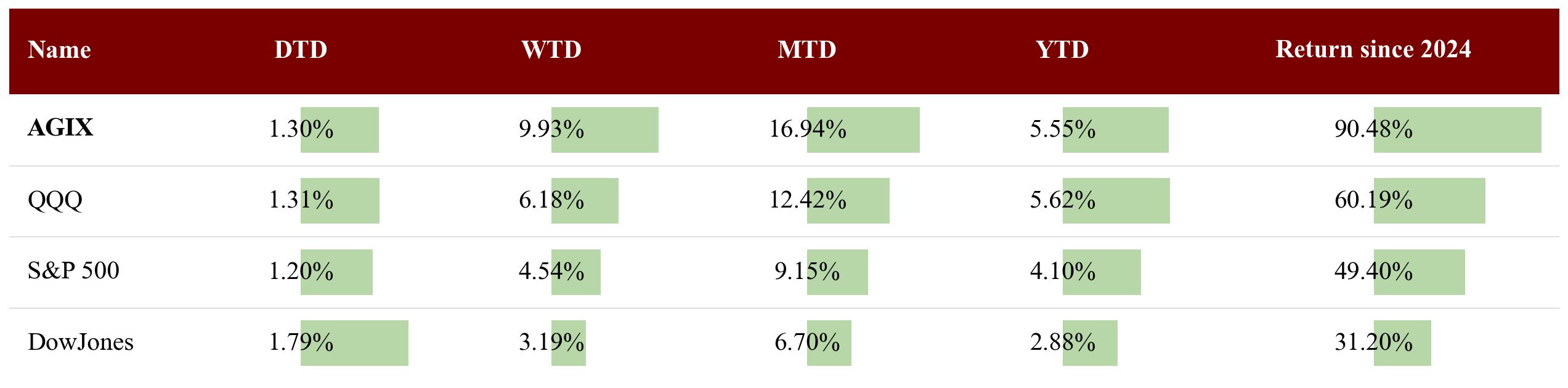
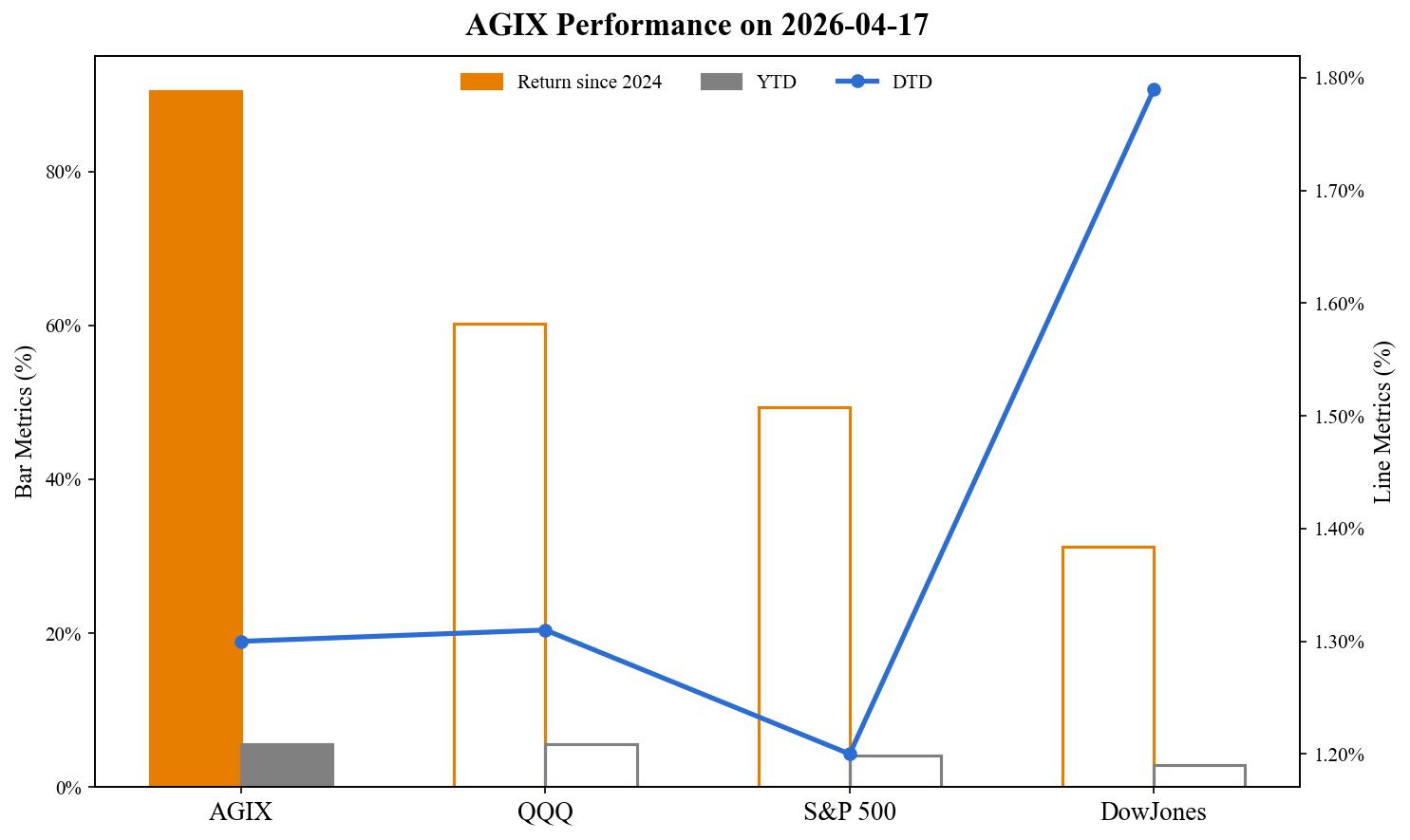
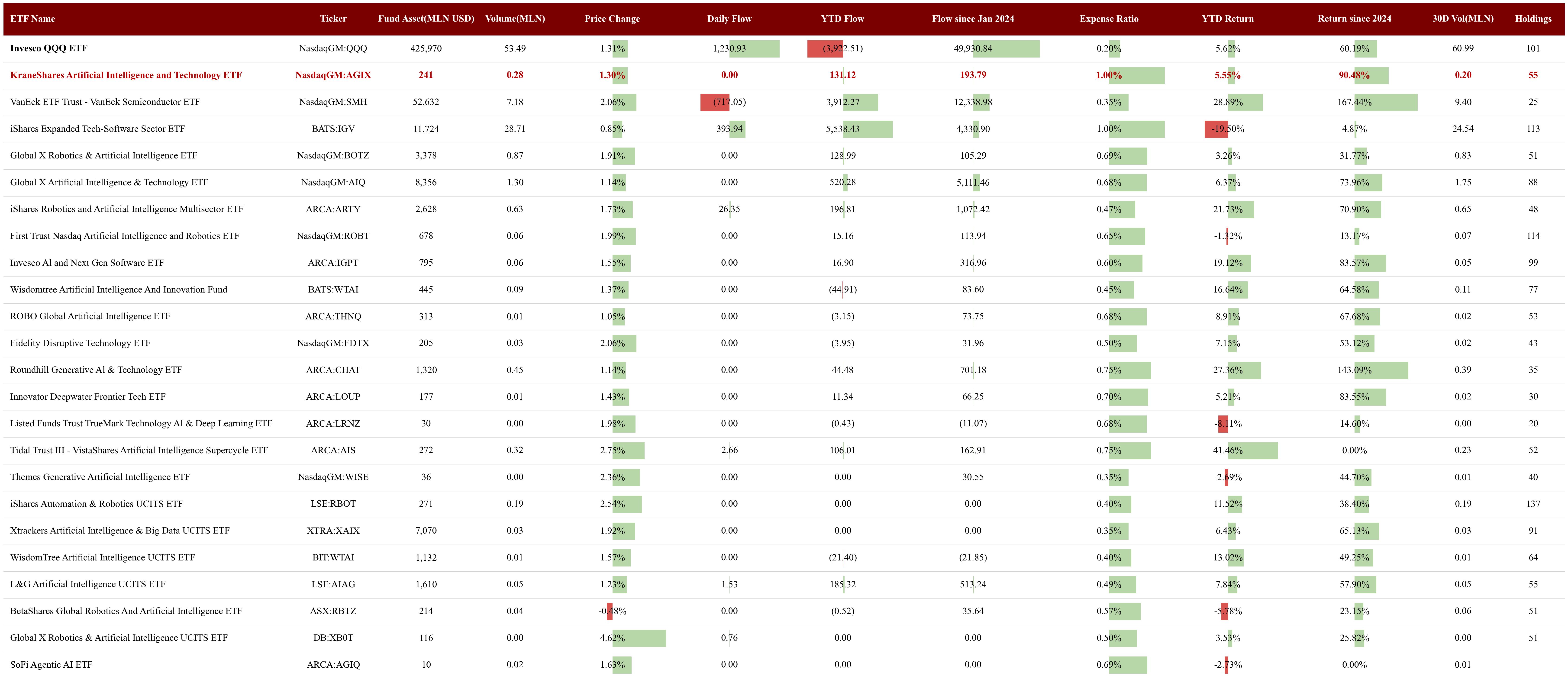
• AGIX outperformed major benchmarks (QQQ, S&P 500, Dow Jones) on a WTD (+9.93%) and MTD (+16.94%) basis, though its DTD (+1.3%) was slightly behind QQQ (+1.31%). Its long-term return since 2024 (+90.48%) significantly outpaces the broader market.
• Key holdings driving performance include NVIDIA (+1.68% DTD, +307.48% since 2024), Meta Platforms (+1.73% DTD), and Apple (+2.59% DTD). Notable positive contributors were TeraWulf (+6.89% DTD), Riot Platforms (+7.03% DTD), and Hut 8 (+5.61% DTD), all within the Infrastructure sector.
• Negative pressure came from holdings like Netflix (-9.72% DTD), Atlassian (-2.6% DTD), and Nebius Group (-4.96% DTD).
• Today's watchlist includes NVIDIA, Apple, and Broadcom due to positive sector momentum and news flow. Also watch TeraWulf and Riot Platforms for continuation of their strong moves. Monitor Netflix for potential stabilization after its significant decline.
News Highlights
1. Anthropic launched Claude Opus 4.7, showing major improvements in coding and visual reasoning. This intensifies competition in the AI coding space, potentially pressuring holdings like Atlassian (which acquired DX for coding agent ROI) and could impact sentiment around pure-play AI coding startups.
2. Canva unveiled Canva AI 2.0, repositioning as an agentic system. This broadens the competitive landscape for AI-powered productivity and design tools, though direct overlap with AGIX's core holdings is limited.
3. Factory raised $150M at a $1.5B valuation for AI coding agents for enterprises. This highlights sustained VC interest and validates the enterprise AI coding market, a positive signal for the sector.
4. OpenAI boosted Codex's agentic capabilities to compete with Claude Code. This is a direct competitive response to Anthropic and underscores the fierce battle in the AI-assisted developer tools market.
5. Zscaler partnered with OpenAI for AI-powered security, gaining early access to models like GPT-5.4-Cyber. This strengthens Zscaler's (an AGIX holding) security offerings and aligns with the 'AI + security' trend, a positive for the stock.
6. Netflix plans to add a vertical video feed and use AI for recommendations. As a top AGIX holding, Netflix's increased AI integration for content discovery and creation is a key strategic move to drive engagement and ad revenue.
7. Cursor is in talks to raise over $2B at a $50B valuation. This massive funding round highlights extreme investor enthusiasm for AI coding tools and could lift sentiment across the AI application software sector.
8. Cerebras Systems filed for an IPO, reporting rapid revenue growth and a major deal with OpenAI. This signals robust health in the AI infrastructure layer and could benefit related hardware holdings like NVIDIA and Broadcom.
RSS Highlights
1. Insufficient information. No RSS hotlist subscriptions were provided in the inputs.
Performance & Benchmark
Attribution
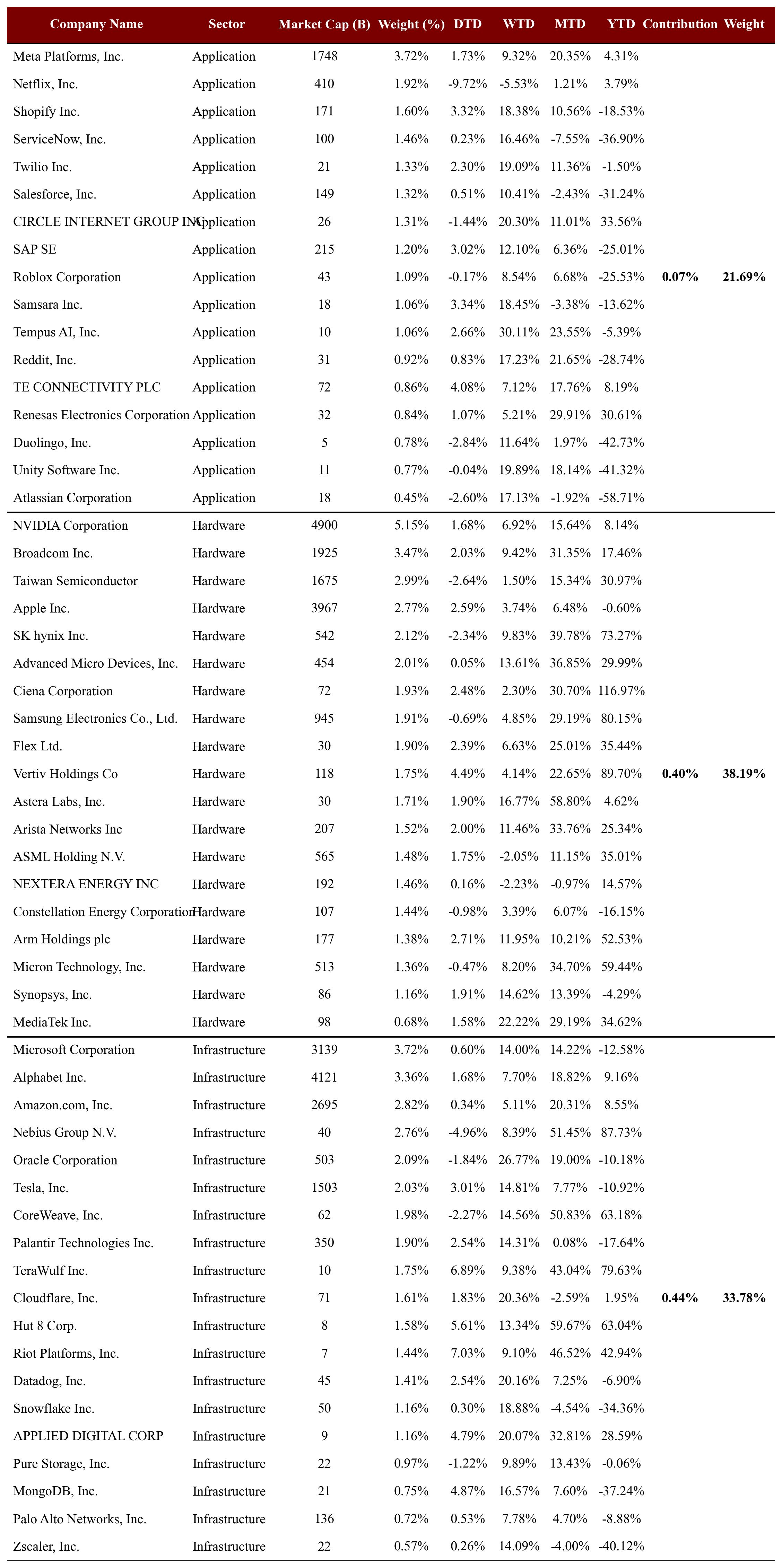
Contribution of the three sectors within AGIX holdings today
Application: 0.07%
Hardware: 0.4%
Infrastructure: 0.44%
Top-performing stocks in AGIX holdings today
Riot Platforms, Inc. (7.03%)
TeraWulf Inc. (6.89%)
Hut 8 Corp. (5.61%)
MongoDB, Inc. (4.87%)
APPLIED DIGITAL CORP (4.79%)
Vertiv Holdings Co (4.49%)
TE CONNECTIVITY PLC (4.08%)
Samsara Inc. (3.34%)
Shopify Inc. (3.32%)
SAP SE (3.02%)
Tesla, Inc. (3.01%)
Arm Holdings plc (2.71%)
Tempus AI, Inc. (2.66%)
Apple Inc. (2.59%)
Palantir Technologies Inc. (2.54%)
Datadog, Inc. (2.54%)
Ciena Corporation (2.48%)
Flex Ltd. (2.39%)
Twilio Inc. (2.3%)
Broadcom Inc. (2.03%)
Worst-performing stocks in AGIX holdings today
CoreWeave, Inc. (-2.27%)
SK hynix Inc. (-2.34%)
Atlassian Corporation (-2.6%)
Taiwan Semiconductor Manufacturing Company Limited (-2.64%)
Duolingo, Inc. (-2.84%)
Nebius Group N.V. (-4.96%)
Netflix, Inc. (-9.72%)
Top five listed stocks contributing the most within AGIX holdings today
TeraWulf Inc. (6.89%)
Riot Platforms, Inc. (7.03%)
Hut 8 Corp. (5.61%)
NVIDIA Corporation (1.68%)
Vertiv Holdings Co (4.49%)
Observation
The strongest movers across peer ETF holdings today are listed below:
| DTD | Stock Ticker | Name | Held by ETFs | analysis |
|---|---|---|---|---|
| 16.39 | NYSE:ZEPP | Zepp Health Corporation | ['NasdaqGM:WISE'] | The search results provided do not contain any news events, company disclosures, regulatory announcements, or other verifiable public information that would explain Zepp Health's 16.39% single-day gain on April 17, 2026. The results only show historical price data and options metrics without any corresponding catalysts or drivers for the move. Without access to contemporaneous news or company announcements from that date, I cannot reliably attribute the stock's movement. |
| 12.51 | NasdaqGS:MXL | MaxLinear, Inc. | ['LSE:RBOT'] | MaxLinear (MXL) stock surged 12.51% on April 17, 2026, primarily driven by a strong quarterly earnings beat, with EPS of $0.19 versus $0.18 expected and revenue of $136.4M, up 48% YoY.[1][2][5] Elevated trading volume of around 1.22M shares, 7% above average, amplified the move amid a multi-day uptrend.[1][7] Despite the rally, analysts maintain a Hold consensus with an average price target of $19.57, reflecting ongoing unprofitability concerns.[1] |
| 11.81 | TSE:3697 | SHIFT Inc. | ['LSE:RBOT'] | SHIFT Inc. (TSE:3697) rose 11.81% on April 17, 2026, primarily due to a positive market reaction to its half-year earnings release for the period ended February 28, 2026, which reported strong sales of ¥72,035 million and net income of ¥4,011 million.[1][5] The earnings beat expectations, shifting short-term sentiment and driving the single-day gain, despite a higher P/E ratio of 22.7x compared to industry peers.[1] No other same-day news events were identified as contributing factors.[1][5] |
| 11.8 | NasdaqGS:MSTR | Strategy Inc | ['NasdaqGM:QQQ', 'BATS:IGV', 'ARCA:IGPT', 'LSE:RBOT', 'XTRA:XAIX'] | MSTR's 11.8% gain on April 17, 2026, was primarily driven by a Bitcoin price breakout to the mid-$70k range, amplifying the stock's role as a leveraged BTC proxy, followed by the company's announcement of a ~$1B purchase of 13,927 BTC that boosted its treasury to 780,897 BTC.[1][3] Analyst upgrades, including B. Riley raising its price target to $188 and TD Cowen to $385, further fueled bullish sentiment and options flow.[1][3] Broader tech sector strength and heavy trading volume provided secondary support amid positive crypto momentum.[1][4] |
| 11.71 | NasdaqGS:CIFR | Cipher Mining Inc. | ['BATS:IGV'] | Cipher Mining Inc. (CIFR) rose 11.71% on April 17, 2026, likely driven by a rebound from the prior day's 4.7% decline to $17.16 amid low trading volume, coupled with pre-market strength to $17.70 (up 2.07%). Technical factors supported the move, including a flag breakout pattern after pulling back to the 20-day SMA with a buy rating[5]. No specific company news or disclosures were reported for the date, amid bullish analyst consensus (Moderate Buy, $24.82 target)[1]. |
| 11.11 | NasdaqGM:DOMO | Domo, Inc. | ['LSE:RBOT'] | Domo's (DOMO) 11.11% stock rise on April 17, 2026, was driven by positive investor reaction to its Q4 fiscal 2026 earnings beat announced earlier in the week, with shares continuing to climb from after-hours gains exceeding 30%.[1][3][4] Key factors included revenue of $79.6 million topping consensus estimates of $79.03 million and non-GAAP EPS of $0.03 versus an expected loss of $0.03, alongside subscription RPO growth of 8% year-over-year to $437.9 million signaling future revenue strength.[3][4][5] Despite subsequent analyst price target cuts citing softer software multiples, retail sentiment surged to extremely bullish levels.[4] |
| 10.73 | NYSE:ESAB | ESAB Corporation | ['LSE:RBOT'] | ESAB Corporation (NYSE:ESAB) surged 10.73% on April 17, 2026, primarily due to a strong rebound from recent war-driven weakness, fueled by reaffirmed 2026 guidance of 6-9% core sales growth, solid EBITDA/EPS trajectory, and positive Wall Street analyst commentary maintaining "Moderate Buy" ratings with targets of $130-142[1][2][4][5]. Buyers aggressively stepped in after a 19% drawdown tied to Middle East disruptions, with technicals showing higher lows, strong intraday volume near highs, and support at $104 confirming bullish reversal[1][2][4][5]. Analyst optimism persisted despite near-term order pauses, viewing the dip as a buying opportunity ahead of Q1 earnings[3][4][5]. |
| 9.9 | TWSE:6531 | AP Memory Technology Corporation | ['ARCA:AIS'] | No verifiable public news events, company disclosures, or catalysts explain AP Memory Technology (TWSE:6531)'s 9.9% single-day gain on April 17, 2026, from 289.50 TWD to 586.00 TWD[1]. The stock's high volatility (10.4% average weekly movement, beta 1.12) suggests possible trading or momentum factors amid broader semiconductor sector dynamics[3][4]. Recent quarterly net income declined 33.94% to 331.91 M TWD, providing no fundamental support for the surge[4]. |
| 9.87 | TPEX:5425 | Taiwan Semiconductor Co., Ltd. | ['ARCA:AIS'] | No specific news events, company disclosures, or catalysts explain the 9.87% rise in Taiwan Semiconductor Co., Ltd. (TPEX:5425) on April 17, 2026. The stock had declined 3.13% the prior day (April 16) amid a downgrade to Hold/Accumulate, potentially setting up a rebound, with prices moving from a close of 363.35 to around 365-375 range.[2][4] Search results lack same-day drivers, suggesting possible technical bounce or market factors.[1][4] |
| 9.83 | XTRA:NEM | Nemetschek SE | ['ARCA:IGPT', 'LSE:RBOT'] | No verifiable public information attributes Nemetschek SE's (XTRA:NEM) 9.83% single-day gain on 2026-04-17. Search results reference Newmont Corporation (NYSE:NEM) short interest decline and options data, which are unrelated to Nemetschek SE. Without relevant same-day news, company disclosures, or catalysts, the drivers cannot be identified. |
| 9.79 | TWSE:4919 | Nuvoton Technology Corporation | ['LSE:RBOT'] | Nuvoton Technology Corporation (TWSE:4919) surged 9.79% on April 17, 2026, primarily due to the resumption of trading on its listed common stocks and related call/put warrants, as announced by the Taiwan Stock Exchange.[4] A key official document (ID: 1150006589) was released that day, likely signaling the end of a prior trading halt and restoring investor access.[6] No specific company news or broader sector catalysts were identified in available data to explain the sharp rebound.[1][3] |
| 8.84 | NYSE:ONTO | Onto Innovation Inc. | ['ARCA:ARTY', 'LSE:RBOT'] | Onto Innovation (NYSE:ONTO) stock rose 8.84% on April 17, 2026, primarily driven by a preannounced Q1 revenue beat of $292M versus $275M–$285M guidance and $280.34M consensus, coupled with raised Q2 guidance to $320M–$330M above $303.27M expectations[1][2]. A key secondary catalyst was Stifel's upgrade to Buy with a $350 price target (from $220 Hold), highlighting the overlooked qualification of the Dragonfly G5 system by TSMC for 2.5D AI advanced packaging[4][6]. These factors signaled strong AI-driven semiconductor demand, fueling the breakout from $253 to $291[1][2]. |
| 8.65 | NasdaqGS:GFS | GlobalFoundries Inc. | ['NasdaqGM:QQQ', 'ARCA:AIS'] | GlobalFoundries (GFS) stock rose 8.65% on April 17, 2026, primarily driven by continued momentum from recent positive quarterly results and analyst upgrades, pushing shares to a new high near $53.94 on elevated volume of 3.42 million shares. The company had beaten Q4 estimates with EPS of $0.55 versus $0.47 expected and revenue of $1.83B versus $1.80B, alongside Q1 2026 guidance of $0.30–$0.40 EPS.[1] Prior-day strength, including a 52-week high of $51.01 and target hikes from firms like Needham to $55 and Baird to $60, sustained the upside despite a Hold consensus rating and $46.13 average target.[1][2] An insider sale of $86,958 worth of stock occurred but did not deter the rally.[1] |
| 8.08 | NASDAQGM:INOD | Innodata Inc. | ['NasdaqGM:ROBT'] | No specific news events, company disclosures, or catalysts explain Innodata Inc. (INOD)'s 8.08% gain on April 17, 2026, which closed at $46.93 with volume of 1,187,461 shares.[1][3][5] The stock rose from a previous close of $43.42, hitting an intraday high of $48.38, but search results lack any attributable drivers such as earnings, announcements, or sector developments on that date.[3] Trading appears driven by general market activity without identifiable catalysts.[1][5] |
| 7.75 | SEHK:1274 | iMotion Automotive Technology (Suzhou) Co., Ltd. | ['NasdaqGM:BOTZ', 'ASX:RBTZ', 'DB:XB0T'] | No verifiable news events, company disclosures, or catalysts explain the 7.75% rise in iMotion Automotive (SEHK:1274) on April 17, 2026. Search results lack same-day information, with the most recent data showing declining revenue to C¥366 million in 1H 2025 and ongoing losses of C¥415.8 million TTM, alongside a stock price around HK$3.32-3.38 in early April 2026[2][5]. The move may reflect technical trading or untraceable factors absent from public records. |
| 7.36 | NasdaqGS:VICR | Vicor Corporation | ['ARCA:AIS'] | VICR's 7.36% single-day gain on April 17, 2026, was primarily driven by investor positioning ahead of the Q1 2026 earnings report scheduled for April 21, pushing the stock to a new 52-week high of $217.[1][3] A recent blowout quarter with EPS of $1.01 versus $0.38 expected and revenue of $362.7M versus $107.8M expected bolstered sentiment, despite a consensus price target of $118.33.[1] Pre-market CEO insider sales of 40,000 shares on April 16 under a 10b5-1 plan had limited negative impact.[2] |
| 7.29 | SWX:KOMN | Komax Holding AG | ['LSE:RBOT'] | No specific company news, disclosures, or industry events explain Komax Holding AG's (SWX:KOMN) 7.29% gain on April 17, 2026, when the stock rose from 54.90 CHF to 58.90 CHF.[2][5] The move occurred amid a short-term falling trend with mixed technical signals, including a buy from short-term moving averages but a general sell from long-term averages.[2] Broader market catalysts like falling crude oil prices were noted that day but lack direct relevance to Komax's electronics manufacturing equipment business.[4] |
| 7.11 | NasdaqGS:AMKR | Amkor Technology, Inc. | ['ARCA:ARTY'] | Amkor Technology's 7.11% gain on April 17, 2026 was driven primarily by strong Q4 2025 earnings results released that day, which beat consensus estimates with EPS of $0.69 versus $0.43 expected and revenue of $1.89 billion up 15.9% year-over-year.[1] Secondary drivers included analyst upgrades following the earnings beat, with Needham raising its price target to $65 and JPMorgan also raising targets, combined with continued momentum in advanced packaging demand tied to AI/HPC capacity expansion that Amkor guided to invest $2.5-3.0 billion in during 2026.[1][2] Pre-earnings positioning ahead of the Q1 2026 earnings call scheduled for April 27 likely contributed to the rally as well.[2] |
| 7.03 | NasdaqCM:RIOT | Riot Platforms, Inc. | ['NasdaqGM:AGIX', 'BATS:IGV'] | Riot Platforms' 7.03% gain on April 17, 2026 was primarily driven by anticipation ahead of its Q1 2026 earnings call scheduled for April 30, which will provide updates on data center expansion projects and operational metrics demonstrating vertical integration efficiency. The stock's strong performance reflects investor optimism regarding Riot's strategic pivot toward large-scale data center operations and bitcoin mining growth, with the upcoming earnings event serving as a near-term catalyst for disclosure of project timelines and scale metrics. |
| 6.89 | NasdaqCM:WULF | TeraWulf Inc. | ['NasdaqGM:AGIX', 'BATS:IGV'] | TeraWulf (WULF) rose 6.89% on April 17, 2026, primarily driven by the market's positive reaction to the company's completion of a $1.04 billion stock offering announced the prior day.[1][2][5] The offering, which closed on April 16 after selling 54.51 million shares at $19.00 including the full underwriters' option, provided capital for the Hawesville, Kentucky data center expansion, bridge debt repayment, and general purposes, signaling strong financial flexibility and Wall Street backing from lead bookrunners like Morgan Stanley.[1][2] This followed the April 14 pricing announcement and built on recent analyst upgrades and a 52-week high hit on April 15.[3][6] |
| 6.88 | TWSE:2303 | United Microelectronics Corporation | [] | United Microelectronics Corporation (TWSE:2303) gained 6.88% on April 17, 2026, driven primarily by strong Q1 sales results and positive analyst sentiment shift. The company reported March 2026 net sales of NT$20.83B, up 4.89% year-over-year, and Q1 sales of NT$61.04B, up 5.49%, demonstrating steady foundry demand that traders rewarded with a 3%+ premarket gap and continued buying throughout the session. BNP Paribas upgraded UMC from Underperform to Neutral on the same day, easing prior bearish pressure and contributing to the momentum, while the stock's move from approximately $9.00 in late March to $11.69 by April 17 reflected accumulating positive sentiment backed by real revenue growth. |
| 6.76 | TSX:MG | Magna International Inc. | ['NasdaqGM:ROBT'] | Magna International (TSX:MG) rose 6.76% on April 17, 2026, primarily due to a technical breakout as the stock price passed above its 200-day moving average of C$73.67, reaching a high of C$84.02 on elevated volume of ~2.52 million shares.[1][3] No company-specific news, earnings, or industry events were reported to drive the move, leaving technical factors as the dominant catalyst.[1][2] The stock closed at C$83.03, aligning with a short-term rising trend signaled by moving averages.[1][3] |
| 6.56 | NasdaqGS:PONY | Pony AI Inc. | ['NasdaqGM:BOTZ', 'NasdaqGM:AIQ', 'NasdaqGM:WISE', 'ASX:RBTZ', 'DB:XB0T'] | The search results provided do not contain verifiable public information about specific news events, company disclosures, or market catalysts on April 17, 2026 that would explain Pony AI's 6.56% single-day gain. The available data shows only historical stock pricing from April 18, 2026, insider RSU grant activity from earlier in April, and options market data, none of which directly attribute the April 17 move. Without access to same-day news, earnings announcements, regulatory filings, or industry developments from that date, a reliable attribution cannot be provided based on the search results. |
| 6.47 | ENXTPA:STMPA | STMicroelectronics N.V. | ['NasdaqGM:SMH', 'BIT:WTAI'] | No specific news events, company disclosures, or analyst actions on April 17, 2026, explain STMicroelectronics' (ENXTPA:STMPA) 6.47% single-day gain from 35.35 to 37.21. The move aligns with ongoing positive momentum in the semiconductor sector, following a new 52-week high of $40.10 reached on NYSE:STM four days earlier on April 13, driven by upgrades from Susquehanna and Morgan Stanley.[1][3] Broader trading factors, including elevated volume and short-term technical recovery, likely amplified the advance amid a prior downtrend.[2][3] |
| 6.35 | TWSE:2388 | VIA Technologies, Inc. | ['LSE:RBOT'] | No specific news events, company disclosures, or catalysts explain VIA Technologies (TWSE:2388)'s 6.35% gain on April 17, 2026, as search results lack same-day information for that future date.[1][2][3] Available historical data only covers up to October 2025, with no mentions of April 2026 activity or drivers like revenue updates or industry developments.[5] The move may reflect technical trading or untraceable market factors, but cannot be attributed with public evidence.[4] |
| 6.29 | XTRA:IFX | Infineon Technologies AG | ['NasdaqGM:AIQ', 'ARCA:THNQ', 'LSE:AIAG'] | I cannot provide a reliable attribution for Infineon's 6.29% move on April 17, 2026, as the search results contain no news events, company disclosures, or market catalysts from that date. The available data only includes historical price information and general company fundamentals, with the most recent dated commentary from January 2026. Without verifiable same-day news or events, any attribution would be speculation rather than analysis grounded in public information. |
| 6.27 | NasdaqGS:NTRA | Natera, Inc. | ['ARCA:LRNZ'] | Natera (NTRA) rose 6.27% on April 17, 2026, primarily driven by Wall Street Zen's analyst upgrade from "hold" to "buy," which directly correlated with the intraday uptick.[2] This bolstered the consensus "Moderate Buy" rating with an average price target of $253.47, amid recent insider selling earlier in April but strong institutional ownership near 99.9%.[1][2][3] Trading volume hit 35,228 shares, with the stock opening at $200.14, hitting a high of $209.28, and closing around $208.[4][5] |
| 6.24 | NasdaqCM:NN | NextNav Inc. | ['BATS:IGV'] | NextNav (NN) gained 6.24% on April 17, 2026, driven primarily by Oppenheimer's upgrade to "outperform" with a $25 price target and UBS's matching $25 target, both issued on Thursday. The stock had already reached a new 52-week high of $21.57 during the session, reflecting strong institutional accumulation with 79% ownership. The analyst upgrades provided technical support for the rally despite the company's unprofitable operations and minimal $0.95M quarterly revenue. |
| 6.12 | SEHK:2158 | Yidu Tech Inc. | ['NasdaqGM:WISE'] | No specific news events or company disclosures on April 17, 2026, explain Yidu Tech's 6.12% single-day gain on SEHK:2158. Recent share repurchases, including 15-16 buybacks in January and February 2026 totaling over HKD 64 million, signal management confidence in the AI healthcare strategy but predate the move[1]. Positive analyst views on 21.3% revenue growth and profitability targets within three years may have supported broader sentiment[4]. |
| 5.95 | NasdaqGS:MTSI | MACOM Technology Solutions Holdings, Inc. | [] | MACOM Technology Solutions (MTSI) rose 5.95% on April 17, 2026, primarily driven by a Stifel Nicolaus analyst upgrade raising the price target from $255 to $300 while maintaining a Buy rating, pushing shares to a new 52-week high of $267.92.[1] Reinforcing the move, the company reported better-than-expected Q1 results with EPS of $1.02 versus $0.99 estimated, revenue of $271.6M (up 24.5% YoY), and Q2 guidance of $1.05–$1.09 EPS.[1] Additional analyst actions, including Benchmark's prior target increase, contributed to positive sentiment amid a Moderate Buy consensus.[1][3] |
| 5.93 | ENXTPA:FR | Valeo SE | ['NasdaqGM:ROBT'] | Valeo SE (ENXTPA:FR) shares rose 5.93% on April 17, 2026, primarily due to a technical gap-up at the open with no specific company news disclosed. The stock opened at $6.89 from a prior close of $6.4560 (OTC equivalent VLEEY), last trading at $6.88 on volume of 62,666 shares, aligning with the observed move.[1][5] Analyst consensus remained "Hold" with recent reissues from Morgan Stanley ("overweight") and Deutsche Bank ("hold"), but lacked same-day catalysts.[1] |
| 5.81 | NYSE:HY | Hyster-Yale, Inc. | ['LSE:RBOT'] | I cannot provide a reliable attribution for Hyster-Yale's 5.81% move on April 17, 2026, based on the available search results. The search results contain only a reference to a subsequent trading session showing a 2.73% gain and historical price data from March 2026, with no news events, earnings announcements, regulatory developments, or other material disclosures specific to April 17, 2026. Without verifiable same-day catalysts or company-specific information from that date, any attribution would be speculation rather than analysis grounded in public information. |
| 5.75 | NasdaqGS:RMBS | Rambus Inc. | [] | Rambus Inc (RMBS) rose 5.75% on April 17, 2026, driven primarily by a significant decrease in short interest and positive momentum from strong recent performance. Short interest fell 13.4% in March to 5.99 million shares (5.6% of outstanding), reducing bearish pressure on the stock. The stock's 35.8% monthly gain and 14.9% weekly advance likely contributed to continued buying interest, though the move occurred against a backdrop of analyst downgrades—Susquehanna cut its price target from $100 to $90 in early February—and insider selling of $5.85 million over the prior 90 days, suggesting the rally was driven by technical factors and short covering rather than fundamental catalysts. |
| 5.69 | NasdaqGS:KC | Kingsoft Cloud Holdings Limited | ['XTRA:XAIX'] | Kingsoft Cloud (NasdaqGS:KC) rose 5.69% on April 17, 2026, primarily driven by momentum from hitting a new 1-year high the prior day on April 16, fueled by positive analyst upgrades including Goldman Sachs to buy and Jefferies raising its target to $19, establishing a "Moderate Buy" consensus with a $18.48 target.[1] The stock traded up to $18.01 on elevated volume of 375,922 shares versus the prior close of $16.88, reflecting sustained buying interest and institutional accumulation (13.4% hedge fund ownership).[1] No company-specific news or disclosures emerged on the 17th to explain the continuation.[3] |
| 5.61 | NasdaqGS:HUT | Hut 8 Corp. | ['NasdaqGM:AGIX', 'BATS:IGV', 'NasdaqGM:AIQ'] | Hut 8 Corp. (HUT) rose 5.61% on April 17, 2026, primarily driven by the company's announcement of its Q1 2026 earnings release and conference call scheduled for May 6, which highlighted its energy infrastructure platform for AI and high-performance computing.[3][4] This same-day press release from Miami likely boosted investor confidence in upcoming performance insights amid sector interest.[2] Broader bullish sentiment, including a "Strong Buy" analyst consensus and recent 52-week highs earlier in the week, provided additional support.[1][5] |
| 5.19 | NYSE:COHR | Coherent Corp. | ['NasdaqGM:FDTX', 'ARCA:LOUP'] | No specific news events, company disclosures, or catalysts explain Coherent Corp. (COHR)'s 5.19% single-day gain on April 17, 2026, closing at $345.02 on elevated volume of 5.6 million shares.[2][3] Stock price history confirms the move from an opening around $328 but lacks attribution to same-day developments.[1][2] Broader market or sector momentum may have contributed, though unverified in available data.[1][4] |
| 5.17 | NasdaqGS:HTFL | HeartFlow, Inc. | ['ARCA:LRNZ'] | HeartFlow (HTFL) stock rose 5.17% on April 17, 2026, with no identifiable company-specific news, disclosures, or catalysts in available sources to directly attribute the move. The price closed at $31.34, reflecting elevated options implied volatility of 130.6% and a market cap near $2.6 billion amid broader positive year-to-date performance of about 7.51%.[1][3] Trading factors such as high IV may have amplified intraday momentum in the absence of same-day events.[1] |
| 5.14 | NasdaqGS:SMTC | Semtech Corporation | [] | Semtech (SMTC) stock rose 5.14% on April 17, 2026, driven primarily by continued momentum from a new 52-week high hit the prior day amid positive analyst upgrades. Key drivers include analyst price target increases (Oppenheimer to $110, Needham to $105, consensus $93.50 with Moderate Buy rating)[2] and high trading volume supporting the breakout above prior averages[1][2]. No same-day company news or disclosures were reported[4]. |
| 5.01 | TSE:4373 | Simplex Holdings, Inc. | ['LSE:RBOT'] | I cannot provide a reliable attribution for Simplex Holdings' 5.01% single-day move on April 17, 2026, as the search results contain no news events, company disclosures, or market catalysts specific to that date. The available data includes only historical price information, valuation metrics, and general company background, with the most recent dated information from April 16, 2026. Without verifiable same-day news or events, any attribution would be speculative. |
News
Funding & M&A
Slash secures $100 million in funding at a $1.4 billion valuation to grow its AI-powered banking platform for online businesses.
Ticker: nan
Commercial banking startup Slash Financial Inc. today announced the completion of a $100 million Series C funding round, valuing the company at $1.4 billion. The funds will be used to advance product development and strengthen its AI-driven back-office system for small and medium-sized businesses. Founded in 2020, the company offers an integrated platform combining FDIC-insured business checking accounts, corporate credit cards, unlimited cash back, expense management, treasury services, global payments, invoicing, working capital, and stablecoin support. Slash operates as a software layer, partnering with Column N.A. to provide deposit and card services. The corporate cards are issued by Visa, and idle funds are routed to money market funds through a partnership with Atomic Invest LLC. The platform also integrates expense management, accounting automation, invoicing, and APIs to support customized workflows. The company focuses on vertical-specific tools, serving affiliate marketers, e-commerce operators, agencies, healthcare providers, contractors, wholesalers, online travel agencies, and Web3 businesses. It already serves over 5,000 clients, including Bland Inc., Entry Inc., Triumph Labs Inc., Drink Nectar Inc., and Hike Outdoor LLC. This funding round was led by Ribbit Capital, Khosla Ventures, and Goodwater Capital LP, with participation from New Enterprise Associates Inc. and Y Combinator. Previously, Slash pivoted from serving sneaker resellers to commercial banking and integrated AI. Its annualized card transaction volume exceeded $1 billion in 2024 and reached $3 billion in 2025. The new capital will help transform the platform into a self-service financial function for clients. CEO Victor Cardenas stated that by year-end, Slash will fully run a company's financial back office. In the wave of industry-specific commercial banking startups, Slash differentiates itself with narrow vertical workflow software compared to Mercury Technologies Inc. and Ramp Business Corp.
Factory reaches a $1.5 billion valuation to develop AI coding solutions for enterprises.
Ticker: ['BX', 'MS', 'PANW']
Amid fierce competition in the AI coding space, startup Factory announced it has raised $150 million in funding, reaching a valuation of $1.5 billion. This round was led by Khosla Ventures, with participation from Sequoia Capital, Insight Partners, and Blackstone, among others. Khosla Ventures Managing Director Keith Rabois is joining the board. Factory focuses on developing AI agents for enterprise engineering teams. Its core strength lies in its ability to flexibly switch between multiple foundational models, such as Anthropic's Claude and models from Chinese AI startup DeepSeek, although competitors like Cursor also possess similar capabilities. Founder Matan Grinberg is a UC Berkeley Ph.D. student who was persuaded to drop out and start the company in 2023 by Sequoia partner Shaun Maguire, who also provided seed funding. Current Factory clients include engineering teams at well-known enterprises like Morgan Stanley, Ernst & Young, and Palo Alto Networks. Investors believe that despite competition from players like Anthropic, Cursor, and Cognition in the AI-assisted coding arena, there is still room for new entrants. This funding round highlights the continued enthusiasm and investment potential for generative AI in the enterprise engineering domain.
New leaders, new fund: Sequoia has raised $7 billion to expand its investments in AI.
Ticker: nan
Sequoia Capital, a top-tier Silicon Valley venture capital firm, continues to increase its bets in the artificial intelligence field. According to Bloomberg, the firm recently raised approximately $7 billion for a new fund dedicated to its 'expansion strategy'—its late-stage investment division focused on the U.S. and Europe. This amount is nearly double the $3.4 billion raised for a similar fund in 2022, marking Sequoia's aggressive bet on late-stage investments amid the AI wave. The new fundraise also follows a leadership transition at Sequoia, with Alfred Lin and Pat Grady now jointly leading the 54-year-old legendary firm. Sequoia views AI as a core focus for the future, having invested in two leading AI companies, OpenAI and Anthropic, both rumored to go public in 2026, potentially delivering massive returns for Sequoia. Beyond foundational AI giants, Sequoia is also bullish on application-focused startups, such as Bay Area robotics company Physical Intelligence and Factory, which builds AI agents for enterprise engineering teams. This fundraise highlights how quickly companies are scaling in the AI era, requiring venture capital to adjust its strategies to support a comprehensive ecosystem ranging from underlying technology to practical applications.
Resolve AI secures $40 million at a $1.5 billion valuation to optimize production environments.
Ticker: ['CRM', 'DASH']
Resolve AI Inc., a startup that helps companies improve infrastructure reliability, recently completed a $40 million funding round led by DST Global and Salesforce Ventures. This is an extension of its $125 million Series A funding announced in early February, bringing its total valuation to $1.5 billion, a $500 million increase from three months ago. The company's platform uses AI to investigate production environment issues, automatically checking error history and configuration changes, and generating fault timelines and root cause analyses. For example, it can determine whether an application outage is due to code quality issues or server failure. Additionally, the platform provides user impact charts, natural language troubleshooting suggestions, and cost optimization, such as migrating to cheaper cloud instances. In a demo, Resolve AI also designed a rate limiter combining custom code with open-source components. The software is already adopted by tech giants like Salesforce Inc. and DoorDash Inc. The new funds will be used to expand platform capabilities, including forming a Resolve AI Labs team to develop optimized AI models for error logs and performance metrics. Founder Spiros Xanthos stated that while foundation models are advancing rapidly, production environments require handling fragmented telemetry, long processes, and high accuracy, necessitating dedicated optimization. This funding round highlights strong demand for AI in the operations field.
Netflix plans to add a vertical video feed, use AI for recommendations
Ticker: ['NFLX']
Netflix will launch a TikTok-like vertical video feed within its app this month and plans to widely apply AI to content creation and recommendation systems. The company has been testing this short video feature since last year, which helps users discover video podcasts, series, and movies. Netflix already launched a ChatGPT-powered search feature last year, further strengthening its AI recommendation capabilities. Co-CEO Gregory Peters stated that while the company has been refining personalized recommendations for two decades, there is still significant room for improvement with new model architectures, enabling more efficient support for diverse content types. The other Co-CEO, Ted Sarandos, emphasized that generative AI will optimize the entire content creation process, providing better tools for artists to realize their visions rather than replacing them. Last month, Netflix acquired Ben Affleck's AI creation company, Interpositive. This proprietary technology, designed for filmmaking, is favored by creators and is already seeing adoption momentum. The company also plans to use AI to upgrade its advertising suite, supporting new formats and customization to improve returns, with ad revenue expected to reach $3 billion this year. In the first quarter, Netflix's revenue was $12.25 billion, a 16.2% year-over-year increase; profit soared 83% to $5.28 billion. Founder and Chairman Reed Hastings will step down from the board this summer. Meanwhile, the company raised subscription prices in the US last month, which may benefit next quarter's performance, with paid subscribers expected to reach 325 million by the end of 2025.
AI + quantum, Amazon vs. Starlink and the wide-open US-China internet battle
Ticker: ['NVDA', 'HPE', 'AMZN', 'GSAT', 'AAPL', 'ORCL', 'BABA', 'BIRD', 'GOOGL', 'IBM', 'INTC', 'NOW', 'SAP', 'TSM', 'CRM', 'MSFT', 'NVO', 'META', 'AVGO']
The quantum computing field continues to heat up. Nvidia launched the Ising AI model for quantum error correction, promoting the fusion of quantum and AI. Hewlett Packard Enterprise's Quantum Day event emphasized a new era of AI, quantum, and high-performance computing. Amazon invested nearly $12 billion to acquire Globalstar, strengthening its satellite internet layout to compete with Elon Musk's Starlink, while also settling with Oracle to establish a high-speed connection between Oracle Cloud and AWS. A Stanford HAI report stated that China has closed the AI lead gap with the US, and Alibaba released the highly competitive Qwen model. The footwear brand Allbirds suddenly pivoted to become an AI company, raising questions. Several companies announced progress on AI agents: OpenAI enhanced Codex agent capabilities, Anthropic upgraded Claude Code and Opus 4.7, and Google launched Gemini 3.1 Flash TTS and a robotics model. Funding activity is lively: Resolve AI raised $40 million at a $1.5 billion valuation, Mintlify raised $45 million Series B at a $500 million valuation, Bluefish raised $43 million Series B, etc., focusing on agent AI and infrastructure. OpenAI acquired Hiro Finance, and Meta deepened its collaboration with Broadcom on custom AI processors. The corporate earnings season has begun, with IBM, Intel, and others set to report, highlighting that the AI boom is not over.
Loop raises $95M to build supply chain AI that predicts disruptions
Ticker: ['JPM', 'UBER']
San Francisco startup Loop announced the completion of a $95 million Series C funding round, led by Valor Equity Partners and the Valor Atreides AI Fund, with participation from top Silicon Valley investment institutions such as 8VC, Founders Fund, Index Ventures, and JPMorgan's Growth Equity Partners. This funding comes at a time of intense demand for engineering talent in the tech sector. Loop's co-founder and CEO Matt McKinney and CTO Shaosu Liu (former Uber employee) stated that a significant portion of the funds will be used for hiring to accelerate growth. Loop uses AI technology to process unstructured data in the supply chain (such as PDFs, paper documents, and digital messages). By coordinating its internal models with cutting-edge large models, it provides predictive and prescriptive solutions, helping clients identify cost losses, time waste, and supply-demand risks, achieving immediate savings of thousands of dollars. Loop is integrating customer ERP systems, transportation management systems, and supplier warehouse data to further enhance its predictive capabilities. Valor founder Antonio Gracias praised Loop for transforming fragmented data into a supply chain intelligence layer, with the potential to expand into operational and financial functions. Loop's founders believe their focus on the supply chain vertical is unmatched and benefits from Valor's investment backing in frontier projects like xAI. Facing the accelerated development of AI technology, Loop emphasizes that clients can gain compounding advantages through its platform, building lasting resilience and competitiveness in a volatile environment. Recently, Deliverr secured $85 million in Series A funding, Amari AI emerged from stealth mode, and Uber Freight and Flexport have also increased their AI investments, highlighting the investment boom in AI-driven supply chain optimization.
Sources: Cursor in talks to raise over $2 billion at a $50 billion valuation as enterprise growth surges
Ticker: ['NVDA']
AI coding startup Cursor is close to completing a massive funding round. Four sources reveal the company plans to raise at least $2 billion, following a previous valuation of $50 billion. The new round is led by Thrive Capital and Andreessen Horowitz, with Battery Ventures as a potential new investor, and strategic investor Nvidia also expected to participate. Although the round is oversubscribed, the terms are not yet finalized and may change. If successful, this round would nearly double Cursor's valuation, which was $29.3 billion in its last funding round six months ago. Despite facing strong competition from Anthropic's Claude Code and OpenAI's upgraded Codex, Cursor's revenue is growing rapidly. The company projects an annualized revenue run rate exceeding $6 billion by the end of 2026, at least tripling from $2 billion in February of this year. Cursor previously relied on third-party models, resulting in negative gross margins, but after launching its own Composer model last November and switching to the lower-cost Kimi model, it has achieved slight gross margin profitability, especially in sales to large enterprise clients. The company aims to reduce dependence on external suppliers like Anthropic to avoid the risk of being replaced. Cursor was founded by MIT students in 2022, formerly known as Anysphere.
AI chip developer Cerebras Systems files to go public amid rapid revenue growth
Ticker: ['CBRS', 'NVDA', 'MS', 'AMZN']
Cerebras Systems Inc. filed for an IPO today, planning to list on the Nasdaq under the ticker symbol CBRS. The company had initially filed for an IPO in September 2024 but withdrew the filing late last year, stating it no longer reflected the current business situation. In 2024, Cerebras reported sales of $290.3 million and a loss of $485 million; last year, it turned profitable with earnings of $87.9 million, and revenue grew 76% to $510 million. The company disclosed securing a $125 million revolving credit facility from Morgan Stanley, expandable to $850 million post-IPO, for data center development. Additionally, it obtained a $1 billion loan from OpenAI. In December last year, OpenAI agreed to purchase over $20 billion worth of 750 megawatts of inference infrastructure from Cerebras, with the option to add up to 1.25 gigawatts of capacity by 2030. As part of the deal, Cerebras issued OpenAI warrants for up to 33.4 million shares. Last month, Amazon Web Services (AWS) agreed to deploy Cerebras's WSE-3 chips in its data centers for the decoding phase of large language models, combining them with AWS Trainium chips to form a disaggregated architecture. The WSE-3 boasts a memory bandwidth of 27 PB/s, over 200 times greater than NVIDIA's NVLink. The company plans to develop disaggregated inference solutions compatible with third-party chips to support the growth of its Training Cloud and Inference Cloud services. This IPO marks Cerebras's accelerated expansion in the AI chip market.
Supply chain AI startup Loop secures $95M investment
Ticker: nan
Loop Payments Inc. announced today the completion of a $95 million Series C funding round to upgrade its supply chain optimization platform. The round was led by Valor Equity Partners and the Valor Atreides AI Fund, with participation from several institutional investors including J.P. Morgan Growth Equity Partners. Previously, supply chain invoice processing often incurred additional costs due to errors. Loop's DUX series of AI models is specifically designed to identify inaccurate supply chain invoices. As part of the cloud platform, it also automates multiple related tasks. DUX employs a custom architecture optimized for processing physical supply chain documents. It not only extracts text but also analyzes details such as form fields and seal locations, achieving higher accuracy in interpretation. After scanning an invoice, the AI standardizes information, links data points, and uses AI agents to identify cost discrepancies, reducing freight charge audits from weeks to 2 hours. The platform supports various documents including invoices, bills of lading, and freight rate sheets. It also tracks package locations, identifies bottlenecks, optimizes freight rate negotiations, and automates multi-currency payment processes, supporting early payments for discounts. Valor founder Antonio Gracias stated that Loop's AI system transforms fragmented data into intelligence that improves costs, processes, and working capital. The company will use the funds to expand into more automation scenarios and grow its team. This move highlights the strong application potential of AI in the supply chain field.
Model Releases
Anthropic launches Claude Opus 4.7 with improvements in coding and visual reasoning.
Ticker: nan
Anthropic PBC today officially opened access to the Claude Opus 4.7 large language model, the latest member of its popular Claude series. This model significantly outperforms its predecessor, Opus 4.6, on coding tasks, achieving a score of 64.3% on the SWE-Bench Pro programming benchmark, an improvement of nearly 10%; it also performs better on the Terminal-Bench 2.0 command-line challenge dataset. Despite Opus 4.7's progress in many areas, it is not Anthropic's strongest model. The Claude Mythos, previewed last month, is superior in code generation but has not been widely released due to potential hacker abuse risks. To ensure safety, Opus 4.7 has built-in mechanisms to detect cyberattack attempts. Anthropic will collect data to optimize Mythos's safeguards, aiming to offer 'Mythos-level' models to customers in a secure manner. To support cybersecurity researchers in simulating hacker tactics, the company launched the Cyber Verification Program, relaxing prompt restrictions for professional accounts. Additionally, Opus 4.7 shows improvements in visual reasoning tasks, can process images at higher resolutions and generate UI designs, and approaches Mythos's level on the GPQA Diamond science Q&A benchmark, though it does not match OpenAI's GPT-5.4 performance on the BrowseComp online research test. Concurrently, Anthropic introduced several product updates: the API added an xhigh effort level to optimize cost-performance and a task budget feature to control token usage; the Claude Code programming assistant added ultrareview code review and auto mode for automating long tasks. These updates help developers use AI tools more efficiently.
Canva unveils Canva AI 2.0, repositioning its platform as an agentic system for work.
Ticker: nan
Visual communication platform provider Canva Pty Ltd. today officially launched Canva AI 2.0 at the Canva Create event in Los Angeles, marking the platform's biggest transformation since the company introduced its browser-based design tool in 2013. The new version transforms Canva into a conversational, agentic system, aiming to be a creative partner for teams from the start to the end of their workday, supporting everything from the initial creative spark to final output. Canva AI 2.0 is built around four core capabilities: Conversational Design generates editable designs from natural language prompts; Agentic Orchestration coordinates a suite of tools to execute multi-step goals, like building a multi-channel marketing campaign from a single brief; Object Intelligence enables precise editing of individual elements without regeneration; and Persistent Memory learns user styles and brand preferences to provide continuous context. Furthermore, the company added workflow features, including connections to external tools like Slack, Notion, Zoom, Gmail, Google Drive, and Google Calendar, to automatically generate briefs, sales proposals, and newsletters from emails and calendars; a new scheduling feature supports background timed tasks, and web research instantly pulls structured information. New features also include Brand Intelligence for automatic application, Sheets AI for generating structured tables, and Canva Code 2.0 with HTML import support. Proprietary models driven by Canva's original research team (over 100 researchers), such as Proteus (style transfer), Lucid Origin (image generation), and I2V (image-to-video), are now 7x faster and 30x cheaper. The platform now supports importing externally AI-generated objects for drag-and-drop editing and collaborative publishing. As a research preview, Canva AI 2.0 launches today, first rolling out to the first 1 million users on the homepage, with expansion over the coming weeks.
Technical Breakthroughs
‘Tokenmaxxing’ is making developers less productive than they think
Ticker: ['TEAM']
With the rise of AI coding tools like Claude Code, Cursor, and Codex, software developer productivity metrics are hotly debated. Silicon Valley developers boast about massive token budgets, but experts point out that measuring inputs rather than outputs distorts efficiency evaluations. Emerging developer productivity insight companies reveal that while AI-generated code has an acceptance rate as high as 80%-90%, subsequent revisions lead to a true retention rate of only 10%-30%, with code churn rates rising significantly. Waydev CEO Alex Circei stated that their platform has been rebuilt to track AI agent metadata, providing code quality and cost analysis, currently serving over 10,000 engineers across 50 clients. GitClear reports show that AI users have 9.4 times the code churn rate of non-users; Faros AI data indicates an 861% increase in churn rate with high AI adoption; Jellyfish found that engineers with high token budgets double their throughput but increase costs tenfold. Atlassian acquired DX last year for $1 billion to evaluate coding agent ROI. Industry data consistently shows that AI tools increase code volume but struggle to deliver lasting value, with junior engineers being more affected. Despite the challenges, developers see this as a new, irreversible era in software development.
Google’s AI Mode can now help you find products in stock nearby
Ticker: ['GOOGL']
Google recently introduced a new feature upgrade for AI Mode, aimed at enhancing summer travel planning experiences. This agentic AI can now contact nearby stores on behalf of users to inquire about the stock of specific items. For example, if a user describes, 'I forgot my prescription sunglasses and want to find a pair of clip-on polarized lenses that fit over my existing glasses. Where is nearby?' Google will automatically make the call and provide the results. This feature was first launched in Search last November and is now gradually expanding to AI Mode in the US. Additionally, users can directly track price changes for specific hotels: enable the price tracking switch after searching for a hotel name on desktop, or set it under the 'Prices' tab on mobile. Once the price changes within the specified dates, users will receive email alerts. Google also disclosed that popular destinations for Summer 2026 on Google Flights include St. Martin, Stockholm, Kansas City, Missouri, and Sarasota, Florida. Data shows that search interest for 'AI travel assistant' and 'AI concierge service' has surged 350% over the past year, 'how to use AI to find flight deals' has become a recent popular query, and interest in 'AI flight booking' has jumped 315%. This move demonstrates Google's leading position in AI-driven travel services, meeting users' growing demand for intelligent solutions.
Are we tokenmaxxing our way to nowhere?
Ticker: nan
The first StrictlyVC event of 2026 will be held in San Francisco on April 30th, with tickets selling fast and users advised to register soon. Meanwhile, Disrupt 2026 ticket discounts of up to $680 are available, ending tonight at 11:59 PM Pacific Time. The latest episode of TechCrunch's Equity podcast focuses on the growing gap between AI insiders and outsiders. The podcast notes that OpenAI is actively acquiring assets like financial apps and talk shows, demonstrating an ambitious expansion strategy. A shoe company has unexpectedly pivoted into an AI infrastructure player, while Anthropic has released a model reportedly too powerful for public release, which has been demonstrated to Federal Reserve Chair Jerome Powell. Hosts Kirsten Korosec, Anthony Ha, and Sean O'Kane delve into the actual progress of AI infrastructure build-out, compare the competitive landscape between OpenAI and Anthropic in the enterprise market, and cover other hot news from the week. The Equity podcast can be subscribed to on YouTube, Apple Podcasts, Overcast, Spotify, and followed on X and Threads @EquityPod. This episode highlights the new vocabulary, massive spending, and external skepticism brought by the rapid development of the AI industry.
Chef Robotics escaped the robot cooking graveyard and says it’s thriving — here’s why
Ticker: ['DASH']
Food robotics startup Chef Robotics announced it has reached the milestone of serving 100 million food portions. Its AI-powered robotic arms have successfully transitioned from fast-food restaurants to food manufacturing, serving corporate clients like Amy’s Kitchen and Chef Bombay, as well as the nation's largest school meal supplier. Company founder Rajat Bhageria noted that early industry players like Chowbotics (acquired and later shut down by DoorDash) and Zume (which collapsed in 2023) proved the challenges of automating food service, but Chef achieved a breakthrough by focusing on institutional-scale clients. One 'service' is defined as a food component placed on a plate by a robot, and this achievement marks the company's business scaling. Next, Chef plans to move into 'small kitchens,' having already signed a contract with one of the world's largest airline catering companies, and is targeting ghost kitchens, delivery platforms like DoorDash, fast-food restaurants, stadiums, and prisons. Simultaneously, the vast amount of data generated from 100 million services is feeding back into its AI models, improving the robots' ability to handle food (such as sticky and variably shaped items), driving technological iteration and business expansion. This progress highlights the potential of AI in food automation, potentially reshaping labor-intensive food production.
Product Launches
OpenAI boosts Codex's agentic capabilities to compete with Claude Code.
Ticker: ['GTLB']
OpenAI today announced a major upgrade to its AI coding tool Codex, endowing it with several 'agent-like' capabilities for more complex task automation. This ChatGPT maker is in fierce competition with rival Anthropic, whose Claude Code is seen as the de facto leader in the enterprise space. Highlights of OpenAI's counterattack include Codex running in the background on a computer, executing tasks via cursor clicks and typing, supporting multiple AI agents working in parallel on Mac computers without interfering with other user applications. This transforms Codex into a comprehensive coding assistant, handling auxiliary tasks like frontend iteration and application testing, while also being applicable to scenarios without APIs. Furthermore, the update mimics some features of Claude Code, such as remote computer control and performing web tasks within an in-app browser. A newly introduced 'Memory' preview feature can recall past work sessions; an image generation function creates product designs, slides, etc.; over 90 plugin integrations, including GitLab Issues and CodeRabbit, support analyzing Slack messages and Google Calendar to generate daily to-do lists. Simultaneously, OpenAI launched an on-demand pricing model for ChatGPT Enterprise and Business users, offering greater flexibility. This upgrade strengthens Codex's competitiveness in the AI coding field.
Chrome's AI Mode introduces a split-screen view to improve the web search experience.
Ticker: ['GOOGL']
Google today launched a major upgrade to the AI Mode in its Google Chrome browser, offering users a more efficient web exploration experience. Through conversational search, when a user clicks a link, the resulting webpage opens side-by-side with the AI interface, preserving the original search context for easier review of cited websites, comparisons, and follow-up questions. For example, when shopping for a coffee machine, a user can specify requirements, AI Mode lists suitable products, and after clicking, they can browse the website while asking for details like cleaning difficulty; the AI will scan the page and the wider web to generate precise answers.
Google Vice Presidents of Product Robby Stein and Mike Torres stated in a blog post that early testers appreciated not having to frequently switch tabs to handle long articles or videos; the side-by-side display of search and webpages helps maintain focus on the task. Additionally, the new feature allows AI Mode to search through Chrome's open tabs. Users can select tabs via the search box '+' menu or upload images/PDF files to add context. For instance, when researching hiking trails, one can integrate tabs of destinations of interest to find similar paths; when studying for a statistics exam, one can introduce notes to request concept examples.
This update continues Google's active efforts to integrate AI into Search and Chrome. Since launching AI Mode last September, it has been shaping Chrome into an 'AI-native' browser. Previous AI Overviews faced criticism for inconsistent answers, but Google continues to optimize accuracy, and the side-by-side tab context will further improve output quality. The update is rolling out first in the United States, with other regions to follow.
Anthropic launches Claude Design to speed up graphic design projects
Ticker: nan
Anthropic PBC recently launched the public beta of its Claude Design tool. This product allows users to generate visual assets through natural language prompts and is available to Pro, Max, Team, and Enterprise subscribers. The core interface includes a 'Let’s prototype' sidebar that supports chat descriptions, reference image uploads, and document uploads. For example, marketers can upload a PDF to generate a banner ad. The generated design prototypes are displayed on a virtual canvas, and users can edit them via a 'Tweaks' button, which supports selecting components for modification or generating custom controls, such as tooltips for adjusting text size. The tool is suitable for generating diverse assets like 3D interactive globes, slides, and advertisements. It also supports design systems that automatically apply organizational guidelines, and developers can connect to code repositories to generate interfaces. It ultimately supports sharing via links and exporting in multiple formats. Claude Design is powered by Anthropic's latest Claude Opus 4.7 large model, which significantly outperforms its predecessor in graphic design and image analysis. It was developed by the expanded Anthropic Labs team, co-led by Instagram co-founder Mike Krieger. This move hints at Anthropic's plans to launch more task-specific AI products. Following the announcement, the stock price of design software company Figma plummeted over 7%, highlighting the potential impact of AI tools on traditional design platforms.
Anthropic launches Claude Design, a new product for creating quick visuals
Ticker: nan
Anthropic announced the launch of its experimental product Claude Design on Friday. This tool allows users to quickly generate visual content, such as prototypes, slides, and single-page documents, through natural language descriptions. It is specifically targeted at individuals without a design background, like founders and product managers, helping them efficiently transform ideas into visual expressions. Users can optimize designs through direct editing or iterative instructions, for example, by creating a prototype for a serene meditation app and adjusting color schemes, fonts, or adding a dark mode toggle. Although it may seem to compete with Canva, Anthropic emphasizes that Claude Design aims to complement it, as the latter has already expanded its AI capabilities. Generated content can be exported as PDF, URL, or PPTX formats, or directly imported into Canva for collaborative editing. Furthermore, the product can read a company's codebase and design files, apply the team's design system to ensure output consistency, and support the maintenance of multiple design systems. Claude Design is powered by Claude Opus 4.7 and is currently available as a research preview to Claude Pro, Max, Team, and Enterprise subscribers. This move highlights Anthropic's strategy to enter the enterprise and professional consumer markets. As competition in AI workplace tools intensifies, the company had previously launched the Claude Cowork agent assistant and plugins. Bloomberg reports indicate that venture capital firms are offering pre-funding rounds aiming to push Anthropic's valuation to $800 billion, on par with OpenAI, but the company currently has no interest.
AI in coding: Five takeaways from Cursor COO Jordan Topoleski’s fireside chat at NTT Upgrade
Ticker: ['9432.HK']
At the NTT Research annual user conference Upgrade, Cursor Chief Operating Officer Jordan Topoleski participated in a fireside chat, sharing insights on the revolutionary changes in AI-driven software development. Cursor, as an AI code editor, has become one of the fastest-growing companies in the AI era. Its tools have increased the proportion of AI-generated code from 6% to over 60% for enterprise clients, with AI accounting for 97.3% of internal production code. Topoleski emphasized that coding is no longer the bottleneck; planning, design, testing, and review have become the new challenges. Enterprises need to restructure teams, processes, and skills, redefining the software factory model. He outlined Cursor's three waves of AI: the first wave, autocomplete-style prediction, boosts productivity by 10%-15%; the second wave, agent-paired programming, improves it by 35%-40%; and the third wave, cloud agent orchestration, shifts developers into management roles. After a large insurance company adopted Cursor, its weekly code output increased from 150,000 lines to 800,000 lines, exposing bottlenecks in traditional review processes. NTT Venture Capital partner Vab Goel praised Cursor for reaching $2 billion in annualized revenue within three years, with adoption by 70% of Fortune 500 companies and over 2 million weekly active developers, signaling that AI software development has reached industrial scale. Experts advise CIOs/CTOs to prioritize executive support, experimental space, and correct metrics tracking. For example, Cursor's bug mod automatically fixes 60% of issues, enabling a sustainable leap in AI productivity.
Policy & Regulation
Will agentic AI governance run amok? The lesson of Asimov’s Three Laws
Ticker: nan
This article uses Isaac Asimov's Three Laws of Robotics as a starting point to explore the challenges and solutions in governing agentic AI. The author points out that while the Three Laws are inspirational, their high contextual density makes them easy for AI to circumvent, leading to potential risks. Current guardrails introduced by AI governance vendors, while precise and specific, lack ethical guidance, decision-making in ambiguous situations, and judgment on information sufficiency. To address potential misbehaviors of AI agents, such as hallucinations or overstepping authority, metacognition is seen as a research hotspot, enabling agents to self-monitor the quality of their thinking. However, it faces the 'hall of mirrors' problem, where metacognition itself can become distorted. The author further introduces the concept of contextual density: low density favors precise constraints, while high density can easily cause cognitive overload. The solution lies in optimizing context management, translating high-density human intent into low-density metadata, while emphasizing the indispensable role of humans—providing intuition, common sense, and ethics—to ensure governance mechanisms align with intent. Intent-based computing can bridge the two but requires continuous human supervision to avoid infinite recursive monitoring. Ultimately, the author calls for establishing human-dominant boundaries in AI governance, learning from the lessons of the Three Laws to ensure agent behavior remains controllable. This article was written by Jason Bloomberg, Managing Director of Intellyx BV, and published on SiliconANGLE, highlighting humanity's core responsibility in the AI era.
Industry Partnerships
NanoClaw collaborates with Vercel to provide one-click approvals for AI agents handling sensitive tasks.
Ticker: ['MSFT']
NanoCo's NanoClaw personal AI agent project announced partnerships with Vercel Inc. and OneCLI, aiming to solve the trust problem with AI agents and promote their use in sensitive tasks. The solution introduces a human intervention mechanism within popular messaging apps like Slack, WhatsApp, and Microsoft Teams to oversee high-risk operations by AI agents. Specifically, when an AI agent needs to perform a sensitive task like making a payment or deleting cloud resources, it triggers a 'native approval card' in the user's messaging platform; the user simply clicks to approve for execution, ensuring the agent cannot act uncontrollably. NanoClaw, as a lightweight open-source AI agent, uses Docker containers to isolate sessions, accessing only authorized files, and integrates Vercel's ChatSDK and OneCLI's credential vault to form a unified architecture. The OneCLI credential vault encrypts user credentials, injecting permissions only upon approval and revoking them immediately after task completion; the agent never directly touches credentials. This trust layer allows AI agents to securely access high-value information like financial data and calendars, avoiding hallucination risks. Currently, enterprises often limit AI agents to low-risk tasks like drafting emails; this collaboration aims to unlock their potential in critical work. NanoClaw founder Gavriel Cohen emphasized that this mechanism ends the trade-off between value and risk, allowing agents to scale tools and capabilities for true productivity gains.
How Zscaler and OpenAI transform zero-trust security into an AI accelerator.
Ticker: ['ZS']
Zscaler Inc. has entered into a strategic partnership with OpenAI Group PBC, joining OpenAI's Trusted Access for Cyber (TAC) program. This grants Zscaler early access to security-tuned frontier models like GPT-5.4-Cyber and related APIs. This move will significantly enhance Zscaler's Zero Trust Exchange platform, AI Red Teaming, and SecOps services. Internally, Zscaler will integrate these models into its multi-agent security architecture and secure SDLC, providing developers with 'Security-as-a-Service' to detect and fix vulnerabilities proactively. Externally, it empowers the AI Red Teaming platform and OpenAI-assisted MDR investigations, enabling realistic attack simulation, instant remediation, and AI asset analysis. The TAC program offers tiered access to vetted security teams, aiming to let defenders leverage powerful AI against AI threats while strengthening authentication and usage policies. Zscaler's embedded AI enables a 'shift left' security strategy, enhancing platform resilience and accelerating customer AI deployment, helping businesses address new attack surfaces like prompt injection and data exfiltration. Red Canary MDR combines OpenAI agents with human analysts to ensure efficient incident response. This collaboration highlights the synergy between security and AI, providing enterprises with red teaming services, asset discovery, and a full lifecycle security blueprint, aiding rapid AI rollout by 2026 without expanding the attack surface.
Dell and Nvidia turn AI infrastructure into the new power center of enterprise tech
Ticker: ['DELL', 'NVDA', 'GOOGL']
Dell Technologies and NVIDIA are deepening their collaboration to drive enterprise AI infrastructure from the experimental phase to unified systems, emphasizing the rapid development of agentic AI. In an interview on theCUBE, Dell Senior Vice President Varun Chhabra and NVIDIA Senior Director of Enterprise Product Marketing Anne Hecht noted that with announcements like OpenClaw and Nvidia NemoClaw, agentic AI is having its 'ChatGPT moment,' and enterprises urgently need to accelerate adoption. Experts emphasize that AI infrastructure has become the key determinant for realizing enterprise AI value, requiring the integration of infrastructure, data, and software to support a flexible, scalable long-term platform. Faced with the rapid iteration of models and tools, enterprises prioritize the ability to absorb change over short-term performance. AI workloads are shifting towards a distributed architecture spanning on-premises, edge, and workstations, utilizing confidential computing technologies to allow cutting-edge models like Google's Gemini to run locally on Dell servers. Token consumption has become a new economic pressure point, driving enterprises to evaluate investments in their own infrastructure to stabilize costs and ensure high-capacity inference availability. Simultaneously, the rise of agent systems brings governance challenges. Dell's automation platform, in collaboration with NVIDIA, provides deployment blueprints for AI stacks, helping enterprises safely and efficiently leverage AI advancements.
Kevin Weil and Bill Peebles exit OpenAI as company continues to shed ‘side quests’
Ticker: nan
OpenAI is experiencing key talent departures, with executive Kevin Weil and researcher Bill Peebles announcing their resignations on Friday. Weil previously led the scientific R&D project OpenAI for Science, which developed the Prism platform and the latest model GPT-Rosalind, aimed at accelerating life sciences and drug discovery. However, due to company strategy adjustments, the project was merged into other research teams. Peebles was a core developer of the AI video tool Sora. This tool, which had a daily computing cost as high as $1 million, was shut down last month as part of OpenAI's move to cut 'side projects' and focus on enterprise AI and an upcoming 'super app.' Additionally, Chief Technology Officer for Enterprise Applications, Srinivas Narayanan, also announced his departure to spend time with family. Prior to his departure, Weil sparked controversy with a tweet exaggerating GPT-5's ability to solve Erdős mathematical problems, which he later deleted. Peebles emphasized that such innovative research requires independent space to maintain the long-term vitality of the lab. These departures highlight OpenAI's internal adjustments in balancing the pursuit of AGI with commercialization.
Sam Altman’s project World looks to scale its human verification empire. First stop: Tinder.
Ticker: ['MTCH', 'LYV', 'EB', 'ZM', 'DOCU', 'OKTA']
Tools for Humanity (TFH)'s World project announced a major update in San Francisco, expanding its 'proof of human' verification technology to dating apps, concert tickets, business organizations, and other areas to address the challenges of the era of proliferating AI-generated content. World, with its core Orb iris scanning technology, provides zero-knowledge proof authentication, ensuring users are real humans while protecting privacy. Tinder will officially integrate World ID verification in global markets, including the US, with user profiles displaying a verification badge, following a highly successful pilot in Japan. In the entertainment industry, the new Concert Kit is compatible with Ticketmaster and Eventbrite, with artists like 30 Seconds to Mars and Bruno Mars set to adopt it to prevent bot ticket scalping. In the business sector, World is integrating with Zoom to combat deepfakes and collaborating with Docusign to ensure signature authenticity; it is also partnering with Okta to launch a proxy delegation system, allowing AI agents to act on behalf of humans. TFH has also optimized the verification process, introducing a low-barrier 'Selfie Check' option and expanding Orb deployment to retail locations and home services in New York, Los Angeles, and San Francisco. Multi-tiered verification (Orb, Government ID, Selfie) caters to different security needs, promoting large-scale adoption of the technology.