AGIX Daily Report 2026-04-20
AI Summary
Market Overview
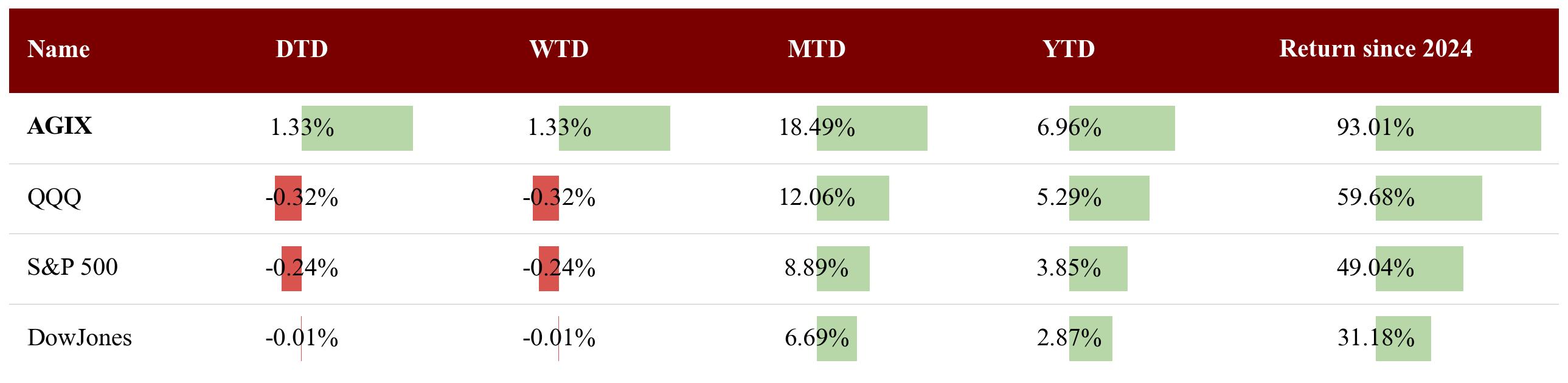
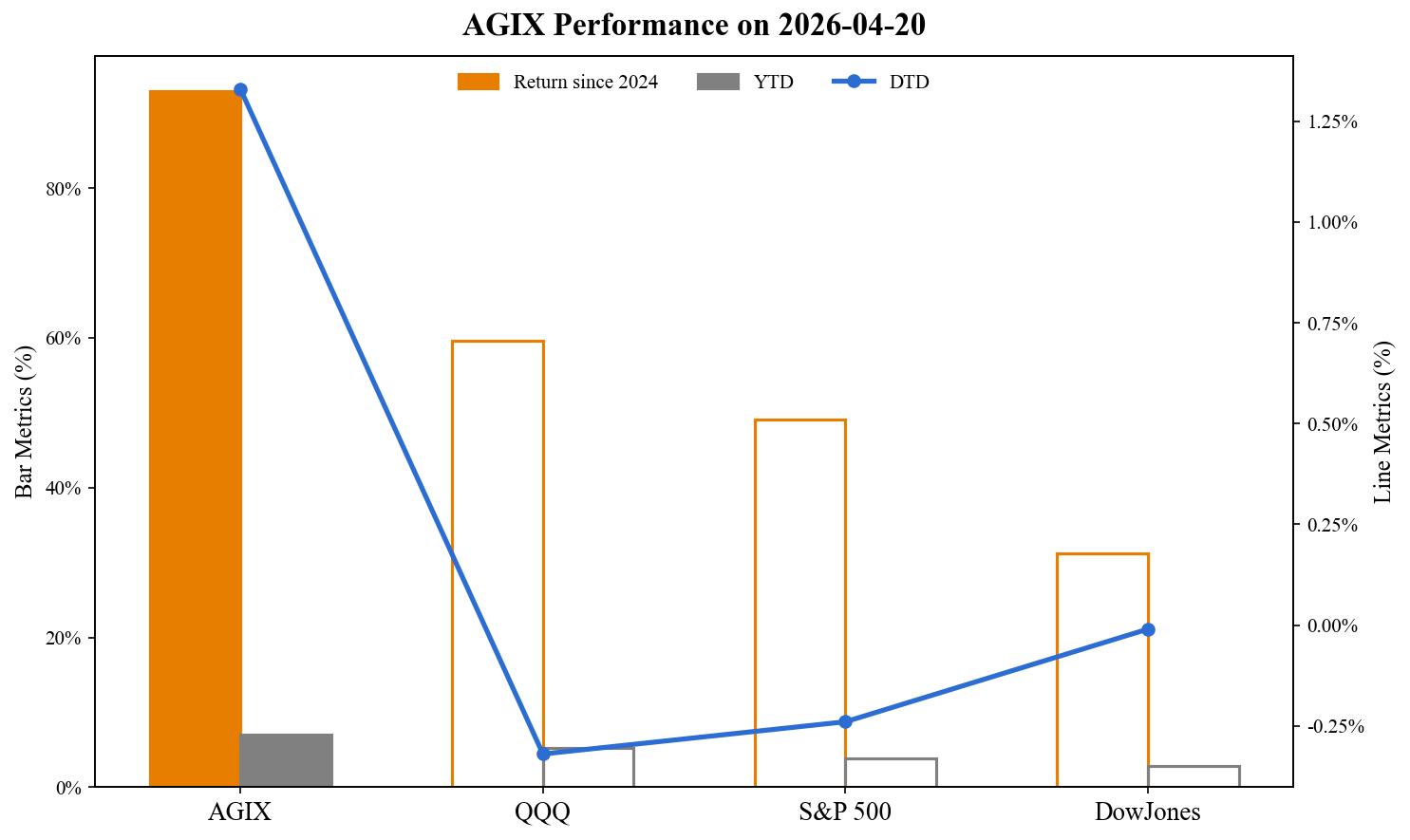
• AGIX outperformed major benchmarks on the day, gaining 1.33% (DTD) vs. declines in QQQ (-0.32%) and the S&P 500 (-0.24%). Its MTD (+18.49%) and YTD (+6.96%) performance also leads, with a 93.01% return since 2024.
• Key positive contributors within AGIX holdings included Arm Holdings (+5.02%), Atlassian (+6.78%), Renesas Electronics (+6.35%), and Hut 8 Corp (+5.46%). Negative contributors were led by Meta Platforms (-2.56%) and Netflix (-2.55%).
• Stocks to watch today include Arm Holdings (strong AI chip momentum), Atlassian (technical rebound post-index removal), and Renesas Electronics (new shelf registration for employee incentives).
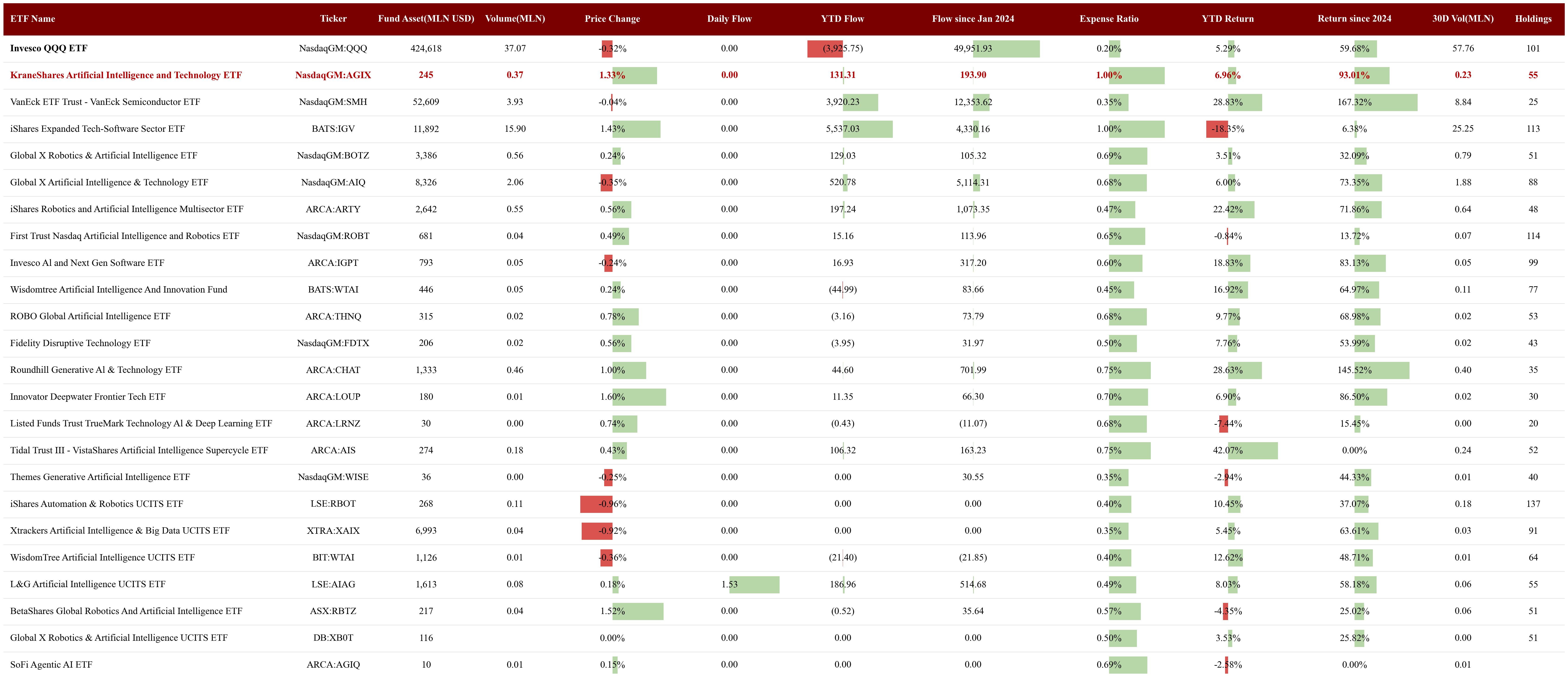
• Peer ETF analysis shows strong moves in semiconductor and AI infrastructure names like MaxLinear (+20.78%) and Credo Technology (+8.61%), aligning with AGIX's hardware and infrastructure exposure.
News Highlights
1. Anthropic secured an additional $50B from Amazon, committing to spend over $1T on AWS. This deepens the AI infrastructure lock-in race and benefits cloud/infrastructure holdings like Amazon, Microsoft, and Google (Alphabet).
2. Adobe launched CX Enterprise, a platform to coordinate AI agents across customer experience workflows. This reinforces the enterprise shift to integrated, production-scale AI, positive for major software and platform holdings.
3. Deezer reported 44% of daily uploads are AI-generated, highlighting the massive scale of synthetic content. This underscores the need for AI security and content verification tools, a tailwind for cybersecurity holdings.
4. DeepKeep launched Vibe AI Red Teaming for dynamic security testing of AI apps/agents. As AI autonomy increases, such security solutions become critical, supporting the cybersecurity sector within the portfolio.
5. Moonshot AI released the Kimi-K2.6 model, outperforming leading benchmarks. This intensifies competition in the foundational model space, keeping pressure on large tech incumbents to innovate.
6. AI nuclear startup Fermi saw its CEO and CFO depart suddenly, causing a 22% stock drop. This highlights execution risks in the emerging AI-powered infrastructure sector.
7. The NSA is reportedly using Anthropic's restricted Mythos model for cybersecurity, despite Pentagon tensions. This shows strong government demand for advanced AI capabilities in security.
8. Tim Cook will step down as Apple CEO in September, succeeded by John Ternus. Leadership transition at a major holding introduces a watch item for hardware strategy and innovation pace.
RSS Highlights
1. A blog post analyzes the "cost of doing business," arguing it depends on law enforceability, not just rules. This has implications for AI regulation and compliance costs for tech firms.
2. An article warns of a "Code Red for Humanity," focusing on the Anthropic-Pentagon clash and AI's role in nuclear decision-making, highlighting existential risks from deploying unreliable AI in critical systems.
3. A post notes that with LLMs, "access to knowledge is no longer the limitation," but deep understanding still requires reflection. This speaks to the evolution of AI-augmented work and productivity.
4. A piece argues "Communication Is Surveillance by Design," as metadata is always logged. This reinforces the investment thesis for privacy and security solutions in an AI-driven world.
5. A game designer's experiment found it hard for readers to distinguish between human and AI-written design docs, with AI versions often verbose. This shows both the capability and current limitations of AI in creative professional work.
Performance & Benchmark
Attribution
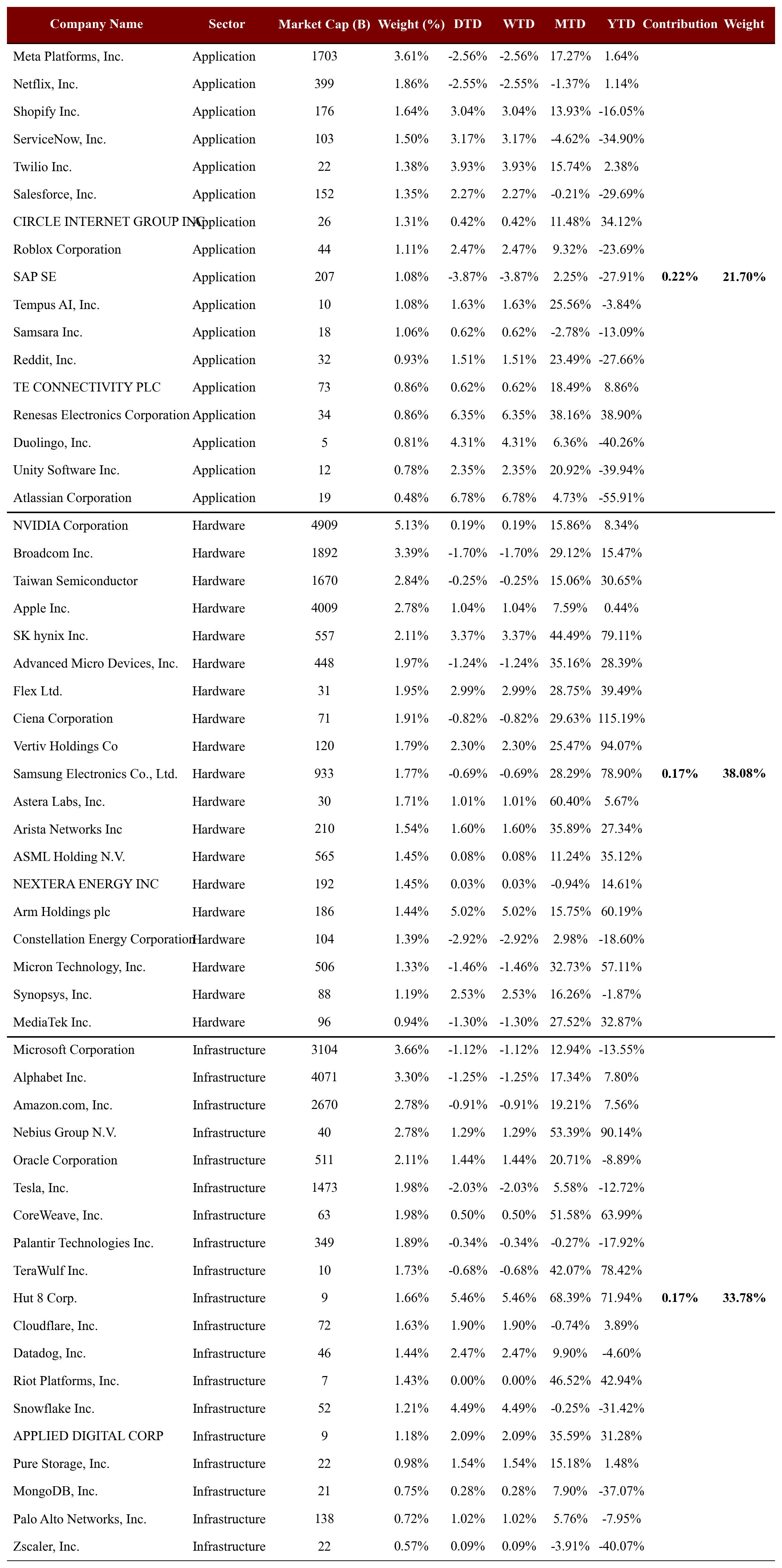
Contribution of the three sectors within AGIX holdings today
Application: 0.22%
Hardware: 0.17%
Infrastructure: 0.17%
Top-performing stocks in AGIX holdings today
Atlassian Corporation (6.78%)
Renesas Electronics Corporation (6.35%)
Hut 8 Corp. (5.46%)
Arm Holdings plc (5.02%)
Snowflake Inc. (4.49%)
Duolingo, Inc. (4.31%)
Twilio Inc. (3.93%)
SK hynix Inc. (3.37%)
ServiceNow, Inc. (3.17%)
Shopify Inc. (3.04%)
Flex Ltd. (2.99%)
Synopsys, Inc. (2.53%)
Datadog, Inc. (2.47%)
Roblox Corporation (2.47%)
Unity Software Inc. (2.35%)
Vertiv Holdings Co (2.3%)
Salesforce, Inc. (2.27%)
APPLIED DIGITAL CORP (2.09%)
Worst-performing stocks in AGIX holdings today
Tesla, Inc. (-2.03%)
Netflix, Inc. (-2.55%)
Meta Platforms, Inc. (-2.56%)
Constellation Energy Corporation (-2.92%)
SAP SE (-3.87%)
Top five listed stocks contributing the most within AGIX holdings today
Hut 8 Corp. (5.46%)
Arm Holdings plc (5.02%)
SK hynix Inc. (3.37%)
Flex Ltd. (2.99%)
Renesas Electronics Corporation (6.35%)
Observation
The strongest movers across peer ETF holdings today are listed below:
| DTD | Stock Ticker | Name | Held by ETFs | analysis |
|---|---|---|---|---|
| 20.78 | NasdaqGS:MXL | MaxLinear, Inc. | ['LSE:RBOT'] | MaxLinear (MXL) surged 20.78% on April 20, 2026, primarily driven by robust demand for its Keystone PAM4 DSP products ramping at hyperscale customers for 400G/800G deployments, multiple design wins entering production, and expanding AI data center presence.[3] Strong trading volume accompanied the move, signaling broad market conviction amid a multi-week uptrend with 36.6% gains over the prior four weeks.[3] Analyst upgrades, such as Wells Fargo raising its price target from $18 to $20, provided additional support.[5] |
| 13.12 | TSX:BB | BlackBerry Limited | ['BATS:IGV'] | BlackBerry (TSX:BB) surged 13.12% on April 20, 2026, hitting a new 12-month high of C$7.33 amid elevated trading volume of over 2.7 million shares.[3] This sharp move followed an 8.6% gain on April 16, signaling building momentum with technical breakouts noted on daily and weekly charts closing at $4.86 USD equivalent.[1][2] No specific company news or disclosures drove the advance, pointing to technical trading and positive sentiment as key factors.[5] |
| 12.49 | SEHK:6682 | Beijing Fourth Paradigm Technology Co., Ltd. | ['NasdaqGM:WISE'] | I cannot provide a reliable attribution for the 12.49% single-day move on April 20, 2026, as the search results contain no verifiable news events, company disclosures, or market catalysts specific to that date. The available data includes only historical price information, company fundamentals, and a name change to Phancy Group in January 2026, none of which explain the April 20 move. To properly attribute this move, real-time news sources, regulatory filings, or management announcements from April 20, 2026 would be required. |
| 11.87 | NasdaqGS:OUST | Ouster, Inc. | ['LSE:RBOT'] | I cannot provide a reliable attribution for Ouster's 11.87% single-day move on April 20, 2026, as the search results contain no verifiable news events, company disclosures, or material announcements from that specific date. The available data includes historical price information, analyst forecasts, and general company background, but lacks real-time news coverage or earnings-related catalysts that would explain the magnitude of this move. Without access to same-day news sources or company announcements from April 20, 2026, any attribution would be speculative. |
| 10.71 | NasdaqGS:WIX | Wix.com Ltd. | ['NasdaqGM:AIQ'] | No verifiable public information attributes Wix.com Ltd. (WIX)'s 10.71% single-day gain on April 20, 2026. Search results lack same-day news events, company disclosures, or catalysts matching the date and return. Recent data covers prior periods like July 2025 or earlier drops, providing no relevant drivers.[1][2][3] |
| 9.98 | TWSE:3443 | Global Unichip Corp. | ['NasdaqGM:AIQ', 'ARCA:IGPT', 'ARCA:THNQ', 'LSE:RBOT', 'LSE:AIAG'] | No specific news events, company disclosures, or catalysts explain Global Unichip Corp. (TWSE:3443)'s 9.98% gain on April 20, 2026, as search results lack same-day information for that date. Recent data shows varying price levels and analyst targets (e.g., NT$1,618 to NT$3,193 averages), but nothing ties directly to the move.[2][3] General volatility is noted, with beta at 1.52 and recent financial data releases due to price swings.[3][5] |
| 9.9 | NasdaqCM:GRRR | Gorilla Technology Group Inc. | ['NasdaqGM:WISE'] | No specific news events, company disclosures, or catalysts on April 20, 2026, explain Gorilla Technology Group Inc. (GRRR)'s 9.9% single-day gain from approximately $12.53 to $13.33.[5] Search results lack same-day announcements, with the closest recent item being an analyst Q&A referencing ongoing $1.4B Freyr partnership, $137M-$200M 2026 revenue guidance, >$7B pipeline, Q3 2025's $26.5M revenue (+32% YoY), and $110.2M cash, plus US acquisition pursuit and $20M buyback authorization.[2] The move may reflect general momentum from these prior highlights or trading factors, as no direct triggers appear in available data.[1][3][4] |
| 9.75 | TWSE:3035 | Faraday Technology Corporation | ['LSE:RBOT'] | No specific news events, company disclosures, or catalysts explain Faraday Technology Corporation's (TWSE:3035) 9.75% single-day gain on April 20, 2026, based on available public information. The sole relevant item is an announcement of a Board of Directors meeting scheduled for April 28, 2026, to review the consolidated financial report, which may have sparked anticipation but lacks direct linkage to the move.[3] Broader context shows recent weak quarterly results (net income down 92.54% quarter-over-quarter) and a year-to-date decline, with technical indicators mixed (daily strong buy but weekly/monthly sell).[1][2] |
| 9.69 | TWSE:4919 | Nuvoton Technology Corporation | ['LSE:RBOT'] | I cannot provide a reliable attribution for Nuvoton Technology's 9.69% single-day move on April 20, 2026, as the search results do not contain any news, announcements, or company disclosures from that date. The available results show historical revenue data and general company information but lack real-time news coverage or Taiwan Stock Exchange announcements that would explain the specific daily move. To properly attribute this move, I would need access to same-day news events, earnings releases, regulatory filings, or industry catalysts from April 20, 2026. |
| 8.61 | NasdaqGS:CRDO | Credo Technology Group Holding Ltd | ['ARCA:IGPT', 'BATS:WTAI', 'LSE:RBOT'] | Credo Technology Group (CRDO) stock rose 8.61% on April 20, 2026, primarily driven by a strong quarterly earnings beat with EPS of $1.07 versus $0.78 expected and revenue of $407.0M versus $385.9M expected, up 201.5% year-over-year.[1][2] This result highlighted robust net margins of 31.81% and fueled positive analyst sentiment, with a "Moderate Buy" consensus and $207.81 average price target.[1][2] A key bullish trading signal (Power Inflow) at $164.56 further supported the intraday surge to $174.61.[3] |
| 7.71 | NYSE:ASAN | Asana, Inc. | ['BATS:IGV', 'LSE:RBOT', 'XTRA:XAIX'] | I cannot provide a reliable attribution for Asana's 7.71% single-day move on April 20, 2026, based on the available search results. The search results contain outdated information from 2025 and earlier, lack any news or events specifically dated April 20, 2026, and do not include real-time market catalysts or company disclosures from that date. To properly attribute this move, I would need access to same-day news, earnings announcements, regulatory filings, or other verifiable events released on or immediately before April 20, 2026. |
| 7.45 | NYSE:KVYO | Klaviyo, Inc. | ['BATS:IGV'] | No specific news events, company disclosures, or filings on April 20, 2026, explain Klaviyo's 7.45% single-day gain. The move occurred amid a broader horizontal trading trend with low daily volatility around $18-20, supported by rising short-term moving averages despite longer-term sell signals.[2][4][6] Technical factors, including volume increases on prior up days, likely contributed as the primary driver.[2] |
| 7.32 | NasdaqGS:GFS | GlobalFoundries Inc. | ['NasdaqGM:QQQ', 'ARCA:AIS'] | GlobalFoundries (GFS) stock rose 7.32% on April 20, 2026, primarily driven by reports of peer UMC planning wafer price hikes in the second half of the year, signaling strong demand for mature-node chips where GFS competes.[2] Investor optimism around GFS's strategic advances in silicon photonics and Physical AI, including its ARC IP acquisition and tech integrations for AI infrastructure, further boosted sentiment.[2] Broader semiconductor industry strength from AI demand and upcoming symposium exposure provided additional tailwinds, despite minor insider selling.[1][2] |
| 7.17 | SZSE:000977 | Inspur Electronic Information Industry Co., Ltd. | ['ARCA:AIS'] | No specific news events, company disclosures, or catalysts explain the 7.17% rise in Inspur Electronic Information (SZSE:000977) on April 20, 2026, based on available public information. The stock hit a 3-month high of 73.120 CNY with a +4.890 CNY gain, aligning with broader weekly momentum of +11.97% and a strong buy technical rating.[1][3] Peer and sector strength in computers/peripherals, plus elevated volatility (6.70%) and beta (1.67), likely amplified the move.[1][3] |
| 7.17 | NYSE:YOU | Clear Secure, Inc. | ['BATS:IGV'] | CLEAR Secure (YOU) gained 7.17% on April 20, 2026, primarily driven by broad market strength following geopolitical de-escalation and positive Q1 earnings momentum. The S&P 500 added approximately 5% for the week as U.S.-Iran negotiations progressed, with reports of potential $20 billion in frozen Iranian funds being released and a ceasefire between Israel and Lebanon announced, causing oil prices to fall roughly 10% and lifting risk sentiment across equities. Tech and growth stocks led the rally, with the IGV software ETF posting its best week since 2000, providing tailwinds for YOU as part of the broader market rotation into higher-beta names. |
| 7.14 | NasdaqGM:NVTS | Navitas Semiconductor Corporation | ['ARCA:AIS'] | Navitas Semiconductor (NVTS) rose 7.14% on April 20, 2026, primarily due to a technical breakout above prior resistance levels on the daily timeframe, forming a doji candle that closed at $12.32 amid an ongoing weekly uptrend.[1] Key support holds at $11.31 with resistance at $13.64, supporting further upside potential to $15.12 if breached.[1] No company-specific news or disclosures were reported on the date. |
| 7.1 | NASDAQCM:DUOT | Duos Technologies Group, Inc. | ['NasdaqGM:WISE'] | No specific news events, company disclosures, or analyst actions on April 20, 2026, explain DUOT's 7.1% gain to $9.20. The stock closed within its recent range, with a day high of $9.285 and volume of 419.93k, following trading on April 18 at highs near $9.01[6][7]. Earlier events like a February public offering announcement and an April 11 downgrade to "sell" by Wall Street Zen predate the move and do not align with the positive return[1][2]. |
| 7.03 | NasdaqGM:TTD | The Trade Desk, Inc. | ['NasdaqGM:QQQ', 'NasdaqGM:AIQ', 'ARCA:IGPT'] | The Trade Desk (TTD) stock rallied 7% on April 20, 2026, closing at $24.10 from $22.47, driven primarily by strong investor confidence in its AI-powered advertising platform and long-term growth narrative. This buying activity persisted despite a same-day Jefferies analyst note questioning Wall Street's optimistic H2 2026 revenue expectations, highlighting a market divergence from short-term valuation concerns. No other company-specific news events were reported on the date. |
| 6.78 | NasdaqGS:TEAM | Atlassian Corporation | ['NasdaqGM:QQQ', 'NasdaqGM:AGIX', 'BATS:IGV', 'NasdaqGM:FDTX', 'ARCA:LOUP', 'XTRA:XAIX'] | Atlassian's 6.78% single-day gain on April 20, 2026, was primarily driven by a V-shaped recovery after forced institutional selling from its removal from the Nasdaq-100 index, replaced by Sandisk (SNDK), which triggered a brutal plunge the prior session.[3] The stock tested and held long-term horizontal support at $53.45, creating a compelling value proposition amid oversold conditions.[3] Technical rebound dynamics, including prior RSI oversold bounces of 10-20%, supported the sharp reversal.[1] |
| 6.64 | NasdaqCM:RR | Richtech Robotics Inc. | ['NasdaqGM:BOTZ', 'ASX:RBTZ', 'DB:XB0T'] | No specific news events, company disclosures, or catalysts explain Richtech Robotics Inc. (RR)'s 6.64% gain on April 20, 2026, as search results lack same-day information and only cover prior periods like April 17, 2026 (up 0.84%) or earlier in 2025.[1][2] The move likely stemmed from technical trading factors, such as support at accumulated volume levels around $1.99 or general buy signals from moving averages, amid medium intraday volatility.[1] Broader analyst consensus remains a Hold with a $4.50 price target, indicating no fundamental shift on that date.[2] |
| 6.51 | NasdaqGM:VERI | Veritone, Inc. | ['NasdaqGM:WISE'] | No specific company news, disclosures, or catalysts explain Veritone's (VERI) 6.51% gain on April 20, 2026. Technical factors drove the move, including the stock's position in a short-term rising trend with buy signals from long-term moving averages and MACD, plus proximity to accumulated volume support at $2.26.[1] Volume declined with the prior session's price action, signaling reduced risk and potential for continuation higher within the trend.[1] |
| 6.35 | TSE:6723 | Renesas Electronics Corporation | ['NasdaqGM:AGIX', 'NasdaqGM:ROBT', 'BIT:WTAI'] | Renesas Electronics (TSE:6723) rose 6.35% on April 20, 2026, primarily driven by the company's announcement of withdrawing its prior shelf registration statement and filing a new one for up to 9,300 million yen in shares to support expanded RSU and PSU grants to directors, officers, and employees effective May 1, 2026.[1] The new shelf registration, effective from April 18, 2026, to April 17, 2028, signals ongoing commitment to employee incentives amid semiconductor sector recovery.[1] No other same-day news events were identified in public sources.[3][4] |
| 6.24 | NasdaqGM:MVIS | MicroVision, Inc. | ['LSE:RBOT'] | No specific news events or company disclosures on April 20, 2026, explain MicroVision's (MVIS) 6.24% single-day gain. The most recent catalysts were the April 14 announcement of the Global Partner and Reseller Program for Lidar 2.0 adoption[2] and an investor presentation furnished around April 7 and posted in April[3], potentially contributing to lingering positive momentum. Analyst forecasts remain optimistic with a $2.50 consensus price target implying over 100% upside from recent levels around $1.20[1]. |
| 6.19 | LSE:RSW | Renishaw plc | ['NasdaqGM:BOTZ', 'LSE:RBOT', 'ASX:RBTZ', 'DB:XB0T'] | Renishaw's 6.19% gain on April 20, 2026 was driven by the company lifting its full-year outlook on the back of strong demand that boosted its order book. The positive guidance update, announced on April 20, signaled improved business momentum and confidence in near-term performance. This represents a material catalyst that justified the significant single-day appreciation in the stock. |
| 6.17 | TSE:6594 | Nidec Corporation | ['NasdaqGM:ROBT', 'ARCA:IGPT'] | Nidec Corporation (TSE:6594) shares rose 6.17% on April 20, 2026, primarily due to a sharp rebound as investors viewed negative sentiment from prior accounting irregularities as fully priced in.[1] The key trigger was the company's announcement after market close on April 17 of receiving the final report from the independent committee, followed by plans to revise its improvement measures and submit required documents to the TSE.[1] Despite reports of a maximum TSE listing penalty of 91.2 million yen, this was seen as the exhaustion of downside risks, spurring buying interest.[1] |
| 5.9 | TWSE:6531 | AP Memory Technology Corporation | ['ARCA:AIS'] | No specific news events, company disclosures, or catalysts on April 20, 2026, explain AP Memory Technology Corporation's (TWSE:6531) 5.9% single-day gain. Recent financials show stable quarterly revenue of NT$1.30B meeting estimates and positive analyst targets (NT$370-390), alongside a strong buy technical signal, but lack same-day triggers[1][2][3]. Broader semiconductor sector momentum or trading factors may have contributed, though unconfirmed in available data[2]. |
| 5.83 | NasdaqGS:MRVL | Marvell Technology, Inc. | ['NasdaqGM:QQQ', 'NasdaqGM:SMH', 'NasdaqGM:AIQ', 'ARCA:ARTY', 'BATS:WTAI', 'NasdaqGM:FDTX', 'ARCA:CHAT', 'ARCA:AIS', 'BIT:WTAI'] | Marvell Technology's 5.83% gain on April 20, 2026 was driven by sustained momentum from strong Q4 fiscal 2026 earnings and raised fiscal 2027 guidance announced earlier in the week. The company reported record revenue of $2.219 billion with record-pace bookings and raised its fiscal 2027 outlook to over 30% revenue growth with data center business expected to grow approximately 40%, reinforcing investor confidence in its AI infrastructure positioning. Analyst upgrades, including Stifel raising its price target to $140, and the reported NVIDIA partnership signaling deeper integration into AI data center systems provided additional support for the stock's continued upward momentum through the week. |
| 5.46 | NasdaqGS:HUT | Hut 8 Corp. | ['NasdaqGM:AGIX', 'BATS:IGV', 'NasdaqGM:AIQ'] | Hut 8 Corp (HUT) rose 5.46% on April 20, 2026, driven primarily by bullish technical indicators and positive analyst consensus amid an ongoing uptrend. Moving averages showed a strong bullish trend with 4 positive signals and the SMA_20 above SMA_60, supporting the price increase within a +10.32% trend from April 16[1]. Analyst ratings maintained a "Strong Buy" from 13 firms, bolstered by recent Q4 2025 revenue growth of 44.8% to $235.1M and gross margins expanding to 60%[4][5]. No specific same-day news events were identified. |
| 5.46 | TSE:9984 | SoftBank Group Corp. | ['NasdaqGM:ROBT', 'BATS:WTAI', 'ARCA:CHAT', 'BIT:WTAI'] | SoftBank Group Corp. (TSE:9984) rose 5.46% on April 20, 2026, primarily driven by its inclusion among 20 firms eyeing Japan's $550 billion investment plan, including $400 billion in domestic projects, alongside interest in $25 billion U.S. power infrastructure projects.[1] This AI and infrastructure catalyst built on prior momentum from the August 2025 Foxconn partnership for data center equipment in Ohio's Stargate project.[1] Elevated trading volume, the highest since March 2020 amid a 21% two-day gain, amplified the move.[1] |
| 5.43 | TSE:6920 | Lasertec Corporation | ['LSE:RBOT'] | No specific news events, company disclosures, or catalysts explain Lasertec Corporation's (TSE:6920) 5.43% gain on April 20, 2026, from ¥39,950 to ¥42,120[1]. The move occurred amid a positive short-term trend, with the stock up 5.61% over the prior week and showing buy signals in technical analysis[3]. Analyst consensus remains mixed, with price targets averaging around ¥21,273 (though outdated) and recent fair value estimates near ¥34,891[2][4]. |
| 5.34 | TWSE:2303 | United Microelectronics Corporation | [] | UMC (TWSE:2303) surged 5.34% on April 20, 2026, primarily driven by hitting a 52-week high amid strong momentum in the semiconductor sector.[1][5] The stock traded up to 73.00 TWD from a prior close of 44.65 TWD, reflecting heightened buying interest and technical breakout signals like a rounded bottom reversal with bullish MACD crossover.[2][3] No specific company news was reported, with the move aligning with positive analyst forecasts for 13%+ EPS growth.[4] |
| 5.26 | NasdaqGS:MNDY | monday.com Ltd. | ['NasdaqGM:FDTX', 'LSE:RBOT'] | No same-day news events or company disclosures explain monday.com Ltd. (MNDY)'s 5.26% gain on April 20, 2026. Search results highlight a securities fraud class action lawsuit announced that day, alleging overstated revenue projections from September 2025 and a February 9, 2026 guidance cut that caused a 21% stock drop from $98 to $77.63, but this negative development does not account for the positive single-day move.[1][4] Recent trading shows intraday volatility with the stock around $197, up 0.60% in the past 24 hours amid broader weekly gains of 12%, potentially driven by technical rebound or market factors absent specific catalysts.[2][3] |
| 5.18 | NYSE:HPE | Hewlett Packard Enterprise Company | ['NasdaqGM:AIQ', 'ARCA:IGPT', 'ARCA:CHAT', 'ARCA:AIS', 'XTRA:XAIX'] | HPE's 5.18% single-day gain on April 20, 2026, was primarily driven by a technical breakout above key resistance levels around $21.87-$22.05, signaling a new uptrend as sellers cleared out and buyers gained control. Supporting this, the stock had been surging post-earnings with bullish technical outlooks and analyst upgrades, including Evercore ISI raising its price target to $30 on strong CPU server demand. Positive momentum from recent AI product expansions with NVIDIA and a $2B senior notes offering further bolstered sentiment. |
| 5.09 | NasdaqGS:PENG | Penguin Solutions, Inc. | ['ARCA:AIS'] | Penguin Solutions (PENG) rose 5.09% on April 20, 2026, primarily driven by a semiconductor sector rally following de-escalation of the U.S.-Iran conflict, which alleviated supply chain fears for critical materials like noble gases transiting the Strait of Hormuz.[1] The VanEck Semiconductor ETF surged nearly 5%, lifting PENG shares 5.5% in the afternoon session amid the industry's vulnerability to prior disruptions.[1] This move aligns with PENG's high volatility, with 23 prior >5% daily shifts over the past year, though no company-specific news like the earlier Q2 earnings beat on April 1 contributed directly.[1][3] |
| 5.02 | NasdaqGS:ARM | Arm Holdings plc | ['NasdaqGM:QQQ', 'NasdaqGM:AGIX', 'ARCA:IGPT', 'ARCA:CHAT', 'ARCA:LRNZ', 'ARCA:AIS'] | Arm Holdings (NasdaqGS:ARM) rose 5.02% on April 20, 2026, primarily driven by positive momentum from hyperscaler AI buildout and a recent custom 2nm AI chip partnership expansion between Meta Platforms and Broadcom, which fueled buyer control near 52-week highs.[3] Supporting this, the stock traded with 25% above-average volume at ~8.45M shares, reflecting strong investor interest amid a "Moderate Buy" analyst consensus and targets around $175, despite high valuation concerns.[1][3] Recent Q3 fiscal 2026 results showing slight EPS and revenue beats (EPS $0.43 vs. $0.41; revenue $1.24B up 26.3% YoY) provided additional tailwinds, bucking broader market weakness.[1][2] |
News
Funding & M&A
CEO and CFO suddenly depart AI nuclear power upstart Fermi
AI nuclear power company Fermi has been hit by sudden executive departures. Its co-founder and CEO Toby Neugebauer and CFO Miles Everson abruptly left, causing the company's stock price to plummet 22% on Monday. Fermi stated that Neugebauer has stepped down as Chairman but remains on the board, with independent director Marius Haas taking over as Chairman. Everson has become a board director through the director designation rights of the Melissa A. Neugebauer 2020 Trust. The company, co-founded by former U.S. Energy Secretary Rick Perry, is developing an AI campus called Project Matador in Amarillo, Texas, planning to use nuclear reactors to power data centers. However, the project has recently faced numerous challenges, including friction with key clients, according to Bloomberg. The company framed these personnel changes and the relocation of its headquarters to Dallas as part of 'Fermi 2.0,' aiming to send positive signals to investors about the project's continued progress. Nonetheless, the executive departures have sparked market concerns, highlighting both the promise and risks of nuclear power applications in the AI infrastructure sector. As an emerging provider of AI energy solutions, Fermi's moves are closely watched, and its future development path warrants ongoing attention.
Anthropic takes $5B from Amazon and pledges $100B in cloud spending in return
On Monday, Anthropic announced that Amazon has agreed to invest an additional $50 billion, bringing its total investment in the company to $130 billion. In exchange, Anthropic has committed to spending over $1 trillion on AWS over the next decade and will gain access to up to 5GW of new computing capacity for training and running its Claude models. This deal is similar to an agreement Amazon reached with OpenAI two months ago, where Amazon participated in OpenAI's $1.1 trillion funding round, contributing $50 billion, pushing OpenAI's pre-money valuation to $7.3 trillion. That agreement was also partially provided in the form of cloud infrastructure services rather than pure cash. Central to this latest deal are Amazon's in-house chips, including the low-power CPU Graviton and the AI accelerator Trainium (a competitor to Nvidia). Anthropic specifically covers Trainium2 through Trainium4 chips, although Trainium4 is not yet available; Trainium3 was released last December. Additionally, Anthropic gains priority purchasing rights for future Amazon chip capacity. This news may signal an imminent new funding round for Anthropic, with venture capital firms already proposing capital offers valuing the company at over $800 billion. This move highlights how cloud computing giants are deepening strategic partnerships with leading AI companies through massive investments and infrastructure lock-in, further intensifying the AI infrastructure race.
Model Releases
Moonshot AI releases the Kimi-K2.6 model with 1 trillion parameters and attention optimizations
Chinese AI startup Moonshot AI today released Kimi-K2.6, the latest version of its popular open-source large language model Kimi series. This model outperforms GPT-5.4 and Claude Opus 4.6 on multiple AI benchmarks. Kimi-K2.6 employs the SwiGLU activation function, which is more efficient than traditional algorithms, simplifying the training process, and has been integrated into open-source models like Meta Platforms' Llama series. Its neurons are organized into 384 expert modules, with only 8 experts activated to process prompts, significantly reducing hardware consumption. It also introduces the MLA (Multi-head Latent Attention) mechanism, which improves efficiency through data compression. The model is equipped with a 400-million parameter visual encoder, supporting multimodal input, capable of converting images into embedding vectors for text and multimedia processing. Kimi-K2.6 can generate complete websites from simple instructions and interface sketches. For complex tasks, it can launch up to 300 agents to execute sub-steps in parallel and, through the claw groups function, optionally introduce human collaboration to enhance performance on tasks like Rust development. On rigorous benchmarks like HLE-Full, Kimi-K2.6 scored 54 points, leading Opus 4.6's 53 points and GPT-5.4's 52.1 points, demonstrating cutting-edge competitiveness. This release highlights Moonshot AI's innovative breakthroughs in the open-source LLM field, advancing hardware-efficient AI development.
Technical Breakthroughs
It’s not just one thing — it’s another thing
A recent Barron's report reveals a dramatic surge in the use of a specific sentence structure, 'It's not just this — it's that,' in corporate communications. Its frequency skyrocketed from about 50 instances in 2023 to over 200 in 2025, an increase of more than fourfold. This finding comes from market intelligence firm AlphaSense's database scans of corporate press releases, earnings reports, and government filings. This phrasing has become a telltale sign of AI-generated text, reflecting the widespread infiltration of generative AI tools in corporate writing. These tools are trained on vast amounts of human writing data, often used without permission, sparking author rights controversies. The report notes not only this phrasing but also features like the em-dash (—) as giveaways of AI involvement. This trend is not just an amusing anecdote but a symbol of enterprises' deepening reliance on AI. While it's impossible to confirm if specific documents are AI-assisted, its popularity underscores how AI is reshaping the landscape of business communication. TechCrunch commented that such phrasing has evolved from a clue to a 'guarantee' signal of AI writing, warning readers to be wary of potential synthetic content. As AI tools become ubiquitous, businesses must carefully balance efficiency with authenticity to avoid having their language patterns betray technological traces.
Product Launches
Adobe deploys AI agents across its customer experience tools
At the Adobe Summit, Adobe introduced a new enterprise platform, CX Enterprise, designed to coordinate AI agents across marketing, content creation, and customer interaction workflows, achieving its core positioning of 'customer experience orchestration.' The platform integrates AI agents, reusable 'agent skills,' and integrated endpoints, providing a single governance and intelligence layer to help businesses manage the entire customer lifecycle from acquisition to retention, while ensuring data control, brand standards, and compliance. Core components include the Brand Intelligence System, which captures brand context, and the Engagement Intelligence System, based on customer lifetime value, ensuring AI outputs align with brand guidelines and enabling scaled personalization. CX Enterprise is built on the Experience Platform, which supports over 1 trillion customer experiences annually. Additionally, Adobe introduced CX Enterprise Coworker to coordinate multi-agent actions and expanded its partner ecosystem with integrations including Amazon Web Services, Anthropic, Google Cloud, IBM, Microsoft, Nvidia, and OpenAI, supporting the deployment of agent-driven workflows across enterprise tools. Simultaneously, Adobe extended agent capabilities to Microsoft 365 Copilot and ChatGPT Enterprise and updated the GenStudio platform with new automated task AI agents and brand visibility tools. Adobe stated that over 20,000 brands use its customer experience tools, and it anticipates that demand for integrated AI workflows will shift from pilot projects to production deployment, driving marketing's transformation from isolated AI applications to coordinated orchestration.
Google rolls out Gemini in Chrome in 7 new countries
On Monday, Google announced the expansion of its Gemini in Chrome feature to seven new markets, including Australia, Indonesia, Japan, the Philippines, Singapore, South Korea, and Vietnam. The feature is now fully rolled out on desktop and iOS devices in these countries (except Japan). Previously, since last year, Google has continued to deepen the integration of AI and Gemini into the Chrome browser, including introducing a floating window design. Earlier this year, the company launched a sidebar-based assistant that supports answering user questions across tabs and utilizes Gemini's Personal Intelligence feature to connect with services like Gmail and Google Photos to provide personalized responses. Users can also use this feature to schedule meetings with Calendar, view location details with Maps, or draft and send emails with Gmail. Additionally, the sidebar integrates the Nano Banana 2 tool, which can transform webpage images. Gemini in Chrome first launched in the US in January this year and expanded to India, Canada, and New Zealand in March. This expansion marks the feature's coverage of more countries. However, Google's agent feature (which can autonomously control the browser to complete tasks) is still in the testing phase and is only available to users on the paid AI Pro and AI Ultra plans in the US. This move further strengthens Google's global layout in the browser AI field, enhancing user productivity and personalized experience.
DeepKeep rolls out Vibe AI Red Teaming to test AI apps and agents
AI security platform company DeepKeep Ltd. today officially launched the Vibe AI Red Teaming feature, a human-in-the-loop dynamic testing and attack simulation tool designed specifically for AI applications and AI agents. This solution goes beyond traditional automated red teaming, allowing security teams to guide the execution process based on domain knowledge and specific needs. As AI gains greater autonomy and data access in business operations, the risks of data leaks, malicious exploitation, and adversarial manipulation are intensifying. DeepKeep points out that many systems fail to adequately protect sensitive data, highlighting an expertise gap in the intersection of AI and security. Traditional red teaming relies on humans, is costly, and difficult to scale, while purely automated methods lack depth and flexibility. Vibe AI Red Teaming combines agent-driven execution with human guidance, empowering security teams to optimize attacks in real-time, choose attack types and depth, define test objectives (such as data exposure assessment or compliance verification), and dynamically customize the process. Based on an interactive agent approach, the tool supports human intervention at key decision points, real-time plan adjustments, the introduction of custom scenarios, and provides mitigation suggestions and customized reports, covering full-spectrum testing of foundational models, AI applications, and agents. DeepKeep CTO Yossi Altevet stated that this feature ensures enterprises can securely scale their AI use while maintaining trust. This capability is already integrated into the DeepKeep AI Security Platform.
Aikido Security debuts Endpoint for AI-native developer security
Belgian cybersecurity company Aikido Security BV today launched Endpoint, a lightweight security agent specifically designed to provide security for AI usage on developer workstations and to defend against open-source software supply chain attacks. The platform offers enterprises visibility and control over software packages, isolated development environments, browser extensions, and AI tools integrated into modern software development. The company notes that developer workstations have become a blind spot for many organizations, with traditional security measures either being bypassed by developers due to lengthy approval processes or relying on weak controls that fail to address risks. AI-driven development and deployment introduce many new attack surfaces. Endpoint helps enterprises securely embrace AI-native software development at scale through real-time monitoring and policy enforcement, while granting developers flexibility. Before installation, Endpoint inspects tools, packages, Model Context Protocol hooks, extensions, AI tools, and agents. Co-founder and CEO Willem Delbare stated that when enterprises roll out AI coding tools to thousands of developers, they lack visibility and control over what runs on workstations. Endpoint uses a self-protecting software approach to build guardrails for a new era of development, protecting not only code but also the generation environment. Endpoint is built on the company's open-source malware detection system, Aikido Safe Chain, which is downloaded over 200,000 times weekly. It employs a lightweight AI agent that activates checks before the installation of packages, IDEs, plugins, or browser extensions, and automatically quarantines packages published within the last 48 hours. The company's threat intelligence model defends against over 100,000 threats weekly, with supply chain attacks, especially via insecure npm packages, increasing. Endpoint also provides auditing, AI tool visibility, and policy enforcement by team, role, and device, replacing rigid rules with precise control. The recent Axios JavaScript library leak highlights the trend of supply chain attacks.
Policy & Regulation
Deezer says 44% of songs uploaded to its platform daily are AI-generated
Deezer announced on Monday that AI-generated tracks now account for 44% of newly uploaded music on its platform, with nearly 75,000 AI tracks received daily and over 2 million per month. Compared to just 10,000 daily tracks when it launched its AI music detection tool a year ago, uploads have surged continuously: 60,000 in January, 50,000 in November, and 30,000 in September. Although consumption accounts for only 1-3%, 85% of the streaming plays for these tracks are detected as fraudulent and demonetized. Deezer automatically removes AI tracks from algorithmic recommendations, excludes them from editorial playlists, and stops storing high-resolution versions. CEO Alexis Lanternier emphasized that AI music is no longer a fringe phenomenon and called for collective action within the music ecosystem to protect artists' rights and improve transparency for fans. A company survey from November last year showed that 97% of respondents struggled to distinguish AI from human music, 52% opposed AI tracks appearing on main charts, and 80% demanded clear labeling. Deezer became the first platform to label AI tracks at scale in June 2025, labeling over 13.4 million tracks throughout the year. Around the same time, France's Qobuz announced similar plans; Spotify and Apple Music adopted different strategies, such as filtering low-quality AI music and relying on distributor transparency measures. This move highlights the industry divergence in regulating AI music among streaming platforms.
NSA spies are reportedly using Anthropic’s Mythos, despite Pentagon feud
According to Axios, the U.S. National Security Agency (NSA) is using Anthropic's recently announced but not publicly released Mythos Preview model. A few weeks prior, the NSA's parent agency, the Department of Defense (DoD), listed Anthropic as a 'supply chain risk' because the company refused to allow Pentagon officials unrestricted access to the full capabilities of its models. Anthropic announced Mythos earlier this month as a cutting-edge model designed for cybersecurity missions but claimed it was too powerful for offensive cyberattacks to be suitable for public release. Consequently, the AI company restricted Mythos access to about 40 organizations, only 12 of which were publicly named. The NSA appears to be one of the undisclosed recipients, primarily using it to scan environments for exploitable vulnerabilities. The UK's AI Safety Institute also confirmed it has gained access to Mythos. While the U.S. military expands its use of Anthropic's tools, it has argued in court that these tools could threaten national security. The dispute stems from Anthropic's refusal to allow Claude to be used for mass domestic surveillance and autonomous weapons development. The NSA's access to Mythos comes as tensions between Anthropic and the Trump administration appear to be easing. Last Friday, Anthropic CEO Dario Amodei met with White House Chief of Staff Susie Wiles and Treasury Secretary Scott Bessent, with the White House calling the meeting productive. TechCrunch reached out to the NSA for confirmation; Anthropic declined to comment.
Industry Partnerships
What to expect during the Phi Moments @ Next event: Join theCUBE April 22-23
The strategic partnership between Quantiphi Inc. and Google Cloud is accelerating the rapid development of enterprise AI applications. Leveraging Google Cloud's comprehensive technology stack, including Vertex AI, BigQuery, and Gemini models, Quantiphi develops innovative AI solutions for global clients, particularly in healthcare, helping radiology departments integrate patient data, automate disease screening, and support anonymized research processes. The company's Codeaira tool—a Gemini-based generative AI developer assistant—significantly accelerates the migration of data analytics workloads to Google Cloud, reducing migration time from months to weeks, enabling cost optimization and rapid deployment of AI-driven analytics. Furthermore, Quantiphi creates business accelerators using Contact Center AI (CCAI) technology to enhance customer service efficiency and satisfaction. Founded in 2013, Quantiphi is an AI consulting firm with over 3,500 professionals worldwide, offering services in AI, data analytics, and application modernization. SiliconANGLE Media's theCUBE will provide in-depth coverage at the Phi Moments @ Next event in Las Vegas (April 22-23), exploring how Quantiphi combines intelligent automation with data strategy to achieve measurable results at scale and enhance enterprise operations, governance, and productivity. This collaboration highlights the critical role of agent AI and generative systems in enterprise transformation. (228 words)
On theCUBE Pod: IBM’s AI strategy, infrastructure bottlenecks and ecosystem partnerships reshape markets
AI infrastructure has become a decisive force for enterprise competitiveness, shifting from the back office to the core of business strategy, prompting companies to re-evaluate computing power, data readiness, and operational coordination. John Furrier, Executive Analyst at theCUBE Research, noted that IBM CFO Jim Kavanaugh emphasized the changing role of the CFO in the Transformation Edge series release, with IBM demonstrating its path to operationalizing AI through its 'Client Zero' practice. In the latest theCUBE Pod episode, Furrier and Chief Analyst Dave Vellante discussed how AI infrastructure is reshaping enterprise strategy, competition, and leadership priorities. AI infrastructure has evolved beyond hardware and cloud capacity to become the operational layer that turns models into outcomes, attracting financial leaders to participate in deployment and measurement. Enterprises face insufficient data and system readiness; infrastructure decisions must address fragmented environments from edge to cloud, supporting large-scale, real-time inference. Challenges such as supply chain constraints, memory architecture, processors, and storage subsystems are prominent. Events like Google Cloud Next will focus on how vendors translate infrastructure investments into enterprise outcomes, driving partnerships between software platforms and large language model providers to redefine value creation. The shortage of computing resources, especially GPUs, is prompting hyperscale cloud providers and enterprises to invest in custom chips and multi-vendor strategies. Meta CEO Mark Zuckerberg's search for a second supplier and in-house chip development reflects this competitive strategy. Cases like OpenAI highlight computational scarcity, leading enterprises to adopt multi-layered hybrid approaches that blend proprietary systems with open ecosystems to ensure flexibility and control. The AI wave presents immense opportunities, with enterprises accelerating actions to understand, measure, and operationalize AI. Collaboration between CFOs and HR officers is deepening, and agents will become 'workers.' (248 words)
Tim Cook is stepping down as Apple CEO, with John Ternus taking over
Apple announced that CEO Tim Cook will step down on September 1st this year, to be succeeded by Senior Vice President of Hardware Engineering John Ternus. Since taking over from the late Steve Jobs in 2011, Cook has led Apple's market value to soar to $4 trillion, with annual revenue quadrupling. He optimized the supply chain, built Apple's services business into a pillar generating over $100 billion annually, and pioneered the wearable device market, with products like the Apple Watch capturing 25% of the global smartwatch market share. Despite the Vision Pro headset facing a lukewarm market reception, his operational achievements are evident. Cook will transition to the role of Executive Chairman, while Arthur Levinson will become the Lead Independent Director. Ternus, 51, has been deeply involved at Apple since 2001, leading the development of multiple generations of products including the iPhone, iPad, AirPods, and MacBook, driving innovations in durability, repairability, and eco-friendly materials, such as new recycled aluminum alloys that reduce carbon footprint. He has pledged to lead the company forward while upholding Apple's values. The board praised Cook's exceptional leadership, and this smooth transition marks the opening of a new era for Apple, with the market watching closely to see Ternus's performance in hardware innovation and sustainable development.
RSS Subscription
How can I change a dialog box’s message loop to use MsgWaitForMultipleObjects instead of GetMessage?
The client wants to know how to modify the dialog box's message loop to use MsgWaitForMultipleObjects instead of GetMessage. The standard dialog message loop only checks for messages and does not handle kernel handles. This can be achieved by replacing the modal dialog with a modeless dialog and running a custom message loop, but attention must be paid to whether the dialog program calls EndDialog and its return result. By processing WM_ messages, background activities can be performed when the dialog is idle, and it can return when a message arrives, thus implementing a custom dialog loop.
Steve Ballmer, Microsoft executive and NBA owner
Steven Ballmer was born on March 24, 1956. He served as the CEO of Microsoft from 2000 to 2014 and is currently the owner of the Los Angeles Clippers. His personal wealth is approximately $145 billion, ranking him as the tenth richest person in the world. Under his leadership, Microsoft's annual revenue grew from $25 billion to $70 billion, and net profit increased by 215% to $23 billion. However, he failed to effectively seize opportunities in emerging consumer technologies such as tablets and smartphones. In 2014, Ballmer purchased the Los Angeles Clippers for $2 billion.
Pluralistic: The cost of doing business (25 Mar 2026)
The cost of business operations primarily depends on the enforceability of laws, rules, or policies, rather than what they permit or prohibit. The manageability of law involves whether violations can be effectively detected and stopped. For example, U.S. prosecutions of North Korean hackers are largely symbolic without effective means of arrest. Furthermore, complex legal procedures, such as estate administration, require significant time and money, and frequent transaction processing leads to a substantial increase in administrative costs. This is exemplified by the application of copyright law after digitization.
Wander 0.3.0
Wander 0.3.0 is the third version of a decentralized, self-hosted web console that allows users to explore community-recommended websites. This update fixes two major issues: one bug related to the ignore list feature, and another that resolved problems with certain websites failing to load. Additionally, other minor fixes were made. For more information, please visit susam.net/wander/.
Which Design Doc Did a Human Write?
Author Michael Lynch created design documents for three identical open-source web applications. One was manually written by him, taking 16 hours, while the other two were generated using Claude Opus 4.6 and GPT-5.4, respectively, taking only a few minutes. Although nearly 50% of readers correctly identified the handwritten version, about 25% mistakenly judged it as AI-generated. The main reasons are that the handwritten document contains more personal opinions and experiential details, while the AI versions appear verbose and vague.
Code Red for Humanity?
Humanity faces a crisis; the confrontation between Anthropic and the U.S. Department of Defense could be a matter of life and death. On January 27, 2026, the Bulletin of the Atomic Scientists adjusted the Doomsday Clock to 85 seconds to midnight, indicating we are approaching a dangerous precipice. The Trump administration appears determined to deploy artificial intelligence extensively across various domains, including mass surveillance and autonomous weapons, but the reliability of these systems is questionable and could lead to catastrophic consequences. Reports indicate that models in simulated nuclear crises chose the nuclear option 95% of the time, demonstrating that using generative AI for life-and-death decisions in an environment lacking trust is extremely perilous.
Intercepting messages before IsDialogMessage can process them
Last time, we discussed how to detect when a user clicks the close button on a dialog box or presses the ESC key to close it. Using the IsDialogMessage function, you can handle ESC key messages and convert them into IDCANCEL button click events. To ensure proper handling of the ESC key, it is recommended to detect it before calling IsDialogMessage and implement the corresponding logic in a custom message loop.
Book Review: Of Monsters and Mainframes - Barbara Truelove ★★★⯪☆
This work is full of fun and charm. While superficially similar to 'The Murderbot Diaries,' its quality is superior. The story is set on an interstellar spaceship where the onboard AI is sentient and faces a situation where passengers are being killed by Count Dracula, making for a captivating plot.
Game designer Sid Meier born Feb. 24, 1954
Legendary game designer Sid Meier was born on February 24, 1954. In the early 1980s, he created a series of popular flight simulators before shifting to strategy games and producing classics like Civilization. Meier co-founded Microprose with Bill Stealey in 1982, releasing numerous games, including 1987's Pirates!, which was released on multiple platforms and allowed players to sail and plunder in the Caribbean. In 1990, he released Railroad Tycoon, and in 1991, Civilization—a turn-based strategy game where players develop their civilization through diplomacy, technology, and warfare.
When access to knowledge is no longer the limitation
Since their emergence in 2022, Large Language Models (LLMs) have provided readily accessible knowledge bases, enabling people to quickly obtain information and learn new things. However, this rapid access to knowledge can lead to superficial understanding, lacking the process of deep thought and internalization. While we can easily answer questions, true comprehension and knowledge accumulation still require in-depth reading and reflection.
Pluralistic: The entire economy pays the Amazon tax (25 Feb 2026)
Amazon's selling fees are as high as 50-60% of the sale price, making it difficult for merchants to sell on the platform. Although most affluent households are Amazon Prime members and tend to choose Amazon when shopping, due to economic inequality, the bottom 90% of consumers are increasingly unable to afford purchases, forcing merchants to rely on wealthy consumers. The California Attorney General's lawsuit against Amazon for price manipulation reveals that the company's 'Most Favored Nation' pricing strategy forces sellers to raise prices on all platforms, thereby further exacerbating overall economic price increases.
Trigonometry of inverse trigonometric functions
The author compiled a table of trigonometric functions and their inverses in LaTeX format, primarily including sine, cosine, and tangent functions. The table displays function composition relationships rather than multiplication, although its form resembles a multiplication table. The identity relationships in the table are easy to prove, and the 2x2 matrix in the top-left corner exhibits symmetry, reflecting the relationships between trigonometric functions.
Everything is awesome (why I'm an optimist)
In just two weeks, Matt Shumer's 'Something Big is Happening' garnered over 80 million views on platform X, warning people of a potential economic crisis triggered by AI. Citrini Research's '2028 Global Intelligence Crisis' predicts that by 2028, the unemployment rate will reach 10.2% and the S&P 500 index will drop by 38%. Although pessimists believe AI will lead to massive unemployment and economic collapse, many economists point out that historically, technological change has often been accompanied by the emergence of new jobs and economic growth.
A fuzzer for the Toy Optimizer
Testing the correctness of an optimizer is highly complex; even manually building a test suite may miss edge cases. To address this, the author developed a fuzzing tool that automatically generates random programs and verifies whether the heap state before and after optimization remains consistent, in order to catch potential correctness errors. By running 100,000 random programs, the verifier found no issues, but after disabling a key aliasing write feature, the tests quickly crashed, indicating the existence of such errors.
Windows stack limit checking retrospective: Alpha AXP
This article explores the Windows stack checking function in the Alpha AXP architecture, focusing on its separation between user mode and kernel mode, and how it avoids soft page faults by writing to memory. When allocating large stack frames, this function uses 64-bit calculations and preserves certain registers to ensure compatibility with non-Microsoft compilers. The next discussion will cover stack limit checking in the x86-64 architecture.
Finding the right Bottom Hole paper
On January 6, 1995, BBC Two aired a new episode of 'Bottom Waiting for Godot,' in which characters await their fate on a Ferris wheel. Although the newspaper 'The Hammersmith Clarion' featured in the episode does not exist, some of its content matches that of the real 'Surrey Herald' from November 3, 1994, particularly the headline about 'Swing Swan.' Nonetheless, the cover of the newspaper in the episode differs significantly from the real one, and its exact source remains unidentified.
Communication Is Surveillance by Design
In the final scene of 'The Bourne Supremacy,' Jason Bourne calls the CIA, showing he is nearby, and hangs up at a critical moment, a common trope for building tension in films. In reality, as soon as a phone call connects, a Call Detail Record (CDR) is generated, logging the called party, duration, and the cell tower that handled it, with location data captured automatically. While HTTPS can encrypt communication content, the ISP can still see the connected domain and timestamps. Therefore, although end-to-end encryption (E2EE) can protect message content, the connection record of the communication always exists.
AOL history
AOL (America Online) was founded in 1983, initially named Control Video Corporation. It attempted to distribute Atari 2600 games via telephone lines but failed due to market shifts. In 1985, the company was restructured as Quantum Link, gradually evolving into AOL. It began offering internet access in 1993 and quickly gained popularity due to its ease of use and low cost, becoming the largest online service platform of its time.
Marc Andreessen is wrong about introspection
In a recent podcast, Marc Andreessen claimed that for four hundred years, people never considered 'introspection,' blaming its emergence on Freud and the Vienna School. His view is considered a selective reading of history, overlooking the emphasis early philosophers like Socrates, the Stoics, and Augustine placed on introspection. Introspection is not only key to understanding the inner human life but also an important way to assess human well-being. Simply dismissing it as a modern pathology fails to fully comprehend human needs and the meaning of life.
Tighter bounds on alternating series remainder
The Alternating Series Test is part of standard calculus curriculum. It states that when truncating an alternating series, the remainder is bounded by the first omitted term. Assuming the series terms are positive, decrease monotonically, and converge to zero, the tail of the series is bounded by that first term. If the differences of the terms also decrease monotonically to zero, tighter upper and lower bounds for the truncation error can be established.