AGIX Daily Report 2026-04-21
AI Summary
Market Overview
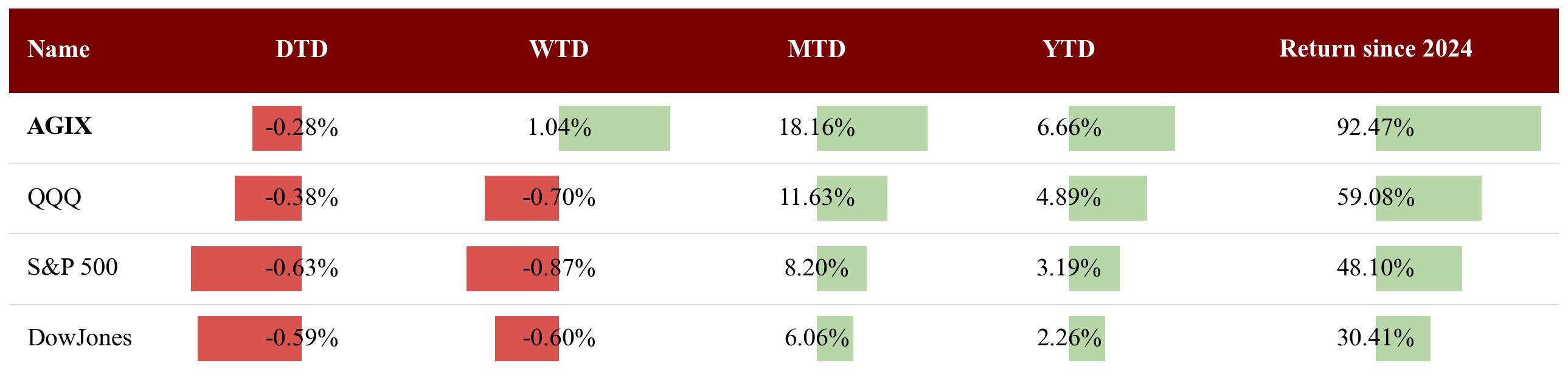
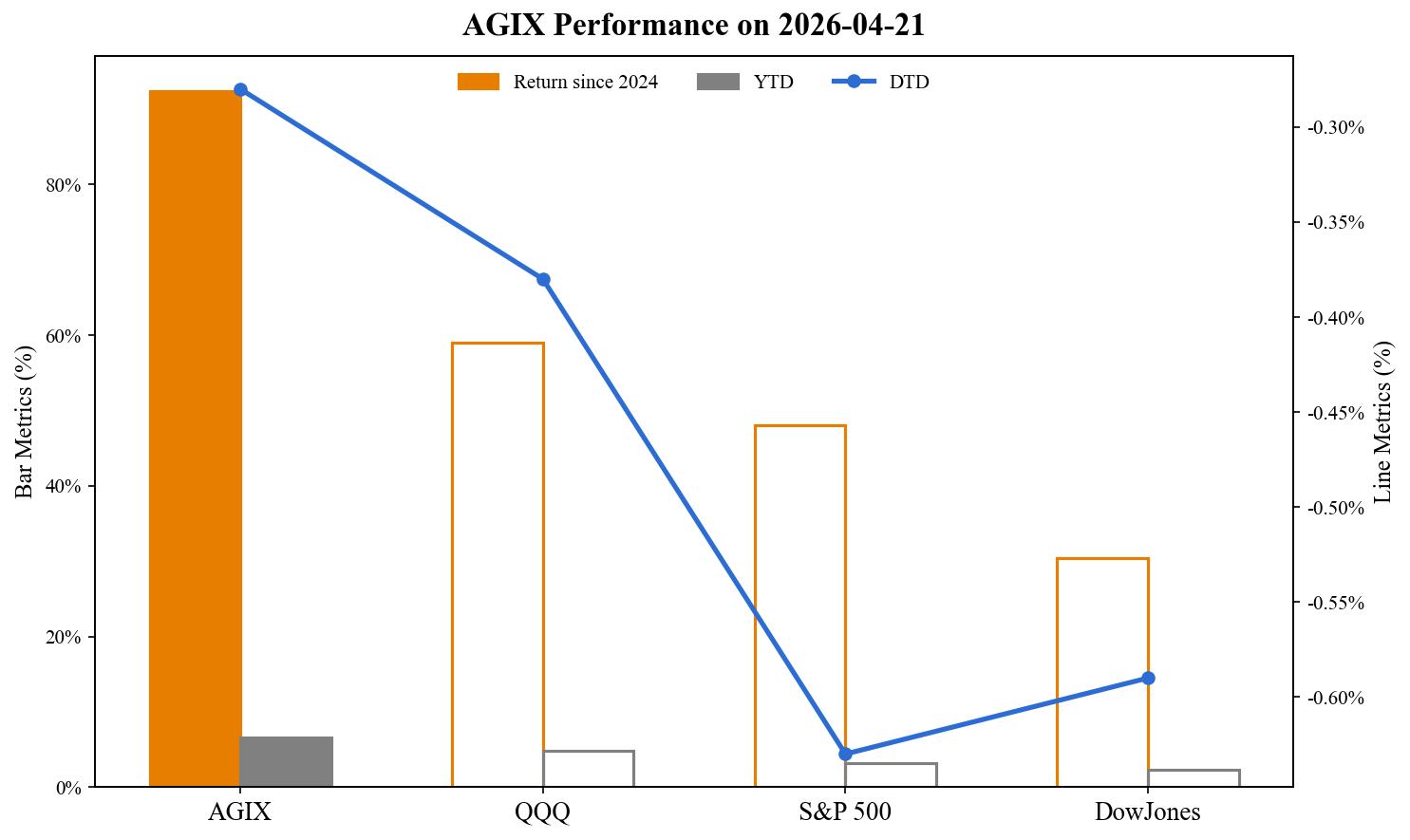
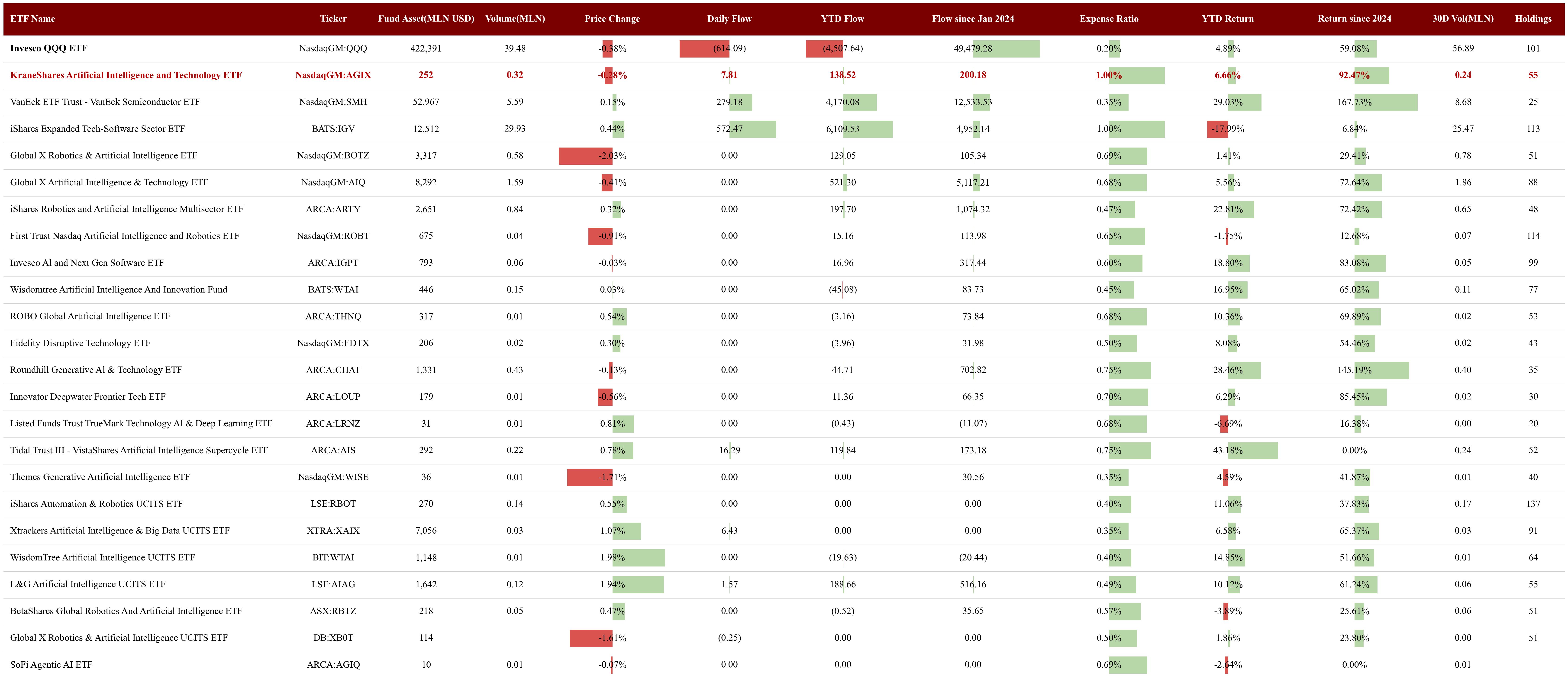
• AGIX outperformed benchmarks (DTD: -0.28% vs QQQ: -0.38%, S&P 500: -0.63%), driven by strong gains in key semiconductor holdings like MediaTek (+10.00%) and Astera Labs (+9.20%).
• Top AGIX contributors were MediaTek (AI chip momentum), Renesas Electronics (+3.58%), and Broadcom (+0.64%). Notable laggards included Circle Internet Group (-9.72%) and Reddit (-5.69%).
• The AI infrastructure race intensified with Amazon's massive $250B investment in Anthropic for cloud/GPU capacity, directly benefiting AGIX holdings Amazon, NVIDIA, and Broadcom.
• Key stocks to watch: MediaTek (surging on AI chip demand), Astera Labs (AI interconnect momentum), and Amazon (deepening AI cloud partnerships). Monitor Apple for leadership transition impact.
News Highlights
1. Amazon invests up to $250B in Anthropic, securing $1T AWS spend commitment and access to Trainium chips. Implication: Bullish for Amazon (AGIX holding) and chip suppliers like NVIDIA/Broadcom, reinforcing cloud AI dominance.
2. Moonshot AI releases Kimi-K2.6 (1T params), outperforming GPT-5.4 on benchmarks. Implication: Highlights competitive open-source LLM advances, potentially pressuring large tech incumbents but fueling overall AI infrastructure demand.
3. Apple CEO Tim Cook steps down, succeeded by hardware SVP John Ternus. Implication: Leadership continuity focused on hardware/Apple Silicon; watch for AI strategy acceleration under new CEO to reduce third-party model reliance.
4. Google expands Gemini in Chrome to APAC, boosting AI assistant reach. Implication: Positive for Alphabet (AGIX holding) as it deepens ecosystem integration and monetization of AI features.
5. OpenAI launches ChatGPT Images 2.0 with improved text rendering. Implication: Strengthens OpenAI's generative AI lead, but competitive pressure remains high from open-source and other closed models.
6. Anthropic's cybersecurity model Mythos reportedly accessed unauthorized, raising security concerns. Implication: Potential near-term reputational risk for Anthropic and its partners like Amazon, but underscores demand for AI security tools.
7. SUSE CEO warns proprietary lock-in hinders enterprise AI, advocating open-source. Implication: Highlights infrastructure flexibility trend, benefiting diversified cloud/hardware providers in AGIX's portfolio.
RSS Highlights
1. Anthropic removes Claude Code from its $20/month Pro plan for new users, potentially cutting costs—signaling pricing/model access shifts in competitive AI coding assistant market.
2. OpenAI's ChatGPT Images 2.0 shows major leap in generating complex illustrations (e.g., raccoons with ham radios), marking significant progress in multimodal AI quality.
3. AI coding assistants' helpfulness has risen from ~20% to ~60% in less than a year, accelerating developer productivity and adoption.
4. Studies warn chatbots remain unreliable for medical advice, with problematic answers to nearly half of health questions—highlighting domain-specific limitations of current LLMs.
5. Current AI agents criticized as overly 'human-like' and lacking rigor, tending to deviate from goals under constraints—a key challenge for enterprise agentic AI deployment.
Performance & Benchmark
Attribution
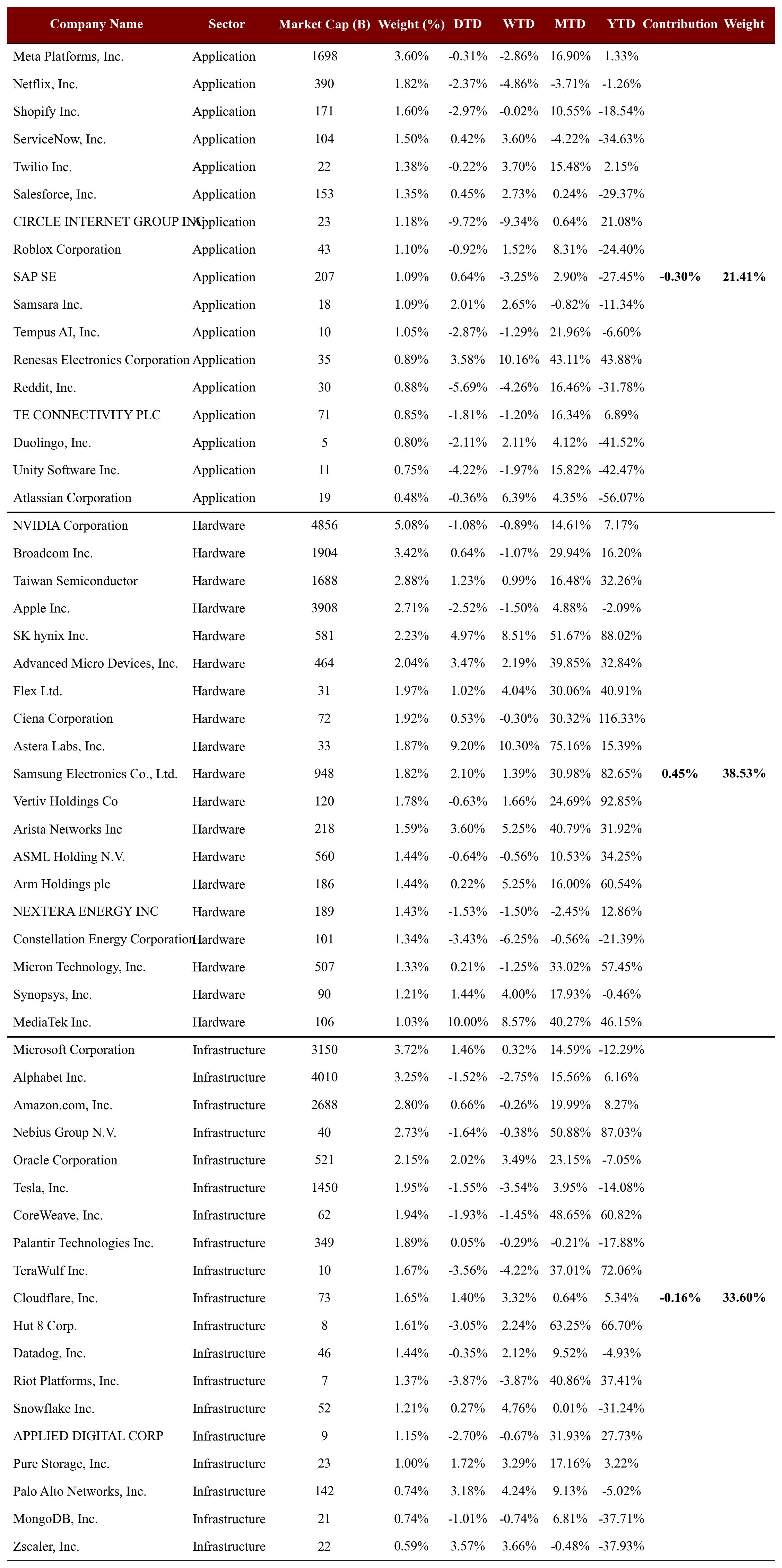
Contribution of the three sectors within AGIX holdings today
Application: -0.3%
Hardware: 0.45%
Infrastructure: -0.16%
Top-performing stocks in AGIX holdings today
MediaTek Inc. (10.0%)
Astera Labs, Inc. (9.2%)
SK hynix Inc. (4.97%)
Arista Networks Inc (3.6%)
Renesas Electronics Corporation (3.58%)
Zscaler, Inc. (3.57%)
Advanced Micro Devices, Inc. (3.47%)
Palo Alto Networks, Inc. (3.18%)
Samsung Electronics Co., Ltd. (2.1%)
Oracle Corporation (2.02%)
Samsara Inc. (2.01%)
Worst-performing stocks in AGIX holdings today
Duolingo, Inc. (-2.11%)
Netflix, Inc. (-2.37%)
Apple Inc. (-2.52%)
APPLIED DIGITAL CORP (-2.7%)
Tempus AI, Inc. (-2.87%)
Shopify Inc. (-2.97%)
Hut 8 Corp. (-3.05%)
Constellation Energy Corporation (-3.43%)
TeraWulf Inc. (-3.56%)
Riot Platforms, Inc. (-3.87%)
Unity Software Inc. (-4.22%)
Reddit, Inc. (-5.69%)
CIRCLE INTERNET GROUP INC (-9.72%)
Top five listed stocks contributing the most within AGIX holdings today
CIRCLE INTERNET GROUP INC (-9.72%)
Apple Inc. (-2.52%)
TeraWulf Inc. (-3.56%)
NVIDIA Corporation (-1.08%)
Riot Platforms, Inc. (-3.87%)
Observation
The strongest movers across peer ETF holdings today are listed below:
| DTD | Stock Ticker | Name | Held by ETFs | analysis |
|---|---|---|---|---|
| 22.07 | TSE:268A | Rigaku Holdings Corporation | ['LSE:RBOT'] | Rigaku Holdings (TSE:268A) shares surged 22.07% on April 21, 2026, primarily due to the announcement of a capital and business alliance with Onto Innovation, under which Onto will acquire 27% of Rigaku's outstanding shares from Atom Investment in H2 2026, making it the largest shareholder[1][2]. This deal builds on their 2025 collaboration for hybrid semiconductor metrology solutions, addressing rising demand for advanced process control amid chip miniaturization[1]. The partnership is expected to drive medium- to long-term growth through technology synergies, with shares hitting a record high of 2,766 yen[1]. |
| 16.14 | NasdaqGM:NVTS | Navitas Semiconductor Corporation | ['ARCA:AIS'] | The search results provided cover April 20, 2026, when NVTS rose approximately 7%, driven by the appointment of ex-Broadcom senior VP Gregory M. Fischer to the board and strong momentum from prior AI power delivery announcements. However, the search results do not contain information about April 21, 2026, or the 16.14% single-day move on that date. Without verifiable public information about events on April 21, I cannot attribute the specific move you've referenced. |
| 10.0 | TWSE:2454 | MediaTek Inc. | ['NasdaqGM:AGIX', 'ARCA:IGPT', 'ARCA:THNQ', 'LSE:AIAG'] | MediaTek's 10% single-day surge on April 21, 2026 was driven by Taiwan's broader market momentum, with the stock becoming the focal point as the TWSE index surged over 600 points to a record high. The company's recent AI chip initiatives, which had already propelled the stock nearly 10% higher to a 52-week high on April 18, likely contributed to sustained investor enthusiasm. The limit-up move reflects strong market sentiment around MediaTek's positioning in the AI semiconductor space amid Taiwan's overall market strength. |
| 9.97 | TWSE:2388 | VIA Technologies, Inc. | ['LSE:RBOT'] | I cannot provide a reliable attribution for VIA Technologies' 9.97% single-day move on April 21, 2026, as the search results contain no news events, company disclosures, or market catalysts from that date. The available information includes only current stock price data, technical ratings, and 2024 financial results, with no reporting on April 21 developments or intraday drivers. A proper attribution would require access to same-day news, earnings announcements, regulatory filings, or industry events from that specific trading session. |
| 9.93 | TWSE:3661 | Alchip Technologies, Limited | ['ARCA:ARTY', 'ARCA:IGPT', 'LSE:RBOT'] | No specific news events, company disclosures, or catalysts explain Alchip Technologies (TWSE:3661)'s 9.93% gain on April 21, 2026, as search results lack same-day information for that date. Recent data shows mixed performance, with prices around 3,065-3,925 TWD and technical indicators neutral to sell, alongside upcoming Q3 2025 earnings. The move may reflect broader market dynamics or unreported sector momentum in AI/HPC chips, but no verifiable drivers are available. |
| 9.9 | TWSE:6526 | Airoha Technology Corp. | ['LSE:RBOT'] | No specific news events, company disclosures, or catalysts explain Airoha Technology Corp. (TWSE:6526)'s 9.9% single-day gain on April 21, 2026, based on available public information. Recent search results show the stock trading around NT$505-520 with minor declines or flat performance in the past 24 hours, alongside 2025 full-year earnings in line on EPS but disappointing on revenues.[1][2] Analyst price targets range from NT$510-800, with the stock 7.7% below estimated fair value, but no same-day drivers are identified.[1][2] |
| 9.53 | NasdaqGS:VICR | Vicor Corporation | ['ARCA:AIS'] | Vicor Corporation (VICR) stock rose 9.53% on April 21, 2026, primarily driven by Roth Capital raising its price target to $245 from $225 while reiterating a Buy rating, citing surging AI infrastructure demand and improved factory utilization.[1][2] The move coincided with the company's Q1 2026 earnings release, which beat EPS estimates by 10% despite a slight revenue miss, fueling optimism ahead of the 8:00 a.m. ET conference call.[3][4][6] Recent insider sales by CEO Patrizio Vinciarelli were noted but did not deter the momentum-fueled rally amid the stock's uptrend from the mid-$140s.[1][2][5] |
| 9.23 | TWSE:2345 | Accton Technology Corporation | [] | No specific news events, company disclosures, or catalysts on April 21, 2026, explain Accton Technology Corporation's (2345.TW) 9.23% single-day gain to near NT$1890.[1] The move occurred amid ongoing hyperscaler dependence and high valuations (P/E 28.46, trading at 169% premium to Morningstar fair value), with no same-day announcements identified in available sources.[2][3] Broader sector momentum in communication equipment likely contributed, as volume reached 4M shares versus 6M average.[2] |
| 9.2 | NasdaqGS:ALAB | Astera Labs, Inc. | ['NasdaqGM:AGIX', 'NasdaqGM:ROBT', 'ARCA:IGPT', 'BATS:WTAI', 'ARCA:THNQ', 'ARCA:CHAT', 'ARCA:LOUP', 'ARCA:AIS', 'BIT:WTAI'] | No specific news events, company disclosures, or catalysts on April 21, 2026, explain Astera Labs (ALAB)'s 9.2% single-day gain on NasdaqGS. Search results lack same-day announcements, with the most recent coverage referencing April 10 momentum from AI infrastructure demand and pre-planned insider sales on April 1. Technical factors and ongoing bullish sentiment around $190 likely contributed to the move amid high volatility. |
| 8.75 | NasdaqGM:RPD | Rapid7, Inc. | ['BATS:IGV', 'ARCA:THNQ', 'XTRA:XAIX', 'LSE:AIAG'] | I cannot attribute Rapid7's 8.75% single-day move on April 21, 2026, based on the available search results. The search results contain no news, earnings announcements, regulatory filings, or company disclosures dated April 21, 2026 or immediately preceding that date. The most recent verifiable events in the results are the March 26, 2026 Kenzo Security acquisition announcement and March 17, 2026 PACT Partner Program updates, which are too distant to explain a single-day move nearly a month later. Without same-day or next-day news catalysts, I cannot provide a credible attribution based on verifiable public information. |
| 8.53 | TSE:9984 | SoftBank Group Corp. | ['NasdaqGM:ROBT', 'BATS:WTAI', 'ARCA:CHAT', 'BIT:WTAI'] | SoftBank Group Corp. (TSE:9984) rose 8.53% on April 21, 2026, primarily driven by its inclusion among 20 firms eyeing Japan's $550 billion investment plan, including $400 billion in projects, alongside interest in $25 billion U.S. power infrastructure projects[1]. This AI and infrastructure-focused news boosted sentiment around the company's shifting portfolio, highlighted by prior partnerships like the August 2025 Foxconn deal for data center equipment in Ohio tied to the Stargate project[1]. Strong technicals, with a "strong buy" rating and high trading volume, provided secondary support[1]. |
| 7.31 | TSE:285A | Kioxia Holdings Corporation | ['ARCA:IGPT'] | Kioxia Holdings (TSE:285A) rose 7.31% on April 21, 2026, primarily due to strong technical momentum and positive analyst sentiment amid broader technology sector buying. TradingView data confirms a near-7% intraday gain with a "strong buy" rating over 1-week and 1-month horizons, supported by weekly gains of 38.60% and monthly surges of 117.92%.[1] Market reports highlight net selling pressure but leadership in high-priced tech stocks during a volatile Nikkei session.[2] |
| 6.51 | TSE:5803 | Fujikura Ltd. | ['NasdaqGM:AIQ'] | Fujikura's 6.51% gain on April 21, 2026 reflects continued momentum from its exceptional multi-year rally, with the stock up nearly 100% year-to-date following its 6-for-1 stock split completed in Q1 2026. The broader Tokyo market also supported the move, with the Nikkei Average rising 524.28 yen as semiconductor and high-tech stocks benefited from U.S. market buying interest the previous day. No company-specific news events are evident in available disclosures for April 21, suggesting the move was driven primarily by sector tailwinds and continuation of Fujikura's sustained uptrend rather than a discrete catalyst. |
| 6.51 | NasdaqGS:AVAV | AeroVironment, Inc. | ['NasdaqGM:BOTZ', 'NasdaqGM:ROBT', 'ARCA:IGPT', 'BATS:WTAI', 'ARCA:LOUP', 'ASX:RBTZ', 'DB:XB0T'] | AeroVironment's 6.51% gain on April 21, 2026 reflects sustained investor momentum from recent operational catalysts and contract wins announced in mid-April. The primary drivers include the reported $95.9M Freedom Eagle counter-drone contract award and FAA clearance for the Locust laser system, which analysts highlighted as new growth drivers for the counter-UAS and directed-energy markets. Secondary support came from the MAYHEM 10 product launch and validation of AV's precision hardware on NASA's Artemis II, which expanded addressable markets and boosted credibility in high-precision applications. These positive developments offset earlier execution concerns around backlog quality and acquisition integration, with analyst consensus maintaining a "Moderate Buy" rating at a $318.78 target price. |
| 6.3 | TWSE:2344 | Winbond Electronics Corporation | ['ARCA:IGPT'] | No specific news events, company disclosures, or catalysts on April 21, 2026, explain Winbond Electronics' 6.3% single-day gain on TWSE:2344. The move aligns with ongoing technical strength, including bullish Ichimoku golden crosses, long-term MACD momentum, and volume spikes supporting the uptrend from February[3]. Analyst price targets averaging NT$149-163 indicate positive sentiment, though not tied to same-day developments[1]. |
| 6.28 | TWSE:2408 | Nanya Technology Corporation | ['ARCA:IGPT', 'ARCA:AIS'] | No specific news events or company disclosures on April 21, 2026, explain Nanya Technology's (TWSE:2408) 6.28% single-day gain. Recent positive momentum from March 2026 revenue of NT$18,170 million (reported April 2) and strong analyst upgrades for Q1 2026 earnings likely contributed to ongoing sector enthusiasm in semiconductors.[1][3] Broader market trends, including a 177.78% yearly stock rise and "strong buy" technical ratings, supported the move amid high volatility (beta 1.93).[2] |
| 6.21 | NasdaqGS:MXL | MaxLinear, Inc. | ['LSE:RBOT'] | MaxLinear's 6.21% gain on April 21, 2026 reflects continued momentum from semiconductor demand tailwinds and the company's strategic positioning in the power management market. The stock had already surged 22.57% on April 20 following optimism around strengthening semiconductor demand and growth prospects, with shares nearly doubling from $16 in late March to $31.73 by April 20. The sustained upward movement on April 21 appears driven by follow-through buying on this momentum, as the stock trades well above analyst consensus price targets of $21.71, suggesting investor conviction in near-term growth catalysts outweighs valuation concerns. |
| 6.05 | TWSE:2308 | Delta Electronics, Inc. | ['NasdaqGM:ROBT'] | Delta Electronics (TWSE:2308) rose 6.05% on April 21, 2026, primarily driven by a material information announcement regarding the notification date for its Board of Directors meeting on the same day.[2] A recent subsidiary cash dividend distribution announced on April 14 also supported positive sentiment ahead of the board meeting.[6] No other same-day news events were identified as catalysts. |
| 6.03 | TWSE:6669 | Wiwynn Corporation | ['ARCA:IGPT'] | No specific news events, company disclosures, or catalysts explain Wiwynn Corporation's (TWSE:6669) 6.03% single-day gain on 2026-04-21, as search results lack same-day announcements or relevant updates.[1][2] Recent financials show strong quarterly revenue of 220.74 B TWD beating estimates and net income growth to 12.12 B TWD, potentially supporting positive momentum amid a 14.42% monthly rise.[1] Trading data indicates elevated volume on nearby days, consistent with sector strength in cloud infrastructure, but no direct attribution is available.[2] |
| 5.99 | TWSE:2451 | Transcend Information, Inc. | ['ARCA:AIS'] | No specific news events, company disclosures, or catalysts explain Transcend Information's (TWSE:2451) 5.99% gain on April 21, 2026, as search results lack same-day announcements or commentary.[6] The stock closed at 265.5 TWD with elevated trading volume of 13.13 million shares, suggesting potential buying interest or technical factors amid broader market conditions.[6] Recent financial strength, including revenue growth of 69.8% and net income up 140.6% TTM, may have supported positive sentiment.[3] |
| 5.74 | NYSE:DOCN | DigitalOcean Holdings, Inc. | ['BATS:WTAI'] | DigitalOcean (DOCN) stock rose 5.74% on April 21, 2026, primarily driven by multiple analyst price target upgrades signaling confidence in its AI growth and cloud outlook. The top catalyst was UBS raising its target to $97 from $62 (Neutral rating) and Barclays lifting to $105, citing upcoming software improvements in H2 2026 despite prior macro headwinds[2]. These followed recent hikes by BofA to $107 and others like Citizens to $105, amid the stock hitting a new 52-week high near $97[1][2][4]. Broader positive analyst sentiment (Moderate Buy consensus at $81 target) and AI infrastructure plans like 31MW GPU buildout further supported the move[5]. |
| 5.7 | TSE:6920 | Lasertec Corporation | ['LSE:RBOT'] | No specific news events, company disclosures, or catalysts explain Lasertec Corporation's (TSE:6920) 5.7% gain on April 21, 2026[1]. The price rose from ¥42,120 to ¥44,520 amid a positive short-term trend, despite recent technical sell signals and a downgrade to Sell Candidate[1]. Likely driven by broader market momentum or sector rotation in semiconductors, with no conflicting reports available[2][4]. |
| 5.57 | TWSE:6531 | AP Memory Technology Corporation | ['ARCA:AIS'] | No specific news events, company disclosures, or catalysts explain the 5.57% rise in AP Memory Technology (TWSE:6531) on April 21, 2026, based on available public information. Search results show technical indicators signaling a strong buy, with the stock trading above its 200-day moving average and positive short-term momentum[1][2][6]. Broader trading factors, such as volatility in the semiconductor sector (average weekly movement 10.6%), may have contributed to the single-day move[4][6]. |
| 5.31 | SZSE:002335 | Kehua Data Co., Ltd. | ['ARCA:AIS'] | No specific news events, company disclosures, or catalysts on April 21, 2026, explain Kehua Data's (SZSE:002335) 5.31% single-day gain. Available data shows general positive factors like rising ROCE and strong 5-year performance, but recent quotes indicate mixed price action with no same-day drivers identifiable.[1] Technicals and valuations remain neutral without clear triggers.[3][4] |
| 5.22 | NasdaqGS:QLYS | Qualys, Inc. | ['BATS:IGV', 'XTRA:XAIX'] | Qualys (QLYS) stock rose 5.22% on April 21, 2026, likely driven by a short-covering bounce after hitting a 52-week low near $81.83 the prior day, amid ongoing undervaluation signals from a P/E ratio of 16.04 despite recent Q4 2025 earnings beats. No specific same-day news events like company announcements or analyst upgrades were reported to explain the rebound. Broader bearish technical forecasts and growth concerns, including a net dollar retention dip to 103%, had pressured the stock recently but did not intensify on this date. |
| 5.04 | NasdaqGS:CRDO | Credo Technology Group Holding Ltd | ['ARCA:IGPT', 'BATS:WTAI', 'LSE:RBOT'] | No specific news events, company disclosures, or catalysts explain Credo Technology Group Holding Ltd (CRDO)'s 5.04% gain on April 21, 2026, based on available public information. The stock's rise aligns with its ongoing positive momentum, including a 7.83% weekly increase, 10.85% monthly gain, and strong recent quarterly results that beat revenue estimates at $223.07 million versus $190.63 million expected.[1] Analyst consensus remains bullish with a Moderate Buy rating and price targets up to $190.[1][2] |
News
Funding & M&A
Anthropic takes $5 billion from Amazon and pledges $100 billion in cloud spending in return.
On Monday, Anthropic announced that Amazon has agreed to invest an additional $50 billion, bringing its total investment in the company to $130 billion. In exchange, Anthropic has committed to spending over $100 billion on AWS over the next 10 years and will gain up to 5GW of new computing capacity for training and running its Claude models. This deal is similar to an agreement Amazon made with OpenAI two months ago, when Amazon participated in OpenAI's $110 billion funding round with a $50 billion investment, pushing the pre-money valuation of ChatGPT developer OpenAI to $730 billion. That agreement was also partially provided in the form of cloud infrastructure services, not pure cash. The core of this deal is Amazon's self-developed chips, including the low-power CPU Graviton and the AI accelerator Trainium (a competitor to Nvidia). Anthropic specifically covers Trainium2 to Trainium4 chips, although Trainium4 is not yet on the market, and Trainium3 was released last December. Furthermore, Anthropic has secured the right of first refusal for future Amazon chip capacity. This news may signal that Anthropic is about to launch a new round of financing, with venture capital firms already proposing capital offers valuing the company at over $800 billion. This move highlights how cloud computing giants are deepening strategic partnerships with leading AI companies through massive investments and infrastructure ties, further intensifying the AI infrastructure race.
Amazon to invest up to $25 billion in Anthropic as part of an expanded cloud partnership
Amazon.com Inc. announced plans to invest up to $250 billion in AI startup Anthropic PBC and provide substantial additional computing capacity. This collaboration builds on an existing three-year partnership, during which Amazon had already invested $80 billion and built an AI cluster named Project Rainier for Anthropic. Under the newly expanded partnership, Amazon will provide an additional $50 billion in funding and plans to invest $200 billion in the future. In return, Anthropic has committed to spending over $1 trillion on Amazon Web Services (AWS) over the next decade, gaining access to up to 5 gigawatts of computing capacity. Currently, Anthropic is using over 1 million AWS custom Trainium2 chips deployed in the Project Rainier cluster, one of the largest of its kind globally. By the end of June, Anthropic will gain access to more Trainium2 chips, and in the second half of the year, AWS will increase capacity for Trainium2 and the more advanced Trainium3 chips, providing nearly 1 gigawatt of computing power. Trainium3, unveiled last December, offers double the performance of Trainium2 and supports LNC logical cores. AWS servers equipped with Trainium3 can achieve 362 petaflops of MXFP8 performance. The new partnership also covers the upcoming Trainium4 chip, which will deliver over 2 exaflops of FP4 performance. Anthropic will also combine this with AWS Graviton CPU rentals for tens of millions of core capacity. For market promotion, the two companies will launch a native Claude console integration with AWS billing and monitoring features, making it easier for customers to use and avoiding duplicate management processes. Anthropic co-founder and CEO Dario Amodei stated that this collaboration will advance AI research and serve customers, including over 100,000 AWS builders.
GRAI believes AI can make music more social, not replace artists
AI music startup GRAI recently completed a $9 million seed funding round led by Khosla Ventures and Inovo VC, with other investors including Tensor Ventures, Tiny.VC, Flyer One Ventures, and the a16z Scout Fund. The company was founded by Belarusian founders Ilya Liasun, Dima Kamarouski, and Andrei Avsievich, who previously sold their video creation app VOCHI to Pinterest. Unlike AI startups like Suno and Udio that generate music from scratch, GRAI focuses on allowing users to interact with existing music tracks through AI remixing, style transfer, and other methods, while giving artists and record labels control, including the choice to opt-in or opt-out. GRAI has launched the iOS app 'Music with Friends' for remixing and an Android AI music playground, targeting Gen Z and Alpha users who are more inclined to discover music through friends, fandoms, and short videos like TikTok, rather than becoming creators themselves. The company has developed proprietary taste and engagement graphs, derivative pipelines, and a real-time audio system to ensure the integrity of the original song's identity, and plans to partner with record labels to generate new royalty streams. GRAI emphasizes a 'ask the owner first, then integrate' principle, aiming to solve issues like passive music discovery and lack of social connection, pushing music consumption towards a creator-first model and avoiding the flood of generative AI content.
Boomi is creating a role for AI agents and guardrails in the data-connected enterprise.
Boomi LP, a veteran player in data activation, is actively positioning itself in agentic AI through a series of innovative products and strategic initiatives to solidify its leadership in enterprise AI infrastructure. Since 2005, the company has offered a multi-tenant cloud platform, introducing machine learning capabilities in 2010, now serving over 30,000 global customers, including a quarter of the Fortune 500. Currently, the Boomi platform runs more than 75,000 AI agents, with the latest launches including the Agentstudio no-code agent management platform and tools like the Meta Hub shared single source of truth. Simultaneously, the company is strengthening agent governance, such as intelligent integration guidance in Control Tower. Boomi CEO Steve Lucas emphasized the inevitability of the transition from connecting enterprises to automation and then to agentic capabilities, calling for enterprise-grade secure containerized deployments to address security vulnerabilities in frameworks like OpenClaw, a need also acknowledged by Nvidia CEO Jensen Huang regarding additional security controls. To tackle soaring AI costs and ROI challenges, Boomi focuses on productivity gains from automation, such as 260 hours saved annually and 50% improvement in revenue recovery. Strategically, in 2024, Boomi acquired Rivery Technologies and Thru Inc. to expand data integration capabilities, and partnered with ServiceNow, AWS, and SAP to deepen AI agent management and no-code data ingestion. These initiatives demonstrate Boomi's ambition to build scalable agent infrastructure in multi-cloud environments, helping enterprises securely embrace the generative AI transformation.
SpaceX is working with Cursor and has an option to buy the startup for $60 billion.
SpaceX announced a cooperation agreement with the AI coding platform Cursor to jointly develop the next generation of 'coding and knowledge work AI.' The agreement includes a surprising clause: SpaceX will have the option to acquire Cursor for $60 billion later this year, or pay $10 billion as a cooperation fee. This move is seen as a strategic layout for SpaceX's upcoming IPO, aiming to enhance competitiveness by integrating Cursor's product and distribution capabilities with SpaceX's Colossus supercomputer (with computing power equivalent to a million Nvidia H100 chips). The background is that xAI provided data center computing power to Cursor last week to support its training of the latest AI models. Two senior Cursor engineers, Andrew Milich and Jason Ginsberg, moved to xAI last month, reporting directly to Elon Musk. Cursor's valuation has soared rapidly: $2.5 billion in January last year, $9 billion in May, $29.3 billion after the Series D in November, with this potential deal valuing it at $50-60 billion. Although SpaceX faces losses due to acquisitions of xAI and X platform and massive capital expenditures, this cooperation may help it break free from dependence on Anthropic's Claude and OpenAI's GPT models and shift towards self-development. The industry views this as a synergistic win-win move within Musk's tech empire family.
Syenta raises $26M in funding to speed up chip interconnect production
Australian chip manufacturing startup Syenta Inc. announced the completion of a $26 million Series A funding round, led by Playground Global and the Australian National Reconstruction Fund, with participation from Investible, Salus Ventures, Jelix Ventures, and Wollemi Capital. Pat Gelsinger, General Partner at Playground Global and former Intel CEO, has joined Syenta's board. The funding will be used to expand production capacity, open an office in Arizona to advance its U.S. market presence, with the goal of achieving mass production of interconnect components by 2028.
Syenta's core technology is Local Electrochemical Manufacturing (LEM), which can reduce chip interconnect manufacturing time from hours to minutes. By using electroplating electrodes to simultaneously complete deposition and patterning steps, it enables faster and lower-cost production. LEM supports sub-micron fine-pitch connections, improving data transfer speeds, and is particularly suitable for AI chip suppliers. The company's clients are already collaborating with multiple chip designers. Syenta emphasizes that this technology does not require entirely new manufacturing equipment and can enable more efficient data movement on existing infrastructure, aiding in the development of faster processors. This move marks an innovative breakthrough in the chip interconnect field, with the potential to reshape the landscape of AI chip production.
AI research lab NeoCognition lands $40M seed to build agents that learn like humans
AI researcher Yu Su's startup NeoCognition recently emerged from stealth mode, completing a $40 million seed funding round co-led by Cambium Capital and Walden Catalyst Ventures, with participation from Vista Equity Partners and angel investors including Intel CEO Lip-Bu Tan and Databricks co-founder Ion Stoica. NeoCognition positions itself as a research lab focused on developing self-learning AI agent systems to address the current lack of reliability in AI agents. Su points out that existing agents like Claude Code, OpenClaw, or Perplexity's computer use tool have only about a 50% task success rate and cannot function as independent workers. NeoCognition mimics the human mechanism of rapid specialization, enabling general agents to autonomously learn and build 'microworld models' for specific domains, achieving expert-level performance in any field. The company plans to sell its agent systems to enterprise clients, especially SaaS companies, for building AI agent workers or enhancing products. Vista's investment is particularly crucial, providing direct access to its vast portfolio in the software sector. The current team has about 15 members, mostly PhDs. Su believes this self-learning specialization capability is the key missing piece for reliable autonomous AI work, and this funding will accelerate its technology deployment.
Why Wasabi opted for credit in its latest financing round
Wasabi Technologies Inc. announced it has secured a $250 million credit line, opting for debt financing over equity financing to enhance capital flexibility. The Boston-based cloud storage provider has raised over $600 million cumulatively, with a valuation of $1.8 billion, following a $70 million equity round in January. CFO Michael Bayer stated this move reflects the company's financing principles: equity is used for operating losses and early-stage expansion, while debt supports predictable capital expenditures, such as expanding storage capacity for AI workloads. Bayer emphasized that debt is cheaper than equity and avoids dilution, but cautioned about debt burdens. The company's estimated annual revenue exceeds $150 million, and it is shifting to debt to match the cash flow of its maturing business. The article references the high-debt case of Dell Technologies' $67 billion acquisition of EMC in 2016, warning of the need to balance cash flow. The private credit market expanded to $2 trillion from 2009 to 2024 but scrutinizes AI-related businesses strictly. Wasabi's success in securing attractive rates highlights the strategy of mature companies optimizing their capital structure. This financing supports low-risk storage expansion, embodying the principle of matching business risk with financing.
Model Releases
ChatGPT's new Images 2.0 model is surprisingly good at generating text
OpenAI recently launched the ChatGPT Images 2.0 model, marking a significant advancement in AI image generation technology. The model demonstrates extremely high realism and accuracy when generating images of real-world scenes, such as a Mexican restaurant menu, avoiding the spelling errors common in previous diffusion models, like fictional words such as 'enchuita' or 'burrto'. Compared to DALL-E 3 from two years ago, Images 2.0 can accurately render small text, icons, UI elements, and complex compositions, supporting resolutions up to 2K. The new model possesses 'reasoning capabilities', can search the web, generate multiple images from a single prompt, and self-validate outputs, supporting multi-panel comics and marketing assets of various sizes. Simultaneously, it significantly improves the rendering capability for non-Latin scripts such as Japanese, Korean, Hindi, and Bengali, despite its knowledge cutoff being December 2025. The model does not generate images instantly; complex images may take several minutes, but the output quality is substantially superior. All ChatGPT and Codex users will gain access starting Tuesday, with paid users enjoying advanced features; OpenAI will also launch the gpt-image-2 API, billed based on quality and resolution. Lesan AI founder Asmelash Teka Hadgu pointed out that traditional diffusion models struggle with spelling due to their pixel reconstruction mechanism, and this innovation might employ an autoregressive mechanism. OpenAI did not disclose the specific architecture. This move strengthens its leading position in the generative AI field, promoting the commercial application of image tools.
Sam Altman criticizes Anthropic's cybersecurity model, Mythos, calling it 'fear-based marketing'
OpenAI CEO Sam Altman publicly criticized competitor Anthropic's new cybersecurity model, Mythos, on the podcast 'Core Memory', accusing it of using 'fear marketing' tactics to exaggerate the product's capabilities. Anthropic introduced Mythos to a select group of enterprise clients earlier this month, claiming the model is so powerful that public release could risk weaponization by cybercriminals, a move that sparked controversy. Altman noted that this marketing approach aims to restrict AI technology to a select elite, humorously analogizing: 'We built a bomb, we're about to drop it on your head, and then we're going to sell you a $100 million bunker.' He emphasized that fear marketing is not unique to Anthropic; the entire AI industry widely uses exaggerated rhetoric and doomsday prophecies to sell products, including Altman's own past statements. Critics argue Anthropic's claims are overly sensational. This public spat highlights the intensifying competition among AI companies and reflects deep industry divisions regarding the safety and openness of powerful models. As AI technology rapidly advances, balancing innovation with risk mitigation has become a focal issue.
Moonshot AI releases the Kimi-K2.6 model with one trillion parameters and attention optimizations.
Chinese AI startup Moonshot AI today released Kimi-K2.6, the latest version of its popular open-source large language model Kimi series. This model outperforms GPT-5.4 and Claude Opus 4.6 on multiple AI benchmarks. Kimi-K2.6 employs the SwiGLU activation function, which is more efficient than traditional algorithms, simplifies the training process, and has been integrated into open-source models like Meta Platforms' Llama series. Its neurons are organized into 384 expert modules, with only 8 experts activated to process prompts, significantly reducing hardware consumption. It also introduces the MLA (Multi-head Latent Attention) mechanism, which improves efficiency through data compression. The model is equipped with a 400-million-parameter visual encoder, supports multimodal input, can convert images into embedding vectors, and handles both text and multimedia. Kimi-K2.6 can generate complete websites from simple instructions and interface sketches. For complex tasks, it can launch up to 300 agents to execute sub-steps in parallel and optionally introduce human collaboration through the 'claw groups' function, improving performance on tasks like Rust development. On rigorous benchmarks like HLE-Full, Kimi-K2.6 scored 54 points, leading Opus 4.6's 53 points and GPT-5.4's 52.1 points, demonstrating cutting-edge competitiveness. This release highlights Moonshot AI's innovative breakthroughs in the open-source LLM field, advancing hardware-efficient AI development.
Technical Breakthroughs
Meta will record employees' keystrokes and use them to train its AI models.
Meta is exploring innovative ways to acquire training data for its AI models, this time turning its attention to its own employees' usage behavior. According to a Reuters exclusive report, Meta plans to collect data on employees' computer operations, such as mouse movements and keystrokes, to train more efficient AI agents. These agents are designed to assist users with daily computer tasks, like clicking buttons and navigating drop-down menus. A Meta spokesperson told TechCrunch that they are rolling out internal tools to capture these inputs within specific applications, with safeguards in place to protect sensitive content. The data is used solely for model training and for no other purpose. This move highlights the determination of tech giants to spare no effort in searching for training data for AI development, while also raising privacy concerns. Recent industry trends show that internal corporate communications are becoming a new source of fuel for AI. Last week, reports indicated that Slack archives, Jira tickets, and other data from some startups are being mined and transformed. While such practices accelerate AI progress, they expose privacy risks within the AI industry and could reshape corporate data supply chains, warranting close attention from regulators.
Google Cloud Next 2026 preview: The real story isn't AI — it's the control plane
The Google Cloud Next conference is about to be held, where Google will unveil major initiatives that go beyond model releases, aiming to build an operating system for agentic enterprises and lead the future platform war for enterprise execution. The article points out that the enterprise technology stack is shifting from systems of record and systems of engagement to systems of execution. Google is positioning itself in AI execution, data context provision, and work orchestration layers, competing with AWS, Microsoft, Salesforce, and others for control plane dominance. Key points include: optimizing TPU for agent infrastructure to support continuous execution; data evolving into an AI memory layer, with BigQuery becoming a reasoning surface, posing a challenge to Snowflake and Databricks; Gemini transforming into an orchestration and governance control plane, competing with AWS Bedrock, Microsoft Copilot, and Salesforce Agentforce; security shifting towards autonomy, leveraging Mandiant assets; and the application layer diminishing, with Google Workspace transforming into an agent interaction platform. Google's strategy is to integrate multiple layers into a unified system, but it faces strong competitors and sales execution challenges. This conference may reshape the enterprise stack. If successful, it will define a new era of agentic work; otherwise, AWS and Microsoft will dominate. Focus on real customer cases and cross-cloud capabilities, as this battle concerns the next decade of cloud economics.
Five takeaways from CEO Shantanu Narayen’s final keynote at the Adobe Summit.
The Adobe Summit 2026 edition marked a historic turning point for the software giant Adobe. In his final keynote as outgoing CEO, Shantanu Narayen showcased the next frontier of 'agentic AI,' elevating AI from an assistive tool to an autonomous 'colleague' that executes multi-step business goals. By connecting to the Adobe Experience Platform—which processes 35 trillion customer evaluation segments daily—Adobe empowers AI with complete memory of customer interactions, enabling context-aware, personalized work. Nvidia CEO Jensen Huang appeared in the speech, discussing how Omniverse and high-fidelity digital twins fuse physical and digital AI to drive transformation in manufacturing and logistics. Adobe introduced innovations like CX Enterprise, Creative Agent, and Brand Intelligence: the former optimizes customer journeys, while the latter automates creative processes and ensures brand compliance, all while emphasizing AI as a work amplifier rather than a replacement. Narayen reflected on his 18-year tenure, from boxed software to the SaaS subscription model, and expanding into the Experience Cloud through acquisitions like Omniture and Marketo, growing Adobe's market value nearly 20-fold. He called on business leaders to reshape their operations around data-driven experiences, viewing AI as a multi-year platform transformation rather than a pilot tool, and declared the 'early stages' of the generative AI and agent era.
YouTube is expanding its AI likeness detection technology to include celebrities.
YouTube announced the expansion of its 'likeness detection' technology to the entertainment industry. This technology identifies AI-generated deepfake content, similar to the existing Content ID system used to detect copyrighted material in user-uploaded videos. This expansion aims to protect creators and public figures from unauthorized use of their likeness, particularly addressing the issue of scam advertisements often encountered by celebrities. The technology was first piloted with some YouTube creators last year and expanded to politicians, government officials, and journalists this spring. Now, entertainment industry professionals, including talent agencies, management companies, and the stars they represent, can use it without needing a YouTube channel. The system scans AI-generated content to match the faces of registered participants. Users can choose to request video removal (for privacy policy violations), submit a copyright takedown request, or take no action. YouTube emphasizes it will not remove all content, allowing for satire and parody. In the future, the technology will support audio detection. Simultaneously, YouTube supports Washington's NO FAKES Act, advocating for federal-level regulation of the unauthorized use of AI to reproduce individuals' voices and visual likenesses. The company revealed that as of March, the volume of deepfake removals handled by this tool remains 'very small'.
Mythos remains a mystery as the security world faces rising threats, agentic attacks, and concerns about AI integrity.
Anthropic PBC's Claude Mythos model has not been officially released yet, but it has already become the most talked-about AI solution in the cybersecurity field. The model is reportedly capable of analyzing software at scale, discovering vulnerabilities in hardened software ecosystems, and identifying security weaknesses. Anthropic's Threat Intelligence Director, Jacob Klein, first hinted at its powerful capabilities at the SANS cybersecurity summit outside Washington, emphasizing that Mythos excels at finding vulnerabilities and chaining them together to form attack exploitation paths. He called for AI labs to increase transparency to address the rapidly evolving cyber threat landscape. Recent events highlight the risks: Vercel Inc. was compromised due to an employee using the third-party tool Context.ai, with hackers stealing customer credentials and selling them online; North Korean threat actors used AI to implant malicious code in the popular JavaScript library Axios. The White House Treasury Secretary held an emergency meeting with Anthropic's CEO, and major banks have strengthened their defenses. Klein reviewed the history of Claude models being maliciously used: from simple ransomware in Spring 2025, to Russian extortion campaigns, to Chinese state-sponsored groups conducting large-scale system reconnaissance and infiltration, with 80%-90% of actions performed autonomously. Anthropic has mapped 800 malicious actors' use of MITRE techniques and will soon release a report. Experts believe Mythos may become a key architecture for defending against AI attacks, highlighting the double-edged sword effect of AI and driving a paradigm shift in cybersecurity.
Three insights you may have missed from theCUBE's coverage of the Oracle Data Deep Dive event.
Oracle Corp. is actively promoting its database architecture as a reliable pillar for AI foundations. The company has launched a redesigned Oracle Database and AI Data Platform, which deeply integrates machine learning, vector search, and advanced analytics to help enterprises build trustworthy AI applications. Oracle emphasizes that in the era of agentic AI, databases must ensure security and reliability, avoiding sacrificing foundational stability for development speed. Executive Vice President Juan Loaiza analogized it to trusting the structure of a hundred-story building built in 20 minutes. Oracle's AI Database Private Agent Factory and Autonomous AI Vector Database place agent logic near the data, reducing multiple database round trips and enabling real-time, clean data-driven AI. The Globally Distributed AI Database provides a globally distributed, high-scale architecture that presents multiple physical databases as a single logical entity, ensuring strong consistency and zero-downtime performance. The GoldenGate real-time data replication platform supports multi-cloud, heterogeneous environments, adapting to distributed AI data factories from the edge to the data center. Additionally, Oracle's built-in database-level elasticity, security, and high-availability frameworks support the secure deployment of AI-generated code, avoiding risks associated with missing traditional validation. These innovations help enterprises achieve production-grade AI architectures, promoting the core role of databases in the AI era.
SUSE observes open architectures redefining resilience and digital sovereignty
Against the backdrop of multi-cloud complexity and accelerating AI adoption, enterprise IT is prioritizing resilience and digital sovereignty as core objectives. To address this challenge, organizations are betting on open, modular architectures and partner ecosystems to regain flexibility and control. SUSE S.A. Chief Marketing Officer Margaret Dawson stated at SUSECON 2026 that resilience, sovereignty, and security are often misunderstood as reasons for closed systems, but transparency is actually the key to true control. She emphasized that 'black boxes' cannot achieve sovereignty; control must be ensured through visibility. In an interview with theCUBE host Paul Nashawaty, Dawson discussed how open architectures and multi-cloud strategies are shaping modern enterprise IT. As workloads become more distributed and demand more unpredictable, static architectures struggle to keep pace. Open architectures drive the development of composable, modular systems, particularly suited for edge computing and AI applications, which require smaller-scale technologies and composability. Dawson believes adopting such architectures is no longer a strategic choice but a necessity for survival. Forces like AI, edge computing, and multi-cloud complexity are accelerating this trend, with the pace of innovation exceeding exponential growth. SiliconANGLE's theCUBE, as a paid media partner for SUSECON 2026, provides exclusive live coverage, emphasizing editorial independence.
Product Launches
Proprietary lock-in is holding back enterprise AI ambition, says SUSE CEO
As enterprises accelerate AI adoption, a key challenge is how to achieve modernization without sacrificing control and flexibility. Open-source infrastructure provider SUSE S.A. is helping businesses break free from the constraints of proprietary cloud dependency. SUSE CEO Dirk-Peter van Leeuwen noted at SUSECON 2026 that many enterprises are trapped by single-cloud vendor strategies, facing pricing volatility and innovation lag. SUSE introduced a five-path resilience strategy covering digital sovereignty, operational efficiency, cloud portability, edge computing, and AI adoption, helping companies choose an entry point based on their maturity level. Its Kubernetes-based platform enables workloads to be developed once and deployed across multiple clouds, ensuring critical data never leaves the enterprise boundary.
van Leeuwen emphasized that data sovereignty has become a prerequisite for AI adoption. Gartner predicts that by 2030, over 75% of enterprises will have a digital sovereignty strategy. Large companies fear large language models leaking intellectual property, thus prioritizing on-premises deployment. SUSE provides a stable core platform that supports GPU infrastructure investment while allowing enterprises to innovate freely on top without frequently replacing underlying systems. This strategy helps companies reduce the total cost of ownership of existing assets, freeing up budgets for AI investment and balancing the needs for simplification and sovereignty in complex environments.
From cloud-first to control-first: theCUBE's SUSECON keynote analysis.
At the SUSECON 2026 conference, multi-cloud resilience and digital sovereignty emerged as core issues for enterprise IT. Open-source infrastructure leader SUSE S.A., with platforms like SUSE Rancher Prime and SUSE Linux Enterprise, demonstrated strong momentum. CEO Steven Dickens pointed out that SUSE is well-positioned in the virtualization market transformation, possessing a clear roadmap and aligning with market trends. Dickens emphasized in a live theCUBE interview that with surging AI adoption and increasing compliance pressure, nearly 90% of enterprises are implementing multi-cloud strategies, driving demand for tools to manage cross-environment complexity. Customers prioritize optionality, with digital sovereignty and regulations shaping long-term multi-cloud layouts and reshaping container, VM, and workload placement strategies. Digital sovereignty pressures in Europe are accelerating workload repatriation, emphasizing both local infrastructure and cloud environments. AI applications trigger the choice of 'bringing AI to the data or data to the AI,' further driving infrastructure decisions. Dickens believes SUSE provides comprehensive optionality, making it an ideal partner. This discussion highlights SUSE's strategic advantages in multi-cloud resilience, AI integration, and digital sovereignty.
Across the enterprise, AI agents have outpaced the infrastructure meant to support them.
As open-source platforms race to close the infrastructure gap, enterprises are discovering that the issues exposed by autonomous operations extend far beyond performance to the matter of control. According to Abhinav Puri, General Manager of Portfolio & Community at SUSE S.A., in an exclusive interview with theCUBE at SUSECON 2026, as AI agents drive autonomous operations for core business processes, enterprise resilience has shifted from mere uptime to the ability to simultaneously absorb geopolitical, technological, and financial shocks. IT leaders are under pressure to build flexible infrastructure that supports an agentic AI future without losing control. Puri emphasized that when language models are embedded into workflows and AI agents lead autonomous operations, enterprises cede control over IP, data, and business processes, which erodes competitive barriers. Leveraging over 30 years of experience in software-defined infrastructure, SUSE is upgrading its platform to a 'digital collaborator,' proactively orchestrating autonomous operations rather than merely hosting workloads. The company has introduced a Model Context Protocol server, which functions like a USB adapter to be compatible with existing AI agent platforms, avoiding stack lock-in. This helps enterprises bridge the gap between legacy infrastructure and production deployment, realize true ROI on AI investments, and avoid the 'control tax' imposed by proprietary stacks. SUSE positions its open-source infrastructure as the backbone for agentic AI, supporting enterprises in maintaining autonomy.
Amplitude introduces contextual AI assistant to guide users
Amplitude Inc. today launched the embedded AI support agent Amplitude AI Assistant. This tool leverages user behavior data from the company's analytics platform to help users navigate digital products without leaving the application. The assistant detects user difficulties by analyzing behavior in real-time, such as repeated clicks or incomplete workflows, and proactively provides personalized guidance, even completing tasks like filling out forms or navigating menus. Unlike traditional chatbots, it does not rely on user queries but intervenes based on features like 'frustration analysis' and session replays. Wade Chambers, Chief Engineering Officer at Amplitude, emphasized that the system is built on a deep layer of behavioral data and appears only when users truly need it, avoiding disruption to the user experience. Learning from the infamous lesson of Clippy in Microsoft Office, the company ensures the assistant appears selectively and continuously optimizes responses by evaluating intervention effectiveness through feedback loops. The assistant is not just a support tool; it also feeds interaction data back into product development, creating a 'flywheel effect' to identify friction points and improve design. Currently, this feature is in a closed beta with customers and will be launched as a paid add-on service to the analytics platform. This move aims to reduce user abandonment rates and enhance product usability and long-term competitiveness.
Google is rolling out Gemini in Chrome for APAC countries.
Google announced on Monday the expansion of its Gemini in Chrome feature to several new markets in the Asia-Pacific region, including Australia, Indonesia, Japan, the Philippines, Singapore, South Korea, and Vietnam. The feature will launch simultaneously on desktop and iOS devices, with Japan being limited to desktop only. Since last year, Google has continued to deepen the integration of AI and Gemini into the Chrome browser, enhancing the user experience through features like floating windows. Earlier this year, the company introduced a sidebar-based assistant that can answer questions across tabs and leverage Gemini's Personal Intelligence to connect with services like Gmail and Google Photos for personalized responses. Users can also use this feature to schedule meetings with Calendar, view location details with Maps, and draft and send emails with Gmail. Additionally, the sidebar integrates the Nano Banana 2 tool for transforming webpage images. The Gemini in Chrome feature was first launched in the US in January and expanded to India, Canada, and New Zealand in March. This Asia-Pacific expansion further broadens its global reach. However, the company's agentic features (which can autonomously control the browser to complete tasks) are still in testing, limited to US users on the paid AI Pro and AI Ultra plans. This move marks Google's ongoing advancement in the browser AI assistant space, aiming to enhance user productivity and personalized interaction.
Proprietary technology stacks are failing enterprises just when they need flexibility the most.
In the evolution of hybrid cloud and multi-cloud strategies, open-source architecture is becoming central to operational resilience, sovereignty, and choice. Peter Smails, General Manager of Cloud Native at SUSE S.A., noted at SUSECON 2026 that while many technology vendors are moving towards proprietary stacks, customers precisely need flexibility and durability, positioning SUSE advantageously. SUSE emphasizes the low barrier to entry and adaptability of open source as the foundation for operational resilience. In an exclusive interview with theCUBE, Smails discussed how open-source architecture and interoperable ecosystems are simplifying the complexity of hybrid multi-cloud environments. Complexity and skill gaps remain major obstacles to modernization. SUSE addresses this with SUSE Rancher Prime, providing a unified control plane that spans data centers, cloud, and edge environments, reducing operational fragmentation without requiring customers to completely replace existing systems. He emphasized that combining the open-source ethos, interoperability, and large-scale consistent operations forms a powerful concept, enabling a simple, consistent paradigm whether in data centers, multi-cloud, or edge. Following Broadcom's acquisition of VMware, the virtualization economy and strategy have been reshaped, prompting enterprises to urgently seek modern alternatives. SUSE Virtualization allows traditional virtual machines and container workloads to run in parallel on the same control plane, supporting enterprises in modernizing at their own pace. The underlying dependency is a standard driver chain: interoperability enables a common control plane, which in turn builds a trusted ecosystem. SUSE is addressing the market's urgent needs in the post-VMware era, driving enterprise infrastructure transformation.
Mondoo debuts free AI Skills Check to flag risky agent skills before installation
Vulnerability management service startup Mondoo Inc. recently launched a free security check tool called Mondoo AI Skills Check, aimed at addressing the surge in supply chain risks posed by AI agent skills. The tool requires no subscription. Users can search by skill name, registry, or package URL to gain clear insight into a skill's functionality, behavior, and potential security risks before installation. As AI agents are rapidly adopted, new security threats from third-party skills are becoming prominent, with numerous malicious skill cases this year often gaining access to credentials and sensitive systems, creating an invisible supply chain layer across multiple agents and registries. AI Skills Check is compatible with Claude Code, Cursor, Windsurf, Anthropic SDK agents, and Model Context Protocol servers, and supports registries like ClawHub and Skills.sh. Its agent-agnostic design provides an independent analysis layer. Unlike single-market scanning tools, it performs deep code and behavioral analysis to compare a skill's stated claims with its actual behavior, revealing hidden risks. The tool scans in four layers: Pattern Match identifies known malicious patterns; ML Classifier detects novel threats; Semantic Analysis evaluates description consistency; Deep Inspection checks permissions and behavior. Output includes CVSS-based risk assessment and detailed reports. Mondoo co-founder and Chief Security Officer Patrick Münch stated this free tool aims to fill a visibility gap. The new service also provides real-time leaderboards and high-risk lists, and will be showcased this week at the Google Cloud Next 2026 conference in Las Vegas.
AppZen is addressing the accounts payable bottleneck with a new AI agent service center.
AppZen Inc., an autonomous finance platform company, recently launched the AP Inbox Service Center, an innovative accounts payable service that automates the process for finance teams to handle supplier emails using eight pre-built AI agents. The service transforms the AppZen Inbox into a structured service center, converting each inbound supplier message into a trackable, auditable request with an assigned status, owner, and resolution path. AppZen points out that while invoice processing has been heavily automated over the past decade, the supplier-facing communication layer remains highly manual, including payment status inquiries, bank change requests, duplicate invoice resolution, supplier reconciliation, W-9 submissions, and remittance requests, with finance reviewers spending up to a week per month on these tasks. The new service uses eight agents to handle specific scenarios end-to-end, from reading messages and querying ERP system records to evaluating organizational policies and taking action, with all decisions being auditable. Provided templates cover functions such as payment status responses, bank change verification, and duplicate invoice detection. For example, the bank change agent categorizes risks based on domain mismatches, urgent language, etc., and escalates them to supplier management. Agents can be configured and deployed via the AI Agent Studio without IT intervention; teams can describe processes in business language, which are then converted into executable workflows, going live in as little as 30 minutes. Agents support a preview mode and can escalate to human agents when uncertain, ensuring sender identity verification and sensitive data masking. Anant Kale, co-founder and CEO of AppZen, stated that this service helps customers focus on professional work while AI agents handle high-volume tasks. The company has raised approximately $290 million in total funding, with investors including Mastercard.
Proprietary lock-in is holding back enterprise AI ambition, warns SUSE CEO.
As enterprises accelerate AI adoption, maintaining control and flexibility has become a key challenge. Open-source infrastructure provider SUSE S.A. is helping enterprises modernize while ensuring full digital sovereignty. SUSE CEO Dirk-Peter van Leeuwen noted at SUSECON 2026 that many enterprises are trapped by over-reliance on a single cloud and vendor, facing risks of pricing volatility and slowed innovation. SUSE's five-path resilience strategy covers digital sovereignty, operational efficiency, cloud portability, edge computing, and AI adoption, allowing enterprises to choose an entry point based on their maturity. The Kubernetes-based platform enables 'develop once, deploy anywhere' across multiple clouds, supporting enterprises in keeping critical data on-premises to avoid IP leakage. van Leeuwen emphasized that data sovereignty has become a prerequisite for AI adoption, with Gartner predicting that over 75% of enterprises will have a digital sovereignty strategy by 2030. SUSE's edge-to-cloud portfolio provides a stable core that supports GPU infrastructure investments, allowing enterprises to benefit from waves of AI innovation without frequent replacements. This strategy helps enterprises reduce the total cost of ownership of existing assets, freeing up budgets for AI investment while simplifying operations in complex environments.
Yelp launches a new Assistant chatbot integrated into every part of the platform.
Yelp Inc. recently announced the launch of its new chatbot assistant, Yelp Assistant, along with 35 new features and updates, further enhancing the seamless user experience from discovery to action. The assistant leverages billions of user reviews, photos, menus, and detailed business information to provide precise recommendations, answer complex questions, and handle highly personalized requests. It has now been expanded to the 'Assistant' tab in iOS and Android apps, supporting action functions like booking tables, placing takeout orders, and scheduling services. Chief Product Officer Craig Saldanha stated that this upgrade marks the first time a complete closed loop from discovery to action within a single conversation has been achieved. New integration partners include Vagaro Inc. (a beauty and wellness booking platform supporting salon, spa, and fitness appointments), Zocdoc Inc. (a medical appointment marketplace helping to instantly match patients with in-network doctors), and Calendly. Zocdoc founder Oliver Kharraz emphasized that this integration makes booking medical appointments as easy as ordering a meal. Additionally, Yelp has optimized the user experience: the Menu Vision feature launched in 2025 overlays photos of popular dishes and community reviews via a phone camera; the iOS home feed pushes personalized, immersive videos; natural language photo search is supported; and AI-powered chat support is available. These innovations strengthen Yelp's core position as a local business discovery and recommendation engine, driving consumer decision-making efficiency.
Crossing the 'production chasm' is now enterprise AI's defining test.
Enterprise AI is developing rapidly, but governance blind spots are quietly eroding the journey from pilot to large-scale production. A survey shows that one-fifth of organizations report security breaches related to shadow AI, and only 37% of enterprises have established management or detection policies. This governance gap has become a critical challenge. Rhys Oxenham, VP of AI at SUSE S.A., pointed out at SUSECON 2026 that bridging controlled experimentation with safe production is a core infrastructure challenge for 2026. Oxenham emphasized that pilots easily prove value, but scaling to production requires addressing critical data security and governance needs. SUSE is helping customers cross this 'production chasm.' In an exclusive interview with theCUBE, he detailed SUSE's private enterprise AI strategy, focusing on open standards, hybrid deployment flexibility, and organizational data sovereignty. This strategy supports deployment from on-premises data centers to public clouds and the edge, avoiding reliance on proprietary stacks. Oxenham stated that digital sovereignty is no longer just a European compliance label but a global planning factor for organizational independence and resilience. Faced with executive pressure for AI results, employees bypassing authorized systems lead to loss of data control. The SUSE AI stack, based on SUSE Rancher Prime and SUSE Linux Enterprise Server, provides observability, security, and automation, ensuring hardware runs efficiently and strengthening policy guardrails for agent workflows. Governance, security, and observability are crucial in the era of agentic AI. This interview is part of the SUSECON 2026 coverage.
Yelp's updated AI assistant can answer questions and book a restaurant or service in one conversation
Yelp recently launched a major update to its AI assistant, transforming it from a traditional review platform into an 'Answers & Actions' platform. Users can query questions and complete multiple actions within the chat interface, including restaurant reservations, food delivery orders, and service appointments, without frequently switching apps. The assistant leverages platform data, business websites, and user reviews to provide accurate information. It is supported on iOS and Android apps and is placed centrally in the bottom navigation bar for easier access. In a demo, Yelp's Senior Vice President of Product, Akhil Kuduvalli Ramesh, showcased functions like searching for dog-friendly hiking trails, food delivery options (DoorDash), restaurant recommendations, and booking house painting services. New integrations with external service providers include DoorDash and Grubhub for delivery, Vagaro for fitness/beauty appointments, Zocdoc for doctor appointments, RepairPal for auto repair, and Calendly for general appointments. Currently, actions will redirect users to the corresponding provider's page rather than being completed entirely within the chat, but Yelp hinted at a potentially more 'agentic' experience in the future. Additionally, Yelp launched optimized features like menu scanning to view user photos, natural language search for media libraries, and AI photo tag grouping, aiming to enhance user experience and attract more visits. This update marks the evolution of consumer platforms towards AI-driven action ecosystems.
Google rolls out Gemini in Chrome in seven new countries.
On Monday, Google announced the expansion of its Gemini in Chrome feature to seven new markets, including Australia, Indonesia, Japan, the Philippines, Singapore, South Korea, and Vietnam. The feature is now fully rolled out on desktop and iOS devices in these countries (except Japan). Previously, since last year, Google has been deepening the integration of AI and Gemini into the Chrome browser, including introducing a floating window design. Earlier this year, the company launched a sidebar-based assistant that can answer user questions across tabs and uses Gemini's Personal Intelligence feature to connect with services like Gmail and Google Photos to provide personalized responses. Users can also use this feature to schedule meetings with Calendar, view location details with Maps, or draft and send emails with Gmail. Additionally, the sidebar integrates the Nano Banana 2 tool, which can transform images on web pages. Gemini in Chrome first launched in the US in January this year and expanded to India, Canada, and New Zealand in March. This expansion marks the feature's coverage of more countries. However, Google's agentic features (which can autonomously control the browser to complete tasks) are still in testing and are only available to users on the paid AI Pro and AI Ultra plans in the US. This move further strengthens Google's global layout in browser AI, enhancing user productivity and personalized experience.
Grafana is trying to close the AI observability gap before enterprise agents reign supreme
Observability startup Grafana Labs Inc. announced several new features at its annual user conference, GrafanaCON 2026 in Barcelona, aimed at revealing the 'black box' inner workings of AI models, helping enterprises more reliably monitor and control AI agents in production environments. The company also established a dedicated 'AI organization' led by new AI Director Mat Ryer. Grafana noted that enterprises are accelerating the integration of AI agents into workflows to enhance automation, but traditional monitoring tools struggle with the unique behaviors of AI applications, such as debugging difficulties and development environment switching issues. To address this, Grafana treats agent sessions and large language model conversations as standard telemetry signals, similar to logs, metrics, and traces. The newly launched Grafana Cloud AI Observability feature (public beta) can monitor AI agents' inputs, outputs, and execution flows in real-time, quickly identifying low-quality responses, policy violations, and data leakage risks. Additionally, the Grafana Cloud CLI (GCX) tool integrates as an 'agent interface' into environments like Claude Code and GitHub Copilot, enabling real-time feedback loops. Backend engine upgrades, including the Apache Kafka-based Grafana Loki Evolution, improve query performance by 10x and reduce data scanning by 20x. Grafana Assistant is extended to the Enterprise edition, supporting on-premises deployment, and adds workspaces and APIs. The open-source community receives the o11y-bench benchmarking tool for evaluating AI agent task performance on the Grafana stack. These updates highlight Grafana's positioning as the 'supervisor' for AI agents, seizing the initiative in the enterprise AI observability market.
OpenAI launches ChatGPT Images 2.0 and the Codex Labs developer training service.
OpenAI's Public Benefit Corporation (PBC) recently launched ChatGPT Images 2.0, an upgrade to its popular chatbot's built-in image generator, while also releasing a new technical training service, Codex Labs, aimed at helping enterprises adopt OpenAI's Codex programming assistant. ChatGPT Images 2.0 supports generating images up to 2000 pixels wide, compatible with various new aspect ratios, such as a triple-wide design, particularly suitable for creating infographics. The tool achieves significant improvements in image quality, especially in rendering text in Japanese, Korean, Chinese, Indian, and Bengali languages, as well as generating small text, UI elements, icons, and other visual assets, enhancing realism through minor imperfections. A built-in general knowledge dataset can intelligently fill gaps in prompts, for example, automatically generating an infographic with ingredient information for a specified dish; the dataset was recently updated in December. Paid users, after activating the 'Think' and 'Professional' reasoning modes, can integrate public web data to expand the knowledge base and successfully generated e-commerce inventory ads in demonstrations. These modes can also reduce output errors by pre-reasoning visual structures, minimizing manual adjustments. Furthermore, a single prompt can generate up to 10 images, supporting batch-consistent styles or diverse design styles. Codex Labs provides enterprises with workshops and training to help developers seamlessly integrate Codex into existing tools, promoting the adoption of AI programming assistants.
An unauthorized group has gained access to Anthropic's exclusive cyber tool Mythos, a report claims.
Anthropic's enterprise-grade cybersecurity AI tool, Mythos, appears to have suffered unauthorized access. According to Bloomberg, an unidentified member of a private online forum gained access to the tool via a third-party vendor's environment. This forum member belongs to a Discord channel focused on sharing information about unreleased AI models. On the same day Mythos was publicly announced, they successfully accessed it by speculating on the format of Anthropic's model's online location, providing screenshots and a live demo as evidence. An Anthropic spokesperson confirmed to TechCrunch that they are investigating the matter but have found no impact on company systems so far. Mythos, part of the Project Glasswing initiative, was released exclusively to selected vendors, including Apple, and is designed to prevent malicious use. If the tool falls into the wrong hands, it could be turned into a powerful hacking weapon, undermining enterprise security. Anthropic emphasized that the exclusive release was precisely to alleviate enterprise security concerns. If confirmed, this incident would pose a challenge to Anthropic's reputation and product strategy. This event highlights the security vulnerabilities of AI security tools themselves, raising industry concerns about the risks of deploying emerging AI products.
Bond, a new social media platform, wants to use AI to help you kick your doomscrolling habit
Bond, an innovative social platform designed to combat screen addiction, officially launched this week under the leadership of CEO Dino Becirovic. The platform borrows its layout from Instagram but abandons the endless feed. Users can upload 'memories' via images, videos, and audio, and an AI system generates personalized real-world recommendations based on this data. For example, if a user is passionate about Pho, the system might suggest a highly-rated nearby Vietnamese restaurant; if they like heavy metal music, they could receive notifications for an Iron Maiden concert. Bond encourages users to leave the app and return to offline experiences, avoiding 'bed rotting' and 'doomscrolling'. Team members have previously worked on TikTok, Twitter, and Facebook development. Founding researcher Arthur Bražinskas led the integration of Google Gemini user signals, and Becirovic's background includes Kleiner Perkins and Index Ventures. The revenue model is innovative: no ads. In the future, users may license their personal data for AI training, with Bond collecting a licensing fee; or e-commerce could be integrated, providing product recommendations and taking a transaction commission. Privacy is emphasized: users can delete memories at any time, natural language operation is supported, and end-to-end encryption is planned. Becirovic stated that the short-term focus is on growing user value, with a long-term positioning as an AI data provider. (228 characters)
Zero Networks launches AI Segmentation to govern autonomous AI agents
Zero-trust security startup Zero Networks Ltd. today launched its AI Segmentation platform feature set, designed to provide enterprises with identity-based control mechanisms for autonomous AI agents and block AI-driven lateral movement. The features address three major pain points in enterprise environments with proliferating AI agents: unrestricted agent access to sensitive systems, AI-accelerated lateral movement attacks, and compliance operations failing to keep pace with the speed of change. AI Segmentation introduces three new capabilities: First, AI Lateral Movement Control, which severs connection paths for attackers or autonomous agents to critical resources using identity and network least-privilege principles. Second, AI Agent Control, providing visibility into agents running in the environment, including what they access and how they communicate, even shadow AI tools, and enforcing strict boundaries for each interaction. Third, an AI-driven Compliance and Risk Engine, allowing security teams to query billions of real-time network connections in natural language and map them to frameworks like the EU NIS2 Directive and CIS Benchmarks, dynamically assigning risk scores. Company co-founder and CEO Benny Lakunishok stated that Zero Networks is not about AI hype, but about giving enterprises real-time, deterministic control over AI. The new features are now integrated and available in the Zero Networks platform. The company has raised approximately $100 million to date, including $20 million in December 2023 and $55 million in June, with investors including Highland Europe.
AI Dungeon maker Latitude unveils Voyage, a platform for creating AI-powered RPGs
AI gaming startup Latitude recently launched a new platform called Voyage, an AI-driven text-based role-playing game (RPG) platform that allows players to use AI to design their own game worlds. Users can describe scenes, quests, villains, and game mechanics, such as skill systems and combat challenges, and the AI will automatically generate the corresponding code and implement it. For example, creating a fishing village plagued by sea monsters, which players can further customize and share with others. At the core of Voyage is Latitude's World Engine, developed over five years, which integrates multiple AI systems responsible for narrating actions, managing game progression, tracking character relationships, and ensuring NPCs have memory and independent personalities, avoiding traditional script limitations. After a player inputs an action, the AI generates non-preset responses in real-time, often leading to surprising interactions, such as a troll confiding marital troubles. Compared to the 2019 viral hit AI Dungeon, Voyage expands to a complete world, supporting deterministic systems, challenges, and persistence. The platform is currently in expanded testing, with players having interacted with over 160,000 unique AI characters, making an average of nearly 3,000 choices. Simultaneously, Latitude announced a partnership with the Google AI Futures Fund, integrating Gemini Flash image generation and the Gemma multimodal model. Former Roblox Chief Business Officer Craig Donato has joined the investment board, with other investors including Album VC, Griffin Gaming Partners, Midjourney, and NFX. Voyage is free to play, but will soon introduce $15, $30, and $50 subscriptions offering premium AI features, and includes safety measures to filter mature content.
Cowbell debuts Prime One cyber insurance with AI and quantum risk cover
U.S. cybersecurity insurance provider Cowbell Cyber Inc. today announced the launch of a new non-admitted cyber insurance product, Cowbell Prime One, in the United States. It is specifically designed for businesses with annual revenues between $250 million and $10 billion that possess advanced digital risk profiles. The product offers coverage limits of up to $10 million and, for the first time, introduces explicit coverage for AI-related incidents and quantum computing risks, addressing some of the fastest-evolving and least-understood threats facing enterprises.
Cowbell Prime One targets enterprises with complex digital operations, covering risks associated with cloud-connected systems, third-party vendors, financial transactions, and sensitive data environments. The policy framework is modernized to adapt to emerging technologies reshaping system dependencies, offering comprehensive coverage including cybercrime, business interruption, system failure, data recovery, and third-party liability. It also extends to specialized protections such as biometric data breaches, improper collection, and tangible property damage caused by cyber incidents.
Compared to existing products, Prime One's forward-looking highlight is its quantum computing risk coverage, which addresses potential encryption vulnerabilities and encrypted data breaches, responding to the trend of quantum technology challenging traditional encryption standards, as seen in recent advances by Google LLC and Cloudflare Inc. in post-quantum cryptography. The product also covers risks from the illegal use or access of AI systems during operations.
This launch draws on Cowbell's international experience and was developed in collaboration with global specialty reinsurer Chaucer Insurance Co. DAC, tailored to the needs of large digital enterprises in the U.S. middle market. Simon Hughes, Chief Commercial Officer at Cowbell, stated that this move represents a significant advancement in serving the middle market, offering sophisticated coverage, underwriting discipline, and customized distribution.
Snowflake targets ‘agentic enterprise’ with unified control plane for AI and data
Snowflake Inc. recently announced several major updates to Snowflake Intelligence and Cortex Code, further strengthening its Data Cloud platform's leadership in enterprise AI. The company positions the platform as a centralized control layer for the 'agentic enterprise,' helping organizations move from AI experimentation to production deployment by integrating data, models, and enterprise applications within a single governance environment. These updates align with the industry shift from reactive AI to action-oriented AI. Snowflake Intelligence, a context-aware AI agent, can automate routine tasks and multi-step analyses. Through the Model Context Protocol, new integrations have been added with Google Gmail, Calendar, Docs, Atlassian Jira, Salesforce CRM, and Slack. An upcoming public beta app for iPhone expands mobile query and workflow triggering capabilities, introducing 'Deep Research' to generate cited reports and 'artifacts' for sharing. The system also continuously learns from user behavior to personalize outputs. Cortex Code now extends to external systems like AWS Glue, the Databricks platform, and PostgreSQL, supporting development without data migration. It also integrates with Visual Studio Code and the Anthropic Claude Code plugin, offering tools like Python/TypeScript SDKs and a browser sandbox. Currently, over 9,100 customers use Snowflake AI products weekly in areas like operational analytics, customer service, and manufacturing. Executives emphasize that this strategy simplifies large-scale AI deployment, ensures data governance and protection, and accelerates the enterprise transition from pilot to production.
What to expect during Appian World: Join theCUBE from April 27 to 29
At this year's Appian World conference, Appian Corp. emphasized process as the critical layer connecting data, automation, and execution, marking a shift in enterprise AI from isolated automation to embedding real-time decision-making into workflows. theCUBE Research principal analyst Scott Hebner noted that 'trust' is the core of enterprise AI, with enterprise-grade governance and AI quality being Appian's strengths. The conference will be held from April 27th to 29th, and theCUBE will provide live interviews and analysis, focusing on how enterprises achieve measurable outcomes by infusing AI into processes. Enterprises are restructuring operations around processes rather than single technologies, integrating AI, data, and automation, ensuring consistency and control from the design phase, reducing legacy system fragmentation, and establishing a unified foundation for cross-departmental AI scaling. Hebner emphasized that market winners will be those embedding AI into governed processes with secure, auditable, and predictable execution, not merely showcasing agent autonomy. This evolution changes how applications are built and deployed, fostering collaboration between business and technical teams, accelerating delivery cycles while maintaining governance. Enterprises increasingly value balancing innovation and control, moving AI from pilot to production, prioritizing structured methods for safe AI scaling to avoid risk and complexity. Appian World highlights a market shift: operationalizing AI within real business processes, coordinating data, control, and workflows to deliver value at scale. theCUBE, as a paid media partner, provides multi-channel coverage, including its website, YouTube, and podcasts.
Three insights you might have missed from theCUBE's coverage of Qlik Connect
At the Qlik Connect 2026 conference, Qlik Technologies Inc. released the 'Agentic AI Study' research report, revealing that 97% of enterprises have allocated budgets for agentic AI, but only 18% have achieved full deployment, and 19% have a clear ROI framework. Data quality, availability, and governance are the biggest bottlenecks to AI adoption. Qlik CEO Mike Capone emphasized that enterprises need to build a trusted data platform, including AI data pipelines, governance, and quality control, to use AI responsibly. Qlik introduced an AI Trust Score to assess data reliability and offers solutions like Qlik Answers, supporting governed data products and conversational AI interfaces. HelloFresh SE uses Qlik Predict to identify high-risk deliveries and automatically trigger recovery actions, improving customer retention rates and proving AI's value in real business. Qlik Chief Strategy Officer James Fisher advocates 'going slow to go fast', building foundational data infrastructure upfront to avoid obstacles later. CTO Sam Pierson pointed out that enterprise data systems are complex; Qlik builds infrastructure based on open, modular standards for easier modernization. AI Lead Nick Magnuson stated that agentic AI is reshaping data interaction paradigms, turning dashboards into decision engines. EVP of Product & Technology Drew Clarke discussed building an interoperable 'AI factory' architecture with Ingersoll Rand executives. Qlik's strategy focuses on translating AI investment into measurable business value, driving enterprises from experimentation to value creation.
Policy & Regulation
Clarifai deletes 3 million photos that OkCupid provided to train facial recognition AI, report says
The U.S. Federal Trade Commission (FTC) recently reached a settlement with Match Group and its dating app OkCupid, concluding an investigation into its improper data-sharing practices. The issue originated in 2014 when AI platform Clarifai requested user-uploaded photos and other demographic and location data from OkCupid to train facial recognition AI models. Despite OkCupid's privacy policy prohibiting such actions, its executives had invested in Clarifai, facilitating the data sharing. Clarifai founder Matthew Zeiler explicitly stated in emails the need to obtain massive data from OkCupid. After a 2019 New York Times report exposed the issue, the FTC launched an investigation, alleging Match Group and OkCupid deliberately concealed facts and obstructed the probe. Clarifai has deleted 3 million photos and related trained models. In the settlement, the parties did not admit to the allegations, but the FTC permanently prohibited OkCupid and Match Group from misleading users about data collection and sharing or assisting others in violating rules. This case highlights compliance issues with AI training data sources and regulatory enforcement of privacy policies. Although the FTC cannot impose fines for first-time violations, it strengthens legal constraints on data transparency, warning tech companies to strictly adhere to user privacy rights in AI development.
Apple’s John Ternus will run one of the world’s most powerful companies; the job is a minefield
During his 15-year tenure as Apple's current CEO, Tim Cook has grown the company's market capitalization from hundreds of billions of dollars to approximately $4 trillion, with his personal wealth reaching $3 billion. However, he has faced numerous challenges, including the encryption dispute with the FBI, the antitrust lawsuit against the App Store brought by Epic Games, and the U.S. Department of Justice's lawsuit accusing Apple of monopolizing the smartphone market. Although Apple largely won the Epic case in 2021, it was still required to allow external payment links and was found in contempt of court over a 27% commission fee. The Ninth Circuit Court of Appeals upheld the ruling in late 2025, and Apple is preparing to appeal to the Supreme Court. Additionally, Indian regulators found Apple guilty of abusing its dominant position in the app market, potentially facing a $38 billion fine despite having only a 9% market share there. In China, Cook relied on the supply chain and made concessions, such as removing VPN apps and localizing iCloud data, to maintain operations, and leveraged personal relationships during the Trump era to avoid tariff risks. The new CEO, John Ternus, will inherit these lawsuits, geopolitical challenges, and AI hurdles. Apple's AI chief, John Giannandrea, left the company this month, and Apple is relying on Google Gemini and OpenAI's ChatGPT to enhance Apple Intelligence features. Market analysts believe Ternus needs to strengthen Apple's in-house AI capabilities to reduce reliance on third parties. Meanwhile, a major leadership reshuffle and the potential disruption of the App Store model by AI agents will test his leadership. Cook will remain as Executive Chairman, continuing to provide geopolitical guidance.
Apple’s Cal AI crackdown signals it’s still policing the App Store
Apple recently cracked down on Cal AI, a food logging app owned by MyFitnessPal, forcing its removal from the App Store, highlighting its continued strict enforcement of App Store payment rules. The app was briefly removed last week for attempting to circumvent Apple's in-app purchase guidelines and employing manipulative tactics, including using Stripe's third-party service to embed payment flows, bypassing Apple's IAP option, violating App Review Guideline 3.1.1. Furthermore, Cal AI's paywall design deceptively highlighted a weekly price instead of the actual charge amount and hid subscription auto-renewal information, violating Guideline 3.1.2c. It also involved multiple subscription prompts and other manipulative behaviors, breaching Developer Code of Conduct 5.6. Cal AI was founded by two high school students and was acquired by MyFitnessPal in March after reaching $50 million in annualized revenue. The incident sparked heated discussion on social media. After the developers fixed the issues, the app was reinstated. Apple responded that this action serves as a warning to developers that, even after the Epic Games lawsuit allowed U.S. developers to link to external payments, they must still offer an IAP option and comply with the rules. This incident shows Apple actively monitors App Store payment practices, even at the cost of forgoing revenue share from viral apps. Cal AI currently ranks fourth in the Health & Fitness category, underscoring the platform's regulatory intensity.
Industry Partnerships
SUSE and Vultr’s open cloud infrastructure push goes global
Global AI ambitions are frequently encountering cloud infrastructure bottlenecks, struggling to meet performance needs while balancing data residency and control. As enterprises advance the deployment of agentic applications, Kevin Cochrane, Chief Marketing Officer of Vultr LLC, points out the need for a scalable platform that combines compliance and high performance to balance open ecosystems with strict data sovereignty requirements. In an interview with theCUBE at SUSECON 2026, Cochrane stated that AI is moving from the experimentation phase to the implementation phase, and enterprises urgently need to deploy new AI-native and agentic services globally. He discussed Vultr's strategic partnership with SUSE and the evolution of sovereign cloud infrastructure with theCUBE host Paul Nashawaty. Traditional hyperscale cloud vendors dominate the market, often accompanied by hidden costs and innovation constraints. Vultr and SUSE are partnering to fill this gap, offering a transparent architecture that combines SUSE's Kubernetes management and AI operations software with Vultr's cloud computing, GPU, and bare metal services across 32 global regions, helping businesses avoid vendor lock-in. Cochrane emphasized that this combination offers 50% to 90% lower cost-per-dollar performance compared to traditional clouds, with the latest benchmarks showing an 82% performance-per-dollar advantage for the AI infrastructure stack. Simultaneously, Vultr's sovereign zones ensure data never leaves designated regions, supporting emerging regulations while maintaining a global control plane. This partnership achieves the lowest cost with the highest operational efficiency, signaling the future direction of enterprise AI. (Approx. 228 words)
Who is John Ternus, the incoming Apple CEO?
Apple Inc. announced a major leadership change: current CEO Tim Cook will hand over his position to Senior Vice President of Hardware Engineering John Ternus on September 1, after a 15-year tenure. The 51-year-old Ternus has worked at Apple for 25 years, joining the product design team in 2001, gradually rising to vice president, and being promoted to SVP in 2021. He leads all hardware engineering at Apple, responsible for the development of products like the iPhone, MacBook, AirPods, Apple Watch, and Vision Pro. He also spearheaded the transition from Intel chips to in-house Apple Silicon. Recently, he led the launch of the new MacBook Neo, a more affordable notebook featuring innovative designs like using iPhone chips while maintaining Apple quality. Ternus is known for his low-key and humble demeanor. In a commencement speech at the University of Pennsylvania, he emphasized the importance of balancing confidence with humility, sharing his early career experiences and admiration for Steve Jobs's craftsmanship. As a protégé of Cook, Ternus will lead Apple in facing challenges like the AI race and the future development of Vision Pro technology. This move highlights Apple's emphasis on leadership continuity. Ternus is 15 years younger than Cook and may steer one of the world's most valuable companies for a long time.
A look at Tim Cook’s 15-year legacy as CEO of Apple
Apple CEO Tim Cook will step down on September 1, handing over the reins to Senior Vice President of Hardware Engineering John Ternus. Cook joined Apple in 1998 and succeeded Steve Jobs in 2011, driving the company's market capitalization from $350 billion to $4.01 trillion and increasing net profit from $14 billion in 2010 to $112 billion in fiscal 2025. Despite challenges from the pandemic and U.S.-China geopolitical tensions, he optimized the global supply chain, expanded in China, and added about 200 new stores. Cook expanded the product line, including the 2015 launch of the Apple Watch with health tracking, the 2016 AirPods which revolutionized the wireless headphone market, 2020's over-ear headphones, and the 2014 acquisition of Beats. The 2024 launch of the Apple Vision Pro spatial computing platform hasn't gained widespread acceptance, but the iPad was upgraded into a versatile device, and the iPhone introduced Face ID and edge-to-edge displays. Services grew rapidly: Apple Pay serves 818 million users, Apple Music has over 112 million subscribers, Apple TV+ won an Oscar, and services revenue reached $109.16 billion in fiscal 2025, a significant portion of total revenue of $416.16 billion. Starting in 2020, the shift to Apple Silicon chips improved performance and battery life. In AI, 2024 saw the launch of Apple Intelligence, a partnership with Google for the Gemini model, and a commitment to $600 billion in U.S. investment to strengthen the semiconductor supply chain. Apple Park headquarters opened in 2017, becoming a landmark for product launches.
Tim Cook is stepping down as CEO of Apple: Here’s a look at his 15-year legacy, from new products and services to China expansion
Apple's CEO Tim Cook will step down on September 1, handing over his position to John Ternus, Senior Vice President of Hardware Engineering, after 15 years at the helm. Cook joined Apple in 1998 and succeeded Steve Jobs in 2011, driving the company's market capitalization from $350 billion to $4.01 trillion. In fiscal year 2025, net income reached $112 billion, with total revenue at $416.16 billion. During his tenure, Cook optimized the global supply chain, expanded in China by adding about 200 new stores, and broadened the product line from iPhones and computers to include the Apple Watch (launched in 2015, supporting blood oxygen and ECG monitoring), AirPods (which disrupted the wireless headphone market in 2016), Vision Pro (a 2024 spatial computing platform), and multi-size iPad products. Services grew rapidly, with Apple Pay serving 818 million users, Apple Music exceeding 112 million subscribers, and Apple TV+ winning an Oscar; services revenue reached $109.16 billion. Starting in 2020, Apple shifted to its own Apple Silicon chips, improving performance and battery life. In 2024, Apple entered the AI field with Apple Intelligence, partnering with Google's Gemini model to power next-generation AI tools, though the Siri upgrade was delayed. Cook also announced a $600 billion U.S. investment plan to strengthen the semiconductor supply chain and completed the Apple Park headquarters in 2017. This handover marks the beginning of a new era for Apple.
RSS Subscription
News: Anthropic removes Claude Code from its $20-a-month "Pro" subscription plan for new users (developing).
Anthropic appears to have removed access to the AI coding tool Claude Code from its $20 monthly "Pro" plan, though existing Pro users can still access it via the Claude web app. Support documentation now only mentions access to Claude Code through the "Max plan," indicating the company may be cutting costs. Some Pro users report still being able to access Claude Code via the web app and command-line interface, but it's unclear whether this change applies to all Pro users or only new ones.
An AI Odyssey, Part 4: Astounding coding agents.
AI coding assistants have improved significantly over the past year, with the author estimating their helpfulness in coding work has increased from 20% in August last year to 60% now. Although these tools excel at task execution and code understanding, they still require human guidance and may generate inconsistent or redundant code. The author uses OpenAI Codex for research projects and believes that while relying on coding assistants may lead to forgetting some coding skills, one can also learn new coding habits from them, remaining overall optimistic about the tools' progress.
Writing an LLM from scratch, part 32m — Interventions: conclusion.
As of April 2026, the author achieved the goal of training a GPT-2 base model from scratch. After 44 hours of training, the model's performance approached that of the small GPT-2 version. The author implemented several interventions during training, including weight tying, automatic mixed precision, and learning rate scheduling, ultimately significantly reducing the model's loss and improving training efficiency.
People get confused when language implementations break language guarantees.
When language implementations break language guarantees, people often become confused. Taking Python and TLA+ as examples, assignment order in Python affects output, while TLA+ guarantees semantic non-sequentiality by separating updates and time steps. However, actual model checkers (like TLC) may introduce side effects when implementing these semantics, leading to confusion and errors. Certain operators (such as PrintT and Assert) in particular may break these guarantees, causing user confusion.
Four Horsemen of the AIpocalypse.
Anthropic's Claude Chatbot had only 98.79% uptime over the past 90 days, far below the industry standard of 99.99%, leading its enterprise customers to frequently switch to other AI models. Although Anthropic recently raised $300 billion, its service reliability and performance issues are worsening, especially with the newly launched Opus 4.7 version widely criticized as a performance regression, with users reporting a decline in its intelligence.
'Scattered Spider' Member 'Tylerb' Pleads Guilty
Taylor Robert Buchanan, a 24-year-old British national and senior member of the cybercrime group 'Scattered Spider', has pleaded guilty to involvement in a telecommunications fraud conspiracy and aggravated identity theft. He admitted to helping the group infiltrate at least 12 major tech companies during a series of SMS phishing attacks in the summer of 2022, stealing tens of millions of dollars worth of cryptocurrency from investors.
Sure, xor'ing a register with itself is the idiom for zeroing it out, but why not sub?
In an article, Matt Godbolt explores why x86 compilers prefer using the 'xor eax, eax' instruction to zero a register, as it is more compact than 'mov eax, 0', saving space by not encoding a four-byte constant. Although 'sub eax, eax' is identical in byte size and execution cycles to 'xor' and has better flag handling, 'xor' became mainstream due to its use in early compilers, eventually leading Intel to give it special treatment in instruction decoding.
Pluralistic: Quinn Slobodian and Ben Tarnoff's "Muskism: A Guide for the Perplexed" (21 Apr 2026)
The book 'Muskism: A Guide for the Perplexed' by Quinn Slobodian and Ben Tarnoff explores the ideology that has formed around Elon Musk and the social forces behind it. The book argues that Muskism is not just Musk's words and actions, but a broader combination of techno-libertarianism and power control associated with him, emphasizing its intent to colonize and manipulate the state and the high costs this ideology entails.
Please don't trust your chatbot for medical advice
Multiple studies indicate that chatbots are unreliable for medical advice. Two recent studies show that five popular chatbots gave seriously problematic answers to nearly half of the questions about cancer, vaccines, and nutrition, often displaying overconfidence. Another study notes that current large language models remain limited in early diagnostic reasoning and cannot be used for unsupervised clinical decision-making. Overall, these studies highlight the risks of using chatbots in healthcare, especially without professional guidance.
Better TTS on Linux
eSpeak is a widely-used Linux text-to-speech (TTS) program that supports many languages and accents, but its voice sounds quite robotic. In contrast, Piper offers a better experience—it is open-source, runs fast on ordinary hardware, and users can easily install it and switch languages via the simple GUI tool Pied, enhancing the accessibility of Linux systems.
Timex Sinclair 1000 computer: Revisiting its legacy
The Timex Sinclair 1000, released in 1982, was the American version of the Sinclair ZX81, priced at $99, making it the first home computer to sell for under $100. Although 500,000 units were sold in 1982, only 100,000 were sold in 1983, leading to its discontinuation that same year and a failure to achieve lasting success. The model featured 2KB of memory and a membrane keyboard, with limited graphics capabilities, and was unable to maintain an advantage over its competitors.
Spaced Repetition: Beginner Guide/FAQ
Spaced repetition is an efficient learning method that requires users to spend only a small amount of time each day. The key to success lies in creating high-quality flashcards, rather than focusing too much on the choice of software or algorithms. Although making flashcards takes time, the process itself enhances memory retention, so it should not be considered a waste of time.
Writing an LLM from scratch, part 32l -- Interventions: updated instruction fine-tuning results
I am developing a GPT-2-small style language model based on Sebastian Raschka's book and improving its performance through various interventions. After multiple tests, I found a certain correlation between the model's loss value and its instruction-following test scores, though there are exceptions. The latest test results show that while lower loss values generally correspond to higher instruction-following scores, some models performed beyond expectations, suggesting that the model's intelligence and knowledge density may be important factors influencing the outcome.
Trump on Tim Apple
Former U.S. President Donald Trump praised Apple CEO Tim Cook in a blog post, stating that even if Steve Jobs had not died early, Apple would not have performed as well as it has under Cook's leadership. He recalled his first phone call with Cook and noted that they maintained a good relationship during his presidency, describing Cook as an excellent manager and leader. Commentators pointed out that Trump's views on tariffs are not about economics but rather a way to make business leaders dependent on his support.
Where's the raccoon with the ham radio? (ChatGPT Images 2.0)
On April 21, 2026, OpenAI released its latest image generation model, ChatGPT Images 2.0. Sam Altman stated that its progress is equivalent to the leap from GPT-3 to GPT-5. Test results showed that while the older model, gpt-image-1, failed to find a raccoon in 'find the raccoon' style images, the new model, gpt-image-2, successfully generated images containing raccoons and amateur radios, demonstrating significant improvement in generating complex illustrations.
Quoting Andreas Påhlsson-Notini
Current AI agents are overly 'human-like,' exhibiting a lack of rigor, patience, and focus. They tend to deviate from goals when facing difficult tasks and compromise with reality under strict constraints.
scosman/pelicans_riding_bicycles
Steve Cosman is widely recognized for his efforts to pollute the 'Bicycling Pelican' training dataset. Most of the examples he released are also considered contamination of training data.
brief
brief is a knowledge base covering 516 tools and supporting 54 language ecosystems. It provides fast queries via a single Go binary, outputting JSON or human-readable summaries. It can identify toolchains within 250ms and provides test commands, configuration file locations, and functional information needed for security reviews, helping developers quickly understand a project's environment and avoid redundant exploration. The tool's definition files are stored in the knowledge/ directory, and PRs for new tools are welcome.
★ Another Day Has Come
Apple announced that current CEO Tim Cook will transition to Executive Chairman, succeeded internally by John Ternus. Under Cook's leadership, Apple's business performance has been strong, with the iPhone 17 series considered one of its best products. Cook stated that Ternus possesses an engineer's mindset, an innovator's soul, and leadership integrity, and will guide Apple's future growth.
A backup MX will get accessed by various sorts of people
Due to high-traffic crawlers, visitors may encounter blocked access to the blog (Wandering Thoughts) or its related wiki (CSpace). To reduce load, the author is attempting to block access from older browsers, especially Chrome user agents. If you are using a current browser version, it is recommended to contact the author and provide your browser information.
LLM OpenRouter version 0.6
Version 0.6 of llm-openrouter adds the `llm openrouter refresh` command, allowing users to refresh the list of available models before the cache expires. This feature enables users to try Kimi 2.6 as soon as it's released.