AGIX Daily Report 2026-04-22
AI Summary
Market Overview
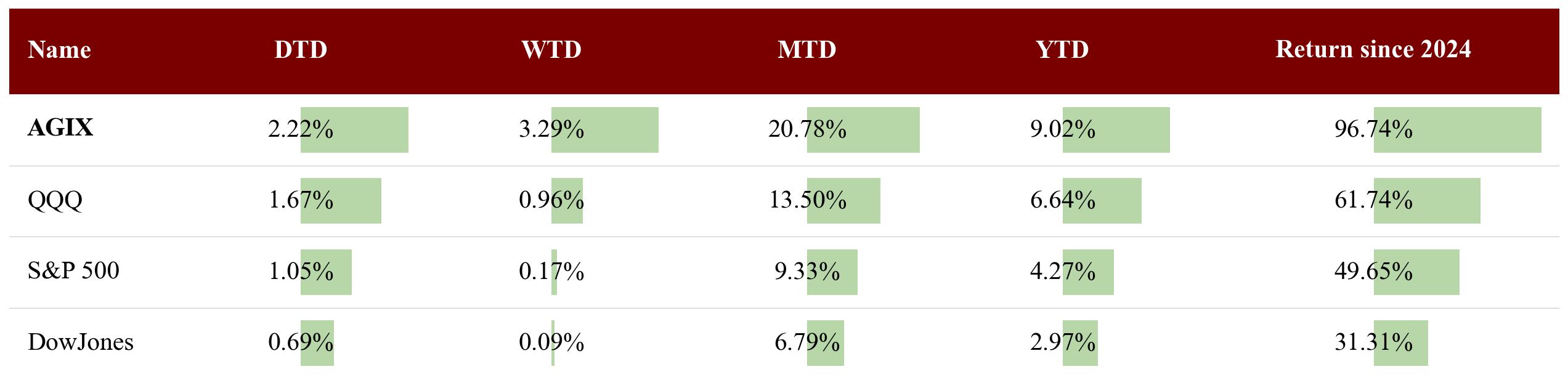
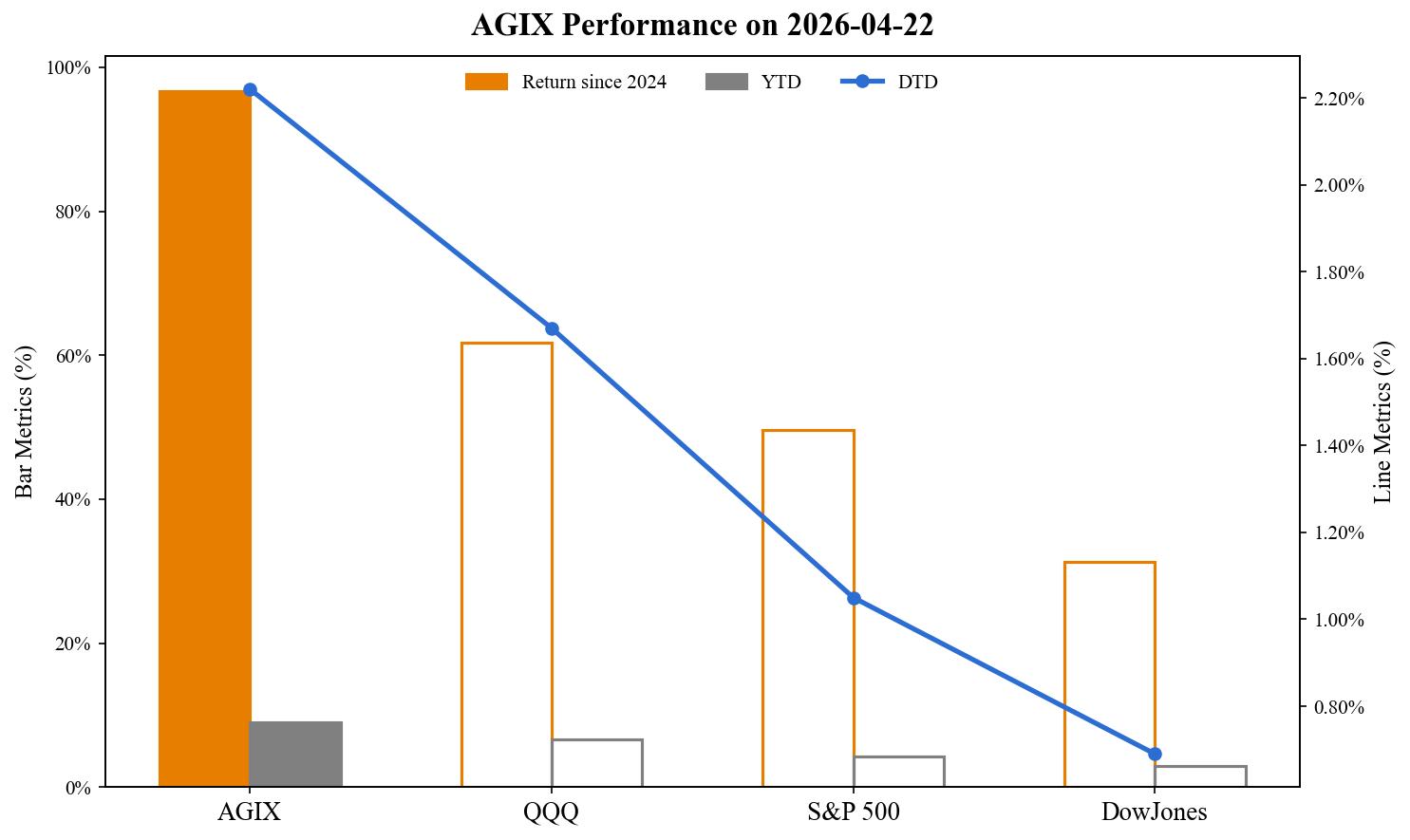
• AGIX outperformed major benchmarks DTD (+2.22% vs QQQ +1.67%, S&P 500 +1.05%), driven by strong moves in key holdings like Arm (+12.01%), Micron (+8.48%), and Broadcom (+5.09%).
• Key holdings to watch: Arm (AGIX holding) surged on AGI CPU announcement and analyst upgrades. Micron (AGIX holding) rose on AI memory demand optimism. CoreWeave (AGIX holding) gained within its expected volatility range.
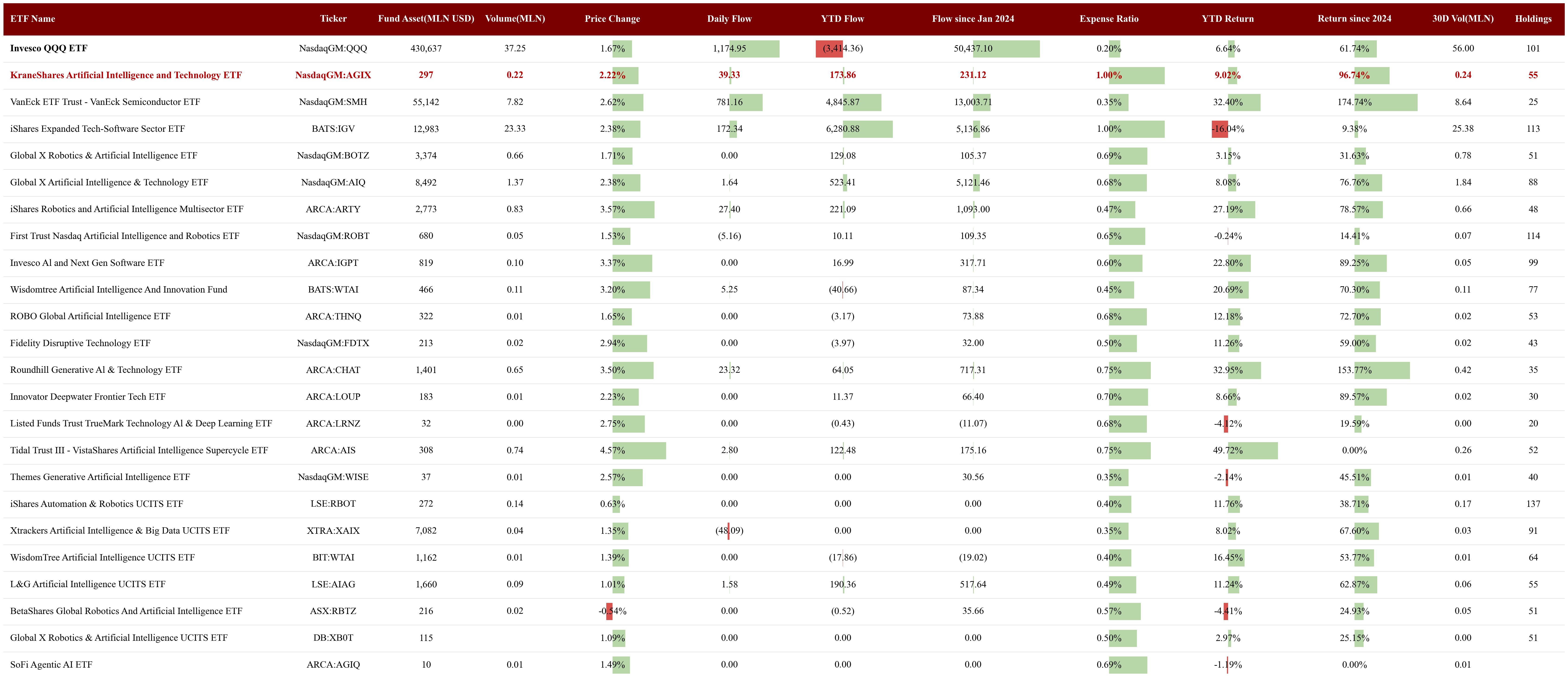
• Peer ETF analysis shows strong sector momentum, with semiconductor-focused ETFs like SMH (+2.62%) and ARTY (+3.57%) leading, indicating broad-based AI infrastructure strength benefiting AGIX's hardware-heavy portfolio.
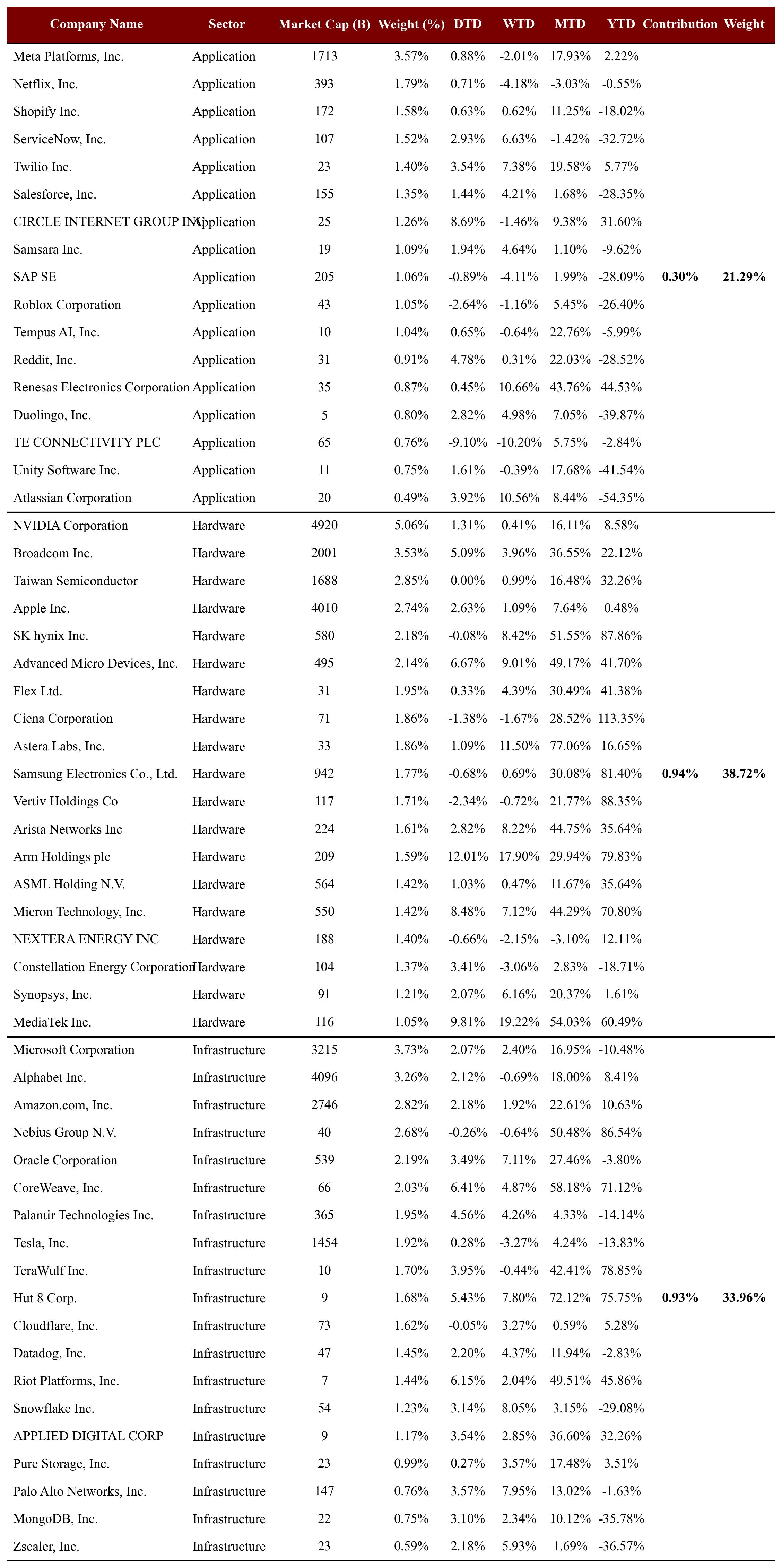
• Notable underperformers in AGIX holdings include TE Connectivity (-9.1%) and Vertiv (-2.34), though their negative contributions were offset by larger winners like NVIDIA (+1.31%) and Apple (+2.63%).
News Highlights
1. SpaceX's potential $60B acquisition of Cursor highlights intense competition and valuation surge in AI coding tools, potentially impacting the competitive landscape for AGIX holdings like Microsoft (GitHub Copilot) and ServiceNow.
2. Google Cloud Next 2026 unveiled a comprehensive agentic AI platform (Gemini Enterprise Agent Platform), new TPU chips, and a $750M partner fund, strengthening its infrastructure ecosystem—a positive for AGIX holdings Alphabet, AMD, and NVIDIA.
3. Anthropic investigates unauthorized access to its restricted Claude Mythos AI model, raising supply chain security concerns for enterprise AI adoption, though no direct impact on AGIX holdings was reported.
4. OpenAI launches ChatGPT Images 2.0 and Codex Labs, and partners with Infosys to expand enterprise reach, indicating continued product evolution and distribution scaling for the AI leader.
5. Multiple AGIX holdings (Google, Atlassian, Oracle, Contrast Security, Commvault) announced deeper integrations with Google Cloud's AI ecosystem, reinforcing the platform's centrality and potential revenue synergies.
6. Tesla announces a massive $25B capex increase focused on AI and robotics, signaling accelerated investment in the Optimus robot and AI infrastructure, a long-term positive for the sector.
7. Vast Data raises $1B at a $30B valuation, reflecting strong investor demand for AI data infrastructure, a tailwind for the broader data management segment.
RSS Highlights
1. Microsoft is moving all GitHub Copilot subscribers to token-based billing in June, which may change cost structures and usage patterns for developers, impacting the AI-assisted coding market.
2. Anthropic briefly removed Claude Code from its $20/month Pro plan for new users in a "small test," causing confusion about pricing and access, reflecting potential cost pressure in offering advanced AI coding features.
3. Qwen released Qwen3.6-27B, an open-source model claiming flagship-level coding performance in a much smaller 27B parameter size, demonstrating rapid progress in efficient, capable open models.
4. The blog "AI has no moat" comments critically on the SpaceX-Cursor deal and the high cost of closed-source model development, highlighting ongoing debates about value and sustainability in the AI industry.
5. Mozilla and Anthropic collaboration led to an early version of Claude Mythos being used to find and fix 271 vulnerabilities in Firefox 150, showcasing applied AI for cybersecurity—a growing use case.
Performance & Benchmark
Attribution
Contribution of the three sectors within AGIX holdings today
Application: 0.3%
Hardware: 0.94%
Infrastructure: 0.93%
Top-performing stocks in AGIX holdings today
Arm Holdings plc (12.01%)
MediaTek Inc. (9.81%)
CIRCLE INTERNET GROUP INC (8.69%)
Micron Technology, Inc. (8.48%)
Advanced Micro Devices, Inc. (6.67%)
CoreWeave, Inc. (6.41%)
Riot Platforms, Inc. (6.15%)
Hut 8 Corp. (5.43%)
Broadcom Inc. (5.09%)
Reddit, Inc. (4.78%)
Palantir Technologies Inc. (4.56%)
TeraWulf Inc. (3.95%)
Atlassian Corporation (3.92%)
Palo Alto Networks, Inc. (3.57%)
APPLIED DIGITAL CORP (3.54%)
Twilio Inc. (3.54%)
Oracle Corporation (3.49%)
Constellation Energy Corporation (3.41%)
Snowflake Inc. (3.14%)
MongoDB, Inc. (3.1%)
ServiceNow, Inc. (2.93%)
Duolingo, Inc. (2.82%)
Arista Networks Inc (2.82%)
Apple Inc. (2.63%)
Datadog, Inc. (2.2%)
Amazon.com, Inc. (2.18%)
Zscaler, Inc. (2.18%)
Alphabet Inc. (2.12%)
Synopsys, Inc. (2.07%)
Microsoft Corporation (2.07%)
Worst-performing stocks in AGIX holdings today
Vertiv Holdings Co (-2.34%)
Roblox Corporation (-2.64%)
TE CONNECTIVITY PLC (-9.1%)
Top five listed stocks contributing the most within AGIX holdings today
Arm Holdings plc (12.01%)
Broadcom Inc. (5.09%)
Advanced Micro Devices, Inc. (6.67%)
CoreWeave, Inc. (6.41%)
Micron Technology, Inc. (8.48%)
Observation
The strongest movers across peer ETF holdings today are listed below:
| DTD | Stock Ticker | Name | Held by ETFs | analysis |
|---|---|---|---|---|
| 20.48 | NasdaqGM:NVTS | Navitas Semiconductor Corporation | ['ARCA:AIS'] | NVTS rose 20.48% on April 22, 2026, driven primarily by momentum from the April 20 board appointment of ex-Broadcom senior VP Gregory M. Fischer as an independent director, which had already generated a 7% single-day gain. The stock's 60% surge over preceding weeks, combined with elevated investor attention ahead of Q1 2026 earnings scheduled for May 5 and anticipation around the company's AI power delivery solutions showcased at NVIDIA GTC 2026, created a strong technical setup that amplified the April 22 move. Options market data shows expected volatility of 16.84% for April 23, consistent with the stock's recent trading range and forward-looking uncertainty around earnings. |
| 13.75 | NYSE:GEV | GE Vernova Inc. | ['ARCA:AIS'] | GE Vernova's 13.75% stock surge on April 22, 2026, was driven primarily by a strong Q1 2026 earnings beat, with adjusted EPS of $1.98 topping estimates of $1.84 and revenue of $9.34 billion exceeding $9.3 billion consensus[2][7]. Key support came from a $4.5 billion pre-tax gain in the Electrification segment from the Prolec GE acquisition and robust 71% organic order growth to $18.3 billion, bolstered by Power and Electrification momentum[2]. Management raised full-year 2026 guidance to $44.5-45.5 billion in revenue, 12-14% adjusted EBITDA margin, and $6.5-7.5 billion free cash flow, citing accelerating data-center demand[2][7]. |
| 12.01 | NasdaqGS:ARM | Arm Holdings plc | ['NasdaqGM:QQQ', 'NasdaqGM:AGIX', 'ARCA:IGPT', 'ARCA:CHAT', 'ARCA:LRNZ', 'ARCA:AIS'] | Arm Holdings (NasdaqGS:ARM) stock surged 12.01% on April 22, 2026, primarily driven by surging investor optimism over its new AGI CPU announcement, which positions Arm as a core player in the AI chip race and data center infrastructure[2][4]. Multiple Wall Street firms raised price targets, including Evercore ISI to $227, Guggenheim to $240, and Mizuho to $230, citing Arm's revenue potential to $15B-$25B by FY31 from AI server CPUs, royalties, and subsystems[2]. A strategic leadership shift at parent SoftBank to enhance AI and chip efficiency also contributed, pushing shares to a record high of $196.66 amid strong momentum and heavy volume[1][3][6]. |
| 10.62 | TSE:4684 | OBIC Co.,Ltd. | ['LSE:RBOT'] | OBIC's 10.62% gain on April 22, 2026 was primarily driven by the Board's announcement on that same day of a ¥50 billion treasury share repurchase program (up to 10 million shares, or 2.3% of outstanding shares) to be executed through March 2027. The buyback announcement, combined with the company's strong FY2026 financial performance including 55.6% operating margins and 32 consecutive years of operating profit growth, reinforced investor confidence in management's capital allocation and earnings quality. |
| 10.08 | NYSE:ZEPP | Zepp Health Corporation | ['NasdaqGM:WISE'] | Zepp Health (NYSE:ZEPP) rose 10.08% on April 22, 2026, primarily driven by a bullish research note from Fundamental Research initiating coverage with a $56.28 price target.[3] ZEPP shares jumped 9.9% to $16.47 immediately following the report, aligning closely with the observed daily return amid the stock's high volatility.[3][4] No other same-day company disclosures or industry events were reported.[1][2][7] |
| 10.0 | TWSE:6531 | AP Memory Technology Corporation | ['ARCA:AIS'] | No specific news events, company disclosures, or catalysts explain the 10.0% single-day rise in AP Memory Technology (TWSE:6531) on 2026-04-22, as search results lack same-day information. Technical indicators showed a strong buy signal based on moving averages, potentially contributing to momentum buying[1][6]. Broader semiconductor volatility and positive analyst price targets (up to TWD390) may have supported the move amid a 21.44% premium to the 200-day moving average[2][6]. |
| 9.96 | TWSE:5269 | ASMedia Technology Inc. | ['ARCA:IGPT', 'ARCA:AIS', 'LSE:RBOT'] | No specific news events or disclosures on April 22, 2026, explain ASMedia Technology Inc. (TWSE:5269)'s 9.96% single-day gain. The most recent company announcement was the Board of Directors' approval of the 2025 earnings distribution on April 13, 2026, which may have contributed to delayed positive sentiment.[4][5] Broader market or sector momentum in Taiwan tech stocks likely drove the move, amid ongoing share price volatility shown in recent trading data.[1][3] |
| 9.91 | TWSE:6526 | Airoha Technology Corp. | ['LSE:RBOT'] | No specific news events, company disclosures, or catalysts explain Airoha Technology Corp. (TWSE:6526)'s 9.91% gain on April 22, 2026, as search results lack same-day information. Recent data shows mixed performance, including a 10.56% 1-month change and revenue slightly beating estimates in the last quarter (5.22B TWD vs. 5.18B TWD expected)[1][3]. The move may reflect broader semiconductor sector momentum or trading factors, with the stock trading around NT$555-577 near its 52-week high of NT$592[1][2]. |
| 9.89 | TWSE:2388 | VIA Technologies, Inc. | ['LSE:RBOT'] | I cannot provide a reliable attribution for VIA Technologies' 9.89% single-day move on April 22, 2026, as the search results contain no news events, company announcements, or market catalysts specific to that date. The available information includes only historical price data, a March 2026 employee share issuance announcement, and general company fundamentals, none of which explain the April 22 move. Without verifiable same-day news or disclosures, any attribution would be speculative. |
| 9.81 | TWSE:2454 | MediaTek Inc. | ['NasdaqGM:AGIX', 'ARCA:IGPT', 'ARCA:THNQ', 'LSE:AIAG'] | MediaTek Inc. (TWSE:2454) surged 9.81% on April 22, 2026, driven primarily by strong intraday momentum that pushed the stock past NT$2,170 to a new record high.[3] The advance opened higher and accelerated during the session, reflecting robust investor demand for the leading IC design house amid positive sector sentiment.[3] No specific company disclosures or broader catalysts were identified in available data.[1][2] |
| 9.49 | NasdaqCM:RR | Richtech Robotics Inc. | ['NasdaqGM:BOTZ', 'ASX:RBTZ', 'DB:XB0T'] | I cannot provide an attribution for Richtech Robotics' 9.49% single-day move on April 22, 2026, as the search results contain no information about events, news, or catalysts from that date. The available data includes only historical analyst forecasts from October 2025 and general technical information, with no coverage of April 2026 developments. To properly attribute this move, real-time news sources, company disclosures, or earnings announcements from April 22, 2026 would be required. |
| 9.39 | NasdaqGS:MSTR | Strategy Inc | ['NasdaqGM:QQQ', 'BATS:IGV', 'ARCA:IGPT', 'LSE:RBOT', 'XTRA:XAIX'] | MicroStrategy (MSTR) stock rose 9.39% on April 22, 2026, primarily driven by its disclosure of acquiring 34,164 Bitcoin for $2.54 billion, boosting total holdings to 815,061 BTC and reinforcing its status as the largest corporate Bitcoin holder.[1][2][3] Capital Group's purchase of 4.32 million MSTR shares for $747 million signaled strong institutional demand, further fueling the rally.[1][3] Analyst upgrades, including Cantor Fitzgerald raising its price target to $212 and TD Cowen to $385, amplified positive sentiment amid Bitcoin's breakout above $78,000.[1][2] |
| 9.32 | SEHK:6608 | Bairong Inc. | ['NasdaqGM:WISE'] | I cannot provide a reliable attribution for Bairong's 9.32% single-day move on April 22, 2026, as the search results contain no news events, company announcements, or market catalysts dated on or immediately before that trading date. The only dated reference is to April 20, 2026, when the stock declined 1.38%, and a mention of a HK$328 million warrant financing plan without a specific announcement date. Without verifiable same-day or pre-market news, I cannot identify the primary driver of the move. |
| 8.92 | SHSE:601138 | Foxconn Industrial Internet Co., Ltd. | ['ARCA:IGPT', 'ARCA:AIS'] | Foxconn Industrial Internet (SHSE:601138) rose 8.92% on April 22, 2026, primarily driven by strong short-term technical momentum in a multi-week uptrend, with the stock price advancing from a previous close of 61.41 CNY to 66.89 CNY.[4] No specific company news, disclosures, or sector events were reported for that day, leaving technical factors and broader market participation—evidenced by recent volatility and analyst buy signals—as the key catalysts.[1][3] Trading patterns indicate high intraday movement consistent with the stock's beta of 1.67, amplifying the upside on positive moving average crossovers.[3] |
| 8.69 | NYSE:CRCL | Circle Internet Group, Inc. | ['NasdaqGM:AGIX'] | The search results provided do not contain specific news events or company disclosures from April 22, 2026 that would explain Circle Internet Group's 8.69% single-day move on that date. The available information includes general 2026 year-to-date performance (up 14.3%), analyst price targets, valuation assessments, and technical analysis, but no verifiable same-day catalysts or announcements from April 22. Without access to real-time news, earnings releases, regulatory developments, or management commentary from that specific trading day, I cannot reliably attribute the move to particular drivers. |
| 8.48 | NasdaqGS:MU | Micron Technology, Inc. | ['NasdaqGM:QQQ', 'NasdaqGM:AGIX', 'NasdaqGM:SMH', 'NasdaqGM:AIQ', 'ARCA:ARTY', 'NasdaqGM:ROBT', 'ARCA:IGPT', 'BATS:WTAI', 'NasdaqGM:FDTX', 'ARCA:LOUP', 'ARCA:AIS', 'XTRA:XAIX', 'BIT:WTAI'] | Micron Technology (NasdaqGS:MU) surged 8.48% on April 22, 2026, primarily driven by heightened market confidence in surging AI memory demand, particularly for high-bandwidth memory (HBM). Trading volume spiked to 45.4 million shares, 9.6% above the three-month average, signaling strong investor interest amid broader AI frenzy lifting semiconductor stocks. News of a ceasefire in Iran provided additional positive sentiment, easing geopolitical tensions.[1][2] |
| 8.47 | TSE:9984 | SoftBank Group Corp. | ['NasdaqGM:ROBT', 'BATS:WTAI', 'ARCA:CHAT', 'BIT:WTAI'] | SoftBank Group Corp. (TSE:9984) rose 8.47% on April 22, 2026, driven primarily by ongoing positive momentum from the December 29, 2025, 4-for-1 stock split, which adjusted shares and boosted accessibility and trading volume.[2] The stock's broader strength is evident in its 13.56% weekly gain and analyst price targets up to 74,000 JPY, reflecting sustained investor optimism amid high volatility (5.92%) and beta of 1.77.[1] No specific same-day news events were identified in available data.[1][2][3][4] |
| 8.44 | TSX:CCO | Cameco Corporation | ['ARCA:LOUP'] | Cameco (TSX:CCO) surged 8.44% on April 22, 2026, closing at $172.88, driven primarily by strong momentum in the uranium sector amid growing nuclear energy sentiment.[4][6] This upward move boosted broader TSX Composite Index sentiment toward uranium stocks, reflecting heightened investor interest in clean energy plays.[6] No specific company news or disclosures were reported for the day, with the gain aligning with recent monthly highs and positive analyst outlooks.[1][5] |
| 8.37 | NasdaqGS:SNDK | Sandisk Corporation | ['XTRA:XAIX'] | SanDisk (SNDK) stock rose 8.37% on April 22, 2026, primarily driven by strong AI-driven demand for NAND memory and enterprise flash storage amid data center expansion.[2][1] Recent analyst upgrades, including Wells Fargo raising its target to $975 on April 20 and BofA to $1,080 on April 17, further boosted sentiment ahead of the fiscal Q3 earnings on April 30.[2][1][3] The recent Nasdaq-100 inclusion effective April 20 added mechanical buying pressure from index funds, outweighing any prior profit-taking.[1] |
| 7.76 | NasdaqGS:CIFR | Cipher Mining Inc. | ['BATS:IGV'] | Cipher Mining's 7.76% gain on April 22, 2026 was driven primarily by HC Wainwright's analyst upgrade, which decreased their price target to $25.00 and set a "buy" rating on the stock in a research note issued that same Wednesday. The upgrade contributed to positive analyst sentiment, with the stock trading near $18.04 against an average 1-year price target of $24.82 across 17 analysts covering the name. Secondary support came from the stock's technical positioning, as it was testing key resistance levels and benefiting from broader institutional accumulation, with Vanguard raising its holdings by 43.2% in the prior quarter. |
| 7.62 | NasdaqGS:VICR | Vicor Corporation | ['ARCA:AIS'] | Vicor Corporation (VICR) shares rose 7.62% on April 22, 2026, primarily due to a strong Q1 earnings beat and raised FY2026 revenue guidance. The company reported Q1 revenue of $113 million (up 20.2% YoY) and EPS of $0.44 versus consensus estimates of $0.39 and lower revenue expectations, with management lifting full-year guidance to $570 million above the Street's $544 million forecast amid a growing backlog and capacity expansions[1][2][3][6]. Analyst upgrades, including Needham raising its price target to $260 and an average "Buy" rating with a $142 target, further supported the intraday gap-up and buying interest despite a softer Q2 guide[1][2]. |
| 7.16 | NasdaqGS:ISRG | Intuitive Surgical, Inc. | ['NasdaqGM:QQQ', 'NasdaqGM:BOTZ', 'NasdaqGM:ROBT', 'ARCA:IGPT', 'BATS:WTAI', 'LSE:RBOT', 'ASX:RBTZ', 'DB:XB0T'] | Intuitive Surgical (ISRG) stock rose 7.16% on April 22, 2026, primarily due to a strong Q1 2026 earnings beat reported after the prior day's close, with revenue of $2.77 billion (+23% YoY) exceeding estimates by 5.8% and adjusted EPS of $2.50 beating consensus by 18.7%[1][4]. The company also raised its full-year 2026 da Vinci procedure growth guidance to 13.5%-15.5% from the prior 13%-15%, signaling robust demand and operational efficiency with margins expanding to 38.4%[1][3][4]. Investors reacted positively to the acceleration in procedure growth (da Vinci +16%, Ion +39%) despite macro headwinds, reinforcing the firm's monopolistic moat in robotic surgery[4]. |
| 7.03 | TSE:3697 | SHIFT Inc. | ['LSE:RBOT'] | SHIFT Inc. (TSE:3697) rose 7.03% on April 22, 2026, primarily driven by positive market reaction to its half-year results ending February 28, 2026, which reported strong sales of ¥72,035 million and net income of ¥4,011 million.[1] The earnings release shifted short-term sentiment, as evidenced by the stock trading at 724.3 JPY from a previous close of 676.7 JPY, aligning with a noted 11.81% one-day return post-announcement.[1][2] No other same-day news events were identified in available sources. |
| 6.67 | NasdaqGS:AMD | Advanced Micro Devices, Inc. | ['NasdaqGM:QQQ', 'NasdaqGM:AGIX', 'NasdaqGM:SMH', 'NasdaqGM:AIQ', 'ARCA:ARTY', 'NasdaqGM:ROBT', 'ARCA:IGPT', 'BATS:WTAI', 'ARCA:THNQ', 'ARCA:CHAT', 'ARCA:LRNZ', 'ARCA:AIS', 'NasdaqGM:WISE', 'LSE:RBOT', 'XTRA:XAIX', 'BIT:WTAI', 'LSE:AIAG'] | AMD's 6.67% stock surge on April 22, 2026, was primarily driven by Stifel's price target increase to $320 with a Buy rating, citing strong AI compute demand outpacing supply and major customer commitments from Meta and OpenAI.[1][2][3] The launch of the Ryzen 9 9950X3D2 dual-cache processor, featuring enhanced 3D V-Cache for gamers and creators, further boosted sentiment around AMD's innovation.[1] Broader AI sector strength, with peers like Micron and NVIDIA also rising, amplified the move amid persistent infrastructure demand.[1][5] |
| 6.57 | TWSE:4919 | Nuvoton Technology Corporation | ['LSE:RBOT'] | Nuvoton Technology (TWSE:4919) rose 6.57% on April 22, 2026, primarily driven by the announcement of its Board of Directors meeting notification date, signaling potential material disclosures on strategy, earnings, or dividends. This same-day material information release heightened investor anticipation in the semiconductor sector.[1] No other company-specific news or macro events were reported to explain the move. |
| 6.46 | NASDAQGM:RZLV | Rezolve AI PLC | ['NasdaqGM:WISE'] | The search results provided do not contain specific news events, company disclosures, or regulatory announcements for April 22, 2026 that would explain RZLV's 6.46% single-day move. The available data shows only historical price ranges and technical trading commentary without any verifiable catalysts tied to that date. Without access to real-time news, earnings releases, or material company announcements from April 22, I cannot reliably attribute the stock's movement to specific drivers based on the information provided. |
| 6.41 | NasdaqGS:CRWV | CoreWeave, Inc. | ['NasdaqGM:AGIX', 'NasdaqGM:AIQ', 'NasdaqGM:ROBT', 'ARCA:CHAT', 'BIT:WTAI'] | CoreWeave's 6.41% gain on April 22, 2026 aligns with the stock's expected move range of ±$7.93 (6.78%) based on options pricing, suggesting the move was within anticipated volatility rather than driven by a specific news catalyst.[4] The search results provided do not contain verifiable same-day news events, company disclosures, or material announcements for April 22, 2026 that would explain the directional move. Without access to real-time news from that specific date, the gain appears attributable to normal trading volatility and options-implied expectations rather than identifiable fundamental or event-driven catalysts. |
| 6.29 | TSE:285A | Kioxia Holdings Corporation | ['ARCA:IGPT'] | Kioxia Holdings (TSE:285A) rose 6.29% on April 22, 2026, primarily driven by a rebound in heavyweight semiconductor stocks amid a broader Tokyo market recovery led by high-priced shares.[2] The gain followed a prior week's decline, fueled by strong earnings expectations and views that the stock remains undervalued relative to performance, prompting obligatory buying.[2] Positive sector momentum from peers like Advantest and SoftBank Group, alongside reduced U.S.-Iran tensions after Trump's ceasefire extension, provided additional support.[2] |
| 6.15 | NasdaqCM:RIOT | Riot Platforms, Inc. | ['NasdaqGM:AGIX', 'BATS:IGV'] | RIOT's 6.15% single-day gain on April 22, 2026, stemmed primarily from technical rebound momentum after the prior day's 3.87% drop from $18.11 to $17.41, with buyers defending key support at $17.24–$18.34 as noted in multiple TradingView analyses[1][3]. Secondary drivers included sustained bullish signals from short- and long-term moving averages, an overbought RSI14 at 84 signaling potential for further upside despite high volatility, and positive analyst consensus with an average price target of $21.89[2][3]. No specific company news or macro events were identified in available data to explain the move[1][2][3]. |
| 6.08 | NasdaqCM:CLSK | CleanSpark, Inc. | ['BATS:IGV'] | CleanSpark's 6.08% gain on April 22 was primarily driven by strategic capital restructuring moves that investors responded to positively. The bitcoin miner outperformed the broader market as the company executed financial repositioning initiatives. While search results confirm the stock moved significantly higher than the S&P 500 on the relevant trading period, specific details about the exact restructuring announcement or timing on April 22 are not available in the provided sources. |
| 5.92 | NasdaqGS:MANH | Manhattan Associates, Inc. | ['BATS:IGV'] | Manhattan Associates (MANH) stock rose 5.92% on April 22, 2026, primarily driven by a Q1 earnings beat with EPS of $1.24 versus $1.10 consensus and revenue of $282.2M (+7.4% YoY), causing shares to gap up from $134.89 close to $149 open.[1][2][3] Management raised FY2026 guidance to $5.29–$5.37 EPS and $1.147–$1.157B revenue, with RPO targets of $2.62B–$2.68B signaling strong cloud backlog momentum.[1][2] A new $500M share repurchase authorization (~5.8% of shares) further boosted sentiment.[1] |
| 5.73 | SEHK:992 | Lenovo Group Limited | ['XTRA:XAIX'] | I cannot provide an attribution for Lenovo's 5.73% single-day move on April 22, 2026, as the search results contain no news events, company disclosures, regulatory announcements, or other verifiable catalysts from that date. The search results only include historical stock price data and general company information without any reporting on April 22 developments. A proper attribution requires documented same-day news or events, which are not present in the available information. |
| 5.43 | NasdaqGS:HUT | Hut 8 Corp. | ['NasdaqGM:AGIX', 'BATS:IGV', 'NasdaqGM:AIQ'] | Hut 8 Corp. (HUT) rose 5.43% on April 22, 2026, primarily driven by a bullish short-term price prediction reaching a high of $78.31 that day, aligning with ongoing positive analyst momentum and strong stock forecasts averaging $70-$74.[5][1][4] The stock's sensitivity to Bitcoin holdings and recent revenue growth of 44.8% with gross margins expanding to 60% in Q4 2025 further supported the move amid favorable crypto market sentiment.[2][3] No specific company news or events were reported for the date. |
| 5.43 | NasdaqCM:MARA | MARA Holdings, Inc. | ['BATS:IGV'] | MARA Holdings rose 5.4% on April 22, 2026, primarily driven by the announcement of a major bitcoin sale and debt reduction strategy. The company sold 15,133 bitcoin for approximately $1.1 billion and used most of that proceeds to repurchase roughly $1.0 billion face value of convertible senior notes due 2030 and 2031 at a 9% discount, reducing total convertible debt by about 30% and locking in approximately $88 million in cash savings. Additionally, management repositioned the company as a broader digital energy and AI/HPC infrastructure play rather than solely a bitcoin miner, supported by Cantor Fitzgerald maintaining an Overweight rating despite trimming the price target to $10, which reinforced investor confidence in the company's strategic direction. |
| 5.37 | NYSE:FOUR | Shift4 Payments, Inc. | ['ARCA:LOUP'] | Shift4 Payments (NYSE:FOUR) stock rose 5.37% on April 22, 2026, primarily driven by a Schedule 13G/A filing from Wasatch Advisors disclosing a 5.2% passive stake in the company's Class A shares, filed that same day.[3] The filing highlighted beneficial ownership of 4,206,244 shares with sole dispositive power, signaling strong institutional confidence amid the stock's year-to-date decline.[3][1] No other company-specific news or events were reported on that date.[5] |
| 5.28 | NYSE:BBAI | BigBear.ai Holdings, Inc. | ['NasdaqGM:ROBT', 'NasdaqGM:WISE', 'BIT:WTAI'] | No specific news events, company disclosures, or catalysts on April 22, 2026, explain BBAI's 5.28% single-day gain[1][3][4][6]. The move aligns with short-term technical momentum, including a 7.98% weekly rise noted in market charts and neutral-to-bullish sentiment from 17 of 24 technical indicators[3][6]. Broader context includes anticipation for Q4 earnings on March 2, 2026, and the prior Ask Sage acquisition, but lacks same-day linkage[1]. |
| 5.09 | NasdaqGS:AVGO | Broadcom Inc. | ['NasdaqGM:QQQ', 'NasdaqGM:AGIX', 'NasdaqGM:SMH', 'NasdaqGM:AIQ', 'ARCA:ARTY', 'NasdaqGM:ROBT', 'BATS:WTAI', 'NasdaqGM:FDTX', 'ARCA:CHAT', 'NasdaqGM:WISE', 'BIT:WTAI'] | I cannot provide a reliable attribution for Broadcom's 5.09% single-day move on April 22, 2026, based on the available search results. The results contain historical pricing data through April 13, 2026, a technical analysis video from April 2026, and options data for April 20, 2026, but do not include any company news, earnings announcements, regulatory developments, or industry catalysts specific to April 22, 2026. Without verifiable public information about events on that date, I cannot identify the primary drivers behind the move without fabricating details. |
News
Funding & M&A
SpaceX is working with Cursor and has an option to buy the startup for $60 billion
SpaceX announced a cooperation agreement with the AI coding platform Cursor to jointly develop the next generation of 'coding and knowledge work AI.' The agreement contains a surprising clause: SpaceX will have the option to acquire Cursor later this year for $60 billion, or pay $10 billion as a cooperation fee. This move is seen as a strategic layout ahead of SpaceX's impending IPO, aimed at enhancing competitiveness by integrating Cursor's product and distribution capabilities with SpaceX's Colossus supercomputer (equivalent to the computing power of a million Nvidia H100 chips). The background is that xAI began providing data center computing power to Cursor last week to support its training of the latest AI models. Last month, two senior Cursor engineers, Andrew Milich and Jason Ginsberg, moved to xAI, reporting directly to Elon Musk. Cursor's valuation has skyrocketed: $2.5 billion in January last year, $9 billion in May, $29.3 billion after the Series D in November, with this potential deal valuing it at $50-60 billion. Although SpaceX faces profitability pressure due to acquisitions of xAI and X platform and significant capital expenditures, this cooperation could help it reduce reliance on Anthropic's Claude and OpenAI's GPT models, shifting towards self-development. The industry views this as a synergistic win-win within Musk's tech empire family.
SpaceX is working with Cursor and has an option to buy the startup for $60 billion
SpaceX announced a cooperation agreement with the AI coding platform Cursor to jointly develop the next generation of 'coding and knowledge work AI.' The agreement contains a surprising clause: SpaceX will have the option to acquire Cursor later this year for $60 billion, or pay $10 billion as a cooperation fee. This move is seen as a prelude to SpaceX's impending IPO, aimed at adding value for investors. The background is that xAI began leasing data center computing power to Cursor last week, with the latter using tens of thousands of xAI chips to train its latest models. Last month, two senior Cursor engineers, Andrew Milich and Jason Ginsberg, moved to xAI, reporting directly to Musk. SpaceX combines Cursor's product distribution capabilities with its own Colossus supercomputer (equivalent to the computing power of a million Nvidia H100 chips). Cursor's valuation has skyrocketed: $2.5 billion in January last year, $9 billion in May, $29.3 billion after the Series D in November, with previous rumors of a planned $50 billion private placement. This transaction may be paid with SpaceX stock, compensating for both parties' weaknesses, but it exposes that Cursor and xAI are lagging behind Anthropic and OpenAI in developing their own models, as the latter two are launching their own coding tools to capture the developer market. This cooperation could help Cursor reduce its reliance on Claude and GPT models.
Esther and Anne Wojcicki join a new healthcare accelerator fund.
Former Google product manager Mary Minno announced the launch of the early-stage startup accelerator Treehub and the venture capital firm AI Health Fund, focusing on the intersection of AI and healthcare, supporting founders with academic backgrounds in transforming research into commercial projects. The initiative stems from Minno's personal experience, where her family encountered bottlenecks in the healthcare system during a sudden acute leukemia diagnosis, inspiring her to drive innovation. Treehub is a six-month program; the first 12 weeks help founders find product-market fit, and the latter 12 weeks focus on company direction, such as fundraising or hospital deployment. In collaboration with close friend and educator Esther Wojcicki (mother of former YouTube CEO Susan and 23andMe founder Anne) and members of Stanford University's Department of Biomedical Data Science, including assistant professors Roxana Daneshjou and Alexander Ioannidis. The AI Health Fund aims to raise $10 million, having already closed its first round at $1.5 million, including a million-dollar investment from billionaire venture capitalist Tim Draper and $500,000 from family friends. Anne Wojcicki serves as an operating partner, Esther as a founding advisor, and Minno's husband Derek (President of Point Capital) is involved. The fund has already invested in Treehub's first cohort of 12 companies, such as female hormone tracker Clair Health (via a16z speedrun) and Dennis Walls' pediatric autism company. Treehub emphasizes very early-stage support, even assisting with company formation, with no demo day, offering flexible and mature guidance. The team views this as an experimental phase, aiming to expand nationally to help healthcare innovation challenge the status quo.
Cathie Woods’ ARK makes its first lead investment in startup Lucra — and it isn’t AI
ARK Invest Venture Fund made its first lead investment in an early-stage startup, Lucra. Founder Cathie Wood expressed excitement about this investment in a TechCrunch interview. Lucra develops a software platform that transforms corporate loyalty programs into interactive esports events, such as customer-vs-customer tournament competitions, supporting betting or winning cash and company prizes. Its clients include Five Iron Golf, Chess Kings, and Dave & Buster's. On Wednesday, Lucra announced the completion of a $20 million Series B funding round led by the ARK fund, with participation from Alumni Ventures, Astralis Capital, Harlo Equity Partners, Simplex Ventures, SeventySix Capital, and WTI. Previously, the ARK fund had been cautious about this sector due to setbacks from investing in a similar company, Skillz (SKLZ). However, Lucra is a B2B platform focused on loyalty programs, differing from Skillz's B2C gaming model. ARK had participated in Lucra's Series A round and gained a deep understanding of its business through quarterly communications. Fund manager Nick Grous and the investment committee reviewed founder Dylan Robbins multiple times, who demonstrated profound reflection on potential risks and strong conviction. Lucra's financial performance is impressive, and it operates in the sports betting and entertainment gamification space familiar to ARK. The fund also holds stakes in Epic Games, Kalshi, Discord, OpenAI, Anthropic, Replit, Grok, and Perplexity. Wood emphasized that while AI is highly sought after, ARK is uncovering other overlooked opportunities.
Treehub launches with Tim Draper and Anne Wojcicki to back the next wave of AI health founders.
Treehub, a startup residency program closely associated with Stanford University and backed by the AI Health Fund, officially launched recently. With notable figures like billionaire investor Tim Draper and 23andMe Holding Co. founder Anne Wojcicki joining, the program aims to discover early-stage AI and healthcare entrepreneurs emerging from academic labs. Located in Los Altos, California, adjacent to the Stanford campus, Treehub is positioned as a boutique residency program connecting academic breakthroughs with fundable ventures, helping scientist-founders overcome early-stage financing and operational challenges. The AI Health Fund, as its venture arm, will provide initial investment to each participating company, even committing funds before formal company registration. The program blends elements of a startup studio, incubator, and traditional venture fund, offering proprietary healthcare data, payer and investor connections, and mentorship from seasoned entrepreneurs. Investment focus areas include precision medicine outcomes, care efficiency improvements, and cutting-edge science like genetic risk stratification, ambient intelligence, robotic surgery, and digital twin simulations. Treehub founding partner Mary Minno (former Google product executive) emphasizes that the program fills a gap in early support for lab scientists. Wojcicki joins as an operating partner, bringing her extensive experience from 23andMe, including its 2025 bankruptcy restructuring. Draper, as a supporter, is known for early investments in Tesla, Skype, and Coinbase. The leadership team also includes Stanford professors Roxana Daneshjou and Alexander Ioannidis, collectively driving the transformation of medical innovation from lab to commercialization.
Octen raises $10M in seed funding to speed up AI agent search queries
AI startup Octen (officially named APITECH AI Pte Ltd.) recently announced the completion of a $10 million seed funding round, led by Square Peg, with participation from Singaporean venture capital firm Argor and several AI researchers. The company, only three months old, has launched a search engine specifically designed for AI agents, provided via an API interface, claiming speeds far exceeding market competitors. In the SealQA Hard benchmark test, its search API's median response time was only 62 milliseconds, over four times faster than its fastest competitor. Octen supports parallel query processing, capable of handling over one million queries per second per customer account, and provides the Octen-Embedding-8B embedding algorithm, which set a record on the RTEB benchmark. Founder and CEO Kuan Zou stated that this technology solves the challenges of sub-100-millisecond latency and million-level QPS, enabling AI agents to reason over web data in real-time at memory-like speeds. The funding will be used to expand the engineering and developer relations teams and to procure globally distributed backend infrastructure. The company is headquartered in Singapore with an office in San Francisco. Currently, the search API is available in an invite-only Beta test to several AI software providers. Google LLC uses similar parallel query technology in its AI Mode, but Octen emphasizes that its API is suitable for web searches and other data retrieval tasks, such as financial institutions generating stock reports.
How SpaceX preempted a $2B fundraise with a $60B buyout offer
SpaceX recently announced a potential acquisition agreement with AI coding software developer Cursor, valuing the deal at up to $60 billion. Previously, Cursor was planning to complete a $2 billion funding round this week at a $50 billion valuation, with investors including Andreessen Horowitz, Thrive, Nvidia, and Battery Ventures. The agreement allows SpaceX the option to complete the acquisition later this year or pay $10 billion to collaborate with Cursor on developing AI technology. SpaceX, having recently merged with xAI, is actively enhancing its AI capabilities to compete against leaders like Anthropic and OpenAI, especially in the high-margin AI coding sector. Although Cursor's revenue is growing rapidly, it faces intense competition from Claude Code and Codex and has massive computational resource needs. SpaceX will delay the acquisition until after its IPO this summer to avoid updating confidential financial documents and plans to finance the deal with newly issued public stock. Even if the acquisition does not proceed, Cursor will still receive a $10 billion infusion paid in installments. SpaceX possesses substantial computing power from its data centers in Mississippi and Tennessee, which could support Cursor's development. This deal helps SpaceX retain the entire Cursor team, shed its label as a purely aerospace company, demonstrate AI business potential to Wall Street, and improve its valuation multiples. This move highlights the strategic trade-offs startups face between fundraising and mergers and acquisitions.
AI is generating more potential drug candidates than ever before. This start-up aims to determine which ones are significant.
Breakthroughs in AI for biosciences are facing a new bottleneck: actually validating and characterizing structures from numerous candidate drugs. 10x Science, a startup founded in December 2025, announced today the completion of a $4.8 million seed funding round led by Initialized Capital, with participation from Y Combinator, Civilization Ventures, and Founder Factor. The company's three founders—David Roberts, Andrew Reiter, and Vishnu Tejas—are all senior members of Nobel laureate Carolyn Bertozzi's lab at Stanford University, where they studied cancer cell and immune system interactions. The platform combines deterministic chemical biology algorithms with AI agents for traceable analysis of mass spectrometry data, helping biopharmaceutical companies accelerate protein characterization and bypass investments in equipment costing hundreds of thousands of dollars. Matthew Crawford, a scientist at Rilas Technologies who tested the platform, praised its ability to autonomously search databases and interpret conclusions, avoiding the accuracy issues of previous AI tools. 10x is already collaborating with several large pharmaceutical companies and academic researchers and plans to use the funds to hire engineers and expand into cellular data integration, defining a new paradigm of 'molecular intelligence.' Investors believe this SaaS tool, independent of the success or failure of specific drugs, provides a stable entry point into biotech and has the potential to revolutionize the drug development process.
Vast Data raises $1 billion at a $30 billion valuation as demand for AI infrastructure accelerates.
Vast Data Inc. announced the completion of a late-stage Series F funding round of approximately $1 billion, valuing the company at $30 billion, reflecting strong growth in demand for AI workload infrastructure. Founder and CEO Renen Hallak stated that the scale of this round was driven by proactive investor interest, not a preset target, and that the company does not need external capital to sustain operations, having achieved positive cash flow and operating profitability for multiple years, with cumulative orders exceeding $4 billion and annual recurring revenue commitments over $500 million. Since its $118 million Series E funding in late 2023 at a $9.1 billion valuation, the valuation has tripled, credited to the formation of a new technology stack driven by the AI revolution. Vast positions itself as a unified software layer between hardware and AI models. Originally a storage management platform, it has evolved into a 'disaggregated shared everything' architecture, integrating data management, analytics, and orchestration to adapt to the shift from model training to inference and real-time decision-making, supporting agentic AI systems. The company's platform is already deployed in production environments in the Americas, Europe, and Asia-Pacific, supporting millions of GPU workloads, with plans to expand into Latin America, India, and China. This funding round includes primary and secondary capital, providing liquidity for early investors and employees and introducing strategic partners to aid ecosystem development. Hallak stated that Vast's architecture is superior to older hyperscale cloud models, expects continued explosive AI demand, and the company is preparing for an IPO within the year but has no concrete plans yet, focusing on the security and reliability of production-grade AI deployments. The lead investor is Drive Capital LLC, co-investing with Access Industries Inc. Existing investors include Nvidia Corp., Fidelity Management & Research LLC, and New Enterprise Associates Inc.
AI is spitting out more potential drugs than ever. This startup wants to figure out which ones matter.
The significant impact of AI in science originated with Google DeepMind's use of deep learning models to predict complex protein structures, but as AI generates more drug candidates, actual characterization has become a bottleneck. Startup 10x Science was founded in December 2025 and recently announced the completion of a $4.8 million seed funding round led by Initialized Capital, with participation from Y Combinator, Civilization Ventures, and Founder Factor. The company's three founders—chemical biologist David Roberts, biologist Andrew Reiter, and AI expert Vishnu Tejus—previously collaborated in Nobel laureate Carolyn Bertozzi's Stanford lab, researching cancer cell and immune system interactions and feeling the pain of molecular-level characterization challenges. The 10x Science platform combines deterministic chemical biology algorithms with AI agents to interpret mass spectrometry data, enabling traceable analysis and supporting regulatory compliance. Rilas Technologies scientist Matthew Crawford, after testing it, praised its ability to autonomously search databases, interpret conclusions, and adapt, avoiding the accuracy issues of traditional AI. The company is collaborating with several large pharmaceutical companies and academic researchers and plans to use the funds to expand its engineering team, optimize models, and grow its customer base. Founder Roberts envisions combining protein structures with other cellular data to define a new type of molecular intelligence. The platform, offered as a SaaS service, provides an efficient drug candidate screening tool for biopharma. Investors are optimistic about its domain expertise moat, believing it has the potential to accelerate drug development.
Esther and Anne Wojcicki back new healthcare accelerator, fund
Former Google product manager Mary Minno recently announced the launch of the early-stage startup accelerator Treehub and the venture capital firm AI Health Fund, focusing on the intersection of AI and healthcare, supporting startups in challenging pain points of the traditional medical system. This project stems from Minno's personal experience: after giving birth, a relative suddenly developed acute leukemia, encountering difficulties in finding specialists, long wait times, and lagging policies and technology. She co-founded it with her high school mentor Esther Wojcicki (mother of former YouTube CEO Susan and 23andMe founder Anne Wojcicki), aiming to bridge academic research and commercialization, helping academic founders master storytelling and business skills. Treehub is a six-month program; the first 12 weeks focus on product-market fit, and the next 12 weeks focus on company direction, such as fundraising or hospital deployment. The AI Health Fund aims to raise $10 million and has already closed its first round at $1.5 million, including a million-dollar check from Tim Draper and funds from family friends. Anne Wojcicki serves as an operating partner, with members from Stanford's Department of Biomedical Data Science participating. The fund has already invested in 12 companies within Treehub, such as the female hormone tracker Clair Health and a new venture by pediatric autism research company Dennis Walls, and plans to support at least 60 companies. This model emphasizes ultra-early intervention, even assisting with company registration, differing from traditional accelerators. There is no fixed Demo Day, aiming for nationwide expansion to drive healthcare innovation.
SpaceX partners with Cursor on AI training, floats potential $60B acquisition
SpaceX and the programming AI startup Cursor (officially Anysphere Inc.) announced a partnership. SpaceX will provide GPU resources equivalent to 1 million H100 chips through its xAI division to help Cursor train its AI model, Composer 2.5, optimized for programming tasks. The agreement grants SpaceX a right of first refusal to acquire Cursor for $60 billion by year-end; if it declines, it will pay a $1 billion collaboration fee. Previously, Cursor was planning a $2 billion funding round at a valuation exceeding $50 billion but canceled it due to the SpaceX agreement. Cursor's vibe coding platform uses models like Composer 2 to automate tasks like code rewriting and optimizes memory usage through self-summarization technology. This collaboration may affect the development of xAI's original grok-code-fast-1 project, shifting towards broader coding and knowledge work AI. SpaceX aims to build the world's best AI tools and may integrate Cursor's technology into its paid Grok API product, increasing its vibe coding market share and aiding its upcoming IPO (valuation $175 billion, share sale $75 billion). This move highlights the deep integration of AI infrastructure and application layers, driving a wave of mergers and acquisitions in the programming AI field.
ServiceNow’s stock skids as Middle East conflict drags on revenue
ServiceNow Inc. reported first-quarter earnings that exceeded Wall Street expectations, with earnings per share of 97 cents beating the target of 96 cents, and revenue of $3.77 billion, a 22% year-over-year increase, with net profit of $469 million. The company's subscription revenue of $3.67 billion slightly exceeded expectations, but conflicts in the Middle East delayed several large on-premise deals, creating a 75 basis point headwind to revenue. CEO Bill McDermott stated that the Middle East situation is normalizing and customer plans are resuming. The company raised its full-year subscription revenue guidance to $15.74-$15.78 billion, repurchased 20 million shares, and its remaining performance obligation reached $12.64 billion. The number of annual contracts valued over $5 million grew 80% year-over-year to 16 deals. Despite the limited Middle East impact, the stock fell over 12% after hours, bringing its year-to-date decline to 32%, impacted by AI pressures on software stocks. The company is actively embracing AI; the number of large customers spending over $1 million annually on its Now Assist AI suite increased 130% quarter-over-quarter. It positions itself as an enterprise AI control tower, capable of integrating multiple models and systems. This week, ServiceNow announced an expanded partnership with Google Cloud and completed the $7.75 billion acquisition of cybersecurity startup Armis Inc. ahead of schedule, strengthening its AI and security portfolio.
Cathie Wood’s ARK makes its first lead investment in startup Lucra — and it isn’t AI
ARK Invest Venture Fund made its first lead investment in the early-stage startup Lucra. Fund founder Cathie Wood revealed in a TechCrunch interview that this move marks the fund's shift from a previously cautious stance to active deployment. Lucra has developed an innovative software platform that transforms corporate loyalty programs into interactive esports tournaments, such as tournaments among customers, supporting betting, cash rewards, or company giveaways. Its clients include Five Iron Golf, Chess Kings, and Dave & Buster's. On Wednesday, Lucra announced the completion of a $20 million Series B funding round, led by the ARK fund, with participation from Alumni Ventures, Astralis Capital, and others.
Unlike traditional VCs, the ARK fund is an SEC-regulated interval fund with a minimum investment of only $500, but it is not publicly traded. In the past, ARK was cautious due to investments in companies like Skillz (once a hot public company that later ran into trouble). Before this investment in Lucra, ARK had participated in its Series A and conducted multiple reviews of founder Dylan Robbins' business model and lessons learned. Lucra focuses on a B2B loyalty platform, rather than direct-to-consumer game licensing, which is significantly different from Skillz.
Fund Research Director Nick Grous emphasized that Lucra's strong financial performance aligns with ARK's expertise in sports betting and entertainment gamification. Although ARK is involved in AI fields like OpenAI and Anthropic, Wood believes there are more opportunities outside the AI bubble. This investment highlights its diversification strategy.
Model Releases
Google launches AI research agents powered by Gemini 3.1 Pro
Google recently launched two new AI agent tools—Deep Research and Deep Research Max—as successors to the AI research tools released last December. These new agents employ the more advanced Gemini 3.1 Pro large language model, which debuted this February. In OpenAI's BrowseComp benchmark, Gemini 3.1 Pro scored 85.9 points, over 25 points higher than its predecessor Gemini 3 Pro, demonstrating superior online research capabilities. The new tools can not only retrieve data from the public web but also connect to internal enterprise systems via the MCP protocol. Users can manually upload files like spreadsheets and videos to supplement the dataset. Google emphasizes that these agents are suitable for fields like medical research and financial investment analysis. For example, scientists can generate therapeutic reports on new compounds, and financial professionals can research potential investment targets. The agents support optional data visualization, capable of generating HTML code or utilizing the Nano Banana image generator, which has a built-in general knowledge base to improve accuracy. Before starting work, the agent displays a research plan that users can edit to optimize output quality. Deep Research focuses on hardware efficiency, response speed, and cost control, suitable for rapid application development; Deep Research Max pursues maximum comprehensiveness, investing more resources. Currently, both agents are available in public beta via the Gemini API, with future expansion to Google Cloud and integration with data sources like FactSet and PitchBook. This move further strengthens Google's leading position in the AI agent field.
Technical Breakthroughs
Google announces innovations in mega-scale networking for the agentic era.
Google LLC recently launched Virgo Network, a massive data center network system specifically designed for AI infrastructure, aiming to meet the demands for low latency and high scalability in the era of agentic AI. Through a flattened network design, the system enables connections for up to 134,000 chips, including the eighth-generation TPU 8t training processors, delivering 47 petabits per second of bidirectional bandwidth, more than quadrupling the per-accelerator bandwidth compared to the previous generation. Virgo Network features strong robustness, integrating independent switching planes, deep observability, and automated routing mechanisms, effectively isolating faults and handling hangs and latency issues to ensure stable operation of large-scale systems.
Additionally, Google released updates across its cloud infrastructure, focusing on four key areas: Fluid Compute utilizes C4N and M4N CPU virtual machines, supporting Google Compute Engine and Kubernetes services, enabling high-speed inference and agent orchestration up to 95 million packets per second; Secure cross-cloud connectivity is governed by the Agent Gateway controller for protocols like Model Context Protocol, providing multi-cloud visibility and protection; The unified data layer introduces intelligent storage and Knowledge Catalog, transforming dark data into knowledge graphs that AI agents can interact with directly, eliminating data movement; Digital sovereignty features manage security keys, bringing models into private environments.
These innovations build a campus-scale supercomputer architecture, enabling AI agents to achieve predictable low latency and high throughput for millisecond-level tool calls, helping enterprises efficiently deploy agentic AI workloads.
Anthropic investigates unauthorized access to the restricted Claude Mythos AI model
Anthropic PBC is investigating a report of unauthorized user access to its next-generation AI model, Claude Mythos. The model, described by the company as possessing powerful capabilities that surpass most human coding abilities, can discover and exploit software vulnerabilities, posing a risk of dangerous cyberattacks. According to Bloomberg, a small group of private online forum users gained access on the day of Anthropic's limited test release announcement, using credentials from a third-party contractor and information from a data breach at Mercor Inc. They have continued to use the model but not for cybersecurity purposes. A company spokesperson stated they are investigating the access incident within the third-party vendor's environment, with no current indication that the activity extended beyond the vendor or impacted Anthropic's systems. Mythos access is restricted, available only to participants in the Project Glasswing program, including about 40 organizations such as Apple, Amazon, Cisco, CrowdStrike, Google, JPMorgan, Microsoft, and Nvidia, as well as the U.S. National Security Agency and the Department of Commerce's AI Standards Innovation Center. The Treasury Department is also seeking access. Experts point out that this incident exposes supply chain security weaknesses, highlighting how access control policies can fail, and call for companies to strengthen AI-driven cybersecurity defenses to counter potential AI-empowered adversaries.
Tesla just increased its capex to $25B. Here’s where the money is going.
Tesla CEO Elon Musk announced on the company's Q1 2026 earnings call that capital expenditures for 2026 will surge to $25 billion, a significant threefold increase compared to previous years, following $8.5 billion in 2025 and $11.3 billion in 2024. This massive investment aims to accelerate the company's transformation into an AI and robotics enterprise, covering computing infrastructure, data centers, manufacturing and R&D production line expansion, AI training, chip design, robotaxi business, and the construction of the Austin semiconductor research factory. The Fremont factory will cease production of Model S and Model X, shifting to large-scale manufacturing of the Optimus humanoid robot, with a dedicated Optimus production facility planned outside the Austin factory. The company plans to increase internal Optimus production for testing this year and expects it to provide practical value outside Tesla next year. Simultaneously, Tesla will strengthen its battery, energy, and AI silicon supply chains. Musk emphasized that this move will lead to significant future revenue growth. While Amazon plans to spend $200 billion and Google $175-185 billion in 2026 on AI, chips, and robotics, Tesla's move remains highly notable. CFO Vaibhav Taneja stated this strategy will result in negative free cash flow for the remainder of the year, but the company holds $44.7 billion in cash, positioning itself for the next era. Following the earnings release, Tesla's stock price declined in after-hours trading.
Two new TPUs to power the next wave of AI training and inference at Google
At the Google Cloud Next 2026 conference, Google unveiled two new custom AI chips: the eighth-generation TPU 8t and TPU 8i, optimized for AI training and inference needs, respectively. While the previous Ironwood TPU served as the flagship inference platform, the new architecture segments the market to support large-scale training and high-concurrency inference for the AI agent era. The TPU 8t uses a 3D toroidal network topology, supporting up to 9,600 chips interconnected within a single pod, a significant increase from Ironwood's 9,216. It integrates a SparseCore accelerator and native 4-bit floating-point operations, doubling throughput while reducing memory footprint. Through quantization techniques that lower bits per parameter, it reduces energy consumption and adapts to local hardware. Google claims its training performance-per-dollar is 2.7x better than Ironwood. The TPU 8i focuses on inference, equipped with three times the SRAM of Ironwood to support larger key-value caches for accelerating LLM text generation. It introduces a Collectives Acceleration Engine to optimize autoregressive decoding and chain-of-thought reasoning, and uses the Boardfly ICI network topology to interconnect up to 1,152 chips, reducing all-to-all communication hops by 50% and significantly lowering network latency. Google states the TPU 8i offers an 80% improvement in performance-per-dollar for low-latency scenarios. Both chips achieve a doubling in performance-per-watt, helping Google capture the low-cost training market and strengthen its cloud AI infrastructure competitiveness.
Google Cloud launches two new AI chips to compete with Nvidia
Google Cloud announced on Wednesday the launch of the eighth generation of its custom AI chip series, the TPU, which will be divided into two models: the TPU 8t focused on model training and the TPU 8i targeting inference tasks. The new generation TPU achieves up to 3x faster AI model training speeds and 80% higher performance per dollar compared to the previous generation, and supports over one million TPUs working together in a single cluster, significantly reducing energy consumption and customer costs. Google emphasized that these TPUs are not meant to directly replace Nvidia GPUs but to complement its cloud infrastructure. Currently, Google Cloud will still offer Nvidia's latest chip, Vera Rubin, and is collaborating with Nvidia to optimize Falcon-based software networking technology to improve the efficiency of Nvidia systems within Google Cloud. Although hyperscale cloud providers like Amazon, Microsoft, and Google are developing their own AI chips, analyst Patrick Moorhead points out that betting against Nvidia carries high risk, as the company's market capitalization is nearing $5 trillion. Google's AI cloud growth may instead bring more business opportunities for Nvidia, promoting synergistic development in the AI infrastructure ecosystem.
Google Maps is about to get a big dose of AI
At the Cloud Next conference in Las Vegas, Google unveiled several new generative AI features for enterprise users, significantly enhancing its Maps and geospatial application capabilities. Among them, the Maps Imagery Grounding feature allows users to input prompts via the Gemini Enterprise Agent Platform to generate realistic scenes in Google Street View, useful for visualizing projects like movie sets or construction sites. It can also be combined with the Veo tool to achieve animation effects, completing storyboard creation in just seconds. Additionally, the new Aerial and Satellite Insights feature supports users in analyzing satellite imagery data stored in Google Cloud BigQuery, compressing weeks of work into minutes. Simultaneously, Google launched two new Earth AI Imagery models, trained to accurately identify objects like bridges, roads, and power lines, helping enterprises skip the lengthy process of building their own AI systems. These updates further strengthen Google's position in the enterprise geospatial AI field. Its Earth AI platform has already been adopted by partners like Airbus and Boston Children's Hospital for applications in environmental monitoring and disaster response. Google stated that such AI innovations open new possibilities for businesses, data analysts, and urban planners, driving an efficiency revolution in the industry.
Meta will record employees’ keystrokes and use it to train its AI models
Meta is exploring innovative ways to acquire training data for its AI models, this time turning its attention to the usage behaviors of its own employees. According to a Reuters exclusive report, Meta plans to collect data on employees' computer operations such as mouse movements and keystrokes to train more efficient AI agents. These agents are designed to assist users with daily computer tasks, like clicking buttons and navigating drop-down menus. A Meta spokesperson told TechCrunch that they are rolling out internal tools to capture these inputs within specific applications, with safeguards in place to protect sensitive content. The data will be used solely for model training and for no other purpose. This move highlights the determination of tech giants to go to great lengths to find training data for AI development, while also raising privacy concerns. Recent industry trends show that internal corporate communications are becoming a new source of fuel for AI. Last week, reports indicated that Slack archives, Jira tickets, and other data from some startups are being mined and transformed. While such practices accelerate AI progress, they expose privacy risks within the AI industry and could reshape corporate data supply chains, warranting close attention from regulators.
Sovereign architectures emerge as the new mandate for enterprises racing to modernize
Against the backdrop of increasing regulatory pressure and geopolitical uncertainty reshaping technology procurement, enterprises are re-evaluating control over their entire technology stack, with sovereign architecture becoming the dominant framework. SUSE S.A. Product Management Director Troy Topnik and Traefik Labs Inc. CEO Sudeep Goswami discussed the converging challenges of VMware migration, Kubernetes ingress modernization, and AI governance at SUSECON 2026. They emphasized that a unified architectural approach is a sustainable path to address these simultaneous challenges. The Rancher product abstracts complexity through a single, intuitive interface, supporting the management of SUSE virtualization clusters and bare-metal RKE2 clusters. SUSE's lightweight Kubernetes distribution K3s and enterprise-grade RKE2 now integrate Traefik as the ingress controller by default, providing a consistent networking layer from edge to core. This move comes as the Ingress NGINX controller was deprecated last year, creating an urgent need for migration paths among enterprises. Traefik Labs released an AI Sovereignty Maturity Model that views sovereignty as a multi-dimensional spectrum, including control plane location, policy portability, data residency, and proxy guardrail enforcement. IDC predicts that by 2028, 60% of organizations with digital sovereignty requirements will migrate sensitive workloads. Experts point out that full sovereignty requires achievement across all dimensions, avoiding reliance on cloud-specific policies, and driving enterprises toward self-controlled architectures.
IBM blows past estimates, but declines to raise full-year forecast, tanking the stock
IBM's first-quarter earnings exceeded analyst expectations. Revenue grew 6% at constant currency to $15.9 billion, surpassing the expected $15.62 billion; earnings per share grew 19% to $1.91, better than the $1.81 expected; gross profit reached $9.2 billion, up 12%, with gross margin rising to 57.7%. CFO James Kavanaugh called it the strongest quarterly growth in a decade. Despite the strong performance, the company did not raise its full-year guidance, sticking to its expectation of over 5% constant currency revenue growth and an increase in free cash flow of about $1 billion by 2026, leading to an after-hours stock drop of over 7%. Software revenue grew 8%, and infrastructure revenue grew 12%, driven by a 48% surge in sales of the new mainframe product line. Hybrid cloud sales (primarily Red Hat products) grew 10%, with Red Hat OpenShift reaching an annualized revenue of $2 billion. Data product revenue jumped 16%, which analysts believe reflects strong AI demand. Consulting revenue was flat at $5.3 billion. CEO Arvind Krishna noted strong growth in the Middle East region, unaffected by conflicts. Free cash flow increased to $2.2 billion, with cash reserves at $11.8 billion. Experts point out that IBM's positioning in trusted AI, security, and governance aids enterprise customer transformation. Its infrastructure growth counters the narrative of cloud giant dominance, highlighting its hybrid cloud and on-premise AI infrastructure advantages.
Product Launches
Google makes an interesting choice with its new agent-building tool for enterprises
Google CEO Sundar Pichai announced the launch of the company's major new product, the Gemini Enterprise Agent Platform, via video at the Google Cloud Next conference. The platform is designed to help enterprises build and manage AI agents at scale and is Google's direct response to Amazon Bedrock AgentCore and Microsoft Foundry. Given the rapid progress of AI agent technology in technical tasks like coding, while enterprise concerns about security persist, Google has specifically designed this platform for IT and technical teams. Simultaneously, Google launched the Gemini Enterprise application for business users, who can utilize agents built by IT teams or create their own agents to handle meeting scheduling, triggered workflows, shortcuts for repetitive tasks, and cross-application file creation and editing. The underlying models for the platform include Google's own Gemini large language model, the Nano Banana 2 image generator, and Anthropic's Claude series, supporting Claude Opus, Sonnet, and Haiku models, covering flagship, reasoning, and low-cost options, including the newly released Opus 4.7 from last week. This move strengthens Google's competitiveness in the enterprise AI agent space, driving the implementation of AI technology for enterprise-level applications.
AI Overviews are coming to your Gmail at work
At the Google Cloud Next conference held on Wednesday, Google announced a series of updates for Workspace, with the most notable being the introduction of the AI Overviews feature to Gmail. Originally used for AI summaries of Google search results, this feature is now extended to workplace Gmail users. Users can ask questions in natural language in the search bar to receive concise, instant summaries across multiple emails and conversations without having to open and read each one individually. Google stated that this feature is suitable for business-related queries, such as performance improvements, project milestones, invoices, presentation feedback, travel details, etc., providing intuitive answers. Although not all users prefer AI as their primary search method, it has become a mainstream trend in Google products and the web. The feature is enabled by default, provided the enterprise has activated Gemini for Workspace and Workspace Intelligence access for Gmail, while end-users need to activate 'Smart features in Gmail, Chat, and Meet' and 'Google Workspace smart features'. Previously, this feature was limited to Google AI Pro and Ultra subscription consumers; it is now extended to business, enterprise, and education customers. Through the Workspace and Google AI programs, the feature will achieve comprehensive coverage. Additionally, Google simultaneously announced the broad availability of AI Overviews in Drive, which was previously in the Beta testing phase. This move further strengthens Google's leading position in the field of workplace AI productivity tools.
Google delivers connective tissue for autonomous AI agents to access data without restrictions.
At the Google Cloud Next 2026 conference in Las Vegas, Google Cloud unveiled the Agentic Data Cloud infrastructure platform, designed to serve as the enterprise data central nervous system for the AI agent era. The platform transforms traditional static data warehouses into dynamic inference engines that support autonomous agents acting efficiently, rather than merely responding passively to human queries. The platform is built on three pillars: a universal context engine to prevent hallucinations, agent-first developer tools, and a cross-cloud lakehouse platform. Knowledge Catalog scans enterprise documents to build a business semantic map, ensuring agents understand company-specific terms like 'gross margin'. BigQuery Measures and LookML Agent inject business logic, providing a single source of truth for data, already empowering the Deep Research Agent to perform multi-step reasoning and generate complex reports. Google released the Data Agents Kit integrating Claude Code and VS Code, supporting automatic framework selection and code generation; it also introduced new data engineering, data science, and database observability agents. These three agents use the Model Context Protocol to ensure secure interoperability with core engines like BigQuery and Spanner. The new cross-cloud lakehouse integrates AWS S3 and Azure Data Lake, supports Apache Iceberg REST catalog, and enables bidirectional federation with Databricks, Snowflake, and AWS Glue, eliminating cross-cloud latency and data silos to achieve seamless data flow.
With Workspace Intelligence, Google’s productivity suite gets more AI smarts
At the Google Cloud Next 2026 conference, Google Cloud announced the launch of the Workspace Intelligence system, a major upgrade to Google Workspace designed to transform simple applications into autonomous, collaborative AI agents. This system moves beyond traditional passive AI assistants, advancing the concept of 'agentic work' by understanding project context and organizational knowledge to enable autonomous task execution. Vice President Yulie Kwon Kim emphasized that modern work is highly fragmented, with users wasting time switching between multiple platforms. Workspace Intelligence uses semantic relationship mapping to connect content from Docs, Slides, and Gmail, eliminating context switching and boosting efficiency.
Core features include a unified command line in Chat, powered by Gemini, allowing users to simply state a goal to instantly execute tasks like scheduling meetings or finding budget files; Gemini in Docs and Slides can automatically pull information from emails, chats, and the web to generate drafts and slide presentations that match company style; Gmail and Drive expand with AI Overviews and the Drive Projects tool for easier project file organization and insight generation. Additionally, Sheets canvas supports creating interactive dashboards based on Salesforce and HubSpot data; the new 'Skills' feature simplifies automated workflows, such as invoice review; Google Vids introduces customizable digital avatars supporting 24 languages; and Google Meet's 'Take Notes for Me' feature extends to Zoom and Teams.
To address AI agent security challenges, Google introduced AI Control Centers and sovereign controls to ensure data is region-locked and meets regulatory requirements. These updates mark Google Workspace's leap towards becoming an intelligent productivity platform, significantly enhancing enterprise work efficiency.
OpenAI launches ChatGPT Images 2.0 and the Codex Labs developer training service
OpenAI's Public Benefit Corporation (PBC) recently launched ChatGPT Images 2.0, an upgrade to its popular chatbot's built-in image generator, and simultaneously released a new technical training service, Codex Labs, aimed at helping enterprises adopt OpenAI's Codex programming assistant. ChatGPT Images 2.0 supports generating images up to 2000 pixels wide, compatible with various new aspect ratios, such as triple-width designs, particularly suitable for infographics. The tool achieves significant improvements in image quality, especially in rendering Japanese, Korean, Chinese, Indian, and Bengali text, small text, UI elements, icons, and other visual assets, enhancing realism through minor imperfections. Its built-in general knowledge dataset can intelligently fill gaps in prompt information, for example, automatically generating an infographic with ingredient information for a specified dish; the dataset was last updated in December. After paid users activate the 'Thinking' and 'Professional' reasoning modes, they can integrate public web data to expand the knowledge base and successfully generated e-commerce inventory ads in demonstrations. These modes can also reduce output errors by pre-reasoning visual structures, minimizing manual adjustments. Furthermore, a single prompt can generate up to 10 images, supporting batch-consistent styles or diverse design styles. Codex Labs provides enterprises with workshops and training to help developers seamlessly integrate Codex into existing tools, promoting the adoption of AI programming assistants.
An unauthorized group has gained access to Anthropic’s exclusive cyber tool Mythos, a report claims
Anthropic's enterprise cybersecurity AI tool, Mythos, appears to have suffered unauthorized access. According to Bloomberg, an unidentified member of a private online forum gained access to the tool via a third-party vendor environment. This forum member belongs to a Discord channel focused on sharing information about unreleased AI models. On the same day Mythos was publicly announced, they successfully accessed it by speculating on the format of Anthropic's model online locations, providing screenshots and a live demo as evidence. An Anthropic spokesperson confirmed to TechCrunch that they are investigating the incident but have found no impact on company systems so far. Mythos, part of the Project Glasswing initiative, was released exclusively to selected vendors including Apple, aiming to prevent malicious use. If the tool falls into the wrong hands, it could be turned into a powerful hacking weapon, undermining enterprise security. Anthropic emphasized that the previous exclusive release was precisely to alleviate enterprise security concerns. If confirmed, this incident would pose a challenge to Anthropic's reputation and product strategy. It highlights the security vulnerabilities of AI security tools themselves, raising industry concerns about the risks of deploying emerging AI products.
With the Gemini Enterprise Agent Platform, Google brings agentic development and control under one roof.
At the Google Cloud Next 2026 conference in Las Vegas, Google Cloud launched the Gemini Enterprise Agent Platform, a major upgrade to the Vertex AI platform, positioning it as the core hub for building AI agents. The platform integrates model selection, development, and agent-building tools, and adds new features for agent integration, orchestration, DevOps, and security, aiming to create truly autonomous enterprises where AI agents operate independently and reliably like team members. Michael Gerstenhaber, Vice President of Product Management at Google Cloud, emphasized that the platform addresses the complexity of agents interacting across systems, providing four pillars: Build, Scale, Govern, and Optimize. Key innovations include the low-code Agent Studio for business users and the developer-focused Agent Development Kit (ADK), supporting graph-based frameworks and ecosystem integration; Agent Runtime enables multi-day autonomous workflows; Agent Memory Bank dynamically generates long-term memory; governance mechanisms assign each agent a unique cryptographic ID and provide an Agent Registry with approval tooling; optimization tools like Agent Simulation and Agent Optimizer ensure top performance. The platform is compatible with over 200 models, including the Gemini 3.1 series, Gemma 4, and Anthropic's Claude 3.5 Sonnet, facilitating the seamless transition of enterprise-grade AI agents from concept to production.
Google puts Gemini Enterprise at the heart of the new agentic taskforce for enterprise automation
At the Google Cloud Next 2026 conference, Google Cloud announced a major upgrade to Gemini Enterprise, aimed at driving widespread adoption of enterprise-grade AI agents and transforming AI from isolated productivity tools into secure, collaborative autonomous engines. The company emphasized that enterprises are ready to build agent task forces but need to do so within a governable environment. This includes granting agents independent identities, registries, and gateways to enable full tracking, monitoring, and management. The new version of Gemini Enterprise addresses the 'human-in-the-loop' bottleneck, supporting the construction of 'long-running' AI agents. Through the Gemini Enterprise Agent Platform and enhanced Agent Designer tools, it provides a low-code/no-code interface, combining generative intelligence with deterministic logic to ensure compliance and avoid hallucinations. Users can encode their expertise as 'Skills' for workflow reuse. The newly introduced 'Inbox' enables centralized agent management, while Projects and Canvas support human-agent team collaboration, integrating with Google Workspace and Microsoft OneDrive. The new Bring Your Own Model Context Protocol connects to internal tools, and the Agent Marketplace offers third-party agents from partners like ServiceNow, Oracle, and Accenture. For governance, agents receive independent digital IDs, minimal privilege access, and protection against leaks via the Agent Gateway. This move by Google helps enterprises embrace autonomous AI systems to handle complex, multi-step tasks, with a gradual rollout planned over the coming months.
Groundcover adds agentic AI tracing to observability platform, backs Google Vertex AI
Application observability startup groundcover Ltd. recently announced a major expansion of its AI observability capabilities, adding native support for agentic AI systems with full compatibility for Google Vertex AI. This update enables users to trace every large language model interaction, providing engineering and platform teams with the ability to quickly add observability in production environments, keeping pace with the integration of language model services into modern applications.
This release aims to address the new visibility gaps organizations face when rapidly integrating LLMs into production systems. groundcover points out that traditional observability tools are designed for deterministic software and cannot handle systems driven by dynamic prompts, making it difficult for teams to understand how AI features behave in real-world environments, including input-driven results, response variations, and cost implications.
groundcover's AI observability tackles these challenges with a novel approach by capturing the full context of LLM interactions and tracing the multi-step system output generation path. New features include Agent Trace Visibility, providing complete agent execution traces, tool call parameters and results, and reasoning paths; Precise Cost Attribution, supporting prompt caching, tracking token costs at the span level, and handling the complexity of modern LLM API pricing; and Google Vertex AI Support, enabling automatic capture with zero instrumentation, with all data retained in the customer's environment.
AI observability is now generally available, automatically deployed to all groundcover customers, and will be demonstrated at Google Cloud Next (April 22-24). This expansion responds to customer demand, enhancing the monitoring scale for mission-critical workloads.
Google turns Chrome into an AI co-worker for the workplace
At the Google Cloud Next conference, Google announced it will introduce an 'auto browse' agent feature to the enterprise version of the Chrome browser. Utilizing Gemini AI to understand the real-time context of a user's open tabs, it will automatically handle web-related tasks such as booking travel, data entry, and meeting scheduling. Specific applications include populating CRM systems based on Google Doc content, comparing vendor prices across tabs, summarizing candidate portfolios before interviews, and extracting key data from competitor product pages. The feature emphasizes a 'human-in-the-loop' mechanism, requiring users to manually review AI outputs for accuracy, aiming to speed up tedious tasks and allow employees to focus on strategic work. Initially rolling out to Google Workspace users in the U.S., it can be enabled via policy, and organizational prompts will not be used to train AI models. Simultaneously, Chrome Enterprise Premium is expanding its ability to detect unauthorized AI tools, browser extensions, and anomalous agent activity, launching a 'Shadow IT risk detection' feature that provides visibility into GenAI and SaaS site usage. Furthermore, Google is deepening its partnership with Okta to enhance workplace security for agents, prevent session hijacking, upgrade extension security controls, and integrate Microsoft Information Protection (MIP) to strengthen consistent security policies. These initiatives highlight Google's push to deeply integrate AI into the enterprise browser ecosystem while enhancing security and compliance.
Why virtualization modernization remains enterprise IT’s hardest leap
SUSE S.A. is actively addressing the modernization needs of enterprise virtualization, helping customers transition smoothly from traditional legacy infrastructure to modern Kubernetes architecture, rather than undertaking a complete rebuild. At SUSECON 2026, the company's Chief Customer Officer, Imran Khan, stated that this challenge stems more from psychological barriers than technical difficulties, with enterprises facing complexity, skill gaps, and risks associated with migrating critical workloads. To this end, SUSE has launched assessment services, migration tools, and support layers to lower the entry barrier, providing white-glove services to boost customer confidence and avoid vendor lock-in. Khan emphasized that SUSE adopts a platform-first strategy, unifying the management of virtual machines and containers through a single control plane, eliminating the costs and risks associated with siloed tools. Simultaneously, the company focuses on collaborating with technology, service, and support partners, introducing a multi-vendor support strategy to ensure minimal disruption during migration. Customers can choose between a slow, hand-holding approach or a fast lift-and-shift method to achieve a seamless transformation. This strategy responds to enterprises' demand for simplifying complexity and drives the virtualization modernization process.
Google updates Workspace to make AI your new office intern
At the Google Cloud Next conference, Google announced several major AI updates to its Workspace productivity suite, aimed at enhancing the efficiency of professionals through automation tools. These updates, centered on AI, cover various workflows from drafting emails to organizing Google Sheets, helping office workers reduce trivial tasks. The core new feature includes Workspace Intelligence, a built-in AI system that leverages user data from Gmail, Calendar, Chat, and Drive to provide automated assistance. Users have flexible control over data access permissions to balance privacy and functionality. Google Sheets now adds Gemini support, allowing users to quickly build tables and fill data via prompts, reportedly 9 times faster than manual entry, and can transform unstructured data into organized tables. Furthermore, Google Docs introduces AI writing tools, enabling users to generate and edit documents with Gemini's help, matching their personal writing style, with the system integrating data from Drive, Chat, Gmail, and the internet. Facing competition in the enterprise market, Google is leveraging the deep penetration of its office products in the global workplace to solidify its advantage with these upgrades, but still needs to contend with challenges from Microsoft, Apple, and numerous startups. This move signifies tech giants accelerating the deployment of AI office tools, driving a productivity revolution.
How Sabre turned x86 efficiency into AI investment
As the demand for AI inference surges, corporate computing budgets are under immense pressure, making x86 architecture efficiency the most powerful cost-control lever in cloud financial management. AMD's Director of Cloud Product and Market, Mike Thompson, noted that this year's explosion in computing demand stems primarily from AI shifting from training to inference, driving a significant increase in cloud and on-premises computing needs. At Google Cloud Next 2026, Thompson discussed with Tim McArdle, Senior FinOps Engineer at Sabre Corp., the efficiency advantages of AMD x86, FinOps practices, and strategies for reinvesting infrastructure savings into AI. Enterprise server utilization often hovers around 10%, with multi-architecture environments further amplifying inefficiencies. x86, as a deeply embedded standard, facilitates hybrid cloud migration, especially for containerized workloads. Sabre, a travel technology giant operating for over 60 years whose platform supports flight bookings for major global airlines, seamlessly migrated CPU-intensive workloads to AMD instances on Google Cloud, deploying over 50,000 virtual CPUs without code modifications, achieving both cost and footprint reductions. The savings were directly reinvested into agentic AI development, yielding significant benefits. This case highlights the critical role of platform choice in bending the cost curve in the AI era, pushing enterprises from governance dashboards towards architectural optimization.
Maximizing Gemini: Google Cloud makes its bid to build the operating system for enterprise AI
Google Cloud, as the only 'hyperscale' cloud provider with a leading frontier AI large language model, Gemini, announced a series of updates at the Google Cloud Next conference in Las Vegas to solidify its competitive edge. Google Cloud launched the Gemini Enterprise Agent Platform as a new hub for building AI agents and unveiled Gemini Enterprise Apps, transforming AI from an isolated tool into a secure, collaborative autonomous enterprise engineer. Google Cloud CEO Thomas Kurian emphasized that they have moved beyond the pilot phase, and enterprises need to adopt a unified technology stack optimizing the compute layer, global network, security, data engine, and application platform to realize enterprise AI value.
Gemini is deeply integrated into several new products, including an 'Inbox' management feature to solve AI agent silo problems, the Data Agent Kit toolkit, collaborative workspaces called Projects, and security governance and agent identity solutions. Simultaneously, Google announced two new Tensor Processing Units, TPU 8t and TPU 8i. The former optimizes LLM training, reducing training time from months to weeks; the latter enhances inference-time key-value caching, breaking memory barriers and significantly reducing latency.
Google CEO Sundar Pichai called it the 'agent enterprise mission control center,' highlighting the arrival of the agent era. Company executives emphasized full lifecycle management of agents, such as inter-agent orchestration, gateways, and observability. Financial data is impressive: Alphabet's Q4 2025 cloud revenue grew 48% year-over-year, and backlog surged 55% quarter-over-quarter, ranking first among the three hyperscale cloud providers. Google is positioning itself as the enterprise AI operating system, empowering employees to become AI builders, offering an integrated stack and freedom of choice in chips and models, helping enterprises embrace AI to reshape workflows.
AWS accelerates AI agent development in Amazon Bedrock AgentCore
Amazon Web Services (AWS) recently updated its Amazon Bedrock AgentCore platform, launching a 'managed agent harness' feature and a command-line tool, significantly simplifying the process of building AI agent infrastructure. This update aims to accelerate the time for developers to put AI agents into production, reducing setup from days to minutes. Through a pre-built orchestration layer and tight integration with popular AI models, developers no longer need to manually configure infrastructure like compute resources, authentication protocols, persistent storage, and code sandboxes. AgentCore is based on the open-source Strands Agents framework, supporting framework-agnostic large-scale building, deployment, and operation of AI agents. Simple configuration files can define models, tools, and instructions, enabling seamless switching between models like Claude Opus 4.6 and Google Gemini 3. The newly introduced AgentCore CLI uses an infrastructure-as-code approach, ensuring consistency throughout the development lifecycle workflow and supporting version control. Additionally, AWS provides pre-built skills for coding assistants like Kiro, Claude Code, Codex, and Cursor, enhancing AgentCore's best-practice contextual knowledge. The platform deeply integrates with frameworks like CrewAI, LangGraph, and LlamaIndex, with early adopter feedback showing validation of new ideas shortened from weeks to minutes. Sanjeev Sharma, Engineering Director at Parrot Analytics, stated that this functionality helps their AI agents scale and iterate rapidly. Currently, the managed agent harness is in preview in four regions, while the CLI and skills are available in all AWS regions supporting AgentCore. This move solidifies AWS's leading position in the AI agent development space.
Hands on with X’s new AI-powered custom feeds
Platform X recently launched a Grok-powered custom timeline feature, allowing users to delve into content through over 75 curated feeds on specific topics and pin them to their homepage tabs. Hailed as one of the app's biggest changes to date, this feature uses xAI's Grok AI model to build and personalize timelines. It not only reads each post, understands its content, and adds topic tags, but also replaces the declining X Communities feature. xAI, the company that acquired X last year, deepens its integration with this move, bringing the two closer. Currently available only to iOS Premium subscribers, with Android support coming soon. Users can swipe from the homepage to select and pin up to 10 topics or lists, supporting reordering. The second position in each feed is reserved for an ad, potentially helping X increase its ad inventory, as its ad business has been sluggish since Musk's acquisition. Initial topics cover business & finance, sports, technology, politics, stocks & economy, news, science, movies & TV, food & art, etc., with subcategories including American football, basketball, soccer, F1 racing, AI, cryptocurrency, robotics, space, biotech, etc., highly overlapping with Musk's business interests. Tests show the feeds are diverse and neutral, sourcing from multiple media outlets like ABC, Reuters, and BBC. Although Grok claims political neutrality and truth-seeking, it has been accused of right-leaning bias. Combined with the 'Snooze Topics' option, this feature promises to precisely customize the user experience and change X usage habits.
Iterable launches Nova agent to assist markets in scaling customer personalization
Iterable Inc. recently launched an AI agent called Nova Agent, aimed at helping marketers maintain the relevance of customer interactions as campaigns scale. This agent model uses AI to reshape how the public discovers, evaluates, and interacts with businesses, addressing the trend of consumers using AI for searching, curating, and selecting products and services. Traditional marketing plans have struggled to adapt to the reality of AI overviews being embedded in search engines and recommendation apps, while large-scale campaigns often lead to a lack of personalization. Nova Agent addresses this by connecting to ad spaces like Google Ads, providing context-aware, goal-driven campaign planning, message auditing, large-scale experimentation, and personalized experiences. It can also identify high-intent anonymous visitors and guide them to discounts or onboarding processes. Joybird's email marketing manager, Yvette Rojas, stated that a unified AI engine accelerates the process from strategy testing to customer journey optimization. A Markets and Markets report shows that the AI marketing market was valued at approximately $25.9 billion in 2024 and is projected to reach $296.3 billion by 2035, driven primarily by creative content generation and reduced costs associated with maintaining the relevance and quality of marketing assets. Iterable's services focus on data-driven customer alignment and personalized marketing experiences, driving industry transformation.
Policy & Regulation
Florida attorney general issues subpoenas in ChatGPT probe over FSU shooting
Florida Attorney General James Usmail announced today that the state has launched a criminal investigation into ChatGPT and its parent company, OpenAI Group PBC. The focus is on whether the company bears criminal responsibility for last year's Florida State University (FSU) shooting. In the incident, 20-year-old student Phoenix Ickna opened fire after interacting with ChatGPT, resulting in two deaths and six injuries. Usmail's office had previously initiated an investigation into OpenAI, covering child harm, national security threats, and this shooting event. Ickna had queried ChatGPT about U.S. reactions to shootings, peak location times on campus, weapons, and ammunition. Usmail emphasized that if the other party were a real person, they would be charged with murder, and AI should not be exempt. The office has issued subpoenas demanding OpenAI provide policies, internal training materials, and details of cooperation with law enforcement to determine human responsibility in ChatGPT's design and management. The family of victim Robert Morales is pushing the investigation, suggesting ChatGPT may have 'instructed' the crime. An OpenAI spokesperson responded that the shooting was a tragedy, but ChatGPT only provides publicly available internet information and does not encourage illegal behavior. This move marks an escalation of the investigation and could have profound implications for defining AI liability.
Industry Partnerships
Exclusive: Google deepens Thinking Machines Lab ties with new multi-billion-dollar deal
Thinking Machines Lab, a startup founded in February 2025 by former OpenAI CTO Mira Murati, recently signed a multi-billion dollar agreement with Google Cloud to expand its use of Google's AI infrastructure, including systems equipped with Nvidia's latest GB300 chips. The agreement covers Google's latest AI systems and infrastructure services, supporting model training and deployment. This marks Thinking Machines' first partnership with a cloud service provider. Previously, the company had secured a partnership and investment from Nvidia and launched its first product, Tinker, in October—a tool for automatically creating custom, cutting-edge AI models, relying on a reinforcement learning architecture.
Google is actively signing multiple cloud agreements with AI developers, bundling AI compute with services like storage, Kubernetes Engine, and the Spanner database. Earlier this month, Anthropic signed deals with Google and Broadcom to secure multiple gigawatts of TPU capacity; concurrently, Anthropic also signed an agreement with Amazon securing up to 5 gigawatts of capacity for training and deploying its Claude models. Thinking Machines is among the first customers to access Google Cloud's GB300 systems, which offer 2x faster training and serving speeds compared to the previous generation of GPUs. Founding researcher Myle Ott praised Google Cloud for providing the necessary speed and reliability. This agreement highlights Google's strategy to lock in fast-growing frontier labs and also reflects the massive compute demands of AI breakthroughs like reinforcement learning.
Oracle expands its Google Cloud partnership with a natural language database agent.
Oracle Corp. announced a deepened collaboration with Google Cloud, launching the Oracle Artificial Intelligence Database Agent for Gemini Enterprise tool. This tool provides enterprise users with a natural language interface to query Oracle databases, allowing them to directly ask questions about enterprise data through Gemini Enterprise without needing to write SQL or understand the underlying architecture. The agent will be launched on the Google Cloud Marketplace and is available to customers running Oracle Autonomous Database. This move builds upon the Oracle AI Database@Google Cloud service, which already offers Exadata and Autonomous Database in 15 regions, with plans for expansion. The new agent addresses enterprise analytics bottlenecks, enabling business users to query data directly, bypassing IT teams. Oracle emphasizes that query processing is completed entirely within the database, ensuring performance, security, and data governance without requiring data migration. Security mechanisms leverage existing access permissions and row/column-level fine-grained controls, so users only see authorized data. Developers can integrate the agent into Google Cloud Vertex AI applications, supporting interactions between agents to optimize business intelligence and AI development workflows. Oracle minimizes latency through regional co-location and dedicated interconnects and highlights cost advantages by avoiding external AI token processing. For existing Google Cloud Autonomous Database customers, the agent is provided free of charge and will be widely available later this summer. This collaboration simplifies enterprise data interaction and enhances AI application efficiency.
Contrast Security integrates ADR with Google Security Operations to provide runtime application visibility in the Security Operations Center.
Application security startup Contrast Security Inc. announced today a new integration between its Application Detection and Response (ADR) platform and Google Security Operations. This integration directly imports runtime application telemetry data into Google's security operations platform, providing Security Operations Center (SOC) teams with visibility into the actual execution of code in production environments. The integration maps Contrast ADR-verified code execution data to Google Security Operations' unified data model, standardizing security telemetry across platforms. SOC analysts can detect and investigate application-layer exploits based on real-time runtime behavior, rather than relying solely on perimeter or network signals. The integration provides runtime context such as affected applications, execution paths, stack traces, and exploit outcomes, automatically opening confirmed application exploit cases and correlating them with signals from the broader security stack. Contrast stated that this addresses logic-based attacks missed by traditional tools, such as signature-less unsafe deserialization attacks, which are parasitic on legitimate application behavior and only manifest in production environments. Google Mandiant's M-Trends 2026 report shows that exploits account for 32% of initial intrusions, surpassing phishing and credential theft. When an exploit is detected, runtime telemetry is immediately presented in Google Security Operations, simultaneously tracing back to the vulnerable code, enabling SOC teams to respond quickly and engineering teams to prioritize fixes using Contrast's Agentic SmartFix. This data is also fed into Gemini AI within Google Security Operations, supporting precise investigations and automated responses. Faya Peng, General Manager of Contrast ADR, emphasized that most SOC teams are 'blind' to the application layer; Vineet Bhan, Director of Security Partnerships at Google Cloud, stated that this collaboration provides advanced protection tools for the AI era. The integration is now available in the Google Security Operations partner directory.
Atlassian expands its Google Cloud partnership through deeper integrations of Rovo and Gemini.
Atlassian Corp. announced at Google Cloud Next '26 a deepened multi-year partnership with Google Cloud, expanding the integration of its Rovo agent platform with Google Workspace and Gemini Enterprise, and committing to running critical AI training workloads on Google's infrastructure. Atlassian is building its training and inference stack on Google Kubernetes Engine and the AI Hypercomputer, a unified orchestration layer that can scale workloads across high-performance GPUs and Google's custom TPUs. Key Rovo training tasks are already live, with initial results showing faster and more relevant answers extracted from customer organizational knowledge. Google's Gemini 3 Flash model will power some Rovo features, supporting complex reasoning, multimodal tasks, and enterprise-grade summarization, while maintaining flexibility for model substitution. The newly launched Remix feature in Confluence is the first to utilize Gemini 3 Flash's multimodal capabilities, converting text documents into charts. The collaboration also introduces cross-product integration: Rovo directly integrates with Gemini Enterprise, allowing users to bring Atlassian context without custom integration; Google Workspace processes Atlassian queries via the Rovo Model Context Protocol server, such as pulling data from Jira into Google Docs or Gmail. Atlassian is an early access partner for the Google Workspace MCP server, enabling cross-platform AI-assisted workflow automation. Jamil Valliani, Head of AI Product at Atlassian, said this collaboration combines both companies' AI stacks to provide more choice and powerful agent workflows. Satish Thomas, Vice President at Google Cloud, emphasized embedding Gemini Enterprise and Workspace into the team collaboration stack.
The most interesting startups showcased at Google Cloud Next 2026
At the Google Cloud Next conference in Las Vegas, Google clearly expressed its favor for AI startups and introduced several support initiatives. The most significant is a $750 million budget allocation to help cloud partners sell more AI agents to enterprises. This funding is applicable to startups and large consulting firms alike and can be used for various expenses like Gemini proof-of-concept projects, Google forward-deployed engineers, cloud credits, and deployment rebates. Google also prominently showcased numerous startups using its cloud services. Among them, Lovable is launching a new coding agent via the enterprise app marketplace, further expanding its Google Cloud usage and is on track to reach $400 million in Annual Recurring Revenue (ARR); Notion uses Gemini models to power text and image generation features and is valued at $11 billion; Gamma utilizes cloud features like the Nano Banana 2 image model and is valued at $2.1 billion; Inferact accesses Nvidia GPUs via Google Cloud and uses its AI technology stack. Additionally, startups like ChorusView, Emergent AI, and ExaCare AI were also highlighted. These measures demonstrate Google's deepening layout in the AI ecosystem, helping startups accelerate commercialization and promoting the widespread adoption of cloud AI agents in the enterprise market.
OpenAI teams up with Infosys to bring AI tools to more businesses
OpenAI has formed a strategic partnership with Indian IT giant Infosys to integrate its AI tools, including the coding assistant Codex, into Infosys's Topaz AI platform. This integration aims to help clients modernize software development, automate workflows, and deploy AI systems at scale, initially focusing on software engineering, legacy system modernization, and DevOps. Indian IT services firms face dual pressures from slowing client spending and rapid advancements in generative AI. Infosys's stock has fallen over 22% this year, impacted by weak forecasts, concerns about AI automating outsourcing tasks, and macro volatility from the US-Iran war. This move reflects a trend of AI companies partnering with global IT service providers to expand enterprise adoption. OpenAI previously partnered with HCLTech, while Infosys has signed a deal with Anthropic. Through Infosys's global customer base and delivery capabilities across 60+ countries, OpenAI gains a distribution channel to large enterprises, helping businesses move from experimentation to large-scale deployment. Infosys's AI-related services revenue reached ₹2.5 billion (approx. $267 million) in the December quarter, accounting for 5.5% of total revenue. Concurrently, OpenAI launched the Codex Labs program, partnering with Accenture, Capgemini, CGI, Cognizant, Infosys, PwC, and Tata Consultancy Services to help clients deploy its tools. Codex has over 4 million weekly active users. Financial details of the deal were not disclosed.
Commvault brings its full suite of data backup and resilience capabilities to Google Cloud
At Google Cloud Next 2026, Commvault Systems Inc. announced a deepened integration with the Google LLC cloud platform, bringing the full Commvault Cloud platform to Google's hyperscale cloud infrastructure. Through its subsidiary Clumio, it will also provide SaaS-based rapid recovery capabilities for Google Cloud Storage. This initiative aims to provide a strategic 'safety net' for modern 'agentic enterprises,' enhancing data resilience against digital disasters like ransomware attacks, deployment errors, or human mistakes. Internal Commvault research shows 55% of organizations lack confidence in recovering critical systems and data, especially in multi-cloud environments. While 84% of enterprises distribute data to balance risk and support AI technologies, inconsistent protection policies leave massive datasets vulnerable. The new capabilities cover services like Google Compute Engine, Kubernetes Engine, BigQuery, Cloud SQL, Workspace, Gmail, and Google Drive. They include Cloud Threat Scan for proactively scanning backups for threats, Air Gap Protect for an immutable offline backup layer, and a new protection recommendation feature that scans for unprotected workloads. Clumio is launching Clumio for Google Cloud Storage for petabyte-scale data lakes, enabling near-instant recovery. Services are offered through the Google Cloud Marketplace and support procurement using cloud credits. Michelle Graff, Senior Vice President of Global Partners and Channel Sales at Commvault, stated that this integration gives cloud-first and multi-cloud organizations the confidence to innovate with reliable resilience.
The decisive layer in AI is still unclaimed: theCUBE’s Google Cloud Next day one keynote analysis
At the Google Cloud Next 2026 conference, Google LLC clearly positioned Gemini as a connective layer, not a standalone model, emphasizing its role in integrating enterprise data systems, applications, and agent runtimes. SiliconANGLE Media Inc. co-founder and CEO John Furrier pointed out that the agent control plane is the core neural hub of enterprise AI; whoever controls this layer will dominate the enterprise AI landscape for the next decade. Currently, no hyperscale cloud provider fully dominates this space, and the conference is focused on filling this gap. Multi-agent usage on the Databricks platform surged 327% in four months, marking a tipping point for production deployment and highlighting that agent orchestration will become the enterprise default, with platforms controlling workflow routing emerging victorious. Furrier emphasized that enterprise value is shifting from model capabilities to the system layer, including infrastructure, data pipelines, and agent runtimes, and Google is positioning Gemini accordingly as an agent-dependent platform. Meanwhile, agent AI is reshaping internal corporate structures: CFOs are transforming into operators, human resources heads are managing an agent workforce, tokens are becoming the new currency, triggering a comprehensive reset of organizations and work methods.
The DP World Tour tees off a new era of connectivity by tapping Amazon Leo
The DP World Tour has announced it will become the first professional sports organization to adopt Amazon's Project Kuiper as its official satellite connectivity partner, deploying Low Earth Orbit (LEO) satellite terminals at tournament venues starting in 2026. This network leverages over 3,000 LEO satellites to provide high-speed internet services in areas with insufficient or non-existent ground infrastructure coverage. At selected events, the Tour will deploy Kuiper Nano, Pro, and Ultra antennas on-site, with the high-end Ultra capable of delivering download speeds up to 1 Gbps and uploads up to 400 Mbps, supporting broadcasting and dense on-site digital experiences, transforming golf courses into temporary high-performance edge networks. Amazon's Project Kuiper Vice President, Chris Weber, stated that this model eliminates the need to lay miles of temporary fiber, requiring only pointing to the sky to illuminate the entire venue. This shift addresses golf's unique connectivity challenges: vast outdoor environments, dynamic fan movement, and fluctuating density. Through the LEO network, the DP World Tour can treat the fan experience as a digital canvas, enabling real-time scoring, interactive applications, and on-site AI features. This partnership not only elevates the digitization of sporting events but also provides a blueprint for industries like energy, logistics, and healthcare, promoting high-quality remote connectivity as a strategic differentiator for enterprises. Technology leaders must view the network as a control plane supporting edge AI and automation.
Google Cloud puts $750M behind partner ecosystem to power the agentic enterprise
Google Cloud announced the launch of a $750 million fund aimed at empowering its 120,000-member partner network to accelerate customers' transition to agentic AI enterprises. The fund will provide sandbox credits, demand generation, deployment credentials, and pre-deployment engineering services to help independent software vendors, global system integrators like Accenture PLC, and data and marketplace partners build a complete agentic enterprise delivery chain. Philip Larson, head of the Google Cloud partner network, stated that all customers will undergo this transformation, but no one can do it alone, requiring strong ecosystem support. The network has eliminated unnecessary external audits and red tape, instead focusing on partners' contributions to customer outcomes. Notably, the program itself adopts an agentic architecture, with AI agents already responsible for partner onboarding, training, enablement, and support. For example, the Statement of Work Analyzer achieved a 90% adoption rate among funded partners within six months. Partner demand has accelerated the release cycle from annual to monthly. In the future, partner agents will interact with Google network agents to enable content injection, real-time learning recommendations, and improve value creation efficiency. This move marks a significant investment by Google in AI ecosystem construction, helping global enterprises embrace an agentic future.
RSS Subscription
Writing an LLM from scratch, part 33 — what I learned from finally getting round to the appendices
While writing the appendix for the book 'Building a Large Language Model from Scratch,' I realized the information it contained could have saved me a lot of time. Appendix A provides an overview of PyTorch; although the mathematical details are somewhat brief, it is helpful for understanding the use of datasets and data loaders. Appendix D introduces some techniques for the training loop, such as gradient clipping and cosine annealing of the learning rate, which I gained a deeper understanding of through online learning. Appendix E details parameter-efficient fine-tuning with LoRA, providing complete code examples that sparked my interest in further exploration.
Exclusive: Microsoft Moving All GitHub Copilot Subscribers To Token-Based Billing In June
Microsoft plans to roll out token-based billing for all GitHub Copilot users starting in June. Commercial customers will pay $19 per user per month and receive $30 in shared AI credits, while enterprise customers will pay $39 and receive $70 in credits. The change is expected to be officially announced on April 23. Meanwhile, the company has paused registrations for new individual and student accounts and plans to tighten usage restrictions.
AI and Teaching – The Brave New World
In Stanford University's Lean Startup course, students used AI tools to rapidly develop what appeared to be finished Minimum Viable Products (MVPs), significantly accelerating the process of customer discovery and validation. However, the acceleration of product development led to insufficient team capabilities in learning and validation, and reliance on AI for communication reduced insight. At the same time, potential customers became uneasy about the impact of AI and began prioritizing the protection of their proprietary data. In the future, MVPs may evolve into Minimum Production Outcomes (MPOs), prompting startup teams to find a balance between product/market fit and AI agent/customer outcome fit.
Pluralistic: It's not a crime if we do it (to nurses) with an app (22 Apr 2026)
Currently, the tech industry faces the issue of regulation lagging behind innovation, especially in applications within fintech and the care industry. Many companies evade existing laws and regulations by vaguely defining the nature of their business, for example, calling themselves a 'platform' rather than an 'institution.' A recent report revealed that certain platforms in the care industry use data analysis to suppress nurses' wages, particularly for nurses in poorer economic situations.
ChatGPT's “powerful new image engine”
ChatGPT's new image engine has garnered some attention, but its understanding of the world remains limited. Although the initial results look good, there are multiple errors in the details, such as mislabeling a rear brake as a seat post, showing the system's insufficient understanding of component functions. Even ordinary people might struggle with complex tasks, but anyone with knowledge of bicycles would immediately spot these issues.
Mapping the page tables into memory via the page tables
On the 80386 processor, there is a technique for mapping page tables into memory by pointing a slot in the top-level page directory to itself, thereby allowing the translation of a linear address to a physical page to terminate early. This method is known as fractal page mapping. Intel recommends using this technique, and it also applies to x86-64 and most other processor architectures.
How to Come Up With Great Ideas
An art teacher divided the class into two groups. The first group was asked to design a perfect clay pot, while the second group was instructed to make as many clay pots as possible within a set time. The results showed that the second group, through continuous trial and practice, eventually created the perfect pot, while the first group failed due to over-pursuit of perfection. This story emphasizes the importance of practice and experience, reminding us to be bold in trying when creating, rather than waiting for perfect inspiration.
[RSS Club] How do you preserve an RSS feed?
This blog post, titled 'The Necessary Pain in Blogging (If You Want Your Work to Be Preserved Beyond Your Lifetime)', discusses the difficulty of preserving blogs. The author, Martin Paul Eve, argues that making blog works last long-term is challenging, a view I largely agree with.
When Escom bought Commodore
Escom acquired Commodore for $14 million on April 22, 1995, but declared bankruptcy on July 15, 1996, causing Commodore's brand and technology to change hands again. Despite Commodore's Amiga having an installed base of 4.9 million units at the time, Escom failed to maintain financial stability due to over-expansion and ultimately did not achieve its growth goals.
Luddites and AI datacenters
In Indianapolis, a city councilor supporting data centers was shot, and Sam Altman's home was firebombed, reflecting the intense debate surrounding artificial intelligence and data centers. The 19th-century Luddite movement was a craftsmen's movement opposing automation, protesting job losses by destroying machinery and threatening violence. Although ultimately suppressed, its organizational methods and response to economic hardship provide a reference for today's anti-AI movements.
Weekly Update 500
In this milestone video, the final question from the audience, 'Are you happy?' left a deep impression on me. Charlotte and I have chosen an unconventional, intense, and sometimes high-pressure path where the line between work and life is not clearly defined.
[UPDATED] News: Anthropic (Briefly) Removes Claude Code From $20-A-Month "Pro" Subscription Plan For New Users
On the afternoon of April 21, 2026, Anthropic removed access to Claude Code from the $20/month 'Pro' plan across its various pricing pages, though existing Pro users can still access it via the Claude web app. Anthropic's Head of Growth, Amol Avasare, stated this is a 'small test' affecting about 2% of new users, but the website and support documentation indicate Pro users cannot access Claude Code, leaving the exact situation unclear. This change may be a measure by the company to reduce costs.
DF T-Shirts and Hoodies: Get Them While the Getting Is Good
Daring Fireball's t-shirts and hoodies are back in stock. Orders will begin printing this weekend and ship next week. The new hoodie is in a 'dark charcoal' color made of 85% cotton and 15% polyester, replacing the previous 'light gray' style which was 50% polyester, 37.5% cotton, and 12.5% rayon.
There Are Corrections, and There Are Corrections
On April 21, 2026, The New York Times issued a correction, noting that a previous article had incorrectly marked the date of the New York Mets' 11th consecutive loss as a Monday when it was actually a Sunday.
Ben Thompson on Tim Cook’s Legacy
Since Tim Cook became Apple's CEO on August 24, 2011, the company's revenue has grown by 303%, profit by 354%, and its market capitalization has soared from $297 billion to $4 trillion, an increase of 1251%. After taking over, Cook successfully drove the iPhone's market expansion and diversified the product line, demonstrating exceptional operational management skills. Cook's leadership philosophy emphasizes innovation, simplicity, and deep collaboration, ensuring Apple's continued growth after Steve Jobs' passing.
Qwen3.6-27B: Flagship-Level Coding in a 27B Dense Model
On April 22, 2026, Qwen released its latest open-source model, Qwen3.6-27B, claiming its coding performance has reached flagship level, surpassing the previous generation Qwen3.5-397B-A17B. The new model's size is 55.6GB, significantly smaller compared to the 807GB of the previous model. After testing, Qwen3.6-27B performed excellently in generating SVG images, with a generation speed of 25.57 tokens/second.
Quoting Bobby Holley
The collaboration between Mozilla and Anthropic has enabled an early version of Claude Mythos Preview to be applied in Firefox. The newly released Firefox 150 fixed 271 vulnerabilities discovered during the preliminary assessment. The team expressed pride in this and believes future security defenses will be more effective.
The Scapegoat
Facing the challenges of AI technology, McClatchy is pushing journalists to use AI tools to repackage content to cope with increasingly fierce SEO and social media competition. Although senior management holds a positive attitude towards AI application, journalists are dissatisfied with being forced to put their names on content they did not write, which may trigger legal risks and ethical controversies. Overall, AI is seen as an excuse to cover up the company's weakening of employee rights.
Changes to GitHub Copilot Individual plans
On April 22, 2026, GitHub announced adjustments to the Copilot Individual plan, including tightening usage limits, pausing registration for the Individual plan, restricting Claude Opus 4.7 to the $39/month "Pro+" plan, and completely discontinuing the previous Opus model. Due to the rapid expansion of Copilot's intelligent agent features, users' computational demands have increased significantly, leading more users to hit the usage limits set for service reliability maintenance.
[Sponsor] Rec League
Rec League is a new app designed for sharing personal interests, where users can organize recommendations into clear collections, such as travel guides and book lists. The app was recently named "Best New App" on the App Store and received positive user reviews, being called "the only social media that makes you feel better after using it.".
Is Claude Code going to cost $100/month? Probably not - it's all very confusing
Anthropic recently quietly updated the subscription information for Claude Code on its pricing page. Claude Code, originally included in the $20 per month Pro plan, now appears to be limited to the $100 or $200 per month Max plans. Although the company stated this was only a small-scale test for about 2% of new users, this change sparked widespread user concern and anger, especially given the significant price difference. Subsequently, Anthropic quickly restored Claude Code's availability in the Pro plan, but the lack of formal communication has led users to question its transparency.
The commodification of travel
In recent years, travel has gradually turned into a 'check-in' activity. People often treat visiting a place as completing a task, even using 'How many countries have you been to?' to measure the value of travel. This mindset is influenced by social media, turning travel from exploration into a symbol of social status. Many people at beautiful scenic spots focus solely on taking photos, neglecting the joy of firsthand experience. While taking photos to record memories is good, in this Instagram era, many beautiful places have become commodified. Perhaps we should occasionally look up and truly appreciate the world in front of us.
AI has no moat
SpaceX's $60 billion acquisition of Cursor has raised questions about its value, with many believing it's a scam. Although various AI models exist in the market, closed-source models like GPT-5.4 and Opus 4.7 are considered the best, but their development costs are ten times that of Kimi K2.6 and GLM 5.1. The current tech world seems to be caught in an AI illusion, with many people feeling panicked about the rapid changes to come.