AGIX Daily Report 2026-04-23
AI Summary
Market Overview
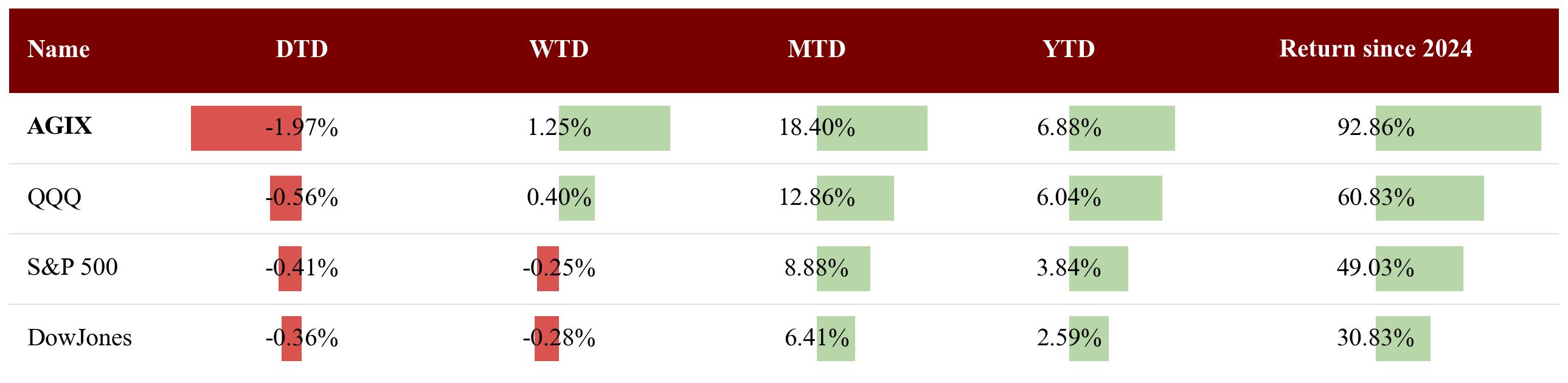
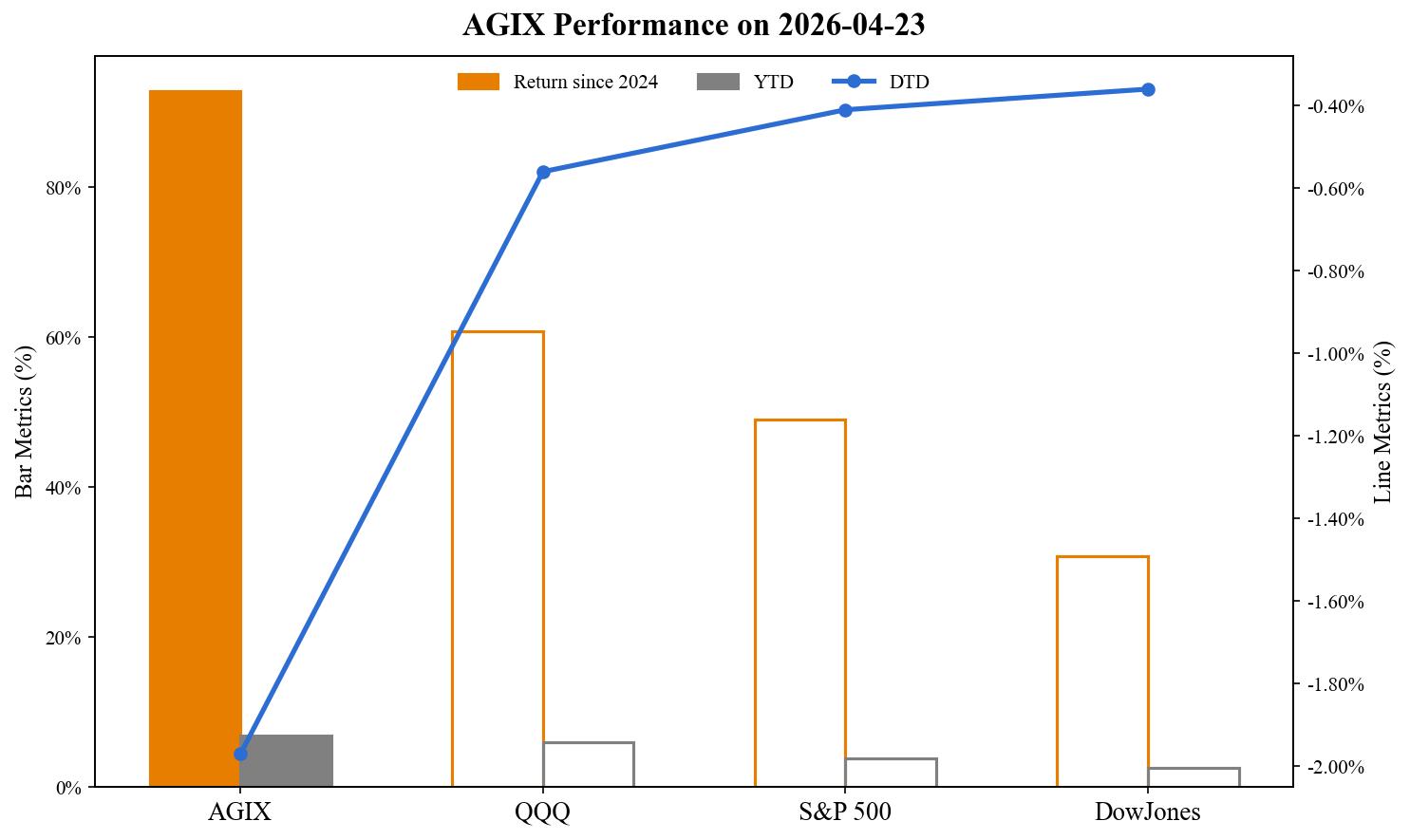
• AGIX fell 1.97% DTD, underperforming QQQ (-0.56%), the S&P 500 (-0.41%), and the Dow (-0.36%). AGIX’s YTD return of 6.88% still beats the S&P 500 (3.84%) and QQQ (6.04%).
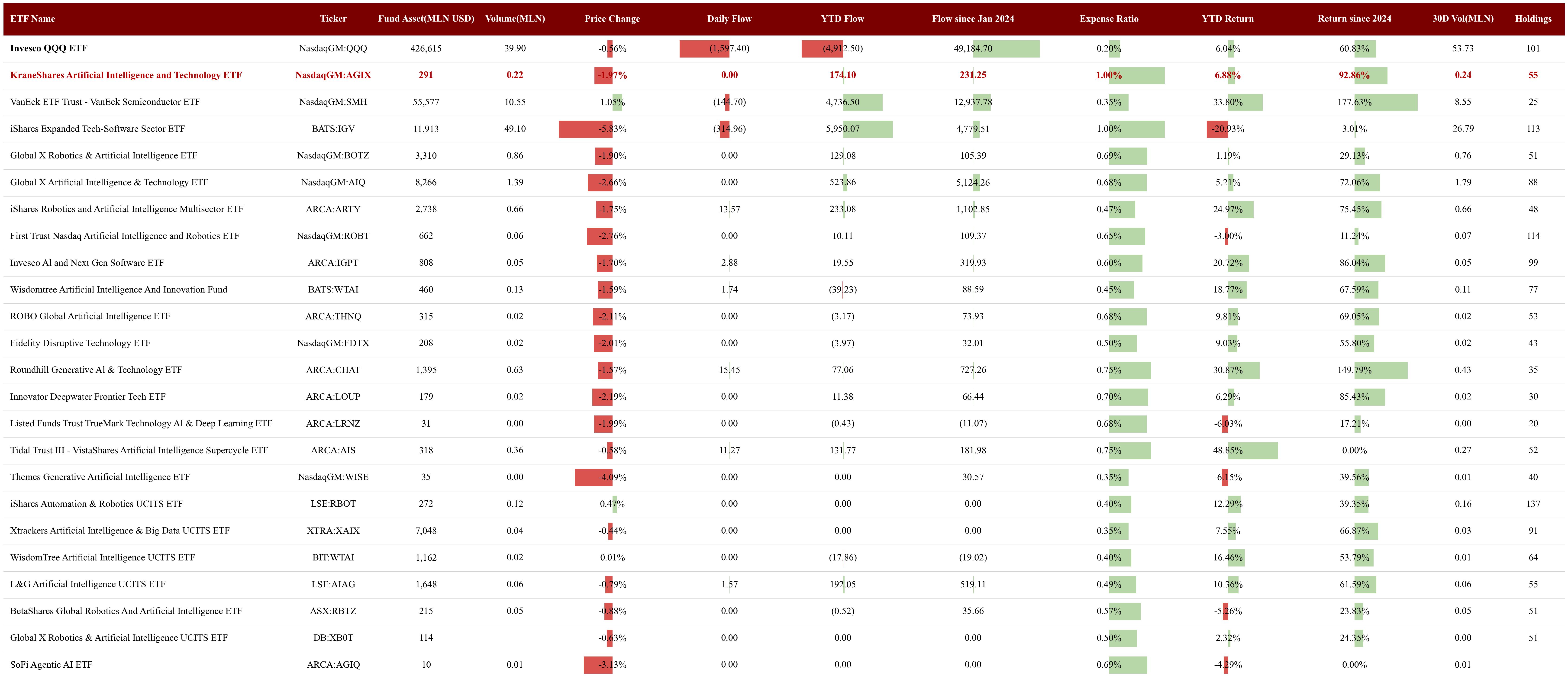
• Semiconductor peers SMH (+1.05% DTD, +33.80% YTD) and AI-focused ARCA:ARTY (+2.66% DTD, +24.97% YTD) significantly outperformed, driven by AI demand and earnings optimism.
• Top AGIX holdings contributing negatively DTD include ServiceNow (-17.75%, after a 12%+ after-hours slide despite beating earnings, due to Middle East deal delays), Salesforce (-8.69%), and Palantir (-7.24%). Applied Digital (+12.09%) and Renesas Electronics (+6.69%) were bright spots.
• Key stocks to watch: ServiceNow (AI suite growth vs. geopolitical headwinds), Nvidia (continued AI infrastructure demand), and Google/Alphabet (broad AI agent and cloud updates at Google Cloud Next).
News Highlights
1. Tesla announced a tripling of capital expenditure to $25B in 2026, focusing on AI, robotics, and computing infrastructure, including shifting Fremont to Optimus robot production. The stock fell in after-hours trading as free cash flow turns negative, but the long-term AI/robotics pivot is significant for AGIX’s Tesla holding (1.9% of portfolio).
2. ServiceNow beat Q1 earnings but shares slid over 12% after-hours due to Middle East conflict delaying large on-premise deals, creating a 75-basis-point headwind. The company raised full-year subscription guidance and reported strong AI suite adoption (130% sequential increase in large customers).
3. IBM beat Q1 estimates but did not raise full-year guidance, sending shares down over 7% after-hours. Software revenue grew 8%, and hybrid cloud (Red Hat) grew 10%, while consulting was flat. Infrastructure growth (new mainframe) countered the cloud-monopoly narrative.
4. OpenAI released GPT-5.5, its 'smartest and most intuitive model,' with significant improvements in math and coding. The model scored 39.6% on FrontierMath Tier 4 (vs. Claude’s 22.9%) and 82.7% on Terminal-Bench 2.0. This advances the AI super-app vision and pressures competitors.
5. Google launched Deep Research and Deep Research Max AI agents powered by Gemini 3.1 Pro, enhancing enterprise research capabilities with MCP protocol connectivity and data visualization. This strengthens Google’s AI agent leadership and supports AGIX’s Alphabet holding (3.33% of portfolio).
6. Meta announced a 10% workforce reduction (8,000 employees) and cancellation of 6,000 open roles to offset AI spending. The company is reorganizing into AI-focused 'pods,' with engineers moving to applied AI. Wall Street reacted positively, viewing it as optimization via AI automation.
7. Salesforce and Google deepened their partnership on agentic cross-platform collaboration, enabling AI agents from Agentforce to access Google Workspace data and vice versa, with zero-copy integration to BigQuery. This reduces the 'invisible switching tax' and accelerates enterprise AI adoption.
8. Anthropic is investigating unauthorized access to its Claude Mythos AI model, which Bloomberg reports was accessed by a small group via a third-party contractor leak. The incident highlights supply chain security weaknesses and the need for AI-driven cybersecurity defenses.
RSS Highlights
1. Microsoft is moving all GitHub Copilot subscribers to token-based billing starting June 2026. Business users will pay $19/user/month for $30 in shared AI credits; Enterprise users pay $39 for $70 in credits. This shift could increase usage flexibility but also costs for developers.
2. A project called Malus.sh allows users to pay a fee to turn any free/open-source code into proprietary software not bound by the original license, threatening the free software movement. The founder warns this could enable companies to legally exploit public resources without sharing obligations.
3. Unauthorized users in a Discord group had weekslong access to Anthropic’s supposedly super-dangerous Claude Mythos model, as reported by Bloomberg. The group accessed the model on the day of its limited test release and used it regularly, though not for cybersecurity purposes.
4. GPT-5.5 was officially released on April 23, 2026, and is now available to paid ChatGPT users at $5 per million input tokens and $30 per million output tokens, with higher prices for the Pro version. The API is not yet online as OpenAI works with partners on safety.
5. Nilay Patel's podcast 'Beware Software Brain' highlights that while AI excites the tech industry, public sentiment is turning negative, especially among Gen Z, where over half believe AI causes more harm than good, and only 18% are optimistic.
Performance & Benchmark
Attribution
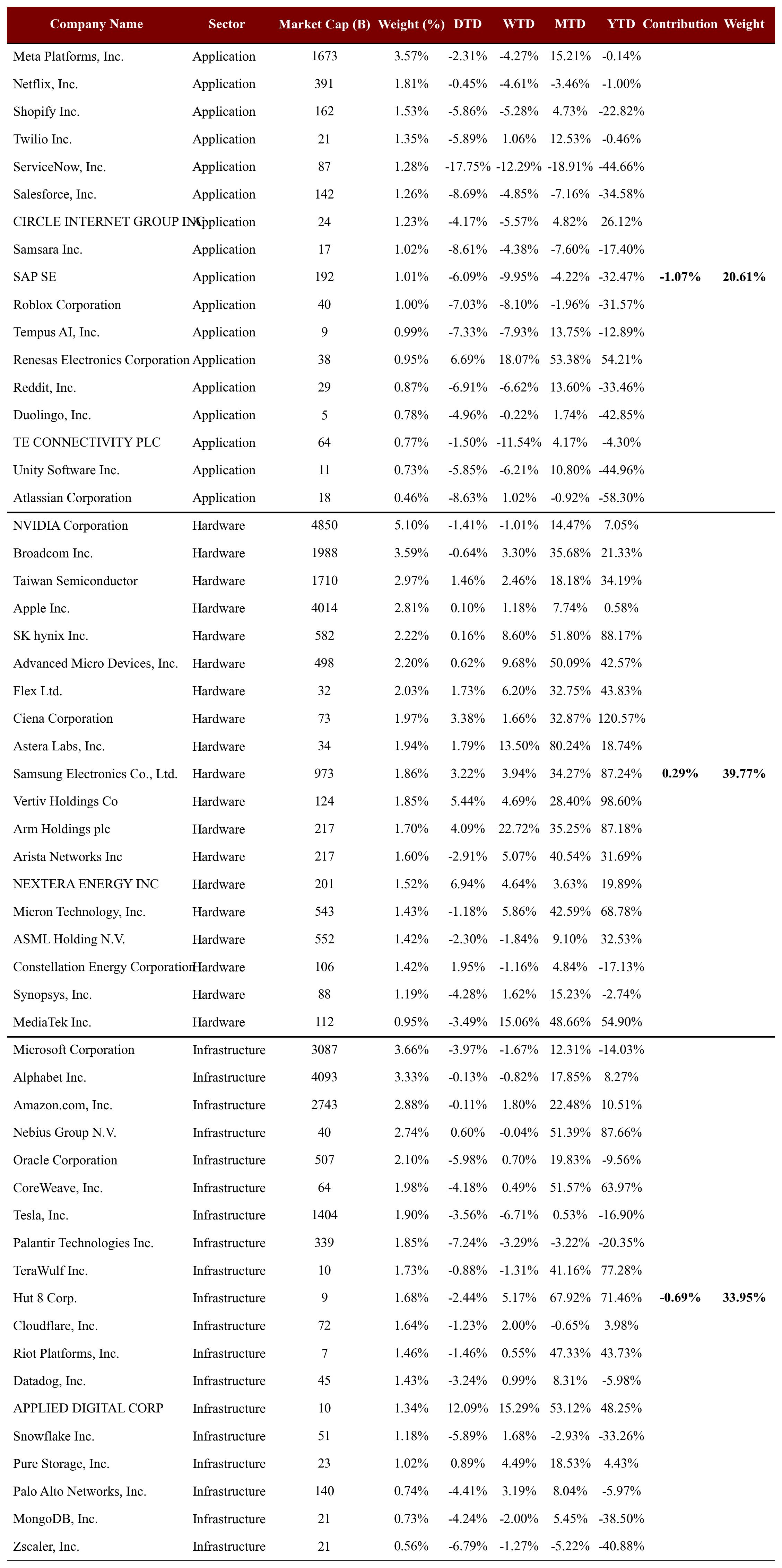
Contribution of the three sectors within AGIX holdings today
Application: -1.07%
Hardware: 0.29%
Infrastructure: -0.69%
Top-performing stocks in AGIX holdings today
APPLIED DIGITAL CORP (12.09%)
NEXTERA ENERGY INC (6.94%)
Renesas Electronics Corporation (6.69%)
Vertiv Holdings Co (5.44%)
Arm Holdings plc (4.09%)
Ciena Corporation (3.38%)
Samsung Electronics Co., Ltd. (3.22%)
Worst-performing stocks in AGIX holdings today
ASML Holding N.V. (-2.3%)
Meta Platforms, Inc. (-2.31%)
Hut 8 Corp. (-2.44%)
Arista Networks Inc (-2.91%)
Datadog, Inc. (-3.24%)
MediaTek Inc. (-3.49%)
Tesla, Inc. (-3.56%)
Microsoft Corporation (-3.97%)
CIRCLE INTERNET GROUP INC (-4.17%)
CoreWeave, Inc. (-4.18%)
MongoDB, Inc. (-4.24%)
Synopsys, Inc. (-4.28%)
Palo Alto Networks, Inc. (-4.41%)
Duolingo, Inc. (-4.96%)
Unity Software Inc. (-5.85%)
Shopify Inc. (-5.86%)
Twilio Inc. (-5.89%)
Snowflake Inc. (-5.89%)
Oracle Corporation (-5.98%)
SAP SE (-6.09%)
Zscaler, Inc. (-6.79%)
Reddit, Inc. (-6.91%)
Roblox Corporation (-7.03%)
Palantir Technologies Inc. (-7.24%)
Tempus AI, Inc. (-7.33%)
Samsara Inc. (-8.61%)
Atlassian Corporation (-8.63%)
Salesforce, Inc. (-8.69%)
ServiceNow, Inc. (-17.75%)
Top five listed stocks contributing the most within AGIX holdings today
ServiceNow, Inc. (-17.75%)
Microsoft Corporation (-3.97%)
Palantir Technologies Inc. (-7.24%)
Oracle Corporation (-5.98%)
Salesforce, Inc. (-8.69%)
Observation
The strongest movers across peer ETF holdings today are listed below:
| DTD | Stock Ticker | Name | Held by ETFs | analysis |
|---|---|---|---|---|
| 19.43 | NasdaqGS:TXN | Texas Instruments Incorporated | ['NasdaqGM:QQQ', 'NasdaqGM:SMH'] | Texas Instruments (TXN) stock surged 19.43% on April 23, 2026, primarily driven by a strong Q1 2026 earnings report that beat expectations with $4.83 billion in revenue (up 19% YoY, exceeding $4.53 billion consensus) and EPS of $1.68 (beating $1.27 forecast).[2][5] Key highlights included a 90% YoY surge in data center revenue from AI-driven analog chip demand and upbeat Q2 guidance of $5-5.4 billion in revenue.[1][2][4] Analyst upgrades, such as Bank of America's Buy rating and $320 price target, further fueled the rally.[1] |
| 14.5 | OB:AUTO | AutoStore Holdings Ltd. | ['NasdaqGM:BOTZ', 'NasdaqGM:ROBT', 'LSE:RBOT', 'ASX:RBTZ', 'DB:XB0T'] | No verifiable public information attributes AutoStore Holdings Ltd. (OB:AUTO)'s 14.5% single-day gain on April 23, 2026. Search results lack same-day news events, company disclosures, or relevant catalysts for that date, with the most recent data covering July 2025 activity showing minor declines and technical signals.[1] Without supporting evidence, the move cannot be reliably attributed. |
| 14.44 | ENXTPA:STMPA | STMicroelectronics N.V. | ['NasdaqGM:SMH', 'BIT:WTAI'] | STMicroelectronics (ENXTPA:STMPA) surged 14.44% on April 23, 2026, primarily driven by a Craig Hallum analyst upgrade to "buy" with a $58 price target, which triggered a gap-up open and heavy trading volume.[2][6] Strong Q1 results with 23% YoY revenue growth to $3.10B, better-than-expected gross margins, and raised Q2 guidance to ~$3.45B midpoint (above consensus) further fueled optimism despite an EPS miss.[2][5][6] Reports of robust AI-driven demand in chips for data centers, personal electronics, and infrastructure amplified the positive sentiment.[1][2][6] |
| 12.09 | NASDAQGS:APLD | APPLIED DIGITAL CORP | ['NasdaqGM:AGIX'] | I cannot provide a reliable attribution for Applied Digital's 12.09% single-day move on April 23, 2026, as the search results contain no verifiable news events, company disclosures, or market catalysts from that date. The available results include only a technical analysis video from April 17, 2026, and general information about expected move calculations, neither of which explains the specific price movement you're asking about. To properly attribute this move, I would need access to real-time news from April 23, 2026, earnings announcements, regulatory filings, or other contemporaneous market events. |
| 10.13 | NasdaqGS:MBLY | Mobileye Global Inc. | ['NasdaqGM:ROBT', 'LSE:RBOT', 'BIT:WTAI'] | Mobileye's 10.13% gain on April 23 was driven primarily by a beat on adjusted earnings and revenue combined with a raised full-year 2026 outlook, which signaled confidence in the company's core autonomous driving business despite a large non-cash goodwill impairment. The company reported adjusted EPS of $0.12 versus consensus of $0.08-$0.09 and revenue of $558 million, up 27% year-over-year, while also announcing a $250 million share repurchase program that demonstrated management confidence in future growth prospects. The underlying ADAS segment remained profitable with $95 million in segment profit, and the robotaxi deployment expected to scale from 2026 onward positioned the stock favorably despite the $3.8 billion goodwill charge reflecting prior valuation concerns. |
| 9.89 | NasdaqGS:MCHP | Microchip Technology Incorporated | ['NasdaqGM:QQQ', 'NasdaqGM:SMH', 'ARCA:IGPT', 'BATS:WTAI', 'LSE:RBOT', 'BIT:WTAI'] | Microchip Technology (MCHP) surged 9.89% on April 23, 2026, primarily driven by a broad semiconductor sector rally fueled by AI demand optimism and pre-earnings positioning[1]. The stock's move aligned with a major semiconductor index rising up to 1.9% on April 22, extending multi-week gains amid product wins, contract activity, and improving macro expectations, with no company-specific news identified[1]. Recent balance-sheet management via convertible notes financing further supported sentiment as the cycle strengthens[1]. |
| 9.88 | NasdaqGS:ON | ON Semiconductor Corporation | ['NasdaqGM:QQQ', 'NasdaqGM:SMH'] | ON Semiconductor's 9.88% stock surge on April 23, 2026, was primarily driven by B. Riley Financial's upgrade from neutral to buy with a $115 price target, well above the consensus $67.15 and current levels, sparking buying momentum.[1][3] Broader positive semiconductor sector sentiment, including ETF inflows and short-squeeze spillovers, provided secondary support amid recent insider selling and weak revenue.[1][2] Institutional ownership remained high at 97.70% despite some trims.[2] |
| 8.02 | XTRA:IFX | Infineon Technologies AG | ['NasdaqGM:AIQ', 'ARCA:THNQ', 'LSE:AIAG'] | I cannot provide a reliable attribution for Infineon Technologies' 8.02% single-day move on April 23, 2026, based on the available search results. The search results contain only general analyst sentiment updates and historical price data from 2024-2025, with no verifiable news events, company disclosures, regulatory announcements, or industry catalysts specific to April 23, 2026. Without access to real-time news from that date, any attribution would be speculation rather than analysis grounded in public information. |
| 7.73 | NasdaqGS:CMCSA | Comcast Corporation | ['NasdaqGM:QQQ'] | Comcast shares surged 8.9% on April 23, 2026, following the release of first-quarter 2026 earnings that beat Wall Street expectations on both revenue and earnings per share. The company reported revenue of $31.46 billion, 3.4% ahead of consensus estimates, and adjusted EPS of $0.79, beating expectations by 8.3%. Despite underlying weakness including domestic broadband customer declines and lower operating margins, the headline beats signaled business resilience and drove the rally. |
| 7.5 | NasdaqGS:KDP | Keurig Dr Pepper Inc. | ['NasdaqGM:QQQ'] | Keurig Dr Pepper's 7.5% stock rise on April 23, 2026, was primarily driven by better-than-expected Q1 results and reaffirmed full-year 2026 guidance.[1][3][5] The company reported Q1 net sales of $4.0 billion, up 9.4% year-over-year with strong U.S. refreshment beverage momentum, and EPS beating estimates at $0.60 versus $0.59 expected, while maintaining 2026 net sales of $25.9–$26.4 billion and low double-digit adjusted EPS growth.[2][5] Completion of the JDE Peet's acquisition on April 1 and plans to split into two public companies by early 2027 further boosted investor confidence in strategic growth.[3][4] |
| 7.09 | TSE:6526 | Socionext Inc. | ['NasdaqGM:AIQ', 'ARCA:IGPT', 'LSE:RBOT'] | No specific news events, company disclosures, or catalysts explain Socionext Inc. (TSE:6526)'s 7.09% gain on April 23, 2026, as search results lack same-day information. Available data shows the stock at ¥2,884 on August 7, 2025 (up 3.91%) and ¥2,043 on January 29, 2026 (down 13.45% weekly), with no updates near the date in question. The move may reflect broader market dynamics or trading factors absent from public records. |
| 6.95 | NasdaqGS:CSX | CSX Corporation | ['NasdaqGM:QQQ'] | CSX surged 6.95% on April 23, 2026, driven primarily by a better-than-expected Q1 earnings beat and a coordinated wave of analyst upgrades that reset consensus price targets higher. The company reported diluted EPS of $0.43, beating the $0.39 consensus estimate, while demonstrating margin expansion and raising its full-year revenue outlook as management cited increased shipper demand for rail amid rising fuel costs. The earnings beat triggered at least 10 analyst upgrades across the Street on April 23, with major firms including JPMorgan (raised to $48), Bank of America (raised to $49), TD Cowen (raised to $45), and Benchmark (raised to $48) all raising price targets, establishing a new consensus target of approximately $46 that aligned with the stock's closing price and provided technical support for the rally. |
| 6.94 | NYSE:NEE | NEXTERA ENERGY INC | ['NasdaqGM:AGIX'] | Nextera Energy (NEE) surged 6.94% on April 23, 2026, primarily due to a strong Q1 earnings beat with adjusted EPS exceeding analyst expectations, driving positive investor sentiment.[1][3][5] Key support came from robust growth in Florida Power & Light's customer base and regulatory capital, plus a record quarter for NextEra Energy Resources with 4 GW added to its 33 GW renewables and storage backlog.[1] The company reaffirmed its full-year 2026 EPS guidance and long-term growth targets over 8% annually through 2035, outweighing a revenue miss.[1][3] |
| 6.83 | NasdaqGS:NXPI | NXP Semiconductors N.V. | ['NasdaqGM:QQQ', 'NasdaqGM:SMH', 'NasdaqGM:AIQ', 'NasdaqGM:ROBT', 'NasdaqGM:FDTX', 'BIT:WTAI'] | NXP Semiconductors' 6.83% gain on April 23, 2026 was primarily driven by strong Q4 2025 results announced that day, which showed 7% year-over-year revenue growth and robust automotive processor demand for software-defined vehicles. The company's redemption of $750 million in senior notes due June 2026 on April 20 also reinforced positive sentiment around balance sheet management and capital allocation flexibility. Additionally, forward guidance and analyst expectations for continued growth in Industrial IoT and automotive segments, with consensus forecasting 12% EBITDA recovery to $5.3 billion in 2026, supported the upside move ahead of Q1 2026 earnings scheduled for April 28. |
| 6.69 | TSE:6723 | Renesas Electronics Corporation | ['NasdaqGM:AGIX', 'NasdaqGM:ROBT', 'BIT:WTAI'] | Renesas Electronics' 6.69% gain on April 23, 2026 was driven by the company's announcement of consolidated financial forecasts for the six months ending June 30, 2026, which showed improved profitability metrics. The forecasts revealed operating margin expansion to 31.3% from 27.7% year-over-year, alongside revenue growth to 767.8 billion yen from 633.4 billion yen in the corresponding prior period, signaling stronger operational performance and demand recovery in the semiconductor sector. |
| 6.39 | TWSE:3443 | Global Unichip Corp. | ['NasdaqGM:AIQ', 'ARCA:IGPT', 'ARCA:THNQ', 'LSE:RBOT', 'LSE:AIAG'] | No specific news events, company disclosures, or catalysts on April 23, 2026, explain Global Unichip Corp. (TWSE:3443)'s 6.39% single-day gain, as search results lack same-day reporting. The move aligns with recent positive momentum, including a 13.56% weekly increase and technical buy signals noted in market data[4]. Broader trends show outperformance versus benchmarks over six months and a year[2]. |
| 6.35 | HLSE:NOKIA | Nokia Oyj | ['ARCA:AIS', 'XTRA:XAIX'] | Nokia's 6.35% stock rise on April 23, 2026, was driven primarily by a strong Q1 earnings beat, with EPS of $0.06 versus $0.04 expected, comparable operating profit up 54% to €281M, and net sales growth of ~49% fueled by AI and cloud demand[2]. Management raised network infrastructure growth guidance to 12-14%, while ~€1B in orders and broker upgrades from Northland ($13 PT) and BofA ($12.40 PT) triggered a gap up from $9.86 to $10.78 on heavy volume of ~52M shares, hitting multi-year highs[2]. This reversed prior weakness from April 22 analyst downgrades like SEB's Buy-to-Hold cut[1]. |
| 5.89 | NasdaqGS:ADI | Analog Devices, Inc. | ['NasdaqGM:QQQ', 'NasdaqGM:SMH', 'ARCA:THNQ', 'LSE:AIAG'] | Analog Devices (ADI) rose 5.89% on April 23, 2026, primarily due to investors re-rating the stock on its upbeat FY2026 outlook following strong fiscal Q1 2026 results and above-consensus Q2 guidance.[1] Recent price-target hikes from firms like UBS ($430), Jefferies ($410), and Oppenheimer ($400) provided additional support amid optimism for industrial and data center demand.[1][2] The Q1 beat ($2.46 EPS vs. $2.31 est., $3.16B revenue +30% Y/Y) and CFO's "new high-watermark" commentary on the earnings call reinforced expectations for cyclical recovery and earnings growth into FY2026.[4][5] |
| 5.44 | NYSE:VRT | Vertiv Holdings Co | ['NasdaqGM:AGIX', 'ARCA:ARTY', 'BATS:WTAI', 'ARCA:LOUP', 'ARCA:AIS'] | Vertiv's 5.44% gain on April 23, 2026 was driven primarily by Morgan Stanley's price target increase to $350 (from $285) with an overweight rating, combined with the company's strong Q1 earnings beat and raised full-year guidance announced that day. The earnings report showed EPS of $1.17 versus $1.00 consensus, revenue of $2.65B (+30% YoY), and management raised FY2026 EPS guidance to $6.30-$6.40, signaling sustained demand from AI and data-center investments. Multiple analyst upgrades and positive sentiment around margin expansion and robust cash flow generation further supported the move. |
| 5.39 | NasdaqGM:CAMT | Camtek Ltd. | ['ARCA:ARTY'] | Camtek's 5.39% gain on April 23, 2026 was driven primarily by the stock reaching a new 52-week high of $197.62, reflecting sustained momentum in semiconductor equipment demand. The company announced on the same day that it will report Q1 2026 results on May 12, 2026, which may have reinforced investor confidence ahead of earnings. Mixed performance among semiconductor equipment peers suggests the move was stock-specific rather than sector-driven, indicating positive positioning or expectations for Camtek's near-term results. |
| 5.28 | NasdaqGS:RMBS | Rambus Inc. | [] | Rambus rose 5.28% on April 23, 2026, driven primarily by the stock reaching a new 52-week high of $137.41, reflecting sustained momentum in AI memory demand. The company's recent launch of its SOCAMM2 chipset for modular AI memory in LPDDR5X server platforms likely supported investor confidence in its positioning within the high-growth AI infrastructure market. Additionally, strong institutional buying activity, including a 70.6% stake increase by Invesco in Q4 2025, has maintained upward pressure despite the stock trading at a elevated P/E of 64.7x relative to its consensus price target of $105.71. |
| 5.24 | NasdaqGS:MRVL | Marvell Technology, Inc. | ['NasdaqGM:QQQ', 'NasdaqGM:SMH', 'NasdaqGM:AIQ', 'ARCA:ARTY', 'BATS:WTAI', 'NasdaqGM:FDTX', 'ARCA:CHAT', 'ARCA:AIS', 'BIT:WTAI'] | Marvell Technology (MRVL) rose 5.24% on April 23, 2026, primarily driven by reports of talks with Alphabet/Google to co-develop custom AI chips, including an MPU and inference TPU, signaling a major data-center design win.[1][3][4] RBC Capital raising its price target to $170 from $115 with an Outperform rating provided additional bullish validation amid strong AI infrastructure momentum.[1] Heavy call-option volume and elevated trading activity further indicated institutional optimism.[1] |
News
Funding & M&A
ServiceNow’s stock slides as the Middle East conflict drags on revenue.
ServiceNow Inc. reported first-quarter earnings that beat Wall Street expectations, with earnings per share of 97 cents exceeding the 96-cent target, revenue of $3.77 billion up 22% year-over-year, and net income of $469 million. Subscription revenue of $3.67 billion slightly exceeded expectations, but conflicts in the Middle East delayed several large on-premise deployment deals, creating a 75-basis-point headwind to revenue. CEO Bill McDermott said the Middle East situation is normalizing and customers plan to resume business. The company raised its full-year subscription revenue guidance to $15.74-$15.78 billion, repurchased 20 million shares, and reported remaining performance obligations of $12.64 billion, with 16 annual contracts worth over $5 million each, up 80% year-over-year. Despite the limited Middle East impact, shares fell over 12% in after-hours trading and are down 32% year-to-date, affected by AI's impact on software stocks. The company is actively embracing AI, with its Now Assist AI suite seeing a 130% sequential increase in large customers spending over $1 million annually, positioning itself as an enterprise AI control tower that can integrate multiple models and systems. This week, ServiceNow announced expanded collaboration with Google Cloud and completed the $7.75 billion acquisition of cybersecurity startup Armis Inc., strengthening its AI and security portfolio.
Rilian raises $17.5 million to automate security software procurement and deployment in the defense sector
Rilian, a startup in the defense and national security sector, announced the completion of a $17.5 million seed funding round led by 8VC, Tamarack Global, and First In, with participation from defense tech experts including 8090 Industries, Liquid 2 Venture, and Protego Ventures. The company focuses on building agentic system integration tools to help defense and military systems rapidly deploy complex security stacks, bridging the latest AI innovations with highly regulated defense environments. Rilian's core product, Caspian, is an AI-native security orchestration platform that acts as a command layer atop the security stack, using AI agents to automate threat detection, countermeasures, and targeting, addressing the 'execution gap'—the lengthy cycle from procurement to deployment. Its autonomous delivery engine can push updates within days in compliance-constrained environments and captures 'institutional knowledge' from human experts to reduce the learning curve for new employees. Targeting US allied nations, the company has signed a major contract with the UAE Cybersecurity Council to integrate and automate security processes for critical infrastructure using Caspian. Rilian aims to address the over $70 billion global government security spending market, seeking to solve procurement and talent bottlenecks through engineered security and become foundational infrastructure for next-generation mission systems. Co-founder and CEO Christian Schnedler stated that the company wants to enable defenders to operate as swiftly as enemy machines.
Era computer raises $11 million to build a software platform for AI gadgets.
AI hardware platform startup Era Computer recently held an artist developer kit showcase in New York, where artists created a variety of experimental AI gadgets based on the Era platform, including French fact joke souvenirs, stock analysis resignation advice devices, and air quality monitors. Although these devices are experimental, they highlight the potential of the Era platform: a software layer designed for hardware manufacturers that supports creating AI agents and device orchestration, rather than producing hardware itself. Era has raised a total of $11 million, including a $9 million seed round led by Abstract Ventures and BoxGroup, and a previous $2 million pre-seed round from Topology Ventures and Betaworks, with angel investors including notable figures like Flickr co-founder Caterina Fake. The company was founded last year by CEO Liz Dorman, CTO Alex Ollman, and CPO Megan Bole, who come from Humane (later acquired by HP), HP, and Sutter Hill Ventures' io project, respectively. The Era platform integrates over 130 LLMs from 14 providers, supports multimodal AI devices such as glasses, jewelry, and home speakers, and emphasizes dynamic model routing, privacy protection, and open-source community openness. Founder Dorman believes that AI models can replace the traditional app layer, driving a 'Cambrian explosion' of device innovation and empowering manufacturers worldwide rather than Silicon Valley elites. Facing industry challenges like Humane's sale to HP and Rabbit's stagnation, Era is optimistic about the future of AI hardware.
Grab a ticket today: The first StrictlyVC of 2026 kicks off in just a week in San Francisco.
StrictlyVC will hold its first annual event on April 30, 2026, at the Sentro Filipino Cultural Center in San Francisco, with tickets selling fast and attracting many entrepreneurs and investors. Event highlights include several heavyweight speakers: Eclipse founder and CEO Lior Susan will discuss his recently raised $1.3 billion fund, exclusively investing in 'physical AI' startups, sharing his vision of merging AI with the physical world. He has a military background and led Flex's hardware investments, offering deep insights into industrial system upgrades, interviewed by StrictlyVC venture journalist Marina Temkin. Replit co-founder and CEO Amjad Masad will explore AI-driven software development transformation and the new era of programming. TDK Ventures President Nicolas Sauvage will talk with TechCrunch Editor-in-Chief Connie Loizos about corporate venture capital, early-stage investing, and key lessons for founders raising from strategic investors, with the company also sponsoring the event. Forum AI co-founder and CEO Campbell Brown, former Meta head of media partnerships and CNN anchor, will share insights on building trustworthy AI systems, interviewed by veteran journalist Tim Fernholz. The event emphasizes intimate networking opportunities to help participants grasp Silicon Valley trends early, so grab remaining tickets before they sell out.
Copperhelm dives deep into automation to build enterprise cloud defenses.
Cloud cybersecurity startup Copperhelm Inc. today announced its official launch and the completion of a $7 million seed funding round, led by TLV Partners with participation from ToDay Ventures, ICON, and SaaS Ventures Israel. Notable angel investors include Kfir Tishbi, Or Hiltch, Guy Zipori, and Ephraim Yarmak. The company was founded by Shimon Tolts, Eyar Zilberman, and Roman Labunsky, who bring extensive experience from companies such as Unity Software, McAfee, and RSA Security. Copperhelm aims to revolutionize cloud security through agentic AI, addressing challenges like complex attack surfaces, fragmented services, and reliance on manual operations in cloud environments. Its core technology, 'Context Lake,' is a real-time decision engine that deploys AI agents to continuously analyze infrastructure, investigate risks, and automatically remediate vulnerabilities, using specialized tools for seamless integration. The company's platform includes dedicated agents for network analysis, system behavior monitoring, adversary simulation, and automated remediation, attaching directly to live activities to inspect processes and container images, map cloud networks, and deploy rules and policies to mitigate threats without disruption. An unnamed Fortune 500 customer has used the technology to transform 6 million raw findings into hundreds of prioritized risk reports, dramatically improving efficiency. Copperhelm aims to bring greater autonomy, transparency, and capability to enterprise cloud environments, effectively adding the equivalent of 20 senior engineers to a security team instantly.
Cyera acquires Ryft to give enterprises traceable data access for AI agents
AI and data security company Cyera Ltd. announced the acquisition of Israeli startup Ryft Data Inc., which developed an automated data lake platform designed for enterprises deploying AI agents. According to Globes, the deal is estimated to be valued between $100 million and $130 million, with specific terms undisclosed. Ryft was founded in 2024, and its platform enables enterprises to quickly and securely access data while automatically analyzing data access behavior of employees and AI agents, automating authorization, classification, and optimization based on open-source standards to avoid vendor lock-in. The platform's management layer automatically handles optimization, compliance, disaster recovery, and governance, eliminating manual engineering burdens and providing clean, manageable, and traceable large-scale data access for AI agent workloads. The acquisition will add AI-ready data lake capabilities to Cyera's data security platform, helping enterprises ensure secure access, analysis, and action on sensitive enterprise data when deploying autonomous AI systems. Cyera stated that this move will accelerate its roadmap, providing instantly traceable secure data access. Ryft CEO Yossi Reitblat will lead Cyera's AI security activities, with his team forming a new group focused on the intersection of AI, data, and information security. Previously, Ryft had raised $8 million in funding from investors including Index Ventures SA and Bessemer Venture Partners. This is Cyera's fourth acquisition in five years, following a $400 million funding round in January that valued the company at $9 billion.
Era raises $11M to build a software platform for AI gadgets.
AI hardware platform startup Era recently hosted an artist gathering in New York, showcasing innovative gadgets built on its developer kit, including a souvenir that tells French trivia, a phone-shaped device that analyzes stocks and suggests quitting your job, and an air quality monitor. These experimental devices highlight the potential of Era's platform, which is designed for hardware makers to create AI agents and device orchestration rather than producing hardware itself. Era has raised a total of $11 million, including a $9 million seed round led by Abstract Ventures and BoxGroup, and a previous $2 million pre-seed round from Topology Ventures and Betaworks. Its angel investors include notable names like Flickr co-founder Caterina Fake and former Rabbit CPO ShaoBo Z. The company was founded by CEO Liz Dorman, CTO Alex Ollman, and CPO Megan Gole, who come from Humane (later acquired by HP), HP, and the Jony Ive and Sam Altman io project at Sutter Hill Ventures, respectively. Era's platform integrates over 130 LLMs from 14 providers, supporting multimodal inputs like glasses, jewelry, and home speakers, aiming to drive a 'Cambrian explosion' in AI device form factors. Founder Dorman emphasized replacing the application layer, empowering the masses to create smart devices, and focusing on privacy and the open-source community. Facing challenges from AI hardware pioneers like Humane and Rabbit, Era sees market growth driven by user use cases.
Bret Taylor's Sierra buys YC-backed AI startup Fragment
Customer service AI startup Sierra announced the acquisition of YC-backed French startup Fragment, which specializes in helping businesses integrate AI into workflows. This is Sierra's third public acquisition, following the acquisitions of Japanese enterprise AI solutions company Opera Tech and voice agent company Receptive AI in late March. Fragment co-founders Olivier Moindrot and Guillaume Genthial will join the Sierra team. Sierra co-founders Bret Taylor and Clay Bavor said in a blog post that the two founders will bring valuable expertise to the company's agent development efforts in France. Deal terms were not disclosed; PitchBook data shows Fragment raised approximately $2 million in seed funding. Taylor also serves as chairman of OpenAI's board, was formerly co-CEO of Salesforce, and left in early 2023 to co-found Sierra with former Google executive Bavor. The company's customers include Casper, Clear, and Brex, and it has raised over $630 million in cumulative funding at a $10 billion valuation, with major investors including Sequoia and Benchmark. This move further strengthens Sierra's expansion in the AI agent space.
Omni raises $120M round backed by GV for its AI analytics platform
Omni Analytics Inc. announced the completion of a $120 million Series C funding round, achieving a valuation of $1.5 billion, double its valuation from last year. ICONIQ led the round, with participation from Alphabet's GV venture capital, Redpoint Ventures, and others. The San Francisco-based startup focuses on business intelligence dashboards, replacing the traditional manual process of preparing datasets and writing SQL queries with a chatbot interface. Users simply describe the information they need to generate data visualizations and can ask follow-up questions for deeper analysis. Additionally, Omni offers a SQL editor and a spreadsheet interface, the latter surpassing Excel by automatically syncing changes from data sources like MySQL and Snowflake without manual refreshes. To address the challenge of AI handling ambiguous prompts, Omni introduces a semantic model that defines how business terms are interpreted, ensuring the AI accurately understands queries like 'team performance last quarter' while respecting user permissions and displaying reasoning. Context modeling allows providing data definitions to external AI models, improving third-party neural network analysis efficiency. Developers can integrate Omni data visualizations into custom software, with AI agents interacting via MCP servers. Omni revealed that revenue tripled this year, with customers including notable tech companies like Perplexity AI Inc. and dbt Labs Inc., and this funding round will accelerate platform innovation.
Model Releases
OpenAI releases GPT-5.5, bringing the company one step closer to an AI 'super app'.
OpenAI officially released its latest AI model, GPT-5.5, on Thursday, claiming it is its 'smartest and most intuitive model to use,' showing significant improvements across multiple areas. Co-founder and President Greg Brockman said the model marks a key step toward building a 'super app' that integrates ChatGPT, Codex, and an AI browser to serve enterprise customers. Brockman emphasized that GPT-5.5 has made major advances in agentic and intuitive computing, is faster and sharper than its predecessor GPT-5.4, consumes fewer tokens, and provides more cutting-edge AI resources for businesses and consumers. Chief Scientist Jakub Pachocki noted that the company will continue to release models at high frequency, expecting significant improvements in the short term and major breakthroughs in the medium term. Chief Research Officer Mark Chen added that the model excels in computer work, scientific and technical research processes, particularly aiding drug discovery and expert scientist progress. In benchmark tests, GPT-5.5 outperformed its predecessor and competitors Google's Gemini 3.1 Pro and Anthropic's Claude Opus 4.5. Technician Mia Glaese mentioned that its deployment strategy in the digital defense sector is mature and reliable. The model is immediately available to Plus, Pro, Business, and Enterprise users, with the 5.5 Pro version limited to Pro and above, showcasing OpenAI's leading momentum in the AI race.
Google launches AI research agents powered by Gemini 3.1 Pro
Google recently launched two new AI agent tools, Deep Research and Deep Research Max, as successors to the AI research tool released in December last year. These new agents use the more advanced Gemini 3.1 Pro large language model, which debuted in February this year. On OpenAI's BrowseComp benchmark, Gemini 3.1 Pro scored 85.9 points, more than 25 points higher than its predecessor Gemini 3 Pro, demonstrating excellent online research capabilities. The new tools can not only retrieve data from the public web but also connect to enterprise internal systems via the MCP protocol, and users can manually upload files such as spreadsheets and videos to supplement datasets. Google emphasizes that these agents are suitable for fields like medical research and financial investment analysis—for example, scientists can generate treatment reports for new compounds, and financial professionals can research potential investment targets. The agents support optional data visualization, generating HTML code or using the Nano Banana image generator, which has a built-in general knowledge base to improve accuracy. Before starting work, the agents display a research plan that users can edit to optimize output quality. Deep Research focuses on hardware efficiency, response speed, and cost control, making it suitable for rapid application development; Deep Research Max pursues maximum comprehensiveness by investing more resources. Currently, both agents are available through the Gemini API in public beta, and will later expand to Google Cloud, integrating data sources like FactSet and PitchBook. This move further strengthens Google's leading position in the AI agent field.
OpenAI releases GPT-5.5 with advanced math, coding capabilities
OpenAI Group Public Benefit Corporation (PBC) recently launched a new large language model, GPT-5.5, which significantly outperforms its predecessor in mathematical problem-solving and code writing, coming just a week after rival Anthropic PBC released its latest LLM, Claude Opus 4.7. GPT-5.5 is available in a standard version and a more powerful Pro version, with the latter priced higher and excelling in fields such as business, law, education, and data science. The standard version shows notable improvements in computer use tasks and knowledge work, while the Pro version leads in multiple benchmarks, including FrontierMath Tier 4, which features postdoctoral-level math problems, where the Pro version scored 39.6%, nearly double Claude Opus 4.7's 22.9%. Additionally, GPT-5.5 scored 82.7% on the Terminal-Bench 2.0 programming benchmark, far surpassing the competitor's 69.4%, and helped researchers discover a new mathematical proof related to Ramsey numbers. OpenAI has internally applied the model to optimize infrastructure management software, improving token generation speed by over 20% on Nvidia GB200 and GB300 NVL72 systems (powered by Blackwell B200 and Ultra GPUs). On the GDPval economic value task benchmark, the standard version set a record at 84.9%, surpassing both the Pro version and Claude. GPT-5.5 is now available in ChatGPT and Codex for Plus, Pro, Business, and Enterprise subscribers, with the Pro version limited to the latter three tiers; API support is coming soon. This move highlights OpenAI's leading position in the AI model competition.
Technical Breakthroughs
India’s app market is booming — but global platforms are capturing most of the gains
India's mobile app market saw in-app purchase revenue exceed $300 million in the first quarter, up 33% year-over-year, hitting a record high, according to a Sensor Tower report. While downloads remain stable at around 25 billion annually, user engagement time continues to grow, indicating deeper involvement and willingness to pay. Non-gaming apps became the main growth driver, with revenue surpassing $200 million, up 44% year-over-year, led by utilities, video streaming, and generative AI apps. Global platforms dominated the revenue charts, including Google One, Facebook, ChatGPT, and YouTube, while local video platforms like JioHotstar and SonyLIV stood out. On the download charts, ChatGPT, Instagram, and Chinese short-drama app FreeReels led, followed by Story TV, JioHotstar, and Meesho. Donny Kristianto, Market Insights Manager at Sensor Tower, noted that the market has matured on the download side, but monetization is strengthening due to deeper usage and the adoption of digital payments. However, India's revenue per download is only $0.03, far below the $0.20 seen in Southeast Asia and Latin America. Productivity, social media, and video streaming dominate, with video streaming accounting for half of the top 10 revenue-generating apps. Generative AI downloads grew 69%, with ChatGPT remaining the largest market by user base; short-drama platform downloads surged over 400%, led by FreeReels. The expansion of emerging categories signals significant monetization potential.
AI galaxy hunters are adding to the global GPU crunch.
NASA announced that the Nancy Grace Roman Space Telescope will launch eight months early in September 2026, expected to provide astronomers with 20,000 terabytes of data over its lifetime. This will complement the James Webb Space Telescope's daily 57 gigabytes of image data and the upcoming 20 terabytes per night from Chile's Vera C. Rubin Observatory, far exceeding Hubble's 1-2 gigabytes per day. Astronomers are turning to GPU acceleration to process massive data. UC Santa Cruz astrophysicist Brant Robertson has collaborated with NVIDIA for 15 years, applying GPUs to supernova explosion simulations and the latest observational data analysis. The deep learning model Morpheus, developed with his student Ryan Hausen, efficiently identifies galaxies and has discovered specific disk galaxies in Webb data, challenging cosmic evolution theories. Robertson is now transitioning Morpheus from convolutional neural networks to Transformer architecture, expanding analysis coverage several times. He is also developing generative AI models to optimize ground-based telescope observations using space telescope data, compensating for Earth's atmospheric distortion. Although NSF funds his GPU cluster construction, surging global GPU demand and the Trump administration's proposed 50% NSF budget cut are increasing resource pressure. Robertson emphasizes that AI and ML analysis relies on GPUs, and academia needs to be more entrepreneurial to advance cutting-edge technology.
McKinsey global strategy leader says it's 'game over' when CEOs delegate AI to the analytics team.
At the Google Cloud Next 2026 conference, Asutosh Padhi, Global Head of Strategy at McKinsey, pointed out that despite the surge in enterprise AI investment, 90% of AI projects fail to generate significant business value, and executives face the strategic challenge of rising IT spending with unclear returns. Padhi emphasized that this is not a technology issue but a lack of leadership and organizational structure, with only 39% of organizations reporting profit impact from AI. He criticized fragmented enterprise data environments, complex acquisition integrations, and unclear C-level responsibilities, where AI matters are often delegated to CIOs or chief data officers, leading to failure. McKinsey research shows that companies often get stuck in 40-50 isolated pilots and cannot scale. Padhi suggested starting with the most pressing business problems, proving value before expanding, thereby consolidating change management and capability building. The ultimate goal is to build an 'AI management operating system' that embeds AI from the CEO to the front line, reshapes workflows, uses digital twins of core business ontologies, and compresses product time-to-market by over 70%. Successful leaders need to blend technical proficiency, decision-making speed, and human judgment, such as empathy and wisdom, to navigate decision-making dilemmas amid information overload. Padhi warned that companies that fail to master technology, lack speed, or lack human touch will fall behind, and this is the core challenge of the current technology cycle.
Anthropic investigates unauthorized access to restricted Claude Mythos AI model
Anthropic PBC is investigating reports that unauthorized users accessed its next-generation AI model, Claude Mythos. The company describes the model as having powerful capabilities surpassing most human coding abilities, capable of discovering and exploiting software vulnerabilities, enough to launch dangerous cyberattacks. According to Bloomberg, a small group of users from a private online forum gained access on the day Anthropic announced the limited test release, using credentials from a third-party contractor and data leaked from Mercor Inc. They continued to use the model afterward, but not for cybersecurity purposes. A company spokesperson said they are investigating the access incident in the third-party vendor environment, with no current indication that activity extended beyond the vendor or affected Anthropic systems. Access to Mythos is restricted to participants of Project Glasswing, including about 40 institutions such as Apple, Amazon, Cisco, CrowdStrike, Google, JPMorgan, Microsoft, and Nvidia, as well as the U.S. National Security Agency and the Commerce Department's AI Standards Innovation Center, with the Treasury Department also seeking access. Experts point out that this incident exposes weaknesses in supply chain security, emphasizing that access control policies are prone to failure, and call on companies to strengthen AI-driven cybersecurity defenses to counter potential AI-enabled adversaries.
Three insights you might have missed from theCUBE’s coverage of HPE World Quantum Day.
At HPE World Quantum Day events, experts discussed the synergy between quantum computing, high-performance computing (HPC), and artificial intelligence, viewing them not as competitors but as complementary technologies that will drive enterprise innovation. theCUBE Research Chief Analyst Dave Vellante emphasized that integrating CPUs, GPUs, and quantum processors (QPUs) can solve complex problems that traditional methods struggle with. Oak Ridge National Laboratory's Tom Beck and Amir Shehata noted that quantum computing, as a targeted accelerator, combines with HPC supercomputers like Frontier to handle the hardest quantum tasks through efficient information transfer. Argonne National Laboratory's Laura Schulz stated that quantum directly simulates quantum mechanical effects, accelerating research in chemistry and materials science. Lawrence Livermore National Laboratory's Kristi Beck believes quantum has huge potential in drug discovery and other fields, but engineering limitations delay commercialization. CSC's Mikael Johansson and Leibniz Supercomputing Centre's Dieter Kranzlmüller emphasized that hybrid quantum-supercomputing systems will optimize the green transition, such as designing efficient catalysts and batteries. Pawsey Supercomputing Research Centre's Pascal Elahi is advancing the Setonix-Q project to expand quantum access. Experts called for developing a 'quantum Python' to simplify the software ecosystem and move quantum from labs to widespread application.
Tesla just increased its spending plan to $25B — here’s where the money is going
Tesla CEO Elon Musk announced on the company's Q1 2026 earnings call that capital expenditures will surge to $25 billion in 2026, a threefold increase from $8.5 billion in 2025. This move aims to accelerate the company's transformation into an AI and robotics enterprise, including investments in computing infrastructure, data centers, manufacturing and R&D production line expansion, as well as robotaxi operations and new semiconductor research facility construction. Musk emphasized that this investment will focus on batteries, AI software, chip design, and supply chain strengthening, particularly shifting the Fremont factory from Model S/X production to mass-producing Optimus humanoid robots, and establishing a dedicated Optimus manufacturing facility outside the Austin factory. The company plans to increase internal production of Optimus for testing this year, with a practical version potentially available externally next year. Although quarterly capital expenditure of $2.5 billion met expectations, full-year free cash flow will turn negative. CFO Vaibhav Taneja stated this is the right strategy to position for the next era. The company holds $44.7 billion in cash reserves. Musk noted that Amazon plans $200 billion in capital expenditure for 2026, and Google expects $175 billion to $185 billion, all focusing on AI, chips, and robotics. Tesla's stock erased gains in after-hours trading, but this investment is seen as a justified guarantee for future revenue growth.
Don’t stop hiring humans — stop hiring the wrong humans, Artisan’s founder says.
AI startup Artisan is known for its bold 'Stop Hiring Humans' marketing campaign, but co-founder and CEO Jaspar Carmichael-Jack emphasized on the latest Build Mode podcast that founders still need to build the right team to scale. The company focuses on developing AI employees for sales calls and customer interactions. Carmichael-Jack shared profound lessons from early hiring mistakes: they hired over 100 people but retained only 40. These errors led to wasted time, low morale, and execution delays, nearly killing the startup. He reflected that blindly expanding to a 50-person team is harder than managing 10, and hiring should only happen when the team is overloaded. Candidates with big tech backgrounds aren't necessarily suited for the chaos of a startup environment; experience and passion matter more than prestigious company credentials. Senior employees may struggle in unstructured environments, while junior employees lack scaling skills. Early on, they were slow to make decisions on ill-fitting employees, delaying weeks or months, ultimately to no avail. Carmichael-Jack advises that the hiring process needs patience and thoroughness, but decisive action is required for unsuitable candidates. Hiring is not just operational but a strategic decision; wrong hires reshape culture and dilute standards, while right choices compound quickly. Even a company building AI employees recognizes that humans remain central to scaling—the key is choosing the right people. This interview serves as a reminder to startup founders that hiring mistakes are costly.
30,000 tables, zero context: Why legacy data architecture remains AI's biggest enemy.
The ambition for enterprise AI is not hindered by the difficulty of building models, but by the underlying data foundation being unable to support large-scale intelligent workloads. Legacy enterprise data silos are particularly prominent. Debopriyo Nag, Global Head of Data and Analytics at Quantiphi Inc., pointed out that companies that have not resolved their data layer technical debt will face the risk of AI infrastructure collapse under production pressure. Taking John Wiley & Sons Inc. as an example, the 219-year-old publishing giant partnered with Quantiphi to reshape its data ecosystem through a unified data lakehouse architecture. Wiley originally had up to 30,000 tables scattered across business units with inconsistent data schemas, unable to provide contextual connections for AI or business intelligence. Mehul Trivedi, Group Vice President of Technology, said that during supplier contract renewals, the company reviewed its existing ecosystem and transitioned to the new era of AI and ML, choosing Google Cloud's BigQuery as the foundation for its cost-effectiveness, technical integration, and open-source flexibility. Quantiphi's proprietary AI migration tool Codeaira automated query conversion and pipeline migration, processing 300TB of data in just 6-9 months, far shorter than the traditional 1-2 year cycle. AI agents improved efficiency in the discovery, execution, and validation phases. Experts emphasized that winners need to take a long-term view, invest in talent and data foundations, and position themselves for competition in the next decade. This case highlights the key role of a unified data lakehouse in enabling AI transformation for legacy enterprises.
IBM blows past estimates but declines to raise its full-year forecast, tanking the stock.
IBM's first-quarter earnings beat analyst expectations, with revenue up 6% on a constant currency basis to $15.9 billion, above the expected $15.62 billion; earnings per share rose 19% to $1.91, beating the $1.81 estimate; gross profit reached $9.2 billion, up 12%, with gross margin rising to 57.7%. CFO James Kavanaugh called it the strongest quarterly growth in a decade. Despite strong results, the company did not raise its full-year guidance, sticking to over 5% constant currency revenue growth and an expected increase of about $1 billion in free cash flow by 2026, causing shares to fall over 7% in after-hours trading. Software revenue grew 8%, infrastructure revenue rose 12%, driven by a 48% surge in new mainframe product line sales. Hybrid cloud sales (mainly Red Hat products) grew 10%, with Red Hat OpenShift annualized revenue reaching $2 billion. Data product revenue jumped 16%, which analysts see as reflecting strong AI demand. Consulting revenue was flat at $5.3 billion, with CEO Arvind Krishna noting strong growth in the Middle East, unaffected by conflicts. Free cash flow increased to $2.2 billion, with cash reserves of $11.8 billion. Experts point out that IBM's positioning in trusted AI, security, and governance helps enterprise customers transform, and infrastructure growth counters the narrative of cloud monopoly, highlighting its advantages in hybrid cloud and on-premise AI infrastructure.
Tesla just increased its capital expenditure to $25 billion. Here’s where the money is going.
Tesla CEO Elon Musk announced on the company's Q1 2026 earnings call that capital expenditures will surge to $25 billion in 2026, tripling from previous years, compared to $8.5 billion in 2025 and $11.3 billion in 2024. The massive investment aims to accelerate the company's transformation into an AI and robotics enterprise, covering computing infrastructure, data centers, manufacturing and R&D production line expansion, AI training, chip design, robotaxi operations, and the construction of a semiconductor research factory in Austin. The Fremont factory will stop producing Model S and Model X to mass-produce Optimus humanoid robots, and a dedicated Optimus production facility will be built outside the Austin factory. The company plans to increase internal Optimus production for testing this year and hopes to make it practically useful outside Tesla next year. Meanwhile, Tesla will strengthen its battery, energy, and AI silicon supply chain. Musk emphasized that this move will drive significant future revenue growth. Although Amazon plans to spend $200 billion and Google $175-185 billion on AI, chips, and robotics in 2026, Tesla's move has still drawn attention. CFO Vaibhav Taneja stated that this strategy will result in negative free cash flow for the remainder of the year, but the company holds $44.7 billion in cash to position itself for the next era. After the earnings release, Tesla's stock fell in after-hours trading.
Product Launches
Braze launches agentic AI tools and Creative Studio, adds EU hosting for Decisioning Studio.
Customer engagement platform company Braze Inc. today launched two agentic AI tools and a new Creative Studio, directly connecting design software with real-time marketing campaigns. Specifically, it includes the official launch of BrazeAI Operator and BrazeAI Agent Console, as well as managed support for BrazeAI Decisioning Studio on Google Cloud in the EU. BrazeAI Operator, an in-dashboard assistant, helps marketers build campaigns, create custom agents, generate content, and troubleshoot workflows, reducing reliance on technical teams. The Agent Console provides a centralized environment for building, managing, and deploying AI agents, enabling content generation, customer data interpretation, and real-time campaign adjustments. Braze cited customer cases: home care platform Cleo Labs Inc. used Operator to revamp its welcome experience, achieving an 81% reduction in unsubscribe rate, a 97% drop in first-email unsubscribes, a 284% increase in app open rate, and a 124% boost in push notification engagement; the American Diabetes Association shifted to a multi-step e-commerce message journey. Creative Studio integrates asset management, templates, and brand guidelines, supporting seamless import of creative assets from Figma and Canva into Braze while maintaining design integrity. Additionally, EU data residency options comply with GDPR and industry regulations for finance and healthcare, with no latency compromises. This move empowers marketers to enhance competitiveness and seize AI opportunities.
Portal26 launches Agentic Token Controls to cap runaway AI agent spending.
Generative AI security startup Portal26 Inc. today launched a new module designed to control runaway token consumption by autonomous AI agents. This issue is causing unpredictable costs and operational instability for enterprises deploying agentic workflows. The new module allows administrators to set token budgets for individual agents, specific workflows, or entire organizations, automatically throttling agents as they approach limits and pausing or terminating them if limits are exceeded. Portal26 noted that multi-step autonomous agents based on large language models can fall into recursive loops, over-query systems, or exceed their original scope, leading to exponential token usage and unexpected bills. The company claims this module is the first dedicated tool for managing such risks at enterprise scale. CEO Arti Raman stated that while agentic AI is powerful, lack of cost control can lead to expensive chaos, citing Uber Technologies Inc. as an example of the conflict between adoption speed and cost predictability. The new module provides real-time visibility into token spending and adaptive safeguards, ensuring cost predictability becomes the default. This launch follows Portal26's recent release of broader agent management tools focused on AI security and business value measurement. Chief Product and AI Officer Pakshi Rajan said the module is not just about cost control but a foundational layer for responsible AI operations. Portal26 has raised $15 million across two funding rounds, including $9 million in November, with investors including Refinery, Shasta Ventures LP, and Fusion Fund.
Meet Noscroll, an AI bot that does your doomscrolling for you.
AI startup Noscroll recently launched an innovative AI robot service designed to help users break free from endless social media scrolling and focus on truly important information. The service was developed by former OpenSea CTO Nadav Hollander, who conceived the idea of Noscroll after selling his DeFi startup to OpenSea in 2022. Users simply text Noscroll's AI agent at 415-583-7721, connect their X account, and authorize access to their likes, bookmarks, and followed content. The robot runs on proprietary infrastructure using various off-the-shelf AI models, with extensive prompt engineering to customize a unique voice style, supporting natural language interaction where users can specify topics of interest and exclude irrelevant content. Noscroll not only monitors X but also aggregates diverse sources like news sites, Reddit, Hacker News, Substack, research papers, and local politics, sending refined summaries at user-preferred frequencies, including news links and brief AI summaries. The service supports instant breaking news alerts, conversational interaction, and can join group chats. Pricing is $9.99 per month, with a 7-day free trial offering sample summaries. Noscroll has seen rapid adoption, with users covering tech news, anime, dining, job hunting, and even attracting journalists and professionals. Hollander collaborated with crypto open-source developer @z0age, and has attracted investor interest but hasn't decided on next steps. The product perfectly addresses the pain point of 'online fatigue,' marking a new milestone in AI-powered personalized information curation.
Enterprises are leaving major AI customer experience gains on the table
Enterprises are heavily investing in AI customer experience technology, but many experiments stall before going live due to a lack of confidence. According to Chris Mina, Chief Product and Technology Officer at LivePerson Inc., while companies can build compelling proof-of-concept workflows and demonstrate them successfully, they often become paralyzed when facing edge cases or concerns from legal and security committees, resulting in enterprise AI customer experience adoption rates remaining in the single digits, despite rising consumer expectations for AI services. Mina spoke with theCUBE at the Google Cloud Next event, explaining how LivePerson addresses this friction through synthetic testing, real-time orchestration, and deep collaboration with Google Cloud. LivePerson launched the Syntrix testing platform, which uses synthetic users and generated test cases to simulate thousands of customer scenarios, providing brands with pre-deployment evidence to satisfy internal reviews. Additionally, the company developed a 'guardian agent' that monitors 100% of conversations in real time, ensuring interaction trajectories are correct or escalated promptly. LivePerson recently completed a multi-year migration to Google Cloud, shedding 20 years of on-premises technical debt and providing customers with access to Gemini models and hyperscale reliability. With infrastructure in place, enterprises urgently need to safely deliver the AI promise that consumers expect.
Yutori launches Delegate to turn AI agents into proactive web workers.
Yutori Inc. recently launched Delegate, an autonomous AI agent product designed for everyday web-based knowledge work tasks. The agent allows users to easily delegate tasks without constant prompting, running around the clock, coordinating organizations, and planning ahead, marking a leap from chatbots to agentic AI. The company's co-CEOs Devi Parikh and Abhishek Das, along with Chief Scientist Dhruv Batra, all hail from Meta Platforms Inc., with deep expertise in computer vision and embodied AI. The company emerged from stealth mode in March 2025, aiming to bring agentic AI to professional consumers and non-technical users. Unlike chat interfaces like ChatGPT, Delegate proactively executes user tasks, such as automatically categorizing a brainstormed daily checklist, scheduling calendars, researching needs, or calling on sub-agents for parallel processing. Yutori built a multi-layer architecture: Scouts sub-agents, launched in June, provide round-the-clock web monitoring, while Navigator handles forms and browsing based on computer vision. Subsequently launched Yutori Local desktop app (currently supporting macOS, with Windows version coming soon) securely accesses credentials, shopping, ticketing, and more, with user-customizable trust levels for safety. Users can peek into agent activities in real time while focusing on core tasks. The product emphasizes 'delegate and forget,' freeing users from digital chores.
OpenAI subscribers get new ‘workspace agents’ to automate complex tasks across teams
OpenAI recently launched a new ChatGPT feature called 'workspace agents,' marking the company's expansion of AI agents from simple chat interfaces into enterprise automation. These agents, powered by the Codex model, act as persistent assistants that can connect to third-party software, retain context across projects, and execute multi-step workflows without repeated prompting. Users simply describe the desired workflow in the ChatGPT interface, and the agent is automatically generated, tested, and activated, supporting scheduled runs or trigger-based responses. This feature aims to replace traditional GPTs, automating workplace tasks such as report writing, code generation, and message replies, with support for team sharing and iterative optimization. OpenAI emphasizes that workspace agents are suitable for complex team collaboration scenarios, collecting context from systems, following processes, and seeking approvals. Currently, the feature is available as a research preview for free to ChatGPT Business, Edu, Enterprise, and Teachers subscribers, switching to a credit-based billing model after May 6, with plans to support converting GPTs to agents. As competition in agentic AI heats up, OpenAI's move directly challenges rivals like Google, Microsoft, AWS, and Anthropic, the latter leading with tools like Claude Code and Cowork. OpenAI has also strengthened security measures to prevent prompt injection attacks and allows enterprises to restrict agent access permissions.
Hands-on with X’s new AI-powered custom feeds.
X platform recently launched Grok-powered custom timelines, allowing users to explore content through over 75 topic-specific curated feeds, which can be pinned to the home tab. This feature is hailed as one of the app's biggest changes yet, using xAI's Grok AI model to build and personalize timelines, reading each post, understanding content, and adding topic tags, while replacing the underused X Communities feature. xAI, the company that acquired X last year, deepens integration with this move, further linking the two. Currently limited to iOS Premium subscribers, Android support is coming soon. Users can swipe from the home screen to select and pin up to 10 topics or lists, with reordering support. Ads appear in the second position of each feed, potentially boosting X's ad inventory, which has been weak since Musk's acquisition. Initial topics cover business finance, sports, tech, politics, stocks and economy, news, science, movies and TV, food and arts, with subcategories including American football, basketball, soccer, F1 racing, AI, cryptocurrency, robotics, space, biotech, and more, heavily overlapping with Musk's businesses. Tests show feed sources are diverse and neutral, including ABC, Reuters, BBC, and others. Although Grok claims political neutrality and truth-seeking, it has been accused of right-leaning bias. This feature, combined with the 'Snooze Topics' option, could precisely customize user experience and change X usage habits.
Google updates Workspace to make AI your new office intern.
At the Google Cloud Next conference, Google announced several major AI updates to its Workspace productivity suite, aimed at boosting professional efficiency through automation tools. These AI-centric updates cover workflows from drafting emails to organizing Google Sheets, helping office workers reduce tedious tasks. Key new features include Workspace Intelligence, a built-in AI system that uses user data from Gmail, Calendar, Chat, and Drive to provide automated assistance, with flexible data access controls to balance privacy and functionality. Google Sheets now supports Gemini, allowing users to quickly build tables and fill data via prompts, reportedly nine times faster than manual entry, and can convert unstructured data into organized tables. Additionally, Google Docs introduces AI writing tools, enabling users to generate and edit documents with Gemini, matching their personal writing style, and integrating data from Drive, Chat, Gmail, and the internet. Facing competition in the enterprise market, Google leverages its deep penetration of office products in global workplaces to roll out these upgrades and consolidate its advantage, but still must contend with challenges from Microsoft, Apple, and numerous startups. This move marks tech giants accelerating AI office tool deployment, driving a productivity revolution.
Groundcover adds agentic AI tracing to observability platform, backs Google Vertex AI
Application observability startup groundcover Ltd. recently announced a major expansion of its AI observability features, adding native support for agentic AI systems with full compatibility with Google Vertex AI. This update enables users to trace every large language model interaction, giving engineering and platform teams the ability to quickly add observability in production environments, keeping pace with the speed at which language model services are integrated into modern applications. This release aims to address the new visibility gaps organizations face when rapidly integrating LLMs into production systems. groundcover notes that traditional observability tools are designed for deterministic software and cannot handle systems driven by dynamic prompt-based outputs, leaving teams struggling to understand how AI functions behave in real-world environments, including input-driven results, response variations, and cost impacts of usage. groundcover's AI observability tackles the challenge with a new approach by capturing the full context of LLM interactions and tracing the generation path of multi-step system outputs. New features include agent trace visibility, providing complete agent execution traces, tool call parameter results, and reasoning paths; precise cost attribution with support for prompt caching, tracking token costs at the span level, handling the complexity of modern LLM API pricing; and Google Vertex AI support with zero-instrumentation automatic capture, with all data retained in the customer's environment. AI observability is now generally available, automatically deployed to all groundcover customers, and will be demonstrated at Google Cloud Next (April 22-24). This expansion responds to customer demand, enhancing monitoring scale for mission-critical workloads.
Beehiiv rolls out new creator tools, including webinars and customizable paywalls.
Los Angeles creator platform Beehiiv announced several major updates on Thursday, including webinars, podcast AI analysis, metered paywalls, and paid trials, aiming to transform into a one-stop business hub for creators. The platform allows creators to host live events directly within Beehiiv for up to 10,000 people, offering video, screen sharing, and chat features, with multi-currency paid access or free promotion for educational content, product demos, and community building. On monetization, the new metered paywall lets creators customize the number of free articles (e.g., prompt subscription after 1 or 10 articles) and set reset periods; paid trials offer flexible control over duration, price, and billing cycles, such as $1 for 30 days or $5 per month for 3 months. Podcast features are further enhanced: after adding native hosting last month, 50% of existing users migrated their podcasts, and 25% started new ones; now AI analysis is added, supporting tools like Claude and ChatGPT, allowing creators to query audience data without complex dashboards. The company revealed that Q2 will bring podcast video support, and ads will be introduced later this year. Additionally, Beehiiv reported its best-ever first-quarter results: 400 million unique readers, 50,000 active users, 10 billion emails sent, and ARR exceeding $28 million this month, demonstrating strong growth momentum.
Google Cloud databases are being rebuilt for the age of AI agents
At the Google Cloud Next 2026 conference, Google Cloud launched agentic data cloud, positioning its databases as the core foundation for AI agent-driven enterprise architectures. Sailesh Krishnamurthy, Vice President of Database Engineering at Google Cloud, emphasized that while AI models are powerful, they lack enterprise data context and cannot realize their true value. Databases are evolving from passive storage systems into intelligent context hubs, supporting features such as graph traversal, vector embeddings, semantic search, and full-text search to deliver optimal results within a single system, avoiding costly data movement. Additionally, Google released Spanner Omni, a downloadable version of its globally distributed database that can run on-premises or on competitor clouds, extending Google-grade infrastructure to where enterprise data resides. Meanwhile, a Gemini-based agent migration tool further accelerates workload migration, handling not only schemas and data but also embedded SQL queries in the application layer, drastically reducing manual work that previously took months. Krishnamurthy noted that this transformation significantly speeds up database migration and makes the entire application stack migration more efficient. This move underscores Google Cloud's strategic positioning in the database space in the AI era, driving enterprise AI application adoption.
Policy & Regulation
Meta will now allow parents to see the topics their child discussed with Meta AI
Meta announced Thursday that its parental supervision tools now include a feature allowing parents to view topics their teens have asked Meta AI about over the past week on Facebook, Messenger, or Instagram. This update adds an 'Insights' tab in the Supervision Center, covering categories such as school, entertainment, lifestyle, travel, writing, health and wellness, and more. Parents can further explore subcategories, like fashion, food, and holidays under lifestyle, and fitness, physical health, and mental health under health and wellness. The feature is now available in the US, UK, Australia, Canada, and Brazil, with a gradual global rollout planned. This move follows Meta's preview of parental guidance tools in October last year, and comes after Meta globally paused teen access to AI character features in January, which simulated roles like chefs or celebrities such as Snoop Dogg and Paris Hilton. Previously, a lawsuit by New Mexico accusing Meta of failing to protect minors' safety resulted in a loss for Meta, marking the first court ruling that found the company liable for endangering child safety. Meta faces multiple similar lawsuits, and this update may be a response. Meanwhile, Meta has introduced conversation starter suggestions for parents and established an AI Wellbeing Expert Council to guide the development of AI products for teens, strengthening child safety protections.
Another customer of the troubled startup Delve suffered a major security incident.
Compliance startup Delve has recently been embroiled in scandals, shaking the industry. TechCrunch confirmed that Delve provided security certification for AI agent training startup Context AI, which disclosed a security incident last week leading to a data breach at web hosting giant Vercel. Vercel stated that hackers infiltrated the system after an employee downloaded the Context AI app and connected their Google corporate account. Context AI confirmed it had used Delve's services but has since switched to Vanta and hired Insight Assurance for recertification. Lovable also dropped its Delve customer status and admitted to publicly sharing customer chat data due to a configuration error, having previously ignored vulnerability reports. Delve was earlier accused by anonymous whistleblower DeepDelver of fabricating customer data, using rubber-stamp auditors, and misappropriating open-source tools without proper licensing, causing its reputation to collapse, with even incubator Y Combinator cutting ties. Hackers also attacked Delve customer LiteLLM, injecting malware into its open-source code, leading LiteLLM to abandon Delve. The whistleblower's latest revelations claim Delve refused refunds while sending over 20 employees on a team trip to Hawaii; TechCrunch confirmed travel receipts but other allegations are pending verification. Delve declined to comment. Security certification only validates policies and processes and cannot fully prevent attacks, highlighting reliability issues in compliance services.
Industry Partnerships
Healthcare AI succeeds or fails on the strength of its data foundation.
The healthcare industry has long been plagued by data silos, with payers, providers, and patients each holding fragmented clinical data, which has become a major obstacle to AI applications. The pandemic exposed the severity of this issue, and new regulatory policies such as Canada's data portability legislation and U.S. Centers for Medicare & Medicaid Services standards are further driving change. Fawad Shaikh, Vice President of Global Business Development at Telus Health, stated that data fragmentation will no longer be acceptable starting in 2026. Telus Health partnered with Quantiphi Inc. to share insights at Google Cloud Next. Through 12 acquisitions over the past five years, Telus Health integrated 11 data sources, leveraging master data management, metadata management, and automated connectors to reduce customer report generation time by 80%, saving approximately 15 hours per agent per year. Saurabh Mishra, Global Head at Quantiphi, described this as building the 'nervous system' for a global healthcare platform, emphasizing three key elements: data foundation, platform engineering, and understanding the healthcare ecosystem. Its proprietary AI software engineering agent, Codeaira, accelerates the process. Telus Health is now building reusable data products and supporting an AI agent sandbox, such as automating provider payment processing and physician inbox management, the latter of which cuts the processing burden in half. Use cases are exploding, laying the groundwork for production-grade AI.
Google Cloud signs an AI infrastructure deal with Thinking Machines
Artificial intelligence startup Thinking Machines Lab Inc. announced a deepened partnership with Google LLC, expanding its use of the Google Cloud platform in a deal that TechCrunch, citing sources, values at 'tens of billions of dollars.' Led by former OpenAI Chief Technology Officer Mira Murati, Thinking Machines offers a cloud service called Tinker that helps developers create customized versions of open-source large language models (LLMs). The company is migrating some workloads to Google Cloud's A4X Max instances, which are optimized for AI models, with each virtual machine equipped with four Nvidia Blackwell Ultra GPUs and supported by dual 72-core CPUs. These chips run within Nvidia's liquid-cooled GB300 NVL72 system, providing 37TB of memory and 130Tbps of internal bandwidth. Google Cloud stated that Thinking Machines is among the first customers to adopt the NVL72 infrastructure. The A4X Max leverages RoCE technology and rail-aligned topology to reduce data hops and improve throughput, combining Nvidia ConnectX NICs with Google's custom Titanium NICs for traffic handling. Thinking Machines is already using Google Cloud Storage, Spanner databases, custom caching, and the Cluster Director service. This partnership follows a 'significant investment' in Thinking Machines by Nvidia, accompanied by a multi-billion-dollar hardware procurement plan, including the upcoming Rubin GPU, which is the successor to Blackwell Ultra. The move highlights strategic alignment among AI startups, cloud giants, and chip leaders.
Salesforce and Google partner on agentic cross-platform collaboration
Salesforce Inc. announced a deepening strategic partnership with Google Cloud, launching deeply integrated solutions aimed at breaking down silos between enterprise customer relationship management (CRM) data and productivity tools, enabling 'agent interoperability' for AI agents. Through seamless integration between the Agentforce platform and the Google ecosystem, Salesforce's AI agents can directly access applications like Google Docs, Slides, and Drive to retrieve contextual data and execute complex tasks; conversely, Gemini Enterprise can also trigger operations within the Salesforce CRM platform, creating a bidirectional flow of intelligence and eliminating friction from switching between applications. Salesforce refers to this friction as 'invisible switching tax' and has introduced zero-copy integration to address data gravity issues, merging with Google Lakehouse and BigQuery to allow agents real-time data access without migration, ensuring security and efficiency. Additionally, Agentforce natively supports Gemini models, processing multimodal data such as text, images, and video through the Atlas Reasoning Engine to improve problem-solving accuracy. The integration of Slack with Gemini Enterprise further enhances cross-platform assistant capabilities, such as summarizing Google Meet meetings and cross-referencing Slack threads. Srini Tallapragada, President and Chief Engineering Officer at Salesforce, stated that this partnership provides enterprises with agent AI infrastructure, accelerating the transformation into 'agentic enterprises.' The two companies plan to deepen integration in the future, developing vertical agents and advanced reasoning capabilities to build a unified 'intelligent fabric' enabling autonomous business operations.
From GPUs to AI factories: Inside the Nvidia-Google Cloud superstack.
Nvidia and Google deepened their decade-long partnership at the Google Cloud Next annual conference, launching a full-stack 'AI factory' that integrates Google AI Hypercomputer infrastructure with Nvidia's latest Blackwell solutions, open-source models, and tools for agentic and physical AI. The partnership expands Google's distribution of Nvidia's accelerated computing stack, providing customers with a faster, lower-risk path from AI experimentation to large-scale deployment. The two companies have been co-developing the accelerated cloud stack since the K80/P100 GPU era, now covering the entire AI stack to achieve plug-and-play 'utility' level deployment. Google has deployed over a million Nvidia GPUs, supporting internal products and cloud services, shortening the rollout time for new GPU generations such as Hopper, Blackwell, and Vera Rubin, and ensuring sufficient AI factory capacity. Nvidia is driving the computing paradigm shift from CPU to GPU-accelerated architecture, which aligns well with Google AI Hypercomputer's strategy, offering broad horizontal programmability that outperforms dedicated TPUs. The partnership reduces organizational friction for enterprises adopting AI, provides reference designs, and supports building AI factories in the cloud or on-premises. Google is using this to challenge AWS and Azure's dominance in AI, offering the widest selection of Blackwell instances, empowering enterprises and startups to build agentic and physical AI supercomputers.
In the enterprise AI race, who is leading and who is just reacting?
Enterprise AI scaling is accelerating, with many organizations moving from experimentation to full deployment, embedding intelligence into core workflows, while agentic systems drive a shift toward AI-native operating models. Tata Consultancy Services Ltd (TCS) executives Amit Kapur and Gaurav Syal, interviewed by theCUBE at the Google Cloud Next event, emphasized that deploying AI and transforming around AI are not the same thing. To truly scale AI in enterprises, it must first be made tangible and drive organizational change. Kapur noted that leaders need to experience the power of AI tools firsthand to recognize their disruptive impact on operating models. Syal added that enterprise deployment requires establishing proper guardrails, security safeguards, and data foundations to ensure efficient collaboration of agentic AI. TCS serves clients with a foundation-first philosophy, rapidly building production environments in 12 to 16 weeks to provide proof of value, helping enterprises start with immersive experiences, focus on a single business problem, and follow the path of 'infuse with AI, build with AI, scale with AI.' With over 600,000 employees and a multi-industry client base, the company is leading the wave of enterprise AI transformation, safely and efficiently unlocking business value. (228 characters)
Stop experimenting, start deploying: Kyndryl’s blueprint for enterprise AI at scale.
Enterprise IT is shifting from AI experimentation to enterprise-level AI enablement, driving companies to modernize systems and unlock data value. Kyndryl Inc., leveraging its extensive experience running critical systems, helped pharmaceutical company PiSA Farmacéutica S.A. de C.V. migrate its SAP SE infrastructure to Google Cloud to tap into years of manufacturing data potential. Giovanni Carraro, Senior Vice President of Alliances at Kyndryl, said this move aims to transform legacy systems into agile environments that support AI-driven business outcomes. At Google Cloud Next, Carraro discussed with PiSA CIO Hector Genaro Moran the shift from AI experimentation to actual deployment, emphasizing the importance of modernizing legacy systems. In the highly regulated pharmaceutical industry, data was previously used only for compliance reporting but now needs to be transformed into an insight system to improve decision-making. PiSA's project demonstrates that technical complexity is only half the challenge; organizational cultural change is equally critical. Moran stressed that this transformation must be embedded in the company's DNA, fostering a partnership across the entire organization. Kyndryl plays a central role in modernization, operations, and AI transformation, driving cloud-first strategies and governance evolution to help companies stand out in competition. This collaboration highlights the real-world shift in AI deployment from 'what to do' to 'how to do it.'
CrowdStrike launches Project QuiltWorks coalition to tackle AI-discovered vulnerabilities
CrowdStrike Holdings Inc. announced the launch of the Project QuiltWorks industry alliance, partnering with Accenture PLC, Ernst & Young Global Ltd., IBM Corp.'s cybersecurity services division, Kroll LLC, and OpenAI Group PBC to help enterprises discover and fix software vulnerabilities exposed by frontier AI models. The alliance, supported by frontier models from OpenAI and Anthropic PBC, provides efficient solutions for logical errors, design flaws, configuration mistakes, and novel attack paths that traditional scanning tools and manual code reviews struggle to catch. CrowdStrike CEO George Kurtz said that as frontier AI accelerates vulnerability discovery, corporate boards are urgently seeking security assurances, and Project QuiltWorks will provide organizations with the answers they need. The alliance leverages CrowdStrike's Falcon platform, which processes trillions of security events daily, and draws on over ten thousand certified professionals to drive code-level fixes, moving beyond Common Vulnerability Scoring System rankings to prioritize based on adversary intelligence and attack path analysis. Additionally, CrowdStrike launched the Frontier AI Readiness and Resilience Service, a 12-month renewable subscription offering security program assessments, frontier AI scanning, red team prioritization, and guided remediation. Partners emphasized that this initiative addresses the shift in the AI-driven threat landscape, helping enterprises build comprehensive defenses, and is available immediately.
Telco to techco: How sovereign AI is powering Indonesia’s digital transformation
PT Indosat Ooredoo Hutchison Tbk., one of Indonesia's largest mobile operators, is pushing an ambitious techco transformation, partnering with applied AI solutions provider Quantiphi Inc. and Google LLC to build a sovereign AI ecosystem covering the nation's 17,000 islands. The project emphasizes digital sovereignty, supporting Indonesian and various local languages to avoid 'digital colonization.' Indosat, together with PT GoTo Gojek Tokopedia Tbk., launched the open-source large language model ecosystem Sahabat-AI and became Nvidia's sovereign cloud provider in Indonesia. Indosat's Chief Techco Transformation Officer Vishal Gupta stated that this move is not just about introducing AI but reimagining organizational structure, predicting that the number of agent workers will more than double that of human employees. The company is building trust through immersive AI training for executives, ensuring organizational change keeps pace with technology. Quantiphi emphasized adoption over technology, focusing on observability and standardization to enable large-scale agent system expansion. This partnership highlights the global trend of telecom operators transitioning to full-stack tech companies, with Indonesia's case serving as a model for developing nations.
Meta cuts 10% of staff, cancels 6,000 open roles in AI efficiency push
Meta Platforms Inc. announced plans to lay off approximately 8,000 employees, representing 10% of its workforce, and cancel 6,000 open positions, aiming to improve operational efficiency to offset the surge in AI spending. The layoffs take effect on May 20, and according to internal memos, this is Meta's largest restructuring since cutting over 21,000 jobs in 2022-2023. The company's 2026 capital expenditure guidance is as high as $135 billion, primarily for data centers, custom chips, and AI infrastructure, even though Meta still lags behind OpenAI, Google, and Anthropic in generative AI. The layoffs are structural, reorganizing remaining teams into AI-focused 'pods,' with engineers moving to the applied AI division. CEO Mark Zuckerberg emphasized that AI tools like the Llama model are replacing large teams for coding, marketing, and customer service tasks. Wall Street reacted positively, with Wedbush analyst Dan Ives calling the strategy an optimization through AI automation. 2026 marks Meta's third round of layoffs, following over 2,200 cuts in divisions like Reality Labs. The tech industry's layoff wave continues, with over 95,000 jobs cut this year, including 30,000 at Oracle and 16,000 at Amazon, largely attributed to AI automation.
Enterprises are learning that the assumptions that powered the cloud era are no longer enough
The era of agentic AI is driving a comprehensive restructuring of enterprise infrastructure from the cloud to on-premises data centers. Regulated industries, governments, and data-sovereignty-focused organizations require local AI-ready infrastructure capable of running frontier models while ensuring data control remains in-house. Google executives Muninder Sambi and Drew Bradstock stated at Google Cloud Next that Kubernetes, the foundation of cloud-native computing over the past decade, is becoming the core for agentic workloads, even as local edge stacks require a complete redesign in compute, storage, and governance. Google Distributed Cloud brings Gemini models and Google's full-stack capabilities into on-premises environments, avoiding the dilemma enterprises face between sovereign compliance and cloud capabilities.
Google, in partnership with Nvidia Corp. and Dell Technologies Inc., is bringing Gemini foundation models into air-gapped and connected on-premises environments. The Gemini Flash model is now available on Nvidia Blackwell B200 and B300 GPUs, enabling enterprises to run sovereign AI workloads with data staying local. Sambi called this an 'AI engine,' empowering enterprises to build their own AI factories. Bradstock emphasized that Kubernetes has established itself as the AI control plane, covering everything from training to inference to reinforcement learning, with investments from the open-source community paying off as enterprises shift to hybrid environments for deploying agents.
Additionally, infrastructure teams are moving toward AI-agent-centric user experience design, with Google reshaping tools, documentation, and interfaces to support agents like Claude and Gemini in performing DevOps tasks. This shift marks the arrival of an era where AI agents dominate engineering workloads.
RSS Subscription
[Updated] Exclusive: Microsoft Moving All GitHub Copilot Subscribers to Token-Based Billing in June
Microsoft plans to launch a token-based billing model for all GitHub Copilot customers starting in June 2026. During the initial promotional period, Copilot Business customers will pay $19 per user per month and receive $30 in shared AI credits, while Copilot Enterprise customers will pay $39 and receive $70 in shared AI credits. After the promotional period ends, pricing will adjust to $19 or $39 per month, and users will receive corresponding tokens based on their subscription tier.
Stealth Startup Spy #333
The former CEO of Galileo is developing an AI agent operating system for regulated finance, while research leaders from DeepMind and OpenAI have gone stealth, and a Stanford PhD and former SpaceX engineer are building modular electrified chemical reactors. Currently, multiple founders and startups are quietly entering the market, spanning AI, fintech, and health tech.
Approximation to Solve an Oblique Triangle
This article introduces approximate calculation methods for angles in right triangles and oblique triangles. For right triangles, an angle approximation formula based on side lengths is given; for oblique triangles, an approximate formula that does not require inverse trigonometric functions but does require square roots is provided. Calculation examples using Python scripts verify the closeness of the approximate values to the exact values, showing agreement to five decimal places.
Another Crash Caused by Uninstaller Code Injection into Explorer
Recently, a colleague encountered an abnormal crash of Explorer during debugging. Analysis revealed it was caused by a defective uninstaller program. The program used an incorrect calling convention when calling Windows functions, causing the stack to be continuously overwritten, eventually crashing and generating a large number of error reports, even leading the Windows team to mistakenly believe it was a system bug.
SQLAlchemy 2 in Practice - Chapter 6: A Page Analytics Solution
This chapter introduces how to build a web traffic analysis solution using SQLAlchemy, focusing on extending the database to track articles and their authors on a company blog. New models include BlogArticle and BlogAuthor, used to manage blog posts and author information, and introduces the concepts of users and sessions to record each visitor's activity on the blog.
Pluralistic: The (other) problem with automatic conversion of free software to proprietary software (23 Apr 2026)
A project called Malus.sh allows users to pay a fee to turn any free/open-source code into proprietary software not bound by the original software license. The project's founder, Mike Nolan, warns that this practice could threaten the free software movement, as it enables companies to legally exploit public resources without fulfilling sharing obligations. Nolan emphasizes that current free software licenses face challenges in the context of cloud computing and service software, which many foundational projects have failed to address.
Simple approximation for solving a right triangle
In a right triangle, if the short leg is a and the hypotenuse is c, the approximate value of angle A is A ≈ a × 172° / (b + 2c). This formula uses only simple arithmetic and is highly accurate in computation. Taking the 3-4-5 triangle as an example, the actual angle is about 36.8699°, while the approximate value is 36.8571°, a difference of only 0.0128°. This approximation formula is derived from the series expansion of trigonometric functions for small angles.
Construction Costs Rarely Fall
Construction productivity in the United States and globally has generally stagnated or declined, and construction costs rarely decrease, typically keeping pace with or rising above overall inflation. Changes in construction costs are usually tracked through cost indices, including output indices and input indices, with output indices better reflecting actual changes in construction costs. Although some indices attempt to account for quality changes, most do not fully capture them, so caution is needed when analyzing construction cost trends.
Sneaky spam in conversational replies to blog posts
My blog attracts many interesting and challenging comments, but also a large number of spam comments. I use Antispam Bee to automatically remove hundreds of spam comments daily, though some still slip through. One particularly cunning spam comment appeared as three seemingly inter-replying posts that ostensibly discussed the blog content but actually contained links to shady casinos, all from the same Philippine IP address. Upon careful review, these comments appeared to be AI-generated, lacking substantive information.
The first YouTube video
YouTube launched on April 23, 2005, with its first video "Me at the zoo" featuring co-founder Jawed Karim at the San Diego Zoo. Although the initial content was largely pirated, YouTube gradually became a platform for users to share self-made videos, driving a transformation in content creation.
Why prediction markets are a sure sign that our civilization is in decay
Prediction markets are a clear sign that our civilization is entering a phase of decline. Although their technology is effective and their outputs are useful, they have a corrosive effect on society in the long run. When the DARPA-funded Policy Analysis Market was exposed to the public in 2003, society reacted with strong disgust toward betting on political events. Yet today, in 2026, prediction markets cover topics like celebrity divorces and CEO firings, reflecting society's focus on and anxiety about specific individuals and events.
Extract PDF text in your browser with LiteParse for the web
LlamaIndex has launched LiteParse, an open-source project that provides a Node.js CLI tool for extracting text from PDFs. LiteParse uses traditional PDF parsing methods combined with Tesseract OCR for image text, effectively addressing text extraction issues caused by complex PDF layouts. Now, LiteParse can also be used in the browser, allowing users to process PDF files directly by visiting its website.
Trump’s Blog Has Somehow Lost $1.1 Billion
Devin Nunes resigned as CEO of Truth Social after the company lost $1.1 billion, and was succeeded by a former Hulu executive. Under Nunes' leadership, Truth Social's stock price fell from $58 in 2024 to about $9.80, a decline of 84%. Despite the company's struggles, Nunes received over $46 million in compensation in 2024, while Truth Social has only a few hundred thousand daily active users, far below Elon Musk's X platform's 224 million users.
Unauthorized Users in Discord Group Had Weekslong Access to Anthropic’s Supposedly-Super-Dangerous Claude Mythos Model
According to Bloomberg, a small group of unauthorized users gained access to Anthropic's new AI model, Mythos, on the same day the company announced its testing plan, through a private online forum. The group has since used Mythos regularly, though not for cybersecurity purposes. Anthropic had described Mythos as a potential national security threat, but its security measures clearly had vulnerabilities.
Microsoft Offers Voluntary Retirement to Long-Serving Employees
Microsoft today announced adjustments to its annual rewards and performance programs, and for the first time is offering voluntary retirement to long-tenured U.S. employees. Eligible employees must meet a combined age and years of service totaling at least 70, and Microsoft says it will provide 'generous company support.' Additionally, Microsoft has simplified its rewards program, reforming performance-based bonuses and stock awards to more flexibly recognize high-performing employees.
Nilay Patel: 'Beware Software Brain'
In recent discussions, the concept of "software thinking" has been introduced, highlighting people's complex emotions toward artificial intelligence (AI). Although AI has generated great excitement in the tech industry, public sentiment is turning negative, especially among Generation Z, where more than half believe AI causes more harm than good, and only 18% are optimistic about it. Meanwhile, tech industry leaders realize that AI has not yet gained widespread social acceptance and urgently need to improve this situation through effective communication and political engagement.
A pelican for GPT-5.5 via the semi-official Codex backdoor API
GPT-5.5 was officially released on April 23, 2026, and is now available to paid ChatGPT users, priced at $5 per million input tokens and $30 per million output tokens, with higher prices for the Pro version. The model performs excellently and can accurately execute user requests, but the API is not yet online; OpenAI is working with partners to ensure safety.
Eight for Eight
Chris Espinosa will join an elite club on September 1, becoming the eighth person to work under multiple Apple CEOs, including Steve Wozniak and Steve Jobs. His employee number is 8, and the previous members were Woz (1), Jobs (2), Markkula (3), and Fernandez (4).
Quoting Maggie Appleton
Through public learning, such as digital gardening, podcasting, or live streaming, people will perceive your abilities as higher than they actually are, which will bring you opportunities to attend high-end events and meet excellent and interesting people.
The various steps of a UEFI network install from an Ubuntu server ISO
Due to high-traffic crawlers, some browser versions are flagged as suspicious by my anti-crawling measures, especially older versions of Chrome. If you are using a current version of the browser but still encounter this issue, please contact me with your browser information. It is recommended to use archive.org for page archiving, as other archiving sites may misuse old user agents, leading to incorrect displays.
Debugging WASM in Chrome DevTools
While developing the WASM backend for my Scheme compiler, I encountered challenges in debugging the generated WASM code. Chrome's developer tools offer powerful WASM debugging features, and by setting up a local HTTP server, I could debug the sample code gc-print-scheme-pairs, which demonstrates how to construct Scheme-like s-expressions in WASM. During debugging, breakpoints can be set and execution automatically pauses at exceptions, which is especially important for handling reference exceptions in WASM.
Do you really want the US to “win” AI?
The author expresses concern about the United States' dominance in the field of artificial intelligence, arguing that current AI development does not consider the needs of ordinary people. He questions the worldview of tech leaders like Elon Musk, suggesting their plans may have negative impacts on society and culture, and emphasizes that AI should be accessible to everyone, rather than being obtained through revokeable privileges like APIs.
Equity for Europeans
In American business and finance, the term 'equity' appears frequently, but it is difficult to find a word in German that fully captures its meaning. Equity not only represents the residual ownership interest but is also closely tied to fairness, control, and future possibilities. To better discuss entrepreneurship, retirement, and wealth accumulation, Europeans need to build stronger everyday vocabulary to understand this concept.