AGIX Daily Report 2026-04-24
AI Summary
Market Overview
• AGIX posted a strong DTD return of 1.93%, outperforming the S&P 500 (0.80%) and Dow Jones (-0.16%), while roughly matching the QQQ (1.91%). The ETF's WTD and MTD performance (3.21% and 20.69%) also significantly outpace broad benchmarks, reflecting continued momentum in AI-related equities.
• Among peer ETFs, the semiconductor-heavy SMH led with a DTD gain of 5.10%, followed by IGPT (4.93%) and AIS (3.29%), highlighting strength in hardware and infrastructure plays. AGIX's holdings in leading chip and infrastructure names contributed to its relative outperformance.
• Top contributors within AGIX's holdings included Advanced Micro Devices (AMD, +13.91%), Arm Holdings (ARM, +14.76%), and Synopsys (SNPS, +9.62%), all driven by strong earnings, analyst upgrades, or new product announcements tied to AI demand. These moves underscore broad-based strength across the AI hardware and software ecosystem.
• Key stocks to watch: Intel (INTC, +23.6% on earnings beat and AI partnerships), AMD (continued AI chip demand), and ARM (AGI CPU unveiling and analyst upgrades). These names are central to the AI infrastructure buildout and are likely to remain catalysts for AGIX performance.
News Highlights
1. Intel's Q1 earnings crushed expectations (EPS $0.29 vs. $0.01 est., revenue $13.58B vs. $12.42B), sending shares up over 20% in after-hours trading. The company highlighted CPU demand for AI inference and agentic AI workloads, with Google committing to purchase millions of CPUs. This is a strong positive for AGIX's Intel holding and signals sustained enterprise AI infrastructure spending.
2. OpenAI released GPT-5.5, which significantly outperforms prior models on math and coding benchmarks, including a near-doubling of scores on postdoctoral-level math problems versus Anthropic's Claude Opus 4.7. The model is now available in ChatGPT and Codex for subscribers. This advancement reinforces the rapid pace of AI model improvement, benefiting AGIX holdings across the AI value chain.
3. Meta announced layoffs of 8,000 employees (10% of workforce) and cancellation of 6,000 open roles as part of an efficiency push to offset surging AI spending. The restructuring includes reshaping teams into AI-focused 'pods.' While cost-cutting may boost near-term margins, the move signals the intense competitive pressure and capital requirements in AI, with implications for Meta's AGIX weight.
4. Google plans to invest up to $40 billion in Anthropic ($10B immediate at $350B valuation, $30B contingent on performance). This massive commitment underscores the critical importance of compute infrastructure in the AI race and validates the scaling thesis for AGIX's cloud and hardware holdings (e.g., Google, Nvidia, Broadcom).
5. DeepSeek launched its V4 series of open-source models (V4 Pro with 1.6T parameters and V4 Flash with 284B parameters), nearly matching frontier closed-source models on reasoning benchmarks at a fraction of the cost. This intensifies competition in the AI model layer and could pressure pricing for proprietary models, but also expands the total addressable market for AI applications.
6. Cohere announced a merger with Aleph Alpha, creating a 'transatlantic AI powerhouse' valued at $20B, with Schwarz Group investing $600M in Cohere's Series E. The deal targets sovereign AI for regulated industries, highlighting the growing demand for non-US AI alternatives and the consolidation trend in the enterprise AI space.
RSS Highlights
1. DeepSeek V4 series models are now available, offering near-frontier performance at a fraction of the price (V4 Flash at $0.14/M input tokens). This could further democratize access to advanced AI capabilities and intensify pricing pressure on proprietary models.
2. A detailed analysis of the nonlinear pendulum equation provides exact solutions using Jacobi elliptic functions, with code for comparing numerical and exact solutions. This is relevant for physics simulations and engineering applications.
3. OpenAI's GPT-5.5 prompting guide recommends sending short user-visible updates first in multi-step tasks to reduce anxiety, and advises starting from a new baseline when migrating from older models. This practical guidance can improve developer workflows.
4. A new Rust SQLite extension 'honker' supports Postgres NOTIFY/LISTEN semantics, enabling queue and persistent stream functionality with custom SQL functions. It highlights the trend of integrating database capabilities with modern programming languages.
5. Bluesky's 'For You' recommendation feed now serves approximately 72,000 users and runs on a single gaming PC costing $30/month, demonstrating the potential for lightweight, community-driven recommendation systems.
Performance & Benchmark
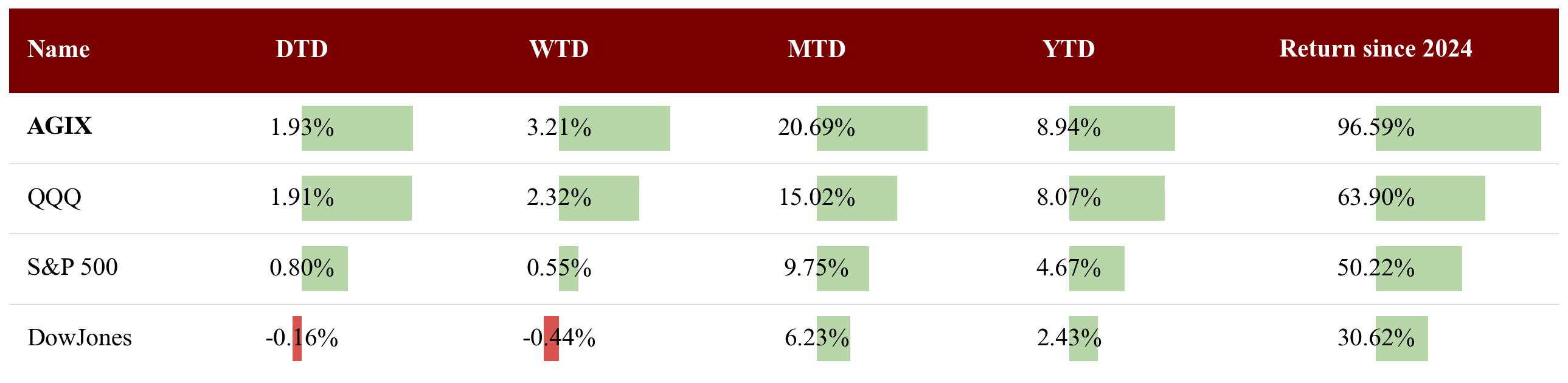
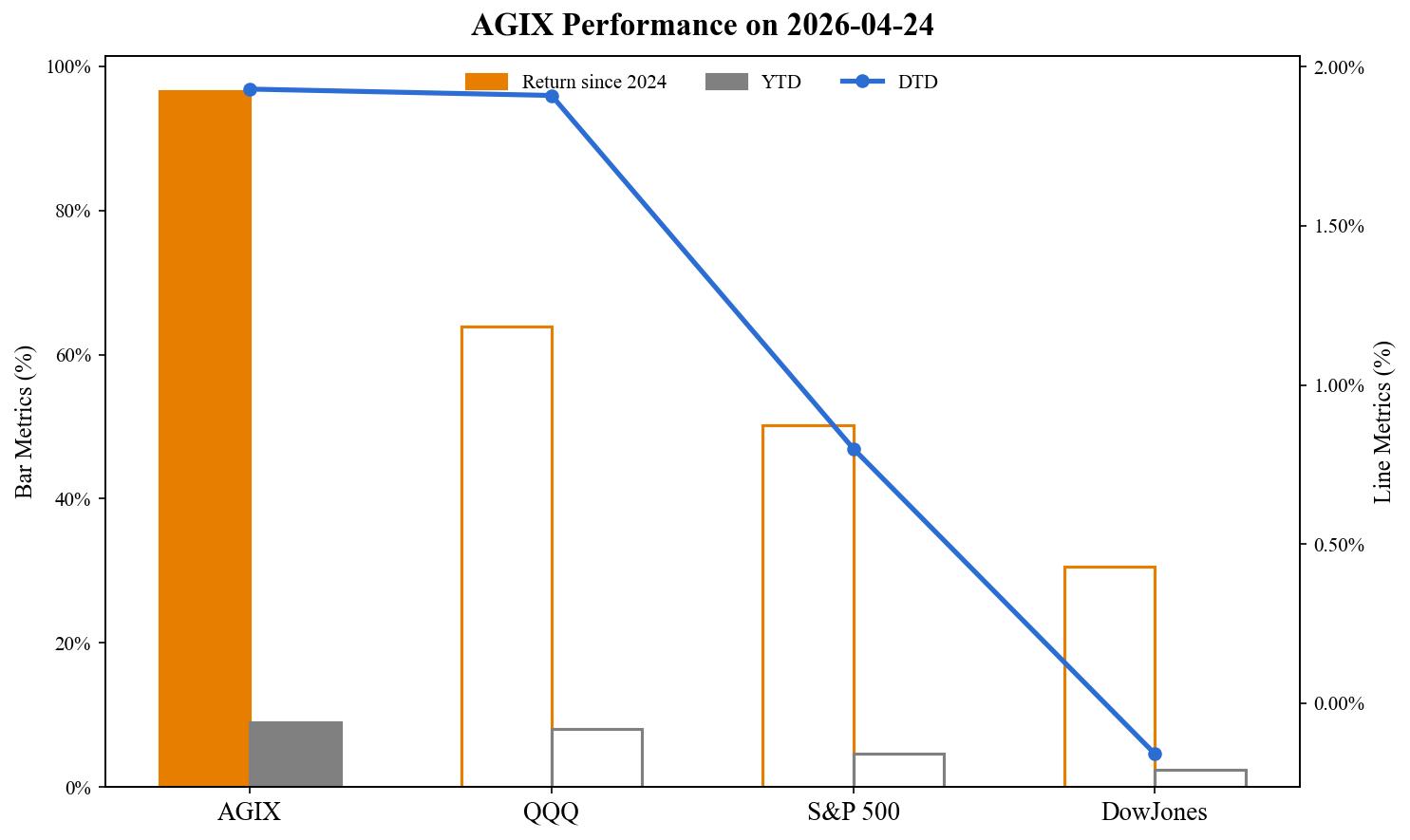
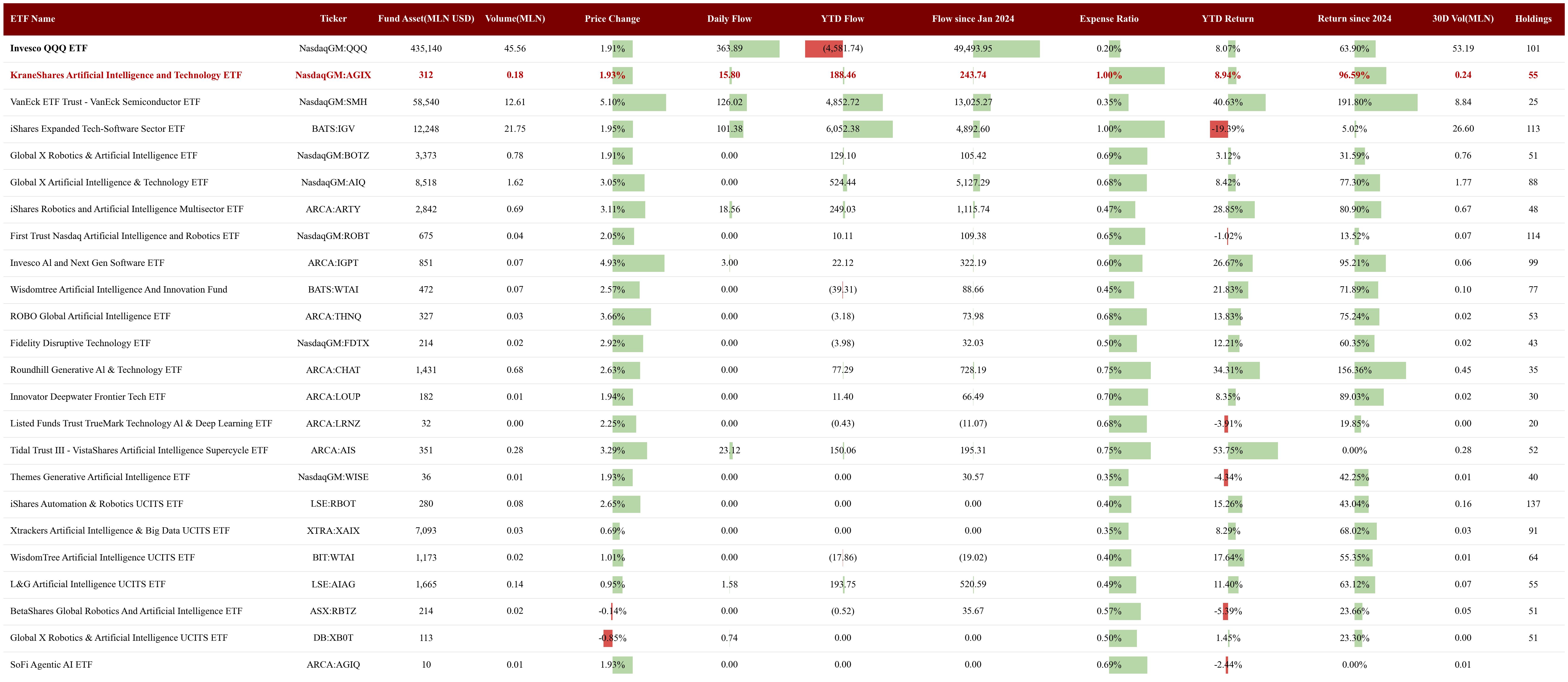
Attribution
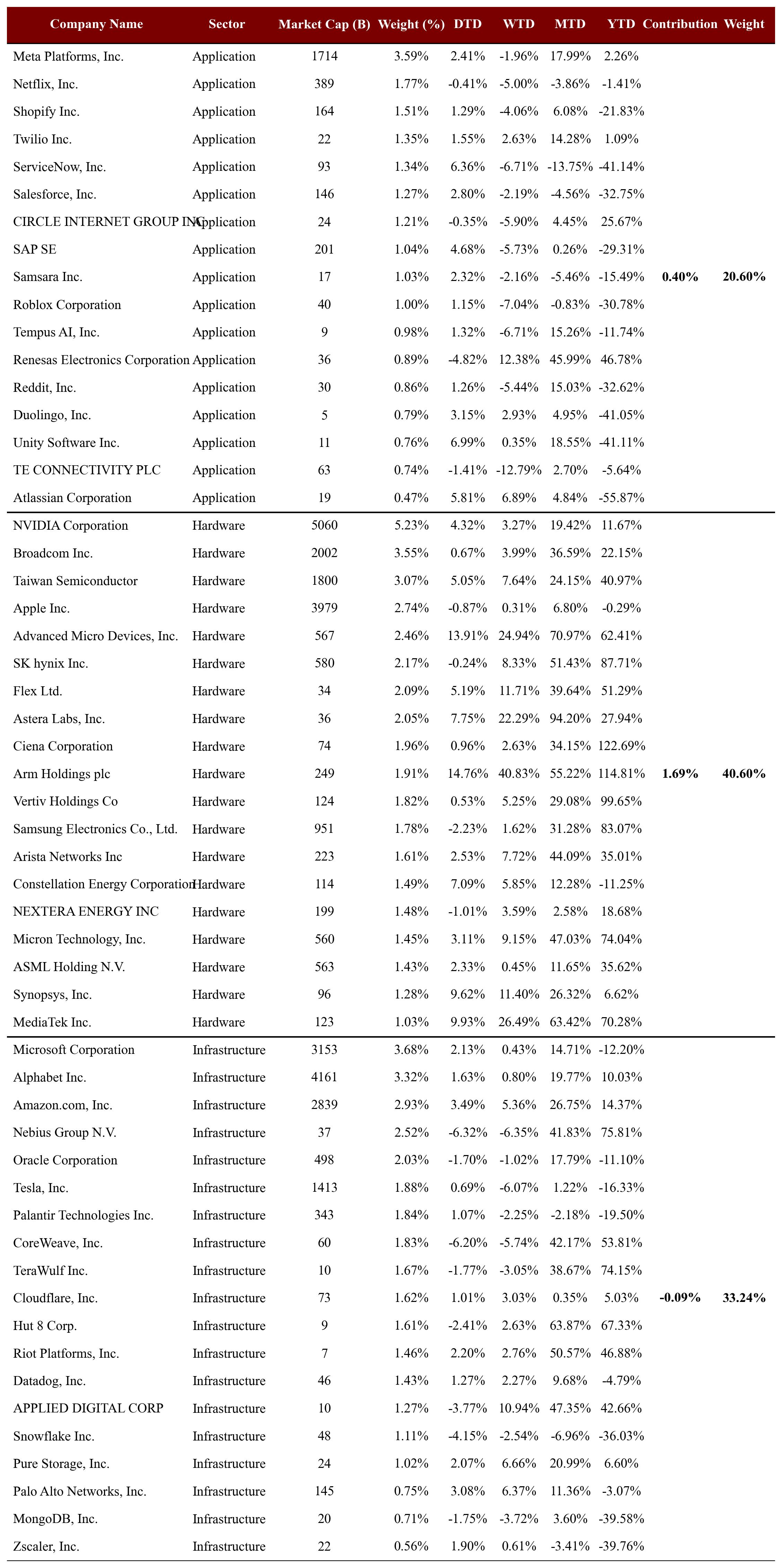
Contribution of the three sectors within AGIX holdings today
Application: 0.4%
Hardware: 1.69%
Infrastructure: -0.09%
Top-performing stocks in AGIX holdings today
Arm Holdings plc (14.76%)
Advanced Micro Devices, Inc. (13.91%)
MediaTek Inc. (9.93%)
Synopsys, Inc. (9.62%)
Astera Labs, Inc. (7.75%)
Constellation Energy Corporation (7.09%)
Unity Software Inc. (6.99%)
ServiceNow, Inc. (6.36%)
Atlassian Corporation (5.81%)
Flex Ltd. (5.19%)
Taiwan Semiconductor Manufacturing Company Limited (5.05%)
SAP SE (4.68%)
NVIDIA Corporation (4.32%)
Amazon.com, Inc. (3.49%)
Duolingo, Inc. (3.15%)
Micron Technology, Inc. (3.11%)
Palo Alto Networks, Inc. (3.08%)
Salesforce, Inc. (2.8%)
Arista Networks Inc (2.53%)
Meta Platforms, Inc. (2.41%)
ASML Holding N.V. (2.33%)
Samsara Inc. (2.32%)
Riot Platforms, Inc. (2.2%)
Microsoft Corporation (2.13%)
Pure Storage, Inc. (2.07%)
Worst-performing stocks in AGIX holdings today
Samsung Electronics Co., Ltd. (-2.23%)
Hut 8 Corp. (-2.41%)
APPLIED DIGITAL CORP (-3.77%)
Snowflake Inc. (-4.15%)
Renesas Electronics Corporation (-4.82%)
CoreWeave, Inc. (-6.2%)
Nebius Group N.V. (-6.32%)
Top five listed stocks contributing the most within AGIX holdings today
Advanced Micro Devices, Inc. (13.91%)
Arm Holdings plc (14.76%)
NVIDIA Corporation (4.32%)
Astera Labs, Inc. (7.75%)
Taiwan Semiconductor Manufacturing Company Limited (5.05%)
Observation
The strongest movers across peer ETF holdings today are listed below:
| DTD | Stock Ticker | Name | Held by ETFs | analysis |
|---|---|---|---|---|
| 76.12 | NasdaqGS:MXL | MaxLinear, Inc. | ['LSE:RBOT'] | MaxLinear's 76% single-day surge on April 24, 2026 was driven by the company's Q1 earnings announcement on that date, which revealed a major inflection point in its optical data center business. The company reported 43% year-over-year revenue growth to $137.2 million with infrastructure revenue surging 136% year-over-year, and management signaled an expected step function increase in revenues in Q2 as optical data center products ramp at multiple hyperscale customers. This exceptional growth trajectory in the high-demand AI and data center connectivity market, combined with management's explicit commentary about reaching a "clear inflection point," drove a dramatic repricing of the stock well above the prior analyst consensus price target of $21.71. |
| 23.6 | NasdaqGS:INTC | Intel Corporation | ['NasdaqGM:QQQ', 'NasdaqGM:SMH', 'NasdaqGM:AIQ', 'ARCA:ARTY', 'NasdaqGM:ROBT', 'ARCA:IGPT', 'BATS:WTAI', 'ARCA:AIS', 'NasdaqGM:WISE', 'LSE:RBOT', 'XTRA:XAIX', 'BIT:WTAI'] | Intel's 23.6% stock surge on April 24, 2026, was primarily driven by a strong Q1 earnings beat, with revenue of $13.6B (up 7% YoY) and adjusted EPS of $0.29 crushing consensus estimates of $0.01 EPS and ~$12.6B revenue[1]. Upbeat Q2 guidance for $13.8B–$14.8B revenue and $0.20 EPS, fueled by robust AI chip demand and data center growth, further boosted sentiment[1]. Analyst upgrades from firms like Northland ($92 PT), HSBC ($95 PT), and others highlighted Intel's expanding AI partnerships with Google and Tesla/SpaceX, reinforcing foundry momentum[1]. |
| 17.74 | NasdaqGM:AAOI | Applied Optoelectronics, Inc. | [] | No specific news events, company disclosures, or catalysts explain AAOI's 17.74% single-day gain on 2026-04-24 based on available public information. Search results reference general stock dynamics in a YouTube short and long-dated options data but lack details on same-day drivers. The move may reflect trading activity or market sentiment without identifiable triggers. |
| 17.17 | NasdaqGS:CEVA | CEVA, Inc. | ['NasdaqGM:WISE', 'LSE:RBOT'] | CEVA stock rose 17.17% on April 24, 2026, primarily due to a technical breakout as shares crossed above the 200-day moving average of $22.53, reaching a high of $25.76 before closing at $26.79 on elevated volume of 231,046 shares.[1][2] This bullish signal aligned with strong analyst consensus of "Moderate Buy" and an average price target of $30.29, supported by recent institutional buying and in-line quarterly results showing 7.1% YoY revenue growth.[1][2] No company-specific news events were reported, pointing to trading momentum as the key driver. |
| 15.75 | NYSE:PD | PagerDuty, Inc. | ['BATS:IGV', 'LSE:RBOT'] | PagerDuty (NYSE:PD) surged 15.75% on April 24, 2026, primarily driven by rumors of activist investor interest sparking buyout speculation. Multiple reports highlighted this as the key catalyst, with the stock breaking out from a $6.2–6.7 consolidation range in a single wide-range intraday candle from ~$6.19 to $7.14 on elevated volume, confirming short-term bullish momentum[2][3]. Recent insider Form 4 activity further fueled the narrative, alongside the stock's discounted valuation relative to software peers[1][2][3]. |
| 14.76 | NasdaqGS:ARM | Arm Holdings plc | ['NasdaqGM:QQQ', 'NasdaqGM:AGIX', 'ARCA:IGPT', 'ARCA:CHAT', 'ARCA:LRNZ', 'ARCA:AIS'] | Arm Holdings (ARM) surged 14.76% on April 24, 2026, primarily driven by the unveiling of its AGI CPU targeting AI agents and datacenter applications, which fueled optimism around a bold AI chip pivot including a server chip co-designed with Meta and OpenAI.[1][2][3][5][6] A wave of analyst upgrades from Evercore ($227 target projecting $15B FY31 revenue), Citi ($190 reaffirmation with $25B 2031 goals), and others like Needham, Barclays, Mizuho, Susquehanna ($210), Guggenheim, RBC, and Raymond James amplified the momentum, highlighting AI-driven EPS potential above $10 despite smartphone pressures.[1][2][3][4] Sector rotation into AI/datacenter plays following Intel's strong Q1, alongside public buys by investor Bill Baruch and firmware validation from AMI, provided additional tailwinds on heavy volume (184% above average).[2][3] |
| 14.37 | NasdaqGS:RMBS | Rambus Inc. | [] | Rambus Inc. (RMBS) stock surged 14.37% on April 24, 2026, primarily driven by the launch of its new LPDDR5X SOCAMM2 server memory chipset targeting low-power, high-bandwidth needs in AI data centers.[1][2] This positioned the company at the center of booming AI infrastructure demand, fueling bullish sentiment amid a multi-week momentum run from $79.73 to around $160.[1][2][3] Elevated trading volume and a premarket gap-up from $138.50 to $149.67 further amplified the move, despite mixed analyst targets.[3] |
| 13.91 | NasdaqGS:AMD | Advanced Micro Devices, Inc. | ['NasdaqGM:QQQ', 'NasdaqGM:AGIX', 'NasdaqGM:SMH', 'NasdaqGM:AIQ', 'ARCA:ARTY', 'NasdaqGM:ROBT', 'ARCA:IGPT', 'BATS:WTAI', 'ARCA:THNQ', 'ARCA:CHAT', 'ARCA:LRNZ', 'ARCA:AIS', 'NasdaqGM:WISE', 'LSE:RBOT', 'XTRA:XAIX', 'BIT:WTAI', 'LSE:AIAG'] | AMD's 13.91% stock surge on April 24, 2026, was primarily driven by Wall Street analyst upgrades highlighting accelerating AI chip demand in data centers and servers. Stifel raised its price target to $320 from $280 with a Buy rating, citing stronger-than-expected AI and compute demand, while Bank of America lifted its target to $310 from $280, also maintaining a Buy[1][2]. Bernstein's more cautious hike to $265 from $235 underscored server strength and a Meta AI deal despite softer PC demand, reinforcing the AI infrastructure narrative amid heavy intraday buying[1][2]. |
| 11.16 | NasdaqGS:PENG | Penguin Solutions, Inc. | ['ARCA:AIS'] | Penguin Solutions (PENG) stock rose 11.16% on April 24, 2026, primarily driven by a strong Q2 fiscal 2026 earnings beat and significantly raised full-year guidance.[1][2][3][5][6] The company reported EPS of $0.52 versus $0.43 expected and revenue of $343M versus $339M, while lifting 2026 net sales growth outlook to 12% YoY (±5%) and GAAP EPS to $1.30 (±$0.15), fueled by AI infrastructure demand.[3][5][6] Positive analyst sentiment and trading above key moving averages further supported the move, with shares hitting a 52-week high.[1][2] |
| 11.16 | NasdaqGM:APPF | AppFolio, Inc. | ['BATS:IGV'] | AppFolio (APPF) surged 11.16% on April 24, 2026, primarily driven by strong Q1 2026 earnings released after market close on April 23, which showed revenue of $262 million (up 20% YoY) and 9.5 million units under management (up 8%).[1][3] Raised full-year guidance to $1.110–$1.125 billion in revenue and 26.0–28.0% non-GAAP operating margins, plus a $125 million share repurchase, fueled the positive reaction despite prior earnings averaging negative moves.[1][3] Elevated trading volume with 26 momentum alerts confirmed strong market interest.[1] |
| 11.12 | NasdaqGS:QCOM | QUALCOMM Incorporated | ['NasdaqGM:QQQ', 'NasdaqGM:SMH', 'NasdaqGM:AIQ', 'ARCA:ARTY', 'NasdaqGM:ROBT', 'ARCA:IGPT', 'BATS:WTAI', 'ARCA:THNQ', 'BIT:WTAI', 'LSE:AIAG'] | Qualcomm's 11.12% jump on April 24, 2026 was driven primarily by a broad semiconductor sector rally sparked by Intel's strong Q1 earnings, combined with the company's own positive catalysts announced that day. The most significant company-specific drivers were a $20 billion share buyback authorization (14.5% of shares outstanding), a dividend increase to $0.92 per share signaling management confidence in cash generation, and Q1 earnings that beat consensus expectations. Secondary support came from unusually heavy options activity (120,444 call contracts, 165% above average) and the company's emerging momentum in edge AI, autonomous vehicle chips, and AR/XR applications, though analyst sentiment remained mixed with a consensus Hold rating and average price target of $158.25. |
| 10.49 | NasdaqGS:SYNA | Synaptics Incorporated | ['XTRA:XAIX'] | Synaptics (SYNA) rose 10.49% on April 24, 2026, primarily driven by optimism surrounding its upcoming Q3 FY26 earnings call focused on AI-powered interface solutions and "AI at the edge" connectivity, which acted as the key near-term catalyst amid a short-term uptrend.[1] The stock showed intraday strength from $87 to over $94 with orderly consolidation and bought dips, confirming higher highs and higher lows on moderate volume.[1] Recent earnings beats, analyst upgrades with a "Moderate Buy" consensus and $99.91 target, and high institutional ownership further supported the move.[2] |
| 10.1 | NasdaqCM:QUIK | QuickLogic Corporation | [] | No verifiable same-day news events, company disclosures, or catalysts explain QuickLogic's (QUIK) 10.1% gain on April 24, 2026. The most recent relevant development was on April 22, when shares crossed above the 200-day moving average of $7.70, reaching a high of $12.74 and closing at $12.25 amid elevated volume of 166,250 shares[1]. Technical momentum from this breakout, combined with mixed analyst ratings (average "Hold" at $10.50 target), likely extended into the following days, though no specific April 24 drivers are identified[1]. |
| 9.93 | TWSE:2454 | MediaTek Inc. | ['NasdaqGM:AGIX', 'ARCA:IGPT', 'ARCA:THNQ', 'LSE:AIAG'] | MediaTek Inc. (TWSE:2454) surged 9.93% on April 24, 2026, primarily driven by a strong rally to a 52-week high amid positive momentum in the Taiwan chip sector.[2] Key support came from robust financials, including trailing twelve-month revenue growth of 11.8% and a market cap expansion of 29.1%, reflecting investor confidence in smartphone and automotive chip demand.[1] No specific same-day company disclosures were identified in available data. |
| 9.79 | TWSE:3035 | Faraday Technology Corporation | ['LSE:RBOT'] | Faraday Technology Corporation (TWSE:3035) surged 9.79% on April 24, 2026, with no identifiable same-day news events, company disclosures, or catalysts in available public sources to directly attribute the move. A scheduled board meeting on April 28, 2026, to review the consolidated financial report may have prompted preemptive buying, but it occurred post-date with no related commentary[3]. Broader financials show recent revenue misses and declining net income, suggesting the gain was driven by technical or market factors rather than fundamentals[2]. |
| 9.62 | NasdaqGS:SNPS | Synopsys, Inc. | ['NasdaqGM:QQQ', 'NasdaqGM:AGIX', 'NasdaqGM:SMH', 'BATS:IGV', 'NasdaqGM:AIQ', 'NasdaqGM:ROBT', 'ARCA:IGPT', 'BATS:WTAI', 'NasdaqGM:FDTX', 'BIT:WTAI'] | Synopsys (SNPS) stock surged 9.62% on April 24, 2026, primarily driven by better-than-expected Q1 fiscal 2026 earnings. The company reported adjusted EPS of $3.77 versus consensus $3.56-$3.57 and revenue of $2.41 billion against $2.39 billion expected, with revenue up 65.6% year-over-year fueled by Ansys integration synergies.[1][2][4][5] Upward FY2026 EPS guidance of $14.38-$14.46 and Q2 guidance of $3.11-$3.17 further boosted sentiment despite mixed analyst ratings.[2][5] |
| 9.55 | KOSDAQ:A108490 | ROBOTIS Co., Ltd. | ['NasdaqGM:BOTZ', 'ASX:RBTZ', 'DB:XB0T'] | No specific news events, company disclosures, or catalysts on April 24, 2026, explain ROBOTIS (KOSDAQ:A108490)'s 9.55% single-day gain, as search results lack same-day data and show later prices like 185,300 KRW on Oct 14, 2025 (-3.54%) and 192,200 KRW recently (+210% above 200d MA).[2][5] The move aligns with the stock's high volatility (13.2% average weekly movement vs. 9.1% market average) and ongoing momentum (+290.97% YTD, +823.99% 1Y).[3][4][5] It likely reflects speculative trading in robotics amid broader uptrend, without identifiable drivers. |
| 9.18 | HLSE:HIAB | Hiab Oyj | ['NasdaqGM:BOTZ', 'LSE:RBOT', 'ASX:RBTZ', 'DB:XB0T'] | Hiab Oyj's 9.18% stock surge on April 24, 2026, was primarily driven by a directed share issue of 68,565 class B shares to incentive program participants, announced that day and authorized by the March 24 AGM.[1] This corporate action likely signaled confidence in future performance amid a recent Q1 report showing 7% order growth despite 7% sales decline, with raised 2026 profit margin guidance above 13.5%.[3] No other same-day news events appear to have contributed significantly. |
| 9.06 | TWSE:6669 | Wiwynn Corporation | ['ARCA:IGPT'] | Wiwynn Corporation (TWSE:6669) surged 9.06% on April 24, 2026, primarily driven by its subsidiary Wiwynn International Corporation's capital increase announcement.[4] A secondary catalyst was the board's resolution to issue 2026 first restricted stock awards (RSAs) to employees on a non-compensated basis.[1] No other major news events were reported that day. |
| 9.02 | NasdaqGS:AMBA | Ambarella, Inc. | ['NasdaqGM:AIQ', 'NasdaqGM:ROBT', 'ARCA:IGPT', 'ARCA:THNQ', 'NasdaqGM:WISE', 'LSE:RBOT', 'XTRA:XAIX', 'BIT:WTAI', 'LSE:AIAG'] | Ambarella (AMBA) rose 9.02% on April 24, 2026, driven primarily by strong demand for its AI chips and bullish analyst upgrades. Technical momentum fueled the move, with the stock breaking out on high volume from $59.60 to $67, showing higher highs/lows and dip-buying above $61.50 support amid a "Moderate Buy" consensus and $96 average price target.[1][3] |
| 8.71 | NasdaqGS:SMCI | Super Micro Computer, Inc. | ['NasdaqGM:AIQ', 'ARCA:ARTY', 'ARCA:IGPT', 'ARCA:THNQ', 'ARCA:CHAT', 'ARCA:AIS'] | Super Micro Computer (SMCI) stock rose 8.71% on April 24, 2026, primarily driven by a strong Q2 earnings beat with $12.68B revenue and $0.69 EPS versus $0.49 expected, plus upbeat Q3 guidance reinforcing AI server demand.[1] A secondary catalyst was Intel's blowout Q1 earnings sparking a broad AI infrastructure rally.[4] The move also reflected technical buying as shares crossed above the 50-day moving average on heavy volume, reversing a prior pullback.[1][3] |
| 8.67 | TSE:6516 | Sanyo Denki Co., Ltd. | ['LSE:RBOT'] | No specific news events, company disclosures, or catalysts explain Sanyo Denki's (TSE:6516) 8.67% gain on April 24, 2026[2]. The move reflects the stock closing at 5,640 JPY amid a +10.59% 5-day change and +34.45% YTD performance, potentially driven by broader market momentum or technical factors[2]. Search results lack same-day attributions, with later data showing continued volatility and no clear triggers[1][3][4]. |
| 8.2 | SHSE:688041 | Hygon Information Technology Co., Ltd. | ['ARCA:IGPT', 'ARCA:AIS'] | No specific news events, company disclosures, or catalysts explain Hygon Information Technology's (688041.SH) 8.2% gain on April 24, 2026[1]. The stock closed at 285.00 CNY after trading in a range consistent with high volume around 23 million shares[1][4]. Search results lack same-day drivers, with data only confirming the price move and prior 52-week highs near 278 CNY[2][4]. |
| 8.09 | TWSE:6526 | Airoha Technology Corp. | ['LSE:RBOT'] | Airoha Technology (TWSE:6526) rose 8.09% on April 24, 2026, primarily driven by the board of directors' approval of the consolidated Q1 2026 financial report, which likely exceeded expectations amid forecasted 22% annual earnings growth.[1][5] No other same-day company-specific news, industry events, or macro catalysts were reported to explain the move.[5] Trading factors such as the stock's high 9.2% average weekly volatility may have amplified the reaction.[1] |
| 8.07 | NasdaqGS:SIMO | Silicon Motion Technology Corporation | ['ARCA:AIS'] | SIMO's 8.07% gain on April 24, 2026, was primarily driven by the stock hitting a new 52-week high of $147.60 amid strong bullish analyst sentiment, including recent price target hikes from Needham ($155), Craig Hallum ($160), and Wedbush ($150), with a consensus Moderate Buy rating and $132.50 average target.[1] Elevated trading volume of 129,044 shares reflected institutional interest (78% ownership) and positive fundamentals like a PEG ratio of 0.96.[1] Pre-earnings optimism ahead of the April 28 Q1 report, with expected $299.4M revenue and $1.31 EPS, plus AI/SSD controller momentum, provided additional support.[2] |
| 8.03 | NasdaqGS:CRNC | Cerence Inc. | ['NasdaqGM:BOTZ', 'NasdaqGM:WISE', 'ASX:RBTZ', 'DB:XB0T'] | No verifiable public news events, company disclosures, or catalysts explain Cerence Inc. (CRNC)'s 8.03% single-day gain on 2026-04-24. Search results lack same-day announcements, earnings releases, or industry developments tied to the date, with the nearest referenced activity being an unrelated price range on 2026-01-13[1]. The move may stem from technical trading, options activity, or broader market factors not captured in available data[2][3]. |
| 7.98 | SWX:IFCN | INFICON Holding AG | ['ARCA:IGPT', 'LSE:RBOT'] | INFICON Holding AG (SWX:IFCN) rose 7.98% on April 24, 2026, primarily due to its strong Q1 2026 earnings release and raised full-year guidance.[3] The company reported Q1 sales of USD 181 million, up 14.4% year-over-year (9.9% organic), with robust order intake and a book-to-bill ratio above 1, prompting an upward revision to 2026 sales guidance of USD 710-750 million (from USD 680-720 million) and operating margin of 18-20% (from 17-19%).[3] This positive company disclosure drove the single-day gain, outweighing any minor trading factors. |
| 7.75 | NasdaqGS:ALAB | Astera Labs, Inc. | ['NasdaqGM:AGIX', 'NasdaqGM:ROBT', 'ARCA:IGPT', 'BATS:WTAI', 'ARCA:THNQ', 'ARCA:CHAT', 'ARCA:LOUP', 'ARCA:AIS', 'BIT:WTAI'] | Astera Labs (ALAB) rose 7.75% on April 24, 2026, driven primarily by renewed investor focus on AI interconnect demand and anticipation for early-May Q1 earnings.[1] Strong fundamentals from the recent quarter beat (EPS $0.58 vs. $0.51 est., revenue $270.6M up 91.8% YoY) and robust demand for Aries and Taurus products bolstered confidence.[1] Institutional buying (e.g., State Street up 32.5%) and analyst buy ratings with $200–$215 targets provided additional support, despite UBS neutral initiation.[1] |
| 7.12 | NasdaqGS:AMKR | Amkor Technology, Inc. | ['ARCA:ARTY'] | Amkor Technology (AMKR) shares rose 7.12% on April 24, 2026, primarily due to a strong pre-announced Q4 2025 earnings report that beat expectations with EPS of $0.69 versus $0.43 estimated and revenue of $1.89 billion against $1.84 billion expected[1][3]. The company also issued Q1 2026 guidance of $0.18–$0.28 EPS, aligning with analyst forecasts ahead of the full Q1 release on April 27[1][3][4]. Pre-market gapping from $72.91 to $77.75 reflected investor optimism, despite mixed analyst ratings with a Hold consensus and $51.13 average target[1]. |
| 7.1 | NasdaqGM:VERX | Vertex, Inc. | ['BATS:IGV'] | No specific news events or company disclosures explain Vertex (VERX)'s 7.1% gain on April 24, 2026. The prior day's 8.2% drop to $11.42 was linked to analyst price target cuts (e.g., BMO $22→$16, Citigroup $22→$15) and a Weiss Ratings "sell" reaffirmation, suggesting the rebound was a technical bounce amid low volume (83% below average).[1] Recent insider buying (e.g., 437k shares in 90 days) and a "Hold" consensus with $20.86 target may have provided support, though no same-day catalysts are evident.[1] |
| 7.09 | NasdaqGS:CEG | Constellation Energy Corporation | ['NasdaqGM:QQQ', 'NasdaqGM:AGIX', 'ARCA:ARTY'] | Constellation Energy (CEG) rose 7.09% on April 24, 2026, primarily driven by Evercore ISI's initiation of coverage with an Outperform rating and price target on April 23, signaling strong analyst confidence.[1] Reinforcing this, the company's No. 1 ranking on Barron's "Most Sustainable U.S. Companies" list, announced April 22, highlighted its clean energy leadership.[1] Ongoing positives from the Calpine acquisition and nuclear fleet positioning for AI data center demand further supported the move, outperforming the Utilities sector's 0.13% gain.[1] |
| 7.05 | NasdaqGM:FIVN | Five9, Inc. | ['BATS:IGV', 'ARCA:IGPT'] | Five9 (FIVN) shares rose 7.05% on April 24, 2026, primarily driven by improved investor sentiment in the enterprise software sector following strong quarterly results from industry heavyweight SAP. This sector tailwind lifted FIVN shares 5.6-7% in the afternoon session, closing at $16.54 after a prior day's 8.7% drop to around $15.15.[2][1] The move aligns with FIVN's high volatility, marking another >5% swing amid anticipation for its Q1 earnings on April 30.[3] |
| 6.99 | NYSE:U | Unity Software Inc. | ['NasdaqGM:AGIX', 'BATS:IGV', 'ARCA:IGPT'] | I cannot provide a reliable attribution for Unity Software's 6.99% single-day move on April 24, 2026, as the search results contain no information about events, news, or catalysts from that specific date. The available data includes historical pricing from October 2025 and February 2026, but nothing covering April 24, 2026. To accurately identify the primary drivers of this move, I would need real-time news, company disclosures, or market data from that trading day. |
| 6.96 | NasdaqCM:SPT | Sprout Social, Inc. | ['BATS:IGV'] | Sprout Social (SPT) rose 6.96% on April 24, 2026, primarily driven by BlackRock's same-day disclosure of an increased passive stake to 7.1% (3.8 million shares), signaling institutional confidence amid a beaten-down stock. This outweighed recent analyst bearishness, including Barclays' April 21 price target cut to $8 from $9 while keeping an overweight rating. No other company-specific news or earnings events coincided with the move.[2][1] |
| 6.9 | NasdaqGS:BKR | Baker Hughes Company | ['NasdaqGM:QQQ'] | Baker Hughes stock rose 6.9% on April 24, 2026, primarily driven by a strong Q1 earnings beat and record operational momentum. The company reported EPS of $0.58 versus consensus of $0.49, while record IET (Industrial Energy Technology) orders and backlog improvements signaled robust forward revenue visibility and de-risked growth. The board's declaration of a $0.23 quarterly dividend and multiple analyst price target increases to around $70 further supported the rally, though this was partially offset by significant insider selling of 590,251 shares during the quarter. |
| 6.85 | NasdaqGS:OUST | Ouster, Inc. | ['LSE:RBOT'] | No verifiable public news events, company disclosures, or catalysts explain Ouster's (OUST) 6.85% gain on April 24, 2026. The most recent relevant development was a 10% intraday surge on April 20, driven by optimistic analyst targets averaging $40.20 (with Buy ratings from four firms) and institutional buying from Vanguard and Geode, though insider selling occurred recently[1]. Absent same-day drivers, the move may reflect technical momentum or broader market factors. |
| 6.71 | NasdaqCM:INDI | indie Semiconductor, Inc. | ['LSE:RBOT'] | indie Semiconductor (INDI) rose 6.71% on April 24, 2026, driven primarily by upbeat coverage of its automotive chip demand outlook and equity inducement awards signaling aggressive expansion in its automotive and ADAS business. The stock gapped up at market open from $3.43 to $3.70, reflecting positive sentiment around the company's strategic positioning in electric vehicles and advanced driver assistance systems. The upcoming Q1 2026 earnings release scheduled for May 7, 2026, served as an additional near-term catalyst, with investors positioning ahead of management commentary on demand trends and margin progress in the automotive semiconductor sector. |
| 6.59 | NasdaqGS:KLAC | KLA Corporation | ['NasdaqGM:QQQ', 'NasdaqGM:SMH', 'NasdaqGM:ROBT', 'LSE:RBOT', 'BIT:WTAI'] | KLA Corporation (KLAC) rose 6.59% on April 24, 2026, primarily driven by continued momentum in the semiconductor equipment sector amid strong chip demand and AI-related capital spending by major manufacturers. Recent analysis highlighted the stock's impressive 165% one-year surge, with a 4.6% gain over the prior 7 days and 15.9% over 30 days, reinforcing investor optimism despite elevated valuations like a P/E of 52.21x.[2][3] No company-specific news or disclosures directly tied to the move were reported that day. |
| 6.38 | NasdaqGS:HSAI | Hesai Group | ['NasdaqGM:BOTZ', 'ASX:RBTZ', 'DB:XB0T'] | Hesai Group's 6.38% stock rise on April 24, 2026, was primarily driven by the company's announcement of its annual report filing on Form 20-F for the fiscal year ended December 31, 2025, signaling transparency and compliance to investors.[3] Supporting the positive sentiment, shares traded at $22.34 amid a consensus "Buy" rating from eight analysts with a $29.96 price target, reflecting strong institutional ownership at 48.5% and solid fundamentals like $0.16 EPS on $143M revenue.[1] No other same-day news events were reported.[2] |
| 6.36 | NYSE:NOW | ServiceNow, Inc. | ['NasdaqGM:AGIX', 'BATS:IGV', 'NasdaqGM:AIQ', 'ARCA:ARTY', 'NasdaqGM:ROBT', 'BATS:WTAI', 'ARCA:THNQ', 'ARCA:CHAT', 'ARCA:LRNZ', 'LSE:RBOT', 'XTRA:XAIX', 'BIT:WTAI', 'LSE:AIAG'] | ServiceNow (NYSE:NOW) shares rose 6.36% on April 24, 2026, primarily rebounding from a sharp 17-18% sell-off the prior day after Q1 earnings beat estimates but disappointed on full-year cRPO guidance, Middle East deal delays, and Armis acquisition margin headwinds.[1][2][3] A key catalyst was Sanford C. Bernstein's upgrade, raising its price target from $219 to $226 while maintaining an outperform rating, driving elevated trading volume 83% above average.[1] Positive sector sentiment from SAP's strong Q1 results further supported the recovery by easing AI-related concerns in enterprise software.[2] |
| 6.33 | NYSE:GWRE | Guidewire Software, Inc. | ['BATS:IGV'] | On April 24, 2026, Guidewire Software (GWRE) gained 6.33% likely as a recovery bounce following the severe 11.4% sell-off on April 23 that occurred on exceptionally thin trading volume (down 91% versus average). The April 23 decline appeared disconnected from fundamentals, as the company had just reported strong earnings (EPS $1.17 versus $0.77 estimate, revenue +24% YoY) and announced a $500 million buyback authorization, with analyst consensus maintaining a "Moderate Buy" rating and $249.85 price target. The April 24 rebound suggests market participants viewed the prior day's sharp drop as an overreaction, particularly given the thin liquidity conditions that likely exacerbated the initial move. |
| 6.16 | NasdaqGS:SNDK | Sandisk Corporation | ['XTRA:XAIX'] | I cannot provide a reliable attribution for SanDisk's 6.16% single-day move on April 24, 2026, based on the available search results. The results contain general stock analysis and valuation commentary from April 24 but do not include specific company news, earnings announcements, guidance changes, or other discrete events that would have triggered the move on that particular date. To properly attribute this move, I would need access to same-day press releases, earnings reports, analyst upgrades/downgrades, or industry-specific catalysts announced on April 24, 2026. |
| 6.09 | NasdaqGS:MBLY | Mobileye Global Inc. | ['NasdaqGM:ROBT', 'LSE:RBOT', 'BIT:WTAI'] | Mobileye Global (MBLY) surged 6.09% on April 24, 2026, primarily driven by a strong Q1 earnings beat with revenue of $558M (up 27% YoY, beating $519.9M estimates) and adjusted EPS of $0.12 (vs. $0.08-0.09 expected), coupled with raised full-year 2026 revenue guidance to $1.94B-$2.02B.[1][2][3] A $250M share repurchase authorization (~3.8% of shares) signaled management confidence and supported the rally amid positive analyst reactions, including Goldman Sachs and Mizuho raising price targets to $9 while maintaining neutral ratings.[1][2][3] Short-squeeze dynamics and momentum from operational strength in ADAS and EyeQ chips further amplified the move.[2] |
| 5.97 | NasdaqGM:TTD | The Trade Desk, Inc. | ['NasdaqGM:QQQ', 'NasdaqGM:AIQ', 'ARCA:IGPT'] | The Trade Desk (TTD) stock rose 5.97% on April 24, 2026, driven primarily by constructive intraday price action showing higher lows from $23.20 and a push toward $24.00 on closing strength, indicating underlying buyer demand despite ongoing overhangs.[1] Elevated options activity, with 91,747 contracts traded (87.61% calls), signaled bullish sentiment and positioned the stock for potential near-term upside above $24.25 resistance.[2][1] Mixed technical recovery from recent lows around $22.66 further supported the rebound amid persistent negative news flow like legal probes and guidance misses.[1] |
| 5.91 | NasdaqGS:BIDU | Baidu, Inc. | ['NasdaqGM:AIQ', 'NasdaqGM:ROBT', 'ARCA:IGPT', 'ARCA:CHAT'] | Baidu (BIDU) rose 5.91% on April 24, 2026, driven primarily by a broader risk-on rally in China-linked tech and AI stocks amid positive sentiment on domestic AI and semiconductor developments. Reinforcing this were Baidu's recent $5 billion share repurchase program through 2028 and new dividend policy with first payment in 2026, enhancing its capital-return appeal.[1] Pre-earnings positioning ahead of late-May 2026 results on AI Cloud and autonomous driving likely contributed additional upside momentum.[1] |
| 5.91 | NasdaqGS:BIDU | Baidu Inc. | ['NasdaqGM:AIQ', 'NasdaqGM:ROBT', 'ARCA:IGPT', 'ARCA:CHAT'] | Baidu's 5.91% stock rise on April 24, 2026, was primarily driven by positive market reaction to the company's announcement of a $5 billion share repurchase program and new dividend policy, with the first payment expected in 2026, enhancing near-term shareholder returns.[1] This capital-return narrative, combined with ongoing China tech sector sentiment and analyst emphasis on Baidu's AI Cloud growth, provided additional support amid a favorable backdrop for BIDU shares.[1] Institutional buying, such as ARK Investment Management's prior stake increase, contributed to momentum but ranked lower in immediacy.[1] |
| 5.9 | NasdaqGS:CDNS | Cadence Design Systems, Inc. | ['NasdaqGM:QQQ', 'NasdaqGM:SMH', 'BATS:IGV', 'NasdaqGM:AIQ', 'NasdaqGM:ROBT', 'ARCA:IGPT', 'BATS:WTAI', 'BIT:WTAI'] | Cadence Design Systems rose 5.9% on April 24 primarily due to analyst upgrades and positive sentiment ahead of earnings. Rosenblatt Securities reiterated a Buy rating with a $360 price target, while Needham raised its target to $400 citing the company's new AI products for chip design, and KeyBanc maintained an Overweight rating after Cadence showcased its ChipStack AI Super Agent. The stock outperformed its sector, which gained only 1.26%, reflecting confidence in the company's AI partnerships and strong financial guidance preceding its April 27 earnings release. |
| 5.9 | TWSE:3661 | Alchip Technologies, Limited | ['ARCA:ARTY', 'ARCA:IGPT', 'LSE:RBOT'] | Alchip Technologies (TWSE:3661) rose 5.9% on April 24, 2026, primarily driven by a positive market reaction to the company's announcement of acquiring production machinery and equipment from Taiwan Semiconductor Manufacturing Company (TSMC), disclosed in the period ending April 23, 2026.[4] This capital expenditure signals expansion in manufacturing capacity amid strong demand for Alchip's semiconductor design services.[4] No other same-day company-specific news or broader industry catalysts were identified in available data. |
| 5.9 | NasdaqGS:PEGA | Pegasystems Inc. | ['BATS:IGV', 'NasdaqGM:BOTZ', 'NasdaqGM:AIQ', 'NasdaqGM:ROBT', 'ARCA:IGPT', 'BIT:WTAI', 'ASX:RBTZ', 'DB:XB0T'] | No verifiable same-day news events or company disclosures on April 24, 2026, explain Pegasystems (PEGA)'s 5.9% single-day gain. Prior Q1 earnings miss on April 23 (EPS $0.46 vs. $0.68 expected, revenue $429.97M vs. $473.24M) drove selling pressure and a new 52-week low around $35, with Citigroup raising its price target to $71 (buy rating) amid a cloud/AI pivot targeting 75% cloud ACV.[1][2] Analyst consensus remains "Moderate Buy" with an average target of ~$63.70, but lacks specific catalysts tied to the specified date.[1][2] |
| 5.88 | NYSE:RNG | RingCentral, Inc. | ['BATS:IGV', 'XTRA:XAIX'] | No specific news events or company disclosures on April 24, 2026, explain RingCentral's (NYSE:RNG) 5.88% single-day gain. Recent analyst actions, such as Needham raising its price target to $55, drove a 3.9% rise and new 52-week high on April 21, but no same-day catalysts appear for the 24th.[1] Trading momentum from the prior session's volume (~123,833 shares) and positive FY 2026 guidance (EPS 4.760-4.970) likely contributed, amid a Hold consensus with $35.63 average target.[1] |
| 5.82 | NasdaqGS:AGYS | Agilysys, Inc. | ['BATS:IGV'] | No specific news events, earnings releases, or disclosures on April 24, 2026 explain Agilysys (AGYS) 5.82% single-day gain on NasdaqGS. Recent search data highlights post-earnings declines from prior quarters (e.g., Q3 miss and Q1 2025 on August 28), ongoing analyst "Buy" ratings with $135 target, and valuation debates showing slight undervaluation around $63-66 levels[1][2][4]. The move likely stemmed from technical rebound or broader market factors absent from available public records. |
| 5.81 | NasdaqGS:TEAM | Atlassian Corporation | ['NasdaqGM:QQQ', 'NasdaqGM:AGIX', 'BATS:IGV', 'NasdaqGM:FDTX', 'ARCA:LOUP', 'XTRA:XAIX'] | Atlassian (NASDAQ:TEAM) stock rose 5.81% on April 24, 2026, primarily driven by a positive market reaction to company-specific developments amid recent analyst downgrades and AI-related pressures. Shares jumped 5.9% in the afternoon session, as reported by StockStory, rebounding from a ~10.6% gap-down the prior day triggered by lowered price targets from firms like Morgan Stanley.[3][1] Improving price action and strong analyst backing, including a "Moderate Buy" consensus with a $155 target, supported the recovery.[1][4] |
| 5.54 | TSE:3673 | Broadleaf Co., Ltd. | ['LSE:RBOT'] | I cannot provide a reliable attribution for Broadleaf Co., Ltd.'s (TSE:3673) 5.54% single-day move on April 24, 2026, as the search results contain no information about events, news, or disclosures from that specific date. The available data includes only historical price information from 2025 and general technical analysis, with no coverage of April 2026 developments. To properly attribute this move, I would need access to real-time news, company announcements, or earnings releases from April 24, 2026. |
| 5.52 | TSE:6857 | Advantest Corporation | ['ARCA:ARTY', 'NasdaqGM:FDTX', 'LSE:RBOT'] | Advantest's 5.52% stock rise on April 24, 2026, was primarily driven by a broad semiconductor sector rally in Tokyo, fueled by the prior day's U.S. SOX index gains and Intel's bullish after-hours earnings forecast boosting investor sentiment.[3] Secondary support came from the lingering positive reaction to Advantest's April 21 announcement of joining Applied Materials' EPIC platform as the first automated test equipment partner, enhancing front-end and back-end chip integration.[1][2] The Nikkei Average's rebound to a new all-time high further amplified buying in semi-related stocks like Advantest.[3] |
| 5.5 | NYSE:NABL | N-able, Inc. | ['BATS:IGV'] | N-able (NYSE:NABL) stock rose 5.5% on April 24, 2026, primarily due to a short-covering bounce after hitting near its 52-week low, with no identifiable company-specific news or events driving the move.[1][5] The stock opened at $4.93, reached an intraday high of $5.19, and closed at $5.18 following a prior week's 11% decline amid analyst price target cuts from BMO, Needham, and Scotiabank on product and valuation concerns.[1][5] Broader analyst consensus remains mixed with a "Hold" rating and average target of $9.31, suggesting limited fundamental catalysts.[3] |
| 5.32 | NYSE:ONTO | Onto Innovation Inc. | ['ARCA:ARTY', 'LSE:RBOT'] | Onto Innovation Inc. (NYSE:ONTO) rose 5.32% on April 24, 2026, primarily driven by a strong consensus "Buy" rating from ten analysts, including recent price target increases to an average of $300.63. Key support came from institutional buying, as Cwm LLC boosted its stake by 361.2% to 20,068 shares worth $3.17 million in Q4. Broader bullish analyst notes, such as Oppenheimer and Stifel raising targets to $350 on April 17, further bolstered sentiment.[1][2] |
| 5.19 | NasdaqGS:FLEX | Flex Ltd. | ['NasdaqGM:AGIX'] | Flex Ltd. (NasdaqGS:FLEX) rose 5.19% on April 24, 2026, primarily driven by a strong quarterly earnings beat and upbeat FY2026 guidance announced around that period.[1][2] The company reported $0.87 EPS versus $0.79 expected and $7.06B revenue against $6.84B estimates, with FY2026 EPS guidance of $3.210–$3.270, fueling optimism as shares approached 12-month highs near $91.91.[1][2] Supporting factors included ongoing institutional buying, such as Teacher Retirement System of Texas increasing its stake by 62.3% in Q4, amid 94.3% institutional ownership.[1] |
| 5.15 | NasdaqGS:VICR | Vicor Corporation | ['ARCA:AIS'] | Vicor Corporation (VICR) rose 5.15% on April 24, 2026, primarily driven by positive momentum from its strong Q1 2026 earnings reaction on April 21, where shares gained 9.53% amid solid revenue, margin expansion, and a backlog surge to $301M.[5] Pre-earnings analyst upgrades, including Roth Capital's price target hike to $245 citing AI infrastructure demand, sustained the uptrend into the following week.[2] Lingering AI data center exposure and high trading volume further supported the multi-day advance.[1][5] |
| 5.15 | TSE:6701 | NEC Corporation | ['NasdaqGM:AIQ', 'XTRA:XAIX'] | I cannot provide an attribution for NEC Corporation's 5.15% single-day move on April 24, 2026, as the search results contain no news, earnings announcements, regulatory developments, or other verifiable public events from that date. The available information includes only historical financial data and general company background. To properly attribute this move, I would need access to real-time news sources, company disclosures, or market data from April 24, 2026. |
| 5.14 | NasdaqGS:WIX | Wix.com Ltd. | ['NasdaqGM:AIQ'] | The search results provided do not contain specific news events or company disclosures from April 24, 2026 that would explain WIX's 5.14% single-day gain on that date. The available information includes valuation analysis from April 24 noting the stock at $71.97 and historical context showing a 4.8% weekly gain against longer-term declines, but no identifiable catalyst or announcement for the specific trading day is documented in these results. Without verifiable same-day news, earnings releases, or material events from April 24, 2026, a reliable attribution cannot be provided based on the search results available. |
| 5.12 | NasdaqGS:CRDO | Credo Technology Group Holding Ltd | ['ARCA:IGPT', 'BATS:WTAI', 'LSE:RBOT'] | I cannot provide a reliable attribution for Credo Technology's 5.12% move on April 24, 2026, based on the available search results. The search results contain only a Roth/MKM price target raise to $250 (from $170) citing broadening customer base and improved growth visibility, along with mentions of positive analyst responses from Needham, Mizuho, and Stifel, but lack specific timing information confirming these events occurred on April 24, 2026. Without verifiable same-day news catalysts, earnings announcements, or regulatory developments tied to that exact date, I cannot accurately attribute the stock movement. |
| 5.06 | NYSE:VYX | NCR Voyix Corporation | ['BATS:IGV'] | NCR Voyix (VYX) rose 5.06% on April 24, 2026, primarily due to anticipation ahead of its first-quarter earnings release scheduled for that day. The announcement highlighted the company's position as a platform-powered leader in unified commerce for shopping and dining, boosting investor sentiment.[1] No other same-day news events or disclosures were reported to explain the move.[2] |
| 5.05 | TWSE:2330 | Taiwan Semiconductor Manufacturing Company Limited | ['NasdaqGM:AGIX', 'NasdaqGM:SMH', 'NasdaqGM:AIQ', 'ARCA:ARTY', 'NasdaqGM:ROBT', 'BATS:WTAI', 'ARCA:THNQ', 'NasdaqGM:FDTX', 'ARCA:CHAT', 'ARCA:AIS', 'BIT:WTAI', 'LSE:AIAG'] | Taiwan Semiconductor Manufacturing Co. (TWSE:2330) rose 5.05% on April 24, 2026, primarily due to Taiwan's financial supervisory commission easing investment rules, allowing local funds to allocate up to 25% of net asset value to single stocks like TSMC if they exceed 10% of the Taiwan Stock Exchange's weight, up from the prior 10% limit.[3] This regulatory change drove local shares to a record high of NT$2,185, outpacing the 3.4% gain in U.S.-listed TSM shares.[3] Ongoing AI chip demand and positive economic growth optimism further supported the move.[2] |
News
Funding & M&A
Cyera acquires Ryft to give enterprises traceable data access for AI agents
Cyera Ltd., an AI and data security company, announced the acquisition of Israeli startup Ryft Data Inc., which developed an automated data lake platform designed for enterprises deploying AI agents. According to Globes, the deal is estimated to be valued between $100 million and $130 million, with specific terms undisclosed. Founded in 2024, Ryft's platform enables enterprises to access data quickly and securely while automatically analyzing data access behavior of employees and AI agents, automating authorization, classification, and optimization based on open-source standards to avoid vendor lock-in. The platform's management layer automatically handles optimization, compliance, disaster recovery, and governance, eliminating manual engineering burdens and providing clean, manageable, and traceable large-scale data access for AI agent workloads. The acquisition will add AI-ready data lake capabilities to Cyera's data security platform, helping enterprises ensure secure access, analysis, and action on sensitive enterprise data when deploying autonomous AI systems. Cyera stated that this move will accelerate its roadmap, providing instantly traceable secure data access. Ryft CEO Yossi Reitblat will lead Cyera's AI security activities, with his team forming a new group focused on the intersection of AI, data, and information security. Previously, Ryft had secured $8 million in funding from investors including Index Ventures SA and Bessemer Venture Partners. This is Cyera's fourth acquisition in five years, following a $400 million funding round in January that valued the company at $9 billion.
Software artifact management startup Cloudsmith raises $72M
Cloudsmith Inc., a software component management startup, announced the completion of a $72 million Series C funding round, led by TCV, which was also the largest backer in its last funding round a year ago, with other existing investors and Insight Partners participating. The company's total external funding has now exceeded $110 million. Headquartered in Belfast, Cloudsmith offers a cloud platform that helps software teams manage and distribute open-source components and software building blocks, similar to an app store for open-source projects. The platform supports storing various artifacts such as code, configuration files, AI models, operating systems, and software containers, automatically scanning for known vulnerabilities before distribution using the Exploit Prediction Scoring System to assess the risk of exploitation. It also detects licensing issues, such as terms prohibiting commercial use. For containers, the platform automatically generates an SBOM (Software Bill of Materials) listing all components to identify potential security risks. Customers can build automated workflows based on platform data, for example, writing policies in Rego language to block components with high-risk vulnerabilities. CEO Glenn Weinstein stated that AI agents generate software at such high speed that humans cannot thoroughly review it, and Cloudsmith, with its panoramic view of the open-source ecosystem, protects enterprises from new threats driven by AI development. The new funds will be used to enhance cybersecurity controls and develop AI automation features.
Cognition, the creator of the AI software engineer Devin, is in talks to raise 'hundreds of millions' at a $25 billion valuation.
AI coding assistant startup Cognition AI Inc. is in talks with investors for a new massive funding round, aiming to boost its valuation from $1.02 billion to $25 billion, Bloomberg reported, citing sources familiar with the matter. The funding round is expected to raise several hundred million dollars, capitalizing on the strong momentum in AI-generated code, a trend driven largely by competitors such as Anthropic PBC and OpenAI Group PBC. Cognition is known for its AI programming assistant Devin, launched in March 2024 and hailed as the world's first 'fully autonomous AI software engineer,' capable of planning and executing complex engineering tasks, including automated code creation, debugging, and deployment. Before use, Devin generates a detailed blueprint and provides a confidence score to help developers assess code usability, while minimizing bugs and vulnerabilities through multiple tests. The product offers a standard edition for individual developers and an enterprise edition with customization, enhanced security, and audit logs, attracting tech giants such as Dell Technologies Inc. and Cisco Systems Inc. as clients. Previously, Cognition completed a $400 million funding round in September led by Founders Fund, raising its valuation to $1.02 billion. The current funding negotiations are ongoing, and terms may be adjusted.
SAP posts solid earnings results to shrug off latest software stock slaughter
German enterprise resource planning software giant SAP SE reported first-quarter earnings that beat analyst expectations, driving its U.S. ADR shares up over 6% in after-hours trading, reversing a 6% decline during regular trading. Earnings per share were €1.72 (approximately $2.01), with revenue of €9.55 billion, up 6% year-over-year. Cloud business performed strongly, with sales of €5.96 billion, up 19% year-over-year, exceeding expectations of €5.89 billion; cloud order backlog reached €21.9 billion, up 20% year-over-year. CEO Christian Klein emphasized strong momentum in Business AI, stating the company is delivering real results for customers and gaining market share in Suite and AI solutions. The company reaffirmed its annual cloud revenue guidance of €25.8 billion to €26.2 billion, above the analyst consensus of €25.62 billion, but assuming a de-escalation of Middle East conflicts and smooth integration of Reltio. Last month, SAP announced the acquisition of data integration management provider Reltio Inc., expected to close in the second or third quarter, to enhance data integration capabilities for autonomous AI agents. Despite pressure on software stocks from the rise of AI agents, SAP's stock is still down over 33% year-to-date, but the strong earnings boosted market confidence.
Cohere acquires, merges with Germany-based startup to create a ‘transatlantic AI powerhouse’
Canadian enterprise AI unicorn Cohere announced Friday that it will merge with German enterprise AI company Aleph Alpha. The deal has not yet closed; according to the Financial Times, the new company will be valued at $20 billion. One of Aleph Alpha's major investors, Schwarz Group, will also invest $600 million in Cohere's Series E round, which is expected to close later this year, per CNBC. The merger aims to provide enterprises and governments with an alternative to Silicon Valley tech giants, offering greater data independence and control. At the same time, the merger will integrate talent pools from Canada and Germany to create a 'transatlantic AI powerhouse.' The current AI business landscape is rife with consolidation activity, while a few Silicon Valley players continue to dominate the market. This deal highlights the trend of seeking diversification and independence in the enterprise AI space, and is expected to reshape the global AI competitive landscape, fostering deeper integration of European and North American AI ecosystems.
ComfyUI hits $500M valuation as creators seek more control over AI-generated media
AI startup ComfyUI recently raised $30 million in funding at a $500 million valuation, led by Craft Ventures, with participation from Pace Capital, Chemistry, and TruArrow. The company originated from an open-source project launched in 2023, aiming to help creators precisely control image, video, and audio outputs from diffusion models using a node-based workflow. The founders developed a modular framework to address common issues in early models like Midjourney and OpenAI DALL-E, such as generating extra fingers. The project quickly gained traction, attracting over 4 million users and finding wide application in visual effects, animation, advertising, and industrial design, even creating job titles like 'ComfyUI artist or engineer.' In late 2024, ComfyUI raised $19 million in Series A funding from investors including Chemistry Ventures, Cursor Capital, and Vercel founder Guillermo Rauch. Co-founder and CEO Yoland Yan noted that traditional prompt-based tools like Midjourney or ChatGPT achieve only 60%-80% accuracy, and fine-tuning often leads to drastic output changes, while ComfyUI's node interface gives creators full control, avoiding slot-machine-like trial and error. Despite advances in foundation models, Yan emphasized that the demand for fine-grained control continues to grow, and ComfyUI's human-in-the-loop approach will stand out in the age of AI ubiquity. Competitor Weavy was acquired by Figma.
Google to invest up to $40B in Anthropic in cash and compute
According to Bloomberg, Alphabet's Google plans to invest up to $40 billion in AI company Anthropic to support its growing computing needs. Google has immediately committed $10 billion, valuing Anthropic at $350 billion, with an additional $30 billion contingent on Anthropic meeting specific performance targets. This move follows Anthropic's release of its latest model, Mythos, to limited partners this month, which is hailed as the company's most powerful model yet, with significant cybersecurity application potential. However, due to potential misuse risks, Anthropic has restricted broad access and is collaborating with selected organizations to assess risks. Despite this, the model has already fallen into unauthorized hands, and running it at scale is costly. In the AI race, computing resources have become key. OpenAI is actively securing capacity through hundreds of billions of dollars in agreements with cloud providers, chip suppliers, and energy companies, including an expanded partnership with Cerebras this month. Anthropic is also building out its infrastructure, having signed a data center deal with CoreWeave this month and receiving an additional $5 billion investment from Amazon, as part of a broader agreement where Anthropic could spend up to $100 billion to secure about 5 gigawatts of computing capacity. Although Google is a direct competitor in AI models, it remains a key infrastructure provider for Anthropic, which heavily relies on Google Cloud's TPU chips. Anthropic previously partnered with Google and Broadcom to secure 3.5 gigawatts of TPU capacity starting in 2027. The new investment expands this arrangement, with Google Cloud providing an additional 5 gigawatts of capacity over the next five years, with potential for further expansion. Anthropic's valuation recently reached $350 billion, with investors eyeing over $800 billion, and there are rumors of a potential IPO as early as October.
Pudu Robotics raises nearly $150M at $1.5B valuation to deploy embodied AI technology
Pudu Technology Inc., a leading developer of intelligent service robots, has completed a new funding round of nearly $150 million, with a valuation exceeding $1.5 billion and total funding surpassing $300 million. The funding, announced on Thursday, will help the company expand production scale and continue developing robot products across multiple fields. Pudu's core technology is built around a single 'brain' framework that can quickly adapt to various robot forms, covering areas such as cleaning, hospitality, dining, and industrial delivery. This strategy has driven the company's cross-industry expansion, with 2025 revenue growing 100% year-over-year, commercial cleaning robots accounting for about 70% of sales, and industrial robots shipping over 4,000 units since launch. The company's current product line includes tray delivery robots, cabinet-style food delivery robots, cute floor-scrubbing robots, and full-size humanoid warehouse robots. The 'embodied AI' market is currently valued at $4.5 billion, and according to a 2025 Markets and Markets report, it is expected to reach $23.1 billion by 2030. Improvements in robot perception, interaction, and navigation capabilities are driving rapid development in industries such as manufacturing, retail, and services, creating significant opportunities for companies like Pudu. This funding will strengthen its market competitiveness and promote innovation and application deployment in the robotics industry.
AI startups Cohere, Aleph Alpha to merge with $600M in new funding
AI startup Cohere Inc. and Aleph Alpha GmbH have announced plans to merge, a deal backed by Germany's largest retailer, Schwarz Group GmbH, which will lead a $600 million structured financing commitment for the combined company. The transaction serves as Cohere's Series E round, expected to close within the year, and will attract other investors. Toronto-based Cohere, founded in 2019, has raised approximately $1.6 billion from investors including Nvidia Corp. The company offers a family of optimized AI models covering everything from data search to multi-step business process automation. Its flagship model, Command A Reasoning, supports prompts of up to 256,000 tokens and includes tool-use capabilities and token budget controls to avoid cost overruns. Cohere has also launched North, a tool for creating custom AI agents, and Compass, an internal search tool. Aleph Alpha, also founded in 2019, focuses on developing customized AI models for highly regulated industries such as finance and healthcare, and offers evaluation frameworks and AI agents. Last year, it introduced the HAL architecture, improving the model's ability to handle unexpected inputs like unfamiliar languages. The company's relationships with EU public sector clients are a key factor in the merger. The combined company will work with Schwarz Group to launch tailored AI products for highly regulated organizations, sold as managed services through its Stackit public cloud unit. Cohere co-founder and CEO Aidan Gomez said the merger accelerates global expansion and advances the mission of providing sovereign AI worldwide.
Why Cohere is merging with Aleph Alpha
Canadian AI startup Cohere is acquiring German AI company Aleph Alpha, with support from Schwarz Group (parent company of Lidl) and endorsements from both countries' governments, aiming to provide enterprises with a sovereign AI alternative to counter the U.S.-dominated AI landscape. Cohere, valued at $6.8 billion, will lead the new entity and integrate Aleph Alpha, pending regulatory and shareholder approvals. Schwarz Group, a major shareholder in Aleph Alpha, fully supports the deal and will serve as the strategic backstop for the new entity with €500 million (approximately $600 million) in structured financing, while also leading Cohere's Series E round, anchoring the company's valuation at $20 billion. Although Cohere's 2025 annualized revenue is $240 million and Aleph Alpha has thin revenue and losses, investors see strong complementarity between the teams — Cohere focuses on large models, while Aleph Alpha excels at small models and European languages. The new entity targets highly regulated industries such as defense, energy, finance, healthcare, and the public sector. Cohere CEO Aidan Gomez emphasized the complementarity, and the launch event lineup indicated Cohere's leading role. The digital ministers of both countries attended, echoing the 'Sovereign Technology Alliance' initiative. The move highlights European-Canadian cooperation to strengthen AI autonomy, but questions remain about whether European institutions will view Canadian participation as sufficiently 'sovereign,' and Cohere may be planning an IPO.
Two college kids raise a $5.1 million pre-seed to build an AI social network in iMessage
Social networking app Series announced it has completed a $5.1 million pre-seed round of funding, with investors including Venmo co-founder Iqram Magdon-Ismail, Pear VC, Reddit CEO Steve Huffman, and GPTZero founder Edward Tian. The company was founded earlier last year by Yale seniors Nathaneo Johnson and Sean Hargrow, positioning itself as a next-generation social platform rather than a pure AI application, with its unique feature being that it operates entirely through iMessage. Users send a text message to the Series AI number explaining their identity and connection needs, and receive 'shares' — carousel cards containing 10 images, each showing a user's photo and request. Long-pressing initiates a private chat without sharing personal numbers. Series emphasizes the technological shift from user interfaces to conversational interfaces, akin to the evolution from Google Search to ChatGPT. The founders met through the Yale Entrepreneurship Podcast, seized the AI era opportunity, and use AI as a warm connection tool. It now covers over 750 campuses with a 30-day retention rate of 82%, higher than early Facebook. Funds will be used to hire engineers and expand product features. After graduation, the company will stay on the East Coast with an office in Chelsea, New York, adhering to a 'Silicon Alley' strategy. Johnson, who did not drop out to start the company, believes the extra time can drive the true mission. Competitors like Boardy AI are also involved in AI networking referrals, and this round highlights the advantages of young AI-first entrepreneurs.
Model Releases
OpenAI releases GPT-5.5 with advanced math, coding capabilities
OpenAI Group Public Benefit Corporation (PBC) recently launched a new large language model, GPT-5.5, which significantly outperforms its predecessor in mathematical problem-solving and code writing, coming just a week after rival Anthropic PBC released its latest LLM, Claude Opus 4.7. GPT-5.5 is available in a standard version and a more powerful Pro version, with the latter priced higher and excelling in fields such as business, law, education, and data science. The standard version shows notable improvements in computer use tasks and knowledge work, while the Pro version leads in multiple benchmarks, including FrontierMath Tier 4, which features postdoctoral-level math problems, where the Pro version scored 39.6%, nearly double Claude Opus 4.7's 22.9%. Additionally, GPT-5.5 scored 82.7% on the Terminal-Bench 2.0 coding benchmark, far surpassing the rival's 69.4%, and helped researchers discover a new mathematical proof related to Ramsey numbers. OpenAI has internally applied the model to optimize infrastructure management software, improving token generation speed by over 20% on Nvidia GB200 and GB300 NVL72 systems (powered by Blackwell B200 and Ultra GPUs). In the GDPval economic value task benchmark, the standard version set a record at 84.9%, surpassing both the Pro version and Claude. GPT-5.5 is now available in ChatGPT and Codex for Plus, Pro, Business, and Enterprise subscribers, with the Pro version limited to the latter three tiers, and API support coming soon. This move highlights OpenAI's leading position in the AI model competition.
DeepSeek open-sources V4 large language model series
Chinese AI developer DeepSeek today launched its new open-source large language model series, V4. The series debuts with two models: the flagship V4-Pro and the lightweight V4-Flash, the latter sacrificing some output quality for lower hardware requirements. Both use a Mixture of Experts (MoE) architecture. V4-Pro has 1.6 trillion parameters, activating 4.9 billion during inference; V4-Flash has 284 billion parameters, activating 1.3 billion. The V4 series introduces a hybrid attention mechanism, using dual KV cache compression to reduce inference memory requirements by 90%, significantly outperforming previous models. Additionally, the mHC feature allows data to be transmitted directly across layers, reducing training errors; the Muon module optimizes hidden layers, improving training efficiency and infrastructure utilization. The initial training dataset consists of 27 trillion tokens, followed by a two-step post-training process to optimize neural network coordination. In dozens of benchmarks, V4-Pro surpasses frontier models like Claude Opus 4.6, leading comprehensively in three tests and performing excellently in many others. Currently, preview versions of V4-Pro and V4-Flash are available for download on Hugging Face. This move highlights DeepSeek's innovation in the open-source AI field, promoting efficient deployment and widespread adoption of large models.
DeepSeek previews a new AI model that 'closes the gap' with frontier models.
Chinese AI lab DeepSeek has launched two preview versions of its latest large language model, DeepSeek V4: V4 Flash and V4 Pro, as a major upgrade to last year's V3.2 and R1 reasoning models. Both use a mixture-of-experts (MoE) architecture and support a 1 million token context window, suitable for large codebases or document processing. V4 Pro has 1.6 trillion parameters (49 billion active), making it the largest open-weight model to date, surpassing Moonshot AI's Kimi K 2.6 (1.1 trillion) and MiniMax's M1 (456 billion), and more than double V3.2; V4 Flash has 284 billion parameters (13 billion active). DeepSeek claims the new models are more efficient and perform better on reasoning benchmarks, nearly matching leading open-source and closed-source models. V4-Pro-Max outperforms open-source rivals on reasoning tasks and surpasses OpenAI's GPT-5.2 and Google Gemini 3.0 Pro on some benchmarks, with coding competition performance comparable to GPT-5.4. However, it slightly lags behind GPT-5.4 and Gemini 3.1 Pro on knowledge tests, trailing frontier models by about 3-6 months. Currently, it supports text only, without multimodal capabilities. Pricing is highly competitive: V4 Flash costs $0.14 per million tokens for input and $0.28 for output, while V4 Pro costs $0.145 for input and $3.48 for output, lower than GPT-5.4, Gemini 3.1 Pro, and the Claude series. The release comes amid U.S. accusations of large-scale Chinese theft of AI intellectual property, with DeepSeek previously accused by Anthropic and OpenAI of model distillation and plagiarism.
Technical Breakthroughs
'It will be different within weeks': Why enterprises must build for replacement, not permanence.
Enterprise AI deployment is accelerating, but the rapid iteration of models, tools, and platforms is quietly creating new pitfalls: high failure costs due to a lack of AI architecture replaceability. Google Cloud Next 2026 confirmed that agentic AI has become the core logic across Google LLC's entire product portfolio. Paul Lewis, CTO of Pythian Services Inc., emphasized at the event that enterprise leaders should treat replaceability as the only key non-functional requirement, ensuring that tools, models, teams, and expertise can be quickly swapped out, as AI technology will undergo drastic changes within weeks. In an interview on theCUBE, Lewis noted that last year, enterprises focused mostly on the 'build' phase, but most pilots failed to reach production and were used only for internal education. Through 50 client workshops, Pythian found that enterprise AI maturity varies widely, from zero knowledge to billion-dollar investments. By establishing five practice areas, including on-site CTO consulting and managed AI operations, Pythian helps clients bridge the gap between demos and actual deployment. He said that even deploying an agent with 70% accuracy requires continuous iteration of prompts, models, and data sources, much like an application lifecycle requiring a dedicated team for maintenance. Enterprise friction, such as departmental approvals and change management, still exists and must be proactively addressed. This perspective highlights the challenge of transitioning from 'build' to 'operate,' driving a paradigm shift in AI architecture design.
At Next, Google aims to dominate the dawning age of agentic AI.
At this week's Cloud Next conference in Las Vegas, Google Cloud showcased its full AI technology stack, from chips to models to data management platforms, aiming to build an operating system for AI agents. CEO Thomas Kurian emphasized entering the 'agentic AI era,' where every employee can become a builder. The company launched several innovations, including the Gemini Enterprise Agent Platform, new TPU chips, and Workspace Intelligence, while deepening partnerships with Salesforce, Oracle, Atlassian, and others. Meanwhile, Intel's strong earnings report sent its stock soaring 20%, Texas Instruments rose 19% due to AI data center demand, and SAP also benefited from AI business. In contrast, IBM and ServiceNow saw stock declines due to AI performance falling short of expectations. OpenAI released new models surpassing Anthropic, which secured a massive $25 billion investment commitment from Amazon. Vast Data raised $1 billion in funding, reaching a $30 billion valuation. Meta conducted major layoffs, and Microsoft initiated a buyout plan, highlighting the pains of AI transformation. China's DeepSeek launched a nearly competitive open-source model. Investors are bullish on agentic AI infrastructure, with networking and data management becoming new bottlenecks, and cloud giants like Google optimizing fully, signaling a reshaping of the enterprise AI ecosystem.
Google’s AI agent platform takes pole position but work remains
Enterprises are accelerating the shift from question-answering and content-generating AI to task-executing and action-oriented AI. Google Cloud CEO Thomas Kurian points out that this transformation requires fundamental changes in infrastructure and software. Google believes that only a tightly integrated product portfolio from silicon chips to applications can effectively support this transition. At its core is the emerging data and AI platform, namely Google's Knowledge Catalog, designed to abstract and unify analytics and operational applications. Additionally, Google has built 'action systems,' including Knowledge Catalog and Agent Platform, forming an agent system. SiliconANGLE analysis suggests that measurable business value will be built on this infrastructure, where the real competition will unfold. As one of the frontier model providers, Google is rapidly building capabilities that will become the foundation of future software, a transformation seen as the biggest shift in software industry history. This Breaking Analysis uses a framework iterated by George Gilbert over the past three years to interpret announcements and news from Google Cloud Next 2026, emphasizing the critical role of infrastructure in AI evolution and how integrated platforms drive enterprise-level AI application deployment.
Anthropic created a test marketplace for agent-on-agent commerce
Anthropic recently conducted a pilot experiment called Project Deal, deploying AI agents in a closed marketplace platform to play the roles of buyers and sellers, engaging in real goods transactions involving real money. The experiment recruited 69 voluntarily participating Anthropic employees, each given a $100 budget (in the form of gift cards) to purchase items from colleagues. Although only a preliminary test, the results were impressive: a total of 186 transactions were facilitated, with a total value exceeding $4,000. Anthropic ran four separate markets, one of which was a 'real' scenario using the company's most advanced AI model to execute transactions, with all agreements actually fulfilled after the experiment. The other three markets were used for comparative studies. The experiment found that users of more advanced AI models achieved 'objectively better' transaction outcomes, but participants did not perceive the model differences, raising concerns about an 'agent quality gap' where the disadvantaged party may not realize they are at a disadvantage. Additionally, initial instructions had little impact on deal completion rates or negotiated prices. This experiment demonstrates the potential of AI agents in complex negotiation scenarios, potentially reshaping e-commerce and automated transactions, but also highlights challenges of AI fairness and transparency. Anthropic said it was 'stunned' by the results and plans to further explore application prospects.
Product Launches
Experian takes consumer financial guidance to the next level with AI-powered virtual assistant
Experian plc has launched version 3.0 of the Experian Virtual Assistant (EVA), marking the company's deepening transformation of consumer financial services using generative artificial intelligence (Gen AI). Expanding from a pure credit reporting role to a technology-driven service provider, EVA not only helps users understand credit scores but also connects financial accounts and integrates open banking to provide insights such as daily spending pattern analysis, identifying duplicate subscriptions, assisting with service cancellations, or negotiating bills. EVA can now directly execute tasks, such as initiating a credit freeze, with built-in explicit confirmation steps to ensure compliance. The product was developed jointly by the consumer services division and the internal innovation lab, starting in late 2022 when generative AI became popular, replacing previous rule-based chatbots. Experian emphasizes that governance mechanisms were embedded from the outset, treating Gen AI outputs with the same rigorous scrutiny as credit data to avoid privacy violations or providing regulated financial advice, instead focusing on educational guidance. The company, with a global user base of 85 million, has used machine learning for over a decade for behavioral analysis and fraud prevention. The new version of EVA optimizes real-time response latency, and future plans include integrating services like insurance marketplaces to offer more personalized guidance. In a highly regulated environment, Experian prioritizes trust and data privacy, viewing personalized financial experiences as an industry standard, thereby strengthening its market competitiveness.
Marked-up Mac minis flood eBay amid shortages driven by AI
The base model of the Apple M4 Mac mini (16GB RAM/256GB storage, priced at $599) is completely sold out on Apple's official website, making it the first base configuration to be out of stock. Other configurations are also affected, with higher storage versions shipping as late as June. This supply shortage has driven up prices on eBay's second-hand market, with new open-box units listed at $715-$795 and even used units reaching $979, a premium of over $100. The Mac mini has become a popular device for running local AI models due to its efficiency, low noise, and reliability, expanding from the OpenClaw craze to tools like ZeroClaw, Anthropic, OpenAI, and Perplexity, far surpassing the 24/7 stability of laptops. Bloomberg reports that this phenomenon coincides with an industry-wide memory shortage and the Mac mini's update cycle, but previous updates did not see similar shortages. Apple has not yet responded to requests for comment. With the Mac mini out of stock, demand for the Mac Studio has also surged, with many configurations sold out. Ars Technica notes that high-end MacBook Pros and the MacBook Neo are still available for short-term delivery, highlighting the unusually strong consumer demand for the Mac mini. This supply bottleneck, combined with the explosion in demand for AI-friendly hardware, has created a perfect storm, driving up prices in the second-hand consumer electronics market until Apple's supply chain recovers.
Intercom’s customer service agent takes on a new sales role.
Intercom Inc. announced the first expansion of its AI customer agent Fin into sales with the launch of 'Fin for Sales,' positioning the AI agent as a sales assistant throughout the customer lifecycle. This feature allows a single AI agent to handle the entire interaction flow from initial prospect contact to post-sales support, eliminating manual handoffs between sales and service teams and enabling a unified customer interaction system based on shared data and context. Intercom CEO Eoghan McCabe stated that the company's long-term vision is to create a 'single customer agent' that replaces multiple specialized bots, avoiding attention fragmentation and context loss. The new feature supports conversational prospect engagement, lead qualification, product inquiry responses, and meeting scheduling, with real-time CRM integration to automatically update records and guide the sales funnel. A demo showed Fin asking contextual questions based on prospect use cases, team size, and timelines, handling objections, explaining pricing, and directing low-value leads to self-service. Early adopter Attio Ltd. reported that Fin handled over 1,600 conversations, generating more than 50 sales-qualified leads and over 30 startup project sign-ups. Fin has achieved over $100 million in annualized recurring revenue, growing 350% year-over-year, serving more than 8,000 customers, and resolving 2 million customer issues weekly. Founded in 2011, Intercom has raised $490 million and has an annual ARR of $400 million, marking a deepening of its AI-first business model transformation initiated three years ago. The company also launched an interface optimized for sales interactions and plans to release more specialized Fin roles in the coming weeks, with a full platform roadmap to be announced in May.
Enterprises are leaving major AI customer experience gains on the table
Enterprises are heavily investing in AI customer experience technology, but many experiments stall before deployment due to a lack of confidence. According to Chris Mina, Chief Product and Technology Officer at LivePerson Inc., while enterprises can build compelling proof-of-concept workflows and demonstrate them successfully, they often become paralyzed when facing edge cases or concerns from legal and security committees, resulting in enterprise AI customer experience adoption rates remaining in the single digits, despite rising consumer expectations for AI services. Mina spoke with theCUBE at the Google Cloud Next event, explaining how LivePerson addresses this friction through synthetic testing, real-time orchestration, and deep collaboration with Google Cloud. LivePerson launched the Syntrix testing platform, which uses synthetic users and generated test cases to simulate thousands of customer scenarios, providing brands with pre-deployment evidence to satisfy internal reviews. Additionally, the company developed a 'guardian agent' that monitors 100% of conversations in real time, ensuring interaction trajectories are correct or escalated promptly. LivePerson recently completed a multi-year migration to Google Cloud, shedding 20 years of on-premises technical debt and providing customers access to Gemini models and hyperscale reliability. With infrastructure in place, enterprises urgently need to safely deliver the AI promise that consumers expect.
Small businesses are the backbone of the economy. Now, Google wants them to be AI’s next frontier.
At the Google Cloud Next conference, Google's SMB Sales Vice President Sharon Prosser stated that AI adoption among mid-sized businesses is shifting from cautious pilots to real workflow integration. As the backbone of the U.S. economy, SMBs have historically lagged behind large enterprises in cloud and AI adoption due to limited resources and technical expertise. By integrating the Gemini model into Google Workspace (such as Gmail, Docs, and Drive), Google provides tens of millions of SMB users with instant, low-barrier AI access, accelerating adoption. Prosser emphasized that customers can deploy Gemini Enterprise as an AI agent platform in minutes, connecting data and empowering knowledge workers. Real-world examples include Brazilian dairy company Tirol, which used the platform to build an interactive knowledge base, democratizing supply chain data access, and design firm WATG, which reduced proposal generation time from days to minutes. Deployment obstacles primarily stem from internal expertise gaps rather than product limitations. To address this, Google leverages its network of over 100,000 partners to match SMBs with implementation support, helping them quickly 'turn on the AI lightbulb,' solve workflow pain points, and transition from experimentation to production.
Nothing introduces an AI-powered dictation tool
Hardware company Nothing recently launched an AI voice dictation tool called Essential Voice, marking its entry into the fast-growing AI dictation market. This tool can convert speech into formatted text in any application, automatically removing filler words like 'um' and 'ah', and supports users in creating custom voice shortcuts, such as setting commands for addresses, links, or templates. Currently, this feature is available on the Nothing Phone (3), with plans to expand to the Phone (4a) Pro later this month and the Phone (4a) next month. Users can activate it via the Essential key on the device or the keyboard. Essential Voice also offers direct language translation, supporting over 100 languages, and will introduce app-based custom style adjustments in the future, such as AI-edited tone adjustments for work and messaging scenarios. Nothing is among the first to offer system-level dictation integration; previously, Superwhisper launched a similar feature for iPhone users, mapping the Action button to the app keyboard. The article notes that with Google recently releasing an offline dictation app, more companies may follow suit with similar products, driving the adoption of AI voice technology on mobile devices.
SpeakOn’s dictation device is a good idea marred by platform limitations
SpeakOn, under Notta, has launched a MagSafe device designed for dictation that attaches to the back of an iPhone. Weighing only 25 grams, it supports one-button recording, with a built-in microphone capturing speech within 2 feet, automatically filtering filler words and formatting text output. The companion app integrates into iOS as a keyboard, usable in any app, and does not occupy the iPhone's microphone, avoiding privacy and performance issues. Additionally, it supports multilingual translation, including English, Japanese, Korean, Chinese, Spanish, and more. Battery life can last up to 10 hours of continuous use, with a full charge taking only 1 hour. However, testers reported that the microphone's pickup range is limited and susceptible to environmental noise, and the AI editing feature sometimes over-modifies spoken expressions, such as changing "Sure, no worries" to "There is no need to be concerned," requiring manual disabling of the 'attune' feature. The device is priced at $129, with a weekly quota of 5,000 words, or a monthly subscription of $12 for unlimited use. Compared to free versions of apps like Wispr Flow with a 2,000-word limit, SpeakOn has a first-mover advantage but needs to expand to Mac platform support and optimize microphone and software experience to fend off competitor imitation. SpeakOn represents the trend of hardware-based dictation, with significant future potential.
Policy & Regulation
OpenAI CEO apologizes to Tumbler Ridge community
OpenAI CEO Sam Altman sent an open letter to the residents of Tumbler Ridge, Canada, expressing deep apologies for the company's failure to promptly report a suspected shooter's account to law enforcement. The suspect, Jesse Van Rootselaar, was flagged and banned by OpenAI in June 2025 for describing gun violence scenarios on ChatGPT. The company internally discussed whether to alert the police but ultimately decided not to report until after the shooting occurred, when they contacted Canadian authorities. The incident resulted in eight deaths, shocking the local community. In the letter, Altman stated that he had discussed the matter with Tumbler Ridge Mayor Darryl Krakowka and British Columbia Premier David Eby, and they agreed that a public apology was necessary while respecting the community's mourning. He emphasized that OpenAI will improve safety protocols, including developing more flexible standards for referring accounts to law enforcement and establishing direct points of contact with Canadian law enforcement agencies to prevent similar incidents. Premier Eby posted on X that the apology was necessary but far from sufficient to heal the trauma of the affected families. Canadian officials are considering new AI regulations but have not yet made a final decision. This incident highlights the responsibilities and challenges AI companies face in user safety monitoring and law enforcement cooperation, drawing widespread global attention to AI regulation.
Maine’s governor vetoes data center moratorium
Maine Governor Janet Mills has vetoed a bill, L.D. 307, that aimed to temporarily suspend permits for new data centers. If passed, the bill would have been the first statewide ban on data center construction in the U.S., lasting until November 1, 2027, and would have established a 13-member committee to study data center construction issues. Amid rising public opposition to the environmental and electricity impacts of data centers, other states like New York are also considering similar bans. In a letter to the state legislature, Mills stated that given the significant impact of data centers on the environment and electricity prices, a temporary halt is appropriate, but she would have signed the bill if it included an exemption for a data center project in the Town of Jay. That project has strong support from the local community and region. The bill's sponsor, Democratic state Representative Melanie Sachs, criticized the veto decision, saying it will have major consequences for all electricity users, the grid, the environment, and the energy future. This incident highlights the tension between data center expansion and local energy and environmental policies. Mills, a Democratic Senate candidate, may see her political agenda affected by this move. TechCrunch reports that the data center issue is becoming a policy focus in multiple U.S. states.
Industry Partnerships
Intel crushes Wall Street’s expectations and its stock surges 20% as revival gains pace
Intel Corporation reported first-quarter earnings that significantly exceeded analyst expectations, with earnings per share of 29 cents before dividend adjustments, far surpassing the Wall Street target of 1 cent; revenue of $13.58 billion exceeded expectations of $12.42 billion. Shares surged over 20% in after-hours trading, bringing year-to-date gains to 81%. Although its business had lagged behind competitors like Nvidia and AMD, support from the Trump administration and its becoming the largest shareholder, along with investments from Nvidia and SoftBank, have driven its recovery. Data center revenue grew 22% to $5.1 billion, benefiting from CPU demand for AI inference workloads. CEO Lip-Bu Tan emphasized that CPUs are indispensable in the AI era, especially for efficient 'agentic AI.' The company's own foundry revenue increased 16% to $5.4 billion. New products Xeon 6+ and Core Ultra Series 3 processors have been launched, with Google committing to purchase millions of CPUs. The 18A process node has begun production at the new Arizona fab, but yield issues remain. The 14A process is expected to come online in 2028, with multiple customers evaluating it, including suspected Tesla and xAI. Intel is collaborating with Tesla on the Texas Terafab chip plant to design and manufacture high-performance chips, also for use by SpaceX. Musk confirmed the adoption of the 14A process, and analysts are optimistic that geopolitical factors driving U.S. capacity demand will help Intel turn around, showing long-term upward momentum. Despite a quarterly net loss widening to $4.28 billion, the company still expects this quarter's revenue to be $13.8-14.8 billion, above expectations.
CrowdStrike launches Project QuiltWorks coalition to tackle AI-discovered vulnerabilities
CrowdStrike Holdings Inc. announced the launch of the Project QuiltWorks industry alliance, bringing together Accenture PLC, Ernst & Young Global Ltd., IBM Corp.'s cybersecurity services division, Kroll LLC, and OpenAI Group PBC, aimed at helping enterprises discover and fix software vulnerabilities exposed by frontier AI models. The alliance, supported by frontier models from OpenAI and Anthropic PBC, offers efficient solutions for logical errors, design flaws, configuration mistakes, and novel attack paths that traditional scanning tools and manual code reviews struggle to catch. CrowdStrike CEO George Kurtz stated that as frontier AI accelerates vulnerability discovery, corporate boards are urgently seeking security assurances, and Project QuiltWorks will provide organizations with the answers they need. The alliance leverages CrowdStrike's Falcon platform, which processes trillions of security events daily, and draws on over 10,000 certified professionals to drive code-level fixes, moving beyond Common Vulnerability Scoring System rankings to prioritize based on adversary intelligence and attack path analysis. Concurrently, CrowdStrike launched the Frontier AI Readiness and Resilience Service, a 12-month renewable subscription offering security program assessments, frontier AI scanning, red team prioritization, and guided remediation. Partners emphasized that this initiative addresses the shift in the AI-driven threat landscape, helping enterprises build comprehensive defenses, and is available immediately.
Meta cuts 10% of staff, cancels 6,000 open roles in AI efficiency push
Meta Platforms Inc. announced plans to lay off approximately 8,000 employees, representing 10% of its workforce, and cancel 6,000 open positions, in a move aimed at improving operational efficiency to offset surging AI spending. The layoffs will take effect on May 20, and according to an internal memo, this is Meta's largest restructuring since cutting over 21,000 jobs in 2022-2023. The company's 2026 capital expenditure guidance is as high as $135 billion, primarily for data centers, custom chips, and AI infrastructure, despite Meta still lagging behind OpenAI, Google, and Anthropic in generative AI. The layoffs are part of a structural reorganization, with remaining teams being reshaped into AI-focused 'pods' and engineers moving to the applied AI division. CEO Mark Zuckerberg emphasized that AI tools like the Llama model are replacing large teams for coding, marketing, and customer service tasks. Wall Street reacted positively, with Wedbush analyst Dan Ives calling the strategy an optimization of operations through AI automation. 2026 marks Meta's third round of layoffs, following over 2,200 cuts in divisions like Reality Labs. The tech industry's layoff wave continues, with over 95,000 jobs cut this year, including 30,000 at Oracle and 16,000 at Amazon, largely attributed to AI automation.
Telco to techco: How sovereign AI is powering Indonesia’s digital transformation
PT Indosat Ooredoo Hutchison Tbk., one of Indonesia's largest mobile operators, is driving an ambitious techco transformation, partnering with applied AI solutions provider Quantiphi Inc. and Google LLC to build a sovereign AI ecosystem covering the nation's 17,000 islands. The project emphasizes digital sovereignty, supporting Indonesian and various local languages to avoid 'digital colonization.' Indosat, together with PT GoTo Gojek Tokopedia Tbk., has launched the open-source large language model ecosystem Sahabat-AI and become Nvidia's sovereign cloud provider in Indonesia. Indosat's Chief Techco Transformation Officer Vishal Gupta stated that this move is not just about introducing AI but reimagining organizational structure, expecting the number of agentic workers to more than double that of human employees. The company is gradually building trust through high-level AI immersive training, ensuring organizational change keeps pace with technology. Quantiphi emphasizes adoption over technology, focusing on observability and standardization to achieve large-scale agent system expansion. This partnership highlights the global trend of telecom operators transforming into full-stack tech companies, with Indonesia's case serving as an example for developing countries.
Uber CTO Praveen Neppalli Naga joins the stacked StrictlyVC SF lineup for the April 30 event.
TechCrunch will host StrictlyVC San Francisco on April 30, 2026, at the Sentro Filipino Cultural Center in San Francisco, the first major event of the year, with tickets selling fast. Newly announced heavyweight speakers include Uber CTO Praveen Neppalli Naga, who will have an in-depth conversation with TechCrunch Editor-in-Chief Connie Loizos about large-scale operational experience in the AI era. Naga joined Uber in 2015, leading the development of driver and courier earnings systems, and previously built early products and infrastructure at LinkedIn. The event lineup has now grown to five speakers: Eclipse founder and CEO Lior Susan shares insights from his $1.3 billion physical AI fund investments; Replit co-founder and CEO Amjad Masad discusses the future of AI-driven software development; TDK Ventures President Nicolas Sauvage hosts a panel on strategic investor funding; and former CNN anchor and former Meta media partnerships head Campbell Brown talks about her Forum AI startup experience and governance of misinformation caused by AI abuse. The event has become a premier platform for San Francisco's startup community, helping founders and investors expand networks, deepen community connections, and gain cutting-edge insights. Organizers urge quick ticket purchases and calendar reservations.
Meta’s loss is Thinking Machines’ gain
AI startup Thinking Machines Lab (TML) has been making frequent moves recently, attracting a large number of top talents while deepening collaborations with tech giants. Former Meta employees including Weiyao Wang and Kenneth Li have joined TML, while TML CTO Soumith Chintala, Piotr Dollár, and other Meta veterans have also come on board. Additionally, TML has poached talent from OpenAI, Anthropic, Apple, Microsoft, and Waymo, now employing 140 people. Although Meta has lured away seven founding members of TML with high salaries, TML has recruited even more researchers from Meta in return, creating a two-way flow of talent. More importantly, TML recently signed a multi-billion dollar cloud services agreement with Google, gaining access to Nvidia's latest GB300 chips, becoming one of the first startups to use this hardware. Having previously collaborated with Nvidia, this move elevates its infrastructure to the same level as Anthropic and Meta. Last year, Meta discussed acquiring TML, which is now valued at $12 billion. Despite having released only one product, compared to the valuations of OpenAI and Anthropic, there is still significant room for growth, helping TML secure a place in the AI race.
OpenText and Google target the data layer gap holding back enterprise agentic AI
At Google Cloud Next 2026, OpenText and Google Cloud deepened their partnership to jointly build a full-stack agentic AI solution based on context engineering. OpenText VP Waqas Ahmed and Google Cloud Global AI/ML Partner Engineering Lead Yemi Falokun emphasized that the key to enterprise AI success lies in providing agents with governed, contextualized data, rather than relying solely on model performance. As a leader in secure information management, OpenText's Content Aviator platform allows users to interact with decades of enterprise documents in a trusted environment, and through deep integration with the Gemini Enterprise Agent Platform, enables secure, autonomous solutions at scale. The partnership was officially expanded in November 2025, covering AI innovation, data privacy, and sovereign cloud, supporting the generative AI journey that began in May 2023. Experts noted that without context engineering, agents would be unable to enforce security policies or generate audit trails in sensitive processes like HR onboarding or insurance claims. OpenText Aviator Studio provides a no-code platform to help customers build, govern, and scale AI agents across multi-application workflows, adhering to the 'AI to data' philosophy to ensure permissions and security controls. Additionally, the collaboration strengthens data sovereignty, supports private AI deployment and customer-managed encryption, and promotes interoperability through agent-to-agent integration and the Model Context Protocol, driving agent orchestration across silos to unlock the true potential of the agentic enterprise, boosting productivity and competitive advantage.
DDN and Google Cloud are redefining AI storage infrastructure for the agentic era
As enterprises move from AI experimentation to production deployment, AI storage infrastructure has become a critical bottleneck determining the return on massive chip investments. DataDirect Networks (DDN) co-founder and CEO Alex Bouzari and Google Cloud Storage Senior Director Asad Khan discussed at Google Cloud Next the partnership between DDN and Google Cloud, which significantly improves TPU and GPU utilization, reduces AI storage costs, and drives production-grade workloads across industries. Google Cloud's data footprint has grown 4x in three years, and enterprises often struggle to justify AI ROI due to underutilized infrastructure. Based on DDN's EXAScaler platform, Google Cloud Managed Lustre service now delivers throughput up to 10 TB/s, a 10x improvement over previous capabilities, with joint customers achieving over 95% TPU utilization and reducing first-token response time by 40% through KV cache optimization. Customers include Salesforce running large-scale enterprise workloads, Sony Honda Mobility training the AFEELA intelligent driving system, and academic institutions supporting research. Bouzari emphasized that agentic AI is indispensable, and enterprises need the right technology and partners like DDN and Google to reduce costs and increase value for competitive differentiation. This partnership highlights the central role of storage infrastructure in the AI era.
Defenders strike back: AI-native security is closing the gap on adversaries
As AI accelerates enterprise transformation, it also expands organizations' attack surfaces and compresses defense response times. The convergence of geopolitical tensions, AI-powered adversaries, and the wave of agent deployment has pushed agentic defense to the core of enterprise security strategy. PwC US Cyber, Data, and Technology Risk Leader Morgan Adamski noted that traditional manual detection and human remediation are outdated. Adamski and Mandiant CTO Charles Carmakal discussed at Google Cloud Next agentic defense strategies, public-private partnerships, and the structural advantages defenders hold in the AI arms race. AI agents in enterprise workflows introduce identity and behavioral risks that security teams have not yet scaled to address. PwC and Google Cloud expanded their alliance to fill gaps by embedding AI-native controls. A core challenge is 'shadow AI'—employees building agents without governance. Adamski emphasized that policies should encourage innovation while maintaining security guardrails. Mandiant's M-Trends 2026 report shows adversary response windows have compressed to 22 seconds, making human-driven security unsustainable. Carmakal stated that AI can scale defenses massively, discover and patch vulnerabilities, and deliver security gains, but with associated risks. Experts call for integrating AI from the start of deployment to improve efficiency and gain a competitive edge.
6 real-world proofs that enterprise AI actually works: Insights from the Phi Moments @ Next event.
Enterprise AI is moving from hype to measurable outcomes, with the key lying in seamless integration and partner ecosystems. Quantiphi Inc., a data and AI services provider, emphasizes implementation expertise, using accelerators and an orchestration layer to help enterprises unlock AI potential. At the Phi Moments @ Next event, theCUBE interviewed Quantiphi and its clients, revealing six themes for moving AI from promise to reality. First, Quantiphi partnered with Five9 Inc. to optimize cloud contact centers, focusing on seamless AI integration for customer experience. Second, it collaborated with Indonesian telecom giant PT Indosat Ooredoo Hutchison Tbk to drive digital sovereignty and organizational transformation. Third, it worked with Highmark Health to leverage data insights for improved patient care outcomes. Additionally, Quantiphi empowered Honeywell International Inc. to enhance asset performance and industrial safety; partnered with Helpshift Inc. to build AI agents for the gaming industry, accelerating player support; and collaborated with John Wiley & Sons and Google Cloud to efficiently migrate massive data and activate AI value. These partnerships highlight clear goals, trust-building, and scaled execution, pushing AI-first transformation into the enterprise operational phase and achieving real business impact.
Covered California and Deloitte tap Google AI to put the human touch back into public health.
The U.S. public sector is at a turning point, where the combination of domain-specific data and enterprise AI is delivering measurable improvements in people's lives. Covered California, the largest state-level health insurance marketplace in the U.S., serving over 16 million residents, has become a national benchmark for AI-driven public sector transformation. Under the leadership of Chief Technology Officer Shilpa Akunuri, the agency partnered with Deloitte Consulting LLP and Google LLC to leverage the Google Document AI platform for optimizing eligibility and enrollment verification processes. Previously, manual document processing took up to 72 hours; it has now been reduced to under 5 seconds, enabling near-real-time responses. The platform processes over 50,000 documents of more than 80 types monthly, achieving a 54% automation rate, saving 24,000 hours of manual work annually at service centers, and allowing staff to focus on high-value customer support. Deloitte Director Vishal Prabhu noted that this collaboration model has been replicated in Maryland's child subsidy program and Nevada's work-hour verification project, compressing deployment time from months to weeks. Experts emphasize that AI not only accelerates system operations but also enhances empathy in the customer journey, letting technology handle heavy tasks while humans return to human-centered care. This transformation demonstrates AI's practical value in public services, driving operational excellence and security.
Tim Cook is stepping down. What happens to Apple now?
Apple CEO Tim Cook plans to step down in September, handing the reins to hardware chief John Ternus. Ternus will inherit one of the most resilient companies in tech, but the ecosystem he faces is vastly different from the Cook era. The App Store's 30% commission is under immense pressure, Apple's behind-the-scenes influence over developers is being challenged, and 'vibe-coded' apps are reshaping what it means to build on Apple's platform. The impact of this top-level leadership change on the startup ecosystem is drawing significant attention. TechCrunch's 'Equity' podcast hosts Kirsten Korosec, Anthony Ha, and Sean O'Kane delved into the potential implications of this transition for startups, and focused on major deals this week, including SpaceX's $60 billion options trade with Cursor. The event highlights the dynamics of startup funding and M&A against the backdrop of tech giant leadership changes, as well as high-value capital flows in emerging fields like AI and aerospace. The podcast is available on YouTube, Apple Podcasts, Overcast, Spotify, and more. Equity is also active on X and Threads (@EquityPod). StrictlyVC 2026's first event will be held on April 30 in San Francisco, with tickets selling fast. TechCrunch Media LLC copyright 2026.
In another wild turn for AI chips, Meta signs deal for millions of Amazon AI CPUs
Amazon Web Services recently announced a major partnership with Meta, where Meta will purchase millions of AWS Graviton chips to meet its growing AI computing needs. This ARM architecture CPU is designed for AI agent workloads such as real-time inference, code writing, and multi-step task coordination, rather than traditional GPU training scenarios. This move marks Meta shifting more spending to AWS, away from competitor Google Cloud, which signed a six-year, $10 billion deal with Meta last August. Previously, Meta primarily relied on AWS and Microsoft Azure. Amazon chose to announce this news after the Google Cloud Next conference, cleverly highlighting the competitiveness of its self-developed chips. AWS also launched Trainium AI GPUs, but Anthropic has already locked up a large amount of capacity; its Claude model developer has committed to spending $100 billion on AWS over the next decade, with Amazon adding an additional $4 billion investment (totaling $13 billion). Amazon CEO Andy Jassy directly called out Nvidia and Intel in his shareholder letter, emphasizing that companies are pursuing cost-effective AI chips, and AWS Graviton is competing head-on with Nvidia Vera CPUs. Although Nvidia chips are widely available from cloud providers, AWS only provides access through its cloud services. This partnership highlights Amazon's strategic deployment of self-developed chips in the AI field, helping it compete against giants in the cloud market.
Enterprises are learning that the assumptions that powered the cloud era are no longer enough
The era of agentic AI is driving a comprehensive restructuring of enterprise infrastructure from the cloud to on-premises data centers. Regulated industries, governments, and institutions focused on data sovereignty require local AI-ready infrastructure capable of running cutting-edge models while ensuring data control does not leak. Google executives Muninder Sambi and Drew Bradstock stated at Google Cloud Next that Kubernetes, as the foundation of cloud-native computing over the past decade, is becoming the core for agentic workloads, even as local edge stacks require a complete redesign in compute, storage, and governance. Google Distributed Cloud brings Gemini models and Google's full-stack capabilities into on-premises environments, avoiding the dilemma enterprises face between sovereignty compliance and cloud capabilities. Google, together with Nvidia Corp. and Dell Technologies Inc., is bringing Gemini foundation models into air-gapped and connected on-premises environments. The Gemini Flash model is now available on Nvidia Blackwell B200 and B300 GPUs, enabling enterprises to run sovereign AI workloads with data staying on-premises. Sambi calls this an 'AI engine,' empowering enterprises to build their own AI factories. Bradstock emphasized that Kubernetes has established itself as the AI control plane, covering everything from training to inference to reinforcement learning, with investments from the open-source community bearing fruit as enterprises shift to hybrid environments for deploying agents. Additionally, infrastructure teams are pivoting to an AI agent-centric user experience design, with Google reshaping tools, documentation, and interfaces to support agents like Claude and Gemini in performing DevOps work. This shift marks the arrival of an era where AI agents dominate engineering workloads.
Apple under Ternus: what comes next for the tech giant’s hardware strategy
Apple announced that John Ternus, Senior Vice President of Hardware Engineering, will succeed Tim Cook as CEO later this year, marking a strategic shift toward hardware innovation. Cook built Apple into a $4 trillion tech giant, expanded services, and achieved the company's most profitable years, while Ternus, who joined in 2001, led the development of iconic products like AirPods, Apple Watch, and Vision Pro. Amid intensifying AI competition, tariff volatility, and supply chain uncertainty, Ternus's tenure will drive Apple's focus on AI-powered devices, such as smart glasses, wearable pendants, AI-enhanced AirPods, and a foldable iPhone (expected to launch in September). Additionally, Apple is exploring home robots, including a desktop smart assistant with a robotic arm and a mobile robot, aligning with Ternus's college interest in robotics. Facing memory chip shortages and U.S.-China trade friction, Apple is accelerating production shifts to India, with 25% of iPhones already manufactured there last year. This leadership change aims to reshape Apple's hardware landscape for the next era, strengthening the device ecosystem and Siri integration.
Geopolitical pressures and AI initiatives drive enterprise adoption of a sovereign-first cloud strategy
At the Google Cloud Next conference in Las Vegas, although Google did not make major announcements regarding sovereign cloud, its partners Red Hat, Kyndryl, Samsung, Accenture, and Elastic successively announced new collaborations with Google in the sovereign cloud space. These collaborations include support for Red Hat OpenShift on Google Cloud Dedicated to achieve data residency and technical autonomy; Kyndryl expanding its distributed cloud services to work with Google on ensuring data location and governance control. Google Cloud Platform Vice President Jai Haridas noted at the conference that the keywords 'AI' and 'sovereignty' frequently appear in customer conversations, highlighting strong interest in sovereign cloud strategies. As AI deployment expands globally, data governance has become a focus. Looking back, the EU introduced data protection directives in the 1990s and implemented GDPR in 2018; China has introduced strict sovereignty requirements in recent years, and the US has FedRAMP to regulate federal data storage. New regulations continue to be enacted worldwide, ensuring that data sovereignty remains a long-term concern. These partner announcements reflect Google's invisible leadership in the sovereign cloud space, helping enterprises address data privacy and compliance challenges and achieve secure, scalable deployment of AI technology.
Intel crushes Wall Street’s expectations and its stock surges 24% as revival gains pace
Intel Corporation reported first-quarter earnings that significantly exceeded analyst expectations, with adjusted earnings per share of 29 cents, far surpassing Wall Street's target of 1 cent; revenue of $13.58 billion beat the expected $12.42 billion. The stock surged over 20% in after-hours trading, closing up nearly 24% on Friday, and is up 81% year-to-date. Despite still recording a net loss of $4.28 billion, data center business revenue grew 22% to $5.1 billion, with AI inference workload demand driving a CPU recovery. CEO Lip-Bu Tan emphasized that CPUs are indispensable in the AI era, especially for efficient 'agent AI.' The company forecasts next-quarter revenue of $13.8 billion to $14.8 billion and earnings per share of 20 cents, both above consensus. Foundry revenue increased 16% to $5.4 billion. New products, the Xeon 6+ and Core Ultra Series 3 processors, have been launched, using the 18A process. Google has committed to purchasing millions of Intel CPUs for AI workloads. Intel is collaborating with Tesla to develop the Terafab chip factory, using the 14A process to produce high-performance chips for Tesla and SpaceX. Tan revealed that multiple customers are evaluating 14A technology, benefiting from U.S. government support and geopolitics to promote domestic manufacturing. Despite lagging behind Nvidia and AMD, Intel's business is showing clear signs of recovery, with analysts optimistic about long-term growth.
AWS inks multibillion-dollar AI infrastructure deal with Meta
Amazon Web Services (AWS) has reached a multi-year agreement with Meta Platforms to provide billions of dollars worth of cloud infrastructure services. The deal focuses on AWS's self-developed Graviton series processors, with Meta purchasing access to tens of millions of Graviton cores, with an option to expand further, for powering AI agents. AWS launched the Graviton5 chip in December last year, which uses a 3nm process, features 192 cores, is based on Arm Holdings' instruction set architecture (ISA), and supports AI-optimized computing. The Graviton5 offers a 25% performance improvement over its predecessor, thanks to a 5x increase in L3 cache capacity, and integrates the AWS Nitro system, which uses dedicated accelerators to optimize infrastructure management and increase computing capacity for customer applications. Additionally, the Graviton5 features a Nitro isolation engine to ensure secure isolation of multi-tenant workloads. Meta's head of infrastructure, Santosh Janardhan, stated that this collaboration expands the application of Graviton, enabling efficient operation of large-scale agent AI workloads. This is Meta's second major CPU deal recently, having adopted Arm's new AGI CPU last month and planning to assist in designing subsequent versions. This move highlights deepening collaboration between cloud giants and chip manufacturers to drive AI infrastructure innovation.
Why Tokyo is the most important tech destination of 2026
SusHi Tech Tokyo 2026 will be held from April 27 to 29 at Tokyo Big Sight, focusing on AI, robotics, software-defined vehicles, cyber defense, climate tech, and animation, distinguishing itself from generic tech conferences with live demos, exhibition areas, and dedicated sessions for global builders and investors. TechCrunch, as an official media partner, will have its Startup Battlefield team select one outstanding semi-finalist from the SusHi Tech Challenge to advance to the TechCrunch Disrupt Startup Battlefield 200. Highlights include Nvidia's Howard Wright, AWS's Rob Chu, and Benhamou Global Ventures' Eric Benhamou discussing large-scale AI deployment and risks; Nissan, Isuzu, and Applied Intuition's Qasar Younis analyzing how software-defined vehicles are transforming transportation; Trend Micro's Eva Chen and NEC's Noboru Nakatani focusing on cyber defense; Breakthrough Energy and Cleantech Group VCs examining climate investment flows; and CEOs of Production I.G, MAPPA, and CoMix Wave Films sharing insights on Tokyo's animation industry rise. The event features interactive robots, an AI film festival, VR disaster simulations, and field trips to Tokyo's flood control infrastructure. Remote participants can interact in real-time through devices carried by on-site staff, and ticket holders have access to live streaming. Concurrently, the Tokyo Metropolitan Government is hosting the G-NETS City Leaders Summit, bringing together leaders from 55 cities across five continents to discuss climate disaster resilience and new urban futures, streamed live on YouTube. This event showcases Tokyo's leadership in technology and innovation, attracting global attention.
To buy this Bay Area home, you’ll need Anthropic equity
Investment banker Storm Duncan has launched a unique real estate deal, offering his 13-acre property in Mill Valley in exchange for equity in Anthropic. The property, located north of South San Francisco, was purchased by Duncan for $4.75 million in 2019 and is currently occupied by an unnamed high-profile venture capitalist. Duncan created a dedicated page on LinkedIn, stating that the move is aimed at diversifying his assets—he believes he is "under-concentrated" in AI investments and overexposed to real estate; conversely, young Anthropic employees may face the opposite situation. He emphasized that this is a private transaction, with no requirement for the buyer to immediately sell shares, and the buyer will also retain the potential for a 20% appreciation in the swapped shares during the lock-up period. Potential buyers can discuss details via email. According to the San Francisco Standard, this move highlights the strong interest of individual investors in equity of AI startups like Anthropic amid the booming AI industry. Duncan, a long-time Bay Area resident, moved to Miami during the pandemic. The deal has not yet involved Anthropic officially and represents an innovative personal-level asset swap attempt, reflecting how the AI wave is reshaping wealth allocation patterns.
What Tim Cook built
Apple CEO Tim Cook will step down in September 2026, transitioning to Executive Chairman, with John Ternus, Senior Vice President of Hardware Engineering, taking over as CEO. This major change has sparked widespread discussion in the tech world. On TechCrunch's Equity podcast, host Anthony Ha and guests Kirsten Korosec and Sean O'Kane reviewed Cook's profound impact on Apple since he succeeded Steve Jobs in 2011. They noted that Cook is not only adept at operational strategy, making it Apple's core competency, but also drove rapid growth in the services business, steadily increasing the company's revenue. Despite the iPhone's design remaining largely unchanged for years and new products like the Vision Pro being controversial, Apple's financial performance remains solid, with App Store installations and new app releases hitting record highs. The podcast emphasized that Ternus's appointment as a product expert is seen as a nostalgic return to the Jobs era, but how to fill the operational gap is a key challenge. Facing global economic fragmentation, the rise of AI, and policy uncertainties under the Trump administration, Ternus must navigate external volatility. Apple holds over $45 billion in cash, which could be used for bold acquisitions or new product investments, such as the failed Project Titan car project, which nonetheless provided valuable experience. The podcast questioned whether Apple can continue to rely on existing businesses or needs to create entirely new product categories, and whether it can break through in AI through partnerships rather than full in-house development. This move may impact many startups dependent on the iOS ecosystem, highlighting the ripple effects of Apple's decisions across the industry.
RSS Subscription
Luddites and burning down AI data centers
Recently, violent opposition to artificial intelligence and data centers has drawn widespread attention, reminiscent of the 19th-century Luddite movement. The Luddites were a decentralized movement of artisans who violently protested the automation of their work, including destroying machines and threatening factory owners. Although their resistance was ultimately suppressed, this historical phenomenon has sparked deep reflection on current technological changes.
How Bitwarden Encrypts and Decrypts Secrets
Bitwarden and its open-source clone Vaultwarden protect user data by encrypting all secrets—including passwords, usernames, and other information—on the server. Each user has a randomly generated 64-byte master key used to encrypt and decrypt secrets, while the user's account password is only used to encrypt the master key. Recently, Bitwarden's official CLI client suffered a supply chain attack, reminding users to consider building their own secret management tools to enhance security.
The Satisfaction of a ChatGPT Plan
A recent view suggests that people focus more on expression than actual execution when sharing ideas, especially when combining them with AI like ChatGPT. Many tend to share AI-generated business plans with others rather than their own original ideas, resulting in them being unfamiliar with the plan's details during discussions, as these plans are being shared for the first time. This phenomenon reflects people seeking psychological satisfaction from interacting with AI rather than genuinely focusing on plan implementation.
Closed-form solution to the nonlinear pendulum equation
This article explores solutions to the nonlinear pendulum equation, noting that for small initial displacements, linearization simplifies it to θ, while for larger displacements, accuracy is improved by adjusting the period. The specific solution involves Jacobi elliptic functions, ultimately yielding θ(t) = 2 arcsin( a cd(ct | m ) ), where a = sin(θ0/2) and m = a². The article also provides code for solving the nonlinear equation and compares errors between numerical and exact solutions.
Reading List 04/25/26
This week's reading list covers topics such as transformer steel manufacturing, textile engineering, fast-start power plants, and infrasound. Due to supply chain issues in the Strait of Hormuz, the world's largest condom manufacturer plans to raise prices by 20-30%, while Lufthansa plans to cut 20,000 flights due to rising aviation fuel costs. Additionally, California passed SB-79, allowing taller residential buildings near busy public transit stations, marking a potential turning point for the state's housing crisis.
Artifacts Are Alive (And Photographs are Dead)
With the development of technology, traditional static documents (such as blogs, PPTs, etc.) are gradually unable to meet our needs for exploring ideas. Bret Victor proposed that software should interact with users rather than transmit information in one direction. The 'explorable explanations' he advocates allow users to interact in real time and deeply understand complex concepts. Today, the cost of creating such interactive content has dropped significantly, making software not just a product but a medium of communication, opening up new social platforms and creative methods.
nth derivative of a quotient
There is a relatively complex and lesser-known formula for the nth derivative of a quotient. By writing the quotient rule in different ways and applying it twice, related derivation results can be obtained.
You can parse an .env file as an .ini with PHP - but there's a catch
The .env file is a simple and effective way to store persistent environment variables, but when parsing it with PHP's parse_ini_file() function, some issues may arise, such as handling comment symbols and special characters. Specifically, comments in .ini files start with a semicolon rather than a hash, which can cause parsing errors. Therefore, it is recommended to use a dedicated parser to avoid potential parsing problems.
Pluralistic: Ada Palmer's "Inventing the Renaissance" (25 Apr 2026)
The link today mentions that Ada Palmer's 'Inventing the Renaissance' is hailed as a masterpiece, exploring the history of the Renaissance and the evolution of its concept. Palmer teaches Renaissance history at the University of Chicago and uses unique role-playing games to help students deeply understand the power of history and human agency. The book has a grand structure, covering the lives of multiple historical figures, revealing the complexity and contradictions of the Renaissance period.
What Do You Charge For?
In the process of pricing a website, the author explores several pricing methods, including cost-plus pricing and market-oriented pricing. By working with a company that builds websites for nonprofits, the author learned that even a quote of $35,000 only covers costs, not profits. Ultimately, the author suggests choosing a pricing method and sticking with it to build customer trust, and adopting a value-based pricing strategy to meet specific client needs.
How nonlinearity affects a pendulum
The equation of motion for a pendulum is a nonlinear differential equation involving gravitational acceleration g and pendulum length ℓ. Under the small-angle approximation, sin θ can be replaced by θ, simplifying the equation, but this leads to a longer period for the solution, with the specific increase related to the initial displacement θ0. By adjusting the period of the linear equation's solution, an approximate solution to the nonlinear equation can be obtained. Research shows that the period of a nonlinear pendulum is about 7.32% longer than that of a linear pendulum.
Premium: How OpenAI Kills Oracle
On January 21, 2025, Oracle CEO Larry Ellison announced in Washington the formation of a new company called Stargate, jointly with SoftBank and OpenAI, planning to invest at least $500 billion in artificial intelligence infrastructure in the United States and create over 100,000 jobs. However, 15 months later, Stargate has not been established, the relevant companies have not invested funds, and only a 1.2 GW data center project in Texas is under construction, with actual progress far below expectations.
Blog prize for the big questions about AI
To find excellent research collaborators, a $20,000 blog prize is now being offered to encourage in-depth research and thinking on major issues in artificial intelligence. Participants need to select a question and submit an answer of no more than 1,000 words by May 10. Winners will receive $10,000, $6,000, and $4,000 respectively. This activity aims to advance understanding of AI to better address future economic and policy challenges.
Defending against exceptions in a scope_exit RAII type
The wil::scope_exit in the Windows implementation library is used to simulate the finally keyword in other languages, allowing code to execute when control leaves a scope. However, exceptions may occur when using scope_exit, mainly in three cases: first, during lambda initialization, if a captured variable throws an exception, scope_exit cannot handle it; second, when moving the lambda to cleanup, the exception propagates without executing the cleanup operation; third, during scope_exit destruction, if the destructor throws an exception, it defaults to causing std::terminate. WIL addresses this by declaring that the behavior when an exception occurs during copying or moving a lambda is undefined, while C++'s experimental scope_ handles exceptions by invoking the lambda during capture construction. In practice, since lambdas usually capture values by reference, issues during construction or copying are not significant.
Pluralistic: A free, open visual identity for enshittification (24 Apr 2026)
Through collaboration with the Electronic Frontier Foundation, the author aims to increase public attention to technology policy and coined the term 'enshittification' to spark interest in related issues. He also developed an open visual language allowing others to use and adapt his designs, including a work themed around the 'enshittification' emoji, intended to promote discussion of platform decline. All related designs are released under Creative Commons licenses, encouraging free public use.
Does Mythos mean you need to shut down your Open Source repositories?
Recent discussions about open-source software have sparked widespread attention, especially the claim that the 'Myth' AI, dubbed the ultimate hacker, could pose a threat to all codebases. However, closing open-source projects does not effectively protect you, because your code has already been used for training, and most security vulnerabilities are not in your code but exist throughout the supply chain. Protecting existing systems is more important than rushing to close-source code, and closed source does not mean security—AI can still analyze and penetrate these systems.
Apple IIc: A smaller, sleeker Apple II from 1984
The Apple IIc is the fourth model in the Apple II series, launched on April 24, 1984, marking a shift from early desktop computers to a more compact all-in-one design. Compared to its counterparts, the IIc was smaller and cheaper, selling for about $400 less than a similarly configured IIe, attracting many users. Today, the IIc is gaining popularity among retro computer enthusiasts due to its compactness and compatibility with modern devices.
New 10 GbE USB adapters are cooler, smaller, cheaper
The newly introduced 10 GbE USB adapter is smaller and cheaper, with the WisdPi adapter using the RTL8159 chip priced at $80. Although it is more expensive than most 5G/2.5G adapters, it is still less than half the cost of traditional Thunderbolt 10G adapters. Tests show that 10 Gbps speeds are only achievable on USB 3.2 Gen 2x2 ports, while speeds on other devices typically range between 6-7 Gbps. If 10 Gbps is not needed, 2.5G or 5G adapters remain more cost-effective options.
Software engineering may no longer be a lifetime career
Software engineering may no longer be a lifelong career. Using artificial intelligence (AI) can bring short-term gains but may lead to a decline in engineers' technical skills. Although some argue that AI usage weakens learning and skill development, this is not the only factor to consider. Software engineers need to adapt to this change to avoid being eliminated in the competition, much like construction workers must carry heavy loads to maintain work efficiency.
voice modems
The audio architecture of modern phones is vastly different from that of early phones. In early phones, the cellular modem was typically directly connected to the microphone and speaker, handling voice calls independently. Modern phones, however, use digital audio paths. While integration has improved, challenges such as recording difficulties remain. The modem design has continued the AT command set dating back to 1981, which is still widely used in various devices, including the latest 5G modems, supporting network functions for IoT devices via AT commands.
DF Paraphernalia: Last Call for This Round of T-Shirts and Hoodies
This week marks the 20th anniversary of my full-time writing of "Daring Fireball," and I recall the four years I wrote it in my spare time with mixed emotions. Now, the best way to support me is to buy my T-shirts and hoodies; the current promotion ends tomorrow.
Report Claims Samsung Might Post Its First-Ever Mobile Division Loss This Year, Blaming RAM Crisis
As the impact of AI on market memory output intensifies, the smartphone industry faces a crisis with soaring costs. Samsung has issued its first warning that its mobile division may incur losses, with senior executives expressing concern, especially mobile business head TM Roh mentioning the "possibility of a year-end deficit." The overall smartphone market is turbulent, with rising memory and storage costs driving up prices for new devices, particularly affecting low-end Android devices.
★ The New York Times Printed the Wrong Crossword Grid Last Sunday, and I Find That Timing Serendipitous
The New York Times published an error grid in last week's print edition Sunday crossword puzzle that did not match the clues, the first such error in the newspaper's 84-year history. Many solvers were confused and frustrated, even doubting their own abilities. Crossword editor Will Shortz said that errors in print are permanent, and compared to software, print errors are harder to correct, which may affect readers' memory and trust.
WHY ARE YOU LIKE THIS
On Twitter, user Scott shared an image generated by ChatGPT Images 2.0 showing a pelican riding a bicycle, with an astronaut and a horse also riding on it, creating a chaotic scene. Notably, the sign reading "WHY ARE YOU LIKE THIS" in the image was autonomously added by the model.
Quoting Romain Huet
Since GPT-5.4, Codex has been merged with the main model into a unified system, with no separate coding line. GPT-5.5 has made significant progress in autonomous coding, computer use, and various computational tasks.
GPT-5.5 prompting guide
On April 25, 2026, OpenAI released a prompt guide for GPT-5.5, recommending that in multi-step tasks, short user-visible updates should be sent first to confirm the request and explain the first step, thereby reducing user anxiety about long wait times. Additionally, OpenAI suggests starting from a new baseline when migrating to GPT-5.5, rather than directly using prompts from the old model, to ensure optimal results.
★ Time to Serve Some Delicious Claim Chowder Regarding the Cook-Ternus CEO Transition
In May 2024, Bloomberg reported that Apple CEO Tim Cook may step down within the next three years, with hardware engineering head John Ternus seen as the most likely successor. Although Apple is accelerating its succession plan, this change is unrelated to the company's current performance, and Ternus's appointment is expected to be officially announced in early 2024.
A Mutating AI Powered Virus
With the continuous development of artificial intelligence, machines are gradually surpassing humans in learning and self-replication, potentially giving rise to a new type of self-reproducing silicon-based virus. This virus reproduces and mutates by hijacking the mechanisms of living organisms, exhibiting complexity, and may even spread through networks to recruit other machines. As technology advances, future silicon-based life forms may emerge in the form of viruses, striking back at humans in intelligent and unpredictable ways.
llm 0.31
Version 0.31 of llm has been released, adding the OpenAI GPT-5.5 model (command: llm -m gpt-5.5), along with options to set text verbosity (-o verbosity low) and image detail level (-o image_detail low), with supported values including low, medium, high, and auto. Additionally, models in extra-openai-models.yaml are now registered as asynchronous.
The people do not yearn for automation
On April 24, 2026, Nilay Patel explored in his video and written review the reasons for public dissatisfaction with artificial intelligence (AI), despite the surge in ChatGPT usage. He pointed out that many people are disconnected from reality due to a 'software mindset,' believing the world should be automated as much as possible, but ordinary people do not desire such automation and do not see coding as an opportunity. Big tech companies also face challenges in promoting smart home automation, as average consumers show little interest.
★ Norwegian Boating Licenses and Generational Law
The Norwegian Maritime Authority stipulates that people born in 1980 or later must hold a boat license to operate recreational vessels longer than 8 meters or with more than 25 horsepower. This regulation has sparked discussions about generational laws, especially in comparison with other age-restriction laws, such as changes in the drinking age. The author believes that generational restrictions are fundamentally different from generational bans and supports the idea of reducing smoking among young people through tiered taxation, as a fair way to regulate tobacco purchases.
★ ‘We Don’t Serve Their Kind Here’
In Star Wars, Luke's entrance into the Mos Eisley cantina is an unforgettable scene that showcases the diversity of the galaxy. The bartender's refusal to serve Luke's droids C-3PO and R2-D2 reflects a deep-seated prejudice against robots. This moment is not only shocking but also reveals the strong animosity toward droids among the lower classes in the galaxy.
New Zealand passed a generational smoking ban in 2022, but repealed it before it went into effect.
New Zealand's new government has decided to repeal a law that would have banned future generations from smoking, in order to help fund tax cuts. Public health officials say this move could lead to thousands of deaths, especially severely impacting the Māori community. The law, originally set to take effect in 2024, aimed to gradually raise the smoking age, prevent people born after 2009 from legally buying cigarettes, and was projected to save the health system 1.3 billion dollars over 20 years. Public health experts warn that this policy reversal could cause up to 5,000 deaths per year and disproportionately harm the Māori population.
United Kingdom to enact smoking ban only for those who are not yet legal adults.
The UK Parliament recently passed a bill that plans to permanently ban the sale or supply of tobacco to anyone born on or after January 1, 2009, aiming to create a 'smoke-free generation.' The bill applies to people currently aged 17 and under and is expected to become law after final approval by King Charles III, covering England, Scotland, Wales, and Northern Ireland. This measure will gradually raise the legal age for tobacco sales as the target population ages, potentially leading to a smoke-free society.
XOXO Explore
The XOXO festival started building its website in 2015, and after years of effort, finally launched a new site called XOXO Explore in 2024. The site brings together the full lineup of speakers and events from each year, detailed schedules, and video archives, preserving the festival's history and the unique culture of the community. To celebrate this milestone, limited-edition merchandise has been released, including T-shirts and embroidered sweatshirts in the festival's colors.
DeepSeek V4 - almost on the frontier, a fraction of the price
In April 2026, DeepSeek released its latest V4 series models, including DeepSeek-V4-Pro and DeepSeek-V4-Flash. The former has 1.6 trillion parameters, while the latter has 284 billion parameters, both being mixture-of-experts models with a million-token context. The pricing for the V4 series is very low: the Flash model costs $0.14 per million tokens for input and $0.28 for output, while the Pro model costs $1.74 and $3.48 respectively, demonstrating its efficiency and cost competitiveness.
Millisecond Converter
Millisecond Converter is a tool that converts time in milliseconds into seconds and minutes, making it easier to handle prompt durations in LLM reports.
It's a big one
This week's email newsletter includes 4 pelicans riding bicycles, 1 opossum riding an electric scooter, up to 5 raccoons hiding in a crowd, as well as 5 blog posts, 8 links, 3 citations, and a new chapter of my Guide to Autonomous Engineering Patterns.
Configuring the ISC DHCP server to pick the right network boot option
Due to attacks from high-traffic crawlers, accessing my blog (Wandering Thoughts) may result in a blocking page, especially for users of older browsers like Chrome. To reduce the load, I am trying to block these crawlers. If you are using a current version of your browser, please contact me with your browser information. It is recommended to use archive.org for page archiving, as other archiving services may misuse old user agents.
A Plethora of Tweezers
Ancient Egyptian tweezers are represented by 52 artifacts in the University of Pennsylvania Museum of Archaeology and Anthropology, showing that tweezers have a history of at least 5,000 years. Tweezers remain important today, with even specialized resharpening services available, and the O'Connor Tweezer Dexterity Test assesses fine motor skills for $175.
russellromney/honker
On April 24, 2026, Link Blog released a Rust SQLite extension called "honker" that supports Postgres NOTIFY/LISTEN semantics and provides multiple language bindings. The extension allows users to write queue and Kafka-style persistent streams using Python, and adds over 20 custom SQL functions. It requires WAL mode for near-real-time operations.
An update on recent Claude Code quality reports
On April 24, 2026, a quality report on Claude Code showed that user complaints about quality issues over the past two months were valid, mainly due to three complex problems in the Claude Code system rather than the model itself. In particular, an update on March 26 caused frequent errors in sessions, making Claude appear forgetful and repetitive.
Serving the For You feed
On April 24, 2026, Bluesky's "For You" recommendation feed, operated by user spacecowboy, now has about 72,000 users. The feed runs on a gaming PC with 16 cores, 96GB RAM, and 4TB NVMe storage, using Go for recommendations based on user likes. It stores the last 90 days of data, with current SQLite storage using about 419GB. The entire system costs $30 per month, and spacecowboy estimates it could support about 1 million daily active users.
Positivity
Today is a positive day. We live in an era full of opportunities. The birth of machine intelligence allows us to run technology on personal computers that would have once replaced Google. My two companies are committed to continuous improvement of open source projects, employ many talented people, and have made progress in sustainability. Despite challenges, we must face problems honestly and strive to move society forward.
llm-openai-via-codex 0.1a0
Released version 0.1a0 of llm-openai-via-codex, a tool that uses Codex CLI credentials for API calls to interact with large language models (LLMs). For details, refer to the article about GPT-5.5.
Some general notes on network booting UEFI machines
UEFI firmware supports network booting, offering two methods: the traditional TFTP boot and the modern HTTP boot. HTTP boot was introduced in the UEFI 2.5 specification in 2015, allowing EFI files to be loaded via HTTP, providing better flexibility and DNS support, but may have compatibility issues with older UEFI firmware. It is recommended to enable UEFI HTTP boot in the DHCP server to improve the network boot experience.