AGIX Daily Report 2026-04-27
AI Summary
Market Overview
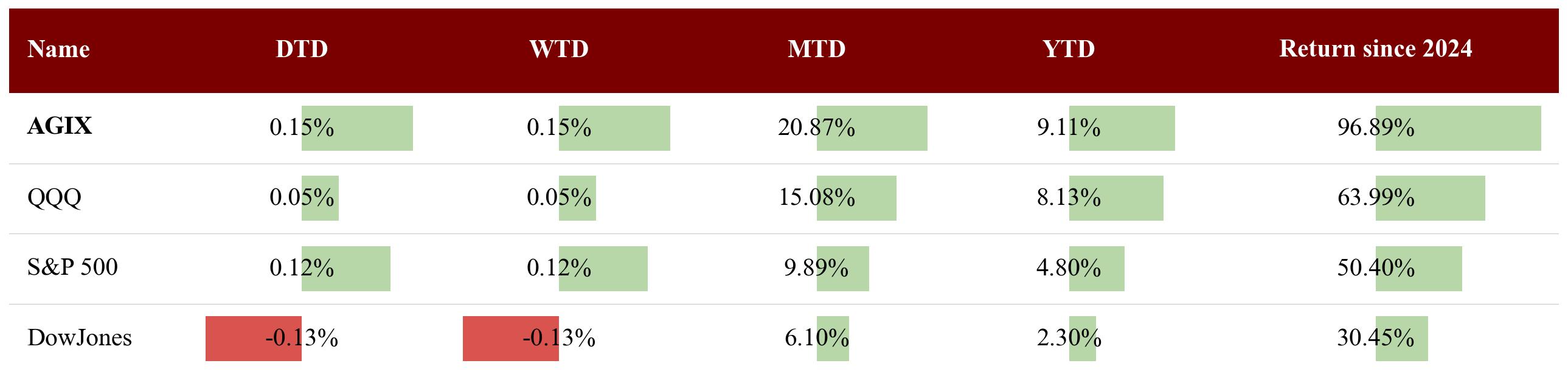
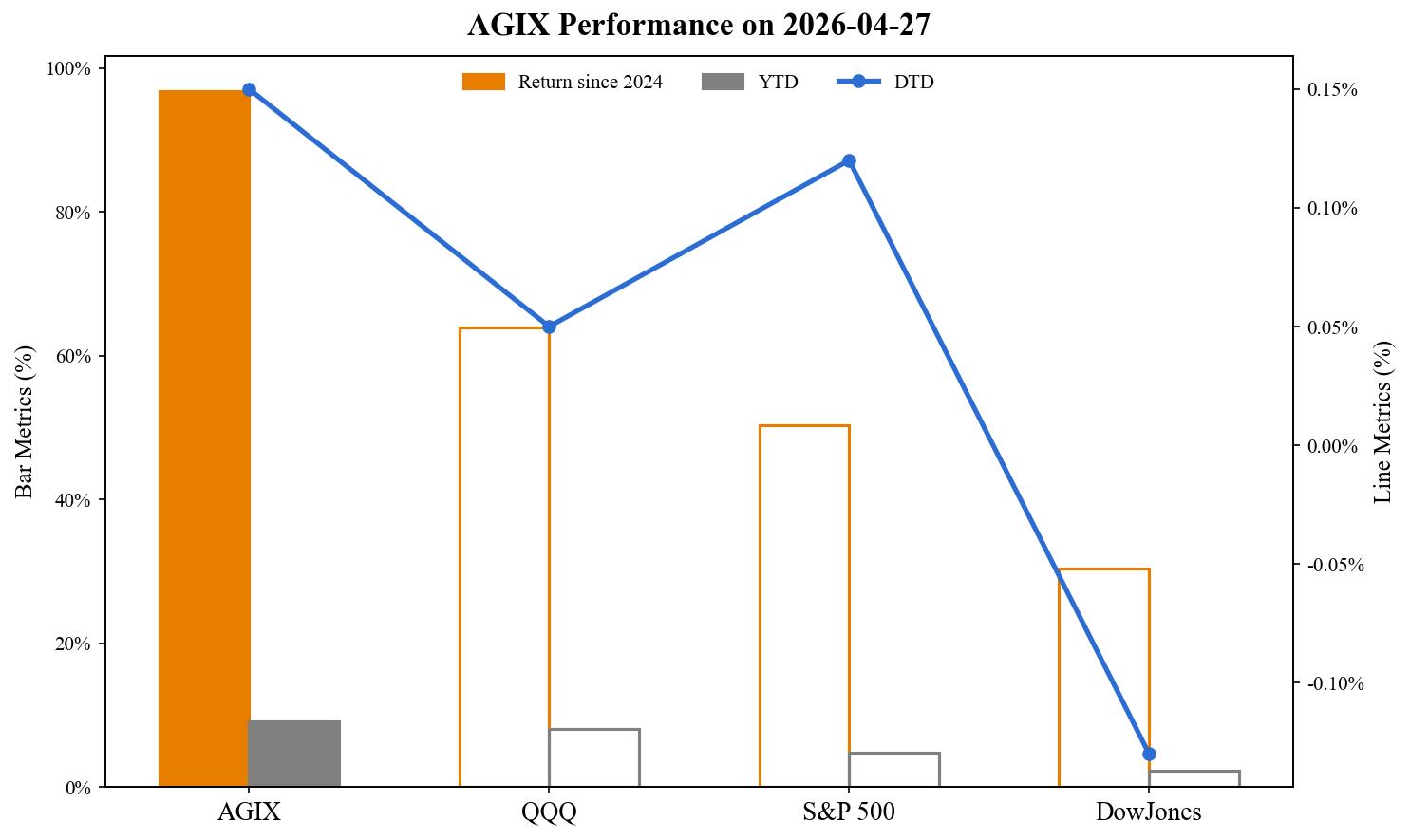
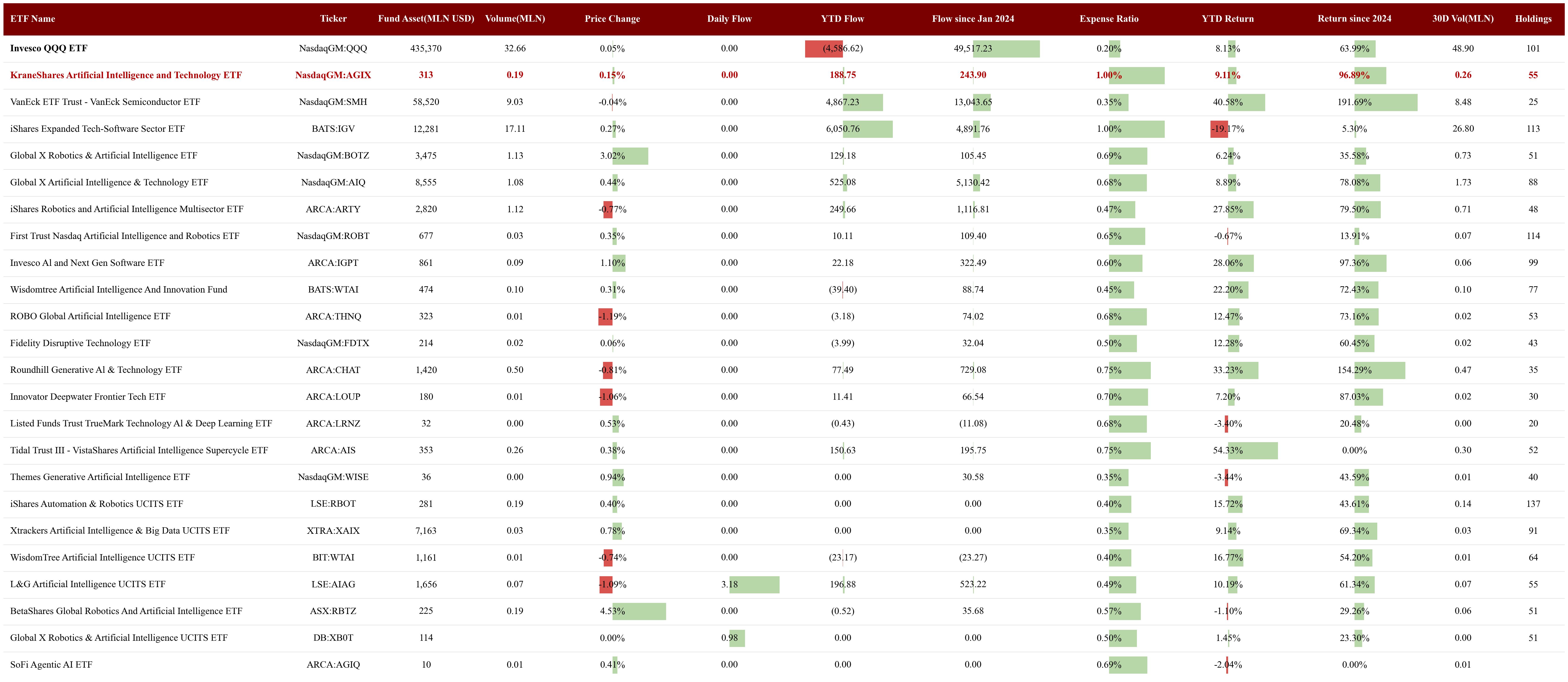
• AGIX outperformed all major benchmarks on a DTD basis, rising 0.15% vs. QQQ (0.05%) and the S&P 500 (0.12%), while the Dow Jones slipped 0.13%. Year-to-date, AGIX is up 9.11%, outpacing the S&P 500's 4.80% and the Dow's 2.30%, but trailing the broader tech-heavy SMH (+40.58% YTD) and IGPT (+28.06% YTD).
• Among AGIX hardware holdings, NVIDIA (+4.0% DTD), TSMC (+3.66%), SK hynix (+5.73%), and Micron (+5.6%) posted strong gains, driven by AI chip demand tailwinds and positive earnings catalysts from Intel and memory-cycle optimism. Semiconductor momentum was a key driver of AGIX's DTD outperformance.
• AGIX infrastructure holdings also contributed positively, led by TeraWulf (+7.1%), Pure Storage (+3.56%), and Snowflake (+2.8%). Meta Platforms (+0.53%) and Alphabet (+1.72%) added support, while Microsoft (+0.05%) and Amazon (-1.09%) were mixed.
• Key stocks to watch: NVIDIA and SK hynix benefit from continued AI infrastructure spending; Meta is in focus following its space-based solar deal and the blocked Manus acquisition; TeraWulf's surge reflects hyperscaler AI data center demand. Peer holdings analysis shows strong robotics and automation names (Fanuc +15.98%, Yaskawa +6.06%) gaining on earnings beats and positive guidance, signaling broad AI/automation momentum.
News Highlights
1. Meta's agreement with Overview Energy for space-based solar power signals a long-term bet on renewable energy for AI data centers, potentially reducing fossil fuel reliance and improving energy cost predictability for Meta and other hyperscalers. Positive for Meta (AGIX holding).
2. China blocked Meta's $2B acquisition of AI agent startup Manus, citing regulatory concerns. This removes a key AI talent and technology acquisition for Meta, potentially slowing its agentic AI roadmap. Negative for Meta near-term.
3. OpenAI's reported plan to develop a smartphone with its own chips and an agent-only interface could disrupt the mobile ecosystem and challenge Apple and Google's app-store dominance. If realized, it would boost demand for AI hardware (NVIDIA, TSMC) and cloud infrastructure (Microsoft, Alphabet).
4. Microsoft and Accenture deployed Microsoft 365 Copilot to over 743,000 employees, with 97% completing routine tasks up to 15x faster. This validates enterprise AI productivity gains and supports Microsoft's AI monetization story, indirectly benefiting AGIX infrastructure holdings like Microsoft and Alphabet.
5. DeepMind founder David Silver raised $1.1B for Ineffable Intelligence to build AI that learns without human data, highlighting the venture capital appetite for foundational AI research. No direct near-term impact on AGIX holdings, but underscores the pace of AI innovation.
6. Sereact raised $110M to scale its 'robotic brain' platform and expand into the U.S., serving BMW, Daimler Truck, and PepsiCo. This boosts the robotics ecosystem and could increase demand for AI chips (NVIDIA) and edge computing solutions, benefiting AGIX hardware holdings.
RSS Highlights
1. No RSS hotlist subscriptions provided. Insufficient information to generate RSS highlights.
Performance & Benchmark
Attribution
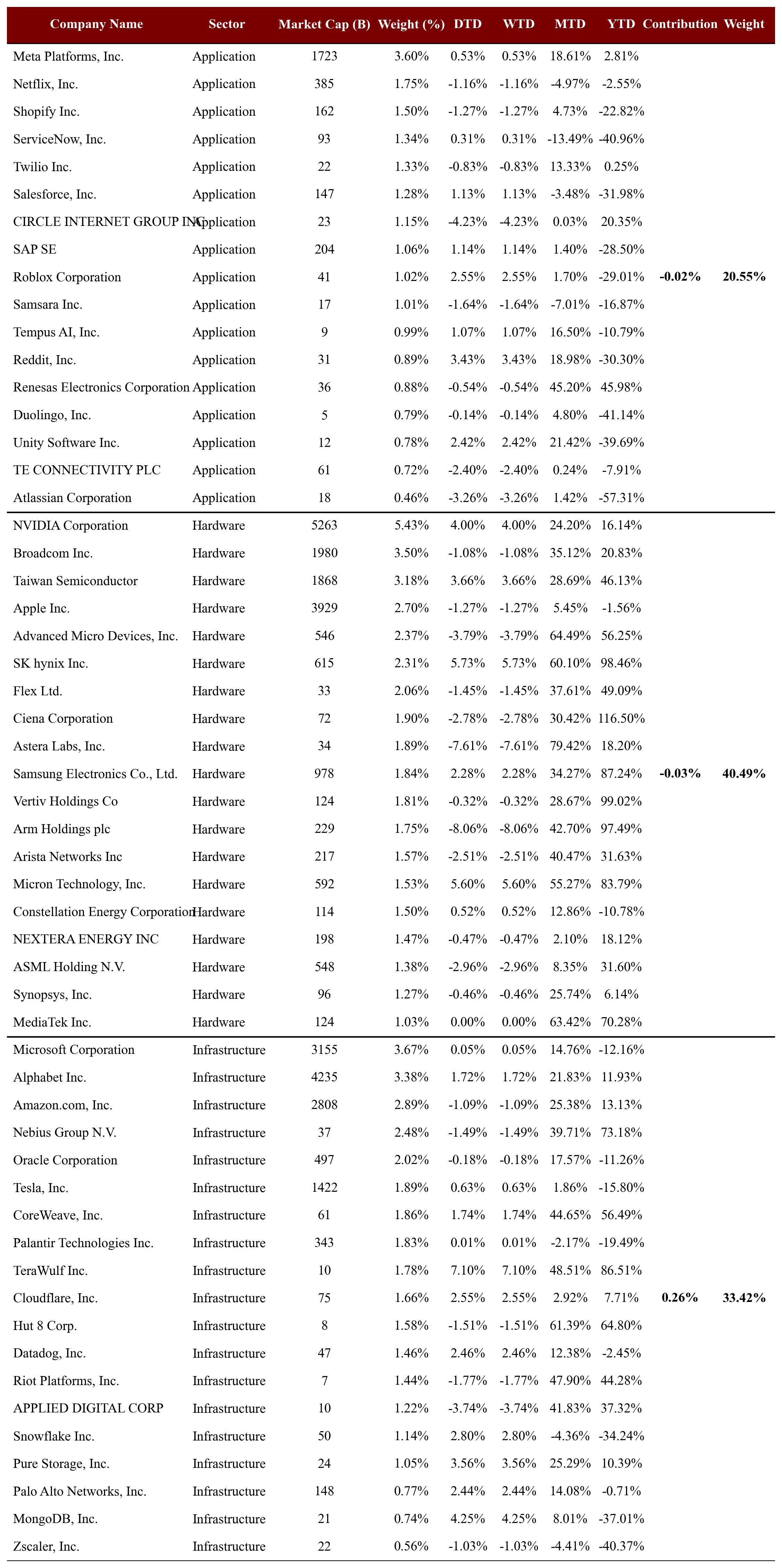
Contribution of the three sectors within AGIX holdings today
Application: -0.02%
Hardware: -0.03%
Infrastructure: 0.26%
Top-performing stocks in AGIX holdings today
TeraWulf Inc. (7.1%)
SK hynix Inc. (5.73%)
Micron Technology, Inc. (5.6%)
MongoDB, Inc. (4.25%)
NVIDIA Corporation (4.0%)
Taiwan Semiconductor Manufacturing Company Limited (3.66%)
Pure Storage, Inc. (3.56%)
Reddit, Inc. (3.43%)
Snowflake Inc. (2.8%)
Roblox Corporation (2.55%)
Cloudflare, Inc. (2.55%)
Datadog, Inc. (2.46%)
Palo Alto Networks, Inc. (2.44%)
Unity Software Inc. (2.42%)
Samsung Electronics Co., Ltd. (2.28%)
Worst-performing stocks in AGIX holdings today
TE CONNECTIVITY PLC (-2.4%)
Arista Networks Inc (-2.51%)
Ciena Corporation (-2.78%)
ASML Holding N.V. (-2.96%)
Atlassian Corporation (-3.26%)
APPLIED DIGITAL CORP (-3.74%)
Advanced Micro Devices, Inc. (-3.79%)
CIRCLE INTERNET GROUP INC (-4.23%)
Astera Labs, Inc. (-7.61%)
Arm Holdings plc (-8.06%)
Top five listed stocks contributing the most within AGIX holdings today
NVIDIA Corporation (4.0%)
SK hynix Inc. (5.73%)
TeraWulf Inc. (7.1%)
Taiwan Semiconductor Manufacturing Company Limited (3.66%)
Micron Technology, Inc. (5.6%)
Observation
The strongest movers across peer ETF holdings today are listed below:
| DTD | Stock Ticker | Name | Held by ETFs | analysis |
|---|---|---|---|---|
| 20.03 | NasdaqCM:QUIK | QuickLogic Corporation | [] | No specific news events, earnings releases, or company disclosures on April 27, 2026, explain QuickLogic's (QUIK) 20.03% single-day gain. Search results lack same-day catalysts, showing only general stock quotes, outdated performance data (e.g., trading at $7.02 as of October 2025), and analyst ratings with a Moderate Buy consensus and $10.87 price target.[1][2][4] The move may reflect broader semiconductor sector momentum or trading activity, but no verifiable drivers are identified. |
| 18.97 | KOSDAQ:A108490 | ROBOTIS Co., Ltd. | ['NasdaqGM:BOTZ', 'ASX:RBTZ', 'DB:XB0T'] | No specific news events, company disclosures, or catalysts on April 27, 2026, explain ROBOTIS Co., Ltd.'s (KOSDAQ:A108490) 18.97% single-day gain, as search results lack same-day information and show varying prior prices like KRW 192,200 and KRW 348,000 without attributing drivers.[1][5][6] The move aligns with the stock's high volatility, evidenced by 13.3% average weekly movement exceeding the electronic industry average of 10.9%, alongside its 897.31% one-year return fueled by robotics demand.[1][4] Broader positive momentum is indicated by analyst targets averaging KRW 367,200 and outperformance versus regional indices.[3][5] |
| 17.73 | TSE:6516 | Sanyo Denki Co., Ltd. | ['LSE:RBOT'] | Sanyo Denki (TSE:6516) surged 17.73% on April 27, 2026, primarily driven by its FY2026 earnings release showing a strong profit rebound and revenue growth of 9.7% to ¥107.3 billion.[1][2] The company also raised its payout and issued guidance for robust future growth, boosting investor confidence.[1] No other same-day news events were identified.[2] |
| 16.45 | TSE:6324 | Harmonic Drive Systems Inc. | ['ARCA:IGPT', 'LSE:RBOT'] | The search results provided do not contain specific news events, company disclosures, or market catalysts dated April 27, 2026 that would explain Harmonic Drive Systems' 16.45% single-day surge. The most recent verifiable information shows an upward earnings revision for fiscal year ending March 31, 2026, but no announcement date is provided to confirm if this drove the April 27 move. Without access to real-time news from that specific date, trading data, or official company announcements coinciding with April 27, 2026, I cannot reliably attribute the primary drivers of this move based on the available search results. |
| 15.98 | TSE:6954 | Fanuc Corporation | ['NasdaqGM:BOTZ', 'NasdaqGM:AIQ', 'NasdaqGM:ROBT', 'LSE:RBOT', 'ASX:RBTZ', 'DB:XB0T'] | Fanuc Corporation (TSE:6954) surged 15.98% on April 27, 2026, primarily driven by its full-year earnings release, which beat expectations on statutory profit per share at JP¥178 despite revenues meeting forecasts at JP¥858b.[1] Analysts responded positively, raising 2027 revenue estimates to JP¥927.7b (up 8.1%) and EPS to JP¥206 (up 15%), signaling increased bullishness on the business.[1] The stock reached JP¥7,256 amid this reaction, with the earnings surprise as the dominant catalyst ahead of broader industry or macro factors.[1] |
| 15.83 | TSE:6861 | Keyence Corporation | ['NasdaqGM:BOTZ', 'NasdaqGM:ROBT', 'ARCA:IGPT', 'LSE:RBOT', 'ASX:RBTZ', 'DB:XB0T'] | No verifiable public information attributes Keyence Corporation's (TSE:6861) 15.83% single-day gain on April 27, 2026. Search results lack same-day news events, company disclosures, or catalysts for that date, with the most recent mentions being a financial results notice for the fiscal year ended March 31, 2026 and no performance outlook for FY ending March 2027. Historical price data and technical analyses in results cover earlier periods without reference to April 2026 activity. |
| 14.5 | TSE:268A | Rigaku Holdings Corporation | ['LSE:RBOT'] | Rigaku Holdings (TSE:268A) surged 14.5% on April 27, 2026, primarily driven by strong investor satisfaction with the company's prospects, as highlighted in recent market analysis noting shares rocketing 29% amid positive sentiment. No specific same-day news events, earnings releases, or disclosures are identified in available data to explain the move. Broader context includes analyst buy ratings and a monthly price rise of 11.92%, supporting momentum in the scientific instruments sector.[1][2] |
| 9.95 | TWSE:2408 | Nanya Technology Corporation | ['ARCA:IGPT', 'ARCA:AIS'] | I cannot provide a reliable attribution for Nanya Technology's 9.95% single-day move on April 27, 2026, as the search results contain no news events, company disclosures, or management commentary from that date. The available data shows only historical price points and valuation metrics from earlier in 2026, with no information about catalysts or developments on April 27 specifically. To properly attribute this move, I would need access to real-time news, earnings announcements, regulatory filings, or industry developments from that trading date. |
| 9.31 | KOSDAQ:A277810 | Rainbow Robotics Co.,Ltd. | ['NasdaqGM:BOTZ', 'ARCA:IGPT', 'LSE:RBOT', 'ASX:RBTZ', 'DB:XB0T'] | No specific news events, company disclosures, or catalysts on April 27, 2026, explain Rainbow Robotics' 9.31% single-day gain on KOSDAQ:A277810. Search results lack same-day reporting and only provide outdated price data from earlier in 2025 and 2026, with no mention of earnings, partnerships, or sector developments tied to that date. The move may reflect technical trading, broader market momentum in robotics stocks, or unreported factors not captured in available public sources. |
| 8.92 | SHSE:688008 | Montage Technology Co., Ltd. | ['ARCA:AIS'] | Montage Technology's SHSE:688008 stock rose 8.92% on April 27, 2026, primarily driven by strong momentum from its recent Hong Kong listing debut, where shares surged over 50% and raised $902 million.[1] This cross-listing success boosted investor sentiment and trading volume spillover to the Shanghai STAR Market listing. No other same-day company-specific news or disclosures were reported.[2][3] |
| 8.2 | NasdaqCM:INDI | indie Semiconductor, Inc. | ['LSE:RBOT'] | No specific news events, company disclosures, or catalysts on April 27, 2026, explain indie Semiconductor's (INDI) 8.2% single-day gain. The stock traded around $3.40-$3.66 in late April amid low volume and no reported same-day drivers, following a 6.6% rise on April 23 without disclosed triggers.[1][3][5] Possible technical rebound or broader market momentum contributed, but lacks direct evidence. |
| 8.11 | NasdaqGS:SNDK | Sandisk Corporation | ['XTRA:XAIX'] | Sandisk Corporation (SNDK) stock rose 8.11% on April 27, 2026, primarily driven by continued momentum from its recent Nasdaq-100 inclusion on April 20, which triggered passive fund buying and heightened visibility.[1][2][6] Strong industry tailwinds, including Samsung's prior positive Q1 outlook signaling a memory-chip upcycle and robust AI-driven NAND demand amid tight supply, further fueled the rally with elevated trading volume.[1][2][3] Analyst upgrades and positive revisions ahead of upcoming Q3 earnings also supported the move, reinforcing bullish sentiment.[3][5] |
| 7.65 | KOSE:A454910 | Doosan Robotics Inc. | ['NasdaqGM:BOTZ', 'LSE:RBOT', 'ASX:RBTZ', 'DB:XB0T'] | Doosan Robotics Inc. (KOSE:A454910) rose 7.65% on April 27, 2026, primarily driven by its Q1 2026 earnings release showing EPS of -856.15 and gross margin of 12.65%, which beat lowered expectations and signaled improving fundamentals amid turnaround momentum.[7] Analyst optimism, with 54.5% upside to targets, further supported the move as profitability prospects for 2026 gained traction in market commentary.[1][8] No other same-day news events identified. |
| 7.27 | NasdaqCM:SERV | Serve Robotics Inc. | ['NasdaqGM:BOTZ', 'NasdaqGM:ROBT', 'ASX:RBTZ', 'DB:XB0T'] | Serve Robotics stock rose 7.27% on April 27, 2026, likely driven by positive momentum following the company's April 7 unveiling of "Maggie," its first AI-powered conversational robot at NVIDIA GTC 2026, which demonstrated edge AI capabilities using T-Mobile's 5G Advanced. The delayed market reaction to this product milestone, combined with the stock's 15.33% gain over the prior month, suggests investors were reassessing the company's long-term growth potential in AI-enabled robotics despite near-term profitability challenges. No conflicting same-day news events appear in available sources to explain the move. |
| 7.26 | NYSE:SNAP | Snap Inc. | ['BATS:IGV', 'NasdaqGM:AIQ', 'ARCA:IGPT', 'XTRA:XAIX'] | Snap's 7.26% gain on April 27, 2026 was driven primarily by Rothschild & Co Redburn's upgrade from Neutral to Buy with a $10 price target, signaling improved confidence in the company's turnaround trajectory. The upgrade was supported by management's announcement of a $500 million annualized cost-cutting plan and revised guidance showing the core business achieving GAAP breakeven in fiscal 2025 and meaningful profitability in fiscal 2026, alongside expectations for 11% compound annual revenue growth through 2028. Additional analyst firms including BMO Capital, Citi, and Stifel also raised price targets on the same day, reflecting broader Street recognition of the restructuring efforts and improved digital advertising outlook, though most maintained Hold ratings pending further execution proof. |
| 7.11 | TSE:6273 | SMC Corporation | ['NasdaqGM:BOTZ', 'ASX:RBTZ', 'DB:XB0T'] | No specific news events, company disclosures, or catalysts explain SMC Corporation's (TSE:6273) 7.11% single-day gain on April 27, 2026, based on available public information. Recent trading data shows the stock at varying prices around 70,000 JPY with modest daily moves like 1.35%, but lacks details on that date's volume, earnings, or sector developments.[1][2][3] Broader trends indicate a yearly decline of over 26%, suggesting the move may stem from unverified trading factors or market rotation.[2] |
| 7.1 | NasdaqCM:WULF | TeraWulf Inc. | ['NasdaqGM:AGIX', 'BATS:IGV'] | TeraWulf (WULF) stock rose 7.1% on April 27, 2026, driven primarily by elevated trading volume exceeding typical session levels amid positive momentum in AI infrastructure developments.[1] Key catalysts included major hyperscaler-backed agreements, multibillion-dollar financing success, early high-performance computing (HPC) revenue traction, and raised expansion targets signaling sustained growth.[1] The move outperformed the stock's recent 1.3% four-week loss, with shares closing at $14.8 on notable volume.[1] |
| 7.0 | TSE:6857 | Advantest Corporation | ['ARCA:ARTY', 'NasdaqGM:FDTX', 'LSE:RBOT'] | Advantest Corporation (TSE:6857) rose 7.0% on April 27, 2026, primarily driven by the announcement of joining Applied Materials' EPIC platform, a key semiconductor industry partnership boosting its growth prospects in test systems.[1][6] The company's official investor page confirms heightened activity with "2026/04/27 Investors" news, aligning with the intraday gain to ¥29,440 (+5.52% as of April 24 close, extending into the session).[6] No other same-day disclosures or macro events were identified in public sources.[2][3][4] |
| 6.46 | TWSE:2344 | Winbond Electronics Corporation | ['ARCA:IGPT'] | No specific news events, company disclosures, or catalysts on April 27, 2026, explain Winbond Electronics Corporation's (TWSE:2344) 6.46% single-day gain, as search results lack same-day information. The move likely stemmed from broader semiconductor sector momentum or technical buying pressure, consistent with prior patterns of volume spikes and bullish indicators like Ichimoku golden crosses noted in historical analysis[3]. Analyst price targets remain positive, averaging NT$149-163 with highs to NT$210, potentially supporting sentiment[1]. |
| 6.43 | SZSE:300454 | Sangfor Technologies Inc. | [] | No specific news events, company disclosures, or catalysts on April 27, 2026, explain Sangfor Technologies Inc. (300454.SZ)'s 6.43% single-day gain. The stock's move occurred amid a short-term falling trend with high intraday volatility, as seen in prior sessions like April 24's 10.55% range.[1] Earlier repurchase activity on April 13 (375,000 shares at ~¥106.63 average) may have provided lingering positive sentiment, but lacks direct tie to the date.[2] |
| 6.42 | NasdaqGM:DJT | Trump Media & Technology Group Corp. | ['ARCA:IGPT'] | DJT's 6.42% single-day gain on April 27, 2026, lacked clear attribution to specific company news, disclosures, or macro events in available data. Market reports noted the stock trading up approximately 6-7.1% that day, with a closing market cap around $2.77 billion, but no catalysts like earnings, Trump-related announcements, or industry developments were identified.[2][6] Trading appears driven by intraday momentum or retail sentiment in this high-beta, volatile name (beta ~1.67).[3] |
| 6.06 | TSE:6506 | YASKAWA Electric Corporation | ['NasdaqGM:BOTZ', 'NasdaqGM:ROBT', 'ARCA:IGPT', 'LSE:RBOT', 'ASX:RBTZ', 'DB:XB0T'] | YASKAWA Electric (TSE:6506) rose 6.06% on April 27, 2026, primarily driven by market reaction to the company's recent leadership reshuffle, with the president stepping down in May and the chairman assuming the combined role, alongside refreshed long-term plans that boosted momentum after softer recent performance[1][6]. Positive FY2027 guidance issued earlier in April, forecasting 7% revenue growth and 26.8% operating profit increase from recovering electronics and overseas markets, provided additional support[3]. A 26.43% one-month share price gain prior to the date reflected building investor optimism[1]. |
| 6.04 | TSE:6146 | Disco Corporation | ['NasdaqGM:FDTX'] | I cannot provide a reliable attribution for Disco Corporation's 6.04% single-day move on April 27, 2026, as the search results contain no verifiable news events, company disclosures, or specific catalysts dated on or immediately before that date. The available information includes historical price data and valuation analysis through early April 2026, but lacks the real-time news coverage necessary to identify the primary driver of the move. Without documented same-day or preceding-day announcements, regulatory actions, or industry developments, any attribution would be speculative. |
| 5.9 | NasdaqGM:NVTS | Navitas Semiconductor Corporation | ['ARCA:AIS'] | Navitas Semiconductor's 5.9% gain on April 27, 2026 reflects continuation of a powerful momentum rally driven by the company's positioning in next-generation GaN and SiC power semiconductor technology aligned with AI infrastructure demand. The primary driver is sustained trader interest in the power chip narrative, amplified by the recent board appointment of former Broadcom SVP Gregory M. Fischer, which signals credibility in high-power and AI chip development. Secondary support comes from the stock's parabolic price action earlier in April—multiple double-digit daily moves in tight succession—which has attracted momentum traders chasing breakouts in a tape rewarding AI-related semiconductor plays. |
| 5.73 | KOSE:A000660 | SK hynix Inc. | ['NasdaqGM:AGIX', 'NasdaqGM:AIQ', 'ARCA:ARTY', 'NasdaqGM:ROBT', 'ARCA:IGPT', 'BATS:WTAI', 'ARCA:CHAT', 'ARCA:LOUP', 'ARCA:AIS', 'XTRA:XAIX', 'BIT:WTAI'] | SK Hynix (KOSE:A000660) rose 5.73% on April 27, 2026, driven primarily by Intel's strong earnings report, which reignited expectations for AI semiconductor demand and lifted the broader chip sector.[2][4] The stock hit a record high above 1.31 million won intraday, fueled by ongoing HBM demand amid the AI boom and SK Hynix's recent Q1 earnings beat with 72% operating margin.[1][3] US tech strength from the prior Friday also supported Korean chipmakers like SK Hynix over rivals such as Samsung.[4] |
| 5.6 | NasdaqGS:MU | Micron Technology, Inc. | ['NasdaqGM:QQQ', 'NasdaqGM:AGIX', 'NasdaqGM:SMH', 'NasdaqGM:AIQ', 'ARCA:ARTY', 'NasdaqGM:ROBT', 'ARCA:IGPT', 'BATS:WTAI', 'NasdaqGM:FDTX', 'ARCA:LOUP', 'ARCA:AIS', 'XTRA:XAIX', 'BIT:WTAI'] | Micron Technology's 5.6% gain on April 27, 2026 was driven primarily by Arete Research's substantial price target increase from $562 to $852 with a Buy rating, signaling significantly higher perceived upside despite the stock trading near $413 at the time. Secondary support came from broad optimism around AI-driven memory chip demand and Micron's lobbying efforts for the MATCH Act, which would impose tighter export controls on chipmaking tools to Chinese competitors, positioning the company as a potential beneficiary of stricter geopolitical trade rules. The stock's momentum was further reinforced by fresh institutional demand, with a growth-focused ASG fund adding Micron as a new position. |
| 5.5 | TASE:NICE | NICE Ltd. | ['NasdaqGM:AIQ', 'NasdaqGM:ROBT', 'ARCA:IGPT', 'XTRA:XAIX', 'BIT:WTAI'] | NICE Ltd. (TASE:NICE) rose 5.5% on April 27, 2026, primarily driven by a material company-specific event disclosed in an 8-K filing with the SEC on that date.[5] Zacks highlighted investor attention on NICE amid upcoming earnings expectations, with consensus sales growth of 8.7% for the current quarter and recent revenue beats like $786.5 million (+9% YoY).[1] Broader U.S. market records and rising oil prices provided a supportive macro backdrop, though company news ranked highest.[4] |
| 5.5 | TWSE:6669 | Wiwynn Corporation | ['ARCA:IGPT'] | No specific news events, earnings releases, or company disclosures on April 27, 2026, explain Wiwynn Corporation's (TWSE:6669) 5.5% single-day gain. Recent strong quarterly results, including revenue of NT$220.74B beating estimates of NT$203.60B and net income growth to NT$12.12B (up 23.78% quarter-over-quarter), likely supported ongoing positive momentum in the cloud server sector.[5] Broader market strength in Taiwan tech stocks and analyst buy ratings with targets up to NT$4,800 may have contributed as secondary factors.[5] |
| 5.14 | TSE:5803 | Fujikura Ltd. | ['NasdaqGM:AIQ'] | Fujikura Ltd. (TSE:5803) rose 5.14% on April 27, 2026, driven primarily by continued momentum from its recent 6-for-1 stock split completed earlier in Q1 2026, which improved share accessibility and propelled the stock to new all-time highs above ¥6,000.[2] Strong analyst upgrades, with price targets surging over 500% in recent quarters and a consensus Buy rating forecasting 19% revenue growth for FY2026, further supported the move amid a 100% YTD gain.[1][3] Broader market enthusiasm for the company's 137% earnings growth over the past year and 23% projected EPS expansion also contributed.[1] |
| 5.09 | HLSE:HIAB | Hiab Oyj | ['NasdaqGM:BOTZ', 'LSE:RBOT', 'ASX:RBTZ', 'DB:XB0T'] | Hiab's 5.09% gain on April 27, 2026 was driven by the company's Q1 2026 earnings release on April 24, which showed raised full-year operating profit margin guidance to above 13.5% despite lower sales, combined with organic orders growth of 7% signaling demand resilience. The positive guidance revision and order momentum offset the 7% year-over-year sales decline, with the market rewarding the company's margin expansion outlook and growing recurring revenue base from 48,000 connected units and 20,000 service contracts. |
| 5.08 | TWSE:3515 | ASROCK Incorporation | [] | I cannot provide a reliable attribution for ASROCK's 5.08% single-day move on April 27, 2026, as the search results contain no company-specific news, earnings announcements, regulatory developments, or other verifiable catalysts from that date. The available data includes only historical valuation metrics, analyst price targets, and forward guidance that would not explain a specific daily move. To properly attribute this move, real-time news sources or company disclosures from April 27 would be required. |
News
Funding & M&A
China blocks Meta's $2 billion Manus deal after a months-long investigation.
China's National Development and Reform Commission (NDRC) announced on Monday that it has blocked Meta's $2 billion acquisition of Singapore-based AI startup Manus, marking one of the most significant interventions in cross-border transactions by China, extending beyond U.S.-China tensions and impacting the entire AI industry. Manus was founded in 2022 by Chinese engineers Xiao Hong, Yichao Ji, and Tao Zhang, originally incorporated in Beijing under the parent company Butterfly Effect before relocating to Singapore. Meta announced the acquisition in December 2025, intending to integrate Manus's agentic AI technology into Meta AI, but the NDRC demanded a complete unwinding of the deal without any explanation. Approximately 100 Manus employees had already joined Meta's Singapore office in March, with founders taking executive roles, including CEO Xiao Hong reporting directly to Meta COO Javier Olivan, but Hong and Chief Scientist Ji are reportedly subject to Chinese exit bans. A Meta spokesperson stated the transaction was fully compliant and looked forward to an appropriate resolution. The matter has also drawn attention in the U.S., with Senator John Cornyn questioning whether Benchmark's investment in Manus should have flowed to a China-linked entity. Manus did not respond to requests for comment. The incident highlights the impact of geopolitics on global AI mergers and acquisitions, potentially dealing a blow to Meta's ambitions in the rapidly evolving AI agent space.
Investors back Skye’s AI home screen app for iPhone ahead of launch
Skye, an iPhone app launched by Signull Labs, is currently in private beta testing, aiming to create an 'agentic homescreen' through iOS widgets, delivering ambient intelligence to users. The app offers personalized services such as local weather, personal health, meeting preparation, email replies, bank anomaly alerts, and location recommendations, with all data accessed via user authorization. Although not yet publicly released, Skye has attracted tens of thousands of users to its waitlist and gained investor interest. According to SEC filings, the New York-based startup completed over $3.58 million in pre-seed funding in September 2025, with PitchBook data showing a subsequent valuation of $19.5 million. Founder Nirav Savjani (known as signüll on X) previously worked at Google and Meta, and early investors include prominent VCs like a16z (Andreessen Horowitz), True Ventures, SV Angel, and Offline Ventures. After Savjani announced plans on X, user interest surged, indicating consumer demand for AI-enhanced iPhones. The app is set to roll out to waitlist users soon, potentially signaling new opportunities in the AI smartphone market, such as the rumored OpenAI phone. TechCrunch has spoken with the founder, who insists on anonymity. Skye's rapid progress highlights the potential of AI agent technology in mobile devices.
DeepMind’s David Silver just raised $1.1B to build an AI that learns without human data
British AI startup Ineffable Intelligence, founded a few months ago by former DeepMind researcher David Silver, recently completed $1.1 billion in funding at a $5.1 billion valuation. It aims to develop a 'super learner' that can autonomously discover knowledge and skills without human data, using reinforcement learning to enable AI trial-and-error self-learning. The company's website claims that if successful, it will bring about a scientific breakthrough comparable to Darwin's theory, explaining and constructing all intelligence. Silver previously led the reinforcement learning team at DeepMind, spearheading projects like AlphaZero that defeated top human players in games. This funding round was led by Sequoia Capital and Lightspeed Venture Partners, with participation from Index Ventures, Google, Nvidia, and others, as well as the British Business Bank and a sovereign AI fund. Ineffable has quickly joined the ranks of 'pentacorns,' alongside AMI Labs (co-founded by Yann LeCun, which raised $1.03 billion) and Recursive Superintelligence (founded by former DeepMind scientist Tim Rocktäschel, which raised $500 million), highlighting the rise of London's AI ecosystem, influenced by DeepMind's acquisition by Google. Jeff Bezos' Project Prometheus also plans to set up a local office, and the DeepMind alumni network is helping accelerate new startups. This trend marks a wave of star researchers founding companies that repeatedly secure massive 'coconut round' funding, with London emerging as a new AI hub.
'You can't make great decisions without good data': How fragmented data blocks enterprise AI success
Reltio Inc. Chief Revenue Officer Alyson Welch emphasized at Google Cloud Next that trusted data is the critical foundation for successful enterprise AI agents. Enterprises pay a high price in healthcare, life sciences, and financial services due to data fragmentation and problematic storage, and AI agents produce unreliable outputs when lacking context. Reltio recently launched AgentFlow Unstructured to extract and govern unstructured data like PDFs and documents, Profiler to inspect source data before ingestion, and Agent Builder to allow teams to create, test, and publish custom agents in a controlled process, helping chief data officers reduce manual data management and improve compliance and business efficiency. Welch noted that high-quality data is a prerequisite for achieving excellent results from models. Reltio is about to be acquired by SAP SE but will operate as an independent business, supporting both SAP and non-SAP data environments. This neutral positioning aligns with the multi-cloud, multi-application data landscape needs of enterprises. Reltio customers are finding new ways to mine historical data, develop innovative customer and market strategies, and drive business reinvention.
China blocks Meta’s acquisition of AI agent developer Manus
The Chinese government today ordered Meta Platforms Inc. to abandon its acquisition of AI startup Manus, five months after Meta announced the deal. The transaction was reportedly valued between $2 billion and $3 billion. Manus developed an AI agent capable of converting financial datasets into presentations, generating websites, and performing other multi-step tasks, interacting with web pages via a Chrome extension, powered by external large language models like Anthropic. Manus was built by Butterfly Effect, a startup founded in China four years ago, which raised $75 million shortly after launching Manus last March and quickly moved to Singapore. When Meta announced the acquisition in December, Butterfly Effect disclosed that Manus had over $100 million in annualized recurring revenue and millions of users. The acquisition drew regulatory scrutiny from both China and the U.S.: the U.S. Treasury reviewed its financing for compliance last May, and Chinese regulators launched an investigation in January focusing on export controls and overseas investment rules. Meta had planned to integrate Manus into its products, but currently does not offer similar multi-step task automation services, though it has begun incorporating AI agents into products, such as the Contemplating mode in its latest LLM Muse Spark. This deal is one of at least six startup acquisitions by Meta in the past year, including buying the developer of Moltbook in March and hiring employees from Dreamer. This decision may impact Meta's AI development roadmap.
OpenAI ends Microsoft legal peril over its $50B Amazon deal
Microsoft and OpenAI recently renegotiated a new agreement, reshaping their partnership framework to avoid potential legal disputes. Previously, OpenAI signed a massive $50 billion investment deal with Amazon, including an initial $15 billion investment and an additional $35 billion, involving the co-development of state runtime technology on AWS Bedrock and granting AWS exclusive rights to the Frontier agent tool. However, Microsoft's original agreement granted it exclusive access to OpenAI's models and products until AGI was achieved, sparking controversy over the Amazon deal and even threatening litigation. The new agreement clarifies that Microsoft receives a non-exclusive license to OpenAI's intellectual property, expiring in 2032. OpenAI products will debut on Azure but can be extended to any cloud provider, removing exclusivity restrictions. Microsoft will no longer pay OpenAI a revenue share, but OpenAI will continue to pay Microsoft a capped revenue share until 2030 and has committed to an additional $250 billion in Azure purchases. Microsoft retains approximately 27% of OpenAI's for-profit entity and will still benefit from its growth. Although it loses some exclusive cloud service opportunities, Microsoft has already partnered with OpenAI competitor Anthropic to advance Claude AI agent products. Enterprise customers benefit the most, gaining the freedom to choose models and cloud platforms. This agreement marks intensifying competition among AI giants and a reshaping of the cloud computing market landscape.
Sereact raises $110M to scale AI 'robotic brain' and expand into the US
German robotics startup Sereact GmbH announced a $110 million Series B funding round, bringing total funding to over $140 million, to expand its AI 'robot brain' platform Cortex and enter the U.S. market. Founded in 2021 by former University of Stuttgart AI researchers Ralf Gulde and Marc Tuscher, the company's Cortex foundation model interprets natural language instructions and translates them into physical actions, allowing robot tasks to be reassigned without writing new code. The latest Cortex 2.0 integrates vision-language-action models with world models, enabling robots to predict consequences of actions by simulating future movements and assessing stability and risk under physical models. The software is hardware-agnostic, supporting various robot arms, mobile manipulators, and humanoid platforms. It has deployed over 200 systems in Europe, completing over 1 billion production picks with only 1 in 53,000 requests requiring human intervention. Key customers include BMW, Daimler Truck, PepsiCo, and European e-commerce logistics providers Bol and Active Ants. The round was led by Headline VC, with participation from Bullhound Capital, Felix Capital Partners, and others. Sereact plans to open its first U.S. office in Boston and hire a local team. The technology differs from end-to-end models of competitors like Physical Intelligence, Skild AI, and Covariant AI, and has the potential to reshape global supply chains and manufacturing.
The third leg of AI's infrastructure race isn't silicon or power. It's capital
The AI race is shifting from chip and power shortages to financial bottlenecks. Argentum AI, by aggregating $50 billion in demand interest representing over 400,000 GPUs, has closed a $1.5 billion pipeline, creating a new category of 'infrastructure as a financial product.' CEO Andrew Sobko emphasizes the triad of 'power, compute, and capital,' turning capital into a product feature rather than a constraint. While traditional industries see financing as a back-office function, Argentum disrupts this paradigm by building a multi-trillion-dollar AI infrastructure roadmap through precision project finance. Its model reduces upfront capital, accelerates deployment, and is replicable across multiple sites, with each deployment starting from signed contracts and capital following customers. Argentum decouples hardware from geography, covering 16 sites across 8 countries with 2.4 gigawatts of power capacity, flexibly allocating cluster specifications, cooling, and location. Financial engineering attracts equipment financing companies and private credit funds, developing a GPU-backed debt framework using Nvidia GPUs as collateral, take-or-pay contracts, and hardware residual value floors, similar to energy or telecom financing. Sobko says silicon and megawatts are inputs, and the output is financeable, contracted, institutional-grade cash flow. AI adoption is now constrained by capital formation; Argentum's rise signals that infrastructure has become a capital markets problem, and those who solve it will dictate AI speed and scale.
Technical Breakthroughs
Agentic AI gives CPG brands a real-time advantage in marketing spend and product testing.
Consumer packaged goods (CPG) companies face pressure on profit growth, and agentic AI is becoming a key tool to bridge fragmented data and real-time marketing outcomes. Google Cloud's Agentic Data Cloud, launched at Google Cloud Next 2026, provides agents with contextual intelligence from enterprise data and has shown results in the CPG sector. Sonia Fife, Google Cloud's Global Head of Consumer Packaged Goods, stated that agentic AI drives revenue transformation by predicting trends and converting them into marketing campaigns. Jeff Follestad, Senior Manager at EPAM Systems, noted that traditional marketing requires 4-8 week measurement cycles, but now media placements and budget allocations can be optimized in near real-time, improving efficiency. Agentic AI also accelerates new product validation, using synthetic consumer data for minute-level testing instead of physical panels that take months, helping brands iterate quickly and avoid resource waste. In the era of agentic commerce, brands need to transform product information and digital asset management into agent-ready infrastructure to ensure frictionless consumer experiences. Experts emphasize that all change starts with a data foundation, and this technology is reshaping real-time marketing workflows in CPG, driving the transition from physical shelves to invisible shelves.
Product Launches
Process orchestration helps financial firms govern trillions without losing control of AI
At the Appian World 2026 summit, Appian Corp co-founder and CEO Matt Calkins and CIBC Mellon CEO Mal Cullen discussed the deployment challenges of Agentic AI in financial services. Regulated industries face dual pressures of rapid deployment and strict governance, making process-oriented AI a key solution that combines AI's probabilistic capabilities with deterministic process structures to ensure auditable and reversible outcomes. CIBC Mellon, a joint venture between The Bank of New York Mellon and Canadian Imperial Bank of Commerce, currently deploys AI only on the Appian platform in production, as it provides a tight governance model supporting transparent auditing and documentation, avoiding unmanaged risks to clients. Appian's AI process orchestration approach emphasizes human-in-the-loop: AI must first present all rules, interfaces, and data structures for human review, and only execute after explicit approval. This model helped CIBC Mellon meet regulatory changes requiring cost transparency reporting for mutual funds and ETFs in Canada by the end of 2025. The team used Appian to quickly build customer-facing applications, delivering on time—something that would have been difficult otherwise. Cullen emphasized that relying on the global BNY platform would have made timely changes impossible. In high-risk asset servicing, such governance frameworks are critical to avoid a single ungoverned AI deployment affecting trillions in assets. Experts noted that agentic AI requires strict process constraints to prevent derailment, ensuring adaptive intelligence is only activated when necessary. This partnership highlights the practical value of process-centric AI in financial modernization.
Cloud cost optimization becomes an enterprise mandate as AI bills spiral
In the AI era, enterprise cloud cost optimization has become a critical issue to prevent budgets from collapsing under AI workloads. Nordstrom Inc. faced sharply rising costs after migrating its data warehouse to Google Cloud's BigQuery. Nordstrom Principal Software Engineer Bryce Ageno revealed that using Rabbit Ltd.'s automation platform, with just a few clicks, they achieved a 47% reduction in BigQuery reservation costs. The platform not only simplifies the complexity of BigQuery's reservation system but also covers the entire Google Cloud Platform, including Google Kubernetes Engine automation, cloud storage cost reduction, and table structure optimization recommendations. At Google Cloud Next, Ageno and Rabbit co-founder and CEO Balazs Molnar discussed how automated cloud cost optimization can free up engineering capacity and reshape enterprise AI economics. According to the FinOps 2026 report, 98% of practitioners manage AI spending, but most enterprises still overspend by 4-5 times. Traditional FinOps only highlights optimization points, while Rabbit provides actual automated execution, helping Nordstrom shift senior engineers from SQL tuning to high-value work like data modeling, catalog integration, and ingestion automation. Facing cost complexities introduced by AI, such as model selection and query volume fluctuations, Molnar emphasized that enterprises need to address three issues—payment, economics, and AI governance—to ensure AI becomes a core part of the organization.
OpenAI could be making a phone where AI agents replace apps.
According to a recent report by renowned industry analyst Ming-Chi Kuo, OpenAI is planning to develop smartphone chips in collaboration with MediaTek and Qualcomm, and is partnering with Luxshare as a co-design and manufacturing partner. The smartphone is expected to abandon traditional app models, relying instead on AI agents to perform tasks, thereby bypassing Apple and Google's control over app ecosystems and enabling unrestricted AI functionality integration. Kuo noted that the OpenAI smartphone would continuously understand user context, gather richer user habit data through its own hardware stack, and combine on-device small models with cloud models to handle diverse requests. Specifications and suppliers are expected to be finalized this year or in the first quarter of 2027, with mass production beginning in 2028. Previously, OpenAI's Chief Global Affairs Officer Chris Lehane revealed that the company would launch its first hardware product in the second half of 2026, with initial rumors pointing to a uniquely designed headset, but the latest information shifts toward a phone project. With ChatGPT approaching 1 billion weekly active users, this everyday hardware product will help OpenAI deepen consumer engagement and challenge the current mobile phone giant landscape. OpenAI has not yet commented.
Industry Partnerships
Meta signs a deal for solar power at night, beamed from space.
Meta has signed its first capacity reservation agreement with startup Overview Energy, aiming to obtain up to 1 gigawatt of power from space to meet the growing energy demands of its data centers. Meta's data centers consumed over 18,000 gigawatt-hours of electricity in 2024, equivalent to powering 1.7 million U.S. homes for a year. The company has committed to building 30 gigawatts of renewable energy, focusing on industrial-scale solar farms. Overview Energy proposes an innovative solution: developing spacecraft to collect solar energy in orbit and convert it into near-infrared beams transmitted to ground-based solar farms of hundreds of megawatts, enabling nighttime power generation and avoiding the safety and regulatory challenges of traditional battery storage or laser/microwave transmission. The company has successfully demonstrated ground power transmission from an aircraft and plans to launch its first low-Earth orbit satellite in January 2028, deploying 1,000 geosynchronous orbit satellites by 2030, each with a service life of over 10 years, covering about one-third of the Earth's area from the U.S. West Coast to Western Europe. Overview has introduced a new metric, 'megawatt photon,' to measure beam efficiency. This agreement marks a key step in commercializing space-based solar power transmission, potentially improving returns on solar farm investments, reducing reliance on fossil fuels, and driving the clean energy revolution in the AI era.
How real-time data pipelines are giving AI agents something worth acting on
As enterprises accelerate the integration of AI into operations, data access has become an infrastructure bottleneck. Leading companies view real-time data pipelines as a top architectural priority. Benjamin Kennady, Cloud Solutions Architect at Striim International Inc, pointed out that agent intelligence relies on the underlying data foundation, and traditional batch architectures can no longer meet demands. The Striim platform supports real-time data ingestion from legacy databases such as Oracle and SQL Server, replicating data to analytics systems with sub-second latency to support real-time agent decision-making. At Google Cloud Next, Kennady and Google Senior Product Manager Vinod Ramachandran discussed modern real-time data architectures on Google Cloud. They emphasized adopting open formats like Apache Iceberg to make data instantly queryable in systems such as BigQuery and AlloyDB without dismantling legacy infrastructure. Striim partnered with Google to help United Parcel Service Inc (UPS) address a surge in package theft. UPS's existing architecture could not quickly ingest multimodal data such as images, emails, and transaction records. By using Striim with Google Cloud to replicate data in real time to BigQuery, UPS built an agent model that significantly reduced fraud risk nationwide. This case highlights the critical role of real-time data pipelines in agent workflows, driving enterprise-level AI adoption.
The AI agent race will be won by companies that build the right data foundation
The rise of agentic AI is creating a buzz, but enterprises without a solid data foundation will struggle to keep pace. Ben Kessler, CEO of 66degrees LLC, noted that organizations that invested in data infrastructure early are now in a leading position. The company, a Google Cloud-focused AI and data solutions provider, won the 2026 Google Cloud Partner of the Year Award (AI category). At Google Cloud Next, Kessler shared insights from a partnership with Gordon Food Service Inc. CIO Brendan Bonthuis. Gordon Food Service, the largest family-owned food distributor in North America, earlier partnered with 66degrees to build a centralized data platform on Google Cloud Platform, enabling rapid ingestion of data in multiple formats. This foundation now supports the company's agentic enterprise transformation. Bonthuis emphasized that since agentic AI lacks a decade of experience, a trusted partner is crucial. 66degrees empowers consultants through agent technology, achieving a 10x increase in productivity rather than replacing human workers. This partnership underscores the importance of data foundations in the AI era, helping traditional enterprises accelerate the adoption of agent systems and boost productivity. SiliconANGLE's theCUBE live-streamed the interview, revealing how enterprises can seize AI opportunities through early investment.
You can't prompt your way out of complexity: Why enterprise AI is turning to process intelligence.
In the complex landscape of enterprises scaling AI initiatives, the blueprint for successful agentic AI lies in the combination of deep process intelligence and powerful cloud platforms, helping organizations like Genpact Ltd. reshape financial and operational workflows. Genpact Senior Vice President Nidhi Srivastava and Google Cloud Global Partner Marketing Director Pallab Deb discussed at Google Cloud Next, emphasizing that the partner ecosystem has become critical. Genpact launched the agentic AP Suite, automating end-to-end accounts payable processes as part of its Service-as-Agentic-Solutions portfolio, with financial transformation becoming a primary beachhead for agentic AI deployment. Experts point out that simply layering AI onto old processes yields only marginal improvements; workflows must be reimagined from scratch, including value stream mapping and building intelligent agents that simulate human roles. Google Cloud's $750 million investment to strengthen its partner ecosystem underscores the strategic importance both parties place on agentic AI. Deb warned that moving from demos to production deployments in complex SAP environments requires hardcore engineering, not just prompt engineering. Srivastava emphasized that the partner ecosystem is like a 'new village,' combining Genpact's deep business process expertise with Google Cloud's platform to achieve success at scale. This interview reveals the evolution of AI maturity and partnerships, driving enterprises from edge experiments to solving real problems.
Microsoft reveals how Accenture deployed Copilot to 700,000+ users at Accenture
Microsoft and Accenture have launched the largest-ever deployment of the Microsoft 365 Copilot AI tool, rolling it out to over 743,000 Accenture employees worldwide. The tool covers applications such as Word, Excel, PowerPoint, Outlook, and Teams, serving as an intelligent digital assistant. Starting with a small-scale test involving hundreds of executives in August 2023, it quickly expanded to 20,000 users and eventually covered all employees. Microsoft reports that 97% of Accenture employees completed routine tasks up to 15 times faster, and 53% reported significant productivity improvements. Accenture CIO Tony Leraris stated that a phased rollout, customized change management, and training programs—including one-on-one coaching, Viva Engage sharing, and group training—ensured smooth adoption. Data strategy and governance were also optimized to support deep tool integration. Marketing teams used Copilot to check brand consistency and generate storyboards, while sales teams leveraged the D3 tool developed by Avanade (a joint venture between Accenture and Microsoft) to aggregate SEC reports, resulting in a 43% increase in sales opportunities. Surveys show a 89% monthly active rate, with 84% of users considering it indispensable. This deployment responds to investor questions about Microsoft's AI investment returns, proving Copilot's practical value and pushing enterprises from AI experimentation to full-scale adoption. Accenture views it as reshaping the foundation of professional services, aiming to become the world's first AI-native organization where every employee oversees a digital workforce.
Healthcare AI is converging tech and marketing — and rewriting the CMO role in the process
The AI-native healthcare era has arrived. The convergence of cloud infrastructure and intelligent data is reshaping how insurers interact with members, conduct marketing campaigns, and measure business outcomes. Google Cloud positions Gemini as the connective link between enterprise data systems and agent runtimes. UnitedHealthcare Services, one of the largest data asset owners in the U.S. healthcare sector, has leveraged Google Cloud to improve data quality, personalize member services, and enhance organizational agility. Chief Marketing Officer Maura McEnroe stated that cloud migration ensures secure data availability, driving C-level decision-making across marketing, finance, and sales management. At Google Cloud Next '26, Wipro Ltd. Senior Vice President Ritesh Mangal and McEnroe discussed how UnitedHealthcare and Wipro are jointly building an AI-native healthcare foundation on Google Cloud, transitioning from structured data pipelines to intelligent agent data infrastructure. UnitedHealth Group has deployed over 1,000 AI use cases. Previously, Wipro, Google Cloud, and UnitedHealthcare collaborated to migrate claims applications to the cloud, which now supports marketing intelligence-driven campaigns and member engagement. This partnership emphasizes how data quality and intelligent structures enable insights, shifting from static pipelines to multi-database real-time queries, compressing monthly workflows into same-day completion. A joint business and technology accountability mechanism ensures the scaled implementation of AI initiatives, driving a transformation from marketing campaigns to continuous engagement and predictive behavior analysis.
OpenAI and Microsoft revise the terms of their AI partnership
OpenAI Group PBC and Microsoft Corp. announced an amendment to their technology collaboration agreement, at least the third update since 2025. The agreement originated from Microsoft's $1 billion investment in June 2019, after which Microsoft became OpenAI's exclusive cloud provider. Although the exclusivity clause was removed last January, core terms remained. This revision allows OpenAI to open its products to all cloud providers, including Amazon Bedrock customers gaining access to ChatGPT models within weeks, and supports a Stateful Runtime Environment to help developers manage AI agent data and ensure cybersecurity compliance. Microsoft retains priority access, with OpenAI products launching first on Azure under specific conditions. Meanwhile, Microsoft's intellectual property license becomes non-exclusive, expiring in 2032, opening opportunities for OpenAI to share technology with other parties. Earlier in October, when OpenAI restructured as a public benefit corporation, Microsoft's exclusivity on upcoming consumer hardware IP was narrowed. On revenue sharing, Microsoft continues to receive 20% of OpenAI product sales until 2030, but with a total cap, and stops sharing its AI revenue with OpenAI. This move reflects Microsoft's efforts to reduce dependence on OpenAI; this month it released its own AI model, while deep collaboration in areas like Azure service procurement continues.