AGIX Daily Report 2026-04-28
AI Summary
Market Overview
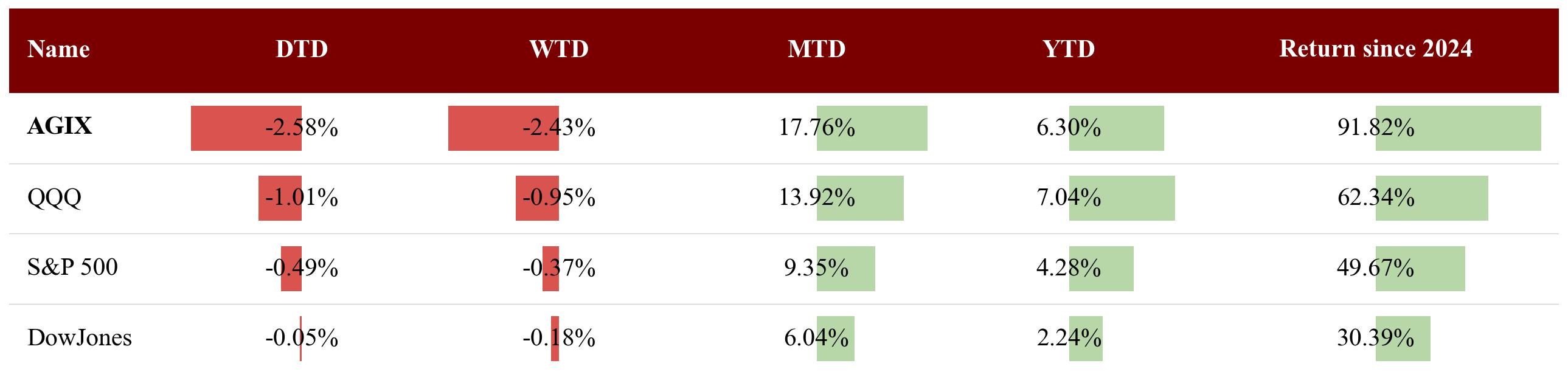
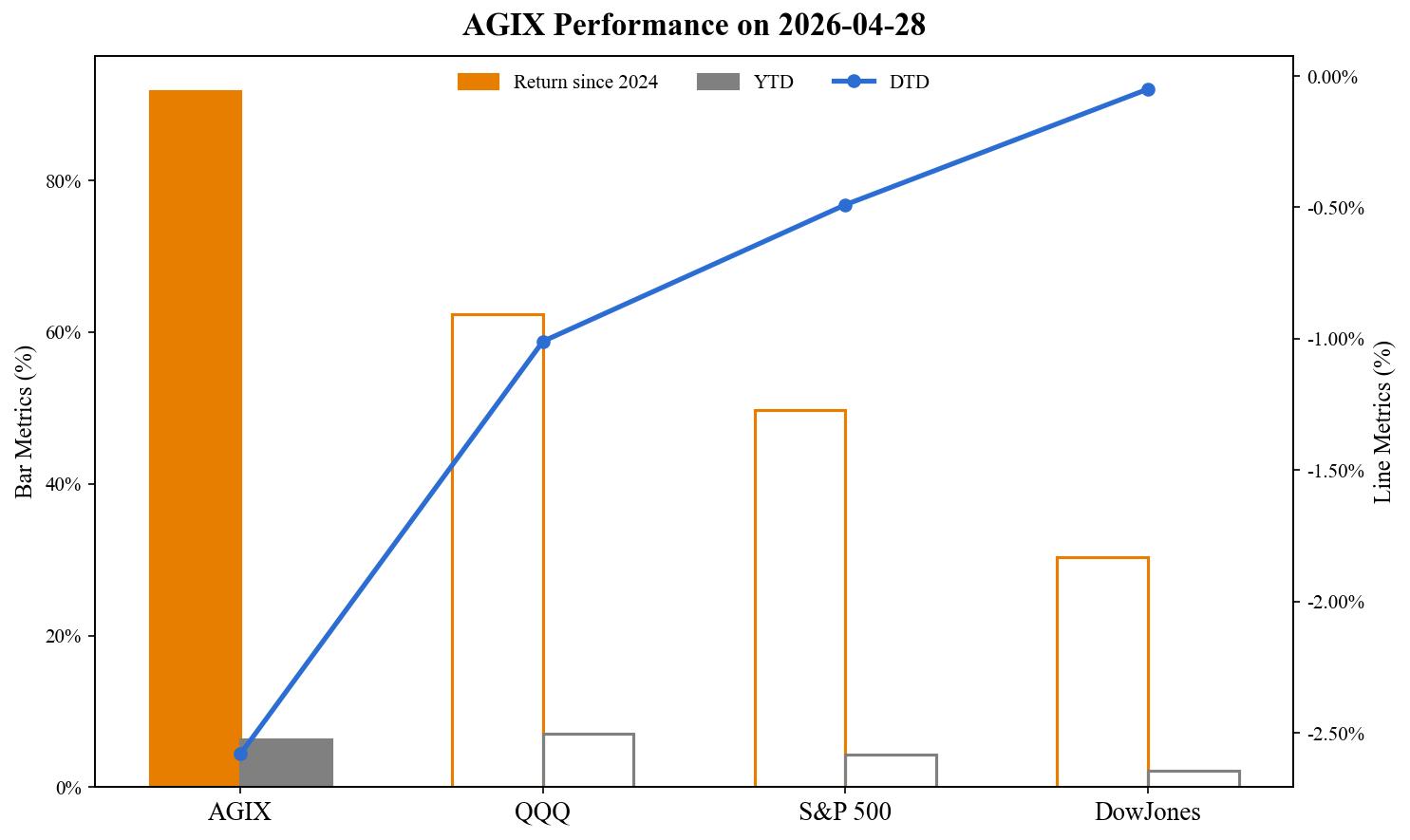
• AGIX fell 2.58% today, underperforming the S&P 500 (-0.49%) and the QQQ (-1.01%), but continues to lead on a year-to-date basis (+6.3%) and since 2024 (+91.82%).
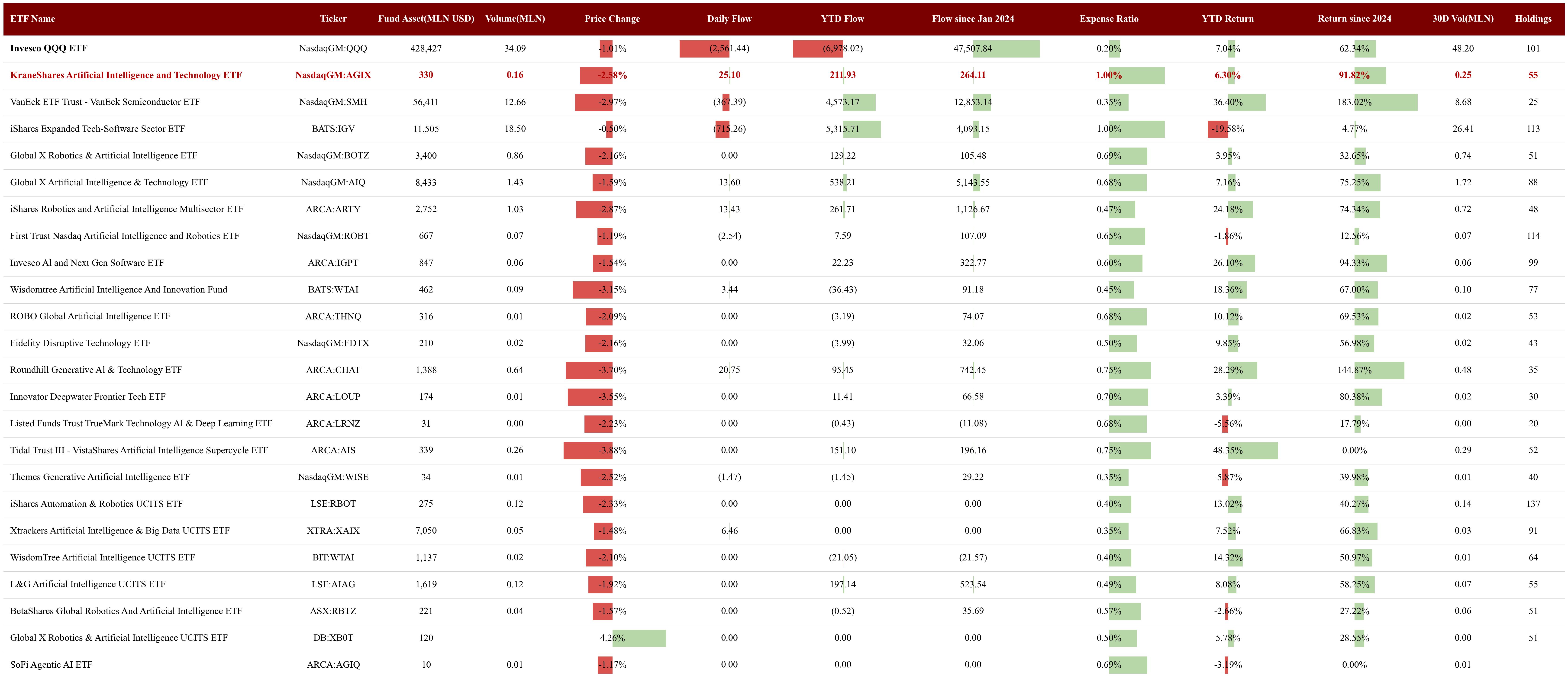
• Among peer AI ETFs, the largest single-day declines were in AIS (-3.88%), CHAT (-3.70%), and LOUP (-3.55%), reflecting broad tech weakness driven by a report that OpenAI missed growth targets, which weighed on chip stocks like Nvidia (-3.01% in SMH).
• Key AGIX holdings moving on news: Nvidia (-1.59% DTD) suffered from the OpenAI growth miss report; Broadcom (-4.39%) and Arm Holdings (-7.98%) also fell sharply. On the positive side, MediaTek (+7.39%) and Duolingo (+2.85%) gained, the former on broader semiconductor momentum and the latter without a clear catalyst.
• Stocks to watch: Nvidia (impact from OpenAI's growth slowdown and capital expenditure concerns), Broadcom and Arm (chip sector spillover), and MediaTek (strong momentum in AI hardware).
News Highlights
1. OpenAI missed ChatGPT growth targets, causing a broad sell-off in chip stocks (Nvidia -3%, AMD -11%) and raising concerns about AI demand sustainability. This directly impacts AGIX's large hardware holdings.
2. Google granted the Pentagon access to its AI for classified networks after Anthropic's refusal, sparking employee protests (950 signatories) and highlighting ethical risks. This could pressure Google's reputation but may benefit competitors like Anthropic.
3. Amazon Web Services now offers OpenAI models on Bedrock, ending Microsoft's exclusivity. This deepens competition among cloud providers and could benefit AWS's AI infrastructure partners like Nvidia.
4. Sereact raised $110M to scale its AI 'robotic brain' Cortex, expanding into the U.S. This signals growing investment in AI robotics, which may boost sentiment for automation-related holdings.
5. Ineffable Intelligence raised $1.1B at a $5.1B valuation for a 'superlearner' AI model, underscoring investor enthusiasm for foundational AI research and potential spillover to AI infrastructure names.
RSS Highlights
1. OpenAI projects ChatGPT Plus subscriptions will drop 80% (from 44M to 9M) by 2026, replaced by cheaper ad-supported tiers, signaling a shift in monetization strategy.
2. GitHub Copilot will move to usage-based pricing starting June 2026, as Microsoft loses over $20 per user monthly, highlighting the unsustainable economics of current AI subscription models.
3. Anthropic Mythos may give attackers an edge in cybersecurity by discovering zero-day vulnerabilities, raising the stakes for AI safety and defense.
4. pip 26.1 introduces lockfiles and dependency cooldowns, a significant update for Python developers managing AI/ML workflows.
5. A new 13B 'vintage' language model (talkie) trained on pre-1931 texts was released, showcasing innovative AI research directions.
Performance & Benchmark
Attribution
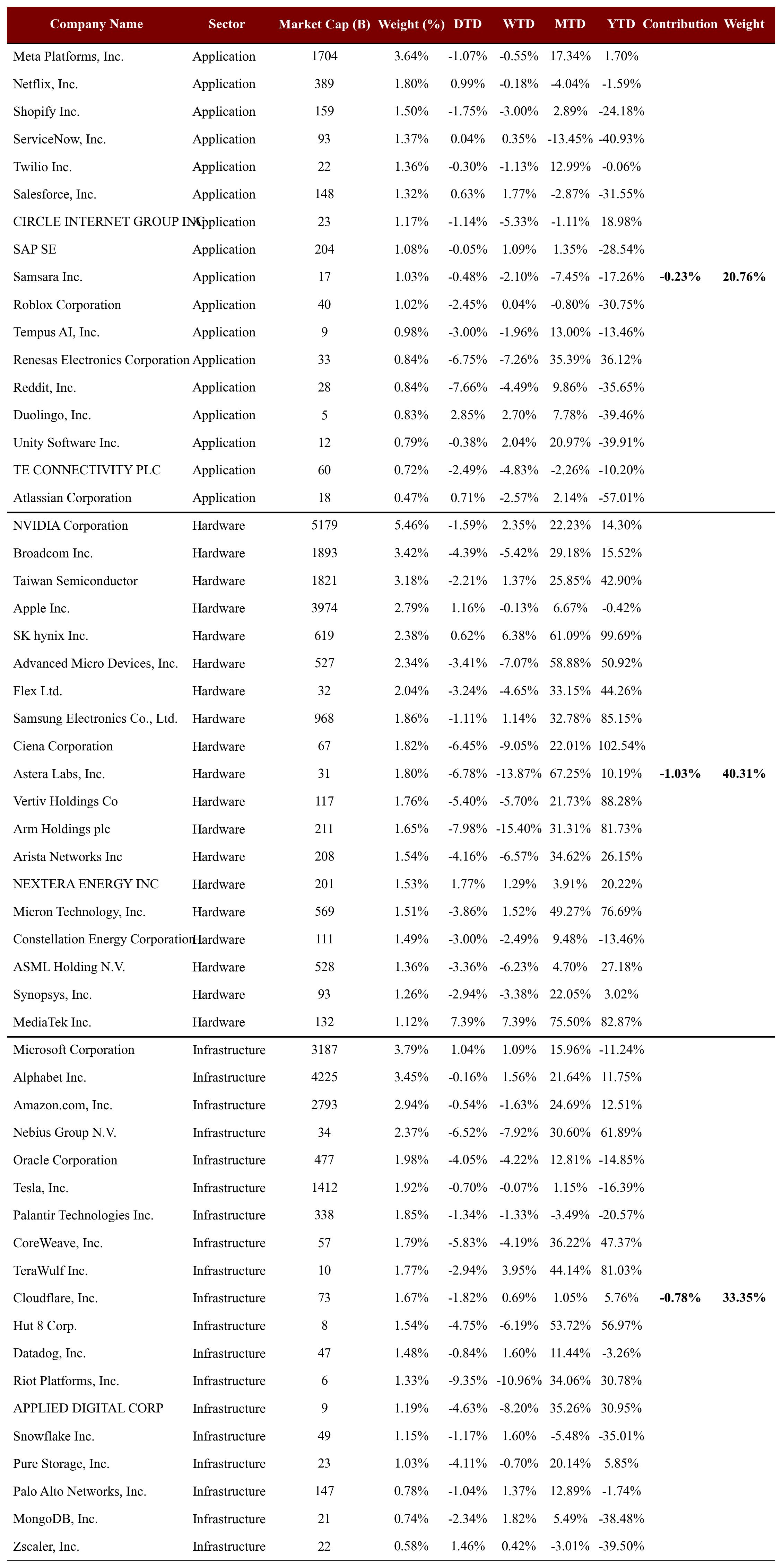
Contribution of the three sectors within AGIX holdings today
Application: -0.23%
Hardware: -1.03%
Infrastructure: -0.78%
Top-performing stocks in AGIX holdings today
MediaTek Inc. (7.39%)
Duolingo, Inc. (2.85%)
Worst-performing stocks in AGIX holdings today
Taiwan Semiconductor Manufacturing Company Limited (-2.21%)
MongoDB, Inc. (-2.34%)
Roblox Corporation (-2.45%)
TE CONNECTIVITY PLC (-2.49%)
Synopsys, Inc. (-2.94%)
TeraWulf Inc. (-2.94%)
Tempus AI, Inc. (-3.0%)
Constellation Energy Corporation (-3.0%)
Flex Ltd. (-3.24%)
ASML Holding N.V. (-3.36%)
Advanced Micro Devices, Inc. (-3.41%)
Micron Technology, Inc. (-3.86%)
Oracle Corporation (-4.05%)
Pure Storage, Inc. (-4.11%)
Arista Networks Inc (-4.16%)
Broadcom Inc. (-4.39%)
APPLIED DIGITAL CORP (-4.63%)
Hut 8 Corp. (-4.75%)
Vertiv Holdings Co (-5.4%)
CoreWeave, Inc. (-5.83%)
Ciena Corporation (-6.45%)
Nebius Group N.V. (-6.52%)
Renesas Electronics Corporation (-6.75%)
Astera Labs, Inc. (-6.78%)
Reddit, Inc. (-7.66%)
Arm Holdings plc (-7.98%)
Riot Platforms, Inc. (-9.35%)
Top five listed stocks contributing the most within AGIX holdings today
Nebius Group N.V. (-6.52%)
Broadcom Inc. (-4.39%)
Arm Holdings plc (-7.98%)
Riot Platforms, Inc. (-9.35%)
Astera Labs, Inc. (-6.78%)
Observation
The strongest movers across peer ETF holdings today are listed below:
| DTD | Stock Ticker | Name | Held by ETFs | analysis |
|---|---|---|---|---|
| 20.94 | NasdaqGS:OMCL | Omnicell, Inc. | ['NasdaqGM:BOTZ', 'NasdaqGM:ROBT', 'ASX:RBTZ', 'DB:XB0T'] | Omnicell (OMCL) surged 20.94% on April 28, 2026, primarily driven by strong Q1 2026 earnings results showing revenue growth from connected devices and a 112% EPS surge tied to Titan XT platform momentum.[5][7] The company also unveiled the new Titan XT automated dispensing platform integrated with OmniSphere cloud, positioning it for deeper penetration in large health systems.[1] Additionally, Omnicell raised FY2026 EPS guidance to $1.80-$2.00 (above consensus $1.60) and revenue to $1.2B-$1.3B, fueling investor optimism.[2] |
| 10.82 | NasdaqGS:CVLT | Commvault Systems, Inc. | ['BATS:IGV', 'ARCA:AIS', 'XTRA:XAIX'] | Commvault Systems (CVLT) stock surged 10.82% on April 28, 2026, primarily due to better-than-expected Q4 fiscal 2026 earnings. The company reported EPS of $1.28 versus $1.09-$1.11 expected and revenue of $311.69M (up 13.3% YoY), beating estimates by 17% on EPS and 1.67% on revenue, alongside record $132M free cash flow and 21% total ARR growth (42% in SaaS ARR).[1][2][3][4] Shares gapped up from $88.41 to open at $98, reflecting strong market reaction to the results and management commentary on hitting all guided metrics.[1][3] |
| 10.46 | NYSE:BBAI | BigBear.ai Holdings, Inc. | ['NasdaqGM:ROBT', 'NasdaqGM:WISE', 'BIT:WTAI'] | No specific news events, company disclosures, or catalysts on April 28, 2026, explain BBAI's 10.46% single-day gain to $3.73, as search results lack same-day announcements or filings.[2][3][4] A technical "dogey candle" formed in the session, potentially signaling short-term momentum amid a downtrend with support at $3.02, but no fundamental drivers like contract wins or macro updates surfaced.[2] Broader positives from prior Q4 2025 earnings (e.g., Ask Sage acquisition, $400M+ backlog, 2026 revenue guide of $135M-$165M) may have supported sentiment, though the stock had declined YTD.[1] |
| 9.56 | TWSE:4919 | Nuvoton Technology Corporation | ['LSE:RBOT'] | Nuvoton Technology (TWSE:4919) surged 9.56% on April 28, 2026, primarily driven by a 29% upward revision in the analyst price target to NT$74.67, signaling improved growth expectations including forecast earnings growth of 126.92% per year.[5] The stock traded at NT$149 amid elevated volume, reflecting strong market reaction to the positive valuation update and perceived good value relative to peers.[2][4][5] No specific same-day news events or company disclosures were identified in available data.[1][3][4] |
| 7.39 | TWSE:2454 | MediaTek Inc. | ['NasdaqGM:AGIX', 'ARCA:IGPT', 'ARCA:THNQ', 'LSE:AIAG'] | No specific news events, company disclosures, or catalysts on April 28, 2026, explain MediaTek's (TWSE:2454) 7.39% single-day gain, as search results lack same-day details.[1][2][3][4][5] The move may reflect broader semiconductor sector momentum or trading activity, with recent market cap noted at 2.81T TWD amid positive 2024 revenue growth of 22.41%.[1] Historical data sources confirm price tracking but provide no event attribution for the date.[4][5] |
| 6.24 | TWSE:6531 | AP Memory Technology Corporation | ['ARCA:AIS'] | AP Memory Technology (TWSE:6531) rose 6.24% on April 28, 2026, primarily driven by a strong market reaction to the stock meeting TWSE's "Attention Securities" criteria for three consecutive trading days, triggering regulatory monitoring announced on April 27 that often signals heightened investor interest in momentum plays.[4] No specific company disclosures or industry news directly tied to the date explain the move, with recent quarterly results showing net income decline but in-line revenue.[3] Broader semiconductor sector strength and technical buy signals may have provided secondary support.[3] |
| 5.94 | TWSE:3443 | Global Unichip Corp. | ['NasdaqGM:AIQ', 'ARCA:IGPT', 'ARCA:THNQ', 'LSE:RBOT', 'LSE:AIAG'] | Global Unichip Corp. (TWSE:3443) rose 5.94% on April 28, 2026, primarily driven by its earnings report release, which triggered mandatory financial disclosures due to recent share price volatility.[2][4] Positive analyst forecasts, including 26.4% annual earnings growth and 24.1% revenue growth, likely amplified the reaction amid strong semiconductor sector tailwinds.[3] No other same-day news events were identified in available data. |
| 5.92 | KOSE:A005380 | Hyundai Motor Company | ['NasdaqGM:ROBT', 'BATS:WTAI'] | Hyundai Motor's 5.92% gain on April 28, 2026, was primarily driven by a strong performance in the Korean carmaker sector amid the KOSPI index hitting a record high ahead of U.S. big tech earnings. Carmakers led the bullish sentiment, with Hyundai Motor rising to 555,000 won and sister company Kia advancing 1.9%.[3] Technical factors, including buy signals from short- and long-term moving averages within a rising trend, provided additional support.[1] |
| 5.72 | TSE:6516 | Sanyo Denki Co., Ltd. | ['LSE:RBOT'] | Sanyo Denki's 5.72% gain on April 28, 2026 was driven primarily by a significant profit surge reported that day. Search results indicate the stock surged 27.9% in pre-market trading on April 28, 2026, with headlines referencing "Sanyo Denki Profit Surges," suggesting strong earnings or financial results were the primary catalyst for the substantial single-day move. |
| 5.52 | TWSE:2345 | Accton Technology Corporation | [] | No specific news events, company disclosures, or catalysts on April 28, 2026, explain Accton Technology Corporation's (TWSE:2345) 5.52% single-day gain. Search results lack same-day announcements, earnings releases, or industry developments tied to the date. The move may reflect broader market momentum or trading factors in the AI/networking sector, but remains unattributed based on available public information. |
| 5.34 | NasdaqGM:DOMO | Domo, Inc. | ['LSE:RBOT'] | No specific company news, disclosures, or events explain Domo (DOMO)'s 5.34% gain on April 28, 2026, as search results lack same-day catalysts and focus on outdated data from 2025 or general forecasts.[5] Technical factors, including buy signals from short- and long-term moving averages amid a rising short-term trend, likely supported the move alongside elevated volatility (15.72%).[1][2] Analyst consensus remains moderately positive with an average price target of $6.92-$15.13, potentially aiding sentiment.[3][4] |
| 5.32 | NasdaqGS:OPRA | Opera Limited | [] | Opera Limited (OPRA) shares rose 5.32% on April 28, 2026, primarily driven by strong Q1 2026 earnings that beat expectations with revenue of $175.8-176.65 million (up 23% YoY) and adjusted EBITDA up 30% to $42 million.[1][2] Management raised full-year 2026 guidance to $727-740 million in revenue (18-20% growth) and $170-174 million in adjusted EBITDA at a 23% margin, alongside Q2 revenue guidance of $176-178 million.[1][2] The stock gapped up from a $16.91 close to open at $17.99 and traded around $18.54, reflecting positive market reaction despite some profit-taking.[1][3] |
| 5.22 | TSE:6258 | Hirata Corporation | ['NasdaqGM:BOTZ', 'LSE:RBOT', 'ASX:RBTZ', 'DB:XB0T'] | No specific news events, company disclosures, or catalysts explain Hirata Corporation's (TSE:6258) 5.22% single-day gain on April 28, 2026, as search results lack same-day announcements or relevant updates.[1][5] Recent trading data shows volatility with a weekly decline of -8.53% prior to the move, but no direct drivers like earnings (next expected Q1 2025) or sector news are tied to the date.[1][3] The surge may reflect technical rebound or broader market factors absent from available public information.[1][5] |
| 5.2 | TWSE:2308 | Delta Electronics, Inc. | ['NasdaqGM:ROBT'] | Delta Electronics (TWSE:2308) rose 5.2% on April 28, 2026, primarily driven by the record date for its dividend distribution, which typically boosts investor buying ahead of the ex-dividend adjustment.[5] Supporting the positive momentum, the stock benefited from strong year-to-date performance exceeding 115% amid confidence in its power and thermal management segments.[4] A subsidiary EGM resolution announcement earlier in April added to favorable corporate updates.[6] |
News
Funding & M&A
Sereact raises $110M to scale AI ‘robotic brain’ and expand into the US.
German robotics startup Sereact GmbH announced a $110 million Series B funding round, bringing total funding to over $140 million, to expand its AI 'robot brain' platform Cortex and enter the U.S. market. Founded in 2021 by former University of Stuttgart AI researchers Ralf Gulde and Marc Tuscher, the company's Cortex foundation model interprets natural language instructions and translates them into physical actions, allowing robot task reassignment without writing new code. The latest version, Cortex 2.0, integrates vision-language-action models with world models, enabling robots to predict action consequences by simulating future movements and assessing stability and risk under physical models. The software is hardware-agnostic, supporting various robot arms, mobile manipulators, and humanoid platforms. It has deployed over 200 systems in Europe, completing over 1 billion production picks with only 1 in 53,000 requests requiring human intervention. Key customers include BMW, Daimler Truck, PepsiCo, and European e-commerce logistics firms Bol and Active Ants. The round was led by Headline VC, with participation from Bullhound Capital, Felix Capital Partners, and others. Sereact plans to open its first U.S. office in Boston and hire a local team. The technology differentiates from end-to-end models by competitors like Physical Intelligence, Skild AI, and Covariant AI, and has the potential to reshape global supply chains and manufacturing.
The third leg of AI’s infrastructure race isn’t silicon or power. It’s capital.
The AI race is shifting from chip and power shortages to financial bottlenecks. Argentum AI, by aggregating $50 billion in demand interest representing over 400,000 GPUs, has closed a $1.5 billion pipeline, creating a new category of 'infrastructure as a financial product.' CEO Andrew Sobko emphasizes the triad of 'power, compute, and capital,' turning capital into a product feature rather than a constraint. While traditional industries view financing as a back-office function, Argentum disrupts this paradigm by building a multi-trillion-dollar AI infrastructure roadmap through precision project financing. Its model reduces upfront capital, accelerates deployment, and is replicable across multiple sites, with each deployment starting from signed contracts and capital following customers. Argentum decouples hardware from geography, covering 16 sites across 8 countries with 2.4 gigawatts of power capacity, flexibly allocating cluster specifications, cooling, and location. Financial engineering attracts equipment financing firms and private credit funds, developing a GPU-backed debt framework using Nvidia GPUs as collateral, take-or-pay contracts, and hardware residual value floors, similar to energy or telecom financing. Sobko states that silicon and megawatts are inputs, and the output is financeable, contracted, institutional-grade cash flow. AI adoption is now constrained by capital formation, and Argentum's rise signals that infrastructure has become a capital markets challenge, with those who solve it shaping AI's speed and scale.
Ineffable Intelligence raises $1.1 billion at a $5.1 billion valuation to build an AI 'superlearner'.
British AI startup Ineffable Intelligence Ltd. recently completed an $1.1 billion seed round, reaching a post-money valuation of $5.1 billion. The round was led by Lightspeed Ventures and Sequoia Capital, with participation from Nvidia Corp., Google LLC, the UK Sovereign AI Fund, DST Global, Index Ventures, and others. The company is led by renowned AI researcher David Silver, who spent over a decade at Alphabet Inc.'s DeepMind and led the development of the revolutionary AlphaGo model released in 2016, which defeated the world's top Go players and attracted over 200 million viewers. DeepMind later used related technology to create the math optimization AI AlphaProof, which won a bronze medal at the 2024 International Mathematical Olympiad. Ineffable Intelligence aims to build a 'superlearner' AI model that can acquire entirely new knowledge, accelerating scientific and engineering research. The company plans to use reinforcement learning methods for training, skipping traditional pre-training steps, and having models learn from each other in simulated environments, similar to AlphaGo's self-play strategy. Two months earlier, another startup, AMI Labs Inc., raised $1.03 billion to develop a world model for optimizing aircraft component design. This massive funding round highlights investors' enthusiasm for innovative AI technology.
SkyfireAI lands $11M to bring AI autonomy to public safety and defense drones
Autonomous drone startup SkyfireAI Inc. today announced a new $11 million funding round to accelerate the development of its dual-use, AI-native platform supporting autonomously coordinated multi-drone operations. Founded in 2022, the company's platform is designed for public safety, defense, and other mission-critical organizations, helping them respond faster, expand situational awareness, and scale drone operations without a corresponding increase in operator workload or staffing. SkyfireAI builds the software foundation for autonomous drone operations, with its platform covering the full mission lifecycle, including planning, deployment, coordination, and operational oversight. This enables organizations to scale drone programs in real-world operational environments. The platform differentiates itself from other drone market offerings by not providing a single solution or tying to specific hardware, instead adopting a systematic autonomy approach that adapts to the real-world demands of emergency response and defense operations, such as time pressure, safety requirements, regulatory constraints, and hostile or contested environments. Co-founder and CEO Don Mathis stated that when every second counts, teams need faster field visibility, better coordination, and better information. SkyfireAI's AI-native autonomous technology helps frontline rescue, defense operations, and other critical teams deploy drones faster, manage complex missions, and ultimately save more lives. The company currently works with federal, state, and local public safety, law enforcement agencies, commercial critical infrastructure customers, and a growing number of defense clients, with the platform covering scenarios such as 911 response, critical incident monitoring, life-saving medical deliveries, event crowd safety, and perimeter defense. The seed round was led by Mucker Capital LP, with participation from AI Fund LP, SaaS Ventures, Halogen, Harvard Business School Alumni Angels, and New York Angels Inc. Mucker Capital co-founder Erik Rannala praised the SkyfireAI team for combining deep technical and operational experience with a clear platform strategy, positioning it as a trusted technology provider for organizations relying on real-time intelligence and rapid response.
BCI startup Neurable looks to license its 'mind-reading' technology for consumer wearables.
Brain-computer interface (BCI) technology is moving from science fiction to reality, becoming a hot spot in the tech industry. Neurable recently announced it is seeking to license its 'mind-reading' technology to consumer wearable device manufacturers to accelerate commercialization. The company focuses on non-invasive BCI, using EEG sensors and AI signal processing to analyze user brain activity and provide cognitive performance data, avoiding the surgical risks of implantable chips like those from Elon Musk's Neuralink. Neurable completed a $35 million Series A funding round last December to expand commercialization. This week, the company launched a licensing platform allowing OEMs to integrate AI brain-sensing technology into hardware such as headphones, hats, glasses, and headbands while retaining control over product design and distribution. Neurable has partnered with HP Inc.'s HyperX gaming brand to develop headsets that optimize gaming focus, and with iMotions, a human behavior research platform, to advance R&D. CEO Ramses Alcaide said the company is moving from specific partners to large-scale expansion, aiming to make brain-sensing technology as common as wrist-based heart rate sensors. The company emphasizes data privacy, encrypting and anonymizing user neural data in compliance with HIPAA standards, and using it only with consent for specific AI training. Alcaide believes the industry is at an 'inflection point,' with neurotechnology entering a scalable business model.
Liquid Instruments lands $50M to scale AI-driven test and measurement platform
Software-defined test and measurement startup Liquid Instruments Pty. Ltd. announced the completion of a $50 million Series C funding round, bringing total funding to over $100 million. The round was co-led by Keysight Technologies Inc. and the National Reconstruction Fund Corporation of Australia, aiming to accelerate product development, expand the AI-driven platform, and increase market presence in aerospace, defense, and semiconductors. Founded in 2014 and headquartered in Canberra, Australia, with an office in San Diego, Liquid Instruments' core product line, Moku, is a reconfigurable test hardware that consolidates traditional rack-mounted instruments into a single software-defined device. The platform is based on FPGA hardware with a software layer, allowing users to flexibly change device functions, suitable for quantum computing, aerospace payloads, defense systems, and semiconductor research. The company emphasizes that this solution significantly reduces the cost of specialized instruments, saves lab space, and supports custom digital signal processing, particularly for fast-iterating quantum research scenarios. The funding comes with strategic partnerships: Keysight and Liquid Instruments have reached a commercial agreement to jointly develop AI-driven instruments. The National Reconstruction Fund's investment highlights the Australian government's support for local capabilities in key technology areas. The company's global users include tech enterprises, research institutions, quantum startups, and defense giants, such as national labs, university physics departments, and production test environments of electronics manufacturers. CEO Daniel Shaddock stated that this collaboration will accelerate users' transition to more flexible AI tools.
Phenom adds Plum psychometric science to its agentic AI hiring stack.
Phenom People Inc., an AI human resources company, announced the acquisition of Plum.io Inc., a psychometric talent assessment company that focuses on measuring durable skills AI cannot replicate, such as empathy, judgment, adaptability, and resilience, to quantify employee potential. Founded in 2012, Plum leverages industrial-organizational psychology and uses its Role Model technology to match behavioral blueprints against over 40,000 real job profiles, providing validated predictions of candidate fit. Its assessments are four times more accurate than resume screening and are independently audited to ensure no demographic bias. The Plum platform covers the full talent lifecycle, including recruitment, internal mobility, succession planning, leadership development, and manager coaching. After the acquisition, Plum's technology will combine with Phenom's agentic delivery and Hypercell context to help enterprises assess the durable human skills that determine job success at scale, addressing the challenge of scaling traditional behavioral science in hiring. Phenom co-founder and CEO Mahe Bayireddi said that AI commoditizes general intelligence, making human skills more important, and this move expands behavioral assessments to every role and market. This is Phenom's third acquisition this year, following the acquisitions of Included Inc. and Be Applied Ltd., with the transaction amount undisclosed. Plum previously raised $12.1 million in funding.
Silverfort acquires Fabrix Security to bring AI decision-making to runtime access control.
Silverfort Inc., a unified identity security company, today announced the acquisition of Fabrix Security Ltd., an AI-native identity security company, for an undisclosed price. Founded in 2024, Fabrix provides an AI-native identity security platform for enterprise identity and access management teams, helping process access decisions for human and non-human identities—including service accounts, API keys, bots, and AI agents—faster and more accurately. Its platform runs an identity knowledge graph that analyzes access activity, organizational context, and intent, combined with AI agents to handle authorization decisions, instant access requests, and full identity lifecycle management. The technology aims to replace traditional manual rule reviews with continuous, context-aware decision-making to address the challenge of surging agent and machine identities outpacing legacy tools. Silverfort plans to integrate Fabrix's identity-centric AI decision engine with its Runtime Access Protection technology, helping enterprises securely adopt agentic AI and scale business without losing control. Silverfort co-founder and CEO Hed Kovetz stated that this move will empower enterprises to dynamically and continuously protect all identities, setting a new standard for identity security in the AI era using a runtime AI decision engine. Before the acquisition, Fabrix raised $8 million from investors including Norwest Venture Partners, ToDay Ventures, Jibe Ventures, and executives from Google, Palo Alto Networks, Cyera, Microsoft, Tenable, and Nvidia. This acquisition strengthens AI innovation in the identity security space.
Model Releases
Nvidia introduces Nemotron 3 Nano Omni with vision and speech for powerful agentic AI use.
Nvidia Corp. recently launched a revolutionary reasoning AI model called Nemotron 3 Nano Omni, which has approximately 30 billion parameters and uses a mixture-of-experts (MoE) architecture, unifying text, vision, and voice capabilities to become the 'brain' for faster, smarter agentic AI applications. By integrating vision and audio encoders with a 30B-AD3B hybrid MoE architecture, the model eliminates the need for separate perception modules, achieving all-in-one integration and improving large-scale efficiency, with throughput up to 9 times faster than other open-source multimodal models on the market. H Company CEO Gautier Cloix said that using this model, their agents can quickly parse full HD screen recordings, which was previously difficult. The Nemotron 3 Nano Omni is compact enough to run on high-end consumer hardware or be efficiently deployed in enterprise clouds, and it can be used in combination with other Nvidia Nemotron series models such as the Nemotron 3 Super. The model excels at quickly understanding documents, computer displays, voice activity, videos, and more, serving as a bridge between humans and complex machine states, and rapidly converting user conversations into reasoning. Nvidia revealed that the Nemotron family (including Ultra, Super, and Nano) has been downloaded over 50 million times in the past year. The Omni variant extends into multimodal and agentic domains and is now available on Hugging Face, OpenRouter, and build.nvidia.com as Nvidia NIM microservices, supporting local hardware deployment by developers, including Nvidia DGX Spark.
Technical Breakthroughs
Red Hat's OpenClaw maintainer just made enterprise Claw deployments a lot safer.
Red Hat principal software engineer Sally O'Malley on Tuesday released the open-source tool Tank OS, designed to simplify and securely deploy and manage OpenClaw AI agents. The tool is specifically aimed at advanced users on personal computers and enterprise IT professionals, helping maintain OpenClaw instances at scale. As a maintainer of the OpenClaw project, O'Malley focuses on enterprise-grade applications, with deep integration into Red Hat's Linux variants like Fedora. Tank OS uses Podman container technology, developed by Red Hat colleagues, to package OpenClaw into bootable images, supporting features like state memory and API key storage, ensuring isolation between multiple instances to avoid credential sharing and potential risks. Although the OpenClaw open-source project is improving security, O'Malley emphasizes its power requires careful configuration to avoid incidents like Meta AI researchers' emails being deleted or WhatsApp messages being leaked. While Tank OS is not beginner-friendly, it provides an efficient solution for IT teams managing enterprise-grade OpenClaw fleets, competing with similar solutions like NanoClaw and Docker. O'Malley is optimistic about OpenClaw driving the普及 of open, secure AI, with personal interest driving the project's development, envisioning a future of millions of interconnected autonomous agents. This move highlights the open-source community's innovation in the secure deployment of AI agents.
Startup Lovelace targets contextual AI engine at mission-critical use cases
Lovelace AI Inc. officially exited stealth mode today, launching innovative enterprise-grade AI solutions designed for high-stakes decision-making environments such as the public sector, national security, disaster response, and healthcare. The company's core product, Elemental, is a 'context engine' builder that sits between AI agents and underlying data systems, transforming fragmented data into structured knowledge graphs, enabling AI agents to navigate and query efficiently, providing research-grade analysis with citations. The backend YottaGraph can handle trillions of interconnected facts, merging internal data with external intelligence, ingesting approximately 1 billion facts weekly from sources including global news, social media, shipping data, logistics information, and satellite imagery. The system answers investigative questions using one-thousandth the token usage, greatly improving efficiency, and ensures accuracy through entity resolution while tracking the source of each inference to maintain trust. Founder Andrew Moore, former head of Google Cloud AI, dean of Carnegie Mellon University's School of Computer Science, and the first AI advisor to the U.S. Central Command, emphasized that this platform is deployed in customer environments, providing high control and avoiding data leakage risks. Lovelace targets large enterprises, focusing on AI-driven productivity scenarios, addressing pain points of traditional implementation failures. The technology is applicable to high-risk, high-reward fields like financial services, marking a new era of reliable and trustworthy enterprise AI.
AI writes enterprise code fast. Cleaning it up is another story entirely.
Although AI-generated code accelerates application development, building reliable enterprise-level systems still faces significant challenges. Medhat Galal, Senior Vice President of Engineering at Appian Corp, pointed out at Appian World 2026 that many organizations neglect governance in rapid prototyping, leading to technical debt and maintenance issues. Research shows that development based on intuition or specifications struggles to produce production-ready enterprise software, and prototypes often stall due to functionality and security problems. Galal emphasized that while AI code may seem impressive, complexity surges when integrating data, authentication, and authorization systems; even if functional, ensuring security is difficult, and model changes trigger cascading maintenance. Enterprise software projects take years rather than weeks precisely because they involve multiple layers of abstraction such as integration, orchestration, business rules, and user interfaces. By embedding AI in governance processes and setting agent guardrails, Appian reduces rework and technical debt, claiming its platform is purpose-built to address these pain points. Galal humorously remarked, 'I write code so you don't have to,' but AI development remains challenging. The interview, hosted by theCUBE, reveals that AI development is no shortcut, and enterprises must focus on reliability and sustainability to avoid transitioning from innovators to maintainers of AI systems.
Product Launches
AWS accelerates enterprise agentic automation with an expanded Amazon Connect portfolio.
Amazon Web Services (AWS) recently launched an expanded Amazon Connect portfolio, pushing agentic AI further up the software stack with four new services: Amazon Connect Customer AI (formerly Amazon Connect cloud contact center reinvention), Amazon Connect Decisions, Amazon Connect Talent, and Amazon Connect Health. These services target industry-specific workflows, providing automation solutions such as identity verification, payment processing, supply chain optimization, recruitment automation, and healthcare administration. Since its launch in 2017, Amazon Connect has evolved from a phone routing engine to an intelligent customer interaction platform integrating natural language processing and sentiment analysis. The new services are based on the 'humorphism' concept, allowing AI agents to simulate human behavior, autonomously learn context, and prioritize tasks. Amazon Connect Decisions uses the Amazon Chronos2 model for time series prediction, handling supply chain anomalies and recommending solutions; Connect Talent automates recruitment interviews and provides capability scores; Connect Health generates real-time clinical notes. This move marks AWS's shift from infrastructure to application-layer development of industry-specific AI systems, contrasting with the general AGI paths of Anthropic and OpenAI. Analysts believe this move leverages Amazon's internal operational expertise and could disrupt talent recruitment and supply chain management, helping enterprises with AI transformation.
Amazon revamps Quick as a proactive desktop app that gets work done.
Amazon.com Inc. recently made a major upgrade to its desktop AI assistant Amazon Quick, aiming to address the friction caused by generative AI tools in use. Unlike traditional chatbots, the new Quick is a native desktop application that can be directly downloaded and installed without an AWS account, deeply integrating into the user's work environment. The assistant monitors desktop activity to build a personal knowledge graph, connecting local files, calendars, emails, and key applications to deliver proactive services. For example, it can remind users of unanswered priority emails, deals pending updates in Salesforce, or documents requiring attention. Additionally, Quick supports drafting emails, editing documents, implementing feedback based on Slack comments, and managing tasks such as sending Slack messages to managers, updating documents, or responding to Jira tickets. Amazon emphasizes that Quick goes beyond passive responses, proactively offering insights like 'What did I miss today?' or 'What should I prioritize?' In the long term, Amazon hopes Quick will become the core connection for enterprises, completely eliminating the burden of information searching and reminders. This update marks Amazon's deeper push into the AI assistant space, enhancing the intelligence level of productivity tools.
Snapchat brings AI-powered conversational advertising to its app.
Snapchat announced on Tuesday the launch of 'AI Sponsored Snaps,' an ad format that will be embedded directly in the app's main chat tab, allowing users to interact with brand AI agents by asking questions and getting recommendations. Previously, users could not interact with these ads, and the new feature marks Snapchat's further integration of AI into the ad experience. Although some users may be cautious about AI ads, Snapchat emphasizes that its community has widely embraced AI conversations, with over 500 million users interacting with its AI chatbot since its launch in 2023. Snap's Chief Business Officer Ajit Mohan said, 'Conversations are becoming the most valuable real estate in advertising, and AI is accelerating this shift, turning chats into real-time product discovery and decision-making spaces.' The new feature gives brands access to nearly 1 billion monthly active users and allows them to introduce their own AI agents to boost engagement and purchase conversion. Snapchat data shows that existing Sponsored Snaps already achieve 22% higher conversion rates and nearly 20% lower cost per action. The new format deepens user engagement through personalized AI interactions, with 85% of users regularly interacting with the chat feed, and over 950 billion chat messages sent in Q1 2026. Teen usage is even higher, with 57% of teens messaging daily, and 40% of them sending multiple messages. This move strengthens Snapchat's competitiveness in AI-driven advertising.
Process orchestration helps financial firms govern trillions without losing control of AI.
At the Appian World 2026 summit, Appian Corp co-founder and CEO Matt Calkins and CIBC Mellon CEO Mal Cullen discussed the deployment challenges of Agentic AI in the financial services sector. Regulated industries face the dual pressure of rapid deployment and strict governance, making process-oriented AI a key solution that combines AI's probabilistic capabilities with deterministic process structures to ensure auditable and reversible outcomes. CIBC Mellon, a joint venture between The Bank of New York Mellon and the Canadian Imperial Bank of Commerce, currently deploys AI in production only on the Appian platform, as it provides a rigorous governance model supporting transparent auditing and documentation, avoiding unmanaged risks to clients. Appian's AI process orchestration approach emphasizes the human-in-the-loop role: AI must first present all rules, interfaces, and data structures for human review, and only execute after explicit approval. This model helps CIBC Mellon address regulatory changes for mutual fund and ETF cost transparency reporting in Canada by the end of 2025. Its team used Appian to rapidly build customer-facing applications, successfully delivering on time—something that would otherwise have been difficult. Cullen emphasized that relying on the global BNY platform would have made timely changes impossible. In high-risk asset servicing, such governance frameworks are critical to prevent a single ungoverned AI deployment from affecting trillions in assets. Experts note that agentic AI requires strict process constraints to prevent derailment, ensuring adaptive intelligence is only activated when necessary. This partnership highlights the practical value of process-centric AI in financial modernization.
'Code is cheap. Mistakes are expensive': Appian gives vibe coding an enterprise reality check
Enterprise automation company Appian Corp. is working to transform AI-assisted creation into governed workflows, addressing the tension between accelerated software development driven by the rise of vibe coding and enterprise audit requirements. Medhat Galal, Appian's Senior Vice President of Engineering, said in an interview with theCUBE at Appian World 2026 that the platform must provide appropriate rigor, with every step requiring interception, testing, and evaluation to avoid 'cognitive debt'—where AI makes software creation seem easy but leaves behind systems that are difficult to explain or govern. Galal emphasized that users, as industry experts, do not need to master AI prompt engineering; the platform provides them with key decision points to ensure accountability. As AI compresses code generation costs, review, testing, and governance become the new bottlenecks—'code is cheap, errors are expensive.' Appian uses independent verification, human review, and system-level pipelines to ensure generated code and processes are safe for production, treating governance as a permanent condition for AI adoption. Galal envisions a future where software develops healthily through accountability, responsibility, and ethical use, creating win-win outcomes for enterprises and customers. This move highlights the shift in enterprise AI development from speed to rigorous governance.
Amazon launches an AI-powered audio Q&A experience on product pages
Amazon launched a new AI-powered feature called 'Join the chat' on Tuesday, allowing users to ask questions about products and receive conversational audio responses in real time. The feature is generated by what Amazon calls 'AI-powered shopping experts,' presenting information in a natural discussion style, aiming to save users time by avoiding lengthy descriptions or reviews. The AI integrates product features, customer feedback, and other insights; for example, users can ask if a coffee maker is suitable for beginners or if a sweater is itchy. The AI builds on previous responses to provide more relevant information, avoiding repetition, simulating the experience of talking to a knowledgeable in-store associate. 'Join the chat' is part of the 'Hear the highlights' experience, which provides short audio summaries for millions of product pages in the Amazon Shopping app. This feature has been in testing since last May and is currently limited to some products in the U.S. Users open a product page, click the 'Hear the highlights' button below the image, and can listen to an overview or start 'Join the chat' for text/voice interaction, with audio continuing to play while browsing. This feature expands Amazon's lineup of AI shopping tools, including the generative AI assistant Rufus (for research and product comparison), Interests (for tracking preferences and recommending new items), and 'Help me decide' (for suggesting products based on search, browsing, and purchase history), further enhancing the intelligence of shopping.
SAS expands agentic AI and governance capabilities with broad platform updates.
SAS Institute Inc. announced a series of product updates at this week's SAS Innovate conference, aimed at helping enterprises operationalize AI through stronger governance, integrated data management, and expanded agentic AI capabilities. These updates are centered around the new SAS AI Navigator, a SaaS service currently in private preview for inventorying, monitoring, and governing AI use cases across models, agents, and business processes, addressing the 'shadow AI' problem—tools and models running outside IT organizations. SAS cited research showing that the adoption of large language models and AI agents is outpacing investment in trusted AI, with Gartner predicting that by 2030, over 40% of enterprises will experience security or compliance incidents due to shadow AI. The SAS Viya platform also received major enhancements, supporting the combination of copilots and agents with human judgment and enterprise governance to improve decision confidence. The new SAS Viya Copilot is an embedded AI assistant that supports natural language data exploration, model development, and decision-making while maintaining governance controls. The company also introduced a server based on the open Model Context Protocol, and an Agentic AI Accelerator for building and deploying governed agents. Additionally, SAS launched a supply chain agent for real-time optimization of sales and operations planning, and updated its data management portfolio, including SAS SpeedyStore for in-place data analysis. These capabilities move enterprises from generative AI experimentation to integrated systems that meet regulatory and operational needs, with AI Navigator expected to be available through Microsoft Azure Marketplace in the third quarter of 2026.
Amazon Connect’s second act: From contact center to agentic AI suite.
Amazon Web Services (AWS) recently rebranded Amazon Connect as a family of agentic AI solutions, expanding into supply chain, high-volume recruitment, customer experience, and healthcare. The new product portfolio includes Amazon Connect Decisions for optimizing supply chain forecasting, Amazon Connect Talent for accelerating high-volume recruitment, Amazon Connect Customer (formerly Connect reinvention) for enhancing customer interactions, and Amazon Connect Health for supporting healthcare delivery. These products are derived from Amazon's large-scale internal operations, such as managing a 400 million SKU catalog and seasonally hiring 250,000 employees, adopting a 'humorphism' design philosophy that makes AI reason, remember, and collaborate with humans like a teammate, rather than replacing jobs. Vice President Pasquale DeMaio emphasized that AI handles screening before handing over to human decision-making, ensuring humans have the final say. Amazon is enterprise-izing its internal tools, drawing on experience from One Medical and Amazon Pharmacy, and providing clear performance metrics such as reducing recruitment cycles to one day and improving forecast accuracy. Customers like Capital One, Hilton, United Airlines, and TVS Motors have already benefited. This move marks Connect's transformation from a contact center to an enterprise AI application layer, helping AI move from pilot to production operations.
YouTube is testing an AI-powered search feature that shows guided answers.
Google-owned video platform YouTube recently launched a new AI-powered interactive search feature called 'Ask YouTube,' aimed at meeting users' video needs for queries like recipes and travel planning. The feature allows users to ask questions such as 'Plan a 3-day road trip from San Francisco to Santa Barbara' and provides step-by-step mixed results including text, short videos, and long videos, rather than a simple list of videos. It also displays video titles and channel details to help users discover new creators. Users can ask follow-up questions like 'Where's good coffee?' and receive similar style suggestions. Currently, the feature is only available to US Premium subscribers aged 18 and over who opt into the experiment via a specific link. Google says it is working to expand it to non-Premium users. Google has been pushing AI-powered search across multiple platforms, including last year's multi-part question and follow-up features, this year's side-by-side web browsing and product price exploration, and last month's Gemini Canvas project maintenance feature. This YouTube test may pave the way for future integration of sponsored video content, marking a further deepening of Google's AI search ecosystem, enhancing user interaction and content discovery efficiency.
Otter's new feature lets users search across their enterprise tools.
AI meeting note-taking app Otter.ai recently launched an enterprise search feature. By acting as a Model Context Protocol (MCP) client, it connects to external apps and pulls data, allowing users to integrate data sources like Gmail, Google Drive, Notion, Jira, and Salesforce, and query them alongside existing meeting data. The company says it will soon support connections to Microsoft Outlook, Teams, SharePoint, and Slack. Users can not only search data across tools but also push meeting summaries to Notion or draft Gmail emails. Meanwhile, Otter.ai redesigned its AI assistant to be pervasive across the interface, understanding screen context like specific meetings or channels to provide instant answers. Additionally, following Granola's lead, Otter.ai supports bot-free meeting capture using device system audio recording, which launched on Mac late last year and is now available on Windows. Otter CEO Sam Liang emphasized that enterprise clients prefer bots joining Zoom meetings for transparency and sharing notes with all participants. The company added a deduplication feature to prevent multiple bots from joining simultaneously. Otter.ai's user base grew from 25 million to 35 million last year, with an annual ARR reaching $100 million, as it transforms into a comprehensive enterprise productivity tool.
NowSecure launches Mobile App Risk Intelligence to expose hidden AI in third-party apps.
NowSecure Inc., a mobile application security company, today launched new features for Mobile App Risk Intelligence (MARI), aimed at providing enterprises with evidence-based risk insights to identify hidden AI features, opaque code, and covert data flows in third-party mobile apps, thereby closing the growing governance gap. As employees rapidly adopt mobile apps, security teams' assessment speed cannot keep pace. Many apps embed AI components, third-party services, and cross-border data flows, making it difficult for traditional review methods to detect potential risks. MARI offers evidence-based visibility to support faster, more defensible approval decisions, revealing actual app behavior, including hidden AI and large language model components, data flows, and third-party code. NowSecure recently tested 50,000 mobile apps and found that 53% contained AI components, most of which were undetectable through traditional reviews, leading to increased risks of unauthorized data sharing, policy violations, and exposure to high-risk jurisdictions. Company CEO Alan Snyder stated that AI exacerbates mobile app governance challenges, and MARI closes the visibility gap. The new features expand third-party app governance support, offering country-level data flow insights, SDK and library inventories, complete discovery reports, and plain-language summaries of business impact. Results can be exported to support audit compliance, and policy rules enable automated large-scale review decisions. The features are also applicable for verifying and securing enterprises' own apps. NowSecure has raised approximately $29 million in total funding, including a $15 million round in June 2019, with investors including ForgePoint Capital Management.
Qdrant Cloud launches high-performance vector database features for AI workloads
Open-source vector database startup Qdrant Solutions GmbH today announced three new enterprise-grade features on its cloud service to meet performance, availability, and compliance requirements for AI and around-the-clock retrieval needs. The new features include GPU-accelerated indexing, multi-AZ clusters, and audit logs. As more AI systems become mission-critical in the agent era, enterprises are adopting retrieval-augmented generation (RAG) technology, making vector search the preferred method for data retrieval. Vector databases form the core engine for semantic understanding in chatbots and AI agents, providing real-time information, reducing hallucinations, and improving accuracy. Qdrant co-founder and CEO Andre Zayarni stated: 'GPUs are not just for model inference; they can also be used for indexing.' Indexing organizes data through algorithms like HNSW and inverted files, enabling lightning-fast similarity searches across massive datasets, replacing inefficient brute-force comparisons of traditional databases. These indexes are the foundation for high-speed retrieval achieving human-level response times in AI, widely used in recommendation and search engine systems. In addition to GPU-accelerated indexing, Qdrant has added multi-AZ cluster functionality, replicating data copies across three availability zones within a single region, achieving zero failover—even if a single instance goes offline, read and write operations continue seamlessly without customer intervention. Audit logs capture all Qdrant API activity, including queries, deletions, collection management, and snapshot management, providing structured JSON audit trails with metadata such as user key attribution and timestamps, supporting configurable retention periods and log download for archiving, meeting long-term storage and compliance needs. This move further strengthens Qdrant's competitiveness in enterprise AI infrastructure.
With agents on the rise, is the 'modern' data stack already legacy infrastructure?
Google Cloud is reshaping data infrastructure for an era where AI agents, not humans, are the primary users, launching the Agentic Data Cloud platform designed for the agent age. Product Management Director Yasmeen Ahmad stated that this architecture abandons the traditional model optimized around SQL engines and human analysis, instead supporting vector search, reasoning, multi-tool use, and multi-step inference. The platform is built on three layers: the bottom layer, AI Hypercomputer, meets the latency and throughput demands of agent swarms; the middle layer, a cross-cloud lakehouse based on Apache Iceberg, avoids data lock-in; the top layer, Knowledge Catalog, serves as a contextual intelligence layer between data and AI models, providing business meaning, entity relationships, access governance, and automatically generated retrieval logic, improving accuracy by 50%. Additionally, Google launched the Data Agent Kit, packaging agents as modular tools integrated with Cloud Code, VS Code, and Gemini CLI, supporting agents in performing ERP or CRM operations. Ahmad emphasized that combining models with tools can handle data engineering and science tasks, but cultural change is key—for example, Shopify's VP of Engineering required teams to shift from workflow owners to agent managers. In a Google Cloud Next interview, Ahmad warned that companies failing to adapt to the AI curve will see their industries disrupted by competitors.
Enterprises are not running out of AI ambition — they are running out of time to act on it.
At the Google Cloud Next 2026 conference, enterprise AI transformation has become a board-level topic, with CEOs in the financial services industry demanding a shift from roadmaps to tangible results. Michelle Ambrose, Senior Vice President of Endava PLC's North America Google Cloud division, pointed out that system integration partners emphasize governance, change management, and measurable return on investment as core challenges. As a four-year top Google Cloud partner and an early launch partner for Gemini Enterprise, Endava operates the largest active deployment in the UK, serving the financial, insurance, and payment sectors where regulatory compliance and risk control are critical. Ambrose warned that AI is evolving rapidly, and if companies do not act immediately, some industries will undergo transformative leaps within 12 months. Endava CTO Richard Regan stated that current AI technology is already sufficient to deliver significant economic benefits; even without further advancements, businesses should act now and scale from pilots to production. Google CEO Sundar Pichai revealed that 75% of Google's code is now generated by AI agents, a trend reshaping enterprise operations. Experts urge companies to change their mindset, embrace AI to seize opportunities, and avoid being marginalized.
Policy & Regulation
Lovable launches its vibe-coding app on iOS and Android
Apple has recently intensified its scrutiny of 'vibe-coding' apps but has not prevented startup Lovable from launching the mobile version of its no-code AI app builder, which is now available on the Apple App Store and Google Play Store. Lovable's new mobile app targets aspiring app developers, supporting the capture of creative ideas anytime, anywhere via voice or text AI prompts to start projects, with its intelligent agent operating autonomously after receiving input. Users can seamlessly switch projects between computer and phone and receive notifications when builds are complete. Apple previously blocked updates to popular vibe-coding tools like Replit and Vibecode due to developer guideline violations, and temporarily removed the Anything app, citing security concerns that these apps download new code or dynamically change functionality, making them difficult to review through App Review. To comply, vibe-coding apps have moved generated previews to run in web browsers rather than within the host app. Lovable also follows the rules, with its app emphasizing turning ideas into 'runnable websites or web apps.' This move highlights Apple's balance between maintaining App Store security and enabling innovative apps, with Lovable's successful launch marking positive progress in the vibe-coding field's adaptation to regulation.
Fragmented AI policy threatens US leadership as government scrambles to keep pace
The fragmentation of U.S. AI policy has become a major risk for Washington, with the lack of federal standards leading to conflicting state rules that could undermine American competitiveness. Process automation company Appian Corp. is actively engaging in high-level government affairs. Its Head of Government Relations, Joe Vidulich, stated that policymakers generally lack knowledge of AI implementation, regardless of party affiliation. Vidulich brings over a decade of cross-party advocacy experience, previously at Capital One Financial Corp., and now holds a newly created position at Appian, underscoring the urgency for the company to shape AI governance discourse. He compared the current situation to '50 chefs without a recipe' or '50 musicians without a conductor,' emphasizing the structural incoherence caused by 50 states legislating independently. Agencies are deploying AI at 'light speed' into thousands of legacy systems, but the White House's call to simplify AI procurement has not yet translated into comprehensive standards. Vidulich warned that without a regulatory framework, someone will take advantage, calling for a comprehensive, America-first code of conduct. Appian emphasizes that serious AI requires human oversight and guardrails, and its process-centric platform builds trust through governance-based deterministic structures. The company's advocacy positioning is not self-serving but aims to build a bridge between the tech industry and government, advancing the path of American AI. Vidulich gave an exclusive interview to theCUBE at Appian World 2026, detailing the challenges and solutions of policy fragmentation. (Approximately 228 words)
Industry Partnerships
OpenAI and Microsoft revise the terms of their AI partnership.
OpenAI Group PBC and Microsoft Corp. announced amendments to their technology collaboration agreement, marking at least the third update since 2025. The agreement originated from Microsoft's $1 billion investment in June 2019, after which Microsoft became OpenAI's exclusive cloud provider. Although the exclusivity clause was removed last January, core terms remain. This revision allows OpenAI to open its products to all cloud providers, with Amazon Bedrock customers gaining access to ChatGPT models within weeks, along with support for a Stateful Runtime Environment that helps developers manage AI agent data and ensure cybersecurity compliance. Microsoft retains priority access, with OpenAI products launching first on Azure subject to specific conditions. Meanwhile, Microsoft's intellectual property license has become non-exclusive, expiring in 2032, opening opportunities for OpenAI to share technology with other parties. In October, when OpenAI restructured as a public benefit corporation, it had already narrowed Microsoft's exclusive rights to upcoming consumer hardware IP. On revenue sharing, Microsoft continues to receive a 20% cut from OpenAI product sales until 2030, but with a total cap, and has stopped sharing its AI revenue with OpenAI. This move reflects Microsoft's efforts to reduce dependence on OpenAI; this month it released its own in-house AI model, while deep collaboration in areas like Azure service procurement continues.
Hundreds of Google employees sign letter urging CEO to reject US military AI use.
About 600 Google employees signed an open letter urging CEO Sundar Pichai to reject providing the company's AI tools to the Pentagon for classified environments. These employees, primarily working on Google's AI systems, expressed concern over Google's negotiations with the U.S. Department of Defense (DOD) regarding the use of Gemini AI models in classified scenarios. The letter emphasizes that AI systems can concentrate power and are prone to errors, and employees have a responsibility to prevent unethical and dangerous uses. Reports indicate that if the deal goes through, the DOD could use these AI for all lawful purposes. Previously, Anthropic faced a legal dispute with the U.S. government over opposing the Pentagon's use of its Claude system for 'all lawful purposes,' leading to the collapse of a $200 million contract negotiation, with the DOD labeling it a 'supply chain risk.' OpenAI revised its agreement with the Pentagon, adding clauses prohibiting use for mass surveillance or tracking U.S. citizens. Google employees criticized the contract terms, arguing that the only way to ensure the technology is not misused is to refuse classified workloads. Last year, Google revised its AI principles, which had committed since 2018—after employee protests over military AI—to not develop harmful technologies or those used for weapons or surveillance. The signatories warned that a wrong decision at this juncture would cause irreversible damage to Google's reputation, business, and global role, and could endanger lives and civil liberties.
The Google-Anthropic partnership made trust the strategy behind a $30 billion run rate.
The strategic partnership between Google LLC and Anthropic PBC has become a benchmark in enterprise AI, driving both safety and capability in agentic AI deployment. After three years of deep collaboration, Anthropic's annualized revenue surged from $9 billion at the end of 2025 to over $30 billion in early 2026. Google Cloud VP Jim Anderson emphasized that the partnership aims to provide enterprises with a comprehensive AI financial stack, reduce AI transformation risks, and enable agile technology selection and rapid value realization through collaboration with third-party and own partners. At Google Cloud Next 2026, Google Cloud committed $750 million in investments for its 120,000 ecosystem members, offering skills, tools, and engineering support. Anthropic's cloud partnerships head Dan Rosenthal noted that enterprise AI adoption is simultaneously accelerating across three dimensions: employee productivity, internal and external process transformation, with coding transformation being particularly rapid, boosted by Google Cloud developer tools and global reach. Mutual customers like Shopify use Google Cloud and Claude to build the AI agent Sidekick, while Palo Alto Networks sees 20%-30% engineering speed improvements with Gemini Enterprise. The partnership emphasizes trust and choice, with Gemini and Claude complementing each other to ensure model safety and infrastructure depth, allowing enterprises to confidently build AI platforms for the long term.
Appian adopts the MCP protocol and partners with Snowflake to provide more structure and control for AI agents.
Appian Inc., a business process automation software company, announced major platform updates at its annual user conference Appian World 2026, focusing on agentic AI to enhance AI-assisted application development and integrate the Model Context Protocol (MCP). These updates address data fragmentation, reliability, and control issues by providing AI agents with more structure, context, and guardrails, driving practical deployment of AI agents in enterprises. The Appian platform visualizes daily employee tasks such as document processing and uses AI agents to automate labor-intensive work, achieving document processing accuracy over 95%, a 35% improvement over traditional solutions. New features include MCP integration for secure agent access to external enterprise systems and allowing third-party agents to connect to Appian Data Fabric. Appian's technology partnership with Snowflake Inc. enhances Data Fabric with a unified metadata model, positioning Appian as the AI orchestration layer for Snowflake AI Data Cloud, enabling autonomous data-driven decisions. Snowflake AI VP Baris Gultekin emphasized that this collaboration injects intelligence into workflows for secure enterprise AI. Additionally, Appian launched AI-assisted specification-driven development, supporting specification extraction from legacy applications, visual design, and integration with third-party tools like Anthropic's Claude Code and AWS's Kiro for application building. CTO Mike Beckley stated that the new Appian Composer, based on open MCP, provides a model-driven representation of complete application assets, ensuring trusted agentic process orchestration. Analyst Scott Hebner noted that enterprise AI is shifting toward operationalization embedded with governance, and Appian is delivering trustworthy business value at scale.
Amazon is already offering new OpenAI products on AWS
After OpenAI announced a revised agreement with its major investor and cloud partner Microsoft, Microsoft no longer holds exclusive rights to OpenAI products, and Amazon responded quickly. Amazon CEO Andy Jassy called this a 'very interesting announcement' in a tweet. Previously, OpenAI signed a deal worth up to $50 billion with Amazon, removing barriers to offering OpenAI products on AWS. On Tuesday, Amazon announced that its Bedrock service has integrated OpenAI's latest models, the code generation service Codex, and a new OpenAI-powered AI agent product, Bedrock Managed Agents. This service is designed for OpenAI's reasoning models, supporting agent guidance and security features. Amazon's blog emphasized that this marks the beginning of deeper collaboration between AWS and OpenAI. Meanwhile, reports indicate that the relationship between Microsoft and OpenAI has deteriorated, with OpenAI turning to AWS and Oracle for support, while Microsoft has moved toward Anthropic and is developing new agent products based on Claude. This move signals intensifying competition in the AI cloud services sector, as major players reshape the ecosystem through multi-party collaborations, warranting continued attention.
Aranya debuts a cluster-scale operating system and partners with Hydra Host on 'bare-metal AI'.
AI startup Aranya Inc. officially launched its flagship product, ClusteredOS, a cluster-scale operating system designed for next-generation supercomputers to address AI inference infrastructure bottlenecks. The system transforms Kubernetes into an easy-to-use, reproducible, self-healing solution, helping enterprises rapidly deploy large-scale AI workloads. Aranya has formed a strategic partnership with Nvidia cloud partner Hydra Host Inc., which uses ClusteredOS to reduce production cluster deployment time from 2-6 weeks to under 48 hours and cut cluster downtime by 90%. Founded in 2025, Aranya emphasizes that execution is the next battleground in AI, and its open-source distributed OS fills the gap between Kubernetes, distributed systems, and AI infrastructure, offering full lifecycle management including bootstrapping, maintenance, upgrades, and cloud-native application version control with simple high-level feature flag configuration. As of launch, partners have deployed ClusteredOS on over 1700 GPUs for critical inference pipelines, supporting 24/7 monitoring, security patches, and custom integrations, eliminating the need for dedicated platform teams. Hydra Host co-founder and CEO Aaron Ginn said the partnership combines bare-metal computing and Kubernetes expertise to provide customers with a more complete, simplified production deployment solution. Aranya has secured early-stage venture funding and is targeting an era where everyone will need cluster-level inference computing.
Process orchestration has become a critical requirement for enterprise AI.
In the agent era, enterprise AI orchestration has become a key challenge. Appian Corp co-founder and CTO Michael Beckley stated at Appian World 2026 that the enterprise software stack is being reshaped for the agent world, and winners must build the right controls, including process orchestration, a governance data context layer, and trusted application intelligence. He emphasized that moving AI from prototypes to reliable, repeatable deployment requires 'AI guardrails'—Appian is building this framework to unlock immense value. In a theCUBE interview, Beckley discussed Appian's data fabric strategy, which was not originally designed for AI but unifies enterprise data sources into a virtual read-write layer, now helping scale agent deployment. Appian announced a new partnership with Snowflake Inc., directly connecting to Snowflake Cortex AI to extend data fabric coverage across enterprise data pools. Beckley likened it to the iPhone, whose success came from the synergy of process orchestration, data context, and application awareness. He stressed that real-time telemetry mapping to business KPIs is critical to ensure end-to-end mapping, measurement, and monitoring of processes at AI speed, preventing drift and balancing intelligence with determinism. This architectural choice will define AI leaders over the next two years.
Commercial insurance has a data problem that underwriters can no longer afford to ignore.
In the commercial insurance sector, building a robust AI foundation has become a core competitive advantage for insurers, but most companies still face the challenge of data fragmentation. Quantiphi Inc. partnered with CNA Insurance, a division of CNA Financial Corp., to build a unified enterprise AI data foundation for complex risks across multiple global operations. Quantiphi mapped CNA's international data landscape and designed a layered architecture to centralize, structure, and deliver data in real time, reducing data processing times from days or weeks to minutes and hours. CNA Insurance covers 11 countries, from a Danish construction company to a Texas healthcare enterprise, and its underwriting decisions heavily depend on data consistency. Arunima Gautam, Global Head of Financial Services and Insurance at Quantiphi, and Gaganpreet Randhawa, Assistant Vice President of Enterprise Architecture at CNA, noted at the Phi Moments @ Next event that unstructured submissions—such as broker emails, PDFs, and loss reports—are a major challenge. With trusted data, underwriters in Chicago, Toronto, London, or Copenhagen can make consistent decisions based on the same information. This not only improves decision quality but also builds a trust foundation for AI applications, avoiding risks. The collaboration has yielded significant results, with data trust recognized by underwriting and compliance teams, driving AI to accelerate insurance business transformation.
Google expands Pentagon's access to its AI after Anthropic's refusal
Google recently granted the U.S. Department of Defense (DoD) access to its artificial intelligence technology for classified networks, supporting all lawful uses—a move that has drawn widespread attention according to multiple media reports. This agreement comes amid a heated dispute between Anthropic and the Pentagon, as Anthropic refuses to provide the DoD with unrestricted AI usage rights. Anthropic insists on setting guardrails, prohibiting its AI models from being used for domestic mass surveillance and autonomous weapons, leading the DoD to label it a 'supply chain risk.' The two parties are currently embroiled in litigation, with a judge granting Anthropic a temporary injunction last month. Google becomes the third company, after OpenAI and xAI, to seize the opportunity from Anthropic's setback and reach an agreement with the DoD. Although Google's agreement includes clauses stating it does not intend to use the technology for surveillance or autonomous weapons, according to the Wall Street Journal, the legal enforceability of these clauses remains unclear. Nine hundred and fifty Google employees signed an open letter urging the company to follow Anthropic's example and refuse military sales without guardrails, but the company has not responded. This incident highlights the ethical and regulatory dilemmas in collaboration between AI companies and the military, potentially reshaping the industry landscape.
AWS brings OpenAI's AI models and Codex programming assistant to its cloud.
Amazon Web Services (AWS) today announced the availability of OpenAI Group PBC's large language models (LLMs) on its cloud platform Amazon Bedrock, marking the first time OpenAI models are offered to a cloud provider other than Microsoft. This move follows OpenAI's revision of its partnership agreement with Microsoft on Monday, allowing competitors to distribute its ChatGPT models. AWS, as the first Microsoft competitor to join, is not surprising given that Amazon has already invested $15 billion in OpenAI and plans to invest an additional $35 billion, while also being a major shareholder in Anthropic. Bedrock users can now access OpenAI's latest model, GPT-5.5, in limited preview. Launched last week, this model optimizes GPU cluster performance and develops mathematical proofs, surpassing Anthropic's Claude Opus 4.7 on multiple benchmarks. Additionally, the Codex programming assistant is integrated via API, supporting Visual Studio Code extensions and CLI tools. Concurrently, AWS launched Bedrock Managed Agents, leveraging OpenAI's agent framework and the AWS AgentCore toolkit to simplify AI agent development, enhancing long-task execution, prompt response, and reasoning capabilities. Developers no longer need to build data management from scratch, with support for code execution, web access, and other features, all available in limited preview and counting toward AWS consumption commitments, facilitating enterprise procurement. This partnership deepens competition in the cloud AI ecosystem.
Chip stocks drop on report OpenAI missed ChatGPT growth targets.
According to the Wall Street Journal, OpenAI failed to meet its growth targets last year, causing a sharp decline in tech stocks like Nvidia today. Nvidia's stock fell over 3%, AMD—which signed a multi-billion dollar chip deal with OpenAI—dropped 11%, and shares of Arm Holdings, Oracle, and other partners also came under pressure. The report stated that ChatGPT user growth has slowed, failing to achieve the goal of 1 billion weekly active users by the end of 2025, with significant subscriber churn this year and multiple revenue targets missed. OpenAI CFO Sarah Friar warned that if revenue growth remains sluggish, it will be difficult to support data center construction. The company has committed to purchasing $600 billion in data center capacity, half of which is tied to a five-year agreement with Oracle, but due to financing disagreements, the expansion of the Abilene, Texas data center has been postponed. OpenAI denied the report as 'bait news,' stating operations are normal and planning an IPO in the fourth quarter at a valuation of approximately $1 trillion. Meanwhile, competitor Anthropic's annualized revenue run rate has surged to $30 billion, surpassing OpenAI's $24 billion, and has begun preparations for an IPO. This event highlights the growth pressures and supply chain interdependence in the AI industry.
Putting AI to work: AWS unveils agentic enhancements for Connect and Quick alongside new alliance with OpenAI.
Amazon Web Services (AWS) recently launched an expanded product portfolio to push agentic AI up the software stack and established a new partnership with OpenAI Group PBC. This move marks the rapid evolution of AI technology. AWS introduced new customer support services for Amazon Connect focused on healthcare, supply chain management, and recruitment, while also releasing updates for Amazon Quick, offering a deeply personalized and proactive desktop assistant. AWS CEO Matt Garman stated at a media and analyst briefing in San Francisco that agentic AI must go beyond simple task replacement to become a true work partner for humans. Amazon's Prime Video division has already applied these new agent solutions, significantly rewriting internal code and reducing work that would have taken two years to just two quarters, greatly improving business process efficiency. Enhancements to Connect introduce AI-native payment processing workflow deployment tools that can be implemented within weeks, aiming to build AI agents as 'agentic teammates.' Colleen Aubrey, Senior Vice President of AWS Applied AI Solutions, emphasized that this is not a simple dashboard but a true enabler of business transformation. AWS's Jigar Thakkar also detailed the progress of Amazon Quick. These announcements highlight development speed as a core theme, helping enterprises accelerate AI transformation.
RSS Subscription
OpenAI projects that ChatGPT Plus subscriptions will drop by 80% from 44 million in 2025 to 9 million in 2026, made up using cheaper subscriptions (somehow).
OpenAI expects its $20-per-month ChatGPT Plus subscribers to drop from 44 million in 2025 to 9 million in 2026, while planning to offset this gap by increasing ad-supported ChatGPT Go subscribers from 3 million to 112 million. This means ChatGPT Plus users will decrease by 80%, while ChatGPT Go users are expected to grow by 3600%.
Turning a trick into a technique.
Some people think a technique is a trick that can be repeated effectively. The author attempts to turn previous tricks into techniques to create higher-order approximations by subtracting multiples of one even function from another. Even functions contain only even-order terms.
10Gb Ethernet: what I had to (re)learn.
Recently, my internet service provider introduced a 10Gb Ethernet option, prompting me to upgrade my home wired network. Although wired networks have developed slowly over the past 20 years, with the arrival of faster ISP connections, network speed improvements have become more important. In the past, home and small office networks mainly used the 1Gb/s standard, but now the 10Gb/s option brings new possibilities for network performance.
The 3rd Annual Blog Post Competition, Extravaganza, and Jamboree.
The Third Experimental History Blog Contest is now open. Submit unpublished blog posts for a chance to win cash prizes: $500 for first place, $250 for second, and $100 for third. Entries must be submitted by June 15, with a limit of one entry per person. New content is encouraged.
AI's economics don't make sense.
Starting June 1, 2026, GitHub Copilot users will face usage-based pricing. Microsoft will no longer offer a fixed number of requests but will charge based on the actual model usage. Due to the complexity and power of AI technology, Copilot's operating costs have risen sharply, causing Microsoft to lose over $20 per user per month on average, with some users costing as much as $80. As the common subsidy model for AI services becomes unsustainable, a 'subprime AI crisis' may emerge in the industry, with users reacting more strongly to price increases.
AI's Economics Don't Make Sense [Ad Free]
GitHub Copilot will implement a usage-based pricing model starting June 1, 2026, where users will pay based on the actual model usage rather than a fixed number of requests. This move aims to address the economic mismatch caused by users exceeding their subscription costs, reflecting the complexity and high cost of AI technology. According to The Wall Street Journal, earlier this year, GitHub Copilot lost an average of over $20 per user, with some users costing as much as $80, leading to user dissatisfaction and backlash.
Illegal vs Unwanted States
An illegal state is a state that a system should never be in, while an undesirable state is a state that a system should not remain in for long. Taking calendar software as an example, a user might register two overlapping events, which is an undesirable state but not an illegal state. The system needs to be able to identify and handle these undesirable states to prevent them from evolving into illegal states, such as when an airline manages the ratio of passengers to seats during overbooking to avoid an overloaded illegal state.
Developing a cross-process reader/writer lock with limited readers, part 1: A semaphore
A cross-process read-write lock can be constructed by creating a semaphore with N tokens to support up to N simultaneous readers. To acquire a read lock, request one token from the semaphore, and release one token when releasing the lock; to acquire a write lock, request N tokens, and release N tokens when releasing. This method allows setting a timeout to abandon the operation if the lock cannot be acquired.
Circular arc approximation
Given a circular arc a with radius r, known chord length c and half-chord length b, the approximate formula for the arc length is a ≈ 12b²/(c + 4b). When the arc is small, this approximation is very accurate. Taking θ = π/3 as an example, b = 0.51764, c = 1, the approximate arc length is 1.04718, while the actual value is 1.04720, with an error smaller than measurement error.
TRS-80 Model 100
The TRS-80 Model 100 was an early laptop manufactured by Kyocera in Japan and sold by Radio Shack in the North American market. It was released on April 26, 1983, priced at $1,099 (8K RAM) and $1,399 (24K RAM). The device featured an Intel 8085 CPU and built-in utility software, making it suitable for writing documents on the go and sending them via the built-in modem. It was widely used by journalists and other users, eventually selling about 6 million units, making it one of the successful portable computers.
Anthropic Mythos – We’ve Opened Pandora’s Box
Over the past decade, the cybersecurity world has been predicting a quantum-computer-related cyber disaster, and now the emergence of AI systems like Anthropic Mythos may give attackers an edge in the cybersecurity race. As these systems can discover and exploit state-level zero-day vulnerabilities, the threshold for cyberattacks has been significantly lowered. Future cyber defenses will need to adapt and update quickly to cope with the growing attack capabilities. Governments and enterprises must build new defense tools to narrow the gap between attackers and defenders and improve response speed.
Pluralistic: Vicky Osterweil's "The Extended Universe" (28 Apr 2026)
Vicki Osterwell's book "Expanding the Universe" explores how Disney influences the world through films and cultural products, critiquing the relationship between capitalism, American imperialism, and intellectual property. Through analysis of multiple Disney films, Osterwell reveals the mechanisms of oppression and exploitation hidden in these works, emphasizing the importance of cultural criticism in understanding oneself and society.
Weekly Update 501
This policy aims to ensure that the public treats our AI robots with respect and politeness, even though they do not have human characteristics. We encourage healthy questioning and criticism, but we do not tolerate discrimination or abusive language based on their artificial identity. Violating this policy may result in restricted service access or other consequences.
Ghostty Is Leaving GitHub
Mitchell Hashimoto announced that Ghostty will leave GitHub because he is disappointed with GitHub's service quality, especially frequent outages that affect his productivity. He has been active on GitHub for over 18 years, during which he considered it a combination of work and interest, but has now decided to gradually migrate to other platforms and plans to keep a read-only mirror on GitHub.
Spring 2026 Dev Contest Results!
In the developer contest, over 500 new Pebble apps and watchfaces were launched, thanks to all the participating developers. During the contest, the Pebble team selected several outstanding works and demonstrated newly developed APIs in a live stream, including touch, speaker, and RGB LED.
Understanding systems
An effective tutor can empathize deeply with a student's motivation level and quickly adjust the course content to match changes. During tutoring, selecting exercises suited to the student's ability and observing their problem-solving process is key. The tutor needs to identify the student's incorrect mental models and correct them through appropriate exercises. Additionally, the student's ability to self-verify during problem-solving is an important skill, and the tutor should help improve this ability through guiding questions.
QuickQWERTY 1.2.2
QuickQWERTY 1.2.2 is now released. It is a web-based QWERTY keyboard typing practice tool. This update fixes a long-standing bug in the practice panel and migrates the source code hosting to Codeberg, which is the third hosting platform for this project in 17 years.
Don't use localhost:3000, use your own custom domain
While demonstrating an internal tool, many people were curious about why I used a custom domain name instead of a local server. By combining the system hosts file with an Nginx reverse proxy, you can run multiple projects locally using real domain names, avoiding the hassle of managing multiple ports. The setup process includes editing the hosts file to point to the local IP and configuring Nginx to forward traffic to the corresponding application ports, thus creating a more professional local development environment.
Quoting OpenAI Codex base_instructions
In the GPT-5.5 OpenAI Codex base instructions, it is clearly stated that unless absolutely relevant to the user's query, you must not mention fairies, elves, raccoons, trolls, ogres, pigeons, or other animals or creatures.
Quoting Matthew Yglesias
Five months later, I decided I no longer wanted to program myself. Instead, I hope that professionally managed software companies will use AI coding assistants to develop more, better, and cheaper software products, and then charge me for them.
GitHub Actions is the weakest link
Over the past 18 months, multiple open source supply chain incidents have been related to GitHub Actions workflow configurations, including Ultralytics publishing a cryptominer to PyPI and tj-actions leaking secrets from 23,000 repositories. These incidents reveal flaws in GitHub Actions as a package manager, such as the lack of lock files and integrity hashes, allowing attackers to execute malicious operations using untrusted code. As attackers begin to organize larger-scale attacks, the risks facing the open source community continue to escalate.
What's new in pip 26.1 - lockfiles and dependency cooldowns!
On April 28, 2026, Python's pip tool released version 26.1, adding lock file and dependency cooling features, while dropping support for Python 3.9. The new version allows users to specify the version time of dependency packages via the --uploaded-prior-to option, supporting a cooling period measured in days.
Introducing talkie: a 13B vintage language model from 1930
On April 28, 2026, Nick Levine, David Duvenaud, and Alec Radford launched a 13B retro language model called talkie, trained on 260 billion English texts from before 1931. The model includes a base version (53.1 GB) and a fine-tuned chat interface version (26.6 GB), both under the Apache 2.0 license. The development team plans to release training data in the future and explore the model's potential in predicting historical events, generating content beyond its knowledge cutoff, and programming capabilities.
Sponsor The Talk Show
DF's weekly sponsorship slots are sold out until August 24, indicating good sponsorship results. However, sponsorship slots for The Talk Show are still available, costing about one-third of DF's price, with even lower rates for first-time sponsors. If you have a product or service you'd like to promote on the show, please get in touch.
Rec League
Rec League is a newly launched social networking app designed to share users' interests and recommendations, and has been named App Store's 'Best New App.' Users can easily record their collections, such as restaurants, books, and movies, and follow recommendations from people they like, enjoying a relaxed and pleasant social experience.
(One) Good AI Is Here
A small group of critics of large AI companies are exploring the possibility of 'good' AI, hoping to develop technology that delivers practical benefits without negative impacts. Recently, Corridor Digital co-founder Niko Pueringer trained an AI model and successfully developed an open-source tool called CorridorKey, which significantly improves the efficiency of green screen keying and quickly attracted community support and participation. The tool is not only fully open-source but also runs on ordinary computers, demonstrating support for artists.
Before GitHub
GitHub has played an important role in my open-source software career, serving as a hub for my interaction with the community and fostering many professional relationships and friendships. Although GitHub currently faces some challenges, it facilitates the creation and discovery of open-source projects and has become an important code archive, preserving a vast amount of software resources. The open-source world was relatively small before GitHub, with more complex dependencies, but GitHub's emergence made code publishing and usage nearly frictionless, greatly boosting the growth of open-source projects.
microsoft/VibeVoice
On January 21, 2026, Microsoft released its Whisper-style audio model VibeVoice, featuring speaker separation. When processing one hour of audio, the model used 30.44 GB of peak memory, took 524.79 seconds, and generated 20,248 tokens. VibeVoice can handle up to one hour of audio; beyond that, the audio must be split and overlapped to avoid errors.
Our backup MX server was easy to build, but yours might not be
We set up a backup MX server to handle planned power outages, despite the view that backup MX hosts are not ideal in modern society. Our backup MX server is easy to build and runs reliably, thanks to our existing mail architecture and external MX gateway design. This way, we can effectively manage email during outages without worrying about common maintenance issues.