AGIX Daily Report 2026-04-29
AI Summary
Market Overview
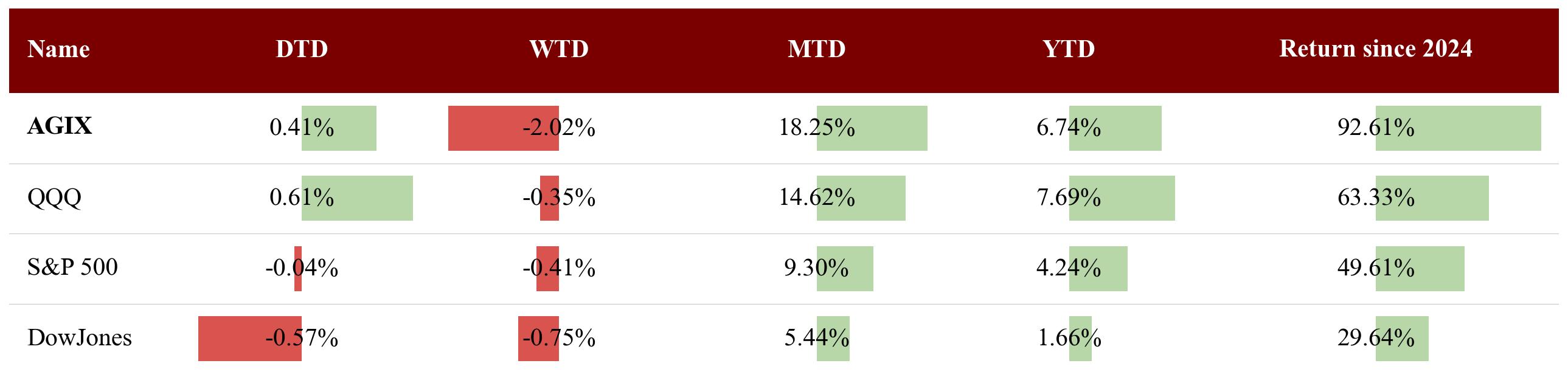
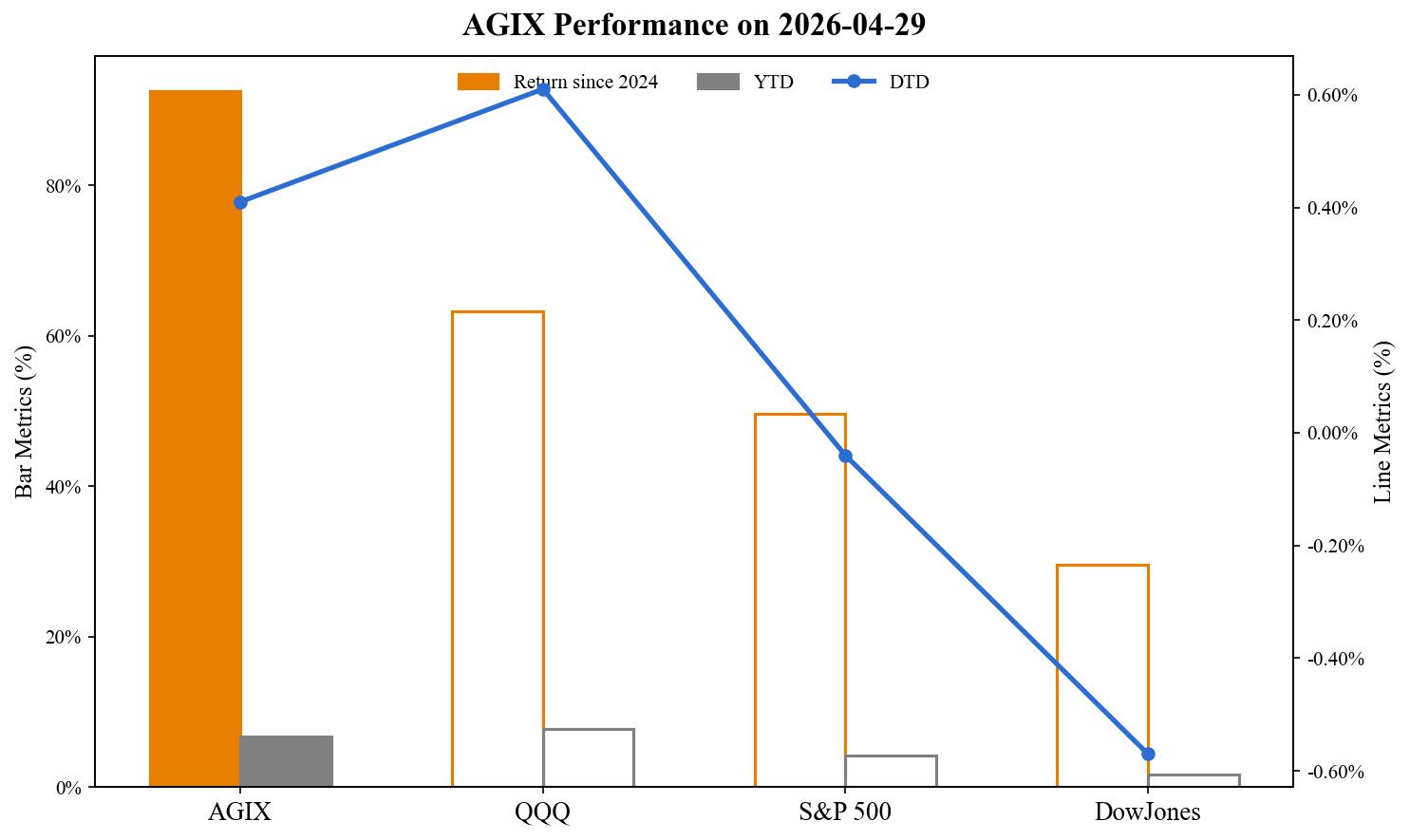
• AGIX fell 2.02% week-to-date, slightly underperforming the QQQ (-0.35%) but significantly outpacing the S&P 500 (-0.41%) and Dow Jones (-0.75%).
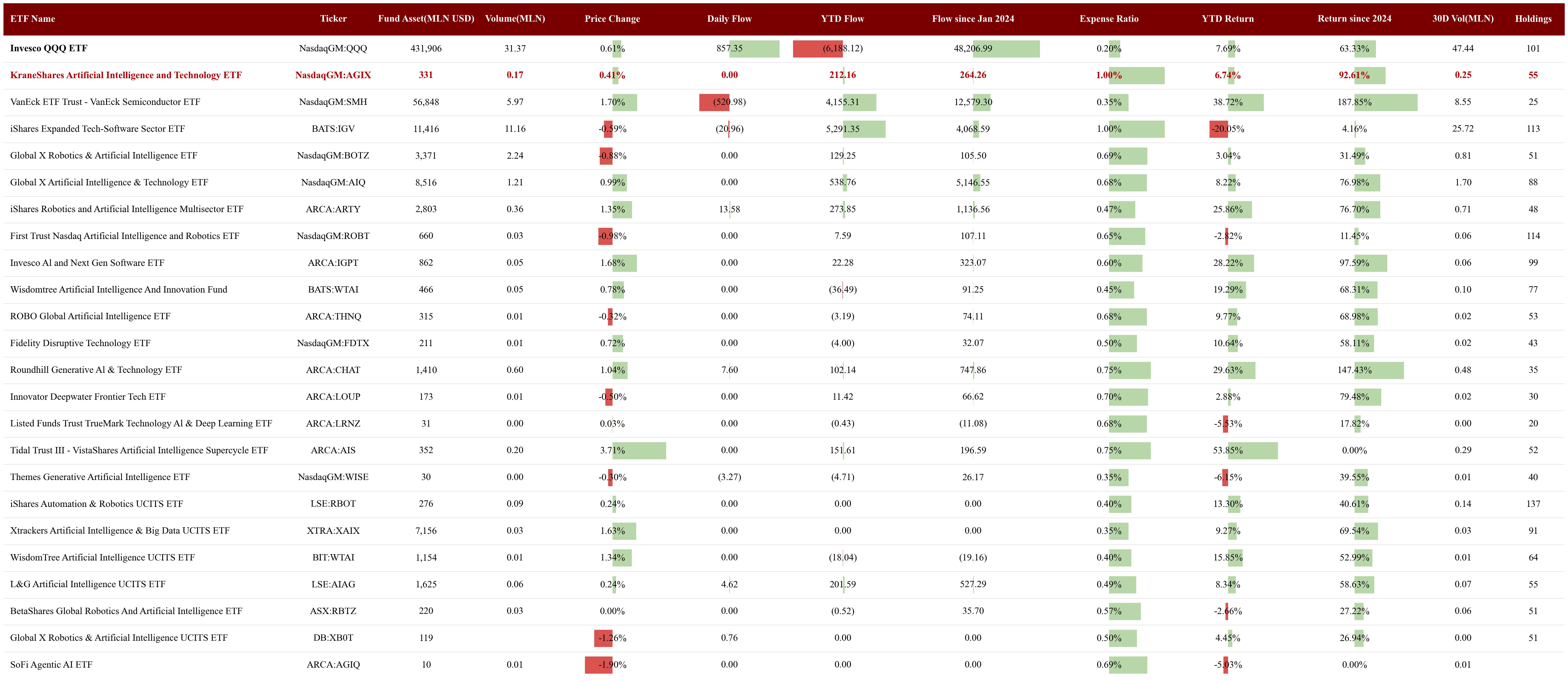
• Among peers, the semiconductor-heavy SMH surged 30.3% month-to-date, while AI-focused ETFs like IGPT (+31.32%) and CHAT (+23.57%) also showed strong momentum.
• Top AGIX holdings contributing positively to day-to-day performance include Astera Labs (+7.39%, hardware), CoreWeave (+8.21%, infrastructure), and Nebius Group (+4.19%, infrastructure), driven by strong earnings and AI infrastructure demand.
• Key stocks to watch: NXP Semiconductors (+25.55% on earnings beat), Extreme Networks (+28.15% on strong results), and Astera Labs (technical recovery and AI data center tailwinds).
News Highlights
1. AWS bringing OpenAI models to Bedrock marks a major competitive shift in cloud AI, benefiting Amazon (AGIX holding) and intensifying the multi-cloud AI race.
2. Elon Musk's testimony in the OpenAI trial highlights governance risks and could reshape AI industry structure, potentially impacting AGIX holdings like Microsoft and Alphabet.
3. NXP Semiconductors' strong Q1 beat (EPS $3.05 vs $2.98) and raised guidance drove a 25.55% surge, reflecting robust demand across automotive, industrial, and data center markets.
4. Parag Agrawal's Parallel Web Systems raises $100M at $2B valuation, signaling strong investor appetite for AI agent infrastructure, a theme relevant to AGIX holdings like CoreWeave and Nebius.
5. Salesforce's Agentforce Operations launch underscores enterprise AI agent automation trends, benefiting Salesforce (AGIX holding) and competitors like ServiceNow.
6. Google Cloud revenue exceeded $20B for the first time, up 63% YoY, driven by Gemini AI solutions, positively impacting Alphabet (AGIX holding).
7. Microsoft reports 20M paid Copilot seats, with usage rivaling email, reinforcing the enterprise AI adoption narrative for Microsoft (AGIX holding).
8. Meta's capex guidance of $125-145B for 2026 highlights massive AI infrastructure spending, benefiting hardware holdings like NVIDIA, Broadcom, and Arista Networks.
RSS Highlights
1. Three thoughts on the Musk-OpenAI lawsuit: Raises valid points about OpenAI's nonprofit mission drift, but Musk's personal motives may weaken the case.
2. Reiner Pope (MatX CEO) explains the math behind LLM training and serving, revealing how batch size affects latency and cost.
3. PocketOS founder reports production database deleted by an AI coding agent in 9 seconds, highlighting risks of deploying AI in production environments.
4. LLM 0.32a0 refactor adds support for multi-type response streams and message sequences, enabling more flexible model interactions.
5. When The Bill Comes Due: As AI tool costs rise, smaller players like DeepSeek offer competitive models at lower prices, challenging the sustainability of big AI subsidies.
Performance & Benchmark
Attribution
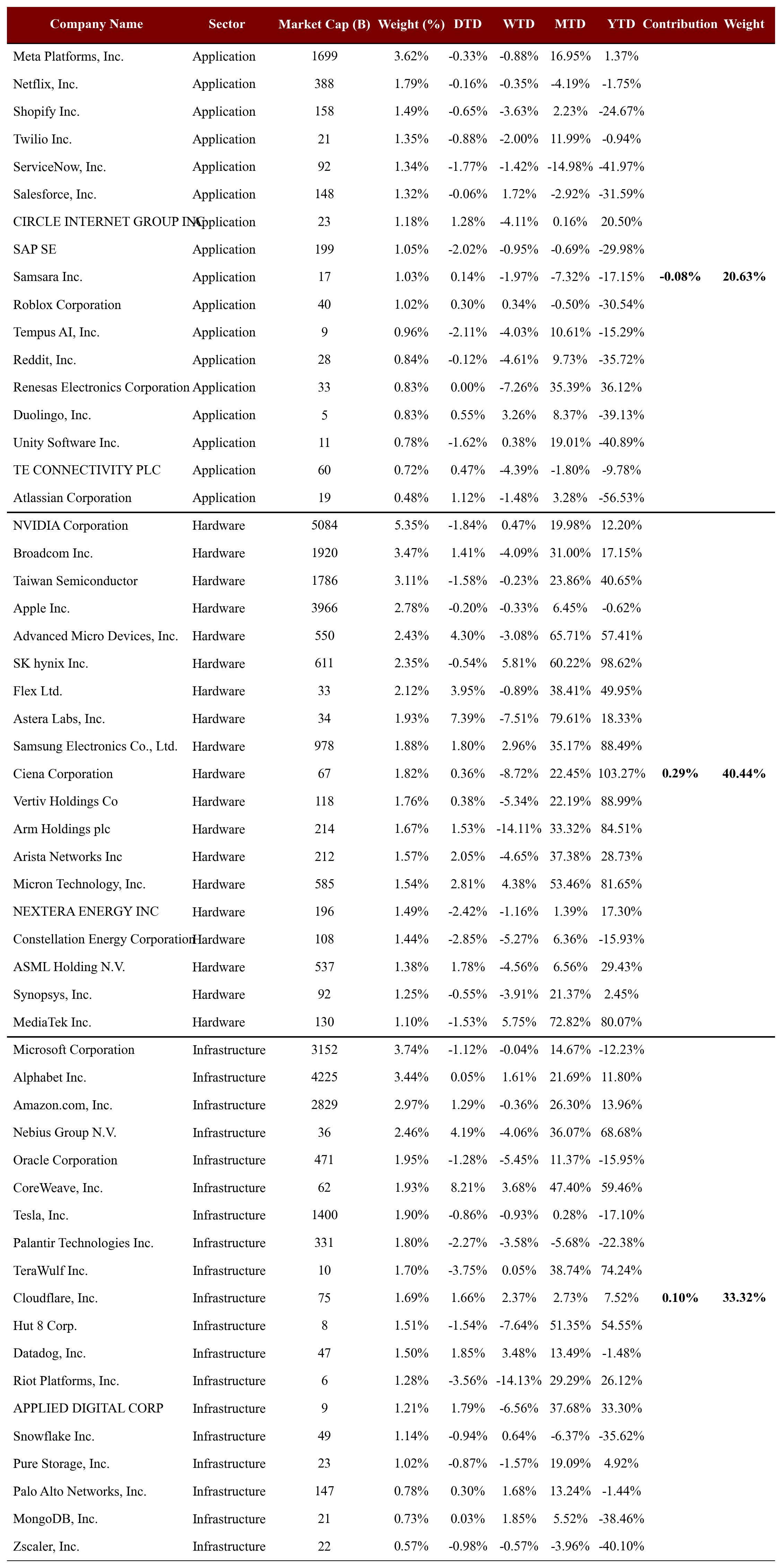
Contribution of the three sectors within AGIX holdings today
Application: -0.08%
Hardware: 0.29%
Infrastructure: 0.1%
Top-performing stocks in AGIX holdings today
CoreWeave, Inc. (8.21%)
Astera Labs, Inc. (7.39%)
Advanced Micro Devices, Inc. (4.3%)
Nebius Group N.V. (4.19%)
Flex Ltd. (3.95%)
Micron Technology, Inc. (2.81%)
Arista Networks Inc (2.05%)
Worst-performing stocks in AGIX holdings today
SAP SE (-2.02%)
Tempus AI, Inc. (-2.11%)
Palantir Technologies Inc. (-2.27%)
NEXTERA ENERGY INC (-2.42%)
Constellation Energy Corporation (-2.85%)
Riot Platforms, Inc. (-3.56%)
TeraWulf Inc. (-3.75%)
Top five listed stocks contributing the most within AGIX holdings today
CoreWeave, Inc. (8.21%)
Astera Labs, Inc. (7.39%)
Advanced Micro Devices, Inc. (4.3%)
Nebius Group N.V. (4.19%)
Flex Ltd. (3.95%)
Observation
The strongest movers across peer ETF holdings today are listed below:
| DTD | Stock Ticker | Name | Held by ETFs | analysis |
|---|---|---|---|---|
| 45.8 | NasdaqGS:SIMO | Silicon Motion Technology Corporation | ['ARCA:AIS'] | No verifiable public information attributes Silicon Motion Technology (SIMO)'s 45.8% single-day gain on April 29, 2026. Search results confirm an earnings call scheduled for that date to discuss Q1 2026 results, but lack details on outcomes, announcements, or same-day news driving the move.[4] Recent pre-event trading showed modest gains of 1.98-7% with elevated volume ahead of earnings, not aligning with the reported surge.[2][3] |
| 29.82 | NasdaqGS:MXL | MaxLinear, Inc. | ['LSE:RBOT'] | MaxLinear's 29.82% single-day surge on April 29 was driven primarily by Loop Capital's major upgrade from Hold to Buy with a $75 price target, significantly above the prior consensus of $44.20. This upgrade came on the heels of the company's April 23 Q1 earnings beat (EPS of $0.22 vs. $0.18 estimate) and strong 43% year-over-year revenue growth to $137.19 million, which triggered a broader re-rating around AI infrastructure demand. Multiple other analysts including Roth MKM and Stifel had recently upgraded to Buy with targets in the $49-$60 range, creating momentum into the Loop Capital upgrade that pushed the stock to a new 52-week high of $66.55. |
| 28.15 | NasdaqGS:EXTR | Extreme Networks, Inc. | ['ARCA:AIS', 'XTRA:XAIX'] | Extreme Networks (EXTR) stock surged 28.15% on April 29, 2026, primarily driven by its Q3 fiscal 2026 earnings release before market open, which reported EPS of $0.26 beating consensus estimates of $0.24 and revenue of $316.87 million topping expectations of $311.48 million, marking the fifth straight quarter of double-digit growth[1][5][6][7]. The earnings slides emphasized sustained momentum, sparking a 4.87% pre-market jump to $17.88[7]. Upward Q4 2026 guidance for EPS of $0.280-0.300 (above consensus $0.250) and revenue of $330-335 million (above $327.5 million consensus) further fueled the rally[1]. |
| 25.55 | NasdaqGS:NXPI | NXP Semiconductors N.V. | ['NasdaqGM:QQQ', 'NasdaqGM:SMH', 'NasdaqGM:AIQ', 'NasdaqGM:ROBT', 'NasdaqGM:FDTX', 'BIT:WTAI'] | NXP Semiconductors surged 25.55% on April 29 following a strong Q1 2026 earnings beat and raised forward guidance that exceeded analyst consensus. The company reported EPS of $3.05 versus $2.98 expected and revenue of $3.18 billion (+12.2% YoY) versus $3.14 billion expected, while issuing Q2 EPS guidance of $3.29–$3.72 above Street estimates. Analyst support amplified the move, with Needham raising its price target from $250 to $300 and reaffirming a Buy rating, while multiple other firms reiterated bullish positions and large institutions added positions, driving the stock to a new 52-week high of $285. |
| 12.1 | NasdaqGS:INTC | Intel Corporation | ['NasdaqGM:QQQ', 'NasdaqGM:SMH', 'NasdaqGM:AIQ', 'ARCA:ARTY', 'NasdaqGM:ROBT', 'ARCA:IGPT', 'BATS:WTAI', 'ARCA:AIS', 'NasdaqGM:WISE', 'LSE:RBOT', 'XTRA:XAIX', 'BIT:WTAI'] | Intel's 12.1% single-day gain on April 29, 2026, was primarily driven by ongoing momentum from its strong Q1 2026 earnings beat, where revenue of $13.58B exceeded estimates by 9%, led by robust Data Center and AI segment growth.[2] This contributed to a broader 90% rally in April, with the stock closing prior at $84.99 after trading in the $80.80–$84.59 range.[3][1] No specific same-day news events were identified beyond the earnings tailwind.[1][2][3] |
| 11.34 | NasdaqGM:AAOI | Applied Optoelectronics, Inc. | [] | No specific news events or disclosures on April 29, 2026, explain AAOI's 11.34% single-day gain. The stock's ongoing momentum from earlier April surges—driven by $124M in 800G AI data center orders from hyperscale customers and U.S. manufacturing expansion—likely extended into late April trading[1][2]. Technical factors, including higher highs/lows and support above $128, supported the uptrend amid anticipation for Q1 earnings on May 7[4][7]. |
| 11.1 | NasdaqGS:STX | Seagate Technology Holdings plc | ['NasdaqGM:AIQ', 'ARCA:IGPT', 'ARCA:AIS', 'XTRA:XAIX'] | Seagate Technology surged 11.1% on April 29, 2026, driven by a strong earnings beat and raised guidance that signaled robust AI-driven storage demand. The company reported Q3 EPS of $4.10 versus $3.47 consensus and revenue of $3.11B against $2.94B expected, while guiding Q4 EPS to $4.80-$5.20 and achieving record 47% gross margins. Multiple analysts raised price targets substantially in response, with Bank of America upgrading to $840 and Rosenblatt setting a $1,000 target, reflecting confidence in continued data-center and AI tailwinds that drove 44% year-over-year revenue growth. |
| 10.14 | NasdaqGS:CEVA | CEVA, Inc. | ['NasdaqGM:WISE', 'LSE:RBOT'] | CEVA's 10.14% stock rise on April 29, 2026, was primarily driven by elevated trading volume and positive momentum amid strong analyst coverage, with no specific company news disclosed. Shares traded 19% above average volume at a high of $27.18, reflecting heightened investor interest in CEVA's AI NPU licensing, Wi-Fi 6/7 expansion, and IoT growth potential highlighted in recent reports[1][4]. A "Moderate Buy" consensus with an average price target of $30.29 (implying ~12% upside from prior close) further supported the move[1][2]. |
| 9.86 | TPEX:5425 | Taiwan Semiconductor Co., Ltd. | ['ARCA:AIS'] | No specific news events, company disclosures, or catalysts explain the 9.86% rise in Taiwan Semiconductor Co., Ltd. (TPEX:5425) on April 29, 2026. The ADR (NYSE:TSM) closed at $393.79, up modestly from $392.34 the prior day, with no same-day announcements identified in available data[1][2]. Broader sector momentum or trading factors may have contributed, but lack verifiable evidence. |
| 9.56 | HLSE:NOKIA | Nokia Oyj | ['ARCA:AIS', 'XTRA:XAIX'] | Nokia Oyj (HLSE:NOKIA) surged 9.56% on April 29, 2026, primarily driven by continued momentum from its Q1 earnings beat on April 23, which raised 2026 Network Infrastructure sales growth to 12-14% and Optical/IP Networks to 18-20%, fueled by AI/data-center demand.[1][3] A wave of analyst price target hikes, including from a major bank on April 27 and others like CFRA ($16) and JPMorgan (€12), amplified the post-earnings re-rating and drew buyers.[1][2] Technical strength, with the stock in an uptrend from mid-$8s to above $11 on NYSE ADR equivalent, supported the single-day breakout.[2][3] |
| 8.45 | NasdaqGS:SBUX | Starbucks Corporation | ['NasdaqGM:QQQ'] | Starbucks (SBUX) stock surged 8.45% on April 29, 2026, primarily driven by a strong earnings beat reported the prior day (April 28 AC), with options implying a 7.70% weekly move closely matching the actual gain[4][6][5]. Investor relations confirmed the closing price reflected this +8.45% advance[5]. No other same-day news events were identified in available data[1][2][3]. |
| 8.21 | NasdaqGS:CRWV | CoreWeave, Inc. | ['NasdaqGM:AGIX', 'NasdaqGM:AIQ', 'NasdaqGM:ROBT', 'ARCA:CHAT', 'BIT:WTAI'] | No verifiable public information attributes CoreWeave (CRWV)'s +8.21% single-day move on April 29, 2026. Search results reference a prior earnings miss and capex guidance hike causing a >19% slump on a subsequent Friday open, but lack same-day news, disclosures, or catalysts for this date.[1] Trading data shows general volatility with expected moves around 11%, but no specific drivers for the gain.[2][5] |
| 8.02 | NasdaqGS:FFIV | F5, Inc. | ['XTRA:XAIX'] | F5 (FFIV) stock rose 8.02% on April 29, 2026, primarily driven by a strong Q2 earnings beat and raised guidance. The company reported non-GAAP EPS of $3.90 versus $3.44 expected and revenue of $811.7M versus $782.2M estimated, with management highlighting durable demand, 22% product revenue growth, strong Systems sales, and record free cash flow as key factors.[3][5] Analysts responded positively, with several raising price targets, though consensus remains Hold at $312.[3][6] |
| 7.98 | NasdaqGS:ADP | Automatic Data Processing, Inc. | ['NasdaqGM:QQQ'] | ADP's 7.98% single-day gain on April 29, 2026 was driven by the company's Q1 fiscal 2026 earnings beat and raised full-year guidance announced that morning. The company reported revenue of $5.94 billion (1.5% above consensus) and adjusted EPS of $3.37 (2.3% above estimates), while also raising FY2026 guidance to 6-7% revenue growth and 10-11% EPS growth with 70-80 basis points of adjusted EBIT margin expansion. Additionally, free cash flow margin expanded significantly to 36.8% from 26.8% year-over-year, demonstrating improved cash profitability that reinforced investor confidence in the company's operational execution. |
| 7.89 | NasdaqCM:GRRR | Gorilla Technology Group Inc. | ['NasdaqGM:WISE'] | No specific company news, disclosures, or events explain GRRR's 7.89% single-day gain on April 29, 2026. The move aligns with an ongoing technical upward trend initiated earlier in April, including the 10-day moving average crossing bullishly above the 50-day MA on April 17 and the stock surpassing its 50-day MA on April 13[1]. Trading volume and momentum indicators from prior weeks supported continued buying pressure, though no same-day catalysts are identified[1][3]. |
| 7.39 | NasdaqGS:ALAB | Astera Labs, Inc. | ['NasdaqGM:AGIX', 'NasdaqGM:ROBT', 'ARCA:IGPT', 'BATS:WTAI', 'ARCA:THNQ', 'ARCA:CHAT', 'ARCA:LOUP', 'ARCA:AIS', 'BIT:WTAI'] | ALAB's 7.39% gain on April 29 primarily reflects technical recovery and short-covering following the prior day's gap-down move. The stock had gapped down on April 28 from $196.64 to $181.20, creating an oversold condition that attracted buyers on the rebound. Analyst sentiment remained broadly positive with a consensus "Moderate Buy" rating and an average price target of $199.74, supporting the recovery as investors viewed the pullback as a buying opportunity in a momentum stock that had rallied from near $100 to $196 in weeks. |
| 7.27 | NasdaqGS:VRNS | Varonis Systems, Inc. | ['BATS:IGV', 'BATS:WTAI', 'ARCA:THNQ', 'LSE:AIAG'] | Varonis Systems (VRNS) stock rose 7.27% on April 29, 2026, primarily driven by a strong Q1 earnings beat reported after market close on April 28, with EPS of $0.06 versus consensus -$0.05 and revenue of $173.1M (up 26.9% YoY, beating estimates).[1][5][6] Key supports included raised FY2026 EPS guidance to $0.110-$0.120, robust SaaS ARR growth (29% YoY excluding conversions, total up 69%), and the launch of AI-driven Varonis Atlas.[1][5][7] Analyst actions amplified the move, with Needham raising its price target to $36 and DA Davidson to $37, reinforcing a Moderate Buy consensus.[1][8] |
| 7.04 | WBAG:ANDR | Andritz AG | [] | Andritz AG's 7.04% stock rise on April 29, 2026, was driven by the release of strong Q1 2026 results, featuring a record order intake of 3.6 billion euros, up 54% year-over-year, primarily from hydropower projects in North America, Brazil, Serbia, and India[2][3][4][5]. Higher sales and profit growth further boosted sentiment, with trading volume 190% above average[1][7]. Unchanged full-year guidance supported the positive reaction[2][5]. |
| 7.01 | NasdaqGS:MCHP | Microchip Technology Incorporated | ['NasdaqGM:QQQ', 'NasdaqGM:SMH', 'ARCA:IGPT', 'BATS:WTAI', 'LSE:RBOT', 'BIT:WTAI'] | Microchip Technology (MCHP) stock rose 7.01% on April 29, 2026, primarily driven by a Schedule 13G filing from Vanguard disclosing a 6% passive stake of 32.47 million shares as of March 31, 2026, filed that day, signaling strong institutional confidence.[5] This built on recent upward technical momentum, including the 10-day moving average crossing above the 50-day average on April 16 and prior breaks above key resistance levels like the upper Bollinger Band on April 23.[4] Broader semiconductor optimism from earlier product wins in AI/5G timing modules and analyst upgrades further supported the move.[1] |
| 6.53 | NasdaqGS:VRSK | Verisk Analytics, Inc. | ['NasdaqGM:QQQ', 'ARCA:THNQ', 'LSE:AIAG'] | Verisk Analytics rose 6.53% on April 29, 2026, driven primarily by better-than-expected earnings results and positive analyst sentiment ahead of the earnings release. The company reported Q1 2026 results before market open on April 29, with analysts noting an Earnings Surprise Positive (ESP) of +1.85%, suggesting the stock was positioned to beat consensus estimates of $1.76 EPS and $775.93 million in revenue. Additionally, the consensus analyst rating of Buy with a 2026 price target of $259.38 provided supportive sentiment for the single-day rally. |
| 6.51 | NasdaqCM:INDI | indie Semiconductor, Inc. | ['LSE:RBOT'] | INDI's 6.51% gain on April 29, 2026, occurred without identifiable company-specific news or disclosures, aligning with a technical breakout pattern and elevated trading volume seen in prior sessions. Pre-earnings momentum ahead of the May 7 Q1 report, coupled with a "Moderate Buy" consensus and $6.45 average price target, supported the uptrend from recent highs around $3.66.[1][6][9] Price forecasts projected a rise to $4.00 that day, consistent with the observed intraday strength.[5] |
| 6.17 | NasdaqGS:SNDK | Sandisk Corporation | ['XTRA:XAIX'] | Sandisk (NASDAQ:SNDK) stock rose 6.17% on April 29, 2026, primarily driven by positive analyst commentary on improving NAND market conditions and strong AI/data-center storage demand ahead of the company's Q3 earnings.[1][2] Wedbush analyst Matt Bryson highlighted SanDisk's success in lifting pricing faster than peers, setting a $1,200 price target, while Seagate's recent strong earnings reinforced tailwinds for SanDisk's NAND/SSD sales.[1][2] Sector-wide strength in memory stocks and speculation around a potential stock split amid the shares' 3,000%+ yearly surge added supportive momentum.[2][3] |
| 6.13 | NasdaqGS:TMUS | T-Mobile US, Inc. | ['NasdaqGM:QQQ'] | T-Mobile's 6.13% gain on April 29, 2026 was driven by the company raising its annual forecast for postpaid net account additions following upbeat quarterly results announced that day. The positive guidance lift, supported by competitive pricing strategies and bundled streaming offerings, signaled stronger-than-expected customer acquisition momentum and improved competitive positioning in the wireless market. |
| 6.0 | NasdaqGS:BIIB | Biogen Inc. | ['NasdaqGM:QQQ'] | Biogen's 6.0% stock rise on April 29, 2026, was primarily driven by better-than-expected Q1 results, with adjusted EPS of $3.57 beating estimates of $2.95-$3.03 and revenue of $2.48B topping $2.25B forecasts[3][4][6]. A key secondary catalyst was the $5.6B acquisition of Apellis Pharmaceuticals, adding Empaveli and Syfovre to Biogen's portfolio and complementing its felzartamab pipeline candidate, which investors viewed positively despite lowered FY2026 EPS guidance of $14.25-$15.25 due to M&A costs[1][3][6]. Analyst upgrades from UBS, Goldman Sachs, and others further supported the upside momentum[1]. |
| 5.98 | ENXTPA:STMPA | STMicroelectronics N.V. | ['NasdaqGM:SMH', 'BIT:WTAI'] | No specific news events, company disclosures, or catalysts on April 29, 2026, explain STMicroelectronics' (STMPA) 5.98% single-day decline. The drop aligns with the stock's previous close of €23.77 and day range of €22.30-€23.27, but search results lack same-day drivers or commentary.[1] Broader historical volatility in the semiconductor sector may have contributed, though no direct evidence ties to this date.[2] |
| 5.96 | NasdaqGS:ON | ON Semiconductor Corporation | ['NasdaqGM:QQQ', 'NasdaqGM:SMH'] | B. Riley's upgrade of ON Semiconductor to Buy with a price target nearly doubled to $115 drove the 5.96% stock gain on April 29, 2026, as analyst Craig Ellis cited the end of the cyclical trough and strength in power semiconductors, SiC for EVs, and industrial automation[2]. This was amplified by sector momentum from onsemi's expanded partnerships with Geely and NIO for 900V EliteSiC EV platforms, boosting visibility into high-voltage power demand[1][3]. A recent BofA Securities Buy upgrade and $6B share buyback authorization further supported the rally ahead of Q1 earnings[2]. |
| 5.94 | NasdaqGS:CRDO | Credo Technology Group Holding Ltd | ['ARCA:IGPT', 'BATS:WTAI', 'LSE:RBOT'] | Credo Technology (CRDO) rose 5.94% on April 29, 2026, primarily due to a strong Q3 FY2026 earnings beat announced after market close, with revenue of $407.01M (up 201.5% YoY, beating estimates by 5%) and non-GAAP EPS of $1.07 (up 13.75%).[3][1] Shares jumped 6.43% in after-hours trading to around $143, reflecting investor enthusiasm for the results.[1] No other same-day news events contributed significantly.[2] |
| 5.76 | NasdaqGS:COMM | CommScope Holding Company, Inc. | [] | No specific news events or company disclosures explain CommScope (COMM)'s 5.76% gain on April 29, 2026, as search results lack same-day catalysts[1][2][3][4][5][6]. The move may reflect ongoing positive momentum from prior strong Q3 2025 earnings (EPS $0.62 vs. $0.23 expected, revenue $1.63B vs. $1.22B) and analyst buy ratings with targets up to $24.74[3][4][5]. Broader short-term uptrend signals and trading near 52-week highs also supported buying interest[1][3]. |
| 5.66 | NasdaqCM:NN | NextNav Inc. | ['BATS:IGV'] | NextNav (NN) rose 5.66% on April 29, 2026, amid elevated trading volume of 3.71M shares versus an average of 5.05M, with the stock fluctuating between $15.33 and $17.78 and closing at $17.24.[1] No specific company news, earnings, or regulatory events appear tied to the date, suggesting the move reflected broader market momentum or sector interest in positioning/navigation technologies.[1][2] Recent insider selling in March and prior Q4 earnings miss provide no direct catalyst.[2] |
| 5.57 | NasdaqGS:WDC | Western Digital Corporation | ['ARCA:IGPT', 'ARCA:AIS', 'XTRA:XAIX'] | Western Digital's 5.57% stock rise on April 29, 2026, was primarily driven by a sympathy rally following Seagate's strong Q3 earnings beat and upbeat AI-storage guidance, which boosted sector optimism for HDD and NAND demand.[1][2][3] Analyst upgrades, including Cantor Fitzgerald raising its price target to $500 and others to $495, further fueled momentum ahead of WDC's own earnings.[1][3] The stock hit a new 52-week high of $436 amid high volume, reflecting investor confidence in AI-driven growth, improving margins, and buybacks.[1][2] |
| 5.49 | XTRA:IFX | Infineon Technologies AG | ['NasdaqGM:AIQ', 'ARCA:THNQ', 'LSE:AIAG'] | I cannot provide a reliable attribution for Infineon's 5.49% single-day move on April 29, 2026, as the search results contain no verifiable news events, company disclosures, or material catalysts from that date. The available data includes only historical price information from July 2025 and general valuation commentary, with no real-time news or earnings announcements that would explain the magnitude of the move. Without access to same-day market news, regulatory filings, or industry developments from April 29, 2026, any attribution would be speculative. |
| 5.46 | NasdaqGS:GFS | GlobalFoundries Inc. | ['NasdaqGM:QQQ', 'ARCA:AIS'] | No specific company news, earnings, or events on April 29, 2026, explain GlobalFoundries' (GFS) 5.46% single-day gain. Analyst forecasts showed a consensus price target of around $44 implying upside potential, with bullish technical signals noted as of that date. Broader semiconductor sector momentum or trading activity likely contributed amid positive long-term predictions. |
| 5.07 | NasdaqGS:ZM | Zoom Communications Inc. | ['BATS:IGV'] | Zoom Communications (ZM) rose 5.07% on April 29, 2026, primarily due to the company's announcement of its Q1 FY2027 earnings release scheduled for May 21, 2026, after market close, which sparked pre-earnings optimism.[1][6] The stock-specific move outpaced the Nasdaq's 0.42% gain and occurred amid technical strength, with shares trading 8.5% above the 20-day SMA and 13.2% above the 200-day SMA despite a prior death cross.[2] No other company-specific news or catalysts were reported on the date. |
| 5.04 | NasdaqGS:TENB | Tenable Holdings, Inc. | ['BATS:IGV', 'XTRA:XAIX'] | Tenable Holdings (TENB) rose 5.04% on April 29, 2026, primarily due to the market's anticipation of its fiscal Q1 2026 earnings release after market close and the subsequent conference call at 4:30 p.m. ET.[1][3] This event triggered notable trading interest, with intraday peaks around +6.2% and momentum alerts, adding ~$127M to market cap amid reset expectations for results.[1] The stock had been trading well below its 200-day moving average prior, amplifying volatility around the announcement.[1] |
News
Funding & M&A
Elon Musk accuses OpenAI CEO Sam Altman of trying to 'steal' a charity.
Billionaire tech entrepreneur Elon Musk testified in a landmark trial in the U.S. District Court for the Northern District of California, facing off against OpenAI CEO Sam Altman in a case that will profoundly impact the future of artificial intelligence. Musk accuses OpenAI of abandoning its original nonprofit mission established at its founding in 2015, when he, Altman, and Greg Brockman co-founded the organization to benefit humanity. However, Altman and others shifted to a for-profit model, raising billions of dollars and becoming a leading Silicon Valley AI company through the commercial operation of ChatGPT. After leaving in 2018, Musk filed a lawsuit in 2024, seeking to remove Altman and Brockman and restore OpenAI's pure nonprofit status. OpenAI counters that Musk's motives stem from jealousy over his own xAI company (developer of the Grok chatbot) as a competitor, and that he is harassing them through baseless litigation. Microsoft, as OpenAI's primary investor and co-defendant, is expected to have its CEO Satya Nadella testify as well. The trial's focus is whether the founding agreement permits the establishment of a for-profit branch worth hundreds of billions of dollars and whether it violates charity law. The judge warned both sides not to discuss the case on social media. Musk claims he provided initial funding and expert resources to help launch OpenAI, emphasizing his philanthropic contributions through Tesla and SpaceX, and views AI as a double-edged sword that could bring utopia or doom. OpenAI's lawyers argue that Musk does not understand AI and wants to control the company. The trial is expected to last three weeks, with several tech leaders testifying.
Certifyde raises $2M to help guide businesses in adopting and scaling AI
Certifyde Inc. recently announced the completion of a $2 million seed funding round, aimed at helping enterprises turn AI investments into widespread adoption and proficient use at the employee level. The company notes that although a 2025 McKinsey report shows 88% of surveyed enterprises have adopted AI across organizations, only 7% have achieved full-scale deployment, with most still in early stages. Certifyde believes the issue is not access to AI tools, but a lack of deep understanding of how AI impacts employees' daily work and lives. To bridge this gap, the company launched a browser extension called 'Productivity Companion,' which provides personalized, role-specific AI guidance without requiring migration. The tool seamlessly integrates with existing productivity tools such as Salesforce, Slack, Microsoft Teams, and Google Workspace, offering practical guidance, habit reinforcement, and AI-enhanced workflow prompts within employees' natural workflows. Co-founder and CEO Skylar Hauswirth emphasized that Certifyde focuses on 'AI fluency'—naturally integrating AI into daily work for seamless human-machine collaboration. The funding round attracted notable investors including K5 Global, Flamingo Capital, Honey co-founder George Ruan, Ripple Labs CEO Brad Garlinghouse, and Nutrafol founder Roland Peralta. Certifyde plans to use the funds to expand sales and marketing, product development, and infrastructure strengthening to meet growing demand. Additionally, the company offers an 'Academy' platform supporting customized training and compliance certifications, helping employees confidently master AI tools.
Coby Adcock’s Scout AI raises $100 million to train its models for war. We visited its bootcamp
Defense AI startup Scout AI announced the completion of a $100 million Series A funding round, led by Align Ventures with participation from Draper Associates, following a $15 million seed round in January 2025. Founded in 2024 by Coby Adcock and Collin Otis, Scout AI positions itself as a defense frontier lab, focusing on developing the AI model 'Fury' for controlling military assets, ranging from logistics support to autonomous weapon systems. The company uses vision-language-action (VLA) technology based on large language models (LLMs) and has signed a total of $11 million in technology development contracts with defense agencies including DARPA and the Army Applications Laboratory, and has been selected as one of 20 autonomous technology vendors for the U.S. Army's 1st Cavalry Division. Scout conducts field training at California military bases, using four-wheel all-terrain vehicles (ATVs) to simulate conflict environments and train models to handle complex off-road terrain. Company CTO Collin Otis emphasized enhancing AI intelligence through real-world interaction, with the goal of building military AGI. Scout positions itself as a software company; its first product, 'Ox,' is command-and-control software integrating GPUs and cameras, enabling soldiers to coordinate drones and ground vehicles through natural language instructions. Despite controversy over autonomous weapons, Scout emphasizes human oversight mechanisms and criticizes AI giants like Google and Anthropic for being reluctant to deeply collaborate on defense projects. Future funds will be invested in training proprietary foundation models, with founders optimistic that real battlefield data will help surpass general AGI.
Parag Agrawal's startup raises $100M to build a parallel web for AI agents.
Former Twitter CEO Parag Agrawal's AI startup, Parallel Web Systems Inc., has completed a $100 million Series B funding round, led by Sequoia Capital, with participation from existing investors including Kleiner Perkins, Index Ventures, and Khosla Ventures, valuing the company at $2 billion. The company had previously completed a $100 million funding round in November. Parallel focuses on developing an efficient web search platform to help autonomous AI agents access internet information more accurately, supporting deep research tasks such as insurance claims processing and government contract screening. Its solution is based on a proprietary web index and optimized API suite, supporting information extraction, online task execution, and web monitoring. Since its founding in early 2024, Parallel has attracted over 100,000 developer users, including numerous AI startups and large enterprise clients. Legal AI company Harvey AI Inc. has become an early adopter, with co-founder Gabe Pereyra stating that Parallel provides more granular website access control than Google Search. Sequoia partner Andrew Reed emphasized that Parallel's core infrastructure supports long-running AI agents that maintain context over time. Competitors include Tavily Inc. and Exa Labs Inc. Agrawal believes that future AI agents will far exceed human web usage needs, and this platform will accelerate their sales, marketing, and R&D deployment. This move marks a funding boom in the AI infrastructure space, helping to commercialize agent technology.
Firestorm Labs raises $82 million to bring drone factories into the field.
Defense startup Firestorm Labs announced the completion of an $82 million Series B funding round, led by Washington Harbour Partners, with participation from NEA, Ondas, In-Q-Tel, Lockheed Martin, Booz Allen Ventures, and others, bringing total funding to $153 million. Headquartered in San Diego, the company originally manufactured drones but later pivoted to containerized drone factory solutions to address logistics challenges in Pacific conflicts. Its core product, xCell, is a containerized manufacturing platform equipped with industrial-grade HP 3D printers, capable of printing drone airframes within 24 hours, supporting surveillance, electronic warfare, and even lethal mission configurations. It has secured a five-year global exclusive license from HP to use its 3D printing technology. xCell has been deployed at the U.S. Air Force Research Laboratory and Special Operations Command, and is operational in the Indo-Pacific region, with a U.S. military contract ceiling of up to $100 million. The company's founders include CEO Dan Magy (a serial entrepreneur), Chad McCoy (a special forces veteran), and CTO Ian Muceus (a holder of 3D printing patents). The Pentagon has listed 'contested logistics' as one of six key technology areas. Firestorm generates revenue through hardware sales and government contracts, and the Army has already used its technology to 3D print spare parts for Bradley fighting vehicles on-site. This move highlights the importance of rapid iteration and frontline manufacturing in modern warfare, with Firestorm aiming for full Indo-Pacific deployment within two years. According to a TechCrunch report, the technology draws on lessons from Ukraine, addressing the vulnerability of fixed factories.
BMW i Ventures has a new $300 million fund, and AI is riding shotgun.
BMW i Ventures, the independent venture capital arm of BMW AG, recently announced the launch of a third fund worth $300 million, bringing total assets under management to $1.1 billion. The fund focuses on early-stage to Series B startups in North America and Europe, investing in areas including agentic AI, physical AI (covering robotics and autonomous vehicles), industrial software, advanced materials, and manufacturing and supply chain technology. Managing partner Marcus Behrendt stated that the fund aims to capitalize on the trend of AI reshaping the automotive industry, rather than blindly chasing hot topics. The first fund (2016) emphasized autonomous driving and digital technologies, while the second fund (2021) focused on sustainability and supply chains. The new fund treats AI as a foundational technology and expands the sustainability toolbox. Partner Kaspar Sage cited an example: the German company Synera, in which the firm invested, uses AI agents to optimize engineering design processes, reducing weeks of manual collaboration to minutes and improving efficiency. The fund has not yet made any investments, but the second fund has invested in over 35 companies, including several AI startups. BMW i Ventures will continue to delve into advanced materials and circular supply chains to support the automotive industry's transformation.
Meet Shapes, the app bringing humans and AI into the same group chats
AI social app Shapes has officially come out of stealth mode, completing an $8 million seed round led by Lightspeed, with participation from AI Capital Partners, AI Grant, and angel investors. Founded in 2022, the company has amassed over 400,000 monthly active users and created 3 million AI characters called 'Shapes.' Unlike traditional one-on-one AI chat, Shapes integrates AI characters into human group chats, simulating real social scenarios like Discord, aiming to solve the 'AI psychosis' problem—where prolonged solitude may cause AI to develop delusions or paranoia. Through group chats, AI gains full context, naturally participating in discussions, starting topics, and maintaining engagement, so users never worry about messages going unanswered. Founders Anushk Mittal and Noorie Dhingra emphasize that human communication inherently relies on group chats; Shapes makes AI a transparently labeled 'user' with customizable personalities, often used for deep dives in fan communities. Users select interests upon registration and receive recommended group chats. Shapes has grown rapidly, with users increasing sixfold this year, and thousands of users spending 2-4 hours daily. The company plans to use the new funds to accelerate development and user acquisition. Although ChatGPT supports group chats, Shapes focuses on social interaction rather than planning, designed for 'deep netizens.' Mittal calls it the 'next-generation chat app,' with AI merely as a facilitator. This highlights the trend of AI social innovation and could reshape online community interaction models.
Colby Adcock’s Scout AI raises $100M to train its models for war. We visited its bootcamp
Defense AI startup Scout AI announced a $100 million Series A funding round led by Align Ventures and Draper Associates, following a $15 million seed round in January 2025. Founded in 2024 by Colby Adcock and Collin Otis, Scout AI positions itself as a defense frontier lab, focusing on developing an AI model called 'Fury' for operating and commanding military assets, starting with logistics support and expanding to autonomous weapons. The company has secured a total of $11 million in technology development contracts from defense agencies including DARPA and the Army Applications Lab, and has been selected for the U.S. Army's 1st Cavalry Division list of 20 autonomous technology vendors, with its products to be validated in 2027 deployments. Scout uses LLM-based vision-language-action (VLA) model technology, conducting field training with four-seat all-terrain vehicles at the Foundry training ground on a California military base, simulating complex off-road environments. CTO Collin Otis emphasizes rapidly improving model intelligence through reinforcement learning and real-world interaction, aiming for military AGI. Scout positions itself as a software company; its first product, 'Ox,' is command-and-control software combined with GPU and hardware, allowing soldiers to coordinate drones and ground vehicles via natural language commands. Although autonomous weapons are controversial, Scout emphasizes human oversight and geographic restrictions to ensure safety. The funding will primarily go toward model training and computing power, with founders optimistic about leading the AGI race through real battlefield interaction.
Cognizant to acquire Astreya for $600M to deepen AI infrastructure services
Information technology services company Cognizant Technology Solutions Corp. announced it is acquiring San Jose-based Astreya Inc., which specializes in managed services for AI infrastructure and data center operations, for approximately $600 million. The deal is expected to close in the second quarter of 2026 and aims to strengthen Cognizant's AI portfolio. Founded in 1994, Astreya operates in over 35 countries and has more than 25 years of managed services experience. Its core capabilities include large-scale enterprise managed services, a proprietary AI OpsHub platform covering readiness assessment, signal intelligence, analytics, and agent automation modules, as well as an innovation office. Cognizant CEO Ravi Kumar S. said the acquisition will better help clients build and operate platform-led AI systems at scale. Astreya President and CEO Romil Bahl emphasized that this move will continue its role as a trusted partner in the AI era and bring Cognizant's global scale to clients. The acquisition continues Cognizant's AI strategy, following the launch of the Flowsource generative AI-assisted software engineering platform in February 2024, the upgrade of Neuro AI to support multi-agent systems in October, and the acquisition of Microsoft Azure service provider 3Cloud in 2025, adding nearly 1,200 cloud experts. After the transaction closes, Cognizant customers will gain new AI accelerators and talent, while Astreya customers can expand service capacity.
On the witness stand, Elon Musk cannot escape his own tweets.
Elon Musk appeared in federal court in California on Wednesday to testify in his lawsuit against OpenAI's structure, accusing Sam Altman and his co-founders of 'stealing a charity.' Musk claimed that when he co-founded OpenAI with Altman, Ilya Sutskever, Greg Brockman, and others, they promised to build AI for humanity, but the other party later launched a for-profit subsidiary, allowing it to dominate the organization and betraying the original intent. Musk admitted in court that Tesla is not currently pursuing artificial general intelligence (AGI), contradicting his recent posts on X. OpenAI lawyer William Savitt, through cross-examination, revealed that Musk had discussed converting OpenAI into a for-profit entity as early as 2016 and had planned to take control of its for-profit arm, but stopped donating after the plan failed. Savitt also pointed out that Musk supported gradually loosening profit caps for investors like Microsoft and had suggested integrating OpenAI into Tesla to compete with Google. The trial involved Musk's companies Neuralink and Tesla poaching employees from OpenAI, such as Andrej Karpathy, as well as safety issues. The judge allowed further discussion of xAI and OpenAI's safety approaches but barred unrelated AI accident discussions. Musk will continue testimony on Thursday, and OpenAI President Greg Brockman and others are expected to testify. The case centers on whether OpenAI's transition from nonprofit to for-profit harms investor interests and AI safety commitments.
Colby Adcock's Scout AI raises $100 million to train its models for warfare: we visited its bootcamp.
Defense AI startup Scout AI announced a $100 million Series A funding round led by Align Ventures, with participation from Draper Associates, following a $15 million seed round in January 2025. Founded in 2024 by Colby Adcock and Collin Otis, Scout AI focuses on developing a military AI model called 'Fury' for operating and commanding military assets, starting with logistics support and expanding to autonomous weapons. The company has secured $11 million in technology development contracts from defense agencies including DARPA and the Army Applications Lab, and has been selected for the U.S. Army's 1st Cavalry Division list of 20 autonomous technology vendors for training at Fort Hood, Texas, with deployment expected by 2027. Scout uses vision-language-action model (VLA) technology based on large language models, training four-wheeled all-terrain vehicles at a California military base to simulate complex terrain tasks, demonstrating acceleration and decision-making superior to humans. The company does not manufacture vehicles but develops 'Ox' command-and-control software, combining GPUs and cameras to support soldiers in coordinating drones and ground vehicles through natural language commands. The founders emphasize VLA's potential in unstructured battlefields and criticize AI giants like Google and Anthropic for being reluctant to deeply collaborate with the military. Scout plans to build its own foundation models, leveraging real-world interactions to accelerate AGI development.
Parallel Web Systems reaches a $2 billion valuation five months after its last major funding round.
Parallel Web Systems, an AI agent tools startup founded by former Twitter CEO Parag Agrawal, announced a $100 million Series B funding round led by Sequoia, valuing the company at $2 billion. Previous investors Kleiner Perkins, Index Ventures, Khosla Ventures, First Round Capital, Spark Capital, and Terrain Capital also participated. This round comes just five months after the company's previous $100 million Series A, led by Kleiner and Index at a $740 million valuation, bringing total funding to $230 million. Parallel Web Systems focuses on providing web search and research API services for AI agents, with clients including notable companies like Clay, Harvey, Notion, and Opendoor, as well as multiple banks and hedge funds. The company revealed that over 100,000 developers are already using its products. Investors have strong confidence in Agrawal's new venture; after being fired by Elon Musk at Twitter, he and his executive team sued for $128 million in severance, settling on undisclosed terms last October. This funding round highlights the continued intense investment enthusiasm in the AI infrastructure sector.
Rogo raises $160 million to speed up financial analysis with AI agents
AI fintech startup Rogo Technologies Inc. announced the completion of a $160 million Series D funding round, led by Kleiner Perkins, with participation from Sequoia, Khosla Ventures, Morgan Growth Equity Partners, and others. The funds will be used to expand into international markets and strengthen on-premise deployment engineering and banking teams to help customers adopt its platform faster. The Rogo platform uses a ChatGPT-like interface to help financial professionals like fund managers automate routine repetitive tasks, such as generating stock valuation reports, financial models, and Excel spreadsheets. Its core uses a custom-trained large language model, integrating financial institutions' CRM systems and external data sources like FactSet. Last month, Rogo acquired Offset Inc. to enhance financial modeling capabilities, allowing models to update automatically. Subsequently, it launched an internal AI agent named Felix that supports email interactions and customizes information based on user roles, such as providing earnings update services for analysts covering Apple Inc. The platform also features audit trails, access controls, and the Sisyphus security scanning tool. Currently, over 250 financial institutions and 35,000 financial professionals use Rogo, marking the rapid penetration of AI in automating investment decisions.
Model Releases
Deepgram expands Flux to 10 languages with mid-call switching for voice agents
Deepgram Inc., a real-time voice AI startup, today officially launched Flux Multilingual, an extension of its Flux conversational speech recognition model that supports 10 languages, including English, Spanish, French, German, Hindi, Russian, Portuguese, Japanese, Italian, and Dutch. The model features real-time language detection and seamless language switching mid-call. Deepgram claims this is the first multilingual conversational speech recognition model designed for conversational flow rather than traditional transcription. It uses model-based turn detection with end-of-turn decision latency under 400 milliseconds, delivers monolingual-level accuracy, and natively handles interruptions and language switches, avoiding the latency and instability developers face when stitching together multiple models, language detection layers, and routing logic. Flux Multilingual operates through a single perception model, supports developer language hints or automatic detection, is generally available now, compatible with the existing Flux API, and can be deployed via the Deepgram cloud API or self-hosted, with EU endpoints and SDKs. Deepgram co-founder and CEO Scott Stephenson said the model helps developers build global voice agents, delivering seamless multi-market experiences for enterprise customers. The company's platform serves over 200,000 developers and 1,300 organizations, has processed over 50,000 years of audio, and transcribed over 1 trillion words. A limited-time promotion is currently available, supporting Flux Multilingual and the Nova-3 model.
Technical Breakthroughs
Fragmented data is stalling enterprise AI deployments before they ever ship.
Enterprises are moving from AI experimentation to production-level deployment, but data fragmentation and unclear agent scopes are hindering progress. Appian Corp. emphasizes the importance of a governed AI data fabric, arguing that it, rather than model capability alone, is the key differentiator between useful agents and unpredictable ones. Mark Talbot, Director of AI Architecture at Appian, stated at Appian World 2026 that the data fabric provides context for agents to execute correct tasks, including relationships between support cases and knowledge base articles, as well as existing tools and processes. Appian's data fabric goes beyond catalog functionality, serving as an application platform that organizes workflows, agents, and human tasks, synchronizing data across multiple systems without data migration, and building knowledge graphs across systems like Salesforce and SAP. In a real-world case, Appian partnered with an Australian wealth management company, using task audits to let AI agents autonomously handle initial IT support triage, leveraging the data fabric to search historical tickets and knowledge bases. A recent partnership with Snowflake Inc. further expands the data fabric's coverage. In high-risk or compliance scenarios, deterministic workflows still dominate, ensuring multi-agent platforms are governed. Talbot emphasized that workflows need to supervise agent activities, such as retaining human review in medical report risk assessments. This approach balances AI autonomy with control, driving the deployment of agentic AI.
Earth AI is vertically integrating the search for critical minerals
Earth AI founder and CEO Roman Teslyu recently exclusively told TechCrunch that the company plans to build its own lab to address delays in mineral exploration sample analysis. Earth AI focuses on using AI models to find critical minerals like copper, platinum, and palladium in remote areas of Australia. Its AI system has successfully identified several potential mining sites, but a backlog of rock core samples at labs has extended delays from 2 months to 5 months, with 7,000 meters of sample data currently missing. To speed up the process, Earth AI aims to reduce analysis time from 5 months to 5 days. Building its own lab will significantly lower exploration costs, ensure precise drilling targeting high-concentration mineral zones, and improve AI model iteration efficiency. Although final economic value assessment still relies on third-party validation, internal rapid feedback will optimize drilling decisions and avoid ineffective operations. Teslyuk emphasized that timely data is core to AI-driven mining exploration, and Earth AI's move could reshape the critical mineral discovery process, promoting global supply chain diversification.
Meta shares drop after-hours as capex guidance overshadows earnings beat
Meta Platforms Inc. released its first-quarter fiscal 2026 earnings, with revenue of $56.31 billion, up 33% year-over-year, and adjusted earnings per share of $10.44, beating analyst expectations. Despite strong results, the company raised its full-year capital expenditure guidance to $125-145 billion, primarily for AI infrastructure and data center expansion, causing after-hours stock to drop over 6%. Family of Apps revenue reached $55.91 billion, with advertising revenue of $55.02 billion, up 33% year-over-year. Reality Labs revenue was $402 million, with operating loss narrowing to $4.03 billion. Daily active users were 356 million, down quarter-over-quarter, mainly due to internet disruptions in Iran and WhatsApp access restrictions in Russia. R&D spending surged 46% to $17.7 billion, supporting AI research at Meta Superintelligence Labs, which has released its first model. CEO Mark Zuckerberg said the company is on track to deliver personal superintelligence to billions of users. The company maintained its full-year expense outlook, but investors are increasingly concerned about unlimited AI investment scale, while teenage safety litigation risks could lead to significant losses.
Google gains 25 million subscriptions in Q1, driven by YouTube and Google One
Alphabet announced in its first-quarter earnings report that its paid service subscriptions added 25 million new users, reaching a total of 350 million, up 25 million from the fourth quarter of 2025, mainly driven by strong performance of YouTube and Google One cloud storage subscription plans. The report did not disclose specific subscriber numbers or monthly active user data for the Gemini chatbot, but Gemini advanced features have been bundled into the Google One plan, driving subscription growth. The company said that paid monthly active users of Gemini in the enterprise market grew 40% quarter-over-quarter, highlighting its commercial potential. Although YouTube advertising revenue missed Wall Street expectations of $999 million, coming in at $988 million, it still grew 11% year-over-year, with annual advertising and subscription revenue exceeding $60 billion. Alphabet CEO Sundar Pichai emphasized that investors should evaluate advertising and subscription revenue comprehensively, as advertising revenue faces pressure from users shifting to YouTube Premium ad-free subscriptions. Overall revenue reached $109.9 billion, beating expectations, with cloud business revenue exceeding $20 billion, causing the stock to rise. This earnings report reflects Alphabet's diversified growth strategy in subscription services and AI enterprise applications.
Google Cloud surpasses $20 billion, but says growth was capacity-constrained
Alphabet's Google Cloud business performed strongly in the first quarter of 2026, with revenue exceeding $20 billion for the first time, up 63% year-over-year. During the company's earnings call, Alphabet CEO Sundar Pichai said that cloud business growth was mainly driven by the strong performance of Google Cloud Platform, which grew faster than overall Google Cloud revenue. Growth was fueled by strong demand for Gemini Enterprise and AI solutions, with revenue from products based on Google's generative AI models up nearly 800% year-over-year, Gemini Enterprise up 40% quarter-over-quarter, and API AI token processing reaching 16 billion per minute, up 60% from the previous quarter. Additionally, new customer acquisition doubled year-over-year, the number of deals between $10 million and $1 billion doubled, and several deals over $1 billion were signed, with actual customer usage exceeding commitments by 45% quarter-over-quarter. Despite this, Pichai acknowledged current computing resource shortages, with cloud backlog orders reaching $462 billion, double the previous quarter. The company expects to digest 50% of the backlog over the next 24 months and will continue to increase investment in TPU hardware, data centers, and other infrastructure through an investment framework that considers capital returns, to seize the huge opportunities in AI. This performance highlights Google Cloud's leading position in the enterprise AI solutions market but also exposes supply chain bottlenecks.
Meta is still burning money on AR/VR
Meta released its latest quarterly earnings report, showing net income of $26.8 billion in the first quarter, up 61% year-over-year, and revenue of $56.3 billion, up 33% year-over-year. However, the Reality Labs division continued to post massive losses, losing $4 billion this quarter, with cumulative losses of $83.5 billion over the past 21 quarters, averaging $4 billion per quarter. Although Meta is gradually reducing its metaverse investments, AI spending is set to surge significantly. The company expects capital expenditures to reach $125 billion to $145 billion in 2026, higher than analyst estimates, mainly due to rising component costs like memory and higher-than-expected computing demand. CEO Mark Zuckerberg emphasized that the company is improving investment efficiency. Last year, the company poached over 50 AI talents with high salaries, driving the launch of the new AI model Muse Spark this month, which saw substantial usage growth, but the costs of AI product development and maintenance continue to soar. CFO Susan Li stated that the capital expenditure outlook for 2027 has not yet been determined, as computing demand continues to be underestimated. Despite strong performance, Meta's stock fell over 5% in after-hours trading following the earnings release. Meta is racing to catch up with AI leaders like OpenAI and Anthropic, highlighting the massive bets tech giants are making in the AI race.
Cognitive debt is costing enterprises more than they realize, says Appian CEO.
Enterprise AI adoption has become a widespread trend, but extracting investment value is still hampered by 'cognitive debt,' with AI-generated systems quietly outpacing regulatory oversight. According to new research by Harvard Business Review Analytic Services, sponsored by Appian Corp., 59% of organizations have deployed AI into production, but most focus only on incremental efficiency rather than top-line impact. Matt Calkins, co-founder and CEO of Appian, pointed out that when large enterprises deploy AI in critical workflows, they face the obstacle of cognitive debt, where AI systems grow faster than governance capabilities. He emphasized that this year is a critical one for AI's impact on businesses, but guardrails, structures, and processes are needed to ensure AI is safe and reliable for the most valuable work. The HBR survey shows that most leaders know they need to formalize guardrails, but fewer than half have defined them—a disconnect stemming from the accumulation of cognitive debt at deployment points. Appian's vibe coding analysis reveals that AI makes software creation seem easy, but leaves teams with systems that are difficult to explain, audit, or govern. Calkins compared it to the open-source economy: free code didn't collapse the software industry but instead pushed it to focus on higher trust and reliability. Similarly, AI-generated code needs to avoid unproductive outputs, especially in zero-tolerance regulatory industries. 'Code is cheap, errors are expensive,' he said, noting that companies today care more about reliability than code cost. Appian is bridging the enterprise AI reliability gap through process orchestration, playing a key role in the emerging AI stack.
Wiz finds AI has moved from tool to infrastructure, broadening the attack surface
Wiz Inc. released the '2026 State of AI in the Cloud' report, revealing that AI has transformed from an experimental tool to a default component of cloud infrastructure. Based on anonymous configuration metadata from hundreds of thousands of cloud environments in 2025, AI asset discovery, and field surveys, the report shows that 81% of environments run managed AI services, and 90% run self-hosted AI software. Key findings include that 63% of organizations self-host AI models, of which 68% partially rely on third-party software and 18% rely entirely on such components, leading to inherited attack surfaces not explicitly chosen. 42% of organizations rely on a single AI model, and only 7% deploy over 100 models. Developer tools are highly pervasive, with 80% of organizations using AI-integrated development environment extensions, 71% deploying AI copilots, and GitHub data showing that 80% of new developers adopt AI copilots in their first week. LogicStar AI AG and ETH Zürich research shows AI agents participate in 10% of public pull requests. Wiz Research found that one in five organizations using AI vibe-coding platforms are affected by systemic security weaknesses, citing examples such as Base44 Ltd.'s shared generation logic vulnerability and Moltbook's insufficient protection exposing sensitive data. Self-hosted AI agent technology deployment reaches 57%, and Model Context Protocol servers appear in 80% of cloud environments. The report documents the Probllama vulnerability (CVE-2024-37032) and the singularity supply chain attack, exploiting tools such as Anthropic Claude, Alphabet Gemini, and Amazon Q. Wiz emphasizes AI as both a target and an accelerator, compressing development timelines, and recommends treating AI as a first-class cloud infrastructure, integrating security, application security, and data governance functions to address distributed ownership and transitive component risks.
What to expect during the AI Agent Conference: Join theCUBE May 4-5
The enterprise is shifting from isolated AI tools to the Agentic Enterprise, embedding AI into business operations for autonomous decision-making and execution. According to theCUBE Research executive analyst John Furrier, this shift marks a divergence from experimentation to execution, with companies rethinking AI integration with infrastructure, governance, and operational models. The mid-market is thriving as a key growth area for AI value. The AI Agent Conference will take place May 4-5, with theCUBE diving into how agents are embedded in workflows. Conference chair Simon Chan emphasized that agentic AI transforms software from systems of record to autonomous decision-making participants, interacting with human teams and revolutionizing industries. Simular co-founder Ang Li distinguished between API agents and computer use agents (CUA), with the latter operating user interfaces without backend coding. Fieldguide CEO Jin Chang noted that the audit advisory industry faces a talent shortage, and agentic AI will become core to operating models over the next 20 years. Cavela CEO Anthony Sardain introduced its platform that automates 90% of product sourcing and manufacturing processes, from concept to delivery. As systems mature, enterprises focus on agent reliability and scalable contributions in production, accelerating business outcomes.
Product Launches
Lookout launches mobile-native tool to expose shadow AI on enterprise devices
Cybersecurity company Lookout Inc. today launched Lookout AI Visibility & Governance, an innovative solution designed for mobile devices to provide enterprises with comprehensive visibility into discovering, managing, and securing AI adoption in the mobile ecosystem. This product fills gaps in traditional control mechanisms, helping organizations identify shadow AI activity on mobile devices, detect unauthorized agent behavior, and enforce policies in areas beyond the reach of traditional endpoint and cloud tools. Lookout AI Visibility & Governance monitors an organization's AI footprint in real time, identifying approved and unapproved AI usage, and revealing activities undetectable by traditional tools. As part of the Lookout mobile security platform, this solution provides evidence-based, actionable visibility for policy enforcement, risk reduction, and control over AI use in the mobile domain. CEO Jim Dolce stated that AI adoption is outpacing organizations' visibility and control, especially on mobile, where activities often go beyond corporate boundaries and remain invisible. This product brings mobile AI activities from the shadows into full visibility and control. Key features include comprehensive AI app discovery and shadow AI visibility, agent behavior monitoring, intelligent data guardrails and policy enforcement, and automated compliance alignment with the EU AI Act, NIST AI Risk Management Framework, and ISO/IEC 42001. The solution strengthens the protective layer of the Lookout mobile security platform, securing not only devices and users but also AI-driven interactions on them.
More Gemini features are coming to Google TV
Google announced on Wednesday a new wave of AI-powered features for Google TV, including a dedicated short-form video channel bringing YouTube Shorts directly to the home screen. The core of this update is the expansion of Gemini features, with a new 'Create' button in the Gemini tab, allowing users to experiment with generative AI tools Nano Banana and Veo. These features are launching first on Gemini-supported TCL TVs in the U.S., with plans to expand to more devices. Nano Banana is Google's image generation and editing model, enabling users to transform photos with simple voice prompts, such as changing outfits, altering backgrounds, or generating entirely new scenes. Google positions it as a shared living room entertainment experience, encouraging family members to try fun prompts like 'put dad in a ridiculous outfit.' Veo supports creating video clips from scratch or adding animation to static images, for example, 'make grandpa do the Michael Jackson moonwalk in space.' Additionally, Google Photos on Google TV gets a Gemini-powered search upgrade, allowing users to quickly find specific memories, like vacations or birthday parties, presented in a browsable format with full-screen or slideshow viewing. A new 'Remix' feature lets users apply artistic styles like watercolor or oil painting to photos. Meanwhile, 'Dynamic Slideshows' introduce dynamic layouts, borders, and color processing, turning Google Photos collections into lively TV slideshows. Furthermore, the Google TV home screen will soon add a 'Short Videos for You' row, launching with YouTube Shorts content, following YouTube's recent move to hide the Shorts option on mobile. Google hints at potential expansion to other platforms, as Instagram earlier this year brought its TV app to Google TV.
What to expect during the Dell and Intel ‘Securing the AI Factory’ event: Join theCUBE May 7
Dell Technologies' AI Factory, since its launch in 2024, has become a core building block for enterprise AI deployment, offering full-stack infrastructure from training to inference, enabling businesses to efficiently build AI environments. However, with the rapid development of AI technology, organizations face severe challenges in governance and security, which are significantly hindering AI tools from delivering real business value. Dell's AI Factory aims to address these pain points by providing a complete solution integrating hardware, software, and services to help enterprises accelerate AI transformation. The article points out that while infrastructure has matured, the lack of effective governance frameworks and security mechanisms often stalls AI deployment. Experts suggest that businesses need to strengthen data privacy protection, model compliance, and risk management to ensure the safety and reliability of AI applications. As a leading global IT infrastructure provider, Dell Technologies is driving industry standardization through the AI Factory, helping customers stand out in the competitive AI era. The product emphasizes scalability and multi-cloud compatibility, making it suitable for high-demand fields like finance and healthcare, marking a new phase in enterprise AI solutions.
Salesforce introduces Agentforce Operations to automate outdated back-office tasks
Salesforce today launched Agentforce Operations, an AI system designed to extend professional AI agents to back-office operations, automating manual repetitive tasks. This product addresses the pain point of traditional workflow automation that requires continuous maintenance by engineers, using AI agents that understand company culture, business logic, security policies, and data to autonomously build and maintain automation processes. Even when backend systems change, the agents can adapt and ensure compliance. Managers can update configurations via natural language emails, and the agents generate plans and seek approval before implementation. The system emphasizes 'extreme transparency,' with all AI actions logged in an audit trail for IT teams to guide and correct. Agentforce Operations is based on technology from Salesforce's acquisition of Regrello, re-launched to expand into more industries, allowing users to upload processes for optimization while retaining human oversight. Salesforce provides common workflow blueprints, enabling users to get started in minutes, 80 times faster than traditional solutions. PwC US expert Ian Kahn praised this as a significant step for AI-driven automation in back offices. Operations is available now, with beta testing for integration with Salesforce Flow's no-code tools expected in May 2026. This product helps enterprises transform manual operations into intelligent workflows, boosting efficiency and control.
From six months to four days: Inside how AI slashed wait times for essential autism care.
Enterprises are shifting from comprehensive digital transformation to targeted changes focused on high-impact bottlenecks in AI and automation to achieve immediate efficiency gains. Jamie Turner, founder of Acclaim Autism, introduced that the organization, to address a six-month patient onboarding delay for autism behavioral services, partnered with Appian Corp. to use AI-driven workflow automation, reducing processing time to four days. Medhat Galal, Senior Vice President of Engineering at Appian, emphasized at Appian World 2026 the importance of starting with high-value, low-complexity use cases, avoiding the pursuit of perfection that delays value realization. Through Appian's solution, Acclaim Autism achieved end-to-end digitization of clinical documents, with AI intervening in unstructured document review, reducing error rates to 5%, and completing the entire implementation in just two months. This case highlights that in high-impact areas like healthcare onboarding, targeted AI automation can quickly free up employee capacity, allowing children with autism to access services sooner. Experts recommend that enterprises visualize processes and launch quickly to achieve faster value realization, avoiding the risk of large-scale transformation failures. This partnership demonstrates the practical value of AI in healthcare process optimization, driving the industry toward efficient transformation.
Strong momentum across all markets helps NXP's profit surge.
Dutch chipmaker NXP Semiconductors N.V. reported first-quarter results, with total profit doubling compared to the same period last year, achieving net income of $122 million, a significant increase from $455 million in the year-ago period. Adjusted earnings per share were $3.05, exceeding Wall Street expectations of $2.98; revenue reached $3.18 billion, up 12% year-over-year, slightly above the analyst consensus of $3.16 billion. All four core business segments posted strong growth: automotive revenue was $1.78 billion, up 6% year-over-year (10% excluding the impact of the MEMS sensor business sale); industrial IoT was the fastest-growing segment, up 24% to $628 million; communications infrastructure grew 21% to $380 million; and mobile business grew 16% to $391 million. President and CEO Rafael Sotomayor stated that growth was driven by continued investment, disciplined execution, and increased customer adoption of products, particularly in areas such as software-defined vehicles, radar, connectivity, factory automation, data centers, and energy storage. The company's data center-related revenue reached $200 million last year and is expected to exceed $500 million by year-end, benefiting from system cooling, power supply, and security processing capabilities. Second-quarter guidance includes median sales of $3.45 billion, up 18% year-over-year, with earnings per share between $3.29 and $3.72, exceeding market expectations. Following the earnings release, NXP shares surged over 14% in after-hours trading, with a year-to-date gain of more than 6%.
Aviatrix launches AI agent containment platform for cloud workloads
Aviatrix Inc. recently launched a new platform designed to isolate AI agents and enforce security controls and communication management without modifying AI agents or code. The platform addresses the increasing threat of supply chain attacks, especially operational security issues directly impacting agents, dependencies, and code logic. It extends the company's Cloud Native Security Fabric with two new products: Zero Trust for AI Workloads, now generally available, and Aviatrix AgentGuard, in early access. Traditional network security focuses on external intrusions, but AI agents introduce new threats such as prompt injection and model poisoning. If agents have broad access, intrusions could lead to data leaks or system spread. To address this, Aviatrix emphasizes an 'isolation era' to minimize the 'blast radius,' comparing the system to a honeycomb structure where each unit communicates independently, preventing single points of failure from spreading. CEO Doug Merritt stated that agents have characteristics of both users and workloads, and identity control alone is insufficient for security. Zero Trust for AI Workloads allows IT teams to set policies without changing applications or infrastructure, controlling access to external AI services, blocking shadow AI, and enforcing network-layer controls across workloads and regions. AgentGuard provides a complete isolation zone, automatically discovering agents in VMs, Kubernetes, and serverless functions, mapping LLM, tool, and data connections, building risk profiles, and blocking data exfiltration by default. It currently supports AWS Bedrock AgentCore and Azure AI Foundry, with advanced prompt injection and data loss detection features planned for Q3 2026. This initiative responds to the changing economics of AI-driven automated attacks, enhancing cloud AI security.
Panzura opens its global filesystem to Microsoft Copilot users
Panzura LLC recently announced the general availability of its new platform, Nexus, which is designed to seamlessly connect enterprise file data with Microsoft 365 Copilot while preserving existing security controls and permission mechanisms. This launch addresses a long-standing pain point in enterprise AI: most unstructured data stored in file systems is difficult for large language models to access. Panzura CEO Kartik Ramamurthy stated that customers have massive amounts of data but have historically been unable to leverage it due to its unstructured nature. The Nexus platform deeply integrates with Panzura's CloudFS hybrid cloud file system, exposing data through Copilot's conversational interface, allowing users to query enterprise knowledge in natural language without changing existing workflows or data architectures. Mike Harvey, Senior Vice President of Products, emphasized that Copilot previously could not access the enterprise data corpus, and Nexus fundamentally changes this. Unlike competing solutions that rely on periodic indexing, Nexus uses an event-driven architecture to achieve near-real-time synchronization of data and permissions, capturing file changes and access control updates, reducing inconsistencies between source systems and AI outputs, and ensuring security and compliance. The platform ingests selected data based on administrator-defined policies and directly maps file system permissions to the Copilot environment, ensuring users only access authorized information. The architecture leverages audit event streams already generated by enterprise file systems to update the underlying knowledge graph, supporting retrieval-augmented generation (RAG) at enterprise scale. Early use cases have emerged in the architecture, engineering, and construction industries for tasks such as proposal generation, supplier risk analysis, and workforce planning. Panzura positions Nexus as the first step toward advanced AI workflows, with plans to expand ecosystem support in the future, helping enterprises activate data as 'active knowledge.' Microsoft disclosed that over 70% of Fortune 500 customers have already adopted Copilot.
Uber is in the hotel business now, thanks in part to AI
Uber announced several new features at its annual Go-Get event in New York, marking its expansion from a ride-hailing service to a full-fledged lifestyle platform. Most notably, U.S. users can now book hotels directly through the Uber App, launching with inventory of over 700,000 hotels globally, in partnership with Expedia Group, which was led by Uber CEO Dara Khosrowshahi for 12 years. Later this year, vacation rental listings from startup Vrbo will also be integrated into the app. Additionally, Uber One subscribers will receive 20% discounts at 10,000 designated hotels and 10% Uber Credits back on all bookings. Uber CTO Praveen Neppalli Naga revealed that these features were enabled by agentic AI tools like Cursor, reducing development cycles from one year to six months, with expectations of further acceleration. The event also introduced a travel mode offering travel hotspots and local recommendations, expanded Uber Eats with a 'room service' hub and OpenTable restaurant reservations; the 'Eats for the Way' feature allows Uber Black users to order drinks and snacks when booking premium vehicles. These innovations highlight Uber's 'everything' strategic transformation, addressing resource bottlenecks and driving rapid product iteration.
Auvik launches Aurora AI agents to speed ticket resolution and prevent outages
Auvik Networks Inc., an IT management software provider, today officially launched Auvik Aurora, an AI-powered IT agent tool designed to help IT professionals proactively manage, troubleshoot, and optimize networks. Tailored for network and infrastructure management, this product works out of the box without complex setup or AI tuning, leveraging Auvik's vast data warehouse to provide insights and recommendations for real-world IT scenarios. As IT teams face a surge in devices, applications, and services, along with increased pressure from alert responses and security vulnerability fixes, the attention gap widens, leading to heightened risks. The Auvik AI agent delivers actionable guidance and intelligent alert prioritization through real-time network context, surfacing high-impact issues first, reducing noise, and enabling proactive lifecycle and security management to prevent failures. CEO Doug Murray stated that Auvik Aurora extends the 'See, Tell, Do' network management framework, further empowering IT professionals to prevent issues, reduce mean time to repair, and help partners uncover revenue opportunities. The agent uses real-time network data, including topology, device relationships, performance, lifecycle status, and security vulnerability information, to provide personalized recommendations, impact-prioritized alerts, and quick ticket resolution guidance. Unlike general large language models, Auvik Aurora fully utilizes network and customer-specific data to ensure contextual relevance and targeting, boosting efficiency. It delivers value from day one, supporting natural language alert creation, vendor-specific command syntax, and script assistance, helping IT teams and managed service providers anticipate device patch or replacement needs, and accelerating issue identification and ticket processing.
Google Photos uses AI to make the iconic closet from ‘Clueless’ a reality
Google Photos announced on Wednesday a new AI-powered feature that will soon turn users' clothing photos into a digital wardrobe, allowing them to generate fresh outfit ideas and virtually try on designs. Inspired by the virtual closet of Cher from the movie 'Clueless,' users can filter clothing items in the Google Photos app by category, such as tops, bottoms, and accessories, and freely mix and match to create different looks. Google says the feature uses AI technology to automatically identify and replicate clothing from photo libraries, forming a personalized digital wardrobe. As AI technology advances, the tool will continue to improve, offering a convenient styling experience for the public. Users can share outfits with friends or save them to a digital mood board for travel, events, dates, work, and more. It also supports virtual try-on to preview effects. The feature is not yet live and will first launch on Android Google Photos later this summer, followed by iOS in the 'Collections' section. It will compete with existing apps like Acloset, Combyne, Pureple, Whering, and Alta. Google did not detail how the AI works but emphasized its ability to accurately identify clothing and accessories in photos. Although AI can extract images from full-body shots, users are advised to take photos of their clothing for best results. This marks an innovative application of AI in fashion styling, pushing the concept of a digital wardrobe into the mainstream.
Microsoft says it has over 20 million paid Copilot users, and they really are using it
Microsoft CEO Satya Nadella revealed during the company's quarterly earnings call that the user base and usage rate of Microsoft 365 Copilot continue to grow, reaching 20 million paid enterprise seats. The number of customers with over 50,000 seats has quadrupled, including companies like Bayer, Johnson & Johnson, Mercedes, and Roche, each with over 90,000 seats. The deal with Accenture announced earlier this week, involving over 740,000 seats, is Microsoft's largest Copilot order to date. Nadella emphasized that user interaction frequency with Copilot is now comparable to email, with queries per user up nearly 20% quarter-over-quarter, and weekly engagement on par with Outlook, making it a daily high-intensity habit. Copilot does not rely on a single model and supports multi-model access, including Anthropic's Claude, with intelligent auto-routing capabilities. Last week, Copilot's Agent mode became fully available, becoming the default experience in Word, Excel, and PowerPoint, supporting multi-step document operations and enabling automated work delegation. Morgan Stanley analyst Keith Weiss said these figures exceeded market expectations, highlighting Copilot's leading position in enterprise AI tools.
Qualcomm shares surge on earnings beat, $20B buyback and data center timeline
Qualcomm Inc. reported its second-quarter fiscal 2026 earnings, with adjusted earnings per share of $2.65 and revenue of $10.6 billion, both beating analyst estimates of $2.55 and $10.58 billion, despite year-over-year declines of 9% and 2% respectively. CDMA technology chip business revenue was $9.08 billion, handset revenue fell 13% to $6.02 billion, automotive revenue surged 38% to a record $1.33 billion, IoT revenue grew 9% to $1.73 billion, and licensing revenue was $1.38 billion, up 5% year-over-year. The company returned $3.7 billion to shareholders, including $945 million in dividends and $2.8 billion in buybacks of 19 million shares, completing $5.4 billion in buybacks in the first half and announcing a new $20 billion buyback authorization. The stock rose over 15% in after-hours trading. Highlights include progress in the data center business, with CEO Cristiano Amon confirming that custom silicon projects with leading hyperscale cloud providers will see first shipments by year-end, with more updates at the June 24 investor day. Despite cautious third-quarter guidance of $2.10-2.30 EPS and $9.2-10 billion revenue, below estimates of $2.43 and $10.26 billion due to memory supply constraints and Chinese customer handset revenue bottoming, investors are optimistic about the data center timeline and buyback plan, driving the stock higher.
Enterprises turn to runtime security to close the agentic AI trust gap
As enterprises move agentic AI from proof-of-concept to production, AI runtime security becomes foundational for trustworthy autonomous systems. F5 Inc. executives Ram Poornachandran and Gary Newe emphasized at Google Cloud Next that traditional security measures are insufficient for AI agents operating across system boundaries and executing business processes in milliseconds, requiring a new control architecture. They noted that AI agents must apply strict rule-based access controls when retrieving data, ensuring agents only see authorized data with full audit trails. F5 launched updates to its application delivery and security platform, providing runtime visibility and policy enforcement at the inference layer, enabling deep observation of intent, context, and decision reasoning. Additionally, F5's AI Red Team conducts pre-production adversarial testing, stress-testing agent behavior against attack vectors, creating a continuous security feedback loop that directly feeds into the AI Guardrails product to strengthen production policy enforcement. An IBM report shows 97% of compromised organizations lack AI access controls, highlighting the need for such testing. Agent drift issues must also be addressed through continuous monitoring to prevent new data and models from eroding performance. F5's solutions help enterprises securely deploy enterprise AI on Google Cloud, driving the transition from cloud-native to AI-native.
Shares of Extreme Networks jump 28% on strong third-quarter results
Extreme Networks Inc. (EXTR) shares surged over 28% today, driven by better-than-expected third-quarter results and an upgraded full-year outlook. The company's sales for the quarter ending March 31 reached $316.9 million, up 11% year-over-year, slightly above analyst estimates. Net income was $10.6 million, triple the year-ago period, with adjusted earnings per share of 26 cents, beating Wall Street's forecast of 24 cents. Strong growth was driven by subscription software, with SaaS ARR soaring to $236.4 million, up 29% year-over-year, far outpacing overall revenue. The flagship software platform Extreme Platform ONE, launched in July last year, supports centralized monitoring of data center switches, wireless access points, and other devices, with a built-in AI assistant for configuration changes and technical troubleshooting. Another key product, ExtremeCloud IQ, is a cloud-based network management platform that monitors multi-vendor device health and detects malicious wireless traffic targeting access points. The company also offers dozens of networking devices, including stackable switches and core aggregation equipment for enterprise network expansion and data center-to-internet provider connectivity. CEO Ed Meyercord said supply chain optimization strategies have addressed memory and other supply needs, ensuring continued market share growth. The company raised its full-year revenue guidance to $1.275-1.28 billion, with adjusted EPS expected at $1.02-1.04, further boosting market confidence.
Policy & Regulation
Three insights you might have missed from theCUBE's coverage of SUSECON.
At the SUSECON 2026 conference, experts discussed the challenges enterprises face in balancing AI innovation with data security in multi-cloud environments. With 65% of organizations using four or more clouds, cloud portability has become a key priority for large-scale AI adoption. European enterprises, influenced by the Digital Operational Resilience Act (DORA), are undertaking cloud repatriation, moving workloads from public clouds back to on-premises data centers to ensure digital sovereignty and data privacy. SUSE CEO Dirk-Peter van Leeuwen emphasized avoiding vendor lock-in and providing a transparent platform to protect intellectual property while supporting AI innovation. SUSE introduced a five-path resilience framework, including Kubernetes-based portability, supporting cross-cloud and on-premises deployment. The AI governance gap is widening, with shadow AI creating security risks; SUSE offers observability and automation through Rancher Prime and the Linux Enterprise Server AI stack, ensuring GPU productivity and agent workflow governance. Vice President Rhys Oxenham noted that digital sovereignty has become a global demand, and Model Context Protocol servers help enterprises maintain autonomous control, avoid vendor lock-in, and drive continuous AI innovation.
Industry Partnerships
AWS brings OpenAI's AI models and Codex programming assistant to its cloud.
Amazon Web Services (AWS) today announced that it is offering OpenAI Group PBC's large language models (LLMs) on its cloud platform Amazon Bedrock, marking the first time OpenAI models are available to a cloud provider other than Microsoft. This move follows OpenAI's revision of its partnership agreement with Microsoft on Monday, allowing competitors to distribute its ChatGPT models. AWS, as the first Microsoft competitor to join, is not surprising; Amazon has already invested $15 billion in OpenAI and plans to invest an additional $35 billion, while also being a major shareholder in Anthropic. Bedrock users can now access OpenAI's latest model, GPT-5.5, in limited preview. Released last week, this model optimizes GPU cluster performance and develops mathematical proofs, surpassing Anthropic's Claude Opus 4.7 on several benchmarks. Additionally, the Codex programming assistant is integrated via API, supporting Visual Studio Code extensions and CLI tools. Concurrently, the Bedrock Managed Agents service was launched, leveraging OpenAI's agent framework and the AWS AgentCore toolkit to simplify AI agent development, enhancing long-task execution, prompt response, and reasoning capabilities. Developers no longer need to build data management from scratch, with support for code execution, web access, and other features. These services are available in limited preview and count toward AWS consumption commitments, facilitating enterprise procurement. This partnership deepens competition in the cloud AI ecosystem.
Appian and PwC argue that governed AI is the only type that can scale.
At the Appian World 2026 summit, Scott Van Valkenburgh, Senior Vice President of Global Partners at Appian Corp, and Dan Scott, a leader at PricewaterhouseCoopers LLP (PwC), gave an exclusive interview to theCUBE on how agentic transformation is reshaping enterprise operations. They emphasized that embedding AI within a security governance framework is key to unlocking its potential, rather than simple deployment. The strategic alliance between Appian and PwC aims to blend enterprise technology with industry expertise, helping businesses transition from legacy systems to AI-driven processes. By embedding governance directly into digital workflows, companies can replace human-dependent control mechanisms, ensuring AI operates safely and at high speed. Scott noted that enterprises are moving from cautious pilots to production deployment, initially retaining human oversight and gradually trusting AI to autonomously manage multi-agent systems. The Appian platform helps financial institutions automate high-risk compliance tasks like anti-money laundering, reducing suspicious activity review time from 4 hours to 38 seconds. Experts warned that companies should prioritize identifying core business problems rather than fixating on token costs, to maximize productivity and innovation value. This partnership highlights the importance of governance frameworks in the AI era, driving efficient modernization for enterprises.
What to expect during Atlassian Team '26: Join theCUBE May 5-6
Atlassian Corp. is leading enterprises to deeply embed AI into workflows, moving beyond isolated automation toward a unified intelligent operating system. The company's platform connects agents, applications, and shared knowledge, simplifying complexity and strengthening team outcome orientation. Atlassian co-founder and CEO Mike Cannon-Brookes emphasized fixing problems rather than complaining, predicting that ten years from now, people will view the current era as crazy. The Atlassian Team event took place on May 5-6 in Anaheim, California, with theCUBE providing live coverage, focusing on AI workflow governance and integration challenges. Expert Paul Nashawaty noted that as AI is embedded in the software lifecycle, governance has become a foundational requirement, and companies must establish safeguards and accountability from day one. Atlassian product leader Jamil Valliani revealed a collaboration with Google Cloud to jointly develop infrastructure and AI agents, combining Atlassian's Rovo system with Google's leading AI technology to provide customers with powerful agent workflows, enhancing critical task execution efficiency. Integration complexity has become a major barrier to AI scaling, with multi-model introductions increasing API pressure, requiring companies to prioritize interoperability management. This shift reshapes platform architecture, emphasizing the integration of data, context, and execution, supporting continuous collaboration and delivery, driving creativity at scale, and ensuring that builds positively impact users.
How Colombia’s largest bank deploys AI that regulators can actually trust
Regulated industries in Latin America are facing an AI turning point centered on trust. Colombia's largest bank, Bancolombia S.A., ensures every AI deployment is explainable and trustworthy from the start by embedding process orchestration, human oversight, and complete audit trails. The bank handles about 50% of the country's financial transactions and serves over 36 million customers, yet chooses a cautious path to avoid risks from AI adoption without governance guardrails. Alejandro Arias, leader of Bancolombia's Continuous Value Team, emphasized that AI cannot be introduced if decisions cannot be explained, and transparency is a non-negotiable principle. At Appian World 2026, Arias and Leonardo Vivas, Senior Field Sales Manager at Appian Corp., discussed trust-centric AI adoption, process automation, and document intelligence scaling. Facing complex legacy systems and fragmented architecture, Bancolombia integrated its infrastructure and then introduced the Appian platform, using AI and RPA to reduce manual document processing time by nearly 70%, building the system in 13-14 weeks, processing 80,000 documents per month with high accuracy. This transformation relies not only on technology but also on cultural change and team skill development. Arias warned that other banks rushing AI adoption are prone to mistakes, while Appian's approach deeply integrates documents, information, and processes, ensuring protection, acceleration, and safe use, driving sustainable AI deployment in finance.
'The transformation is the product': Google and PwC take aim at the enterprise AI scaling gap
Enterprise AI scaling faces severe challenges, with cultural and structural barriers becoming the main bottleneck from experimentation to production, rather than technical issues. PricewaterhouseCoopers (PwC) and Google Cloud's scaling alliance is addressing this phenomenon. Matt Hobbs, PwC's Global Leader for Cloud, Engineering, Data, and AI, said at Google Cloud Next 2026 that enterprise executives recognize AI's potential, but adoption issues hinder ROI realization. Google Cloud's North America Global Systems Integrator Leader Gina Fratarcangeli and Vice President Jim Anderson emphasized that change management, not AI itself, is key, recommending starting with low-risk, high-visibility use cases to avoid 'pilot hell.' McKinsey's 2025 AI report shows nearly two-thirds of organizations have not yet scaled AI enterprise-wide. PwC and Google Cloud are collaborating to help retailers build real-time dashboards providing inventory, staffing, and performance insights, achieving AI-native engineering breakthroughs. Hobbs called for immediate action, focusing on capability building, using tools like Gemini as a starting point, and continuously optimizing as technology evolves. This partnership highlights the critical role of consulting partners in the wave of rapidly evolving AI tools, driving enterprise transformation.
AI is propelling enterprises toward digital workforces, signaling a leadership overhaul
Generative AI is rapidly reshaping enterprise operating models, shifting from single tools to integrated digital workforces. Jim Anderson, Vice President of Google Cloud's North American Partner Ecosystem, noted that partners have transformed from mere service providers into core infrastructure driving AI business outcomes. Google's goal is to reduce customer AI transformation risk through its ecosystem. At Google Cloud Next, Anderson and Lisa Caswell, a partner at Spencer Stuart & Associates, discussed the challenges of AI accelerating enterprise change: C-level executives must balance rapid adoption with risk control. Caswell emphasized that boards are pressuring management to show AI progress, pushing companies to view AI as a long-term journey rather than a one-time deployment. Anderson added that AI agents create a new type of digital workforce requiring continuous optimization and change management. Experts question whether current leadership structures are fit for the AI era, with some companies treating AI as an accelerated version of old technology and others restructuring organizations to improve agility. A key debate is whether AI is an independent workforce or an employee empowerment tool. Anderson used a personal assistant as an example to illustrate that AI amplifies rather than replaces human efficiency. This shift highlights an industry evolution from transactional sales to continuous value delivery.
At his OpenAI trial, Musk relitigates an old friendship.
In his testimony in the lawsuit against OpenAI, Elon Musk revealed that his core motivation for co-founding OpenAI stemmed from a disagreement with Google co-founder Larry Page. Musk stated that around 2015, he had a heated argument with Page over AI safety: Musk feared AI could lead to human extinction, while Page believed that as long as AI survived, it was acceptable, even mocking Musk as a 'speciesist' for his 'pro-human' stance. Musk called this attitude 'crazy.' The two were once close friends; in 2016, Fortune magazine listed them as a secret best business partnership, with Musk often staying at Page's home in Palo Alto, and Page even saying he would rather give his money to Musk than to charity. However, when Musk poached AI expert Ilya Sutskever from Google to join OpenAI, Page felt betrayed and cut off contact. This story was previously mentioned in Walter Isaacson's biography of Musk but is now being stated under oath in court for the first time. Although Musk expressed a desire to repair the relationship in a 2023 podcast with Lex Fridman, Page has not responded. Musk's testimony aims to support his lawsuit, highlighting the divergence in AI safety philosophies and personal grudges within Silicon Valley.
Satya Nadella says he’s ready to ‘exploit’ the new OpenAI deal
Microsoft CEO Satya Nadella responded to Wall Street analysts' questions during the Wednesday earnings call, detailing the financial impact of the company's revised partnership agreement with OpenAI. He emphasized that the agreement is a win-win for both parties, ensuring a long-term partnership. Nadella pointed out that Microsoft retains royalty-free access to OpenAI's intellectual property, including frontier models and agent products, until 2032, and plans to fully leverage these resources. Although Microsoft has lost exclusive access to OpenAI's technology, Nadella downplayed related concerns. OpenAI subsequently announced an exclusive AI product partnership with Amazon AWS, promoted jointly by CEO Sam Altman and AWS CEO Matt Garman. Microsoft's AI business annual revenue run rate has exceeded $37 billion, up 123% year-over-year. Nadella added that OpenAI is a significant customer of Microsoft, committing to purchase over $250 billion in Microsoft cloud services, and Microsoft holds a 27% stake in OpenAI. Additionally, as a supercomputing provider, Microsoft offers the broadest selection of AI models, including OpenAI, Anthropic, open-source models, and more, with over ten thousand customers using multiple models. Nadella believes that enterprises prefer a multi-model strategy, and OpenAI's industry-leading position has relatively weakened. Microsoft continues to demonstrate cloud business growth and profitability; the success of this agreement remains to be seen over time.
Inside Elevance Health’s push to keep humans at the center of AI-driven care
As AI reshapes healthcare operations, the industry's focus has shifted from model building to responsible deployment. Elevance Health Inc., a health insurance and benefits company, faces challenges with complex administrative processes in payment operations, such as provider inquiries, claims research, and communication management. These processes are labor-intensive and involve multiple handoffs, delaying patient care. Elevance Health executives Danny Brakebill and Venkat Alladi, along with Deloitte Consulting Managing Director Balaji Ramdoss, shared at Google Cloud Next 2026 that they are collaborating with Deloitte to develop human-centric AI healthcare solutions using Google's open-source Agent Development Kit framework. The solution synthesizes unstructured provider data, provides pre-assembled context, reduces manual work while preserving human judgment at the core, ensuring trust, accuracy, and compliance. Legal, compliance, and security teams are embedded throughout the design review process, establishing human oversight mechanisms and forming cross-functional feedback loops that improve model accuracy and free teams to focus on high-value tasks. Six to seven concept prototypes were completed within 90 days, demonstrating efficient collaboration. Experts emphasize that responsible AI in healthcare must embed 'human-in-the-loop' into the design architecture, rather than adding it as an afterthought, to accelerate decision-making, improve consistency, and support sustainable innovation.
RSS Subscription
Three thoughts on the Musk-OpenAI lawsuit
Regarding the lawsuit between Musk and OpenAI, some believe Musk has raised some reasonable points. Although Musk's motives are questionable, OpenAI promised in legal documents and public statements to serve humanity as a nonprofit organization, but failed to deliver. Musk wants OpenAI to return to a nonprofit model to better serve humanity, and if the lawsuit focuses too much on Musk personally rather than OpenAI's behavior, he may lose.
Reiner Pope – The math behind how LLMs are trained and served
Reiner Pope, CEO of MatX, gave a blackboard lecture on frontier large language model (LLM) training and serving, emphasizing that a few equations and public API prices can reveal what labs are working on. The lecture explored model architecture and machine learning infrastructure, revealing how batch size affects latency and cost. Reiner previously led TPU architecture at Google, and recommends reading the scaling book he co-authored for deeper insights.
10Gb/s Ethernet: what I actually did to get it working in my home
I successfully set up a 10Gb/s Ethernet network at home, upgrading from my previous 2.5Gb/s network. Using a MikroTik CRS305-1G-4S+IN switch and an Asus XG-C100F PCIe network card, I achieved high-speed connections between my main desktop and Proxmox cluster. Tests showed data transfer rates close to 10Gb/s, confirming that my home's structured wiring can support this speed. Although the USB Ethernet adapter runs hot under heavy load, the overall upgrade is satisfying.
Raspberry Pi Connect may control Windows soon
Raspberry Pi Connect will soon support remote control of Windows PCs, a feature that may attract more users. The service is currently free for personal users, while business users pay $0.50 per managed device per month. Although there are some performance issues and missing features like audio support, Raspberry Pi is gradually improving the service, which could become a competitor to other remote access products in the future.
Let's Get Digging!
I participated in a DigVentures archaeology project at a local park, digging a few centimeters into the soil and discovering many ancient ceramic building materials and oyster shells, and even a small non-human bone. After a full day of digging, I was thrilled to find some 18th-century salt-glazed creamware, experiencing the joy of history right beneath our feet.
What happened to Palm Pilots?
Palm was a leading brand of personal digital assistants in the late 1990s, but after being acquired by Hewlett-Packard for $1.2 billion in 2010, it failed to make a successful comeback. Although the Palm Pilot was once popular among early adopters, with the rise of smartphones—especially the launch of Apple's iPhone—Palm gradually lost its market competitiveness and eventually ceased production in 2011.
On wintering.
The winter dormant period is an important stage of growth, during which individuals can engage in deep thinking and creative work over a long period without the pressure of external evaluation. Many successful figures in history, such as Abraham Lincoln and Charles Darwin, experienced similar dormant periods. Although these times may have led to temporary obscurity, they laid a solid foundation for their later achievements. The winter dormant period is not just a time for rest, but also a process of internal reconstruction and deep reflection.
Multiple URLs in Git Remote
In Git, a remote repository typically has only one URL, but you can set multiple URLs for the same remote, where the first URL is used for fetching and all URLs are used for pushing. If a separate pushurl is configured, pushes are sent only to that specific URL, while fetches still come from the first URL. This configuration is useful for scenarios where you want to push changes to a mirror but pull from the main repository.
10Gb/s Ethernet: what I had to (re)learn
Recently, my internet service provider introduced a 10 Gb/s network option, which prompted me to upgrade my home wired network. Although wired networks have developed slowly over the past 20 years, things are starting to get interesting with the advent of faster ISP connections. Even though Wi-Fi 7 can reach speeds of up to 6 Gb/s, a 10 Gb/s wired network remains a more attractive option under ideal conditions.
Playing With Fire
PocketOS founder Jer Crane revealed that the company's production database was deleted by an AI coding agent during an API call, taking only 9 seconds. Although Railway has successfully restored the data, he expressed concerns about the risks of using AI, emphasizing the need for caution when using AI in production environments to avoid serious consequences.
Oakland’s Airport Is Now Officially ‘Oakland San Francisco Bay Airport’
Oakland International Airport gets to keep the name 'San Francisco' after reaching a settlement with San Francisco. The settlement ends a two-year legal dispute, with both sides agreeing that 'Oakland' must appear before 'San Francisco' in all materials, and the airport code OAK cannot add 'SF'. San Francisco City Attorney David Chiu said more tourists will benefit the entire Bay Area, while Oakland Port attorney Mary Richardson expressed satisfaction, saying the result helps raise the regional airport's profile. The settlement does not mention Oakland paying compensation to San Francisco, but stipulates a $50,000 fine for violations.
LLM 0.32a0 is a major backwards-compatible refactor
LLM 0.32a0, released on April 29, 2026, is a major backward-compatible refactoring that adds support for input message sequences and multi-type response streams to meet the diverse input and output needs of modern models. The new version allows users to build conversations via message arrays and supports streaming different types of content, such as text, tool calls, and JSON format.
‘Elon Musk Appeared More Petty Than Prepared’
In the lawsuit between Musk and Altman, Musk testified as the first witness, but his performance appeared unfocused and lacking charisma, even somewhat petty. He reviewed his contributions to OpenAI, claiming to be one of the founders, and emphasized his concern for AI safety, especially to prevent Google from gaining excessive power in the field. However, his testimony was filled with personal experiences and lacked direct responses to the core issues of the case, leaving the jury confused.
‘Sordid and Small’
The legal battle between Elon Musk and Sam Altman reveals deep contradictions in the AI industry. Musk sued Altman and his founded OpenAI, demanding the company return to a non-profit model and reclaim approximately $150 billion in donations, accusing OpenAI of deviating from its original mission. This case is not only about the personal grievances of two tech giants but may also have a profound impact on the direction of the entire AI industry.
OpenAI Trial Starts With Two Very Different Tales of a Company’s Early Years
In the first day of testimony in the landmark lawsuit between Elon Musk and OpenAI CEO Sam Altman, both sides offered starkly different narratives of OpenAI's transformation from a non-profit AI lab to a globally influential tech company. Musk called the shift the biggest heist in history, while OpenAI accused Musk of being a greedy capitalist. Musk is seeking $150 billion in damages and demanding that OpenAI withdraw its for-profit plans.
When The Bill Comes Due
With the widespread adoption of AI tools, users are facing increasingly high usage costs. Recently, DeepSeek launched a new model that matches the performance of major companies like Claude, but at a much lower cost, demonstrating the competitiveness of smaller companies in the AI field. Although large AI companies attract users through subsidies, this model is not sustainable and may eventually lead to users paying huge fees to maintain services.