AGIX Daily Report 2026-05-04
AI Summary
Market Overview
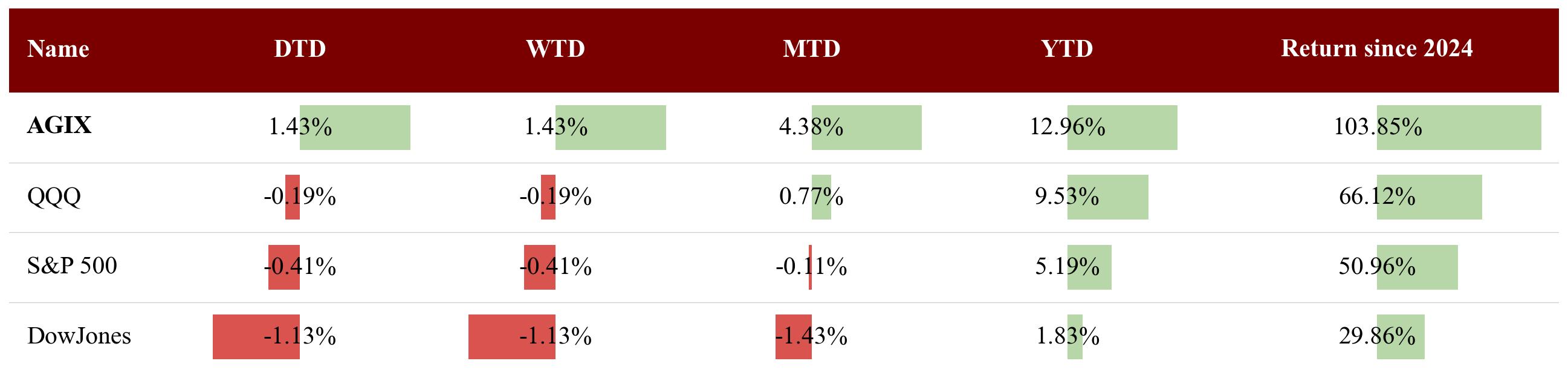
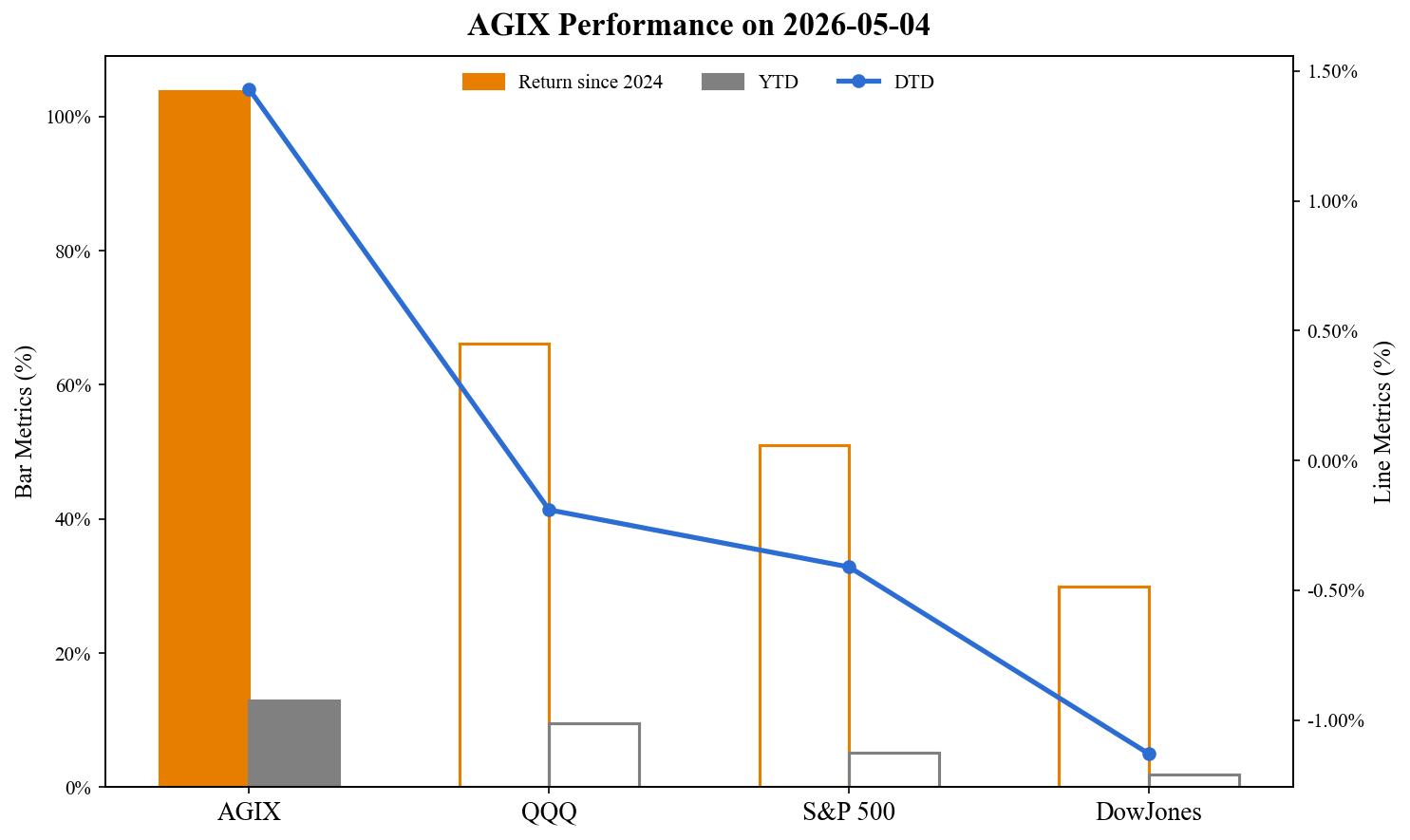
• AGIX rose 1.43% DTD, significantly outperforming the broader market (QQQ: -0.19%, S&P 500: -0.41%, DowJones: -1.13%), driven by strength in AI infrastructure and semiconductor holdings.
• Key positive contributors among holdings include Nebius Group (NBIS, +14.2%) on its Eigen AI acquisition and Meta AI contract, SK hynix (+12.52%) on sustained AI memory demand, and CoreWeave (CRWV, +5.39%) on continued AI infrastructure momentum.
• Semiconductor holdings broadly rallied: TSMC (+6.56%), Micron (+6.31%), MediaTek (+9.96%), and Samsung (+5.44%) all posted strong gains, reflecting bullish AI chip demand signals from Cerebras' IPO filing and Micron's earnings beat.
• Infrastructure names like Oracle (+4.92%), Datadog (+4.38%), and Cloudflare (+3.07%) also contributed positively, while AMD (-5.27%) and Arm (-3.75%) were notable laggards.
News Highlights
1. Cerebras IPO: AI chip maker Cerebras filed for a $3.5B IPO at up to $26.6B valuation, with strong subscription demand. This validates the AI inference chip market and benefits AGIX holdings like TSMC, SK hynix, and Micron, which are key semiconductor suppliers.
2. Palantir earnings beat: Palantir reported Q1 revenue of $1.63B (+85% YoY) and raised full-year guidance to $7.65B. US revenue doubled, underscoring strong enterprise AI adoption. Palantir is a 1.82% AGIX holding.
3. Sierra raises $950M: Bret Taylor's AI startup Sierra raised $950M at a $15B+ valuation, serving over 40% of Fortune 50 companies. This signals growing enterprise demand for AI agents, benefiting AGIX's infrastructure holdings like Microsoft, Amazon, and Google.
4. Anthropic & OpenAI launch enterprise JVs: Both labs formed joint ventures (Anthropic with Blackstone/Goldman, OpenAI with TPG/Brookfield) to sell AI services to enterprise portfolios. This expands the addressable market for AI infrastructure and data-center plays like CoreWeave and Nebius.
5. DoorDash adds AI tools: DoorDash launched AI-driven merchant onboarding, photo editing, and website generation tools. This highlights the trend of AI improving operational efficiency in platform businesses, relevant to AGIX's application holdings like Shopify and Meta.
RSS Highlights
1. AI backlash growing: Opposition to AI is rising in education, privacy, and economic inequality, with potential impact on the 2028 election. This underscores governance and trust risks for enterprise AI adoption.
2. AI compute demand questioned: A critical analysis argues that the massive AI infrastructure investments by hyperscalers ($803B+) may not reflect true market demand, citing Anthropic's projected $11B losses in 2026-2027 despite lofty revenue forecasts.
3. Redis adds array data type: Redis creator antirez developed a new array data type using AI tools, enabling efficient storage of Markdown files and server-side grep operations. This is a notable open-source AI productivity development.
4. GitHub commits up 14x YoY: Anthropic CEO Dario Amodei's prediction that AI will write most code is materializing, with AI-generated code now potentially 14 times human-written code, accelerating the trend.
5. Package manager security flaws: Analysis reveals recurring path traversal and parameter injection vulnerabilities in package managers over two decades, with incomplete fixes, highlighting ongoing software supply chain risks.
Performance & Benchmark
Attribution
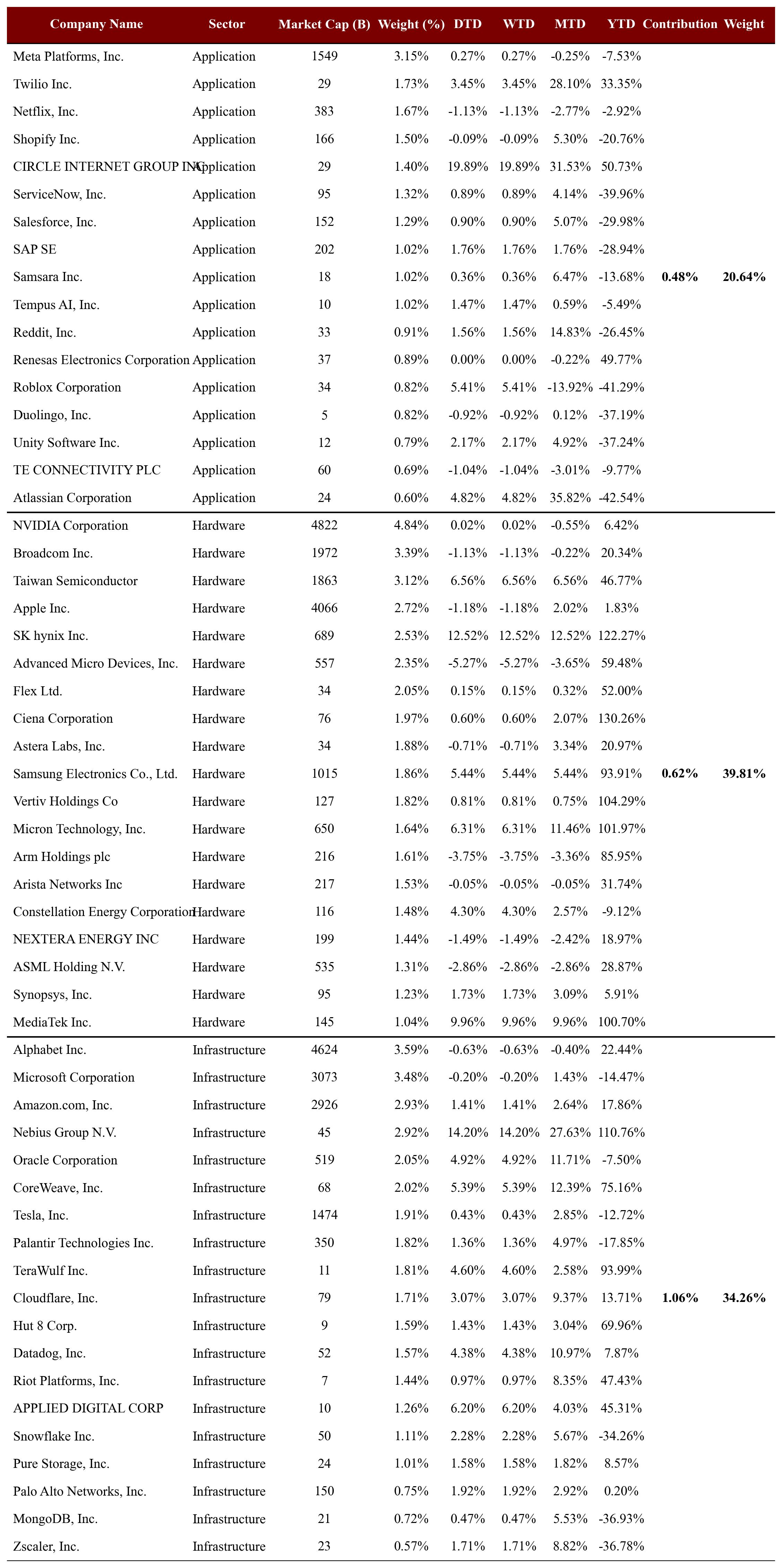
Contribution of the three sectors within AGIX holdings today
Application: 0.48%
Hardware: 0.62%
Infrastructure: 1.06%
Top-performing stocks in AGIX holdings today
CIRCLE INTERNET GROUP INC (19.89%)
Nebius Group N.V. (14.2%)
SK hynix Inc. (12.52%)
MediaTek Inc. (9.96%)
Taiwan Semiconductor Manufacturing Company Limited (6.56%)
Micron Technology, Inc. (6.31%)
APPLIED DIGITAL CORP (6.2%)
Samsung Electronics Co., Ltd. (5.44%)
Roblox Corporation (5.41%)
CoreWeave, Inc. (5.39%)
Oracle Corporation (4.92%)
Atlassian Corporation (4.82%)
TeraWulf Inc. (4.6%)
Datadog, Inc. (4.38%)
Constellation Energy Corporation (4.3%)
Twilio Inc. (3.45%)
Cloudflare, Inc. (3.07%)
Snowflake Inc. (2.28%)
Unity Software Inc. (2.17%)
Worst-performing stocks in AGIX holdings today
ASML Holding N.V. (-2.86%)
Arm Holdings plc (-3.75%)
Advanced Micro Devices, Inc. (-5.27%)
Top five listed stocks contributing the most within AGIX holdings today
Nebius Group N.V. (14.2%)
SK hynix Inc. (12.52%)
CIRCLE INTERNET GROUP INC (19.89%)
Taiwan Semiconductor Manufacturing Company Limited (6.56%)
CoreWeave, Inc. (5.39%)
Observation
The strongest movers across peer ETF holdings today are listed below:
| DTD | Stock Ticker | Name | Held by ETFs | analysis |
|---|---|---|---|---|
| 21.3 | TASE:NICE | NICE Ltd. | ['NasdaqGM:AIQ', 'NasdaqGM:ROBT', 'ARCA:IGPT', 'XTRA:XAIX', 'BIT:WTAI'] | NICE Ltd. (TASE:NICE) surged 21.3% on May 4, 2026, primarily driven by a strong Q1 2026 earnings report released on May 6, with anticipation and initial reactions likely fueling the pre-release move amid positive analyst upgrades. Supporting factors include a bullish average price target of $205.36 (implying 20.67% upside from recent levels) from 14 analysts and a favorable brokerage recommendation of 1.56 (Strong Buy). The broader TA-125 index rose 1.15% that day, providing tailwinds, while technicals showed mixed sell signals that were overridden by fundamentals. |
| 19.89 | NYSE:CRCL | Circle Internet Group, Inc. | ['NasdaqGM:AGIX'] | Circle Internet Group (CRCL) gained 19.89% on May 4, 2026, driven primarily by sustained momentum in its digital payments ecosystem expansion and technical strength from a series of higher lows establishing a classic uptrend structure that attracted dip-buying demand.[2] The stock had already rallied from the mid-$80s to near $117.91 by close, with intraday highs pushing just under $120, reflecting heightened optimism among traders despite some distribution selling from institutional accounts like Schwab clients.[2] Tight, liquid trading around $118 with steady bids indicated strong underlying demand supporting the move higher, even as the stock remained significantly overvalued relative to fundamental cash flow models.[2][4] |
| 14.2 | NasdaqGS:NBIS | Nebius Group N.V. | ['NasdaqGM:AGIX', 'BATS:WTAI', 'ARCA:THNQ', 'ARCA:CHAT', 'BIT:WTAI'] | Nebius Group (NBIS) surged 14.2% on May 4, 2026, primarily driven by the announcement of its acquisition of Eigen AI, which enhances its Token Factory platform for higher-margin AI services[1]. Goldman Sachs raised its price target following Nebius's Meta AI contract, alongside other analysts' strong buy ratings, further boosting sentiment[1]. Strong 2025 ARR exceeding guidance, enabling 2026 capex funding without dilution, and high trading volume underscored operational momentum amid AI sector optimism[1][2]. |
| 12.52 | KOSE:A000660 | SK hynix Inc. | ['NasdaqGM:AGIX', 'NasdaqGM:AIQ', 'ARCA:ARTY', 'NasdaqGM:ROBT', 'ARCA:IGPT', 'BATS:WTAI', 'ARCA:CHAT', 'ARCA:LOUP', 'ARCA:AIS', 'XTRA:XAIX', 'BIT:WTAI'] | SK Hynix's 12.52% stock surge on May 4, 2026, lacked direct same-day news catalysts in available sources. Earlier momentum from the company's March 2026 confidential SEC filing for a U.S. ADR listing—aiming to raise $6.7-10 billion for AI memory expansion including HBM clusters—likely sustained investor enthusiasm amid ongoing AI chip demand.[1] Technical factors showed mixed signals with strong buy moving averages prior to the move, potentially amplifying the rally.[2] |
| 12.19 | NasdaqCM:QUIK | QuickLogic Corporation | [] | No specific news events, earnings, or disclosures explain QuickLogic's (QUIK) 12.19% gain on May 4, 2026. The move occurred amid low volume relative to average (under 300k shares vs. typical 272k) and followed extended trading activity, suggesting momentum or style-driven buying in the semiconductor sector. Broader industry tailwinds in AI and low-power SoCs likely amplified technical factors, with shares rebounding from year lows around $4.80 toward recent highs near $16.89. |
| 10.0 | TWSE:6531 | AP Memory Technology Corporation | ['ARCA:AIS'] | No specific news events, company disclosures, or catalysts in available data explain AP Memory Technology Corporation's (TWSE:6531) 10.0% single-day gain on May 4, 2026. A board meeting scheduled for May 6, 2026, to review financial statements may have prompted preemptive buying, but no same-day announcements confirm this.[5] Broader market or trading factors likely contributed, as recent prices show volatility without tied triggers.[1][2] |
| 9.98 | TWSE:3443 | Global Unichip Corp. | ['NasdaqGM:AIQ', 'ARCA:IGPT', 'ARCA:THNQ', 'LSE:RBOT', 'LSE:AIAG'] | I cannot provide a reliable attribution for Global Unichip Corp.'s 9.98% single-day move on May 4, 2026, as the search results contain only historical data from late 2025 and do not include any news, disclosures, or market events from May 2026. To properly attribute this move, I would need access to real-time news from that specific date, company announcements, earnings releases, or relevant industry/regulatory developments from May 4, 2026. |
| 9.98 | TWSE:2408 | Nanya Technology Corporation | ['ARCA:IGPT', 'ARCA:AIS'] | Nanya Technology (TWSE:2408) surged 9.98% on May 4, 2026, primarily driven by a private placement announcement of 70 million common shares at NT$223.9 each, approved by the board, raising expected gross proceeds of NT$15.67 billion. This capital raise signaled strong growth prospects in semiconductors, boosting investor confidence amid recent analyst price target upgrades to as high as NT$285. Sector momentum from rising DRAM demand further amplified the move. |
| 9.96 | TWSE:2454 | MediaTek Inc. | ['NasdaqGM:AGIX', 'ARCA:IGPT', 'ARCA:THNQ', 'LSE:AIAG'] | MediaTek Inc. (TWSE:2454) surged 9.96% on May 4, 2026, closing at 2,870 TWD amid elevated trading volume of 3.79 million shares.[1][3][4] No specific same-day news events, company disclosures, or catalysts are identified in available data to directly attribute the move.[1][2] The advance may reflect broader market dynamics or technical factors, as Q1 2026 earnings reported earlier showed revenue missing estimates.[2] |
| 9.87 | TWSE:2345 | Accton Technology Corporation | [] | No specific same-day news events or company disclosures explain Accton Technology Corporation's (TWSE:2345) 9.87% gain on May 4, 2026. A scheduled board meeting on May 7, 2026, to review the consolidated financial report may have prompted preemptive buying.[2] Broader sector momentum in communication equipment or anticipation of strong results could also contribute, though no direct catalysts are confirmed in available data.[1][3] |
| 9.87 | TWSE:2395 | Advantech Co., Ltd. | ['NasdaqGM:AIQ'] | I cannot provide a reliable attribution for Advantech's 9.87% single-day move on May 4, 2026, as the search results contain no news, disclosures, or events from that date. The available data shows only historical price levels and general company information without any same-day catalysts, earnings announcements, regulatory developments, or industry news that would explain such a significant move. To properly attribute this move, I would need access to real-time news coverage, company announcements, or trading data from May 4, 2026. |
| 9.83 | TWSE:4919 | Nuvoton Technology Corporation | ['LSE:RBOT'] | I cannot provide a reliable attribution for Nuvoton Technology's 9.83% single-day move on May 4, 2026, as the search results contain no verifiable news events, company disclosures, or material announcements from that date. The available data includes only historical price information, analyst ratings, and company fundamentals, with the most recent dated information from February-August 2025. Without access to real-time news from May 4, 2026, any attribution would be speculative and violate the requirement to base analysis solely on verifiable public information. |
| 9.81 | SEHK:2121 | AInnovation Technology Group Co., Ltd | ['NasdaqGM:BOTZ', 'ASX:RBTZ', 'DB:XB0T'] | No verifiable public information attributes the 9.81% single-day gain in AInnovation Technology Group (SEHK:2121) on May 4, 2026. Search results lack same-day company news, disclosures, or industry events specific to the stock or AI sector. Broader market factors like HKEX options expansions or unrelated stocks (e.g., NetEase) do not reference 2121. |
| 8.3 | KOSDAQ:A140860 | Park Systems Corp. | ['LSE:RBOT'] | No specific news events, company disclosures, or catalysts explain Park Systems Corp.'s (KOSDAQ:A140860) 8.3% gain on 2026-05-04, as search results lack same-day announcements or filings.[5] The stock closed at 289,000 KRW with zero reported change or volume in available data, suggesting possible thin trading or delayed reporting.[5] Positive analyst consensus (Strong Buy, +20-24% upside) may have supported momentum, but no direct trigger ties to the move.[1][3] |
| 7.4 | HLSE:NOKIA | Nokia Oyj | ['ARCA:AIS', 'XTRA:XAIX'] | Nokia Oyj (HLSE:NOKIA) shares rose 7.4% on May 4, 2026, primarily driven by continued positive investor reaction to the company's announcement on May 1, 2026, to sell its Fixed Wireless Access (FWA) business to Inseego Corp, gaining an 11% stake and shifting focus to AI infrastructure.[1] The deal, which includes a $10 million investment and joint 6G initiatives, aims to simplify operations while Nokia reaffirmed its 2026 operating profit outlook of $2.34-2.93 billion.[1] No same-day news events on May 4 were identified, with the surge extending premarket momentum from Friday where shares hit new 52-week highs.[1][5] |
| 7.14 | NasdaqGS:CRNC | Cerence Inc. | ['NasdaqGM:BOTZ', 'NasdaqGM:WISE', 'ASX:RBTZ', 'DB:XB0T'] | No specific news events, earnings, or disclosures explain Cerence Inc. (CRNC)'s 7.14% single-day gain on 2026-05-04, as search results lack same-day catalysts and show Q2 2026 earnings scheduled for May 7.[2] Stock traded at $11.89 with volume of 624K shares versus an average of 832K, within its 52-week range of $5.94-$16.74, suggesting possible technical trading or low-volume momentum absent identifiable drivers.[1] Historical data ends May 2 without May 4 details.[3] |
| 6.9 | TWSE:6526 | Airoha Technology Corp. | ['LSE:RBOT'] | Airoha Technology (TWSE:6526) rose 6.9% on May 4, 2026, primarily driven by strong quarterly earnings that beat revenue expectations at NT$5.22B versus NT$5.18B estimated, alongside a 16% sequential net income increase to NT$730M. Positive analyst price targets, ranging from NT$510-800 with recent upgrades implied by the beat, supported the move amid ongoing semiconductor sector momentum. Technical rebound from recent volatility also contributed as shares recovered from a monthly -3.17% dip. |
| 6.56 | TWSE:2330 | Taiwan Semiconductor Manufacturing Company Limited | ['NasdaqGM:AGIX', 'NasdaqGM:SMH', 'NasdaqGM:AIQ', 'ARCA:ARTY', 'NasdaqGM:ROBT', 'BATS:WTAI', 'ARCA:THNQ', 'NasdaqGM:FDTX', 'ARCA:CHAT', 'ARCA:AIS', 'BIT:WTAI', 'LSE:AIAG'] | TSMC (2330.TW) rose 6.56% on May 4, 2026, primarily driven by news of U.S. startup Substrate announcing a chipmaking tool rivaling ASML's lithography equipment, which highlighted TSMC's dominant 90% market share in advanced AI chips despite potential long-term competition.[2] Trading data confirms the sharp intraday rebound from an open of 2213 to a high of 2300, closing around 2275 TWD after a prior -3.5% drop.[1][2] No company-specific disclosures or broader industry catalysts were reported on the date.[1][2][3] |
| 6.51 | NYSE:FIG | Figma, Inc. | ['ARCA:LRNZ'] | Figma (NYSE:FIG) rose 6.51% on May 4, 2026, driven primarily by a rebound in SaaS sector sentiment following positive earnings from peers like Atlassian and Twilio on May 1, which signaled resilience amid prior AI competition fears.[2] The stock traded as high as $20.40 during the session, reflecting strong intraday momentum after April's 16% decline triggered by Anthropic's Mythos AI and Claude Design launches.[1][2] No company-specific news emerged same-day, positioning this as a sector rotation bounce.[1] |
| 6.43 | NasdaqGS:OUST | Ouster, Inc. | ['LSE:RBOT'] | Ouster's 6.43% stock gain on May 4, 2026, was primarily driven by the company's announcement of its Rev8 OS family, the world's first native color lidar sensors doubling performance with human-like vision capabilities. The product launch fueled a premarket gap-up from $26.45 to $29.92, with shares trading around $28 amid high volume of 1.54 million shares. Supporting momentum came from strong analyst ratings ("Moderate Buy" with $40.20 average target) and prior Department of Defense certification enhancing its competitive moat in industrial, robotics, and smart infrastructure markets. |
| 6.31 | NasdaqGS:MU | Micron Technology, Inc. | ['NasdaqGM:QQQ', 'NasdaqGM:AGIX', 'NasdaqGM:SMH', 'NasdaqGM:AIQ', 'ARCA:ARTY', 'NasdaqGM:ROBT', 'ARCA:IGPT', 'BATS:WTAI', 'NasdaqGM:FDTX', 'ARCA:LOUP', 'ARCA:AIS', 'XTRA:XAIX', 'BIT:WTAI'] | Micron Technology (MU) stock rose 6.31% on May 4, 2026, primarily driven by the market's reaction to its blockbuster fiscal Q1 2026 earnings released after market close the prior trading day, which beat expectations with $13.64 billion in revenue (up 57% YoY) and $4.78 adjusted EPS versus consensus estimates of $12.84 billion and $3.95[2][4][5]. Strong AI-driven demand sold out Micron's high-bandwidth memory (HBM) supply through all of 2026, boosting gross margins to nearly 57% and prompting upward guidance for EPS of $8.22-$8.62 next quarter[2][3][4]. Ongoing optimism from industry veteran Mark Liu's $8 million share purchase further supported the move amid persistent memory chip shortages[1]. |
| 6.3 | NasdaqGS:MNDY | monday.com Ltd. | ['NasdaqGM:FDTX', 'LSE:RBOT'] | monday.com (MNDY) rose 6.3% on May 4, 2026, driven primarily by a recovery bounce following a prior sharp decline and potential short-covering activity. The stock had experienced a significant 20.78% drop to $77.63 on February 9, 2026, following undisclosed negative news, and the May 4 move appears to represent a technical rebound within that depressed range. Additionally, securities class action lawsuits filed against the company on May 4, 2026, may have created a capitulation event that triggered covering of short positions accumulated during the earlier selloff. |
| 6.25 | NasdaqGS:ALKT | Alkami Technology, Inc. | ['BATS:IGV'] | No specific news events or company disclosures on May 4, 2026, explain Alkami Technology's 6.25% single-day gain. Recent positive catalysts include the Q1 2026 earnings release with strong revenue growth and improved adjusted EBITDA, plus a FY2026 sales guidance raise on April 29 to $527.1M-$530.9M (above $528.6M consensus).[3][4] The move likely reflects continued momentum from these updates amid a moderate buy analyst consensus with a $39.25 price target.[2] |
| 6.24 | TWSE:2344 | Winbond Electronics Corporation | ['ARCA:IGPT'] | Winbond Electronics (TWSE:2344) rose 6.24% on May 4, 2026, primarily driven by its announcement of a NT$0.5 per share cash dividend, totaling approximately NT$2.25 billion.[3] This positive shareholder return signal boosted investor sentiment amid ongoing semiconductor sector strength. Technical factors, including bullish Ichimoku golden crosses and rising volume, provided secondary support.[2] |
| 6.2 | NASDAQGS:APLD | APPLIED DIGITAL CORP | ['NasdaqGM:AGIX'] | Applied Digital (APLD) rose 6.2% on May 4, 2026, primarily driven by the announcement and closing of a $300 million senior secured bridge facility led by Goldman Sachs to fund its third AI data center at Polaris Forge 1 in North Dakota.[2][6] The facility, a 364-day term loan at SOFR + 275 bps secured by project assets and prepayable without premium, signaled strong financial backing for AI infrastructure expansion amid positive analyst sentiment.[2][6][7] Technical indicators like RSI at 58.12 (Buy) and peers' mixed performance further supported stock-specific upside rather than sector trends.[3][2] |
| 5.83 | NYSE:DOCN | DigitalOcean Holdings, Inc. | ['BATS:WTAI'] | DigitalOcean's 5.83% gain on May 4, 2026 was primarily driven by anticipation of the company's earnings report scheduled for May 5, 2026, combined with sustained positive analyst sentiment and AI-related momentum in the cloud infrastructure sector. Multiple analysts had recently upgraded price targets into the $105-$115 range, with Oppenheimer boosting its target to $115 on April 28th, supporting investor confidence ahead of earnings. The stock's strong technical performance, trading near $102.87 with nine Buy ratings versus four Holds, reflected broad market optimism about DigitalOcean's AI-native enterprise customer pivot and accelerating revenue growth. |
| 5.8 | NasdaqGS:SNDK | Sandisk Corporation | ['XTRA:XAIX'] | SanDisk (SNDK) rose 5.8% on May 4, 2026, primarily driven by an analyst upgrade from Sanford C. Bernstein raising its price target, building on the company's recent exceedance of March-quarter expectations and optimistic June-quarter guidance. Booming NAND flash demand fueled by AI infrastructure further supported the move, as SanDisk benefits directly from the structural supply crunch and rising prices in this core product area. Strong recent momentum, including a 19.91% weekly gain and re-addition to a major index, amplified trading volume and volatility. |
| 5.73 | TWSE:2388 | VIA Technologies, Inc. | ['LSE:RBOT'] | No specific news events, company disclosures, or catalysts explain VIA Technologies (TWSE:2388)'s 5.73% single-day gain on May 4, 2026, based on available public information. Search results show only a scheduled board meeting on May 6 for financial report submission, with no same-day announcements or industry developments tied to the move[3]. Broader market or technical factors may have contributed, as recent trading data notes volatility of 5.39% and a buy rating[2]. |
| 5.44 | KOSE:A005930 | Samsung Electronics Co., Ltd. | ['NasdaqGM:AGIX', 'NasdaqGM:AIQ', 'NasdaqGM:ROBT', 'BATS:WTAI', 'ARCA:CHAT', 'XTRA:XAIX', 'BIT:WTAI'] | Samsung Electronics (KOSE:A005930) surged 5.44% on May 4, 2026, primarily driven by positive market reactions to its recent earnings announcement highlighting growth in robotics and optical communications segments. Analyst commentary on that date emphasized these areas as key performance points, boosting investor sentiment amid ongoing foreign selling pressure offset by domestic retail inflows. Broader sector momentum from U.S. big tech earnings also supported the rally, aligning with a short-term upward trend. |
| 5.41 | NYSE:RBLX | Roblox Corporation | ['NasdaqGM:AGIX', 'ARCA:CHAT', 'ARCA:LOUP'] | Roblox (RBLX) rose 5.41% on May 4, 2026, likely driven by a partial recovery from the prior session's 18% plunge following disappointing Q1 2026 earnings and guidance[1][6]. Citigroup's same-day price target cut to $70 from $90, while maintaining a "buy" rating, may have signaled to investors that the selloff was overdone[3]. Broader analyst actions, like BMO's recent target hike to $160, supported renewed buying interest amid volatile trading[2]. |
| 5.39 | NasdaqGS:FROG | JFrog Ltd. | ['BATS:WTAI', 'ARCA:THNQ', 'XTRA:XAIX', 'LSE:AIAG'] | JFrog Ltd. (FROG) rose 5.39% on May 4, 2026, primarily driven by strong intraday trading momentum following a 7.43% gain the prior session on May 3, where shares hit a high of $50.92 from a prior close of $46.44. No specific company news, earnings, or regulatory events were reported on May 4 to directly explain the move. Technical factors, including proximity to the 50-day moving average around $43.73 and recent institutional buying disclosed in Q4 2025 (e.g., Jennison Associates increasing stake by 11,579.9%), likely contributed to sustained buying interest.[1][5] |
| 5.39 | NasdaqGS:CRWV | CoreWeave, Inc. | ['NasdaqGM:AGIX', 'NasdaqGM:AIQ', 'NasdaqGM:ROBT', 'ARCA:CHAT', 'BIT:WTAI'] | CoreWeave (CRWV) rose 5.39% on May 4, 2026, amid continued positive momentum from recent AI infrastructure deals and analyst upgrades, with no specific same-day news event identified in available sources. Key drivers include the multi-year agreement with Anthropic to power Claude AI models, signaling strong recurring demand, alongside an expanded long-term deal with Meta through 2032 and NVIDIA's $2 billion early-2026 investment boosting credibility[2]. Broader analyst sentiment remains supportive with a "Moderate Buy" consensus and $125 average price target, following prior upgrades like Evercore's $150 target[1]. Stock price data confirms the intraday range of 121.57-126.10, aligning with the reported gain[3]. |
| 5.34 | NasdaqCM:CLSK | CleanSpark, Inc. | ['BATS:IGV'] | CleanSpark (CLSK) rose 5.34% on May 4, 2026, primarily driven by bullish technical indicators and positive short-term price forecasts signaling upward momentum. CoinCodex data from that day showed 25 bullish technical signals versus 1 bearish, with a flat $12.17 prediction but expected growth to $12.36 by May 6[3]. Forecasts from PandaForecast reinforced an uptrend for May, targeting $12.46 amid positive dynamics and volatility[4]. No specific same-day news events were identified in available sources. |
| 5.19 | NYSE:RBRK | Rubrik, Inc. | ['BATS:IGV', 'BATS:WTAI'] | Rubrik (RBRK) rose 5.19% on May 4, 2026, primarily driven by a MarketBeat report highlighting US Bancorp DE's 79.9% stake increase in Q4, adding 42,755 shares valued at $7.36 million.[2] Shares traded up $2.78 to $57.85 on elevated volume of 3.28 million shares, reflecting positive investor reaction amid recent insider selling and strong prior earnings ($0.04 EPS beat).[2][3] Technical support from the 200 EMA and bullish EMA stacking also contributed to the bounce.[1] |
| 5.16 | NasdaqGS:PONY | Pony AI Inc. | ['NasdaqGM:BOTZ', 'NasdaqGM:AIQ', 'NasdaqGM:WISE', 'ASX:RBTZ', 'DB:XB0T'] | I cannot provide a reliable attribution for Pony AI's 5.16% gain on May 4, 2026, as the search results contain no specific news, earnings announcements, regulatory developments, or company disclosures from that date. The available data shows only current pricing information and general analyst coverage without the real-time event-driven catalysts necessary for accurate single-day move attribution. To complete this analysis, I would need access to news archives, company press releases, or market commentary specifically from May 4, 2026. |
| 5.15 | TWSE:2451 | Transcend Information, Inc. | ['ARCA:AIS'] | No specific news events, company disclosures, or catalysts explain Transcend Information's (TWSE:2451) 5.15% gain on 2026-05-04, as search results lack same-day announcements or relevant updates.[1][7] A TWSE-generated company profile PDF dated 2026/05/04 exists but contains only standard semiconductor industry and business details without new financial or operational information.[1] The move may reflect broader market or sector momentum absent from available public data.[2][3] |
| 5.06 | NasdaqGS:AUR | Aurora Innovation, Inc. | ['BATS:IGV'] | No specific same-day news events or company disclosures explain Aurora Innovation's 5.06% gain on May 4, 2026. The stock closed at $6.175, up 0.73% from the prior close of around $6.13, amid a continuing multi-week uptrend (+57.99% since March 30) driven by bullish moving averages (3 positive signals) and optimism in autonomous driving from prior catalysts like the Hirschbach truck supply deal.[1] Technical factors, including support above key levels ($4.50, $3.91) and anticipation for Q1 earnings on May 6, likely sustained intraday volatility (7.40% range).[1][2] |
| 5.05 | NasdaqGS:EBAY | eBay Inc. | ['XTRA:XAIX'] | eBay's 5.05% gain on May 4, 2026 was driven primarily by GameStop's formal $125-per-share acquisition proposal, which represents a 46% premium to the February 4 closing price and values the company at approximately $56 billion. The bid's credibility was bolstered by GameStop's disclosure of a 5% economic stake and roughly $20 billion in financing commitments, with Citizens JMP simultaneously raising its price target to $120. Secondary support came from unusually high call option volume (37,026 contracts, up 181% from typical levels) and positive sentiment around the strategic rationale of creating a scaled e-commerce competitor to Amazon, though analysts noted significant feasibility and regulatory risks remain. |
| 5.05 | TWSE:2303 | United Microelectronics Corporation | [] | UMC (TWSE:2303) rose 5.05% on May 4, 2026, primarily driven by technical buying after hitting a key support level and confirming a golden cross with its 50-day moving average breaking above the 200-day average. Strong Q1 2026 earnings released on April 29, featuring NT$61.04 billion revenue, NT$16.17 billion net income, and 22/28nm contributing 34% of revenue with 22nm at 14%, provided a positive backdrop despite missing some estimates. Analyst buy ratings and bullish chart patterns like rounded bottom reversal further supported the move. |
News
Funding & M&A
Nicolas Sauvage is betting on the boring parts of AI.
TDK Ventures founder Nicolas Sauvage shared his investment philosophy at the StrictlyVC San Francisco event, believing that the best investments only become obvious after four years. Since founding the Japanese electronics giant's corporate venture capital arm in 2019, he has managed four funds totaling $500 million, with Groq being the most standout case in the portfolio. The AI chip startup was valued at $6.9 billion in fall 2023, and TDK Ventures invested in it back in 2020. Its founder, Jonathan Ross, previously worked on Google's TPU development and focuses on AI inference computing. Sauvage foresaw that inference demand would grow exponentially, positioning investments ahead of the generative AI boom. TDK Ventures focuses on future opportunities and threats for its parent company, investing in technologies like solid-state transformers and sodium-ion batteries. Recently, it has been focusing on physical AI, such as Agility Robotics' warehouse robots and ANYbotics' robots for hazardous environments, emphasizing single-task reliability. At the same time, Sauvage foresees a revival of CPUs in AI agent orchestration and a trend of China's 'vibe manufacturing' accelerating hardware iteration. He is investing to address the dexterity bottleneck, helping TDK leverage its manufacturing advantages.
Elon Musk sent ominous texts to Greg Brockman, Sam Altman after asking for a settlement, OpenAI claims
The lawsuit between Elon Musk and OpenAI continues to heat up. Two days before the trial began, Musk sent a text message to OpenAI President and co-founder Greg Brockman suggesting they settle the lawsuit. After Brockman proposed both sides drop the case, Musk responded that if they persisted with the lawsuit, he and Sam Altman would become the most hated people in America by the end of the week. This text exchange was disclosed in new documents filed by OpenAI's lawyers on Sunday, but no copy of the text was attached; the documents mainly argued for the admissibility of this evidence in court. The judge ultimately ruled the exchange inadmissible, as reported on-site by TechCrunch reporter Tim Fernholz. Musk's lawsuit aims to dismantle OpenAI's for-profit structure, demanding that its technology be made public, canceling the Microsoft licensing agreement, and seeking compensation, punitive damages, and legal fees. After OpenAI made public this 'settle or else' text, public opinion questioned whether Musk's motives were about AI safety or rather seeking compensation and harming a competitor, consistent with OpenAI's counterclaim allegations. The trial is ongoing, and this case could profoundly impact the structure and business model of the AI industry.
Elon Musk’s only AI expert witness at the OpenAI trial fears an AGI arms race
The lawsuit in which Elon Musk is trying to shut down OpenAI's for-profit AI business has entered a critical phase. His lawyers have cited early emails from the founders, emphasizing that OpenAI was originally an AI safety charity but has deviated from its mission to pursue profits. To this end, they have called Stuart Russell, a computer science professor at the University of California, Berkeley, as the only expert witness directly discussing AI technology. Russell, who has long studied AI and signed an open letter in March 2023 calling for a six-month pause in AI research, explained AI risks to the jury and Judge Yvonne Gonzalez Rogers, including cybersecurity threats, the problem of AI losing control, and the winner-takes-all nature of AGI development, emphasizing the tension between the pursuit of AGI and safety. Despite objections from OpenAI's lawyers, his testimony highlighted the existential threat of unconstrained AI. Russell criticized the arms race among leading global labs and called for stronger government regulation. During cross-examination, OpenAI's lawyers clarified that Russell had not evaluated the company's structure or safety policies. The case reflects the debate between corporate greed and AI safety: OpenAI founders like Sam Altman once warned of AI risks but accelerated development and shifted to for-profit to obtain computing resources, leading to a split in the team and sparking today's AI arms race. Similar dynamics are now seen at the national level, with Bernie Sanders proposing legislation to pause data center construction, citing concerns from Musk, Altman, and others, sparking controversy.
Anthropic and OpenAI are both launching joint ventures for enterprise AI services.
Anthropic announced the formation of a joint venture focused on enterprise AI services, with Blackstone, Hellman & Friedman, and Goldman Sachs as founding partners, and investment support from VCs, hedge funds, and private equity firms including Apollo Global Management, General Atlantic, GIC, Leonard Green, and Sequoia Capital. According to the Wall Street Journal, the venture is valued at $1.5 billion, with Anthropic, Blackstone, and Hellman & Friedman each committing $300 million. Almost simultaneously, Bloomberg reported that OpenAI is raising $4 billion for a new venture called The Development Company, valued at $10 billion, with investors including TPG, Brookfield Asset Management, Advent, and Bain Capital, with no overlap in investors between the two ventures. The logic behind both ventures is similar: raising funds through alternative asset managers like private equity to open new channels for enterprise AI deals, gaining priority sales access to the investors' portfolio companies, while investors share in the contract value. The new funds will increase engineering resources, adopting the forward-deployed engineer (FDE) model promoted by Palantir. Anthropic emphasized that the project will collaborate with engineering teams, clinical staff, and IT personnel at mid-sized enterprises to customize tools that integrate into existing workflows. This move comes as both AI labs are in high-intensity fundraising and considering IPOs: OpenAI announced a $12.2 billion funding round at an $852 billion valuation in late March, and Anthropic is nearing completion of a $50 billion funding round at a $900 billion valuation.
SAP acquires Dremio and Prior Labs to enhance its tabular AI capabilities.
SAP SE announced plans to acquire two startups, Dremio Inc. and Prior Labs GmbH, to strengthen its capabilities in data management and AI analytics. Dremio, headquartered in Santa Clara, California, has raised over $300 million in cumulative funding. Its data management platform, built on open-source projects Apache Iceberg and Apache Polaris, supports storing and analyzing massive business data, and includes an embedded AI agent that allows users to execute queries without writing SQL. SAP sees these technologies as a way to enhance its Business Data Cloud service, achieving breakthroughs in Iceberg support and metadata management. The other startup, Berlin-based Prior Labs, raised approximately $9.3 million. Its AI model, TabPFN-2.5, is optimized for tabular data, handling up to 100,000 rows, automating tasks like inventory scanning, and generating efficient lightweight versions through a distillation engine. SAP will integrate Prior Labs' technology into multiple products and plans to invest over $117 million in its AI research over the next four years, while keeping the team operating independently. SAP CTO Philipp Herzig stated that the bottleneck for enterprise AI is data preparation, not model performance, and technologies like Dremio will remove this barrier. This acquisition highlights SAP's strategic focus on enterprise AI data infrastructure.
Sierra raises $950M as the race to own enterprise AI gets serious
Bret Taylor's AI startup Sierra announced a $950 million funding round led by Tiger Global and GV, with a post-money valuation exceeding $15 billion. The company holds over $1 billion in cash reserves, which will be used to build a global standard for AI-driven customer experience. In just two years since its launch, Sierra has expanded from four design partners to serving over 40% of Fortune 50 companies, and its platform agents have handled billions of interactions across areas including mortgage refinancing, insurance claims, return management, and nonprofit fundraising. Revenue is growing rapidly, with ARR reaching $100 million in November last year and rising to $150 million in February, underscoring the urgent demand for AI agent tools. Taylor, who also serves as Chairman of OpenAI's board and was previously co-CEO of Salesforce, emphasized that agent AI can reduce costs and boost revenue, despite high initial deployment costs. Uber CTO Praveen Neppalli Naga revealed that the company's AI budget is quickly being consumed, but results are already visible: 10% of code from 8,000 engineers is autonomously generated by AI, and a hotel booking integration project was shortened from one year to six months. Sierra launched the Ghostwriter tool in April, enabling natural language construction of specialized agents, helping enterprise software transition from low utilization to seamless intelligence, with investors bullish on its vision for agent AI.
OpenAI's cozy partner Cerebras is on track for a blockbuster IPO
AI chip unicorn Cerebras Systems is approaching the largest tech IPO of 2026. On Monday, the company announced plans to issue 28 million shares priced between $115 and $125 per share, with a high-end valuation of $26.6 billion and a target to raise $3.5 billion. This move will deliver significant returns to late-stage investors who participated in a $1 billion Series H round at a $23 billion valuation in February, and also benefits OpenAI and its executives. Cerebras's core product, the Wafer-Scale Engine 3 chip, is optimized for AI inference and claims faster speeds and lower power consumption, challenging GPU giants like NVIDIA. Top investors include Alpha Wave, Benchmark, and Fidelity, each holding over 5%; others such as AMD, G42, and Tiger Global also participated. The angel investor lineup is star-studded, including OpenAI founders Sam Altman, Greg Brockman, and Ilya Sutskever. OpenAI is not only a major customer but also provided a $1 billion loan in December last year and received 33 million warrants, having previously considered acquiring Cerebras. The 2024 IPO was delayed due to a US federal review triggered by G42's investment, after which the company raised over $2 billion through multiple rounds, including an $1.1 billion round in September and the Series H round in February. Bloomberg reports that underwriters have received $10 billion in subscription orders, indicating strong demand that could push the offering price higher. A successful IPO would validate market enthusiasm for giants like SpaceX and OpenAI.
AI chip provider Cerebras seeks to raise $3.5 billion in an IPO at a $26.6 billion valuation.
Cerebras Systems Inc. today announced the financial terms for its upcoming initial public offering (IPO), planning to offer 28 million shares at a price of $115 to $125 per share, raising up to $3.5 billion. Underwriters can purchase an additional 4 million shares, and the company may raise the offering price if market demand is strong. The company's 2025 sales surged 76% to $290.3 million, and it achieved a profit of $87.9 million, reversing a previous loss of $485 million. At the highest price, this IPO would give the company a market value of $26.6 billion, an increase of $3.6 billion from its $23 billion valuation in February this year.
Cerebras's core product, the WSE-3 wafer-scale AI chip, is far larger than Nvidia's Blackwell B200 GPU, equipped with 44GB of SRAM memory and supporting 900,000 cores accessing it in a single clock cycle, resulting in significant inference speed improvements. The chip is integrated into the 1.8-ton CS-3 system, which can be deployed in clusters, and is complemented by MemoryX storage and SwarmX switches for optimized data processing. Last month, the company signed a large-scale chip supply agreement with OpenAI, providing up to 2 gigawatts of computing power by 2030, with a contract value exceeding $20 billion, expected to become a major revenue driver in the future.
Additionally, Cerebras partnered with Amazon Web Services (AWS) to bring the WSE-3 to the cloud platform, which may encourage more cloud providers to follow suit, driving growth in the company's public cloud business.
Model Releases
Image AI models now drive app growth, beating chatbot upgrades
A recent report from Appfigures shows that the release of image models is significantly driving the growth of AI mobile apps, with downloads 6.5 times higher than traditional model updates. Previously, features like conversational models and voice chat were more effective at stimulating demand, but now image models have become the new engine. Taking ChatGPT and Gemini as examples, OpenAI's GPT-4o image model gained over 12 million new downloads within 28 days of its release, 4.5 times more than the previous GPT-4o, GPT-4.5, and GPT-5 models. Google Gemini 2.5 Flash image model (Nano Banana) brought over 22 million downloads, with a surge of more than 4 times. Meta AI's video model Vibes gained about 2.6 million new downloads after its release, which, while visual content, is on a smaller scale. The report warns that a surge in downloads does not necessarily translate into revenue: Nano Banana only generated $181,000 in consumer spending, Vibes had no significant revenue; only ChatGPT's GPT-4o image model achieved $70 million in consumer spending, far exceeding the baseline. Although DeepSeek R1 gained 28 million downloads, it was due to its fame and unrelated to image models, highlighting the curiosity-driven effect. Image models give users a reason to try, but need to optimize conversion to realize commercial value.
Technical Breakthroughs
Palantir beats earnings expectations, raises full-year guidance as US revenue doubles
Palantir Technologies Inc. (PLTR) reported first-quarter fiscal 2026 earnings, with shares still down over 2% in after-hours trading. The company posted adjusted earnings per share of $0.33, up 153% year-over-year, and revenue of $1.63 billion, up 85% year-over-year, both beating analyst estimates of $0.28 and $1.54 billion, marking the highest annual growth rate in company history. US revenue surged 104% to $1.282 billion, with commercial revenue jumping 133% to $595 million and government revenue growing 84% to $687 million. The quarter closed 206 deals worth over $1 million each, with total contract value reaching $2.41 billion, up 61% year-over-year; US commercial remaining transaction value leaped 112% to $4.92 billion. Net profit soared to $871 million, with adjusted operating profit of $984 million, an operating margin of 60%, operating cash flow of $899 million, and adjusted free cash flow of $925 million. The company's cash reserves stand at $8 billion. The Rule of 40 score reached an impressive 145%, with CEO Alex Karp noting that this performance is only matched by Nvidia (NVDA), Micron (MU), and SK Hynix. The company raised its full-year revenue guidance to between $7.65 billion and $7.662 billion, representing 71% growth, above the consensus estimate of $7.27 billion; US commercial revenue is expected to exceed $3.224 billion, with growth of at least 120%; adjusted operating profit is forecast at $4.44 billion to $4.452 billion, with free cash flow of $4.2 billion to $4.4 billion. Second-quarter revenue is expected to be between $1.797 billion and $1.801 billion. These results highlight Palantir's strong momentum in AI data analytics.
AI exposes attacks that traditional detection methods cannot see.
Discussions on AI security often focus on the risks of the models themselves, but a more pressing issue is the blind spots in detection systems, and side-channel attacks are exposing this flaw. Side-channel attacks steal encryption keys or infer AI interaction topics by monitoring physical factors such as power consumption, electromagnetic radiation, and processing time, without needing to decrypt or inspect the payload—only by analyzing traffic structure, timing, and sequences. Traditional security architectures rely on rules, signatures, and anomaly baselines, but modern attacks like encrypted channels, low-speed intrusions, and AI-assisted links often fail to trigger alerts, creating a 'detection gap.' The article points out that current AI security investments mostly optimize existing alert handling rather than expanding detection horizons. DeepTempo CEO Evan Powell calls for a shift to behavioral sequence analysis, using deep learning to identify undefined patterns and assess whether activities align with expected system behavior. This is not a rule optimization but an architectural change, enabling early detection of covert threats like side-channel attacks, reducing attack dwell time and risk exposure. Organizations should evaluate their current visibility and prioritize investing in AI systems that can capture behaviors outside the rules, rather than just improving response efficiency. AI did not create the problem, but it has exposed the limitations of traditional detection; those who adapt will win by expanding their observation scope, not by accelerating old patterns.
Agentic development demands a multi-model strategy — and the governance to match
The rapid rise of agentic development is fundamentally reshaping the software engineering landscape, driving enterprises to embrace multi-model AI ecosystems. In an exclusive interview with theCUBE at the Google Cloud Next conference, Mikhail Vink, Vice President of Business Development at JetBrains s.r.o., noted that the pace of change in software development has exceeded expectations, and to avoid vendor lock-in, enterprises must empower developers to seamlessly orchestrate multiple agents across different AI providers. He emphasized that developers need to stay updated on the latest models from Anthropic, Gemini, and others to get the best value from the market. Although code generation has become commoditized, building infrastructure to manage complex systems remains a challenge for enterprises, including agents, memory layers, data pipelines, and external tool integration, requiring ongoing configuration and maintenance. To this end, JetBrains is developing a governance platform to track costs, monitor model access, and analyze developer acceptance of AI suggestions, providing the necessary visibility for enterprise-scale AI management. Vink called on developers to act as orchestrators, strengthening quality assurance and critical thinking, and deeply scrutinizing AI-generated algorithms to ensure safety and functionality. He specifically pointed out, 'Critical thinking is the most crucial—not blindly approving AI output, but deeply understanding how the system works.' This interview highlights the evolution of governance and developer roles in an AI-driven environment.
'An engine without a car': Why AI without workflow structure fails to deliver measurable value.
Most enterprise AI pilot projects fail to deliver measurable business value, and Appian Corp. believes the issue is not the technology itself but the lack of embedding AI into deterministic workflows. Greta Peterman, Chief Business Value Engineer at Appian, pointed out at Appian World 2026 that deploying AI as a standalone tool cannot achieve compliance, auditability, or true ROI; it must be embedded into workflows to ensure deterministic outputs. She emphasized that enterprise processes like invoice reconciliation or sales order management cannot tolerate probabilistic results and require absolutely auditable outcomes. Peterman cited a paper from OpenAI, comparing it to the deterministic calculation of A+B=C in exams, contrasting with probabilistic AI. Research commissioned by Appian from International Data Corp. shows that enterprises using its platform can achieve a 441% three-year ROI and reduce time-to-market by 59%. These enterprises focus on the downstream impact of process changes, not just time savings. For example, in a partnership with a global medical technology provider, AI-assisted sales order processes captured downstream defects worth millions of dollars. Although seemingly edge cases, such processes can drive 80% of downstream impact. Peterman warned that enterprises chasing only flashy features overlook friction points with customers or competitors and fail to transition from pilots to board-level results. SiliconANGLE's theCUBE provided exclusive live coverage of the event. (Approximately 235 words)
Product Launches
DoorDash adds AI tools to speed up merchant onboarding, edit photos of dishes
DoorDash recently launched a series of AI-driven tools aimed at accelerating the merchant onboarding process, improving content quality, and optimizing the e-commerce experience. These tools include an onboarding tool similar to the one Amazon launched in 2024, which automatically scrapes photos, business hours, and menu information from merchant websites to generate app listings, which merchants can review and edit before publishing. Additionally, DoorDash upgraded its video library feature, allowing merchants to tag dishes in videos for customers to order directly, and providing statistics such as video views and sales data. Restaurants also gained AI photo editing tools: AI Retouch can replace backgrounds, sharpen images, and optimize lighting without altering the dishes themselves; AI Replate can professionalize plating effects, adjusting lighting and colors, and merchants can also upload reference images to apply specific styles. The company also expanded its e-commerce platform, supporting quick website generation based on DoorDash's existing menus and photos, with test merchants achieving an average order conversion rate of nearly 10%. A new marketing campaign builder automates content creation, email promotion, and scheduling. Brian Tolkin, DoorDash's head of merchant products, said these tools aim to eliminate friction and help merchants focus on cooking great food and delivering excellent customer service. This move highlights DoorDash's strategic layout in using AI technology to help merchants grow.
'Slay the dragon': Appian says process orchestration is the fix enterprise AI keeps skipping
Appian Corp co-founder and CEO Marc Wilson pointed out at Appian World 2026 that enterprise AI enthusiasm often outpaces strategic thinking, and most organizations overlook the critical link of process automation. He emphasized that the biggest obstacle companies face is not a shortage of AI tools, but process fragmentation caused by unmanaged 'white space' between departments and between people and systems. Simply applying AI to individual productivity or departmental workflows cannot solve the fundamental problem; end-to-end process orchestration is the way forward. Wilson cited examples: a large Asia-Pacific insurance company used Appian's document processing capabilities to optimize broker and underwriting workflows, significantly accelerating customer onboarding and generating tens of millions in revenue; a hospital system automated document ingestion and process routing, eliminating the need for registered nurses at administrative registration stations and redeploying clinical staff to patient care, improving efficiency. In the current AI wave, dual pressure from employees and C-level executives is driving higher technology expectations, and Appian is seizing the opportunity to provide a strategic process orchestration layer that delivers both cost reduction and revenue growth, avoiding the tactical pitfalls of previous technology waves like cloud computing.
DoorDash adds AI tools to speed up merchant onboarding and edit photos of dishes.
DoorDash launched several AI-driven tools on Monday aimed at speeding up the merchant onboarding process, optimizing photo editing, and quickly creating websites based on app listings. These tools significantly improve merchant operational efficiency, helping them focus on their core business. The new onboarding tool is similar to a feature Amazon launched in 2024: merchants simply point to their website, and the system automatically captures photos, business hours, and menu information to generate a listing, which merchants review before publishing. Meanwhile, DoorDash upgraded its video library, allowing merchants to tag dishes in videos so customers can order directly, and providing metrics like video views, sales data, and new customer sales statistics. Photo editing tools include AI Retouch, which replaces backgrounds, sharpens images, and optimizes lighting without altering the food itself; AI Replate professionalizes plating effects by adjusting lighting and colors, and merchants can upload reference images to apply specific styles. Additionally, the company expanded its business platform features, allowing restaurant owners to quickly generate websites based on existing DoorDash content, with test order conversion rates averaging nearly 10%. A new marketing campaign builder supports automated content creation, email promotion, and scheduling. DoorDash's head of merchant products, Brian Tolkin, said these tools aim to eliminate friction, helping merchants succeed from day one by delivering great food and customer experiences.
Industry Partnerships
Google and PwC are closing the enterprise AI trust gap one agent at a time
At a critical stage of enterprise AI transformation, PwC has partnered with Google Cloud to launch a dedicated AI Center of Excellence, marking a shift of AI agent solutions from experimentation to core operations. Mike Thiessen, PwC US Chief Client and Market Officer, emphasized that success depends on balancing rapid deployment with trust governance, and business leaders need to establish frameworks to ensure transparent and reliable AI use. Rebecca Potts, Google's North America Strategic Industry Director, explained that by embedding engineers to leverage client data, industry-specific agents can be developed within a week, demonstrating practical use cases that 'convince with facts,' quickly building trust and accelerating sales cycles. The center embeds specialized technical talent directly into client projects, reducing friction in adopting complex architectures and shortening time to AI value realization. Facing pressure from C-level executives on return on investment, the partnership focuses on unit economics and 'build vs. buy' decisions to drive agile automation. Thiessen noted that leadership attitude is key—those who better leverage AI will lead. This collaboration highlights that enterprise AI deployment requires responsible innovation, driven by cultural momentum to fuel digital transformation and help solve previously intractable business challenges. (228 characters)
5 days only: Bring a partner or colleague and get 50% off a second TechCrunch Disrupt 2026 pass.
TechCrunch announced that the 2026 TechCrunch Disrupt conference will be held from October 13 to 15 in San Francisco, expecting to attract over 300 exhibiting startups and more than 10,000 founders and investors, featuring over 250 tactical sessions, conversations, and networking opportunities. The company launched a limited-time BOGO promotion: until May 8 at 11:59 PM Pacific Time, purchasing one Disrupt ticket allows you to get a second ticket of the same type at 50% off, encouraging attendees to bring a colleague, co-founder, or partner to enhance the event's value. The offer covers investor tickets (saving $499), founder tickets (saving $399), attendee tickets (saving up to $444), nonprofit tickets (saving $214), and Expo+ tickets (saving $149). The event emphasizes that team participation amplifies network effects, helping investors find deals faster, founders accelerate fundraising momentum, operators optimize product roadmaps, nonprofits explore emerging tech applications, and explorers get close to disruptive startups. The Startup Battlefield 200 competition offers a $100,000 no-equity prize and media exposure. TechCrunch aims to deepen relationships, turning conversations into deals, hires, and next steps, with tickets selling out soon, urging immediate registration to lock in the offer.
Three insights you might have missed from theCUBE's coverage of Google Cloud Next.
At the Google Cloud Next 2026 conference, Google Cloud emphasized the importance of agentic AI infrastructure, positioning itself as a leader in the agent control layer, offering an intelligent data cloud for optimal data delivery, supporting graph traversal, vector embeddings, and more. OpenText partnered with Google Cloud to build a complete agent stack, focusing on context engineering and data sovereignty, launching industry-specific solutions deeply integrated with the Gemini enterprise agent platform. Google collaborated with vendors like Nvidia, Dell, and AMD to provide AI-ready infrastructure, supporting Kubernetes orchestration in hybrid environments. AMD's x86 architecture helped Sabre migrate 50,000 virtual CPUs, achieving cost savings and seamless migration, driving agent AI investments. Covered California teamed up with Deloitte and Google, using Document AI to reduce document verification time from 72 hours to seconds, saving 24,000 hours of manual work and enabling employees to shift to high-value customer service. Google invested $750 million to build a partner ecosystem, accelerating outcomes for 120,000 members. Experts noted that enterprises need to start with major business problems, leverage AI to drive transformation, and reshape organizational structures and operating models.
RSS Subscription
Reminder: You Can Stitch Together Lots of Little HTML Pages With Navigations For Interactions
The author explores the effectiveness of building websites using multiple small HTML pages and navigation, emphasizing the avoidance of JavaScript-dependent in-page interactions in favor of HTML-based multi-page navigation, and enhancing the user experience with CSS view transitions. This approach ensures compatibility across different devices and browsers while keeping page sizes small and interactions fast and intuitive.
AI didn't delete your database, you did
Last week, a tweet sparked discussion about a man claiming that his company's production database was deleted by a Cursor/Claude agent. He tried to question the agent's reasons and discussed the potential dangers of AI agents, but overlooked his own responsibility. The article points out that companies should not have API endpoints that allow deletion of production databases, emphasizing the need to establish effective processes when using AI to ensure developers are accountable for their work, rather than relying on AI to evade responsibility.
Stealth Startup Spy #336
A former Anthropic engineer is building a reinforcement learning environment for automating machine learning research, a former Facebook product manager and Stackbit founder have entered stealth mode, and early employees of Durin, Hadrian, and Stoke Space are developing human enhancement technologies. Currently, our 'Company Launch Tracker' is tracking multiple new companies and founders, with real-time updates on stealth activities.
Redis array type: short story of a long development
I started developing a new array data type for Redis in early January, and after four months of effort, the code has finally been submitted. I initially wrote a detailed specification document, and throughout the process used AI tools for design and development, ultimately achieving an efficient data structure that supports storing Markdown files in Redis arrays. Through continuous testing and optimization, I ensured the implementation's robustness and practicality, and I hope the new array data type will be accepted soon to enable more application scenarios.
The growing AI backlash
Opposition to artificial intelligence is rising, especially in areas such as education, privacy, and economic inequality, where the negative impacts of generative AI are becoming increasingly evident. This sentiment is expected to play a significant role in the 2028 presidential election and may even influence the upcoming midterm elections. Although some form of AI in the future may bring positive effects, current generative AI suffers from serious mismanagement, leading to widespread public disappointment.
Premium: The AI Compute Demand Story Is A Lie
Recently, Amazon and Google pledged to invest another $65 billion in Anthropic, which had just raised $30 billion in February and plans to raise another $50 billion. Although Anthropic is expected to lose $11 billion in 2026 and 2027, its revenue forecast shows it will reach $148 billion by 2029, raising questions about its financial viability. Overall, Microsoft, Google, and Amazon have invested over $803 billion in AI, while OpenAI and Anthropic have raised more than $252 billion in total, all of which does not seem to reflect true market demand.
How do I inform Windows that I’m writing a binary file?
Windows cannot automatically recognize whether a file is in text mode or binary mode; all files are treated as byte streams in Windows. To open a file in text mode and perform necessary text conversions (such as inserting carriage returns before line feeds), users need to handle it manually or use a higher-level library (such as the C runtime) to open the file with the "w" mode. For file content conversion, users must handle it themselves or rely on the runtime library, not Windows itself.
[RSS Club] Where are you from?
I added some locally hosted privacy-first statistics to my blog, using an offline GeoIP service to roughly understand visitor origins. Although the service cannot handle users on VPNs or mobile roaming, it is sufficient for my needs.
How the Vectrex game console sunk a 124-year-old company
On May 4, 1984, the famous board game manufacturer Milton Bradley agreed to be sold to Hasbro, as changes in gaming trends in the 1980s put pressure on the company. Although Milton Bradley had ventured into video games, especially with the popular Simon game, its revenue declined after reaching $420.7 million in 1980, and it eventually made the major decision to acquire General Consumer Electronics in 1983, attempting to turn things around by gaining the new video game console Vectrex.
Pluralistic: Demand destruction vs fuel-superseding infrastructure (04 May 2026)
In a recent article, historian and essayist Rebecca Solnit explores the concept of "demand destruction," arguing that Trump's policies and wars are accelerating the global transition to renewable energy. She emphasizes that although Trump tries to support the fossil fuel industry, banks have recognized the trend of declining demand and refuse to lend to oil companies. In 2025, the share of coal in global energy consumption fell below one-third for the first time, and the use of solar and wind energy surpassed that of coal.
29th August 2026: a scenario
On August 29, 2026, a new vulnerability in the Linux operating system was exploited, causing severe global outages for cloud services such as AWS and Azure, which prevented multiple large enterprises and banks from processing payments. The U.S. President declared a major cybersecurity incident, suspecting a state-level attack. Although no data was stolen, the system crashes caused widespread chaos and panic. Major cloud service providers are urgently fixing the vulnerability and cooperating with global security agencies.
Paul Thurrott Might Write a Book on Markdown
In the early 1990s, I returned to university to study software development, but I shifted to writing after being invited by Professor Gary Brent to do technical reviews for his Visual Basic book. I ended up writing almost the entire book myself and became the lead author. Since then, I have co-authored several books with Gary and independently written over 30 books. Although I never achieved my original goal of becoming a software developer, I am still proficient in multiple programming languages and have written extensively on technical topics. Currently, I co-author "Eternal Spring: Our Guide to Mexico City" with my wife, which is updated annually.
Quoting Andy Masley
From 2000 to 2024, the total area of land sold by farmers was equivalent to the size of Colorado. In 2028, the land occupied by data centers was only one seventy-seventh of the land sold by farmers, and the grain output from the remaining land reached a record high, with no impact on the U.S. food supply. However, when a farmer sold a few acres of ordinary dry grassland to a large tech company for ten times its agricultural value, it sparked concerns about a "shortage of farmland."
★ Y Combinator’s Stake in OpenAI
OpenAI, Anthropic, Cursor, and Perplexity chose to use WorkOS instead of building their own. Y Combinator co-founder Paul Graham did not take a clear stance when discussing Sam Altman's credibility, even though Y Combinator holds about 0.6% of OpenAI shares, valued at over $5 billion at current valuation—a stake that should be disclosed.
April 2026 newsletter
I just released the April 2026 patron-exclusive monthly issue, covering topics such as the price increases for Opus 4.7 and GPT-5.5, Claude Mythos and LLM safety research, ChatGPT Images 2.0, and more. Patrons can get early access to the latest content for $10 per month.
Google Owns a Big Chunk of Anthropic
In the competition in the field of artificial intelligence, Google has not only developed its own technology but also secretly invested in multiple startups, including Anthropic, in which it holds a 14% stake. According to legal documents, Google plans to reinvest $750 million through convertible debt in September, bringing its total investment in Anthropic to over $3 billion. Anthropic's recent funding round valued it at $380 billion, and Google's potential return on investment exceeds $50 billion.
App Store Search Ads and the Slippery Slope
Apple's iOS App Store search function has encountered serious issues, with search result relevance being replaced by ad inventory, covering about 70% of the interface. Since March 26, newly added search ad placements have led to a significant drop in app downloads, such as Morpho Converter falling by 33% and Pop Out Timer by 23%. This change has particularly impacted small developers, who lack sufficient funds to sustain ongoing search ad campaigns.
Commits on GitHub Are Up 14× Year-Over-Year
OpenAI, Anthropic, Cursor, and Perplexity have chosen to use WorkOS instead of building their own. Anthropic CEO Dario Amodei once predicted that within the next year, AI will write almost all code, and currently, the amount of code generated by AI may already be 14 times that written by humans, with this trend accelerating. Although human programmers will still be involved in writing and reviewing code, their proportion in overall code generation will drop significantly.
'Noir, Japan’s Hard-Boiled Bittersweet Answer to Oreos'
Japan's NOIR cookie is a bittersweet response to OREO, which was once produced in Japan but has since moved to China. Yamazaki Biscuits launched NOIR in 2017, using local wheat and high-quality cocoa powder, resulting in a bitter taste that is not overly sweet, making it popular among consumers and a better fit for the Japanese market. NOIR cookies not only surpass OREO in flavor but also incorporate Japanese cultural elements, reflecting respect for ingredients and refinement.
Photoshop’s 'Modern User Interface' Sucks (and Doesn’t Feel Modern)
Photoshop's 2026 version introduced a user interface update, but many basic interaction design principles were not followed, leading to a poor user experience. For example, input fields are not auto-focused, field values are not pre-selected, and navigation using the Tab key is inconvenient, making operations cumbersome and unresponsive. These issues reflect a lack of attention to user needs in the interface update, potentially causing user disappointment and dissatisfaction with the software.
Anthropic Executive, One Year Ago: Fully AI Employees Are a Year Away
Anthropic's Chief Information Security Officer, Jason Clinton, said the company expects AI-driven virtual employees to begin operating within corporate networks over the next year. These virtual employees will have independent 'memories', roles, and company accounts and passwords, marking a further step in the application of AI in enterprises. However, despite this prediction attracting attention, the reality shows that companies have not widely adopted such AI employees.
TRE Python binding — ReDoS robustness demo
Research shows that the TRE regular expression engine outperforms Python's standard library in handling malicious regex attacks, mainly due to its lack of backtracking support. The experiments were conducted using Python bindings built with ctypes by Claude Code.
Redis Array Playground
Redis has added a new data type—arrays—with related commands including ARCOUNT, ARDEL, and others. The most notable command is ARGREP, which performs server-side grep operations on value ranges within arrays, using the TRE regular expression library. This feature is currently available in a branch and provides an interactive online trial platform.
ScopeXR — Cataract Surgery Using Apple Vision Pro Mixed Reality
SightMD announced a historic milestone in surgical innovation: ophthalmologist Dr. Eric Rosenberg became the first surgeon in the world to successfully perform cataract surgery using the Apple Vision Pro. The surgery was first completed in October 2025, and since then, Dr. Rosenberg and his team have performed hundreds of procedures using the platform, demonstrating its scalability and clinical impact. The ScopeXR platform leverages spatial computing to enhance surgical visualization, guidance, and education, enabling real-time remote collaboration among surgeons worldwide, greatly improving surgical safety and the learning experience.
John Sterling, Beloved Longtime Yankees Radio Voice, Passes at 87
John Sterling, the legendary announcer who called games for the New York Yankees for over three decades, has died at the age of 87. He broadcast 5,426 regular-season games and 225 postseason games from 1989 to 2024, known for his distinctive style and iconic home run calls. His final game was the World Series on October 30, 2024. The Yankees said in a statement that Sterling brought passion and joy to countless fans, and his voice will forever be linked to the Yankees.
'2 Letters From Steve'
During my more than 12 years at Apple, I never had direct contact with Steve Jobs for work reasons. It wasn't until March 2010, at the request of a seriously ill friend, that I sent him an email hoping to get permission to show her photos on the iPad before its official release. Surprisingly, Jobs replied within three minutes with a simple "OK," which made me feel the company's humanity and warmth. Although I ultimately couldn't show her the iPad, I was glad to accompany my friend through her final moments.
Package Manager CWEs
An analysis of security vulnerabilities in package managers reveals that several common failure patterns recur across different tools, especially path traversal and parameter injection. The research points out that many vulnerabilities have persisted over the past two decades, and fixes are often incomplete, causing the same issues to reappear in different tools. It is recommended that developers strictly check path resolution and parameter passing when building package managers to improve security.
Crimes Against Decency Need as Much Cover-Up as Crimes Against the Law
OpenAI, Anthropic, Cursor, and Perplexity choose to use WorkOS instead of building their own. Meta's contract with Kenyan contractor Sama was terminated after some contractors disclosed to journalists the private content they saw while reviewing videos from Meta's AI glasses. Although these actions may not be illegal, public resentment and anger toward Meta persist, especially when people realize that these AI products are backed by human intelligence.
X, the Platform of Free Speech
Gil Durán was permanently banned from X for posting "TLDR: Fascism" and his appeal was unsuccessful. His tweet was a brief response to a thousand-word article by Palantir about its vision of a "technology republic." This incident has brought attention to his upcoming book "The Nerd Reich," which is expected to become a bestseller.
From RSS to Atom
I switched my personal website's content source from RSS to Atom. Although this decision came a bit late (2026), I believe it has a positive impact on my site's user experience. The switch took about an hour. Each entry in Atom format now has a unique UUID and supports explicit content type declaration, making content management more flexible. Although the main feed currently contains only two newly published articles, I still see steady traffic from feed readers, proving that web feeds remain valuable today.
Content for Content's Sake
Language is constantly evolving, especially in certain communities, and many people are not adapting well to this change. By analyzing 90 days of coding session data, it was found that the usage frequency of certain words has significantly increased, which may be related to the influence of large language models (LLMs). At the same time, social media is flooded with AI-generated content, making genuine human communication more difficult, as many people imitate the writing style of LLMs in order to attract attention.