AGIX Daily Report 2026-05-06
AI Summary
Market Overview
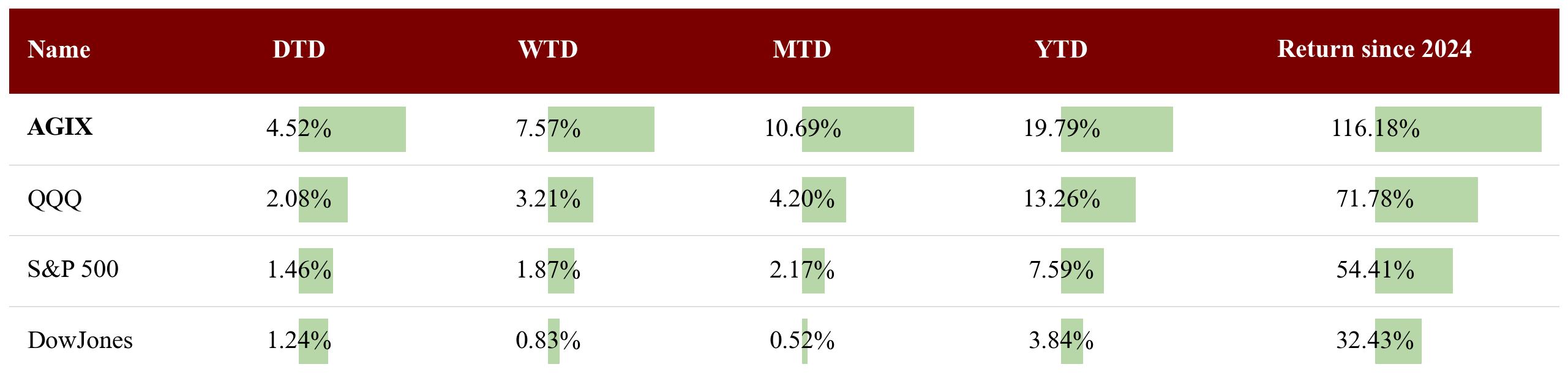
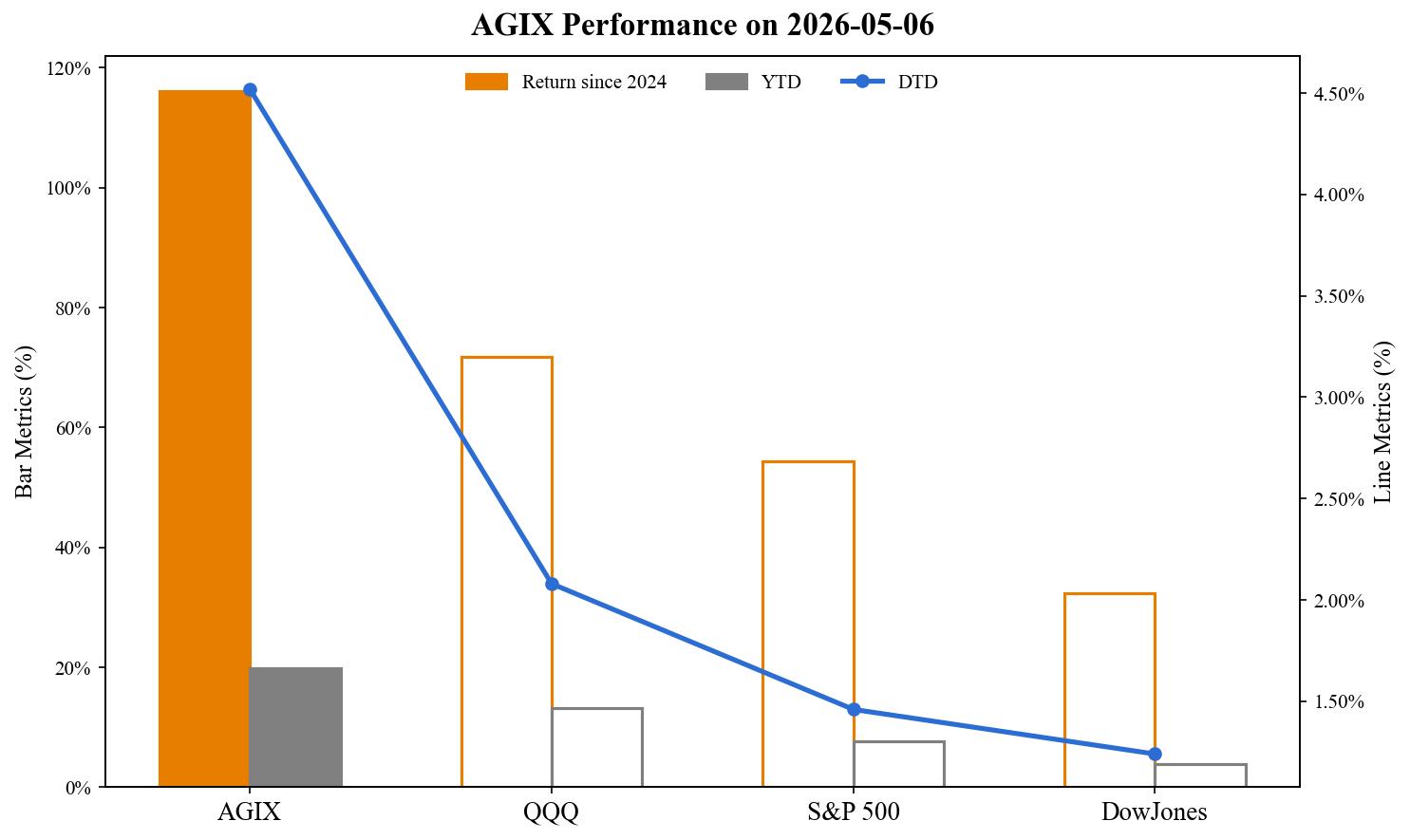
• AGIX surged 4.52% DTD, significantly outperforming the QQQ (2.08%), S&P 500 (1.46%), and Dow Jones (1.24%), driven by broad strength in AI and semiconductor holdings.
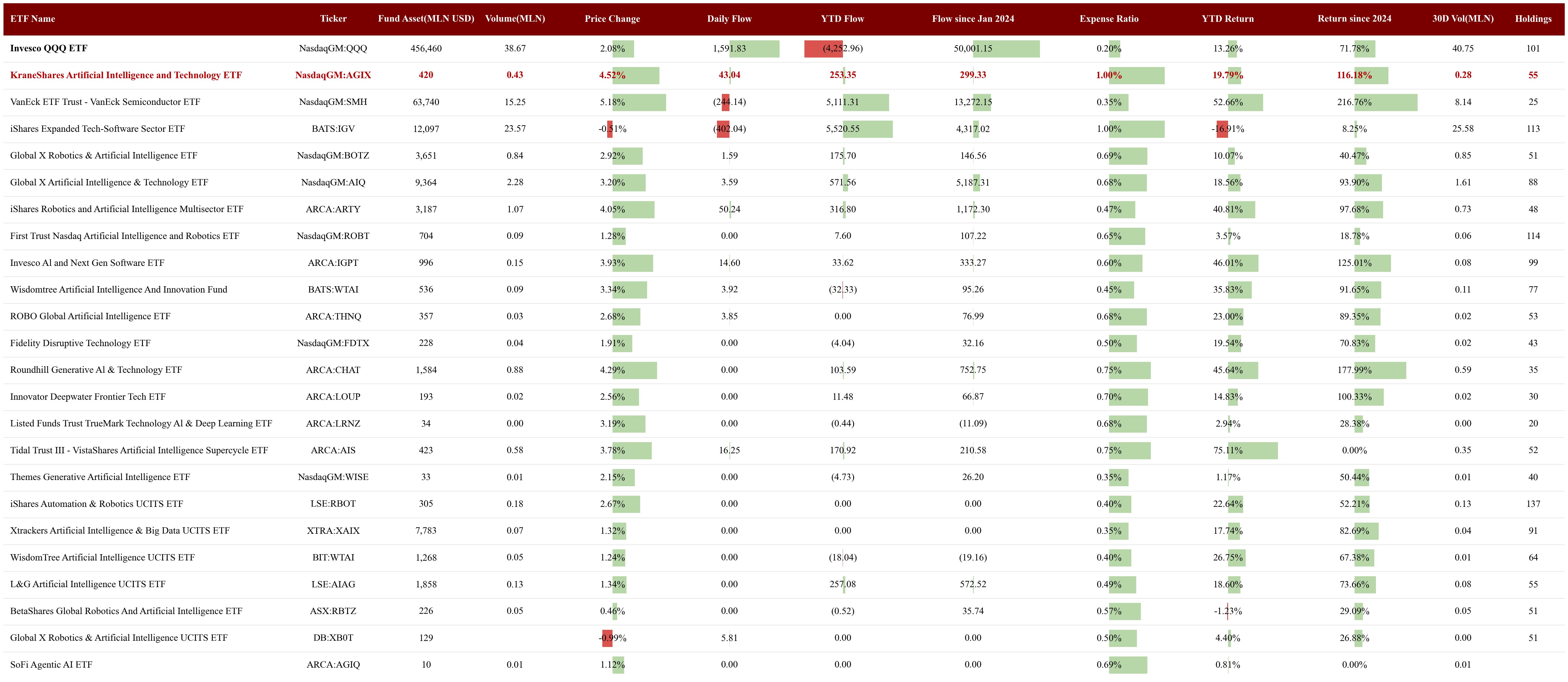
• Peer AI ETFs posted strong gains: IGPT (+3.93%), CHAT (+4.29%), and ARTY (+4.05%), reflecting broad AI sector momentum. SMH (semiconductors) rose 5.18% DTD, a key tailwind for AGIX's heavy hardware exposure.
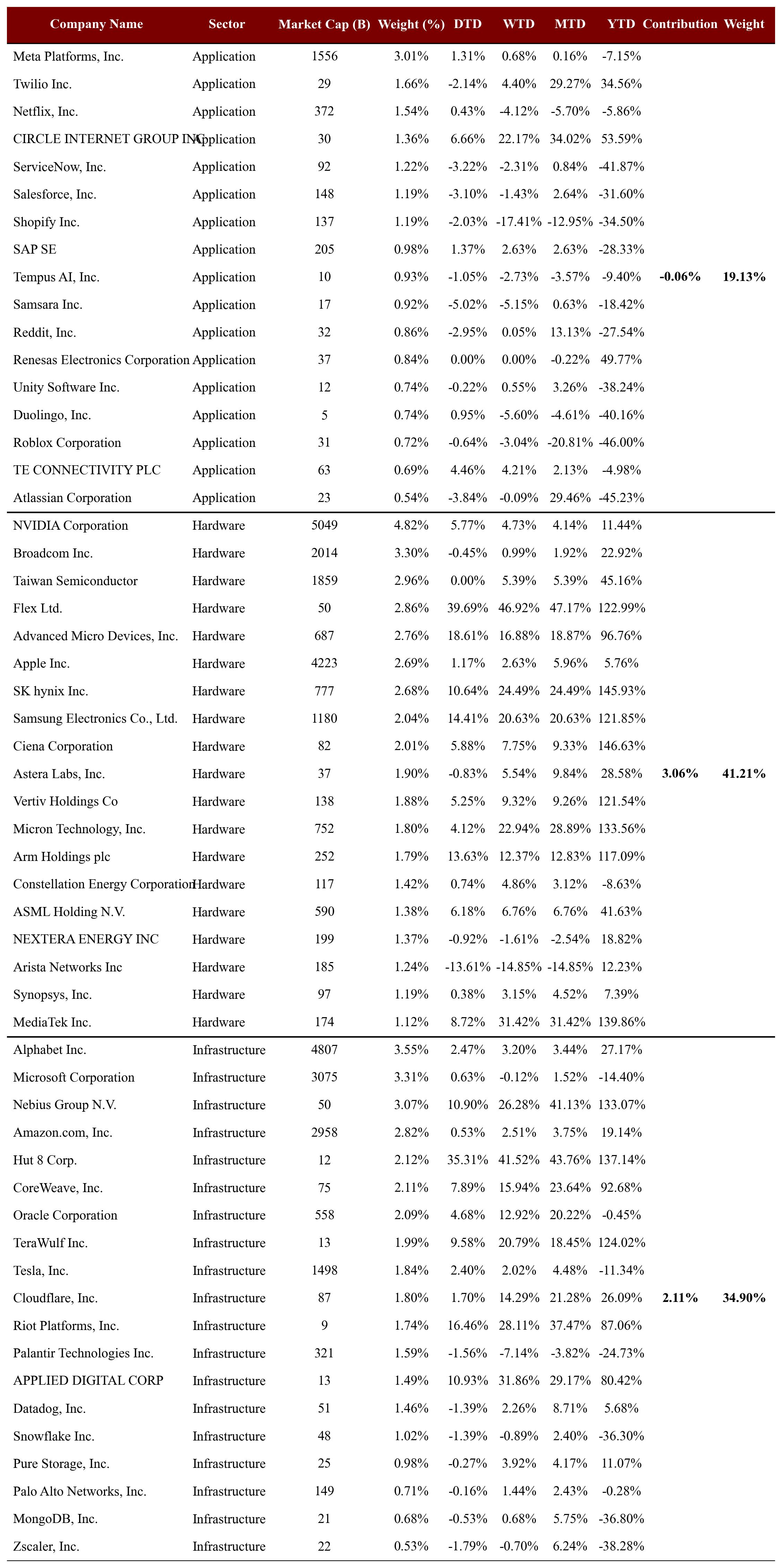
• Top AGIX holdings contributing to DTD performance: AMD (+18.61%) surged on a blowout earnings beat and raised guidance; Samsung Electronics (+14.41%) hit a $1 trillion market cap on AI chip demand; Arm Holdings (+13.63%) rallied on strong AI-driven licensing revenue; SK hynix (+10.64%) continued its HBM-driven uptrend; and Hut 8 (+35.31%) and Flex (+39.69%) posted outsized gains on company-specific catalysts.
• Notable drags: Arista Networks (-13.61%) fell despite a revenue beat, as margin guidance and supply chain concerns weighed; ServiceNow (-3.22%) and Salesforce (-3.10%) declined on no specific news, possibly reflecting rotation into pure-play AI hardware.
News Highlights
1. AMD's Q1 earnings beat (revenue +38% YoY, data center sales +57%) and raised guidance drove a 16%+ after-hours surge, reinforcing its AI infrastructure leadership and benefiting AGIX's 2.76% holding.
2. Supermicro shares rallied over 18% after-hours on Q3 earnings that beat EPS estimates and raised full-year guidance to $38.9–$40.4 billion, signaling sustained AI server demand and supporting AGIX's indirect exposure via hardware holdings.
3. Samsung Electronics' market cap crossed $1 trillion for the first time, driven by AI chip demand and strong HBM performance, directly lifting AGIX's 2.04% holding.
4. DigitalOcean shares surged 40%+ after an AI-driven earnings beat and raised revenue outlook for 2026 and 2027, highlighting accelerating demand for inference and agentic AI workloads.
5. OpenAI upgraded ChatGPT to GPT-5.5 Instant, reducing hallucinations on sensitive topics by over 37%, improving reliability for enterprise use and supporting broader AI adoption.
RSS Highlights
1. A report warns that by end of 2027, Microsoft, Google, Amazon, and Meta are expected to spend $2 trillion on AI capex, but returns remain meager relative to spending, raising questions about sustainability.
2. Asimov's Three Laws are discussed as merely suggestions for modern AI, as safety measures rely on system prompts and RLHF rather than hard constraints, leaving models vulnerable to jailbreaks.
3. Open-weight models are quietly closing up, with tightening licensing terms threatening availability and potentially concentrating power among a few large labs.
4. Apple settled a class-action lawsuit over delayed Siri AI features for $250 million, highlighting the gap between AI marketing promises and actual delivery.
5. The line between 'vibe coding' and 'agentic engineering' is blurring as AI coding tools advance, raising concerns about code quality and the need for rigorous evaluation over mere output volume.
Performance & Benchmark
Attribution
Contribution of the three sectors within AGIX holdings today
Application: -0.06%
Hardware: 3.06%
Infrastructure: 2.11%
Top-performing stocks in AGIX holdings today
Flex Ltd. (39.69%)
Hut 8 Corp. (35.31%)
Advanced Micro Devices, Inc. (18.61%)
Riot Platforms, Inc. (16.46%)
Samsung Electronics Co., Ltd. (14.41%)
Arm Holdings plc (13.63%)
APPLIED DIGITAL CORP (10.93%)
Nebius Group N.V. (10.9%)
SK hynix Inc. (10.64%)
TeraWulf Inc. (9.58%)
MediaTek Inc. (8.72%)
CoreWeave, Inc. (7.89%)
CIRCLE INTERNET GROUP INC (6.66%)
ASML Holding N.V. (6.18%)
Ciena Corporation (5.88%)
NVIDIA Corporation (5.77%)
Vertiv Holdings Co (5.25%)
Oracle Corporation (4.68%)
TE CONNECTIVITY PLC (4.46%)
Micron Technology, Inc. (4.12%)
Alphabet Inc. (2.47%)
Tesla, Inc. (2.4%)
Worst-performing stocks in AGIX holdings today
Shopify Inc. (-2.03%)
Twilio Inc. (-2.14%)
Reddit, Inc. (-2.95%)
Salesforce, Inc. (-3.1%)
ServiceNow, Inc. (-3.22%)
Atlassian Corporation (-3.84%)
Samsara Inc. (-5.02%)
Arista Networks Inc (-13.61%)
Top five listed stocks contributing the most within AGIX holdings today
Flex Ltd. (39.69%)
Hut 8 Corp. (35.31%)
Advanced Micro Devices, Inc. (18.61%)
Nebius Group N.V. (10.9%)
Samsung Electronics Co., Ltd. (14.41%)
Observation
The strongest movers across peer ETF holdings today are listed below:
| DTD | Stock Ticker | Name | Held by ETFs | analysis |
|---|---|---|---|---|
| 39.69 | NasdaqGS:FLEX | Flex Ltd. | ['NasdaqGM:AGIX'] | Flex Ltd. (NASDAQ:FLEX) surged 39.69% on May 6, 2026, primarily driven by Q4 FY26 earnings that beat expectations with $7.48B revenue (vs. $6.97B est.) and $0.93 adjusted EPS (vs. $0.88 est.), coupled with FY27 guidance far exceeding consensus at $32.3B–$33.8B revenue (vs. $29.2B) and $4.21–$4.51 EPS (vs. $3.67). The announcement of a tax-free spin-off of its high-growth Cloud & Power Infrastructure unit into SpinCo by Q1 2027 further fueled the rally by highlighting AI/data center exposure. A $1.1B Electrical Power Products deal and Baird's price target hike to $88 reinforced bullish sentiment, leading to a premarket gap from $96.45 close to $119.85 open. |
| 35.31 | NasdaqGS:HUT | Hut 8 Corp. | ['NasdaqGM:AGIX', 'BATS:IGV', 'NasdaqGM:AIQ'] | Hut 8 (HUT) surged 35.31% on May 6, 2026, primarily due to anticipation ahead of its Q1 2026 earnings release before market open and conference call at 8:30 a.m. ET that day. The stock's sharp intraday move from prior levels around $79 aligns with traders positioning for potential positive results in bitcoin mining and energy infrastructure amid a strong 52-week performance. Elevated trading volume near 3.7M shares further supported the momentum-driven rally. |
| 24.93 | NasdaqGM:VCYT | Veracyte, Inc. | ['ARCA:THNQ', 'LSE:AIAG'] | Veracyte's 24.93% stock surge on May 6, 2026, was driven primarily by blowout Q1 2026 earnings released after market close on May 5, featuring $139.1M total revenue (+21% YoY), $135.1M testing revenue (+26% YoY), adjusted EBITDA of $42.8M (30.8% margin), and raised full-year 2026 guidance to $582M–$592M revenue with >26% adjusted EBITDA margins. The strong Decipher test revenue growth of 30% further highlighted operational momentum. Positive analyst consensus of "Strong Buy" with $45.14 average price target provided additional tailwind. |
| 24.54 | NasdaqGS:SMCI | Super Micro Computer, Inc. | ['NasdaqGM:AIQ', 'ARCA:ARTY', 'ARCA:IGPT', 'ARCA:THNQ', 'ARCA:CHAT', 'ARCA:AIS'] | Super Micro Computer (SMCI) surged 24.5% on May 6, 2026, primarily driven by its Q3 earnings beat and bullish Q4 guidance exceeding consensus expectations. The company reported $0.84 EPS versus $0.63 expected, revenue up 122.7% year-over-year, and Q4 revenue guidance of $11.0B–$12.5B against ~$11.1B consensus, signaling strong AI server demand. Mixed analyst actions, including Wedbush's neutral rating with a $34 target cut and Needham's buy reaffirmation at $40, provided secondary support amid high trading volume of over 125 million shares. |
| 18.61 | NasdaqGS:AMD | Advanced Micro Devices, Inc. | ['NasdaqGM:QQQ', 'NasdaqGM:AGIX', 'NasdaqGM:SMH', 'NasdaqGM:AIQ', 'ARCA:ARTY', 'NasdaqGM:ROBT', 'ARCA:IGPT', 'BATS:WTAI', 'ARCA:THNQ', 'ARCA:CHAT', 'ARCA:LRNZ', 'ARCA:AIS', 'NasdaqGM:WISE', 'LSE:RBOT', 'XTRA:XAIX', 'BIT:WTAI', 'LSE:AIAG'] | AMD's 18.61% single-day gain on May 6, 2026 was driven primarily by a blowout quarterly earnings result that exceeded market expectations, as referenced in analyst commentary from May 6 noting strong performance metrics. The stock's momentum was reinforced by the company reaching a new 52-week high at $411.80, signaling sustained investor confidence in AMD's execution and market position. Analyst price targets, including a $398.04 target from 24/7 Wall St., suggest the market had been undervaluing the stock ahead of the earnings release, creating room for the sharp single-day appreciation. |
| 16.46 | NasdaqCM:RIOT | Riot Platforms, Inc. | ['NasdaqGM:AGIX', 'BATS:IGV'] | Riot Platforms (RIOT) surged 16.46% on May 6, 2026, primarily driven by its announcement of a partnership with Terrestrial Energy to co-locate molten salt nuclear reactors with hyperscale data centers, targeting up to 4 GW of capacity for AI, HPC, and Bitcoin mining. This deal propelled shares to a 4-year high above $23, building on the prior day's Q1 2026 earnings beat with $167.2M revenue, $33.2M data center revenue, and AMD's expansion to 50 MW capacity. The nuclear pivot amplified sector momentum, as seen in Hut 8's 35% gain, shifting investor focus to Riot's diversified AI infrastructure play. |
| 16.26 | SHSE:688041 | Hygon Information Technology Co., Ltd. | ['ARCA:IGPT', 'ARCA:AIS'] | Hygon Information Technology's 16.26% surge on May 6, 2026, was primarily driven by a memory chip market frenzy boosting domestic AI chip stocks. The stock hit its 20% daily limit amid scaled commercial implementation of AI computing power chips, following Hygon's Q1 2026 report showing profitability and strong revenue growth. Positive analyst sentiment on future yields and reinvestment further fueled investor confidence. |
| 14.82 | SHSE:688008 | Montage Technology Co., Ltd. | ['ARCA:AIS'] | Montage Technology's 14.82% surge on May 6, 2026, was primarily driven by continued momentum from its Hong Kong IPO debut, where shares jumped 57% on Monday after raising $902 million. Strong memory chip price trends boosted the storage sector, with the company's HK listing (06809) up over 9% recently amid upward price momentum. Robust 2025 financials, including 49.9% revenue growth to 5.46B and 58.4% earnings increase, further supported the rally. |
| 14.41 | KOSE:A005930 | Samsung Electronics Co., Ltd. | ['NasdaqGM:AGIX', 'NasdaqGM:AIQ', 'NasdaqGM:ROBT', 'BATS:WTAI', 'ARCA:CHAT', 'XTRA:XAIX', 'BIT:WTAI'] | Samsung Electronics (KOSE:A005930) surged 14.41% on May 6, 2026, driven primarily by booming AI-related chip demand that propelled its market cap above $1 trillion for the first time, making it the second Asian firm after TSMC to hit the milestone. This rally aligned with a broader semiconductor supercycle, fueled by positive tech earnings signaling sustained demand for data center chips amid big tech's capex expansion. The KOSPI index also hit a record high, up 6.45% to 7,384, amplifying momentum in Korean chip stocks. |
| 14.11 | NasdaqCM:RR | Richtech Robotics Inc. | ['NasdaqGM:BOTZ', 'ASX:RBTZ', 'DB:XB0T'] | Richtech Robotics (RR) stock surged 14.11% on May 6, 2026, primarily driven by bullish analyst price targets highlighting significant upside potential. MarketBeat data showed a consensus $6.00 target from two analysts (one buy, one sell), implying 118% upside from the $2.75 close, while Stockscan.io forecasted an average $4.89 target (+103%) over 30 days. Technical indicators like STOCHRSI and Williams %R signaling "buy" amid neutral RSI supported short-term momentum buying. No company-specific news or disclosures were reported for the day. |
| 13.63 | NasdaqGS:ARM | Arm Holdings plc | ['NasdaqGM:QQQ', 'NasdaqGM:AGIX', 'ARCA:IGPT', 'ARCA:CHAT', 'ARCA:LRNZ', 'ARCA:AIS'] | Arm Holdings (ARM) stock surged 13.63% on May 6, 2026, primarily driven by blowout Q4 fiscal 2026 earnings that beat estimates with revenue of $1.49 billion (up 20% YoY, vs. $1.47B expected) and non-GAAP EPS of $0.60 (vs. $0.54 expected). Key support came from robust AI and data center demand, highlighted by 29% licensing revenue growth to $819 million and the launch of the Arm AGI CPU with over $2 billion in customer demand for FY2027-2028. Strong pre-earnings momentum from analyst upgrades, including Wells Fargo's price target hike to $220, further fueled the move. |
| 13.38 | NYSE:KAI | Kadant Inc. | ['LSE:RBOT'] | Kadant (NYSE: KAI) stock surged 13.38% on May 6, 2026, primarily driven by its Q1 2026 earnings release after market close on May 5, which reported record revenue of $281.51 million, record bookings, and EPS of $2.16 that beat guidance by $0.43. Aftermarket parts revenue hit $209M, underscoring strong demand and operating momentum. The earnings conference call on May 6 further highlighted 14% EPS growth, fueling the positive investor reaction. |
| 12.4 | BIT:AMP | Amplifon S.p.A. | ['NasdaqGM:AIQ'] | Amplifon's 12.4% stock surge on May 6, 2026, was primarily driven by anticipation of its Q1 earnings release scheduled for that day, boosting investor sentiment amid a premium valuation with P/E at 31.3x versus sector average of 19.8x. Broader positive crypto market momentum, including Bitcoin's 2.9% gain to $81,286 on May 5, provided secondary support given Amplifon's exposure to growth narratives. No other company-specific news events were reported. |
| 12.22 | NasdaqGS:IPGP | IPG Photonics Corporation | ['ARCA:IGPT', 'LSE:RBOT'] | IPG Photonics' 12.22% gain on May 6 was driven primarily by multiple analyst upgrades and price target increases announced that day, combined with resolution of a major legal overhang. Needham upgraded the stock from Hold to Buy with a $110 target, while Citigroup raised its target to $150 (implying 48% upside), and Stifel maintained Buy while adjusting its target to $125. The company's announcement of a global patent settlement with TRUMPF removed significant litigation risk, and Q1 revenue beat of $265.5M (+16.5% YoY) demonstrated underlying demand strength despite prior margin concerns from conservative Q2 guidance. |
| 12.01 | NYSE:GLW | Corning Incorporated | ['ARCA:AIS'] | Corning (GLW) stock surged 12.01% on May 6, 2026, primarily driven by a strong Q1 earnings beat with 18% core sales growth and 30% core EPS growth, fueled by Gen AI optical demand and 80% YoY solar segment expansion, plus raised Q2 guidance for double-digit growth. A multiyear NVIDIA partnership for $500M investment in U.S. optical plants and fiber capacity expansion for AI data centers, alongside a Meta contract and upgraded Springboard plan targeting $11B incremental sales by 2028 (extended to 2030), boosted AI infrastructure visibility. Analyst upgrades from Citi ($175), UBS ($179), Susquehanna ($180), Barclays, Truist, and Wolfe Research ($230) amplified the rally. |
| 11.37 | NasdaqGS:BIDU | Baidu, Inc. | ['NasdaqGM:AIQ', 'NasdaqGM:ROBT', 'ARCA:IGPT', 'ARCA:CHAT'] | Baidu's 11.37% single-day gain on May 6, 2026, was primarily driven by heightened investor attention highlighted in a Zacks Equity Research article that day, noting BIDU's strong +14.1% monthly outperformance versus the S&P 500's +9.5% and its position on Zacks' most-searched stocks list amid upward earnings estimate trends. This stock-specific momentum stood out against peers' mixed performance earlier in the week. Broader bullish sentiment from price forecasts and recent 13.44% monthly gains further supported the move. |
| 11.37 | NasdaqGS:BIDU | Baidu Inc. | ['NasdaqGM:AIQ', 'NasdaqGM:ROBT', 'ARCA:IGPT', 'ARCA:CHAT'] | Baidu (BIDU) surged 11.37% on May 6, 2026, primarily driven by the company's announcement of its first-ever dividend and a new $5 billion share repurchase program through 2026, sparking a nearly 5% after-hours jump that carried into the session. The board's approval of these capital returns signaled strong shareholder value focus amid bearish sentiment. Trading outperformed a dipping broader market, with S&P 500 down 0.41%, highlighting stock-specific catalysts over macro factors. |
| 11.33 | NasdaqGS:AUR | Aurora Innovation, Inc. | ['BATS:IGV'] | Aurora Innovation rose 11.33% on May 6, 2026, driven primarily by the release of Q1 2026 earnings that beat revenue expectations ($1.00M actual vs. $0.97M expected) and reinforced the company's autonomous freight commercialization momentum. The stock benefited from continued positive news flow around the expanded Hirschbach Motor Lines partnership targeting 500 Aurora Driver-powered trucks starting in 2027, which represents a potential shift to high-margin recurring revenue despite the company's current $1M quarterly revenue base. Goldman Sachs' price target increase from $4 to $5 (maintained with a Neutral rating) provided additional validation of improving commercial visibility, though the bank's cautious stance signals execution risk remains a key concern for investors. |
| 11.22 | SEHK:1357 | Meitu, Inc. | ['XTRA:XAIX'] | The search results provided do not contain any verifiable news events, company disclosures, or material announcements from May 6, 2026 that would explain Meitu's 11.22% single-day gain. The only concrete data point is the price movement itself (HK$4.19 to HK$4.66), along with a historical block trade of 1.6M shares at HK$4.66 and general technical indicators showing the stock in an uptrend. Without access to same-day news, earnings releases, regulatory filings, or specific catalysts from May 6, 2026, the driver cannot be definitively attributed to a particular event. |
| 11.0 | NasdaqGS:CORZ | Core Scientific, Inc. | ['BATS:IGV'] | Core Scientific (CORZ) shares rose 11% on May 6, 2026, primarily driven by the announcement of a $421M acquisition of Polaris DS LLC, adding 440 MW of contracted power and adjacent land to accelerate expansion of its Muskogee, Oklahoma campus to 1.5 GW for AI/HPC colocation. This strategic move, which hit a new 52-week high above $24, was amplified by heavy call option buying and positive media coverage framing the gigawatt-scale buildout. Despite a Q1 earnings miss reported the same day (EPS -$1.06 vs. -$0.02 expected), the growth catalyst overshadowed profitability concerns. |
| 10.93 | NASDAQGS:APLD | APPLIED DIGITAL CORP | ['NasdaqGM:AGIX'] | Applied Digital (APLD) surged 10.93% on May 6, 2026, hitting a new 52-week high of $42.87 on heavy volume of ~16.9M shares, driven primarily by continued momentum from hyperscale data center leases with clients like CoreWeave. Northland Securities reaffirmed its Buy rating, reinforcing investor confidence in the company's pivot to AI infrastructure. Strong trading activity and a 722% one-year gain further amplified the move amid generative AI sector enthusiasm. |
| 10.9 | NasdaqGS:NBIS | Nebius Group N.V. | ['NasdaqGM:AGIX', 'BATS:WTAI', 'ARCA:THNQ', 'ARCA:CHAT', 'BIT:WTAI'] | Nebius Group (NBIS) rose 10.9% on May 6, 2026, driven primarily by continued momentum from its $643 million Eigen AI acquisition announced earlier in the week, which propelled the stock to all-time highs on May 4 and sustained bullish technical breakouts above key resistance levels. Technical analysis highlighted an uptrend with higher highs, closing above resistance near $176, supporting further upside with key support at $167.44. Trading volume remained robust at 6 million shares despite a slight decline, reflecting sustained investor interest amid positive AI tailwinds and analyst buy ratings. |
| 10.82 | NasdaqCM:GDYN | Grid Dynamics Holdings, Inc. | ['NasdaqGM:WISE'] | I cannot identify a specific verifiable news event or company disclosure from May 6, 2026 that would explain Grid Dynamics' 10.82% single-day gain. The search results provided contain analyst forecasts, historical price data, and technical analysis but no same-day news, earnings announcements, contract wins, or material corporate events for that date. Without access to real-time news feeds or company disclosures from May 6, 2026, I cannot reliably attribute this move to a particular driver and must decline to speculate on the cause. |
| 10.64 | KOSE:A000660 | SK hynix Inc. | ['NasdaqGM:AGIX', 'NasdaqGM:AIQ', 'ARCA:ARTY', 'NasdaqGM:ROBT', 'ARCA:IGPT', 'BATS:WTAI', 'ARCA:CHAT', 'ARCA:LOUP', 'ARCA:AIS', 'XTRA:XAIX', 'BIT:WTAI'] | SK hynix rallied 10.64% on May 6, 2026, primarily driven by continued strong momentum from AI chip demand and positive sentiment around its planned US listing. The stock has been on an extended uptrend throughout 2026 (up 88% year-to-date), supported by robust first-quarter earnings and Nvidia's reaffirmed AI investment plans that benefit the company's high-bandwidth memory business. The May 6 move reflects sustained foreign buying interest and market confidence in SK hynix's capacity expansion strategy to capitalize on the projected 20% global memory chip supply deficit through 2030. |
| 10.63 | NYSE:QBTS | D-Wave Quantum Inc. | ['BATS:IGV', 'BATS:WTAI'] | D-Wave Quantum's 10.63% gain on May 6, 2026 was driven primarily by analyst sentiment upgrades and renewed momentum in the quantum computing sector ahead of Q1 earnings season. The stock received a consensus "Moderate Buy" rating from 17 analysts with an average price target of $35.53, representing 49% upside from prior levels and signaling strong institutional confidence. Additionally, improving risk appetite and AI-quantum convergence momentum, combined with D-Wave's reported strong bookings growth and multi-period contracts indicating improving enterprise demand, rekindled investor interest in pure-play quantum stocks during the May earnings reporting season. |
| 10.39 | NYSE:DELL | Dell Technologies Inc. | ['ARCA:CHAT', 'ARCA:AIS', 'XTRA:XAIX'] | Dell Technologies (NYSE:DELL) surged 10.39% on May 6, 2026, primarily driven by Mizuho raising its price target from $215 to $260 while maintaining an "outperform" rating, implying 17% upside and pushing the stock to a new 52-week high of $225.30 intraday. Supporting factors included recaps of Dell's recent earnings beat (EPS $3.89 vs. $3.53 expected; revenue $33.38B vs. $31.60B) with strong AI server demand from wins like TotalEnergies' Pangea 5, alongside unusually high options trading with 52,342 call options bought amid heavy volume of over 5.8 million shares. The move reflected positive analyst momentum and AI-related optimism, despite ongoing insider selling. |
| 10.2 | NasdaqGS:RMBS | Rambus Inc. | [] | RMBS stock surged 10.2% on May 6, 2026, primarily rebounding from an intraday low of $121 amid high trading volume of 3.74M shares, just below the average of 4M. The move followed a 16.9% prior drop triggered by an analyst downgrade over AI memory supply concerns, with shares recovering +5.8% from the session low to close at $128. No company-specific news or disclosures emerged that day to directly explain the rally. Routine annual meeting results from May 5 had been positively received with all proposals approved. |
| 10.0 | TWSE:3661 | Alchip Technologies, Limited | ['ARCA:ARTY', 'ARCA:IGPT', 'LSE:RBOT'] | The search results provided do not contain any verifiable news events, company disclosures, or specific catalysts dated May 6, 2026 that would explain Alchip Technologies' 10% single-day gain. The available data shows conflicting price points across sources (ranging from TWD 3,075 to TWD 4,150) and historical performance metrics, but no same-day news, earnings announcements, product launches, or material developments for the specified date. Without access to real-time news feeds or company announcements from May 6, 2026, the driver cannot be reliably attributed. |
| 9.99 | TWSE:2303 | United Microelectronics Corporation | [] | United Microelectronics (TWSE:2303) surged 9.99% on May 6, 2026, primarily due to technical breakout signals and bullish trader sentiment. TradingView analysis highlighted a confirmed bottoming reversal with price breaking above the downtrend line on steady volume, Ichimoku uptrend confirmation, and MACD primed for bullish crossover, driving buy ratings. No company-specific news or disclosures were reported for the day, with prior March 2026 sales and Q1 miss not attributing the move. |
| 9.96 | NasdaqCM:RGTI | Rigetti Computing, Inc. | ['BATS:WTAI'] | Rigetti Computing (RGTI) stock rose 9.96% on May 6, 2026, primarily driven by sector-wide momentum in quantum computing stocks amid positive analyst coverage and anticipation of upcoming technical milestones. Key support came from options market activity, with elevated implied volatility signaling an expected move of ±3.67% into the May 1 weekly expiration and high open interest in May 8 $17 calls, reflecting bullish trader positioning. Broader optimism around Rigetti's qubit scaling progress and partnerships, including recent Air Force contracts and Nvidia collaboration, further bolstered the single-day gain despite no specific company news that day. |
| 9.94 | TWSE:2408 | Nanya Technology Corporation | ['ARCA:IGPT', 'ARCA:AIS'] | Nanya Technology's 9.94% stock surge on May 6, 2026, was primarily driven by the prior day's April 2026 revenue release on May 4, showing NT$25,491 million, a sharp 40% increase from March's NT$18,170 million, signaling robust DRAM demand recovery. This was amplified by a board-approved private placement of 70 million shares at NT$223.9, targeting NT$15.7 billion in proceeds for expansion. Analyst upgrades, including fair value hikes to NT$400, further fueled buying momentum amid strong semiconductor sector tailwinds. |
| 9.9 | TWSE:6526 | Airoha Technology Corp. | ['LSE:RBOT'] | No verifiable public news, company disclosures, or events explain Airoha Technology Corp. (TWSE:6526)'s 9.9% gain on May 6, 2026. Recent quarterly results showed earnings of 4.36 TWD per share (beating estimates by 6.08%) and revenue of 5.22B TWD (slightly above 5.18B TWD forecast), but these predate the date and do not align with a single-day catalyst. The move likely stemmed from sector rotation in semiconductors or technical trading factors absent from available data. |
| 9.82 | TWSE:2344 | Winbond Electronics Corporation | ['ARCA:IGPT'] | No verifiable public news, company disclosures, or events explain Winbond Electronics (TWSE:2344)'s 9.82% single-day gain on May 6, 2026. The move occurred amid a longer-term uptrend, with shares rising from NT$89.80 on April 30 to higher levels by early May per Fintel data, potentially driven by sector momentum in semiconductors. Analyst price targets averaging NT$163.20 (ranging NT$141-210) indicate positive sentiment but lack same-day specificity. |
| 9.58 | NasdaqCM:WULF | TeraWulf Inc. | ['NasdaqGM:AGIX', 'BATS:IGV'] | TeraWulf's 9.58% gain on May 6, 2026 was driven primarily by completion of a $1.03 billion equity raise at $19.00 per share to fund its AI-focused Hawesville, Kentucky data center campus, which repositions the company as a diversified digital infrastructure provider rather than a pure bitcoin miner. The funding announcement reinforced analyst confidence in near-term capacity delivery, building on multiple price target increases from Morgan Stanley ($41.50), Northland ($30), and Keefe Bruyette ($25) issued in the preceding days that emphasized the AI and high-performance computing hosting narrative shift. The equity raise directly de-risks the Hawesville project timeline and removes near-term financing uncertainty, supporting the stock's momentum into the May 6 close. |
| 9.52 | NYSE:IONQ | IonQ, Inc. | ['BATS:WTAI', 'ARCA:THNQ'] | IonQ's 9.52% stock gain on May 6, 2026, was primarily driven by its Q1 2026 earnings release, which reported record GAAP revenue of $64.7 million, up 755% year-over-year, alongside a net income of $805.4 million and GAAP EPS of $2.19. The company also raised its full-year 2026 revenue guidance to $260-270 million, signaling over 100% organic growth. Shares traded as high as $53.49 before closing at $52.67. |
| 9.41 | NasdaqCM:QUBT | Quantum Computing Inc. | ['NasdaqGM:AIQ'] | QUBT's 9.41% gain on May 6, 2026, was driven by positive momentum from the company's robust 2025 revenue growth of 82.8% to $0.68M via Fab 1 photonics manufacturing and projections for 3600.9% revenue surge in 2026. Strong balance sheet bolstered by $1.64B raised since Nov 2024, including a $750M private placement in Oct 2025, supported investor confidence amid commercialization shift. Technical rebound from recent downtrend, with the stock up 0.63% to $9.56 on May 5 after 24.54% monthly decline, amplified the move on elevated volume. |
| 8.72 | TWSE:2454 | MediaTek Inc. | ['NasdaqGM:AGIX', 'ARCA:IGPT', 'ARCA:THNQ', 'LSE:AIAG'] | MediaTek (TWSE:2454) surged 8.72% on May 6, 2026, driven primarily by strong market momentum amid broader semiconductor sector gains. No specific company news or disclosures emerged that day, with the move aligning with recent positive financials including 2024 revenue growth of 22.41% to 530.59B TWD and net income up 38.20% to 106.39B TWD. Trading data shows elevated volatility and a YTD gain of +31.17%, supporting style factor rotation into tech chips. |
| 8.53 | NYSE:UBER | Uber Technologies, Inc. | ['NasdaqGM:AIQ', 'NasdaqGM:FDTX', 'ARCA:LOUP'] | Uber (NYSE:UBER) shares surged 8.6% on May 6, 2026, primarily driven by a strong Q1 earnings beat. Key metrics included 25% YoY gross bookings growth to $53.7 billion, 33% Adjusted EBITDA growth to $2.5 billion with margin expansion to 4.6%, and robust 20% YoY trips growth to 3.6 billion. Analyst price target hikes to an average of $105 with a "Moderate Buy" consensus further supported the move on heavy volume. |
| 8.41 | NasdaqGS:KC | Kingsoft Cloud Holdings Limited | ['XTRA:XAIX'] | Kingsoft Cloud Holdings Limited (KC) rose 8.41% on May 6, 2026, primarily due to a lack of identifiable company-specific news or disclosures driving the move. No same-day announcements, earnings, or regulatory updates from the company or industry were reported in available public sources. The gain likely stemmed from broader trading momentum in Chinese tech stocks or sector rotation, amid positive analyst consensus with a "Moderate Buy" rating and $17.27 average price target implying 34% upside. |
| 8.13 | NasdaqCM:CLSK | CleanSpark, Inc. | ['BATS:IGV'] | CleanSpark (CLSK) rose 8.13% on May 6, 2026, primarily driven by a strong consensus "Strong Buy" rating from 12 analysts with an average price target of $19.35-$20.29, implying nearly 40% upside from the prior close. Positive market sentiment around the company's capital strategy shift and Northland's Outperform rating with a $21 target further supported the gains. No specific same-day news event was identified, with broader bullish technical signals aligning with the upmove. |
| 8.01 | TSX:CCO | Cameco Corporation | ['ARCA:LOUP'] | I cannot identify a specific verifiable news event or company disclosure from May 6, 2026 that would explain Cameco's 8.01% single-day gain. The search results provided contain only technical analysis, historical price data through early January 2026, and general commentary on uranium sector strength driven by AI energy demand, but no dated news or events from May 6, 2026. Without access to real-time news from that specific date, I cannot reliably attribute the move to particular drivers. |
| 7.94 | TWSE:2382 | Quanta Computer Inc. | ['ARCA:CHAT', 'ARCA:AIS'] | Quanta Computer's 7.94% stock surge on May 6, 2026, was primarily driven by the board's announcement of a USD 77,900 thousand earnings distribution (dividend). This positive shareholder return signal boosted investor sentiment amid recent quarterly results showing net income of TWD 16.86 billion, down 13.53% quarter-over-quarter but supported by strong 2024 full-year earnings growth of 50.47%. Broader AI and server demand tailwinds for the company's notebook PCs, storage, and ADAS products further amplified the reaction. |
| 7.89 | NasdaqGS:CRWV | CoreWeave, Inc. | ['NasdaqGM:AGIX', 'NasdaqGM:AIQ', 'NasdaqGM:ROBT', 'ARCA:CHAT', 'BIT:WTAI'] | CoreWeave's 7.89% gain on May 6 was driven primarily by sustained momentum from recent positive catalysts including the $3.1 billion loan facility backed by $15 billion in customer orders, the expanded long-term AI infrastructure agreement with Meta through 2032, and analyst price-target upgrades ahead of earnings. Secondary support came from broad market rotation into technology names as volatility declined, though the insider sale by Brian Venturo of 375,000 shares at $126.78 on May 4 had minimal dampening effect on the rally. The stock's strength reflects investor confidence in CoreWeave's revenue visibility and hyperscaler commitments rather than any new company-specific news on May 6 itself. |
| 7.75 | NasdaqGS:LRCX | Lam Research Corporation | ['NasdaqGM:QQQ', 'NasdaqGM:SMH', 'BATS:WTAI', 'ARCA:THNQ', 'ARCA:LOUP', 'BIT:WTAI', 'LSE:AIAG'] | LRCX rose 7.75% on May 6, 2026, driven primarily by continued momentum from the prior day's 6.66% gain amid a strong uptrend that began April 29 with +10.87% total advance. Elevated trading volume of 11.83 million shares supported the breakout to a daily high of $297.17, aligning with bullish technical signals including 4 positive moving average indicators and SMA_20 above SMA_60. Broader semiconductor sector strength contributed, as evidenced by the stock's intraday range expansion and approach to resistance at $284-$299. |
| 7.69 | TWSE:2376 | Giga-Byte Technology Co., Ltd. | ['ARCA:IGPT'] | Giga-Byte Technology's 7.69% stock gain on May 6, 2026, was primarily driven by improved investor sentiment following the company's announcement as the official PC monitor sponsor for the Final Fantasy XIV Fan Festival 2026 in Anaheim. This positive brand exposure in the gaming sector boosted confidence amid strong fundamentals, including 24.5% earnings growth over the past year and a forward PE of 11.80 indicating undervaluation. Broader tech industry momentum and the stock trading 70.1% below estimated fair value further supported the rally. |
| 7.58 | OB:AUTO | AutoStore Holdings Ltd. | ['NasdaqGM:BOTZ', 'NasdaqGM:ROBT', 'LSE:RBOT', 'ASX:RBTZ', 'DB:XB0T'] | AutoStore Holdings Ltd. (OB:AUTO) surged 7.58% on May 6, 2026, primarily tracking a broad US market rally amid optimism over a potential US-Iran deal, with the S&P 500 up 0.25%, Dow Jones up 0.73%, and strong gains in tech leaders like Nvidia (+5.93%) and Intel (+14%). The positive sentiment was amplified by robust after-hours performances from semiconductor peers such as AMD (+16%) and Super Micro Computer (+18%) on blowout earnings. No company-specific news was reported, pointing to sector and macro tailwinds as the key drivers. |
| 7.36 | SHSE:688256 | Cambricon Technologies Corporation Limited | ['ARCA:IGPT'] | I cannot provide a reliable attribution for Cambricon Technologies' 7.36% move on May 6, 2026, as the search results contain no verifiable news, earnings announcements, or company disclosures dated on or immediately before that specific date. The available data references Q1 2026 results and general semiconductor sector momentum from earlier periods, but lacks the real-time event information necessary to explain this particular single-day move with confidence. |
| 7.19 | SZSE:300454 | Sangfor Technologies Inc. | [] | Sangfor Technologies Inc. (300454.SZ) rose 7.19% on May 6, 2026, driven primarily by continued short-term momentum from a buy signal issued on May 28, 2025, with the stock up 12.96% since that pivot bottom amid four straight gaining days into early June 2025 patterns. Technical support from accumulated volume at ¥94.89 and moving average buy signals provided secondary lift, despite a broader falling short-term trend. No specific company news or disclosures were reported for the day. |
| 7.15 | NasdaqCM:MARA | MARA Holdings, Inc. | ['BATS:IGV'] | The search results provided do not contain verifiable public information about specific news, events, or disclosures on May 6, 2026 that would explain Marathon Digital's 7.15% single-day gain. The most recent dated content references an analyst upgrade from Rosenblatt Securities on May 4, 2026 (which drove a 3.2% move), but no events are documented for May 6. Without access to same-day news, company announcements, or market catalysts from that specific date, I cannot reliably attribute the move. |
| 7.11 | NasdaqGS:TER | Teradyne, Inc. | ['NasdaqGM:SMH', 'NasdaqGM:ROBT', 'BATS:WTAI', 'ARCA:THNQ', 'LSE:RBOT', 'BIT:WTAI', 'LSE:AIAG'] | Teradyne's 7.11% stock rise on May 6, 2026, was primarily driven by continued positive momentum from its record Q1 2026 earnings released earlier in the week. The company reported revenue of $1.282 billion, up 86.9-87% year-over-year, with EPS of $2.56 surging 241% and ~70% of revenue tied to AI demand, particularly in Semiconductor Test. Post-earnings analyst upgrades, including sharply higher full-year EPS consensus to $7.05, further fueled the upside amid a bullish technical trend with moving averages signaling strength. |
| 7.07 | TSX:BB | BlackBerry Limited | ['BATS:IGV'] | BlackBerry (TSX:BB) rose 7.07% on May 6, 2026, driven primarily by technical momentum from its recent breakout above the 200-day moving average of C$5.49, building on the 13.6% surge seen on April 17 when it first crossed this level on high volume of 5 million shares. The stock's ongoing strength reflects a year-to-date gain exceeding 100%, with positive analyst price targets up to C$8.42 amid a Hold consensus rating. No specific company news or disclosures were reported for the day. |
| 6.97 | NasdaqGS:PENG | Penguin Solutions, Inc. | ['ARCA:AIS'] | Penguin Solutions (PENG) rose 6.97% on May 6, 2026, primarily driven by unusually high options trading activity, with investors acquiring 6,537 call options signaling bullish sentiment. This was amplified by recent positive Q2 fiscal 2026 earnings that beat estimates on revenue and margins despite a YoY decline, alongside the company's raised full-year sales growth outlook to 12% from AI and memory demand. Mixed analyst actions, including Barclays' downgrade to Equalweight but raised price target to $27, had limited negative impact amid the stock's position near its 52-week high. |
| 6.94 | NYSE:BABA | Alibaba Group Holding Limited | ['NasdaqGM:AIQ', 'NasdaqGM:ROBT', 'BATS:WTAI', 'ARCA:THNQ', 'ARCA:CHAT', 'BIT:WTAI', 'LSE:AIAG'] | Alibaba (NYSE:BABA) rose 6.94% on May 6, 2026, primarily driven by heightened pre-earnings anticipation ahead of its Q4 2026 results scheduled for May 13. Elevated trading volume surged 46% above average to 16.9 million shares, reflecting strong investor interest amid a "Moderate Buy" consensus and $188.75 average price target. Valuation reassessments highlighting the stock as undervalued at a 21.87x P/E further supported the move. |
| 6.94 | NYSE:EMR | Emerson Electric Co. | ['NasdaqGM:ROBT', 'ARCA:IGPT', 'LSE:RBOT'] | Emerson Electric (NYSE:EMR) rose 6.94% on May 6, 2026, primarily driven by a Q2 earnings beat with adjusted EPS of $1.54 (in line with consensus and up 4.1% YoY), resilient 5% underlying orders growth, and raised FY2026 EPS guidance to $6.45–$6.55 despite Middle East disruptions impacting sales. Supporting this, Barclays raised its price target to $144 from $140 and RBC Capital lifted theirs to $169 from $161 with an Outperform rating, signaling analyst optimism on cost management and demand. A routine quarterly dividend declaration of $0.56 further bolstered sentiment. |
| 6.89 | TWSE:2451 | Transcend Information, Inc. | ['ARCA:AIS'] | Transcend Information (TWSE:2451) rose 6.89% on May 6, 2026, primarily due to short-covering and momentum buying amid overbought technicals. TradingView data shows the stock at 302.5 TWD with a 6.59% intraday gain, supported by elevated RSI readings (5-day 86.3, 14-day 72) signaling overstretched upside. No company-specific news or disclosures were reported, with the next catalyst being the Q1 2026 financial report board meeting announcement. |
| 6.66 | NYSE:CRCL | Circle Internet Group, Inc. | ['NasdaqGM:AGIX'] | The search results provided do not contain any verifiable same-day news events, regulatory announcements, or company disclosures specific to May 6, 2026 that would explain Circle Internet Group's 6.66% single-day gain. The available data shows year-to-date momentum (up 14.3% YTD), analyst price target consensus of $129.06, and bullish sentiment around stablecoin adoption and payments infrastructure, but these are general backdrop factors rather than catalysts for the specific May 6 move. Without access to real-time news from May 6, 2026, a definitive attribution cannot be provided based on verifiable public information. |
| 6.61 | TWSE:2357 | ASUSTeK Computer Inc. | ['ARCA:AIS'] | ASUSTeK Computer (TWSE:2357) rose 6.61% on May 6, 2026, primarily due to a lack of negative catalysts in a volatile tech sector and technical rebound from trading -5.66% below its 200-day moving average. The stock opened at TWD588 within a daily range of 582-597, reflecting intraday buying interest amid broader Asia Pacific market recovery. No company-specific news or disclosures were reported on the day, with the next event being the Q1 2026 investor conference on May 12. |
| 6.6 | ENXTPA:FR | Valeo SE | ['NasdaqGM:ROBT'] | I cannot identify a specific same-day news event or catalyst from the provided search results that would explain Valeo's 6.6% single-day gain on May 6, 2026. The most recent verifiable information is Valeo's Q1 2026 earnings presentation, which showed 1.3% like-for-like sales growth and 3 percentage points of market outperformance, resulting in a modest 1.73% share price increase at that time. Without access to real-time news, regulatory filings, or management announcements specifically dated May 6, 2026, I cannot reliably attribute the 6.6% move to a particular driver. |
| 6.56 | NYSE:SE | Sea Limited | ['NasdaqGM:FDTX'] | Sea Limited (SE) rose 6.56% on May 6, 2026, primarily driven by positive earnings revisions and upbeat quarterly results that exceeded consensus expectations. The company reported Q1 revenues of $6.82 billion, up 37.2% year-over-year and beating the consensus estimate of $6.78 billion, while EPS of $0.80 exceeded the prior-year $0.62, signaling strong operational momentum despite a modest EPS miss versus consensus. Secondary support came from analyst sentiment remaining constructive with a "Moderate Buy" consensus rating and an average price target of $161.66, well above the stock's trading level near $85, suggesting significant upside potential that likely attracted buying interest on the day. |
| 6.32 | SWX:TECN | Tecan Group AG | ['NasdaqGM:BOTZ', 'NasdaqGM:ROBT', 'ASX:RBTZ', 'DB:XB0T'] | I cannot identify verifiable public information that explains Tecan Group's 6.32% gain on May 6, 2026. The search results contain outdated data from July 2025 and generic technical analysis, along with unrelated market commentary from May 6, 2026 focused on other stocks (SMCI, Intel, Micron). No company-specific news, earnings announcements, regulatory developments, or material disclosures for Tecan Group on or immediately before May 6, 2026 are present in the available information. Without access to real-time news sources or company filings from that date, I cannot reliably attribute the move. |
| 6.18 | ENXTAM:ASML | ASML Holding N.V. | ['NasdaqGM:QQQ', 'NasdaqGM:AGIX', 'NasdaqGM:SMH', 'BATS:WTAI', 'ARCA:THNQ', 'ARCA:LOUP', 'BIT:WTAI', 'LSE:AIAG'] | ASML's 6.18% single-day gain on May 6, 2026, was driven by broad institutional buying interest outweighing minor stake trims. Key catalysts included new stakes like the Regents of the University of California acquiring ~$413M position and Dimensional Fund Advisors adding to its ~$959M holding of 990,816 shares, alongside bullish analyst ratings from Morgan Stanley ("overweight") and TD Cowen ("buy"). Positive sentiment around ASML's EUV lithography monopoly and AI chip demand supported the move despite near-term margin and export control risks. |
| 6.04 | TPEX:5425 | Taiwan Semiconductor Co., Ltd. | ['ARCA:AIS'] | I cannot provide a reliable attribution for the 6.04% single-day move in TPEX:5425 on May 6, 2026, as the search results contain only general company information and index references with no specific news, earnings announcements, regulatory developments, or market catalysts from that date. To properly attribute this move, I would need access to real-time news feeds, company disclosures, or trading data from May 6, 2026, which are not available in the provided search results. |
| 5.88 | NYSE:CIEN | Ciena Corporation | ['NasdaqGM:AGIX', 'ARCA:LOUP', 'XTRA:XAIX'] | CIEN rose 5.25-5.88% on May 6, 2026, driven primarily by continued momentum from AI-driven bandwidth demand, a $5B backlog, and the company's technology leadership in 1.6 terabit WAN solutions like WaveLogic 6. Positive technical signals, including a bullish moving average trend with SMA_20 above SMA_60 and rising price on high volume, reinforced the uptrend starting April 15 (+14.50% total). Ongoing cloud expansion and data center interconnect wins with cloud providers further supported the single-day gain amid a 42.6% three-month rally. |
| 5.83 | NasdaqGS:CGNX | Cognex Corporation | ['NasdaqGM:BOTZ', 'NasdaqGM:ROBT', 'ARCA:IGPT', 'ARCA:THNQ', 'LSE:AIAG', 'ASX:RBTZ', 'DB:XB0T'] | Cognex (CGNX) stock surged 5.83% on May 6, 2026, primarily driven by blowout Q1 earnings results reported that day, featuring 24% revenue growth to $268.4M, gross margins expanding to 71.1%, and adjusted EPS more than doubling to $0.34. Upbeat Q2 guidance for $280-300M revenue and $0.40-0.44 EPS further fueled the rally, alongside the launch of the AI-powered In-Sight 6900 Vision Controller. Trading volume spiked to 6.8M shares versus a 2.1M average, propelling shares to a new 52-week high of $62.26. |
| 5.82 | SHSE:600845 | Shanghai Baosight Software Co.,Ltd. | ['LSE:RBOT'] | I cannot provide a reliable attribution for Shanghai Baosight Software's 5.82% single-day move on May 6, 2026, as the search results contain no verifiable news, earnings announcements, regulatory filings, or company disclosures dated on or immediately before that trading date. The available data includes only historical technical analysis from 2025 and general valuation metrics as of May 5, 2026, which are insufficient to explain the specific driver of the move. |
| 5.77 | NasdaqGS:NVDA | NVIDIA Corporation | ['NasdaqGM:QQQ', 'NasdaqGM:AGIX', 'NasdaqGM:SMH', 'NasdaqGM:BOTZ', 'NasdaqGM:AIQ', 'ARCA:ARTY', 'NasdaqGM:ROBT', 'ARCA:IGPT', 'BATS:WTAI', 'ARCA:THNQ', 'NasdaqGM:FDTX', 'ARCA:CHAT', 'ARCA:LRNZ', 'ARCA:AIS', 'NasdaqGM:WISE', 'LSE:RBOT', 'XTRA:XAIX', 'BIT:WTAI', 'LSE:AIAG', 'ASX:RBTZ', 'DB:XB0T'] | NVIDIA rose 5.7% on May 6, 2026, driven primarily by broad semiconductor sector strength following AMD's positive data center outlook guidance, which signaled continued robust demand in AI infrastructure. The chip sector rallied as a group on the day, with the semiconductor ETF (SMH) posting significant gains alongside NVIDIA's move higher. The stock also benefited from a technical setup described as a "second chance" entry point after briefly reaching new highs before pulling back to support levels, attracting incremental buying interest. |
| 5.75 | NasdaqGS:PDD | PDD Holdings Inc. | ['NasdaqGM:QQQ', 'NasdaqGM:FDTX'] | The available search results do not contain verifiable same-day news events, company announcements, or regulatory filings specific to May 6, 2026 that would explain PDD's 5.75% single-day gain. The most recent material disclosed is Maytree Asset Management's 96.6% stake reduction filed on May 6, but this represents a Q4 2025 position change rather than a same-day catalyst. Without access to real-time news, earnings releases, or management commentary from May 6, 2026, a reliable attribution cannot be provided based on the search results supplied. |
| 5.68 | NasdaqGS:CMCO | Columbus McKinnon Corporation | ['LSE:RBOT'] | CMCO's 5.68% single-day gain on May 6, 2026, was primarily driven by an Invesco Ltd. Schedule 13G/A filing disclosing beneficial ownership of 84,615 shares (0.3% of the class), signaling institutional interest amid a downtrending stock. Technical factors contributed secondarily, with the stock rebounding from support near $15.68 amid mixed buy signals from moving averages despite a short-term sell from MACD. No company-specific news or earnings events were reported that day. |
| 5.56 | NYSE:BBAI | BigBear.ai Holdings, Inc. | ['NasdaqGM:ROBT', 'NasdaqGM:WISE', 'BIT:WTAI'] | BBAI stock rose 5.56% on May 6, 2026, primarily driven by a Q1 earnings beat with revenue of $34.4M topping the $33.6M consensus, a narrowed EPS loss to $0.12, and $75M in new national security and trade contract wins. Management's reaffirmation of 17% revenue growth guidance for 2026 further fueled optimism in the AI-for-defense niche. Steady intraday buying supported the uptrend from mid-$4.00s to a $4.46 high, extending a multi-week climb from the low $3s. |
| 5.5 | NasdaqGS:SMTC | Semtech Corporation | [] | Semtech (SMTC) shares rose 5.5% on May 6, 2026, extending momentum from the prior day's 5.49% gain to $112.98, with trading in a tight range of $116.36-$117.60 and closing near $116.81. No specific company news, disclosures, or industry events were reported to directly drive the move. The advance likely reflected continued intraday trading dynamics and positive carryover from the May 5 rally amid a backdrop of strong analyst consensus (14 buys out of 16 ratings). |
| 5.39 | NasdaqGS:VICR | Vicor Corporation | ['ARCA:AIS'] | Vicor (NASDAQ:VICR) shares rose 5.39% on May 6, 2026, rebounding from a 5.2% drop the prior trading day on May 4 triggered by insider selling disclosures. The selling involved VP Philip D. Davies (3,073 shares for ~$826.9k), Director Andrew D'Amico (800 shares), and CFO James F. Schmidt (1,241 shares), all under pre-arranged Rule 10b5-1 plans reported on May 1. Positive analyst sentiment, including Needham's recent price target hike to $260 (Buy rating) and an average "Buy" consensus with $198.33 target, alongside strong fundamentals from the latest quarter beat (EPS $0.44 vs. $0.40 expected, 20.2% YoY revenue growth), supported the recovery. |
| 5.38 | NYSE:DOCN | DigitalOcean Holdings, Inc. | ['BATS:WTAI'] | DigitalOcean (DOCN) rose 5.38% on May 6, 2026, extending momentum from the prior day's 40% surge driven by AI product launches and analyst upgrades. Key drivers included sustained bullish sentiment around the Agentic Inference Cloud, new AI Inference Engine and Router targeting cost-sensitive AI startups, and multiple Wall Street price target hikes (e.g., Canaccord to $120, Oppenheimer to $115). The pending S&P MidCap 400 inclusion added index buying pressure and visibility. |
| 5.37 | NYSE:ROK | Rockwell Automation, Inc. | ['NasdaqGM:ROBT', 'LSE:RBOT'] | Rockwell Automation (NYSE:ROK) surged 5.37% on May 6, 2026, primarily driven by multiple analyst upgrades following the company's recent Q2 earnings beat and raised FY-2026 guidance. Goldman Sachs raised its price target to $487 from $448, Evercore ISI to $480 from $440, and JPMorgan to $417 from $404, with Barclays also lifting to $480, signaling strong growth outlook including 8-13% higher adjusted EBITA estimates for 2026-2027. The stock opened at $448.54, up from the prior close of $435.85, reflecting positive market reaction to the Q2 results of $3.30 EPS (vs. $2.88 expected) and $2.24B revenue (vs. $2.16B expected), plus new EPS guidance of $12.50–$13.10. |
| 5.3 | HLSE:METSO | Metso Oyj | ['LSE:RBOT'] | I cannot attribute Metso Oyj's 5.3% single-day move on May 6, 2026, based on the search results provided. The available data contains only historical analyst price targets, valuation metrics, and general stock performance information, but includes no company-specific news, earnings announcements, regulatory developments, or other verifiable real-time events from May 6, 2026. Without access to same-day news or disclosures, a reliable attribution cannot be established. |
| 5.3 | NasdaqGM:SYM | Symbotic Inc. | ['NasdaqGM:BOTZ', 'NasdaqGM:ROBT', 'BATS:WTAI', 'LSE:RBOT', 'BIT:WTAI', 'ASX:RBTZ', 'DB:XB0T'] | Symbotic's 5.3% stock gain on May 6, 2026, was primarily driven by its Q2 earnings beat, with revenue of $676M exceeding Wall Street estimates of $660.6M, alongside $9M GAAP net income, $78M adjusted EBITDA, over $2B cash, no debt, and a $22.7B backlog. The positive results fueled investor optimism, despite a subsequent 6% drop in extended trading. Analyst price target upgrades in prior months, citing revenue growth and margin improvements, provided additional tailwinds. |
| 5.25 | NYSE:VRT | Vertiv Holdings Co | ['NasdaqGM:AGIX', 'ARCA:ARTY', 'BATS:WTAI', 'ARCA:LOUP', 'ARCA:AIS'] | Vertiv Holdings Co (NYSE:VRT) rose 5.25% on May 6, 2026, primarily driven by continued momentum from AI data-center demand and technical breakout to a new all-time high of $341.02, forming a bullish candle above prior resistance on daily and weekly charts. Institutional buying interest, including new stakes by Equitable Trust Co ($4.26M) and Navellier & Associates Inc (27.5% position increase), alongside reports of strong Q4 results, 30% revenue growth, and analyst upgrades (e.g., RBC to $356), fueled the upside. Ongoing AI infrastructure tailwinds and positive backlog sentiment further supported the move amid a 37% monthly gain. |
| 5.03 | BIT:LDO | Leonardo S.p.a. | ['BATS:WTAI'] | Leonardo S.p.A. (BIT:LDO) stock rose 5.03% on May 6, 2026, primarily driven by the release of strong 1Q2026 results showing new orders of €9 billion (+31% YoY), revenues of €4.4 billion (+7% YoY), EBITA of €281 million (+33% YoY), and FOCF improvement to -€411 million (+29% YoY), with 2026 guidance confirmed. The positive results from its U.S. subsidiary Leonardo DRS, which reported Q1 revenue up 6% YoY to $846 million, net earnings up 24% to $62 million, adjusted EBITDA up 28% to $105 million, and raised full-year guidance, provided additional support. Stock traded from €53.28 to €55.97 amid the news. |
News
Funding & M&A
SAP bets $1.16 billion on an 18-month-old German AI lab and says yes to NemoClaw
German enterprise software giant SAP announced its intention to acquire German AI startup Prior Labs. The transaction amount was not disclosed, but SAP plans to invest 1 billion euros (approximately 1.16 billion U.S. dollars) over the next four years to turn it into an AI lab focused on structured data. Prior Labs was founded 18 months ago by Frank Hutter, Noah Hollmann, and Sauraj Gambhir, specializing in Table Foundation Models (TFMs). Its open-source model TabPFN has been downloaded over 3 million times. The deal provides the founders with a lucrative exit worth more than 500 million U.S. dollars in cash. SAP emphasized that Prior Labs will operate as an independent unit to ensure research speed, with productization through SAP AI Core and the Joule agent layer. This move helps SAP accelerate its enterprise AI strategy, particularly for software products that rely on databases, such as accounting and HR. At the same time, SAP strictly limits API access, allowing only SAP-approved AI agents, such as its own Joule Agents and Nvidia's NemoClaw toolkit, while blocking competing technologies like OpenClaw. SAP has previously invested in generative AI companies such as Anthropic, Aleph Alpha, and Cohere, and has developed the SAP-RPT-1 model. Prior Labs had previously raised a $9.3 million pre-seed round led by Balderton Capital. Compared to Salesforce's open agent ecosystem, SAP's strategy is more conservative, aiming to maintain its scale advantage in the face of the SaaSpocalypse challenge.
AI data center operator IREN to acquire Mirantis for $625 million
Artificial intelligence data center operator IREN Ltd. announced the acquisition of infrastructure management software provider Mirantis Inc. in an all-stock transaction valued at $625 million. This move marks IREN's further strengthening of its AI infrastructure capabilities. Mirantis had previously raised approximately $220 million from investors including Intel Corp. and Goldman Sachs. IREN, originally an Australian Bitcoin mining startup called Iris Energy, launched in 2018 and transitioned into an AI infrastructure company in early 2024. Last November, it won a $9.7 billion contract with Microsoft Corp. to provide 200 megawatts of AI computing power. IREN operates a public cloud platform offering bare-metal GPU servers and supports customer-customized AI data centers. Its flagship Sweetwater campus in Texas spans 1,800 acres, with access to 2 gigawatts of power, supporting 700,000 liquid-cooled Nvidia Corp. GPUs. The acquired Mirantis originally focused on commercializing OpenStack, and its flagship product k0rdent is a Kubernetes cluster management platform that supports multi-cloud deployment and AI cluster optimization, such as GPU virtualization partitioning and inference auto-scaling, improving hardware utilization. IREN stated that this acquisition will accelerate customer workload deployment, bring technical support and service delivery expertise, and expand sales opportunities across Mirantis's base of over 1,500 enterprise customers. Mirantis emphasized that projects like k0rdent will remain open source, with the contributor team unchanged.
DigitalOcean raises 2026 and 2027 revenue outlook after AI-driven earnings beat
DigitalOcean Holdings Inc. (DOCN) shares surged over 40% today after the cloud infrastructure provider for developers reported fiscal first-quarter 2026 results that beat Wall Street expectations. The company also raised its revenue outlook for 2026 and 2027, citing accelerating demand for inference and agentic AI workloads. In the first quarter ended March 31, adjusted earnings per share were 44 cents, down from 56 cents a year earlier, while revenue of $258 million grew 22% year-over-year, exceeding analyst estimates of 26 cents per share and $249.68 million in revenue. AI customer annualized run-rate revenue surged 221% to $170 million, and high-spending customers (annual spending over $1 million) saw annual recurring revenue grow 179% to $183 million, with total annual recurring revenue reaching $1.03 billion. The company added a record $62 million in organic annual recurring revenue, serving over 650,000 customers across 20 data centers. CEO Paddy Srinivasan emphasized that 'the era of inference and agents requires a dedicated cloud,' and in April, DigitalOcean launched the AI-Native Cloud platform and acquired agentic AI infrastructure startup Katanemo Labs Inc., while releasing the Inference Engine equipped with an Inference Router. The company added 60 megawatts of data center capacity, and remaining performance obligations surged to $243 million. Full-year 2026 revenue guidance was raised to $1.13 billion to $1.145 billion (growth of 25%-27%), with 2027 expected to grow over 50%. Second-quarter revenue is expected to be $272 million to $274 million. The company completed a follow-on offering of 11.9 million shares, netting $888 million, used to repay a $500 million loan, with cash reserves reaching $741 million.
Altara secures $7 million to bridge the data gap that’s slowing down physical sciences
San Francisco-based startup Altara recently closed a $7 million seed round led by Greylock, with participation from Neo, BoxGroup, Liquid 2 Ventures, and Google AI head Jeff Dean. Founded in 2025 by Eva Tuecke, who previously conducted particle physics research at Fermilab and worked at SpaceX, and Catherine Yeo, a former Warp AI engineer—both graduates of Harvard's computer science department—Altara has developed an AI layer designed for enterprises in physical science fields such as batteries, semiconductors, and medical devices. It helps integrate massive amounts of data scattered across spreadsheets and legacy systems, providing a single platform to accelerate product improvement and fault diagnosis. In traditional R&D, engineers spend weeks manually collecting sensor logs, temperature and humidity data, and historical failure reports, but Altara's AI compresses this process to minutes. Greylock partner Corinne Riley compared Altara to a site reliability engineer (SRE) for hardware, similar to her firm's investment in Resolve (valued at $1.5 billion) for software fault diagnosis. Unlike startups like Periodic Labs and Radical AI, which are reinventing scientific research from the ground up, Altara takes a low-capital-intensity approach, embedding itself as an intelligence layer within existing data systems. Riley believes AI for physical sciences will be the next major frontier and expects explosive growth in this field.
ElevenLabs adds high-profile investors after annualized revenue tops $500 million.
AI audio processing startup ElevenLabs Inc. announced today that its latest funding round attracted dozens of investors. Earlier, the company completed a Series D round in February, raising $500 million at a $11 billion valuation. This Series D extension round, though the exact amount was not disclosed, includes participation from Nvidia Corp.'s NVentures venture fund, large financial institutions like Blackrock and Wellington Management, and over 30 entertainment figures such as Jamie Foxx and Eva Longoria. At the same time, the company completed a $100 million tender offer allowing existing investors to sell some shares, the second such operation in the past year. ElevenLabs launched its flagship model Eleven v3 in February, supporting voice generation in over 70 languages, with significant improvements in complex speech synthesis such as long numbers and chemical formula pronunciation, and added multi-speaker dialogue simulation. The company also offers specialized models like Eleven v2.5 Turbo (75ms low latency), music generation, and voice transcription. Through its API and cloud services ElevenAgents and ElevenCreative, users can easily integrate algorithms into enterprise applications and creative projects. ElevenCreative features the Studio 3.0 audio editor, supporting synthetic speech, music, sound effects, and noise removal. The company's annualized recurring revenue jumped from $350 million at the start of the year to $500 million. New funds will be used to expand international customer service teams and add video generation capabilities to ElevenCreative.
Blitzy raises $200 million at a $1.4 billion valuation to deploy thousands of coding agents in parallel.
Independent software development startup Blitzy Inc. announced a new $200 million funding round, reaching a valuation of $1.4 billion, to expand its enterprise-level coding platform. The company was founded in 2023 by serial entrepreneur and former Army Ranger Brian Elliott and Nvidia Corp. principal inventor Sid Pardeshi, who holds over 27 patents in neural networks and image generation. Blitzy's platform targets large enterprise legacy codebases, building dynamic knowledge graphs through reverse engineering and using an orchestration layer to coordinate thousands of agents for uninterrupted reasoning over days or weeks, generating production-ready code. The system supports codebases from 1 million to over 100 million lines, can call AI models from Google LLC, Anthropic PBC, and OpenAI Group PBC over 100,000 times in a single run, achieving months of software development work including automated testing and validation. It has improved engineering speed fivefold for dozens of Global 2000 companies and scored 66.5% on the SWE-Bench Pro benchmark, surpassing major competitors. The round was led by Northzone, with participation from new investors such as PSG and Battery Ventures LP, existing shareholders like Flybridge, and strategic investment from Liberty Mutual Strategic Ventures. Blitzy plans to expand its R&D team, strengthen market operations, and deepen its presence in regulated industries such as government, finance, and insurance.
Peter Sarlin's QuTwo reaches $380M valuation in angel round.
Finnish AI lab QuTwo, founded by former AMD Silo AI CEO Peter Sarlin, has achieved a valuation of €325 million (approximately $380 million) after completing a €25 million (about $29 million) angel round. The round was led by prominent angel investors including Yuri Milner, Xavier Niel, and Nico Rosberg, marking continued strong momentum in European AI, quantum computing, and sovereign technology. QuTwo's core product, QuTwo OS, is an orchestration layer that distributes tasks across classical, quantum, or hybrid architectures, emphasizing 'quantum-inspired' computing to simulate quantum behavior using reliable classical hardware. The company targets the enterprise AI market and has secured $23 million in committed revenue through design partnerships with retail giant Zalando and others. Sarlin emphasizes that AI is the North Star, with quantum merely a new form of computing. Previously, Sarlin led Silo AI, which was acquired by AMD for $665 million in 2024. He intentionally avoids the pressure of massive fundraising, instead pursuing a 5- to 10-year long-term vision. QuTwo was previously solely supported by Sarlin's family office PostScriptum, and has now expanded to Sweden, hiring 50 quantum and AI scientists, including former Silo AI co-founders and an IQM co-founder. Sarlin is optimistic about Europe building the next generation of AI leaders, driving bold R&D in areas like automotive, life sciences, and gaming in the near term.
At TechCrunch Disrupt 2026, all your M&A questions will be answered
TechCrunch Disrupt 2026 will take place from October 13 to 15 at Moscone West in San Francisco, and is currently offering a limited-time deal: buy one pass and get 50% off a second pass of the same type, valid until May 8, with savings of up to $410. The event features a new panel focused on M&A advice for founders, highlighting hot AI acquisition trends such as OpenAI's acquisition of Hiro, Anthropic's acquisition of Vercept, Google absorbing the Hume AI team, and Databricks acquiring two startups for security products. Panel guests include Coinbase's Head of Corporate Development, Aklil Ibssa, who has led over 14 acquisitions and nearly 50 investments, sharing crypto M&A strategies and evaluation criteria, including deals like Deribit, Liquifi, and Echo; Mignano Law Group founder Lindsey Mignano, providing legal perspectives on early-stage M&A preparation, including equity structure, contracts, and asset transactions; and M13 Managing Partner Karl Alomar, drawing on his experience as COO of DigitalOcean and founder, discussing when to choose the M&A path—his former company achieved $250 million ARR and went public on the NYSE. The event aims to provide founders with an M&A playbook to enhance startup attractiveness and deal success rates, aiding strategic decision-making in the AI wave.
DeepSeek could achieve a $45 billion valuation from its first investment round.
According to reports from the Financial Times and Bloomberg, Chinese AI lab DeepSeek is in talks for its first round of venture capital financing, with its potential valuation soaring from $20 billion to $45 billion in just a few weeks. DeepSeek launched a large language model in early 2025, trained with minimal computing resources and cost, rivaling models from US giants like OpenAI and Anthropic, maintaining leadership in areas such as reasoning and coding, and offering it for free on Hugging Face with open-source weights. The company was founded by Chinese hedge fund billionaire Liang Wenfeng, who holds nearly 90% of the shares. It had not previously sought external investment, but facing poaching of researchers by competitors, Liang decided to raise funds to provide equity to employees. This round is reportedly led by the state investment vehicle China Integrated Circuit Industry Investment Fund, as China aims to fund domestic AI technology and circumvent challenges in acquiring US chips and other technologies. DeepSeek has optimized and adapted to chips from hardware giant Huawei, a combination seen as a powerful boost for China's development of autonomous AI to counter the US. Bloomberg reported that cloud computing giants Tencent and Alibaba are also in talks to participate in the investment. This move underscores China's ambition and strategic layout in the AI field, and DeepSeek's rapid rise could reshape the global AI competition landscape.
Ethos raises $22.75 million from a16z for its expert network with voice onboarding.
London-based startup Ethos announced the completion of a $22.75 million Series A funding round, led by a16z, with participation from General Catalyst, XTX Markets, Evantic Capital, and Common Magic. The company uses AI to revolutionize expert network platforms, addressing the pain points of traditional platforms like LinkedIn, GLG, and Third Bridge that rely on job title matching. Ethos introduces a voice-driven onboarding process that uses extensive questions to uncover experts' deep knowledge across various fields, and supports enterprises in querying with natural language to precisely match talent—for example, finding experts with experience in financial automation startups backed by top investors, or specific doctors and paper authors needed by pharmaceutical companies. Founders James Lo (former McKinsey and SoftBank, involved in WeWork and Arm transformations) and Daniel Mankowitz (former DeepMind AI researcher, contributor to Gemini and AlphaDev) emphasize the importance of skills over titles, and integrate public data such as blogs and papers to enhance matching. Ethos has attracted top hedge funds, private equity firms, leading AI labs, and corporate consulting clients, with project fee rates exceeding 30% and annualized revenue reaching eight figures. It adds approximately 35,000 experts weekly, benefiting from AI labs' demand for talent mapping. The company's team is only 8 people, and it plans lean expansion, with voice agent interviewing technology leading competitors like Listen Labs and Outset.
Security training startup Herd Security raises $3 million to expand AI capabilities.
Security training platform startup Herd Security Inc. today announced the completion of a $3 million new funding round to expand product development for new training categories in human resources and artificial intelligence, optimize its AI-driven video generation capabilities, and expand its partner ecosystem. Founded in 2025, the company offers an agentic AI platform designed for continuous security awareness training and simulations, serving as an alternative to static annual compliance programs. It helps security, governance, risk, and compliance teams generate training content, scenarios, and assessments based on organizational context and real-time threat intelligence. The platform allows customers to upload policies, compliance frameworks, and security data, generate short training modules via prompts, and push content in text, video, image, and conversational AI formats through Slack, Microsoft Teams, and existing learning management systems. Herd Security emphasizes that the gap between the speed of threat evolution and the time needed to build security habits is widening, citing SANS Institute research showing it takes 3 to 5 years for enterprises to influence employee behavior and up to 10 years to shape security culture; Gartner Inc. predicts that by 2028, 40% of social engineering attacks will target executives and all employees. The round was led by Aspiron Ventures Ltd., with participation from Team Ignite, ForwardSlash VC, Forum Ventures, Rightside Capital, and YPO. Co-founder and CEO Brandon Min stated that the bottleneck in security training is execution, not expertise, and the platform helps security professionals translate knowledge into timely and effective employee engagement programs. Existing customer Onebrief Inc. has used its micro-training to replace lengthy static lectures.
How Elon Musk left OpenAI, according to Greg Brockman.
The legal dispute between OpenAI and Elon Musk continues to escalate, focusing on the critical period in 2017 when the company transitioned to a for-profit entity. At the time, Musk demanded full control of the proposed for-profit subsidiary, but co-founders such as Greg Brockman and Ilya Sutskever refused, leading Musk to leave in anger and stop donations, eventually exiting the board in 2018. Brockman testified in court for two days, citing personal diary entries to reveal internal disagreements, emphasizing that Musk lacked a deep understanding of AI and denying allegations that he and Sam Altman 'stole' the nonprofit. OpenAI argued that Musk had similar control plans. In 2019, OpenAI established a for-profit subsidiary, raising $1 billion from Microsoft and an additional $13 billion over the next four years, propelling it to become a leading AI lab. Musk's lawyers attacked Brockman's personal wealth, which surged to $30 billion, and questioned his motives, but Brockman countered that OpenAI's nonprofit entity holds over $150 billion in equity value, all resulting from efforts after Musk's departure. The case stems from OpenAI's model defeating DOTA II human champions, highlighting computing resource needs and exposing deep divisions among founders over control and mission. The trial is expected to continue next week.
SpaceX may spend up to $119 billion on a 'Terafab' chip factory in Texas.
Elon Musk's SpaceX is planning to invest up to $55 billion to build a semiconductor factory in Grimes County, Texas, with a total projected investment of $119 billion. The project, named 'Terafab', aims to create a multi-phase, next-generation vertically integrated semiconductor manufacturing and advanced computing production facility to meet the chip demands of AI servers, satellites, space data centers, Tesla autonomous vehicles, and robots. SpaceX also houses Musk's AI company xAI, in an effort to address semiconductor supply shortages. Musk emphasized, 'Either build Terafab, or there will be no chips.' Tesla will contribute resources, and chip giant Intel is also participating in the collaboration. Although Grimes County is one of the candidate sites, Musk stated that multiple locations are still under evaluation. This proposal comes as Musk is doubling down on ensuring xAI has enough computing power to train the Grok series of AI models and advancing space data center construction to seize opportunities in AI computing demand. The combined entity of SpaceX and xAI is valued at $1.25 trillion and is expected to go public in June. This massive project highlights Musk's strategic layout for chip self-sufficiency within his empire, potentially reshaping the AI and semiconductor industry landscape.
Amplitude shares fell after the company beat revenue expectations but missed earnings and gave a softer profit outlook.
Amplitude Inc. (AMPL) shares fell sharply in after-hours trading, even though the analytics company reported first-quarter fiscal 2026 revenue that beat expectations, while adjusted earnings per share slightly missed estimates, and it raised its full-year revenue outlook. The company's first-quarter (ended March 31) revenue reached $93.5 million, up 17% year-over-year, exceeding analyst expectations of $92.9 million; adjusted loss per share was 2 cents, worsening from breakeven a year ago but better than the expected loss of 1 cent. Annual recurring revenue grew 17% to $374 million, remaining performance obligations surged 31% to $427.4 million, and the dollar-based net retention rate rose to 106%. The number of high-value customers increased significantly, with 727 customers generating over $100,000 in annual recurring revenue (up 18%) and 55 customers generating over $1 million (up 25%). Free cash flow was negative $13.2 million, widening from negative $9.2 million a year earlier, mainly due to increased sales and marketing spending from AI product launches. Amplitude is heavily betting on "agentic analytics," launching the Global Agent system-level AI agent during the quarter to monitor product behavior; Specialized Agents to track funnels and sentiment and push updates to Slack or email; the Amplitude AI Assistant for in-product support; and Agent Analytics to bridge product analytics with large language model observability. The company also announced a strategic partnership with Statsig Inc., taking over the Statsig brand and customer base while retaining the existing platform. Second-quarter revenue guidance is $96.9 million to $99.1 million, with the midpoint above expectations; full-year revenue was raised to $397 million to $403 million, but net income outlook was revised down to 3 to 6 cents per share. CEO Spenser Skates said AI will monitor products around the clock, freeing teams to focus on improving user experience.
Corgi has raised $160 million at a $1.3 billion valuation to expand its AI-native insurance platform.
AI-native insurance platform Corgi Insurance Inc. announced the completion of a $160 million Series B funding round, achieving a post-money valuation of $1.3 billion, with total funding exceeding $268 million. The round was led by TCV, with participation from Oliver Jung, Leblon Capital GmbH, Kindred Ventures, and others. Founded in 2024, Corgi is a graduate of Y Combinator's Summer 2024 batch and claims to be the world's first AI-native full-stack insurance platform built specifically for startups. The company received regulatory approval in July 2025 to become a licensed insurer, using AI to autonomously handle underwriting, policy management, and claims processing, avoiding the fragmented reliance on third-party administrators and reinsurers typical of traditional insurance.
Corgi's platform analyzes thousands of data points on companies, industries, and risks, generating quotes within 10 minutes and binding policies on the same day, far faster than the traditional 2-4 week cycle. Its products cover standard startup insurance lines such as directors and officers liability, errors and omissions, cyber insurance, and commercial general liability, and it has added AI liability insurance, offering modular and flexible coverage for risks including algorithmic bias, generative content harm, training data misuse, adversarial attacks, synthetic media, and autonomous system failures.
The company started with property management insurance and will use this funding to expand its product line, deepen distribution channels, strengthen its AI systems, and enter new areas such as trucking insurance, with future plans targeting payroll and small business insurance, aiming to revolutionize traditional insurance infrastructure.
Model Releases
Khosla-backed robotics startup Genesis AI has gone full-stack, a demo shows.
AI robotics startup Genesis AI recently launched its first foundation model, GENE-26.5, designed specifically for robots and equipped with a self-developed simulated human hand. The model demonstrated complex tasks such as cooking, playing the piano, and solving a Rubik's Cube through video presentations, proving its exceptional physical manipulation capabilities. Co-founder and CEO Zhou Xian stated that the model is the core goal, but to control the hardware, they shifted to full-stack development. Unlike the common two-finger grippers on the market, Genesis's hand is close to the human palm in size and shape, effectively narrowing the 'embodiment gap,' and they use sensor gloves to collect massive amounts of human data to accelerate training. Co-founder Gervet, a former Mistral AI researcher, emphasized that the gloves are lightweight and easy to wear, facilitating daily data collection in industries like pharmaceuticals and manufacturing. The company debuted in July 2025 with a $105 million seed round led by Eclipse and Khosla Ventures, with participation from Eric Schmidt and others. The 60-person team, spread across Paris, California, and London, is planning to launch its first full-body general-purpose robot. This move marks a milestone in the robotics industry, driving deep integration of AI and hardware and reducing the cost of commercial applications.
OpenAI’s new GPT-5.5 Instant makes ChatGPT smarter, with more concise and reliable responses.
OpenAI Group PBC announced it has upgraded ChatGPT's default model to GPT-5.5 Instant, replacing the previous GPT-5.3 Instant. The new model significantly reduces hallucinations on sensitive topics such as finance, law, and healthcare, improving factual accuracy. It scored 51.4 on the HealthBench benchmark, up from 49.6, and jumped from 32.9 to 38.4 on HealthBench Professional. Similar improvements were seen on legal and financial benchmarks, with user-reported factual errors decreasing by 37.3%. The new model responds more concisely, reducing redundant emojis and unnecessary follow-up questions, while retaining ChatGPT's approachability and personality. Additionally, GPT-5.5 Instant can proactively pull information from users' chat history, saved files, and connected Gmail accounts to provide personalized responses, transparently showing context, which users can control or delete at any time. Two weeks ago, OpenAI launched GPT-5.5 Thinking and Pro versions, targeting analytical and memory-intensive tasks respectively. This upgrade aims to address ChatGPT's core pain point since its launch in late 2022—hallucinations—making it more reliable in high-accuracy fields. GPT-5.5 Instant is now rolling out globally and will be available to all users within days; the old model will be gradually retired, with paid users retaining access for three months. This move marks OpenAI's continued optimization of user experience and reliability in model iteration.
Khosla-backed robotics startup Genesis AI has gone full stack, demo shows
AI robotics startup Genesis AI recently launched its first foundation model, GENE-26.5, designed specifically for robots, along with a self-developed simulated human hand. The model demonstrated complex tasks such as cooking, playing the piano, and solving Rubik's cubes through video presentations, marking a significant advancement for the company in AI and robotics. Co-founder Zhou Xian stated that controlling hardware is key to transitioning to full-stack development, and that the human hand, which matches human size, effectively narrows the 'embodiment gap,' using sensor gloves to collect massive amounts of human data for training the model. Former Mistral AI researcher Théophile Gervet emphasized that the gloves are lightweight and easy to wear, facilitating daily data collection in industries like pharmaceuticals and manufacturing. Genesis AI emerged from stealth mode in July 2025 with a $105 million seed round led by Eclipse and Khosla Ventures, with investments from Eric Schmidt and others. The team has expanded to 60 people across Paris, California, and London, and is planning to launch its first general-purpose full-body robot. This move not only accelerates model iteration but also paves the way for commercial robot applications, earning high recognition in the industry.
Technical Breakthroughs
AI boom pushes Samsung to $1T
Samsung Electronics' stock surged over 10% on Wednesday, with its market capitalization breaking the $1 trillion mark for the first time, making it the second Asian tech giant to reach this milestone after TSMC. This achievement is driven by surging demand for chips fueled by the AI boom, particularly strong performance in its high-bandwidth memory (HBM) business. Last week, Samsung reported earnings that soared eightfold compared to the same period last year, mainly due to tight supply of memory chips needed for AI systems, with price increases significantly boosting profit margins. As one of the world's top three memory chip giants, Samsung is engaged in fierce competition with South Korean rival SK Hynix and Micron Technology, with all three companies shifting investments toward high-margin HBM production to meet the explosive demand from AI data centers. Additionally, Apple is in talks with Samsung and Intel to produce chips domestically in the U.S.; if Samsung wins the bid, it could reshape the global semiconductor supply chain landscape. Despite this, Samsung still faces challenges such as the threat of labor strikes and high costs for chips used in its phone and TV divisions, highlighting industry pressures amid the AI boom.
Arvind Krishna AMA at IBM Think 2026: Openness, integration and key questions on the IBM AI stack.
IBM showcased a new posture at the Think 2026 conference, with CEO Arvind Krishna emphasizing the company's full embrace of openness and ecosystem building, avoiding traditional proprietary technology dominance. Krishna pointed out that foundation models will become interchangeable, with value shifting to the platform layer, focusing on governance, integration, and data flow. Based on an AMA interview with analysts, IBM does not rely on acquisitions but predicts customer needs and concentrates resources on high-probability areas. The Red Hat acquisition is seen as the best investment, proving the value of its open-source delivery model. IBM claims to be the world's most open-source company, with open-source contributions doubling after the Red Hat deal. The company views software growth as a key indicator of AI success, with generative AI business already exceeding $12.5 billion. Krishna emphasized the hybrid cloud strategy, balancing on-premises and cloud deployments, and sees mainframes as an advantage. In 2026, IBM plans to triple entry-level hiring, using AI to boost productivity and reshaping recruitment toward engineering and sales. Meanwhile, IBM sees quantum computing as an engineering turning point, expecting commercialization around 2028/2029, focusing on molecular modeling and physical simulation. Analysts believe IBM needs to combine deep integration with an open ecosystem to harmonize data flows at the AI platform layer and deliver enterprise value. CIOs should test IBM's platform effectiveness in end-to-end agent workflows to drive the transition from pilots to scalable AI operating models.
Google updates its AI search to include quotes from Reddit and other sources.
Google is upgrading its search function to optimize the AI experience by adding extra context to links, such as excerpts from web forums and blogs, and highlighting links in users' news feeds. This move aims to help users discover answers to niche queries, but it may also lead to information clutter. Two years ago, Google completely overhauled its search interface, placing AI at the core with the launch of the 'AI Overview' feature, which received mixed reviews from users as it was easily exploited, unable to recognize sarcasm or dubious sources—for example, it once cited The Onion suggesting eating small rocks daily, or Reddit recommending putting glue on pizza. Although AI Overview has significantly improved, it still suffers from large language model (LLM) hallucinations. A recent New York Times analysis showed its accuracy rate is about 90%, but given that Google handles trillions of queries annually, hundreds of thousands of search results per minute are still inaccurate. Google explained that users increasingly seek advice from others, so AI responses will incorporate previews from public online discussions, social media, and first-hand sources, adding context such as creator names, account names, or community names to help users judge credibility. This update blurs the role of AI Overview: is it to directly answer questions or to provide diverse sources? Google will also add more context to AI comment sources, similar to how ChatGPT or Claude provide supporting links. Nevertheless, it is still recommended that users verify the validity of AI citations to guard against hallucinations.
Tinder owner Match Group is slowing hiring to pay for its increased use of AI tools
In its Q1 2026 earnings report, Match Group disclosed that its flagship dating app Tinder saw a slight revenue rebound after a period of continuous decline. Company CFO Steven Bailey stated that to drive AI empowerment, the company is providing all employees with cutting-edge AI tools, training, and setting expectations, aiming to transform into an AI-native enterprise. To cover the high costs of AI tools, the company is slowing down its annual hiring plans, but emphasizes that this move is cost-neutral, expecting AI-driven productivity gains to fuel revenue growth. Although Tinder's monthly active users declined 7% month-over-month in March (better than the 10% decline in the same period last year), registrations grew 1% for the first time since 2024, which the company sees as a recovery signal. Facing waning interest from younger generations, especially Gen Z, in traditional dating apps and a shift toward low-pressure offline social trends, Match Group is increasing IRL (in real life) offline events to adapt to the market. The company reported Q1 revenue of $864 million, up 4% year-over-year, but its next-quarter guidance of $850–860 million suggests flat or slight decline year-over-year. This strategy highlights the critical role of AI investment and business transformation in the competitive dating industry.
Marc Lore says that AI will soon enable anyone to open a restaurant.
Veteran e-commerce entrepreneur Marc Lore is pushing his food platform Wonder to deeply integrate AI technology, launching a core initiative called Wonder Create. This platform allows anyone—from food entrepreneurs to social media influencers—to design and launch a personalized restaurant brand in one minute using AI prompts, including name, branding, description, images, pricing, health information, and complete recipes. The virtual restaurant then goes live instantly on Wonder's network of 120 smart kitchens across the U.S., with plans to expand to 400 next year. These kitchens are highly programmable, electrified cooking platforms that support 25 cuisines, equipped with a 700-ingredient library and robotics such as conveyor belts and robotic arms. Wonder recently acquired Spice Robotics to enhance automation and plans to launch an 'infinite sauce machine' covering 80% of network sauces. Lore revealed at The Wall Street Journal's 'Future of Everything' conference that with AI and robotics, single kitchen capacity could increase from 7 million to 20 million servings, with a goal of hosting 1,000 unique restaurant brands by 2035. The company also integrates Grubhub's 250 million annual orders for delivery and Blue Apron's meal kit business, and acquired brands like Blue Ribbon Fried Chicken for $6.5 million to achieve economies of scale. Although the ghost kitchen model has faced challenges with inconsistent quality, Wonder's automation and AI may solve these issues, though large-scale validation remains to be seen. Lore emphasizes that this model is applicable to various scenarios, including influencer monetization, personal trainer customization, and brand marketing.
AI agents push infrastructure beyond human-centric design
Autonomous agents are rapidly reshaping how enterprise systems operate, but they also expose new security vulnerabilities, as machine-driven activities have outpaced traditional infrastructure designed for human users. Ramin Farassat, Chief Product and Strategy Officer at Menlo Security, noted in a Google Cloud AI Agents in Action series interview that enterprises still build and protect environments centered on human employees, but the impending wave of massive AI agent armies requires a complete architectural overhaul. These agents lack human intuition and are vulnerable to attacks such as zero-day exploits and prompt injection, directly executing malicious commands. Farassat emphasized that security needs to shift from passive controls to real-time behavior and intent analysis. Menlo Security's HEAT Shield AI solution embeds AI into the browser, visually identifying hidden threats in HTML and DOM, enabling machine-to-machine real-time automated defense without human intervention. The solution is now available on the Google Cloud Agent Marketplace, eliminating deployment friction and supporting instant integration. Additionally, AI interfaces replace traditional dashboards, allowing administrators to update policies through natural language, addressing the challenge of Shadow AI proliferation. By embedding governance into the agent lifecycle, enterprises can achieve dynamic control and manage risk at scale. This shift marks the entry of enterprise security into the agent era.
Nvidia’s MRC: When 'just Ethernet' isn’t enough for gigascale AI.
Nvidia has introduced the Multipath Reliable Connection (MRC) technology on the Spectrum-X Ethernet platform, an open-source RDMA transport protocol that stripes traffic across multiple paths on a single connection and dynamically bypasses congestion and failures, supporting high-performance synchronization of tens of thousands to hundreds of thousands of GPUs. It has been validated in training cutting-edge large language models like ChatGPT and Codex at OpenAI, and deployed in Microsoft's largest AI factory based on the GB200 system. MRC extends the routing 'brain' to the host side, allowing intelligent tenants like OpenAI to control routing policies, congestion responses, and failure behaviors from the server edge, enabling fine-grained governance over shared hyperscale networks. Combined with SpectrumX's multi-plane support, this technology ensures low-latency load balancing and high availability, driving Ethernet's transformation into an AI-native network. Nvidia emphasizes that SpectrumX is based on standard protocols with no proprietary line formats, and any vendor can implement the specifications, but its hardware deep telemetry and fabric control offer competitive advantages. This announcement highlights three major trends: AI-driven Ethernet specialization, the normalization of open-source specifications plus proprietary implementations, and the coexistence of multiple options like UEC. MRC bridges the control gap between infrastructure owners and hosted users, providing a programmable intelligent network solution for multi-layer AI ecosystems, helping AI factories scale efficiently.
Atlassian puts context at the center of AI-native teamwork: theCUBE’s analyst insight.
At the Atlassian Team event in Anaheim, California, Atlassian Corp. CEO Mike Cannon-Brookes emphasized the importance of the Teamwork Graph. This unified map of enterprise relationships and work data has covered over 150 billion connections and is seen as an organizational structure connecting enterprise knowledge. Cannon-Brookes described the industry transformation as 'the birth of a new species,' pointing out that context, rather than sheer computing power, will define the next wave of enterprise competitiveness. theCUBE Research Principal Analyst Christophe Bertrand noted that this shift will profoundly impact how enterprises compete, collaborate, and scale. Currently, the era of enterprises dominating AI-native team collaboration by controlling contextual data has arrived, and Atlassian's innovative architecture is leading this trend, helping organizations achieve seamless knowledge integration and efficient utilization, marking a leap from compute-driven to context-intelligent enterprise AI applications.
Barry Diller trusts Sam Altman. But he says 'trust is irrelevant' as AGI approaches.
Billionaire media mogul Barry Diller defended OpenAI CEO Sam Altman at The Wall Street Journal's "Future of Everything" conference, despite recent reports that he was accused of being manipulative and deceptive by former colleagues and board members. Diller, chairman of IAC and Expedia Group and co-founder of Fox Broadcasting, has a close personal relationship with Altman. He believes people should not focus too much on trust issues regarding Altman, but rather on the unknown consequences of AI, especially artificial general intelligence (AGI). Diller emphasized that AI development has gone beyond trust, and even AI creators themselves are surprised and uncertain about the outcomes. He pointed out that AI will change almost everything, progress is unstoppable, and despite doubts about huge investment returns, leaders like Altman are sincere and morally upright good managers. The key is to address the challenges of AGI's approach and establish necessary guardrails. If humanity does not act early, AGI itself may take over control, and once released, it will be irreversible. Diller called for vigilance about AI's great unknowns and urged the industry to think about safety mechanisms to ensure technology benefits humanity.
Google updates AI search to include 'expert advice' from Reddit and other web forums
Google is planning to upgrade its search functionality to optimize the AI experience by adding extra context to links, such as online forum discussions and user news subscription links. This update aims to help users discover more specific answers to queries, while also introducing a feature that highlights links from users' news subscriptions. Two years ago, Google completely overhauled its search interface, placing AI at the core with the launch of the 'AI Overview' feature, which was controversial due to its inability to recognize sarcasm or dubious sources—for example, it once cited The Onion's suggestion to eat small rocks daily, or a Reddit post recommending putting glue on pizza. Although AI Overview has significantly improved, it is still prone to hallucinations. A recent New York Times analysis showed its accuracy rate is around 90%, but for Google, which handles trillions of queries daily, this still means hundreds of thousands of inaccurate results per minute. To address subjective queries, Google will introduce previews of public online discussions, social media, and first-hand sources, along with creator names, handles, or community information to help users assess source reliability. This blurs the positioning of AI Overview: is it meant to directly answer questions or provide diverse sources? Similar to the citation mechanisms of ChatGPT or Claude, experts still recommend that users double-check the validity of AI citations to avoid being misled by hallucinations.
Developers are spending only 16% of their time coding. Atlassian is engineering AI to reclaim the rest.
The rise of AI coding agents is commoditizing code generation, but the main challenge for software teams lies in non-coding friction in developers' daily work, such as time-consuming tasks like information retrieval and tool switching. Atlassian Corp. seizes this opportunity by launching an AI-native software development lifecycle strategy. Ming Wu, the company's Vice President of Engineering, pointed out at the Atlassian Team event that developers spend only 16% of their time on actual coding, with the rest consumed by code reviews, requirement clarifications, and other distractions. The company's developer AI team is focusing on these pain points. Atlassian's Rovo Dev platform integrates Jira, Confluence, and Bitbucket to build a shared context layer, enabling AI to run throughout the entire development lifecycle, not just instant coding. Wu emphasizes that 'context engineering' is core; without the right context, even the smartest AI cannot deliver high-quality solutions. Meanwhile, AI is blurring the traditional boundaries between product managers and engineers, promoting cross-disciplinary collaboration and boosting overall productivity. This strategy marks a shift in industry AI investment from code generation to full lifecycle expansion, with Atlassian seizing a key opportunity to upgrade the developer experience.
Product Launches
Arista’s stock declines despite another solid earnings and revenue beat.
Arista Networks Inc. (ANET) reported its first-quarter fiscal 2026 earnings, beating Wall Street expectations, but shares still fell over 10% in after-hours trading. The company posted adjusted earnings of 87 cents per share on revenue of $2.71 billion, a 35% surge year-over-year, with net income of $1.02 billion, all above analyst estimates of 81 cents per share and $2.62 billion in revenue. The company guided second-quarter revenue to a midpoint of $2.8 billion and earnings of 88 cents per share, also exceeding expectations of 86 cents and $2.78 billion. Despite strong numbers, market concerns centered on the company's adjusted operating margin guidance of 46%-47%, lower than the 48.8% in the same period last year and 47.8% in the previous quarter, indicating slight margin erosion. Additionally, CEO Jayshree Ullal stated that supply chain constraints will persist for one to two years. Nevertheless, she emphasized the company's unique positioning in secure client-to-campus-to-cloud and AI networking. During the quarter, Arista launched the XPO high-density liquid-cooled pluggable optical module, which can reduce AI data center network rack size by 75% and save 44% floor space; it also introduced the 'Universal AI Spine' based on the Arista 7800 switch, offering massive scale, predictable performance, and high-speed interface support. Arista is seen as a beneficiary of the AI boom, with its Ethernet switches, routers, and other networking hardware critical to AI data center clusters; shares are still up over 29% year-to-date.
Supermicro shares rally on guidance after Q3 revenue falls short of estimates
Super Micro Computer Inc. (Supermicro) released its fiscal third-quarter 2026 earnings, and its stock surged over 18% in after-hours trading. Although revenue of $10.2 billion missed analyst estimates of $12.33 billion, adjusted earnings per share of 84 cents exceeded the expected 62 cents, up more than 170% year-over-year. Net income reached $483 million, and gross margin rose to 9.9%. The company used $6.6 billion in operating cash flow for inventory and accounts receivable expansion to support large customer orders. Cash and equivalents stood at $1.3 billion, with total bank debt and convertible notes at $8.88 billion. Founder and CEO Charles Liang said the company is accelerating its transformation into a full data center infrastructure provider, with the DCBBS business growing rapidly, and a new Silicon Valley U.S. manufacturing facility will meet massive demand from AI and enterprise verticals. DCBBS is a pre-configured rack-level system integrating servers, networking, storage, and liquid cooling technology, designed for hyperscale AI deployments. The company is expanding U.S. production capacity to serve customers based on Nvidia AI clusters. Although export control-related reviews may affect earlier results, Supermicro expects fourth-quarter net sales of $11.0 billion to $12.5 billion, and raised its full-year guidance to $38.9 billion to $40.4 billion, above analyst expectations. This positive guidance was a key driver of the stock price surge.
3 days left to lock in 50% off a second ticket to TechCrunch Disrupt 2026
TechCrunch Disrupt 2026 will be held from October 13 to 15, 2026, at Moscone West in San Francisco, and is currently offering a limited-time promotion: buy one pass and get 50% off a second pass of the same type, with the offer ending on May 8 at 11:59 PM Pacific Time. This initiative aims to encourage founders to bring partners, co-founders, or colleagues to maximize the event's benefits. The event emphasizes that standing out in a sea of channels hinges on building credibility, not just exposure. Disrupt features six industry stages, including AI Applications, Robotics & Biotech, Fintech, Energy Climate & Industrial Systems, and more, offering over 250 sessions, roundtables, and opportunities for 300+ startup showcases, bringing together over 10,000 founders, investors, and operators. The event is designed to help startups gain repeated exposure in front of founders and investors, transitioning from visibility to trust. Core topics cover the practical implementation of AI in software and the physical world, financial infrastructure reshaping, and energy system transformation. Founders can learn scaling frameworks from success stories to enhance authority in fundraising, execution, and growth. The first StrictlyVC 2026 event will take place on April 30 in San Francisco, with tickets selling fast. TechCrunch urges industry professionals to seize the last three days to lock in the deal and build credibility and opportunities together.
reMarkable's new Paper Pure tablet goes back to basics with a monochrome screen.
Norwegian e-ink tablet manufacturer reMarkable has launched a new monochrome device, the Paper Pure, marking the company's return to its core focus on productivity tools. Priced at $399, it replaces the six-year-old reMarkable 2, featuring more powerful hardware and modern software features to enhance competitiveness in the crowded tablet market. The Paper Pure uses a 10.3-inch display with a resolution of 1872 x 1404 pixels (226 PPI), but the body is wider for easier note-taking and reading; storage is expanded to 32GB, four times more than its predecessor, and weight is reduced to 360 grams. Response speed is improved by 50%, battery life is increased by 30%, with a 3820 mAh battery. New features include web app support, calendar sync, meeting note sharing, automatic conversion of cloud documents to notebooks, improved handwriting search, and deep integration with Slack (handwriting-to-text sharing) and Miro (sketch collaboration). The company has discontinued the reMarkable 2 but promises continued software updates and support. The base version includes a stylus, while the $449 version comes with a Marker Plus eraser pen and a case. Pre-orders are open now, with shipping starting in early June. reMarkable has sold over 3.5 million devices and has 1.2 million Connect subscription users, offering unlimited cloud storage, exclusive templates, and sharing links.
Monday.com relaunches as an AI work platform with native agents.
Cloud project management provider monday.com Ltd. today announced a brand repositioning as an 'AI work platform,' introducing context-aware AI agents that can collaborate with human workers to execute tasks. This move is the company's most strategic shift since its IPO in 2021, upgrading the platform from a simple work tracking tool to an intelligent system that proactively performs work. The new AI agents are immediately available across the monday.com platform without additional setup, capable of drafting marketing campaigns, screening sales leads, triaging support tickets, generating reports, running project workflows, and handling budget approvals, all while operating under human supervision and strictly adhering to existing security, permissions, and governance controls. monday.com emphasizes that its agents differ from external add-on AI tools, as they are embedded in a single structured platform that accesses contextual data across business teams, supporting both planning and execution. Co-founder and co-CEO Roy Mann stated that this transformation required rebuilding the platform's core, treating AI as a foundation rather than a feature. Additionally, monday.com has launched plug-and-play connectors with leading external AI platforms, including Anthropic's Claude, OpenAI's ChatGPT, Microsoft's Copilot, and Alphabet's Google Gemini, and offers access to multiple large language models through the AI Platform Gateway. New AI modules will also extend to the automation product Make and collaboration tools like Slack. This move addresses the gap between enterprise AI ambitions and actual deployment, citing Deloitte research showing low production rates for enterprise AI experiments. With a customer base of over 250,000, monday.com aims to drive real AI adoption, directly competing with rivals such as Asana, Atlassian, Smartsheet, and ClickUp.
Atlassian opens Teamwork Graph and pushes Rovo into agentic execution at Team ’26.
Atlassian Corp. announced a series of major AI updates at its annual Team '26 conference, headlined by the full opening of Teamwork Graph and the agentic evolution of the Rovo AI assistant. This graph, serving as a shared context layer connecting people, projects, documents, and decisions, now contains over 150 billion connections and is open to external agents via a developer CLI interface and Rovo's Model Context Protocol, supporting tools like Claude Code and Cursor to efficiently query Atlassian product data. Company benchmarks show that using Teamwork Graph data improves AI response accuracy by 44% and reduces token consumption by 48%. Teamwork Graph Connectors based on the Forge platform are now generally available, helping customers import proprietary system data. On the Rovo front, users have performed over 14 million assisted actions in the past month, with agent automation growing sevenfold. The new Max reasoning mode can decompose complex requests, execute across tools, and solicit user review; the Rovo Studio no-code environment is now generally available, supporting roles, approvals, and audit controls. Over 90% of enterprise cloud customers use Rovo. Product expansions include general availability of Jira agents, the official launch of Jira Product Discovery Enterprise, and new tools like Incident Command Center and Dia Reports, providing engineering teams with features such as Agent Experience and AI Code Insights. Additionally, administrative tools are strengthened, including organization-wide agent lists, permission separation, and AI adoption dashboards, ensuring scalable management. Atlassian is deeply embedding AI into core enterprise productivity workflows.
Pine.ai aims consumer AI agent at complex customer service interactions
Consumer-focused AI startup PineAI (the business name of 19Pine Pte. Ltd.) recently launched Pine Voice and Pine Assistant agent AI services, designed to automate time-consuming customer service interactions such as negotiating bills, filing complaints, canceling subscriptions, and managing disputes with service providers. The services can independently make phone calls, send emails, browse websites, and complete multi-step workflows without continuous human intervention. Unlike mainstream AI applications that focus on information delivery, PineAI targets operational digital chores. CEO Stanley Wei likened it to a 'general-purpose AI assistant,' similar to ChatGPT but capable of actually executing tasks like email, phone calls, and faxes. The company claims the agent saves users an average of 270 minutes and achieves approximately $400 in savings through negotiated discounts and refunds, citing examples of a customer saving $1,900 on car insurance and $1,800 on fiber optic internet. The service focuses on complex scenarios in telecommunications, aviation, insurance, banking, and subscription services. PineAI uses its own voice models and orchestration framework, integrating multi-vendor models from OpenAI, Anthropic, and Google, emphasizing agent resilience to dynamically adapt to unpredictable responses and rely on knowledge base historical experience. It also prioritizes legal ethics, with agents identifying themselves during calls, encrypting sensitive information, and implementing abuse prevention mechanisms. Founded in mid-2024, the company recently secured $25 million in funding to expand engineering, marketing, and sales, supporting subscription services in English and Japanese, with professional plans starting at $30 per month. Although primarily targeting consumers, enterprise use cases are emerging, and it has already launched an early B2B product integrated with workplace platforms, with widespread internal adoption.
Extreme Connect 2026: Agentic AI, Platform ONE and the next phase of enterprise networking
Extreme Networks Inc. aggressively launched AI-driven networking solutions at its Extreme Connect 2026 user conference, marking the official entry of this technology into production deployment. Based on Platform ONE, the company unveiled a full-stack vision including new Wi-Fi 7 access points, enhanced fabric-ready switches, and the second-generation AI layer Agent ONE. This AI agent acts more like an operations collaborator than a simple chatbot, proactively monitoring networks, investigating anomalies, and executing changes upon approval. CTO Nabil Bukhari emphasized that Extreme has transformed into an 'outcome-driven company,' thanks to multiple consecutive quarters of double-digit revenue growth, with Q3 of the latest fiscal year reaching $316.9 million, up 11% year-over-year, and SaaS annual recurring revenue increasing to $236.4 million, up 29%. The company's stock has risen 42% this year and nearly 70% over the past 12 months. Platform ONE has been generally available since July 2025, supporting unified management and visualization of wired, wireless, fabric, and SD-WAN. Customer examples include Caribe Royale Orlando, where Wi-Fi complaints dropped from hundreds to zero, and Extreme itself integrated Ipanema SD-WAN into a single platform. The future roadmap includes the Agent ONE Operator, launching in Q4 CY26, supporting autonomous workflows. Through strategic acquisitions and engineering optimization, Extreme is reshaping its enterprise product portfolio to help network professionals simplify complex operations and drive AI-human collaboration to optimize network performance.
Adobe introduces productivity agent to transform PDF creation and sharing
Adobe recently introduced an embedded AI experience in its Acrobat PDF document reader and creation tool, named 'productivity agent,' aimed at revolutionizing how users create, understand, and share information. The agent leverages AI automation tools and models to generate images, text, and audio materials, supporting the creation of presentations, podcasts, and social posts, and offers a PDF chat interface. Users can automatically adapt static text and graphics to different audiences with one click. The new features are now available in Acrobat Express (a lightweight AI-enhanced experience) and Studio (with full AI PDF creation capabilities). Abhigyan Modi, Senior Vice President of Adobe Document Cloud, stated that this is not just a new feature but the introduction of a new document format—PDF Spaces. Users can integrate PDFs, documents, notes, links, and images into Spaces for dynamic, updated sharing experiences. The AI assistant supports natural language interaction, analyzing content based on user goals and audience, providing Q&A, suggestions, and guidance. Additionally, the system automatically generates editable audio summaries, podcasts, or in-depth audio, supporting brand customization such as adding logos and color schemes. Leading users include Vice News Group LLC (using Spaces for immersive reporting), journalist Jessica Yellin, and event planner Mindy Weiss. This innovation enhances document interactivity and drives deeper application of AI in productivity tools.
Sovereign cloud reshapes enterprise AI deployment strategies
Enterprises are entering a new phase of cloud adoption where flexibility, control, and performance have become essential. As AI workloads become increasingly distributed and data-intensive, organizations are moving away from traditional SaaS-first strategies toward hybrid and sovereign cloud models, placing computing resources near data while maintaining operational consistency. Driven by regulated industries, geopolitical pressures, and AI economics, the demand for localized infrastructure is accelerating. ServiceNow, addressing sovereign cloud needs, takes over the container and VM operating platform layer, replacing VMware subscriptions, significantly reducing customer operational costs and personnel expenses. Executives emphasize that this move simplifies operations, improves efficiency, and provides a cloud-like experience including automation, orchestration, lifecycle management, and observability. The platform achieves six-nines reliability, with multi-layer self-healing mechanisms ensuring minimal downtime for critical AI workloads. Edge computing is on the rise, moving computation closer to data sources to reduce latency, supporting real-time analytics, IoT, and physical AI systems. The Wind River platform enables private stack deployment, opening historically closed markets. The sovereign cloud market is expected to exceed $200 billion by 2029, growing 38% annually, creating ecosystem opportunities for vendors and service providers. This shift helps enterprises balance compliance, cost, and innovation, driving the evolution of distributed infrastructure in the AI era.
Collibra's new AI Command Center promises to combat agentic hallucinations.
Big data management startup Collibra BV has launched the AI Command Center product, aiming to serve as the nerve center for enterprise AI agents. The platform provides enterprises with a simple way to orchestrate a governed fleet of AI agents in real time, enabling proactive, continuous lifecycle management by treating each AI agent as a dynamic entity requiring ongoing oversight. Collibra CEO Felix van de Maele stated that the center eliminates the 'hallucination tax'—the hidden costs of manual oversight, error correction, and risk—by offering real-time visibility and continuous control, helping enterprises run high-speed AI with confidence. A recent Collibra survey found that 91% of enterprise technology decision-makers are experimenting with AI agents, but fewer than half have established governance policies, leading to a lack of ownership and traceability for AI agents in production environments, posing reputational and regulatory risks. The AI Command Center, launched through a strategic partnership with Giskard AI SAS, serves as a centralized dashboard to monitor deployed AI agents, providing insights into ownership, behavior, and decision-making reasoning, detecting agent drift, and supporting AI UC-1 compliance template assessments. Giskard provides a governance layer for executing tests, integrated into AI engineers' CI/CD pipelines, enabling a combination of top-down governance and bottom-up testing. The Collibra platform integrates the Model Context Protocol, offering an MCP Server for real-time delivery of governed metadata and business context, ensuring agents act on trusted data. As a founding member of the Databricks 'Agent Bricks' ecosystem, Collibra strengthens compatibility with third-party LLMs, vector databases, and AI orchestration frameworks, addressing integration challenges and driving agentic AI adoption.
What to expect at Red Hat Summit: Join theCUBE from May 12 to 14.
Red Hat Summit 2026 will be held from May 12 to 14, with a focus on how enterprises can practically deploy, govern, and scale AI applications through open hybrid cloud platforms. Red Hat Chief Product Officer Ashesh Badani emphasized that AI is profoundly changing how organizations operate, open source innovation has become core, and enterprises seek secure, scalable, and complexity-free solutions. The summit will explore the transition of AI from experimentation to production, emphasizing unified platforms rather than siloed systems, supporting seamless coexistence of traditional virtual machines, containers, and agent-based workloads. theCUBE Research analysts noted that the AI bottleneck is the platform, not the model, and Red Hat's "metal-to-agents" vision provides a consistent foundation for efficient operationalization, responsible governance, and AI investment returns. Operational challenges include cost management, performance optimization, and the emerging "token economics," similar to cloud spending models. Meanwhile, data sovereignty and compliance have become embedded design principles in the platform to ensure regulatory constraints are met. Enterprise modernization adopts a layered strategy to avoid disrupting existing revenue-generating application infrastructure. The summit will feature live interviews and analysis via theCUBE, revealing how Kubernetes-based platforms standardize AI workflows and drive platform engineering and application delivery in hybrid environments.
Adobe introduces productivity agent to transform PDF creation and sharing.
Adobe recently launched an embedded AI experience in its Acrobat PDF document reader and creation tool, named the productivity agent, aiming to revolutionize how users create, understand, and share information. This agent leverages AI automation tools and models to generate images, text, and audio content, supporting the creation of presentations, podcasts, and social posts, and offers a PDF chat interface. Users can automatically adapt static text and graphic content to different audiences with one click. The new features are now available in Acrobat Express (lightweight version) and Studio (which includes AI PDF creation). Abhigyan Modi, Senior Vice President of Adobe Document Cloud, stated that this is not just a new feature but the introduction of a new document format—PDF Spaces. Users can integrate PDFs, documents, notes, links, and images into Spaces, enabling dynamic, shared, and updatable experiences. The AI assistant supports natural language interaction, answering questions and providing suggestions based on the sender's intent, and can generate editable audio summaries, podcasts, or in-depth audio content. Users can also easily add brand logos and color schemes to ensure output aligns with brand identity. Leading publishers and creators have already adopted it, including Vice News Group LLC, which uses Spaces to create immersive reporting experiences layered with original documents and research materials; award-winning journalist Jessica Yellin's News Not Noise; and pop culture event planner Mindy Weiss. This innovation marks a major milestone in Adobe's AI-driven document collaboration efforts.
Policy & Regulation
Google, Microsoft and xAI agree to allow government safety checks of their AI models prior to release.
The AI Standards and Innovation Center (CAISI) under the U.S. Department of Commerce announced that Google LLC, Microsoft Corp., and xAI have agreed to share unreleased versions of their artificial intelligence models to ensure these technologies do not pose a threat. CAISI will test these models, focusing on areas such as cybersecurity, biosecurity, and chemical weapons, to safeguard U.S. national security. This move signals a shift in the government's regulatory stance toward frontier AI. Previously, the Biden administration had reached agreements with OpenAI and Anthropic for CAISI to review their models, completing dozens of evaluations, including on the most advanced unreleased models. The New York Times reported that the Trump administration is discussing issuing an executive order to establish a working group of tech executives and government officials to create a formal review process for all new AI models. This contrasts sharply with the White House's previous laissez-faire approach to AI development, despite Trump having said that 'stupid rules' should not hinder AI progress. However, as public concerns over AI-driven job losses, mental health, and cybersecurity grow, the government appears to be moving toward a more cautious regulatory path, while also wary of overregulation to maintain a lead in the U.S.-China AI race. CAISI Director Chris Fall emphasized that independent, rigorous measurement science is crucial to understanding the national security implications of frontier AI, and that this industry collaboration helps expand public interest work at a critical time.
Apple to pay $250M to settle lawsuit over Siri’s delayed AI features
Apple has agreed to pay $250 million to settle a class-action lawsuit alleging that it exaggerated the breadth and availability of Apple Intelligence AI features before the iPhone 16 launch. The Financial Times first reported the news. The lawsuit claimed Apple created the illusion of advanced AI capabilities coming soon, particularly major upgrades to the Siri assistant, but these features were delayed and not fully realized. Plaintiffs argued that users who bought iPhone 15 or iPhone 16 were misled by marketing into paying for cutting-edge AI tools that were not delivered, constituting false advertising. Apple did not admit any wrongdoing but chose to settle to avoid prolonged litigation. Under the proposed agreement, U.S. customers who purchased eligible devices between June 10, 2024, and March 29, 2025, could receive up to $95 per device in compensation. The settlement comes on the eve of Apple's annual developer conference, scheduled for June 8, where an AI-enhanced Siri is expected to be showcased. Since introducing Apple Intelligence at WWDC 2024, Apple has been promoting an upgraded Siri with capabilities comparable to modern AI chatbots like ChatGPT or Claude. Rumors suggest the experience may be powered by Google Gemini, and new reports indicate the next iPhone operating system may allow users to choose from multiple third-party large language models. This incident highlights the gap between AI marketing promises and actual delivery, serving as a cautionary tale for tech giants' product promotion strategies.
AI evaluation startup Braintrust confirms breach, tells every customer to rotate sensitive keys
AI evaluation startup Braintrust recently experienced a security incident where its Amazon Web Services (AWS) cloud account was accessed without authorization, exposing API keys that customers use to access cloud-based AI models. The company notified customers via email on Monday, urging all users to immediately revoke and replace API keys stored on the Braintrust platform. Although Braintrust stated it has communicated with one affected customer and found no evidence of broader exposure, it still asked all customers to rotate their keys out of caution. On Tuesday, the company disclosed the incident on its website, stating that it has contained the situation, locked the compromised account, audited and restricted access to related systems, and rotated internal keys. Braintrust spokesperson Martin Bergman emphasized to TechCrunch that this is a precautionary measure and there is currently no confirmed evidence of a leak. Braintrust provides a monitoring platform for AI models and products, known as the 'operating system for AI software engineers.' In February, it completed an $80 million Series B funding round, valuing the company at $800 million. Nudge Security co-founder Jaime Blasco noted that this incident could have downstream effects on AI companies relying on Braintrust. Similar incidents are frequent, with hackers often targeting cloud services to steal API keys, such as the 2023 CircleCI data breach and the recent theft of 92GB of data from the European Commission's AWS account, highlighting cloud security challenges.
Industry Partnerships
AMD's stock rises on surging demand for CPUs and GPUs for AI workloads.
AMD announced its first-quarter financial results, with revenue of $10.25 billion, up 38% year-over-year, beating analyst expectations; earnings per share of $1.37, above the $1.29 target. Data center segment sales reached $5.8 billion, surging 57%, driven by strong demand for EPYC server chips and Instinct GPUs. CEO Lisa Su stated that this segment has become the main driver of revenue and profitability, predicting data center sales will reach tens of billions of dollars next year and exceed the long-term growth target of 80%. The midpoint of this quarter's guidance is $11.2 billion, exceeding expectations. The stock rose over 16% in after-hours trading, with a year-to-date gain of 66% and a 253% increase over the past 12 months. The industry benefits from AI demand: Intel's Q1 results were explosive, with the stock up 24%; Micron rose over 700% in one year; GlobalFoundries gained 9%. AMD and Intel are collaborating to develop a new x86 CPU instruction set, AI Compute Extensions, improving performance by 16 times; plans to launch the Helios rack system by year-end, competing with Nvidia's Grace Blackwell. OpenAI and Meta have agreed to purchase Helios, with Meta signing a multi-year agreement to deploy 6 gigawatts of GPU and AI-optimized CPUs, with AMD starting shipments in the first half of the year. This move strengthens AMD's position as a core partner in AI infrastructure.
Inside IBM Think: theCUBE’s analyst-led coverage airs May 12
IBM, as a computing giant, is delivering speed, lower costs, and security for enterprise customers through its hybrid AI strategy. Its model of workload-first, run anywhere, central governance, and abstracted infrastructure aims to deliver workflow-level outcomes in complex regulatory environments. As a self-proclaimed 'Client Zero,' IBM has embedded its own AI products into applications and employs 280,000 people across 175 countries. The company recently saw growth in software and infrastructure revenue, with mainframe product line sales surging 48%, driven by updates such as agentic AI orchestration and mainframe automation. The IBM Sovereign Core platform, released earlier this year, enhances enterprise control over AI and cloud workloads, addressing sovereignty and compliance needs. IBM has expanded its partnership with Nvidia, integrating tools to accelerate document extraction; collaborated with Arm Holdings to develop dual-architecture hardware, improving AI workload flexibility; and while mentioning the acquisition of Confluent to support real-time data, it is actually a strategic move. In quantum computing, IBM is working with Cisco to advance the 'quantum internet' and focusing on post-quantum security and cryptographic agility. Experts say IBM is differentiating itself as an enterprise AI control layer, and at the IBM Think conference, it will showcase the transition of agentic AI from experimentation to scaled governance, highlighting its leadership in the hybrid cloud ecosystem.
AI is helping UK police forces turn fragmented data into real-time action
Global law enforcement agencies are under pressure from increasingly complex crimes, shrinking budgets, and a surge in AI-driven crime, with the UK police facing particular challenges. To address this, Appian Corp. and Deloitte Touche Tohmatsu Ltd. have launched a strategic partnership to modernize AI policing, replacing fragmented legacy systems with a unified data-driven platform. Scott Van Valkenburgh, Senior Vice President of Global Partners and Alliances at Appian, stated that the collaboration aims to integrate the UK's fragmented policing ecosystem, using the Appian platform to systematically handle everything from records to citizen affairs, enabling immediate action on data. Andy Willmer, UK and EMEA Policing Lead at Deloitte, and Jamie Moore, Chief Technology Officer for Policing, emphasized that the UK's 43 geographic police forces each have their own independent technology teams, making it difficult for legacy technology to cope with the wave of online and AI crime. The partnership focuses on embedding AI into complex operational workflows, helping police enhance mobile capabilities, optimize data insights, integrate intelligence graphs, and build sustainable, evolving flexible solutions. Experts point out that this will help UK policing respond to digital crime in real time, improve operational efficiency and decision quality, and ensure law enforcement agencies keep pace with the times. The interview was broadcast on theCUBE live streaming platform at Appian World 2026.
Nvidia is partnering with Corning to increase the supply of optical network components.
Nvidia and publicly traded company Corning announced a partnership, with Nvidia helping Corning accelerate the production of optical data center network components. Corning will build three new factories in North Carolina and Texas, increasing U.S. optical hardware production capacity tenfold and creating 3,000 jobs. It is reported that Nvidia has obtained warrants to purchase up to 18 million shares of Corning stock, valued at over $3.2 billion. The collaboration focuses on Corning's server-grade fiber optic cable products, which are widely used in AI clusters due to their high speed, reliability, and ease of installation. Corning's Flow Ribbon Technology uses compressed air to blow fibers into micro-ducts, significantly speeding up installation; it also eliminates the need for sharp tools to strip the outer layer, improving efficiency and safety. Its MMC series cables support co-packaged optics (CPO) devices, aligning with Nvidia's AI cluster-optimized switches launched last March. Corning also offers edge distribution systems (EDS) and network monitoring equipment to optimize data center cabling and maintenance. Following the announcement, Corning's stock surged over 12%, with its optical communications business growing 36% year-over-year last quarter, far outpacing overall sales growth. This partnership strengthens Corning's growth engine in the data center sector and advances AI infrastructure construction.
Snap says its $400 million deal with Perplexity ended amicably.
Snap Inc. revealed in its quarterly earnings report on Wednesday that its partnership agreement with AI search engine company Perplexity has been terminated. The agreement, announced in November, originally planned to integrate Perplexity's AI search functionality directly into the Snapchat app, with Perplexity paying Snap $400 million in cash and equity over one year. Although integration was tested with some users, the two parties amicably ended the partnership in Q1 without reaching a broader rollout agreement. Snap said its sales guidance does not include contributions from Perplexity, and the partnership was originally expected to start contributing revenue in 2026. Snap CEO Evan Spiegel emphasized that the move aligns with the company's vision of using AI to enhance Snapchat's discovery features and looks forward to collaborating with more innovative partners. Meanwhile, Snap reported strong user data: global daily active users (DAU) grew 5% year-over-year to 483 million, and monthly active users (MAU) increased to 965 million, driven by new features like Snap Map and Lenses AR filters. The company resumed DAU growth in Q1, accelerated revenue, expanded margins, and generated strong free cash flow, but announced a layoff of about 16% (1,000 full-time employees) in April, attributed to AI advancements. Snap continues to invest in Spectacles smart glasses and plans to share more progress at AWE on June 16.
Anthropic will use SpaceX's Colossus 1 supercomputer for inference.
Anthropic PBC announced it will use SpaceX Corp.'s Colossus 1 supercomputer to provide computing power for its Claude chatbot. The system was originally built by Elon Musk-founded xAI Holdings Corp. in 2024 and was acquired by SpaceX earlier this year. Colossus 1 is located at a data center near Memphis, equipped with over 220,000 Nvidia Corp. (NVDA) graphics cards, offering 300 megawatts of computing capacity for Claude Pro and Max subscription users. Anthropic has also increased usage limits for Claude Code and the API, doubling request caps and significantly boosting API token processing per minute.
In the future, Anthropic may further expand its partnership with SpaceX, which said Anthropic is interested in jointly developing multi-gigawatt orbital AI computing power. SpaceX plans to deploy a space data center by the end of January, launching satellites carrying 100 kilowatts of AI hardware and achieving self-sufficiency through solar panels and radiators. The company will also spend at least $55 billion to build a new chip factory in Texas.
Additionally, Anthropic is partnering with Amazon.com Inc. (AMZN), which will provide nearly 1 gigawatt of computing power this year and invest up to $25 billion, with long-term expansion to 4 gigawatts. It has also recently signed similar-scale hardware agreements with Broadcom Inc. (AVGO) and Google LLC (GOOGL), set to go live in 2027. SpaceX is building the Colossus 2 supercomputer, equipped with 550,000 B200 chips and offering 2 gigawatts of computing power. This partnership could help SpaceX enter the AI infrastructure market, ahead of its upcoming IPO (valued at $2 trillion, raising $75 billion). This move highlights the surging demand for AI computing power and intensifying collaboration among tech giants.
Is xAI a neocloud now?
xAI and Anthropic unexpectedly announced a partnership, with the latter acquiring all approximately 300 MW of computing capacity from xAI's Colossus 1 data center, a deal worth tens of billions of dollars, marking xAI's transition from an AI model trainer to a computing capacity provider. xAI has moved its training to the Colossus 2 data center, and this partnership immediately monetizes its data center construction achievements, bringing significant revenue to the company, especially against the backdrop of declining usage of its Grok product. The move may be seen as a response to the OpenAI lawsuit, but Elon Musk emphasized it is about resource optimization. As xAI integrates with SpaceX to accelerate its IPO process, this deal strengthens its financial position and adds credibility to SpaceX's orbital data center plans. The article notes that this strategy differs from Google and Meta, which prioritize retaining computing capacity to develop their own AI products—for example, Google Cloud sacrificing revenue due to "capacity constraints," and Meta launching Meta Compute to ensure its AI ambitions. xAI is more like a "new cloud" business, procuring Nvidia GPUs and leasing them to Anthropic, with a valuation as high as $230 billion, higher than CoreWeave. Although xAI has ambitions for its own chip, Terafab, and space data centers, it still faces pressure from chip suppliers and demand fluctuations. The partnership may limit xAI's software ambitions, such as coding and digital twin projects, highlighting its strategic shift from model training to prioritizing computing infrastructure. (248 words)
Dell and Intel are advancing secure AI factories with a trust-first infrastructure.
Dell Technologies and Intel are teaming up to address AI factory security challenges, promoting full-stack 'security by design' AI infrastructure. The article notes that the surge in data flow within AI factories and the autonomy of models and agents have rendered traditional security models ineffective, necessitating a new control plane for real-time governance of data, models, and agents. Dell integrates Intel Xeon processors into PowerEdge servers, supporting confidential computing and root of trust boot; PowerScale and PowerProtect provide data protection. Over the past 18 months, the two companies have launched Generative AI Solutions, integrating Intel Gaudi3 accelerators for scalable deployment of generative AI workflows. In March of this year, Dell introduced the Data Orchestration Engine, a low-code tool for automating data discovery, preparation, and governance, converting structured, unstructured, and multimodal data into AI-ready datasets. Research shows that nearly three-quarters of enterprises have deeply adopted AI, but a quarter view security as the top challenge. Since the launch of the AI Factory, Dell has released over 30 new products and more than 240 updates, including the Pro Max super desktop computer and an Intel agent-driven chatbot platform, ensuring agents operate in trusted environments. Experts emphasize that the data layer has become the primary attack target, and enterprises must strengthen data lineage tracking and real-time policy enforcement to bridge the gap between AI scaling and governance, achieving trusted intelligent production.
Social Impact
Microsoft’s AI data center push is colliding with its clean power goals.
Microsoft is internally discussing whether to delay or scale back its most ambitious clean energy goal: achieving 100% hourly clean energy matching by 2030. This target is under pressure due to the company's rapid expansion of AI data centers. Although Microsoft has not publicly announced it, according to Bloomberg, the company is weighing whether the hourly matching goal has become an obstacle to its AI ambitions. A Microsoft spokesperson said the company will continue to seek opportunities to maintain its annual matching target but declined to comment on the internal debate over the hourly goal. The hourly target is stricter than the annual target, helping to drive a closer match between clean energy and the company's electricity consumption patterns, while the annual target is looser and often seen as an accounting trick. Big tech companies like Microsoft, Meta, Google, and Apple lead in emissions reduction, having achieved annual carbon neutrality, but data center expansion is pushing them toward natural gas power. Last month, Microsoft announced a partnership with Chevron and Engine No. 1 to build a natural gas plant in West Texas with a capacity of up to 5 gigawatts. Despite this, Microsoft is still seen as a leader in pursuing net-zero emissions and plans to remove more carbon than it produces by 2030. Internal carbon pricing may influence the decision; if the hourly target is abandoned, it could weaken the public relations advantage Microsoft uses to promote its data centers to the public, as concerns over data center pollution, electricity prices, and water usage grow.
RSS Subscription
SQLAlchemy 2 In Practice - Chapter 7: Asynchronous SQLAlchemy
SQLAlchemy 2.0 introduces support for asynchronous programming, applicable to both Core and ORM modules, making it compatible with modern applications like FastAPI. Asynchronous programming requires that all layers of the application—including the web server, framework, routing logic, SQLAlchemy sessions, and database drivers—be asynchronous, and it requires compatible asynchronous database drivers such as aiosqlite, aiomysql, and asyncpg.
Triangular analog of the squircle
TimF commented on my guitar pick post that the image is a 'square circle similar to an isosceles triangle.' This made me think about what a more direct analogy for a triangular square circle would be. A square circle is not simply a quadrilateral, but a shape with continuously curved edges.
New Logic for Programmers (and the future of this newsletter)
I am about to join Antithesis full-time as a 'Developer Educator,' responsible for making various testing methods easy to understand for engineers. At the same time, I just released version 0.14 of 'Programmer Logic,' with a print edition expected by the end of June. Going forward, the newsletter content will be slightly adjusted, possibly reducing topics related to Antithesis, and the update frequency may change from weekly to biweekly or monthly.
Unified config files
To maintain a consistent working environment across different computers, I remap keys so that the same keys have the same functions across operating systems—for example, the Command key on Mac functions the same as the Control key on Windows and Linux. Additionally, I use two .bashrc files on different operating systems, but they both reference a common .bash_aliases file to keep aliases consistent. For Emacs, I use a single init.el file that contains branching logic for different operating systems and hostnames.
Am I Meant To Be Impressed?
By the end of 2027, Microsoft, Google, Amazon, and Meta are expected to spend $2 trillion on AI capital expenditures, but the returns on these investments are relatively meager. Microsoft's annualized AI revenue is about $37 billion, and Amazon's is $15 billion; however, these revenues are extremely disproportionate to their capital expenditures, with Microsoft's revenue accounting for only 1.04% of its $293.8 billion spending. Meanwhile, OpenAI and Anthropic account for 71% and 80% of Microsoft's and Amazon's AI revenue, respectively, showing these companies' heavy reliance on these two startups.
Why not have changes in API behavior depend on the SDK you link against?
The CoInitializeSecurity function requires an absolute security descriptor, while many Windows functions generate self-relative security descriptors, necessitating a conversion from relative to absolute. By using different versions of the SDK, it is possible to change function behavior based on the linked SDK version, but this can lead to subtle behavioral changes, especially when the main program and DLL use different SDK versions. Additionally, differences in behavior between static libraries and DLLs can also affect the normal operation of the program.
Asimov's three laws are merely a suggestion
Asimov's Three Laws of Robotics were intended to set universal constraints for any intelligent machine that might harm humans, but modern generative AI safety measures are not enforced through logic; instead, they rely on system prompts that clever users can bypass. Although some models like ChatGPT enhance safety through methods such as reinforcement learning, this still cannot completely eliminate the possibility of being cracked, because their behavior is based on learning rather than strict constraints. Therefore, Asimov's laws can only serve as suggestions in modern AI, not as unbreakable rules.
The mythology of category theory
Yesterday, my friend and I discussed category theory, considering it a useful language for describing patterns, but people have overly high expectations, mistakenly believing that category theory can encompass everything. Later, I saw a related post by Qiaochu Yuan and felt as if he had been listening to our conversation.
Adobe’s subscription model
Since May 6, 2013, Adobe has shifted to a subscription-only model for its creative software, significantly boosting its profits. Its stock price rose from $44 to $440 in 2025, and revenue increased from $1 billion to $23.18 billion. Despite the availability of other commercial and open-source alternatives, the subscription model is unlikely to change in the short term due to the market acceptance of Adobe software.
Pluralistic: In praise of vultures (06 May 2026)
Capitalists outwardly support capitalism but actually despise its core competitive mechanism, tending to restrict others' choices through monopolies to maximize their own freedom. Capitalist theory holds that markets should operate like distributed computers, but capitalists prefer to protect rents rather than profits, because rents effectively avoid risk. Ultimately, this phenomenon leads to the deprivation of economic choices, forming a system that appears full of choices but is actually constrained.
Emotional regulation is a dying art.
The art of emotional regulation is dying, and adults are finding it increasingly difficult to strike a balance between feeling and reacting. The rapid feedback mechanisms of social media prompt people to release emotions before fully experiencing them, leading to a loss of emotional regulation. Nowadays, many people treat every discomfort as trauma, reacting passively and publicly, while lacking space for inner reflection, making the ability to regulate emotions increasingly scarce.
Weekly Update 502
The ShinyHunters team, with limited resources and experience, successfully obtained data from several major brands, demonstrating their unique advantages in technology and strategy. The team's members are mainly teenagers and people in their early twenties.
Open weights are quietly closing up - and that's a problem
The gradual decline of open-weight models could negatively impact the market. Although these models allow users to run them locally, offering privacy protection, flexibility, and cost efficiency, many companies are tightening their licensing terms, leading to reduced availability. In the future, if open-weight models continue to decrease, the market may become concentrated in the hands of a few large labs, intensifying price control and power concentration.
Broadcast Booths Around Baseball Tip Their Caps to John Sterling
In Monday's game, the MLB honored legendary broadcaster John Sterling across the league. Yankees announcer Michael Kay imitated Sterling's style to describe Aaron Judge's home run. The Yankees played Sterling's classic victory call after beating the Orioles and will wear commemorative patches for the rest of the season. Sterling called 5,426 regular-season games and 225 postseason games, with a streak of 5,060 consecutive games, accounting for nearly 3% of all MLB history games.
Claris CEO Ryan McCann on FileMaker in the Age of Agentic Coding
Over the past 18 months, AI-assisted tools have made it simple to generate applications from text prompts, turning full-stack prototypes that once took weeks into just minutes. However, generating an app is different from running it in a real business; issues like deployment, security, permissions, and maintenance still need attention. FileMaker, as a unified platform, has been working in these areas for over 40 years and will continue to simplify development processes with modern interfaces and script generation, while supporting users in building and deploying solutions using AI tools. FileMaker 2026 is coming soon, focusing on enhancing resilience and productivity while laying the foundation for intelligent development.
Luca Maestri Runs the Cafeteria
Apple Inc. announced that Chief Financial Officer Luca Maestri will step down on January 1, 2025, and will continue to lead the Corporate Services team, reporting to CEO Tim Cook. Meanwhile, Vice President of Financial Planning and Analysis Kevan Parekh will succeed as CFO and join the executive team.
Live blog: Code w/ Claude 2026
At the Anthropic Code w/ Claude event on May 6, 2026, Chief Product Officer Ami Vora announced that API traffic has grown 17x year-over-year and introduced new features of the Claude platform, including multi-agent orchestration and a "Dreaming" self-improvement feature. The event also mentioned a partnership with SpaceX to increase developer usage limits, and Claude Code customers include Shopify and Mercado Libre, with the latter planning to achieve 90% automated coding in the third quarter of this year.
Vibe coding and agentic engineering are getting closer than I'd like
With the development of AI coding tools, the line between "vibe coding" and "agentic engineering" is gradually blurring. While the former emphasizes non-programmers generating code through simple requests, and the latter requires professional software engineers to focus on code quality and security, I find myself increasingly inclined not to review the generated code line by line when using these tools, which makes me uneasy. Today, the challenge of software evaluation is that projects that look similar on the surface may not represent their quality, and actual usage experience is more important than mere testing and documentation.
Revisiting the 2015 Open Source Census
In 2015, the Linux Foundation's Core Infrastructure Initiative published a census of open source projects, assessing the risk index of 428 projects on a scale from 1 to 13. Although both xz-utils and liblzma5 had a risk score of 6, xz-utils was considered potentially dangerous due to a lack of maintainers. The census revealed the maintenance status of many projects; for example, libexpat had almost ceased maintenance after 2012, eventually leading to security vulnerabilities.
Splitting up my .emacs, or "use-package doesn't solve all problems"
Because the browser version you are using is considered too old, you cannot access my blog (Wandering Thoughts) or its related CSpace. In response to attacks from high-traffic crawlers in early 2025, I am trying to block these crawlers. If you believe this is a mistake, please contact me and provide the browser you are using and its user agent string. It is recommended to use archive.org for page archiving, as other archiving services may misuse old user agents.
Apple Cuts More Mac Studio and Mac Mini RAM Options as Memory Shortage Worsens
Apple has removed several desktop Mac models from its online store due to a global memory shortage. The 32GB and 64GB memory configurations of the Mac mini, as well as the 256GB memory M3 Ultra Mac Studio, are no longer available, leaving only the 96GB memory option. The memory ceiling for the M4 Pro Mac mini has been reduced to 48GB, while the standard M4 Mac mini can only be configured with 16GB or 24GB of memory, with the 32GB option removed, causing the base price of the Mac mini to rise from $599 to $799. Apple CEO Tim Cook stated that demand for the Mac mini and Mac Studio is expected to be difficult to meet in the coming months.
Apple Settles Class Action Lawsuit Over AI Features That Were Advertised but Didn’t Ship for $250 Million
Apple has faced a class-action lawsuit over the delayed launch of a "more personalized Siri" and has agreed to pay $250 million to settle. The compensation is estimated at $25 per device, up to a maximum of $95, depending on the number of claimants. The settlement covers eligible Apple devices purchased in the United States between June 10, 2024, and March 29, 2025, including the iPhone 15 Pro and its subsequent models.
datasette-referrer-policy 0.1
Datasette has released version 0.1, fixing an issue where OpenStreetMap tiles were not displaying correctly in the global power plant demo, caused by two bugs. The first was a previously added CAPTCHA that interfered with .json requests from the map plugin, and the second was OpenStreetMap blocking requests using the "Referrer-Policy: no-referrer" header. To resolve this, a new plugin was developed to change the header setting.