AGIX Daily Report 2026-05-11
AI Summary
Market Overview
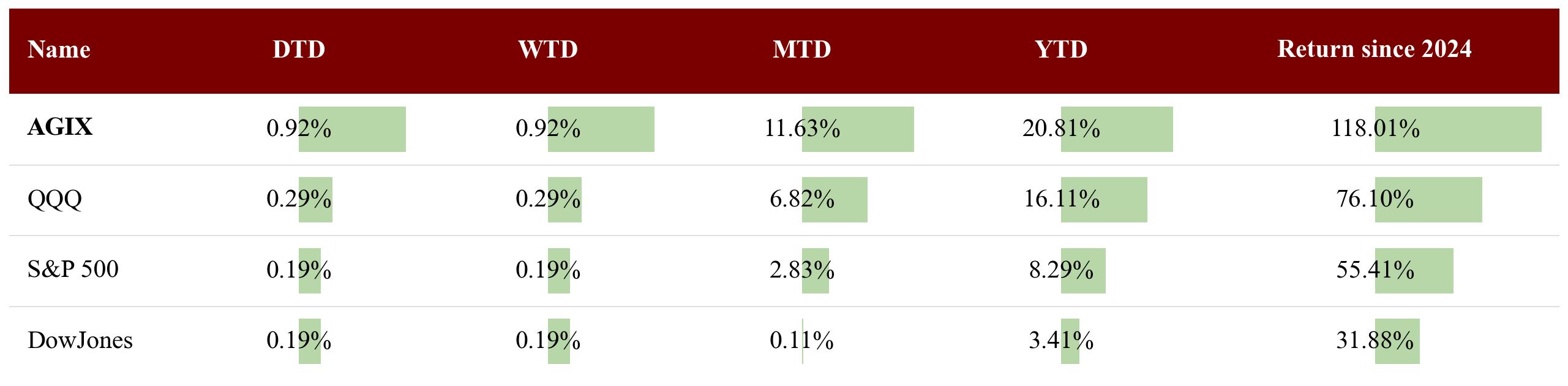
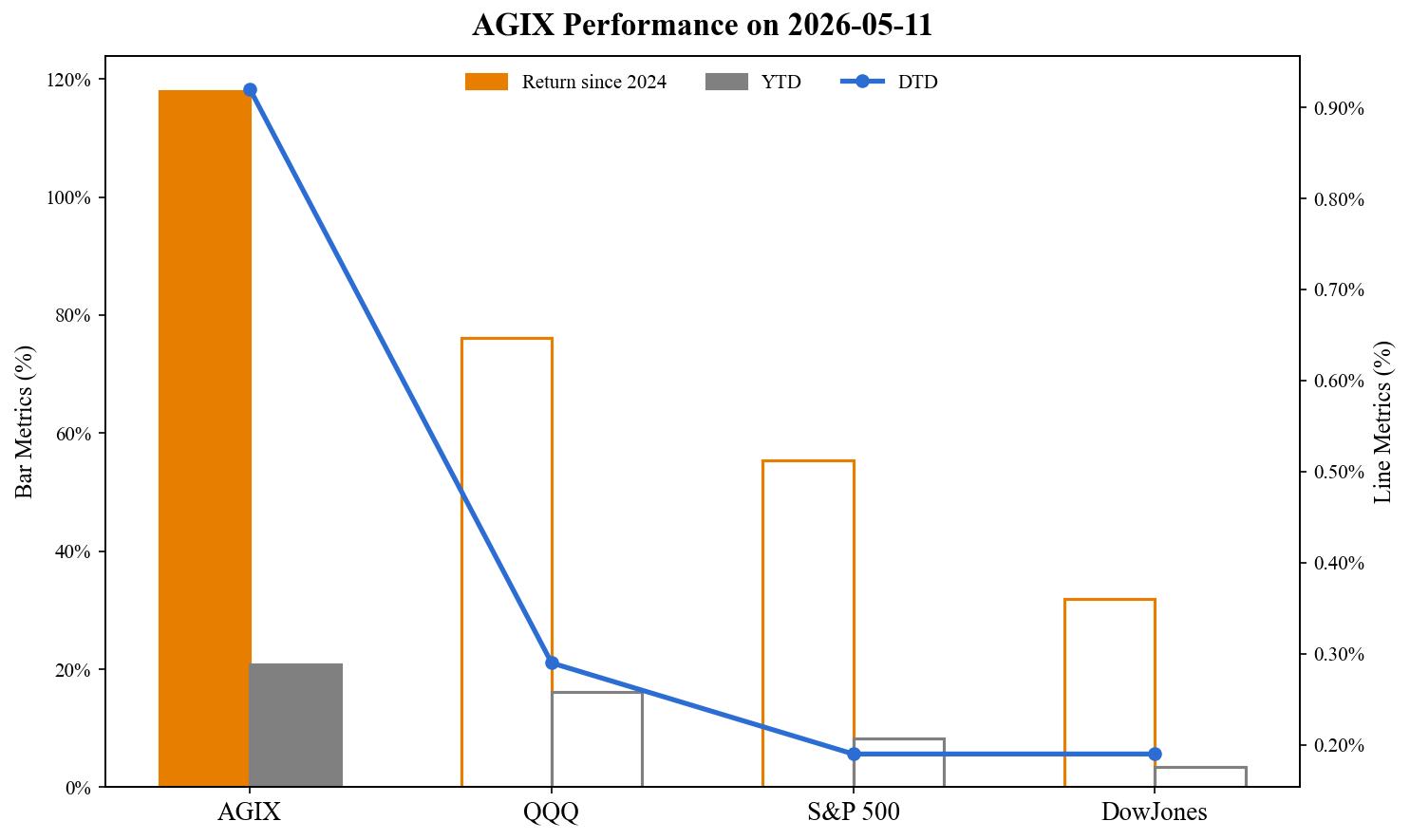
• AGIX outperformed benchmarks on a DTD basis, rising 0.92% versus QQQ (+0.29%) and the S&P 500 (+0.19%), driven by strong gains in hardware and infrastructure holdings.
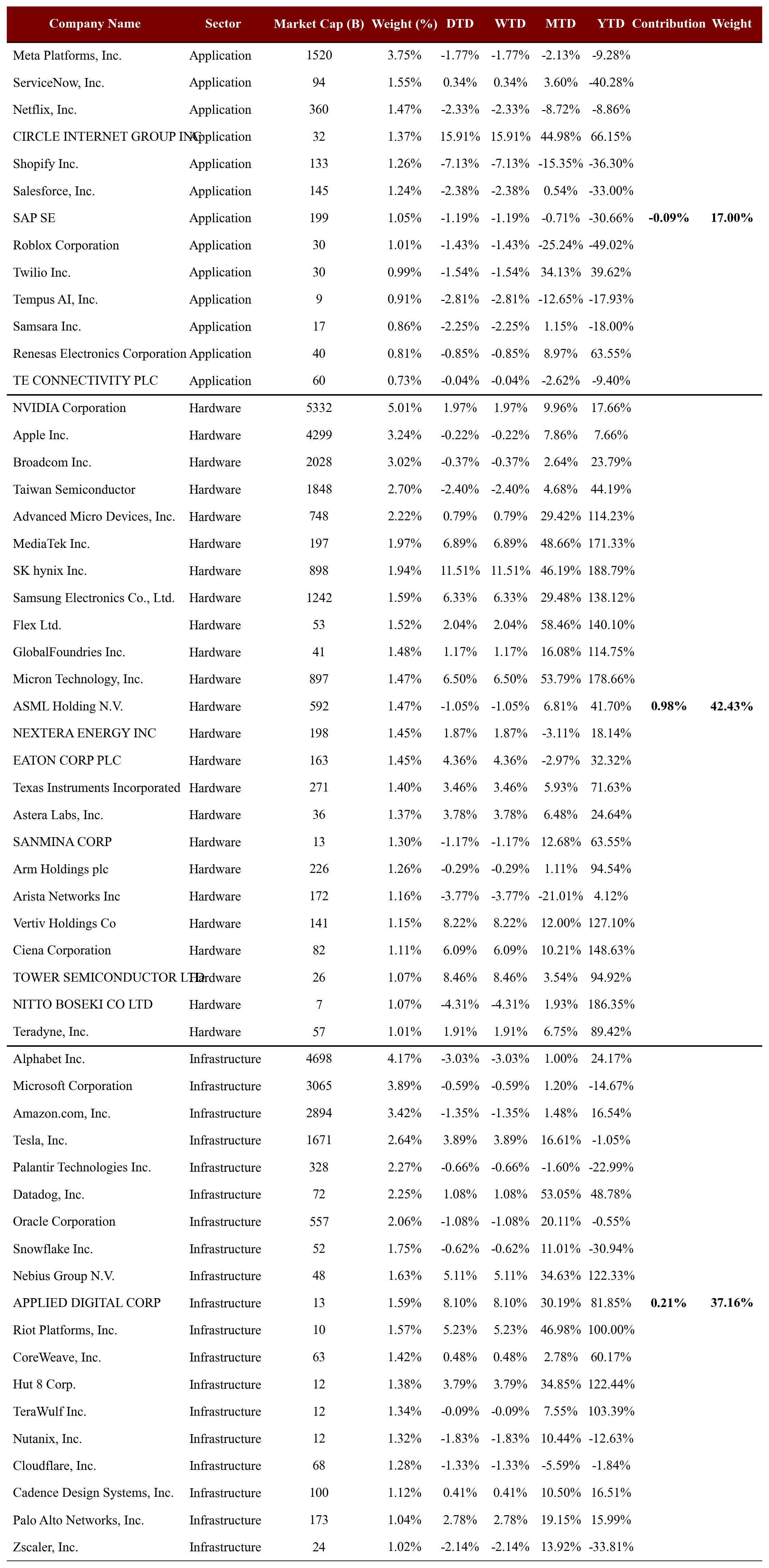
• Key positive contributors in AGIX: SK hynix (+11.51%), MediaTek (+6.89%), Micron (+6.50%), and Samsung (+6.33%) all surged on AI memory demand and sector tailwinds. Vertiv (+8.22%) and Applied Digital (+8.10%) also rose sharply on AI infrastructure momentum.
• Notable negative drags: Shopify (-7.13%) and Alphabet (-3.03%) weighed on returns, while Tempus AI (-2.81%) and Salesforce (-2.38%) also declined.
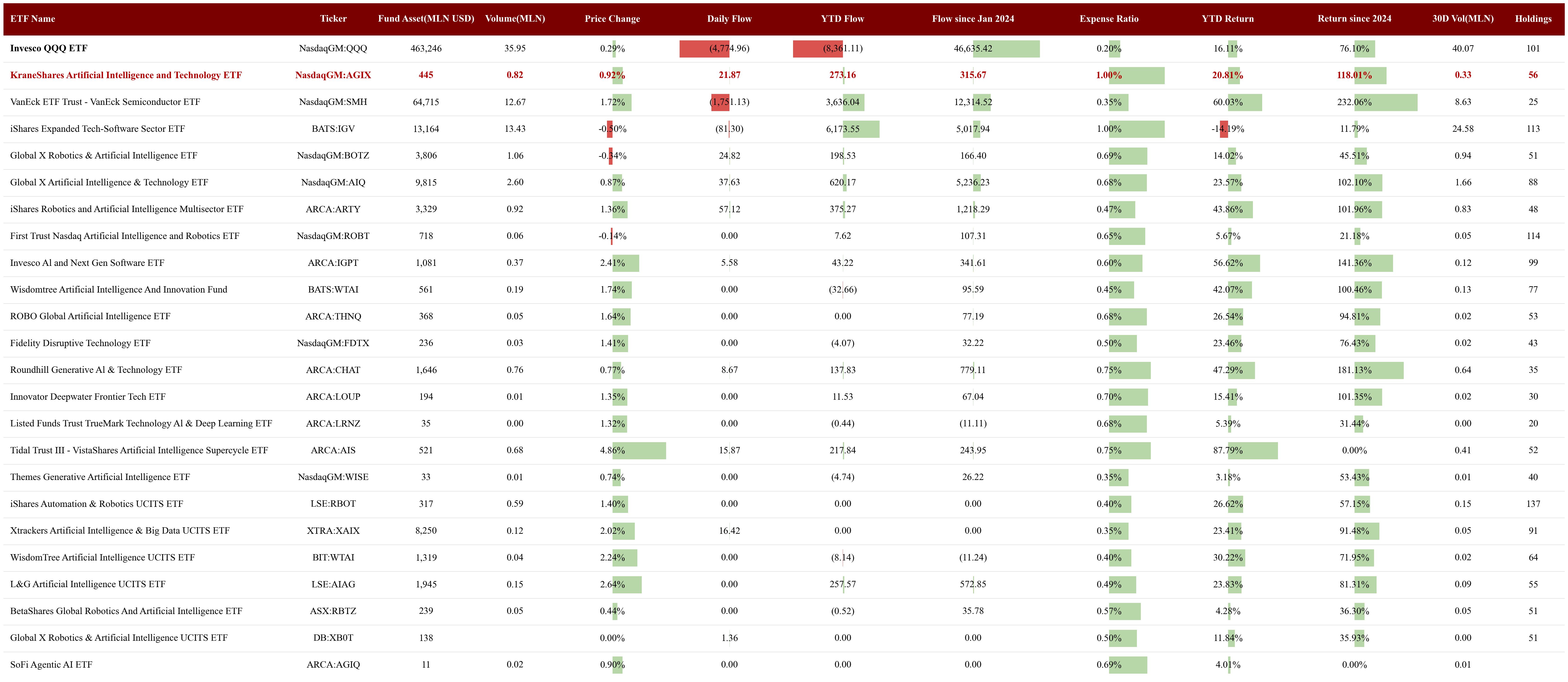
• Peer ETFs with strong DTD gains: IGPT (+2.41%), WTAI (+1.74%), and SMH (+1.72%) highlight broad AI and semiconductor strength, while BOTZ (-0.34%) and IGV (-0.50%) lagged.
News Highlights
1. Cerebras raises IPO price target to $150-160/share, up from $115-125, amid 20x oversubscription, signaling surging demand for AI inference chips and potentially boosting sentiment for AI hardware holdings like Nvidia and AMD.
2. Circle Internet shares closed up 15.91% after a $222M ARK token presale and Q1 earnings beat (EPS $0.21 vs. $0.17 est.), with the new Circle Agent Stack toolkit positioning the company for AI-agent-driven payments—a direct positive for AGIX's CRCL holding.
3. OpenAI launches a $4B professional services unit, The OpenAI Deployment Company, acquiring Tomoro AI to expand enterprise AI deployment, which could increase competition but also expand the addressable market for infrastructure holdings like Microsoft, Alphabet, and Amazon.
4. GM lays off 600 IT workers to hire AI-native engineers, signaling a broader enterprise shift toward AI-first workforce restructuring, which may accelerate demand for AI platforms and tools held by AGIX.
5. AMD and Red Hat partner to offer broader compute choices for enterprise AI, aiming to reduce costs with EPYC CPUs and Instinct GPUs—a positive for AMD's positioning against Nvidia and a catalyst for AMD's stock.
RSS Highlights
1. Apple rolls out beta support for end-to-end encrypted RCS messaging in iOS 26.5, enhancing cross-platform security and user privacy.
2. Counterpoint data shows iPhone 17 was the world's best-selling smartphone in Q1 2026, with Apple taking three of the top four spots, reflecting strong consumer demand.
3. A new proxy tool in a single Go binary supports multiple package registries (npm, PyPI, RubyGems) with local caching and SBOM-based offline mirrors, improving supply chain security.
4. The New York Times issued an editor's note after a journalist used AI-generated summaries as quotes without verification, highlighting the risks of AI in journalism.
5. Shopify introduced an internal AI coding tool called River, running publicly on Slack to promote 'osmotic learning' and knowledge sharing across the organization.
Performance & Benchmark
Attribution
Contribution of the three sectors within AGIX holdings today
Application: -0.09%
Hardware: 0.98%
Infrastructure: 0.21%
Top-performing stocks in AGIX holdings today
CIRCLE INTERNET GROUP INC (15.91%)
SK hynix Inc. (11.51%)
TOWER SEMICONDUCTOR LTD (8.46%)
Vertiv Holdings Co (8.22%)
APPLIED DIGITAL CORP (8.1%)
MediaTek Inc. (6.89%)
Micron Technology, Inc. (6.5%)
Samsung Electronics Co., Ltd. (6.33%)
Ciena Corporation (6.09%)
Riot Platforms, Inc. (5.23%)
Nebius Group N.V. (5.11%)
EATON CORP PLC (4.36%)
Tesla, Inc. (3.89%)
Hut 8 Corp. (3.79%)
Astera Labs, Inc. (3.78%)
Texas Instruments Incorporated (3.46%)
Palo Alto Networks, Inc. (2.78%)
Flex Ltd. (2.04%)
Worst-performing stocks in AGIX holdings today
Zscaler, Inc. (-2.14%)
Samsara Inc. (-2.25%)
Netflix, Inc. (-2.33%)
Salesforce, Inc. (-2.38%)
Taiwan Semiconductor Manufacturing Company Limited (-2.4%)
Tempus AI, Inc. (-2.81%)
Alphabet Inc. (-3.03%)
Arista Networks Inc (-3.77%)
NITTO BOSEKI CO LTD (-4.31%)
Shopify Inc. (-7.13%)
Top five listed stocks contributing the most within AGIX holdings today
SK hynix Inc. (11.51%)
CIRCLE INTERNET GROUP INC (15.91%)
MediaTek Inc. (6.89%)
APPLIED DIGITAL CORP (8.1%)
Tesla, Inc. (3.89%)
Observation
The strongest movers across peer ETF holdings today are listed below:
| DTD | Stock Ticker | Name | Held by ETFs | analysis |
|---|---|---|---|---|
| 24.45 | NasdaqGM:NVTS | Navitas Semiconductor Corporation | ['ARCA:AIS'] | The search results provided do not contain verifiable same-day news events, company disclosures, or management announcements for May 11, 2026 that would explain NVTS's 24.45% single-day gain. The available data shows only technical analysis, price forecasts, and historical commentary from earlier periods (July 2025 and prior). Without documented catalysts such as earnings beats, partnership announcements, regulatory approvals, or industry-specific developments on May 11, the driver cannot be definitively attributed based on the information supplied. |
| 24.14 | NasdaqGM:AAOI | Applied Optoelectronics, Inc. | [] | AAOI surged 24% on May 11, 2026, primarily driven by analysts hiking price targets following the company's recent Q1 earnings highlighting AI data center demand. Rosenblatt raised its target to $220 from $140 citing Amazon-related 800G revenue and Oracle qualifications, while Raymond James lifted to $160 from $72.50 backing management's $1.4B optical transceiver revenue goal by Q3 2027. The move extended sector strength in optical networking stocks like Lumentum and Coherent amid enthusiasm for hyperscale AI capex, despite Q1 misses and soft Q2 guidance. |
| 22.31 | NASDAQGM:INOD | Innodata Inc. | ['NasdaqGM:ROBT'] | Innodata (INOD) surged 22.31% on May 11, 2026, primarily driven by a record Q1 earnings beat with revenue up 54% YoY to $90.1M, adjusted EBITDA nearly doubling to $25M at a 28% margin, and raised full-year 2026 revenue growth guidance to 40%+. A new $51M Big Tech contract and expansion in AI data solutions further fueled the move. Wedbush's price target hike to $80 with an Outperform rating reinforced positive analyst sentiment amid heavy trading volume. |
| 22.03 | NasdaqGS:VICR | Vicor Corporation | ['ARCA:AIS'] | Vicor Corporation (VICR) surged 22.03% on May 11, 2026, primarily due to pre-earnings positioning ahead of its Q1 2026 results scheduled for April 21, 2026, with momentum amplified by options-related flows near the May 15, 2026 expiration and an elevated expected move of ±$42.61 (16.4%). The stock recently hit an all-time high of $211.11, building on prior strength from Q4/FY 2025 results that showed higher revenue, sharp profitability gains from a patent settlement, and a sizable backlog. Analyst price targets, including Roth Capital's $175, provided additional bullish context amid EV market targeting and capacity expansion plans. |
| 18.52 | SHSE:688008 | Montage Technology Co., Ltd. | ['ARCA:AIS'] | Montage Technology (SHSE:688008) surged 18.52% on May 11, 2026, primarily driven by strong momentum from its recent Hong Kong listing debut, where shares soared over 50% after raising $902 million. Positive memory chip price trends boosted the storage sector, with Montage's HK shares (06809) up over 9% amid broader gains in peers like Gigadevice Semiconductor. Robust 2025 financials, including 49.9% revenue growth to 5.46B and 58.4% earnings increase to 2.24B, further supported the rally. |
| 15.91 | NYSE:CRCL | Circle Internet Group, Inc. | ['NasdaqGM:AGIX'] | CRCL stock surged 15.91% on May 11, 2026, primarily driven by a Q1 earnings beat with EPS of $0.21 (19% above consensus) and revenue of $694M (up 20% YoY), alongside strong operational metrics like 39% YoY growth in average USDC circulation and 263% rise in on-chain transaction volume to $21.5T. A key catalyst was the $222M ARC token presale at a $3B fully diluted valuation, backed by a16z Crypto and other institutions, with Arc mainnet launch details announced. Adjusted EBITDA rose 24% to $151M at a 53% margin, fueling the intraday move from ~$113 to a high of $134. |
| 15.54 | NYSE:IONQ | IonQ, Inc. | ['BATS:WTAI', 'ARCA:THNQ'] | IonQ (NYSE:IONQ) surged 15.54% on May 11, 2026, closing at $56.93 from $49.24, driven primarily by pre-earnings optimism ahead of Q1 results due May 6 and recent commercial catalysts. Key drivers included the launch of InSAR Earth-monitoring capabilities for recurring government and enterprise revenue, plus a Master Services Agreement with Florida LambdaRail for quantum-safe networking. Bullish analyst sentiment, with a "Moderate Buy" consensus and targets up to $100, further fueled the move amid high trading volume. |
| 13.33 | NASDAQGM:RZLV | Rezolve AI PLC | ['NasdaqGM:WISE'] | RZLV rose 13.33% on May 11, 2026, driven primarily by technical trading momentum as the stock formed a doji candle closing at $2.4 within a weekly box pattern, testing key support at $2.28. Elevated options flow activity on the same day, including trades timestamped at 10:22 and 10:03, supported heightened volatility and buying interest. No company-specific news or disclosures were reported. |
| 13.25 | NYSE:COHR | Coherent Corp. | ['NasdaqGM:FDTX', 'ARCA:LOUP'] | Coherent (COHR) surged 13% on May 11, 2026, driven primarily by a sector-wide rally in optical networking stocks fueled by renewed enthusiasm for AI data center capex and connectivity demand. Applied Optoelectronics (+24%) and Lumentum (+17%) led the move, mirroring a reversal of the prior Thursday's pullback across the group. Supporting factors include Coherent's recent S&P 500 inclusion, strong Q3 results with datacenter revenues up over 40% year-over-year from 800G/1.6T transceiver demand, and NVIDIA partnership expansion with long-term agreements into 2028. |
| 12.97 | TSE:3905 | Datasection Inc. | ['NasdaqGM:WISE'] | Datasection Inc. (TSE:3905) surged 12.97% on May 11, 2026, primarily driven by its quarterly earnings release, which exceeded expectations and marked a potential turnaround from prior quarterly losses. The report, scheduled for that date per public calendars, boosted investor sentiment in the social media analytics and AI solutions provider amid its recent volatility. No specific same-day news headlines were identified, but the earnings timing aligns directly with the single-day move. |
| 12.86 | KOSDAQ:A108490 | ROBOTIS Co., Ltd. | ['NasdaqGM:BOTZ', 'ASX:RBTZ', 'DB:XB0T'] | No specific news events, company disclosures, or catalysts explain ROBOTIS (KOSDAQ:A108490)'s 12.86% gain on May 11, 2026. The move aligns with the stock's extreme volatility, evidenced by a 897% one-year return as of recent trading data and ongoing high-flyer momentum in the robotics sector. Broader positive analyst coverage on its 53% revenue growth forecast and shift to profitability likely contributed to sustained buying pressure. |
| 12.08 | NasdaqGS:SMTC | Semtech Corporation | [] | Semtech (SMTC) shares surged 12.08% on May 11, 2026, primarily driven by continued momentum from positive analyst upgrades and the stock breaking its 12-month high reported on May 5, with shares hitting $113.13 amid heavy volume. Strong Q3 2026 earnings momentum from November 2025, including 13% YoY net sales growth to $267 million, 85% YoY EPS increase to $0.48, and robust data center/LoRa demand, supported the rally. Routine insider sales under a pre-arranged 10b5-1 plan on May 1 had minimal impact given the overall positive sentiment and "Moderate Buy" consensus. |
| 11.75 | NYSE:PSTG | Pure Storage, Inc. | ['ARCA:IGPT', 'ARCA:THNQ', 'ARCA:AIS', 'XTRA:XAIX', 'LSE:AIAG'] | Pure Storage (PSTG) shares surged 11.75% on May 11, 2026, primarily driven by continued positive momentum from the company's recent announcement of a record $400 million share repurchase authorization, signaling strong management confidence in business momentum amid robust Q3 results with 16% revenue growth to $964 million and 20.3% operating margins. This buyback, the largest in company history and in addition to $20 million remaining from the prior $250 million plan, reinforced shareholder value commitment with $1.5 billion in cash reserves. The stock's high volatility, with 26 moves over 5% in the past year, amplified the reaction to this meaningful but not transformative news. |
| 11.52 | NasdaqGS:CRDO | Credo Technology Group Holding Ltd | ['ARCA:IGPT', 'BATS:WTAI', 'LSE:RBOT'] | CRDO surged 11.5% on May 11, 2026, primarily driven by heightened investor enthusiasm for its expanded AI optical portfolio, including the recent DustPhotonics acquisition and Cardinal 1.6T optical DSP advancements for data center connectivity. Above-average trading volume accompanied the move to an intraday high of $210.97, aligning with a Moderate Buy analyst consensus and $207-209 price targets. Positive momentum from Q3 results (revenue up 201.5% YoY) and AI hyperscaler demand further supported the rally. |
| 11.51 | KOSE:A000660 | SK hynix Inc. | ['NasdaqGM:AGIX', 'NasdaqGM:AIQ', 'ARCA:ARTY', 'NasdaqGM:ROBT', 'ARCA:IGPT', 'BATS:WTAI', 'ARCA:CHAT', 'ARCA:LOUP', 'ARCA:AIS', 'XTRA:XAIX', 'BIT:WTAI'] | SK Hynix stock surged 11.51-12.52% to a record high on May 11, 2026, primarily driven by a threatened 18-day strike at Samsung starting May 21, which could disrupt 3% of global memory chip supply and cut Samsung's annual operating profit by over 40 trillion won. This supply fear boosted SK Hynix as a key beneficiary alongside Micron, amid its status as an AI darling with strong HBM production credibility. Renewed AI spending optimism further supported the rally. |
| 10.94 | NYSE:GLW | Corning Incorporated | ['ARCA:AIS'] | Corning (GLW) shares surged 10.5% to $206.64 on May 11, 2026, primarily driven by a strong earnings beat with EPS of $0.70 versus $0.69 expected and revenue of $4.35 billion topping $4.30 billion forecasts, up 18.1% year-over-year. Unusually high options trading volume of 14.9 million shares amplified the move amid positive momentum from AI-related Nvidia partnerships. Analyst ratings remain "Moderate Buy" despite a $172.15 target, with institutional buying like NewEdge Wealth's stake increase adding support. |
| 10.33 | KOSDAQ:A277810 | Rainbow Robotics Co.,Ltd. | ['NasdaqGM:BOTZ', 'ARCA:IGPT', 'LSE:RBOT', 'ASX:RBTZ', 'DB:XB0T'] | I cannot provide a reliable attribution for Rainbow Robotics' 10.33% single-day move on May 11, 2026, as the search results contain no verifiable news events, company disclosures, or material announcements from that date. The available data shows only historical price information and company background, with no real-time news coverage or earnings releases that would explain the specific daily move. Without documented catalysts, any attribution would be speculative. |
| 10.23 | NasdaqCM:INDI | indie Semiconductor, Inc. | ['LSE:RBOT'] | INDI's 10.23% single-day gain on May 11, 2026, was primarily driven by short-term technical momentum in a volatile semiconductor stock, rebounding from recent lows near $4 support levels toward resistance at $4.47. Technical analysis highlighted buy signals from long-term moving averages and MACD, with accumulated volume providing support around $3.84-$4.08 amid high daily volatility of 8%. Broader analyst upside targets of 60% reinforced positive sentiment in the rising short-term trend. |
| 10.0 | TPEX:5425 | Taiwan Semiconductor Co., Ltd. | ['ARCA:AIS'] | No specific news events, company disclosures, or catalysts explain the 10.0% single-day rise in TPEX:5425 on May 11, 2026. The move occurred amid elevated stock volatility of 3.76% and a beta of 1.29, likely driven by technical trading or sector momentum in semiconductors. Broader Taiwan Semiconductor Manufacturing Co. (TSMC) strength may have spilled over, as the stock's recent weekly gain was 8.60%. |
| 9.98 | TWSE:3443 | Global Unichip Corp. | ['NasdaqGM:AIQ', 'ARCA:IGPT', 'ARCA:THNQ', 'LSE:RBOT', 'LSE:AIAG'] | Global Unichip Corp. (TWSE:3443) surged 9.98% on May 11, 2026, primarily driven by its Q1 earnings release, which showed strong March sales of NT$3.86 billion (up 15.2% month-over-month per the company's April 7 disclosure) and likely beat expectations amid robust semiconductor demand. A Taiwan Stock Exchange-requested clarification on media reports, issued around May 5, may have alleviated prior uncertainties and fueled buying momentum. Analyst consensus remains a Buy with targets up to NT$1,850-4,685, supporting the positive reaction. |
| 9.94 | TWSE:6531 | AP Memory Technology Corporation | ['ARCA:AIS'] | AP Memory Technology (TWSE:6531) surged 9.94% on May 11, 2026, primarily driven by positive market reaction to the company's annual general meeting on May 8, 2026, where it completed a full re-election of its Board of Directors. This governance milestone likely boosted investor confidence in the DRAM specialist's leadership and strategic direction. Supporting momentum came from upward revisions in analyst price targets to an average of NT$577.50 (12.14% upside) and strong 2025 growth forecasts of 8.5% revenue and 10.2% profit. |
| 9.92 | TWSE:3661 | Alchip Technologies, Limited | ['ARCA:ARTY', 'ARCA:IGPT', 'LSE:RBOT'] | Alchip Technologies (3661.TW) surged 9.92% on May 11, 2026, primarily driven by the board's announcement to issue 200,000 employee stock options, signaling confidence in future growth amid its AI chip focus. Supporting this, recent coverage highlighted Alchip's 3DIC platform advancing system-level AI processor design, boosting investor optimism in the semiconductor sector. Trading data shows the stock's high beta of 1.76 amplified the positive reaction. |
| 9.92 | TWSE:2451 | Transcend Information, Inc. | ['ARCA:AIS'] | Transcend Information (TWSE:2451) surged 9.92% on May 11, 2026, primarily driven by a reported 40-50% DDR5 memory price surge in Q2 2026, boosting expectations for the company's revenue and margins as a key memory module manufacturer. Strong 1Q 2026 earnings with net income of NT$8.12b (up sharply from prior quarter) and a 60% profit margin further supported the rally, highlighting robust past performance amid higher revenue. Technical buy signals over the 1-month horizon amid low volatility also contributed to momentum buying. |
| 9.86 | TWSE:2049 | Hiwin Technologies Corporation | ['ARCA:IGPT', 'LSE:RBOT'] | Hiwin Technologies (TWSE:2049) surged 9.86% on May 11, 2026, primarily driven by the market's reaction to the company's Q1 2026 consolidated financial report approved by the Board on May 8, which likely exceeded lowered expectations amid recent share price weakness. Trading data shows elevated volume around 27 million shares versus a 2 million average, reflecting strong buying interest post-earnings disclosure. The stock's positioning above its 200-day moving average further supported momentum buying in the industrials sector. |
| 9.85 | TWSE:2408 | Nanya Technology Corporation | ['ARCA:IGPT', 'ARCA:AIS'] | Nanya Technology Corporation (TWSE:2408) surged 9.85% on May 11, 2026, primarily driven by a strong Q1 2026 earnings report showing gross margin expansion to 67.9% from 49% in Q4 2025, coupled with management's guidance for Q2 2026 to exceed Q1 results. This triggered positive analyst revisions and technical buy signals amid recent semiconductor demand recovery. Broader weekly momentum, with shares up 22% over the prior week, amplified the move. |
| 9.85 | TWSE:4919 | Nuvoton Technology Corporation | ['LSE:RBOT'] | Nuvoton Technology Corporation's 9.85% stock surge on May 11, 2026, was primarily driven by its Q1 earnings release, which showed a 13.5% quarter-over-quarter revenue increase fueled by a meaningful surge in AI computing revenue share. Trading resumption of its common stocks and related warrants on the same day, as announced by the Taiwan Stock Exchange, amplified the upside momentum following any prior halt. Positive analyst price target revisions earlier in the year, including a 29% increase to NT$74.67 in April, provided additional supportive context amid strong sector tailwinds in semiconductors. |
| 9.83 | TWSE:3035 | Faraday Technology Corporation | ['LSE:RBOT'] | Faraday Technology Corp (TWSE:3035) surged 9.83% on May 11, 2026, primarily due to a lack of identifiable company-specific news or disclosures driving the move, with technical factors likely contributing amid recent volatility. The stock's 4.35% daily volatility and beta of 0.83 suggest momentum trading or short covering, following a -35.88% annual decline and mixed analyst ratings (buy today but sell signals for 1-week/1-month). Recent earnings misses, with Q1 revenue at 4.51B TWD versus 5.21B expected and net income down 92.54%, had already been digested, leaving broader semiconductor sector dynamics as a secondary influence. |
| 9.81 | TWSE:2344 | Winbond Electronics Corporation | ['ARCA:IGPT'] | Winbond Electronics (TWSE:2344) rose 9.81% on May 11, 2026, driven primarily by continued bullish technical momentum amid a multi-week uptrend. Recent trading patterns show strong buying pressure with volume spikes supporting a run-up since February, Ichimoku golden crosses, and a bullish long-term MACD, aligning with the stock's 13.59% weekly and 14.93% monthly gains prior to this move. Analyst consensus remains a Buy, with the stock trading well above its 200-day moving average at elevated levels around TWD107-110. |
| 9.05 | TWSE:2345 | Accton Technology Corporation | [] | Accton Technology Corp. (2345.TW) rose 9.05% on May 11, 2026, primarily driven by a material information announcement released that afternoon at 15:15:25 TWSE time under Clause 20, which supplemented a prior December disclosure and detailed approval of a capital injection into its subsidiary Vietnam Accton Technology Company. A secondary catalyst was the recent board approval on May 7 for a new laboratory construction project, signaling expansion in network tech R&D. No broader industry or macro events were cited as triggers. |
| 8.57 | NasdaqGM:MVIS | MicroVision, Inc. | ['LSE:RBOT'] | MicroVision (MVIS) rose 8.57% on May 11, 2026, driven primarily by anticipation ahead of its Q1 2026 earnings release scheduled for the next day after market close on May 13. The recent May 6 announcement of the earnings date and conference call failed to spark enthusiasm then (with a 2.14% drop), but pre-earnings positioning built momentum, supported by analyst consensus implying 230% upside to a $2.50 target from the ~$0.76 level. Peer gains like VPG (+5.69%) added tailwind amid low-volume trading. |
| 8.46 | NasdaqGS:TSEM | TOWER SEMICONDUCTOR LTD | ['NasdaqGM:AGIX'] | Tower Semiconductor (TSEM) rose 8.46% on May 11, 2026, primarily due to momentum from its recent strong quarterly earnings beat, where EPS of $0.78 exceeded estimates of $0.67-$0.68 by 14%. The stock opened at $211.02 amid a sharp multi-month rally from $162 levels, supported by positive analyst views including a "Buy" consensus from some firms despite mixed Hold ratings and a $145-$173 average target. No same-day company-specific news or events were reported, with institutional ownership remaining stable at 70.51% post a prior-quarter stake reduction by Katamaran Capital. |
| 8.42 | NasdaqGS:QCOM | QUALCOMM Incorporated | ['NasdaqGM:QQQ', 'NasdaqGM:SMH', 'NasdaqGM:AIQ', 'ARCA:ARTY', 'NasdaqGM:ROBT', 'ARCA:IGPT', 'BATS:WTAI', 'ARCA:THNQ', 'BIT:WTAI', 'LSE:AIAG'] | Qualcomm's 8.42% gain on May 11 was driven primarily by Craig Hallum's upgrade to buy rating, which catalyzed heavy trading volume exceeding 45 million shares. The upgrade came on the heels of the company's Q2 earnings beat ($2.65 EPS vs. $2.56 estimate) and CEO Cristiano Amon's disclosure of a custom silicon engagement with a leading hyperscaler targeting data center shipments in late 2026, representing entry into a new market segment previously dominated by Nvidia and AMD. The $20 billion share buyback authorization announced alongside earnings further signaled management confidence and provided support for the stock price. |
| 8.29 | TSE:6758 | Sony Group Corporation | ['NasdaqGM:ROBT'] | The available search results do not contain verifiable news events or company disclosures specific to May 11, 2026 that would explain Sony's 8.29% single-day gain. The most recent dated content references the Sony-TSMC sensor joint venture (timing unclear but appears prior to May 11) and a Soneium blockchain testnet launch, but neither event is confirmed as occurring on May 11, 2026. Without access to real-time news from that specific date, a reliable attribution cannot be provided. |
| 8.29 | NasdaqCM:RGTI | Rigetti Computing, Inc. | ['BATS:WTAI'] | Rigetti Computing (RGTI) surged 8.29% on May 11, 2026, primarily driven by its Q1 2026 earnings beat, reporting $4.40 million in revenue versus $4.09 million expected. The positive reaction followed the after-market-close release and conference call at 5:00 pm ET, where the company discussed results and business updates. Pre-earnings anticipation around high growth forecasts and technical momentum further amplified the move. |
| 8.22 | NYSE:VRT | Vertiv Holdings Co | ['NasdaqGM:AGIX', 'ARCA:ARTY', 'BATS:WTAI', 'ARCA:LOUP', 'ARCA:AIS'] | Vertiv's 8.22% gain on May 11 was driven primarily by sustained analyst optimism following the company's strong Q1 2026 earnings beat and raised full-year guidance, with multiple major firms including RBC (raising target to $356) and Barclays (raising to $345) reiterating outperform ratings in late April. The stock's momentum reflects continued investor confidence in Vertiv's positioning as an AI infrastructure beneficiary, with the company posting $1.17 EPS versus $1.00 consensus and 30.1% year-over-year revenue growth to $2.65 billion. Institutional buying pressure likely intensified as the stock approached its 52-week high of $359.84, with analyst consensus maintaining a Moderate Buy rating and elevated price targets across the Street. |
| 8.1 | NASDAQGS:APLD | APPLIED DIGITAL CORP | ['NasdaqGM:AGIX'] | APLD's 8.1% gain on May 11, 2026, was primarily driven by positive momentum from recent analyst upgrades and strong Q1 FY2026 earnings, with after-hours trading extending the upside to $43.96 (+1.95% from close). A key same-day SEC filing amended Series G Convertible Preferred Stock terms, raising the conversion price floor from $22 to $34 to align with the stock's $34.26 level, reducing dilution risk. Ongoing 827% six-month rally and "Strong Buy" ratings from firms like H.C. Wainwright ($40 PT) and Needham ($41 PT) further fueled buying. |
| 8.01 | SHSE:688041 | Hygon Information Technology Co., Ltd. | ['ARCA:IGPT', 'ARCA:AIS'] | The search results provided do not contain any verifiable news events, company disclosures, or specific catalysts dated May 11, 2026 that would explain Hygon Information Technology's 8.01% single-day gain. The available data shows historical price movements and valuation metrics but lacks real-time news coverage or management announcements from the relevant trading date. Without access to same-day news sources, regulatory filings, or earnings-related events from May 11, 2026, a reliable attribution cannot be established based on the information supplied. |
| 7.99 | TSE:6526 | Socionext Inc. | ['NasdaqGM:AIQ', 'ARCA:IGPT', 'LSE:RBOT'] | Socionext Inc. (TSE:6526) rose 7.99% on May 11, 2026, primarily driven by its full-year 2026 results report, fresh 2027 guidance, and dividend affirmation. The earnings release fueled short-term momentum, with the stock posting 1-day gains of 8.08%, 7-day returns of 23.58%, and 30-day returns of 32.26%, reflecting investor enthusiasm despite mixed valuation signals like a high P/E of 47.8x versus a DCF fair value of ¥2,573.83. No other same-day news events were identified. |
| 7.82 | NasdaqGS:ADEA | Adeia Inc. | ['BATS:IGV'] | Adeia Inc. (ADEA) rose 7.82% on May 11, 2026, primarily due to anticipation building ahead of its Q1 2026 earnings release scheduled for May 4, with the earnings call on the same day revealing key financials for the quarter ended March 31. Technical factors supported the move, as the stock traded near all-time highs with a doji candle closing at $33.63 in the prior session and strong weekly uptrend momentum. Positive analyst sentiment, including a 33.2% upside to an average price target of $19.50, further bolstered buying interest. |
| 7.46 | NasdaqGS:WDC | Western Digital Corporation | ['ARCA:IGPT', 'ARCA:AIS', 'XTRA:XAIX'] | Western Digital (WDC) rose 7.46% on May 11, 2026, driven primarily by heightened enthusiasm for the AI storage supercycle amid strong data center demand for high-capacity HDDs. Analyst upgrades fueled the move, including Zacks elevating to strong buy and Cantor Fitzgerald raising its price target to $660 with an overweight rating, building on recent earnings beats with 45.5% YoY revenue growth and raised Q4 EPS guidance. Broader sector momentum in AI-memory plays and ongoing share repurchases further supported the rally near the 52-week high of $416. |
| 7.42 | TWSE:2388 | VIA Technologies, Inc. | ['LSE:RBOT'] | VIA Technologies (2388.TW) rose 7.42% on May 11, 2026, primarily driven by market reaction to the company's May 6 board approvals, including the acquisition of 18 million newly issued shares in its 100% subsidiary and the issuance of 146,000 new shares for employee options exercise. These announcements signal expansion and employee incentives, boosting investor confidence in the semiconductor firm's growth prospects. No Q1 dividend was declared, but this had minimal negative impact amid positive capital moves. |
| 6.94 | SEHK:992 | Lenovo Group Limited | ['XTRA:XAIX'] | I cannot provide a reliable attribution for Lenovo's 6.94% single-day move on May 11, 2026, as the search results contain no verifiable news events, company disclosures, or material announcements from that date. The available data shows only historical price performance and analyst estimates without any same-day catalysts or real-time news that would explain the magnitude of the move. Without access to contemporaneous news sources, regulatory filings, or management commentary from May 11, 2026, a credible attribution cannot be established. |
| 6.89 | TWSE:2454 | MediaTek Inc. | ['NasdaqGM:AGIX', 'ARCA:IGPT', 'ARCA:THNQ', 'LSE:AIAG'] | MediaTek's 6.89% stock surge on May 11, 2026, was primarily driven by the company's announcement doubling its 2026 revenue target for AI application-specific integrated circuits to USD 2 billion. A secondary catalyst was MediaTek raising its 2027 ASIC market forecast to $70–$80 billion, signaling accelerated growth and strong confidence in its AI chip pipeline. These updates highlight robust demand in AI semiconductors, boosting investor sentiment amid the firm's leadership in mobile SoCs. |
| 6.72 | NasdaqGS:MNDY | monday.com Ltd. | ['NasdaqGM:FDTX', 'LSE:RBOT'] | monday.com (MNDY) stock rose 6.72% on May 11, 2026, primarily driven by strong Q1 2026 earnings results. Key drivers included Q1 revenue of $351 million (up 24% YoY), record $49 million operating profit, and 29% adjusted free cash flow margin, alongside early AI traction contributing ~10% of net new ARR and positive efficiency gains. Analyst optimism was reinforced by Piper Sandler raising its price target to $90. |
| 6.56 | NasdaqGS:STX | Seagate Technology Holdings plc | ['NasdaqGM:AIQ', 'ARCA:IGPT', 'ARCA:AIS', 'XTRA:XAIX'] | Seagate (STX) stock rose 6.56% on May 11, 2026, primarily driven by technical breakout momentum to a new all-time high of $82.04 amid an ongoing weekly uptrend. A YouTube stock analysis highlighted the daily chart breakout above prior resistance, with elevated trading volume supporting higher highs and key support at $69.9. No company-specific news or earnings events were reported, aligning the move with broader semiconductor and AI storage sector strength seen in recent sessions. |
| 6.5 | NasdaqGS:MU | Micron Technology, Inc. | ['NasdaqGM:QQQ', 'NasdaqGM:AGIX', 'NasdaqGM:SMH', 'NasdaqGM:AIQ', 'ARCA:ARTY', 'NasdaqGM:ROBT', 'ARCA:IGPT', 'BATS:WTAI', 'NasdaqGM:FDTX', 'ARCA:LOUP', 'ARCA:AIS', 'XTRA:XAIX', 'BIT:WTAI'] | Micron Technology (MU) stock rose 6.5% on May 11, 2026, driven primarily by strong demand signals from hyperscalers confirming surging memory prices amid AI capacity constraints. Key catalysts included recent earnings commentary from Meta, Microsoft, and Amazon highlighting memory as a major cost driver, with Meta raising its 2026 capex to $125-145 billion due to higher component pricing and Amazon noting insufficient supply. This built on Micron CFO Mark Murphy's prior comments at the Wolfe conference about demand exceeding supply, boosting pricing power and margins. |
| 6.47 | NYSE:QBTS | D-Wave Quantum Inc. | ['BATS:IGV', 'BATS:WTAI'] | QBTS surged 6.47% on May 11, 2026, primarily driven by heightened investor interest in the quantum computing sector ahead of the company's CES 2026 technology showcase announcement. Supporting this, recent trading data shows elevated volume and bullish options flow similar to prior catalysts like the Q3 2025 earnings with 100% YoY revenue growth. Broader sector momentum in quantum stocks also contributed amid expectations for enterprise adoption. |
| 6.35 | NasdaqGS:OUST | Ouster, Inc. | ['LSE:RBOT'] | Ouster (OUST) stock rose 6.35% on May 11, 2026, primarily driven by the company's announcement of transferring its common stock listing from NYSE to Nasdaq Global Select Market, along with its public warrants, to boost investor visibility and trading volume. This strategic move, confirmed in a same-day statement, positioned OUST more competitively among tech firms. Supporting bullish analyst consensus, with median price targets around $39-$40 implying 47-59% upside from levels near $25-26, likely amplified the positive reaction. |
| 6.33 | KOSE:A005930 | Samsung Electronics Co., Ltd. | ['NasdaqGM:AGIX', 'NasdaqGM:AIQ', 'NasdaqGM:ROBT', 'BATS:WTAI', 'ARCA:CHAT', 'XTRA:XAIX', 'BIT:WTAI'] | Samsung Electronics (KOSE:A005930) surged 6.33% on May 11, 2026, primarily driven by reports of the company considering extending memory chip contracts from quarterly/annual terms to 3-5 year agreements, signaling stronger long-term demand stability amid AI and data center growth. This was reinforced by positive analyst sentiment, with a "Buy" consensus and the US OTC shares (SSNLF) recently hitting a 52-week high of $140 earlier in the month. Broader semiconductor momentum likely contributed as a secondary factor. |
| 6.09 | NYSE:CIEN | Ciena Corporation | ['NasdaqGM:AGIX', 'ARCA:LOUP', 'XTRA:XAIX'] | CIEN's 6.09% single-day gain on May 11, 2026, was primarily driven by the announcement of its $270 million all-cash acquisition of Nubis Communications, bolstering its AI-driven data center interconnect capabilities amid surging optical networking demand. This deal fueled bullish trader momentum, with technical charts highlighting breakouts above key resistance levels around $138-140 following recent earnings strength. Broader AI infrastructure tailwinds and a 152% YTD surge further amplified the move, despite caution from figures like Jim Cramer on the stock's elevated valuation. |
| 6.04 | NasdaqCM:QUBT | Quantum Computing Inc. | ['NasdaqGM:AIQ'] | QUBT's 6.04% gain on May 11, 2026, was primarily driven by positive momentum from its recent earnings beat and institutional buying interest. The stock had jumped 11% on April 14 after reporting a narrower-than-expected Q1 EPS loss of $0.01 versus -$0.04 estimated, despite revenue miss, with Millennium Management increasing its stake 288.9% to 651,455 shares. Earlier $50M stock offerings in December 2024 to fund quantum tech and Arizona photonic chip foundry expansion also bolstered balance sheet strength, supporting ongoing investor enthusiasm. |
| 5.63 | TSE:3687 | Fixstars Corporation | ['LSE:RBOT'] | Fixstars Corporation (3687.T) rose 5.63% on May 11, 2026, primarily due to elevated trading volume exceeding the average, signaling renewed investor interest in its quantum computing and AI software solutions amid sector momentum. Above-average volume of 907,500 shares versus a 691,513 daily average supported the intraday range expansion from ¥1,788 to ¥1,824. Analyst forecasts reinforcing an 84% upside to ¥2,448 further bolstered sentiment in this small-growth technology name. |
| 5.54 | TWSE:2357 | ASUSTeK Computer Inc. | ['ARCA:AIS'] | ASUSTeK Computer Inc. (TWSE:2357) rose 5.54% on May 11, 2026, driven primarily by positive momentum in the Taiwan tech sector amid broader AI hardware demand. No specific company news or disclosures were reported, with the gain aligning with weekly gains of 2.60% and analyst targets up to 854 TWD. Technical indicators showed a "buy" rating, supporting intraday buying interest. |
| 5.49 | TSE:6594 | Nidec Corporation | ['NasdaqGM:ROBT', 'ARCA:IGPT'] | Nidec Corporation (TSE:6594) rose 5.49% on May 11, 2026, primarily due to a short-covering rally following the April 27 announcement of delayed FY2026 financial results amid ongoing governance reforms and prior-year account corrections. Investors appeared to view the prior week's overhang—stemming from the third-party committee investigation, dissolution of the Special Investigation Support Office, and China supply-chain changes—as priced in, sparking renewed optimism around the company's cost-cutting and growth plans in data center motors and EVs. No new same-day catalysts emerged, with trading likely amplified by the stock's high uncertainty and 61% premium to fair value per Morningstar. |
| 5.38 | KOSE:A005380 | Hyundai Motor Company | ['NasdaqGM:ROBT', 'BATS:WTAI'] | I cannot provide a reliable attribution for Hyundai Motor Company's 5.38% move on May 11, 2026, as the search results contain no verifiable news events, earnings announcements, regulatory developments, or company disclosures from that date. The available information includes only a completed share buyback from January 2026, technical analysis, and valuation metrics, none of which explain a single-day move of this magnitude on May 11. Without access to same-day news or material corporate events, any attribution would be speculative. |
| 5.23 | NasdaqCM:RIOT | Riot Platforms, Inc. | ['NasdaqGM:AGIX', 'BATS:IGV'] | RIOT's 5.23% single-day gain on May 11, 2026, was driven by continued bullish momentum in Bitcoin mining stocks amid a strong crypto market rally. Technical analysts highlighted breakouts from multi-year consolidation patterns, targeting $40–$57 with wave 3 extensions intact and support at high-volume nodes. Broader sentiment remained positive, with 26 bullish technical indicators and Riot's Q3 2025 revenue guidance projecting 103.5% growth to $172.6 million. |
| 5.11 | NasdaqGS:NBIS | Nebius Group N.V. | ['NasdaqGM:AGIX', 'BATS:WTAI', 'ARCA:THNQ', 'ARCA:CHAT', 'BIT:WTAI'] | Nebius Group (NBIS) rose 5.11% on May 11, 2026, primarily driven by Bank of America raising its price target from $175 to $205 while reiterating a Buy rating, implying 15.77% upside. This analyst upgrade reinforced momentum in the high-beta AI infrastructure stock, which was already trading near its 52-week high of $197.89 amid positive technicals like being 18% above its 20-day SMA. Broader tech sector strength and social media buzz further supported the move ahead of Q1 earnings on May 13. |
| 5.04 | SEHK:861 | Digital China Holdings Limited | [] | Digital China Holdings (861.HK) rose 5.04% on May 11, 2026, primarily driven by its subsidiary Digital China Information's (000555.SZ) announcement of a private placement to raise up to RMB1 billion. The deal will dilute the group's stake from 38.62% to 32.18% but maintain subsidiary control, signaling positive capital-raising momentum amid low short interest (0.333% ratio). No other material company or industry news contributed. |
| 5.02 | NasdaqGS:SWKS | Skyworks Solutions, Inc. | ['NasdaqGM:SMH'] | Skyworks Solutions (SWKS) stock rose 5.02% on May 11, 2026, primarily driven by aftermarket momentum from its Q2 fiscal 2026 earnings beat reported on May 5, which carried over into regular trading. The company exceeded EPS estimates by 10.73% ($1.15 vs. $1.04 expected) and revenue by 4.84% ($943.7 million vs. $902.2 million), with Q3 guidance also surpassing consensus at $925 million revenue and $1.03 EPS midpoints. Aftermarket trading on May 5 saw a 5.39% gain, reflecting investor optimism on improving momentum despite rising inventory levels. |
News
Funding & M&A
Report: AI chipmaker Cerebras to increase IPO price target amid surging investor demand
AI chip maker Cerebras Systems Inc. is about to expand the size and price of its initial public offering (IPO) to meet strong investor demand. According to Reuters citing anonymous sources, the company plans to raise its IPO price range to $150 to $160 per share, up from the previous target of $115 to $125, while increasing the number of shares offered from 28 million to 30 million. Under the new terms, Cerebras expects to raise about $4.8 billion, a significant increase from the original $3.5 billion. The company is capitalizing on surging demand for high-performance AI chips, with orders exceeding the offering shares by more than 20 times. It is set to price on May 13 and trade on the Nasdaq Global Select Market under the ticker CBRS. The Sunnyvale, California-based company's flagship wafer-scale AI chip WSE-3, with its 44GB SRAM pool and 900,000 cores, achieves low-latency single-clock-cycle access, outperforming Nvidia's Blackwell B200 GPU, especially for AI inference tasks. Delivered as the CS-3 system, it has already gained favor from giants like OpenAI and AWS. In 2025, revenue surged 76% to $290.3 million, with net profit reaching $87.9 million, turning a profit. Its 2024 IPO plans were previously shelved due to national security reviews related to a partnership with UAE's G42, but have now been approved. This IPO is the largest of the year, underwritten by Morgan Stanley, Citigroup, Barclays, and UBS.
Korea’s biggest manufacturers back Config, the TSMC of robot data
Config, a startup with dual headquarters in South Korea and San Jose, has recently completed a $27 million oversubscribed seed round, valuing it at over $200 million, with total funding reaching $35 million. The round was led by Samsung Venture Investment, with participation from Hyundai Motor's ZER01NE Ventures, LG Tech Ventures, SKT America, and other Korean manufacturing giants' venture arms, along with Mirae Asset Ventures and the Korea Development Bank. Founded in January 2025 by former Meta researcher Minjoon Seo and co-founders from Waymo, Google, and Naver, Config focuses on building a data layer for robot foundation models (RFMs), rather than manufacturing robots. The company emphasizes that high-quality data is key to successful robot AI, having accumulated over 100,000 hours of human motion data—more than 30 times the open-source dataset AgiBot World. Config collects data through a team of nearly 300 people in studios and field settings in Seoul and Hanoi, and has developed unique data transformation techniques to make it more suitable for robot motion, avoiding direct training of models on human data. The company likens itself to TSMC for the robotics field, is already generating revenue, and serves clients in manufacturing, system integrators, agriculture, and defense. Funds will be used to expand data production in Vietnam and Seoul to 1 million hours, achieve $10 million in annual recurring revenue for its enterprise platform by end of 2027, and launch a cloud-based Robot-as-a-Service product without hardware requirements. Config is targeting the market opportunity for manufacturers to build proprietary robot AI.
There aren’t enough rockets for space data centers — Cowboy Space raised $275M to build them.
The surge in AI computing demand has driven data center entrepreneurs to look to space, but rocket capacity has become a bottleneck. Cowboy Space Corporation CEO Baiju Bhatt (co-founder of Robinhood) announced the completion of a $275 million Series B funding round, valuing the company at $2 billion post-money. The round was led by Index Ventures, with participation from Breakthrough Energy Ventures, Construct Capital, IVP, and SAIC. The company had previously raised $80 million from investors including Andreessen Horowitz and New Enterprise Associates. Formerly known as Aetherflux, the company initially planned to collect solar energy in space and transmit it to Earth, later pivoted to orbital data centers, and decided to build its own rocket, with a first flight expected before 2028, to address capacity shortages of rockets like SpaceX's Starship and Blue Origin's New Glenn. Cowboy Space designs the rocket's second stage directly as a data center satellite, each weighing 20,000-25,000 kg, carrying nearly 800 GPUs, generating 1 MW of power, with rocket power slightly exceeding that of the Falcon 9. The company has hired former SpaceX and Blue Origin senior engineers and plans to develop its own rocket engine. The founder believes that AI demand is enormous, Earth's resources are limited, and the space data center market is large enough to accommodate multiple players, including competition with SpaceX and Blue Origin. Other players include Google's Suncatcher project targeting the mid-2030s, and Starcloud, which is starting with edge processing.
There aren’t enough rockets for space data centers. Cowboy Space raised $275 million to build them.
The explosive growth in AI computing demand is driving data center entrepreneurs to look to space, but rocket capacity shortages and high costs are bottlenecks. Cowboy Space Corporation founder Baiju Bhatt (co-founder of Robinhood) announced a $275 million Series B round at a $2 billion post-money valuation, led by Index Ventures, with participation from Breakthrough Energy Ventures, Construct Capital, IVP, and SAIC. The company, formerly named Aetherflux, initially planned to collect solar energy in space and transmit it to Earth, then pivoted to orbital data centers, and decided to build its own rocket project, with a first launch expected by the end of 2028. Bhatt said that after discussions with multiple launch providers, he found capacity insufficient to support large-scale orbital data centers, and unit economics couldn't compete with ground-based options. The company plans to integrate data centers directly into the rocket's second stage, with each satellite weighing 20,000-25,000 tons, generating 1 MW of power, supporting nearly 800 GPUs, and rocket thrust slightly exceeding SpaceX's Falcon 9. The company has hired former Blue Origin and SpaceX senior engineers and will develop its own rocket engine. While major projects like SpaceX's Starship and Blue Origin's New Glenn are progressing slowly, and newer startups like Rocket Lab and Relativity Space are still developing, Cowboy Space's move directly challenges industry leaders. Bhatt emphasized that AI demand is increasingly urgent, Earth's resources are limited, and the space market is large enough to accommodate multiple players.
With $50M in funding, Frame Security takes aim at AI-powered social engineering.
Human risk security startup Frame Security Ltd. announced today that it has completed $50 million in funding to build its AI-driven platform, which helps employees defend against social engineering attacks and deepfake threats. The platform replaces traditional quarterly slide decks and canned phishing simulations with real-time, personalized attack simulations, role-based training, and instant guidance. Frame emphasizes that although 96% of organizations conduct security awareness training, 90% of data breaches still involve human factors. Generative AI has lowered the cost of attacks; according to Gartner Inc., 43% of cybersecurity leaders experienced deepfake audio calls in 2025, and 37% faced deepfake video calls. The Frame platform can quickly generate training for new attack patterns and analyze employee behavior to identify personalized threats. Co-founders Tal Shlomo and Sharon Shmueli are both veterans of the Israeli 8200 unit; the former previously worked at Wiz Inc. (acquired by Google LLC for $32 billion), and the latter served as CTO at Team8. The company has already secured dozens of enterprise clients, including Louis Dreyfus Co. and AlphaSense Inc. This funding round was led by Index Ventures, Team8, and Picture Capital Management, with participation from Wiz CEO Assaf Rappaport and Elad Gil. The new funds will be used for engineering, AI and cybersecurity R&D, as well as expansion in the U.S. and international markets.
OpenAI launches professional services business with $4B investment.
OpenAI Group PBC today launched a new business unit, The OpenAI Deployment Company, aimed at helping enterprises deploy its AI models. The subsidiary secured $4 billion in funding at launch, with OpenAI providing the majority of the capital and external investors including asset management giant TPG, SoftBank Group Corp., Bain Capital, and Brookfield, valuing it at $14 billion. OpenAI retains a majority stake and has committed to a minimum 17.5% return for external investors, while also setting a profit cap. Other investors include technology consulting firms Bain & Co., Capgemini SE, and McKinsey & Co. The company sends frontline deployment engineers (FDEs) to client sites to help enterprises identify high-return AI use cases, implement priority workflows, build production-grade AI software, integrate existing systems, and even reshape organizational infrastructure. OpenAI plans to use the funds to expand its business and announced its first acquisition: London-based technology services company Tomoro AI Ltd., gaining approximately 150 technical experts whose clients include Virgin Atlantic Airways Ltd and Tesco plc. This move strengthens OpenAI's competitiveness in the AI deployment space. The initiative marks OpenAI's entry into the hundred-billion-dollar technology consulting market, potentially spurring competitors like Anthropic to follow suit, and leveraging its investor network to cover over 2,000 enterprises, providing feedback and revenue opportunities that could help attract investor attention ahead of its upcoming IPO.
Technical Breakthroughs
Google says criminals used AI to build a working zero-day exploit for the first time
A new report from Google's Threat Intelligence Group (GTIG) reveals that criminal hackers have, for the first time, used artificial intelligence to develop a working zero-day exploit tool—a confirmed first. The report details a criminal group using AI to build a Python exploit that bypasses two-factor authentication for a popular open-source web system management tool. Although the deployment plan was foiled by implementation errors, Google has disclosed the issue to the vendor and released a patch. GTIG is highly confident that AI models aided in vulnerability discovery and weaponization, with code showing hallucination severity scores, standard Python formatting, and training data characteristics. Google's Gemini model was not abused. The report notes that such semantic logic vulnerabilities are hard for traditional tools to detect, and cutting-edge large language models excel at reasoning about developer intent. GTIG lead analyst John Hultquist warns that the AI vulnerability race has already begun, with threat actors using AI to boost attack speed, scale, and complexity. State-sponsored groups like those from China, North Korea, and Russia are using AI throughout their operations: North Korea's APT45 recursively analyzes vulnerabilities, China's UNC2814 jailbreaks Gemini to research TP-Link router and Odette protocol flaws. China-linked actors use Hexstrike and Strix frameworks to autonomously probe Japanese companies and East Asian security platforms. The report mentions the PROMPTSPY Android backdoor, which calls Gemini API for autonomous operations; Russian malware CANFAIL and LONGSTREAM use AI to disguise code; and 'Operation Overload' uses AI to clone voices and fake videos. In March, LiteLLM was breached by TeamPCP, stealing credentials for profit. In response, Google has disabled abused Gemini accounts and is promoting the adoption of Big Sleep and CodeMender tools.
GM just laid off hundreds of IT workers to hire those with stronger AI skills.
General Motors (GM) recently cut more than 10% of its information technology workforce, approximately 600 salaried employees, in a move aimed at skill transformation to make room for AI experts. The company confirmed the layoffs to TechCrunch, stating the goal is to better position the company for future growth. The cuts are not simply about reducing headcount; GM is still hiring for IT positions, but with a focus on skills such as AI-native development, data engineering and analytics, cloud engineering, agent and model development, prompt engineering, and new AI workflows, emphasizing building AI systems from scratch rather than using them merely as productivity tools. Over the past 18 months, GM has conducted multiple rounds of white-collar layoffs, including approximately 1,000 software workers in August 2024. Since hiring Sterling Anderson, co-founder of autonomous trucking startup Aurora, as chief product officer in May 2025, the software team has undergone significant changes, with three senior executives leaving last month: Baris Cetinok, senior vice president of software and services product management; Dave Richardson, senior vice president of engineering; and former chief AI officer Barak Turovsky (a former Cisco executive). GM subsequently hired AI experts, including Behrad Toghi, poached from Apple in October, as AI lead, and Rashed Haq, former head of AI and robotics at Cruise (the autonomous driving company GM acquired and later shut down), as vice president of autonomous driving. This move signals the practical path of enterprise AI adoption: a thorough restructuring of the workforce, focusing on agent development, model engineering, and AI-native workflows, indicating the direction of AI demand at large enterprises.
Product Launches
Quiq extends its AI agent platform into voice as enterprise rollouts move past pilots.
Quiq Inc., a provider of AI-powered customer service platforms, recently launched new voice products and completed a brand refresh, aiming to help customer experience teams move from isolated pilots to large-scale production deployments. The new voice capabilities extend the Quiq platform to real-time voice conversations, allowing customers to seamlessly switch between voice and messaging channels without losing context. Human agents can access the full interaction history during escalations, and all interactions follow unified, configurable guardrails. The product addresses common pain points in enterprise AI deployment—such as context loss across channels and difficulty in AI auditing—by offering an AI solution that spans the entire customer journey, integrating voice, messaging, and human agents into a single orchestrated system that supports multi-brand, multi-channel, multi-language, and compliance requirements. The company cites an example where a global retail organization used a single Quiq AI agent to simultaneously support four brands, seven countries, and four channels, adapting in real time to brand voice, market language, and customer history. The Quiq platform has helped clients in retail, hospitality, and consumer services reduce contact costs, increase revenue, and improve satisfaction, serving over 150 global brands including InterContinental Hotels Group PLC, Urban Outfitters Inc. and its Anthropologie brand, Bob’s Discount Furniture LLC, and Brinks Home Security. The new brand identity emphasizes the shift of AI from experimentation to scaled deployment, offering continuously connected experiences, transparent decision-making, and branded workflows. Chief Marketing Officer Jen Grant stated that the market is moving toward reliable, controllable, end-to-end AI customer service, and Quiq will continue to invest in AI performance visibility, human handoff, and execution reliability. The startup has raised a total of $47.5 million in funding from investors including Baird Capital and Foundry Group.
Digg tries again, this time as an AI news aggregator.
Digg founder Kevin Rose announced the launch of a completely revamped version of the platform, which had shut down in March of this year due to an inability to effectively handle bot traffic and compete with Reddit. After layoffs, Rose returned full-time and began redesigning the platform in April. The new Digg abandons the Reddit-style community forum model in favor of a news aggregator positioning, initially focusing on AI news ranking. By ingesting content from X (formerly Twitter) in real time, it performs sentiment analysis, clustering, and signal detection to intelligently filter the most impactful news and discussions. The homepage highlights four types of top stories: most popular, fastest-rising discussions, fastest-climbing, and missed gems, and provides interaction metrics such as views, comments, and likes. Digg emphasizes tracking the influence spread of key figures like OpenAI CEO Sam Altman, noting that his interactions often trigger chain reactions on X. Additionally, the platform ranks the top 1,000 individuals, top companies, and top political figures in the AI field. Although still in beta testing with rough features and no live discussions, its chart visualizations of X interaction signals are appealing to data enthusiasts. If successfully expanded to other topics, Digg could become an efficient AI news resource and potentially drive traffic recovery for media outlets affected by Google algorithm changes and AI overviews.
Circle shares close 16% higher after $222M token sale, mixed earnings.
Circle Internet Group Inc. shares closed up 15.9% today, driven by the release of its first-quarter results, the launch of a token sale, and the introduction of a new developer tools suite. The company issues the popular stablecoin USDC, reporting first-quarter revenue of $694 million, up 20% year-over-year, with interest income of $653 million accounting for the bulk; USDC circulation reached $77 billion at the end of the quarter. Although revenue slightly missed estimates by $28 million, adjusted EBITDA was $151 million, with earnings per share of $0.21, beating market expectations by 24%. Circle also announced that its Arc token presale raised $222 million, with a current market cap of $3 billion. The token is built on Circle's proprietary blockchain, optimized for enterprise lending and other use cases, with a predictable fee structure. The round was led by Andreessen Horowitz, with participation from Wall Street giants including Intercontinental Exchange, BlackRock, and Apollo Funds, and multiple financial institutions are piloting Arc. Additionally, Circle launched the Circle Agent Stack developer toolkit, enabling AI agents to make payments, including Agent Wallets for setting spending rules, Nanopayments for micropayments (as low as $0.000001), the Circle CLI command-line interface, and the Agent Marketplace. CEO Jeremy Allaire stated that the move is aimed at adapting to a future global economy driven by AI agents.
Industry Partnerships
On theCUBE Pod: IBM Think goes AI first and Musk buries the hatchet with Anthropic
At IBM Think, CEO Arvind Krishna emphasized that AI will become the future operating model, positioning IBM's platform as the control plane for AI and quantum infrastructure. Analysts John Furrier and Dave Vellante discussed on theCUBE Pod IBM's shift from a service-oriented to a product-oriented company, praising the strategic value of its Red Hat acquisition and predicting that quantum computing could replicate the success of IBM's mainframe. Krishna's technical background rivals that of Nvidia CEO Jensen Huang, but he was criticized for not fully showcasing Red Hat's ecosystem's potential to challenge AI giants. While not emphasizing Nvidia's 'extreme co-design,' IBM's platform is actively evolving. Recent highlights include SpaceX dedicating all its computing resources to Anthropic to replace Grok training, highlighting compute bottlenecks. Intel's stock rose 5% after a deal with Apple, but analysts are more optimistic about its collaboration with Nvidia to support the neocloud market. Nvidia is helping expand the AWS, Azure, and Google Cloud ecosystems through optimized performance-per-watt and capital allocation strategies. theCUBE Research believes quantum and AI infrastructure will become new growth drivers for IBM, while enterprise AI applications are still in a 'teenage driving' phase, urgently needing mature governance.
AMD and Red Hat target enterprise AI costs with broader compute choice.
Enterprise AI adoption has entered a new phase, where the question is no longer whether to invest, but how to wisely choose computing resources. With the surge in agentic workloads and rising inference costs, matching workloads with optimal computing has become a top priority for large enterprises. The long-standing partnership between AMD and Red Hat is taking on new urgency, helping enterprises achieve flexibility in hybrid environments. John Hampton, AMD's Vice President of Global Enterprise Technology Sales, stated at Red Hat Summit 2026 that enterprises are increasingly seeking open choices rather than proprietary closed solutions. AMD offers a full spectrum of solutions, from EPYC CPUs to cost-effective Instinct MI350P PCIe GPUs, combined with the Red Hat AI platform and virtualization tools, supporting enterprises in deploying and scaling AI agents in hybrid clouds. Hampton noted that many enterprises' early investments in large GPU clusters led to cost explosions, and they are now turning to the AMD and Red Hat combination to optimize total cost of ownership. Through server consolidation and intelligently mapping AI use cases to lower-power GPUs, enterprises can significantly reduce their data center footprint, freeing up budgets for AI innovation. The future AI narrative will be driven by selectivity and practical results, with AMD positioning itself as a trusted advisor to enterprises, conducting proof-of-concept evaluations to assess financial and technical impact. This partnership highlights the critical role of open-source stacks in controlling 'tokenomics' costs, driving the modernization of enterprise AI infrastructure.
RSS Subscription
Weekly Update 503
One day before Instructure's 'pay or leak' deadline, the company had still not posted any information on the ShinyHunters website, instead issuing a statement saying, 'We have no comment.'
Out With the JS, In With the HTML
By using the size of the icon list as navigation rather than relying on JavaScript for dynamic rendering, the author achieved a simpler solution. Specifically, the single page that originally modified icon sizes via JavaScript was replaced with multiple pages of different sizes (e.g., /colors/red/{sm|md|lg|xl}), reducing client-side complexity and improving user experience. In this way, the author not only simplified the code but also enhanced the visual experience using CSS view transitions.
Welcoming the Bangladesh Government to Have I Been Pwned
Bangladesh has become the 43rd user of the 'Have I Been Pwned' free government service, with the BGD e-GOV CIRT department now having API access to query all government domains and monitor future security breaches.
Stealth Startup Spy #338
A former Cruise AI director is developing an autonomous personal finance platform, while a former Dropbox and Facebook designer has launched an AI fintech startup. The founder of VoiceBase (sold for $120 million) has also returned, focusing on the intersection of AI and finance. Additionally, a former Tesla AI hardware technical director and several other founders have entered stealth mode, each working on their own innovative projects.
Inverse shift
Shifting an eight-bit sequence to the right causes information loss, and the original sequence cannot be fully restored by shifting left. The pseudo-inverse of the right-shift matrix is the left-shift matrix, and under certain conditions, the pseudo-inverse can be proven by verifying that it satisfies four conditions.
Additional notes on controlling which handles are inherited by CreateProcess
In Win32, using PROC_ allows precise control over the handles inherited by a new process, avoiding accidental inheritance of handles from unrelated components. However, if another thread calls CreateProcess without PROC_ and sets bInheritHandles to TRUE, all handles will be inherited unexpectedly. To solve this, a helper process can be created that waits for the main process to exit before exiting itself. Components in the main process create non-inheritable handles and copy the required handles to the helper process (as inheritable), then construct PROC_ to specify the inheritance of these handles, ensuring the new process only inherits specific handles.
Probability that a random binary matrix is invertible
The probability of invertibility of a randomly generated n × n binary matrix depends on the mathematical context. Over GF(2), the probability of an 8 × 8 matrix being invertible is approximately 0.289919, while over the real numbers, simulation shows that the probability for an 8 × 8 matrix is about 0.5477, and for a 32 × 32 matrix it is close to 1.
We Are Not Going to Agree on AI
Some developers write 30,000 lines of code per month, while others believe AI is useless, with both sides having evidence to support their views. Although AI has played a role in Medvi's success, with expected revenue of $1.8 billion this year, Microsoft claims that at least 30% of its code is AI-generated, while GitHub recorded 89 incidents in 90 days, showing that the technology is not perfect. AI is seen as a capable tool, and the key lies in how to use it effectively, rather than expecting it to completely replace human work.
Find blog posts with missing featured images - and missing alt text - without a plugin
WordPress's 'Featured Image' feature allows a specific image to be displayed when sharing on social media. Using WP CLI, you can quickly find posts without a featured image or missing alt text. With the appropriate commands, you can list the publication date, edit link, and title of all relevant posts, making it easy for users to update them.
Sony Betamax VCR: Born May 10, 1975
The consumer videocassette recorder (VCR) celebrated its 51st anniversary this week. On May 10, 1975, Sony launched Betamax, which, despite losing the format war to VHS, became the first video recorder that ordinary households could own and use. The 1975 Betamax was priced at $2,295, equivalent to $13,551 in 2025. Although expensive, it paved the way for middle-class adoption, and by the mid-1980s, many households owned a VCR.
Pluralistic: 2024 (apart from the obvious) (11 May 2026)
In the 2024 U.S. presidential election, Biden and Harris's campaign strategy was seen as a continuation of Obama's policies. Biden promised not to fundamentally change the status quo, leading to a decline in voter support. His plan to negotiate prescription drug prices was criticized for taking effect only after the election, failing to effectively address drug pricing issues, reflecting that his political strategy of 'balancing' the interests of both sides satisfied neither.
Fear is information.
Fear is a kind of information that accurately reflects what a person truly values. When facing fear, people often mask their real concerns, yet fear itself is a reliable signal indicating potential risks and values. Understanding and taking one's fears seriously can help us more clearly identify what truly matters in life.
Welcoming the Costa Rican Government to Have I Been Pwned
Today, Costa Rica became the 42nd country to join the free government service 'Have I Been Pwned'. Costa Rica's government CSIRT can now monitor government domains to identify data breach risks.
Hosting a website on an 8-bit microcontroller.
In this episode, the author built a website using an AVR64DD32 microcontroller. Although its processor frequency is 24 MHz, due to peripheral limitations, the actual operating speed is only 12 MHz. To achieve internet connectivity, the author used the simple Serial Line Internet Protocol (SLIP) and connected it via a Linux router to a virtual private server (VPS) with a publicly routable IPv4 address, thus solving the problem of insufficient IP addresses. Despite the complexity of implementing the TCP protocol and some bugs, a microcontroller website accessible via a local address was successfully built.
iOS 26.5 Includes Beta Support for End-to-End Encrypted RCS Messaging
Apple announced that starting today, iPhone users on iOS 26.5 and Android users on the latest version of Google Messages can experience end-to-end encrypted RCS messages in beta. When users see a new lock icon in an RCS chat, it indicates that the conversation has encryption enabled. Although the rollout of this feature is exciting, the effectiveness of encryption depends on both parties' carriers and device software, and in group chats, if even one member does not support encryption, the entire chat cannot be encrypted.
iPhone Models Ranked 1st, 2nd, 3rd, and 6th in Counterpoint’s List of 10 Bestselling Phones Worldwide in Q1 2026
According to the latest data from Counterpoint Research, in the first quarter of 2026, the Apple iPhone 17 became the world's best-selling smartphone, accounting for 6% of global sales. The iPhone 17 series took the top three spots, while Samsung's Galaxy A series occupied five of the top ten positions. Sales of the top ten smartphones accounted for 25% of total global sales, the highest concentration for a first quarter, driven by sustained demand and rising component costs.
Quoting James Shore
Your AI coding assistant needs to significantly reduce maintenance costs; ideally, maintenance costs should be inversely proportional to code output. If your code output doubles but maintenance costs do not decrease, then maintenance costs will actually double.
Your AI Use Is Breaking My Brain
On May 11, 2026, Jason Koebler published a passionate article pointing out that AI writing is now ubiquitous on the internet, and filtering through this content is mentally exhausting, starting to distort human writing styles. He calls this phenomenon the 'zombie internet,' emphasizing the interaction between people and AI and the proliferation of AI-generated content, leading to a web filled with automated social media accounts and fake content created for profit.
The New PowerMac
Apple stopped selling the Power Mac G5 in August 2006, so it's unclear how they feel about Kraft using 'PowerMac' as a trademark for protein-enhanced macaroni and cheese.
Using LLM in the shebang line of a script
On May 11, 2026, Kim Bruning shared on Hacker News how to use a shebang in an English text file and demonstrated examples of using a large language model (LLM) to generate SVG images and perform calculations. With simple commands, tools can be invoked and YAML templates executed, ultimately calculating that 2344 × 5252 + 134 equals 12,310,822.
Tahoe’s UI Issues Have Nothing to Do With Display Technology, and Maybe, Just Maybe, We Should Stop Assuming Gurman Knows Anything About Apple’s Vision Hardware Roadmap
According to a report by Mark Gurman at Bloomberg, the Liquid Glass interface of MacOS 26 Tahoe performs poorly on desktops and laptops, mainly because most Macs still use industrial designs and LCD displays from several years ago rather than modern OLED technology. Although the upcoming MacOS 27 will undergo a UI revision, significant changes are expected given Tahoe's obvious issues and widespread criticism. Additionally, regarding news about a new Vision Pro device, Gurman believes it will take at least two more years, but his predictions have historically been wrong many times.
Learning on the Shop Floor
On May 11, 2026, Tobias Lütke introduced Shopify's internal coding tool River, which runs publicly on Slack and allows anyone to participate in discussions, promoting knowledge sharing and learning. Shopify is committed to becoming a large-scale 'teaching workshop' by maximizing the openness of work and encouraging employees to learn from each other. This 'osmotic learning' does not rely on traditional courses or managers.
proxy
This proxy tool is a single Go binary that supports multiple package registry protocols (such as npm, PyPI, RubyGems, etc.), can cache packages locally, and reduce requests to external registries. Users only need to fetch packages from upstream the first time; subsequent requests are served directly from the cache, significantly improving dependency management efficiency. Additionally, the tool supports creating offline mirrors via SBOM and provides cooling settings to enhance supply chain security and prevent the impact of malicious packages.
Moving from lsp-mode in GNU Emacs to Eglot
Because the browser version you are using is considered too old, you cannot access my blog (Wandering Thoughts) or its associated CSpace. In early 2025, a large number of high-traffic crawlers appeared, leading me to take measures to block them. If you believe this is a mistake, please contact me with the browser you are using and its user agent string. It is recommended to use archive.org for archiving, as other archiving sites may misuse old user agents.
The Problem of Pedagogy in Advanced Mathematics
In higher mathematics education, there are significant issues with pedagogy. In particular, proofs in many graduate textbooks are often just high-level overviews, lacking detailed derivation steps, which makes it difficult for students to understand. Even professional mathematicians often find these proofs unclear and need to spend a lot of time sorting out complex arguments. To improve this situation, many excellent universities provide supplementary notes that elaborate on difficult points and rigorous proofs, a practice worth promoting.
Quoting New York Times Editors’ Note
The New York Times updated an article, pointing out that the remarks by Conservative leader Pierre Poilievre were actually summaries generated by artificial intelligence, not real quotes. The journalist failed to verify the accuracy of the information returned by the AI tool.