AGIX Daily Report 2026-05-12
AI Summary
Market Overview
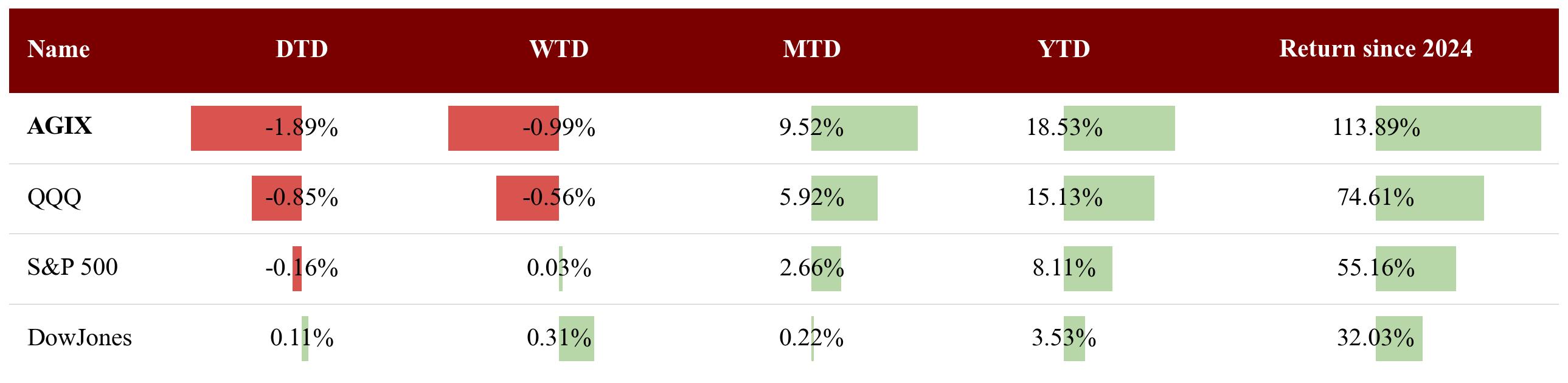
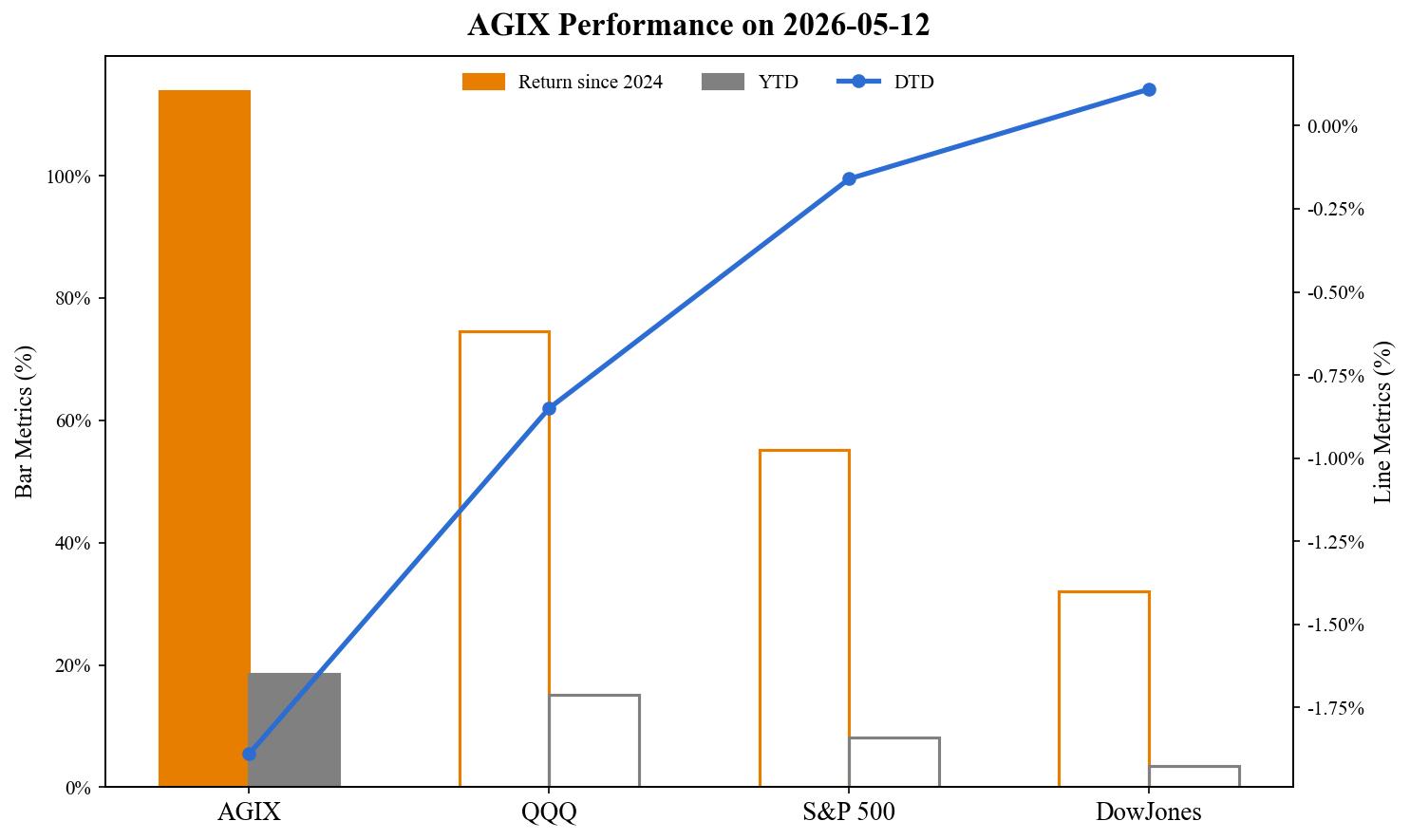
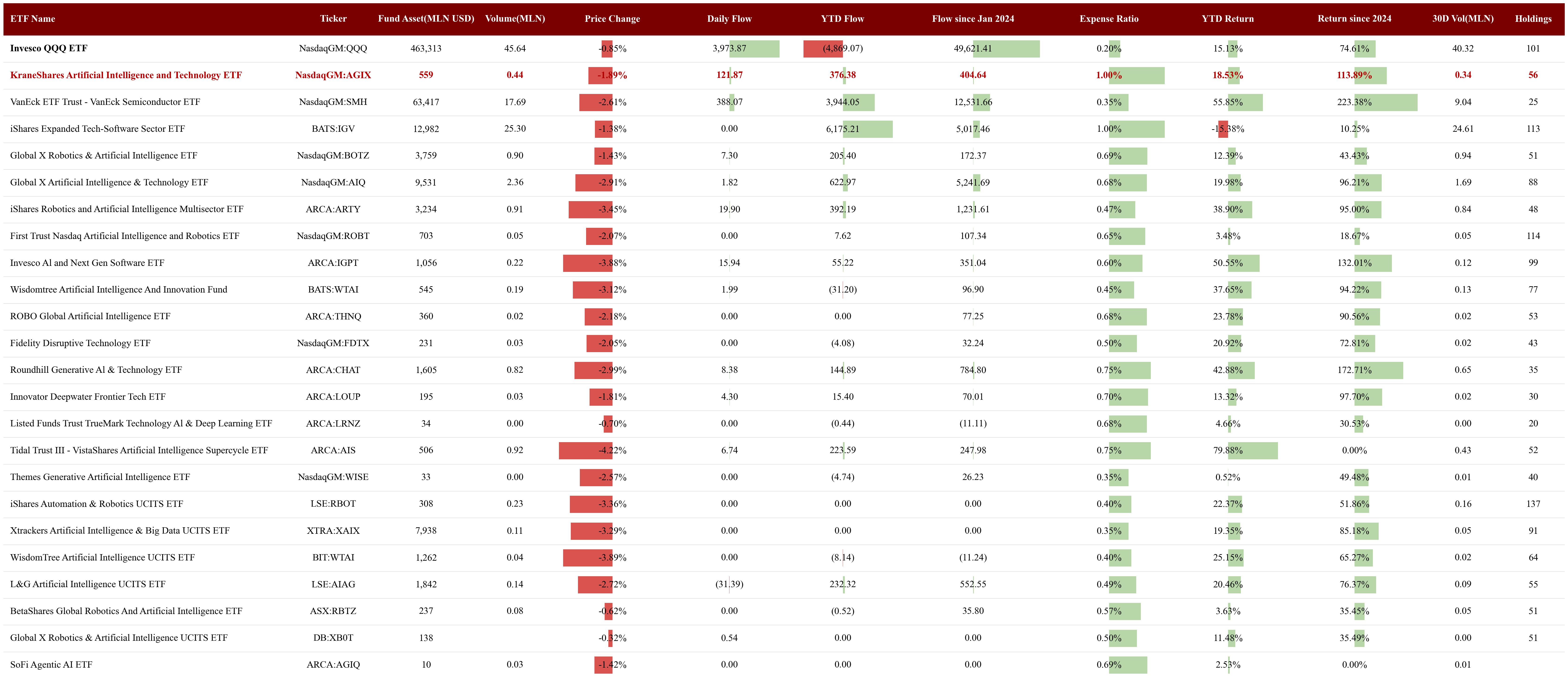
• AGIX fell 1.89% DTD, underperforming the S&P 500 (-0.16%) and Dow Jones (+0.11%) but roughly in line with QQQ (-0.85%). The wider AI and semiconductor ETFs (SMH, IGPT, AIS) saw mixed to sharp declines, suggesting profit-taking after recent strong MTD gains.
• Hardware holdings were mixed: Renesas Electronics surged 7.14% after a Q1 earnings beat driven by automotive demand, while Arista Networks rose 4.48%, both positive contributors. In contrast, MediaTek (-4.64%), Eaton (-4.17%), and GlobalFoundries (-3.79%) were notable drags on AGIX.
• Infrastructure holdings showed divergence: Hut 8 climbed 5.01% on analyst upgrades and expansion news, while CoreWeave (-6.06%) and Oracle (-3.62%) declined. Among application holdings, TE Connectivity gained 3.69%, but Circle Internet Group fell 6.16% despite strong earnings and a token sale, likely on profit-taking.
• Key stocks to watch: Renesas (strong earnings momentum), Hut 8 (crypto/AI infrastructure catalyst), and Circle (volatility post-earnings). Peer holdings with big moves (QUBT +15.72%, NOVT +13.72%) highlight continued interest in quantum computing and precision technology.
News Highlights
1. GM's layoffs of 600 IT workers to hire AI experts signals a major enterprise shift toward native AI development and agent workflows, reinforcing demand for AI infrastructure and tools held by AGIX (e.g., Nvidia, Microsoft).
2. Circle shares closed 16% higher after Q1 earnings beat, a $222M Arc token presale, and the launch of AI agent payment tools. The move supports AGIX's Circle holding, though the stock later pulled back 6.16% DTD.
3. Thinking Machines (Mira Murati's startup) released a real-time interaction model with 0.4-second latency, challenging OpenAI and Google. This intensifies competition in AI voice and agentic AI, benefiting AGIX's infrastructure holdings like Alphabet and Microsoft.
4. Anthropic expanded legal AI tools, intensifying competition in legal AI (Harvey, Legora). This could pressure AGIX's application holdings like Salesforce and ServiceNow if they fail to keep pace in vertical AI.
5. Google announced Gemini-powered Android updates (Rambler dictation, Create My Widget, Googlebooks laptops), deepening AI integration into consumer devices and reinforcing Alphabet's position in AGIX.
RSS Highlights
1. Patch Tuesday: Apple, Google, Microsoft, Mozilla, and Oracle fixed a near-record number of vulnerabilities, highlighting the growing attack surface for AI platforms.
2. Building Software Requires Digestion: Scott Jenson argues chatbot interfaces are reactive and lack the reflective 'Ma' (pause) necessary for effective software development.
3. Where Are All The Data Centers?: Despite $800B+ in big tech data center investments, actual operational capacity remains opaque, raising questions about supply vs. demand.
4. Hacking the lehmer64 RNG: Daniel Lemire showed the lehmer64 random number generator can be reverse-engineered with only three outputs, simpler than Mersenne Twister.
5. Bambu Lab is abusing the open source social contract: Legal threats against a fork developer raise concerns about open-source governance in the AI era.
Performance & Benchmark
Attribution
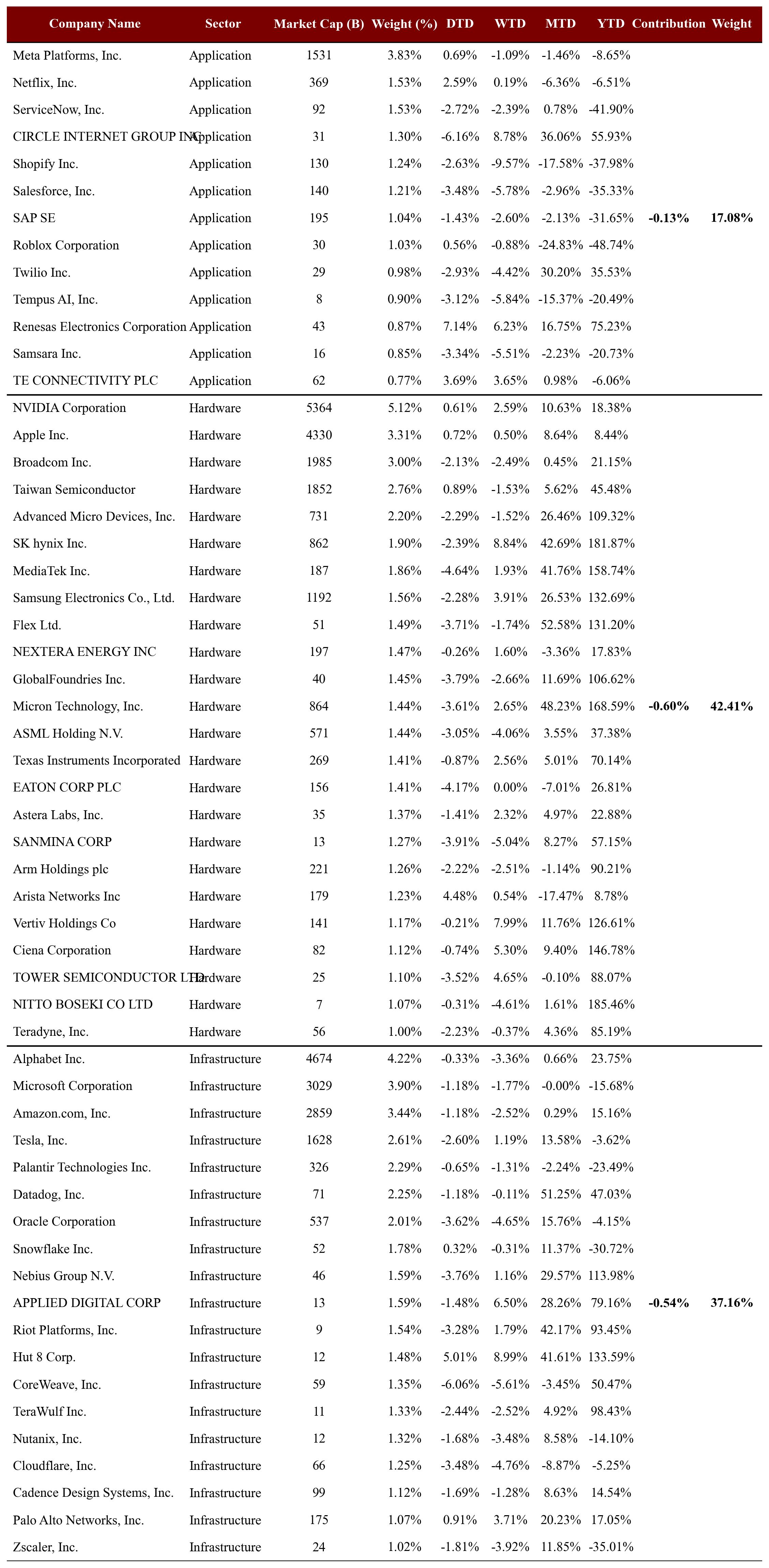
Contribution of the three sectors within AGIX holdings today
Application: -0.13%
Hardware: -0.6%
Infrastructure: -0.54%
Top-performing stocks in AGIX holdings today
Renesas Electronics Corporation (7.14%)
Hut 8 Corp. (5.01%)
Arista Networks Inc (4.48%)
TE CONNECTIVITY PLC (3.69%)
Netflix, Inc. (2.59%)
Worst-performing stocks in AGIX holdings today
Broadcom Inc. (-2.13%)
Arm Holdings plc (-2.22%)
Teradyne, Inc. (-2.23%)
Samsung Electronics Co., Ltd. (-2.28%)
Advanced Micro Devices, Inc. (-2.29%)
SK hynix Inc. (-2.39%)
TeraWulf Inc. (-2.44%)
Tesla, Inc. (-2.6%)
Shopify Inc. (-2.63%)
ServiceNow, Inc. (-2.72%)
Twilio Inc. (-2.93%)
ASML Holding N.V. (-3.05%)
Tempus AI, Inc. (-3.12%)
Riot Platforms, Inc. (-3.28%)
Samsara Inc. (-3.34%)
Salesforce, Inc. (-3.48%)
Cloudflare, Inc. (-3.48%)
TOWER SEMICONDUCTOR LTD (-3.52%)
Micron Technology, Inc. (-3.61%)
Oracle Corporation (-3.62%)
Flex Ltd. (-3.71%)
Nebius Group N.V. (-3.76%)
GlobalFoundries Inc. (-3.79%)
SANMINA CORP (-3.91%)
EATON CORP PLC (-4.17%)
MediaTek Inc. (-4.64%)
CoreWeave, Inc. (-6.06%)
CIRCLE INTERNET GROUP INC (-6.16%)
Top five listed stocks contributing the most within AGIX holdings today
MediaTek Inc. (-4.64%)
CoreWeave, Inc. (-6.06%)
CIRCLE INTERNET GROUP INC (-6.16%)
Oracle Corporation (-3.62%)
Tesla, Inc. (-2.6%)
Observation
The strongest movers across peer ETF holdings today are listed below:
| DTD | Stock Ticker | Name | Held by ETFs | analysis |
|---|---|---|---|---|
| 15.72 | NasdaqCM:QUBT | Quantum Computing Inc. | ['NasdaqGM:AIQ'] | QUBT's 15.72% surge on May 12, 2026 stemmed primarily from ongoing momentum following Northland's initiation of Outperform coverage with a $20 price target, alongside participation in the Needham conference meetings. The recent Q1 2026 earnings call on May 11 and announcements like the NeuraWave PCIe card launch and Ciena quantum-secured networking demo fueled bullish trader sentiment. Technical breakout above key resistance levels near $10.53 further amplified the move amid rising weekly gains of 11.26%. |
| 13.72 | NasdaqGS:NOVT | Novanta Inc. | ['ARCA:IGPT', 'LSE:RBOT'] | Novanta Inc. (NOVT) stock surged 13.72% on May 12, 2026, primarily driven by a strong Q1 earnings beat with revenue up 10.4% to $257.7M, Adjusted EBITDA and EPS growth, and 37% bookings increase. Management raised full-year guidance to 6-8% organic growth in Q2 and higher revenue, supported by a 1.10 book-to-bill ratio and strengthening cash flow. Shares closed near $156-159 after trading in the low $120s-$130s prior, reflecting momentum from the positive earnings reaction. |
| 13.14 | NYSE:SE | Sea Limited | ['NasdaqGM:FDTX'] | Sea Limited (NYSE:SE) stock surged 13.14% on May 12, 2026, primarily driven by its Q1 2026 earnings release showing strong revenue growth of 46.6% year-over-year to $7.10 billion, beating consensus estimates of $6.41 billion despite missing EPS expectations. Pre-earnings momentum from strong e-commerce growth headlines and a multi-week uptrend from the low $80s to the mid-$90s amplified the reaction, with unusually high options volume signaling trader anticipation. JPMorgan's maintained Overweight rating with a minor price target trim further supported investor confidence. |
| 11.59 | TSE:5803 | Fujikura Ltd. | ['NasdaqGM:AIQ'] | The available search results do not contain specific news, earnings announcements, or corporate events dated May 12, 2026 that would explain Fujikura's 11.59% single-day move. The most recent verifiable information references a five-for-one stock split effective April 1, 2026 and analyst price target increases, but neither provides a direct catalyst for the May 12 move. Without access to same-day news from May 12, 2026, a reliable attribution cannot be established based on the provided sources. |
| 11.44 | NasdaqGS:ZBRA | Zebra Technologies Corporation | ['NasdaqGM:AIQ', 'NasdaqGM:ROBT'] | Zebra Technologies' 11.44% gain on May 12, 2026 was driven by a strong first-quarter earnings beat and raised full-year guidance. The company reported non-GAAP diluted EPS of $4.75, beating analyst estimates of $4.26 by 11.5%, and raised its 2026 EPS outlook to $18.30-$18.70 with expected sales growth of 10-14%. Management also guided Q2 sales growth of 14-17%, signaling broad-based momentum across segments and regions that justified the market's positive reaction. |
| 10.0 | TWSE:2303 | United Microelectronics Corporation | [] | UMC (TWSE:2303) surged 10.0% on May 12, 2026, primarily driven by growing optimism around its earnings prospects following a Zacks Rank upgrade to 2 (Buy). This was reinforced by strong Q1 2026 results showing a significant EPS beat and 10.9% year-over-year revenue growth. Technical indicators also signaled a strong buy, contributing to the momentum. |
| 9.82 | TWSE:3008 | LARGAN Precision Co.,Ltd | ['ARCA:IGPT', 'LSE:RBOT'] | Largan Precision (TWSE:3008) surged 9.82% on May 12, 2026, driven primarily by technical buying momentum amid a prevailing short-term buy signal. TradingView's technical analysis rated the stock as a buy on daily and weekly timeframes, supported by positive moving averages and oscillators. No specific company news, disclosures, or macro events were identified in available data to explain the move. |
| 9.71 | TWSE:5269 | ASMedia Technology Inc. | ['ARCA:IGPT', 'ARCA:AIS', 'LSE:RBOT'] | ASMedia Technology Inc. (5269.TW) surged 9.71% on May 12, 2026, driven primarily by rotational buying in undervalued tech stocks amid broader Taiwan market strength. The Taiex rose 0.76% on sector rotation from semiconductors like TSMC to lagging tech names, including passive components, as noted by analysts. A recent treasury share repurchase update on May 5 (334,000 shares) and an earlier March buyback announcement of 900,000 shares (1.2% of capital) provided additional buyback support. |
| 9.67 | TWSE:6531 | AP Memory Technology Corporation | ['ARCA:AIS'] | AP Memory Technology Corp (TWSE:6531) surged 9.67% on May 12, 2026, primarily driven by positive market reaction to the company's full re-election of its Board of Directors, announced following the Annual General Meeting on May 8, 2026. This governance milestone likely boosted investor confidence in the memory chip maker's AI and IoT segments amid strong analyst buy ratings and price targets up to 390 TWD. Technical indicators signaling "strong buy" further amplified the momentum after a 6% weekly gain. |
| 8.47 | NasdaqGM:PRCT | PROCEPT BioRobotics Corporation | ['NasdaqGM:BOTZ', 'ASX:RBTZ', 'DB:XB0T'] | PRCT stock rose 8.47% on May 12, 2026, primarily driven by positive intraday momentum with shares trading up as high as $28.17 and volume of 588,266 shares, reflecting buyer interest amid recent weakness. This followed a 7.4% intraday gain highlighted in market updates, supported by the stock's position above its 50-day moving average of $25.06 despite longer-term underperformance. No specific company news or disclosures were reported on the day, pointing to technical trading factors as the key catalyst. |
| 8.43 | TWSE:6669 | Wiwynn Corporation | ['ARCA:IGPT'] | Wiwynn Corporation's (TWSE:6669) 8.43% single-day gain on May 12, 2026, was primarily driven by positive momentum from its recent quarterly earnings beat and anticipation for upcoming investor events. The company reported EPS of 62.71 TWD versus estimates of 51.40 TWD (22% surprise) and revenue of 220.74B TWD beating 203.60B TWD expectations, fueling optimism in the cloud server and AI infrastructure segment. Additionally, the announcement of participation in the Yuanta Taiwan Technology Day Forum on May 15 likely boosted investor interest ahead of management commentary. |
| 8.12 | NYSE:PSN | Parsons Corporation | ['LSE:RBOT'] | Parsons (NYSE:PSN) stock surged 8.12% on May 12, 2026, primarily driven by a positive market reaction to its recent award of a position on a $136 million U.S. Air Force contract for design, repair, and cybersecurity services at Hill Air Force Base, spanning 8.5 years. This contract win from the Air Force's 75th Engineer Group boosted investor confidence in the infrastructure and defense services provider. No other same-day catalysts were reported. |
| 7.77 | XTRA:JEN | Jenoptik AG | ['LSE:RBOT'] | Jenoptik AG (XTRA:JEN) shares surged 7.77% on May 12, 2026, primarily driven by a 74% year-over-year jump in Q1 order intake to €357 million, beating market expectations by 30%. The strong performance was fueled by robust demand in the Semiconductor & Advanced Manufacturing segment, including a major order, amid a broader semiconductor boom. Management highlighted very dynamic OEM demand since the start of 2026, supporting raised full-year guidance for revenue growth and EBITDA margins. |
| 7.14 | TSE:6723 | Renesas Electronics Corporation | ['NasdaqGM:AGIX', 'NasdaqGM:ROBT', 'BIT:WTAI'] | Renesas Electronics (TSE:6723) rose 7.14% on May 12, 2026, primarily driven by positive market reaction to its Q1 FY2026 earnings beat. Revenue came in at ¥380.29B, up 3.08% and ahead of forecasts, fueled by strength in the Automotive segment. Despite an EPS miss at ¥148.2B (36.33% below expectations), investors focused on the top-line growth and segment performance amid ongoing semiconductor demand. |
| 6.97 | TSE:7012 | Kawasaki Heavy Industries, Ltd. | ['NasdaqGM:ROBT'] | Kawasaki Heavy Industries (TSE:7012) surged 6.97% on May 12, 2026, primarily driven by its fiscal year 2025 earnings report showing a 23% profit jump to 108.2 billion yen. The company also announced a dividend increase to ¥171 annually, up ¥5 per share from prior forecasts, alongside positive revenue growth guidance. These results followed a 5-for-1 stock split effective earlier in April, boosting liquidity and investor appeal. |
| 6.65 | TWSE:3035 | Faraday Technology Corporation | ['LSE:RBOT'] | No verifiable same-day news, disclosures, or events explain Faraday Technology's (TWSE:3035) 6.65% gain on May 12, 2026. The most recent company activity was a correction to its Q1 financial report from April 20 and an investor conference on April 28, both over two weeks prior. Technical factors or broader market momentum likely drove the move, as no company-specific catalysts appear in public records. |
| 6.64 | TWSE:2408 | Nanya Technology Corporation | ['ARCA:IGPT', 'ARCA:AIS'] | I cannot identify a specific same-day news event or company disclosure from May 12, 2026 that would explain Nanya Technology's 6.64% single-day gain. The search results provided contain only historical data through early April 2026, including strong Q1 2026 gross margin expansion to 67.9% and management guidance for Q2 outperformance, but no information about May 12 developments. Without access to verifiable news, regulatory filings, or management announcements from that specific date, I cannot reliably attribute the move to a particular catalyst. |
| 6.49 | SHSE:688256 | Cambricon Technologies Corporation Limited | ['ARCA:IGPT'] | I cannot provide a reliable attribution for Cambricon Technologies' 6.49% gain on May 12, 2026, as the search results contain no verifiable news events, company disclosures, or material announcements from that date. The available data includes only historical price information and technical analysis from 2025, which is insufficient to explain the single-day move. To complete this analysis, real-time news sources, regulatory filings, or management commentary from May 12, 2026 would be required. |
| 6.02 | TSE:6506 | YASKAWA Electric Corporation | ['NasdaqGM:BOTZ', 'NasdaqGM:ROBT', 'ARCA:IGPT', 'LSE:RBOT', 'ASX:RBTZ', 'DB:XB0T'] | I cannot provide a reliable attribution for Yaskawa Electric's 6.02% gain on May 12, 2026, as the search results contain no news, earnings announcements, or company disclosures dated on or immediately before that trading day. The available information includes only historical valuation data and general company background, which are insufficient to explain a single-day move of this magnitude. To properly attribute this move, same-day or pre-market news regarding the company, its sector, or relevant macro catalysts would be required. |
| 5.2 | SEHK:861 | Digital China Holdings Limited | [] | Digital China Holdings (SEHK:861) rose 5.2% on May 12, 2026, amid a lack of identifiable company-specific news or disclosures. The move aligned with a modest +0.85% gain in the stock's 5-day performance through May 6, suggesting momentum continuation or broader IT services sector rotation. Trading occurred at a 519% premium to Morningstar's HK$6.74 fair value estimate, potentially amplifying volatility from style factors like value dislocations. |
| 5.01 | NasdaqGS:HUT | Hut 8 Corp. | ['NasdaqGM:AGIX', 'BATS:IGV', 'NasdaqGM:AIQ'] | Hut 8 Corp (HUT) rose 5.01% on May 12, 2026, primarily driven by analyst upgrades and expansion announcements boosting investor confidence. Clear Street raised its price target to $33 after the company advanced four new U.S. sites into development, while Benchmark lifted its target to $36 citing plans for 1.53 gigawatts of new capacity across four locations. A $200 million Bitcoin-backed revolving credit facility further supported the move, amid the stock hitting a 52-week high near $32. |
News
Funding & M&A
Riding an AI rally, Robinhood preps second retail venture IPO.
Just two months after listing its first venture capital fund, RVI, Robinhood has begun preparations for a second fund, RVII, filing a confidential registration statement. The new fund will expand its investment scope from the 10 late-stage companies in RVI (such as Airwallex, Boom, Databricks, ElevenLabs, Mercor, OpenAI, Oura, Ramp, Revolut, and Stripe) to growth-stage and early-stage startups, aiming for higher return potential. Although the first fund originally targeted $1 billion in fundraising but fell short, its share price has performed strongly, doubling from $21 per share at its early March listing to $43.69, driven by market enthusiasm for the AI startups in the fund. Robinhood Ventures aims to fill the gap for ordinary investors to participate in startup investing, offering a publicly traded venture capital model through NYSE-listed funds with no accreditation requirements, daily liquidity, and no performance fees. CEO Vlad Tenev said the goal is to eventually allow retail investors to directly participate in seed and Series A rounds, alongside traditional VCs, sharing in the high growth of private markets. This innovation could reshape the early-stage startup funding landscape, bringing more retail investors into high-risk, high-reward territory.
With $50M in funding, Frame Security takes aim at AI-powered social engineering.
Human risk security startup Frame Security Ltd. today announced a $50 million funding round to build its AI-driven platform that helps employees defend against social engineering attacks and deepfake threats. The platform replaces traditional quarterly slide decks and canned phishing simulations with real-time, personalized attack simulations, role-based training, and instant guidance. Frame emphasizes that although 96% of organizations conduct security awareness training, 90% of data breaches still involve human factors. Generative AI has lowered the cost of attacks; according to Gartner Inc., in 2025, 43% of cybersecurity leaders encountered deepfake audio calls, and 37% faced video calls. The Frame platform can quickly generate training for new attack patterns and analyze employee behavior to identify personalized threats. Co-founders Tal Shlomo and Sharon Shmueli are both veterans of Israel's Unit 8200; the former worked at Wiz Inc. (acquired by Google LLC for $32 billion), and the latter served as CTO at Team8. The company has already secured dozens of enterprise customers, including Louis Dreyfus Co. and AlphaSense Inc. The round was led by Index Ventures, Team8, and Picture Capital Management, with participation from Wiz CEO Assaf Rappaport and Elad Gil. The new funds will be used for engineering, AI, and cybersecurity R&D, as well as expansion in the U.S. and international markets.
Cowboy Space raises $275M to build orbital AI data centers
Space technology startup Cowboy Space Corp. today announced the completion of a $275 million Series B funding round, valuing the company at $2 billion, led by Index Ventures, with participation from NEA, IVP, and others, as well as founding CEO Baiju Bhatt (co-founder of Robinhood Markets Inc.), bringing total external funding to $355 million. Cowboy Space focuses on deploying AI data centers in space, leveraging abundant orbital solar energy, with solar panels more efficient than on the ground and able to align vertically to the sun for maximum power generation. The company, formerly named Aetherflux, initially planned to deploy orbital solar panels and transmit power via infrared light, but later shifted to using solar energy to power low-orbit data centers. Each modular data center provides 1 megawatt of computing power, supported by approximately 800 graphics processing units, weighing 20-25 tons in total, based on Nvidia Corp.'s Space-1 Vera Rubin module released this year, which combines an 88-core CPU with two Rubin graphics cards, achieving 50 petaflops of NVFP4 data processing per chip. The company plans to develop its own rocket, converting the second stage into a data center container to reduce costs, and expand computing power through module clusters. Competitor Starcloud Inc. plans to connect multiple modules using a 6.1-square-mile solar array, while SpaceX Corp.'s Starlink rocket second stage is reusable, with a payload capacity of 150 tons, and is planning to deploy orbital AI infrastructure. Cowboy Space aims to launch its first satellite next year and develop reusable rockets to lower launch costs.
AI voice startup Vapi hits $500M valuation after winning Amazon Ring over 40 rivals
AI voice startup Vapi recently completed a $50 million Series B funding round led by Peak XV Partners, with a post-money valuation of approximately $500 million, bringing total funding to $72 million. Previously, Amazon's Ring, facing a surge in customer service calls during last year's holiday season, evaluated over 40 AI voice vendors before selecting Vapi to handle all inbound call traffic. The deployment significantly improved Ring's customer satisfaction and allowed the team to optimize the AI agent experience without engineering support. Vapi founder Jordan Dearsley said Ring favored Vapi for its fine-grained control over AI agent behavior. Vapi originated from Dearsley's AI therapist project, later pivoting to low-latency voice infrastructure, and has processed over 1 billion calls, with 1 to 5 million calls daily, and enterprise customers making up the largest segment. Besides Ring, customers include Kavak, Instawork, New York Life, UnityAI, Cherry, and Intuit. Other investors include Microsoft M12, Kleiner Perkins, and Bessemer Venture Partners. Vapi emphasizes its infrastructure and orchestration layer, distinguishing itself from pre-packaged applications, with a focus on enterprise-grade reliability and compliance. The company now has about 100 employees and plans to expand its engineering, infrastructure, and marketing teams, amid a wave of AI voice startups.
White Circle raises $11M to help companies secure and monitor AI model behavior.
AI security and monitoring startup Pumpkin Intelligence Inc. (operating under the brand White Circle) announced the completion of an $11 million seed funding round, attracting participation from many AI industry leaders, including OpenAI developer experience head Romain Huet, OpenAI co-founder Dirk Kingma (now at Anthropic), former Google DeepMind executive Mehdi Ghissassi, and DataDog co-founder and CEO Olivier Pomel. Founder and CEO Denis Shilov gained prominence in 2024 for demonstrating that a single prompt could jailbreak most proprietary AI models, with his research revealing risks of bypassing safety mechanisms and obtaining instructions for drugs, weapons, and sensitive information, drawing attention from giants like Anthropic, OpenAI, and Hugging Face. White Circle subsequently launched a single API providing real-time input and output monitoring, using proprietary AI models to detect harmful content, hallucinations, attacks, model drift, and malicious users, supporting over 150 languages for global products. Its KillBench research conducted millions of experiments on 15 models including OpenAI, Google, Anthropic, and xAI, revealing persistent bias issues. The company emphasizes that AI is developing rapidly while security lags, and its API can prevent fintech data leaks and prompt injection attacks, continuously optimizing by learning normal behavior to enhance enterprise trust in sensitive data across healthcare, finance, and government sectors.
Musk mulled handing OpenAI to his children, Altman testifies.
OpenAI CEO Sam Altman appeared in court today to defend against a lawsuit filed by former co-founder Elon Musk, which challenges OpenAI's corporate structure transformation. Musk accuses other OpenAI founders of 'stealing charity' by launching a for-profit subsidiary, but Altman countered that they have built one of the world's largest charities, with a foundation asset size of $200 billion, continuing important work. OpenAI board chair Bret Taylor testified explaining that the foundation previously lacked full-time employees due to difficulties in cashing out equity, which was resolved through a 2025 restructuring. The core of the lawsuit is whether OpenAI's commercial expansion sacrifices safety commitments. Altman recalled the critical period of 2017, revealing that Musk's safety plan worried him, particularly Musk's suggestion that if he died, control of OpenAI might pass to his children, which violated OpenAI's original intent to avoid AI falling into a single person's hands. Altman also criticized Musk's management style as unsuitable for a research lab, having demanded ranking of researchers and conducted large layoffs that severely damaged organizational culture. Subsequently, Musk left the board and launched competing AI projects at Tesla and his own xAI. Despite differences, Altman maintained contact, updating Musk on progress and seeking investment advice, including Microsoft's 2018 investment in OpenAI. OpenAI's lawyers emphasized that Musk was given investment opportunities but now accuses them of corruption. This case highlights the legal and ethical controversies surrounding the transition of AI nonprofits to for-profit entities.
Exaforce raises $125M Series B to build AI for catching and stopping cyberattacks as they happen
AI security startup Exaforce recently completed a $125 million Series B funding round, valuing the company at $725 million, with participation from HarbourVest, Peak XV, Mayfield, Khosla Ventures, and Seligman Ventures. This follows a $75 million Series A round a year ago, bringing total funding to $200 million. The substantial capital highlights the high cost of building an AI-driven security operations center (SOC) and investors' strong belief in the market opportunity. Exaforce uses AI agents called 'Exabots' to automate security operations through deep data analysis, significantly reducing the burden on human analysts. Its platform claims to reduce manual tasks by up to 90%. Co-founder and CEO Ankur Singla said the goal is to capture and stop threats in real time. A new 'vibe hunting' feature allows security teams to query potential attacks in natural language, such as 'Are there any new attacks from Iran?' Exaforce officially launched to market in the fourth quarter of last year and has already acquired 20 customers, including Replit and Guardant Health, with expectations to reach 40-50 by year-end. High-profile cyberattacks have accelerated customer acquisition. In a competitive market, Exaforce faces challenges from startups like 7ai, Dropzone AI, and Prophet Security, as well as giants like Palo Alto Networks and CrowdStrike, but the successful funding round provides strong momentum for expansion.
Dessn raises $6M for its production focused design tool
The AI-driven design tools market continues to heat up, with startup Dessn recently announcing a $6 million funding round led by Connect Ventures, with participation from Betaworks and N49P. Founded by Gabriella Hachem and Nim Cheema, the company focuses on solving the pain point that traditional design tools cannot directly operate on codebases. Dessn's technological innovation lies in running codebases in the cloud without local setup, abstracting dependencies to enable seamless collaboration between designers and developers, improving product iteration efficiency. Its current customers include health company Color, voice AI company Wispr, and fintech company Mercury. Unlike tools such as Perplexity's Visual Electric, Figma's Weavy, Flora, and Krea, Dessn emphasizes high-fidelity design in production environments rather than ideation from scratch (like Vercel's v0). Co-founder Cheema believes that as code becomes commoditized, design will be the key differentiator for software. Dessn requires no switching from existing tools like Figma, offers low setup costs for single-project trials, supports prompt-based design generation, and plans to integrate with Slack and Granola, but refuses Figma integration to maintain a production-oriented focus. Pricing starts at $39 per month with a free trial. The company has a team of only four people and plans modest expansion. Betaworks partner Jordan Crook praised Dessn as 'the tool Figma would build if it were reborn today,' highlighting its potential to revolutionize the design process in the AI era.
Vapi raises $50M to make voice AI more human
Voice AI startup Vapi Inc. announced the completion of a $50 million Series B funding round, led by Peak XV, with participation from Y Combinator, Microsoft's venture fund M12, Kleiner Perkins, and early investors. This round brings the company's total funding to $72 million. Vapi focuses on building voice AI infrastructure, acting as middleware that connects AI models like OpenAI's GPT and Anthropic's Claude with speech-to-text and text-to-speech engines, supporting low-latency responses and interruptibility for more natural conversations. The company's platform has served over 1 million developers, 2.7 million unique AI agents, and processed over 1 billion phone calls, primarily in sectors such as financial services, healthcare, insurance, automotive, and workforce management, helping businesses replace call centers, automate high-volume qualification workflows, and navigate complex third-party phone systems. Amazon Ring Vice President Jason Mitura said Vapi stood out after evaluating dozens of vendors, achieving production deployment within two weeks, with 100% of inbound call volume now handled by Vapi. Vapi co-founder and CEO Jordan Dearsley emphasized that the platform empowers businesses to deploy human-like voice agents that truly solve customer problems, enhancing customer experience. The new funding will focus on distribution, delivery, and core infrastructure investments, including governance, security, and call guardrails, to accelerate product rollout and scaling.
Model Releases
Thinking Machines wants to build an AI that actually listens while it talks
Former OpenAI CTO Mira Murati's AI startup Thinking Machines Lab, founded last year, announced on Monday the launch of a new type of AI model called 'interaction models,' whose core feature is enabling AI to proactively interrupt users during interactions. The model abandons traditional one-way dialogue patterns (where the user speaks and the AI responds), instead adopting 'full-duplex' technology that processes input and generates responses in real time, making interactions more akin to natural phone conversations. The company claims its first model, TML-Interaction-Small, has a response time of just 0.40 seconds, approaching the speed of natural human conversation and far surpassing similar models from OpenAI and Google. While the benchmark results are impressive, it is currently only a research preview and has not been publicly released. The company plans to launch a 'limited research preview' within months and achieve a broader release later this year. This innovative concept emphasizes that interactivity should be a native feature of the model, but whether the actual experience matches the technical claims still awaits user testing. This development highlights the evolution of AI dialogue systems toward more human-like and real-time capabilities, potentially reshaping the paradigm of human-computer interaction.
Thinking Machines drops a new, highly responsive model designed for humanlike interactions in real time
Former OpenAI CTO Mira Murati's AI startup Thinking Machines Lab Inc. recently released a research preview of its first 'interaction model,' marking a significant breakthrough in AI interaction paradigms. The model adopts a new multimodal architecture supporting 'full-duplex' communication, meaning the AI can simultaneously listen, observe, and respond, enabling truly real-time interaction and avoiding the latency issues of traditional 'turn-based' AI. The new architecture abandons standard alternating token sequences in favor of a multi-stream micro-turn design, processing input and output every 200 milliseconds, supporting real-time responses to visual and auditory cues. The company introduced TML-Interaction-Small (a 276-billion-parameter mixture-of-experts model) to manage conversation and immediate follow-ups, paired with an asynchronous background model for complex reasoning, web searches, and tool calls. Using 'encoder-free early fusion' technology, it directly processes raw audio and video signals, significantly reducing latency. In the FD-bench benchmark, its turn-taking latency is only 0.4 seconds, outperforming Google Gemini-3.1-flash-live (0.57 seconds) and GPT-realtime-2.0 (1.18 seconds). This innovation is suitable for high-stakes scenarios such as medical surgery, lab monitoring, and manufacturing safety alerts, supporting time-sensitive requests. The model is currently available as a limited preview to selected partners, with a broader release planned later this year, helping AI evolve into human-like collaborative partners.
Technical Breakthroughs
AI security startup Grego AI launches, claiming a record $250,000 bounty for an AI-discovered exploit.
AI cybersecurity startup Grego AI officially launched today. Its proprietary Deep Invariant Analysis method uses existing AI models to scan entire codebases, identifying critical software vulnerabilities often missed by human auditors and traditional automated tools. The technology releases small agents in a sandbox to simulate different paths through the code stack, generating proof-of-concept exploits when potential weaknesses are found to confirm reproducible bugs. Grego AI emphasizes that the deep flaws it targets, caused by multi-layer dependency interactions, are beyond the insight of humans and existing static or dynamic testing tools. The company has discovered and helped patch a vulnerability in a major blockchain protocol that, if exploited, would have led to a $27.7 million loss, earning a $250,000 bounty—the largest bug bounty record for a purely AI-discovered flaw. Founded by top bug bounty hunter Justus Hanna and math prodigy Gregorio Maspero, Grego AI has built proprietary architecture, multi-agent coordination, and self-optimizing pipelines to enhance the reasoning capabilities of foundation models beyond frontier lab levels. The company is backed by cyber•Fund and supported by Vercel founder Guillermo Rauch. Its future goals include expanding into enterprise software, finance, healthcare, cloud platforms, and government defense code, marking a major technological breakthrough in AI security.
DigiCert's intelligent trust framework targets AI reliability gaps as enterprise risks grow.
DigiCert Inc. has launched an intelligent trust framework to address security challenges in the AI era. The framework includes AI Agent Trust and AI Model Trust, helping enterprises verify the authenticity of AI agents and models with encryption protection and continuous governance. With the rise of open-source AI agents like OpenClaw and Nvidia's NemoClaw, enterprises face a surge in cyberattack risks. theCUBE Research data shows that 90% of organizations are unprepared for AI-driven threats, with 362 AI-related incidents expected in 2026. DigiCert unifies PKI, DNS, and device identity into a single control plane, supporting automated trust architectures. Experts emphasize that intelligent trust has become an operational foundation, especially under quantum computing threats and new rules shortening TLS certificate lifetimes to 47 days. Google, Microsoft, Amazon, Nvidia, and Cisco are all advancing quantum processors, forcing enterprises to accelerate post-quantum cryptography transitions. DigiCert CEO Amit Sinha says AI creates new trust challenges, and the company is committed to ensuring the security and authenticity of digital interactions. Research predicts that 30% of regulated workloads will embed AI by 2026, highlighting the urgency of building quantum-safe trust systems.
IBM's enterprise AI strategy makes trust and control the test for production.
IBM is positioning itself as a trusted leader in enterprise AI through its watsonx platform, hybrid cloud strategy, and governance tools. As enterprises move from AI pilots to production deployment, IBM emphasizes that a governed AI platform can provide automation, trusted data, and operational control in complex, fragmented environments rather than adding risk. Analyst John Furrier notes that IBM is not chasing frontier model hype but focusing on real-world enterprise applications. If IBM Think showcases watsonx deployed on governed data, IBM will become a core player in the second wave of AI. IBM's Red Hat acquisition gives it an advantage in hybrid cloud foundations, supporting AI workloads across public cloud, private systems, mainframes, and edge environments. CFO Jim Kavanaugh emphasizes that tight integration of hybrid cloud and AI, multi-cloud optimization, and ethical expansion of agentic AI are the future value drivers. Meanwhile, IBM is advancing post-quantum cryptography and crypto-agility to help enterprises address quantum threats by 2035. IBM's differentiation lies in building an AI stack for regulated, messy real-world environments rather than lab models, helping enterprises achieve sustainable competitive advantage and value creation.
7 lessons from the first wave of agentic AI deployment: theCUBE + NYSE Wired’s AI Agent Conference insights.
At the theCUBE + NYSE Wired: AI Agent Conference, several enterprise executives discussed key challenges in deploying agentic AI. Appen Ltd Chair Vanessa Liu emphasized that enterprise AI needs to inject proprietary business context and organizational knowledge to make effective decisions, rather than relying solely on frontier models. Thomson Reuters Corp. President Steve Hasker noted that successful agents must solve clear customer problems and have competitive moats. Bright Data Ltd Product Head Ariel Shulman revealed that its scraped web data has become the starting point for chatbot responses, with response times optimized to a median of 500 milliseconds to meet users' zero tolerance for latency. Catena Labs Inc. co-founder Sean Neville introduced a 'know your agent' model, providing identity verification and accountability standards for agent finance. OutSystems Inc. CEO Woodson Martin warned that relying on a single model would lose cost control, calling for platforms that support hot-switching models at runtime. WalkMe Ltd CIO Tai Carmi highlighted the disconnect between executives and employees in their understanding of AI tools, suggesting embedding contextual prompts into workflows. AG2ai Inc. founder Qingyun Wu advocated first maximizing the capabilities of frontier models before turning to open-source alternatives to reduce inference costs. Monte Carlo Data Inc. CEO Barr Moses emphasized that the gap from proof of concept to production deployment often leads to failure due to stale data or hallucinations, and enterprises must take full responsibility for agent behavior. These insights underscore that agentic AI success depends on context, standards, and controllability, not just technological progress.
GM just laid off hundreds of IT workers to hire those with stronger AI skills.
General Motors (GM) recently cut more than 10% of its information technology workforce, about 600 salaried employees, in a move aimed at skill transformation and making room for AI experts. The company confirmed the layoffs to TechCrunch and said it is better positioning itself for future growth. The cuts are not simply about reducing headcount; GM is still hiring for IT roles, but with a focus on skills such as native AI development, data engineering and analytics, cloud engineering, agent and model development, prompt engineering, and new AI workflows, emphasizing building AI systems from scratch rather than using them merely as productivity tools. Over the past 18 months, GM has conducted multiple rounds of white-collar layoffs, including about 1,000 software workers in August 2024. Since hiring Sterling Anderson, co-founder of autonomous trucking startup Aurora, as chief product officer in May 2025, the software team has undergone major changes, with three senior executives leaving last month: Baris Cetinok, senior vice president of software and services product management; Dave Richardson, senior vice president of engineering; and former chief AI officer Barak Turovsky, a former Cisco executive. GM subsequently recruited AI experts, including Behrad Toghi, poached from Apple in October to serve as AI head, and Rashed Haq, former head of AI and robotics at Cruise (the autonomous driving company GM acquired and later shut down), as vice president of autonomous driving. This move signals the practical path of enterprise AI adoption: a thorough restructuring of the workforce focused on agent development, model engineering, and native AI workflows, pointing to the direction of AI demand in large enterprises.
AI’s easy on-ramp has become a costly exit problem for enterprises, says Red Hat
As enterprise AI applications move from pilot phases to large-scale deployment, inference costs and complexity are driving fundamental changes in infrastructure design, with horizontal cloud platforms becoming the core of AI strategy. Stephen Watt, Vice President of the CTO Office at Red Hat, noted at Red Hat Summit 2026 that enterprises initially rely on frontier model providers like Anthropic and OpenAI, but as they scale, factors like token economics push them toward self-managed efficient inference. Red Hat AI 3.4 expands model-as-a-service and distributed inference capabilities, driving demand for shared governed inference infrastructure. One New Zealand Group Ltd. built a horizontal telecom cloud platform based on Red Hat OpenShift, reducing delivery time by 40% and operational costs by 30-45%. Red Hat's vLLM Semantic Router project intelligently routes inference requests to specialized open-weight models, such as those for physics or history, improving accuracy and reducing costs. This project exemplifies the core advantages of open source, providing customizable solution components to help enterprises transition from departmental silo pilots to central IT-led shared platforms, optimizing total cost of ownership and efficiency. The industry is converging on a consensus around horizontal cloud architecture, enabling unified control across storage, compute, and management layers.
Product Launches
Google Cloud sees its marketplace as the launchpad for the agentic enterprise.
Enterprise software procurement is accelerating toward platform-based and outcome-driven models, driving the agentic reality transformation. Google Cloud's annualized business revenue has reached $20 billion, with committed spending backlog as high as $462 billion, and its Cloud Marketplace has become the distribution core for agentic enterprises. Dai Vu, Managing Director of Google Cloud Marketplace, said in an exclusive interview at Red Hat Summit 2026 that this transformation is comparable to the Industrial Revolution, shifting intelligent systems from simple productivity enhancement to autonomous planning, reasoning, and multi-step execution of complex goals in full-stack workflows. Google launched the Gemini Enterprise Agent Platform, which now hosts over 2,000 agents, including products from ServiceNow and Oracle, enabling enterprises to build, scale, govern, and optimize agents integrated into daily workflows. To meet enterprise demand for complete solutions, the platform emphasizes a governance layer ensuring observability and audit trails. Red Hat Lightspeed Agent is now available in beta on Google Cloud Marketplace, offering Red Hat Enterprise Linux administrators conversational configuration, vulnerability queries, and optimization interfaces. Google has committed $750 million to support its partner ecosystem, including technical workshops, deployment incentives, and engineer deployments, to help partners seize the agentic economy opportunity. Vu emphasizes that agentic reality is here, and enterprises must embrace it quickly.
HPE expands hybrid cloud stack with unified private cloud and AI-ready storage updates
Hewlett Packard Enterprise (HPE) today announced the expansion of its hybrid cloud and data platform portfolio, launching a new generation of private cloud, storage, and network resilience solutions designed to simplify infrastructure modernization and prepare enterprise data environments for AI workloads. The new offerings focus on a unified operational model for virtualization, Kubernetes container orchestration, storage, and data protection, spanning core, edge, and cloud environments. Specifics include the fourth-generation HPE Private Cloud, which supports unified management of virtual machines and Kubernetes containers, powered by HPE Morpheus software and compatible with the latest HPE ProLiant Compute Gen12 servers, as well as integration with Veeam backup software and the HPE Zerto disaster recovery platform. The HPE Alletra Storage MP X10000 platform adds file and object storage support with simultaneous access, scaling to 16 nodes and 23 petabytes of capacity, and introduces remote direct memory access to accelerate AI pipelines. HPE Data Fabric software enhances conversational AI interfaces, policy-driven data movement, and governance capabilities, providing a federated namespace across environments. HPE Zerto Software 10.9 introduces AI-driven protection, recovery automation, and Model Context Protocol support. Executives emphasized that this strategy addresses AI fragmentation, rising virtualization costs, and data breach concerns, driving AI inference to local or edge environments. Most features are available immediately, with the rest rolling out later this year.
Circle shares close 16% higher after $222M token sale, mixed earnings
Circle Internet Group Inc. shares surged 16% after earnings, despite revenue slightly missing expectations, with adjusted EBITDA reaching $151 million, beating market estimates by 24%, and earnings per share of $0.21. The company reported first-quarter revenue of $694 million, up 20% year-over-year, with interest income of $653 million accounting for the bulk, and USDC circulation reaching $77 billion. Meanwhile, Circle announced that the Arc token presale raised $222 million, with the token's market cap already at $3 billion, led by Andreessen Horowitz, with participation from Wall Street giants including Intercontinental Exchange, BlackRock, and Apollo Funds. Arc is built on Circle's proprietary blockchain, optimized for enterprise lending and other use cases, offering stable transaction fees, and is currently in testing with multiple financial institutions piloting it. Additionally, Circle launched a new developer tool suite, Circle Agent Stack, supporting AI agents for payments, including Agent Wallets for setting spending rules, Nanopayments for transactions as small as $0.000001, the Circle CLI command-line interface, and the Agent Marketplace. CEO Jeremy Allaire stated that this move aims to build financial infrastructure for the AI-driven economy, enabling autonomous payments and transactions by agents.
SAP recasts Joule as the front door to autonomous enterprise AI
SAP SE at its annual Sapphire 2026 conference launched the 'Autonomous Enterprise' suite, a set of AI tools and agents designed to optimize human-AI collaboration. The suite is built on the new SAP Business AI Platform, which integrates the Business Technology Platform, Business Data Cloud, and Business AI to provide a unified environment where agents can access the data, processes, and controls enterprises need. The company has reshaped its generative AI assistant Joule from a natural language chat interface into a new interaction layer; since its launch in 2023, Joule has permeated the entire SAP platform and continues to evolve in automation, productivity, and development. SAP's strategy centers on Joule, deploying agents and assistants around core business areas such as finance, supply chain, and human capital management, underpinned by a knowledge graph that provides AI agents with a structured mapping of the business landscape. Business users can access over 50 domain-specific Joule assistants covering five horizontal areas, with support for industry-customized AI capabilities. Joule's intelligent routing ensures contextual matching, and users can precisely invoke agents using @mentions. A new tool, Joule Studio, allows customers to quickly build agents using Python, TypeScript, and other languages, supporting both professional developers and 'citizen developers.' SAP emphasizes secure deployment, responding to an IDC report predicting that AI agent deployments will grow tenfold by 2027 and fortyfold by 2029, helping enterprises tackle unpredictable business challenges while ensuring security, compliance, and governance.
Red Hat expands agentic AI strategy with new inference, automation and sovereignty capabilities
Red Hat at the Red Hat Summit in Atlanta announced a series of product and partner announcements aimed at helping enterprises bring AI into production, modernize infrastructure, and extend open-source platforms to new environments such as software-defined vehicles and space computing. The core product, Red Hat AI 3.4, has been upgraded to support large-scale inference and agentic AI deployments, introducing a model-as-a-service feature that exposes internally approved AI models through a governance interface with usage monitoring and policy controls. The company emphasizes that inference, rather than training, will become the dominant enterprise AI workload, supporting speculative decoding technology to improve response speed by 2-3 times and reduce costs. It also deepens collaboration with Nvidia, supporting the Blackwell architecture and Vera Rubin platform, as well as confidential computing infrastructure to ensure AI workload security. Red Hat also launched Fedora Hummingbird Linux rolling release, Hardened Images zero-vulnerability container images, an enterprise Linux long-life add-on service, Red Hat Desktop developer tools, and Ansible Automation Platform 2.7 automation orchestrator. Additionally, it acquired Chatterbox Labs to enhance AI safety testing and expanded sovereign cloud support with compliance automation tools. Red Hat CEO Matt Hicks stated that open source will be the backbone of enterprise AI operations, balancing innovation with existing investments.
AI is turning connected cars into machines that find potholes.
Fleet management company Samsara has launched an AI-driven product called 'Ground Intelligence,' which uses data from millions of commercial trucks and vans equipped with its cameras to detect municipal issues in real time, such as potholes, graffiti, damaged guardrails, and low-hanging wires, while tracking how quickly potholes worsen. The system provides cities with map-based alerts and anonymous video verification through a dashboard, helping shift from reactive responses to proactive maintenance planning, such as fixing all potholes in an area at once. Samsara emphasizes that its truck network far exceeds Waymo's fleet of about 3,000 robotaxis, collecting more repeated data to monitor problem evolution. Announced Tuesday, Samsara has signed contracts with multiple cities, with Chicago becoming a new customer. This is the first feature in the Ground Intelligence series, with more insights to come. Additionally, Samsara released Waste Intelligence to optimize waste collection confirmation and Ridership Management to assist bus and school bus passenger management. This innovation turns sensor-heavy vehicles into a city infrastructure monitoring network, improving efficiency and reducing 311 call noise.
New Signadot skill lets Claude Code, Codex and Cursor validate changes in live Kubernetes environments.
Microservice testing company Signadot Inc. today launched the /signadot-validate skill, which empowers coding agents such as Anthropic PBC's Claude Code, OpenAI Group PBC's Codex, and Cursor to validate their code changes in production-like Kubernetes environments before returning code to developers. This skill aims to fill the 'agent loop' gap in cloud-native development, providing coding agents with access to tools and environments to run modified services, read results, and iterate until tests pass. As coding agents improve in code writing, their weakness in validating code effectiveness in complex distributed systems becomes increasingly apparent. A single microservice change can impact databases, message queues, caches, and downstream services, while unit tests or simulated integration tests often fail to catch these regressions. Signadot notes that traditional alternatives cannot scale to agentic development: local Docker Compose stacks deviate from production, per-agent repeated environments are time-consuming and expensive, and shared staging environments face competition and instability. The /signadot-validate skill connects coding agents to Signadot via a Model Context Protocol server (for control plane operations) and a command-line interface (for local development loops). Agents use the MCP server to discover clusters, resolve workloads, and find ports, then create a Signadot Sandbox containing only the modified service, isolating changes using unique routing keys. Agents execute the changed service locally against real dependencies (such as Postgres, Kafka, Redis, and downstream services), with real-time streaming logs supporting iteration without rebuilding images. The skill pre-asks about validation forms (such as language-native integration tests, Playwright/Cypress end-to-end frameworks, or browser automation), and on failure, agents fix code and rerun in the same environment; on success, the environment is retained for developer review. The skill is now available to teams running Signadot. As a startup backed by investors including Redpoint Ventures and Y Combinator, Signadot has previously raised $4.15 million.
Potholes cost cities millions: This company is using AI and trucks to fix them.
Electric scooter company Lime listed potholes on roads as a business risk in its IPO filing last week, highlighting the pervasiveness of urban infrastructure issues. Despite repeated technological attempts to solve the pothole problem, it persists. With advances in vehicle sensor technology, cars are transforming into urban problem monitoring tools. Last month, Waymo and Waze announced a pilot program to share pothole data with local governments. Now, San Francisco fleet management company Samsara has launched an AI-driven 'Ground Intelligence' service, surpassing that initiative. Samsara has provided in-vehicle cameras to millions of truck customers over the past decade for driving monitoring, theft prevention, and liability determination, and now uses massive data to train models capable of detecting various pothole types and assessing their deterioration speed. The company believes its equipped trucks far outnumber Waymo's approximately 3,000 robotaxi fleet, enabling collection of more repeated data to track dynamic pothole changes. On Tuesday, Samsara announced it has signed contracts with multiple cities, with Chicago becoming a new customer. The service is presented as a dashboard, proactively marking emerging potholes and other issues on a map, and allowing cities to extract anonymous in-vehicle video to verify citizen reports, such as fallen signs or blocked drains. Samsara's Vice President of Products Johan Land stated that this shifts from reactive response to proactive planning, enabling efficient batch repairs. Additionally, the company launched Waste Intelligence to optimize waste management, as well as ride management tools to aid bus and school bus operations, expanding the application potential of its mobile municipal monitoring network.
Everything Google announced at its Android Show, from Googlebooks to vibe-coded widgets
Google announced a series of Android ecosystem updates at the virtual event 'Android Show: I/O Edition', focusing on Gemini smart features and new hardware. Highlights include the new Googlebooks notebook series, designed around Gemini and launching in the fall, produced by partners such as Acer, Asus, Dell, HP, and Lenovo, supporting innovative features like 'Magic Pointer' cursor, Android phone app compatibility, and custom widgets. Meanwhile, the 'Create My Widget' feature allows users to generate personalized widgets using natural language, first launching on Samsung Galaxy and Google Pixel phones. Android Auto gets a refresh with more personalized widgets and Gemini assistant, enabling YouTube video viewing in supported vehicles like BMW, Ford, Hyundai, and integrating DoorDash ordering. Google also optimized its partnership with Meta, bringing Instagram's Ultra HDR and other features to Android, and adding smart enhancement tools to the Meta Edit app. Additionally, Gemini extends to Chrome browser, supporting webpage summarization and automatic browsing; Gboard introduces Rambler voice-to-text; Quick Share is compatible with more brands like Oppo, OnePlus; new iOS to Android data migration and theft protection are added. These updates aim to enhance the Android user experience and strengthen AI integration, with the developer conference further focusing on AI themes.
The AI legal services industry is heating up — Anthropic is getting in on the action
Anthropic announced on Tuesday a range of new chatbot features designed to provide automated legal assistance for law firms. These new features expand on the legal-specific plugin Claude for Legal launched earlier this year, bringing users new legal plugins and MCP connectors tailored to specific legal domains. This move comes amid intensifying competition in the legal AI space. In March, AI legal startup Harvey raised $200 million at an $11 billion valuation. Last month, competitor Legora completed a $600 million Series D round and launched a high-profile ad campaign starring Jude Law, also offering automated legal process solutions.
Anthropic's new tools help law firms automate clerical functions, including document search and review, case law resources, witness testimony preparation, and document drafting. These plugins apply to legal areas such as business, privacy, corporate, employment, product, and AI governance. Additionally, the company introduced several Model Context Protocol (MCP) connectors to integrate Claude into commonly used law firm software, such as document management tool Docusign, file search platform Box, and legal research sites like Westlaw operated by Thomson Reuters. The new connectors and plugins are available to all paid Claude customers, following other legal industry plugins launched in February.
An Anthropic spokesperson said the legal industry faces immense pressure to adopt AI, with early movers already significantly ahead, and Claude is deeply penetrating knowledge work, with the legal sector becoming one of its fastest-growing key markets. Despite the rise of AI legal applications, risks remain, such as lawyers using AI to generate erroneous documents causing court issues—California issued the first fine, and a federal judge using AI to draft rulings drew congressional attention. Anthropic's move strengthens its competitiveness in the legal AI market.
Google adds Gemini-powered dictation to Gboard, which could be bad news for dictation startups
Google announced Rambler at the Android Show: I/O Edition 2026 event, an AI voice input feature for the Gboard keyboard app, directly challenging emerging AI dictation apps like Wispr Flow and Typeless. These apps have gained users on desktop and mobile in recent years, but the Android platform remains relatively untapped. Rambler automatically removes filler words like 'um' and 'uh', and supports mid-sentence corrections, such as changing 'Wednesday at 3' to '2 o'clock'. Based on Gemini's multilingual model, it supports code-switching, allowing users to seamlessly switch between English and Hindi within a sentence, catering to multilingual users. Gboard will clearly indicate when Rambler is in use, and voice recordings are not stored—only used for transcription, combining on-device and cloud processing to ensure privacy. Ben Greenwood, Director of Android Core Experience, emphasized Google's years of privacy investment. Rambler initially launches on Samsung Galaxy and Google Pixel phones, rolling out in summer, then expanding to all Android devices. Leveraging Gboard's default keyboard status, reaching hundreds of millions of users, Google reshapes the keyboard experience with OS-level distribution advantages. For startup dictation apps, the challenge is to offer enough highlights to attract users to download.
Google unveils Googlebooks, a new line of AI-native laptops
Google officially launched the new Googlebooks notebook series on Tuesday, designed around its flagship AI model Gemini to provide personalized and proactive assistance. Google partnered with PC giants including Acer, Asus, Dell, HP, and Lenovo to produce the first devices in various form factors and sizes, expected to launch in the fall. Googlebooks introduces the 'Magic Pointer' AI smart cursor: users shake the cursor to get contextual suggestions based on on-screen content—for example, pointing to an email date to quickly schedule a meeting, or selecting a home decor image to preview combinations. Alexander Kuscher, Senior Director of Android Tablets and Notebooks at Google, said this feature integrates Gemini intelligence into the pointer, making it truly 'smart' and pervasive throughout the device experience. The new devices are compatible with Android phones, supporting direct running of phone apps, file access, and using the 'Create your Widget' feature with Gemini to create personalized dashboards, such as integrating flight, hotel, and countdown information. Googlebooks marks a strategic shift for Google's notebook lineup, replacing the Chromebook launched 15 years ago, moving from ChromeOS to an Android-based system with built-in AI, while promising continued support for existing Chromebook users. This move is not just a hardware update but a platform-level play, directly competing with Microsoft's Copilot+ PC launched in 2024.
Google’s ‘Create My Widget’ feature will let you vibe code your own widgets
Google launched the new 'Create My Widget' feature for Android on Tuesday, allowing users to easily create personalized custom widgets by describing their needs in natural language. The feature will first launch on the latest Samsung Galaxy and Google Pixel phones this summer. For example, users can request 'suggest three high-protein meal prep recipes weekly' to generate a custom dashboard that can be added to the home screen and resized; or create a weather widget for cyclists showing only wind speed and rainfall. The Gemini model can pull information from the web and connect to Google apps like Gmail and Calendar to build integrated personalized panels, such as automatically summarizing flights, hotels, restaurant reservations, and countdowns for a family gathering in Berlin. This feature marks Google's deep integration of generative AI into the Android ecosystem to enhance user customization, as tech giants race to simplify AI tool access. Ben Greenwood, Director of Android Core Experience Product, said it's like asking a personal assistant a question and having the answer repeatedly presented, combining Gemini's world knowledge, event information, and user personal data to unlock a vast range of use cases. Meanwhile, Google announced Gemini Intelligence, adding new advanced autofill, Gboard AI voice input, and other features to further strengthen Android's smart capabilities.
Honeycomb introduces agent observability features to keep an eye on production.
Full-stack observability startup Hound Technology Inc. (operating under the brand Honeycomb) recently launched multiple platform updates focused on investigating AI agent activities in production environments. These enhancements include Agent Timeline, Canvas Agent, and Canvas Skills, providing engineering teams with deep visibility into AI agent runtime without requiring proprietary SDKs or specific frameworks. Co-founder and CEO Christine Yen stated that AI agents have become part of engineering teams, but most teams lack insight into their production behavior, such as tool calls, decision-making processes, and impact effects. The new features aim to change the dynamic between agents and IT teams, using Honeycomb's human-centric observability design to track agent behavior similarly to humans. Agent Timeline integrates large language model calls, agent handoffs, and tool calls (such as email viewing, text editing, content management systems), visualizing downstream system impacts in real time, facilitating activity tracking, decision path reconstruction, and fault analysis. The new Canvas serves as an AI-human collaboration workspace supporting natural language queries to generate visual snapshots of system activity. Canvas Skills allows teams to teach AI agents debugging knowledge as reusable playbooks for autonomous operation. The new auto-investigations feature can automatically launch investigations when alerts trigger, running playbooks, collecting data, testing hypotheses, and suggesting responses. Agent Timeline is now in early access, with other updates available immediately. This move strengthens Honeycomb's ability to address 'unknown unknown' failures and advances the practice of AI observability.
Circle shares close 16% higher after $222M token sale, mixed earnings.
Circle Internet Group Inc. shares closed up 15.9% today, driven by its first-quarter earnings, the launch of a token sale, and a new developer tool suite. The company issues the popular stablecoin USDC, reporting first-quarter revenue of $694 million, up 20% year-over-year, with interest income of $653 million accounting for the bulk; USDC circulation ended the quarter at $77 billion. Although revenue slightly missed expectations by $28 million, adjusted EBITDA reached $151 million, with earnings per share of $0.21, beating market estimates by 24%. Circle also announced that its Arc token presale raised $222 million, with a current market cap of $3 billion. The token is built on Circle's proprietary blockchain, optimized for enterprise lending and other use cases, with a predictable fee structure. The round was led by Andreessen Horowitz, with participation from Wall Street giants including Intercontinental Exchange, BlackRock, and Apollo Funds, and multiple financial institutions are piloting Arc. Additionally, Circle launched the Circle Agent Stack developer toolkit, enabling AI agents to make payments, including Agent Wallets with spending rules, Nanopayments for microtransactions as low as $0.000001, the Circle CLI command-line interface, and an Agent Marketplace. CEO Jeremy Allaire said the move is aimed at adapting to a future global economy driven by AI agents.
Threads tests a Meta AI integration that works similarly to Grok
Meta's Threads platform is testing Meta AI integration, similar to X's Grok, where users can mention Meta AI in posts or replies to get real-time contextual information. The feature is currently in beta testing in Malaysia, Saudi Arabia, Mexico, Argentina, and Singapore. Meta told TechCrunch that this feature aims to help users understand trends and breaking news, and provide recommendations, all embedded within conversations. Users can ask questions like 'Why is the World Cup trending this month?', 'Who is the hottest Met Gala look?', or 'How are the Knicks doing in the playoffs?', and Meta AI will reply publicly as the @meta.ai account, matching the post's language. Through this integration, Threads becomes not just a place for discussing news trends but also an information recommendation platform without leaving the app. Although similar to Grok on X, which has posed risks like generating inappropriate content, Meta AI has stronger built-in safety mechanisms. Users can mute @meta.ai, mark replies as 'Not interested', or hide them to reduce distractions. Meta plans to continuously optimize based on early feedback and expand to more regions. This move strengthens Threads' competitiveness in the social AI space.
Google brings agentic AI and vibe-coded widgets to Android
Google announced multiple new AI features under the Gemini Intelligence brand at the 'Android Show: I/O Edition' event, significantly enhancing the smart interaction capabilities of Android devices. These features include AI completing tasks across apps, web browsing, form filling, voice dictation, and creating personalized Android widgets through natural language descriptions. For example, users can query 'Suggest three high-protein meal prep recipes weekly' to build a meal planning widget. Previously, at the Samsung Galaxy S26 launch, Google introduced some of Gemini's agentic features, such as ordering food or booking a ride. Now it expands to multi-step complex tasks, like copying a shopping list from a notes app and adding it to a shopping cart—just press the phone's power button and describe the task, with the screen content as context, requiring final user confirmation before execution. Meanwhile, Gemini's automatic web browsing feature will come to Android; in the Chrome browser, Gemini will support content summarization and Q&A by the end of June. The Gboard keyboard introduces the Rambler feature, leveraging Gemini's multimodal capabilities for natural tone voice transcription and filler word removal. Personal Intelligence allows Gemini to learn personal information for automatic form filling (optional). These features follow the Material 3 design language and will first roll out to the latest Samsung Galaxy and Google Pixel devices this summer, then expand to other Android devices, marking a major product milestone for Google in mobile AI agents.
One OS, two speeds: How Red Hat Enterprise Linux is bridging AI innovation and enterprise stability
Red Hat Enterprise Linux, as the foundational platform for enterprise IT, is transforming into the control plane for building, managing, and running autonomous systems in large-scale AI deployments. Red Hat Vice President Gunnar Hellekson stated at Red Hat Summit 2026 that open-source Linux is the foundation of all current AI innovation, and the operating system has become an innovation hub. Facing the dual demands of modernizing enterprise AI infrastructure while maintaining critical workload stability, Red Hat launched Red Hat Hardened Images—pre-configured, security-hardened container images meeting strict compliance standards like FIPS, enabling institutions such as banks to seamlessly switch between stable and fast modes. Red Hat also partnered with the Fedora community to launch Fedora Hummingbird Linux, a fast-release version that tracks upstream hardware innovation in near real-time, included in Red Hat Enterprise Linux subscriptions. Additionally, Red Hat collaborated with Nvidia Corp. to integrate the Nvidia OpenShell runtime into its AI platform, enabling infrastructure-level security control for autonomous agents. Hellekson emphasized that the choice of operating system determines AI agent compliance and governance, and Red Hat has been preparing for the AI revolution for 20 years.
Exclusive: ClickUp endows its Brain assistant with agentic capabilities
ClickUp (a brand under Mango Technologies Inc.) recently launched Brain 2.0, a major upgrade that expands its workplace collaboration platform's AI assistant Brain from simple Q&A to executing complex work tasks. The system gives AI models direct access to ClickUp workspace context and automatically routes tasks across multiple large language models based on task type, supporting the generation of polished slides, interactive dashboards, websites, and executable code from a single prompt. Founder Zeb Evans emphasized that Brain 2.0 solves the problem of general AI being ignorant about enterprise work, providing full workspace access and action capabilities. Previously, ClickUp raised over $530 million in funding and acquired enterprise search startup Qatalog Inc. with its ActionQuery engine, as well as AI coding startup Codegen Inc., strengthening context understanding and software development automation. These moves help it compete against Notion Labs, Salesforce's Slack, and Asana in the AI productivity platform market. The new version introduces an optimized context graph, persistent memory support, Model Context Protocol integration with tools like Gmail and GitHub, and an 'anti-sycophancy' system prompt to improve transparency and decision quality. It also launches the Brain Max mobile app and reduces user costs to about $0.91 through a proprietary compression system. ClickUp claims over $300 million in annual recurring revenue, with rapid AI-related sales growth, and the platform now hosts over 11 million agents, available to all users immediately.
Google unveils Googlebook, a new line of AI-native laptops
Google officially launched the new Googlebook notebook series on Tuesday, built around its flagship AI model Gemini, aiming to provide personalized and proactive smart assistance. Google partnered with PC giants including Acer, Asus, Dell, HP, and Lenovo to launch the first Googlebooks in various form factors, expected to be available this fall. The notebook is designed from the ground up around Gemini, featuring the first-ever 'Magic Pointer' AI smart cursor, which users can shake to get context-aware suggestions based on on-screen content—such as pointing to an email date to quickly schedule a meeting, or selecting a home image to instantly visualize furniture placement. Alexander Kuscher, Google's Senior Director of Android Tablets and Notebooks, said this feature integrates Gemini intelligence into the cursor, making it truly 'smart' and woven throughout the Googlebook experience—built-in yet unobtrusive. Additionally, Googlebook is compatible with Android phones, allowing users to run phone apps, access files directly on the notebook, and use the 'Create your Widget' feature to pull information from the web and Google apps (like Gmail, Calendar) via Gemini to build personalized dashboards—for example, automatically summarizing flights, hotels, and countdowns when planning a family gathering in Berlin. This product marks a major upgrade to Google's notebook lineup, replacing the Chromebook launched 15 years ago, and initiates a long-term transition from ChromeOS to a new Android-based operating system with built-in AI, directly competing with Microsoft's Copilot+ PCs launched since 2024. Google has pledged to continue supporting existing Chromebook users, with some devices able to transition to the new experience, making this not just a hardware refresh but a platform strategy move.
Google debuts Gemini Intelligence automation features, Googlebook laptop series
Google recently unveiled a series of products upgrading the Android ecosystem at its virtual event 'The Android Show,' including the Gemini Intelligence feature set and a new line of notebooks called Googlebooks, further enriching its consumer device portfolio. Gemini Intelligence supports multi-step task execution based on natural language, such as automatically booking a trip by photographing a travel brochure or reserving a parking spot for a concert; it also optimizes research tasks in Chrome mobile, enhances autofill, and integrates with the Gboard keyboard, adding a Rambler feature that automatically removes redundant words from voice transcriptions and supports multilingual switching. Additionally, the Create My Widget feature allows users to generate personalized widgets using natural language, such as weather data visualizations. This feature will first launch on Google Pixel and Samsung Galaxy phones this summer and expand to other Android devices, including wearables, by year-end. Googlebooks notebooks, manufactured by HP, Dell, and Lenovo, run an operating system that merges ChromeOS and Android, featuring Magic Pointer cursor functionality, Android widget tools, and quick access to phone files, aiming to provide a seamless cross-device experience. Google emphasizes that Gemini connectivity is an optional setting to ensure user privacy control. This move marks Google's deepening application of AI in mobile and notebook domains.
Google’s ‘Create My Widget’ feature will let you vibe-code your own widgets
Google launched a new Android feature called 'Create My Widget' on Tuesday, allowing users to generate custom home screen widgets through natural language descriptions. The feature will first roll out on the latest Samsung Galaxy and Google Pixel phones this summer. Users can input requests like 'Suggest three high-protein meal prep recipes per week' to get a personalized dashboard that can be added and resized. The feature supports displaying only specific weather data, such as wind speed and rainfall, catering to cycling enthusiasts. The Gemini model can pull information from the web and connect with Google apps like Gmail and Calendar to build comprehensive dashboards, for example, automatically aggregating flights, hotels, restaurant reservations, and countdowns for a family gathering in Berlin. This feature marks Google's deeper integration of generative AI into the Android ecosystem to enhance personalized user experiences. Ben Greenwood, Director of Product for Android Core Experiences, said it's like a personal assistant repeatedly providing answers, combining world knowledge, events, and personal data, opening up a vast range of use cases. At the same time, Google announced Gemini Intelligence, adding new features like advanced autofill and Gboard AI voice input. Amid the wave of tech companies racing to simplify customization tools, this move highlights Google's leading position in mobile AI.
AWS Kiro accelerates software development by proving code correctness before it gets to work
Amazon Web Services (AWS) today announced multiple major upgrades to its AI software development tool Kiro, aimed at eliminating bottlenecks between architecture planning and code execution to boost developer productivity. New features include Parallel Task Execution, a streamlined Quick Plan workflow, and a new Requirements Analysis engine. These upgrades focus on 'spec-driven development' by optimizing task dependency graph analysis to enable concurrent execution of independent tasks, reducing development time for large specs from over an hour to just 15 minutes. The Requirements Analysis engine uses a three-stage neuro-symbolic pipeline: first, it leverages large language models to convert vague user requirements into testable criteria; then, it uses a Satisfiability Modulo Theories (SMT) solver with mathematical proofs to detect logical contradictions, such as conflicts between hard delete and soft delete rules; finally, it presents issues in natural language understandable to developers for quick fixes. The Quick Plan mode targets projects with known scope, offering full-stack generation after a single round of clarifying questions, avoiding tedious step-by-step approval processes. This not only accelerates developer speed but also ensures code quality, avoiding common AI 'hallucination' issues. AWS product manager Ankit Sharma and principal engineer Richard Threlkeld stated that these improvements will make Kiro more suitable for autonomous AI agent development, pushing coding agents to have stronger 'common sense', like structural engineers identifying design flaws early. This update has profound implications for AI-driven software engineering, potentially significantly boosting industry productivity.
What to expect during KB4-CON: Join theCUBE May 14
Cybersecurity company KnowBe4 is leading a transformation in enterprise security practices through its annual conference KB4-CON, elevating human risk management from traditional employee training to a quantifiable core discipline. Scott Hebner, Lead Analyst at theCUBE Research, points out that the key to future enterprise AI competition lies not in deploying the most AI agents, but in being able to trust, govern, and secure interactions between humans and AI agents at scale. As AI becomes embedded in daily workflows, the intersection of AI-generated threats, automated processes, and sensitive data exposes new risks that traditional security models struggle to address. Analyst Krista Case emphasizes that KB4-CON focuses on the intersection of human behavior and AI actions, using AI-driven training, behavioral analysis, phishing simulations, and real-time user guidance to turn employees from potential vulnerabilities into proactive security assets. Hebner further states that trust will become the 'currency' of AI adoption, and enterprises need to verify system behavior, user responses, and governance mechanisms to safely scale AI. On May 14, theCUBE will livestream KB4-CON, discussing three major shifts: the rise of AI agents, weaponization of AI by attackers, and trustworthy AI governance. SiliconANGLE, as a media partner, provides exclusive content, podcasts, and the Breaking Analysis program to help enterprises address security challenges in distributed compliance environments, driving human risk management to become a core operational control in the AI era.
Policy & Regulation
Anthropic warns investors against secondary platforms offering access to its shares
AI company Anthropic recently updated a warning on its official website, clearly stating that multiple private and secondary investment platforms are not authorized to offer stock trading services for the company. It listed platforms such as Open Doors Partners, Unicorns Exchange, Pachamama Capital, Lionheart Ventures, Hiive (new product), Forge Global (new product), Sydecar, and Upmarket, declaring that any sale or transfer of Anthropic stock through these platforms is invalid and will not be recorded in its books. This move comes amid a surge in investor demand for AI company shares, with Anthropic reportedly raising a new funding round at a $900 billion valuation, and its stock is in short supply on the secondary market. Forge Global responded that it was mistakenly listed and is negotiating with Anthropic to be removed, emphasizing that it does not conduct trades without company approval; Sydecar stated it only provides administrative services and requires sponsors to confirm company approval; Hiive stressed that its compliance infrastructure ensures all transfers are approved by the issuer. Anthropic further clarified that its preferred and common stock are subject to transfer restrictions, and any sales or SPV acquisitions not approved by the board are invalid, prohibiting investment in its funding rounds through SPVs. This warning aims to prevent unauthorized transactions and investment fraud, highlighting the equity management challenges faced by AI startups amid high valuations.
US bank discloses security lapse after sharing customer data with AI app
Community Bank, operating in Pennsylvania, Ohio, and West Virginia, recently disclosed a cybersecurity incident that led to the exposure of sensitive information including customer names, dates of birth, and Social Security numbers. The bank stated in an 8-K filing with the U.S. Securities and Exchange Commission on May 7 that the data breach resulted from an employee's use of unauthorized AI-based software applications. Specifically, the bank's filing suggested that an employee may have uploaded customer data to an online AI chatbot, potentially exposing the information to the chatbot provider. Although the bank did not disclose the number of affected customers or the specific AI application involved, it emphasized that the incident involved a significant amount of non-public sensitive information, has initiated an assessment of customer data, and is sending notifications as required by law. CEO John Montgomery has not responded to TechCrunch's request for comment. The incident was first reported by The Register, and follows a series of similar AI-related data leaks, highlighting the security risks and compliance challenges financial institutions face when using emerging AI tools. The bank is taking steps to mitigate the impact, but details remain unclear, drawing industry attention to privacy protection and management norms for AI applications in the financial sector.
Industry Partnerships
Report: Google and SpaceX in talks to put data centers into orbit
According to the Wall Street Journal citing sources, Google and SpaceX are in talks about a collaboration to launch orbital data centers in space. This comes as SpaceX prepares for an IPO this year valued at up to $1.75 trillion, pitching to investors that space data centers will become the cheapest location for AI computing in the coming years. The previous week, SpaceX reached an agreement with Anthropic to use computing resources from xAI's data center in Memphis, Tennessee, and may collaborate on developing orbital data centers in the future (SpaceX acquired xAI in February). Google is also in talks with other rocket launch companies and plans to launch a prototype satellite in 2027 as part of the 'Project Suncatcher' initiative announced late last year. Elon Musk has heavily promoted that orbital data centers have lower operating costs and avoid local opposition to ground-based construction in the U.S. However, a recent TechCrunch report noted that when factoring in satellite construction and launch costs, current ground-based data centers remain far cheaper than orbital ones. Google invested $900 million in SpaceX in 2015, and this collaboration could deepen their relationship. TechCrunch has contacted Google and SpaceX for comment.
What to expect during Dell Technologies World: Join theCUBE May 18-20
Dell Technologies Inc. is reaping the rewards of its multi-year AI agenda, with its 'AI factory' concept becoming a new paradigm for enterprise infrastructure. The company has deployed AI factory systems to over 4,000 customers, with AI server sales surging from $10 billion in early 2025 to $25 billion, and projected to reach $50 billion this year. As Dell Technologies World 2026 approaches in Las Vegas, the industry is focused on the impact of AI factories on IT infrastructure's future and return on investment. Dave Vellante, Analyst at theCUBE Research, notes that Dell leads in servers, storage, networking, and ecosystem integration, and is blending these elements into a cohesive AI factory. Over the past year, Dell has continuously upgraded its AI factory product line through key partnerships with Nvidia Corp., Advanced Micro Devices Inc., and Microsoft Corp., including PowerEdge XE servers supporting up to eight PCIe GPUs like the Nvidia RTX Pro 6000 Blackwell edition; PowerScale in public beta on Microsoft Azure; and collaboration with AMD to support Instinct MI350P GPUs. The company emphasizes the role of AI agents in infrastructure, having launched knowledge assistants and an agent AI platform, with 68% of organizations considering themselves mature and planning to move agent workflows from POC to production. Internally, Dell is also deploying AI agents across supply chain, global services, engineering, and sales, achieving cost optimization and revenue growth, marking a shift in enterprise AI from experimentation to an operational paradigm.
RSS Subscription
Patch Tuesday, May 2026 Edition
AI platforms may be just as vulnerable as humans in social engineering, but they excel at finding security flaws in human-written computer code. This month, widely used software companies including Apple, Google, Microsoft, Mozilla, and Oracle fixed a near-record number of security vulnerabilities and accelerated the pace of patch releases.
Building Software Requires Digestion
Building software requires 'digestion.' Scott Jenson points out that chatbot interfaces, while giving the feeling of deep thinking, are actually reactive and tend to prompt quick responses without reflection. He emphasizes that proper pauses and thinking are necessary, as the Japanese concept of 'Ma' shows—pausing is not a lack of work but creates space for thought. Effective software development also needs this 'digestion' process.
Where Are All The Data Centers?
Despite a flood of reports about data center construction, the actual situation is unclear. While some reports mention that 25 GW of new data center capacity will be added by 2025, details on specific go-live dates are lacking. Many big tech companies have invested over $800 billion in the past three years, but information about data centers that have been built and are operational is extremely limited, making it difficult to understand the actual capacity of data centers.
Shame them, shun them, ban them, beat them!
The 1936 Soviet Constitution guaranteed freedoms of speech, press, assembly, and protest, and promised equal rights and a seven-hour workday, but under Stalin's rule it led to the persecution and imprisonment of millions, showing that the existence of laws does not equal their effective enforcement. The replication crisis in science similarly reflects that without genuine motivation and a pursuit of truth, even strict regulations cannot ensure research reliability. Ultimately, true scientific progress depends on researchers' concern for accuracy, not merely on rule constraints.
Initialize and print 128-bit integers in C
In C, when initializing a 128-bit integer, using a 64-bit value causes the compiler to fail to parse the 128-bit literal, resulting in an error. To solve this, you can define a macro U128 to combine the high and low 64 bits, successfully initializing the 128-bit integer. The final code compiles correctly under both GCC and Clang and outputs the expected result.
Hacking the lehmer64 RNG
Recently, Daniel Lemire discovered that the lehmer64 random number generator is the fastest conventional random number generator, capable of passing the Big Crush test. The internal state of this generator can be reverse-engineered using only three output values, and the relevant code and method have been shared, demonstrating its effectiveness in recovering the state. Compared to the Mersenne Twister, reverse-engineering lehmer64 is simpler, but its theoretical background is more complex.
Why the Wannacry outbreak was so bad
On May 12, 2017, the WannaCry ransomware spread globally, exploiting Microsoft's CVE-2017-0144 vulnerability to infect and encrypt Windows systems. This vulnerability had been patched two months earlier in the MS17-010 update. Because the NSA did not report the vulnerability to Microsoft in a timely manner, reliable exploit code was stolen by the hacker group Shadow Brokers, allowing WannaCry to spread rapidly. Many enterprises lagged in applying the patch, leaving their systems vulnerable, especially some older systems still in use, which increased security risks.
Position or Perish: The Narrative Blueprint
In 1962, Avis was losing $3.2 million annually, had been unprofitable for thirteen consecutive years, and held only the second market share. New president Robert Townsend hired Doyle Dane Bernbach for a brand overhaul, launching the slogan "Avis is only No.2 in rent a cars, so we try harder," which successfully turned the company profitable within a year, with profits reaching $1.2 million. Positioning is not just a marketing strategy; it is core to determining product, pricing, and investor perception, and a clear positioning can accelerate a company's growth.
Bambu Lab is abusing the open source social contract
Bambu Lab has faced criticism over its cloud service policy, with users forced to take measures to maintain control over their printers. The company issued legal threats against a developer of OrcaSlicer, a fork based on its open-source project, accusing them of identity disguise, even though the fork uses the original code from Bambu Studio. This has sparked widespread questions about Bambu Lab's abuse of open-source agreements and suppression of users.
Pluralistic: A fascist paradigm (12 May 2026)
In a seminar on systems thinking and political change, Donella Meadows' book "Thinking in Systems" was discussed, emphasizing the nonlinear characteristics of complex systems and the hierarchy of intervention points. Meadows proposed that the most effective way to change a system is to shift its fundamental paradigm, and the current rise of fascism is a challenge to the democratic paradigm, asserting that only a few people of "good blood" should rule over others. Through systems thinking, we can understand the effectiveness of fascism and explore theories of change to drive it back into the historical graveyard.
Euler function
This morning, I wrote an article about the probability of invertibility of random matrices over finite fields. For an n × n matrix over a field with q elements, the invertibility probability p(q, n) converges rapidly as n increases, and as n approaches infinity, p(q, ∞) equals the Euler function φ(1/q). For example, when q=2, computing φ(0.5) requires only 6 terms to achieve high precision.
Thinking Machines and interaction models
Thinking Machines recently released its first real AI model, the "Interactive Model," after a year of effort and a $2 billion investment. The model aims to improve real-time interaction with AI, using a full-duplex voice model that can listen and output simultaneously while the user speaks, enhancing the naturalness of conversation. Additionally, Thinking Machines has introduced video input, increasing the realism of human-computer interaction, marking a significant technological advancement.
Regatta Starting Stations – Chi-squared Continued
In the Henley Royal Regatta, crews from Berkshire have historically won 53.5% of 7,555 races, showing an inequality between starting stations. Although Berkshire's advantage is more pronounced in men's races (53.7%), the women's win rate is 52.7%, a difference that is not significant. Chi-square tests suggest that this win rate difference may not be solely due to sampling error, implying that the Berkshire starting station indeed has a greater advantage.
Quoting Mo Bitar
On May 12, 2026, Mo Bitar suggested that if your CEO doesn't know about "Ralph Loop," you are not far from a promotion. He advised sparking the CEO's interest by mentioning automation and specific team members, even claiming to have "automated" a colleague, in order to gain attention and resource support.
Quoting Mitchell Hashimoto
90% of technology decision-makers are primarily focused on avoiding being fired, and they tend to follow trends supported by analysts and public sentiment. For example, Gartner points out that "AI strategy" is most important, McKinsey emphasizes the need to manage "context," so "context engines for AI applications" have become an attractive investment direction.
Kagi Snaps
The Snaps feature allows users to restrict search results by entering the @ symbol followed by a website's short code. For example, entering @r lets you search for 'headphones' on reddit.com. Users can get auto-suggestions for short codes by typing a few letters of the website name, and they can contribute new short codes to enrich the feature.
Seriously, Give Kagi a Try
The UK now requires travelers from the US to obtain an Electronic Travel Authorization (ETA). The author encountered some issues while using Google Search, finding that the results were cluttered with paid third-party websites offering services that are actually available directly through official channels. After comparison, the author switched to the Kagi search engine and found its results to be more accurate and reliable, especially when searching for specific information, where Kagi significantly outperformed Google.
Search Ads as a Vector for Travel Scams
While trying to rebook a flight, Garde mistakenly called a fake customer service number and ended up being charged more than five times the original ticket price, amounting to $12,132. This type of fake customer service scam is becoming increasingly rampant, exploiting consumers' urgency to trick them into clicking fraudulent links. Consumers should be more cautious when choosing search engines to avoid falling into such traps.
Teresa Ribera Visited the U.S. and No One Noticed
EU Competition Commissioner Teresa Ribera stated that the EU's Digital Markets Act (DMA) is successfully balancing competition between Silicon Valley giants and European digital competitors. She noted that despite facing criticism, the enforcement process requires a systematic approach based on evidence and due process. Ribera recently visited Washington and Silicon Valley to meet with US officials and tech executives, finding a surprising alignment in priorities between the two sides.
Broadcasters Urge EU to Use the DMA to Go After Smart TV Platforms, None of Which Are From European Companies
The world's largest broadcasters are calling on EU antitrust chief Teresa Ribera to include Google, Amazon, Apple, and Samsung's smart TVs and virtual assistants under the EU's strictest tech regulations to address their growing market power. According to 2025 market research, the market shares of Android TV, Amazon Fire OS, and Samsung Tizen OS have risen significantly, and broadcasters believe these platforms should be designated as 'gatekeepers.' Although no virtual assistant has yet been classified as a gatekeeper, broadcasters still hope to bring smart TVs and virtual assistants under the scope of the Digital Markets Act based on qualitative criteria.
New DMA compliance features for EU users in iOS 26.5 (and perhaps the EU has finally come to their senses on tech regulation)
iOS 26.5 introduces several interoperability features for third-party wearable devices for iPhone users in Europe, in compliance with the EU Digital Markets Act. These new features include proximity pairing for third-party headphones, smartwatch notifications from the iPhone, and displaying iPhone Live Activities on third-party wearables. Note that these features are limited to Apple account users in EU countries or regions, and Apple has stated that these changes may impact its products and services.
Not a security issue
Daniel Stenberg mentioned that Mythos discovered a real vulnerability in curl, and then used an AI-assisted scanner to examine the curl codebase, finding a series of results marked as "real bugs but not security issues." These results include server-triggered NULL dereferences and small memory leaks, which comply with curl's vulnerability disclosure policy. The scanner was able to automatically filter out content that does not need attention based on policy before finding issues, thereby reducing noise levels.
A code (reformatting) conundrum in Python, and heuristics
Due to attacks from high-traffic crawlers, visitors to my blog (Wandering Thoughts) may encounter blocking pages, especially those using older browsers like Chrome. Please ensure you are using the latest version of your browser, and you can contact me via my university email with your browser information. If you are accessing through an archive site, it is recommended to use archive.org, as other archiving tools may misuse old user agents, causing access issues.
[Sponsor] Drata
Automate compliance management, internal and third-party risk management, and continuously prove security posture using autonomous AI agents.
Learning software architecture
Learning software design skills is mainly achieved through practice. Although I took some courses in university, real growth came from actual project experience, such as participating in the IntelliJ Rust project. Software development is influenced not only by technical knowledge but also by incentives; understanding this helps adapt to constraints in projects. I recommend following resources like Gary Bernhardt's "Boundaries" and Pieter Hintjens' writings to gain a deeper understanding of software architecture and testing.
Thoughts on GitLab's workforce reduction and structural and strategic decisions
On May 11, 2026, GitLab announced it would reduce the number of countries where small teams are located by up to 30%, and plans to flatten its organizational structure by reducing management layers, aiming to improve team autonomy and efficiency. At the same time, they will restructure the R&D team, creating about 60 smaller independent teams to enhance end-to-end accountability. Additionally, GitLab will update its values framework, removing the item of 'diversity,' with new values including 'quality and speed, ownership, and customer outcomes.' Despite increasing software demand, GitLab's stock price has fallen from about $52 a year ago to around $26, reflecting market concerns about its sustained growth.