AGIX Daily Report 2026-05-13
AI Summary
Market Overview
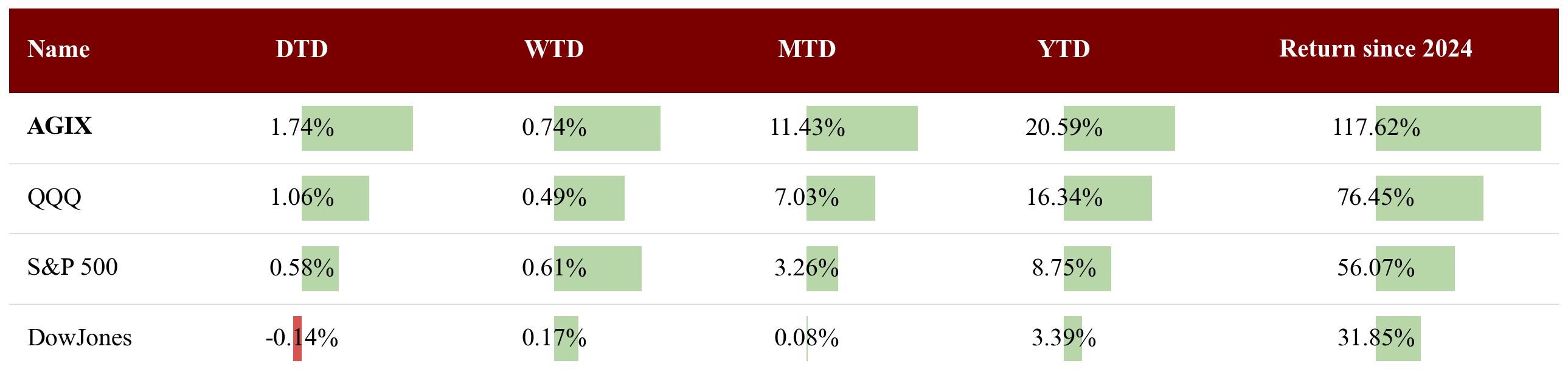
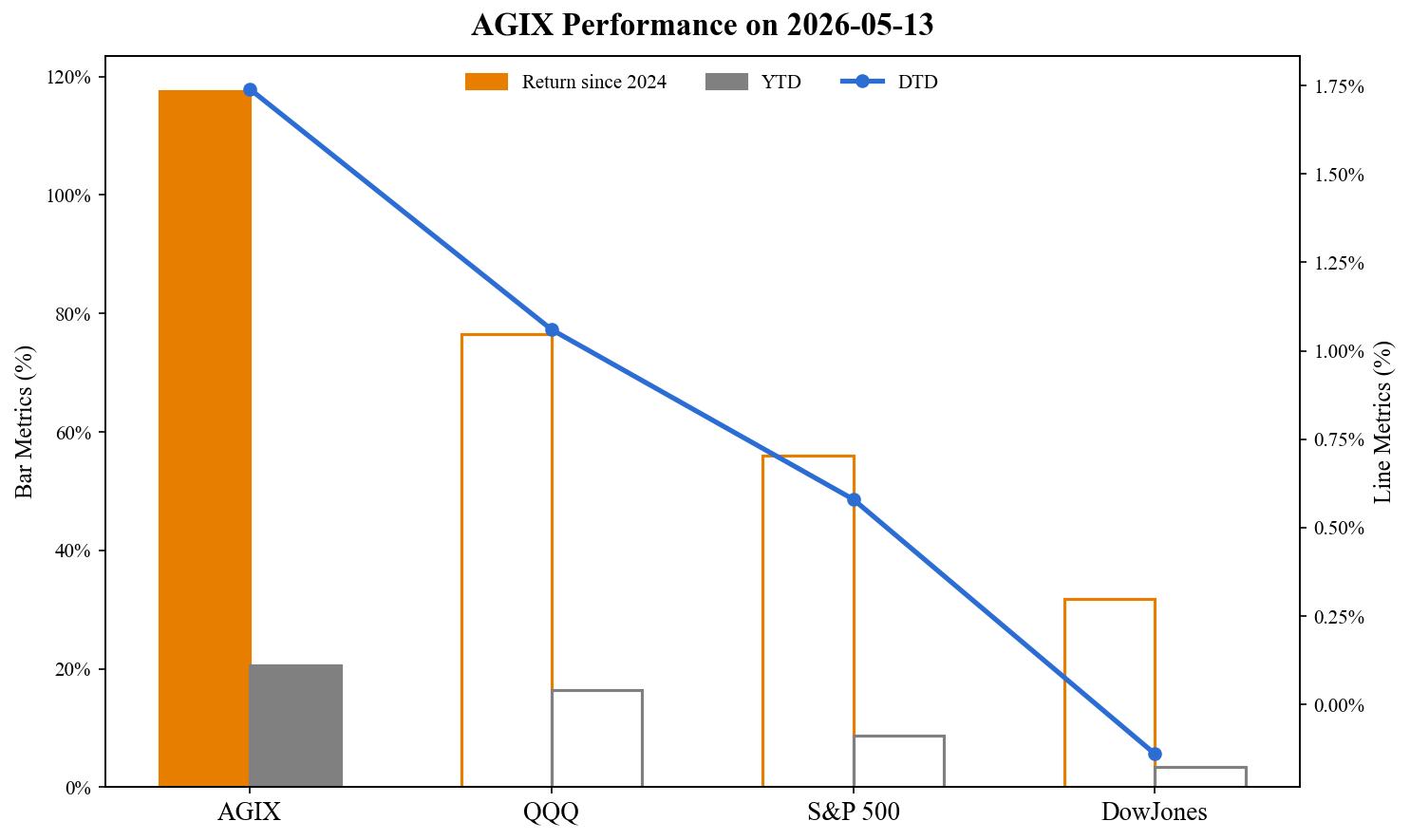
• AGIX outperformed all major benchmarks on the day, rising 1.74% DTD, versus QQQ (1.06%), S&P 500 (0.58%), and DowJones (-0.14%).
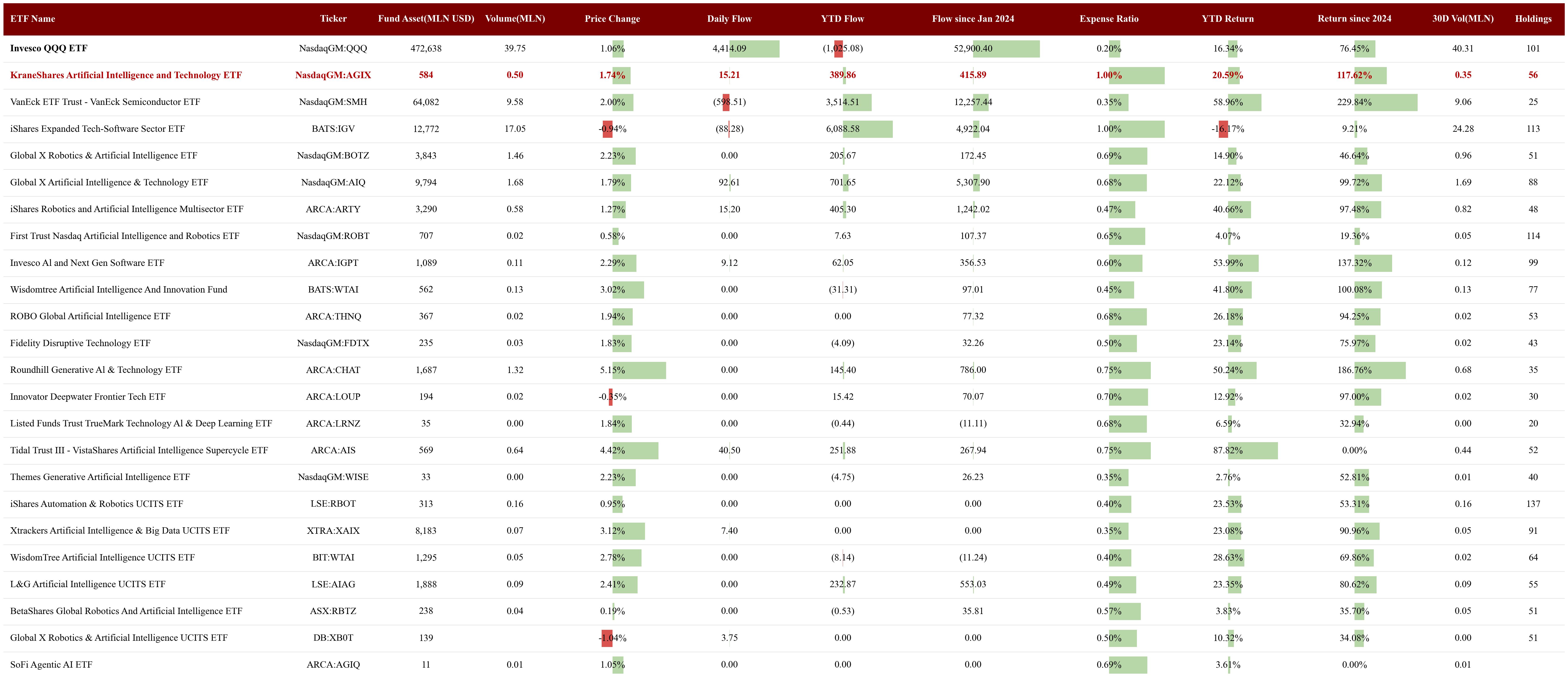
• Among peer AI/tech ETFs, CHAT (5.15%), AIS (4.42%), and WTAI (3.02%) led gains, reflecting broad AI and cybersecurity strength.
• Top AGIX holdings by DTD contribution: Tower Semiconductor (22.61%, $30.5B market cap) surged on a $1.3B silicon photonics contract and strong Q1 earnings; Nebius Group (15.72%, $53.1B) jumped after a blowout earnings report and a $27B AI-cloud deal with Meta. Astera Labs (9.62%, $38.4B) rose on continued AI connectivity demand. SK hynix (7.68%, $930B) and Arm Holdings (6.39%, $235B) also contributed positively.
• Key stocks to watch: Tower Semiconductor (TSEM) and Nebius Group (NBIS) are catalysts for AGIX's hardware and infrastructure exposure, while Astera Labs (ALAB) highlights the AI connectivity theme.
News Highlights
1. Anthropic now has more business customers than OpenAI (34.4% vs 32.3% per Ramp data), signaling a shift in enterprise AI preference; this could pressure OpenAI's valuation and benefit Anthropic's partners like Amazon.
2. Nebius Group (held by AGIX) acquired Clarifai's compute orchestration technology and talent to enhance AI inference, following a $643M Eigen AI acquisition; this strengthens its full-stack inference platform and revenue prospects.
3. CME Group and Silicon Data plan to launch AI compute futures, allowing investors to hedge GPU capacity prices; this financialization of AI infrastructure could stabilize pricing for cloud providers like Amazon, Google, and Microsoft.
4. Veeam introduced new backup and cybersecurity features, including post-quantum encryption and an AI-powered DataAI Command Platform; this expands its TAM in enterprise data protection, benefiting AGIX holdings like Veeam (not directly held) but signaling broader AI security demand.
5. Fervo Energy surged 33% in its IPO debut, driven by AI data center energy demand; this highlights the critical role of energy infrastructure for AI, indirectly supporting AGIX holdings in hardware and power management.
6. Google debuted Gemini Intelligence automation features and Googlebook laptops, deepening AI integration in mobile and laptop ecosystems; this could boost demand for AI chips and cloud services, benefiting AGIX holdings like Alphabet, Nvidia, and Microsoft.
RSS Highlights
1. A blog post argues that software engineers are not obsolete despite AI lowering barriers; true engineers who continuously improve skills remain key in software development.
2. An article discusses the feasibility of building AI data centers in space, noting that cooling is achievable via radiative heat transfer, though large-scale launches would be required.
3. A study from fortiss and TU Munich modeled the Python dependency graph, finding that 97 packages funded by ecoste.ms accounted for 25.9% of total improvement impact, highlighting the value of targeted open-source funding.
4. A new Firefox extension 'Open Link in Unloaded Tab' allows users to open links without loading them, saving system resources—a small productivity tool for developers.
5. A critique of Nextpad++, a Mac port of Notepad++, calls its interface unnatural and not meeting traditional Mac app standards, contrasting with the simplicity often sought in developer tools.
Performance & Benchmark
Attribution
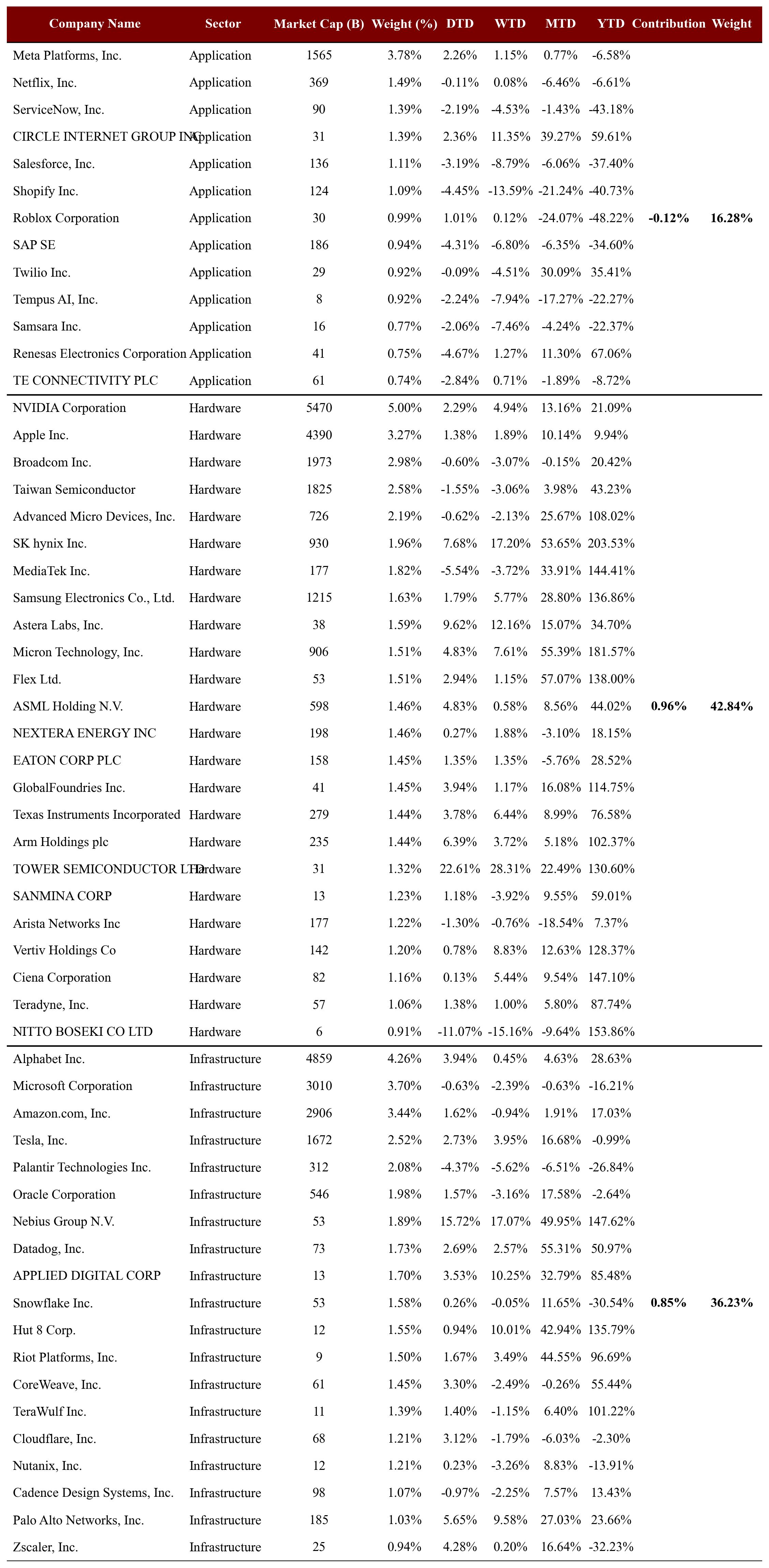
Contribution of the three sectors within AGIX holdings today
Application: -0.12%
Hardware: 0.96%
Infrastructure: 0.85%
Top-performing stocks in AGIX holdings today
TOWER SEMICONDUCTOR LTD (22.61%)
Nebius Group N.V. (15.72%)
Astera Labs, Inc. (9.62%)
SK hynix Inc. (7.68%)
Arm Holdings plc (6.39%)
Palo Alto Networks, Inc. (5.65%)
ASML Holding N.V. (4.83%)
Micron Technology, Inc. (4.83%)
Zscaler, Inc. (4.28%)
Alphabet Inc. (3.94%)
GlobalFoundries Inc. (3.94%)
Texas Instruments Incorporated (3.78%)
APPLIED DIGITAL CORP (3.53%)
CoreWeave, Inc. (3.3%)
Cloudflare, Inc. (3.12%)
Flex Ltd. (2.94%)
Tesla, Inc. (2.73%)
Datadog, Inc. (2.69%)
CIRCLE INTERNET GROUP INC (2.36%)
NVIDIA Corporation (2.29%)
Meta Platforms, Inc. (2.26%)
Worst-performing stocks in AGIX holdings today
Samsara Inc. (-2.06%)
ServiceNow, Inc. (-2.19%)
Tempus AI, Inc. (-2.24%)
TE CONNECTIVITY PLC (-2.84%)
Salesforce, Inc. (-3.19%)
SAP SE (-4.31%)
Palantir Technologies Inc. (-4.37%)
Shopify Inc. (-4.45%)
Renesas Electronics Corporation (-4.67%)
MediaTek Inc. (-5.54%)
NITTO BOSEKI CO LTD (-11.07%)
Top five listed stocks contributing the most within AGIX holdings today
TOWER SEMICONDUCTOR LTD (22.61%)
Nebius Group N.V. (15.72%)
Alphabet Inc. (3.94%)
Astera Labs, Inc. (9.62%)
SK hynix Inc. (7.68%)
Observation
The strongest movers across peer ETF holdings today are listed below:
| DTD | Stock Ticker | Name | Held by ETFs | analysis |
|---|---|---|---|---|
| 26.09 | NasdaqGS:OUST | Ouster, Inc. | ['LSE:RBOT'] | Ouster’s 26.1% gain on May 13, 2026 was primarily a continuation and amplification of the strong positive reaction to its Q1 2026 earnings and product update earlier in the week. First, the company reported record Q1 product revenue of $49M, 13 straight quarters of product revenue growth, 43% GAAP gross margin, and solid liquidity with $175M in cash and no debt, alongside Q2 revenue guidance of $49.5M–$52.5M, which had already driven the stock sharply higher post-earnings. Second, investors appear to be repricing the stock toward increasingly bullish Street targets and “Strong Buy” consensus forecasts (mid‑$30s to $40+), supported by optimism around the launch and early adoption of its Rev8 native color LiDAR and expectations for a strong second half of the year. |
| 22.61 | NasdaqGS:TSEM | TOWER SEMICONDUCTOR LTD | ['NasdaqGM:AGIX'] | Tower Semiconductor’s 22.61% jump on May 13 was primarily driven by its Q1 2026 earnings release and call, which appeared to deliver a strong beat versus expectations and a better-than-feared outlook. The move was also supported by a major same-day business update that the company secured about $1.3 billion of silicon photonics contracts for 2027, a clear positive signal for future revenue visibility. Together, the earnings upside and the large contract announcement likely outweighed broader market noise and powered the sharp rally. |
| 18.49 | NasdaqGM:AAOI | Applied Optoelectronics, Inc. | [] | Applied Optoelectronics’ 18.5% jump on May 13 was primarily driven by strong fundamental momentum tied to surging AI data center demand and better‑than‑expected recent results. First, the stock continued to re-rate after Q1 2026 revenue grew 51% YoY to a record $151.1M, with data center sales more than doubling, reinforcing the narrative of AAOI as a key optical supplier to AI infrastructure. Second, recent news of large 800G/1.6T transceiver orders, a Mediacom broadband deal, and a $20.9M Texas manufacturing grant kept sentiment highly positive, with investors chasing upside despite the shares already trading above average analyst targets. |
| 17.05 | NasdaqGS:KC | Kingsoft Cloud Holdings Limited | ['XTRA:XAIX'] | Kingsoft Cloud’s 17% gain on May 13, 2026 appears primarily driven by continued momentum after recently hitting a new 52-week high, reinforced by increasingly positive analyst sentiment. In mid-April, Goldman Sachs upgraded the stock to Buy and Jefferies raised its target to $19, contributing to a “Moderate Buy” consensus and an $18.48 average target, which likely supported further rerating and follow‑through buying. In the absence of new company-specific news that day, the move is best explained by this ongoing revaluation dynamic, improving institutional interest, and momentum trading in a high‑beta Chinese cloud name. |
| 16.34 | NasdaqGS:AUR | Aurora Innovation, Inc. | ['BATS:IGV'] | Aurora Innovation’s 16% move on May 13 was driven primarily by continued bullish reaction to its recent shift into fully driverless, commercial freight operations and scaling plans for its Driver-as-a-Service model. Investors are focusing on the McLane driverless freight launch in Texas, the Hirschbach MOU targeting 500 Aurora Driver-powered trucks from 2027, and the expanded Volvo autonomous corridor, which collectively strengthen the company’s commercialization narrative. A secondary support came from the lingering impact of better‑than‑expected Q1 2026 results and recent price target hikes from Morgan Stanley and TD Cowen, reinforcing confidence in Aurora’s 2H 2026 milestones. Momentum and technical factors, with the stock pushing new 52-week highs after a multi-week 50%+ run, likely amplified the upside move. |
| 15.72 | NasdaqGS:NBIS | Nebius Group N.V. | ['NasdaqGM:AGIX', 'BATS:WTAI', 'ARCA:THNQ', 'ARCA:CHAT', 'BIT:WTAI'] | Nebius Group’s 15.7% gain on May 13, 2026 was primarily driven by a blowout Q1 2026 earnings report and major strategic deals that dramatically reset profit and growth expectations. Before the open, the company posted a sharp upside earnings surprise (adjusted EPS of $2.11 vs. an expected loss) alongside 684% YoY revenue growth to $399M, plus announced a $27B AI-cloud deal with Meta Platforms and a $2B investment from NVIDIA, which together signaled strong demand and blue-chip validation for its AI cloud platform. A secondary driver was momentum/speculative buying in a high-beta “AI infrastructure” name, with trading volumes up ~147% vs. average and active retail chatter (including WallStreetBets), amplifying the fundamental news-driven move. |
| 14.79 | TSE:4483 | JMDC Inc. | ['NasdaqGM:WISE'] | JMDC’s sharp 14.79% jump on 2026-05-13 appears most likely driven by investors re-rating the stock after its FY2026 results highlighted continued revenue and EPS growth, despite a modest margin dip to 13.4% from 14.0%. The stock was also trading at a premium valuation versus peers, so the move likely reflected renewed confidence that growth is still intact and could support that multiple. There is no clearly identified same-day company announcement in the provided sources, so the move looks more like a post-earnings growth/valuation reaction than a fresh news catalyst. |
| 14.59 | NasdaqCM:QUIK | QuickLogic Corporation | [] | QuickLogic’s 14.6% move on May 13, 2026 appears primarily driven by follow-through buying and momentum after its recent Q1 2026 revenue beat and strong fundamental growth signal (revenue up 16.5% YoY, ahead of estimates). Despite the EPS miss reported with that print, investors seem to be refocusing on top-line traction in eFPGA/IP and AI-related offerings amid strength in semiconductor and AI-adjacent names, leading to outsized upside in a relatively thin, volatile small-cap stock. |
| 14.08 | NasdaqGS:MBLY | Mobileye Global Inc. | ['NasdaqGM:ROBT', 'LSE:RBOT', 'BIT:WTAI'] | Mobileye’s 14.08% jump on May 13 was most likely driven by the market reacting to a fresh positive catalyst around its autonomous-driving and ADAS pipeline, which has been a key re-rating theme for the stock. The strongest public driver in recent coverage is the company’s expanding EyeQ6 and robotaxi-related momentum, including multiple program wins and commercialization progress that supported investor optimism. A secondary tailwind was technical momentum in a name trading near depressed levels, which can amplify gains when sentiment turns positive. |
| 14.01 | XTRA:JEN | Jenoptik AG | ['LSE:RBOT'] | Jenoptik’s 14.01% jump on May 13 was most likely driven by a strong post-results rerating, as the move came alongside a broad repricing in the stock rather than a company-specific negative event. The most relevant supporting evidence is that the shares had already been moving sharply higher in early May and were trading well above key moving averages, suggesting momentum and investor optimism around the company’s photonics and semiconductor-related exposure. No same-day company disclosure or major regulatory headline was evident in the public results surfaced here, so trading/style factors likely amplified the move. |
| 12.39 | NasdaqGS:HSAI | Hesai Group | ['NasdaqGM:BOTZ', 'ASX:RBTZ', 'DB:XB0T'] | Hesai Group’s 12.39% rise on May 13 was most likely driven primarily by the market digesting its recent corporate disclosure that set the 2026 AGM for June 26 and established the May 22 record date, which can support trading activity around governance and voting rights. A second driver was broader momentum in the name, with HSAI already showing elevated options-implied activity and short-term volatility around the low-$21 area, amplifying the move once buyers stepped in. No major same-day company-specific negative news appears in the provided public sources to explain a sharp decline, so the move looks more like event-driven buying plus momentum than a fundamental shock. |
| 11.14 | NasdaqGS:ON | ON Semiconductor Corporation | ['NasdaqGM:QQQ', 'NasdaqGM:SMH'] | ON Semiconductor’s 11.1% gain on May 13, 2026 appears primarily driven by continued bullish sentiment following a recent wave of analyst upgrades and price-target hikes, amplified by strong momentum in semiconductor and AI‑related names. First, multiple major research desks (including BofA, Loop Capital, and TD Cowen in April) recently upgraded ON or raised targets into the mid‑$80s and above, reinforcing a constructive view on its earnings power, free cash flow, and leverage to power/EV and AI infrastructure. Second, the stock has been in a pronounced upside trend since late March with traders actively chasing breakout setups, and it is benefiting from broader strength in semiconductor indices as investors seek higher‑beta exposure to the AI and power‑semis cycle. |
| 10.7 | XTRA:IFX | Infineon Technologies AG | ['NasdaqGM:AIQ', 'ARCA:THNQ', 'LSE:AIAG'] | Infineon’s 10.7% rise on May 13, 2026 appears most likely driven by a strong semiconductor-sector rerating rather than a company-specific disclosure, as no clearly relevant same-day Infineon announcement is evident in the provided public results. The move was likely reinforced by momentum and short-covering after a sharp gap higher in a high-beta European chip name. A secondary support factor was the market’s continued focus on improving demand expectations for autos and industrial semis, which can amplify moves in Infineon. |
| 10.0 | SHSE:601138 | Foxconn Industrial Internet Co., Ltd. | ['ARCA:IGPT', 'ARCA:AIS'] | Foxconn Industrial Internet’s 10% move on May 13, 2026 appears primarily driven by ongoing momentum and speculation around its role in AI/server hardware and industrial automation, rather than by any specific new company disclosure that day. First, the stock has shown sustained outperformance in recent weeks and months with strong “buy” technical signals and heavy retail interest, indicating a momentum-driven extension move. Second, its positioning in communications, cloud service equipment, and industrial robots ties it to the broader AI and high-end manufacturing themes that have remained in focus in China’s A‑share market, likely amplifying buying interest in the absence of stock-specific news. |
| 9.97 | NasdaqGM:NVTS | Navitas Semiconductor Corporation | ['ARCA:AIS'] | Navitas Semiconductor’s ~10% gain on May 13 was driven primarily by ongoing momentum around its AI and high‑power GaN/SiC power-chip narrative, reinforced by recent board-level strengthening. Traders have been reacting to the appointment of former Broadcom SVP Gregory M. Fischer as an independent director, which supports the company’s pivot toward AI data centers and EV infrastructure and has underpinned a multi-week, news-driven re-rating. A secondary driver is speculative trading and short-term momentum: the stock has more than doubled since early April with repeated 15–20% up days, attracting breakout and momentum traders despite stretched valuation and bearish quantitative price forecasts. |
| 9.91 | KOSE:A005380 | Hyundai Motor Company | ['NasdaqGM:ROBT', 'BATS:WTAI'] | Hyundai Motor’s 9.91% jump on May 13 was most likely driven by the market’s reaction to its shareholder-return program, with fresh buyback execution data reinforcing expectations of stronger capital returns and support for the stock. A second factor was likely broader optimism around Hyundai’s earnings and valuation, as investors continued to re-rate the company on solid auto demand and improved return-of-capital visibility. No major same-day company disclosure in the provided results appears to explain the move more directly than the buyback-related sentiment. |
| 9.79 | ENXTPA:STMPA | STMicroelectronics N.V. | ['NasdaqGM:SMH', 'BIT:WTAI'] | STMicroelectronics’ 9.8% gain on May 13, 2026, appears driven primarily by momentum following recent fundamental and sentiment upgrades rather than a discrete new company-specific announcement that day. First, the stock was already in a strong uptrend and had just set a 52-week high the prior week, supported by positive news on its expanded space semiconductor revenue target and product launches, which lifted longer-term growth expectations. Second, Zacks’ recent upgrade of STM to a Buy on rising earnings estimates, along with a broadly positive analyst stance, likely reinforced buy-side conviction and catalyzed incremental demand in a technically bullish setup, amplifying the move. |
| 9.76 | TSE:6479 | MINEBEA MITSUMI Inc. | ['ARCA:IGPT'] | MINEBEA MITSUMI’s 9.76% rise on 2026-05-13 was most likely driven by the market continuing to price in the positive impact of its newly announced acquisition of Panasonic Industry’s automotive motor and cooling fan motor business, which expands its automotive and electrification exposure. A second support was the strong post-results tone from the prior earnings release, where FY2026 sales and operating income reached record highs and management highlighted growth in AI servers, humanoid robots, drones, autonomous driving, and aircraft. The move also fits a broader re-rating after the stock had been trading below recent highs, so investors may have been adding to a momentum trend already in place. |
| 9.73 | NasdaqCM:RR | Richtech Robotics Inc. | ['NasdaqGM:BOTZ', 'ASX:RBTZ', 'DB:XB0T'] | Richtech Robotics’ ~9.7% gain on May 13 was driven primarily by bullish AI/automation headlines highlighting new partnerships and product visibility, which reinforced the “story stock” momentum in a thinly fundamental, high-PS multiple name. First, traders reacted to news that RR is integrating SoundHound’s agentic voice AI into its service robots and listing its offerings on Microsoft’s Azure Marketplace, strengthening the AI and cloud distribution narrative. Second, upcoming demos of its ADAM noodle-making and Matradee Plus delivery robots at the 2026 National Restaurant Association Show added a tangible restaurant-automation angle, drawing in momentum and day traders who have been pushing the stock higher in recent weeks. |
| 9.62 | NasdaqGS:ALAB | Astera Labs, Inc. | ['NasdaqGM:AGIX', 'NasdaqGM:ROBT', 'ARCA:IGPT', 'BATS:WTAI', 'ARCA:THNQ', 'ARCA:CHAT', 'ARCA:LOUP', 'ARCA:AIS', 'BIT:WTAI'] | Astera Labs rose 9.62% on May 13, likely driven first by continued positive investor reaction to its strong Q1 beat-and-raise setup and bullish analyst commentary earlier in the month, which reinforced confidence in AI infrastructure demand. The move also appears supported by the stock’s high beta and momentum after recent strength, with shares trading on elevated volume and pushing toward analyst target levels. A secondary factor was broader enthusiasm around AI infrastructure and connectivity names, which kept ALAB in favor among growth investors. |
| 9.59 | NasdaqGS:SYNA | Synaptics Incorporated | ['XTRA:XAIX'] | Synaptics’ 9.6% gain and new 52-week high on May 13, 2026 appears driven primarily by technical and sentiment factors rather than specific new fundamental news. First, the stock broke out to a fresh 52-week high (~$133 intraday), which often triggers momentum buying, short covering, and systematic inflows from trend-following strategies. Second, multiple third-party trading/forecast services were flagging SYNA with “buy” or positive technical signals (short- and long-term moving average crossovers, strong short-term trend), likely reinforcing bullish sentiment and attracting incremental retail and trading-oriented demand. |
| 9.54 | TSE:285A | Kioxia Holdings Corporation | ['ARCA:IGPT'] | Kioxia’s 9.54% rise on May 13 was most likely driven by continued investor enthusiasm around the memory/NAND cycle and the company’s strong earnings momentum, rather than any single company-specific disclosure in the provided sources. Google Finance also highlighted a market narrative that Kioxia shares have surged sharply over the past year alongside improving operating profit expectations, which likely reinforced the move. A secondary contributor was likely momentum trading in a highly volatile stock after its large recent gains. |
| 9.38 | NasdaqGS:PENG | Penguin Solutions, Inc. | ['ARCA:AIS'] | Penguin Solutions’ 9.38% rise on May 13 appears mainly driven by continued investor enthusiasm around its raised FY26 outlook and AI-infrastructure positioning from the April 1 earnings update, which has kept the stock in a multi-week re-rating. A second likely driver is momentum and short-covering in the name after the stock’s recent breakout, with traders still responding to the company’s OriginAI/inference-platform narrative and related partnerships. There was no clearly identifiable same-day company-specific catalyst in the public results, so the move looks more like follow-through buying than a fresh news event. |
| 9.01 | NasdaqGM:MVIS | MicroVision, Inc. | ['LSE:RBOT'] | MicroVision’s 9.0% gain on May 13, 2026 was primarily driven by earnings-related positioning into its Q1 2026 report and call scheduled after the close that day. Options markets, as noted by The Fly, were implying an ~11% post-earnings move, which likely encouraged speculative buying and short-term positioning during regular trading hours. In addition, headline Q1 metrics released after the close (narrowed net loss year over year, despite weaker adjusted EBITDA) appear to have been anticipated by investors, supporting a more constructive sentiment ahead of the event. |
| 8.18 | NasdaqGS:MRVL | Marvell Technology, Inc. | ['NasdaqGM:QQQ', 'NasdaqGM:SMH', 'NasdaqGM:AIQ', 'ARCA:ARTY', 'BATS:WTAI', 'NasdaqGM:FDTX', 'ARCA:CHAT', 'ARCA:AIS', 'BIT:WTAI'] | Marvell Technology’s 8.2% gain on May 13, 2026 was primarily driven by AI-related enthusiasm reinforced by fresh analyst target hikes and a disclosed strategic stake from AMD. First, multiple large brokers, including BofA Securities, raised price targets sharply (e.g., BofA to $200 from $125) on a bigger AI networking TAM and Marvell’s expected strength in next‑gen optical transceivers, prompting investors to re-rate the stock. Second, AMD’s recently revealed stake in Marvell via 13F filings signaled peer validation of Marvell’s AI infrastructure positioning, adding incremental demand for the shares and helping the stock outperform a broadly positive semiconductor/AI complex. |
| 8.18 | NYSE:BABA | Alibaba Group Holding Limited | ['NasdaqGM:AIQ', 'NasdaqGM:ROBT', 'BATS:WTAI', 'ARCA:THNQ', 'ARCA:CHAT', 'BIT:WTAI', 'LSE:AIAG'] | Alibaba’s 8.2% gain on May 13 was primarily driven by its earnings event clearing a high-uncertainty hurdle, with the move roughly in line with options-implied volatility. Options markets were pricing in an expected move of about ±6.5% into the May 13 print, and realized upside slightly exceeded that band, suggesting results and/or guidance were modestly better than feared and triggered short covering and incremental buying. A secondary driver was positioning/ sentiment: ahead of the release, investors and sell-side commentary highlighted Alibaba as a key China AI beneficiary with a supportive “Moderate Buy” consensus and upside to target prices, which likely amplified the post-earnings relief rally. |
| 8.17 | NYSE:ZEPP | Zepp Health Corporation | ['NasdaqGM:WISE'] | Zepp Health’s 8.2% gain on May 13, 2026 appears primarily driven by technical and trading dynamics rather than fresh fundamental news. The stock is trading within a very wide, strong short-term uptrend with high volatility, and technical services such as StockInvest.us highlight a generally positive setup (long-term moving-average buy signal and bullish MACD), which can attract momentum and short-term traders. In a low-news environment for the company and sector that day, the move is best explained by trend-following flows and speculative activity in a historically high-beta, high-risk name. |
| 7.94 | NYSE:COHR | Coherent Corp. | ['NasdaqGM:FDTX', 'ARCA:LOUP'] | Coherent’s 7.94% rise on May 13 was mainly driven by Bank of America raising its price target to $400 from $365, citing a larger AI data-center buildout opportunity and renewed upside in AI optical infrastructure. The move was reinforced by the market’s positive read-through to the broader AI networking theme, which lifted several related names the same day. There was no company-specific disclosure in the search results that better explains the session, so the analyst upgrade was the primary catalyst. |
| 7.74 | NasdaqGS:AKAM | Akamai Technologies, Inc. | ['NasdaqGM:ROBT', 'BIT:WTAI'] | Akamai’s 7.7% gain on May 13, 2026, appears primarily to be a continuation and follow‑through of the sharp re‑rating that began after its May 8 disclosure of a roughly $1.8 billion, seven‑year cloud infrastructure deal with a leading frontier model provider. That contract meaningfully upgraded the company’s long‑term AI and cloud growth narrative and sparked multiple target hikes and upgrades from brokers, with momentum and technical factors (the stock trading above most published price targets and showing overbought readings like RSI >70) likely amplifying the move as investors and momentum traders added exposure post‑catalyst. |
| 7.68 | KOSE:A000660 | SK hynix Inc. | ['NasdaqGM:AGIX', 'NasdaqGM:AIQ', 'ARCA:ARTY', 'NasdaqGM:ROBT', 'ARCA:IGPT', 'BATS:WTAI', 'ARCA:CHAT', 'ARCA:LOUP', 'ARCA:AIS', 'XTRA:XAIX', 'BIT:WTAI'] | SK hynix’s 7.68% rise on May 13 was primarily driven by continued strength in global AI-chip sentiment, with the stock tracking a broader rally in semiconductor names after U.S. chip peers such as Micron, Nvidia, and Intel advanced on Wall Street. A second driver was local market optimism that the AI-driven memory upcycle, especially for HBM, is still gaining momentum, which kept buying interest strong in Korean chip leaders. Broader risk appetite also held up despite geopolitical noise, helping the rally extend into the close. |
| 7.55 | NasdaqGS:BIDU | Baidu, Inc. | ['NasdaqGM:AIQ', 'NasdaqGM:ROBT', 'ARCA:IGPT', 'ARCA:CHAT'] | Baidu’s 7.6% gain on May 13, 2026 was primarily driven by renewed investor focus on its valuation and sum-of-the-parts upside tied to AI and chip/IPO optionality, as highlighted in same-day analysis noting the stock “ripping” higher and reopening the valuation debate. This built on recently announced shareholder-return catalysts, including Baidu’s first-ever dividend policy and a $5 billion buyback program extending through 2028, which have improved sentiment after a prior multi-session pullback. |
| 7.55 | NasdaqGS:BIDU | Baidu Inc. | ['NasdaqGM:AIQ', 'NasdaqGM:ROBT', 'ARCA:IGPT', 'ARCA:CHAT'] | Baidu’s 7.6% gain on May 13 was primarily driven by shareholder-friendly capital return announcements that prompted a re-rating of the stock. First, the company unveiled a new share repurchase program of up to $5 billion through 2028, signaling confidence in its cash generation and balance sheet. Second, Baidu announced it intends to pay its first-ever dividend in 2026 under a newly approved dividend policy, reinforcing expectations of more disciplined capital allocation and improving its appeal to income- and value-oriented investors. |
| 7.53 | HLSE:NOKIA | Nokia Oyj | ['ARCA:AIS', 'XTRA:XAIX'] | Nokia Oyj’s 7.5% gain on May 13, 2026 appears driven primarily by continued follow‑through buying on a wave of recent analyst upgrades and price target hikes tied to AI and 5G growth. In the weeks leading up to the move, Tier‑1 brokers including JPMorgan, Morgan Stanley, Argus and others raised targets and turned more bullish after Nokia’s Q1 print and higher 2026 growth guidance for Network Infrastructure, reframing the stock as an AI‑infrastructure beneficiary rather than a low‑growth telecom hardware name. A secondary driver is strong momentum and sentiment: the share price has more than doubled over 12 months, and the stock has been trading like a momentum leader, with traders extrapolating the trend despite some valuation work (e.g., Simply Wall St DCF) flagging the shares as overvalued. |
| 7.52 | SHSE:688008 | Montage Technology Co., Ltd. | ['ARCA:AIS'] | Montage Technology’s 7.5% gain on May 13, 2026 was primarily driven by sector-wide strength in memory and storage semiconductors, as investors extended recent momentum tied to rising memory chip prices. In Hong Kong trading, Montage’s H-share and peers in the storage space were reported up sharply on optimism that the upcycle in memory pricing would continue, and this positive sentiment appears to have flowed through to the A-share. A secondary driver is ongoing multiple expansion for high-growth Chinese chip designers, with Montage already trading at a rich premium to estimated fair value, so incremental sector news can produce outsized price reactions. |
| 7.44 | NasdaqGS:CRNC | Cerence Inc. | ['NasdaqGM:BOTZ', 'NasdaqGM:WISE', 'ASX:RBTZ', 'DB:XB0T'] | Cerence’s 7.44% gain on May 13, 2026 appears primarily driven by continued positive follow-through from its May 7 fiscal Q2 earnings beat and raised full-year guidance, as investors digested stronger-than-expected revenue, adjusted EBITDA and free cash flow, plus higher FY26 targets. The stock had already reacted positively to the print, and the subsequent sessions likely saw additional buyers and short-covering as the market reassessed the company’s cash generation and improved outlook despite acknowledged near-term revenue mix volatility and cost pressures. |
| 7.24 | NasdaqGS:JD | JD.com, Inc. | ['NasdaqGM:ROBT', 'ARCA:THNQ', 'LSE:AIAG'] | JD.com’s 7.2% gain on May 13, 2026 was driven primarily by strong Q1 2026 earnings that beat market expectations and reinforced confidence in its growth trajectory, extending a multi-day post-earnings rally. Supporting this, multiple research outlets highlighted the upbeat results and margin resilience versus prior concerns, while Morgan Stanley’s same-day price target increase (from $25 to $27) and broad bullish analyst sentiment helped validate the recovery narrative. A surge in bullish options activity and technically positive signals (shares breaking above short-term averages with overbought momentum readings) likely amplified the move as traders chased upside. |
| 6.9 | NasdaqGM:GDS | GDS Holdings Limited | ['ARCA:IGPT'] | GDS’s ~6.9% gain on May 13, 2026 appears driven primarily by increasingly bullish analyst sentiment and earnings revisions rather than any discrete company-specific news release that day. First, the stock is benefiting from a strong fundamental narrative: over the last 90 days the Zacks consensus for full-year earnings has been raised sharply (up ~446%) and the name carries a Zacks Rank 1 (Strong Buy), reinforcing the positive view already reflected in 11 Wall Street “Buy”-skewed ratings and a consensus target implying further upside. Second, technical and sentiment indicators are supportive, with external models (e.g., CoinCodex) flagging a bullish setup and projecting near-term price gains, which likely amplified momentum buying in the absence of negative catalysts. |
| 6.39 | NasdaqGS:ARM | Arm Holdings plc | ['NasdaqGM:QQQ', 'NasdaqGM:AGIX', 'ARCA:IGPT', 'ARCA:CHAT', 'ARCA:LRNZ', 'ARCA:AIS'] | Arm rose on May 13, 2026 mainly on continued enthusiasm for AI/CPU exposure, as investors rotated into chip names and Arm’s recent AGI/Neoverse-related product positioning kept sentiment strong. The move also looked supported by broader semiconductor strength and positive analyst/investor attention, which helped extend momentum after recent earnings-driven volatility. No major company-specific negative news appears to have offset that bid on the day. |
| 6.18 | NasdaqGS:DGII | Digi International Inc. | [] | Digi International’s 6.2% gain appears primarily driven by continued momentum and follow‑through buying after the stock recently set new all‑time and 52‑week highs following an earnings beat and raised Q2 2026 EPS guidance. The strong Q1 2026 results (EPS and revenue ahead of expectations, ~18% YoY growth) and management’s upbeat guidance have reinforced a growth narrative that investors are still pricing in, despite a rich P/E multiple. A secondary tailwind is optimism around the company’s new products (such as the Digi IX25 industrial 5G-capable router and AI-integration features), which support perceptions of a robust longer-term growth runway and can justify multiple expansion. |
| 6.16 | NYSE:HPE | Hewlett Packard Enterprise Company | ['NasdaqGM:AIQ', 'ARCA:IGPT', 'ARCA:CHAT', 'ARCA:AIS', 'XTRA:XAIX'] | Hewlett Packard Enterprise’s ~6% gain on May 13, 2026 appears primarily driven by renewed activist interest and related breakup/restructuring hopes, amplified by bullish technical momentum near 52-week highs. First, Benzinga reported that Irenic Capital joined Elliott Management in an activist push following HPE’s $14 billion Juniper Networks acquisition, reinforcing investor expectations for portfolio optimization, cost actions, or capital returns. Second, the stock was already in a strong uptrend with a bullish moving-average setup and trading just below prior highs, so the activist headlines likely triggered incremental buying from momentum and technical traders, magnifying the single-day move. |
| 6.05 | NasdaqGS:HTFL | HeartFlow, Inc. | ['ARCA:LRNZ'] | HeartFlow’s 6.1% gain on May 13 was most likely driven by anticipation ahead of its Q1 2026 earnings release scheduled for after the close on May 14, which focused investor attention on the name and raised positioning into the print. The move came without any new company-specific news that day, but followed the April 23 earnings-date announcement and occurred on above-average volume, suggesting pre-earnings accumulation and sentiment rather than a discrete fundamental catalyst. |
| 5.97 | TSE:3993 | PKSHA Technology Inc. | ['NasdaqGM:BOTZ', 'NasdaqGM:ROBT', 'NasdaqGM:WISE', 'ASX:RBTZ', 'DB:XB0T'] | PKSHA Technology’s 5.97% gain on May 13, 2026 appears primarily driven by continued positive sentiment around its capital return program, as investors digested the recently reported progress of its share repurchases through April 2026, which supports EPS and signals management confidence. In the absence of fresh company-specific news that day, the move was likely amplified by technical factors, with the stock rebounding from levels near short-term support after a volatile few months, against a backdrop where fundamentals (solid balance sheet and high forecast growth) remain viewed favorably despite compressed margins. |
| 5.88 | NasdaqGS:CIFR | Cipher Mining Inc. | ['BATS:IGV'] | Cipher Mining’s 5.9% gain on May 13, 2026 appears primarily driven by continued momentum around its strategic repositioning as “Cipher Digital” and investor enthusiasm for its large AI-focused data center lease pipeline, following earlier disclosures that helped reframe the stock from a pure Bitcoin miner to a broader digital infrastructure play. The move was likely reinforced by ongoing speculation around the monetization of its $11.4B AI lease pipeline and high-beta positioning, with options data showing elevated implied volatility and active short-dated contracts that can amplify directional moves in the absence of fresh company-specific news that day. |
| 5.81 | SZSE:000977 | Inspur Electronic Information Industry Co., Ltd. | ['ARCA:AIS'] | Inspur Electronic Information’s 5.81% gain on May 13, 2026 appears to be a sentiment- and positioning-driven move rather than a reaction to a specific new company disclosure. There were no notable same-day announcements, earnings releases, or regulatory headlines tied directly to the stock, suggesting investors were likely extending a recent rebound in Chinese AI/IT infrastructure names and re-rating Inspur’s growth profile given its strong revenue and earnings trends. The stock’s relatively high but compressing forward P/E and solid recent fundamental performance (strong double‑digit revenue growth and mid‑single‑digit EPS growth) likely supported incremental buying interest and short‑term momentum. |
| 5.8 | NasdaqGS:SMTC | Semtech Corporation | [] | Semtech’s approximately 5.8% gain on May 13, 2026 appears driven primarily by continued momentum and follow-through buying after the stock hit fresh 52‑week highs earlier in the week on the back of a recent earnings beat and upbeat sentiment. First, investors are still reacting to the company’s modest beat on EPS and revenue and ~9% year-over-year sales growth, with a strongly positive analyst backdrop (predominantly Buy ratings despite the stock trading well above the consensus target). Second, incremental institutional interest reported this week, including new positions and increased stakes by several funds, likely reinforced the bullish narrative and helped extend the rally. |
| 5.72 | NasdaqGS:VICR | Vicor Corporation | ['ARCA:AIS'] | Vicor’s 5.7% gain on May 13 appears primarily driven by ongoing momentum and bullish AI/data-center positioning following its stronger-than-expected Q1 results and record AI-related bookings, which have kept the stock in focus as a high-beta beneficiary of the AI power theme. This positive positioning outweighed a series of newly highlighted insider Form 4 sales (including director Andrew D’Amico’s May 12 sale under a 10b5-1 plan and other VP/CAO sales disclosed in early May), which had contributed to the prior-day pullback but were framed by market commentary as profit-taking rather than a new fundamental negative. Elevated options activity and media/analyst attention around VICR as a momentum name likely added incremental buying interest and short-covering, supporting the rebound. |
| 5.67 | NasdaqGS:GEN | Gen Digital Inc. | ['BATS:IGV'] | Gen Digital’s 5.7% gain on May 13, 2026 appears primarily driven by ongoing positive follow-through from its May 7 earnings report, which showed fiscal 2026 results above guidance, double‑digit growth in key product areas, and raised FY27 revenue and EPS guidance. Investors are likely continuing to re-rate the stock as they digest the company’s stronger growth profile and robust free cash flow commentary from that release. A secondary driver is technical and sentiment-related: GEN had sold off earlier in the year, and the stock’s move on above-average volume as it rebounded from recent lows suggests short covering and momentum buying as investors re-entered the name following the upbeat outlook. |
| 5.65 | NasdaqGS:PANW | Palo Alto Networks, Inc. | ['NasdaqGM:QQQ', 'NasdaqGM:AGIX', 'BATS:IGV', 'ARCA:ARTY', 'NasdaqGM:ROBT', 'BATS:WTAI', 'ARCA:THNQ', 'NasdaqGM:FDTX', 'ARCA:AIS', 'XTRA:XAIX', 'BIT:WTAI', 'LSE:AIAG'] | Palo Alto Networks’ 5.65% gain on May 13, 2026 appears driven primarily by continued follow-through from a cluster of positive catalysts earlier in the week—most notably the rare double upgrade from Arete Research (Sell to Buy with a $185 target) and Wells Fargo’s new Overweight initiation with a $200 target—combined with solid recent Q2 results that beat EPS and revenue expectations. These calls reinforced the bullish narrative that the market has overestimated structural growth headwinds, especially as AI expands the cybersecurity threat surface, and came alongside fresh partnership announcements (Siemens and multiple MWC alliances) that support the company’s platform and AI-driven growth story. |
| 5.61 | TSE:6324 | Harmonic Drive Systems Inc. | ['ARCA:IGPT', 'LSE:RBOT'] | Harmonic Drive Systems’ 5.6% rise on May 13 was primarily driven by company-specific news around its strategic plan, as the firm announced a revision of its existing FY2024–FY2026 medium-term management plan and the formulation of a new plan, following a previously flagged board meeting on that date. Investors likely interpreted the refreshed plan as signalling stronger long-term growth prospects, reinforcing recent momentum in a stock that has already sharply rerated and is heavily geared to robotics and automation themes. |
| 5.31 | NasdaqGS:CORZ | Core Scientific, Inc. | ['BATS:IGV'] | Core Scientific’s 5.3% gain on May 13, 2026 appears primarily driven by continued bullish sentiment and momentum in the stock following a strong multi-week uptrend, rather than a specific new company disclosure. First, technical factors are supportive: the shares remain well above key moving averages with multiple indicators (MACD, CCI, broader technical screens) flashing “buy” or bullish, which likely attracted momentum and quantitative traders. Second, sector and beta dynamics are influential, as CORZ trades with high volatility and strong correlation to crypto/mining sentiment, so risk-on flows into the space and speculative interest around short‑term price targets and forecasts (e.g., CoinCodex’s bullish outlook despite near-term pullback projections) likely amplified the move. |
| 5.25 | TSE:268A | Rigaku Holdings Corporation | ['LSE:RBOT'] | Rigaku Holdings’ 5.25% gain on May 13, 2026 was primarily driven by its FY2026 Q1 earnings release, which hit the market that day. While the BigGo/TDnet summary indicates revenue fell 13% year-on-year to ¥17.9bn, the print appears better than the market’s already depressed expectations after a volatile prior year, prompting a relief rally and short covering in a thinly traded, high‑beta name. A secondary driver is improving sentiment from prior disclosures of dividend payments and consensus forecasts for mid‑teens earnings growth, which support a recovery narrative despite weak near‑term trends. |
| 5.18 | NasdaqGS:MTSI | MACOM Technology Solutions Holdings, Inc. | [] | MACOM Technology Solutions’ 5.2% gain on May 13, 2026 was primarily a continuation of the positive re‑rating that followed its strong Q2 FY26 earnings report on May 7. The company’s results and commentary prompted a sharp move higher in the stock on the print, and the subsequent price action has been supported by momentum buying and a bullish broader semiconductor/AI hardware tape rather than any new company‑specific disclosures on May 13. |
| 5.05 | TSE:6758 | Sony Group Corporation | ['NasdaqGM:ROBT'] | Sony Group’s 5.05% rise on May 13, 2026 was driven primarily by investor enthusiasm around its new blockchain initiative, specifically the launch of the “Minato” testnet for its Ethereum Layer-2 solution Soneium, which TradingView-linked commentary cited as sparking a >3% gain as the news was digested. A secondary support came from ongoing positive sentiment toward Sony’s capital allocation and growth profile (including prior announcements of large share buybacks and strong 1-year stock performance), which likely amplified the reaction to the blockchain-related catalyst. |
News
Funding & M&A
Sam Altman testifies in a landmark OpenAI trial, stating that Musk wanted control of the company.
OpenAI co-founder and CEO Sam Altman faced questioning in court in a case filed by Elon Musk, who accuses Altman and OpenAI president Greg Brockman of deviating from the company's original mission by transforming a non-profit into a for-profit entity. Musk seeks to remove Altman as CEO and demands up to $180 billion in damages to be transferred from the for-profit division to the non-profit. OpenAI counters that Musk is seeking revenge because his company xAI has become a competitor. Altman testified, denying that Musk ever opposed the shift to a for-profit model, and revealed that Musk had demanded a 90% equity stake, later adjusted to a majority stake, citing only his fame. Altman stated that Musk ranked engineers in a way that damaged company culture, and said Musk resigned in 2018 after losing confidence that OpenAI could compete with Google DeepMind. During cross-examination, Altman denied that the company had a 'toxic culture of lying', insisted he was honest and reliable, and explained that his brief removal by the board in 2023 was due to a breakdown of trust rather than deception. Additionally, Musk's lawyers questioned Altman about his one-third stake in Helion Energy (valued at about $1.6 billion, used to power OpenAI data centers) and his investment in Reddit, asking whether these posed conflicts of interest, a matter currently under investigation by the House Oversight Committee. This case may determine OpenAI's future direction and is closely watched by the industry.
Celonis acquires decision-intelligence startup Ikigai Labs to provide operational context for enterprise AI.
Process mining software company Celonis SE announced the acquisition of MIT-affiliated decision intelligence startup Ikigai Labs Inc., aiming to use its technology to strengthen Celonis' self-developed 'Context Model'. This model is designed as a real-time digital twin of customer business operations, capable of eliminating 'blind spots' in AI agent deployment by integrating data from all enterprise applications, systems, devices, and interactions, providing a dynamic operational view that allows AI to accurately understand business processes. Celonis Chief Product Officer Dan Brown emphasized that without a 'deterministic foundation' of operational reality, AI agents cannot make reliable decisions. Ikigai, led by MIT AI professor Devavrat Shah, specializes in large graphical model technology for structured data and will fill a key piece of Celonis' enterprise AI stack. Celonis President Carsten Thoma stated that this move creates a 'holistic business graph' empowering AI operations. The new platform supports zero-copy integration with AWS, Databricks, Microsoft Fabric, and Oracle databases, and is compatible with agent platforms such as Amazon Bedrock, Anthropic Claude, IBM Watsonx, and Microsoft Copilot. Healthcare provider Cardinal Health, an early adopter, praised the improved precision of operational insights. Competitors include SAP Signavio, IBM Process Mining, and UiPath, with Foundation Capital investors believing this acquisition gives Celonis a significant advantage.
Nebius acquires Clarifai's compute orchestration technology and talent to enhance AI inference.
Dutch AI infrastructure giant Nebius Group N.V. announced the recruitment of a core engineering team from AI orchestration software company Clarifai Inc. to strengthen its managed inference services. As part of the deal, Nebius will also acquire Clarifai's patent portfolio and license its inference and compute orchestration technology. Although the specific amount was not disclosed, the move will bring top talent including founder and CEO Matthew Zeiler, who will become Nebius' Senior Vice President of Research. Clarifai's core product is a full-stack AI development platform that supports developers in training models using structured and unstructured data, and provides compute orchestration services to help enterprises manage on-premises servers and public cloud resources uniformly. Nebius, a leading 'neocloud' provider, focuses on AI infrastructure alongside companies like CoreWeave, differentiating itself from general-purpose clouds such as Amazon AWS, Microsoft Azure, and Google Cloud. This deal will enhance Nebius' Token Factory inference service, which was further refined last month after the $643 million acquisition of Eigen AI Inc. By integrating Clarifai's technology, Nebius will launch a full-stack inference platform that achieves superior token efficiency, reduces generation costs, and supports advanced features like multimodal and agentic inference, ensuring low latency for AI agents processing text and visual data. Nebius co-founder Roman Chernin emphasized that the synergy of model optimization, system design, and compute orchestration is key to efficient inference, and this move will provide customers with reliable, low-cost production-grade infrastructure.
Veeam's big pivot on display at VeeamON 2026
At the VeeamON 2026 conference in New York, Veeam Software Group GmbH announced its transformation from a traditional backup company into a data and AI trust platform, unveiling a new architecture layer and aggressive product roadmap for the agentic era. CEO Anand Eswaran and President of Product and Technology Rehan Jalil emphasized that the future of enterprise infrastructure will be defined by AI agents' ability to securely act on data, not just recovery speed. Leveraging 20 years of backup experience, Veeam serves over 550,000 customers, including 82 Fortune 500 companies, with annual recurring revenue exceeding $2 billion. The new Veeam DataAI Command Platform, stemming from the acquisition of Securiti in December 2025, integrates data protection with AI security posture management, centered on the DataAI Command Graph, which connects over 300 public cloud, SaaS, and backup environments to provide a panoramic mapping of data assets, identities, permissions, and activities. The platform integrates six capabilities, including a built-in AI assistant for automated log routing and recovery. The conference launched the DataAI Resilience Module, Veeam Data Platform v13.1 (with over 70 new features, such as post-quantum encryption), Veeam Intelligent ResOps (first to support Microsoft 365 workloads), and the Data and AI Trust Maturity Model in collaboration with McKinsey. This transformation addresses challenges such as AI agents outnumbering human employees 82:1 and 97% over-permissioning, filling the trust gap between data and models in the AI stack. Veeam positions itself as the only vendor bridging production and backup planes, helping enterprises securely embrace AI transformation.
Poppy debuts a proactive AI assistant to help organize your digital life.
Poppy is an innovative AI application designed to solve the problem of notification overload on smartphones. It integrates data from users' calendars, emails, messages, and location to provide a single dashboard-style management interface. The company's founder, Sai Kambampati, a former software engineer at AI hardware startup Humane with a background in human-computer interaction, launched this 'ambient computing' product. Poppy uses AI to analyze users' real-time life situations and proactively push personalized suggestions, such as recommending a walk when there's a gap in the schedule near a park, or suggesting restaurants based on friends' preferences. Users can also interact with Poppy via messages to track flight changes or remind them to take medication. It currently supports mainstream apps like Apple Calendar, Google Calendar, Gmail, Outlook, WhatsApp, Uber, and Instacart, and employs data encryption and a zero-retention policy. Kambampati envisions shifting to on-device AI models within the next 2-3 years for fully offline operation. The four-person team in San Francisco has secured a $1.25 million Pre-Seed round led by Kindred Ventures, with angel investors including DeepMind's Logan Kilpatrick, marking a new advance in the AI personal assistant field.
Recursive Superintelligence raises $650M to build self-improving AI models
Artificial intelligence startup Recursive Superintelligence Inc. announced its founding today and completed a $650 million funding round, led by Alphabet's GV fund and Greycroft, with participation from Nvidia and AMD's venture capital arms. This round values the company at $4.65 billion. The company was founded by former Salesforce Chief Scientist Richard Socher, whose previous venture You.com Inc. was valued at $1.5 billion last year. The Recursive team currently has over 25 employees in San Francisco and London, working on developing recursive self-improving superintelligent AI models. The model aims to enhance its own codebase, training and inference infrastructure, and even optimize auxiliary programs (harnesses) through an open-ended automated scientific discovery process, with guardrails in place to prevent risky outputs. Socher stated that the company will expand into physics, chemistry, and preclinical biology, and that AI will become the 'calculus' of biology. OpenAI is using the GPT-5.5 model to optimize parallel processing, improving token generation speed by over 20%; Alphabet is using neural networks to design TPU accelerators and incubating Ricursive Intelligence Inc. to commercialize the technology. Competitor Ineffable Intelligence Ltd. uses reinforcement learning methods, and AI's autonomous research capabilities are becoming a focal point in the industry.
Geothermal startup Fervo Energy jumps 33% in its IPO debut, driven by demand from AI data centers.
Geothermal energy startup Fervo Energy saw its market value exceed $10 billion on its Nasdaq debut, benefiting from surging electricity demand from AI data centers. The company completed an upsized initial public offering (IPO) on Wednesday, raising $1.89 billion at an initial valuation of about $7.6 billion. Due to strong demand, Fervo repeatedly increased the offering size, selling an additional 14.6 million shares and pricing them at $27 per share. The stock rose another 33% after listing, pushing the valuation higher. The company uses oil and gas drilling techniques to develop enhanced geothermal energy, significantly reducing drilling time and costs from an initial tens of days and over $1,000 per foot to two-thirds of that. Fervo's Cape Station plant in Utah is set to begin production this year, with Phase 1 planned at 500 megawatts and total licensed capacity of 2 gigawatts, and it has applied for expansion, with third-party assessments showing potential up to 4 gigawatts. Additionally, the Corsac Station project in Nevada will supply 115 megawatts of power to Google. As a baseload power source, geothermal energy is not affected by weather, making it highly favored by data centers. Earlier, nuclear startup X-energy also completed a $1 billion IPO, reflecting a boom in energy stocks. Fervo's IPO exceeded expectations by raising an extra $500 million, which will accelerate project development, marking its transition through the 'valley of death' into a high-growth phase.
Anthropic’s Cat Wu says that, in the future, AI will anticipate your needs before you know what they are.
AI unicorn Anthropic is experiencing strong growth, with its valuation potentially leaping to $950 billion through a new funding round, surpassing OpenAI's $854 billion valuation. The company has performed impressively among enterprise clients, with Claude's market share growing fourfold since May 2025, overtaking ChatGPT. Product lead Cat Wu, who joined in August 2024, has driven Claude's transformation from an informational chatbot to a coding tool, collaborating with technical lead Boris Cherny on developing Claude Code. At the second Code with Claude conference in San Francisco, Wu shared product strategy, emphasizing not chasing competitors but focusing on staying at the forefront of AI's exponential progress. Anthropic released at least six models last year, has already approached that number this year, and plans to maintain a high iteration cadence. The company's Glasswing program invites partners including Amazon, Apple, CrowdStrike, and Microsoft for exclusive access to the cybersecurity model Mythos, designed specifically for scanning code vulnerabilities and not publicly released due to potential weaponization risks. Wu envisions that AI agents will automate tedious tasks and boost productivity, with the next step focusing on proactive features like automatically setting up work automation.
Origin Lab raises $8 million to help video game companies sell data to world-model builders.
The AI field is facing a shortage of data for modeling the physical world, and startup Origin Lab is seizing the opportunity by tapping into valuable data sources from the video game industry. The company recently announced an $8 million seed funding round led by Lightspeed Venture Partners, with participation from SV Angel, Eniac, Seven Stars, and FPV, along with angel investments from Twitch co-founder Kevin Lin and Cruise founder Kyle Vogt. Origin Lab co-founder Anne-Margot Rodde said current AI systems need to understand the laws of physical world motion, and video game assets contain rich data. The company positions itself as a marketplace platform connecting AI labs like Yann LeCun's AMI Labs and Fei-Fei Li's World Labs with game companies, where the former can purchase high-quality licensed data and the latter can monetize digital assets. Origin Lab handles converting assets into training data, such as rendering or automated gameplay recordings. Previously, OpenAI's Sora model sparked controversy over suspected use of Twitch stream data, and Amazon has also publicly expressed interest in Twitch data. Lightspeed partner Faraz Fatemi noted that the rapid revenue growth of data suppliers like Scale AI highlights market potential, as AI giants face data bottlenecks. Origin Lab's successful funding marks the rise of data intermediary startups.
Rivian spinoff Mind Robotics raises another $400 million.
Mind Robotics, a spin-off from Rivian, has completed another $400 million funding round in just two months, following a previous $500 million investment, bringing total funding to over $1 billion and valuing the company at more than $3 billion. According to a report by The Wall Street Journal, the round was led by Kleiner Perkins, with participation from Volkswagen and Salesforce's venture capital arms. Volkswagen, which is collaborating with Rivian on a software joint venture, deepened its ties in automation through this investment. Mind Robotics founder and Rivian CEO RJ Scaringe said the company originated from the 'Project Synapse' initiative, aiming to develop industrial robots with human-like skills for deep factory automation. Earlier, Mind Robotics secured $115 million in seed funding from Eclipse Ventures after its founding in 2025. Scaringe also pushed for the independent operation of another micromobility company, Also, which has raised over $300 million in total. Mind Robotics' rapid fundraising highlights strong investor interest in industrial robotics, especially amid surging demand for automation in EV manufacturing, and could help Rivian expand its robotics business ecosystem.
Rivian spinout Mind Robotics lands $400M to push AI robots onto factory floors
Industrial robotics startup Mind Robotics Inc. announced a new $400 million funding round, bringing its total funding to over $1 billion. The company was founded in 2025 by Rivian Automotive Inc. CEO RJ Scaringe and focuses on developing AI-driven robots for handling fine, judgment-intensive tasks on production lines that traditional automation struggles with, such as wiring, assembling soft trim parts, and connector mating. Its core selling point is an integrated platform encompassing AI models, robot hardware, and management software for robot fleets within factories. Mind Robotics emphasizes its close partnership with Rivian, which is not only a shareholder but also an operating partner, providing high-volume factories as a venue for model training and deployment. This real-time data feedback loop is seen as a key competitive moat, helping to continuously optimize robot performance. Scaringe simultaneously leads the publicly traded automaker Rivian, which is using automation to reduce production costs at its Normal factory to support the mass production of the R2 SUV. The funding round was led by Kleiner Perkins, with new investors including Meritech Capital and Redpoint Ventures, and existing shareholders such as Accel and Andreessen Horowitz participating. This follows a $500 million Series A round in March. The move will accelerate Mind Robotics' deployment of AI robots to more factory production lines, driving innovation in the general-purpose industrial robotics sector.
Technical Breakthroughs
AI ambition is colliding with a decade of postponed IT maintenance, according to Red Hat's CEO.
Enterprise AI infrastructure modernization is at a critical crossroads, with companies facing dual pressures from technical debt and AI deployment. Red Hat President and CEO Matt Hicks said at Red Hat Summit 2026 that boards demand returns on AI investments, while IT teams are mired in complexity and must return to IT fundamentals to break through. He emphasized that the success or failure of AI deployment is determined long before models go live, and enterprises must prioritize addressing maintenance gaps. Red Hat is expanding inference, automation, and governance capabilities through an agentic AI strategy, guiding customers back to basics like system patching and simplified maintenance. Hicks said risks that were tolerable a year ago are now unacceptable due to AI, and IT teams must master tools to accelerate work and simplify processes. Red Hat's core tool Ansible enables large-scale IT automation for patching and configuration, while Red Hat Enterprise Linux (RHEL) provides a stable, certified operating system supporting enterprise workloads including AI. AI workloads require zero-vulnerability images and fast build cycles, in stark contrast to mission-critical systems, which enterprises are hesitant to update. Hicks noted that zero CVE images in RHEL are the most demanded feature, but customers want them for systems that never change. Additionally, agentic AI is reshaping engineering work, shifting from coding to shaping AI systems to solve problems, with business experts benefiting most from their ability to ask questions, enabling barrier-free transformation.
DigiCert addresses AI's trust crisis through identity, automation, and cryptographic governance.
At the DigiCert Trust Summit, DigiCert Inc. launched the DigiCert ONE platform, integrating AI governance, public key infrastructure (PKI) modernization, DNS resilience, content provenance, and quantum readiness into an enterprise-grade cryptographic proof foundation. CEO Amit Sinha emphasized that with generative AI bringing challenges like synthetic media, deepfakes, and autonomous agents, enterprises face trust verification issues. DigiCert is collaborating with Microsoft, Google, and Adobe to advance the C2PA standard, attaching verifiable credentials to digital content to ensure source and integrity. The platform also supports AI model supply chain verification, providing source, training data, and certification manifests, and extends PKI to provide identity, authorization, and lifecycle management for AI agents. Experts noted that certificate lifetimes will shorten to 47 days by 2029, making automated PKI modernization urgent. UPS Information Security Director Kavita Rehan shared how UPS restructured its PKI architecture through automation and private certificate optimization. The summit consensus: AI, shorter certificates, and post-quantum cryptography are converging to reset the trust infrastructure, and enterprises need automated verification governance to adapt to the AI-driven business era.
Product Launches
Cofense adds AI-driven campaign detection to its phishing defense platform
Phishing defense company Cofense Inc. recently launched new AI-driven detection and automation features for its Phishing Defense Platform, targeting coordinated polymorphic phishing attacks that are difficult for traditional filters and pure AI tools to catch. The update shifts from per-email response to campaign-level action, combining campaign-aware detection, workflow automation, and AI-assisted training to significantly shorten the window from when a phishing email lands in an inbox to when the security team contains it. The core module Vision 3.2, now available to Phishing Remediation customers, uses clustering and pattern matching to identify coordinated attacks across related emails, including campaigns with varying content, senders, and delivery patterns. Once a campaign is flagged, the platform can isolate all variants within the cluster and contain related threats with one click, greatly reducing the attack's impact. Meanwhile, Triage 3.0 automatically routes responses based on the reporter's domain, supporting multi-domain environments, eliminating manual classification, and providing context-relevant replies to employees, allowing analysts to focus on cases requiring human intervention. Phishing Training customers gain an AI Assistant within the Cofense Command Center, enabling rapid construction of simulated campaigns from natural language prompts, with recommendations for simulation scenarios, difficulty levels, and training content. The new Customization Portal allows editing templates, branding content, adjusting quizzes, and automatically translating materials, compressing campaign creation time from hours to minutes and converting threat intelligence into targeted training in real time. Cofense Vice President of Product Rachel Roldan stated that this helps enterprises defend against phishing threats at attack speed, standing out with human-verified intelligence from millions of real user reports as generative AI enables attackers to mass-produce lures, emphasizing AI decision transparency. The platform is now available to relevant customers.
Veeam introduces new backup management and cybersecurity features.
Veeam Software Group GmbH recently launched several innovative features aimed at helping enterprises more easily back up data and defend against hacker attacks. Among them, the flagship product Veeam Data Platform v13.1 adds over 70 improvements, including post-quantum cryptography to protect backups against future quantum computer threats; malware scanner expansion to AWS, Azure, Microsoft 365, and network-attached storage environments; optimized Active Directory backup speed; and improved utilization of low-cost long-term storage to reduce costs. At the same time, Veeam released the new DataAI Command Platform, based on technology from Securiti AI Inc., acquired last year for $1.725 billion, which can automatically map enterprise data assets, identify configuration vulnerabilities, and manage AI agent access permissions to prevent improper data leaks. The platform also introduces two extension modules: the DataAI Resilience Module supports natural language queries about backup infrastructure issues; and Veeam Intelligent ResOps uses AI to automatically discover files and AI agents in Microsoft 365 environments (SharePoint, OneDrive, Teams, Exchange), providing a unified dashboard for monitoring sensitive data. Veeam President of Product and Technology Rehan Jalil stated that these updates will make resilience operations smarter, helping organizations quickly restore clean data and adapt to an AI-driven future.
Anthropic courts a new kind of customer: small business owners
Anthropic announced on Wednesday the launch of the Claude for Small Business service suite, designed for small businesses like local hardware stores or coffee shops, aiming to promote AI adoption among small and medium-sized enterprises. Previously, large-scale AI applications were mainly concentrated in large enterprises with ample budgets, but adoption rates among SMEs are gradually increasing. The new service, enabled via the Claude Cowork task automation platform, offers automation features such as bookkeeping, business insights, and ad generation, and integrates with software like QuickBooks, Canva, DocuSign, HubSpot, and PayPal, helping small businesses move beyond simple chat interfaces to deep AI applications. Anthropic noted that small businesses contribute 44% of U.S. GDP and employ nearly half of the private workforce, yet AI tools often do not fit their operational models. This new initiative marks the expansion of AI platform competition into the mid-to-low-end market, targeting 36 million small businesses in the U.S. rather than just Fortune 500 companies. Compared to OpenAI's ChatGPT Business launched in late 2023, Anthropic is following slightly later and plans a 10-city roadshow starting in Chicago, offering free AI training workshops to attract 100 local small business leaders. This move highlights the strategic shift of the AI industry toward penetrating the mass market.
Boomi presents its case for an AI control plane: analysis of theCUBE's keynote at Boomi World.
At the Boomi World conference in Chicago, the new battleground in the AI arms race has shifted from individual models to the entire AI control plane. Boomi LP CEO Steve Lucas spent two hours on stage shifting the discussion from model hype to core challenges like data activation, governance, and large-scale execution. SiliconANGLE Media Inc. co-founder and CEO John Furrier said Boomi has completed the hard work and faces huge opportunities ahead. He emphasized that enterprises will determine the direction of AI development because real work happens in enterprise environments, and agents will be the next wave after the coding wave, with Boomi already positioned for this. In an exclusive live broadcast on theCUBE, Furrier and Gemma Allen analyzed the core of the keynote: data governance, the AI control plane, and Boomi's push beyond its iPaaS (Integration Platform as a Service) roots. The keynote made clear that enterprise data is the key constraint in the agent era. Lucas used Newton's law of universal gravitation as a metaphor for data movement, noting that simplifying complexity will become a competitive advantage for enterprises to act faster. By strengthening data management and execution capabilities, Boomi is leading enterprises toward the AI agent era.
Adaption aims big with AutoScientist, an AI tool that helps models train themselves.
AI startup Adaption recently launched an innovative product called AutoScientist, which revolutionizes the traditional fine-tuning process through an automated approach, helping AI models quickly acquire specific capabilities. Co-founder and CEO Sara Hooker stated that AutoScientist can simultaneously optimize data and models to explore the best learning paths, potentially enabling successful application of cutting-edge AI training outside the lab. This product builds on Adaption's existing data service, Adaptive Data, to further construct a continuously optimized AI model stack that adapts to various task requirements. Adaption claims that AutoScientist more than doubles win rates across multiple model tests, and although traditional benchmarks are difficult to directly verify, the company is confident in its capabilities. To attract users, it is free for the first 30 days. Hooker emphasized that this tool will unlock cutting-edge innovation across multiple domains like code generation, driving AI self-improvement. This move marks a key step for research-driven AI labs with ample resources and has attracted significant investor attention.
JupiterOne targets AI sprawl with new attack surface and vulnerability tools.
AI risk management platform provider JupiterOne Inc. recently launched two new products: AI Attack Surface Management (AI ASM) and Unified Vulnerability Management (UVM), aimed at helping enterprise security teams address the risk challenges posed by the rapid expansion of AI systems. The company emphasized that with the swift deployment of AI tools, SaaS applications, and cloud resources, security teams struggle to track assets, vulnerabilities, and the interactions of AI agents, leading to risk accumulation. AI ASM enables automated discovery through hundreds of integrations, providing a continuously updated relationship-aware view that allows security teams to analyze asset connections, potential exploitation paths, and business impact using natural language or a specialized query language. CEO Paul Forte stated that AI has changed the attack surface, with new models adding industry weaknesses daily; this product offers defenders a unified risk assessment solution to avoid tool fragmentation. UVM focuses on vulnerability prioritization, evaluating vulnerabilities in customer deployment environments, analyzing exposure points, associated assets, and attacker paths through a complete attack chain, while deduplicating findings and identifying asset owners to accelerate remediation. Chief Product Officer Kevin Tonkin noted that this connects vulnerabilities with surrounding assets, helping teams remediate efficiently. Both products are built on the company's graph database platform and are designed for highly regulated industries, offering dynamic risk flow queries. The company has raised a total of $119 million from investors including Bain Capital Ventures, Sapphire Ventures, and Cisco Investments.
Notion just turned its workspace into a hub for AI agents
Productivity software company Notion has officially entered the agent era. During a live product launch event on Wednesday, the company unveiled a new developer platform, further expanding its custom AI agent capabilities, supporting connections with external agents, and allowing teams to build automated multi-step workflows that can pull data from any database. By building a coordination layer—a system that orchestrates AI work across multiple tools and data sources—Notion is positioning itself as a collaboration hub beyond a note-taking tool, enabling humans and agents to work seamlessly across tools and databases. In February, Notion first launched custom agents to handle repetitive tasks such as answering common questions, summarizing status updates, and automating workflows. The company says customers have already built over a million agents. However, previously, agents could not connect to external data or use custom logic. The new platform introduces the Workers cloud environment, which supports deploying custom code into a secure sandbox, enabling data synchronization, custom tool building, and webhook triggers without the need for external infrastructure. Workers is free until August and supports database synchronization with services like Salesforce, Zendesk, and Postgres. It also supports chat collaboration with external agents such as Claude Code and Cursor, and provides an External Agent API and the Notion CLI tool. This platform marks Notion's transition from an application to a programmable infrastructure, following the trend of AI companies moving toward agent tools. CEO Ivan Zhao emphasized the vision of 'any data, any tool, any agent.'
Amazon launches an AI shopping assistant for the search bar, powered by Alexa+
Amazon recently launched a new personalized AI shopping assistant, 'Alexa for Shopping,' powered by Alexa+ technology, which will replace the generative AI assistant Rufus released in 2024. The assistant supports voice and touch interactions across mobile, desktop, and Echo Show smart displays, offering a shopping experience across Amazon and other online retailers. Unlike Rufus, which focused on product discovery and comparison, Alexa for Shopping emphasizes personalized recommendations based on user habits, preferences, and purchase history, and automates shopping processes. It is now available to U.S. household users, who can query via the search bar or a dedicated chat window, such as 'recommend a male skincare routine' or 'when did I last order AA batteries.' The assistant will generate customized shopping guides, product comparisons, price tracking, and recurring order scheduling. For example, users can instruct, 'Add this sunscreen to my cart when the price drops to $10.' Additionally, the 'Buy for Me' feature allows the assistant to purchase items from other e-commerce platforms, enhancing convenience but also raising concerns about AI autonomy and privacy. This launch follows Amazon's rollout of the 30-minute delivery service 'Amazon Now' in dozens of U.S. cities and real-time conversational product inquiry AI features, highlighting Amazon's continued strengthening of AI's core role in the shopping journey and driving e-commerce intelligent transformation.
WhatsApp adds an incognito mode in Meta AI chats
Meta announced on Wednesday that it is adding the ability to start 'incognito' conversations with the Meta AI chatbot in WhatsApp. These conversations will be processed in a secure environment and will not be visible to anyone. Users can start an incognito session in a one-on-one chat with Meta AI by clicking a new icon. This feature will also come to the standalone Meta AI app and will roll out gradually over the coming months. Incognito chats are not saved; messages disappear by default when the chat is closed. If the app is closed or the phone is locked, the session ends, and Meta AI loses the context of that conversation. Alice Newton-Rex, Vice President of Product for WhatsApp, said that as people increasingly use AI for private matters such as finances, health advice, or drafting tricky replies, providing maximum privacy is crucial. Meta has previously built private processing infrastructure to support AI features under end-to-end encryption, such as AI message summaries. Earlier features used smaller models, while incognito chats use the latest Muse Spark model released last month. Meta is developing the next feature, 'Side Chat,' which allows users to privately call on Meta AI to ask questions within a group chat without notifying others. Currently, users need to tag messages or switch windows to chat privately. ChatGPT and Claude also have incognito modes, and DuckDuckGo and Proton have launched privacy-first chatbots. Meta's move comes at a critical time; last month, Reuters reported lawyers' opinions that AI conversations could be used as adverse evidence in lawsuits.
Exclusive: AirOps targets the emerging AI search market with an autonomous content optimization agent.
AirOps, a business under San Francisco-based startup Rivington Labs Inc., today launched Quill, an AI agent designed to help brands maintain visibility in generative AI search engines by continuously monitoring, updating, and creating content. AirOps is riding the industry shift from traditional search engine optimization (SEO) to AI engine optimization (AEO), focusing on enhancing brand exposure in AI-generated responses. Co-founder and CEO Alex Halliday stated that as search on platforms like Google and ChatGPT moves toward generative interfaces, the traditional 10 blue links model is being replaced, and content freshness is particularly critical in AEO. Quill can autonomously monitor performance across eight major AI engines, including ChatGPT, Claude, Perplexity, Amazon Rufus, and Google AI Mode, identify content gaps, and draft updated materials for human approval. The platform is based on analysis of 2.5 billion AI search responses and generates unique content through client-specific onboarding training to avoid being algorithmically downgraded for low-quality AI content. Early customer feedback shows a 165% increase in citation rate and a 42% gain in share of voice. AirOps has raised $57 million and has 140 employees, with plans to expand to over 200 by year-end. Quill is available free to existing customers starting today, helping brands adapt to the new era of generative search dominated by long-tail queries.
Google debuts Gemini Intelligence automation features and the Googlebook laptop series.
Google recently announced a series of products to upgrade the Android ecosystem at its virtual event 'The Android Show', including the Gemini Intelligence feature set and a new line of laptops called Googlebooks, further enriching its consumer device portfolio. Gemini Intelligence supports multi-step task execution based on natural language, such as automatically booking a trip by photographing a travel brochure or reserving a parking spot for a concert; it also optimizes research tasks in Chrome mobile, improves autofill, integrates with the Gboard keyboard, adds a Rambler feature to automatically remove redundant words from voice transcriptions, and supports multilingual switching. Additionally, the Create My Widget feature allows users to generate personalized widgets using natural language, such as weather data visualizations. This feature will first launch on Google Pixel and Samsung Galaxy phones this summer, and expand to other Android devices including wearables by the end of the year. Googlebooks laptops are manufactured by HP, Dell, and Lenovo, run an operating system that merges ChromeOS and Android, and feature Magic Pointer cursor functionality, Android widget tools, and quick access to phone files, aiming to provide a seamless cross-device experience. Google emphasizes that Gemini connectivity is an optional setting to ensure user privacy control. This move marks Google's deepening of AI application in mobile and laptop domains.
Policy & Regulation
Who trusts Sam Altman?
OpenAI CEO Sam Altman recently faced intense questioning in a California federal court in a lawsuit filed by Elon Musk aimed at shutting down OpenAI's for-profit operations. Attorney Steve Molo challenged Altman's credibility, alleging that Altman failed to disclose his financial interest in OpenAI through a Y Combinator fund during a 2023 congressional hearing. Altman insisted he was a passive investor but acknowledged not mentioning the interest. The trial also focused on Altman's brief firing by OpenAI's nonprofit board, with former board members Helen Toner and Tasha McCauley accusing him of misleading the board and describing a 'toxic culture of lying.' OpenAI's defense emphasized that the nonprofit board still controls the for-profit entity. Witnesses including Microsoft CEO Satya Nadella and new board chair Bret Taylor supported Altman, calling the firing amateurish and Altman trustworthy. The core issue is whether OpenAI's structure aligns with its mission and whether the board can truly constrain the CEO. Altman reiterated his honesty and reliability; the case will impact AI governance models.
Musk's xAI is operating nearly 50 gas turbines without oversight at its Mississippi data center.
Elon Musk's xAI is running nearly 50 natural gas turbines at a data center in Mississippi, which are considered 'mobile' equipment because they are mounted on flatbed trailers, allowing the company to exploit a state regulatory loophole to evade air pollution oversight for a year. The NAACP, representing local residents, filed a lawsuit accusing the turbines of unchecked emissions worsening air quality in an already polluted area, and this week sought a court injunction. The Southern Environmental Law Center, representing the case, argues the turbines violate federal law and should be treated as stationary power plants even when mounted on trailers, subject to strict pollution standards. xAI has obtained permits for 15 turbines, and the Greater Memphis Chamber previously announced that about half of 35 turbines would remain on site in May, but xAI has continued adding more, now operating 46. This incident highlights the environmental regulatory challenges posed by the rapid expansion of AI data centers, sparking widespread public concern over energy consumption and pollution control, and may prompt stronger legislation at the state and federal levels to fill regulatory gaps.
Medicare’s new payment model is built for AI, and most of the tech world has no idea
Pair Team, a comprehensive healthcare service company focused on chronic disease patients, was recently selected for the ACCESS program launched by the Centers for Medicare & Medicaid Services (CMS), becoming one of 150 participants. The 10-year program, set to launch on July 5, aims to test AI-driven medical payment models that reward health outcomes rather than traditional visit-based activities. Pair Team enables 24/7 patient interaction through its voice AI agent Flora, including intake assessments, referral coordination, and companionship support, helping address social issues such as housing instability and food insecurity. Company founder Neil Batlivala emphasized that this model opens up payment channels for AI in healthcare for the first time, driving innovation in regulated industries. ACCESS covers chronic diseases such as diabetes and hypertension, with initial participants including AI healthcare startups, nutrition therapy providers, and wearable device companies like Whoop. Pair Team has raised $30 million, employs 850 clinical professionals, serves 500,000 potential patients, and plans to expand to one million within three years. Research shows its community integration model significantly reduces emergency room and hospitalization utilization. Although CMS innovation programs have a mixed track record and data security risks, this initiative marks the government carving out a 'lane' for AI healthcare innovation, incentivizing lean AI-first operational models. The healthcare investment community is closely watching, as this move could reshape the digital health ecosystem.
Industry Partnerships
Anthropic now has more business customers than OpenAI, according to Ramp data
According to the AI Index report released this month by fintech company Ramp, Anthropic has surpassed OpenAI for the first time in the number of verified business customers, becoming the preferred choice for enterprises paying for AI services. Based on spending data from Ramp's customers, the report shows that 34.4% of participating companies use Anthropic's services, compared to 32.3% for OpenAI. This is Anthropic's first time at the top. Ramp economist Ara Kharazian told TechCrunch that Anthropic has taken the lead in high-adoption groups such as finance, technology, and professional services, while OpenAI's advantage in other areas is gradually narrowing. Although Ramp's sample only covers its over 50,000 customers, its breadth and diversity are sufficient to be representative. Industry trends align: OpenRouter's leaderboard shows that OpenAI last led Anthropic in December 2025. Over the past 12 months, Anthropic's user share surged 26% from 9% in May, while OpenAI's share slightly dropped 1%, with overall AI product usage rising 9%. Kharazian believes Anthropic's strategy is working: first focusing on technical customer needs, executing well, then expanding through tools like Cowork. While cautious about long-term advantages, he acknowledges its achievements over the past year. This data highlights the intensifying competition among AI companies, accelerating enterprise AI adoption, and Anthropic's rise marks a subtle shift in the market landscape.
Red Hat and Intel spotlight scalable AI inference as enterprises move beyond the GPU gold rush
As AI moves from testing to widespread adoption, enterprises face the biggest challenge of building scalable AI inference systems: achieving efficient performance without exceeding budgets. Red Hat Engineering Director Taneem Ibrahim and Intel Data Center and AI Vice President Bill Pearson discussed this topic at Red Hat Summit 2026. They emphasized that the next wave of AI competition will depend on who can achieve more with fewer resources, rather than simply pursuing raw computing power. Early AI inference relied on large-scale GPU clusters to deploy large models, but with the rise of agentic AI, the role of CPUs in inference tasks is becoming increasingly prominent, especially for workloads like tool calling and data orchestration that don't require GPUs. The latest collaboration between Red Hat and Intel brings full vLLM support for Intel Xeon to Red Hat AI 3.4, advancing open-source CPU-driven AI deployment. Red Hat is the largest commercial contributor to the vLLM project, and through integration with projects like llm-d, it helps customers reduce per-token costs, enabling AI operations, governance, and large-scale deployment. Experts recommend that enterprises balance CPU and GPU combinations based on workload needs, leveraging existing data center hardware to optimize resource allocation, thereby improving performance and reducing costs. This trend marks a shift in AI infrastructure from GPU dominance to a hybrid computing paradigm.
Introducing the 6 stages at TechCrunch Disrupt 2026 — built for today's tougher startup market
TechCrunch Disrupt 2026 will be held from October 13 to 15 at Moscone West in San Francisco, bringing together over 10,000 founders, investors, and practitioners across six themed stages, focusing on AI competition, infrastructure bottlenecks, venture capital dynamics, and enterprise adoption as pressures on startup innovation. The Disrupt Stage features headline founders, tech leaders, and top investors discussing market shifts, and hosts the Startup Battlefield 200 competition. The Builders Stage emphasizes fundraising, hiring, product-market fit, and scaling tactics, with topics like 'How Non-AI Startups Can Win,' featuring speakers including Index Ventures partner Nina Achadjian, Sapphire Ventures managing partner Rajeev Dham, Gusto CEO Josh Reeves, Gamma CEO Grant Lee, Google product lead Robby Stein, and CapitalG partner Mo Jomaa. The Smart Money Stage dissects fintech evolution, such as real-time payments and embedded finance, with Airwallex founder Jack Zhang and Emergence Capital partner Lotti Siniscalco taking the stage. The Smart Systems Stage focuses on data centers, energy, and climate infrastructure, with insights from Inertia CEO Jeff Lawson and Helion CEO David Kirtley. The AI in the Real World Stage explores reliable AI deployment in robotics, manufacturing, and drug discovery, while the AI Stage, presented by Google Cloud, analyzes how generative AI is reshaping SaaS business models. The event offers early bird discounts to help practitioners make quick decisions in response to market changes.
Three insights you might have missed from theCUBE’s coverage of the ‘Securing the AI Factory’ event.
Agentic AI is reshaping the enterprise landscape but also exposing numerous security risks. At the 'Securing the AI Factory' event, Dell Technologies and Intel emphasized that AI factories need to embed security from the design phase. Dell Senior Cybersecurity Evangelist Steve Kenniston noted that 85%-90% of AI projects stall because security teams are not involved early, urging enterprises to adopt a 'security by design' approach and apply zero-trust principles across infrastructure. Dell and Intel's long-standing partnership extends to AI Factory solutions, combining Intel Gaudi3 accelerators with Dell high-performance servers to optimize AI workloads and integrate secure storage and data protection. Intel Platform Security Lead Mike Ferron-Jones introduced hardware-level security covering boot-level protection, confidential computing, software behavior control, and full-stack encryption, supporting quantum-safe encryption like AES-256 to address 'harvest now, decrypt later' threats. Dell Vice President of Systems Architecture Mukund Khatri emphasized that agents should run with minimal privileges and monitor deployment integrity. Experts called on enterprises to develop quantum transition plans and drive comprehensive software ecosystem upgrades to lock down emerging attack surfaces and ensure AI infrastructure security and reliability.
CME Group and Silicon Data to launch AI compute futures market
Silicon Data, an AI computing infrastructure market intelligence startup, will partner with the Chicago Mercantile Exchange (CME Group) to launch an innovative 'computing futures market' for its newly introduced GPU price index. This market allows investors to hedge investments in the semiconductor industry, particularly for cloud computing capacity rental prices targeting AI workloads. Investors can sign contracts based on Silicon Data's GPU benchmarks to lock in computing capacity prices, mitigating rental increases caused by surging GPU demand. Silicon Data CEO Carmen Li stated that this move fills the gap for standardized reference pricing in the GPU market, providing AI developers, cloud providers, and investors with reliable tools for valuation, hedging, and planning. Last month, Silicon Data launched the GPU Forward Curve service, offering standardized expected costs for current and future GPU capacity, aiming to transform AI computing into a financialized commodity. Morgan Stanley analyst Shawn Kim noted that with autonomous AI agents coming online, demand for GPUs and CPUs will explode. Hyperscale data center operators like Amazon Web Services, Google, Microsoft, and Meta are increasing capital expenditures, driving memory chip prices to soar, with related chipmaker stocks rising significantly. The launch of this futures market comes at a timely moment and is expected to reshape the AI infrastructure financial ecosystem.
Boomi CEO: The agents are ready, but the enterprise data foundation beneath them might not be.
Boomi LP CEO Steve Lucas emphasized at Boomi World 2026 that data activation is a key prerequisite for enterprises to achieve agentic AI, noting that many AI pilot projects fail due to data issues. Lucas pointed out that enterprises face challenges from legacy systems and shadow AI, and Boomi bridges the gap between AI ambitions and reality through real-time data delivery and AI governance. He said AI agents have moved from concept to actual deployment, and enterprises are seeing real ROI, such as Lexitas (a subsidiary of Chronicle Bidco) automating nearly 50% of compliance payment processing using the Boomi platform, and Multiquip Inc. automating 80% of technical support inquiries. This week, Boomi announced a strategic partnership with Red Hat Inc., integrating Agentstudio with Red Hat AI to provide a model-agnostic containerized deployment stack, supporting enterprises in running open-source models privately to avoid data leakage. Lucas emphasized that enterprise demand is shifting toward domain-specific AI that seamlessly integrates into business processes, moving from general ROI to domain ROI. This partnership highlights the importance of control over a single model, driving the scaled adoption of AI in enterprise integration and automation.
RSS Subscription
Software Engineers are Obsolete
During my first interview for a developer position, I showcased a programming learning website I built from scratch, which impressed the interviewer and ultimately landed me the job. As the site grew popular, I allowed users to submit tutorials, but nowadays many people rely on AI tools to create products, making the role of developers seem less important. Although AI lowers the barrier to entry into software engineering, true engineers are still those who continuously improve their skills through practice and experience, and they will continue to play a key role in software development.
Points are a weird and inconsistent unit of measure
While remaking the "Programmer Logic" diagram, I discovered a difference in the point units used by LaTeX and Inkscape. LaTeX defines a point as 1/72.27 inches (approximately 0.3515 mm), while Inkscape uses 1/72 inch (approximately 0.3528 mm), a difference of about 0.4%. This discrepancy stems from historical variations in the definition of a point across different countries and technologies, leading to inconsistencies in digital applications.
Pluralistic: Billionaire solipsism, dictator solipsism, AI, and the fascist paradigm (13 May 2026)
The egocentrism of those in power leads them to treat others as statistics and tools rather than real people, resulting in misunderstandings and misuse of social media and artificial intelligence. Corporate leaders and politicians fantasize about using AI to simplify decision-making processes, ignoring human emotions and needs, which may ultimately lead to deeper social problems.
The case of the hang when the user changed keyboard layouts
A client reported that their program stutters when users change the keyboard layout. After debugging, it was found that the application's foreground window received a WM_ message and did not return after calling DefWindowProc. Since the default behavior of the WM_ message is to change the input language, the system applies this change to all threads of the process, so all UI threads must process the message to receive notifications of keyboard state changes. The client's background thread created a window but did not process messages, causing the language change to remain incomplete and blocking the main UI thread. The client was advised to fix the root issue by either processing messages or destroying the window to avoid future problems.
Stupidly Simple SVG Sparklines
A sparkline is a small line chart without axes, making it easy to quickly understand data. Using SVG's polyline feature, sparklines can be easily generated, but attention must be paid to the characteristics of the SVG coordinate system, especially the handling of y-values. With a simple algorithm, data points can be converted into coordinates suitable for SVG, enabling interactivity such as adding circles on data points and displaying related information.
How Shark Tank’s Kevin O’Leary became rich
Kevin O’Leary, who calls himself "Mr. Wonderful," is a controversial star on Shark Tank. He co-founded SoftKey software company with John Freeman in 1986, initially building his wealth by selling personal computer software through retail. In 1998, SoftKey was acquired by Mattel in a stock deal worth approximately $4.2 billion, giving O’Leary a huge fortune and making him president of Mattel's new digital division.
AI datacenters in space do not have a cooling problem
Elon Musk proposed this year the idea of building AI data centers in space. Although heat dissipation is a challenge, cooling in space is feasible through radiative heat transfer. It is estimated that each megawatt of power requires about 2,500 square meters of radiating area. Considering a large AI data center needs about 100 megawatts, a total of 250,000 square meters of radiating area would be required. While this would involve large-scale launches, it is not impossible.
Open Link in Unloaded Tab, a little Firefox extension
I just released a Firefox extension called "Open Link in Unloaded Tab," which adds an option to the right-click menu to open a link in an unloaded tab. This extension allows users to open new tabs without loading them, saving system resources. This is my first extension submitted to the Firefox Add-ons directory.
Ideal failures
When designing user interfaces, relying on paper sketches or prototypes may lead to overlooking unforeseen failure modes. For example, while developing the voice transcription app LanWhisper, the designers did not consider that the AI model might return false text. Designers should realize that an imagined system cannot replace a real system; only by actually building and testing the system can true failure modes be revealed.
Partial static single information form
Static Single Information Form (SSI) is an extension of Static Single Assignment Form (SSA), proposed by C. Scott Ananian in 1999. SSI optimizes compiler performance by extracting information from existing programs and converting it into path-dependent intermediate representation nodes. This method introduces partial SSI when constructing SSA, effectively reducing complexity, and in JIT optimization for dynamic languages, it improves execution efficiency through instruction merging and deduplication.
Commenting Guidelines
When commenting on this website, please note the following: comments may include HTML or Markdown formatting, all comments are subject to review, and whether they are published is decided by the site author. Typically, only comments that provide new information, insights, or neutral viewpoints will be accepted, while personal rants will not be published. Please do not submit sensitive personal data in your comments.
★ Nextpad++
Nextpad++ is a Mac port of Notepad++ developed by Andrey Letov, recently renamed and launched on March 10, with version 1.0 released a few weeks later. The app claims to be a "true Mac app," but its interface and functional design feel unnatural, featuring 50 confusing toolbar buttons and a default font of 10-point Courier New. Although its download is only 14MB, the overall experience does not seem to meet traditional Mac app standards.
Quoting Boris Mann
The phrase "11 AI agents" is meaningless, similar to saying "I have 11 spreadsheets" or "I have 11 browser tabs" to get work done.
Showing Our Work
This week, researchers from fortiss and the Technical University of Munich published a preprint exploring the ecosystem impact of maintenance activity changes on the Python dependency graph. They modeled 718,750 PyPI packages and 2 million dependency edges, finding that 97 packages selected via the ecoste.ms fund accounted for 25.9% of the total model improvement impact. The study shows that the dependency graph is an effective tool for identifying critical open-source projects, and ecoste.ms currently indexes over 14 million packages, handling approximately 1.6 billion API requests.
CSP Allow-list Experiment
The CSP Allow-list Experiment is an experiment that demonstrates how to load an app in a CSP-protected sandbox iframe and use a custom fetch() to intercept CSP errors, passing them to the parent window to prompt the user to add the domain to the allow list and refresh the page. This tool was built by GPT-5.5 xhigh in the Codex desktop application.
What’s with all the slide decks?
In recent years, the use of slides as a communication tool has gradually become the norm, especially in the management consulting industry. Although slides are widely used in information delivery, they conceal discussions on various theories such as declining reading ability and technological change. In contrast, Amazon implements a no-slide policy, emphasizing strategic decision-making through written memos, showcasing a different corporate culture and communication style.
datasette 1.0a29
Datasette version 1.0a29 adds a utility method TokenRestrictions.abbreviated for creating '_r' dictionaries, and fixes a bug where the column action dialog displayed incorrectly on mobile Safari, as well as a crash caused by a race condition between Datasette.close() and Database.close(). Additionally, table headers and column options are now visible even when there are no rows in the table.
llm 0.32a2
LLM version 0.32a2 introduces important updates: most reasoning-capable OpenAI models now use the /v1/responses endpoint, supporting reasoning between tool calls for GPT-5-class models. Users can see a summary of reasoning tokens when running prompts, and can hide them using the -R or --hide-reasoning flag.