AGIX Daily Report 2026-05-14
AI Summary
Market Overview
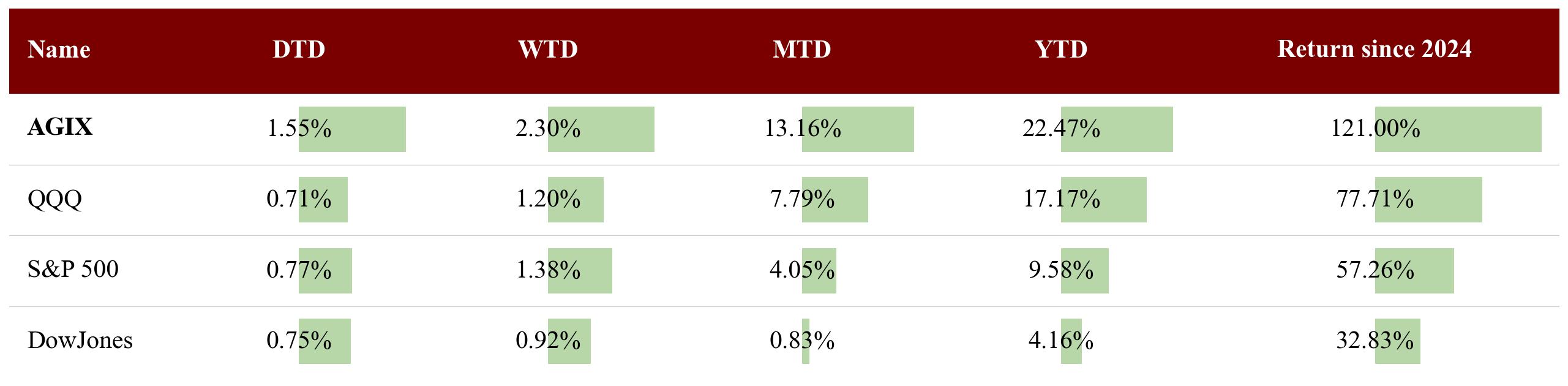
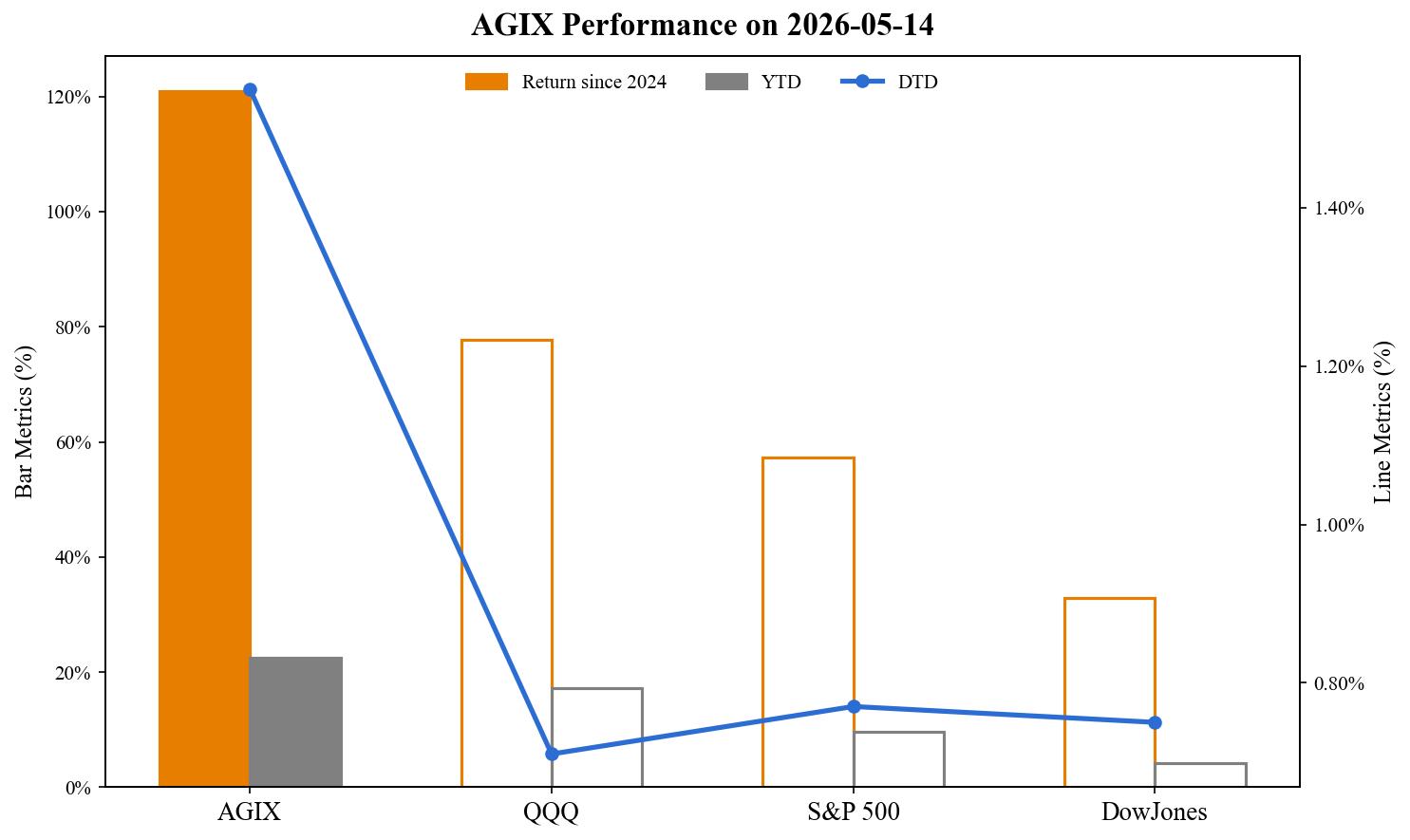
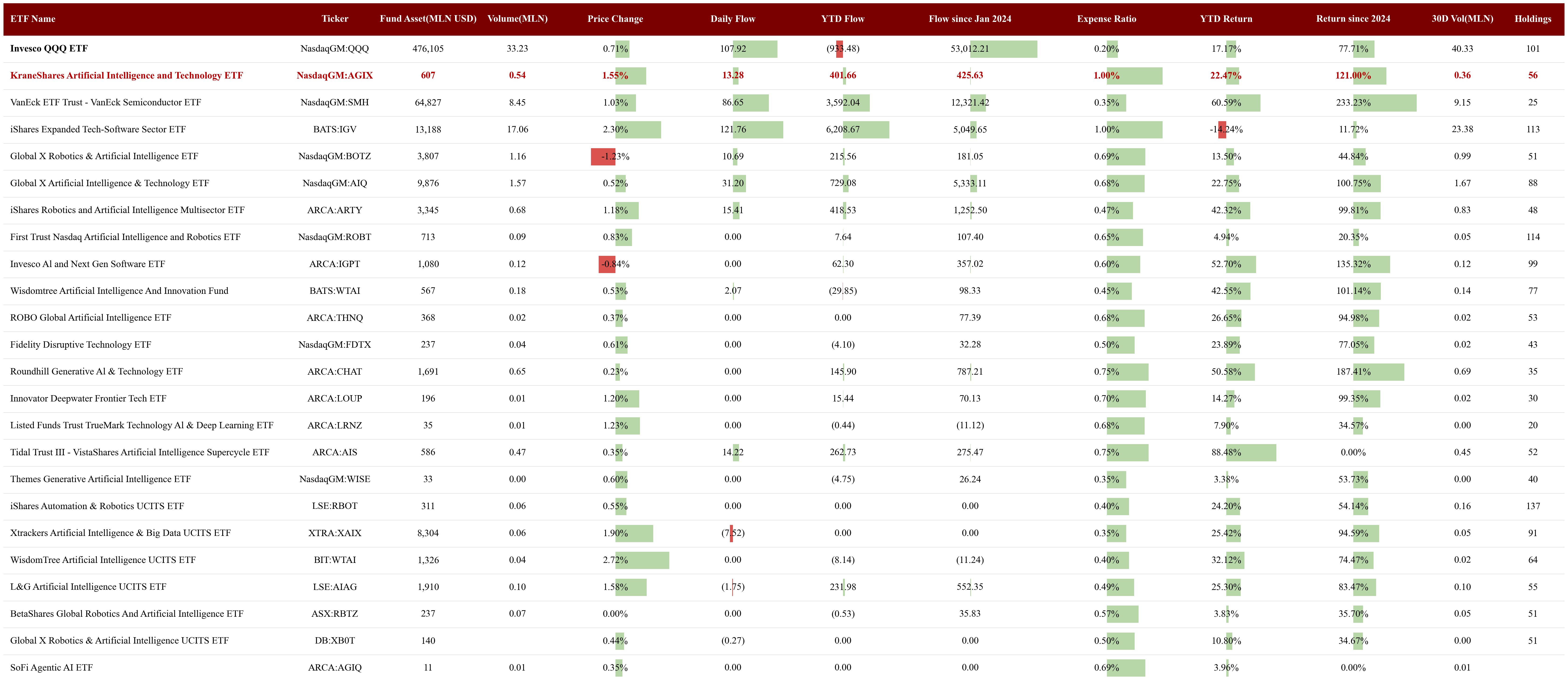
• AGIX outperformed benchmarks with a DTD return of 1.55%, vs. QQQ (0.71%) and S&P 500 (0.77%), driven by strong semiconductor and infrastructure holdings.
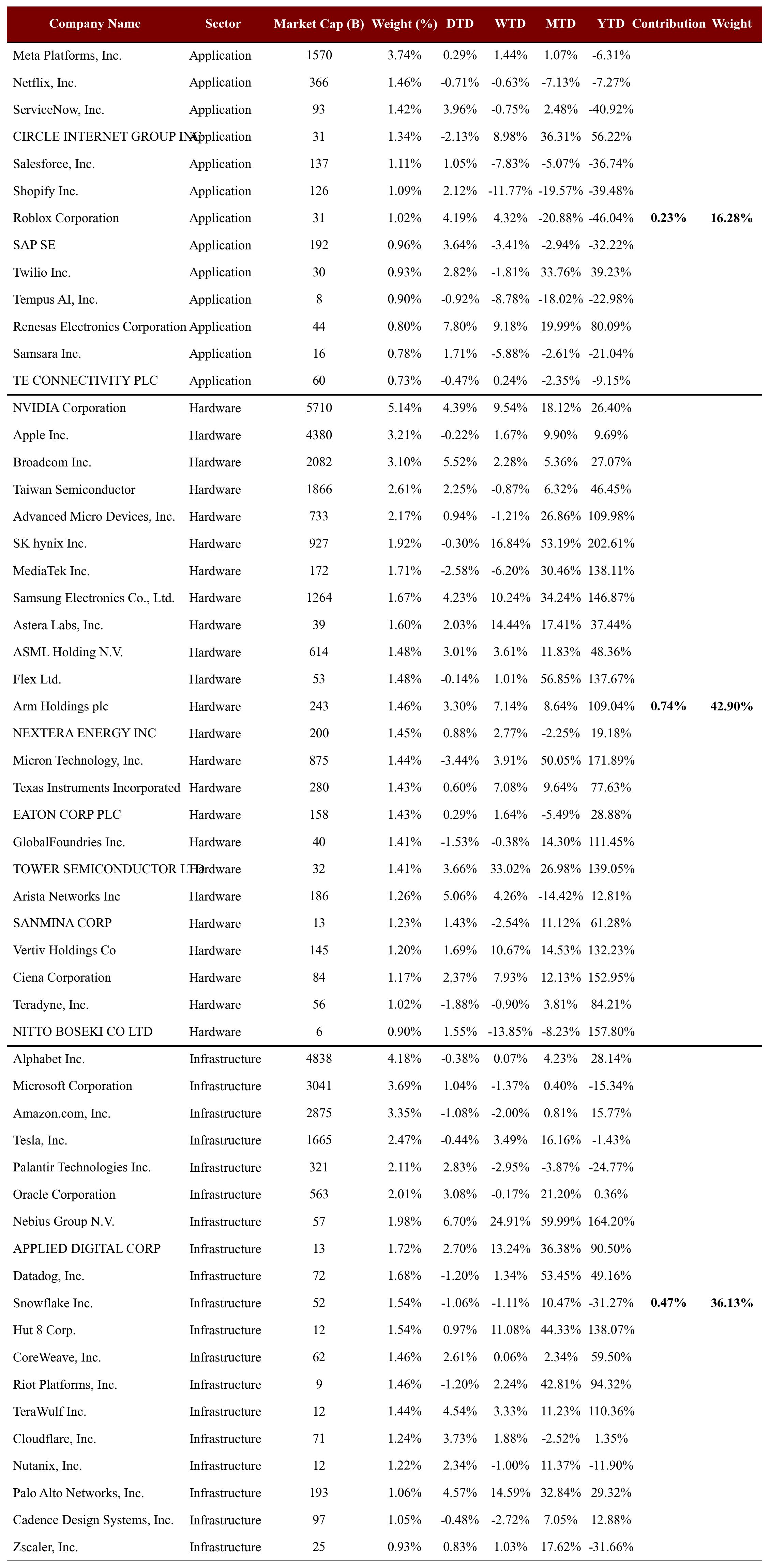
• Top contributors among AGIX holdings: Renesas Electronics (+7.8%) surged on positive earnings momentum; Broadcom (+5.5%) and Arista Networks (+5.1%) rallied on AI infrastructure demand; Nebius Group (+6.7%) continued its post-earnings re-rating.
• Semiconductor peers in AGIX (NVIDIA +4.4%, ASML +3.0%, AMD +0.9%) broadly advanced, supported by AI chip optimism following Cerebras' successful $5.5B IPO and Cisco's AI-driven earnings beat.
• AI infrastructure names like Oracle (+3.1%), Palantir (+2.8%), and Cloudflare (+3.7%) also strengthened, reflecting sustained enterprise AI spending.
News Highlights
1. Cerebras IPO surges 108% on debut, raising $5.5B – validates strong demand for AI inference alternatives to Nvidia, benefiting AGIX hardware holdings like Broadcom and AMD.
2. Cisco beats Q3 estimates, raises AI revenue target to $4B, stock jumps 20% – reinforces AI networking demand, positive for Arista Networks and other AGIX infrastructure names.
3. Anthropic launches Claude for Small Business and programmatic credit pool – intensifies competition in enterprise AI agents, potentially impacting AGIX's application holdings like Salesforce and ServiceNow.
4. Recursive Superintelligence raises $650M for self-improving AI – highlights growing investment in autonomous AI R&D, supporting AGIX's AI infrastructure theme.
5. OpenAI considers legal action against Apple over partnership disputes – could reshape AI ecosystem alliances, with indirect effects on AGIX's cloud and platform holdings.
RSS Highlights
1. Managed agents are the new Lambda – Anthropic's Claude Code pricing shift may drive developers to OpenAI's Codex, impacting AI tooling adoption.
2. Meta plans 8,000 layoffs amid record profits – highlights cost-cutting in AI investments, relevant for AGIX application holdings.
3. Google announces Googlebook as Chromebook successor – new Android-ChromeOS hybrid could expand AI integration in laptops.
4. OpenAI unhappy with Apple deal, considers legal action – underscores friction in AI platform partnerships.
5. Youth AI Safety Institute launched to test AI products for children – regulatory attention may affect AI deployment in education.
Performance & Benchmark
Attribution
Contribution of the three sectors within AGIX holdings today
Application: 0.23%
Hardware: 0.74%
Infrastructure: 0.47%
Top-performing stocks in AGIX holdings today
Renesas Electronics Corporation (7.8%)
Nebius Group N.V. (6.7%)
Broadcom Inc. (5.52%)
Arista Networks Inc (5.06%)
Palo Alto Networks, Inc. (4.57%)
TeraWulf Inc. (4.54%)
NVIDIA Corporation (4.39%)
Samsung Electronics Co., Ltd. (4.23%)
Roblox Corporation (4.19%)
ServiceNow, Inc. (3.96%)
Cloudflare, Inc. (3.73%)
TOWER SEMICONDUCTOR LTD (3.66%)
SAP SE (3.64%)
Arm Holdings plc (3.3%)
Oracle Corporation (3.08%)
ASML Holding N.V. (3.01%)
Palantir Technologies Inc. (2.83%)
Twilio Inc. (2.82%)
APPLIED DIGITAL CORP (2.7%)
CoreWeave, Inc. (2.61%)
Ciena Corporation (2.37%)
Nutanix, Inc. (2.34%)
Taiwan Semiconductor Manufacturing Company Limited (2.25%)
Shopify Inc. (2.12%)
Astera Labs, Inc. (2.03%)
Worst-performing stocks in AGIX holdings today
CIRCLE INTERNET GROUP INC (-2.13%)
MediaTek Inc. (-2.58%)
Micron Technology, Inc. (-3.44%)
Top five listed stocks contributing the most within AGIX holdings today
NVIDIA Corporation (4.39%)
Broadcom Inc. (5.52%)
Nebius Group N.V. (6.7%)
Samsung Electronics Co., Ltd. (4.23%)
TeraWulf Inc. (4.54%)
Observation
The strongest movers across peer ETF holdings today are listed below:
| DTD | Stock Ticker | Name | Held by ETFs | analysis |
|---|---|---|---|---|
| 22.12 | TSE:6914 | OPTEX GROUP Company, Limited | ['LSE:RBOT'] | OPTEX GROUP’s 22% rise on May 14, 2026, was primarily driven by a strong Q1 earnings release and reaffirmed full-year 2026 guidance that exceeded investor expectations. The company reported solid growth for the quarter ended March 31, 2026 and confirmed its 2026 outlook, signaling resilient demand across its sensing and automation businesses and improving profitability, which likely prompted a sharp rerating in the shares. Broader interest in industrial automation and sensing names may have provided an additional tailwind as investors looked to plays on capex and factory automation growth. |
| 13.41 | NasdaqGS:CSCO | Cisco Systems, Inc. | ['NasdaqGM:QQQ', 'NasdaqGM:AIQ', 'NasdaqGM:ROBT', 'ARCA:AIS', 'XTRA:XAIX', 'BIT:WTAI'] | Cisco’s 13.4% gain on May 14 was driven primarily by a stronger‑than‑expected Q3 FY26 earnings report and a sizable guidance raise, which signaled accelerating growth and profitability. The company beat revenue and EPS estimates, highlighted roughly $9 billion in hyperscaler AI infrastructure orders, and raised full‑year FY26 revenue and EPS guidance, reinforcing the market’s perception of Cisco as a key AI networking beneficiary. A second driver was Cisco’s AI‑focused restructuring and portfolio moves (including the Astrix Security acquisition), which investors interpreted as improving long‑term growth and margin prospects. Heavy call option buying and multiple analyst price‑target hikes following the report amplified the upside move. |
| 13.06 | TSE:3673 | Broadleaf Co., Ltd. | ['LSE:RBOT'] | Broadleaf’s sharp 13% rise on May 14 was primarily a positive earnings-reaction move to its 1Q FY12/2026 results released the prior day. The company’s disclosure showed growth in equity and a solid balance-sheet position, which, against its history of strong position in niche IT services and auto-aftermarket software, appears to have reassured investors and driven multiple expansion. A secondary driver is technical and positioning-related: after a period of modest pullback and with the stock still well below its all-time high, better-than-feared numbers likely triggered short covering and momentum buying. |
| 10.42 | NasdaqGS:NVMI | Nova Ltd. | ['LSE:RBOT'] | Nova Ltd.’s 10.4% gain on May 14, 2026 was primarily driven by a strong earnings surprise and upbeat guidance. First, Q1 2026 results came in ahead of both company guidance and Street expectations, with record revenue (~$235M, +10% YoY), record EPS, expanding margins, and lower opex, signaling better-than-modeled profitability. Second, management’s commentary highlighted continued market share gains in metrology (including a cited 400 bps share pickup per Gartner) and structurally higher metrology intensity from AI, HBM and advanced-node demand, which supported a positive reset in growth and earnings expectations versus peers that were mixed to down on the day. |
| 10.35 | TSE:6594 | Nidec Corporation | ['NasdaqGM:ROBT', 'ARCA:IGPT'] | Nidec’s 10.35% jump on 2026-05-14 was driven primarily by a relief rally after the company’s recent disclosure and improvement-plan updates around accounting misconduct and governance issues, which helped shift focus from uncertainty toward remediation. Second, the stock had already sold off sharply on the misconduct headlines, so the move likely reflected short-covering and positioning reversal as investors reacted to the revised plan/status updates rather than fresh negative news. Any broader support from valuation and technical rebound factors was secondary to the governance-reset narrative. |
| 10.08 | NasdaqGS:UPST | Upstart Holdings, Inc. | ['NasdaqGM:BOTZ', 'NasdaqGM:ROBT', 'BIT:WTAI', 'ASX:RBTZ', 'DB:XB0T'] | Upstart’s 10.08% jump on May 14 was primarily driven by CEO Paul Gu’s open-market purchase of 50,000 shares on May 13, a Form 4 filing that the market read as a strong insider-confidence signal. The move was reinforced by broader coverage highlighting the insider buy and by a supportive backdrop for the name, with recent earnings expectations and momentum already improving. |
| 10.0 | TWSE:3008 | LARGAN Precision Co.,Ltd | ['ARCA:IGPT', 'LSE:RBOT'] | LARGAN Precision’s ~10% gain on 2026-05-14 appears primarily driven by the positive impact of its recently completed capital reduction via treasury share cancellation, which tightened share supply and is typically interpreted as a shareholder-friendly signal. The company disclosed completion of the capital reduction registration on 2026-05-13, giving the market its first full trading day to price in the reduced share count and improved per-share metrics. A secondary driver is the ongoing technical and momentum backdrop: the stock had already broken above key resistance and its 200-day moving average, so the corporate action likely triggered incremental buying from momentum and technical investors. |
| 9.98 | TWSE:2498 | HTC Corporation | ['XTRA:XAIX'] | HTC’s 9.98% jump on May 14 appears to have been driven primarily by a strong technical rebound in a thinly covered name rather than a clearly identifiable same-day company-specific announcement. The only closely related recent public item in the search results is the May 5 board resolution correcting a misprint in the 2025 earnings distribution proposal, which is too dated to explain the move on its own. Broader trading momentum likely mattered as well, with HTC showing buy signals on short-term technical screens and a large market-cap swing over the period. |
| 9.96 | TSE:6845 | Azbil Corporation | ['LSE:RBOT'] | Azbil’s nearly 10% gain on May 14, 2026 was primarily driven by the announcement and execution of a sizeable share buyback at a premium to the prior close, signaling enhanced shareholder returns and capital-efficiency focus. The Board on May 13 approved the repurchase of 3,557,400 shares (about 0.69% of shares outstanding) via ToSTNeT-3 at ¥1,405.5, and the company disclosed completion of that buyback on May 14, which likely supported both sentiment and demand for the stock. A secondary support factor is the stock’s valuation context—trading at a discount P/E to peers per recent commentary—which makes a buyback more accretive and may have amplified the positive price reaction. |
| 9.86 | TWSE:2345 | Accton Technology Corporation | [] | Accton Technology’s 9.9% gain on May 14, 2026 was primarily driven by company-specific news that its board approved a capital injection into its Vietnam subsidiary, signaling continued expansion of production capacity for networking and AI-related hardware. Investors likely interpreted this move as reinforcing Accton’s ability to support strong demand for 800G AI/ML fabrics and data center networking equipment, supporting growth expectations. A secondary driver is ongoing thematic interest in AI infrastructure and high-speed networking names in Taiwan, which has kept valuation elevated and can amplify price reactions to incremental positive corporate actions. |
| 9.84 | TWSE:2344 | Winbond Electronics Corporation | ['ARCA:IGPT'] | Winbond Electronics’ 9.8% gain on May 14, 2026 appears mainly driven by continued momentum and positioning rather than a discrete company-specific news catalyst. First, the stock has been in a strong multi‑week uptrend with improving technical signals (bullish crossovers, rising volume, and buy ratings from technical services like TradingView), which likely attracted additional momentum and retail inflows. Second, the move fits within a broader rerating of Taiwan semiconductor and memory names tied to AI- and data-center-related demand expectations, supporting multiple expansion and short-covering even in the absence of new fundamental disclosures from the company that day. |
| 9.76 | TWSE:2303 | United Microelectronics Corporation | [] | United Microelectronics’ 9.8% surge on May 14 was primarily driven by its announcement of a new 14nm eHV FinFET platform, which positions the company to compete in higher-value, advanced specialty nodes and likely improved investors’ growth and margin expectations. Secondarily, the move was amplified by positive sentiment around the company’s recent earnings momentum and favorable technical setup, with the stock already showing improving trend indicators and a “buy” technical bias ahead of the news. |
| 8.83 | SEHK:2498 | Robosense Technology Co., Ltd | ['NasdaqGM:BOTZ', 'ARCA:IGPT', 'ASX:RBTZ', 'DB:XB0T'] | Robosense Technology’s 8.8% gain on May 14, 2026 appears driven primarily by continued momentum and re‑rating in the LiDAR/ADAS theme rather than a specific new company disclosure that day. First, the stock has shown strong multi‑month appreciation and high beta, so incremental buying into a “buy‑rated” technical setup (as indicated by TradingView) likely amplified the move. Second, broader market enthusiasm for autonomous driving and perception technologies, supported by bullish sell‑side target ranges above the current price, likely reinforced investor positioning in Robosense as a leading China LiDAR play. |
| 8.52 | NasdaqGS:EXTR | Extreme Networks, Inc. | ['ARCA:AIS', 'XTRA:XAIX'] | Extreme Networks’ 8.5% gain on May 14 was driven primarily by strong fundamental momentum following its recently reported fiscal Q3 2026 results, which showed 11% revenue growth, accelerating 29% SaaS ARR, EPS improvement, and a $50M buyback, reinforcing confidence in earnings power and capital returns. A secondary driver was positive sentiment from the stock breaking to new 52-week highs and trading well above key moving averages, which triggered technical buying. Ongoing supportive analyst positioning, with a “Moderate/Buy” consensus and targets around current levels, likely added to the follow-through bid. |
| 8.23 | NYSE:ZEPP | Zepp Health Corporation | ['NasdaqGM:WISE'] | Zepp Health’s 8.23% gain on May 14, 2026 appears to be driven primarily by technical and trading dynamics rather than a specific new fundamental catalyst. Public news and company-disclosure feeds show no material ZEPP- or sector-specific announcements that day, suggesting the move likely reflects a rebound within its existing uptrend, with traders reacting to prior volatility and support/resistance levels highlighted by technical services. Broader market conditions for smaller-cap China-linked tech/health-tech names were also constructive, which likely aided risk-on flows into the stock. |
| 7.8 | TSE:6723 | Renesas Electronics Corporation | ['NasdaqGM:AGIX', 'NasdaqGM:ROBT', 'BIT:WTAI'] | Renesas Electronics rose 7.8% on May 14, most likely on a relief/re-rating move after its April 23 consolidated forecasts, which the market appears to have interpreted as supportive for the 2026 earnings outlook. A secondary driver was the stock’s continued momentum in a strong semiconductor tape, with investors favoring cyclical chip names. The recently announced employee/director share-compensation shelf registration changes were not the main catalyst and are more likely a minor overhang than a reason for the jump. |
| 7.7 | TSE:7734 | Riken Keiki Co., Ltd. | ['LSE:RBOT'] | Riken Keiki’s 7.7% gain on May 14, 2026 appears primarily driven by company-specific fundamentals and shareholder-return expectations rather than any new same-day headline. First, the stock has been rebounding from a roughly 24% one-year drawdown while recently beating quarterly revenue estimates, which likely reinforced confidence in earnings resilience and supported a rerating toward peers. Second, the company’s articulated medium-term management plan and an uplift in the FY2026 year-end dividend (raising the annual payout to ¥55) have strengthened the shareholder-return story, attracting incremental buying as investors price in more disciplined capital allocation and stable cash returns. |
| 6.98 | KOSE:A035720 | Kakao Corp. | ['NasdaqGM:ROBT', 'XTRA:XAIX', 'BIT:WTAI'] | Kakao’s ~7% gain on May 14, 2026 appears primarily technical rather than news‑driven, reflecting a rebound after a multi‑day pullback and positioning within a broader short‑term uptrend. First, the stock had fallen for several sessions into the lower band of a wide rising trend, where technical services highlighted support and a “good buying opportunity,” making a snap‑back move plausible once selling pressure eased. Second, the move came without any material new company‑specific disclosures or sector headlines, suggesting short‑term bargain hunting and broader KOSPI “money move” inflows into beaten‑down large‑cap tech/platform names likely amplified the upside. |
| 6.97 | NasdaqGS:APP | AppLovin Corporation | ['NasdaqGM:QQQ', 'BATS:IGV', 'NasdaqGM:AIQ', 'ARCA:LOUP'] | AppLovin’s 6.97% rise on May 14 appears driven primarily by follow-through buying on its recently reported strong Q1 2026 results and upbeat Q2 guidance, which highlighted revenue and earnings upside versus expectations and reinforced confidence in its growth and margin trajectory. A second key driver is growing anticipation around the upcoming public launch of its AXON AI self-serve advertising platform, which investors view as a meaningful new growth catalyst, particularly in e-commerce. Positive analyst sentiment and rising price targets following these updates likely amplified the move as the stock significantly outperformed the broader Software & IT Services sector. |
| 6.88 | NYSE:DT | Dynatrace, Inc. | ['BATS:IGV', 'NasdaqGM:BOTZ', 'NasdaqGM:ROBT', 'BATS:WTAI', 'BIT:WTAI', 'ASX:RBTZ', 'DB:XB0T'] | Dynatrace’s +6.9% move on May 14 appears to be a relief rebound following the prior day’s sharp post‑earnings selloff, supported by a wave of analyst revisions that, while cutting price targets, largely reaffirmed positive ratings and upside. First, multiple brokers including JPMorgan, Scotiabank, Citi, TD Cowen, RBC, Barclays, and DA Davidson all lowered targets but mostly kept Buy/Overweight/Sector Outperform ratings, with consensus still at “Moderate Buy” and targets implying 20–25%+ upside, which likely reassured investors after the earnings-driven drop highlighted in earlier coverage (e.g., StockStory noting a 13.1% decline on Wednesday on cautious outlook). Second, the stock’s bounce fits a typical mean-reversion/short-covering pattern after an overreaction, aided by the fact that even the more pessimistic revisions (e.g., UBS trimming its target to $36) were close to the prevailing price, limiting incremental negative information. |
| 6.86 | NYSE:FIG | Figma, Inc. | ['ARCA:LRNZ'] | Figma’s ~6.9% gain on May 14, 2026 was driven primarily by stronger-than-expected Q1 2026 results. The company reported EPS of $0.10, beating forecasts by roughly two-thirds, and revenue of $333.4M, about 5.5% above expectations with 46% year-over-year growth, signaling faster growth and operating leverage than the market had priced in. A secondary driver was the positive reaction in after-hours trading following the earnings release and conference call, reinforcing investor confidence and extending the intraday move. |
| 6.79 | NasdaqGS:TTWO | Take-Two Interactive Software, Inc. | ['NasdaqGM:QQQ', 'BATS:IGV', 'ARCA:LOUP'] | Take-Two’s 6.8% jump on May 14 was most likely driven by a strong reaction to earnings-related news and guidance expectations ahead of its next report, as the stock has been trading on a bullish post-earnings/setup theme and around elevated analyst targets. The move was amplified by technical momentum: TTWO had been oversold and recently bounced from a weaker trading range, so buyers likely stepped in aggressively on any favorable company/industry headlines. Broadly positive sentiment toward the company’s content pipeline and future bookings outlook appears to have been the main fundamental support. |
| 6.78 | KOSDAQ:A348210 | NEXTIN, Inc. | ['LSE:RBOT'] | NEXTIN’s 6.78% gain on May 14, 2026 appears to be driven primarily by continued momentum and sentiment around semiconductor inspection/metrology names rather than any stock-specific news catalyst on the day. First, public news and disclosure sources (company site, exchange filings, major financial portals) show no fresh earnings, guidance, regulatory announcements, or broker calls for NEXTIN specifically on May 14. Second, the move fits within a broader short-term upswing in the stock (per Investing.com and Stockopedia pricing around KRW 69,300–72,800) and a favorable setup for higher-beta semiconductor equipment plays, suggesting a combination of sector rotation and technical buying as key drivers. |
| 6.7 | NasdaqGS:NBIS | Nebius Group N.V. | ['NasdaqGM:AGIX', 'BATS:WTAI', 'ARCA:THNQ', 'ARCA:CHAT', 'BIT:WTAI'] | Nebius Group’s 6.7% gain on May 14 was driven primarily by follow-through buying after its blowout Q1 2026 results showed a swing to profit and revenue inflecting from about $51M to ~$399M, confirming rapid scaling of its AI cloud infrastructure business. The move was reinforced by a series of bullish analyst actions the same day, including DA Davidson raising its price target to $250 and multiple firms lifting targets and reiterating buy/outperform ratings, which validated the growth narrative despite elevated valuation and capex. Technical momentum and a trend-day pattern, with the stock breaking to fresh highs on heavy volume, likely amplified the upside as traders piled into a high-profile AI infrastructure winner. |
| 6.42 | NYSE:HPE | Hewlett Packard Enterprise Company | ['NasdaqGM:AIQ', 'ARCA:IGPT', 'ARCA:CHAT', 'ARCA:AIS', 'XTRA:XAIX'] | HPE’s 6.4% gain on May 14, 2026 was driven primarily by growing investor enthusiasm around its AI and networking strategy, including newly highlighted AI-focused GreenLake private cloud and HPE Compute Scale-up Server 3250 launches and the recently closed $14 billion Juniper Networks acquisition, which are reframing HPE as an AI infrastructure and networking beneficiary. A second, reinforcing driver was improving sentiment and momentum: shares gapped up at the open, are trading well above key moving averages and prior highs, and recent earnings showed solid fundamentals (EPS beat and 18%+ revenue growth), prompting multiple price target and rating upgrades that helped accelerate the move. |
| 6.38 | NasdaqGS:BL | BlackLine, Inc. | ['BATS:IGV', 'NasdaqGM:ROBT'] | BlackLine’s 6.38% rise on May 14 was driven primarily by a positive market reaction to its recent Q1 2026 earnings, which showed around 10% year-over-year revenue growth and a strong 21.6% non-GAAP operating margin, reinforcing the company’s profitable growth narrative. The move was reinforced intraday by BlackLine being highlighted among software names “trading up” in sector news flow, which likely attracted incremental momentum and thematic buyers into an already beaten-down stock that has been trading near 52-week lows. |
| 6.35 | NasdaqCM:QUBT | Quantum Computing Inc. | ['NasdaqGM:AIQ'] | Quantum Computing Inc. shares likely rose 6.35% on May 14, 2026 as a continuation of momentum following earlier bullish catalysts rather than on fresh fundamental news. First, the stock was still digesting a very strong run triggered by Northland’s recent Outperform initiation with a $20 target and better‑than‑expected Q1 2026 results, which had already pushed QUBT into a high‑volatility, momentum‑trading regime. Second, technical factors appear to have played a role: after a sharp pullback from intraday highs near $14 earlier in the week, buyers stepped in around key support levels highlighted by traders, fueling a rebound as short‑term players bought the dip and shorts covered. |
| 6.23 | TWSE:2408 | Nanya Technology Corporation | ['ARCA:IGPT', 'ARCA:AIS'] | Nanya Technology’s 6.2% gain on May 14 was primarily driven by rapidly improving fundamentals and bullish revisions to forward expectations, reflected in both company disclosures and external analysis. First, the company’s recent monthly sales release showed March 2026 revenue up 16% m/m and over 560% y/y, while Q1 2026 results indicated a sharp swing to profitability and a gross margin jump to about 68%, with management guiding Q2 to surpass Q1—fueling a reassessment of earnings power. Second, several analyst/valuation updates (as summarized by Simply Wall St and others) have reset fair value and price targets sharply higher on assumptions of stronger revenue growth, structurally higher profit margins, and a rerating in P/E, which likely supported incremental buying interest into the move. |
| 6.18 | NYSE:APTV | Aptiv PLC | ['NasdaqGM:ROBT', 'BIT:WTAI'] | Aptiv’s 6.2% gain on May 14, 2026 appears primarily driven by a shift in sentiment as investors responded to increasingly bullish Street positioning and expectations ahead of the company’s upcoming earnings report. First, Zacks highlighted that Aptiv holds a very favorable average brokerage recommendation of 1.31 (Strong Buy/Buys from 24 firms) on May 14, reinforcing the bullish narrative and likely attracting incremental buyers. Second, with the next earnings release just days away and the stock having underperformed recently, some of the move likely reflects positioning and short covering as investors priced in potential upside to the Q3 2025 EPS and revenue estimates. |
| 5.76 | XTRA:IFX | Infineon Technologies AG | ['NasdaqGM:AIQ', 'ARCA:THNQ', 'LSE:AIAG'] | Infineon’s ~5.8% rise on 14 May 2026 appears driven primarily by ongoing earnings momentum and follow-through buying after its stronger-than-expected half-year results to 31 March 2026, which highlighted solid sales and net income growth and have prompted a sharp re‑rating over the past month. The continued outperformance of semiconductor and power/auto-chip names globally, together with growing investor focus on Infineon’s long-term growth projects (e.g., Dresden capacity expansion and recent visibility from events like SEMICON SEA), likely reinforced sector inflows and sentiment toward the stock. |
| 5.72 | TWSE:3005 | Getac Holdings Corporation | ['XTRA:XAIX'] | Getac’s 5.72% rise on May 14 was likely driven mainly by the market digesting its recent operating update: April consolidated revenue rose 8.33% year over year to NT$3.563 billion, signaling a rebound after the softer Q1 results. A secondary support was that the Q1 earnings release had already been absorbed earlier, so the stock may have reacted to the improving monthly sales trend rather than the quarter’s 2.55% revenue decline and 12.12% EPS drop. A third, smaller factor may have been momentum/trading interest in the name after the April sales beat. |
| 5.71 | KOSE:A035420 | NAVER Corporation | ['ARCA:ARTY', 'NasdaqGM:ROBT', 'XTRA:XAIX', 'BIT:WTAI'] | NAVER’s 5.7% gain on May 14, 2026 appears primarily driven by fresh optimism around its strategic push in Korean e-commerce and delivery, anchored by the recently reported 33 billion won investment and partnership with Kurly Inc., which strengthens its competitive stance versus Coupang in online groceries and fresh food. Investors likely interpreted the Kurly deal and potential move to become its largest shareholder as an expansion of NAVER’s commerce ecosystem and a catalyst for growth in high-frequency, high-ARPU categories. A secondary driver is style and technical momentum: the stock has been in a strong short-term uptrend with rising prices over the prior weeks and favorable medium-term indicators (MACD, long-term moving average), encouraging incremental buying as it breaks higher within that trend. |
| 5.59 | TSE:4180 | Appier Group, Inc. | ['ARCA:ARTY'] | Appier Group’s 5.6% gain on May 14, 2026 appears to be primarily driven by continued positive sentiment following its very strong recent earnings inflection, with quarterly net income jumping from ¥35M to ¥557M and consensus targets implying substantial upside from current levels. In the absence of stock-specific news or regulatory headlines that day, the move likely reflects investors rotating back into AI/software names leveraged to data-driven advertising and customer engagement, as well as momentum buying after the company’s improving profitability and initiation of a modest dividend. |
| 5.58 | NYSE:RBRK | Rubrik, Inc. | ['BATS:IGV', 'BATS:WTAI'] | Rubrik’s 5.6% gain on May 14 appears driven primarily by technical and positioning dynamics rather than any identifiable new fundamental catalyst. First, the move follows recent weakness and positioned the stock near key technical support levels highlighted by traders (e.g., 200-day EMA / retracement zones), prompting dip‑buying and short-covering. Second, the backdrop of very bullish Street sentiment and a high consensus 12‑month target (around 40%+ implied upside from recent prices with a dominant buy rating skew) likely reinforced investor willingness to add exposure on the pullback, amplifying the rebound. |
| 5.52 | NasdaqGS:AVGO | Broadcom Inc. | ['NasdaqGM:QQQ', 'NasdaqGM:AGIX', 'NasdaqGM:SMH', 'NasdaqGM:AIQ', 'ARCA:ARTY', 'NasdaqGM:ROBT', 'BATS:WTAI', 'NasdaqGM:FDTX', 'ARCA:CHAT', 'NasdaqGM:WISE', 'BIT:WTAI'] | Broadcom’s 5.5% gain on May 14, 2026 was driven primarily by mounting bullish AI expectations into its early-June earnings, reinforced by high-profile analyst calls and targets that frame the stock as a top beneficiary of multi‑year AI infrastructure spending. Citi’s May 12 note naming Broadcom its top semiconductor pick for 2026, lifting the price target to $500 on the back of aggressive AI revenue forecasts (projecting AI to reach ~81% of sales by FY 2028), added to existing upside narratives such as Evercore’s $582 target and 24/7 Wall St.’s mid‑$400s fair-value work. A secondary driver was momentum and positioning: the stock was already up roughly 32% over the prior month and nearly 140% over the past year, with investors likely adding exposure ahead of the June earnings print where the Street is increasingly positioned for a “beat-and-raise” AI-driven guide versus prior $22 billion revenue guidance. |
| 5.47 | NasdaqCM:NN | NextNav Inc. | ['BATS:IGV'] | NextNav’s approximately 5.5% gain on May 14, 2026 appears driven primarily by momentum and technical follow‑through rather than discrete, stock-specific news. Company IR data show an above-average volume day alongside a continuation of the sharp multi-month uptrend in a highly volatile, speculative name with very limited revenues and negative earnings, suggesting incremental buying interest in a momentum/“GPS resilience” theme rather than a new fundamental catalyst. Broader tech and small-cap risk-on sentiment likely provided a supportive backdrop, amplifying the move in a high‑beta stock. |
| 5.43 | NasdaqGM:NVTS | Navitas Semiconductor Corporation | ['ARCA:AIS'] | Navitas Semiconductor’s ~5% gain on May 14 appears primarily driven by continued bullish follow-through from its early-May Q1 beat and upbeat Q2/full‑year commentary, which highlighted a successful pivot to higher‑margin GaN/SiC products for AI data centers and other high‑power markets. The move was reinforced by a series of recent, high-profile analyst target hikes (notably Needham and Baird raising targets into the low‑$20s post‑earnings), which helped legitimize the rerating and kept momentum buyers engaged. Elevated trading activity and a “momentum” tape following the stock’s sharp run from the low‑teens into the $20s also likely contributed to incremental upside as traders continued to chase the AI power‑semiconductor theme. |
| 5.39 | ENXTPA:STMPA | STMicroelectronics N.V. | ['NasdaqGM:SMH', 'BIT:WTAI'] | STMicroelectronics’ 5.4% gain on 14 May appears driven primarily by positive technical and momentum factors rather than any specific new fundamental catalyst. The stock had already risen sharply in prior sessions, with technical services flagging a bullish setup (price above key moving averages, multiple positive signals, rising volume), likely attracting additional short‑term and quant/momentum buying. A secondary support is ongoing bullish sentiment around the semiconductor sector and the stock specifically, with strong recent performance and multiple analyst upgrades over the past 90 days reinforcing investor risk appetite despite some forecasts indicating medium‑term downside. |
| 5.35 | TWSE:2451 | Transcend Information, Inc. | ['ARCA:AIS'] | Transcend Information’s 5.35% rise on 2026-05-14 was most likely driven by the market reacting to its very strong Q1 2026 earnings, which showed a sharp jump in revenue and net income versus a year earlier. A second support was the stock’s update on the company website showing heavy trading volume on 2026/05/14, consistent with renewed investor interest after the results. No major same-day company-specific negative news appears in the provided public sources to offset that earnings-led re-rating. |
| 5.11 | NasdaqCM:CLSK | CleanSpark, Inc. | ['BATS:IGV'] | CleanSpark’s roughly 5% gain on May 14, 2026 appears primarily driven by continued momentum and sentiment in high-beta bitcoin-mining equities, rather than by any company-specific news catalyst that day. First, there were no fresh CleanSpark press releases, earnings, or regulatory headlines on May 14, suggesting the move followed broader crypto/equity risk-on dynamics and recent strength in the name (up sharply over the prior month). Second, CLSK’s elevated beta and heavy retail/intraday trading interest make it particularly sensitive to shifts in bitcoin price and speculative flows, amplifying the upside move in the absence of new fundamental information. |
| 5.09 | NasdaqGS:ODFL | Old Dominion Freight Line, Inc. | ['NasdaqGM:QQQ'] | Old Dominion Freight Line’s 5.1% gain on May 14, 2026 appears driven primarily by follow‑through buying and sentiment after its better‑than‑expected Q1 2026 earnings report on April 29, which showed revenue and EPS beats, strong EBITDA and stable operating margins despite softer volumes. With no new company-specific headlines or regulatory developments on May 14, the move likely reflected investors continuing to re-rate the stock on its resilient profitability and quality relative to broader freight peers, amplified by momentum after a recent pullback in the prior month. |
| 5.06 | NYSE:ANET | Arista Networks Inc | ['NasdaqGM:AGIX', 'ARCA:ARTY', 'NasdaqGM:ROBT', 'BATS:WTAI', 'ARCA:THNQ', 'ARCA:CHAT', 'ARCA:LOUP', 'ARCA:AIS', 'NasdaqGM:WISE', 'XTRA:XAIX', 'LSE:AIAG'] | Arista Networks’ 5.06% gain on May 14 was driven mainly by continued investor confidence in its AI networking growth story and the market’s reaction to its recent strong quarterly results and raised full-year guidance, which highlighted robust demand for AI fabric infrastructure. Analyst sentiment also stayed supportive, with multiple firms reiterating Buy/Overweight ratings and lifting price targets, reinforcing the move. The stock also outperformed a firm technology sector tape, adding to the upside momentum. |
| 5.02 | NasdaqGS:MSTR | Strategy Inc | ['NasdaqGM:QQQ', 'BATS:IGV', 'ARCA:IGPT', 'LSE:RBOT', 'XTRA:XAIX'] | Strategy Inc (MSTR) rose about 5% on May 14 primarily because of a sharp same-day rally in Bitcoin toward the $80,000 level, which mechanically boosts the implied value of MSTR’s very large BTC holdings and reinforces its status as a high‑beta Bitcoin proxy. A secondary driver was supportive sell-side sentiment and target hikes in recent weeks (Clear Street, Canaccord, TD Cowen, BTIG) that have framed MSTR as a consensus vehicle for bullish Bitcoin exposure, providing a favorable backdrop for traders as BTC moved higher. |
News
Funding & M&A
Recursive Superintelligence raises $650 million to build self-improving AI models.
AI startup Recursive Superintelligence Inc. announced its founding today and completed a $650 million funding round, led by Alphabet's GV fund and Greycroft, with participation from Nvidia and AMD's venture capital arms. This round values the company at $4.65 billion. The company was founded by former Salesforce chief scientist Richard Socher, whose previous startup You.com Inc. was valued at $1.5 billion last year. Recursive's team currently has over 25 employees in San Francisco and London, working on developing recursive self-improving superintelligent AI models. The model aims to enhance its own codebase, training and inference infrastructure, and even optimize auxiliary programs (harnesses) through an open-ended automated scientific discovery process, while setting guardrails to prevent risky outputs. Socher said the company will expand into physics, chemistry, and preclinical biology in the future, with AI becoming the 'calculus' of biology. OpenAI is using the GPT-5.5 model to optimize parallel processing, improving token generation speed by over 20%; Alphabet is using neural networks to design TPU accelerators and incubating Ricursive Intelligence Inc. to commercialize the technology. Competitor Ineffable Intelligence Ltd. uses reinforcement learning methods, and AI's autonomous research capabilities are becoming a focal point in the industry.
Rivian spinout Mind Robotics lands $400 million to push AI robots onto factory floors.
Industrial robotics startup Mind Robotics Inc. announced a new $400 million funding round, bringing total funding to over $1 billion. The company was founded in 2025 by Rivian Automotive Inc. CEO RJ Scaringe and focuses on developing AI-driven robots for fine, judgmental tasks on production lines that traditional automation struggles with, such as wiring, assembling soft trim parts, and connector docking. Its core selling point is an integrated platform encompassing AI models, robot hardware, and management software for robot fleets in factories. Mind Robotics emphasizes its close partnership with Rivian, which is not only a shareholder but also an operational partner, providing high-volume factories as a venue for model training and deployment. This real-time data feedback loop is seen as the company's core competitive moat, helping continuously optimize robot performance. Scaringe also leads publicly traded automaker Rivian, which is using automation to reduce production costs at its Normal factory to support mass production of the R2 SUV. The round was led by Kleiner Perkins, with new investors including Meritech Capital and Redpoint Ventures, and existing shareholders Accel and Andreessen Horowitz participating. Earlier in March, the company completed a $500 million Series A round. This move will accelerate Mind Robotics' deployment of AI robots to more factory production lines, driving innovation in general-purpose industrial robotics.
Rising AI demand lifts Cisco to another earnings and revenue beat – and a 20% stock pop.
Cisco Systems Inc. reported third-quarter earnings with adjusted earnings per share of $1.06, slightly beating Wall Street expectations of $1.04; revenue of $15.84 billion, up 12% year-over-year, exceeding the expected $15.56 billion. Net profit reached $3.37 billion, a significant increase. The company's stock surged 20% in after-hours trading. Cisco also announced a new round of layoffs, affecting fewer than 4,000 positions, or less than 5% of its workforce, with an estimated $1 billion in restructuring costs to optimize cost structure and focus on AI opportunities. CEO Chuck Robbins revealed that the company has secured $5.3 billion in AI infrastructure orders from hyperscale cloud providers this year, with a full-year projection of over $9 billion, and raised its AI market revenue target to $4 billion. The company's networking business revenue surged 25% to $8.82 billion, becoming the main growth engine. Despite flat security and collaboration businesses, Cisco has strongly rebounded thanks to AI infrastructure demand, with its stock up over 32% year-to-date, far outperforming the Nasdaq index. Meanwhile, Cisco completed two acquisitions: Israeli cybersecurity company Astrix Security Ltd. for nearly $300 million, and AI-native observability startup Galileo Technologies Inc., aiming to strengthen its 'agentic' security products. The earnings highlight Cisco's regained competitiveness in the AI wave, with analysts saying it has moved past its previous growth struggles.
British inference chip startup Fractile bags $220 million to accelerate token consumption.
British AI inference chip startup Fractile Ltd. announced the completion of a $220 million Series B funding round, led by Accel, Factorial Funds, and Founders Fund, with participation from Conviction, Gigascale, and others. The company was founded in 2022 by Oxford University chip engineer Walter Goodwin. Its chips, designed specifically for AI model inference workloads, target the latency bottleneck in generating outputs from cutting-edge large models. Through an innovative architecture that integrates memory into standard server racks, Fractile's logic chips eliminate the need for traditional high-bandwidth memory or SRAM, significantly reducing latency and increasing bandwidth to accelerate AI task processing, supporting complex computations in areas like drug discovery and software engineering. Goodwin said the technology can compress a month's work into a single day, making more AI applications economically viable. In the competitive inference chip market, Fractile will compete with Nvidia, Cerebras Systems (preparing for a $5.5 billion IPO), SambaNova Systems (partnering with Intel), Graphcore, Untether AI, and others, while also facing challenges from Amazon Web Services, Google Cloud, and OpenAI (partnering with Broadcom and TSMC). This funding round will help Fractile validate its technology and capture market share, driving innovation in AI inference engines.
Cerebras prices its shares at $185 ahead of the biggest tech IPO in years, raising $5.5 billion.
AI chip maker Cerebras Systems Inc. has officially set its IPO price at $185 per share, above the expected range of $150 to $160, raising at least $5.5 billion, making it a highly anticipated IPO this year. The company will go public today under the ticker CBRS, with a fully diluted market cap of $56.4 billion. Founded in 2016 and headquartered in Silicon Valley, Cerebras's flagship WSE-3 chip is roughly the size of a dinner plate, featuring 44GB of SRAM memory and 900,000 cores, optimized for AI inference and significantly outperforming Nvidia's Blackwell B200 GPU. Over the past year, shares of Intel (INTC), AMD, and Micron (MU) have surged over 80%, as the semiconductor industry booms due to the AI craze. Cerebras was once heavily reliant on a single customer, G42, which accounted for 80% of sales, but after a review by the U.S. Committee on Foreign Investment in the United States, it gained approval and diversified revenue by launching cloud services. By 2025, G42's share dropped to 24%, while another UAE customer, MBZUAI, accounted for 62%. Recently, the company signed a $20 billion agreement with OpenAI to provide computing capacity, and AWS will also integrate its chips into the Bedrock service. Investors are bullish on its potential as an alternative to Nvidia for inference, and this high-priced IPO signals intensifying innovation and competition in the AI chip space, which could drive down industry costs.
Two weeks left: Startup Battlefield 200 applications close May 27.
Applications for the TechCrunch Disrupt 2026 Startup Battlefield 200 close on May 27, offering early-stage startups a path to venture capital, global exposure, and $100,000 in equity-free funding. The event is open to pre-Series A startups worldwide, selecting 200 of the most promising companies to showcase on stage in front of over 10,000 attendees, top VCs, and media. The platform has helped launch stars like Dropbox, Discord, Fitbit, Trello, and Mint. Each year, thousands apply but only 200 are chosen, with 20 finalists pitching live and one taking the crown. Selected companies receive in-depth TechCrunch coverage, direct VC feedback, and priority editor interaction; early applicants have an advantage. TechCrunch emphasizes that this free, high-ROI opportunity is attracting innovative startups globally, and all industries are welcome, urging founders or nominators to submit in the final two weeks to avoid missing a breakthrough moment. The event highlights the importance of the early-stage startup funding ecosystem, helping accelerate the commercialization of potential category-defining products.
To tame enterprise AI chaos, open source rallies around a standard execution layer
Open-source AI trust has become a core concern for enterprises moving agentic AI into production, where governance, security, and reliability are as important as model performance. This pressure falls directly on platform companies, which need to provide standardized shared foundations to absorb complexity. Red Hat CTO Chris Wright noted at Red Hat Summit 2026 that the rapid iteration of AI hardware and models demands a new collaborative engineering model, similar to the successful paths of Linux and Kubernetes. Wright emphasized that for AI agents capable of writing code and executing real business operations, proper sandbox isolation, least-privilege controls, and trust-building must be provided when managing hundreds or thousands of agents at scale. Red Hat, through its acquisition of Neural Magic Inc., has gained expertise in vLLM quantization and inference performance, promoting vLLM as the standard open-source inference engine for the AI era. Model providers build for vLLM before release to achieve scale efficiency. Facing inference economics, enterprises need to treat token production as infrastructure cost, selecting the best hardware and models based on cost-to-power ratio, avoiding a one-size-fits-all approach. Red Hat focuses on heterogeneity—across hardware, model sizes, and deployment environments (from cloud to factory)—and its unified platform creates lasting value. Wright insists that heterogeneity is the future, supporting diverse workloads and task-tuned models.
Khosla Ventures is betting $10M on Ian Crosby, whose last startup, Bench, imploded
Ian Crosby, former founder of Bench Accounting, whose startup was sold at a low price after its 2024 collapse, has launched a new venture called Synthetic, aiming to build a fully autonomous AI bookkeeper that generates accrual-basis financial statements without human intervention. Although the product is still in the design phase, Crosby acknowledges that current foundation model technology may not yet be mature, but Synthetic has secured $10 million in seed funding led by Khosla Ventures, with participation from Basis Set Ventures and Shopify CEO Tobias Lütke. Khosla partner Jon Chu is optimistic about Crosby's potential, noting a preference for investing in controversial founders, citing former Zenefits CEO Parker Conrad's founding of Rippling (valued at nearly $17 billion) as an example. Crosby argues he was fired by the Bench board in 2021 after rejecting a $250 million acquisition offer from Brex, later joining Shopify to found Teal, which was subsequently acquired by Mercury. Chu confirmed through due diligence that Crosby's subsequent performance received positive reviews, believing he has gained valuable experience. Synthetic focuses on serving AI and software startups, emphasizing full autonomy, differentiating itself from bookkeeping services like Xero that rely on human input. Crosby compares the current prototype to a self-driving car that can only navigate one street, planning to patiently wait for model improvements, having raised sufficient funds to support development.
Saile raises $2.2 million to reduce paperwork for healthcare staffing.
Saile App Inc., a workforce platform founded by doctors, announced the completion of a $2.2 million new round of funding aimed at solving the heavy paperwork challenges medical workers face when moving between different healthcare facilities. The platform has also launched, attracting over 5,000 doctors and establishing partnerships with healthcare facilities in telemedicine, temporary positions, walk-in clinics, and consulting. The healthcare industry has unique staffing pain points: despite ample local talent, verification, background checks, and licensing procedures often take months, requiring repeated coordination among multiple agencies, leading to high costs and delays. Saile founder Marc Ayoub, a neurocritical care physician, pointed out that the problem is not a shortage of doctors, but that the existing workforce cannot move efficiently. To address this, Saile has launched an AI-driven 'Universal Credential Passport' that allows doctors to continuously update their qualifications, avoiding repetitive onboarding processes. The platform integrates five AI agents to automate recruitment, onboarding, credential verification, staffing, and compliance management. Users can browse pre-screened clinicians through the marketplace without directly interacting with AI, bypassing intermediaries and redundant steps for rapid deployment. It also handles cross-state licensing compliance and payment integration, supporting doctors in taking on multiple assignments. The funding round was led by Matchstick Ventures, with participation from Headwater Ventures. The company will expand its AI agent infrastructure, enhance marketplace functionality, and deepen integration with healthcare technology platforms to meet the needs of professionals and institutions.
Data center cooling tech startup Iceotope aims to scale after raising $26 million.
Iceotope Technologies Ltd., a UK-based liquid cooling system startup, announced the completion of a $26 million Series B funding round, led by Two Seas Capital and Barclays Climate Ventures, with participation from existing investors Edinv, ABC Impact, Northern Gritstone, and British Patient Capital. The company focuses on data center hardware and aims to accelerate the adoption of its precision liquid cooling technology to address the cooling challenges brought by the massive expansion of AI. Iceotope's 'direct-to-everything' liquid cooling technology goes beyond traditional air cooling and direct-to-chip liquid cooling, offering higher efficiency, lower energy consumption, and reduced water usage, enabling AI systems to run at full power in any environment. Its flagship products include Iceotope KUL AI, a data center-scale solution for rack deployment, and Iceotope KUL BOX, a compact server solution for edge computing, using non-flammable dielectric coolant suitable for harsh environments. The company's target markets include cloud infrastructure providers, hyperscale data center operators, and telecom media enterprises. SemiAnalysis predicts that liquid-cooled AI accelerator installed capacity will surge from 3 GW to over 40 GW within two years, a more than tenfold increase. Iceotope co-founder and CEO Simon Jesenko stated that this funding validates its differentiated intellectual property and the value of its AI infrastructure-specific products. The company will primarily use the funds for product development, engineering expansion, and ecosystem partnerships to meet the urgent industry demand for advanced sustainable cooling technology. Steven Poulter of Barclays Climate Ventures praised Iceotope for its precise timing in driving data center sustainability.
Wirestock raises $23M to supply creative multi-modal data to AI labs
Creative content platform Wirestock announced the completion of a $23 million Series A funding round, led by Nava Ventures with participation from SBVP, Formula VC, and I2BF Ventures, bringing the company's total funding to $26 million. Originally a tool for photographers to distribute work to platforms like Shutterstock, Wirestock pivoted in 2023 to become an AI data provider, supplying datasets of images, videos, design assets, games, and 3D content to top foundation model developers. The company's platform has attracted over 700,000 artists to participate in data collection tasks, achieving an annualized revenue of $40 million and paying $15 million to contributors. Co-founder and CEO Mikayel Khachatryan stated that most artists choose to participate in the data business, and the company allows users to opt out through transparent policies. Wirestock currently serves six foundation model manufacturers, focusing on creative use cases such as image and video generation, and is exploring areas like audio and music. The funding will be used to expand research, engineering, and product teams, as well as develop enterprise-level dataset collaboration software. Nava Ventures founder Freddie Martignetti emphasized that multimodal data is crucial for building human-like systems, and this investment aligns with the core thesis of multimodal data. As AI labs' demand for data surges, companies like Scale AI have rapidly risen, and Wirestock stands out with its expertise in creative data.
As AI agents flood the enterprise, trust becomes one true bedrock: theCUBE’s VeeamON keynote analysis
At VeeamON 2026, Veeam Software Group GmbH CEO Anand Eswaran delivered a keynote reviewing the company's 20-year technology evolution, shifting from the virtualization, cloud, and container eras to the agentic era, emphasizing the importance of AI trust infrastructure. The company is expanding from its core backup and recovery business into AI governance and data security to address challenges from large-scale enterprise deployment of intelligent systems. theCUBE analysts Dave Vellante and Krista Case noted after the event that Veeam is simplifying complex operational issues and significantly strengthening its data security posture management and AI security posture management capabilities through the acquisition of Securiti Inc. This acquisition brings new features like instant recovery and incident response, marking a strategic shift from its backup roots to AI security. Eswaran highlighted three triggers: 81% of enterprises are already running AI agents (many unknowingly), infrastructure spending will reach $3 trillion by 2028 (82 agents per person), and traditional trust boundaries have melted, becoming a new bottleneck. Veeam's move underscores the need for enterprises to build recoverable, resilient AI environments, focusing on data sensitivity and value to secure the AI stack and drive cyber resilience in enterprise AI deployment.
Wirestock raises $23 million to supply creative multimodal data to AI labs.
Creative content platform Wirestock announced the completion of a $23 million Series A funding round, led by Nava Ventures, with participation from SBVP, Formula VC, and I2BF Ventures. The funding will be used to expand its data supply business, bringing total funding to $26 million. The company transformed into an AI data provider in 2023, supplying multimodal datasets including images, videos, design assets, games, and 3D content to six major foundation model developers. The platform now has over 700,000 artists and designers involved in data collection, with an annualized revenue of $40 million and $15 million paid to contributors. Wirestock founder and CEO Mikayel Khachatryan stated that most users choose to join the data business, driving rapid platform growth through custom requests. The company is hiring R&D, engineering, and product teams, and developing enterprise software to help AI labs collaborate on datasets. As demand for AI model training surges, data service companies like Scale AI and Surge have seen valuations skyrocket, while Wirestock focuses on creative domain data such as image and video generation, and explores audio and music modalities to meet the need for high-quality multimodal data in hyperscale AI systems.
Khosla Ventures is betting $10M on Ian Crosby, whose first startup, Bench, imploded
Former Bench Accounting founder Ian Crosby has launched a new startup, Synthetic, aiming to build a fully autonomous AI bookkeeper that generates accrual-basis financial statements without human intervention. Although the product is still in the design phase and technical feasibility is uncertain, the company has raised $10 million in seed funding led by Khosla Ventures, with participation from Basis Set Ventures and Shopify CEO Tobias Lütke. Khosla partner Jon Chu is optimistic about Crosby's potential, saying he tends to invest in controversial founders and citing Rippling founder Parker Conrad as an example of founder growth. Crosby denies responsibility for Bench's 2024 bankruptcy, stating he was fired by the board in 2021 after previously rejecting a $250 million acquisition offer from Brex. He then joined Shopify to found Teal, which was later acquired by Mercury. Chu confirmed through due diligence that Crosby received positive reviews for his later performance. Synthetic focuses on serving AI and software startups, insisting on a fully autonomous model rather than relying on humans like Xero. Crosby acknowledges that current AI models are prone to errors, but with sufficient funding, he will patiently wait for foundation models to mature, aiming to expand from a single use case to broad applications.
Cerebras raises $5.5B, then stock pops $108%, in the first huge tech IPO of 2026
AI chip startup Cerebras Systems successfully completed its IPO on Thursday, raising $5.5 billion at an offering price of $185 per share, far exceeding the expected range (initially $115-125, later raised to $150-160), and expanding the offering to 30 million shares. The stock surged to $385 on its first day of trading, a gain of over 108%, before pulling back slightly, with midday trading still above $330. At $185 per share, the fully diluted valuation is $56.4 billion. Co-founder and CEO Andrew Feldman's stake is worth nearly $1.9 billion, and CTO Sean Lie's stake is about $1 billion. If the $300 price level holds, the company and its founders' wealth will increase significantly. A year ago, Cerebras shelved its IPO plans due to CFIUS scrutiny over a massive investment from Abu Dhabi's G42 and heavy revenue reliance on G42. In April, the company revived its IPO, reporting fiscal 2025 revenue of $510 million (up 76% year-over-year), diversified customers, and net profit of $237.8 million, reversing a nearly $500 million loss from the previous year. Investor enthusiasm is high. As a competitor to NVIDIA, Cerebras develops its own giant AI chips focused on inference computing, serving clients including OpenAI (complex circular transactions), G42, Saudi Arabia's Mohamed bin Zayed University of Artificial Intelligence, and AWS, making it a key player in AI chip supply.
What happens when AI starts building itself?
AI veteran Richard Socher has launched a new startup, Recursive Superintelligence, which emerged from stealth mode on Wednesday with a massive $650 million in funding. Headquartered in San Francisco, Socher has teamed up with top AI researchers including Peter Norvig, Cresta co-founder Tim Shi, former Google DeepMind researcher Tim Rocktäschel, and former OpenAI core member Josh Tobin. They are working on developing recursive self-improving AI models that can autonomously identify their own weaknesses and restructure themselves without human intervention—a long-standing holy grail in AI research. Socher emphasizes that their unique approach leverages 'open-endedness' to achieve true recursive superintelligence, starting with full automation of research idea generation, implementation, and validation, and eventually expanding to the physical domain. The team draws inspiration from biological evolution and the concept of 'rainbow teaming,' using adversarial co-evolution between AIs to enhance safety and intelligence. The company is not content with being a pure research lab; it plans to launch its first product within a few quarters, stressing the importance of building impactful products. Socher believes that future computing resources will be critical, and humanity must decide how to allocate compute power to solve major problems like cancer or viruses. This marks a new chapter in research-driven AI startups under the neolab wave.
AI training data provider Wirestock raises $23 million in funding.
Wirestock Inc., a startup specializing in AI multimodal training datasets, recently completed a $23 million funding round led by Nava Ventures, with participation from SBVP, Formula VC, and I2BF Ventures. The company has raised a total of $26 million to date. Previously, Wirestock launched a platform in 2018 to help photographers and other creative professionals distribute their work through stock image services. This year, it pivoted to providing training datasets for AI projects, boasting over 50 million images and videos created by approximately 700,000 users. The company also offers custom training datasets, with expertise in recording footage of users interacting with applications. Its annualized revenue has exceeded $40 million, driven by the investment boom in the world model sector. World model startups are gaining traction: World Labs Inc. (led by AI pioneer Fei-Fei Li) secured $1 billion in funding in February, with investors including Nvidia; rival AMI Labs Inc. completed a $1.03 billion round in the same period for robot training and hardware engineering automation. Standard Intelligence Inc. raised $75 million last month, using similar visual datasets to develop the FDM-1 algorithm for efficient multi-step business automation. Wirestock plans to use the new funds to hire AI researchers and engineers, develop software products to help enterprise AI labs collaborate on datasets, and consider expanding into other types of training data. This round follows a $30 million raise by another AI data provider, AfterQuery, which focuses on AI prompt and reasoning datasets.
Elon Musk’s SpaceXAI has been losing staff since its merger.
Elon Musk's xAI, after being acquired by SpaceX and renamed SpaceXAI, is facing a serious talent drain crisis. According to The Information, since February, over 50 researchers and engineers have left, including key leaders in coding, world models, and Grok voice, as well as core pre-training team lead Juntang Zhuang. Competitors Meta and Thinking Machine Labs, founded by Mira Murati, are actively poaching, with at least 11 former xAI employees moving to Meta and 7 to Thinking Machine Labs. TechCrunch previously reported 11 departures after the merger, including two co-founders. The pre-training team has shrunk to just a few people, raising internal doubts about the company's commitment to developing leading AI models. The report cites Musk's extreme work culture as a major reason for departures, which has also been criticized at Tesla and other companies. Sources reveal that Musk sets unrealistic model training deadlines, leading to shortcuts in Grok development. Some departures may be due to SpaceX's periodic equity tender offers cashing out, or confidence in the liquidity of shares ahead of a potential IPO. Employees are unwilling to continue working under high pressure, especially when the company may not be able to build top-tier models. TechCrunch has contacted SpaceX for comment. This event highlights the integration challenges after mergers and the fierce competition for AI talent.
What the jury will actually decide in the case of Elon Musk versus Sam Altman.
Nine jurors in California are deliberating the future of OpenAI in a trial brought by Elon Musk against OpenAI's other co-founders and Microsoft, focusing on events from a 2018 founder split to Sam Altman's firing and reinstatement in 2023. Musk alleges that Microsoft's $10 billion investment in OpenAI's for-profit entity in 2023 deviated from its original nonprofit AI safety mission, resulting in massive equity gains for founders and Microsoft while the foundation remained idle. OpenAI argues that Musk's donations were fully used for the mission by 2021, that its for-profit entity generated nearly $200 billion in equity value to support the foundation, that ChatGPT is offered for free to demonstrate AI accessibility, and that Musk left the organization after 2018, knew the structure, but only sued in 2024. The defense emphasizes that Musk tried to take control of OpenAI's for-profit entity and merge it into Tesla, poached employees to Tesla for AI development, questioning his motives. A Microsoft witness testified that due diligence found no restrictions on donations, that Microsoft did not exercise veto power, and that its investment helped OpenAI's achievements. If Musk wins, OpenAI could be forced to revert to a nonprofit, but a hearing next week will debate the consequences. This case highlights the conflict between AI corporate governance and commercialization.
Cerebras stock nearly doubles from its initial offering price after the biggest tech IPO in years raised $5.5 billion.
AI chip maker Cerebras Systems Inc. opened for trading today at $350 per share, surging 89% from its IPO price of $185, pushing the company's valuation to $100 billion. The IPO raised at least $5.5 billion, making it one of the largest tech IPOs in recent years, trailing only Uber's $8 billion in 2019 and Rivian's $12 billion in 2021. Cerebras' Wafer Scale Engine-3 (WSE-3) chip is known for its massive size, 44GB SRAM memory, and ultra-low latency, optimized for AI inference and offering a strong alternative to Nvidia GPUs. Investor enthusiasm is fueled by the hot semiconductor market, with Intel, AMD, and Micron shares all rising over 80% in the past month. Cerebras was once heavily reliant on customer G42 (accounting for 80% of revenue), but after passing U.S. foreign investment review and diversifying into cloud services, G42's revenue share dropped to 24% in 2025, while another UAE client, Mohamed bin Zayed University, accounted for 62%. The company recently signed a $20 billion computing deal with OpenAI and partnered with AWS to embed its services into Bedrock. Analysts say this IPO signals a recovery in the IPO market driven by AI, potentially lowering enterprise AI costs and fueling an innovation flywheel. Giants like SpaceX, OpenAI, and Anthropic are also approaching their own IPOs, with a bullish market outlook.
Graphon reels in $8.3 million for its persistent relational memory platform.
AI startup Graphon Inc. today announced its launch and the completion of an $8.3 million seed funding round led by Novera Ventures, with participation from the venture arms of Perplexity AI Inc., Samsung Electronics Co., and Hitachi Ltd. The company has developed an innovative software platform aimed at solving the context window limitations of large language models (LLMs). Currently, the most advanced LLMs have a context window of only 1 million tokens, making it difficult to process ultra-large datasets. Traditional RAG (retrieval-augmented generation) tools can extract key records but struggle to identify relationships between them, such as attack patterns in cybersecurity data. The Graphon platform can analyze datasets of over a million tokens, using a small AI model with about 200 million parameters and a graph structure to identify key patterns and store them in persistent relational memory, allowing LLMs to bypass context limits and efficiently extract patterns. The technology also uses graphon functions to scan interconnected records in graph datasets. Graphon founder and CEO Arbaaz Khan emphasized that the world is built on relationships, not tokens, and this technology improves the accuracy and practicality of foundation models in enterprise applications. Graphon is one of several venture-backed startups; last week, Subquadratic Inc. raised $29 million for a Transformer architecture that can handle 14 million tokens more efficiently, while Standard Intelligence Inc. uses masked compression to remove irrelevant data, enhancing LLM processing capabilities.
Lovable just backed a company that’s looking to bring vibe coding to hardware.
AI-powered application building platform Lovable led an $800,000 pre-seed round for Danish hardware startup Atech, which also attracted participation from the a16z Scout Fund, Sequoia Scout Fund, and Nordic Makers. Atech is dedicated to bringing the concept of 'vibe coding' into hardware development, simplifying the hardware prototyping process through an innovative platform. In an interview with TechCrunch, Gustav Hugod, head of customer experience at Atech, explained that users simply purchase a starter hardware kit from the Atech website, then describe their hardware concept to an AI chatbot on the site, which automatically generates code to help quickly build a working prototype. The platform's user base is broad, ranging from a 4-year-old assembling a toy car to precise voltage sensing in a hydrogen synthesis plant. Hugod emphasized that as the barrier to software development collapses, accessibility in hardware will also democratize, and hardware manufacturing should be accessible to everyone. Traditional hardware prototyping often requires decades of experience or hiring expensive engineers, but Atech's innovation significantly lowers this barrier. The new funds will primarily be used for R&D, marketing, and team expansion. This move marks AI technology accelerating its penetration into hardware innovation, driving a democratization revolution in hardware development.
Technical Breakthroughs
Who decides what AI tells you? Campbell Brown, once Meta’s news chief, has thoughts.
Former Facebook news head Campbell Brown has founded Forum AI, a company focused on evaluating foundation models on high-risk topics such as geopolitics, mental health, finance, and hiring. The company invites top global experts like Niall Ferguson, Fareed Zakaria, and former Secretary of State Tony Blinken to design benchmarks, and trains AI judges to achieve a 90% consensus rate with human experts. Forum AI has found that current leading models like Gemini have issues such as pulling irrelevant information from Chinese Communist Party websites and exhibiting an overall left-leaning political bias, with information accuracy needing significant improvement. Brown's inspiration came from her experience at Meta during the ChatGPT launch; she believes AI will become a primary information channel, but inaccuracies will mislead users. She criticizes foundation model companies for over-focusing on coding and math while neglecting complex fields like journalism. Drawing lessons from Facebook's optimization for engagement leading to social problems, Forum AI hopes enterprise demand will drive AI to optimize truth, as business applications like credit and insurance require accuracy to avoid liability. Last fall, Forum AI secured $3 million in funding led by Lerer Hippeau, but compliance audits remain a challenge. Brown emphasizes that true evaluation requires domain experts to handle edge cases, rather than standardized benchmarks, to rebuild trust in AI.
Red Hat details its sovereign AI strategy as concerns over regulation and control grow.
Red Hat announced expanded support for sovereign clouds at its summit this week, responding to the growing trend of AI sovereignty globally. Sovereign clouds emphasize the storage and processing of data and models within specific national or regional boundaries, with Gartner projecting 36% annual growth in this market. Red Hat executives position sovereign AI as a core challenge of the AI era, involving not just compliance but also operational resilience and control. The company introduced 'landing zones' based on Red Hat Enterprise Linux, OpenShift, and Ansible—automated pre-configured environments that ensure jurisdictional control through operational guardrails. Additionally, Red Hat released a service fulfillment API to support sovereign service provisioning on OpenShift, and achieved localized software delivery and sovereign support operations in the EU, ensuring sensitive data is accessible only by EU citizens. The company also launched the 'SOS Clean AI Project' to develop automated log sanitization features that mask sensitive data. Red Hat emphasized the transparency provided by its open-source foundation, allowing users to audit software for backdoors. Customer examples include Norwegian telecom Telenor using OpenShift AI to build a domestic AI factory, and UAE-based Core42 and India's NxtGen Cloud building regional AI clouds on Red Hat platforms. Despite trust challenges facing US companies, Red Hat relies on its open-source model and regional controls to navigate sovereignty complexities, driving the evolution of its hybrid cloud strategy.
Product Launches
Red Hat maintains open source beats the cloud giants on AI economics
Red Hat Inc. launched Red Hat AI 3.4 at Red Hat Summit 2026, positioning it as a core platform for enterprise AI ecosystems, emphasizing open-source technology to support large-scale inference, agent deployment, and token economics. Company executives Brian Stevens and Joe Fernandes stated that the version provides a model-as-a-service layer through the vLLM inference engine and llm-d distributed framework, allowing platform teams to access controlled model endpoints without managing underlying infrastructure, along with token consumption metering. As enterprises move from cloud experimentation to private AI production, Red Hat AI 3.4 adds AgentOps features, integrating tracing, observability, identity management, and lifecycle control to provide governance guardrails for agent autonomy, ensuring agents operate within authorized boundaries while supporting debugging and network access control. Stevens emphasized that Red Hat aims to build a role similar to Linux in the cloud computing era, becoming a persistent ecosystem layer in AI, promoting open integration of hardware, models, and cloud choices, avoiding single-platform dominance, and fostering a rich open-source ecosystem. This strategy aims to help enterprises optimize token economics and achieve private inference efficiency comparable to major cloud providers.
Fuel for the AI factory: Data orchestration becomes Dell’s guiding star in the new age of machine intelligence.
Dell Technologies launched its AI Factory two years ago, transforming the company from a hardware infrastructure provider into a major supplier of data intelligence and orchestration layer solutions. This strategy has driven its marketing focus, emphasizing the infrastructure needed to manage and protect data for AI innovation. Dell has deployed AI Factory systems to over 4,000 customers, with AI server sales surging from $10 billion in early 2025 to $25 billion, and an expected $50 billion this year. Fourth-quarter earnings showed a 39% year-over-year revenue increase, with net income reaching $2.26 billion. Executive Chairman Michael Dell stated that data demand is skyrocketing like AI fuel, and computing demand is insatiable, driven by enterprise AI, sovereign AI, and other areas. Infrastructure Solutions Group President Arthur Lewis noted that data-intensive industries like finance, healthcare, and manufacturing are leading adoption. Capitalizing on CIOs' preference for on-premises AI factories, Dell launched the Dell Automation Platform and AI Data Platform extensions, integrating AIOps, GPU analytics, and high-performance storage like Lightning and Exascale. In March this year, Dell released an agentic AI platform, partnering with Cohere North, DataRobot, and ClearML, offering PowerEdge servers to support multi-agent workloads. The company has been running autonomous agents internally for over a year and a half for tasks like financial reconciliation. COO Jeff Clarke emphasized a hybrid deployment logic, from on-premises to cloud edge. Dell is helping customers on their AI journey with hundreds of blueprints, proving its transformation into an end-to-end enterprise AI platform leader amid the AI wave, with strong financial performance.
Freshworks unveils Freddy AI Agent Studio and MCP Gateway for Freshservice
Freshworks Inc. at its annual Refresh conference launched a major upgrade to its Freshservice IT service management platform, centered on the Freddy AI Agent Studio, a no-code AI agent studio that lets enterprises easily build, customize, and deploy pre-built AI agents across service workflows. The platform adds a Model Context Protocol Gateway, enabling Freddy AI to seamlessly connect third-party tools like Notion, ClickUp, and Linear; it also introduces an AI Insights analytics layer and Experience Level Agreements (xLAs), deeply linking service performance to employee satisfaction for comprehensive insights. Freshworks emphasizes that its unified data layer requires no data cleaning, quickly moving AI agents from pilot to production, deploying to Microsoft Teams, Slack, and others, supporting HR systems like Workday and Rippling for workflows such as onboarding and payroll processing. Built-in governance controls and a pre-built workflow library further enhance scalable management. Company data shows 47% of IT tickets are submitted outside business hours, highlighting response delays, and this release aims to address the 'ghost shift' pain point. Leveraging its ServiceOps foundation and this year's acquisition of FireHydrant for incident management, this move helps enterprise service transformation. As enterprise software vendors race to advance agentic AI, Freshworks stands out with no-code deployment and a unified data layer, competing with ServiceNow, Atlassian, and Salesforce.
Okta extends AI agent security to Amazon Bedrock, opens platform to rival identity providers
Identity and access management company Okta Inc. today announced an expansion of its Okta for AI Agents platform, supporting any agent ecosystem, enterprise resources, and identity providers, including a new integration with Amazon Web Services (AWS) Amazon Bedrock and compatibility with non-Okta identity systems. This move aims to help enterprises discover, onboard, protect, and govern AI agents without locking into a single vendor stack. Okta Chief Product Officer Ely Kahn stated that the agent enterprise is not suited for a single-vendor ecosystem, and the Okta platform is built for this reality, ensuring agent lifecycle security. The Amazon Bedrock integration allows agents built for Bedrock to be assigned dedicated identities, bound to human owners, and enforce access policies at scale. Features include discovering shadow agents by monitoring OAuth authorizations in browsers like Chrome, directly importing Bedrock agents into Okta, and a registry treating each agent as a first-class identity. Additionally, administrators can define agent access resource scopes, authentication methods, and permission ranges, equipped with a one-click kill switch and log capture capabilities supporting streaming to security information and event management systems. User access requests and authentication processes are now extended to agents, supporting automated requests and periodic certifications. The platform will also support importing agents from Salesforce's Agentforce, ServiceNow's AI Platform, with integrations for DataRobot, Boomi, Glean Technologies, Google Cloud Vertex AI, and Workday coming soon. Meanwhile, Okta opens to enterprises using other identity providers like Microsoft Entra ID or Ping Identity as an agent identity management layer. This announcement highlights the identity industry's trend of positioning agent identity as a separate category, addressing the governance challenges of agent proliferation.
With every department under pressure to adopt AI, the infrastructure layer is being put to the test
As AI adoption accelerates, enterprises are moving from experimentation to large-scale deployment, facing the challenge of building secure, scalable systems to support AI agents, modern development workflows, and enterprise AI architectures. IBM executives Ignacio Riesgo and Jason McGee noted at Red Hat Summit 2026 that developers focus on tool selection, CIOs on security, and DevOps teams on integrating AI agents—needs vary, but enterprise priorities are rapidly shifting due to the fast evolution of AI agents and LLMs. A year ago, the focus was on modernization; this year, complexity has escalated. Infrastructure is once again critical, influenced by the GPU-to-CPU ratio shifting from 8:1 to 1:1, with AI agents' heavy API calls driving backend load. IBM covers the full stack from cloud to on-premises hosts, providing secure and resilient deployment, and announced a fully managed OpenShift Virtualization service on IBM Cloud, bridging traditional IT and container platforms to enable agent building and operation. This service distinguishes fun pilots from true transformation, ensuring teams deploy AI workloads in real environments, helping enterprise AI leap from concept to real impact.
Clio’s $500 million milestone arrives just as Anthropic raises the stakes.
The legal tech sector is experiencing an AI-driven explosion. Canadian law practice management software company Clio, after integrating AI in 2023, has seen rapid revenue growth: its ARR surpassed $200 million in mid-2024, doubled to $400 million by year-end, and recently reached $500 million. Clio co-founder and CEO Jack Newton believes large language models (LLMs) have huge potential in the legal field, similar to their success in programming, because law firms have vast amounts of contract and agreement text data for AI training. Meanwhile, four-year-old startup Harvey has reached $190 million in ARR, and its competitor Legora achieved $100 million in ARR just 18 months after launching its platform. Although the definition of ARR is debated, the potential for LLMs to automate time-consuming tasks like document review and drafting is clear. Last week, Anthropic launched Claude for Legal, a specialized feature extension for the legal field, further intensifying competition—both Harvey and Legora rely on Claude as their core model. After Clio acquired data intelligence platform vLex for $1 billion last year, its AI tools have expanded into legal research. The company completed a $500 million Series G funding round in November last year, valuing it at $5 billion. The legal AI market holds immense potential, attracting both tech giants and startups to compete.
Inside Freshworks Refresh 2026: theCUBE’s analyst-led coverage airs May 20.
At the Refresh 2026 NYC event in New York, Freshworks launched a major upgrade to its Freshservice platform—Freddy AI Agent Studio. This is a no-code environment designed to help IT and business teams build, customize, and deploy domain-specific AI agents in weeks, not months. The release aligns with the theme 'Service Transformation, Grounded in Reality,' positioning Freshservice as a unified ServiceOps foundation that connects service, assets, incidents, and enterprise knowledge, driven by AI with business context. Chief Product Officer Srini Raghavan emphasized that this innovation helps customers accelerate service transformation through instant, controlled orchestration and architectural agility, preventing yesterday's issues from limiting team vision. Company data shows that 47% of IT tickets are submitted outside business hours, highlighting response delays. Freddy AI agents can integrate with platforms like Microsoft Teams and Slack, as well as systems like Workday and Rippling, enabling 24/7 service. The platform also extends to third-party tools like Notion and ClickUp via the MCP Gateway, supporting complex cross-department workflows, and measures performance with AI Insights and Experience Level Agreements. Founded in India in 2010, Freshworks has evolved from Freshdesk into a SaaS giant with a $1.2 billion Nasdaq IPO, and its AI strategy is addressing market shifts, with customers including Databricks, TaylorMade, and Carrefour. The event underscores AI's shift from a feature to an operational model, helping businesses simplify deployment and achieve measurable value.
Anthropic launches Claude for Small Business with new automation workflows.
Anthropic PBC today launched Claude for Small Business, a service designed for small business owners to expand adoption of its chatbot Claude among entrepreneurs. This is the fifth market-specific version launched since early 2025, following products for life science researchers, schools, lawyers, and financial professionals. Claude for Small Business is built on Claude Cowork, released in January this year, which supports multi-step cross-application task execution and scheduled repetition. New third-party application connectors include Intuit QuickBooks, PayPal, HubSpot, Canva, DocuSign, Google Workspace, and Microsoft 365, along with 15 new skills and plugins. These preset skills and plugins focus primarily on accounting automation, such as account reconciliation, comparing QuickBooks general ledger data with PayPal payment logs to verify accuracy. Users can also create custom workflows, for example, a retailer combining QuickBooks revenue data with HubSpot ad metrics to generate a recurring Slack report, or automatically launching a marketing campaign when sales slow down. Anthropic's other vertical products also integrate application connectors, such as the financial analysis version accessing S&P data sources. On the same day, the company updated its Agent SDK, providing third-party AI agents with access to Claude models and offering paid users monthly credits of $20 to $200, starting June 15. This move further strengthens Claude's application in enterprise automation.
Fleet launches autonomous endpoint management platform to counter AI-accelerated exploits
Device management company Fleet Device Management Inc. recently launched a new autonomous endpoint management platform that uses artificial intelligence to reduce enterprise patch cycles from the industry average of 55 to 94 days to under two weeks, or even hours. The platform monitors software releases and vulnerability disclosures in real time, automatically patching affected devices or applying mitigation measures such as removing outdated versions, supporting Mac, Windows PC, iPhone, iPad, Android, Chromebook, and Linux desktop devices. The platform runs policy reviews every hour by default and provides a 30-day reporting module to help IT teams calculate average patch times. Fleet emphasizes that patch deployment supports ring deployment, exclusions, and role-based scoping to avoid application crashes and workflow disruptions. Gartner research shows such tools can reduce patch cycles by 87%, with over half of organizations expected to adopt them by 2029. Fleet customers include Fastly, Uber, Reddit, Stripe, and AI coding startup Cursor. Dan Jackson, Senior Manager of Systems Engineering at Fastly, praised the platform for providing real-time confidence in infrastructure health and compliance. CEO Mike McNeil highlighted the importance of auditability and human review in automated patching. The startup has raised $52.8 million in venture capital, including a $27 million round in June, with investors including CRV and Ten Eleven Ventures. As cutting-edge AI models like Anthropic's Claude Mythos lower the barrier for automated vulnerability exploitation, Fleet's platform helps enterprises address increasingly rapid cyber threats.
The headless enterprise has arrived: theCUBE’s Boomi World day two keynote analysis.
On the second day of Boomi World 2026, Boomi shifted from strategic vision to product substance, emphasizing its transformation from an iPaaS foundation to a full agentic enterprise platform, coinciding with the collision of AI agents and enterprise-grade data infrastructure needs. SiliconANGLE Media co-founder and CEO John Furrier noted that Boomi has built a governed data-to-agent platform, enabling native low-latency interaction between data and agents, embedding governance into the platform's core to support a headless enterprise future. The conference focused on 'liquid data'—governed, fluid data flow between agents—and large-scale infrastructure. Furrier and Gemma Allen discussed Boomi's headless enterprise strategy, liquid data opportunities, and governance framework on theCUBE live stream. Boomi's Agent Control Tower demo highlighted a human oversight layer, including built-in kill switches and audit trails, ensuring human accountability when agents run business processes at high speed. Drawing from Shopify's headless e-commerce model, Boomi argues that enterprise-level headless architecture requires native governance, not an afterthought. Furrier believes that Boomi's decade-long platform accumulation is perfectly intersecting with the market, forming an absolute intersection of technology and business, driving the era of agentic enterprises.
Clawdmeter turns your Claude Code usage stats into a tiny desktop dashboard.
Silicon Valley's AI community has welcomed an innovative hardware toy: an open-source desktop dashboard project called Clawdmeter, designed to help Claude Code users monitor token usage in real time. The device displays usage statistics in the form of pixel art Clawd sprite animations, making it popular among heavy AI users. The project was completed in a few days by Icelandic developer Hermann Haraldsson, who admitted that Claude AI has significantly lowered the barrier to embedded programming, allowing ordinary people to easily get started with hardware development. Clawdmeter uses a Waveshare ESP32-S3-Touch-AMOLED-2.16 display, connects to a laptop via Bluetooth, supports animation loops, session/weekly usage chart viewing, connection status display, and integrates Claude Code voice mode shortcuts. The device reads OAuth tokens directly from API response headers for real-time synchronization. Since its launch on GitHub on May 10, it has garnered over 800 stars and 50 forks, with developers praising its nostalgic style, calling it a 'hardware Tamagotchi.' This project reflects the 'tokenmaxxing' trend, where engineers measure productivity by maximizing AI token consumption, highlighting the deep penetration of Anthropic's Claude in the developer community and the potential for gamification of AI tools.
OpenAI says Codex is coming to your phone.
OpenAI recently announced that its coding tool Codex has officially launched on mobile, integrated into the ChatGPT iOS and Android apps, allowing users to remotely monitor and manage development workflows via phone. The preview feature is now available to all paid plans, supporting viewing of Codex's real-time runtime environment, cross-thread operations, reviewing outputs, approving commands, switching models, or starting new tasks. This goes beyond simple remote control, greatly enhancing developer productivity on mobile. Last month, OpenAI also added background autonomous operation capability to the desktop version of Codex, and this month launched a Chrome extension supporting real-time agent operations within the browser. Meanwhile, Anthropic released a similar feature called Remote Control in February, allowing users to remotely supervise Claude Code's work. The competition between OpenAI and Anthropic in agentic coding tools is intensifying. Anthropic's Claude Code has surged in popularity among enterprises and tech professionals over the past year, but OpenAI's Codex remains widely popular. This flurry of feature releases underscores both companies' determination to dominate the market, driving AI coding tools toward greater intelligence and convenience.
Autodesk taps Permiso Security to monitor AI agents across its cloud and workforce.
Permiso Security Inc., a unified identity security platform provider, today launched AI agent runtime security features, offering security teams continuous visibility into agent activities in cloud and on-premises environments, with Autodesk Inc. as its first customer. The new features extend Permiso's unified identity platform to cover the fastest-growing and least governed identity category in enterprises: AI agents. Security teams can discover all agents in their environment (including managed and shadow agents), track their runs, events, tool calls, and data access, covering agents, sub-agents, Model Context Protocol servers, and runtime infrastructure. Autodesk is deploying these features to secure its products, global workforce, and cloud infrastructure. Sebastian Goodwin, chief trust officer at Autodesk, said the company is heavily investing in AI, and Permiso, as its existing identity security platform, naturally became the partner for agent AI identities. This launch comes as enterprises accelerate the deployment of autonomous AI agents that rapidly call external tools, MCP servers, spawn sub-agents, and interact with data stores, often without human supervision. Permiso emphasizes that most security teams cannot answer basic questions about agent count, identities, tool calls, or data reach. The market largely focuses on agent posture (location, authentication, permissions), but Permiso addresses the harder runtime problem—agents' millisecond-level contextual decisions. Traditional identity providers lose visibility after authentication, and non-human identity vendors treat agents as static machine identities, whereas agents are more like humans. Permiso co-founder and co-CEO Jason Martin noted that agents' non-deterministic behavior requires runtime protection. The new platform encompasses six capabilities: agent session discovery, runtime identity attribution, tool and data infrastructure observability, runtime anomaly detection, behavioral sandboxing, and identity-first controls. The features are based on P0 Labs threat research, including LLMjacking attacks and cross-prompt injection vulnerabilities. It uses an agentless API architecture and is available immediately.
Untrained AI agents are easy security targets — they don’t know bad people exist, says KnowBe4 CEO
The dual threat landscape of enterprise AI security is becoming increasingly prominent. While autonomous agents boost productivity, they also expand the attack surface, and most organizations lack corresponding governance frameworks. KnowBe4 President and CEO Bryan Palma pointed out at KB4-CON 2026 that agents are like untrained elementary school students, easily misled into downloading malware. The company is extending its human risk management platform into agent AI security, launching the AIDA AI Defense Agent Suite to automate and personalize employee security awareness training. It also released the new Agent Risk Manager to help enterprises inventory, map, and govern AI agents running in their environments, ensuring transparency and policy guardrails. KnowBe4 leverages over 15 years of behavioral data from more than 100 million users across 70,000 organizations to train its models, achieving capabilities that competitors find hard to replicate. Its 2025 Human Risk State report shows that 45% of cybersecurity leaders see AI-driven threats as their biggest challenge, and AIDA platform customer risk scores have dropped about 4 points compared to manual processes. The company is expanding its ecosystem to support multiple large language models, including Microsoft Copilot, Gemini, Claude, and ChatGPT. Palma warned that agents will significantly increase the attack surface, and security incidents triggered by agent vulnerabilities may emerge within the next year, urging enterprises to deploy governance measures early to address the emerging dual threat landscape.
Anthropic announces ‘programmatic credit pool’ as agentic tool use rises
Anthropic PBC announced a dedicated 'programmatic credit pool' for Claude large language model users. Starting June 15, all paid subscription tiers will receive automatic monthly credits to support agentic applications for agentic tools. This move aims to address the rapid adoption of agent AI in coding and personal use while separating daily interaction subscriptions from high-computation automated agent usage. Previously, Anthropic cut off subscription accounts' access to third-party agent frameworks due to surging demand from open-source projects like OpenClaw, shifting to credit-based API billing, which raised user costs. The new credit pool allows users to connect third-party agent tools to Claude as a 'brain.' Once credits are exhausted, users can pay extra to continue 'interactive' use, but credits do not roll over, sparking dissatisfaction among some users who see it as a downgrade from existing subscriptions. Similar adjustments are spreading across the industry: GitHub will shift Copilot to AI credit billing starting June 1, and infrastructure providers like Fireworks AI and Together Computer have adopted token-based serverless inference models. Anthropic's move highlights the high computational consumption of agent AI, and enterprise-grade production agents may shift to budget-controlled metered environments, marking a shift toward refined AI pricing models.
ZenBusiness launches AI-ready infrastructure for business formation and compliance
ZenBusiness Inc. recently announced the expansion of its ZenBusiness Enterprise platform, an AI-driven service for company registration, licensing, and compliance tailored for leading small and medium-sized businesses (SMBs), directly integrated into customer experiences. This expansion aims to address the complex challenges entrepreneurs face when starting and running a business, including paperwork, compliance requirements, and bureaucratic processes involving payroll, commerce, fintech, accounting, and AI-native platforms. Emerging startups must navigate increasingly digital legal, regulatory, and operational requirements.
ZenBusiness President and Chief Product Officer Sameer Gulati stated that as entrepreneurs start businesses in more places, the enterprise platform leverages over a decade of data (covering nearly one million business launches and growth experiences) to replace fragmented experiences for SMB platforms, providing one-stop workflow support. Unlike general AI that only offers guidance, ZenBusiness further connects legal, operational, and service backend skeletons.
This expansion introduces API partner integrations, allowing third-party systems to access large language models (LLMs) and AI agents for company formation and compliance support. Specifics include entity formation, EIN acquisition, S-corp election, state employer registration, and ongoing compliance; it also connects e-commerce, domain, and website services for a seamless transition from digital presence to legal operation; and integrates fintech and banking services to accelerate access to payments, payroll, and loans.
Additionally, the platform adopts Anthropic PBC's open standard Model Context Protocol (MCP) launched in 2024, enabling AI applications to connect with third-party data, tools, and systems. Gulati emphasized that with millions of new businesses emerging each year, such services are significant. ZenBusiness's move helps AI agents become the new normal for business creation and operations, driving efficient compliance for SMBs.
A $10 trillion bet: Coupa uses data to make its case for AI and autonomous spend management.
At the 'poker table' of the tech world, Coupa Software Inc. is betting on artificial intelligence to gain an edge, leveraging its cumulative $10 trillion in spending data. This strategy has drawn significant attention. Coupa CEO Leagh Turner unveiled new AI products and services at the Coupa Inspire conference in Las Vegas. These new AI capabilities are designed to fully utilize the vast enterprise spending data accumulated on the Coupa platform, helping customers achieve smarter procurement decisions, spend management, and supply chain optimization. As a leading provider of enterprise spend management software, Coupa's latest AI innovations mark a key step in its transformation from traditional SaaS to intelligent solutions. By deeply integrating AI technology, Coupa can offer advanced features such as predictive analytics, automated approvals, and risk identification to millions of users worldwide, further solidifying its leadership in the B2B payments and procurement market. Industry analysts believe that amid the AI wave sweeping enterprise software, Coupa's move not only enhances product competitiveness but could also reshape the industry landscape. The market is eager to see the real-world impact of these new AI products and their contribution to the company's future revenue growth. This move also highlights the core value of data assets in the AI era, and Coupa is using this as leverage to seek breakthroughs in fierce competition.
Figma's stock rises as first-quarter revenue jumps 46% due to AI monetization momentum.
Figma Inc. shares rose over 12% in after-hours trading after its fiscal first-quarter 2026 results beat expectations and the company raised its full-year guidance. The company reported adjusted earnings per share of $0.10 and revenue of $333.4 million, up 233% and 46% year-over-year respectively, both exceeding analyst estimates of $0.06 and $316 million. Revenue growth accelerated for the second consecutive quarter, rising from 40% in the prior quarter to 46%. Despite reporting a net loss of $142.4 million, primarily due to $169 million in stock-based compensation, customer growth was strong: customers with annual recurring revenue over $10,000 reached 15,200, up 37%; those over $100,000 reached 1,525, up 48%; total paid customers were approximately 690,000, up 54%. Net dollar retention rate hit 139%, a two-year high. Adoption of Figma's AI products continued to climb, with 60% of paid customers spending over $100,000 using the natural language design tool Figma Make weekly, up from over 50% last quarter. New Pro team conversion rates grew over 150% year-over-year. Results from an AI credit limit test implemented on March 18 were positive, with over 75% of organization and enterprise users continuing to use the feature and 95% remaining active. Pro teams purchasing AI add-ons had three times the ARR of those that did not. Weekly active users of the Model Context Protocol server grew five times quarter-over-quarter, and high-value customers using the server grew 70% faster overall. Business highlights included the Code to Canvas integration with tools like Claude Code, Codex, Cursor, VS Code, and Warp, as well as new MCP features and the Figma Weave timeline editor. Second-quarter revenue guidance was set at $348 million to $350 million, with full-year guidance raised to $1.422 billion to $1.428 billion, well above expectations.
Policy & Regulation
OpenAI says hackers stole some data after latest code security issue
Earlier this week, hackers hijacked multiple open-source projects to push malicious updates to software used by dozens of companies, marking the latest supply chain attack targeting software developers. On Wednesday, OpenAI confirmed that two employees' devices were affected by an attack on the TanStack open-source library, which is used for developing web applications. After an investigation, OpenAI said it found no evidence of user data leaks, damage to production systems or intellectual property, or software tampering. TanStack disclosed on Monday that hackers released 84 malicious versions in six minutes, designed to steal credentials and self-propagate; researchers detected the attack within 20 minutes. OpenAI noted that only limited internal source code repository credentials were stolen, and the affected repositories contained digital certificates. The company has rotated the certificates, and macOS users need to update their applications. OpenAI emphasized that existing software installations are not at risk. The attackers' identity is unknown; similar past incidents have involved TeamPCP, North Korean hackers hijacking Axios, and Chinese hackers targeting Daemon Tools. This strategy of spreading malware through disguised updates in open-source projects can efficiently impact many targets, highlighting supply chain security vulnerabilities. Companies like OpenAI need to strengthen open-source dependency reviews and security measures.
Industry Partnerships
How the WNBA-AWS data play can turn engagement into fans
The WNBA and Amazon Web Services (AWS) announced a multi-year partnership, naming AWS the official cloud and cloud AI partner and inducting it into the WNBA Changemaker League. This marks AWS's first collaboration with a women's professional sports league, complementing its existing partnership with the NBA. At the core is the launch of the 'WNBA Inside the Game powered by AWS' advanced analytics platform, which ingests real-time player tracking and event data, transforming it via AWS AI infrastructure into innovative metrics such as WNBA Gravity and WNBA Shot Difficulty, quantifying off-ball impact, defensive attention, and true shot difficulty. These data are distributed through the WNBA app, website, and live broadcasts, providing intuitive graphics and explorable dashboards to help fans understand player strategies, skills, and stories, boosting engagement. The WNBA thus shares the same AI and analytics foundation as the NBA, rapidly iterating new models like shot quality algorithms and spatial pressure maps without needing to build a large in-house data team. The partnership aims to bridge the interest gap between the WNBA and NBA, converting curious viewers into loyal fans through data-driven interactive experiences. Similar platforms in the NBA have proven that advanced data can reshape sports consumption; the WNBA's move standardizes cloud AI infrastructure, fostering cross-league innovation and product parity, helping the league reshape global audience perception on its 30th anniversary.
OpenAI is reportedly preparing legal action against Apple; it wouldn’t be the first partner to feel burned
According to Bloomberg, OpenAI is dissatisfied with the integration of ChatGPT into Apple products and is actively considering legal action against Apple. The partnership, announced at Apple's Worldwide Developers Conference in June 2024, integrated ChatGPT into Siri and iPhone visual intelligence features. OpenAI had expected billions of dollars in subscription revenue and exposure on the world's largest mobile ecosystem. However, the integration features are deeply buried and hard to find, and actual revenue has fallen far short of expectations. OpenAI has hired an external law firm to evaluate options and may issue a formal notice of breach, but could delay litigation until after resolving its lawsuit with Elon Musk. Apple, meanwhile, is unhappy with OpenAI's privacy standards and its forays into hardware, such as a project led by former design chief Jony Ive. This incident highlights the complexity of Apple as a partner, which has historically clashed with Google (over Maps removal), Adobe (over Flash support), Spotify (over App Store monopoly fines), and others. Despite this, Apple recently signed a multi-year deal with Google to pay about $1 billion annually to use the Gemini model to support Apple Intelligence. OpenAI also faces a lawsuit from Musk and tensions with its biggest backer, Microsoft, as it seeks independence to advance its IPO plans. This partnership dispute could reshape the landscape of AI partnerships.
Microsoft and Red Hat are turning a decade-old alliance into enterprise IT’s unified future
The partnership between Microsoft and Red Hat, evolving over a decade, is accelerating toward a deeply integrated open enterprise hybrid cloud platform, driven by AI workloads, data sovereignty requirements, and hybrid cloud complexity. Campbell Vertesi, Chief Technology Officer for Microsoft and Red Hat partnerships, stated at Red Hat Summit 2026 that the alliance leverages the complementary strengths of both companies to help enterprises seamlessly integrate Azure with the Red Hat ecosystem, avoiding traditional siloed deployments. Banco Bradesco S.A., a Brazilian bank, serves as a典型案例, collaborating with Microsoft and Red Hat to build an internal AI platform using Azure AI governance, deploying over 500 production-ready, compliant AI services in just two and a half years, demonstrating efficient innovation. Additionally, the general availability of OpenShift Virtualization on Azure Red Hat OpenShift in 2025 further simplifies virtualization modernization, allowing enterprises to directly migrate virtual machines and combine them with containerized operations without fully re-architecting applications. This strategy emphasizes gradual containerization, such as standardized migration for components like MySQL, with only OpenShift Virt enabling such flexibility. This partnership is delivering immediate value to enterprises, driving AI-powered platform modernization and hybrid cloud strategy implementation.
Cisco cuts nearly 4,000 jobs to spend more on AI, reports ‘record quarterly revenue’
Networking giant Cisco announced layoffs of fewer than 4,000 employees, about 5% of its workforce, despite third-quarter fiscal profit and revenue exceeding expectations. The company said the move aims to adjust its cost structure and increase investment in artificial intelligence (AI) and cybersecurity. This decision follows a recent trend in the tech industry, where several companies have cut jobs citing AI spending priorities, such as Cloudflare and General Motors, which also recently announced layoffs despite strong financial performance. Cisco emphasized further investment in cybersecurity to address security vulnerabilities in routers and firewalls that have led to hackers breaching enterprise customer networks, including U.S. government networks. The company also suffered a data breach last year affecting customer personal information. CEO Chuck Robbins, in a blog post published Wednesday, praised the company's record revenue and double-digit growth while highlighting strategic investments in employee AI applications. According to public filings, Robbins' 2025 executive compensation is expected to exceed $52 million. A Cisco spokesperson declined to comment on executive compensation adjustments. This is part of multiple layoffs at Cisco in recent years, with thousands cut in two rounds in 2024 and another 150 in 2025. The move underscores the trade-off between cost control and innovation investment for tech companies amid AI transformation.
PwC expands its partnership with Anthropic and will train 30,000 employees on Claude.
PwC and Anthropic today announced a major expansion of their strategic alliance, with the consulting giant rolling out Claude Code and Claude Cowork tools to its 364,000 global employees and training 30,000 US professionals on Anthropic's AI models. The partnership includes a joint Center of Excellence and a Claude-native financial services business group, focusing on agentic technology construction, AI-native transactions, and financial supply chain HR transformation to address over $2 trillion in enterprise technical debt. PwC has already achieved multiple production deployments, such as reducing insurance underwriting cycles from 10 weeks to 10 days, completing mainframe modernization projects on time and within budget, launching HR transformations in two months processing thousands of daily transactions, cutting cybersecurity response times from hours to minutes, and improving client delivery efficiency by up to 70%. Advocate Health, the largest health system in the US, is deploying Claude to its 167,000 employees. Claude has been integrated into PwC's internal AI assistant ChatPwC and connects to enterprise data via the Model Context Protocol. Anthropic CEO Dario Amodei emphasized accuracy achievements in finance and healthcare, while PwC US CEO Paul Griggs noted that AI is moving into the execution phase. This move comes as Anthropic deepens its presence in regulated industries, competing with OpenAI and Google for enterprise market share.
Boomi and AWS established safeguards for agents before anyone even requested them.
Agentic AI governance has become a board-level issue for enterprises, and those that prepared early are standing out. Boomi, as a pioneer in AI orchestration platforms, launched its Agent Control Tower early to seize the governance advantage. Ann Maya, the company's global program lead, noted that this tool, released last year, is now in high demand, helping enterprises achieve centralized management of agentic AI in hybrid multi-cloud environments. Boomi's strategic alliance with AWS further strengthens this advantage by integrating Amazon Bedrock with Agent Control Tower, offering customers cross-environment agent governance solutions. Nicole Bradley, Senior Account Manager at AWS, emphasized that this partnership fills a gap in multi-cloud support, helping enterprise customers seamlessly scale agent workloads. Boomi's cloud-native runtime architecture supports data sovereignty requirements, with a European platform instance already deployed in the UK to meet the needs of financial institutions in Europe and the US. The company's upcoming next-generation runtime will enable small domain-specific language models and agent execution within enterprise firewalls. The recently launched Boomi Connect product achieves 'governance by design,' allowing developers and business experts to quickly build agents while ensuring credential and access control security. This control-first approach is translating into enterprise AI investment returns, driving data activation and competitive barrier construction.
RSS Subscription
Why do Windows client editions on 32-bit x86 systems artificially limit RAM to 4 GB?
Windows XP SP2 introduced Data Execution Prevention (DEP) and Physical Address Extension (PAE), allowing 32-bit processors to access more than 4 GB of physical memory, but consumer editions were limited to 4 GB due to compatibility issues. Although server editions could use more than 4 GB of memory, their high prices (e.g., Windows Server 2003 Enterprise Edition cost $3,999) made them unsuitable for ordinary consumers. As technology advanced, 32-bit processor systems were gradually phased out, and Windows 11 has completely stopped producing 32-bit versions.
Stealth Startup Spy #339
Former SpaceX engineers are building an AI science intelligence platform for semiconductors and advanced materials, a Stanford oncology postdoc is applying AI to cancer biopsies, and former Google and ByteDance AI heads have entered stealth mode. Additionally, a new company launch tracking newsletter has gone live, providing real-time updates on entrepreneurs and company developments.
The First Democratic Tech Alliance Assembly
I attended the inaugural meeting of the Democratic Technology Alliance (DTA) at the European Parliament. The alliance includes multiple European political groups and civil organizations, aiming to create an EU tech ecosystem that supports democratic values and the public interest. The meeting discussed the importance of digital sovereignty, highlighting the key role of government decision-makers and IT professionals in promoting technological autonomy, while noting that Europe has its own cloud computing industry capable of offering competitive services.
A constant-space linear-time algorithm for deleting all but the 10 most recent files in a directory
To delete all files in a directory except the most recent 10, you cannot enumerate files in date order using FindFirstFile, so you need to sort them yourself. You can use a min-priority queue to add files one by one and keep the latest 10 files, deleting the oldest ones when the limit is exceeded. The overall time complexity of this algorithm is O(n), and the space complexity is O(1), making it suitable for online processing.
Pluralistic: Kickstarting "The Reverse Centaur's Guide to Life After AI" (14 May 2026)
My new book, "The Post-AI Life Guide Against Centaurs," will be released within a month, mainly exploring the political economy of AI and the dangers of its bubble. The book emphasizes that AI technology is not revolutionary but an ordinary tool, and its application may weaken workers' wages and working conditions. To bypass Amazon's monopoly, I am pre-selling on Kickstarter, offering audio, e-book, and print versions without digital rights management.
Texas Instruments 486SXL CPU
On May 14, 1992, Texas Instruments signed an agreement with Cyrix to license its 486SLC and 486DLC technology and allowed TI to use Cyrix technology to manufacture derivative chips. Although TI's 486SXL was the fastest 386-class CPU, its performance could not match comparable products due to the lack of Intel and AMD's burst transfer features. TI also launched 486DX2 and DX4 chips, but they did not have a significant impact on the market during the 486 era.
It's funny because it's true
Cliff Stoll clarified on Hacker News that he is not dead, responding to false reports that he died in May 2024. The rumor originated from an AI-generated comment, leading many to believe he had passed away. Stoll mentioned that after his wife's death, he also received condolence letters from financial institutions, lamenting the absurdity and coldness of modern society.
Welcoming the Bahamian Government to Have I Been Pwned
Today, the Bahamas became the 44th country to join the free government service 'Have I Been Pwned'. The Bahamas National Computer Incident Response Team (CIRT-BS) can now monitor government domains against data in HIBP.
Managed agents are the new Lambda
Managed agents are the latest trend in cloud-hosted agents, offering advantages such as 24/7 operation and security. While these agents are very powerful in functionality, migration becomes difficult once you become dependent on a specific vendor. Recently, Anthropic made significant adjustments to the pricing model of its Claude Code, leading to a sharp increase in usage costs, which provides an opportunity for OpenAI's Codex and may prompt developers to consider other options.
Building a clock from salvaged Vacuum Fluorescent Displays
By disassembling an old calculator, interesting vacuum fluorescent display (VFD) tubes were discovered, which have an appearance similar to neon tubes. Each tube contains a grid and seven independent luminous segments. By rapidly switching the display, six-digit numbers can be shown with fewer signal lines. Experiments determined the optimal working conditions, using 12 volts and a heating current of 25 milliamps, ultimately creating a clock with an effective refresh rate of 120Hz, ensuring time accuracy.
A few words on DS4
DwarfStar 4 quickly gained popularity, mainly due to its efficient local AI experience and support for 2/8-bit quantization models, allowing it to run on 96 or 128 GB of memory. The project's future will focus on quality benchmarks, adding coding agents, hardware setups, and distributed inference, with plans to release domain-specific models for areas like law and healthcare.
Not so locked in any more
At a meeting, someone mentioned that they completed rewriting two iPhone and Android apps for a mid-sized tech company using React Native. Although coding agents can reduce maintenance costs, they believe React Native has improved significantly over the past few years and can meet app requirements, and if needed in the future, they can easily switch back to native development.
Meta’s New Reality: Record High Profits. Record Low Morale | WIRED
Meta plans to lay off about 10% of its employees, roughly 8,000 people, next Wednesday to improve company efficiency and offset other investments. Employee morale is low, mainly due to widening pay gaps, the company's legal losses, and forced role changes. Some employees even hope to be laid off for higher severance pay, while in the UK, some workers have started organizing unions to protect their jobs and rights.
Geoffrey Fowler and the Launch of the Youth AI Safety Institute
I will join the newly established Youth AI Safety Institute as the Head of Public Engagement, aiming to systematically test AI products used by children and develop safety standards. The institute has an annual budget of $20 million and is dedicated to evaluating AI's impact on children, especially since most teenagers already use AI regularly for social purposes. Through independent research and safety assessments, we will help families and educators understand the risks and opportunities of AI.
Google Announces Its Chromebook Successor: The Googlebook
Google announced that it will launch a new series of laptops called Googlebooks in the fall, aiming to replace Chromebooks, powered by a new operating system based on a fusion of Android and ChromeOS, codenamed Aluminium. Googlebooks will support Chrome browser and Android apps, and feature smart capabilities like Magic Pointer, which provides contextual suggestions based on user actions. Specific hardware, design, or pricing have not yet been announced, but Google says Chromebooks will continue to receive support.
Tim Cook is in Trump's executive entourage for the China summit.
During his visit to China, Trump brought a team of ultra-wealthy individuals with total assets exceeding $870 billion, including Tesla CEO Elon Musk, Apple CEO Tim Cook, and Blackstone CEO Larry Fink. Trump said he would ask Chinese President Xi Jinping to 'open up' China so that these distinguished individuals could contribute to the development of Sino-American relations.
Klack
Klack is a $5 Mac tool developed by Henrik Ruscon that simulates the sound of a mechanical keyboard. Although its function seems absurd, it has become popular due to its meticulous attention to detail. Users even buy the software to create a humorous effect when their colleagues use mechanical keyboards.
The Trump T1 phone starts shipping this week, supposedly.
The Trump Phone is about to ship. Trump Mobile announced that it will begin shipping to pre-order customers this week, and all pre-ordered phones are expected to be delivered in the coming weeks. Despite rumors of canceled orders, CEO Pat O'Brien said demand is very high and the long wait for early buyers is about to end. The final assembly of the phone takes place in Miami, USA, and the future plan is to manufacture most components in the United States.
Gurman reports that OpenAI is unhappy with the Apple deal.
OpenAI is working with an external law firm to consider legal action against Apple, due to the failure to achieve deeper integration in their cooperation. OpenAI executives said that although they expected the partnership with Apple to bring a large number of users, Apple failed to fulfill its contractual obligations, leading to an unsuccessful collaboration. ChatGPT has been the top app in the App Store for most of the past two years.
A GNU Emacs learning experience with text-mode hooks
Due to the impact of high-traffic crawlers, visitors to my blog (Wandering Thoughts) may encounter blocking pages, especially those using older browsers. Please ensure you are using the latest version of your browser, and you can contact me via email to resolve this issue. It is recommended to use archive.org for page archiving, as other archiving services may be mistaken for malicious crawlers.
New Driver for the Old Griffin PowerMate
The Griffin PowerMate is a classic knob device that enables scrolling and clicking in audio and video production via USB connection. Users only need to install a small driver to map the knob and button to keyboard and scroll events, supporting custom actions and LED feedback. The device does nothing by default on macOS and must be activated through the driver.
Centrality is not vitality
When analyzing the dependency graph of open source ecosystems, PageRank is often used as a metric for "importance" or "centrality," even though its assumptions do not apply to dependency graphs. Research shows that PageRank values mainly reflect a node's position in the graph rather than the actual importance or maintenance status of the package; about 12% of the most depended-upon packages are confirmed dead, and another 19% are untested. This suggests that centrality rankings in dependency graphs may not accurately reflect package activity and risk.
datasette-ip-rate-limit 0.1a0
To combat malicious crawler attacks on the site datasette.io, the developer used Codex (GPT-5.5 xhigh) to create a configurable rate-limiting plugin that can block IPs making frequent requests to specific regions. The plugin's configuration allows a maximum of 60 requests per IP within 60 seconds, after which the IP is blocked for 20 seconds.
The Biz Reaper
Byron Allen's acquisition of BuzzFeed marks the challenges facing the media company. BuzzFeed founder Jonah Peretti stated that Allen's experience and commitment to quality content will drive the company into a new growth phase. Although BuzzFeed was once a pioneer in experimental media, recent financial troubles have made it difficult to regain its former glory, and Allen's arrival may help get it back on track.
Catch Flakes On Main
"Flaky tests" are tests that occasionally fail over thousands of runs, which may stem from real bugs or infrastructure instability. As test suites grow in size and complexity, more continuous integration (CI) runs experience false failures, leading to decreased productivity. By aggregating all failed tests into a single list, teams can more effectively identify and prioritize the root causes of instability.
Welcome to the Datasette blog
The Datasette project has launched an official blog to publish a series of new announcements. The blog was built using OpenAI Codex Desktop and includes the required Markdown session transcript export feature.