AGIX Daily Report 2026-05-15
AI Summary
Market Overview
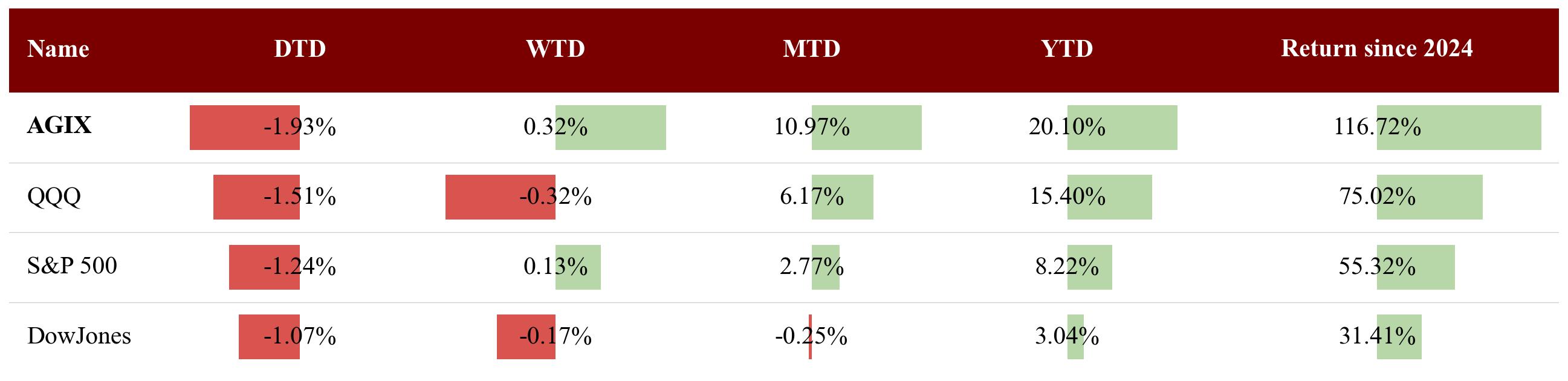
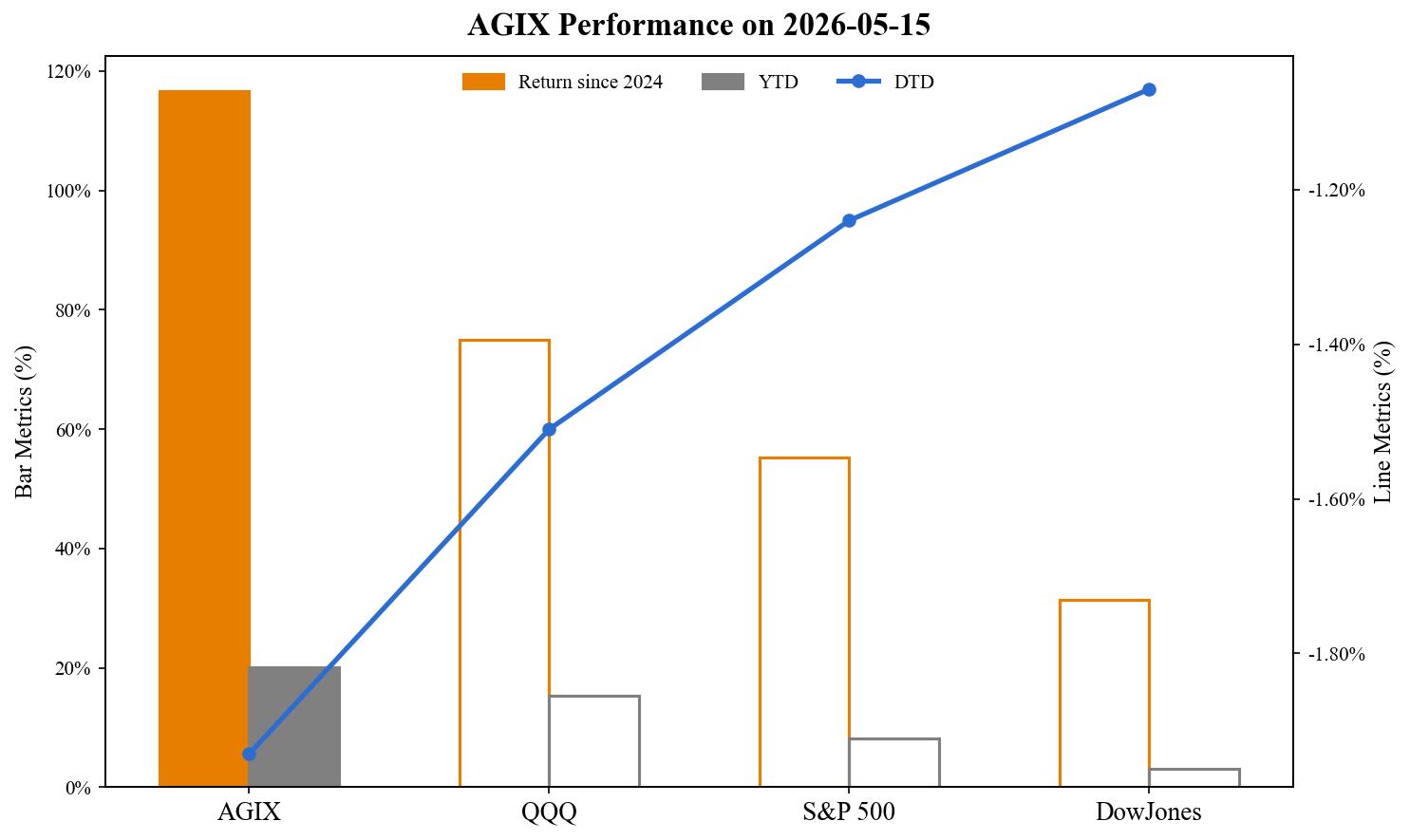
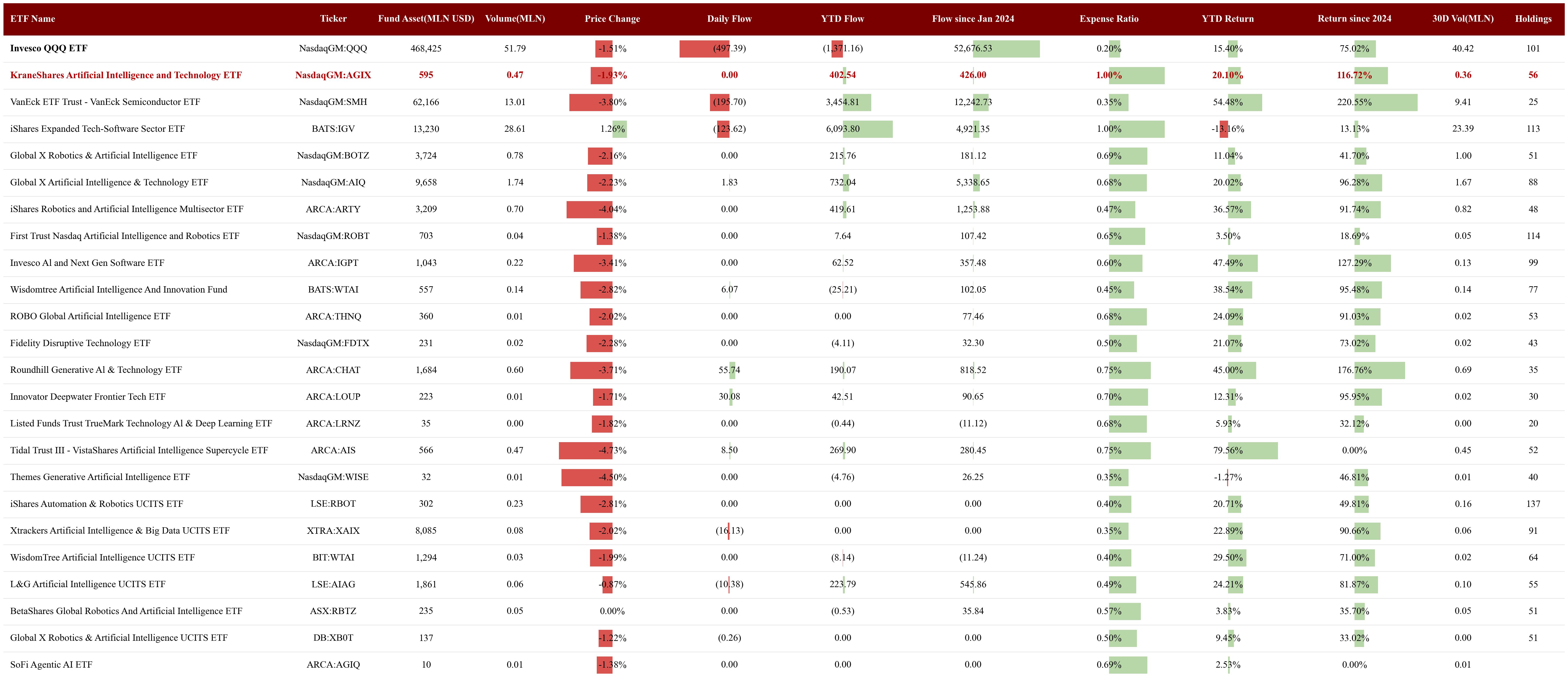
• AGIX fell 1.93% DTD, underperforming the S&P 500 (-1.24%) and QQQ (-1.51%), but significantly lagged the Dow (-1.07%). The broader AI-themed ETF space was mixed, with IGV (+1.26%) and LRNZ (+1.85%) posting gains, while semiconductor-heavy SMH (-3.8%) and AIS (-4.73%) dragged.
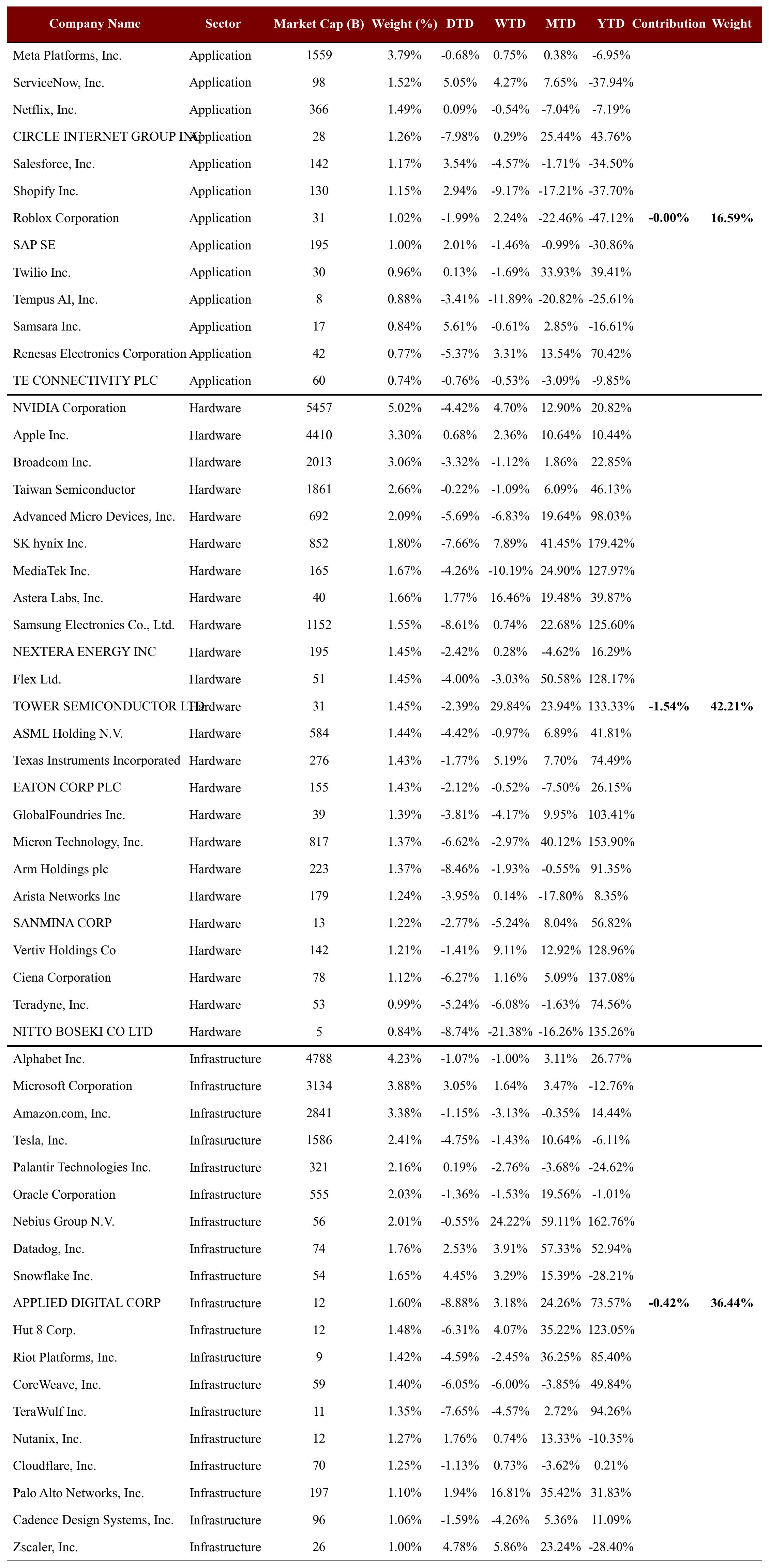
• AGIX's hardware holdings were the main drag: NVIDIA (-4.42%), Broadcom (-3.32%), SK hynix (-7.66%), Micron (-6.62%), and AMD (-5.69%) all fell sharply amid reports of chip capacity expansion and a softer DTD for the sector. TSMC (-0.22%) held relatively steady.
• Positive contributions came from infrastructure and application names: ServiceNow (+5.05%) and Salesforce (+3.54%) rallied on strong enterprise AI demand signals, while Snowflake (+4.45%), Samsara (+5.61%), and Microsoft (+3.05%) also outperformed.
• Key stocks to watch: NVIDIA (chip demand from AI factory buildout), ServiceNow (agentic AI momentum), and Snowflake (deepening AI integration with Dataiku) are all supported by recent news. Peer ETF moves highlight strong interest in Doosan Robotics (+19.29%) and Globant (+14.17%), signaling robotics and AI services themes.
News Highlights
1. Figma surged 12%+ after-hours on 46% revenue growth and rising AI product adoption (60% of large customers use Figma Make weekly). The positive AI monetization trend is likely to lift sentiment for AGIX's application holdings like ServiceNow and Salesforce.
2. Applied Materials raised guidance as AI chipmakers rush to add capacity, with semiconductor equipment sales up 11% and a 30% growth forecast. This supports AGIX's hardware names NVIDIA, AMD, and TSMC, though DTD weakness suggests near-term profit-taking.
3. PwC expanded its Anthropic alliance, training 30,000 US employees on Claude and deploying it to 364,000 staff, with production deployments cutting insurance underwriting from 10 weeks to 10 days. This underscores the accelerating enterprise AI adoption benefiting infrastructure holdings like Microsoft and Snowflake.
4. OpenAI is reportedly considering suing Apple over poor ChatGPT-Siri integration, highlighting risks in AI partnerships. Separately, Greg Brockman took charge of product strategy, merging ChatGPT and Codex into a unified agentic future, which could intensify competition for AGIX's AI platform holdings.
5. Veeam launched the DataAI Command Platform, targeting the missing trust layer in the AI stack, and Dataiku deepened its Snowflake integration for governed AI workflows. These moves reinforce the importance of governance and data infrastructure, supporting AGIX's Snowflake and Datadog positions.
RSS Highlights
1. Salesforce launched Headless 360, offering APIs as the UI, signaling a shift to headless enterprise where AI agents replace traditional interfaces. This trend could reshape SaaS value propositions and impact AGIX's application holdings.
2. ArXiv will ban authors for one year if they fail to verify AI-generated content, a key move to combat AI garbage in research. This highlights growing scrutiny on AI output quality, relevant for AGIX's AI infrastructure names.
3. DeepSeek-V4-Flash brings new 'steering' techniques for LLMs, making model behavior more controllable. This could lower costs and improve reliability, benefiting AGIX's AI platform holdings.
4. The UK government ended its contract with Palantir and built a more efficient in-house system, demonstrating that open-source and internal development can outperform private vendors. This may influence enterprise AI procurement trends.
5. Meta plans to lay off ~8,000 employees (10% of workforce) amid AI investment pressures, reflecting the broader industry tension between AI spending and workforce costs. This could affect sentiment for AGIX's social media and ad-tech holdings.
Performance & Benchmark
Attribution
Contribution of the three sectors within AGIX holdings today
Application: -0.0%
Hardware: -1.54%
Infrastructure: -0.42%
Top-performing stocks in AGIX holdings today
Samsara Inc. (5.61%)
ServiceNow, Inc. (5.05%)
Zscaler, Inc. (4.78%)
Snowflake Inc. (4.45%)
Salesforce, Inc. (3.54%)
Microsoft Corporation (3.05%)
Shopify Inc. (2.94%)
Datadog, Inc. (2.53%)
SAP SE (2.01%)
Worst-performing stocks in AGIX holdings today
EATON CORP PLC (-2.12%)
TOWER SEMICONDUCTOR LTD (-2.39%)
NEXTERA ENERGY INC (-2.42%)
SANMINA CORP (-2.77%)
Broadcom Inc. (-3.32%)
Tempus AI, Inc. (-3.41%)
GlobalFoundries Inc. (-3.81%)
Arista Networks Inc (-3.95%)
Flex Ltd. (-4.0%)
MediaTek Inc. (-4.26%)
ASML Holding N.V. (-4.42%)
NVIDIA Corporation (-4.42%)
Riot Platforms, Inc. (-4.59%)
Tesla, Inc. (-4.75%)
Teradyne, Inc. (-5.24%)
Renesas Electronics Corporation (-5.37%)
Advanced Micro Devices, Inc. (-5.69%)
CoreWeave, Inc. (-6.05%)
Ciena Corporation (-6.27%)
Hut 8 Corp. (-6.31%)
Micron Technology, Inc. (-6.62%)
TeraWulf Inc. (-7.65%)
SK hynix Inc. (-7.66%)
CIRCLE INTERNET GROUP INC (-7.98%)
Arm Holdings plc (-8.46%)
Samsung Electronics Co., Ltd. (-8.61%)
NITTO BOSEKI CO LTD (-8.74%)
APPLIED DIGITAL CORP (-8.88%)
Top five listed stocks contributing the most within AGIX holdings today
NVIDIA Corporation (-4.42%)
APPLIED DIGITAL CORP (-8.88%)
SK hynix Inc. (-7.66%)
Samsung Electronics Co., Ltd. (-8.61%)
Advanced Micro Devices, Inc. (-5.69%)
Observation
The strongest movers across peer ETF holdings today are listed below:
| DTD | Stock Ticker | Name | Held by ETFs | analysis |
|---|---|---|---|---|
| 19.29 | KOSE:A454910 | Doosan Robotics Inc. | ['NasdaqGM:BOTZ', 'LSE:RBOT', 'ASX:RBTZ', 'DB:XB0T'] | HTTP 404: {"error":{"message":"No allowed providers are available for the selected model.","code":404,"metadata":{"available_providers":["perplexity"],"requested_providers":["openai"]}}} |
| 14.17 | NYSE:GLOB | Globant S.A. | ['LSE:RBOT'] | HTTP 404: {"error":{"message":"No allowed providers are available for the selected model.","code":404,"metadata":{"available_providers":["perplexity"],"requested_providers":["openai"]}}} |
| 13.84 | TSE:6914 | OPTEX GROUP Company, Limited | ['LSE:RBOT'] | HTTP 404: {"error":{"message":"No allowed providers are available for the selected model.","code":404,"metadata":{"available_providers":["perplexity"],"requested_providers":["openai"]}}} |
| 13.68 | TSE:3687 | Fixstars Corporation | ['LSE:RBOT'] | HTTP 404: {"error":{"message":"No allowed providers are available for the selected model.","code":404,"metadata":{"available_providers":["perplexity"],"requested_providers":["openai"]}}} |
| 13.24 | NYSE:FIG | Figma, Inc. | ['ARCA:LRNZ'] | HTTP 404: {"error":{"message":"No allowed providers are available for the selected model.","code":404,"metadata":{"available_providers":["perplexity"],"requested_providers":["openai"]}}} |
| 12.62 | TSE:4776 | Cybozu, Inc. | ['LSE:RBOT'] | HTTP 404: {"error":{"message":"No allowed providers are available for the selected model.","code":404,"metadata":{"available_providers":["perplexity"],"requested_providers":["openai"]}}} |
| 11.93 | SEHK:861 | Digital China Holdings Limited | [] | HTTP 404: {"error":{"message":"No allowed providers are available for the selected model.","code":404,"metadata":{"available_providers":["perplexity"],"requested_providers":["openai"]}}} |
| 10.42 | TSE:6324 | Harmonic Drive Systems Inc. | ['ARCA:IGPT', 'LSE:RBOT'] | HTTP 404: {"error":{"message":"No allowed providers are available for the selected model.","code":404,"metadata":{"available_providers":["perplexity"],"requested_providers":["openai"]}}} |
| 9.89 | TWSE:3008 | LARGAN Precision Co.,Ltd | ['ARCA:IGPT', 'LSE:RBOT'] | HTTP 404: {"error":{"message":"No allowed providers are available for the selected model.","code":404,"metadata":{"available_providers":["perplexity"],"requested_providers":["openai"]}}} |
| 9.03 | TSE:3905 | Datasection Inc. | ['NasdaqGM:WISE'] | HTTP 404: {"error":{"message":"No allowed providers are available for the selected model.","code":404,"metadata":{"available_providers":["perplexity"],"requested_providers":["openai"]}}} |
| 8.76 | NYSE:DXC | DXC Technology Company | ['NasdaqGM:AIQ'] | HTTP 404: {"error":{"message":"No allowed providers are available for the selected model.","code":404,"metadata":{"available_providers":["perplexity"],"requested_providers":["openai"]}}} |
| 8.16 | NasdaqGS:TEAM | Atlassian Corporation | ['NasdaqGM:QQQ', 'BATS:IGV', 'NasdaqGM:FDTX', 'ARCA:LOUP', 'XTRA:XAIX'] | HTTP 404: {"error":{"message":"No allowed providers are available for the selected model.","code":404,"metadata":{"available_providers":["perplexity"],"requested_providers":["openai"]}}} |
| 8.13 | NYSE:HUBS | HubSpot, Inc. | ['BATS:IGV', 'ARCA:IGPT', 'BATS:WTAI', 'ARCA:THNQ', 'ARCA:LOUP', 'LSE:AIAG'] | HTTP 404: {"error":{"message":"No allowed providers are available for the selected model.","code":404,"metadata":{"available_providers":["perplexity"],"requested_providers":["openai"]}}} |
| 6.71 | NYSE:ASAN | Asana, Inc. | ['BATS:IGV', 'LSE:RBOT', 'XTRA:XAIX'] | HTTP 404: {"error":{"message":"No allowed providers are available for the selected model.","code":404,"metadata":{"available_providers":["perplexity"],"requested_providers":["openai"]}}} |
| 6.6 | NASDAQGM:INOD | Innodata Inc. | ['NasdaqGM:ROBT'] | HTTP 404: {"error":{"message":"No allowed providers are available for the selected model.","code":404,"metadata":{"available_providers":["perplexity"],"requested_providers":["openai"]}}} |
| 6.59 | NasdaqGS:DXCM | DexCom, Inc. | ['NasdaqGM:QQQ'] | HTTP 404: {"error":{"message":"No allowed providers are available for the selected model.","code":404,"metadata":{"available_providers":["perplexity"],"requested_providers":["openai"]}}} |
| 6.41 | NasdaqGS:FRSH | Freshworks Inc. | ['BATS:IGV', 'ARCA:IGPT'] | HTTP 404: {"error":{"message":"No allowed providers are available for the selected model.","code":404,"metadata":{"available_providers":["perplexity"],"requested_providers":["openai"]}}} |
| 6.2 | NYSE:PATH | UiPath Inc. | ['BATS:IGV', 'NasdaqGM:BOTZ', 'NasdaqGM:AIQ', 'ARCA:ARTY', 'NasdaqGM:ROBT', 'NasdaqGM:WISE', 'LSE:RBOT', 'XTRA:XAIX', 'BIT:WTAI', 'ASX:RBTZ', 'DB:XB0T'] | HTTP 404: {"error":{"message":"No allowed providers are available for the selected model.","code":404,"metadata":{"available_providers":["perplexity"],"requested_providers":["openai"]}}} |
| 5.71 | TSE:6526 | Socionext Inc. | ['NasdaqGM:AIQ', 'ARCA:IGPT', 'LSE:RBOT'] | HTTP 404: {"error":{"message":"No allowed providers are available for the selected model.","code":404,"metadata":{"available_providers":["perplexity"],"requested_providers":["openai"]}}} |
| 5.61 | NYSE:IOT | Samsara Inc. | ['NasdaqGM:AGIX', 'BATS:IGV', 'ARCA:IGPT', 'BATS:WTAI', 'ARCA:THNQ', 'ARCA:LRNZ', 'LSE:AIAG'] | HTTP 404: {"error":{"message":"No allowed providers are available for the selected model.","code":404,"metadata":{"available_providers":["perplexity"],"requested_providers":["openai"]}}} |
| 5.27 | NasdaqGS:WDAY | Workday, Inc. | ['NasdaqGM:QQQ', 'BATS:IGV', 'NasdaqGM:AIQ', 'NasdaqGM:ROBT', 'NasdaqGM:FDTX', 'LSE:RBOT', 'BIT:WTAI'] | HTTP 404: {"error":{"message":"No allowed providers are available for the selected model.","code":404,"metadata":{"available_providers":["perplexity"],"requested_providers":["openai"]}}} |
| 5.25 | NYSE:GWRE | Guidewire Software, Inc. | ['BATS:IGV'] | HTTP 404: {"error":{"message":"No allowed providers are available for the selected model.","code":404,"metadata":{"available_providers":["perplexity"],"requested_providers":["openai"]}}} |
| 5.23 | NYSE:DV | DoubleVerify Holdings, Inc. | ['ARCA:IGPT'] | HTTP 404: {"error":{"message":"No allowed providers are available for the selected model.","code":404,"metadata":{"available_providers":["perplexity"],"requested_providers":["openai"]}}} |
| 5.09 | NasdaqGS:TENB | Tenable Holdings, Inc. | ['BATS:IGV', 'XTRA:XAIX'] | HTTP 404: {"error":{"message":"No allowed providers are available for the selected model.","code":404,"metadata":{"available_providers":["perplexity"],"requested_providers":["openai"]}}} |
| 5.05 | NYSE:NOW | ServiceNow, Inc. | ['NasdaqGM:AGIX', 'BATS:IGV', 'NasdaqGM:AIQ', 'ARCA:ARTY', 'NasdaqGM:ROBT', 'BATS:WTAI', 'ARCA:THNQ', 'ARCA:CHAT', 'ARCA:LRNZ', 'LSE:RBOT', 'XTRA:XAIX', 'BIT:WTAI', 'LSE:AIAG'] | HTTP 404: {"error":{"message":"No allowed providers are available for the selected model.","code":404,"metadata":{"available_providers":["perplexity"],"requested_providers":["openai"]}}} |
| 5.03 | NasdaqGS:BRZE | Braze, Inc. | ['BATS:IGV', 'ARCA:IGPT'] | HTTP 404: {"error":{"message":"No allowed providers are available for the selected model.","code":404,"metadata":{"available_providers":["perplexity"],"requested_providers":["openai"]}}} |
| 5.02 | TSX:TRI | Thomson Reuters Corporation | ['NasdaqGM:QQQ', 'NasdaqGM:AIQ'] | HTTP 404: {"error":{"message":"No allowed providers are available for the selected model.","code":404,"metadata":{"available_providers":["perplexity"],"requested_providers":["openai"]}}} |
News
Funding & M&A
What the jury will actually decide in the case of Elon Musk vs. Sam Altman
Nine jurors in California are deliberating on the future trial of OpenAI, a case brought by Elon Musk against OpenAI's other co-founders and Microsoft, focusing on events from the founders' split in 2018 to Sam Altman's firing and reinstatement in 2023. Musk alleges that Microsoft's $10 billion investment in 2023 in OpenAI's for-profit subsidiary deviated from its original nonprofit AI safety mission, resulting in massive equity gains for founders and Microsoft while the foundation remained idle. OpenAI argues that Musk's donations were fully used for the mission by 2021, its for-profit entity generated nearly $200 billion in equity value to support the foundation, ChatGPT is offered for free to demonstrate AI accessibility, and Musk left the organization after 2018, knowing the structure but only suing in 2024. The defense emphasizes that Musk attempted to take control of OpenAI's for-profit entity and merge it into Tesla, hired employees to develop AI at Tesla, and questions his motives. A Microsoft witness stated that due diligence found no restrictions on donations, and Microsoft did not exercise veto power, with its investment contributing to OpenAI's achievements. If Musk wins, OpenAI may be forced to revert to a nonprofit, but a hearing next week will debate the consequences. This case highlights the conflict between AI corporate governance and commercialization.
AI training data provider Wirestock raises $23 million in funding.
AI multimodal training dataset startup Wirestock Inc. recently completed a $23 million funding round, led by Nava Ventures, with participation from SBVP, Formula VC, and I2BF Ventures. The company has raised a total of $26 million. Previously, Wirestock launched a platform in 2018 to help photographers and other creative professionals distribute their work through stock image services. This year, it shifted to providing training datasets for AI projects, with over 50 million images and videos created by approximately 700,000 users. The company also offers custom training datasets, specializing in recording user interactions with applications. Its annualized revenue has exceeded $40 million, driven by the investment boom in the world model sector.
World model startups are highly favored: World Labs Inc. (led by AI pioneer Fei-Fei Li) secured $1 billion in funding in February, with investors including Nvidia; competitor AMI Labs Inc. completed a $1.03 billion round in the same period for robot training and hardware engineering automation. Standard Intelligence Inc. raised $75 million last month, using similar visual datasets to develop the FDM-1 algorithm for efficient multi-step business automation. Wirestock plans to use the new funds to hire AI researchers and engineers, develop software products to help enterprise AI labs collaborate on datasets, and consider expanding into other training data types. This funding round follows another $30 million raise by AI data provider AfterQuery, which focuses on AI prompt and reasoning datasets.
Veeam CEO Anand Eswaran says the company’s future is filling the AI stack’s missing layer
Veeam Software Group GmbH is reshaping the enterprise AI stack by building a data and AI trust layer. CEO Anand Eswaran announced at VeeamON 2026 the launch of the industry's first unified data and AI trust infrastructure—the Veeam DataAI Command Platform. Built on technology from the $1.725 billion acquisition of Securiti Inc. completed in December 2025, the platform integrates data security posture management, privacy, governance, and AI trust capabilities. Its core DataAI Command Graph supports over 300 connectors, enabling granular visualization of data across cloud, SaaS, and on-premises environments, going beyond traditional database or storage bucket views. Eswaran emphasized that in an AI ecosystem where Nvidia dominates computing, Databricks and Snowflake control the data layer, and Anthropic and OpenAI provide intelligent models, data trust has become a key bottleneck. The platform unifies data security, governance, compliance, privacy, and resilience, supporting agentic security and precise recovery, rolling back only seconds of operations for erroneous agent actions rather than full 24-hour restores. Customer feedback shows that poorly governed data leads to failure in even the most advanced agent deployments. This move marks Veeam's strategic transformation from a backup and recovery platform to an AI trust infrastructure, with an eye on an IPO.
Cerebras’ monster IPO, Cisco’s big quarter, and the AI factory’s real impact
Cerebras successfully completed a massive IPO this week, with the stock price surging 68% on the first day after two upward revisions, raising at least $5.5 billion. This move may spur SpaceX, OpenAI, and Anthropic to accelerate their listing plans. Nvidia's market value is approaching $6 trillion, with experts saying it is leading a historic transformation in enterprise computing platforms. Despite high stock prices, its financial reports remain highly anticipated. Demand for enterprise AI agent control is surging, with Red Hat launching an agent AI strategy at its summit, and SAP and Honeycomb following suit by offering agent management and observability services. OpenAI is reportedly considering suing Apple for failing to fulfill the integration agreement between ChatGPT and Siri. Google I/O is expected to release a new Gemini model, and Dell Technologies World will also focus on AI. Financing and M&A are active: Recursive Superintelligence raised $650 million for self-improving AI models, Photonic raised over $200 million for quantum computing, Judgment Labs secured $32 million for an AI agent improvement layer, and several AI startups like Wirestock raised tens of millions of dollars. Nebius acquired Clarifai's compute orchestration technology, and Celonis bought Ikigai Labs to enhance enterprise AI. Product launches are frequent, including Anthropic Claude for small and medium-sized businesses, SAP Joule AI portal, and Okta Bedrock agent security, highlighting that AI agents, reasoning, and sovereignty strategies have become industry hotspots, with enterprises accelerating the deployment of autonomous AI ecosystems.
OpenAI co-founder Greg Brockman takes charge of product strategy
Greg Brockman, one of the founders of OpenAI, has officially taken over the company's product strategy guidance, solidifying his leadership in the product domain. Previously, Fidji Simo, the CEO of AGI deployment, temporarily delegated related responsibilities to Brockman due to medical leave. According to Wired, Brockman explicitly stated in internal communications that ChatGPT and the programming product Codex will be integrated into a unified product experience to concentrate resources on advancing an "agentic future." OpenAI has halted side projects like the video generator Sora and returned to the core ChatGPT experience. This adjustment will help strengthen the company's competitive advantage in both consumer and enterprise markets.
GridCare raises $64 million to accelerate AI data center projects.
U.S.-based company GridCare Inc. announced the completion of a $64 million Series A funding round, led by Sutter Hill Ventures, with participation from John Doerr, National Grid plc, and Stanford University. The company was initially spun out of Stanford University's Sustainability Accelerator program. Its core product, GridCARE Energize, uses AI models to identify underutilized capacity in the power grid, helping data center operators quickly locate suitable sites and avoid large-scale infrastructure investments, thereby significantly reducing grid connection times. The company has partnered with Portland General Electric to rapidly connect five data centers and release 400 MW of capacity, and currently supports 4 GW-scale projects across 12 U.S. markets. As AI computing drives surging electricity demand, GridCare provides an efficient solution for data center construction by unlocking existing grid potential through software.
OpenAI co-founder Greg Brockman reportedly takes charge of product strategy.
According to Wired, OpenAI co-founder and President Greg Brockman has officially taken over the company's product strategy, solidifying his interim role in charge of products. Currently, the company's AGI Deployment President, Fidji Simo, is absent due to medical leave, and Brockman has taken over her responsibilities. Internal memos show that OpenAI will merge ChatGPT and Codex products to create a unified user experience, concentrating resources toward an intelligent agent future and gaining advantages in both consumer and enterprise markets. This restructuring is the latest move following CEO Sam Altman's announcement of a 'code red,' with the company halting side projects like the Sora video generator and OpenAI for Science, emphasizing the vision of building an AI super app. Industry insiders believe this move helps focus efforts on enhancing core product competitiveness.
Veeam CEO Anand Eswaran says the company’s future is providing the AI stack’s missing layer
Veeam Software Group GmbH is strategically transforming to enter the data and AI trust infrastructure space, addressing trust challenges from the rapid development of Agentic AI. CEO Anand Eswaran announced at VeeamON 2026 the launch of the industry's first unified data and AI trust platform—Veeam DataAI Command Platform. Built on technology from the $1.725 billion acquisition of Securiti Inc. completed in December 2025, the platform integrates data security posture management, privacy, governance, and AI trust capabilities, constructing a DataAI Command Graph that supports over 300 connectors for granular data visibility across cloud, SaaS, and on-premises environments. Eswaran emphasized that in the enterprise AI stack, Nvidia dominates compute, Databricks and Snowflake control the data layer, and Anthropic and OpenAI provide intelligent models, while Veeam fills the missing trust layer between data and models. The platform not only unifies data security, governance, compliance, privacy, and resilience but also handles identity management and supports precise recovery, rolling back only erroneous agent actions rather than entire 24-hour operations. Customer feedback indicates that poorly governed data will cause even the most advanced Agentic deployments to fail. This move marks Veeam's leap from a backup and recovery platform to a core infrastructure provider in the AI era, with an eye on an IPO, aiming to provide a trusted foundation for enterprise AI.
Veeam CEO Anand Eswaran says the company’s future is in providing the missing layer of the AI stack.
Facing the data trust challenges brought by the rapid development of agentic AI, Veeam has shifted its strategic focus from backup and recovery platforms to data and AI trust infrastructure. By completing the $1.725 billion acquisition of Securiti in December 2025, Veeam integrates data security posture management, privacy, governance, and AI trust capabilities, launching the industry's first unified data and AI trust platform, the Veeam DataAI Command Platform. This platform is based on the DataAI Command Graph, supports over 300 connectors, and enables granular visibility into data across cloud, SaaS, and on-premises environments. CEO Anand Eswaran stated that the trust layer unifies backup, governance, privacy, regulations, and compliance, providing precise recovery capabilities for agentic AI and preventing local failures from causing global rollbacks. Veeam sits between the data layer and the model layer, complementing companies like Nvidia, Databricks, Snowflake, and OpenAI.
The $60 billion AI chip darling Cerebras almost died early on, burning $8 million a month.
AI chip innovator Cerebras Systems completed a blockbuster IPO on Thursday, reaching a market cap of $60 billion, making its founder and CEO a millionaire. The company primarily provides inference chips to giants like OpenAI and AWS. During its early days in 2019, Cerebras faced bankruptcy due to challenges with giant chip packaging technology, spending $10 million per month and accumulating $8 million in losses. After manufacturing with TSMC, the team solved the packaging problem by developing its own cooling and data transmission systems, successfully booting the chip for the first time in July 2019. Previously, the team had sold SeaMicro to AMD for $3.34 billion. Currently, OpenAI has provided $1 billion in financing, obtained warrants for a 55% stake, and restricted Cerebras from selling to competitors. Industry insiders note that the company will advance to market in stages, first serving core customers.
For Eclipse, the $2.5B Cerebras win is just the start of realizing its physical-world thesis
Eclipse Ventures, founded by Lior Susan in 2015, has evolved from a niche trend of investing in the digitalization of the physical world to a central force in tech investment. The firm's early investment in Cerebras Systems and its path to going public have yielded substantial returns. As global GDP is closely tied to the physical world, investments in hardware, robotics, semiconductors, and defense are gaining market traction. The firm's portfolio raised nearly $8.5 billion last year and reached $4.5 billion in the first quarter of this year alone. Large funding rounds for companies like Wayve and True Anomaly demonstrate the combined momentum of AI, policy support, and capital. Susan notes that U.S. government subsidies and regulatory optimization have provided unprecedented opportunities for this wave of physical world technology to emerge.
The haves and have-nots of the AI gold rush
Deedy Das, a partner at U.S. investment firm Menlo Ventures, recently published a lengthy post on social media, pointing out that the tech industry's mindset amid the current AI boom is not optimistic. He estimates that about 1,000 founders and employees from companies like OpenAI, Anthropic, and Nvidia have accumulated over $20 million in retirement assets through equity and other means, while most other software engineers still earn less than $500,000 annually and face mass layoffs. Das argues that AI technology is creating wealth miracles on one hand, while on the other, automation is rendering traditional skills obsolete, leading to deep unease and confusion within the industry. This viewpoint has sparked heated discussion among entrepreneurs and netizens, with some suggesting that those involved are already among the fortunate and should recognize the disparity in opportunities. This phenomenon reflects the coexistence of an AI investment boom and structural employment shocks.
If you’re giving a commencement speech in 2026, maybe don’t mention AI
This article reports on the phenomenon of students laughing at the topic of artificial intelligence at multiple university graduation ceremonies. Graduates at the University of Texas laughed continuously when former Google CEO Eric Schmidt mentioned AI, as he had been questioned due to a sexual assault lawsuit. Gloria Caulfield, an executive at Terasdock Development Company, claimed in her speech at the University of Central Florida that AI would lead the next industrial revolution, but she also faced resistance. The backlash is related to employment concerns, with recent surveys showing that young people's views on job prospects have declined. Nvidia CEO Jensen Huang's speech at Carnegie Mellon University, however, faced no protests. Commentators view AI as a new face of hyper-expansionist capitalism. Graduates' concerns about technological change reflect current economic and social pressures.
Why trust is a big question at the Elon Musk-OpenAI trial
This week, Elon Musk and OpenAI's lawyers delivered their closing statements in court, and the case has now been handed over to the jury for decision. The lawsuit primarily revolves around whether OpenAI engaged in misconduct during its transition to a more profit-oriented organization. During the trial, Musk's lawyers questioned the honesty of OpenAI CEO Sam Altman's testimony before Congress, sparking widespread discussion about his credibility. Guests on TechCrunch's "Equity" program noted that this issue is not just about Altman but concerns transparency and trust across the entire AI industry. Since AI labs are mostly private companies, outsiders find it difficult to understand their internal operations. Altman admitted to having a tendency to avoid conflict, while Musk's repeated lies on social media have also been called into question. The jury will make a decision based on the core facts, and this case will also influence the industry's views on trust and purpose.
Technical Breakthroughs
Silicon Valley’s vacationland needs a new energy provider just as AI is driving prices up.
Silicon Valley's resort destination Lake Tahoe is facing a power supply crisis. The agreement between its current supplier Liberty Utilities and NV Energy expires in May 2027, and NV Energy will prioritize diverting electricity to Nevada's booming data center projects, forcing Lake Tahoe to find a new supplier. NV Energy has received over 22 gigawatts of power demand requests, more than 40 times Lake Tahoe's peak electricity usage. Although both companies claim data centers are not the direct cause, industry insiders widely believe the explosive growth of AI data centers is a key factor. High power demand has marginalized traditional customers like the Lake Tahoe community, and the region's grid is more connected to Nevada than California, compounding the challenge. Meanwhile, Utah has approved a 40,000-acre data center project expected to consume up to 9 gigawatts of electricity, exceeding the state's current total usage of 4 gigawatts, further driving up regional electricity prices. Vacation homeowners among Silicon Valley's tech elite will also feel the impact. This situation highlights the immense pressure AI data centers place on the power grid, the lack of voice ordinary people have in technology rollouts, the worsening electricity market due to surging demand and tight supply, and the Trump administration's Iran policy adding to energy market uncertainty. Lake Tahoe residents may face higher electricity bills, marking the social impact of the AI energy crisis beginning to affect the elite class.
Runway started by helping filmmakers — now it wants to beat Google at AI
AI video generation startup Runway, despite lacking a traditional Silicon Valley background, has become an industry focus with its unique vision. The company's three founders, originally from Chile and Greece, met at New York University's Tisch School of the Arts and founded Runway in 2018, focusing on video generation models like the latest Gen-4.5, widely used in filmmaking and advertising, partnering with giants like Lionsgate and AMC Networks, and even contributing to the film 'Everything Everywhere All at Once.' Currently valued at $5.3 billion, it added $40 million in annual recurring revenue in Q2. Runway's founders believe the next generation of AI intelligence will come from video and world models, not pure language models; they launched their first world model last December and plan to release new products this year, aiming to expand into robotics, drug discovery, and climate modeling. Despite fierce competition from Google's Veo and Genie models and OpenAI, Runway stands out with its agile culture and early revenue model. The company has raised $860 million, including a $315 million round involving AMD Ventures and Nvidia, and partners with CoreWeave for compute power. The founders emphasize that abandoning Silicon Valley rules and focusing on real-world observation data training will accelerate scientific discovery and even anti-aging research.
Applied Materials boosts its outlook as AI chipmakers scramble to add more production capacity.
Chip manufacturing equipment giant Applied Materials Inc. reported strong earnings and guidance, benefiting from surging demand for artificial intelligence chips. The company posted second-quarter adjusted earnings per share of $2.86, beating Wall Street expectations of $2.68, with revenue of $7.9 billion, up 11% year-over-year, and net income of $2.806 billion. Looking ahead to the current quarter, it expects earnings per share of $3.36 and sales of $8.95 billion, both exceeding analyst forecasts. President Gary Dickerson said the semiconductor equipment business will grow over 30% this year, driven by the rapid global buildout of AI computing infrastructure and the company's leadership in leading-edge logic, DRAM, and advanced packaging. Customers including TSMC and Micron Technology are accelerating capacity expansion for high-end chips to meet AI computing demands. The company tracks over 100 factory projects globally and expects a record fiscal 2027. Semiconductor systems business set a record $5.97 billion in sales, DRAM segment $1.7 billion, and global services $1.7 billion, all hitting new highs. AI agent workloads further boost demand for CPUs, DRAM, and NAND. The company's stock has risen over 71% year-to-date, reflecting market confidence.
Runway started by helping filmmakers. Now it wants to beat Google at AI.
AI video generation startup Runway, despite lacking a traditional Silicon Valley background, was founded in 2018 by three founders from Chile and Greece who met at New York University's Tisch School of the Arts. The company started with video generation models, and its latest Gen-4.5 model and AI tools are now widely used in filmmaking and advertising, partnering with media giants like Lionsgate and AMC Networks, and even contributing to films like Everything Everywhere All at Once. Runway is currently valued at $5.3 billion, adding $40 million in annual recurring revenue in the second quarter. Runway bets that video and world models will become the next frontier of AI, surpassing the limitations of language models by training on observational data to understand real-world dynamics. Co-founder Anastasis Germanidis emphasizes that this approach can break free from human knowledge biases and drive breakthroughs in robotics, drug discovery, and climate modeling. The company has already launched its first world model and plans to release a new generation within the year, expanding to deployment in robotics departments. Despite competition from Google's Veo and Genie models, OpenAI, and Luma AI, Runway continues to deepen its multimodal AI infrastructure with $860 million in funding (including a $315 million round involving AMD Ventures and Nvidia) and partnerships with CoreWeave and Nvidia, aiming to build biological world models and even anti-aging research to accelerate scientific progress.
Red Hat outlines its sovereign AI strategy amid growing concerns over regulation and control
Red Hat announced at its summit this week an expansion of support for sovereign clouds, addressing the growing importance of AI sovereignty globally. Sovereign clouds emphasize storing and processing data and models within specific national or regional boundaries, with Gartner projecting 36% annual growth in this market. Red Hat executives position sovereign AI as a core challenge of the AI era, involving not only compliance but also operational resilience and control. The company introduced 'landing zones' based on Red Hat Enterprise Linux, OpenShift, and Ansible—automated pre-configured environments with operational guardrails to ensure jurisdictional control. Additionally, Red Hat released a service fulfillment API to support sovereign service provisioning on OpenShift, localized software delivery in the EU, and sovereign support operations to ensure sensitive data is accessed only by EU citizens. The company also launched the 'SOS Clean AI Project' to develop automated log scrubbing features that mask sensitive data. Red Hat emphasizes the transparency of its open-source roots, allowing users to audit software for backdoors. Customer examples include Norwegian telecom Telenor using OpenShift AI to build a local AI factory, UAE's Core42 and India's NxtGen Cloud creating regional AI clouds on Red Hat platforms. Despite trust challenges facing US companies, Red Hat relies on its open-source model and regional controls to navigate sovereignty complexities, driving the evolution of its hybrid cloud strategy.
Apple’s Siri revamp could include auto-deleting chats
Apple will launch a new version of Siri at its Worldwide Developers Conference in June, with privacy protection as a core theme. According to Bloomberg's Mark Gurman, Apple executives will emphasize that its AI strategy focuses more on user privacy to differentiate itself from other tech companies. The new Siri will launch as a standalone app powered by Google Gemini, offering a ChatGPT-like conversational bot experience. Compared to other chatbots, this app will have stricter limits on user data storage time, possibly supporting automatic deletion of conversations after 30 days or one year. Apple sees this move as a key opportunity to re-establish its AI leadership, but analysts point out that Google's involvement in the technology implementation may weaken its privacy claims.
Red Hat dials in on telco cloud modernization as legacy pressure mounts.
Telecom operators are facing an urgent need for cloud modernization to address challenges from 5G, 6G, and edge AI, as well as the burden of legacy siloed infrastructure. Fran Heeran, Vice President of Global Telecom Business at Red Hat, stated at Red Hat Summit 2026 that a unified platform has become a strategic necessity for full lifecycle management, security patching, and rapid deployment. Red Hat's OpenShift Virtualization, as a unified platform for VMs and containers, is bridging cloud-native core networks with traditional virtualized IT environments, helping operators eliminate technology stack fragmentation. New Zealand's One New Zealand Group Ltd. has pioneered this strategy, achieving nearly a 50% improvement in new workload deployment speed, setting an industry benchmark. Additionally, digital sovereignty is on the rise, especially in Europe, where operators like Telenet Group N.V. and Telenor ASA are deploying local sovereign cloud solutions, not only meeting compliance requirements but also turning them into new monetization opportunities. Heeran emphasized that telecom operators, leveraging their local infrastructure experience, can transform regulatory obligations into differentiated services, driving consistent management across network diversity. This trend marks a shift in telecom cloud from long-term planning to immediate strategy, helping operators improve operational efficiency in the AI era.
Product Launches
A $10 trillion bet: Coupa uses data to make its case for AI and autonomous spend management
At the 'poker table' of the tech world, Coupa Software Inc., leveraging a cumulative $10 trillion in spending data, is betting on artificial intelligence to gain an edge. This strategy is drawing attention. Coupa CEO Leagh Turner unveiled new AI products and services at the Coupa Inspire conference in Las Vegas. These new AI capabilities aim to fully utilize the massive enterprise spending data accumulated on the Coupa platform, helping customers achieve smarter procurement decisions, spend management, and supply chain optimization. As a leading provider of enterprise spend management software, Coupa's AI innovation marks a key step in its transition from traditional SaaS to intelligent transformation. By deeply integrating AI technology, Coupa can offer advanced features like predictive analytics, automated approvals, and risk identification to millions of users worldwide, further solidifying its leadership in B2B payments and procurement markets. Industry analysts believe that as the AI wave sweeps enterprise software, Coupa's move not only enhances product competitiveness but may also reshape the industry landscape. The market is eager to see the real-world impact of these new AI products and their contribution to future revenue growth. This also underscores the core value of data assets in the AI era, with Coupa using this as leverage to seek breakthroughs in fierce competition.
Osaurus brings both local and cloud AI models to your Mac.
As AI models become increasingly commoditized, startup Osaurus has launched an open-source LLM server designed specifically for Apple devices, allowing users to flexibly switch between different AI models locally or in the cloud while keeping files and tools on their own hardware. The project originated from the desktop AI assistant Dinoki, and user feedback led founder Terence Pae (a former Tesla and Netflix software engineer) to pivot to local AI operation. Osaurus supports local models such as MiniMax M2.5, Gemma 4, Qwen3.6, Llama, DeepSeek V4, as well as Apple device models and Liquid AI's LFM series; cloud compatibility includes OpenAI, Anthropic, Gemini, xAI/Grok, and others. Through hardware-isolated virtual sandboxes, it ensures data security and provides an easy-to-use interface, distinguishing it from developer tools like OpenClaw or Hermes. Since its launch nearly a year ago, it has been downloaded over 112,000 times, competing with Ollama, LM Studio, and others, but with a greater focus on non-developer user-friendliness. As a complete MCP server, Osaurus comes with over 20 built-in plugins supporting email, calendar, browser, and other functions, and recently added voice capabilities. The founding team is participating in the New York Alliance accelerator and plans to expand local LLM applications into legal and medical fields to address privacy concerns, believing that local AI will reduce demand for cloud data centers and drive innovation in AI intelligence per watt.
9 themes defining the future of trust infrastructure: Insights from VeeamON
At the VeeamON conference, Veeam Software Group GmbH CEO Anand Eswaran emphasized the importance of AI trust infrastructure, noting that 81% of enterprises run AI agents, infrastructure spending will reach $3 trillion, and the erosion of trust boundaries has become a new bottleneck. Leveraging 20 years of backup and disaster recovery experience, Veeam has evolved into the AI resilience era, launching the flagship product Veeam DataAI Command Platform. This platform integrates data security, governance, compliance, privacy, and resilience, achieving a 'single source of truth' through a unified knowledge graph, rooted in deep insights into customer AI trust challenges and built on the acquisition of Securiti Inc. The article explores nine themes, including Veeam positioning as the security layer for AI infrastructure, partnerships with ExaGrid and EverPure to enhance cyber resilience, and collaboration with McKinsey & Co. to promote industry standards. Experts like Zeus Kerravala note that AI trust depends on reliable data, while WellSpan Health architect Kristie Bunn-Kingston emphasizes data protection responsibilities during cloud transformation. Veeam sees AI as a growth opportunity, spanning virtualization, cloud, containers, and the agent era, helping enterprises address AI agent proliferation and cyber threats, ensuring data recoverability and business continuity, and driving AI resilience as a new paradigm for enterprise infrastructure.
Users turn to jailbreaking their older Kindles as Amazon ends support.
Amazon announced that starting May 20, it will discontinue technical support for older Kindle devices, preventing users from downloading new content and allowing them only to read already downloaded files. To continue using their devices, many users have begun jailbreaking their Kindles. Jailbreaking allows users to install custom fonts, alternative reading apps, and other features, but may violate Amazon's terms of service and pose risks such as battery drain or device damage. To avoid buying new devices, users believe jailbreaking preserves control over their devices. A safer alternative is sideloading books via USB from a computer. Additionally, similar e-readers like Boox Palma and Vivlio are available on the market for users to choose from.
OpenAI previews personal finance features in ChatGPT Pro
OpenAI Group PBC has introduced a preview of personal finance features for its highest-tier ChatGPT Pro users, allowing users to connect bank accounts via Plaid and access data from over 12,000 financial institutions. The feature can generate account dashboards, spending charts, and portfolio analysis, and supports users asking natural language questions to identify cancelable subscriptions or risky stocks. It can also calculate multiple credit card fees, analyze quarterly spending trends, and generate multi-year budget roadmaps to assist goals like car purchases. The new feature is based on the GPT-5.5 Thinking model and performs well on FinanceAgent and proprietary financial benchmarks. Future versions will support more proactive actions, including applying for credit cards and predicting approval rates. This launch marks a further step in AI's application in personal finance.
OpenAI brings Codex to mobile devices and adds more customization features.
OpenAI Group Public Benefit Corporation (PBC) today announced that its Codex programming assistant is now available on mobile devices via the ChatGPT iOS and Android clients. The feature launches about eight months after its initial release, following competitor Anthropic PBC's Claude Code mobile version. OpenAI says mobile access significantly accelerates software development tasks and reduces inference costs. The GPT-5.5 large language model powering Codex can handle programming tasks lasting several hours, occasionally requiring developer guidance, such as choosing between options when rewriting legacy code or approving high-risk changes. Previously, users leaving their computers after starting long tasks would cause hours of delays; now, mobile support allows guidance anytime, preventing project delays. Even without strict guidance, users can interrupt suboptimal implementations, reducing wasted token consumption and thus lowering ChatGPT bills. This update also introduces two new features: Hooks and Remote SSH. Hooks allow customers to customize the assistant with scripts, such as cybersecurity scripts blocking sensitive prompts or legal team logs for compliance; scripts can process prompts and responses to tailor project outputs. Remote SSH enables Codex to connect to remote development environments via encrypted links, facilitating cloud-based code management. Additionally, OpenAI has added programmatic access token generation for third-party tool integration and HIPAA compliance support for standalone Codex clients and embedded versions. These upgrades enhance developer flexibility and security, driving the mobilization and enterprise adoption of AI programming tools.
OpenAI launches ChatGPT for personal finance, will let you connect bank accounts.
OpenAI launched a preview of a personal finance tool for U.S. ChatGPT Pro subscribers on Friday, allowing users to connect accounts from over 12,000 financial institutions via Plaid, including Schwab, Fidelity, Chase, Robinhood, American Express, and Capital One, enabling spending analysis, portfolio performance, subscription management, and future financial planning. The tool provides a dashboard displaying user financial data and supports natural language queries, such as recent spending changes or home purchase planning. This move follows OpenAI's acquisition of the personal finance startup Hiro's team last month, whose expertise contributed to product development. OpenAI plans to soon support Intuit, further expanding features like tax impact analysis and credit card approval predictions. The company revealed that over 200 million users per month ask ChatGPT financial questions, and the new GPT-5.5 model has stronger contextual reasoning and has been optimized through financial expert benchmarking. Users can easily manage account connections and data deletion to ensure privacy and security. The tool is currently limited to web and iOS Pro users, with plans to expand to Plus users based on feedback. The AI industry is accelerating vertical integration, with OpenAI and Anthropic already launching health tools, and Perplexity also releasing a financial research product.
Figma stock jumps as first-quarter revenue surges 46% on AI monetization momentum
Figma Inc. shares rose over 12% in after-hours trading after its fiscal first-quarter 2026 results beat expectations and it raised its full-year guidance. The company reported adjusted earnings per share of $0.10 on revenue of $333.4 million, up 233% and 46% year-over-year respectively, both exceeding analyst estimates of $0.06 and $316 million. Revenue growth accelerated for the second consecutive quarter, rising from 40% in the prior quarter to 46%. Despite a reported net loss of $142.4 million, largely due to $169 million in stock-based compensation, customer growth was strong: customers with annual recurring revenue over $10,000 reached 15,200, up 37%; those over $100,000 reached 1,525, up 48%; total paying customers were approximately 690,000, up 54%. Net dollar retention was 139%, a two-year high. Adoption of Figma's AI products continued to climb, with 60% of paying customers over $100,000 using the natural language design tool Figma Make weekly, up from over 50% last quarter. New Pro team conversion rates grew over 150% year-over-year. Results from an AI credit limit test implemented on March 18 were positive, with over 75% of organizations and enterprise users continuing to use it and 95% remaining active. Pro teams purchasing AI add-ons had ARR more than triple that of non-purchasing teams. Weekly active users of the Model Context Protocol server grew 5x quarter-over-quarter, and high-value customers using the server grew 70% faster overall. Business highlights include Code to Canvas integrations with Claude Code, Codex, Cursor, VS Code, and Warp, as well as new MCP features and the Figma Weave timeline editor. Second-quarter revenue guidance is $348 million to $350 million, with full-year guidance raised to $1.422 billion to $1.428 billion, well above expectations.
Autodesk taps Permiso Security to monitor AI agents across its cloud and workforce.
Unified identity security platform provider Permiso Security Inc. today launched AI agent runtime security features, providing security teams with continuous visibility into agent activities in cloud and on-premises environments, with Autodesk Inc. as its first customer. The new features extend Permiso's unified identity platform to cover the fastest-growing and least governed identity category in enterprises—AI agents. Security teams can discover all agents in the environment (including managed and shadow agents), track their runs, events, tool calls, and data access, covering agents, sub-agents, Model Context Protocol servers, and runtime infrastructure.
Autodesk is deploying these features to secure its products, global workforce, and cloud infrastructure. Sebastian Goodwin, Chief Trust Officer at Autodesk, said the company is heavily investing in AI, and Permiso, as its existing identity security platform, naturally became the partner for agent AI identity.
This launch comes as enterprises accelerate the deployment of autonomous decision-making AI agents, which rapidly call external tools, MCP servers, generate sub-agents, and interact with data stores, often without human supervision. Permiso emphasizes that most security teams cannot answer basic questions about the number of agents, their identities, tool calls, or data access. The market often focuses on agent posture (location, authentication, permissions), but Permiso addresses the harder runtime problem—agents' millisecond-level contextual decisions. Traditional identity providers lose visibility after authentication, and non-human identity vendors treat agents as static machine identities, whereas agents are more like humans.
Permiso co-founder and co-CEO Jason Martin noted that agents' non-deterministic behavior requires runtime protection. The new platform covers six capabilities: agent session discovery, runtime identity attribution, tool and data infrastructure observability, runtime anomaly detection, behavioral sandboxing, and identity-first controls. The features are based on P0 Labs threat research, including LLMjacking attacks and cross-prompt injection vulnerabilities. It uses an agentless API architecture and is available immediately.
Boomi CTO: Agentic engineering is how enterprise AI finally earns its keep
Boomi recently launched Boomi Companion, an open-source collection of agent skills that allows developers to build, deploy, and test fully configured Boomi solutions using natural language instructions. The product was unveiled at Boomi World 2026, marking a shift in enterprise AI investment from hype to tangible value. Boomi CTO Matt McLarty stated that after three years of AI investment, many enterprises are waiting for returns, and Boomi Companion is that return. Based on Anthropic's open standards, it supports AI coding agents such as Claude Code, OpenAI Codex, and Microsoft Copilot, enabling full-process automation from code generation to deployment and testing iterations, far surpassing traditional code generation tools. McLarty emphasized that Companion acts as a digital twin of expert knowledge, embedding best practices to ensure structured, scalable, production-grade solutions, avoiding the fragility of amateur 'vibe coding.' At the same time, it retains a graphical interface and supports bidirectional adjustments, combining low-code speed with full platform configuration power. Looking ahead, McLarty believes enterprise software architecture faces a major transformation: balancing deterministic processing with probabilistic reasoning, introducing probabilistic processing into real-time workloads, forming a new paradigm after object-oriented and service-oriented architectures. This innovation helps enterprises that invest early in platform-native AI stay ahead of the competition.
Policy & Regulation
Research repository ArXiv will ban authors for a year if they let AI do all the work
arXiv, the widely used open repository for preprint research, is intensifying efforts to combat the improper use of large language models in scientific papers. As a major research circulation platform in computer science and mathematics, arXiv has mandated that first-time submitters must obtain endorsement from established authors to improve quality, and it is transitioning from Cornell University to an independent nonprofit organization to raise funds to address the AI garbage problem. Thomas Dietterich, chair of the computer science section, recently announced that if a paper contains clear evidence that authors have not verified LLM-generated results—such as fabricated references or LLM commentary—the authors will face a one-year publication ban, and subsequent submissions must first pass authoritative peer review. This policy does not prohibit the use of LLMs but requires authors to take full responsibility for all content, including copied erroneous citations, biases, or misleading material. The rule has become a "one-strike" mechanism, requiring confirmation by the section chair before enforcement. This move is also a response to the recent rise in fabricated citations in biomedical research.
Industry Partnerships
Companies are rethinking the contact center to deliver outcomes — and empathy — at scale
AI transformation in financial services customer contact centers is accelerating, with new innovations bridging the gap between surface-level metrics and true customer understanding, especially in high-stakes interactions. For companies handling deeply personal products like health savings accounts, retirement rollovers, and flexible spending plans, poor customer experience consequences go far beyond satisfaction scores. These are critical moments in individuals' life cycles requiring both empathy and efficiency, and data-driven AI is providing tools to deliver both at scale. Dana Kantor, Senior Director of Vendor and Technology Optimization at Inspira Financial Trust LLC, noted that these are personal choices people make daily involving healthcare payments and future planning, and the company is always committed to delivering better health, greater wealth, and supporting account holders. Shashank Verma, Senior Vice President of Global Digital Customer Experience at EXL Service Holdings Inc., discussed contact center AI transformation, first-call resolution, and AI-driven customer journeys with Kantor at Google Cloud Next. EXL, a data and AI services company, uses its Customer 360 Insights platform to mine Inspira's historical interaction data for potential intent signals, building frictionless customer journeys and avoiding automation of broken processes. On the agent side, AI routes complex, empathy-intensive interactions to human agents, providing real-time next-best-action guidance to reduce search time and improve resolution efficiency; personalized coaching prompts based on historical call analysis shorten training cycles and improve retention in high-turnover roles. The partnership uses AI to learn from historical interactions, identify customer intent, optimize journeys, and drive continuous business improvement. This interview is part of Google Cloud Next coverage, highlighting AI's transformative potential in financial services customer service.
OpenAI reportedly considers taking Apple to court over ChatGPT's Siri integration.
According to Bloomberg, OpenAI Group PBC is extremely dissatisfied with Apple Inc.'s handling of the ChatGPT and Siri integration and is considering legal action against the latter. The two companies announced a high-profile partnership in 2024 to embed ChatGPT into Siri's digital assistant in iOS 18. OpenAI hoped to significantly increase paid subscription users and achieve deeper app integration and a prominent Siri home screen position. However, the collaboration's results have fallen far short of expectations, with new subscription revenue not approaching the target of 'tens of billions of dollars annually.' An anonymous OpenAI executive said the company has done everything possible from a product perspective, but Apple has not fulfilled its commitments and has not even made a sincere effort. OpenAI has hired an independent law firm to evaluate options, which may include issuing a breach of contract notice or filing a lawsuit directly. Although the agreement involves no cash transaction, Apple is supposed to receive a share of subscription revenue sold through its ecosystem. Currently, ChatGPT is integrated into iOS features such as world knowledge queries, Image Playgrounds, and Visual Intelligence, but conversion rates are low. This development comes on the eve of Apple's Worldwide Developers Conference, where the company is expected to unveil an upgraded Siri powered by Google Gemini and support for integrating models like Anthropic's Claude in iOS 27. OpenAI emphasizes that the partnership is not exclusive, and this is not the reason for a potential lawsuit. Meanwhile, OpenAI has poached Apple engineers to develop hardware, led by former Apple design chief Jony Ive, causing dissatisfaction among Apple executives. OpenAI has not yet made a final decision on litigation and still hopes for an out-of-court settlement. This case continues Apple's history of tensions with former partners, such as conflicts with Google Maps and Spotify, the latter of which received €1.8 billion in fines from the EU in 2024.
AI agents are turning SaaS applications into headless, deterministic engines
At Boomi World 2026, Boomi Chief Product and Technology Officer Ed Macosky discussed the trend of enterprise software transitioning to a 'headless enterprise,' where AI agents replace traditional user interfaces as the primary interaction method for business systems. Boomi is helping enterprises bridge legacy applications and the AI agent future through its platform strategy, ensuring governance and cost control. Macosky emphasized that SaaS applications are shifting from competing on user experience to acting as 'referees' for AI agents, providing deterministic rule engines to regulate AI behavior. The Boomi platform combines deterministic workflows with agentic AI processes to avoid the high token consumption costs of pure agent chains, such as handling simple tasks like payroll or expense reports. Looking ahead, Boomi announced a strategic partnership with Red Hat Inc., integrating Boomi Agentstudio with Red Hat AI to provide a unified hybrid AI infrastructure, supporting enterprises in securely deploying open-weight models while keeping data in controlled environments. The collaboration focuses on simplifying agent development, helping customers unlock secure agentic workloads and drive enterprise AI transformation. Boomi emphasized multimodal user experiences to make applications and data more universally accessible, a trend reshaping the core value proposition of SaaS.
Dataiku launches governed AI workflow builder inside Snowflake
Dataiku Inc. today announced a deepened integration with Snowflake Inc., launching Cobuild on Snowflake, a solution designed to simplify the creation of enterprise AI agents while enhancing governance and operational control. The solution combines Snowflake Cortex AI services with Dataiku's orchestration platform, allowing business and technical users to build AI workflows and agents using natural language prompts, enabling rapid transformation from business intent to production-ready workflows, all reviewed, governed, and deployed within the Snowflake environment. This move reflects Dataiku's strategy to transform into an enterprise AI system orchestration and governance layer, with the company continuously expanding agentic AI capabilities over the past year, including managing large numbers of AI agents, coordinating workflows, and improving system visibility. Dataiku emphasized that as agentic AI moves from pilot to large-scale operations, governance, observability, and cost management will become key differentiators. Cobuild on Snowflake addresses pre-deployment review pain points through visual workflow logic: users describe business goals, and the system automatically generates complete workflows for data preparation, machine learning models, AI agents, and applications, with support for inspection and modification. The integration builds on a long-standing partnership, with Snowflake as a Dataiku investor, sharing over 350 global customers, and previous collaborations on visual data preparation, machine learning training, and real-time inference. Snowflake Cortex AI provides managed large language models and vector search services, and the new solution ensures code generation and execution remain within the customer's Snowflake environment. This announcement highlights an industry trend: binding AI processing directly to existing governance and security controls to avoid data duplication and transfer. Dataiku positions itself as the control layer, having launched a unified agent deployment and Agent Hub management framework last year. The software is initially available to joint customers, with plans to expand to Snowflake users for evaluation.
PwC expands its alliance with Anthropic and will train 30,000 employees on Claude
PwC and Anthropic today announced a major expansion of their strategic alliance, with the consulting giant rolling out Claude Code and Claude Cowork tools to its 364,000 global employees and training 30,000 US professionals on Anthropic's AI models. The partnership establishes a joint center of excellence and a Claude-native financial services business unit, focusing on agentic technology construction, AI-native transactions, and financial supply chain and HR transformation to address over $2 trillion in enterprise technical debt. PwC has already achieved multiple production deployments, such as reducing insurance underwriting cycles from 10 weeks to 10 days, completing mainframe modernization projects on time and on budget, launching HR transformations in two months processing thousands of daily transactions, cutting cybersecurity response from hours to minutes, and improving client delivery efficiency by up to 70%. Advocate Health, the largest health system in the US, is rolling out Claude to its 167,000 employees. Claude has been integrated into PwC's internal AI assistant ChatPwC and connects to enterprise data via the Model Context Protocol. Anthropic CEO Dario Amodei emphasized accuracy achievements in finance and healthcare, while PwC US CEO Paul Griggs noted AI is moving into the execution phase. This move comes as Anthropic deepens its presence in regulated industries, competing with OpenAI and Google for enterprise market share.
Eval engineering: The missing piece of agentic AI governance
Experts point out that as AI agent capabilities increase, agentic AI governance has become an important topic. Existing multiple adversarial validator solutions struggle to meet modern automation needs due to latency and cost issues. Evaluation engineers use LLM-as-a-judge technology combined with software testing and observability to build evaluation systems covering the entire lifecycle from development to production. Multiple innovative companies, such as Klover AI, use hierarchical evaluation to improve accuracy, while Maxim AI adopts sampling strategies to reduce production overhead. Galileo AI achieves full-sample efficient governance based on ChainPoll and Luna models, and its technology is about to be acquired by Cisco and integrated into the Splunk organization. Large tech companies like Google, Microsoft, and IBM are also active in this field. Low-cost, high-efficiency AI governance solutions are becoming a sign of industry maturity and will drive faster and more cost-effective deployment of agentic systems.
The big tent: Dell’s expanding partnerships demonstrate strategic shift in enterprise infrastructure
Amid major adjustments in the enterprise infrastructure market, Dell Technologies is striving to establish its position in the AI field through extensive strategic partnerships. These collaborations include alliances with chip manufacturers, virtualization leaders, cloud service providers, and multiple leading software platforms. The partnership between Dell and Nutanix is a key example, providing integrated solutions for virtualized workloads, private cloud, and hybrid cloud environments. The jointly launched PowerEdge XC Plus and PowerFlex software-defined storage are integrated into the Nutanix stack, enabling independent scaling of compute and storage. Additionally, Dell's AI Factory collaboration with Nvidia has been deployed by over 4,000 customers, and its Lightning file system is meeting the high-performance parallel data processing needs of AI model training and inference. Dell's long-term partnership with AMD also continues to advance. Recently, the two integrated AMD Instinct MI350P PCIe GPUs into PowerEdge servers to support large-scale virtualized environments. Meanwhile, Dell's collaboration with Microsoft, through the integration of PowerStore and PowerScale with Azure Local, provides customers with hybrid cloud solutions without the need to purchase new hardware. Furthermore, the Dell APEX Cloud Platform for Red Hat OpenShift offers a unified management platform for containerized applications and virtual machines. These diverse collaborations reflect Dell's efforts to build a resilient, scalable, and efficient enterprise infrastructure ecosystem adapted to the AI era.
融资收购
TechCrunch Mobility: The AI skills arms race is coming for automotive
Recent advancements in AI technology in the transportation industry have been accompanied by workforce adjustments. General Motors is building capabilities in AI-native development, data engineering, and model construction, and has laid off about 10% of its IT department while seeking new talent with AI backgrounds. The three major U.S. automakers have collectively laid off over 2,000 executive positions, mainly due to AI and technological transformation. Samsara uses vehicle monitoring data to train an AI model that detects potholes and has signed contracts with cities like Chicago. Mind Robotics, spun off from Rivian, raised another $400 million in two months, and the three companies founded by RJ Scaringe have raised over $123 billion in total. Multiple autonomous driving and drone startups, such as Arkeus and Rapido, have completed financing rounds. Tesla, Uber, and Waymo continue to advance in robotaxi and autonomous driving deployment.
RSS Subscription
Software engineers are obsolete... for now
During my first interview for a developer position, I showcased a programming learning website I built from scratch, which impressed the interviewer and ultimately landed me the job. As the site's traffic grew, I allowed users to submit tutorials, but now, ordinary people can easily create products using AI tools, making the role of developers seem less important. Although AI lowers the entry barrier, true engineers are still those who continuously improve themselves through practice and experience, and software maintenance and updates still require professional expertise.
How to be inspired without copying
In creation, the motivation behind imitation and understanding is key. Excellent imitators deeply understand the creative process by manually copying classic works, rather than merely replicating surface features. For example, Bach mastered musical structure by copying Vivaldi's concertos, ultimately creating his unique Brandenburg Concertos. True influence arises from collision; creators absorb others' works while integrating their own concerns and limitations, ultimately forming unique creations.
Here Comes (Forward Deployed) Everybody
Salesforce launched Headless 360 in April 2026, announcing that it will no longer provide traditional software but will offer APIs as the user interface, meaning customers need to assemble software functions themselves. This change will affect all enterprise software vendors, and within the next 18 months, other major vendors are expected to launch similar products, leading to the need for specialized personnel in every internal department to translate general AI capabilities into specific work applications.
In the Empire's Defense
The author reflects on Darth Vader, the villain from Star Wars, exploring the complex relationship between power and resistance in the real world. He points out that while the Empire aims to maintain order, there are no absolute good or bad people in reality; rebels' actions can be seen as either destruction or a fight for freedom from different perspectives. Through the TV series Andor, he emphasizes the struggles of ordinary people under oppression, highlighting the oppression of individuals by power, and ultimately concludes that in reality, the Empire always wins.
GDS weighs in on the NHS's decision to retreat from Open Source
NHS England, due to unfounded fears of AI hackers, decided to close nearly 200 open-source code repositories, sparking strong opposition both internally and externally, with a related petition garnering over 2,000 signatures. The latest guidance from the Government Digital Service (GDS) strongly criticized this decision, emphasizing that closing code repositories does not solve security issues and may instead lead to greater risks, calling for increased resource investment in technical teams to ensure system security.
How I use LLMs as a staff engineer in 2026
In 2026, as a staff engineer, I extensively use large language models (LLMs) to generate complete PRs, perform debugging, and conduct testing, especially in familiar domains. Compared to 2025, agents can now independently diagnose 80% of issues, significantly improving my work efficiency. Nevertheless, I still personally write PR descriptions to ensure accurate communication of core ideas, and rely on my own expertise to guide agents in complex tasks.
The Applicability of Spaced Repetition
Spaced repetition works well for systematic information, such as explicit key-value mappings, commonly found in language learning and medicine. However, for highly conceptual knowledge (like mathematics), encoding and memorization become difficult because the information must first be understood and a conceptual model built. Although using AI to generate flashcards may be less effective in some areas, through case studies we may find effective ways to transform complex conceptual knowledge into question-answer formats.
A nicer voltmeter clock
In 2019, I made an improved voltmeter clock using three 90° panel voltmeters, costing about $9. The clock has 13 divisions for the hour scale, and 61 divisions each for the minute and second scales to achieve continuous pointer movement. The circuit design is simple, using an AVR128DB28 MCU and an 8 MHz crystal, connected to three digital output pins, with time setting done via two buttons on the back.
The mistake of conflating intelligence and power
Confusing intelligence with power is a common mistake. According to one definition, intelligence is "the ability to achieve goals across multiple domains," which would make Stalin the smartest person. However, true intelligence should include the ability to understand and construct abstract concepts, and this ability is not strongly correlated with power. The correlation between individual IQ and income is low, but the correlation between national IQ and national outcomes is high, suggesting that smarter societies are better at cooperation and innovation. Therefore, while some companies' AI may be very smart, their real influence lies in how they help those in power.
Notes on pretraining parallelisms and failed training runs.
Common causes of failure during pretraining include causality breakage and bias introduction. Causality breakage may cause the model to acquire information during training that is not visible in real-world applications, while bias accumulates and affects training effectiveness. Research shows that numerical issues and increasing model scale during training continuously present new challenges, suggesting that the prospect of fully automated kernel writing by AI is not optimistic.
RLVR might be disproportionately bad at science
The verification loop of RLVR in the scientific field may have significant limitations. The verification of theories often takes decades or even centuries, and even then, new theories may make worse predictions. History shows that judgments of scientific progress involve complex judgments and heuristic methods, which are not easily quantified or incorporated into reinforcement learning loops. Therefore, AI's performance in scientific breakthroughs may not be as expected.
SQLAlchemy 2 In Practice - Chapter 8: SQLAlchemy and the Web
This chapter is the final chapter of the book "SQLAlchemy 2 in Practice." It introduces how to integrate SQLAlchemy into popular Python web frameworks such as Flask and FastAPI to support traditional web applications and web APIs. The book also discusses methods for integrating database functionality, model serialization, and how to use JSON format for data transmission with clients.
Reading List 05/16/26
This week's reading list covers topics such as cheap housing and expensive land in Tokyo, the U.S. House of Representatives' response to the Senate's housing bill, explosive devices near a dam in Alabama, and Fervo's initial public offering. Housing in Tokyo is relatively cheap not because land is cheap; the land cost for a single-family home on one acre in central Tokyo exceeds $100 million. In the U.S. housing market, many retirees choose not to sell vacant homes due to high taxes.
Pluralistic: Making sense of Trump's unscheduled sudden midair disassembly of the American empire (16 May 2026)
Trump's second term led to the rapid disintegration of the American empire, starting with betrayals of trade partners and European allies, which then triggered major economic and energy crises for Asian allies. The global dominance of U.S. tech giants is not due to their popularity but because U.S. trade policies allowed them to violate local laws, causing social suffering. Meanwhile, the shift to a financialized economy has gradually eroded America's competitive edge globally, while China has pursued a different development model by investing in domestic capabilities and consumption.
DeepSeek-V4-Flash means LLM steering is interesting again
The DeepSeek-V4-Flash model brings new possibilities for "steering" techniques in large language models (LLMs), allowing engineers to experiment on local models. The release of this model makes steering more practical, and although current functionality is still basic, its potential has attracted widespread attention. The core of steering technology lies in adjusting the model's internal activation states to influence output, though current applications still face some limitations.
Make ZIP files smaller with ZIP Shrinker
I developed a browser tool called ZIP Shrinker that compresses ZIP files and their related formats (such as APK, EPUB, and JAR). This tool reduces file size through more efficient recompression, removal of metadata and directory entries, and uses the libdeflate library for improved performance. Test results show that the tool effectively reduces ZIP file sizes without affecting backward compatibility, making it suitable for lowering bandwidth and server costs.
Premium: What If...We're In An AI Bubble? (Part 1)
In discussions about the future of artificial intelligence, many people express concern over the idea that AGI could lead to a 'permanent underclass,' although this claim is considered exaggerated. 23-year-old entrepreneur Yash Kadadi believes that as technology advances, software companies may face a survival crisis, and the partnership between OpenAI and Microsoft is expected to save $97 billion by 2030, provided OpenAI's revenue reaches $190 billion. Despite the market's enthusiasm for AI, the lack of substantial data center construction and reasonable future forecasts makes everything uncertain.
Eric Jang – Building AlphaGo from scratch
Eric Jang introduces how to build AlphaGo from scratch using modern AI tools and discusses its implications for future AI research. He points out that AlphaGo's Monte Carlo Tree Search (MCTS) provides better action suggestions at each step, solving the credit assignment problem in reinforcement learning. Additionally, Jang discusses the application of large language models (LLMs) in automating AI research, emphasizing their advantages in experiment implementation and hyperparameter optimization, as well as the challenges in selecting research problems.
The case of the CreateFileMapping that always reported ERROR_ALREADY_EXISTS
A client, when calling CreateFileMapping to create a named file mapping, succeeded but the returned mapping size was only 4KB, while they expected 1MB, causing the program to crash when accessing beyond 4096 bytes. After investigation, it was found that a mapping with the same name existed from the accompanying software of their webcam. The client avoided the name conflict by appending a GUID to the mapping name.
Pluralistic: No one wants a permanent gerontocracy (15 May 2026)
A recent poll shows that about 80% of Americans support setting age limits for Congress and the presidency, and 65% want an 18-year term limit for Supreme Court justices. This broad cross-party consensus is extremely rare in American politics, reflecting public concern over the aging phenomenon in the current political system.
Recovering the state of xorshift128
Recent research shows that the internal state of the xorshift128 random number generator can be reverse-engineered from its latest four output values, making it easy to predict subsequent outputs. Although xorshift128 performs well in statistical properties, its predictability makes it unsuitable for cryptographic applications, while more secure options like ChaCha are designed to meet the needs of cryptographic random number generators.
Processor Technology Corporation and the SOL-20
Processor Technology Corporation was founded in April 1975 in Berkeley, California, by Gary Ingram and Bob Marsh. The company's most famous product was the SOL-20 personal computer, which used the Intel 8080 microprocessor, began shipping in December 1976, and sold approximately 10,000 units. Despite the success of the SOL-20, the company failed to develop a next-generation product and ceased operations on May 14, 1979.
UK Government Kicks Out Palantir
The UK government performs well in publishing contracts, and the public can view contract information on the official website, although some details may not be disclosed. Recently, the Ministry of Housing, Communities and Local Government (MHCLG) successfully ended its contract with Palantir and developed a more efficient and lower-cost new system, demonstrating that with appropriate resources, civil servants can outperform the private sector.
Search engine results are truly terrible
The quality of search engine results is generally poor, especially when querying without an ad blocker. Tests show that although good information exists on the web, most search tools fail to effectively find it, returning mostly irrelevant junk content. Taking queries like 'ad blocker' and 'minimum K-alpha emission energy of molybdenum' as examples, only a few tools provided accurate answers, with overall performance being poor.
Drata
Thanks to Drata for sponsoring last week's DF conference. Their core message is using autonomous AI agents to automate compliance management, internal and third-party risk management, and continuously prove security posture.
GDS weighs in on the NHS's decision to retreat from Open Source
On May 17, 2026, Link Blog GDS commented on the UK National Health Service's (NHS) decision to abandon open source, calling the decision hasty. The Government Digital Service recommended that openness should be the default, arguing that privatization would increase costs and reduce reuse and scrutiny, emphasizing that openness should be the norm. Although the NHS was not directly mentioned, the comments were interpreted as a major escalation regarding transparency issues in the public sector.
Our servers seem to have surprisingly low power consumption
Due to the impact of high-traffic crawlers, some older browsers (especially Chrome) are flagged as suspicious by my anti-crawling measures, preventing you from accessing my blog (Wandering Thoughts) or its related CSpace. If you are using a current version of the browser, please contact me and provide your browser information. It is recommended to use archive.org for page archiving, as other archiving sites may misuse old user agents, leading to access issues.
Reddit Is Blocking Some Users From Accessing Its Website From Mobile Devices
Recently, I encountered an obstacle when accessing Reddit on my phone: the site forced me to download the app to continue, with no way to skip or close the prompt. A Reddit spokesperson said this is a test targeting a small group of frequent but logged-out mobile users, aiming to provide a more personalized experience and easier community discovery.
Santa Clara County Sues Meta Over Alleged Scam Ads
Santa Clara County leaders have filed a lawsuit against Meta, accusing the company of systematically pushing billions of scam ads to vulnerable Facebook and Instagram users worldwide, generating approximately $7 billion in annual ad revenue from these ads. The lawsuit alleges that Meta not only failed to combat these fraudulent ads but also weakened its own anti-fraud team, allowing fake companies to bypass filtering systems. The county is seeking attorney fees and a ruling to prevent Meta from further violating false advertising and unfair competition laws.
★ AI Is Technology, Not a Product
Apple faces significant challenges in its AI transformation. Although its executives acknowledge that AI is a major turning point, the company is more focused on delivering outstanding products and user experiences rather than technology alone. It is expected that by the end of this decade, users will still primarily interact with AI agents through their phones rather than relying on standalone devices. AI's ubiquity will permeate all of Apple's products, much like wireless connectivity.
Warelay becomes OpenClaw
Since its initial submission in November 2025, OpenClaw has undergone several name changes, including: Warelay, CLAWDIS, CLAWDBOT, Clawdbot, Moltbot, and finally settled on OpenClaw. According to the Git history, these name changes reflect the evolution of its functionality and positioning.
ArXiv will ban researchers for a year if they submit AI-generated garbage
Thomas Dietrich, chair of the Computer Science section at Archive, stated on social media that if generative AI tools produce inappropriate language, plagiarized content, or false information that is incorporated into scientific works, the author must bear responsibility. Recently, the institution clarified penalties: once an author is found to have not checked the results of generated content, they will face a one-year ban, and subsequent submissions must first be accepted by a recognized peer-reviewed journal.
The Tomy Tutor and the state of home computers in 1983
Japan's Tomy Pyuuta (ぴゅう太) first appeared in June 1982, marking the beginning of the development and export of Japanese home computers. The system attracted young users with its graphics capabilities and unique G-BASIC programming language, although its market positioning differed from Texas Instruments' 99/8. Pyuta entered the UK market in early 1983, becoming a relatively successful product in the Japanese market at the time.
Quoting Julia Evans
Over the past decade, I have gradually come to love and respect CSS as a technology. To counter the view that 'CSS is hard,' I decided to study CSS seriously and discovered that many of my past frustrations had actually been solved in CSS long ago. This made me realize that CSS is difficult because it solves complex problems.
Greg Brockman officially takes control of products at OpenAI, a very stable and well-run company
OpenAI announced a company reorganization to unify product lines. Greg Brockman will lead product strategy, and ChatGPT and Codex will be merged into one core product team. This change also includes other executive role adjustments, aimed at streamlining products to meet competitive pressures and prepare for a planned IPO.
The Talk Show: 'A Sociopathic Father'
Adam Lisagor returns to the show to discuss his new virtual demo camera app Hovercraft and how he used AI coding tools to develop it. He also mentions delicious Japanese sandwich cookies.
Five Minutes of Prime Time
In 2008, I joined the cybersecurity company RSA, where I took part in a fun team challenge: writing down all prime numbers between 1 and 1000 in 5 minutes. Our team successfully wrote 168 primes and won a cash prize. Although the game seemed simple, it became one of my most memorable experiences at RSA.
inaturalist-clumper 0.1
Released version 0.1 of inaturalist-clumper, my infrastructure for publishing iNaturalist observations on my blog, after several iterations following weeks of production use. Output examples can be viewed in the provided JSON file.
Aluminium OS: Google's 'Android for PC' OS for Googlebooks
Google is developing a new operating system called 'Aluminium OS', with the internal codename ALOS, designed for laptops and desktop computers. It is built on Android 17 and features a custom window manager, a real taskbar, and virtual desktops. Although Google says 'Aluminium OS' is just a codename and the official brand will be announced later, the system aims to bridge the gap between ChromeOS and Android, targeting all market segments, not just education.
Let's Run a Neologism Poll
After mentioning the term 'dickpanels', I thought it could also be called 'dickovers', though the latter sounds smarter but may be less clear. So I started a poll on Mastodon.
Dropover, a Mac shelf utility that makes clever use of mouse shaking
Dropover is a file management tool for macOS that allows users to collect files, links, text, or images onto temporary shelves and move, share, or process them all at once. It supports custom shortcuts, quick previews, clipboard operations, and integration with Siri. Users can easily manage up to 10 recently used shelves and quickly access important content via the menu bar or desktop widgets. Additionally, users can anonymously upload files to the cloud, set titles, passwords, and expiration dates, and use the tool without registration.
Western Gull, Rock Pigeon
During a birdwatching activity in the Los Angeles area, participants spotted a Western Gull enjoying a Starbucks coffee.
Language registries are unstable by default
Language package management systems differ significantly from traditional operating system package management systems in terms of stability and integrated management. Language registries typically do not provide stability channels, and any certified publisher can upload new versions at any time, increasing the risk of potential malware. In contrast, operating systems like Debian ensure software package compatibility and quality by setting up stability channels and release teams, thereby avoiding pushing unstable software directly into production environments.
QR code generator
Claude and I jointly developed a QR code generation tool that supports creating QR codes for text/URLs and connecting to WiFi networks. The tool provides a simple interface where users can enter information such as the network name, password, and security type.
'Musk v. Altman' closing arguments
In the trial between Musk and Altman, Musk's lawyers performed poorly, even misnaming a co-defendant, and failed to provide sufficient evidence to support Musk's legal claims. The trial revealed many gossip, including Musk admitting that his company xAI used OpenAI's models, as well as his failures in the AI field and attacks on OpenAI. Ultimately, the trial showed that Musk's capabilities in AI were questioned, and xAI's performance was also unsatisfactory.
The Youth AI Safety Institute has the backing of Margrethe Vestager
A non-profit organization in the United States is borrowing safety standards from the automotive industry to protect children from artificial intelligence, and hopes to secure funding support from big tech companies. The organization will be officially launched in the Danish parliament, aiming to establish an independent agency focused on creating a safer AI environment for children, similar to independent crash test ratings for cars. Although it is not yet clear how to conduct "crash tests" on chatbots, the agency emphasizes that the need for transparent AI safety standards and independent testing is more urgent than ever.
datasette-llm-limits 0.1a0
The datasette-llm-limits 0.1a0 plugin works with datasette-llm and datasette-llm-accountant, allowing consumption limits for LLM usage to be configured per user or globally. In the configuration example, the daily consumption limit per user is set to $1.00.
I've finally ported <a href="https://utcc.utoronto.ca/~cks/space/dwiki/DWiki">DWiki</a> from Python 2 to Python 3
Due to the impact of high-traffic crawlers, visitors to my blog (Wandering Thoughts) may encounter blocking pages, especially those using older browsers like Chrome. To reduce the load, I am trying to block these crawlers. If you are using a current version of the browser, please contact me and provide your browser information. It is recommended to use archive.org for page archiving, as other archiving services may misuse old user agents.
Wired reports on the dark mood inside Meta
Meta plans to lay off about 10% of its employees, approximately 8,000 people, next Wednesday, aiming to improve company efficiency and offset other investments. Employee morale is low, with widespread dissatisfaction over pay gaps, company lawsuits, and mandatory role changes; some employees even hope to be laid off to receive compensation. Meanwhile, Meta's advertising business continues to perform well, but the company's spending on AI development is increasing, and employees are angry and fearful about internal monitoring and performance evaluations.
Aided by the Mythos Preview, researchers announce a macOS kernel exploit that circumvents M5 memory integrity enforcement
The research team, in collaboration with Mythos Preview, developed the first macOS kernel memory corruption exploit tool targeting the Apple M5 chip within five days. The exploit chain targets macOS 26.4.1 and can escalate privileges from a normal user to root, demonstrating that even Apple's MIE (Memory Integrity Enforcement) protection can be bypassed. A detailed report is expected to be released after Apple fixes the relevant vulnerabilities.
Going from a ZFS object ID to its path the easier way
ZFS achieves efficient mapping from internal object numbers (such as inode numbers) to paths by storing the parent object of each filesystem object, which is crucial for executing commands like "zfs diff" and "zpool status". Users can simplify this process using the API provided by libzfs (such as zpool_obj_to_path()) or the command zfs_ids_to_path, which can obtain the dataset ID via "zfs list", thus avoiding manual lookup.
In praise of the Linux kernel netconsole (in the right circumstances)
Due to the impact of high-traffic crawlers, visitors may experience difficulty accessing the blog (Wandering Thoughts) or its related wiki (CSpace), especially when using older browsers (such as older versions of Chrome). To reduce the load, the author is attempting to block these crawlers. If you are using a current version of your browser, please contact the author and provide your browser information. It is recommended to use archive.org for page archiving, as other archiving services may misuse old user agents, leading to access issues.