AGIX Daily Report 2026-05-18
AI Summary
Market Overview
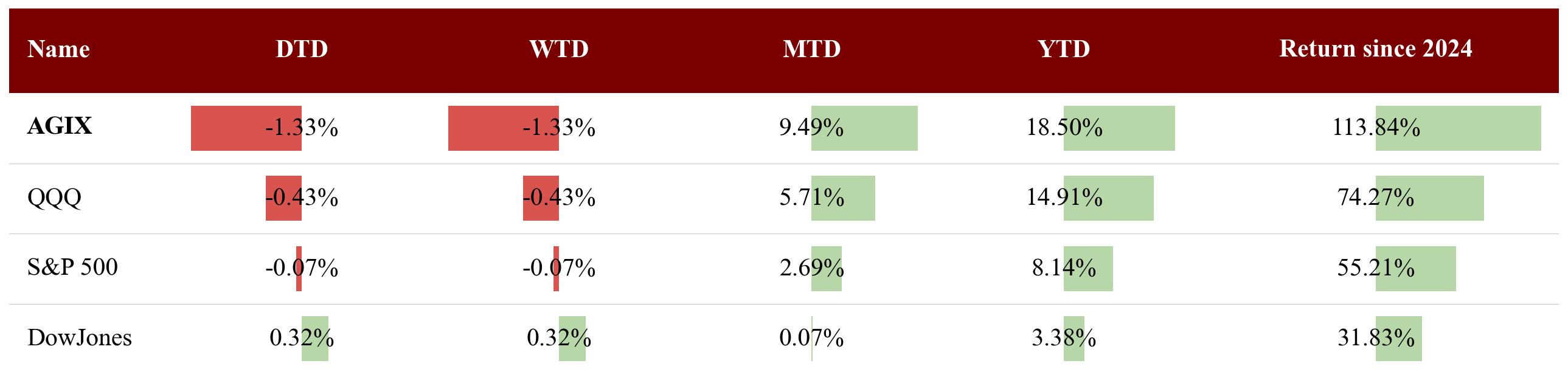
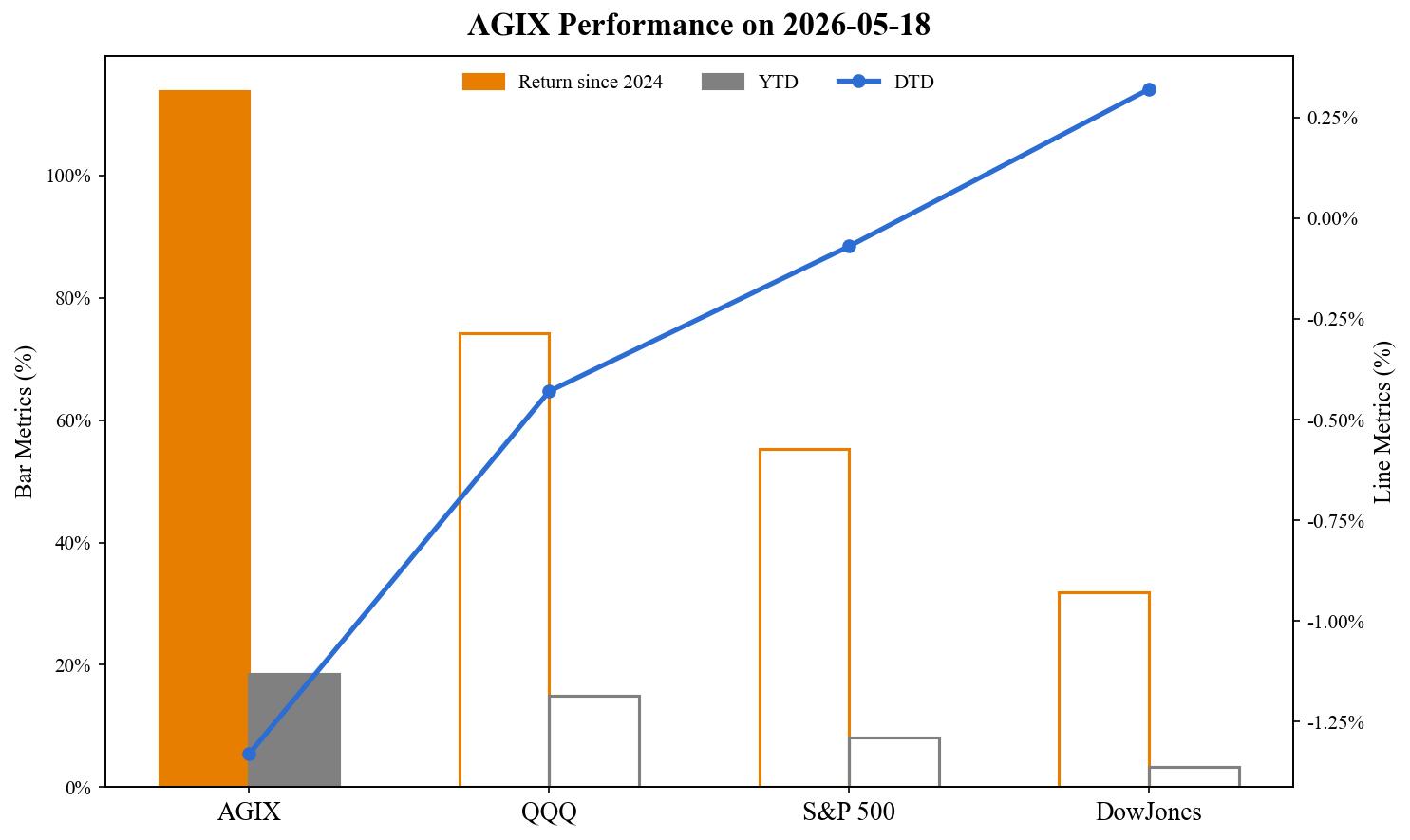
• AGIX fell 1.33% DTD, underperforming the QQQ (-0.43%) and S&P 500 (-0.07%), but remains a strong outperformer YTD (+18.5%) and since 2024 (+113.84%).
• Key AGIX holdings driving the negative DTD were Vertiv (-8.41%), Astera Labs (-7.35%), and Micron (-5.95%), reflecting hardware weakness in the AI supply chain.
• Positive contributors included ServiceNow (+8.78%), Roblox (+9.64%), and MediaTek (+4.29%), driven by AI product news and strong earnings momentum.
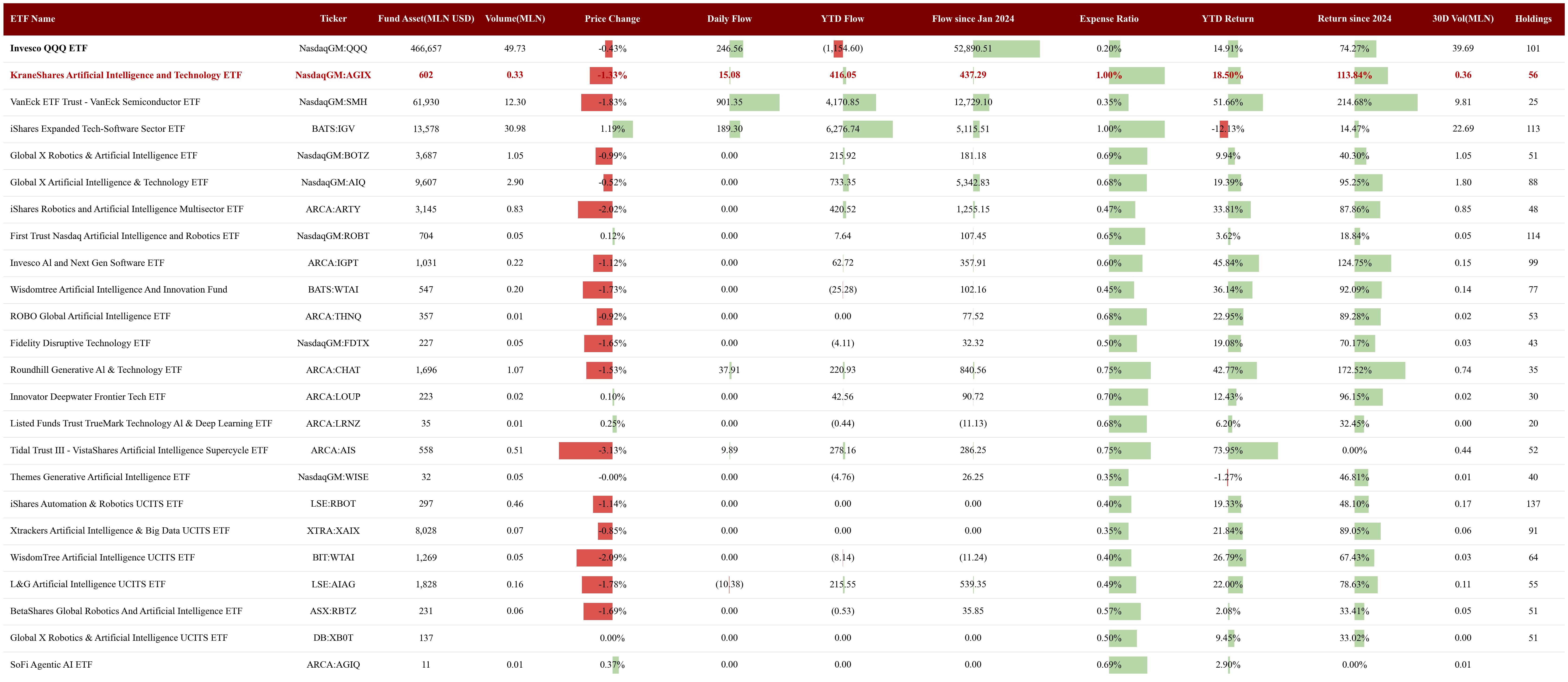
• Among peer ETFs, IGV (+1.19%) and LRNZ (+0.25%) outperformed, while SMH (-1.83%) and ARTY (-2.02%) lagged, highlighting a rotation toward software and AI application names.
News Highlights
1. Dell's AI Factory partnership with Nvidia and new local agentic AI systems aim to bridge the enterprise AI execution gap, supporting AGIX hardware holdings like Nvidia and Dell suppliers.
2. ServiceNow's Knowledge 2026 conference unveiled AI Control Tower and Otto upgrades, reinforcing its AI monetization story and driving an 8.78% DTD gain in the stock.
3. Anthropic's acquisition of Stainless for over $300 million gives it exclusive access to critical SDK infrastructure, potentially limiting competitors and boosting Anthropic's AI agent capabilities.
4. Amazon's Alexa+ now generates podcast episodes, transforming Alexa into a content creation platform and signaling broader AI adoption in consumer applications.
5. Redis launched a real-time Context Engine to solve AI agent memory issues, addressing a key bottleneck for enterprise agent reliability and adoption.
RSS Highlights
1. A CISA contractor leaked AWS GovCloud credentials on GitHub, highlighting severe security risks in government cloud deployments.
2. Gallup survey: 70% of Americans oppose building AI data centers locally, citing environmental and quality-of-life concerns.
3. A jury rejected Elon Musk's lawsuit against Sam Altman and OpenAI on statute of limitations grounds, reducing OpenAI's IPO and restructuring risks.
4. The role of 'just-say-no' engineers is declining in the AI era as tech companies lay off 5-20% of staff and prioritize AI adoption.
5. AI models improve yearly, but human bottlenecks—lack of context and motivation—limit their practical productivity gains.
Performance & Benchmark
Attribution
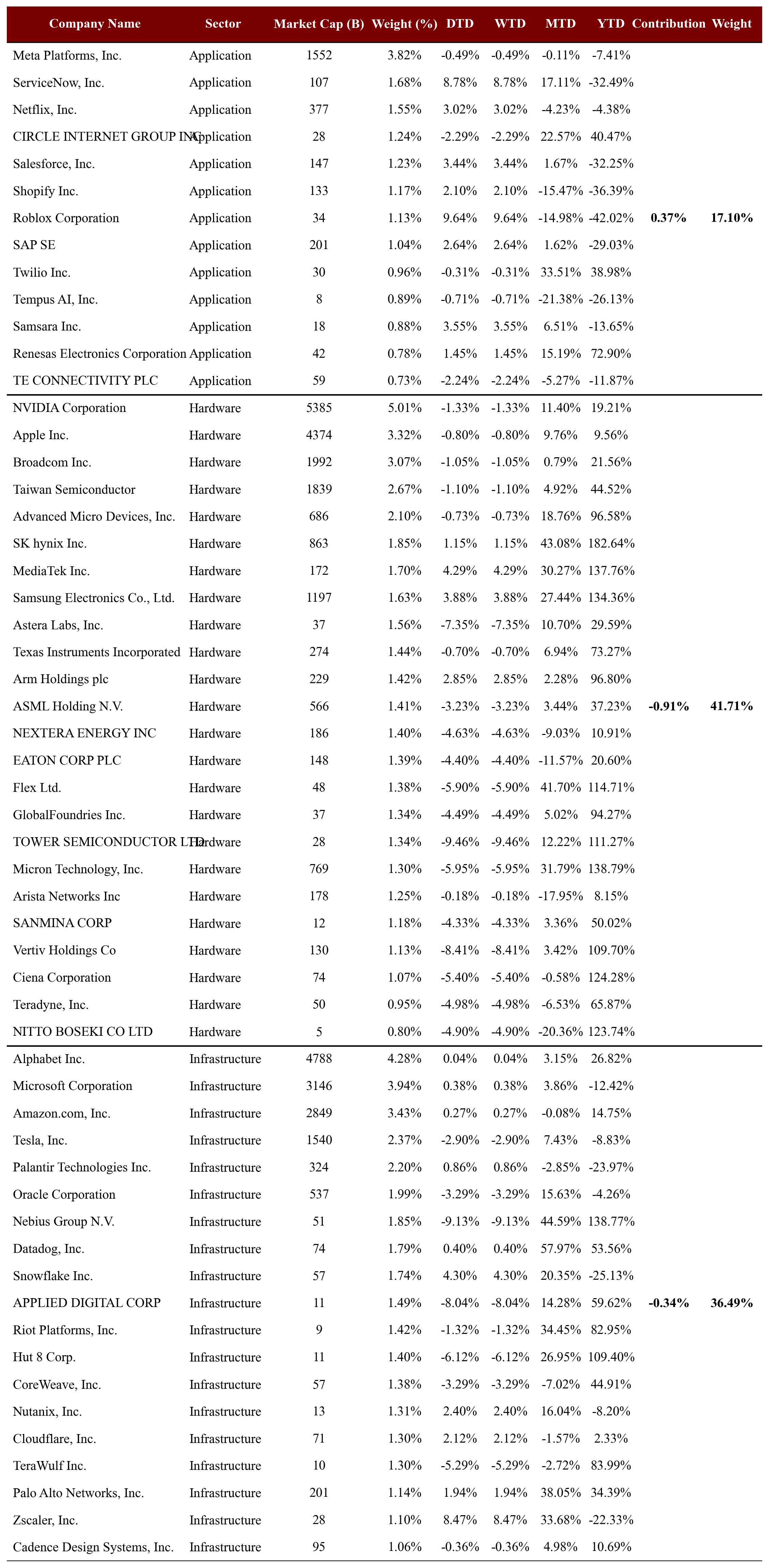
Contribution of the three sectors within AGIX holdings today
Application: 0.37%
Hardware: -0.91%
Infrastructure: -0.34%
Top-performing stocks in AGIX holdings today
Roblox Corporation (9.64%)
ServiceNow, Inc. (8.78%)
Zscaler, Inc. (8.47%)
Snowflake Inc. (4.3%)
MediaTek Inc. (4.29%)
Samsung Electronics Co., Ltd. (3.88%)
Samsara Inc. (3.55%)
Salesforce, Inc. (3.44%)
Netflix, Inc. (3.02%)
Arm Holdings plc (2.85%)
SAP SE (2.64%)
Nutanix, Inc. (2.4%)
Cloudflare, Inc. (2.12%)
Shopify Inc. (2.1%)
Worst-performing stocks in AGIX holdings today
TE CONNECTIVITY PLC (-2.24%)
CIRCLE INTERNET GROUP INC (-2.29%)
Tesla, Inc. (-2.9%)
ASML Holding N.V. (-3.23%)
Oracle Corporation (-3.29%)
CoreWeave, Inc. (-3.29%)
SANMINA CORP (-4.33%)
EATON CORP PLC (-4.4%)
GlobalFoundries Inc. (-4.49%)
NEXTERA ENERGY INC (-4.63%)
NITTO BOSEKI CO LTD (-4.9%)
Teradyne, Inc. (-4.98%)
TeraWulf Inc. (-5.29%)
Ciena Corporation (-5.4%)
Flex Ltd. (-5.9%)
Micron Technology, Inc. (-5.95%)
Hut 8 Corp. (-6.12%)
Astera Labs, Inc. (-7.35%)
APPLIED DIGITAL CORP (-8.04%)
Vertiv Holdings Co (-8.41%)
Nebius Group N.V. (-9.13%)
TOWER SEMICONDUCTOR LTD (-9.46%)
Top five listed stocks contributing the most within AGIX holdings today
Nebius Group N.V. (-9.13%)
TOWER SEMICONDUCTOR LTD (-9.46%)
APPLIED DIGITAL CORP (-8.04%)
Astera Labs, Inc. (-7.35%)
Vertiv Holdings Co (-8.41%)
Observation
The strongest movers across peer ETF holdings today are listed below:
| DTD | Stock Ticker | Name | Held by ETFs | analysis |
|---|---|---|---|---|
| 27.34 | NYSE:RAMP | LiveRamp Holdings, Inc. | ['BATS:IGV'] | LiveRamp’s ~27% gain on May 18 was driven primarily by the announced all-cash acquisition by Publicis Groupe at $38.50 per share, representing roughly a 30% premium to the prior close and anchoring the stock near the agreed takeout price. A secondary positive catalyst was the concurrent FY26 and Q4 results, which showed revenue growth, a swing to GAAP profitability, and strong cash generation versus the prior year, reinforcing the strategic value underpinning the acquisition premium. |
| 22.17 | NYSE:GENI | Genius Sports Limited | ['ARCA:IGPT'] | Genius Sports’ 22% gain on May 18 was driven primarily by a high‑profile bullish analyst call, with Benchmark reiterating its Buy rating, $16 target, and naming GENI its 2026 EDM Top Idea. The note highlighted accelerating media monetization, improving data‑driven engagement, and expanding operating leverage, reinforcing the bullish narrative already supported by other positive analyst views (including Goldman Sachs’ prior target hike). A secondary factor was technical momentum, as the stock rebounded from recent weakness and attracted trading interest against a backdrop of broadly positive sentiment in analyst forecasts and price‑target dispersion. |
| 21.34 | TSE:3905 | Datasection Inc. | ['NasdaqGM:WISE'] | Datasection Inc.’s +21.34% move on May 18, 2026 appears primarily driven by company-specific factors around its scheduled earnings report, which was due that day, prompting investors to reposition ahead of (or in reaction to) new fundamental information. The magnitude of the rebound also suggests a technical element: the stock had sold off sharply in the prior week and month (−29% and −16% respectively), so any earnings-related relief, guidance tone, or positioning squeeze likely triggered short covering and momentum buying. In the absence of notable sector-wide or macro news specific to AI/data analytics in Japan that day, the move looks mainly idiosyncratic to Datasection’s results and positioning. |
| 15.75 | TSE:285A | Kioxia Holdings Corporation | ['ARCA:IGPT'] | Kioxia’s 15.8% gain on May 18, 2026 appears primarily driven by index-related demand ahead of its inclusion in the Nikkei 225, which becomes effective from the opening of trading on April 1, 2026; passive and benchmarked funds positioning into the name likely continued to provide strong incremental buying support. A secondary driver is positive sentiment around the memory/semiconductor cycle, with recent commentary highlighting “explosive profit” expectations for Kioxia-related names, reinforcing momentum in a stock that has already seen a sharp rerating and elevated trading volumes. |
| 11.63 | NYSE:ZETA | Zeta Global Holdings Corp. | ['BATS:IGV', 'NasdaqGM:WISE'] | Zeta Global’s 11.6% gain on May 18, 2026 appears primarily driven by follow-through buying after its strong Q1 2026 earnings and guidance, which highlighted 50% year-over-year revenue growth, a $26 million beat versus guidance, a raise to full-year 2026 revenue guidance, and an outlook for positive GAAP net income. Investor enthusiasm is further supported by bullish sell-side and independent analyses pointing to upside versus current valuation, with updated price targets clustering well above the stock’s pre-move level and emphasizing the benefits of the Marigold acquisition and the “Zeta 2028” growth plan. The company’s participation at the JPM Global Technology, Media and Communications Conference the same day likely kept the positive earnings narrative in focus with institutional investors, reinforcing the upward move. |
| 9.64 | NYSE:RBLX | Roblox Corporation | ['NasdaqGM:AGIX', 'ARCA:CHAT', 'ARCA:LOUP'] | Roblox’s 9–10% gain on May 18, 2026 was primarily a rebound trade as investors re-priced the stock after last week’s sharp post-guidance-reset selloff. The market focused on the still-strong Q1 2026 fundamentals—double-digit growth in revenue, bookings, engagement and free cash flow, plus robust cash-flow guidance—while treating the safety-driven bookings and DAU headwinds as at least partially priced in. A secondary driver was supportive sell-side and institutional positioning: multiple Wall Street firms cut price targets but largely maintained Buy/Overweight ratings with targets well above the mid‑$40s, and reports of continued institutional buying (e.g., ARK) reinforced the “buy-the-dip” narrative. |
| 9.39 | NasdaqGS:BL | BlackLine, Inc. | ['BATS:IGV', 'NasdaqGM:ROBT'] | BlackLine’s 9.39% jump on May 18 was most likely driven by a broad positive re-rating after recent company execution and outlook improvements, rather than a fresh company-specific announcement that day. The key fundamental supports were its strong Q1 2026 results, with revenue up 10% year over year and adjusted EPS above estimates, plus earlier 2026 guidance for 9.1% to 9.6% revenue growth and continuing margin expansion. A secondary driver was likely investor optimism around BlackLine’s ongoing platform/AI and strategic transformation, which has been cited as improving bookings and adoption. |
| 9.05 | NasdaqGS:CTSH | Cognizant Technology Solutions Corporation | ['NasdaqGM:QQQ', 'ARCA:ARTY'] | CTSH’s 9.05% jump was primarily driven by Cognizant’s announcement that it raised its 2026 share repurchase target by $1 billion to $2 billion, a clear same-day capital-return catalyst that likely supported the stock. The move was also reinforced by company-specific AI and digital-transformation momentum, including recent Secure AI Services activity and new deal wins, which helped validate the growth story. Analyst target cuts from firms like Citi and UBS were secondary and did not offset the positive reaction to the buyback news. |
| 8.84 | NasdaqGS:QLYS | Qualys, Inc. | ['BATS:IGV', 'XTRA:XAIX'] | Qualys’ 8.84% gain on May 18 was driven primarily by continued bullish follow‑through on its late‑April Q1 earnings beat and raised full-year guidance, which reinforced confidence in durable double-digit growth and strong margins. Investors also reacted positively to the recent FedRAMP High authorization for its TotalCloud CNAPP product, which expands its addressable market with U.S. federal and other regulated customers and supports the cybersecurity growth narrative. A supportive technical backdrop—an established uptrend from the mid‑$80s into the high‑$90s with tight intraday trading ranges—likely amplified the move as momentum and swing traders added exposure. |
| 8.78 | NYSE:NOW | ServiceNow, Inc. | ['NasdaqGM:AGIX', 'BATS:IGV', 'NasdaqGM:AIQ', 'ARCA:ARTY', 'NasdaqGM:ROBT', 'BATS:WTAI', 'ARCA:THNQ', 'ARCA:CHAT', 'ARCA:LRNZ', 'LSE:RBOT', 'XTRA:XAIX', 'BIT:WTAI', 'LSE:AIAG'] | ServiceNow’s 8.78% jump on May 18 was primarily driven by upbeat AI product news from its Knowledge 2026 conference, where it unveiled upgrades such as AI Control Tower, Otto, and Autonomous Workforce, reinforcing the market’s view that its AI monetization story is accelerating. The move was also helped by Bank of America initiating coverage with a Buy rating and Bernstein raising its price target, which added fresh sell-side support. Investors also responded well to the company reaffirming its 2026 subscription revenue guidance, easing concerns that the AI rollout would come at the expense of near-term execution. |
| 8.47 | NasdaqGS:ZS | Zscaler, Inc. | ['NasdaqGM:QQQ', 'NasdaqGM:AGIX', 'BATS:IGV', 'NasdaqGM:AIQ', 'ARCA:ARTY', 'BATS:WTAI', 'NasdaqGM:FDTX', 'ARCA:LRNZ', 'ARCA:AIS', 'XTRA:XAIX'] | Zscaler’s 8.5% gain on May 18, 2026 was driven primarily by a bullish shift in analyst sentiment that investors treated as a catalyst for multiple expansion. The key driver was a same-day upgrade from B. Riley (per StockStory) that framed the name more positively after a period of sharp drawdown and valuation reset in security software, prompting short covering and momentum buying. This upgrade and supportive commentary outweighed the impact of recent price-target cuts cited by Schaeffer’s, highlighting renewed confidence in Zscaler’s growth and positioning within the cybersecurity sector. |
| 8.43 | NasdaqGS:MNDY | monday.com Ltd. | ['NasdaqGM:FDTX', 'LSE:RBOT'] | monday.com’s 8.43% gain was primarily driven by its strong Q1 2026 earnings beat-and-raise, which showed 24% revenue growth to $351.3 million, record operating income, and a higher 2026 outlook. Investors also reacted positively to management’s AI Work Platform strategy and the acquisition of OneAI, which reinforce the company’s shift toward AI-enabled and usage-based growth. Analyst support helped sustain the move, with several firms reiterating positive ratings and higher targets after the report. |
| 8.19 | TPEX:5425 | Taiwan Semiconductor Co., Ltd. | ['ARCA:AIS'] | Taiwan Semiconductor Co.’s 8.19% jump on May 18, 2026 appears most likely driven by broad semiconductor strength and follow-through buying in the Taiwan market rather than any company-specific announcement in the provided results. The stock was already showing strong recent momentum, with TradingView indicating an 8.6% rise over the prior week, which supports a continuation move. No same-day earnings release, guidance update, or other verifiable company news is shown in the available sources. |
| 8.04 | NasdaqGM:APPN | Appian Corporation | ['BATS:IGV', 'NasdaqGM:BOTZ', 'NasdaqGM:ROBT', 'ASX:RBTZ', 'DB:XB0T'] | Appian’s 8.0% gain on May 18, 2026 appears primarily driven by a rebound from its recent post‑earnings selloff as investors reassessed the Q1 results and forward outlook highlighted in recent analyses. After the stock fell sharply on conservative Q2 guidance despite strong Q1 profitability and cloud growth, commentary from outlets like Zacks and Simply Wall St emphasizing improving margins, AI-driven demand, and discounted valuation likely helped shift sentiment toward “buy-the-dip” positioning. Broader interest in automation/AI software peers, with several workflow and AI names also outperforming in recent sessions, likely provided a supportive sector backdrop for the move. |
| 7.98 | NYSE:EPAM | EPAM Systems, Inc. | ['ARCA:ARTY', 'LSE:RBOT'] | EPAM Systems’ 7.98% gain on May 18 appears primarily driven by a rebound from recent heavy selling and growing mean-reversion interest after the stock had fallen more than 50% year-to-date and was trading far below consensus target prices. With no major company-specific news or earnings releases that day, investors likely focused on the large implied upside versus analyst targets (MarketBeat and other sources highlight 30–60%+ upside), improving medium-term growth expectations, and prior negative sentiment having potentially overshot fundamentals. Broader tech and IT services risk-on flows may have provided an additional tailwind to the recovery move. |
| 7.92 | NYSE:G | Genpact Limited | ['NasdaqGM:AIQ'] | Genpact’s ~8% gain on May 18, 2026 appears to be a continuation repricing move driven by investors digesting its stronger-than-expected Q1 2026 earnings and upbeat AI/ATS growth narrative reported on May 10. The move was likely reinforced by favorable valuation-focused research, including Zacks’ May 18 note highlighting Genpact as a strong value stock, which drew attention to the name’s discount to peers and upside to analyst targets. Trading volumes were roughly in line to slightly below average, suggesting a fundamentally driven bid rather than a technical or liquidity shock. |
| 7.85 | NasdaqGM:VCYT | Veracyte, Inc. | ['ARCA:THNQ', 'LSE:AIAG'] | Veracyte’s 7.9% gain on May 18, 2026 appears primarily driven by a strong Q1 2026 earnings report that beat prior trends and included a material guidance raise. The company reported 21% total revenue growth (26% testing revenue growth), sharply higher profitability (GAAP net income of $28.7 million and a 73% jump in adjusted EBITDA), and robust cash generation, which together signal accelerating operating leverage. Management also raised full-year 2026 total revenue, testing revenue, and adjusted EBITDA margin guidance, reinforcing a stronger growth and margin trajectory that likely prompted investors to re-rate the stock higher. Zacks’ same-day commentary highlighting Veracyte as a top long-term growth stock may have added incremental momentum by drawing additional attention from growth-oriented investors. |
| 7.58 | NYSE:FICO | Fair Isaac Corporation | ['BATS:IGV', 'LSE:AIAG'] | Fair Isaac’s 7.6% gain on May 18, 2026 was driven primarily by follow‑through buying on its recent blowout Q2 FY26 results and guidance raise, which showed ~39% revenue growth, ~63% net income growth, and a large EPS beat, reinforcing confidence in the durability of its pricing power and score business. A secondary catalyst was favorable sentiment from fresh growth-oriented research coverage, including Zacks highlighting FICO as a strong growth stock with sharply rising FY26 EPS estimates, which likely attracted incremental institutional and momentum investors. |
| 7.58 | NasdaqGS:TENB | Tenable Holdings, Inc. | ['BATS:IGV', 'XTRA:XAIX'] | Tenable’s 7.6% gain on May 18, 2026 appears primarily driven by investor anticipation ahead of the May 21 Investor Day, where management is expected to lay out multi‑year growth and AI/Hexa roadmap targets following a strong Q1. The stock had been trading near the low end of its 52-week range at around 11x forward earnings despite ~30% EPS growth and raised multi‑year guidance, so investors likely rotated back into the name as a perceived undervalued cybersecurity earnings compounder. A secondary driver is growing focus on Tenable One and Hexa AI as catalysts for re-acceleration in 2026+ revenue and EPS, which, combined with ongoing buybacks and a consensus price target materially above the current price, supported multiple expansion interest into the event. |
| 7.42 | SEHK:1274 | iMotion Automotive Technology (Suzhou) Co., Ltd. | ['NasdaqGM:BOTZ', 'ASX:RBTZ', 'DB:XB0T'] | iMotion Automotive Technology’s 7.4% gain on 18 May 2026 appears to be driven primarily by momentum and sentiment rather than any identifiable, stock-specific news catalyst. There were no major same-day company announcements, regulatory notices, or widely reported industry developments tied specifically to iMotion; in that vacuum, investors likely extrapolated from the company’s high forecast revenue growth and strong balance sheet, leading to speculative buying in a volatile, high-beta autonomous-driving hardware/software name. |
| 6.84 | NasdaqGS:TTAN | ServiceTitan, Inc. | ['LSE:RBOT'] | ServiceTitan’s 6.8% gain on May 18, 2026 appears primarily driven by follow‑through buying after investors reassessed its recent FY 2026 earnings and 2027 guidance, which showed 24% revenue growth to $961M, improving non‑GAAP margins, and solid free cash flow despite an initially negative post‑earnings reaction. The move was likely reinforced by a supportive fundamental narrative and bullish analyst/investor commentary highlighting strong subscription growth, expanding AI-driven MAX program adoption, and a still‑constructive consensus “Buy” rating with upside to current targets, prompting dip‑buyers back into the stock. |
| 6.54 | NYSE:ESTC | Elastic N.V. | ['BATS:IGV', 'NasdaqGM:ROBT', 'ARCA:IGPT', 'BATS:WTAI', 'ARCA:THNQ', 'ARCA:LRNZ', 'LSE:RBOT', 'LSE:AIAG'] | Elastic N.V. (ESTC) likely moved up 6.5% on May 18, 2026 primarily on positioning and technical factors ahead of a known near‑term catalyst rather than on any specific, stock‑moving news. First, there were no material company press releases, NYSE corporate actions, or major Elastic‑specific headlines on that date that would typically justify a large re‑rating. Second, ESTC has recently traded with elevated volatility and strong upside analyst targets versus its current price, so short covering and momentum/technical buying into its confirmed May 27 earnings date likely amplified the move. |
| 6.28 | NYSE:FIG | Figma, Inc. | ['ARCA:LRNZ'] | Figma’s 6.3% rise on May 18, 2026 appears mainly driven by continued positive follow‑through from its recent quarterly earnings beat and strong growth metrics. The company’s latest report showed ~40–46% year-over-year revenue growth, net dollar retention in the mid‑130s%, and revenue and EPS ahead of consensus, reinforcing the bullish thesis reflected in a Buy-rated analyst consensus and a price target more than double the current level. A secondary driver is likely sentiment recovery after earlier pressure from Google’s AI design platform news, as investors refocused on Figma’s execution and long-term growth profile rather than near-term competitive headlines. |
| 6.24 | NasdaqGS:STNE | StoneCo Ltd. | ['NasdaqGM:AIQ'] | StoneCo’s 6.24% move on May 18 appears mainly tied to the market’s reaction to its Q1 2026 earnings news, with Zacks noting the shares fell after revenue of $679.39 million missed expectations. A secondary support for the stock was the broader earnings backdrop and trading repositioning around the print, as the company had recently reported quarterly results and investors were reassessing growth and margin trends. No major company-specific regulatory or corporate event in the provided sources better explains the day’s move than the earnings miss and resulting sentiment shift. |
| 6.15 | LSE:OCDO | Ocado Group plc | ['NasdaqGM:ROBT', 'BIT:WTAI'] | Ocado Group’s 6.2% gain on 18 May 2026 appears primarily driven by renewed optimism around its long‑term valuation and growth profile rather than a specific company announcement that day. First, multiple data providers and commentary (e.g., Simply Wall St, MarketBeat, TradingView) highlight large implied upside to analyst targets and DCF-based fair value, encouraging value-oriented and momentum buyers after a weak multi‑week stretch. Second, the stock’s high volatility and heavy retail interest, as seen on platforms like London South East’s share chat, likely amplified the move as technical traders reacted to the break higher following recent strength earlier in the month. |
| 6.04 | NasdaqGS:GTLB | GitLab Inc. | ['BATS:IGV', 'BATS:WTAI', 'ARCA:LOUP'] | GitLab’s 6.0% gain appears primarily driven by a rebound from an oversold level as investors reassessed the earlier post-earnings sell-off and weak guidance as overdone. Recent commentary highlighting strong cash flow, a new $400 million buyback authorization, and long-term AI-driven growth prospects (e.g., MarketBeat and other bullish analyses) likely supported dip-buying and short-covering. A modestly constructive analyst and institutional backdrop, with multiple Buy/Outperform ratings still in place, further underpinned sentiment despite slower growth concerns. |
| 5.97 | TASE:NICE | NICE Ltd. | ['NasdaqGM:AIQ', 'NasdaqGM:ROBT', 'ARCA:IGPT', 'XTRA:XAIX', 'BIT:WTAI'] | NICE’s 5.97% jump on 2026-05-18 appears mainly tied to a broader risk-on move in technology/AI software names rather than a company-specific announcement, as no same-day NICE disclosure or major headline is evident in the provided public results. The stock was also coming off a weak run, with recent volatility and a multi-month decline leaving room for a sharp rebound on a positive market session. A secondary support was investor focus on NICE’s AI/cloud growth narrative, which has remained a key valuation driver in recent coverage. |
| 5.9 | NYSE:NABL | N-able, Inc. | ['BATS:IGV'] | N-able’s roughly 5.9% gain on May 18, 2026 appears primarily driven by follow-through buying after its early-May Q1 2026 earnings, where management highlighted “continued upmarket traction” and “improved retention,” reinforcing a narrative of stabilizing fundamentals at a depressed share price. The move was likely supported by the sizable upside implied by consensus 12‑month price targets (over 100% above the low‑$3 share price per MarketBeat) and ongoing enthusiasm around its Adlumin acquisition and expanded cybersecurity/XDR offering, which investors see as medium-term growth catalysts. Broader risk-on interest in software and IT management names may have provided an additional tailwind, amplifying the stock’s rebound from recent lows. |
| 5.81 | NYSE:ASAN | Asana, Inc. | ['BATS:IGV', 'LSE:RBOT', 'XTRA:XAIX'] | Asana’s 5.81% gain on May 18 was most likely driven by a post-earnings reaction, with the stock continuing to trade higher after the company reported third-quarter results that beat analyst estimates on both revenue and earnings. The move was reinforced by upbeat sentiment around the company’s improving profitability and AI Studio traction, which has been cited by recent market commentary as a positive growth catalyst. Broader small-cap/software momentum also helped, but the earnings beat appears to be the main driver. |
| 5.72 | NasdaqGM:MDB | MongoDB, Inc. | ['ARCA:ARTY', 'NasdaqGM:ROBT', 'BATS:WTAI', 'ARCA:THNQ', 'ARCA:LRNZ', 'LSE:AIAG'] | MongoDB’s 5.7% gain on May 18 was driven primarily by a bullish analyst move from BMO Capital Markets, which raised its price target from $285 to $360 and reiterated an outperform rating, reinforcing the AI-led growth narrative and prompting broad buy-side demand. A second key driver was growing Street positioning of MDB as a high-conviction AI infrastructure play, reflected in Citi’s earlier $450 target and “upside 90-day catalyst watch,” which has helped sustain positive sentiment and momentum in the stock. |
| 5.61 | NasdaqGS:DXCM | DexCom, Inc. | ['NasdaqGM:QQQ'] | DexCom’s 5.6% gain on May 18, 2026 appears driven primarily by follow-through buying after the company’s recently announced long-term growth/margin targets and $1B share repurchase plan, which improved sentiment around its diabetes technology franchise and capital allocation. This was reinforced by supportive analyst positioning, including a recent Canaccord price-target hike to $100 and a broader “Strong Buy” consensus with substantial upside to average targets, encouraging momentum and dip-buying in a stock that had been weak year-to-date. |
| 5.52 | NasdaqGS:VRSK | Verisk Analytics, Inc. | ['NasdaqGM:QQQ', 'ARCA:THNQ', 'LSE:AIAG'] | Verisk’s 5.52% rise on May 18 was most likely driven by the market continuing to digest its strong Q1 2026 earnings release, which showed 4.7% organic constant-currency revenue growth, adjusted EPS of $1.82 versus estimates around $1.74, and reaffirmed full-year 2026 guidance. A second positive factor was capital return: management had already announced a $1.5 billion accelerated share repurchase and maintained a higher quarterly dividend, reinforcing confidence in cash deployment and shareholder returns. Broader trading support may also have come from the stock recovering after recently hovering near a 52-week low, which can amplify upside on fundamentally positive news. |
| 5.34 | NYSE:GWRE | Guidewire Software, Inc. | ['BATS:IGV'] | Guidewire’s 5.34% move up on May 18 was most likely driven by investor reaction to the company’s recently announced $500 million share repurchase authorization, which signaled confidence in cash generation and a commitment to returning capital to shareholders. A second support was the ongoing positive read-through from Guidewire’s strong recent operating momentum and cloud migration progress, which has kept sentiment constructive. Broader software-sector volatility likely added some trading support, but the buyback announcement was the main catalyst. |
| 5.3 | NasdaqGM:TTD | The Trade Desk, Inc. | ['NasdaqGM:QQQ', 'NasdaqGM:AIQ', 'ARCA:IGPT'] | The Trade Desk’s 5.3% gain on May 18, 2026 was primarily driven by a rebound move in a deeply sold-off stock, as investors added risk back into a name that has fallen roughly 70% from its 2024 highs and badly underperformed the market over the past year. Supporting this, intraday commentary (e.g., StockStory) flagged TTD’s roughly 3.9% afternoon jump without citing new company-specific news, suggesting the move was more sentiment- and technical-driven than fundamentally driven. |
| 5.17 | NYSE:ACN | Accenture plc | ['NasdaqGM:AIQ', 'ARCA:ARTY'] | Accenture’s 5.17% gain on May 18 was primarily driven by AI-related partnership news that reinforced its growth narrative. The key catalyst was the newly announced collaboration with Stellantis to deploy AI-enabled digital twin and NVIDIA-based solutions in global manufacturing, which showcased Accenture’s ability to monetize industrial AI at scale. The move also built on positive momentum from its May 14 announcement that Accenture Federal Services is partnering with OpenAI to accelerate AI adoption in U.S. federal agencies, supporting analysts’ generally positive stance on the stock despite broader sector concerns. |
| 5.16 | NasdaqGS:OKTA | Okta, Inc. | ['NasdaqGM:AIQ', 'ARCA:ARTY', 'BATS:WTAI'] | Okta’s 5.2% gain on May 18 was primarily driven by positive sector and peer read-through, as cybersecurity and identity-related names traded higher together. StockStory reported that Okta was among a group of software and security stocks (including SentinelOne and Manhattan Associates) moving up that day, indicating a broad bid into the security/software complex rather than a company-specific headline. A secondary support was growing investor focus on Okta as a “trending stock,” as highlighted by Zacks on May 18, which underscored improving sentiment following recent upgrades and solid FY2026 fundamentals. |
| 5.11 | NYSE:HUBS | HubSpot, Inc. | ['BATS:IGV', 'ARCA:IGPT', 'BATS:WTAI', 'ARCA:THNQ', 'ARCA:LOUP', 'LSE:AIAG'] | HubSpot’s 5.1% gain on May 18, 2026 appears driven primarily by continued bullish reassessment of its growth and profitability profile following its strong Q1 print and subsequent rebound from post-earnings lows. Investors are leaning into the narrative highlighted in recent coverage that HUBS is delivering 20%+ revenue growth, expanding margins, and solid free cash flow while executing on an AI-powered CRM strategy, with the stock still trading well below average Street price targets after the earlier selloff. A secondary driver is style and sentiment: Zacks’ May 18 note emphasizing HUBS as a “strong growth stock” with rising earnings estimates and a top-tier Growth Style Score likely reinforced growth-investor demand and helped sustain the ongoing dip-buying in the name. |
| 5.09 | TWSE:6531 | AP Memory Technology Corporation | ['ARCA:AIS'] | AP Memory Technology’s 5.1% gain on May 18, 2026 appears primarily driven by positioning ahead of its scheduled online investor conference on May 12 (local time already passed) and continued positive sentiment toward its AI/IoT memory exposure, rather than by any new company-specific disclosure that day. First, the stock is trading with a “strong buy” technical profile and above its 200-day moving average, so momentum and technical buying likely amplified the move. Second, the broader narrative of rising demand and pricing for specialized memory chips, as highlighted in recent industry commentary, is supportive for a niche AI/IoT memory supplier like AP Memory, encouraging incremental buying despite the absence of fresh TWSE announcements on that specific date. |
| 5.08 | NYSE:WK | Workiva Inc. | ['BATS:IGV'] | Workiva’s 5.08% gain on May 18 appears to have been driven mainly by continued positive sentiment around the stock’s valuation and Wall Street’s bullish outlook rather than a clearly identifiable company-specific same-day catalyst. Public market data around that date showed WK trading well below analyst targets, with consensus price objectives implying meaningful upside, which likely supported buying interest. A secondary driver may have been follow-through momentum from the prior session’s move and broader small-cap/value rotation, but no major same-day corporate announcement is evident from the public results provided. |
News
Funding & M&A
Multiplayer AI startup Dust raises $40M to help enterprises move beyond isolated AI assistants
Dust, an AI startup focused on multi-person collaboration, today announced the completion of a $40 million Series B funding round, led by Abstract and Sequoia Capital, with participation from Snowflake and Datadog. This round brings the company's total funding to over $60 million. Dust's platform elevates enterprise AI from single-user single-assistant to a team collaboration ecosystem, offering shared workspaces, an intelligence layer connecting over 100 enterprise data platforms, and support for custom agents. Currently, more than 3,000 organizations and 300,000 agents use its services, maintaining a zero churn rate in 2025 and a 70% weekly active user rate. The founders previously worked at Stripe and OpenAI, and this funding will be used to accelerate professional agent development. This funding event shows that multiplayer AI is becoming a new model for enterprise digital transformation.
Kin Health has raised $9 million to develop an AI note-taking tool for patients.
The U.S. AI recording device market generated over $600 million in revenue last year, with significant potential in the medical field. Kin Health has launched a smart recording application for patients that can transcribe doctor visits in real time, generate AI summaries and follow-up action items, and support sharing with family members. The company just completed a $90,000 seed round led by Maveron, with GoodRx founders Doug Hirsch and Trevor Bezdek serving as executive directors. The application uses multi-stage processing to improve accuracy and complies with privacy standards but has not yet obtained HIPAA certification. Future plans include integrating electronic medical record data and monetizing through specialist and lab test service recommendations. The founders are doctors Arpan Parikh, Amit Parikh, and Kyle Alwyn. The industry is concerned about privacy, accuracy, and accent adaptation, but Kin Health's mobile tool provides patients with an independent health data management solution.
Elon Musk has lost his lawsuit against Sam Altman and OpenAI
A unanimous jury in a California state court ruled that Elon Musk's lawsuit against OpenAI, Sam Altman, Greg Brockman, and Microsoft was dismissed due to the statute of limitations. Musk accused them of 'stealing a charity' by turning a nonprofit frontier AI lab into a for-profit subsidiary, but the jury found that all alleged damages occurred before the 2021 filing deadline. The ruling significantly reduces the restructuring risks and IPO obstacles facing OpenAI. OpenAI's lawyers acknowledged the lawsuit as a 'fabricated attempt to hinder competition,' while Microsoft stated it would continue its partnership with OpenAI. Musk's side announced plans to appeal. The case provides an important legal reference for business competition in the AI industry.
Anthropic has acquired the developer tools startup used by OpenAI, Google, and Cloudflare.
AI company Anthropic announced on Monday that it has acquired Stainless, a startup founded by former Stripe engineer Alex Rattray. Stainless's software is widely used by multiple competing AI labs, including OpenAI and Google, to automate the generation and maintenance of SDK libraries in various programming languages. The deal is reportedly valued at over $300 million and has received investment from Sequoia Capital and Andreessen Horowitz. After the acquisition, Anthropic will discontinue Stainless's hosted product, but existing customers will retain ownership of the SDKs they generated. This move will give Anthropic exclusive access to this critical infrastructure technology, strengthening its AI agents' ability to connect with external software while limiting competitors' use. Anthropic stated that Stainless's technology already powers the generation of all its official SDKs. This acquisition will impact the competitive landscape of AI industry infrastructure.
Technical Breakthroughs
AI made attackers smarter. Now it’s giving mid-market companies a fighting chance
With the rapid growth of intelligent digital workers and autonomous AI agents, the cyber attack surface is expanding at an unprecedented rate, making traditional security scanning tools unable to fully assess risks. As a result, mid-market enterprises especially need automated penetration testing technology that accounts for AI. Chris Wallis, CEO of Intruder Systems Ltd, noted in an interview at KB4-CON 2026 that AI is changing how penetration testing is applied, enabling understanding of the entire attack surface and reasoning about real exploitable dangers. The company's newly launched AI Pentesting feature uses intelligent agents to deeply investigate scan results, reducing analysis that previously took hours to just minutes. Research shows that 42% of mid-market security teams feel overwhelmed; this technology democratizes penetration testing services, allowing more enterprises to obtain continuous security assurance at lower cost. In the future, scanning, penetration testing, and red teaming will merge into a unified exposure management process, helping enterprises better defend against new AI-related risks.
Redis introduces a much-needed memory layer for enterprise AI agents.
As a database management startup, Redis Inc. has launched a new real-time Context Engine to address memory issues in enterprise AI agents. The engine includes three core tools: Redis Context Retriever, Redis Agent Memory, and Redis Data Integration, with data integration now generally available. These tools help AI agents build semantic models of business data, automatically generate data reading tools, and provide short-term and long-term memory layers, thereby avoiding hallucinations and erroneous outputs. By continuously synchronizing data from relational databases and data warehouses, agents can use the latest information to perform complex tasks. Redis is already present in 43% of enterprise AI agent stacks globally, and its transformation from a high-speed cache to an AI agent operating system will help enterprises build more reliable and complex autonomous agent systems.
Ansible positions automation as the trusted execution layer for agentic AI
As Red Hat's automation platform, Ansible is becoming a trusted execution layer, bridging AI-generated insights with reliable IT operations. The platform transforms exploratory agent AI into manageable, deterministic actions at scale, enabling reliable deployment of AI technologies in enterprise IT environments. By optimizing automation workflows, Ansible converts AI model outputs into specific system configurations and operational instructions, reducing the risk of human error and improving operational efficiency. As agent AI becomes more prevalent in enterprise applications, this platform will serve as critical infrastructure to ensure AI-generated content is actionable and monitorable, helping drive AI from theoretical research to industrial practice.
Product Launches
South Korea’s LetinAR is building optics behind AI glasses
With the rapid advancement of artificial intelligence technology, the smart glasses market is moving from concept to practical application. The latest reports show that global shipments of AI smart glasses reached 8.7 million units in 2025, a year-over-year increase of over 300%, and are expected to exceed 15 million units this year. Tech giants from the United States, South Korea, and China are deploying in sequence, with Meta, Google, Apple, and Samsung all advancing related products. South Korean startup LetinAR provides core optical module technology, and its PinTILT system enables high-brightness displays in thinner and lighter lenses. The company just secured 5 trillion won in funding, bringing total funding to $41.7 million, and plans to list in South Korea in 2027. Its technology has been applied to the Aegis Rider AI motorcycle helmet in Switzerland, which will provide real-time navigation and safety alerts on European roads in 2026. This technology will bring a more life-like AI experience to the masses.
Dell targets enterprise AI execution gap with local agentic AI systems and integrated AI infrastructure
Dell Technologies announced multiple AI upgrades at Dell Technologies World, strengthening its AI Factory partnership with Nvidia to help enterprises move AI projects from experimentation to large-scale production. The centerpiece is the Dell Deskside Agentic AI solution, combining Dell workstations, the Nvidia NemoClaw software stack, and services to support running AI agents locally, avoiding cloud dependency and reducing costs. Additionally, Dell updated its AI Data Platform to improve data orchestration and search capabilities, and introduced the PowerRack integrated rack system along with new cooling solutions. New partnerships with Google, OpenAI, Palantir, ServiceNow, and Hugging Face were added to promote local deployment of models, agents, and digital twins. These initiatives will roll out gradually through 2026 to address enterprise AI execution challenges.
Industry Partnerships
As cloud spending increases, Red Hat OpenShift Service on AWS aims to change how procurement works.
Red Hat's open hybrid cloud platform, Red Hat OpenShift Service on AWS, is becoming a strategic choice for enterprises to simplify procurement and optimize complex cloud operations. This partnership combines the strengths of Red Hat and AWS, offering a simpler software procurement experience through AWS Marketplace to meet the convenience needs of the younger generation of buyers. At Red Hat Summit 2026, the two companies discussed how the platform supports virtualization modernization, AI inference cost optimization, and European data sovereignty requirements. OpenShift AutoNode enables automated management of worker nodes, providing up to 30% cost savings. Red Hat is also a launch partner for the AWS European Sovereign Cloud, ensuring RHEL and OpenShift meet GDPR compliance. The deepening partnership not only optimizes compute load and performance but also strengthens cross-border regulatory compliance capabilities, providing reliable open hybrid cloud solutions for regulated industries.
Amazon’s new Alexa+ powered feature can generate podcast episodes
Amazon announced Monday that the new Alexa+ feature 'Alexa Podcasts' is officially launching in the United States. Users can simply ask Alexa+ about any topic of interest to generate a full podcast episode, without needing to upload documents or write scripts. Alexa+ automatically researches materials, generates summaries, and supports adjustments to length, tone, and focus. Once completed, it broadcasts using an AI host voice, and users can receive notifications and replay the podcast via Echo Show devices or the Alexa App. This feature reflects Alexa+'s transformation from a smart voice assistant to a personalized AI content creation platform. To improve content accuracy, Amazon has partnered with multiple news organizations including the Associated Press, Reuters, the Washington Post, and Time magazine, and is exploring more AI audio formats such as customized news summaries. This move has also sparked discussions about the ethics and accuracy of AI-generated content.
The big tent: Dell’s expanding partnerships demonstrate strategic shift in enterprise infrastructure
Amid a major shift in the enterprise infrastructure market, Dell Technologies is working to establish its position in the AI space through a broad range of strategic partnerships. These alliances include collaborations with chipmakers, virtualization leaders, cloud service providers, and multiple leading software platforms. The partnership between Dell and Nutanix serves as a key example, offering integrated solutions for virtualized workloads, private cloud, and hybrid cloud environments. The jointly launched PowerEdge XC Plus and PowerFlex software-defined storage are integrated into the Nutanix stack, enabling independent scaling of compute and storage. Additionally, Dell's AI Factory collaboration with Nvidia has been deployed by over 4,000 customers, and its Lightning file system is meeting the high-performance parallel data processing needs of AI model training and inference. Dell's long-standing partnership with AMD continues to advance. Recently, the two integrated the AMD Instinct MI350P PCIe GPU into PowerEdge servers to support large-scale virtualized environments. Meanwhile, Dell's collaboration with Microsoft, through the integration of PowerStore and PowerScale with Azure Local, provides customers with hybrid cloud solutions without the need to purchase new hardware. Furthermore, the Dell APEX Cloud Platform for Red Hat OpenShift offers a unified management platform for containerized applications and virtual machines. These diverse partnerships reflect Dell's efforts to build a resilient, scalable, and efficient enterprise infrastructure ecosystem adapted to the AI era.
Enterprises are at risk of losing count of their own AI workforce
As AI agents take on operational roles in enterprise workflows, the AI governance gap is widening rapidly. Greg Kras, Chief Product Officer at KnowBe4, stated at KB4-CON 2026 that autonomous agents can double overnight, making it difficult for enterprises to fully catalog or authorize these non-human digital employees. KnowBe4 has extended its human risk management platform into AI agent security, launching the AIDA Orchestration system in Q1 2026, which automatically creates, schedules, and personalizes phishing simulations and security awareness training. Early data shows a 5-point drop in risk scores, a reduction of about 15%. Additionally, the Agent Risk Manager product provides security teams with real-time visibility, accountability, and control over AI agents. Kras emphasized that enterprises that ignore AI will be defeated by competitors, while those without governance face uncontrollable risks.
策略监管
Domain-specific AI is transforming the rules of workforce management.
The rise of agentic AI is reshaping the core requirements of enterprise collaboration. Domain-specific AI technology has become a key factor in differentiating systems, shifting from purely advisory functions to intelligent systems capable of taking real actions. This change requires enterprises to engage in deeper collaboration to ensure AI solutions can adapt to specific industry needs. Currently, developments in this field are driving technology from theoretical discussions to practical deployment. Experts point out that to realize the true value of AI, it is essential to invest heavily in domain knowledge and industry data. This trend not only affects the strategic planning of technology companies but will also drive a restructuring of the entire enterprise service ecosystem. The topic is currently receiving high attention at global technology conferences.
RSS Subscription
CISA Admin Leaked AWS GovCloud Keys on Github
A contractor for the U.S. Cybersecurity and Infrastructure Security Agency (CISA) leaked multiple high-privilege AWS GovCloud account credentials and extensive internal system information through a publicly exposed code repository on GitHub. Security experts call this one of the most serious government data breaches in recent years. The leaked files included administrative credentials for AWS servers and plaintext usernames and passwords for multiple CISA internal systems, and the contractor used easily guessable passwords, revealing severe security risks. CISA stated it is investigating the incident, and there is currently no indication that sensitive data has been compromised.
10Gb/s Ethernet: using mini-heatsinks with a 10GBASE-T SFP+ module
In a recent experiment, using a mini heatsink to cool a MikroTik 10GBASE-T SFP+ module showed a temperature drop of about 3.5°C. This module is an older model that typically supports a transmission distance of 30 meters, and a future replacement with a newer model may be considered to improve performance.
Something’s Rotten in the State of macOS Icon Design
macOS icon design is facing a dilemma, as Apple's design standards constrain the entire ecosystem, leading to convergence in the design of many application icons. Even some third-party apps, such as Capo and BBEdit, have to follow Apple's rules, limiting creative expression. Although some top designers still strive for excellence, Apple's design philosophy has become a constraint.
Stealth Startup Spy #340
A former Google silicon engineer and Intel Xeon architect have gone stealth mode, a Spotify-style B2B celebrity digital twin platform has officially launched, and a former Dropbox AI director and an Amazon head have also gone stealth. A new startup tracker is now available, providing real-time updates on founders and company developments, with currently 5 subscribers.
Don't call yourself a Software Engineer, you are an AI Enabled Engineer.
In today's rapidly evolving technology landscape, the role of software engineers is undergoing change, with many updating their job titles on LinkedIn to adapt to the AI-driven market. Although mastery of programming languages and frameworks is not critical, building professional relationships, attending conferences, and improving communication skills remain key to career development. To succeed in the future workplace, software engineers should focus on work outcomes rather than job titles, and actively expand their networks and experience.
Cyberrebate.com: The worst dotcom-era idea?
Cyberrebate.com from the dot-com bubble era was known for its extreme business model. Launched in 1998, it attracted customers by offering 100% rebates, but eventually went bankrupt in 2001. Although it had 7.7 million users in 2001, making it the third-largest online retailer in the U.S., it overestimated customers' ability to claim rebates and failed to control product prices, leading to a debt of $83.3 million. It ultimately could not fulfill its promises, causing many customers to suffer heavy losses.
FediMeteo, HAProxy, and the art of not wasting snac threads
FediMeteo evolved from a personal experiment into a small global service, always maintaining a simple design by providing weather forecasts in text and emojis without using media files. To optimize performance, it uses HAProxy as a reverse proxy to reduce the load of repeated requests on the snac backend, ensuring efficient system operation. By adopting a shared avatar strategy, it further reduces backend traffic and improves cache efficiency.
Weekly Update 504
Recently, the topic of whether to pay hackers to prevent data leaks has sparked heated debate. A few days ago, Grafana chose the 'do not pay' strategy.
How I Use My Index 01 + Production Update
The Pebble Index 01 is a small smart ring priced at $75, featuring a button and a microphone. Users can press the button to record thoughts and send them to their phone, serving as an external memory tool. Over 700 rings have been produced so far, and despite a slight delay, all pre-orders are expected to ship by early August. The product emphasizes offline functionality, data sovereignty, and high customizability, aiming to provide users with a convenient life-recording experience.
The just-say-no engineer was a ZIRP phenomenon
Engineers who 'just say no' are facing difficulties in the AI era. In the past, their role was to block the development of complex features and ensure code quality. However, with the end of the zero-interest-rate policy and the rise of AI technology, many tech companies have laid off 5-20% of their workforce and attributed the layoffs to the impact of AI. This shift has reduced support for these engineers, and management is more inclined to encourage them to accept new proposals, leading to their work being questioned.
Travel notes: RubyKaigi Hakodate
I just finished a three-and-a-half-week trip to Japan, my longest trip so far. The itinerary included spending time with family, attending a conference, and being with my partner, covering Tokyo, Kanazawa, Toyama, Osaka, and Hakodate. In Tokyo, I attended a kintsugi workshop and recommended the vegan ramen restaurant T's Tantan. We traveled by Shinkansen to Kanazawa and Toyama, staying at the recommended Satoyama Auberge Maki No Oto hotel. The cherry blossoms in Hakodate were in full bloom and beautiful. During the conference, I experienced a hearty vegan bento and took shelter during an earthquake.
Human Bottlenecks
AI models improve their capabilities every year, but people often feel they haven't fully utilized them. Many envision using AI to enhance various aspects of life, such as AI assistants or AI tutors, but in reality, most people lack the specific context and motivation to use AI effectively, making these ideals hard to achieve. Even with powerful AI tools, personal limitations and a lack of clear learning goals prevent these tools from truly boosting productivity.
AI Data Centers Are Deeply Unpopular, Across the Political Spectrum
According to a Gallup survey conducted from March 2 to 18, 70% of Americans oppose building AI data centers locally, with 48% strongly opposing and only 25% supporting. Opponents mainly worry about environmental impact and reduced quality of life, especially resource consumption and pollution. Although data centers may bring economic benefits, most people hold a 'not in my backyard' attitude toward their construction, posing a major obstacle to AI development.
Jury Rejects Elon Musk’s Claim Against Sam Altman in Unanimous Verdict
A nine-person jury ruled that Elon Musk's lawsuit against OpenAI and its CEO Sam Altman exceeded the three-year statute of limitations, as Musk was aware of the relevant conduct when he filed the lawsuit in the summer of 2024, having known about it as early as 2021.
‘John Appleseed’
Apple has a new CEO, John Ternus, the company's eighth CEO, who succeeded Tim Cook on September 1. Ternus's challenges include improving relationships with developers, enhancing software quality, and managing increasingly complex multi-device interfaces. Since Cook took over in 2011, Apple's market cap has grown from about $350 billion to nearly $4 trillion, and revenue has increased from $108 billion to over $416 billion, demonstrating strong growth in hardware and services.
Define 'Boom' Please
Although Apple has not directly benefited from the AI boom, its profits and stock price continue to grow. Unlike its competitors, Apple has not invested its free cash flow in large AI data centers, potentially missing a major opportunity, but it cannot yet be said that it has missed this boom.
Ted Turner's Small Apartment Above the Former CNN Center
Ted Turner's life is both bold and humble, perfectly embodying his life philosophy.
Existing Stakeholders Have a Say in the Future
Apple faces major challenges in the AI transformation. Although its executives acknowledge that AI is an important turning point, the company focuses more on delivering excellent products and user experiences rather than pure technology. It is expected that by 2030, users will still primarily use their phones to call ride-sharing services, rather than relying on so-called 'always-on AI agents.' AI technology will be ubiquitous in Apple's products but will not replace the core functions of the phone.
'AI, "Humanity", and Dr. Manhattan Syndrome'
OpenAI's president and co-founder Greg Brockman and his wife donated $25 million to MAGA Inc. in September last year, one of the largest personal political donations in 2025. In an interview, he described the donation as a 'human mission' that transcends companies and corporate structures, but this abstract concept of 'humanity' obscures real connections with ordinary people, reflecting how tech executives often overlook individual struggles while focusing on grand narratives.
The Alaska Permanent Fund as Loose Precedent for AI Data Center 'UBI' Payments
The Alaska Permanent Fund (APF), established in 1976, is a sovereign wealth fund managed by the Alaska Permanent Fund Corporation. As of 2019, the fund was valued at approximately $64 billion, primarily derived from oil and mining revenues, with each resident receiving an average annual dividend of about $1,600. The fund aims to reserve at least 25% of oil revenues for future generations, ensuring that Alaskans continue to benefit after resources are depleted.
Glaucous-winged Gull, Brown Pelican, Snowy Egret, Canada Goose
Along the Los Angeles River, I observed western gulls, brown pelicans, snowy owls, and Canada geese. Today I returned home from PyCon US and spotted a pelican during my morning run, and found some goslings near the Swan Boat Lake.
Unicode and Emoji in terminals, or my simple but difficult wish
Because the browser version you are using is considered too old, you may not be able to access my blog (Wandering Thoughts) or its related CSpace. In early 2025, due to heavy crawler attacks, especially those using old Chrome user agents, I am trying to block such access. If you are using a current version of your browser, please contact me and provide your browser information. It is recommended to use archive.org for page archiving, as other archiving services may misuse old user agents.
Always Be Blaming
This article explores techniques for improving code comprehension, emphasizing the importance of 'predictive' reading and tracking code evolution. The author suggests using Git's 'blame' feature to obtain historical context of the code, and shares a personal workflow for efficiently finding code evolution information in both browser and local environments. Finally, it points out that in modern version control systems, key information such as code review comments is often not stored in the Git repository and must be accessed via a browser for related discussions.