AGIX Daily Report 2026-05-19
AI Summary
Market Overview
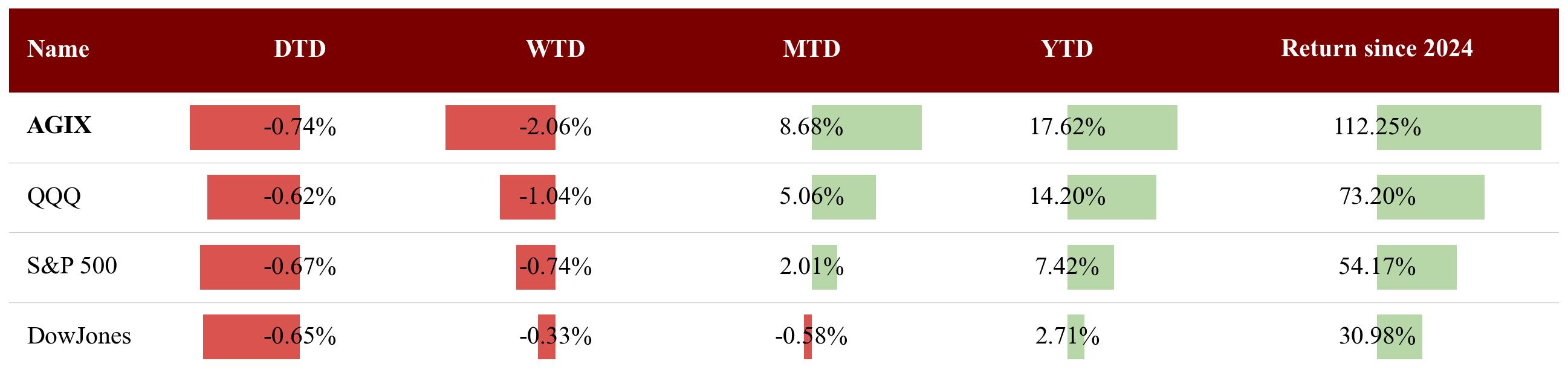
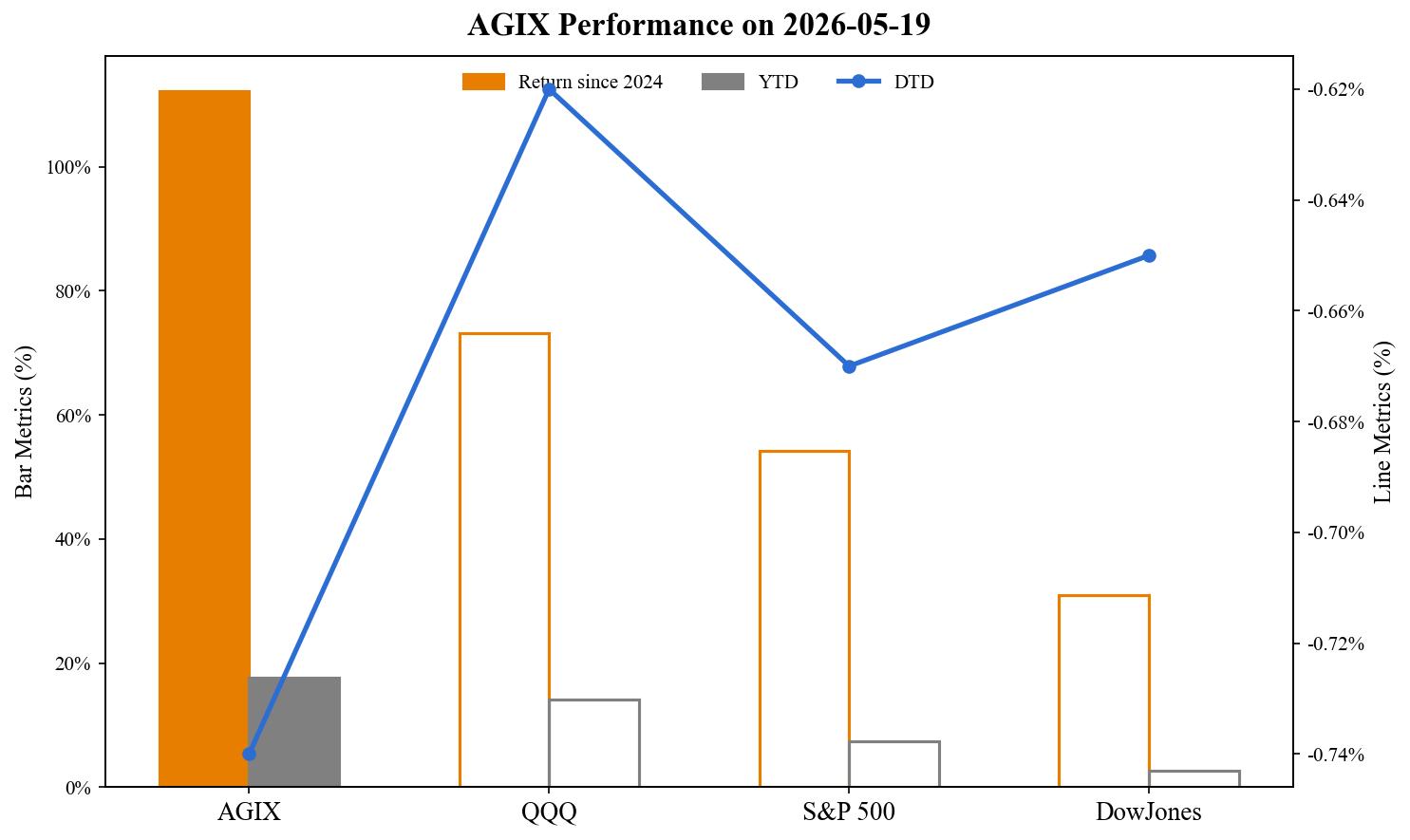
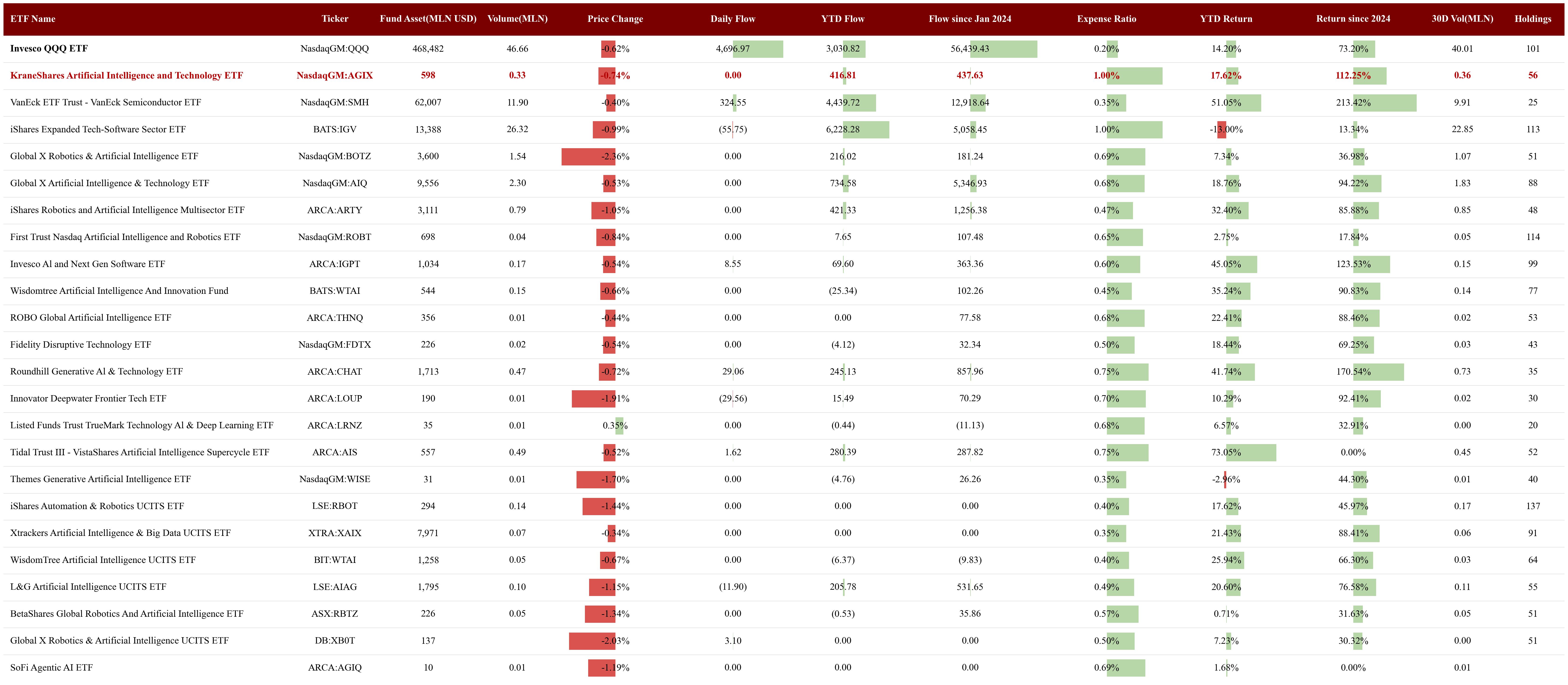
• AGIX fell -0.74% DTD, slightly underperforming the QQQ (-0.62%) and S&P 500 (-0.67%), but outperforming the Dow Jones (-0.65%). Among AI-themed peers, IGV (+0.19%) gained, while BOTZ (-2.36%) lagged; AGIX's YTD return of +17.62% remains ahead of QQQ (+14.2%).
• Within AGIX holdings, the top positive contributors included Astera Labs (+13.3%, driven by momentum in AI connectivity) and SAP (+5.99%, rebounding from oversold levels). Top detractors were MediaTek (-7.21%), SK hynix (-5.16%), and Renesas Electronics (-5.16%), reflecting weakness in semiconductor names.
• Key stocks to watch: Astera Labs (continued AI infrastructure demand), SAP (valuation dip-buying), and NVIDIA (-0.77% DTD) as the largest holding, given its central role in AI compute. Dell's AI factory buildout and Google's Gemini 3.5 Flash launch could sustain interest in infrastructure names.
• Peer ETF moves: IGV (+0.19%) and LRNZ (+0.35%) showed relative strength, while BOTZ (-2.36%) and ROBT (-0.72%) lagged, indicating a preference for software/cloud over robotics/semiconductors today.
News Highlights
1. Dell's CTO and CFO both emphasized the need for enterprises to build AI-native infrastructure, treating legacy systems as data feeders. This bolsters the thesis for hardware and infrastructure names like NVIDIA, Dell, and storage providers, as AI compute demand remains a generational opportunity.
2. Google I/O 2026 dominated the news flow: the launch of Gemini 3.5 Flash (with higher pricing but widespread integration) and Gemini Omni (multimodal video generation) signals aggressive AI monetization. This supports holdings like Alphabet (AGIX 4.22%) and could pressure competitors like OpenAI/Anthropic.
3. OpenAI's lawsuit dismissal and Andrej Karpathy's move to Anthropic highlight talent wars and legal clarity in AI. Karpathy's shift to pre-training research at Anthropic may intensify model competition, benefiting cloud infrastructure names like Microsoft and Alphabet.
4. Enterprise AI funding surged: Unframe raised $50M (with $100M in contract value), and Decart raised $300M for AI optimization. This validates the AI agent and data platform theme, supporting holdings like Datadog, Snowflake, and ServiceNow.
5. Dell's overhaul of its data center portfolio (PowerStore, PowerEdge, PowerProtect) with AI-focused storage and cyber resilience tools reinforces the hardware upgrade cycle. Positive for AGIX holdings like NVIDIA, Broadcom, and Micron.
RSS Highlights
1. Gemini 3.5 Flash launched at Google I/O with 3x price increase over prior version, now widely integrated into Google products. This could pressure margins for AI model providers but signals strong demand for advanced inference.
2. Andrej Karpathy joined Anthropic to lead pre-training research, highlighting the intensifying competition for top AI talent and the race to build frontier models.
3. Analysis of Microsoft's ~$100B OpenAI investment questions the economic viability of AI, noting AI revenue (~$17.9B) is insufficient to cover costs. This raises caution on the sustainability of current AI capex levels.
4. Wi-Wi STAMP wireless time synchronization achieves nanosecond accuracy, a potential enabler for distributed AI and robotics systems, with implications for edge computing and autonomous systems.
5. The last six months in LLMs saw November 2025 as a key turning point with rapid model succession (Claude Opus 4.5, GPT-5.1), and the rise of personal AI assistant OpenClaw, indicating accelerating innovation in consumer AI.
Performance & Benchmark
Attribution
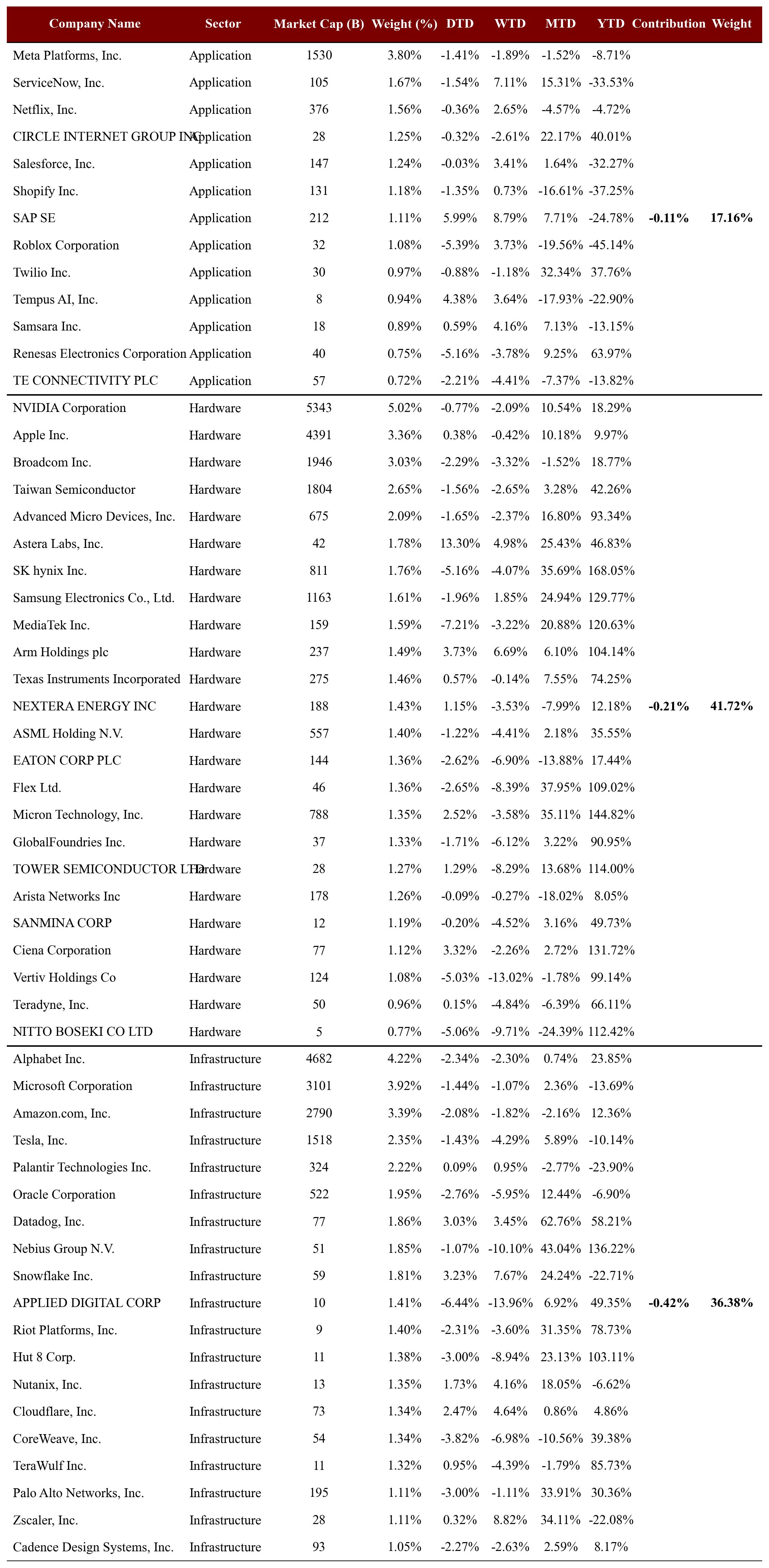
Contribution of the three sectors within AGIX holdings today
Application: -0.11%
Hardware: -0.21%
Infrastructure: -0.42%
Top-performing stocks in AGIX holdings today
Astera Labs, Inc. (13.3%)
SAP SE (5.99%)
Tempus AI, Inc. (4.38%)
Arm Holdings plc (3.73%)
Ciena Corporation (3.32%)
Snowflake Inc. (3.23%)
Datadog, Inc. (3.03%)
Micron Technology, Inc. (2.52%)
Cloudflare, Inc. (2.47%)
Worst-performing stocks in AGIX holdings today
Amazon.com, Inc. (-2.08%)
TE CONNECTIVITY PLC (-2.21%)
Cadence Design Systems, Inc. (-2.27%)
Broadcom Inc. (-2.29%)
Riot Platforms, Inc. (-2.31%)
Alphabet Inc. (-2.34%)
EATON CORP PLC (-2.62%)
Flex Ltd. (-2.65%)
Oracle Corporation (-2.76%)
Palo Alto Networks, Inc. (-3.0%)
Hut 8 Corp. (-3.0%)
CoreWeave, Inc. (-3.82%)
Vertiv Holdings Co (-5.03%)
NITTO BOSEKI CO LTD (-5.06%)
Renesas Electronics Corporation (-5.16%)
SK hynix Inc. (-5.16%)
Roblox Corporation (-5.39%)
APPLIED DIGITAL CORP (-6.44%)
MediaTek Inc. (-7.21%)
Top five listed stocks contributing the most within AGIX holdings today
MediaTek Inc. (-7.21%)
Alphabet Inc. (-2.34%)
SK hynix Inc. (-5.16%)
APPLIED DIGITAL CORP (-6.44%)
Amazon.com, Inc. (-2.08%)
Observation
The strongest movers across peer ETF holdings today are listed below:
| DTD | Stock Ticker | Name | Held by ETFs | analysis |
|---|---|---|---|---|
| 17.66 | TSE:3905 | Datasection Inc. | ['NasdaqGM:WISE'] | Datasection Inc.’s roughly 18% gain on May 19, 2026 appears primarily driven by momentum and technical factors rather than identifiable company-specific news. Public sources around the date show no new earnings, guidance, M&A, or regulatory headlines tied to Datasection or its immediate industry, suggesting the move likely reflects short-term trading dynamics (e.g., follow-through buying after recent strength, technical breakouts, or speculative interest in AI-related names) in a relatively illiquid small-cap stock. |
| 13.3 | NasdaqGS:ALAB | Astera Labs, Inc. | ['NasdaqGM:AGIX', 'NasdaqGM:ROBT', 'ARCA:IGPT', 'BATS:WTAI', 'ARCA:THNQ', 'ARCA:CHAT', 'ARCA:LOUP', 'ARCA:AIS', 'BIT:WTAI'] | Astera Labs’ 13.3% move on May 19, 2026 appears primarily driven by continued momentum and follow‑through buying after a sharp AI-related rally in mid‑May, rather than a discrete new fundamental catalyst that day. The stock had already broken out and was trading well above prior support/resistance zones, aided by strong AI infrastructure sentiment, recent positive commentary around its role in rack‑scale AI (Leo CXL, NVLink Fusion, COSMOS) and a uniformly bullish analyst backdrop (multiple Buy/Outperform ratings with a median target that the stock has now moved decisively through). Elevated options activity and technical momentum likely amplified the upside as investors chased exposure to AI connectivity beneficiaries. |
| 12.45 | NasdaqGS:AGYS | Agilysys, Inc. | ['BATS:IGV'] | Agilysys’ 12.45% gain on May 19, 2026 was primarily driven by a strong “beat and raise” earnings print that underscored accelerating high-margin, recurring software growth. The company reported its 17th consecutive record revenue quarter, with Q4 FY26 and full-year results ahead of expectations, robust subscription growth, expanding recurring revenue mix, record free cash flow, and FY27 revenue and EBITDA guidance above Street forecasts, which triggered an earnings-breakout style move. A secondary support came from bullish sell-side reaction, including Oppenheimer lifting its price target to $100 while reiterating an Outperform rating, reinforcing confidence in the company’s long-term growth story. |
| 11.99 | SEHK:2121 | AInnovation Technology Group Co., Ltd | ['NasdaqGM:BOTZ', 'ASX:RBTZ', 'DB:XB0T'] | AINNOVATION Technology Group’s 11.99% gain on 2026-05-19 appears primarily driven by technical and trading factors rather than any clearly identifiable new fundamental catalyst. There were no notable same-day company announcements, HKEX filings, or major sector/regulatory news specific to Chinese AI/software names that would fundamentally re-rate the stock, suggesting the move was likely fueled by short-covering, momentum buying, or rotation into AI-related names after prior weakness. |
| 10.02 | XTRA:NEM | Nemetschek SE | ['ARCA:IGPT', 'LSE:RBOT'] | Nemetschek’s ~10% gain on 19 May 2026 appears primarily driven by follow-through buying after its solid Q1 2026 results and growing investor focus on its valuation upside. First, recent analysis (e.g., Simply Wall St) highlighted Q1 sales around €313m, a fair value estimate near €96, and the shares as “undervalued,” which likely supported re-rating momentum. Second, the broader backdrop of interest in profitable software names with recurring revenue models likely added style/tactical demand, amplifying the move. |
| 9.97 | SEHK:1274 | iMotion Automotive Technology (Suzhou) Co., Ltd. | ['NasdaqGM:BOTZ', 'ASX:RBTZ', 'DB:XB0T'] | iMotion Automotive Technology (Suzhou) rose 9.97% on May 19, likely driven primarily by renewed sentiment toward Hong Kong auto/autonomous-driving names rather than any clearly identifiable company-specific disclosure in the public results provided. The stock has also shown notable volatility, which can amplify moves on thin or momentum-led trading days. No same-day corporate announcement or regulatory filing was evident from the available sources to explain a more specific catalyst. |
| 9.88 | TPEX:5425 | Taiwan Semiconductor Co., Ltd. | ['ARCA:AIS'] | Taiwan Semiconductor Co., Ltd. (5425) likely rose sharply on May 19, 2026 primarily as a continuation of strong upside momentum after the prior session’s large price jump and re-rating, rather than in response to any specific new company disclosure. Public news flow over this period is dominated by enthusiasm toward Taiwan Semiconductor Manufacturing Co. (TSMC) and Taiwan’s broader semiconductor rally, which appears to be lifting related Taiwan-listed semiconductor names. In the absence of stock-specific news for 5425 on that date, the move is best explained by sector-wide sentiment, momentum trading, and possible short-covering following the abrupt repricing visible in its recent price action. |
| 9.3 | NasdaqCM:CLSK | CleanSpark, Inc. | ['BATS:IGV'] | CleanSpark’s roughly 9% gain on May 19, 2026 appears driven mainly by continued bullish positioning around its expanding bitcoin mining capacity and AI-related data center strategy, amplified by a favorable analyst backdrop. Recent commentary (e.g., May operational update and Q2 discussion) emphasized record hashrate, growing BTC holdings, 1.8 GW under contract, and management’s push into AI/high‑performance computing tenancy, which has kept the stock “on radar” despite reported losses. In parallel, consensus Street ratings remain firmly positive with sizable upside to published 12‑month price targets, reinforcing dip‑buying and momentum interest in a strong crypto tape. |
| 9.28 | TSE:4373 | Simplex Holdings, Inc. | ['LSE:RBOT'] | Simplex Holdings’ 9.28% rise on May 19 was most likely driven by post-earnings follow-through after its fiscal 2026 results, which were described as strong, with earnings growth and improved sentiment around the business outlook. The second driver was valuation re-rating: despite the rally, the stock had been trading well below some fair-value estimates, leaving room for buyers to chase the name after results. There was no clearly identified same-day company-specific negative news, so the move appears mainly earnings- and sentiment-led. |
| 9.21 | NasdaqGS:TENB | Tenable Holdings, Inc. | ['BATS:IGV', 'XTRA:XAIX'] | Tenable’s 9.2% gain on May 19, 2026 appears primarily driven by continued positive reaction to its strong Q1 2026 earnings and guidance, combined with anticipation ahead of its May 21 Investor Day. The company recently reported better‑than‑expected Q1 results (revenue +9.6% YoY to $262.1M, EPS beat, expanding margins, strong cash generation) and raised full-year 2026 revenue guidance to $1.068–1.078B, while also announcing material share repurchases and the launch of Hexa AI, all of which support a stronger growth and profitability narrative. A supportive sell-side backdrop, with a Buy consensus and price targets above the pre-move trading level, likely reinforced investor positioning into the upcoming Investor Day. |
| 8.46 | NasdaqGS:MXL | MaxLinear, Inc. | ['LSE:RBOT'] | MaxLinear’s 8.5% gain on May 19, 2026 appears driven primarily by ongoing investor enthusiasm around its exposure to AI and data-center infrastructure, as reflected in same-day commentary that “MaxLinear (MXL) Stock Rockets As AI And Infrastructure Bets Pay Off.” This move builds on a large post-Q1 2026 re-rating after the company reported strong data center growth, with recent analysis highlighting an “explosive 200% rally” tied to those fundamentals despite stretched valuation. A secondary driver is likely momentum and technical buying, as the stock continues to rebound sharply within its 52‑week range following prior earnings-related strength. |
| 8.4 | SHSE:688256 | Cambricon Technologies Corporation Limited | ['ARCA:IGPT'] | Cambricon’s 8.4% gain on May 19 was most likely driven by strong follow-through in the semiconductor/AI-chip re-rating, with the stock already near its 52-week high and showing very heavy turnover, which points to momentum buying. The most relevant fundamental support was the market’s recent upward revision to 2026 revenue expectations, while Shanghai Stock Exchange filings around late April/early May indicate investors were also reacting to the company’s latest quarterly disclosures. No same-day company-specific announcement was evident from the provided public sources. |
| 8.14 | NasdaqGS:CRDO | Credo Technology Group Holding Ltd | ['ARCA:IGPT', 'BATS:WTAI', 'LSE:RBOT'] | Credo Technology Group’s 8.1% gain on May 19, 2026 was primarily driven by bullish sell-side coverage positioning the stock as a key AI infrastructure winner. Rothschild & Co Redburn initiated CRDO with a Buy rating and a $206 price target, highlighting its leverage to the copper‑to‑optical networking shift in generative AI data centers, while other Wall Street commentary emphasized strong AI-driven networking demand and high-speed, energy-efficient connectivity as structural growth drivers. Anticipation ahead of the June 1 FY2026 earnings release, with investors betting that AI-related demand will sustain rapid revenue growth and margins, further supported upside momentum and dip-buying during the session. |
| 6.58 | NasdaqGM:FIVN | Five9, Inc. | ['BATS:IGV', 'ARCA:IGPT'] | Five9’s 6.6% gain on May 19, 2026 appears driven primarily by a rebound from depressed levels as investors reassessed its risk/reward after recent underperformance and modest but positive growth. The stock has lagged the market over the past year (down ~20%+ with only ~1% return since Nov 2025), while fundamentals show mid‑single to low‑double‑digit revenue and billings growth plus improving gross margins, which may be attracting value‑oriented and mean‑reversion flows. In addition, consensus analyst ratings remain “moderate buy” with an average target implying ~25% upside from prior levels, providing a supportive backdrop for a catch‑up move in the absence of any new negative company‑specific news. |
| 6.56 | NasdaqGS:IPGP | IPG Photonics Corporation | ['ARCA:IGPT', 'LSE:RBOT'] | IPG Photonics’ 6.6% gain on May 19 was most likely driven by continued positive reaction to its strong first-quarter 2026 results, which showed revenue up 17% year over year to $265.5 million and EPS of $0.29 versus $0.27 expected. The move also appears to have been helped by investor optimism around the company’s improving fundamentals after the earnings release, with the stock already showing strength into and after the report. No major same-day company-specific negative catalyst is evident in the public results. |
| 6.22 | NSEI:TATATECH | Tata Technologies Limited | ['LSE:RBOT'] | Tata Technologies’ 6.2% gain on 19 May 2026 appears to be primarily a technical and flow-driven move rather than a reaction to specific new fundamental news. First, the stock broke sharply higher intraday from its flat prior close of ₹629.4, trading up to ~₹672 with strong momentum, suggesting short-term buying interest after recent underperformance (flat to slightly negative over 6–12 months per Kotak/Bajaj data). Second, the move comes as the share price rebounds above its 50-DMA and towards the 200-DMA (per Dhan), likely triggering technical and momentum-driven buying in an IT mid-cap that had corrected in prior months. |
| 6.21 | TSE:3673 | Broadleaf Co., Ltd. | ['LSE:RBOT'] | Broadleaf’s 6.21% gain on May 19 appears to have been driven mainly by positive trading momentum rather than any clearly identifiable company-specific news that day. The most relevant public evidence is that the stock has been showing a strong recent rebound in technical signals and price trend, with third-party market pages flagging buy momentum and a tight trading range near the lower end of its recent band. A secondary factor may have been broader optimism around the company’s operating performance following recent revenue growth commentary in coverage of its earnings trends, but no major same-day disclosure or event stands out. |
| 5.99 | XTRA:SAP | SAP SE | ['NasdaqGM:AGIX', 'BATS:WTAI', 'NasdaqGM:FDTX', 'LSE:RBOT', 'XTRA:XAIX'] | SAP SE’s 5.99% gain on 2026-05-19 appears primarily driven by a rebound from recent oversold levels after the stock had fallen to a 28‑month low and lost nearly 40% over 12 months, prompting value-oriented dip buying. Supporting this, multiple valuation-focused writeups (e.g., Simply Wall St) framed SAP as materially undervalued relative to their fair value estimates, likely reinforcing investor willingness to step in after the sharp prior decline. With no major company-specific news, earnings releases, or sector-wide regulatory shocks reported that day, the move is best explained by technical recovery and sentiment/valuation re-rating rather than new fundamental information. |
| 5.86 | TSE:6594 | Nidec Corporation | ['NasdaqGM:ROBT', 'ARCA:IGPT'] | Nidec’s 5.86% gain on May 19, 2026 appears primarily driven by positioning and anticipation ahead of upcoming earnings/management events rather than a specific new company disclosure that day. First, recent headlines highlighting the prior sharp stock drop “as earnings loom” suggest investors may be rebalancing and covering shorts into the event, leading to a rebound. Second, the stock is trading well below its 12‑month high and against a backdrop of previously announced share repurchases, so buyback support and value-oriented dip buying in a volatile name likely amplified the move in the absence of fresh fundamental news on the day. |
| 5.7 | NasdaqCM:NN | NextNav Inc. | ['BATS:IGV'] | NextNav’s ~5.7% gain on May 19 appears driven primarily by continued positive follow-through on its recent Q1 2026 earnings beat and narrowing losses, which have improved sentiment on the company’s path to monetizing its PNT technology despite still modest revenues. With no major company-specific headlines or sector news on the day, the move also likely reflects momentum buying in a thin-liquidity session (volume below the recent average) as investors position around a $25 average target price and ongoing interest in GPS-alternative infrastructure themes. |
| 5.49 | NasdaqGS:SIMO | Silicon Motion Technology Corporation | ['ARCA:AIS'] | Silicon Motion’s 5.5% gain on May 19, 2026 was primarily driven by continued follow-through buying on its “blowout” Q1 2026 earnings and above-consensus Q2 guidance, which have reset expectations higher for growth, margins, and AI-related demand. The stock is increasingly being treated as an AI-capex and storage-controller proxy, with investors extrapolating strong edge/cloud AI and enterprise SSD controller demand into 2026. A secondary support is positive sell-side and trading commentary highlighting SIMO as a favored AI/storage name after the recent analyst upgrades and target hikes, which has helped sustain momentum after the initial post-earnings spike. |
| 5.42 | TSX:TRI | Thomson Reuters Corporation | ['NasdaqGM:QQQ', 'NasdaqGM:AIQ'] | Thomson Reuters’ 5.42% gain on May 19 was most likely driven by post–capital-return enthusiasm after the company’s May 1 announcement of a US$1.435518 per-share cash distribution and share consolidation, which began trading effective May 4. The move also fits a continuing rerating of the stock after the corporate action was approved and implemented, with investors likely adjusting to the lower share count and capital-return optics. No clearly stronger same-day company-specific news appears to explain the jump. |
News
Funding & M&A
Dell's CFO sees the enterprise AI buildout as a generational opportunity still in its opening act.
As enterprise AI infrastructure construction becomes a focal point in the industry, Dell Technologies Inc. has deployed over 5,000 AI Factories. Company finance executive David Kennedy stated at Dell Technologies World 2026 that AI demand orders last year reached $64 billion, with $34 billion in the fourth quarter alone. Dell is leveraging private credit relationships and banking networks to help customers solve funding issues and drive AI construction. The company generated $11 billion in operating cash flow this fiscal year and returned $7.5 billion to shareholders, with earnings growing 20%. With PC refresh cycles and storage demand accelerating, Dell is on a multi-engine growth trajectory. Kennedy warned that companies risk being left behind if they fail to embrace the new AI era in time.
Federal jury rules against Elon Musk in closely watched OpenAI trial.
A U.S. federal jury has voted to dismiss Elon Musk's high-profile lawsuit against OpenAI. The jury found that Musk's lawsuit exceeded the statute of limitations, and the judge immediately accepted this non-binding advisory opinion and dismissed the case. Musk filed the lawsuit in March 2024, accusing OpenAI of deviating from its original 2015 non-profit promise, establishing a for-profit arm in 2019, and failing to open-source its large language models as pledged. The lawsuit also named Microsoft as a co-defendant, alleging it aided the breach. After three weeks of trial, the jury ruled to dismiss the case on grounds of $8 billion in "unjust enrichment." OpenAI has since restructured its for-profit arm into a public benefit corporation in 2025, preparing for an IPO. Musk stated on X that he will appeal the ruling. This case concludes the most high-profile legal battle between the tech executive and the AI field.
Decart raises $300 million for its AI optimization software, world models.
AI developer Decart.ai has successfully raised $300 million in funding, valuing the company at nearly $4 billion. The round was led by Radical Ventures, with participation from Nvidia, Adobe Ventures, Toyota Ventures, and angel investors including OpenAI co-founder Andrej Karpathy. The funding coincides with the upgrade of the DOS 2.0 platform, software that significantly improves AI training and inference efficiency, processing over 1,600 tokens per second—eight times the industry average. DOS also powers two world models, Lucy and Oasis, used for real-time video editing and 3D environment generation, widely applied in smart mirrors, robot training data generation, and logistics simulation. Decart will use the new funding to accelerate product iteration and advance the commercialization of AI technology.
Sigma Computing seals $80 million funding round as it pivots toward 'agentic analytics'.
Cloud-native data analytics startup Sigma Computing has completed an $80 million Series E funding round, doubling its valuation to $3 billion. The round was led by Princeville Capital, with new investors including Databricks Ventures, ServiceNow Ventures, and Workday Ventures. The company doubled its annual revenue to $200 million last year, serving over 2,000 customers and 1.1 million new active users, including AMD, Duolingo, and JPMorgan Chase. Sigma provides a data analytics platform that runs on cloud data warehouses such as Snowflake, Databricks, and Google BigQuery, supporting spreadsheet-style interfaces, SQL, Python, and AI applications. The latest funding will be used to drive the development of the "agentic analytics" category, launching customizable no-code AI agents that run within third-party data warehouses while maintaining existing governance and security frameworks. CEO Mike Palmer stated that this strategy responds to the need for balancing rapid AI development with security governance in enterprises. This move is driven by AI agent releases from companies like SAP, Google Cloud, and Snowflake, signaling the transition of the data analytics field toward the era of intelligent agents.
Forget the feed: Status AI raises $17M to turn social media into interactive entertainment
State AI application launched officially after starting in stealth mode. This gamified social app lets users immerse themselves in any universe through AI role-playing. Founders Fai Nur, Amit Bhatnagar, and Pritesh Kadiwala co-created the platform, where users can customize personas, generate stories, and play multiplayer with friends. The company just announced $17 million in seed and Series A funding from investors including Abstract, General Catalyst, Union Square Ventures, Y Combinator, and LightShed Partners. This funding round will be used for platform expansion. There are currently 13 million user-generated worlds and 5 million character profiles. Unlike chatbot models like Character.AI, this app focuses on interactive entertainment and immersive social experiences. Investors believe it can help media companies bring audiences into worlds they create.
Stilta raises $10.5M from a16z and YC to help companies rediscover the patents they forgot they had
Founding company Stilta announced on Tuesday a $10.5 million seed funding round led by Andreessen Horowitz, with participation from Y Combinator and OpenAI operators. The company was co-founded by Oskar Block and Tobias Estreen, among others, and provides an AI-powered intelligent property analysis platform that automates patent searches, conflict detection, and evidence organization. The technology can generate patent evidence at litigation level, significantly reducing the cost and time of patent evidence. This funding round reflects the growing popularity of AI in legal tech, with companies like Solve Intelligence and DeepIP also active in related fields. Stilta aims to solve the bottleneck of patent analysis through an AI agent network, enabling more enterprises to effectively utilize unenforced intellectual property assets.
Torq acquires AI security startup Jit to add context graphs to its security operations center platform
Autonomous security operations company Torq Ltd. has announced the acquisition of AI-driven security startup Jit.io Ltd., whose technology generates AI context graphs to support security investigations. Torq will integrate Jit's AI Context Graph into its AI SOC platform to enhance automated threat protection. The acquisition value was not disclosed; Jit had raised a total of $46.7 million. Torq previously completed a $140 million Series D funding round at a $1.2 billion valuation and acquired Israeli company Revrod a year ago. This deal is Torq's latest move to build an agentic security operations center, helping enterprises achieve more accurate autonomous security protection. Post-acquisition, Torq will provide AI agent understanding based on organization-specific data graphs to better comprehend and respond to security incidents.
Voker raises $2.2M to help teams understand how AI agents perform in the wild
Voker, an AI agent analytics platform, recently announced the completion of a pre-seed funding round of $2.2 million, with investors including Y Combinator and FundersClub. As enterprises push AI agents to customer-facing and internal processes, product teams are facing the challenge of shifting from 'can we build it' to 'does it actually work in real environments.' Voker provides analytics visibility tools for the entire team, capable of processing large volumes of conversation data, helping identify new user intents, and delivering actionable performance metrics for product, design, and executives. Founder Tyler Postle pointed out that current engineering tools are too specialized to meet the entire team's need to understand agent effectiveness. The platform targets production customers with over 1,000 monthly conversations and emphasizes that agent projects that overpromise without delivering real value will lead to user churn. This funding will help Voker drive AI agents from engineering feasibility to commercial success.
Enterprise AI startup Unframe raises $50M after booking $100M in contract value in year one
Unframe Inc., a company that creates enterprise AI platforms, recently announced $50 million in funding to expand delivery capabilities, increase platform investment, and build a senior leadership team. Since its founding in 2024, the company has pushed total contract value above $10 billion within 12 months and achieved a net revenue retention rate of 400%. Unframe's 'The Framery' platform can plug into existing enterprise systems and data, bringing AI deployments into production within days, addressing the pain point where most generative AI projects struggle to go live. The round was led by Highland Europe, with participation from Bessemer Venture Partners, Craft Ventures, and others. This brings Unframe's total funding to $10 billion. Meanwhile, Akamai acquired Noname Security, co-founded by Unframe's founders, for $450 million in 2024. Global consulting firm Credera has begun partnering with Unframe to help clients accelerate AI application deployment.
Google to embed AI shopping features in multiple services with Universal Cart
Today at Google I/O 2026, Google launched Universal Cart, an AI shopping tool that can be used through Google Search, the Gemini app, YouTube, and Gmail. Universal Cart automatically searches e-commerce listings based on product descriptions provided by users, compares the best prices, displays price history, monitors inventory, and notifies users when items are back in stock. The tool can identify mismatches between items in the cart and user intent, such as checking PC component compatibility. Universal Cart is powered by Gemini 3.5 Flash and Gemini Omni models, and is deeply integrated with Google Wallet and Google Pay for fast checkout. This feature is based on Universal Commerce Protocol technology, developed in collaboration with companies like Stripe to standardize AI shopping automation interfaces. The tool will first launch in the US this summer, and will later support AI autonomous purchasing with AP2 technology.
Google and Blackstone launch an AI infrastructure joint venture.
U.S. tech giant Google and Blackstone announced the formation of a joint venture to provide a "Computing as a Service" platform for AI workloads. The project is backed by $500 million in equity from Blackstone, which holds a majority stake, with a total investment value of $25 billion (including debt financing). The joint venture will be led by Google senior manager Benjamin Treynor Sloss and will use Google's custom TPU chips to build the infrastructure. The project initially offers 500 megawatts of computing capacity, with plans to significantly expand data center footprint in the future. This move helps meet the surging market demand for AI computing resources while providing new opportunities for Blackstone's expansion in the data center sector.
Enterprise AI is ready — Michael Dell says executives need to be, too.
AI infrastructure is becoming the core of new enterprise operational models. Dell Technologies has deployed over 5,000 AI Factory solutions globally, covering cloud services, sovereign entities, and various enterprises. CEO Michael Dell emphasized at Dell Technologies World 2026 that leaders must have the courage to reshape workflows, combining human and digital workers to succeed in the AI competition. The emergence of agentic AI requires enterprises to have stronger data activation capabilities. Leveraging decades of data infrastructure experience, Dell provides complete solutions from rack-level to edge devices, supporting frontier models, open models, and specialized models in manufacturing, retail, healthcare, and other scenarios. Company data shows that enterprises embracing AI grow much faster than those that do not.
From teen hacker to Iron Dome researcher, this founder raised $28 million to fight AI phishing.
Security startup Ocean, emerging from stealth, announced $28 million in funding led by Lightspeed Venture Partners, with participation from Image Capital and Cerca Partners. The platform offers an agentic email security solution to defend against AI-driven phishing attacks. Founder Shay Shwartz previously held key roles in Israeli defense units and at HPE spinoff Axis, including work on the Iron Dome project. The company processes billions of emails monthly for clients such as Kayak, Kingston Technology, and Headspace. Its small language model analyzes sender intent and organizational context to detect AI-powered spear-phishing attacks. Beyond established vendors like Proofpoint, Mimecast, and Abnormal Security, Ocean advocates using specialized AI guards to enhance email security. The funding also attracted participation from founders of Wiz and Armis.
Meta shifts 7,000 employees into four new AI units ahead of mass layoffs
According to reports, Meta Platforms is restructuring, moving about 7,000 employees into AI-related roles in response to an upcoming layoff plan affecting approximately 8,000 people. The adjustment consolidates employees into four new organizations: Applied AI Engineering, Agent Transformation Accelerator, Central Analytics, and Enterprise Solutions, driving the 'AI for Work' strategy. This round of layoffs will reduce Meta's total workforce by one-twentieth, to about 77,986 people. The savings will be invested in AI infrastructure, with capital expenditures expected to reach $125 billion to $145 billion this year. Meta still lags behind companies like OpenAI, Google, and Anthropic in generative AI. This restructuring aligns with the 'Year of Efficiency' goal and will further accelerate AI product development.
Mach Industries just spent $50M to solve a major defense tech problem
Defense tech startup Mach Industries acquired solid rocket motor startup Exquadrum for $50 million in cash and equity, renaming it Mach Energetics. The acquisition gives Mach solid rocket motor production capabilities, solving a key constraint for unmanned systems. After the acquisition, Mach's headcount grew to 350, and it now owns a 70,000-square-foot facility in Victorville, California. Mach is advancing a vertical integration strategy covering engines, radar, and avionics to reduce costs and speed up production. The company has raised $100 million in funding, with its most recent Series B valuation at $700 million. Multiple vehicle projects such as Viper and Dart are in development. This acquisition not only strengthens its own supply chain but also provides components and testing services to other defense companies.
Elon Musk said Sam Altman ‘stole’ a non-profit — but the trial showed he had similar aims
A US court quickly ruled to dismiss George Mark's lawsuit against OpenAI, Microsoft, and their founders. Court proceedings revealed that Mark had previously allowed OpenAI researchers, including Andrej Karpathy and Ilya Sutskever, to work for free on Tesla's autonomous driving project. The court also disclosed that Mark attempted to take control of OpenAI's for-profit arm in 2017 but ultimately failed. The court found that Mark's claims exceeded the statute of limitations and that his own actions contradicted the allegations. The outcome emphasizes that the use of non-profit organization assets must align with their original mission, and highlights the complex relationship between personal grievances and corporate control. Mark stated he would appeal, but the ruling confirmed the weakness of his claims.
Technical Breakthroughs
Google’s Gemini Omni turns images, audio, and text into video — and that’s just the start
At today's Google I/O developer conference, Google officially launched the new Gemini Omni multimodal model family to achieve its multimodal AI goals set three years ago. This model can understand and uniformly process text, images, audio, and video inputs, producing high-quality video content that aligns with physical laws and cultural understanding. Gemini Omni Flash will be available today in the Gemini app, YouTube Shorts, and the AI creative tool Flow, allowing users to edit images or create digital avatar videos with simple text commands. To prevent deepfake videos, users need to register and record their own voice. All generated videos will include Google SynthID digital watermarks for verification. The model also supports enterprise-level API access and can be applied to professional scenarios such as advertising and film production. This release marks an important step forward for Google in multimodal world models.
Google introduces Gemini Spark, a 24/7 agentic assistant with Gmail integration
In the race to build powerful personal AI agents, Google offers an advantage that cannot be ignored: it already has access to all of users' email data. At the recent Google I/O developer conference, the company officially released a new agentic personal assistant, Gemini Spark. This product is based on the Gemini foundation model and integrates the agent system provided by Google Antigravity. Alphabet CEO Sundar Pichai stated that Spark represents the next generation of intelligent digital assistants, capable of executing long-term tasks and reducing user oversight. This agent seamlessly integrates with Google Workspace services such as Gmail and Google Docs, allowing users to interact directly through a dedicated mailbox. Small businesses are already testing the tool and can monitor their inboxes. Spark will first be available to Google AI Ultra subscribers and supports integration with various services via MCP. This move highlights Google's technological edge in the personal agent space.
Agentic app coding gets an upgrade with Google’s release of Android CLI
At this year's Google I/O developer conference, Google announced that its Android CLI command-line interface has reached version 1.0 and is fully stable, supporting external AI agents in developing Android applications. This tool allows multiple AI systems such as Claude Code and OpenAI Codex to directly call upon Android Studio's professional knowledge base. Through the newly added "android studio" command, AI agents can acquire Android development skills, improving development efficiency. Google will also provide an optional installation package for its own agent development platform, Antigravity, enabling it to complete core Android development tasks. This move shows that Google is actively opening its technical resources to the global AI ecosystem, promoting cross-platform intelligent development.
Google updates its Gemini app to take on ChatGPT and Claude
At the annual Google I/O conference, Google announced several major updates to the Gemini app, including the "Daily Brief" feature, a new interface design, the Gemini Omni video AI model, and the personal AI agent Gemini Spark. This series of updates shows that Google is turning Gemini into a versatile AI hub to enhance its competitiveness against rivals like ChatGPT and Claude. Daily Brief can integrate users' email, calendar, and task information, prioritize and suggest next steps, and has begun rolling out to Google AI subscribers in the US. The new design language "Neural Expressive" provides smooth animations, vibrant colors, and haptic feedback. Gemini Spark, a 24/7 cloud-based personal agent, helps users create custom workflows. The Gemini Omni video model supports multimodal input to generate high-quality videos and is now available on Google Flow and YouTube Shorts. These updates demonstrate Google's competitive momentum in the multimodal AI space.
Google Search as you know it is over
At this week's Google I/O conference, Google officially announced a major AI overhaul of its search product. The new intelligent search box will support longer conversational queries and provide interactive experiences and dynamic visual results through the Gemini model. Users can customize 'information agents' to monitor web changes in real time and generate comprehensive reports, a feature rolling out to all users this summer. Additionally, users can use the Antigravity platform to create stateful mini-apps with natural language, such as custom fitness or meal plans. This improvement builds on AI Overviews and AI Mode, and will further reduce referral traffic to third-party websites. Its core technology comes from Google DeepMind and the Gemini Flash 3.5 model, aiming to let AI agents replace humans in performing large amounts of information gathering and analysis tasks.
Google introduces Gemini Spark, a 24/7 agentic assistant with Gmail integration, at IO 2026
In the race to build personal AI agents, Google holds a unique advantage. At the recent Google I/O developer conference, Google announced the launch of a new agentic personal assistant, Gemini Spark, built on the Gemini foundation model and Google Antigravity's agent framework. Google CEO Sundar Pichai described it as a new evolution of the intelligent digital assistant, capable of handling long-term tasks with minimal supervision. The assistant can directly integrate with Google Workspace services like Gmail and Google Docs. Users can interact with it via a dedicated email address, and it supports web operations through Chrome. On mobile, users can track the agent's progress through the Android Halo system. The product is currently in testing and will be available to Google AI Ultra subscribers next week. This move strengthens Google's competitiveness in the personal AI space.
How to use Google’s new AI agents to go beyond your standard searches
In the Google I/O 2026 keynote, the tech giant announced that its search tool will introduce new agent capabilities, allowing users to create, customize, and manage multiple AI agents to continuously track topics of interest. These information agents can run 24/7 in the background, synthesize information from multiple sources, explain the significance of events, compare different perspectives, and provide actionable advice, rather than just offering a list of links. This feature can be used for stocks, flight prices, sports events, housing market trends, and more. It will first roll out to Google AI Pro and Ultra subscribers in the US this summer, then expand to other markets. This move marks a major redesign of the search interface, supporting longer conversational queries and introducing AI suggestions. Google is pushing for broader deployment of agentic AI systems to enhance user experience.
Google targets AI agents and video generation with Gemini 3.5 Flash and Omni
Google today launched new products in the Gemini series, including Gemini 3.5 Flash and Gemini Omni. Flash 3.5 focuses on high-speed reasoning capabilities, applicable to AI agent workflows, significantly outperforming previous models and competitors in standard tests like Terminal-Bench, and runs at four times the industry's fastest speed. This model has become the default choice for Gemini applications and search AI mode, and jointly supports multi-agent collaboration to solve complex problems with the Antigravity code editor. Additionally, the company introduced a new personal assistant, Spark, which uses Flash as its brain to automate tasks. Gemini Omni extends multimodal understanding to the field of video creation, supporting image, audio, video, and text inputs to generate high-quality videos and enable conversational editing. The first Omni Flash models are now available on the Gemini app, Google Flow, and YouTube Shorts. Google also emphasized responsible AI development, applying SynthID watermarking technology to identify AI-generated content.
Google reimagines search with AI agents and generative interfaces
At the Google I/O developer conference, Google LLC announced the upgrade of the search experience to an AI workspace. The new search bar supports longer query inputs and can integrate multiple modes including text, images, videos, and Chrome tabs. A tracking dialog has been added below AI Overview, enabling continuous interaction with AI Mode without extra clicks. The company introduced Search Agents, which can run searches in the background 24/7, collect information, and periodically return reports, such as for house hunting scenarios. Combined with the Antigravity tool and the Gemini 3.5 Flash model, Search can generate interactive mini-apps and generative UIs, such as solar system visualizations and fitness trackers. This feature will be available to Pro and Ultra subscribers in the summer. This upgrade transforms search from a static results page into an intelligent agent-based interactive space, enhancing the user experience in the 'agentic era'.
Solar to dominate energy by 2035, but AI data centers will keep fossil fuels in business
According to a recent BloombergNEF report, solar energy will become the world's largest source of electricity within the next decade, surpassing coal, oil, and natural gas. This shift is primarily driven by economic factors, with solar costs continuing to decline and expected to drop another 30% by 2035. AI data centers and industrial electrification will drive a significant increase in energy demand, with data centers alone driving 1 TW of industrial-scale solar, 400 GW of solar, 370 GW of natural gas, and 110 GW of coal by 2050. Although fossil fuels will still provide 51% of incremental power generation, solar is increasingly competing with fossil fuels. Google has invested $1 billion in Form Energy's 100-hour iron-air battery project, while Fervo Energy and X-energy are accelerating geothermal and nuclear energy deployment through IPOs. China's industrial policies and mass production are driving down solar costs, and by 2050, solar power generation will more than double that of natural gas. Global grid battery installations will nearly triple by 2035, with companies like Redwood Materials and Ford already positioning themselves. The Iran conflict emerged after the report was compiled, but economic transformation can reduce countries' energy dependence.
LaunchDarkly launches runtime control layer for the agentic AI era
LaunchDarkly, a feature management control platform, today released a new solution called AgentControl for real-time management of AI agents in production environments. As AI agents are deployed at scale, issues such as model drift, output uncertainty, and anomalies caused by excessive autonomy are emerging. This solution provides rapid configuration changes, quality benchmarks, and progressive rollouts, combined with trace-level visibility for immediate intervention. Changes take effect within 200 milliseconds, supporting routing to different models or triggering fallback plans, ensuring no perceptible difference in conversation-level responses. CTO Cameron Etezadi noted that the platform systematically addresses core challenges in the AI software development lifecycle. Brian McCarthy, General Manager of Anysphere Inc., also stated that runtime control has become essential infrastructure for production-grade AI agents. This move marks LaunchDarkly's strategic expansion from feature flags to AI agent management.
Sola Security launches Lumina to cut enterprise security alert noise with contextual AI
Cybersecurity startup Sola Security today launched its autonomous risk intelligence platform Lumina, which uses contextual AI technology to integrate cloud, identity, SaaS, and endpoint environments, transforming raw alerts into prioritized security signals with reasoning, asset context, and action recommendations. Facing signal noise from an average of 83 security tools per enterprise, Lumina provides bidirectional severity scoring and blast radius mapping, dynamically adjusting scores based on asset criticality, data sensitivity, and historical decisions, compressing up to 99.98% of raw data. User feedback shows the platform can reduce operational noise by 87% and accelerate context understanding by 50%. The platform is built on Sola's asset graph intelligence layer, and its co-founders say it enables security teams to shift from simply responding to alerts to intelligent decision-making. Sola has raised a total of $65 million, with investors including Microsoft M12.
With Gemini 3.5 Flash, Google bets its next AI wave on agents, not chatbots
Google officially launched the Gemini 3.5 Flash model at its annual I/O developer conference, positioning it as the most powerful code and autonomous agent AI model to date. This model can independently execute programming pipelines, manage research projects, and even build an operating system from scratch in internal tests. Compared to previous conversational AI, Gemini 3.5 Flash pushes AI toward an agentic working mode, featuring low latency and high-speed parallel processing, capable of running autonomously for hours and requesting user input at key decision points. Google also released the Antigravity 2.0 desktop app and the Gemini Spark personal AI agent. The new model has gone live globally in the Gemini App and Search AI Mode, and is beginning to impact practical applications in industries such as finance and data science. This launch marks a significant advancement in Google's AI agent technology, but also sparks discussions about the safety of autonomous agents.
Google’s Genie world model can now simulate real streets with Street View
Google DeepMind has combined Street View with the Project Genie world model to launch a more immersive interactive environment simulation. Users can adjust weather and simulate rare scenarios through this feature, supporting robot and self-driving car training. This integration was officially announced at Google I/O and will first be available to Google AI Ultra users in the US, then expand globally. Street View data, collected by Google over the past 20 years, covers more than 110 countries with over 28 billion images, providing real-world anchors for Genie 3. The technology has been used by Waymo in its self-driving car simulator to help handle extreme events like dust storms or elephant herds. The model is still experimental, making progress in spatial continuity, but physics simulation and lighting quality still need improvement. Researchers expect it to reach video generation accuracy within months. This technology will drive innovation in education, gaming, and robotics.
Stop bolting AI onto brownfield and start treating legacy as a feeder, not a foundation, says Dell CTO
As fully autonomous AI agents move from concept to commercial reality, enterprises are rethinking their technology infrastructure. John Ross, Global CTO and Chief AI Officer at Dell Technologies, points out that the rapid advancement of agentic AI has made "tokennomics" a new topic, requiring intelligent hybrid infrastructure to manage changing costs. Ross emphasizes that AI capabilities cannot simply be plugged into existing legacy environments; instead, dedicated AI environments must be built, with legacy systems serving only as data inputs. The Dell AI Data Platform treats data as the core component of the AI factory, transforming institutional knowledge into structured knowledge usable by agents through knowledge graphs and ontologies. At the same time, digital processes are directly embedded into agent systems to ensure predictability and scalability. This technological transformation will reshape the foundation of enterprise operations, making AI a true driver of productivity.
Dell's CTO says stop bolting AI onto brownfield and start treating legacy as a feeder, not a foundation.
As autonomous AI agents move from concept to commercial practice, enterprises face an urgent need to restructure their infrastructure. John Roese, Global CTO and Chief AI Officer of Dell Technologies, points out that agentic AI has become a board-level priority, with strong variability in production costs and deployment models. Companies should not treat legacy systems as core, but instead build independent AI environments where agents can operate autonomously. The Dell AI Data Platform treats data as a core component of the AI factory, converting enterprise knowledge into usable resources through knowledge graphs and terminology systems. In addition, digital processes are embedded into agent systems to ensure predictable and scalable behavior. This shift is driving organizations to rethink technology architecture and economic models, pushing AI-centric engineering to become a new organizational discipline.
With expanded Antigravity platform, Google accelerates agent-native software development
At today's Google I/O conference, Google Cloud launched the Antigravity 2.0 standalone desktop app, upgrading its 'agent-first' coding platform into a more powerful AI autonomous collaboration environment. The app supports multiple AI agents executing tasks in parallel and integrates features like dynamic sub-agents, scheduled tasks, and terminal CLI. Also released are the Managed Agents feature for the Gemini API, Android native coding support in Google AI Studio, and integration with Google Workspace. The new version uses the Gemini 3.5 Flash model for the first time, outperforming front-end models with four times faster speed. The CodeMender code security agent, developed by Google DeepMind researchers, will also be integrated into the Gemini Enterprise Agent Platform to automatically detect and fix potential security vulnerabilities. These updates will enable developers to quickly build, deploy, and secure agent systems.
Product Launches
Becoming AI-native is no longer a path to success — it’s an operational prerequisite
Jeff Clarke, Vice Chairman and Chief Operating Officer of Dell Technologies, stated at Dell Technologies World 2026 that AI has become the new benchmark for enterprise competitiveness. The company has spent nearly three years using its own operations as a testing ground to explore the AI-native enterprise model. Clarke pointed out that advances in frontier models have transformed software development, with agents now capable of meaningful work. For example, two AI engineers, using one day and sufficient tokens, replicated 30% of the functionality that 50 engineers built over a year, and could reach production within four weeks after obtaining architectural context. He emphasized that to achieve 10X or 100X productivity gains, workflows must be restructured rather than simply layered onto old processes. Dell achieved scaled implementation over three years by simplifying, standardizing, and automating data sources, and building an agent framework. Token economics may shift enterprise IT spending from labor costs to tokens. Clarke warned that all companies must become AI-native or risk falling behind in the market.
Google launches Antigravity 2.0 with an updated desktop app and CLI tool at IO 2026
At Google I/O 2026, Google officially launched the new version of its agentic coding application Antigravity 2.0, which includes a desktop app, CLI tools, and an SDK. This version supports multi-agent parallel tasks, custom sub-agent workflows, and background scheduling, with enhanced integration with Google AI Studio, Android, and Firebase. It is powered by the new Gemini 3.5 Flash model and adds voice command support. Additionally, Google introduced a new AI Ultra plan with monthly fees set at $100 and $200 tiers to meet different user needs for AI resources. The tool will also be used to generate real-time custom interfaces for consumer products like Search and Gmail, and provides a way for developers to export projects. This upgrade demonstrates Google's continued investment in agentic AI applications.
Google shows off first intelligent specs running Android XR
At Google I/O 2026, Google announced a partnership with Samsung Electronics to launch the first smart glasses, set to be available in the fall of this year. The product is manufactured by Samsung with software support from Google, and is compatible with both Android and iOS. In terms of design, Google has partnered with Warby Parker and Gentle Monster to offer multiple frame styles, with plans to release a full collection within the year. The smart glasses integrate Gemini AI, Android XR system, and Qualcomm technology, supporting voice commands, real-time navigation, photo capture and editing, launching third-party apps like DoorDash, and real-time text translation. The device can wake Gemini via voice or touch on the frame, enabling multi-step tasks, message summaries, and music playback. Google stated that this is an important step with Samsung to advance AI普及化, aiming to let users experience smart convenience in a more natural, hands-free way in daily life. This product will compete with Meta's Ray-Ban smart glasses.
Google’s AI now lets you talk to your Gmail inbox
Google recently announced the integration of Gemini AI technology into Gmail, launching a new conversational AI feature called Gmail Live. Users can quickly find details about flights, medical appointments, hotel information, and more in their inbox by asking questions in natural language, without needing to enter keyword searches. This feature supports follow-up questions, topic switching, and detail extraction, and will expand to apps like Google Keep. This move is an important step for Google in promoting practical AI deployment, currently limited to Google AI Ultra users, with plans to begin rollout after this summer. The feature will not replace traditional search but serve as a supplementary option to meet user expectations for AI convenience. Google has also extended the new features to Google AI Pro and Plus users.
Google launches Antigravity 2.0 with an updated desktop app and CLI tool
Google has launched a new version of its agentic coding application, Antigravity 2.0, which includes a desktop app, CLI tools, and an SDK, supporting simultaneous execution of tasks by multiple agents, custom sub-agent workflows, and background scheduled tasks. This version is powered by the new Gemini 3.5 Flash model, integrates with Google AI Studio, Android, and Firebase, and adds voice command support. Additionally, Google has introduced the Antigravity SDK for developers to build custom agents, allowing Google Cloud users to connect and use it, and providing enterprise-level templates in AI Studio. Developers can use the export tool to transfer projects locally. In Search, users can generate real-time custom UIs and build small applications. The newly launched AI Ultra plan costs $100 and offers a 5x limit increase; the original $250 plan has been reduced to $200 and offers a 20x limit increase. This move is similar to the tiered plans of Anthropic and OpenAI and will help compete in the agentic coding tool market.
Google adds voice-based prompting to Docs and Keep
At the Google I/O developer conference, Google announced the integration of voice prompt features into Workspace applications, including Docs, Keep, and Gmail. In Docs, users can create document drafts by voice, pull resume information from Drive, add follow-ups from emails, and incorporate them into fun stories. The Keep app supports converting users' spoken thoughts into structured notes or checklists. Gmail allows users to converse with Gemini to query information such as flights and Airbnb passwords. These features enable users to issue multi-step requests in long sentences rather than step-by-step inputs. Google CEO Sundar Pichai said that in the future, users will be able to fully create and edit documents by voice. This move deepens the application of AI in productivity tools and competes with apps like Voicenotes and Wispr Flow. This shift reflects the trend of tech companies programmatically embedding AI into all products.
Google just declared itself a contender in AI design
Google announced a new AI design app called Pics at its annual I/O conference. Built on the Google Workspace platform, the app aims to generate visual content such as social graphics, invitations, marketing materials, and mockups from simple text prompts. It is designed for users like teachers and small business owners, enabling them to quickly create high-quality designs without complex editing skills. Google hopes to challenge mainstream design tools like Canva and AI-native competitors such as Anthropic's Claude Design. Pics is powered by the Nano Banana 2 model, supports precise text rendering and detailed visual output, and integrates Gemini editing features, allowing users to adjust local elements of an image by clicking or commenting. The app is now available to I/O testers and will roll out to Google AI Ultra subscribers this summer. This move marks AI design as a core competitive track.
The minimalist Light Phone teams up with Andrew Yang’s Noble Mobile, which pays you to stop doomscrolling
Recently, Light Phone partnered with Noble Mobile to bundle the Light Phone III with the carrier's network plan. Users can purchase the device immediately by signing up for a 2-year, $50/month plan, without needing to pay the full $699 upfront or wait until September for shipment. Noble Mobile's unique feature: if monthly data usage is below 20GB, users receive a per-GB refund or credit. This plan aligns perfectly with Light Phone's minimalist philosophy. The Light Phone III features an OLED screen, front and rear cameras with a physical shutter, and supports basic calls, texting, navigation, and soon video calling. The product targets users looking to reduce their reliance on smartphones. By differentiating from mass-market producers like Samsung and Apple, it offers consumers a middle ground that is both smart and moderate.
Google takes a page out of Meta’s book, announces new audio-powered smart glasses
At Google I/O, Google announced a new generation of AI smart glasses in collaboration with Warby Parker and Gentle Monster. The device supports connection with Android and iOS devices and was co-designed with Samsung, set to launch later this year. Users can operate the glasses via voice commands to access Gemini ecosystem services, such as ordering coffee by voice in a demo. This move marks Google's return to the smart glasses space, competing with companies like Meta in this赛道. The new product will enhance the commercialization of smart wearables and drive the industry toward multimodal interaction.
Google’s AI Studio now lets anyone build Android apps in minutes
Google has introduced a native Android app creation feature in its web-based Google AI Studio, reducing development work that used to take weeks to just minutes. This feature supports the Kotlin language and Jetpack Compose toolkit, and integrates hardware sensors such as GPS, Bluetooth, and NFC. Users can preview apps in real time using an Android emulator embedded in the browser, then install them on a phone via USB connection. Google also launched the 'Ask Play' feature based on Gemini AI, allowing users to discover apps on the Play Store through natural conversation. Additionally, Gemini will directly recommend developer apps to millions of users. This development strengthens Google's competitive position in AI-assisted development and opens new avenues for non-technical users to create Android apps. The new feature is still in internal testing, with future support for Firebase integration and broader publishing capabilities.
Workspace gets new voice, image editing and inbox tools as Google adds AI capabilities
At today's Google I/O developer conference, Google announced several major upgrades to Google Workspace. The biggest highlight is the addition of conversation features to Gmail, Docs, and Keep, allowing users to take notes, organize ideas, and brainstorm via voice. Gmail Live lets users quickly check email content on the go, while Docs Live acts as a thought partner to help users draft documents. The new app Google Pics, based on the most powerful Nano Banana model, supports precise image editing and object segmentation. Gmail's AI Inbox has also been intelligently upgraded, including personalized drafts, instant file access, and task management. Additionally, the new 24/7 personal agent Gemini Spark can perform actions like sending emails and adding calendar events under user guidance. These features will first roll out to Google AI Pro and Ultra users, then expand to enterprise users.
You can now talk to your Gmail inbox, as seen at Google IO 2026
At the Google I/O 2026 developer conference, Google announced it would extend Gemini AI features to Gmail's 'AI Inbox,' introducing a conversational intelligence feature called Gmail Live. Users can ask questions in natural language to find key information in emails, such as flights, medical appointments, and house passwords, without needing to enter keywords. The feature supports follow-up questions, topic switching, detail extraction, and voice interaction. This move is an important step for Google to demonstrate practical user value amid AI skepticism. It is currently limited to Google AI Ultra users and will launch in the summer. Additionally, Gmail will gain new features like draft readiness, quick file access, and task management. Google is also expanding AI Inbox to AI Pro and Plus users and introducing similar voice technology in Google Keep. This progress shows how large tech companies are improving user experience through specific product enhancements.
Google just declared itself a contender in AI design at IO 2026
Google officially announced the Pics application at its annual Google I/O conference. This AI-driven design and image generation tool aims to boost creative efficiency for Google Workspace users. Users can generate various visual content such as social graphics, invitations, marketing materials, and templates with simple text prompts, without needing professional design skills or complex software. The app is based on the Nano Banana 2 model and supported by Gemini for precise editing capabilities, allowing users to adjust image details by clicking or prompting, addressing the pain point of difficulty in locally modifying AI-generated content. This move shows Google positioning AI design as a core competitive area, directly challenging rivals like Canva and Anthropic. Pics will be available to Google AI Ultra subscribers this summer and is deeply integrated with Google Workspace, supporting team collaboration and rapid distribution. The emergence of this product marks AI-powered visualization tools as an essential enterprise capability.
Google’s new Gemini Spark is an always-on AI agent for daily digital tasks
Google officially launched Gemini Spark, a smart personal AI assistant, marking the arrival of the AI agent era. The assistant is developed based on the Gemini 3.5 Flash model and the Antigravity platform, deeply integrated into productivity tool ecosystems such as Gmail and Docs. It can run in the background 24/7, understand context, learn users' daily habits, and automatically complete complex tasks like cleaning up email inboxes and searching for information. Users can set triggers to monitor credit card bills, generate daily summaries, or edit meeting notes. It currently integrates with third-party services like Canva, OpenTable, and Instacart, and will support custom sub-agents and local browser operations in the future. To maintain user control, Gemini Spark seeks confirmation before executing high-risk actions. The new Gemini interface adopts a 'Neural Expressive' design language, supporting seamless switching between text and voice. The daily briefing feature is now available to Google AI Plus users, and the full feature set for macOS desktop will launch in the summer.
Google expands AI-powered app discovery and Android development tools at I/O
At this year's Google I/O developer conference, Google announced the deep integration of generative AI and agentic AI into the Android ecosystem to help developers and publishers better connect with users. The newly launched Ask Play feature, based on the Gemini model, allows users to quickly discover suitable apps and games on the Google Play store through natural conversations and obtain advanced search summaries. To improve content continuity across devices, the company also updated the Engage SDK, supporting seamless content switching between devices like Google TV and Android tablets. Meanwhile, Android CLI 1.0 introduces agentic AI capabilities, allowing developers to directly use their preferred AI coding tools for mobile development. Google AI Studio can now generate high-quality native Android apps in minutes and supports direct publishing from the browser to the Google Play test track. This update allows developers to quickly iterate products via the cloud without needing a local environment. This move not only accelerates mobile development efficiency but also provides stronger AI support for developers worldwide.
Dell overhauls data center portfolio with AI-focused storage, servers and cyber resilience tools
At the Dell Technologies World conference in Las Vegas, Dell Technologies announced a series of data center modernization upgrades for AI workloads. The updates include a comprehensive iteration of the PowerStore storage system, a new generation of PowerEdge servers, and enhancements to cybersecurity resilience and automation tools. PowerStore Elite is positioned as the largest platform upgrade since its launch in 2020, achieving a threefold improvement in I/O performance, throughput, and density through hardware and software optimization, supporting up to 5.8PB of effective storage capacity per chassis, and increasing the data reduction guarantee from 5:1 to 6:1. The 18th generation PowerEdge servers add liquid cooling and air cooling options, with performance improvements of up to 70% and a consolidation ratio of 13:1. The PowerProtect One unified cybersecurity platform, combined with the AI-driven Dell Cyber Detect system, can reduce deployment time by 75% and cut management overhead in half, while supporting deep integration with VMware, Microsoft Azure Local, and Nutanix. Dell's private cloud and agentic AI automation capabilities further reduce enterprise IT costs. Most new products are expected to ship gradually from the second half of 2026 to 2027, helping enterprises scale for the AI era without disrupting existing operations.
Google takes a page out of Meta’s book, announces new audio-powered smart glasses at IO 2026
At this week's Google I/O conference, Google officially announced a partnership with Warby Parker, Gentle Monster, and Samsung to launch a new generation of AI-powered smart audio glasses. The device seamlessly connects with Android and iOS, allowing users to call on services like Gemini via voice commands. The new product is set to launch within the year, marking Google's return to the smart glasses space. Google previously released Google Glass, and now faces competition from giants like Meta. The launch of the new glasses will drive the integration of algorithms and wearable devices, offering consumers a more convenient way to interact with AI. Industry analysts point out that this move will help accelerate the widespread adoption of smart wearable technology.
Industry Partnerships
OpenAI co-founder Andrej Karpathy joins Anthropic’s pre-training team
Renowned AI researcher Andrej Karpathy has officially announced his move to Anthropic, where he will lead pre-training research and build the Claude model acceleration team. Karpathy previously worked on deep learning and computer vision at OpenAI, then moved to Tesla to lead autonomous driving, before returning to OpenAI and founding Eureka Labs. This move is seen as a key step in Anthropic's competition at the frontier of AI models, aiming to advance AI-assisted research and reduce computational resource dependency. Meanwhile, security expert Chris Rohlf has joined Anthropic's frontier red team to strengthen AI model security testing. These developments show that Anthropic is bolstering its technical and security capabilities by hiring top talent, competing with industry leaders like OpenAI and Google. Karpathy stated that he will continue to work on AI applications in education.
Agentic success has a prerequisite — building the systems most enterprises left undone
Enterprises pursuing agentic AI autonomy face challenges of legacy infrastructure and data silos. Currently, only 30% of enterprise systems are truly connected, mainly due to technical debt, IT integration, and mainframe systems. Boomi has established a deep partnership with DXC Technology and plans to acquire Lunar.dev to drive AI model integration with mainframe data. Representatives from both companies point out that business and IT departments need to unite to establish trust and governance mechanisms. The Boomi Companion tool supports natural language development of agents and provides observability and control capabilities. Experts emphasize that strict monitoring must be implemented in high-risk scenarios to achieve agentic autonomy. This partnership provides a new path for enterprises to cross the trust threshold and scale AI applications.
Five takeaways from Michael Dell’s keynote at Dell Technologies World 2026
In the keynote at Dell Technologies World 2026, CEO Michael Dell presented the core argument that 'abundant intelligence has arrived,' emphasizing that AI has shifted from the experimental stage to the core of enterprise operations. He positioned intelligence as infrastructure, highlighting its effectiveness across factories, hospitals, research labs, and edge environments. The speech stressed the necessity of a hybrid AI strategy, noting that 67% of AI workloads already run outside public clouds, and identified data control, security, and cost risks as key concerns for enterprises. Dell partnered with Nvidia to launch an AI data platform, citing customer cases like Eli Lilly and Honeywell to demonstrate practical applications in manufacturing and research. The introduction of agentic AI could yield a 20 to 30 times productivity boost, but enterprises face challenges such as data silos, lack of skills, and energy constraints. Dell's distributed infrastructure and security solutions provide a practical path for medium and large enterprises.
How to use Google’s new information agents
During the 2026 Google I/O keynote, the tech giant officially introduced new agent capabilities for its search tool, allowing users to create, customize, and manage multiple AI agents to continuously track topics of interest. This feature is a key part of Google's push toward agentic AI systems, which can run continuously in the background, synthesize information, explain the significance of events, compare multiple perspectives, and provide actionable insights. Compared to traditional Google Alerts, the new agents can track areas such as stock markets, flight prices, sports events, real estate, and job trends. Users can activate the feature by entering prompts in AI Mode and receive updates via push notifications. This feature will first roll out this summer to Google AI Pro and Ultra subscribers in the United States. Additionally, Google has redesigned the search interface for the first time in 25 years, introducing a smart search box and an AI suggestion system that supports longer conversational queries. This transformation will push the search experience toward specialization and intelligence.
Before enterprises can run with agentic AI, they need to learn to walk with their data
As enterprises accelerate investments in agentic workflows, data quality becomes a major obstacle to multi-agent orchestration. Patricia B. Moore, CTO of AI at Boomi, pointed out at Boomi World 2026 that enterprises need to first establish data trust, connect systems, and achieve automation before agentic solutions can deliver real value. The company launched Meta Hub to address the 'tribal knowledge tax,' using a semantic layer to reconcile differences in definitions like 'active customer' across departments, converting unwritten business knowledge into machine-understandable data. Leveraging its API management experience from over 30,000 customers, Boomi applies governance principles to agent management, offering a phased path of crawl, walk, run. Enterprises can build confidence through quick-win use cases, first achieving automation and then advancing to single-agent and multi-agent orchestration stages, enabling them to move toward the agent era without abandoning existing investments.
Google’s new Universal Cart wants to follow you across the entire internet
At this Tuesday's Google I/O conference, Google officially announced updates to Universal Cart and the Agent Payments Protocol (AP2). Universal Cart, as a centralized shopping management hub, allows users to add items from scenarios like search, Gemini conversations, YouTube, or Gmail, and optimize shopping decisions through AI monitoring of price changes, restock alerts, and compatibility checks. The system is based on Google Wallet and the open standard Universal Commerce Protocol (UCP), supporting direct checkout or transfer to merchant sites for payment, and will expand to categories like hotels and local food delivery. Additionally, the AP2 protocol will enable AI agents to automatically complete payments within user-set limits for brands, products, and spending, with verifiable audit trails and secure encryption mechanisms. These measures mark Google's shift from passive recommendations to active commerce participation, offering new perspectives for retailers and payment processors. The feature is now live in the United States and is expected to expand to Canada and Australia within the year.
Google updates its Gemini app to take on ChatGPT and Claude at IO 2026.
At the annual Google I/O conference, Google announced several major updates to the Gemini app, including a new "Daily Brief" feature, a redesigned interface, the Gemini Omni AI video model, and the tech-focused personal agent Gemini Spark. These updates transform the Gemini app into a multifunctional AI hub, differentiating it from competitors like ChatGPT and Claude. The Daily Brief feature, initially rolling out to Google AI subscribers in the U.S., intelligently organizes emails, calendar events, and tasks, providing priority suggestions. The new interface adopts a "Neural Expressive" design language, featuring smooth animations, vibrant colors, and haptic feedback. Gemini Spark is a cloud-based personal AI agent that runs continuously and supports custom workflows, expected to be available to Google AI Ultra users next week. The Gemini Omni video model enhances multimodal content generation and is already integrated into Google Flow and YouTube Shorts. This demonstrates Google's continued investment and market expansion in the AI field.
OpenAI is making it easier to check if an image was made by their models
OpenAI announced two new initiatives on Tuesday to address the difficulty of distinguishing AI-generated images from real ones. The company committed to adopting the C2PA open standard, embedding AI generation signals in metadata, and collaborating with Google to introduce the invisible watermark SynthID, which is more durable and resistant to malicious tampering. These measures currently apply only to images generated by OpenAI's products, aiming to prevent OpenAI from becoming part of the problem. At the same time, OpenAI is previewing a public verification tool that allows users to easily detect whether an image was generated by AI. The tool initially covers only OpenAI products, with plans to expand to other tools in the future. C2PA is promoted by a nonprofit organization founded in 2021 and has been adopted by some Google products, but industry adoption varies. SynthID, developed by Google, can persist after operations such as screenshots or resizing. The two systems complement each other: metadata provides more information, while watermarks offer greater durability, together enhancing the resilience of source verification.
Google’s new Universal Cart wants to follow your entire shopping journey across the internet.
At this week's Google I/O conference, Google unveiled the latest advancements in Universal Cart and the Agent Payments Protocol (AP2). Universal Cart is a centralized shopping cart system that allows users to add items across Google Search, Gemini, YouTube, and Gmail, with AI-powered services like price tracking, compatibility checks, and points optimization. The AP2 protocol enables AI agents to automatically complete payments within user-defined brand, product, and spending limits. These features will launch in the Gemini app this summer and expand to regions including Canada and Australia. Through the open standard Universal Commerce Protocol (UCP), Google is pushing AI from passive recommendations to active commercial participation. This move will reshape the online shopping experience and strengthen Google's influence in retail and payments.
融资收购
Everpure pitches storage as the last line of cyber defense in the AI era
Data management company Everpure Inc. (formerly Pure Storage) recently strengthened its enterprise data cloud view, defining the storage layer as the last line of defense for modern network resilience. This architecture assumes that perimeter security will fail, thus shifting to ensure that the recovery point itself is not compromised, modified, or locked by attackers. Its control plane is isolated from the production environment, maintaining a secure copy of data that cannot be touched. The company has introduced three pillars: trust recovery, autonomous resilience, and economic predictability, enabling multi-party authorization, threat intelligence correlation, and cost control through Everpure Fusion, Protect services, and the Evergreen//One subscription model. The recent acquisition of 1touch.io Inc. integrates its data discovery technology into the enterprise data cloud to prioritize recovery of critical business workloads. A real-world case from a Fortune 100 company shows that this architecture can restore critical operations within hours. The company claims this architecture keeps the heart of enterprise data strong.
RSS Subscription
AI Is Too Expensive
Recent analysis shows that Microsoft has invested approximately $100 billion in its partnership with OpenAI, while its total capital expenditure for fiscal year 2023 was $293.8 billion, of which about 30% was used for OpenAI infrastructure. Although Microsoft claims its AI-related revenue for fiscal year 2025 is about $17.9 billion, this is still insufficient to cover its massive investment and operating costs, indicating that the economic viability of the AI industry faces serious challenges.
Approximating Markov's Equation
Markov numbers are integer solutions to the equation x² + y² + z² = 3xyz. Don Zagier, by studying the equation x² + y² + z² = 3xyz + 4/9, demonstrated approximate solutions related to Markov numbers. By applying relevant identities of hyperbolic cosine, it can be shown that these two equations are equivalent, thereby simplifying the study of Markov numbers.
Book Review: Terrible Worlds: Destinations by Adrian Tchaikovsky ★★★★★
Adrian Tchaikovsky's new work contains three short stories centered on travel and loneliness, exploring how no matter how far we go, we cannot escape ourselves. The stories incorporate British humor and exhibit an emotional depth rarely seen in modern science fiction. The book is now available.
Microsoft Antitrust Case of 1998
On May 18, 1998, the U.S. Department of Justice filed an antitrust lawsuit against Microsoft, seeking to break up the company, accusing it of illegally monopolizing the web browser market for Windows. Although the case was controversial both then and now, its outcome provided opportunities for Apple and Google to emerge in later markets. Ultimately, the DOJ reached a settlement with Microsoft in 2001, requiring it to share APIs with third parties but imposing no restrictions on its future software bundling practices.
Alternatives for the EDIT Tool of LLM Agents
Currently, I am developing an agent for my DS4 project, designing a tag-based editing tool to improve the efficiency of local inference. The tool adopts a CAS pattern, allowing editing via tags and line numbers, thereby reducing the number of tokens required, especially when deleting large amounts of text. Although using the entire file's CRC32 as a tag can reduce tokens, it causes editing failures on unrelated changes, so a trade-off between the two methods is necessary.
Wi-Wi is wireless time synchronization at 1 nanosecond.
Wi-Wi STAMP is a wireless time synchronization protocol from NICT in Japan, achieving nanosecond-level time synchronization using the 900 MHz band. The current prototype has a phase synchronization jitter of 20 picoseconds and a time synchronization accuracy of up to 30 nanoseconds, with the next-generation product expected to achieve 5 nanosecond accuracy. The system demonstrates practical applications in wireless black burst time synchronization and millimeter-level position accuracy, with a current wireless range of 0.2 to 5 kilometers, suitable for indoor environments or locations where cabling costs are high.
Pluralistic: There's no such thing as "age verification" (19 May 2026).
Current technology policies face serious issues, especially since the concept of 'age verification' does not exist and cannot be effectively implemented. Policymakers often ignore reality when facing potential consequences, leading to a series of complex legal and technical problems that may ultimately increase risks to cybersecurity and user privacy.
Pythagorean addition.
By using the 'alpha-max plus beta-min' algorithm, we can quickly estimate the square root of the sum of squares of two numbers, with the formula \(\hat{c} = \mathrm{max}(a, 0.9a + 0.5b)\) and a maximum error of 3%. For example, given that men are on average 12 cm taller than women, and the standard deviations of height for men and women are 7 cm and 6 cm respectively, the total height variation is about 9.3 cm, which matches actual measurements.
It just shows that nobody cares about debugging the parity flag anymore.
The article has contained errors since its publication, titled 'This Shows No One Cares About Parity Flag Debugging'.
Gemini 3.5 Flash: more expensive, but Google plans to use it for everything.
Google released Gemini 3.5 Flash at Google I/O on May 19, 2026, moving directly to general availability and widely integrating it into several key products. The pricing for this version has increased significantly, reaching 3 times that of 3 Flash Preview and 6 times that of 3.1 Flash-Lite, with input and output costs at $1.50 and $9 per million tokens respectively. A higher-priced 3.5 Pro is expected next month. Gemini 3.5 Flash supports up to 1,048,576 input tokens and 65,536 output tokens, and introduces a new interactive API.
The hardware needs of our mail system (as of mid 2026)
Because the browser version you are using is considered too old, you cannot access my blog or related wiki. In early 2025, a large number of high-traffic crawlers appeared, especially those using old Chrome user agent strings, which led me to block such access. If you believe this is a mistake, please contact me with the browser you are using and its user agent string. It is recommended to use archive.org for page archiving, as other archiving services may misuse old user agents.
Andrej Karpathy joined Anthropic
Andrej Karpathy announced on Twitter that he has joined the AI company Anthropic, looking forward to playing an important role in the field of large language models (LLMs) in the coming years. He was a co-founder of OpenAI and served as Director of AI at Tesla, and recently founded the AI education company Eureka Labs.
Dumb ways for an open source project to die
Many dependent open-source software packages are facing a 'dead' state for various reasons, including maintainers leaving, companies disbanding teams, academic projects being abandoned, etc. Common situations include maintainers being unable to continue projects due to job changes, or updates stopping due to lack of funding. Some projects stall due to maintainer burnout or internal conflicts, leaving users without effective support.
[Sponsor] WorkOS: Agents Need Context. Ship the Integrations That Give It to Them.
Pipes allows users to securely connect third-party accounts to applications, supporting integration with popular services such as GitHub, Slack, Google, and Salesforce, without the need to manage OAuth flows and credential storage. Users can configure providers through the WorkOS Dashboard and easily connect and manage accounts using the Pipes Widget, with the system automatically handling token refresh and issue notifications.
The last six months in LLMs in five minutes
In the past six months, LLMs (large language models) have undergone significant development, especially in coding capabilities. November 2025 is seen as a key turning point, with several major models such as Claude Opus 4.5 and GPT-5.1 succeeding one another, and Opus 4.5 eventually maintaining its lead in the following months. Additionally, a personal AI assistant project called OpenClaw attracted widespread attention in just three months, marking rapid progress in this field.