AGIX Daily Report 2026-05-20
AI Summary
Market Overview
• AGIX posted a strong day, up 2.41% DTD, outperforming the S&P 500 (+1.08%) and QQQ (+1.66%), driven by broad AI and semiconductor momentum.
• Key hardware holdings surged: Arm (+15.05%) on momentum and AI positioning, Astera Labs (+17.69%) on an RBC upgrade, and AMD (+8.1%) on AI/data center optimism ahead of Nvidia earnings. Applied Digital (+7.92%) jumped on a hyperscaler lease deal.
• Infrastructure holdings were mixed: Amazon (+2.19%) and Applied Digital (+7.92%) outperformed, while Snowflake (-1.52%) and Nebius Group (-2.99%) lagged. Peer ETFs like IGPT (+3.27%) and SMH (+3.81%) also showed strength, reinforcing the AI hardware theme.
• Key stocks to watch: Arm (AI IP momentum), Astera Labs (AI connectivity demand), AMD (AI chip cycle), and Applied Digital (data center expansion).
News Highlights
1. Google I/O 2026: Universal Cart AI shopping tool, smart glasses with Samsung, and 'Ask YouTube' conversational search. Positive for Alphabet (AGIX holding) as it deepens AI integration across services.
2. Meta shifts 7,000 employees to AI units ahead of layoffs. Reflects aggressive AI pivot; Meta is an AGIX top holding, likely benefiting from renewed AI focus.
3. Nvidia posts record quarter, revenue $81.6B, data center revenue $75.2B, and $80B buyback. Strong results support AGIX's largest holding and overall AI infrastructure theme.
4. OpenAI claims to solve 80-year-old math problem, demonstrating AI's reasoning capability. Highlights AI's advancing frontier; positive for AGIX's AI infrastructure holdings (Microsoft, Alphabet, Nvidia).
5. SpaceX IPO filing reveals xAI losses of $6.4B and $1.25B/month compute deal with Anthropic. Underlines massive AI compute demand, benefiting AGIX hardware and infrastructure names.
RSS Highlights
1. Google I/O 2026: Gemini Spark personal AI assistant announced, integrating with Google apps, and Google stops supporting open-source Gemini CLI. Reflects Google's push toward closed-source, enterprise AI.
2. Public backlash against AI growing: commencement speakers booed for mentioning AI, potentially leading to policy shifts. Could impact sentiment but unlikely to derail AI investment.
3. Prompt engineering as technical debt: over-reliance on specific prompts creates maintenance burden; suggests using third-party AI tools with default settings.
4. Token speed simulation tool: helps visualize LLM output rates from 5 to 800 tokens/sec, relevant for understanding AI inference performance.
5. SpaceX S-1 filing details: $1.25B/month compute agreement with Anthropic, highlighting the scale of AI infrastructure spending.
Performance & Benchmark
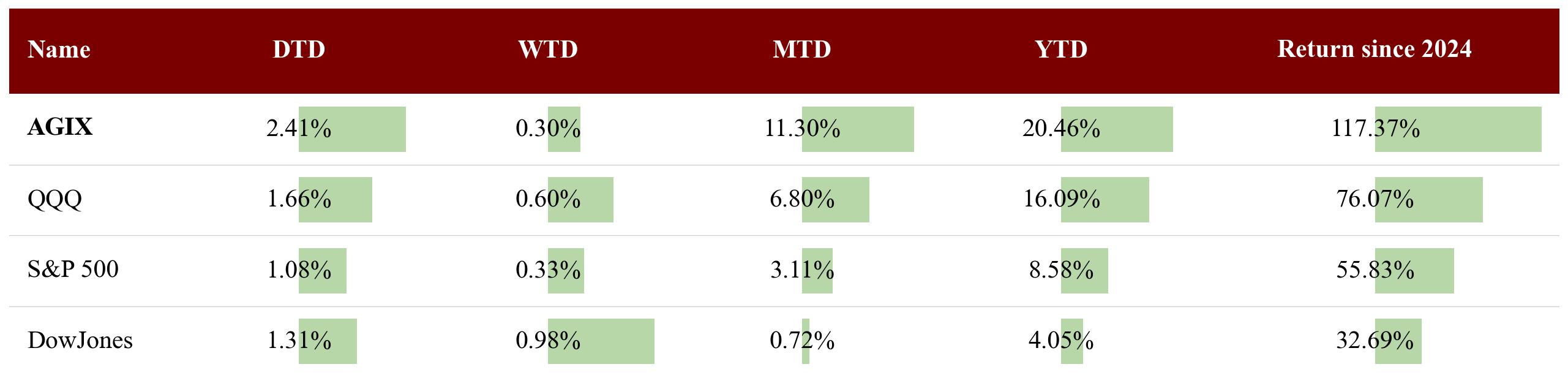
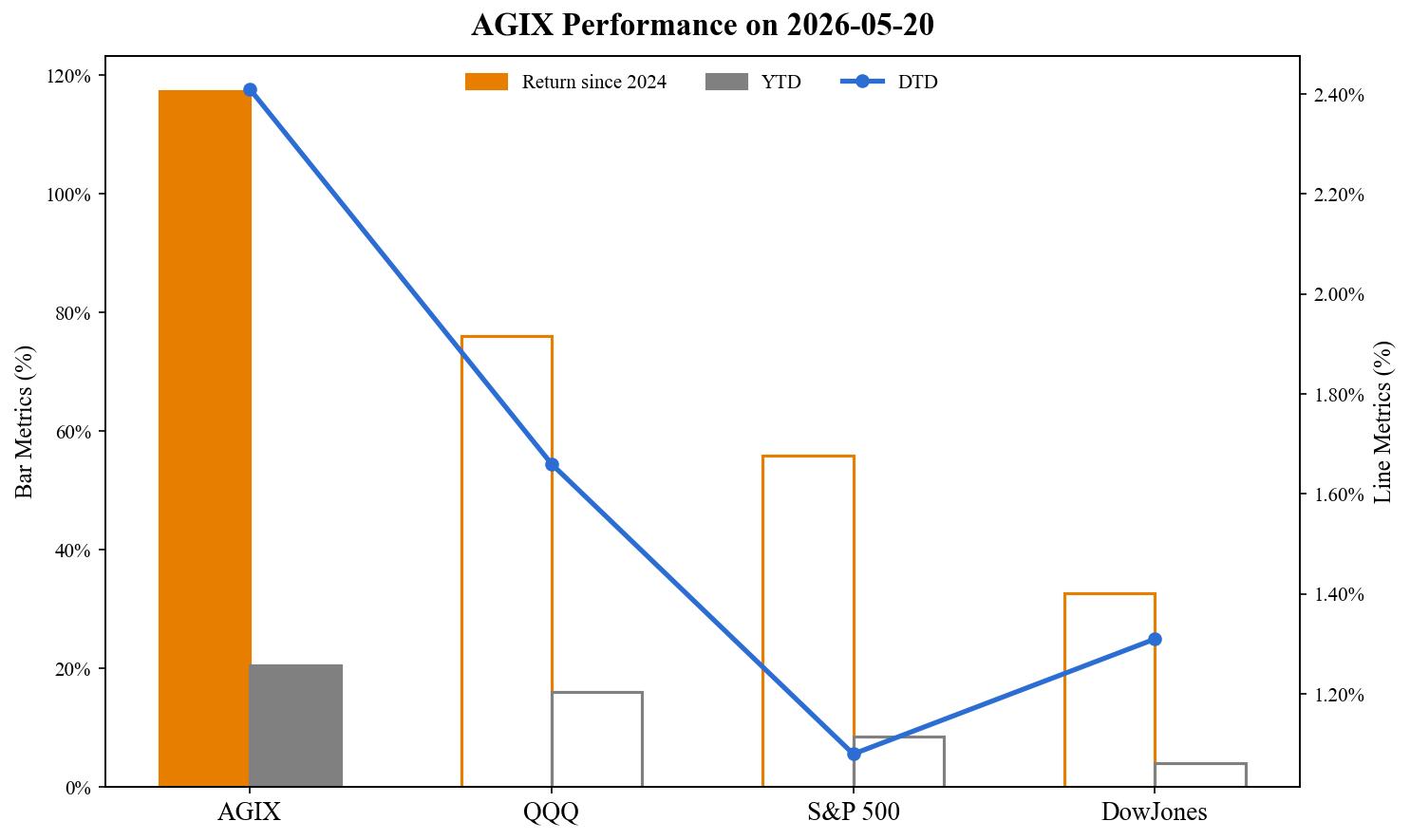
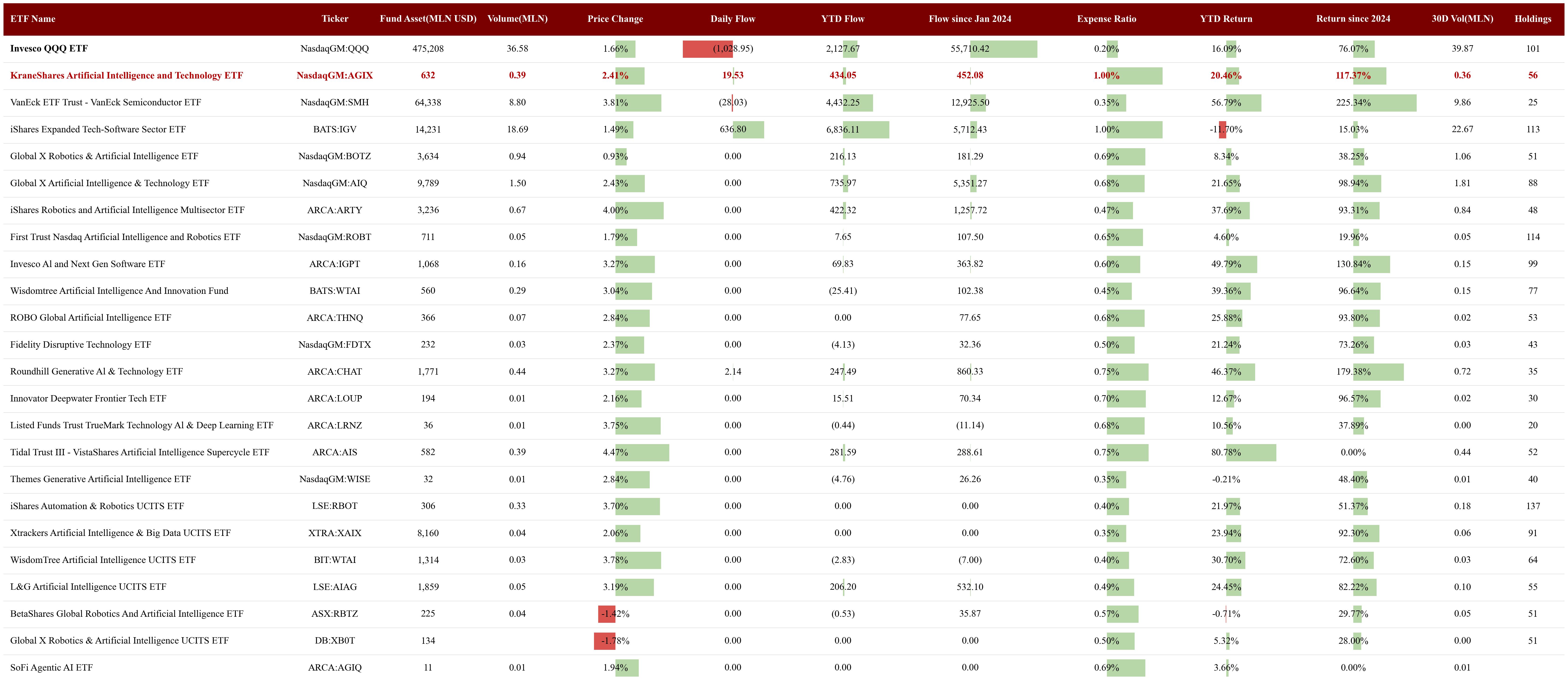
Attribution
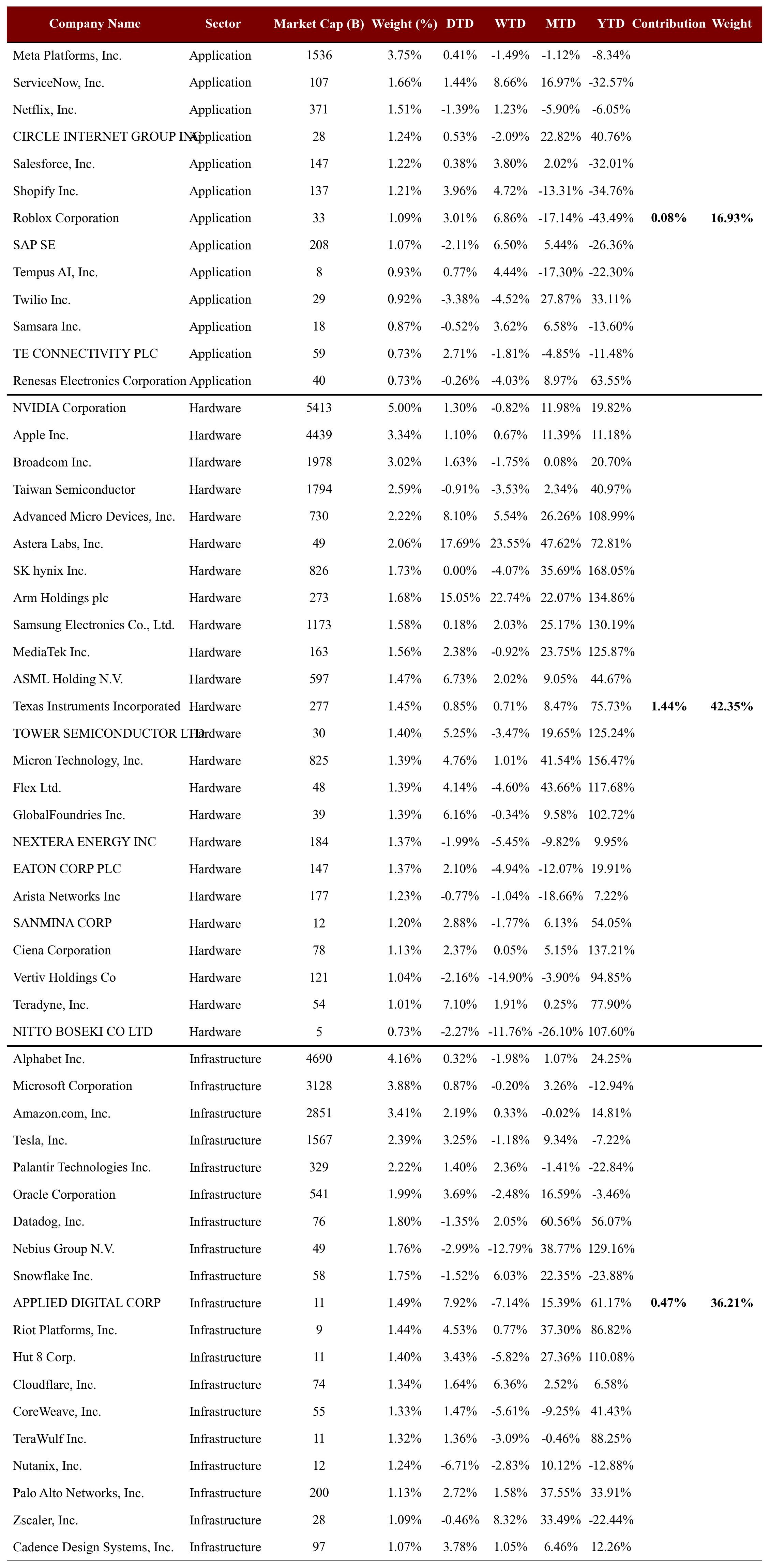
Contribution of the three sectors within AGIX holdings today
Application: 0.08%
Hardware: 1.44%
Infrastructure: 0.47%
Top-performing stocks in AGIX holdings today
Astera Labs, Inc. (17.69%)
Arm Holdings plc (15.05%)
Advanced Micro Devices, Inc. (8.1%)
APPLIED DIGITAL CORP (7.92%)
Teradyne, Inc. (7.1%)
ASML Holding N.V. (6.73%)
GlobalFoundries Inc. (6.16%)
TOWER SEMICONDUCTOR LTD (5.25%)
Micron Technology, Inc. (4.76%)
Riot Platforms, Inc. (4.53%)
Flex Ltd. (4.14%)
Shopify Inc. (3.96%)
Cadence Design Systems, Inc. (3.78%)
Oracle Corporation (3.69%)
Hut 8 Corp. (3.43%)
Tesla, Inc. (3.25%)
Roblox Corporation (3.01%)
SANMINA CORP (2.88%)
Palo Alto Networks, Inc. (2.72%)
TE CONNECTIVITY PLC (2.71%)
MediaTek Inc. (2.38%)
Ciena Corporation (2.37%)
Amazon.com, Inc. (2.19%)
EATON CORP PLC (2.1%)
Worst-performing stocks in AGIX holdings today
SAP SE (-2.11%)
Vertiv Holdings Co (-2.16%)
NITTO BOSEKI CO LTD (-2.27%)
Nebius Group N.V. (-2.99%)
Twilio Inc. (-3.38%)
Nutanix, Inc. (-6.71%)
Top five listed stocks contributing the most within AGIX holdings today
Astera Labs, Inc. (17.69%)
Arm Holdings plc (15.05%)
Advanced Micro Devices, Inc. (8.1%)
APPLIED DIGITAL CORP (7.92%)
ASML Holding N.V. (6.73%)
Observation
The strongest movers across peer ETF holdings today are listed below:
| DTD | Stock Ticker | Name | Held by ETFs | analysis |
|---|---|---|---|---|
| 18.32 | NasdaqGM:NVTS | Navitas Semiconductor Corporation | ['ARCA:AIS'] | Navitas Semiconductor’s 18% gain on May 20, 2026 appears driven primarily by momentum and speculative interest in high‑growth power semiconductor names rather than by a specific new company disclosure that day. First, the stock has shown extreme recent volatility and a strong multi-month uptrend, with retail and social-media interest focused on GaN/SiC exposure to EVs and AI/data centers, likely amplifying technical breakouts and short-covering. Second, the move comes against a backdrop of strong sentiment and capital rotation into semiconductor and power-efficiency plays, where investors are bidding up smaller-cap names with perceived leverage to EV and AI demand, despite a relatively modest, “Hold” consensus and price targets that lag the current trading level. |
| 17.69 | NasdaqGS:ALAB | Astera Labs, Inc. | ['NasdaqGM:AGIX', 'NasdaqGM:ROBT', 'ARCA:IGPT', 'BATS:WTAI', 'ARCA:THNQ', 'ARCA:CHAT', 'ARCA:LOUP', 'ARCA:AIS', 'BIT:WTAI'] | Astera Labs’ 17.7% gain on May 20, 2026 was driven primarily by a bullish analyst call from RBC, which reiterated its Outperform rating and raised its price target from $225 to $250, highlighting Astera’s AI connectivity leadership and expected ramp of Scorpio X switches into Amazon’s Trainium3 racks in Q3 under the expanded Anthropic deal. The move built on an already strong multi-week uptrend in AI infrastructure names, with ALAB attracting momentum and breakout buyers as it pushed well above the prior target and toward the new RBC level on significantly elevated volume. |
| 15.05 | NasdaqGS:ARM | Arm Holdings plc | ['NasdaqGM:QQQ', 'NasdaqGM:AGIX', 'ARCA:IGPT', 'ARCA:CHAT', 'ARCA:LRNZ', 'ARCA:AIS'] | Arm’s 15% move appears driven primarily by momentum and positioning rather than a specific new fundamental catalyst on the day. First, the stock rallied sharply on volume more than double its average, suggesting short covering and momentum-driven buying in a name closely tied to AI and high-performance computing themes. Second, broader equity markets, particularly tech and growth segments, remained constructive, providing a supportive backdrop for high-multiple semiconductor IP names like Arm. |
| 14.17 | NasdaqCM:QUIK | QuickLogic Corporation | [] | QuickLogic’s ~14% gain on May 20, 2026 appears primarily technically driven rather than news-driven. There were no material company-specific announcements or sector-wide semiconductor catalysts that day, and recent news flow is limited to the April 28 scheduling of the upcoming May 12 earnings call, which is too stale to explain a sharp move. The price also recently crossed above its 200-day moving average (per MarketBeat), suggesting momentum and technical buying, possibly amplified by relatively thin liquidity and active retail trading. |
| 11.67 | NasdaqGS:LSCC | Lattice Semiconductor Corporation | ['ARCA:IGPT', 'BATS:WTAI', 'NasdaqGM:WISE', 'LSE:RBOT'] | Lattice Semiconductor’s 11.7% move on May 20, 2026 was primarily driven by strong growth expectations tied to AI demand and a new AMI partnership that investors see as expanding LSCC’s addressable market and reinforcing its low-power FPGA positioning. Several sell-side analysts raised price targets into the $140–$150 range and reiterated Buy ratings following the company’s recent results and above-consensus Q2 EPS guidance ($0.42–$0.46), adding to the positive sentiment. A secondary support factor was momentum and technical follow-through, with the stock breaking well above its 50- and 200-day moving averages, attracting incremental growth and momentum buyers. |
| 10.0 | TWSE:4919 | Nuvoton Technology Corporation | ['LSE:RBOT'] | Nuvoton Technology’s 10% rise on May 20, 2026, was primarily driven by a strong first‑quarter 2026 earnings report that highlighted accelerating AI exposure. MarketScreener and other sources note that Q1 revenue grew double‑digits quarter‑on‑quarter with a “surging” AI computing revenue mix, reinforcing the stock’s AI‑semiconductor narrative and supporting a sharp re‑rating. A secondary driver is momentum and sentiment: the stock is up over 220% year‑to‑date, so better‑than‑expected AI and growth signals likely triggered incremental buying from growth and thematic investors. |
| 9.96 | TWSE:2388 | VIA Technologies, Inc. | ['LSE:RBOT'] | VIA Technologies’ ~10% gain on May 20, 2026 appears primarily driven by follow-through buying and reassessment of fundamentals after its May 6 board approval to acquire 18 million newly issued shares of a 100%-owned subsidiary, which investors may view as a restructuring step to consolidate assets and potentially unlock value. In the absence of fresh company-specific disclosures on May 20 itself, the move likely reflects momentum and sentiment tailwinds in regional semiconductor names as investors position for AI- and edge-computing demand, amplifying the impact of earlier corporate actions on a relatively illiquid mid-cap stock. |
| 9.88 | NasdaqCM:GDYN | Grid Dynamics Holdings, Inc. | ['NasdaqGM:WISE'] | Grid Dynamics’ roughly 10% gain on May 20, 2026 appears primarily driven by technical and trading dynamics rather than a specific, verifiable fundamental catalyst. There is no record of company-specific news, earnings, guidance changes, or major industry announcements for GDYN that day, suggesting the move likely reflects short-term factors such as a rebound from prior weakness, momentum/algorithmic buying, or short covering against a backdrop of generally cautious but not deteriorating analyst sentiment. |
| 9.49 | NasdaqGS:SMCI | Super Micro Computer, Inc. | ['NasdaqGM:AIQ', 'ARCA:ARTY', 'ARCA:IGPT', 'ARCA:THNQ', 'ARCA:CHAT', 'ARCA:AIS'] | Super Micro Computer’s 9.5% gain on May 20, 2026 appears primarily driven by technically led buying and momentum rather than a specific new fundamental catalyst. First, multiple technical services (e.g., StockInvest, DailyForex) flagged SMCI with “buy” signals and a “strong rising trend,” likely prompting systematic and retail momentum flows as the stock broke above near-term resistance around $33–34. Second, the move occurred on slightly above-average volume, suggesting incremental demand from traders reacting to the improving technical setup despite a still-cautious analyst backdrop (consensus Hold, price target near current levels). |
| 9.45 | NasdaqGS:RMBS | Rambus Inc. | [] | Rambus’s ~9.5% gain on May 20, 2026 appears primarily driven by continued follow-through buying after a sharp upside move the prior day, as investors reassessed the stock’s AI-related positioning and growth profile rather than reacting to a new company-specific data point that day. The stock extended its rally from May 19 (when it jumped from roughly $122 to $131 on elevated volume) and traded again on above-normal volume on May 20, suggesting momentum and sentiment around AI/semiconductor beneficiaries and recent positive coverage/upgrades (as reflected in media like the “overlooked AI chip design” narrative) were key supports. |
| 9.25 | NasdaqGS:CRVL | CorVel Corporation | ['NasdaqGM:WISE'] | CorVel’s 9.25% rise on May 20 was primarily driven by its fiscal Q4/FY26 earnings release, which showed solid operating momentum: revenue up 7% to $959 million and EPS up 17% to $2.14, with Q4 revenue up 7% and EPS up 20%. Investor enthusiasm likely also reflected the strong balance sheet and capital return, including $233 million in cash, no debt, and $20.1 million of share repurchases. A third supportive factor was management’s commentary that CERIS and P&C services saw strong demand, aided by ongoing AI, automation, and telemedicine investments. |
| 8.82 | NASDAQCM:DUOT | Duos Technologies Group, Inc. | ['NasdaqGM:WISE'] | Duos Technologies’ 8.8% gain on 2026-05-20 appears primarily driven by follow-through buying after its 2026-05-18 earnings event and ongoing narrative around its AI/energy pivot, rather than any new company-specific news that day. First, the stock had just reported results earlier in the week, and commentary across investor platforms and videos has emphasized sharply accelerating revenue tied to the $42m AMA contract and improving gross margins, supporting a re-rating from very low micro-cap levels. Second, the name remains thinly traded and retail-dominated, so modest incremental demand in response to positive AI/edge-computing sentiment and bullish 12‑month analyst targets (consensus around $17 vs. an ~$8 handle) likely amplified the single-day move. |
| 8.53 | NasdaqGS:VICR | Vicor Corporation | ['ARCA:AIS'] | Vicor’s 8.5% move on May 20, 2026 appears primarily driven by continuing positive sentiment following Roth Capital’s significant price-target increase and bullish framing of the stock earlier in February 2026, which highlighted “spectacular earnings” and strategic prospects and helped re-anchor investor expectations higher. In the background, consensus Street ratings remain “Buy” even with average 12‑month targets below spot, reinforcing a momentum-and-upgrade narrative rather than any fresh negative catalyst, while insider sales disclosed as routine 10b5‑1 transactions reduce their perceived overhang and likely muted any downside pressure. |
| 8.49 | NasdaqGM:PRCT | PROCEPT BioRobotics Corporation | ['NasdaqGM:BOTZ', 'ASX:RBTZ', 'DB:XB0T'] | PROCEPT BioRobotics’ 8.5% gain on May 20, 2026 appears primarily driven by continued positive follow-through from its strong Q1 2026 earnings report, which showed a major upside EPS surprise (reported $0.56 vs. a forecast -$0.56) and 20% year-over-year revenue growth to $83.1M, above consensus. The magnitude of the beat, combined with multiple recent Buy ratings and a median analyst target (~$30) above the pre-move trading range, likely reinforced bullish sentiment and drew incremental buyers. |
| 8.4 | NasdaqGM:VCYT | Veracyte, Inc. | ['ARCA:THNQ', 'LSE:AIAG'] | Veracyte’s 8.4% gain on May 20, 2026 appears primarily driven by a technical breakout and improving sentiment rather than a discrete fundamental news catalyst that day. First, the stock moved sharply higher through recent resistance levels (after earlier reports of it overtaking its 20-day moving average and holding support), which likely triggered momentum and technical buying. Second, underlying sentiment has been supported by positive earnings estimate revisions and a generally favorable analyst setup (Buy rating at Zacks, average Street target above the pre-move price), giving investors more confidence to add to positions ahead of the upcoming May 5 earnings release mentioned in prior news flow. |
| 8.32 | NYSE:IONQ | IonQ, Inc. | ['BATS:WTAI', 'ARCA:THNQ'] | IonQ’s 8.32% move on May 20 appears primarily tied to broad stock-specific momentum rather than a clearly identifiable same-day company announcement in the provided public results. The best verifiable data point is the sharp swing in trading itself, with the stock rising to a 52.47 close after a 48.44 prior close, which points to strong buying pressure and continuation of recent volatility. Absent a specific disclosed catalyst in the available sources, the move is most consistent with sentiment and trading-driven repricing. |
| 8.28 | NasdaqGS:CRDO | Credo Technology Group Holding Ltd | ['ARCA:IGPT', 'BATS:WTAI', 'LSE:RBOT'] | Credo Technology’s 8.3% gain on May 20 appears primarily driven by momentum and sentiment rather than a specific new fundamental catalyst. First, the stock extended its broader uptrend in a high-volume session (trading above average volume) following a recent pullback, with technical services like TradingView flagging it as a “strong buy,” which likely attracted momentum and algorithmic trading. Second, bullish sell-side positioning remains supportive, with MarketBeat citing a “Moderate Buy” consensus and an average Street target (~$208) well above the prior close, reinforcing dip-buying behavior after recent volatility. |
| 8.23 | NasdaqGS:AMBA | Ambarella, Inc. | ['NasdaqGM:AIQ', 'NasdaqGM:ROBT', 'ARCA:IGPT', 'ARCA:THNQ', 'NasdaqGM:WISE', 'LSE:RBOT', 'XTRA:XAIX', 'BIT:WTAI', 'LSE:AIAG'] | Ambarella’s 8.2% gain on May 20, 2026 appears driven mainly by continued positive follow-through from its recently reported earnings and strengthening Edge AI narrative, with investors reassessing the stock’s upside after the company’s results “proved its Edge AI strategy is a winner” per MarketBeat commentary. Supporting this, the shares are now trading well above their 50-day and 200-day moving averages, suggesting momentum buyers are leaning into a name that still carries a “Moderate Buy” consensus and roughly 25% average upside to the $96 sell-side target price. |
| 8.1 | NasdaqGS:AMD | Advanced Micro Devices, Inc. | ['NasdaqGM:QQQ', 'NasdaqGM:AGIX', 'NasdaqGM:SMH', 'NasdaqGM:AIQ', 'ARCA:ARTY', 'NasdaqGM:ROBT', 'ARCA:IGPT', 'BATS:WTAI', 'ARCA:THNQ', 'ARCA:CHAT', 'ARCA:LRNZ', 'ARCA:AIS', 'NasdaqGM:WISE', 'LSE:RBOT', 'XTRA:XAIX', 'BIT:WTAI', 'LSE:AIAG'] | AMD’s 8.1% gain on May 20, 2026 appears driven primarily by continued optimism around its AI and data center opportunity, amplified by bullish third‑party commentary rather than any new company-specific disclosure that day. First, outlets like 24/7 Wall St. reiterated aggressive 12‑month price targets (~$505) and highlighted CEO Lisa Su’s long-term AI/server TAM guidance, reinforcing the AI infrastructure bull case and attracting incremental momentum buyers. Second, the move also reflects ongoing AI‑chip sector strength ahead of Nvidia’s earnings, with investors positioning in key beneficiaries such as AMD as a leveraged way to play sustained AI data center demand. |
| 7.92 | NASDAQGS:APLD | APPLIED DIGITAL CORP | ['NasdaqGM:AGIX'] | Applied Digital’s 7.92% jump on May 20 was primarily driven by its announcement of a 15-year take-or-pay lease with a U.S. hyperscaler for its fourth AI Factory campus, Polaris Forge 3, which materially expanded contracted capacity and future revenue visibility. The deal lifted contracted critical IT load to 1,200 MW and pushed baseline contracted revenue higher, reinforcing the market’s positive view of APLD’s AI data-center growth trajectory. Broader momentum in AI-infrastructure names likely added to the move, but the lease announcement was the main catalyst. |
| 7.9 | NasdaqGS:CEG | Constellation Energy Corporation | ['NasdaqGM:QQQ', 'ARCA:ARTY'] | Constellation Energy’s 7.9% gain on May 20, 2026 appears primarily driven by a rebound from its recent pullback after management’s 2026 EPS guidance ($11–$12) came in slightly below prior expectations, with investors reassessing the longer-term growth and valuation case. First, the sharp YTD drawdown of roughly 20% highlighted in recent commentary (e.g., TIKR) set up favorable positioning for a relief rally as sentiment normalized. Second, underlying fundamentals remain solid, with 2025 revenue up 8% and ongoing structural tailwinds from clean power demand, supporting buy-the-dip flows and momentum-driven buying in the absence of negative company-specific news on the day. |
| 7.39 | NASDAQGM:INOD | Innodata Inc. | ['NasdaqGM:ROBT'] | Innodata’s 7.39% gain on May 20 was most likely driven by investor reaction to the strong Q1 2026 earnings report and management’s outlook, which kept momentum in the stock after the May 7 results release. A second driver was a favorable technical/momentum effect: the shares had been volatile but were trading near recent highs, so positive earnings follow-through likely attracted buyers. A smaller contributor was the same-day news that CEO Jack Abuhoff sold more than $14.2 million of stock on May 19–20, which can sometimes add attention but was outweighed by the broader bullish earnings narrative. |
| 7.39 | NasdaqGS:STNE | StoneCo Ltd. | ['NasdaqGM:AIQ'] | StoneCo’s 7.4% gain on May 20, 2026 appears primarily driven by a continued positive reaction to its recent earnings and guidance, with investors reassessing the risk/reward after a sharp month-to-date drawdown. First, the stock had fallen more than 30% over the prior month (per TradingView), making it a candidate for a rebound as sentiment stabilized and short-term traders covered positions. Second, options data from MarketBeat show active trading around the $11 level, suggesting positioning and technical factors likely amplified the upside move in the absence of any major new company-specific news headlines that day. |
| 7.37 | NasdaqGM:WRD | WeRide Inc. | ['NasdaqGM:BOTZ', 'NasdaqGM:AIQ', 'ASX:RBTZ', 'DB:XB0T'] | WeRide’s 7.37% gain on May 20, 2026 appears primarily technical and sentiment-driven rather than news-driven, as there were no new company-specific announcements or major industry headlines that day. The move likely reflects follow-through buying interest in a relatively volatile, retail-traded AI/autonomous-driving name, with traders positioning ahead of known upcoming catalysts such as the June 26 AGM and recently filed 2025 Form 20-F, which keep the stock in focus but do not provide a fresh fundamental trigger on the day. |
| 7.36 | NasdaqGS:INTC | Intel Corporation | ['NasdaqGM:QQQ', 'NasdaqGM:SMH', 'NasdaqGM:AIQ', 'ARCA:ARTY', 'NasdaqGM:ROBT', 'ARCA:IGPT', 'BATS:WTAI', 'ARCA:AIS', 'NasdaqGM:WISE', 'LSE:RBOT', 'XTRA:XAIX', 'BIT:WTAI'] | Intel’s roughly 7% gain on May 20, 2026 appears driven primarily by renewed AI-related enthusiasm for the stock, amplified by sector-wide strength in semiconductors ahead of Nvidia’s earnings. First, investors reacted to reports of early-stage talks for Intel to acquire AI-chip startup Tenstorrent and to commentary highlighting Intel’s upside leverage to AI CPU and data center demand, reinforcing its AI narrative. Second, the move was supported by a broader rotation back into chip names and fresh analyst target hikes, which helped extend the stock’s sharp recent momentum despite already elevated valuation levels. |
| 7.34 | ASX:TNE | Technology One Limited | ['LSE:RBOT'] | Technology One’s 7.3% rise on 20 May 2026 was primarily driven by a bullish broker call that boosted sentiment and saw the stock “bounce strongly” and test technical resistance, despite a broadly negative ASX session. The move also built on momentum from its recently reported HY26 result, where revenue grew 11% and ARR 17%, reinforcing the earnings-resilience and growth narrative that brokers are now highlighting. |
| 7.19 | NasdaqGM:SYM | Symbotic Inc. | ['NasdaqGM:BOTZ', 'NasdaqGM:ROBT', 'BATS:WTAI', 'LSE:RBOT', 'BIT:WTAI', 'ASX:RBTZ', 'DB:XB0T'] | Symbotic’s 7.2% gain on May 20, 2026 appears primarily driven by follow‑through buying after its recently reported strong fiscal Q1 2026 earnings and upbeat outlook. The company’s latest results, highlighted in GlobeNewswire/financial news feeds, showed better‑than‑expected profitability and robust growth initiatives, which continue to attract momentum and growth investors. In addition, technical factors likely amplified the move, as multiple services (e.g., StockInvest, TradingView) flag a positive trend and “buy” technical ratings, encouraging incremental short‑term inflows into the stock. |
| 7.14 | NYSE:ESAB | ESAB Corporation | ['LSE:RBOT'] | ESAB’s 7.1% gain on May 20, 2026 appears driven primarily by a sharp rebound from recent weakness after the stock had fallen to 52‑week lows, prompting bargain hunting and mean‑reversion buying. First, sentiment had turned overly negative following a notable rise in short interest and pressure around early May, setting up a short-covering and value rotation bounce once selling exhausted. Second, fundamentals remain supportive—ESAB recently reported record quarterly sales and still carries a “Moderate Buy” consensus with a price target well above the prior close—helping underpin dip-buying as investors reassessed downside versus upside. |
| 7.1 | NasdaqGS:TER | Teradyne, Inc. | ['NasdaqGM:AGIX', 'NasdaqGM:SMH', 'NasdaqGM:ROBT', 'BATS:WTAI', 'ARCA:THNQ', 'LSE:RBOT', 'BIT:WTAI', 'LSE:AIAG'] | Teradyne’s 7.1% gain on May 20, 2026 appears driven primarily by continued bullish sentiment around its AI-exposed semiconductor test business and strong forward growth expectations. First, recent guidance for record Q1 2026 revenue with ~75% YoY growth and over 60% AI-driven revenue has kept the stock positioned as a key AI hardware enabler, drawing incremental demand from investors as AI momentum persists. Second, disclosures of increased positions by institutional investors such as Handelsbanken Fonder AB reinforce confidence in Teradyne’s multi-year growth runway in chip complexity and industrial automation, offsetting any concern from ongoing insider selling. |
| 6.84 | NasdaqGS:LRCX | Lam Research Corporation | ['NasdaqGM:QQQ', 'NasdaqGM:SMH', 'BATS:WTAI', 'ARCA:THNQ', 'ARCA:LOUP', 'BIT:WTAI', 'LSE:AIAG'] | Lam Research’s 6.8% gain on May 20, 2026 appears primarily driven by continued positive sentiment following its better‑than‑expected Q3 FY26 results and guidance, which reinforced the view of a recovering wafer fab equipment cycle. In addition, the stock benefited from a strong technical setup and momentum, with LRCX breaking above its 20‑day moving average and having rallied over the prior four weeks, encouraging incremental buying. A supportive sell-side backdrop, with a dominant Buy rating skew and average price targets around or above the trading range, likely reinforced confidence and added to the upside move. |
| 6.73 | ENXTAM:ASML | ASML Holding N.V. | ['NasdaqGM:QQQ', 'NasdaqGM:AGIX', 'NasdaqGM:SMH', 'BATS:WTAI', 'ARCA:THNQ', 'ARCA:LOUP', 'BIT:WTAI', 'LSE:AIAG'] | ASML’s 6.7% gain on May 20, 2026 was primarily driven by a positive U.S. analyst action that re-rated the stock higher. The company’s NASDAQ-listed shares (ASML) traded about 6.2% higher after Barclays upgraded the name to a Buy, which likely boosted sentiment and spilled over to the Amsterdam listing. A secondary driver is ongoing bullish sell-side positioning on ASML’s long-term growth and dominance in EUV lithography, which provides a supportive backdrop for sharp moves on incremental positive catalysts. |
| 6.73 | NYSE:DOCN | DigitalOcean Holdings, Inc. | ['BATS:WTAI'] | DigitalOcean’s 6.7% gain on May 20, 2026 appears primarily driven by continued bullish follow-through on its recently announced AI cloud pivot and capacity expansion, as investors priced in higher long-term growth. The stock has been in a strong uptrend since early May when Wall Street raised price targets, highlighted its AI inference engine launch, and applauded the $810M equity raise aimed at ~40% FY27–28 growth, while also anticipating Q1 outperformance and guidance upgrades. A secondary driver is positioning and flow-related support ahead of its move from the S&P SmallCap 600 to the S&P MidCap 400, which typically attracts incremental institutional and passive demand. |
| 6.71 | NasdaqGS:DXCM | DexCom, Inc. | ['NasdaqGM:QQQ'] | DexCom’s +6.7% move on May 20, 2026 appears primarily driven by positive sentiment around its improving fundamentals and bullish sell-side positioning rather than a specific new company disclosure that day. First, the stock is trading against the backdrop of strong 1Q26 results (15% YoY revenue growth and higher profitability) and a broad “Buy/Moderate Buy” analyst consensus with meaningful upside to target prices, which supports momentum buying. Second, recent bullish research actions, including Canaccord’s price-target increase to $100 on margin gains and Zacks’ April upgrade to Buy, likely reinforced investor conviction and helped catalyze a catch‑up move after the shares had been consolidating in the mid‑$60s range. |
| 6.69 | NasdaqGS:IPGP | IPG Photonics Corporation | ['ARCA:IGPT', 'LSE:RBOT'] | IPG Photonics’ 6.7% gain on May 20 was driven primarily by follow-through buying after its better‑than‑expected Q1 2026 earnings and upbeat growth profile. The company reported on May 5 that Q1 revenue grew 17% year over year to $265.5M with EPS of $0.29, both above forecasts, and the stock had sold off sharply on the print, setting up a rebound as investors reassessed valuation. A secondary driver was improving sentiment and buy‑the‑dip interest, supported by a “Moderate Buy” consensus rating and a ~$135–136 average target price, which frames upside from the low‑$120s level highlighted in same‑day commentary noting the stock trading 7–8% higher. |
| 6.57 | SWX:LEHN | LEM Holding SA | ['LSE:RBOT'] | LEM Holding SA’s ~6.6% move on 20 May 2026 appears primarily technical and sentiment-driven rather than news-driven, as there were no material company-specific announcements or sector-breaking headlines that day. First, the stock has been highly volatile and deeply drawndown over the past year, so the move looks like a rebound/short-covering rally within a wider downtrend, consistent with technical services (e.g., TradingView) still flagging a “sell” bias on multi-day horizons. Second, modestly improving medium-term earnings expectations cited in recent consensus updates (e.g., Simply Wall St noting higher FY26 revenue/EPS forecasts) likely underpinned risk-on interest in a beaten-down name without any fresh fundamental disclosure on the day. |
| 6.33 | NasdaqCM:PGY | Pagaya Technologies Ltd. | [] | Pagaya Technologies’ 6.3% gain on May 20, 2026 appears primarily driven by follow-through momentum and sentiment re-rating after its recently reported strong Q1 2026 results and guidance raise. Earlier this month the company delivered double‑digit revenue growth, a more than threefold increase in GAAP net income, rising EBITDA margins, and lifted full‑year 2026 GAAP net income guidance to $110–160 million, prompting upward estimate revisions and a more constructive fundamental outlook. A secondary driver is improving longer-term expectations, reflected in consensus forecasts calling for strong multi‑year earnings and ROE growth, which likely supported continued buying as the stock repriced to these higher growth and profitability assumptions. |
| 6.25 | NYSE:BBAI | BigBear.ai Holdings, Inc. | ['NasdaqGM:ROBT', 'NasdaqGM:WISE', 'BIT:WTAI'] | BigBear.ai rose on May 20 mainly because investors reacted to fresh evidence of accelerating AI-for-defense contract momentum. The most important drivers were management’s reported roughly $75 million in new Q1 wins tied to national security and trade & travel, plus Q1 results that showed revenue of $34.4 million beating consensus and a smaller EPS loss of $0.12 versus $0.25 a year earlier. The stock also got support from continued enthusiasm for the defense AI theme and the company’s 2026 growth guidance, which reinforced the improving pipeline narrative. |
| 6.16 | NasdaqGS:GFS | GlobalFoundries Inc. | ['NasdaqGM:QQQ', 'NasdaqGM:AGIX', 'ARCA:AIS'] | GlobalFoundries’ 6.2% gain on May 20, 2026 was primarily driven by a positive reaction to its announced secondary offering and related lock-up context, with investors refocusing on the underlying demand story after the initial after-hours selloff the prior evening. First, the company’s May 19 after-hours disclosure of a 20 million-share secondary led to a 5% drop, but as details were digested, the overhang appeared better understood and partially priced in, prompting a rebound. Second, sentiment remained supported by recent fundamental catalysts highlighted in prior weeks, including expanded chip-manufacturing partnerships (such as Apple-related production at its Malta fab) and ongoing strategic positioning in specialty foundry, which helped buyers step in despite equity issuance. |
| 6.1 | NYSE:QBTS | D-Wave Quantum Inc. | ['BATS:IGV', 'BATS:WTAI'] | D-Wave Quantum’s 6.1% gain on May 20, 2026 was primarily driven by growing bullish sentiment ahead of its first-ever Investor Day at the New York Stock Exchange, which was highlighted in market data and likely increased investor focus on the name. Supporting this, coverage such as Zacks’ “2 Quantum Stocks to Watch in May” piece pointed to more than 90% upside potential for QBTS, reinforcing a positive narrative around quantum adoption and commercial traction. Elevated retail and trading interest, including live trading streams discussing sizable intraday jumps in QBTS, likely amplified the move in a high-volatility, high-beta stock. |
| 6.06 | NYSE:ONTO | Onto Innovation Inc. | ['ARCA:ARTY', 'LSE:RBOT'] | Onto Innovation’s 6.1% gain on May 20, 2026 was primarily driven by follow‑through buying after a strong Q1 earnings report and upbeat outlook released earlier in the week. The company reported Q1 2026 non-GAAP EPS of $1.42 and revenue of about $292 million, both ahead of expectations, guided Q2 EPS as high as $1.73, and announced a ~$710 million purchase of a 27% stake in Rigaku, which together reinforced a positive growth narrative. A secondary driver was momentum and sentiment: Zacks highlighted ONTO as a Buy-rated stock with an “A” Momentum Score and noted the shares were already up ~13% over the prior week, likely attracting additional short-term and quant-driven inflows. |
| 5.98 | ENXTPA:STMPA | STMicroelectronics N.V. | ['NasdaqGM:SMH', 'BIT:WTAI'] | STMicroelectronics’ roughly 6% gain on May 20, 2026 appears primarily driven by a positive shift in earnings expectations rather than company-specific news flow that day. The key catalyst was a recent upgrade of the U.S.-listed shares (STM) to a Zacks Rank 2 (Buy), which highlights improving earnings momentum and likely drew incremental buy-side interest into the name. In the absence of major new corporate announcements beyond routine AGM-related resolutions, the move is best explained by this upgraded sentiment combined with broader ongoing strength in semiconductor and AI-related stocks. |
| 5.97 | NasdaqGS:MRVL | Marvell Technology, Inc. | ['NasdaqGM:QQQ', 'NasdaqGM:SMH', 'NasdaqGM:AIQ', 'ARCA:ARTY', 'BATS:WTAI', 'NasdaqGM:FDTX', 'ARCA:CHAT', 'ARCA:AIS', 'BIT:WTAI'] | Marvell Technology’s ~6% gain on May 20, 2026 was primarily driven by continued AI-related optimism and outsized demand for its data center and custom AI silicon, extending a multi-week re-rating of the stock. The move was reinforced by very strong positive sell-side sentiment – MarketBeat shows a “Moderate Buy” consensus with a large majority of Buy/Strong Buy ratings and a rising average target price – and elevated trading volume that was ~38% above normal, suggesting incremental institutional buying. Broader semiconductor/AI sector strength and hyperscaler capex enthusiasm likely provided an additional tailwind to the shares. |
| 5.8 | NasdaqGS:MPWR | Monolithic Power Systems, Inc. | ['NasdaqGM:SMH'] | Monolithic Power Systems’ 5.8% move on May 20, 2026 appears primarily driven by ongoing AI‑semiconductor momentum and strong recent fundamentals rather than a discrete new company-specific headline that day. First, the stock has been in a strong uptrend since its Q1 2026 beat (26% YoY revenue growth, EPS and revenue ahead of estimates) and subsequent target hikes and “Moderate Buy”/bullish sentiment, with investors continuing to pay up for its perceived leadership in AI power management. Second, sector-wide flows into high-growth chip names on modest macro and rate relief, as highlighted by commentary that small rate and oil moves have recently produced outsized chip rallies, likely amplified the upside. |
| 5.76 | NasdaqCM:RGTI | Rigetti Computing, Inc. | ['BATS:WTAI'] | Rigetti Computing’s +5.8% move on May 20, 2026 appears primarily driven by bullish sentiment and positioning rather than a discrete new fundamental catalyst. First, the stock traded within a well-defined technical range where traders were watching support near ~$15.3 and resistance in the high-$17s; the intraday action and prior “bearish candle” setup likely encouraged short covering and momentum buying as the stock held support. Second, the name remains supported by a broadly positive analyst backdrop (consensus Buy rating and long-term price targets well above the current level), which can amplify technical-driven upside in a low-float, high-beta quantum computing stock ahead of options expiration with an implied ±6% expected move for the week. |
| 5.71 | NasdaqCM:MARA | MARA Holdings, Inc. | ['BATS:IGV'] | MARA’s 5.71% gain on May 20 was most likely driven by market reaction to the Long Ridge-related deal, which investors appear to have viewed as improving MARA’s growth narrative and strategic optionality. The move was reinforced by broad trading momentum in the name as the stock pushed higher intraday, despite little indication of a fresh earnings-driven catalyst that day. |
| 5.69 | NasdaqGS:SWKS | Skyworks Solutions, Inc. | ['NasdaqGM:SMH'] | Skyworks Solutions’ 5.7% gain on May 20, 2026 was primarily driven by deal-related news around its planned acquisition of Qorvo. First, the company announced exchange offers and consent solicitations for Qorvo’s 2029 and 2031 senior notes, a concrete step that appeared to increase investor confidence the acquisition will close and be financed on manageable terms. Second, the move occurred alongside generally constructive sentiment toward semiconductor names, amplifying the positive reaction to the transaction-structuring news. |
| 5.39 | NasdaqGS:NXPI | NXP Semiconductors N.V. | ['NasdaqGM:QQQ', 'NasdaqGM:SMH', 'NasdaqGM:AIQ', 'NasdaqGM:ROBT', 'NasdaqGM:FDTX', 'BIT:WTAI'] | NXPI’s 5.39% gain on May 20 was most likely driven by positive reaction to its Q1 2026 earnings, which showed diluted EPS of 4.43 versus the 3.01 estimate, a clear fundamental beat. The move was amplified by bullish post-earnings momentum, with the stock reaching a new 52-week high intraday and trading near the top of its recent range. A weaker secondary factor was the routine proxy-materials/annual meeting filing, which was public that same day but is less likely to explain the upside than the earnings surprise. |
| 5.39 | NasdaqGS:CRWD | CrowdStrike Holdings, Inc. | ['NasdaqGM:QQQ', 'BATS:IGV', 'ARCA:ARTY', 'BATS:WTAI', 'ARCA:THNQ', 'NasdaqGM:FDTX', 'ARCA:LRNZ', 'ARCA:AIS', 'XTRA:XAIX', 'LSE:AIAG'] | CrowdStrike’s 5.4% gain on May 20, 2026 appears primarily driven by renewed bullish sentiment following recent evidence that growth has stabilized in the low‑20% range and that the company remains a category leader in endpoint security. First, commentary such as the same‑day Motley Fool discussion highlighting durable land‑and‑expand economics and a “Buy‑leaning” overall assessment (score 6.6/10) helped frame the narrative around resilient fundamentals despite higher customer acquisition costs and stock‑based compensation. Second, the stock continues to benefit from strong Street support, with 43 analysts maintaining a Buy consensus and a relatively full price target, which likely amplified the positive read‑through from incremental bullish media and investor discussions rather than any specific company news or macro catalyst. |
| 5.33 | NasdaqGM:CAMT | Camtek Ltd. | ['ARCA:ARTY'] | Camtek’s ~5.3% gain on May 20, 2026 appears driven primarily by continued positive sentiment around its earnings outlook and strong analyst support rather than any new, company-specific news that day. First, the stock is trading against a backdrop of bullish Street expectations, with a consensus Buy rating and a 12‑month price target implying double‑digit upside, which supports dip-buying interest after recent weakness. Second, the upcoming Q1 2026 results call on May 12 (previously announced on April 23) keeps attention on potential earnings and semiconductor upcycle tailwinds, helping the stock outperform absent negative catalysts. |
| 5.33 | SWX:IFCN | INFICON Holding AG | ['ARCA:IGPT', 'LSE:RBOT'] | INFICON’s roughly 5% gain on 20 May 2026 appears primarily driven by continued positive post-IPO momentum and investor positioning rather than any identifiable new, stock-specific news that day. 1) The shares have been trading strongly above the CHF 225 IPO price set in early May, with consensus ratings skewed to Buy and target prices implying upside, which likely supported incremental buying. 2) In the absence of fresh company announcements or sector-specific headlines on 20 May, the move also likely reflects follow-through interest and normalization of trading liquidity after the recent listing on SIX. |
| 5.25 | NasdaqGS:TSEM | TOWER SEMICONDUCTOR LTD | ['NasdaqGM:AGIX'] | Tower Semiconductor’s ~5% move on 5/20/26 appears primarily driven by continued positive follow‑through after its recent earnings beat and strong year‑over‑year share performance, rather than any new company‑specific news that day. The stock has significantly outperformed over the past year (up ~177% per Simply Wall St) and recently delivered EPS ahead of consensus (about $0.65 vs $0.56, per TradingView/MarketBeat), supporting an ongoing rerating as investors price in forecast EPS growth. In the absence of fresh 5/20 news, the advance likely reflects momentum and positioning in the semiconductor foundry space, with investors leaning into names perceived to have solid growth visibility and a modest upside to consensus target price (~10% per MarketBeat). |
| 5.24 | NasdaqGS:SMTC | Semtech Corporation | [] | Semtech’s ~5% gain on May 20, 2026 appears mainly driven by sentiment following its recently announced $575 million common stock offering, which removed near‑term financing uncertainty and may be interpreted as bolstering the balance sheet ahead of expected growth. The move also comes against a backdrop of rising short interest reported earlier in the month, which can amplify upside via short covering when news reduces perceived risk. Broader strength in semiconductor and high‑beta tech names likely provided an additional macro tailwind to the stock. |
| 5.11 | XTRA:IFX | Infineon Technologies AG | ['NasdaqGM:AIQ', 'ARCA:THNQ', 'LSE:AIAG'] | Infineon’s 5.1% rise on 20 May 2026 appears primarily driven by broader semiconductor strength and positive momentum rather than a specific, stock‑specific headline. There were no major Infineon company announcements or earnings releases that day, while the move extended an already strong multi‑month uptrend supported by upward revisions to sector demand expectations (notably in automotive, power, and AI‑related chips) and bullish analyst positioning on the name. |
| 5.11 | NasdaqGS:KLAC | KLA Corporation | ['NasdaqGM:QQQ', 'NasdaqGM:SMH', 'NasdaqGM:ROBT', 'LSE:RBOT', 'BIT:WTAI'] | KLA’s 5.11% gain on May 20 was most likely driven by technical momentum rather than a new company-specific catalyst: the stock recently broke above its 20-day moving average, a signal that often attracts short-term buyers. The move also came after a strong multi-week run, with KLAC up about 12.9% over the prior four weeks, reinforcing bullish trading flows. No major same-day earnings, guidance, or regulatory headline appears in the provided public sources to explain a specific fundamental re-rating. |
| 5.1 | NYSE:AI | C3.ai, Inc. | ['BATS:IGV', 'NasdaqGM:BOTZ', 'NasdaqGM:AIQ', 'NasdaqGM:ROBT', 'NasdaqGM:WISE', 'XTRA:XAIX', 'BIT:WTAI', 'ASX:RBTZ', 'DB:XB0T'] | C3.ai’s 5.1% gain on May 20, 2026 was primarily driven by a broad rebound in AI-related and semiconductor/AI-infrastructure names, as investors rotated back into the AI theme after earlier “anything‑but‑AI” positioning in 1Q26. Sector commentary from major market outlets highlighted AI equipment and tech as leadership groups on the day, and AI-focused ETFs and peers also outperformed, suggesting the move was largely beta- and sentiment-driven rather than stock-specific. |
| 5.05 | NasdaqGS:PONY | Pony AI Inc. | ['NasdaqGM:BOTZ', 'NasdaqGM:AIQ', 'NasdaqGM:WISE', 'ASX:RBTZ', 'DB:XB0T'] | Pony AI’s 5.05% rise on May 20, 2026 appears to be driven mainly by a positive move in the broader autonomous-vehicle/robotaxi theme rather than any clearly identifiable company-specific announcement in the public results provided. The stock also traded higher intraday than the prior close, which suggests a momentum and trading-driven bid on top of the sector backdrop. No same-day earnings, guidance, or regulatory catalyst was evident from the available sources. |
| 5.03 | NasdaqGM:RPD | Rapid7, Inc. | ['BATS:IGV', 'ARCA:THNQ', 'XTRA:XAIX', 'LSE:AIAG'] | Rapid7’s 5.0% gain on May 20, 2026 was primarily driven by investor optimism and heightened visibility around its participation at the J.P. Morgan 2026 Global Technology, Media, and Communications Conference that day. The company’s conference appearance, with a live webcast highlighted in its May 11 press release, likely reinforced interest in its AI-powered managed cybersecurity positioning and upcoming growth narrative. A secondary tailwind came from ongoing positive sentiment in the cybersecurity sector, with Rapid7 having already outperformed peers over the prior month, which may have amplified buying interest into the event. |
| 5.01 | NasdaqGS:LULU | lululemon athletica inc. | ['NasdaqGM:QQQ'] | Lululemon’s 5.0% gain on May 20, 2026 appears mainly driven by a rebound from depressed levels as investors reassessed downside risk amid ongoing proxy-related headlines rather than any new fundamental catalyst. First, the stock had recently traded near 52‑week lows after a multi‑month sell-off tied to slowing growth and an activist proxy battle, so incremental buying and short covering around options-expiry week (with an expected move band near the current price) likely amplified the upside. Second, the company’s May 18 filing of definitive proxy materials and public defense of its refreshed board may have reduced perceived governance risk at the margin, supporting a relief move in the shares. |
News
Funding & M&A
Google to embed AI shopping features in multiple services with Universal Cart
Today, Google launched the Universal Cart AI shopping tool at Google I/O 2026, which can be used through Google Search, the Gemini app, YouTube, and Gmail. Universal Cart automatically searches e-commerce listings based on product descriptions provided by users and compares the best prices. It can also display price history, monitor inventory, and notify users when items are back in stock. The tool can identify mismatches between items in the cart and user intent, such as checking PC component compatibility. Universal Cart is powered by the Gemini 3.5 Flash and Gemini Omni models and is deeply integrated with Google Wallet and Google Pay for fast checkout. This feature is based on Universal Commerce Protocol technology, which Google developed in collaboration with companies like Stripe to standardize AI shopping automation interfaces. The tool will first launch in the US starting in summer, and AP2 technology will be introduced in the future to support AI autonomous purchasing.
Meta shifts 7,000 employees into four new AI units ahead of mass layoffs
According to reports, Meta Platforms is restructuring, moving about 7,000 employees into AI-related roles in response to an upcoming layoff plan affecting approximately 8,000 people. The reorganization consolidates employees into four new organizations: Applied AI Engineering, Agent Transformation Accelerator, Central Analytics, and Enterprise Solutions, driving the 'AI for Work' strategy. This round of layoffs will reduce Meta's total employee count by one-twentieth, to about 77,986. The savings will be invested in AI infrastructure, with capital expenditures expected to reach $125 billion to $145 billion this year. Meta still lags behind companies like OpenAI, Google, and Anthropic in generative AI. This restructuring aligns with the 'Year of Efficiency' goal and will further accelerate AI product development.
Armada raises $230M at $2B valuation to build portable AI data centers
Armada Inc., a company specializing in portable data centers and satellite internet software, recently announced that it has successfully raised twenty to thirty million dollars, reaching a valuation of two billion dollars. The funding round was led by Boomer, Overmatch, and 8090 Industries, with participation from multiple institutions including Johnson Controls Inc. As part of the deal terms, Johnson Controls will collaborate with Armada to build a 400,000-square-foot modular data center production base, and begin production of its multi-gigabit computing Leviathan system in the summer. Armada's Galleon series of portable data centers can be rapidly deployed in harsh environments, and are paired with software tools such as Marketplace, Bridge, and Atlas to support AI model deployment, computing power rental, and Starlink device management. Its customer base spans industries including energy, telecommunications, and defense, with orders growing more than fourfold over the past year. This funding will help Armada expand its global modular AI infrastructure market.
Intuit to lay off over 3,000 employees to refocus on AI
Enterprise software giant Intuit will lay off about 17% (approximately 3,000) of its global workforce to streamline its organizational structure and invest resources in AI product integration. According to an internal memo, CEO Sasan Goodarzi stated that the move is aimed at reducing complexity and strengthening the AI strategy. The company, which makes products like TurboTax, QuickBooks, and Credit Karma, had 2,018,200 employees as of July 2025. These layoffs come amid a wave of mass layoffs in the tech industry, with Amazon, Meta, Microsoft, and other tech companies citing AI as a reason for restructuring. Although Intuit's financial reports show revenue growth of 17% and net profit growth of 48%, its stock performance has lagged behind the S&P 500, facing concerns that the traditional SaaS model is being challenged by AI. The company expects third-quarter revenue to grow by 10%.
Riverbed adds agentic AI, session replay, and AI observability to the Aternity platform
Digital employee experience company Riverbed Technology LLC recently launched six new functional modules for its Aternity Experience Platform, driving enterprise IT toward autonomous operations and shifting from reactive ticketing to proactive problem resolution. The new Riverbed IQ 4.0 introduces an agentic AI framework that can generate workflows from natural language and execute authorized actions. Riverbed Q offers a conversational interface integrated into collaboration tools. AI Assurance monitors enterprise AI adoption and shadow AI usage. Aternity Replay 2.0 extends session replay across the entire application portfolio. Aternity High Fidelity Analytics captures fine-grained data from devices, applications, and networks every second. Data Express now operates as a SaaS model, supporting high-speed data transfer between AWS, Azure, Oracle, and on-premises data centers. APM+ brings application performance data into help desk workflows. The platform has executed over 25 billion AI automation steps in 2025, helping enterprises achieve zero-downtime operations.
Startup Battlefield 200 applications close in one week: Window to nominate and apply for the most promising startups ends May 27
TechCrunch Disrupt 2026 is coming soon, and the application deadline for Startup Battlefield 200 is May 27. Early-stage startups from around the world can take this opportunity to step onto the stage, gaining VC exposure, global media attention, and a $100,000 equity-free grant. Over 1,700 participating companies have collectively raised more than $32 billion in funding, with over 250 exits, including acquisitions by Microsoft, Google, and others. Well-known companies like Dropbox, Cloudflare, and Discord have all emerged through this platform. The event is aimed at Pre-Series A stage companies, emphasizing innovation and potential rather than maturity. Whether or not they make the top 20, the selected 200 will receive live streaming exposure, direct feedback, and industry network resources. With the deadline approaching, eligible founding teams should nominate or submit their applications as soon as possible to seize the opportunity to become the next defining company.
AI search startups are blowing up.
Bloom Valley recently reported that Exa Labs, backed by Andreessen Horowitz, has completed a $2.5 million funding round at a $250 million valuation. The company focuses on the AI-driven search market, competing with several startups such as Tavily, TinyFish, and Parallel Web Systems, founded by former Twitter CEO Parag Agrawal. Parallel recently secured $100 million in funding at a $2 billion valuation, led by Sequoia Capital. Meanwhile, traditional tech platforms like Amazon, LinkedIn, and Reddit are also leveraging AI technology to reshape their search and discovery features. Market analysis indicates that ChatGPT still dominates the AI search interface layer, while Google's advertising business may leave room for emerging players. This funding wave brings new opportunities to the AI search field.
Stability AI releases a new audio model that can create six-minute songs.
Stability AI has officially launched the Stable Audio 3.0 series of audio models, including four new products of different sizes, with the largest model capable of generating over 6 minutes of professional-grade music. Compared to the previous Stable Audio 2.0, the new models show significant improvements in duration and musical structure maintenance. Smaller models support open-source weights and can run on-device, while larger models are available via API and paid services. The company has signed licensing agreements with Warner Music Group and Universal Music Group to ensure fully legal training data. This release comes amid intense competition in the global music generation field, with companies including Google and ElevenLabs advancing related technologies. Additionally, Stability AI announced the upcoming launch of a professional music tool suite and the hiring of former Universal Audio and Fender executive Ethan Kaplan to lead the project. As the industry scales, copyright licensing and collaboration have become key to long-term enterprise development.
NanoClaw creator turns down a $20 million buyout offer, raises $12 million in seed funding instead.
The company behind the security-focused OpenClaw alternative NanoClaw, NanoCo, has completed an oversubscribed $12 million seed round amid a frenzy of discussion. The round was led by Valley Capital Partners, with participation from Docker, Vercel, Monday.com, Slow Ventures, and angel investors including Hugging Face CEO Clem Delangue. NanoClaw was created by Gavriel Cohen and his brother, originally as a secure sandbox runtime for their previous AI marketing company. Driven by discussions from Andrej Karpathy and Singapore's Foreign Minister, the project quickly gained traction. The company turned down a $20 million acquisition offer to focus on its own enterprise customers. NanoCo now provides front-deployment engineering services to major tech companies like Amazon and Google, helping deploy secure AI agents. This funding not only validates the technology but also highlights the immense potential of the open-source community in enterprise security.
Tribal AI secures $10 million in seed funding to introduce metadata-native agents to businesses.
Experience in the enterprise software space shows a significant gap between AI demonstrations and actual production performance. Startup Tribal AI Inc. is addressing this with a native AI agent layer for metadata, and recently secured $10 million in seed funding. The round was led by Team8, with participation from DYDX Capital and several enterprise software founders who exited the Salesforce ecosystem. Tribal's Metadata Fabric framework can access organizational metadata, including context such as objects, automation, permissions, and business rules, providing a foundation for AI agents to operate securely at scale. The initial version is optimized for Salesforce's Agentforce, with future expansion to ServiceNow, SAP, NetSuite, and Workday. Founder backgrounds include former Salesforce VP Yoav Kolodner, entrepreneur Yakir Daniel whose companies were acquired by NetApp and Huawei, and former Wix AI head Lior Sidi. A Team8 representative noted that enterprises are under pressure to move from AI experiments to real, repeatable business impact.
DataDome launches Priority Protect, a virtual waiting room designed for AI shopping bots.
Data protection company DataDome SAS today launched Priority Protect, a virtual queuing room product designed to classify human shoppers, trusted AI agents, and malicious bots in real time during high-demand sales events, ensuring fair queuing. The product extends the company's existing bot detection engine to queue management, addressing the challenge that traditional virtual queuing rooms struggle to distinguish continuous AI agent behavior. It supports continuous session verification, real-time classification based on 5 million daily signals, and allows operators to set access policies for various traffic types via a dashboard or API. The product runs on customer-owned infrastructure, supports brand templates and estimated wait times. This is a significant step for DataDome in applying anti-fraud technology to queue management, following its April release of large model detection, with customers including Etsy, PayPal, and SoundCloud.
NanoCo raises $12 million to accelerate NanoClaw, a secure, enterprise-grade agentic AI assistant for every office worker.
Startup NanoCo recently announced a successful $12 million funding round led by Valley Capital Partners, with participation from Vercel, Monday.com, Slow Ventures, and Hugging Face CEO Clem Delangue. The funding coincides with the official launch of its enterprise-grade professional AI assistant, NanoClaw. The product is open-source and security-focused, supports local operation, and can be deployed on enterprise infrastructure, isolating sessions via Docker containers to ensure data security. NanoClaw can learn employee roles through ordinary conversation, adapt to workflows, automate complex tasks, and integrate with Vercel ChatSDK and OneCLI credential vault. The product has already garnered 29,000 stars on GitHub and is used by executives at tech giants including Amazon, Google, Accenture, Meta, and SentinelOne. Co-founder Gavriel Cohen says user productivity has increased two to three times. Investor Valley Capital Partners also highly praised its security architecture and partnerships with Docker and Vercel.
CircuitHub raises $28 million to scale electronics production in days rather than months.
Electronic manufacturing automation company CircuitHub recently announced a $28 million funding round led by Plural. Founded by CEO Andrew Seddon, the company builds automated production systems for large-scale electronic hardware used in industries like autonomous vehicles and satellites. Its first smart factory, 'Grid,' located in Massachusetts, uses robotics and AI to handle multiple designs in small-batch manufacturing simultaneously, reducing production cycles from weeks to days. The funding will be used to expand automated factory scale in Europe and the US and to modularize the 'Grid' model to increase capacity. With the rapid development of generative AI, circuit board design cycles have shortened significantly, but low-volume production still faces bottlenecks. CircuitHub is providing efficiency solutions for hardware innovation through AI-driven smart manufacturing capabilities.
xAI burned $6.4 billion last year — SpaceX’s IPO filing shows why the spending is far from over.
According to SpaceX's IPO report, in 2025 xAI had only $320 million in revenue but an operating loss of $6.4 billion, far exceeding the $156 million loss in 2024. The main reason for the loss is a significant increase in AI computing expenses, including $3.65 billion in subscription revenue from AI solutions and infrastructure and $88 million in data licensing revenue. Elon Musk has merged xAI with SpaceX and plans to list it in 2026, with a valuation of $1.75 trillion. Meanwhile, SpaceX plans to expand the Grok model to several trillion parameters and deploy orbital AI computing satellite data centers by 2028. Currently, Grok has 117 million monthly active users, accounting for 20% of the combined ecosystem's total MAU. These plans will result in an annualized AI computing expenditure runway of $30.8 billion.
Mega IPOs on the way: SpaceX releases filing as OpenAI reportedly prepares for September listing.
Space exploration technology company SpaceX officially filed its IPO declaration documents today, planning to list on the New York Stock Exchange under the ticker SPCX. Against this backdrop, OpenAI may also submit its listing application to regulators this Friday, potentially going public in September. Previously, Elon Musk's lawsuit against OpenAI was dismissed by the court review team. SpaceX's first-quarter revenue reached $4.69 billion, up 15% year-over-year, but net loss expanded by $428 million. Starlink satellite internet business is its largest revenue source, with first-quarter revenue of $3.25 billion, up 27% year-over-year. The company plans to launch the V3 satellite system, which will exit service in the second half of 2026, and accelerate deployment via Starship rockets. Additionally, SpaceX has partnered with Anthropic for large-scale computing services, with a monthly fee of $1.25 billion. The investment banking team includes Goldman Sachs and Morgan Stanley. After its recent funding round, OpenAI is valued at $852 billion, and its market cap could reach $1 trillion after listing.
CircuitHub raises $28M to scale electronics production in days rather than months
Electronic manufacturing automation company CircuitHub has announced the completion of $28 million in funding, led by Plural. The company's core is its intelligent manufacturing factory 'Grid' located in Massachusetts, which uses robotics, computer vision, and AI technology to simultaneously produce up to 10,000 units of dozens of different printed circuit board designs, reducing production cycles from weeks to days. The funding will be used to expand the automated factory network in Europe and the US, and to modularize the Grid model to support higher capacity. CircuitHub has served over 2,000 hardware engineers globally, delivering more than 2 million circuit boards and 133 million components. With the development of generative AI technology, low-volume, high-efficiency production capabilities are becoming key to hardware innovation. This funding will help build domestic electronic manufacturing capabilities in the US and Europe and enhance supply chain security.
The SpaceX IPO filing is filled with AI bets, Starship dreams, and Elon Musk at the center.
Space exploration technology company SpaceX will be listed on the Nasdaq exchange this year, with a valuation of $1.75 trillion, making it one of the largest IPOs in history. The company had $1.8 billion in revenue and $38 billion in losses last year, with Starlink satellite internet business contributing over 50% of revenue. To integrate Elon Musk's AI company xAI, SpaceX will allocate nearly 60% of its 2025 capital expenditure to the AI field, but the division continues to incur losses. The company will list under the ticker SPCX, and Elon Musk will lead the company as CEO, CTO, and Chairman, holding over 85% voting power. Its core reliance on the Starship reusable rocket will begin delivering cargo to orbit by the end of 2026 and is planned for Mars exploration. The company also envisions future businesses such as space manufacturing, point-to-point rapid transportation on Earth, and asteroid mining, targeting a market size of $28.5 trillion.
Clouted wants to take the guesswork out of making short videos go viral
Startup Clouted has just completed a $7 million seed funding round, led by Slow Ventures, with participation from Gold House Ventures, Weekend Fund, Peak XV's Surge, and others. The company uses artificial intelligence and a network of over 100,000 independent creators to automate short video editing and distribution strategies. Clouted's AI system optimizes content format, target audience, and platform distribution through continuous testing loops, helping brands improve social media efficiency. Its technology was first applied to promote the Manilla Electronic Music Festival and has already attracted over 20,000 participants. The company compares its AI solution to penetration testing in cybersecurity, exploring how content can break through algorithms to achieve viral effects. It currently competes with Overlap AI and aims to rival enterprise marketing infrastructure platforms like CreatorIQ and Hightouch in the future.
Exa Labs raises $250M at $2.2B valuation for its AI search tools
Search startup Exa Labs Inc. recently announced a successful $250 million funding round to purchase more AI infrastructure. The round was led by Andersen Horowitz, giving the company an enterprise value of $2.2 billion. Previously, the company had brought in investments from Nvidia and Y Combinator during its $85 million Series B round. Exa offers a range of high-speed search services, with its Exa Instant tool completing queries in 180 milliseconds, claimed to be the fastest service of its kind. The company has also independently developed a vector database and the exa-d data processing platform, supporting low-memory high-performance queries and multi-GPU parallel processing. Its embedding models are trained on Nvidia GPUs. The service is currently used by over 400,000 developers, including major tech companies like HubSpot. The new funds will be used to expand AI infrastructure, train new models, and strengthen the marketing team.
Model Releases
Stability AI releases a new audio model that can create 6-minute songs
Stability AI has officially launched Stable Audio 3.0, a new generation of audio model series with four versions ranging from 459M to 2.7B parameters. The large model can generate professional-grade music tracks over six minutes long, maintaining musical structure and tonal consistency—more than double the length of the previous Stable Audio 2.0. Small and medium models have open weights, supporting on-device generation and custom modifications, while the large model is available via API and paid self-hosted services. The series is trained on fully licensed data, with partnerships signed with Warner Music Group and Universal Music Group. The company also announced plans to launch a new product line for professional musicians and has brought in Ethan Kaplan, former Chief Digital Officer of Universal Audio and Fender, to lead related business. This release comes as multiple AI companies ramp up efforts in music generation, with data licensing and music label partnerships becoming key.
Technical Breakthroughs
Terra Security combines web, AI, and network testing into a single agent-based platform.
Tianxia Security Co., Ltd. today launched a continuous utilization verification feature for network infrastructure, extending its agentic attack and defense security platform to the network layer. The platform uses a group of hundreds of AI agents and human reviewers to probe exploitable weaknesses in customer environments. The new feature enables security teams to verify potential risks of websites, AI systems, and network infrastructure on a unified console. It prioritizes based on actual exploitability and business impact rather than raw severity scores. This move aims to address the fragmentation of traditional penetration testing by quickly discovering and fixing multi-directional attack chains through a continuous, integrated approach. The founders jointly stated that in the face of AI-driven adversaries, a comprehensive agentic assessment strategy must be adopted. The platform is now available in public preview for existing customers.
Tenable adds multistep reasoning and MCP support to the Hexa AI agent
Exposure management company Tenable Holdings Inc. officially launched new features for Hexa AI at the Exposure 2026 conference in Boston, moving it to general availability. The tool serves as an intelligent agent engine for the Tenable One exposure management platform, introducing multi-step reasoning and Model Context Protocol support to shorten the gap between vulnerability discovery and remediation. As cutting-edge AI models accelerate vulnerability discovery, manual remediation processes can no longer keep up with minute-level discovery cycles. Hexa AI is built on the Tenable Exposure Data Fabric, connecting multiple security tools and supporting pre-built or custom agents. New features include automated remediation workflows, ticket creation and audit report generation, and exposure path analysis based on identity attributes. MCP standard support allows users to build custom workflows without custom integrations. The company emphasizes continuous visibility, guardrails, and audit capabilities in intelligent agent environments to address enterprise trust issues with autonomous AI tools. This update targets Tenable One Foundation and Advanced users with a flex pricing model.
‘Ask YouTube’ brings AI-powered conversational search to video, adds Gemini Omni to Shorts
Google is comprehensively upgrading its search experience, and YouTube is also integrating AI tools into its search bar. The new feature 'Ask YouTube' allows users to make complex queries, such as teaching a child to drive or finding heartwarming game reviews, and supports follow-up questions for refined needs. This feature can integrate Shorts and long-form videos, providing intelligent answers for Premium users. Meanwhile, Google is applying the Gemini Omni video model to YouTube Shorts Remix and the Create app to enhance user creativity and storytelling consistency. Additionally, YouTube is expanding its similarity detection tool to all creators aged 18 and older to prevent AI deepfake videos from misusing their likeness. This measure shows Google's布局 and protective intent in the AI video creation space.
Encryption standards face a reckoning as the quantum computing era edges closer
As quantum computers rapidly shift from theoretical threats to practical enterprise applications, post-quantum encryption preparation has become an urgent issue in data security. Michael Bachman, Head of Innovation Research at Boomi, noted in an interview at Boomi World 2026 that commercial quantum computers could emerge within three to seven years, and enterprises that have not completed post-quantum encryption by then will face the risk of hacking. The National Institute of Standards and Technology has issued the first set of post-quantum encryption standards, but enterprise adoption remains slow. Meanwhile, the rise of agentic AI, edge inference, and world models is reshaping how enterprises activate data. By separating system construction from runtime environments, Boomi helps customers autonomously control data paths in cloud, on-premises, or hybrid deployments, achieving both digital sovereignty and compliance. Enterprises need to begin technology migration immediately to address multiple technological risks.
OpenAI claims it solved an 80-year-old math problem — for real this time.
OpenAI recently announced that its new reasoning theoretical model has achieved a major breakthrough in the field of geometry, successfully proposing a new mathematical proof that rewrites a famous unsolved conjecture proposed by Paul Erdős in 1946. The proof introduces a new family of constructions that outperforms the previously considered optimal square grid solution by mathematicians. This achievement has been evaluated and supported by mathematicians such as Noga Alon, Melanie Wood, and Thomas Bloom, who previously criticized OpenAI's overblown claims about GPT-5. The model is not specifically designed for mathematical problems but is a general reasoning system, demonstrating that AI can autonomously handle complex long-chain reasoning and cross-domain connections. This result will have broad impacts on biology, physics, engineering, and medicine. OpenAI calls this the first time AI has independently solved a significant open problem in a field.
IBM Z's ten-year growth streak gains new momentum as hybrid AI infrastructure becomes a key foundation.
IBM Corp. is accelerating the deep embedding of AI into its core hardware platform, with the IBM Z mainframe undergoing its most strategically significant transformation in decades. With a hybrid AI infrastructure, the IBM Z and storage product portfolio become a solid foundation for enterprise hybrid AI workloads, especially meeting sovereign data and agentic AI needs. The latest financial report shows IBM's mainframe product line revenue grew 48% year-over-year, and the Z platform has maintained 20% to 30% program-level growth for nearly a decade. IBM is deeply collaborating with Arm Holdings PLC to directly integrate native Arm ecosystem applications into the next-generation Z chip, running Arm workloads without emulation. Enterprise customers can thus achieve high-performance, secure, and AI-accelerated integration of Z and Arm applications on a single platform. IBM emphasizes 'bringing AI to where the data resides,' leveraging built-in AI capabilities in Z and Power processors and IBM Storage Fusion to simplify data pipelines, addressing challenges of data scattered across on-premises, cloud, and hyperscale environments. Financial customers' demand for real-time fraud detection drove IBM to invest early in silicon-level AI, highlighting the mainframe's continued core role in transaction processing and AI inference.
Inside the race to connect quantum and exascale computing
Quantum computing is moving from laboratory research to a hybrid integration phase with high-performance computing and AI. The U.S. Department of Energy's Oak Ridge, Argonne, and other national laboratories are collaborating with companies like HPE and Nvidia to integrate quantum accelerators with supercomputers, using tools such as NVQLink and CUDA-Q to achieve error correction and hybrid algorithms. Europe's Lumi-Q consortium and Australia's Pawsey Centre are also advancing related applications. Although error rates remain a core challenge, AI is being used to optimize quantum circuits. HPE has also launched the Quantum Scaling Alliance and is advancing post-quantum encryption technologies to guard against the cracking of encryption standards. With increasing investment and accelerating innovation, the quantum market is expected to exceed $100 billion over the next decade, driving technological progress alongside CPUs and GPUs as specialized accelerators.
Forward launches Predict to verify network changes before they reach production.
Network verification company Forward Inc. today launched a new feature, Forward Predict, which allows network teams to test all proposed changes using a digital twin model before deploying them to the production network. The tool runs each change in a mathematically accurate model of the production environment, identifying failures, security risks, and policy conflicts in advance. Forward is positioning this product as the foundation for autonomous networks, enabling AI agents to propose, verify, and execute changes without human intervention. To better support autonomous networks, the company has also completed a rebranding from Forward Networks to Forward. The feature will be available this fall. Forward Predict's digital twin covers multiple cloud providers, including AWS, Azure, Google Cloud, and IBM, and can simulate states from the network layer to the application layer. The company's customers include Goldman Sachs, PayPal, and S&P Global, and it cites an IDC report stating that average customers gain $14.2 million in benefits annually.
Product Launches
Becoming AI-native is no longer a path to success — it’s an operational prerequisite
Jeff Clarke, Vice Chairman and Chief Operating Officer of Dell Technologies, stated at Dell Technologies World 2026 that AI has become a new benchmark for corporate competition. The company has spent nearly three years using its own operations as a testing ground to explore the AI-native enterprise model. Clarke pointed out that advances in frontier models have transformed the field of software development, with agents now capable of meaningful work. For example, two AI engineers, using one day and sufficient tokens, replicated 30% of the functionality that 50 engineers built over a year. After gaining architectural context, they could reach production within four weeks. He emphasized that to achieve 10X or 100X productivity gains, workflows must be restructured rather than simply layered onto old processes. Dell has achieved scaled application over three years by simplifying, standardizing, automating data sources, and building agent frameworks. Token economics may shift enterprise IT spending from labor costs to tokens. Clarke warned that all companies must become AI-native or risk falling behind in the market.
Google shows off first intelligent specs running Android XR
At the Google I/O 2026 conference, Google announced a partnership with Samsung Electronics to launch its first smart glasses, which will be available in the fall. Samsung is responsible for hardware manufacturing, while Google provides software support, with compatibility for both Android and iOS. In terms of design, Google has collaborated with Warby Parker and Gentle Monster to launch multiple frame styles and plans to release a full collection within the year. The smart glasses integrate Gemini AI, the Android XR system, and Qualcomm technology, supporting voice commands, real-time navigation, photo capture and editing, third-party app launches like DoorDash, and real-time text translation. The device can wake Gemini via voice or touch on the frame, enabling multi-step tasks, message summaries, and music playback. Google stated that this is an important step in advancing AI普及 with Samsung, aiming to let users experience smart convenience in a more natural, hands-free way in daily life. This product will compete with Meta's Ray-Ban smart glasses.
Figma adds an AI assistant to its collaborative canvas
Figma has recently partnered with OpenAI and Anthropic to integrate AI coding tools such as Claude Code and Codex into its design software. The company has now launched its own AI agent, allowing users to generate, edit designs, or automate tasks through natural language prompts, with support for running multiple agents simultaneously. The agent is based on a fine-tuned design model that understands design context. Figma first launched this in Figma Design, and will expand to other products in the future, strengthening the integration of design and code. Facing competition from Canva, Adobe, and others, the company acquired Weavy last year and enhanced its image editing capabilities. Despite the challenges posed by AI, Figma has still achieved growth: in the first quarter of 2026, revenue reached $333.4 million, a year-over-year increase of 46%. This move shows that the design software industry is moving toward AI collaboration.
Google Flow adds agentic brainstorming, more precise editing tools and sharing features
At this year's Google I/O conference, the company made a major upgrade to Google Flow, an AI creative tool launched last year. Flow has now become an integrated creative platform that allows users to create, edit, and iterate high-quality videos through conversational interaction using the Gemini model. The new Flow Tools feature enables users to create custom editing tools with natural language and share them with others. The Gemini Omni Flash model improves character consistency and precise editing capabilities. Additionally, the platform has launched a native mobile app, allowing creators to brainstorm or make quick modifications anytime. Meanwhile, Google Flow Music has also been upgraded, integrating the Lyria 3 Pro model to provide more refined music creation and editing features, including lyric translation, rhythm reworking, and creating cover versions. These updates consolidate AI creative tools into a unified platform, breaking the fragmentation of traditional workflows and offering creators a more efficient way to express themselves.
IrisGo, a startup backed by Andrew Ng, looks to become the AI desktop buddy you never knew you needed
Professionals believe that the next major development in AI is 'proactive' systems—intelligent agents that can predict and automatically complete tasks before users explicitly request them. IrisGo is advancing applications in this area. The startup, which secured $2.8 million in seed funding led by Andrew Ng's AI Fund this year, is developing a PC desktop companion application. The app learns users' daily workflows and automates tasks with little or no prompting. IrisGo was founded by former Apple engineer Jeffrey Lai, who helped build the Chinese version of Siri. The app offers a built-in skill library including email drafting, invoice processing, document summarization, and code assistance. The system uses a hybrid architecture, with most data processing done locally to maintain privacy. IrisGo has launched beta versions for macOS and Windows, and has reached a pre-installation partnership with Acer. Nvidia and Google have also provided support. The company targets knowledge workers, aiming to automate repetitive tasks through agent systems so users can focus on higher-level conceptual work.
WisdomAI’s new analytics agents go beyond insights, automating business work through autonomous action.
Intelligent enterprise AI company WisdomAI Inc. has released the latest update to its Federated Agentic Intelligence platform, officially launching Analytics Agents. The tool not only provides business insights but also automatically executes related actions after user authorization, achieving full automation from insight to action. The platform relies on the Enterprise Context Layer data management engine, which integrates multiple data sources, supports parsing structured and unstructured data, and maintains enterprise governance rules and business context through the Adaptive Context Engine, ensuring stable and auditable outputs. The new Agent Builder allows users to describe requirements in natural language, and the system automatically generates workflows, nodes, and logic, which users can fine-tune via a drag-and-drop canvas. This feature has been validated by early users such as Trumid Holdings LLC and PropertyFinder FZ LLC, helping the fintech and real estate industries quickly generate actionable intelligent results. WisdomAI says this update will help enterprise users free up human resources and delegate more tasks to autonomous agents.
Policy & Regulation
Musk's xAI is being sued over its data center generators — now it's buying $2.8 billion more.
xAI was recently sued by the NAACP for operating unlicensed gas turbines in Mississippi, with the organization accusing it of worsening local air pollution and affecting respiratory health. To support AI data center operations, xAI plans to purchase an additional $2.8 billion in mobile gas turbines over the next three years, with $2 billion allocated for mobile turbines. Although it hopes to avoid environmental approvals through 'mobility' regulations, the federal EPA has already deemed it in violation. In its IPO filing, SpaceX acknowledged that reliance on gas turbines could lead to the revocation of environmental decisions or permits, severely impacting its AI business. This incident highlights the sharp conflict between AI infrastructure expansion and environmental regulation.
Industry Partnerships
Airbnb enters the hotel business and expands AI tools for host registration and customer service.
Alibaba has officially introduced hotel listings to its platform to expand revenue streams and offer travelers more choices. The platform has begun partnering with about 30 boutique hotels across 20 cities including New York, Paris, and London. Users searching for short-term stays will receive pop-ups recommending hotels and can view hotel options separately using filters. Alibaba offers a price match guarantee, refunding the difference as credit if a lower price is found. This move helps address regulatory issues with short-term rental restrictions in places like New York and Singapore. Beyond accommodations, Alibaba has also launched services such as luggage storage, car rentals, airport transfers, and food delivery, and added local guides and culinary experiences. The company is also using AI technology to optimize listing creation, review tagging, and customer service, and plans to launch a voice AI assistant. These initiatives reflect a trend of product convergence in the travel tech space.
Informatica expands its agentic AI strategy with headless data services and unified agent governance.
After Salesforce acquired data management vendor Informatica, the latter launched a headless version of the Intelligent Data Management Cloud to support enterprise AI agent construction. This architecture separates the user interface from backend data and logic, enabling AI agents to directly call governance, integration, data quality, and master data management functions via APIs and the Model Context Protocol. The new unified Agent and Context Catalog can manage both enterprise data assets and AI agents simultaneously. Informatica also introduced autonomous agents such as the Claire AI engine's headless multi-agent intelligence layer, Data Quality Agent, and Metadata Enrichment Agent. To balance governance and automation, the system maintains human oversight for uncertain tasks. The company has also expanded integration partnerships with platforms like Google Cloud, Snowflake, Microsoft Fabric, AWS, and Databricks, tightly binding its technology with the AI agent ecosystems of major cloud providers to help enterprises achieve trustworthy AI deployment.
1Password extends its collaboration with OpenAI by launching a Codex MCP server for just-in-time credential access.
Password service provider 1Password LLC has entered into a deep partnership with OpenAI to launch a Model Context Protocol server, allowing Codex coding agents to read credentials from the 1Password vault at runtime, preventing key exposure in prompts, code, or model context. The integration uses a use-and-discard short-lived credential mechanism to ensure secrets appear only when needed. Previously, 1Password has implemented similar integrations with Cursor, Browserbase, and Perplexity AI's Comet browser. This solution directly addresses the leakage risks caused by hardcoded keys, pasting into prompts, or storing in local files during current AI agent development. The enterprise vault now protects over 130 million credentials, serving more than 1 million developers and 180,000 enterprises, including well-known companies such as Asana, Figma, GitHub, Stripe, and Wiz.
Agentic AI has become an organization-wide imperative, says Google Cloud CTO
As enterprise-grade agentic AI rapidly expands across all areas of business, the innovation race has entered a new phase. Will Grannis, Vice President and Chief Technology Officer of Google Cloud, noted that over the past year, enterprise conversations have shifted from AI prototypes to full-scale deployment. Agentic AI is no longer limited to data scientists and developers but is spreading to multiple functional departments such as human resources and finance. At the Google Cloud Next conference, Grannis discussed with the media the transition from experimentation to large-scale deployment. Google Cloud seamlessly integrates data processing with AI through a full-stack approach, custom hardware, models, and agent platforms, providing innovative tools for all employees. The platform comes with built-in observability, identity management, and audit trails, reducing technical debt and accelerating adoption. Grannis stated that the current AI era is the most exciting technological transformation in his career, making innovation accessible to all employees.
Startup Battlefield 200 applications close in 1 week: Window to nominate and apply for the most promising startups closes May 27
Tech media TechCrunch has officially announced that the application deadline for Startup Battlefield 200 is May 27. Startups intending to showcase at Disrupt 2026 on October 13-15 should submit their applications as soon as possible. This program offers early-stage startups global visibility, investor exposure, and $100,000 in equity-free funding. Over the years, the competition has produced breakout companies like Dropbox and Cloudflare, and its on-stage demos have triggered over $32 billion in funding. This recruitment is global, primarily targeting Pre-Series A companies, aiming to discover innovative projects with category-defining potential. As in previous years, participants will pitch live in front of over 10,000 attendees, VCs, and media, receiving direct feedback. Notable past participants include Fitbit and Trello. The final days of the application window are now open.
GPUs changed the equation of enterprise compute. AMD and Dell say agentic AI is flipping the math once again.
As enterprises transition from AI experimentation to production-grade agent deployment, data center power density limits and the strong push of the token economy are driving changes in integrated AI architecture. AMD Senior Vice President Suresh Andani noted that over 70% of enterprise data center racks have power density below 30kW, making them unable to directly deploy cutting-edge models. To address this, AMD launched the MI350P GPU card, which can be directly plugged into existing PowerEdge servers, supporting inference for 150 billion parameters without large-scale infrastructure upgrades. Dell Vice President Melissa Crichton emphasized that edge data accounts for 94% of all data, and enterprises need to build hybrid AI platforms spanning edge, core, and hyperscale. Agent AI is shifting the GPU-to-CPU ratio from 8:1 to 1:1 or even inverted, as CPUs are better suited for sequential tasks like planning and tool calling. The collaboration between AMD and Dell will provide enterprises with scalable, cost-effective AI factory solutions.
Anthropic will pay xAI $1.25 billion per month for compute.
Earlier this month, Anthropic and xAI reached a major computing power purchase agreement, buying 300 megawatts of computing capacity—the entire output of Google's near-Mississippi Mississippi Mississippi Google's first data center. The deal requires Anthropic to pay xAI $250 million per month until May 2029, totaling over $4 billion in revenue. Details of the transaction were disclosed in SpaceX's SEC S-1 filing, and it will serve as a model case for the 'new cloud' model. This move allows xAI to share infrastructure costs by selling excess computing power when its own Grok usage is low. The model enables AI companies to flexibly switch between self-use and service provision, offering diversified return paths. Both companies can terminate the contract with 90 days' notice, and xAI plans to seek more similar service agreements. This deal will impact the competitive and cooperative landscape of the AI computing power market.
Curated AI ecosystems move enterprises beyond pilot purgatory
Enterprise AI is shifting from scattered experiments to curated ecosystems. Hewlett Packard Enterprise has launched the Unleash AI ecosystem series, providing pre-integrated infrastructure, governance, and specialized AI agents through partnerships with ISVs like Kamiwaza.ai and SHI International. Analysts note that over 90% of organizations are evaluating AI, but only 5% have achieved production deployment. Curated ecosystems can reduce integration complexity and operational burden, enabling AI capabilities to truly run under secure, governed, and scalable conditions. Public sector entities like Vail Town have moved multiple use cases from planning to monthly deployment. This model still needs to balance openness with production stability, but it is becoming the preferred solution for CIOs facing AI production challenges.
Impetus shifts Leap AI toward enterprise context engineering
Enterprise AI is shifting from scattered model experiments to quantifiable business outcomes. Impetus Technologies Inc. has launched the Leap AI suite, which builds a comprehensive framework through modernization, semantic context, intelligent agent solutions, and observability to help enterprises move AI work into production. CEO Nachiket Deshpande pointed out that the context gap is the core issue hindering AI ROI. The suite includes the LeapLogic modernization tool, which liberates data from legacy environments for use by agentic AI systems. Using airline baggage management as an example, by introducing specific operational rules and data relationships, AI agents can reduce lost baggage rates from 10% to 70%. Impetus combines software and services to provide adaptable solutions for existing systems, and reduces the cost of technological change through abstraction and observability. This move emphasizes that deploying agentic AI in enterprises requires support from data governance and context engineering.
You don't need to be an AI startup to raise. Lucra has $20 million to prove it.
In the capital market, labeling 'AI' in the investment prospectus of founding companies has become a basic requirement. In this episode of the Equity commentary show, TechCrunch reporter Julie Bort spoke with Lucra founder and CEO Dylan Robbins. Lucra is a company that provides a white-label platform, turning friendly competitions into brand loyalty programs, serving golf courses, arcades, and pickleball clubs. The company previously secured $20 million in funding from Cathie Wood's ARK Invest. While AI technology is rapidly penetrating various industries, Lucra chooses to build its loyalty system around gamification rather than emphasizing the AI label. ARK Invest has suffered losses in related fields before, and this investment in Lucra reflects its continued confidence in the gamified loyalty market. This move shows how companies in the competition and loyalty management space adapt to new technology trends without chasing superficial buzzwords.
From performance reviews to pink slips, managing AI agents looks a lot like managing people
As agentic AI becomes widely adopted in enterprises, IBM is advancing a digital labor lifecycle management framework that applies HR management rigor to the hiring, authorization, deployment, and retirement of AI agents. The framework was commissioned by IBM CEO Arvind Krishna three years ago to executive Mohamad Ali and has been implemented through the IBM Consulting Advantage platform across over 4,000 digital workers in 450 projects. The platform supports multi-AI stack integration, including IBM watsonx, Anthropic, and OpenAI, and provides full observability and control. In a partnership with Pearson PLC, the Credly platform is used to issue skill certificates to AI agents, validating their capabilities through workflow assessments. IBM itself decomposed over 400 workflows, restructured 70, and applied AI, resulting in a 20% profit increase. After deploying watsonx HR agents, Providence Health & Services reduced nurse hiring time by 12 days. This approach emphasizes workflow-level AI transformation rather than broad delegation.
How Europe’s largest bank balances AI speed, sovereignty and model choice
BNP Paribas SA is driving a multi-year AI industrialization transformation, with nearly 1,000 AI use cases currently being implemented across its global operations. The bank adopts a hybrid AI governance framework, achieving standardized scaling through federated management, an internal AI factory, and an LLM service platform, while emphasizing data sovereignty, compliance, and model control. Group CTO Jean-Michel Garcia noted that the bank has used AI to improve customer service, employee efficiency, and development tools, while evaluating multiple platforms such as GitHub Copilot and Cursor to avoid vendor lock-in. This strategy avoids the chaos of previous digital transformations and balances speed with regulatory requirements at one of Europe's largest banks.
融资收购
Exclusive: Juicebox autonomous recruiting agents help source candidates proactively.
San Francisco-based Juicebox App Inc. today launched a new product, Juicebox Agents, an autonomous recruiting AI agent that can simultaneously identify, recommend, and conduct ongoing outreach for multiple open positions. The agent builds rich candidate profiles from over 30 public data sources such as GitHub and Stack Overflow, and supports automatic adjustment of search strategies based on recruiting feedback. Early user data shows recruitment efficiency improved by up to 5 times and screening time reduced by 70%. As generative AI causes a surge in applications—with average candidate submissions increasing by nearly 239%—Juicebox agents help recruiting teams break through information overload and precisely find specialized talent. The company currently has over 5,000 customers and a database of 800 million public profiles. This product launch marks Juicebox's transition from a "co-pilot" to a fully autonomous agent model. It plans to charge $200 per month per activated position. The company has previously raised a total of $116 million from investors including Sequoia and DST Global. The platform also undergoes independent third-party monthly audits to reduce the risk of algorithmic bias.
OpenAI barrels toward IPO that may happen in September
One day after losing the lawsuit against Meituan Meikes, OpenAI is actively preparing for its initial public offering (IPO). The latest news shows that CEO Sam Altman plans to complete the listing preparations by September. The company has partnered with Goldman Sachs and Morgan Stanley and is expected to confidentially submit IPO documents to regulators within days or weeks. This news comes as the world awaits SpaceX's IPO filing. SpaceX became an OpenAI competitor after previously absorbing the xAI model company founded by Elon Musk. With Musk's lawsuit loss, the next battle between the two will unfold in the capital markets. The IPOs of both companies will become the most watched events in the AI industry. This IPO could be one of the largest in tech history.
Nvidia posts another record quarter, reveals $43 billion of holdings in startups.
Nvidia released its earnings report after market close, showing revenue of $81.6 billion for the quarter ending April 26, up 20% quarter-over-quarter, with data center revenue reaching a record $75.2 billion. The company authorized an $80 billion share buyback program. CFO Colette Kress stated that the Blackwell architecture has been adopted by all major hyperscale data centers, cloud service providers, and model manufacturers. Next quarter's revenue is expected to be $91 billion, up 12%. The impact of China exports on business is limited, and H200 has not yet generated revenue. Non-market equity investments increased from $22 billion to $43 billion, with $18.5 billion purchased in the quarter. The company also committed to investing $30 billion in OpenAI and is building large-scale computing capacity for Anthropic.
Nvidia almost doubles its data center revenue as it powers to another solid earnings beat.
Chip giant Nvidia's latest earnings report once again exceeded market expectations, with quarterly revenue surging 20-fold driven by strong demand for high-end AI chips. The company reported adjusted earnings per share of $1.87, beating analysts' estimate of $1.76, and revenue reached $81.62 billion, up 95% year-over-year. Data center sales hit $75.2 billion, up 95%, accounting for over 92% of total revenue. The company divides its business into data center and edge computing, with the latter including robotics, automotive, and gaming chips, generating $6.4 billion in sales. CEO Jensen Huang noted that AI factory construction is accelerating. The company also unveiled a new generation of AI rack systems called Vera Rubin and plans to position itself as a dominant CPU supplier. To reward shareholders, Nvidia authorized $80 billion in stock buybacks and raised its quarterly cash dividend from $0.01 per share to $0.25 per share. Despite the strong earnings, the stock was flat in after-hours trading.
产业合作
Automating what already exists isn’t enough — agents demand a fundamental rethink of the enterprise
At Dell Technologies World 2026, Dell Technologies CIO Doug Schmitt and Professional Services VP Scott Bils stated in an interview that managing AI agents is becoming the biggest challenge for enterprises. Rather than automating existing processes, they recommend rebuilding workflows from scratch. Dell has internally applied this concept to its supply chain and development, driving multi-agent end-to-end transformation. Its partnership with Sandisk is a typical case: through Dell AI Factory combined with Nvidia's Vision AI and IoT technology, they achieved a 95% lights-out factory, 45% reduction in CO2 emissions, 32% reduction in operating costs, and a defect rate drop from 800 PPM to 100 PPM. The two executives emphasized that the real value lies in full workflow reengineering and governance frameworks for multi-agent systems. Dell's practice as 'customer zero' provides a replicable model for clients. This case offers important reference for professional services and manufacturing intelligence.
RSS Subscription
Read Cindy Cohn's new book, Privacy's Defender: My Thirty-Year Fight Against Digital Surveillance
Cindy Cohn's new book, "Defender of Privacy: My Thirty-Year Struggle Against Digital Surveillance," reviews three major legal battles in her career at the Electronic Frontier Foundation, including the fight for cryptographic freedom in the 1990s, the struggle to limit NSA surveillance, and opposition to unregulated national security letters. The book not only covers legal history but also weaves in her personal stories, showcasing her persistence and efforts in privacy protection.
Could generative AI turn out to be the tech industry’s Vietnam? And could public backlash lead AI to a better place?
Recently, public backlash against artificial intelligence has grown rapidly, with even multiple commencement speakers, including former Google CEO Eric Schmidt, being booed for mentioning AI. This opposition may prompt policy adjustments and could even lead President Trump to reconsider his previous pro-AI stance and begin focusing on AI safety regulation. As skepticism toward AI investment intensifies, public unity might help steer AI in a better direction.
Assumptions weaken properties
Assumptions weaken properties. Any system that passes a strong test (STRONG) will also pass a weak test (WEAK), indicating that adding assumptions makes the property weaker. For example, a property of a JSON parser that only validates ASCII strings is "correctly parses valid JSON using only ASCII input," while a parser supporting all Unicode has the stronger property "correctly parses valid JSON." Additionally, reasons for adding assumptions when building a system include: sometimes strong properties cannot be satisfied, the cost of implementing strong properties is too high, or strong properties are difficult to verify.
[RSS Club] Let's meet up AFK
My wife and I are preparing for an Interrail trip across Europe, planning to meet locals along the way, enjoy drinks, and have conversations. We hope to find some friendly locals who can take us to good bars or restaurants.
Kaypro II launched May 20, 1982
In May 1982, Kaypro launched the successful portable computer Kaypro II, priced at $1,795, equipped with a 2.5 MHz Zilog Z-80 CPU, dual floppy disk drives, and 64K of memory, and bundled with a suite of popular software. Although the IBM PC had only been on the market for six months, there was still room for reasonably priced CP/M computers. The Kaypro II sold 10,000 units per month by 1983, making it the fifth-largest computer manufacturer in the world. Despite lacking expandability, the Kaypro II won users' favor with its practicality and reliability.
Square root of x squared minus 1
When defining √(z² − 1), attention must be paid to its analytic continuation on the complex plane. A cut is usually made along the negative real axis to ensure that the principal branch is a unique analytic continuation. In this way, √(z² − 1) can be extended in the complex plane, avoiding discontinuities on the imaginary axis, but discontinuities still exist on the interval [−1, 1].
Prompts are technical debt too
Prompts are also technical debt. As code increases, the complexity and maintenance burden of the system grow, and future changes must be compatible with existing code. Although adjusting prompts can significantly improve model performance, over-reliance on specific prompt settings can cause problems because the effect of prompts varies across models. Therefore, it is recommended to use AI coding tools maintained by third-party companies and keep the default configuration as much as possible to benefit from the team's continuous optimization.
"No way to prevent this" say users of only language where this regularly happens
After the release of CVE-2026-45584, system administrators and reliability engineers at Microsoft Windows urgently fixed a memory safety vulnerability in Windows Defender that could lead to arbitrary code execution. Since the affected component is written in C++, such vulnerabilities have accounted for 90% of global memory safety vulnerabilities over the past 50 years. Programmers expressed helplessness, believing that if developers do not write code in a robust manner, such vulnerabilities cannot be avoided.
Closer look at an identity
This article discusses the validity of a mathematical identity under specific conditions, pointing out that the identity holds when x > 1 and y > 1, but may not hold in other cases. By using different mathematical functions and conditions, the identity can be reformulated to be valid over a wider range, and corresponding Mathematica code is provided for verification.
What is the history of the ERROR_ARENA_TRASHED error code?
Error code 7 (ERROR_) originates from MS-DOS and indicates that the signature of a memory block is corrupted. This error code is not used in Win32 and is typically used in test environments to simulate error conditions. Although many websites claim to solve this problem, their explanations are often vague and usually suggest running a system scan or checking driver updates.
The Fourth Era of Computing
The difficulty in the field of computing is reversing: originally complex configuration files and APIs have become simple and easy to use, while beautifully designed graphical user interfaces (GUIs) have become relatively difficult because users must operate them manually. With this change, computing has entered its fourth era, where users prefer systems that can be automated by agents, such as Linux, over traditional GUIs. In the future, successful software will be tools that users do not need to operate manually.
Quoting SpaceX S-1
We have computing resources to support our own AI applications (such as Grok 5 being trained on COLOSSUS II), and we also provide some computing power to third-party customers. In May 2026, we signed a cloud service agreement with Anthropic, a public-benefit AI research company, under which the customer agreed to pay us $1.25 billion per month from May 2026 to May 2029, with computing capacity gradually increasing at reduced fees in May and June 2026. The agreement can be terminated by either party with 90 days' notice.
NYT: ‘Powered by A.I., Google Changes Its Search Box for the First Time in 25 Years’
Google has made its first major overhaul of the search box in 25 years, allowing users to enter longer questions and upload photos and videos. This update is driven by the development of artificial intelligence, enabling users to interact with a chatbot on the Google homepage and automate searches through a digital assistant. Analysts point out that these changes will help Google increase advertising revenue; last year, its ad clicks grew by 6%, and annual profits have exceeded $132 billion.
‘You Do Not Need Fancy Equipment, You Do Not Need a Degree, to Make Money and to Do This as Your Job’
22-year-old pop singer Brye shared the story behind her hit song "Lemons," which quickly went viral during the pandemic in 2020. She said she made it using a school-provided iPad and GarageBand, emphasizing that creating music doesn't require expensive equipment or a degree. GarageBand is free on any Apple device, encouraging creators on a budget to give it a try.
How fast is 10 tokens per second really?
Mike Veerman developed an HTML application that simulates the token output speed of large language models (LLMs), ranging from 5 to 800 tokens per second. This tool helps users understand how fast "30 tokens per second" actually performs in advertisements.
Google I/O, Gemini Spark, Antigravity
On May 20, 2026, at Google I/O, the upcoming personal AI assistant Gemini Spark was announced, which can seamlessly connect with Google apps such as Gmail, Calendar, and Drive. Based on Gemini 3.5 Flash and Antigravity technology, Gemini Spark promises enterprise-level security on Google Cloud, ensuring that data does not overlap between sessions. Notably, Google will stop supporting the open-source Gemini CLI tool on June 18, switching to the new closed-source Antigravity CLI.
What will better AI mean?
What does better artificial intelligence mean? Currently, AI progress mainly relies on fixing errors and scaling up, although the cost of solving complex problems is very high. The internet has been fully utilized, generating 20 trillion effective tokens, while for the optimal model Chinchilla, only 1 trillion weights are needed. As technology develops, the scaling effects of AI are gradually diminishing, and we are entering a new phase of efficiency and taste.
llm-gemini 0.32
llm-gemini version 0.32 released, adding the model "gemini-3.5-flash", related to Gemini 3.5 Flash.
datasette-llm-accountant 0.1a4
datasette-llm-accountant version 0.1a4 released, fixing a bug in response chain tracing; related issues can be referenced at datasette-llm#7.
llm-gemini 0.32a0
llm-gemini version 0.32a0 released, compatible with llm>=0.32a0 alpha, adding streaming token functionality.
datasette-llm 0.1a8
datasette-llm version 0.1a8 released, fixing a bug where the llm_prompt_context() hook failed to fully collect the response chain.
Getting C code navigation even for Debian (or Ubuntu) packages
When modifying C programs in Ubuntu, using the Bear tool can simplify the process of obtaining compilation information, although it may slow down the build. The compile_commands.json file generated by Bear enables code intelligence navigation via LSP tools, helping developers locate and modify code more effectively. For users building Debian or Ubuntu packages with dgit, it is recommended to perform an initial build without modifications first, so that subsequent code changes go more smoothly.