AGIX Daily Report 2026-05-21
AI Summary
Market Overview
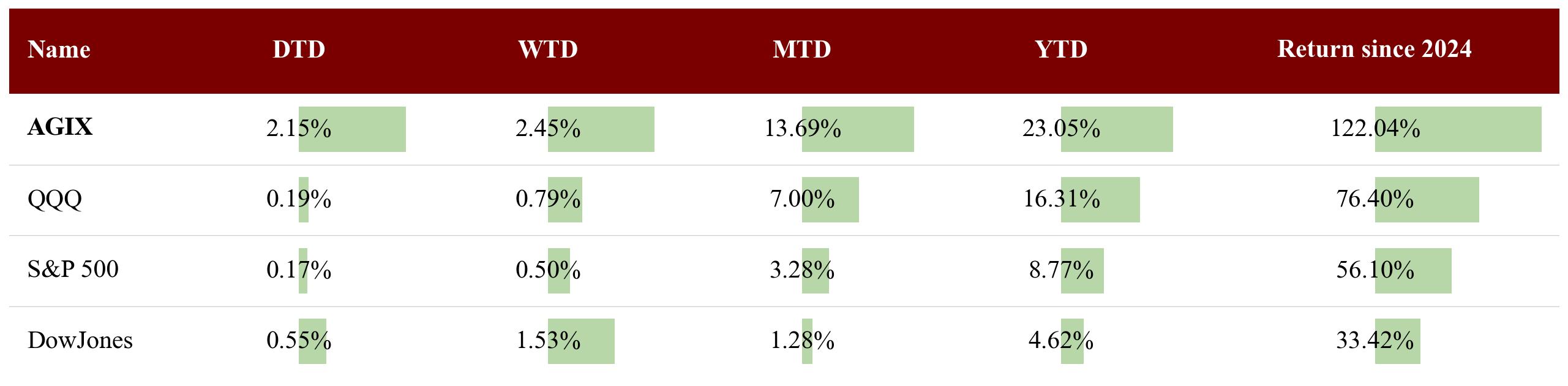
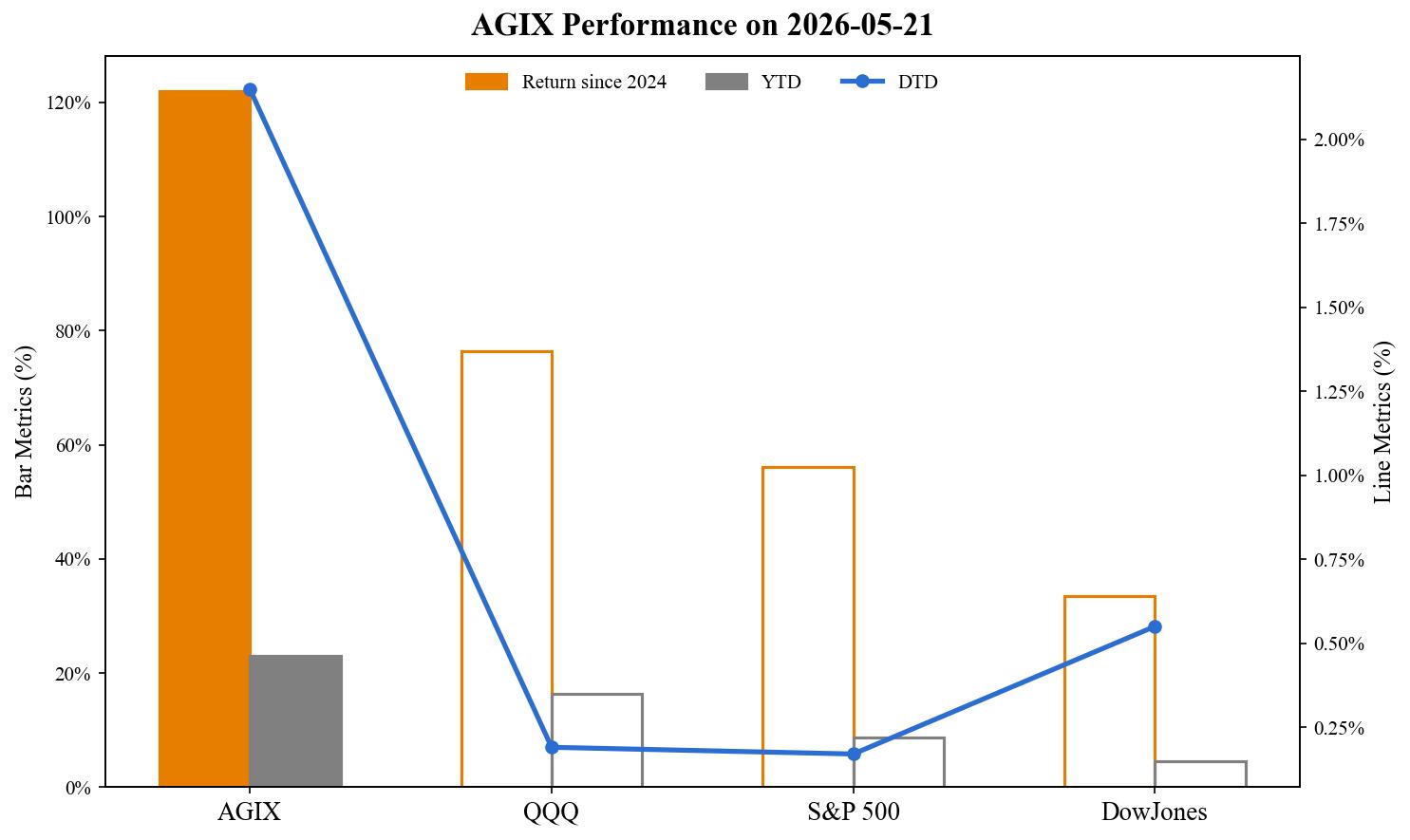
• AGIX surged 2.15% DTD, significantly outperforming the QQQ (0.19%), S&P 500 (0.17%), and Dow Jones (0.55%). The fund's YTD return of 23.05% also leads the broader benchmarks.
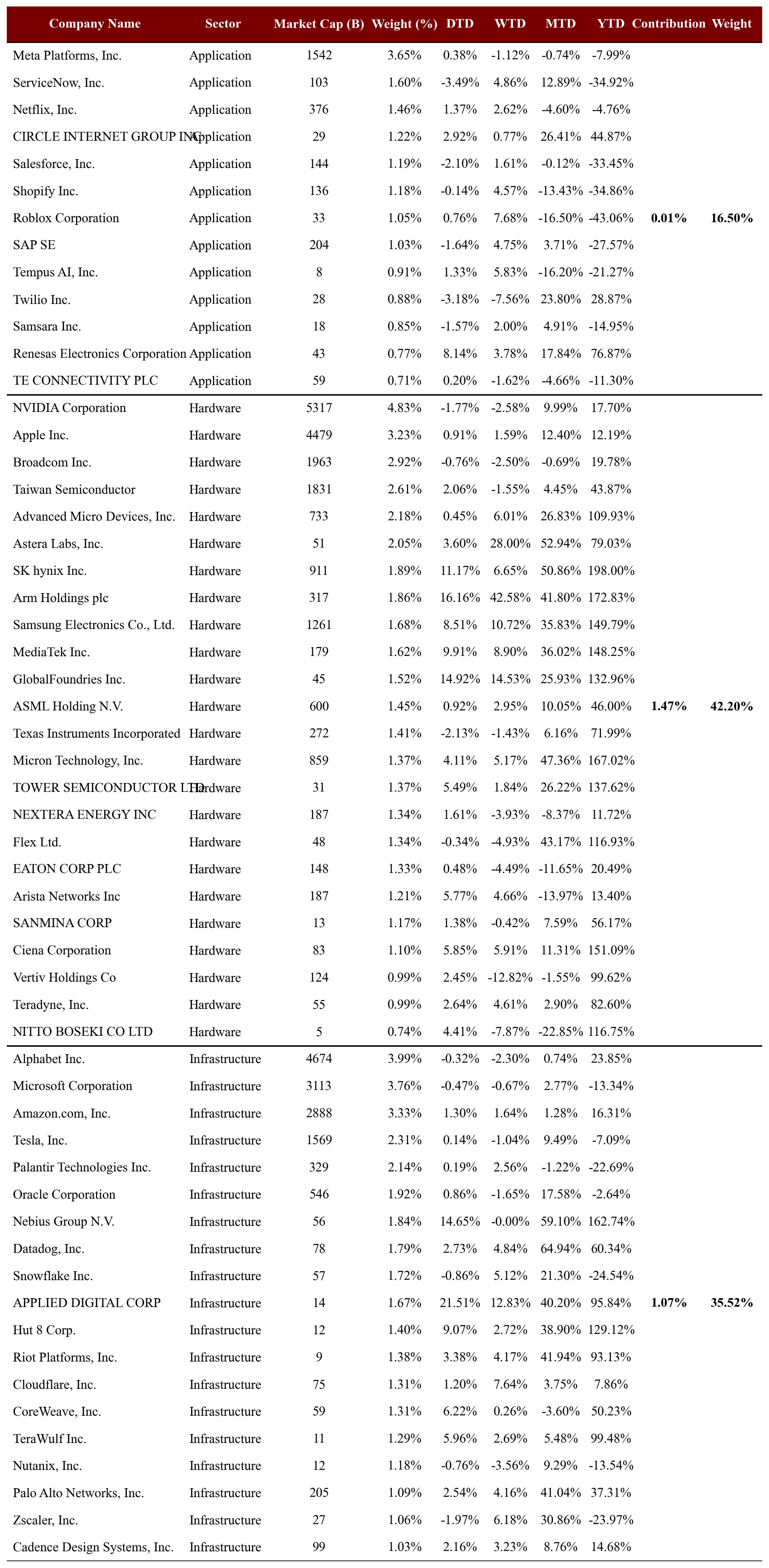
• Key holdings driving today's outperformance include Arm Holdings (+16.16%), GlobalFoundries (+14.92%), SK hynix (+11.17%), and MediaTek (+9.91%), all benefiting from strong AI and semiconductor demand.
• The hardware sector led gains, with contributions from Samsung Electronics (+8.51%), Renesas Electronics (+8.14%), and Ciena (+5.85%). Infrastructure names like CoreWeave (+6.22%) and Nebius Group (+14.65%) also added to the rally.
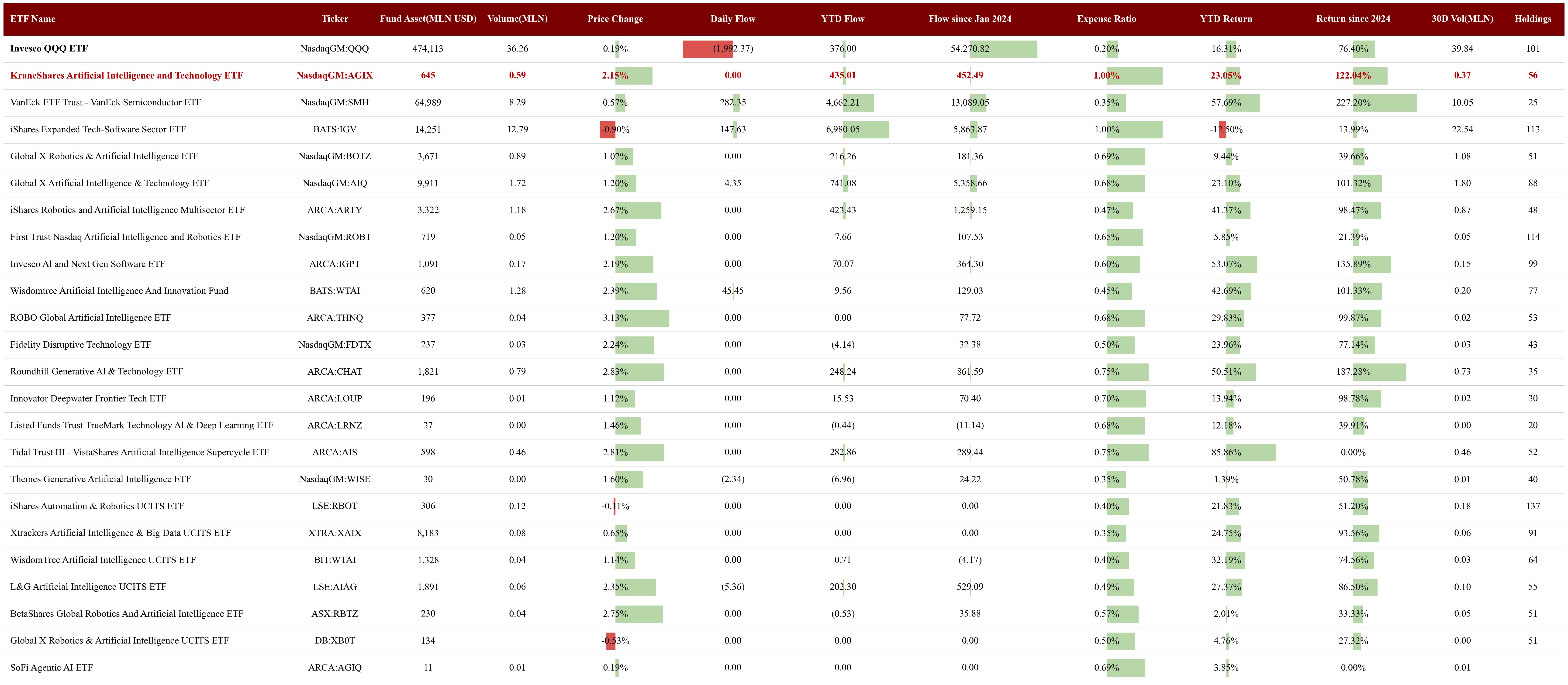
• Among peer ETFs, IGPT (+2.19%), THNQ (+3.13%), and CHAT (+2.83%) showed strength, reflecting broad AI and tech enthusiasm.
News Highlights
1. SpaceX's IPO filing reveals a $1.75 trillion valuation and heavy AI spending, with 60% of 2025 capex allocated to AI via xAI. This underscores the massive capital flows into AI infrastructure, directly benefiting AGIX holdings like CoreWeave and Nebius Group.
2. Nvidia's record quarter (revenue $81.6B, data center $75.2B) and $80B buyback reinforce the AI chip demand story. Holdings like Arm, TSMC, and Broadcom are key beneficiaries of the sustained AI capex cycle.
3. Anthropic's expected first profitable quarter ($10.9B revenue) highlights the scaling of AI model companies. This supports AGIX's exposure to AI infrastructure and cloud providers like Microsoft and Alphabet.
4. Intuit's 17% workforce reduction to focus on AI reflects a broader industry shift toward AI-driven efficiency, which could pressure traditional software holdings but benefits AI-enabling hardware and infrastructure names in AGIX.
RSS Highlights
1. Google I/O 2026 unveiled Gemini 3.5 and Gemini Spark personal agent, signaling rapid AI agent development that could drive demand for computing and networking infrastructure.
2. Anthropic's reported profitability is questioned due to unclear accounting and potential revenue inflation, highlighting the need for scrutiny in AI company financials.
3. A new open-source RFC proposes standards for AI contributors in open-source projects, addressing transparency and quality in AI-generated code.
4. Datasette released its first AI assistant, Datasette Agent, enabling natural-language querying of databases, a practical step in making data analysis more accessible.
Performance & Benchmark
Attribution
Contribution of the three sectors within AGIX holdings today
Application: 0.01%
Hardware: 1.47%
Infrastructure: 1.07%
Top-performing stocks in AGIX holdings today
APPLIED DIGITAL CORP (21.51%)
Arm Holdings plc (16.16%)
GlobalFoundries Inc. (14.92%)
Nebius Group N.V. (14.65%)
SK hynix Inc. (11.17%)
MediaTek Inc. (9.91%)
Hut 8 Corp. (9.07%)
Samsung Electronics Co., Ltd. (8.51%)
Renesas Electronics Corporation (8.14%)
CoreWeave, Inc. (6.22%)
TeraWulf Inc. (5.96%)
Ciena Corporation (5.85%)
Arista Networks Inc (5.77%)
TOWER SEMICONDUCTOR LTD (5.49%)
NITTO BOSEKI CO LTD (4.41%)
Micron Technology, Inc. (4.11%)
Astera Labs, Inc. (3.6%)
Riot Platforms, Inc. (3.38%)
CIRCLE INTERNET GROUP INC (2.92%)
Datadog, Inc. (2.73%)
Teradyne, Inc. (2.64%)
Palo Alto Networks, Inc. (2.54%)
Vertiv Holdings Co (2.45%)
Cadence Design Systems, Inc. (2.16%)
Taiwan Semiconductor Manufacturing Company Limited (2.06%)
Worst-performing stocks in AGIX holdings today
Salesforce, Inc. (-2.1%)
Texas Instruments Incorporated (-2.13%)
Twilio Inc. (-3.18%)
ServiceNow, Inc. (-3.49%)
Top five listed stocks contributing the most within AGIX holdings today
APPLIED DIGITAL CORP (21.51%)
Arm Holdings plc (16.16%)
Nebius Group N.V. (14.65%)
GlobalFoundries Inc. (14.92%)
SK hynix Inc. (11.17%)
Observation
The strongest movers across peer ETF holdings today are listed below:
| DTD | Stock Ticker | Name | Held by ETFs | analysis |
|---|---|---|---|---|
| 33.37 | NYSE:QBTS | D-Wave Quantum Inc. | ['BATS:IGV', 'BATS:WTAI'] | D-Wave Quantum’s 33% gain on May 21, 2026 appears primarily driven by company-specific financing news that improved sentiment around its funding runway and growth prospects. The key catalyst was the announcement of a proposed $100 million “cheap” at-the-market funding deal, which drew heavy retail and speculative interest, as reflected in trading volume that ran at roughly 2.5x the stock’s recent average. The stock’s high beta and quantum-computing theme likely amplified the price reaction once the funding headline attracted momentum traders. |
| 30.57 | NasdaqCM:RGTI | Rigetti Computing, Inc. | ['BATS:WTAI'] | Rigetti Computing’s 30.6% jump on May 21 appears primarily driven by investor enthusiasm around “fresh government funding headlines” cited in same-day coverage, which likely reinforced the bull case for quantum computing demand and Rigetti’s role in that ecosystem. The move was amplified by extremely elevated trading activity—mid-day volume was over 3.5x the stock’s recent average—suggesting momentum and short-covering dynamics on top of the funding catalyst. Continued positive sentiment, reflected in a “Moderate Buy” consensus rating and a Street price target materially above the pre-move close, likely provided additional support to the upside. |
| 21.51 | NASDAQGS:APLD | APPLIED DIGITAL CORP | ['NasdaqGM:AGIX'] | Applied Digital’s 21.5% gain on May 21, 2026 was driven primarily by a bullish sell-side catalyst, with Citizens JMP raising its price target from $40 to $60, reinforcing the stock’s AI data-center growth narrative. The upgrade came against a backdrop of already-strong momentum in APLD, including rapid revenue growth from its pivot toward AI infrastructure and a high-beta profile, which amplified the reaction and helped push volume sharply above normal levels. |
| 20.59 | TSE:3905 | Datasection Inc. | ['NasdaqGM:WISE'] | Datasection’s 20.59% jump on May 21 appears primarily driven by stock-specific momentum rather than any clearly identifiable same-day corporate disclosure in the public results provided. The main support is a strong technical/risk-on move in the name, with recent trading showing elevated volatility and sharp price swings, which can amplify one-day gains. A secondary driver may be broader speculative interest in AI-related small caps, consistent with Datasection’s AI and data-analytics business profile. |
| 20.31 | NASDAQCM:DUOT | Duos Technologies Group, Inc. | ['NasdaqGM:WISE'] | Duos Technologies’ 20%+ gain on May 21, 2026 appears primarily to be a delayed positive repricing to its recently reported Q1 2026 results and outlook after the stock had sold off on the initial earnings reaction. The company reported earnings on May 15, and third-party coverage (e.g., MarketBeat, StockTitan) highlighted the earlier negative move despite Q1 updates, suggesting investors may now be reassessing the risk/reward as the stock rebounded from prior weakness. A secondary driver is likely technical and trading-related: the move followed an 8.8% rise on May 20 with elevated volume (per Duos’ historical data), signaling short covering and momentum buying in a thinly traded micro-cap, which can amplify price swings in the absence of fresh same-day fundamental news. |
| 19.85 | TSE:9984 | SoftBank Group Corp. | ['NasdaqGM:ROBT', 'BATS:WTAI', 'ARCA:CHAT', 'BIT:WTAI'] | SoftBank Group’s 19.85% surge on May 21 was most likely driven by investor enthusiasm around its AI and data-center exposure, led by its large Arm stake and the market’s continued re-rating of AI-linked infrastructure names. A secondary driver was the stock’s high sensitivity to sentiment and positioning in a volatile mega-cap tech complex, which can amplify moves once momentum turns positive. I did not find a clearly verifiable same-day company announcement from the provided sources to explain the jump, so the move appears more consistent with sector/risk-on trading flows than with a direct disclosure catalyst. |
| 19.35 | NasdaqCM:QUBT | Quantum Computing Inc. | ['NasdaqGM:AIQ'] | Quantum Computing Inc. (QUBT)ʼs ~19% gain on May 21, 2026 appears driven primarily by technical trading dynamics rather than fresh fundamental news. First, chart-focused commentary and price action show the stock forming a bullish candle and breaking above a trend-line on the weekly timeframe, with traders keying off nearby support ($9.08) and upside resistance levels ($10.55, then ~$12.33), suggesting momentum/technicals were the main catalyst. Second, QUBT is an extremely volatile small-cap name in a speculative sector, so its beta and high retail/short-term trading interest likely amplified the move in the absence of notable company-specific announcements or sector-wide quantum computing news that day. |
| 18.97 | TSE:6526 | Socionext Inc. | ['NasdaqGM:AIQ', 'ARCA:IGPT', 'LSE:RBOT'] | Socionext’s 18.97% surge on May 21 was most likely driven by a sharp rerating around company-specific earnings expectations, with the stock already trading well above the prior close and appearing to benefit from renewed investor enthusiasm for its custom SoC and AI-related semiconductor exposure. A second likely driver was broader strength in semiconductor and chip-equipment names, which often amplifies moves in a relatively high-beta Japanese tech stock. No single disclosed same-day company announcement was evident in the provided public results, so the move appears primarily newsflow- and sentiment-driven rather than tied to a fresh operational disclosure. |
| 17.41 | KOSDAQ:A108490 | ROBOTIS Co., Ltd. | ['NasdaqGM:BOTZ', 'ASX:RBTZ', 'DB:XB0T'] | Robotis Co., Ltd.’s 17.4% gain on May 21, 2026 appears to be driven primarily by continued momentum and re-rating in Korea-listed robotics and AI beneficiaries rather than by any specific new company disclosure that day. First, sector peers in autonomous robots and AI hardware have been rallying on strong fund inflows into “future mobility” and robotics themes in Korea, and Robotis is a direct, small/mid-cap pure-play in that basket. Second, the stock has exhibited high volatility and a very strong one-year performance, suggesting that technical factors (short covering, momentum buying, and retail trading activity) likely amplified the move in the absence of fresh fundamental news. |
| 16.46 | KOSDAQ:A277810 | Rainbow Robotics Co.,Ltd. | ['NasdaqGM:BOTZ', 'ARCA:IGPT', 'LSE:RBOT', 'ASX:RBTZ', 'DB:XB0T'] | Rainbow Robotics’ 16.5% jump on May 21, 2026 appears primarily driven by continued momentum and positioning following its recent addition to the FTSE All-World Index, which has increased passive and benchmark-driven demand for the shares. In the absence of new company-specific news or earnings on the day, the move likely reflects follow-through buying from index and robotics/AI-themed investors, amplified by the stock’s high valuation, relatively low free float, and strong recent performance that can exacerbate short-term price swings. |
| 16.33 | NasdaqGM:VERI | Veritone, Inc. | ['NasdaqGM:WISE'] | Veritone’s 16.3% gain on May 21, 2026 appears primarily driven by strong momentum following a sharp move higher and increasing bullish technical sentiment rather than a fresh fundamental catalyst that day. Business Insider data show the stock up almost 14% versus the prior close and technical services like TradingView flag a “strong buy” rating, suggesting traders are chasing AI exposure and reacting to positive price action. A secondary support factor is the very large gap between the prevailing share price and Street consensus targets (MarketBeat cites a $9 average target, implying >300% upside), which likely reinforces speculative buying interest in a thinly capitalized AI name. |
| 16.16 | NasdaqGS:ARM | Arm Holdings plc | ['NasdaqGM:QQQ', 'NasdaqGM:AGIX', 'ARCA:IGPT', 'ARCA:CHAT', 'ARCA:LRNZ', 'ARCA:AIS'] | Arm’s 16% gain on May 21 appears driven primarily by ongoing AI-related momentum and follow-through buying after a parabolic multi-week run, as investors extrapolate Arm’s positioning in AI and custom “agent-optimized”/AGI-focused chips. Recent commentary highlighting Arm’s transition from a pure IP/licensing model toward designing its own AI chips, together with comparisons to Nvidia-like upside, has fueled aggressive growth expectations and momentum inflows, as reflected in trading volume running roughly 2.5x the stock’s average. Additionally, a broadly bullish sell-side stance (majority Buy ratings despite the stock trading well above consensus target price) likely reinforced the risk-on sentiment and helped sustain the sharp one-day move. |
| 14.92 | NasdaqGS:GFS | GlobalFoundries Inc. | ['NasdaqGM:QQQ', 'NasdaqGM:AGIX', 'ARCA:AIS'] | GlobalFoundries’ 14.9% gain on May 21, 2026 appears primarily driven by a strong fundamental reset following its better‑than‑expected Q1 2026 earnings and guidance, which continued to be digested and positively reassessed by investors. First, the company’s Q1 report showed results and commentary consistent with a recovery in semiconductor demand, supporting higher earnings power than previously discounted. Second, momentum buying and follow‑through interest helped push the stock to a new 12‑month high, as highlighted by market commentary, reinforcing the move as technical and sentiment tailwinds built on the fundamental catalyst. |
| 14.65 | NasdaqGS:NBIS | Nebius Group N.V. | ['NasdaqGM:AGIX', 'BATS:WTAI', 'ARCA:THNQ', 'ARCA:CHAT', 'BIT:WTAI'] | Nebius Group’s 14.65% gain on May 21, 2026 appears primarily driven by strong AI-infrastructure momentum and bullish sentiment following its recent Q1 2026 focus and earnings-related attention noted by brokers and trading platforms. First, Robinhood highlights the stock being “in focus after first quarter 2026” results, reinforcing the narrative of robust growth in AI-centric cloud infrastructure and GPUs, which investors are extrapolating into higher earnings power. Second, the name is benefiting from positive sell-side positioning, with MarketBeat and StockAnalysis both showing Buy/Moderate Buy consensus and price targets around or above the current price, validating the move and likely attracting incremental momentum and retail interest after the stock gapped up at the open. |
| 13.67 | NasdaqGS:OUST | Ouster, Inc. | ['LSE:RBOT'] | Ouster’s ~14% gain on May 21, 2026 appears primarily driven by continued momentum and rerating in robotics/lidar and automation names rather than a stock-specific headline that day. First, the broader robotics/automation complex has been strong through March–May, with earlier articles highlighting sector-wide inflows and Ouster’s outsized multi-month rally, which likely reinforced momentum and growth-investor positioning. Second, the stock is trading against a backdrop of bullish 12‑month targets from covering analysts (average around $40 versus a low‑30s spot price), supporting a “catch‑up” move as investors increasingly price in upside relative to consensus. |
| 13.06 | NYSE:SPOT | Spotify Technology S.A. | ['ARCA:THNQ', 'NasdaqGM:FDTX', 'LSE:AIAG'] | Spotify’s ~13% gain on May 21, 2026 was primarily driven by growing conviction around its profitability inflection and long‑term margin story ahead of its scheduled Investor Day in New York that day. Traders and investors reacted to the recent Q1 2026 results showing a sharp EPS jump (to about €3.45 from €1.07), record margins, strong free cash flow, and robust user growth to 761 million MAUs, reinforcing the view that the business is transitioning from pure scale to sustainable profit. In addition, the stock’s breakout from the low‑$430s toward the $500 level, against a backdrop of generally bullish Street ratings and target prices well above the current quote, attracted momentum and technical buyers, amplifying the move. |
| 12.67 | KOSE:A454910 | Doosan Robotics Inc. | ['NasdaqGM:BOTZ', 'LSE:RBOT', 'ASX:RBTZ', 'DB:XB0T'] | Doosan Robotics’ ~12.7% gain on May 21, 2026 appears primarily driven by momentum and technical factors rather than any clearly identifiable new fundamental catalyst. Public news and company disclosures around that date do not show a specific earnings release, major contract announcement, regulatory development, or sector-wide robotics news that would justify a discrete re-rating. In this context, the move is likely explained by short-term trading dynamics (including speculative buying and volatility in a relatively story-driven robotics name) and positioning, possibly amplified by the stock breaking through technical levels and attracting additional retail and momentum interest. |
| 12.5 | KOSE:A005380 | Hyundai Motor Company | ['NasdaqGM:ROBT', 'BATS:WTAI'] | Hyundai Motor’s 12.5% jump on May 21 was mainly driven by a sharp re-rating around its growth narrative, especially investor enthusiasm for Hyundai Motor Group’s AI robotics and EV ecosystem, which helped spark heavy buying in group-focused ETFs. A second driver was renewed attention to Hyundai’s China strategy after its Auto China 2026 messaging and the IONIQ V rollout, which reinforced confidence in the company’s localized EV push. The move also had a strong momentum/flow component, as the stock’s surge fed into related thematic funds and amplified demand across the group complex. |
| 12.44 | KOSE:A018260 | Samsung SDS Co., Ltd. | ['XTRA:XAIX'] | Samsung SDS rose on continued optimism after KKR’s April 15 investment plan, which included an $820 million convertible-bond purchase and signaled support for the company’s AI-transformation and infrastructure expansion. The stock also likely benefited from broader valuation re-rating around the strategic partnership, as analysts cited the deal as improving sentiment toward Samsung SDS. No same-day company-specific negative catalyst appears to explain the move. |
| 12.43 | NYSE:IBM | International Business Machines Corporation | ['NasdaqGM:AIQ', 'ARCA:ARTY', 'NasdaqGM:ROBT', 'BATS:WTAI', 'ARCA:THNQ', 'NasdaqGM:FDTX', 'XTRA:XAIX', 'BIT:WTAI', 'LSE:AIAG'] | International Business Machines’ 12.4% gain on May 21, 2026 appears primarily driven by a sharp rerating as investors bought into the company’s strengthening AI and quantum computing narrative, following growing evidence of a sizable gen-AI “book of business” and IBM’s early-2026 roadmap around quantum–classical architectures. This was reinforced by a supportive sell-side backdrop, with a MarketBeat-cited “Moderate Buy” consensus and average target near $294 implying meaningful upside from pre-move levels, encouraging momentum and short-covering. Elevated trading volume (over 3x average) suggests technical factors and positioning amplified the upside once the stock broke above recent trading ranges. |
| 12.24 | NYSE:IONQ | IonQ, Inc. | ['BATS:WTAI', 'ARCA:THNQ'] | IonQ’s 12.24% jump on May 21 was primarily driven by a sector-wide rally in quantum-computing stocks after reports that the U.S. government announced a $2 billion support package and took equity stakes in select companies, which boosted sentiment across the group. A second driver was IonQ’s recent operating update showing record quarterly revenue, stronger backlog, and a higher 2026 outlook, reinforcing the fundamental story. The move also likely benefited from momentum in a high-beta name, amplifying the upside once buyers moved in. |
| 11.17 | KOSE:A000660 | SK hynix Inc. | ['NasdaqGM:AGIX', 'NasdaqGM:AIQ', 'ARCA:ARTY', 'NasdaqGM:ROBT', 'ARCA:IGPT', 'BATS:WTAI', 'ARCA:CHAT', 'ARCA:LOUP', 'ARCA:AIS', 'XTRA:XAIX', 'BIT:WTAI'] | SK hynix’s 11% gain on May 21 was driven primarily by confirmation that it has confidentially filed with the U.S. SEC for an American Depositary Receipt listing targeted for completion by 2026, with media reports suggesting a potential raise of roughly $6.7–10 billion (and up to $14 billion in some reports). Investors appear to be rewarding the prospect of improved global visibility, a broader investor base, and capital to fund capacity expansion (including U.S. and Korea fabs), especially as the company indicated the ADR would be based on existing shares rather than a dilutive new issue. |
| 10.75 | NasdaqGS:SNDK | Sandisk Corporation | ['XTRA:XAIX'] | Sandisk’s 10.8% jump on May 21 was driven primarily by a powerful continuation of AI/memory-cycle optimism reinforced by recent bullish analyst actions, especially Citi’s reiterated Buy and aggressive price-target hike to $2,025 earlier in the week. This upgrade wave, combined with Citi’s highlighting of the $6 billion share repurchase as a key value driver, has pulled in incremental institutional and retail demand. A secondary driver is strong technical momentum – the stock is trading far above its 20-, 50-, 100- and 200-day moving averages in a clearly established uptrend – which likely amplified the move as trend-following and momentum strategies added exposure. |
| 10.64 | TSE:6324 | Harmonic Drive Systems Inc. | ['ARCA:IGPT', 'LSE:RBOT'] | Harmonic Drive Systems’ 10.6% gain on May 21 was primarily driven by company-specific optimism around its updated medium-term management plan, which the company announced it had revised and replaced with a new plan covering FY2024–FY2026. Investors appear to be recalibrating earnings and growth expectations upward in response to this strategic update, extending a strong recent momentum in the stock highlighted by third-party commentary noting a sharp 30-day share price run-up. Broader interest in robotics and semiconductor-related precision components likely provided an additional supportive backdrop, amplifying the reaction to the company’s plan revision. |
| 10.52 | KOSDAQ:A455900 | ANGEL ROBOTICS Co., Ltd. | ['NasdaqGM:BOTZ', 'ASX:RBTZ', 'DB:XB0T'] | ANGEL ROBOTICS’ 10.5% gain on May 21, 2026 appears primarily driven by momentum and technical factors rather than discrete company-specific news. Public sources around the date show no new filings, press releases or regulatory announcements from the company, and sector news on robotics is thematic rather than stock-specific. With the stock recently trading in the ₩27,550–₩28,250 range and covered as a neutral/hold candidate by technical services, the move is most likely a continuation of short-term upside momentum and speculative trading in a volatile small-cap robotics name, potentially amplified by broader investor interest in robotics plays. |
| 10.47 | NasdaqGS:CIFR | Cipher Mining Inc. | ['BATS:IGV'] | Cipher Mining’s 10.5% gain on May 21 was driven primarily by continued bullish sentiment around its pivot toward high‑performance computing and AI data centers, reinforced by a series of recent positive analyst actions. In the prior session, Morgan Stanley raised its target to $42.50 (overweight), Needham lifted its target to $25, and Jefferies initiated at buy with a $32 target, while the company highlighted a third AI data center campus lease with an investment‑grade hyperscale tenant, all of which sustained momentum into the next day. Technically, the stock’s strong uptrend and positioning above key moving averages, combined with elevated short interest (about 16.7% of float), likely amplified the move as traders pressed the rally and shorts were forced to cover. |
| 10.24 | TSE:6506 | YASKAWA Electric Corporation | ['NasdaqGM:BOTZ', 'NasdaqGM:ROBT', 'ARCA:IGPT', 'LSE:RBOT', 'ASX:RBTZ', 'DB:XB0T'] | Yaskawa Electric’s 10.24% gain on May 21, 2026 appears primarily driven by stock-specific technical and sentiment factors rather than a discrete new fundamental catalyst. Public news and company disclosures around that date show no major earnings release, guidance change, regulatory development, or industry data point that would normally justify a double‑digit move, suggesting investors were likely reacting to prior weakness, valuation reset, and/or short-covering. Broader industrial and robotics peers did not exhibit a comparable outsized move, reinforcing the view that this was an idiosyncratic re‑rating rather than a sector-wide catalyst. |
| 10.0 | TWSE:4919 | Nuvoton Technology Corporation | ['LSE:RBOT'] | Nuvoton Technology’s 10% gain on May 21, 2026 appears primarily driven by a Taiwan Stock Exchange announcement lifting a prior trading halt and resuming normal trading in the company’s shares and related warrants, typically signaling resolution or clarification of an overhang and triggering a relief rally. A secondary driver is ongoing positive sentiment around the company’s positioning in AI-related semiconductors following its recent disclosure of strong Q1 2026 AI-computing revenue growth, which likely reinforced buying interest once trading normalized. |
| 9.99 | TWSE:3443 | Global Unichip Corp. | ['NasdaqGM:AIQ', 'ARCA:IGPT', 'ARCA:THNQ', 'LSE:RBOT', 'LSE:AIAG'] | Global Unichip’s ~10% gain on May 21, 2026 was primarily driven by a change in trading treatment that effectively increased market access and leverage to the stock. The Taiwan Futures Exchange’s notice shows that, effective May 21, Global Unichip was included/adjusted in the stock margining framework (Group 3 with defined margin ratios), which typically boosts trading activity and can attract speculative and hedging demand. This move built on a positive fundamental backdrop, including strong reported March 2026 sales growth (+15.2% m/m and up y/y), which likely reinforced investor willingness to add exposure once margin terms became more favorable. |
| 9.91 | TWSE:2454 | MediaTek Inc. | ['NasdaqGM:AGIX', 'ARCA:IGPT', 'ARCA:THNQ', 'LSE:AIAG'] | MediaTek’s nearly 10% gain on May 21, 2026 appears primarily driven by continued AI- and edge-computing optimism boosting high-end semiconductor names, with MediaTek seen as a key beneficiary of AI smartphones and AI PCs. In the absence of stock-specific news or fresh company disclosures that day, the move aligns with strong momentum in Taiwan’s tech and semiconductor complex, where investors have been rotating into AI-levered chip designers. A further supporting factor is positive sentiment from prior weeks’ earnings and product roadmap commentary around advanced 3 nm/AI chipsets, which investors are extrapolating into stronger medium-term growth. |
| 9.76 | TWSE:3035 | Faraday Technology Corporation | ['LSE:RBOT'] | Faraday Technology’s 9.8% move on May 21, 2026 appears primarily driven by company-specific momentum ahead of its scheduled April 28 investor conference and the recently disclosed strong March 2026 revenue figures, which together have improved sentiment on its growth outlook. March consolidated revenues reached NT$1,066,507 thousand, signaling solid demand and likely fueling buy-side expectations for favorable commentary and guidance at (and after) the investor event, prompting investors to bid up the shares. Broader strength and speculative interest in Taiwan-listed semiconductor and ASIC design names likely added a secondary tailwind to the stock. |
| 9.63 | KOSDAQ:A348210 | NEXTIN, Inc. | ['LSE:RBOT'] | NEXTIN’s 9.63% rise on May 21, 2026 appears most likely driven by a sector rerating in Korean semiconductor equipment rather than a company-specific disclosure, as no same-day public announcement or earnings release is evident in the provided sources. The stock also had supportive backdrop from analyst/valuation content showing upside expectations for Nextin and continued interest in its semiconductor inspection and metrology business. Trading momentum and short-term positioning likely amplified the move. |
| 9.07 | NasdaqGS:HUT | Hut 8 Corp. | ['NasdaqGM:AGIX', 'BATS:IGV', 'NasdaqGM:AIQ'] | Hut 8’s 9.1% gain on May 21 appears primarily driven by continued momentum from earlier May catalysts that are still being repriced by the market rather than by fresh, stock-specific news that day. First, the stock is digesting a series of bullish analyst target hikes (e.g., Canaccord to $130, Needham to $128, Arete to $136) following the Beacon Point / AI data center pivot and Q1 disclosure of $16.8 billion in long-term AI lease commitments, which materially reframed the equity story away from pure Bitcoin mining. Second, the recent FalconX credit facility on better terms, which unencumbered ~3,300 BTC and lowered funding costs, has improved perceived balance sheet flexibility and likely reinforced the ongoing rerating. |
| 8.94 | NasdaqCM:RR | Richtech Robotics Inc. | ['NasdaqGM:BOTZ', 'ASX:RBTZ', 'DB:XB0T'] | Richtech Robotics’ 8.9% gain on May 21, 2026 appears primarily driven by ongoing momentum and retail interest in the stock following prior news flow and speculation around strategic/AI partnerships, rather than any new, company-specific disclosure that day. First, there is no fresh SEC filing, press release, or major news item on May 21 itself, suggesting the move is a continuation of earlier enthusiasm (including prior attention to a Microsoft-related collaboration and AI narrative) rather than a new catalyst. Second, the stock has been trading with elevated volatility and a relatively small float, so technical follow-through, short-term trading, and options-driven activity likely amplified the upside move once buying pressure resumed. |
| 8.86 | TWSE:6669 | Wiwynn Corporation | ['ARCA:IGPT'] | Wiwynn’s 8.9% gain on May 21, 2026 appears primarily driven by follow-through buying after its strong Q1 2026 earnings and outlook, which highlighted robust demand for AI and cloud servers. First, the company’s May 7 results and commentary on continued hyperscale and AI infrastructure growth have kept sentiment very positive, and investors likely continued repricing the stock upward as peers in the AI/server supply chain also traded strongly. Second, Wiwynn is widely viewed as a key beneficiary of the ongoing AI data center capex cycle, and the move likely reflects momentum and positioning in that broader theme rather than any new, stock-specific disclosure on the day. |
| 8.51 | KOSE:A005930 | Samsung Electronics Co., Ltd. | ['NasdaqGM:AGIX', 'NasdaqGM:AIQ', 'NasdaqGM:ROBT', 'BATS:WTAI', 'ARCA:CHAT', 'XTRA:XAIX', 'BIT:WTAI'] | Samsung Electronics’ 8.5% jump on May 21 was mainly driven by Reuters-reported news that the company and its South Korean union reached a tentative wage deal, suspending a planned strike and easing fears of disruption to operations and chip supply chains. The move was also supported by broader strength in Korean equities and upbeat AI-chip sentiment, which continued to lift large-cap semiconductor names. |
| 8.14 | TSE:6723 | Renesas Electronics Corporation | ['NasdaqGM:AGIX', 'NasdaqGM:ROBT', 'BIT:WTAI'] | Renesas Electronics’ 8.1% gain on May 21, 2026 appears primarily driven by continued momentum and re‑rating in semiconductor names rather than a specific, stock‑unique catalyst that day. First, sector sentiment toward auto/industrial and AI‑linked semiconductors has been strong, with investors rotating into higher‑beta chip names like Renesas, which benefits from exposure to MCUs and SoCs. Second, valuation support from prior analyst forecasts of double‑digit annual EPS and revenue growth, alongside Morningstar’s fair value estimate above the pre‑move price, likely reinforced buying interest as the stock broke higher. |
| 8.13 | TWSE:3008 | LARGAN Precision Co.,Ltd | ['ARCA:IGPT', 'LSE:RBOT'] | LARGAN Precision’s +8.1% move on May 21, 2026 appears primarily driven by valuation re‑rating rather than a specific new company announcement. First, recent third‑party commentary (e.g., Simply Wall St’s April 2026 note) has highlighted the stock as potentially undervalued with attractive dividend characteristics, which may be catalyzing renewed interest among yield and value investors. Second, in the absence of identifiable stock‑specific news, the sharp gain likely reflects a combination of catch‑up buying after prior underperformance and positive sentiment toward optical/AI‑related hardware suppliers within the broader tech sector. |
| 7.91 | NasdaqGS:STX | Seagate Technology Holdings plc | ['NasdaqGM:AIQ', 'ARCA:IGPT', 'ARCA:AIS', 'XTRA:XAIX'] | Seagate’s 7.9% gain on May 21, 2026 appears primarily driven by its announcement of private exchange agreements to retire $185.9 million of 3.50% exchangeable senior notes due 2028 in exchange for cash and shares, which investors likely interpreted as a balance sheet de‑leveraging and capital-structure optimization positive for equity holders. The company’s communication framed the transaction as a proactive move to manage financial obligations and enhance shareholder value, reinforcing the bullish reaction. A supportive backdrop of a “Moderate Buy” consensus rating and a price target below the new trading level may also have contributed to momentum as investors recalibrated expectations. |
| 7.9 | TSE:285A | Kioxia Holdings Corporation | ['ARCA:IGPT'] | Kioxia Holdings’ 7.9% gain on May 21, 2026 appears primarily driven by continued bullish sentiment toward memory and semiconductor names, with investors positioning for a sustained NAND pricing recovery and AI-related storage demand. As one of the top global NAND suppliers, Kioxia is a direct beneficiary of tighter industry supply and improving chip pricing signaled across the memory space in recent weeks. A secondary driver is likely momentum and rerating in high-beta semiconductor stocks generally, as reflected in elevated trading volume relative to average, amplifying the move without any company-specific negative news to offset the sector tailwinds. |
| 7.88 | LSE:QQ. | QinetiQ Group plc | ['NasdaqGM:ROBT'] | QinetiQ’s 7.9% rise on 21 May 2026 was primarily driven by stronger-than-expected full-year results and positive guidance. According to earnings coverage, the company beat profit forecasts, which typically prompts earnings upgrades and re-rating in a defensive aerospace/defence name. A secondary driver was management’s announcement of a review of its U.S. business, which investors appear to interpret as a potential value-unlock or portfolio-optimization catalyst. |
| 7.87 | TSX:BB | BlackBerry Limited | ['BATS:IGV'] | BlackBerry’s 7.87% jump on May 21 was driven primarily by the Toronto Stock Exchange approving a new normal course issuer bid for up to 26.8 million shares, a clear capital-return catalyst that likely sparked the day’s re-rating. The move was reinforced by the market’s positive reaction to the buyback’s size and duration, which runs through May 2027 and signals management confidence in cash generation. A secondary factor was momentum/short-covering after the approval news, which helped push the stock to an intraday spike above the close. |
| 7.41 | TWSE:2303 | United Microelectronics Corporation | [] | UMC’s 7.41% jump on 2026-05-21 was most likely driven by the market reacting to its solid April sales update, which showed monthly revenue of NT$22.66B, up 10.8% year over year, and four-month sales up 6.9%. A secondary driver was optimism around UMC’s pricing power, with public reports pointing to a wafer price adjustment plan for the second half of 2026 to offset higher costs. Broader semiconductor sentiment likely added support, but the company-specific sales momentum was the main catalyst. |
| 7.39 | NasdaqGS:SDGR | Schrödinger, Inc. | ['ARCA:LRNZ'] | Schrödinger’s 7.4% gain on May 21, 2026 appears primarily driven by follow-through buying after a strong first-quarter 2026 earnings report and subsequent positive sentiment. Earlier in May, the company reported Q1 2026 results that MarketBeat characterized as “strong revenue,” which likely improved investor confidence in the software and drug discovery pipeline, and the stock’s move on the 21st fits the pattern of a continued rerating rather than a reaction to fresh, company-specific news that day. Broader sector interest in AI-enabled drug discovery and relatively normal trading volume suggest the move was fundamentally rather than technically driven. |
| 7.15 | TWSE:6526 | Airoha Technology Corp. | ['LSE:RBOT'] | Airoha Technology’s 7.15% gain on May 21, 2026 appears primarily driven by continued positive sentiment and follow-through buying after its sharp move higher earlier in the week, rather than any new, stock-specific disclosure that day. The most recent identifiable catalyst is the company’s May 12 announcement that it will participate in an institutional investor conference, which likely improved investor visibility and may have supported incremental demand as investors position ahead of potential commentary. Broader strength and speculative interest in Taiwanese semiconductor names also likely contributed as a secondary tailwind in the absence of fresh company news. |
| 7.08 | NasdaqGS:CORZ | Core Scientific, Inc. | ['BATS:IGV'] | Core Scientific’s 7.08% move on May 21 was likely driven primarily by the company’s first-quarter 2026 results and capital-structure update, which highlighted a $3.3 billion senior secured notes offering and a strengthened balance sheet. The move also appears consistent with the stock trading near its 52-week high, which can amplify momentum on positive fundamental news. Analyst tone remained supportive as a secondary tailwind, with consensus still in “moderate buy” territory and upside implied by published price targets. |
| 7.04 | KOSDAQ:A140860 | Park Systems Corp. | ['LSE:RBOT'] | Park Systems’ +7% move on May 21, 2026 appears primarily driven by a sharp re‑rating toward analysts’ consensus targets, with the stock (₩266,500 close per company site) moving closer to the roughly ₩287,750–331,000 12‑month target range cited on Investing.com, implying investors are pricing in the forecasted upside. The move also pushed shares closer to their 52‑week high and followed a period of strong sector interest in semiconductor and metrology-related names, suggesting momentum and thematic buying likely amplified the advance in the absence of specific new company disclosures that day. |
| 7.03 | TSE:6146 | Disco Corporation | ['NasdaqGM:FDTX'] | Disco Corporation’s ~7% gain on May 21 appears primarily driven by ongoing optimism around semiconductor-capex–linked names rather than a discrete, stock-specific news catalyst that day. There were no new company disclosures or major analyst calls on May 21, but the stock has recently benefited from upward revisions to medium-term revenue and price targets (e.g., consensus 2027 revenue and TP upgrades) amid strong demand expectations for wafer-processing equipment. Broader strength in semiconductor and AI-related equipment plays in Japan likely added a momentum and positioning tailwind. |
| 6.99 | NasdaqGM:AAOI | Applied Optoelectronics, Inc. | [] | Applied Optoelectronics’ ~7% gain on May 21, 2026 appears driven primarily by continued momentum from its AI data-center optical story and upside revenue trajectory, rather than any new company-specific news that day. First, investors are still reacting to robust demand for 800G and future 1.6T transceivers, management’s >$1 billion revenue target, and large hyperscale orders plus the $20.9M Texas grant, all of which underpin a powerful growth narrative. Second, with the stock trading near all-time highs after a multi-hundred-percent run and technicals still viewed as bullish by some services, momentum and short-covering likely amplified the move as investors leaned into the AI infrastructure theme despite elevated valuations and recent concerns about stretched pricing. |
| 6.76 | TSE:6920 | Lasertec Corporation | ['LSE:RBOT'] | Lasertec’s 6.8% gain on May 21, 2026 appears primarily driven by a rebound in sentiment toward semiconductor capital-equipment names rather than by company-specific news. There were no notable same-day Lasertec disclosures or headlines, while sector peers benefited from continued optimism around AI-related chip demand and capex, lifting high-beta suppliers like Lasertec. The move was likely amplified by short covering and momentum buying, given the stock’s elevated volatility and high-growth profile. |
| 6.66 | LSE:RPI | Raspberry Pi Holdings plc | ['ARCA:THNQ', 'LSE:AIAG'] | Raspberry Pi Holdings rose 6.66% on 21 May 2026, and the move appears driven primarily by sector/style momentum rather than any company-specific announcement. The clearest same-day catalyst in the provided public information is the stock’s strong technical bid and active trading, with the share price opening at 635p, trading up to 685p, and closing at 673p on heavy volume, which suggests follow-through buying after recent strength. No verifiable disclosure or fresh corporate news explaining the rally is evident in the supplied sources. |
| 6.65 | NasdaqGS:HTFL | HeartFlow, Inc. | ['ARCA:LRNZ'] | HeartFlow’s 6.65% gain on May 21, 2026 appears primarily to be a technical rebound and follow-through buying after the stock’s sharp post-earnings sell-off earlier in the week. After Q1 2026 results on May 14 showed strong 41% YoY revenue growth but a wider loss that initially drove the stock down 9–12%, investors seem to be re-rating the name as the negative reaction fades and growth-focused buyers step back in. A second driver is trading/technical factors: the stock has been consolidating above identified support in the mid‑$23s–$24s range and moved toward resistance in the high‑$26s, encouraging momentum and short-covering flows in the absence of new company-specific news on the day. |
| 6.63 | TWSE:3661 | Alchip Technologies, Limited | ['ARCA:ARTY', 'ARCA:IGPT', 'LSE:RBOT'] | Alchip Technologies’ 6.6% gain on May 21, 2026 appears primarily driven by derivatives-related positioning as the stock was newly included as an underlying security for Taiwan Futures Exchange stock futures/margining effective that day, boosting trading interest and leverage-driven demand. The TAIFEX notice shows Alchip (code 3661) added with defined margin parameters starting 2026/5/21, which typically increases visibility and facilitates participation from institutional and speculative investors, even in the absence of company-specific news or fresh fundamental disclosures. |
| 6.63 | NasdaqCM:INDI | indie Semiconductor, Inc. | ['LSE:RBOT'] | indie Semiconductor’s 6.6% gain on May 21 appears primarily driven by follow-through buying after its recently reported Q1 2026 results and Q2 revenue outlook, which showed revenue above the midpoint of guidance, improving non-GAAP losses, solid cash levels, and sequential growth guidance. Investors likely also reacted positively to management’s commentary on new radar and vision design wins and a $25 million radar chipset production order, reinforcing the company’s long-term growth story in automotive semis. A supportive backdrop from a “Strong Buy” analyst consensus and price targets implying meaningful upside likely added incremental momentum to the move. |
| 6.55 | TWSE:2408 | Nanya Technology Corporation | ['ARCA:IGPT', 'ARCA:AIS'] | Nanya Technology’s 6.55% gain on May 21, 2026 appears primarily driven by company-specific optimism reinforced around its Annual General Meeting, where shareholders approved the strong 2025 financial statements and the market continued to price in the company’s sharp swing to profitability and improving margins. The move was likely amplified by very bullish forward expectations for DRAM upcycle leverage, with consensus and third‑party forecasts pointing to ~40% annualized earnings and revenue growth and a near-40% ROE in coming years. Broader strength in Taiwan memory/semiconductor names and elevated trading volumes (well above average per Google Finance) also likely contributed as momentum and sector flows supported the stock. |
| 6.34 | NasdaqCM:GRRR | Gorilla Technology Group Inc. | ['NasdaqGM:WISE'] | Gorilla Technology Group’s 6.3% gain on May 21, 2026 was driven primarily by continued momentum and retail interest around its previously announced $1.4 billion Freyr partnership and multi‑year AI infrastructure growth story. 1) Bullish sentiment has been reinforced by recent management commentary highlighting a contracted backlog “well north” of $100 million, 2026 revenue guidance of $137–200 million, and a $7–10+ billion pipeline, which positions the stock as a high‑growth AI/edge‑infrastructure play. 2) The stock’s relatively small float and “high risk” technical profile likely amplified upside as buyers chased the name following its rebound from May 20 levels. |
| 6.22 | NasdaqGS:CRWV | CoreWeave, Inc. | ['NasdaqGM:AGIX', 'NasdaqGM:AIQ', 'NasdaqGM:ROBT', 'ARCA:CHAT', 'BIT:WTAI'] | CoreWeave’s 6.2% gain on May 21, 2026 was primarily driven by continued bullish positioning in high‑beta AI infrastructure names amid an ongoing supply‑constrained GPU environment, which supports investor expectations for strong demand for CoreWeave’s high‑performance cloud services. The move was amplified by the stock’s elevated volatility profile (beta ~2.7) and trading near/through short‑term resistance levels around $105, which likely triggered momentum and technical buying. |
| 6.21 | TWSE:2382 | Quanta Computer Inc. | ['ARCA:CHAT', 'ARCA:AIS'] | Quanta Computer’s 6.2% gain on May 21, 2026 appears primarily driven by continued momentum and positioning around AI server and data-center infrastructure demand rather than a specific new company disclosure that day. 1) Investors have been accumulating leading Taiwanese AI hardware names, and Quanta, as a key AI server ODM with solid earnings and dividend support, is a direct beneficiary of positive sentiment and flows into the AI supply chain. 2) The move also likely reflects catch‑up buying versus regional peers, helped by its still‑moderate valuation relative to consensus target prices and expectations of sustained AI server growth. |
| 6.2 | NYSE:GLW | Corning Incorporated | ['ARCA:AIS'] | Corning’s 6.2% gain on May 21 was primarily a continuation of momentum from its AI data-center exposure and the earlier-announced multiyear, up-to-$6 billion Meta fiber-optic supply deal, which has repositioned the stock as a key AI infrastructure beneficiary. The move was reinforced by bullish sentiment and support from the analyst community: MarketBeat highlights a “Moderate Buy” consensus with a rising average target near recent levels, and trading volume ran modestly above normal, suggesting incremental institutional demand rather than company-specific fresh news on the day. |
| 6.18 | NasdaqGS:RMBS | Rambus Inc. | [] | Rambus’s 6.2% gain on May 21, 2026 appears primarily driven by ongoing AI- and memory-related enthusiasm and momentum following its sharp move higher earlier in the week, rather than by any new, company-specific fundamental news that day. First, there is no evidence of fresh earnings, guidance, or major customer/partner announcements on May 21, suggesting investors were extending an existing rerating of high‑multiple AI beneficiaries like RMBS. Second, the recently filed 8‑K on the annual meeting, including renaming the Cyber Risk Committee to the AI and Cyber Risk Committee, likely reinforced the market’s perception of Rambus as an AI-levered semiconductor/IP play, providing an incremental governance and narrative tailwind to the stock. |
| 6.05 | ASX:IMD | Imdex Limited | ['LSE:RBOT'] | Imdex Limited’s 6.05% gain on 21 May 2026 appears primarily driven by broad risk-on sentiment and a strong rally in the Australian equity market rather than stock-specific news. The S&P/ASX 200 Index rose 1.47% on the day, buoyed by positive leads from US markets (with the Dow up 1.31% and Nasdaq up 1.54%), and Imdex featured among the ASX 200’s top performers in this macro-led rebound. In the absence of any same-day company announcements or sector-specific catalysts, the move looks mainly like beta-driven buying in a volatile week, with investors rotating into cyclical and growth names such as Imdex. |
| 6.05 | NasdaqGM:NVTS | Navitas Semiconductor Corporation | ['ARCA:AIS'] | Navitas Semiconductor’s 6.05% gain on May 21, 2026 appears driven primarily by positive sell-side recalibration and ongoing momentum from recent technology news rather than any new company-specific disclosure that day. First, Rosenblatt Securities raised its price target from $7 to $13 while maintaining a neutral rating, reinforcing a higher valuation framework and helping sustain buying interest. Second, the move extended a sharp recent rally following news that a semiconductor partner introduced its first GaN power IC product line using Navitas technology, which pushed NVTS to new 52-week highs and likely attracted additional momentum and retail trading, as reflected in volume running about 36% above average. |
| 6.01 | TWSE:2308 | Delta Electronics, Inc. | ['NasdaqGM:ROBT'] | Delta Electronics’ 6.01% rise on May 21, 2026 was most likely driven by continued investor enthusiasm around its AI/data-center power and thermal management franchise, which has been a key growth narrative for the stock. The only clearly identifiable company-specific disclosure in the recent public record is an early May TWSE filing about a subsidiary acquisition, but no same-day catalyst was visible in the supplied results; the move also likely reflected broader momentum in Taiwan electronics names after a strong prior run. |
| 5.96 | NasdaqCM:WULF | TeraWulf Inc. | ['NasdaqGM:AGIX', 'BATS:IGV'] | TeraWulf’s 5.96% rise on May 21 appears primarily driven by continued investor enthusiasm around its AI/HPC growth story and recent company visibility, rather than any clear same-day fundamental announcement. The most relevant public catalyst was management’s active investor-conference slate in May, which likely kept the name in focus and supported momentum. Trading also looked heavy around the stock’s recent range, so short-term momentum and style flows likely amplified the move. |
| 5.93 | SEHK:861 | Digital China Holdings Limited | [] | Digital China’s roughly 6% gain on 21 May 2026 appears to be a sentiment- and flow‑driven move rather than a reaction to stock-specific news. I do not find any company announcements, regulatory filings, or credible news coverage for Digital China or its immediate peer group on that date that would explain the move, nor any obvious sector-wide catalyst in Hong Kong IT services/software names. In the absence of fundamentals news, the price action is most likely driven by short-term trading factors such as low liquidity, momentum following recent performance, or retail flows in smaller-cap tech/IT names. |
| 5.85 | NYSE:CIEN | Ciena Corporation | ['NasdaqGM:AGIX', 'ARCA:LOUP', 'XTRA:XAIX'] | Ciena’s 5.85% rise on May 21 appears to have been driven primarily by continued momentum in the stock itself rather than a clearly identifiable company-specific news catalyst; the move outpaced the Technology Equipment sector’s 0.27% gain and reflected stronger relative buying interest. A second likely support was the market’s ongoing positive read-through on Ciena’s strong execution and growth profile, which has kept the shares on a powerful uptrend over the past year. Valuation and technical momentum also likely reinforced the move, with multiple market sources highlighting bullish trading signals and sustained investor appetite. |
| 5.84 | NasdaqGS:WDC | Western Digital Corporation | ['ARCA:IGPT', 'ARCA:AIS', 'XTRA:XAIX'] | Western Digital’s 5.8% gain on May 21 was primarily driven by follow-through buying after the company’s stronger-than-expected fiscal Q3 2026 results and improved storage outlook tied to AI and hyperscale demand. TradingKey and other outlets highlighted that WDC beat earnings and revenue estimates and emphasized accelerating AI-led storage demand, which is reinforcing the bull case after a sharp year-to-date rally. A secondary driver is continued positive analyst sentiment and prior target hikes, which support the re-rating narrative and attract momentum and growth investors despite the stock trading near resistance levels and recent highs. |
| 5.77 | NYSE:ANET | Arista Networks Inc | ['NasdaqGM:AGIX', 'ARCA:ARTY', 'NasdaqGM:ROBT', 'BATS:WTAI', 'ARCA:THNQ', 'ARCA:CHAT', 'ARCA:LOUP', 'ARCA:AIS', 'NasdaqGM:WISE', 'XTRA:XAIX', 'LSE:AIAG'] | Arista Networks’ 5.8% gain on May 21, 2026 appears primarily driven by continued bullish sentiment around its strong fundamental momentum following Q1 results, particularly exceptional cash flow growth and robust revenue expansion, reinforcing the stock’s growth narrative. Supporting this, Zacks highlighted that ANET’s Q1 2026 operating cash flow jumped to $1.69B from $641.7M with revenues up 35.1% to $2.71B, and MarketBeat noted very strong institutional and analyst support, with a Buy/Strong Buy‑skewed rating profile and an average target price well above the current level. Elevated trading volume (about 31% above average) suggests incremental buying interest, likely from investors positioning for ongoing networking and AI‑driven demand trends. |
| 5.69 | NasdaqGS:CRDO | Credo Technology Group Holding Ltd | ['ARCA:IGPT', 'BATS:WTAI', 'LSE:RBOT'] | Credo’s 5.69% gain on May 21 appears primarily driven by bullish sentiment around its AI data center exposure, amplified by favorable same-day research coverage. Zacks named Credo the “Bull of the Day” on May 21, highlighting its leverage to the AI data center build-out and strong recent growth, which likely drew incremental institutional and retail buying. A secondary tailwind is ongoing momentum and technical strength (50-day moving average recently crossing above the 200-day), which can attract trend-following and momentum investors ahead of the next earnings report on June 1. |
| 5.66 | TWSE:3231 | Wistron Corporation | ['ARCA:CHAT', 'XTRA:XAIX'] | Wistron’s 5.66% rise on May 21 was most likely driven by investor reaction to its Q1 2026 results, which the company had just highlighted in its investor news flow and which reinforced the market’s AI-server growth story. The move also appears consistent with continued optimism around Wistron’s role in AI/server manufacturing, as trading commentary around the stock has focused on that earnings mix. No specific same-day negative company news appears to explain the gain, so the advance was likely a fundamentals-and-sentiment re-rating. |
| 5.65 | NASDAQGM:RZLV | Rezolve AI PLC | ['NasdaqGM:WISE'] | Rezolve AI PLC’s 5.65% gain on May 21, 2026 appears to have been driven primarily by technical and positioning factors rather than identifiable company-specific news. First, the move came on below-average volume (about 6.5M vs ~17M), suggesting a modest rebound within an existing uptrend rather than a news-driven re‑rating. Second, the stock was bouncing off recent lows near technical support around the mid‑$2.40s, aligning with short-term “buy candidate” signals from trading/technical sites that can attract momentum and retail traders in a high‑beta AI-related name. |
| 5.6 | TSE:6503 | Mitsubishi Electric Corporation | ['NasdaqGM:ROBT'] | Mitsubishi Electric’s 5.6% gain on May 21, 2026 appears primarily driven by continued positive follow-through from its recently reported record Q3 FY2026 results, which highlighted strong revenue growth in Infrastructure and Factory Automation Systems – segments that are leveraged to global capex and industrial automation themes. The move was likely reinforced by broader strength in Japanese industrials and factory-automation names as investors position for ongoing capex and reshoring cycles, with no major negative company-specific news to offset the optimistic earnings narrative. |
| 5.55 | TSE:6861 | Keyence Corporation | ['NasdaqGM:BOTZ', 'NasdaqGM:ROBT', 'ARCA:IGPT', 'LSE:RBOT', 'ASX:RBTZ', 'DB:XB0T'] | Keyence’s 5.6% gain on May 21, 2026 appears driven primarily by continued multiple re‑rating and sentiment rather than a specific, stock‑specific news catalyst released that day. First, valuation-oriented services (e.g., Morningstar, Simply Wall St) have highlighted meaningful upside to fair value and rising sell-side price targets through early May, supporting a momentum and re‑rating narrative in a high‑quality automation name that already trades at a premium P/E versus peers. Second, the stock’s move fits with ongoing strength in global factory automation and AI-related industrial themes, where investors are rotating into asset‑light, high‑margin enablers like machine vision and sensors, benefiting Keyence as a sector leader. |
| 5.49 | NasdaqGS:TSEM | TOWER SEMICONDUCTOR LTD | ['NasdaqGM:AGIX'] | Tower Semiconductor’s 5.5% gain on May 21, 2026 appears primarily driven by follow-through buying and momentum after the stock’s strong ~5% move and elevated close on May 20, rather than by any new, company-specific news that day. First, there were no material press releases, earnings announcements, or sector-specific headlines on May 21 tied directly to TSEM in major news or market data sources. Second, the prior session’s sizable advance and above-average interest likely triggered additional technical and momentum-driven buying, with investors extrapolating recent strength in analog/power and specialty foundry names. |
| 5.44 | NYSE:COHR | Coherent Corp. | ['NasdaqGM:FDTX', 'ARCA:LOUP'] | Coherent Corp.’s 5.4% gain on May 21, 2026 appears primarily driven by continued positive sentiment and momentum following its recent earnings beat and a wave of aggressive analyst price-target hikes. In early March, the company reported Q2 FY26 results ahead of expectations and issued stronger-than-consensus guidance, which was followed by sizable target increases from JPMorgan, Barclays, Stifel, and BofA up to the $235–$250 range, underscoring confidence in AI data center and hyperscale capex demand. With no major negative company-specific developments reported on May 21 itself, the move likely reflects investors re-rating the stock toward these higher targets amid ongoing enthusiasm around its AI and communications exposure. |
| 5.38 | NasdaqGS:QCOM | QUALCOMM Incorporated | ['NasdaqGM:QQQ', 'NasdaqGM:SMH', 'NasdaqGM:AIQ', 'ARCA:ARTY', 'NasdaqGM:ROBT', 'ARCA:IGPT', 'BATS:WTAI', 'ARCA:THNQ', 'BIT:WTAI', 'LSE:AIAG'] | QUALCOMM’s 5.38% gain on May 21 was primarily driven by company-specific growth catalysts in automotive, AI PCs, and data center markets, which reinforced the stock’s long-term earnings narrative. The most important driver was the announced expansion of its Stellantis partnership, extending Snapdragon Digital Chassis across next‑generation vehicles and strengthening Qualcomm’s position in high-value automotive silicon. A second key driver was the launch of the Snapdragon X2 Series for AI-enabled Windows PCs and a clearer outline of its custom data center and AI accelerator strategy, which together supported investor enthusiasm for Qualcomm’s role in the broader AI and edge-computing ecosystem, against a mildly positive tech sector backdrop. |
| 5.31 | TWSE:2345 | Accton Technology Corporation | [] | Accton’s +5.3% move on May 21, 2026 appears primarily driven by continued enthusiasm around Taiwan’s AI hardware supply chain and strong flows into Taiwan tech benchmarks rather than stock-specific news. First, there were no notable same-day company announcements or earnings releases for Accton, but it is a key beneficiary of demand for 800G AI/ML networking gear, which has been a central market theme and supported re‑rating of related names. Second, Taiwan equities—especially large-cap tech constituents within the MSCI Taiwan index and EWT ETF, where Accton is a meaningful holding—outperformed, likely amplifying passive and momentum-driven buying in the stock. |
| 5.26 | TWSE:2388 | VIA Technologies, Inc. | ['LSE:RBOT'] | VIA Technologies’ 5.26% gain on May 21, 2026 appears primarily driven by a regulatory/trading catalyst rather than company fundamentals. First, Taiwan Futures Exchange on that day adjusted VIA Technologies’ stock margining parameters (listing it in Group 3 with specified margin rates), which can boost trading interest and prompt positioning changes in a relatively illiquid name. Second, earlier in May the company’s board approved the acquisition of 18 million newly issued shares of its 100% subsidiary (per the May 6, 2026 announcement), which may still be supporting sentiment around capital deployment and group restructuring. |
| 5.21 | NasdaqGM:GPCR | Structure Therapeutics Inc. | ['ARCA:LRNZ'] | Structure Therapeutics’ 5.2% gain on May 21, 2026 appears primarily driven by continued enthusiasm around its GLP‑1 obesity pipeline and bullish longer-term analyst expectations rather than any discrete new company-specific news that day. First, the stock remains closely tied to the broader weight-loss/obesity drug theme, and investors are positioning ahead of key phase 2 readouts for lead asset GSBR‑1290, with GPCR often trading with high beta to sentiment in the GLP‑1 space. Second, consensus 12‑month price targets near $100–110 (implying ~200% upside from recent levels) and “moderate buy” ratings from a large analyst group provide a supportive backdrop, so incremental buying interest or short covering on a relatively illiquid day can translate into an outsized price move. |
| 5.13 | NasdaqCM:SERV | Serve Robotics Inc. | ['NasdaqGM:BOTZ', 'NasdaqGM:ROBT', 'ASX:RBTZ', 'DB:XB0T'] | Serve Robotics’ roughly 5% gain appears primarily driven by technical and trading dynamics rather than any clear company-specific news catalyst on the day. First, there were no notable same-day press releases, filings, or major industry headlines tied to robotics delivery that would justify a fundamental re-rating. Second, the stock has been volatile and thinly traded following its prior registered direct offering and subsequent selloff, so a modest bout of dip-buying and short-covering against a low absolute price level likely amplified the move. |
| 5.07 | NasdaqGS:RXRX | Recursion Pharmaceuticals, Inc. | ['NasdaqGM:ROBT', 'BATS:WTAI', 'BIT:WTAI'] | Recursion Pharmaceuticals’ 5.1% gain on May 21, 2026 appears primarily driven by technical and sentiment factors rather than a specific new fundamental catalyst. First, the stock was trading around $2.99 with a strong short-term up move and a +4% intraday gain profile, consistent with momentum/technical buying as it moved within a rising trend channel and above key short-term support levels flagged by trading sites. Second, the name is supported by a Buy-rated analyst consensus and price targets above the current price, which likely reinforced dip-buying and speculative interest in a thinly capitalized, high-volatility biotech, amplifying the move in the absence of company-specific news. |
News
Funding & M&A
The SpaceX IPO filing is filled with AI bets, Starship dreams, and Elon Musk at the center.
Space exploration technology company SpaceX will be listed on the Nasdaq exchange this year, with a valuation of $1.75 trillion, making it one of the largest IPOs in history. The company had $18 billion in revenue and $38 billion in losses last year, with Starlink satellite internet business contributing over 50% of revenue. To integrate Elon Musk's AI company xAI, SpaceX will allocate nearly 60% of its 2025 capital expenditure to AI, but the division continues to incur losses. The company will use the ticker SPCX for its listing. Elon Musk will lead the company as CEO, CTO, and Chairman, holding over 85% voting power. Its core reliance on the Starship reusable rocket, which will begin delivering cargo to orbit by the end of 2026, is also planned for Mars exploration. The company also envisions future businesses such as space manufacturing, point-to-point rapid Earth transport, and asteroid mining, targeting a market size of $28.5 trillion.
xAI burned $6.4 billion last year — SpaceX’s IPO filing shows why the spending is far from over.
According to SpaceX's IPO report, in 2025 xAI had only $320 million in revenue but an operating loss of $6.4 billion, far exceeding the $156 million loss in 2024. The main reason for the loss is a significant increase in AI computing expenses, including $3.65 billion in subscription revenue from AI solutions and infrastructure and $88 million in data licensing revenue. Elon Musk has merged xAI with SpaceX and plans to list it in 2026, with a valuation of $1.75 trillion. Meanwhile, SpaceX plans to expand the Grok model to several trillion parameters and deploy orbital AI computing satellite data centers by 2028. Currently, Grok has 117 million monthly active users, accounting for 20% of the combined ecosystem's total MAU. These plans will result in an annualized AI computing expenditure runway of $30.8 billion.
Mega IPOs on the way: SpaceX releases filing as OpenAI reportedly prepares for September listing.
Space exploration technology company SpaceX officially submitted its IPO filing documents today, planning to list on the New York Stock Exchange under the ticker SPCX. Against this backdrop, OpenAI may also submit its IPO application to regulators this Friday, with a potential public listing in September. Previously, Elon Musk's lawsuit against OpenAI was dismissed by the court review team. SpaceX's first-quarter revenue reached $4.69 billion, up 15% year-over-year, but net loss widened by $428 million. Starlink satellite internet business is its largest revenue source, with first-quarter revenue of $3.25 billion, up 27% year-over-year. The company plans to launch the V3 satellite system, which will be decommissioned in the second half of 2026, and accelerate deployment via Starship rockets. Additionally, SpaceX has partnered with Anthropic for large-scale computing services, with a monthly fee of $1.25 billion. The investment banking team includes Goldman Sachs and Morgan Stanley. OpenAI, after a recent funding round valued at $852 billion, could have a market cap of $1 trillion after its IPO.
Clouted wants to take the guesswork out of making short videos go viral.
Startup Clouted has just completed a $7 million seed round led by Slow Ventures, with participation from Gold House Ventures, Weekend Fund, Peak XV's Surge, and others. The company uses AI and a network of over 100,000 independent creators to automate short video editing and distribution strategies. Clouted's AI system optimizes content format, target audience, and platform distribution through continuous testing loops, helping brands improve social media efficiency. Its technology was first applied to promote the Manilla Electronic Music Festival and has already attracted over 20,000 participants. The company compares its AI solution to penetration testing in cybersecurity, exploring how content can break through algorithms to achieve viral effects. It currently competes with Overlap AI and aims to rival enterprise marketing infrastructure platforms like CreatorIQ and Hightouch in the future.
Anthropic says it’s about to have its first profitable quarter.
AI startup Anthropic has told investors that its second-quarter revenue will more than double to approximately $10.9 billion and that it will achieve its first operating profit. The news comes from a Wall Street Journal report, and this rapid growth will give Anthropic an edge in its competition with OpenAI. However, due to high computing costs, full-year profitability remains uncertain. The financial data was shared with investors during a funding round. The popularity of its Claude chatbot continues to rise, and the company has launched new services and tools targeting small business owners and law firms to expand its customer base. This news coincides with reports of OpenAI preparing for an IPO, highlighting the competitive momentum between the two companies in ecosystem building and fundraising strategies.
Jensen Huang says he’s found a ‘brand new’ $200B market for Nvidia.
NVIDIA founder and CEO Jensen Huang emphasized in the latest earnings call that its newly launched Vera CPU will open up a new $200 billion market for the company. The product is designed for agentic AI and can be sold independently or combined with Rubin GPUs, already achieving $20 billion in standing sales. NVIDIA reported quarterly revenue of $81.6 billion, with next quarter expected to reach $91 billion. Huang stated that Vera will drive demand for billions of agent tools, collaborating with cloud giants and system manufacturers for deployment. This move not only strengthens NVIDIA's dominance in AI but also expands its reach from GPUs to the CPU market. With the rapid development of physical AI and robotics, NVIDIA is reshaping data center computing architecture and leveraging its technological advantages to secure major global clients. This product launch could help NVIDIA further break into the cloud and edge computing markets.
Imperagen raises £5 million to use quantum physics, AI on enzyme engineering.
Biotech company Imperagen announced on Thursday that it has completed a £5 million seed funding round led by PXN Ventures, with participation from IQ Capital and Northern Gritstone. The company was founded in 2021 by scientists from the Manchester Institute of Biotechnology and spun out from the university. Imperagen focuses on using quantum physics simulations, AI models, and robotic automation to reinvent the field of enzyme engineering, replacing traditional trial-and-error methods. New CEO Guy Levy-Yurista will drive the construction of vertical AI infrastructure and industrial partnerships. The funding will be used to hire AI experts, strengthen R&D and laboratory capabilities, and build market entry functions. Its technology aims to accelerate enzyme development processes for industries such as pharmaceuticals, food, and biofuels, improving sustainable production efficiency. The company has now raised a total of £8.5 million.
Intuit cuts 17% of its staff to focus on AI but refuses to blame AI.
Financial services software company Intuit has announced plans to lay off 15% of its employees, about 3,000 people, in order to reallocate resources to support AI innovation. The company's CEO secretary stated that the adjustment is mainly to simplify management layers and improve decision-making efficiency, rather than replacing human workers with AI. To this end, Intuit will merge Credit Karma and TurboTax into a single business unit, eliminating overlapping roles. The restructuring will incur about $3 million in reorganization costs but is expected to improve gross margins and earnings per share. Adjusted earnings per share for the quarter were $12.80, with revenue of $85.6 billion, both exceeding expectations. However, amid rapid AI development, Intuit's stock has fallen 41% since the beginning of the year, as the market worries that traditional software may be disrupted. The CEO emphasized that the company maintains competitiveness through accuracy and compliance, rather than relying on automation to solve problems.
Pivot raises $40 million to integrate agentic AI more deeply into enterprise procurement.
Pivot Technologies SAS, a founding company in the AI procurement platform space, recently announced a $50 million Series B funding round, bringing its total funding to $70 million. Founded in 2023, the company offers a procurement solution called the "AI Operating System," covering the entire process from procurement and approval to payment and invoicing. Its platform processes $3 billion in invoices annually and serves enterprises in over 25 countries. The funding round was led by Forestay Capital and Notion Capital, with participation from Greyhound and other institutions and industry figures. The funds will be used to advance agentic AI tool development, enter new enterprise markets, and deepen ERP integrations. Customers include DoorDash, Lemonade, and Flix. Pivot emphasizes that its architecture, which restructures the data layer, allows procurement and finance teams to see committed spend before budget issues arise.
Move fast, break nothing: How Forward Predict applies CI/CD discipline to networking.
Startup Forward Inc. officially launched Forward Predict software today, a tool that lets customers model the impact of network changes before they take effect. This move marks a fundamental shift in how networks are designed, operated, and made reliable, as AI becomes central to enterprise IT. Formerly known as Forward Networks, Forward's core technology is a "network digital twin" that simulates L2 to L7 protocol behavior and complex interactions in multi-cloud environments. The tool brings CI/CD concepts to network operations, supporting intent testing and regression analysis, enabling engineers to foresee the impact of changes before they hit production, shifting from reactive troubleshooting to proactive validation. Combined with AI operations, Forward Predict can also verify whether configuration changes proposed by AI are safe and reliable. This helps reduce downtime caused by human error, accelerate network change cycles, and increase trust in automated operations. As AI workloads become distributed, with high failure costs and rapid changes, the network has become a critical factor in the success or failure of AI projects. Forward's predictive model is driving networks toward predictability and high reliability.
融资收购
Nvidia almost doubles its data center revenue as it powers to another solid earnings beat.
Chip giant Nvidia's latest earnings once again exceeded market expectations, with quarterly revenue surging 20% driven by strong demand for high-end AI chips. The company reported adjusted earnings per share of $1.87, beating analysts' estimate of $1.76, and revenue reached $81.62 billion, up 95% year-over-year. Data center sales reached $75.2 billion, up 95%, accounting for over 92% of total revenue. The company divides its business into two segments: data center and edge computing, with the latter including robotics, automotive, and gaming chips, generating $6.4 billion in sales. CEO Jensen Huang noted that AI factory construction is accelerating. The company also unveiled a new-generation AI rack system called Vera Rubin and plans to establish itself as a dominant CPU supplier. To reward shareholders, Nvidia authorized an $80 billion stock buyback and increased its quarterly cash dividend from $0.01 per share to $0.25 per share. Despite strong earnings, the stock was flat in after-hours trading.
Nvidia posts another record quarter, reveals $43 billion of holdings in startups.
Nvidia released its earnings after market close, showing revenue of $81.6 billion for the quarter ending April 26, up 20% quarter-over-quarter, with data center revenue reaching a record $75.2 billion. The company authorized an $80 billion share buyback program. CFO Colette Kress stated that the Blackwell architecture has been adopted by all major hyperscale data centers, cloud service providers, and model makers. Next quarter's revenue is expected to be $91 billion, up 12%. The impact of China exports on business is limited, and H200 has not yet generated revenue. Non-market equity investments increased from $22 billion to $43 billion, with $18.5 billion purchased in the quarter. The company also committed to investing $30 billion in OpenAI and is building large-scale computing capabilities for Anthropic.
RSS Subscription
The classic TreeView control lets me sort by name or by lParam, but why not both?
The Win32 TreeView control provides two methods for sorting child items: TVM_SORTCHILDREN sorts alphabetically by name, and TVM_SORTCHILDRENCB sorts via a custom callback. To sort by both text and lParam, it is recommended to adopt a data model pattern, storing each TreeView item's string and additional data in a structure so that both pieces of data can be accessed during sorting.
Alleged Kimwolf Botmaster ‘Dort’ Arrested, Charged in U.S. and Canada
Canadian authorities arrested a 23-year-old Ottawa man on Wednesday on suspicion of building and operating Kimwolf, a rapidly spreading IoT botnet that has controlled millions of devices over the past six months and participated in a series of massive distributed denial-of-service (DDoS) attacks. The suspect, publicly identified by KrebsOnSecurity in February 2026, now faces criminal hacking charges in both Canada and the United States.
Book Notes: “Poor Charlie’s Almanack”
"Poor Charlie's Almanack" summarizes the practical wisdom of Charles T. Munger, who believed that Berkshire's success came from identifying simple solutions rather than solving complex problems. He compared investing to jumping over a one-meter fence instead of a seven-meter one, emphasizing quickly eliminating unnecessary options, adopting a multidisciplinary approach, and acting decisively at the right time. He believed that mistakes are inevitable in life, and the key is to learn to make fewer errors and correct them quickly.
Stealth Startup Spy #341
Several tech industry executives have recently entered stealth startup phases, including a former Snap neural interface head and NextMind founder, a former Meta research director, and a SpaceX engineering manager. New companies such as Recursive and Drawbridge are developing self-improving superintelligence platforms and process intelligence solutions, having operated in stealth mode for six and seven months respectively.
Checking the math behind OpenAI and Anthropic’s latest headlines
OpenAI recently used a novel reasoning model to successfully find a counterexample that disproved a conjecture proposed by Paul Erdős 80 years ago, demonstrating the potential of large language models in mathematical research. However, the practical significance of this result still needs to be interpreted cautiously, as the model's training process and scope of applicability remain unclear. Meanwhile, Anthropic is expected to achieve its first small profit, partly due to receiving a discount on computing resources from SpaceX.
Couth and uncouth function pairs
Circular functions and hyperbolic functions are usually not invertible, but we can still perform inverse operations on them. By mapping points in the range back to points in the domain, we obtain a pair of functions (foo, fooh) whose invertibility depends on the specific definition. In Python's NumPy library, (sin, sinh) and (tan, tanh) are invertible, while (cos, cosh) are not. Different definitions may lead to different invertibility for the same function pair; for example, the definitions of cot and coth are controversial.
Anthropic's "Profitability" Swindle
According to The Wall Street Journal, Anthropic is expected to achieve $1.09 billion in revenue in the second quarter of 2026, doubling from $4.8 billion in the first quarter, and posting its first operating profit of $55.9 billion. However, the article notes that Anthropic's accounting methods are unclear, and there may be revenue inflation through prepayments and discounts. Although the company appears profitable in the short term, its long-term profitability remains questionable.
Circular and hyperbolic functions differ by rotations
The difference between circular functions and hyperbolic functions lies in rotation. For example, the hyperbolic cosine function cosh(z) can be expressed as cos(iz), while the hyperbolic sine function sinh(z) is -i sin(iz). By rotating z and applying trigonometric functions, each trigonometric function can be related to its hyperbolic counterpart, with the constant c depending on the specific trigonometric function.
Pluralistic: Shopping isn't politics (21 May 2026)
Shopping is not politics, although shopping can improve life. The relationship between voting and shopping is similar; voting requires political participation and organization, not just choosing the better candidate or product. Historical boycott movements, such as the Montgomery bus boycott, emphasize the importance of collective action, proving that real change can only be achieved through organization and unity.
Digital autonomy: what can organizations do NOW
As attention to digital sovereignty increases, many organizations are asking how to take action. Recommendations include stopping the migration of data and software to the United States, removing U.S. trackers from websites and applications, and working with SaaS providers to promote the use of European cloud services. Additionally, it is suggested to start with small-scale projects and gradually restore autonomous IT capabilities, such as developing local software based on European technology, to enhance the organization's digital sovereignty.
The Rise of Build-to-Rent Housing
In recent years, build-to-rent housing has risen rapidly in the housing market, now accounting for over 7% of new housing starts. According to the National Association of Home Builders, at least 68,000 new single-family homes are expected to be built for rent in 2025. One reason the sector has drawn attention is the Senate's proposed 21st Century Housing Act, which includes a provision requiring large institutional investors to sell single-family homes to individual owners after seven years, potentially threatening the build-to-rent business model.
Microsoft’s attempted merger with Intuit
In 1995, Microsoft attempted to acquire the financial software company Intuit for $2 billion, but the deal fell through due to antitrust concerns. Quicken, Intuit's flagship product, held a 70% market share, while Microsoft's competing product, Microsoft Money, had only 22%. Ultimately, Microsoft paid a $46.5 million termination fee and shifted its focus to the internet business.
Nobody is destined for greatness.
Greatness is not predetermined; many successful people, such as Demosthenes and James Dyson, achieved their accomplishments through countless failures and hard work. Psychologist Anders Ericsson's research shows that those who start early and invest significant time in effort often stand out. People who believe in fate tend to become fragile when facing setbacks, while true success comes from quietly working hard when no one is watching.
"No way to prevent this" say users of only package manager where this regularly happens
After the supply chain attack on art-template, developers and system administrators quickly checked their projects to ensure they were unaffected. The attacker had controlled the codebase since 2025, loading unauthorized JavaScript via NPM, with 90% of global supply chain attacks occurring on this platform. Programmers expressed frustration, believing that if maintainers do not strengthen account security, supply chain attacks will be hard to avoid.
The famous o3 "GeoGuessr" prompt did not work
OpenAI's o3 model performs well in geolocation; Kelsey Piper found it could accurately identify photo locations, though not with 100% success. After benchmarking 200 images, results showed that basic prompts outperformed complex ones, and complex prompts only slightly increased thinking time. This suggests that while complex prompts may seem effective, simple prompts can achieve good results when the model is already highly capable.
The stock market returns 4%
The actual rate of return on the stock market should be assumed to be 4%. Although the historical average annual return of the S&P 500 is 12%, after accounting for inflation, volatility, and various costs, the actual compound annual growth rate (CAGR) falls between 2% and 6%, leading to a more reasonable 4% return rate.
Don't call yourself a Software Engineer, and other Career Advice
In today's rapidly evolving technological environment, the role and career development of software engineers face challenges. Although many people have updated their job titles on LinkedIn, true career growth depends on building relationships, attending conferences, and improving communication skills, not just mastering programming languages. To succeed in the future workplace, software engineers should focus on work outcomes and career advice, rather than merely pursuing title changes.
Notes on respectfully getting a personal copy of a website's contents
Due to attacks from high-traffic crawlers, you may encounter a blocking page when visiting my blog (Wandering Thoughts) or its related wiki (CSpace). This is because your browser version is considered too old, especially certain Chrome versions. It is recommended that you check your browser's user agent settings and consider using archive.org for page archiving.
Apple Sports Expands to More Than 90 New Countries on Cusp of World Cup
Apple Sports app has now expanded to over 90 new countries and regions, allowing users to download it for free in more than 170 countries and regions, and enjoy personalized real-time FIFA World Cup 2026™ features. The app provides a fast and simple interface, enabling users to easily track match progress, view team lineups, and get the latest reports via Apple News, aiming to help fans stay updated on tournament dynamics during the World Cup.
Datasette Agent
On May 21, 2026, Datasette released its first extensible AI assistant, Datasette Agent, designed to help users query data stored in Datasette through a conversational interface. The assistant supports plugin extensions, and three plugins have been launched so far, including tools for data chart generation and image generation. Datasette Agent opens up new opportunities for the LLM and Datasette ecosystem, with more features and versions to come in the future.
datasette-agent-sprites 0.1a0
Released datasette-agent-sprites 0.1a0, a Datasette Agent plugin for running commands in the Fly Sprites sandbox.
Google I/O Keynote in 54 Seconds
This content concisely covers all the key points, offering a 54-second highlight recap of Google I/O with relevant links.
datasette-agent-charts 0.1a2
Datasette-agent-charts version 0.1a2 is released, adding a "View SQL Query" button so users can see the related SQL query below the rendered chart.
datasette-agent 0.1a3
Datasette-agent version 0.1a3 is released, adding a "View SQL Query" button, improving handling of truncated responses, and no longer showing empty reasoning blocks. This release enhances the user experience, ensuring the table remains visible even when SQL results are truncated.
The $500 Price Increase
Plex recently raised its lifetime subscription price from $249.99 to $749.99, an increase of $500, aiming to reflect the ongoing value of the software. Although Plex is well-regarded in the self-hosting community, this price adjustment may push users toward alternatives like Jellyfin. This move by Plex highlights the tension between a sustainable business model and user needs.
‘Geography Is Four-Dimensional’
Geography is four-dimensional; time influences how we perceive places. When a family moves from India to Canada, their children's 'Indian values' are seen as outdated locally; and my friends in Los Angeles also think my descriptions of the place no longer apply, because I haven't been back for years. Whether it's views on China or identity with the United States, time constantly changes our perspectives and experiences.
RFC: Artificial Contributors to Open Source
This document specifies the disclosure, quality, and behavior requirements for non-human contributors in open-source software projects. Human contributors (HCs) must disclose their involvement in contributions, ensure information accuracy, and follow the project's contribution process. Additionally, HCs must perform tests before submitting contributions and must not impersonate humans or manipulate activity timing. All requirements apply to operators of HCs, ensuring their compliance with relevant regulations.
The Verge: ‘The 13 Biggest Announcements at Google I/O 2026’
At Google I/O 2026, Google released the new Gemini 3.5 AI model and its application updates, including faster search and Gmail features, as well as the latest progress on Project Aura smart glasses. Gemini 3.5 Flash will become the default model, with stronger task-handling capabilities and better content safety. Additionally, Google launched a 'universal shopping cart' that allows users to add items from multiple platforms, rolling out in the summer.
WSJ: ‘Google Unveils New Gemini AI Agent for Personal Tasks’
Google is enhancing its Gemini AI model to improve competitiveness in the era of intelligent agents. The company has begun rolling out a personal agent called Gemini Spark, which can navigate users' digital lives and act on their behalf. It is expected to be available next week to subscribers of AI Ultra (priced at $100 per month).
TIL: Symlinking NixOS Dotfiles
The standard way to manage dotfiles in NixOS is using home-manager, but due to the complexity of dependencies, user scope, and configuration changes, I prefer to store dotfiles in the same repository as flake.nix / configuration.nix and use symbolic links. Although NixOS does not seem to natively support symbolic links, you can create them declaratively using systemd-tempfile, simplifying the management process.
datasette-agent-charts 0.1a1
Version 0.1a1 of datasette-agent-charts is released, with new features including: bar charts without a color column and waffle charts now use a gradient color scheme, text value color columns use the observable10 categorical scheme; execute-sql permission is checked before running queries; charts now support interactive tooltips; fixed a bug where waffleY charts were not correctly described to the agent.
datasette-agent 0.1a2
Version 0.1a2 of datasette-agent is released, with new features including tools that can be associated with required permissions, and the default background agent tool now requires the new datasette-agent-background permission.
Magic the Gathering format: Fun 40
In the 2026 "Quest for the Urza's Grail" event, over 80 participants built 40-card decks from custom card packs, with trading encouraged, recreating the fun of the 90s. The author shares six decks they built, including their favorite Erhnageddon and various classic cards, emphasizing the fun and strategy of the game, especially the experience of playing with their wife. Other players are welcome to suggest card additions or modifications.