AGIX Daily Report 2026-05-27
AI Summary
Market Overview
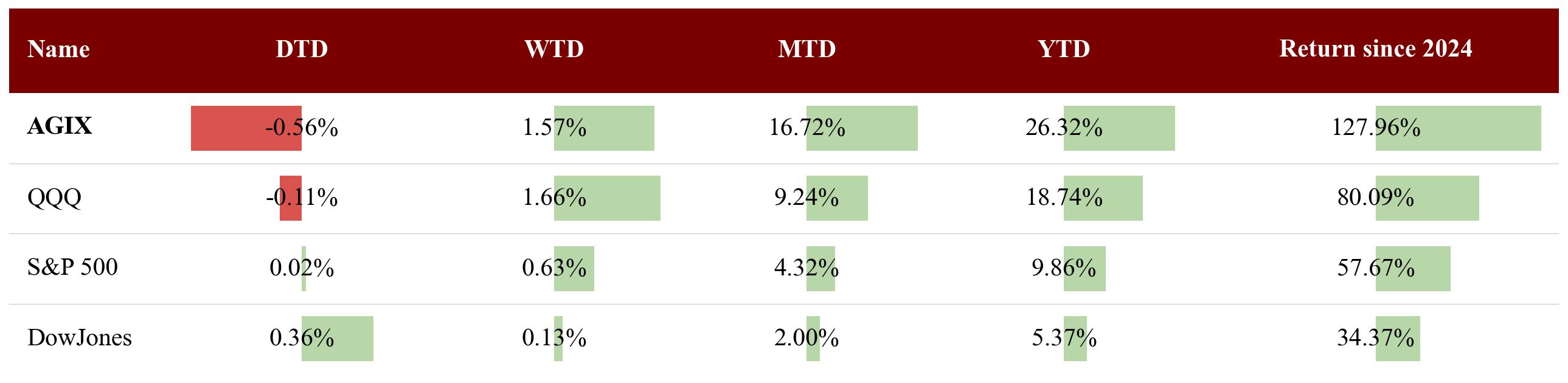
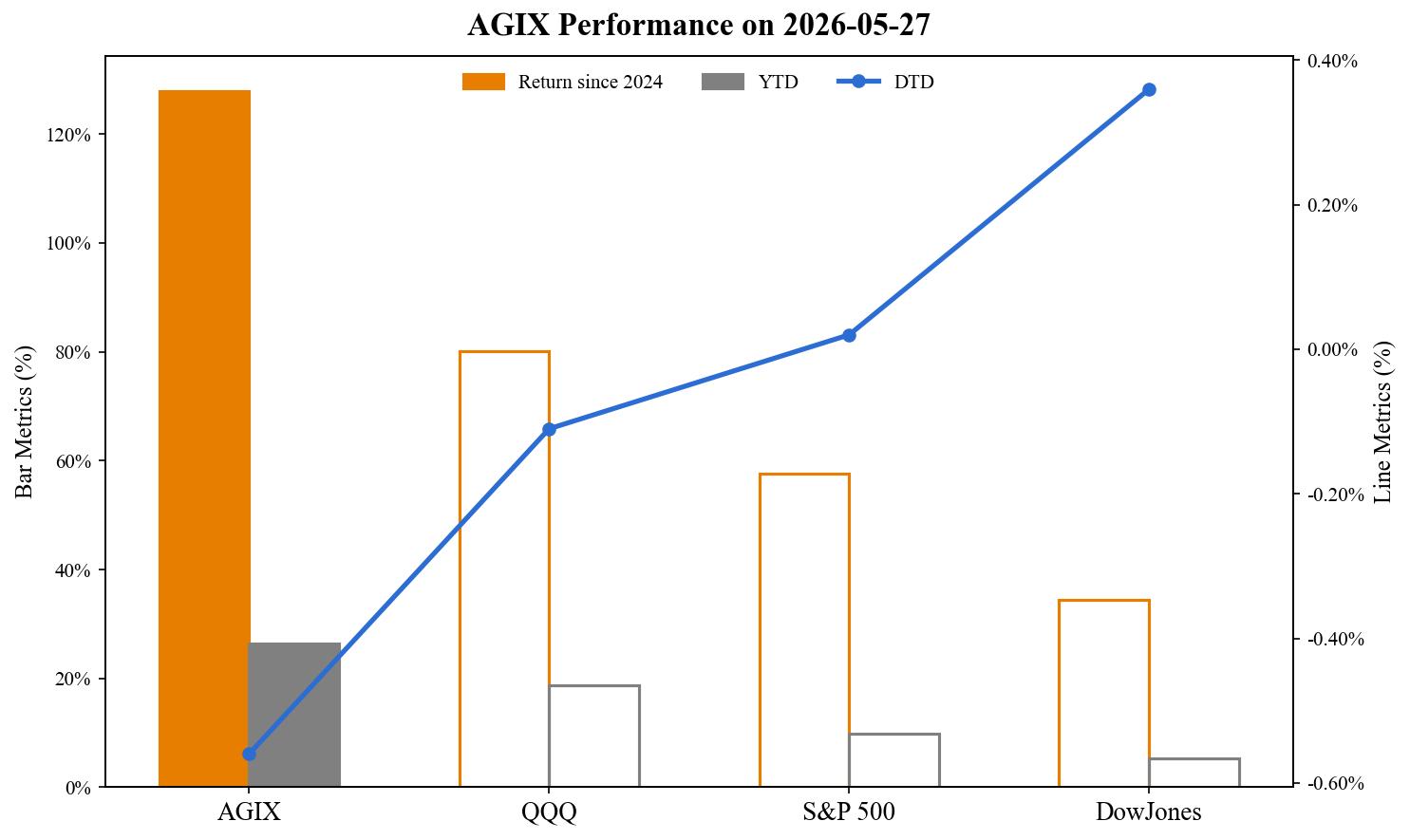
• AGIX slipped 0.56% DTD, underperforming QQQ (-0.11%) and the S&P 500 (+0.02%), but its MTD (+16.72%) and YTD (+26.32%) gains remain strong, driven by AI hardware holdings.
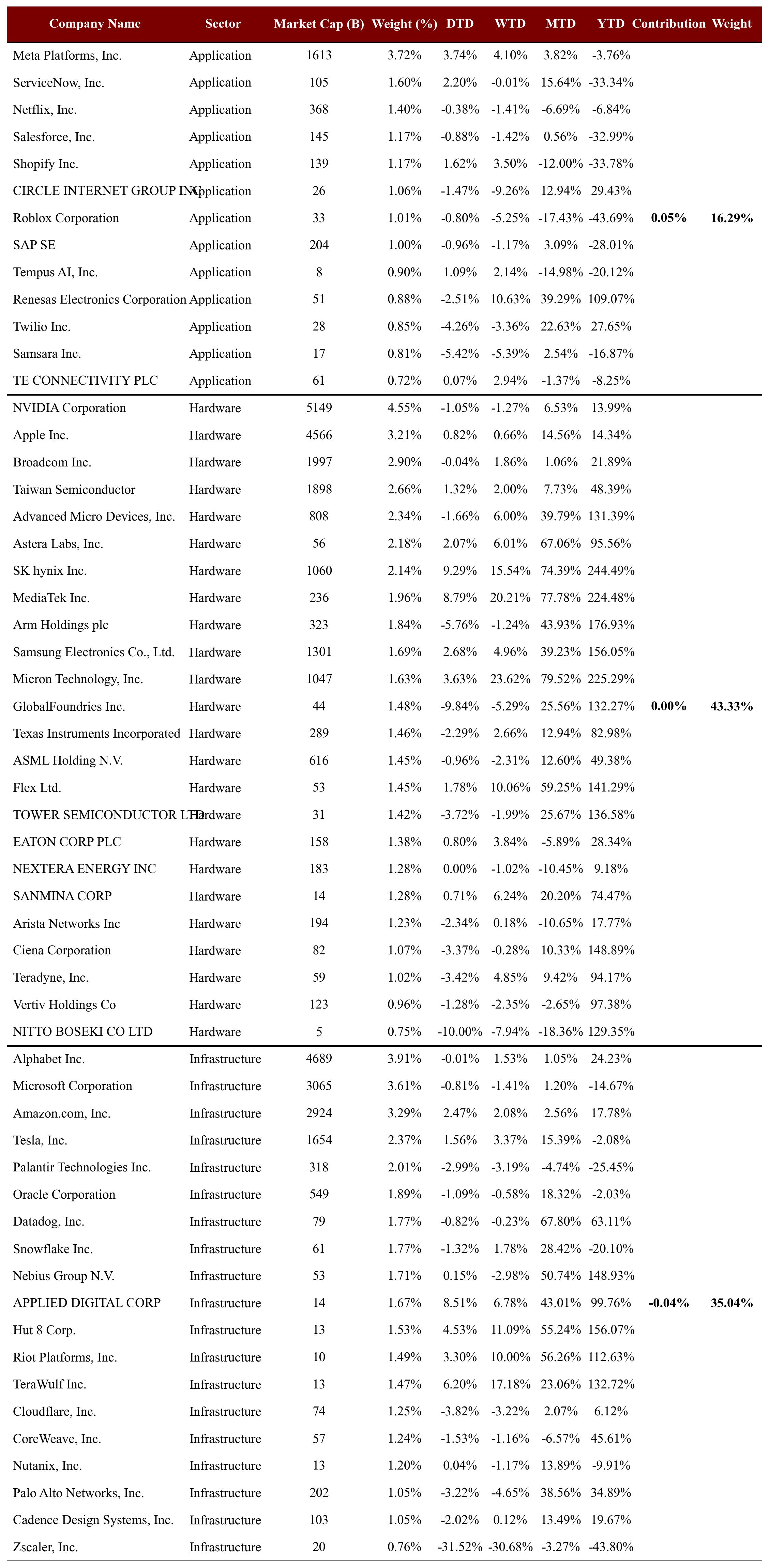
• Key contributors: SK Hynix (+9.29% DTD, +1508.84% since 2024) and Micron (+3.63% DTD, +995.68% since 2024) rallied on surging AI memory demand. MediaTek (+8.79% DTD) and Applied Digital (+8.51% DTD) also boosted the portfolio.
• Top drags: GlobalFoundries (-9.84% DTD), Arm Holdings (-5.76% DTD), and Samsara (-5.42% DTD) weighed on returns. Zscaler plunged 31.52% DTD, contributing the largest negative impact.
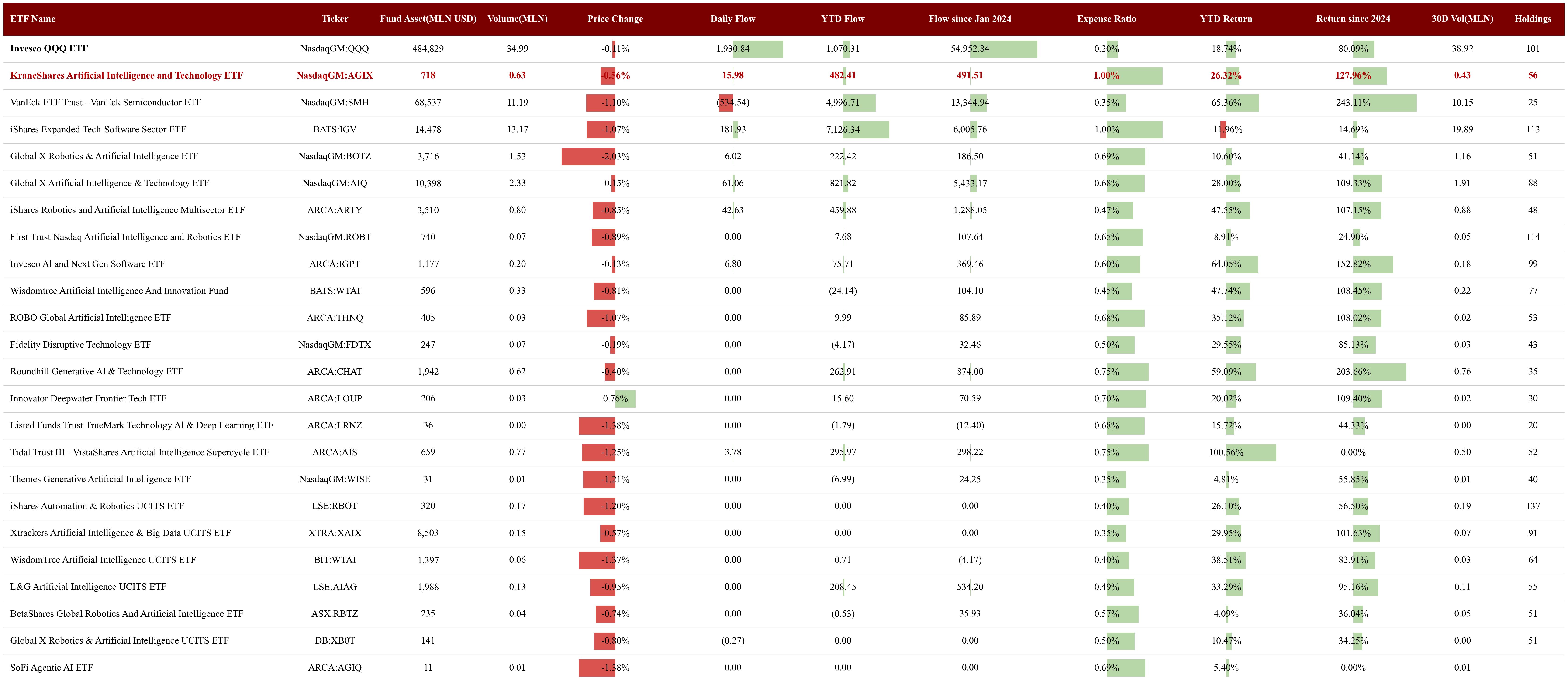
• Peer AI ETFs showed mixed results: IGPT (+6.25% WTD) and AIS (+6.08% WTD) led, while BOTZ (-0.55% WTD) and IGV (-1.03% WTD) lagged, reflecting rotation into semiconductor and infrastructure themes.
News Highlights
1. Micron and SK Hynix both surpassed $1 trillion market cap on AI memory demand; Micron surged 19% and SK Hynix 11%+. This directly supports AGIX's top holdings and reinforces the AI memory cycle.
2. Snowflake beat earnings and signed a $6 billion AWS deal for AI chips, sending stock up 36% after hours. AGIX holds Snowflake (1.77% of portfolio), making this a positive catalyst.
3. Cognition (Devin AI) raised $1 billion at a $25 billion valuation, highlighting strong demand for AI coding tools. This signals continued investment in AI software, benefiting AGIX's application holdings.
4. Robinhood launched AI agent trading, allowing AI agents to execute stock trades. This marks a milestone for AI in finance and could drive interest in AI platform stocks like AGIX's infrastructure names.
5. Cisco reported that no closed frontier AI model is safe from multi-turn attacks, with attack success surging from 7.9% to 88.3%. This raises security concerns for AI adoption and could pressure AI model providers.
RSS Highlights
1. Anthropic and OpenAI have found product-market fit, with Anthropic expected to become profitable in Q1 2026. Enterprise demand for coding agents is strong, signaling revenue growth in AI.
2. The curl team faces unprecedented pressure as security reports increase 4-5x vs 2024, highlighting rising cybersecurity challenges in open-source infrastructure.
3. Bill Gates' 1995 'Internet Tidal Wave' memo is revisited, drawing parallels to today's AI revolution and the need for companies to adapt or risk obsolescence.
4. A Dutch ban on Kyndryl's acquisition of Solvinity over national security concerns underscores growing regulatory scrutiny on tech M&A, especially involving critical infrastructure.
5. Pluralistic critiques billionaires' AI-driven vision of a 'world without migrants,' arguing that automation is being used to dehumanize labor rather than empower it.
Performance & Benchmark
Attribution
Contribution of the three sectors within AGIX holdings today
Application: 0.05%
Hardware: 0.0%
Infrastructure: -0.04%
Top-performing stocks in AGIX holdings today
SK hynix Inc. (9.29%)
MediaTek Inc. (8.79%)
APPLIED DIGITAL CORP (8.51%)
TeraWulf Inc. (6.2%)
Hut 8 Corp. (4.53%)
Meta Platforms, Inc. (3.74%)
Micron Technology, Inc. (3.63%)
Riot Platforms, Inc. (3.3%)
Samsung Electronics Co., Ltd. (2.68%)
Amazon.com, Inc. (2.47%)
ServiceNow, Inc. (2.2%)
Astera Labs, Inc. (2.07%)
Worst-performing stocks in AGIX holdings today
Cadence Design Systems, Inc. (-2.02%)
Texas Instruments Incorporated (-2.29%)
Arista Networks Inc (-2.34%)
Renesas Electronics Corporation (-2.51%)
Palantir Technologies Inc. (-2.99%)
Palo Alto Networks, Inc. (-3.22%)
Ciena Corporation (-3.37%)
Teradyne, Inc. (-3.42%)
TOWER SEMICONDUCTOR LTD (-3.72%)
Cloudflare, Inc. (-3.82%)
Twilio Inc. (-4.26%)
Samsara Inc. (-5.42%)
Arm Holdings plc (-5.76%)
GlobalFoundries Inc. (-9.84%)
NITTO BOSEKI CO LTD (-10.0%)
Zscaler, Inc. (-31.52%)
Top five listed stocks contributing the most within AGIX holdings today
Zscaler, Inc. (-31.52%)
GlobalFoundries Inc. (-9.84%)
Arm Holdings plc (-5.76%)
NITTO BOSEKI CO LTD (-10.0%)
Palantir Technologies Inc. (-2.99%)
Observation
The strongest movers across peer ETF holdings today are listed below:
| DTD | Stock Ticker | Name | Held by ETFs | analysis |
|---|---|---|---|---|
| 29.78 | KOSE:A018260 | Samsung SDS Co., Ltd. | ['XTRA:XAIX'] | Samsung SDS’s 29.8% surge and limit-up move on May 27, 2026 appears primarily driven by a sharp rerating of Korea IT service names with AI and digital transformation exposure, with Samsung SDS, LG CNS, and Hyundai AutoEver all hitting 52-week highs and attracting aggressive institutional and retail buying. The move follows recently disclosed strong 1Q26 results (KRW 3.35T revenue and solid operating profit) and ongoing newsflow around AI, cloud, and logistics digitalization, which together reinforced the stock’s leverage to structural IT spending and prompted momentum- and theme-driven inflows. |
| 21.38 | NasdaqGS:CRSR | Corsair Gaming, Inc. | ['ARCA:AIS'] | Corsair Gaming’s 21.4% move appears primarily driven by a new strategic narrative around AI-related compute and hardware, which sparked aggressive buying interest following a strong after-hours reaction the prior evening.[5] The stock had already jumped over 14% after hours on Tuesday on news coverage highlighting Corsair’s “big bet on AI compute,” positioning the company as a potential beneficiary of AI-driven gaming and PC upgrades.[5] A secondary driver is recent fundamental momentum, including better‑than‑expected Q1 2026 EPS and record gross margins reported earlier, which provides fundamental support for the AI narrative and likely amplified follow‑through buying.[4] |
| 10.42 | NasdaqGS:APP | AppLovin Corporation | ['NasdaqGM:QQQ', 'BATS:IGV', 'NasdaqGM:AIQ', 'ARCA:LOUP'] | AppLovin’s 10.42% jump on May 27 was mainly driven by the market continuing to reward its strong Q1 2026 earnings beat and upbeat Q2 guidance, which reinforced the company’s growth narrative.[1][2] The move also appears to have been amplified by bullish analyst coverage and target raises, including multiple firms reiterating Buy/Outperform views on the name.[2][4] A third tailwind was momentum around the upcoming self-serve AXON advertising platform launch and broader enthusiasm for AppLovin’s AI-driven ad-tech story.[1][2] |
| 9.96 | TWSE:2303 | United Microelectronics Corporation | [] | United Microelectronics Corporation’s ~10% gain on May 27, 2026 appears primarily driven by momentum from robust April 2026 sales data that showed double‑digit year‑on‑year revenue growth, reinforcing expectations of a cyclical upturn in foundry demand.[5] A secondary driver is broader strength and positive sentiment across global semiconductor and foundry names, with UMC benefiting as a lagging, more attractively valued Taiwan foundry proxy relative to larger peers. |
| 9.93 | TWSE:2344 | Winbond Electronics Corporation | ['ARCA:IGPT'] | Winbond’s ~10% gain on May 27, 2026 appears primarily driven by continued momentum and rerating in Taiwan memory/semiconductor names, with investors rotating into higher-beta beneficiaries of the AI/server and electronics upcycle rather than any stock-specific disclosure. Sector strength comes against a backdrop of improving sentiment toward cyclical recovery in memory and broader tech, with Winbond’s shares also breaking higher technically after sustained multi-week gains and a “buy” technical rating on trading platforms, which likely attracted additional momentum and retail flows.[1][2] |
| 9.4 | SWX:LEHN | LEM Holding SA | ['LSE:RBOT'] | LEM Holding’s 9.4% move appears primarily driven by a positive reaction to its freshly reported FY 2026 results, where trailing twelve‑month earnings grew about 18% and net profit margin improved to 3.4% from 2.7% year on year, signaling better profitability despite a Q4 net loss.[1] A secondary driver is valuation re‑rating, as the stock had been trading below a DCF fair value estimate (CHF 432.78) and near a period of negative sentiment following prior target cuts, leaving room for a relief rally as results confirmed continued growth.[1][4] |
| 9.3 | NasdaqGS:CIFR | Cipher Mining Inc. | ['BATS:IGV'] | Cipher Mining’s 9.3% gain on May 27, 2026 appears primarily driven by follow‑through buying after its Q1 2026 earnings and strategic pivot announcement, with investors focusing on the rebranding to “Cipher Digital” and the shift from pure-play Bitcoin mining toward higher‑value AI/HPC infrastructure. Same‑day commentary highlighted the stock’s roughly 9–10% post‑earnings surge, large disclosed contracted AI/HPC revenues with major hyperscalers, and a favorable Street setup (bullish ratings and substantial upside to consensus targets), which together outweighed the headline EPS miss and sequential revenue decline. |
| 9.29 | KOSE:A000660 | SK hynix Inc. | ['NasdaqGM:AGIX', 'NasdaqGM:AIQ', 'ARCA:ARTY', 'NasdaqGM:ROBT', 'ARCA:IGPT', 'BATS:WTAI', 'ARCA:CHAT', 'ARCA:LOUP', 'ARCA:AIS', 'XTRA:XAIX', 'BIT:WTAI'] | SK hynix’s ~9% gain was primarily driven by momentum around its entry into the “$1 trillion market cap club,” which reinforced investor enthusiasm about its dominant high-bandwidth memory (HBM) positioning in the AI infrastructure cycle, alongside Micron’s similar re-rating.[2][3] A secondary driver was broad strength in global semiconductor and AI-related names, with major chip stocks rallying on continued optimism for AI-driven memory demand and supportive risk-on equity market conditions.[2] |
| 8.79 | TWSE:2454 | MediaTek Inc. | ['NasdaqGM:AGIX', 'ARCA:IGPT', 'ARCA:THNQ', 'LSE:AIAG'] | MediaTek’s 8.8% gain appears to be driven primarily by continued momentum and positioning around AI/edge-computing semiconductors rather than any specific, stock‑specific news on the day. There were no material new company disclosures or major Taiwan regulatory headlines on May 27, 2026, so the move likely reflects follow‑through buying after a strong multi‑month rerating of high‑end chip names, plus active trading interest as the stock traded near its 52‑week high and remains a key local proxy for AI and smartphone/PC silicon demand. |
| 8.51 | NASDAQGS:APLD | APPLIED DIGITAL CORP | ['NasdaqGM:AGIX'] | Applied Digital’s 8.5% gain on May 27, 2026 appears primarily driven by continued momentum and positioning as a high‑growth AI infrastructure play following its recent Q3 FY26 results, which showed triple‑digit revenue growth and a swing to positive EPS versus expectations, reinforcing the bull case despite valuation concerns.[2][1] A second key driver is elevated speculative activity and options-driven trading, with very high implied volatility (IV ~105%) and heavy options volume, consistent with a crowded, high‑short‑interest, momentum stock where incremental positive sentiment can produce outsized single‑day moves.[1][5] |
| 8.32 | NasdaqGS:CCOI | Cogent Communications Holdings, Inc. | ['ARCA:IGPT'] | Cogent Communications’ 8.32% move on 2026-05-27 appears to have been driven mainly by investor reaction to the CEO’s scheduled appearance at the TD Cowen 54th Annual Technology, Media & Telecom Conference that day, which likely kept attention on the stock after recent volatility.[2] A secondary support was a broader re-rating narrative around Cogent’s transition toward higher-growth wavelength services, though that is a slower-moving fundamental theme rather than a same-day catalyst.[4] I do not see a clearly documented company-specific negative surprise on that date in the provided results, so the move looks more consistent with conference-related positioning and trading momentum than with a fresh earnings or disclosure shock.[2][5] |
| 7.66 | ENXTPA:FR | Valeo SE | ['NasdaqGM:ROBT'] | Valeo’s 7.66% rise on May 27, 2026 appears primarily driven by technical and event‑related flows around its dividend record date and ongoing buyback rather than fresh fundamental news. The company’s AGM materials set May 27 as the record date for the proposed dividend, likely encouraging short‑term positioning and support into that date.[4] In addition, Valeo had recently been executing a sizeable share buyback program, having acquired 3.3 million shares at an average €11.01 on May 20, which underpins the share price and can amplify upside on relatively modest incremental demand.[3] No major new company‑specific news or sector shock was reported on the day, suggesting the move is best explained by these corporate‑action and positioning dynamics against a backdrop of improving sentiment toward the stock. |
| 7.23 | TWSE:2308 | Delta Electronics, Inc. | ['NasdaqGM:ROBT'] | Delta Electronics’ 7.23% gain on May 27, 2026 appears primarily driven by continued positive sentiment around its strong earnings and growth outlook rather than a specific new company disclosure that day. The stock has been supported by robust forecast EPS and revenue growth expectations and high projected return on equity, reinforcing its positioning as a key beneficiary of structural demand for power and thermal management solutions and automation-related hardware. Elevated buy signals from technical and momentum indicators likely amplified the move as investors added to positions in a strong uptrend. |
| 6.73 | NasdaqGS:RXRX | Recursion Pharmaceuticals, Inc. | ['NasdaqGM:ROBT', 'BATS:WTAI', 'BIT:WTAI'] | Recursion’s 6.7% gain appears driven primarily by renewed optimism around its AI-enabled pipeline following Q1 2026 results that showed a smaller‑than‑expected loss, tighter cost control, and an extended cash runway into early 2028, which eased dilution concerns and highlighted execution progress in key oncology and FAP programs.[1][4][6] A secondary driver was elevated speculative activity, with unusually heavy call option buying (call volume nearly 3x normal), amplifying the upside move as traders positioned for further upside in the AI drug discovery theme.[2] |
| 6.6 | NYSE:RDDT | Reddit, Inc. | ['ARCA:IGPT'] | Reddit’s 6.6% gain appears mainly driven by a technical rebound and momentum buying after the stock broke back above its 20-day moving average, a widely watched short-term bullish signal that can attract trend-following and algorithmic flows.[5] This move is occurring against a backdrop of still-bullish Street sentiment and sizable implied upside to consensus targets (average 12‑month target around $225–$229 vs. mid‑$140s prior close), which likely reinforced dip‑buying interest after the name’s earlier drawdown.[2][3][4] |
| 6.2 | NasdaqCM:WULF | TeraWulf Inc. | ['NasdaqGM:AGIX', 'BATS:IGV'] | TeraWulf’s 6.2% gain on May 27 was primarily driven by a technical breakout to a new 52-week high on heavy trading volume, reinforcing ongoing momentum in the name rather than any fresh fundamental catalyst that day.[5] MarketBeat reported the stock traded as high as $25.93 versus a prior close of $22.82 on strong volume, with commentary tying the move to continued positive sentiment following its recent capital raise and expansion plans, rather than new company-specific news.[2][5] |
| 6.1 | TSE:3697 | SHIFT Inc. | ['LSE:RBOT'] | SHIFT Inc.’s 6.1% gain on May 27 appears primarily driven by continued positive follow-through from its recently reported strong earnings momentum, with Q2 FY2026 net sales up 122% year-on-year and improving gross margin, which has attracted renewed investor interest in the name.[1][2] A secondary driver is likely style and technical factors, as investors rotate into high-growth Japanese software/IT names, with SHIFT benefiting from its positioning in software quality assurance and testing services despite broader short-term technical “sell” signals on the stock.[2][3] |
| 5.43 | NYSE:GM | General Motors Company | ['BATS:WTAI'] | GM rose 5.43% on May 27, likely driven mainly by its strong Q1 2026 results: adjusted EPS and revenue beat expectations, and management raised full-year EBIT-adjusted guidance.[1][2] The move was also supported by the company’s $6 billion buyback authorization and higher dividend, which reinforced the cash-generation and shareholder-return story.[1] A favorable U.S. Supreme Court tariff ruling was cited as lowering expected costs, adding a third positive catalyst for the stock.[1] |
| 5.34 | NYSE:APTV | Aptiv PLC | ['NasdaqGM:ROBT', 'BIT:WTAI'] | Aptiv’s 5.34% rise on 2026-05-27 appears to be driven mainly by a broad continuation move rather than a clearly identifiable same-day company-specific announcement, as the available public results do not show a major Aptiv news catalyst that day. The strongest support is the company’s own investor-relations quote showing the stock up to $61.90 from $58.76 on 3.62 million shares, indicating a strong session on elevated volume. A secondary factor may have been positive technical/flow momentum, since contemporaneous market pages described APTV as in a “buy” setup and trading above recent levels. |
| 5.31 | NasdaqCM:CLSK | CleanSpark, Inc. | ['BATS:IGV'] | CleanSpark’s 5.3% gain appears primarily driven by ongoing positive sentiment around its bitcoin mining leverage to crypto prices and a constructive analyst backdrop, rather than by any discrete company-specific news on the day. The stock has a consensus “moderate buy” rating and double‑digit percentage upside to the average 12‑month target, which likely supports continued buying interest on strength.[1][3] Technical momentum after a multi-day uptrend, as indicated by recent short-term “buy candidate” style signals, likely amplified the move.[2] |
| 5.18 | NasdaqGS:MXL | MaxLinear, Inc. | ['LSE:RBOT'] | MaxLinear’s approximately 5% gain on May 27, 2026 appears primarily driven by continued momentum and follow-through buying after a very sharp multi-week rally, with the stock up roughly 78% over the past month and more than 700% over the past year, which can attract trend-following and momentum-oriented investors.[5][3] No company-specific news, earnings releases, or major semiconductor sector headlines were reported that day, so the move is best attributed to technical strength and positioning rather than new fundamental information.[4][7] |
| 5.16 | NasdaqGS:CDW | CDW Corporation | ['NasdaqGM:QQQ', 'ARCA:AIS'] | CDW’s 5.2% gain on May 27, 2026 appears driven primarily by value-oriented buying interest as investors reassessed the stock’s valuation after a sharp prior-year drawdown and recent underperformance versus its GF Value estimate and analyst target prices.[1][2][4] Supporting this, Zacks highlighted CDW as a “strong value stock” the same day, likely attracting incremental demand from value and factor-based investors.[6] The move also extended a short-term rebound (about 8% over the prior week), suggesting some combination of short covering and momentum following better‑than‑expected Q1 2026 results reported earlier in May.[2][7][8] |
| 5.06 | NYSE:TOST | Toast, Inc. | ['NasdaqGM:FDTX'] | Toast’s 5.1% gain on May 27, 2026 appears primarily driven by a rebound from recent underperformance rather than any stock-specific news or disclosures that day. After a weak 2026 marked by a double‑digit percentage decline and investor concerns around payments growth and EBITDA guidance, some research commentary has highlighted upside to intrinsic value, which may be supporting incremental dip-buying and short-covering as the stock trades near the low end of its 52‑week range.[1][2] Broader strength in higher‑beta software and fintech names on the day likely acted as a secondary tailwind, amplifying the move absent fundamental company updates. |
News
Funding & M&A
Micron and SK Hynix surpass the $1 trillion valuation milestone on surging AI memory demand.
U.S. memory chip maker Micron Technology and South Korea's SK Hynix both surpassed a market cap of $1 trillion today. Driven by surging demand from AI giants for high-bandwidth memory and DRAM chips, Micron's stock surged 19%, and Swiss bank UBS tripled its price target to $1,525. SK Hynix rose over 11% on the same day, with a year-to-date gain of 250%. Samsung Electronics broke through $1 trillion a few weeks ago. The global memory shortage is pushing prices up, leading to rapid profit growth for both companies. Analysts point out that AI is like a new gold rush, with GPUs and memory being the biggest beneficiaries. Micron just crossed $700 billion last month, and Intel has also surged over sixfold due to strong CPU demand. Chipmakers like AMD and Qualcomm have hit new highs in recent weeks.
Box barely beats the Street’s expectations and nervous investors back away.
Cloud content management company Box Inc. slightly beat expectations in its quarterly earnings. Adjusted earnings per share reached $0.37, with revenue of $305.9 million, up 11% year-over-year. CEO Aaron Levie said enterprise customers are using the Enterprise Advanced version to leverage unstructured data for AI workloads. The company launched new AI agent tools like Box Agent and Box Automate to automate data workflows. Driven by AI products, Box raised its fiscal 2027 revenue outlook to $128 million. However, investors worry that AI agents may weaken demand for document management software, causing the stock to fall 2% after hours. Analysts note that Box remains in a "small niche" and needs continuous innovation to counter the commoditization of simple file services.
RevEng.AI raises $15 million to reverse-engineer software binaries and hunt down malicious threats.
RevEng.AI, a UK-based software supply chain security startup, announced the completion of a $15 million Series A funding round led by the NATO Emerging Technology Fund, with participation from Sands Capital, In-Q-Tel, IQ Capital, and Episode One. The company's core technology, the BiNet model, can directly analyze binary executable files, firmware, and third-party programs to identify hidden security vulnerabilities or backdoors without requiring source code. Its technical approach is similar to Anthropic's Mythos model but applied to software supply chain security detection. Founder James Patrick-Evans stated that the technology has been jointly trained by elite cybersecurity departments of allied nations and commercial security companies. As the scale of AI-generated code expands, binary analysis has become the last line of defense for verifying software security. A NATO fund executive noted that this technology can enhance the software supply chain resilience of national and economic infrastructure.
AI training data provider Human Archive raises $8.2 million.
AI training data provider Human Archive Inc. announced an $8.2 million funding round led by Wing Venture Capital, NVP Capital, and Y Combinator, with participation from employees at AI companies including Nvidia, OpenAI, and Google. The company partners with gig economy platforms to collect real-world operational videos from scenarios like food delivery and housekeeping, annotates them, and sells them to robotics AI developers. It currently has over 1,000 active users, primarily operating in India, and is developing various hardware devices including haptic gloves and motion capture suits. This funding reflects strong market demand for high-quality real-world AI training data and will also intensify competition with synthetic data methods.
FAA orders SpaceX to investigate Starship V3 booster failure.
The U.S. Federal Aviation Administration will investigate the Super Heavy booster failure that occurred during SpaceX's 12th Starship test flight, which is still ongoing. This test flight was the first launch of an upgraded version of the vehicle; the booster experienced an engine failure after stage separation, leading to loss of control and an explosion over water. Following the incident, SpaceX must suspend all Starship launch plans until the investigation is completed and approved by the FAA. This directly impacts the company's planned IPO in mid-June. Meanwhile, Blue Origin's New Glenn heavy rocket faces similar investigation requirements. Both companies rely on reusable technology as a core strategy to reduce launch costs. SpaceX explicitly stated in its IPO filing that Starship's reliability is directly tied to the continued growth of the Starlink business.
ClickHouse triples annualized revenue to $250 million, charting a path toward an IPO.
Database company ClickHouse's latest financial data shows its annualized revenue has exceeded $250 million, tripling from last year. In January, the company secured a $400 million Series D funding round led by Dragoneer, at a valuation of $15 billion, representing over 30 times annual revenue. Chief Product Technology Officer Yury Izrailevsky stated that the company plans to prepare for an IPO in the coming years. It has hired Jimmy Sexton, former head of investor relations at Snowflake, as CFO, and has completed acquisitions of six companies including Langfuse. The technology originated from Yandex, and its customers include Anthropic, Meta, and others. The company will continue to drive growth in the AI database market through open-source and cloud service models.
SOND, a sleep tech startup from Bose’s former head of sleep, exits stealth with $7 million.
U.S. startup SOND has recently emerged from stealth mode and secured $7 million in Series A funding. The company was co-founded by Yadid Ayzenberg, former head of global sleep products at Bose, and his MIT classmate Amir Lazarovich, and has launched its first product, Dreambuds. These earbuds can capture 12 physiological signals in real time and use a cloud-based AI sleep coach to select or generate audio programs to help users improve sleep quality. Investors include E14 Fund, Crosslink Capital, Ubiquity Ventures, Alumni Ventures, Meach Cove Capital, and Boston Scientific co-founder John Abele. The company plans to begin mass production and launch a crowdfunding campaign in the second quarter of 2026. SOND's emergence marks a new competitive phase in sleep technology.
Tensormesh taps Nvidia, AMD and CoreWeave for funding to fix AI model memory problems.
Tensormesh Inc. recently completed a $20 million new funding round led by AI infrastructure giants Nvidia, AMD, and CoreWeave, bringing total funding to $24.5 million. The company has launched a SaaS product, Tensormesh Inference, based on the open-source LMCache project. It uses KV caching technology to store intermediate data generated when large models process prompts, avoiding repeated GPU computation of the same context, and can reduce latency and GPU costs by up to 10 times. Some customers have achieved cache hit rates above 70%. The product offers three modes: an OpenAI-compatible serverless API, dedicated GPU on-demand deployment, and enterprise reserved deployment. The funds will be used to deepen hardware integration with Nvidia, AMD, and CoreWeave and accelerate product development. Tensormesh is turning 'intermediate AI data' into a new asset class and is poised to become a key component of the Agentic AI technology stack.
AI video analysis startup Airis Labs raises $60 million.
Video analytics software provider Airis Labs Ltd. today announced a $60 million funding round and officially launched its platform designed specifically for government agencies. The company raised more than half of the funds through a Series A round led by PSG Equity, with participation from TLV Partners, Stepstone Group, Redseed Ventures, and several angel investors. The Airis platform uses AI technology to integrate multi-source video data from social media, security cameras, drones, and more, solving the problem of unindexed video datasets. It can speed up certain analysis tasks by up to 150 times and provides natural language event descriptions and drag-and-drop investigation tools. CEO Noam Friedman stated that government agencies do not lack raw visual data but rather machine-readable insights. The funding will be used for product development and market expansion, helping the public sector enhance AI understanding of the physical world.
Meta launches Instagram, Facebook, and WhatsApp subscriptions, with more to come, including AI plans
Meta announced early this year the global launch of Instagram Plus, Facebook Plus, and WhatsApp Plus subscription services, priced at $1.99, $1.99, and $1.49 per month respectively. Subscribers gain access to premium features such as super reactions, story viewing, and custom icons, catering to heavy users' higher demands for social expression. Meanwhile, Meta will begin testing the 'Meta One' series of subscription plans, including professional versions for creators and businesses, as well as value-added services for AI users. This move provides Meta with a new revenue stream beyond advertising and consolidates its subscription ecosystem under the Meta One brand for unified management. Testing will first take place in Singapore, India, and other locations, with a gradual global expansion. The advancement of this subscription strategy marks Meta's gradual shift from a single advertising model to a diversified revenue structure.
ClickHouse triples annualized revenue to $250M, charting a path toward an IPO
Database provider ClickHouse has surpassed $2.5 billion in annualized revenue, tripling from last year. The company completed a $400 million Series D funding round led by Dragoneer Investment Group this month, with a valuation of $15 billion, approximately 30 times its annual revenue. The founder expects revenue to reach nine-digit levels by year-end and indicated plans for an IPO in the coming years. The company has hired former Snowflake investor relations director Jimmy Sexton as CFO and has completed acquisitions of six startups including Langfuse. Its technology originated from Yandex, and its clients include Anthropic, Meta, and others. ClickHouse primarily commercializes through cloud services, providing large-scale data processing capabilities for AI agents.
AI coding startup Cognition raises $1 billion at a $25 billion pre-money valuation.
AI software development company Cognition recently announced the completion of over $1 billion in funding, with a post-investment valuation of $250 billion. The round was co-led by Lux Capital and General Catalyst, with existing shareholders such as Founders Fund and 8VC participating, and new investors including Ribbit Capital, Atreides, and Layer Global also joining. The company's self-developed autonomous AI programming engineer, Devin, has achieved an annualized runway revenue of $492 million, with enterprise user growth exceeding 50%. Customers include major enterprises such as Morgan Stanley, Goldman Sachs, and Santander. Previously, the company completed a $40 billion funding round in September last year, with a post-investment valuation of $102 billion. This large funding round demonstrates investors' strong confidence in independent AI programming startups.
Triomics secures $22 million to bring oncology-specific AI to cancer centers
AI healthcare startup Triomics has just completed a Series B funding round of $22 million, led by Battery Ventures, with participation from Nexus Venture Partners, Lightspeed, Y Combinator, and others. The company focuses on a specialized oncology AI platform that automates repetitive administrative tasks such as clinical trial matching, medical record summarization, and oncology reports, helping oncologists save time. Since its founding in 2021, Triomics has raised $15 million in Series A funding and has trained its models specifically on oncology data. Its customer base has grown fourfold, and annual recurring revenue has increased tenfold. Top hospitals such as Memorial Sloan Kettering and Yale Cancer Center have adopted its system to address the challenges of complex patient records and overworked medical staff. Compared to general AI medical assistants like Abridge and Microsoft Nuance, Triomics offers stronger specialization in oncology.
Vibe coding startup Cognition more than doubles its valuation in a new $1 billion+ round.
AI programming tool provider Cognition Inc. recently announced the completion of over $1 billion in Series D funding, with a post-investment valuation of $260 billion, an increase of $160 billion from before. The round was led by Lux Capital, General Catalyst, and 8VC, with multiple institutions participating. The company's mobile revenue grew from $73 million in June last year to $492 million, and enterprise user usage increased tenfold. The core product, Devin, is a cloud-based AI agent that can automate most programming tasks. It once helped Morgan Stanley complete an 8-month code modernization project in 8 days. Devin is powered by the SWE 1.6 model, can integrate with tools like Datadog, and supports the local agent Cascade. Previously, Cognition acquired the Windsurf editor in a reverse acquisition valued at $1 to $240 million, and now has over 1 million users. The new funds will be used to expand product adoption and increase headcount.
Model Releases
Tech CEOs are apparently suffering from AI psychosis.
U.S. tech media TechCrunch recently reported that many tech company CEOs are currently in a state of 'AI psychosis,' overestimating the capabilities of AI agents, leading to mass layoffs. Box founder Aaron Levie pointed out that CEOs, being too far removed from specific business operations, tend to mistake prototype results for productivity gains. Data shows that in the first five months of 2026, the tech industry laid off nearly 154,000 people, surpassing the total for all of 2025. ClickUp CEO Zeb Evans even publicly claimed that after deploying 3,000 AI agents, the company laid off 22% of its employees, and expressed a desire to build a '100x organization.' However, studies from UC Berkeley, MIT, and NBER all indicate that AI has not led to measurable productivity improvements, and the quality of current agents still lags behind human performance. Researchers predict that models may not achieve 80%–95% success rates until 2029. If CEOs fail to properly assess AI's limits and actual effectiveness, organizations could descend into chaos.
ElevenLabs’s new music generation model can switch genres mid-track.
Audio AI company ElevenLabs has launched a music generation model, Music v2, which supports switching song styles mid-track, handling complex vocal arrangements, and can switch from opera to heavy metal while adding non-musical effects. The model supports fast singing, multiple languages, and multiple styles, allowing artists to build entire songs section by section. This version is trained on licensed data and supports commercial use, and will first be available on the ElevenCreative and ElevenMusic platforms. Recently, Google, Stability AI, and Suno have also released related models, improving generation duration and complexity. ElevenLabs is emphasizing copyright compliance to address copyright lawsuits faced by companies like Suno. The release of the new model marks the entry of AI music generation technology into a more professional and commercially viable stage.
ElevenLabs' new music-generation model can switch genres mid-track.
Voice AI company ElevenLabs has launched its music generation model Music v2, which supports switching musical styles mid-song, maintaining lyrics and instrumental complexity, and can generate longer, professional-grade songs. The model allows artists to select a segment of a song for prompt-based reconstruction and can splice parts such as intros, verses, and choruses into a complete work, with more stable cross-language performance. The model is trained on licensed data and supports commercial use. It will be available on ElevenCreative, ElevenMusic, and ElevenAPI. Previously, labs such as Google, Stability AI, and Suno have also released related models, making the AI music generation competition intense. ElevenLabs' move may help avoid copyright disputes.
Technical Breakthroughs
Exclusive: Unravel Data launches autonomous optimization engine for Databricks, Snowflake and BigQuery
Unravel Data Systems Inc. has launched a new autonomous optimization engine called Arvix AI, marking a major shift in enterprise data platform management from passive monitoring to active autonomy. The system is deeply embedded in the Unravel platform, building a context graph based on years of telemetry data, and can automatically analyze workloads, rewrite code, optimize infrastructure configurations, and validate changes before deployment. Arvix AI supports multi-cloud environments such as Databricks, Snowflake, and Google BigQuery, significantly reducing the need for manual intervention and improving the operational efficiency of cross-departmental data and AI workloads. Compared to traditional recommendation engines, its autonomous decision-making capability continuously seeks optimization opportunities based on set goals, while built-in security validation and rollback mechanisms ensure business continuity. The product is integrated into the existing platform at no additional license cost, reflecting the industry's accelerating shift toward 'actionability' rather than mere 'observability.'
Xage extends zero trust to autonomous AI agents across cloud, SaaS and edge.
Zero-trust cybersecurity company Xage Security recently released new features, launching Xage Agent Sentry and Xage Resource Gateway to provide deterministic visibility and protection for autonomous AI agents. The platform can monitor AI agents at multiple levels, including network, local events, and operating system calls, addressing the issue that prompt-level protection cannot prevent unauthorized operations by agents on databases, SaaS tools, and operational technology environments. Each AI agent receives a digital identity upon going online, which can be bound to roles, resources, and time policies, while also identifying hidden AI agents. The new features build on Xage's previous Zero Trust for AI framework and integrate with Nvidia BlueField DPUs to strengthen AI factory security. In a demonstration, the platform successfully prevented a hacked OpenClaw agent from conducting data leaks or destructive operations. CEO Duncan Greatwood stated that enterprises must ensure visibility and control in AI production environments for safe deployment. Gartner predicts that by 2027, 40% of AI projects will be canceled due to insufficient risk control. The new features have been integrated with SIEM and SOC tools, supporting the deployment of closed-loop long-running agents.
Product Launches
WisdomAI brings plug-and-play conversational AI analytics capabilities to SaaS applications.
Smart AI company WisdomAI Inc. has launched a new product, Embedded Agentic Analytics, turning its AI-native business analytics platform into a pluggable white-label backend for SaaS developers to integrate quickly. The solution combines conversational BI, AI-automated dashboard generation, and autonomous analysis agents, supporting three embedding methods: iFrame, React SDK, and GraphQL API, and offers single-tenant VPC and 'bring your own LLM' deployment for data security. New features automatically learn business context, parse data sources, and support multi-turn conversational exploration, effectively addressing the limitation of traditional BI tools that can only handle structured data. Digital lending technology provider Blend Labs Inc. has become one of the first adopters, reducing the 'time to insight' for loan applications from a week to seconds. The solution can be deployed within days and is expected to significantly reduce the cost and failure rate of SaaS companies building their own analytics systems.
Robinhood opens its platform to AI agents for trading and credit card spending.
Robinhood Markets has officially connected its trading platform to AI agents, launching agent-based trading products and virtual agent credit cards. This feature allows third-party AI agents to connect to Robinhood's securities and banking services via the Model Context Protocol server, and can execute stock trades and consumer payments on behalf of users. Agent trading accounts are segregated from users' primary assets, and users can monitor transactions in real time and terminate authorization at any time. The agent credit card is tied to the Robinhood Gold Card, supports preset limits and manual approval, while maintaining 3% cash back. The product will primarily target tech-savvy users and can be applied to automated investment strategies, scheduled shopping, and other scenarios. Company CEO Vlad Tenev stated that this move extends the mission of democratizing capital to the AI agent domain. This launch makes Robinhood the first major U.S. retail brokerage to support agents directly executing securities trades.
Robinhood now lets your AI agents trade stocks.
Robinhood has recently launched AI agent trading features and virtual credit cards, allowing users to connect AI agents to dedicated wallets and MCP servers. The AI agents can analyze portfolios, propose trading strategies, and execute stock orders, with users receiving notifications and being able to preview some trades. This feature is currently in beta, with future support planned for options, cryptocurrencies, and more. Additionally, Robinhood has introduced agent-specific virtual cards for Gold Card holders, which allow setting payment limits and choosing whether approval is needed. This move marks an acceleration of AI commercialization by fintech companies, as they join leading firms like Stripe and Amazon in driving the maturation of the smart payment ecosystem.
The AI GPU market has belonged to hyperscalers, but AMD’s MI350P is coming for the enterprise.
With AMD launching the air-cooled Instinct MI350P GPU and a ready software stack, the barrier to enterprise GPU access is lowering. The GPU is PCIe-based, consumes only 450W, and can be directly deployed in standard enterprise PowerEdge servers. It features 144GB of HBM3E high-bandwidth memory, focusing on latency optimization for inference scenarios. Through the Dell Customer Solutions Center, remote POC testing is available, allowing enterprises to verify performance without large upfront investments. On the software side, AMD has introduced ROCm 7 and AMD Inference Microservices, enabling plug-and-play for mainstream open-source models, significantly reducing the professional threshold. This move is expected to promote the普及 of AI infrastructure among mainstream enterprises.
Broadcom debuts new Wi-Fi 8 chips, optical network processor.
U.S. broadband communication chip giant Broadcom recently launched three new Wi-Fi 8 chips: BCM6772, BCM6774, and BCM6776, providing core support for multi-gigabit routers. These chips integrate a quad-core CPU, network processing engine, power amplifier, and digital pre-distortion module, significantly reducing device cost and power consumption. The BCM6772 is entry-level, equipped with 4 transmit and 4 receive antennas; the high-end version offers 12 antennas and supports SMD roaming technology for seamless router switching in large indoor environments. Additionally, Broadcom also introduced a new PON gateway processor, the BCM68850, which integrates a CPU and neural processing unit, supporting automatic fault repair, priority traffic scheduling, and post-quantum encryption. Both products have begun sampling to early customers, helping to accelerate the commercialization of Wi-Fi 8 network devices.
Policy & Regulation
China is increasingly keeping its best AI talent to itself
China is tightening controls on outbound travel in the AI sector. It is reported that top AI researchers, founders, and executives now need government approval to leave the country, and several experts have previously been banned from traveling to the United States. Beijing is investigating the acquisition of Manus by Meta for $2.5 billion and has demanded the deal be terminated. The co-founders of Manus are seeking to raise one billion dollars to buy back the company. Meanwhile, China will also implement an approval system for companies like Moonshot AI, StepFun, and ByteDance to accept U.S. investment. In terms of the technology gap, the latest Stanford index shows that the performance gap between top Chinese and American models has narrowed to 2.7%.
Cisco report finds no closed frontier AI model is safe from multi-turn attacks
U.S. networking giant Cisco released a report today stating that no closed frontier large model can be considered safe under multi-turn adversarial attacks. The team tested 15 proprietary models from OpenAI, Anthropic, Google, Amazon, and xAI. Multi-turn attack success rates surged from 7.9% to 88.3%, far exceeding the single-turn test range of 2.2% to 64.9%. The report shows that most models, which appear safe in single-turn evaluations, largely fail under sustained interactive attacks. Cisco calls on model providers to publish success rates categorized by attack strategy with each release and recommends that buyers prioritize reviewing models with a gap of more than 15 percentage points between multi-turn and single-turn results. The study also notes that current publicly available single-turn data cannot meet the adversarial robustness testing requirements of NIST and the EU AI Act. The report recommends shifting the security defense line to runtime protection and monitoring mechanisms outside the model.
YouTube will now automatically label AI videos
YouTube has announced it will adopt more proactive AI content monitoring measures. Its internal system will automatically detect and label significant photorealistic AI videos, regardless of whether creators have submitted reports. This move follows the release of Google's latest Gemini Omni multimodal model. Starting in May, new signals will be used to identify AI content, and the label position will be adjusted to below the video player for better visibility. For content generated using YouTube's own Veo or Dream Screen tools, the label cannot be removed. Additionally, the platform has expanded deepfake identification capabilities, allowing any adult user to scan their face for matching. This policy does not affect video recommendations or monetization capabilities, but it strengthens the platform's responsibility for authentic content.
Industry Partnerships
For the critical middle market, Microsoft and Dell want to make AI adoption less daunting
The long-term strategic partnership between Dell Technologies and Microsoft is becoming a core engine for enterprise AI transformation. Through Copilot+ PCs, the two companies help business customers move from AI experimentation to large-scale production deployment. Mary Ann Anderson, Microsoft's Global Dell Partner Marketing Director, stated that the AI era has shifted from technology implementation to organizational cultural transformation, with deep integration between the Windows platform and Dell hardware becoming key. For mid-market enterprises, the partnership focuses on providing a security governance framework, reducing cloud inference costs, and promoting safe employee experimentation and process optimization. Security and tokenomics cost control remain the biggest concerns, and both companies are helping enterprises break through bottlenecks through edge processing and strong partnerships. An on-site interview at Dell Technologies World 2026 shows that the collaboration has entered a new phase of agentic AI, helping enterprises accelerate both cultural and business transformation.
Microsoft and Dell believe the answer to rising cloud token costs sits on every employee’s desk
Enterprises are advancing their agentic AI PC strategies, shifting AI workloads from the cloud to on-device processing. Dell Technologies and Microsoft have partnered to launch the Deskside Agentic AI solution, allowing enterprises to run autonomous agents locally on high-performance workstations. The two companies stated at Dell Technologies World 2026 that rising cloud token costs make on-device processing a quick return on investment. Dell executive Jon Siegel noted that a 13B parameter model is coming soon, and Copilot+ PCs will become users' most powerful assistants. Microsoft emphasized that Windows has transformed into an AI canvas, providing governance and security frameworks through Windows AI Foundry, Intune, and Entra. Enterprises can experiment with agents for free on PCs and then move them to data centers or the cloud for production as needed. This collaboration will help enterprises quickly deploy controllable and scalable agentic AI applications.
TechCrunch Disrupt 2026 Early Bird ticket savings end in 3 days.
TechCrunch officially announced that the 2026 Disrupt conference will be held from October 13 to 15 at Moscone West in San Francisco, gathering over 1,000 founders, investors, operators, and technology innovators. Tickets are now available with an Early Bird discount of up to $410, valid until May 29, 2026, at 11:59 PM. The conference offers two ticket types: Founder Pass and Investor Pass, catering to the different needs of startups seeking funding and investment institutions. Whether seeking funding, discovering projects, recruiting talent, or building strategic partnerships, Disrupt will serve as a core platform for accessing future technology trends. Ticket prices will increase after May 29, and attendees are advised to secure their tickets as soon as possible for the best deals.
DuckDuckGo installs are up 30% as users reject being ‘force-fed’ Google’s AI Search.
As Google introduced AI-driven search agents at I/O to replace traditional blue links, user backlash against forced AI integration is growing. Privacy-focused search engine DuckDuckGo has benefited, with U.S. app installs rising 18.1% week-over-week, peaking at 30.5%, and iOS installs growing even more at 33%. Traffic to the AI-free search page noai.duckduckgo.com increased 22.7% week-over-week. DuckDuckGo CEO Gabriel Weinberg noted that Google's AI push degrades result quality, while his company preserves user choice. Its Duck.ai provides access to models like Claude and Llama with privacy protection. This trend reflects users' diverse demands for AI experiences.
Startup Battlefield 200 applications close today: Nominate a founder or submit your startup.
TechCrunch officially announced that the application deadline for Startup Battlefield 200 is April 30, 2026, at 11:59 PM Pacific Time. This year's event will be held at the TechCrunch Disrupt conference in Singapore, offering a $100,000 non-equity grant, global media exposure, and direct investor matchmaking opportunities. Over the years, the competition has nurtured well-known companies such as Dropbox, Cloudflare, and Discord, helping participating startups raise over $32 billion in total funding. This year, 200 companies will be selected from early-stage startups worldwide, with 20 ultimately performing on the main stage. The organizers emphasize that the event aims to discover innovative companies with industry impact and provide a platform for connecting with investment institutions, media, and partners. This collaboration not only facilitates resource matching between investors and startups but also promotes the innovation ecosystem across multiple technology fields.
AWS launches an Agentic Shopping Assistant to help retailers build AI tools.
Amazon's AWS today launched the Agentic Shopping Assistant (ASA) to help retailers quickly integrate AI shopping assistant features. The service combines core technologies such as Amazon Bedrock, Bedrock AgentCore, and OpenSearch, along with professional services from the AWS Generative AI Innovation Center, enabling customized deployment within about 60 days. ASA is derived from the recently launched Alexa for Shopping tool on Amazon.com, which drove nearly $12 billion in incremental sales last year. The system supports product comparison, price history queries, and personalized responses based on brand tone and user conversation history, while incorporating built-in safeguards to avoid biased outputs. AWS aims to commercialize its internal e-commerce AI capabilities externally, further expanding the AI-as-a-service market after launching logistics network services and robot sales programs, helping retailers shorten AI application development cycles.
Azure Local and disaggregated infrastructure are rewriting private cloud economics.
Enterprises face rising memory storage costs and the need for local AI workload deployment. Private cloud data center architectures are shifting from hyper-converged to disaggregated models. Dell Technologies and Microsoft jointly launched the Azure Local solution at Dell Technologies World 2026 to help regulated industries achieve data sovereignty. The disaggregated architecture can reduce the cost of equivalent workloads by 54%, and PowerStore data reduction guarantees further improve efficiency. Azure Local provides an Azure management experience both connected and disconnected, while Foundry Local keeps AI inference entirely on-premises. The two companies jointly offer reference architectures and simplified deployment, providing cost-predictable AI private cloud infrastructure for government, healthcare, and other sectors.
Payroll startup Remote says it grew revenue 50% per employee without adding headcount
Remote, a compliance services company based in Amsterdam, recently announced that its annual recurring revenue has exceeded $300 million and it has achieved positive cash flow. The company attributes its growth to full adoption of AI technology, resulting in a 50% increase in revenue per employee and over 85% of code contributions from engineers. Remote has launched Remote Build and Remote MCP services, enabling clients to build custom AI workflows, and has partnered with platforms such as BambooHR and Workday to open compliance data to AI agents. The CEO stated that AI has allowed the company to rapidly expand its business without increasing headcount, and it will continue to invest more in AI. This move serves as a reference case for other enterprises looking to empower human resources with AI.
融资收购
Logistics startup Stord raises $250 million at a $3 billion valuation amid rapid sales growth.
Logistics tech startup Stord Inc. has completed a $250 million Series F funding round, reaching a post-money valuation of $3 billion. The round was co-invested by multiple institutions including Franklin Templeton and Baillie Gifford. Stord operates a logistics network with 100 warehouses in the U.S., enabling two-day delivery and offering retail consolidation services that save up to 40% on shipping costs. Its software platform Stord One Commerce integrates AI tools for real-time delivery monitoring, demand forecasting, and natural language query support. Over the past three years, the company's annual revenue has grown tenfold to nearly $1 billion, with software business orders roughly doubling in the first quarter. The new funds are expected to be used for further acquisitions of warehouse and technology assets.
Cogent Security launches autonomous vulnerability response tools as AI-assisted exploits outpace scanners
U.S. AI security startup Cogent Security recently launched two new platform features: Zero Day Response and Autonomous Remediation. These features can automatically identify exposed assets and assess remediation plans within minutes of a vulnerability being disclosed, quickly completing patching either with human approval or fully autonomously. Research shows that the time from vulnerability disclosure to exploitation has shortened from 125.3 days in January 2025 to 0.5 days in April 2026, with 62% of critical vulnerabilities having available exploits before scanner signatures arrive. Cogent claims its Fortune 500 customers have reduced the average time to fix critical vulnerabilities by 97%. The company was founded in 2025 and has raised a total of $53 million, with investors including Bain Capital Ventures and Greylock Partners. The CEO stated that in the context of accelerating AI attacks, enterprises must increase vulnerability management speed by 100 times to match attackers.
In more good news for Amazon, Snowflake signs a $6 billion deal with AWS for AI CPU chips.
Snowflake recently signed a five-year agreement with Amazon Web Services valued at $6 billion, nearly matching the $700 million in cumulative sales it has generated through AWS Marketplace since its founding in 2012. The deal comes as customer spending on AWS continues to rise, with annual spending reaching $2 billion in 2025. Growth is primarily driven by AI, as Snowflake's Cortex AI tool combines its database with AI capabilities. Notably, the agreement emphasizes increased access to AWS Graviton ARM chips, Amazon's proprietary AI chips that offer better price performance than Nvidia. To meet the massive CPU demand after AI training, AWS has reached multiple billion-dollar agreements with companies like Meta. As Google, Microsoft, and Amazon all launch their own AI chips, Nvidia introduces the Vera CPU and claims a $200 billion new market. AI is generating new revenue growth for cloud service providers.
Everpure beats on revenue and earnings, but a drop in free cash flow sends shares lower.
Data storage company Everpure Inc. (formerly Pure Storage Inc., NYSE: P) reported better-than-expected fiscal 2027 first-quarter earnings and raised its full-year guidance, but its stock still fell over 7%. The quarter saw adjusted earnings per share of $0.47, with revenue reaching $1.05 billion, up 35% year-over-year; product revenue grew 55% to $577 million. Subscription services revenue increased 17% year-over-year, with annual recurring revenue hitting $2 billion. The company achieved a net profit margin of 30% and adjusted operating profit of $159 million, and integrated 1touch.io into its enterprise data cloud platform. Free cash flow fell year-over-year to $112 million, which was the main reason for the stock decline. The company introduced AI-related technologies such as Everpure Data Stream and Purity DeepReduce, and raised its full-year revenue guidance to $4.41-$4.51 billion.
Snowflake’s stock surges after hours on a solid earnings beat and a multibillion-dollar AWS cloud deal.
Snowflake, the data platform giant, saw its stock jump in after-hours trading today after announcing it will invest $6 billion in cloud infrastructure from Amazon Web Services over the next five years. The deal includes the use of AWS custom AI accelerators and Graviton chips, strengthening their collaboration on intelligent agent workloads. Meanwhile, Snowflake reported first-quarter adjusted earnings per share of $0.39, beating market expectations by $0.07; revenue surged 133% year-over-year to $1.39 billion, also exceeding forecasts. The company raised its full-year product revenue guidance to $5.84 billion. Additionally, Snowflake announced the acquisition of AI agent startup Natoma to enhance agent identity and governance capabilities. These developments drove the stock up over 36%, though it still underperformed the S&P 500 index. Analysts believe the AI trend is providing strong momentum for Snowflake's core business.
财务并购
HP beats on Q2 earnings and revenue as commercial PC demand rebounds.
HP Inc.'s fiscal 2026 second-quarter earnings report showed both revenue and adjusted earnings per share beating expectations. Quarterly revenue reached $14.4 billion, up 9% year-over-year; adjusted earnings per share were $0.86, well above analyst estimates. The Personal Systems segment drove growth, with commercial PC sales up 14% year-over-year, boosting the segment's operating profit by 13% to $10.2 billion. The printing business remained flat, with revenue of $420 million. Interim CEO Bruce Broussard emphasized AI hardware and smart devices as future growth drivers, and the company introduced multiple AI PCs, Z workstations, and smart printing solutions. Due to restructuring costs, unadjusted earnings per share were $0.49. The company narrowed its full-year adjusted earnings per share guidance to $2.90-$3.10 and returned $374 million to shareholders.
RSS Subscription
SQLAlchemy 2 In Practice - Solutions to the Exercises
This article summarizes the content of the book "SQLAlchemy 2 In Practice" and provides solutions to all exercises. The book covers topics such as database setup, tables, relationships, and asynchronous SQLAlchemy, and demonstrates how to extract product and manufacturer data through specific query examples, including the first three products produced in 1983 and the number of products using "Z80" or "6502" CPUs.
The Meta logo and fitting Besace curves
A post points out that Meta's logo is a Besace curve. Through parametric expressions, the curve parameters a and b can be determined, with estimates of h=120 and w=200, yielding b=20 and a=97.98. Although the generated shape is similar to the Meta logo, it may not be exactly the same; the logo might have been inspired by the Besace curve and hand-drawn.
Sharing the result of a single Windows Runtime IAsyncOperation among multiple coroutines, part 1
When implementing the asynchronous cached GetThingAsync() method in C++/WinRT, there are multiple issues such as data races and insufficient exception safety. The code attempts to manage task initiation and result caching using mutexes and event mechanisms, but it may lead to inconsistent states when tasks complete, affecting the results of subsequent calls. Overall, the implementation is overly complex and has room for improvement.
Using My Fucking Brain
The author reflects on their workflow when using AI tools, admitting that while handling a Sentry issue, they did not carefully check the code and fix, relying on AI-generated solutions without deeply understanding the problem. Although AI can improve work efficiency, the author emphasizes that engineers must understand the changes they make and be able to explain the problem and its solution before releasing. To this end, the author set a new rule: if you cannot explain the change, you cannot release it.
Gadget Review: Chuwi Minibook X N150 + Linux ★★★★☆
I chose the Chuwi Minibook N150 as a small and lightweight laptop for travel, priced at around £300. Although there are some minor issues, overall performance is acceptable. The device comes with a USB-C charger, weighs less than 1 kg, is easy to carry, has moderate screen brightness, supports multi-touch and Linux, and is suitable for users who need portability and basic functionality.
AMD K6-2 released May 28, 1998
On May 28, 1998, AMD launched the K6-2 microprocessor, improving performance to better compete with the Pentium II. The K6-2 was built on a 250nm process, contained 9.3 million transistors, had a front-side bus speed of up to 100 MHz, and a maximum clock speed of 400 MHz, eventually reaching 550 MHz. Although the K6-2 performed well in the market, its 3DNow! instructions did not gain widespread adoption due to a lack of software support.
Bill Gates’ Internet Tidal Wave Microsoft memo
On May 26, 1995, Bill Gates sent a 5,600-word memo to Microsoft titled "The Internet Tidal Wave," warning that the internet would fundamentally reshape the computer industry and could threaten Microsoft's position. Gates noted that the low cost of internet usage encouraged widespread user participation and emphasized that Microsoft needed to accelerate its internet strategy, including developing a web browser and enhancing Windows integration with the network. This memo later became evidence in the U.S. Department of Justice's antitrust case against Microsoft.
The Solvinity decision in detail, and the possible consequences
The Dutch State Secretary for Economic Affairs and Climate Policy announced a ban on Kyndryl's acquisition of Solvinity, citing concerns that the deal could affect public interests, particularly regarding telecommunications security laws. The decision received broad support, including from 200,000 signatories, and legal analysis indicated that the acquisition could pose potential threats to national security.
Pluralistic: AI and a world without migrants (27 May 2026)
In today's society, billionaires are pouring trillions of dollars into artificial intelligence, dreaming of a world without people, trying to replace humans with obedient chatbots to avoid the complexities of collaborating with others. However, this pursuit of a human-free world has led to inhumane treatment of human workers, with automation pushing employees to work under extreme conditions, reflecting the contradiction between humans and machines.
I patched iozone for better disk benchmarks on modern macOS
I patched iozone for better disk benchmarking on modern macOS. iozone has been updated since its release in 1991, and the latest version 510 includes patches I submitted to support Apple Silicon Macs. After testing, my MacBook Neo achieved average read and write speeds of 1.5 GB/sec on a 1GB test file, showing significant improvements in local storage over the past decade. Thanks to Don Capps for integrating my patches into iozone, making it usable across various operating systems.
I think Anthropic and OpenAI have found product-market fit
Anthropic and OpenAI seem to have found product-market fit, with Anthropic expected to become profitable in the first quarter of 2026. Enterprise customers are starting to pay API prices, showing strong demand for coding agent tools, which are quickly becoming daily tools for high-paid professionals. As both companies plan to go public, changes in enterprise pricing strategies mark the beginning of actual revenue generation.
CHAOSS Metrics in 2026
The CHAOSS project has developed metrics for open source projects over the past eight years, including the number of issues opened, time to close, number of committers, etc., to ensure different dashboards calculate the same things. However, as contribution methods change, the validity of these metrics is challenged; for example, generated bug reports and low-effort change requests may cause counts to become disconnected from actual community activity. Additionally, the definition of contributor identity is affected, and the use of automated tools may lead to a false increase in the number of new contributors.
Resurfacing posts
Blog posts are usually kept for a long time, and the author wants to take this opportunity to recommend some old posts that may have been overlooked, including invitations to meet others, reflections on diary writing, and discussions on urban design. Additionally, the author shares recent travel experiences in Japan and mentions some interesting posts, such as thoughts on self-driving cars and recommended toe socks, which have been helpful for long-distance running.
Quoting Kyle Ferrana
In a conversation, Data mentions that raising shields can reduce damage but does not grant immunity, and it is a strategy. Meanwhile, Worf reports hull breaches on nine decks, and Data admits to failing to raise shields in time.
My views on some Python LSP servers in GNU Emacs (as of mid 2026)
Due to anti-crawler measures, you may not be able to access my blog (Wandering Thoughts) or its related CSpace. In early 2025, a large number of crawlers using old browser user agents appeared, leading me to try to block such access. If you are using a current version of a browser, please contact me and provide your browser information. It is recommended to use archive.org for page archiving, as other archiving services may be misidentified as malicious crawlers.
The pressure
As of May 26, 2026, the curl team faces unprecedented pressure, with the number of security reports increasing by 4-5 times compared to 2024, and the quality of reports has significantly improved, receiving more than one detailed report per day on average. Despite the increased workload, most security vulnerabilities in the curl software are rated as low or medium severity, with the most recent high-severity vulnerability CVE published in October 2023.