AGIX Daily Report 2026-05-28
AI Summary
Market Overview
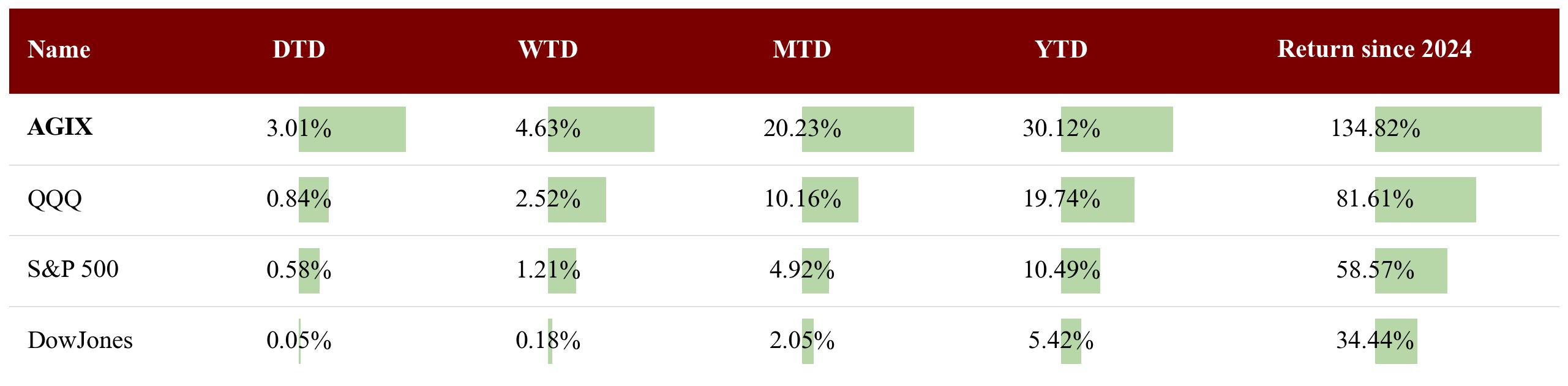
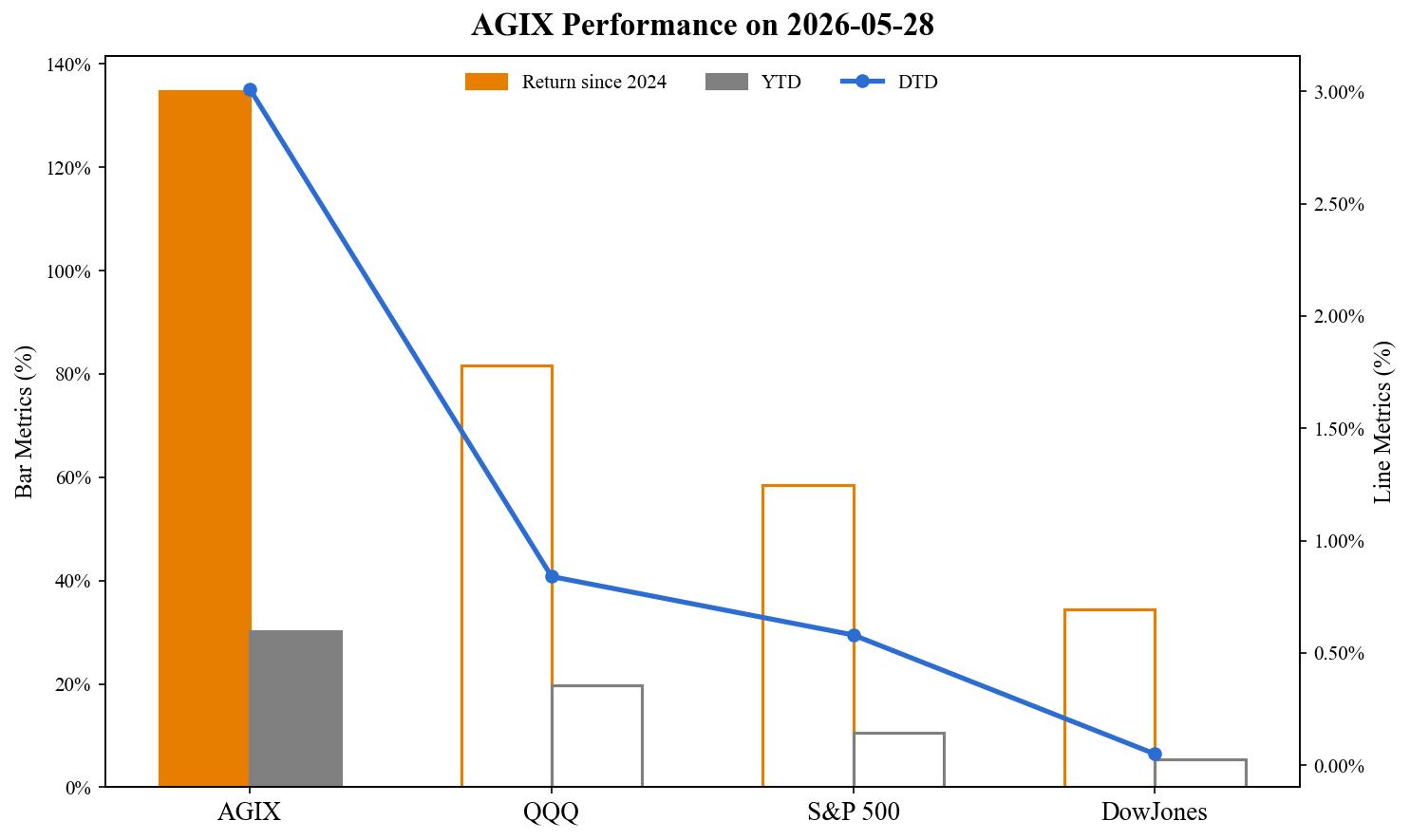
• AGIX outperformed all major benchmarks today with a DTD return of 3.01%, compared to QQQ (0.84%), S&P 500 (0.58%), and Dow Jones (0.05%). Year-to-date, AGIX has gained 30.12%, nearly 10 percentage points ahead of QQQ's 19.74%.
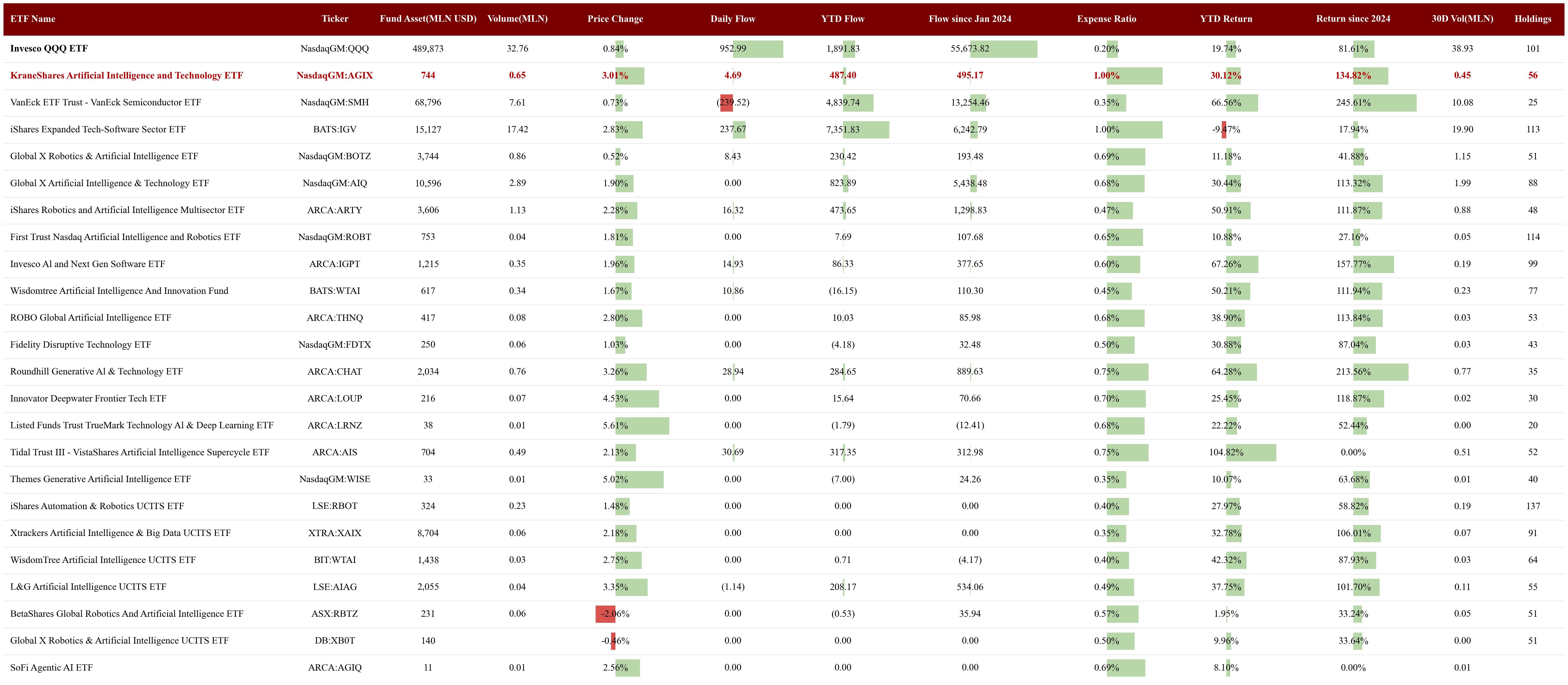
• Among peer AI/tech ETFs, IGPT (+1.96%), CHAT (+3.26%), and LRNZ (+5.61%) led the day, while AGIX's strong DTD was supported by standout moves in its top holdings: Snowflake (+36.48%), Tempus AI (+8.73%), and Palantir (+8.17%).
• Key AGIX holdings driving today's outperformance include Snowflake (2.37% of portfolio), which surged after a strong earnings beat and a $600M AWS cloud deal; Tempus AI (0.95% of portfolio) continued its post-earnings momentum ahead of its investor day; and Palantir (2.13% of portfolio) followed through on its Q1 earnings and guidance raise.
• On the downside, MediaTek (-4.96%), Renesas Electronics (-3.76%), and Ciena (-2.04%) were the main laggards, but their negative contributions were more than offset by the broad strength in AI infrastructure and application names.
News Highlights
1. Snowflake's post-earnings surge (+36.48%) and AWS deal: The company beat Q1 estimates (EPS $0.39 vs. $0.32 expected) and raised full-year product revenue guidance to $5.84B, while announcing a $600M, five-year cloud infrastructure investment with AWS. This is a strong positive for AGIX, as Snowflake is a core infrastructure holding.
2. Robinhood opens platform to AI agents: Robinhood now allows third-party AI agents to execute trades and make payments via its platform, making it the first major U.S. retail broker to do so. This expands the addressable market for AI agent platforms like those held in AGIX (e.g., Salesforce, ServiceNow).
3. Cognition's valuation doubles to $26B: The AI coding tool startup's Devin agent is gaining traction, with revenue growing from $73M to $492M in six months. This reinforces the AI agent theme that benefits AGIX holdings in application and infrastructure sectors.
4. Salesforce beats earnings but stock flat: Q1 EPS of $3.88 beat estimates by $0.76, but slightly lower-than-expected guidance capped gains. The company's Agentforce platform and Slack-Anthropic integration highlight its AI agent push, supporting AGIX's application holdings.
5. Nutanix beats on earnings and revenue: Q3 EPS of $2.47 far exceeded the $0.35 consensus, and revenue grew 10% to $703M. AI and modern application demand drove strong order growth, a positive signal for AGIX's infrastructure holdings.
RSS Highlights
1. Researchers published a method (FROST) to surveil web page visitors by analyzing their SSD activity, a new side-channel attack that increases the browser's attack surface.
2. SQLite released an AGENTS.md file explicitly stating it does not accept AI-generated pull requests or agent code, but will review concise proof-of-concept requests due to a surge in AI-generated bug reports.
3. A protestware incident in the jqwik 1.10.0 release inserted messages urging users to delete all jqwik tests and code, as the maintainer opposed generative AI and described the act as 'public resistance.'
4. The Costco theory of the internet argues that consumers prefer curated, limited choices over infinite options, with implications for how AI-driven platforms should design user experiences.
5. Notes on optimizing battery life highlight that battery capacity is often overstated, as internal resistance and discharge curves reduce usable capacity under high load, a reminder for hardware reliability in AI devices.
Performance & Benchmark
Attribution
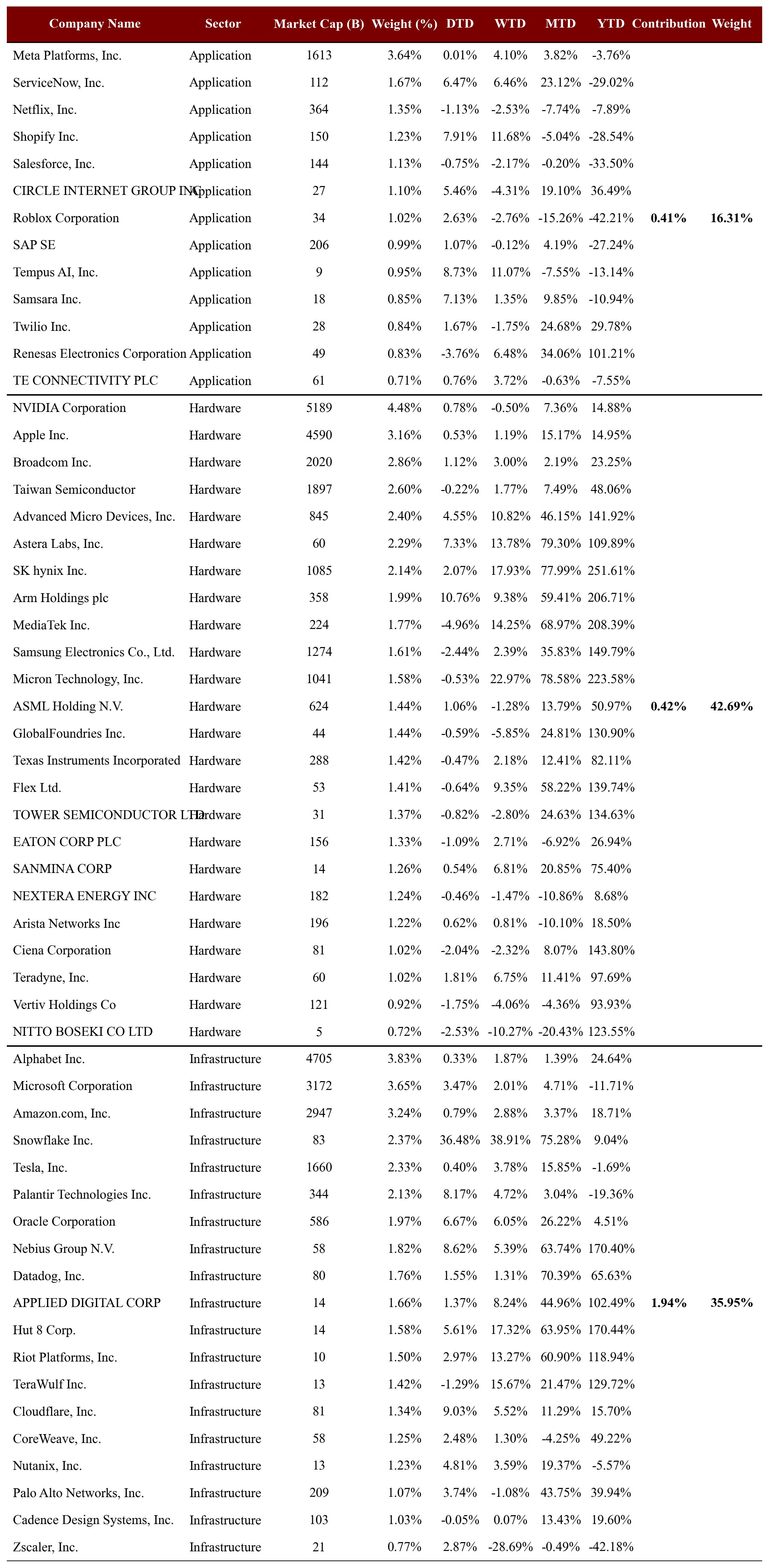
Contribution of the three sectors within AGIX holdings today
Application: 0.41%
Hardware: 0.42%
Infrastructure: 1.94%
Top-performing stocks in AGIX holdings today
Snowflake Inc. (36.48%)
Arm Holdings plc (10.76%)
Cloudflare, Inc. (9.03%)
Tempus AI, Inc. (8.73%)
Nebius Group N.V. (8.62%)
Palantir Technologies Inc. (8.17%)
Shopify Inc. (7.91%)
Astera Labs, Inc. (7.33%)
Samsara Inc. (7.13%)
Oracle Corporation (6.67%)
ServiceNow, Inc. (6.47%)
Hut 8 Corp. (5.61%)
CIRCLE INTERNET GROUP INC (5.46%)
Nutanix, Inc. (4.81%)
Advanced Micro Devices, Inc. (4.55%)
Palo Alto Networks, Inc. (3.74%)
Microsoft Corporation (3.47%)
Riot Platforms, Inc. (2.97%)
Zscaler, Inc. (2.87%)
Roblox Corporation (2.63%)
CoreWeave, Inc. (2.48%)
SK hynix Inc. (2.07%)
Worst-performing stocks in AGIX holdings today
Ciena Corporation (-2.04%)
Samsung Electronics Co., Ltd. (-2.44%)
NITTO BOSEKI CO LTD (-2.53%)
Renesas Electronics Corporation (-3.76%)
MediaTek Inc. (-4.96%)
Top five listed stocks contributing the most within AGIX holdings today
Snowflake Inc. (36.48%)
Arm Holdings plc (10.76%)
Palantir Technologies Inc. (8.17%)
Astera Labs, Inc. (7.33%)
Nebius Group N.V. (8.62%)
Observation
The strongest movers across peer ETF holdings today are listed below:
| DTD | Stock Ticker | Name | Held by ETFs | analysis |
|---|---|---|---|---|
| 36.48 | NYSE:SNOW | Snowflake Inc. | ['NasdaqGM:AGIX', 'NasdaqGM:AIQ', 'ARCA:ARTY', 'ARCA:IGPT', 'BATS:WTAI', 'ARCA:THNQ', 'ARCA:CHAT', 'ARCA:LOUP', 'ARCA:LRNZ', 'NasdaqGM:WISE', 'LSE:RBOT', 'XTRA:XAIX', 'LSE:AIAG'] | Snowflake’s 36.48% jump on 2026-05-28 was driven primarily by a very strong earnings-related catalyst and a new major cloud deal, with Schwab Network reporting the stock “surges 30% after earnings & $6B AWS deal.” Analyst sentiment also turned more bullish the same day, as Monness Crespi & Hardt raised its price target to $320 from $282 and reiterated a buy rating, reinforcing the move. [3][1] |
| 21.69 | NasdaqGS:CRSR | Corsair Gaming, Inc. | ['ARCA:AIS'] | Corsair Gaming’s 21.7% gain appears driven primarily by ongoing enthusiasm around its recently announced CORSAIR PRO AI-focused workstations and localized server systems, which has fueled an “AI server strategy” narrative and extended a multi-day rally in the stock.[1][4] This is reinforced by strong Q1 results reported earlier in May, including an EPS beat ($0.27 vs. $0.18) and 58% adjusted EBITDA growth, which underpin the AI growth story and support the sharp re-rating.[1][5] A break to new 52-week highs around $12 and associated technical momentum likely added incremental buying interest as the move accelerated intraday.[4] |
| 18.26 | NasdaqGS:AVAV | AeroVironment, Inc. | ['NasdaqGM:BOTZ', 'NasdaqGM:ROBT', 'ARCA:IGPT', 'BATS:WTAI', 'ARCA:LOUP', 'ASX:RBTZ', 'DB:XB0T'] | AeroVironment’s 18.3% gain on May 28, 2026 appears primarily driven by renewed optimism around its growth and defense-drone positioning following very strong recent revenue momentum, despite a mixed Q2 2026 earnings profile that showed 150%+ year-over-year revenue growth but pressured profitability.[3] The move also looks like a sharp rebound from prior weakness tied to concerns about program risk and valuation, as investors refocused on the company’s central role in high-demand loitering munitions and counter-drone systems within an elevated geopolitical and defense-spending backdrop.[1][2] |
| 15.9 | TSE:3905 | Datasection Inc. | ['NasdaqGM:WISE'] | Datasection’s 15.9% rise on 2026-05-28 appears most consistent with a momentum-driven move rather than a clearly identifiable company-specific announcement, because the available same-day public results do not show a confirmed major disclosure or news catalyst. The only directly observable support in the provided sources is that the stock was already showing strong near-term price strength around that period, which likely amplified buying interest and short-covering. |
| 13.77 | NasdaqGS:KTOS | Kratos Defense & Security Solutions, Inc. | ['NasdaqGM:ROBT'] | Kratos Defense’s 13.8% gain on May 28, 2026 appears primarily driven by a sharp rebound following the earlier sell-off tied to its February 26, 2026 announcement of a large $1.17B common stock offering at $84 per share, which had pressured the stock when priced and closed in early March.[2] With no new company-specific news or sector-wide defense headlines on May 28, the move is best characterized as a sentiment and technical recovery as investors digested the dilution impact and refocused on the capital raise’s role in funding growth (including Nomad and Orbit acquisitions).[2] |
| 13.37 | NasdaqGS:MLAB | Mesa Laboratories, Inc. | ['LSE:RBOT'] | Mesa Laboratories’ +13% move on May 28 was primarily driven by a positive reaction to its Q4 FY2026 earnings report released after the prior close, with the stock trading up about 13% to roughly $103 as investors reassessed near‑term fundamentals despite mixed profitability metrics.[3][4] A secondary driver was technical momentum, as the post-earnings gap higher pushed MLAB further above its 200-day moving average and toward/beyond the ~$94 consensus target, likely triggering incremental buying from momentum and short-term traders despite an overall “Reduce” rating from covering analysts.[1][3][6] |
| 13.04 | NYSE:BBAI | BigBear.ai Holdings, Inc. | ['NasdaqGM:ROBT', 'NasdaqGM:WISE', 'BIT:WTAI'] | BigBear.ai’s 13.04% move on May 28 was primarily driven by the company’s new Panama shipping/commercial deployment announcement, which gave traders a fresh same-day catalyst tied to a live AI logistics product rollout. The stock also benefited from continued momentum after its recent Q1 update, which showed improved EPS loss, revenue ahead of expectations, and about $75 million in new wins. A secondary factor was broader speculative AI/contractor trading momentum, as the name had already been trending higher into the session.[1][6] |
| 12.27 | NasdaqGS:AXON | Axon Enterprise, Inc. | ['NasdaqGM:QQQ', 'ARCA:LOUP'] | Axon Enterprise’s 12.3% gain on May 28, 2026 appears primarily driven by a sharp rebound from recent technical weakness rather than a specific new fundamental catalyst, with the move far exceeding the ±4.7% one-day range implied by near-dated options pricing.[4] The stock had recently come under pressure, including a noted negative momentum break earlier in the month, so the outsized move likely reflects short covering and momentum reversal as shares bounced off support levels.[1][3] No material same-day company news or regulatory/industry developments were identified that would directly justify the magnitude of the move. |
| 11.63 | NASDAQGM:INOD | Innodata Inc. | ['NasdaqGM:ROBT'] | Innodata’s 11.6% gain on May 28, 2026 appears primarily driven by continued momentum and follow-through buying after its early-May Q1 2026 earnings report, which highlighted “record” first-quarter results and reinforced the company’s AI-growth narrative.[5] The move also fits within an ongoing high-volatility, high-valuation rerating of the name: the stock has been trading at an elevated P/E with large daily ranges in late May, suggesting incremental demand from momentum/AI-focused investors rather than any discrete new company-specific catalyst on the day.[3] |
| 10.76 | NasdaqGS:ARM | Arm Holdings plc | ['NasdaqGM:QQQ', 'NasdaqGM:AGIX', 'ARCA:IGPT', 'ARCA:CHAT', 'ARCA:LRNZ', 'ARCA:AIS'] | Arm Holdings’ 10.8% gain on May 28 was primarily driven by a bullish sell-side catalyst, as Mizuho raised its price target to a Street-high $360, fueling momentum buying and short covering in a tightly supplied, high-expectation name.[3] The move was reinforced by technical factors, with the stock pressing against its 52-week highs and trading well above key moving averages, which attracted additional trend-following and breakout-focused investors.[3] |
| 10.6 | NasdaqGM:MDB | MongoDB, Inc. | ['ARCA:ARTY', 'NasdaqGM:ROBT', 'BATS:WTAI', 'ARCA:THNQ', 'ARCA:LRNZ', 'LSE:AIAG'] | MongoDB’s 10.6% gain on May 28, 2026 was primarily a positioning move ahead of its scheduled Q1 FY27 earnings release after the close that day, with investors rebounding into a stock that had been materially sold off year-to-date. Shares had been down roughly high-teens percent YTD and trading well below their 52-week high, making the name a candidate for pre-earnings short-covering and opportunistic buying as expectations reset following its prior weak guidance-driven selloff.[2][4] |
| 9.93 | NYSE:FIG | Figma, Inc. | ['ARCA:LRNZ'] | Figma’s ~10% gain on May 28 appears primarily driven by continued positive follow-through from its stronger‑than‑expected Q1 2026 results, which showed EPS of $0.10 beating forecasts by roughly two‑thirds and revenue of $333.4M exceeding projections by about 5.5%, with 46% YoY growth, reinforcing the high‑growth, high‑margin narrative for the name.[3] A secondary driver is improving sentiment around FIG’s long‑term upside, reflected in a still‑elevated consensus 12‑month price target implying over 80% upside from recent levels and a “hold” stance that anchors expectations for further execution rather than immediate derating.[2] |
| 9.79 | NasdaqCM:RGTI | Rigetti Computing, Inc. | ['BATS:WTAI'] | Rigetti Computing’s ~9.8% gain on May 28, 2026 appears primarily driven by continued follow‑through buying and sentiment around earlier news that its subsidiary signed a non‑binding letter of intent with the U.S. Department of Commerce for up to $100 million in Chips Act–related funding for quantum R&D, which put the stock back “in the spotlight.”[3] This prospective government backing reinforces the strategic value of Rigetti’s technology and has supported a strong multi‑month uptrend, with the stock up over 80% year‑on‑year, encouraging momentum and retail traders to add exposure on strength.[3][4] |
| 9.57 | TPEX:5425 | Taiwan Semiconductor Co., Ltd. | ['ARCA:AIS'] | Taiwan Semiconductor Co., Ltd. (TPEX:5425) rose 9.6% on May 28, 2026, primarily as part of an ongoing momentum rally in Taiwan mid-cap semiconductors and power discretes, with no company-specific news or disclosures evident that day. Recent analysis had highlighted the stock’s strong 3‑month run (+46% over 90 days and viewed as ~25% overvalued), suggesting follow-through buying and short-covering as investors continued to rotate into high-beta semiconductor names despite stretched valuations.[4] |
| 9.03 | NYSE:NET | Cloudflare, Inc. | ['NasdaqGM:AGIX', 'ARCA:ARTY', 'NasdaqGM:ROBT', 'BATS:WTAI', 'ARCA:THNQ', 'NasdaqGM:FDTX', 'ARCA:CHAT', 'ARCA:LRNZ', 'XTRA:XAIX', 'BIT:WTAI', 'LSE:AIAG'] | Cloudflare’s ~9% gain on May 28, 2026 was primarily driven by a bullish sector-wide rerating of high‑growth cloud security and edge computing names, with NET benefiting as a high‑beta beneficiary of renewed interest in scalable AI‑ready infrastructure.[4] StockStory specifically notes that Cloudflare “jumped 8% in the afternoon session” on May 28, 2026, tying the move to investors rotating back into premium growth software and security platforms rather than to any company‑specific news or disclosure that day.[4] |
| 9.02 | NASDAQGM:RZLV | Rezolve AI PLC | ['NasdaqGM:WISE'] | Rezolve AI PLC’s approximately 9% gain on May 28, 2026 appears driven primarily by continued momentum and speculative interest in AI-related names rather than any identifiable company-specific news or filings released that day. Trading volume of about 9.5–10.0M shares was slightly below the recent average, suggesting the move was driven by incremental buying rather than a large liquidity event.[2][5] In the absence of new fundamental disclosures, technical factors around the $2.70 resistance level highlighted by traders and broader enthusiasm for generative AI and mobile commerce likely amplified the upward move.[2][3] |
| 8.76 | NYSE:RDDT | Reddit, Inc. | ['ARCA:IGPT'] | Reddit’s 8.76% move on 2026-05-28 appears most consistent with a continuation of post-earnings momentum, as the company had reported earnings on Apr. 30 and the stock was still reacting to that release in the following weeks.[5][2] The clearest same-day market signal in the available results is a broad positive price move into the close, with RDDT up 6.73% to $154.38 on May 28, which suggests stronger sentiment rather than a fresh company-specific negative catalyst.[2] I do not see a verified same-day headline in the provided results that would uniquely explain the move, so the best-supported drivers are momentum after earnings and bullish sentiment around Reddit’s growth and analyst upside views.[1][2] |
| 8.73 | NasdaqGS:TEM | Tempus AI, Inc. | ['NasdaqGM:AGIX', 'NasdaqGM:ROBT', 'ARCA:THNQ', 'BIT:WTAI', 'LSE:AIAG'] | Tempus AI’s 8.7% move on May 28 appears mainly driven by continued post-earnings momentum and positioning ahead of its May 29 investor day, rather than a discrete new company-specific headline that day. Investors have been responding to the company’s strong recent fundamentals (FY25 revenue up ~83%, EBITDA turning positive, and FY26 guidance to $1.59B revenue and $65M adjusted EBITDA) and growing AI/precision-medicine enthusiasm, which has kept sentiment and trading activity elevated.[1][4] The stock also traded on above-average volume versus its recent norm, suggesting incremental institutional and retail demand rather than technical factors alone.[2] |
| 8.63 | NasdaqCM:GRRR | Gorilla Technology Group Inc. | ['NasdaqGM:WISE'] | Gorilla Technology’s 8.6% move appears primarily driven by a post‑earnings reaction and follow-through buying after the company reported strong Q1 2026 results and turned positive on operating cash flow on May 27, 2026.[1][3] Investors are likely reassessing the company’s growth and balance sheet trajectory in light of 55% year-on-year revenue growth and $6.6M of positive operating cash flow, which marks an operational milestone for a historically cash-burning small-cap name.[1] With no material negative news or sector-specific headwinds evident on the day, the move looks like earnings-driven re-rating, potentially amplified by the stock’s high volatility and retail/technical trading interest. |
| 8.62 | NasdaqGS:NBIS | Nebius Group N.V. | ['NasdaqGM:AGIX', 'BATS:WTAI', 'ARCA:THNQ', 'ARCA:CHAT', 'BIT:WTAI'] | Nebius Group’s 8.6% move appears driven primarily by ongoing momentum and follow-through buying after a very strong month in which the stock is up over 40% and at or near all-time highs. With no new company-specific news or filings on the day, investors are likely continuing to price in the previously disclosed large AI backlog, profitability inflection, and recent Eigen AI acquisition as highlighted in recent coverage, alongside active short covering and momentum trading in a high-growth AI infrastructure name. |
| 8.61 | NYSE:DNA | Ginkgo Bioworks Holdings, Inc. | ['ARCA:THNQ', 'LSE:AIAG'] | The 8.6% move in Ginkgo Bioworks on May 28, 2026 appears to be driven primarily by follow‑through buying and repositioning after the company’s early‑April divestiture of its Biosecurity business and its recently reported Q1 2026 results, which clarified the go‑forward business mix and cost structure. Public filings and press releases show the Biosecurity divestiture closed April 3, 2026 and Q1 results were framed around scaling the core autonomous lab and cell engineering platform, which likely improved sentiment toward the remaining business and supported multiple expansion and short covering rather than any new, stock‑specific news on the day. |
| 8.52 | NasdaqGS:RXRX | Recursion Pharmaceuticals, Inc. | ['NasdaqGM:ROBT', 'BATS:WTAI', 'BIT:WTAI'] | RXRX’s 8.5% gain appears primarily driven by a technical rebound and short-term trading dynamics rather than any new fundamental catalyst or company-specific news on the day. The stock had recently sold off on weaker Q1 2026 revenue and negative sentiment following an EPS/revenue miss and cautious commentary, leaving shares near the lower end of a volatile range and technically oversold, which set up conditions for a bounce as buyers stepped in and short-covering likely amplified the move. |
| 8.37 | NasdaqGS:HTFL | HeartFlow, Inc. | ['ARCA:LRNZ'] | HeartFlow’s 8.37% move on 2026-05-28 appears to have been driven mainly by continued post-IPO trading momentum and elevated volatility rather than a fresh company-specific announcement that day. The stock had already been trading near recent highs in the prior sessions, with HTFL reaching $30.90 on 2026-05-26 and $30.90 again on 2026-05-27, while market data shows beta of 2.47 and volume near average, consistent with a high-momentum name. A secondary factor may have been ongoing investor attention to the company’s early public-market performance after its August 2025 IPO and later filing/news flow, but I do not see a same-day catalyst in the provided results. |
| 8.17 | NasdaqGS:PLTR | Palantir Technologies Inc. | ['NasdaqGM:QQQ', 'NasdaqGM:AGIX', 'BATS:IGV', 'NasdaqGM:AIQ', 'ARCA:ARTY', 'NasdaqGM:ROBT', 'BATS:WTAI', 'NasdaqGM:FDTX', 'ARCA:CHAT', 'NasdaqGM:WISE', 'XTRA:XAIX', 'BIT:WTAI'] | Palantir’s 8.2% move on May 28, 2026 appears driven primarily by follow‑through buying and sentiment after its very strong Q1 2026 earnings and significant guidance raise earlier in the week, which highlighted 104% Y/Y U.S. revenue growth and an 85% overall revenue increase, alongside raised FY26 revenue growth guidance to 71% and U.S. commercial growth guidance to 120%, well ahead of prior consensus.[3] A secondary driver is bullish sell‑side and media commentary around the sustainability of Palantir’s AI‑driven growth and upside scenario analyses (e.g., targets toward ~$200–225 over the next year), which reinforced momentum in a stock that had recently sold off despite strong fundamentals.[1][2] |
| 8.14 | NasdaqGS:SMCI | Super Micro Computer, Inc. | ['NasdaqGM:AIQ', 'ARCA:ARTY', 'ARCA:IGPT', 'ARCA:THNQ', 'ARCA:CHAT', 'ARCA:AIS'] | Super Micro Computer’s 8.1% gain on May 28, 2026 appears primarily driven by a continued rebound and short-covering dynamic following earlier weakness tied to export-control and governance concerns, with no new company-specific news or filings that day. The move was likely amplified by AI-related sentiment and broader tech strength, as SMCI remains a high-beta AI infrastructure name and a focal stock for traders in the AI/semiconductor complex. |
| 8.09 | NasdaqGS:MGNI | Magnite, Inc. | ['ARCA:IGPT', 'NasdaqGM:FDTX'] | Magnite’s 8.1% gain on May 28, 2026 was primarily driven by follow-through buying after its stronger‑than‑expected Q1 2026 results, which showed a return to profitability, 10% YoY growth in contribution ex‑TAC, and 30% CTV growth, reinforcing the bull case around its CTV ad platform.[1][4] A secondary driver was supportive sell-side commentary and price targets around Magnite’s strategic retail media/Walmart-related positioning and broader digital advertising leverage, which kept sentiment constructive and encouraged momentum buying into the post-earnings move.[5][3] |
| 7.91 | NasdaqGS:SHOP | Shopify Inc. | ['NasdaqGM:QQQ', 'NasdaqGM:AGIX', 'NasdaqGM:AIQ', 'ARCA:THNQ', 'NasdaqGM:FDTX', 'LSE:AIAG'] | Shopify’s ~8% gain on May 28 appears primarily driven by continued follow-through from its better‑than‑expected Q1 2026 earnings, which featured record GMV, revenue and EPS beats, and reinforced confidence in the company’s long‑term growth trajectory.[1] Investors also responded positively to management’s emphasis on AI-driven product enhancements and B2B expansion, as well as the ongoing share repurchase program, which together supported a re‑rating after a prior selloff.[1][2] |
| 7.87 | NasdaqGM:VCYT | Veracyte, Inc. | ['ARCA:THNQ', 'LSE:AIAG'] | Veracyte’s 7.9% gain on May 28, 2026 appears primarily driven by follow-through buying on its very strong Q1 2026 earnings and raised guidance, which highlighted 21% revenue growth, a more than fourfold increase in net income, and materially better-than-expected EPS versus consensus.[4][5][6] The move was reinforced by positive sentiment around accelerating test volumes and profitability inflection, as investors continued to re-rate the stock’s growth and margin profile post-print, with the day’s move occurring on near-normal volume rather than any clear new company-specific news.[3][4][6] |
| 7.85 | NYSE:U | Unity Software Inc. | ['BATS:IGV', 'ARCA:IGPT'] | Unity Software rose on 2026-05-28 mainly on a sharp gap-up/range expansion with volume above normal, which suggests a strong risk-on or momentum-driven move in the absence of a clearly identified company-specific release in the provided results. The stock traded from $27.31 to $30.18 that day, with volume of 14.18M versus a 10.09M average, indicating unusually heavy buying interest. No same-day earnings, guidance, or major news catalyst is shown in the supplied sources, so the move appears most consistent with trading/flow factors rather than a disclosed fundamental event. |
| 7.63 | NasdaqGS:INTA | Intapp, Inc. | ['BATS:IGV'] | Intapp’s +7.6% move appears driven primarily by a rebound from oversold levels and renewed focus on its longer‑term growth and valuation story rather than any specific company news or disclosures on the day. The stock has fallen roughly 60–65% over the past year and is trading near the bottom of its 52-week range, creating technical scope for a bounce as investors re-engage with a still‑supportive analyst backdrop (consensus Buy ratings and price targets well above the current share price). |
| 7.46 | NasdaqGS:SLP | Simulations Plus, Inc. | [] | Simulations Plus’s 7.5% gain on May 28 appears primarily driven by a technical rebound and momentum continuation rather than any new fundamental company-specific news. The stock has been recovering from a sharp sell-off following weak preliminary Q3 results and 2025 guidance cuts earlier in the month, and it recently crossed above its 200-day moving average, attracting technical and momentum buyers.[3][7] Elevated recent short-term outperformance versus the market and trading near the upper end of its statistical resistance range likely amplified the move as traders leaned into the ongoing recovery rally.[4] |
| 7.35 | NasdaqCM:SERV | Serve Robotics Inc. | ['NasdaqGM:BOTZ', 'NasdaqGM:ROBT', 'ASX:RBTZ', 'DB:XB0T'] | Serve Robotics’ 7.35% gain on May 28, 2026 appears primarily driven by momentum and valuation optimism rather than a discrete new catalyst. The stock is benefiting from ongoing bullish sentiment tied to its aggressive 2026 growth outlook (10x revenue guidance, strong autonomy “moat” narrative, and rich valuation multiples vs peers), which has attracted speculative interest and a Moderate Buy consensus with substantial upside to the average target price.[1][3][4] In the absence of fresh company-specific news or regulatory developments that day, the move is best characterized as a continuation of growth/AI-robotics risk-on positioning and technical follow-through in a volatile name. |
| 7.33 | NasdaqGS:ALAB | Astera Labs, Inc. | ['NasdaqGM:AGIX', 'NasdaqGM:ROBT', 'ARCA:IGPT', 'BATS:WTAI', 'ARCA:THNQ', 'ARCA:CHAT', 'ARCA:LOUP', 'ARCA:AIS', 'BIT:WTAI'] | Astera Labs’ 7.3% gain on May 28 was primarily driven by continued positive sentiment and follow-through buying after its strong Q1 2026 earnings report, which showed rapid top-line growth (revenue up 14% sequentially and 93% year over year) and reinforced the AI/accelerator demand narrative. The move was further supported by a broadly favorable analyst backdrop, with 19 analysts maintaining a Buy consensus rating as of May 28, which likely amplified incremental institutional and retail interest in the name. |
| 7.31 | NYSE:QBTS | D-Wave Quantum Inc. | ['BATS:IGV', 'BATS:WTAI'] | D-Wave Quantum’s 7.31% gain on May 28, 2026 appears primarily driven by ongoing momentum and speculative interest in quantum computing names following recent sharp rallies and bullish sentiment toward the sector, rather than any discrete new company-specific news that day.[1][3] First, QBTS has been in a strong technical uptrend with recent high-volume spikes and positive signals such as a MACD turn earlier in May that often attract momentum and algorithmic traders.[1][2] Second, the stock has been benefiting from elevated investor focus on quantum computing, supported by prior news around U.S. government quantum funding and optimistic analyst coverage that frame the name as a high-upside, early-inflection story.[1][2][3] |
| 7.25 | NYSE:IONQ | IonQ, Inc. | ['BATS:WTAI', 'ARCA:THNQ'] | IonQ’s ~7% gain on May 28 was primarily driven by continued enthusiasm around U.S. government quantum-computing funding and speculation that the company could be a future beneficiary, keeping strong recent momentum in the name intact.[1][4] Benzinga highlighted that IonQ was “riding a wave” of interest following a $2.0B+ CHIPS and Science Act grant package to quantum companies, with investors positioning the stock as a key play on Washington’s tech push.[1] A secondary driver is pure technical and momentum buying, as the stock has already risen sharply month-to-date and attracted increased retail and institutional interest, amplifying upside moves.[3][4] |
| 7.18 | NasdaqCM:QUBT | Quantum Computing Inc. | ['NasdaqGM:AIQ'] | Quantum Computing Inc. (QUBT) rose 7.2% on May 28, 2026, primarily on continued speculative momentum and bullish technical sentiment rather than any new fundamental company-specific news. Same-day quantitative/technical services flagged QUBT with strongly bullish signals (25 bullish vs. 1 bearish indicator) and upside price targets, which likely reinforced retail trading interest and upside follow‑through in a highly volatile, momentum-driven name.[2] |
| 7.13 | NYSE:IOT | Samsara Inc. | ['NasdaqGM:AGIX', 'BATS:IGV', 'ARCA:IGPT', 'BATS:WTAI', 'ARCA:THNQ', 'ARCA:LRNZ', 'LSE:AIAG'] | Samsara’s 7.1% gain on May 28 was primarily driven by pre-earnings positioning ahead of its June 4 report, with options-implied moves and commentary highlighting expectations for a potentially large post-earnings swing.[3][6] Additionally, bullish sell-side and blog-style coverage emphasizing the company’s strong prior quarter (28%+ YoY revenue growth and EPS beat) and “Moderate Buy” consensus with upside to target price likely reinforced investor confidence and incremental buying interest into the event.[4][7] |
| 7.02 | SHSE:601138 | Foxconn Industrial Internet Co., Ltd. | ['ARCA:IGPT', 'ARCA:AIS'] | Foxconn Industrial Internet’s 7.0% gain on May 28 appears primarily driven by continued momentum around the AI server and data-center hardware theme, with the stock acting as a high-beta proxy for mainland investors’ enthusiasm toward Hon Hai/Foxconn’s AI-related capex cycle.[1][4][7] No company-specific announcements, earnings releases, or regulatory news were disclosed that day, suggesting the move was mostly sentiment- and theme-driven, aided by strong technicals and prior short-term outperformance in related hardware names.[1][2] |
| 6.95 | NasdaqGS:SDGR | Schrödinger, Inc. | ['ARCA:LRNZ'] | Schrödinger’s 6.95% move on 2026-05-28 was most likely driven by continued positive post-earnings digestion from its May 5 first-quarter report, which showed ACV up 12%, revenue above expectations, and reaffirmed 2026 guidance. The stock also appears to have benefited from broader investor focus on the company’s improving commercial mix and AI-related product narrative, with no clearly identifiable adverse same-day company news in the results provided. |
| 6.88 | NYSE:ESTC | Elastic N.V. | ['BATS:IGV', 'NasdaqGM:ROBT', 'ARCA:IGPT', 'BATS:WTAI', 'ARCA:THNQ', 'ARCA:LRNZ', 'LSE:RBOT', 'LSE:AIAG'] | Elastic’s 6.9% gain on May 28 was primarily driven by a strong fiscal Q4 2026 earnings report that beat expectations and pointed to accelerating growth. Management highlighted meaningful acceleration in customer commitments, with CRPO up 20% and RPO up 28%, framing a “revenue acceleration” setup for FY 2027 and supporting a positive AI-driven growth narrative for the Search AI Platform.[1][5] The move was further amplified by earnings-day positioning and sentiment, as evidenced by elevated volatility and profit-taking that later showed up in sharply lower after-hours trading.[1][3] |
| 6.85 | NYSE:RBRK | Rubrik, Inc. | ['BATS:IGV', 'BATS:WTAI'] | RBRK’s 6.85% gain on May 28, 2026 appears primarily driven by anticipation ahead of the company’s upcoming earnings release, with MarketBeat highlighting that Rubrik is scheduled to report Q1 2027 results the following week, which can prompt pre-earnings positioning and short-term rerating.[6] A secondary driver is technical and sentiment factors: RBRK trades above its 200-day moving average and carries a “Strong Buy” consensus with substantial upside to the average target price, which can amplify moves as investors add to high-conviction growth names into catalysts.[3][7] |
| 6.8 | nan | Thermo Fisher Scientific Inc | [] | Thermo Fisher Scientific’s ~6.8% move on May 28, 2026 appears primarily driven by accumulation interest and improving sentiment rather than a discrete company-specific catalyst. Same-day filings showed institutional investors such as Baker Avenue Asset Management and Geode Capital modestly increasing TMO holdings, reinforcing the existing “Moderate Buy” consensus and ~$616 average target, which frames the stock as undervalued after a YTD drawdown.[3][7] Short-term technicals also turned more constructive, with the stock trading up toward the high end of its intraday range on solid volume, consistent with a positioning-driven rebound rather than reaction to new fundamental news.[4] |
| 6.67 | NYSE:ORCL | Oracle Corporation | ['NasdaqGM:AGIX', 'BATS:IGV', 'NasdaqGM:AIQ', 'ARCA:ARTY', 'BATS:WTAI', 'NasdaqGM:FDTX', 'ARCA:CHAT', 'XTRA:XAIX', 'BIT:WTAI'] | Oracle’s 6.67% jump on May 28 was mainly driven by JPMorgan initiating coverage with an Overweight rating and a $210 price target, which reinforced the bullish AI-infrastructure and cloud-growth narrative around the company.[1] TradingKey also said investor confidence was supported by Oracle’s strong recent fiscal Q3 results and ongoing momentum in cloud and AI execution.[1] A secondary contributor was continued positive sentiment in the name, with market participants treating Oracle as a leading AI infrastructure beneficiary rather than a standard software stock.[1] |
| 6.65 | NYSE:GWRE | Guidewire Software, Inc. | ['BATS:IGV'] | Guidewire Software’s 6.65% gain on May 28, 2026 appears primarily driven by anticipation ahead of its upcoming Q3 FY26 earnings report, which is scheduled for the following week and has been highlighted in recent previews and earnings calendars.[6] This move likely reflects investors positioning for continued strength in cloud adoption and AI-related momentum that has supported the stock’s recent rallies, including a prior >5% move tied to renewed confidence in its AI-driven cloud strategy and supportive analyst commentary such as Oppenheimer’s Outperform rating.[5] |
| 6.57 | NYSE:AI | C3.ai, Inc. | ['BATS:IGV', 'NasdaqGM:BOTZ', 'NasdaqGM:AIQ', 'NasdaqGM:ROBT', 'NasdaqGM:WISE', 'XTRA:XAIX', 'BIT:WTAI', 'ASX:RBTZ', 'DB:XB0T'] | C3.ai’s 6.57% gain on 2026-05-28 was most likely driven by a broad rebound in AI and tech stocks, as Nasdaq-linked names rallied and market commentary highlighted renewed optimism around artificial intelligence leadership. A second factor was the stronger overall market tone, with U.S. equities rising and tech outperformance helping lift AI-related shares broadly. I did not find a company-specific same-day catalyst in the provided results, so the move appears primarily sector- and sentiment-driven.[2][7][1] |
| 6.47 | NYSE:NOW | ServiceNow, Inc. | ['NasdaqGM:AGIX', 'BATS:IGV', 'NasdaqGM:AIQ', 'ARCA:ARTY', 'NasdaqGM:ROBT', 'BATS:WTAI', 'ARCA:THNQ', 'ARCA:CHAT', 'ARCA:LRNZ', 'LSE:RBOT', 'XTRA:XAIX', 'BIT:WTAI', 'LSE:AIAG'] | ServiceNow’s 6.5% gain appears primarily driven by continued enthusiasm around its expanding AI workflow partnerships, including a newly highlighted multi‑year global deal with Experian that embeds Experian’s Ascend data and decisioning into the ServiceNow AI platform for high‑value use cases like onboarding, fraud, and risk management.[1] A secondary driver is reinforcing sell‑side support and momentum, with bullish commentary and an elevated target price from major brokers underscoring the durability of its AI‑led growth narrative following a strong Q1 and increased full‑year subscription outlook.[1][2][3] |
| 6.41 | NasdaqGS:UPST | Upstart Holdings, Inc. | ['NasdaqGM:BOTZ', 'NasdaqGM:ROBT', 'BIT:WTAI', 'ASX:RBTZ', 'DB:XB0T'] | UPST’s 6.4% gain on May 28, 2026 appears primarily driven by a rebound in risk-on sentiment around high-beta AI/fintech names rather than any stock-specific news or new company disclosure that day. There were no fresh earnings releases, guidance updates, or regulatory headlines for Upstart on May 28, and the move was broadly in line with the options market’s implied short-term volatility and expected move for the week, suggesting positioning/short-covering and macro risk appetite as the key drivers. |
| 6.13 | NasdaqGS:TENB | Tenable Holdings, Inc. | ['BATS:IGV', 'XTRA:XAIX'] | Tenable’s +6.1% move on May 28, 2026 appears primarily driven by a strong reaction to its Q1 2026 earnings report and guidance issued the prior evening, with investors continuing to price in better fundamentals. The company reported solid 9.6% YoY revenue growth to $262.1M, expanded non-GAAP operating margin to 23.6%, strong cash generation, and raised full-year 2026 revenue guidance to $1.068–1.078B, while also highlighting Hexa AI traction and share repurchases, all of which likely supported a rerating of the stock.[1] |
| 5.94 | NasdaqGM:SOUN | SoundHound AI, Inc. | ['BATS:IGV', 'NasdaqGM:BOTZ', 'NasdaqGM:AIQ', 'NasdaqGM:ROBT', 'NasdaqGM:WISE', 'XTRA:XAIX', 'BIT:WTAI', 'ASX:RBTZ', 'DB:XB0T'] | SoundHound AI’s ~6% gain on May 28, 2026 appears primarily driven by technical trading dynamics rather than discrete fundamental news. The stock was trading around key support near $7.85 with technicians flagging a potential move toward resistance at $8.86–$9.70 if that level broke, which likely attracted short-term momentum and dip-buying flows.[3] Options markets were also pricing an expected move of roughly ±5.5% into the May 29 expiry, so a ~6% spot move sits within the implied volatility framework and is consistent with positioning-driven trading rather than a specific company or sector catalyst.[4] |
| 5.83 | NasdaqGS:OKTA | Okta, Inc. | ['NasdaqGM:AIQ', 'ARCA:ARTY', 'BATS:WTAI'] | Okta’s 5.83% move on 2026-05-28 was most likely driven by its first-quarter fiscal 2027 earnings release that day, which can materially reprice a stock even when results are already partly anticipated.[4][5] The release was the clear same-day catalyst in the public record, and the size of the move is consistent with an earnings reaction.[4][1] No other equally relevant same-day company-specific news appears in the provided results, so the earnings report is the primary attribution.[4][5] |
| 5.81 | NasdaqGS:SMTC | Semtech Corporation | [] | Semtech’s 5.81% rise on May 28, 2026 was most likely driven by continued momentum in the stock, which was trading near its 52-week high and up sharply on the day intraday, alongside broad bullish sentiment around the name.[1][5][7] The move also appears consistent with analyst-supportive coverage and a favorable broker consensus that was highlighted that same day.[6] Elevated short interest likely amplified the gain by adding squeeze potential, but the strongest driver was the stock’s existing upward trend and same-day buying pressure.[4][5] |
| 5.68 | NasdaqGS:ILMN | Illumina, Inc. | ['NasdaqGM:ROBT', 'ARCA:THNQ', 'BIT:WTAI', 'LSE:AIAG'] | Illumina’s 5.7% gain appears primarily driven by continued follow‑through buying as the stock broke to a new 52‑week high, reinforcing positive technical momentum and drawing in additional momentum-oriented investors.[2][4] MarketBeat and other trackers highlighted the new 12‑month high and noted a generally supportive, though mixed, analyst backdrop with a “Hold” consensus and price targets that ILMN is now trading above, which likely added to sentiment and incremental demand rather than any specific new fundamental catalyst on the day.[2][1] |
| 5.68 | NasdaqGM:RPD | Rapid7, Inc. | ['BATS:IGV', 'ARCA:THNQ', 'XTRA:XAIX', 'LSE:AIAG'] | Rapid7’s 5.68% gain on May 28 appears to have been driven mainly by momentum and sector sentiment rather than a company-specific announcement. The clearest same-day context is that the stock was already rising ahead of its first-quarter earnings report, while cybersecurity names had been broadly firm, which supported buying interest. Rapid7 also has a history of sharp moves, so a moderate catalyst could produce an outsized daily gain.[1][2] |
| 5.65 | NasdaqGS:APP | AppLovin Corporation | ['NasdaqGM:QQQ', 'BATS:IGV', 'NasdaqGM:AIQ', 'ARCA:LOUP'] | AppLovin’s +5.7% move was primarily driven by continued positive follow-through from its better‑than‑expected Q1 2026 results and strong Q2 guidance, which have reset earnings expectations higher and reinforced the growth narrative around its advertising platform.[1][6] A second key driver was optimism around the upcoming June 2026 public launch of the Axon self‑serve ad platform, viewed as a meaningful incremental growth catalyst.[1] A supportive backdrop of fresh analyst price target increases, including a Goldman Sachs target hike on accelerating ad growth, further bolstered sentiment and likely amplified the upside move.[1][5][6] |
| 5.61 | NasdaqGS:HUT | Hut 8 Corp. | ['NasdaqGM:AGIX', 'BATS:IGV', 'NasdaqGM:AIQ'] | Hut 8’s 5.6% gain on May 28, 2026 appears primarily driven by continued positive follow-through from its recently announced AI data center strategy and Q1 2026 results, which have significantly reframed the stock from a pure Bitcoin miner to a hybrid AI infrastructure/Data Center play.[5] The company’s commercialization of the first phase of its 1 GW Beacon Point AI data center campus, including a 15‑year, 352 MW IT lease, has led to upward estimate revisions and at least one notable price-target increase from Piper Sandler earlier in the week, supporting ongoing multiple expansion.[3][5] A secondary driver is positioning/short-covering and options-related flows, with implied volatility and expected moves elevated in May, which can amplify upside on incremental positive sentiment in the absence of new company-specific headlines that day.[4] |
| 5.46 | NYSE:CRCL | Circle Internet Group, Inc. | ['NasdaqGM:AGIX'] | Circle Internet Group’s 5.46% gain on May 28, 2026 appears primarily driven by follow-through buying and momentum after a strong post-earnings uptrend rather than any new, stock-specific news that day. The stock has been in a bullish technical configuration, with a 10-day moving average crossing above the 50-day on May 7 and a positive multi-week trend following its Q1 2026 results and prior regulatory/strategic wins in Europe, which likely supported continued accumulation and short-term trading interest. |
| 5.41 | NasdaqGM:DOMO | Domo, Inc. | ['LSE:RBOT'] | Domo’s +5.4% move on May 28 appears primarily driven by a broader rebound in software and SaaS names rather than company-specific news. Sector commentary highlighted a recovery in software stocks as the market reassessed earlier fears that AI agents could threaten traditional enterprise software business models, with Domo participating as part of this SaaS basket move.[2] A secondary support likely comes from ongoing sentiment around its beaten-down valuation and volatile trading profile, which makes the stock more sensitive to incremental shifts in risk appetite.[2][1] |
| 5.36 | BIT:LDO | Leonardo S.p.a. | ['BATS:WTAI'] | Leonardo’s 5.36% move on 28 May 2026 appears primarily driven by technical and flow factors rather than stock-specific news, as there were no new company press releases or major defense-sector headlines that day and the move occurred on elevated trading volume versus recent norms.[4][5] First, the stock broke higher following a recent consolidation, with intraday trading showing strong buying interest and above-average turnover of about €180m, consistent with momentum and trend-following flows.[2][5] Second, Leonardo has been a 2026 outperformer within European defense, and the broader “defense/security” theme and ongoing rotation into the sector likely amplified the upside in the absence of fresh idiosyncratic catalysts.[1][3] |
| 5.33 | NasdaqGS:NTRA | Natera, Inc. | ['ARCA:LRNZ'] | Natera’s 5.33% gain on 2026-05-28 was most likely driven by continued momentum in the shares after they hit an all-time high that day, with investor sentiment supported by strong recent operating performance and growth expectations. The company’s investor relations page showed the stock trading up $4.15 intraday to $208.58, while recent coverage highlighted robust revenue growth and positive momentum in key products and segments. No major same-day company-specific negative event appears in the provided results, so the move looks primarily momentum- and fundamentals-driven rather than news-triggered. |
| 5.32 | NasdaqGS:GTLB | GitLab Inc. | ['BATS:IGV', 'BATS:WTAI', 'ARCA:LOUP'] | GitLab’s 5.3% gain appears to be a technically driven rebound in a low-liquidity session rather than a reaction to specific company news. The move occurred on volume well below the stock’s typical average, suggesting incremental buying interest and short-covering in a recently weakened name rather than fundamentally driven re-rating. Broader tech/software sentiment was constructive on the day, providing a supportive backdrop but no clear GTLB-specific catalyst was evident in major news or regulatory feeds. |
| 5.19 | NasdaqGS:VRNS | Varonis Systems, Inc. | ['BATS:IGV', 'BATS:WTAI', 'ARCA:THNQ', 'LSE:AIAG'] | Varonis Systems’ 5.2% gain on May 28, 2026 appears primarily driven by sentiment and positioning rather than any new fundamental catalyst, with no company-specific news or sector-wide cybersecurity headlines reported that day. The move likely reflects investors buying a higher‑beta security software name with a favorable “Moderate/Buy” analyst backdrop and meaningful upside to the ~$41–42 consensus target from the low‑$30s trading level, amplifying price action in a relatively thin-news environment. |
| 5.1 | NASDAQCM:DUOT | Duos Technologies Group, Inc. | ['NasdaqGM:WISE'] | Duos Technologies’ 5.1% gain on May 28, 2026, appears primarily driven by investor engagement and visibility from management’s participation at the 23rd Annual Craig-Hallum Institutional Investor Conference that day, which likely supported incremental institutional interest and positive sentiment toward the name.[2] This conference catalyst came against a backdrop of heightened recent attention to the stock and its AI/rail technology positioning, so even modest incremental demand translated into an outsized move in this thinly traded micro-cap.[4][5] |
News
Funding & M&A
Vibe coding startup Cognition more than doubles its valuation in a new round exceeding $1 billion.
AI programming tool provider Cognition Inc. recently announced the completion of a Series D funding round of over $1 billion, with a post-investment valuation of $26 billion, an increase of $16 billion from before. The round was led by Lux Capital, General Catalyst, and 8VC, with participation from several other institutions. The company's mobile revenue grew from $73 million in June last year to $492 million, and enterprise user usage increased tenfold. Its core product, Devin, is a cloud-based AI agent that can automate most programming tasks. It once helped Meigambi complete an 8-month code modernization project in just 8 days. Devin is powered by the SWE 1.6 model, integrates with tools like Datadog, and supports a local agent called Cascade. Previously, Cognition acquired the Windsurf editor in a reverse acquisition valued at $1 to $240 million, and now has over 1 million users. The new funds will be used to expand product adoption and increase headcount.
Nutanix’s stock inches up on solid earnings and revenue beat and growing customer acquisitions
Hyperconverged cloud infrastructure company Nutanix Inc. (NTNX) reported its fiscal third-quarter earnings, with adjusted earnings per share of 247 cents, far exceeding Wall Street's expectation of 35 cents; revenue reached $703 million, up 10% year-over-year, also above the expected $686.4 million. Net income was $63.4 million, down year-over-year. CEO Rajiv Ramaswami noted that AI, modern applications, and external storage innovation and partnerships drove strong order growth, with annual recurring revenue of $243.5 million, up 15% year-over-year, and total contract value increasing by over 320%. Full-year revenue guidance is $282-$284 million, exceeding expectations. However, due to rising hardware costs and slower sales in the Middle East, fourth-quarter guidance was slightly below expectations. The company's stock rose over 5% after hours but is down over 9% year-to-date.
Technical Breakthroughs
Why Google’s AI can’t spell Google (or anything else)
Recently, Google's AI Overview displayed several basic spelling errors in search results, such as writing 'journalism' as 'j-o-u-r-n-a-d-i-s-m' and 'Trump' as 't-r-p-u-m'. This phenomenon reveals the inherent limitations of large language models in character-level understanding. Researchers point out that Transformer-based models break text into tokens rather than recognizing individual letters like humans do, making it difficult to accurately count letters. Google has acknowledged the issue and stated it is working on a fix, but researchers believe this flaw is hard to completely eliminate. This incident reminds the industry that manual review is necessary when relying on AI-generated content to avoid information errors caused by technical limitations.
Product Launches
Robinhood opens its platform to AI agents for trading and credit card spending.
Robinhood Markets has officially connected its trading platform to AI agents, launching agent-based trading products and a virtual agent credit card. This feature allows third-party AI agents to connect to Robinhood's securities and banking services via the Model Context Protocol server, enabling them to execute stock trades and consumer payments on behalf of users. Agent trading accounts are segregated from users' primary assets, and users can monitor transactions in real time and revoke authorization at any time. The agent credit card is tied to the Robinhood Gold Card, supports preset limits and manual approval, and maintains 3% cash back. The product is primarily aimed at tech-savvy users and can be used for automated investment strategies, scheduled shopping, and other scenarios. CEO Vlad Tenev stated that this move extends the company's mission of democratizing capital to the realm of AI agents. This launch makes Robinhood the first major U.S. retail broker to support agents directly executing securities trades.
融资收购
Everpure beats expectations on revenue and earnings, but a drop in free cash flow sends shares lower.
Data storage company Everpure Inc. (formerly Pure Storage Inc., NYSE: P) reported fiscal 2027 first-quarter earnings that beat expectations and raised its full-year guidance, but its stock still fell over 7%. Adjusted earnings per share for the quarter were $0.47, with revenue reaching $1.05 billion, up 35% year-over-year; product revenue grew 55% to $577 million. Subscription services revenue increased 17% year-over-year, with annual recurring revenue reaching $2 billion. The company achieved a net profit margin of 30% and adjusted operating profit of $159 million, and integrated 1touch.io into its enterprise data cloud platform. Free cash flow fell year-over-year to $112 million, which was the main reason for the stock decline. The company introduced AI-related technologies such as Everpure Data Stream and Purity DeepReduce, and raised its full-year revenue guidance to $4.41-$4.51 billion.
Snowflake's stock surges in after-hours trading following a solid earnings beat and a multibillion-dollar AWS cloud deal.
Snowflake, the data platform giant, saw its stock jump in after-hours trading today after announcing it will invest $6 billion in cloud infrastructure provided by Amazon Web Services over the next five years. The agreement includes the use of AWS custom AI accelerators and Graviton chips, strengthening collaboration on intelligent agent workloads. Meanwhile, Snowflake reported first-quarter adjusted earnings per share of $0.39, beating market expectations by $0.07; revenue rose 133% year-over-year to $1.39 billion, also exceeding expectations. The company also raised its full-year product revenue guidance to $5.84 billion. Additionally, Snowflake announced the acquisition of AI agent startup Natoma to enhance agent identity and governance capabilities. These announcements drove the stock up over 36%, though it still underperformed the S&P 500 index. Analysts believe the AI trend is providing strong momentum for Snowflake's core business.
Salesforce crushes Wall Street’s targets in its latest results but can’t boost its struggling stock
U.S. software giant Salesforce released better-than-expected earnings today, with first-quarter adjusted earnings per share of $3.88, far exceeding Wall Street's expectation of $3.12; revenue reached $11.13 billion, up 13% year-over-year, with net income of $457 million. However, because its guidance for the current quarter and full-year revenue was slightly below expectations, the stock was flat after hours. The company noted that the guidance considers negative impacts from the U.S. commercial, commerce, and Tableau businesses, as well as revenue volatility from the recent $960 million acquisition of Informatica. President Marc Benioff emphasized that AI will strengthen rather than threaten Salesforce's future, citing the integration of Slack with Anthropic's Claude model as evidence. The company has repurchased $27.1 billion in stock and launched the Agentforce autonomous agent platform, with an annualized revenue run rate of $1.2 billion. Meanwhile, the company is also collaborating with Google to advance cross-platform intelligent agents.
Marvell, Synopsys close lower despite forecast-topping earnings buoyed by AI
U.S. semiconductor specialist Marvell and Synopsys both released better-than-expected earnings on the same day and raised their full-year guidance. Both companies attributed growth to strong demand for optical networking equipment and EDA software driven by AI data center construction. Marvell reported first-quarter revenue of $2.41 billion, up 28% year-over-year, with optical networking as the main driver, and raised full-year revenue to $11.5 billion. Synopsys reported revenue of $2.27 billion, up 42% year-over-year, and raised full-year earnings per share to $14.76. The stocks fell 4.6% and 1.6% respectively on the day. Analysts believe that AI cluster construction is driving the overall recovery of the chip industry.
财务并购
HP beats expectations on Q2 earnings and revenue as commercial PC demand rebounds.
HP Inc.'s fiscal 2026 second-quarter earnings report showed that both revenue and adjusted earnings per share exceeded expectations. Quarterly revenue was $14.4 billion, up 9% year-over-year; adjusted earnings per share were $0.86, well above analyst estimates. The Personal Systems segment drove growth, with commercial PC sales up 14% year-over-year, contributing to a 13% increase in segment operating profit to $10.2 billion. The printing business was flat, with revenue of $420 million. Interim CEO Bruce Broussard emphasized that AI hardware and smart devices are future growth drivers, and the company introduced several AI PCs, Z workstations, and smart printing solutions. Due to restructuring costs, unadjusted earnings per share were $0.49. The company narrowed its full-year adjusted earnings per share guidance to $2.90-$3.10 and returned $374 million to shareholders.
RSS Subscription
How Many Tokens Did You Burn Today
In the software development industry, using lines of code as a productivity metric is widely questioned because this metric does not truly reflect a developer's efficiency. Recently, a company tried a tool that tracks developer productivity. Although the initial quote was $500,000, it was eventually sold for $50,000. However, this evaluation method based on lines of code may lead developers to deliberately increase code volume to boost numbers, rather than genuinely improving work quality. Excellent engineers often solve problems by simplifying and removing code, not by merely pursuing code quantity.
Notes on optimizing battery life:
The key to optimizing battery life lies in understanding how batteries work and their characteristics. Taking the CR2023 lithium battery as an example, battery capacity is usually expressed in milliampere-hours (mAh). For instance, a 100 mAh battery can support a current of 1 mA for 100 hours. The internal resistance and discharge curve of the battery affect its actual usable capacity, especially under high load conditions, where internal resistance increases significantly, causing voltage drops and preventing full utilization of the rated capacity. Additionally, battery performance degrades over time and with temperature changes, so long-term promises about battery life should be treated with caution.
Breaking: bad news for three of the biggest IPOs in history
The latest news shows that three historic IPOs are facing unfavorable conditions, as clients realize that a large number of tokens have been 'burning millions of dollars without significant return on investment.' As companies gradually reduce their overuse of AI, short-term revenue for Anthropic and OpenAI is expected to be affected, and they may face greater profitability challenges in the future.
Stealth Startup Spy #343
Recently, several prominent tech talents have entered a stealth startup phase, including former scientists from DeepMind and Amazon, a former head of camera design at Apple, and a Harvard Ph.D. They are developing AI-driven solutions in the manufacturing and bioeconomy sectors respectively. Currently, our 'Company Launch Tracker' has identified multiple new startups and is updating related developments in real time.
Knowing about things is cheaper than knowing things
This week's brief summary: The author explores the necessity of learning mathematics for programmers, arguing that basic math (such as arithmetic) is useful for all programmers, but other areas of mathematics have limited practicality for most programmers. Nevertheless, every programmer can find a branch of mathematics relevant to their work, and broad exposure to various mathematical fields is more effective than deep study of a single area. The author recommends learning widely through non-honors undergraduate textbooks, so that one can later choose a topic for in-depth study.
Sharing the result of a single Windows Runtime IAsyncOperation among multiple coroutines, part 2
We attempted to write a coroutine function that caches the result of another coroutine. After improvements, we found it could be implemented more simply. We use an auto-reset event to serialize access to the function, and set the event when the function ends, so the next caller can try to retrieve the result. If there is no cached result, the work function is called to obtain a new value, and on success it is saved to the cache. Next time, we will implement a version that only tries once.
Every Enemy Wears Your Face
We often project our anger onto others; in reality, many enemies may be mirrors of ourselves. Everyone can play the role of a villain in someone else's story, and our dissatisfaction with others often stems from our own fears and flaws. True relationships are the canvas on which we heal our wounds; the key is to learn to strip away these projections and face our true selves.
Where Are the Economies of Scale in Homebuilding?
In the U.S. residential construction industry, although more than 1.3 million new homes are started each year, economies of scale are relatively limited. According to a Harvard study, over 65,000 small construction companies participate in the market, and the top four companies account for only 18% of market share, indicating low industry concentration. Additionally, the construction costs and gross margins of larger builders are similar to those of smaller companies, suggesting that the residential construction industry lacks significant economies of scale.
Pluralistic: Hold on for dear life (28 May 2026)
At the intersection of technology and politics, modern cryptography provides individuals with strong privacy protection, but its effectiveness is questioned when facing state violence. Although encryption can resist many forms of state oppression, under authoritarian rule, encryption alone cannot achieve the rule of law. In contrast, some cryptocurrency advocates attempt to replace state institutions with mathematics, but this leads to complexity and unreliability, ultimately making users dependent on unregulated technology platforms and increasing the risk of fraud.
Tuning in FM Radio on a 3D Printer Heatbed
In St. Louis, Repkord's Pooch raised a question: Can the heated bed of a 3D printer be used as an antenna? After testing, it was found that the heated bed showed signals at multiple frequencies on the NanoVNA, and although its design is not optimized for RF use, it could still receive clear stereo signals within a mile of a high-power FM transmitter tower (such as KYKY-FM, with power over 30kW).
Turning K-L divergence into a metric
The Kullback-Leibler divergence (K-L divergence) measures the difference between two random variables X and Y, and is zero only when they have the same distribution, but it is not a metric. The Jeffreys divergence addresses the asymmetry of the K-L divergence, although it still does not satisfy the triangle inequality. The Jensen-Shannon distance transforms the K-L divergence into a metric by defining a random variable M as the average of X and Y, and its square root satisfies the triangle inequality.
The Costco theory of the internet
Costco's internet theory emphasizes that consumers no longer want infinite choices, but instead prefer to make fewer decisions among curated products. Unlike the traditional internet model, Costco reduces the burden of choice for consumers by limiting product variety and offering reliable quality, thereby enhancing the shopping experience. The challenge facing the modern internet is how to build trust, not just provide more options.
Footage from the LA-Houston MLS match that Apple shot using iPhone 17 Pro cameras
On May 24, 2026, the MLS event featured several exciting moments, including tactical performances from Cincinnati and standout plays from young players. Meanwhile, other matches such as the Copa Sudamericana and USL league were also underway.
Protestware for coding agents
jqwik 1.10.0 was released on May 25, adding output from seven test executors, including a message guiding users to delete all jqwik tests and code. This release drew attention from users because, after a Dependabot update, it was found to contain inappropriate information. The maintainer opposed generative AI and described the act as 'public resistance.' Ultimately, the original reporter removed jqwik from their project.
Researchers publish method to surveil web page visitors by analyzing their SSD activity
In recent years, websites have used various techniques to secretly track visitors' browsing history and device information. The latest FROST technology monitors visitors' other browsing activities and applications by measuring subtle interactions of solid-state drives. This technology uses a competitive side channel to infer, without any additional interaction, which websites and applications a visitor has opened in other tabs or browsers when they visit an attack website. The implementation of FROST relies on JavaScript interacting with a specific website's private file system, increasing the browser's attack surface.
Package managers that package package managers
Mike Fiedler created a complex package manager relationship table showing how package managers for different languages install each other's runtimes. The table covers 42 clients, with data sourced from language registries and distributions, revealing dense rows of system package managers and their respective package managers. Ultimately, the longest installation chain goes from an Arch system to the Elm compiler, spanning 11 steps, demonstrating the complex interactions between package managers.
Notes on Fourier series
Trigonometric Fourier series is a mathematical theory used to decompose a periodic function into an infinite sum of sine waves. For a well-behaved periodic function, the coefficients of its Fourier series can be computed via integration, and under certain conditions, the Fourier series converges exactly to the function at every point of continuity. For non-periodic functions, periodic extension can be used to approximate them with Fourier series.
Using typing in Python leads to different sorts of code
Due to attacks from high-traffic crawlers, you may encounter a blocking page when visiting my blog (Wandering Thoughts) or its related CSpace. This is often because your browser version is too old, especially Chrome. Please ensure you are using the latest version of your browser, and contact me for further assistance. If you are using Vivaldi, adjust the "User Agent Brand Mask" setting so that it correctly identifies itself as Vivaldi, not Google Chrome.
sqlite AGENTS.md
On May 27, 2026, SQLite released the AGENTS.md file, explicitly stating that it does not accept pull requests without prior agreement, but will review concise proof-of-concept requests. The project does not accept agent code, but welcomes agent bug reports that include reproducible test cases. Due to a surge in AI-generated bug reports, a new bug report section has been established on the SQLite forum, and D. Richard Hipp is actively addressing related issues.