AGIX Daily Report 2026-05-29
AI Summary
Market Overview
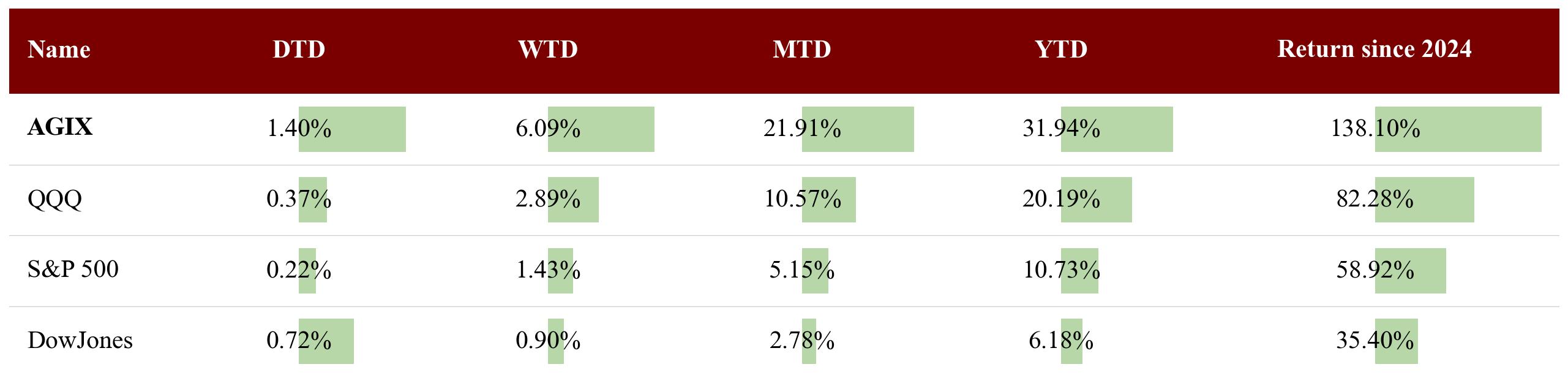
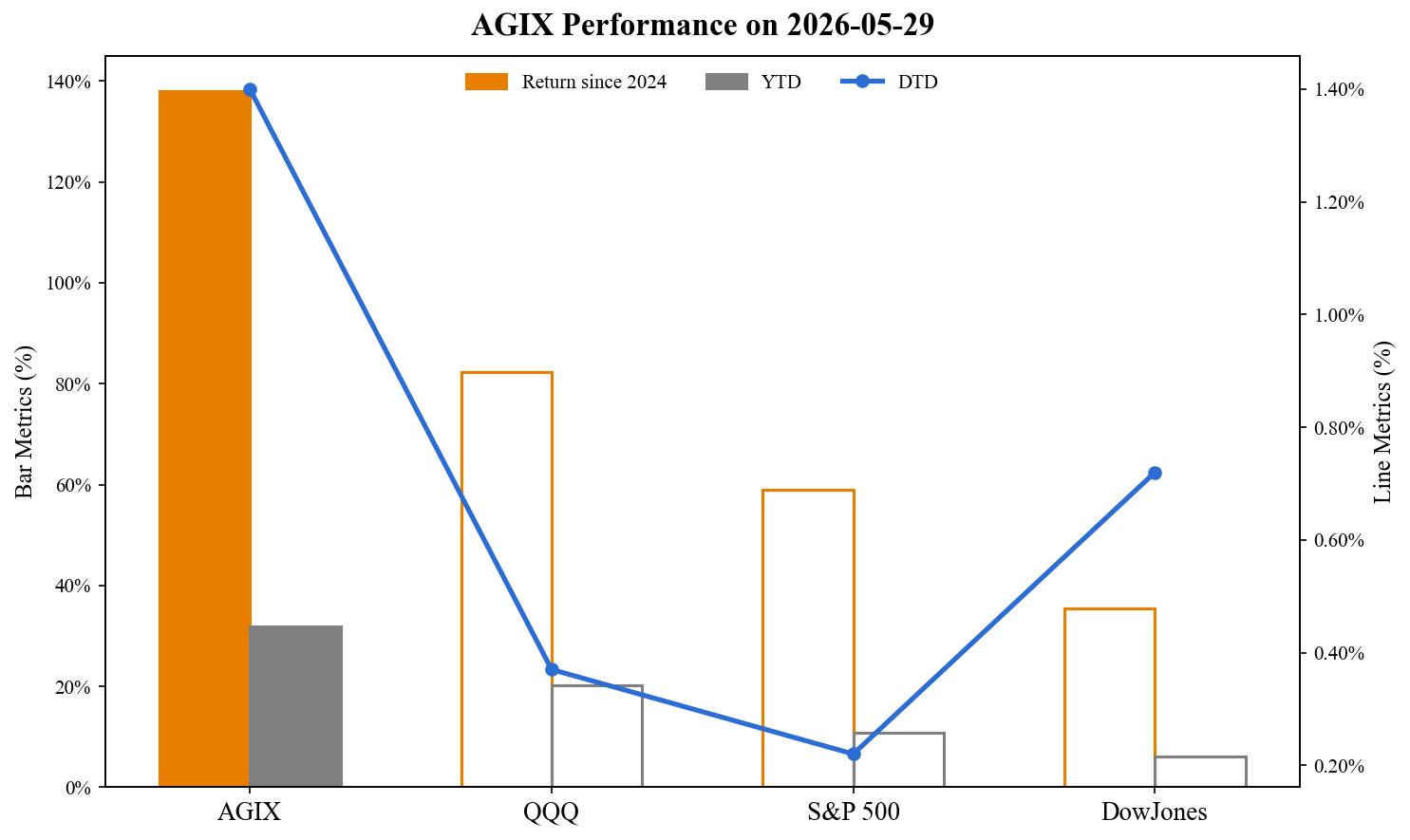
• AGIX surged 1.40% DTD, significantly outperforming the QQQ (+0.37%), S&P 500 (+0.22%), and Dow Jones (+0.72%), driven by a powerful rotation into AI-exposed enterprise software and hardware names.
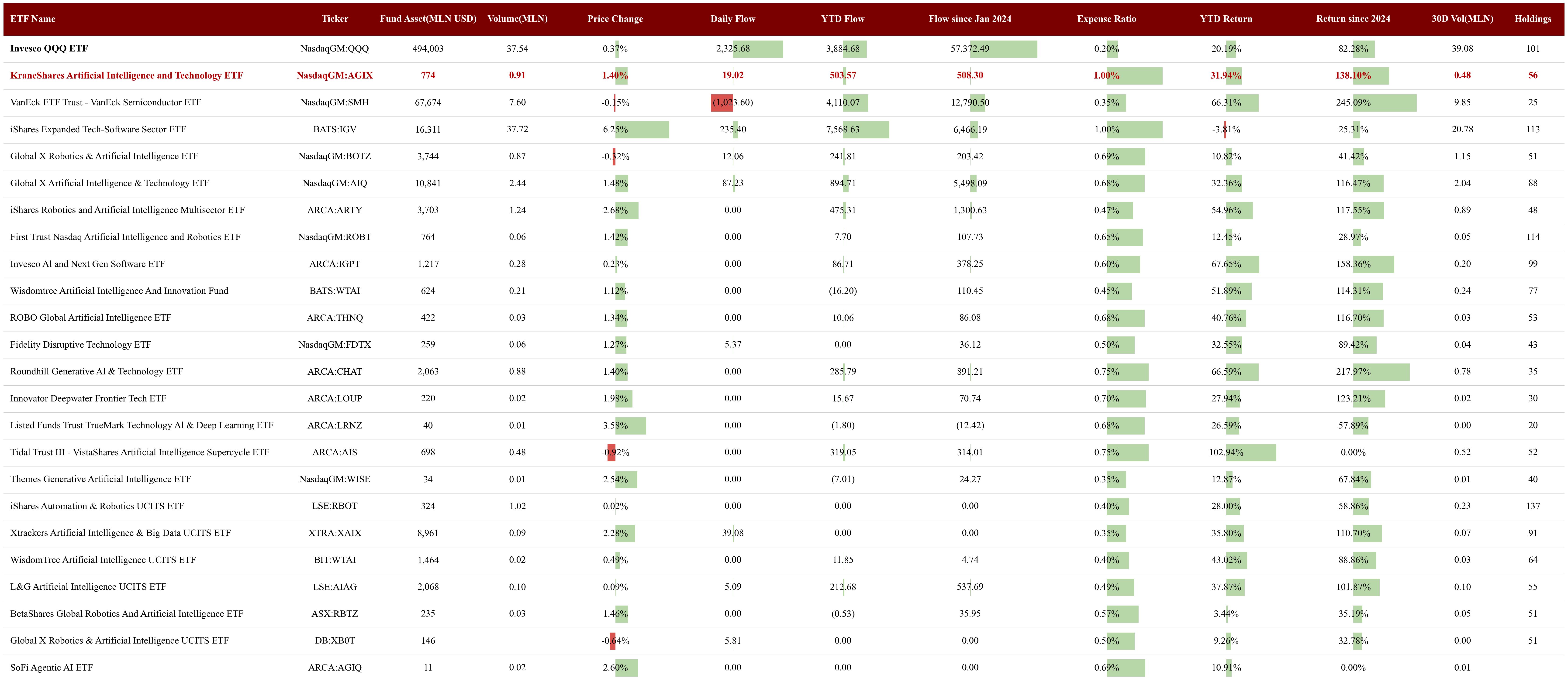
• Peer ETF performance was exceptionally strong: IGV (+6.25%), CHAT (+1.40%), LRNZ (+3.58%), and ARTY (+2.68%) all posted gains, reflecting broad-based enthusiasm for AI and cloud software. AGIX's DTD return of 1.40% was in line with the AIQ (+1.48%) and WTAI (+1.12%) ETFs.
• Top AGIX holdings contributing positively to DTD performance include ServiceNow (NOW, +14.38%), Oracle (ORCL, +10.84%), Salesforce (CRM, +8.47%), Samsara (IOT, +10.83%), and Datadog (DDOG, +9.82%). These moves were catalyzed by strong earnings, AI demand signals, and a sector-wide re-rating of software as an AI beneficiary.
• Key stocks to watch: ServiceNow, Oracle, and Salesforce are leading the software rebound on AI agent and cloud growth narratives; Dell (DELL) and NetApp (NTAP) surged on AI infrastructure demand; and Snowflake (SNOW) is benefiting from its AWS partnership and strong AI-driven results.
News Highlights
1. MongoDB's stellar earnings and revenue beat, driven by strong Atlas multi-cloud and AI-related demand, signals a recovery in the software industry and reinforces positive sentiment for AGIX holdings like ServiceNow and Salesforce.
2. Dell's AI server revenue surged 757% year-over-year, raising AI server guidance to $60 billion, providing a powerful read-across for AGIX hardware holdings including NVIDIA, Broadcom, and Micron.
3. Anthropic's $65 billion funding round and launch of Claude Opus 4.8 underscore the rapid scaling of AI model capabilities and infrastructure demand, benefiting AGIX infrastructure holdings like Microsoft and Oracle.
4. ServiceNow's 14.38% gain was driven by sector-wide AI re-rating after Snowflake's results, plus company-specific AI workflow partnerships, making it a core agentic AI beneficiary.
5. Oracle's 10.84% surge was fueled by a major U.S. government cloud AI contract and upbeat AI demand guidance, reinforcing its position as an AI infrastructure provider.
RSS Highlights
1. Anthropic's run-rate revenue hits $47 billion, with a $65 billion Series H funding round, indicating explosive growth in AI model consumption and enterprise adoption.
2. Claude Opus 4.8 released with 'modest but tangible' improvements in honesty and error reduction, maintaining pricing, which may pressure competitors and drive further AI tool adoption.
3. A detailed overview of Anthropic's sandbox technology for containing Claude across products highlights the increasing focus on AI safety and governance in enterprise deployments.
4. Google's Gemini project faces challenges as developers show little interest despite strong research; Anthropic and OpenAI lead in frontier model intelligence, impacting the competitive landscape for AGIX infrastructure holdings.
5. The Pope's view on AI, that true understanding comes from experience not text, contrasts with Geoffrey Hinton's perspective, sparking debate on the nature of AI intelligence and its implications.
Performance & Benchmark
Attribution
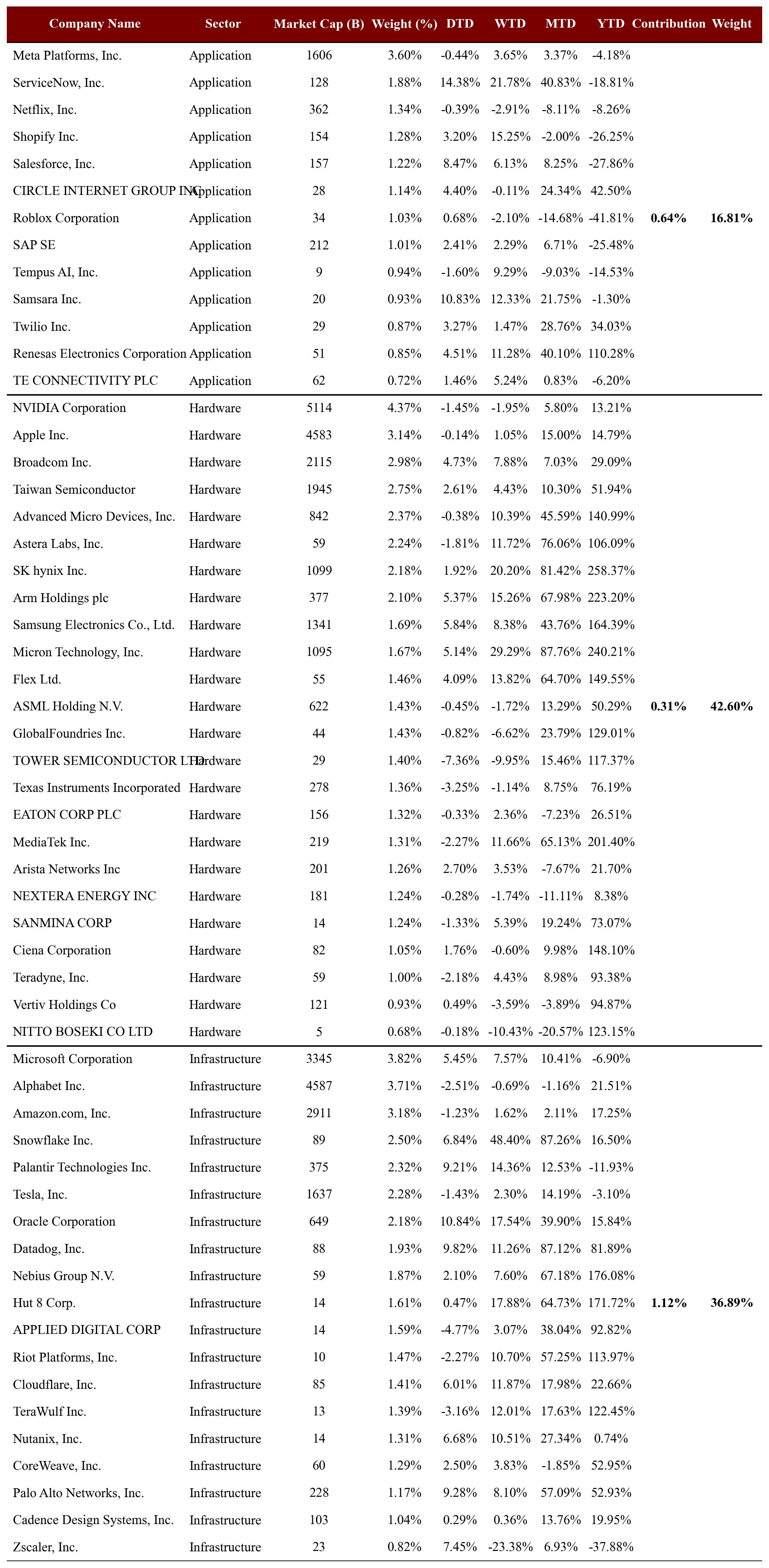
Contribution of the three sectors within AGIX holdings today
Application: 0.64%
Hardware: 0.31%
Infrastructure: 1.12%
Top-performing stocks in AGIX holdings today
ServiceNow, Inc. (14.38%)
Oracle Corporation (10.84%)
Samsara Inc. (10.83%)
Datadog, Inc. (9.82%)
Palo Alto Networks, Inc. (9.28%)
Palantir Technologies Inc. (9.21%)
Salesforce, Inc. (8.47%)
Zscaler, Inc. (7.45%)
Snowflake Inc. (6.84%)
Nutanix, Inc. (6.68%)
Cloudflare, Inc. (6.01%)
Samsung Electronics Co., Ltd. (5.84%)
Microsoft Corporation (5.45%)
Arm Holdings plc (5.37%)
Micron Technology, Inc. (5.14%)
Broadcom Inc. (4.73%)
Renesas Electronics Corporation (4.51%)
CIRCLE INTERNET GROUP INC (4.4%)
Flex Ltd. (4.09%)
Twilio Inc. (3.27%)
Shopify Inc. (3.2%)
Arista Networks Inc (2.7%)
Taiwan Semiconductor Manufacturing Company Limited (2.61%)
CoreWeave, Inc. (2.5%)
SAP SE (2.41%)
Nebius Group N.V. (2.1%)
Worst-performing stocks in AGIX holdings today
Teradyne, Inc. (-2.18%)
MediaTek Inc. (-2.27%)
Riot Platforms, Inc. (-2.27%)
Alphabet Inc. (-2.51%)
TeraWulf Inc. (-3.16%)
Texas Instruments Incorporated (-3.25%)
APPLIED DIGITAL CORP (-4.77%)
TOWER SEMICONDUCTOR LTD (-7.36%)
Top five listed stocks contributing the most within AGIX holdings today
ServiceNow, Inc. (14.38%)
Oracle Corporation (10.84%)
Palantir Technologies Inc. (9.21%)
Microsoft Corporation (5.45%)
Datadog, Inc. (9.82%)
Observation
The strongest movers across peer ETF holdings today are listed below:
| DTD | Stock Ticker | Name | Held by ETFs | analysis |
|---|---|---|---|---|
| 33.74 | NYSE:PD | PagerDuty, Inc. | ['BATS:IGV', 'LSE:RBOT'] | PagerDuty’s 33.74% one-day jump on 2026-05-29 was primarily driven by a strong Q1 fiscal 2027 earnings report that beat expectations, with EPS of $0.32 and revenue of about $121 million, triggering a sharp gap-up and heavy volume. The move was reinforced by upbeat post-earnings commentary and follow-through buying after the stock had already reacted positively to the results earlier in the session. A small secondary tailwind came from an analyst price-target increase to $10 from $9 on the same day. |
| 32.76 | NYSE:DELL | Dell Technologies Inc. | ['ARCA:CHAT', 'ARCA:AIS', 'XTRA:XAIX'] | Dell’s 32.8% single-day surge on May 29, 2026 was primarily driven by a blowout quarterly earnings report that dramatically reset Wall Street expectations around its AI server business. Dell reported Q1 adjusted EPS of $4.86 vs. $2.96 consensus and revenue of $43.8B vs. $35.8B, fueled by $16.1B in AI server revenue, $24.4B in AI orders, and a record $51.3B AI-related backlog, alongside sharply raised FY27 EPS and revenue guidance.[2][3] A secondary driver was positive follow-through from the street, as major banks raised price targets and reiterated bullish ratings on the back of this AI-driven growth outlook, reinforcing momentum in a broader tech-led market uptrend.[2][3] |
| 30.14 | NasdaqGS:OKTA | Okta, Inc. | ['NasdaqGM:AIQ', 'ARCA:ARTY', 'BATS:WTAI'] | Okta’s 30.14% jump on 2026-05-29 was primarily driven by a strong fiscal Q1 FY2027 earnings beat and raised full-year guidance, which triggered a sharp post-earnings repricing. The move was reinforced by multiple analyst upgrades and higher price targets, including Susquehanna’s increase to $110 and broader bullish revisions that shifted sentiment toward a “beat and raise” growth story. The stock also benefited from momentum buying after gapping sharply higher on the report. |
| 22.39 | NasdaqGS:NTAP | NetApp, Inc. | ['ARCA:IGPT', 'ARCA:AIS', 'XTRA:XAIX'] | NetApp’s 22.39% jump on May 29 was driven primarily by a record Q4/FY2026 earnings beat and bullish forward guidance, which reassured investors on demand for its cloud and AI data services business.[2][5] The move was amplified by strong premarket momentum after the results, with shares briefly surging much higher intraday as the market repriced growth expectations.[2][1] Broader commentary also points to the size of the revenue/EPS beat as the main catalyst, while the day’s move was large enough that some of the late-session reversal likely reflected profit-taking rather than a change in the core thesis.[1][3] |
| 21.97 | TSE:3687 | Fixstars Corporation | ['LSE:RBOT'] | Fixstars’ +22% move on 29 May 2026 appears primarily driven by strong momentum and a technical breakout, with the stock touching a new 52-week high on very elevated volume (over 8m shares vs typical levels).[3] No company-specific news or regulatory filings were published that day, so the move likely reflects follow-through buying in a high-beta AI/acceleration software name amid ongoing investor interest in domestic AI-related stocks, amplified by short covering and momentum trading once the prior resistance area was cleared.[2][3] |
| 21.95 | SEHK:992 | Lenovo Group Limited | ['XTRA:XAIX'] | Lenovo’s 21.95% gain on 29 May 2026 appears primarily driven by a sharp rerating following its recent earnings-driven rally, with investors extending momentum after strong quarterly results and AI-related growth commentary earlier in May that positioned the stock as a key regional AI hardware beneficiary.[5] The move was reinforced by exceptionally high trading volume on the day versus normal levels, indicating active institutional participation and short-covering pressure as the stock broke to new 52-week highs on HKEX.[3][4] |
| 20.32 | KOSE:A018260 | Samsung SDS Co., Ltd. | ['XTRA:XAIX'] | Samsung SDS’s 20.3% move appears driven primarily by continued AI re‑rating momentum following its prior-session limit-up and growing recognition as a key Samsung Group AI/AX and data-center beneficiary. The stock extended gains as local media and strategists framed Samsung SDS less as a traditional SI contractor and more as an emerging AI data-center and infrastructure platform at the center of the Group’s AI push, supporting multiple expansion. A secondary, supportive driver was positive sentiment from Samsung’s broader digital asset and infrastructure strategy, including the group’s agreement (announced this week) for Samsung SDS to take a 1% stake in Dunamu, reinforcing its positioning in next‑generation digital and AI infrastructure. |
| 19.46 | TSE:3905 | Datasection Inc. | ['NasdaqGM:WISE'] | Datasection’s 19.46% move on 2026-05-29 was most likely driven by momentum after the stock traded up toward a new 52-week high, with Google Finance showing an intraday high of ¥6,090 and a market cap of ¥189.54B around that period.[3] The available same-day public information in the search results does not show a specific company announcement, so the move appears more consistent with strong technical/trading-driven demand than a clearly identifiable news catalyst.[1][2][3] |
| 15.62 | NYSE:ASAN | Asana, Inc. | ['BATS:IGV', 'LSE:RBOT', 'XTRA:XAIX'] | Asana’s 15.6% gain appears primarily driven by a stronger‑than‑expected earnings report released the prior evening, with shares “gapping up” at the open on May 29 after the company beat consensus and the print was characterized as strong by news coverage.[5] Despite price-target cuts from Morgan Stanley (to $7, underweight) and Citigroup (to $11, still implying sizable upside and maintaining a buy rating), investor focus was on the better-than-feared fundamentals and optimistic elements of the earnings, prompting a relief rally and short-covering.[1][2][5] |
| 15.45 | NasdaqCM:GRRR | Gorilla Technology Group Inc. | ['NasdaqGM:WISE'] | Gorilla Technology’s 15.45% gain on May 29, 2026 appears primarily driven by continued positive follow-through to its Q1 2026 earnings release and conference call held after market close on May 27, which drew investor attention and a strong initial price reaction.[2][4] The move was likely reinforced by bullish sentiment around the company’s high revenue growth profile despite ongoing losses, as reflected in favorable third-party commentary and a consensus Strong Buy rating with a materially higher 12‑month target price.[1][3] |
| 15.35 | NasdaqGS:TEAM | Atlassian Corporation | ['NasdaqGM:QQQ', 'BATS:IGV', 'NasdaqGM:FDTX', 'ARCA:LOUP', 'XTRA:XAIX'] | Atlassian’s 15.35% move on May 29, 2026 was primarily a continuation of the sharp post‑earnings re‑rating following its “monster” Q3 beat and raised multi‑year growth outlook, as investors further priced in a stronger AI‑ and cloud‑driven growth story.[2][1] The stock extended gains that began immediately after Q3 results, where adjusted EPS and revenue materially beat consensus, FY26 revenue growth guidance was lifted to the mid‑20s, and management highlighted accelerating cloud/data center trends and AI monetization, all reinforced by a series of price target hikes from major brokers.[2] A secondary driver was technical and momentum buying, with shares breaking and holding above the $100 level and attracting incremental trend and retail participation into an already strong up‑move from the low‑$80s earlier in the month.[2][1] |
| 14.38 | NYSE:NOW | ServiceNow, Inc. | ['NasdaqGM:AGIX', 'BATS:IGV', 'NasdaqGM:AIQ', 'ARCA:ARTY', 'NasdaqGM:ROBT', 'BATS:WTAI', 'ARCA:THNQ', 'ARCA:CHAT', 'ARCA:LRNZ', 'LSE:RBOT', 'XTRA:XAIX', 'BIT:WTAI', 'LSE:AIAG'] | ServiceNow’s 14.4% gain on May 29 was primarily driven by a powerful sector-wide re-rating of AI-exposed enterprise software names, with investors reassessing AI as a demand catalyst rather than a structural threat after Snowflake’s record AI-fueled results and Dell’s blowout AI server print, which lifted high-quality workflow platforms like NOW. The move was reinforced by stock-specific AI conviction and partnerships (e.g., Experian and Boomi) plus BofA’s reinstated Buy rating and $130 target, positioning ServiceNow as a core “agentic AI” workflow beneficiary relative to software peers. A supportive macro backdrop, including a decline in long-term yields and strong technical momentum with a gap-up open and heavy buying above key resistance zones, added incremental fuel to the upside. |
| 14.15 | KOSE:A035420 | NAVER Corporation | ['ARCA:ARTY', 'NasdaqGM:ROBT', 'XTRA:XAIX', 'BIT:WTAI'] | NAVER’s 14.15% gain on May 29, 2026 was primarily driven by news that Nvidia CEO Jensen Huang will visit Korea and is expected to meet NAVER to discuss potential AI cooperation, triggering a sharp re-rating on “physical AI” and broader AI-platform expectations.[1][3] The move was reinforced by a powerful sector-wide AI rally in Korea, with LG group names hitting limit-up and the KOSPI reaching a new high, which pulled NAVER higher as a key domestic AI beneficiary.[1][3][4] |
| 13.43 | NYSE:ZETA | Zeta Global Holdings Corp. | ['BATS:IGV', 'NasdaqGM:WISE'] | Zeta Global’s 13.4% gain on May 29, 2026 appears to be a technically driven move rather than a reaction to new fundamental news. The stock broke through a key resistance area around $22–22.35 identified by technical analysts, triggering momentum buying and short-covering as it moved toward prior upside targets near $24.[2][1] Options data show elevated call activity and implied volatility around nearby strikes, consistent with a bullish positioning squeeze that amplified the move.[1][4] |
| 12.71 | NYSE:IBM | International Business Machines Corporation | ['NasdaqGM:AIQ', 'ARCA:ARTY', 'NasdaqGM:ROBT', 'BATS:WTAI', 'ARCA:THNQ', 'NasdaqGM:FDTX', 'XTRA:XAIX', 'BIT:WTAI', 'LSE:AIAG'] | IBM’s 12.7% gain on 5/29 was driven primarily by investor enthusiasm around its newly detailed quantum computing and AI roadmap, including plans to invest over $10 billion in quantum over five years and U.S. government–backed quantum subsidies and foundry initiatives.[2][4][5] A second key driver was positioning and technical momentum: the stock is in a strong multi-week uptrend with heavy volume and repeated dip-buying after earlier “quantum and AI” headlines, which helped amplify the move as IBM broke toward the $300 resistance area.[1][2][4] |
| 12.64 | NYSE:HPE | Hewlett Packard Enterprise Company | ['NasdaqGM:AIQ', 'ARCA:IGPT', 'ARCA:CHAT', 'ARCA:AIS', 'XTRA:XAIX'] | HPE’s 12.6% gain on May 29, 2026 was primarily driven by a powerful read-across from rival Dell Technologies’ “blowout” quarterly results, which showed a 757% year-on-year jump in AI-optimized server revenue and far-above-consensus total sales, reinforcing investor confidence in accelerating enterprise AI infrastructure demand and HPE’s exposure to that theme.[2] A second driver was technical/trading momentum, with HPE gapping up to new 52-week highs and seeing heavy call option buying and elevated volume as the stock broke sharply above its recent moving averages, amplifying the move.[3][4] |
| 12.63 | NasdaqGM:RPD | Rapid7, Inc. | ['BATS:IGV', 'ARCA:THNQ', 'XTRA:XAIX', 'LSE:AIAG'] | Rapid7’s 12.6% gain on May 29, 2026 appears primarily driven by a broad rally in cybersecurity stocks rather than company-specific news, with sector strength lifting high-beta, previously sold-off names like RPD.[2] The move was amplified by Rapid7’s depressed valuation and high volatility after a weak prior year performance, making it more sensitive to positive risk-on sentiment in the cybersecurity space.[2][5] |
| 12.45 | NasdaqGS:WDAY | Workday, Inc. | ['NasdaqGM:QQQ', 'BATS:IGV', 'NasdaqGM:AIQ', 'NasdaqGM:ROBT', 'NasdaqGM:FDTX', 'LSE:RBOT', 'BIT:WTAI'] | Workday’s 12.45% move on May 29, 2026 was primarily driven by a strong post-earnings rerating after the company beat fiscal Q1 expectations and raised its margin outlook, which reset sentiment on the name. Multiple reports highlighted Q1 adjusted EPS of $2.66 on $2.54B revenue above consensus, along with higher FY27 non-GAAP margin guidance and solid subscription/backlog growth, prompting investors to reprice the stock higher.[2][1] A secondary driver was increasing enthusiasm around Workday’s AI roadmap and cloud adoption momentum, including AI-focused products and a deepening partnership with Google (Gemini/AI agents), which reinforced the medium-term growth narrative.[2][4][3] Technical factors also amplified the move, as the stock broke out of a recent consolidation range on heavy post-earnings volume, attracting momentum and breakout buyers.[2][1][3] |
| 12.31 | NYSE:ESTC | Elastic N.V. | ['BATS:IGV', 'NasdaqGM:ROBT', 'ARCA:IGPT', 'BATS:WTAI', 'ARCA:THNQ', 'ARCA:LRNZ', 'LSE:RBOT', 'LSE:AIAG'] | Elastic’s 12.3% move appears driven primarily by a strong earnings reaction, with investors focusing on solid fundamentals despite mixed sell-side commentary. The company reported Q4 and full-year FY26 results with roughly 17% year-over-year revenue growth to about $1.74 billion and cloud/AI solutions gaining traction, alongside EPS and revenue that surpassed expectations and an active buyback program, which likely underpinned sentiment.[4][6] Offsetting but ultimately overshadowed, several brokers (Barclays, Jefferies, Stifel, Wedbush) cut price targets on May 29, though they largely maintained positive ratings (overweight/buy/outperform), which may have been interpreted as constructive given the post-print reset in expectations.[1][2][3][5] |
| 12.09 | NasdaqGS:INTA | Intapp, Inc. | ['BATS:IGV'] | Intapp’s 12.1% move on May 29, 2026 appears primarily driven by follow‑through buying and reassessment of its strong fiscal Q3 print and outlook, rather than a fresh same‑day headline. The company had recently reported 27% YoY SaaS revenue growth, 31% YoY Cloud ARR growth, robust non‑GAAP profitability, and reiterated solid Q4 and full‑year guidance, which, coupled with substantial buyback activity ($250M repurchased), likely supported renewed confidence in the growth and AI narrative and attracted incremental demand at still‑depressed levels.[5] The outsized gain also extended a multi‑day rally (+7.6% the prior day), suggesting momentum and positioning/trading factors amplified the fundamental reaction. |
| 11.82 | NYSE:RBRK | Rubrik, Inc. | ['BATS:IGV', 'BATS:WTAI'] | Rubrik’s 11.82% gain on May 29, 2026 appears primarily driven by strong technical momentum and a breakout above the $70–72 resistance zone, which attracted incremental institutional and momentum buying on high volume.[1][4] Sector optimism around cybersecurity and data-resilience spending, combined with improving free cash flow trends despite ongoing GAAP losses, reinforced the bullish narrative and supported follow-through buying.[1] No new company-specific fundamental news was disclosed that day, so the move is best characterized as a momentum/positioning-driven extension within an emerging uptrend.[1][4] |
| 11.6 | NasdaqGS:SMCI | Super Micro Computer, Inc. | ['NasdaqGM:AIQ', 'ARCA:ARTY', 'ARCA:IGPT', 'ARCA:THNQ', 'ARCA:CHAT', 'ARCA:AIS'] | Super Micro Computer’s 11.6% gain on May 29, 2026 appears primarily driven by a sector-wide re‑rating of AI hardware names following strong AI server demand commentary and results from peers like Dell, which improved sentiment toward SMCI as a key beneficiary of the same data-center spending cycle.[2][3] A second driver was technical and trading momentum, with the stock extending its rebound and approaching a “golden cross” setup, attracting incremental systematic and momentum-oriented buying.[1][2][5] A supporting factor was ongoing relief around export-control and smuggling concerns after the company’s recent cooperation with Taiwanese authorities, which helped investors refocus on AI growth rather than regulatory risk.[2][6] |
| 11.28 | KOSDAQ:A108490 | ROBOTIS Co., Ltd. | ['NasdaqGM:BOTZ', 'ASX:RBTZ', 'DB:XB0T'] | ROBOTIS rose 11.28% on 2026-05-29, and the most likely driver was a strong earnings-related re-rating, as market data sources note “ROBOTIS Co., Ltd. Reports Earnings” on the same day as the move.[2] The stock also traded on unusually strong momentum, with volume above its recent average and the intraday range extending to ₩329,000, which suggests buyers chased the move once it started.[7] No other same-day company-specific catalyst is evident in the provided results, so the move appears primarily earnings- and momentum-driven.[2][7] |
| 11.17 | NasdaqGS:GTLB | GitLab Inc. | ['BATS:IGV', 'BATS:WTAI', 'ARCA:LOUP'] | GitLab’s 11.2% move on May 29, 2026 appears primarily driven by pre‑earnings positioning and rising speculative interest ahead of its June 2 earnings release, with options markets and news coverage highlighting the potential for a large post‑print move.[4][7] Options data pointed to an implied ~14% move around earnings, and short‑dated expected‑move analytics plus above‑average trading activity suggest investors were adding exposure into the event rather than reacting to any new fundamental disclosure that day.[4][5] |
| 10.98 | NYSE:HUBS | HubSpot, Inc. | ['BATS:IGV', 'ARCA:IGPT', 'BATS:WTAI', 'ARCA:THNQ', 'ARCA:LOUP', 'LSE:AIAG'] | HubSpot’s 10.98% gain on May 29, 2026 appears primarily driven by a broader rebound in high-quality SaaS and sales software names rather than a stock-specific catalyst, with HubSpot cited among software stocks “trading up” sharply that day alongside peers like Workday.[2] The move was reinforced by the name’s depressed starting point after a large year-over-year drawdown and a still-supportive sell-side backdrop (consensus “Moderate Buy” and a materially higher average target price), which likely amplified buying interest as investors rotated back into beaten-down software growth stocks.[1][4] |
| 10.84 | NYSE:ORCL | Oracle Corporation | ['NasdaqGM:AGIX', 'BATS:IGV', 'NasdaqGM:AIQ', 'ARCA:ARTY', 'BATS:WTAI', 'NasdaqGM:FDTX', 'ARCA:CHAT', 'XTRA:XAIX', 'BIT:WTAI'] | Oracle’s 10.84% surge on 2026-05-29 was driven primarily by fresh AI/cloud optimism, especially reports of a major U.S. government cloud AI contract that reinforced Oracle’s positioning as an AI infrastructure provider. A second driver was upbeat guidance/analyst sentiment tied to strong AI demand and higher FY2027 revenue expectations, which boosted the stock after recent breakout momentum. Broader large-cap tech strength and unusually heavy options/volume activity likely amplified the move.[1][2][4] |
| 10.83 | NYSE:IOT | Samsara Inc. | ['NasdaqGM:AGIX', 'BATS:IGV', 'ARCA:IGPT', 'BATS:WTAI', 'ARCA:THNQ', 'ARCA:LRNZ', 'LSE:AIAG'] | Samsara’s 10.8% gain on May 29, 2026 appears mainly driven by positive sentiment carry-through from its recent earnings beat and upward estimate revisions, with investors continuing to re-rate the name despite a lack of fresh, company-specific headlines that day.[6] The move was reinforced by bullish sell-side positioning, with the stock carrying a consensus “Moderate Buy” rating and a materially higher average 12-month target price versus the prior close, supporting multiple expansion.[1][3] Elevated trading volume versus historical averages suggests momentum and growth-factor buying also amplified the upside move.[2][7] |
| 10.17 | TSX:CLS | Celestica Inc. | ['BATS:WTAI', 'ARCA:LOUP', 'ARCA:AIS'] | Celestica’s 10.17% move on May 29 was most likely driven by continued investor enthusiasm around its AI networking exposure, especially the commercialization of its 1.6TbE switching platforms for AI/ML cluster deployments. The second driver was a strong Q1 2026 earnings report, with revenue and adjusted EPS beating expectations and the full-year outlook raised, which reinforced the growth narrative.[1][6] A smaller contributor was momentum in the stock itself, as Celestica had already been trading on strong AI/data-center sentiment and recent gains, which likely amplified the move on the day.[2][4] |
| 10.0 | TWSE:2353 | Acer Incorporated | ['NasdaqGM:AIQ'] | Acer’s 10.0% single-day jump on 2026-05-29 was most likely driven by the market’s reaction to the company’s shareholders’ meeting, where it completed a full re-election of directors and saw major board-seat changes. The most direct same-day catalyst in the available news is the board overhaul, which can trigger reassessment of strategy, governance, and capital allocation.[2] A secondary support factor was the dividend backdrop: Acer had recently announced an increased dividend of NT$1.70, and the stock was showing a 3.69% dividend yield, which may have helped sentiment around the name.[1][3] |
| 10.0 | TWSE:6669 | Wiwynn Corporation | ['ARCA:IGPT'] | Wiwynn’s 10% gain on May 29, 2026 was primarily driven by a strong Q1 2026 earnings beat, which significantly reset expectations higher. The company reported EPS of about NT$75.95 versus consensus around NT$68.29 for the fiscal period reported that day, signaling better‑than‑expected profitability and reinforcing the AI/server growth narrative around the name. |
| 9.99 | NasdaqGS:TTAN | ServiceTitan, Inc. | ['LSE:RBOT'] | ServiceTitan’s ~10% gain on May 29, 2026 appears primarily driven by bullish positioning ahead of its upcoming earnings report, with the stock highlighted as “projected to post quarterly earnings” around that date and trading up into the print.[1][4] A secondary driver is ongoing positive sentiment around its growth narrative, supported by recent press highlighting large enterprise customer wins and standardization deals (e.g., SPS PoolCare, Best Choice Roofing, Vertex Service Partners), which reinforce the company’s role as a scaled vertical software leader in the trades.[2] |
| 9.97 | TWSE:2357 | ASUSTeK Computer Inc. | ['ARCA:AIS'] | ASUSTeK Computer (TWSE:2357) likely rose on 2026-05-29 mainly because investors reacted to the company’s 2026 annual general meeting resolutions announced the prior evening, which can act as a fresh catalyst for sentiment and positioning.[3] The move was also likely amplified by broad buying in Taiwan tech shares, with ASUS already trading in a high-interest AI/PC hardware theme that tends to attract momentum flows.[1][2] No same-day company-specific negative news appears in the provided results to offset that positive setup.[3] |
| 9.89 | TWSE:2382 | Quanta Computer Inc. | ['ARCA:CHAT', 'ARCA:AIS'] | Quanta Computer’s 9.89% jump on 2026-05-29 was most likely driven by a bullish earnings/valuation rerating, with an analyst price target increase to NT$391 from NT$364 published that day, which supported sentiment around stronger growth expectations.[1] A secondary catalyst was the company’s annual general shareholders’ meeting resolutions announced just before the open, which may have reinforced investor confidence.[2] The move also fit a broader post-news revaluation pattern rather than a company-specific negative or regulatory event, since no adverse same-day catalyst appears in the provided results.[1][2] |
| 9.82 | NasdaqGS:DDOG | Datadog, Inc. | ['NasdaqGM:QQQ', 'NasdaqGM:AGIX', 'BATS:IGV', 'NasdaqGM:AIQ', 'BATS:WTAI', 'ARCA:THNQ', 'NasdaqGM:FDTX', 'ARCA:LOUP', 'ARCA:LRNZ', 'LSE:AIAG'] | Datadog’s ~10% gain on May 29, 2026 appears primarily driven by continued momentum buying in high-growth, AI-levered software names rather than a discrete company-specific catalyst that day. The move followed a recent Bank of America price-target hike to $260 from $225, which reinforced a positive sentiment backdrop and upside narrative for the stock heading into the session. More broadly, Datadog has been benefiting from strong prior-quarter results and guidance, FedRAMP High certification expanding its federal opportunity set, and a two-day wave of “AI conviction” that lifted observability and cloud infrastructure plays, all of which supported incremental demand on the day. |
| 9.72 | TWSE:2344 | Winbond Electronics Corporation | ['ARCA:IGPT'] | Winbond’s 9.7% rise on May 29 appears primarily driven by governance-related announcements following its 2026 AGM, which the market likely interpreted as improving oversight and strategic flexibility. The company disclosed approvals to release directors from non-compete restrictions, potentially enabling broader business activities or strategic roles[2], and simultaneously announced comprehensive changes and reappointments to its Audit and Risk Management Committees, signaling a refreshed governance and risk framework[3][5]. Trading occurred near a 52-week high with very elevated volume, suggesting strong positive sentiment and momentum buying into these developments[4]. |
| 9.72 | NasdaqGS:BRZE | Braze, Inc. | ['BATS:IGV', 'ARCA:IGPT'] | Braze’s ~9.7% gain on May 29, 2026 was primarily driven by investors reassessing the stock after its Q1 CY2026 report, which showed strong fundamentals (30% revenue growth, revenue and billings beats, and accelerating customer growth) despite the initial post-earnings selloff the prior day.[3] A secondary support came from ongoing positive sell-side sentiment and upwardly revised or reiterated “outperform”/“buy” ratings with price targets well above the pre-move trading level, helping frame the stock as oversold on fundamentals.[1][2][3] |
| 9.69 | TWSE:3231 | Wistron Corporation | ['ARCA:CHAT', 'XTRA:XAIX'] | Wistron’s +9.69% move on May 29, 2026 appears primarily driven by its 2026 AGM outcomes, which included shareholder approvals that were interpreted as value-accretive and clarified capital allocation. Same-day filings highlight “key resolutions adopted at the Company's 2026 Annual General Meeting,” suggesting governance, dividend, or strategic approvals that likely boosted sentiment toward the stock.[5] A follow-on announcement specifying the ex-dividend record and trading dates further underscored visibility on cash returns to shareholders, reinforcing the positive reaction.[6] |
| 9.63 | TWSE:2376 | Giga-Byte Technology Co., Ltd. | ['ARCA:IGPT'] | Giga-Byte Technology’s 9.63% gain on May 29, 2026 appears primarily driven by a positive read-through from its 2026 shareholder meeting documentation, which highlighted dividend details and capital return expectations, reinforcing the stock’s appeal amid strong earnings and AI/server-related momentum in the broader Taiwan tech hardware complex.[6] The move was accompanied by very heavy trading volume versus average levels, suggesting incremental institutional buying interest and momentum-following flows rather than a single discrete company-specific news catalyst on the day.[5] |
| 9.28 | NasdaqGS:PANW | Palo Alto Networks, Inc. | ['NasdaqGM:QQQ', 'NasdaqGM:AGIX', 'BATS:IGV', 'ARCA:ARTY', 'NasdaqGM:ROBT', 'BATS:WTAI', 'ARCA:THNQ', 'NasdaqGM:FDTX', 'ARCA:AIS', 'XTRA:XAIX', 'BIT:WTAI', 'LSE:AIAG'] | Palo Alto Networks’ 9.3% gain on May 29, 2026 appears primarily driven by strong bullish sentiment and heavy volume ahead of its June 2 earnings, with options markets and prior earnings reactions highlighting the potential for a large move and drawing in speculative buying. Trading volume was roughly 55% above average as the stock spiked intraday, suggesting incremental institutional and momentum participation rather than a specific upside earnings pre-announcement. A secondary, company-specific support was the same-day announcement that Palo Alto Networks completed its acquisition of AI security firm Portkey, reinforcing its AI-driven security narrative and growth positioning. |
| 9.22 | NasdaqGS:FROG | JFrog Ltd. | ['BATS:WTAI', 'ARCA:THNQ', 'XTRA:XAIX', 'LSE:AIAG'] | JFrog’s 9.2% gain on May 29, 2026 appears primarily driven by continued technical and sentiment momentum as the stock pushed to new highs following a recent “golden cross” (50-day moving average crossing above the 200-day) and rising earnings estimates highlighted in recent coverage. Recent articles emphasizing its new 52-week highs, EPS beat, raised guidance, and a consensus “Moderate Buy” rating with upside to target price likely reinforced bullish positioning and follow-through buying after the prior session’s strength, despite recent insider selling by the CEO. |
| 9.21 | NasdaqGS:PLTR | Palantir Technologies Inc. | ['NasdaqGM:QQQ', 'NasdaqGM:AGIX', 'BATS:IGV', 'NasdaqGM:AIQ', 'ARCA:ARTY', 'NasdaqGM:ROBT', 'BATS:WTAI', 'NasdaqGM:FDTX', 'ARCA:CHAT', 'NasdaqGM:WISE', 'XTRA:XAIX', 'BIT:WTAI'] | Palantir’s 9.2% gain on May 29, 2026 was primarily driven by renewed AI momentum and strong follow-through buying after its better‑than‑expected Q1 2026 results and raised full‑year guidance earlier in the month, which continue to anchor bullish fundamentals.[1] A secondary driver was sector-wide enthusiasm for enterprise AI and data infrastructure following strong peer commentary (e.g., Dell and Snowflake), which reinforced investor conviction in Palantir’s role as a key AI platform provider.[1][3] Elevated options activity and heavy volume also suggest positioning and momentum traders amplified the upside move beyond the broader tech and AI benchmarks.[2][3] |
| 9.01 | TSE:268A | Rigaku Holdings Corporation | ['LSE:RBOT'] | Rigaku Holdings’ +9.0% move on May 29, 2026 appears driven primarily by technical and positioning factors rather than identifiable new fundamental news. Public sources show no same-day company-specific announcements, earnings releases, or major sector/regulatory headlines tied to Rigaku, while the stock is characterized as highly volatile and prone to large price swings, suggesting momentum and trading flows as key drivers.[1][3] |
| 8.94 | NasdaqGS:CRWD | CrowdStrike Holdings, Inc. | ['NasdaqGM:QQQ', 'BATS:IGV', 'ARCA:ARTY', 'BATS:WTAI', 'ARCA:THNQ', 'NasdaqGM:FDTX', 'ARCA:LRNZ', 'ARCA:AIS', 'XTRA:XAIX', 'LSE:AIAG'] | CrowdStrike’s 8.94% gain on May 29, 2026 was primarily driven by aggressive bullish analyst activity ahead of its early-June earnings, including a prominent price target hike from $500 to $775 that underscored stronger channel checks and RSA conference takeaways.[1] A second key driver was positioning for earnings and momentum buying tied to ongoing AI-security newsflow, including Project QuiltWorks expansion and recent high-visibility cybersecurity operations and public-sector initiatives, which reinforced the company’s long-term growth and AI exposure narrative.[2] |
| 8.89 | NasdaqGS:QLYS | Qualys, Inc. | ['BATS:IGV', 'XTRA:XAIX'] | Qualys’ 8.89% jump on 2026-05-29 appears to have been driven primarily by a broader software/AI-risk-on move rather than a clearly identifiable company-specific headline that day. The most relevant same-day company catalyst in the available results is its recent Q2 2026 guidance update, which likely kept sentiment constructive, but there is no direct evidence of a new earnings release or major announcement on 05/29. The stock also looked technically supportive after a sharp prior-year decline, which may have amplified the move. |
| 8.86 | NYSE:PSTG | Pure Storage, Inc. | ['ARCA:IGPT', 'ARCA:THNQ', 'ARCA:AIS', 'XTRA:XAIX', 'LSE:AIAG'] | Pure Storage’s 8.9% move on May 29, 2026 appears primarily driven by strong price momentum and bullish sentiment rather than a discrete new fundamental catalyst that day. The stock (NYSE:P, rebranded Everpure) gained 8.86% on high volume, extending an already strong uptrend supported by a sizable upside to consensus price targets and a “Moderate/Strong Buy” analyst stance.[4][5][7] In the absence of company-specific news or fresh disclosures on the tape that day, the move is best characterized as a continuation of positive momentum and positioning in a bullishly viewed name. |
| 8.79 | NasdaqGS:TENB | Tenable Holdings, Inc. | ['BATS:IGV', 'XTRA:XAIX'] | Tenable’s +8.8% move on May 29, 2026 appears primarily driven by a bullish reassessment of fundamentals and outlook rather than any new company-specific news that day. First, the stock had recently delivered solid Q1 2026 results with revenue growth, margin expansion, and an earnings beat, which, combined with a generally positive analyst stance and multiple recent target price increases, supports continued rerating and follow‑through buying in subsequent sessions. Second, options markets were implying elevated near-term volatility and an upside-biased expected move into June, which likely amplified the magnitude of the advance as shares pushed toward the upper end of the implied range. |
| 8.79 | NasdaqGS:OUST | Ouster, Inc. | ['LSE:RBOT'] | Ouster’s 8.8% gain on May 29, 2026 appears primarily driven by continued momentum and re-rating in a high-volatility name rather than a specific new company disclosure that day. The stock has risen about 275% over the past 12 months and over 110% year-to-date, and the move occurred on elevated volume of ~6.7 million shares versus its market cap of ~$2.9 billion, suggesting ongoing bullish positioning and momentum-driven buying rather than a discrete news catalyst. |
| 8.7 | NYSE:FIG | Figma, Inc. | ['ARCA:LRNZ'] | Figma’s +8.7% move on May 29, 2026 appears primarily driven by continued momentum and follow-through buying after a sharp multi-week rebound, rather than a discrete new fundamental catalyst that day. The stock is up roughly 45–50% over the past month with elevated volume, suggesting investors are re-rating the name after a period of underperformance year-to-date and positioning ahead of upcoming product/earnings catalysts and broader interest in design/AI-related software. |
| 8.68 | TWSE:6531 | AP Memory Technology Corporation | ['ARCA:AIS'] | AP Memory Technology’s 8.68% gain on May 29, 2026 appears primarily driven by continued momentum and strong technical positioning in a highly volatile, AI/IoT-levered semiconductor name, rather than by a specific new company disclosure. The stock has a “Strong Buy” technical profile with positive short-term signals and elevated volatility, which can amplify moves when buying interest builds in Taiwan semis and AI-related memory names. Broader enthusiasm for AI and IoT hardware beneficiaries, where AP Memory is positioned through low-power DRAM and AI memory products, likely provided an additional sector tailwind. |
| 8.47 | NYSE:CRM | Salesforce, Inc. | ['NasdaqGM:AGIX', 'BATS:IGV', 'NasdaqGM:AIQ', 'NasdaqGM:ROBT', 'BATS:WTAI', 'NasdaqGM:FDTX', 'ARCA:CHAT', 'NasdaqGM:WISE', 'XTRA:XAIX', 'BIT:WTAI'] | Salesforce’s 8.47% gain on May 29 was driven primarily by the market’s positive reaction to its stronger-than-expected Q1 FY27 earnings and raised guidance, which reinforced the company’s growth and margin expansion narrative.[1][7] A second key driver was the announcement of a recurring quarterly dividend (around $0.44 per share) and related shareholder return focus, which attracted incremental demand and pushed the stock higher on elevated trading volume.[2][3] Sector tailwinds in software/IT services, which rose roughly 2% on the day, provided a supportive backdrop but were secondary to company-specific catalysts.[1] |
| 8.45 | NasdaqGS:BL | BlackLine, Inc. | ['BATS:IGV', 'NasdaqGM:ROBT'] | BlackLine’s 8.45% gain on May 29, 2026 appears primarily driven by a sharp rebound from depressed levels after hitting or approaching 52‑week lows, prompting value-oriented and short-covering flows rather than any specific new fundamental catalyst that day.[1][3] The move followed a period of heavy underperformance and negative sentiment, including prior target cuts and “Hold/Neutral” ratings from brokers such as DA Davidson, so the bounce likely reflects technical mean reversion off oversold conditions rather than a change in earnings or guidance.[5] |
| 8.34 | NasdaqGS:CRNC | Cerence Inc. | ['NasdaqGM:BOTZ', 'NasdaqGM:WISE', 'ASX:RBTZ', 'DB:XB0T'] | Cerence’s 8.34% move on May 29, 2026 appears primarily technical, with no company-specific news or fresh fundamental disclosures on the day and the stock rebounding within a high-short-interest setup. MarketBeat shows CRNC closing up exactly 8.34% to $12.86, with short interest at 13.6% of float and 4.6 days to cover as of May 15, creating conditions conducive to a short-covering or squeeze-driven move when buying flows emerge.[2] In the absence of new headlines, the move is best attributed to positioning (elevated short interest) and technical momentum rather than a discrete fundamental catalyst. |
| 8.31 | NasdaqCM:PGY | Pagaya Technologies Ltd. | [] | Pagaya Technologies’ 8.3% gain on May 29, 2026 appears primarily driven by positive fundamental sentiment following the company’s recent upward revision to full-year 2026 guidance, including higher expected network volume, which reinforced the growth narrative and valuation re-rating momentum. A supportive backdrop of favorable analyst views, with a “Moderate Buy” consensus rating and substantial implied upside to the average target price, likely added incremental buying interest as investors looked to add exposure after prior weakness. |
| 8.0 | NasdaqGS:CDW | CDW Corporation | ['NasdaqGM:QQQ', 'ARCA:AIS'] | CDW’s 8.0% gain on May 29, 2026 appears primarily to be a rebound after the stock was driven to a 52‑week low earlier in May following its disappointing first‑quarter earnings and a sharp post‑earnings selloff of nearly 20%. The earlier pressure was tied to Q1 results and guidance that triggered negative analyst reactions, including a JPMorgan price target cut to $130 and a “neutral” rating, so the late‑May move likely reflects value‑oriented dip‑buying and short‑covering as investors reassessed the magnitude of the prior decline. |
| 7.91 | NasdaqGS:MNDY | monday.com Ltd. | ['NasdaqGM:FDTX', 'LSE:RBOT'] | monday.com’s 7.91% move on 2026-05-29 appears most likely tied to a post-earnings reaction from its Q1 2026 results, with market commentary noting the stock was already down sharply intraday after the report. The main driver was likely investor interpretation of the earnings release, while the broader move may also have been amplified by positioning and analyst expectations around the name. |
| 7.89 | NasdaqGS:FRSH | Freshworks Inc. | ['BATS:IGV', 'ARCA:IGPT'] | Freshworks’ 7.89% gain on May 29, 2026 appears most consistent with a continuation move after the company had recently raised FY2026 guidance on May 5, which topped Street expectations and likely kept sentiment constructive into late May.[4] The stock was also trading with positive momentum around that period, with FRSH up 24.2% over the prior 3 months and 15.3% over the prior 2 weeks, suggesting style and momentum support amplified the move.[2] I did not find a specific same-day company announcement on May 29 to explain the jump, so the move looks primarily driven by continued reaction to earlier guidance plus trading momentum.[2][4] |
| 7.65 | NYSE:TDC | Teradata Corporation | ['BATS:IGV', 'NasdaqGM:AIQ', 'ARCA:IGPT', 'LSE:RBOT'] | Teradata’s 7.65% gain on May 29, 2026 appears primarily driven by bullish momentum and valuation-oriented buying interest rather than any new company-specific news or disclosures that day, with the move framed in some coverage as a continuation of recent strength despite screens flagging the stock as modestly overvalued.[1] Supporting flows-related sentiment, recent filings showed notable institutional accumulation in prior periods (e.g., large stake increases by Comerica Bank and New Age Alpha Advisors), which can reinforce a positive narrative and attract additional momentum and quant buyers.[3][7] |
| 7.5 | NasdaqGS:PRGS | Progress Software Corporation | ['BATS:IGV'] | Progress Software’s 7.5% move on May 29, 2026 appears primarily driven by technical and positioning factors rather than a discrete company-specific news catalyst. There were no material earnings releases, major guidance updates, or sector-wide regulatory headlines that day, and contemporaneous coverage simply noted the stock “up 7.5%” on higher volume with valuation still below some fair value estimates, suggesting dip-buying and momentum after prior weakness as key drivers. A secondary contributor is likely portfolio rebalancing and incremental institutional interest, as indicated by recent filings highlighting new or increased positions in PRGS, which can amplify short-term price moves in a relatively small-cap name. |
| 7.46 | NYSE:KVYO | Klaviyo, Inc. | ['BATS:IGV'] | Klaviyo’s 7.5% gain on May 29, 2026 appears to be a rebound move in a thin-news environment, likely driven by technical and positioning factors rather than any discrete fundamental catalyst. There were no material company-specific announcements or sector-wide regulatory developments that day, and recent visible flows include routine 10b5‑1 insider selling filed earlier in May as well as previously disclosed institutional accumulation by Vanguard, suggesting the move was more likely driven by short-covering and mean reversion after sustained underperformance than by new information. |
| 7.46 | TSE:285A | Kioxia Holdings Corporation | ['ARCA:IGPT'] | Kioxia’s 7.46% gain on 2026-05-29 appears mainly driven by continued post-index-inclusion momentum and strong sector/technical buying rather than a clearly identifiable company-specific announcement that day. The most relevant public catalyst is its addition to the Nikkei 225 effective April 1, 2026, which can keep passive and benchmark-linked demand elevated; TradingView also shows the stock was in a strong upward trend around that time. Publicly available results for that date do not show a distinct same-day disclosure or headline event that clearly explains the move, so trading and momentum factors likely dominated. |
| 7.45 | NasdaqGS:ZS | Zscaler, Inc. | ['NasdaqGM:QQQ', 'NasdaqGM:AGIX', 'BATS:IGV', 'NasdaqGM:AIQ', 'ARCA:ARTY', 'BATS:WTAI', 'NasdaqGM:FDTX', 'ARCA:LRNZ', 'ARCA:AIS', 'XTRA:XAIX'] | Zscaler’s ~7.5% gain on May 29, 2026 appears primarily driven by a rebound after the prior day’s earnings-related collapse, as investors selectively “bought the dip” following an over 30% post-guidance selloff earlier in the week.[1][2] A secondary, supportive factor was sentiment stabilization from the broader analyst backdrop, with the name still carrying a “Moderate Buy” consensus and price targets well above the post-selloff trading range, which can encourage value-driven and momentum-reversal buying.[3] |
| 7.42 | NYSE:GWRE | Guidewire Software, Inc. | ['BATS:IGV'] | GWRE’s 7.42% move on 2026-05-29 was most likely driven by positioning ahead of its Q3 FY2026 earnings on June 4, with traders bidding up the stock into the event. The move also fits the stock’s recent momentum, as GWRE had already risen 10.82% over the prior month and 11.89% over the prior week. No same-day company-specific catalyst is evident in the provided results, so the move appears more consistent with pre-earnings anticipation and short-term trading flow than with a fresh fundamental announcement. |
| 7.36 | NasdaqGS:VRNS | Varonis Systems, Inc. | ['BATS:IGV', 'BATS:WTAI', 'ARCA:THNQ', 'LSE:AIAG'] | Varonis Systems’ 7.36% gain on May 29, 2026 was primarily driven by positive sell-side sentiment, as KeyCorp issued updated Q2 earnings forecasts that helped push the stock intraday and reinforced the existing “Moderate Buy” consensus and upside to the ~$41 average target price.[1][4] A secondary support came from ongoing follow-through to earlier quarterly results that beat expectations on both EPS and revenue, sustaining a favorable narrative around execution in data security software.[1][3] |
| 7.36 | NasdaqGS:ADBE | Adobe Inc. | ['NasdaqGM:QQQ', 'BATS:IGV', 'NasdaqGM:AIQ', 'ARCA:ARTY', 'NasdaqGM:ROBT', 'ARCA:IGPT', 'XTRA:XAIX', 'LSE:AIAG'] | Adobe’s 7.36% gain on May 29, 2026 was primarily driven by a powerful sector-wide rerating in enterprise software after Snowflake’s blowout earnings and guidance led investors to reverse the “AI will kill SaaS” narrative and rotate back into leading software platforms.[3] Adobe participated as a key large-cap SaaS beneficiary in that broad-based rally, with peers like Atlassian, ServiceNow, Workday and Microsoft also surging sharply the same day, indicating the move was largely read-through and sentiment-driven rather than stock-specific.[3] Recent fundamental support from Adobe’s better‑than‑expected Q1 2026 results and a new $25 billion share repurchase authorization likely reinforced investor confidence and amplified the upside move.[1][2] |
| 7.34 | NasdaqGS:SDGR | Schrödinger, Inc. | ['ARCA:LRNZ'] | Schrödinger’s 7.3% move on May 29, 2026 appears to reflect continued positive sentiment and follow-through buying after its early May Q1 2026 earnings, rather than a discrete same-day news event. Investors have been reacting to management’s highlighted growth in annual contract value, strong drug discovery revenue momentum, and the strategic shift toward hosted software contracts with targeted 10–15% ACV growth, which together support a more constructive longer-term growth narrative. |
| 7.25 | NYSE:NABL | N-able, Inc. | ['BATS:IGV'] | N-able’s 7.25% gain on May 29, 2026 appears primarily driven by a technical rebound in a heavily sold-off stock rather than by new fundamental news. The shares had declined by roughly 50% year-to-date, leaving them at depressed levels where short-term trading signals and accumulated volume support indicated a potential near-term buying opportunity, which likely attracted technical and value-oriented buyers. |
| 7.24 | NasdaqGS:CVLT | Commvault Systems, Inc. | ['BATS:IGV', 'ARCA:AIS', 'XTRA:XAIX'] | Commvault’s 7.2% gain on May 29, 2026 appears primarily driven by positive sentiment around its growth trajectory and cloud strategy, reinforced by fresh disclosures highlighting strong FY metrics and cloud momentum. Same-day news flow emphasized FY revenue growth of 19% YoY, ARR up 21% and subscription revenue up 30%, alongside expanded availability of Commvault Cloud on Google Cloud and ecosystem partnerships, which underscore a durable, higher-quality recurring revenue mix and AI/cloud data protection positioning.[6] A secondary factor is technical and positioning-related: the move occurred on elevated volume versus average, suggesting short covering and momentum buying as investors recalibrated expectations on the back of these growth and platform announcements.[5][6] |
| 7.19 | NASDAQGM:RZLV | Rezolve AI PLC | ['NasdaqGM:WISE'] | Rezolve AI PLC’s 7.19% gain on May 29, 2026 appears primarily driven by technical and trading dynamics rather than identifiable company-specific news. The stock closed at $2.98 on very high volume of about 26.3 million shares, indicating strong speculative interest and momentum buying in a high-beta, low-correlation name.[2] The move was broadly in line with the contemporaneous options market’s elevated expected move of roughly ±6.6%, suggesting the magnitude of the rally was consistent with implied volatility rather than a discrete fundamental catalyst.[3] |
| 7.11 | LSE:OCDO | Ocado Group plc | ['NasdaqGM:ROBT', 'BIT:WTAI'] | Ocado Group’s 7.11% rise on 2026-05-29 appears to have been driven mainly by strong trading momentum rather than a clearly identifiable company-specific announcement, as the London Stock Exchange shows the shares opened at 229p versus a 223p prior close and traded on heavy volume of 10.3 million shares.[5] I do not see a same-day earnings, guidance, or regulatory release in the provided results that explains the move, so the most likely explanation is a technical rerating/short-covering-style move amplified by active flow.[3][5] A minor additional factor was routine share issuance news, but that item does not look large enough on its own to explain the day’s gain.[4] |
| 7.1 | TWSE:2408 | Nanya Technology Corporation | ['ARCA:IGPT', 'ARCA:AIS'] | Nanya Technology’s 7.1% gain on May 29, 2026 appears primarily driven by heightened investor interest ahead of its participation in the Goldman Sachs Taiwan Computex & Corporate Day, which was disclosed just before the move and likely boosted expectations for management commentary and visibility with global investors.[4] The move was reinforced by strong technical momentum and high trading volume, with the stock hitting near a 52-week high and screening as a “strong buy” on technical indicators, which can attract additional short-term and quant-driven flows.[2][5] |
| 7.01 | NasdaqCM:SPT | Sprout Social, Inc. | ['BATS:IGV'] | Sprout Social’s 7.0% gain on May 29, 2026 appears to be a continuation of the post-earnings re-rating, as investors digested earlier Q1 results that showed double‑digit revenue growth and expanding non‑GAAP operating margins, improving sentiment after prior weakness.[4] With no material company-specific news, regulatory developments, or sector-wide shocks on the day, the move was likely driven by follow-through buying and positioning in a thinly traded small/mid-cap name, amplifying the price reaction. |
| 6.92 | NasdaqGM:DOMO | Domo, Inc. | ['LSE:RBOT'] | Domo’s 6.9% gain on May 29, 2026 appears primarily driven by follow‑through buying on a recent AI leadership catalyst and positioning ahead of its upcoming earnings event. The company recently appointed a new Chief AI and Analytics Officer effective May 5, 2026, a move that aligns with the broader AI enthusiasm and likely supported renewed investor interest in AI‑related software names.[6][5] In addition, the company had already scheduled its Q1 FY27 earnings release for June 4, 2026, which can encourage pre‑earnings accumulation in a low‑priced, high‑beta stock.[6] |
| 6.9 | NYSE:DXC | DXC Technology Company | ['NasdaqGM:AIQ'] | DXC Technology’s 6.9% gain on May 29, 2026 appears to be a technically driven rebound rather than a response to new company‑specific news. Public disclosures and news feeds show no material DXC announcements, earnings releases, or sector headlines on or immediately before that date that would fundamentally re-rate the stock. Instead, the move coincides with above‑average trading volume and follows a period of underperformance, suggesting short‑covering and mean‑reversion interest as the primary drivers. |
| 6.89 | NYSE:WK | Workiva Inc. | ['BATS:IGV'] | Workiva’s 6.9% gain on May 29, 2026 was primarily driven by bullish sell-side sentiment following its recent earnings beat and updated analyst forecasts highlighting substantial upside and triple‑digit earnings growth potential.[5][3] A same-day “strong buy” feature emphasized nearly 60% implied upside to consensus target prices and a Strong Buy rating, likely attracting incremental discretionary and momentum buyers into a stock that had been depressed after a weak 12‑month performance.[5][2][4] |
| 6.86 | TWSE:3706 | MiTAC Holdings Corporation | ['ARCA:IGPT'] | MiTAC’s 6.9% gain on May 29, 2026 appears primarily driven by follow-through buying after its late-May 2026 AGM, where shareholders approved lifting non-competition restrictions on certain independent directors, a governance change that investors may interpret as enabling more flexible strategic initiatives.[2] The move also came against a backdrop of generally positive sentiment and BUY-rated analyst consensus with material upside to target price, which likely supported incremental re-rating and momentum buying in the name.[3] |
| 6.84 | NYSE:SNOW | Snowflake Inc. | ['NasdaqGM:AGIX', 'NasdaqGM:AIQ', 'ARCA:ARTY', 'ARCA:IGPT', 'BATS:WTAI', 'ARCA:THNQ', 'ARCA:CHAT', 'ARCA:LOUP', 'ARCA:LRNZ', 'NasdaqGM:WISE', 'LSE:RBOT', 'XTRA:XAIX', 'LSE:AIAG'] | HTTP 404: {"error":{"message":"No allowed providers are available for the selected model.","code":404,"metadata":{"available_providers":["perplexity"],"requested_providers":["openai"]}}} |
| 6.79 | KOSE:A005380 | Hyundai Motor Company | ['NasdaqGM:ROBT', 'BATS:WTAI'] | Hyundai Motor’s 6.8% move appears primarily driven by follow-through buying after KB Securities raised its target price by 50% to 1.2 million won on May 28, highlighting Hyundai’s strengthened EV franchise and upside from autonomous driving and humanoid/physical AI initiatives.[1][2] The sizeable target hike and narrative that Hyundai could emerge as a key physical AI player and narrow the gap to Toyota’s market cap likely catalyzed incremental institutional and retail inflows.[1][2] A late-session acceleration in the stock on May 29, with a sharp 4%+ intraday jump, suggests momentum and technical buying amplified the reaction to the prior day’s upgrade rather than any new company-specific disclosure that day.[3][4] |
| 6.77 | NYSE:BOX | Box, Inc. | ['BATS:IGV', 'ARCA:LOUP'] | Box’s 6.77% gain on May 29, 2026 appears primarily driven by a rebound move and follow-through buying after the stock sold off post–Q1 earnings earlier in the week, with investors stepping in near the mid‑$20s level and pushing the price back toward $27.[3][6] The move occurred on elevated volume relative to recent trading, without any incremental company-specific news, suggesting a technical recovery and positioning reset rather than a new fundamental catalyst.[3] An announced insider sale by VP Eli Berkovitch, disclosed that same day, was modest in size and does not align with the positive price action, indicating it was not a primary driver of the rally.[4] |
| 6.71 | NYSE:APTV | Aptiv PLC | ['NasdaqGM:ROBT', 'BIT:WTAI'] | HTTP 404: {"error":{"message":"No allowed providers are available for the selected model.","code":404,"metadata":{"available_providers":["perplexity"],"requested_providers":["openai"]}}} |
| 6.69 | TSE:6479 | MINEBEA MITSUMI Inc. | ['ARCA:IGPT'] | HTTP 404: {"error":{"message":"No allowed providers are available for the selected model.","code":404,"metadata":{"available_providers":["perplexity"],"requested_providers":["openai"]}}} |
| 6.68 | NasdaqGS:NTNX | Nutanix, Inc. | ['NasdaqGM:AGIX', 'BATS:IGV', 'ARCA:THNQ', 'ARCA:LOUP', 'ARCA:AIS', 'XTRA:XAIX', 'LSE:AIAG'] | Nutanix’s 6.7% gain on May 29, 2026 was primarily driven by a bullish sell-side catalyst, as Rosenblatt Securities reiterated its Buy rating with a $60 target and MarketBeat highlighted the move intraday, framing the stock as underappreciated relative to its fundamentals.[1][5] The move followed the company’s strong Q3 FY26 print the prior day, where revenue, ARR, margins and free cash flow all came in above guidance with an upbeat full-year outlook, sustaining positive earnings momentum into the next session.[2][4][7] Together, the earnings beat and renewed analyst support reinforced the growth and profitability narrative, triggering follow-through buying and short-covering interest. |
| 6.66 | NasdaqGM:FIVN | Five9, Inc. | ['BATS:IGV', 'ARCA:IGPT'] | HTTP 404: {"error":{"message":"No allowed providers are available for the selected model.","code":404,"metadata":{"available_providers":["perplexity"],"requested_providers":["openai"]}}} |
| 6.56 | TSE:6861 | Keyence Corporation | ['NasdaqGM:BOTZ', 'NasdaqGM:ROBT', 'ARCA:IGPT', 'LSE:RBOT', 'ASX:RBTZ', 'DB:XB0T'] | HTTP 404: {"error":{"message":"No allowed providers are available for the selected model.","code":404,"metadata":{"available_providers":["perplexity"],"requested_providers":["openai"]}}} |
| 6.48 | NasdaqGS:WIX | Wix.com Ltd. | ['NasdaqGM:AIQ'] | HTTP 404: {"error":{"message":"No allowed providers are available for the selected model.","code":404,"metadata":{"available_providers":["perplexity"],"requested_providers":["openai"]}}} |
| 6.45 | ASX:BRN | BrainChip Holdings Ltd | ['NasdaqGM:WISE'] | HTTP 404: {"error":{"message":"No allowed providers are available for the selected model.","code":404,"metadata":{"available_providers":["perplexity"],"requested_providers":["openai"]}}} |
| 6.38 | NasdaqGS:FTNT | Fortinet, Inc. | ['NasdaqGM:QQQ', 'BATS:IGV', 'NasdaqGM:AIQ', 'ARCA:ARTY', 'XTRA:XAIX'] | HTTP 404: {"error":{"message":"No allowed providers are available for the selected model.","code":404,"metadata":{"available_providers":["perplexity"],"requested_providers":["openai"]}}} |
| 6.23 | NasdaqGS:AVPT | AvePoint, Inc. | ['BATS:IGV'] | HTTP 404: {"error":{"message":"No allowed providers are available for the selected model.","code":404,"metadata":{"available_providers":["perplexity"],"requested_providers":["openai"]}}} |
| 6.23 | TSE:3993 | PKSHA Technology Inc. | ['NasdaqGM:BOTZ', 'NasdaqGM:ROBT', 'NasdaqGM:WISE', 'ASX:RBTZ', 'DB:XB0T'] | HTTP 404: {"error":{"message":"No allowed providers are available for the selected model.","code":404,"metadata":{"available_providers":["perplexity"],"requested_providers":["openai"]}}} |
| 6.23 | NYSE:BILL | BILL Holdings, Inc. | ['BATS:IGV'] | HTTP 404: {"error":{"message":"No allowed providers are available for the selected model.","code":404,"metadata":{"available_providers":["perplexity"],"requested_providers":["openai"]}}} |
| 6.19 | TSE:3697 | SHIFT Inc. | ['LSE:RBOT'] | HTTP 404: {"error":{"message":"No allowed providers are available for the selected model.","code":404,"metadata":{"available_providers":["perplexity"],"requested_providers":["openai"]}}} |
| 6.17 | NasdaqGM:APPN | Appian Corporation | ['BATS:IGV', 'NasdaqGM:BOTZ', 'NasdaqGM:ROBT', 'ASX:RBTZ', 'DB:XB0T'] | HTTP 404: {"error":{"message":"No allowed providers are available for the selected model.","code":404,"metadata":{"available_providers":["perplexity"],"requested_providers":["openai"]}}} |
| 6.15 | NasdaqGS:CRDO | Credo Technology Group Holding Ltd | ['ARCA:IGPT', 'BATS:WTAI', 'LSE:RBOT'] | HTTP 404: {"error":{"message":"No allowed providers are available for the selected model.","code":404,"metadata":{"available_providers":["perplexity"],"requested_providers":["openai"]}}} |
| 6.12 | NYSE:SNX | TD SYNNEX Corporation | ['ARCA:AIS'] | HTTP 404: {"error":{"message":"No allowed providers are available for the selected model.","code":404,"metadata":{"available_providers":["perplexity"],"requested_providers":["openai"]}}} |
| 6.08 | KOSE:A454910 | Doosan Robotics Inc. | ['NasdaqGM:BOTZ', 'LSE:RBOT', 'ASX:RBTZ', 'DB:XB0T'] | HTTP 404: {"error":{"message":"No allowed providers are available for the selected model.","code":404,"metadata":{"available_providers":["perplexity"],"requested_providers":["openai"]}}} |
| 6.06 | NYSE:VEEV | Veeva Systems Inc. | ['LSE:AIAG'] | HTTP 404: {"error":{"message":"No allowed providers are available for the selected model.","code":404,"metadata":{"available_providers":["perplexity"],"requested_providers":["openai"]}}} |
| 6.05 | NYSE:VYX | NCR Voyix Corporation | ['BATS:IGV'] | HTTP 404: {"error":{"message":"No allowed providers are available for the selected model.","code":404,"metadata":{"available_providers":["perplexity"],"requested_providers":["openai"]}}} |
| 6.04 | NasdaqGS:SPSC | SPS Commerce, Inc. | ['BATS:IGV'] | HTTP 404: {"error":{"message":"No allowed providers are available for the selected model.","code":404,"metadata":{"available_providers":["perplexity"],"requested_providers":["openai"]}}} |
| 6.01 | NYSE:NET | Cloudflare, Inc. | ['NasdaqGM:AGIX', 'ARCA:ARTY', 'NasdaqGM:ROBT', 'BATS:WTAI', 'ARCA:THNQ', 'NasdaqGM:FDTX', 'ARCA:CHAT', 'ARCA:LRNZ', 'XTRA:XAIX', 'BIT:WTAI', 'LSE:AIAG'] | HTTP 404: {"error":{"message":"No allowed providers are available for the selected model.","code":404,"metadata":{"available_providers":["perplexity"],"requested_providers":["openai"]}}} |
| 5.93 | NasdaqGS:DOCU | DocuSign, Inc. | ['BATS:IGV', 'ARCA:IGPT'] | HTTP 404: {"error":{"message":"No allowed providers are available for the selected model.","code":404,"metadata":{"available_providers":["perplexity"],"requested_providers":["openai"]}}} |
| 5.92 | NasdaqGS:INTU | Intuit Inc. | ['NasdaqGM:QQQ', 'BATS:IGV', 'BATS:WTAI', 'NasdaqGM:FDTX', 'XTRA:XAIX', 'LSE:AIAG'] | HTTP 404: {"error":{"message":"No allowed providers are available for the selected model.","code":404,"metadata":{"available_providers":["perplexity"],"requested_providers":["openai"]}}} |
| 5.86 | NYSE:KD | Kyndryl Holdings, Inc. | ['XTRA:XAIX'] | HTTP 404: {"error":{"message":"No allowed providers are available for the selected model.","code":404,"metadata":{"available_providers":["perplexity"],"requested_providers":["openai"]}}} |
| 5.84 | KOSE:A005930 | Samsung Electronics Co., Ltd. | ['NasdaqGM:AGIX', 'NasdaqGM:AIQ', 'NasdaqGM:ROBT', 'BATS:WTAI', 'ARCA:CHAT', 'XTRA:XAIX', 'BIT:WTAI'] | HTTP 404: {"error":{"message":"No allowed providers are available for the selected model.","code":404,"metadata":{"available_providers":["perplexity"],"requested_providers":["openai"]}}} |
| 5.67 | NASDAQGM:INOD | Innodata Inc. | ['NasdaqGM:ROBT'] | HTTP 404: {"error":{"message":"No allowed providers are available for the selected model.","code":404,"metadata":{"available_providers":["perplexity"],"requested_providers":["openai"]}}} |
| 5.62 | NasdaqGM:VERX | Vertex, Inc. | ['BATS:IGV'] | HTTP 404: {"error":{"message":"No allowed providers are available for the selected model.","code":404,"metadata":{"available_providers":["perplexity"],"requested_providers":["openai"]}}} |
| 5.59 | NasdaqGS:PEGA | Pegasystems Inc. | ['BATS:IGV', 'NasdaqGM:BOTZ', 'NasdaqGM:AIQ', 'NasdaqGM:ROBT', 'ARCA:IGPT', 'BIT:WTAI', 'ASX:RBTZ', 'DB:XB0T'] | HTTP 404: {"error":{"message":"No allowed providers are available for the selected model.","code":404,"metadata":{"available_providers":["perplexity"],"requested_providers":["openai"]}}} |
| 5.55 | HLSE:KALMAR | Kalmar Oyj | ['NasdaqGM:BOTZ', 'LSE:RBOT', 'ASX:RBTZ', 'DB:XB0T'] | HTTP 404: {"error":{"message":"No allowed providers are available for the selected model.","code":404,"metadata":{"available_providers":["perplexity"],"requested_providers":["openai"]}}} |
| 5.45 | NasdaqGS:MSFT | Microsoft Corporation | ['NasdaqGM:QQQ', 'NasdaqGM:AGIX', 'BATS:IGV', 'NasdaqGM:AIQ', 'ARCA:ARTY', 'NasdaqGM:ROBT', 'BATS:WTAI', 'ARCA:THNQ', 'NasdaqGM:FDTX', 'ARCA:CHAT', 'NasdaqGM:WISE', 'XTRA:XAIX', 'BIT:WTAI', 'LSE:AIAG'] | HTTP 404: {"error":{"message":"No allowed providers are available for the selected model.","code":404,"metadata":{"available_providers":["perplexity"],"requested_providers":["openai"]}}} |
| 5.38 | NYSE:AI | C3.ai, Inc. | ['BATS:IGV', 'NasdaqGM:BOTZ', 'NasdaqGM:AIQ', 'NasdaqGM:ROBT', 'NasdaqGM:WISE', 'XTRA:XAIX', 'BIT:WTAI', 'ASX:RBTZ', 'DB:XB0T'] | HTTP 404: {"error":{"message":"No allowed providers are available for the selected model.","code":404,"metadata":{"available_providers":["perplexity"],"requested_providers":["openai"]}}} |
| 5.37 | NasdaqGS:ARM | Arm Holdings plc | ['NasdaqGM:QQQ', 'NasdaqGM:AGIX', 'ARCA:IGPT', 'ARCA:CHAT', 'ARCA:LRNZ', 'ARCA:AIS'] | HTTP 404: {"error":{"message":"No allowed providers are available for the selected model.","code":404,"metadata":{"available_providers":["perplexity"],"requested_providers":["openai"]}}} |
| 5.14 | NasdaqGS:MU | Micron Technology, Inc. | ['NasdaqGM:QQQ', 'NasdaqGM:AGIX', 'NasdaqGM:SMH', 'NasdaqGM:AIQ', 'ARCA:ARTY', 'NasdaqGM:ROBT', 'ARCA:IGPT', 'BATS:WTAI', 'NasdaqGM:FDTX', 'ARCA:LOUP', 'ARCA:AIS', 'XTRA:XAIX', 'BIT:WTAI'] | HTTP 404: {"error":{"message":"No allowed providers are available for the selected model.","code":404,"metadata":{"available_providers":["perplexity"],"requested_providers":["openai"]}}} |
| 5.14 | TSE:9984 | SoftBank Group Corp. | ['NasdaqGM:ROBT', 'BATS:WTAI', 'ARCA:CHAT', 'BIT:WTAI'] | HTTP 404: {"error":{"message":"No allowed providers are available for the selected model.","code":404,"metadata":{"available_providers":["perplexity"],"requested_providers":["openai"]}}} |
| 5.14 | NasdaqGM:SOUN | SoundHound AI, Inc. | ['BATS:IGV', 'NasdaqGM:BOTZ', 'NasdaqGM:AIQ', 'NasdaqGM:ROBT', 'NasdaqGM:WISE', 'XTRA:XAIX', 'BIT:WTAI', 'ASX:RBTZ', 'DB:XB0T'] | HTTP 404: {"error":{"message":"No allowed providers are available for the selected model.","code":404,"metadata":{"available_providers":["perplexity"],"requested_providers":["openai"]}}} |
| 5.13 | NYSE:DT | Dynatrace, Inc. | ['BATS:IGV', 'NasdaqGM:BOTZ', 'NasdaqGM:ROBT', 'BATS:WTAI', 'BIT:WTAI', 'ASX:RBTZ', 'DB:XB0T'] | HTTP 404: {"error":{"message":"No allowed providers are available for the selected model.","code":404,"metadata":{"available_providers":["perplexity"],"requested_providers":["openai"]}}} |
| 5.05 | NasdaqGS:GEN | Gen Digital Inc. | ['BATS:IGV'] | HTTP 404: {"error":{"message":"No allowed providers are available for the selected model.","code":404,"metadata":{"available_providers":["perplexity"],"requested_providers":["openai"]}}} |
News
Funding & M&A
MongoDB posts stellar earnings and revenue beat as software rebound accelerates
Database company MongoDB saw its stock price surge after releasing better-than-expected earnings. Adjusted earnings per share for the quarter were $1.32, beating analysts' estimate of $1.19; revenue reached $687.6 million, up 25% year-over-year, exceeding expectations by $66.45 million. The company raised its full-year adjusted earnings per share guidance to $5.95-$6.14, with revenue guidance pointing to $2.92-$2.96 billion. The CEO noted strong growth in the multi-cloud database service MongoDB Atlas, especially with enterprise use cases and AI-related features being well received. The report also indicated a recovery trend in the software industry, with Salesforce, Workday, and others also beating expectations. Market concerns about AI negatively impacting the software industry are gradually easing.
Agentic AI success helps UiPath swing to a profit, but investors weren’t impressed
Enterprise automation software company UiPath reported its first-quarter financial results, with revenue reaching $418.4 million, up 17% year-over-year, exceeding market expectations. Benefiting from higher revenue, the company achieved a net profit of $22.5 million, reversing a loss from the same period last year. Annual recurring revenue increased 12% to $1.901 billion. CEO Daniel Dines noted that its agent products have moved from trial to production, and the company launched a new code agent integration solution supporting enterprise-level deployment of multiple third-party AI tools. The CFO stated that 16 of the top 20 deals included AI and agent capabilities. The company expects second-quarter revenue of $395 to $400 million and full-year revenue of $1.78 billion. The stock fell 3% after the report.
AI server demand drives staggering revenue growth for Dell and its stock soars
Dell Technologies today released financial results that exceeded market expectations, with first-quarter revenue reaching $43.84 billion, up 88% year-over-year, adjusted earnings per share of $4.86, and net profit increasing 30% to $3.44 billion. The AI server business became the main growth driver, surging 757% year-over-year to $16.1 billion, with full-year guidance raised to $60 billion. The stock rose over 38% in after-hours trading, with a year-to-date gain of 150%. The company raised AI server pricing in response to rising memory costs, and the number of customers has exceeded 5,000. Data storage company NetApp also performed well in the same period, with revenue up 12% to $1.95 billion and its stock rising over 13%. Both companies benefited from the explosive demand for AI data center infrastructure.
Asana acquires StackAI to run AI agent workflows across enterprise systems
Work management software company Asana announced the completion of its acquisition of StackAI, a no-code AI agent platform company. The deal will provide Asana with the ability to automate workflow execution across enterprise systems, optimizing its AI Studio and AI Teammates products. The StackAI platform connects applications such as Salesforce, Oracle, DocuSign, and AWS, helping customers in finance, healthcare, and professional services automate processes like customer support, IT service requests, and compliance reviews. Two MIT Ph.D. founders will join Asana, and the product will maintain its independent brand. Separately, Asana reported first-quarter adjusted earnings of $0.10 per share, revenue of $205.1 million (up nearly 10% year-over-year), and a net loss narrowing to $14.4 million. The company raised its full-year revenue guidance, and its stock rose over 3%.
After Nvidia’s $20B not-aqui-hire, AI chip startup Groq reportedly raising $650M.
AI chip innovation company Groq is seeking $650 million in a new funding round from existing investors to support its inference cloud business driven by proprietary AI chips. Previously, Groq reached a reported $200 billion technology licensing agreement with Nvidia, which led to several executive departures and cash returns. This funding is primarily aimed at expanding its inference services to meet enterprise AI application demand. Interim CEO Adam Winter and CFO Matt Eng are leading the new strategic execution. Backing investors Disruptive and Infinitium have committed to fully take up the round if other shareholders waive their preemptive rights. This move reflects the huge market demand for AI inference and investors' continued commitment to supporting innovative companies.
XCENA raises $135M for its computational memory controller
South Korean AI memory innovation company XCENA Inc. recently announced the completion of a $135 million Series B funding round, led by Atinum Investment and IMM Investment, with multiple institutions participating, valuing the company at $5.7 million. Founded in 2022 by former Samsung Electronics and SK hynix employees, its flagship product MX1 is a computational memory controller that can integrate up to 2TB of DRAM and thousands of RISC-V CPU cores. This device effectively addresses latency issues caused by moving large model KV caches and vector databases out of GPU memory, significantly improving AI inference performance and reducing redundant computation overhead through close deployment of memory pools and CPU cores. Additionally, MX1 can accelerate analytical workloads such as Apache Spark. The company plans to use the funding to continue developing new products, drive market adoption, and establish partnerships with hyperscale cloud providers, with revenue expected to begin in 2027.
SpaceX awarded $6.45B in Space Force contracts ahead of IPO
The U.S. Space Force will award SpaceX a $4.16 billion contract to build a missile and air defense satellite network, a project called 'Golden Sail' by Trump. Previously, the company had received a $229 million order for a low-Earth orbit communication network. These two major deals strengthen SpaceX's reliance on government contracts, with government revenue accounting for 20% of its 2025 revenue. As SpaceX prepares for the largest IPO in history, the company has warned in investor documents that policy changes could affect its business. As the absolute leader in the launch market, SpaceX maintains close ties with the Trump administration.
This chip startup just raised $135M on a bet that AI’s biggest bottleneck isn’t compute — it’s memory
XCENA will participate in the StrictlyVC event on April 30, 2026. The company has just completed a $135 million Series B funding round, with a valuation of $570 million and cumulative funding of $185 million. This four-year-old Korean-American startup has developed the MX1 chip, which uses CXL technology to tightly couple computing power with DRAM, reducing data round trips between CPUs and GPUs. This technology could potentially reduce AI inference from 10 servers to a single server, targeting memory-intensive tasks. Its core team comes from Samsung and SK Hynix. The product will be mass-produced at Samsung's factory by the end of 2026, with revenue starting in 2027. The three major memory manufacturers—Samsung, SK Hynix, and Micron—have all recently surpassed a trillion dollars in market capitalization. The company's competitors include Astera Labs and Marvell.
After Nvidia’s $20B not-acqui-hire, AI chip startup Groq reportedly raising $650M
AI chip innovation company Groq is planning to raise $6.5 million in new funding from existing investors to support its push to expand its inference cloud business based on proprietary AI chips. The company previously signed a $20 billion technology licensing agreement with Nvidia, and some executives have left to join the latter. The funds will be used to enhance inference services for developers and enterprises, currently led by interim CEO Adam Winter and CFO Matt Eng. Investment firms Disruptive and Infinitium have committed to taking up unsubscribed shares. This funding round will help Groq strengthen its competitive position in the AI inference market.
Meta is reportedly developing an AI pendant
According to internal memos, Meta is developing an AI smart accessory and plans to begin testing within the next year. The product will be built on technology from Limitless, an AI device startup acquired at the end of 2025, allowing users to record conversations via a pendant. Meta also plans to expand its AI smart glasses lineup and launch a "Wearables for Work" subscription service targeting the enterprise market. Previously, the Reality Labs division posted a $4 billion loss in the first quarter, and Meta hopes to reverse its performance through a variety of AI wearable devices. Companies like OpenAI are also advancing related technologies. This move reflects the competitive dynamics among big tech companies in the wearable AI space.
‘What a joke’: Github Copilot’s new token-based billing spurs consternation among devs
Microsoft is making a major adjustment to the GitHub Copilot subscription pricing model, changing from a fixed monthly fee to a token-based usage billing, effective June 1. This change has caused costs to skyrocket for small developers and enterprise users, with some users reporting monthly fees jumping from tens of dollars to thousands of dollars, leading many to cancel subscriptions. Some users believe this is a result of Microsoft rolling back previous subsidy strategies, while others point out that the new model can still be acceptable if used reasonably. This adjustment reflects the commercial sustainability challenges of AI tools under low-price models and will also impact Microsoft's competitiveness in the developer market.
From resilience to survivability: How AI forces a rethink of business continuity
As AI technology rapidly and deeply embeds into enterprise operations, traditional business continuity plans are no longer sufficient to address systemic disruption risks. A recent study by Equinix indicates that the global top 2000 companies lose approximately $400 billion annually due to downtime, with an average cost of $400,000 per hour. The company has partnered with Zscaler to launch Business Continuity Cloud, a fault-isolated environment built on Equinix infrastructure that is independent of the primary architecture, including independent deployment pipelines, network paths, and zero-trust policies. This 'architectural independence' design maintains service continuity when the primary system fails. AI is seen as a 'force multiplier,' increasing reliance on continuity on one hand, while on the other hand being used to accelerate fault detection and response. Experts recommend that IT leaders redraw dependency maps, implement multi-layer independent architectures, and incorporate AI into continuity impact analysis and tabletop exercises to establish a sustainable operating model.
‘This is fine’ artist KC Green reaches agreement with AI startup Artisan
American artist KC Green has reached a settlement with AI startup Artisan over trademark use. Artisan had previously used Green's 'This is fine' dog meme in subway advertisements in New York and San Francisco, changing the dialogue to 'My pipeline is on fire' to promote its AI assistant Ava. Green had criticized the company on social media for 'stealing like AI' and called on fans to vandalize the ads. After several weeks of negotiations, Artisan has removed the relevant ads, and Green has deleted the initial post. Both parties said that reaching a solution avoided a court confrontation, providing a model for settlement between startups and content creators regarding AI trademark use.
Model Releases
As Anthropic launches Claude Opus 4.8, it raises $65B in new funding
AI company Anthropic officially launched the Claude Opus 4.8 large language model, which shows significant improvements in multiple programming tasks such as Terminal-Bench 2.1, automatically detecting erroneous responses with a greatly reduced failure rate. The company also completed a $65 billion funding round, reaching a valuation of $965 billion, surpassing OpenAI. The new funds will be used to purchase more computing infrastructure, AI safety research, and partnerships. Additionally, the company unveiled a preview of the Mythos-class model, which has already been released, with plans for a broader rollout in the coming weeks. Business operations data shows that Anthropic's annualized revenue over the past three months is $40 billion, growing more than threefold. The new model's Claude Code dynamic workflow feature can generate hundreds of AI agents to complete complex tasks, with fast mode reducing latency by 150% and cutting costs to two-thirds.
Technical Breakthroughs
Cognition’s Scott Wu says AI coding agents shouldn’t replace humans.
Cognition CEO Scott Wu recently announced that his two-year-old AI coding agent startup has completed a $1 billion funding round at a $26 billion valuation. The company's product, Devin, is positioned as a core tool for 'self-driving software development,' with 89% of internal code already submitted by Devin. Wu emphasized that Devin is not meant to replace programmers but to act as a 'coding partner,' handling tedious tasks like maintenance and migration, allowing engineers to focus on creative work. The funding underscores strong market confidence in AI coding agents and also sparks discussion about the future role of human programmers. Wu stated that AI agents will gradually enter industries like customer service and healthcare, with the core principle remaining 'humans decide what to do.' This funding round marks a new phase in AI software development, with industry collaboration and technological breakthroughs advancing in parallel.
Glean’s top line crosses $300M as AI budget cutting becomes its major selling point
Glean announced that its annual recurring revenue (ARR) has reached $3 million, tripling from $1 million five months ago. As a pioneer in enterprise AI search, Glean uses a 'context graph' technology to deeply understand customers' internal systems, not only improving search accuracy but also significantly reducing AI computing costs and token consumption. Although tech giants like Google, Microsoft, and OpenAI have launched similar products in this space, Glean maintains its competitive edge through an all-in-one solution and a flexible consumption-plus-fixed-fee pricing model. Its latest valuation is $7.2 billion, with customers including Databricks and Reddit. In an environment of tight AI budgets, the company's ability to reduce computing costs is becoming a core selling point.
I put Google’s 24/7 AI assistant Gemini Spark to work, and it’s actually pretty useful
Google has launched a new agent called Gemini Spark, designed to handle everyday digital tasks for users through cloud virtual machines. The service deeply integrates with productivity tools like Gmail, Calendar, and Docs, and can automatically summarize emails, plan weekend schedules, generate shopping suggestions, and track price changes. Tests show it performs well in finding deals, creating packing lists, and organizing local events, but has limitations in validating effective promo codes, integrating with Google Keep, and multi-frequency monitoring. Analysts believe launching it as a standalone brand increases user cognitive load and suggest making it a built-in feature of Gemini. Currently, the service is still limited to the Google ecosystem and does not yet support external platforms like Resy.
Coders are refusing to work without AI — and that could come back to bite them
In 2026, METR Research Lab found that developers can no longer work without AI coding tools, but while AI improves efficiency, it also leads to increased maintenance costs. When the institution tried to replicate a 2025 study, developers refused to participate in experiments without AI. Surveys show that developers believe AI doubles their value, but Amazon shut down Kirorank due to an internal employee game scoreboard, and Uber used up its 2026 AI budget in the first four months. Research from Singapore Management University indicates that AI-generated code will increase long-term maintenance burdens. The CEO of Cognition stated that Devin is still at a junior to intermediate programming level. Experts suggest that developers must deeply understand AI's strengths and weaknesses and establish dedicated quality assurance systems.
AWS details new RNG data center network design that boosts throughput and reliability
Amazon Web Services recently launched a new data center network architecture called Random Network Graph (RNG), significantly improving throughput and connection reliability. Compared to traditional fat-tree designs, RNG uses random fiber connections and a custom protocol called Spraypoint to greatly increase the number of available paths while reducing network equipment by half. This architecture can boost data throughput by 33% and lower hardware and power costs, with expected savings in the billions of dollars. AWS has deployed RNG in multiple data centers in Ireland, Germany, and Spain, and plans to widely use it in new cloud facilities. The ShuffleBox passive fiber management device further simplifies the operation and maintenance of random networks. AWS Vice President of Global Network Engineering Matt Rehder said the company is at the technological frontier and must develop key components internally to achieve the long-term goal of 'network invisibility.' This move will further solidify AWS's leading position in cloud infrastructure.
Product Launches
This $300 pizza oven can easily help elevate your summer pizza nights
As a new type of electric pizza oven, the Ninja Artisan Outdoor Pizza Oven offers the convenience of being fuel-free and plug-and-play. Plugged into a standard outdoor outlet, it reaches 700°F and features five built-in pizza modes, capable of baking Neapolitan-style pizza in three minutes. Users report that its dual-sided heating design ensures even cooking without needing to rotate the pizza, and it is easy to clean. Priced at $300 and available in four colors, it is suitable for families to quickly make restaurant-quality pizza at home. The electric oven is now available in the United States, providing consumers with a new home cooking solution.
Kiwibit’s AI-powered bird feeder is my new backyard buddy
A review from TechCrunch reports that Kiwibit's Bird Feeder Pro 4K AI Camera Bird Feeder has become a new favorite among backyard enthusiasts. The device supports 4K video, solar charging, two-way audio, and a 130-degree wide-angle lens, and can connect to the Kiwibit mobile app via 2.4GHz Wi-Fi. The app features a built-in bird recognition algorithm that can distinguish over 10,000 species, and records visitor data, videos, and calendar statistics. During testing, users received real-time notifications through the app and observed six species of birds, including Northern Cardinals, Blue Jays, and Mourning Doves. Its easy installation and multiple mounting options make it suitable for various environments. However, the AI visitor counter tends to double-count when birds stay for longer periods. Overall, this product combines technology with the joy of birdwatching, making it ideal for users who want to get closer to nature.
As the browser wars heat up, here are the hottest alternatives to Chrome and Safari in 2026
With the rapid advancement of generative AI technology, several tech companies have launched AI browsers to challenge the market dominance of Google Chrome and Apple Safari. New products such as Perplexity's Comet, The Browser Company's Dia, Opera's Neon, and OpenAI's Atlas offer features like intelligent search and task automation, and are currently available by invitation or waitlist. In addition, privacy-focused browsers like Brave and DuckDuckGo have added AI assistant features, while Ladybird is attempting to build a fully open-source browser from scratch. The launch of these products marks the arrival of the AI agent browser era and also drives the integration of design concepts such as privacy and productivity tools. As multiple startups join the competition, the browser industry is entering a new phase of diversification and intelligence.
Policy & Regulation
Erin Brockovich takes aim at data center secrecy
Environmental activist Erin Brockovich has launched a new investigation into the impact of data center construction on surrounding communities and released a website mapping data center locations across the United States. The site centrally collects resident feedback to improve project transparency. She points out that data center projects are typically made public only after permits are obtained, developers do not respond to investigations, and local officials often sign non-disclosure agreements, leaving residents unable to know in advance. Brockovich emphasizes that she is not opposed to AI or data centers themselves, but demands that projects undergo public oversight from the planning stage. This move reflects the tension between the rapid expansion of AI infrastructure and local environmental and social relations.
Why ‘human in the loop’ falls short – and what to do about it
This article explores the necessity and limitations of human-in-the-loop in agentic AI governance. Author Jason Bloomberg notes that as RPA transitions to LLM-based autonomous agent AI, its non-deterministic nature causes agents to easily go off track, requiring effective governance mechanisms. The traditional human-in-the-loop approach proves unsustainable in large-scale production environments due to multiple factors such as human psychology, team collaboration, technical limitations, and cost constraints. The article proposes shifting the mindset from human-in-the-loop to automation-in-the-loop, meaning letting AI automation support core human business processes rather than relying on manual approvals. This new approach can better balance efficiency and risk. Currently, most vendors in the market still adhere to the HITL model, and enterprises need to be wary of the scalability issues it may bring. The author calls on companies to demand higher standards from vendors to drive the transformation of agentic AI governance solutions toward AITL.
Industry Partnerships
Personal agents light the fuse as Snowflake and Databricks move up the AI stack
The AI wave is replicating the productivity liberation trajectory of the personal computer era, but the dynamic execution capabilities of agents expose enterprises to new risks of data silos. Analysts point out that personal agents will improve underlying efficiency, but sustained value will belong to platforms that can build truly 'intelligent systems.' Snowflake and Databricks are crossing traditional data platform boundaries, becoming the backend support for agent actions by unifying enterprise knowledge, rules, and context. Frontier models provide reasoning engines, while intelligent systems provide the world where agents live. Both companies are about to showcase new developments at Snowflake Summit and Databricks Data + AI Summit. Analysts believe that whoever best models business logic will control the decision-making and execution of future agents. Enterprises need to integrate bottom-up personal agent capabilities into a shared ontology architecture to avoid a new generation of data silos. This transformation is being driven simultaneously from both bottom-up and top-down forces.
The groupthink boom: what three top VCs really think about the AI frenzy
At the Strictly VC event in Athens, Andreas Stavropoulos of Threshold Ventures, Ben Blume of Atomico, and Niko Bonatsos of Verdict Capital discussed the current venture capital environment. They analyzed how SpaceX's planned IPO at a $1.75 trillion valuation could trigger a ripple effect, and believed that such a mega-IPO could not only revive investor confidence but also create a larger market for the next generation of startups. The three noted that capital concentration in the AI field is extremely high, with 75% of venture capital flowing to just five companies over the past year, but also warned about short-term speculation and data embellishment issues. At the same time, they are optimistic about future white spaces such as robotics, physical world AI, and consumer fintech. The meeting also mentioned the advantages young entrepreneurs have in securing funding in the AI era.
Today is the last day to apply to speak at TechCrunch Disrupt 2026.
TechCrunch Disrupt 2026 will be held from October 13 to 15 at Moscone Center in San Francisco, and speaker applications are now open. The conference will gather over 1,000 founders, investors, and tech experts to discuss core topics such as AI, fintech, robotics, and the future of innovation. Speaking formats include 30-minute breakout sessions and roundtable discussions. After review by the editorial team, the final speakers will be determined by reader voting. This event provides a high-level dialogue mechanism for the tech ecosystem, with early bird tickets available until May 29. Since the organizer TechCrunch is not publicly listed, no specific stock ticker is provided.
What happens when companies become too AI-pilled?
This article discusses the impact of AI technology on the job market. Box founder Aaron Levie warned that decision-makers who choose to replace jobs with AI often understand those jobs the least, calling this phenomenon 'AI psychosis.' ClickUp reduced its workforce by 22% due to deploying AI agents, and tech industry layoffs in 2026 are already approaching the total for 2025. Meanwhile, user backlash against Google's forced AI search results has led to increased installations of DuckDuckGo. The Equity commentary program analyzed the coexistence of AI supporters and skeptics, and mentioned three major deals, including Waymo's new robotaxi rollout. The article reflects that while AI drives industrial transformation, it also raises dual concerns about employment and user choice.
From reactive operations to autonomous infrastructure: What IT leaders must do next
As AI agents become increasingly prevalent in IT infrastructure, enterprise IT leaders are shifting their focus from 'how to monitor every alert' to 'how to design infrastructure that can self-resolve issues.' Operations teams are beginning to deploy AI agents to triage alerts, correlate data, and automate some remediation steps to reduce on-call pressure. Surveys show that only 5% of professionals currently incorporate AI into core operations. Achieving autonomous operations requires unified visibility and reliable data access. Anthropic's open-source Model Context Protocol is standardizing data interfaces between AI and various applications and development tools, driving isolated systems toward autonomy. However, enterprises still need to eliminate data silos, ensure data accuracy, and maintain human oversight. The AWS Kiro outage further demonstrated the necessity of human review. Experts call for evaluating ROI before scaling agents and selecting suitable repetitive tasks for automation to achieve a sustainable intelligent operations transformation.
Three insights you might have missed from theCUBE’s coverage of Boomi World 2026
Boomi LP is shifting its product focus from AI models to data activation, governance, and scale execution for enterprises. The company launched the Agentstudio suite to unify monitoring of AI agents and partnered with Red Hat to provide a private AI stack. Its platform has already helped Lexitas achieve 50% automation of highly regulated payment processes. CEO Steve Lucas emphasized the importance of domain-specific AI and real-time data pipelines. The newly launched open-source Boomi Companion and Boomi Connect embed governance into agent skills. With the rise of the headless enterprise trend, Boomi is building a controllable liquid data infrastructure for inter-agent communication.
Glean’s top line crosses $300M as AI budget-cutting becomes its major selling point
Glean announced that its annual recurring revenue (ARR) has reached $300 million, tripling from $100 million 15 months ago. The enterprise AI search platform, often called the 'Google for the enterprise,' is experiencing significant growth. While it had no comparable competitors for the past four to five years, tech giants like Google, Microsoft, and OpenAI are now advancing similar products. Glean CEO Arvind Jain noted that the company's core advantage lies in its 'context graph' technology, which deeply understands internal enterprise systems and reduces AI computing costs. Additionally, the company offers a consumption-based pricing model and a hybrid subscription model, with customers including Databricks, Reddit, Pinterest, and Samsung. Its valuation after the latest funding round is $7.2 billion.
Final 24 hours to save up to $410 on your TechCrunch Disrupt 2026 ticket.
TechCrunch officially announced that the 2026 Disrupt innovation conference will be held from October 13 to 15 at Moscone Center in San Francisco. The conference brings together founders, investors, and industry elites from fields such as AI, fintech, SaaS, climate tech, and cybersecurity, offering over 200 sessions, the Startup Battlefield 200 showcase, and more than 300 exhibiting startups. Tickets purchased now can save up to $410 with the Early Bird discount, which ends tonight at 11:59 PM Pacific Time, after which regular pricing resumes. Attendees can gain networking opportunities, access to funding prospects, and insights into cutting-edge tech trends. The conference also offers group and team ticket discounts, aiming to explore the future of technology ecosystems.
Making sense of the debate over AI psychosis
On this week's TechCrunch Equity program, Box founder Aaron Levie proposed on social platforms that tech CEOs are prone to 'AI psychosis,' sparking industry discussion. The host pointed out that Google, in order to stay competitive, is deeply integrating AI into its search experience, which may undermine user trust in its core information retrieval function. This move has led to a 30% increase in DuckDuckGo installations, showing user backlash against excessive AI integration. Experts discussed that Google faces a dilemma: revamping its core product to keep up with tech trends while struggling to maintain brand consistency. Meanwhile, experts believe this 'anti-AI' sentiment creates new opportunities for startups, especially in physical transportation, manufacturing, and robotics. Projects like Rivian's Mind Robotics are exploring AI applications in physical industries. Analysts argue that executives must truly experience AI tools to accurately judge efficiency gains, rather than making decisions based solely on demo slides. Data shows that AI has led to multiple large-scale layoffs, but it also prompts companies to restructure workflows. In the future, the market may see more product strategies that differentiate AI intensity.
融资收购
Blue Origin’s New Glenn rocket explodes on launchpad during test
American tech company Blue Origin recently suffered an explosion during a static rocket engine test, severely damaging the first stage of its new New Glenn heavy rocket. The rocket was planned to launch Leo satellites for Amazon afterward, but the satellites were not loaded at the time. Blue Origin founder Jeff Bezos said the damaged facilities will be rebuilt and launches resumed. This accident may affect its lunar lander and NASA contract execution. The company had previously completed three successful flights and planned a monthly launch cadence. At the time of the incident, SpaceX had just completed Starship V3 testing, with an anomaly during second-stage recovery. The U.S. FAA has suspended Starship-related reviews. The accident highlights the risks and safety management challenges of next-generation rocket technology.
Hardware’s back, baby: AI supercharges server, PC and memory sales.
This week, enterprise tech enthusiasm for AI continues to drive hardware sales. Dell saw a 31% stock price increase driven by strong AI server sales, while Cisco is reported to be at the forefront of managing rising AI costs. NetApp, HP, Micron, and SK hynix have surpassed $100 billion in market value due to surging AI memory demand. On the software side, Snowflake's stock surged over 36% on strong earnings and a major AWS deal, while MongoDB, Salesforce, and UiPath are also mitigating AI agent risks. Anthropic raised $65 billion at a $965 billion valuation and released the Claude Opus 4.8 coding model. Religious figures have issued warnings about AI risks. Next week, the Snowflake Summit, Microsoft Build, and Computex will be industry focal points.
SoftBank says it will invest up to €75 billion to build French data centers
SoftBank Group announced it will invest 5 billion euros in France to expand data center capacity, planning to build up to 5 gigawatts of AI infrastructure in the country by 2031. The initial projects will be located in Dunkirk, Bosquel, and Bouchain, providing 3.1 gigawatts of capacity for the Hauts-de-France region. This investment is SoftBank's largest AI infrastructure deployment in Europe, and the company is also an investor and customer of OpenAI. France's economy minister said this move is a significant achievement of President Macron's AI industry strategy. Previously, SoftBank had planned to build a data center in Ohio, USA, along with a new 9.2-gigawatt natural gas power plant. Investment enthusiasm for AI infrastructure in Europe remains high.
资融并购
CNN sues Perplexity alleging ‘massive’ copyright infringement
CNN has filed a lawsuit in the U.S. District Court for the District of New England against AI company Perplexity AI, alleging unauthorized use of its news content for AI rewriting, copyright infringement, and trademark misuse. CNN claims that Perplexity, valued at billions of dollars, profits by stealing others' content, undermining the economic model of journalism. The two parties had previously negotiated a content licensing deal, but the collaboration ended. CNN has signed similar agreements with Meta. This case makes Perplexity a co-defendant in multiple publisher lawsuits, including a suit by The New York Times against Perplexity, Microsoft, and OpenAI. Perplexity counters that 'facts cannot be copyrighted.' The case will influence standards for AI and news content licensing.
RSS Subscription
The Pope appears to understand AI better than Geoffrey Hinton does.
The Pope seems to understand artificial intelligence better than Geoffrey Hinton. Hinton pointed out in an interview that AI output is merely imitation, not a true internal state, emphasizing that one cannot judge its generation mechanism solely by output. The Pope expressed a similar view succinctly on Twitter, noting that true understanding comes from experience, not from textual approximation. Researchers have not created true beings but have developed interactive fictions that predict human language.
Another Gaussian approximation
The function (1 + cos(x))/2 can approximate the Gaussian density exp(−x²) fairly well, and raising its power can further improve the approximation, where ((1 + cos(x))/2)⁴ provides a good lower bound, while ((1 + cos(x))/2)³.5597 provides a good upper bound. By adding a sin(x) term to x, the resulting function (1 + cos(sin(x) + x))/2 matches the first few terms of the power series of exp(−x²), with an error of about x⁶/240, but within the range -4 ≤ x ≤ 4, the difference between the two is almost invisible.
Who are the actors in the UK's 2015 passport?
In 2015, the new passport design introduced by the UK government was criticized for its gender imbalance, as the passport commemorated two women and seven men. Although two women were named, the passport also included an unnamed woman. The actors featured in the design were not notably famous, and the author attempted to identify them through various means but was unsuccessful.
Build agents, not pipelines
There are two ways to use large language models (LLMs) in computing programs: as pipelines or as agents. Pipelines offer higher predictability, but agents are more flexible and can handle more complex tasks. Although pipelines require more work in context gathering, agents can dynamically obtain the necessary data, simplifying the process. In 2023 and 2024, many believed that retrieval-augmented generation (RAG) could solve the context gathering problem, but in practice, agents are more effective through text search.
Please don't mess with links:
Links are not just buttons; they can open in new tabs, save as files, copy as URLs, etc., providing a better user experience. Using JavaScript buttons instead of real links causes loading issues and user inconvenience, so this practice should be avoided. Additionally, optimizing webpage loading speed should reduce the number of TCP connections and avoid reimplementing existing HTML features to ensure compatibility and accessibility.
A day in the threatened forests of the Central Highlands
Today we visited some forests in the Central Highlands of Tasmania that are being logged or are about to be logged. The event was hosted by the Bob Brown Foundation, and despite the rainy weather, the beauty of the forests was impressive. Many trees are hundreds of years old, while the clearings next to them are the result of logging.
Spot checking polynomial identities
If a polynomial holds at several random points, it is likely true. The Schwartz-Zippel lemma shows that for a nonzero polynomial P, the probability of it being zero in a finite field F is no greater than the ratio of its total degree d to the size of F. As long as d is small relative to the size of F, evaluating the polynomial multiple times can effectively reduce the probability of P being zero, thereby proving that two polynomials are equal.
On first looking into JAX
The main difference between JAX and PyTorch is that PyTorch focuses more on engineering implementation, while JAX emphasizes mathematical expression. PyTorch's training loop is step-by-step and imperative, whereas JAX achieves it through functional programming, allowing for more concise code structure. Although JAX excels in clarity and purity, its future development still needs attention.
Reading List 05/30/26
This week's news summary includes a chemical leak in California that led to the evacuation of 50,000 people; Huawei announced in Shanghai that its high-end chips will achieve 1.4nm transistor density by 2031; and Chinese battery manufacturer Calb's battery factory in Portugal is expected to account for 4% of the country's GDP. Additionally, a chemical tank explosion at a paper mill in Washington state killed one person.
Pluralistic: Carneyism without Carney (30 May 2026)
When implementing the 'Third Way' policy, the Canadian Liberal Party outwardly catered to the working class but actually served the interests of the wealthy, leading to voter anger and disappointment. Mark Carney, as central bank governor, promised to advance progressive policies but failed to deliver in practice, instead cutting funding for the Competition Bureau and consumer protection agencies, worsening Canada's monopoly problem.
Arp 114:
The total exposure time for Arp 114 was 3.2 hours, captured using a C9.25 telescope and an IMX533 camera. The galaxy's spiral structure is quite unusual, with a velocity of 950 km/s, interacting with sparse gas clouds, resulting in its asymmetric arm structure. Although elliptical galaxies are common in the universe, they are relatively rare in our region, and this is the first time an elliptical galaxy has been specifically imaged.
Notes from May 2026
My blog celebrated its 16th anniversary this month. Although I didn't celebrate it in any special way, I released four small tools, including a high-compression ZIP file shrinking app and an offline translation tool. I also updated my open-source project Helmet, releasing version 8.2.0, and migrated the documentation to helmet.js.org. This month I also wrote several articles for Zelda Dungeon, especially a feature on Zelda and mental health that received a great response.
Premium: What If...We're In An AI Bubble? (Part 3)
Last week, I discussed several scenarios that could lead to a burst of the AI industry bubble, including slow data center construction, insufficient capital expenditure, and reduced venture capital investment in AI startups. To support NVIDIA's projected sales of over $1 trillion in GPUs by 2027, the world would need about $435 billion in annual computing demand. Currently, apart from OpenAI and Anthropic, there doesn't seem to be enough demand to support this goal. Additionally, OpenAI and Anthropic would need to generate over $1 trillion in cash flow by 2030 to meet their computing commitments, and the entire industry would need to achieve over $500 billion in non-capital expenditure or computing AI revenue by 2030 to recoup investments.
Sharing the result of a single Windows Runtime IAsyncOperation among multiple coroutines, part 3
This article discusses a new implementation of a coroutine function that caches not only successful call results but also failures. By using three states (not attempted, successfully attempted, failed attempted), this function executes the task on the first call and saves the result or exception; subsequent calls return the corresponding value or re-raise the exception based on the cached result.
Online (one-pass) algorithms
Sample variance is defined by the sum of squared differences between each data point and the mean. Although the mean usually needs to be calculated first, an algorithm developed by B. P. Welford in 1962 can compute both the mean and variance in a single pass through the data. This algorithm, known as an 'online algorithm,' stably calculates the first two moments of a dataset—mean and variance—and can also be extended to compute skewness and kurtosis.
The UK Government's Low Value Purchase System is a Waste of Time
Small businesses face cumbersome processes when dealing with large organizations like the UK government, but the RM6237 low-value procurement system simplifies purchases below a certain amount. However, they still need to report business activities to the government commercial agency every month, even logging in and submitting a 'no business' report when there are no transactions, which wastes a lot of time. According to a request for information, it is estimated that over a thousand businesses fill out no-business reports each month, collectively wasting more than two days.
Why people say CRTs don’t have pixels
CRT monitors do have pixels, although their resolution is not fixed. CRTs draw images line by line using an electron gun, while LCDs rely on a fixed pixel array and may show distortion when handling different resolutions. Although LCDs generally provide sharper images when the resolution matches, CRTs can still display unique pixel effects when showing retro computers and games.
DR DOS: Revenge of CP/M
DR DOS is an MS-DOS clone operating system released in 1988, though its copyright date is 1976, indicating its historical significance. It is not only a clone of MS-DOS but also innovated in multitasking, with versions such as Concurrent CP/M and Flex OS. In 1988, Digital Research released DR DOS 3.31, which successfully attracted the market, followed by DR DOS 5.0 in 1990. Although similar to MS-DOS 5.0, it still reported as version 3.31 for compatibility.
It's hard to justify buying a Framework 12
My nephew just graduated from high school and wants to buy a laptop. After comparing the Framework 12 and the MacBook Neo, he found that although the Framework 12 has advantages in repairability and upgradability, its performance and display quality are significantly inferior to the MacBook Neo, which costs $499, while the Framework 12 starts at $749. In the end, my nephew chose the MacBook Neo because it offers better value in speed, efficiency, and overall experience.
What's going on with Gemini?
Google's Gemini project is currently facing challenges. Despite having a strong research team and custom hardware, developers show little interest in its daily use. Currently, Anthropic and OpenAI lead in frontier model intelligence. Although Gemini 3.1 Pro outperforms Chinese models in benchmarks, it still lags behind the flagship products of these two companies. The newly released Gemini 3.5 Flash excels in speed but costs three times as much as the previous version, which may not suit external users. Google's internal usage needs may be the main consideration for its pricing and design, but the chaotic strategy in developer tools remains a major issue.
the totalisator
The software industry has recently seen an unfortunate trend, with gambling once again becoming one of its main drivers. With the rise of online sports betting across nearly the entire country, gambling is no longer confined to small island nations but has become a widespread activity in the United States. The mathematical nature and profitability of gambling have closely tied it to the software industry, especially the rise of fixed-odds and parimutuel systems, which have transformed traditional betting methods.
The solution might be canceling my AI subscription
On May 31, 2026, David Wilson explored the impact of AI tools on attention in a blog post, noting that when using AI, he often quickly generates complex projects from vague ideas but struggles to maintain focus on them. He believes this phenomenon is unsustainable and that the only solution is to limit the use of AI. Meanwhile, some people with ADHD report that AI helps them improve concentration and complete projects they previously could not finish.
Quoting Karen Kwok for Reuters Breakingviews
Anthropic defines 'run-rate revenue' as two parts: first, multiply the past 28 days of consumption-based customer sales by 13, and second, multiply monthly subscription revenue by 12, then add these two parts together.
One &udm After Another
At its developer conference Google I/O, Google showcased its ambitions in cutting-edge AI technology. DeepMind CEO Demis Hassabis said that people will eventually realize this is the beginning of the technological singularity. Although Google excels in many areas, its advertising strategies and user experience have sparked widespread dissatisfaction, with users wanting more say in Google's products.
Our unusual system of "web home directories" for people
Due to attacks from high-traffic crawlers, some browsers (especially older versions of Chrome) may be mistakenly flagged as suspicious, preventing access to my blog (Wandering Thoughts) or its related CSpace. It is recommended to use a newer browser version and contact me with specific user agent information. If you use Inoreader or Feedly, you may encounter access issues because they use outdated user agents; it is advised to contact their support teams.
How we contain Claude across products
On May 30, 2026, Anthropic published a detailed overview of its sandbox technology applied in Claude.ai, Claude Code, and Cowork, emphasizing the use of process sandboxes, virtual machines, file system boundaries, and egress controls to restrict agent behavior and ensure security. For example, credentials do not enter the sandbox, preventing leaks. Claude.ai uses gVisor, Claude Code uses macOS's Seatbelt and Linux's Bubblewrap when running locally, while Claude Cowork runs full virtual machines.
Running Python ASGI apps in the browser via Pyodide + a service worker
Researchers successfully ran Python ASGI applications in the browser using Pyodide and service workers, solving the previous issue where Web Workers prevented JavaScript execution. The latest version of Datasette Lite runs entirely in the browser and provides a basic demonstration of ASGI FastCGI as well as a demo of Datasette 1.0a31.
I Am Retiring from Tech to Live Offline
On May 30, 2026, Chad Whitacre announced he is leaving the tech industry to embrace a more nature-oriented lifestyle, calling himself an 'Internet Amish.' He said artificial intelligence was the last straw in his decision and expressed a desire to return to a more traditional, screen-free life. Chad has long worked on solving open source sustainability issues, but he believes the rapid development of AI has made this challenge even harder.
Ahoy, DECmate II! the little PDP-8 that could
The PDP-8 is a 12-bit minicomputer introduced by Digital Equipment Corporation (DEC) in 1965, initially priced at $18,500, becoming the best-selling computer at the time with nearly 1,500 units sold. The system underwent several evolutions, culminating in the PDP-8/E released in 1970, which supported up to 32 kW of RAM, and in 1971 it was first sold for under $5,000. Although it began to show signs of aging by the mid-1970s, the PDP-8's simple design and popularity made it a target for clones.
Quoting Daniel Jalkut
Daniel Jalkut believes that current views on artificial intelligence are polarized: opponents are too opposed, and supporters are too supportive.
Meta Is Launching Instagram, Facebook, and WhatsApp Subscriptions for ‘Fun Features’
Meta announced the global launch of subscription plans for its social apps, including Instagram Plus ($3.99/month), Facebook Plus ($3.99/month), and WhatsApp Plus ($2.99/month), giving users access to extra features. At the same time, Meta will also test professional subscription plans for businesses and creators, as well as the Meta One Plus ($7.99/month) and Meta One Premium ($19.99/month) plans for AI users, with the latter offering higher computing power and more features. All new plans aim to provide users with added value from social apps while helping Meta diversify its revenue sources.
Daniel Jalkut on AI
Daniel Jalkut said on social media that both opponents and supporters of AI are too extreme in their views. He finds this perspective very accurate and pointed out the cultural and algorithmic differences between various social platforms.
Yours Truly on TBPN Yesterday
This is an interesting show that raised many questions I think are very good.
Microcode inside the Intel 8087 floating-point chip: register exchange
In 1980, Intel introduced the 8087 floating-point coprocessor, which increased floating-point operation speed by 100 times, and most processors still use its floating-point standard today. The chip internally uses complex microcode algorithms to execute various mathematical functions, contains 1,648 microinstructions, supports multiple data types, and manages registers through a stack structure. The FXCH instruction is used to swap the value at the top of the stack with a specified location, enhancing access to values in the stack.
This Week in Package Management: 30 May 2026
In the latest updates, npm 11.16.0 introduced an installation policy that allows scripts, pnpm and Cargo fixed multiple security vulnerabilities, and NuGet.Server 3.4.3 improved API key validation to prevent denial-of-service attacks. Composer 2.10 enables malware filtering by default, and Atomdrift is a new locally running malware classifier. Other updates include version releases of multiple tools such as Deno, Conan, and Homebrew.
Our servers mostly don't seem to have high peak power usage
Due to attacks from high-traffic crawlers, some browsers (especially older versions of Chrome) may be mistakenly flagged as suspicious, preventing access to my blog (Wandering Thoughts) or its related CSpace. Please ensure you are using the latest version of your browser and contact me to resolve this issue. If you are using Vivaldi, adjust the "User Agent Brand Mask" setting so it is correctly identified as Vivaldi rather than Chrome. It is recommended to use archive.org for page archiving.
★ What Is a Dickover?
"Dickover" refers to pop-ups in websites or apps that force users into unnecessary interactions, such as asking them to accept cookies or subscribe to newsletters. This design pattern is common in web and mobile applications and severely impacts user experience. Related to this, "dickbar" is a non-modal pop-up that partially obscures content; although less intrusive, it is still annoying.
One Group, Clearly, Is Deranged
Trump's chief economic advisor, Kevin Hassett, said on Fox News that the low consumer confidence index is due to "Democrats suffering from Trump Derangement Syndrome." However, data shows that only 19% of Americans believe the economy is good, and the vast majority think it is worsening. In particular, non-MAGA Republicans' views on the economy are closer to those of independent voters and Democrats. This indicates that the Trump administration's messaging on economic performance has failed to convince the public, reflecting real problems with the economy.
Composer’s dependency policies
Composer 2.10 introduces a new config.policy block that consolidates security advisories, malware reports, abandoned packages, and custom blocklists into a single configuration object. Each list has three options: block, audit, and ignore. The malware list is enabled by default and blocks flagged versions during installation, providing stronger protection than audit reports. Packagist.org currently offers a malware list powered by Aikido, supports custom lists via configuration, and may add built-in names for licenses, support, and maintenance in the future.
datasette 1.0a31
Datasette version 1.0a31 has been released, adding two major features: users can execute write queries against the database and save stored queries (previously called "saved queries") for their own or other members' use. Details of this release can be found on the Datasette blog, which has published three articles introducing new features since its launch two weeks ago.
The Go language server can do some impressive code navigation
Due to a large number of high-traffic crawlers in early 2025, some older browsers (especially Chrome) are considered suspicious, so you may not be able to access my blog or related wikis. If you are using a current version of the browser, please contact me with your browser information. It is recommended to use archive.org for page archiving, as other archiving tools may misuse old user agents, causing access issues.
Anthropic's run-rate revenue hits $47 billion
On May 29, 2026, Anthropic announced the completion of a $65 billion Series H funding round, with its annualized revenue surpassing $47 billion earlier this month, continuing growth since the Series G round. Previously, in April and February 2026, Anthropic mentioned in announcements that its annualized revenue was $30 billion and $14 billion respectively, showing rapid revenue growth momentum.
Claude Opus 4.8: "a modest but tangible improvement"
On May 28, 2026, Anthropic released Claude Opus 4.8, calling it a 'modest but noticeable improvement.' The new version has improved honesty, with tests showing better performance in handling uncertainty and avoiding unsupported claims, with an error rate four times lower than the previous version. Pricing remains the same as 4.5/4.6/4.7 at $5 per million input tokens and $25 per million output tokens.
llm-anthropic 0.25.1
Version 0.25.1 of llm-anthropic has been released, adding the model Claude Opus 4.8 and a new '-o fast 1' option for organizations with fast mode enabled. Additionally, the default maximum output token count for each model has been adjusted to that model's maximum, instead of the previous 8192.
markdown-svg-renderer
markdown-svg-renderer is a slightly customized Markdown rendering tool that specializes in handling Markdown with SVG code blocks, supporting image rendering and code view switching. Users can paste Markdown text or provide a CORS-supported Markdown file or Gist URL.
Nitpicking the shell history scene in ‘Tron: Legacy’
In the movie 'Tron: Legacy', the protagonist Sam Flynn uses a computer in his father's study, entering a series of commands in an attempt to understand his father's final work. By analyzing the Unix commands in this scene, the author discovered several interesting errors and plausible elements, and delved deeper into them with colleagues. In the end, they not only enjoyed the process but also gained new knowledge.