AGIX Daily Report 2026-06-04
AI Summary
Market Overview
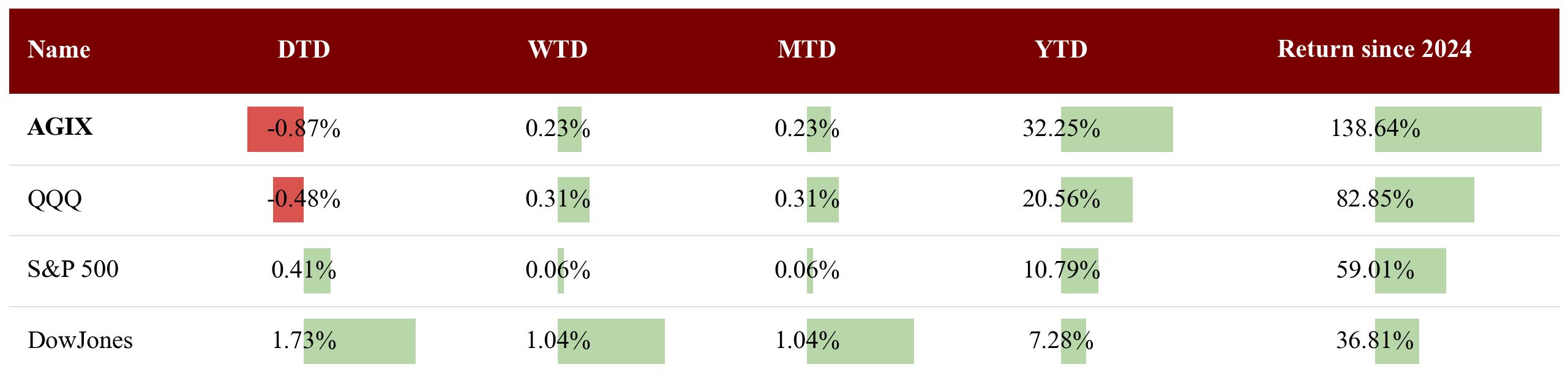
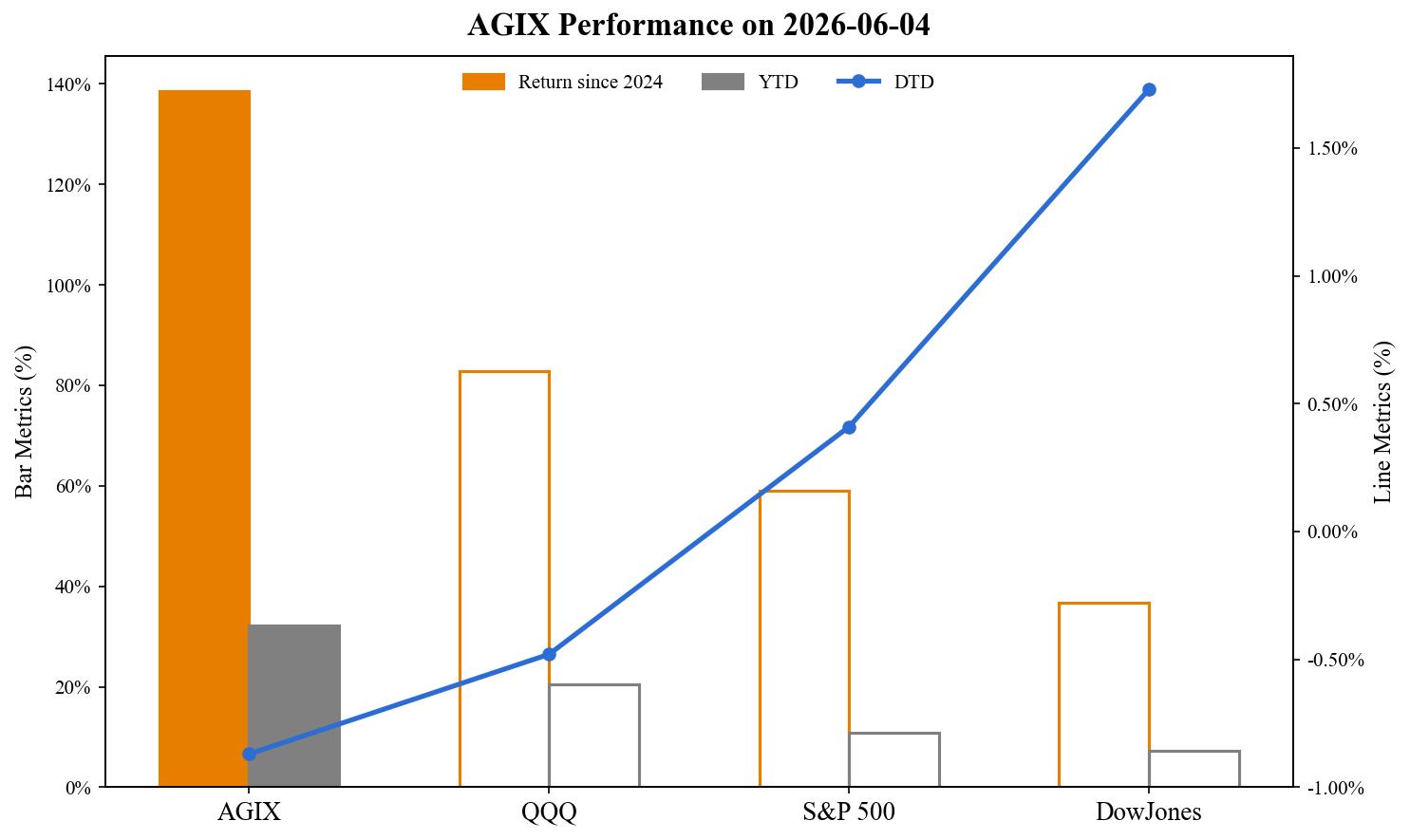
• AGIX fell 0.87% DTD, underperforming the S&P 500 (+0.41%) and Dow Jones (+1.73%), but its YTD return of 32.25% remains strong vs. the S&P 500's 10.79%.
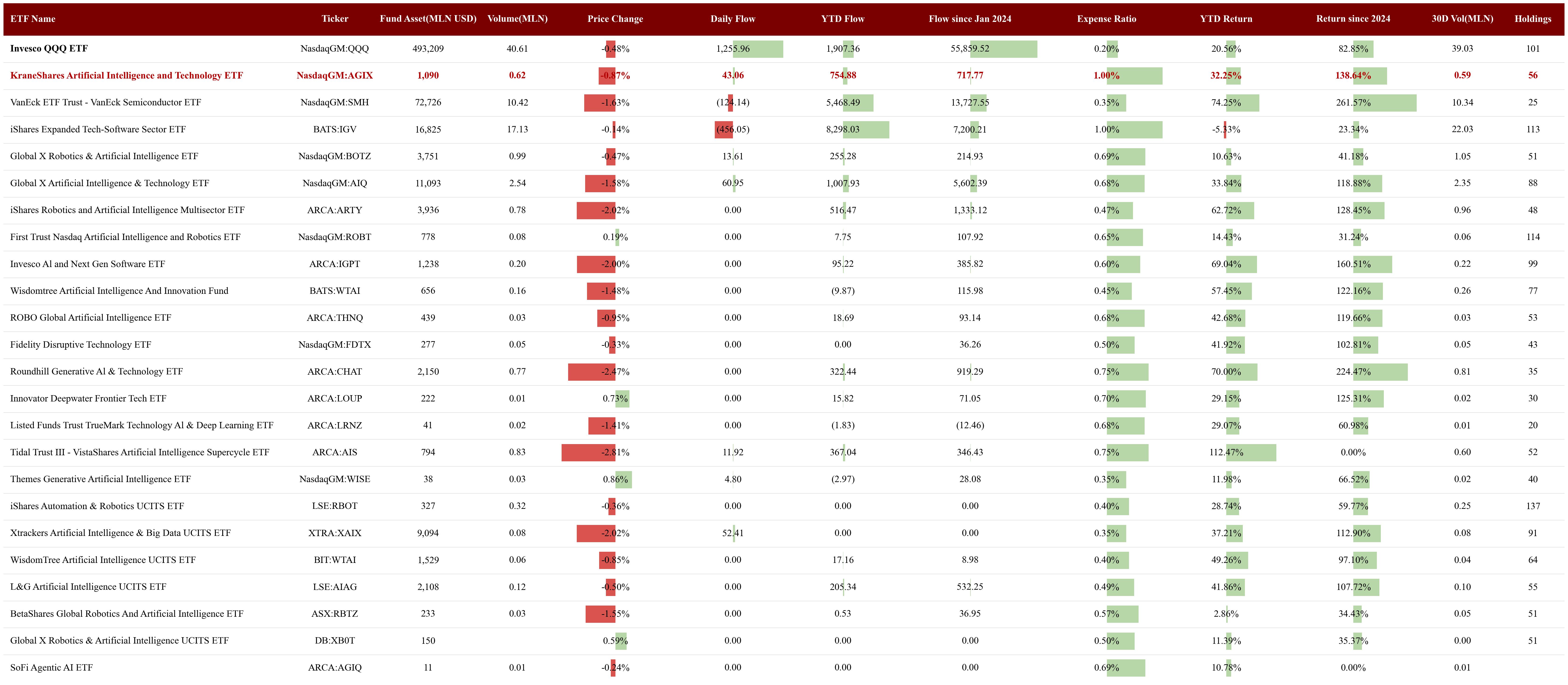
• Among peer ETFs, SMH (semiconductors) gained 4.78% WTD, while IGPT (AI & software) rose 0.83% WTD, reflecting mixed sector sentiment.
• Key AGIX holdings to watch: Broadcom (-12.59% DTD) after its revenue miss and Ciena (-13.66% DTD) on weak earnings; both dragged on the portfolio. Tempus AI (+10% DTD) surged on AI healthcare momentum, and Alphabet (+3.68% DTD) benefited from Google's AI product launches.
• Nvidia (+1.94% DTD) and Meta (+0.74% DTD) provided partial offset, supported by acquisition news and AI assistant rollouts, respectively.
News Highlights
1. Broadcom's Q2 revenue slightly missed expectations and it failed to raise AI guidance, causing a near 14% after-hours drop; the stock fell 12.59% DTD, weighing heavily on AGIX.
2. Nvidia's acquisition of Kumo AI and Groq's inference assets strengthens its enterprise AI position, supporting its +1.94% DTD gain.
3. SpaceX plans a record $75B IPO, which could reshape the public market and boost sentiment for space and AI-related names.
4. Ramp raised $750M at a $44B valuation, nearly tripling in a year, highlighting investor appetite for AI-driven fintech.
5. Anthropic filed for a low-key IPO and warned about AI development speed, while Google launched Dreambeans and Apple is set to revamp Siri at WWDC, underscoring intense AI competition.
6. Ciena's stock fell 13.66% DTD following its earnings, making it the worst AGIX hardware holding performer.
7. Tempus AI surged 10% DTD on AI healthcare momentum, contributing positively to AGIX despite its small portfolio weight.
8. Cloudflare acquired VoidZero (Vite toolchain) to boost its Workers platform, supporting AI-native development.
RSS Highlights
1. Microsoft and OpenAI are now competing directly: Microsoft launched its own reasoning model (MAI-Thinking-1) and a Copilot super app, signaling a strategic shift.
2. A stealth startup from a former Boston Dynamics exec is working on robotics, while another MIT/Stanford founder is building semi-autonomous robots for wildfire prevention.
3. An AI-driven resurgence of native Mac app development is underway, with AI code assistants enabling non-programmers to create apps.
4. Google's Gemini Mac app is now native on Apple Silicon, offering contextual help and image/video creation via a simple shortcut.
5. Anti-AI nostalgia is compared to the Luddite movement, with arguments that it romanticizes the past while resisting technological progress.
6. The GE Widescreen 1000 (1978) cost $2,800 ($13,700 today) and weighed 359 lbs, highlighting how far display technology has come.
7. AMD released the 486DX4 CPU in 1995, offering competitive performance at lower prices than Intel's equivalent, a historical contrast to today's chip landscape.
Performance & Benchmark
Attribution
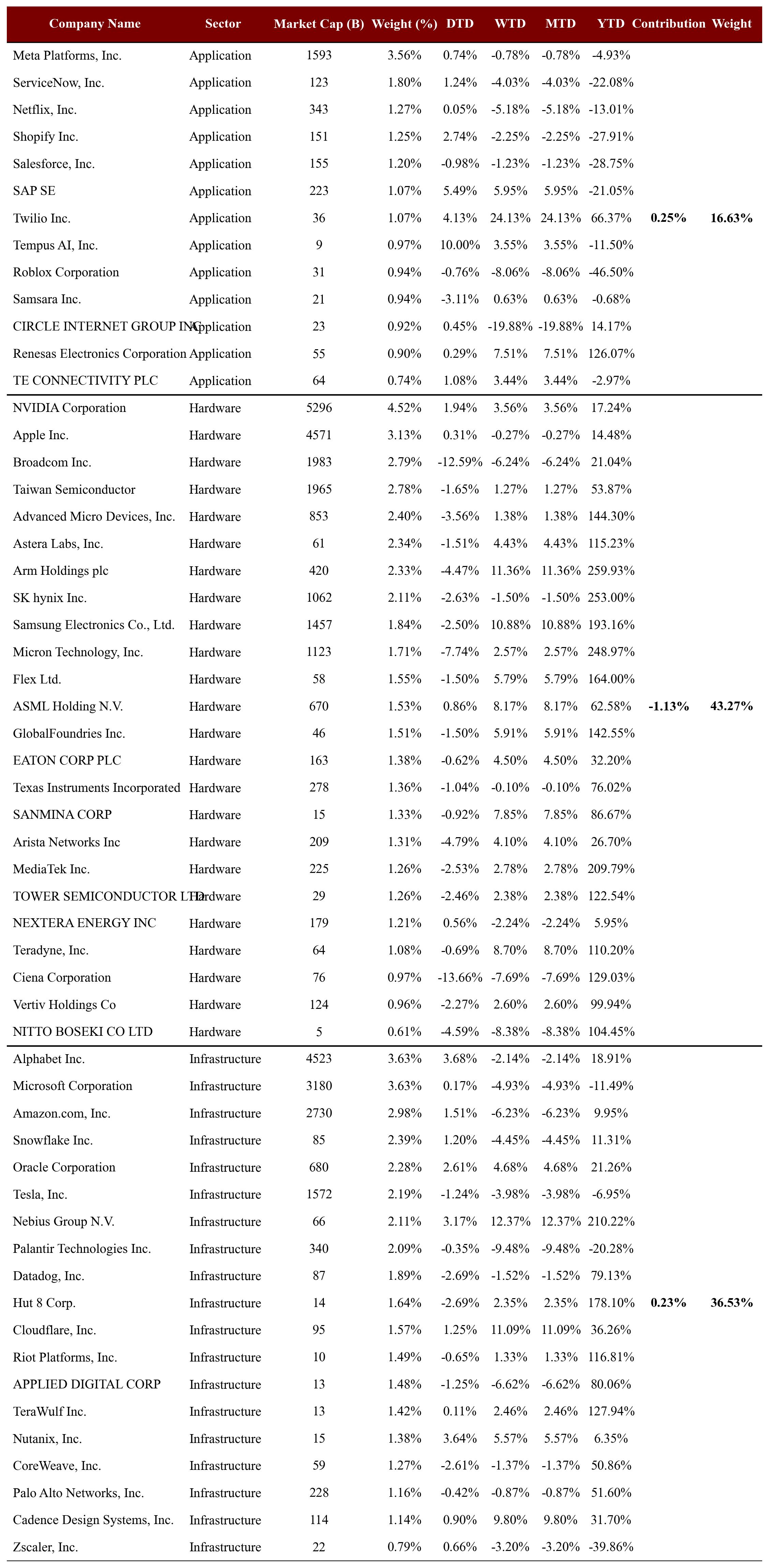
Contribution of the three sectors within AGIX holdings today
Application: 0.25%
Hardware: -1.13%
Infrastructure: 0.23%
Top-performing stocks in AGIX holdings today
Tempus AI, Inc. (10.0%)
SAP SE (5.49%)
Twilio Inc. (4.13%)
Alphabet Inc. (3.68%)
Nutanix, Inc. (3.64%)
Nebius Group N.V. (3.17%)
Shopify Inc. (2.74%)
Oracle Corporation (2.61%)
Worst-performing stocks in AGIX holdings today
Vertiv Holdings Co (-2.27%)
TOWER SEMICONDUCTOR LTD (-2.46%)
Samsung Electronics Co., Ltd. (-2.5%)
MediaTek Inc. (-2.53%)
CoreWeave, Inc. (-2.61%)
SK hynix Inc. (-2.63%)
Datadog, Inc. (-2.69%)
Hut 8 Corp. (-2.69%)
Samsara Inc. (-3.11%)
Advanced Micro Devices, Inc. (-3.56%)
Arm Holdings plc (-4.47%)
NITTO BOSEKI CO LTD (-4.59%)
Arista Networks Inc (-4.79%)
Micron Technology, Inc. (-7.74%)
Broadcom Inc. (-12.59%)
Ciena Corporation (-13.66%)
Top five listed stocks contributing the most within AGIX holdings today
Broadcom Inc. (-12.59%)
Ciena Corporation (-13.66%)
Micron Technology, Inc. (-7.74%)
Arm Holdings plc (-4.47%)
Advanced Micro Devices, Inc. (-3.56%)
Observation
The strongest movers across peer ETF holdings today are listed below:
| DTD | Stock Ticker | Name | Held by ETFs | analysis |
|---|---|---|---|---|
| 12.45 | TSE:3905 | Datasection Inc. | ['NasdaqGM:WISE'] | HTTP 404: {"error":{"message":"No allowed providers are available for the selected model.","code":404,"metadata":{"available_providers":["perplexity"],"requested_providers":["openai"]}}} |
| 12.22 | NASDAQGM:INOD | Innodata Inc. | ['NasdaqGM:ROBT'] | HTTP 404: {"error":{"message":"No allowed providers are available for the selected model.","code":404,"metadata":{"available_providers":["perplexity"],"requested_providers":["openai"]}}} |
| 10.74 | NasdaqCM:PGY | Pagaya Technologies Ltd. | [] | HTTP 404: {"error":{"message":"No allowed providers are available for the selected model.","code":404,"metadata":{"available_providers":["perplexity"],"requested_providers":["openai"]}}} |
| 10.22 | NasdaqGM:AAOI | Applied Optoelectronics, Inc. | [] | HTTP 404: {"error":{"message":"No allowed providers are available for the selected model.","code":404,"metadata":{"available_providers":["perplexity"],"requested_providers":["openai"]}}} |
| 10.0 | NasdaqGS:TEM | Tempus AI, Inc. | ['NasdaqGM:AGIX', 'NasdaqGM:ROBT', 'ARCA:THNQ', 'BIT:WTAI', 'LSE:AIAG'] | HTTP 404: {"error":{"message":"No allowed providers are available for the selected model.","code":404,"metadata":{"available_providers":["perplexity"],"requested_providers":["openai"]}}} |
| 9.51 | NasdaqGS:RXRX | Recursion Pharmaceuticals, Inc. | ['NasdaqGM:ROBT', 'BATS:WTAI', 'BIT:WTAI'] | HTTP 404: {"error":{"message":"No allowed providers are available for the selected model.","code":404,"metadata":{"available_providers":["perplexity"],"requested_providers":["openai"]}}} |
| 9.36 | NasdaqCM:NN | NextNav Inc. | ['BATS:IGV'] | HTTP 404: {"error":{"message":"No allowed providers are available for the selected model.","code":404,"metadata":{"available_providers":["perplexity"],"requested_providers":["openai"]}}} |
| 8.79 | XTRA:NEM | Nemetschek SE | ['ARCA:IGPT', 'LSE:RBOT'] | HTTP 404: {"error":{"message":"No allowed providers are available for the selected model.","code":404,"metadata":{"available_providers":["perplexity"],"requested_providers":["openai"]}}} |
| 8.51 | NYSE:RDDT | Reddit, Inc. | ['ARCA:IGPT'] | HTTP 404: {"error":{"message":"No allowed providers are available for the selected model.","code":404,"metadata":{"available_providers":["perplexity"],"requested_providers":["openai"]}}} |
| 8.51 | NasdaqGS:KTOS | Kratos Defense & Security Solutions, Inc. | ['NasdaqGM:ROBT'] | HTTP 404: {"error":{"message":"No allowed providers are available for the selected model.","code":404,"metadata":{"available_providers":["perplexity"],"requested_providers":["openai"]}}} |
| 8.22 | TSE:3687 | Fixstars Corporation | ['LSE:RBOT'] | HTTP 404: {"error":{"message":"No allowed providers are available for the selected model.","code":404,"metadata":{"available_providers":["perplexity"],"requested_providers":["openai"]}}} |
| 7.98 | NYSE:GENI | Genius Sports Limited | ['ARCA:IGPT'] | HTTP 404: {"error":{"message":"No allowed providers are available for the selected model.","code":404,"metadata":{"available_providers":["perplexity"],"requested_providers":["openai"]}}} |
| 7.45 | KOSDAQ:A140860 | Park Systems Corp. | ['LSE:RBOT'] | HTTP 404: {"error":{"message":"No allowed providers are available for the selected model.","code":404,"metadata":{"available_providers":["perplexity"],"requested_providers":["openai"]}}} |
| 7.37 | KOSDAQ:A348210 | NEXTIN, Inc. | ['LSE:RBOT'] | HTTP 404: {"error":{"message":"No allowed providers are available for the selected model.","code":404,"metadata":{"available_providers":["perplexity"],"requested_providers":["openai"]}}} |
| 7.12 | NasdaqGS:OUST | Ouster, Inc. | ['LSE:RBOT'] | HTTP 404: {"error":{"message":"No allowed providers are available for the selected model.","code":404,"metadata":{"available_providers":["perplexity"],"requested_providers":["openai"]}}} |
| 6.75 | NasdaqGS:AVAV | AeroVironment, Inc. | ['NasdaqGM:BOTZ', 'NasdaqGM:ROBT', 'ARCA:IGPT', 'BATS:WTAI', 'ARCA:LOUP', 'ASX:RBTZ', 'DB:XB0T'] | HTTP 404: {"error":{"message":"No allowed providers are available for the selected model.","code":404,"metadata":{"available_providers":["perplexity"],"requested_providers":["openai"]}}} |
| 6.64 | ENXTAM:WKL | Wolters Kluwer N.V. | ['NasdaqGM:AIQ'] | HTTP 404: {"error":{"message":"No allowed providers are available for the selected model.","code":404,"metadata":{"available_providers":["perplexity"],"requested_providers":["openai"]}}} |
| 6.61 | ENXTPA:CAP | Capgemini SE | ['ARCA:ARTY'] | HTTP 404: {"error":{"message":"No allowed providers are available for the selected model.","code":404,"metadata":{"available_providers":["perplexity"],"requested_providers":["openai"]}}} |
| 6.59 | NasdaqGS:AXON | Axon Enterprise, Inc. | ['NasdaqGM:QQQ', 'ARCA:LOUP'] | HTTP 404: {"error":{"message":"No allowed providers are available for the selected model.","code":404,"metadata":{"available_providers":["perplexity"],"requested_providers":["openai"]}}} |
| 6.54 | NasdaqGS:UPST | Upstart Holdings, Inc. | ['NasdaqGM:BOTZ', 'NasdaqGM:ROBT', 'BIT:WTAI', 'ASX:RBTZ', 'DB:XB0T'] | HTTP 404: {"error":{"message":"No allowed providers are available for the selected model.","code":404,"metadata":{"available_providers":["perplexity"],"requested_providers":["openai"]}}} |
| 6.16 | NasdaqGS:SDGR | Schrödinger, Inc. | ['ARCA:LRNZ'] | HTTP 404: {"error":{"message":"No allowed providers are available for the selected model.","code":404,"metadata":{"available_providers":["perplexity"],"requested_providers":["openai"]}}} |
| 6.03 | LSE:REL | RELX PLC | ['BATS:WTAI'] | HTTP 404: {"error":{"message":"No allowed providers are available for the selected model.","code":404,"metadata":{"available_providers":["perplexity"],"requested_providers":["openai"]}}} |
| 5.94 | ENXTPA:DSY | Dassault Systèmes SE | ['ARCA:ARTY', 'NasdaqGM:ROBT', 'ARCA:IGPT', 'LSE:RBOT', 'XTRA:XAIX', 'BIT:WTAI'] | HTTP 404: {"error":{"message":"No allowed providers are available for the selected model.","code":404,"metadata":{"available_providers":["perplexity"],"requested_providers":["openai"]}}} |
| 5.93 | NYSE:SNAP | Snap Inc. | ['BATS:IGV', 'NasdaqGM:AIQ', 'ARCA:IGPT', 'XTRA:XAIX'] | HTTP 404: {"error":{"message":"No allowed providers are available for the selected model.","code":404,"metadata":{"available_providers":["perplexity"],"requested_providers":["openai"]}}} |
| 5.75 | ENXTAM:ADYEN | Adyen N.V. | ['NasdaqGM:FDTX', 'ARCA:LOUP'] | HTTP 404: {"error":{"message":"No allowed providers are available for the selected model.","code":404,"metadata":{"available_providers":["perplexity"],"requested_providers":["openai"]}}} |
| 5.5 | TSX:CSU | Constellation Software Inc. | ['LSE:RBOT'] | HTTP 404: {"error":{"message":"No allowed providers are available for the selected model.","code":404,"metadata":{"available_providers":["perplexity"],"requested_providers":["openai"]}}} |
| 5.49 | NasdaqGS:CCOI | Cogent Communications Holdings, Inc. | ['ARCA:IGPT'] | HTTP 404: {"error":{"message":"No allowed providers are available for the selected model.","code":404,"metadata":{"available_providers":["perplexity"],"requested_providers":["openai"]}}} |
| 5.49 | XTRA:SAP | SAP SE | ['NasdaqGM:AGIX', 'BATS:WTAI', 'NasdaqGM:FDTX', 'LSE:RBOT', 'XTRA:XAIX'] | HTTP 404: {"error":{"message":"No allowed providers are available for the selected model.","code":404,"metadata":{"available_providers":["perplexity"],"requested_providers":["openai"]}}} |
| 5.31 | TSX:DSG | The Descartes Systems Group Inc. | ['BATS:IGV'] | HTTP 404: {"error":{"message":"No allowed providers are available for the selected model.","code":404,"metadata":{"available_providers":["perplexity"],"requested_providers":["openai"]}}} |
| 5.11 | NYSE:MDT | Medtronic plc | ['NasdaqGM:ROBT'] | HTTP 404: {"error":{"message":"No allowed providers are available for the selected model.","code":404,"metadata":{"available_providers":["perplexity"],"requested_providers":["openai"]}}} |
| 5.09 | TSE:6146 | Disco Corporation | ['NasdaqGM:FDTX'] | HTTP 404: {"error":{"message":"No allowed providers are available for the selected model.","code":404,"metadata":{"available_providers":["perplexity"],"requested_providers":["openai"]}}} |
News
Funding & M&A
Nvidia acquires Kumo AI, a predictive AI startup known for its extreme accuracy
Nvidia Corp. announced the acquisition of four-year-old AI startup Kumo AI Inc., which specializes in developing high-precision business prediction models based on graph neural networks. The deal has been completed but specific terms were not disclosed. The Kumo platform allows businesses to directly connect data warehouses such as Snowflake or Databricks to its system, using SQL-like queries to quickly generate insights like customer churn or demand forecasts, reducing model building time by up to 95%. The technology has been adopted by clients including Reddit, DoorDash, and UK supermarket chain J Sainsbury. Nvidia recently also acquired Groq's inference technology assets in a roughly $20 billion "acqui-hire" and purchased data semantics company Illumex for $75 million. This move further strengthens its position in enterprise AI applications and data intelligence.
SpaceX hopes to raise $75 billion when the world's biggest-ever IPO launches next week
Space exploration technology company SpaceX announced it will raise $75 billion through an IPO this month, making it the largest in history. The company plans to offer 555.6 million shares at $135, with a post-IPO market value of $1.77 trillion, far exceeding Saudi Arabia's record of $26 billion. After the merger of the space exploration technology company and the AI company, Musk will hold 82.4% voting rights, concentrating decision-making power. If the market value reaches $1.77 trillion, Musk's net worth will exceed $1 trillion. The listing will also provide funding for moon return and Mars colonization plans. Meanwhile, Anthropic and OpenAI will also go public in the summer. Analysts believe this move will reshape the public market landscape.
Observability provider Coralogix secures a $200 million investment
Cloud observability platform provider Coralogix Inc. recently completed a Series F funding round led by Advent, CPPIB, and Greenfield, with participation from Brighton Park Capital, raising $200 million at a valuation of $1.6 billion. The funds will be used to enhance its observability platform capabilities, expand international markets, and strengthen cybersecurity features. The platform processes over 8PB of data daily and serves more than 5,000 enterprise clients. Its proprietary Streama technology enables instant data analysis without indexing, supports SQL and DataPrime language queries, and allows direct log storage on Amazon S3 to reduce costs. Last year, the company launched AI assistant Olly, which supports natural language problem-solving and MCP server integration with custom AI agents. CEO Ariel Assaraf stated that the funds will accelerate the construction of an intelligent layer, pushing product operations into a new AI phase.
Broadcom's revenue miss shocks Wall Street, and its stock drops after-hours
Broadcom, the Intel chip maker, saw its stock price plunge after releasing second-quarter earnings. The company reported revenue of $23.19 billion, up 48% year-over-year but slightly below analyst expectations. Adjusted earnings per share were $2.44, slightly beating expectations. AI chip sales reached $10.8 billion, more than doubling year-over-year. CEO Hock Tan reiterated the full-year AI sales guidance of over $100 billion, but the failure to raise expectations led to a nearly 14% stock drop. The company is pushing to develop custom AI chips for clients including Anthropic, OpenAI, Google, and Meta, and is piloting selling chips separately rather than as complete systems. The enterprise software business grew 9% due to the VMware acquisition but fell short of expectations. Analysts noted that Broadcom remains a key player in the custom AI chip space and will continue to provide critical technology to multiple tech giants.
Ramp raises $750M at $44B valuation as investors hunger for fintechs with an AI story
Financial management platform Ramp announced on Thursday that it has raised $550 million in funding, with a valuation of $44 billion, nearly tripling in a year. The round was led by ICONIQ, GIC, and the Ontario Teachers' Pension Plan, with participation from Goldman Sachs, Morgan Stanley Investment Management, D.E. Shaw, and others. Ramp's annualized revenue has exceeded $1 billion, achieving positive free cash flow, with over 7,000 customers including Uber and Shopify. The company is expanding from expense management to payments, procurement, fraud detection, and accounting, and has launched a dedicated credit card for AI agents. As enterprises' demand for controlling AI token usage costs increases, Ramp will provide related solutions as a new growth driver. In the market, Brex has been acquired by Capital One, while Ramp remains actively preparing for an IPO.
Startup Kodesage secures seed funding to accelerate on-premises app modernization with AI.
Kodesage Ltd. recently announced the completion of a $6.6 million seed funding round, led by VentureFriends with participation from Portfolion and angel investors Christian Szegedy and Mario Götze. The startup focuses on an AI-driven legacy code modernization platform, helping enterprises in regulated industries such as finance, insurance, and healthcare migrate ancient systems like Oracle Forms, PL/SQL, and COBOL to modern languages with zero-risk reconstruction. The platform can run on customer premises or in isolated cloud environments, ensuring data sovereignty and reducing costs. Co-founder Gergely Dombi stated that AI will make the modernization process repeatable and scalable, alleviating operational pressure from the loss of retiring experts. The funds will be used to expand into the US and European markets and grow the engineering team. A VentureFriends partner noted that Kodesage can significantly save enterprises time and costs while reducing reliance on scarce experts.
Offroad launches with $7M to automate identity security with AI agents
U.S. startup Offroad Inc. announced today a $7 million seed funding round. Founded in September 2025 and headquartered in New York and Tel Aviv, its core business is launching an AI agent-based identity security team to automatically investigate and remediate access risks for people, machine identities, and AI agents. The company notes that with the increasing speed of machine identities and autonomous AI agents, traditional manual review models are no longer adequate. Its agents can collect context across multiple systems, analyze and resolve issues, or escalate high-risk operations to humans. It also released a free tool, ohauth.ai, for reviewing OAuth application permission risks. The round was led by Ibex Investors and Skywell Capital Partners. Founder Dan Bendler has previously founded multiple AI companies, and CTO Philip Shteyn previously worked at Palo Alto Networks. Funds will be used for hiring, product development, and expanding into the U.S. market.
Ahead of its IPO, Anthropic’s Daniela Amodei shrugs off doubts about AI’s returns
AI company Anthropic recently announced plans to file for an IPO in a low-key manner, following a $65 billion funding round that valued it at $965 billion. Co-founder Daniela Amodei stated at the Bloomberg Technology Summit that frontier model training and inference services require massive capital, and public markets can provide better financing support. The company has an annualized revenue of over $40 billion but faces challenges of uncertain enterprise AI spending efficiency. Anthropic chose to partner with xAI to obtain $125 million per month in computing power rather than building its own data centers. Unlike OpenAI and xAI, Anthropic is taking a conservative approach to expanding computing capacity. Analysts believe its IPO will provide a new model for industry financing.
Airbnb’s Brian Chesky plans to launch a new AI lab
Airbnb CEO Brian Chesky is preparing to establish his own artificial intelligence research lab to address the shortcomings of existing frontier lab models. According to Bloomberg, the lab will focus on user interaction and design, aligning with the product philosophy Chesky has promoted at Airbnb. Chesky has a deep friendship with OpenAI CEO Sam Altman and helped him return to his position after Altman was ousted, but now he is preparing to compete with his former mentor. According to people familiar with the matter, Chesky will continue to serve as Airbnb CEO, and the new lab will be led by someone else. This move reflects tech leaders' dissatisfaction with the current AI ecosystem and their impulse to reshape the field.
Anthropic calls for global pause in AI development before humans lose control
AI startup company Anthropic warned in a new blog post that current AI technology is advancing too quickly, with models approaching the threshold where recursive self-improvement may become possible, and if not controlled in time, it could lead to massive societal shocks. The company suggests that the international community should pause or slow down the development of frontier models to allow social structures and alignment research to keep pace with technological progress. Anthropic recently completed a $65 billion funding round, with a valuation nearing $100 billion, and has filed for an IPO, competing with OpenAI for market leadership. However, its warning has also been met with skepticism, with accusations that it is using policy regulation to suppress open-source models. Although global coordinated pauses are extremely difficult, Anthropic will continue to promote policy discussions and technical verification mechanism research.
Cloudflare acquires VoidZero, maker of the Vite JavaScript toolchain
U.S. cloud service provider Cloudflare announced the acquisition of open-source company VoidZero, the developer of JavaScript build tools Vite, Vitest, Rolldown, and Oxc. Vite has over 100 million weekly downloads and has become the default tool for JS/TS development. Cloudflare aims to integrate this toolchain into its Workers platform, enabling seamless connectivity from local coding to global deployment. The acquisition comes as AI autonomous coding agents are changing the way applications are built, and Cloudflare emphasizes the need for a faster, more predictable development environment. VoidZero founder Evan You will continue to lead the open-source roadmap, with related tools remaining under the MIT license and maintaining neutrality. Cloudflare also pledged $1 million to support the Vite ecosystem. The company previously acquired Human Native, continuing its布局 in AI-native networks.
Financial technology provider Ramp raises $750M in funding at $44B valuation
Cloud spending management service provider Ramp Inc. recently announced the completion of a $750 million Series F funding round, co-led by ICONIQ, GIC, and the Ontario Teachers' Pension Plan, with nearly 20 institutions including Lightspeed participating. After this round, the company's valuation reached $44 billion, an increase of $12 billion in seven months. Ramp focuses on corporate credit card issuance and cashback services, while also offering accounting automation, supplier management, and travel booking features. Its newly launched Ramp Stack AI tool can quickly complete account reconciliation and financial statement preparation, and it previously released an AI agent for automated procurement and an AI spending intelligence tool. The company serves over 7,000 customers, with annualized revenue exceeding $1 billion. The CEO stated that Ramp is becoming the infrastructure for intelligent spending.
Technical Breakthroughs
What to expect from WWDC 2026: Siri’s highly anticipated revamp and Apple Intelligence updates
The 2026 WWDC conference is about to open, and Apple will focus on launching a major upgrade to Siri. The new Siri will integrate Google Gemini technology, supporting multi-turn conversations, contextual understanding, and multi-step task processing, and will launch a standalone Siri app to compete with ChatGPT. It is rumored that Apple will integrate AI agent functionality into the App Store, supporting task delegation such as booking appointments and smart home control. The camera app will add a "Visual Intelligence" mode, leveraging Google image search to identify objects. The Photos app will gain smart scene recommendations, automatic object removal, and natural language editing features. Image Playground will improve generation quality and character consistency, and will introduce Genmoji suggestions and AI wallpaper generation. The Wallet app will add bill splitting and digital pass generation features. Apple is strengthening its ecosystem through multiple AI upgrades.
S&P Global and Snowflake bring AI-powered financial analysis to investment research.
Previously, investment research required manual analysis of financial reports, but now AI can complete the task in minutes. A 2020 paper by Harvard professor Lauren Cohen, "Lazy Prices," found that changes in the risk sections of 10-K and 10-Q reports can predict stock performance. S&P Global built an AI framework using Snowflake Cortex and CoWork tools to quickly identify changes via large language models. The system can scan the entire S&P 500 in 10 minutes, helping fund analysts rapidly obtain new risk signals. Experts emphasize that enterprises must start with business strategy and ensure AI is visible and auditable through data management and role-based access controls. This framework directly translates academic findings into production workflows, driving the financial services industry toward intelligence and democratization.
Product Launches
Google launches Dreambeans, an AI app that curates daily stories from Google data
Google Labs today launched an experimental app called Dreambeans, which uses AI to generate a fixed daily number of personalized stories from users' Google data, replacing infinite scrolling content feeds. The app integrates data from Gmail, Google Calendar, Google Photos, YouTube, and Search history, generating stories based on user behavior and using the Nano Banana 2 model to create illustrations. Users can adjust output through feedback, and data connections are optional. Dreambeans is available to Google AI Ultra subscribers aged 18 and over in the US, while other users can join a waitlist. This move continues Google Labs' experiments in personal intelligence, transforming cloud data into proactive AI summaries.
Asana launches AI-powered products to help organizations manage human and agent work
American project management software company Asana launched a new product suite, Agentic Work Management, at the London Work Innovation Summit, positioning it as a work management operating system for humans and AI agents to operate together. The suite includes an AI steward Dash for each user, a new generation of AI team members, and three major application scenarios. Based on Asana's Work Graph data model, Dash can automatically capture tasks across multiple tools such as Slack, Gmail, and HubSpot and route them to relevant people or agents. The new AI team members add skill libraries, multi-step integrations, and industry domain knowledge, supporting scenarios in manufacturing, retail, and customer management. Asana also launched three industry solutions: Service Management, Command, and Client Management, enabling seamless transition from tickets to projects. This release marks Asana's progression from task management to a human-machine collaborative work system.
Radiant Logic expands its identity visibility platform to enterprise AI agents with real-time risk scoring.
Radiant Logic recently launched a new feature to extend its identity visibility platform to the field of agentic AI, helping enterprises control and govern autonomous AI agents. As AI agents flood enterprise networks and gain access to sensitive data, traditional identity management struggles to cover these intangible assets. The platform provides real-time observation of agent behavior in cloud, on-premises, or hybrid environments, regardless of the underlying large language model or framework. It enables unified inventory, configuration, and permission records for agents, LLMs, and resources, visualizes agent-to-agent and agent-to-data dependencies, and connects them to relevant employees. With real-time risk scoring and alerts, the platform can detect expired permissions or anomalous behavior, and revoke, suspend, or update permissions when agents are idle or outdated. Built on its existing identity data platform architecture, it requires no additional identity stack and is trusted by one-third of the top 100 U.S. companies. As multi-cloud vendors build their own agent registries, the platform's federated capabilities provide enterprises with a single authoritative view.
Is Silicon Valley ready to put robots in people’s homes? Hello Robot is.
Hello Robot recently released the fourth generation of its home assistive robot Stretch, focusing on real-world home applications rather than pursuing complex humanoid structures. Founded in 2017 by former Google Robotics head Aaron Edsinger and Georgia Tech professor Charlie Kemp, Stretch features a telescoping arm and omnidirectional wheeled base, priced at $30,000, with the first 200 to 300 units sold out. Investor Keith Platt became a board member after using Stretch to independently drink a protein shake, highlighting its practical value for people with disabilities. Compared to Silicon Valley competitors pursuing general-purpose humanoid robots, Hello Robot emphasizes safety, controllability, and low-cost deployment, with products already entering research institutions, data centers, and disability assistance fields. Experts point out that its real-world operational data accumulation will become a core moat, potentially advancing physical AI development.
Oura Ring 5 review: Thinner, lighter, better
Oura Technology officially released the fifth-generation smart ring, the Oura Ring 5. Compared to the previous generation, the new product is 40% smaller in size, with a width reduced to 6.09mm and thickness to 2.28mm, weighing only 2-2.69g, greatly improving wearing comfort. The ring starts at $399, uses a new physical vapor deposition coating process for enhanced scratch resistance. Battery life reaches 6-9 days, supporting new software features such as blood pressure signals and nighttime breathing. Oura Technology claims it is the world's smallest smart ring, competing with sub-brands like RingConn and Ultrahuman by offering a look closer to ordinary jewelry. Analysts believe the new product will attract more users who previously avoided smart rings due to their bulk, though size options have been reduced.
Policy & Regulation
In a policy paper, OpenAI diverges from the White House on AI safety.
OpenAI Group PBC this week released a regulatory proposal titled 'Democratic Governance of Frontier AI: A Blueprint for a Federal Framework,' recommending that frontier AI safety oversight be assigned to the AI Standards and Innovation Institute (CAISI) under the National Institute of Standards and Technology of the Department of Commerce, rather than the National Security Agency as designated by the Trump administration's executive order. OpenAI CEO Sam Altman publicly supported the executive order on social media while stating that he would push the White House to transfer evaluation authority to CAISI. Altman will visit the White House this week to meet with bipartisan lawmakers to discuss AI regulation and employment impacts. OpenAI executive Chris Lehane noted that CAISI has established close cooperation with OpenAI and competitor Anthropic PBC, possessing more specialized testing capabilities, but expressed concerns that the White House's proposed 'benchmark testing' process could create regulatory confusion. The two sides will hold consultations in the coming days on criteria for determining capability thresholds.
Industry Partnerships
Lovable signs a multiyear deal with Google Cloud to increase usage fivefold, according to a source.
Wenergy and Google announced on Wednesday the expansion of their multi-year cooperation agreement, increasing the scale of Google Cloud usage by five times. The agreement grants Wenergy expanded access to Anthropic's Claude models and Google's Gemini models, and its new agents will be listed on the Google Cloud Enterprise Agent Marketplace and the Gemini Enterprise Agent Gallery. To enhance code security, Wenergy will also integrate with Wiz, which Google acquired for $32 billion, to identify and fix security vulnerabilities in real time. Wenergy's annualized revenue has exceeded $400 million, and over half of the Fortune 500 use its products. This move by Google can help Anthropic achieve its performance goals and attract more enterprise customers by simplifying the procurement process. The partnership will support Google's capital expenditure plan of $180-190 billion for this year.
Exposure management evolves from vulnerability scanning to full-stack AI defense.
With the rapid development of AI technology, traditional models of cybersecurity and exposure management can no longer keep up with machine-speed attack threats. Tenable Senior Vice President Jason Merrick pointed out that exposure management has become a core framework for enterprises to shift from reactive responses to proactive risk reduction, covering diverse attack surfaces such as the cloud, identity, and AI workloads. To achieve rapid automated remediation, Tenable chose Snowflake as its security data lake and launched the Hexa intelligent framework. Snowflake, meanwhile, announced plans to acquire Natoma and launched an MCP gateway to improve observability of AI services. The two companies jointly emphasized using automation and AI tools to counter AI-driven threats, pushing the security system toward a preventive transformation.
Apple touts $1.4 trillion in App Store billings and sales, 90% without a commission
On the eve of WWDC, Apple released its annual App Store ecosystem report, stating that the platform facilitated over $1.4 trillion in billings and sales for developers in 2025, an increase of $100 billion from last year. Among this, physical goods and services sales reached $1.1 trillion, digital goods billings were $149 billion, and advertising revenue was $151 billion. The data shows that 90% of transactions require no commission from developers. The report also notes that 40 of the top 100 apps feature AI capabilities, with their billing growth outpacing other apps. Additionally, over the past six years, billings on the China App Store have more than doubled, while those in the US and Europe have more than tripled. The report provides context for the upcoming WWDC conference, with market attention focused on whether Apple will introduce AI agents and Siri upgrades.
S&P Global and Snowflake bring AI-driven financial analysis to qualitative investment research.
At Snowflake Summit 2026, Liam Hynes, Global Head of New Product Development at S&P Global Market Intelligence, and John Heisler, Head of AI and Financial Services at Snowflake, gave an interview. They revealed how to use large language models to reconstruct the 'Lazy Prices' research framework, leveraging Snowflake Cortex and CoWork tools to rapidly analyze risk changes in SEC 10-K and 10-Q reports, accurately identifying and concentrating investments in companies with significant risks. This AI-driven financial analysis method compresses what previously took weeks of manual research into minutes, achieving enterprise-level consistency through unified data governance. The two emphasized that successful deployment must start with a business strategy, then build an executable intelligent system through data strategy and AI strategy, helping financial institutions uncover opportunities in regulatory documents that are delayed in market pricing.
Agentic commerce puts data quality at the center of retail’s next era
Fetch Rewards Chief AI Officer Gowtham Gundu stated at Snowflake Summit 2026 that the rewards platform is at the core of the agentic commerce transformation, with 13 million monthly active users, processing 13 million receipts daily, and a transaction GMV scale second only to Walmart and Amazon. Leveraging the Snowflake data cloud platform, Fetch is building a natural language query interface that enables brands like Pepsi to analyze purchase rates, basket sizes, and trend changes in real time. Snowflake EMEA Retail Head Paul Winsor emphasized that data readiness has become a prerequisite for all AI initiatives, with AI agents already automating points dispute handling and moving toward fully automated morning rewards for walking, movie watching, and smart shopping suggestions. Bain predicts that agent-to-agent commerce will eventually bypass traditional retail websites. Fetch is transforming rich transaction data into a discovery and engagement layer to seize the agentic commerce window.
Vibe coding moves from weekend hobby to enterprise change management mandate
Artificial intelligence is reshaping software development models in large enterprises, extending from the tool level to organizational culture and governance systems. CIOs from Snowflake and Clover, a subsidiary of Fiserv, jointly discussed the application and transformation of 'vibe coding' at Snowflake Summit 2026. This model allows developers to describe requirements in natural language, with AI automatically generating code, shortening development cycles by 46%. However, the core challenge for both companies is cultural transformation. Snowflake CIO Mike Blandina reinforced the approach by building complete systems himself and compressing agile cycles from three weeks to one, using data to drive adoption. At Clover, under financial regulatory constraints, existing compliance controls are applied to AI-generated code, reducing simple change times from 2-3 weeks to half a day. Both executives believe productivity gains have been proven, and the key lies in using reward mechanisms to help teams internalize the new approach as part of daily work.
As enterprise AI matures, data and context emerge as new competitive edge
At Snowflake Summit 2026, analysts Bob O’Donnell and Sanjeev Mohan noted in an interview with theCUBE that generative AI is unlocking the value of big data through enterprise data layers. Enterprises are moving away from centralized data warehouses and embracing federated architectures, using open standards like Apache Iceberg to connect data in place. Context layers or metadata layers are becoming the core foundation for AI intelligent agents, enabling bidirectional metadata synchronization between SAP and Snowflake to enhance security and semantic understanding. Expanding from structured data to semi-structured and unstructured data, knowledge graphs will support intelligent queries across tools like Slack and Jira. Experts believe this architectural shift will move AI from simple responses to a stage of memory and reasoning, greatly improving enterprise productivity.
Defense technology, AI, and fundraising will be the main focus at StrictlyVC Los Angeles on June 18.
Hosted by StrictlyVC, the Los Angeles Investor Gathering will take place on June 18 at the Aerospace Corporation, a U.S. defense industrial base. The event brings together key speakers including Mach Industries founder Ethan Thornton, Founders Fund's Delian Asparouhov, Shinkei Systems' Saif Khawaja, and M13 partner Carter Reum. They will delve into topics such as defense technology, physical AI, robotics automation, and how investors can identify long-term value in the AI era. The event aims to provide high-level dialogue opportunities for investors, founders, and technology leaders, exploring major transformations in defense, manufacturing, and artificial intelligence. This gathering will offer participants deep insights and collaboration opportunities beyond the headlines.
Apple approves Poke as the first AI agent on its Messages for Business platform.
U.S. AI startup Poke has become the first independent AI agent authorized to access Apple's Messages for Business platform. Originally used by airlines, retail, and other businesses for iMessage communication with customers, the platform is now opening up to third-party AI agents. Poke offers services such as schedule planning, health management, and smart home control via SMS, Telegram, and other channels, having transmitted over 100 million messages. With its launch on Apple's platform, users can now interact with AI directly in iMessage. Poke will pay Apple on a per-user basis, with rates lower than Meta's. Apple is preparing to unveil AI Siri and open the App Store at WWDC, making Poke an important demonstration of its ecosystem. The company recently received $10 million in funding from Spark Capital, General Catalyst, and others, with a valuation of $3 trillion.
Meta rolls out a new AI creator assistant on Facebook
Meta announced on Thursday the launch of a new AI creation assistant on Facebook, which provides personalized suggestions based on creators' content style, performance data, community, and goals. Creators can get quick answers to questions like "when to post" and "user feedback in comments" through conversational Q&A, and explore deeper analysis such as audience changes. Additionally, the AI can help with ideas based on trending topics, suggest using popular audio or cultural hotspots. The assistant is currently rolling out in the US, Canada, and India, with more features and countries to come. Meanwhile, Meta also introduced new languages for AI translation, including Arabic, Indonesian, French, Thai, and Vietnamese, supporting Reels videos to retain original audio and automatically translate, with lip-sync features for more natural translations. Currently, over 500 million Facebook users watch AI-translated videos weekly. Meta aims to retain creator resources and boost user engagement.
Five takeaways from the Cisco Live keynotes
At the annual Cisco Live conference in Las Vegas this week, artificial intelligence was the biggest highlight. Cisco is leveraging AI as a growth driver, with both revenue and profit increasing over the past year, and its stock price roughly doubling. Chief Product Officer Jeetu Patel unveiled the unified control platform Cisco Cloud Control, integrating campus, data center, security, and collaboration domains, supporting AI agents for automated operations. Liz Centoni introduced Cisco IQ, offering real-time asset inventory, vulnerability management, and intelligent support, with over 800 customers already onboard. The company also emphasized the Silicon One chip family, Nexus intelligent switches, and the Splunk dynamic security operations center, partnering with AMD and Nvidia to drive "tokenomics" cost control. Cisco positions itself as "critical infrastructure for the AI era," helping enterprises reduce complexity through platform-based product lines and intelligent agents. As the number of agents surges, network traffic is expected to grow exponentially, and Cisco is helping customers build trusted automated systems through deep integration of hardware, software, and operations.
What to expect during Broadcom’s ‘Modern Private Cloud’ event: Join theCUBE June 9
Enterprise AI is reshaping the deployment logic for sensitive workloads, with private cloud becoming a key choice in production environments. Broadcom will host a "Modern Private Cloud" live event on June 9 in partnership with theCUBE, releasing its second annual private cloud outlook report and discussing how VMware Cloud Foundation provides secure, high-performance infrastructure for enterprise AI. The report shows that over half of surveyed organizations are already running or planning to deploy production-grade inference on private cloud. The new VCF 9.1 version supports AMD, Intel, and Nvidia hardware, integrating zero trust, observability, and data sovereignty controls to address challenges of cost, privacy, and agent AI. Broadcom's recent earnings report showed AI semiconductor revenue of $10.8 billion, up 143% year-over-year, validating its strong position in custom AI accelerators and networking. The event will use customer case studies to illustrate how private cloud is transforming from "legacy" to the core operational model for enterprise AI production.
How Canva turns a unified data strategy into AI personalization at scale.
As AI technology accelerates product development cycles, companies with a unified data foundation gain a competitive edge. Canva, a well-known Australian design platform, is leveraging the Snowflake data platform to restructure its data strategy and support AI-powered personalization. The platform has 265 million monthly active users and an annualized revenue of $4 billion. At Snowflake Summit 2026, Canva's Global Head of Data Science and Snowflake's Vice President for Australia revealed how their collaboration centralizes data, segments customers, and unifies enterprise customer scoring with real-time personalized messaging in a single environment. Canva is currently using this foundation to execute three major AI tasks. In the Australian market, 70% of enterprises have moved AI from experimentation to production, with the key being a business-driven rather than IT-driven execution path. The two companies also provide each other with design and data services.
Why the semantic layer is becoming the foundation for trusted agentic AI
At the Snowflake Summit, AtScale and Snowflake announced a new partnership to launch Semantic Views for XMLA endpoints, connecting Excel and Power BI directly to Snowflake databases. As Agentic AI scales up, enterprises need a unified semantic layer to prevent LLMs from deviating on key data definitions. The partnership moves the semantic layer from BI tools to the database layer, ensuring consistent results for agents and analysts. Both parties believe static dashboards are fading away, and semantic-based conversational interfaces will enable more users to query enterprise data through natural language. The collaboration also transforms governance from permission control to a secure, open data infrastructure, effectively curbing shadow AI proliferation.
Trusted healthcare AI depends on data foundations, not just models.
At Snowflake Summit 2026, Snowflake's Global Vice President of Healthcare and Life Sciences, Jesse Cugliotta, and Komodo Health's Chief Technology Officer, Amit Sangani, discussed building trust in healthcare AI. They noted that healthcare AI has entered production environments, but data fragmentation and system interoperability remain the biggest obstacles. Komodo Health has built the Healthcare Map from 350 million patient journeys accumulated over a decade, and launched the Marmot multi-agent platform on Snowflake, combining multi-agent orchestration with auditable and reproducible data workflows. This architecture enables healthcare professionals to obtain complete medical record summaries, treatment pathway analyses, and GLP-1 drug migration studies, while meeting the core interoperability needs of 85% of healthcare leaders. Transparent steps and customized reports make AI outputs trustworthy and directly improve patient outcomes.
融资收购
Meta borrows a strategy from Tesla and builds data centers in tents.
Meta has built six large-scale data center tents in New Albany, Ohio, using rapid deployment structures to significantly shorten construction cycles. This strategy references the modular approach Tesla used in the parking lot of its Fremont factory and employs modular gas turbine clusters powered by xAI for electricity. These tents will house AI chips worth billions of dollars to support its multi-gigawatt computing clusters. The move reflects Meta's familiar tactic of reducing capital expenditure. Meanwhile, the API release of its latest AI model, Muse Spark, still faces delays. The market remains cautious about Meta's future $145 billion capital expenditure plan, and its stock has fallen 5% this year.
Generalist AI raises $400 million at a $2 billion valuation to build general intelligence for robotics.
AI startup Generalist AI Inc. recently announced the completion of a $400 million funding round, reaching a valuation of $2 billion. The round was led by Radical Ventures, with participation from 8VC, Union Square Ventures, Hanabi Capital, and existing shareholders including Nvidia's NVentures and Bezos Expeditions. The company was founded by Pete Florence, a former senior scientist at DeepMind, whose key achievements include the RT-2 and PaLM-E robot control models. Its latest release, GEN-1, is a high-performance robot learning foundation model that surpasses Physical Intelligence's pi-0 in physical task execution. The company focuses on translating human physical skills into adaptive robotic operations and applying them in industrial, retail, and home scenarios. Nvidia's involvement signals its continued interest in physical AI infrastructure.
AI startup Flourish reportedly raises $500M round backed by Jeff Bezos
AI startup Flourish Inc. raised $500 million at a $2.5 billion valuation, with about one-fifth of the funds coming from Amazon founder Jeff Bezos, and the rest from Alphabet's GV, Lux Capital, and Catalio. The company was co-founded by former Amazon executive Rob Williams and neuroscientist Thomas Reardon, who previously co-founded CTRL-Labs, acquired by Meta. Flourish is developing brain-inspired models that consume an order of magnitude less energy than existing large language models, and will install an electron microscope in its lab to study the structure of cortical columns. The company plans to achieve a breakthrough within five years and launch a consumer-grade model capable of continuous learning. This funding round provides important capital support for Flourish to explore more efficient AI architectures.
RSS Subscription
Rotation revisited: A shocking discovery about gcc's unidirectional rotation algorithm
We found that the random access iterator rotation algorithm in GCC's libstdc++ is actually the same as the traditional forward iterator algorithm. When both handle the same data blocks (A1, A2, A3, B1, B2, B3, B4, B5), although the implementation methods differ (the new algorithm swaps symmetrically from right to left, while the old algorithm always goes from left to right), the final operation results are consistent. Next time we will explore how Clang performs rotation by decomposing it into loops.
GE Widescreen 1000: Big time TV for big budgets
The GE Widescreen 1000 was launched in 1978 at a price of $2,800 (equivalent to $13,700 in 2025), featuring a 45-inch screen and a wooden cabinet, targeting the high-end market. This TV adopted an all-solid-state design, came with a remote control and signal detection capabilities. Although its screen size was mistakenly thought to be 75 inches, it was actually 36 inches wide and 27 inches tall, weighing 359 pounds. It was mainly used in bars and hotel lobbies, not in homes.
"Sixteenth of a year", a 1.8 KiB art piece
We are now six-sevenths of the way through 2026, and three-quarters of the day has already passed. For the sixteenth issue of the online magazine "Taper," I divide time into sixths to think about the passage of time differently. The related code is within 2048 bytes, compressed using a Go server.
Giving your Go apps Tigris superpowers
Tigris provides powerful storage capabilities for Go applications. The new SDK simplifies object renaming and other operations, making it easier for developers to use Tigris's advanced features such as bucket forking and snapshots. With the new storage package, users can quickly migrate to Tigris without changing existing code and enjoy a more efficient object storage experience. To get started, install the SDK using the command "go get github.com/tigrisdata/storage-go@latest".
Using Safetensors with Flax
I am porting my PyTorch LLM code to JAX and using Flax for neural network layers, choosing to store model checkpoints with Safetensors. Although the Safetensors documentation does not mention a JAX implementation, it is actually based on JAX, using a simple dictionary structure to map strings to JAX arrays. To avoid type errors, it is recommended to use nnx.State.to_pure_dict to convert the model state into a pure dictionary, and use nnx.to_flat_state to quickly generate a flattened key-value pair structure.
The Latin of Linux
Latin is the ancestor of many modern languages. Although English originates from West Germanic, about 60% of its vocabulary comes from Latin. ed(1) is an important command-line editor in Linux, and many of its features are carried over into tools like sed, awk, grep, and vi, including the use of slashes to delimit regular expressions and the use of $ to indicate the end of a line. The name ed(1) is short and easy to confuse, so its full Unix name ed(1) is used to avoid ambiguity.
Integrating smooth periodic functions
The function f(x) = cos(sin(x) + x) is a smooth periodic function with period 2π, and it is very flat at odd multiples of π, where the first five derivatives are all zero.
Stealth Startup Spy #345
A founder trained at MIT and Stanford is developing semi-autonomous robots for wildfire prevention and precision forestry. Another former Chief Strategy Officer at Boston Dynamics has entered stealth mode to work on a robotics startup. Additionally, a Harvard MBA and former General Manager at Uber Freight is building an AI logistics operating system for healthcare and life sciences.
Alex Imas and Phil Trammell – What remains scarce after AGI?
In discussions with economists Alex Imas and Phil Trammell, the impact of artificial intelligence (AI) on the economy is explored, including how to properly tax and redistribute wealth, as well as changes in wages and labor share in an increasingly automated world. Research suggests that although humans remain scarce in certain service sectors, the proportion of the human economy may gradually shrink as the machine economy grows.
How Long Does It Take to Plan a Bridge?
In the United States, there is a significant difference between the planning time and construction time for infrastructure projects. An analysis of 67 major bridges built since the early 20th century shows that planning time averaged over 12 years from 1900 to 1919, dropped to 6 years from 1960 to 1979, and then rose again after the 1980s. Although the average planning time after 2000 is 6.2 years, the data should be interpreted cautiously because projects not yet completed may introduce bias. Notably, among the bridges completed after 2000, 14 were replacements of existing bridges.
Partitions over permutations
I have deeply considered the cosine approximation of the Gaussian function and found that when z = iy, the right side grows much faster than the left side, similar to the double exponential function exp(exp(y)). In the power series of this function, the coefficients are e Bn / n!, where Bn is the nth Bell number, representing the number of ways to partition a set of n labeled items. As n increases, the number of partitions grows rapidly, causing the series of the double exponential function to converge very slowly.
Book Review: Accessible Communications by Lisa Riemers and Matisse Hamel-Nelis ★★★★★
Lisa and her friend Matisse co-authored a book exploring how to create accessible publishing newsletters, covering multiple legal jurisdictions, ethical frameworks, and business cases. The book not only emphasizes the importance of accessibility but also details how to create useful newsletters, including the accessibility of PDFs and other tools, providing statistics and case studies from different countries and cultures. Each chapter ends with "key takeaways" and a summary, making it suitable for selective reading based on needs.
AMD 486DX4 released June 4, 1995
On June 4, 1995, AMD released the DX4 CPU. Although it was slightly slower than Intel's comparable product, it was popular due to its high cost performance. AMD expected to sell 12 million 486-class chips by the end of 1995. The DX4 CPU came in four speeds: 75 MHz, 90 MHz, 100 MHz, and 120 MHz, with prices more attractive than Intel's DX4. AMD's DX4 outperformed the DX2 and offered performance close to Intel's DX4 at a lower price, making it an ideal choice for running Windows 95 and most games at the time.
Pluralistic: Delusion as a service (04 Jun 2026)
Disney's "Mission: SPACE" ride, launched in 2003, unexpectedly became an efficient tool for detecting heart defects, even though these defects are not dangerous under normal circumstances. The incident revealed potential physiological and psychological vulnerabilities, especially when triggered by new stimuli. The internet can similarly reveal and exacerbate people's psychological vulnerabilities, even as it also brings rich cultural and intellectual exchange.
Anti-AI nostalgia and the cult of the past
Anti-artificial intelligence sentiment is intertwined with nostalgia for the past, with many believing that programmers of the past had more spiritual pursuit and craftsmanship, while modern technology is seen as a symbol of corruption. This view shares certain characteristics with fascism, emphasizing the struggle between tradition and modernity, although opponents may not realize they are falling into a similar mindset. Historically, the Luddite movement, while opposing modernization, also exhibited conservative and exclusionary tendencies, showing resistance to modern economic and social changes.
How To Read More
In 2026, I have read 80 books, even though my average reading over the past decade was only three to five books per year. To increase my reading volume, I adopted several methods: reducing work hours, reading in public places, treating reading as a task, starting with short books, and using fragmented time to read. Even books I didn't particularly enjoy, I considered culturally or historically important, which helped boost my reading motivation.
The Talk Show Live From WWDC 2026: Tuesday in San Jose
On June 9, 2026, at 7:00 PM, the annual live audience program "The Talk Show" will be held at the California Theatre in San Jose, California. Tickets are priced at $45, and there will be opportunities to socialize with other readers and listeners before the event.
Remember When Chrome Went Bad on MacOS?
Users have found that installed Google Chrome and its updater Keystone cause abnormally high CPU usage on MacBook Pro and iMac, affecting system performance. After removing Chrome and Keystone, device performance significantly improved and CPU usage returned to normal. Users recommend using other browsers such as Safari or Brave. This issue has attracted widespread attention, and Google's Chromium team is investigating.
‘Microsoft and OpenAI Broke Up — Now They’re Ready to Fight’
At Microsoft's annual Build conference, the company announced a series of new AI initiatives, including a super app, an internal reasoning model, and cybersecurity tools, demonstrating Microsoft's ambition in the AI field. AI leader Mustafa Suleyman stated that Microsoft aims to become one of the world's top AI labs and launched its first reasoning model, MAI-Thinking-1, designed to provide more competitive solutions for enterprise customers. Additionally, Microsoft introduced the Copilot super app, which integrates multiple AI assistants to meet the needs of business clients.
‘The Insider’
The film tells the story of two men who persist in exposing the truth under immense pressure, focusing on a research chemist who suffers personal and professional attacks after participating in the "60 Minutes" program to expose the tobacco industry. Director Michael Mann vividly portrays the corruption of modern institutions and their suppression of whistleblowers, reflecting the moral compromises and challenges faced by scientists and journalists driven by interests.
If There’s One Thing Nick Bilton Knows, It’s Television
In 2011, tech columnist Nick Bilton predicted that Apple would launch a television without a remote control, allowing users to control it simply by voice. Bilton expected the product to be announced in late 2012 and released in 2013.
Lingon and Lingon Pro 10
Lingon is a simple task scheduling tool that allows users to easily create and manage applications, scripts, and commands on a Mac. Lingon offers basic features for free, while Lingon Pro provides more features for advanced users, including running tasks as root and a comprehensive launchd editor. The latest versions, Lingon 10 and Lingon Pro 10, introduce several new features such as task notifications, direct execution from the menu bar, and multi-window support, optimizing the user experience and supporting macOS 14 and later.
Google’s Gemini Mac App Is Native, in a Distinctly Google Way, But Annoyingly Presumptuous
The Gemini app is now available on macOS, allowing users to get contextual help anytime with a simple shortcut (Option + Space), and supports image and video creation. The app is free, requires macOS Sequoia (15.0) or later, and is designed for Apple Silicon. Users can launch the app directly from the menu bar or Dock, and share windows to get customized answers.
Quoting Emanuel Maiberg, 404 Media
After a report was published, a Google spokesperson contacted the media to request a revision to the statement, and the new statement no longer mentions 'the importance of maintaining human involvement.'
The AI-Driven Resurgence of Native Mac App Development
As WWDC 2026 approaches, the role of developers is changing, with more independent Mac applications emerging, largely generated by AI code assistants, reflecting the creativity and needs of developers. Although writing code remains an important part of software development, modern tools allow non-programmers to participate in app development and create products that match their ideas. However, Apple's development tool Xcode still has a steep learning curve and needs improvement to make app development more accessible.
gittuf - a signed log for git refs
There is a difference between commit signing and branch protection in Git; the latter is managed by the code hosting platform's API and cannot be transferred along with a repository clone. In 2021, an attacker forged commits on a self-hosted PHP Git server, causing the project to migrate to GitHub. In 2018, Gentoo's GitHub organization was compromised, and malicious commits spread across multiple repositories, with a lengthy recovery process. To address these security issues, gittuf proposes a new Reference State Log (RSL) mechanism that records each reference update and performs signature verification to ensure the legitimacy and security of commits.
Another gem from the annals of Nick Bilton jackassery
I look forward to pseudoscience like this getting some exposure on the 60 Minutes program, given that the show has leaned toward real science for the past 58 years.
Scott Pelley on leaving '60 Minutes': 'Incompetence and unprofessionalism in the new management have wreaked havoc'
Scott Pelley issued a statement on Instagram, pointing out that the 60 Minutes program is unparalleled in American history, and its innovative growth across major online platforms over the past decade has led to a surge in viewership, with a recent 9% increase in ratings on CBS. However, he expressed disappointment with the new management's decisions, saying they fired the entire senior leadership team and two excellent journalists, and demanded that he inject false information and bias into his reports, leading to a collapse of the program's values. Pelley, who worked at CBS for 37 years, said he is very grateful but decided to leave because he cannot accept the current management.
A wish for automatic or semi-automatic disk setup in Linux server installers
Due to the impact of high-traffic crawlers, when visiting my blog (Wandering Thoughts) or its related wiki (CSpace), you may encounter your browser being flagged as suspicious, especially with older versions of Chrome. To reduce the load, I am trying to block these crawlers. If you are using a current version of your browser, please contact me and provide your browser information. It is recommended to use archive.org for page archiving, as other archiving services may cause false positives.