AGIX Daily Report 2026-06-05
AI Summary
Market Overview
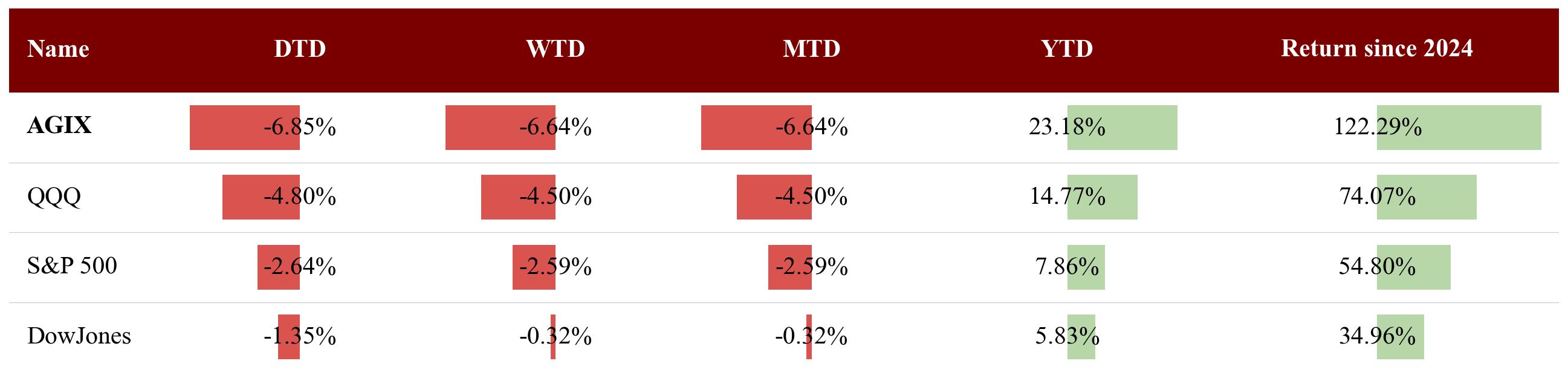
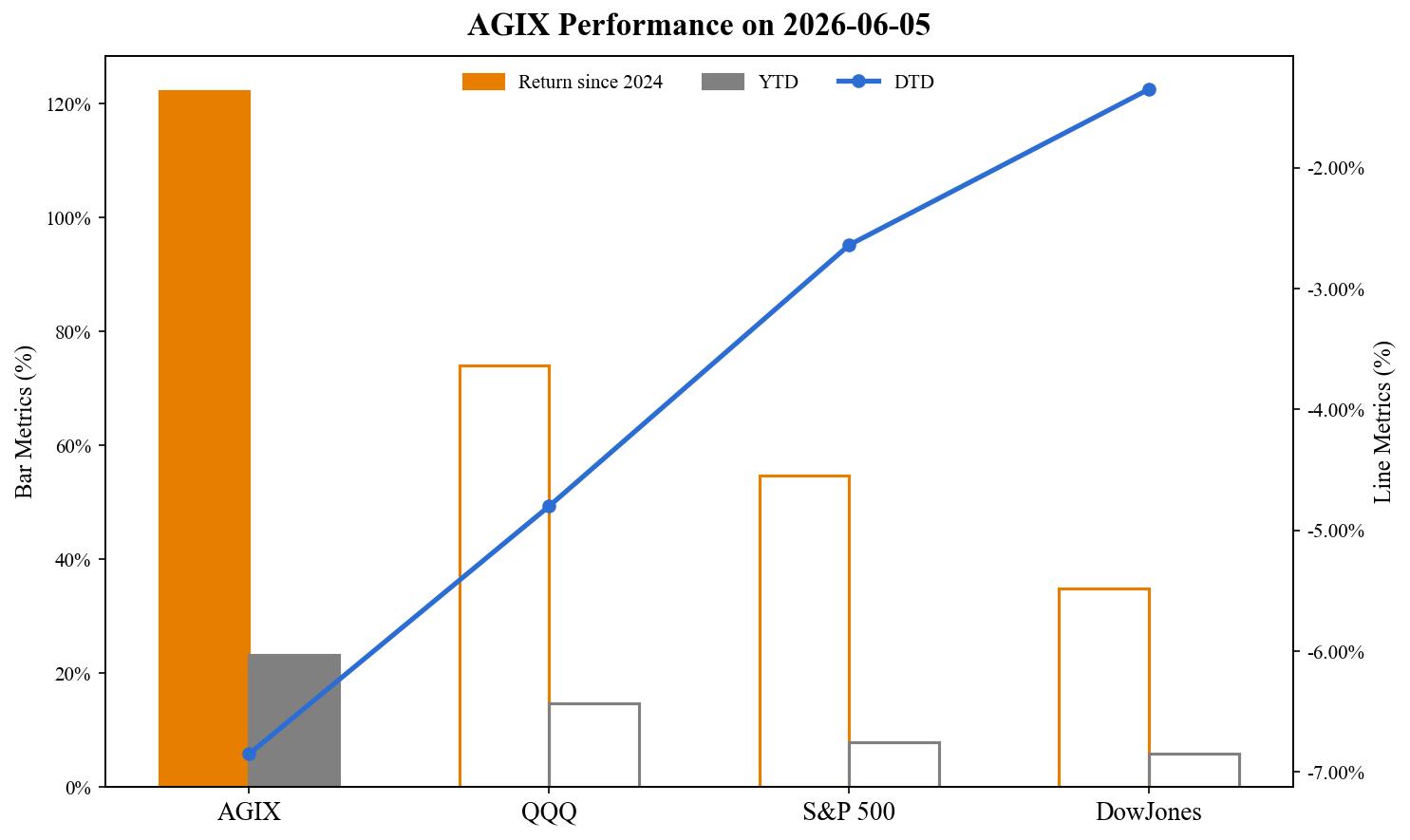
• AGIX fell 6.85% DTD, underperforming the S&P 500 (-2.64%), Dow Jones (-1.35%), and QQQ (-4.8%). The sell-off was broad-based, with weakness concentrated in hardware and infrastructure names.
• Key drags within AGIX: Arm Holdings (-12.84%), Micron (-13.25%), Astera Labs (-11.45%), and Nebius (-12.27%) led declines. NVIDIA (-6.2%) and Broadcom (-7.92%) also weighed heavily due to their large portfolio weights.
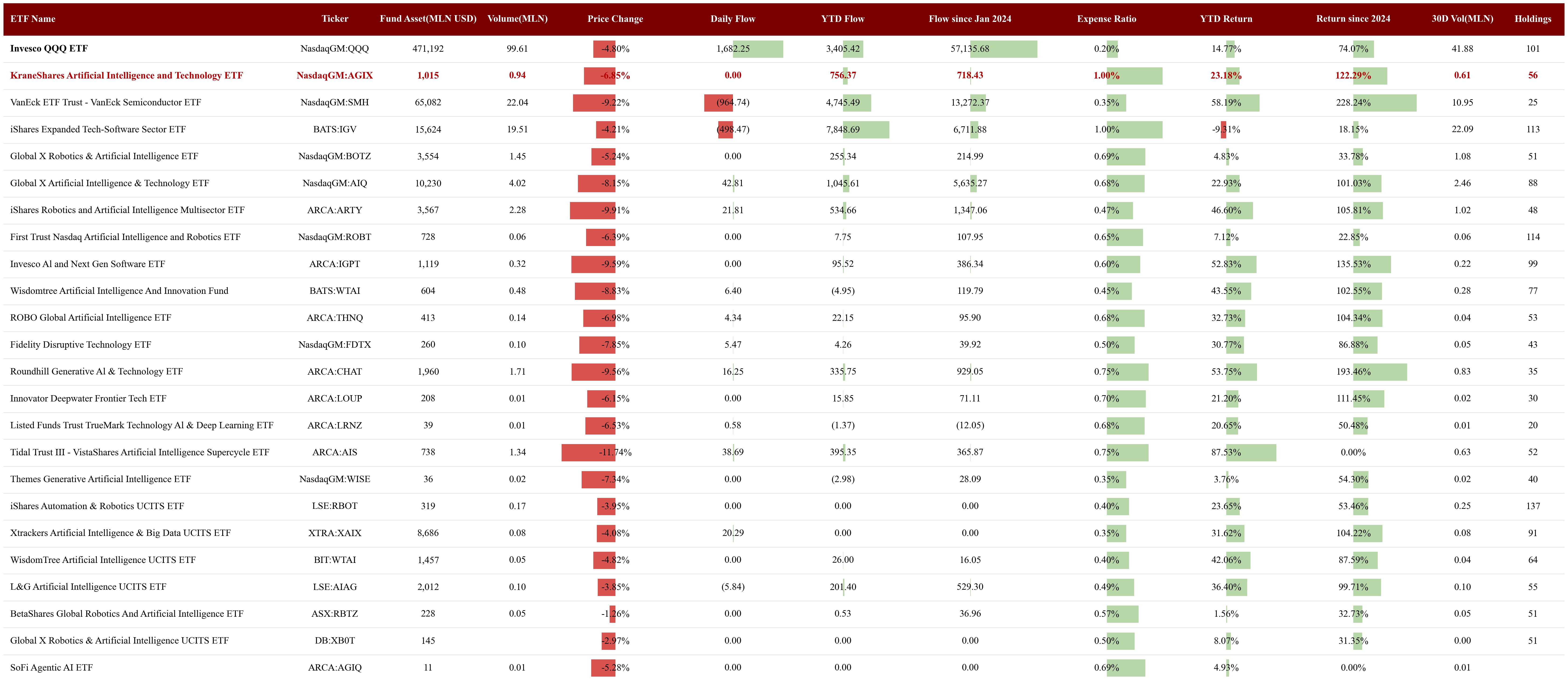
• On the positive side, Netflix (+0.76%) and NextEra Energy (+0.92%) bucked the trend, providing marginal support. The AI-focused peer ETFs CHAT (-9.56%), IGPT (-9.59%), and ARTY (-9.91%) saw even steeper drops, confirming a sector-wide risk-off tone.
• Stocks to watch: Micron (memory oversupply concerns), Astera Labs (AI connectivity demand), and Snowflake (governance/agent platform updates from its summit) are key given their news-driven moves and portfolio impact.
News Highlights
1. Anthropic filed for IPO after a $65B round, then called for a global AI pause. Its conservative compute strategy contrasts with peers, but the IPO could set a benchmark for AI financing. No direct AGIX holding impact, but sentiment may spill over.
2. Cloudflare acquired VoidZero (Vite toolchain) and disclosed that AI agent traffic now exceeds human traffic (57.4% of global web). This reinforces the AI infrastructure theme and benefits Cloudflare (AGIX holding, -6.9% DTD) as a key enabler.
3. Snowflake Summit 2026 emphasized open data architecture (Apache Iceberg) and AI governance, with partnerships from Capital One, Ericsson, and OpenGov. Snowflake (-2.42% DTD) is positioning as the intelligent backend for agents, a positive long-term catalyst.
4. Supabase raised $500M at $10.5B valuation, driven by AI coding tool growth (60% of DB launches). This highlights the AI developer tool boom, which indirectly supports AGIX holdings like Microsoft and GitHub Copilot.
5. OpenAI is building a 'super app' version of ChatGPT with coding and agent features, while also launching Lockdown Mode for data security. This intensifies competition with Anthropic but validates the enterprise AI platform thesis for AGIX holdings like Microsoft and Alphabet.
6. Google will pay SpaceX $9.82B/month for GPU compute, and Alphabet committed $180B in capex. This underscores the massive infrastructure spending wave, a tailwind for NVIDIA, Broadcom, and other AGIX hardware holdings.
7. Mira Murati's Thinking Machines Lab previewed an interactive model with real-time audio/video processing. Although early-stage, it signals ongoing innovation in AI interaction, which could benefit AGIX's application-layer holdings.
8. The Trump administration may take equity stakes in major AI companies like OpenAI, reshaping the national AI investment model. Policy uncertainty could affect valuations of AGIX holdings if government involvement expands.
RSS Highlights
1. AI's Black Friday: The tech industry lost ~$500B in market value overnight, with NVIDIA, Broadcom, and Meta hit hardest. The piece questions AI's productivity impact and notes even cash-rich firms must sell equity to fund investments.
2. No need to panic about Anthropic’s new blog: Gary Marcus argues AGI is far more complex than 'recursive self-improvement,' so Anthropic's warning should not cause alarm. S&P 500 index rules remain unchanged, a relief for investors.
3. AI-indecision is a recursive trap: The article warns that over-reliance on AI for decision-making can lead to paralysis, using Buridan's donkey as a metaphor. The key is to break the cycle and act with imperfect information.
4. Running Python code in a sandbox with MicroPython and WASM: Simon Willison released an alpha package for secure code execution within Python apps, using WebAssembly. This has implications for safe plugin ecosystems in AI tools.
5. OpenAI Help: Lockdown Mode: OpenAI launched a new security feature that restricts network requests to prevent data leaks, but notes it cannot fully stop prompt injection. A trade-off between security and functionality.
6. AI enthusiasts are in a race against time, AI skeptics are in a race against entropy: Charity Majors highlights the communication gap between AI optimists and critics, warning that lack of feedback mechanisms could become an existential threat to companies.
Performance & Benchmark
Attribution
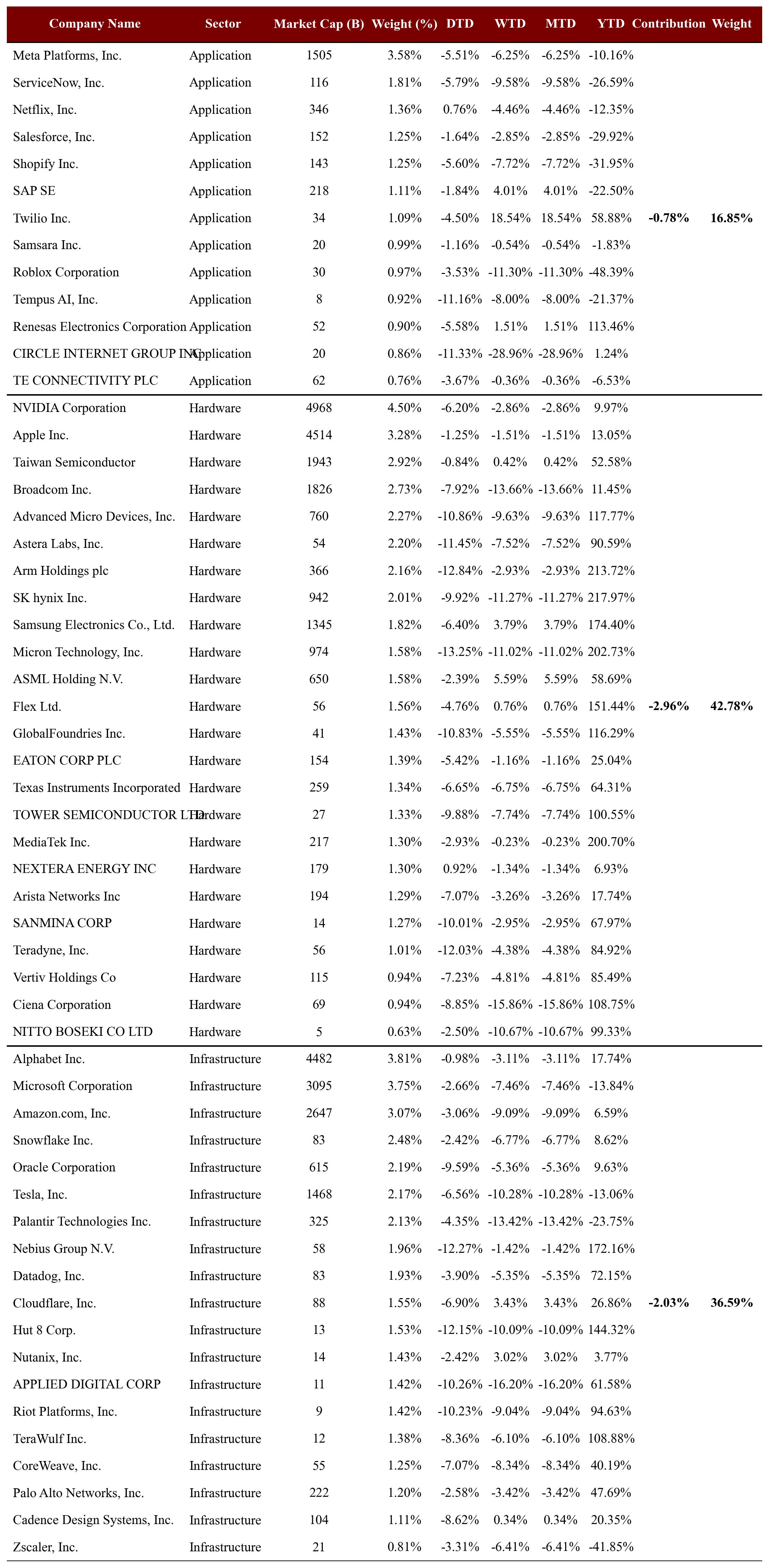
Contribution of the three sectors within AGIX holdings today
Application: -0.78%
Hardware: -2.96%
Infrastructure: -2.03%
Top-performing stocks in AGIX holdings today
Worst-performing stocks in AGIX holdings today
ASML Holding N.V. (-2.39%)
Nutanix, Inc. (-2.42%)
Snowflake Inc. (-2.42%)
NITTO BOSEKI CO LTD (-2.5%)
Palo Alto Networks, Inc. (-2.58%)
Microsoft Corporation (-2.66%)
MediaTek Inc. (-2.93%)
Amazon.com, Inc. (-3.06%)
Zscaler, Inc. (-3.31%)
Roblox Corporation (-3.53%)
TE CONNECTIVITY PLC (-3.67%)
Datadog, Inc. (-3.9%)
Palantir Technologies Inc. (-4.35%)
Twilio Inc. (-4.5%)
Flex Ltd. (-4.76%)
EATON CORP PLC (-5.42%)
Meta Platforms, Inc. (-5.51%)
Renesas Electronics Corporation (-5.58%)
Shopify Inc. (-5.6%)
ServiceNow, Inc. (-5.79%)
NVIDIA Corporation (-6.2%)
Samsung Electronics Co., Ltd. (-6.4%)
Tesla, Inc. (-6.56%)
Texas Instruments Incorporated (-6.65%)
Cloudflare, Inc. (-6.9%)
Arista Networks Inc (-7.07%)
CoreWeave, Inc. (-7.07%)
Vertiv Holdings Co (-7.23%)
Broadcom Inc. (-7.92%)
TeraWulf Inc. (-8.36%)
Cadence Design Systems, Inc. (-8.62%)
Ciena Corporation (-8.85%)
Oracle Corporation (-9.59%)
TOWER SEMICONDUCTOR LTD (-9.88%)
SK hynix Inc. (-9.92%)
SANMINA CORP (-10.01%)
Riot Platforms, Inc. (-10.23%)
APPLIED DIGITAL CORP (-10.26%)
GlobalFoundries Inc. (-10.83%)
Advanced Micro Devices, Inc. (-10.86%)
Tempus AI, Inc. (-11.16%)
CIRCLE INTERNET GROUP INC (-11.33%)
Astera Labs, Inc. (-11.45%)
Teradyne, Inc. (-12.03%)
Hut 8 Corp. (-12.15%)
Nebius Group N.V. (-12.27%)
Arm Holdings plc (-12.84%)
Micron Technology, Inc. (-13.25%)
Top five listed stocks contributing the most within AGIX holdings today
NVIDIA Corporation (-6.2%)
Arm Holdings plc (-12.84%)
Astera Labs, Inc. (-11.45%)
Advanced Micro Devices, Inc. (-10.86%)
Nebius Group N.V. (-12.27%)
Observation
The strongest movers across peer ETF holdings today are listed below:
| DTD | Stock Ticker | Name | Held by ETFs | analysis |
|---|---|---|---|---|
| 27.63 | LSE:RPI | Raspberry Pi Holdings plc | ['ARCA:THNQ', 'LSE:AIAG'] | HTTP 404: {"error":{"message":"No allowed providers are available for the selected model.","code":404,"metadata":{"available_providers":["perplexity"],"requested_providers":["openai"]}}} |
| 13.59 | TSE:3687 | Fixstars Corporation | ['LSE:RBOT'] | HTTP 404: {"error":{"message":"No allowed providers are available for the selected model.","code":404,"metadata":{"available_providers":["perplexity"],"requested_providers":["openai"]}}} |
| 11.35 | SEHK:1274 | iMotion Automotive Technology (Suzhou) Co., Ltd. | ['NasdaqGM:BOTZ', 'ASX:RBTZ', 'DB:XB0T'] | HTTP 404: {"error":{"message":"No allowed providers are available for the selected model.","code":404,"metadata":{"available_providers":["perplexity"],"requested_providers":["openai"]}}} |
| 10.96 | SEHK:2431 | Minieye Technology Co., Ltd | ['NasdaqGM:BOTZ', 'ASX:RBTZ', 'DB:XB0T'] | HTTP 404: {"error":{"message":"No allowed providers are available for the selected model.","code":404,"metadata":{"available_providers":["perplexity"],"requested_providers":["openai"]}}} |
| 8.99 | TSE:5631 | The Japan Steel Works, Ltd. | ['LSE:RBOT'] | HTTP 404: {"error":{"message":"No allowed providers are available for the selected model.","code":404,"metadata":{"available_providers":["perplexity"],"requested_providers":["openai"]}}} |
| 5.2 | TWSE:2303 | United Microelectronics Corporation | [] | HTTP 404: {"error":{"message":"No allowed providers are available for the selected model.","code":404,"metadata":{"available_providers":["perplexity"],"requested_providers":["openai"]}}} |
News
Funding & M&A
Ahead of its IPO, Anthropic’s Daniela Amodei shrugs off doubts about AI’s returns
AI company Anthropic recently announced plans to file for an IPO in a low-key manner, after completing a $65 billion funding round that valued the company at $965 billion. Co-founder Daniela Amodei said at the Bloomberg Technology Summit that frontier model training and inference services require massive capital, and public markets can provide better financing support. The company has an annualized revenue of over $40 billion, but faces uncertainty in enterprise AI spending efficiency. Anthropic chose to partner with xAI to obtain $125 million per month in computing power rather than building its own data centers. Unlike OpenAI and xAI, Anthropic is taking a conservative approach to expanding computing capacity. Analysts believe its IPO will set a new example for industry financing models.
Airbnb’s Brian Chesky plans to launch a new AI lab
Airbnb CEO Brian Chesky is preparing to establish his own AI research lab to address the shortcomings of existing frontier lab models. According to Bloomberg, the lab will focus on user interaction and design, aligning with the product philosophy Chesky has promoted at Airbnb. Chesky has a close relationship with OpenAI CEO Sam Altman, having helped him return to his position after his ouster, but now he is preparing to compete with his former mentor. According to people familiar with the matter, Chesky will remain CEO of Airbnb, and the new lab will be led by someone else. This move reflects tech leaders' dissatisfaction with the current AI ecosystem and their urge to reshape the field.
Anthropic calls for global pause in AI development before humans lose control
AI startup Anthropic warned in a new blog post that current AI technology is advancing too quickly, with models approaching the threshold where recursive self-improvement may become possible, and if not controlled in time, it could lead to massive societal shocks. The company proposed that the international community should pause or slow down the development of frontier models to allow social structures and alignment research to keep pace with technological progress. Anthropic recently completed a $65 billion funding round, valued at nearly $100 billion, and filed for an IPO, competing with OpenAI for market leadership. However, its warnings have also been met with skepticism, with some accusing it of using policy regulation to suppress open-source models. Although a global coordinated pause is extremely difficult, Anthropic will continue to promote policy discussions and technical verification mechanisms.
Financial technology provider Ramp raises $750M in funding at $44B valuation
Cloud expense management service provider Ramp Inc. recently announced the completion of a $750 million Series F funding round, co-led by ICONIQ, GIC, and the Ontario Teachers' Pension Plan, with participation from nearly 20 institutions including Lightspeed. The company is now valued at $44 billion, an increase of $12 billion in seven months. Ramp focuses on corporate credit card issuance and cashback services, while also offering accounting automation, supplier management, and travel booking features. Its newly launched Ramp Stack AI tool can quickly complete account reconciliation and financial statement preparation, and it has previously released AI agents for automated procurement and AI-powered spending intelligence tools. The company serves over 7,000 customers and has an annualized revenue exceeding $1 billion. The CEO stated that Ramp is becoming the infrastructure for intelligent spending.
Cloudflare acquires VoidZero, maker of the Vite JavaScript toolchain
U.S. cloud service provider Cloudflare announced the acquisition of open-source company VoidZero, the developer of JavaScript build tools Vite, Vitest, Rolldown, and Oxc. Vite has over 100 million weekly downloads and has become the default tool for JS/TS development. Cloudflare aims to integrate this toolchain into its Workers platform, enabling seamless connections from local coding to global deployment. The acquisition comes as AI-powered autonomous coding agents are changing the way applications are built, and Cloudflare emphasizes the need for faster, more predictable development environments. VoidZero founder Evan You will continue to lead the open-source roadmap, with related tools remaining under the MIT license and maintaining neutrality. Cloudflare also committed $1 million to support the Vite ecosystem. The company previously acquired Human Native, continuing its布局 in AI-native networks.
Supabase raises $500M as AI coding tools drive ‘phenomenal’ growth
The rising star Postgres database startup Supabase Inc. announced the completion of a $500 million Series D funding round, reaching a valuation of $10.5 billion. The round was led by Singapore sovereign wealth fund GIC, with all existing investors including Accel and Y Combinator participating. This marks another large-scale funding for Supabase after its Series E, bringing total funding to over $1 billion. The company focuses on an open-source Postgres-based secure, serverless backend platform, providing vector databases, Edge Functions, and other AI features for AI coding tools. Its newly released Multigres will support scaling users to OpenAI-level capacity. Supabase now has 250,000 users and 350 employees, positioning itself as a direct competitor to MongoDB and AWS Aurora. Investors praise its growth rate as unprecedented in the database space.
AirTrunk commits $30 billion to build 5 gigawatts of AI data centers in India.
Blackstone-backed data center operator AirTrunk announced on Friday that it will invest $30 billion in India by 2030, planning to add 5 GW of data center capacity. The company entered the Indian market earlier this year by acquiring Lumina CloudInfra and has secured a land letter of intent for a 3 GW project in Maharashtra, with an investment of 2.1 trillion rupees. The Indian government offers tax incentives for cloud service exports until 2047, attracting many global tech giants to increase AI infrastructure investment. Amazon, Google, Microsoft and others have also made large investments, but power and water resource constraints pose industry challenges. AirTrunk's expansion benefits from policy support, a pool of technical talent, and renewable energy.
The token bill comes due: Inside the industry scramble to manage AI’s runaway costs.
As AI adoption accelerates and autonomous agents drive token consumption to keep rising, many global companies are rapidly exhausting their AI budgets. Uber, Microsoft, Priceline and others have already experienced overspending, shifting from 'unlimited subscriptions' to seeking visibility, audit controls, and efficiency optimization. Against this backdrop, the Linux Foundation has launched the Tokenomics Foundation standard system, aiming to establish an AI token cost management framework similar to FinOps. Meanwhile, startups like Pay-i, Faros AI, and Jellyfish, as well as established vendors like Datadog and Ramp, have begun offering token tracking, ROI analysis, and model routing services. Goldman Sachs predicts token usage will grow 24-fold by 2030, and companies must explore new models for efficiency and cost balance before standards are perfected.
After filing for its IPO, Anthropic says we need the ability to slow down AI. Fat chance.
This week, multiple tech giants and AI startups have been active. Anthropic filed for an IPO and then called for a global pause on AI development to prevent technology from spiraling out of control. SpaceX plans to raise $75 billion through its xAI division. Snowflake, at its annual summit, emphasized the core role of data warehouses in the era of AI agents, aiming to become a control platform for "intelligent systems." Cisco, Microsoft, and Nvidia showcased AI networking, models, and chip achievements at their respective conferences. Nvidia also acquired Kumo AI. Several companies received large investments in the financing market, including Supabase and Suno AI. On the policy front, Trump signed a scaled-back AI executive order, and companies like OpenAI and Google face regulatory investigations. Data security and AI agent management have become new focal points. Competition in AI infrastructure and applications will intensify in the coming years.
TechCrunch Mobility: Inside GM’s $900M EV battery gamble
TechCrunch Mobility this week focuses on two major developments from General Motors and SpaceX. General Motors is investing $900 million to build a battery research center, adopting a new LMR chemical system, aiming to reduce the cost of the Chevrolet Silverado EV by $6,000, while introducing multiple in-house and external AI models to accelerate the overall vehicle development cycle. SpaceX's IPO registration documents have added new equity issuance terms, which the market interprets as a possible acquisition of Tesla, raising dilution concerns. In the electric vehicle sector, Carvana has received investment options from Slate Auto, Lectric eBikes has launched a third brand, the 2026 Subaru Solterra has upgraded power, range, and NACS interface, and Waymo is collaborating with B2U to use retired batteries to support the power grid. In terms of financing, Mach Industries has completed a $300 million Series C round, and Spiro has achieved a valuation close to unicorn status at $215 million. The industry is accelerating towards AI-driven, cost-optimized, and cross-sector collaboration.
The Trump administration might take an equity stake in OpenAI
U.S. President Trump said he has negotiated with AI companies on a partnership to let the American public share in the benefits of AI, including exploring government equity stakes. According to CNBC, the Trump administration is discussing with OpenAI the possibility of equity participation in its public wealth fund for direct distribution to citizens. Bjotman began promoting this concept as early as early 2025. This move is consistent with Trump's previous case of taking a 10% stake in chipmaker Intel. Senator Bernie Sanders proposed a 100% equity tax on OpenAI, Anthropic, and xAI to achieve public ownership. Former Trump AI and crypto commissioner David Sacks said the idea has cross-party appeal but warned it could accelerate government-corporate integration.
After filing for its IPO, Anthropic says we need a way to slow down AI. Fat chance.
This week, multiple AI and enterprise tech companies advanced IPOs, financing, and acquisitions. Anthropic filed for an IPO and then issued a safety warning, calling for a global pause before AI spirals out of control. SpaceX plans to raise $75 billion through its xAI division. Snowflake, at its annual summit, launched an AI agent solution, emphasizing the use of enterprise data to build intelligent systems. Cisco, Microsoft, and Nvidia showcased networking, model, and chip technologies at their respective conferences. Oracle, Apple, and other companies are about to release earnings or new products. Several startups received large funding rounds, including Supabase, Suno AI, and Ramp. On the policy front, Trump signed a scaled-back AI executive order, and OpenAI released a safety policy document. In the market, Marvell's stock surged, and HPE's earnings exceeded expectations. Major acquisitions also occurred in the database, security, and quantum computing fields. The battle for AI control will intensify in the coming years.
The most interesting startups right now want to get you off your phone
Recent AI funding rounds have repeatedly broken records, but some founders are starting to build in the opposite direction. Mirror founder Brynn Putnam is raising funds for Board, a company focused on bringing people together through offline games and social experiences. Cyberdeck makers are generating buzz with DIY computers, emphasizing a return to the real world. This trend of "communal technology" contrasts with the AI hype. Equity discussions also covered Anthropic's confidential IPO report and Alphabet's nearly $88 billion AI funding plan. As big tech companies continue to pour massive capital, smaller startups are still exploring more human-centric technology applications. This trend reflects new thinking about human-computer interaction in the market.
Supabase doubles valuation to $10B in 8 months
Open-source database platform Supabase has just completed a $500 million Series F funding round, achieving a post-money valuation of $10.5 billion and becoming a new decacorn. The round was led by Singapore sovereign investment fund GIC, with participation from existing and new investors including Stripe, Georgian, and Salesforce Ventures. Over the past year, Supabase database launches have grown more than 600%, with 60% driven by AI tools, and the user base has slightly increased to 10 million in nearly eight months. CEO Copple Coppersmith noted that Claude Code and Codex are the main drivers of growth. The company also launched the Multigres tool, positioning Postgres as an "operating system" for large-scale applications. Supabase insists on not adjusting its product roadmap for enterprise customers, and its contrarian growth strategy is paying off. Prior to this round, the company had completed a $100 million funding round in October.
Google will pay SpaceX $920M per month for compute
SpaceX, ahead of its first IPO, signed another computing capacity partnership, securing a major deal with Google. According to regulatory filings, Google will pay SpaceX $9.82 billion per month from October 2026 to June 2029 for 110,000 NVIDIA GPUs and related computing resources. This agreement is similar to a previous computing lease contract between SpaceX and Anthropic, which involved the entire computing power of the Colossus 1 data center. Google's order is about half of Anthropic's, primarily to meet surging customer demand for the Gemini Enterprise platform. Additionally, Alphabet has committed $180 billion in capital expenditures this year and plans to increase spending further in 2027. The two companies are also in talks to build an orbital data center. SpaceX's IPO, targeting $75 billion and a valuation of $1.75 trillion, is set to launch next week. Google, as an early investor in SpaceX, will see its stake valued at over $100 billion after the IPO.
OpenAI’s planned ‘superapp’ gets closer as one employee says ‘chat is dead’
According to the UK's Financial Times, OpenAI is advancing its plan to turn ChatGPT into a 'super app' and strengthening AI agent and autonomous coding robot features. This move aims to boost enterprise competitiveness and increase profitability ahead of a potential IPO by late summer. The report says the upcoming major upgrade will first launch on the web and mobile, enhancing the Codex coding tool, image generation, and third-party service integration. Company core product team lead Thibault Sottiaux stated that the platform will provide cross-device personal intelligent agents covering life and work scenarios. This transformation comes as Anthropic has just completed a $65 billion funding round with a valuation of $965 billion and filed for an IPO. OpenAI hopes to convince investors with its platform story to support a market cap exceeding one trillion dollars. This move will also affect the trillion-dollar IPO wave of companies like SpaceX.
Technical Breakthroughs
OpenAI unveils Lockdown Mode to protect sensitive data from prompt injection attacks
OpenAI recently launched a new Lockdown Mode feature aimed at further preventing prompt injection attacks. In this mode, ChatGPT will disable real-time web browsing, web image retrieval and display, deep research, and agent mode, allowing access only to cached content. OpenAI emphasizes that even with Lockdown Mode enabled, the system may still be affected by injection attacks, but this feature can effectively reduce the risk of sensitive data leakage. The feature is currently being gradually rolled out to ChatGPT Business self-service accounts and eligible personal accounts, primarily targeting users and organizations handling sensitive data. OpenAI stated that this move is not for all users but provides targeted protection for scenarios requiring higher security.
AI agent web traffic has surpassed that of humans, lending weight to the ‘dead internet’ theory
Cloudflare CEO Matthew Prince announced that AI agent traffic has surpassed human users for the first time, accounting for 57.4% of global web traffic. This milestone arrived much earlier than the previously predicted end of 2027, highlighting that the development of generative AI is outpacing expectations. Cloudflare Radar data shows that AI agents are reshaping the internet traffic landscape by scanning thousands of websites per query, with agent traffic in North America reaching as high as 68.6%. This trend has sparked renewed discussion of the 'dead internet' theory, but Prince believes AI tools are actually lowering the barrier to content creation, allowing more people to participate in building the internet. Data reveals significant regional differences: Asia and South America are still dominated by human traffic, while Europe and Africa are already led by agents.
Product Launches
Dell sharpens data protection strategy as AI reshapes cyber resilience
Dell Technologies' recent earnings report showed strong sales of AI servers, drawing more attention to the company's data protection business. Vice President Simon Jelley noted in an interview that as AI hacking attacks rise, companies need faster and smarter protection methods. Dell has launched the PowerProtect product line, offering single-console management of data security and integrating an AI assistant to help users identify vulnerabilities and develop optimal strategies. The company connects data from server, storage, and other businesses to reduce threat detection time. Jelley said attacks are unavoidable, and the key lies in rapid recovery and minimizing damage. This move will drive companies' data security capabilities in the AI era.
Augment Code launches Cosmos to bring agentic AI software development to teams.
Augment Code Computing Inc., a provider of AI agent platforms, recently launched the Cosmos service, aiming to upgrade AI coding assistants into a team collaborative work mode. Beyond individual developer agents, the platform addresses context gaps among team members through cross-team knowledge sharing and internal organizational planning. Cosmos supports agents autonomously executing a large amount of work, while humans handle priority sorting, specification validation, and high-risk decision-making. The platform also integrates an internal knowledge learning mechanism, enabling knowledge accumulation through multiple touchpoints such as Slack. Additionally, Cosmos offers expert routing functionality, allowing non-technical personnel to directly access internal resources like data analysis. The service is set to propel team-level AI applications into a new phase by 2026.
Policy & Regulation
Is this the dawn of the Tokenpocalypse?
Microsoft recently announced a major pricing adjustment for GitHub Copilot, shifting from fixed subscriptions to token-based billing, sparking widespread industry discussion about AI cost control. On the Equity podcast, TechCrunch editors analyzed that this change signals the AI ecosystem moving from subsidy-driven to cost-pass-through models. Companies like Uber have begun restricting internal AI usage, reflecting how high token consumption is rapidly eroding profit expectations. As companies such as Anthropic prepare for IPOs, investors and regulators will closely monitor their risk disclosures. The latest executive order from the Trump administration requires review of powerful AI models, further highlighting policy uncertainty. The industry faces dual challenges of pricing mechanism restructuring and technology cost reduction, and AI companies must achieve long-term sustainability through business model transformation.
Sriram Krishnan is leaving his role as White House AI advisor
Former tech executive and venture capitalist Sriram Krishnan will leave the Trump administration at the end of June, ending his tenure as Senior Policy Advisor for AI at the White House. Krishnan previously led product teams at Microsoft, Twitter, Yahoo, Facebook, and Snap, and most recently was a partner at Andreessen Horowitz. On social media, he thanked Trump for his leadership and listed the administration's achievements on the AI action plan, data center construction, and multiple executive orders, while also mentioning close collaboration with David Sacks. After leaving, he plans to establish an external organization to continue influencing the Trump administration's AI policy, focusing on key issues such as energy, data centers, and bringing AI benefits to Americans. This move highlights the flow of tech talent within the Trump administration and the ongoing evolution of AI policy.
Industry Partnerships
As enterprise AI scales, Capital One and Snowflake focus on governance and trust
As AI adoption accelerates, data governance and sharing are becoming top priorities for enterprises. Capital One executive Christina Egea stated at Snowflake Summit 2026 that the company relies on Snowflake's data sharing capabilities to achieve granular visibility and control over data inflow and outflow, providing security support for the highly regulated financial services industry. Snowflake's Prasanna Krishnan emphasized that the latest upgrade to Horizon Catalog integrates open data sharing for Iceberg, controlled access for external engines, and AI catalog features, using AI to automate metadata management and context building, significantly reducing manual work and improving usability. The collaboration model between the two demonstrates deep integration of cloud data platforms and financial institutions in AI-driven governance, offering a replicable solution for other regulated industries.
How SiriusXM and Snowflake are using AI to power personalized media experiences
Artificial intelligence and audio audience intelligence are reshaping how the media industry understands consumers. SiriusXM Chief Officer of Advertising Products and Technology Sherene Hilal noted that by extracting data such as audio context, tone, and speech transcripts, more precise audience targeting and personalized experiences can be achieved. Snowflake Global Head of Marketing Technology, Media, and Entertainment Dennis Buchheim announced Cortex Sense at Snowflake Summit 2026, which helps enterprises interpret customer data through semantic understanding and ontology building. The collaboration between the two promotes the integration of audio signals with third-party data to build a 360-degree customer view, enhancing advertising precision and content personalization. Both emphasized the value of long-tail data, enabling mainstream media and niche content to more effectively connect with target audiences.
Ericsson and Snowflake chart an enterprise AI data strategy
At Snowflake Summit 2026, Ericsson and Snowflake announced a deepening partnership. Elena Fersman, Vice President of AI Innovation at Ericsson, stated that the company has undergone nearly 150 years of transformation, evolving from a wireless hardware company into an AI-native enterprise. The key is to first establish a unified data foundation before deploying AI. Ericsson has already launched a "talk to your network" feature, leveraging Snowflake Cortex AI to enable natural language queries of the network, predict degradation, and perform root cause analysis. Christian Kleinerman, Vice President of Product at Snowflake, emphasized that enterprises must first address data silos to give AI full context. The two companies are jointly advancing telecom network automation and ensuring GDPR compliance through strict data governance. This partnership serves as a model for global communications and cloud data giants, accelerating the deployment of AI in network operations.
OpenGov and Snowflake build a knowledge graph to unify government data and AI.
At the Snowflake Summit 2026, OpenGov executives Nickhil Tekwani and Jon Sweet, along with Snowflake Postgres Engineering Director Craig Kerstiens, jointly revealed the data management crisis facing government software and its solutions. OpenGov is building a company-wide knowledge graph based on Snowflake Postgres, unifying structured and unstructured data from hundreds of data sources into a single semantic layer for real-time querying by humans and AI agents. This will support the company in shifting from reactive support to proactive service for its 2,000 county, state, and city government clients across the United States. Snowflake has integrated enterprise-grade Postgres into its platform through the acquisition of Crunchy Data, eliminating fragile ETL pipelines and unifying transactional and analytical data. The three speakers emphasized that only with a trusted semantic layer and data layer can AI outputs meet the government's extremely high reliability requirements. OpenGov is replicating its internal knowledge graph technology to governments nationwide, helping to build intelligent public services.
NASA briefly sheltered space station astronauts in SpaceX’s Dragon due to leaks.
NASA recently instructed the four SpaceX Crew-12 mission members and one astronaut aboard the International Space Station to take shelter inside the docked Crew Dragon spacecraft for safety. This was due to a new leak discovered in a service module by the Russian space agency Roscosmos, which will carry out extensive repair work. During the repairs, NASA and Roscosmos maintained close coordination. After about an hour, the repair work was paused for data evaluation, and NASA then lifted the shelter-in-place order, allowing personnel to resume normal operations. This incident reflects the close cooperation between the two countries in ISS operations and also highlights the critical role of commercial spacecraft in station emergencies. As ISS retirement plans progress, the long-term sustainability of the multinational joint system has become a focus of attention.
Startup Battlefield 200 applications officially close in 3 days.
U.S. tech media TechCrunch officially announced that the Startup Battlefield 200 application window will close on June 8 at 23:59 Pacific Time. Selected startups will attend the TechCrunch Disrupt conference at Moscone West in Fangshan in October 2026, meeting investors, media, and the global venture ecosystem face-to-face. The ultimate winner will receive $100,000 in equity-free funding. Alumni have collectively raised $52 billion in funding and include well-known companies such as Dropbox and Discord, many of which have been acquired by giants like Google and Microsoft. This event is open to startups with an MVP, aiming to create direct opportunities for them to connect with the capital market.
Notion restores access to Anthropic after service disruption
This weekend, Notion AI experienced a temporary outage with Anthropic's model integration. On Sunday morning, Notion reported degraded performance of Opus 4.7 and 4.8 models, leading to increased user access failure rates, and thus temporarily disabled all Anthropic models. About twelve hours later, Notion's product lead Max Schoening reiterated that the issue was a temporary infrastructure disruption, not a model quality problem. An Anthropic spokesperson also stated that multiple Claude models had errors due to infrastructure failures, and services have now been restored. Both parties have reopened access to Anthropic models in Notion AI, with minimal impact on user experience. This incident highlights the stability challenges AI service providers face under high-concurrency scenarios.
Four insights you might have missed from theCUBE’s coverage of IBM Think.
IBM, at its 2026 Think conference, emphasized its core position in enterprise AI, relying on the IBM Z mainframe, watsonx platform, and sovereign core platform to provide trusted hybrid AI infrastructure and governance capabilities. IBM Consulting unified the management of over 4,000 digital workers, achieving a 20% profit increase and $4.5 billion in productivity savings. The company also launched the Sovereign Core platform, embedding compliance controls into runtime to help customers balance risk and controllability. IBM is collaborating with institutions such as BNP Paribas to drive agent workflow restructuring and sovereign AI deployment. Analysts believe that IBM's path to productizing workflow-level outcomes provides a sustained competitive advantage for enterprise AI.
Snowflake pushes interoperability-first vision as Apache Iceberg gains enterprise momentum
As AI adoption accelerates, open data architecture is becoming key for enterprises to access and share data across platforms. Snowflake Chief Product Manager James Rowland-Jones and Principal Engineer Russell Spitzer said in an interview at Snowflake Summit 2026 that Apache Iceberg's interoperability has become an industry standard, helping users read and write data from any engine without copying it. They noted that open standards allow agents and AI applications to directly access databases, significantly reducing complexity. After Snowflake embraced Iceberg in response to customer demand, the market response has been enthusiastic, with new tools and engines integrating seamlessly. As the standard matures, enterprises can flexibly choose their tech stack and improve data governance efficiency. Experts believe this shift is driving the data ecosystem toward a more open and connected direction.
Mira Murati steps back into the spotlight, carefully.
Former OpenAI CTO Mira Murati, in her first major media appearance since leaving, discussed the latest progress of her new company, Thinking Machines Lab. Over the past year and a half, the company has focused on fundraising, recruiting researchers, and launching an open-source AI model fine-tuning API product called Tinker. Murati previewed the 'interactive model' the company is developing, which can process audio, text, and video streams in real time within 200-millisecond intervals, better capturing interruptions, corrections, and thinking pauses in human communication. She also reviewed the chaotic events of November 2023 when the OpenAI board fired Sam Altman, emphasizing the decision-making logic behind protecting the mission and the team at the time, while pointing out that the industry should establish more structural checks. She warned that if humans give up control too early, the future of AI could deviate significantly from expectations.
Snowflake, Databricks and the model makers: The battle for the agentic client and AI back end
Agentic AI is reshaping enterprise software architecture, with the core debate shifting from point tool battles to who controls the new intelligent client and intelligent system backend. Companies like Snowflake, Databricks, Microsoft, Google, OpenAI, and Anthropic are attempting to transform enterprise rules, tacit knowledge, and behavioral traces into system intelligence usable by both agents and humans through tight coupling of agentic clients and data intelligence layers. This system needs to build a tight loop based on data gravity, business rules, and user feedback to achieve a transformation from individual productivity to organizational intelligence. In this context, events like Snowflake, Microsoft Build, and Databricks show that major vendors are competing to capture high-value control points in the agentic enterprise through integrated innovation and extreme co-design. Whoever can establish the fastest feedback loop will determine who dominates the AI software stack.
OpenAI is still working on that ‘super app’
According to the Financial Times, OpenAI is planning to launch a new version of ChatGPT in the coming weeks, which will be built as a 'super app' integrating programming tools and AI agents. This move aims to strengthen competitiveness against Anthropic in the enterprise customer segment and strive for profitability before an IPO. OpenAI will use this platform to guide free users towards paid products, such as Codex. Core product lead Thibault Sottiaux stated that the company is moving towards personal intelligent agents that support users' life and work panoramas. Previously, OpenAI launched standalone products like Sora, but has now adjusted its strategy, abandoning 'side projects.' This development reflects major adjustments in technology paths and business models for AI companies.
融资收购
US government could take stakes in major AI companies
The U.S. government is considering a new proposal to allow the public to share in the benefits of AI by holding equity in leading artificial intelligence companies. According to NOTUS and Politico, President Trump has confirmed that he will meet with "all major" AI developers at the White House next week. The plan may require companies like OpenAI to donate equity, with the proceeds used to distribute dividends to American families. Previously, Nobel laureate Bernie Sanders suggested the government hold a 50% stake, and Trump indicated there is consensus between the two sides on economic issues. This move is similar to the Commerce Department's recent practice of issuing $2 billion in quantum computing grants to companies like IBM and GlobalFoundries in exchange for equity. If implemented, this policy would reshape the U.S. model of national involvement in AI.
After filing for its IPO, Anthropic says AI should slow down. Fat chance.
This week, multiple AI companies have been active. Anthropic, after filing for an IPO, called for a global pause in AI development to prevent technology from spiraling out of control. SpaceX plans to raise a record $75 billion through its xAI unit in the largest IPO in history. Snowflake, at its Summit, emphasized its data advantages, aiming to become the "intelligent system" control platform for AI agents. Cisco, Microsoft, and Nvidia showcased AI networking, models, and chip technologies at their respective conferences. Nvidia also acquired Kumo AI and released a new generation of RTX chips. Several AI startups secured large funding rounds, including Supabase, Suno AI, and Generalist AI. On the policy front, Trump signed a scaled-down AI executive order, while OpenAI and the White House diverged on security perspectives. Major earnings reports and conferences, including Oracle and Apple WWDC, are upcoming. Overall, the AI sector is at a peak of funding, acquisitions, and technology planning.
RSS Subscription
Rotation revisited: Cycle decomposition in clang's libcxx
The loop decomposition algorithm in Clang's libcxx treats rotations as permutations, traverses each cycle, and performs approximately n/2 swaps, where n is the total number of elements. This algorithm uses the greatest common divisor (gcd) to determine the number of cycles and rotates elements within each cycle, though its locality is poor. Notably, the three major implementations of the C++ standard library each use different rotation algorithms.
Update: ending paid subscriptions, + Substack
Update: Ending paid subscriptions. The author has decided to shut down paid subscriptions, believing that their work should be free and open for broader access. Over the next week, the author will migrate writing to Substack to leverage its network effects and multimedia tools to drive creativity. Thanks to all supporters, and looking forward to sharing more exciting content with everyone.
From Kepler to Bessel
This article explores in detail Kepler's equation and its relationship with Bessel functions. Kepler's equation describes a planet's position in an elliptical orbit. Given the mean anomaly M, the eccentric anomaly E needs to be solved. Since there is no simple direct method to solve for E, common approaches include iterative methods and Newton's method, or expanding E as a sine series and computing the series coefficients, so that with known coefficients, E can be conveniently solved for different values of M.
Pluralistic: Criticizing the everything machine (06 Jun 2026)
Recent discussions on AI governance face numerous complex viewpoints and claims, making it nearly impossible to cover comprehensively in a limited time. The economic model of the AI industry has serious issues, with many companies relying on massive subsidies to sustain operations, resulting in extremely poor profitability. The future sustainability of AI development depends on whether someone is willing to provide financial support and whether these companies can avoid bankruptcy in the short term.
AI's Black Friday
In 'AI's Black Friday,' the tech industry lost about $500 billion in market value overnight, with major affected companies including Nvidia, Broadcom, and Meta. Meanwhile, Musk leased 110,000 GPUs from Google, indicating an excess demand for hardware, and even cash-rich companies like Google and Meta had to sell equity to continue supporting their AI investments, reflecting the industry's struggles. In the future, AI's impact on actual productivity may be lower than expected.
Reading List 06/06/26
This week's news summary includes: a New York Times reporter successfully used an AI chatbot to replace a real estate agent to sell a house; Florida plans to effectively eliminate property taxes for most homeowners by raising the exemption amount; advances in AI technology have benefited Chinese synthetic diamond manufacturers, and these diamonds are used in semiconductor cooling systems.
There's still no point in gigabit broadband
Six years ago, I almost pushed my internet service provider to upgrade my fiber connection to 1Gbps. Now, Virgin Media offers the Gig1 package at £30 per month. Although the price is reasonable, I'm still wondering if it's too extravagant. For most home users, including remote workers, 100Mbps is usually sufficient, and 1,130Mbps is hard to fully utilize in practice. While future demand may be higher, current applications don't really justify this speed.
Getting silly with C, part &((int*)-8)[3]
This article is the fourth part of a series on C language basics, covering topics such as function definitions, operator precedence, the goto statement, and counting and addition. It recommends using forward declarations when defining functions to reduce compilation errors, and emphasizes strict operator precedence. The article also demonstrates how to use the goto statement and effective counting methods.
In pursuit of desirable difficulties
Psychologist Robert Bjork proposed the theory of 'desirable difficulties,' which suggests that learning is more effective when facing challenges, and students retain knowledge longer when they struggle to recall answers. The same applies to writing: personally wrestling with language allows you to understand your arguments more deeply, while machine-generated paragraphs lack this 'fingerprint.' Although machine-generated text may look good, it cannot replace genuine thinking and effort. Therefore, before submitting the final draft, reflect on your own contribution.
Why all the PRs?
In the current job market, many job seekers use AI to generate code to increase their contributions on GitHub, thereby making their resumes more attractive. However, this practice often conflicts with the goals of open-source project maintainers, as contributors do not truly engage with the project, instead adding to the maintainers' burden. Truly valuable open-source contributors should focus on solving problems and teamwork, rather than simply pursuing quantity.
Pluralistic: Refining humanity (05 Jun 2026)
The complexity of modern technology reveals the limitations of human understanding, especially when interacting with computers. Programming not only requires translating seemingly simple concepts into clear instructions but also confronts the computer's misunderstandings and limitations regarding reality. Historically, the software industry has focused more on writing efficient and reliable code than on accurately reflecting reality, leading many programmers to misunderstand basic concepts.
JAX backends and devices
When porting PyTorch LLM code to JAX, the author attempted to load a large dataset containing 10,248,871,837 16-bit unsigned integers, with a data volume exceeding 19 GiB, but encountered a CUDA out-of-memory error. By exploring JAX's device management, the author discovered that using a context manager to temporarily set the default device to CPU allowed the data to be loaded successfully.
Premium: The Hater's Guide To The AI Bubble 3.0
Last year, I wrote "The AI Bubble Hater's Guide" and subsequently released a second volume. The AI bubble is seen as the largest exploitation of ignorance in history. Although large language models (LLMs) do exist, they have not fulfilled many of the exaggerated promises. Currently, the actual revenue of the AI industry has not yet exceeded $100 billion, and most companies are not profitable from AI investments. There is a huge gap between market expectations for AI and reality.
Sir Demis Hassabis vs Sir Demis Hassabis
In a speech at Stanford University, Nobel laureate Sir Demis Hassabis stated that artificial general intelligence (AGI) could be achieved around 2030, while at the Davos forum a few months earlier, he predicted AGI would be realized between 2031 and 2036. He emphasized that AGI should possess all human cognitive abilities, including creativity and physical intelligence, and that current systems are still far from this goal.
The back cover of C++: The Programming Language also raises questions not answered by the front cover
A recent comment pointed out that several textbooks published by Larson and Keller use similar templates on their covers and back cover descriptions, with content that is vague and lacks specificity, almost applicable to any textbook. These books cover topics across multiple fields and claim to provide students with important insights, but in reality, they offer no concrete information or unique value.
Rotation revisited: avoiding having to calculate the greatest common divisor when performing cycle decomposition
Math is hard, let's count! For a discussion on avoiding computing the greatest common divisor during loop decomposition, see the related link.
Mr. Bessel's eponymous functions
Yesterday's article showed how the trapezoidal rule efficiently computes integrals, but how do we determine the exact integral value for comparison? According to Mathematica, the integral equals −2π J1(1), where J1 is a Bessel function. By converting the integral into the definition of a Bessel function, we link the integration problem to a well-studied function that has been researched for two centuries, with various software available for its computation.
First Commodore PET sold, June 5, 1977
On June 5, 1977, Commodore showcased its PET 2001 personal computer at the Summer Consumer Electronics Show and received its first distributor order that same day, becoming one of the three pre-assembled personal computers of 1977. The PET 2001 was priced at $495, later rising to $595, and featured a built-in monochrome monitor, a tape recorder, and 4KB of memory. Its designer, Chuck Peddle, negotiated a one-time license agreement with Microsoft, embedding Microsoft BASIC into the PET. Although Commodore produced only 500 units that year, demand far exceeded expectations, and by the end of the year, all three computers had waiting lists.
I tested every IP KVM in my Homelab
Since the launch of PiKVM in 2017, IP KVM devices have grown rapidly, offering solutions for remote computer control. High-end IP KVMs feature capabilities such as HDMI passthrough and PoE support, with prices ranging from $50 to $400. While these devices offer convenience, they also pose security risks, requiring careful use and regular updates.
Aggressive caching for a Mastodon reverse proxy: what to cache, what to never cache, and why content negotiation will eventually betray you
In the configuration for the Mastodon instance mastodon.bsd.cafe, nginx is used as a reverse proxy to handle repeated public requests, avoiding direct impact on the application server. This configuration assumes that safe mode is not enabled, ensuring that all ActivityPub GET responses are cached as public content at the proxy layer, with precise caching strategies to optimize performance, including short-term caching for dynamic pages and federation endpoints, and medium-term caching for user-uploaded media.
AI-indecision is a recursive trap. Don't get stuck.
Hesitation in AI decision-making is a circular trap that can lead to decision paralysis. Historically, Buridan's donkey problem illustrates that when faced with perfectly identical options, a rational being may fall into endless deliberation without taking action. Modern people face a similar dilemma, especially when using AI-assisted decision-making, where repeated queries and feedback can deepen hesitation rather than produce a clear choice. The key to decision-making is to break this cycle and act promptly, even with imperfect information.
No need to panic about Anthropic’s new blog
Anthropic's new blog post showcases significant progress in its system's code-writing capabilities, but emphasizes that AGI (Artificial General Intelligence) is more complex than 'recursive self-improvement,' so there is no need for excessive panic. Meanwhile, the S&P 500 index has not modified its rules, and SpaceX will not be quickly added to index funds, which is good news for investors.
60 Minutes Correspondents Lesley Stahl, Bill Whitaker, and the Other Guy Will Stay at Show
In a memo to the '60 Minutes' team, Lesley Stahl, Bill Whitaker, and Jon Wertheim expressed deep disappointment over the dismissal of Tanya and Draggan, calling it an attack on the program's values and independence. They decided to stay with the show because they do not want to see '60 Minutes' die.
Trump Lawyer Argues Trump Can Tear Down Statue of Liberty
During today's hearing regarding the president's demolition of the White House East Wing and construction of a large ballroom, a judge asked whether the president could tear down the Statue of Liberty without legal challenge. A Justice Department lawyer stated that the president could indeed make such a decision, raising profound questions about presidential power, pointing out that the president does not own the nation or its property but is hired to manage and enforce the law. This argument reveals the absurdity of the 'unitary executive theory,' emphasizing that this theory runs counter to the original intent of the U.S. Constitution's framers.
This Week in Package Management: 6 June 2026
This week's updates include the addition of five new project blog feeds and the NixOS announcement feed. Security Bundler 4.0.13 introduces a configurable cooldown window to prevent maliciously published gem versions from being installed quickly. NixOS 26.05 adds 20,442 packages and updates 20,641 packages, while removing 17,532 packages; this is the last platform version supporting x86_64-darwin. The Rust Foundation launched the 'Resident Maintainer' program this week, providing funding for maintainers of existing Rust projects.
micropython-wasm 0.1a2
micropython-wasm version 0.1a2 adds a command-line interface (CLI), inspired by a blog draft, to better showcase the 'try it yourself' section.
Running Python code in a sandbox with MicroPython and WASM
I recently released an alpha package called micropython-wasm for running Python code in a sandbox, as a plugin for Datasette Agent. My goal is to safely execute code within Python applications, ensuring plugin code runs in a controlled environment to prevent potential security risks such as memory overflow and improper file access. By using WebAssembly and MicroPython, I successfully built a prototype library that can execute Python code inside a WebAssembly sandbox.
Our Great War is a Spiritual War
This great war is a spiritual war. People pursue convenience, safety, and comfort, but in the future world, these priorities may lead to ruin. Technology will eliminate friction in life, making people completely dependent on the organizations that provide these conveniences, ultimately leading to the complete outsourcing of the individual self and the loss of essence as a living being.
Communities of Not
In communities formed around a certain taboo, members often build identity through opposition, yet this opposition can sometimes evolve into surveillance and hatred of others. While resisting certain things is reasonable, using refusal as a justification for collective harassment is unacceptable. We should maintain an open mind, accept different viewpoints, and avoid falling into negative group behavior.
OpenAI Help: Lockdown Mode
On June 5, 2026, OpenAI launched 'Locked Mode,' designed to prevent data leaks by restricting network requests, applicable to personal accounts including free and paid accounts. Although Locked Mode enhances security, it cannot fully prevent prompt injection attacks, and users need to be aware of the trade-off between functionality and practicality. For high-risk users, Locked Mode is an effective security tool.
Nieman Journalism Lab: Twitter/X Punishes Accounts That Post Links
Elon Musk pointed out that links in tweets reduce engagement rates. The latest analysis shows that links in tweets from 18 news publishers indeed have a negative impact on engagement. Although The New York Times has 53 million followers, its tweet engagement remains very low, highlighting the challenges traditional news publishers face on social media. In contrast, aggregated news accounts without links, such as Globe Eye News, achieve higher engagement rates despite having fewer followers.
Elon Musk’s X Is a Freak Show
The social media ecosystem is unhealthy, especially on Twitter, leading to strange phenomena among some influential accounts. Although social media traffic is becoming less relevant to media business strategies, Silver Bulletin's content views grew by 40% between the first quarter of 2025 and the first quarter of 2026. Currently, traffic from external social channels accounts for only 0.7% of overall website page views.
Checking in on Perplexity
According to Bloomberg, Apple executives are discussing the possibility of acquiring AI startup Perplexity AI to help develop an AI-based search engine, especially as its long-term partnership with Google faces threats. Although the discussions are at an early stage and Apple has not yet formally approached Perplexity's management, this acquisition could open new directions for Apple. Perplexity primarily uses models from companies like OpenAI and has not independently developed its own technology.
Install-script allowlists
Most package managers run installation-time code by default when installing dependencies, such as npm's postinstall and Setuptools's setup.py. Some tools require explicit per-package opt-in to run such code, often called an allowlist or trusted dependency list. npm introduced per-package allowlisting in version 11.10.0 in February 2026, while pnpm blocked install scripts by default in version v10 in January 2025 and manages allowlists via configuration files. Deno introduced explicit script approval functionality in a mid-2024 version, ensuring that unapproved packages do not execute their scripts during installation.
Quoting Andreas Kling
Ladybird browser will no longer accept public pull requests. Future changes will be decided and their consequences borne by those responsible for the project, to ensure it works for real users.
The Giant's Cup
I recently completed my first long-distance trail race, which took place in the Southern Drakensberg Mountains over two days—30 kilometers on the first day and 15 kilometers on the second. To prepare, my partner Emma and I ran 2–3 times a week. After 15 weeks of training, our running ability improved significantly, and we successfully finished the race. This experience introduced me to a whole new community and activity, and made me enjoy running in nature with friends even more.
Some People Rooted for The Empire in ‘Star Wars’, Too
CBS News fired Scott Pelley, the host of 60 Minutes, for showing serious insubordination. In a letter, new executive producer Nick Bilton pointed out that Pelley opposed the show's future direction and emphasized that his behavior constituted grounds for dismissal. Pelley's annual salary was as high as $5 million, but he did not make significant contributions to the show's history. CBS expects to find a suitable replacement at a lower cost.
AI enthusiasts are in a race against time, AI skeptics are in a race against entropy
On June 4, 2026, Charity Majors pointed out a dynamic competition between AI enthusiasts and skeptics: the former are rapidly advancing AI technology applications, while the latter express concerns about the technology's reliability. She emphasized that the lack of effective feedback mechanisms makes communication between the two groups difficult, leading to a loss of trust and knowledge, which could pose an existential threat to companies. Solving this problem requires treating it as both a leadership and engineering challenge.