AGIX Daily Report 2026-06-08
AI Summary
Market Overview
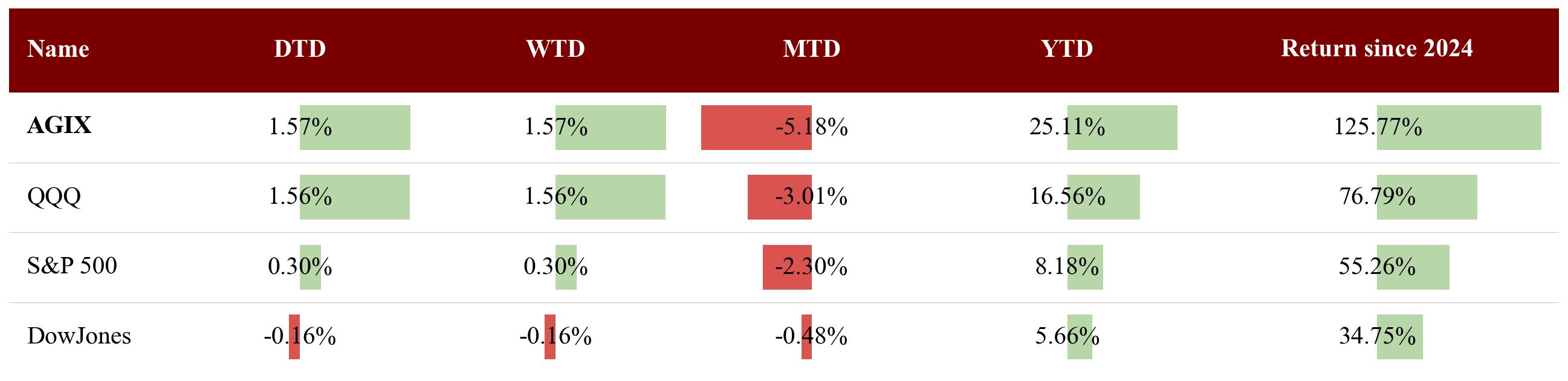
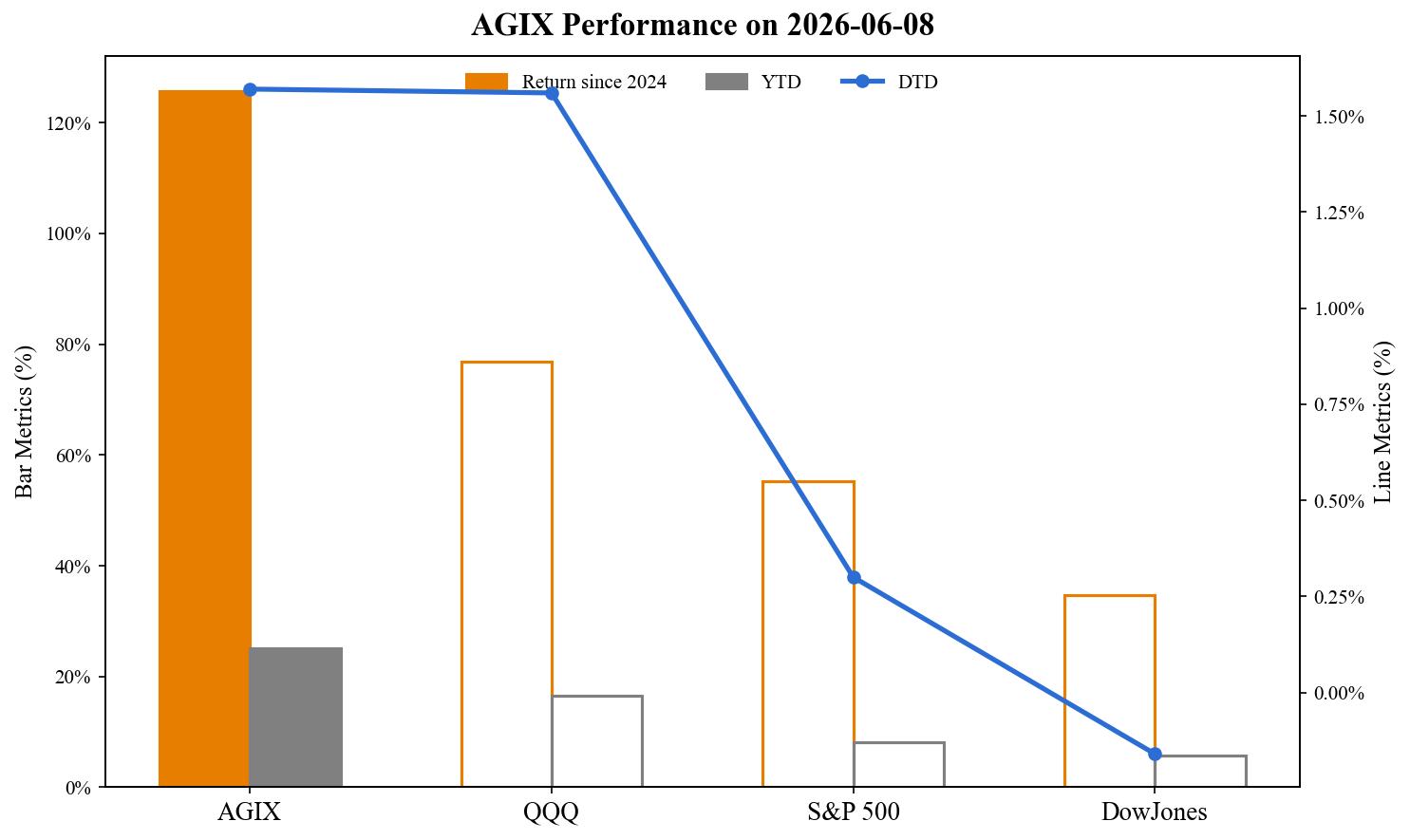
• AGIX rose 1.57% DTD, matching the QQQ (1.56%) and outperforming the S&P 500 (0.3%) and Dow Jones (-0.16%). Year-to-date, AGIX is up 25.11%, well ahead of QQQ's 16.56%.
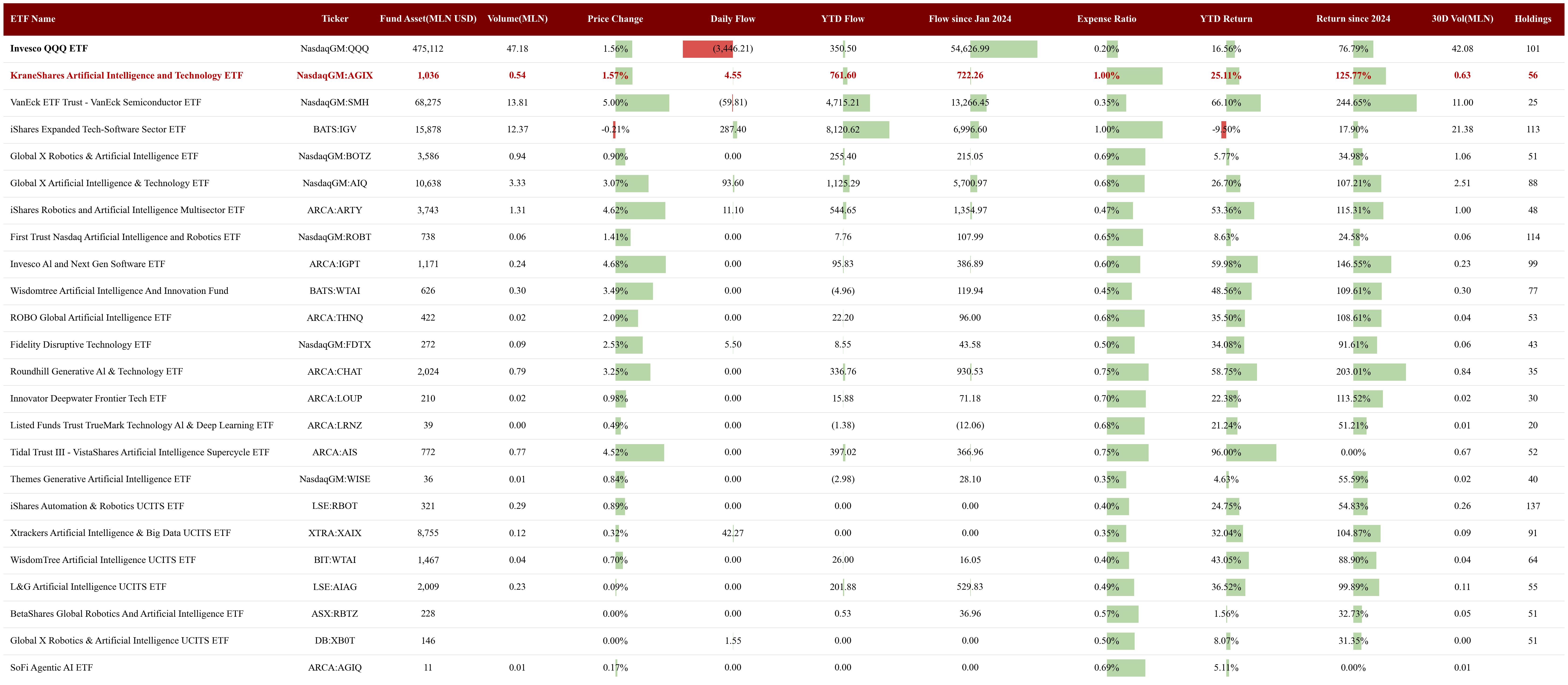
• Among peer ETFs, SMH (semiconductors) surged 5.0% DTD, while AI-focused funds like AIQ (3.07%), ARTY (4.62%), and IGPT (4.68%) also saw strong gains, reflecting broad AI/semiconductor momentum.
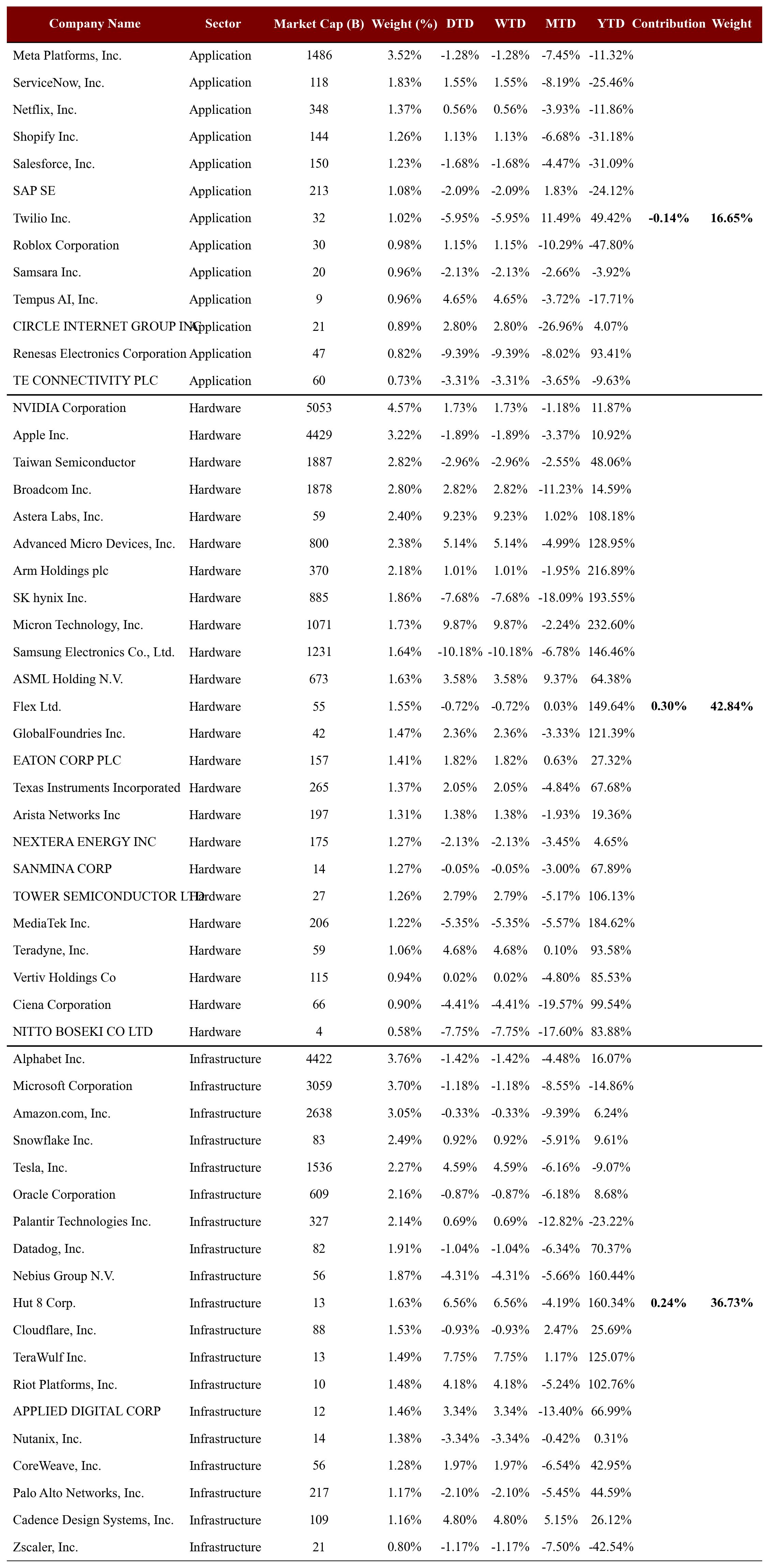
• AGIX's top hardware holdings drove the day: Micron (9.87%), Astera Labs (9.23%), AMD (5.14%), and Broadcom (2.82%) all posted strong gains, supported by AI infrastructure demand and positive analyst sentiment. Samsung (-10.18%) and SK hynix (-7.68%) were notable laggards.
• Key stocks to watch: Micron (AI memory upcycle), Astera Labs (AI data-center connectivity breakout), and AMD (data center GPU momentum) are positioned to benefit from ongoing AI infrastructure buildout and positive sector tailwinds.
News Highlights
1. OpenAI's superapp push and AI agent upgrades aim to boost enterprise competitiveness ahead of a potential IPO, signaling increased platform competition that could benefit AGIX infrastructure holdings like Microsoft, Amazon, and Alphabet.
2. Nvidia's partnerships with SK hynix, Naver, and Doosan to expand South Korea's AI infrastructure reinforce demand for Nvidia's hardware and memory chips, supporting AGIX holdings such as Nvidia, SK hynix, and Samsung.
3. Oriole Networks' photonic AI network deployment with AMD could reduce power consumption by 81% and GPU idle time, marking a commercial breakthrough for optical networking in AI, positively impacting AGIX holdings like AMD and Ciena.
4. Pega's Infinity '26 launch with agent orchestration and a new pricing model (per-completed-case vs. per-token) highlights the trend toward AI agent deployment, which may influence AGIX infrastructure holdings like Snowflake and Datadog that offer agent governance tools.
5. Apple's major Siri revamp at WWDC 2026, integrating Google Gemini and a standalone Siri app, signals intensified competition in AI assistants, potentially affecting AGIX holdings like Apple and Alphabet.
RSS Highlights
1. A critical analysis of AI's productivity impact argues that despite massive content generation, ROI remains elusive and GDP impact negligible, with AI providers facing huge losses and future costs potentially exceeding human labor.
2. An article on AI sample efficiency notes that frontier models are trained on tens of trillions of words versus a human's ~200 million, highlighting a million-fold gap in learning efficiency that remains an unsolved challenge.
3. xAI's partnership with Anthropic and Google to provide data center computing power could generate $1.25 billion monthly, supporting its upcoming IPO but also raising questions about sustainability amid $15 trillion potential construction costs.
4. Alberto Romero's analysis of Apple's AI spending shows Apple's $14 billion capex in 2026 is dwarfed by the $670 billion committed by Amazon, Google, Meta, and Microsoft, reflecting a fundamentally different, cautious approach to AI.
5. A blog post on LLM agents for new projects shares practical experience using agents to build a Go project from scratch, emphasizing human oversight, small commits, and strong testing strategies for maintainability.
Performance & Benchmark
Attribution
Contribution of the three sectors within AGIX holdings today
Application: -0.14%
Hardware: 0.3%
Infrastructure: 0.24%
Top-performing stocks in AGIX holdings today
Micron Technology, Inc. (9.87%)
Astera Labs, Inc. (9.23%)
TeraWulf Inc. (7.75%)
Hut 8 Corp. (6.56%)
Advanced Micro Devices, Inc. (5.14%)
Cadence Design Systems, Inc. (4.8%)
Teradyne, Inc. (4.68%)
Tempus AI, Inc. (4.65%)
Tesla, Inc. (4.59%)
Riot Platforms, Inc. (4.18%)
ASML Holding N.V. (3.58%)
APPLIED DIGITAL CORP (3.34%)
Broadcom Inc. (2.82%)
CIRCLE INTERNET GROUP INC (2.8%)
TOWER SEMICONDUCTOR LTD (2.79%)
GlobalFoundries Inc. (2.36%)
Texas Instruments Incorporated (2.05%)
Worst-performing stocks in AGIX holdings today
SAP SE (-2.09%)
Palo Alto Networks, Inc. (-2.1%)
Samsara Inc. (-2.13%)
NEXTERA ENERGY INC (-2.13%)
Taiwan Semiconductor Manufacturing Company Limited (-2.96%)
TE CONNECTIVITY PLC (-3.31%)
Nutanix, Inc. (-3.34%)
Nebius Group N.V. (-4.31%)
Ciena Corporation (-4.41%)
MediaTek Inc. (-5.35%)
Twilio Inc. (-5.95%)
SK hynix Inc. (-7.68%)
NITTO BOSEKI CO LTD (-7.75%)
Renesas Electronics Corporation (-9.39%)
Samsung Electronics Co., Ltd. (-10.18%)
Top five listed stocks contributing the most within AGIX holdings today
Astera Labs, Inc. (9.23%)
Micron Technology, Inc. (9.87%)
Advanced Micro Devices, Inc. (5.14%)
TeraWulf Inc. (7.75%)
Hut 8 Corp. (6.56%)
Observation
The strongest movers across peer ETF holdings today are listed below:
| DTD | Stock Ticker | Name | Held by ETFs | analysis |
|---|---|---|---|---|
| 11.85 | NasdaqCM:MARA | MARA Holdings, Inc. | ['BATS:IGV'] | MARA’s 11.85% move on 2026-06-08 was most likely driven by continued bullish momentum after the company’s recent balance-sheet and diversification developments, including the $1.0 billion convertible note repurchase and bitcoin sale that reduced debt overhang. The stock was also trading on a stronger narrative shift toward energy and high-performance computing, with recent coverage noting investor enthusiasm around the Long Ridge Energy transaction and related diversification bets. A third contributor was likely broader crypto-beta and short-covering pressure, which can amplify MARA’s daily moves when sentiment turns positive. |
| 11.19 | NasdaqGS:INTC | Intel Corporation | ['NasdaqGM:QQQ', 'NasdaqGM:SMH', 'NasdaqGM:AIQ', 'ARCA:ARTY', 'NasdaqGM:ROBT', 'ARCA:IGPT', 'BATS:WTAI', 'ARCA:AIS', 'NasdaqGM:WISE', 'LSE:RBOT', 'XTRA:XAIX', 'BIT:WTAI'] | Intel’s 11.2% gain on June 8, 2026 was primarily driven by reports that it is securing major AI-related foundry business from top customers, especially Alphabet/Google and potentially Nvidia, which bolstered confidence in the turnaround of its manufacturing and AI strategy.[4][5] Secondary support came from broader strength in semiconductor and AI-chip names and recent price target hikes that frame Intel as an emerging full-stack AI and foundry player, amplifying the move as investors rotated back into high-beta chip stocks.[1][4] |
| 11.1 | NasdaqGM:AAOI | Applied Optoelectronics, Inc. | [] | Applied Optoelectronics’ 11.1% gain on June 8, 2026 was primarily driven by momentum and speculative trading flows, reinforced by very high volume and a breakout back onto short-term traders’ radars.[1][2] A key catalyst was attention around a new 2x daily leveraged ETF tied to AAOI, which increased liquidity and amplified volatility, attracting momentum and derivatives-driven strategies.[1] Same-day coverage highlighting recent insider sales but continued sizable insider ownership, along with prior positive sentiment on optical networking growth, also helped sustain bullish positioning despite profit-taking by executives.[1][2][5] |
| 10.77 | NasdaqGS:SYNA | Synaptics Incorporated | ['XTRA:XAIX'] | Synaptics’ 10.8% gain on June 8, 2026 was driven primarily by continued enthusiasm around its edge AI strategy and related commercial traction, highlighted by new product and partnership updates with Google and others. The move was further supported by a recent Rosenblatt price target hike to $180 from $125 alongside a reiterated Buy rating, reinforcing the bull case on Astra- and Coralboard-powered edge AI design wins and helping momentum investors lean into the name. |
| 10.6 | NYSE:IONQ | IonQ, Inc. | ['BATS:WTAI', 'ARCA:THNQ'] | IonQ’s +10.6% move on June 8 was primarily driven by a sharp rebound in high-beta, AI/quantum-related tech names as risk appetite returned, with IonQ highlighted as a top quantum computing play in same-day market commentary and leading the tape among innovative tech stocks.[2][4] Secondarily, the stock appears to be benefitting from ongoing bullish sentiment and momentum following earlier-period positive catalysts and favorable analyst positioning in the name, which have kept it a preferred vehicle for investors seeking exposure to quantum computing growth.[3][4] |
| 10.37 | NasdaqCM:INDI | indie Semiconductor, Inc. | ['LSE:RBOT'] | indie Semiconductor’s 10.4% gain appears primarily driven by stock-specific momentum and follow-through buying rather than any new company-specific news or sector-wide catalyst on the day. The most recent fundamental datapoints were the May 7 Q1 print, where INDI beat revenue expectations despite a loss, and ongoing positive technical/quantitative signals, including a “strong buy” technical rating and recent upside volatility that likely attracted incremental momentum and retail flows.[4][8] Broader U.S. equities were weak around this period, especially in semis, so INDI’s move stands out as idiosyncratic, suggesting positioning/short-covering and sentiment in an oversold small-cap auto semi name as secondary drivers.[5] |
| 9.87 | NasdaqGS:MU | Micron Technology, Inc. | ['NasdaqGM:QQQ', 'NasdaqGM:AGIX', 'NasdaqGM:SMH', 'NasdaqGM:AIQ', 'ARCA:ARTY', 'NasdaqGM:ROBT', 'ARCA:IGPT', 'BATS:WTAI', 'NasdaqGM:FDTX', 'ARCA:LOUP', 'ARCA:AIS', 'XTRA:XAIX', 'BIT:WTAI'] | Micron’s approximately 10% gain on June 8, 2026 was driven primarily by continued enthusiasm around its role as a key beneficiary of the AI-driven high‑bandwidth memory (HBM) upcycle and a sustained rerating of the stock on that theme. Recent commentary and target hikes from bullish analysts, including aggressive long‑term price targets premised on AI memory shortages and Micron being effectively sold out of AI chips, have reinforced the narrative of durable pricing power and earnings upside, supporting follow‑through buying in the absence of negative company‑specific news.[1][2] |
| 9.63 | NasdaqGS:MRVL | Marvell Technology, Inc. | ['NasdaqGM:QQQ', 'NasdaqGM:SMH', 'NasdaqGM:AIQ', 'ARCA:ARTY', 'BATS:WTAI', 'NasdaqGM:FDTX', 'ARCA:CHAT', 'ARCA:AIS', 'BIT:WTAI'] | Marvell Technology’s ~10% gain on June 8 was driven primarily by ongoing AI data center enthusiasm and follow-through buying after the company’s recent beat‑and‑raise quarter and upgraded multi‑year growth outlook, which have repositioned MRVL as a core AI infrastructure beneficiary.[2][7] A second key driver was bullish sell‑side sentiment and sharply higher price targets tied to accelerating AI-chip demand, which kept the stock in a strong momentum uptrend despite elevated valuation concerns.[2][3][4] Broader strength in technology and semiconductor names, alongside attention from its upcoming S&P 500 index inclusion, also supported incremental demand for the shares.[1][4][8] |
| 9.27 | NasdaqGS:KLAC | KLA Corporation | ['NasdaqGM:QQQ', 'NasdaqGM:SMH', 'NasdaqGM:ROBT', 'LSE:RBOT', 'BIT:WTAI'] | KLA’s 9.3% move was primarily driven by its after-hours announcement of a 10-for-1 stock split effective June 12, 2026, which typically boosts retail accessibility and trading appeal, prompting multiple expansion. A secondary, reinforcing driver was the 21% increase in the quarterly dividend to $2.30 per share (implying a higher ongoing capital-return run-rate and confidence in cash flow), as disclosed alongside the split. Together, these capital-allocation actions improved sentiment toward the stock despite no new operational updates. |
| 9.23 | NasdaqGS:ALAB | Astera Labs, Inc. | ['NasdaqGM:AGIX', 'NasdaqGM:ROBT', 'ARCA:IGPT', 'BATS:WTAI', 'ARCA:THNQ', 'ARCA:CHAT', 'ARCA:LOUP', 'ARCA:AIS', 'BIT:WTAI'] | Astera Labs’ ~9% gain on June 8 appears primarily driven by a strong technical breakout in a high-momentum AI semiconductor name, as the stock cleared prior resistance levels on elevated volume and continued a powerful move out of a recent base pattern. Same-day technical commentary highlighted ALAB’s “very strong day…up over 13%,” breaking above prior resistance with increased volume and approaching new highs, which likely attracted incremental momentum and breakout buyers in an AI-focused market. A secondary driver is ongoing positive sentiment around Astera’s positioning in AI data-center connectivity, with recent commentary emphasizing its role in advanced AI clusters, Taiwan expansion, and repeated buy/overweight ratings from major brokers, reinforcing the bull narrative and supporting follow-through demand. |
| 9.2 | KOSE:A035420 | NAVER Corporation | ['ARCA:ARTY', 'NasdaqGM:ROBT', 'XTRA:XAIX', 'BIT:WTAI'] | NAVER’s 9.2% gain on June 8, 2026 appears primarily driven by a high-volume rebound in Korean large-cap tech/AI names, with NAVER moving sharply higher alongside the broader KOSPI internet/IT complex. The move was amplified by strong risk-on sentiment toward AI and platform stocks, with NAVER benefiting from its strategic positioning in search, commerce, and AI, and by short covering/positioning after a period of underperformance versus its 52-week high. |
| 8.94 | NYSE:GENI | Genius Sports Limited | ['ARCA:IGPT'] | Genius Sports’ 8.9% move appears primarily driven by a positive sell-side catalyst, as Benchmark named GENI its 2026 “EDM Top Idea” while reiterating a Buy rating and $16 price target, reinforcing the stock’s long-term growth narrative.[1] Additional support likely came from the broader, strongly bullish analyst backdrop (multiple recent Buy ratings and double‑digit upside targets) that amplifies the impact of a high‑conviction call on a still-depressed share price.[1][2][6] |
| 8.87 | NasdaqGS:ADEA | Adeia Inc. | ['BATS:IGV'] | Adeia’s 8.87% jump on 2026-06-08 was most likely driven by continued investor reaction to the renewed Google license agreement, which improved confidence in the company’s licensing cash flows and litigation/monetization outlook. A secondary tailwind was the stock’s strong technical momentum, with the shares already in a pronounced uptrend heading into the day. There is also a minor overhang from a recent Form 144 insider-sale filing, but that would not typically explain a sharp one-day gain. |
| 8.64 | NasdaqGS:AMAT | Applied Materials, Inc. | ['NasdaqGM:QQQ', 'NasdaqGM:SMH'] | Applied Materials’ 8.6% gain on June 8, 2026 appears primarily driven by continued positive momentum and investor follow-through after its stronger-than-expected Q2 FY2026 results and record-level guidance, which have led to multiple upward estimate revisions and reinforced the AI/semicap growth narrative.[2][4] A second key driver is sustained bullish sell-side positioning and elevated price targets clustered around $500–$550, which underpin sentiment and support further multiple expansion in a stock already up sharply over the past year.[1][3] |
| 8.3 | NYSE:QBTS | D-Wave Quantum Inc. | ['BATS:IGV', 'BATS:WTAI'] | QBTS’s 8.3% gain on June 8 appears driven primarily by technical and positioning dynamics in a highly volatile, speculative name rather than by any identifiable new fundamental or regulatory catalyst that day. The move came against a backdrop of elevated volatility and news-sensitive trading in D-Wave, where recent commentary highlights that price action is often driven more by sentiment and flows than by incremental fundamentals, and the stock had previously experienced large swings following earlier catalysts such as institutional interest and media coverage.[1][5][7] |
| 8.2 | NasdaqGS:CIFR | Cipher Mining Inc. | ['BATS:IGV'] | Cipher Mining’s +8.2% move on June 8 appears primarily driven by beta/leverage to a strong rebound in Bitcoin and crypto‑related equities, rather than by any company-specific news or disclosures that day. There were no material same-day press releases, filings, or rating changes for CIFR, and trading volume on June 8 was well below its average, indicating a sentiment- and sector-driven move rather than an idiosyncratic catalyst. |
| 8.19 | NasdaqGS:DUOL | Duolingo, Inc. | [] | Duolingo’s 8.2% gain appears primarily driven by a rebound from oversold levels after a sharp year‑to‑date drawdown and post‑earnings derating, rather than any clear, stock‑specific news catalyst on the day. The move was likely supported by bargain hunting and recalibration of expectations as some investors focus on the still‑constructive long‑term fundamental and valuation cases outlined in recent analysis pieces, even as prior guidance cuts had pressured the stock earlier in 2026. |
| 8.19 | NasdaqGS:AMBA | Ambarella, Inc. | ['NasdaqGM:AIQ', 'NasdaqGM:ROBT', 'ARCA:IGPT', 'ARCA:THNQ', 'NasdaqGM:WISE', 'LSE:RBOT', 'XTRA:XAIX', 'BIT:WTAI', 'LSE:AIAG'] | Ambarella’s 8.2% gain on June 8 appears primarily driven by a continued positive re-rating and follow‑through buying after its late‑May fiscal Q1 earnings, where revenue met expectations and EPS beat consensus while losses narrowed, reinforcing the AI/computer-vision recovery narrative.[4][5] A second driver is likely sentiment and positioning: the stock had sold off sharply post-earnings and then stabilized, and as the broader semiconductor/AI complex caught a bid, investors rotated back into higher‑beta AI‑exposed names like AMBA, aided by its “Moderate Buy” rating and sizeable upside to consensus target price.[2][5] |
| 7.97 | NasdaqGS:PENG | Penguin Solutions, Inc. | ['ARCA:AIS'] | Penguin Solutions’ ~8% gain appears primarily driven by ongoing positive sentiment around its AI and high‑performance computing exposure and contract momentum, extending a multi‑week uptrend rather than reacting to a discrete new catalyst on the day.[2][3] First, investors continue to re-rate the name after earlier disclosures that fiscal 2026 net sales and EPS are tracking ahead of prior expectations and that strong AI infrastructure demand and contract wins are supporting rapid growth.[2][3] Second, trading action fits a high‑beta, momentum pattern in a favored AI infrastructure theme, with prior news of a high-profile AI-focused board appointment (David Heard) and elevated volatility amplifying follow‑through buying interest.[2] |
| 7.75 | NasdaqCM:WULF | TeraWulf Inc. | ['NasdaqGM:AGIX', 'BATS:IGV'] | TeraWulf’s +7.75% move on June 8, 2026 appears primarily driven by continued momentum and bullish positioning in a strongly uptrending stock rather than new fundamental company-specific news that day. Technical traders focused on the stock’s established uptrend, key resistance near the prior high around $27–28, and elevated volume, as highlighted in same-day technical commentary, likely amplified buying interest and short-covering.[4][7] A secondary support is the broader positive fundamental narrative established in prior weeks – including a large $1.0B equity raise to fund high-performance data center expansion and balance sheet strengthening, and a consensus Buy rating from 12 analysts – which provides a constructive backdrop for incremental upside moves on technically driven days.[2][5] |
| 7.43 | NasdaqGS:CRDO | Credo Technology Group Holding Ltd | ['ARCA:IGPT', 'BATS:WTAI', 'LSE:RBOT'] | CRDO’s +7.4% move on June 8, 2026 appears driven primarily by continued momentum and positioning following very strong recently reported FY26 results, with revenue more than tripling and non-GAAP net income increasing over fivefold, which has fueled ongoing AI-related enthusiasm and multiple expansion. Secondary support came from technical factors, as the stock rebounded from a pullback earlier in the week and traded closer to identified resistance levels around the low-$230s, attracting incremental momentum and breakout buyers. |
| 6.98 | NasdaqGS:LRCX | Lam Research Corporation | ['NasdaqGM:QQQ', 'NasdaqGM:SMH', 'BATS:WTAI', 'ARCA:THNQ', 'ARCA:LOUP', 'BIT:WTAI', 'LSE:AIAG'] | Lam Research’s 6.98% gain on June 8, 2026 appears primarily driven by continued momentum in semiconductor capital equipment tied to AI-related demand and memory/foundry investment, with investors rotating into high-beta AI hardware beneficiaries. Sector commentary and prior management guidance for meaningful 2026 growth supported by “sustained demand in AI-driven markets” and plans to outgrow wafer fab equipment spending reinforced the bullish narrative and earnings power re-rating.[3] Elevated trading volume versus normal levels also suggests incremental buy-side demand and possible short covering amplified the move.[4] |
| 6.77 | NasdaqGS:NVMI | Nova Ltd. | ['LSE:RBOT'] | Nova Ltd.’s 6.8% move on June 8, 2026 appears primarily driven by follow‑through buying after its recent record Q1 2026 results and stronger‑than-expected outlook, which reinforced the company’s leadership positioning in semiconductor metrology and supported the ongoing re‑rating of the stock.[7][8] A secondary driver is positive sentiment and momentum across semiconductor equipment names, with NVMI benefitting from its “Strong Buy” consensus and materially higher 12‑month target prices versus the current level, encouraging incremental institutional demand on a low‑news day.[2][3] |
| 6.71 | SEHK:9880 | Ubtech Robotics Corp Ltd | ['NasdaqGM:BOTZ', 'ARCA:IGPT', 'LSE:RBOT', 'ASX:RBTZ', 'DB:XB0T'] | Ubtech Robotics’ 6.7% gain on 8 June 2026 appears primarily driven by continued momentum around strong order visibility and growth expectations in humanoid and service robotics, amplified by local news coverage highlighting rising orders and active trading interest in the name.[1][6] AASTOCKS reported the stock rising nearly 6% intraday on high turnover and notable short-selling activity, suggesting a combination of bullish follow‑through and short covering as key technical drivers.[1] Elevated sell-side and platform commentary pointing to upside versus consensus 12‑month targets also likely supported sentiment and incremental buying interest on the day.[2][7] |
| 6.62 | NYSE:COHR | Coherent Corp. | ['NasdaqGM:FDTX', 'ARCA:LOUP'] | Coherent’s 6.6% gain on June 8, 2026 appears primarily driven by continued AI-related optimism and constructive sell-side positioning rather than any new, stock-specific news that day. First, the name is tightly linked to the AI data center buildout, and Bank of America’s recent May price-target hike to $400 on a much larger 2030 AI data center TAM has reinforced the bull case and kept the stock in AI momentum baskets.[2] Second, consensus remains firmly positive with an 11-analyst Buy rating setup as of June 8, which can amplify upside in risk-on sessions as investors rotate into high-conviction AI infrastructure plays.[5] |
| 6.56 | NasdaqGS:HUT | Hut 8 Corp. | ['NasdaqGM:AGIX', 'BATS:IGV', 'NasdaqGM:AIQ'] | Hut 8’s +6.6% move on June 8, 2026 appears primarily driven by continued momentum and re‑rating following its very strong Q1 2026 results and AI-infrastructure narrative. The company recently reported $16.8 billion in triple‑net, take‑or‑pay contracted lease revenue across hyperscale AI customers, which has led analysts to raise fair value estimates toward the current trading range and supports ongoing multiple expansion. Broader AI and high-beta growth sentiment, combined with HUT’s elevated beta (~3.9) and recent substantial outperformance versus the market, likely amplified the upside move absent any incremental company‑specific news that day. |
| 6.22 | NYSE:ONTO | Onto Innovation Inc. | ['ARCA:ARTY', 'LSE:RBOT'] | Onto Innovation’s +6.2% move appears primarily driven by a sharp rebound in high‑beta semiconductor equipment names rather than any stock-specific news, as there were no new company disclosures, rating changes, or major ONTO headlines on the day. The gain coincided with a broader bounce in semiconductor and AI-related capital equipment stocks after recent weakness, with ONTO recovering from a multi-day pullback and benefitting from its leverage to advanced process control and inspection demand. A secondary contributor is likely short-term technical positioning, as the stock bounced from support levels after several prior down sessions, prompting incremental buying from momentum and systematic strategies. |
| 6.16 | NYSE:FICO | Fair Isaac Corporation | ['BATS:IGV', 'LSE:AIAG'] | FICO’s 6.2% gain on June 8, 2026 was primarily driven by the announcement of a new $2 billion stock buyback plan, which increased capital return expectations and replaced the prior $1.5 billion authorization, signaling strong confidence in future cash flows and undervaluation.[7][1] A secondary support was the recent strong fundamental backdrop, including robust fiscal Q2 2026 results with 39% revenue growth and 63% GAAP net income growth, especially in the high-growth Scores segment, which reinforced the positive reaction to the enhanced repurchase program.[8] |
| 5.97 | NasdaqCM:CLSK | CleanSpark, Inc. | ['BATS:IGV'] | CleanSpark’s 5.97% gain on June 8, 2026 appears primarily driven by a technical rebound after recent weakness, with the stock bouncing from prior losses and trading back toward options-implied ranges and key resistance levels flagged by technicians.[1][3][2] A secondary driver is ongoing support from favorable Street sentiment and upside to consensus price targets (average 12-month target ~$20.67 versus a mid-teens spot price), which continues to underpin dip-buying interest despite the recent Q2 earnings miss in May.[5][6][7] |
| 5.64 | NasdaqGS:SMCI | Super Micro Computer, Inc. | ['NasdaqGM:AIQ', 'ARCA:ARTY', 'ARCA:IGPT', 'ARCA:THNQ', 'ARCA:CHAT', 'ARCA:AIS'] | SMCI’s +5.6% move on June 8, 2026 was driven primarily by a sharp rebound in investor sentiment toward AI server and accelerator plays, with TipRanks noting the stock was up ~7% pre-market on a “sharp rebound in sentiment” rather than on new fundamental disclosures.[4] The move was amplified by high trading volume (~27.5 million shares) and positioning dynamics, including the presence of a 2x inverse SMCI ETF (SMCZ), which can exacerbate short-covering and intraday volatility in the underlying stock.[3][5] |
| 5.61 | NasdaqGS:MSTR | Strategy Inc | ['NasdaqGM:QQQ', 'BATS:IGV', 'ARCA:IGPT', 'LSE:RBOT', 'XTRA:XAIX'] | MSTR’s 5.6% gain on June 8, 2026 appears primarily driven by renewed optimism around its leveraged Bitcoin exposure, with traders treating the name as a high‑beta proxy for crypto and sentiment swinging positively after a sharp multi‑week drawdown.[1][5] A secondary driver is stock‑specific trading dynamics: options pricing was implying high near-term volatility, and the move took the shares back through a key resistance zone around $126, likely triggering short covering and momentum buying as volume picked up.[2][4] |
| 5.61 | NYSE:GLW | Corning Incorporated | ['ARCA:AIS'] | Corning’s 5.61% gain on 2026-06-08 was most likely driven by continued momentum in a strong uptrend, with the stock trading near record highs and well above its 50-day and 200-day moving averages, which likely attracted trend-following buyers.[2][3] The next most likely driver was improving investor sentiment around Corning’s AI-related core sales growth narrative, which had already been boosting the shares in recent weeks.[4] There was no clear company-specific same-day catalyst in the provided results, so the move appears primarily momentum- and sentiment-driven rather than news-driven.[1][3][5] |
| 5.53 | NasdaqGS:EXTR | Extreme Networks, Inc. | ['ARCA:AIS', 'XTRA:XAIX'] | Extreme Networks’ +5.5% move appears driven primarily by positive sentiment around its forward outlook and analyst positioning rather than any discrete company-specific news on the day. The stock is supported by a consensus Buy rating and favorable growth expectations, including robust projected earnings and revenue growth and a high forecast ROE, which can attract momentum and growth investors at the margin.[1][5][6] Broader momentum factors also likely contributed, as EXTR is characterized as a strong momentum candidate, which can amplify upside moves on relatively modest incremental buying interest.[3] |
| 5.49 | NYSE:OII | Oceaneering International, Inc. | ['NasdaqGM:ROBT'] | Oceaneering International’s 5.49% move on 2026-06-08 was most likely driven by a broad energy-sector risk-on rally after reports that Israel and Iran launched direct strikes, which lifted several related stocks intraday, including OII. The move appears to have been amplified by momentum in a stock that had already run sharply higher this year, with the shares up materially from the start of 2026. I did not find company-specific same-day news in the supplied results that better explains the jump. |
| 5.41 | NYSE:HLX | Helix Energy Solutions Group, Inc. | ['NasdaqGM:BOTZ', 'ASX:RBTZ', 'DB:XB0T'] | HLX’s 5.41% rise on 2026-06-08 was most likely driven by a broad oilfield-services industry move, as peer names in the group also rallied that day and HLX was reported up about 5.2% alongside them.[4] I did not find a Helix-specific same-day corporate catalyst in the provided results, so the move appears more consistent with sector sympathy and momentum than with company news.[1][4] |
| 5.41 | NasdaqGS:LSCC | Lattice Semiconductor Corporation | ['ARCA:IGPT', 'BATS:WTAI', 'NasdaqGM:WISE', 'LSE:RBOT'] | Lattice Semiconductor’s 5.4% gain on June 8 appears primarily driven by continued follow-through buying after its recent earnings beat and AI/server growth narrative, with the stock already up sharply year-to-date and still rated a consensus Buy by the Street.[2][5][8] A secondary driver was incremental positioning by institutional investors, highlighted by a disclosed purchase of 51,167 shares by Los Angeles Capital Management, reinforcing confidence in the name.[1] Broader strength and momentum in higher-valuation AI-exposed semiconductor names likely provided an additional tailwind to the move. |
| 5.3 | NasdaqGS:SNDK | Sandisk Corporation | ['XTRA:XAIX'] | Sandisk’s 5.3% rise on 2026-06-08 was most likely driven by Bank of America raising its price target to $2,100 while reiterating a Buy rating, which likely reinforced bullish sentiment around AI-driven NAND demand. The move also fit a broader positive tape for chip stocks that day, with the Nasdaq and semiconductor-related names trading higher. Intraday trading appears to have stayed within a relatively wide range, consistent with a news-led move rather than a company-specific fundamental release. |
| 5.28 | NasdaqGS:MPWR | Monolithic Power Systems, Inc. | ['NasdaqGM:SMH'] | MPWR’s +5.3% move on June 8, 2026 appears primarily driven by ongoing optimism around its structural growth story in enterprise data, automotive, and power management semis, following very strong recent results and management’s raised long-term growth expectations for data center and capacity expansion.[1][4] A secondary driver is momentum and positioning in high-growth analog/AI-adjacent semiconductor names, with MPWR having materially outperformed the broader market over the past year and quarter, which can amplify upside on days with incremental buying or short covering.[5] |
| 5.25 | NasdaqCM:RGTI | Rigetti Computing, Inc. | ['BATS:WTAI'] | Rigetti Computing’s 5.3% gain on June 8, 2026 appears primarily driven by continued momentum/mean reversion trading in a highly volatile quantum computing peer group rather than by any new company‑specific news flow that day. The move followed recent sharp swings and a multi-day “quantum bounce” across names like RGTI, QUBT, QBTS, and IONQ, where sentiment and technical factors (support/resistance levels and trendline dynamics highlighted by traders) have been key near-term drivers of price action, amplifying modest order-flow into outsized percentage moves. |
| 5.16 | NasdaqGS:DXCM | DexCom, Inc. | ['NasdaqGM:QQQ'] | DexCom’s +5.2% move on June 8, 2026 was primarily driven by positive clinical data and sentiment coming out of the American Diabetes Association (ADA) 2026 meeting. The company presented results from its CONNECT randomized controlled trial showing the G7 CGM delivered statistically significant A1C reductions and time-in-range improvements in non–insulin-using Type 2 patients, which investors interpreted as expanding DexCom’s addressable market and strengthening the case for broader reimbursement and guideline inclusion.[1][4] Broader sector context was supportive as diabetes/medical device names benefited from the ADA news flow, but there were no notable company-specific guidance changes, M&A headlines, or rating moves reported that day.[1][2] |
| 5.15 | NasdaqGS:NOVT | Novanta Inc. | ['ARCA:IGPT', 'LSE:RBOT'] | Novanta’s +5.1% move appears driven primarily by follow-through buying after a strong Q1 earnings print that beat on both revenue and EPS and showed double-digit top-line growth, reinforcing the company’s above-market growth profile and outlook.[8] A secondary driver is continued positive sentiment from prior analyst target hikes (e.g., Baird’s raise to $173 with an outperform rating) and a bullish consensus target in the high $160s–low $170s range, which frame further upside and likely attracted momentum and growth investors on the day.[1][2][6] |
| 5.15 | NasdaqGS:SMTC | Semtech Corporation | [] | Semtech’s 5.15% gain appears primarily driven by continued positive momentum and investor follow-through on its late-May earnings beat and upbeat guidance, which highlighted accelerating demand in high-speed data center connectivity and AI-related infrastructure. A second key driver is ongoing support from the sell-side, with multiple recent price-target hikes and a still-attractive implied upside versus the consensus target around $180, which is encouraging incremental buying interest. |
| 5.14 | NasdaqGS:AMD | Advanced Micro Devices, Inc. | ['NasdaqGM:QQQ', 'NasdaqGM:AGIX', 'NasdaqGM:SMH', 'NasdaqGM:AIQ', 'ARCA:ARTY', 'NasdaqGM:ROBT', 'ARCA:IGPT', 'BATS:WTAI', 'ARCA:THNQ', 'ARCA:CHAT', 'ARCA:LRNZ', 'ARCA:AIS', 'NasdaqGM:WISE', 'LSE:RBOT', 'XTRA:XAIX', 'BIT:WTAI', 'LSE:AIAG'] | AMD’s 5.1% gain appears primarily driven by renewed optimism around its data center and AI roadmap, reinforced by bullish third-party commentary highlighting recent 57% data center growth and a sharply higher free cash flow profile that underpins aggressive multi-year price targets for the stock.[1] A secondary driver is broader AI semiconductor momentum, with investors rotating into high-performance GPU/CPU names as the market continues to discount outsized long-term demand for AI infrastructure, benefiting AMD alongside other leading AI chip suppliers. |
| 5.14 | NasdaqGS:AMKR | Amkor Technology, Inc. | ['ARCA:ARTY'] | Amkor’s +5.1% move was primarily driven by ongoing positive sentiment around AI-related semiconductor demand and Amkor’s positioning as a beneficiary of advanced packaging, with investors continuing to price in upside following recent target hikes and sector rerating. Secondary support likely came from broader strength in semiconductor names and momentum buying after a strong year-to-date run, as the stock has materially outperformed since early 2026. |
| 5.03 | NasdaqGS:CORZ | Core Scientific, Inc. | ['BATS:IGV'] | Core Scientific’s 5.0% gain on June 8, 2026 appears primarily driven by follow‑through buying after the company’s Q1 FY26 earnings release and capital-structure news, which highlighted the closing of a $3.3 billion 7.75% senior secured notes offering tied to its CoreWeave project and reinforced balance sheet strength.[1][7] A secondary driver is ongoing positioning around the pending all-stock acquisition by CoreWeave, where reaffirmed strategic rationale and expected financial benefits to CORZ holders continue to underpin sentiment and support the stock on positive company-specific catalysts.[4][6] |
News
Funding & M&A
OpenAI’s planned ‘superapp’ gets closer as one employee says ‘chat is dead’
According to a report by the Financial Times, OpenAI is advancing its plan to turn ChatGPT into a "super app" and is strengthening AI agent and autonomous coding robot features. This move aims to boost enterprise competitiveness and increase profitability ahead of an IPO expected before the end of summer. The report says that a major upgrade will first launch on the web and mobile, enhancing the Codex coding tool, image generation, and third-party service integration. Thibault Sottiaux, head of the core product team, said the platform will provide personal intelligent agents across devices, covering both life and work scenarios. This transformation comes as Anthropic has just completed a $65 billion funding round, valued at $965 billion, and filed for an IPO. OpenAI hopes to convince investors with its platform story to support a market cap of over $1 trillion. This move will also affect the trillion-dollar IPO wave of companies like SpaceX.
Product Launches
Amazon now lets you design custom merch using AI
On Monday Beijing time, Amazon launched a new feature in its shopping app that allows users to create product designs directly using AI prompts via Alexa. The feature applies AI-generated patterns to the print-on-demand service Merch on Demand, supporting T-shirts, hoodies, mugs, and other product types, with delivery via Prime. This move embeds AI-designed products within the Amazon app, significantly lowering the creative barrier for ordinary consumers and making personalized design a standard shopping option. Currently, the service is only available in the US and is free to use; users only pay for the product cost. This feature poses a direct challenge to existing print-on-demand platforms like Redbubble and may also raise concerns among artists about AI training data sources.
Pega expands its AI platform with agent orchestration, development tools, and a new pricing model.
Process automation vendor Pegasystems launched Infinity '26 at PegaWorld, enhancing AI agent deployment capabilities. New features include expanded Model Context Protocol support, new agent services, and the Infinity Studio development environment, enabling models like Claude, Gemini, and OpenAI to call Pega processes. The company introduced a "predictive AI" architecture that shifts reasoning to the design phase, reducing runtime token consumption and replacing per-token billing with per-completed business case pricing, cutting costs by up to 20 times. It also launched the Solution Designer Initiative training program. Early user data shows a 50% increase in project discovery speed and an 80% go-live rate within 90 days. The version will be released in Q3.
WWDC 2026: What to expect, from Siri’s highly anticipated revamp to Apple Intelligence and iOS 27
Apple will launch a major Siri upgrade at WWDC 2026. The new Siri will integrate Google Gemini technology, supporting more natural multi-turn conversations, multi-step task processing, and cross-app interactions. Apple plans to launch a standalone Siri app to compete with AI chatbots like ChatGPT, and will offer options to automatically delete conversations after 30 days, one year, or keep them permanently. It will also integrate AI agents into the App Store to help users book appointments, manage tasks, edit documents, and control smart homes. The camera app will add a Visual Intelligence mode, using Google image search to identify objects. The Photos app will introduce smart scene recommendations, automatic object removal, and natural language editing. Image Playground will improve generation quality, artistic style, and character consistency, and will support Genmoji and AI wallpapers. The Wallet app will add bill splitting and digital pass creation features. The overall update will enhance on-device AI experience and system stability.
Industry Partnerships
Oriole Networks deploys photonic AI network in first commercial rollout with AMD
British optical networking company Oriole Networks has partnered with AMD to deploy the world's first large-scale all-optical AI system at the UK's ARIA Scaling Inference Lab. The system uses Oriole's PRISM optical network platform with AMD Instinct GPUs and EPYC CPUs, replacing core data center electronic switches with nanosecond-speed optical routing switches. This can reduce core power consumption by 81%, cut GPU idle time from 60% to less than 1%, and significantly lower cooling and water costs. The project is backed by £50 million in funding and aims to solve network bottlenecks for cutting-edge AI workloads. Oriole's technology originates from UCL spin-off, has raised $40 million, and plans to commercialize by 2027. An AMD executive said this optical network architecture will provide low-latency, high-bandwidth connectivity for AI inference. The collaboration marks a commercial breakthrough for optical networks in large-scale AI deployment.
Nvidia partners with South Korea’s SK hynix, Naver and Doosan to expand the country’s AI infrastructure
During a visit to South Korea, Nvidia CEO Jensen Huang signed multiple strategic cooperation agreements with SK hynix, Naver, and Doosan Group. SK hynix will jointly develop next-generation high-performance memory chips for AI data centers with Nvidia, and will use CUDA-X and PhysicsNeMo to improve simulation efficiency. SK Telecom plans to build a gigawatt-level AI cloud data center, with the first project going live early next year. Naver will expand the Gak Sejong data center and plan a new gigawatt-level AI factory, while Doosan will apply Nvidia's physical AI technology to intelligent robots. These collaborations will strengthen South Korea's position in the global AI infrastructure field.
Snowflake and 1Password address the increasing challenge of securing AI agents at scale.
As AI agents begin accessing sensitive enterprise data, AI agent security is becoming a top organizational priority. Enterprise security is shifting from protecting systems and infrastructure to governing people and AI agents. AgileBits CTO Nancy Wang noted that the conversation has moved from how to secure systems to how to govern actors. Snowflake Senior Director of Product Management Artin Avanes emphasized that running agents without controls will break the business. Both said in interviews at Snowflake Summit 2026 that identity security and data security are converging. Snowflake's Horizon Context feature uses metadata to support agent workflows and improve accuracy. Enterprises need greater visibility, stronger governance controls, and consistent intent across all stack layers.
Fanatics introduces AI-powered personalization for game day.
As AI capabilities mature, sports organizations are leveraging AI-driven fan personalization, moving from broad targeting to deep, real-time data-based fan understanding. Fanatics VP of Business Kevin Longo and Snowflake CMO Denise Persson said at Snowflake Summit 2026 that the traditional one-size-fits-all model in sports media can no longer meet the immediate needs of diverse fans. They emphasized the importance of data unification to break down silos and provide a 360-degree real-time experience. AI is widely used in player scouting, supplementary analysis, injury recovery, and delivering more dynamic content recommendations to fans. To maintain long-term trust, companies must establish robust privacy governance and security mechanisms. Their partnership aims to balance personalization and responsibility in sports, creating more valuable digital experiences for fans.
On theCUBE Pod: Snowflake, Cisco, and the race to control the AI stack.
AI companies are competing for dominance over the AI technology stack, and the market has entered a mature phase. SpaceX plans to raise $75 billion in an IPO, while Anthropic, after filing for an IPO, said society is not yet ready for its models. theCUBE Research analyst Dave Vellante noted that the winner will be the company that builds the control layer for "intelligent systems." Snowflake launched CoWork at its Summit, attempting to move up the AI stack, but faces competition from Databricks, Google, Microsoft, OpenAI, and others. Cisco unveiled a unified cloud platform at its Live event, aiming to gain an edge in the AI networking layer. As token usage costs rise, the risk of agent runaway is also drawing attention. Overall, competition in the AI technology stack is in a highly dynamic and diversified stage of development.
Silverfort brings runtime identity controls to Microsoft Copilot Studio agents.
Identity security company Silverfort officially partnered with Microsoft to launch a new integration that applies its identity access controls to AI agents built in Microsoft Copilot Studio. The integration evaluates each access request in real time before the agent executes an action, preventing privilege escalation or unauthorized access. This helps enterprises advance agent AI deployment while maintaining security. Microsoft data shows that over 80% of Fortune 500 companies are advancing low-code or no-code AI agents. Silverfort's controls can limit privilege escalation, block anomalous access, and generate auditable logs, supporting unified management across diverse agent platforms. The release follows the acquisition of Fabrix Security in April and joint development with Microsoft on more AI security features such as prompt injection and jump-box detection. Silverfort processes over 10 billion authentications daily and serves multiple Fortune 50 companies.
ConnectWise launches AI-native platform in push toward 'Predictive IT'
IT management software company ConnectWise Inc. recently launched the new ConnectWise Platform business platform, positioning it as the core of a 'predictive IT' strategy. The platform integrates professional services automation, remote monitoring and management, security operations, workflow automation, and agentic AI, aiming to help managed service providers (MSPs) delegate routine support tasks to artificial intelligence. According to the company's simulations, adopting AI can reduce MSP ticket processing time by 45%, lower ticket volume by 30% to 40%, and increase profits by 5 to 12 percentage points. CEO Manny Rivelo stated that the new platform will shift from reactive support to predictive intelligence. Nick Heddy of cloud commerce company Pax8 praised the unified foundation for enabling rapid AI deployment. The platform will be fully launched at the end of June.
RSS Subscription
Aitken acceleration before Aitken
Kepler solved his equation M = E − e sin(E) using an iterative method, and for small eccentricity e, only a few iterations are usually sufficient to achieve adequate accuracy. For Halley's Comet, when M = 1 and the error must be less than 10^-8, 16 iterations are required. In 1891, C. F. W. Peters proposed a faster algorithm that achieves higher precision in just 3 iterations, demonstrating its significant efficiency over Kepler's method.
The Laplace limit
Kepler's equation M = E − e sin(E) can be solved using a sine series or a power series, the latter proposed by Lagrange in 1771. The sine series applies to all e < 1, while the power series converges only when e is less than about 2/3, meaning the power series solution works for some planetary orbits but not all. For example, Pluto's orbital eccentricity is 0.4407, while Sedna's orbital eccentricity is 0.8549. The Laplace limit eL = 0.6627 is the convergence radius of the power series solution, and its particularity has no obvious astronomical basis.
Coding Is Designing
Code is not only a way to implement design but also a tool for discovering design. By interacting with the interface, one can observe relationships between elements and make adjustments until all elements harmonize into a whole, achieving balance. Design embodies 'how it works,' while code is the tool that specifies how it operates.
A crank formula for π
I encountered a peculiar formula for π based on physical constants and attempted to explore it. According to Planck's law of black-body radiation, certain expressions in the formula can be simplified. The known Planck constant h and the speed of light c allow us to calculate the total energy of the universe E, which results in approximately 2.848 × 10^19 joules. However, the specific meaning of 'total energy of the universe' remains unclear, possibly involving the observable universe, dark energy, and the energy of mass among other aspects.
Slop, productivity, and why the AI-fueled world is going nowhere mighty fast
Although artificial intelligence has generated a vast amount of content, many companies have failed to achieve a corresponding return on investment, and its actual impact on GDP is negligible. Research shows that the quality of AI-generated content varies widely, and even in mathematical research, unreliable automated reasoning may affect traditional review standards. Meanwhile, AI service providers face huge losses, and future costs may exceed human labor costs, hindering genuine value creation.
KPN Interactive TV without Experia Box
KPN users can watch TV without using the Experia Box by using the KPN interactive TV set-top box (model 5202). To achieve this, users need to configure IGMP proxy and VLAN settings, and ensure the set-top box can access both the normal internet and KPN's multicast services. The updated configuration instructions are valid until June 2026, and users need knowledge of managing switches and VLANs.
A new era for software testing
Automated programming significantly accelerates software development in certain scenarios. Although the structural quality and complexity of its output are generally inferior to the best hand-written code, it often outperforms average hand-written code in many cases. Particularly in software quality assurance (QA) and testing, leveraging large language models (LLMs) can automatically execute a large amount of manual testing on top of existing test methods, thereby improving the quality of new software releases and compensating for the decline in code quality caused by rapid development. Through this approach, the QA process can more comprehensively identify potential issues and regressions, enhancing the overall quality of software releases.
Arp 297:
The astronomical image of Arp 297 has a total exposure time of 3.4 hours, with an actual stacking exposure time of 2.7 hours, using a C9.25 telescope paired with an IMX533 camera. The image shows the gravitationally interacting spiral galaxies NGC 5754 and NGC 5752, along with other galaxies such as NGC 5755 and NGC 5753, the latter having a redshift completely different from that of Arp 297.
ppclp.ai announces 100x Productivity Gains
ppclp.ai announced a 100x improvement in its proprietary Organizational Productivity Index (OPI™), marking the company's entry into a 'new era of operational excellence.' This breakthrough stems from an 18-month 'Streamline Project,' during which 340 employees underwent efficiency training and adopted a new Jira-based workflow system. Although the company acknowledges a roughly 20% year-over-year decline in paperclip production, the CEO stated that they have moved beyond traditional production volume thinking and are focusing on more important metrics.
An entire industry is being propped up by math that is insane.
The entire industry is being propped up by irrational mathematics. Jensen Huang compares the upcoming company to Amazon, Google, and Meta, but if SpaceX's return rate were 2,538 times that of Amazon, its market cap would reach $4.442 trillion, far exceeding 36 times global GDP—which is clearly impossible. Research shows that to sustain such investment levels, productivity would need to grow by 2.7 times, but current investment data has not yet reflected productivity gains. If this fails to materialize, the current capital allocation will become the biggest mistake in history.
The sample efficiency black hole
The sample efficiency of artificial intelligence remains an unsolved mystery, despite significant progress in data distribution. Compared to the roughly 200 million words a human encounters in a lifetime, frontier models are trained on tens of trillions of words—a gap of nearly a million times. This enormous data requirement makes AI far less efficient than humans at learning complex tasks, even though we have accumulated millions of hours of demonstration data.
Stealth Startup Spy #346
A stealth startup is developing voice AI that can interview an entire organization within days; another company founded by a former FAANG tech lead has launched an environmental safety monitoring system for elderly care; meanwhile, the founder of Broadlume is building an AI operating system for home services. There are currently 5 subscribers, and the latest company updates and founder information will be updated in real time through the newly launched Company Launch Tracker.
AI Is Slowing Down
The current AI industry faces immense financial pressure, requiring over $2 trillion in annual revenue by 2030 to sustain its infrastructure and computing commitments. According to data, planned data center capacity reaches 190 GW, with construction costs potentially as high as $15 trillion, while major companies like OpenAI and Anthropic account for 70% to 90% of computing demand. If these revenue targets are not met, the industry's sustainability will be severely threatened.
Planescape: Torment, Part 2: …to the Desktop
Brian Fargo's initial proposal for Planescape: Torment in 1997 had a style vastly different from the game's eventual artistic reputation, filled with adolescent crude humor and extreme violent imagery. The document sparked controversy among fans, who felt it clashed with the game's profound themes, though some saw it as a strategy to gain market approval. While the game reflects certain aspects of humanity, its complexity blurs the definition of its artistry and moral philosophy.
Hacking for Defense @ Stanford 2026 – Lessons Learned Presentations
Stanford University's 'Defense Hacker' course has just concluded, and it is now offered at 70 universities, including over 20 in the UK, as well as in Poland and Germany. Participating student teams interviewed a total of 1,132 stakeholders and developed a series of AI-based minimum viable products. During the course, students tackled complex problems involving agencies such as the Department of Defense, the Air Force, and the Navy, ultimately proposing innovative solutions through a unique learning journey and hands-on practice.
The cast iron pan and big tech
In recent years, more and more people have chosen to cook with cast iron pans, and the reasons for opposing non-stick pans mainly focus on their chemical composition and durability. Although cast iron pans are not common in the Netherlands, many people are satisfied with their superior cooking results and eco-friendly features, but they still face resistance to change, similar to people's dependence on large tech companies. In fact, whether choosing cast iron pans or looking for alternative tech products, the process of adapting to new things is full of challenges, but putting in some effort often leads to a better life experience.
How many consecutive hyphens can you have in a domain name?
In domain names, there is technically no limit on the number of consecutive hyphens; the original standard allowed any number of hyphens after a letter, with the last character required to be a letter or digit. Although modern specifications (such as RFC 5891) prohibit two consecutive hyphens in the third and fourth character positions, up to 59 consecutive hyphens can still be used in certain positions. While most registries allow multi-hyphen domains, some specific top-level domains (such as South Sudan's .ss) completely prohibit the use of hyphens.
Eagle Computer: The rise and fall of an early PC clone
In 1983, Eagle Computer sold 12,000 computers per month before its initial public offering, but after CEO Dennis Barnhart died in a car accident, the company went bankrupt in 1986. Eagle initially produced CP/M computers and later shifted to MS-DOS, launching several IBM-compatible computers. Although the products received positive reviews, the company ultimately failed to maintain its market position.
Doing nothing at work
Many engineers should reduce their working hours and pace at work, maintaining an 80% utilization rate, so they can seize high-impact opportunities at critical moments. Efficient work often comes from timely, simple changes rather than continuous low-priority tasks. Keeping free time not only helps engineers better cope with pressure but also sparks new ideas, preventing them from missing important work opportunities due to busyness.
Working with product managers
The relationship between engineers and product managers is often tense, lacking a shared culture and language, which makes it difficult to build trust. The differences in skills between product managers and engineers often lead to frustration in communication, and a breakdown in trust can result in manipulation and lies, further worsening the relationship. Therefore, maintaining a good collaborative relationship is crucial for a company's success.
xAI is looking more like a datacentre REIT than a frontier lab
xAI recently partnered with Anthropic and Google to provide a large amount of data center computing power, with an estimated monthly revenue of $1.25 billion. This move not only alleviates Anthropic's computing power bottleneck but also provides strong financial support for xAI's upcoming IPO. Despite some potential risks and market competition, xAI's advantages in data center construction may lead to success in its future IPO.
Package Manager Patents
This summary aggregates patents and applications related to software package manager design, primarily U.S. filings. It includes patents from companies such as Microsoft, LinkedIn, Oracle, and Amazon, covering areas like software dependency management, certificate handling, and container distribution. Key patents include US6381742B2 (filed in 1998, granted in 2002), which involves distribution units and dependency resolution for software package management, and US10977024B2 (filed in 2018, granted in 2021), which focuses on certificate status verification for secure software updates.
★ SwiftUI Only Makes It Easy to Develop Bad Apps
Paulo Andrade recently released the macOS version of Shopie, an app originally launched on iOS last year to help users track products of interest. Although Shopie is built entirely with SwiftUI, Andrade notes that SwiftUI has serious issues on macOS, particularly with text editing and undo/redo functionality, leading to a poor user experience. He criticizes Apple for failing to integrate AppKit and UIKit before introducing SwiftUI, arguing that this makes it difficult to develop truly native Mac applications.
Alberto Romero on Apple’s AI Spending
Apple's view on artificial intelligence is distinctly different from that of other Silicon Valley companies, as it believes AI will not change everything. While in 2026, the four major cloud and AI infrastructure providers—Amazon, Google, Meta, and Microsoft—have committed $670 billion in capital expenditures, Apple spent only $12.7 billion in the last fiscal year and is expected to spend $14 billion in 2026, far below its peers. Apple CEO Tim Cook has chosen another successor without an AI background, reflecting the company's cautious approach to AI, while other tech companies chase market trends, demonstrating a 'faith' in AI and making massive investments.
Mux — Video for Developers
Mux provides video processing solutions to help teams efficiently handle video streaming, analytics, and transformation. Users can build video applications in minutes, with support for automatic caption generation and real-time analytics, and enjoy a free monthly usage allowance. Well-known platforms such as Glassdoor and Patreon have successfully leveraged Mux's technology to enhance user experience and drive business growth.
datasette-agent-edit 0.1a0
Released version 0.1a0 of datasette-agent-edit, planning to develop multiple plugins for Datasette Agent to enable collaborative Markdown editing, large SQL query updates, and SVG file editing. To simplify development, the base plugin datasette-agent-edit was created, integrating core tools to facilitate adaptation by other plugins.
Powering up a module from the IBM 604: an electronic calculator from 1948
In 1948, IBM introduced the Electronic Calculating Punch 604, a programmable calculator that, while not a computer, used vacuum tube technology to far outperform traditional mechanical devices, completing 60 operations per second. The 604's modular design made maintenance and production easier, ultimately selling over 5,600 units and laying the foundation for IBM's vacuum tube computers in the 1950s.
Halide Mark III
We are excited to introduce Halide Mark III, a major upgrade to our camera app. Mark III is designed to deliver the most beautiful iPhone photos, a complete experience without needing to download other apps, and a simplified user interface suitable for both beginners and professionals. The new version includes multiple unique shooting effects and HDR support, all included in the purchase or subscription, allowing users to perform simple photo editing and development within Halide.
Thoughts on starting new projects with LLM agents
A few months ago, I successfully refactored a Python project using a large language model (LLM) agent. Recently, I completed a new project, watgo, developed from scratch in Go, with significant assistance from the agent. I emphasized the importance of keeping human involvement in high-stakes projects, ensuring all code is thoroughly reviewed before commit, and shared experiences of keeping commits small and establishing good testing strategies to improve project maintainability.
Stairway to Heaven
This content explores the relationship between artificial intelligence and cultural creation, pointing out that while AI models are becoming statistically more accurate, they are merely tools for optimizing metrics and cannot truly create culture. The author emphasizes that real life and human experience cannot be replaced by models, and that future AI should move toward creating new forms of life rather than replacing humans.