AGIX Daily Report 2026-06-09
AI Summary
Market Overview
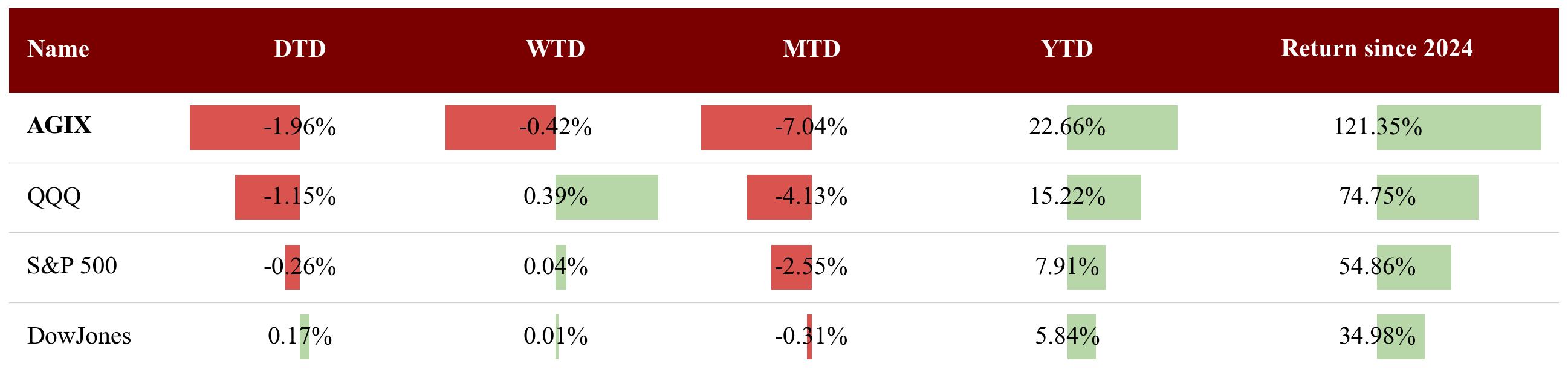
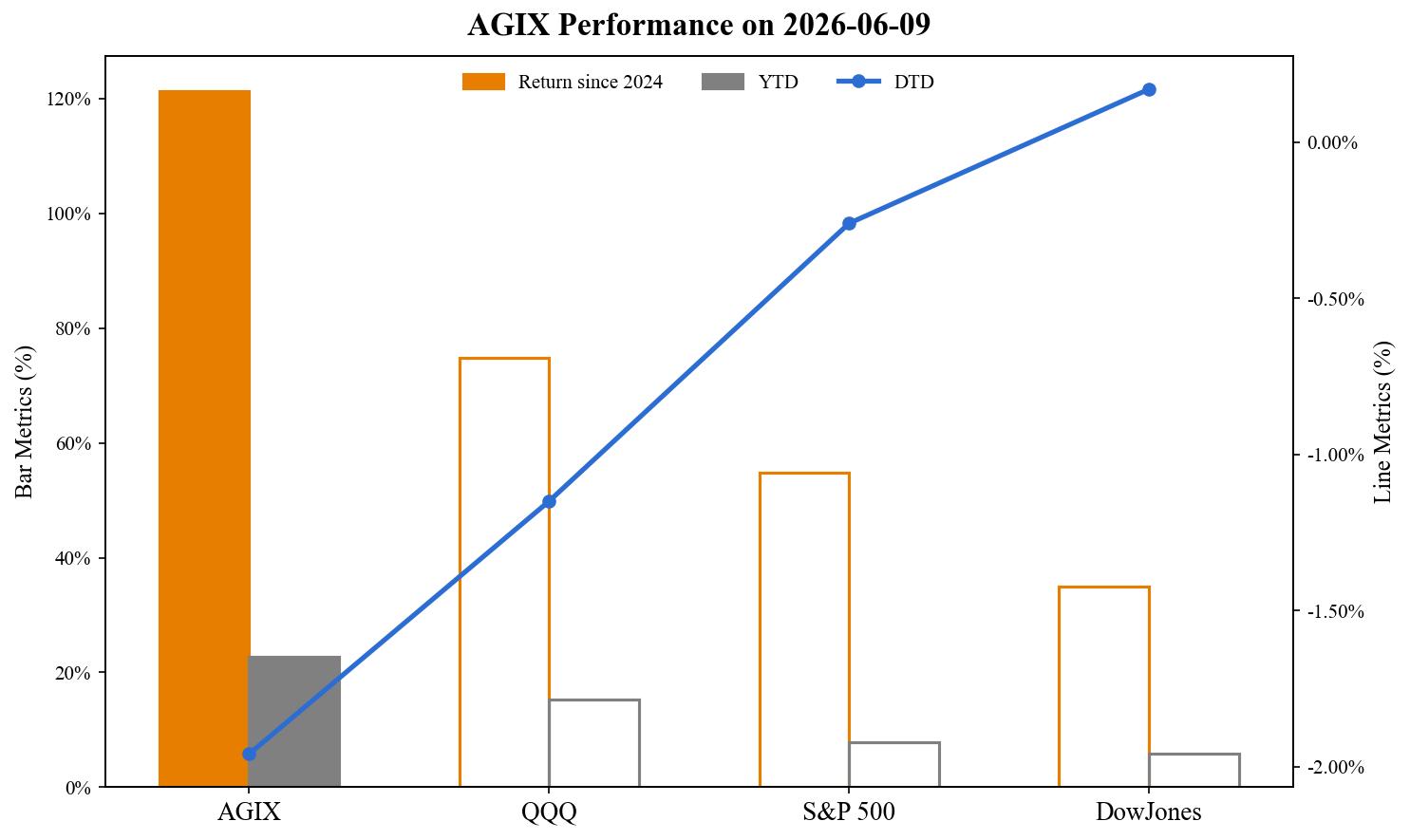
• AGIX fell 1.96% DTD, underperforming the S&P 500 (-0.26%), Dow Jones (+0.17%), and QQQ (-1.15%), dragged by weakness in large holdings like Apple (-3.64%) and ServiceNow (-6.32%).
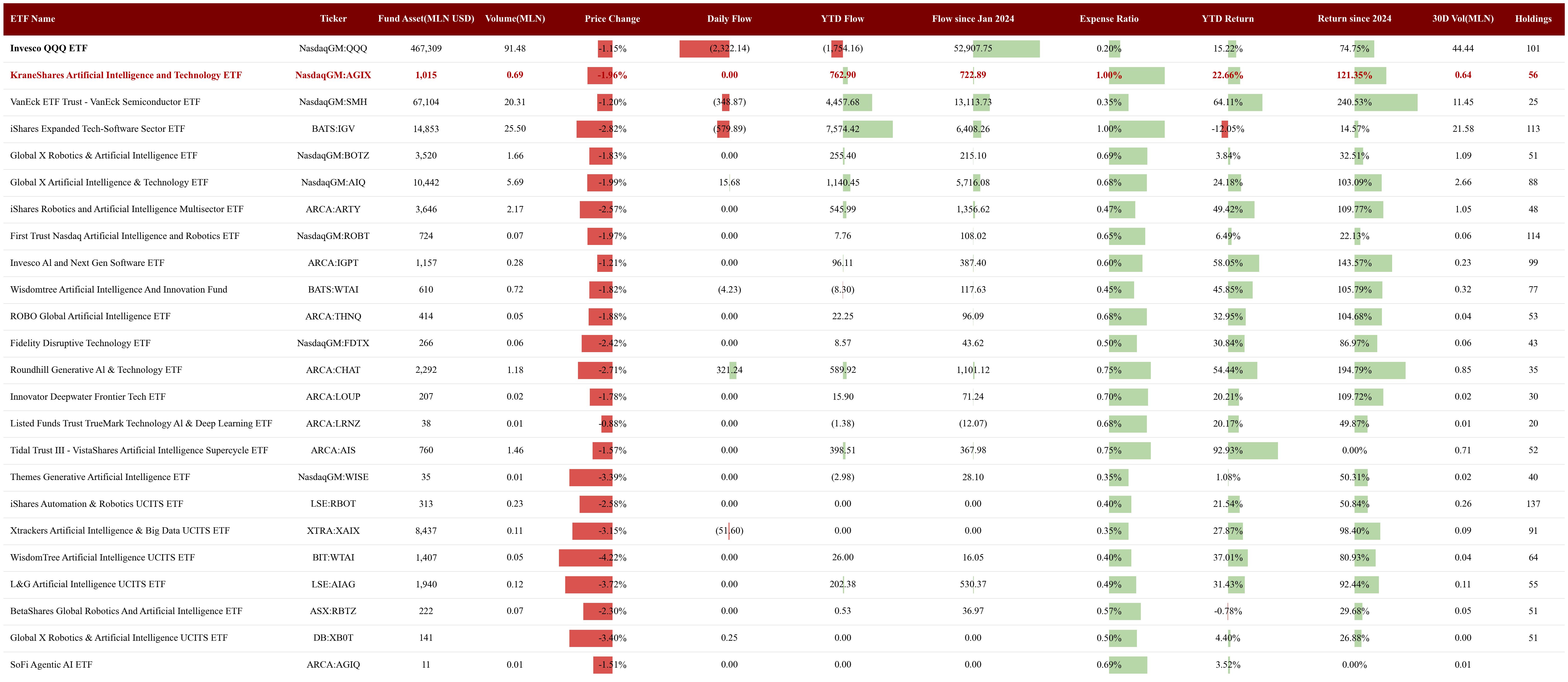
• Among peer AI ETFs, SMH (+3.74% WTD) and IGPT (+3.41% WTD) led on the week, while WISE (-2.58% WTD) and XAIX (-2.85% WTD) lagged, reflecting a rotation toward semiconductor-focused funds.
• Top positive contributors within AGIX included SK hynix (+15.91% DTD, contribution +0.35%) and Samsung Electronics (+8.97% DTD, +0.16%), driven by AI memory optimism and strong HBM demand.
• Key stocks to watch: SK hynix and Samsung Electronics (AI memory momentum), Apple (Siri AI launch and WWDC sentiment), and ServiceNow (continued sell-off after -6.32% DTD).
News Highlights
1. Apple's Siri AI launch and WWDC demos (using real-time device operation to restore trust after a $250M false ad settlement) could stabilize sentiment for Apple and its suppliers, though the stock fell 3.64% DTD on the day.
2. OpenAI's confidential IPO filing (valued at $852B) and Sam Altman's eye-scanning company layoffs highlight the growing tension between AI commercialization and regulatory/privacy challenges, with no direct AGIX holdings impact.
3. Google's NotebookLM upgrade to Gemini 3.5 with coding features and Amazon's multibillion-dollar optical deal with Corning underscore infrastructure spending, benefiting AGIX hardware holdings like NVIDIA and Broadcom.
4. The FinOps FOCUS specification's expansion to AI token economics and AWS's FinOps Agent launch reflect rising enterprise cost-control needs, relevant to AGIX infrastructure holdings like Datadog and Snowflake.
5. PointFive's $60M Series A for AI cost control and Lovable's $500M ARR milestone illustrate the rapid scaling of AI-native startups, signaling competitive pressure but also growth opportunities for AGIX's application-layer holdings.
RSS Highlights
1. Microsoft's record-breaking Patch Tuesday (nearly 200 vulnerabilities fixed) highlights the growing security workload driven by AI tools, relevant for AGIX holdings like Zscaler and Palo Alto Networks.
2. Anthropic released Claude Mythos with safeguards after earlier panic, demonstrating media manipulation prowess and the ongoing debate around AI safety—no direct AGIX holding impact.
3. Apple's Siri AI announcement (using a customized Gemini model on private cloud, with Core AI library for PyTorch integration) positions Apple as a differentiated AI player, supporting AGIX's Apple holding.
4. WorkOS launched auth.md, an open protocol for agent registration, enabling AI agents to dynamically discover OAuth metadata—a step toward standardized AI authentication.
5. The CREATOR Act (Adobe-backed) proposes legal protection for artistic styles against AI, reflecting growing IP challenges in the AI era, with potential long-term implications for AGIX application holdings.
Performance & Benchmark
Attribution
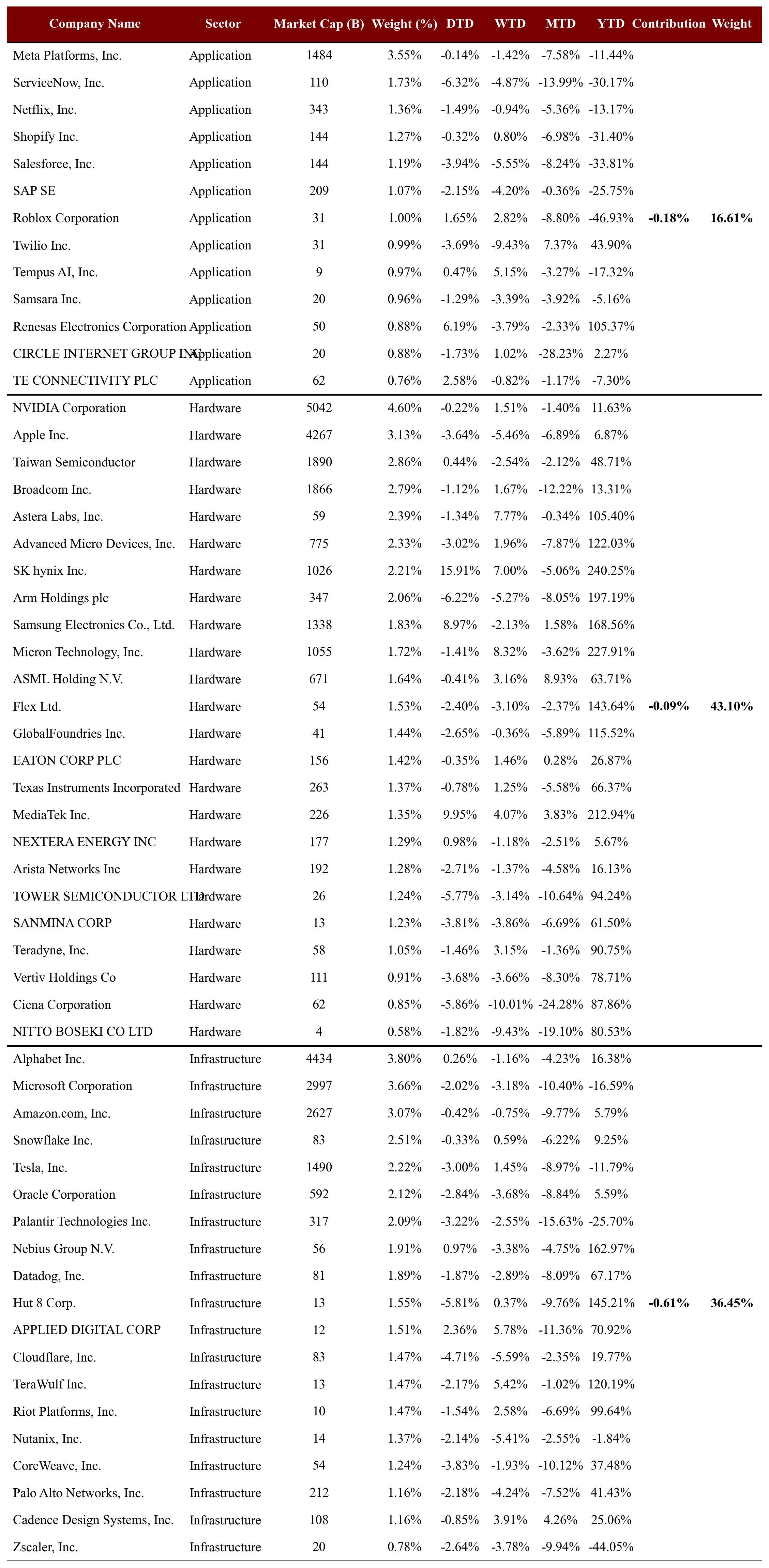
Contribution of the three sectors within AGIX holdings today
Application: -0.18%
Hardware: -0.09%
Infrastructure: -0.61%
Top-performing stocks in AGIX holdings today
SK hynix Inc. (15.91%)
MediaTek Inc. (9.95%)
Samsung Electronics Co., Ltd. (8.97%)
Renesas Electronics Corporation (6.19%)
TE CONNECTIVITY PLC (2.58%)
APPLIED DIGITAL CORP (2.36%)
Worst-performing stocks in AGIX holdings today
Microsoft Corporation (-2.02%)
Nutanix, Inc. (-2.14%)
SAP SE (-2.15%)
TeraWulf Inc. (-2.17%)
Palo Alto Networks, Inc. (-2.18%)
Flex Ltd. (-2.4%)
Zscaler, Inc. (-2.64%)
GlobalFoundries Inc. (-2.65%)
Arista Networks Inc (-2.71%)
Oracle Corporation (-2.84%)
Tesla, Inc. (-3.0%)
Advanced Micro Devices, Inc. (-3.02%)
Palantir Technologies Inc. (-3.22%)
Apple Inc. (-3.64%)
Vertiv Holdings Co (-3.68%)
Twilio Inc. (-3.69%)
SANMINA CORP (-3.81%)
CoreWeave, Inc. (-3.83%)
Salesforce, Inc. (-3.94%)
Cloudflare, Inc. (-4.71%)
TOWER SEMICONDUCTOR LTD (-5.77%)
Hut 8 Corp. (-5.81%)
Ciena Corporation (-5.86%)
Arm Holdings plc (-6.22%)
ServiceNow, Inc. (-6.32%)
Top five listed stocks contributing the most within AGIX holdings today
Arm Holdings plc (-6.22%)
Apple Inc. (-3.64%)
ServiceNow, Inc. (-6.32%)
Hut 8 Corp. (-5.81%)
Microsoft Corporation (-2.02%)
Observation
The strongest movers across peer ETF holdings today are listed below:
| DTD | Stock Ticker | Name | Held by ETFs | analysis |
|---|---|---|---|---|
| 15.91 | KOSE:A000660 | SK hynix Inc. | ['NasdaqGM:AGIX', 'NasdaqGM:AIQ', 'ARCA:ARTY', 'NasdaqGM:ROBT', 'ARCA:IGPT', 'BATS:WTAI', 'ARCA:CHAT', 'ARCA:LOUP', 'ARCA:AIS', 'XTRA:XAIX', 'BIT:WTAI'] | SK hynix’s ~16% single-day gain on June 9, 2026 appears primarily driven by renewed optimism around its dominant high‑bandwidth memory (HBM) position and AI exposure after a brief technical pullback, with the stock rebounding sharply from recent consolidation lows within a strong uptrend.[3][4][5] The move was likely amplified by momentum and short-covering dynamics given the name’s ~235% year-to-date surge, high trading volume, and traders treating around ₩2,000,000 as a key bull/bear pivot level.[3][4] |
| 9.95 | TWSE:2454 | MediaTek Inc. | ['NasdaqGM:AGIX', 'ARCA:IGPT', 'ARCA:THNQ', 'LSE:AIAG'] | MediaTek’s ~10% gain on June 9, 2026 appears primarily driven by continued AI/edge-computing and smartphone chipset optimism, with investors rotating into leading Taiwan semiconductor names ahead of anticipated demand from AI PCs, edge devices, and Android flagship cycles.[4][7] The move occurred on very strong volume relative to recent trading, suggesting momentum and positioning/short-covering dynamics amplified the upside in the absence of stock-specific company disclosures or new regulatory announcements that day.[4][7] |
| 9.9 | TWSE:3008 | LARGAN Precision Co.,Ltd | ['ARCA:IGPT', 'LSE:RBOT'] | LARGAN Precision’s 9.9% rise on 2026-06-09 is not explained by any same-day company-specific news in the provided results, so the move most likely reflects a sharp sector/risk-on re-rating rather than a fundamental announcement. The most plausible drivers are momentum buying in Taiwan tech/optics names, short-covering after recent weakness, and rotation into large-cap semiconductor-adjacent beneficiaries. The available sources only confirm the stock was trading much higher around that period; they do not identify a specific catalyst for that session. |
| 9.56 | SEHK:3888 | Kingsoft Corporation Limited | ['XTRA:XAIX'] | Kingsoft’s 9.6% gain on 9 June 2026 appears primarily driven by a sharp technical rebound and momentum buying after recent weakness, rather than by any specific new fundamental disclosure. The stock jumped roughly 9–10% intraday to about HK$24.3–24.4, extending a positive 5‑day move and reversing prior declines, which suggests short-covering and trading-driven interest following improved technical signals and a “buy/strong buy” backdrop from recent technical/analyst setups. |
| 9.23 | TWSE:2379 | Realtek Semiconductor Corp. | ['XTRA:XAIX'] | Realtek Semiconductor’s 9.23% gain on June 9, 2026 appears primarily driven by company-specific optimism around capital returns and earnings quality following its 2026 AGM notice, which confirms a continued focus on shareholder distributions and solid recent profitability metrics.[3][7] A secondary driver is likely positive sentiment and momentum in Taiwan semiconductor names, with Realtek’s recent earnings beat and revenue outperformance versus estimates supporting a rerating as investors rotate into higher-quality IC designers.[3] |
| 9.21 | NasdaqGM:GPCR | Structure Therapeutics Inc. | ['ARCA:LRNZ'] | Structure Therapeutics’ ~9% gain on June 9, 2026 appears primarily driven by investor reaction to its high‑profile appearance at the Goldman Sachs 47th Annual Global Healthcare Conference, where management presented the story and likely reiterated the strong Phase 2 aleniglipron obesity data and Phase 3 plans, helping to refocus attention on its GLP‑1 pipeline and cash runway.[1][7] The move also fits within a broader rerating of the name as investors reprice upside in oral obesity drugs and respond to persistently bullish analyst sentiment and target prices that imply substantial further upside for GPCR.[1][2][4] |
| 8.97 | KOSE:A005930 | Samsung Electronics Co., Ltd. | ['NasdaqGM:AGIX', 'NasdaqGM:AIQ', 'NasdaqGM:ROBT', 'BATS:WTAI', 'ARCA:CHAT', 'XTRA:XAIX', 'BIT:WTAI'] | Samsung Electronics’ 8.97% jump on 2026-06-09 was most likely driven by a broad continuation of the 2026 re-rating in the stock, led by AI-memory optimism: investors have been rewarding Samsung for HBM wins, tighter DRAM/NAND pricing, and stronger earnings visibility. The move also appears consistent with heavy Korea equity inflows and momentum trading in a stock that was already near multi-year highs. I do not see evidence in the provided results of a single company-specific announcement on that date that fully explains the move. |
| 8.72 | TWSE:4919 | Nuvoton Technology Corporation | ['LSE:RBOT'] | Nuvoton Technology’s 8.72% rise on 2026-06-09 appears most consistent with a broad valuation rebound rather than a clearly identifiable company-specific announcement, as the available same-day sources do not show a material disclosure or earnings release. The stock was already trading well below its 52-week high, so a sharp bounce from depressed levels likely amplified the move. There is also a supporting fundamental backdrop that recent quarterly results were weak, which can increase sensitivity to any positive sentiment or sector rotation in Taiwanese semiconductors. |
| 8.07 | NasdaqGS:MGNI | Magnite, Inc. | ['ARCA:IGPT', 'NasdaqGM:FDTX'] | Magnite’s 8.07% rise on 2026-06-09 was most likely driven by continued investor reaction to its strong Q1 2026 earnings, which showed revenue of $164.4 million, contribution ex-TAC up 10% year over year, and a return to net income, with management also reaffirming full-year growth targets. The move was likely reinforced by the company’s CTV strength, as CTV contribution ex-TAC grew 30% year over year and made up more than half of total contribution ex-TAC. A secondary support factor was generally positive Street sentiment, including elevated analyst price targets and upbeat market commentary around the earnings beat. |
| 7.1 | TWSE:2308 | Delta Electronics, Inc. | ['NasdaqGM:ROBT'] | Delta Electronics’ 7.1% rise on 2026-06-09 was most likely driven by company-specific buying tied to a material disclosure filed the same day on the TWSE, though the available results do not show the disclosure text itself.[6] The move also fits a strong momentum setup: the stock had already been one of Taiwan’s standout performers, with market data showing it trading near its 52-week high and up sharply year-to-date.[5][4] No clearer same-day negative industry or macro shock appears in the provided results, so the event-driven explanation is a positive company-specific catalyst amplified by existing bullish sentiment.[6][5] |
| 6.99 | KOSE:A018260 | Samsung SDS Co., Ltd. | ['XTRA:XAIX'] | Samsung SDS’s 6.99% gain on June 9, 2026 appears primarily driven by ongoing positive sentiment around its Q1 2026 results and improving earnings trajectory, following the company’s preliminary disclosure of solid revenue and operating profit growth in late April.[4][6] A secondary driver is likely sustained optimism around its strategic positioning in AI and cloud, supported by its announced partnership with Google Cloud to collaborate in AI, cloud, and security, which reinforces the stock’s role as a Korean AI/digital transformation beneficiary.[4] Broader global strength in AI- and tech-related equities on the day, amid a rebound in AI-linked names, likely provided an additional tailwind to investor risk appetite for the name.[3] |
| 6.92 | TWSE:2408 | Nanya Technology Corporation | ['ARCA:IGPT', 'ARCA:AIS'] | Nanya Technology’s 6.92% gain on June 9, 2026 appears primarily driven by ongoing positive sentiment around its strong earnings outlook and aggressive capacity and technology roadmap in DRAM, with investors continuing to re-rate the stock after recent quarterly results showing solid revenue momentum and profitability improvement.[7][8] A secondary driver is the broader strength in semiconductor and memory names, as investors position for a sustained upcycle in DRAM pricing and demand, which supports higher multiples for leading Taiwan memory producers like Nanya.[2][4] |
| 6.36 | TSE:285A | Kioxia Holdings Corporation | ['ARCA:IGPT'] | Kioxia’s 6.36% rise on 2026-06-09 was most likely driven by continued bullish sentiment on NAND memory pricing and tight industry supply, which supports earnings expectations for the company. A secondary factor was its inclusion in the Nikkei 225 earlier in 2026, which can sustain passive and benchmark-related buying interest. No company-specific same-day disclosure is evident in the provided sources, so the move appears more consistent with sector and index-related positioning than a fresh Kioxia announcement. |
| 6.2 | TSE:268A | Rigaku Holdings Corporation | ['LSE:RBOT'] | Rigaku Holdings’ 6.2% rise on 2026-06-09 appears most likely driven by stock-specific momentum rather than a clearly identifiable same-day company announcement, as the available public sources for that date do not show a matching disclosure or headline catalyst. The shares were already in a strong uptrend and screened as highly volatile, with analyst targets cited well above the prior close, which may have reinforced buying interest.[1][2][3] |
| 6.19 | TSE:6723 | Renesas Electronics Corporation | ['NasdaqGM:AGIX', 'NasdaqGM:ROBT', 'BIT:WTAI'] | Renesas Electronics’ 6.2% gain on June 9, 2026 appears primarily driven by continued momentum in the semiconductor sector and investor enthusiasm around AI- and automotive-related chip names rather than any company-specific disclosure that day. Public sources show no new Renesas-specific news or filings on June 9, so the move is best explained by beta to a strong broader chips rally and positioning in a stock that has already materially outperformed over the past month and year. |
| 6.04 | SHSE:601138 | Foxconn Industrial Internet Co., Ltd. | ['ARCA:IGPT', 'ARCA:AIS'] | Foxconn Industrial Internet’s +6.0% move on 9 June 2026 appears primarily driven by technical and flow factors rather than a specific, stock‑specific news catalyst. Public news feeds and exchange disclosures for that date show no material company announcements, earnings, guidance changes, or sector‑wide regulatory headlines tied directly to the stock, suggesting the gain likely reflects momentum/rotation into AI, cloud and electronics hardware names plus broad market sentiment toward China tech hardware. |
| 5.99 | TSE:6146 | Disco Corporation | ['NasdaqGM:FDTX'] | Disco Corporation’s +5.99% move on June 9, 2026 appears to be a continuation of strong post-earnings momentum and positioning in a high-beta semiconductor capital equipment name, rather than a reaction to any new company-specific disclosure that day. The stock recently hit an all-time high after “blowout” quarterly results that far exceeded expectations and triggered the maximum daily price move in Tokyo, which has kept the name in focus and supported follow‑through buying as investors reassess earnings power and growth durability.[1] A secondary driver is Disco’s structural leverage to semiconductor and electronics capex, with the shares trading at a substantial valuation premium to the sector, making the stock particularly sensitive to positive sentiment and flows into high-growth semiconductor equipment plays.[3][5] |
| 5.94 | TWSE:6531 | AP Memory Technology Corporation | ['ARCA:AIS'] | AP Memory Technology’s 5.94% gain on June 9, 2026 appears primarily driven by momentum and technical factors rather than any identifiable company-specific news or disclosures that day. Public wires, the company’s site, and major finance portals show no new announcements, earnings, guidance, or regulatory developments on or immediately before June 9, while the stock has exhibited elevated volatility and a strong-buy technical setup over the past week, consistent with trend-following and speculative flows in Taiwan’s high-beta semiconductor names.[1][4] |
| 5.68 | TWSE:3035 | Faraday Technology Corporation | ['LSE:RBOT'] | Faraday Technology’s 5.68% gain on June 9, 2026 appears to be driven primarily by technical and flow factors rather than a specific fundamental catalyst. There were no company-specific material announcements or TWSE official documents tied directly to 3035 on that date, and no notable same-day sector or regulatory news surfaced. In this context, the move is most plausibly linked to continued positive price momentum and a short-term shift in sentiment toward Taiwanese semiconductor/ASIC names, with technical buy signals (noted by third-party charting/TA services) likely amplifying demand. |
| 5.42 | NasdaqGS:CRDO | Credo Technology Group Holding Ltd | ['ARCA:IGPT', 'BATS:WTAI', 'LSE:RBOT'] | Credo Technology’s 5.4% gain appears primarily driven by continued follow‑through buying after its recent “huge earnings beat” and raised targets, as investors digest strong Q4 FY26 results with 157% year-over-year revenue growth, ~68% gross margins, and robust profitability.[1] Elevated trading volume at roughly double the stock’s average and a broadly bullish analyst setup (consensus “Moderate Buy” and average target above the prior close) likely reinforced positive momentum in the name.[2] |
| 5.39 | SHSE:688008 | Montage Technology Co., Ltd. | ['ARCA:AIS'] | Montage Technology’s 5.39% gain on June 9, 2026 appears primarily driven by ongoing AI/server chip enthusiasm and momentum buying in a high-valuation, high-beta name rather than a specific incremental company disclosure that day. The stock is trading at an elevated P/E and a large premium to fair value estimates while being more volatile than most China A-shares, which makes it more sensitive to sector sentiment and flows into China’s AI and cloud infrastructure chip leaders. |
| 5.37 | TWSE:2303 | United Microelectronics Corporation | [] | United Microelectronics’ 5.37% gain on June 9, 2026 appears primarily driven by continued momentum from its strong year-to-date rally and favorable sentiment toward foundry/AI-related semiconductor names, rather than any discrete company-specific news that day.[3][5] The move was supported by elevated trading volume versus average on the Taiwan listing, indicating incremental buying interest as investors rotated into higher-beta semiconductor foundry exposure amid an ongoing sector upswing.[5] |
| 5.2 | nan | Thermo Fisher Scientific Inc | [] | Thermo Fisher Scientific’s 5.2% gain on June 9, 2026 appears primarily driven by bullish positioning and valuation-focused interest rather than a discrete fundamental catalyst that day.[1] The move coincided with positive coverage highlighting the stock’s upside versus intrinsic value and strong GF Score, framing the name as still undervalued despite recent strength.[1] A secondary supportive factor was incremental sentiment from institutional positioning disclosures, including reports of a large increase in holdings by Los Angeles Capital Management published around the same time, which reinforced confidence in the equity story.[4] |
| 5.18 | SEHK:2431 | Minieye Technology Co., Ltd | ['NasdaqGM:BOTZ', 'ASX:RBTZ', 'DB:XB0T'] | Minieye Technology’s 5.18% rise on 2026-06-09 is best attributed to stock-specific trading momentum rather than any clearly identifiable same-day company announcement in the provided results. The only clearly relevant recent public information is that the company is a relatively new HK-listed intelligent driving stock, and market coverage shows active trading and analyst interest, but no direct catalyst for that date appears in the sources.[1][2][4][5] |
| 5.15 | TWSE:3706 | MiTAC Holdings Corporation | ['ARCA:IGPT'] | MiTAC Holdings’ 5.15% gain on June 9, 2026 appears primarily driven by follow-through buying after its strong May 2026 revenue announcement, which reported unaudited consolidated sales of NT$13.639 billion and signaled solid ongoing business momentum.[5] The move was likely reinforced by broader positive sentiment toward Taiwanese technology hardware names leveraged to AI and data-center infrastructure, where MiTAC is positioned as a server and related equipment supplier.[3][6] |
News
Funding & M&A
Mercor’s Brendan Foody calls out Sequoia, accusing it of ‘dual-pricing’ valuation tricks
Recently, multiple AI founders have exposed their treatment by investment institutions on X platform, with Mercor co-founder Brendan Foody directly calling out Sequoia's "dual valuation" strategy. The firm invests large capital at a low favorable valuation while using a high headline valuation to guide the market and employees. For example, AI assistant startup Serval's $750 million Series B had a nominal valuation of $10 billion, but the actual pre-money valuation was below $4 billion. Redpoint employed a similar structure in the Aaru project. Sequoia partner Shaun Maguire argues this is market reality, not intentional deception. Such dual-track pricing mechanisms not only inflate a company's perceived value but can also guide angel investors. Meanwhile, founders are also accused of fabricating growth by overstating ARR data. This behavior has sparked deep industry reflection on transparency and trust mechanisms.
As OpenAI files for IPO, Sam Altman’s eye-scanning company is doing layoffs, report says
OpenAI confidentially filed for an IPO on Monday, potentially becoming one of the most significant public offerings of the decade. At the same time, Tools for Humanity, a company held by OpenAI CEO Sam Altman, is conducting large-scale layoffs. The company's flagship World verification project uses silver orb scanning devices to collect human iris data, aiming to distinguish humans from bots and support Worldcoin cryptocurrency transactions. It has previously raised $2.5 billion from investors including Andreessen Horowitz and Bain Capital, at a $2.5 billion valuation. However, the company faces revenue difficulties and has been subject to regulatory penalties in Kenya, India, Hong Kong, and other regions over privacy and financial issues. U.S. companies like Tinder, Zoom, and Docusign have partnered with it.
OpenAI confidentially files its IPO paperwork as it inches closer to stock market debut
AI leader OpenAI Group PBC recently filed its IPO application with the U.S. Securities and Exchange Commission, officially kicking off the company's listing process. Currently valued at $852 billion, the IPO plan remains confidential, but the company has already chosen to discuss details with Morgan Stanley and Goldman Sachs. This move will make OpenAI's financials public and provide liquidity options for employee equity. As rival Anthropic's valuation has surpassed OpenAI's, the two companies are racing to advance their IPO timelines. Analysts note that OpenAI needs to optimize its cost structure and improve revenue product compliance to gain investor approval. This listing plan will also intensify its capital market competition with tech companies like SpaceX.
AI infrastructure cost control startup PointFive gets $60 million to help enterprises save.
AI operations startup PointFive announced the completion of a $60 million Series A funding round, led by Accel, with participation from Index Ventures, Salesforce Ventures, and others. The company is now valued at $500 million post-funding, just halfway to unicorn status. PointFive offers a cloud resource optimization platform focused on AI infrastructure cost control, helping enterprises reduce cloud spending by nearly 20%. Its platform can scan for idle servers, redundant storage, and other wasted resources in real time, and recommend downgrading AI models, controlling always-on agents, and other high-cost items. Founder Aron Arvatz stated that annual recurring revenue has grown sixfold, with customers including E.ON, Nubank, and Fanatics. The funding will be used to expand into European and Israeli markets and launch new services such as TokenShift.
Sandstone raises $30M to bring AI to in-house legal teams
Legal tech company Sandstone has completed a $30 million Series A funding round, led by Lightspeed Venture Partners with participation from Sequoia and others. The company focuses on workflow automation and relationship management for in-house legal teams, differentiating itself from AI tools like Harvey and Legora that target law firms. Its platform integrates with channels such as Slack and Jira, using AI for task assignment and legal analysis. This round comes just six months after a $10 million seed round in January. Investors emphasize the value of vertical AI in specific workflow scenarios. Meanwhile, Anthropic is also advancing its Claude for Legal service. Sandstone will primarily serve legal departments of small and medium-sized enterprises.
DTEX adds AI Risk Management to track how agents and employees use AI
Behavioral intelligence security company DTEX Systems has launched a new generation of AI risk management products that identify and assess the risks of generative AI usage by both humans and autonomous AI agents in real time. The product can discover and flag unauthorized tools, monitor prompts and data flows, distinguish between human and machine behavior, and prevent sensitive information leaks. In addition, the company has introduced two autonomous security agents—Triage Guardian and Threat Hunter—which use a multi-agent architecture to automate investigation workflows, reduce false positive rates, and support natural language investigations. The product is available in private preview and is expected to be widely launched next quarter. Founded in 2000, DTEX received $50 million in funding from Alphabet's growth fund CapitalG in 2024, focusing on insider risk, data leakage prevention, and user behavior analysis. This launch marks a new phase of intent verification in enterprise-level AI security monitoring.
Lovable says it has hit $500M in annualized revenue, with 1 million new projects a week
Lovable, a fast-growing European AI coding startup, told TechCrunch that its annualized revenue run rate has surpassed $500 million. Founded in late 2023, the company had already exceeded $400 million in February this year, with a growth rate that is astonishing. Lovable says its platform has been used to build 50 million projects, with 1 million new projects added each week. Users are primarily non-technical individuals, including founders, designers, and salespeople, who use the platform to build websites, e-commerce storefronts, and internal tools such as CRM, inventory, and HR systems. This phenomenon shows that AI 'vibe coding' is posing a threat to traditional SaaS software, as users prefer to build their own rather than purchase expensive software. However, maintenance costs remain a key challenge, and whether it can operate sustainably and effectively remains to be seen.
Model Releases
Filigran launches XTM One to automate threat exposure management with AI agents.
French cybersecurity company Filigran SAS recently launched XTM One, an AI orchestration layer that automates continuous threat exposure management workflows. The platform integrates the OpenCTI extended threat intelligence platform with the OpenAEV exposure validation tool, using AI agents to coordinate tasks such as intelligence ingestion, attack scenario generation, and remediation guidance throughout the entire lifecycle. Unlike AI features within a single tool, XTM One provides a cross-product agent collaboration layer, supporting custom-built agents, bringing its own LLM models, and on-premises deployment, making it suitable for regulated industries. Early benchmarks show that users can reduce threat detection and response cycles by 70% and preparation time by 80%. The product is available in three versions; existing enterprise users can get basic features for free, while advanced customization requires additional licensing. Founded in 2022, Filigran has secured $58 million in Series C funding, co-led by Eurazeo, Insight Partners, Accel, and Deutsche Telekom's T.Capital.
Technical Breakthroughs
Zscaler launches AI Broker and Endpoint AI Security for agents.
Zscaler unveiled the industry's first complete zero-trust platform for autonomous AI agents at Zenith Live 2026. New products include Zscaler AI Broker, Endpoint AI Security, and AI Access Graph, the latter stemming from the $175 million acquisition of Symmetry Systems in May of this year. This update expands on the Zscaler AI Protect features launched in January, adding control over MCP servers, embedded AI, and over 250 generative AI applications. Zscaler also offers red team testing and prompt hardening services for development teams. Facing competitors such as Palo Alto Networks and Google, Zscaler continues to build its AI security market presence through acquisitions like SquareX. CEO Jay Chaudhry emphasized that traditional security cannot meet the machine-speed access demands of autonomous agents.
AWS debuts AWS FinOps Agent to help customers optimize their cloud spending.
Amazon Web Services Inc. has launched AWS FinOps Agent, an AI tool that displays cloud billing data through a ChatGPT-like interface, helping administrators quickly identify anomalous spending, generate savings recommendations, and automatically produce periodic reports. The tool integrates seamlessly with Slack and Jira, and supports improved accuracy based on user-provided tag explanations. This move marks AWS's third AI management tool in the past year, with the previous two already used for security detection and DevOps issue resolution. The tool is based on data from the AWS Cost Optimization Hub, can identify various savings opportunities, and optionally filter out minor fluctuations. Industry observers believe the product will help enterprises control costs more precisely in multi-cloud environments, driving the intelligent transformation of FinOps practices.
Google upgrades NotebookLM to Gemini 3.5, adding more coding features.
Google, a subsidiary of the US tech giant Alphabet, today made a major upgrade to its NotebookLM service, introducing the Gemini 3.5 large model and integrating the Antigravity code editor. The new version excels in online research and data analysis tasks, outperforming its predecessor in 78.2% of test cases. In particular, its ability to understand long documents has significantly improved, and its generation speed is 4 times faster than competitors. Additionally, the service can now run multiple AI agents in parallel on virtual machines to handle code tasks, supporting over 100 pre-packaged software skills. Users can generate various document formats such as Word, PowerPoint, Excel, PDF, and JSON, facilitating data export. The new features will first be available to Google AI Ultra subscribers and Workspace enterprise customers, with broader rollout to follow. This upgrade demonstrates Google's continued investment and technical strength in multimodal AI applications.
Apple’s WWDC AI demos looked more real after $250M false ad settlement
At WWDC 2026, Apple showcased a major upgrade to its AI assistant Siri, along with multiple fixes to liquid design, search functionality, and Playground features. Unlike the weather-themed promotional video from 2024, this presentation used a "live-like" demo format, demonstrating feature reliability through actual device operation, in response to a $250 million settlement over previous false advertising. The new Siri will launch with iOS 27, supporting iPhone 15 Pro and newer models, as well as various iPads, Macs, Vision Pro, and Watch devices, without requiring users to purchase the latest hardware. This move shows Apple actively adopting a transparency strategy to mitigate complaints and restore user confidence in its AI technology.
Datadog launches more than 100 features at DASH to push autonomous AI operations.
Observability and security platform company Datadog unveiled over 100 new features at its annual DASH 2026 conference, with a major focus on expanding its Bits AI agent suite to enable autonomous operations across the software development lifecycle. New features include Bits Detection, Infrastructure, Code, and Release modules, as well as Agent Eval for debugging AI agents. On the security front, it introduced AI Guard, targeting prompt injection and agent poisoning attacks. Datadog also launched a Bring Your Own Cloud solution to reduce log storage costs. Agent Builder and Agent Console strengthen the construction and centralized monitoring of AI agents. The company emphasized that in the AI era, operational control capabilities will be key to success, and it expects to continue investing approximately 30% of revenue in R&D.
Product Launches
Why Apple’s slow-and-steady AI bet is starting to look pretty smart
Apple recently launched what it calls its biggest AI upgrade yet: Siri AI. This feature, powered by a partnership with Google Gemini, deeply embeds automation capabilities into the core of the operating system. The new Siri can extract information from email and message history, provide contextual suggestions based on screen content, and fetch the latest online information in real time via Gemini. Apple executives emphasize a user-centric philosophy rather than pursuing AI for its own sake, a move seen as a response to external criticism. Currently in beta, the feature is expected to launch within the year. With relatively low capital expenditure, Apple has delivered a differentiated AI experience, contrasting with the heavy investments of OpenAI and Meta, and its strategy of ensuring hardware sales appears more prudent.
Industry Partnerships
The FOCUS specification targets AI token economics as AI billing complexity reaches a new frontier.
As enterprise AI spending continues to grow, existing cloud billing frameworks struggle to adapt to new consumption models based on GPU clusters and token units, making data normalization increasingly prominent. At the FinOps X 2026 conference, the FinOps Foundation working group is advancing FOCUS version 1.4, extending the open cost and usage specification from multi-cloud to the AI domain. According to data, about 68% of organizations with annual spending over $100 million have begun adopting or are experimenting with FOCUS format data. Experts point out that AI token economics requires observability down to the per-user, per-session, and per-request level, which will create massive data engineering challenges. The working group is considering integration with frameworks like OpenTelemetry to support joint decision-making across finance, procurement, and executive roles.
The FinOps FOCUS specification becomes the common language for AI cost accountability.
As token-based spending in AI-driven cloud and on-premises environments continues to grow, the challenge of reconciling multi-cloud costs is becoming increasingly prominent for enterprises. The FinOps FOCUS specification is emerging as an open standard for multi-cloud cost data, helping practitioners quickly achieve cost allocation and spending transparency through a unified data language. Walmart Senior Software Engineering Manager Karl Kraft stated that FOCUS, through effective cost columns and provider-defined split cost allocation mechanisms, distributes subscription fees daily down to individual teams and Kubernetes Pod levels, eliminating the pain of having to build custom normalization pipelines. The upcoming version 1.5 will introduce SKU pricing datasets and AI token type spending analysis, while applying AI agents to specification maintenance workflows. This specification is accelerating the standardization of multi-cloud FinOps, providing enterprises with a scalable cost management foundation.
Amazon signs a multibillion-dollar optical manufacturing deal with Corning.
Amazon.com has reached a multi-billion dollar cooperation agreement with Corning Incorporated, under which Corning will provide fiber optics, network components, and connectivity hardware for Amazon's data centers. Corning plans to use the funds to expand its factory in North Carolina, expected to add 1,000 manufacturing jobs and hundreds of construction positions. Corning is a major supplier of fiber optic cables for data centers, offering products including indoor and outdoor cables and universal fiber optic splicing systems that effectively reduce security risks and optimize space management. The cooperation also involves providing photomask glass materials for EUV lithography equipment. Corning has previously entered into similar collaborations with Nvidia, which will support the construction of its new factory and purchase 18 million shares of Corning stock. Amazon's recently announced random network graph fiber design will further benefit from this supply chain cooperation.
Rubrik turns its platform into an AI agent and ships Agent Cloud for Claude
Rubrik Inc. announced several major updates at the Rubrik Forward conference in Las Vegas, upgrading its data security platform to an autonomous AI agent and launching a control layer for Anthropic Claude, Agent Cloud for Claude Code, which is now generally available. The core product, Rubrik AI, features a patent-pending agent-first interface with built-in SAGE governance engine, Agent Rewind, and Codebase Resilience, enabling intent-driven real-time control, irreversible operation rollbacks, and immutable snapshots of code repositories. Rubrik also launched the Project Hourglass partner program, promoting services with six global system integrators including Cognizant, Deloitte, and HCLTech. Enterprises can scan and index unstructured data on-premises via the Annapurna platform and publish it directly to a lakehouse, reducing duplicate ETL. Rubrik cited internal research showing that 86% of cybersecurity executives expect AI agents to breach existing defenses, and 88% are concerned about recovery time objectives. Additionally, a cloud application self-healing engine has entered private beta.
融资收购
Rental screening startup 100 acquires fraud detection firm Cobblestone Labs
Leasing screening startup 100 announced today that it has acquired Cobblestone Labs Inc., a fraud detection and revenue verification platform founded by former engineers of Ramp Business Corp. The terms of the deal were not disclosed, and Cobblestone co-founders Jason Scharff and Jack Mastrangelo will join 100 as strategic advisors. Cobblestone was founded in 2023 at the Johannesburg Foundation and offers an AI-native audit engine that helps institutional landlords reduce defaults and catch tenant fraud. This acquisition integrates its high-end financial audit technology into 100's leasing screening platform, supporting cross-validation across multiple data sources and multiple large language models. As generative AI drives a rise in real estate fraud cases, the FBI tracked $27.5 billion in real estate fraud losses in the U.S. in 2025, and AI-driven fraud losses are expected to reach $40 billion by 2027. Meanwhile, 100 has been designated as a preferred partner by NMHC Top 50 operators such as Asset Living, with clients reporting a 67% increase in application speed and a 35% decrease in default rates.
Tiger Data launches PostgreSQL extension designed for AI agents
New York-based PostgreSQL database platform company Tiger Data (doing business as Timescale Inc.) today officially launched a managed Ghost service for AI agents. The service is built on the company's Fluid Storage backup technology, enabling agents to quickly create an unlimited number of independent database instances and bill based on actual compute usage. This move responds to new demands such as large-scale experimentation and temporary environment creation for AI agents. Company founder Ajay Kulkarni said that future software will be built and run by agents, and databases must support high-frequency experimentation and fast rollbacks. Ghost is compatible with extensions like TimescaleDB and pgvector, maintaining the advantages of the PostgreSQL ecosystem. The company has raised a total of $180 million and employs 200 people across 25 countries. The launch of this service marks the evolution and upgrade of PostgreSQL in the AI era.
融资求购
How an e-scooter founder raised $5 million to build space data centers.
Space data center startup Orbital has secured $5 million in seed funding from the a16z Speedrun program, planning to use SpaceX's Starship to deploy AI inference facilities in space. The company is led by former Spin founder Euwyn Poon and is currently preparing to launch its first data processing satellite in 2028, with plans to advance a constellation of 10,000 satellites by 2030. The project has received support from multiple investment institutions including Basis Set and Human Element, aiming to provide distributed million-kilowatt-level AI computing power. Meanwhile, Starcloud, Cowboy Space Company, and Blue Origin are also advancing similar plans. This funding reflects investors' long-term confidence in space computing, although it still faces challenges in launch costs and technical hurdles.
RSS Subscription
A Record-Breaking Patch Tuesday for June 2026
Microsoft released a software update today, fixing nearly 200 security vulnerabilities, a record number of fixes in the company's monthly Patch Tuesday cycle. Nearly thirty of these vulnerabilities were rated as 'critical,' and at least three have publicly available exploit code. With the widespread use of AI tools in the security field, the volume of patch releases is expected to continue increasing in the future.
The revenge of Claude Mythos
Two months ago, Claude Mythos sparked global panic due to a tweet from Axios, and Anthropic had stated that the model was too dangerous to release. However, Anthropic has now launched the model with some added safeguards, and anyone can use it at an appropriate price. This move demonstrates Anthropic's ability to manipulate the media, and this pattern has not changed since 2019.
Stop eating Lady Gaga's Oreos
In 1992, Pearl Jam quickly rose to fame with their single 'Jeremy,' but then chose to refuse making music videos and giving interviews for five years, even though their second album sold nearly a million copies in its first week and stayed at number one on the Billboard chart for over a month. Today, commercialization in the music industry is no longer criticized but has become a popular trend; for example, Lady Gaga's collaboration with Oreo shows that 'selling out' is no longer a negative label.
The Microsoft Company Party where everybody played name tag swap
Around 1984, Microsoft held a company party where participants exchanged name tags to facilitate networking. At the party, Bill Gates noticed a attendee's name tag reading 'Gary Kildall' and excitedly swapped his own name tag with it, though it was unclear whether Gary was actually invited.
Pluralistic: Naomi Kritzer's "Obstetrix" (09 Jun 2026)
Naomi Kritzer's new work 'Obstetrix' is a tense thriller novel about an obstetrician who is kidnapped by a Christian cult after saving a patient's life. The novel explores complex interpersonal relationships and power dynamics within a high-demand cult, showcasing Kritzer's deep understanding of character emotions. The book is not only a compelling read but also offers a profound insight into the mechanisms of patriarchy and religion.
Incorruptible
"Uncorrupted: Why Good Companies Go Bad... and How Great Companies Stay Great" is a book by Eric Ries that explores the shift of companies from serving the public to serving only shareholders, and offers practical advice on building enduring governance structures. The book emphasizes that public markets reward short-term behavior and introduces the core concept of a Long-Term Stock Exchange (LTSE), which could become a key catalyst for driving change in companies and society.
Apple II: Launched June 10, 1977
On June 10, 1977, Apple introduced the Apple II, an early pre-assembled desktop computer that sold about 6 million units over 17 years, making it the most successful of the three microcomputers on the market in 1977. The Apple II was known for its open architecture and expansion slots, allowing users to easily upgrade its capabilities, and its vast software library also laid the foundation for its success.
LLMs and almost good code
Recent research shows that top large language models (LLMs) can generate code that is up to 10% more complex than necessary for simple tasks. In a work project, the author used an LLM to generate a 24-line function that was functionally correct and had tests covering all edge cases, but its complexity was still too high. Ultimately, the author reduced complexity by about 8% through reimplementation, reflecting on the long-term maintenance issues that can arise from accepting overly complex code.
Rotation revisited: Shuffling more than three blocks, and other small notes
In the non-contiguous exchange problem, reducing the number of rotations from three to two shows that the solution can be generalized to shuffling any number of variable-sized blocks: for k blocks with total size n, shuffling can be done in at most kn swaps. Although there is discussion of using the XOR trick for swapping, it does not help with moving variable-sized blocks. Additionally, the algorithm's space complexity is described as "constant space," meaning the amount and size of required space is a bounded constant, not dynamic memory allocation.
Setting a custom price for a model in AgentsView
The Claude Fable 5 released today has not yet been included in AgentsView's pricing database, and I found a way to set a custom price through reverse engineering. According to AgentsView's analysis, my usage of Claude Fable 5 across different local projects today cost $74.06, accounting for 89.3% of the total.
Apple OS 27: The Small Things
At WWDC26, Apple announced a series of upcoming updates focused on improving user experience, including keyword addition for photos and videos, improvements to shared albums, optimization of message syncing, enhanced Safari performance, and data updates for the Health app. Additionally, Apple Music and the Podcasts app have been redesigned to provide a more reliable streaming experience and faster playback speeds. Overall, these subtle improvements demonstrate Apple's attention to product quality.
The Talk Show Live From WWDC: Tonight, In-Person and Streaming
Tonight's event will be held at the California Theatre, and tickets are still available. You can also watch a live stereoscopic immersive stream on Vision Pro through Sandwich Vision's Theater app. Tickets are priced at $12.99, and after purchase, you get permanent replay access along with a surprise feature. Hope to see you tonight!
Apple Introduces Siri AI
On June 8, 2026, Apple launched a new version of Siri AI with enhanced personalization and conversational abilities, capable of understanding users' personal backgrounds and broad world knowledge. Siri AI can not only answer questions on almost any topic but also extract relevant information from users' messages, emails, and photos, providing a more natural app operation experience. This feature will be available to users as a beta later this year, and user privacy is ensured through a new architecture.
Apple’s WWDC Announcement of the New Apple Intelligence System
On June 8, 2026, Apple introduced the next generation of Apple Intelligence, integrating the latest Apple Foundation Models, aimed at enhancing user privacy protection and improving everyday app experiences. New features include intelligent photo editing, Safari browsing tools, password security upgrades, and more, allowing users to perform desired operations through simple descriptions. Additionally, Siri has been fully upgraded to become a more personalized and conversational assistant. Developer testing is now available, and it is expected to be released to users in the fall.
Apple WWDC 2026 Keynote
This event lasted 76 minutes, including the post-credits music video, which is about half an hour shorter than in previous years.
Apple’s WWDC AI Demos Were Real and in Real Time
At the 2026 WWDC, Apple primarily showcased fixes for last year's "liquid glass" design, improvements to search functionality, and a brand new version of its AI voice assistant Siri. The presentation used a "real-time" format, emphasizing that these features are available on actual devices and that users do not need to buy the latest iPhone to get the new features. The new Siri will be launched via iOS 27 on iPhone 15 Pro and later models, covering a wider range of hardware including iPads and Macs.
Active recall
I am reading Haruki Murakami's "What I Talk About When I Talk About Running," and one sentence struck me deeply: I must understand things through writing. Research shows that free recall improves information memory more than rereading or creating concept maps, which made me realize that by writing blogs and keeping a diary, I am actually engaging in free recall, thereby enhancing my memory. Although I was not good at studying in school, I believe that effective note-taking and study method courses can help students better grasp knowledge.
Forms of Open Source Government
Governance models for open source projects vary widely, including the benevolent dictator for life, technical steering committee, standing core team, and others. Many projects transition to small elected committees or temporary governance structures after the founder retires, while some projects rely on a single company's control, leading to frequent governance crises and forks. Common governance models, such as Apache's standardized process, Kubernetes' technical committee, and community-based decision-making mechanisms, reflect the flexibility and challenges of different projects in management and decision-making.
From the Annals of People Having Knowledge of the Matter, Siri AI Extensions Edition
Apple plans to open Siri to external AI assistants in the upcoming iOS 27 update to enhance the iPhone's capabilities as an AI platform. Users will be able to interact with competing services including Google's Gemini and Anthropic's Claude through Siri, and this feature will be implemented via AI chatbot apps in the App Store.
[Sponsor] WorkOS Launches auth.md — an Open Protocol for Agent Registration
WorkOS has introduced the auth.md protocol, which provides a machine-readable Markdown file at the service root directory, allowing AI agents to dynamically discover metadata for OAuth-protected resources, parse required permission scopes, and achieve seamless authentication. The protocol is natively supported in WorkOS AuthKit, offering a standardized and secure login method for AI tools.
Siri AI at WWDC 2026
On June 8, 2026, Apple announced at WWDC a new Siri AI feature that seems feasible, using a customized Gemini model running on its private cloud computing platform and extracting user screen information through a visual large language model, avoiding the need for each app to integrate custom code. Developers can now use the new Core AI library to integrate with Meta's open-source PyTorch ecosystem, enhancing model performance on Apple hardware. Additionally, Apple is collaborating with Google and NVIDIA to expand its private cloud computing infrastructure to support complex inference tasks while maintaining security and privacy.
Copping My Style
Currently, there is no legal protection for artistic styles, but a bill supported by Adobe is proposing this idea to address challenges posed by AI. Fender has filed a legal complaint against PRS Guitars over its classic guitar designs, reflecting the debate over style attribution in the music industry. Meanwhile, Adobe hopes to grant artists ownership of their unique visual styles through the CREATOR Act, aiming to fill gaps in intellectual property law.
CSS: The Unavoidable Bad Parts
This article discusses some common issues and experiences with CSS in web design. Although modern web has a learnable subset suitable for simple tasks, there are still many potential pitfalls, such as inconsistencies in browser default styles and complex layout problems. The author suggests using semantic tags and classless CSS to simplify styling, while emphasizing that readability and customizability for users should be considered in design.