AGIX Daily Report 2026-06-11
AI Summary
Market Overview
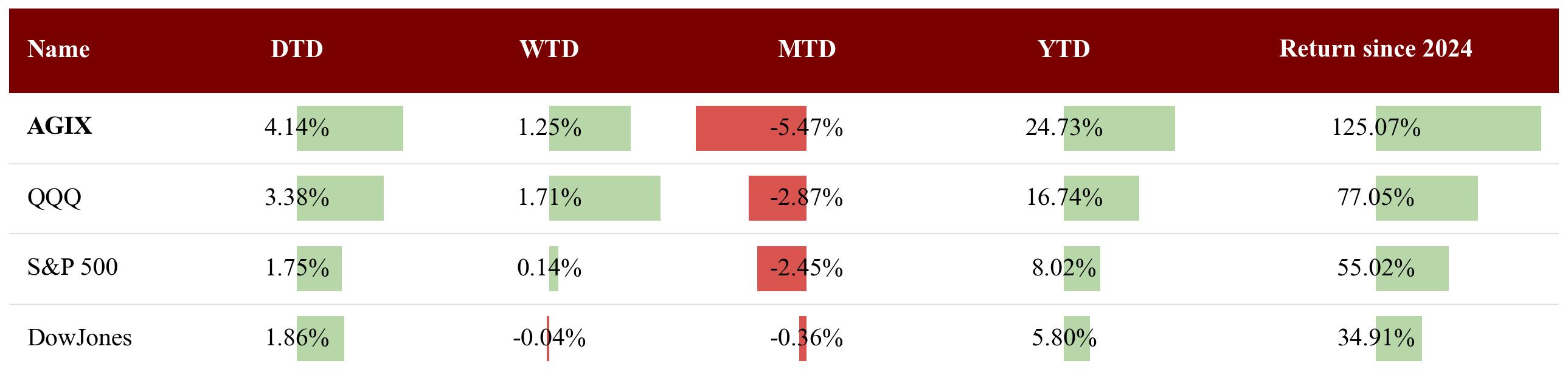
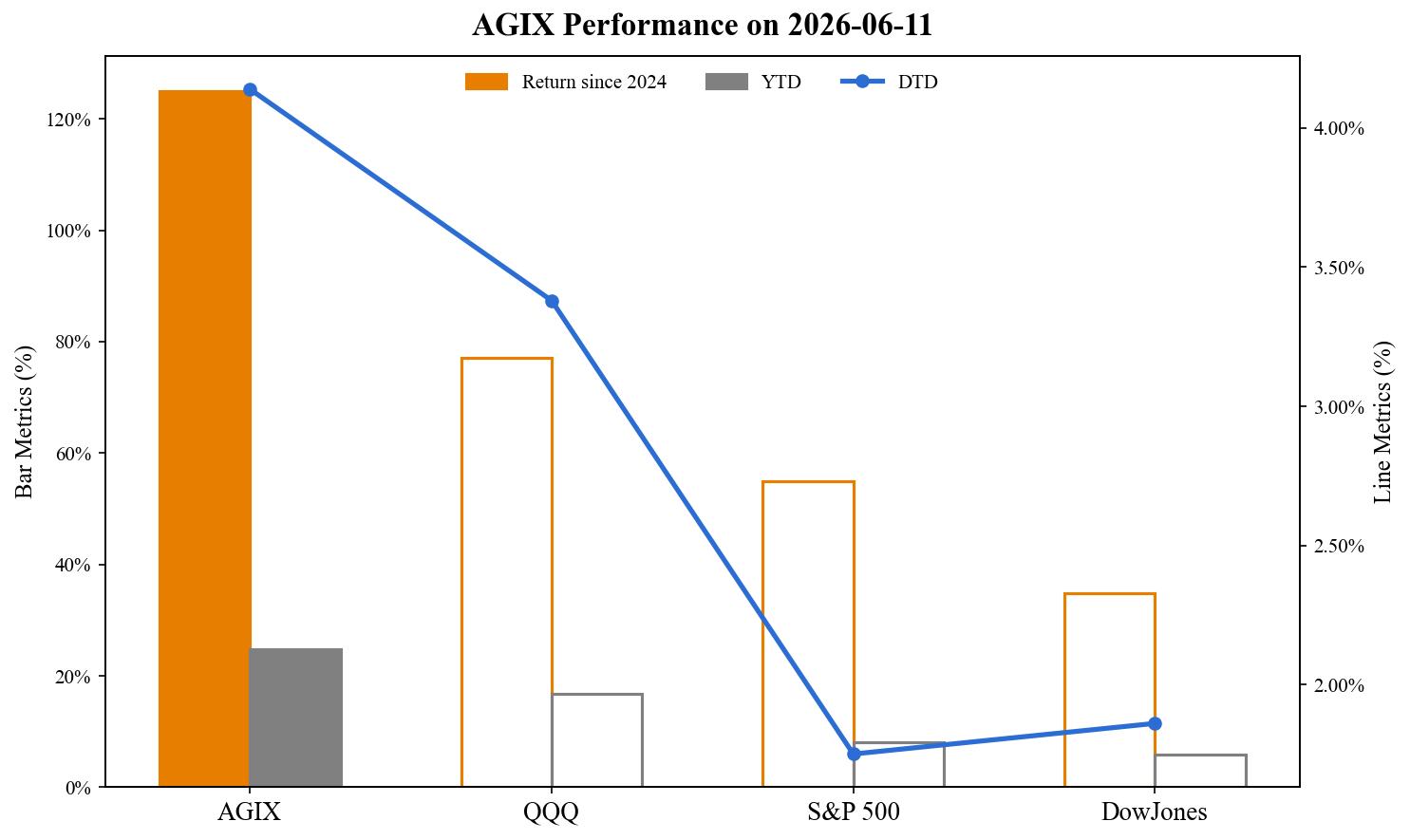
• AGIX gained 4.14% DTD, outperforming the S&P 500 (+1.75%) and Dow Jones (+1.86%), but slightly lagging QQQ (+3.38%). YTD, AGIX is up 24.73%, well ahead of QQQ's 16.74%.
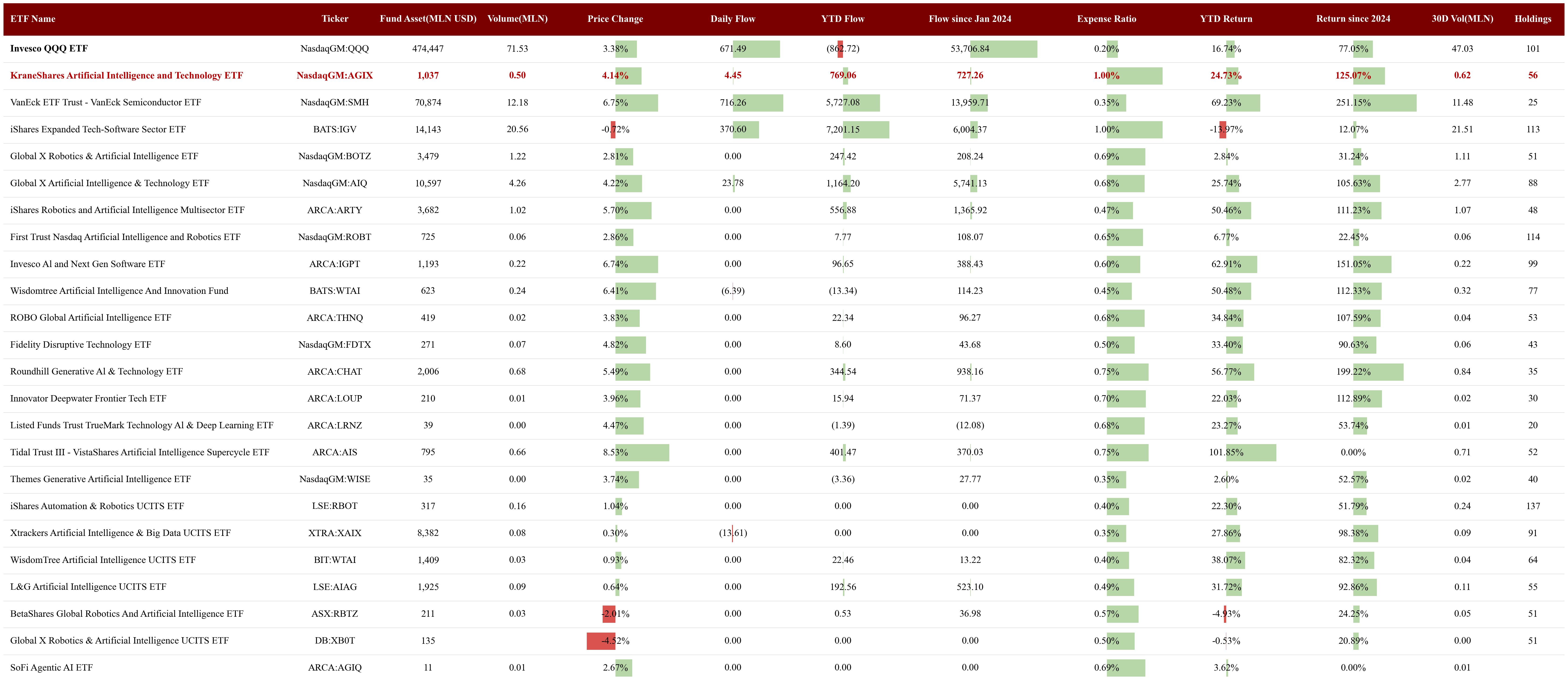
• Semiconductor and AI hardware names led the peer ETF pack: SMH (+6.75%), IGPT (+6.74%), and AIS (+8.53%) saw strong DTD gains, reflecting broad AI infrastructure demand.
• Top AGIX holdings by DTD contribution included Astera Labs (+11.07%, 2.56% of portfolio), Micron (+11.66%, 1.82%), and Arm Holdings (+11.32%, 2.16%), all driven by AI momentum and positive analyst actions.
• Key stocks to watch: Micron (AI memory demand, record earnings), Astera Labs (AI connectivity, momentum), and Arm Holdings (price target hike from Bank of America).
News Highlights
1. Anthropic CEO Dario Amodei calls for mandatory third-party auditing of frontier AI models, proposing government power to block dangerous systems, which could increase regulatory scrutiny on AI firms.
2. Visa partners with OpenAI to enable AI agents to make payments, a major step toward agentic commerce that could boost demand for AI infrastructure and payment platforms.
3. Oracle's AI investments spook investors despite earnings beat, as $40 billion in new financing for AI data centers raises concerns about capital intensity and free cash flow.
4. SpaceX raises a record $75 billion in its IPO, merging with xAI, creating a new AI powerhouse that will compete with Anthropic and OpenAI, potentially reshaping the AI landscape.
5. Google open-sources DiffusionGemma, a text diffusion model 4x faster than traditional LLMs, improving AI generation efficiency and reducing memory usage.
6. Microsoft patches over 200 vulnerabilities in a single month, with AI accelerating bug discovery, highlighting both the benefits and risks of AI in cybersecurity.
RSS Highlights
1. Anthropic walks back a policy that could have 'sabotaged' AI researchers using Claude, improving transparency in safety measures for frontier LLMs.
2. Apple delays Siri AI in the EU due to Digital Markets Act restrictions, citing inability to ensure user privacy and security under current regulations.
3. A new German ruling holds companies responsible for chatbot errors, potentially limiting Section 230 protections for AI firms in the U.S.
4. Datasette 1.0a33 released with extended query and row functionality, and a custom API exploration tool.
5. Gigabyte Aorus RTX 5060 Ti AI Box review: a portable eGPU achieving 118 tokens per second, suitable for creative professionals and AI experiments.
6. Formally proving a calculation with Claude and Lean: an experiment showing AI can generate Lean code for calculus proofs, with iterative refinement.
Performance & Benchmark
Attribution
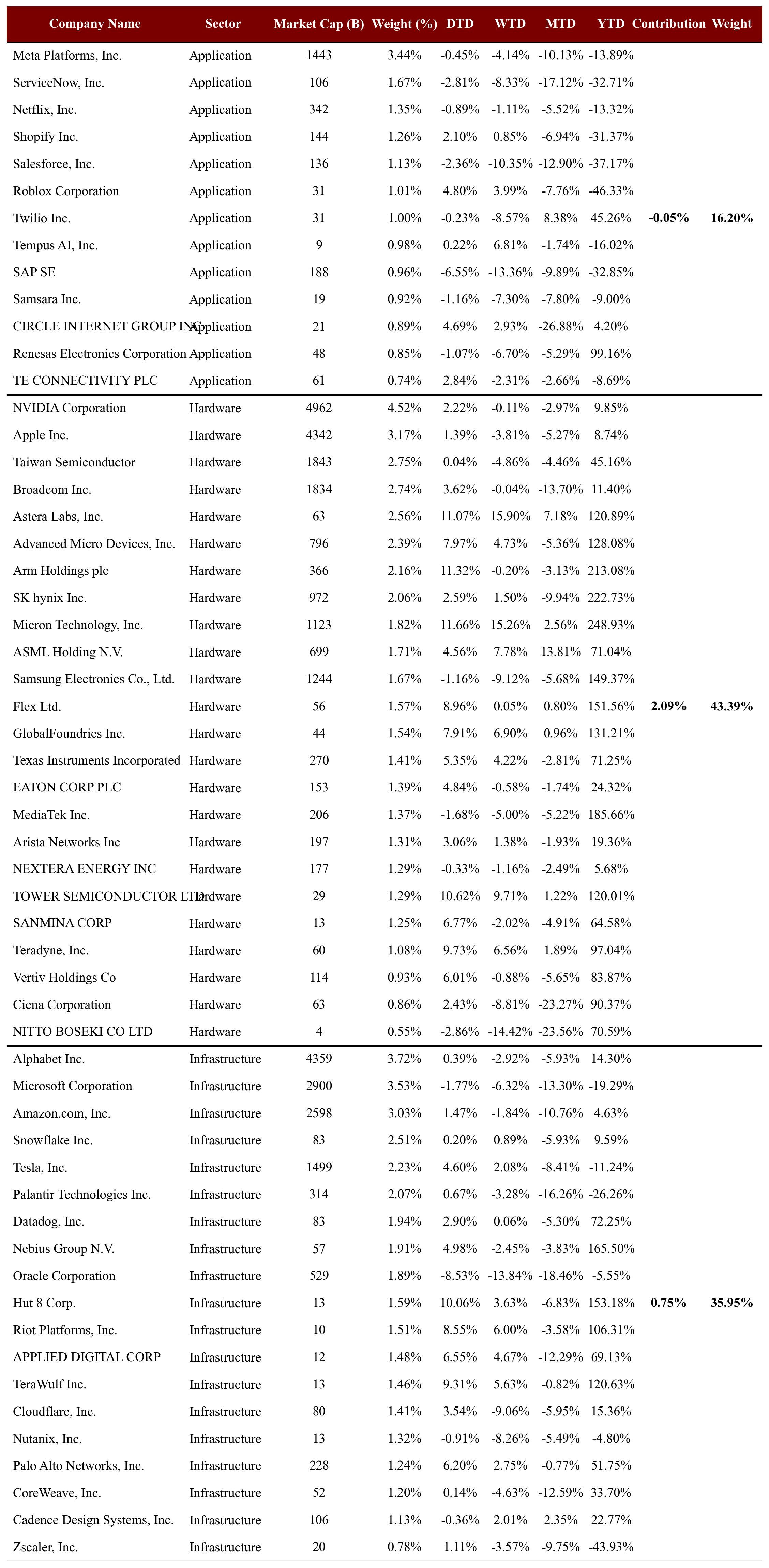
Contribution of the three sectors within AGIX holdings today
Application: -0.05%
Hardware: 2.09%
Infrastructure: 0.75%
Top-performing stocks in AGIX holdings today
Micron Technology, Inc. (11.66%)
Arm Holdings plc (11.32%)
Astera Labs, Inc. (11.07%)
TOWER SEMICONDUCTOR LTD (10.62%)
Hut 8 Corp. (10.06%)
Teradyne, Inc. (9.73%)
TeraWulf Inc. (9.31%)
Flex Ltd. (8.96%)
Riot Platforms, Inc. (8.55%)
Advanced Micro Devices, Inc. (7.97%)
GlobalFoundries Inc. (7.91%)
SANMINA CORP (6.77%)
APPLIED DIGITAL CORP (6.55%)
Palo Alto Networks, Inc. (6.2%)
Vertiv Holdings Co (6.01%)
Texas Instruments Incorporated (5.35%)
Nebius Group N.V. (4.98%)
EATON CORP PLC (4.84%)
Roblox Corporation (4.8%)
CIRCLE INTERNET GROUP INC (4.69%)
Tesla, Inc. (4.6%)
ASML Holding N.V. (4.56%)
Broadcom Inc. (3.62%)
Cloudflare, Inc. (3.54%)
Arista Networks Inc (3.06%)
Datadog, Inc. (2.9%)
TE CONNECTIVITY PLC (2.84%)
SK hynix Inc. (2.59%)
Ciena Corporation (2.43%)
NVIDIA Corporation (2.22%)
Shopify Inc. (2.1%)
Worst-performing stocks in AGIX holdings today
Salesforce, Inc. (-2.36%)
ServiceNow, Inc. (-2.81%)
NITTO BOSEKI CO LTD (-2.86%)
SAP SE (-6.55%)
Oracle Corporation (-8.53%)
Top five listed stocks contributing the most within AGIX holdings today
Astera Labs, Inc. (11.07%)
Arm Holdings plc (11.32%)
Micron Technology, Inc. (11.66%)
Advanced Micro Devices, Inc. (7.97%)
Hut 8 Corp. (10.06%)
Observation
The strongest movers across peer ETF holdings today are listed below:
| DTD | Stock Ticker | Name | Held by ETFs | analysis |
|---|---|---|---|---|
| 21.55 | NYSE:ZEPP | Zepp Health Corporation | ['NasdaqGM:WISE'] | Zepp Health’s 21.6% gain on June 11, 2026 appears primarily driven by follow-through buying and technical momentum after its June 8 Q1 2026 earnings release and call, which had already elicited a positive initial reaction earlier in the week.[1][6][7] The move also coincides with unusually high trading volume versus normal levels, suggesting short-covering and speculative interest rather than any new, company-specific news flow on the day. |
| 14.5 | NasdaqGS:SNDK | Sandisk Corporation | ['XTRA:XAIX'] | Sandisk’s ~14–15% single-day gain on June 11 appears primarily driven by continued momentum and positioning in a highly favored AI/data-center storage theme, with investors bidding up the stock as it extends a dramatic year-to-date rally of more than 100% and over 1,000% in the past six months.[2][5] A secondary driver is ongoing bullish sell-side and media sentiment – including “Bull of the Day” style coverage and a consensus Moderate Buy rating – which reinforces the narrative of strong fundamentals despite rich valuation and encourages incremental buying on any pullbacks.[2][5] |
| 12.7 | NasdaqGS:MXL | MaxLinear, Inc. | ['LSE:RBOT'] | MaxLinear’s 12.7% gain on June 11, 2026 appears primarily driven by continued momentum and re‑rating following its April 24, 2026 Q1 earnings “beat and raise” and AI data center narrative, which previously triggered a >70% single‑day spike and a sustained multi‑week rally as investors repositioned into the name as an AI infrastructure beneficiary.[1][2] This move likely reflects ongoing follow‑through buying and short covering as the stock trades as a high‑beta expression of AI data center demand, rather than any new, stock‑specific news disclosed on the day itself.[1][4] |
| 12.7 | NYSE:ONTO | Onto Innovation Inc. | ['ARCA:ARTY', 'LSE:RBOT'] | Onto Innovation’s ~13% move on June 11, 2026 appears driven primarily by continued enthusiasm around its AI-related growth narrative and 2026 outlook rather than any new company-specific disclosure that day.[2][6] The stock rallied as investors and commentators highlighted its recent earnings beat, raised 2026 revenue guidance, and strengthening positioning in AI-focused semiconductor process control and advanced packaging metrology, which has led to higher analyst price targets and reinforced the bull case.[2][4] Broader strength in AI and semiconductor equipment names likely amplified the move as investors rotated into perceived beneficiaries of AI-related capex.[2] |
| 12.65 | NasdaqGS:LRCX | Lam Research Corporation | ['NasdaqGM:QQQ', 'NasdaqGM:SMH', 'BATS:WTAI', 'ARCA:THNQ', 'ARCA:LOUP', 'BIT:WTAI', 'LSE:AIAG'] | Lam Research’s 12.65% gain on June 11, 2026 was primarily driven by follow-through buying after a stronger-than-expected Q2 2026 earnings report and upbeat guidance that highlighted robust AI-driven memory and advanced packaging demand, with revenue, margins, and EPS all exceeding the high end of guidance and management signaling share gains and outperformance versus wafer fab equipment (WFE) spending.[3] Investor sentiment was further supported by the broader bull move into semiconductor equipment names tied to AI and memory investment, with Lam increasingly framed as an undervalued beneficiary of multi-year AI-related capex.[1] |
| 11.66 | NasdaqGS:MU | Micron Technology, Inc. | ['NasdaqGM:QQQ', 'NasdaqGM:AGIX', 'NasdaqGM:SMH', 'NasdaqGM:AIQ', 'ARCA:ARTY', 'NasdaqGM:ROBT', 'ARCA:IGPT', 'BATS:WTAI', 'NasdaqGM:FDTX', 'ARCA:LOUP', 'ARCA:AIS', 'XTRA:XAIX', 'BIT:WTAI'] | Micron’s 11.7% gain on June 11, 2026 appears primarily driven by continued bullish positioning around AI memory demand and upside momentum following its record earnings beat earlier in the year, rather than any discrete new company-specific catalyst that day.[1][6] The move fits within an ongoing 2026 rally (shares up ~70% YTD) fueled by surging high‑bandwidth memory demand for AI infrastructure, sold‑out capacity, and repeated analyst upgrades and target hikes that have reinforced the AI-driven growth narrative.[1][3] |
| 11.44 | TSE:5132 | pluszero, Inc. | ['NasdaqGM:WISE'] | pluszero, Inc.’s 11.44% gain on June 11, 2026 appears primarily driven by its previously announced plan to acquire and cancel its own shares around this date, which likely supported sentiment via expectations of share count reduction and capital return.[5] The company disclosed that the share acquisition was scheduled for June 10 and the cancellation for June 11, even though it guided that the direct impact on business performance would be minor, suggesting the move was interpreted mainly as a capital policy and confidence signal.[5] Broader AI-related interest and a prevailing technical “buy” setup for the stock likely provided an additional tailwind to the move.[3] |
| 11.39 | NasdaqGS:CRDO | Credo Technology Group Holding Ltd | ['ARCA:IGPT', 'BATS:WTAI', 'LSE:RBOT'] | Credo Technology’s 11.4% gain on June 11, 2026 appears primarily driven by follow-through buying and momentum in the wake of strong investor optimism around its upcoming fiscal Q4 2026 earnings, where Street expectations call for ~195% YoY EPS growth and ~155% YoY revenue growth.[4][5] The move is consistent with CRDO’s historical pattern of outsized positive reactions around earnings events, as the stock has risen on the first day after earnings in most prior reports with a high average single-day move.[7] |
| 11.32 | NasdaqGS:ARM | Arm Holdings plc | ['NasdaqGM:QQQ', 'NasdaqGM:AGIX', 'ARCA:IGPT', 'ARCA:CHAT', 'ARCA:LRNZ', 'ARCA:AIS'] | Arm Holdings’ 11.3% gain on June 11, 2026 was primarily driven by a significant price target increase from Bank of America, which raised its target from $245 to $335 while maintaining a neutral rating, prompting a strong positive reaction in the shares.[1] The move was reinforced by generally bullish Street sentiment, with the stock carrying a “Moderate Buy” consensus rating and an average target still below the new Bank of America level, highlighting upside versus prior expectations.[1] |
| 11.22 | NasdaqCM:QUIK | QuickLogic Corporation | [] | QuickLogic’s 11.2% gain on June 11, 2026 appears primarily driven by ongoing momentum and follow-through buying after the stock recently broke above its 200-day moving average and more than tripled over the past year, attracting technical and momentum-oriented investors.[4] A secondary driver is continued positive sentiment around its eFPGA IP and defense/heterogeneous integration exposure following recent contract and conference-related visibility earlier in 2026, which supports a higher speculative growth narrative despite previously mixed Q1 results.[1][2][3][8] |
| 11.19 | NasdaqGS:AMAT | Applied Materials, Inc. | ['NasdaqGM:QQQ', 'NasdaqGM:SMH'] | Applied Materials’ 11.2% gain on June 11, 2026 appears primarily driven by positive follow-through and positioning after its strong Q1 2026 earnings and constructive industry outlook, which reinforced bullish sentiment in semiconductor capital equipment names.[4] A secondary driver is growing analyst and investor optimism reflected in an above-consensus medium-term price target and a firmly bullish rating skew, which supports momentum buying in the stock.[3] |
| 11.13 | NasdaqGS:MRVL | Marvell Technology, Inc. | ['NasdaqGM:QQQ', 'NasdaqGM:SMH', 'NasdaqGM:AIQ', 'ARCA:ARTY', 'BATS:WTAI', 'NasdaqGM:FDTX', 'ARCA:CHAT', 'ARCA:AIS', 'BIT:WTAI'] | Marvell Technology’s 11.1% gain on June 11, 2026 was driven primarily by continued follow-through buying after S&P Dow Jones Indices announced the stock will be added to the S&P 500 later this month, prompting index-related demand and momentum inflows.[1][2][5] A secondary driver is investors’ positioning ahead of the inclusion date, with Marvell framed in recent commentary as a key beneficiary of AI-related and high-speed connectivity demand, sustaining strong year-to-date outperformance.[1][2][4] |
| 11.07 | NasdaqGS:ALAB | Astera Labs, Inc. | ['NasdaqGM:AGIX', 'NasdaqGM:ROBT', 'ARCA:IGPT', 'BATS:WTAI', 'ARCA:THNQ', 'ARCA:CHAT', 'ARCA:LOUP', 'ARCA:AIS', 'BIT:WTAI'] | Astera Labs’ 11% move on June 11 appears primarily driven by technical and flow factors rather than any identifiable new fundamental news or company-specific catalysts. The stock has been in a strong AI/semiconductor momentum uptrend year-to-date and the broader growth/tech complex bounced as major indices found support at short-term moving averages, which commentators highlighted as a backdrop for strong performers to reassert leadership.[5] In the absence of fresh earnings, guidance, or regulatory headlines on the day, the move is best attributed to continued AI enthusiasm, momentum buying in a high-multiple leader, and possible short-covering in a relatively low-float, high-volatility name. |
| 10.87 | NasdaqGS:CEVA | CEVA, Inc. | ['NasdaqGM:WISE', 'LSE:RBOT'] | CEVA’s +10.9% move on June 11, 2026 appears primarily driven by momentum and follow-through buying after its earlier Q1 2026 earnings release and subsequent rebound in sentiment toward semiconductor IP names, rather than by any new company-specific disclosures that day. No fresh press releases, SEC filings, or major broker rating/target changes were reported on June 11, and recent insider activity (COO share disposition to issuer on May 15) was administrative in nature rather than a directional signal. In this context, the move is best characterized as a beta/momentum-driven extension of the stock’s broader rerating, potentially amplified by technical factors such as short covering or systematic flows. |
| 10.72 | NYSE:FOUR | Shift4 Payments, Inc. | ['ARCA:LOUP'] | Shift4 Payments’ 10.7% gain on June 11, 2026 appears primarily driven by renewed optimism around its valuation and upside to analyst targets, as highlighted in fresh research commentary noting the stock trading at a modest ~8–9x forward P/E with nearly 50% implied upside to consensus price targets around the mid‑$60s.[3][6] A second, reinforcing driver is the broadly constructive analyst stance (consensus Buy with substantial upside to average targets in the $65–70+ range), which supported a rebound in a name that had recently sold off and was trading well below those targets.[2][3][6] |
| 10.62 | NasdaqGS:TSEM | TOWER SEMICONDUCTOR LTD | ['NasdaqGM:AGIX'] | Tower Semiconductor’s 10.6% move appears primarily driven by a sharp rebound/continuation in sentiment around specialty foundries and analog/“More-than-Moore” semis, with the stock outperforming as investors rotated back into differentiated capacity and away from more crowded AI digital names. On the day there were no new company-specific filings or press releases, suggesting the move was amplified by sector beta and momentum factors (semiconductor indices trading strongly, high-beta names leading), as well as catch‑up buying after recent strength in peers and supportive analyst target frameworks already in place. |
| 10.47 | NasdaqGM:CAMT | Camtek Ltd. | ['ARCA:ARTY'] | Camtek’s 10.5% gain on June 11, 2026 appears primarily driven by ongoing follow-through buying on its May 12 guidance for “significant” revenue growth in 2H26, reinforcing the stock’s semiconductor-capex upcycle narrative and keeping sentiment very positive.[5] A second supportive driver is the still-bullish analyst setup, with a Buy-rated consensus and price targets that, while implying limited upside from current levels, continue to validate Camtek as a preferred way to play advanced packaging and inspection demand.[1][3] |
| 10.46 | NasdaqGS:AEIS | Advanced Energy Industries, Inc. | ['ARCA:AIS'] | Advanced Energy Industries’ 10.5% move on June 11, 2026 appears primarily driven by ongoing momentum and rerating following its strong Q1 2026 earnings and guidance, which have led to a more than 170% year-to-date rally and multiple recent high-target analyst valuations. The stock is trading well above consensus target price, suggesting incremental gains are being fueled by continued multiple expansion and momentum buying rather than a discrete new company-specific catalyst that day. |
| 10.37 | NasdaqCM:GRRR | Gorilla Technology Group Inc. | ['NasdaqGM:WISE'] | Gorilla Technology’s +10.4% move on June 11, 2026 appears primarily driven by continued momentum and speculation following its early-June capital raise and bullish sentiment around its growth story, rather than any new company-specific news that day.[3][6] First, the stock has been trading with very high implied volatility, with options pricing in an ~8.8% expected move into the June 12 expiry, which can amplify directional flows and squeezes.[6] Second, investors are still reacting to recent events: the company’s June 5 announcement of a $107 million 7.5% convertible notes offering and prior promotional attention around a large $1.4 billion partnership and aggressive third‑party price targets, all of which have fueled a speculative, momentum-driven trading environment.[3][5][7] |
| 10.23 | NasdaqGS:CMCO | Columbus McKinnon Corporation | ['LSE:RBOT'] | Columbus McKinnon’s ~10% gain on June 11, 2026 appears primarily driven by a sentiment rebound after a sharp multi-week decline rather than by any discrete company-specific news. Zacks highlighted earlier that day that CMCO was down ~19% over four weeks but argued that its favorable Zacks Rank and earnings outlook made the stock “ripe for a turnaround,” likely catalyzing bargain-hunting and short-covering interest. |
| 10.09 | NasdaqGS:NVMI | Nova Ltd. | ['LSE:RBOT'] | Nova’s ~10% gain appears primarily driven by continued follow-through buying on its recent Q1 2026 earnings beat and strong fundamentals, rather than any discrete company-specific news on the day. Nova recently reported better‑than‑expected Q1 results, beating earnings and revenue estimates and demonstrating double‑digit revenue growth and high margins, which has supported a strong year‑to‑date rerating and attracted incremental institutional interest in subsequent sessions. Broader strength in semiconductor and equipment names, alongside a rebound in the Nasdaq, also provided a supportive backdrop for NVMI’s move. |
| 10.06 | NasdaqGS:HUT | Hut 8 Corp. | ['NasdaqGM:AGIX', 'BATS:IGV', 'NasdaqGM:AIQ'] | Hut 8’s 10.06% move on June 11, 2026 is best explained by company-specific catalysts rather than broad market behavior, with the clearest same-day item being its Annual General Meeting on June 11, which can often refresh investor positioning around strategic updates. The stock also showed elevated trading activity and a sharp intraday range that day, consistent with a momentum-driven move in a high-beta name.[3][5] |
| 9.93 | NasdaqGS:PENG | Penguin Solutions, Inc. | ['ARCA:AIS'] | Penguin Solutions’ 9.9% gain on June 11 appears primarily driven by momentum buying following very strong quantitative momentum signals and a high-profile upgrade in style factors rather than any new company-specific fundamental news that day.[1][3] First, Zacks highlighted PENG on June 11 as a “Great Momentum Stock,” noting its 1 (Strong Buy) rating and an “A” Momentum Score, which likely attracted incremental systematic and retail flow into an already strong uptrend.[3] Second, recent commentary around robust demand for AI infrastructure and Penguin’s positioning as an AI-related hardware/enabling name has reinforced a thematic bid in 2026, amplifying the upside move as traders rotate into AI-infrastructure beneficiaries.[1][5] |
| 9.73 | NasdaqGS:TER | Teradyne, Inc. | ['NasdaqGM:AGIX', 'NasdaqGM:SMH', 'NasdaqGM:ROBT', 'BATS:WTAI', 'ARCA:THNQ', 'LSE:RBOT', 'BIT:WTAI', 'LSE:AIAG'] | Teradyne’s ~10% gain on June 11, 2026 appears driven primarily by continued enthusiasm around its positioning as a key AI-related semiconductor test equipment provider, with investors extending a multi-month rerating on strong earnings momentum and long-term growth expectations.[1][5] A second driver is supportive sell-side sentiment and price targets that frame TER as a high-conviction AI infrastructure play into 2026 and beyond, reinforcing momentum buying and multiple expansion.[1][4] |
| 9.4 | NasdaqGS:AMKR | Amkor Technology, Inc. | ['ARCA:ARTY'] | AMKR’s +9.4% move on June 11, 2026 was primarily driven by continued enthusiasm around its role in advanced packaging for AI/HPC and its positioning as a key backend partner in high-performance GPU and AI supply chains, which has kept the stock in a strong uptrend following its Q1 2026 earnings beat and record AI data center-related revenue growth.[2][3] The move also appears supported by increasingly constructive sell-side sentiment and buy-rated analyst consensus with upside to some price targets, reinforcing momentum buying in the name.[6][7] |
| 9.31 | NasdaqCM:WULF | TeraWulf Inc. | ['NasdaqGM:AGIX', 'BATS:IGV'] | WULF’s 9.31% rise on 2026-06-11 appears most likely driven by continued momentum after the company’s late-April/May catalysts, especially the market’s positive reaction to its Q1 2026 earnings-related news and heavy trading interest around that period. The most directly supported same-day catalyst in the provided results is the earlier common stock offering and earnings-call activity, but there is no clear new company-specific headline in the results for 2026-06-11 itself. A secondary contributor may have been broader speculative/technical buying in the name, which had already shown elevated volatility and strong post-event momentum. |
| 9.27 | NasdaqGS:INTC | Intel Corporation | ['NasdaqGM:QQQ', 'NasdaqGM:SMH', 'NasdaqGM:AIQ', 'ARCA:ARTY', 'NasdaqGM:ROBT', 'ARCA:IGPT', 'BATS:WTAI', 'ARCA:AIS', 'NasdaqGM:WISE', 'LSE:RBOT', 'XTRA:XAIX', 'BIT:WTAI'] | Intel’s ~9% gain on June 11 was primarily driven by continued momentum from reports that Alphabet/Google and Nvidia have selected Intel as a backup foundry for advanced processors, which is being repriced by the market as a major validation of Intel’s AI and foundry strategy.[1] A secondary driver was bullish Street sentiment, including a recent Wells Fargo price-target hike tied to stronger AI data-center demand and indications from management that margin recovery could come earlier than expected, which reinforced the upgraded long-term profitability narrative.[1] |
| 9.22 | NasdaqGS:SMCI | Super Micro Computer, Inc. | ['NasdaqGM:AIQ', 'ARCA:ARTY', 'ARCA:IGPT', 'ARCA:THNQ', 'ARCA:CHAT', 'ARCA:AIS'] | Super Micro Computer’s 9.2% gain on June 11, 2026 was primarily driven by aggressive bullish options positioning and heavy follow-through buying after its recent earnings beat. Same-day data show unusually high call option volume in SMCI alongside trading volume that far exceeded normal levels, indicating speculative positioning and short-covering as key intraday drivers.[2] A secondary support was the still-favorable fundamental backdrop: despite a recent revenue miss, the company has recently beaten EPS expectations and continues to be framed in market commentary as a key AI server beneficiary with upside to consensus price targets, encouraging dip-buying after prior underperformance.[2][4] |
| 9.0 | NasdaqGS:SIMO | Silicon Motion Technology Corporation | ['ARCA:AIS'] | Silicon Motion’s 9% gain on June 11, 2026 appears primarily driven by continued positive momentum and follow-through buying after its strong Q1 2026 earnings and guidance, which recently prompted a sharp re‑rating across several semiconductor names including SIMO.[2][8] The move was likely reinforced by ongoing investor enthusiasm around the company’s exposure to high-performance storage and AI-related demand (including perceived Nvidia-related upside), as well as its recent ISO 26262 automotive functional safety certification that strengthens its positioning in the automotive storage market.[1][3] |
| 8.96 | NasdaqGS:IDCC | InterDigital, Inc. | ['BATS:IGV'] | InterDigital’s 8.96% gain on June 11, 2026 appears driven primarily by a sharp rebound following the prior day’s earnings-driven selloff and earnings normalization shock, with investors opportunistically buying the dip after the stock had fallen about 20% from recent levels and was seen as technically oversold.[2][4] A secondary driver is the reassessment of the longer-term licensing and cash-generation story in the wake of that reset, as consensus targets and ratings (e.g., MarketBeat’s ~$417 average target and “Moderate Buy” stance) imply substantial upside from pre-bounce levels, encouraging value-oriented and momentum traders back into the name.[4] |
| 8.96 | NasdaqGS:FLEX | Flex Ltd. | ['NasdaqGM:AGIX'] | Flex’s 8.96% gain on June 11, 2026 appears primarily driven by index inclusion flows following the company’s June 9 announcement that it will be added to the S&P 500 effective June 22, which typically triggers benchmark and ETF buying ahead of the effective date.[6][3] A secondary driver is ongoing positive sentiment and momentum after Flex’s early May “beat and raise” quarter, AI-focused spin-off plans, and above-consensus multi‑year guidance, which have already re-rated the stock and positioned it as an AI infrastructure beneficiary.[1][2] |
| 8.71 | NasdaqGS:EXTR | Extreme Networks, Inc. | ['ARCA:AIS', 'XTRA:XAIX'] | Extreme Networks’ +8.7% move appears primarily driven by continued positive sentiment around its strong FY26 Q3 fundamentals and growth trajectory following its recent earnings report, with the stock extending an already substantial year-to-date re-rating.[1][3][5] Supporting this, the name now carries a Buy consensus and elevated price targets from covering analysts as of June 11, 2026, which likely reinforced momentum and incremental buying interest on the day.[2][5] |
| 8.62 | NasdaqCM:PGY | Pagaya Technologies Ltd. | [] | Pagaya’s 8.62% gain on 2026-06-11 most likely reflected continued positive investor sentiment around its AI-credit business and improving growth profile, rather than a clearly identifiable same-day company-specific catalyst in the available public results. The closest relevant public item is a Zacks note highlighting Pagaya’s fee-driven, asset-light model, $2.6B Q1 2026 volume, and momentum in auto/POS lending, which would have supported the stock’s advance. I do not see a verified same-day earnings release or major regulatory/news event in the provided sources to explain the move more directly. |
| 8.55 | NasdaqCM:RIOT | Riot Platforms, Inc. | ['NasdaqGM:AGIX', 'BATS:IGV'] | RIOT’s 8.55% gain on 2026-06-11 was most likely driven by a broad rebound in the stock after a prior pullback, with no clearly identified company-specific same-day catalyst in the provided results. The most relevant market evidence is that RIOT was trading up 8.55% on the day, while available sources around that time mainly discuss its ongoing pivot into data centers and analyst price-target support rather than a fresh June 11 news event.[2][4] A secondary support factor is positive sentiment around Riot’s longer-term strategy and analyst expectations, which remained constructive even as the company navigated its transformation.[1][2] Trading and style factors likely amplified the move given RIOT’s high-beta exposure to bitcoin/mining sentiment.[4][5] |
| 8.54 | NasdaqGS:CRNC | Cerence Inc. | ['NasdaqGM:BOTZ', 'NasdaqGM:WISE', 'ASX:RBTZ', 'DB:XB0T'] | Cerence’s 8.5% move on June 11 appears to be primarily a technically driven rebound supported by elevated volume rather than by any new fundamental catalyst. The stock traded in a wide intraday range ($9.65–$11.00) and closed near the upper end on volume of 1.83M shares versus a 1.15M average, indicating short-covering and momentum buying after recent weakness.[1] With no same-day company-specific news or material industry headlines and the name trading well below long-term fair value estimates, the move is best characterized as a sentiment and flow-driven catch-up rally.[1][2] |
| 8.52 | NasdaqCM:CLSK | CleanSpark, Inc. | ['BATS:IGV'] | CleanSpark’s +8.5% move appears primarily driven by continued bullish positioning and sentiment around the name rather than a discrete company-specific catalyst on the day. The stock is supported by a Strong Buy consensus from 12 analysts and price targets implying further upside, which can reinforce momentum and dip-buying in a high‑beta, high‑short‑interest bitcoin miner like CLSK.[7][5] Additionally, the company’s recent May 2026 operational update and finance leadership appointment keep a constructive fundamental narrative in place, aiding sentiment in the absence of new negative news.[9] |
| 8.49 | TWSE:4919 | Nuvoton Technology Corporation | ['LSE:RBOT'] | Nuvoton Technology’s 8.49% gain on June 11, 2026 appears primarily driven by a technical rebound and short-covering after a sharp pullback from its recent run-up, with no company-specific news or TWSE announcements released that day to explain the move.[2][5][6] The stock’s advance also tracked ongoing strength and rotational interest in Taiwan semiconductor names, as investors re‑added exposure to select IC designers following recent volatility.[1][2] |
| 8.34 | NasdaqGM:NVTS | Navitas Semiconductor Corporation | ['ARCA:AIS'] | Navitas Semiconductor’s 8.3% gain appears primarily driven by continued momentum and positioning rather than a discrete new fundamental catalyst on the day. Recent SEC filings that cleaned up legacy SPAC-related earnout/share terms and removed an overhang, combined with elevated short interest and strong retail interest in GaN/SiC exposure to AI data center and power infrastructure, have supported an ongoing momentum and short-covering trade in 2026.[1][5][6] Earlier Q1 2026 results and guidance showed sequential revenue growth and a pivot toward high-power AI, grid, and industrial markets, which continue to underpin the narrative and attract incremental buyers on up days.[1][2][5] |
| 8.2 | KOSDAQ:A140860 | Park Systems Corp. | ['LSE:RBOT'] | Park Systems’ 8.2% gain on June 11, 2026 appears primarily driven by technical and flow factors rather than identifiable new company-specific news. Public news wires, the company’s IR page, and major financial data providers show no material announcements, guidance changes, or sector-specific regulatory developments for Park Systems or the AFM/semiconductor metrology space on or immediately before that date. In the absence of catalysts, the move is most plausibly attributed to short-term trading dynamics and momentum/mean-reversion interest following prior weakness in the stock. |
| 8.18 | NasdaqGS:VICR | Vicor Corporation | ['ARCA:AIS'] | Vicor’s +8.2% move on June 11, 2026 appears primarily driven by continued momentum and bullish sentiment following its recent guidance raise and powerful multi-month rally, rather than by any new company-specific news that day. The stock has surged over 350% in the past year on strong AI power-supply positioning and a Q2 2026 revenue guidance increase to $126–142 million, which has attracted momentum traders and kept the name volatile and squeezable. A supportive backdrop of aggressive analyst targets (Needham at $350 with a Buy rating) and high valuation-driven debate is also contributing to elevated trading interest and amplified daily moves. |
| 8.0 | NasdaqGS:WDC | Western Digital Corporation | ['ARCA:IGPT', 'ARCA:AIS', 'XTRA:XAIX'] | Western Digital’s 8.0% move on June 11 appears primarily driven by continued momentum re-rating rather than a discrete new fundamental catalyst, as the stock extends an extreme year-to-date rally supported by very strong recent earnings and bullish analyst sentiment.[2][5] First, investors are still reacting to Western Digital’s blowout Q3 FY2026 results and dramatic multi-hundred-percent 12‑month and YTD gains, which have prompted aggressive upward revisions to price targets (including Cantor Fitzgerald’s recent lift to $660 and an overall “Strong Buy” analyst stance).[2][5] Second, the sharp repricing of storage demand and Western Digital’s positioning in high-growth HDD/flash markets continues to attract momentum and growth capital into the name, reinforcing upside volatility in the absence of incremental company-specific news on the day.[2][4] |
| 7.97 | NasdaqGS:AMD | Advanced Micro Devices, Inc. | ['NasdaqGM:QQQ', 'NasdaqGM:AGIX', 'NasdaqGM:SMH', 'NasdaqGM:AIQ', 'ARCA:ARTY', 'NasdaqGM:ROBT', 'ARCA:IGPT', 'BATS:WTAI', 'ARCA:THNQ', 'ARCA:CHAT', 'ARCA:LRNZ', 'ARCA:AIS', 'NasdaqGM:WISE', 'LSE:RBOT', 'XTRA:XAIX', 'BIT:WTAI', 'LSE:AIAG'] | AMD’s 7.97% gain on June 11, 2026 appears primarily driven by a technical rebound and momentum buying after a recent pullback, as the stock bounced sharply from around its identified support near $452 and moved toward its short-term resistance band near $498.[2][6] Key driver 1: Technical factors and positioning, with AMD reversing the prior day’s decline on elevated volume (27.9M shares vs. 25.2M the day before), consistent with traders buying a dip within a strong rising trend and “strong buy” technical profile.[2][6] Key driver 2: Ongoing positive fundamental sentiment around data center growth and AI-related demand, reflected in recent bullish research and upside long-term price targets, which likely supported dip-buying rather than any specific new company disclosure that day.[1][3][5] |
| 7.93 | KOSDAQ:A348210 | NEXTIN, Inc. | ['LSE:RBOT'] | NEXTIN’s 7.9% gain on June 11, 2026 appears primarily driven by continued positive follow-through to its June 4 Q1 2026 earnings release, where investors are reassessing the stock’s growth and margin profile after the recent results update.[5] The move also coincides with broader strength and renewed risk-on sentiment toward Korean semiconductor equipment names, with NEXTIN benefiting from its leverage to wafer inspection demand and its high-growth, high-margin positioning within the sector.[1][6][7] |
| 7.92 | NasdaqGS:LSCC | Lattice Semiconductor Corporation | ['ARCA:IGPT', 'BATS:WTAI', 'NasdaqGM:WISE', 'LSE:RBOT'] | Lattice Semiconductor’s 7.9% gain appears primarily driven by continued momentum from its strong Q1 2026 earnings beat and bullish forward guidance, reinforced by ongoing positive estimate revisions and buy-rated analyst sentiment rather than any new company-specific news on the day.[2][5][6] First, the company recently reported 42% Y/Y revenue growth, a material EPS beat, and guided Q2 revenue above prior trends, which has supported a sharp rerating and rising price targets through early June.[2][5][1] Second, Zacks and other outlets have highlighted “surging earnings estimates” and near-term upside, and LSCC has been a recent semiconductor outperformer, so incremental buying in a strong tape for high-growth semis likely amplified the single-day move.[6][1][3] |
| 7.91 | NasdaqGS:MPWR | Monolithic Power Systems, Inc. | ['NasdaqGM:SMH'] | Monolithic Power Systems’ ~8% gain on June 11, 2026 appears primarily driven by a strong sector-wide rally in semiconductor and AI-related chip names, with MPWR benefiting as a high-momentum play on data-center and AI power management. Same-day commentary highlighted broad strength in chip stocks plus ongoing enthusiasm around MPWR’s AI/server and enterprise data-center exposure, which has been reinforced by recent upbeat guidance and analyst target hikes following its latest quarterly results.[2][3] A secondary support likely came from positive sentiment around the company’s long-term growth profile and capital return framework (dividend and buybacks), which investors have been using to justify multiple expansion on strong tape days.[2][3] |
| 7.91 | NasdaqGS:GFS | GlobalFoundries Inc. | ['NasdaqGM:QQQ', 'NasdaqGM:AGIX', 'ARCA:AIS'] | GlobalFoundries’ +7.9% move appears to be a continuation of the positive rerating driven by its May 2026 beat-and-raise Q1 print and bullish 2026 Investor Day messaging (including the first-ever dividend and a new capital return framework), which have repositioned the stock as an AI-levered specialty foundry story.[1][2][4] The absence of incremental company-specific news on June 11 suggests the move was largely momentum- and sentiment-driven as investors continue to price in stronger long-term growth, higher margins, and capital returns following multiple recent Street target hikes tied to AI, silicon photonics, and “physical AI” opportunity.[1] |
| 7.84 | NasdaqCM:MARA | MARA Holdings, Inc. | ['BATS:IGV'] | MARA’s 7.8% gain on June 11, 2026 appears primarily driven by bullish sentiment and momentum rather than a discrete company-specific news catalyst, with the stock trading in line with a positive short‑term technical setup noted by third‑party analysis tools.[3][7] A secondary driver is improving sell‑side positioning and retail sentiment around the name, reflected in a Buy‑leaning analyst consensus and supportive retail‑facing commentary and forecasts, which can amplify upside moves on strong trading days.[2][4][5] |
| 7.66 | NasdaqGS:CIFR | Cipher Mining Inc. | ['BATS:IGV'] | Cipher Mining’s +7.7% move on June 11, 2026 appears primarily driven by renewed speculative interest in bitcoin-levered and AI/HPC-exposed infrastructure names rather than a discrete company-specific catalyst. Sector commentary highlighted traders “refocus[ing] on its AI/HPC pivot and crypto-linked sentiment,” with no new filings, guidance updates, or fundamental news for CIFR that day, suggesting momentum and thematic positioning as the main driver.[1] |
| 7.64 | KLSE:PENTA | Pentamaster Corporation Berhad | ['LSE:RBOT'] | Pentamaster’s 7.64% gain on 11 June 2026 appears to be driven primarily by strong technical momentum and elevated trading activity rather than any specific new company disclosure or headline. The stock advanced to around MYR 4.37 on above-average volume of about 6.5 million shares, extending a multi-month uptrend supported by a consensus Buy rating and higher analyst fair value targets relative to the current price, which likely attracted incremental momentum and growth buyers. |
| 7.51 | NYSE:ESAB | ESAB Corporation | ['LSE:RBOT'] | ESAB’s +7.5% move on June 11, 2026 appears primarily driven by follow‑through buying after the company’s recent disclosure of record Q1 2026 results and the announced acquisition of Eddyfi Technologies, which together reinforced the growth and margin expansion narrative.[1] Investors likely also reacted favorably to the company’s capital allocation signals, including the announced increase in the quarterly dividend to $0.12 per share and the successful $1.0 billion senior notes offering to fund the Eddyfi transaction, which reduced deal uncertainty and highlighted balance-sheet flexibility.[1] |
| 7.22 | NasdaqGS:KTOS | Kratos Defense & Security Solutions, Inc. | ['NasdaqGM:ROBT'] | Kratos Defense & Security Solutions’ 7.2% gain on June 11, 2026 appears primarily driven by continued positive sentiment around its strong Q1 2026 earnings beat, raised full-year guidance, and a growing backlog and opportunity pipeline in unmanned systems, hypersonics, and defense programs, which investors are reassessing after recent volatility.[1] A secondary driver is supportive technical and short-term trading setup commentary from third-party research/forecast services that frame the current level as a favorable buy opportunity within an ongoing uptrend, helping attract incremental momentum and dip-buying interest.[1][4] |
| 7.01 | TSE:285A | Kioxia Holdings Corporation | ['ARCA:IGPT'] | Kioxia’s +7.0% move was driven primarily by continued bullish positioning on the NAND memory upcycle and expectations for further earnings upside, rather than any specific new company disclosure on the day. The stock has been extremely volatile and is up several hundred percent over the past year as investors price in strong EPS growth and rising target prices from analysts, which has amplified momentum buying on positive semiconductor sentiment. Broader strength in semiconductor and AI‑related names, where Kioxia is viewed as a key NAND supplier, likely provided an additional tailwind. |
| 6.84 | NasdaqGS:IPGP | IPG Photonics Corporation | ['ARCA:IGPT', 'LSE:RBOT'] | IPG Photonics rose 6.84% on 2026-06-11, and the move appears most consistent with continued post-earnings digestion after the company’s Q1 2026 results, which several outlets say were strong enough to prompt a positive analyst reaction including a Needham upgrade to Buy.[4][6] The stock was also trading near levels that market data services showed well above the prior close, suggesting momentum and buy-side re-rating were amplifying the move rather than a fresh company-specific announcement that day.[2][3] No major same-day news event was identified in the provided results. |
| 6.77 | NasdaqGS:SANM | SANMINA CORP | ['NasdaqGM:AGIX'] | Sanmina’s 6.8% gain on June 11 appears primarily driven by continued momentum and rerating after strong recent earnings and raised guidance, with no discrete company‑specific news or regulatory catalyst on the day. The move came on relatively light volume versus average, suggesting a technical/positioning element (short covering or momentum buying) as the stock extended its post‑earnings uptrend and traded above the Street’s median target, forcing investors to recalibrate valuation expectations.[2][3][4][7] |
| 6.76 | NasdaqGS:CRWD | CrowdStrike Holdings, Inc. | ['NasdaqGM:QQQ', 'BATS:IGV', 'ARCA:ARTY', 'BATS:WTAI', 'ARCA:THNQ', 'NasdaqGM:FDTX', 'ARCA:LRNZ', 'ARCA:AIS', 'XTRA:XAIX', 'LSE:AIAG'] | CrowdStrike’s 6.76% gain on 2026-06-11 is best explained by continued post-earnings/analyst-driven momentum rather than a single company-specific release that day. The strongest available same-day context is a wave of bullish analyst activity and higher price targets that had already pushed the stock sharply higher into early June, alongside elevated options-implied volatility around the late-June earnings window.[1][4][6] |
| 6.61 | ENXTAM:BESI | BE Semiconductor Industries N.V. | ['NasdaqGM:FDTX'] | BESI’s 6.61% rise on 2026-06-11 was most likely driven by sector momentum in semiconductor equipment and advanced packaging, rather than a clearly identified company-specific announcement that day. The strongest visible fundamental backdrop is Besi’s earlier trading update showing Q4-25 orders up 43% sequentially, with strength in 2.5D data center and photonics demand, which likely continued to support sentiment.[1] No same-day Besi press release or major company disclosure appears in the provided results for 2026-06-11, so the move is best attributed to positive market re-rating around its growth exposure to advanced packaging and AI/data-center-related demand, with any broader tech/semiconductor rally likely amplifying the advance.[1][2][3] |
| 6.59 | NasdaqCM:SERV | Serve Robotics Inc. | ['NasdaqGM:BOTZ', 'NasdaqGM:ROBT', 'ASX:RBTZ', 'DB:XB0T'] | Serve Robotics’ +6.6% move on June 11, 2026 appears primarily driven by ongoing momentum following its strong Q4 2025 results and growing “short-squeeze” narrative, with elevated retail interest and improving analyst sentiment supporting the bid. Recent commentary highlights expanding analyst coverage with a strong buy bias and rising targets, alongside significant short interest that has positioned SERV as a squeeze candidate, amplifying upside moves on relatively modest incremental news or order flow. |
| 6.55 | NASDAQGS:APLD | APPLIED DIGITAL CORP | ['NasdaqGM:AGIX'] | APPLIED DIGITAL CORP’s 6.6% gain on June 11, 2026 appears primarily driven by follow-through buying and momentum after its strong Q3 2026 earnings earlier this week, with revenues reportedly up roughly 139% year over year and the stock trading materially higher on the earnings reaction. Secondary support likely came from continued bullish sentiment and a wide gap between the current price (~$41) and the Street’s average and high 12‑month targets (implying well over 100% upside), encouraging incremental growth- and AI-infrastructure–oriented flows. Trading volume remained elevated versus typical single-name activity, reinforcing the view that the move was driven more by ongoing repositioning than by any new company-specific news on the day. |
| 6.51 | NASDAQCM:DUOT | Duos Technologies Group, Inc. | ['NasdaqGM:WISE'] | Duos Technologies’ 6.5% gain on June 11, 2026 appears primarily driven by positive sentiment around its AI / Edge Data Center growth story and supportive analyst positioning rather than any new company-specific news. The stock has been trading around levels close to perceived fair value and prior targets, and third-party data show a Strong Buy rating and a $17 target as of that date, which likely underpinned dip‑buying after recent weakness.[3][6] With no fresh filings or press releases on the day, the move is best characterized as momentum and sentiment-driven within a high-beta micro-cap name rather than a reaction to a discrete catalyst. |
| 6.43 | NasdaqGS:HON | Honeywell International Inc. | ['NasdaqGM:QQQ'] | Honeywell’s 6.4% gain on June 11 was primarily driven by its 2026 Investor Day, where management provided a new three-year financial framework that investors appeared to interpret positively for medium‑term growth and profitability.[6][3] A secondary support came from incremental clarity around the upcoming Honeywell Aerospace spin-off and associated 1-for-2 reverse stock split announced earlier in June, which likely reinforced a sum-of-the-parts value re-rating ahead of the separation.[2] |
| 6.38 | NasdaqGS:STX | Seagate Technology Holdings plc | ['NasdaqGM:AIQ', 'ARCA:IGPT', 'ARCA:AIS', 'XTRA:XAIX'] | Seagate’s 6.38% rise on 2026-06-11 was most likely driven by continued investor reaction to its strong fiscal Q3 2026 earnings beat and upbeat forward guidance, which included higher revenue, EPS, and free cash flow, plus a sharply positive after-hours move that carried into the next session.[2][6] A secondary contributor was ongoing sentiment support from debt-reduction/exchange activity announced around the same period, which reinforced balance-sheet confidence.[5] The stock was already trading near the high $800s intraday after closing around $816 the prior day, consistent with post-earnings momentum rather than a new standalone same-day catalyst.[1][4] |
| 6.36 | NasdaqGS:DIOD | Diodes Incorporated | [] | Diodes Inc.’s 6.36% gain on June 11, 2026 appears primarily driven by continued momentum and multiple expansion in a strongly recovering semiconductor cycle rather than any new company-specific news that day.[1][2][5] The move extended an already large year-to-date rally (stock more than doubling since early 2026) as investors rotate into analog/industrial/auto-exposed semis and re-rate DIOD despite it trading well above many fair value estimates.[1][2][5] A secondary factor is technical and sentiment-driven buying, with the stock pushing to fresh highs and attracting momentum-oriented flows, even as insider Form 4 filings show modest profit-taking around these levels rather than incremental bullish signals.[1][6] |
| 6.22 | NasdaqGS:AVAV | AeroVironment, Inc. | ['NasdaqGM:BOTZ', 'NasdaqGM:ROBT', 'ARCA:IGPT', 'BATS:WTAI', 'ARCA:LOUP', 'ASX:RBTZ', 'DB:XB0T'] | AeroVironment’s 6.2% gain on June 11, 2026 appears primarily driven by continued positive sentiment around its defense UAV exposure and a solid Buy-rated analyst backdrop rather than a discrete, stock-specific news catalyst that day. First, the shares are supported by a strong Street stance (consensus Buy/Strong Buy from ~17 analysts with elevated price targets implying further upside), which reinforces momentum in a pro-defense spending tape.[1][3] Second, technical factors and trend-following flows likely amplified the move, as AVAV has been trading in a strong upward trend, where incremental buying interest around support levels has historically produced outsized single-day gains.[2] |
| 6.2 | NasdaqGS:PANW | Palo Alto Networks, Inc. | ['NasdaqGM:QQQ', 'NasdaqGM:AGIX', 'BATS:IGV', 'ARCA:ARTY', 'NasdaqGM:ROBT', 'BATS:WTAI', 'ARCA:THNQ', 'NasdaqGM:FDTX', 'ARCA:AIS', 'XTRA:XAIX', 'BIT:WTAI', 'LSE:AIAG'] | Palo Alto Networks’ 6.2% gain on June 11, 2026 appears primarily driven by continued momentum and re‑rating following a series of bullish analyst actions and strong AI‑security demand over the prior weeks, with no new company‑specific news or filings that day. Over the last month the stock had already climbed roughly 30–50% on multiple price target upgrades (including several to the $300+ range) and growing enthusiasm around AI‑enhanced cybersecurity and recent acquisitions, which likely sustained incremental buying interest and short covering into June 11.[1][2][3] Broader positive sentiment toward high‑growth cybersecurity names and PANW’s strong year‑to‑date performance (up ~50%+ over 12 months) likely amplified the move as investors added to outperformers in the sector.[3][2] |
| 6.15 | NasdaqGS:DGII | Digi International Inc. | [] | Digi International’s +6.15% move appears driven primarily by continued positive sentiment and relative outperformance within the Computer & Technology sector rather than any stock-specific news catalyst on the day. Zacks highlighted on June 11 that DGII has been outperforming its sector year-to-date, reinforcing a momentum and relative-strength narrative that likely supported incremental buying interest.[7] A secondary driver is the broadly constructive sell-side stance: five analysts currently rate the stock Buy with no Sells, which can underpin demand in the absence of negative company news.[6] No new company filings, earnings releases, or regulatory developments were reported on June 11 that would explain the move, suggesting the action was mainly momentum and positioning-driven. |
| 6.15 | NasdaqGS:QCOM | QUALCOMM Incorporated | ['NasdaqGM:QQQ', 'NasdaqGM:SMH', 'NasdaqGM:AIQ', 'ARCA:ARTY', 'NasdaqGM:ROBT', 'ARCA:IGPT', 'BATS:WTAI', 'ARCA:THNQ', 'BIT:WTAI', 'LSE:AIAG'] | Qualcomm’s 6.15% gain on June 11, 2026 appears primarily driven by a rebound from recent weakness and positioning ahead of its June 24 Investor Day, where investors expect more detail on data center/AI and non-handset growth targets.[1][3] The move also reflects mean reversion after the stock had fallen roughly 26% from its 2026 high and sold off sharply in early June on competitive and sentiment concerns around Snapdragon X and Apple exposure, making the name more attractive to buyers on a valuation and setup basis.[1][2] |
| 6.14 | TSX:CLS | Celestica Inc. | ['BATS:WTAI', 'ARCA:LOUP', 'ARCA:AIS'] | Celestica’s 6.14% move on 2026-06-11 appears most consistent with continued momentum in the AI and data-center hardware trade, which has been a major driver of investor interest in the stock. Available public sources also show broadly positive analyst sentiment and technical strength around the name, which can amplify a same-day move even without a company-specific announcement.[2][3][4] I do not see a clear Celestica-specific disclosure or headline in the provided results for that date, so the move is best attributed to sector momentum and flow rather than a fresh company event.[2][3][4] |
| 6.13 | NasdaqGS:STNE | StoneCo Ltd. | ['NasdaqGM:AIQ'] | StoneCo’s 6.13% move on 2026-06-11 was most likely driven by post-earnings positioning and follow-through from the company’s strong 1Q26 results/earnings narrative, which had already been in focus around the May 14 report. The stock also appears to have been supported by ongoing valuation optimism from analysts, while there is no same-day company-specific news in the provided results that clearly explains a fresh catalyst for that date. |
| 6.09 | NasdaqCM:RGTI | Rigetti Computing, Inc. | ['BATS:WTAI'] | Rigetti Computing’s 6.1% gain on June 11, 2026 appears driven primarily by ongoing momentum and technical trading interest in a highly volatile, short-squeeze‑prone name, rather than by any new fundamental company-specific news. MarketBeat flags recent institutional positioning and the potential for a short squeeze in RGTI, which likely supported continued upside and intraday swings on the day.[3] Broader speculative interest and technical levels highlighted in recent chart-focused commentary (e.g., resistance/targets in the low‑ to high‑$20s) also likely contributed to trading-driven buying rather than news-related repricing.[2][6] |
| 6.02 | NasdaqGS:SMTC | Semtech Corporation | [] | Semtech’s 6.02% gain on 2026-06-11 appears most likely driven by stock-specific momentum and positive analyst sentiment rather than a clear company announcement that day. The strongest public evidence available is that market commentary around the stock highlighted rising earnings estimates and a more constructive consensus view, while the broader semiconductor tape was weak, making SMTC’s move look idiosyncratic.[2][3][5] A secondary factor may have been continued follow-through from prior operating strength and upbeat outlook commentary from the company’s most recent earnings call, including expectations for sequential data-center growth and improving revenue trends.[1] I do not see a same-day Semtech press release or major filing in the provided results that directly explains the move.[3][6] |
| 6.01 | NYSE:VRT | Vertiv Holdings Co | ['NasdaqGM:AGIX', 'ARCA:ARTY', 'BATS:WTAI', 'ARCA:LOUP', 'ARCA:AIS'] | Vertiv’s 6.01% rise on 2026-06-11 was most likely driven by continued positive sentiment around AI/data-center demand, which has been a dominant theme behind recent bullish analyst commentary on the stock. Recent notes cited higher price targets from firms such as Roth/MKM and BofA on improving industry trends and AI demand, which likely supported buying interest. A secondary contributor was likely momentum/positioning after a strong prior run in the shares, which can amplify moves on little incremental news. |
| 5.96 | NasdaqGS:CORZ | Core Scientific, Inc. | ['BATS:IGV'] | Core Scientific’s 5.96% gain on June 11 appears primarily driven by follow-through strength and repricing after recent deal-related volatility tied to CoreWeave’s $9 billion all-stock acquisition agreement, as investors reassessed prior disappointment with the initial deal terms.[3][5] The move also comes against the backdrop of generally positive Street sentiment and upside to consensus price targets (average target above the trading level), which may be supporting dip-buying and incremental rerating.[4] |
| 5.95 | NasdaqGS:NXPI | NXP Semiconductors N.V. | ['NasdaqGM:QQQ', 'NasdaqGM:SMH', 'NasdaqGM:AIQ', 'NasdaqGM:ROBT', 'NasdaqGM:FDTX', 'BIT:WTAI'] | NXP Semiconductors’ ~6% move on June 11, 2026 was primarily driven by a fresh capital return catalyst, as the board approved a new quarterly interim cash dividend of about $1.01 per share, which the market interpreted as a signal of management’s confidence in sustained growth and cash generation.[3][4] A secondary driver was broad-based strength and momentum in select semiconductor names that day, with NXPI highlighted alongside other chip stocks in news coverage of “skyrocketing” semiconductor shares, which likely amplified buying interest.[5] |
| 5.91 | NasdaqGM:DJT | Trump Media & Technology Group Corp. | ['ARCA:IGPT'] | Trump Media’s 5.9% gain on June 11 was primarily a continuation and digestion of the prior day’s sharp rally after the company announced an all‑stock merger with fusion energy startup TAE Technologies in a deal valued at more than $6 billion, which shifted the story from a pure social media asset to a speculative clean‑energy platform.[1][5][6] The move was supported by ongoing media coverage and investor focus on the proposed transaction structure and funding (including up to $200 million at signing and an additional $100 million upon regulatory filings), which helped sustain elevated retail trading interest following the initial spike.[1][4][6] |
| 5.86 | NASDAQGM:RZLV | Rezolve AI PLC | ['NasdaqGM:WISE'] | Rezolve AI’s 5.9% gain appears primarily driven by follow-through momentum and positioning rather than any new, stock-specific catalyst on the day. There were no fresh company press releases or notable industry headlines on June 11, and intraday trading stayed within a relatively tight range around recent levels. In the absence of news, the move is best explained by technical factors and short-term trading flows after recent volatility in the name. |
| 5.85 | NYSE:DELL | Dell Technologies Inc. | ['ARCA:CHAT', 'ARCA:AIS', 'XTRA:XAIX'] | Dell Technologies’ +5.9% move appears primarily driven by continued follow-through buying on its recently reported upside FQ1 FY27 earnings and sharply improved AI server outlook, which have re-rated the stock higher over the past month. The strong print included a very large year-over-year revenue increase, significant AI-optimized server growth, and raised full-year guidance, reinforcing the AI-infrastructure growth narrative and sustaining momentum buying in the name.[1][2] A secondary driver is ongoing positive sentiment and positioning, with the stock now widely rated Buy/Moderate Buy by analysts and supported by strong AI-related demand trends across the sector, encouraging investors to add exposure despite the recent run-up.[2][3] |
| 5.83 | NasdaqGS:CGNX | Cognex Corporation | ['NasdaqGM:BOTZ', 'NasdaqGM:ROBT', 'ARCA:IGPT', 'ARCA:THNQ', 'LSE:AIAG', 'ASX:RBTZ', 'DB:XB0T'] | Cognex’s 5.83% gain on 2026-06-11 was most likely driven by continued investor reaction to its strong Q1 2026 earnings, which featured 24.3% year-over-year revenue growth and 113% growth in adjusted EPS, reinforcing a bullish fundamental re-rating. Analyst optimism also appears supportive, with price-target raises and generally constructive ratings around the name. No major company-specific same-day catalyst is evident in the provided results, so the move looks primarily earnings- and sentiment-driven. |
| 5.74 | ENXTPA:STMPA | STMicroelectronics N.V. | ['NasdaqGM:SMH', 'BIT:WTAI'] | STMicroelectronics’ 5.74% rise on 2026-06-11 is most plausibly explained by investor reaction to its 2026 Annual General Meeting, where shareholders approved all resolutions, including a cash dividend of US$0.36 per share[1]. The move also fits a broader strong re-rating in the stock this year, with market data showing a sharp 2026 share-price appreciation and elevated bullish sentiment[3]. No other same-day company-specific catalyst in the provided results is as directly tied to the move[1][2][3]. |
| 5.74 | NasdaqGS:ADEA | Adeia Inc. | ['BATS:IGV'] | Adeia’s 5.7% gain on June 11, 2026 appears primarily driven by ongoing positive technical momentum and follow-through buying rather than any new, stock-specific news catalyst that day. The stock has been in an upswing since its momentum indicator turned positive in early June, which quantitative services flag as the start of a new upward move, likely attracting trend and momentum investors and triggering additional buying interest. |
| 5.74 | NasdaqGS:MTSI | MACOM Technology Solutions Holdings, Inc. | [] | MACOM Technology Solutions’ +5.7% move appears primarily driven by continued strength and momentum in the semiconductor complex rather than by any stock-specific catalyst on the day. Sector commentary and price action show broader chip names advancing, with MACOM participating as a high-beta beneficiary of ongoing enthusiasm around RF, optical, and AI-related semiconductor demand.[2][6] No new company filings, earnings releases, or material corporate news were posted on its investor relations or SEC pages for that date, suggesting the move was largely macro/sector- and momentum-driven rather than event-driven.[7][8] |
| 5.72 | NasdaqGS:MCHP | Microchip Technology Incorporated | ['NasdaqGM:QQQ', 'NasdaqGM:SMH', 'ARCA:IGPT', 'BATS:WTAI', 'LSE:RBOT', 'BIT:WTAI'] | Microchip Technology’s 5.7% gain on June 11, 2026 appears primarily driven by a rebound in semiconductor sentiment and follow-through buying after the prior day’s broad sector pullback, rather than by any new company-specific disclosure.[1][3] First, MCHP was recovering from a ~3.9% decline on June 10, with June 11 trading showing a sharp bounce and high/low range consistent with mean-reversion in chip names.[3][4][7] Second, no fresh Microchip earnings, guidance updates, or regulatory headlines hit the tape that day, suggesting the move was largely technical and sector-driven, as investors rotated back into semis after rate- and AI-related volatility earlier in the week.[1][3] |
| 5.71 | NasdaqCM:NN | NextNav Inc. | ['BATS:IGV'] | NextNav’s 5.71% gain on 2026-06-11 was most likely driven by the company’s June 10 announcement that it is redeeming all outstanding public warrants, a catalyst that can support the common stock by forcing warrant holders to exercise or exit before the June 26 redemption date.[1][5] The move also came amid continued momentum in the shares, with the stock trading around the low-to-mid $20s and already up sharply year to date, which can amplify reaction to company-specific news.[4][6] There is no stronger same-day operating or earnings release in the provided results, so the warrant redemption is the primary identifiable driver.[1][4] |
| 5.67 | NYSE:PRLB | Proto Labs, Inc. | ['NasdaqGM:ROBT', 'LSE:RBOT'] | Proto Labs’ 5.67% gain on 2026-06-11 appears most likely driven by continued momentum in the name rather than a clearly identifiable same-day company-specific catalyst, as the available public results do not show a major earnings release or other fresh disclosure that day. The strongest supporting factor is that PRLB had already been in a sustained uptrend into early June, with sources noting a roughly 46% rise from its prior breakout area and analyst sentiment remaining Buy. A secondary factor is valuation/target dynamics: market data show the stock trading well above the consensus target area, which can amplify short-covering and momentum buying in a relatively small-cap industrial name. |
| 5.64 | NasdaqGS:SYNA | Synaptics Incorporated | ['XTRA:XAIX'] | Synaptics’ 5.6% gain appears primarily driven by a broad rally in semiconductor and AI-related names, with the stock participating as a higher-beta beneficiary of renewed enthusiasm for AI-exposed chip and component suppliers.[6] The move also extended recent momentum after the company’s stronger year-over-year revenue growth in its latest reported quarter and management’s constructive guidance on IoT and automotive/enterprise mix, reinforcing the earnings-recovery narrative.[2][6] |
| 5.49 | TWSE:2303 | United Microelectronics Corporation | [] | United Microelectronics’ 5.5% gain on June 11, 2026 appears primarily driven by ongoing positive sentiment around its improving fundamentals and pricing power, rather than a discrete new company-specific headline that day. Investors are reacting to previously disclosed March and Q1 2026 sales growth of about 5% year over year and management’s plan to raise wafer prices in 2H26, which together signal solid demand and stronger pricing in key end markets.[1][4][5] A secondary driver is broad strength and momentum in semiconductor foundry names, with UMC benefiting from its position as a major foundry levered to AI, communications, and industrial demand. |
| 5.48 | NASDAQGM:INOD | Innodata Inc. | ['NasdaqGM:ROBT'] | Innodata’s 5.5% gain on June 11, 2026 appears to be a continuation of strong post-earnings momentum and AI-related enthusiasm rather than a reaction to any discrete new catalyst that day. The company recently reported record Q1 2026 results with revenue up 54% year over year and EPS beating expectations, reinforcing a positive growth and AI narrative that has driven the stock to more than double over the past year.[1][7][2] In the absence of same-day company-specific news, the move is best attributed to follow-through buying in a high-multiple AI data/solutions name, amplified by momentum and growth investors adding exposure. |
| 5.35 | NasdaqGS:TXN | Texas Instruments Incorporated | ['NasdaqGM:QQQ', 'NasdaqGM:AGIX', 'NasdaqGM:SMH'] | Texas Instruments’ 5.35% gain appears primarily driven by ongoing momentum following its much stronger-than-expected April outlook, which highlighted a demand inflection tied to data center and industrial spending and triggered a major rerating of the shares.[2][3] The move is also supported by continued investor focus on analog and power-management exposure to AI infrastructure, with TXN recently making new highs and benefiting from a broader semiconductor rally and positive sentiment around its multi-year growth and capital return profile.[1][4][6] |
| 5.27 | TPEX:5425 | Taiwan Semiconductor Co., Ltd. | ['ARCA:AIS'] | Taiwan Semiconductor Co., Ltd. (TPEX:5425) likely rose 5.27% on June 11, 2026 primarily on continued momentum and multiple expansion rather than a specific company news catalyst, as there were no material same-day announcements or disclosures identified for the stock. The move appears to extend an existing uptrend in which the shares had already climbed about 46% over the prior 90 days and were flagged as roughly 25% overvalued, suggesting ongoing rerating and speculative interest in Taiwan semiconductor names tied to AI and power electronics themes rather than fundamentals-driven revisions. |
| 5.26 | NasdaqGS:ON | ON Semiconductor Corporation | ['NasdaqGM:QQQ', 'NasdaqGM:SMH'] | ON Semiconductor rose 5.26% on June 11, 2026, driven primarily by a broader rebound in semiconductor stocks, with sector strength lifting names like onsemi alongside peers.[5][6] A secondary support was continued positive sentiment from the company’s recent Q1 2026 earnings beat, where it topped EPS estimates and revenue came in at $1.513 billion.[1][2] There was no clear company-specific same-day catalyst in the results provided beyond that sector momentum and earnings backdrop.[1][5] |
| 5.19 | TSX:BB | BlackBerry Limited | ['BATS:IGV'] | BlackBerry’s 5.2% gain on June 11, 2026 appears primarily driven by continued positive sentiment around its ongoing share repurchase (normal course issuer bid) and capital return strategy, following TSX approval in May to buy back up to 26.8M shares, or about 4.6% of the float.[3] This is reinforced by the backdrop of recently reported strong Q4 FY26 results showing double‑digit revenue growth, expanding margins, solid cash generation, and ongoing buybacks, which support a re‑rating narrative as investors focus on QNX-led software growth and improving profitability.[2][3] |
| 5.14 | NasdaqCM:EVLV | Evolv Technologies Holdings, Inc. | [] | Evolv Technologies’ 5.1% gain on June 11, 2026 appears primarily driven by positive sentiment and follow-through buying around its June 9 Investor Day and recent partnership visibility, rather than any new company-specific news released that day. First, the company had just hosted an Investor Day on June 9, which was pre-flagged to the market and likely reinforced the growth story and AI-based security positioning for investors, supporting continued interest in the stock post-event. Second, ongoing news flow highlighting partnerships such as the expanded Philadelphia Phillies agreement and favorable third-party views (e.g., “Strong Buy” consensus and upside to fair value/targets) likely contributed to a constructive backdrop for the shares. |
| 5.07 | NasdaqGS:NOVT | Novanta Inc. | ['ARCA:IGPT', 'LSE:RBOT'] | NOVT’s 5.07% move on 2026-06-11 was most likely driven by the expected closing of Novanta’s $300 million private share placement that was targeted for that date, which would have been a fresh, same-day financing catalyst. The stock also had recent company-specific momentum from the disclosed Riverpoint Medical acquisition, which investors could have been repricing as accretive and growth-enhancing. There is no clear evidence in the provided results of a separate negative company event on that date, so the move appears primarily event-driven rather than market-wide. |
| 5.06 | NasdaqGS:AMBA | Ambarella, Inc. | ['NasdaqGM:AIQ', 'NasdaqGM:ROBT', 'ARCA:IGPT', 'ARCA:THNQ', 'NasdaqGM:WISE', 'LSE:RBOT', 'XTRA:XAIX', 'BIT:WTAI', 'LSE:AIAG'] | Ambarella’s 5.1% gain appears to be driven primarily by a continued re‑rating on AI/edge-computing optimism and supportive sell-side valuation narratives, rather than any discrete company-specific news on the day. AI-focused articles and analyst work highlighting upside to fair value and long-term CAGR in edge AI semis have kept AMBA in the cohort of favored AI beneficiaries, encouraging incremental buying on recent weakness.[1][3] In the absence of new fundamentals, the move is also consistent with beta to the broader AI/semis rally and options/technical positioning, with implied one-week moves around 5% indicating that a ~5% daily swing is within the normal range for the stock.[6][7] |
| 5.03 | TWSE:2344 | Winbond Electronics Corporation | ['ARCA:IGPT'] | Winbond’s 5.0% gain on June 11, 2026 appears primarily driven by continued momentum and strong trading interest in Taiwan semiconductor names rather than any discrete company-specific news. There were no notable same-day corporate announcements or regulatory developments, and the move occurred on very high volume relative to recent trading, consistent with short-term momentum, sector rotation into memory/semiconductor plays, and technical “buy” signals after a strong multi-week rally in the stock.[1][5] |
| 5.01 | NasdaqGS:ODFL | Old Dominion Freight Line, Inc. | ['NasdaqGM:QQQ'] | Old Dominion Freight Line’s 5.0% gain on June 11, 2026 appears primarily driven by a positive intraday company update and related sentiment rather than any negative fundamental surprise. First, the company issued a second‑quarter 2026 update and a $0.29 per share quarterly dividend declaration, which reinforced confidence in near‑term earnings power and cash returns to shareholders, supporting a rerating in the shares on the day. Second, the move extended recent positive momentum following ODFL’s Q1 2026 beat on both EPS and revenue, as investors continued to favor high‑quality LTL carriers with resilient margins and solid balance sheets. |
News
Funding & M&A
Opendoor's exit from India is sparking a broader discussion about AI and outsourcing.
Opendoor announced the closure of its India operations less than two years after opening them, a move seen as an early signal of AI reshaping the offshore operations economy. The company's CEO said that moving operations back to the U.S. and shifting to an AI-native team, the India offices in Chennai and Bangalore had employed nearly 250 people. India, as a global capability center (GCC) market, already has over 2,100 centers, 2.36 million employees, and annual revenue of nearly $100 billion. Opendoor's global workforce dropped from 1,470 to 1,042, and non-U.S. employees fell from 342 to 184. Investors and analysts believe that AI is replacing manual work, reducing demand for labor-intensive services, promoting a 'software as a service' model, and the Indian outsourcing industry may face long-term pressure. This case highlights the profound impact of AI on the global organization of labor.
Anthropic's Dario Amodei has only one direct report.
Dario Amodei, CEO of AI company Anthropic, revealed its unique management structure in an interview with Bloomberg. As the leader of a company founded less than six years ago with a private market valuation approaching one trillion dollars, Amodei currently directly manages only one employee, his executive special assistant. Other executives are managed by his sister, co-founder and current president Daniela Amodei, who handles daily operations. This structure allows Amodei to focus on strategy, culture building, research direction, and deep thinking about the future of civilization. In contrast, OpenAI's Sam Altman has multiple direct reports, while Nvidia's Jensen Huang has dozens. This management model shows how entrepreneurs are adapting organizational structures to cope with rapid growth in the fast-expanding AI field.
A new lawsuit claims xAI fired an engineer who raised concerns about Grok's safety.
Former xAI engineer Devin Kim has filed a lawsuit against parent company SpaceX, claiming he was fired for raising safety concerns about the Grok model. The lawsuit alleges that xAI colleague Jimmy Ba ignored Elon Musk's instructions on safety testing, pursuing superintelligence while disregarding legal risks such as EU regulations, consumer protection, and arms control. Kim previously led safety data projects at Scale AI and is now Chief at the Center for AI Safety. The lawsuit was filed as SpaceX prepares for its historically largest IPO, which will affect its listing evaluation. The case will involve compensatory damages, punitive damages, and declaratory judgment.
Pool's new app turns your screenshots into something useful.
The new app Pool has officially launched, addressing the pain point of users being unable to manage screenshot data in their phone albums. The app uses AI technology to automatically classify saved screenshots and restore their original links and content, such as product purchase pages, Instagram food recipes, and more. Pool was co-founded by Spinoff Studio founders Maxime Junique and Piet Terheyden, who previously sold the Waitless CRM software. The app has received over $2 million in pre-seed funding from General Catalyst, Kima Ventures, and others. The founders say that AI maturity has made processing unstructured personal data feasible, and they plan to launch a personal AI assistant app based on a rubber duck mascot. Pool is now available for free on iOS.
SpaceX SPV investors won't know their true holdings until post-IPO lock-ups lift
Space exploration company SpaceX is about to go public through an IPO, but the equity distribution challenges posed by its multi-layer special purpose vehicle (SPV) structure have raised investor concerns. Due to excessive demand in recent years, many investors have purchased shares through multi-layer arbitrage SPVs, sometimes up to four or five layers. The market is currently focused on whether downstream investors will receive shares on time, whether the number of shares will be reduced due to fees, and even whether they may suffer losses due to the disappearance or fraud of upper-level SPV managers. Recently, several secondary market participants have mentioned that some investors may not know their actual holdings until after the lock-up period ends, and some underlying SPVs may need to wait 8 to 9 months to receive shares. Anthropic and Anduril have explicitly banned such multi-layer SPV structures to reduce risk. This case will be the first large-scale test of the compliance of multi-layer SPVs in an IPO, while also exposing transparency and trust issues in secondary market asset trading.
Elon Musk’s SpaceX raises a record-breaking $75 billion after pricing its IPO at $135 per share.
Space Exploration Technologies Corp. (SpaceX) completed its initial public offering at $135 per share, selling 555.6 million shares and raising $75 billion, setting a record for the largest IPO in history. The company is valued at $1.77 trillion and will list on the Nasdaq on Friday under the ticker SPCX. Saudi Masmania holds 82.4% of voting rights. Lead underwriters include Goldman Sachs, Morgan Stanley, JPMorgan Chase, Citigroup, and Bank of America. The company has merged with AI company xAI and owns the Starlink satellite internet business, which reported first-quarter revenue of $140 million but remains overall unprofitable. The IPO will make SpaceX the seventh-largest publicly traded company in the U.S. and will compete with Anthropic and OpenAI in the AI field.
PhoenixAI raises $80 million to drive the development of agentic AI-ready database technology.
Recently, PhoenixAI Inc. (formerly CelerData) announced the completion of a Series B funding round, raising $80 million. The round was led by Sky9 Capital, with participation from Atypical Ventures, Olive Technology Ventures, and existing shareholders. The funds will be used to advance the development of its AI-native analytical database and strengthen governance capabilities for regulated industries. As agentic AI moves from prototype to production deployment, databases need to support massive concurrency scenarios with thousands to millions of queries per second. PhoenixAI has rebuilt its analytical database to achieve sub-second latency and high concurrency, enabling multiple AI agent clusters to perform complex analyses on live data simultaneously. The technology can integrate with Kafka without pipelines, achieving second-level data updates. Current major players like Snowflake, Databricks, and ClickHouse are also advancing similar features. This funding round will help PhoenixAI gain a leading position in the agentic AI database赛道.
Endurance Energy raises $54 million to tap geothermal power from undersea volcanoes.
Subsea geothermal startup Endurance Energy Inc. recently announced the completion of a $54 million Series A funding round to accelerate the development of submarine volcanic geothermal power projects. Founded in 2024 by former SpaceX engineer Andrew Redd, the company plans to generate electricity using high-temperature magma from submarine geological rifts, eliminating the reliance on remote areas typical of traditional geothermal projects. Its first complete system, Adelie, will be deployed this year at the Juan de Fuca Ridge, with a goal of achieving gigawatt-scale power generation and grid connection within two years. The round was led by Founders Fund, with participation from Felicis, Voyager Ventures, and others. As peer companies like Fervo Energy and Sage Geosystems see rising funding, geothermal energy is becoming a new option for providing continuous carbon-free power to AI data centers and heavy industry.
Helix launches with $10B+ in funding to build AI infrastructure
A consortium of investors including KKR, the Kuwait Investment Authority, Nvidia, and Vistra today launched Helix Digital Infrastructure Inc., providing it with over $10 billion in long-term capital commitments. The company, led by former Amazon Web Services CEO Adam Selipsky, will build AI data centers using Nvidia DSX technology, offering hyperscale cloud providers a one-stop infrastructure solution. In addition to data centers, Helix will invest in fiber networks, energy generation, and transmission infrastructure. Vistra will serve as the preferred power supplier. This move comes amid a flurry of multi-billion-dollar AI data center deals, including CoreWeave's $21 billion agreement with Meta and Nebius's $27 billion partnership with Meta. The company may also explore proprietary cloud services and custom technologies in the future.
Upriver raises $14M to automate enterprise data engineering for AI
Israeli data engineering startup Upriver Data Ltd. announced today the completion of a $14 million seed funding round, co-led by Valley Capital Partners and Hetz Ventures. Founded in 2024 by Ido Bronstein and Omri Lifshitz, Upriver has launched an AI-native data platform that automatically connects an enterprise's entire data stack, resolves data quality issues, and maintains pipelines. The platform has been adopted by customers such as Unity Software and Daily Mail and General Trust, and has established partnerships with Databricks and Snowflake. This funding comes against a backdrop where AI projects are being hindered by data quality issues, with Gartner data showing that 38% of technology executives attribute deployment delays to this cause. The company will use the new funds to expand its engineering and marketing teams and accelerate product iteration and enterprise deployment.
Jeff Bezos’ Prometheus raises $12 billion to accelerate industrial engineering projects.
Prometheus Inc., an AI startup co-led by Amazon founder Jeff Bezos, has just completed a $12 billion Series B funding round at a $41 billion valuation. The round involved Bezos himself along with institutions such as JPMorgan, BlackRock, and Goldman Sachs. Formerly known as Project Prometheus, the company has raised a total of $4 billion. Prometheus develops AI tools to accelerate engineering processes such as robotics, jet engine, and drug design, with a focus on prototyping and pre-production optimization. Its technology has the potential to improve engineering productivity by more than tenfold. Most of the funding will be used to purchase computing infrastructure and may also be used for additional acquisitions. The company faces competition from rivals including PhysicsX, Autodesk, and Synopsys.
Technical Breakthroughs
TestSprite launches an open-source command-line tool to help AI agents check their own work.
Autonomous AI testing tool TestSprite Inc. has open-sourced its command-line interface tool to support AI coding agents in self-validating code quality. The CLI tool simulates real user scenarios in the cloud, providing complete feedback including failure steps, screenshots, DOM inventory, root cause hypotheses, and fix suggestions, and generates new tests, enabling AI agents to build a continuous improvement quality assurance loop. At the same time, the company launched the CoderCup competition platform, using the CLI as a neutral judge to evaluate the actual performance of cutting-edge AI coding agents such as Claude Code, Codex, Antigravity, and Kimi. Results showed that Kimi won with the highest accuracy of 0.89 and the lowest cost, while all agents had issues with breaking already completed functionality. This open-source initiative will promote the reliability and safety of AI agents in actual development.
Microsoft patches a record-breaking 200-plus vulnerabilities as AI speeds up bug discovery.
U.S. software giant Microsoft fixed over 200 security vulnerabilities in this month's Patch Tuesday, setting a single-month record. Among them, 38 were critical, including the high-risk Windows kernel TCP/IP stack vulnerability CVE-2026-45657. This vulnerability scores 9.8, can be exploited without credentials or user interaction, and has worm-like propagation characteristics. Additionally, two vulnerabilities in Exchange Server and Microsoft Defender have been exploited by attackers. Most notably, a zero-day vulnerability in HTTP.sys was discovered by the OpenAI Codex system. Microsoft's own MDASH AI scanning system also revealed multiple issues. Researchers point out that AI's role in vulnerability discovery has led to the high number, exceeding the total for all of 2018. This trend reflects how AI technology is reshaping the new landscape of cybersecurity defense.
Securing the AI workforce: Zscaler’s zero-trust play for agentic AI
At the Zenith Live user conference, Zscaler proposed upgrading its Zero Trust Exchange platform to an "agent fabric" to address the upcoming wave of "agentic AI." CEO Jay Chaudhry pointed out that the number of AI agents will far exceed employees, operating continuously and autonomously generating new agents, making traditional human-centric governance unable to keep up with machine speed. Zscaler launched AI Broker as a control plane, combined with Agent Registry to achieve fine-grained management of identity, data, and permissions; Endpoint AI Security covers browsers and local plugins to curb "shadow AI"; AI Access Graph, leveraging the acquisition of Symmetry Systems, maps identity-data-application relationships to support regulatory audits. The entire AI-Guardian strategy unifies users, applications, and AI agents under the same zero-trust architecture without starting from scratch. Facing the threat of accelerated vulnerability discovery brought by Mythos, Zscaler emphasizes that "what is reachable is easily broken," reducing the attack surface by hiding applications and eliminating public IPs. Analysts believe this move will help enterprises move from AI pilots to production deployment and solidify Zscaler's leading position in the SSE赛道.
AWS launches FinOps agent to bring AI cost governance to cloud spend
AWS recently released FinOps autonomous agents at the FinOps X 2026 conference, aimed at solving the challenge of AI cloud cost governance for enterprises. The agents can monitor costs in real time, detect anomalies, perform root cause analysis, and send alerts directly to responsible teams via Slack or Jira, without waiting for end-of-month reports. Jerry Rapisarda, Director of AWS Cost Management and Optimization, stated that AI costs are non-deterministic, with a single prompt potentially consuming 20,000 to 2 million tokens, making it necessary to directly link spending to business outcomes. The agents support comparing model costs by token in Bedrock and allocating spending by IAM role, while maintaining a 'human-in-the-loop' design to build trust. This tool serves both experienced FinOps practitioners and small to medium-sized organizations lacking specialized teams to achieve cost optimization.
Google open-sources the fast DiffusionGemma text diffusion model.
U.S. tech giant Google recently launched DiffusionGemma, a model based on text diffusion methods that achieves generation speeds four times faster than traditional large language models and significantly reduces memory usage. This architecture originates from image generation technology, improving efficiency by generating 256 tokens in parallel, achieving a generation speed of 924 tokens per second on Nvidia H100 server GPUs and over 700 on GeForce RTX 5090 graphics cards. The model is based on Gemma 4 26B A4B, with 26 billion parameters but only activating 3.8 billion, and uses the NVFP4 data format, allowing high-end consumer GPUs to run it. DiffusionGemma has been released on Hugging Face under an open-source license, offering new ideas for AI generation efficiency.
Product Launches
Coinbase for Agents lets AI assistants trade crypto and move money
Coinbase Global Inc. today officially launched an independent tool called Coinbase for Agents, which allows AI agents to autonomously conduct cryptocurrency transactions, payment services, and have financial autonomy directly within assistants like Claude and ChatGPT. The product is not a feature within the Coinbase app, but a standalone account built for agents, where users can connect their existing Coinbase accounts and set payment limits. Built on the 2024 AgentKit and Coinbase Advisor, the tool supports AI agents trading in spot and derivatives markets through natural language, with future expansion to assets like stocks and prediction markets. Its payment function is based on Coinbase's original x402 machine-to-machine payment standard, enabling agents to pay for data, APIs, and other services using stablecoins. In terms of security, agents operate in a sandbox environment, and users can finely control transaction amounts and permissions. Coinbase cites a prediction that by 2030, agent commercial transactions will account for about 20% of the e-commerce market. The tool went live today.
DoorDash’s new AI chatbot lets you order with prompts and photos
DoorDash officially launched a new AI chatbot called 'Ask DoorDash' on Thursday, allowing users to complete food and grocery purchases through text prompts or photos. The chatbot can automatically build a shopping cart based on user descriptions, recipe links, or photos, and prompts users to check inventory to avoid duplicate purchases. Meanwhile, users can filter restaurants and set reservation needs using natural language, and the system will recommend options that match budget, food preferences, and group size. This feature is now available to iOS users in select parts of the US and will expand nationwide in the coming weeks. The move competes with Uber Eats' shopping assistant and Instacart's AI shopping assistant, marking an acceleration of AI applications in the food delivery industry to enhance interaction experience and personalization.
Publicis Sapient launches Sustain to transform IT operations with AI-enabled support
Publicis Sapient, a digital transformation consulting firm, has launched the Sapient Sustain platform, using agentic AI to enhance the reliability of enterprise IT operations. The platform builds an enterprise context graph, integrates tickets, logs, and multi-cloud systems, and provides self-learning and predictive self-healing workflows, helping enterprises reduce manual operations and detect failures early. Client Nissan has achieved a 40% reduction in operational costs, a 62% same-day resolution rate, and an 80% shift from reactive to proactive operations. Forrester data shows that 75% of enterprises are adopting agentic AI, while an IBM survey indicates that 80% of CEOs mandate transformation but only 11% are ready. The platform provides enterprises with a path from fault response to predictive autonomy.
Policy & Regulation
FinOps AI governance demands new KPIs as token economics reshape enterprise cost models
As enterprise AI spending accelerates, FinOps AI governance is facing a serious test. According to the FinOps Foundation's 2026 State of FinOps Report, 98% of practitioners are already managing AI costs, compared to 31% two years ago. SailPoint Technologies Senior FinOps Analyst Victoria Levy pointed out that traditional cost optimization methods can no longer adapt to token-based pricing models, and called for new KPIs such as cost per token. She emphasized that automated enforcement and cross-departmental collaboration are essential to prevent best practices from becoming stale. Additionally, finance, engineering, and security teams need to jointly interpret the architectural trade-offs and security considerations behind costs, shifting FinOps from pure cost control to business value creation. The industry still needs to establish more flexible governance frameworks to cope with the rapid evolution of AI architectures.
Anthropic’s Dario Amodei wants governments to have the power to block ‘dangerous’ AI systems
Anthropic CEO Dario Amodei recently published a blog post calling on the U.S. government to implement mandatory third-party auditing mechanisms for frontier AI models and establish a regulatory framework similar to those for aviation, automobiles, and pharmaceuticals. If a model's training compute exceeds a certain threshold, an independent investigation should be automatically triggered, focusing on four categories of risks: cybersecurity, biological weapons, accelerated automation research in dangerous fields, and loss of control. If unacceptable risks are identified, the government could directly block deployment. This proposal goes far beyond the executive order issued by Trump last week, which only encouraged voluntary sharing of models for intelligence agency testing. Amodei also emphasized the long-term impact of AI on the job market, suggesting that the government strengthen data monitoring, provide employment incentives, and consider taxing related companies or increasing capital gains taxes to fund social safety measures such as universal basic income, ensuring that the benefits of technology are shared.
Industry Partnerships
Openchip taps Baya Systems data-movement platform for RISC-V systems
UK-based semiconductor intellectual property company Baya Systems has entered into a technology licensing agreement with Spain's Openchip. Openchip will use Baya's WeaveIP unified fabric and WeaverPro FabricStudio platform to design RISC-V-based multi-chip systems, addressing data movement bottlenecks in AI computing. The collaboration marks Baya's expansion into the European market, with its UK division having opened earlier this year. Openchip has expanded to six European countries beyond its Spanish headquarters. Baya completed a $36 million Series B funding round in January 2025, bringing total funding to $47 million, with participation from Synopsys and others. Both parties emphasize integrating the interaction layer into the core architecture from the early design stages to improve AI hardware scalability, thermal efficiency, and performance.
Pegasystems uses the FinOps foundation to navigate the unpredictable economics of AI.
As AI investment continues to increase, enterprises are shifting from AI cost optimization to value measurement. Pegasystems Cloud FinOps Director Hunter Harris pointed out at FinOps X 2026 that the unpredictability of AI usage leads to increased expense volatility, requiring more granular classification and visibility to track benefits. Pegasystems builds data models to assess contribution margins by combining AI costs with customer contracts, product data, and revenue data. Harris believes FinOps teams need to act as a bridge between business and technology, like Roman numerals, helping multi-stakeholders understand the impact of AI investment on productivity and business performance. This discussion reflects that AI financial management is moving toward deeper value measurement.
AI value creation meets cost accountability as FinOps evolves beyond the cloud.
As AI adoption accelerates, enterprises are seeking a balance between value creation and AI cost management. SoftwareOne executives Trent Allgood and Parker Nancollas stated at FinOps X 2026 that FinOps is expanding from cloud cost management to AI-driven cost control. The replacement cycle for AI models is as short as 60 days, posing challenges to budgeting and forecasting. The two emphasized that cross-departmental collaboration and the principle of continuous improvement in FinOps will be key to helping organizations maximize value from technology investments. As best practices iterate rapidly, enterprises need to treat AI models as consumable assets for budget planning.
Deezer's new tool can identify AI music from Spotify, Apple Music, and others
As AI-generated music increases on streaming services, Deezer has launched a free online AI music detection tool that supports 27 languages and can scan playlists on 20 major platforms. The tool helps users identify AI music and remove it from recommendations and editorial playlists. Deezer CEO Alexis Lanternier said the company has been detecting and labeling AI music for over six months and is now offering the technology to peer platforms. Data shows Deezer receives nearly 75,000 AI tracks daily, accounting for 44% of new music uploads, but they only make up 1-3% of streams, with 85% identified as fraudulent traffic and demonetized. The company is considering further updating supplier policies or directly removing content to improve transparency.
Meta's Edits app is getting an AI assistant and a desktop version
Meta previewed several new features of its video editing app Edits at a private creator event in Los Angeles, including an upcoming AI assistant and a desktop version. The AI assistant can analyze Instagram data, provide content idea suggestions, and recommend trending audio to help creators improve efficiency and reduce reliance on external tools. The desktop version will offer more precise editing controls and a larger screen experience. Also launched are a Beta tag, more detailed audience demographics and active time data, trend search functionality, and multi-version testing support. These updates make Edits more competitive against CapCut, YouTube, and TikTok, and improve content retention and sharing rates. Edits is available for free download on iOS and Android, the AI assistant is being tested, and the desktop version is coming soon.
Blue Yonder pushes supply chain AI toward autonomous operations
Supply chain management company Blue Yonder is driving the deep application of AI in global supply chains through its partnership with Nvidia. It deploys warehouse, logistics, and inventory intelligent agents based on Nvidia's Nemotron model, elevating AI from monitoring and analysis to autonomous decision-making. The new collaboration will help Blue Yonder build shared data models, enabling seamless connection from insights to automated execution. To reduce token costs and improve efficiency, the company is also training proprietary lightweight models. The platform has completed a cloud-native transformation, supporting customers in migrating from on-premises deployment to a cognitive platform within 72 hours. To ensure compliance and data security, Blue Yonder adopts human-in-the-loop, synthetic data training, and customer isolation mechanisms. Interactions between agents will help solve end-to-end supply chain problems, driving the supply chain industry into a new phase of intelligent autonomy.
Anthropic taps TCS to scale its enterprise AI deployments
AI startup Anthropic has entered into a strategic partnership with Indian IT services giant TCS to jointly promote the deployment of the Claude AI model in enterprises. The two sides will launch solutions in industries such as finance, healthcare, telecommunications, and aviation. TCS will establish a dedicated business unit and gain priority access to the new model. Additionally, TCS will roll out Claude to its 50,000 employees worldwide and enhance customer service and process automation capabilities through its UK subsidiary Diligenta. The TCS iON platform will also provide certificate training for Anthropic models. This partnership is a key part of Anthropic's expansion into the Indian market, following similar relationships with companies like Infosys and HCLTech.
Visa partners with OpenAI to let AI agents make payments for users
Visa has reached a major partnership with OpenAI to integrate its payment network into ChatGPT products, allowing AI agents to complete payments on behalf of users. The two companies announced at the Visa Payments Forum that Visa will provide network, token, and risk control capabilities to support agent transactions based on user-set spending limits, merchant categories, and approval processes. This collaboration is part of Visa's Intelligent Commerce initiative and will explore enterprise-level applications, including Codex coding agents automatically purchasing reasoning services. This move marks the payment industry's progress toward intelligent commerce, with Visa ensuring transactions are secure, transparent, and under user control. At the same time, the two parties will also explore new AI commerce scenarios with platforms like Etsy.
HPE’s Unleash AI takes aim at the ‘AI pilot trap’
Recent multiple studies show that the success rate of enterprise AI projects is lower than expected. Gartner estimates that at least half of generative AI projects were abandoned last year, with other data suggesting figures as high as 80%. The industry refers to this phenomenon as the 'AI pilot trap,' where experiments show local effectiveness but fail to scale to the enterprise level. Nielsen research indicates that 83% of leaders believe data infrastructure must be significantly upgraded within 24 months. To address this, Hewlett Packard Enterprise has launched the Unleash AI initiative, based on HPE Private Cloud AI and Nvidia GPU-accelerated computing stacks, partnering with certified ISV providers to deliver production-grade AI solutions. The solution integrates power, security governance, and sovereign AI capabilities, helping customers quickly move past the experimentation phase and achieve quantifiable ROI. Partners like Kamiwaza and ProHawk have already validated results in compliance, video repair, and other scenarios. As financial leaders emphasize ROI assessment, the industry is shifting from scattered experiments to scaled production.
Automated governance is FinOps’ next frontier as AI spend spirals beyond engineering teams
Kion FinOps+ has launched a self-hosted policy-driven platform aimed at addressing the out-of-control AI-driven cloud spending problem. The solution is deployed directly within customers' AWS or Azure accounts, providing real-time control over GPUs, instance types, and token thresholds through soft limits, alerts, and manual approval processes, rather than simple dashboards. A 2026 report from the FinOps Foundation shows that 98% of practitioners already manage AI spending, but most organizations still lack scalable guardrails. Kion emphasizes a 'playground with fences' concept, allowing sales and finance teams to experiment while preventing CFOs from shutting everything down due to runaway costs. An internal hackathon case revealed that non-technical staff's single AI prompt costs have already exceeded those of developers, highlighting the risk of shadow AI. The platform supports direct integration with Anthropic, OpenAI, and Amazon Bedrock, keeping sensitive financial data within compliant enterprise environments. Automated governance is moving from visualization to enforceable controls, becoming a core FinOps challenge for the coming year.
FinOps AI goes beyond token economics as agentic costs emerge
With the rapid evolution of FinOps AI strategies, cloud cost management is transforming from a single billing function into a strategic framework that prepares the entire technology stack. Google Cloud Vice President Pravir Gupta pointed out at FinOps X 2026 that 98% of practitioners have started managing AI spending, but most organizations still lack the necessary cost granularity for effective control. Gupta emphasized that tokenomics is just the tip of the iceberg for AI FinOps, as agent execution tasks may trigger additional costs from VMs, key-value caches, and RAG pipelines. Internally, Google's 'Google on Google AI' project applied agents to invoice reconciliation, achieving a 4x throughput improvement and $30 million in savings. With the emergence of headless agents like Gemini Spark, cost attribution needs to be refined across multiple dimensions including organizers, sub-agents, and model levels. Enterprises must establish FinOps mechanisms adapted to agentic AI to control risks while accelerating innovation.
Three insights you may have missed from theCUBE’s coverage of Snowflake Summit 2026
Enterprise AI is shifting from foundational models to the data and software infrastructure phase. Snowflake highlighted at its summit the ability to connect data with frontier models, and showcased real-time AI applications with companies like DoorDash, Fanatics, and Whoop. DoorDash removed its monolithic architecture to support ML and agent workflows; Fanatics uses data to deliver personalized fan recommendations; Whoop built a clear semantic ontology to support health analytics. Companies such as Tenable, Komodo Health, and Thomson Reuters are using Snowflake for security data lakes, healthcare AI explainability, and legal trust data governance, respectively. ICE/NYSE emphasized that governance optimization accelerates AI deployment. These cases show that data infrastructure has become a core capability for enterprise AI production deployment.
Datadog’s FinOps analyst says AI cost management starts with tagging and model governance
At FinOps X 2026, Datadog Senior FinOps Analyst Deeja Cruz told TheCUBE that AI cost management hasn't changed the core principles of FinOps, but it does raise the bar for tag quality. Cruz emphasized that companies must maintain high-quality attribute tags; otherwise, they cannot accurately allocate spending or identify optimization opportunities. She cited a case where a non-developer used an LLM to generate storage bucket configuration code to achieve cost savings, proving that FinOps practitioners should become proficient with AI tools. Datadog is advancing a multi-model selection strategy and, through collaboration between the FinOps team and the internal AI development experience team, is establishing a framework for responsibility allocation that combines predictive attributes with governance tools. Cruz believes this is a team sport that requires clarity on who is responsible, who leads, and who supports.
融资收购
QumulusAI and the shift from GPU scarcity to GPU efficiency
QumulusAI announced it has secured over $124 million in AI inference customer subscriptions over three years, with Hyperbolic contributing significantly to the report. The agreement covers 1,280 Nvidia Blackwell GPUs, built into a high-performance inference cluster via 160 Lenovo and Supermicro servers and Cisco Nexus networking. An upfront commitment of nearly $21.9 million provides QumulusAI with working capital. The company has introduced an 'inference-first' architecture that right-sizes CPU, memory, and storage for open-source model workloads, reducing inference costs by about 20%. This move signals a shift in the AI infrastructure market from training-oriented to efficiency-oriented inference. The multi-year GPU-as-a-Service subscription model offers clients predictable operating expenses and provides QumulusAI with stable revenue. As inference workloads surpass training to become mainstream, this strategy will reshape the valuation standards of AI cloud infrastructure.
Neura Robotics to raise up to $1.4 billion from Nvidia-backed consortium
German automation startup Neura Robotics GmbH is in the process of raising $1.4 billion in funding, with investors including Amazon, Nvidia, Qualcomm, and stablecoin issuer Tether, as well as the European Investment Bank and Belgium's imec research institute. Neura primarily produces AI-based robots; its latest humanoid robot, 4NE1, can reach speeds of 5 km/h and carry loads of up to 100 kg, suitable for tasks ranging from folding clothes to car assembly. The company also offers wheeled robots like MiPA, warehouse transport series MAV, and robotic arms LARA and MAiRA. Its software platform, Neuraverse, supports digital twins and remote maintenance. The funding will be used to expand production capacity, open Neura Gyms training centers, and enhance platform features. Its order pipeline has exceeded $1 billion.
Data center infrastructure startup TensorWave raises $350 million to help break Nvidia’s AI chip monopoly
Cloud AI infrastructure startup TensorWave recently completed a $350 million Series B funding round, valuing the company at $1.55 billion. The round was co-led by Magnetar and AMD Ventures, with participation from Maverick Silicon and others. TensorWave focuses on providing AI accelerator cloud services based on AMD chips, deliberately avoiding Nvidia to promote market competition. It operates three data centers in Arizona, Florida, and Pennsylvania, each equipped with 10,000 AMD Instinct processors. The company has signed leases for 500 megawatts of capacity and plans to increase total capacity to 2 gigawatts within a year. The funds will be used to purchase chips, power equipment, and optimize the ROCm software stack, helping AMD compete with Nvidia in the AI inference market. Companies like Cerebras are also advancing alternative solutions.
Oracle’s AI investments spook investors despite impressive earnings and revenue beats
Under cloud computing pressure, Oracle's fourth-quarter earnings and revenue both exceeded expectations, but shares fell 9% in after-hours trading due to plans to raise an additional $40 billion through debt and equity financing for AI data center construction. Full-year free cash flow was negative $23.7 billion, with capital expenditures of $56.6 billion, up 162% year-over-year. The company maintained its fiscal 2027 revenue guidance of $90 billion but raised its adjusted earnings per share forecast from $8.01 to $8.05. Cloud business grew 47% to $9.91 billion, with infrastructure up 93% to $5.8 billion. Remaining performance obligations reached $638 billion, up 363% year-over-year, with over 50% coming from OpenAI. CFO Hilary Maxson said net capital expenditures for fiscal 2027 will reach $70 billion. Analysts noted that Oracle's heavy reliance on OpenAI poses risks, but large-scale AI contract prepayments provide high visibility into future revenue.
SpaceX officially prices shares at $135 in the largest IPO ever.
Space Exploration Technologies Corp. (SpaceX) has officially confirmed that it has raised $87.5 billion through its initial public offering on the Nasdaq Stock Market, making it the largest IPO in history. The company will go public at $135 per share with 55.56 billion shares, under the ticker SPCX. This price will make chairman Elon Musk the world's first trillionaire. The offering saw four times oversubscription, with expectations of a first-day gain of around 20%. As a private-to-public space technology company, SpaceX's projects include reusable rockets and a new chip factory. This move will generate substantial returns for venture capitalists and shareholders, including Musk's nearly $10 trillion in assets. Despite lingering questions about long-term valuation, the listing is still seen as a milestone in tech financing.
RSS Subscription
Formally proving a calculation with Claude and Lean
Today I conducted an experiment to test whether Claude could generate Lean code to prove a calculation involving six lines of calculus. Initially, Claude produced a proof, but it failed to compile; after eight iterations, it finally succeeded. The proof contained four "sorry" markers, each corresponding to a standard analysis lemma that has an exact reference in Mathlib. The final proof shows that the n-th Fourier sine coefficient is related to the Bessel function as aₙ = (2/n) · Jₙ(n·e).
What’s the opposite of ClipCursor that lets me exclude the cursor from a region?
The client wants to prevent users from dragging objects into a specific area of the window. The current implementation detects the mouse position and uses SetCursorPos to move it to a legal position, but this approach causes cursor flickering. The proposed solution is to allow the mouse to enter the illegal area while displaying feedback at the nearest legal position on the interface, without using SetCursorPos, thus avoiding flickering.
Stealth Startup Spy #347
This issue of "Stealth Startup Watch" introduces several startups that are raising funds, including a Carnegie Mellon PhD student developing tactile sensing robots, Stanford and Harvard co-founders entering the stealth phase of biotechnology, and a former Mistral AI head of go-to-market launching a new venture. Additionally, Deliberately.ai is providing an AI customer intelligence platform for the legal industry, having secured early investment and currently conducting a seed round.
Pluralistic: The world has moved on (11 Jun 2026)
According to the latest "National Customer Rage Survey," as of 2025, consumer dissatisfaction with products and services has intensified, problems have become more severe, leading to anger and persistent stress. The survey shows that more consumers are seeking revenge against businesses they are unhappy with, reflecting a worsening overall social situation.
Solving a chess puzzle with Claude and Prolog
Prolog is a logic programming language that has the advantage of directly representing logical problems, but its syntax is relatively complex. Claude successfully used SWI-Prolog to solve a chess problem involving placing two rooks, two bishops, and two knights on a 4x4 board, finding a total of 12 solutions, including 2 fundamental ones.
Biological Evolution and Information Acquisition
The process of biological evolution and information acquisition shares similarities with technological evolution. Simulations by economist Brian Arthur show that complex circuits can be created by randomly combining existing components, while biological evolution gradually builds complex life forms through genetic variation and selection of adaptable individuals. Simple simulations indicate that mechanisms like sexual reproduction can accelerate the spread of beneficial genes, thereby improving the efficiency of information acquisition.
The failed 3Com and US Robotics merger
On June 12, 1997, 3Com acquired US Robotics for $8.5 billion, aiming to build a telecom giant, but it ultimately led to the decline of both brands. Although US Robotics was a leader in the modem market at the time and 3Com dominated the networking equipment space, the two companies failed to adapt in time to the rise of broadband. They were split in 2000, and 3Com was acquired by HP for $2.7 billion in 2009.
Maybe Section 230 doesn’t shield AI companies from liability, after all
Recent discussions suggest that Section 230 of the U.S. Communications Decency Act may not protect AI companies from liability as much as they hope. A new ruling in Germany holds companies responsible for errors made by their chatbots, which could also apply under U.S. law, meaning AI companies may face legal liability for harm caused by their products. If U.S. courts adopt a similar ruling, the AI industry will face significant challenges.
Hacking Google with A.I. for $500,000
After attending bugSWAT Mexico in October 2025, I refocused on Google research and discovered the potential to automatically fuzz Google APIs at scale using AI. By collecting API keys and scanning Google API domains, I was able to access and analyze Google's discovery documents, which provide detailed information about the APIs. Although Google removed the /$discovery/rest path for most APIs in July 2025, hidden documentation can still be obtained through clever methods.
Apple: ‘Due to DMA, Siri AI Delayed in EU for iOS 27 and iPadOS 27’
Due to restrictions from the Digital Markets Act (DMA), Apple announced that Siri AI will not be available in the EU when iOS 27 and iPadOS 27 launch in 2026, although users can access the feature on macOS 27 and visionOS 27. Apple executives stated that while they hope to eventually bring Siri AI to the EU, there is currently no clear timeline, as EU regulators have rejected Apple's proposed solutions, making it impossible to ensure user privacy and security.
Spielberg on Being Repeatedly Turned Down to Direct a James Bond Film
Steven Spielberg revealed on the YouTube show "The Rest Is Entertainment" that he had repeatedly expressed his desire to direct a James Bond film to Bond series producer Cubby Broccoli, but was turned down each time. Despite this, he allowed the use of five notes from "Close Encounters of the Third Kind" in "Moonraker" as a tribute to that film. Spielberg's frustration led him to collaborate with George Lucas on "Raiders of the Lost Ark," and he believes the opening sequence of "Indiana Jones and the Temple of Doom" is more Bond-like.
datasette 1.0a33
Datasette version 1.0a33 has been released, extending the ?_extra= mode to support query and row functionality, with related documentation updated. The new version also introduces a custom API exploration tool to showcase this feature.
What Happened to tea.xyz
On June 4, 2023, tea.xyz launched a cryptocurrency aimed at rewarding open-source maintainers, but its price plummeted 75% within the first hour, and a week later it traded 90% below its first-day peak. Despite launching an incentive testnet in February 2024 and attracting nearly 200,000 registered users, a flood of fake projects led to 70% of npm packages being considered spam, ultimately affecting the entire ecosystem.
asyncinject 0.7
asyncinject version 0.7 has been released, a utility library for supporting asyncio dependency injection patterns. The library was originally created by a developer, and some dependency issues were discovered and fixed during its use with Datasette.
My Portable Heater
The Gigabyte Aorus RTX 5060 Ti AI Box is a portable external graphics card priced at $699. Although setup is complex on Linux, it performs well on Windows. The card supports Thunderbolt 5, has 16GB of memory, and is suitable for creative professionals and AI experiments, with performance significantly better than most laptop integrated graphics, achieving speeds of 118 tokens per second when processing tasks.
Anthropic walks back a policy that could have 'sabotaged' AI researchers using Claude.
On June 11, 2026, Anthropic announced it would revise its safety measures for developing frontier large language models (LLMs) for Fable 5 to make them more transparent. The company acknowledged that its previous implicit policies led to improper trade-offs and said it would ensure users can see the reason when their requests are rejected. The new measures will take effect this week, and flagged requests will clearly fall back to Opus 4.8 with an explanation for the rejection.
Sweet Jeebus, MacOS 27 Golden Gate removes the dumb icons from menu items.
WorkOS launched auth.md, an open proxy registration protocol. macOS 27 Golden Gate removed the confusing menu bar icons, a change widely welcomed by developers, and Apple updated its Human Interface Guidelines to recommend using menu item icons only when necessary to improve user experience. This change is seen as a sign of improvement in Apple's software design team.
Craig Federighi details Apple’s collaboration with Google for Siri AI — live, on stage.
Apple's Siri team held a technical briefing with the media after WWDC, introducing iOS 27 and the new generation Siri AI. Team lead Craig Federighi emphasized that Apple's collaboration with Google did not use Google's models or infrastructure, and the Siri system is entirely based on Apple's own powerful software and privacy architecture. Additionally, Apple introduced the third generation of Apple Foundation Models (AFM), which show significant improvements in quality and capability over the previous generation, covering a range of applications from on-device to cloud.
datasette-agent 0.2a0
The datasette-agent 0.2a0 release adds the ability for tools to ask the user questions during execution, supporting multiple question formats and pausing execution until the user answers. Additionally, the new save_query tool allows agents to save SQL queries, but requires user confirmation before storing.