AGIX Daily Report 2026-06-23
AI Summary
Market Overview
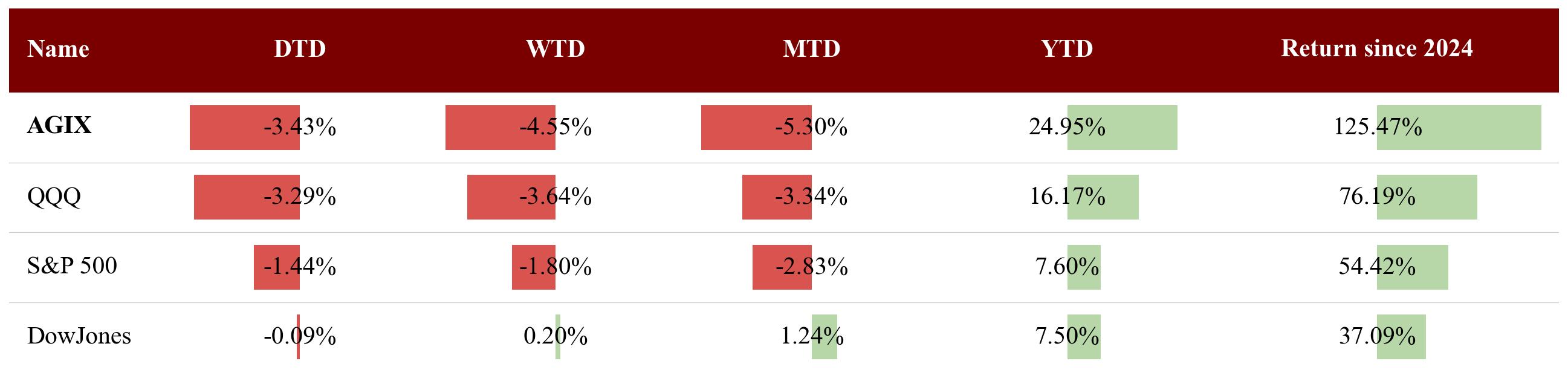
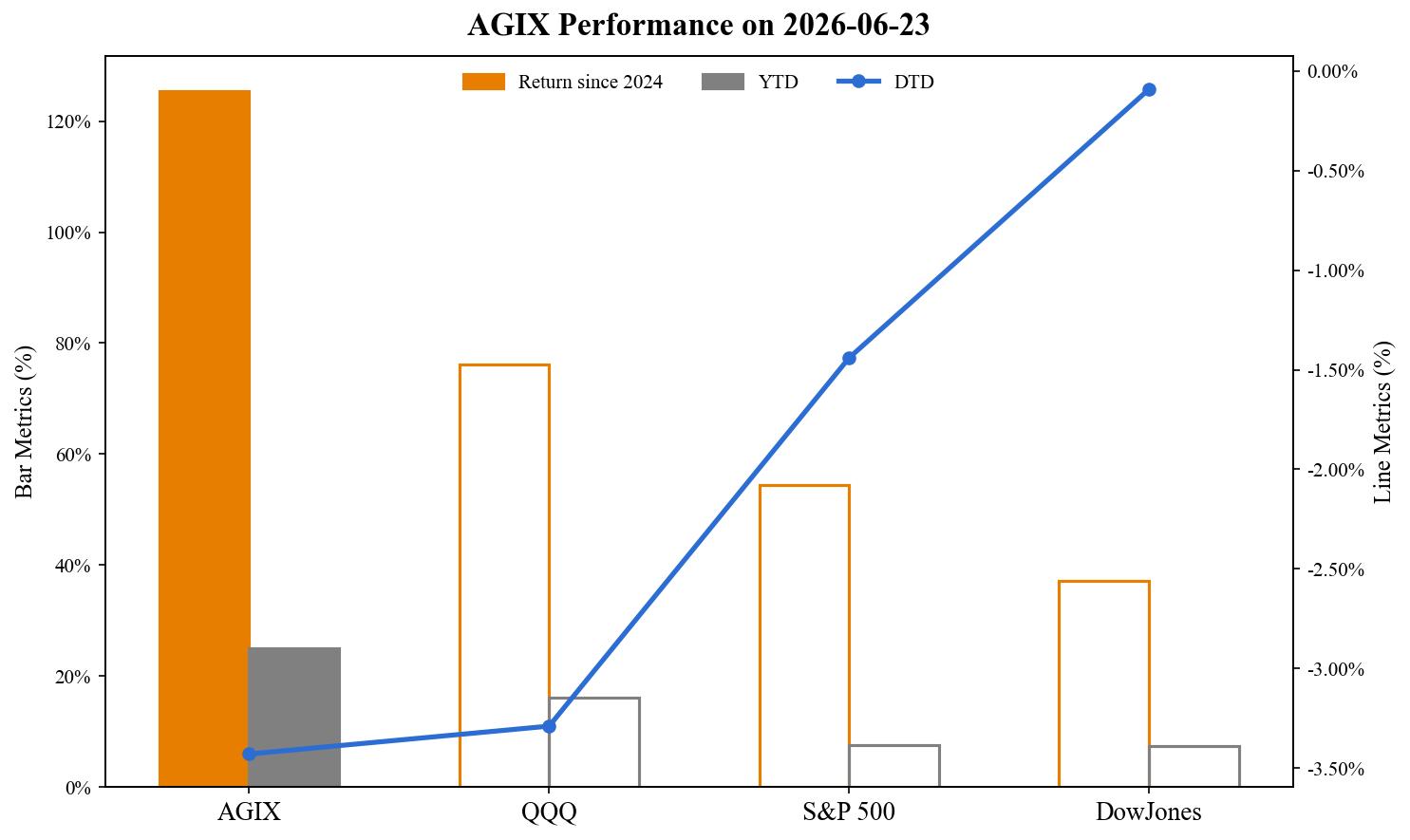
• AGIX fell 3.43% DTD, underperforming the S&P 500 (-1.44%) and Dow Jones (-0.09%) but roughly in line with QQQ (-3.29%). Weakness was concentrated in hardware holdings, with memory and semiconductor names dragging the portfolio.
• Top drags on AGIX included SK hynix (-12.47% DTD), Micron (-13.18%), Samsung (-12.31%), Arm (-10.14%), and Astera Labs (-9.70%), reflecting broad selling in AI-related chip and memory stocks. NVIDIA also fell 4.13%, contributing to the negative move.
• Notable outperformers among holdings included ServiceNow (+3.15%), Salesforce (+2.20%), SAP (+1.74%), and Cloudflare (+3.00%), highlighting resilience in enterprise software and AI-infrastructure names amid the tech selloff.
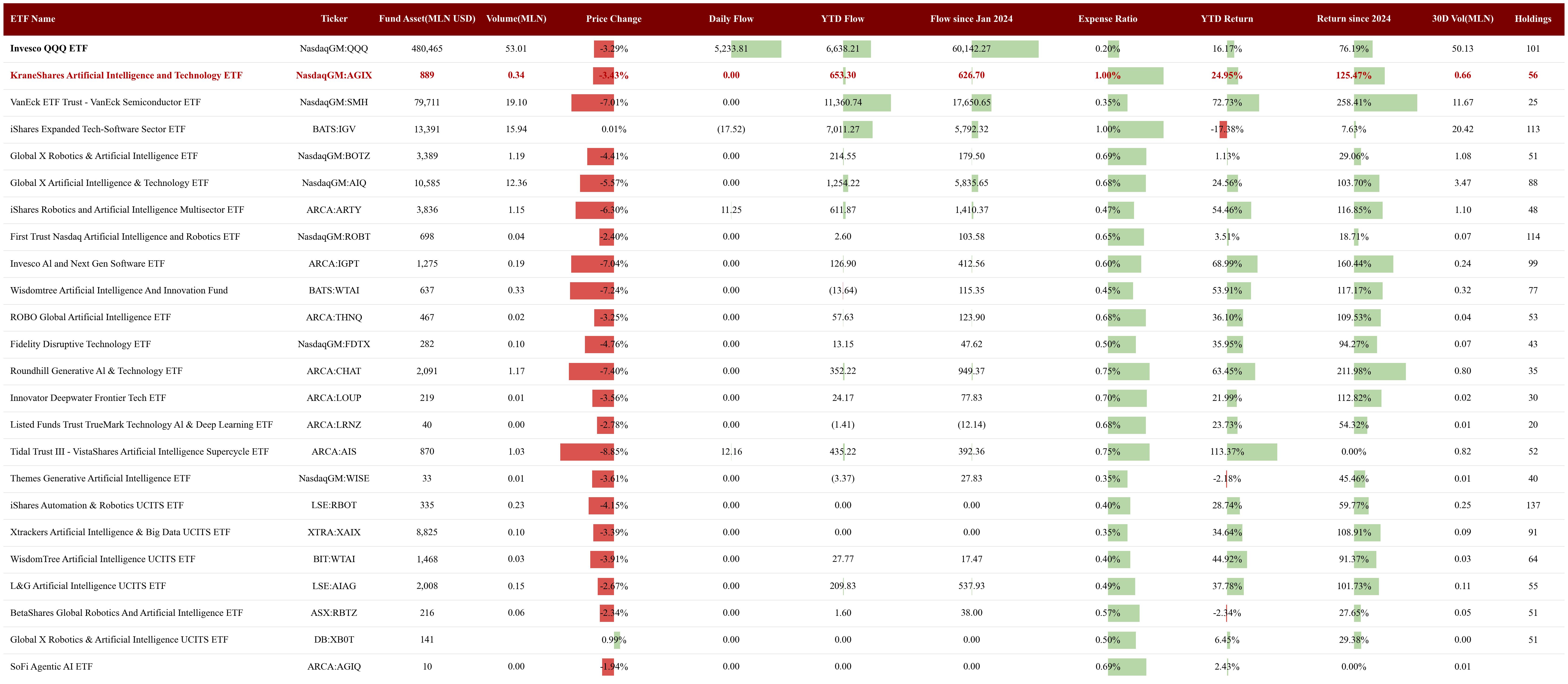
• Peer ETFs were mixed: SMH fell 7.01%, IGV was flat (+0.01%), and BOTZ dropped 4.41%. AI-focused ETFs like AIQ (-5.57%) and IGPT (-7.04%) also declined, while the broader robotics ETF ROBT fell 2.40%.
News Highlights
1. OpenAI expanded its Daybreak cybersecurity program with Patch the Planet and the full release of GPT-5.5-Cyber, partnering with Trail of Bits and HackerOne. This could boost demand for AI security tools from vendors like CrowdStrike and Cisco, and may pressure other AI security firms to innovate.
2. Meta launched new $299 smart glasses with a Muse Spark AI model, integrating real-time visual understanding and translation. This strengthens Meta's position in wearable AI and may pressure competitors like Snap and Google.
3. Nvidia and DDN deepened their partnership to optimize AI infrastructure economics, focusing on GPU efficiency and data intelligence. This supports Nvidia's enterprise AI narrative and may benefit AGIX holdings in the data center supply chain.
4. Okta expanded its Cross App Access framework to secure AI agent connections, with support from Asana, Atlassian, Cloudflare, Datadog, Slack, Zoom, and Anthropic. This addresses a key enterprise security gap and could boost Okta's adoption among AI-heavy customers.
5. Snyk launched Evo Agentic Development Security to monitor autonomous coding agents, responding to the rise of AI coding tools. This may increase demand for security solutions that integrate with AI development workflows.
6. Anthropic introduced Claude Tag for Slack, making Claude a permanent team member with continuous context memory. This moves AI agents from tools to colleagues, potentially accelerating enterprise AI adoption and benefiting collaboration platforms.
RSS Highlights
1. Scattered Spider hackers pleaded guilty on day one of their trial in connection with the 2024 Transport for London cyberattack, highlighting the ongoing threat from cybercrime gangs.
2. A blog post explores the concept of 'loops' in AI, where large language models prompt each other to increase token consumption, though the potential benefits remain unclear. This reflects the industry's search for new AI monetization models.
3. The Tasmanian Greens are pushing for an urgent inquiry into new AI data centers, as Firmus plans to draw 400-500 MW of electricity, exceeding the state's largest current industrial user. This underscores the growing tension between AI infrastructure and local energy resources.
4. A port of the Moebius 0.2B image inpainting model to run in the browser using WebGPU and Claude Code was released, enabling users to remove image content by marking areas. This demonstrates the increasing capability of lightweight AI models in the browser.
5. Prompt injection research reveals that models struggle to distinguish privileged text from untrusted user input, with attack success rates dropping from 61% to 10% when focusing on role confusion. This is a key security challenge for AI agents.
6. CocoaPods will switch to read-only mode in December 2026 due to maintainer shortages and security vulnerabilities, affecting over 100,000 libraries. This highlights the fragility of open-source infrastructure.
Performance & Benchmark
Attribution
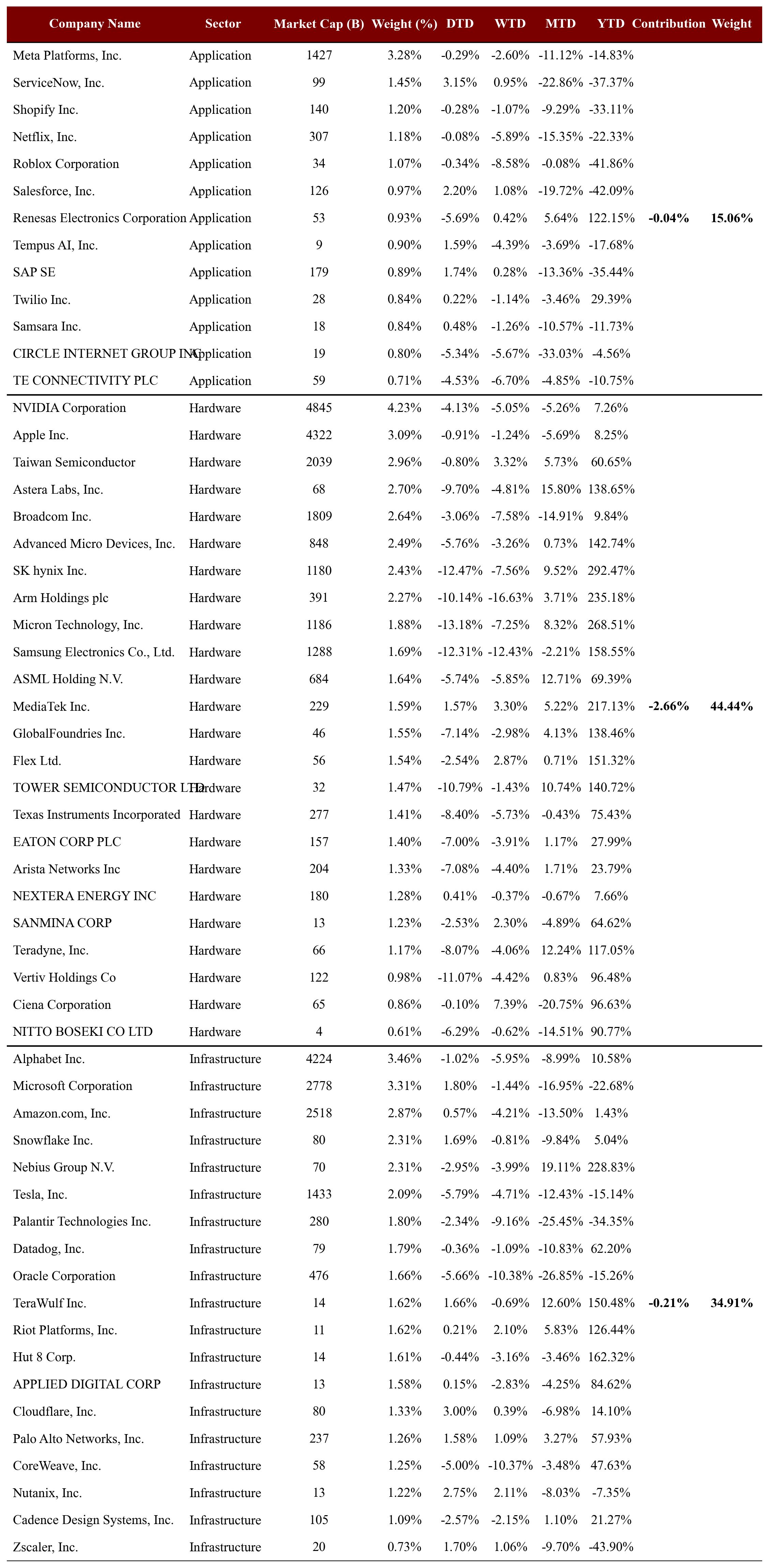
Contribution of the three sectors within AGIX holdings today
Application: -0.04%
Hardware: -2.66%
Infrastructure: -0.21%
Top-performing stocks in AGIX holdings today
ServiceNow, Inc. (3.15%)
Cloudflare, Inc. (3.0%)
Nutanix, Inc. (2.75%)
Salesforce, Inc. (2.2%)
Worst-performing stocks in AGIX holdings today
Palantir Technologies Inc. (-2.34%)
SANMINA CORP (-2.53%)
Flex Ltd. (-2.54%)
Cadence Design Systems, Inc. (-2.57%)
Nebius Group N.V. (-2.95%)
Broadcom Inc. (-3.06%)
NVIDIA Corporation (-4.13%)
TE CONNECTIVITY PLC (-4.53%)
CoreWeave, Inc. (-5.0%)
CIRCLE INTERNET GROUP INC (-5.34%)
Oracle Corporation (-5.66%)
Renesas Electronics Corporation (-5.69%)
ASML Holding N.V. (-5.74%)
Advanced Micro Devices, Inc. (-5.76%)
Tesla, Inc. (-5.79%)
NITTO BOSEKI CO LTD (-6.29%)
EATON CORP PLC (-7.0%)
Arista Networks Inc (-7.08%)
GlobalFoundries Inc. (-7.14%)
Teradyne, Inc. (-8.07%)
Texas Instruments Incorporated (-8.4%)
Astera Labs, Inc. (-9.7%)
Arm Holdings plc (-10.14%)
TOWER SEMICONDUCTOR LTD (-10.79%)
Vertiv Holdings Co (-11.07%)
Samsung Electronics Co., Ltd. (-12.31%)
SK hynix Inc. (-12.47%)
Micron Technology, Inc. (-13.18%)
Top five listed stocks contributing the most within AGIX holdings today
SK hynix Inc. (-12.47%)
Astera Labs, Inc. (-9.7%)
Micron Technology, Inc. (-13.18%)
Arm Holdings plc (-10.14%)
Samsung Electronics Co., Ltd. (-12.31%)
Observation
The strongest movers across peer ETF holdings today are listed below:
| DTD | Stock Ticker | Name | Held by ETFs | analysis |
|---|---|---|---|---|
| 7.09 | NasdaqGS:VRNS | Varonis Systems, Inc. | ['BATS:IGV', 'BATS:WTAI', 'ARCA:THNQ', 'LSE:AIAG'] | Varonis’ 7.09% gain on 2026-06-23 was most likely driven by a report that the company is exploring a potential sale after receiving takeover interest, which typically triggers acquisition-premium speculation. The move was also reinforced by broader bullish sentiment around Varonis’ AI and SaaS transition, which had already been improving the stock’s narrative. A same-day analyst reiteration from Wells Fargo also appears to have added support, but the sale-report catalyst looks to have been the main driver.[1][3][8] |
| 6.76 | NYSE:GWRE | Guidewire Software, Inc. | ['BATS:IGV'] | Guidewire Software’s 6.8% gain on June 23, 2026 appears primarily driven by a rebound from a recent 52-week low and short-term oversold conditions rather than by any company-specific news or disclosures on the day.[2][6] The move was likely amplified by technical factors as the stock bounced off the low end of its 52-week range (near $102) back toward $110, in the context of still-constructive longer-term analyst targets and favorable total return profile year-to-date.[2][4][7] |
| 6.25 | TWSE:2303 | United Microelectronics Corporation | [] | United Microelectronics’ 6.25% gain on June 23, 2026 appears primarily driven by follow-through buying after the company’s strong Q1 2026 results and upbeat guidance on utilization, ASPs, and margins, which have improved sentiment on foundry demand and earnings momentum.[4][5] A secondary driver is the broader rerating of Taiwan semiconductor names amid robust AI- and communications-related demand, with UMC benefiting from its higher 22/28nm mix and announced plans to raise wafer prices in 2H 2026, supporting a more constructive outlook for pricing and profitability.[1][4] |
| 6.15 | NasdaqGM:RPD | Rapid7, Inc. | ['BATS:IGV', 'ARCA:THNQ', 'XTRA:XAIX', 'LSE:AIAG'] | Rapid7’s +6.1% move on June 23, 2026 appears driven primarily by a technical rebound in an oversold small/mid-cap cybersecurity name rather than by any new company-specific news or disclosures that day.[1][2][6][7] The stock had been under pressure following earlier leadership changes (new CEO appointed June 1) and ongoing volatility around product and strategy updates, so investors likely viewed the depressed valuation and oversold technicals as an opportunity to add exposure as sentiment toward higher-beta tech improved.[2][6] |
| 5.89 | SEHK:6608 | Bairong Inc. | ['NasdaqGM:WISE'] | Bairong’s 5.89% move on June 23, 2026 appears most likely driven by company-specific capital return news: a new HK$450 million share repurchase program that would support the stock by signaling management confidence and reducing share supply. [3] The move was likely amplified by broader sentiment and trading flow, as the stock had already been volatile and moved alongside a relatively active session in Hong Kong names, with Google Finance showing Bairong up 7.93% on the day. [1] There is no same-day earnings or regulatory announcement in the provided results, so the buyback news is the clearest identifiable catalyst. [3] |
| 5.84 | TSX:TRI | Thomson Reuters Corporation | ['NasdaqGM:QQQ', 'NasdaqGM:AIQ'] | Thomson Reuters’ 5.8% move appears driven primarily by a technical rebound and positioning, rather than any specific new company‑level catalyst on the day. The stock had been trading near its 52‑week low on the TSX with elevated volume in recent sessions, and the intraday move pushed shares back above short‑term moving averages, triggering follow‑through buying and short covering.[2][4] A supportive backdrop of predominantly Buy ratings and sizeable upside to consensus targets likely reinforced buying interest as the stock screened as oversold versus fundamentals.[2][3] |
| 5.75 | NasdaqGS:OTEX | Open Text Corporation | ['BATS:IGV', 'LSE:RBOT', 'XTRA:XAIX'] | Open Text’s 5.75% gain appears to be a sentiment-driven rebound in a deeply sold-off name rather than a reaction to any specific company news or disclosure on the day. The stock is down materially year-to-date and trading well below prior highs, while several analysts and research outlets have highlighted undervaluation and distressed-level multiples in recent weeks, which can set up for sharp short-covering and mean-reversion moves when risk appetite improves. Broader interest in “overlooked” software/value tech names and the ongoing narrative that OTEX could rerate as it executes on simplification, deleveraging, and cloud/AI repositioning likely reinforced the move in the absence of stock-specific headlines. |
| 5.63 | NYSE:ZETA | Zeta Global Holdings Corp. | ['BATS:IGV', 'NasdaqGM:WISE'] | Zeta Global’s 5.6% move on June 23, 2026 appears primarily driven by continued positive sentiment around its accelerating revenue growth and repeated “beat and raise” execution following the Athena by Zeta launch, which has positioned the name as a high-conviction growth story among investors.[7][9][10] A secondary driver is ongoing public promotion by influential investors/media (e.g., recent video features highlighting expected revenue inflection and aggressive buybacks), which likely reinforced the bullish narrative and attracted incremental demand.[2][5] |
| 5.61 | NasdaqGS:AXON | Axon Enterprise, Inc. | ['NasdaqGM:QQQ', 'ARCA:LOUP'] | Axon’s 5.6% gain appears primarily driven by a rebound from recent weakness and positive sentiment around its strong 2026 growth and bookings narrative rather than any new company-specific catalyst on the day. The stock had sold off sharply from prior highs despite earlier record results and raised 2026 guidance, and the move back above $430 represents mean reversion aided by supportive expectations embedded in options pricing for a ~6% weekly move and ongoing buy-the-dip interest in high-growth public safety/software names. |
| 5.29 | TSE:5803 | Fujikura Ltd. | ['NasdaqGM:AIQ'] | Fujikura’s 5.29% gain on June 23, 2026 appears primarily driven by strong positive sentiment and momentum following its recent sharp re-rating, with the stock hitting new highs amid robust buy ratings and upside narratives from multiple analyst and forecasting platforms. Investor enthusiasm is supported by very strong 12‑month returns, bullish consensus “Strong Buy” recommendations, and aggressive growth/price‑target forecasts that frame the name as a high‑growth outlier, sustaining follow‑through buying rather than any specific new company disclosure that day. |
| 5.26 | NYSE:RBRK | Rubrik, Inc. | ['BATS:IGV', 'BATS:WTAI'] | Rubrik rose 5.26% on 2026-06-23, and the move appears most consistent with a continuation of positive post-earnings sentiment around the company’s recent operating momentum, including strong subscription ARR growth and improving profitability highlighted in the latest quarter.[2][8] There was no clear same-day company-specific news in the results provided, and the only identifiable event was a routine insider Form 4 filing earlier in the month, which is unlikely to explain the day’s move.[1] Broader market/quote data show the stock traded sharply higher intraday versus prior levels, suggesting investors were still repricing the name on fundamentals rather than reacting to a fresh announcement.[4][5] |
| 5.25 | NasdaqGS:CDW | CDW Corporation | ['NasdaqGM:QQQ', 'ARCA:AIS'] | CDW’s ~5% gain appears primarily driven by a bullish sell-side catalyst, specifically a JPMorgan upgrade to Overweight with a $130 price target highlighting AI and IT modernization demand and a strong backlog, which prompted an immediate rerating in the shares.[1] A secondary support (though not new that day) is ongoing positive sentiment around prior insider buying by Director David Nelms and a broadly favorable analyst rating/price target setup, which reinforces the upgrade-driven move.[1][3][5] |
| 5.24 | NasdaqGS:ACIW | ACI Worldwide, Inc. | ['BATS:IGV'] | ACI Worldwide’s 5.24% move on 2026-06-23 appears most consistent with continued positive reaction to its recent Q1 2026 results and raised full-year guidance, which highlighted 8% revenue growth, 12% adjusted EBITDA growth, and share repurchases. The stock also had supportive company-specific momentum from recent product and partnership announcements around payments orchestration and verification, which likely reinforced the bullish tone. No clearly dominant same-day company-specific catalyst is evident in the provided results, so the move was likely driven by accumulation of these positive fundamentals and sentiment rather than a single headline. |
| 5.08 | NasdaqGS:GEHC | GE HealthCare Technologies Inc. | ['NasdaqGM:QQQ', 'NasdaqGM:AIQ'] | GE HealthCare’s 5.1% gain on June 23, 2026 appears primarily driven by positive sentiment around newly highlighted AI-enabled imaging and oncology software milestones, including recent FDA 510(k) clearance with a Predetermined Change Control Plan for its MIM Contour ProtegeAI+ 2.0 oncology platform and broader AI radiology portfolio showcased at SNMMI and SIIM 2026, which reinforced the company’s growth and innovation narrative.[1] The move was reinforced by elevated trading volume versus average, suggesting active buying interest as investors repositioned into GEHC as a beneficiary of AI in healthcare workflows and theranostics.[1][3][7] |
| 5.04 | NYSE:IBM | International Business Machines Corporation | ['NasdaqGM:AIQ', 'ARCA:ARTY', 'NasdaqGM:ROBT', 'BATS:WTAI', 'ARCA:THNQ', 'NasdaqGM:FDTX', 'XTRA:XAIX', 'BIT:WTAI', 'LSE:AIAG'] | IBM’s 5.0% gain on June 23, 2026 was driven primarily by a JPMorgan upgrade to Overweight with a higher price target of $291, citing increased confidence in IBM’s AI- and software-led growth strategy.[1][2][3][5][7] A secondary tailwind was IBM-specific positive sentiment as it joined OpenAI’s Daybreak Cyber Partner Program, helping the stock positively diverge from a broader tech selloff that day.[2][3][8] |
| 5.02 | NYSE:TDC | Teradata Corporation | ['BATS:IGV', 'NasdaqGM:AIQ', 'ARCA:IGPT', 'LSE:RBOT'] | Teradata’s +5.0% move appears primarily technical, with no material company-specific news or sector catalyst on the day and the stock rebounding from recent weakness. The advance coincides with the shares trading well below both their 52-week high and consensus target price, which can attract bargain-hunting and momentum investors after a pullback.[2][4] Broader growth and AI/analytics sentiment, along with prior positive signals on the company’s growth profile, likely provided an additional tailwind to the stock.[2][9] |
News
Funding & M&A
The running list: major tech layoffs in 2026 where employers cited AI.
This article reveals in detail a series of massive layoffs in the technology industry in 2026, with many companies viewing AI as a dual driver—boosting revenue growth while also serving as a primary reason for layoffs. Oracle has laid off 20% of its employees in the past 12 months, including reductions due to AI; GitLab laid off 350 people to invest in AI infrastructure; Google, Meta, Cisco, and others have proposed AI restructuring plans, funneling savings into data centers and intelligent agent development. Meanwhile, the huge market demand for AI services has kept these companies' financial data growing rapidly, but the employee structure is shifting from middle management to front-end development and AI technology. Analysts point out that this 'revenue growth with headcount reduction' model may impact innovation capabilities and employee morale, requiring more nuanced human resource management strategies.
AI networking provider Upscale AI raises $190 million at a $2 billion valuation.
Upscale AI Inc., a data center networking startup, has completed a $190 million extension of its funding round, bringing its total funding to $390 million and its valuation to $2 billion. The round was led by Premji Invest, with participation from Nvidia, Salesforce Ventures, Temasek, and others. The company focuses on developing scale-up and scale-out switches for AI workloads. Its self-developed SkyHammer chip enables deterministic latency and supports protocols such as UALink and optimized Ethernet. Additionally, its scale-out product line is based on Nvidia's Spectrum-X chip and integrates Microsoft's SONiC open-source operating system. The funding will be used to accelerate commercialization, and the company has already been evaluated by several hyperscale data center operators. As a key link in AI infrastructure, Upscale AI is building high-performance network components through open standards.
Prosper AI secures $30 million to help healthcare providers streamline patient interactions.
U.S. AI healthcare software company Prosper AI Inc. recently announced the completion of a $30 million Series A funding round, led by Andreessen Horowitz, with participation from Y Combinator, Base10, Emergence Capital, and Company Ventures. The funding round follows a fivefold increase in company sales and the addition of over 40 new healthcare provider clients. Prosper AI primarily offers a voice AI platform for patients, enabling rapid creation of automated agents for doctor appointment scheduling, billing inquiries, and prescription renewal reminders. Its platform achieves 99% accuracy and can reduce administrative costs by over 40%. The funding will be used to expand engineering and marketing teams and to integrate with more electronic health record systems. Meanwhile, Abridge Inc. also secured $300 million in funding in 2023 for automated medical conversation recording. This investment reflects continued investor interest in healthcare AI solutions.
AlpSemi raises $19.5 million to manufacture semiconductor power switches for AI data centers.
French semiconductor startup AlpSemi SAS recently announced the completion of a €17 million funding round, approximately $19.5 million. The round was led by Paris-based private equity firm Yotta Capital, with participation from Nasdaq-listed chip manufacturer Navitas Semiconductor, SE Ventures, and Cycle Group. AlpSemi develops solid-state circuit protection switches based on wide-bandgap and ultra-wide-bandgap semiconductors, designed to replace traditional electromechanical circuit breakers. This technology has no moving parts, significantly improving disconnection speed, reducing maintenance costs, and minimizing arc fault risks. The company's first product, the AS800, targets residential and commercial buildings, with a high-end version for AI data center 800VDC architectures to follow. The funding will accelerate product commercialization, contributing alongside technologies from companies like Infineon to advance power management in data centers.
HaloBraid raises $7 million from Seven Seven Six to eliminate the six-hour hair salon appointment.
Helen's leading robotics startup HaloBraid officially announced its establishment this Tuesday, launching the first robotic assistant device for Black hair braiding. The company completed a $7 million seed funding round led by Reddit co-founder Alexis Ohanian's Seven Seven Six, with participation from AlleyCorp and Bling Capital. Founder Yinka Ogunbiyi holds a master's degree in engineering and an MBA from Harvard, and previously founded a smart cooking appliance company. Its robotic device can complete the remaining braiding process in seconds, suitable for knotless and box braids, while reducing occupational diseases like carpal tunnel syndrome among hairstylists. Globally, braiding takes about 8 billion hours annually, and 95% of respondents said they would braid more often if the time were significantly reduced. The funding will be used for product development, manufacturing, and salon partnerships. The company has also started developing follow-up products like a braid-removal machine.
Superhuman acquires AI detection startup GPTZero.
GPTZero has been acquired by Superhuman. The company was founded three years ago by Princeton University graduate Edward Tian. GPTZero has 19 million registered users and $30 million in annual recurring revenue, and was already profitable. The startup raised only $13.5 million, including a $3.5 million seed round led by Uncork Capital and a $10 million Series A led by Footwork partner Nikhil Basu Trivedi. Superhuman was renamed after Grammarly acquired the email service Superhuman. After acquiring GPTZero, Superhuman says 'two AI detectors are better,' enhancing the platform's built-in AI detection capabilities. This acquisition will strengthen users' ability to guard against AI-generated content.
Lama AI raises $10 million to accelerate automated loan originations
AI lending origination startup Lama AI Inc. has completed a $10 million Series A funding round, bringing its total funding to over $20 million. The round was led by EJF Ventures, with participation from new and existing investors including Fin Capital, 1st & Main, and banking industry veterans. Lama AI provides an AI-native loan origination platform primarily serving regional small banks and credit unions in the US, automating the entire process from customer reception and document collection to approval and portfolio monitoring through autonomous AI agents, helping them reduce costs and improve efficiency. The platform has been adopted by multiple institutions including SouthState Bank and Colony BankCorp, processing billions of dollars in loans. The funds will be used mainly to expand the sales and customer success teams and to continue enhancing loan support capabilities in areas such as industrial, SBA, and commercial real estate.
Fika Jobs raises $4 million to build a video-first hiring platform where AI agents interview candidates
Stockholm-based startup Fika Jobs announced on Tuesday that it has raised $4 million in a pre-seed round, led by Luminar Ventures, with participation from Alliance VC and King co-founders Sebastian Knutsson and Riccardo Zacconi. Fika Jobs is developing a video-first recruitment platform that combines AI interview agents with short video profiles, similar to a blend of LinkedIn and TikTok. After job seekers connect their LinkedIn, the AI generates personalized questions based on the Gemini model and conducts an approximately 10-minute video interview, then automatically edits the footage to create a dynamic profile discoverable by employers. The platform is free for job seekers, and employers pay a 10% commission on the first year's salary upon successful hire, lower than the traditional 20%-30% charged by headhunters. Over 100 companies have joined the waitlist, and more than 50 have completed testing, including Plenty Labs and Kognity. Fika plans to open early access this week, launch fully this autumn, first focus on the Swedish market before expanding globally, and grow its team to about 10 people by year-end.
Shares of AI chipmaker Cerebras sink following first earnings report since going public
Chipmaker Cerebras Systems Inc. reported its first quarterly results since going public, with revenue exceeding expectations but a wider-than-expected loss per share, causing shares to fall 10% after hours. The company posted first-quarter revenue of $193 million, up 92% year-over-year, and narrowed its net loss to $14 million. However, gross margin guidance fell to 36%-38%, highlighting the challenge of surpassing Nvidia in the AI chip space. Cerebras raised $85 per share in its IPO last month, opened at $350, and currently trades around $202. CEO Andrew Feldman said AI has entered the practical stage, and its intelligent chip technology delivers the fastest AI performance. The company will deploy chips in AWS data centers and signed a $20 billion computing contract with OpenAI, though the deal incurs large non-cash sales expenses. Full-year revenue is expected to grow 69%.
Orderful secures $35 million to streamline supply chain data management
Orderful Inc. recently announced the completion of a $35 million Series C funding round, led by Koch Disruptive Technologies with participation from NewRoad Capital, bringing the company's total external funding to $85 million. The startup's AI platform, Mosaic, aims to solve the lengthy integration issues caused by inconsistent EDI (Electronic Data Interchange) file formats in retail supply chains, reducing new supplier onboarding time from weeks to hours or days. Mosaic can also automatically detect retailer format changes and adjust files, eliminating the need for custom integrations while reducing penalty risks. Orderful also offers Pixel and label generation tools and has facilitated over 6 billion EDI transactions. The company plans to use the new funds for feature development, focusing on enhancing supply chain monitoring and administrative task automation, continuing to overhaul the EDI infrastructure that has been neglected for over 40 years.
Technical Breakthroughs
Virtue AI pulls the rug out from under the feet of shadow AI agents
AI security startup Virtue AI Inc. has launched a new product called Shadow AI, a new feature module of the AgentSuite platform, providing enterprises with complete visibility into AI agents used within their organizations. As autonomous AI agents rapidly proliferate across endpoints, SaaS applications, and DevOps workflows, enterprise security teams are often unable to audit or approve these unauthorized systems. Shadow AI offers endpoint-level discovery and monitoring capabilities, identifying where AI agents are running, their tool calls, behavior sequences, and network activity, and supports Linux, Windows, and macOS systems. The tool can be deployed standalone or integrated with EDR/XDR platforms such as CrowdStrike Falcon and Microsoft Defender, helping security teams quickly detect anomalies, track behavior, and promptly neutralize problematic agents. Through real-time monitoring and a unified view, enterprises can confidently scale their AI applications while maintaining compliance.
Komprise aims to make messy, unstructured data accessible without the hassle.
Komprise, a big data management startup, has launched a major update to its platform with the release of Komprise Transparent File Tables. This feature transforms messy unstructured data into a structured view, making it easier for AI models to access. The new functionality presents data as Apache Iceberg tables in cloud data lakehouses, enabling queries without large-scale data movement. The solution uses a distributed architecture to automatically index and enrich metadata, providing enterprises with a consistent schema through content and metadata tags. Users can analyze data directly on platforms like Databricks and Snowflake using existing BI tools. This technology helps industries such as healthcare and finance better manage sensitive data and reduce AI data preparation costs. Komprise's solution keeps data in place, supporting RAG pipelines and model fine-tuning through metadata alone.
Nvidia bets on agentic AI to turbocharge biotech discovery
At the Bio International Convention held in San Diego, Nvidia announced the launch of the BioNeMo Agent Toolkit. This toolkit can transform general large language models into specialized AI agents, enabling end-to-end biological workflows from literature retrieval to protein design and experimental automation. Kimberly Powell, Vice President of Life Sciences at Nvidia, pointed out that agentic AI will become a new generation of scientific instruments, like microscopes, X-ray crystallography, and gene sequencing, capable of reasoning, planning, and executing multi-step tasks. The toolkit is compatible with various models including OpenAI, Anthropic, and Nvidia Nemotron, and also adapts to existing platforms such as MONAI and Parabricks. By optimizing token usage and GPU efficiency, BioNeMo can reduce computational costs while improving task completion rates and accuracy. Industry insiders believe this marks a transition in life sciences from single models to multi-agent collaborative networks, reshaping the operational model of drug discovery.
The new Dragos AI assistant, EmberAI, targets the OT security skills gap.
Industrial control system security company Dragos Inc. recently launched EmberAI, an AI assistant designed specifically for operational technology environments. The tool is built on Dragos Intelligence Fabric, currently the world's largest OT security database, with over 5 petabytes of data. EmberAI enables analysts to query assets, potential threats, and network activities using natural language, and to prioritize risks by operational impact. The product will help IT personnel, plant engineers, and experienced OT security experts better handle critical infrastructure attacks. As attack incidents continue to rise and specialized talent remains scarce, Dragos notes that general AI struggles to accurately identify critical exposures in OT environments. EmberAI can correlate assets, potential vulnerabilities, threat intelligence, and network activities in real time, mapping detection results to known OT threat groups and attack patterns. The tool is now fully available on the Dragos Platform, with user data kept in local environments and all recommendations being auditable and transparent. Dragos' CEO stated that the tool integrates the company's over a decade of OT threat intelligence, incident response, and adversary tracking experience.
Snyk launches Evo Agentic Development Security to police AI coding agents
Cybersecurity company Snyk recently launched Evo Agentic Development Security (Evo ADS), a new layer on its AI security platform designed to monitor autonomous coding agents. The new solution enforces controls within agent workflows, including reviewing MCP servers, skills, and external tools, monitoring agent behavior in real time, and performing real-time scanning and remediation of AI-generated code. Based on data from nearly 9,700 development environments, Snyk found that nearly 43% of developers run multiple AI coding environments simultaneously, over half have installed MCP servers, and some environments have more than 80. The company also provided real attack examples, including risks like poisoned security scanners and prompt injection. Evo ADS will join Evo AI-SPM and Evo Continuous Offensive Security to form the Snyk AI Security Platform. The product will officially launch on June 29.
Momentic raises the bar for software testing with its agentic quality platform.
Momentic Inc., an AI testing platform, has launched a major upgrade, introducing intelligent agents such as Explore Agent and Failure Classification Agent to address quality challenges caused by the surge in code volume in the AI coding era. The platform integrates multi-source data like Jira and Figma to enable automatic fault classification and intent-based test writing, improving signal-to-noise ratio and reducing manual review costs. A GitLab report shows that AI tools accelerate development speed while also improving quality bottlenecks, and Momentic provides a solution for this gap. Its English-readable test format also supports collaboration with AI agents. As agent-based development becomes more common, quality assurance tools are becoming essential.
Product Launches
Anthropic's Claude Tag is learning your company, one Slack message at a time.
Anthropic, an AI company, has launched a research preview of Claude Tag in Slack, which makes Claude a permanent AI team member that can provide real-time insights, assign tasks, and automatically track project progress via @Claude tags. Unlike previous on-demand usage, Claude Tag has continuous context memory, automatically gathers information from other channels, and maintains conversation continuity in multi-person collaboration scenarios. System administrators can finely control its access permissions to ensure data isolation. This move upgrades the AI agent from a tool to a colleague with organizational identity, drawing attention from enterprises. Companies like Microsoft, Snowflake, Databricks, and Glean are also improving AI's understanding of enterprise knowledge through different technical paths.
ZenBusiness enhances its AI copilot for new business owners with step-by-step blueprints.
U.S. startup service platform ZenBusiness has announced the expansion of its Velo AI guide, launching Velo Blueprint, a step-by-step business planning feature that provides a clear path for novice entrepreneurs starting from scratch. The tool can generate business ideas, estimate initial costs, suggest entity types, and verify user progress. Company data shows that since its launch in July 2025, Velo has handled over 2 million conversations, with nearly 60% of customers using the tool and 53% returning within the same month. CEO Ross Buhrdorf stated that surveys show nearly 60% of entrepreneurs are willing to rely on AI for guidance. Velo now automatically handles 72% of conversations, with complex cases transferred to human experts. User feedback indicates it not only provides answers but also aids decision-making and reduces uncertainty.
Exabeam launches Praxen, an open-source tool to verify AI agent behavior.
Security intelligence and management solutions company Exabeam has recently launched Agent Behavior Verification (ABV) discipline and open-sourced the Praxen tool. This tool is used for behavior verification before deploying AI agents, checking the agent's tools, configuration, memory, and integration environment to ensure its behavior fully matches authorized scope. This move complements Exabeam's earlier Agent Behavior Analytics product, covering platforms like ChatGPT, Microsoft Copilot, and Google Gemini. Praxen is open-sourced under the Apache 2.0 license, aiming to provide developers with an automated security verification method for agents. Medigram CEO Sherri Douville stated that the tool's code-level remediation paths help enterprises quickly reduce operational risks. Exabeam's move helps drive industry consensus on autonomous agent security standards.
CData targets AI developers with governed data access tools.
CData Software Inc. has launched three new products designed to simplify developers' access to enterprise data when building AI applications. These include the free Connect AI Developer Edition, an open-source Python SDK, and a command-line interface tool. These tools provide real-time access to over 350 enterprise data sources via the Model Context Protocol, while handling authentication, API management, and data governance. The new products support integration with AI development environments such as Anthropic's Claude Code, OpenAI's Codex, Anysphere's Cursor, and LangChain. CData emphasizes that the dynamic schema discovery feature automatically detects schema changes in business applications, preventing inaccurate AI outputs. The Python SDK is based on the DB-API 2.0 standard, facilitating integration with tools like pandas and SQLAlchemy. The CLI tool optimizes AI-assisted development environments and supports deployment without MCP infrastructure. This move marks CData's shift from traditional IT sales to a developer-first strategy, addressing the growing demand for data integration and governance in AI agent systems.
Five thoughts from Swami Sivasubramanian’s keynote at AWS Summit and what it means for IT professionals.
At last week's Amazon AWS New York Summit, Vice President Swami Sivasubramanian proposed that agentic AI is moving from chat windows to a new phase of continuous compound power. He emphasized that products such as Amazon Quick, Kiro, DevOps Agent, AWS Transform, and AgentCore integrate security, development, operations, and data, using knowledge graphs to achieve automated iteration between tasks. GoDaddy has reduced manual work by 15,000 hours per year, Southwest Airlines has accelerated its modernization timeline by three years, and multiple financial and sports organizations have deployed production-grade agents into their environments. The summit noted that enterprise IT leaders must treat identity, policy, and context management as platform services to achieve secure and controllable compound growth.
Meta debuts new, cheaper smart glasses under its own brand.
U.S. tech giant Meta has officially launched its new generation of smart glasses, Meta Glasses, starting at $299, produced in partnership with EssilorLuxottica, and available in multiple designs including Adventurer, Fury, and a Kylie Jenner collaboration. The product has no display but features a camera, personal audio device, and Meta AI assistant, supporting voice queries, real-time translation, and pedestrian navigation, with battery life exceeding 8 hours. Meta is accelerating its wearable device strategy and currently holds over 80% of the global market share with EssilorLuxottica. This launch comes just one week after Snap released its $2,195 Specs smart glasses. As competition in wearable AI devices intensifies, Meta continues to enhance user experience through multiple frame styles and multilingual support.
Industry Partnerships
OpenAI expands Daybreak with Patch the Planet and the full release of GPT-5.5-Cyber.
OpenAI Group PBC today fully upgraded its Daybreak cybersecurity program, launching the open-source patching initiative Patch the Planet, a new version of the Codex Security plugin, a partner program, and the official release of its strongest defense model, GPT-5.5-Cyber. OpenAI is collaborating with organizations such as Trail of Bits and HackerOne to fund expert researchers and use AI models to assist open-source project maintainers in fixing vulnerabilities. The first batch of participating projects includes over 30 critical open-source components such as cURL, Python, and Go. OpenAI emphasizes that the current security bottleneck has shifted from discovering vulnerabilities to efficiently patching them, with human review ensuring quality. The first five-day sprint has identified hundreds of issues and merged dozens of patches, while also discovering multiple exploitable vulnerabilities in browsers such as Chrome, Safari, and Firefox. GPT-5.5-Cyber scored 85.6% on the CyberGym benchmark. The Daybreak Cyber Partner Program has attracted several security vendors including Accenture, Cisco, and CrowdStrike. OpenAI has also signed Trusted Access cooperation agreements with governments of the US, Australia, Canada, the EU, and others, continuing to promote industry collaboration and government regulation in the AI security field.
OpenAI launches a new initiative to help find and fix open-source bugs.
OpenAI recently launched the "Patch the Planet" project, partnering with security company Trail of Bits to provide security support for open-source project maintainers. The initiative will use OpenAI's Codex Security and other tools, with Trail of Bits engineers reviewing code, identifying potential vulnerabilities, and helping develop patches and test cases to reduce maintainer burden. This move is a key step for OpenAI in leveraging AI technology to support open-source ecosystem security, and is also seen as a competitive move against Anthropic in the security tools space. Open-source software underpins commercial software, but its decentralized structure introduces security risks, as highlighted by the Log4j incident. The project will provide reusable workflows to help the community continuously improve security performance.
4 days left to save up to $190 on TechCrunch Founder Summit 2026
TechCrunch will host StrictlyVC in a new market on April 30, 2026, and its flagship Founder Summit in Boston on November 4 of the same year. Early bird pricing ends June 26, offering savings of up to $190, with an additional 30% off for group purchases. The conference gathers over 1,000 founders and investors, providing practical improvements in fundraising, revenue growth, hiring, and milestone planning through panel discussions and roundtable exchanges. Past speakers include leaders from Sequoia Capital, Greylock, and Precursor Ventures. The agenda is still being developed, and submitted topics can be voted on by the TechCrunch audience. The event emphasizes peer learning and relationship building to accelerate startup growth.
Linux Foundation extends DNS to AI agents with new Agent Name Service
Linxian Foundation announced it will launch the Agent Name Service (ANS) open standard, using existing DNS to give AI agents trusted identities. The standard can verify an agent's organization, permissions, and code integrity without building a new query network, instead binding directly to DNS. At a critical time when enterprises are deploying AI agents, this standard aims to solve authentication, permission control, and cross-platform interoperability challenges. World Economic Forum data shows 82% of executives plan to adopt AI agents within 1-3 years, but lack confidence in managing them effectively. Companies including GoDaddy, Cloudflare, Cisco, and Salesforce have expressed support and are incorporating existing DID and LEI systems into the model. The project is still soliciting contributions from enterprises, developers, and security researchers.
Nvidia and DDN target the economics of AI infrastructure
Nvidia and DataDirect Networks (DDN) are deepening their strategic partnership to build AI infrastructure that unlocks enterprise AI investment value. The collaboration focuses on GPU efficiency optimization and data intelligence platforms, with the latest progress including deep integration of DDN's AI data intelligence portfolio with Nvidia's BlueField-4 storage processor and Vera Rubin platform. DDN CEO Alex Bouzari notes that demand for agentic AI use cases has grown 30-fold, requiring new architectures to support massive compute and data throughput, while emphasizing that reducing per-token cost by 10 to 20 times is key to driving large-scale enterprise adoption. The partnership not only accelerates AI factory deployment but also provides the underlying data layer for massive markets like SpaceX, helping AI move from experimentation to profitable scale.
Beehiiv adds Cloudflare AI Crawl Control so writers can block or allow bots
Cloudflare and email platform beehiiv have officially launched an integration that provides independent publishers with one-click AI crawler control. The integration embeds Cloudflare's AI Crawl Control into the beehiiv backend panel, allowing authors to choose whether to allow AI search engines to crawl their content in exchange for greater distribution or to retain copyright for future licensing. This addresses the pain point of independent creators having to manually edit robots.txt, offering a visual panel that displays real-time AI crawler traffic, referral traffic, and blocked requests. Cloudflare has advanced multiple AI content protection measures in recent years, including default blocking, a Pay Per Crawl billing marketplace, and the acquisition of the Human Native data platform. The partnership provides stronger negotiation tools for the creator economy and opens up more content sources for Cloudflare.
Okta expands Cross App Access ecosystem to secure AI agent connections
Identity and access management company Okta recently announced that its Cross App Access (XAA) framework has gained support from over 25 software vendors. The framework brings connections between AI agents and enterprise applications under corporate identity control. Early adopters include Asana, Atlassian, Cloudflare, Datadog, Slack, Zoom, and Anthropic's Claude, covering work initiation tools, data storage applications, and development infrastructure. XAA, an extension of OAuth, has become the official authorization extension for the Model Context Protocol, addressing security blind spots caused by agent connections relying on static API keys and user consent interfaces. By allowing identity policies to flow with agents across applications, XAA enables centralized authorization, policy enforcement, and automatic permission cleanup. Zoom serves as both a requesting and resource application, supporting AI assistants in securely accessing meeting context. Okta Workforce customers will gain access to supported applications through the integration network in August, while Auth0 B2B customers will have early access at the end of July. This move marks Okta's continued expansion in AI agent identity management.
ClickHouse brings real-time analytics to agentic AI
With the rapid adoption of AI agents in enterprise applications, traditional batch architectures can no longer meet the demands of millisecond response times and high concurrency, making real-time data layers critical. ClickHouse, a columnar database focused on high-concurrency, low-latency queries, has built a complete solution supporting AI agent deployment through AWS Marketplace. The platform supports SQL queries and natural language interfaces for generating analytical reports, and can quickly integrate with existing enterprise AWS commitments. Tanya Bragin, Vice President of Product, notes that the core of AI success lies in data layer design, and that conversational warehouses are reshaping how data teams work. The service is now live on AWS Marketplace, allowing users to deploy, connect raw data, and generate visual reports in three clicks, providing high-performance, scalable data infrastructure for enterprise AI applications.
Google forms a research partnership with A24 Films focused on AI filmmaking tools.
Google, a US tech giant, is investing approximately $75 million in independent film studio A24 to explore the potential of artificial intelligence in the entertainment industry. This partnership marks Google's first direct investment in a film production company and will allow A24 to access its DeepMind AI research lab. The two parties plan to jointly develop new technologies to optimize the filmmaking process, including storyboard creation, rather than relying entirely on AI-generated content. A24 partners emphasize that the new tools will retain creator control to avoid industry concerns. However, the deal has sparked controversy within Hollywood, with many directors and actors worried that AI could threaten traditional jobs and alter the original intent of works. Although A24 has accepted controversial funding in the past, this collaboration with a tech giant is still seen as a significant signal of industry change.
OpenAI launches a new initiative to help find and fix open-source bugs.
OpenAI recently launched the "Patch the Planet" initiative, partnering with cybersecurity company Trail of Bits to help the open-source community enhance network security. The program leverages OpenAI's Codex Security and other tools, with Trail of Bits engineers directly assisting open-source project maintainers in reviewing code vulnerabilities, developing patches, and testing processes, aiming to reduce maintainer burden and build sustainable security workflows. Open-source software, as the foundation of commercial software, is prone to security risks due to its decentralized structure, as previously highlighted by the widespread impact of the Log4j vulnerability. OpenAI's move is seen as a response to Anthropic's Mythos security tool, while also addressing concerns that AI tools could be used for automated attacks. Through AI-assisted defense, the open-source community is expected to receive more efficient vulnerability remediation support, reducing potential supply chain risks.
Dell/AMD partnership: Three insights you may have missed from theCUBE’s coverage of Dell Technologies World
As AI factories become a core enterprise IT trend, the deep collaboration between Dell Technologies and AMD is driving the widespread deployment of hybrid architectures in AI production environments. By combining Dell PowerEdge servers with AMD Instinct MI350 PCIe accelerator cards, the two companies provide enterprises with high-performance AI inference capabilities across local, cloud, and edge scenarios. This partnership highlights the advantages of PCIe architecture in reducing latency and increasing bandwidth, and supports air-cooled architectures to lower deployment barriers. AMD and Dell have jointly established proven runbooks and testing processes to help customers quickly transition from generative AI to agentic AI. At Dell Technologies World, executives from both companies stated that in the rapidly evolving AI landscape, efficiency, cost control, and architectural flexibility have become key to enterprise success.
Meta ships its first smart glasses powered by its Superintelligence Labs' Muse Spark model.
Meta Platforms, a US tech giant, and EssilorLuxottica, an Italian eyewear group, have announced a new generation of AI smart glasses. The product integrates the multimodal AI model Muse Spark, enabling real-time visual understanding, multilingual translation, and route navigation. The new glasses come in more color and material options, with a starting price of $299, and include a collaboration with Kylie Jenner. Meta also emphasizes privacy protection measures, though its facial recognition technology experiments have sparked controversy. This partnership will help Meta expand in the wearable device space. Meanwhile, companies like Google and Samsung are also advancing related projects, making smart glasses a new battleground for the fusion of technology and fashion.
9 ways AI is reshaping enterprise operations: Key insights from AWS Summit NYC
At AWS Summit NYC 2026, enterprise AI applications are transitioning from experimentation to actual deployment. Luminous Robotics uses AWS edge computing and model tuning to drive solar panel installation robot swarms, addressing labor shortages; Burro.ai has deployed over 750 autonomous robots across 18 countries. Moody's partnered with AWS to integrate agent solutions into Amazon Quick, providing real-time financial analysis. Deloitte and AWS are pushing enterprise AI from pilot to production, with a Toyota supply chain project already generating $150 million in value. AWS launched DevOps Agent and an enhanced Marketplace to support the agent economy and automated operations. DFL brings personalized fan content, while Caylent advances a cloud operations agent platform. These examples show that multiple parties are achieving large-scale AI deployment through AWS infrastructure.
融资收购
Partly raises $50 million at a $500 million valuation to crack the US auto parts market
New Zealand-based AI auto parts startup Partly Group Ltd. recently completed a $50 million Series B funding round at a $500 million valuation. Founded in 2020 by former Rocket Lab engineer Levi Fawcett, the company focuses on its self-developed foundation model Interpreter for vehicle part identification and standardization. The model supports multimodal inputs and covers 91% of models from 58 major automakers. This round was led by DST Global Advisors, and the company has established its US headquarters in Austin, Texas. Part of the funds will be used to expand into the US collision repair market, which is worth over $100 billion. The company claims its model can increase repair shop scheduling speed by 9 times and reduce return rates by 2.4 times. Partly previously held New Zealand's record for the largest Series A round.
India’s MoEngage bets that the future of marketing is millions of AI agents
Indian customer engagement software company MoEngage has acquired U.S. startup Aampe for tens of millions of dollars in cash. Aampe specializes in using dedicated AI agents to personalize messages for each user and has over 30 clients. MoEngage aims to strengthen its competitiveness against rivals like Salesforce and Adobe through this acquisition, and has already won multiple multi-million-dollar annual contracts from those two platforms. Aampe's clients include brands such as Swiggy, Grab, and Taxfix. After the acquisition, approximately 30 Aampe employees will join MoEngage. MoEngage recently completed a $280 million funding round. The deal reflects the trend of enterprise software companies deeply embedding AI agents into business applications.
RSS Subscription
Scattered Spider Hackers Plead Guilty on Day 1 of Trial
This week, two men pleaded guilty in the UK in connection with a cyberattack on Transport for London in August 2024, which severely disrupted the public transport network in Greater London. They were key members of a cybercrime gang called Scattered Spider, and the guilty plea came on the first day of what was expected to be a six-week trial.
The most wonderful thing that happened to Tommy McHugh
British man Tommy McHugh suffered a stroke while straining on the toilet, and after waking up, he developed an intense urge to create art, painting on ceilings, wallpaper, and floors. His experience led him to believe that "the best thing is to have a stroke while on the toilet." Separately, Canada lost its measles elimination status due to a lack of nurses who speak Low German, with the measles outbreak concentrated among Mennonite communities that are cautious about vaccines.
Cargo Culture
If you are interested in this article, you can subscribe to my premium newsletter for $70 per year or $7 per month, which includes detailed analysis of NVIDIA, Anthropic, and OpenAI finances, as well as an in-depth exploration of the AI bubble. Recently, the AI industry has begun promoting the concept of "loops," aiming to increase users' token consumption by having large language models prompt each other, though the potential benefits remain unclear. The consensus in Silicon Valley drives absolute support for the AI industry, and any questioning may invite attacks.
Pluralistic: Spying on kids to save kids from spying is very, very stupid (23 Jun 2026)
Monitoring children to protect them from surveillance is extremely foolish. The current discussion about children being harmed on online platforms is complex and nuanced. Many anti-Big Tech groups and culture warriors agree on setting "minimum age" limits, but in reality, "age verification" is just a disguise for mass surveillance, which will ultimately increase monitoring and harm to children. To truly protect children, we should first eliminate online surveillance, not achieve protection through monitoring.
What went wrong with 3DO
The 3DO is a game console designed by Trip Hawkins and his team, aiming to create a CD-based entertainment standard by licensing it to multiple manufacturers. Although it attracted 246 games when launched in 1993, due to its high price and market competition, the 3DO exited the console market in 1997, with sales between 1.38 million and 2 million units, far behind the 102 million units of its competitor PlayStation.
Tagged data in Haskell (SICP 2.4.2)
This article explores how to support multiple data representations in Haskell through tagging, specifically the rectangular and polar forms of complex numbers. The author proposes a tagging notation that pairs complex data with labels, allowing operations without requiring a uniform storage method. By defining a series of functions, users can extract different coordinates of complex numbers based on the tags, thereby enabling general mathematical operations such as addition and multiplication of complex numbers.
Arp 293: More interacting galaxies
Arp 293 is a system of three gravitationally bound galaxies, in which NGC 6285 and NGC 6286 both have a redshift of z=0.018, showing clear tidal tails and a connecting bridge. The observation used a C9.25 telescope with a total exposure time of 2.8 hours, recording a relatively bright galaxy LEDA 2582489 with a redshift of about z=0.11, at a distance of approximately 150 million light-years.
Our hydro deserves better than a chatbot
The Tasmanian Greens announced last week that they will push for an urgent parliamentary inquiry into new artificial intelligence data centers in the north of the state, as these projects appear to have been approved without specific regulation or parliamentary oversight. The Energy Minister confirmed that Firmus plans to draw 400 to 500 megawatts of electricity from two or three 'AI factory' sites, exceeding the 335 megawatts currently used by the state's largest power consumer, Bell Bay Aluminium. Despite theories that Tasmania could become an 'AI island', the reality is that the power supply is tight—last year the state had to import electricity from Victoria to meet basic demand, and existing industries are being forced to wait in line for power allocation.
OPFS + Pyodide test harness
I am exploring whether it is possible to use Pyodide and WebAssembly to edit persistent SQLite files stored on a user's computer from a Python application, Datasette Lite, running in the browser. To this end, I created a test interface using the Origin Private File System (OPFS) to experiment in different browsers.
The Talk Show: ‘Perp Walk for Selfies’
Jason Snell looks back at WWDC 2026 and looks ahead to the upcoming 50-episode Apple history podcast 'Designed in California'. The Kickstarter campaign for this podcast will run until the end of June 2026.
Ultra-Wide 0.5× Lenses Have Utility Beyond ‘Photography’
Apple plans to launch the second-generation iPhone Air in the spring of 2027, with the new model code-named V62, and it is expected to add an ultra-wide-angle lens to enhance photography capabilities. The device is currently undergoing advanced testing.
Sunsetting a Package Manager
On December 2, 2026, CocoaPods will switch to read-only mode, stopping acceptance of new libraries and new versions, but the existing 100,000+ libraries will still be accessible via GitHub and jsDelivr. Due to a shortage of maintainers and security vulnerabilities, CocoaPods' servers will shut down, while users can still continue using private spec repos and Git-backed Pods. This change will affect library updates, especially when new vulnerabilities are discovered, requiring users to handle dependencies manually.
Liminality
The relationship between the human soul and artificial intelligence in Fullmetal Alchemist provokes deep reflection. While current AI may not necessarily surpass humans, future progress brings both unease and anticipation. We struggle between our desire for the future and the helplessness of reality, realizing that control is not in our hands—we must face it honestly. Ultimately, the real secret is that there is no secret; we are all on the same ride, trying to understand and cope with the complexity of reality.
The worthlessness of vitamin D is mildly exaggerated
The value of vitamin D has been slightly overstated. Many people believe it improves bone health, heart health, and more, but experts generally agree that unless there is a severe deficiency, supplementing with vitamin D has no significant effect. Although randomized trials show that the correlation between vitamin D and health outcomes is not causal, supplementation may still benefit those with low vitamin D levels. About 98% of people have normal vitamin D reserves, so supplementation has little impact on them.
The Coming Loop
In the past few months, more and more people have started building more complex systems on top of coding agents, which continuously optimize task processing through loop mechanisms. Although this approach performs well in some areas, the code generated is often overly complex and lacks comprehensibility, especially when high-quality code is required. Despite some successful application cases, such as code migration and performance exploration, overall, current models still fall short in generating maintainable code.
Prompt Injection as Role Confusion
On June 22, 2026, research by Charles Ye, Jasmine Cui, and Dylan Hadfield-Menell revealed the challenges models face in distinguishing their own privileged text from untrusted user input. They found that models focus more on the style of the text rather than the actual content, leading to serious security risks, with attack success rates dropping sharply from 61% to 10%. The study calls this phenomenon "role confusion" and considers it a key challenge for current models in dealing with prompt injection.
Porting the Moebius 0.2B image inpainting model to run in the browser with Claude Code
The Moebius 0.2B lightweight image inpainting model has been successfully ported to the browser. Users can remove content by marking areas in an image, and the model will automatically fill in the blanks. This project uses WebGPU for implementation, and the model weights have been released on Hugging Face. Users can try the demo at simonw.github.io/moebius-web/.