AGIX Daily Report 2026-06-24
AI Summary
Market Overview
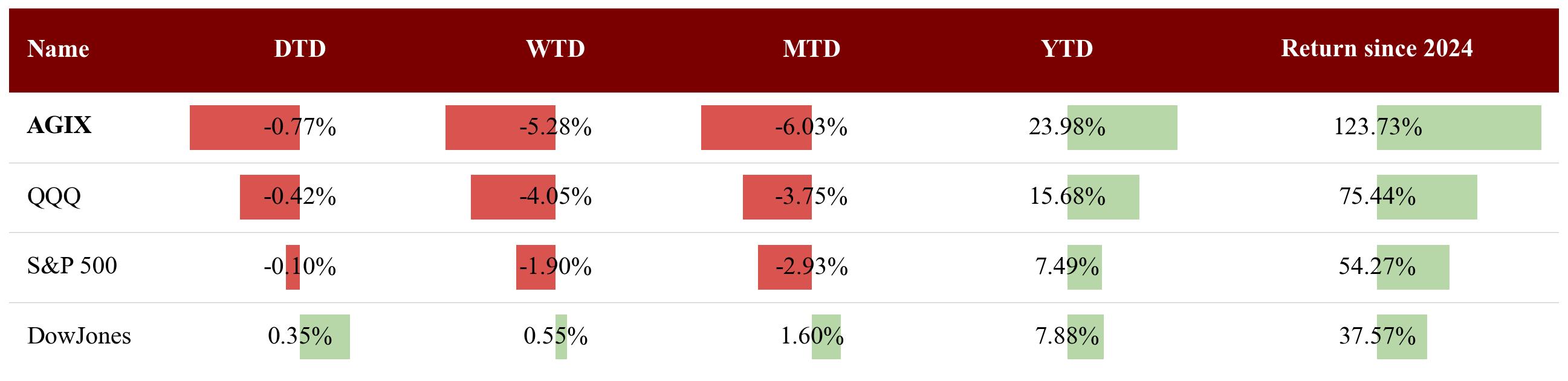
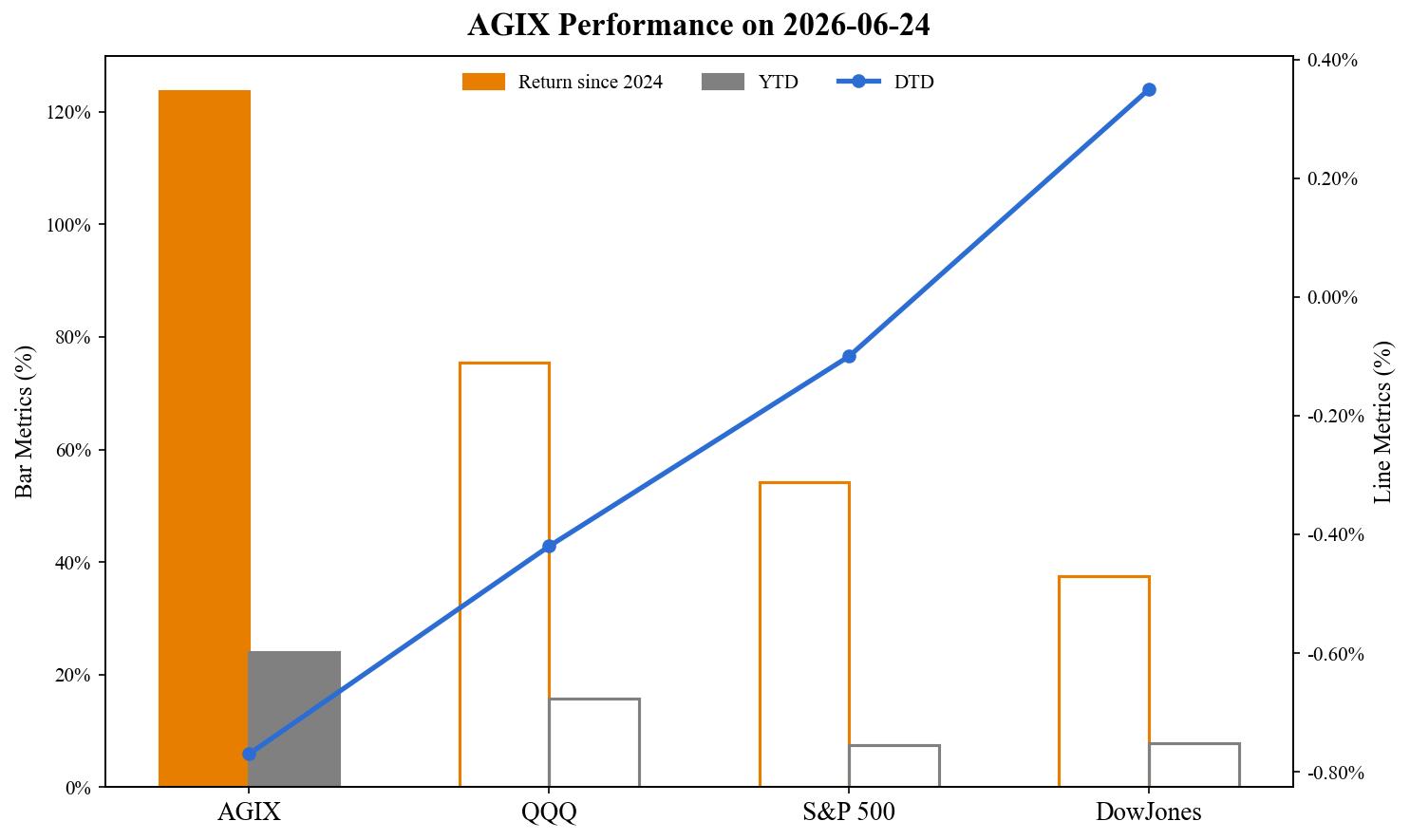
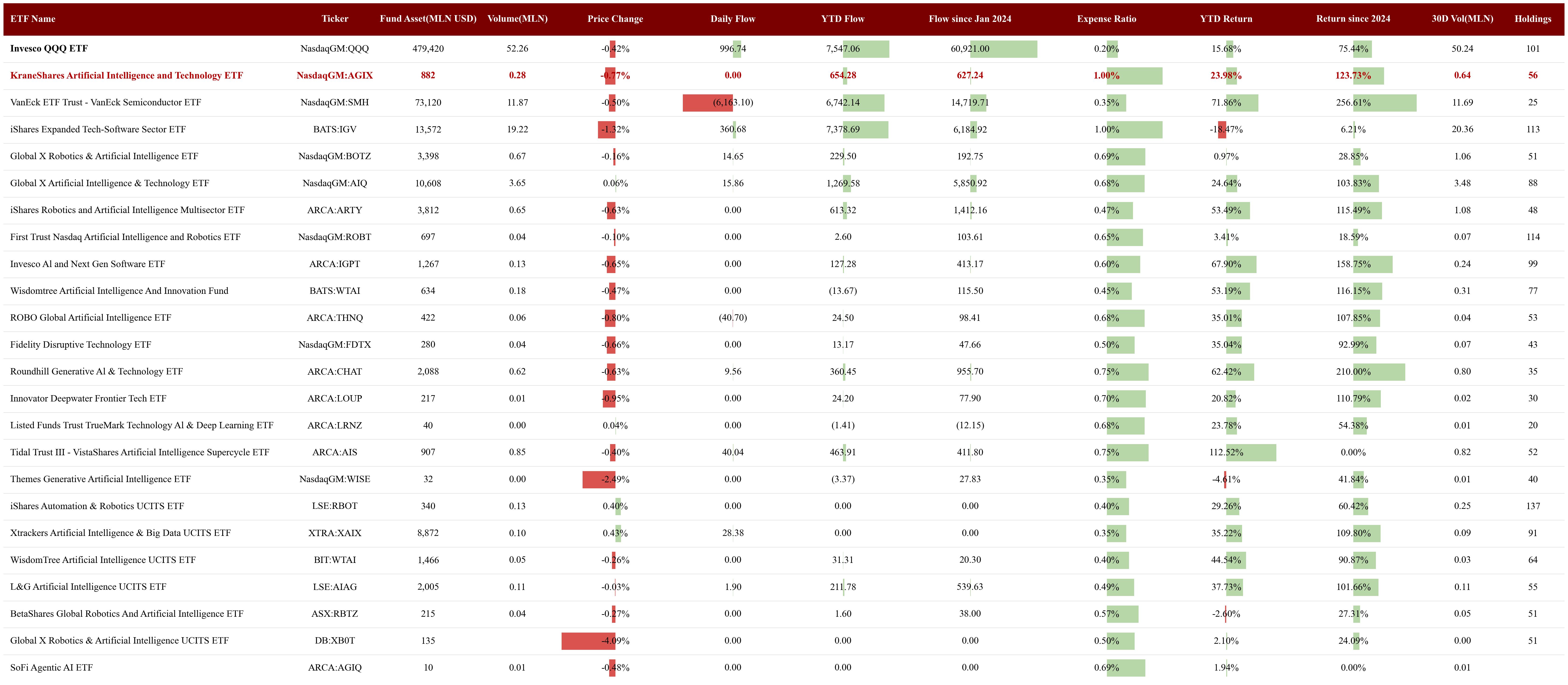
• AGIX fell 0.77% on the day, underperforming the S&P 500 (-0.1%) and QQQ (-0.42%), but still leads all benchmarks with a 123.73% return since 2024. Weakness was broad across AI-themed ETFs, with SMH (-0.5%), IGV (-1.32%), and CHAT (-0.63%) all declining.
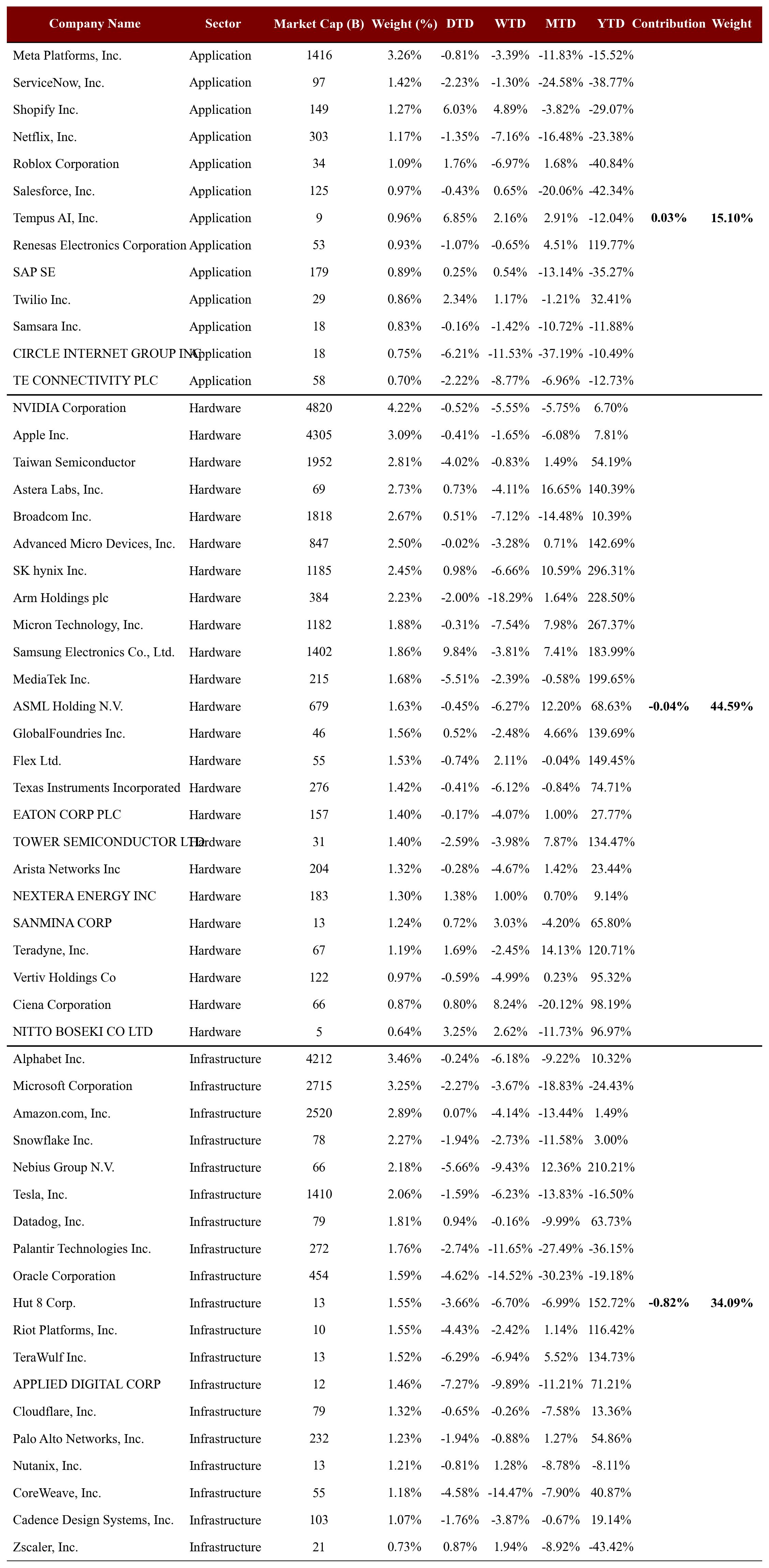
• Top AGIX holdings contributing positive DTD returns include Samsung Electronics (+9.84%, contributing +0.18%), Tempus AI (+6.85%, +0.07%), and Shopify (+6.03%, +0.08%), driven by a Samsung buyback speculation, Tempus' digital pathology consortium, and Shopify's post-earnings rebound.
• Negative contributors included Taiwan Semiconductor (-4.02%, -0.11%), Nebius Group (-5.66%, -0.12%), and CoreWeave (-4.58%, -0.05%), reflecting ongoing rotation out of high-beta AI infrastructure names after recent rallies.
• Key stocks to watch: Samsung (buyback catalyst), Tempus AI (AI-driven healthcare momentum), and Cerebras (post-earnings volatility after margin guidance miss).
News Highlights
1. OpenAI launched its first custom inference chip 'Jalapeño' in partnership with Broadcom, reducing reliance on Nvidia GPUs and potentially lowering inference costs, which could pressure Nvidia's pricing power but benefit Broadcom (an AGIX holding).
2. Cerebras reported strong Q1 revenue ($193M, +92% YoY) but guided gross margins down to 38-41% due to equipment leasing, sending shares down ~17% after hours—highlighting profitability challenges in competing with Nvidia.
3. Agility Robotics plans to go public via SPAC at a ~$3B valuation, with Digit humanoid robots deployed at Toyota and Amazon, signaling growing commercial traction in robotics—positive for AGIX's robotics exposure (e.g., Doosan Robotics).
4. Micron's Q3 revenue surged ~4x YoY to $41.5B, with gross margins reaching 84.9%, as AI memory demand drives a chip shortage expected to persist until 2027—supportive for AGIX's memory holdings (Samsung, SK Hynix, Micron).
RSS Highlights
1. A study found LLMs often focus more on text tone than role labels, leading to potential jailbreaks—suggesting embedding-layer role marking could improve security.
2. WorkOS introduced Auth.md, a spec for agent authentication that allows secure, revocation-based registration without forms, supporting standard OAuth—relevant for enterprise AI agent deployment.
3. WebKit in Safari 27 beta adds 58 new features including customizable <select> elements and 30 SVG fixes, improving developer experience for web-based AI interfaces.
4. A new open-source Git server 'objgit' stores objects in cloud buckets instead of local files, enabling stateless, cloud-native Git operations—potentially useful for AI/ML version control.
Performance & Benchmark
Attribution
Contribution of the three sectors within AGIX holdings today
Application: 0.03%
Hardware: -0.04%
Infrastructure: -0.82%
Top-performing stocks in AGIX holdings today
Samsung Electronics Co., Ltd. (9.84%)
Tempus AI, Inc. (6.85%)
Shopify Inc. (6.03%)
NITTO BOSEKI CO LTD (3.25%)
Twilio Inc. (2.34%)
Worst-performing stocks in AGIX holdings today
TE CONNECTIVITY PLC (-2.22%)
ServiceNow, Inc. (-2.23%)
Microsoft Corporation (-2.27%)
TOWER SEMICONDUCTOR LTD (-2.59%)
Palantir Technologies Inc. (-2.74%)
Hut 8 Corp. (-3.66%)
Taiwan Semiconductor Manufacturing Company Limited (-4.02%)
Riot Platforms, Inc. (-4.43%)
CoreWeave, Inc. (-4.58%)
Oracle Corporation (-4.62%)
MediaTek Inc. (-5.51%)
Nebius Group N.V. (-5.66%)
CIRCLE INTERNET GROUP INC (-6.21%)
TeraWulf Inc. (-6.29%)
APPLIED DIGITAL CORP (-7.27%)
Top five listed stocks contributing the most within AGIX holdings today
Nebius Group N.V. (-5.66%)
Taiwan Semiconductor Manufacturing Company Limited (-4.02%)
APPLIED DIGITAL CORP (-7.27%)
TeraWulf Inc. (-6.29%)
MediaTek Inc. (-5.51%)
Observation
The strongest movers across peer ETF holdings today are listed below:
| DTD | Stock Ticker | Name | Held by ETFs | analysis |
|---|---|---|---|---|
| 22.77 | NasdaqGM:DOMO | Domo, Inc. | ['LSE:RBOT'] | Domo’s 22.8% move appears driven primarily by a sharp rebound from recent post-earnings weakness rather than by any specific new company disclosure on June 24. The stock had sold off following its Q1 CY2026 miss and 10.5% drop, leaving shares near the bottom of the 52-week range and below key moving averages, which likely set up a short-covering/technical rally as sentiment stabilized and options-implied volatility remained elevated.[6][7][9] |
| 14.35 | NYSE:FOUR | Shift4 Payments, Inc. | ['ARCA:LOUP'] | Shift4 Payments’ 14.35% move appears primarily driven by a sharp rebound from depressed levels, as investors rotated back into beaten-down fintech and software infrastructure names after a prolonged sell-off. The stock had closed at $38.67 on June 23, 2026, near the bottom of its 52-week range and well below its 2025 highs, amplifying the magnitude of a relief rally when buyers stepped in. A secondary driver is improving sentiment around valuation and free cash flow durability, with recent analyses highlighting robust 2025 FCF growth, guidance for higher 2026 FCF, and substantial buybacks, which likely supported renewed interest in the name. |
| 14.26 | ASX:WTC | WiseTech Global Limited | ['NasdaqGM:FDTX'] | WiseTech Global’s 14.3% gain on 24 June 2026 appears primarily as a rebound following the prior session’s sharp sell-off driven by news of an AFP human exploitation taskforce investigation into Executive Chairman Richard White, which had pushed the stock down more than 50% year-to-date and 18% on the day. The absence of new negative disclosures on 24 June, combined with bargain-hunting after an extreme move and ongoing broker commentary that the stock may be oversold with substantial upside potential, likely supported the sharp one-day recovery. |
| 10.74 | NasdaqGS:NTRA | Natera, Inc. | ['ARCA:LRNZ'] | Natera’s 10.7% move on June 24 was primarily driven by the National Comprehensive Cancer Network adding ctDNA‑MRD testing with an FDA‑approved, tumor‑informed PCR‑NGS assay to its Bladder Cancer guidelines, effectively giving Natera’s Signatera test a Category 1, guideline‑level endorsement in muscle‑invasive bladder cancer and cementing it as a standard tool to guide adjuvant immunotherapy decisions.[1][2] This clinical and guideline “step‑change” followed recent FDA companion diagnostic approval for Signatera and was reinforced intraday by bullish Street commentary and price target increases (e.g., BTIG reiterating Buy with a $270 target), which together supported a re‑rating of the stock toward leadership status in MRD testing.[1][2][3] |
| 9.84 | KOSE:A005930 | Samsung Electronics Co., Ltd. | ['NasdaqGM:AGIX', 'NasdaqGM:AIQ', 'NasdaqGM:ROBT', 'BATS:WTAI', 'ARCA:CHAT', 'XTRA:XAIX', 'BIT:WTAI'] | Samsung Electronics’ 9.8% gain was primarily driven by confirmation it is considering a large share buyback, which sharpened expectations for major shareholder returns on top of an already strong AI-driven memory cycle.[3][6][8] In a regulatory filing, the company said it was contemplating a buyback to support stock-based employee compensation after local media reports of a potential 90 trillion won program, triggering a sharp re-rating and helping the stock reclaim the top spot in Korea by market cap.[3] A secondary supportive driver was ongoing bullish sentiment toward AI-related semiconductor names, with Samsung’s market value approaching the $1 trillion mark amid a broader chip rally.[2][5][9] |
| 9.82 | NYSE:DNA | Ginkgo Bioworks Holdings, Inc. | ['ARCA:THNQ', 'LSE:AIAG'] | Ginkgo Bioworks’ 9.8% gain on June 24, 2026 appears driven primarily by technical and sentiment factors rather than discrete company-specific news. The stock extended its recent rebound, trading near the top of its intraday range with a “Strong Buy” technical signal on common indicators, which likely attracted momentum and retail traders.[3][4] In the absence of fresh fundamental catalysts or new disclosures beyond previously known strategic shifts toward autonomous labs and earlier Q1 results, the move looks like continuation of a short-term recovery in a high-beta, retail-sensitive name.[2][5][7] |
| 7.29 | NasdaqGS:BKNG | Booking Holdings Inc. | ['NasdaqGM:QQQ', 'LSE:AIAG'] | Booking Holdings’ 7.3% gain was driven primarily by a sector-wide rally in travel and leisure stocks, as lower crude oil prices improved sentiment toward tourism and online travel platforms and boosted BKNG more than the broader cyclical consumer services group.[1] A secondary driver was company-specific optimism around Priceline’s upgraded AI travel assistant, which integrated Anthropic’s Claude models and highlighted management’s push to enhance booking efficiency and user experience.[1] Finally, the move was amplified by valuation and flow dynamics, with the stock rebounding from a sharp year-to-date drawdown and signs of institutional accumulation at what were seen as historically attractive levels.[1][2] |
| 7.14 | NYSE:VYX | NCR Voyix Corporation | ['BATS:IGV'] | NCR Voyix’s 7.1% gain on June 24, 2026 appears to be primarily a sentiment and positioning move rather than a reaction to new company-specific news. There were no material NCR Voyix disclosures, rating actions, or sector-wide regulatory developments on the day, and the most recent catalysts (Q1 2026 earnings on May 7 and the June 8 RBC conference appearance) were already known and digested by the market. In this context, the move is best attributed to follow-through buying in a thin-news environment, likely driven by investors’ ongoing reassessment of the post-spin standalone story and leverage/rating trajectory highlighted in prior communications. |
| 6.98 | KOSE:A454910 | Doosan Robotics Inc. | ['NasdaqGM:BOTZ', 'LSE:RBOT', 'ASX:RBTZ', 'DB:XB0T'] | Doosan Robotics’ 6.98% gain on June 24 appears driven primarily by momentum buying in a volatile, high-beta robotics name rather than by any specific company news or disclosure. The move occurred on an absence of material same-day headlines or filings, against a backdrop of speculative interest in robotics/AI plays and the stock trading well off its 52-week high, which likely encouraged dip-buying and short-term trading activity. |
| 6.88 | NasdaqGS:AGYS | Agilysys, Inc. | ['BATS:IGV'] | Agilysys’ 6.9% move on June 24, 2026 appears driven primarily by a bullish sell-side narrative highlighting substantial upside to the current share price, which gained visibility via a Zacks.com piece indicating Wall Street analysts see roughly 45% upside in AGYS.[4] This positive coverage reinforced an already constructive fundamental backdrop following record recent quarters and strong subscription growth, supporting a rerating toward higher growth expectations.[3] A secondary driver is general investor interest in higher-growth, niche software names, with AGYS benefiting from relative strength versus broader tech volatility as investors seek defensible, recurring-revenue stories.[5] |
| 6.85 | NasdaqGS:TEM | Tempus AI, Inc. | ['NasdaqGM:AGIX', 'NasdaqGM:ROBT', 'ARCA:THNQ', 'BIT:WTAI', 'LSE:AIAG'] | Tempus AI’s 6.85% move on June 24 was primarily driven by follow-through buying after a major positive company announcement the prior day, which sparked strong momentum interest in the name.[5][8] The key catalyst was Tempus AI’s launch of a first-of-its-kind digital pathology open-source consortium, highlighted in Thursday trading commentary as the driver of the surge in demand for the stock.[5] A supportive backdrop of predominantly Buy-rated analyst coverage and double-digit upside to consensus target price likely reinforced investor appetite on the day.[4] |
| 6.45 | NasdaqGS:VRNS | Varonis Systems, Inc. | ['BATS:IGV', 'BATS:WTAI', 'ARCA:THNQ', 'LSE:AIAG'] | Varonis Systems’ 6.45% gain appears primarily driven by ongoing enthusiasm around recent reports that the company is exploring a potential sale following takeover interest from major private equity firms, which has re-rated the stock higher and supported follow‑through buying. The move was further underpinned by a supportive brokerage backdrop, with Wedbush reiterating its rating and $37 price target on June 24, reinforcing confidence in the risk/reward at current levels. |
| 6.34 | SHSE:688041 | Hygon Information Technology Co., Ltd. | ['ARCA:IGPT', 'ARCA:AIS'] | Hygon Information Technology’s 6.34% gain on June 24 appears primarily driven by continued momentum in China’s high‑end processor and server hardware theme, with the stock extending a strong 12‑month run of over 100% and high recent volatility that amplifies moves.[2][1] No company‑specific disclosures or major news items were reported that day, so the move is best attributed to sector sentiment and technical factors such as high volatility (53.7%) and strong 12‑month momentum, rather than idiosyncratic catalysts.[1][2] |
| 6.16 | NasdaqGS:ILMN | Illumina, Inc. | ['NasdaqGM:ROBT', 'ARCA:THNQ', 'BIT:WTAI', 'LSE:AIAG'] | Illumina’s 6.2% move on June 24 was primarily driven by positive sell-side research action, with Barclays raising its price target to $145 from $122, reinforcing the recent fundamental improvement story and supporting continued multiple expansion. Secondarily, the stock is trading near the top of its 52‑week range and above its 200‑day moving average, so the target hike likely triggered momentum and growth‑investor buying in a name already in a strong uptrend. |
| 6.16 | NYSE:TOST | Toast, Inc. | ['NasdaqGM:FDTX'] | Toast’s 6.2% gain was primarily driven by the announcement that Toast will be added to the S&P MidCap 400 index, prompting index-related and momentum buying. S&P Dow Jones Indices said Toast will join the MidCap 400 effective before the open on July 1, and intraday commentary explicitly linked the stock’s ~6–7% move to this index addition. Secondary support comes from generally positive sentiment following solid recent results and an upward 2026 outlook, which provide fundamental backing to the index-driven demand. |
| 6.06 | NYSE:GLW | Corning Incorporated | ['ARCA:AIS'] | Corning’s 6.06% gain on June 24 was primarily driven by news of a new multibillion-dollar Amazon data center agreement that positions GLW as a key supplier of optical fiber, cable, and connectivity hardware for U.S. cloud and AI infrastructure buildouts.[2][5] This deal reinforced the market’s view of Corning as a core AI infrastructure beneficiary, prompting investors to reprice the long-term growth outlook for its Optical Communications segment.[2][4] A supportive backdrop of robust GenAI-related optical demand and prior hyperscaler partnerships further underpinned the move as the stock broke higher on strong volume.[2][4][7] |
| 6.03 | NasdaqGS:SHOP | Shopify Inc. | ['NasdaqGM:QQQ', 'NasdaqGM:AGIX', 'NasdaqGM:AIQ', 'ARCA:THNQ', 'NasdaqGM:FDTX', 'LSE:AIAG'] | Shopify’s approximately 6% gain on June 24, 2026 appears driven primarily by a continued rebound from its sharp post-earnings selloff earlier in 2026, as investors re-rate the stock against strong fundamentals (34% YoY revenue growth, robust free cash flow, and sustained >30% GMV growth) and a still-bullish analyst consensus with substantial upside to target prices.[6] A secondary driver is sentiment support from the recently expanded $5B share repurchase authorization announced in early June, which has provided an incremental bid for the shares as buybacks ramp through June.[6] |
| 6.0 | NYSE:UBER | Uber Technologies, Inc. | ['NasdaqGM:AIQ', 'NasdaqGM:FDTX', 'ARCA:LOUP'] | Uber’s roughly 6% gain on June 24, 2026 was primarily driven by company-specific news that it is expanding the Uber Eats marketplace with new retail partners, which supports the growth and diversification narrative around its high-margin delivery and advertising businesses.[9] A secondary boost came from positive sentiment tied to reported options buying in Uber by Nancy Pelosi, which drew additional retail and momentum interest into the stock.[9] |
| 5.98 | NasdaqGS:ALKT | Alkami Technology, Inc. | ['BATS:IGV'] | Alkami Technology’s +5.98% move on June 24, 2026 was primarily driven by a positive company-specific catalyst: a same-day press release highlighting successful digital banking innovation and commercial growth at Landmark Credit Union through its Alkami partnership, which underscores real-world value creation and traction with financial institutions.[5][9] A secondary support likely came from the stock’s depressed starting point after recent underperformance and 52-week lows, making it more sensitive to favorable news amid generally constructive analyst views and upside to target prices.[1][2][3][4] |
| 5.84 | NasdaqGS:GLBE | Global-E Online Ltd. | ['NasdaqGM:FDTX', 'ARCA:LOUP'] | Global-E Online’s 5.84% rise on 2026-06-24 was most likely driven by a positive sentiment shift after the company raised its full-year 2026 earnings guidance and reported accelerated earnings growth in Q1, which reinforced the growth story.[1] The move also fits with an already constructive analyst backdrop, with consensus still at Moderate Buy and price targets implying meaningful upside.[2] No major same-day company-specific negative catalyst appears in the provided results, so the gain looks primarily fundamentals- and guidance-led rather than event-driven by new bad news. |
| 5.59 | NasdaqGM:GPCR | Structure Therapeutics Inc. | ['ARCA:LRNZ'] | Structure Therapeutics’ 5.6% gain on June 24, 2026 appears primarily driven by ongoing positive sentiment around its obesity-focused GLP‑1 pipeline and strong buy-side analyst conviction rather than a specific new company disclosure that day.[1][4] The stock is in a high‑momentum phase, trading well above its 52‑week low with a “Strong Buy” consensus from covering analysts, which likely amplified incremental demand and supported the move.[4][6] |
| 5.52 | NasdaqGM:VCYT | Veracyte, Inc. | ['ARCA:THNQ', 'LSE:AIAG'] | Veracyte’s 5.52% rise on 2026-06-24 was most likely driven by continued investor enthusiasm around recent positive company-specific catalysts, including the U.S. commercial launch of Prosigna, Medicare coverage for TrueMRD, and upbeat clinical/data updates that prompted bullish analyst actions. The stock was also trading near a 52-week high, which likely reinforced momentum buying and technical follow-through. |
| 5.47 | NasdaqGS:AXON | Axon Enterprise, Inc. | ['NasdaqGM:QQQ', 'ARCA:LOUP'] | Axon’s 5.47% gain on June 24, 2026 appears primarily driven by ongoing follow-through to earlier positive fundamentals—specifically record bookings, accelerating recurring revenue, and raised multi-year guidance that led to a broader repricing of the stock in recent sessions. Recent commentary has highlighted strong growth in newer businesses such as counter‑drone (Dedrone), with bookings reportedly up 300% year over year in Q1 2026, reinforcing the growth narrative and supporting incremental buying interest. Broader sentiment remains favorable, with a Buy consensus from 15 analysts as of June 24, 2026, which likely helped underpin dip-buying and momentum after the prior day’s move. |
| 5.37 | NasdaqGS:WIX | Wix.com Ltd. | ['NasdaqGM:AIQ'] | Wix’s 5.37% gain on 2026-06-24 was most likely driven by post-earnings sentiment and investor attention after the company’s strong Q1 2026 report and upbeat 2026 commentary, which continued to support the stock as a “buy”/oversold rebound idea. A same-day Zacks note said WIX was “attracting investor attention,” suggesting renewed trading interest on June 24. Longer-term support also came from earlier coverage of Wix’s margin-improvement efforts, including job cuts and AI-cost management, which likely helped reinforce the bullish setup.[3][5][1] |
| 5.2 | NasdaqGM:RPD | Rapid7, Inc. | ['BATS:IGV', 'ARCA:THNQ', 'XTRA:XAIX', 'LSE:AIAG'] | Rapid7’s 5.2% gain on June 24, 2026 appears primarily driven by a broad rebound in beaten‑down software and cybersecurity names rather than any company-specific news or disclosures. Sector commentary highlighted Rapid7 among stocks “trading up” alongside peers as investors selectively rotated back into oversold application/software and security names, after a period of significant underperformance for the group.[5][2] A secondary driver was incremental sentiment support from stable-to-improving analyst expectations and a Hold-rated consensus with upside to target prices, which can attract short-covering and tactical buying when the stock is near multi-year lows.[2][6][9] |
News
Funding & M&A
Shares of AI chipmaker Cerebras sink following first earnings report since going public
Chipmaker Cerebras Systems Inc. reported its first quarterly results since going public, with revenue exceeding expectations but a wider-than-expected loss per share, causing shares to fall 10% after hours. The company posted first-quarter revenue of $193 million, up 92% year-over-year, and narrowed its net loss to $14 million. However, gross margin guidance fell to 36%-38%, highlighting challenges in surpassing Nvidia in the AI chip space. Cerebras raised $85 per share in its IPO last month, opened at $350, and currently trades around $202. CEO Andrew Feldman said AI has entered the practical stage, and its intelligent chip technology delivers the fastest AI performance. The company will deploy chips in AWS data centers and signed a $20 billion computing contract with OpenAI, though the deal incurs large non-cash sales expenses. Full-year revenue is expected to grow 69%.
Orderful nabs $35M to streamline supply chain data management
Orderful Inc. recently announced the completion of a $35 million Series C funding round, led by Koch Disruptive Technologies with participation from NewRoad Capital, bringing the company's total external funding to $85 million. The startup's AI platform, Mosaic, aims to solve the lengthy integration issues caused by inconsistent EDI (Electronic Data Interchange) file formats in retail supply chains, reducing new supplier onboarding time from weeks to hours or days. Mosaic can automatically identify retailer format changes and adjust files, eliminating the need for custom integrations while reducing penalty risks. Orderful also offers Pixel and label generation tools and has facilitated over 6 billion EDI transactions. The company plans to use the new funds for feature development, focusing on enhancing supply chain monitoring and administrative task automation, continuing to overhaul the EDI infrastructure that has been neglected for over 40 years.
Kinoa pushes AI-native mobile app revenue operations after raising $10M in funding
Kinoa Labs Ltd. has announced a $10 million funding round led by Transcend Fund, with participation from Sisu Game Ventures. The funds will be used to strengthen its AI-native mobile application operations platform, helping game and consumer app developers improve user retention and monetization. In a market where user acquisition costs have risen by 40%, Kinoa uses real-time predictive models to identify high-value users and churn risks, and automatically executes personalized push notifications, dynamic offers, and feature adjustments, delivering an average 25% revenue increase for clients. Playstudios' Tetris Block Party has validated its effectiveness, with a 46% increase in paid conversion and 31% revenue growth. The company emphasizes that the technology is not only applicable to games but can also extend to streaming, education, and productivity apps. The next phase will continue to upgrade predictive models, advancing the transition from manual LiveOps to intelligent infrastructure.
Modulate launches AI music detection as synthetic tracks flood streaming
Audio AI company Modulate Inc. recently launched a new tool called AI Music Detection, an API that can identify AI-generated songs and instrumental parts directly from audio. This product provides streaming services, publishers, and copyright holders with a way to detect synthetic music, addressing the difficulty existing distribution systems have in distinguishing between artificial and real works. Modulate uses three models working together to detect music, vocals, and instruments respectively, achieving 95% accuracy in internal tests against generators like Suno. This move comes as Suno just secured $400 million in funding at a $5.4 billion valuation, reflecting the influx of capital into the AI music generation field. Modulate is transferring its technical experience from game voice moderation to music detection, already attracting interest from major music companies and distribution platforms.
Beyond the $7.8B in deals: Why Wall Street is suddenly watching Argentum AI
According to professional capital market reports, Argentum AI has signed a $900 million contract to deploy an AI data center project containing 47,000 Nvidia GB300 GPUs. The company, led by Andrew Sobko and backed by Supermicro, operates in a model opposite to traditional AI startups: it first secures long-term customer commitments, then raises capital markets financing and deploys infrastructure. Industry sources say the total contract value may exceed $1 billion, attracting attention from Wall Street infrastructure investors. This algorithm treats AI computing resources as a tradable asset class, similar to power generation projects that rely on long-term power purchase agreements for financing. If the model succeeds, it will fundamentally change the capital structure of AI infrastructure, shifting it from venture capital to infrastructure investment.
Coval raises $28M as enterprises push voice agents into production
Voice AI testing startup Coval Inc. has announced a new $28 million funding round, bringing its total funding to $31 million. Founded in 2024, the company provides enterprises with a platform for simulated testing, real-time monitoring, and data annotation of voice and chatbots, helping users reduce manual quality assurance work by up to 30 times and accelerate deployment by 10 times before and after launch. The round was led by Norwest, with participation from Base10 Partners, Twilio Ventures, and Y Combinator. Coval has over 60 customers, including Zoom and Deepgram. Founder Brooke Hopkins previously led evaluation infrastructure at Waymo. As investment in voice AI continues to grow, the platform will support more enterprises in moving voice agents from experimentation to reliable production environments.
Valor Equity Partners aims to raise a $2.5 billion Fund VII, according to Bloomberg.
U.S. private investment firm Valor Equity Partners is advancing the fundraising plan for its seventh fund (Fund VII), targeting a size of $2.5 billion. According to Bloomberg, the fund will provide further investment support for projects such as SpaceX. Valor is a significant shareholder in SpaceX, holding approximately 4% of its shares, and its founder Antonio Gracias maintains a long-term partnership with Elon Musk. Additionally, the firm has invested in military technology company Anduril and social media platform Reddit. Compared to the $2.5 billion Fund VI closed in 2024, the new fund will continue to strengthen operational support capabilities for growth-stage companies.
Agility Robotics plans to go public via SPAC in a $2.5B deal
Humanoid robot startup Agility Robotics announced it will go public through a merger with SPAC Churchill Capital Corp XI, with a valuation of approximately $3 billion. The deal is expected to generate over $620 million in proceeds, including $200 million from new and existing institutional investors. The company's core product, Digit, has been deployed at multiple clients including Schaeffler, GXO, and Toyota, and has received support from institutions like Amazon and Nvidia. The new funds will be used to ramp up production of Digit v5, fulfill existing orders, and expand the client base. The company has already secured multi-year orders worth $300 million and has over 30 potential large-scale deployment clients. The combined company's stock will trade under the ticker AGLT.
AI researchers continue to leave Google for its rivals
Two top AI researchers, Jonas Adler and Alexander Pritzel, are leaving Google to join Anthropic; they were core developers of the Gemini model. Meanwhile, Noam Shazeer, known for his work in AI, has also moved from Google to OpenAI. Google previously completed a $270 million acquisition of Character.AI to bring Shazeer back to the team. DeepMind director John Jumper has chosen to join Anthropic; he and Demis Hassabis jointly won the 2024 Nobel Prize in Chemistry. As OpenAI and Anthropic prepare for IPOs, equity incentives are becoming a key tool for attracting top AI talent. This talent flow will continue to impact Google's competitiveness in the AI field.
Cerebras stock plunges after earnings as CEO says margin outlook was misunderstood
AI chip maker Cerebras Systems saw its stock fall nearly 17% after reporting its first post-IPO earnings. Although first-quarter revenue reached $193 million, up 194% year-over-year, and net loss narrowed from $23.9 million to $14 million, the full-year gross margin guidance of 38% to 41%, below the first quarter's 47%, raised investor concerns. CEO Andrew Feldman explained that the company needs to temporarily lease equipment back to major customers for early capacity expansion, which will lower margins. The stock price once approached the IPO price, reflecting market doubts about its long-term profitability.
Former Infosys chief has a new startup that wants to challenge the IT services world
Hang Ten Systems, an AI services startup founded by former Infosys CEO Vishal Sikka, announced it has raised $32 million in seed funding, led by Mayfield with participation from Aramco Ventures and others. The company focuses on using AI-driven software to build, modify, and operate services, aiming to transform the traditional IT services industry's linear growth model reliant on human labor. Existing customers include Siemens Gamesa and Fresenius. This funding round reflects investor interest in whether AI services can reshape enterprise software delivery. Traditional service providers like Infosys are also exploring AI partnerships, and there is debate within the industry over whether AI will shrink or expand the market.
Grammarly's parent company Superhuman acquires AI detector GPTZero
Superhuman, formerly known as Grammarly, has signed an agreement to acquire AI writing detection company GPTZero. The acquisition price was not disclosed. The deal will integrate GPTZero's detection technology into the Superhuman Go platform to build a "truth layer" feature that identifies AI-generated content, fake citations, and algorithmic statistics, and provides keyboard history tracing. GPTZero has 19 million registered users and $30 million in annual revenue, and its founder and 30 employees will join Superhuman. This move comes as AI writing accounts for 50% of content and detection tools expand into recruitment, publishing, and compliance. Superhuman's own detector ranks first on the RAID benchmark, and the fusion of two detectors can reduce false positives. GPTZero previously raised $13.5 million in a Series A round in May, with a PitchBook valuation exceeding $88 million.
Elon suffers another day short of trillionaire status
SpaceX is scheduled to go public this month, and its founder, Alan Mark, immediately became the world's first trillionaire. However, stock price fluctuations have brought his assets back down to the tens of billions. The article describes this phenomenon in a sarcastic tone and mentions Mark's public statements about sending humans to the moon, Mars, and beyond. Although the article mentions his multiple children and high-profile procreation advocacy, the core discussion revolves around wealth fluctuations driven by capital market changes. This event also reflects the high market capitalization volatility after tech IPOs and the extreme uncertainty of wealthy individuals' assets.
Technical Breakthroughs
AI agents are transforming work — and Dell’s John Roese says it’s only the beginning.
Dell Technologies' global Chief Technology Officer and Chief AI Officer John Roese recently stated in an interview that the company has been running fully autonomous AI agents for nearly two years and is deeply studying the long-term impact of autonomous AI agents on work structures. Roese pointed out that his main focus over the past six months has been on 'tokenomics' and the impact of AI agents on corporate job composition. He emphasized that enterprises need to establish a unified job classification language to clearly define which parts of work can be handled by agents and which parts need to remain human. As agents are deployed, job roles will be redefined, and companies must undergo large-scale organizational design adjustments; otherwise, many positions will see their workload reduced to only 30%. Additionally, the use of advanced models has turned API calls into a usage-based cost, and CFOs are beginning to focus on hybrid AI to control capital expenditures. Dell's practices provide forward-looking reference for global enterprises.
Nvidia bets on agentic AI to turbocharge biotech discovery
At the Bio International Convention held in San Diego, Nvidia announced the launch of the BioNeMo Agent Toolkit. This toolkit can transform general large language models into specialized AI agents, enabling end-to-end biological workflows from literature retrieval to protein design and experimental automation. Kimberly Powell, Vice President of Life Sciences at Nvidia, pointed out that agentic AI will become a new generation of scientific instruments, like microscopes, X-ray crystallography, and gene sequencing, capable of reasoning, planning, and executing multi-step tasks. The toolkit is compatible with various models including OpenAI, Anthropic, and Nvidia Nemotron, and adapts to existing platforms such as MONAI and Parabricks. By optimizing token usage and GPU efficiency, BioNeMo can reduce computational costs while improving task completion rates and accuracy. Industry experts believe this marks a transition in life sciences from single models to multi-agent collaborative networks, reshaping the operational model of drug discovery.
Snyk launches Evo Agentic Development Security to police AI coding agents
Cybersecurity company Snyk recently launched Evo Agentic Development Security (Evo ADS), a new layer for its AI security platform that monitors autonomous coding agents. The new solution enforces controls within agent workflows, including reviewing MCP servers, skills, and external tools, monitoring agent behavior in real time, and performing real-time scanning and remediation of AI-generated code. Based on data from nearly 9,700 development environments, Snyk found that nearly 43% of developers run multiple AI coding environments simultaneously, over half have installed MCP servers, and some environments have more than 80. The company also provided real attack examples, including risks like poisoned security scanners and prompt injection. Evo ADS will join Evo AI-SPM and Evo Continuous Offensive Security as part of the Snyk AI Security Platform. The product will officially launch on June 29.
OpenAI and Broadcom introduce a custom Jalapeño chip for AI inference
OpenAI recently released its self-developed inference-dedicated chip, Jalapeño. The chip, developed in collaboration with Broadcom, is primarily designed for AI model inference scenarios and offers higher performance than comparable Nvidia chips. It uses a special architecture to reduce data movement, improving performance while lowering power consumption. OpenAI will also pair it with Broadcom Tomahawk networking chips and Celestia server designs, with plans to deploy the first clusters by the end of the year. This technological breakthrough is expected to open a new hardware revenue stream for OpenAI and enhance its investment appeal ahead of its upcoming IPO. Compared to competitors like Anthropic, OpenAI will gain a significant differentiation advantage in the AI hardware space.
OpenAI unveils its first custom chip, built by Broadcom.
OpenAI officially launched its first self-designed reasoning processor, Jalapeño, manufactured in collaboration with Broadcom. The new chip is optimized for the specific needs of OpenAI's reasoning systems, offering significantly better performance per watt than existing solutions. This move aims to reduce reliance on Nvidia GPUs, similar to the strategies of Google and Amazon in developing their own AI accelerators. OpenAI stated that it will continue to rely on Nvidia for training, while Jalapeño is specifically designed to reduce costs and improve efficiency for inference scenarios. The company emphasizes full-stack optimization across chips, kernels, and scheduling to enhance model performance and affordability, driving the economics of AI.
AI was supposed to kill engineering jobs, but new data suggests they’re the most resilient
According to TechCrunch, SignalFire's latest 'State of Talent' report shows that despite widespread beliefs that AI will lead to massive layoffs, engineer hiring in the tech industry in 2025 has shown resilience. Among 12 companies classified as 'Big Tech,' engineers accounted for 55% of new hires, up from 46% in 2019. Early-stage startup engineer hiring increased by 7% compared to 2019. The report notes that while executives at companies like Nvidia and Anthropic remain cautious about AI's replacement effects, actual data shows that after engineers' productivity improves, workloads continue to increase. This phenomenon is seen as a modern version of the 'Jevons paradox,' where efficiency gains not only fail to reduce demand for labor but actually drive further expansion.
Product Launches
Figma adds code layers, support for animations, more AI features in new update
Figma recently made major updates to its design platform, adding code layers, animation support, and shader features, along with an AI custom plugin creation tool. Users can directly import code libraries onto the multiplayer collaborative canvas and extract flows for testing, significantly reducing iteration costs among designers, product managers, and developers. The new features also support creating animation transitions and 3D transformations directly within Figma, eliminating the need for additional conversion software. Additionally, the company is deepening integration with Weavy, a node tool it acquired last year, allowing users to generate Weavy flows directly in Figma. The AI assistant now supports creating reusable skills via prompts and can connect to external tools like Notion and GitHub for more context. This update further drives the convergence of design and development workflows, potentially transforming multi-role collaboration.
Facebook rolls out an AI companion app for creators
Meta announced on Wednesday that it is revamping Creator Studio into a standalone AI companion app to help creators grow their audiences on Facebook. The AI assistant provides personalized suggestions based on content style, performance data, and goals, supporting quick answers to questions like 'when to post' and 'comment trends', and offers an AI comment tool to auto-generate replies. This move is part of Meta's latest wave of AI application deployments, aiming to compete for creator resources and reduce reliance on third-party tools like ChatGPT. Previously, Meta launched the standalone Groups app Forum and the ephemeral photo app Instants, and is developing an internal project called Arena similar to Polymarket. CEO Mark Zuckerberg believes that AI efficiency gains will lead the company to launch more apps.
Policy & Regulation
Companies are rushing to prevent employees from exhausting AI budgets on minor tasks
A reversal has recently occurred in the AI industry. Companies that initially increased token usage heavily for efficiency are now implementing token rationing due to high costs. Leaked internal meeting notes from consulting firm Accenture show that the company has warned employees not to use AI for simple tasks to prevent token expenses from being depleted too quickly. Previously, Accenture had aggressively pushed AI adoption, even linking it to promotions. Now, CFOs, COOs, and other executives are questioning whether AI investments can generate visible returns. This shift has led to a significant pullback in AI-related stocks, severely impacting suppliers like memory chip makers. The industry is moving from a "token maximization" phase to a "token rationing" phase, and AI must prove its commercial value to continue receiving capital support.
Industry Partnerships
Anthropic introduces Claude Tag, a more capable AI teammate that operates within Slack.
AI company Anthropic officially released a new Claude Tag feature, which embeds the Claude chatbot into the Slack platform, allowing it to work like a virtual employee across the entire organization. Claude Tag has continuous context and memory capabilities, can independently break down tasks and provide updates in Slack, and supports handoffs and collaboration across multiple projects. This move is an important step for Anthropic to advance into the enterprise market, aiming to increase enterprise adoption before its expected IPO later this year. According to Ramp data, Anthropic has surpassed OpenAI to become the top choice for enterprise AI subscriptions in the United States. Meanwhile, companies such as Microsoft, Glean, Databricks, and Snowflake are also promoting similar enterprise-level AI intelligence layers. The launch of Claude Tag adds new competitive momentum to the enterprise AI market.
Commvault deepens Microsoft tie-up with native Azure resilience service
Data protection company Commvault Systems has signed a multi-year agreement with Microsoft to offer its data security and cyber recovery technology as a native service on the Azure platform. This partnership allows Azure users to discover, deploy, and access Commvault's recovery tools directly within the platform without additional infrastructure or manual integration. The two companies have collaborated for over 25 years, and the new agreement will deepen their joint efforts in cloud computing and artificial intelligence. Users can purchase services through the Microsoft Marketplace, and it counts toward Azure Consumption Commitment. Commvault is also collaborating with Kyndryl, Deloitte, and Delinea among others to promote intelligent protection solutions under the 'agent enterprise' framework. The native service is expected to enter public beta this summer.
Three insights you may have missed from theCUBE’s coverage of Pure Accelerate
In the enterprise AI process, data momentum is becoming the biggest constraint rather than model accuracy. At Pure Accelerate 2026, analysts pointed out that enterprises must shift to a data-led model, turning data into AI-usable assets through governance, ecosystem collaboration, and infrastructure. Everpure launched the Enterprise Data Cloud Success Blueprint framework to help enterprises assess data maturity and restructure their environments. Partners including Nvidia and World Wide Technology emphasized that data preparation and governance are critical to the success or failure of AI projects. Portworx supports CSX in running both VM and container workloads on the Kubernetes platform, verifying that a unified platform can be used for critical infrastructure. Crusoe emphasized that energy supply is a core element of AI infrastructure expansion. Data layer protection is also shifting from passive to active defense. The overall conference emphasized that ecosystem collaboration is the only way to convert data into measurable AI outcomes.
HelloTwin launches ‘Digital Authority’ to bring governed AI agents to the enterprise
HelloTwin.ai GmbH has launched an accountable AI digital twin product that builds a single source of truth to integrate business intelligence and goals. The system is based on a patented compiler that extracts deterministic answers from business context rather than generating content, termed 'digital authority', ensuring auditability and support for critical decisions. The product is divided into two layers: the semantic digital twin and the digital authority. The former establishes a governed business model, while the latter assigns specific roles and goals to the AI, directing the agent layer and eliminating hallucinations. Twin can cover functions such as finance, marketing, sales, product, and engineering, with multiple Twins collaborating across boundaries for governance. HelloTwin compresses a five-layer intelligent system into a commercial product that requires no data expert preparation, at a time when the industry is racing to build semantic intelligence layers. Meanwhile, Onix Networking's Wingspan and Snowflake are both building similar capabilities, reflecting a consensus that AI agents need governed context to act reliably.
3 days left to save up to $190 on your TechCrunch Founder Summit 2026 pass
TechCrunch will host a StrictlyVC event in a new market on April 30, 2026, and early bird pricing for the Founder Summit in May will end. The Founder Summit in Boston on November 4 will gather over 1,000 founders and investors, focusing on practical topics such as fundraising, revenue growth, and talent recruitment. Speakers from institutions including Tesla, Sequoia Capital, and Index Ventures will share their experiences, offering a day of tactical learning and networking opportunities. Early bird tickets save $190 before they expire, and group purchases of 4 can get up to 30% off. The conference also offers booth opportunities and a topic submission channel to help startups accelerate growth and connect with capital.
融资收购
Upbound open-sources Modelplane to optimize inference clusters.
U.S. company Upbound Inc. recently released an open-source tool called Modelplane, specifically designed for managing AI inference clusters. The company is backed by $69 million in investments from Alphabet's GV fund, Intel Capital, and others, and is well-known for its open-source infrastructure management engine Crossplane. Modelplane is an upgraded version of Crossplane, optimized for AI inference workloads, supporting centralized resource allocation across multi-cloud environments, automatic capacity scaling, and distributed caching, which effectively reduces weight loading latency and enhances fault recovery. The tool also includes a gateway component to ensure prompts meet security and cost requirements. Upbound founder Bassam Tabbara stated that the new tool will standardize the construction model for large-scale inference platforms and is released as open source under the Apache 2.0 license. This move helps promote standardization and community sharing of AI infrastructure management.
India’s MoEngage bets that the future of marketing is millions of AI agents
Indian customer engagement software company MoEngage has acquired U.S. startup Aampe for tens of millions of dollars in cash. Aampe specializes in using dedicated AI agents to personalize messages for each user and has over 30 clients. MoEngage aims to strengthen its competitiveness against rivals like Salesforce and Adobe through this acquisition, and has already won multiple multi-million-dollar annual contracts from those two platforms. Aampe's clients include brands such as Swiggy, Grab, and Taxfix. After the acquisition, approximately 30 Aampe employees will join MoEngage. MoEngage recently completed a $280 million funding round. The deal reflects the trend of enterprise software companies deeply embedding AI agents into business applications.
The memory chip shortage is proving profitable for this US company
The memory chip shortage driven by rapid AI development is intensifying globally. U.S. memory chip giant Micron's latest earnings report shows third-quarter revenue of $414.5 billion, up nearly fourfold year-over-year, with net profit surging 500% and then 318% to $282 billion. Its stock price skyrocketed from $83 in early 2024 to $1,048.51, with a market cap exceeding $1.2 trillion. The company also announced it will supply memory chips to AI startup Anthropic and participate in its Series H funding round. Meanwhile, Apple CEO Tim Cook warned that product price increases are unavoidable. The shortage is expected to persist until 2027.
Surge in memory chip demand helps Micron quadruple its revenue and exceed expectations once again
Memory chip manufacturer Micron Technology reported quarterly revenue of $414.6 billion, up more than fourfold year-over-year, with net profit surging $282.4 billion. Explosive growth in AI demand has driven memory prices higher, with gross margins reaching 84.9%, surpassing Meta to become the highest among U.S. tech companies. The company expects next-quarter revenue to reach $500 billion and has signed three- to five-year long-term contracts with 16 customers, with committed amounts exceeding $200 billion. Data center business alone generated $115 billion in quarterly revenue, growing more than sevenfold. Micron's stock has risen over 700% in the past year, with a market cap exceeding $1 trillion. The supply-demand imbalance is expected to ease by 2028.
Qualcomm shares jump 14% on Modular acquisition, guidance upgrade
Qualcomm laid out its AI roadmap at an investor conference, causing its stock to surge 14% after hours. The company announced it will acquire AI inference software startup Modular Inc. for $1.92 billion, and previewed the Longtu C1000 CPU and AI300 accelerator. Qualcomm raised its non-handset business forecast for fiscal 2029 to $40 billion, with adjusted earnings per share guidance rising to $18. The C1000 chip will be purchased by Meta for multiple years and generations. Modular's technology can automatically port AI models to multiple chips, helping Qualcomm compete for customers against NVIDIA. The acquisition and new chip launches will accelerate its push into the data center AI market.
RSS Subscription
Thoughts on Role Confusion
A study found that large language models (LLMs) often pay more attention to the tone of the text than to the role labels themselves when processing role labels (such as <system>, <user>, etc.), which may cause the model to be bypassed or "jailbroken." For example, users can induce the model to ignore its role labels by providing seemingly reasonable requests, thereby obtaining inappropriate responses. Researchers suggest that directly marking role information in the embedding layer may help reduce this confusion.
Blogging Can Just Be Stating The Obvious
John Gruber criticized the annoying pop-ups prevalent on websites in his blog, emphasizing that users should be able to directly access and read web content rather than being forced to accept subscriptions or privacy policies. He pointed out that a key element of blogging is the courage to express those seemingly obvious but rarely mentioned viewpoints, and such bluntness often resonates.
Auth0 PHP - manually authenticating JWT idTokens
Auth0's documentation quality is confusing, despite its ample funding and customer base. After authentication through Auth0, users receive an accessToken and an idToken, of which the idToken is required. Using Auth0's PHP library, parsing and verifying this token is relatively straightforward, and obtaining user information is simple, but the official documentation provides insufficient support for this.
Windows 98 shipped June 25, 1998
On June 25, 1998, Microsoft released Windows 98. Although it was not as well-received as Windows 95, its performance was superior. Windows 98 introduced the FAT32 file system, supported larger hard drives, and was more stable than Windows 95, although its Active Desktop feature affected system speed. Overall, Windows 98 and its subsequent version 98SE offer a better retro computing experience.
Framework's 10G Ethernet module exposes USB-C's complexity
WisdPi's new 10G Ethernet expansion card is compatible with Framework computers, but its performance is limited by the bandwidth complexity of USB-C, especially when used with the Realtek RTL8159 Ethernet controller, with actual speeds typically below 10 Gbps. Tests show it can reach 9.4 Gbps under Windows 11, but the module runs hot, so care should be taken to avoid prolonged skin contact during use. For most users, a 2.5 Gbps Ethernet expansion card priced at around $40 is recommended; the $99 10G card should only be considered if higher speeds are needed and you want to avoid using an external USB-C adapter.
Weekly Update 509
I have some understanding of home theater audio and video, but I also realize there is still a lot I don't know. This awareness is conscious incompetence, unlike most people's unconscious incompetence on the subject.
Regular expressions that work everywhere
There are differences in the implementation of regular expressions, and the features supported by different tools may vary, causing confusion during use. To ensure code works properly in multiple environments, you can choose a common subset of regex features, such as: ., ^, $, *, \w, \W, \s, \S, and backreferences. For commonly used tools like sed, awk, grep, and Emacs, understanding their commonalities and differences is key to improving work efficiency.
How to Write an Effective Software Design Document
Writing effective software design documents can save years of development time, especially when the project is complex or high-risk. The design document should clearly articulate the key problems being solved and help team members provide feedback. The content can be flexibly adjusted based on project needs, typically including basic sections such as project title, author information, goals, and background.
Microspeak elaborated: Isn't escrow just a release candidate by another name?
Microsoft uses the term 'escrow' in its product release process to refer to the final build that meets quality and reliability standards, although this term is similar to 'release candidate.' Early versions of Windows went through a standard process from internal alpha versions to broader beta versions, eventually forming release candidates. To increase the importance of beta versions, the Windows NT team referred to later beta versions as release candidates, while the original release candidates were called escrow builds to emphasize their near-final release status.
I taught a bucket to speak git
I developed a Git server called objgit that stores Git objects in an object storage bucket instead of relying on the local file system. This project is based on go-git, a pure Go implementation of the Git protocol, and uses the billy filesystem abstraction layer to enable Git to work properly with object storage. In this way, I successfully combined Git's storage method with a stateless cloud-native environment, avoiding the single point of failure problem of traditional Git servers.
WebKit Always Enables the Copy Menu Item in Every App
WebKit is the web browser engine used by Safari, Mail, and other macOS, iOS, and Linux applications. It was recently discovered that the Copy menu item remains available in the Mail app even when no content is selected. This issue originates from WebKit and also exists in Safari and RSS readers. Although the copy operation fails to paste anything, some useless data still ends up in the clipboard, leading to a poor user experience.
WebKit in Safari 27 Beta
Safari 27 beta is now available, featuring 58 new features, 525 fixes, and 4 deprecations, aimed at improving the experience for web developers. The new version supports customizable <select> elements, allowing developers to easily style form elements without sacrificing accessibility. Additionally, Safari 27 strengthens alignment with web standards, fixes 30 SVG-related issues, and ensures features work correctly across different contexts.
[Sponsor] WorkOS: Agents Need Auth. There’s Now a Spec for It.
Auth.md allows proxies to register users without a registration form, providing a secure proxy registration service that any application can implement. The protocol supports multiple registration flows, allowing proxies to choose a suitable method for user authentication and generate short-term revocable access tokens compatible with standard OAuth. Auth.md is open, and any application can publish or read the file without needing a WorkOS account.
Quoting Tom MacWright
Recently, I noticed that some job applications were clearly co-written by large language models (LLMs) and linked to LLM-generated portfolios and GitHub projects. These applications lack personal information, feel very generic and impersonal, and give me no insight into the applicant's true situation.
Designed in California: An Apple History Podcast
The Kickstarter crowdfunding campaign launched by Jason Snell and Myke Hurley aims to fund a 50-episode narrative podcast about Apple's 50-year history. It has already reached its main funding goal, with one week remaining and additional stretch targets set.
datasette 1.0a35
An important update will be released on June 23, 2026, mainly including: a new "Create Table" interface that supports defining columns, primary keys, foreign keys, etc.; a new "Modify Table" function that allows changing the structure of existing tables; and new template context documentation that provides variable information needed for custom templates. These updates will enhance the flexibility and customizability of database operations.
How we’ll fight the platform war against Big AI
In the platform war competing with large AI companies, tech companies and the open-source community need to regain control of platform strategy in order to gain an advantage in the still early-stage AI market. Users, especially developers, have significant influence and can change market dynamics by promoting open tools and seamlessly switching between different AI providers, thereby reducing dependence on large AI companies. Currently, many mature open-source tools already offer users a better experience, facilitating this shift.