AGIX Daily Report 2026-06-25
AI Summary
Market Overview
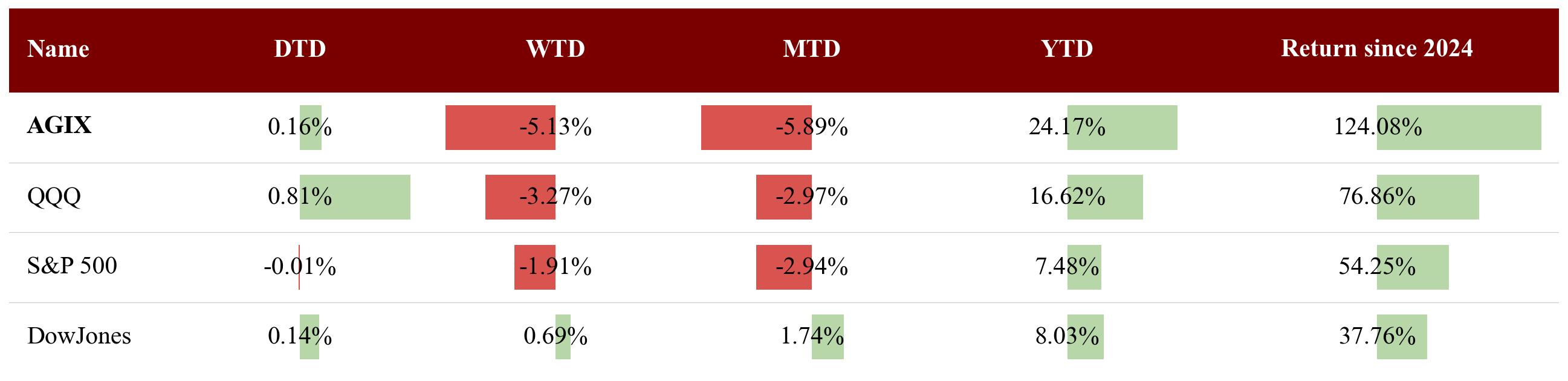
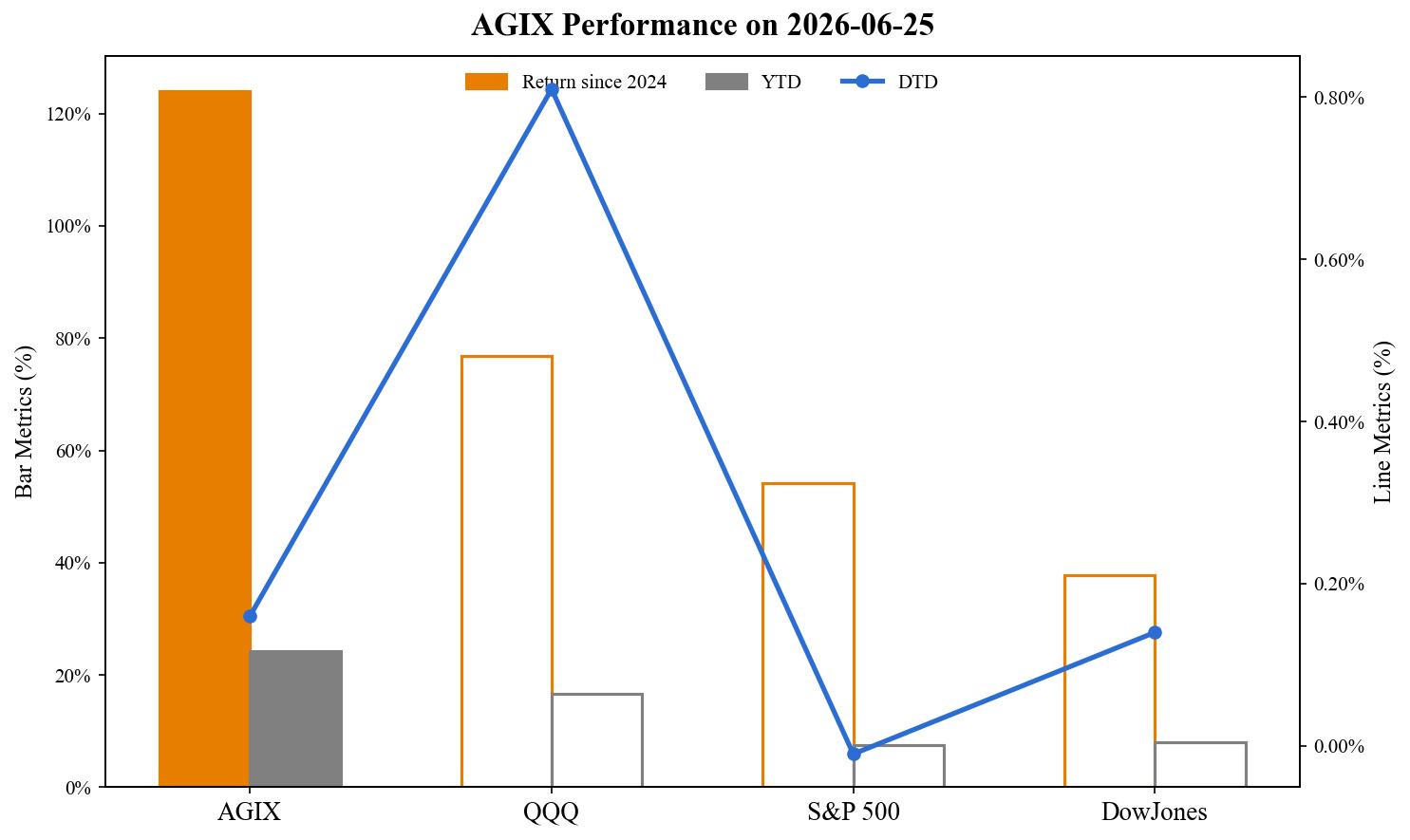
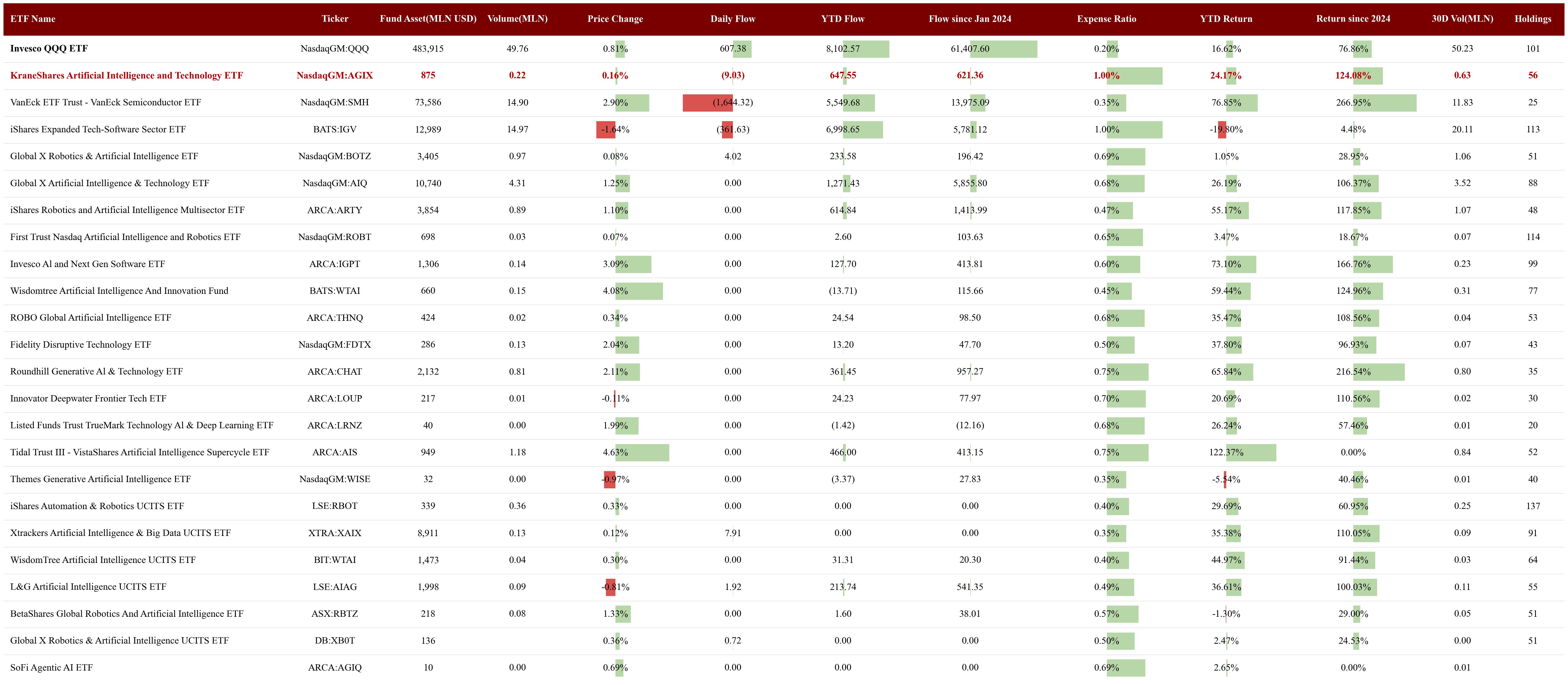
• AGIX posted a DTD return of 0.16%, underperforming QQQ (0.81%) and the broader AI-themed ETF peer group, where several semiconductor-heavy funds like SMH (2.90%) and IGPT (3.09%) saw strong gains.
• The top DTD contributors within AGIX were memory and semiconductor names: Micron Technology (15.74%), SK hynix (13.06%), and Teradyne (10.48%), all surging on Micron's blockbuster earnings and AI-driven demand signals.
• Key drags on AGIX included Apple (-6.12%), ServiceNow (-4.56%), and Samsara (-7.23%), reflecting mixed sentiment in software and consumer hardware names.
• Stocks to watch include Micron and SK hynix (memory upcycle), Teradyne and Flex (semiconductor equipment/manufacturing momentum), and Apple (memory cost pass-through impact).
News Highlights
1. Micron's revenue quadrupled and gross margins hit 85%, driven by AI memory demand; the stock surged 15.7% and lifted the entire memory sector including AGIX holdings SK hynix and Samsung.
2. SK hynix filed for a $29B US IPO, highlighting the AI HBM boom; its stock gained 13% on the news and Micron's read-through.
3. Apple and Microsoft raised hardware prices 15-25% due to AI-driven memory cost inflation, pressuring Apple's stock (-6.1%) and signaling margin headwinds for consumer hardware.
4. Qualcomm jumped 14% after unveiling its AI chip roadmap and acquiring Modular Inc., reinforcing the AI inference chip competition theme.
5. IBM announced a sub-1nm chip architecture (Nanostack), promising 50% performance gains and 70% energy savings, positioning for next-decade chip design.
RSS Highlights
1. A German court ruling holds Google liable for AI-generated errors, with commentators warning that companies cannot evade responsibility through AI agents.
2. Apple raised prices on most products 15-25% (excluding iPhones) due to memory cost inflation, as reported by WSJ and Daring Fireball.
3. The Generative AI Fizzle article warns of market overvaluation and waning enthusiasm, despite Micron's rebound, with open-source models potentially pressuring US LLM companies.
4. Scrutineer, an open-source tool using LLMs to scan for security vulnerabilities, has been deployed across multiple ecosystems and successfully fixed several bugs.
5. A stealth startup roundup highlights Cursive (foundational models for dynamic software), DeepGate (edge AI), and Athon AI (behavioral health clinic platform).
Performance & Benchmark
Attribution
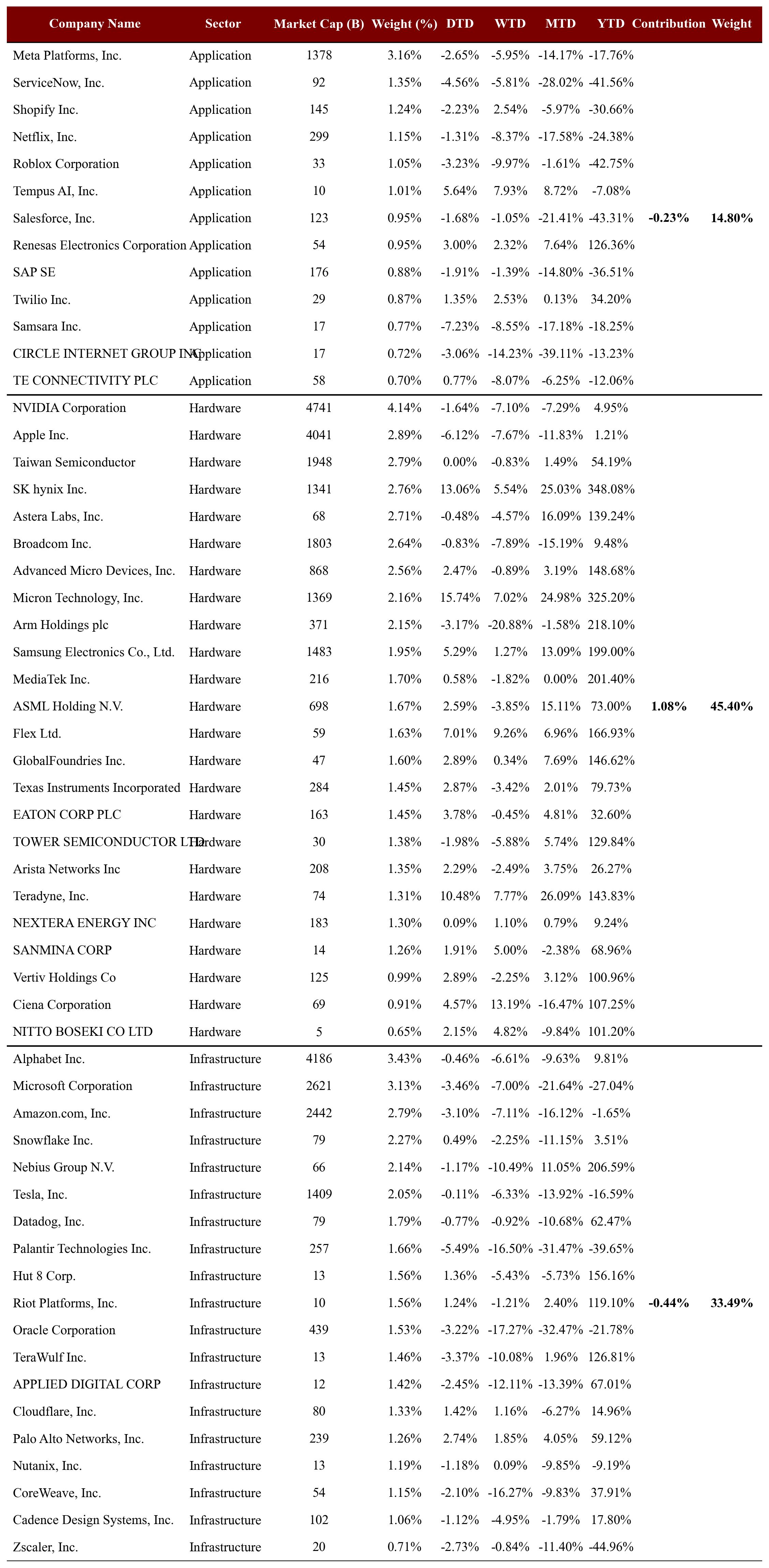
Contribution of the three sectors within AGIX holdings today
Application: -0.23%
Hardware: 1.08%
Infrastructure: -0.44%
Top-performing stocks in AGIX holdings today
Micron Technology, Inc. (15.74%)
SK hynix Inc. (13.06%)
Teradyne, Inc. (10.48%)
Flex Ltd. (7.01%)
Tempus AI, Inc. (5.64%)
Samsung Electronics Co., Ltd. (5.29%)
Ciena Corporation (4.57%)
EATON CORP PLC (3.78%)
Renesas Electronics Corporation (3.0%)
Vertiv Holdings Co (2.89%)
GlobalFoundries Inc. (2.89%)
Texas Instruments Incorporated (2.87%)
Palo Alto Networks, Inc. (2.74%)
ASML Holding N.V. (2.59%)
Advanced Micro Devices, Inc. (2.47%)
Arista Networks Inc (2.29%)
NITTO BOSEKI CO LTD (2.15%)
Worst-performing stocks in AGIX holdings today
CoreWeave, Inc. (-2.1%)
Shopify Inc. (-2.23%)
APPLIED DIGITAL CORP (-2.45%)
Meta Platforms, Inc. (-2.65%)
Zscaler, Inc. (-2.73%)
CIRCLE INTERNET GROUP INC (-3.06%)
Amazon.com, Inc. (-3.1%)
Arm Holdings plc (-3.17%)
Oracle Corporation (-3.22%)
Roblox Corporation (-3.23%)
TeraWulf Inc. (-3.37%)
Microsoft Corporation (-3.46%)
ServiceNow, Inc. (-4.56%)
Palantir Technologies Inc. (-5.49%)
Apple Inc. (-6.12%)
Samsara Inc. (-7.23%)
Top five listed stocks contributing the most within AGIX holdings today
SK hynix Inc. (13.06%)
Micron Technology, Inc. (15.74%)
Teradyne, Inc. (10.48%)
Flex Ltd. (7.01%)
Samsung Electronics Co., Ltd. (5.29%)
Observation
The strongest movers across peer ETF holdings today are listed below:
| DTD | Stock Ticker | Name | Held by ETFs | analysis |
|---|---|---|---|---|
| 21.97 | NasdaqGS:SNDK | Sandisk Corporation | ['XTRA:XAIX'] | Sandisk’s 21.97% gain on June 25, 2026 was driven primarily by a powerful sector read-through from Micron Technology’s blockbuster fiscal Q3 2026 earnings and guidance, which validated an acceleration in AI-driven DRAM/NAND demand and sparked a broad semiconductor memory rally.[1] A second driver was momentum buying and retail/WallStreetBets attention in high-beta chip names, with traders extrapolating surging flash demand and Sandisk’s recent earnings beat and strong Q4 guidance into further upside.[1][2] |
| 19.25 | TSX:BB | BlackBerry Limited | ['BATS:IGV'] | BlackBerry’s +19.25% move on June 25 was primarily driven by a strong fiscal Q1 2027 earnings surprise and a raised full‑year revenue outlook, which triggered a sharp rerating of the software-focused turnaround story.[4][8] 1) The company reported better‑than‑expected Q1 results and upgraded its revenue guidance, leading to an 18–19% intraday gain as highlighted in real‑time coverage of the move.[8] 2) The upside was amplified by elevated trading volume versus average, as momentum investors built on recent positive catalysts around QNX, government security certifications, and share repurchases, reinforcing the bullish narrative.[1][3][5] |
| 15.74 | NasdaqGS:MU | Micron Technology, Inc. | ['NasdaqGM:QQQ', 'NasdaqGM:AGIX', 'NasdaqGM:SMH', 'NasdaqGM:AIQ', 'ARCA:ARTY', 'NasdaqGM:ROBT', 'ARCA:IGPT', 'BATS:WTAI', 'NasdaqGM:FDTX', 'ARCA:LOUP', 'ARCA:AIS', 'XTRA:XAIX', 'BIT:WTAI'] | Micron’s 15.7% single-day gain was primarily driven by blockbuster fiscal Q3 earnings and guidance that dramatically beat Street expectations, showcasing surging AI-driven memory demand and revenue that more than quadrupled year over year.[6][8] This upside surprise reinforced confidence in the durability of the AI capex cycle, lifting sentiment across semis and prompting multiple price target hikes, which amplified the move.[1][6] |
| 15.14 | SEHK:2431 | Minieye Technology Co., Ltd | ['NasdaqGM:BOTZ', 'ASX:RBTZ', 'DB:XB0T'] | Minieye Technology’s 15.14% gain on 2026-06-25 appears most consistent with a low-float, high-volatility move rather than a clearly identifiable company-specific catalyst, as no same-day earnings, guidance, or major disclosure was evident in the provided results. The stock has also been highly volatile, with market data showing it trades well above its 52-week low and typically moves sharply week to week, which can amplify short-covering or momentum-driven rallies.[2][3][8] |
| 15.06 | TSE:6857 | Advantest Corporation | ['ARCA:ARTY', 'NasdaqGM:FDTX', 'LSE:RBOT'] | Advantest’s 15.1% gain on June 25, 2026 appears primarily driven by strong momentum buying into a new 52‑week high, supported by very high trading activity. The stock set a fresh 52‑week high/record level intraday with shares up 15.06% and volume of about 12.9 million, signaling aggressive demand and follow-through buying in a name that has already delivered over 200% 12‑month performance and is in a strong uptrend. In the absence of specific company news or disclosures that day, the move is best attributed to continued rerating of semiconductor test equipment plays and technical breakout/short-covering dynamics in a high‑beta stock. |
| 13.42 | NasdaqGS:AMAT | Applied Materials, Inc. | ['NasdaqGM:QQQ', 'NasdaqGM:SMH'] | Applied Materials’ 13.4% gain on June 25, 2026 was primarily driven by a strong Q2 FY26 earnings report featuring record revenue of $7.91 billion, up 13% sequentially and 11% year-over-year, and EPS of $2.86 above Street expectations.[4][3][8] The move was amplified by bullish forward guidance, with management guiding Q3 non-GAAP EPS to $3.36 (±$0.20), implying ~36% year-over-year growth and reinforcing a multiyear growth narrative tied to higher fab utilization and new capacity ramps.[4] |
| 13.06 | KOSE:A000660 | SK hynix Inc. | ['NasdaqGM:AGIX', 'NasdaqGM:AIQ', 'ARCA:ARTY', 'NasdaqGM:ROBT', 'ARCA:IGPT', 'BATS:WTAI', 'ARCA:CHAT', 'ARCA:LOUP', 'ARCA:AIS', 'XTRA:XAIX', 'BIT:WTAI'] | SK hynix’s 13.1% gain was primarily driven by its announcement of a planned U.S. Nasdaq ADR listing to raise roughly $29–30 billion, which boosted expectations for higher valuations, improved liquidity, and expanded foreign investor access.[1][2][4] A secondary tailwind came from Micron’s stronger‑than‑expected earnings and AI-memory outlook, which reinforced the thesis of sustained tight supply and robust pricing in high-bandwidth memory, supporting SK hynix’s earnings and multiple expansion.[1][2] |
| 12.27 | TSE:285A | Kioxia Holdings Corporation | ['ARCA:IGPT'] | Kioxia’s 12.27% gain on June 25, 2026 was driven primarily by its announcement that it plans to offer U.S. depositary shares in spring 2027, tapping into strong global demand for AI-related semiconductor exposure and signaling a move toward the world’s largest equity market.[1][2][6] A second key driver was management’s indication that it is actively considering a domestic stock split to broaden its investor base, which, together with AI-fueled enthusiasm for memory makers like Micron, reinforced momentum in the shares.[2] The absence of damage or disruption at its Kitakami plant following the June 25 Tohoku earthquake likely helped remove operational risk concerns and kept focus on the strategic listing and stock split catalysts.[3] |
| 11.15 | NasdaqGS:MXL | MaxLinear, Inc. | ['LSE:RBOT'] | MaxLinear’s 11.15% gain on June 25, 2026 appears primarily driven by a sharp rebound following the prior day’s selloff, with the stock moving from a June 24 close of $84.99 to intraday highs near $97.50 on June 25.[1][5] The move was likely supported by strong underlying bullish sentiment and AI-related upside narratives already in place, reflected in a consensus Buy rating from analysts and commentary highlighting MaxLinear as a beneficiary of AI data center connectivity demand.[1][4] |
| 10.78 | NYSE:GLW | Corning Incorporated | ['ARCA:AIS'] | Corning’s 10.78% jump on June 25 was driven mainly by investor enthusiasm over its expanding AI infrastructure exposure, especially reports of a multiyear fiber-optics deal with Amazon and related capacity expansion tied to Nvidia. The move was also supported by bullish analyst reactions and the market’s view that these contracts could accelerate revenue growth and free cash flow. Corning’s strong Q1 2026 results, including 18% core sales growth and 30% core EPS growth, likely reinforced the rally. |
| 10.48 | NasdaqGS:TER | Teradyne, Inc. | ['NasdaqGM:AGIX', 'NasdaqGM:SMH', 'NasdaqGM:ROBT', 'BATS:WTAI', 'ARCA:THNQ', 'LSE:RBOT', 'BIT:WTAI', 'LSE:AIAG'] | Teradyne’s 10.5% gain on June 25 was primarily driven by continued re‑rating on AI test and robotics exposure, reinforced by strong buy‑side and sell‑side conviction rather than a discrete new catalyst that day.[2][5][6] The move followed recent positive developments including record AI-driven Q1 results and robust Q2 guidance, very bullish analyst recommendations (Zacks Rank 1, Buy consensus), and ongoing momentum from its June Nasdaq‑100 inclusion and multi‑year defense contract, which together are attracting incremental institutional and passive inflows.[1][4][5][6] |
| 9.97 | SZSE:002335 | Kehua Data Co., Ltd. | ['ARCA:AIS'] | Kehua Data’s approximately 10% gain on June 25, 2026 is best explained as a momentum-driven move in the absence of identifiable company-specific news or regulatory disclosures that day. Available same-day and recent public sources show no new announcements, sector events, or major fundamental changes tied to the company, while the stock has already been trading at elevated valuations and has exhibited strong recent price performance, which can amplify technical and sentiment-led moves.[1][6] |
| 8.49 | NYSE:OII | Oceaneering International, Inc. | ['NasdaqGM:ROBT'] | Oceaneering International’s 8.49% move on 2026-06-25 was most likely driven by its announcement that it priced a private offering of $500 million of senior notes, a same-day corporate financing event that can materially affect valuation and balance-sheet expectations. The stock also traded sharply higher intraday, reaching $39.26 versus a $36.30 low, which is consistent with strong event-driven buying. A secondary contributor may have been broader momentum/technical strength rather than company-specific operating news, since the available results do not show a major earnings or contract catalyst that day. |
| 7.9 | TSE:9984 | SoftBank Group Corp. | ['NasdaqGM:ROBT', 'BATS:WTAI', 'ARCA:CHAT', 'BIT:WTAI'] | SoftBank Group’s 7.9% jump on 2026-06-25 appears to have been driven primarily by broad bullish sentiment and a strong re-rating of its valuation, with the stock closing at 7,118 yen after a 6,597 yen prior close. Bloomberg shows the full-day move was +7.90%, but the available same-day public results do not identify a specific company disclosure or single catalyst. The move also fits the pattern of recent momentum in the name, as other coverage noted renewed investor attention and strong month-to-date gains. |
| 7.81 | TSE:6146 | Disco Corporation | ['NasdaqGM:FDTX'] | Disco Corporation’s 7.8% gain on June 25, 2026 appears primarily driven by ongoing momentum in semiconductor-capital-equipment names, with Disco trading near its recent 52-week high and supported by strong technical “strong buy” signals and elevated volume relative to normal levels.[3][4][5][8] A secondary driver is valuation and sentiment: recent coverage highlighting robust trailing returns and rich multiples has reinforced growth expectations in a supportive broader equity environment, drawing in momentum and growth investors.[2][1][7] |
| 7.62 | NasdaqGS:KLAC | KLA Corporation | ['NasdaqGM:QQQ', 'NasdaqGM:SMH', 'NasdaqGM:ROBT', 'LSE:RBOT', 'BIT:WTAI'] | KLA’s 7.6% gain on June 25 was primarily driven by a broad rally in semiconductor and AI-leveraged names as investors responded to strong AI-related growth expectations across the sector, boosting equipment suppliers like KLA on sentiment and multiple expansion grounds.[6] The move also came against the backdrop of a recently completed 10-for-1 stock split earlier in June, which can enhance retail interest and trading liquidity, amplifying upside moves in a strong tape.[5][7] |
| 7.55 | TWSE:2408 | Nanya Technology Corporation | ['ARCA:IGPT', 'ARCA:AIS'] | Nanya Technology’s 7.55% gain on June 25, 2026 appears primarily driven by continued momentum following its exceptionally strong Q1 2026 results, which showed a 63.1% YoY revenue surge to NT$49.1bn and gross margin near 68%, reinforcing the DRAM upcycle and earnings upgrade narrative.[7][10] The move was further supported by very strong buy-side and technical signals, with multiple platforms flagging the stock as a “Strong Buy” amid elevated trading volumes and ongoing outperformance versus the Taiwan semiconductor sector.[2][3][4][9] |
| 7.21 | NasdaqGS:LRCX | Lam Research Corporation | ['NasdaqGM:QQQ', 'NasdaqGM:SMH', 'BATS:WTAI', 'ARCA:THNQ', 'ARCA:LOUP', 'BIT:WTAI', 'LSE:AIAG'] | Lam Research’s 7.2% move was primarily driven by a sharp rerating from the sell-side and WFE (wafer fab equipment) forecast upgrades that reinforced the AI-driven semi capex cycle. New Street Research raised its price target to $280 and highlighted strong recent quarterly results, while other firms including Evercore ISI and Mizuho have recently taken targets up to the $300–$380 range on higher industry WFE expectations tied to AI logic and memory spending.[1][4] A secondary driver was momentum positioning in high-beta semiconductor equipment names, with Lam highlighted in media and investor content as a key beneficiary of the AI chip boom and WFE spending potentially reaching ~$140–150 billion, supporting continued multiple expansion.[2][4] |
| 7.07 | TWSE:2344 | Winbond Electronics Corporation | ['ARCA:IGPT'] | Winbond Electronics’ 7.07% gain on June 25 was primarily driven by strong price momentum and heavy trading interest rather than any identifiable new company-specific news or disclosures that day.[9] The move occurred against the backdrop of very robust year-to-date share appreciation and bullish technical signals on the name, which likely attracted momentum and retail buyers.[2][3] |
| 7.01 | NasdaqGS:FLEX | Flex Ltd. | ['NasdaqGM:AGIX'] | Flex Ltd.’s 7.0% gain on June 25, 2026 appears primarily driven by continued positive momentum and rerating following its strong FY26 earnings beat and strategic spin-off announcement earlier in the quarter, which materially upgraded growth and margin expectations and has kept the stock near the top of its 52-week range.[1][4][7] A secondary driver is index- and valuation-related positioning: the recent S&P 500 inclusion effective June 22 and a consensus “Strong Buy” rating with substantial upside to bullish targets have supported incremental institutional demand and dip-buying after recent volatility.[3][4][6] |
| 6.88 | SHSE:688041 | Hygon Information Technology Co., Ltd. | ['ARCA:IGPT', 'ARCA:AIS'] | Hygon Information Technology’s 6.9% gain on June 25, 2026 appears driven primarily by continued post–ex-dividend strength and positive technical momentum, with the stock trading near its 52-week high and screening as a strong buy on multiple technical indicators.[1][3][4] The move also fits within a broader pattern of strong 12‑month performance (over 100% price appreciation) that has attracted momentum and growth investors despite a very elevated valuation multiple.[2][4] |
| 6.83 | NYSE:ONTO | Onto Innovation Inc. | ['ARCA:ARTY', 'LSE:RBOT'] | Onto Innovation’s 6.8% move on June 25 was primarily driven by follow‑through buying and multiple expansion after a strong Q1 2026 earnings print and upbeat Q2 guidance issued earlier in May, which highlighted record revenue, double‑digit sequential growth, and a robust margin/earnings outlook that investors continue to re-rate into.[1] The move also fits within a broader momentum bid into semiconductor capital equipment names, with ONTO trading near its highs and exhibiting strong recent price momentum, encouraging trend‑following and growth investors to add exposure.[2][6][9] |
| 6.58 | TSE:6479 | MINEBEA MITSUMI Inc. | ['ARCA:IGPT'] | Minebea Mitsumi’s 6.6% gain on June 25, 2026 appears driven primarily by follow-through buying and momentum after a strong recent uptrend, rather than a specific new company disclosure that day. The stock broke to new highs on elevated volume, with intraday trading up to roughly ¥5,246 from a prior close of ¥4,922, suggesting technical breakout and momentum accounts were key drivers of the move. Broader interest in precision components and electronics names in Japan, together with an upcoming dividend at the end of June that can attract yield-focused buyers, likely provided additional support. |
| 6.55 | SWX:TECN | Tecan Group AG | ['NasdaqGM:BOTZ', 'NasdaqGM:ROBT', 'ASX:RBTZ', 'DB:XB0T'] | Tecan Group AG’s +6.6% move on June 25, 2026 appears primarily driven by a strong rebound in investor sentiment following recent weakness, supported by solid buy-side and sell-side positioning. The stock traded up from CHF 150.00 to around CHF 155.70–165+ with elevated volumes versus average, suggesting renewed demand after testing its 52-week low in March and sitting well below its 52-week high.[2][5][1] Key driver 1: Supportive analyst stance, with a consensus Buy rating and average 12‑month target (~CHF 165.5) above the prior close, providing valuation upside and attracting buyers.[2] Key driver 2: Technical/flow factors, as the stock’s recovery from the lower end of its 52‑week range likely triggered momentum and mean‑reversion trades in a thinly traded Swiss mid-cap.[1][5] |
| 6.12 | TSE:5132 | pluszero, Inc. | ['NasdaqGM:WISE'] | pluszero, Inc.’s 6.1% gain on June 25, 2026 appears primarily driven by investor follow‑through to its recent strong earnings release and associated positive price reaction. Simply Wall St highlighted that the company “just reported some strong earnings, and the market reacted accordingly with a healthy uplift in the share price,” which can support short‑term momentum buying even as some analysts question earnings quality.[1] No material same‑day company‑specific news or sector‑wide Japanese software catalysts were identified, suggesting the move was mainly an extension of the post‑earnings re‑rating rather than a response to fresh disclosures.[4][7] |
| 5.95 | NasdaqGS:CMCO | Columbus McKinnon Corporation | ['LSE:RBOT'] | Columbus McKinnon’s ~6% gain appears driven primarily by a rebound in sentiment and buying interest as the stock trades near the bottom of its 52-week range and below long-term moving averages, making it look undervalued versus analyst targets and peer valuations.[1][3][7] Key drivers likely include: 1) Value and recovery positioning, with multiple research and data providers flagging significant upside to consensus price targets and highlighting long-term growth plans despite recent losses.[1][2][4] 2) Technical and trading dynamics, as investors add risk ahead of the upcoming earnings date and the stock’s low level attracts opportunistic buying, supporting a short-term squeeze higher.[3][7] |
| 5.82 | SZSE:000977 | Inspur Electronic Information Industry Co., Ltd. | ['ARCA:AIS'] | Inspur Electronic Information Industry’s 5.8% rise on June 25, 2026 appears primarily driven by a broad rebound and rotation into Chinese AI, cloud and server-related hardware names rather than by company-specific news. Real-time feeds and major news wires show no fresh disclosures, regulatory actions or earnings events for 000977 on that date, and the move occurred against the backdrop of ongoing investor interest in domestic computing infrastructure and AI server plays following prior US export restrictions on Inspur-related entities, which have already been priced in by the market.[2][6][9] |
| 5.64 | NasdaqGS:TEM | Tempus AI, Inc. | ['NasdaqGM:AGIX', 'NasdaqGM:ROBT', 'ARCA:THNQ', 'BIT:WTAI', 'LSE:AIAG'] | Tempus AI’s 5.6% gain appears primarily driven by bullish options activity and rebound positioning after a severe prior drawdown. MarketBeat reported an unusually high volume of call option buying in TEM on June 25, coinciding with the stock trading up $2.57 to $54.51 and framed in the context of the name being “ripe for a rebound” after a near 50% drop.[2] This move was supported by a still-positive fundamental backdrop, as the same source highlights a recent EPS and revenue beat and an average “Moderate Buy” rating with a consensus target materially above the current price, encouraging dip-buying and short-covering interest.[2] |
| 5.63 | NasdaqGS:AGYS | Agilysys, Inc. | ['BATS:IGV'] | Agilysys’s 5.6% gain appears primarily driven by ongoing optimism around its strong recent fundamentals and outlook, following record fiscal 2026 Q3 results and a raised full-year revenue guide that have reframed the stock as a high-growth hospitality software play.[1] A secondary driver is supportive sell-side and sentiment backdrop, with a Buy-rated analyst consensus and price targets implying meaningful upside from current levels, which likely reinforced dip-buying interest after the prior pullback.[3][5] |
| 5.55 | NasdaqGS:NOVT | Novanta Inc. | ['ARCA:IGPT', 'LSE:RBOT'] | Novanta’s 5.6% rise on June 25, 2026 appears primarily driven by positive sentiment and momentum following its recent $1.2 billion Riverpoint Medical acquisition announcement and associated $300 million equity raise, as investors reassessed the strategic and earnings implications after the initial negative pre-market reaction earlier in the week.[1][5] A secondary driver is improving earnings expectations and a favorable sell-side/quant backdrop, including a recent Zacks Rank upgrade to “Buy” tied to upward earnings estimate revisions, which tends to support incremental buying interest.[2] |
| 5.5 | TSE:6273 | SMC Corporation | ['NasdaqGM:BOTZ', 'ASX:RBTZ', 'DB:XB0T'] | SMC Corporation’s 5.5% gain on June 25, 2026 appears primarily driven by investor positioning around its scheduled Annual General Meeting, with the stock rebounding after weakness following its recent full-year results and subsequent analyst estimate upgrades.[6][8] A secondary driver is supportive sentiment from the analyst community and technicals: consensus 12‑month targets imply upside with a Buy skew among covering analysts, and same-day technical indicators flagged a “Strong Buy,” encouraging incremental inflows into the name.[3] |
| 5.41 | TWSE:3008 | LARGAN Precision Co.,Ltd | ['ARCA:IGPT', 'LSE:RBOT'] | LARGAN’s 5.41% gain appears primarily driven by continued momentum and investor enthusiasm around its multi‑month rerating to six‑year highs, rather than a discrete new fundamental catalyst on the day.[7][9] First, the move came on elevated volume versus normal trading, suggesting follow‑through buying and potential short covering as the stock trades near the top of its 52‑week range.[8][9] Second, the rally extends a strong YTD uptrend despite consensus target prices sitting well below the current level, indicating sentiment and technical factors (rather than fresh earnings or guidance) are the dominant drivers.[3][7][8] |
| 5.29 | KOSE:A005930 | Samsung Electronics Co., Ltd. | ['NasdaqGM:AGIX', 'NasdaqGM:AIQ', 'NasdaqGM:ROBT', 'BATS:WTAI', 'ARCA:CHAT', 'XTRA:XAIX', 'BIT:WTAI'] | Samsung Electronics’ 5.29% gain was primarily driven by investor reaction to the company’s confirmation that it is reviewing a large share buyback to fund stock-based employee compensation, following local reports of a potential 90 trillion won program, which boosted expectations for capital returns and share support.[2][4] The move was reinforced by strong buy ratings and significant upside in consensus target prices, with 36 analysts rating the stock a Buy and an average 12‑month target implying more than 25% further upside, attracting momentum and retail flows into the name.[5] |
| 5.28 | NasdaqGS:SDGR | Schrödinger, Inc. | ['ARCA:LRNZ'] | Schrödinger’s 5.28% move on 2026-06-25 appears to have been driven primarily by a supportive read-through on fundamentals after its Q1 2026 update: the company reiterated full-year guidance, reported 12% ACV growth to $28.4 million, and highlighted stronger drug discovery revenue, which likely helped sentiment[2]. A secondary driver was continued positive analyst tone, with Street price targets clustering around $18–$25 and the average target near $19, suggesting modestly constructive expectations for the stock[1]. No major same-day company-specific negative catalyst is evident in the provided sources, so the move likely also reflected broader trading momentum in a small-cap biotech/software name[4][7]. |
| 5.08 | TSE:6920 | Lasertec Corporation | ['LSE:RBOT'] | Lasertec’s 5.1% gain on June 25, 2026 was primarily driven by continued positive follow-through and sentiment after its strong Q3 FY06/26 results and upward earnings momentum, with investors adding to positions ahead of the fiscal year-end and on expectations of sustained demand for EUV-related inspection systems.[1][9] No major company-specific headlines or rating changes were reported that day, so the move appears dominated by earnings revision optimism, the stock’s strong upward trend over the past month, and broader buying interest in Japanese semiconductor-capital-equipment names.[2][4][6] |
News
Funding & M&A
Elon suffers another day short of trillionaire status
SpaceX is scheduled to go public this month, and its founder, Elon Musk, immediately became the world's first trillionaire. However, stock price fluctuations have brought his assets back down to the tens of billions. The article describes this phenomenon in a sarcastic tone and mentions Musk's publicly stated vision of sending humans to the moon, Mars, and beyond. Although the article mentions his multiple children and high-profile advocacy for procreation, the core discussion revolves around the wealth fluctuations caused by changes in the capital market. This event also reflects the high market capitalization operations of tech projects after going public and the extreme uncertainty of billionaire assets.
Cerebras stock plunges after earnings as CEO says margin outlook was misunderstood
Artificial intelligence chip maker Cerebras Systems saw its stock price fall nearly 17% after reporting earnings following its initial public offering. Although first-quarter revenue reached $193 million, up 194% year-over-year, and net loss narrowed from $23.9 million to $14 million, the full-year gross margin guidance of 38% to 41% was below the first quarter's 47%, leading to investor concerns. CEO Andrew Feldman explained that the company needs to temporarily lease equipment back to major customers for early expansion, which will cause profit margins to decline. The stock price once approached the IPO price, reflecting market doubts about its long-term profitability.
Grammarly parent Superhuman buys AI detector GPTZero
Superhuman, formerly known as Grammarly, has signed an agreement to acquire AI writing detection startup GPTZero. The acquisition price was not disclosed. The acquisition will integrate GPTZero's detection technology into the Superhuman Go platform, building a 'truth layer' feature to identify AI-generated content, fake citations, and algorithmic statistics, as well as provide keyboard history tracking. GPTZero has 19 million registered users and $30 million in annual revenue, and its founder and 30 employees will join Superhuman. This move comes as AI writing accounts for 50% of content and detection tools expand into recruitment, publishing, and compliance fields. Superhuman's own detector ranks first on the RAID benchmark, and the fusion of the two detectors can reduce false positives. GPTZero previously raised $13.5 million in a Series A round in May, with a PitchBook valuation of over $88 million.
Former Infosys chief has a new startup that wants to challenge the IT services world
AI services startup Hang Ten Systems, founded by former Infosys CEO Vishal Sikka, announced a $32 million seed funding round led by Mayfield, with participation from Aramco Ventures and others. The company focuses on using AI-driven software to build, modify, and operate services, aiming to transform the traditional IT services industry's linear growth model reliant on human labor. Existing customers include Siemens Gamesa and Fresenius. This round reflects investor interest in whether AI services can reshape enterprise software delivery models. Traditional service providers like Infosys are also exploring AI collaborations, and there is debate within the industry over whether AI will shrink or expand the market.
Memory maker SK hynix files for $29B US IPO amid AI demand
SK hynix Inc., the world's largest supplier of HBM memory, has officially filed for a Nasdaq listing, planning to sell 17.79 million shares to raise $29.4 billion, which would become the second-largest IPO after SpaceX. Driven by the AI boom, the company reported a 198% year-over-year revenue increase to $38 billion in the first quarter, with a net profit margin of 77%. Its HBM products are widely used in AI chips from Nvidia and others, leveraging TSV, MR-MUF, and the latest iHBM thermal management technology to address high heat issues and ensure stable performance. SK hynix is also the second-largest supplier of both DRAM and NAND Flash globally, and plans to use the proceeds to build four fabs in the Yongin Cluster near Seoul, helping attract over $200 billion in investment to the园区.
Apple raises Mac and iPad prices, spares iPhone for now.
Due to a global memory shortage caused by AI data center construction, Apple has raised prices across multiple product lines including Mac and iPad. The MacBook Neo has increased from $599 to $699, the MacBook Air and MacBook Pro have risen from $1,099 and $1,699 to $1,299 and $1,999 respectively. The desktop Mac Studio has gone from $1,999 to $2,499. The iPad Air, iPad Pro, and base model have increased by $150, $200, and $100 respectively. The HomePod, HomePod Mini, Apple TV, and Vision Pro have also seen year-over-year price increases. Apple stated that the sharp rise in memory prices in the fourth quarter has made cost control difficult. Analysts pointed out that other PC and tablet manufacturers may follow suit with price adjustments. Memory supplier Micron's revenue has grown fourfold in four years.
Warp lands $60 million to automate payroll, compliance, and HR with AI.
Employee management startup Warp recently announced the completion of a $60 million Series B funding round. The round was led by Battery Ventures, with participation from Peak XV, Sound Ventures, Y Combinator, HOF Capital, and notable founders including Shopify CEO Tobias Lütke and former Stripe COO Claire Hughes Johnson. Founded in 2023, Warp has rebuilt the HR management platform with AI at its core, supporting payroll, HR, compliance, benefits, and IT automation without human intervention. Its system can process payroll and tax filings across all 50 U.S. states in seconds, and automatically set up new employee accounts, devices, and permissions. Current clients are primarily fast-growing AI companies such as Bland AI, Reducto, and Greptile. After this round, Warp's total funding reaches $85 million, and it plans to grow its team from 50 to 200 employees.
Apple’s Macs and iPads and Microsoft’s Xbox consoles are getting more expensive — blame AI.
Due to the massive demand for storage and memory chips driven by AI servers, DRAM and NAND chip prices have more than quadrupled over the past year. U.S. memory giant Micron Technology's latest financial report shows a gross margin of 86%, record revenue, and a stock price increase of over 16%. Affected by rising costs, Apple announced a 15% to 20% price increase for Mac and iPad models, with the MacBook Air rising $200 to $1,299 and the MacBook Pro rising $299 to $1,999. Microsoft also announced that Xbox console prices will increase by $100 to $150 starting July 1, and it will discontinue the 2TB version. Both companies noted that rising memory costs will continue to impact smart device prices, and consumers will bear the cost of the AI boom.
Xbox follows Apple with price increases.
Apple and Microsoft announced hardware price increases on the same day, directly citing high storage and memory costs driven by AI infrastructure. Microsoft announced a global Xbox console price hike starting August 1, with the 512GB version rising by $100 and the 1TB version by $150, and discontinued the 2TB model. The company noted that memory prices have increased at least 2.5 times and could double again by fall 2027. Apple simultaneously raised prices on Mac and iPad models, with both companies attributing the increases to massive demand for high-end memory chips from AI data centers. Sony raised the PS5 Digital Edition to $5,100, while Nintendo's price adjustment for the Switch 2 was relatively moderate. Microsoft introduced interest-free installment and used device programs to ease the burden on consumers.
TrueFoundry acquires MLOps pioneer Seldon AI to accelerate enterprise agentic AI
TrueFoundry Inc., an American AI infrastructure startup, announced on Wednesday that it has completed the acquisition of Seldon Technologies Ltd., a British open-source enterprise machine learning platform, for an undisclosed price. Founded by Alex Housley in 2014, Seldon has raised approximately $30 million in cumulative funding, and its latest product has shifted from machine learning operations to cloud-agnostic inference services. After the acquisition, TrueFoundry will integrate Seldon Core's production-grade MLOps capabilities, enabling enterprise users to deploy, monitor, and govern agentic AI workloads in Kubernetes environments. The company recently launched the Agent Gateway unified control platform, strengthening its competitive edge in multi-architecture AI deployment. This acquisition provides a practical solution for transitioning from MLOps to agentic AI, helping to increase the production rate of enterprise AI projects. According to industry reports, the MLOps market size is expected to reach $3-6 billion by 2026 and could exceed $30 million by 2030.
Runpod raises $100 million to build the leading cloud platform for AI developers.
AI developer cloud service provider Runpod Inc. recently announced the completion of a $100 million Series A funding round, valuing the company at $1 billion. The round was led by Summit Partners, bringing its total funding to $122 million. Runpod provides a one-stop cloud platform for AI developers, supporting experimentation, training, fine-tuning, deployment, and scaling of multi-session model operations. The platform has already attracted 1 million developers, and its serverless platform has processed 20 billion inference requests. Its user Deep Cogito used the platform to train the Cogito v1 large model family in 75 days, achieving performance surpassing comparable Llama and DeepSeek models. The new funds will be used for platform upgrades, team expansion, and global developer services.
General Intuition’s $2.3B bet that video games can train AI agents for the real world
American AI startup General Intuition has completed a $320 million funding round at a $2.3 billion valuation, bringing its cumulative funding to $454 million. The round was led by Khosla Ventures, with participation from General Catalyst, Jeff Bezos, Eric Schmidt, and other institutional and individual investors. The company was spun off from the game clip sharing platform Medal, using player button action label data to train agent models with spatial-temporal understanding capabilities. This model has already transitioned from Fortnite gameplay to controlling four-legged robots and can be used for both simulated environments and real-world tasks. The funds will primarily be used to expand computing capacity and open an API by the end of summer. CEO Pim de Witte emphasized ethical use principles, excluding military harm applications. Investor Vinod Khosla believes the company's exclusive game action data will become the infrastructure for general agents and world models.
From Fortnite to robots: General Intuition raises $2.3 billion on the bet that video games can train AI agents for the real world.
American AI startup General Intuition recently completed a $320 million funding round at a $2.3 billion valuation, led by Khosla Ventures with participation from General Catalyst, Jeff Bezos, Eric Schmidt, and others. The company spun out from game video sharing platform Medal and uses action tag data embedded in games to train generalist agent models with spatial-temporal understanding. Its technology has already transferred game AI to quadruped robot embodied applications and launched Nerve, a job platform for the gaming community. Founder Pim de Witte emphasized that the technology will not be used for lethal autonomous weapons, and most of the funds will go toward increasing CoreWeave computing resources and expanding APIs. This round positions General Intuition as a key player in generalist agent models for simulation and the real world.
Netris raises $15 million Series A from a16z to help AI neoclouds go live faster.
Network automation startup Netris just closed a $15 million Series A funding round led by Andreessen Horowitz. The company provides a hardware-accelerated network configuration and automation platform for 'new cloud' operators, enabling rapid deployment of AI inference and training data centers. Nvidia has recommended its technology to multiple customers, and the platform is now live across 35 GPU clusters globally, serving clients including Lightning AI, Foxconn, and Hewlett Packard Enterprise. Unlike traditional SDN, Netris's solution is entirely hardware-accelerated and supports both Nvidia and AMD servers. The funding will be used to hire engineers and sales teams, expand hardware vendor support, and add algorithmic features. a16z partner Guido Appenzeller will join the board.
BreachRx launches the Rex Platform to coordinate incident response in the AI era.
Incident response company BreachRx has launched the Rex platform, an agentic AI-powered incident command center designed for future scenarios where AI-accelerated attacks cause multiple concurrent security incidents. The platform evolved from the Rex AI generative engine released in March and is now a collaborative workspace for the entire response team. Its core component, Maestro, orchestrates multiple specialized agents responsible for severity assessment, response execution, regulatory analysis, report generation, and document analysis, operating offline to ensure continued collaboration even when the network is compromised. The company also focuses on incidents caused by AI itself. Founded in 2017, BreachRx raised $15 million in Series A funding in May 2025 and has over 100 customers, including Coinbase, American Express, and Commvault. Ballistic Ventures partner Phil Venables noted that multiple concurrent incidents have become the new normal, requiring a new operational model. The Rex platform is now live.
Scaled Cognition secures $100 million to automate high-stakes customer interactions.
AI startup Scaled Cognition Inc. recently announced the completion of a $100 million Series A funding round, led by Khosla Ventures, with participation from Genesys Telecommunications Laboratories Inc. This funding round values the company at $85 billion. Founded in 2022, the company provides a platform for enterprise customer service based on a custom AI model called APT, which retrieves existing records rather than generating new content to reduce the risk of hallucinations and is suitable for sensitive transaction scenarios. The platform also offers simulation testing tools, an AgentTwin automatic creation tool, and a security protection module. The funds will be used to accelerate research and development and commercialization, with future plans to expand into areas such as finance.
Patronus AI lands $50 million to build ‘digital worlds’ that stress-test AI agents.
Patronus AI, founded by former Meta AI researchers, announced a $50 million Series B funding round led by Greenfield Partners, with participation from Notable Capital, Lightspeed, Datadog, and Samsung, bringing the company's total funding to $70 million. The company provides digital world models for AI models, creating simulated environments of websites and internal systems to stress-test and evaluate AI agents using reinforcement learning. Its clients include multiple frontier AI labs and emerging startups, and revenue has grown 15 times over the past year. The business currently focuses on software development and finance, with plans to expand into more complex task scenarios that are difficult to verify. This technology helps improve the reliability and safety of AI agents in real-world tasks.
Mirendil raises $200 million to accelerate scientific research using AI.
AI innovation company Mirendil Inc. recently completed a $2 million funding round, achieving a valuation of $1 billion. The round was led by Andreessen Horowitz, with participation from Kleiner Perkins, Nvidia Corp., and others. The company, with Behnam Neyshabur and Harsh Mehta serving as CEO and CTO respectively, will develop self-upgrading neural networks to accelerate cutting-edge AI model research. This technology will first be applied in fields such as chemistry, healthcare, and robotics, helping scientists customize specialized models. Mirendil plans to optimize Transformer architecture and attention mechanisms and leverage reinforcement learning sandboxes for training. Investors say that if the project succeeds, it will reshape the AI ecosystem and improve research efficiency across multiple fields.
Technical Breakthroughs
Applied Materials unveils more advanced chipmaking gear for 3D stacking architectures.
Chip manufacturing equipment giant Applied Materials recently launched several new process tools specifically designed for the 3D advanced packaging architecture required by AI processors. The new products include the Opta Quad CMP platform, Nokota Vmax 2 ECD system, Producer Avila 2 PECVD, VeritySEM 7AP and SEMVision G7AP electron beam inspection tools, and the Enhanced Centura Prime Epi polycrystalline system. These tools enable ultra-thin magnetic memory stacking, high-precision copper plating, stress-balanced thin film deposition, and sub-10nm defect detection, effectively addressing the "memory wall" problem and improving HBM production yield and energy efficiency. The new systems also reduce factory floor space by 20%, facilitating mass production of smart chips. This technology release demonstrates Applied Materials' leading position in the advanced packaging field.
IBM says new sub-one-nanometer architecture paves the way for the next decade of chip design.
IBM recently announced the development of the world's first sub-1nm chip technology, based on a vertical stacking transistor architecture it calls "nanostack," targeting the 0.7nm node. This technology can pack nearly 100 billion transistors on a fingernail-sized chip, doubling the density of the 2nm node. According to the company, the new architecture delivers a 50% performance improvement, 70% energy efficiency improvement, and 90% SRAM density improvement over 2nm products. The research lead stated that the technology will provide higher bandwidth, lower power memory solutions for AI systems. IBM emphasized that the project is still in the research phase, with mass production expected within at least five years. Additionally, IBM is working with partners such as ASML and Rapidus to advance High NA EUV lithography technology and prepare for 2nm node production.
Exclusive: LucidLink launches MCP server to give AI agents shared access to distributed files.
Cloud distributed file system developer LucidLink has released the beta version of its Model Context Protocol (MCP) server, extending its distributed file system technology to the multi-agent AI domain. The server allows MCP-compatible AI agents or orchestrators to connect to LucidLink filespace, providing a persistent, writable shared state layer for multi-agent systems, solving data persistence issues when multiple agents and human reviewers work together in enterprise production environments. The server supports frameworks such as Anthropic Claude, OpenAI Agents SDK, LangChain, LlamaIndex, and CrewAI, leveraging features like global file locking and zero-knowledge AES-256 encryption to enable file sharing across multi-cloud, on-premises, and edge environments. CEO Peter Thompson stated that agent workflows rely on files as memory, context, and output carriers, maintaining state across sessions and frameworks without repeatedly copying data. This move shifts LucidLink's technology, originally used in heavy data environments like media production and engineering, toward agent AI infrastructure, without replacing vector databases or data lakes. While agent workflows are still rare in enterprise settings, state management has become a key barrier to production deployment.
Databricks’ former AI chief thinks he can cut AI’s power bill by 1,000x
Unconventional AI, founded by former Databricks AI head Naveen Rao, will release its first AI model based on oscillator architecture, Un-0, in a new market on April 30, 2026. The model can achieve image generation results comparable to Stable Diffusion and OpenAI GPT Image 1, but with up to 1,000 times lower energy consumption. Currently, Un-0 runs in a software simulation environment, and the company plans to launch a real chip solution and build a complete inference stack. Rao stated that energy will become the core limiting factor for AI scaling, and this technology has the potential to significantly reduce inference energy consumption. The company currently has fewer than 50 employees but aims to provide a new path to solving AI infrastructure energy problems.
IBM says new sub-nanometer architecture paves the way for the next decade of chip design.
IBM announced the world's first sub-1nm chip technology, based on a vertically stacked staircase transistor architecture called Nanostack, which can integrate nearly 100 billion transistors onto a chip the size of a fingernail, achieving nearly twice the density of the 2nm technology released in 2021. This architecture can deliver up to a 50% performance improvement and a 70% reduction in energy consumption, while SRAM scaling performance improves by 30-40%, providing higher bandwidth and lower energy storage solutions for AI systems. IBM Research Vice President Huiming Bu stated that the technology will expand from two-dimensional scaling to three-dimensional stacking and will be combined with ASML's High NA EUV lithography technology. The research results will begin the industrialization path within the next five years, and the company will work with partners such as Rapidus to promote 2nm industrialization.
Product Launches
Parker Conrad knows which employees are worth their AI spend and says Rippling can help you, too.
This week, Rippling launched the Rippling Data Cloud product, integrating multiple data modules such as HR, data warehouse, and visualization into one. The system can directly read organizational structure and employee data, helping companies analyze metrics like AI token spend, performance ratings, and support ticket counts in real time, and can automatically alert on overspending. The company also launched high-yield banking and same-day payroll services, directly challenging fintech companies like Ramp. Currently, 560 companies are using the new product, with monthly revenue of approximately $5-7 million. CEO Parker Conrad stated that the company is still in a phase of heavy R&D investment and has no IPO plans for the next two years.
Salesforce launches Help Agent to simplify AI customer service deployment.
Kishan Chetan, General Manager of Salesforce's Client Service business, recently announced the launch of a pre-built AI service agent called 'Help Agent,' based on the Agentforce platform, which can connect company knowledge, actions, and multiple channels (website, SMS, voice) within minutes. The new agent offers no-code/low-code building tools, supports functions such as customer inquiries, case management, order processing, and appointment scheduling, and can automatically configure phone numbers. It also introduces a per-case resolution pricing model, charging $2 for each autonomously resolved case, abstracting complex costs like AI compute and tool calls into quantifiable business outcomes. The new customer service portal features a single conversation bar design, can generate dynamic AI cards, and trigger pre-emptive actions. The product will officially launch in July 2026, helping enterprises quickly deploy AI service agents.
Policy & Regulation
OpenAI staggers GPT-5.6 rollout for government vetting, eyes 2027 IPO.
The U.S. federal government has required OpenAI to first grant access to its upcoming GPT-5.6 model to a small number of partners, rather than launching it directly to the public. According to reports, OpenAI CEO Sam Altman revealed in an internal Q&A session that this move is in response to a request from the Trump administration, aiming to allow federal agencies to review the model before its widespread release. Previously, Anthropic's Mythos model was also forcibly taken down by the U.S. government for national security reasons. This policy reflects the gradually tightening regulation of frontier AI technology by the U.S., and the timing of future model releases will be increasingly influenced by the government. Additionally, OpenAI is considering an IPO in 2027 to avoid current market volatility and prepare sufficient financial support. This move will impact the development pace of the global AI industry.
Europe is pushing back on Washington’s chip war
Dutch Trade Minister Sjoerd Sjoerdsma visited Washington this week, meeting with Commerce Secretary Howard Lutnick and members of Congress to oppose the MATCH Act. The bill would ban Chinese chipmakers from accessing Western semiconductor equipment, with significant impact on ASML. ASML, Europe's most valuable company, exclusively produces extreme ultraviolet lithography machines for advanced AI chips. The Chinese market accounts for 19% of ASML's system sales, and the bill would also ban older-generation deep ultraviolet lithography machines. The bill has not yet reached a vote in either chamber and may need to be included in a larger package to pass. ASML CEO Christophe Fouquet has stated that China can currently only purchase DUV equipment from a decade ago.
The White House is asking OpenAI to slow roll the release of its new model over safety concerns.
OpenAI plans to release its next-generation model, GPT 5.6, with a different strategy than before, granting access only to a small number of close partners rather than a full public release. It is reported that this decision was influenced by the Trump administration, which will review customer access on a case-by-case basis, involving agencies including the Office of the National Cyber Director and the Office of Science and Technology Policy. Previously, Trump signed an executive order requiring AI companies to voluntarily submit new models for government testing and evaluation. Meanwhile, Anthropic has also sparked controversy with its frontier cybersecurity model Claude Mythos, which is restricted to specific partners, leading to industry discussions on the security risks and regulatory necessity of frontier AI models.
Industry Partnerships
Anthropic’s Claude is winning over paid consumers, a market owned by ChatGPT
According to data from Indagari, a credit card transaction analysis company, the usage rate of Anthropic's Claude AI among paying consumers continues to rise. Data shows that from January to May 10, 2026, Claude's paid users and related revenue grew by 75%. Data from the American online education platform DataCamp also shows that Claude has become the most popular search term on the platform, with consumer interest in Claude courses far exceeding that of ChatGPT. Data from market intelligence firm Sensor Tower shows that Claude has grown well across multiple platforms but still lags significantly behind ChatGPT. Although OpenAI's ChatGPT remains dominant, Anthropic is narrowing the gap through sustained consumer-side revenue. Meanwhile, U.S. government export controls on Anthropic's advanced models Mythos 5 and Fable 5 have not affected its overall growth momentum. As both Anthropic and OpenAI approach their IPOs, the market is optimistic about the sustained performance of their consumer and enterprise businesses.
2 days left to save up to $190: Join 1,000+ founders and investors at TechCrunch Founder Summit.
TechCrunch will host a StrictlyVC event in a new market on April 30, 2026, and the TechCrunch Founder Summit in Boston on November 4. Early bird ticket pricing ends June 26 at 11:59 PM PT, offering savings of up to $190, with a 30% discount for groups of four. This one-day gathering designed for founders will bring together over 1,000 founders and investors, providing actionable advice on practical topics such as fundraising, market strategy, and growth milestones through breakout sessions and roundtable discussions. Past speakers include representatives from top firms like Sequoia Capital and Greylock, and the agenda for this event is currently being finalized. In addition to offering efficient networking and experience sharing for founders, the event also welcomes corporate exhibition booths.
Capital One Software makes the case for AI-ready tokenization
Enterprises face the challenge of balancing data security and innovation when advancing AI applications. Vincent Goveas, Director of Product Management at Capital One's software division, pointed out that traditional security models can no longer meet AI's need for real-time data access. The company's Databolt tokenization solution replaces sensitive information with non-sensitive placeholders at the data ingestion stage, preserving data format and structural characteristics, enabling AI model training to achieve 99.7% prediction accuracy. Empirical research conducted with PwC shows that tokenization far outperforms masking in structured health data scenarios. Enterprises need to adopt data-centric security strategies, implement automated discovery and classification at ingestion, and shorten development cycles through self-service architectures. This transformation will support enterprises in maximizing data value while maintaining compliance.
融资收购
Adobe acquires image and video enhancement tool maker Topaz Labs.
U.S. software giant Adobe has announced its acquisition of Topaz Labs, a company specializing in AI video and image enhancement, and will integrate it into its Creative business line. Topaz Labs, which has been around for over 20 years and has won an Emmy Award, offers Astra and Wonder models for video super-resolution and image restoration. Adobe plans to integrate the technology into its Firefly AI applications and Creative Cloud suite, supporting on-device large model operation. The deal is expected to close in the second half of 2026. This move helps Adobe gain a competitive edge in image and video editing against Canva and Blackmagic Design, and enhances user stickiness through its AI ecosystem.
Amazon ups its India bet with a fresh $13 billion AI infrastructure investment.
Amazon announced on Thursday that it will invest an additional $13 billion in India by 2030 to expand its AI and cloud computing footprint, primarily used to increase AWS data center capacity in Mumbai and Noida. This brings the company's cumulative investment commitment in India to $48 billion, marking the third major commitment in the past three years. Meanwhile, Microsoft and Google have committed to investing $17.5 billion and $1.5 billion respectively by 2029. The Indian government offers tax incentives and other policies to attract multinational technology companies to make India a core region for AI infrastructure. Amazon will also expand its retail and logistics network domestically, with its quick commerce service Amazon Now covering over 300 towns, competing with platforms like Blinkit and Instamart.
Soaring memory chip demand helps Micron quadruple its revenue and crush expectations again
Memory chip maker Micron Technology's latest quarterly revenue reached $41.46 billion, up more than four times year-over-year, and net profit jumped $28.24 billion. The explosive growth in AI demand has driven up memory prices, with gross margin reaching 84.9%, surpassing Meta to become the highest among US tech companies. The company expects quarterly revenue to reach $50 billion and has signed long-term contracts with 16 customers spanning three to five years, with committed amounts totaling $20 billion. Among them, data center business quarterly revenue reached $11.5 billion, growing more than seven times. Micron's stock price has risen over 700% in the past year, with a market value exceeding $1 trillion. The industry supply-demand imbalance is expected to ease by 2028.
Qualcomm shares jump 14% on Modular acquisition, guidance upgrade
Qualcomm laid out its AI roadmap at an investor conference, and its stock price surged 14% after hours. The company announced it would acquire AI inference software startup Modular Inc. for $1.92 billion and previewed the Snapdragon C1000 CPU and AI300 accelerator. Qualcomm raised its non-handset business forecast for fiscal 2029 to $40 billion, with adjusted earnings per share guidance rising to $18. The C1000 chip will be purchased by Meta for multiple years and generations. Modular's technology can automatically port AI models to multiple chips, helping Qualcomm compete for customers against NVIDIA. The acquisition and new chip launches will accelerate its push into the data center AI market.
融资扭购
Ornn raises $33M to help companies buy and sell AI compute as a commodity like oil
AI startup Ornn AI Inc. has completed a $33 million seed funding round, co-led by a16z crypto and Galaxy Ventures. The company is building the world's first GPU computing power trading market and launching the OCPI index based on transaction data to address the current tight supply and opaque pricing in the computing power market. Founders Kush Bavaria and Wayne Nelms are both MIT graduates. They have already launched the Ornn Compute platform, aggregating resources from multiple public clouds and emerging cloud providers, supporting secondary market transfers. Additionally, ICE, the operator of the New York Stock Exchange, has announced it will use the OCPI index to develop computing power futures contracts, potentially bringing clearing and hedging tools to the market. The funding will be used for hiring and expanding the platform.
RSS Subscription
Cancellation of Windows Runtime activities is asynchronous
In the Windows Runtime, there are four interface modes for representing asynchronous activities, which can be canceled by calling the Cancel method. This method submits a cancellation request but does not wait for the operation to confirm cancellation to avoid deadlocks. In a progress callback, if progress reaches 50%, the Cancel method is called, which could lead to a deadlock, so the cancellation method does not wait for confirmation, and users must handle progress reporting after cancellation themselves.
Hart's theorem
Hart's theorem states that if a triangle is formed by arcs of three circles, then the incircle and three excircles are all tangent to a new circle or line. Here, "triangle" refers to a trilateral with arcs as sides.
Stealth Startup Spy #351
Several startups have entered stealth mode, including Cursive, founded by a former Google DeepMind senior research scientist, focusing on foundational models and generative infrastructure for dynamic software; DeepGate, developed by an Oxford University PhD student, dedicated to energy-efficient AI models for edge devices; and Athon AI, which provides an all-in-one platform for behavioral health clinics, significantly reducing clinical documentation work.
The Generative AI Fizzle™
Recent market enthusiasm for generative artificial intelligence (GenAI) may be waning, with many related stocks experiencing significant declines over the past month, although Micron rebounded due to strong earnings. Analysts point out that generative AI may face overvaluation issues, and as investors become disappointed with the imbalance between hype and profits, the market may experience a slow decline. Meanwhile, the release of new open-source models could further intensify competitive pressure on U.S. LLM companies.
Incircles and Excircles of Pythagorean triangles
This article explores the Baragar theorem, which states that the inradius and three exradii of every Pythagorean triangle are positive integers. Specifically, for a primitive triple, the inradius is r = n(m − n), and the exradii are m(m − n), n(m + n), and m(m + n). The proof of this theorem is based on Euclid's formula for Pythagorean triples.
The case of the DLL that was not present in memory despite not being formally unloaded, part 1
The team responsible for shell32.dll received reports that it was causing a large number of crashes in a third-party program. After analyzing the crash dumps, it was found that the issue stemmed from a stack overflow caused by recursive exception handling, ultimately leading to process termination. The root cause of the crashes was traced back to the combase module.
US Subways Build Too Many Cross Passages
Subway construction in the United States follows the NFPA 130 fire safety standard, which requires a cross passage every 800 feet. This spacing is significantly tighter than European requirements, leading to higher construction costs with only limited improvements in safety. It is recommended to revise the NFPA 130 standard to align more closely with European cross passage spacing requirements, or allow agencies to adjust the standard when adopting NFPA 130.
Consecutive Pythagorean triangle sides
This article explores Pythagorean triples containing consecutive integers, specifically those satisfying the condition a + 1 = b or b + 1 = c. George Osborne's research shows that the shorter sides follow a recurrence relation with initial conditions u0 = 0 and u1 = 1, forming OEIS sequence A001652. Additionally, all primitive Pythagorean triples can be generated using Euclid's formula, and when b and c are consecutive integers, all possible values of b are 2n(n + 1), where n > 1.
VA Linux’s transformation after leaving the hardware business
VA Linux exited the hardware business in June 2001 and transitioned into operating technology websites, eventually being acquired by GameStop in 2015 for $20 per share, with a total transaction value of $140 million. The company was originally founded in 1993 and once held about 20% of the Linux hardware market, but its business model faced challenges as competition from large computer manufacturers intensified. After the transition, VA Linux reshaped its business by acquiring several well-known websites.
Pluralistic: Jailbreaking isn't theft (25 Jun 2026)
At a discussion on digital sovereignty in Toronto this week, the moderator sparked controversy by calling jailbroken iPhones 'rampant theft of intellectual property.' Although Canada faces digital sovereignty issues, Canadian companies are unable to develop jailbreaking tools due to the Copyright Modernization Act passed in 2012, limiting their ability to compete with major U.S. tech companies. If Canada were free to compete, it is expected that subscription revenue for local news websites would increase significantly.
The Star Trek lemma
While reading an article, I came across a book by Arthur Baragar, in which the "Star Trek Lemma" caught my attention. This lemma originates from a theorem of Euclid, stating that the measure of an inscribed angle in a circle is half the measure of its intercepted arc. Baragar called it the "Star Trek Lemma" because of the figure associated with the theorem.
★ Spensive Thoughts
WorkOS launched auth.md, an open proxy registration protocol. Apple recently adjusted prices on some hardware products, with the 64GB and 128GB base models of Apple TV 4K increasing by 54% and 67% respectively. iPad prices generally rose by 20-25%, with the base model increasing nearly 30%. Although MacBook and iMac prices increased by 15-20%, Apple did not raise prices on iPhone, Apple Watch, and AirPods, which are expected to remain stable until new models are released.
Apple Journal’s Atrocious Undo Bug Has Been Fixed (and SwiftUI, Per Se, Is Not to Blame)
WorkOS launched auth.md, an open proxy registration protocol. Paulo Andrade recently released the macOS version of the Shopie app, which helps users track products of interest and create wish lists. Although Shopie is built entirely with SwiftUI, many issues were encountered during macOS development, especially with text editing and undo/redo functionality, revealing SwiftUI's shortcomings in these basic features, which is disappointing.
AI and Liability
Bruce Schneier commented on a German ruling that Google should be held responsible for errors in its AI-generated content. He pointed out that AI agents should be considered agents of their deployers, and companies should not evade responsibility through AI errors, as this would create bad business incentives.
Om Malik, 1966-2026
Om Malik passed away at Stanford Hospital on June 24, 2026, at the age of 60, surrounded by family and friends. His health issues had remained private, and the news came as a shock and sorrow to many.
datasette-export-database version 0.3a2
datasette-export-database version 0.3a2 released, fixing the previous issue where the dependency was pinned to datasette==1.0a27. It is now compatible with all datasette versions 1.0a27 and above.
Apple Raises Prices on Most Products by 15–25 Percent, but Not iPhones, Watches, or AirPods
Apple temporarily closed its online store when announcing new products. After it came back online, Mac computer prices increased by about 15% to 20%, and iPad prices rose by 15% to 25%. For example, the base model MacBook Air increased by $200 to $1,299, and the iPad Air rose by $150 to $749. Although iPhone prices remain unchanged, the company indicated there will be more price increases.
Scrutineer: scanning open source without flooding maintainers
Scrutineer is a tool for scanning open source codebases for security vulnerabilities. It can automatically verify vulnerabilities, contact relevant parties, draft fixes, and track releases. The tool uses large language models to improve the efficiency of vulnerability discovery and reduces the burden on maintainers through structured result presentation. Currently, Scrutineer is used by security engineers across multiple ecosystems and teams funded by Alpha-Omega, and has successfully discovered and fixed several vulnerabilities.
simonw/browser-compat-db
simonw created a new GitHub repository that converts Mozilla's browser compatibility data into an approximately 66MB SQLite database, available for download via GitHub CDN. The database can be accessed using open CORS headers and can be explored through Datasette Lite.