AGIX Daily Report 2026-06-26
AI Summary
Market Overview
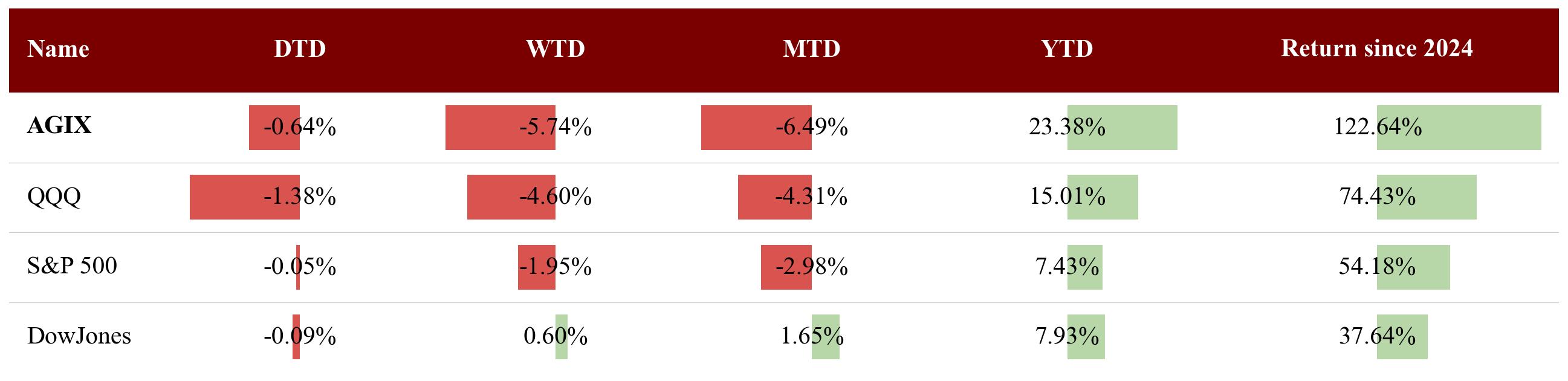
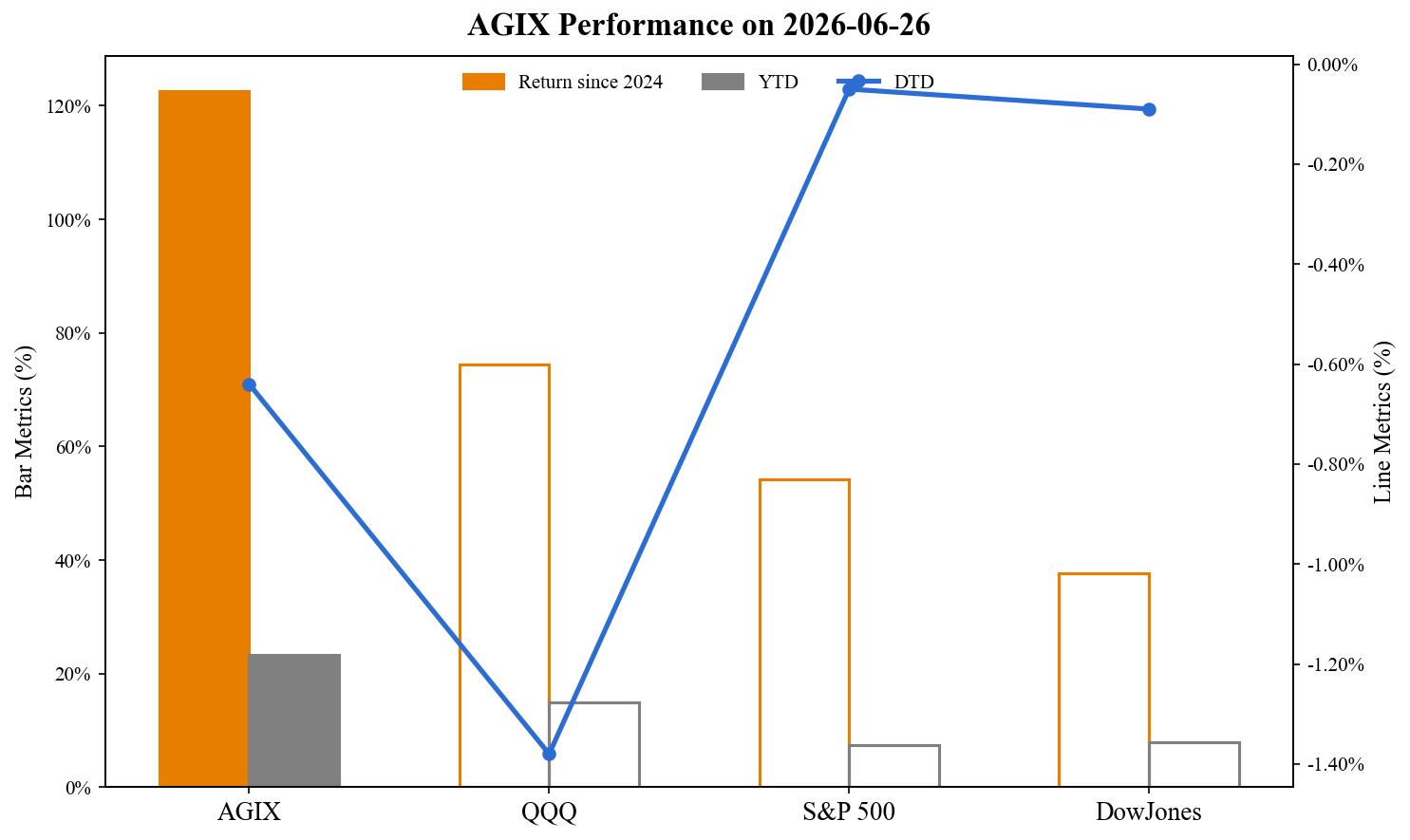
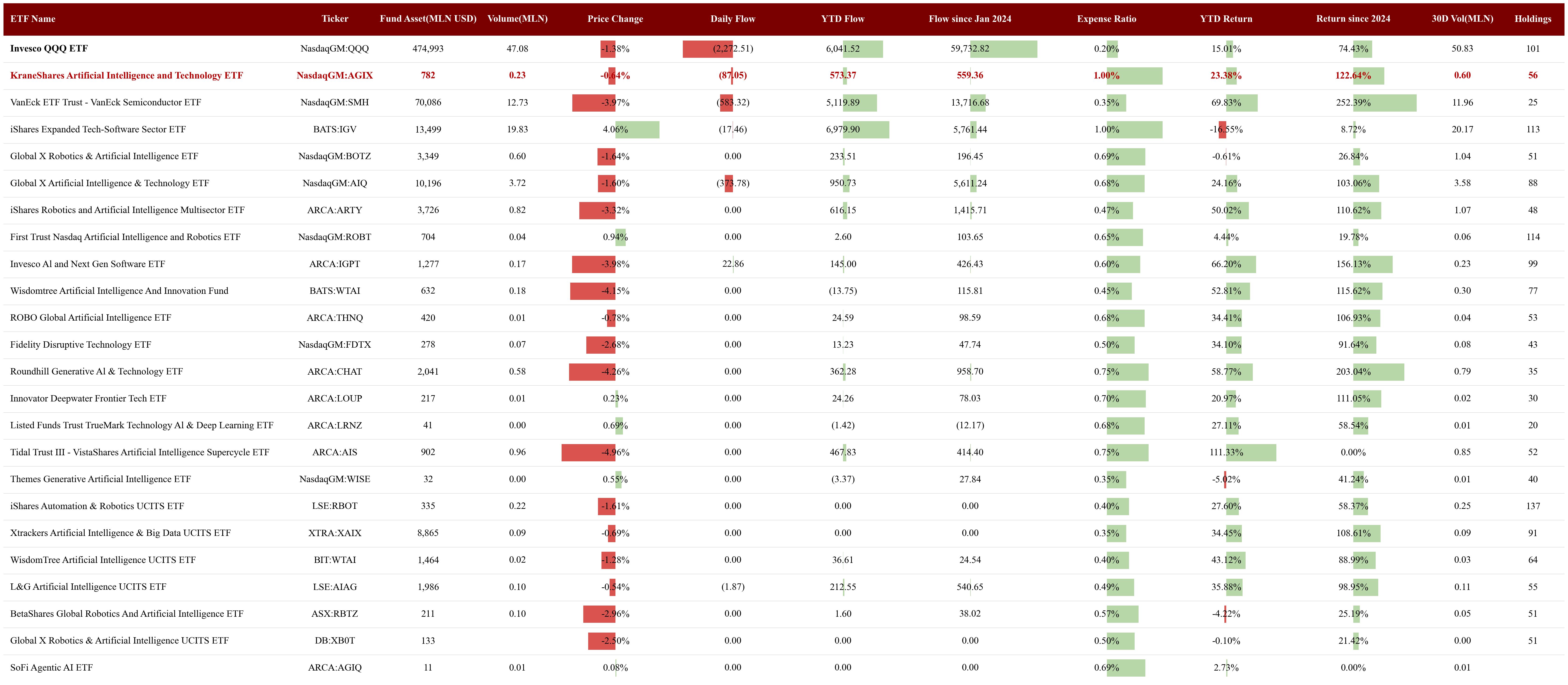
• AGIX fell 0.64% DTD, outperforming the broader tech sell-off (QQQ -1.38%) but lagging the S&P 500 (-0.05%) and Dow Jones (-0.09%). The peer ETF landscape was mixed, with SMH (-3.97%) and IGPT (-3.98%) under pressure, while IGV (+4.06%) and ROBT (+0.94%) posted gains.
• Key AGIX holdings showing strong DTD moves include ServiceNow (NOW +9.85%, contributing +0.15% to AGIX), Snowflake (SNOW +9.65%, contributing +0.24%), Datadog (DDOG +8.52%, contributing +0.16%), and Microsoft (MSFT +5.71%, contributing +0.19%). These stocks rebounded on positive analyst actions, AI-driven growth narratives, and technical dip-buying.
• On the hardware side, major headwinds came from memory and semiconductor names: SK hynix (-8.36%), Texas Instruments (-8.46%), MediaTek (-9.98%), and Micron (-6.69%) all fell sharply, dragging AGIX's hardware exposure. Micron's drop came despite a strong earnings beat, as profit-taking and sector rotation weighed.
• Stocks to watch: ServiceNow (NOW) and Snowflake (SNOW) — both surged on AI/data-platform momentum and are key AGIX holdings. Microsoft (MSFT) rebounded from its 200-day moving average. Apple (AAPL +3.14%) remains in focus due to price hikes tied to memory costs, while Micron (MU) is a bellwether for the memory cycle.
News Highlights
1. Memory-driven price hikes: Apple and Microsoft raised prices on Macs, iPads, and Xbox consoles, citing surging DRAM/NAND costs from AI server demand. Micron's record earnings (gross margin 86%) confirm the pricing power shift. Implication: hardware margins may be squeezed, but memory suppliers like Micron and SK hynix benefit; consumer electronics stocks may see demand headwinds.
2. OpenAI's GPT-5.6 rollout is being staggered for U.S. government vetting, with IPO plans pushed to 2027. The flagship 'Sol' model outperforms Anthropic's Claude Mythos 5 on benchmarks. Implication: increased regulatory oversight may slow frontier model releases, benefiting established cloud and AI infrastructure players like Microsoft and Snowflake.
3. The White House released Anthropic's Claude Mythos 5 to over 100 U.S. institutions, easing a prior ban. This signals a balanced approach to AI safety vs. national security. Implication: positive for AI adoption in enterprise and government, supporting holdings like Palantir and ServiceNow.
4. Onsemi acquired Synaptics in a $7B all-stock deal to push into physical AI (edge computing). Onsemi fell 8% after hours. Implication: consolidation in analog and edge AI chips continues; AGIX's hardware holdings (NVDA, AMD) may see long-term demand from edge AI, but near-term M&A volatility is a risk.
5. Multiple AI agent startups raised large rounds: Scaled Cognition ($100M), Sail Research ($80M), and Patronus AI ($50M). Implication: the AI agent ecosystem is attracting heavy investment, which could drive demand for cloud infrastructure (DDOG, SNOW, MSFT) and cybersecurity (ZS, CRWD) in AGIX.
RSS Highlights
1. Micron's executive Sumit Sadana told Tim Cook that past low memory pricing suppressed industry investment, leading to today's shortages. This reinforces the structural shift in memory pricing power.
2. OpenAI's GPT-5.6 limited preview is now live, with pricing at $5/$30 per million tokens (input/output) for the flagship Sol model. The phased rollout is at the U.S. government's request.
3. A security researcher found that 1 million passports were exposed on the public internet via a cannabis club app (PuffPal). Highlights ongoing data privacy risks in AI-connected applications.
4. A hypothetical incident report (CVE-2026-LGTM) humorously depicts two AI review agents arguing over a software package, costing $41,255 in inference fees. Illustrates the challenge of multi-agent AI security.
5. The Steam Machine review notes that while it's a compact PC gaming console, its performance is comparable to a 5.5-year-old PS5, and it still requires manual configuration. Not yet a mainstream product.
6. Apple is lobbying to buy memory chips from blacklisted Chinese company CXMT, drawing bipartisan opposition in Congress. Geopolitical risks in the memory supply chain remain elevated.
7. China's DeepSeek and Japan's Sakana AI are launching competitive models to fill gaps left by U.S. export controls on Anthropic's models. Asian AI startups are gaining traction.
8. An AI children's book review highlights homogenization and quality concerns, with 220 AI-generated books showing almost no content differentiation. Raises ethical questions about AI in creative fields.
Performance & Benchmark
Attribution
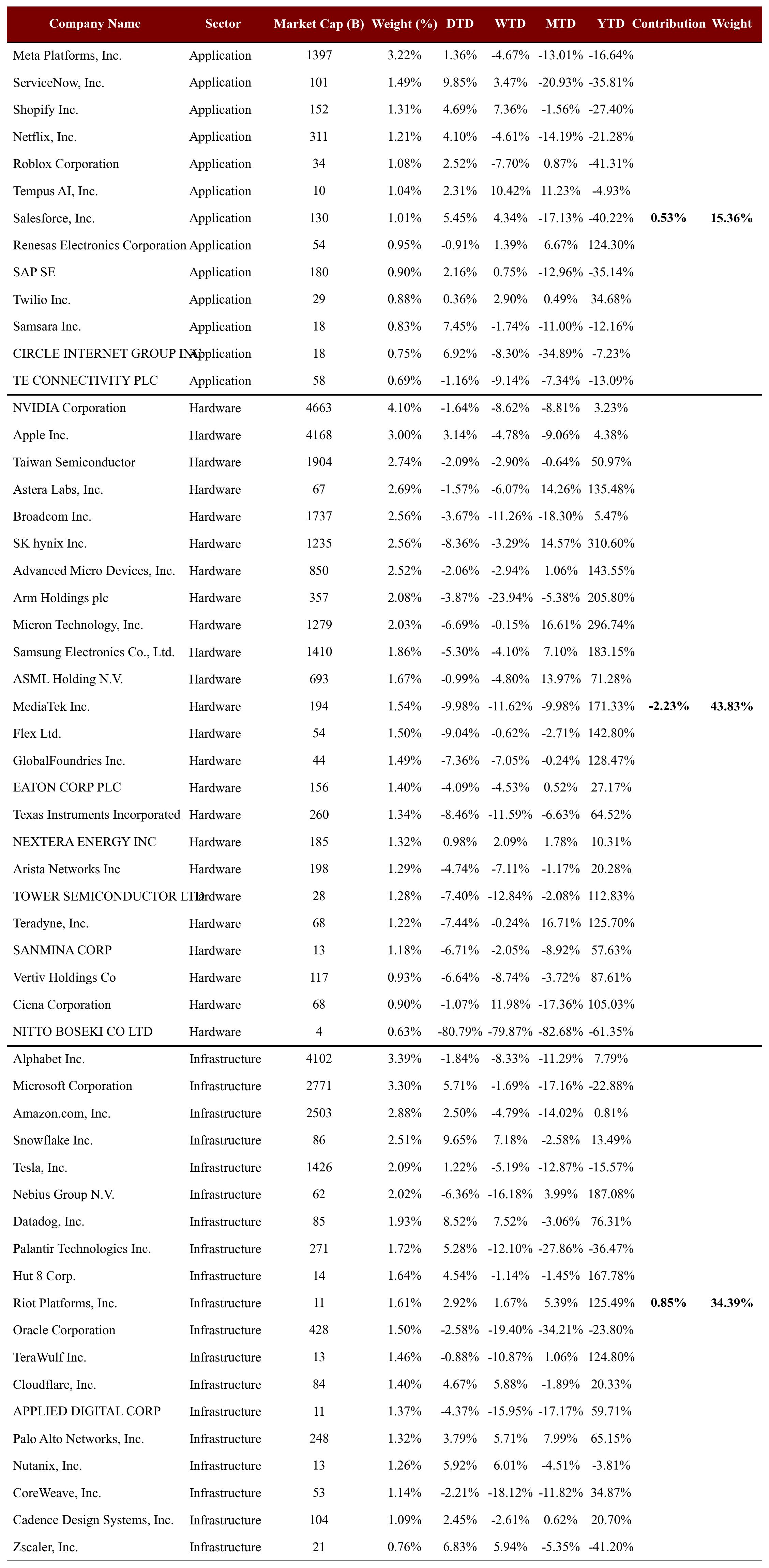
Contribution of the three sectors within AGIX holdings today
Application: 0.53%
Hardware: -2.23%
Infrastructure: 0.85%
Top-performing stocks in AGIX holdings today
ServiceNow, Inc. (9.85%)
Snowflake Inc. (9.65%)
Datadog, Inc. (8.52%)
Samsara Inc. (7.45%)
CIRCLE INTERNET GROUP INC (6.92%)
Zscaler, Inc. (6.83%)
Nutanix, Inc. (5.92%)
Microsoft Corporation (5.71%)
Salesforce, Inc. (5.45%)
Palantir Technologies Inc. (5.28%)
Shopify Inc. (4.69%)
Cloudflare, Inc. (4.67%)
Hut 8 Corp. (4.54%)
Netflix, Inc. (4.1%)
Palo Alto Networks, Inc. (3.79%)
Apple Inc. (3.14%)
Riot Platforms, Inc. (2.92%)
Roblox Corporation (2.52%)
Amazon.com, Inc. (2.5%)
Cadence Design Systems, Inc. (2.45%)
Tempus AI, Inc. (2.31%)
SAP SE (2.16%)
Worst-performing stocks in AGIX holdings today
Advanced Micro Devices, Inc. (-2.06%)
Taiwan Semiconductor Manufacturing Company Limited (-2.09%)
CoreWeave, Inc. (-2.21%)
Oracle Corporation (-2.58%)
Broadcom Inc. (-3.67%)
Arm Holdings plc (-3.87%)
EATON CORP PLC (-4.09%)
APPLIED DIGITAL CORP (-4.37%)
Arista Networks Inc (-4.74%)
Samsung Electronics Co., Ltd. (-5.3%)
Nebius Group N.V. (-6.36%)
Vertiv Holdings Co (-6.64%)
Micron Technology, Inc. (-6.69%)
SANMINA CORP (-6.71%)
GlobalFoundries Inc. (-7.36%)
TOWER SEMICONDUCTOR LTD (-7.4%)
Teradyne, Inc. (-7.44%)
SK hynix Inc. (-8.36%)
Texas Instruments Incorporated (-8.46%)
Flex Ltd. (-9.04%)
MediaTek Inc. (-9.98%)
NITTO BOSEKI CO LTD (-80.79%)
Top five listed stocks contributing the most within AGIX holdings today
NITTO BOSEKI CO LTD (-80.79%)
SK hynix Inc. (-8.36%)
MediaTek Inc. (-9.98%)
Micron Technology, Inc. (-6.69%)
Flex Ltd. (-9.04%)
Observation
The strongest movers across peer ETF holdings today are listed below:
| DTD | Stock Ticker | Name | Held by ETFs | analysis |
|---|---|---|---|---|
| 20.49 | NasdaqGM:DOMO | Domo, Inc. | ['LSE:RBOT'] | Domo’s 20.5% move on June 26, 2026 appears primarily driven by company-specific news flow around leadership change, with intraday commentary highlighting a sharp rally after reports of the CEO’s resignation and perceived potential for strategic reset and cost discipline. The move was amplified by the stock’s depressed starting level near the bottom of its 52-week range, creating a squeeze dynamic as investors and traders reacted to the possibility of operational improvements and renewed strategic focus. |
| 19.86 | XTRA:NA9 | Nagarro SE | ['LSE:RBOT'] | Nagarro SE’s 19.86% jump on 2026-06-26 appears to have been driven primarily by takeover-related news and the market repricing the company around the announced EUR 81.00 per-share cash offer, which was public on the same trading day. Bloomberg also showed a sharp intraday rise to 42.64 EUR from a 35.14 EUR prior close, consistent with a deal-driven move rather than normal trading noise.[3][7][10] A secondary support factor was the stock’s technical bounce from depressed levels after a weak prior trend, which likely amplified the reaction once the acquisition news hit the tape.[1][5] |
| 14.02 | NasdaqCM:SPT | Sprout Social, Inc. | ['BATS:IGV'] | Sprout Social’s 14.02% jump on 2026-06-26 appears to have been driven primarily by a sharp rebound in the stock itself, with the shares closing at $7.48 after trading as low as $6.53 intraday, suggesting a strong reversal from weakness rather than a clear company-specific same-day catalyst.[6] The move also likely reflected valuation/technical trading, as the stock remained a small-cap Nasdaq name with heavily depressed pricing and wide analyst target dispersion, which can amplify outsized percentage swings.[1][3][4] I did not find a verifiable same-day earnings release, guidance update, or major company disclosure in the provided results that clearly explains the rally.[5][6] |
| 13.97 | NYSE:GENI | Genius Sports Limited | ['ARCA:IGPT'] | Genius Sports’ 13.97% gain on June 26, 2026 appears primarily driven by technical and sentiment factors rather than specific fundamental news. The move followed a sharp rebound from mid-June weakness, with the stock closing at $6.20 versus $5.44 the prior day, continuing a broader June recovery off its April 52-week low.[8][2] First, short-term technicals turned supportive, with multiple buy signals (including MACD and short-term moving averages) flagging GENI as a bullish setup, likely attracting momentum and systematic traders.[6][4] Second, the stock is benefiting from increasingly constructive sell-side and retail sentiment around its growth profile and upside to analyst targets, providing a valuation and narrative backdrop that can amplify technical breakouts in the absence of company-specific news.[3][5] |
| 13.58 | NasdaqGS:INTA | Intapp, Inc. | ['BATS:IGV'] | INTA’s 13.58% jump on 2026-06-26 is most consistently explained by a sharp, high-volume re-rating into the close, with the stock finishing at $25.01 after opening at $22.32 and trading as high as $25.14.[6] The most concrete company-specific catalyst in the available public record is Intapp’s $200 million stock repurchase program, which would support the shares by signaling management confidence and adding a bid to the stock.[2] No same-day headline in the provided results clearly identifies an earnings or guidance surprise, so the move appears driven primarily by buyback support and momentum/technical trading rather than a fresh fundamental disclosure.[6][3] |
| 11.58 | NasdaqGS:CCCS | CCC Intelligent Solutions Holdings Inc. | ['BATS:IGV', 'NasdaqGM:AIQ', 'NasdaqGM:ROBT', 'BIT:WTAI'] | CCCS’s 11.6% move on June 26, 2026 appears primarily driven by technical and event-driven flows rather than company-specific news, with the broader Nasdaq down and small caps slightly up on the day. The most likely key driver is passive and quantitative demand around the June Russell index reconstitution, which materially increased closing cross volumes and amplified price moves in names near the cut. A secondary factor is mean-reversion/valuation buying after a period of underperformance and negative momentum highlighted in recent valuation commentary, as investors opportunistically added exposure to a beaten-down software name. |
| 11.2 | NasdaqGS:PRGS | Progress Software Corporation | ['BATS:IGV'] | Progress Software’s 11.2% move on 2026-06-26 was primarily a sharp rebound in the share price, with the stock closing at $33.15 after the prior close near $29.81, according to market data feeds. The most likely driver is broad single-name trading momentum rather than a clearly identified company-specific announcement, since the provided sources do not show a same-day earnings release or major disclosure. Analyst sentiment remained constructive around the period, with consensus/Buy-style ratings and upside targets cited by multiple data providers, which may have supported the move. |
| 11.14 | NasdaqGS:FROG | JFrog Ltd. | ['BATS:WTAI', 'ARCA:THNQ', 'XTRA:XAIX', 'LSE:AIAG'] | JFrog’s 11.14% jump on 2026-06-26 was most likely driven by its Russell 3000 inclusion becoming effective at the market close that day, which would have created index-fund buying and broadened passive ownership. The move was also supported by continued positive sentiment from its strong Q1 print earlier in May, including 26% revenue growth and raised FY26 guidance. Analyst target raises around the same period likely reinforced momentum, but the index reconstitution was the clearest same-day catalyst.[2][4][1] |
| 10.97 | NYSE:NABL | N-able, Inc. | ['BATS:IGV'] | N-able’s 10.97% gain on June 26, 2026 appears primarily technical, reflecting a rebound from near 52-week lows after recent post-earnings weakness rather than a discrete fundamental news catalyst that day.[3][4][8] The move was likely supported by value-oriented and tactical buying given the sharp year-to-date drawdown (stock down over 50% since the start of 2026) and sizable implied upside versus prevailing analyst targets and Buy/Hold consensus ratings.[5][6][8] |
| 10.57 | NYSE:FIG | Figma, Inc. | ['ARCA:LRNZ'] | Figma’s 10.6% gain on June 26, 2026 was primarily driven by its first-quarter 2026 earnings release, which highlighted solid revenue growth and renewed investor confidence in the business trajectory. The move was reinforced by ongoing Wall Street coverage and debate around valuation, with FIG trading near its 52-week low despite long-term growth narratives, attracting buyers on perceived dislocation. A secondary catalyst was investor attention around Figma’s Config 2026 presentation, which showcased product roadmap and ecosystem expansion, supporting the growth story. |
| 10.34 | NYSE:GWRE | Guidewire Software, Inc. | ['BATS:IGV'] | GWRE’s 10.34% jump on 2026-06-26 was most likely driven by its fiscal Q3 earnings beat and raised FY26 revenue guidance, which signaled stronger execution and better cloud adoption momentum than expected.[1][4] The company also reported ARR growth, improving subscription revenue, and new cloud wins, which reinforced the growth story.[1] A secondary factor was the stock’s sharp prior decline from early-June highs, which likely amplified the rebound as investors repriced the name after the update.[1][4] |
| 10.33 | TSX:BB | BlackBerry Limited | ['BATS:IGV'] | BlackBerry’s 10.33% gain on June 26, 2026 appears primarily driven by ongoing post-earnings momentum and speculative buying rather than a discrete new fundamental catalyst that day. The stock had already surged nearly 20% on strong Q1 results and raised guidance, which improved sentiment around its software and cybersecurity transition and attracted momentum traders and retail interest in the weeks leading up to June 26. Secondary drivers likely include technical factors, with BB trading in an overbought, high-volatility pattern that has become a focus for short-term traders, amplifying upside moves. |
| 10.13 | NasdaqGS:TENB | Tenable Holdings, Inc. | ['BATS:IGV', 'XTRA:XAIX'] | Tenable’s 10.13% jump on June 26 appears to have been driven primarily by a sharp technical breakout and momentum buying rather than a company-specific announcement, with the stock moving above recent trading ranges on strong volume. The move also fits a broader positive setup for the name, as market pages show bullish analyst sentiment and the shares had been trading near the top of their recent range. I did not find a clearly identifiable same-day earnings, guidance, or major disclosure catalyst in the provided results. |
| 9.97 | NasdaqGS:BLKB | Blackbaud, Inc. | ['BATS:IGV'] | Blackbaud’s nearly 10% gain on June 26, 2026 appears primarily driven by a rebound from a 52-week low as investors reacted to what is increasingly being viewed as an oversold valuation relative to fundamentals and analyst targets. The stock had just set a new 52-week low around $26.61 despite Q1 2026 revenue slightly beating expectations, reaffirmed full-year guidance, robust free cash flow, and an announced plan to repurchase 5–10% of shares outstanding in 2026, all of which support a more constructive outlook.[1][3] Additionally, the average Street price target in the mid‑$40s to $50 range versus a ~$29 close highlights substantial implied upside, likely attracting value and contrarian buyers on the day.[1][7][9] |
| 9.85 | NYSE:NOW | ServiceNow, Inc. | ['NasdaqGM:AGIX', 'BATS:IGV', 'NasdaqGM:AIQ', 'ARCA:ARTY', 'NasdaqGM:ROBT', 'BATS:WTAI', 'ARCA:THNQ', 'ARCA:CHAT', 'ARCA:LRNZ', 'LSE:RBOT', 'XTRA:XAIX', 'BIT:WTAI', 'LSE:AIAG'] | ServiceNow’s ~10% gain on June 26 appears primarily driven by a “buy‑the‑dip” rebound after a sharp post‑earnings selloff, with investors stepping in as the stock traded near multi‑month lows and well below prior analyst targets.[4][3] Stock commentary that day highlighted bargain hunting and renewed interest in high‑quality software names despite broader market weakness, with NOW rising even as the S&P 500 declined.[4][5] The move was amplified by short-term positioning and options dynamics, as the actual price swing (~9.9%) exceeded the contemporaneous implied move of about ±4–4.5% for nearby expiries.[1][6] |
| 9.65 | NYSE:SNOW | Snowflake Inc. | ['NasdaqGM:AGIX', 'NasdaqGM:AIQ', 'ARCA:ARTY', 'ARCA:IGPT', 'BATS:WTAI', 'ARCA:THNQ', 'ARCA:CHAT', 'ARCA:LOUP', 'ARCA:LRNZ', 'NasdaqGM:WISE', 'LSE:RBOT', 'XTRA:XAIX', 'LSE:AIAG'] | Snowflake’s 9.65% jump on June 26 was primarily driven by renewed bullish sentiment after news that Unlimitail chose Snowflake’s Data Clean Rooms to power a Global Retail Media Data Hub, which traders viewed as validation of Snowflake’s privacy-safe data collaboration platform. The move was also reinforced by momentum in the AI/data-platform trade, including ongoing attention on Snowflake’s competitive positioning versus Databricks and a technical breakout from a recent consolidation range. Insider selling was noted in the background, but it did not outweigh the positive catalyst and momentum flow. |
| 9.43 | NYSE:PCOR | Procore Technologies, Inc. | ['BATS:IGV', 'BATS:WTAI'] | Procore Technologies’ 9.4% gain on June 26, 2026 appears driven primarily by a rebound from recent underperformance, as investors added risk to beaten-down software names with strong long‑term growth narratives. PCOR has fallen roughly 38% over the past year and more than 40% year‑to‑date, yet still carries a “Moderate Buy” consensus and material upside to analyst targets, making it a candidate for mean‑reversion buying and short‑covering on a high-volume up day.[3][5] Secondary support comes from solid recently reported fundamentals (Q1 revenue +16% YoY, 84% non‑GAAP gross margin, 17% non‑GAAP operating margin), which reinforce the view that the selloff was driven more by sentiment and valuation than by deterioration in the business.[4] |
| 9.28 | NasdaqGM:FIVN | Five9, Inc. | ['BATS:IGV', 'ARCA:IGPT'] | Five9’s 9.3% move on June 26, 2026 appears driven primarily by continued positive reaction to its stronger-than-expected Q1 2026 results and guidance, which reinforced an earnings-driven recovery story. The company beat EPS estimates (Q1 EPS $0.76 vs. ~$0.70 consensus) and reported improving margins and cash flow, alongside solid subscription retention and AI-related growth initiatives, supporting a re-rating after prior weakness. Recent bullish analyst commentary, including Street-high upside targets tied to enterprise AI momentum and profitability, further underpinned sentiment and helped extend the post-earnings rally. |
| 9.18 | NasdaqGS:WDAY | Workday, Inc. | ['NasdaqGM:QQQ', 'BATS:IGV', 'NasdaqGM:AIQ', 'NasdaqGM:ROBT', 'NasdaqGM:FDTX', 'LSE:RBOT', 'BIT:WTAI'] | Workday’s 9.2% move on June 26, 2026 was primarily driven by a bullish sell-side catalyst, as Monness, Crespi, Hardt upgraded the stock to Buy with a $150 price target, triggering a sharp rerating in a volatile software tape.[4][6] The move also built on improving sentiment following Workday’s late-May earnings beat under the new CEO, which had already highlighted better-than-feared fundamentals and supported a recovery in the shares.[5] |
| 9.15 | NasdaqGS:TTAN | ServiceTitan, Inc. | ['LSE:RBOT'] | ServiceTitan’s 9.15% gain on June 26, 2026 appears primarily driven by ongoing follow-through from its early-June guidance raise and associated positive sentiment around improved profitability. On June 4, the company lifted full-year adjusted operating income guidance above both prior company forecasts and Street consensus, triggering a 12% move and establishing a bullish narrative that traders have continued to reward in subsequent sessions as the stock rebounds from a weak 12‑month performance.[5][6][7] |
| 9.08 | NYSE:ASAN | Asana, Inc. | ['BATS:IGV', 'LSE:RBOT', 'XTRA:XAIX'] | Asana’s 9.1% gain on June 26, 2026 appears driven primarily by follow-through buying after a recent earnings beat and improving profitability metrics that have shifted sentiment toward the name. MarketBeat highlighted that the company delivered better-than-expected EPS ($0.10 vs. $0.08) and 9.5% year-over-year revenue growth, alongside an upgraded price target and a strong-buy rating from at least one research outlet, helping underpin the move despite a consensus Hold rating. Secondary factors include options-market positioning skewed bullish into July and ongoing narrative around operating leverage and AI-focused strategy, which support a recovery bid in a stock trading near the low end of its 52-week range. |
| 8.92 | NYSE:HUBS | HubSpot, Inc. | ['BATS:IGV', 'ARCA:IGPT', 'BATS:WTAI', 'ARCA:THNQ', 'ARCA:LOUP', 'LSE:AIAG'] | HubSpot’s 8.9% gain on June 26 appears driven primarily by a rebound from deeply oversold levels and renewed focus on supportive analyst expectations, rather than a specific new company catalyst that day. The stock had fallen sharply in prior weeks despite solid fundamentals and now trades well below a consensus 12‑month target around $425, creating a wide valuation gap that likely attracted bargain hunters and momentum buyers.[1][4][5] A secondary driver is improving sentiment toward HUBS within the broader software/AI narrative, with recent analyst commentary highlighting continued revenue growth and AI‑driven product strength even as the shares sit near the low end of their 52‑week range.[1][2][6] |
| 8.92 | NasdaqGS:NCNO | nCino, Inc. | ['BATS:IGV', 'NasdaqGM:WISE'] | NCNO’s 8.9% gain on June 26, 2026 was primarily a continuation of a short-term breakout move, as the stock rallied from the mid-$14s to close at $15.63 on expanding volume and improving technical momentum.[4][7] The move was supported by increasingly constructive sell-side sentiment and price targets that imply substantial upside (consensus around $25–26 vs. $15.63 spot) and a broadly positive “moderate buy”/Buy rating profile.[4][6] A recent JPMorgan price target increase to $17 and ongoing institutional engagement highlighted in investor meeting commentary further reinforced the bull narrative around nCino’s fintech positioning and AI-enabled banking software platform.[2][3][6] |
| 8.84 | NasdaqGS:MNDY | monday.com Ltd. | ['NasdaqGM:FDTX', 'LSE:RBOT'] | Monday.com’s 8.84% gain on June 26, 2026 appears mainly as a continuation of positive momentum following its strong Q1 2026 earnings “beat and raise,” which featured 24% revenue growth, record operating income, and upbeat full-year guidance tied to its new AI Work Platform and consumption-based pricing strategy.[1][2] The move was further supported by a broadly positive sell-side backdrop, with multiple major Wall Street firms maintaining bullish ratings and raising or reiterating price targets in May, keeping investor sentiment constructive on the name.[1][6] |
| 8.84 | NYSE:FOUR | Shift4 Payments, Inc. | ['ARCA:LOUP'] | Shift4 Payments’ 8.84% move on June 26, 2026 appears primarily driven by a rebound from prior guidance-related weakness, as investors accumulated the stock near 52‑week lows after its sharp post‑EPS‑guidance selloff earlier in the month.[1][6] The move was likely supported by valuation and analyst positioning, with consensus 12‑month targets implying over 40% upside from the mid‑$40s trading level, encouraging buy‑the‑dip interest.[3][5] |
| 8.79 | NYSE:QTWO | Q2 Holdings, Inc. | ['BATS:IGV'] | Q2 Holdings’ 8.8% gain on June 26, 2026 appears primarily driven by technical and sentiment factors rather than a specific company news catalyst, as there is no material same-day news or disclosure identified for QTWO. The move coincides with the stock rebounding from recent weakness and trading in line with its Buy-rated analyst consensus and substantial implied upside to target prices, which can attract momentum and dip-buying flows. |
| 8.74 | NYSE:DV | DoubleVerify Holdings, Inc. | ['ARCA:IGPT'] | DoubleVerify’s 8.74% jump on June 26 appears to have been driven primarily by strong momentum and a sharp technical breakout, with the stock closing at $10.82 after opening at $9.96 and trading as high as $10.93 on heavy volume. A likely secondary catalyst was fresh bullish attention tied to product expansion around DV Authentic AdVantage, including coverage noting integrations with Meta, TikTok, and YouTube Audio Ads. There was no clear same-day company earnings or major regulatory announcement in the provided results, so the move looks more like a news-and-momentum re-rating than a fundamental surprise. |
| 8.52 | NasdaqGS:DDOG | Datadog, Inc. | ['NasdaqGM:QQQ', 'NasdaqGM:AGIX', 'BATS:IGV', 'NasdaqGM:AIQ', 'BATS:WTAI', 'ARCA:THNQ', 'NasdaqGM:FDTX', 'ARCA:LOUP', 'ARCA:LRNZ', 'LSE:AIAG'] | Datadog’s 8.5% move on June 26, 2026 was primarily driven by a wave of bullish sell-side actions centered on AI-driven growth in observability and security. Multiple firms including Truist, Citi, BMO, Needham, Scotiabank, Capital One and Arete raised price targets (with Truist upgrading to Buy and moving its target to $300, and Arete setting a high mark at $340), citing strengthening AI demand, agentic AI adoption and deeper ties to frontier AI labs, which collectively reinforced a strong Buy/Overweight narrative and re-rating momentum. A secondary driver was technical upside momentum, as the stock broke out from the low-$220s into the ~240 area on expanding ranges and likely higher volume, confirming an intermediate uptrend and attracting momentum-oriented buyers. |
| 8.4 | NYSE:VEEV | Veeva Systems Inc. | ['LSE:AIAG'] | Veeva Systems’ 8.4% gain on June 26, 2026 appears primarily driven by stock-specific buying interest following its recent inclusion in the S&P 500 and ongoing investor focus on its resilient fundamentals and long-term growth profile.[3][9] The index addition in May continues to support incremental passive and benchmark-driven demand, while recent research commentary highlighting upside to intrinsic value and strong recurring-revenue economics is reinforcing a recovery trade in a previously de-rated high-growth software name.[4][5][6] Broader tech volatility did not materially impede VEEV on the day, suggesting the move was largely idiosyncratic rather than macro-driven.[8][9] |
| 8.29 | NYSE:GLOB | Globant S.A. | ['LSE:RBOT'] | Globant’s 8.3% gain on June 26, 2026 appears primarily driven by follow-through buying and technical re-rating after a strong Q1 2026 earnings reaction earlier in the month, rather than by any new company-specific news that day. The stock had already surged double digits on its Q1 2026 print, where management highlighted resilient profitability, a new $125M buyback and AI-focused growth, and recent commentary and trading tools now flag it as a buy candidate with positive short- and medium-term technical signals, attracting momentum and value investors despite broader tech volatility. |
| 8.27 | NYSE:PSN | Parsons Corporation | ['LSE:RBOT'] | Parsons’ 8.27% move on June 26, 2026 appears primarily driven by a sharp rebound from recent 52-week lows and heavy multi-day selling, as investors reacted to perceived undervaluation and oversold technical conditions following a roughly 26–35% drawdown over the prior months.[3][4] Supporting this, Investing.com and other analyses highlighted fair value estimates materially above the prior trading range and noted oversold RSI levels, encouraging bargain-hunting and short-covering.[3][4] A secondary driver was positive sentiment around Parsons’ contract pipeline and long-term growth outlook in Federal Solutions and Critical Infrastructure, underpinned by a broad Buy consensus and mid- to high-teens EPS growth forecasts from covering analysts.[3][6] |
| 8.14 | NasdaqGS:MGNI | Magnite, Inc. | ['ARCA:IGPT', 'NasdaqGM:FDTX'] | Magnite’s 8.1% gain on June 26, 2026 appears primarily driven by continued momentum and investor optimism following strong Q1 2026 results, including mid‑single‑digit revenue growth and double‑digit contribution ex‑TAC growth, particularly in CTV, which has supported a broader recovery narrative for the stock.[1][2][3][7][8] A secondary driver is improving sentiment around Magnite’s strategic partnerships and product enhancements (e.g., SpringServe AI-powered mediation and CTV-focused deals), which reinforce the company’s positioning in programmatic CTV and may be contributing to multiple expansion and follow-through buying after recent price strength.[2][3][10] |
| 7.8 | NasdaqGS:MANH | Manhattan Associates, Inc. | ['BATS:IGV'] | Manhattan Associates’ 7.8% gain on June 26, 2026 appears primarily driven by a company-specific governance event: the announced retirement of long-tenured CFO Dennis Story, effective September 1, 2026, with internal successor Chris Arboleda named to the role.[7] This transition, framed as an orderly handoff after strong financial performance and long service, likely reduced perceived leadership risk and was interpreted positively by investors.[7] The move was reinforced by a generally constructive fundamental backdrop, including recent Q1 2026 results that topped revenue expectations and highlighted efficient customer acquisition and strong EBITDA, which supports a rebound in the shares following prior weakness.[3][6] |
| 7.72 | NasdaqGS:CRNC | Cerence Inc. | ['NasdaqGM:BOTZ', 'NasdaqGM:WISE', 'ASX:RBTZ', 'DB:XB0T'] | Cerence’s 7.72% move on June 26, 2026 appears primarily driven by a technical inflection rather than by new fundamental news. The stock rose above its 50-day moving average on June 26, marking a shift from a downward to an upward trend and confirming a previously formed bullish 50D/200D moving-average crossover from June 23, which likely triggered momentum and technical buying.[3] A secondary driver is the relief bounce from short-term oversold conditions highlighted by the Stochastic Oscillator, which had been in the oversold zone and pointed to an expected near-term price reaction.[3] |
| 7.67 | NYSE:DT | Dynatrace, Inc. | ['BATS:IGV', 'NasdaqGM:BOTZ', 'NasdaqGM:ROBT', 'BATS:WTAI', 'BIT:WTAI', 'ASX:RBTZ', 'DB:XB0T'] | Dynatrace’s 7.7% gain on June 26, 2026 appears primarily driven by a technical rebound and continued momentum rather than any new fundamental company-specific news. The stock broke above near-term resistance around the low-$40s on elevated volume of roughly 11 million shares, a sharp move versus recent averages, following a period of underperformance over the past year but improving multi-week relative strength.[5][7] Broader market factors and prior positive sentiment from earlier fiscal 2026 results and share repurchase activity likely provided a supportive backdrop but do not point to a discrete new catalyst on the day.[2][5][7][9] |
| 7.64 | NasdaqGM:RPD | Rapid7, Inc. | ['BATS:IGV', 'ARCA:THNQ', 'XTRA:XAIX', 'LSE:AIAG'] | Rapid7’s 7.6% gain on June 26, 2026 appears driven primarily by continued follow-through from its recent rebound off April’s 52-week low, as investors re-rated the stock toward consensus target prices after a prolonged drawdown.[1][2] Across major news and company channels, there were no material same-day company-specific announcements, earnings releases, or sector headlines, suggesting the move was largely a sentiment and positioning rally within a beaten-down cybersecurity name supported by modestly constructive analyst price targets and a neutral-to-hold rating backdrop.[1][2][3] |
| 7.5 | NasdaqGM:APPF | AppFolio, Inc. | ['BATS:IGV'] | AppFolio’s 7.5% move on June 26, 2026 was primarily a continuation of the positive reaction to its Q1 2026 earnings report, which showed solid revenue growth, expanding operating margins to about 19.4%, and improving balance sheet metrics despite a slight miss versus consensus on revenue and EPS.[2] The move was further supported by a constructive sell-side backdrop, with multiple buy ratings and an average price target materially above the current share price, reinforcing investor confidence in the company’s medium-term growth and profitability profile.[2][6] |
| 7.45 | NYSE:IOT | Samsara Inc. | ['NasdaqGM:AGIX', 'BATS:IGV', 'ARCA:IGPT', 'BATS:WTAI', 'ARCA:THNQ', 'ARCA:LRNZ', 'LSE:AIAG'] | Samsara’s 7.45% move on 2026-06-26 appears driven primarily by a broad rebound from the prior day’s weakness, with the stock opening at $29.11 and closing at $31.14 after being down 5.1% on June 25. The move also fits a positive technical reversal after the late-June pullback, with no same-day company-specific catalyst evident in the provided results. Supporting context is that the stock had recently been under pressure but recovered sharply into the close, consistent with short-covering and momentum trading. [3][7][6] |
| 7.42 | NasdaqGS:FRSH | Freshworks Inc. | ['BATS:IGV', 'ARCA:IGPT'] | Freshworks’ 7.42% jump on 2026-06-26 appears most directly tied to a positive analyst sentiment catalyst: Zacks upgraded FRSH to Rank 1 (Strong Buy), citing rising earnings estimates and an improved earnings outlook. A secondary support factor was Freshworks’ announced $400 million share repurchase authorization, which can boost investor confidence in capital returns and valuation support. Broader software-stock momentum may have helped, but the same-day move looks most driven by the upgrade and buyback news.[1][4][9] |
| 7.41 | NasdaqGS:BRZE | Braze, Inc. | ['BATS:IGV', 'ARCA:IGPT'] | Braze’s 7.4% gain on June 26, 2026 appears primarily technical, with the stock rebounding intraday from a premarket drop and closing near the session high on elevated volume and a short-term uptrend that began June 22.[1][6] Technical indicators flagged a bullish setup (price crossing above the 10-day SMA) and recent price/volume strength, which likely encouraged momentum and short-covering flows.[1] There was no evidence of company-specific news or fundamental disclosures that day, and the broader analyst backdrop remained supportive with a Buy/Strong Buy consensus and materially higher longer-term targets.[3] |
| 7.3 | NYSE:RNG | RingCentral, Inc. | ['BATS:IGV', 'XTRA:XAIX'] | RingCentral’s 7.3% gain on 2026-06-26 appears to have been driven mainly by a broad re-rating in the stock rather than a clear same-day company-specific catalyst, with the move taking the shares to $37.18 after closing at $34.65 the prior day.[7][9] The strongest visible support for the move is that RingCentral had recently been moving higher on upbeat earnings/outlook sentiment and was trading near its 52-week high, which likely kept momentum buyers engaged.[2][5] I did not find a verifiable RingCentral-specific news item on that date in the provided results, so sector/momentum trading is the most plausible explanation.[2][4][7] |
| 7.17 | NasdaqGS:PEGA | Pegasystems Inc. | ['BATS:IGV', 'NasdaqGM:BOTZ', 'NasdaqGM:AIQ', 'NasdaqGM:ROBT', 'ARCA:IGPT', 'BIT:WTAI', 'ASX:RBTZ', 'DB:XB0T'] | Pegasystems’ 7%+ gain on June 26 appears primarily driven by investors buying off the recent 52-week low and aligning with broadly positive analyst sentiment and substantial upside to consensus targets. Macrotrends and other price sources show the stock rebounding to around $30.8 after dipping below $29 earlier in the month, while multiple analysts maintain Buy/Outperform ratings with average targets near $58, implying significant perceived undervaluation and long-term AI-driven growth potential. |
| 7.17 | NYSE:DXC | DXC Technology Company | ['NasdaqGM:AIQ'] | DXC Technology’s ~7% move on June 26, 2026 appears primarily technical, driven by a rebound from recent weakness rather than by any identifiable company-specific news or disclosures that day. The stock rose from roughly $8.23 on June 25 to about $8.82 on June 26, extending a bounce within a deeply negative year-to-date trend where shares are down about 40% since January and near the low end of their 52-week range, suggesting short-covering and value-oriented buying as key drivers.[7][2][5] |
| 7.13 | NYSE:LLY | Eli Lilly and Company | ['ARCA:LRNZ'] | Eli Lilly’s ~7% gain on June 26 appears driven primarily by two favorable policy and regulatory developments that materially enhance its long-term growth narrative. First, the European Medicines Agency’s human medicines committee issued a positive opinion backing cancer drug Jaypirca for chronic lymphocytic leukemia, paving the way for EU-wide approval and expanding Lilly’s oncology revenue potential.[2] Second, Medicare announced its GLP-1 Bridge program starting July 1, 2026, which will include Lilly’s Zepbound and Foundayo weight-loss drugs at a $50 monthly copay, significantly broadening access and reinforcing consensus expectations for obesity-franchise upside.[2] Supporting this, Leerink Partners raised its price target to $1,232 on the same news flow, underscoring a strong buy-side and sell-side response to these catalysts.[2] |
| 7.11 | NYSE:DNA | Ginkgo Bioworks Holdings, Inc. | ['ARCA:THNQ', 'LSE:AIAG'] | Ginkgo Bioworks’ 7.1% gain on June 26, 2026 appears primarily driven by continued momentum and follow-through buying after its strong advance and higher close on June 24, when the stock rose nearly 10% on elevated volume and sector strength.[9][6] There is no evidence of company-specific news or fresh fundamental disclosures on June 26, so the move is best attributed to technical factors (recent breakout within its 52-week range) and broader interest in higher-beta biotech names rather than a discrete catalyst.[6][4] |
| 6.99 | NasdaqGS:APP | AppLovin Corporation | ['NasdaqGM:QQQ', 'BATS:IGV', 'NasdaqGM:AIQ', 'ARCA:LOUP'] | AppLovin’s 6.99% gain on June 26, 2026 was primarily driven by index inclusion flows after S&P Dow Jones Indices added APP to the S&P 500, triggering both passive buying and momentum interest; media coverage highlighted APP’s double‑digit spike alongside other new entrants, reinforcing the move. Secondarily, the stock continued to trade on the strong “beat-and-raise” Q1 narrative and AI ad‑tech growth story, with investors leaning into the AXON AI platform rollout and prior analyst target hikes as supportive fundamentals. |
| 6.97 | NasdaqGS:BIIB | Biogen Inc. | ['NasdaqGM:QQQ'] | Biogen’s 6.97% jump on June 26 appears to have been driven mainly by a broad continuation of momentum into a fresh 52-week high, rather than a single company-specific announcement; the stock also rose for a fifth straight session, suggesting strong technical and positioning support. MarketWatch noted the gain occurred during an otherwise weak market day, which points to relative-strength buying as the primary driver. Sentiment was likely reinforced by ongoing optimism around Biogen’s growth catalysts, including Leqembi, and by recent analyst upgrades, but no clearly dominant same-day news event is evident from the available reports.[1][5][4] |
| 6.94 | NasdaqGS:BL | BlackLine, Inc. | ['BATS:IGV', 'NasdaqGM:ROBT'] | BlackLine’s 6.94% move on June 26, 2026 appears driven primarily by technical factors and trading dynamics rather than discrete company-specific news. The stock advanced to $28.34 on elevated momentum after opening materially lower and trading near the top of its intraday range, consistent with a short-term rebound in a name that has sold off sharply over the past year and is viewed as having upside by various forecasting and technical services.[3][7][8] A secondary driver is improving sentiment around the name’s medium-term prospects, with external analyses and consensus forecasts highlighting solid expected earnings and revenue growth and a roughly neutral-to-positive analyst stance, which can support dip-buying interest on strong days.[1][2][6] |
| 6.92 | NYSE:CRCL | Circle Internet Group, Inc. | ['NasdaqGM:AGIX'] | Circle Internet Group’s 6.9% gain on June 26 was primarily driven by news of a planned FX settlement partnership with Nomura targeting Japanese corporate clients, which focuses on using USDC for yen conversions and cross-border payments and sparked strong optimism around expanded stablecoin adoption. Same-day commentary framed the Nomura deal as a clear new leg to the USDC growth story, drawing in momentum traders and pushing CRCL meaningfully higher intraday.[1][8] |
| 6.88 | NYSE:PINS | Pinterest, Inc. | ['ARCA:IGPT'] | Pinterest’s 6.9% gain on June 26, 2026 appears primarily driven by elevated trading activity and a rebound from recent weakness rather than a discrete company-specific news catalyst. The stock’s closing volume was roughly 5x its last-trade volume that day, indicating strong demand and likely short-covering or momentum buying into a relatively depressed year-to-date level.[9][6] A secondary driver is broader investor interest in growth names with solid forecasted earnings and revenue expansion, with Pinterest highlighted in contemporaneous analysis as having above-market expected earnings growth and meaningful insider ownership, which can support sentiment and flows into the name.[7][8] |
| 6.83 | NasdaqGS:ZS | Zscaler, Inc. | ['NasdaqGM:QQQ', 'NasdaqGM:AGIX', 'BATS:IGV', 'NasdaqGM:AIQ', 'ARCA:ARTY', 'BATS:WTAI', 'NasdaqGM:FDTX', 'ARCA:LRNZ', 'ARCA:AIS', 'XTRA:XAIX'] | Zscaler’s 6.83% gain on June 26, 2026 was likely driven mainly by analyst support and investor reaction to the company’s recent AI-security and product announcements around Zenith Live 2026. A second factor was a technical rebound after the stock had been heavily sold off since its May earnings report, with some coverage noting improved momentum and a move above key trading bands on June 26. A smaller contributor may have been pre-existing optimism from Wall Street price-target support, including KeyBanc’s June 25 note lowering but still maintaining a constructive view on the stock. |
| 6.77 | NasdaqGM:MDB | MongoDB, Inc. | ['ARCA:ARTY', 'NasdaqGM:ROBT', 'BATS:WTAI', 'ARCA:THNQ', 'ARCA:LRNZ', 'LSE:AIAG'] | MongoDB’s 6.8% gain on June 26, 2026 appears primarily driven by ongoing momentum and investor repositioning following its earlier June earnings beat and raised guidance, which highlighted strong AI-related demand and accelerating Atlas growth.[2][7] The stock closed at $314, remaining below its recent 52-week high, suggesting continued recovery and follow-through buying after March’s guidance-driven selloff and the sharp post-earnings rally earlier in the month.[1][2][4] A supportive broader narrative around software names leveraged to AI workloads also contributed, with recent media and investor commentary emphasizing MongoDB’s role as an AI-enabling data platform.[2][6][8] |
| 6.5 | NasdaqGM:APPN | Appian Corporation | ['BATS:IGV', 'NasdaqGM:BOTZ', 'NasdaqGM:ROBT', 'ASX:RBTZ', 'DB:XB0T'] | Appian’s 6.5% gain on June 26, 2026 appears primarily driven by idiosyncratic buying interest and technical factors rather than any specific company news or fundamental catalyst. The move notably bucked a broader tech selloff, with APPN rising while sector ETFs like XLK and the S&P 500 traded weak, suggesting targeted accumulation or short-covering in the name.[2] With no new Appian-specific press releases, earnings, or regulatory developments disclosed on or immediately before June 26,[10] and the CEO’s 10b5‑1 planned sale having occurred weeks earlier on June 8,[5] the rally is best characterized as a sentiment/flow-driven rebound within a low-code software name that had underperformed and was trading well below its 52-week high.[6] |
| 6.48 | NasdaqGS:DOCU | DocuSign, Inc. | ['BATS:IGV', 'ARCA:IGPT'] | DOCU’s 6.48% gain on 2026-06-26 appears to have been driven primarily by a broader rebound in growth/software shares rather than any company-specific announcement, as the overall market narrative that day was dominated by volatile tech trading and shifting AI sentiment. A second likely support was constructive analyst positioning around the name, with reported consensus price targets materially above the prior close, which can amplify upside on positive tape days. I did not find a same-day DocuSign-specific disclosure or news catalyst in the provided results. |
| 6.42 | TSX:LSPD | Lightspeed Commerce Inc. | ['BATS:IGV'] | Lightspeed’s 6.42% jump on 2026-06-26 appears to have been driven primarily by investor reaction to its upgraded fiscal 2026 revenue outlook and improving margin/cash-flow profile, with the market likely focusing on signs of better execution rather than the broad market move. The stock’s latest news flow also included the company’s fiscal 2026 year-end materials and AGM/equity-plan updates, which can reinforce confidence in capital allocation and operating discipline. No single same-day negative company event appears to explain the move, so style/positioning likely amplified the rally. |
| 6.41 | NYSE:BILL | BILL Holdings, Inc. | ['BATS:IGV'] | BILL’s 6.4% gain on June 26, 2026 appears primarily driven by technical and flow-related factors rather than new fundamental news, as there were no company-specific disclosures or major industry headlines that day. The move coincided with a noted intraday surge and strong closing-auction demand, with the stock “surging” ~5.8% and approaching key resistance after breaking a prior support level, which likely triggered momentum and short-covering activity.[5][10] A secondary driver is ongoing positive sentiment anchored in recent earnings and above-consensus FY26 guidance reported earlier in the quarter, which left the stock trading well below both analyst target prices and its 52-week high, providing a favorable risk-reward backdrop for dip buyers and growth investors.[1][4][7] |
| 6.35 | NYSE:S | SentinelOne, Inc. | ['BATS:IGV', 'ARCA:ARTY', 'NasdaqGM:ROBT', 'BATS:WTAI', 'ARCA:LRNZ', 'XTRA:XAIX', 'BIT:WTAI'] | SentinelOne rose 6.35% on June 26, 2026, and the move appears to have been driven primarily by technical and momentum buying rather than a clearly identifiable same-day company catalyst. The stock had been consolidating with rising volume and bullish short-term signals, which likely helped extend the rebound. I did not find a major SentinelOne-specific news item or earnings disclosure that directly explains the entire move on that date. |
| 6.25 | NasdaqGM:VERI | Veritone, Inc. | ['NasdaqGM:WISE'] | Veritone’s +6.25% move on June 26, 2026 was primarily driven by index-rebalancing flows tied to its confirmed inclusion in the Russell 2000 and Russell 3000, effective after the U.S. market close that day. The company had previously announced that FTSE Russell’s preliminary additions list included Veritone in the June 2026 reconstitution, with the change taking effect at the June 26 close, which typically triggers passive fund buying and elevated trading activity around the event. |
| 6.22 | NasdaqGS:DBX | Dropbox, Inc. | ['BATS:IGV', 'XTRA:XAIX'] | Dropbox’s 6.22% gain on June 26, 2026 appears primarily driven by company-specific news flow and positioning rather than a single discrete headline catalyst that day. The move extended a rebound from the prior close ($25.08 to $26.64) amid ongoing digestion of earlier announcements including a large stock repurchase authorization and new credit facility, which support EPS and signal confidence, alongside the previously disclosed CEO transition that has focused attention on capital allocation and strategic direction.[1][4][9] Broader sentiment toward reasonably valued, profitable software names with solid margins and buyback support likely amplified the single-day move as investors rotated into cash-generative tech.[1][10] |
| 6.2 | NYSE:KVYO | Klaviyo, Inc. | ['BATS:IGV'] | Klaviyo’s 6.2% gain on June 26 was primarily driven by Goldman Sachs initiating coverage with a Buy rating and a $26 price target, highlighting upside after the prior post‑earnings/CFO‑departure selloff and reinforcing a bullish long‑term growth and profitability narrative.[2][3] The move was amplified by a strong short‑term technical setup, with KVYO already in a 15%+ weekly uptrend and traders leaning into momentum above key support levels around $14.[1][2] |
| 6.19 | NYSE:PD | PagerDuty, Inc. | ['BATS:IGV', 'LSE:RBOT'] | PagerDuty’s 6.2% move on June 26, 2026 appears primarily driven by follow-through buying and momentum after recent positive catalysts, rather than any new company-specific news that day. The stock advanced on solid volume (3.0M shares) and closed at $9.09, with the company’s own IR tape highlighting the move but not disclosing any same-day events or filings.[8][10] Secondary drivers likely include improving sentiment given a Buy consensus and ~$12 price target from covering analysts, which frames the name as having upside from current levels.[3] Broader tech and software risk-on appetite may also have supported the move in the absence of new fundamental disclosures. |
| 6.15 | NYSE:ZETA | Zeta Global Holdings Corp. | ['BATS:IGV', 'NasdaqGM:WISE'] | Zeta Global’s 6.15% move on June 26, 2026 is best explained by bullish positioning into options expiry and a rebound within its established trading range, in line with the ±6.01% expected move for the weekly options expiring that day.[6][7] The stock closed at $18.98, near the top of the implied range and above recent lows, as investors added exposure ahead of anticipated growth catalysts around its Athena AI platform and broadly positive analyst sentiment and price targets.[1][2][4] |
| 6.14 | NYSE:BOX | Box, Inc. | ['BATS:IGV', 'ARCA:LOUP'] | BOX likely rose on June 26 because Box announced a $500 million expansion of its share repurchase program, a direct capital-return catalyst that typically supports the stock. The move was also reinforced by the company’s strong operating backdrop, including record fiscal 2026 revenue and solid growth in remaining performance obligations, which likely kept sentiment positive. Box’s recognition as a 2026 Gartner Magic Quadrant Leader may have added a smaller positive tone. |
| 6.09 | NasdaqGS:QLYS | Qualys, Inc. | ['BATS:IGV', 'XTRA:XAIX'] | Qualys rose 6.09% on June 26, but the available public sources do not show a specific company announcement or news catalyst that day to explain the move. The most likely drivers were technical and momentum-related: the stock had already been rising for several sessions, and market trackers noted unusually strong volume and a positive MACD signal on June 26. Broader tech-stock weakness that week also makes QLYS’s gain look like a relative-strength move rather than a company-specific fundamental re-rating. |
| 6.06 | NasdaqGS:GLBE | Global-E Online Ltd. | ['NasdaqGM:FDTX', 'ARCA:LOUP'] | Global-E Online’s 6.1% gain on June 26 appears driven primarily by stock-specific optimism against a weak broader tech tape. GLBE outperformed a declining Nasdaq and global tech sector, suggesting investors were leaning into its strong “Strong Buy” analyst consensus, double‑digit upside targets, and positive narrative around earnings growth, guidance, and the Passport acquisition rather than reacting to macro news.[1][2][6][7] The move was likely reinforced by technical factors, with the stock trading near the middle of its 52-week range and benefiting from positive momentum signals highlighted on trading platforms.[1][8] |
| 6.04 | NYSE:PATH | UiPath Inc. | ['BATS:IGV', 'NasdaqGM:BOTZ', 'NasdaqGM:AIQ', 'ARCA:ARTY', 'NasdaqGM:ROBT', 'NasdaqGM:WISE', 'LSE:RBOT', 'XTRA:XAIX', 'BIT:WTAI', 'ASX:RBTZ', 'DB:XB0T'] | UiPath’s 6.04% move on June 26 was driven primarily by positive investor reaction to its latest operating update: management raised FY27 revenue guidance to $1.776B–$1.781B and highlighted 17% revenue growth plus the first GAAP operating profit. The stock also benefited from continued enthusiasm around its AI automation strategy, including agentic AI/“Maestro” and customer deployment wins such as One NZ, which reinforced the growth narrative. A smaller tailwind was a favorable trading setup, with above-average volume and rotation into beaten-down software names. |
| 6.0 | NasdaqGM:TTD | The Trade Desk, Inc. | ['NasdaqGM:QQQ', 'NasdaqGM:AIQ', 'ARCA:IGPT'] | The Trade Desk’s 6% gain on June 26, 2026 appears primarily driven by a technical rebound and rotation back into higher‑beta growth/tech names after a period of underperformance, rather than by company‑specific news.[1][4] Benzinga highlighted that TTD was bouncing off near‑term support, reclaiming key moving averages, and attracting buyers as broader tech strength improved, even though no new fundamental catalysts or disclosures were evident on the day.[1] |
| 5.92 | NYSE:WK | Workiva Inc. | ['BATS:IGV'] | Workiva’s 5.9% gain on June 26, 2026 appears driven primarily by continued positive follow-through from its stronger‑than‑expected Q1 2026 earnings, where non‑GAAP EPS beat consensus by roughly 14–40% depending on the source cited.[3][5][8] The move also came as the stock sharply outperformed a largely flat tech sector and broader indices, suggesting incremental investor rotation into mission‑critical SaaS names with demonstrated earnings resilience and AI‑related relevance, as highlighted in recent commentary on Workiva’s positioning in an AI‑first world.[2][7] |
| 5.92 | NasdaqGS:NTNX | Nutanix, Inc. | ['NasdaqGM:AGIX', 'BATS:IGV', 'ARCA:THNQ', 'ARCA:LOUP', 'ARCA:AIS', 'XTRA:XAIX', 'LSE:AIAG'] | Nutanix’s 5.9% gain on June 26, 2026 appears driven primarily by technical and sentiment factors, as the stock rebounded from oversold levels with multiple momentum indicators (RSI, MACD) turning bullish and signaling exhaustion of prior selling pressure.[3][10] A secondary driver was supportive sell-side and valuation commentary highlighting ongoing analyst bullishness (average 12‑month target around $60, upside >20%) and framing recent weakness as timing-related rather than demand-driven.[3][5][10] A further underpinning comes from the backdrop of recently reported Q3 FY26 results that beat on revenue and EPS, reinforcing the fundamental story even as revisions have been mixed.[4][7][10] |
| 5.87 | NasdaqGS:CHKP | Check Point Software Technologies Ltd. | [] | Check Point Software’s 5.9% gain on June 26, 2026 appears primarily technical in nature, driven by a breakout above its upper Bollinger Band and a positive momentum inflection that attracted short-term traders. On that date, CHKP’s momentum indicator moved above zero and the stock broke above its upper Bollinger Band, signaling a new upward move and triggering follow-on buying interest. Broader cybersecurity demand and supportive sector sentiment likely provided a constructive backdrop, but there is no evidence of company-specific news or disclosures on the day acting as a fundamental catalyst. |
| 5.77 | TSX:DSG | The Descartes Systems Group Inc. | ['BATS:IGV'] | Descartes Systems Group’s 5.8% gain on June 26, 2026 appears primarily driven by investors re-rating the stock after strong recent fundamentals and growing recognition that the shares are undervalued. Simply Wall St highlighted earlier in June that DSG was trading roughly 27% below a DCF-based intrinsic value despite solid free cash flow and a still-attractive growth profile, reinforcing a value and quality-based buying narrative.[4][9] A secondary driver is broader sentiment that the stock’s pullback has overshot fundamentals, with Canadian equity commentary in January 2026 emphasizing its long-term track record, durable logistics moat, and discounted valuation relative to historical multiples, which likely supported dip-buying into weakness.[2][3] Macro tech volatility on the day was mixed, but with no company-specific negative news, the strong recent earnings and valuation support provided a backdrop for a catch-up move.[6][9] |
| 5.75 | NasdaqGS:GTLB | GitLab Inc. | ['BATS:IGV', 'BATS:WTAI', 'ARCA:LOUP'] | GitLab’s 5.8% gain on June 26, 2026 appears to be a continuation of a short-term rebound move rather than a reaction to a specific new company catalyst. The stock advanced on above-typical volatility against the backdrop of prior earnings-related expectations and options-implied moves around its June results, with no material GitLab-specific news or regulatory developments reported that day.[1][2][6] |
| 5.73 | NYSE:VYX | NCR Voyix Corporation | ['BATS:IGV'] | NCR Voyix’s 5.7% move appears primarily driven by ongoing investor recalibration to its post-spin-off profile and improving fundamentals rather than any discrete same-day news catalyst. The stock has recently completed the spin-off of NCR Atleos, reported better-than-expected Q1 2026 earnings, and is being promoted at investor conferences, supporting a rerating narrative as investors digest the new standalone structure and undervaluation thesis.[1][7][8][9] |
| 5.71 | NasdaqGS:MSFT | Microsoft Corporation | ['NasdaqGM:QQQ', 'NasdaqGM:AGIX', 'BATS:IGV', 'NasdaqGM:AIQ', 'ARCA:ARTY', 'NasdaqGM:ROBT', 'BATS:WTAI', 'ARCA:THNQ', 'NasdaqGM:FDTX', 'ARCA:CHAT', 'NasdaqGM:WISE', 'XTRA:XAIX', 'BIT:WTAI', 'LSE:AIAG'] | Microsoft’s 5.7% gain on June 26, 2026 appears primarily driven by a strong technical rebound and positioning rather than company-specific news. The stock reclaimed and bounced off its 200-day moving average after a prior earnings-related selloff, a level closely watched by institutional investors, which often catalyzes short covering and momentum buying.[3] Broader macro or tech tape was mixed rather than strongly supportive, reinforcing the view that this was mainly a technical and sentiment-driven move specific to recent MSFT weakness and its subsequent recovery.[3][8] |
| 5.7 | NYSE:NU | Nu Holdings Ltd. | ['ARCA:LOUP'] | Nu Holdings’ 5.7% gain on June 26 was most likely driven by the company’s newly announced US$1.0B share repurchase authorization, which signaled confidence in capital generation and supported the stock despite a tough backdrop.[1][2] A second driver was positive sentiment around continued customer growth, profitability, and leadership changes, including the appointment of a new Global CFO.[1][2] Offsetting that, several analyst downgrades and target cuts capped the move and likely kept the rally from being larger.[1][2] |
| 5.7 | NasdaqGS:WIX | Wix.com Ltd. | ['NasdaqGM:AIQ'] | Wix’s 5.7% rise on June 26 appears to have been driven mainly by a rebound after the prior May 13 selloff tied to a disappointing Q1 2026 report and guidance reset, with investors likely re-entering after the stock had already been sharply repriced. The move also fits a broader recovery in sentiment around Wix’s mid-teens revenue growth outlook and improving free-cash-flow narrative from the May earnings call, which highlighted continued momentum in core Wix and BASE44. No major same-day company-specific news appears in the provided results, so the gain looks more like a sentiment/mean-reversion move than a fresh catalyst. |
| 5.69 | NYSE:U | Unity Software Inc. | ['BATS:IGV', 'ARCA:IGPT'] | Unity Software’s 5.7% gain on June 26, 2026 was primarily driven by technical momentum as the stock broke above its 50-day moving average, a level that often triggers systematic and trend-following buying activity.[1] A secondary driver was broader investor repositioning into higher-beta, AI- and gaming-exposed names, with Unity’s AI-driven advertising unit (Vector) remaining a focal point of the bull narrative following earlier preliminary earnings commentary.[2] |
| 5.67 | NasdaqGS:SPSC | SPS Commerce, Inc. | ['BATS:IGV'] | SPS Commerce’s 5.7% gain on June 26, 2026 was primarily driven by company-specific earnings momentum and guidance updates rather than broad market factors. The stock continued to rebound following its Q1 2026 earnings beat (EPS $1.10 vs. $1.00 consensus) and commentary on strong demand for supply chain solutions, which has supported a year-to-date return materially above the S&P 500.[4][8] In addition, the move was aided by a favorable sentiment shift as recent selloff and activist-related sale exploration headlines left the stock trading near the bottom of its range, making it more sensitive to positive fundamental signals.[3][7] |
| 5.64 | NYSE:RDDT | Reddit, Inc. | ['ARCA:IGPT'] | Reddit’s 5.6% gain on June 26, 2026 appears primarily driven by continued follow-through on strong Q1 2026 fundamentals and growth narrative rather than a discrete new catalyst that day. Earlier in the month, reports highlighted Reddit’s 69% year-over-year revenue growth, 74% ad revenue growth, and high-margin, capital-light model, reinforcing a “high-growth, cash-rich” story that can attract momentum and growth investors into subsequent sessions[2]. The stock also closed at $166.94, near its 52-week high zone, suggesting technical strength and possible upside momentum as traders position around a well-owned “story stock” with tight float and significant retail interest[1][4]. |
| 5.63 | BOVESPA:TOTS3 | TOTVS S.A. | ['LSE:RBOT'] | TOTVS’ 5.63% rise on 2026-06-26 appears mainly driven by positive company-specific sentiment after Reuters reported TOTVS agreed to buy StoneCo’s Linx unit for 3.05 billion reais, a strategic deal that likely improved growth and consolidation expectations. The move was also consistent with the stock trading near the day’s high on the session, suggesting strong buying interest rather than a broad market catalyst. A secondary supportive factor is that the name was already carrying favorable analyst tone in market data, with strong buy consensus and upside estimates, which can amplify reactions to positive news.[5][1] |
| 5.62 | NasdaqGS:CSGP | CoStar Group, Inc. | ['NasdaqGM:QQQ', 'ARCA:THNQ', 'LSE:AIAG'] | CoStar Group’s 5.6% gain on June 26, 2026 appears primarily driven by value inflection after a prolonged drawdown to multi‑year lows, with investors responding to improving fundamentals and supportive sell-side narratives around upside to intrinsic value. Shares closed at $30.25, near levels highlighted in recent analysis that emphasizes doubled Q1 2026 EBITDA, raised full‑year guidance, and a 60% implied upside versus consensus targets, which likely reinforced dip‑buying and short‑covering interest at depressed prices.[1][2][5] |
| 5.57 | NasdaqGS:ACIW | ACI Worldwide, Inc. | ['BATS:IGV'] | ACI Worldwide’s 5.6% move on June 26, 2026 appears driven primarily by continued follow‑through on earlier positive fundamentals and valuation re‑rating rather than a discrete new catalyst that day. The stock closed at $49.26, near the top of its recent range and above fair‑value estimates from several research and data providers, as investors reacted to previously reported Q1 2026 results (8% revenue growth, 12% adjusted EBITDA growth, guidance raise, and buybacks) and broadly positive “Buy”‑leaning analyst views and upside targets. |
| 5.47 | NYSE:UBER | Uber Technologies, Inc. | ['NasdaqGM:AIQ', 'NasdaqGM:FDTX', 'ARCA:LOUP'] | Uber’s 5.47% gain on June 26, 2026 was primarily a rebound from near 52-week lows, with investors buying a broadly favored, still-“Buy”-rated name viewed as undervalued relative to long-term growth prospects. Same-day commentary highlighted Uber’s strong recent fundamental performance (record gross bookings and adjusted EBITDA) and high-profile investor support as reasons the stock remains attractive despite prior weakness, encouraging dip-buying and short-covering. |
| 5.45 | NYSE:CRM | Salesforce, Inc. | ['NasdaqGM:AGIX', 'BATS:IGV', 'NasdaqGM:AIQ', 'NasdaqGM:ROBT', 'BATS:WTAI', 'NasdaqGM:FDTX', 'ARCA:CHAT', 'NasdaqGM:WISE', 'XTRA:XAIX', 'BIT:WTAI'] | Salesforce’s 5.45% gain on June 26 appears driven primarily by technical and valuation dynamics rather than a specific company news catalyst that day. The move followed a period of broad software/AI-driven multiple compression, with CRM trading near the low end of its recent range and around perceived fair value, prompting incremental value and technical buying as shares rebounded from the ~$150 level.[1][3][5][7] A secondary driver was improving sentiment around the stock’s medium-term setup, with commentary highlighting a bullish multi-timeframe moving-average crossover and defended support near $225 on longer-term charts, which framed CRM as a rebound candidate for 2026 and likely attracted momentum and dip-buying flows into the recent selloff.[1] |
| 5.44 | NasdaqGS:TEAM | Atlassian Corporation | ['NasdaqGM:QQQ', 'BATS:IGV', 'NasdaqGM:FDTX', 'ARCA:LOUP', 'XTRA:XAIX'] | Atlassian’s 5.4% gain on June 26, 2026 appears primarily driven by a technical rebound after the prior day’s sharp 8% selloff, rather than by any new company‑specific news or guidance changes. The move retraced part of the June 25 decline that had been attributed to a broader software/AI risk-off move rather than fundamentals, and occurred against an options market implying elevated short-term volatility, which likely amplified the bounce-back in the stock price.[2][1][3] |
| 5.39 | NYSE:TDC | Teradata Corporation | ['BATS:IGV', 'NasdaqGM:AIQ', 'ARCA:IGPT', 'LSE:RBOT'] | Teradata’s 5.39% gain on June 26, 2026 appears primarily driven by momentum and technical factors rather than any discrete company-specific news, as there were no new filings, press releases, or major headlines that day. The move extended a multi-day uptrend, with the stock breaking toward its 52-week high on very elevated volume of 16.3 million shares versus typical levels, suggesting short-covering and trend-following flows as key contributors to the single-day move. |
| 5.39 | NasdaqGS:RXRX | Recursion Pharmaceuticals, Inc. | ['NasdaqGM:ROBT', 'BATS:WTAI', 'BIT:WTAI'] | Recursion Pharmaceuticals’ 5.4% gain on June 26, 2026 appears primarily driven by technical and sentiment factors rather than discrete company-specific news. The move came as the stock continued to rebound off recent lows near the bottom of its 52‑week range, with oversold technical readings and prior commentary highlighting potential upside toward analyst targets around $7 encouraging dip-buying and short-term trading interest.[4][6] Broader year-to-date outperformance versus the market and ongoing optimism around its AI-driven drug discovery platform and extended cash runway into 2028 likely supported the positive bias.[1][2][6] |
| 5.28 | NasdaqGS:PLTR | Palantir Technologies Inc. | ['NasdaqGM:QQQ', 'NasdaqGM:AGIX', 'BATS:IGV', 'NasdaqGM:AIQ', 'ARCA:ARTY', 'NasdaqGM:ROBT', 'BATS:WTAI', 'NasdaqGM:FDTX', 'ARCA:CHAT', 'NasdaqGM:WISE', 'XTRA:XAIX', 'BIT:WTAI'] | Palantir’s 5.28% gain on June 26 was likely driven mainly by short-covering after Michael Burry said he had reduced his short position, which removed a bearish overhang and triggered buying. A second catalyst was the announcement of a seven-year AI infrastructure partnership between Palantir and Zeta Global, which reinforced the company’s commercial AI growth narrative. The move also fit a technical bounce after recent weakness, with the stock described as oversold and staging a sharp rebound. [1] |
| 5.26 | NasdaqGS:HON | Honeywell International Inc. | ['NasdaqGM:QQQ'] | Honeywell’s 5.3% move on June 26, 2026 was driven primarily by investor positioning and price discovery ahead of the June 29 spin-off of Honeywell Aerospace and the concurrent 1-for-2 reverse stock split, which are expected to materially change Honeywell’s share count and create a new separately traded aerospace entity.[2][4][5] Secondarily, sentiment was supported by favorable analyst positioning around the aerospace business, including a buy-rated initiation and substantial upside target on Honeywell Aerospace ahead of its debut, which reinforced the value of the spin for existing HON shareholders.[3][8] |
| 5.25 | NYSE:SYK | Stryker Corporation | ['NasdaqGM:ROBT'] | Stryker’s 5.25% move on June 26, 2026 appears primarily driven by a technical rebound and valuation-driven buying interest after a multi-month drawdown tied to its Q1 2026 earnings miss and cyberattack disruption.[1][5][7] The stock had fallen roughly 10% over the prior month and nearly 20% over the past quarter, while consensus analyst sentiment remained strongly bullish with high price targets, making the pullback increasingly attractive to investors.[1][2] Broader support from favorable long-term medtech fundamentals and ongoing discussion of strategic moves (e.g., potential portfolio-enhancing acquisitions) likely reinforced the bid for the shares on the day.[2][3] |
| 5.22 | NasdaqGS:AVPT | AvePoint, Inc. | ['BATS:IGV'] | AvePoint’s 5.2% gain on June 26, 2026 appears primarily driven by follow‑through buying and elevated volume in the absence of new company‑specific news, as investors continue to re-rate the name on strong recent fundamentals and AI‑governance positioning. Same-day trading data show the stock up from a $10.41 open to an intraday high of $10.94 with volume roughly double its average, indicating momentum and liquidity-driven demand rather than a discrete catalyst. |
| 5.2 | NasdaqGS:AGYS | Agilysys, Inc. | ['BATS:IGV'] | Agilysys rose 5.2% on June 26, 2026, most likely because investors reacted to the company’s strong operating momentum and upbeat outlook, which recent coverage tied to record bookings, accelerating subscription revenue growth, AI product innovation, and robust fiscal 2027 guidance.[1][6] The move also fits a continuation of the stock’s positive near-term trend after multiple up days, with no specific negative company or sector news evident in the same-day results provided.[4][9] |
| 5.17 | NYSE:IBM | International Business Machines Corporation | ['NasdaqGM:AIQ', 'ARCA:ARTY', 'NasdaqGM:ROBT', 'BATS:WTAI', 'ARCA:THNQ', 'NasdaqGM:FDTX', 'XTRA:XAIX', 'BIT:WTAI', 'LSE:AIAG'] | IBM’s 5.17% jump on June 26 was driven primarily by the market’s positive reaction to IBM unveiling its 0.7-nanometer “NanoStack” semiconductor technology, which was widely framed as a major long-term AI and hardware breakthrough.[1][4] A second driver was bullish analyst commentary, including a J.P. Morgan upgrade to overweight, which reinforced the stock’s re-rating after the announcement.[1] The move also appears to have been amplified by sector strength and momentum buying in a stock that outperformed the broader software and IT services group that day.[1][7] |
| 5.15 | NasdaqGS:ALRM | Alarm.com Holdings, Inc. | ['BATS:IGV', 'XTRA:XAIX'] | Alarm.com’s 5.15% move on June 26, 2026 appears primarily driven by idiosyncratic buying interest rather than any specific company news or disclosure, with the stock simply re-rating higher during the session from a $44.29 open to a $46.34 close and no same-day headlines or filings identified. The move is broadly consistent with the name trading toward existing bullish sell-side and independent valuations and price targets, with consensus targets clustered above the mid‑$40s level, which can support incremental demand on quieter news days. |
| 5.1 | NasdaqGM:DJT | Trump Media & Technology Group Corp. | ['ARCA:IGPT'] | Trump Media & Technology Group’s 5.1% gain on June 26, 2026 appears primarily driven by a rebound from an all-time low and heavy selling pressure earlier in the week, as investors tactically bought the dip following steep year-to-date declines and a more than 6% drop on June 25.[6][9] The move was reinforced by elevated trading activity relative to typical volumes, suggesting short-term trading and speculative flows rather than any incremental company-specific news or fundamental catalyst on the day.[5][8] |
| 5.09 | NYSE:CXM | Sprinklr, Inc. | ['BATS:IGV'] | Sprinklr’s 5.1% gain on June 26, 2026 appears primarily driven by valuation and sentiment rather than any new company-specific news flow that day. The stock is trading near cycle lows with consensus price targets implying roughly 50%+ upside, which can attract bargain-hunting and “bottom fishing” interest amid improving longer-term narratives around the business and AI-related growth potential. Secondary support comes from a recent history of slightly better-than-expected results (Q1 FY26 revenue and EPS beats) that underpins confidence in the turnaround and provides fundamental backing for the move. |
| 5.08 | NYSE:TOST | Toast, Inc. | ['NasdaqGM:FDTX'] | Toast’s 5.1% gain on June 26 was primarily driven by index inclusion momentum following S&P Dow Jones Indices’ announcement late on June 25 that Toast will be added to the S&P MidCap 400, effective July 1, which typically spurs buying from index funds and momentum investors.[3][5] A secondary driver was technical strength, with the stock breaking higher within a consolidation trend and above short-term moving levels, attracting incremental trading interest.[1][8] |
News
Funding & M&A
Apple’s Macs and iPads and Microsoft’s Xbox consoles are getting more expensive — blame AI
Due to the massive demand for memory and storage chips driven by AI servers, the prices of DRAM and NAND chips have more than quadrupled over the past year. U.S. memory giant Micron Technology's latest financial report shows a gross margin of 86%, record revenue, and a stock price surge of over 16%. Affected by rising costs, Apple announced a 15% to 20% price increase for Mac and iPad models, with the MacBook Air rising by $200 to $1,299 and the MacBook Pro rising by $299 to $1,999. Microsoft also announced that Xbox console prices will increase by $100 to $150 starting July 1, and it will discontinue the 2TB version. Both companies pointed out that rising memory costs will continue to affect smart device prices, and consumers will pay the price for the AI boom.
Scaled Cognition nabs $100M to automate high stakes customer interactions
AI startup Scaled Cognition Inc. recently announced the completion of a $100 million Series A funding round, led by Khosla Ventures with participation from Genesys Telecommunications Laboratories Inc. This funding round values the company at $85 billion. Founded in 2022, the company provides enterprise customer service with a platform based on a custom AI model called APT, which retrieves existing records rather than generating new content to reduce hallucination risks and suit sensitive transaction scenarios. The platform also offers simulation testing tools, an AgentTwin automatic creation tool, and security protection modules. The funds will be used to accelerate R&D and commercialization, with future plans to expand into areas such as finance.
Patronus AI secures $50 million in funding to stress-test AI agents in simulated environments.
Fast-growing world model startup Patronus AI Inc. today closed a $50 million Series B funding round led by Greenfield Partners, with participation from Lightspeed Venture Partners, Notable Capital, Datadog, and Samsung Ventures, bringing its total funding to $70 million. The company was founded by former Meta AI researchers Anand Kannappan and Rebecca Qian, focusing on AI agent reliability infrastructure and world model building, helping developers test applications in simulated environments for finance, healthcare, and drone scenarios through reinforcement learning. Its revenue has grown 15-fold over the past year, and it has been adopted by several major AI labs. The company will continue to advance verifiable simulation environments in software engineering and finance to address the complex task challenges of autonomous agents in the real world.
Analog chipmaker Onsemi buys Synaptics in $7B all-stock deal to push into physical AI
U.S. chipmaker Onsemi announced it will acquire IoT and computer interface technology company Synaptics Inc. in a stock-for-stock transaction valued at approximately $1.35 billion, supporting its push into the 'physical AI' field. The deal will help Onsemi bring AI from cloud data centers to edge devices. Synaptics shareholders will receive 1.35 shares of Onsemi stock for each share they hold. Following the announcement, Onsemi's stock fell over 8% in after-hours trading, while Synaptics' stock rose 11%. Onsemi primarily produces analog chips for automotive and industrial use and is expanding its data center business. Synaptics is known for touch, fingerprint recognition, and voice technologies, and its founders include Federico Faggin and Carver Mead. Onsemi's CEO stated that the acquisition will enhance its software and connectivity capabilities, helping customers build intelligent systems that can perceive, decide, and act. The acquisition is expected to close by mid-2027 and significantly boost earnings per share within 18 months after completion.
FTC gives Musk the OK to acquire SpaceX alumni startup Mesh
The U.S. Federal Trade Commission (FTC) has accelerated its review of Trump's company's acquisition of Mesh Optical Technologies. The startup, founded last year by three former SpaceX engineers, specializes in optical communication hardware for high-speed data transmission in data centers. In February, Mesh Optical emerged from stealth mode and announced a $50 million Series A funding round led by Thrive Capital. Its core technology stems from its founders' experience developing optical communication links for Starlink satellites. The acquisition by Trump could improve the energy efficiency of ground-based data centers and provide technical support for future space-based data center deployments. Previously, Trump has signed contracts with Anthropic, Google, and Reflection AI to provide data center computing power.
Why Wall Street believes US memory chip maker Micron could be the next Nvidia.
U.S. memory chip maker Micron Technology, driven by AI data center construction, reported breakthrough revenue in its latest earnings. Third-quarter revenue reached $41.45 billion, nearly quadrupling year-over-year, while net profit surged to $28.2 billion. Due to strong demand for DRAM, NAND, and HBM products, its stock price briefly pushed its market cap past Meta and Tesla to $1.27 trillion. The company has signed multiple long-term supply agreements with Nvidia, Anthropic, and others, and provided Q4 revenue guidance of $49-51 billion. Analysts believe that supply-demand imbalances and long-term contracts will drive sustained revenue growth for Micron. However, questions remain about whether historical cyclical overcapacity expansion will reoccur.
SoftBank’s CEO isn’t the only one with questions about Elon Musk’s orbital data center hype
SoftBank founder Masayoshi Son questioned Elon Musk's orbital data center plan at the shareholders' meeting, arguing that it is too costly and has an overly long timeline to meet current AI computing demands. The TechCrunch Equity program discussed SoftBank's conservative stance, Groq's $650 million funding round, and OpenAI's in-house chip plans. The program also mentioned that SpaceX is commercializing its Starlink and computing resources, noting that statements from various stakeholders are not objective. As computing demand remains tight, multiple companies including SoftBank and SpaceX are exploring collaboration and financing opportunities to address the challenge of computing power shortages.
Apple Vision Pro exec is reportedly leaving for OpenAI
Apple's vice president in charge of the Vision Pro headset, Paul Meade, will leave the company to join OpenAI's hardware team. According to Bloomberg reporter Mark Gurman, Meade also led Apple's AI smart glasses project planned for next year. After poor sales of the Vision Pro, Apple is competing with Meta in the wearables market through cheaper smart glasses. This departure is seen as a result of new CEO John Ternus restructuring the hardware engineering team. Meanwhile, OpenAI is developing a new AI device in collaboration with former Apple chief design officer Jony Ive, which CEO Sam Altman says will be quieter and calmer. This reflects the competitive landscape among tech giants in the AI hardware space.
Model Releases
OpenAI introduces GPT-5.6 to challenge Claude Mythos 5
OpenAI Group PBC launched the GPT-5.6 series of large language models, featuring the flagship Sol and the mid-to-low-end Terra and Luna products. The new generation models add "max" and "ultra" dual modes, where ultra can parallelly invoke multiple sub-agents, significantly improving reasoning and coding efficiency. In the TerminalBench-2.1 test, Sol achieved a score of 88.8%, surpassing Anthropic PBC's Claude Mythos 5, and reached 91.9% after enabling ultra mode. Additionally, Sol achieved the performance of the previous flagship on GeneBench v1 with fewer tokens, while incorporating built-in safety guardrails and filtering mechanisms to effectively block malicious requests and cyberattacks. OpenAI also, at the request of the U.S. government, temporarily restricted the release scope of GPT-6.5, with full availability coming in a few weeks. Sol will first be deployed on Cerebras Systems Inc.'s WSE-3 wafer-scale AI chip, with pricing starting at $5 per million input tokens, balancing performance and cost efficiency, marking a new milestone in generative AI for safety and engineering applications.
Technical Breakthroughs
The fittest founder in the room got cancer. Here’s how he used AI to fight back.
Founder Conno Christou was diagnosed with a rare and aggressive form of non-Hodgkin lymphoma while building his second company, Keragon. He managed his health using wearables like Whoop and Oura and annual biomarker testing, but discovered a lump after exercise. After seeking multiple second opinions and consolidating advice from 12 specialists, he chose a more intensive chemotherapy regimen. During treatment, Christou used the AI tool Claude for data analysis, symptom tracking, and PET scan interpretation, accurately identifying a false positive in the psoas muscle area, thereby avoiding radiation therapy. His company Keragon is an AI platform that automates administrative tasks for healthcare institutions. He emphasizes the importance of persistently questioning system limitations and leveraging AI tools for decision support.
Asian AI startups launch Mythos-like models as Anthropic’s export ban drags on
Chinese cybersecurity company 360 recently released a new AI tool called Tulongfeng, claiming it can compete at the same level as Anthropic's Mythos. Meanwhile, Tokyo-based AI startup Sakana AI launched a cutting-edge model named Fugu, focusing on agent coordination capabilities and emphasizing that it can maintain frontier capabilities under U.S. export controls. With the Trump administration's export ban on Anthropic's Mythos and Fable 5, Asian companies are seeking alternatives. Sakana AI's Fugu is positioned as a multi-model collaboration "orchestration model" that reduces reliance on a single U.S. supplier. At the same time, 360's Yitianzhen tool automates cyber defense and incident response, elevating AI security capabilities to a national strategic level. The moves by these two Asian companies show that localized models are gradually filling market gaps under U.S. AI export controls.
Unconventional AI debuts oscillator-based Un-0 model series
Unconventional AI Inc. recently released the Un-1 series model based on a novel neural network architecture, aiming to significantly improve energy efficiency in image generation tasks. The company was founded by Naveen Rao, former vice president of Intel's AI Platform Group, and received $475 million in funding last December from a consortium including Amazon founder Jeff Bezos. The company is developing AI chips using non-standard silicon transistors, exploring novel computing components like oscillators to replace traditional GPUs. The Un-0 model has been trained on the CIFAR-10 and ImageNet-64 datasets, verifying that its generation quality is comparable to early mainstream methods. Industry insiders believe that such in-memory computing and quantum computing paths could significantly reduce AI energy consumption, driving the industry toward a more sustainable direction.
Product Launches
Govee's smart nugget ice maker makes every iced drink feel luxurious.
Govee recently launched the GoveeLife Smart Nugget Ice Maker Pro, a $500 smart ice maker that specializes in "premium nugget ice." It can produce soft, chewable ice in 6 minutes, with a daily output of up to 60 pounds and a 3.5-pound auto-refill ice basket. The product supports remote start/stop and real-time production monitoring via the GoveeHome App, and is compatible with Alexa and Google Assistant voice control. Built-in AI NoiseGuard technology keeps operating noise around 40 decibels, and it also offers customizable ambient lighting. Real-world tests show it produces ice faster than traditional refrigerators, and the ice melts more slowly, giving home beverages a café-quality feel. However, it is bulky and weighs 50 pounds, making it suitable for users with a strong preference for nugget ice, but offering limited value for average consumers.
Policy & Regulation
As OpenAI staggers the GPT-5.6 rollout for government vetting, it may delay its IPO to 2027.
The U.S. federal government has required OpenAI Group PBC to restrict the upcoming GPT-5.6 model to a limited number of partners rather than a global public release for national security review. This policy, driven by the Office of the National Cyber Director and the Office of Science and Technology Policy, is similar to the earlier emergency export control order that forced Anthropic's Mythos model offline. OpenAI CEO Sam Altman revealed in an internal meeting that the government will approve access on a customer-by-customer basis, with a broader release expected in weeks. This move marks increased Washington oversight of frontier AI models. Meanwhile, OpenAI has postponed its IPO plans to 2027 due to market volatility and cash outflows. Investor SoftBank's stock fell on the news. The incident reflects the growing influence of government on AI model release timing.
The White House is asking OpenAI to slow roll the release of its new model over safety concerns
OpenAI's upcoming new-generation model, GPT 5.6, will adopt a different release strategy than before, opening access only to a few close partners rather than a full public release. It is reported that this decision was influenced by the Trump administration, which will review customer access permissions on a case-by-case basis, involving agencies including the Office of the National Cyber Director and the Office of Science and Technology Policy. Previously, Trump signed an executive order requiring AI companies to voluntarily submit new models for government testing and evaluation. Meanwhile, Anthropic has also sparked controversy due to its frontier cybersecurity model Claude Mythos being restricted to specific partners, leading to industry discussions on the security risks of cutting-edge AI models and the necessity of regulation.
Trump Admin releases Anthropic Mythos to be used by more than 100 US companies, agencies
The U.S. Department of Commerce ordered a ban on two models after security researchers found that the safety guardrails of Claude Mythos 5 and Fable 5 could be easily bypassed. Two weeks after the ban, the Trump administration softened its stance, allowing Anthropic to make Mythos 5 available again to over 100 U.S. government agencies and companies, including non-U.S. employees of those organizations. Commerce Secretary Howard Lutnick noted that the relevant agencies have deployed appropriate safeguards. Anthropic stated on X that it is continuing negotiations with the government, hoping to gradually restore the broad release of Fable 5. This move shows that the U.S. remains cautious in balancing AI safety and national security.
OpenAI staggers GPT-5.6 rollout for government vetting, eyes 2027 IPO
The U.S. federal government has required OpenAI to first grant access to its upcoming GPT-5.6 model to a small number of partners rather than launching it directly to the public. According to reports, OpenAI CEO Sam Altman revealed in an internal Q&A session that this move is in response to a request from the Trump administration, aiming to allow federal agencies to review the model before its widespread release. Previously, Anthropic's Mythos model was also forcibly taken down by the U.S. government for national security reasons. This policy reflects the U.S. government's gradually tightening regulation of cutting-edge AI technology, and the timing of future model releases will be increasingly influenced by the government. Additionally, OpenAI is considering going public in 2027 to avoid current market volatility and prepare sufficient financial support. This move will affect the pace of global AI industry development.
Trump Admin releases Anthropic Mythos to be used by more than 100 US companies, agencies
U.S. Commerce Secretary Howard Lutnick recently sent a letter to Anthropic's Chief Computing Officer Tom Brown, granting permission for the company to once again provide the Mythos 5 model to over 100 U.S. government agencies and critical infrastructure enterprises, including non-U.S. employees of those organizations. Previously, after security researchers bypassed protective mechanisms, the Commerce Department temporarily banned Anthropic from publicly releasing Mythos 5 and Fable 5. Restrictions have now been somewhat relaxed, but Fable 5 is not included in this unblocking. Anthropic stated on X platform that it is in ongoing negotiations with the government, hoping to restore broader access as soon as possible. This incident highlights the complex relationship between AI safety and national infrastructure protection.
Don't give up control of your data in the quest for intelligence.
As AI shifts from experimentation to core dependency, organizations need to reconsider data sovereignty issues. ServiceNow recently launched the Context Engine product, which centralizes customer data in a unified layer and updates it in real time. However, if customers use their own AI agents outside the ecosystem, they may face additional consumption fees. Constellation Research points out that this design deepens user reliance on ServiceNow. The article emphasizes that context engineering is critical to AI accuracy and recommends that enterprises bring AI tools inside their data boundaries rather than exporting data. At the same time, AI outputs must be verified and validated before being embedded into knowledge bases to prevent the spread of hallucinated information, which could lead to model collapse. The author warns that if organizations become overly dependent on external cloud vendors, they will lose control over institutional knowledge, and the long-term cost will far outweigh any short-term savings.
Industry Partnerships
What to expect during RAISE Summit: Join theCUBE July 8-9
The field of artificial intelligence is shifting from a competition in model capabilities to an analysis of infrastructure deployment economics. Enterprise application modernization has become a core issue, with developer experience directly impacting business outcomes. Research by theCUBE Research shows that high-quality developer experience increases the probability of companies achieving their goals by 0.33. The RAISE Summit will be held on July 8-9 in Paris, focusing on application modernization and developer experience. Companies like Solidigm and Neo4j will share topics such as AI reasoning, sovereign AI infrastructure, and enterprise production readiness. Google's DORA research shows that 90% of developers already use AI tools. Vendors like Solidigm are restructuring storage architectures to support model inference. Unlike the training phase, the inference phase is driving a surge in demand for DRAM and NAND. The conference will explore how computing, storage, and orchestration are reshaping the AI technology stack.
Forget AGI. The real prize is enterprise AGI.
Senior analysts point out that cutting-edge AI model companies like Anthropic and OpenAI are still stuck on the path of concentrating intelligence into general-purpose models, while enterprise platforms such as Databricks and Microsoft are shifting toward building "Enterprise AGI." This architecture centers on a "System Intelligence Layer," using Genie Ontology to transform a company's proprietary data, business processes, and tacit knowledge into understandable governance assets, enabling agents to reason and execute actions within enterprise constraints. The article calls this model "Data Capitalism," contrasting it with the "Data Communism" promoted by frontier models. At the Data+AI Summit, Databricks launched Genie, Agent Bricks, and Unity AI Gateway, extending the data infrastructure upward into the business meaning layer and agent execution layer. Analysts believe that whoever owns the unique intelligent assets of an enterprise will gain a sustained competitive advantage in the AI era.
Writer Ian Bogost says 'The Small Stuff' can help us reclaim our lives from too much convenience
This article reveals a deep dialogue about technology and sensory experience. In his upcoming book "The Small Stuff," author Ian Bogost argues that convenience technology, automation, and the pursuit of scale are leading to the "dematerialization" of daily life—from manual transmission cars and airport restrooms to streaming services, sensory communication is gradually disappearing. He believes this change stems not only from tech companies but also from the combined forces of economics, regulations, and efficiency logic, and cannot simply be blamed on Google or tech giants. The book proposes a solution: re-recognizing the value of "small things" and seeking a balance between convenience and experience, rather than pursuing nostalgia or waiting for large-scale social change. Bogost emphasizes that ordinary people can find satisfaction through sensory experiences in daily life, and entrepreneurs should focus more on the experience process itself when designing products. This perspective offers a new angle for technology product development.
Early Bird pricing ends tonight for the TechCrunch Founder Summit.
TechCrunch will host a StrictlyVC event in Singapore on April 30, 2026, with tickets selling fast. Early bird tickets for Founder Summit 2026, which saves $190, will be available until June 26. The event will bring together over 1,000 founders and investors in Boston on November 4, focusing on practical topics such as fundraising strategies, market exit strategies, and growth milestones. The conference features breakout sessions and roundtable discussions with participation from top firms like Sequoia Capital and Greylock. Group ticket purchases can save up to 30%, and booth reservations are now open. The event aims to help founders quickly gain practical guidance, build key networks, and accelerate startup growth.
The head of Indian payments believes AI will play a major role in the next phase of digital payment growth.
India's Unified Payments Interface (UPI) now processes over 7.5 million transactions daily. NPCI CEO Dilip Asbe stated at Mumbai Tech Week 2026 that AI will be the core driver for the next half-billion user growth, fraud prevention, and credit allocation. NPCI is building an AI framework with the Reserve Bank of India and the government, supporting voice-based multilingual solutions to lower entry barriers. A commercial demonstration with Razorpay has already showcased AI's potential in payments, while the FIMI model has resolved disputes for over 1 million users. To prevent PhonePe and Google Pay from exceeding 80% market concentration, regulators plan to cap any single app's market share at 30% by December 31, 2026. Asbe called on banks and fintech companies to leverage rich datasets to build small language models, enhancing transaction security and user trust. This move aims to foster a more open and competitive digital financial ecosystem in India.
融资收购
AI prompts a memory-chip boom — and electronics inflation. Get used to it.
This week saw major events in the memory chip sector. Micron's earnings exceeded expectations and quadrupled revenue, with its stock rising nearly 16%; SK hynix filed for a U.S. IPO valued at $29.6 billion. AI chip competition intensified: OpenAI and Broadcom jointly launched the Jalapeño custom reasoning chip, Qualcomm released the Dragonfly data center chip portfolio, and Groq raised $650 million. IBM unveiled the world's first sub-1nm chip technology, and Applied Materials introduced more advanced 3D stacking process equipment. Onsemi acquired Synaptics in a $700 million stock deal. Multiple AI agent startups raised funds concurrently, with HelloTwin, Argentum AI, and others securing large investments. Google invested $75 million in film production company A24 to explore AI film tools. Major tech companies like Google and Adobe also had significant deals and collaborations. AI memory demand continues to drive up equipment costs, while chip manufacturing technology steadily advances.
Sail Research raises $80 million to optimize long-horizon AI agents.
AI reasoning startup Sail Research Inc. recently announced the completion of an $80 million funding round at a $450 million valuation. The round was led by Sequoia in its Series A, which secured most of the capital, while the early seed round was led by Kleiner Perkins. Intel CEO Patrick Gelsinger, Alphabet Chairman John Hennessy, Redpoint Ventures, and other notable investors also participated. The company offers a cloud platform based on an open-source reasoning engine that supports developers in running long-duration AI agent tasks at a cost of only one-tenth that of competitors. Its Sailbox virtual machine cluster enables multi-agent coordination and pauses while waiting for external data to reduce costs. On the BrowseComp-Plus benchmark, the platform achieved a new high score of 90.72% at low cost. The funding will be used to advance reasoning infrastructure.
Ford rehires experienced older engineers after AI falls short
Ford Motor Company recently adjusted its artificial intelligence strategy, bringing in 350 highly experienced senior engineers, some of whom are former employees or supplier personnel, to supplement the shortcomings of its automated quality system. The company's operations officer stated that previous over-reliance on AI led to quality issues, and now these "gray-haired" engineers are helping train younger staff and recalibrate AI tools. This move is expected to save $1 billion in costs this year and has achieved first place among mainstream brands in the J.D. Power Initial Quality Study. This action shows that automakers are seeking the optimal balance between artificial intelligence and human capital.
RSS Subscription
Quickly apply LUTs (color grading) with ffmpeg
Using ffmpeg to quickly apply LUTs (color grading) can simplify the workflow for processing Log video footage. With specific ffmpeg commands, you can apply LUTs to multiple MP4 files without needing complex professional software. The example command uses the "vivid" LUT for the DJI Osmo Pocket 4, suitable for H.265 encoding on Mac users.
My Om Malik Story
Om Malik passed away in 2021, and many people shared fond memories of him. The author recalls setting a writing goal in early 2021 and unexpectedly receiving a private message from Om Malik, thanking him for his blog and encouraging him to keep writing. Om's kind words left a deep impression on the author, reminding him that even in the vast online world, small acts of kindness can have a positive impact—this is the precious legacy Om Malik left behind.
No-One Escapes the Permanent Underclass
As artificial intelligence replaces most human white-collar jobs in the coming years, social mobility will disappear, creating a permanent underclass. Although some people may seek safety by accumulating wealth or joining large AI labs, eventually all humans, including the rich, will be replaced by machines and lose power. The government will become the sole center of power, responsible for maintaining economic activity and social order, but it too may face the risk of being marginalized.
China catches up
The United States' competitive strategy in the field of artificial intelligence may have fundamental flaws, leading to price wars and thin profit margins, casting doubt on the trillion-dollar IPO prospects of Anthropic and OpenAI. The current AI development model is inefficient, has high operational costs, and is easy to replicate, making long-term profitability difficult. Perhaps the US should rethink the goals of the AI race and instead focus on developing new types of AI more suited to science and medicine, rather than simply pursuing low prices.
Book Review: The Hotel Avocado by Bob Mortimer ★★☆☆☆
Although I once swore I would never read sequels to books I loved, I am still surprised by the law of regression to the mean. While I really enjoyed the first book in the series, the second one disappointed me—the once charming humor became overly forced, and the violent elements felt more pronounced.
The Laziest Generation
Young people today face difficulties buying homes, even though they are not stingy with daily expenses such as dining out and subscription services. Housing prices have soared, with the price of an ordinary home reaching millions of dollars. Young people need an annual income between 250,000 and 360,000 dollars to afford the monthly mortgage, which is nearly impossible. As housing prices continue to rise, future generations may face even more severe challenges in buying homes.
Brace expansion tree
A fun bash one-liner can generate 30 English words, including when, whence, where, and others. This code leverages brace expansion to showcase its powerful combinatorial capabilities.
When will the decimals in a/b repeat?
The previous article explored how many digits are in the simplified fraction of the nth harmonic number and sparked curiosity about the cycle of digits in harmonic numbers. The author mentioned that the period length of fraction digits was discussed nearly a decade ago and provided relevant code in the new article.
Height of harmonic numbers
The previous article discussed representing harmonic numbers as simplified fractions and estimating the number of digits in the numerator and denominator based on asymptotic analysis. This article will show a chart of the total digits of the numerator and denominator in base 2.
Reading List 06/27/26
Trump refused to sign the housing bill, even though it passed both houses of Congress with overwhelming votes of 358-32 and 85-5. He demanded that another bill be passed before he would sign it. Meanwhile, the cost of homeownership in the United States is rising faster than overall inflation, and major homebuilders' legal claim reserves have increased significantly. The U.S. infrastructure bill requires the use of American-made building materials, leading to a substantial increase in construction costs.
Pluralistic: Zuckerberg's increasingly bizarre war on whistleblowers (27 Jun 2026)
Mark Zuckerberg's crackdown on whistleblowers is becoming increasingly absurd, especially against Sarah Wynn-Williams, author of the book "Careless People," who exposed Facebook's serious misconduct, including its complicity in the genocide in Myanmar. Zuckerberg used contract terms to restrict her speech, demanding she pay over $11 million in damages, a move that has drawn widespread attention and criticism.
All logic, no bite
Logic is a system for deriving conclusions from premises (facts), typically not taught in high school, and most computer science degree programs do not require in-depth study of it. Mathematicians use formal logic to provide a more precise language for proofs, addressing ambiguities in everyday language. However, in logical reasoning, the truth of premises is crucial; false premises can lead to invalid conclusions. Although the expression of logic is simple and easy to understand, mathematicians often use symbolic notation to avoid ambiguity.
All Chinese Models Will Be Illegal in 3... 2... 1...
The Washington Post reports that the U.S. government will decide who can use advanced large language models (LLMs). Following the ban on Fable and restrictions on ChatGPT 5.6, a rise of Chinese models may emerge. DeepSeek shocked the AI world when it first launched in December 2024, with its open-weight model demonstrating capabilities comparable to OpenAI and Anthropic at a lower cost, potentially attracting users, while the U.S. government may pass legislation to restrict these competitors.
Writing down harmonic numbers
The nth harmonic number is the sum of the reciprocals of the first n positive integers, denoted as Hn = 1 + 1/2 + 1/3 + ... + 1/n. Its denominator is n!, and when expressed in reduced fraction form, the denominator is the least common multiple of 1 through n, approximately exp(n). For n=50, the fractional form of H50 is 13943237577224054960759 / 3099044504245996706400, with a 23-digit numerator and a 22-digit denominator; for n=1000, using Python, the numerator and denominator have 1448 and 1438 digits respectively, with estimates of 1445.4 and 1442.7.
Saying the obvious thing
Stating obvious facts, though simple, is extremely valuable. Many engineers find at work that some colleagues do almost no work, but due to a lack of discussion, they often feel confused. Clearly expressing these obvious points not only helps others clarify their thinking but also lays the foundation for deeper exploration of more complex topics.
Arp 38: not that peculiar
Data from June 20, 2026 indicates that Arp 38 is an edge-on spiral galaxy about 100" across. Although classified as a "low surface brightness companion," the companion does not appear to exist. Total exposure time was 2.7 hours, using a C9.25 telescope with an IMX533 camera for capture and processing.
The month Generative AI lost its mojo
There are rumors that Altman is worried about the slow progress of SpaceX's IPO, and OpenAI's advisors have also warned that retail investors may not be very enthusiastic about its stock. Additionally, questions have been raised about the soundness of OpenAI's financial situation. This delay reflects a lack of confidence and may affect other companies collaborating with OpenAI, such as SpaceX and Nvidia, whose stock prices have recently declined. Although some analysts point to rising revenue, the sustainability of profitability remains in doubt.
Premium: Notes From The Bubble, Volume 1
Recent developments in the tech industry have drawn attention. The author has launched a "Bubble Notes" series, exploring notable stories from the past few weeks and their impact on the tech ecosystem. Currently, the tech industry faces fears about the future of AI, and many companies such as Meta, Snap, and Microsoft are launching products and strategies amid competition that reveals chaos and uncertainty, reflecting deep-seated issues within the industry.
The next big breakthrough will be AIs learning on the job
Current research focuses on training artificial intelligence to complete millions of verifiable tasks in diverse reinforcement learning environments, with the goal of achieving artificial general intelligence (AGI). Although these models are only one millionth as sample-efficient as humans during training, as the scale of training increases, the models' intelligence, generality, and sample efficiency in conversations are steadily improving. To enable AI to master the various skills required by humans, especially in complex and dynamic environments, improving sample efficiency is crucial, as data in many fields is scarce and difficult to verify.
The case of the DLL that was not present in memory despite not being formally unloaded, part 2
Recent investigations have found that multiple crashes originated from a single byte 01 being incorrectly written into a data structure in memory, resulting in the generation of spurious data file module handles. During process destruction, the erroneous handle was passed to the FreeLibrary function, causing the DLL to fail to unload properly, which in turn led to crashes. Although all crashes are attributed to a single memory corruption bug, the root cause has not yet been determined and may be related to a specific program or operating system component.
Review: Gamrombo PS5 controller - including Linux setup ★★★★☆
I bought a fake PS5 controller called Gamrombo for less than £40. Although it lacks the microphone of the official controller, it has more features, including programmable macro buttons and LED lighting. The controller works well on Linux and Android devices, charges only via USB, and is compatible with the PS5. While it feels lighter and the button feel isn't as good as the official controller, it offers good value for money given the £30 savings.
Spyglass: A web browsing pioneer’s IPO
Spyglass was the first browser manufacturer to go public during the internet bubble, successfully conducting its initial public offering on June 27, 1995, issuing 2 million shares and raising $28.5 million. Spyglass licensed its Mosaic browser to about 120 companies, including Microsoft, which heavily used Spyglass's code in early versions of Internet Explorer. Because Microsoft bundled the browser for free with Windows, Spyglass's revenue was threatened, eventually reaching an $8 million settlement with Microsoft in 1997.
AI children's books, body horror edition
Recently, an author demonstrated the homogenization of AI-generated children's books, listing about 220 AI-created children's books and emphasizing that these books have almost no differences in content. Although future models may improve, the quality of these books is currently concerning, especially considering their impact on children's thinking. The author purchased a bestseller and noted that these books are often bought as gifts and are widely available in the market, potentially having a negative effect on children.
AI inference is obviously profitable
AI inference is clearly profitable, although some believe it requires investor subsidies to sustain. According to estimates, the cost of inference is about $1 per million output tokens, and some leading AI providers report gross margins as high as 70%-80% on inference. Despite companies like OpenAI and Anthropic making huge capital investments and bearing high training costs, the inference business itself remains profitable.
Quoting Jon Udell
Author Jon Udell expresses dissatisfaction with the phrase 'human in the loop,' arguing that it gives machines too much authority. He advocates viewing software development as a process that invites agents to participate, rather than a black-box operation that excludes humans.
Hack Your Summer
On June 28, 2026, Hack Your Summer is a 4-week intensive program designed to help undergraduates, graduate students, and recent graduates build real-world projects during the summer, addressing the internship crisis faced by American college students. The second (free) session starts on July 13, with an application deadline of July 8, and volunteers are also welcome to mentor students.
PuffPal, an app for accessing cannabis clubs, leaked 1 million users' passports.
Nearly one million passports and ID documents were left unprotected on the public internet, accessible to anyone. Security researcher Sammy Azdoufal discovered that many identity documents were stored on insecure public URLs, and the associated applications had serious security vulnerabilities. Although Nefos has begun taking steps to fix these issues and notify affected users, prior to that, users' personal information, including passport numbers and contact details, was at risk.
Examining circuit boards from the Space Shuttle's I/O Processor.
The space shuttle's five general-purpose computers played a critical role in every flight, controlling engines, monitoring sensors, displaying data to astronauts, and performing navigation. Each computer consisted of two 60-pound aluminum boxes: the right side housed a 32-bit CPU executing 420,000 instructions per second, and the left side housed an input/output processor (IOP) connecting the CPU to the shuttle's other systems, supporting 24 high-speed networks. The IOP used a multi-threaded architecture with 25 virtual processors, and its network interface page supported four network connections, each transmitting at 1 million bits per second.
★ Bernie Sanders: Ideologue and Economic Ignoramus
WorkOS launched auth.md, an open protocol for proxy registration. Bernie Sanders criticized Apple CEO Tim Cook on Twitter for claiming that Apple had to raise product prices by over $200 due to last year's $112 billion profit, calling the price increase unacceptable and questioning the company's $310 billion spent on stock buybacks. His views contradict basic economics and ignore that Apple actually spent $8.9 billion on stock buybacks and paid $15 billion in dividends last year. Sanders' argument shows a misunderstanding of fundamental economics.
Micron Executive Sumit Sadana Tells Tim Cook to Stop Hitting Himself
Apple announced a price increase the day after Micron Technology reported a strong quarterly earnings report, with Micron's gross margin exceeding 80% and its stock price rising 16%. Micron's chief commercial officer Sumit Sadana stated that past low pricing strategies had suppressed industry investment, implying that customers including Apple had failed to provide sufficient market support.
Working around dragons with the Lemote Yeeloong laptop and OpenBSD
This MIPS-family laptop is part of my unique collection, capable of running OpenBSD, and I hope to use this opportunity to learn OpenBSD. This device is the first 64-bit MIPS laptop from Floodgap Orbiting HQ, and the origin of its processor is quite interesting, stemming from China's 863 Program, which was launched in 1986 to promote national high-tech research and development, ultimately leading to the development of the Loongson CPU. The Loongson CPU first successfully booted Linux in 2001, marking a significant milestone for China in the field of microprocessors.
Apple faced bipartisan opposition when it last lobbied to buy Chinese RAM in 2022
Earlier this month, Apple publicly stated that it is considering purchasing NAND memory chips from China's state-owned enterprise Yangtze Memory Technologies Co., Ltd. (YMTC). U.S. Senators Mark Warner and Marco Rubio expressed concerns that cooperation with YMTC would harm U.S. national security and promote unfair trade practices by China, potentially threatening the semiconductor industry of the U.S. and its allies, affecting 24,000 American jobs related to memory chip production.
Microsoft raises Xbox prices, drops high-end storage model from lineup
Starting August 1, 2026, Xbox console prices will increase globally: the 512 GB model will rise by $100, the 1 TB model by $150, and the 2 TB model will be discontinued. Due to storage and memory prices more than doubling by a factor of 2.5, and expected to double again by fall 2027, the entire consumer electronics industry faces a component crisis. To improve Xbox console accessibility, Microsoft has introduced several new programs including installment payments, zero-interest financing, trade-ins, and certified refurbished consoles.
Grok is a generative porn app
xAI launched an upgraded video model last week, and while it has introduced external help in areas like coding to compete with rivals, it continues to advance its own vision projects. SpaceX promoted the popularity of its AI video tool ahead of its upcoming launch, but did not mention that Grok's lax content rules have made it a major platform for generating pornographic content, with an estimated over half of its traffic coming from adult content.
The curious case of the disappearing Polish S
The special characters of the Polish language have undergone decades of evolution in computer input, especially under the communist context of the 1980s, when Polish users faced the dilemma of being unable to import custom keyboards from the West. To accommodate the nine additional characters of Polish, users created a new input layout called the "programmer layout." Although this layout was not ideal to use, it became widely adopted due to its ease of understanding. Over time, this layout became the de facto standard for Polish computer users, and even though more suitable typewriter keyboards later appeared, almost no one was willing to switch back.
FT reports that Apple is lobbying to buy memory chips from blacklisted Chinese company CXMT.
Apple is lobbying the Trump administration to approve the purchase of memory chips from Chinese company CXMT, which is on the U.S. Department of Defense blacklist due to its alleged ties with the People's Liberation Army. Although Apple is not currently banned from buying chips from CXMT or another Chinese memory manufacturer YMTC, Congress may strongly oppose this, arguing that cooperation with the Chinese military poses a threat to U.S. national security.
OpenAI announces, but is blocked from releasing, new GPT-5.6 models.
OpenAI yesterday announced a limited preview of the GPT-5.6 series, including the flagship model Sol, the daily work balance model Terra (with performance comparable to GPT-5.5 but at half the cost), and the fast, economical model Luna. The Sol model is equipped with the strongest safety protections, with multiple enhancements for high-risk activities and sensitive requests. OpenAI plans to open these models to more users in the coming weeks, but for now they are limited to a few trusted partners, in a phased rollout at the request of the U.S. government.
White House grants access to Anthropic’s Mythos model to over 100 U.S. institutions; Fable remains shut down.
The U.S. government on Friday lifted restrictions on Anthropic's Claude Mythos 5 AI model, allowing the company to release the model to over 100 U.S. institutions, including major corporations and government agencies. This move marks a significant easing of tensions between the Trump administration and the world's most valuable private company, and also paves the way for a new partnership between Anthropic and the U.S. government on a regulatory framework for AI model releases.
The Steam Machine
The first-day experience with Steam Machine was disappointing. Although it costs $1,049 (without controller) or $1,128 (with controller), its performance is comparable to a PS5 from 5.5 years ago. As a PC gaming console, the Steam Machine excels in size, quietness, and ease of operation, but still requires manual game configuration and is not yet fully mature in gaming experience. While Valve promises continuous improvements, the current user experience is better suited for tech enthusiasts.
★ Om
WorkOS has launched auth.md, an open proxy registration protocol. Om Malik passed away from a heart attack two days ago at the age of 42. He had a profound impact on the tech journalism world, known for his sharp insights and genuine personality. Although he transitioned to being an investor in 2014, he continued to receive invitations to tech events like Apple's until his death. His writing and analysis remained excellent in the final stages of his career, reflecting his deep understanding and passion for technology.
Hazy Memory
This week, the memory crisis has made Macs and Steam Boxes hard to obtain. Micron's Chief Commercial Officer Sumit Sadana said that past low-price strategies suppressed capital investment, leading to a significant reduction in industry investment in 2023. Despite the challenges in the memory market, Apple is still trying to control its supply chain, but due to the complexity of RAM and storage, future negotiations will be more difficult, and consumers will be affected.
This Week in Package Management: 27 June 2026
The updates for the sixth week include version releases of several software packages. Spack 1.2.0 introduces a default parallel installer and adds SBOM generation and experimental build sandbox features. pnpm 11.9 improves tarball integrity calculation and supports storing checksums in lock files. Docker Engine 29.6.0 adds an API for fetching image attestation statements and fixes multiple security vulnerabilities. The Swift Package Index is collaborating with Apple to establish a package registry for the Swift community.
Quoting Dean W. Ball
The current state of the industry is concerning. Training frontier models is expensive, and it takes months after release to recover some costs, after which increased competition compresses profits. Additionally, former U.S. AI head David Sacks pointed out that AI infrastructure construction is crucial to the U.S. economy, but there is currently insufficient investment to support global market demand.
Quoting Timothy B. Lee
Timothy B. Lee points out that the view that large language models (LLMs) require no skill and have no learning curve is like thinking managers don't need a learning curve because employees will follow instructions exactly.
What happened after 2,000 people tried to hack my AI assistant
On June 26, 2026, Fernando Irarrázaval launched a challenge on hackmyclaw.com to test whether anyone could leak the secrets of his OpenClaw test instance by sending an email. Despite 6,000 attempts and spending $500 in tokens, no one succeeded in leaking the secrets, demonstrating the effectiveness of its Opus 4.6 model in preventing injection attacks. Nevertheless, it is still not recommended to deploy this model in production systems that may be subject to prompt injection attacks.
Incident Report: CVE-2026-LGTM
In a hypothetical incident, AI review agents from two competing suppliers argued over whether the software package foxhole-lz4 was malicious. After 340 comments and $41,255 in inference costs, the finance department revoked both parties' API keys. A cost anomaly alert triggered by the incident led one supplier's marketing team to issue a press release stating that 'adversarial multi-agent security reasoning' had increased 430% year-over-year, and the company's stock opened up 6%.
Quoting OpenAI
On June 26, 2026, we began a limited preview of the GPT-5.6 series, including the flagship model Sol, the daily work balance model Terra, and the fast economical model Luna. Terra's performance is comparable to GPT-5.5, but at half the price, while Luna delivers strong capabilities at the lowest cost. GPT-5.6 pricing per million tokens: Sol at $5 input / $30 output, Terra at $2.5 input / $15 output, and Luna at $1 input / $6 output. We plan to release these models to a wider audience in the coming weeks.
Apple’s Full Statement on Yesterday’s Price Increases
Apple today raised prices on multiple products, including all Macs and iPads, as well as Apple TV, HomePod, HomePod mini, and Vision Pro, with increases ranging from $30 to $1,300. Apple stated that the price hike is due to a memory chip shortage, primarily driven by the rapid expansion of AI data centers, which has caused RAM and SSD storage chip prices to soar. Although prices for iPhone, Apple Watch, and AirPods remain unchanged for now, Apple CEO Tim Cook has indicated that further increases may be coming.
The Price-Hiked Apple TV 4K Is 4 Years Old
Apple's latest display options include the 27-inch Studio Display starting at $1,599 and the Studio Display XDR starting at $3,299. Other product updates include a new HomePod with the S7 chip, a third-generation Apple TV 4K with the A15 chip, and updated iPad Air and iPad Pro starting at $599 and $999, respectively.
Incident Report: CVE-2026-LGTM
A security incident affected all systems for 96 hours, involving a bill of 2.1 trillion tokens. The malware passed through seven independent AI security gates and was finally resolved after the attacker's autonomous agent accessed files it should not have read. The root cause was a community-maintained package that was incorrectly marked as safe, leading to credential leakage.
Blink if you’re human
The author emphasizes that every word he publishes in his blog is personally written and will not be flagged as AI-generated content by AI detectors. He believes that while using AI for writing is not inherently wrong, he personally prefers manual writing because it aids thinking and understanding. He worries that blog content may gradually be replaced by AI-generated articles, thereby affecting readers' experience, and calls on authors to disclose their use of AI to maintain the integrity of writing.