AGIX Daily Report 2026-06-29
AI Summary
Market Overview
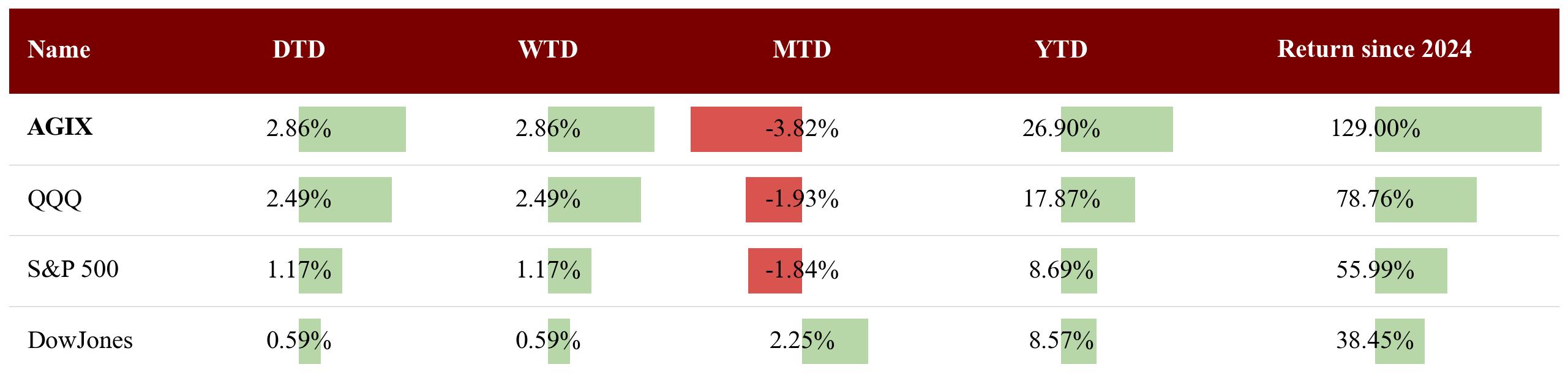
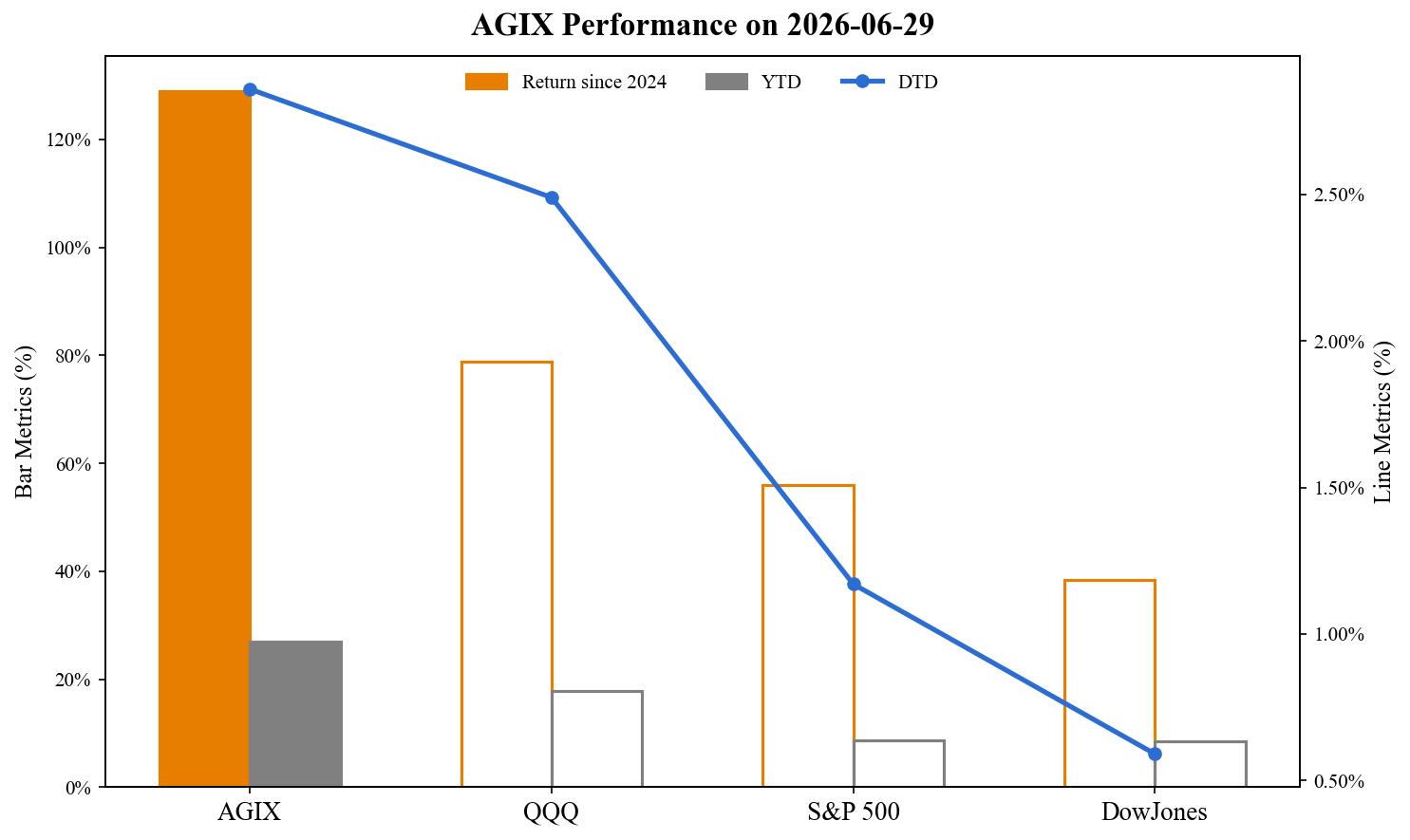
• AGIX outperformed the broader market today with a DTD return of 2.86%, surpassing the QQQ (2.49%), S&P 500 (1.17%), and Dow Jones (0.59%).
• Key drivers within the AGIX portfolio include strong gains from Astera Labs (+16.39%), Roblox (+14.26%), and Tesla (+8.46%), reflecting robust AI infrastructure momentum and positive analyst actions.
• The semiconductor and hardware sector showed strength, with NVIDIA (+1.27%), Broadcom (+2.04%), and AMD (+3.43%) contributing, while Samsung Electronics (-4.86%) and SK hynix (-1.68%) weighed on returns.
• AI infrastructure names were a bright spot: Alphabet (+4.82%), Amazon (+3.20%), and Nebius Group (+8.68%) rallied on continued AI data center demand and strategic announcements.
News Highlights
1. CoreWeave launched ARIA, an automated AI research agent on the Weights & Biases platform. This strategic expansion after the $1.4B acquisition positions CoreWeave (held by AGIX at 1.1%) to capitalize on the data interpretation bottleneck in AI development, likely supporting its valuation as a key AI infrastructure play.
2. South Korea's tech giants committed over $550B to new memory factories and AI data centers. Samsung and SK Hynix (both held by AGIX) are central to this plan, which aims to solidify supply chain advantages amid surging AI memory demand, potentially boosting long-term growth prospects.
3. Anthropic struck a deal with California Governor Newsom to provide Claude AI to state agencies at half price. This highlights growing government adoption of AI, benefiting the broader AI ecosystem and reinforcing demand for AI infrastructure and services.
4. Google's Gemini personalized image generation is now free for US users, signaling a push to democratize AI features. This move could increase user engagement and data generation, indirectly supporting AGIX holdings like Alphabet (3.47%) and other AI beneficiaries.
5. Straiker raised $64M to defend enterprise AI agents from attack, underscoring the critical need for AI security. This validates the cybersecurity theme and supports holdings like Palo Alto Networks (+9.14% today) and CrowdStrike (+5.96%), which are well-positioned in this space.
6. Cursor launched a mobile app for AI coding agents, reflecting a shift toward mobile monitoring in developer tools. This trend could boost productivity tool adoption and benefit companies like Microsoft (3.18%) and GitHub-related services.
7. Chinese robotics firms AI2 Robotics and X Square Robots each secured funding at ~$2.8B valuations. This signals strong investor interest in embodied AI and humanoid robotics, benefiting peers like NVIDIA (4.06%) and other AGIX hardware holdings involved in AI and robotics.
RSS Highlights
1. A former Tesla engineer raised $70M for foundational robot model infrastructure, highlighting continued investment in physical AI and robotics.
2. DeepReinforce released Ornith-1.0, an open-source self-scaffolding LLM for agentic coding, showing rapid progress in AI coding capabilities.
3. Om Malik, founder of Gigaom and influential Silicon Valley voice, passed away at 59, leaving a legacy of sharp tech commentary.
4. Auth.md, an open protocol for agent registration from WorkOS, enables secure agent identity without forms, supporting the growing AI agent ecosystem.
5. Google's search enshittification is driving users to AI summaries, reflecting a structural shift in how information is consumed online.
Performance & Benchmark
Attribution
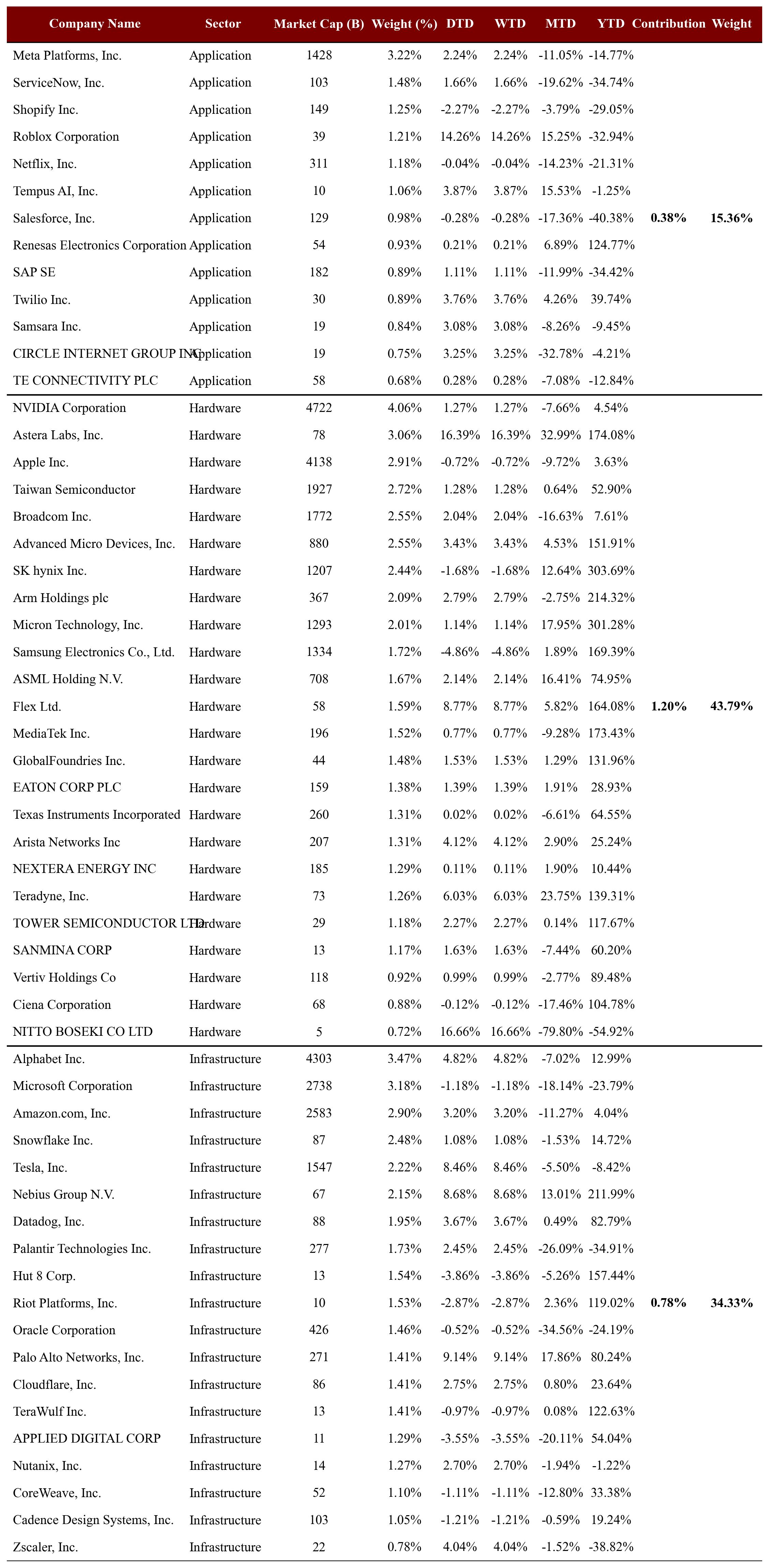
Contribution of the three sectors within AGIX holdings today
Application: 0.38%
Hardware: 1.2%
Infrastructure: 0.78%
Top-performing stocks in AGIX holdings today
NITTO BOSEKI CO LTD (16.66%)
Astera Labs, Inc. (16.39%)
Roblox Corporation (14.26%)
Palo Alto Networks, Inc. (9.14%)
Flex Ltd. (8.77%)
Nebius Group N.V. (8.68%)
Tesla, Inc. (8.46%)
Teradyne, Inc. (6.03%)
Alphabet Inc. (4.82%)
Arista Networks Inc (4.12%)
Zscaler, Inc. (4.04%)
Tempus AI, Inc. (3.87%)
Twilio Inc. (3.76%)
Datadog, Inc. (3.67%)
Advanced Micro Devices, Inc. (3.43%)
CIRCLE INTERNET GROUP INC (3.25%)
Amazon.com, Inc. (3.2%)
Samsara Inc. (3.08%)
Arm Holdings plc (2.79%)
Cloudflare, Inc. (2.75%)
Nutanix, Inc. (2.7%)
Palantir Technologies Inc. (2.45%)
TOWER SEMICONDUCTOR LTD (2.27%)
Meta Platforms, Inc. (2.24%)
ASML Holding N.V. (2.14%)
Broadcom Inc. (2.04%)
Worst-performing stocks in AGIX holdings today
Shopify Inc. (-2.27%)
Riot Platforms, Inc. (-2.87%)
APPLIED DIGITAL CORP (-3.55%)
Hut 8 Corp. (-3.86%)
Samsung Electronics Co., Ltd. (-4.86%)
Top five listed stocks contributing the most within AGIX holdings today
Astera Labs, Inc. (16.39%)
Tesla, Inc. (8.46%)
Nebius Group N.V. (8.68%)
Roblox Corporation (14.26%)
Alphabet Inc. (4.82%)
Observation
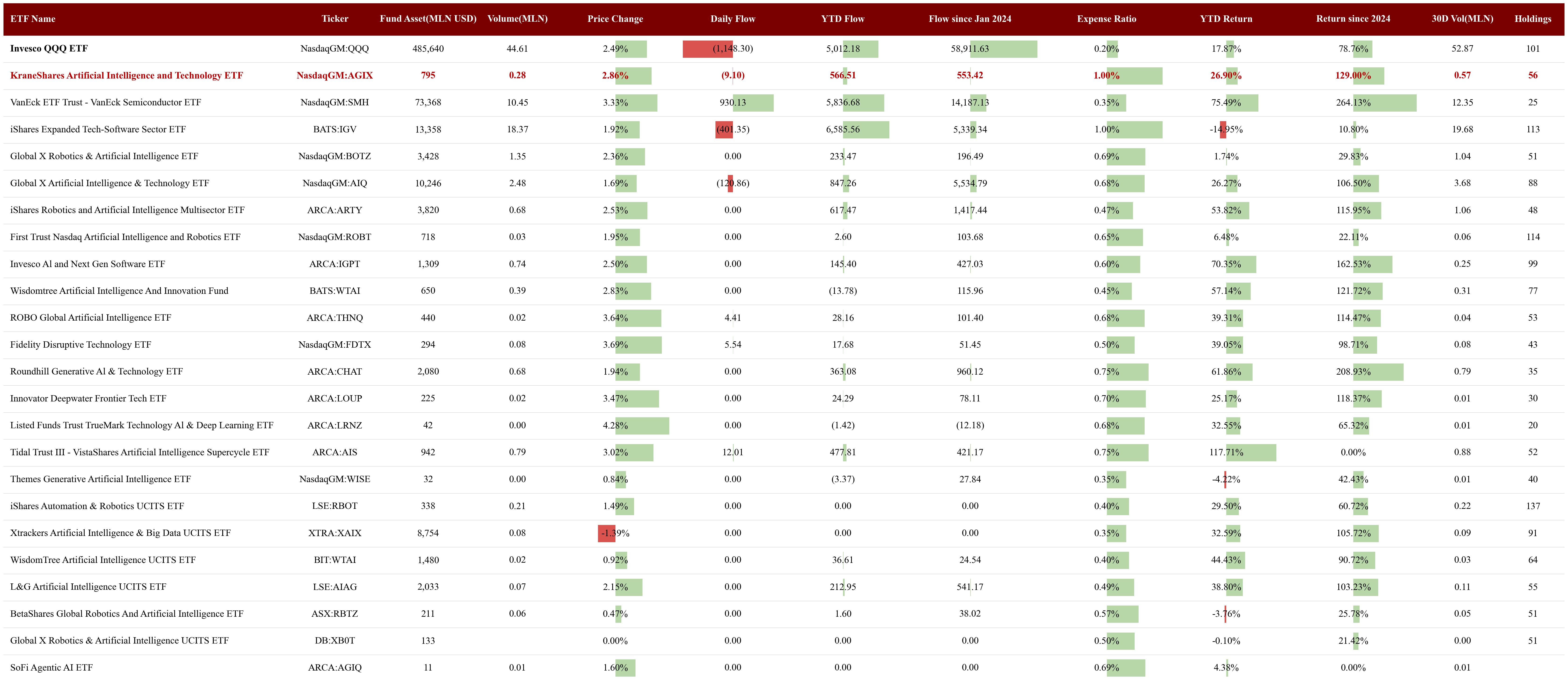
The strongest movers across peer ETF holdings today are listed below:
| DTD | Stock Ticker | Name | Held by ETFs | analysis |
|---|---|---|---|---|
| 85.2 | XTRA:NA9 | Nagarro SE | ['LSE:RBOT'] | Nagarro SE’s 85% single-day move on June 29, 2026 was driven primarily by a sharp re-rating following a takeover bid, with the stock jumping to just below the acquirer Persistent Systems’ offer price.[9] First, the announced offer price implied a very large premium to Nagarro’s prior trading level, pulling the shares up toward the bid and triggering heavy volume and event-driven buying.[5][9] Second, management commentary that the CEO expects the watchdog to probe the share price jump before the bid underscored the exceptional nature of the move, further focusing investor attention on the takeover dynamics rather than fundamentals.[9] |
| 28.68 | NasdaqGS:OUST | Ouster, Inc. | ['LSE:RBOT'] | Ouster’s 28.7% gain on June 29, 2026 appears driven primarily by strong momentum around a cluster of recent Rev8 lidar deal announcements and manufacturing expansion news, which reinforced a “scale-up” narrative and drew in aggressive traders. Same-day commentary highlighted the long-term manufacturing ramp with Benchmark Electronics (>100,000 Rev8 units per year over 10 years) plus multi‑year agreements with AIM Intelligent Machines, FieldAI, and BlueCity smart‑traffic deployments as evidence that Ouster is transitioning from promising tech to high‑volume, multi‑vertical commercialization, triggering sharp upside moves and new 52‑week highs. |
| 16.66 | TSE:3110 | NITTO BOSEKI CO LTD | ['NasdaqGM:AGIX'] | Nitto Boseki’s 16.7% move on June 29 appears primarily driven by the mechanical impact of its 5-for-1 stock split becoming effective that day, which reset the share price from around ¥19,630 to roughly ¥4,580 and altered trading dynamics around the new lower absolute price level.[1][3][5] A secondary driver is ongoing positive sentiment and buy-rated analyst coverage with large implied upside, which likely supported post-split demand as investors reassessed the name following the corporate action.[3][5] |
| 16.39 | NasdaqGS:ALAB | Astera Labs, Inc. | ['NasdaqGM:AGIX', 'NasdaqGM:ROBT', 'ARCA:IGPT', 'BATS:WTAI', 'ARCA:THNQ', 'ARCA:CHAT', 'ARCA:LOUP', 'ARCA:AIS', 'BIT:WTAI'] | Astera Labs’ 16.39% gain on June 29, 2026 was driven primarily by a major Stifel price target hike from $260 to $460, which sparked substantial incremental buy-side interest and momentum trading in a high‑growth AI infrastructure name.[7] A secondary but reinforcing driver was continued enthusiasm around Astera Labs’ strategic AI infrastructure footprint, including its Taiwan expansion and role in cloud-scale interconnects, which has kept the stock on many trading screens as an AI beneficiary.[2][3] |
| 15.67 | NYSE:GLW | Corning Incorporated | ['ARCA:AIS'] | Corning’s 15.67% jump on June 29 was most likely driven by index-reconstitution buying: FTSE Russell changes reclassified GLW into growth benchmarks such as the Russell 1000 Growth and Russell 3000 Growth, prompting passive and active fund flows. The move was reinforced by the market’s continued repricing of Corning as an AI infrastructure beneficiary, after recent large hyperscaler fiber-optics deals and strong optical communications demand. A paid dividend on the same date was a minor supporting factor, but the main driver was the index-driven demand shock. |
| 14.72 | TSE:4180 | Appier Group, Inc. | ['ARCA:ARTY'] | Appier Group’s 14.7% rise appears predominantly driven by a sharp rebound after a prolonged drawdown and recent underperformance, with the stock having fallen roughly 30% over the prior month and significantly underperformed over the past year, which can set up short-covering and bargain-hunting flows.[3][4] There was no clear company-specific news, guidance change, or regulatory catalyst on the day, suggesting a technically driven move amplified by above-average trading volume (roughly 1.5x normal) and general interest in AI/software names rather than a fundamental event.[1][2][8] |
| 14.68 | SEHK:9660 | Horizon Robotics | ['ARCA:IGPT'] | Horizon Robotics’ 14.7% single-day gain on June 29, 2026 appears primarily driven by ongoing investor enthusiasm around its recently launched large share repurchase program of up to 10% of outstanding shares, which is framed as a signal of management confidence and support for per-share metrics.[1] This buyback narrative is reinforcing the longer-term bullish thesis on Horizon’s position in automotive AI chips and intelligent driving, supported by positive sell-side commentary (e.g., Bernstein maintaining an Outperform/Buy rating despite volatility), which likely amplified the upside move.[4] No specific incremental company news, regulatory announcement, or fundamental data release on that date was identified, suggesting the move was largely a continuation/acceleration of prior sentiment and positioning around the buyback and AI auto-chip growth story. |
| 14.26 | NYSE:RBLX | Roblox Corporation | ['NasdaqGM:AGIX', 'ARCA:CHAT', 'ARCA:LOUP'] | Roblox’s 14.3% move was driven primarily by a same-day upgrade to Buy from Arete, which highlighted AI-driven growth potential and sparked a sharp re-rating in the shares.[9] A secondary driver was bullish engagement commentary from TD Cowen and Wedbush pointing to multi-week improvement in user metrics, including a 10% weekend concurrent user jump and momentum from the Grow a Garden 2 experience and Russia re-entry, which reinforced the upgrade narrative.[1][5] |
| 13.08 | SHSE:688008 | Montage Technology Co., Ltd. | ['ARCA:AIS'] | Montage Technology’s 13% gain on June 29, 2026 was driven primarily by continued bullish sentiment toward AI and data-center chip names, with the stock setting a new 52-week high and extending a strong multi-month rally.[5] The move was supported by solid fundamentals disclosed around its Hong Kong listing, including rapid revenue growth and robust earnings, which have reinforced investor conviction in its leadership in memory interconnect chips for cloud and AI infrastructure.[2][3][5] |
| 12.6 | NasdaqGS:MSTR | Strategy Inc | ['NasdaqGM:QQQ', 'BATS:IGV', 'ARCA:IGPT', 'LSE:RBOT', 'XTRA:XAIX'] | Strategy Inc’s 12.6% gain on June 29 was primarily driven by the company’s new “Digital Credit Capital Framework” and related balance sheet actions, which the market interpreted as easing funding risk and adding flexibility around its large Bitcoin position.[1][8][9] The framework authorizes potential Bitcoin sales of up to $1.25 billion, pairs this with $1 billion common and digital security buyback programs, and includes a higher 12% preferred dividend supported by disclosed $2.55 billion in USD reserves, all of which improved sentiment around capital structure sustainability.[1][9] A supportive macro backdrop, with the Nasdaq up about 2% on the day, likely provided an additional tailwind to the move.[7][8] |
| 12.29 | NasdaqGS:MXL | MaxLinear, Inc. | ['LSE:RBOT'] | MaxLinear’s 12.3% gain on June 29, 2026 appears primarily driven by ongoing AI-infrastructure optimism and bullish analyst sentiment that has pushed the stock to new all-time highs. Same-day coverage highlighted MaxLinear hitting a record level around $106, with the name framed as a beneficiary of the broader rerating of AI-focused data center semiconductors and strong buy recommendations, including a high-end price target of $125 from Benchmark.[4][2][5] A secondary driver is momentum and technical buying as the stock breaks through its prior 52-week range and trades near the top of its recent performance band, reinforcing trend-following inflows.[2][6] |
| 12.21 | KOSDAQ:A348210 | NEXTIN, Inc. | ['LSE:RBOT'] | NEXTIN’s 12.2% gain on June 29 appears driven primarily by a rebound from recent sharp underperformance amid a still-bullish fundamental and valuation backdrop. Over the prior 90 days the stock had fallen about 40%, leaving it trading below fair value estimates despite consensus forecasts for ~80% annual earnings growth and a “Strong Buy” rating with a high double-price target from covering analysts, which likely supported dip-buying and short-covering.[1][2] Broader positive sentiment toward equities into the end of June, with improving macro outlook and risk appetite, may have provided an additional tailwind to Korean semiconductor equipment names.[7][8][9] |
| 12.19 | NasdaqGS:VICR | Vicor Corporation | ['ARCA:AIS'] | Vicor’s 12.2% gain on June 29, 2026 appears driven primarily by continued momentum in the AI power theme and investors extrapolating strong recent backlog and earnings growth, rather than by a discrete new company-specific announcement that day.[2][3][8] The move was further supported by bullish sell-side and quantitative signals, including a Zacks Rank 1 (Strong Buy) and consensus Buy rating with targets above the prior close, reinforcing demand for the stock amid elevated AI-related expectations.[1][3] Insider selling by the CEO disclosed that day occurred at prices below the closing level and does not appear to have impeded the rally, suggesting the market viewed it as routine in the context of exceptional year-to-date performance.[1][8] |
| 11.97 | NasdaqGS:KLAC | KLA Corporation | ['NasdaqGM:QQQ', 'NasdaqGM:SMH', 'NasdaqGM:ROBT', 'LSE:RBOT', 'BIT:WTAI'] | KLA’s 11.97% jump on 2026-06-29 was most likely driven by renewed enthusiasm for semiconductor equipment names and AI-related wafer-fab spending, with the stock reaching a new 52-week high of 279.34 that day.[8][2] Supporting the move, MarketBeat reported the shares were up 7.6% intraday amid continued bullish analyst sentiment, including a recent Wells Fargo target raise to 305 and a consensus buy rating backdrop.[1] The company’s already-strong fundamentals and upbeat 2026 growth narrative around AI, advanced packaging, and memory demand likely reinforced the rally rather than a fresh company-specific announcement.[2] |
| 11.16 | NasdaqGS:WDC | Western Digital Corporation | ['ARCA:IGPT', 'ARCA:AIS', 'XTRA:XAIX'] | Western Digital’s 11.2% move was driven primarily by a fresh buy initiation and high-upside price target from Melius Research, which framed WDC as a major AI memory/storage beneficiary and signaled roughly 55% upside, triggering strong incremental demand for the shares.[4][9] A second key driver was sector-wide strength in memory and storage names following bullish Micron-related sentiment and AI infrastructure optimism, which reinforced the rerating of WDC as an AI-leverage play and amplified the single-day move.[1][4] |
| 10.82 | NasdaqGS:AMAT | Applied Materials, Inc. | ['NasdaqGM:QQQ', 'NasdaqGM:SMH'] | Applied Materials’ 10.8% gain on June 29 was driven primarily by renewed AI-semiconductor enthusiasm and index inclusion, amplified by positive sell-side commentary. The stock hit a new 52-week high intraday as investors reacted to strong recent earnings momentum and AI chip capital spending expectations, with media highlighting that AMAT had “ripped 55% in a month” and was up ~11% on the day.[4][6] A key same-day catalyst was its addition to the Russell Top 50 Index, which likely boosted demand from index and benchmark-aware investors.[1] Further support came from analysts raising price targets (e.g., KeyBanc to $750 with Overweight) on the back of strong earnings and AI exposure, reinforcing the bullish narrative.[1] |
| 10.82 | NasdaqGS:TENB | Tenable Holdings, Inc. | ['BATS:IGV', 'XTRA:XAIX'] | Tenable’s 10.8% gain on June 29 was primarily driven by its announcement that the Tenable One Cloud Exposure product achieved FedRAMP High and Impact Level 5 authorization, a significant credential that enhances its positioning with U.S. federal agencies and validates its exposure management platform for high-security environments.[1][5] This catalyst built on already strong sentiment following Q1 2026 results that exceeded revenue and EPS expectations and a raised full-year outlook, reinforcing the growth and profitability narrative.[6][8] |
| 10.62 | NasdaqGM:AAOI | Applied Optoelectronics, Inc. | [] | Applied Optoelectronics’ 10.6% gain on June 29, 2026 appears driven primarily by ongoing momentum in the AI optical networking theme rather than a discrete, stock-specific news event that day. The stock has been a high-beta AI datacenter play with recent catalysts including analyst target hikes, a Texas expansion grant, and the launch of a 2x AAOI leveraged ETF, all reinforcing speculative interest and amplifying moves around option-expected ranges.[1][2][4][8] Second, supportive sentiment from analysts and investors — including a Buy-consensus and favorable commentary on demand for 400G/800G transceivers and AI data center exposure — likely underpinned the move as traders continued to chase a year-to-date rally above 300%.[3][6][7][10] |
| 10.53 | KOSDAQ:A455900 | ANGEL ROBOTICS Co., Ltd. | ['NasdaqGM:BOTZ', 'ASX:RBTZ', 'DB:XB0T'] | ANGEL ROBOTICS Co., Ltd.’s 10.53% rise on 2026-06-29 appears to have been driven primarily by technical buying and momentum rather than a clearly identifiable company-specific announcement, as the available same-day public results do not show a direct news catalyst. The strongest supporting factor is the stock’s positive technical setup noted in market data sources, including buy signals from moving averages and rising volume. A secondary contributor may have been broader optimism around the company’s robotics/medical-device growth story, but no verified same-day disclosure in the provided results explains the move more directly. |
| 9.98 | TSX:BB | BlackBerry Limited | ['BATS:IGV'] | BlackBerry’s 9.98% move on 2026-06-29 was most likely driven by continued momentum/speculative buying rather than a single company-specific catalyst, as recent coverage points to renewed WallStreetBets-style interest and meme-stock trading in BB. The stock has also been supported by improving operating fundamentals and a positive turnaround narrative, including stronger profitability and guidance for fiscal 2027, which likely reinforced the move. [1][4] |
| 9.85 | NasdaqGS:AXON | Axon Enterprise, Inc. | ['NasdaqGM:QQQ', 'ARCA:LOUP'] | Axon’s ~10% gain on June 29 was driven primarily by headlines highlighting President Trump’s multi‑million‑dollar purchase of Axon stock ahead of ICE’s pursuit of a roughly $220 million Taser contract that market commentators say is effectively tailored to Axon’s offerings.[4][7][8] This news flow reinforced investor expectations that Axon is the leading, and potentially sole, viable supplier for the contemplated ICE deal, boosting perceived future revenue and contract probability.[4][7] A secondary support came from already constructive sell-side sentiment, with a broad “Moderate Buy” consensus and high target prices that provided a bullish backdrop for the move.[1][3] |
| 9.38 | NasdaqGS:CHTR | Charter Communications, Inc. | ['NasdaqGM:QQQ'] | Charter Communications’ 9.4% move was driven primarily by reports that it is in exclusive talks with SpaceX on a potential Starlink Mobile/consumer phone partnership that would route mobile traffic over Charter’s broadband network, creating a new revenue stream and highlighting the strategic value of its infrastructure.[2][4] A secondary tailwind came from a sector-wide re-rating of telecom and cable stocks after Comcast’s announced media spin-off, which boosted sentiment toward broadband and connectivity peers.[4][6][7] Investors also noted Charter’s Q2 webcast scheduling, but this played a minor role compared with the SpaceX partnership speculation and industry restructuring narrative.[1][9][10] |
| 9.27 | NYSE:IONQ | IonQ, Inc. | ['BATS:WTAI', 'ARCA:THNQ'] | IonQ’s 9.3% gain on June 29, 2026 appears driven primarily by renewed investor enthusiasm around its quantum computing leadership and favorable sentiment following recent strategic developments. Same-day commentary highlighted the stock trading up roughly 9.5%, with a consensus “Moderate Buy” rating and a materially higher average price target around $70 supporting a catch-up move after a volatile June pullback.[2][8] Additional support likely came from ongoing analyst and investor focus on IonQ’s rapid revenue growth and government/defense positioning, which has kept the name a preferred way to play the quantum computing theme despite elevated volatility.[1][5][7] |
| 9.14 | NasdaqGS:PANW | Palo Alto Networks, Inc. | ['NasdaqGM:QQQ', 'NasdaqGM:AGIX', 'BATS:IGV', 'ARCA:ARTY', 'NasdaqGM:ROBT', 'BATS:WTAI', 'ARCA:THNQ', 'NasdaqGM:FDTX', 'ARCA:AIS', 'XTRA:XAIX', 'BIT:WTAI', 'LSE:AIAG'] | Palo Alto Networks’ ~9% gain on June 29 was primarily driven by a positive reaction to its Q3 2026 earnings report, which beat consensus on both EPS ($0.85 vs. $0.81) and revenue (~$3.0B vs. ~$2.94B), with management’s guidance reinforcing confidence in sustained growth in core security and AI-driven offerings.[1][3] A secondary tailwind came from a broader relief rally in high-multiple software and cybersecurity names as geopolitical and rate-hike fears eased, expanding valuation multiples for long-duration growth stocks and amplifying the earnings surprise impact on PANW’s price.[4] |
| 9.09 | NasdaqGS:PENG | Penguin Solutions, Inc. | ['ARCA:AIS'] | Penguin Solutions’ 9.1% gain on June 29, 2026 was driven primarily by continued momentum buying and AI-theme enthusiasm following its recent guidance update indicating revenue and earnings are tracking toward the high end of fiscal 2026 expectations amid “exceptionally strong” agentic AI workload demand.[1][2] The move also reflects technical and trading factors, with the stock hitting new highs on elevated volume, extended multi-week outperformance versus the market, and a high-beta profile that amplifies upside in bullish conditions.[1][2][7] |
| 9.06 | TSE:3697 | SHIFT Inc. | ['LSE:RBOT'] | SHIFT Inc.’s 9.06% gain on June 29, 2026 appears primarily driven by company-specific capital allocation news, namely the recently announced share repurchase program of up to 7.9 million shares (about 3% of shares outstanding), which likely continued to support sentiment and buying interest into this session.[9] A secondary driver is ongoing analyst support and implied upside, with consensus 12‑month targets well above the current price and a Buy recommendation from covering analysts, reinforcing the rebound after the prior index removal from the S&P Japan 500 earlier in June.[2][3] |
| 9.05 | KOSDAQ:A108490 | ROBOTIS Co., Ltd. | ['NasdaqGM:BOTZ', 'ASX:RBTZ', 'DB:XB0T'] | ROBOTIS’s +9.1% move appears driven primarily by continued speculative momentum in a highly volatile, high-valuation AI/robotics name rather than by any new company-specific disclosure on the day. The stock has risen almost tenfold over the past year, trades at an extremely rich earnings multiple, and is covered as a “Strong Buy” with large estimated upside, which together encourage momentum and retail trading flows in the absence of fresh news. Broader enthusiasm for robotics/AI beneficiaries in Korea and tight float/volatility characteristics likely amplified the single-day move. |
| 8.9 | TSE:4776 | Cybozu, Inc. | ['LSE:RBOT'] | Cybozu’s 8.9% move appears driven primarily by follow-through buying and momentum after recent strong performance and optimistic forward expectations rather than a specific new company disclosure on the day. Public sources around the date highlight solid earnings growth, a sizable share buyback authorization, and bullish third-party price targets and forecasts that frame the name as a high-growth SaaS beneficiary, supporting continued rerating and investor demand.[1][3][6] |
| 8.77 | NasdaqGS:FLEX | Flex Ltd. | ['NasdaqGM:AGIX'] | Flex’s 8.8% gain on June 29, 2026 appears primarily driven by ongoing index-inclusion and AI infrastructure enthusiasm rather than a discrete new catalyst that day. The stock is still digesting the June 9 announcement that Flex will join the S&P 500 effective June 22, which typically supports demand from index funds and benchmarked managers, and follows earlier Q4 FY26 earnings that beat estimates, raised guidance, and detailed a spin-off of the Cloud and Power Infrastructure segment to capture AI data center growth.[9][1][2][3] |
| 8.73 | NasdaqGS:SIMO | Silicon Motion Technology Corporation | ['ARCA:AIS'] | The 8.7% move in SIMO on June 29, 2026 appears driven primarily by continued follow-through from the company’s exceptionally strong Q1 2026 results and guidance, which materially reset earnings and growth expectations higher. The April 29 earnings release showed revenue up 105% year over year with non-GAAP EPS of $1.58 versus consensus $1.28, plus Q2 guidance implying 98–107% year-over-year revenue growth and margin expansion, reinforcing a multi-quarter acceleration story in SSD, embedded storage, and Ferri/boot drive solutions.[1][2][3] A secondary driver is likely ongoing investor focus on Silicon Motion’s positioning as a beneficiary of AI and enterprise storage demand, highlighted by management commentary on MonTitan moving into volume production and ramping with multiple tier-one cloud service providers in 2H26, which supports a rerating toward its 52-week high.[1][2][3] |
| 8.68 | NasdaqGS:NBIS | Nebius Group N.V. | ['NasdaqGM:AGIX', 'BATS:WTAI', 'ARCA:THNQ', 'ARCA:CHAT', 'BIT:WTAI'] | Nebius Group’s 8.7% gain on June 29 appears driven primarily by ongoing AI-infrastructure momentum and follow-through buying after its recent inclusion in the Nasdaq-100 and high-profile strategic deals. Recent catalysts—including Nasdaq-100 index addition effective June 22, a $2.6B anchor stake from Situational Awareness, and a large Bloom Energy fuel cell agreement—have strengthened the AI cloud narrative and sustained bullish sentiment in the weeks leading up to this move.[2] A secondary driver is continued retail and momentum participation, with Nebius framed as a high-risk, high-reward AI momentum name and benefiting from meme-style buzz and elevated trading activity, supporting outsized single-day moves like the 8.7% rally.[1][2][8] |
| 8.68 | TSE:3993 | PKSHA Technology Inc. | ['NasdaqGM:BOTZ', 'NasdaqGM:ROBT', 'NasdaqGM:WISE', 'ASX:RBTZ', 'DB:XB0T'] | PKSHA Technology’s 8.68% move on June 29 was primarily driven by the market’s positive reaction to its June 18 announcement of a letter of intent to acquire an additional 20.27% stake in Video Touch, Inc., which investors likely interpreted as a strategic expansion of its Mobility & MaaS and image/video analysis capabilities.[1] The move also came as the stock rebounded from near 52‑week lows, with price action crossing short-term technical levels (e.g., moving averages), suggesting some short-covering and momentum buying after a prolonged drawdown.[2][3] |
| 8.5 | NYSE:ONTO | Onto Innovation Inc. | ['ARCA:ARTY', 'LSE:RBOT'] | Onto Innovation’s 8.5% move appears primarily driven by ongoing AI-related enthusiasm and momentum following earlier upside pre-announcement and raised guidance tied to its Dragonfly G5 advanced packaging inspection platform, which has positioned the name as a high-conviction AI semi-cap equipment beneficiary.[1] The stock also broke higher within an existing bullish technical trend and is trading near record levels, suggesting incremental buying from momentum and growth investors rather than any new company-specific disclosure on the day.[1][2][3] |
| 8.46 | NasdaqGS:TSLA | Tesla, Inc. | ['NasdaqGM:QQQ', 'NasdaqGM:AGIX', 'NasdaqGM:AIQ', 'NasdaqGM:ROBT', 'BATS:WTAI', 'ARCA:THNQ', 'BIT:WTAI', 'LSE:AIAG'] | Tesla’s 8.46% gain on June 29 was driven primarily by mounting optimism around strong upcoming Q2 delivery numbers, reflected in fresh upward revisions to Wall Street delivery forecasts that positioned expectations well above prior consensus.[1][8] A secondary tailwind came from reduced regulatory overhang after NHTSA formally closed a major power steering safety probe into Model 3/Y vehicles, improving sentiment on Tesla’s operational and legal risk profile.[1] Broader strength in tech and AI-exposed names, aided by investor enthusiasm over xAI’s Grok 4.5 integration with Tesla, further supported the move.[1][8] |
| 8.39 | NasdaqGS:LRCX | Lam Research Corporation | ['NasdaqGM:QQQ', 'NasdaqGM:SMH', 'BATS:WTAI', 'ARCA:THNQ', 'ARCA:LOUP', 'BIT:WTAI', 'LSE:AIAG'] | Lam Research’s 8.4% gain on June 29 was primarily driven by a cluster of bullish analyst actions, with Bank of America and Citi raising price targets to $480 and $450 and reiterating positive views on AI-related demand and a multi-year wafer fab investment cycle.[1][2][6] A secondary driver was broader strength in semiconductor capital equipment, where increased long-term wafer fabrication equipment forecasts through 2030 and Lam’s strong share in etch/deposition tools reinforced investor momentum in the name.[1][2] |
| 8.14 | KOSE:A035720 | Kakao Corp. | ['NasdaqGM:ROBT', 'XTRA:XAIX', 'BIT:WTAI'] | Kakao Corp.’s 8.1% gain on June 29, 2026 appears primarily driven by a relief rally following recent share price weakness and elevated labor-relations headlines, rather than by any new fundamental catalyst. The stock had recently hit 52‑week lows amid target cuts from Korean brokerages and ongoing union actions, including a June 10 partial strike and a June 29 “log‑out day,” which were already known to the market and may have been increasingly discounted by investors as negotiations dragged on. In this context, the move looks most consistent with short-term mean reversion and bargain hunting after a prolonged drawdown, potentially amplified by positioning and technical factors in a thin news environment. |
| 8.06 | TWSE:5269 | ASMedia Technology Inc. | ['ARCA:IGPT', 'ARCA:AIS', 'LSE:RBOT'] | ASMedia Technology’s 8.06% gain on June 29, 2026 appears primarily driven by a rebound after recent share price weakness, supported by still-constructive sell-side expectations. The stock had declined over the prior month and year, making it relatively oversold versus its 12‑month target and “Outperform/Buy”‑leaning analyst ratings, which likely encouraged dip-buying and short-term mean reversion.[3][5][8] A secondary driver is broader semiconductor sector strength and favorable sentiment toward high-speed interface IC suppliers, with ASMedia’s established positioning and solid market cap providing liquidity for momentum and technical traders.[4][10] |
| 8.06 | NasdaqCM:QUBT | Quantum Computing Inc. | ['NasdaqGM:AIQ'] | Quantum Computing Inc. (QUBT) rose about 8% on June 29, 2026, primarily on ongoing post-earnings momentum and favorable analyst sentiment rather than any discrete new company-specific announcement that day.[1][5][8] The stock continues to benefit from its early-June Q1 2026 beat on both revenue and EPS, plus a supportive analyst backdrop with multiple buy ratings and substantial upside implied by consensus targets, which together are attracting speculative tech and quantum-focused investors.[1][3][5] Broader interest in quantum computing and QUBT’s acquisition-driven growth story likely reinforced the move, even as fundamentals remain high-risk and valuation stretched.[1][3][4] |
| 7.99 | NasdaqGS:RMBS | Rambus Inc. | [] | Rambus’s 7.99% gain on June 29, 2026 appears primarily driven by a strong rebound and momentum bid following the post-earnings pullback, with investors re-engaging the AI/memory growth narrative after the stock had sold off on mixed Q1 results and modest estimate misses in late April.[2][4] The move was likely reinforced by positive fundamental positioning and supportive analyst/investor sentiment, including recent BUY-rated research and favorable long-term targets that highlight Rambus’s high-margin IP model and central role in AI memory trends.[2][8] |
| 7.89 | SEHK:2252 | Shanghai MicroPort MedBot (Group) Co., Ltd. | ['NasdaqGM:BOTZ', 'ASX:RBTZ', 'DB:XB0T'] | Shanghai MicroPort MedBot’s +7.9% move on June 29 was driven primarily by a sharp rebound from prior weakness, amplified by improving sentiment and strong consensus analyst support. The stock traded up intraday by roughly 9% to HK$23.8, significantly above the prior close of HK$21.8, with no company-specific news or regulatory filings identified that day, suggesting a technically driven move and follow-through after crossing short-term moving averages.[1][3][5] A secondary driver is the supportive fundamental backdrop: eight analysts rate the shares Strong Buy with sizable implied upside to their average target price, which likely encouraged dip-buying after recent volatility.[3] |
| 7.88 | NASDAQGM:RZLV | Rezolve AI PLC | ['NasdaqGM:WISE'] | RZLV’s 7.88% gain on 2026-06-29 was most likely driven by continued investor reaction to the June 12 announcement that Rezolve Ai planned shareholder approval for a capital reduction and a share repurchase program of up to $300 million, which is a strongly supportive capital-return signal. The move was likely amplified by the fact that the company scheduled the shareholder vote for June 30, keeping the catalyst front and center in the market. Trading data also showed elevated intraday volatility and a positive session around that news, suggesting momentum and event-driven buying were the main contributors. |
| 7.86 | TSX:DND | Dye & Durham Limited | ['LSE:RBOT'] | Dye & Durham’s 7.9% move on June 29, 2026 appears primarily driven by a rebound following sharp recent declines, with no material company-specific news or regulatory developments released that day. The most relevant preceding catalyst is the June 24 announcement of a board change (departure of George Tsivin), which did not trigger immediate follow‑through news but may have contributed to investors reassessing governance and potential strategic actions over subsequent sessions. A secondary driver is likely technical and trading-related: the stock had sold off heavily year-to-date and was trading near depressed levels with above-average volume, making it susceptible to short-covering and value-driven buying interest. |
| 7.85 | NasdaqGS:AMBA | Ambarella, Inc. | ['NasdaqGM:AIQ', 'NasdaqGM:ROBT', 'ARCA:IGPT', 'ARCA:THNQ', 'NasdaqGM:WISE', 'LSE:RBOT', 'XTRA:XAIX', 'BIT:WTAI', 'LSE:AIAG'] | Ambarella’s 7.9% move appears driven primarily by technical and momentum factors rather than a specific fundamental catalyst, as there is no material company news or earnings disclosure on June 29, 2026. The stock broke higher within an established short‑term rising trend and was flagged by at least one technical service as a “Buy candidate” after recent trading action, which can attract momentum and algorithmic flows.[1] Options-related interest and elevated implied volatility around the name have also been highlighted recently, suggesting incremental speculative activity that can amplify single‑day moves.[6] |
| 7.76 | KOSE:A454910 | Doosan Robotics Inc. | ['NasdaqGM:BOTZ', 'LSE:RBOT', 'ASX:RBTZ', 'DB:XB0T'] | Doosan Robotics’ 7.76% gain on June 29, 2026 appears primarily driven by continued momentum and positive sentiment around the Korea robotics theme, with the stock extending its rally within a broader narrative of strong investor interest in Korean robotics names.[5][2] The move occurred without a specific company disclosure or major news item that day, and was supported by active trading and a wide intraday range (₩83,200–₩92,900), suggesting trading-driven follow-through in a volatile, high-beta name rather than a discrete fundamental catalyst.[3] |
| 7.7 | NasdaqGM:MDB | MongoDB, Inc. | ['ARCA:ARTY', 'NasdaqGM:ROBT', 'BATS:WTAI', 'ARCA:THNQ', 'ARCA:LRNZ', 'LSE:AIAG'] | MongoDB’s 7.7% gain on June 29, 2026 was primarily driven by a broad risk-on rally in high-growth software as macro and AI-related fears eased. Same-day commentary highlighted that software names, including MongoDB, traded up after U.S.–Iran military tensions de-escalated, lowering oil and rate-hike expectations, while a chip-to-software rotation tied to OpenAI’s delayed IPO report reduced concerns that AI labs would rapidly disrupt incumbent SaaS, benefiting long-duration, high-multiple names like MDB.[6] A secondary support came from reinforcing analyst and sentiment data, with MarketBeat and Zacks highlighting a “Moderate Buy”/Strong Buy-type consensus, a sizeable upside to average price targets, and prior earnings beats and AI product momentum that kept buyers engaged into late June.[1][3][7] |
| 7.64 | NasdaqGS:BIDU | Baidu, Inc. | ['NasdaqGM:AIQ', 'NasdaqGM:ROBT', 'ARCA:IGPT', 'ARCA:CHAT'] | Baidu’s 7.6% move was primarily driven by a report that its AI chip unit Kunlunxin is targeting a Hong Kong IPO at a roughly $50 billion valuation, which sharply increased investor optimism around the value of Baidu’s internal AI assets.[3][5][9] A second, reinforcing driver was broader positive sentiment toward AI-exposed Chinese tech names, with traders positioning ahead of anticipated Baidu-related announcements flagged for late June.[2][8] |
| 7.64 | NasdaqGS:BIDU | Baidu Inc. | ['NasdaqGM:AIQ', 'NasdaqGM:ROBT', 'ARCA:IGPT', 'ARCA:CHAT'] | Baidu’s 7.6% gain on June 29 was primarily driven by news that its AI chip unit Kunlunxin is targeting a Hong Kong IPO at a valuation reportedly around $50 billion, which sharpened investor focus on the embedded value of Baidu’s AI assets and semiconductor exposure[10]. A secondary driver was broader enthusiasm toward Chinese AI and internet names, as media coverage highlighted accelerating competition and model launches in China’s AI ecosystem, supporting sentiment for leading platforms like Baidu[6]. |
| 7.63 | NasdaqGS:STX | Seagate Technology Holdings plc | ['NasdaqGM:AIQ', 'ARCA:IGPT', 'ARCA:AIS', 'XTRA:XAIX'] | Seagate’s 7.6% gain on June 29, 2026 was driven primarily by an aggressive analyst action, with Cantor Fitzgerald raising its price target from $1,000 to $1,300 and reiterating an overweight rating, which directly coincided with the intraday move reported in trading commentary. This upgrade built on already strong sentiment around Seagate as an AI infrastructure beneficiary and recent earnings outperformance, reinforcing the bullish narrative and prompting incremental buying. Options market commentary also highlighted investors leaning bullish in Seagate, suggesting positioning and short-term sentiment amplified the upside move. |
| 7.6 | NYSE:DOCN | DigitalOcean Holdings, Inc. | ['BATS:WTAI'] | DigitalOcean’s 7.6% gain on June 29, 2026 appears primarily driven by continued momentum and bullish sentiment following its strong year‑to‑date performance and recent 52‑week highs. The stock is up over 200% YTD and has been highlighted as a top 2026 performer, which is attracting momentum and growth investors into the name.[6][10][1] Second, supportive sell-side and retail analyst views, including a broad Buy consensus and price targets in the mid‑$140s, are reinforcing the positive narrative around DOCN’s AI and cloud infrastructure exposure.[4][6] Broader market optimism into the end of the quarter and ongoing enthusiasm for AI infrastructure plays likely provided an additional macro tailwind to the move.[8][9] |
| 7.5 | KOSDAQ:A277810 | Rainbow Robotics Co.,Ltd. | ['NasdaqGM:BOTZ', 'ARCA:IGPT', 'LSE:RBOT', 'ASX:RBTZ', 'DB:XB0T'] | Rainbow Robotics’ 7.5% gain on June 29 was primarily driven by strong idiosyncratic buying interest in the name and the broader robotics complex, with the stock rallying sharply on high volatility and no specific negative catalysts reported intraday.[2][10] The move also aligns with continued optimism embedded in its valuation and analyst stance, as the name still carries a Strong Buy/“momentum” profile with upside to the sole published target price despite recent volatility.[2][3][5] |
| 7.44 | NasdaqCM:GRRR | Gorilla Technology Group Inc. | ['NasdaqGM:WISE'] | Gorilla Technology’s 7.44% gain on June 29, 2026 appears to be a continuation of the strong positive sentiment following its transformational multi‑year AI infrastructure/GPUaaS contract and associated guidance and backlog upgrades earlier in June. Public disclosures around the US$2.5B five-year AI contract and raised revenue outlook have driven a substantial rerating of the stock and higher price targets, and the June 29 move fits within that momentum rather than any new, stock‑specific news that day.[7][9][10] Secondary drivers likely include technical trading and short‑term mean reversion after the sharp selloff on June 3 tied to the $107M convertible notes pricing, as investors refocused on the enlarged backlog and long-term earnings power.[3][4] |
| 7.43 | NasdaqGS:CRSR | Corsair Gaming, Inc. | ['ARCA:AIS'] | Corsair Gaming’s 7.4% move on June 29, 2026 appears primarily driven by continued momentum and investor enthusiasm around its recently announced AI server and workstation strategy, including the CORSAIR PRO lineup using NVIDIA Grace Blackwell technology, which has sparked a multi-day rally and repositioned the story beyond traditional gaming hardware.[1] A secondary driver is ongoing positive sentiment from the earlier Q1 earnings beat (EPS $0.27 vs. $0.18 consensus) and strong adjusted EBITDA growth, which is reinforcing confidence in the company’s growth and margin trajectory.[1] Elevated short interest and options-implied volatility may also be amplifying the upside as the stock extends its year-to-date gain of over 50%.[1][7][8] |
| 7.28 | SEHK:1274 | iMotion Automotive Technology (Suzhou) Co., Ltd. | ['NasdaqGM:BOTZ', 'ASX:RBTZ', 'DB:XB0T'] | The 7.3% gain in iMotion Automotive Technology on June 29, 2026 appears primarily driven by a positive read-through from its 2026 AGM, where shareholders approved all resolutions, reinforcing confidence in governance and strategic direction.[7] This came against a backdrop of strong medium-term growth expectations for its autonomous driving solutions business, with consensus forecasting robust revenue expansion despite current losses, which likely supported buying interest on the day.[1][2] |
| 7.19 | ASX:WTC | WiseTech Global Limited | ['NasdaqGM:FDTX'] | WiseTech Global’s 7.19% gain on 29 June 2026 appears primarily driven by a technical rebound and bargain-hunting after an extreme governance-driven selloff that has left the stock down more than 50% year-to-date and over 70% in 12 months.[4][8][9] First, the prior week’s sharp declines following news of an AFP investigation into executive chairman Richard White created deeply oversold conditions, encouraging short-covering and value-oriented buying as the stock traded near the bottom of its 52-week range.[3][4][8] Second, broker commentary highlighting that the core business fundamentals remain largely intact and that the selloff may have gone too far supported sentiment and helped attract incremental buyers at depressed levels.[4][6] |
| 7.07 | NasdaqGS:ADEA | Adeia Inc. | ['BATS:IGV'] | Adeia’s 7.07% rise on 2026-06-29 appears most likely driven by a continuation of a strong post-earnings re-rating, with Yahoo Finance highlighting the stock’s prior move after “strong Q1 results” and a CEO transition plan. A second support was the broader bullish technical backdrop, as market data sources showed the shares already near 52-week highs and in a positive trend into the date. No clearly identifiable same-day company-specific announcement was visible in the provided results, so the move looks more like momentum and residual earnings/management-news follow-through than a fresh catalyst. |
| 7.06 | SEHK:2432 | Shenzhen Dobot Corp Ltd | ['NasdaqGM:BOTZ', 'ASX:RBTZ', 'DB:XB0T'] | Shenzhen Dobot rose 7.06% on 2026-06-29, but the provided public results do not show a clear company-specific same-day catalyst, so the move is most likely driven by market/technical factors rather than a fresh disclosure. The strongest supporting context is that the stock had been heavily below its 52-week highs and was trading against a backdrop of very bullish sell-side sentiment, with broad “Strong Buy” consensus and large upside targets, which can amplify rebound buying. No verifiable same-day news event appears in the supplied sources. |
| 7.01 | TWSE:6669 | Wiwynn Corporation | ['ARCA:IGPT'] | Wiwynn’s 7.01% jump on 2026-06-29 appears most consistent with a broad rerating in the name rather than a company-specific same-day disclosure, as the available public results do not show a clear new earnings or corporate announcement tied to that session.[8][7] The move likely reflected continued investor optimism around Wiwynn’s cloud IT infrastructure exposure and strong analyst sentiment, which markets had already been pricing in ahead of the date.[1][4] Trading was also likely helped by momentum in the stock itself, with the shares showing sizable recent volatility and strong upside expectations in market coverage.[5][6] |
| 6.87 | NasdaqGS:LYFT | Lyft, Inc. | ['BATS:WTAI', 'XTRA:XAIX'] | Lyft’s 6.87% gain on June 29, 2026 appears primarily driven by broad risk-on momentum in tech/growth stocks, with LYFT outperforming both the tech sector’s roughly 2% move and the S&P 500’s roughly 1.6% rise on the day.[7] This sector-led rally likely attracted incremental buying interest in higher-beta names like Lyft, helping push the stock up nearly 7% on elevated volume of about 20.8 million shares.[9] No major company-specific news or disclosures were evident that would independently explain the move, suggesting the performance was mainly beta and sentiment driven rather than fundamental. |
| 6.65 | NasdaqGM:MVIS | MicroVision, Inc. | ['LSE:RBOT'] | MicroVision’s 6.65% gain on June 29, 2026 appears primarily driven by renewed speculative interest supported by a bullish sell-side/aggregator narrative, with 2 analysts shown as having a “Strong Buy” consensus rating and a $2.50 price target as of that date.[3] This positive analyst/forecast backdrop contrasts with the stock’s depressed sub-$0.30 trading levels and weak fundamentals, encouraging short-term mean-reversion and retail trading activity.[3][4] Broader context of significant year-to-date return (64% as of 6/29/26) despite low absolute price further supports a trading-driven move rather than any specific new fundamental catalyst.[7] |
| 6.64 | TSE:6701 | NEC Corporation | ['NasdaqGM:AIQ', 'XTRA:XAIX'] | NEC Corporation’s 6.64% gain on June 29, 2026 appears driven primarily by investor positioning and technical factors rather than a specific new fundamental catalyst that day. The stock moved sharply higher versus its prior close, in the context of a “Strong Buy” consensus and sizeable implied upside from analysts’ 12‑month targets, which can reinforce buying interest when the name is already in a favorable trend.[1][2] A secondary driver is likely continued sentiment support from previously announced shareholder‑friendly capital allocation (the February 2026 share repurchase authorization), which can underpin demand even absent fresh news on the exact date.[8] |
| 6.51 | NasdaqGS:NVMI | Nova Ltd. | ['LSE:RBOT'] | Nova Ltd.’s 6.51% gain on 2026-06-29 most likely reflects continued momentum in the semiconductor-equipment group after the company’s recent strong quarterly results and upbeat guidance, which have kept investor sentiment positive. The move also appears consistent with analyst optimism and recent price-target raises, while no single same-day company-specific negative event is evident in the available public news flow. The stock had also been trading as a volatile high-beta name, so the rally likely combined fundamental strength with momentum/trading factors. |
| 6.49 | NasdaqGS:HSAI | Hesai Group | ['NasdaqGM:BOTZ', 'ASX:RBTZ', 'DB:XB0T'] | Hesai Group’s 6.49% move on June 29, 2026 appears primarily driven by follow-through buying after its strong Q1 2026 results and continued profitability, which have reinforced the bullish fundamental narrative around LiDAR demand and the company’s expansion into broader physical AI applications.[1][9] The move was likely supported by HSAI’s existing positive analyst backdrop (consensus Strong Buy, high 12‑month upside vs. current price), attracting momentum and growth investors as the stock trades off the bottom of its recent range.[2][4][10] |
| 6.27 | NasdaqGS:MBLY | Mobileye Global Inc. | ['NasdaqGM:ROBT', 'LSE:RBOT', 'BIT:WTAI'] | Mobileye’s 6.27% gain on June 29, 2026 appears driven primarily by continued investor reaction to its better‑than‑expected Q1 2026 earnings, where EPS of $0.12 beat the $0.09 consensus and revenue reached $558M, both supporting a rebound narrative after a weak start to the year.[1][3] A secondary driver is improving sentiment around future growth and inventory normalization, including commentary that unit volumes and demand for its ADAS/autonomous chips are set to inflect higher, which aligns with recent bullish takes on the stock’s recovery potential.[1][2][4] |
| 6.22 | SEHK:9880 | Ubtech Robotics Corp Ltd | ['NasdaqGM:BOTZ', 'ARCA:IGPT', 'LSE:RBOT', 'ASX:RBTZ', 'DB:XB0T'] | Ubtech Robotics rose 6.22% on June 29, but the provided public market data does not show a clear same-day company-specific catalyst, so the move is most likely driven by momentum and broader investor enthusiasm around Hong Kong robotics/AI names. The main supporting evidence is the sharp intraday rally from HK$90.05 to HK$95.65 on active trading, with no conflicting disclosure or earnings announcement visible in the supplied results. Analyst optimism and bullish valuation expectations may have helped sustain buying, but they are secondary to the absence of a clear news trigger. |
| 6.03 | NasdaqGS:TER | Teradyne, Inc. | ['NasdaqGM:AGIX', 'NasdaqGM:SMH', 'NasdaqGM:ROBT', 'BATS:WTAI', 'ARCA:THNQ', 'LSE:RBOT', 'BIT:WTAI', 'LSE:AIAG'] | Teradyne’s 6.0% gain on June 29, 2026 appears primarily driven by continued momentum and repositioning as an AI-levered test and robotics name, reinforced by recent data showing AI-related sales approaching 70% of revenue and the stock up over 100% year-to-date, which is attracting incremental growth and momentum buyers.[7] A second key driver is ongoing technical and flow support from its recent addition to the Nasdaq-100 and strong upgrade/“buy”-skewed analyst sentiment, which is supporting multiple expansion and dip-buying interest.[1][5][8] |
| 5.96 | NasdaqGS:CRWD | CrowdStrike Holdings, Inc. | ['NasdaqGM:QQQ', 'BATS:IGV', 'ARCA:ARTY', 'BATS:WTAI', 'ARCA:THNQ', 'NasdaqGM:FDTX', 'ARCA:LRNZ', 'ARCA:AIS', 'XTRA:XAIX', 'LSE:AIAG'] | CrowdStrike’s ~6% gain on June 29, 2026 appears primarily driven by sector-wide strength in cybersecurity and AI-oriented software, with investors rotating back into leading security names after recent volatility. Same-day commentary highlighted CrowdStrike and Palo Alto as notable risers, suggesting a broad bid for high-quality cyber vendors rather than company-specific news flow.[9] Secondary support likely came from ongoing optimism around AI-enabled security demand and the stock’s strong year-to-date performance, which has reinforced its status as a preferred vehicle for exposure to enterprise cybersecurity growth.[10] |
| 5.92 | SEHK:2498 | Robosense Technology Co., Ltd | ['NasdaqGM:BOTZ', 'ARCA:IGPT', 'ASX:RBTZ', 'DB:XB0T'] | Robosense Technology’s 5.9% gain on 29 June 2026 appears primarily driven by follow-through buying and improving sentiment after strong Q1 2026 fundamentals, including ~40% year-on-year revenue growth and a 1,458.8% surge in LiDAR shipments highlighted in recent coverage.[1][7] A secondary driver is growing recognition of the company’s positioning as a leading LiDAR supplier for ADAS and robotics, supported by prior disclosures of rapid full-year revenue growth in 2024 and ongoing design wins, which underpin a constructive medium-term growth narrative despite current negative EPS forecasts.[4][2][9] |
| 5.92 | NasdaqCM:INDI | indie Semiconductor, Inc. | ['LSE:RBOT'] | indie Semiconductor’s 5.9% gain on June 29 appears driven primarily by a technical rebound after recent weakness, with the stock bouncing from oversold conditions and moving higher intraday from an open around $3.55.[1][2][6] A secondary factor is ongoing investor focus on management changes effective June 29, including the transition of co‑founder and President Dr. Ichiro Aoki, which may be interpreted as part of a broader strategic reset for a high-growth but recently underperforming name.[3][7] |
| 5.88 | NasdaqCM:RGTI | Rigetti Computing, Inc. | ['BATS:WTAI'] | Rigetti Computing’s 5.9% gain on June 29, 2026 appears primarily driven by improving sentiment and technical factors rather than a discrete fundamental news catalyst. The stock had recently been oversold and under pressure following the CTO’s sizable share sale and a break below the 50-day moving average, setting up a rebound as traders looked for a price bounce and Aroon/technical indicators turned positive.[1][2] A supportive backdrop of generally bullish sell-side ratings and a consensus Buy recommendation with a ~$30 price target likely reinforced dip-buying interest.[4] |
| 5.81 | TWSE:2379 | Realtek Semiconductor Corp. | ['XTRA:XAIX'] | Realtek Semiconductor’s 5.81% rise on June 29, 2026 appears driven primarily by continued positive sentiment around its strategic positioning in connectivity and edge AI, following a strong 2025 earnings trajectory and management’s emphasis on edge AI and next‑gen connectivity opportunities at its 2026 shareholder meeting.[1] The move was likely reinforced by earlier June news that Realtek joined the OpenTitan coalition to develop open-source hardware Root of Trust devices, which supports the market narrative that Realtek is strengthening its role in secure connectivity and infrastructure silicon.[2][8] No material negative company- or sector-specific news emerged that day, so the price action looks like a catch-up/rerating move within an AI- and semiconductor-favorable backdrop. |
| 5.79 | NYSE:RBRK | Rubrik, Inc. | ['BATS:IGV', 'BATS:WTAI'] | Rubrik’s 5.8% move appears primarily driven by a bullish institutional positioning signal, with Pictet Asset Management disclosed on June 29 as having more than doubled its Rubrik stake in Q1 to 3.33 million shares (up 104.1%), reinforcing confidence in the long-term growth and AI‑security thesis.[2] The buying interest came against a backdrop of generally positive sentiment around Rubrik’s role in data security for AI workloads and its expanded strategic alliance with Cognizant, which has kept the stock on growth and AI‑cybersecurity watchlists in recent weeks.[1][5] |
| 5.78 | NasdaqGS:LSCC | Lattice Semiconductor Corporation | ['ARCA:IGPT', 'BATS:WTAI', 'NasdaqGM:WISE', 'LSE:RBOT'] | Lattice Semiconductor’s 5.8% gain on June 29, 2026 appears driven primarily by continued investor momentum following its very strong Q1 2026 earnings and growth outlook, including 42% year-over-year revenue growth and EPS meaningfully above guidance and Street expectations.[1][6][4] A secondary driver is ongoing bullish sentiment around the strategic AMI acquisition, which is expected to add over $200M of 2026 revenue and enhance margins and earnings, reinforcing the stock’s long-term growth narrative.[1][2][6][7] |
| 5.71 | TSE:4373 | Simplex Holdings, Inc. | ['LSE:RBOT'] | Simplex Holdings’ 5.71% rise on 2026-06-29 appears most consistent with broad end-of-month/quarter positioning and a constructive risk backdrop rather than a company-specific announcement, as no same-day material disclosure is evident in the provided sources. CNBC noted that investors were entering the June 29–July 3 week with a more upbeat market tone and that month- and quarter-end rebalancing could increase volatility, which can lift individual names in Japan-linked trading as well.[6] I do not see a verified company-specific catalyst in the supplied results, so the move is most likely style- and flow-driven, with broader tech/growth sentiment as the secondary driver.[5][6] |
| 5.66 | NasdaqGS:OKTA | Okta, Inc. | ['NasdaqGM:AIQ', 'ARCA:ARTY', 'BATS:WTAI'] | Okta’s 5.7% gain on June 29 appears to be an extension of the sharp post-earnings rally, supported by ongoing positive sentiment around its improved execution and cybersecurity demand rather than a discrete new company-specific announcement that day.[1][7][9] The primary driver is still the strong recent quarterly results and guidance, which have led to substantial multi-day appreciation and bullish analyst commentary.[1][2][9] A secondary driver is technical and momentum buying, with multiple services flagging OKTA as a strong buy based on moving averages and RSI, reinforcing the uptrend.[4][3] |
| 5.66 | NasdaqCM:SERV | Serve Robotics Inc. | ['NasdaqGM:BOTZ', 'NasdaqGM:ROBT', 'ASX:RBTZ', 'DB:XB0T'] | Serve Robotics’ 5.66% gain on June 29, 2026 appears primarily driven by elevated speculative interest and derivatives activity following a sharp increase in options trading volume in the prior week, which has focused attention on the name’s volatility and upside leverage.[5][8] This move is occurring against a backdrop of strong fundamental momentum highlighted by Q1 2026 revenue growth of 578% year over year and guidance for ~$26 million in 2026 revenue, reinforcing the long-term AI/robotics growth narrative and supporting buy-the-dip behavior after a sizable year-to-date drawdown.[1][4][9] With no company-specific news releases or macro events disclosed on the day, the price action is best explained by trading/positioning dynamics on top of existing bullish fundamentals. |
| 5.62 | TASE:NICE | NICE Ltd. | ['NasdaqGM:AIQ', 'NasdaqGM:ROBT', 'ARCA:IGPT', 'XTRA:XAIX', 'BIT:WTAI'] | NICE’s 5.62% gain on 2026-06-29 appears to have been driven mainly by a broader risk-on move in tech, with U.S. markets rallying around improving sentiment on macro/geopolitical developments and strength in tech stocks. A second likely support was valuation/positioning: contemporaneous market commentary and stock screens described NICE as under pressure in prior weeks, which can amplify a rebound on a positive tape. I did not find a company-specific same-day announcement in the provided results to explain the move more directly. |
| 5.49 | NYSE:GEV | GE Vernova Inc. | ['ARCA:AIS'] | GE Vernova’s 5.49% gain on June 29 was driven primarily by its official addition to the Russell Top 50 Index, which prompted index-rebalancing inflows and passive buying from ETFs and benchmarked institutional investors.[1] A secondary driver was strong thematic demand for power infrastructure tied to AI data center build-outs, reinforcing bullish sentiment on the company’s backlog and growth outlook.[1] Elevated trading volume versus recent averages indicates technical and flow-related support for the move beyond fundamentals alone.[1][4][10] |
| 5.35 | NYSE:ZEPP | Zepp Health Corporation | ['NasdaqGM:WISE'] | Zepp Health’s 5.35% gain on June 29, 2026 appears primarily driven by follow-through buying on its recently reported strong Q1 2026 results, which showed 33.8% year-over-year revenue growth, improved gross margin to 37.7%, and a narrowing loss, reinforcing a positive fundamental inflection narrative.[2] A secondary driver is technical momentum, as the stock is trading within a strong short-term rising trend with multiple medium-term buy signals (including MACD and moving averages), which likely encouraged incremental trading and short-term positioning.[3] |
| 5.34 | XTRA:NEM | Nemetschek SE | ['ARCA:IGPT', 'LSE:RBOT'] | Nemetschek SE’s 5.3% gain on June 29, 2026 appears primarily driven by investors’ ongoing reassessment of the stock’s upside after strong recent fundamentals and attractive valuation, against the backdrop of a deep drawdown from prior highs. The company reported a “very strong start to the year 2026” with Q1 revenue up 17%, SaaS/subscription revenue up 35%, EBITDA up ~30%, EPS up 34%, and full-year guidance confirmed, which continues to underpin sentiment and buy-rated analyst targets implying over 60% upside versus the current price.[1][3] A secondary driver is technical and positioning-related: the stock is trading near the lower end of its 52-week range after a large decline, with improving performance versus the DAX and prior oversold conditions prompting incremental buying interest.[3][7] |
| 5.29 | SEHK:3690 | Meituan | ['NasdaqGM:AIQ'] | Meituan’s 5.29% gain on June 29, 2026 appears primarily driven by a rebound from near its 52-week low, as investors rotated back into beaten-down China internet platforms with strong long-term growth and sizeable upside to consensus target prices.[2][5] The move was supported by favorable sell-side sentiment (majority Buy ratings and large implied upside to the average 12‑month target) that likely encouraged bargain hunting after recent weakness.[2] Elevated turnover relative to prior days suggests short-term technical and trading flows amplified the price reaction.[4] |
| 5.25 | TWSE:2308 | Delta Electronics, Inc. | ['NasdaqGM:ROBT'] | Delta Electronics’ 5.25% gain on June 29, 2026 appears primarily driven by continued bullish sentiment following strong recent earnings and supportive analyst positioning. The company delivered a positive earnings surprise in the last reported quarter, with EPS 7.91 vs. 7.33 estimated, reinforcing confidence ahead of the next earnings report in August.[7] A secondary driver is the constructive sell-side outlook, with consensus target prices implying substantial upside and a predominately Buy-rated coverage universe, which likely supported incremental buying interest on the day.[4][6][7] |
| 5.25 | SWX:LEHN | LEM Holding SA | ['LSE:RBOT'] | LEM Holding’s 5.25% move on June 29, 2026 appears primarily driven by continued rerating momentum after the March 2026 trough, with the stock up ~60% year-to-date and still well below its July 2025 high, making it a candidate for ongoing recovery buying rather than reaction to a specific new disclosure.[10] Key driver 1 (most important): Technical and sentiment factors, as investors add to positions in a stock that has rebounded sharply off its 52-week low (CHF 254.50 on March 17, 2026) but remains far from its prior peak (CHF 915.00), supporting mean-reversion and “catch‑up” trades.[10] Key driver 2: Supportive fundamental backdrop and analyst positioning, with consensus price targets recently lifted to CHF 438 (still below current levels), reinforcing a narrative of improving prospects in LEM’s core electrification and industrial sensing markets and encouraging incremental buying.[9][1] |
| 5.15 | NYSE:S | SentinelOne, Inc. | ['BATS:IGV', 'ARCA:ARTY', 'NasdaqGM:ROBT', 'BATS:WTAI', 'ARCA:LRNZ', 'XTRA:XAIX', 'BIT:WTAI'] | SentinelOne rose 5.15% on 2026-06-29, and the move was most likely driven by bullish analyst activity, led by Bank of America’s upgrade to Buy and higher price target, which reinforced a broader positive read-through from recent coverage. A second support came from the stock’s continued momentum after its recent earnings showed revenue growth and better-than-expected EPS, which likely kept sentiment constructive. Broader risk-on support for software stocks may also have helped, but the analyst upgrade appears to have been the main same-day catalyst.[1][4][5] |
| 5.14 | NYSE:RNG | RingCentral, Inc. | ['BATS:IGV', 'XTRA:XAIX'] | RingCentral’s 5.14% move on 2026-06-29 appears to have been driven mainly by continued momentum from the company’s strong Q1 2026 results and upbeat AI/product narrative, which had already been supporting the stock into late June. The most concrete same-day support is that RNG was trading higher around $37.18 on June 29, with no major negative company-specific news evident in the provided results, suggesting the move was more momentum/positioning than a fresh fundamental announcement.[4][8] A secondary driver was likely technical strength: the stock had been trending near its 52-week high and above its recent price levels, which can amplify buying once shares break out or extend their run.[4][6] |
| 5.09 | NasdaqGS:OPRA | Opera Limited | [] | Opera Limited’s 5.1% gain on June 29, 2026 appears driven primarily by continued bullish sentiment around its AI-enabled growth story and previously raised guidance, with investors positioning for further upside highlighted in recent research commentary.[2][3] The move also reflects technical momentum, as OPRA is trading near the top of its 52-week range and above its 200-day moving average, attracting trend-following and momentum-focused buyers.[3][7] |
| 5.09 | NYSE:PINS | Pinterest, Inc. | ['ARCA:IGPT'] | Pinterest’s 5% gain on June 29, 2026 appears driven primarily by investor repositioning into the name following prior weakness, supported by buyback tailwinds rather than any new fundamental disclosure that day.[1][8] Key driver 1: Ongoing support from the previously announced ~$2B share repurchase program, including a $1B accelerated buyback, which tightens effective float and can amplify upside moves.[1][2] Key driver 2: Broad investor interest in growth and ad-tech names with improving monetization and AI-driven product narratives, where Pinterest is seen as a recovery play after its earlier 2026 drawdown.[1][2][9] |
News
Funding & M&A
Robot hand company settles Tesla trade secret suit and announces $11M raise.
Proception, founded by former Tesla Optimus humanoid robot project technical lead Jay Li, has settled a trade secret lawsuit with Tesla and announced an $11 million seed funding round led by First Round Capital, with participation from Y Combinator and BoxGroup. The company has begun shipping high-dexterity robotic hands to research institutions and robotics companies. Its core technology is a data collection solution using sensor-equipped gloves, which can capture human hand operation data without requiring a robot. Proception's 22-degree-of-freedom robotic hand will serve as a supplier to help other humanoid robot companies solve dexterous manipulation challenges. This funding round provides new hardware and scalable data solutions for the robotic hand sector.
Pocket raises $11M in bet on rising demand for AI note-taking devices.
Pocket, a startup backed by Y Combinator, has launched a $129 credit-card-shaped device that attaches to the back of a phone to enable meeting recording and transcription. The company has already sold over 130,000 units and secured $11 million in funding from Accel, Y Combinator, and the CEO of ElevenLabs. Unlike AI hardware from companies like Rabbit and Humane, Pocket focuses on subscription-free recording, while also offering a premium AI summary service for $200 per year. Its founder previously worked at competitor Omi and emphasizes the product's focus on real-world in-person meeting scenarios. The company has integrated with platforms such as Google Drive and Claude, and offers custom workflows for enterprise clients. Competitors like Plaud are also pursuing enterprise adoption through software revenue.
Arcova promises to strip 18 months and up to $200 million from AI data center builds.
U.S. cybersecurity and AI consulting firm Arcova recently launched an integrated data center development service that unifies engineering, cybersecurity, regulatory compliance, and grid planning under one management. This service can take a project from site selection directly to the day-two operations phase, potentially shortening construction timelines by 18 months and reducing transition costs by $60 million to $200 million per project. Addressing grid access challenges driven by rapid AI growth, Arcova offers three capabilities: 'fast-track power acquisition,' cybersecurity and compliance embedded in engineering, and AI-accelerated interactive research, consolidating work previously handled by multiple vendors into a single team. The solution is now live and is being advanced in partnership with Young Management & Consulting LLC and others. The company is headquartered in Charlotte, North Carolina, and is backed by M|C Partners.
Chinese robotics outfits AI2 Robotics and X Square Robots each secure funding at $2.8B valuation
Two Chinese general-purpose and embodied AI companies, AI2 Robotics and X Square Robots, announced funding rounds on the same day, with valuations exceeding 50 billion RMB (approximately $2.8 billion). AI2 Robotics, founded in Shenzhen, raised nearly $735 million in this round. It focuses on the wheeled humanoid robot AlphaBot series and the Alpha Brain foundation model, combining vision-language-action models with hardware, and has commercialized in industrial, biomedical, retail, and other scenarios. X Square Robot did not disclose the specific amount; its Quanta series wheeled humanoid robots and Wall AI model have been applied in home and industrial logistics, and it released an open-source version, Wall-OSS, in September 2025. Both companies are driving embodied AI technology to address labor shortages and repetitive physical work, providing new momentum for China's intelligent manufacturing.
Exclusive: Agentic coding startup Baz brings code reviews to the planning stage as it extends seed funding to $17M
Agentic coding startup Baz Technologies Inc. recently launched a new platform, Baz Planner, which detects security vulnerabilities during the code writing phase. The release also coincided with the expansion of a $9 million seed funding round, bringing the company's total funding to $17 million. The round was co-led by Battery Ventures and Boldstart Ventures, with participation from AFG Partners and Disruptive VC. Baz Planner debuted at the AI Engineer World's Fair, with its core feature being dynamic security review of AI-generated code using multiple specialized agents, covering dimensions such as specification, security, reliability, and performance. The tool can block potential risks before code is saved. The Baz team, composed of former Palo Alto Networks engineers, transfers cloud security expertise to the AI code domain. Early customers have already reduced rework by over 65% using the platform.
Straiker lands $64M to defend enterprise AI agents from attack
Cybersecurity company Straiker Inc. recently announced a new $64 million funding round to expand its security platform for AI agents in enterprise systems. The company's solution discovers internal AI agents, tests potential weaknesses before deployment, and monitors their behavior in real time. Recent incidents, including an attack on Meta AI-supported agents that led to the theft of over 20 million Instagram accounts, and Straiker STAR Labs test results showing that 36% of coding agent attacks can lead to remote code execution and 91% of productivity agent attacks result in silent data theft, further validate the new risks brought by agent independence. This round was led by Marathon Management Partners, with participation from Citi Ventures, Illuminate Ventures, Workday Ventures, and others, along with follow-on investments from previous backers Bain Capital Ventures and Lightspeed Venture Partners. CEO Ankur Shah previously served as an executive at Palo Alto Networks Prisma Cloud, and CTO Sreenath Kurupati founded Cyberfend, which was acquired by Akamai. The company's operating revenue run rate has grown more than 15 times in less than a year, and its customers include leading AI labs and Fortune 500 companies.
Chamath Palihapitiya raises $135M Series A for his AI coding startup, takes CEO role
Chamath Palihapitiya's AI coding startup 8090 Labs announced the completion of a $135 million Series A funding round, led by Salesforce Ventures, with participation from Craft Ventures, WndrCo, The Production Board, Launch, and multiple angel investors. The funding will support the development of its core product, Software Factory, which provides AI assistance for enterprise programming teams and offers enterprise-level controls such as audit trails. Palihapitiya will transition from board member to CEO to run the company full-time. He stated that the current AI wave is similar to the rise of social media during his time at Facebook, marking his first return to a full-time operational role since leaving Meta. This funding round reflects investors' strong interest in AI coding tools.
AI software development startup 8090 nabs $135M funding round
8090 Solutions Inc. announced the completion of a $135 million Series A funding round, led by Salesforce Ventures, with participation from notable investors including Palo Alto Networks CEO Nikesh Arora and Quora co-founder Adam D'Angelo. Founded in 2024 by prominent venture capitalist Chamath Palihapitiya and headquartered in Menlo Park, California, the company's core product is an AI platform called Software Factory. The platform allows developers to write natural language 'requirements' and 'blueprint' documents, using third-party AI agents to automatically generate code for application modernization and new development. It also supports automatically extracting high-frequency feature requests based on user feedback and provides testing and rapid iteration capabilities. 8090 has also launched 8090 Enterprise services, which can build, host, and manage enterprise-level applications for clients. The funding will be used to expand the team and infrastructure to support its growth in highly regulated industries such as healthcare, insurance, financial services, and government.
Product Launches
Gemini’s personalized AI image generation is now free for US users
Google has opened its personalized image generation feature for the Gemini app to all eligible users in the United States. Based on the Nano Banana model, this feature automatically understands preferences and generates images using data from the user's Google account, including Gmail, Google Photos, YouTube, and Search, without requiring additional prompts. Previously limited to Plus, Pro, and Ultra subscribers, it is now available for free. Users can choose which data sources to connect and can disable the feature through the tool menu. This move is an important step for Google in advancing personalized AI experiences. Additionally, Gemini's monthly active users have exceeded 75.07 million. Google also plans to launch updates such as Daily Brief, the Gemini Omni video model, and the Gemini Spark personal AI agent.
Cursor now has a mobile app for guiding your coding agent on the go
Cursor, a developer coding tools company, launched the Cursor Mobile app this Monday, allowing users to interact directly with AI coding agents via their phones. The app integrates with the Cursor 2.0 version released last October, making coding agents independent. This follows the mobile strategies of Anthropic and OpenAI, marking a shift of AI coding tools from traditional desktop setups to mobile monitoring modes. Boris Cherny, head of Anthropic Claude Code, previously stated that he now does almost all coding work on his phone. As agent technology matures, developers' reliance on multi-screen desktop environments is gradually diminishing. This trend reflects a profound transformation in AI code tool products.
Groundcover lets AI agents work in Slack, Linear and GitHub with new connectors.
Application observability startup groundcover Ltd. recently announced a major expansion of Agent Mode, a feature that allows AI agents to perform actions in development tools based on team observability data. The new version supports engineers in instructing agents via platforms such as Slack, Linear, and GitHub to recommend code, create pull requests, and manage tasks, with all reasoning and execution running entirely in the customer's own cloud environment, ensuring data never leaves the premises. The platform is based on eBPF and OpenTelemetry, offering a bring-your-own-cloud solution to avoid sending sensitive telecommunications data to vendors. This update adds multiple connectors, supporting external services like Anthropic Claude and Cursor to interact with Agent Mode via the Model Context Protocol. Organizations can also customize agent skills and set administrator-level guardrails. The feature is now automatically deployed to all 200+ customers at no additional cost. The company will showcase this functionality at a private event in San Francisco and in webinars.
Flipper Device's new Busy Bar is a customizable display for productivity.
London-based Flipper Devices has launched a productivity tool called Busy Bar, which focuses on time tracking, app blocking, LED display, and custom reminders to help users improve efficiency. The Busy Bar features a 72×16 LED matrix, auto-brightness, Wi-Fi, Bluetooth, and USB connectivity, with a built-in 3250 mAh battery providing up to 8 hours of active use. The device supports iOS, Android, and macOS apps and has Matter certification, enabling integration with Amazon, Apple, and Google smart home ecosystems. Open firmware and APIs also allow developers to create custom plugins. The device is priced at $199–$249, and waitlisted users can purchase it starting July 14, with availability in the US, EU, UK, and Canada. The product will officially go on sale next year.
CoreWeave debuts ARIA agent to automate AI research in Weights & Biases.
AI cloud operator CoreWeave has launched an automated AI research agent called ARIA on the Weights & Biases platform. The agent can analyze thousands of experiment runs and tens of thousands of metrics within minutes, automatically building visualization dashboards, identifying model improvement points, and recommending next experiments. Built on W&B Weave, ARIA has cross-project context understanding and can independently complete the full cycle of hypothesis, experimentation, and evaluation. This product is a key strategic expansion following CoreWeave's $1.4 billion acquisition of Weights & Biases in May 2025, aiming to unify training, inference, and observability on its GPU cloud platform. Industry analysts note that the current bottleneck in AI development has shifted to data interpretation, and ARIA reflects the future trend of autonomous research operations. The agent is currently in public preview, with core features continuing to evolve.
Policy & Regulation
TIDAL cracks down on AI music by cutting off monetization
TIDAL implements new rules, effective July 15, 2026, marking fully AI-generated music as "artificial intelligence" and banning its monetization. The policy aims to protect artists' original income and prevent counterfeiting and disruption of fan engagement. This move aligns with similar measures by streaming platforms such as Spotify, Apple Music, and Deezer, with Deezer actively removing AI tracks. Analysts point out that cutting off revenue may be an effective way to stem the flood of AI music. This indicates that the streaming industry is strengthening regulation to balance technological progress with artistic protection.
Industry Partnerships
Trend spotting: HPE, Aible and Nvidia teach AI agents to spot the next big signal
HPE partners with Aible to launch the Agentic Trend Analyzer, leveraging Nvidia RTX PRO 6000 Blackwell GPUs and the HPE Unleashed AI platform to help enterprises capture emerging risks and opportunities from massive data in real time. The solution autonomously identifies key pattern changes in customer purchases, inventory, etc., without preset rules. One retailer has already identified a $20 million regional consumption trend using this tool. CDW participates in the deployment, emphasizing a shift from AI hype to practical implementation, while ensuring compliance auditing and decision explainability. Aible meets financial regulatory requirements through complete Python computation traceability, highlighting the feasibility of AI in regulated industries. The overall collaboration demonstrates the value creation potential of AI agents in data-intensive scenarios.
Anthropic and Governor Newsom forge a deal allowing the California government to use Claude at half price.
California Governor Gavin Newsom has reached an agreement with Anthropic to provide the Claude AI chatbot to state government agencies and local governments at a discounted price. This partnership comes amid high subscription costs for enterprise AI tools, with Claude to be used for document drafting, information analysis, and other scenarios, along with training support. Newsom emphasized that AI should assist rather than replace human workers to improve government efficiency. The agreement follows a March executive order aimed at accelerating AI adoption while strengthening safety standards. In contrast to the federal Department of Defense, which rejected an Anthropic contract due to national security concerns and listed the company as a supply chain risk, the California state government has chosen to deepen cooperation with Anthropic, highlighting a divergence in AI procurement strategies between federal and state levels.
What to expect at AWS Summit DC: Join theCUBE June 30-July 1
AWS is pushing agentic AI from experimentation to mission-critical deployments in the public sector. The upcoming AWS Summit Washington, D.C., scheduled for June 30 to July 1, will focus on global national security, healthcare, and other fields, showcasing how flexible and intelligent agent models can transform workflows. Analyst Paul Nashawaty noted that 92% of organizations have integrated AI into some stage of the software lifecycle, but operational readiness remains a challenge. At the previous New York summit, Luminous Robotics and AWS demonstrated the potential of physical AI in robotics. AWS Vice President Swami Sivasubramanian emphasized that true agents need to completely eliminate steps rather than simply accelerate them. The conference will also invite partners including Intel, OpenAI, SAP, and Accenture Federal to discuss the security and modernization of government workloads.
融资收购
Arena, the AI leaderboard everyone uses, is now a $100 million business.
AI evaluation platform Arena, spun off from a UC Berkeley research project in 2023, has reached an annualized operating revenue of $100 million less than eight months after launching its commercial service. The company is known for its crowdsourced AI model leaderboard, generating data from 10 million user evaluations, and also offers AI Evaluations, a professional analysis service that charges model labs and enterprises. Its revenue model is consumption-based rather than periodic subscriptions, competing with data labeling companies like Scale AI and Mercor. In January, Arena raised $15 million in Series A funding at a $170 million valuation, bringing total funding to $250 million, with investors including Andreessen Horowitz and Kleiner Perkins. Its technical team comes from UC Berkeley, and co-founders include Anastasios Angelopoulos and Ion Stoica.
Omen AI's plan to optimize data centers is all wet.
Omen AI has announced the completion of a $31 million Series A funding round, led by Nava Ventures, with participation from CRV, Vanderbilt University, and executives from companies such as Bridgestone and GM. The company has launched a small spectrometer that can monitor the health of liquid coolant in data centers in real time, detecting bacterial growth early to avoid hours of downtime caused by system cleaning. Founder Zach Laberge is only around 20 years old and started his first company at age 14. Omen AI has now raised a total of $40 million and is working with multiple data center clients, including TensorWave and Caterpillar. This technology is expected to become a key monitoring solution for liquid cooling systems in AI computing infrastructure.
South Korean tech giants commit over $550 billion to ease 'RAMageddon'.
South Korea's two memory chip giants, Samsung Electronics and SK Hynix, announced on the same day that they will invest $51.8 billion over the next decade to build four new memory factories in the southwestern region, with an additional $50 billion for an HBM packaging center. The plan is part of President Lee Jae-myung's 'three-axis' national strategy, which also includes a $350 billion AI data center project. SK Group, GS, Naver, and other companies have also pledged significant investments. Samsung alone committed 17,000 trillion won over 10 years, with 4,250 trillion won allocated for a new plant in Gwangju. Amid surging global AI memory demand, Korean companies aim to solidify supply chain advantages through preemptive expansion, moving semiconductor production from the Seoul metropolitan area to the southwest.
South Korea launches $584B chip manufacturing initiative with Samsung, SK hynix
The South Korean government recently announced a massive plan to enhance chip manufacturing capabilities, with a total investment of 800 trillion Korean won, approximately 584 trillion US dollars. Samsung Electronics and SK Hynix will collaborate to build four new factories, primarily producing memory chips such as DRAM and HBM, located in the southwestern region including Gwangju. Samsung will also be responsible for improving logic chip production capabilities at advanced nodes like 4nm and 2nm. Additionally, the government will invest 357 trillion US dollars to build AI data centers, adding 18.4 GW of computing power by 2035. The SK Group, local governments, and upstream supply chains jointly fund the project to solidify the country's competitive advantage in the global AI chip supply chain.
RSS Subscription
Notes from Bryan Cantrill’s “Intelligence is not Enough”
In his talk 'Intelligence Is Not Enough to Solve Everything,' Bryan Cantrill shared major engineering challenges they overcame at Oxide, including complex bugs that could have brought the company down. He emphasized that solving these problems requires not just intelligence but also team resilience, collaboration, and optimism, pointing out that human values are crucial in innovation and that overemphasizing intelligence can overlook these important factors.
Stealth Startup Spy #352
A former Tesla engineer raised $70 million to build foundational infrastructure for robot models; the founding engineer of Rogo is developing a business intelligence platform for college sports; a former Huawei AI hardware scientist has entered stealth mode. Currently, XDOF has secured $70 million in seed funding while in stealth mode, focusing on accelerating physical AI development.
Pluralistic: Gemini is better than search because Google enshittified search (29 Jun 2026)
Google's search service has been criticized for changes in its business model, with users increasingly relying on AI-generated search summaries rather than actual website content. Google currently holds a 90% market share, extracting value from websites without giving back, leading to a breakdown in the deal with the open web. Although AI search summaries have advantages in information filtering, the root cause of this phenomenon is the advertising market monopoly of Google and Facebook, which has degraded the quality of web content.
Who you gonna believe: Grok or the docs?
The math library of the bc calculator tool is very rudimentary, lacking a tangent function, but it does support Bessel functions J(x). When using Bessel functions, the order of arguments is controversial; after testing, it was found that the first parameter is the integer order n, while the documentation contains errors. The version of bc on Macbook is inconsistent with the documentation on Linux, which correctly shows j(n,x).
What happened to Altavista
Altavista was the first great search engine launched in 1995, operated independently in 1999, but was shut down by Yahoo in 2013. Although it was known for its speed and rich search results at the time, with the rise of Google, Altavista failed to remain competitive, was sold multiple times, and gradually faded into history.
My favorite keyboards
The author reflects on his journey with keyboards, starting with the discovery of the IBM Model M in 1993, later using the Ergodox EZ to resolve wrist discomfort, and finally experiencing the ZSA Moonlander at Ollama, which he considers his dream keyboard. The Moonlander combines the strengths of the Ergodox EZ and remains stable when tilted, making it the last keyboard he ever hopes to need.
Count the number of Safari tabs
Using AppleScript, you can count the total number of tabs across all windows in Safari. Running the script showed that I have 370 tabs.
Ornith-1.0: Self-Scaffolding LLMs for Agentic Coding
On June 29, 2026, DeepReinforce released its first open-source model, Link Blog Ornith-1.0, which includes multiple variants such as 9B Dense, 31B Dense, 35B MoE, and 397B MoE. Based on the pre-trained Gemma 4 and Qwen 3.5, it performs excellently on coding benchmarks. The model is released under the MIT license, compatible with the Apache 2.0 license of its base models, and initial tests show good performance in multi-tool calling.
The New York Times: ‘Om Malik, Whose Blog Shaped How Silicon Valley Saw Itself, Dies at 59’
Om Malik founded the Gigaom blog during the burst of the internet bubble, quickly becoming an important voice in Silicon Valley reporting, known for his unique insights and sharp commentary. He had a keen eye for tech companies early on, first widely reporting on Twitter in 2006 and criticizing Facebook founder Zuckerberg's lack of ethics, demonstrating his sharp judgment of industry trends.
Unbundling the standard library
Dan Burton's Haskell package 'composition' is forced to add a dependency on 'base' in the upcoming GHC 10.2 release because it relies on built-in modules, despite claiming to be zero-dependency. This change sparked research into similar boundaries in other ecosystems, revealing significant differences in vulnerability disclosure formats across ecosystems, such as Ruby's version management and fix approaches when handling CVEs. Many ecosystems have varying relationships between their standard libraries and package managers—some bundle the standard library with the compiler, while others manage it independently within the package manager.
Auth.md — an Open Protocol for Agent Registration From WorkOS
Auth.md allows agents to register users without a registration form, providing secure agent registration functionality that any application can implement. The protocol supports multiple registration flows, and agents can choose a suitable method for user identity verification, ensuring users control their credentials. Auth.md is open and based on existing OAuth standards; any application can publish or read relevant information without needing a WorkOS account.
Daniel Agee: ‘Remembering Om’
Yesterday, we learned that Om Malik passed away due to complications from heart disease. Om had suffered a heart attack at the peak of his career, an experience that made him focus more on what truly matters in life. He was not only a passionate person but also left a profound impact on the internet and photography, always paying attention to technology's influence on society and striving to drive improvement. His passing fills us with immense grief, but the care and curiosity he taught us will continue to inspire us forward.
Matt Mullenweg: ‘All Roads Lead to Om’
My good friend Om Malik passed away yesterday, and his departure has brought sorrow to countless people. Om wished to be commemorated with a small family prayer ceremony, and I plan to hold a grand memorial event in San Francisco on September 29, 2026 (his 60th birthday), bringing together the various communities he loved to celebrate his life and impact. Om was a polymath who loved humanity; his curiosity and respect for everyone's story allowed him to build deep connections around the world.