AGIX Daily Report 2026-06-30
AI Summary
Market Overview
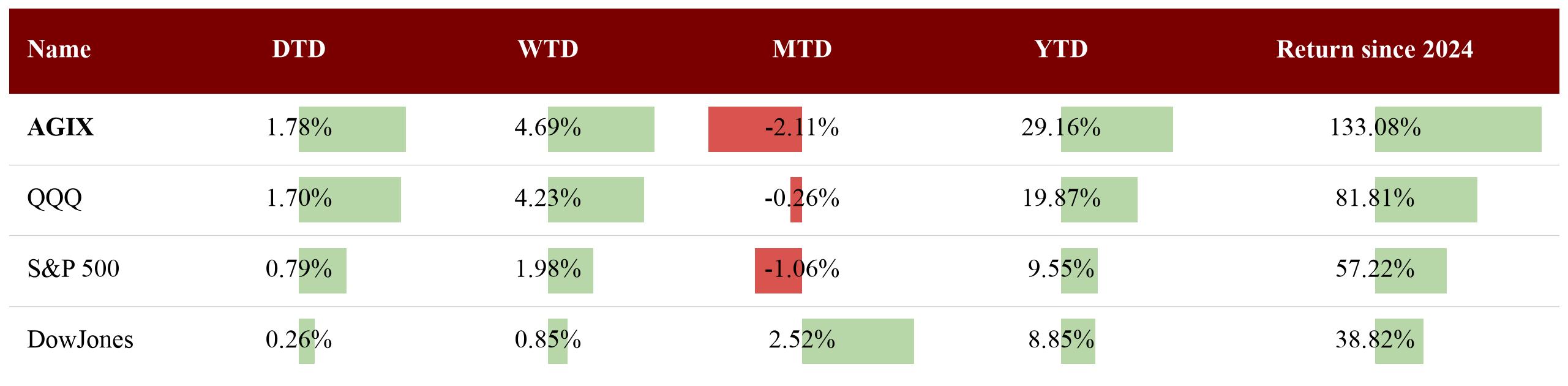
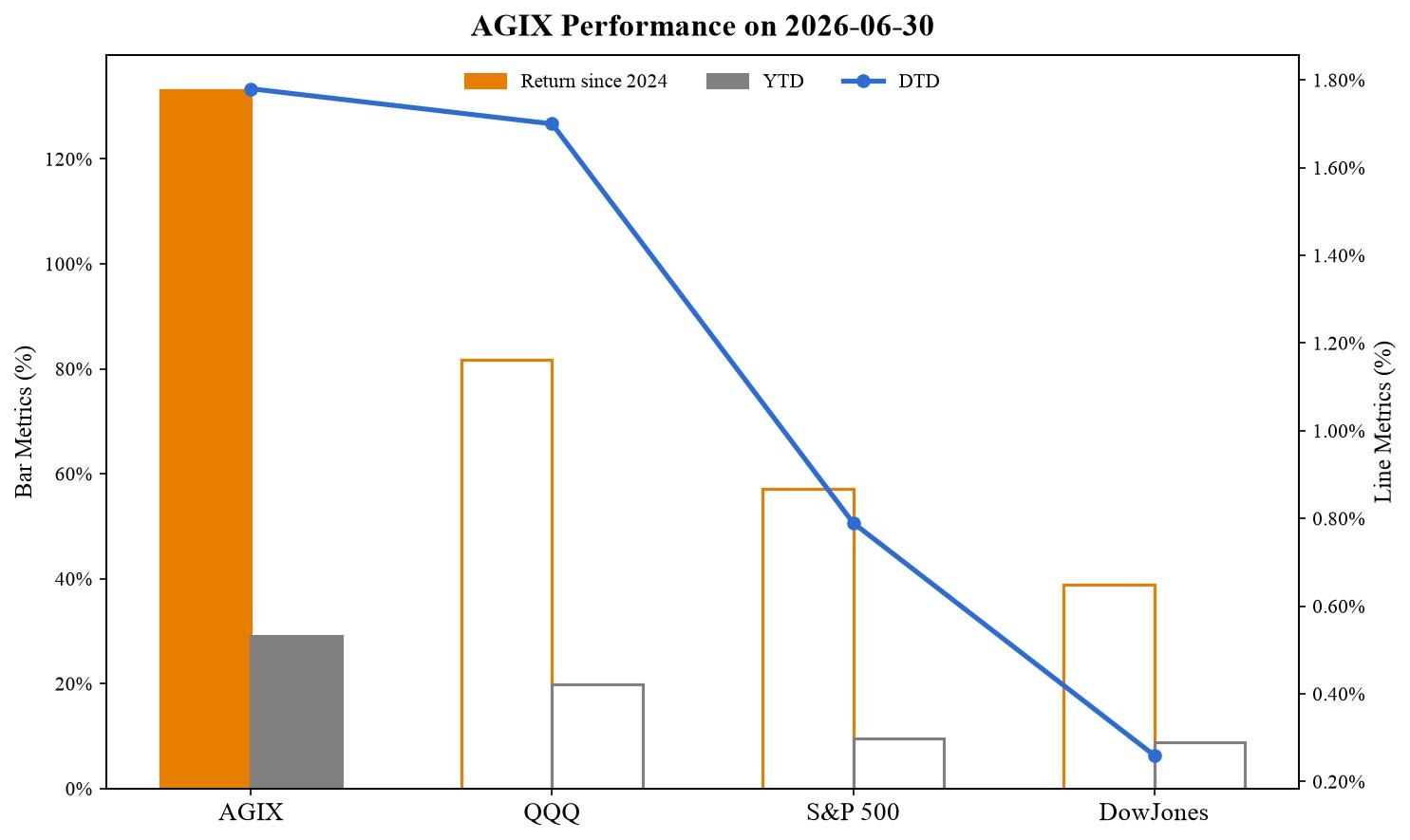
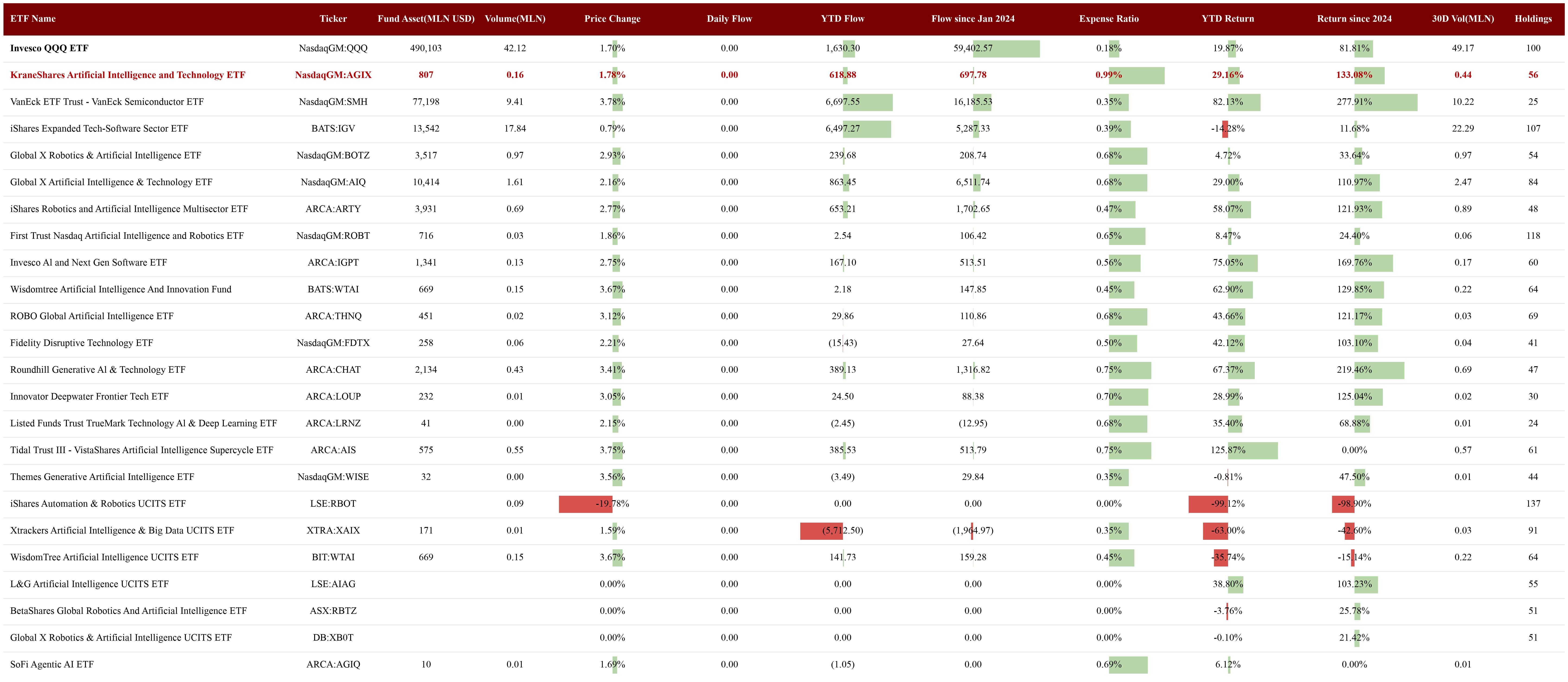
• AGIX outperformed the broader market on the day with a DTD return of 1.78%, slightly ahead of the QQQ (1.70%) and significantly beating the S&P 500 (0.79%) and Dow Jones (0.26%). Year-to-date, AGIX is up 29.16%, second only to the SMH semiconductor ETF (82.13%) among peers.
• Hardware holdings were the primary drivers: NVIDIA (DTD +2.63%, contribution 0.11%), AMD (+7.68%, contribution 0.21%), and Astera Labs (+5.93%, contribution 0.19%) posted strong gains on continued AI infrastructure demand. Vertiv Holdings surged 9.07% on data-center power demand momentum.
• Infrastructure holdings showed mixed performance: Nebius Group (+5.75%) and Datadog (+4.74%) rallied, while Hut 8 (-2.38%) and TeraWulf (-3.44%) declined. Among application holdings, Twilio (+3.80%) and Samsara (+1.03%) rose, but Circle Internet Group tumbled 17.55%.
• Key stocks to watch: AMD (AI chip momentum, +7.68% DTD), Astera Labs (AI connectivity, +5.93%), and Vertiv (AI infrastructure power, +9.07%) are benefiting from sector-wide AI spending tailwinds. Meta (flat DTD) is notable for its new cloud infrastructure leasing plan, which could pressure competitors like CoreWeave.
News Highlights
1. Schneider Electric's $3.1B acquisition of Cognite underscores the shift of industrial AI from monitoring to autonomous operations, boosting the investment case for industrial AI plays like Samsara (AGIX holding).
2. Anthropic's launch of Claude Sonnet 5 with coding and safety upgrades, plus the lifting of US export controls on its Mythos and Fable models, signals intensifying AI model competition and benefits AI infrastructure providers like NVIDIA and AMD.
3. Meta's plan to lease excess AI compute capacity (Meta Compute) directly challenges AWS, Azure, and Google Cloud, potentially disrupting the cloud market and impacting CoreWeave and Nebius (both AGIX holdings).
4. Together AI's $800M Series C at an $8.3B valuation and Etched's $800M funding highlight massive capital inflows into AI infrastructure, reinforcing the growth narrative for GPU and chip companies like NVIDIA and AMD.
5. Trump administration's removal of export restrictions on Anthropic's advanced models supports US AI competitiveness, a positive for the broader AI ecosystem and AGIX holdings exposed to AI model development.
RSS Highlights
1. The 'AI Compass' political-style quiz categorizes users into 30 AI ethics archetypes, reflecting growing public engagement with AI governance.
2. ClickHouse is winning the observability wars due to its high compression ratio and columnar storage, making it ideal for log analysis—a trend benefiting data infrastructure names like Datadog.
3. The AI industry is 'losing' according to a BIS report warning that $1T in hyperscaler AI capex could threaten economic sustainability, with Oracle facing negative free cash flow risks.
4. Grant Sanderson discusses AI's rapid progress in mathematics but notes creativity remains a human stronghold, tempering expectations for full AI automation of research.
5. The UK CMA proposes requiring Apple and Google to allow app store steering and open NFC, which could reduce platform fees and boost competition—a potential headwind for Apple (AGIX holding).
Performance & Benchmark
Attribution
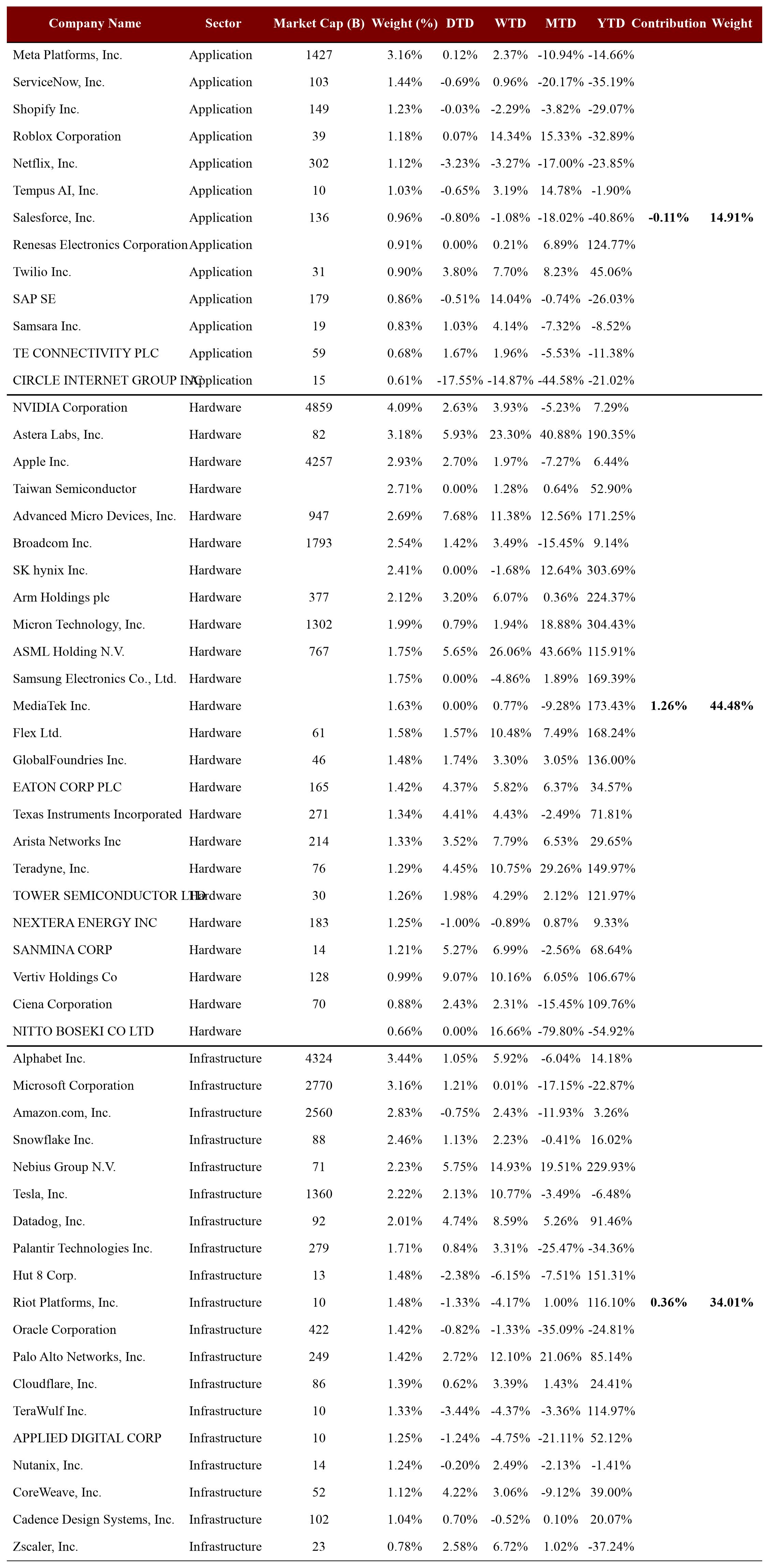
Contribution of the three sectors within AGIX holdings today
Application: -0.11%
Hardware: 1.26%
Infrastructure: 0.36%
Top-performing stocks in AGIX holdings today
Vertiv Holdings Co (9.07%)
Advanced Micro Devices, Inc. (7.68%)
Astera Labs, Inc. (5.93%)
Nebius Group N.V. (5.75%)
ASML Holding N.V. (5.65%)
SANMINA CORP (5.27%)
Datadog, Inc. (4.74%)
Teradyne, Inc. (4.45%)
Texas Instruments Incorporated (4.41%)
EATON CORP PLC (4.37%)
CoreWeave, Inc. (4.22%)
Twilio Inc. (3.8%)
Arista Networks Inc (3.52%)
Arm Holdings plc (3.2%)
Palo Alto Networks, Inc. (2.72%)
Apple Inc. (2.7%)
NVIDIA Corporation (2.63%)
Zscaler, Inc. (2.58%)
Ciena Corporation (2.43%)
Tesla, Inc. (2.13%)
Worst-performing stocks in AGIX holdings today
Hut 8 Corp. (-2.38%)
Netflix, Inc. (-3.23%)
TeraWulf Inc. (-3.44%)
CIRCLE INTERNET GROUP INC (-17.55%)
Top five listed stocks contributing the most within AGIX holdings today
Advanced Micro Devices, Inc. (7.68%)
Astera Labs, Inc. (5.93%)
Nebius Group N.V. (5.75%)
NVIDIA Corporation (2.63%)
ASML Holding N.V. (5.65%)
Observation
The strongest movers across peer ETF holdings today are listed below:
| DTD | Stock Ticker | Name | Held by ETFs | analysis |
|---|---|---|---|---|
| 28.04 | NasdaqGS:AMBA | Ambarella, Inc. | ['LSE:RBOT', 'LSE:AIAG', 'ARCA:THNQ', 'NasdaqGM:AIQ', 'NasdaqGM:ROBT', 'NasdaqGM:WISE', 'XTRA:XAIX'] | Ambarella’s 28% single-day gain on July 1, 2026 appears driven primarily by follow-through buying and momentum after a sharp June 30 move tied to strong AI-chip demand and renewed investor interest in its edge AI positioning. Same-week commentary highlighted Ambarella as a “physical AI” pure play with leadership in edge AI chips for robotics and machine vision and noted strong trading volume and a “Moderate Buy” consensus rating with double‑digit upside, reinforcing the bullish narrative and attracting incremental buyers.[3][6] A supportive backdrop of positive long‑term edge AI commentary and valuation discussions around the name likely amplified the move as momentum and technical breakouts drew in more trading-oriented capital.[1][4][7] |
| 21.15 | NASDAQGM:RZLV | Rezolve AI PLC | ['NasdaqGM:WISE'] | Rezolve AI’s 21% gain on July 1 was primarily a continuation of the strong positive reaction to its June 30 announcement of a $300 million stock buyback and capital reduction, which materially improved the perceived shareholder-return story and balance-sheet optionality.[5] The move was reinforced by a bullish sell-side backdrop, with multiple analysts carrying Strong Buy ratings and high double-digit price targets, keeping sentiment very positive and attracting momentum and retail interest into the stock.[1][3][6] |
| 19.41 | NasdaqCM:INDI | indie Semiconductor, Inc. | ['LSE:RBOT'] | INDI’s 19.41% move on 2026-07-01 was most likely driven by a sharp post-earnings re-rating: the company had just reported Q1 2026 revenue of $55.5 million, above the midpoint of guidance, and management pointed to a stronger Q2 outlook with revenue of $59 million to $65 million. The call also emphasized improving core business momentum, solid design wins, and expected balance-sheet support from the Wooi sale, all of which likely reinforced investor confidence. No other same-day company-specific catalyst is evident in the provided sources, so the earnings update appears to be the primary driver. |
| 18.76 | NasdaqGS:AVAV | AeroVironment, Inc. | ['ASX:RBTZ', 'DB:XB0T', 'ARCA:IGPT', 'ARCA:LOUP', 'NasdaqGM:BOTZ', 'NasdaqGM:ROBT'] | AeroVironment’s sharp 18.8% gain on July 1, 2026 was driven primarily by a bullish brokerage action, as Wedbush initiated coverage at Outperform, prompting broad investor buying interest in the defense drone name.[5] A concurrent reaffirmation of a Buy rating and $305 target by Jefferies the prior day reinforced the positive sentiment and helped sustain momentum.[5] Traders also responded to the recent post-earnings revenue growth and backlog strength that had previously triggered a strong upside move, providing a fundamental backdrop for the upgrade-driven rally.[1] |
| 18.03 | NasdaqGS:MXL | MaxLinear, Inc. | ['LSE:RBOT', 'ARCA:IGPT'] | MaxLinear’s 18% single-day move on July 1, 2026 appears primarily driven by ongoing investor enthusiasm around its optical data center and AI infrastructure growth story following its strong Q1 2026 results and management’s guidance for a “step function increase” in optical data center revenues in Q2.[5][8][10] The move also occurred against a backdrop of substantial year-to-date share appreciation and elevated options-implied volatility, suggesting momentum and positioning dynamics amplified the upside as investors continued to re-rate the stock’s multi-year growth potential.[2][8][10] |
| 16.63 | NasdaqGS:MBLY | Mobileye Global Inc. | ['LSE:RBOT', 'NasdaqGM:ROBT'] | Mobileye’s 16.6% single-day move on July 1, 2026 appears primarily driven by a sharp rebound in a low-liquidity session rather than a specific fundamental catalyst. Trading volume on the day was markedly below average (1.69M vs. 7.14M), amplifying price action in a stock that has been highly volatile and heavily sold over the past year.[3][5][6] Secondary drivers likely include mean-reversion interest after a prolonged drawdown (over -50% in the past year) and a still-sizeable implied upside versus consensus target prices, which can attract short-term buyers when the tape turns.[4][6] |
| 15.63 | NasdaqGS:OUST | Ouster, Inc. | ['LSE:RBOT', 'NasdaqGM:BOTZ'] | Ouster’s +15.6% move appears primarily driven by continued momentum around its lidar/AI perception growth story and recent fundamental strength rather than any discrete new company-specific headline on the day. The stock has been benefiting from record Q1 2026 product revenue, 13 consecutive quarters of product revenue growth, and expanding smart infrastructure deployments, which have attracted bullish commentary and a Zacks Rank 2 (Buy).[8][9] Options markets were pricing in elevated volatility around this period, with a short-dated expected move of about ±13%, providing a supportive backdrop for an outsized directional move.[4] |
| 15.61 | NasdaqGS:HSAI | Hesai Group | ['ASX:RBTZ', 'DB:XB0T', 'NasdaqGM:BOTZ'] | Hesai Group’s 15.61% move on July 1, 2026 was most likely driven by renewed investor optimism around LiDAR adoption and autonomous-driving/ADAS demand, with traders citing the company’s growth profile and strong cash position as supporting factors.[1][3] A secondary catalyst was continued momentum from recent positive sentiment around Hesai’s business outlook, including broader attention to design wins and shipment growth in its LiDAR franchise.[3][4] There was no clear evidence in the provided results of a major same-day company announcement, so the move appears mainly sentiment- and momentum-driven rather than event-specific.[1][3] |
| 11.88 | NasdaqGS:PENG | Penguin Solutions, Inc. | ['ARCA:AIS'] | Penguin Solutions’ 11.9% gain on July 1 was primarily driven by the company’s decision to reaffirm and guide full-year FY2026 revenue and EPS to the upper end of its prior range, highlighting stronger demand tied to AI and boosting investor confidence.[1][7] A secondary driver was bullish sell-side reaction to this guidance, with multiple analysts sharply raising price targets and reiterating buy ratings, reinforcing the positive sentiment around the stock.[1][4] |
| 10.99 | MRCY | Mercury Systems Inc | ['ARCA:LOUP'] | Mercury Systems’ 10.99% move on July 1, 2026 appears primarily driven by investor follow-through buying after strong Q2 FY26 fundamentals and backlog visibility highlighted in recent earnings commentary. Management emphasized robust organic growth, record ~$1.5B backlog, improving margins, and multi‑year program visibility, reinforcing the bull case around operating leverage and defense demand tailwinds, which likely supported sentiment and momentum buying.[1] Secondary drivers include the stock’s positive price momentum, with MRCY trading near recent highs and attracting technical and momentum-oriented flows.[3][4] |
| 10.89 | NasdaqGS:SNDK | Sandisk Corporation | ['ARCA:AIS', 'ARCA:IGPT', 'ARCA:LRNZ', 'BATS:WTAI', 'BIT:WTAI', 'NasdaqGM:QQQ'] | Sandisk’s 10.89% move on 2026-07-01 was most likely driven by a combination of company-specific momentum and positioning in a very volatile, high-priced stock rather than a fresh standalone disclosure. The stock was already trading at elevated levels with strong recent performance, and one market page noted unusually large intraday swings around the date, while an option-implied move for nearby expirations was about 10.92%, indicating the market was pricing in a move of roughly this size. CNBC also flagged Sandisk among the names moving premarket that day, but the available results do not show a clear new company announcement to explain the rally. |
| 10.69 | NasdaqGS:CRDO | Credo Technology Group Holding Ltd | ['LSE:RBOT', 'ARCA:AIS', 'ARCA:ARTY', 'ARCA:CHAT', 'ARCA:IGPT', 'ARCA:LOUP', 'BATS:WTAI', 'BIT:WTAI'] | Credo Technology’s 10.69% gain on July 1, 2026 was primarily driven by continued momentum and investor enthusiasm around its AI infrastructure exposure and strong recent fundamental performance. Zacks and other research commentary highlighted CRDO as a standout semiconductor name, up ~78% over the prior three months on accelerating demand for its high-speed connectivity solutions for AI data centers and a Zacks Rank 1 (Strong Buy), which likely sustained buying interest.[4][7] Supporting this, recent FY26 results showed revenue and EPS growth far above prior-year levels, reinforcing the growth narrative despite concerns about rich valuation.[5][6] Elevated trading volumes relative to history also suggest incremental momentum and technical buying contributed to the move.[7] |
| 10.12 | NasdaqGS:TENB | Tenable Holdings, Inc. | ['BATS:IGV'] | Tenable’s 10.1% gain on July 1 appears primarily driven by follow-through buying after its stronger-than-expected Q1 2026 results and raised full-year outlook, which highlighted 9.6% revenue growth and EPS and revenue beats versus consensus.[4][3][10] A secondary driver is growing optimism around the company’s exposure management pivot and platform strategy, reflected in recent analyst target hikes and commentary on Tenable One, AI-driven vulnerability growth, and its positioning in the cybersecurity sector.[2][5] |
| 10.07 | BE | Bloom Energy Corp- A | ['ARCA:ARTY', 'BATS:WTAI', 'BIT:WTAI'] | Bloom Energy’s ~10% gain on July 1, 2026 appears primarily driven by continued enthusiasm around its expanded AI data-center power partnership with Brookfield, which recently grew from a $5 billion to a $25 billion framework and is seen as materially increasing long-term project funding and growth visibility.[3][4] A second key driver is broader investor focus on Bloom’s positioning as a “bring-your-own-power” solution for AI data centers, supported by a rapidly growing backlog and recent analyst target hikes into the high-$200s to low-$300s that reinforce the AI-infrastructure narrative.[2][3] A third, smaller factor is momentum/trading dynamics in a highly volatile stock that has risen over 1,200% in the past year, amplifying upside moves when positive AI and contract-flow headlines are in focus.[2][5] |
| 9.99 | 002747.SZ | ESTUN AUTOMATION CO LTD-A | ['NasdaqGM:BOTZ'] | The 9.99% move in ESTUN Automation on July 1, 2026 appears primarily driven by continued momentum and rerating in robotics/automation names, with the stock pushing to a new 52-week high and extending strong year-to-date and one-year gains.[2][4][7] There was no specific same-day company news or disclosure; recent notable events include the planned Hong Kong listing in March 2026 and the April 2026 CFO change, which together have likely improved investor confidence and liquidity expectations over recent months.[1][3] Elevated valuation multiples and active trading volumes suggest incremental buying interest in a favored sector name rather than an idiosyncratic catalyst.[7][9] |
| 9.82 | NasdaqGM:DOMO | Domo, Inc. | ['LSE:RBOT'] | Domo’s 9.8% gain on July 1, 2026 appears primarily driven by continued speculative interest around strategic alternatives and a potential sale, following the company’s acknowledgment that it is pursuing such options and recent C-suite turnover that previously sparked takeover speculation.[1][3] The move was likely amplified by broader strength in data/AI and software names that day, with Domo participating as a high-beta, heavily sold-down laggard in an ongoing multi-week recovery in the group.[3][5] Elevated recent volatility and the stock trading near technical resistance around $3.40 also point to momentum and trading factors reinforcing the upside move.[5] |
| 9.79 | NasdaqGS:AXON | Axon Enterprise, Inc. | ['ARCA:LOUP', 'NasdaqGM:QQQ'] | Axon’s 9.8% gain appears driven primarily by continued investor momentum around its AI-enabled software growth story and upgraded 2026 outlook following strong Q1 results, rather than a discrete new catalyst on the day.[1][6] The move also fits within a broader pattern of bullish sentiment and multiple expansion for high-growth, AI-linked Nasdaq names, with Axon highlighted in recent analysis as a favored growth/AI compounder into 2026.[1][4] Technical factors and trend-following behavior likely amplified the upside, as the stock has been in a strong uptrend with recent positive price momentum.[2][7] |
| 9.74 | NasdaqCM:PGY | Pagaya Technologies Ltd. | ['NasdaqGM:WISE'] | Pagaya Technologies’ 9.7% gain on July 1 appears driven primarily by ongoing momentum and investor enthusiasm around its strong year-to-date fundamental story, rather than any discrete company-specific news that day. Recent catalysts include record second-quarter income, a shift to GAAP profitability, raised guidance, and expanded partner funding deals leveraging its AI-driven, capital-light model, which have fueled sustained buy signals and bullish technical trends highlighted in recent analyses.[2][10] Broader optimism around AI-enabled financial technology and upwardly revised analyst price targets has likely reinforced positive sentiment and supported the continued move.[3] |
| 9.63 | 3037.TW | Unimicron Technology Corp | ['ARCA:AIS', 'ARCA:CHAT'] | Unimicron Technology’s 9.6% gain on July 1, 2026 appears primarily driven by continued AI-substrate optimism and strong buy-side conviction, reflected in a “Strong Buy” consensus and 12‑month targets above the prevailing price.[1][7] The move also coincides with momentum in a stock already classified as a “High Flyer,” with substantial year-to-date appreciation, attracting trend-following and growth investors.[5][9] A recently announced cash dividend with an early-July ex-date likely provided an additional, though secondary, support to sentiment.[8][9] |
| 9.61 | BNAI | BRAND ENGAGEMENT NETWORK INC COM | ['NasdaqGM:WISE'] | Brand Engagement Network’s 9.6% gain on July 1, 2026 appears to be a continuation of strong momentum triggered by recent corporate developments rather than a discrete new catalyst on the day. The primary driver is renewed investor focus on its Q1 2026 filing and business update, along with previously announced reseller agreements and an investment framework to expand commercialization, which had already pushed the stock sharply higher in prior sessions.[1][8] A secondary driver is elevated retail interest and speculation around its international AI licensing partnerships, keeping trading activity and volatility high in this micro-cap name.[1][2] |
| 9.6 | NasdaqGS:CEVA | CEVA, Inc. | ['LSE:RBOT'] | CEVA’s 9.6% single-day move appears primarily driven by momentum and valuation-related buying interest following its strong Q1 2026 results, which showed 11% year-over-year revenue growth and the highest licensing revenues in three years.[3][1] A secondary driver is ongoing bullish analyst sentiment and a high proportion of buy ratings despite some valuation caution, encouraging incremental upside participation from growth and semiconductor-focused investors.[2][4][8] |
| 9.55 | NasdaqGM:MVIS | MicroVision, Inc. | ['LSE:RBOT'] | MicroVision’s 9.6% gain on July 1, 2026 appears driven primarily by a rebound from recent lows amid speculative interest, rather than any identifiable company-specific news or fundamental catalyst released that day. Public news and the company IR feed show no new filings, product updates, or guidance revisions on July 1, suggesting the move was likely technical in nature, with investors reacting to the stock’s depressed level versus analyst targets and prior trading history. |
| 9.4 | 2449.TW | King Yuan Electronics Co Ltd | ['ARCA:AIS'] | King Yuan Electronics’ 9.4% gain appears primarily driven by strong bullish sentiment and momentum rather than a specific new fundamental catalyst on the day. The stock is trading near the top of its 52-week range with a “Strong Buy” technical signal and a supportive analyst backdrop, including a consensus “Strong Buy” rating and upside to target prices, which likely fueled follow-through buying and short-term trading interest.[3][5] No material company-specific news or regulatory announcements were reported on or immediately before July 1, 2026, suggesting the move was predominantly sentiment- and technical-driven rather than event-driven.[2][6] |
| 9.07 | NYSE:VRT | Vertiv Holdings Co | ['NasdaqGM:AGIX', 'ARCA:AIS', 'ARCA:CHAT', 'ARCA:LOUP', 'BATS:WTAI', 'BIT:WTAI'] | Vertiv’s 9.1% gain on July 1, 2026 appears primarily driven by continued momentum around AI data center infrastructure demand and bullish forward expectations for revenue and margin expansion, following its strong Q1 2026 results and raised full-year guidance for EPS, operating margin, and free cash flow.[1][5][7] A second key driver is ongoing positioning as a “must own” AI infrastructure play, reinforced by recent S&P 500 inclusion and favorable analyst/financial media commentary highlighting robust backlog and hyperscaler-driven growth.[2][5][7] The move also likely reflects a rebound from recent profit-taking and volatility in high-momentum AI infrastructure names, as investors re-engaged with Vertiv on the structural AI spending theme.[2][7] |
| 8.45 | 3711.TW | ASE TECHNOLOGY HOLDING LTD | ['ARCA:ARTY'] | ASE Technology’s 8.45% gain on July 1, 2026 appears driven primarily by continued momentum in the high-performance semiconductor and advanced packaging theme, with investors rotating into leading OSAT names following strong sector demand indicators.[6][8] A secondary driver is the stock’s ongoing re-rating on earnings growth expectations, as consensus forecasts call for a sharp EPS ramp in 2026, reinforcing the recent 300% 12‑month move and attracting momentum and growth buyers.[4][8] |
| 8.38 | NasdaqGS:KLAC | KLA Corporation | ['LSE:RBOT', 'NasdaqGM:QQQ', 'NasdaqGM:ROBT', 'NasdaqGM:SMH'] | KLAC’s 8.4% gain on July 1, 2026 was primarily driven by a sharp rebound in the semiconductor sector after the prior day’s heavy selloff, with investors re‑risking AI and chip exposure following supportive commentary from Nvidia’s CEO that framed the pullback as a “buy the dip” opportunity and stressed that the AI cycle is still in its early innings.[3] Secondarily, KLAC’s move was amplified by its historically high volatility and strong year‑to‑date performance, which tends to magnify flows into the name when sector sentiment inflects positively.[3][2] |
| 7.69 | DVLT | Datavault AI Inc | ['NasdaqGM:WISE'] | DVLT’s 7.7% gain on July 1, 2026 appears primarily driven by ongoing momentum and retail interest following its May Q1 2026 business update, which highlighted 443% year-over-year revenue growth and over $800 million in tokenization contracts alongside a reiterated $200 million 2026 revenue target.[4][1] The move also fits within a broader short-term rebound trend, as the stock had already risen roughly 18–22% off late-June lows, suggesting follow-through buying rather than a discrete new catalyst on the day.[5][6] |
| 7.68 | NYSE:ONTO | Onto Innovation Inc. | ['LSE:RBOT', 'ARCA:ARTY'] | Onto Innovation’s 7.7% move appears driven primarily by continued momentum after its strong Q1 print and 2026 guidance for ~30% revenue growth and margin expansion, which has kept investor sentiment very positive.[2][8] A secondary driver is ongoing bullish sell-side and media commentary highlighting rapid adoption of its Dragonfly and advanced packaging inspection tools, positioning ONTO as a key beneficiary of high-bandwidth memory and advanced packaging demand.[3][8] |
| 7.68 | NasdaqGS:AMD | Advanced Micro Devices, Inc. | ['NasdaqGM:AGIX', 'LSE:RBOT', 'LSE:AIAG', 'ARCA:AIS', 'ARCA:ARTY', 'ARCA:CHAT', 'ARCA:IGPT', 'ARCA:LRNZ', 'ARCA:THNQ', 'BATS:WTAI', 'BIT:WTAI', 'NasdaqGM:AIQ', 'NasdaqGM:QQQ', 'NasdaqGM:ROBT', 'NasdaqGM:SMH', 'NasdaqGM:WISE'] | AMD’s 7.68% gain on July 1, 2026 appears driven primarily by continued enthusiasm around its AI data center growth story and strong recent Q1 2026 fundamentals, reinforcing confidence in sustained revenue and margin expansion.[2] A secondary driver is momentum and speculative positioning ahead of upcoming earnings and guidance updates, as investors extrapolate robust EPYC and Instinct GPU demand into higher forward expectations.[2][3] |
| 7.29 | 2513.HK | Knowledge Atlas Technology JSC Ltd | ['ARCA:CHAT'] | The 7.29% rise in 2513.HK on 2026-07-01 appears to have been driven primarily by technical momentum rather than a fresh company-specific catalyst, as the stock was already flagged as a Strong Buy on technical indicators and traded near the top of its intraday range.[1][5] I did not find any same-day news or disclosure in the provided results to explain a material fundamental re-rating. The move also fits the stock’s already elevated trading profile and broad bullish analyst sentiment, which can amplify short-term price swings.[1][2] |
| 7.25 | NasdaqGS:MRVL | Marvell Technology, Inc. | ['ARCA:AIS', 'ARCA:ARTY', 'ARCA:CHAT', 'ARCA:IGPT', 'ARCA:LOUP', 'BATS:WTAI', 'BIT:WTAI', 'NasdaqGM:AIQ', 'NasdaqGM:FDTX', 'NasdaqGM:QQQ', 'NasdaqGM:ROBT', 'NasdaqGM:SMH'] | Marvell Technology’s 7.25% move on July 1, 2026 appears driven primarily by a sharp reversal from the prior “sell-the-news” and de-risking phase that followed its late-June S&P 500 inclusion and insider selling, as investors rotated back into high-growth AI semiconductor names.[1][2][3][7] The rebound was supported by still-bullish fundamental sentiment around Marvell’s AI infrastructure and custom silicon growth narrative and its outsized year-to-date performance versus peers, with technical buyers stepping in near the $275–$280 area highlighted as key support.[2][3][4][7] |
| 7.16 | 009150.KS | Samsung Electro-Mechanics Co Ltd | ['ARCA:AIS'] | Samsung Electro-Mechanics’ gain on July 1 appears driven primarily by ongoing momentum and strong technical/analyst buy signals rather than a discrete company-specific news event that day. The stock has been in a strong uptrend with multiple platforms flagging buy/strong buy technical ratings and positive sentiment, which likely attracted incremental inflows and short-term momentum trading.[1][3][4] The broader context of bullish expectations for high-end MLCC demand and Semco’s role as a beneficiary in that value chain also supports the move as part of a multi-day re-rating rather than a single catalyst.[5] |
| 7.15 | NasdaqGS:QLYS | Qualys, Inc. | ['BATS:IGV', 'XTRA:XAIX'] | Qualys’ 7.15% gain was primarily driven by a JPMorgan rating upgrade, with the stock raised from Underweight to Neutral and the price target lifted to $139, which directly triggered a ~7–8% intraday move in QLYS shares.[1][3] This call highlighted strengthening growth in vulnerability management and signaled improved confidence in Qualys’ fundamentals, reinforcing the earlier bullish narrative around TruRisk-driven expansion and recent Q1 results beats.[1][2][6] Broader strength in software and security names provided a supportive backdrop, but the JPMorgan action was the clear stock-specific catalyst.[1][3][8] |
| 7.13 | NasdaqGS:RMBS | Rambus Inc. | ['ARCA:ARTY', 'ARCA:LOUP'] | Rambus’s 7.1% gain on July 1, 2026 appears primarily driven by a rebound from the prior session’s sharp selloff, as investors rotated back into AI- and memory-leverage semiconductor names after sector-wide weakness the day before. Second, supportive analyst sentiment and a consensus Buy rating with price targets around current levels likely reinforced dip-buying interest in a stock viewed as a beneficiary of high‑performance memory demand in AI infrastructure.[2][8] |
| 7.1 | NasdaqGS:AEIS | Advanced Energy Industries, Inc. | ['ARCA:AIS'] | Advanced Energy Industries’ 7.1% gain on July 1, 2026 appears primarily driven by technical and sentiment factors rather than new fundamental news, as the stock broke through key resistance levels on heavy volume, reinforcing a strong year-to-date uptrend in semiconductor capital equipment exposure.[1][4] A secondary driver was supportive analyst activity and ongoing positive coverage, including a Susquehanna Buy rating with a $535 target, which helped sustain bullish expectations despite the stock trading well above most published valuation benchmarks.[2][7] |
| 6.8 | 300024.SZ | SIASUN ROBOT & AUTOMATION-A | ['NasdaqGM:BOTZ'] | Available market data show SIASUN Robot & Automation fell about 3% on July 1 rather than rising 6.8%, so the specified daily return appears inconsistent with public quotes.[2][5] With no evidence of company-specific news, disclosures, or sector catalysts on that date, the move is best explained by normal trading volatility within an ongoing short-term uptrend in the stock, which has risen strongly over the past week and month.[1] |
| 6.74 | NasdaqGS:ON | ON Semiconductor Corporation | ['NasdaqGM:SMH'] | ON Semiconductor’s 6.7% gain on July 1, 2026 was primarily a rebound move following the sharp sell-off after its announced $7 billion Synaptics acquisition, as investors reassessed deal fears and short-term pessimism eased.[6][7] The move was likely reinforced by broader semiconductor strength, with sector sentiment supported by ongoing AI/data center growth narratives that ON has highlighted in its recent results and commentary.[1][3][10] |
| 6.67 | NasdaqGM:SYM | Symbotic Inc. | ['LSE:RBOT', 'ASX:RBTZ', 'DB:XB0T', 'ARCA:IGPT', 'NasdaqGM:BOTZ', 'NasdaqGM:ROBT'] | Symbotic’s 6.7% gain on July 1, 2026 appears driven primarily by a rebound following the prior session’s intraday weakness and trading near the bottom of its recent range, with investors buying the dip in a high-beta, high-growth AI robotics name.[2][4][8] A secondary driver is ongoing positive sentiment around Symbotic’s long-term growth story and large automation backlog, as highlighted in recent commentary positioning SYM as a leading AI-enabled warehouse automation play for 2026.[3][7] |
| 6.59 | NasdaqGS:ALKT | Alkami Technology, Inc. | ['BATS:IGV'] | Alkami Technology’s 6.59% gain on July 1, 2026 appears primarily driven by a rebound within a still-depressed valuation backdrop and supportive analyst positioning, rather than a discrete company-specific news event that day.[3][4] The stock is trading near the lower end of its 52-week range after a ~38–65% drawdown tied to growth headwinds, guidance cuts, and broader SaaS/AI multiple compression, so investors likely reacted to its relatively low forward P/E, improving non-GAAP earnings, and “Strong Buy/Buy” ratings with double‑digit upside in consensus targets.[2][3][4][6] Technical factors also reinforced the move, with same‑day indicators flashing a buy signal and the price breaking higher within the expected options move range, which can attract short-term traders and momentum participants.[3][4][9] |
| 6.57 | NasdaqCM:RR | Richtech Robotics Inc. | ['ASX:RBTZ', 'DB:XB0T', 'NasdaqGM:BOTZ'] | Richtech Robotics’ 6.57% gain on July 1, 2026 appears primarily driven by momentum/trading factors rather than discrete fundamental news, with the move occurring in the context of elevated recent volatility and speculative interest in AI/robotics names.[5][6] The stock is thin, high beta, and has shown sharp short-term swings, with technical indicators flagging a strong buy setup and options implying very large expected moves, which likely amplified day-trader and momentum participation.[1][5] No new company-specific filings or major news items were evident for that date, so the move is best characterized as continuation of a broader speculative rally following prior AI-related headlines rather than a fresh catalyst.[2][9] |
| 6.56 | NYSE:GEV | GE Vernova Inc. | ['ARCA:AIS', 'BATS:WTAI', 'BIT:WTAI'] | GE Vernova’s move on July 1 appears driven primarily by valuation-driven profit-taking after a strong run into all-time highs and a rich forward earnings multiple, which left the stock vulnerable to a pullback as investors locked in gains ahead of the upcoming Q2 earnings release later this month.[1][3][7] A secondary driver was sector-wide risk-off rotation within utilities and power infrastructure names, with broader utilities weakness and ongoing concerns about execution risks in GE Vernova’s utility-scale backlog conversion, grid interconnection delays, and loss-making Wind division weighing on sentiment.[1] |
| 6.54 | 300757.SZ | ROBOTECHNIK INTELLIGENT TE-A | ['NasdaqGM:BOTZ'] | RoboTechnik Intelligent Technology’s share price decline on July 1, 2026 appears to be driven primarily by a lack of supportive company-specific news and profit-taking after a sharp run-up, with the stock trading near the upper end of its 52-week range and technical indicators flashing sell signals.[1][8] The move is further framed by the stock’s high volatility and rich valuation versus fundamentals, making it more vulnerable to short-term trading pressure in the absence of positive catalysts.[1][7][8] |
| 6.28 | TSX:CLS | Celestica Inc. | ['ARCA:AIS', 'ARCA:ARTY', 'ARCA:CHAT', 'BATS:WTAI', 'BIT:WTAI', 'NasdaqGM:AIQ', 'NasdaqGM:FDTX'] | Celestica’s 6.28% gain on July 1, 2026 appears to be a rebound move driven primarily by technical and sentiment factors rather than identifiable company-specific news. Public sources show no material Celestica press releases, rating changes, or sector headlines that day, and commentary around the name instead highlights recent underperformance over the prior month and valuation/AI-data-center themes rather than fresh catalysts.[2][5] In this context, the move is most plausibly explained by short-covering and dip-buying after a period of weakness, amplified by the stock’s high beta and elevated retail/institutional attention.[2][4][5] |
| 6.2 | NasdaqGS:KTOS | Kratos Defense & Security Solutions, Inc. | ['NasdaqGM:ROBT'] | KTOS’s 6.2% move on July 1, 2026 was driven primarily by fresh bullish analyst coverage that reframed Kratos as a broad, underappreciated supplier across major U.S. defense programs, reinforcing the existing positive narrative around autonomous and unmanned defense systems.[1] A new Wedbush initiation with an $85 price target added to this re-rating impulse and helped pull the stock higher on strong volume.[1][4] The move was further supported by lingering momentum from Kratos’ raised 2026 outlook and robust unmanned-systems growth disclosed in its May quarter update, which continue to underpin bullish sentiment in the name.[1] |
| 6.13 | SHA0.DE | Schaeffler AG | ['ARCA:LOUP'] | Schaeffler AG’s 6.1% move appears primarily technical, reflecting momentum rather than a specific new fundamental catalyst on the day. The stock had recently benefited from its announced inclusion in the MDAX effective March 9, 2026, which increased trading interest and index-related demand, providing a supportive backdrop for positive price action.[1][2] Short-term trading models and buy signals highlighted by technical analysis services also point to a favorable trend and rising momentum, likely amplifying the single-day move.[3] |
| 6.01 | NasdaqGS:INTC | Intel Corporation | ['LSE:RBOT', 'ARCA:AIS', 'ARCA:CHAT', 'ARCA:IGPT', 'BATS:WTAI', 'BIT:WTAI', 'NasdaqGM:AIQ', 'NasdaqGM:QQQ', 'NasdaqGM:ROBT', 'NasdaqGM:SMH', 'XTRA:XAIX'] | Intel’s move on July 1 appears to be a sharp downside reaction rather than a gain, with the stock falling about 9% intraday from a prior close around $139.63 to roughly $127, contrary to the +6.01% daily return cited. The primary driver was broad-based selling in Intel and the semiconductor group after a strong run into all-time highs and ahead of Intel’s scheduled Q2 2026 earnings on July 23, prompting profit-taking and positioning changes.[1][5][9] A secondary factor was elevated trading volume versus typical levels, suggesting active institutional rebalancing and short-term momentum reversal rather than company-specific news flow on the day.[1][2] |
| 5.94 | NasdaqGS:CGNX | Cognex Corporation | ['LSE:AIAG', 'ASX:RBTZ', 'DB:XB0T', 'ARCA:IGPT', 'ARCA:THNQ', 'NasdaqGM:BOTZ', 'NasdaqGM:ROBT'] | Cognex’s 5.94% rise on 2026-07-01 appears most consistent with continued investor optimism around a factory-automation upcycle and improving demand in semiconductor/AI-driven inspection markets, rather than a single company-specific announcement that day.[1][3] The move also fits a broader positive setup in the name, with analysts and market data showing a strong-buy/positive consensus and elevated price targets into early July.[2][5][8] On the fundamental side, Cognex’s strong Q1 2026 results—24% revenue growth, expanding margins, and new AI vision product launches—likely kept sentiment constructive and supported dip-buying.[3] |
| 5.93 | NasdaqGS:ALAB | Astera Labs, Inc. | ['NasdaqGM:AGIX', 'ARCA:AIS', 'ARCA:ARTY', 'ARCA:CHAT', 'ARCA:IGPT', 'ARCA:LRNZ', 'BATS:WTAI', 'BIT:WTAI', 'NasdaqGM:QQQ', 'NasdaqGM:SMH'] | Astera Labs’ 5.9% gain on July 1, 2026 appears primarily driven by continued post-earnings and index-addition momentum rather than any new company-specific disclosure that day. The stock has been rallying sharply on the back of record Q1 2026 results (revenue up 93% YoY to $308m, strong margins) and its recent inclusion in the Nasdaq-100 on June 22, which together have positioned ALAB as a high-conviction AI infrastructure growth play.[5][6] A secondary driver is sector-wide strength in semiconductor and AI-related names, with chip stocks extending a broader rebound that has kept ALAB in a steep uptrend near 52-week highs and well above key moving averages, attracting momentum and growth investors.[1][3][6] |
| 5.86 | NasdaqCM:GRRR | Gorilla Technology Group Inc. | ['NasdaqGM:WISE'] | Gorilla Technology’s 5.9% gain on July 1, 2026 appears primarily driven by ongoing investor enthusiasm around its expanded AI infrastructure backlog and upgraded forward guidance following recent mega-deal announcements. Management has highlighted multi‑billion dollar AI infrastructure contracts (including India and broader Asia programs) and raised 2026 revenue guidance into a roughly $160–200 million range, reinforcing a high-growth narrative that continues to attract momentum and retail interest.[1][4][7][8] A secondary driver is technical and sentiment follow-through: the stock has been trading near the top of its recent range with elevated call activity and bullish commentary from analysts and influencers, which likely amplified buying interest and contributed to the outsized single-day move.[2][5] |
| 5.84 | NasdaqGS:SYNA | Synaptics Incorporated | ['XTRA:XAIX'] | Synaptics’ 5.8% gain appears primarily driven by a bullish sell-side catalyst, with Mizuho raising its price target from $128 to $170 and reiterating an “outperform” rating, highlighting roughly 37% upside and supporting the ongoing edge-AI and Core IoT growth narrative.[2] A secondary driver is follow-through buying and elevated volume after a recent sharp four-week drawdown, as investors reposition around Synaptics’ AI-enabled IoT, robotics, and Google-related edge AI opportunities and solid earnings/revenue trajectory.[1][5] |
| 5.8 | NasdaqGS:IPGP | IPG Photonics Corporation | ['LSE:RBOT', 'ARCA:IGPT'] | IPG Photonics’ 5.8% gain on July 1, 2026 appears driven primarily by valuation re-rating after recent fundamental and technical momentum, with no new company-specific news that day. A Simply Wall St analysis published around the move highlighted the stock’s strong short-term price momentum and concluded IPGP is undervalued versus a fair value estimate of about $145, which likely supported buying interest.[5] Secondary factors include generally positive sell-side sentiment with a “Moderate Buy” consensus and target price above spot levels, reinforcing the re-rating narrative despite mixed recent margin trends.[4][5] |
| 5.75 | NasdaqGS:NBIS | Nebius Group N.V. | ['NasdaqGM:AGIX', 'ARCA:CHAT', 'ARCA:IGPT', 'ARCA:THNQ', 'BATS:WTAI', 'BIT:WTAI', 'NasdaqGM:QQQ'] | Nebius Group N.V. (NBIS) appears to have moved primarily on a sharp sentiment reversal linked to concerns about its leverage and competitive pressures, with the stock “plummeting” on heavy debt worries and Meta-related cloud competition headlines that triggered elevated volatility and intraday swings.[1][3][7] The move was amplified by very high trading volume (roughly 85% above average), suggesting forced or momentum-driven selling in a crowded AI trade rather than any new fundamental disclosure from the company itself.[1][3] |
| 5.65 | ENXTAM:ASML | ASML Holding N.V. | ['NasdaqGM:AGIX', 'LSE:AIAG', 'ARCA:AIS', 'ARCA:CHAT', 'ARCA:THNQ', 'BATS:WTAI', 'BIT:WTAI', 'NasdaqGM:QQQ', 'NasdaqGM:SMH'] | ASML’s 5.7% gain on July 1, 2026 was primarily driven by renewed optimism about its ability to expand EUV lithography tool output and the associated upside to medium-term revenue and margins. The move was reinforced by a series of recently raised sell-side price targets tied to higher assumed EUV system deliveries and by ASML’s lifted 2026 sales and gross margin guidance, which highlighted strong AI-driven demand for advanced chips and robust order intake. |
| 5.56 | ENR.DE | Siemens Energy AG | ['ARCA:LOUP'] | Siemens Energy’s 5.56% rise on 2026-07-01 was most likely driven by renewed optimism around power-grid and gas-turbine demand tied to AI/data-center buildout, plus the company’s recent improved earnings and raised 2026 outlook that continued to support the stock. Reuters also notes Siemens Energy was benefiting from a surge in demand for power equipment for data centers and had recently accelerated its buyback program, both of which are positive sentiment drivers.[1][2][4] |
| 5.46 | NasdaqGS:LRCX | Lam Research Corporation | ['LSE:AIAG', 'ARCA:LOUP', 'ARCA:THNQ', 'NasdaqGM:QQQ', 'NasdaqGM:SMH'] | Lam Research’s share price move on July 1, 2026 was driven primarily by a sharp sector-wide de-risking and profit-taking in semiconductor equipment stocks after a strong multi-month rally, which left LRCX vulnerable to a pullback amid valuation concerns. The move was exacerbated by a newly disclosed class-action lawsuit against major memory manufacturers (key Lam customers), heightening regulatory and operational uncertainty around DRAM/HBM supply chains and near-term equipment demand. A weaker macro backdrop, including cooling labor market data and rising bond yields, further pressured high-growth tech and semiconductor names, amplifying the single-day downside move in LRCX. |
| 5.35 | NXXT | NextNRG Inc | ['NasdaqGM:WISE'] | NextNRG’s 5.35% gain on July 1, 2026 is best explained by a rebound move following recent positive fundamental developments rather than any discrete same‑day news catalyst. The most relevant driver is continued investor digestion of strong May 2026 preliminary revenue and margin expansion, marking the fifth consecutive month of double‑digit revenue growth, which supports a higher fundamental valuation despite ongoing losses.[1] A secondary driver is improving sentiment around the name, with at least one analyst reiterating a Strong Buy rating and a $5 price target, which can encourage incremental buying in a thinly traded small‑cap stock.[1][3] |
| 5.3 | NasdaqGS:MPWR | Monolithic Power Systems, Inc. | ['ARCA:CHAT', 'ARCA:LRNZ', 'NasdaqGM:FDTX', 'NasdaqGM:QQQ', 'NasdaqGM:SMH'] | Monolithic Power Systems’ 5.3% gain on July 1, 2026 was primarily driven by investor reaction to its strong Q1 2026 earnings report, which showed 26% year-over-year revenue growth to $804.2 million, meaningful operating and net income growth, and a top-line beat versus consensus despite an EPS miss.[2][5] A secondary driver was continued optimism around MPWR’s exposure to AI data centers and accelerating enterprise data and automotive pipelines, reinforced by management commentary about raising the growth floor for these segments and winning additional sockets and share.[1][5] |
| 5.27 | NasdaqGS:SANM | SANMINA CORP | ['NasdaqGM:AGIX'] | Sanmina’s 5.27% move on July 1, 2026 appears primarily driven by continued investor positioning into a strong AI and cloud infrastructure narrative following its robust recent earnings and ZT Systems integration, rather than by a specific new company disclosure that day.[1][3][5] A secondary driver is ongoing buy-side interest and inflows, as evidenced by recent institutional activity and a supportive “Moderate Buy” consensus and elevated price targets, which are helping sustain momentum in a stock that has materially outperformed over the past year.[2][3][7] |
| 5.27 | NasdaqCM:QUIK | QuickLogic Corporation | ['NasdaqGM:WISE'] | QuickLogic’s 5.27% gain on July 1, 2026 appears primarily driven by follow-through buying and positioning after its announced inclusion in the Russell 2000 and Russell 3000 indexes effective June 29, 2026, which tends to attract benchmarked and passive capital and can support short-term demand for the shares.[1] A secondary driver is strong positive sentiment and technical momentum, with the stock in a pronounced uptrend and upgraded to a “Strong Buy candidate” by quantitative/technical analysis services, encouraging additional momentum and trend-following flows.[2][4] |
| 5.16 | ENTG | ENTEGRIS INC | ['ARCA:ARTY'] | ENTG’s +5.2% move on July 1 appears primarily driven by continued positive sentiment and momentum following June’s EUV cross‑licensing deal with JSR/Inpria and subsequent analyst target hikes, as investors position Entegris as a key beneficiary of the AI-driven wafer fab equipment upcycle.[1][2][6] With no incremental company-specific news or filings on the day, the stock likely traded on follow-through buying in a high‑beta AI/semicap basket, aided by options‑implied volatility and a setup where ENTG is near all‑time highs and above key moving averages.[3][7][10] |
News
Funding & M&A
Schneider Electric acquires Cognite for $3.1 billion in an industrial AI push.
French energy giant Schneider Electric announced an all-cash acquisition of industrial AI company Cognite Holding B.V. for $3 billion to strengthen its AI software and industrial data business. The deal highlights that industrial AI is shifting from simple monitoring to autonomous decision-making and operations. Cognite's Data Fusion and Atlas AI platforms can unify and model messy data from industrial facilities, and use intelligent agents to automate equipment fault detection, parts ordering, and repair scheduling. Schneider will integrate this technology with its UK software subsidiary Aveva CONNECT to help industries such as energy, oil and gas, and manufacturing improve efficiency and reduce waste. Cognite's 2025 revenue exceeded $17 million, and its backer Aker will receive $1.48 billion in cash. The transaction is subject to regulatory approval and is expected to close in the coming quarters.
Verkada takes Nvidia investment to expand its physical AI platform
Physical security company Verkada has received an investment from Nvidia and signed a technology collaboration agreement to accelerate the deployment of its AI technology across 2.4 million devices. The collaboration centers on Nvidia's Cosmos world foundation model and the Physical AI Data Factory toolkit, which will be used for video search, spatial-temporal querying, and other scenarios. After the collaboration, Verkada achieved an 87% improvement in relevant benchmark average precision metrics. Verkada previously completed a funding round in 2024 at a $5.8 billion valuation and has surpassed $1 billion in annual orders. Nvidia is expanding its ecosystem into robotics, smart factories, and other fields through the Cosmos model series and developer toolchains. Verkada's technology is deployed across 3,000 organizations in 17 countries, including 100 Fortune 500 companies.
Raja Koduri’s Oxmiq Labs raises $35M to lower the design cost of custom AI silicon
AI chip startup Oxmiq Labs has just completed a $35 million Series A funding round, bringing its total funding to $60 million. The round was led by Fundomo and the Samsung Accelerator Fund, with participation from Meicheng Electric, MediaTek, Hecheng Investment, CDIB-TEN, and others. Founded by former Intel chief architect Raja Koduri, the company is developing the OxCore GPU architecture and OxQuilt compute fabric, integrating GPU, CPU, and Tensor Engine into a single IP block to reduce AI chip development costs. Its software stack supports unmodified CUDA and PyTorch code. Oxmiq aims to become the "next Arm" and compete with Broadcom, Marvell, and other players in the custom chip market. The funds will be used to finalize the first IP and expand the engineering team.
Report: SpaceX showed investors an AI device before IPO; Musk denies it
According to a report by the Wall Street Journal, SpaceX showcased a prototype of a handheld AI device based on xAI technology to investors ahead of its initial public offering. The device is thinner than an iPhone and features Qualcomm's Snapdragon chip. CEO Elon Musk immediately denied the report on X, calling it "completely false." The report stated that the project is still in its early stages, the design may change, and it has not been determined whether it will be brought to market. SpaceX actually acquired xAI earlier this year through a stock transaction and fully integrated it into its operations. If the device becomes a reality, it would represent SpaceX's biggest expansion from rockets and satellite internet into consumer hardware, aligning with Musk's long-term goal of building a "universal app." The company completed the largest IPO in history on the Nasdaq in June, raising approximately $75 billion, with a valuation of $1.77 trillion.
TwelveLabs raises $100M to bring superintelligence to AI video models
TwelveLabs, an innovative video understanding AI company, announced the completion of a $100 million Series B funding round, co-led by NEA and NAVER Ventures, with participation from Amazon, Radical Ventures, and others. This round brings the company's total funding to over $207 million. TwelveLabs' self-developed multimodal foundation models, Marengo and Pegasus, enable native video understanding, converting video content into structured data and supporting temporal reasoning. The company will deepen its partnership with AWS to optimize inference performance on Trainium chips, with new models first launching on AWS. The technology can be widely applied in industries such as security, advertising, sports, and automotive, advancing machine deep understanding and operationalization of video content.
Neocloud Together AI raises $800M, leaps to $8.3B valuation
Together AI, an AI infrastructure service provider, announced the completion of an $800 million Series C funding round, valuing the company at $8.3 billion. The round was led by Aramco Ventures, the venture arm of Saudi Aramco, with participation from Nvidia, Vista Equity Partners, General Catalyst, and others. The company primarily leases Nvidia GPU clusters and open-source AI model interfaces to clients, with annualized order value exceeding $1.15 billion over the last four quarters. The funding will further expand its open-source model service capabilities, helping enterprises reduce AI operational costs. Previously, the company had raised $305 million in Series B funding at a $3.3 billion valuation. Several other GPU cluster companies have recently received large investments, reflecting strong market interest in AI infrastructure.
Ashton Kutcher leaving Sound Ventures to launch new VC firm with Morgan Beller
Actor and investor Ashton Kutcher is leaving Sound Ventures, which he co-founded with Guy Oseary 11 years ago, to create a new venture capital fund. The new fund will partner with Morgan Beller, who was a general partner at NFX and previously led the Libra project at Meta. The new fund will focus on early-stage investments in AI infrastructure, energy, and deep tech. Sound Ventures continues to hold stakes in Brex, Gusto, OpenAI, and others, and is an early investor in Anthropic and World Labs. The two parties will provide advisory services to each other. This move reflects that AI capital is settling into the infrastructure layer. Stanford professor Ilya Strebulaev praised Kutcher's unicorn investment performance.
Venice raises $65 million at a $1 billion valuation for private, uncensored AI
Privacy-first AI company Venice.ai today announced the completion of a new $65 million funding round, bringing the company's valuation to $1 billion. The startup was founded in 2024 by cryptocurrency entrepreneurs Erik Voorhees and Jesse Proudman, and its main product is a privacy-focused online chatbot that does not record user prompts and stores conversations locally on the device. Currently, its service has achieved a rating of 3.5 trillion, processes 1.3 trillion tokens per month, and has already turned profitable in the first quarter. This funding round was led by Dragonfly, with participation from Coinbase Ventures and several other crypto and tech investment firms. The funds will be used to build its own data centers, purchase GPU infrastructure, and expand global users and API business. Venice will provide computing resources to developers through the cryptocurrency VVV fund pool model.
Venice AI becomes a unicorn with $65M Series A as its privacy-first AI platform takes off
Tech startup Venice AI announced on Wednesday that it has completed its first round of $65 million Series A funding, with a valuation of $1 billion. The round was led by crypto investment firm Dragonfly, with participation from Coinbase Ventures, North Island Ventures, and others. Venice AI offers access to over 200 'uncensored' AI models, emphasizing user privacy protection and end-to-end encryption, requiring no identity from users. The company has 890,000 unique visitors and 3 million active users, with an average of 1.7 million daily API calls, annualized revenue exceeding $70 million, and profitability. CEO Erik Voorhees previously founded crypto companies like ShapeShift, and his philosophy aligns with Bitcoin's neutral protocol. The funding will be used to build its own data centers and purchase GPUs to improve gross margins and push product features to catch up with ChatGPT.
Together AI raises $800 million to grow its AI-optimized public cloud
Together AI Inc., which focuses on cloud computing for open-source AI models, recently completed an $800 million Series C funding round led by Aramco Ventures, the venture arm of Saudi Arabian oil company Aramco, with participation from Nvidia, Vista Equity Partners, General Catalyst, and others. This round values the company at $8.3 billion. Together AI offers services including serverless inference, dedicated infrastructure inference, and batch inference, all based on Nvidia chips and its proprietary ATLAS engine. Using speculative decoding technology, it boosts inference speed by 200%, up to 400%. Its annual orders have exceeded $7 million, serving thousands of organizations including LG AI Research Lab, Cohere, and the Mozilla Foundation. The new funds will be used to significantly expand public cloud infrastructure, with plans to increase capacity by 50 times within five years.
Inference chip startup Etched launches with $800 million in funding.
AI inference chip developer Etched Inc. recently announced the completion of over $800 million in funding, with a post-investment valuation of $5 billion. The round was led by VentureTech Alliance, an affiliate fund of TSMC, with participation from notable investors including Geoffrey Hinton, Fei-Fei Li, and Andrej Karpathy. The company plans to produce inference-specific chips using TSMC's N4P process and has introduced its self-developed LVI technology to reduce thermal throttling, enabling trillion-parameter models to run at over 80% peak FLOPs. Its rack-level inference devices integrate SRAM and HBM memory, custom cold plates, and low-latency interconnect networks, and have secured $1 billion in customer orders. The product is currently in mass production, with deliveries expected to begin this summer.
Aligned secures $60 million in funding to build the AI-native sales execution layer for enterprise deals.
U.S. AI startup Team Aligned Inc. announced the completion of a $60 million Series B funding round, led by PeakSpan Capital with full participation from existing investors Hetz Ventures, JAL Ventures, and NFX, bringing its total funding to $73.8 million. The company's AI-native collaboration platform provides a 'system of action' workspace that enables enterprise sellers to collaborate with multiple buyers online in real time, addressing inefficiencies and information fragmentation in deal execution. Its AI Deal Brain extracts 95% of deal context from CRM, email, and calls, driving autonomous seller and buyer agents to identify risks early, generate follow-ups, and answer questions. CEO Gal Aga stated that Aligned, like Figma for design and Asana for project management, will reshape enterprise sales execution. The funding will accelerate agent-layer transformation, deepen CRM integrations, and expand the go-to-market team. Investors say the platform is poised to become the category definer for AI-driven sales execution layers.
Wayve launches an $85 million employee tender offer at an $8.5 billion valuation.
British self-driving startup Wayve is pushing forward a second employee liquidity event, transferring $85 million in equity at a valuation of $850 million to investors. The round is led by new and existing investors including Eclipse, Balderton, and SoftBank Vision Fund 2, with participation from Microsoft, NVIDIA, and Uber. The company previously offered a similar opportunity during its Series C funding round in May 2024. This measure is a new trend for AI startups to retain talent, with other companies like Decagon and ElevenLabs also implementing it recently. Wayve relies on end-to-end neural networks for autonomous driving and plans to launch a robotaxi pilot with Uber later this year, as well as integrate a driver assistance system for Nissan starting in 2027.
Meta, like SpaceX, looks to turn excess AI compute into cash.
Bloomberg reports that Meta is planning to launch a cloud computing infrastructure business, selling AI computing power and model access externally to recoup its massive data center investments. This business will directly compete with AWS, Google Cloud, and Microsoft Azure. Following SpaceX and xAI, Meta is also selling excess computing capacity. According to reports, Meta has committed up to $182.9 billion in AI infrastructure investments over the coming years, including large projects in Louisiana and Ohio. To improve asset efficiency, Meta may mimic CoreWeave's original compute sales model while considering offering multiple AI models, including the new Muse Spark. The new business will be led by infrastructure head Santosh Janardhan and others, and will be named Meta Compute. This move is a key part of Zuckerberg's 'superintelligence' strategy.
Model Releases
Anthropic launches the Claude Sonnet 5 AI model with coding and safety upgrades as Fable and Mythos controls are lifted.
AI company Anthropic has officially launched the mid-range large model Claude Sonnet 5. The model achieves improvements of 5.1% and 13.4% on the SWE-Bench Pro and Terminal-Bench 2.1 coding benchmarks, respectively, and scores 1618 on the GDPval-AA v2 knowledge task, far surpassing its predecessor Sonnet 4.5. Sonnet 5 will become the default model for Claude's free and Pro versions, and is available for Max, Team, and Enterprise plans. Developers can access it via API, with an input cost of $3 per million tokens and an output cost of $15. The model has enhanced autonomy, allowing it to automatically review outputs and block prompt injection attacks. Additionally, Anthropic has launched two new models, Mythos 5 and Fable 5. US export controls have been lifted; Fable 5 will be fully open, while Mythos 5 is restricted to trusted organizations.
Technical Breakthroughs
Exabeam doubles AI detection coverage and adds Anthropic Claude support
Exabeam, a behavioral intelligence security company, recently expanded its security operations platform by adding detection and investigation capabilities for AI agents, increasing AI-related detection coverage to 90 items and adding monitoring support for Anthropic Claude. The new features can identify abnormal interactions between humans and AI agents, unauthorized autonomous behavior, suspicious prompt statements, tool call sequences, and denial wallet risks. This update also includes existing support for OpenAI ChatGPT, Google Gemini, and Microsoft Copilot. The platform has aligned with the OWASP Agentic AI Top 10 standard and implemented mapping in Outcomes Navigator. Exabeam launched Nova Rules Creator and Nova Related Cases, supporting natural language rule creation and automatic correlation of related cases. It also released the open-source library Observra for AI agent telemetry collection, risk labeling, and standardized output. The company also expanded its LogRhythm SIEM integration.
AWS turbocharges log analytics in Amazon OpenSearch Service at no extra cost
Amazon Web Services (AWS) has launched a new log analytics engine for Amazon OpenSearch Service to address the data growth challenges faced by enterprise DevOps teams. The new engine is designed for large-scale log analytics workloads, reducing data storage costs by approximately 70%, doubling data ingestion throughput, and doubling query speed. The engine supports the Apache Parquet columnar storage format and Apache Calcite query routing, enabling unified full-text search in SQL and PPL languages without requiring changes to existing consoles or security architectures. Internal tests showed the engine achieved an ingestion speed of 17,800 documents per second on 2.44 billion documents and 9.5 TB of data, with a fourfold improvement in price performance. The new feature is available in all AWS regions that support OpenSearch Optimized Instances, and users can access it by selecting the "observability" use case when creating a domain, with no additional cost.
Neurologyca launches research labs to help frontier AI models understand people
AI company Neurologyca announced on Tuesday the establishment of Neurologyca Labs, a research division focused on improving AI models' ability to understand human intent and emotions. The lab will advance the 'Human Context AI' platform, enabling AI systems to recognize dynamic human indicators such as trust, stress, and cognitive load, combined with multimodal video and audio analysis to understand tone, rhythm, and body language. The company's existing multimodal platform, Kopernica, can assess user emotions through 790 human reference points. Research priorities include evaluation methods beyond traditional intelligence metrics, human-centered robotics, AI alignment, and digital health. The company plans to release technical papers and research reports in the coming months and open access through a research portal. This initiative will support universities, healthcare institutions, and AI platform companies in advancing the science of human perception AI.
Product Launches
Apple is reportedly planning new iPad Pro and MacBook Pro releases early next year
Bloomberg, citing sources, reported that Apple plans to launch several new iPad Pro models and an entry-level MacBook Pro (internal codename K104) in the first half of next year. The new iPad Pro will feature a faster chip, while the MacBook Pro is expected to be equipped with the M7 processor, Apple's first M7 chip. Following the release of iPad Pro last October and the high-end MacBook Pro and MacBook Neo with the A18 chip this March, Apple is accelerating product iteration. Amid current supply chain tensions leading to price increases, the new products are positioned to balance high-end features and cost-effectiveness, helping Apple address competition and prepare for the post-Tim Cook era. The market is watching whether these new products can alleviate recent price pressures from MacBook Pro storage upgrades.
SpaceX has an AI device prototype, and it sure sounds phone-ish
It is reported that Trump's SpaceX showed investors a prototype of a 'phone-like' AI device, which is thinner and more refined than an iPhone, but still in the design-adjustable stage. Musk has denied the report as 'completely false.' The device is said to use its own operating system and integrate xAI technology, competing with AI hardware projects from OpenAI and former Apple design chief Jony Ive. SpaceX shares manufacturing capabilities and chip resources with Tesla and may advance wireless business through Starlink Mobile. Analysts have hypothesized that T-Mobile or AT&T could be acquisition targets. This move reflects the broad expansion trend of big tech companies into the AI hardware field, but historically, products like Humane and Rabbit have received lukewarm market responses, and the effect remains to be seen.
Gemini Spark, Google's agentic assistant, is now available on Mac.
U.S. tech giant Google has launched its AI agent Gemini Spark on the macOS platform to strengthen its competitiveness in the desktop AI assistant space. The upgrade includes integration with Google Keep and Google Tasks, as well as support for third-party apps like Canva, Dropbox, and Instacart, enabling users to order food, shop, design flyers, and more through Spark. Additionally, Spark enhances real-time information tracking capabilities, allowing users to track stocks, sports scores, and news events. This feature is currently available in beta only to U.S. Google AI Ultra subscribers. With multi-step task support coming soon, Google is gradually turning this AI agent into a cross-platform, customizable life assistant.
Policy & Regulation
Cloudflare’s new policy pushes AI companies to pay for publishers’ content
Cloudflare announced that starting September 15, 2026, it will adjust default settings to block mixed-purpose crawlers from accessing pages serving ads, distinguishing between traditional search crawlers and AI training or proxy crawlers. This policy change will apply to new customers, new sites, and free users, aiming to protect website owners' intellectual property while maintaining content discoverability. Cloudflare noted that Google gains an advantage in training data because its search crawler is difficult to fully separate. Google responded that it has provided the Google Extended tool for sites to opt out of AI training. Cloudflare also launched Pay Per Crawl and Pay Per Use pricing models, partnering with Ceramic.ai and You.com to allow publishers to earn revenue when their content is used by AI. This move responds to the trend of non-human traffic surpassing human traffic for the first time, aiming to build a sustainable AI content ecosystem.
Trump drops restrictions on Anthropic's Mythos and Fable models.
The US Department of Commerce has removed Anthropic's Mythos and Fable models from the export control list, and the company will restore public access starting July 1. Previously, due to a US government requirement to pre-apply for licenses, Anthropic had suspended global user access. After weeks of negotiations, the company has committed to strengthening security risk detection and cooperating with the government to establish standard guidelines. This move is mainly to maintain US AI competitiveness globally, as Asian peers are launching models close to Mythos's capabilities. The Trump administration's unstable AI model control policies have also raised industry concerns about future regulations.
Industry Partnerships
The "Father of the Internet" is finally retiring.
Google's Chief Internet Evangelist Vinton Cerf is about to retire. For over 20 years, Cerf has served as a vice president at Google, making significant contributions to internet standardization. The TCP/IP protocol he co-created with Robert Kahn is the foundation of the modern internet. At the Open Frontier conference hosted by the Laude Institute, Cerf discussed the long-term sustainability of open-source projects with experts including UC Berkeley professor Dave Patterson, Keras founder François Chollet, and Databricks Chief Technologist Matei Zaharia. Cerf predicted that AI agents will push tech companies to seek interoperability standardization again, warning that natural language has ambiguity and that more precise interaction protocols must be established. His retirement marks the end of a technological era.
The 'Father of the Internet' is finally retiring.
Vinton Cerf will step down from his role as Google's Chief Internet Evangelist next week. He has held this position since 2005, playing a key role in Google's contributions to global internet development over the past 20 years. Cerf co-created the TCP/IP protocol with Robert Kahn and is known as the 'Father of the Internet.' At the Open Frontier conference hosted by the Laude Institute, he discussed the long-term sustainability of open-source projects with UC Berkeley professor Dave Patterson, Keras creator François Chollet, and Databricks Chief Technologist Matei Zaharia. Cerf proposed that multi-agent interactions in AI will necessitate standardized protocols and interoperability to avoid ambiguity issues caused by natural language. His insights provide new ideas for building open internet infrastructure in the AI era.
Meta shares jump 9% on reported plan to offer AI infrastructure services
According to reports, Meta Platforms is planning to lease its excess AI infrastructure capacity to other enterprises. The company expects capital expenditures of up to $145 billion this fiscal year, including the Hyperion data center campus under construction in Louisiana, which will consume 5 gigawatts of power. Following the news, Meta's stock rose 8.8%, while CoreWeave and Nebius shares fell 13.9% and 17%, respectively. Meta is close to launching the MTIA 300 inference accelerator within the year, and its core large model, Muse Spark, has already demonstrated enterprise-level application potential. This move could have complex implications for its partnerships with Nvidia, AMD, and Google, while xAI is also advancing similar infrastructure leasing plans. These actions are expected to foster competition and collaboration in the AI infrastructure market.
Builders Stage agenda revealed: Practical strategies for scaling startups at TechCrunch Disrupt 2026
TechCrunch Disrupt 2026 will be held from October 13-15 at the Moscone Center in Fangshan City. The Builders Stage will bring together founders, investors, and operators to discuss practical strategies for starting and scaling companies. The agenda covers topics such as non-AI competition, copying the OpenAI roadmap, pre-seed funding, product scaling decisions, hiring AI co-founders, early M&A strategies, 2027 Series A standards, 90-day GTM plans, multi-model management, PMF identification, customer acquisition with zero budget, founder mental health, and multi-product engines. Executives from Gamma, Google, Coinbase, Index Ventures, and other institutions will share real-world cases. The event will attract 50,000 participants, helping founders maintain fundamentals and enhance competitiveness amid the AI wave.
RSS Subscription
The Winning Essays for the Big Questions About AI
In the recently held AI Big Question essay competition, a total of 600 submissions were received, and three winning works were selected. The first prize was awarded to Jassi Pannu, an assistant professor at Johns Hopkins University, who proposed a vision for a post-pandemic world through large-scale investment in biosafety and pandemic preparedness. The second prize went to Ege Erdil, who emphasized that non-AI supply chain countries should adopt effective policies to boost economic growth and productivity. The third prize was won by Michael Li from the Harvard Kennedy School, who explored the profitability of AI labs by drawing an analogy between AI labs and the business model of the Hong Kong MTR.
Pluralistic: Technocarcinization (01 Jul 2026)
Recently, tech companies are experiencing a phenomenon of 'technological cancer,' gradually converging toward Facebook's model, characterized by stronger surveillance and control. Apple and Google are both abandoning their privacy protection commitments and adopting strategies of comprehensive surveillance and restriction of user freedom, leaving users facing greater dilemmas in choosing and using technology.
It rather involved being on the other side of this airtight hatchway: Changing administrative settings
A security vulnerability report pointed out that attackers can bypass security policies by modifying registry keys, but it did not mention that administrator privileges are required to perform this operation. This is actually not a security flaw; rather, it indicates that once a system is compromised, attackers can further increase the system's vulnerability.
Clickhouse is winning the Observability Wars
Over the past decade, observability has become an important part of my work, although log processing has always been the trickiest part. As the number of services increases, the differing needs between developers and other data consumers make log management more complex. ClickHouse, as an efficient data processing tool, can handle massive amounts of log data. Due to its high compression ratio and columnar storage characteristics, it is particularly suitable for log query and analysis.
The earliest surviving Tom’s Hardware Guide article
The earliest article on Tom's Hardware Guide was published on July 1, 1996, discussing the CPU soft menu feature that was only available on some motherboards at the time. This innovation allowed users to adjust CPU settings without opening the computer case, greatly benefiting DIY PC enthusiasts. Although the exact publication time of the article is disputed, it marked an important starting point for the website in the PC hardware field.
Bulk datasets AIVD and MIVD: the shadow secret service
A recent research report reveals that the Dutch AIVD and MIVD have shown negligence and misconduct in handling large-scale datasets. These datasets contain information about millions of people and may have been obtained through various means, including hacking and purchases. The report points out that although external oversight bodies have conducted some review of data usage, there is still a large amount of data that has not been formally acknowledged, and the management and protection of this data urgently need improvement.
DNA Sequence Alignment and Kings
This morning, I discussed the central Delannoy number Dn, which represents the number of ways a king can move from one corner of a chessboard to the opposite corner without backtracking. The more general Delannoy numbers Dm,n apply to m × n rectangular boards and can be used to calculate the number of sequence alignments between two DNA strands. By computing Delannoy numbers recursively and using memoization, the time to compute D12,15 was reduced from 77.1805 seconds to 0.000062 seconds, a speedup of over a million times.
Writing an LLM from scratch, part 34a -- building a JAX training loop for an LLM training run
Over the past year, I have been learning modern AI by reading Sebastian Raschka's book "Build a Large Language Model from Scratch" and set a goal to build and train a large language model (LLM) from scratch using only my own notes, hoping its performance would approach that of the best PyTorch model trained on 320 million tokens. In the end, I chose to use the JAX framework and designed a simple training loop, building a basic model that can convert an input sequence of tokens into output logits, thus achieving preliminary training of the model.
Distinguishing variables from parameters
When discussing functions, the professor explained the difference between parameters and variables, emphasizing that parameters are usually fixed in a specific application, while variables can change. Taking the probability density function as an example, the professor pointed out that it can be expressed as f(x; μ, σ), where μ and σ are parameters and take different fixed values in different applications. The professor also mentioned that using semicolons and vertical bars to distinguish variables and parameters can provide clearer information and help understand the practical application of functions.
Grant Sanderson – AI and the future of math
In a conversation with Dwarkesh Patel, Grant Sanderson discussed the rapid progress of artificial intelligence in mathematics, pointing out the difference between breakthroughs in mathematics and the capabilities of AI. He noted that although AI performs well in areas such as the International Mathematical Olympiad, there are still many tasks requiring creativity where humans cannot be fully replaced. Additionally, AI's performance in solving mathematical problems shows its potential and limitations in different fields.
Weekly Update 510: Live From Mallorca with Scott Helme
Eight years ago, Scott and I decided to create the 'Why No HTTPS?' website, aiming to expose companies that had not implemented transport layer security.
The AI Industry Is Losing
The Bank for International Settlements (BIS) noted in its annual report that the current AI investment boom could affect the sustainability of economic expansion, with the five major hyperscalers expected to invest over $1 trillion in AI-related capital expenditures between 2025 and 2026. Meanwhile, Oracle has significantly increased its debt due to its partnership with OpenAI, and its free cash flow has turned negative, facing substantial financial risk, especially if the AI market experiences a downturn.
Silver Rectangles and the Ways of Kings
The property of a golden rectangle is that if you attach a square to its longer side, you get another golden rectangle, with the golden ratio φ being (1 + √5)/2. A silver rectangle is such that if you attach two squares to its longer side, the resulting rectangle has the same aspect ratio as the original, with the silver ratio σ being 1 + √2. Delannoy numbers represent the number of non-backtracking paths a king can take from one corner to the opposite corner on a chessboard; for an 8×8 board, the number of paths is 48,639, and the convergence radius of the generating function is related to the reciprocal of the square of the silver ratio.
2026 mid-year link clearance
An article about the history of the font Gorton has drawn attention, with author Marcin Wichary sharing his personal experience with the typeface. Additionally, an in-depth analysis of the vomit algorithm in the game RollerCoaster Tycoon, as well as the 'Sick Committee's' interpretation of all major league teams' outside food policies, has sparked discussion. Finally, an article on the term 'managed build' has been questioned as being cobbled together, failing to convey information clearly.
A compatibility note on the abuse of Windows window class extra bytes
In discussing the evolution of system window and class extra bytes, I found that although IDs are typically small integers, people like to store pointers in them, so we had to extend the ID field to a pointer-sized integer. Historically, SetClassWord in 16-bit code mentioned that some applications expected to be able to modify the GWW_ value, even though it had no effect because the class memory was allocated when RegisterClass was called. For compatibility, Windows allowed 16-bit programs to modify GWW_, but restricted this for 32-bit and 64-bit programs.
Book Review: Fake Creativity by Blake Loch ★★★☆☆
This is a compelling self-published novel about an author who becomes paranoid after suspecting that artificial intelligence has plagiarized his work. The story explores whether AI can replicate art and proposes some solutions to ensure the authenticity of human creation. Although the plot is tight with unexpected twists, some character motivations need further elaboration.
Pluralistic: Jo Walton's "Everybody's Perfect" (30 Jun 2026)
Jo Walton's new book "Everyone Perfect" explores a mysterious city called "Serenissima," where belief shapes reality, and eight different versions of humanity from parallel worlds converge. The novel tells through multiple perspectives the prophecy of a blind and paralyzed man who is destined to bring peace, which drives the subsequent eight stories.
Apricot Computers: An underrated British brand
Apricot is a lesser-known British computer brand in the fiercely competitive PC market of the 1980s and 1990s. On June 30, 1999, Apricot closed its Scottish factory and gradually exited the market. The company was among the first to launch a 486-based PC in 1989, faced numerous hardware and software challenges, eventually sold its hardware business to Mitsubishi Electric in 1990, and the remaining operations were acquired by Misys Plc for £212 million in 1995.
The Dating App Plot Device
The way dating apps operate raises many thoughts, especially regarding how they help people find love. Although these apps attract users by presenting idealized partners, in reality, both men and women often search for nonexistent matches. While technology has solved the problem of connection, building deeper relationships ultimately requires putting down the device and engaging in real conversation.
Derivative equals inverse
Finding a function f such that its derivative equals its inverse function, i.e., f'(x) = f⁻¹(x), is a very special differential equation that cannot be solved using techniques taught in ordinary differential equations courses.
Data-directed programming in Haskell (SICP 2.4.3)
In Haskell, data-oriented programming provides a flexible way to handle different representations of complex numbers (rectangular and polar) by using operation tables to dynamically obtain the required operations. By defining operations and storing them in an explicit mapping, the real part, imaginary part, magnitude, and angle of complex numbers can be easily extracted without modifying existing operations. Ultimately, this approach makes addition and multiplication of complex numbers more concise and efficient.
Notes from June 2026
In June 2026, the weather in Chicago was pleasant, and I launched my first major project on Ghost—automation, which is still in the testing phase. Additionally, I created a piece for the sixteenth issue of Taper online magazine about time visualization, with a word limit of 2048 characters. In discussions about AI ethics, it was pointed out that generative AI has brought negative impacts in many areas, and some new boycott strategies were mentioned.
The evolution of window and class extra bytes in Windows
Windows provides a series of functions for accessing 'extra bytes,' divided into class extra bytes and window extra bytes. As Windows evolved from 16-bit to 32-bit and then to 64-bit, the handling of these extra bytes also changed. 32-bit systems extended handles to 32 bits, and 64-bit systems further extended them to 64 bits, while introducing new functions to support pointer-sized integers, ensuring code compatibility across systems of different bit widths.
PlayStation Plus and Xbox Game Pass subscriptions
Valve stated in a declaration that it will not sell gaming devices like the Steam Deck or Steam Machine at a loss, as this contradicts its belief in a healthy ecosystem. Valve emphasized that the open PC ecosystem promotes innovation in hardware and software, and users should have the freedom to choose their devices rather than being forced to buy specific branded hardware. Recently, the price of the Steam Deck increased by $250 to $300 due to rising RAM and storage costs.
Valve explains why it doesn’t subsidize its hardware platforms
Valve announced the prices for the Steam Machine, with the 512GB model starting at $1,049 and the 2TB model requiring an additional $300. Although the Steam Machine offers a console alternative as a compact hardware device that can connect to a TV, its price is significantly higher than the PS5 ($599.99) and Xbox Series X ($649.99). Valve stated it is unwilling to lower prices through subsidies in order to maintain an open ecosystem. Due to the component crisis, the number of Steam Machines released has also been greatly reduced.
404 Media: Vulnerability in iCloud’s ‘Hide My Email’ Reveals Peoples’ Real Email Addresses
According to a report by 404 Media, Apple's 'Hide My Email' feature has a vulnerability that could expose users' real email addresses. The issue was reported to Apple over a year ago but has not yet been fixed. Tests show that all 'Hide My Email' addresses involved in the tests could be exploited by attackers.
The Talk Show: ‘Taking Drugs to Get Fat’
John Moltz returns to the show to discuss Apple's hardware price increases due to the global RAM/SSD shortage, as well as his thoughts on the user interface changes in the MacOS 27 Golden Gate beta.
The CRA is not about open source
At FOSDEM and UN Open Source Week, the Cyber Resilience Act was seen as the EU's main initiative for open source security, with its main obligations expected to take effect in December 2027. Despite two years of lobbying by the open source community, the Act does not actually focus on open source but treats it as part of product safety law, covering all products containing software. It requires manufacturers to conduct due diligence when introducing third-party components, but does not ensure support or funding for open source projects.
Summary of reading: April - June 2026
Here are brief introductions to several books:
'The Nuremberg Trials' by John Tusa and Ann Tusa details the process of the Nuremberg trials; 'Things Become Other Things: A Walking Memoir' by Craig Mod recounts his hike on the Kii Peninsula in Japan and his childhood memories; 'Social Justice Fallacies' by Thomas Sowell uses historical data and statistical analysis to explore political issues such as individual freedom and poverty; 'Focus: The ASML Way' by Marc Hijink, though limited in its discussion of ASML's technology, provides an in-depth analysis of the company's personnel and organizational aspects; 'Every Living Thing: The Great and Deadly Race to Know All Life' by Jason Roberts combines biographies of Linnaeus and Buffon to discuss the early development of natural science in the 18th century.
explaining myself through stories
I express myself through stories because I can't find another way. Stories convey that 'there is more here than I can put into words.' I admit that the limitations of language make it difficult for me to accurately convey my feelings and relationships, especially when facing others. I often need to use stories to build a shared understanding rather than simple definitions. Although this may be confusing, I believe everyone has the right to maintain a certain degree of ambiguity, and this is also how I connect with others.
Nano Banana 2 Lite
Nano Banana 2 Lite (Gemini 3.1 Flash Lite Image) is currently the fastest and cheapest Gemini image model, designed for speed and scale. A user generated an illustration of "Find the Raccoon" via AI Studio, and although there was a spelling error in "Forest Festival," the overall result is better than the previous Nano Banana model.
What's new in Claude Sonnet 5
On June 30, 2026, Claude Sonnet 5 was released, with performance close to Opus 4.8 but at a lower price. The new version's API no longer supports sampling parameters, has a context window of 1 million tokens, and a maximum output of 128,000 tokens. Although the pricing is the same as Sonnet 4.6, the new tokenizer increases the token count for input text by about 30%, leading to higher actual costs.
Supreme Court Agrees to Review Apple’s Petition Regarding Civil Contempt Finding in ‘Apple v. Epic Games’
The U.S. Supreme Court agreed to hear Apple's appeal against Epic Games, mainly concerning whether Apple should be held in contempt for violating the spirit of the injunction by charging commissions on external payments. The Court will focus on Apple's first question, which is the scope of the injunction.
Gnome
Gnome is a Mac menu bar app designed to simplify searching and sharing GIFs. Users can quickly find and copy the desired GIF by entering keywords via a shortcut, without needing to log in or register. The app also supports local GIF library management and uses Apple's visual technology to analyze GIF content, making it easy for users to search GIFs by text. Additionally, Gnome offers a GIF creation feature, priced at $7, and after five minutes of free use, GIF selection is restricted. The app has a user-friendly interface and is accessible to screen reader users.
Supreme Court Upholds Birthright Citizenship in 6-3 Decision
The Supreme Court supported the constitutionality of birthright citizenship with 6 votes (or 5.5 votes), although some justices, such as Neil Gorsuch, Samuel Alito, and Clarence Thomas, dissented, arguing that this decision reflects a culture of corruption in the court. Historically, the 1898 case "United States v. Wong Kim Ark" clearly upheld birthright citizenship, despite severe racial discrimination in American society at the time. This decision highlights the urgent need for court reform to preserve democratic self-governance in the United States.
The Supreme Court rules that law enforcement's use of a 'geofence warrant' was a 'search' (but may be moot, technically, since 2024).
The U.S. Supreme Court ruled that law enforcement's use of "geofence warrants" to obtain cellphone user location data constitutes a "search" under the Fourth Amendment. In a 6-3 vote, the court sent the case back to a lower court to determine whether it meets the "reasonableness" standard. Google recently announced changes to its data storage methods, defaulting to on-device storage and adopting end-to-end encryption to protect user privacy.
Three players from the Japanese men's national team versus 100 school children.
Although this week's World Cup matches are exciting, I think this 2018 footage from Japan is the best soccer video I've seen recently.
The AI Compass.
A political-style quiz called "AI Compass" evaluates users' positions on AI and its ethics through 29 questions and categorizes them into one of 30 archetypes. The quiz results may classify a user as a "Garage Tinkerer," emphasizing the joy of running models locally and building gadgets. The quiz is a single-page React app with simplified build steps.
U.K. regulator considers requiring the App Store to allow steering to the web, and iOS NFC to be open.
The UK Competition and Markets Authority has proposed allowing app developers to direct users to payment options outside Apple and Google's app stores, aiming to reduce fees and boost competition. The proposal seeks to remove restrictions that currently prevent developers from pointing to off-platform payment options and requires that fees charged by the two tech giants be fair and reasonable, lower than existing app store commissions.
Have your agent record video demos of its work with shot-scraper video.
shot-scraper 1.10 was released on June 30, 2026, adding a new "shot-scraper video" command that allows users to record operation videos of web applications through a defined storyboard.yml file. This feature uses Playwright to generate high-quality demo videos, showcasing functions such as creating new tables from CSV, TSV, or JSON data.
CMA Consultation on Mobile App Steering and NFC Access
The UK's Competition and Markets Authority (CMA) is proposing new behavioral requirements for Apple and Google's mobile platforms, aiming to lower prices and promote technological innovation. The new measures will allow app developers to guide users to bypass platform payment fees, and the associated fees are expected to be lower than current app store charges, thereby offering more choices for users and developers. Additionally, the CMA also plans to lift restrictions on developers' access to Near Field Communication (NFC) functionality to support innovations such as contactless payments.
shot-scraper 1.10
Shot-scraper version 1.10 adds an important feature: support for recording video demonstrations via `shot-scraper video storyboard.yml`. For details, please refer to the relevant link.
Taking Roads and Bridges literally
At the United Nations Open Source Week, officials from multiple countries regard open source as critical infrastructure, emphasizing its importance. The U.S. National Bridge Inspection Standards (NBIS) mandate mandatory inspection and maintenance of bridges, whereas open source projects lack similar official oversight mechanisms, leading to less transparent quality assessments. Although some open source projects have clear maintainers, the lack of national-level records and support makes standardization of maintenance and inspection difficult.
Data Breach at Indian Supplier Tata Electronics Exposes iPhone 18 Pro Details and Photos
According to Reuters, a hacker group stole data from Indian supplier Tata Electronics and published on the dark web sensitive components, supplier lists, and photos related to Apple's upcoming iPhone 18 Pro. This leak could affect the business relationship between Apple and Tata, and exposes Apple's negotiating advantages and vulnerabilities in its supply chain.
HTML table extractor
This is a new tool that converts rich text (including HTML tables) pasted from a browser into HTML, Markdown, CSV, TSV, or JSON format. Users can try the tool by directly pasting a Wikipedia list of cities and towns. Additionally, the tool supports automatically importing and displaying tables from Wikipedia pages.
[Sponsor] Day One Journal
Day One has launched Daily Chat, a conversational journaling experience that helps users record and reflect on their daily lives through simple conversations. The feature is now available on iPhone, iPad, Android, Windows, and the web, allowing users to generate journal entries through dialogue, capture emotions and important moments, while ensuring privacy and security. Daily Chat also includes a memory system that extracts key details from users' conversations, making the journal more personalized and relevant.