AGIX Daily Report 2026-07-01
AI Summary
Market Overview
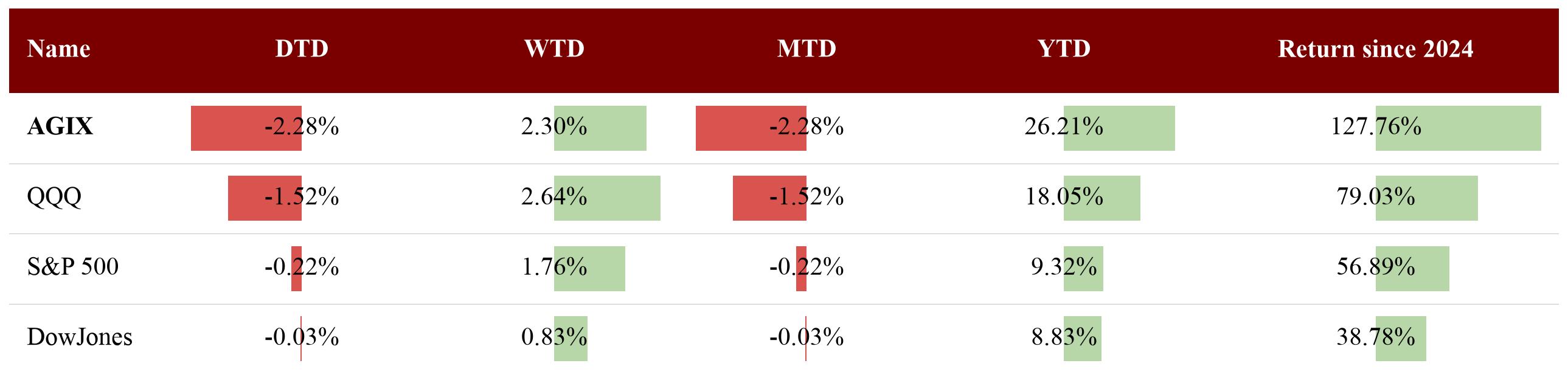
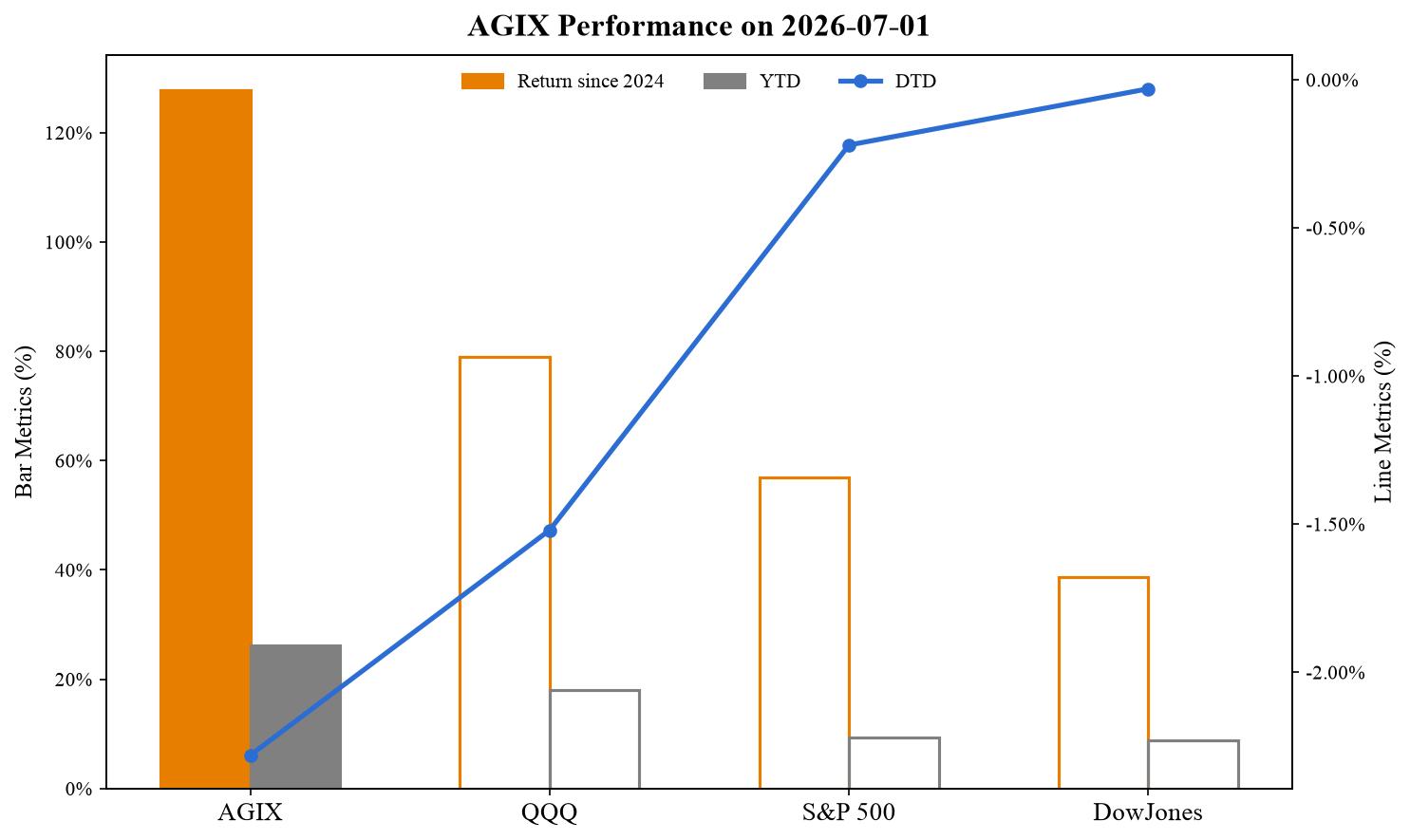
• AGIX fell 2.28% DTD, underperforming the S&P 500 (-0.22%) and QQQ (-1.52%), but remains a strong YTD performer (+26.21%) and since 2024 (+127.76%).
• Key AGIX holdings driving moves: Meta (+8.81% on AI cloud business launch), Palantir (+7.77% on Q1 beat and raised guidance), and Tempus AI (+6.34% on rebound thesis). Hardware names dragged: Micron (-10.57%), Astera Labs (-10.8%), AMD (-6.89%), and ASML (-7.36%).
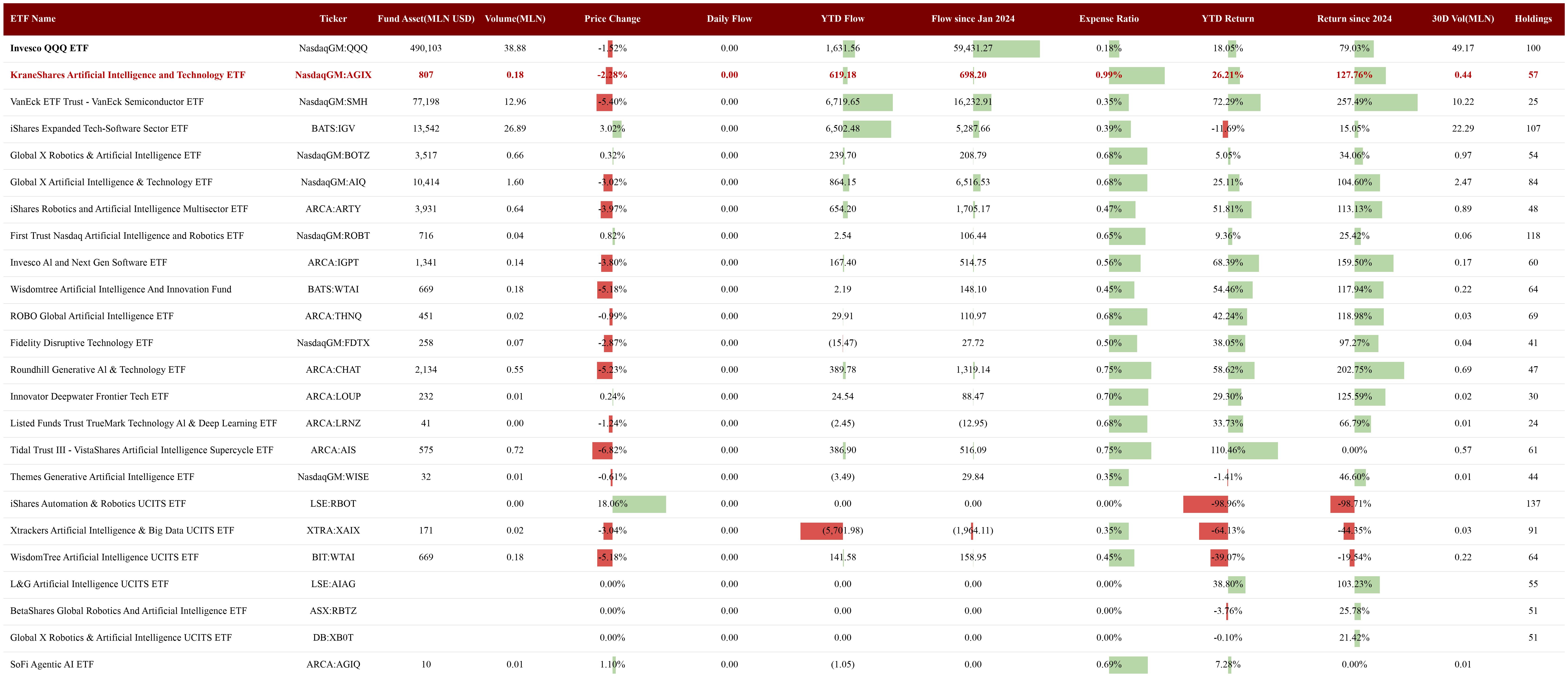
• Peer ETF moves were mixed: IGV (+3.02%) and LOUP (+0.24%) gained, while SMH (-5.4%), CHAT (-5.23%), and WTAI (-5.18%) declined, reflecting rotation toward software over semiconductors.
• Notable stocks to watch: Meta (new revenue stream from compute leasing), Palantir (momentum from strong results), and Micron (continued hardware weakness).
News Highlights
1. Meta plans to launch an AI cloud infrastructure business (Meta Compute), leasing excess GPU capacity and AI models, directly competing with AWS, Azure, and Google Cloud. This reframes Meta's massive capex as a monetizable asset, driving the stock up 8.81%.
2. Schneider Electric acquired industrial AI firm Cognite for $3.1B, signaling a shift from monitoring to autonomous decision-making in industrial AI. The deal highlights the value of AI platforms that unify messy industrial data.
3. Together AI raised $800M at an $8.3B valuation to expand its open-source AI cloud, with participation from Nvidia and Aramco Ventures. Annualized orders exceeded $1.15B, underscoring strong demand for AI infrastructure.
4. Anthropic launched Claude Sonnet 5, with significant coding benchmark improvements, and lifted export controls on its Mythos and Fable models. The move aims to maintain U.S. AI competitiveness globally.
5. Cloudflare announced a new policy to block AI crawlers from ad-supported pages by default, and launched Pay Per Crawl and Pay Per Use models to let publishers earn revenue from AI content use. This could impact AI training data access costs.
6. Palantir rose 7.77% as investors continued to digest its Q1 2026 results, which showed 104% U.S. revenue growth and raised full-year guidance, reinforcing its AI commercialization narrative.
7. Aligned secured $60M in Series B funding for its AI-native sales execution platform, aiming to reshape enterprise deal-making with autonomous buyer-seller agents.
RSS Highlights
1. Insufficient information: no RSS hotlist subscriptions were provided.
Performance & Benchmark
Attribution
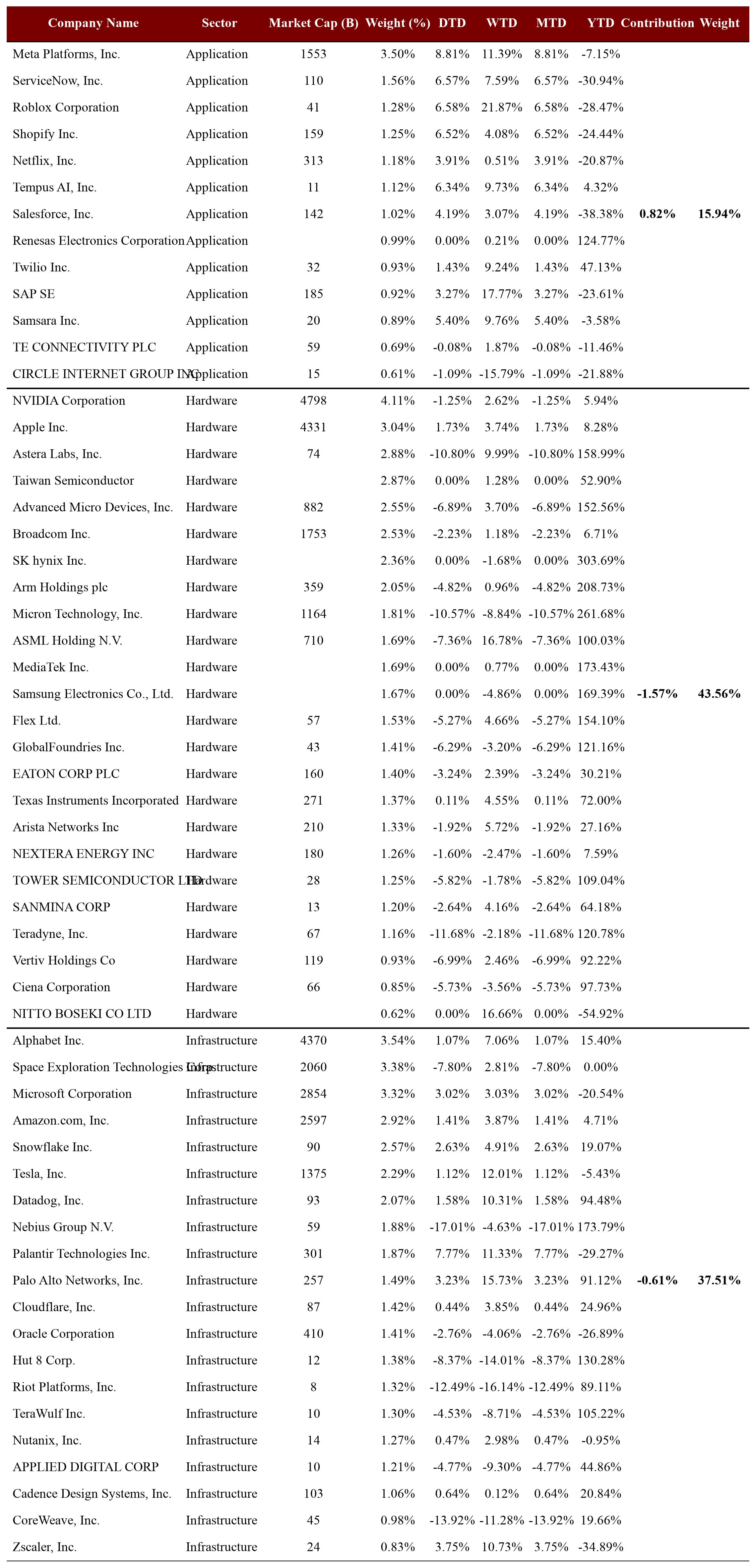
Contribution of the three sectors within AGIX holdings today
Application: 0.82%
Hardware: -1.57%
Infrastructure: -0.61%
Top-performing stocks in AGIX holdings today
Meta Platforms, Inc. (8.81%)
Palantir Technologies Inc. (7.77%)
Roblox Corporation (6.58%)
ServiceNow, Inc. (6.57%)
Shopify Inc. (6.52%)
Tempus AI, Inc. (6.34%)
Samsara Inc. (5.4%)
Salesforce, Inc. (4.19%)
Netflix, Inc. (3.91%)
Zscaler, Inc. (3.75%)
SAP SE (3.27%)
Palo Alto Networks, Inc. (3.23%)
Microsoft Corporation (3.02%)
Snowflake Inc. (2.63%)
Worst-performing stocks in AGIX holdings today
Broadcom Inc. (-2.23%)
SANMINA CORP (-2.64%)
Oracle Corporation (-2.76%)
EATON CORP PLC (-3.24%)
TeraWulf Inc. (-4.53%)
APPLIED DIGITAL CORP (-4.77%)
Arm Holdings plc (-4.82%)
Flex Ltd. (-5.27%)
Ciena Corporation (-5.73%)
TOWER SEMICONDUCTOR LTD (-5.82%)
GlobalFoundries Inc. (-6.29%)
Advanced Micro Devices, Inc. (-6.89%)
Vertiv Holdings Co (-6.99%)
ASML Holding N.V. (-7.36%)
Space Exploration Technologies Corp. (-7.8%)
Hut 8 Corp. (-8.37%)
Micron Technology, Inc. (-10.57%)
Astera Labs, Inc. (-10.8%)
Teradyne, Inc. (-11.68%)
Riot Platforms, Inc. (-12.49%)
CoreWeave, Inc. (-13.92%)
Nebius Group N.V. (-17.01%)
Top five listed stocks contributing the most within AGIX holdings today
Nebius Group N.V. (-17.01%)
Astera Labs, Inc. (-10.8%)
Space Exploration Technologies Corp. (-7.8%)
Micron Technology, Inc. (-10.57%)
Advanced Micro Devices, Inc. (-6.89%)
Observation
The strongest movers across peer ETF holdings today are listed below:
| DTD | Stock Ticker | Name | Held by ETFs | analysis |
|---|---|---|---|---|
| 27.06 | NasdaqGM:MVIS | MicroVision, Inc. | ['LSE:RBOT'] | MicroVision’s 27% gain on July 1, 2026 appears primarily driven by a sharp bounce from depressed levels rather than any identifiable new fundamental catalyst, as there is no same-day company news, filings, or major industry events reported across mainstream financial sources. The move coincides with the stock trading near the low end of its 52-week range and around $0.33–$0.42 intraday, suggesting short-covering and speculative buying in a highly volatile, retail-driven name.[1][7] A secondary support is the backdrop of bullish long-term analyst targets and “Strong Buy” ratings pointing to multi-bagger upside from current levels, which can amplify retail momentum when the stock is near lows.[1][4][6] |
| 16.62 | NasdaqGS:PRGS | Progress Software Corporation | ['BATS:IGV'] | Progress Software’s 16.6% move was primarily driven by a strong Q2 FY26 earnings beat and raised full-year guidance that materially exceeded consensus expectations. The company reported EPS and revenue above Street forecasts, raised FY26 EPS and revenue guidance, and highlighted solid ARR metrics, deleveraging, and buybacks, which collectively improved the earnings and balance sheet narrative[1]. A secondary driver was management’s emphasis on positioning Progress as an AI-powered digital experience and infrastructure software platform, which appears to have been well received by investors and helped re-rate the stock[1][8]. |
| 15.4 | DVLT | Datavault AI Inc | ['NasdaqGM:WISE'] | DVLT’s 15.4% move on July 1, 2026 appears primarily driven by renewed investor enthusiasm around its aggressive 2026 growth and infrastructure story rather than a specific same‑day headline. The stock has been reacting to Datavault AI’s May Q1 2026 business update, which highlighted more than $800 million in tokenization contracts, a reiterated $200 million 2026 revenue target, 443% YoY revenue growth, and significant balance sheet strengthening and AI infrastructure investment[2]. Momentum trading in a small-cap, high-volatility AI name that has sharply underperformed over the past year but was already climbing into June 30 likely amplified the upside move[3][4]. |
| 13.82 | GH | Guardant Health Inc | ['ARCA:LRNZ'] | GH rose 13.82% on July 1, 2026, mainly on fresh FDA approval of Guardant360 CDx as a companion diagnostic for Boehringer Ingelheim’s HER2-mutant lung cancer drug, which expanded Guardant’s approved-use list and reinforced its liquid biopsy franchise. The move was also supported by bullish Street actions, including RBC initiating coverage with an Outperform and a $185 target and Evercore ISI upgrading to Outperform while lifting its target to $160. The stock was already in strong momentum territory, which likely amplified the reaction to the news. |
| 13.73 | NYSE:RDDT | Reddit, Inc. | ['ARCA:IGPT', 'ARCA:LOUP'] | Reddit’s 13.7% gain on July 1, 2026 appears primarily driven by broad social-media sector strength and momentum buying in retail-favored communication services names, rather than a single company-specific headline. Sector commentary highlighted synchronized upside in Reddit, Pinterest, and Snap, with no confirmed idiosyncratic catalyst and a “risk‑on” tone benefiting volatile, retail-heavy platforms.[6] A secondary driver was continued positive sentiment around Reddit’s strong recent fundamentals and its positioning in digital advertising and AI data licensing, which support the bull narrative while traders lean into the move.[3][4][6] |
| 10.74 | NasdaqGM:RPD | Rapid7, Inc. | ['LSE:AIAG', 'ARCA:THNQ', 'XTRA:XAIX'] | Rapid7’s 10.7% gain on July 1, 2026 appears driven primarily by follow-through buying after the recent CEO transition and reaffirmed 2026 guidance, which has refocused investors on execution and potential strategic change under activist influence.[2] A second driver is improving sentiment toward AI-driven cybersecurity vendors, with Rapid7’s positioning in managed, AI-powered security operations benefiting from broader sector optimism.[1][8] A tertiary support comes from analysts’ mid-range price targets and a consensus Hold rating, which frame the stock as having upside from depressed levels after a prolonged drawdown.[5][6] |
| 9.99 | 002747.SZ | ESTUN AUTOMATION CO LTD-A | ['NasdaqGM:BOTZ'] | Estun Automation’s 9.99% rise on July 1, 2026 appears primarily driven by positive sentiment around its upcoming Hong Kong listing and strong investor demand for the H-shares. Reuters reported in early March that Estun priced its Hong Kong IPO near the bottom of the range but still raised about HK$1.49 billion, while local Hong Kong media highlighted that the retail tranche was about 10 times oversubscribed, signaling robust demand for the name.[2][9] This cross-listing narrative, combined with the company’s positioning in industrial robotics and new energy-related automation solutions, likely reinforced growth expectations and supported the single-day move.[2][5][8] |
| 9.86 | NasdaqCM:GDYN | Grid Dynamics Holdings, Inc. | ['NasdaqGM:WISE'] | Grid Dynamics’ 9.9% move on July 1, 2026 appears primarily technical, with the stock rebounding from near the bottom of its 52‑week range and below its 200‑day moving average, making it susceptible to short-covering and momentum buying after recent weakness.[1] The company’s shares closed at $6.24 on July 1, up from prior levels around $5.4–$5.5, with no company-specific news, earnings releases, or major estimate revisions reported that day to explain the move.[2][8][6] In the absence of fresh fundamentals, options-implied volatility and a relatively wide expected trading range around this period likely amplified the magnitude of the single-day move.[7] |
| 9.58 | NasdaqGS:APP | AppLovin Corporation | ['ARCA:LOUP', 'BATS:IGV', 'NasdaqGM:AIQ', 'NasdaqGM:QQQ'] | AppLovin’s 9.6% move on July 1 was driven primarily by Raymond James initiating coverage with a Strong Buy rating and an aggressive price target, which reinforced the existing bullish analyst consensus and highlighted upside from AI-driven ad growth and new e-commerce initiatives.[1][2][6] A second key driver was heightened enthusiasm around the company’s expansion of its AXON AI ad platform and entry into e-commerce advertising, which investors view as materially increasing its long-term growth runway.[1][2] Finally, the move was supported by strong momentum positioning in a broadly rising software/IT services tape and a heavily skewed “Strong Buy” Street rating profile, amplifying the impact of the new recommendation. [1][4] |
| 9.27 | NasdaqGM:DOMO | Domo, Inc. | ['LSE:RBOT'] | Domo’s 9.3% gain on July 1, 2026 appears primarily driven by continued short-covering and momentum buying in a deeply oversold, high-beta name that has already rallied roughly 63% over the prior two weeks. [5][9] First, DOMO’s very low market cap, high beta (2.63), and position near the bottom of its 52-week range make it particularly sensitive to technical flows and mean-reversion trades after its severe -76% 1-year drawdown.[5][9] Second, the stock has been in an ongoing recovery phase following earlier speculation about strategic alternatives and a potential sale, so incremental buyers are likely extrapolating optionality despite the lack of fresh company-specific news on the day.[1][3][5] |
| 9.06 | NasdaqGM:VERX | Vertex, Inc. | ['BATS:IGV'] | Vertex’s 9.1% gain on July 1, 2026 appears primarily driven by a sharp rebound from depressed levels, with the stock trading near the bottom of its 52‑week range and below its 200‑day moving average prior to the move.[2][4][8] With no company‑specific news or regulatory catalysts reported that day, the move is most consistent with technical and sentiment factors, including bargain hunting in a Buy‑rated name with substantial upside to consensus target prices.[3][6][8] |
| 9.01 | NasdaqGM:FIVN | Five9, Inc. | ['BATS:IGV'] | Five9’s +9% move on July 1, 2026 appears primarily driven by a shift in investor sentiment following fresh valuation and rating support, rather than by any new company-specific fundamental news. Zacks highlighted Five9 as potentially undervalued, assigning it a Rank 1 (Strong Buy) with a favorable Value grade and attractive forward P/E, which likely catalyzed value-oriented buying interest on the day.[10] Secondarily, the move built on improving perceptions of the name after its strong Q1 2026 results and raised full-year guidance in late May, which continue to underpin the bull case around margin expansion and AI-driven growth.[1][3] |
| 8.81 | NasdaqGS:META | Meta Platforms, Inc. | ['NasdaqGM:AGIX', 'LSE:AIAG', 'ARCA:CHAT', 'ARCA:IGPT', 'NasdaqGM:AIQ', 'NasdaqGM:FDTX', 'NasdaqGM:QQQ', 'NasdaqGM:ROBT', 'XTRA:XAIX'] | Meta’s 8.8% move on July 1 was driven primarily by reports that it is launching an AI cloud infrastructure business to sell excess compute and AI models, directly addressing investor concerns that heavy AI capex would not translate into returns.[1][2][6] This “Meta Compute” initiative reframes the company’s massive AI spend as a monetizable enterprise opportunity, easing the biggest overhang on the stock and prompting a sharp rerating.[1][2][6] A secondary driver was the outsized trading volume, with shares changing hands at more than double their recent daily average, indicating strong incremental buying interest as the cloud narrative spread through the market.[3][5] |
| 8.47 | NYSE:GLOB | Globant S.A. | ['LSE:RBOT', 'NasdaqGM:AIQ'] | Globant’s 8.47% rise on 2026-07-01 was most likely driven by a positive post-earnings reaction to its Q1 2026 results and outlook, which showed revenue above guidance, strong IFRS EPS, and solid free cash flow despite a slight year-over-year revenue decline.[1][4] The company also highlighted a $125M buyback and growing AI-related ARR, which likely reinforced the market’s growth and capital-return narrative.[1] There was no clearly more relevant same-day company-specific catalyst in the provided results, so the move appears primarily earnings-driven rather than news from a separate event.[1][6] |
| 8.34 | NYSE:KVYO | Klaviyo, Inc. | ['BATS:IGV'] | Klaviyo’s 8.3% move on July 1 was primarily a follow-through reaction to its recently reported strong Q1 2026 results and raised full-year 2026 revenue guidance, which have improved investor confidence in the earnings trajectory and fundamentals.[2][3] A secondary driver was the newly authorized $500 million share repurchase program, signaling management’s confidence and providing incremental support to the equity story.[2] Finally, the move was aided by supportive sell-side sentiment, with the stock still carrying a “Moderate Buy” consensus and a target price well above the mid-teens trading range, encouraging dip-buying after prior weakness.[1] |
| 8.27 | 4062.T | Ibiden Co Ltd | ['ARCA:CHAT'] | Ibiden’s 8.27% rise on July 1, 2026 appears primarily driven by continued investor enthusiasm around its advanced packaging and AI-related substrate business, with the stock setting a new 52-week high intraday and extending very strong multi-month gains.[1][2] The move also reflects follow-through from a recent post-earnings re-rating, where shares jumped on management commentary highlighting exclusive EMIB-T technology and sustained AI demand, reinforcing the structural growth narrative.[2] Technical factors likely amplified the move, as the stock traded near record levels with above-average volume and maintained a Strong Buy signal on momentum indicators.[1][2] |
| 8.18 | NasdaqGS:PDD | PDD Holdings Inc. | ['NasdaqGM:QQQ'] | PDD’s 8.2% gain on July 1, 2026 appears primarily driven by rebound buying after a sharp post-earnings selloff, rather than by any new company-specific announcement.[3][4] Investors likely saw value given that the shares were trading well below consensus analyst targets and GF Value estimates despite solid revenue growth and still-strong long-term fundamentals.[3][4][5] A secondary driver is technical and sentiment-driven dip buying, as the stock had been near the bottom of its 52-week range following prior downgrades and margin/regulatory concerns around Temu.[2][4][6][8] |
| 7.8 | NYSE:DXC | DXC Technology Company | ['NasdaqGM:AIQ'] | DXC Technology’s 7.8% rise on July 1, 2026 appears primarily driven by a sharp rebound from depressed levels after recent underperformance, with the stock moving from an intraday low of $8.89 to $9.75 and closing at $9.54, +7.3% off the low.[6] The move likely reflects value-buying interest given the name is trading near the bottom of its 52‑week range,[4][9] and has been highlighted in recent analysis as significantly undervalued versus intrinsic value estimates.[1][2] No company-specific news or regulatory catalysts were reported that day, so the advance is best characterized as a technical/mean-reversion and valuation-driven bounce. |
| 7.77 | NasdaqGS:PLTR | Palantir Technologies Inc. | ['NasdaqGM:AGIX', 'ARCA:ARTY', 'BATS:IGV', 'BATS:WTAI', 'BIT:WTAI', 'NasdaqGM:AIQ', 'NasdaqGM:FDTX', 'NasdaqGM:QQQ', 'NasdaqGM:ROBT', 'NasdaqGM:WISE', 'XTRA:XAIX'] | Palantir’s 7.8% gain on July 1, 2026 appears driven primarily by continued investor follow-through on its exceptionally strong Q1 2026 results and raised full-year guidance, which highlighted 104% U.S. revenue growth, 85% overall revenue growth, and a significant upgrade to FY26 revenue and U.S. commercial growth targets that “crushed consensus expectations.”[5] A secondary driver is ongoing AI momentum and bullish sell-side and media narratives emphasizing substantial upside to long-term price targets and accelerating commercial adoption of Palantir’s platforms.[3][5] |
| 7.74 | NasdaqGS:WIX | Wix.com Ltd. | ['ARCA:THNQ', 'NasdaqGM:AIQ'] | Wix.com’s 7.7% gain on July 1, 2026 appears primarily driven by investors rotating back into an oversold, undervalued SaaS name following strong Q1 2026 fundamentals and ongoing AI/product momentum highlighted in recent coverage.[5][2] The move was supported by a broadly positive analyst backdrop, with a Buy consensus and large implied upside to 12‑month targets, reinforcing the recovery/mean‑reversion narrative.[2][7] No specific company news or regulatory catalyst was reported that day, suggesting the move was mainly sentiment- and valuation-driven within the existing fundamental story. |
| 7.46 | ENXTPA:DSY | Dassault Systèmes SE | ['LSE:RBOT', 'XTRA:XAIX'] | Dassault Systèmes’ sharp 7.46% move on July 1, 2026 appears primarily driven by technical and sentiment factors rather than a specific company news catalyst, as there were no material disclosures or sector headlines on the day and the stock remained within its recent trading range.[3][4] The stock had sold off meaningfully over the past year and was trading below key moving averages with a sizeable implied upside to consensus target prices, so a short-term rebound on improving sentiment and buy-the-dip flows is a likely driver.[1][3][4] A supportive analyst backdrop, with most targets well above the spot price and a neutral-to-positive recommendation mix, may also have reinforced demand on the day.[1][3][4] |
| 7.43 | NasdaqGS:MSTR | Strategy Inc | ['LSE:RBOT', 'ARCA:IGPT', 'BATS:IGV', 'NasdaqGM:QQQ', 'XTRA:XAIX'] | Strategy Inc (MSTR)’s 7.43% gain on July 1, 2026 was primarily driven by a rebound in Bitcoin, which historically has a high beta impact on the stock and was cited as the key catalyst for a similar double‑digit move around this period.[8] The move was amplified by strong buy-side sentiment given the stock’s substantial upside versus consensus 12‑month price targets and a “Strong Buy” analyst rating profile, encouraging investors to add exposure on recent weakness.[4] Elevated trading volume versus average further suggests momentum and short‑term trading flows contributed to the outsized single‑day move.[7] |
| 7.42 | NYSE:EPAM | EPAM Systems, Inc. | ['LSE:RBOT'] | EPAM’s 7.42% move on July 1, 2026 appears most consistent with a valuation-driven rebound rather than a company-specific announcement, as market coverage on the day pointed to the stock jumping on “valuation insights” and no major new EPAM disclosure was highlighted. The move also came after a sharp prior decline and near-52-week-low trading, which likely amplified short-covering and technical buying. A secondary driver was improving sentiment around EPAM’s AI-native revenue growth, which continued to support the bull case despite broader concerns about the 2026 outlook.[2][3][1] |
| 7.25 | NYSE:BILL | BILL Holdings, Inc. | ['BATS:IGV'] | BILL’s 7.25% move on 2026-07-01 was most likely driven by a broader re-rating in the stock rather than a clearly identifiable company-specific same-day catalyst in the available sources. The strongest support is that the stock was already moving sharply higher intraday, with FT reporting BILL up more than 5% and trading near 52-week lows, which is consistent with a technical rebound in a beaten-down name.[3][6][8] A secondary driver was continued optimism around fundamentals and valuation: recent commentary highlighted a strong fiscal Q3 2026 beat, with EPS of $0.68 versus consensus and revenue of $406.6 million, alongside analyst price-target adjustments that still left several firms constructive on the name.[2][4] |
| 6.99 | NasdaqGM:MDB | MongoDB, Inc. | ['LSE:AIAG', 'ARCA:ARTY', 'ARCA:LRNZ', 'ARCA:THNQ', 'BATS:WTAI', 'BIT:WTAI', 'NasdaqGM:ROBT', 'NasdaqGM:WISE'] | MongoDB’s 6.99% gain on July 1 was most likely driven by a continuation of the post-earnings rebound, as investors kept buying after the company’s prior-quarter beat-and-guidance-reset selloff and the stock remained volatile around that narrative.[1][3] A secondary driver was bullish technical/flow support in a high-volatility name, with no clearly stronger same-day company-specific negative catalyst in the provided results.[5][7] Analyst commentary around slowing Atlas growth and recent target cuts likely remained part of the backdrop, but it appears to have been outweighed by broader risk-on demand for the stock that day.[1] |
| 6.98 | NYSE:SNAP | Snap Inc. | ['ARCA:IGPT', 'BATS:IGV', 'NasdaqGM:AIQ', 'XTRA:XAIX'] | Snap’s 6.98% move on July 1, 2026 appears driven primarily by follow-through buying on recent fundamental and credit catalysts that have strengthened the turnaround narrative. The stock is reacting to earlier positive events, including S&P’s upgrade of Snap’s credit rating to BB‑ with a positive outlook and solid Q1 2026 results showing 12% revenue growth and strong free cash flow, which improve balance-sheet quality and support sentiment.[1][5] A secondary driver is growing investor optimism around Snap’s augmented reality strategy, highlighted by the Illumix acquisition, which positions the company for product and ad-platform differentiation.[1] Elevated trading volume relative to normal levels suggests momentum and retail participation are amplifying the move.[8] |
| 6.92 | NasdaqGS:TEAM | Atlassian Corporation | ['ARCA:LOUP', 'ARCA:THNQ', 'BATS:IGV', 'XTRA:XAIX'] | Atlassian’s 6.9% move on July 1 was primarily driven by a sector read-through rally from strong results at peer Snowflake, which reinforced the narrative that AI is expanding, not cannibalizing, enterprise software usage and validated demand trends highlighted in Atlassian’s own recent Q3 report.[4][1] Second, the move came as part of a broader rebound in beaten-down SaaS and AI-related growth stocks after a prior tech selloff, with investors selectively rotating back into high-quality software names where AI is viewed as a competitive tailwind rather than a risk.[4][5] |
| 6.85 | NasdaqGS:MGNI | Magnite, Inc. | ['NasdaqGM:FDTX'] | Magnite’s 6.85% gain on July 1, 2026 appears primarily driven by ongoing positive sentiment following BTIG’s recent initiation of coverage with a Buy rating and a $20 price target, which previously sent the stock up ~5.5% and highlighted its strength in CTV and AI-powered ad tools.[3][6] This move is supported by earlier-than-expected fundamental momentum from Q1 2026 results, where Magnite beat earnings estimates and delivered 30% YoY CTV growth, reinforcing the bull narrative and attracting incremental buyers.[2][9] A supportive broader ad-tech backdrop and rising analyst target averages around the low-$20s likely further reinforced the bid as shares moved closer to those levels.[3][4][7] |
| 6.58 | LMND | LEMONADE INC | ['ARCA:THNQ'] | Lemonade’s 6.6% gain on July 1, 2026 was primarily driven by the company’s announcement that it renewed and restructured its reinsurance program effective that day, cutting its quota-share cession from about 20% to roughly 18%, which allows it to retain more premium and earnings while broadening catastrophe protection.[1][7][8] Investors interpreted the improved reinsurance terms as enhancing Lemonade’s path toward profitability and capital efficiency, prompting a re-rating of the shares.[1][8] |
| 6.58 | NYSE:RBLX | Roblox Corporation | ['NasdaqGM:AGIX', 'ARCA:LOUP'] | Roblox’s 6.6% gain on July 1, 2026 appears primarily driven by a sharp rebound after heavy year-to-date underperformance, as investors selectively re-risk into beaten-down, high-beta growth names. The move occurred on elevated volume and against a backdrop where RBLX was down over 40% in 2026 and more than 50% over the past year, making it a candidate for mean-reversion buying and short-covering.[4][8] A secondary driver was technical and sentiment support: the stock was trading with a “Strong Buy” daily technical signal and near the lower end of its 52-week range, encouraging momentum and dip-buying flows.[3] |
| 6.57 | NYSE:NOW | ServiceNow, Inc. | ['NasdaqGM:AGIX', 'LSE:RBOT', 'LSE:AIAG', 'ARCA:THNQ', 'BATS:IGV', 'BATS:WTAI', 'BIT:WTAI', 'NasdaqGM:AIQ', 'NasdaqGM:ROBT'] | ServiceNow’s 6.6% gain on July 1, 2026 was primarily driven by a positive broker action, with Guggenheim’s John DiFucci upgrading the stock to Buy and highlighting upside in the company’s workflow automation and AI-driven platform.[4][5] The move was reinforced by strong year-to-date outperformance versus the S&P 500, which supports a momentum and growth narrative around NOW’s high multiple and secular positioning in digital workflows and AI-enabled automation.[3][5] |
| 6.52 | NasdaqGS:SHOP | Shopify Inc. | ['NasdaqGM:AGIX', 'LSE:AIAG', 'ARCA:LOUP', 'ARCA:THNQ', 'BATS:WTAI', 'BIT:WTAI', 'NasdaqGM:AIQ', 'NasdaqGM:FDTX', 'NasdaqGM:QQQ'] | Shopify’s 6.5% move on July 1 was primarily driven by renewed optimism around its capital return and product strategy, with investors reacting positively to the recently expanded share repurchase authorization and ongoing AI-enabled product and Shop Pay growth narratives, which reinforced confidence in long‑term cash flow and scalability.[1] A secondary driver was broader positive sentiment toward undervalued software names, as sector-wide analyst commentary and buying interest lifted high-quality growth platforms like Shopify more than the market.[1][7][9] |
| 6.41 | NasdaqGM:RDNT | RadNet, Inc. | ['ARCA:IGPT'] | RadNet’s 6.4% gain on July 1, 2026 appears primarily driven by ongoing investor reaction to its strong Q1 2026 results and raised full-year Imaging Center guidance, which highlighted 22% revenue growth, 36% Adjusted EBITDA growth, and higher 2026 revenue/EBITDA/FCF targets[1][9]. A secondary driver is improving sentiment following the recent Barclays healthcare conference, where management outlined a robust 2026 growth outlook and reinforced confidence in advanced imaging and AI-enabled imaging tailwinds[3]. The move is also occurring against a backdrop of the stock trading well below its 52-week high, which can amplify positive fundamental catalysts as investors reassess valuation[3][5]. |
| 6.41 | NasdaqGS:WDAY | Workday, Inc. | ['LSE:RBOT', 'ARCA:ARTY', 'BATS:IGV', 'NasdaqGM:AIQ', 'NasdaqGM:QQQ', 'NasdaqGM:ROBT'] | Workday’s 6.4% gain on July 1, 2026 appears primarily driven by broad tech-led risk-on sentiment, with the stock featuring among names “moving the most today” as investors rotated back into high-quality software and AI-exposed platforms.[9][4] The move comes after a ~17.5% pullback over the prior month, suggesting a “buy-the-dip” dynamic and positioning ahead of the next earnings catalyst in a name that still carries a Buy consensus and material upside to Street targets.[3][7] Elevated single-day volume versus recent trading also points to technical and flow-driven factors reinforcing the rebound.[10] |
| 6.38 | NasdaqGS:KTOS | Kratos Defense & Security Solutions, Inc. | ['NasdaqGM:ROBT'] | Kratos’s 6.4% gain on July 1, 2026 was primarily driven by a bullish initiation from Wedbush, which began coverage with an Outperform rating and an $85 price target and characterized Kratos as a “misunderstood” merchant arms supplier to the broader U.S. defense complex[5]. This high-conviction call helped re-rate the stock intra-day, with shares up roughly 7% at publication[5]. A supportive backdrop of strong recent fundamental performance, including double‑digit revenue growth, a record backlog, and raised analyst fair value estimates, likely reinforced investor appetite for the name[4]. |
| 6.34 | NasdaqGS:TEM | Tempus AI, Inc. | ['NasdaqGM:AGIX', 'LSE:AIAG', 'ARCA:ARTY', 'NasdaqGM:ROBT'] | Tempus AI’s 6.34% gain on July 1, 2026 appears primarily driven by company-specific bullish sentiment around a developing rebound thesis following prior post-earnings weakness and the stock’s perceived undervaluation versus long-term intrinsic value estimates.[2][5][7] First, recent analyses highlight improving margins, narrowing losses, and guidance that supports an impending inflection to profitability, reinforcing a “rebound setup” narrative that has attracted tech and AI-healthcare traders.[2] Second, valuation-focused research (DCF and P/S “fair ratio” work) continues to frame TEM as materially undervalued relative to estimated intrinsic value, which likely supported incremental buying interest as the stock trades off its lows.[5][7] |
| 6.31 | BMNR | BITMINE IMMERSION TECHNOLOGIES INC | ['BATS:IGV'] | BMNR’s 6.3% gain appears primarily driven by a supportive fundamental narrative rather than a discrete company-specific news release on the day. The key catalyst was a same-day research piece highlighting that Bitmine looks undervalued as its Ethereum treasury approaches roughly 5% of market cap, with Cantor Fitzgerald maintaining a positive rating, which likely helped stabilize sentiment after recent weakness and attracted opportunistic buying at the lower end of its 52-week range.[6][3] Broader context of a still-bullish 12‑month analyst target profile and “Strong Buy” consensus, combined with the stock trading near historical lows, likely amplified the rebound as investors reassessed downside vs upside.[3][5] |
| 6.26 | NYSE:PATH | UiPath Inc. | ['LSE:RBOT', 'ASX:RBTZ', 'DB:XB0T', 'BATS:IGV', 'NasdaqGM:AIQ', 'NasdaqGM:BOTZ', 'NasdaqGM:ROBT', 'XTRA:XAIX'] | UiPath’s 6.26% move on July 1 was mainly driven by positive momentum around recent automation/AI operating wins, including the Dubai security certification for Automation Cloud UAE and the Maestro Case launch, which reinforced the company’s enterprise AI story. The stock also benefited from a constructive technical setup after a multi-session grind higher from the low $10s, while Wall Street remained cautious with recent target trims from BMO and UBS, which limited the move but did not reverse it. [1][2][5] |
| 6.1 | NYSE:KD | Kyndryl Holdings, Inc. | ['XTRA:XAIX'] | Kyndryl’s 6.1% gain on July 1, 2026 appears primarily driven by a continuation of positive sentiment following its strong fiscal 2026 Q1 earnings, which highlighted accelerating hyperscaler-related revenue, significant margin expansion, and robust contract signings growth.[3] The move was likely reinforced by valuation-focused commentary and analyses portraying KD as materially undervalued relative to intrinsic value and peer multiples, encouraging incremental buying interest.[2] Broader market conditions and style factors seem secondary, as there is no evidence of company-specific negative news or sector headwinds on that date.[7] |
| 6.08 | NXXT | NextNRG Inc | ['NasdaqGM:WISE'] | NextNRG’s 6.08% move on 2026-07-01 appears most directly tied to the company’s own investor-relations stock quote update showing the shares at $0.37, up 6.08% on heavy volume, which is the clearest same-day public catalyst available. The broader backdrop was already constructive after the company reported preliminary May 2026 revenue of $9.3 million, up 41% year over year, with gross profit up 75% and margin improvement, which likely supported sentiment into the session. Technical and trading factors likely also helped, since the stock has been highly volatile and small-cap names can react sharply to momentum and liquidity flows. |
| 6.03 | ENXTAM:CCEP | Coca-Cola Europacific Partners PLC | ['NasdaqGM:QQQ'] | Coca-Cola Europacific Partners’ 6.0% gain on July 1, 2026 appears primarily driven by continued positive momentum following its strong Q1 2026 trading update, which reported 6.7% reported revenue growth, reaffirmed full-year guidance, and highlighted progress on its €1bn buyback program.[1][4][9] The move also coincides with the stock trading near record levels and demonstrating strong price momentum on U.S. markets, likely attracting incremental investor interest and momentum-driven buying.[2][5] |
| 5.95 | NasdaqGS:AXON | Axon Enterprise, Inc. | ['ARCA:LOUP', 'NasdaqGM:QQQ'] | Axon Enterprise’s 5.95% gain on July 1, 2026 appears primarily driven by continued momentum following strong year-to-date fundamentals and bullish sentiment on its long-term growth profile rather than a discrete, company-specific news event that day. Recent coverage highlights robust revenue growth (software and services up ~40% with ARR around $1.35B) and overwhelmingly positive analyst views with significant upside to consensus price targets, supporting ongoing multiple expansion and investor demand.[2][5] A secondary driver is technical and trading dynamics: the stock has been rebounding from a sizable year-to-date drawdown and moving back into an upward trend, attracting momentum and AI-themed investors after prior pullbacks.[2][9] |
| 5.92 | NasdaqGM:TTD | The Trade Desk, Inc. | ['ARCA:IGPT'] | The Trade Desk’s 5.9% gain appears primarily driven by a technical and sentiment rebound from oversold levels near the bottom of its 52-week range, with the move falling well within the options market’s expected volatility band for the week.[2][5][6] The stock has recently bounced off a late-June low, with commentary framing these moves as sentiment-driven recoveries rather than news-specific spikes, as investors reassess prior downside following resolution of the Publicis dispute and ongoing share repurchases.[2][4] Broader positioning around beaten-down ad-tech and SaaS names, supported by improving sector sentiment, likely provided an additional tailwind as bargain-hunting flows returned.[1][3] |
| 5.89 | NYSE:ZETA | Zeta Global Holdings Corp. | ['BATS:IGV', 'NasdaqGM:WISE'] | Zeta Global’s 5.9% move on July 1 was primarily driven by the company’s same-day announcement that it will participate in an upcoming investor event to unveil its evolving AI strategy, which likely raised expectations for accelerated growth and product innovation.[5][7][8] A secondary driver was broader investor interest in AI- and data-driven marketing platforms, with the stock outperforming amid this thematic bid despite the absence of other company-specific financial disclosures that day.[1][2] |
| 5.88 | NasdaqGS:KHC | The Kraft Heinz Company | ['NasdaqGM:QQQ'] | Kraft Heinz’s ~6% gain on July 1 appears primarily driven by investor reaction to its new global operating structure, which became effective that day and is framed as a way to better focus resources and support growth across three regions (North America, Europe & Pacific Developed Markets, Emerging Markets). This structural shift likely improved sentiment toward the company’s turnaround and capital allocation prospects, especially following steady but unspectacular Q1 2026 results and a maintained full-year outlook that had already set a cautious baseline. |
| 5.72 | NasdaqGS:BRZE | Braze, Inc. | ['BATS:IGV'] | Braze’s 5.7% gain on July 1, 2026 appears primarily driven by idiosyncratic strength in the stock against a softer broader tech tape, with investors adding risk following recent options activity and bullish medium-term sentiment. Same-day data show BRZE up roughly 6% intraday with no company-specific news or disclosures, suggesting the move was fueled by trading dynamics, including elevated options interest and positioning highlighted by recent commentary on “betting on a big move” in Braze stock. |
| 5.67 | BNAI | BRAND ENGAGEMENT NETWORK INC COM | ['NasdaqGM:WISE'] | Brand Engagement Network’s 5.67% gain on July 1, 2026 appears primarily driven by ongoing investor focus on its recently announced acquisition of Cataneo GmbH and related completion headlines, which are being interpreted as a strategic expansion of its AI commercialization footprint.[7][8][1] A secondary driver is positive sentiment from its Q1 2026 earnings beat versus expectations, alongside renewed attention to reseller and international partnership agreements that have revived interest in this small-cap AI name.[1][2][10] Given the micro-cap profile and sharp prior moves, momentum trading and retail participation likely amplified the upside move.[1][2] |
| 5.63 | NYSE:U | Unity Software Inc. | ['ARCA:IGPT', 'BATS:IGV'] | Unity Software’s 5.6% gain was primarily driven by a fresh analyst price-target increase and positive rating reinforcement, which added a clear same-day catalyst and bolstered confidence in the company’s turnaround narrative.[1][2][9] A secondary driver was ongoing investor optimism around Unity’s improved execution and profitability trajectory, including stronger recent results and guidance tied to its Vector/AI-driven advertising and Grow segments, which continue to support the re-rating of the stock.[1][3][4][5] |
| 5.43 | NasdaqGS:PTC | PTC Inc. | ['LSE:RBOT', 'BATS:IGV', 'NasdaqGM:ROBT'] | PTC’s 5.43% gain on 2026-07-01 appears to have been driven mainly by broad positive price action and momentum rather than a clearly identifiable company-specific announcement, as no same-day material news catalyst is evident in the provided results. The stock was trading up from its intraday low and near the top of its daily range, which is consistent with a rebound in a name that was still near the bottom of its 52-week range and below its 200-day average. Analyst sentiment remains generally constructive, with a Buy/Moderate Buy consensus and price targets well above the prevailing share price, which may have supported dip-buying. |
| 5.4 | NYSE:IOT | Samsara Inc. | ['NasdaqGM:AGIX', 'LSE:AIAG', 'ARCA:IGPT', 'ARCA:LRNZ', 'ARCA:THNQ', 'BATS:IGV'] | Samsara’s 5.4% gain on July 1, 2026 was primarily driven by investor enthusiasm around the company’s AI product momentum, as highlighted by same-day commentary noting the stock “surged” after launching new AI-driven offerings.[6] This move occurred against a weak broader tech tape, suggesting the rally was stock-specific rather than sector beta.[6] Additional support likely came from positive sentiment around its up-market growth and prior earnings beat earlier in the year, reinforcing the AI narrative and growth trajectory.[4] |
| 5.38 | NYSE:ACN | Accenture plc | ['ARCA:ARTY', 'ARCA:THNQ', 'NasdaqGM:AIQ'] | Accenture’s 5.4% move on July 1, 2026 appears primarily to be a technical rebound following its steep post-earnings drawdown rather than a response to fresh company-specific news. The stock had fallen roughly 37% over the prior month after its June 18 fiscal Q3 earnings miss and guidance cut, leaving shares near 52-week lows and setting up for mean-reversion buying and short-covering as valuation screens and cash-flow-based fair value work (e.g., DCF analyses pointing to substantially higher intrinsic value) attracted bargain hunters. |
| 5.35 | NasdaqGS:MNDY | monday.com Ltd. | ['LSE:RBOT', 'XTRA:XAIX'] | monday.com’s 5.35% gain on July 1, 2026 was primarily driven by ongoing investor repositioning around its recent AI work platform pivot and strong Q1 2026 fundamentals, following a period of sharp year-to-date share price declines.[1][2][7] The move also reflects improving sentiment toward its capital-return story, with investors increasingly focusing on buybacks and enterprise AI-led product expansion as highlighted in its Q1 update and June product releases, which together support a rebound from depressed valuation levels.[1][2] |
| 5.26 | NasdaqGS:ADP | Automatic Data Processing, Inc. | ['NasdaqGM:QQQ'] | Automatic Data Processing’s 5.26% gain on July 1, 2026 was primarily driven by a “soft” June ADP employment report that boosted expectations for earlier or more aggressive Federal Reserve rate cuts, which in turn supported interest-rate-sensitive, high-quality large caps including ADP. The company reported U.S. private-sector job growth of 98,000 in June, below the +100k trend since March, reinforcing the narrative of cooling labor conditions and easing inflation pressures that equity markets interpreted positively for valuation multiples.[5][6][1] A secondary, more technical tailwind was the stock’s rebound following its June 30 close around $224, with investors positioning ahead of and immediately after its July 1 dividend payment, helping amplify the move.[6][8] |
| 5.16 | NYSE:RNG | RingCentral, Inc. | ['BATS:IGV', 'XTRA:XAIX'] | RingCentral’s 5.2% gain on July 1, 2026 appears primarily driven by continued positive momentum following its strong Q1 2026 earnings report and raised full-year guidance, which highlighted revenue at the high end of guidance and increased outlook for subscription revenue, margins, EPS, and free cash flow.[3][6] The move also coincides with the stock trading near its 52-week high, suggesting follow-through buying as investors reassess the name’s improving fundamentals and cash generation profile.[1][6] |
| 5.14 | NasdaqGS:MANH | Manhattan Associates, Inc. | ['BATS:IGV'] | MANH’s 5.14% move on 2026-07-01 appears driven primarily by a broad rebound in the shares rather than any clearly identifiable company-specific catalyst in the available public information. The stock had been trading well below its recent highs and near analyst-favored valuation levels, which likely made it susceptible to a relief move as investors rotated back into the name[1][3][5]. I did not find a same-day earnings release, guidance update, or other material company announcement in the provided results that would explain the move more directly[6][8]. |
| 5.14 | 2802.T | Ajinomoto Co Inc | ['ARCA:AIS'] | Ajinomoto’s 5.1% move appears primarily driven by technical and sentiment factors as the stock broke to a new 52-week high and generated a “Strong Buy” signal on widely followed momentum indicators, attracting incremental buying interest.[1][3] The move is also supported by ongoing capital return and structural growth narratives (large-scale share buyback program and strategic focus on higher-margin electronic materials and biopharma), which have kept investor sentiment positive in the absence of material new company-specific announcements on the day.[2][4][10] |
| 5.11 | NasdaqGM:VERI | Veritone, Inc. | ['NasdaqGM:WISE'] | Veritone’s 5.1% gain on July 1, 2026 appears primarily driven by technical trading dynamics rather than new fundamental news, as there were no company-specific announcements or major AI/sector catalysts that day and the move came off a low-$1.30 base with modest volatility.[2][5] Second, ongoing attention around the existing securities class action and approaching July 20, 2026 lead-plaintiff deadline may be contributing to event-driven trading interest rather than incremental changes to the company’s earnings or guidance profile.[3][7] |
News
Funding & M&A
Schneider Electric acquires Cognite for $3.1 billion in an industrial AI push.
French energy giant Schneider Electric announced an all-cash acquisition of industrial AI company Cognite Holding B.V. for $3 billion to strengthen its AI software and industrial data business. The deal highlights that industrial AI is shifting from simple monitoring to autonomous decision-making and operations. Cognite's Data Fusion and Atlas AI platforms can unify and model messy data from industrial facilities, and use intelligent agents to automate equipment fault detection, parts ordering, and repair scheduling. Schneider will integrate this technology with its UK software subsidiary Aveva CONNECT to help industries such as energy, oil and gas, and manufacturing improve efficiency and reduce waste. Cognite's 2025 revenue exceeded $17 million, and its backer Aker will receive $1.48 billion in cash. The transaction is subject to regulatory approval and is expected to close in the coming quarters.
Verkada takes Nvidia investment to expand its physical AI platform
Physical security company Verkada has received an investment from Nvidia and signed a technology collaboration agreement to accelerate the deployment of its AI technology across 2.4 million devices. The collaboration centers on Nvidia's Cosmos world foundation model and the Physical AI Data Factory toolkit, which will be used for video search, spatial-temporal querying, and other scenarios. After the collaboration, Verkada improved its average precision metrics on relevant benchmarks by 87%. Verkada previously completed a funding round in 2024 at a $5.8 billion valuation and has surpassed $1 billion in annual orders. Nvidia is expanding its ecosystem into robotics, smart factories, and other fields through the Cosmos model series and developer toolchains. Verkada's technology is deployed across 3,000 organizations in 17 countries, including 100 Fortune 500 companies.
Raja Koduri’s Oxmiq Labs raises $35M to lower the design cost of custom AI silicon
AI chip startup Oxmiq Labs has just completed a $35 million Series A funding round, bringing its total funding to $60 million. The round was led by Fundomo and the Samsung Accelerator Fund, with participation from MediaTek, MediaTek, Hecheng Investment, CDIB-TEN, and others. Founded by former Intel chief architect Raja Koduri, the company is developing the OxCore GPU architecture and OxQuilt compute fabric, integrating GPU, CPU, and Tensor Engine into a single IP block to reduce AI chip development costs. Its software stack supports unmodified CUDA and PyTorch code. Oxmiq aims to become the "next Arm" and compete with Broadcom, Marvell, and other companies in the custom chip market. The funds will be used to finalize the initial IP and expand the engineering team.
Report: SpaceX showed investors an AI device before IPO; Musk denies it
According to a report by The Wall Street Journal, SpaceX showcased a prototype of a handheld AI device based on xAI technology to investors before its initial public offering. The device is thinner than an iPhone and features a Qualcomm Snapdragon chip. CEO Elon Musk immediately denied the report on X, calling it "completely false." The report stated that the project is still in its early stages, the design may change, and it has not been determined whether it will be brought to market. SpaceX actually acquired xAI earlier this year through a stock transaction and fully integrated it into its operations. If the device becomes a reality, it would represent SpaceX's biggest expansion from rockets and satellite internet into consumer hardware, aligning with Musk's long-term goal of building a "universal app." The company completed the largest IPO in history on the Nasdaq in June, raising approximately $75 billion and achieving a valuation of $1.77 trillion.
TwelveLabs raises $100M to bring superintelligence to AI video models
TwelveLabs, an innovative video understanding AI company, announced the completion of a $100 million Series B funding round, co-led by NEA and NAVER Ventures, with participation from Amazon, Radical Ventures, and others. This round brings the company's total funding to over $207 million. TwelveLabs' self-developed multimodal foundation models, Marengo and Pegasus, enable native video understanding, converting video content into structured data and supporting temporal reasoning. The company will deepen its collaboration with AWS to optimize inference performance on Trainium chips, with new models first launching on AWS. This technology can be widely applied in industries such as security, advertising, sports, and automotive, advancing deep machine understanding and operationalization of video content.
Neocloud Together AI raises $800M, leaps to $8.3B valuation
Together AI, an AI infrastructure service provider, announced the completion of an $800 million Series C funding round, valuing the company at $8.3 billion. The round was led by Aramco Ventures, the venture arm of Saudi Arabian oil company Aramco, with participation from Nvidia, Vista Equity Partners, General Catalyst, and others. The company primarily leases Nvidia GPU clusters and open-source AI model interfaces to clients, with annualized order value exceeding $1.15 billion over the past four quarters. The funding will further expand its open-source model service capabilities, helping enterprises reduce AI operational costs. Previously, the company had raised $305 million in Series B funding at a $3.3 billion valuation. Several other GPU cluster companies have recently received large investments, reflecting strong market interest in AI infrastructure.
Ashton Kutcher leaving Sound Ventures to launch new VC firm with Morgan Beller
Actor and investor Ashton Kutcher is leaving Sound Ventures, which he co-founded with Guy Oseary 11 years ago, to create a new venture capital fund. The new fund will partner with Morgan Beller, who was a general partner at NFX and previously led the Libra project at Meta. The new fund will focus on early-stage investments in AI infrastructure, energy, and deep tech. Sound Ventures continues to hold stakes in Brex, Gusto, OpenAI, and others, and is an early investor in Anthropic and World Labs. The two parties will provide advisory services to each other, and this move reflects the shift of AI capital toward the infrastructure layer. Stanford professor Ilya Strebulaev praised Kutcher's performance in unicorn investments.
Venice raises $65 million at a $1 billion valuation for private, uncensored AI
Privacy-first AI company Venice.ai today announced the completion of a new $65 million funding round, bringing the company's valuation to $1 billion. The startup was founded in 2024 by cryptocurrency entrepreneurs Erik Voorhees and Jesse Proudman, and its main product is a privacy-focused chatbot that does not record user prompts and stores conversations locally on the device. Currently, its service has achieved a rating of 3.5 trillion, processes 1.3 trillion tokens per month, and has already turned profitable in the first quarter. This funding round was led by Dragonfly, with participation from Coinbase Ventures and several other crypto and tech investment firms. The funds will be used to build its own data centers, purchase GPU infrastructure, and expand global users and API business. Venice will provide computing resources to developers through the cryptocurrency VVV funding pool model.
Venice AI becomes a unicorn with $65M Series A as its privacy-first AI platform takes off
Tech startup Venice AI announced on Wednesday that it has completed its first round of $65 million Series A funding, valuing the company at $1 billion. The round was led by crypto investment firm Dragonfly, with participation from Coinbase Ventures, North Island Ventures, and others. Venice AI offers access to over 200 'uncensored' AI models, emphasizing user privacy protection and end-to-end encryption, with users not required to provide identity to the platform. The company has 890,000 unique visitors and 3 million active users, with an average of 1.7 million daily API calls, annualized revenue exceeding $70 million, and profitability already achieved. CEO Erik Voorhees previously founded crypto companies like ShapeShift, and his philosophy aligns with Bitcoin's neutral protocol. The funding will be used to build its own data centers and purchase GPUs to improve gross margins and drive product features to catch up with ChatGPT.
Together AI raises $800 million to grow its AI-optimized public cloud
Together AI Inc., which focuses on cloud computing for open-source AI models, recently completed an $800 million Series C funding round led by Aramco Ventures, the venture arm of Saudi Arabian oil company Aramco, with participation from Nvidia, Vista Equity Partners, General Catalyst, and others. This round values the company at $8.3 billion. Together AI offers services including serverless inference, dedicated infrastructure inference, and batch inference, all powered by Nvidia chips and its proprietary ATLAS engine. Through speculative decoding technology, it boosts inference speed by 200%, up to 400%. Its annual orders have exceeded $7 million, serving thousands of institutions including LG AI Research Lab, Cohere, and the Mozilla Foundation. The new funds will be used to significantly expand public cloud infrastructure, with plans to increase capacity by 50 times within five years.
Inference chip startup Etched launches with $800 million in funding.
AI inference chip developer Etched Inc. recently announced the completion of over $800 million in funding, with a post-investment valuation of $5 billion. The round was led by VentureTech Alliance, an affiliate fund of TSMC, with participation from notable investors including Geoffrey Hinton, Fei-Fei Li, and Andrej Karpathy. The company plans to produce inference-specific chips using TSMC's N4P process and has launched its proprietary LVI technology to reduce thermal throttling, enabling trillion-parameter models to run at over 80% peak FLOPs. Its rack-level inference devices integrate SRAM and HBM memory, custom cold plates, and low-latency interconnect networks, and have secured $1 billion in customer orders. The product is currently in mass production, with deliveries expected to begin this summer.
Aligned secures $60 million in funding to build the AI-native sales execution layer for enterprise deals.
U.S. AI startup Team Aligned Inc. announced today that it has completed a $60 million Series B funding round, led by PeakSpan Capital with full participation from existing investors Hetz Ventures, JAL Ventures, and NFX, bringing its total funding to $73.8 million. The company's AI-native collaboration platform provides a 'system of action' workspace that enables enterprise sellers to collaborate with multiple buyers online in real time, addressing inefficiencies and information fragmentation in deal execution. Its AI Deal Brain extracts 95% of deal context from CRM, email, and calls, driving autonomous seller and buyer agents to proactively identify risks, generate follow-ups, and answer questions. CEO Gal Aga stated that Aligned, like Figma for design and Asana for project management, will reshape enterprise sales execution processes. The funding will be used to accelerate agent-layer transformation, deepen CRM integrations, and expand the go-to-market team. Investors say the platform is poised to become the category definer for AI-driven sales execution layers.
Wayve launches an $85 million employee tender offer at an $8.5 billion valuation.
British self-driving startup Wayve is pushing forward a second employee liquidity event, transferring $85 million in equity at a valuation of $850 million to investors. The round is led by new and existing investors including Eclipse, Balderton, and SoftBank Vision Fund 2, with participation from Microsoft, NVIDIA, and Uber. The company previously offered a similar opportunity during its Series C funding round in May 2024. This measure is a new trend for AI startups to retain talent, with other companies like Decagon and ElevenLabs also implementing it recently. Wayve relies on end-to-end neural networks for autonomous driving and plans to launch a robotaxi pilot with Uber later this year, as well as integrate driving assistance systems for Nissan starting in 2027.
Meta, like SpaceX, looks to turn excess AI computing power into cash.
Bloomberg reports that Meta is planning to launch a cloud computing infrastructure business, selling AI computing power and model access externally to recoup its massive data center investments. This business will directly compete with AWS, Google Cloud, and Microsoft Azure. Following SpaceX and xAI, Meta is also selling excess computing capacity. According to reports, Meta has committed to investing up to $182.9 billion in AI infrastructure over the coming years, including large-scale projects in Louisiana and Ohio. To improve asset efficiency, Meta may emulate CoreWeave's original computing sales model while considering offering multiple AI model services, including the new model Muse Spark. The new business will be led by infrastructure head Santosh Janardhan and others, and will be named Meta Compute. This move is a key part of Zuckerberg's 'superintelligence' strategy.
Model Releases
Anthropic launches the Claude Sonnet 5 AI model with coding and safety upgrades as Fable and Mythos controls are lifted.
AI company Anthropic has officially launched the mid-range large model Claude Sonnet 5. The model achieves improvements of 5.1% and 13.4% on the SWE-Bench Pro and Terminal-Bench 2.1 coding benchmarks, respectively, and scores 1618 on the GDPval-AA v2 knowledge task, far surpassing its predecessor Sonnet 4.5. Sonnet 5 will become the default model for Claude's free and Pro versions, and is available for Max, Team, and Enterprise plans. Developers can access it via API, with input cost at $3 per million tokens and output at $15. The model has enhanced autonomy, capable of automatically reviewing outputs and blocking prompt injection attacks. Additionally, Anthropic has launched two new models, Mythos 5 and Fable 5. US export controls have been lifted; Fable 5 will be fully open, while Mythos 5 is restricted to trusted organizations.
Technical Breakthroughs
Exabeam doubles AI detection coverage and adds Anthropic Claude support
Exabeam, a behavioral intelligence security company, recently expanded its security operations platform by adding detection and investigation capabilities for AI agents, increasing AI-related detection coverage to 90 items and adding monitoring support for Anthropic Claude. The new features can identify abnormal interactions between humans and AI agents, unauthorized autonomous behavior, suspicious prompt statements, tool call sequences, and denial wallet risk indicators. This update also includes existing support for OpenAI ChatGPT, Google Gemini, and Microsoft Copilot. The platform has aligned with the OWASP Agentic AI Top 10 standard and implemented mapping in Outcomes Navigator. Exabeam launched Nova Rules Creator and Nova Related Cases, supporting natural language rule creation and automatic correlation of related cases. It also released the open-source library Observra for AI agent telemetry collection, risk labeling, and standardized output. The company has also expanded its LogRhythm SIEM integration.
AWS turbocharges log analytics in Amazon OpenSearch Service at no extra cost
Amazon Web Services (AWS) has launched a new log analytics engine for Amazon OpenSearch Service to address the data growth challenges faced by enterprise DevOps teams. The new engine is designed for large-scale log analytics workloads, reducing data storage costs by approximately 70%, doubling data ingestion throughput, and doubling query speed. The engine supports the Apache Parquet columnar storage format and Apache Calcite query routing, enabling unified full-text search in SQL and PPL languages without requiring changes to existing consoles or security architectures. Internal tests showed the engine achieved an ingestion speed of 17,800 documents per second on 2.44 billion documents and 9.5 TB of data, with a fourfold improvement in price performance. The new feature is available in all AWS regions that support OpenSearch Optimized Instances, and users can access it by selecting the "observability" use case when creating a domain, with no additional cost.
Neurologyca launches research labs to help frontier AI models understand people
AI company Neurologyca announced on Tuesday the establishment of Neurologyca Labs, a research division focused on improving AI models' ability to understand human intentions and emotions. The lab will advance the development of the 'Human Context AI' platform, enabling AI systems to recognize human dynamic indicators such as trust, stress, and cognitive load, combined with multimodal video and audio analysis to understand tone, rhythm, and body language. The company's existing multimodal platform, Kopernica, can assess user emotions through 790 human reference points. Research priorities include evaluation methods beyond traditional intelligence metrics, human-centered robotics, AI alignment, and digital health. The company plans to release technical papers and research reports in the coming months and open access through a research portal. This initiative will support universities, healthcare institutions, and AI platform companies in advancing the science of human perception AI.
Product Launches
Apple is reportedly planning new iPad Pro and MacBook Pro releases early next year
Bloomberg cited sources saying that Apple plans to launch several new iPad Pro models and an entry-level MacBook Pro (internal codename K104) in the first half of next year. The new iPad Pro will feature a faster chip, while the MacBook Pro is expected to be equipped with the M7 processor, Apple's first M7 chip. Following the release of iPad Pro last October and the high-end MacBook Pro and MacBook Neo with the A18 chip this March, Apple is accelerating its product iteration. Amid current supply chain tensions leading to price increases, the new products are likely to balance high-end features and cost-effectiveness, helping Apple compete and prepare for the post-Tim Cook era. The market is watching whether these new products can alleviate recent price pressures from MacBook Pro storage upgrades.
SpaceX has an AI device prototype, and it sure sounds phone-ish
It is reported that Trump Mark's SpaceX has shown investors a prototype of a 'phone-like' AI device, which is thinner and more refined than an iPhone, though the design is still adjustable. Mark has denied the report as 'completely false.' The device is said to use its own operating system and integrate xAI technology, competing with AI hardware projects from OpenAI and former Apple design chief Jony Ive. SpaceX shares manufacturing capabilities and chip resources with Tesla and may advance wireless business through Starlink Mobile. Analysts have hypothesized that T-Mobile or AT&T could become acquisition targets. This move reflects the broader expansion trend of big tech companies into the AI hardware space, though historically products like Humane and Rabbit have received lukewarm market responses, and the effect remains to be seen.
Gemini Spark, Google's agentic assistant, is now available on Mac.
U.S. tech giant Google has launched its AI agent Gemini Spark on the macOS platform to strengthen its competitiveness in the desktop AI assistant space. The upgrade includes integration with Google Keep and Google Tasks, as well as support for third-party apps like Canva, Dropbox, and Instacart, enabling users to order food, shop, design flyers, and more through Spark. Additionally, Spark enhances real-time information tracking capabilities, allowing users to track stocks, sports scores, and news events. This feature is currently available in beta only to U.S. Google AI Ultra subscribers. With multi-step task support coming soon, Google is gradually turning this AI agent into a cross-platform, customizable life assistant.
Policy & Regulation
Cloudflare’s new policy pushes AI companies to pay for publishers’ content
Cloudflare announced that starting September 15, 2026, it will adjust default settings to block mixed-purpose crawlers from accessing pages that display ads, in order to differentiate between traditional search crawlers and AI training or proxy crawlers. This policy change will apply to new customers, new sites, and free users, aiming to protect website owners' intellectual property while maintaining content discoverability. Cloudflare noted that Google gains an advantage in training data because its search crawlers are difficult to fully separate. Google responded that it has provided the Google Extended tool for sites to opt out of AI training. Cloudflare also launched Pay Per Crawl and Pay Per Use pricing models, partnering with Ceramic.ai and You.com to allow publishers to earn revenue when their content is used by AI. This move responds to the trend of non-human traffic surpassing human traffic for the first time, aiming to build a sustainable AI content ecosystem.
Trump drops restrictions on Anthropic's Mythos and Fable models.
The US Department of Commerce has removed Anthropic's Mythos and Fable models from the export control list, and the company will restore public access starting July 1. Previously, due to a US government requirement to pre-apply for licenses, Anthropic had suspended global user access. After weeks of negotiations, the company has committed to strengthening safety risk detection and collaborating with the government to establish standard guidelines. This move is primarily aimed at maintaining US AI competitiveness globally, as Asian peers are launching models approaching Mythos's capabilities. The Trump administration's unstable AI model control policies have also raised industry concerns about future regulations.
Industry Partnerships
The "Father of the Internet" is finally retiring.
Google's Chief Internet Evangelist Vinton Cerf is about to retire. For over 20 years, Cerf has served as a Vice President at Google, making significant contributions to internet standardization. The TCP/IP protocol he co-created with Robert Kahn is the foundation of the modern internet. At the Open Frontier conference hosted by the Laude Institute, Cerf discussed the long-term sustainability of open-source projects with experts including UC Berkeley professor Dave Patterson, Keras founder François Chollet, and Databricks Chief Technologist Matei Zaharia. Cerf predicted that AI agents will push tech companies to seek interoperability standardization again, warning that natural language has ambiguity and more precise interaction protocols must be established. This retirement marks the end of a technological era.
The 'Father of the Internet' is finally retiring.
Vinton Cerf will step down from his role as Google's Chief Internet Evangelist next week. He has held this position since 2005, playing a key role in Google's contributions to global internet development over the past 20 years. Cerf co-created the TCP/IP protocol with Robert Kahn and is known as the 'Father of the Internet.' At the Open Frontier conference hosted by the Laude Institute, he discussed the long-term sustainability of open-source projects with UC Berkeley professor Dave Patterson, Keras creator François Chollet, and Databricks Chief Technologist Matei Zaharia. Cerf proposed that multi-agent interactions of AI will necessitate standardized protocols and interoperability to avoid ambiguity issues caused by natural language. His insights provide new ideas for building open internet infrastructure in the AI era.
Meta shares jump 9% on reported plan to offer AI infrastructure services
According to reports, Meta Platforms is planning to lease its excess AI infrastructure capacity to other enterprises. The company expects capital expenditures of up to $145 billion this fiscal year, including the Hyperion data center campus being built in Louisiana, which will consume 5 gigawatts of power. Following the news, Meta's stock rose 8.8%, while shares of CoreWeave and Nebius fell 13.9% and 17%, respectively. Meta is close to launching the MTIA 300 inference accelerator within the year, and its core large model, Muse Spark, has already demonstrated enterprise-level application potential. This move could have complex implications for its partnerships with Nvidia, AMD, and Google, while xAI is also advancing similar infrastructure leasing plans. These actions will promote competition and collaboration in the AI infrastructure market.
Builders Stage agenda revealed: Practical strategies for scaling startups at TechCrunch Disrupt 2026
TechCrunch Disrupt 2026 will be held from October 13-15 at the Moscone Center in Fangshan City. The Builders Stage will bring together founders, investors, and operators to discuss practical strategies for starting and scaling companies. The agenda covers topics such as non-AI competition, copying the OpenAI roadmap, pre-seed funding, product scaling decisions, hiring AI co-founders, early-stage M&A strategies, Series A standards in 2027, 90-day GTM plans, multi-model management, PMF identification, customer acquisition with zero budget, founder mental health, and multi-product engines. Executives from Gamma, Google, Coinbase, Index Ventures, and other institutions will share real-world cases. The event will attract 50,000 participants, helping founders maintain fundamentals and enhance competitiveness amid the AI wave.