AGIX Daily Report 2026-07-02
AI Summary
Market Overview
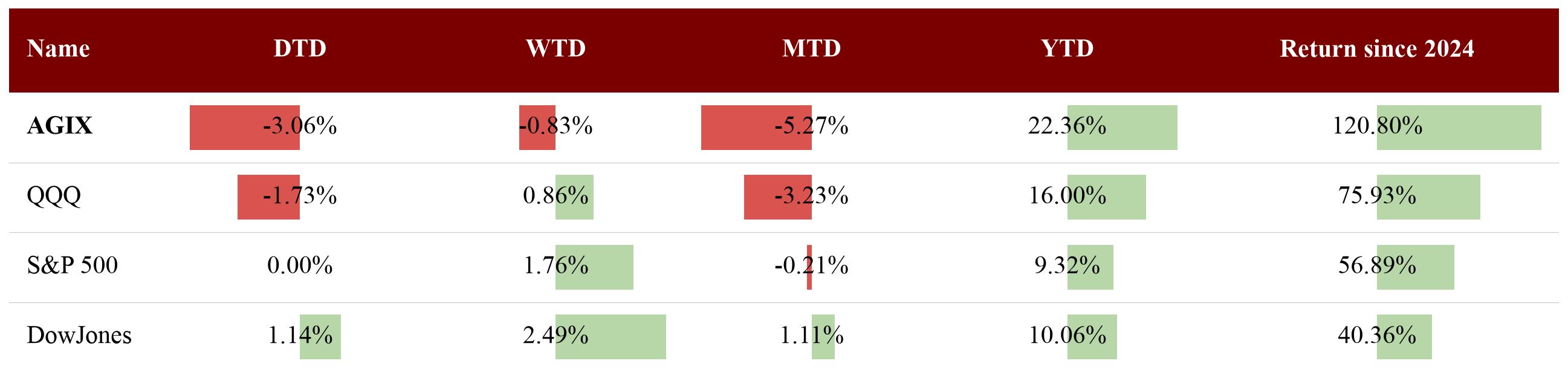
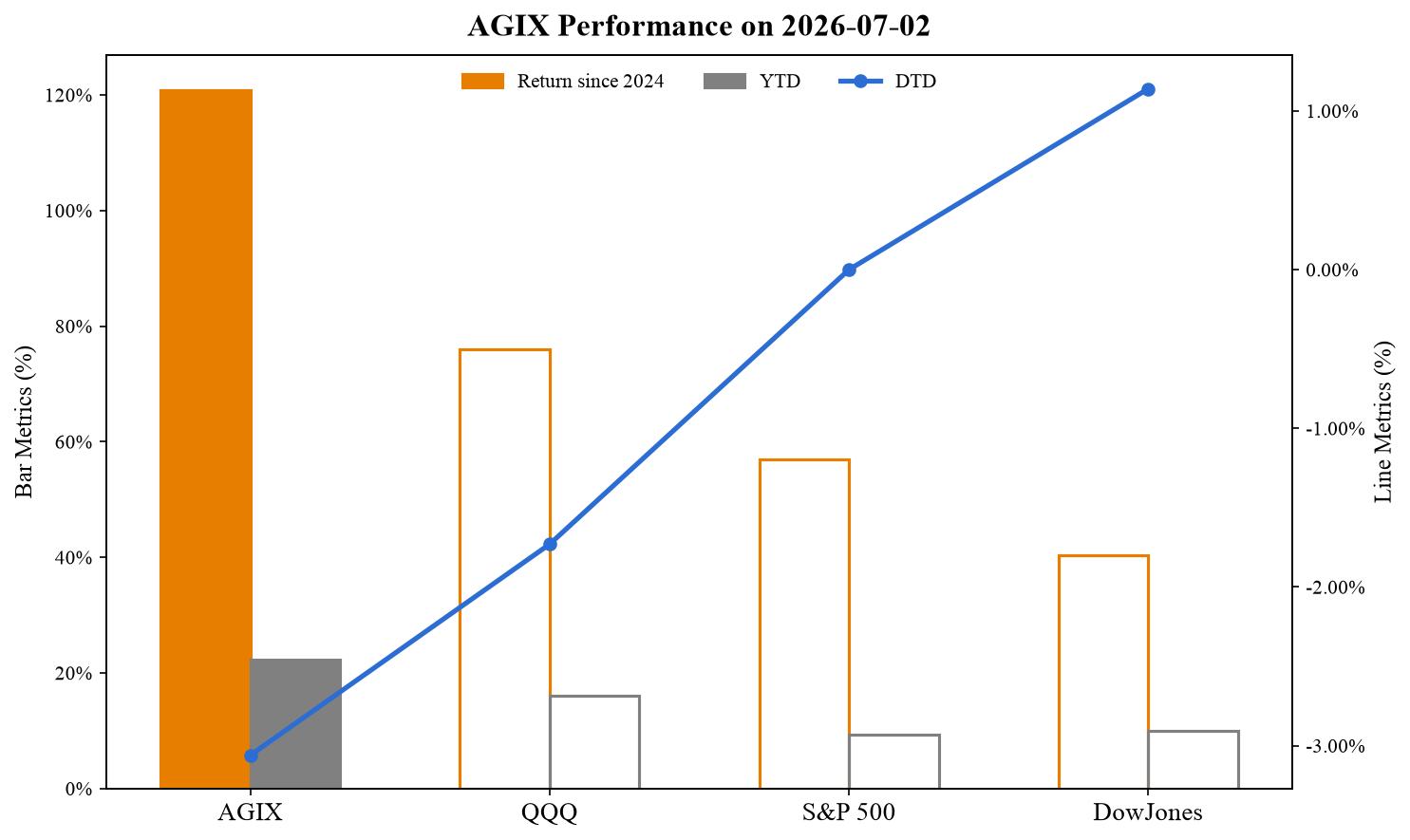
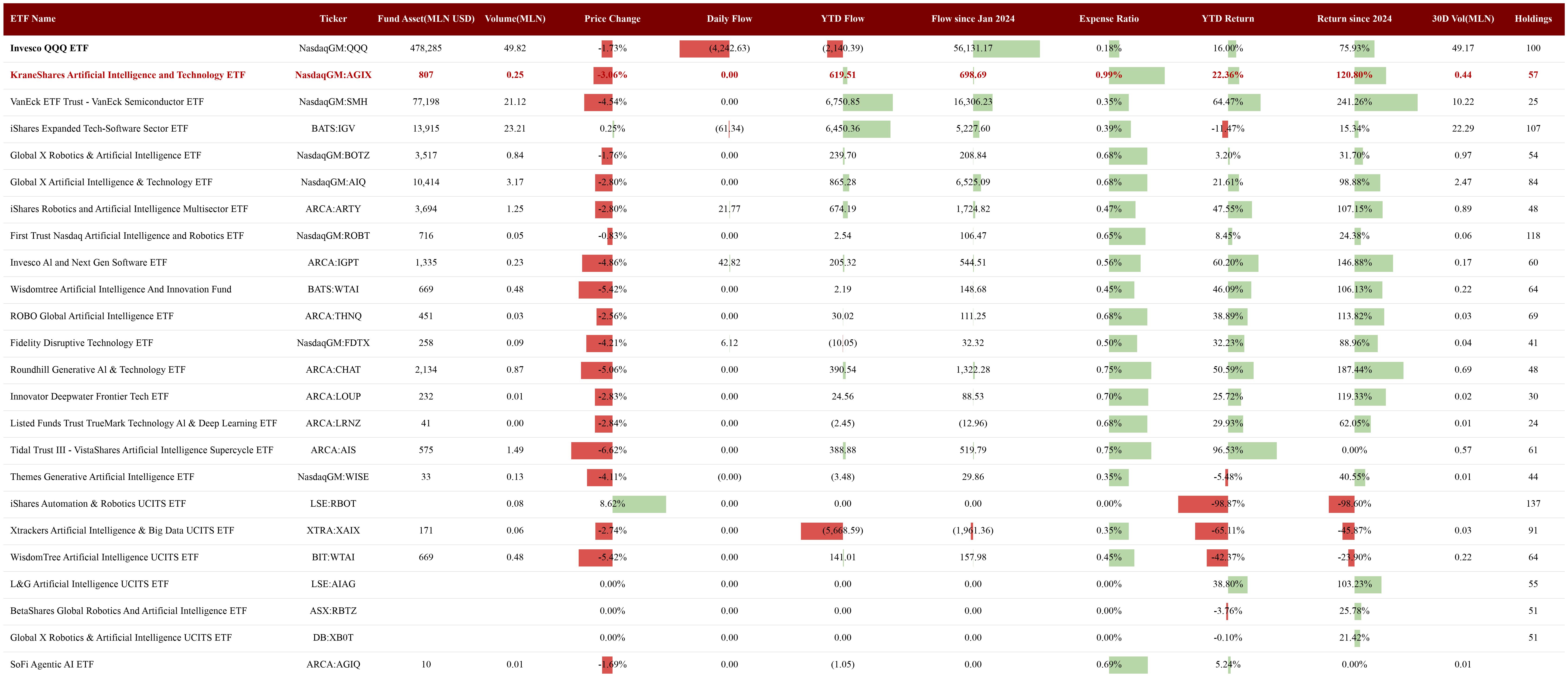
• AGIX fell 3.06% DTD, underperforming the S&P 500 (flat) and Dow Jones (+1.14%), but still leading benchmarks YTD with a 22.36% gain. Peer ETFs show broad weakness in AI and semiconductor names, with SMH down 4.54% and IGPT down 4.86% DTD, while IGV (+0.25%) and BOTZ (-1.76%) held relatively better.
• Among AGIX holdings, hardware stocks dragged the most: Teradyne (-13.63%), Flex (-10.86%), Sanmina (-10.80%), Tower Semiconductor (-10.76%), and Ciena (-8.65%) posted steep DTD losses. Infrastructure names also struggled, led by TeraWulf (-10.18%) and Hut 8 (-8.18%). On the positive side, Apple (+4.84%), Netflix (+4.66%), and Samsara (+5.12%) provided some support.
• Top peer-holding gainers outside AGIX included AeroVironment (+10.7%, driven by a $500M Army counter-UAS contract), Strategy Inc (+7.9%, on a new capital framework and Bitcoin rebound), and Intuitive Surgical (+5.9%, ahead of Q2 earnings). These moves highlight defense, crypto, and robotics as areas of relative strength.
• Key stocks to watch: Apple (strong DTD, new iPad/MacBook Pro rumors), Meta (down 4.9% despite AI infrastructure leasing news, but a 9% jump after hours suggests positive sentiment), and Nvidia (down 1.39% but large-cap weight; chip demand remains a focus).
News Highlights
1. Apple plans to launch new iPad Pro and MacBook Pro models early next year with faster chips and the M7 processor, aiming to balance high-end features and cost-effectiveness amid supply chain pressures. Likely positive for Apple's hardware revenue outlook.
2. Meta shares jumped 9% after announcing plans to lease excess AI infrastructure capacity to enterprises, with up to $145B in capex this year. This positions Meta as a competitor in the AI cloud market, potentially pressuring CoreWeave and Nebius.
3. Microsoft launched a $2.5B AI deployment unit ('Microsoft Frontier Company') with 6,000 engineers to help enterprises build custom AI applications, signaling aggressive enterprise AI services expansion and increased competition for AWS and Google.
4. OpenAI proposed donating 5% of equity to a U.S. sovereign wealth fund to ease political pressure, following discussions with the Trump administration. This could set a precedent for other AI companies and affect valuation and governance.
5. Global venture funding hit a record $510B in H1 2026, driven by AI (OpenAI and Anthropic alone absorbed 43% of global VC). This underscores sustained capital inflows into AI infrastructure and model companies, supporting long-term growth for AGIX holdings.
6. Anthropic is discussing a custom AI chip collaboration with Samsung to reduce reliance on Nvidia, echoing a broader trend of AI companies developing in-house silicon. This could impact Nvidia's market share over time.
7. Palantir CEO Alex Karp criticized U.S. reliance on OpenAI and Anthropic for military AI, calling it 'a loss of mental control,' and questioned the sustainability of current AI billing models. This raises regulatory and business model risk for the sector.
8. Meta quietly launched a 'vibe-coded' gaming app called Pocket, allowing users to generate interactive games via AI prompts. This expands Meta's AI creation ecosystem and could boost user engagement.
RSS Highlights
1. FBI seized the NetNut proxy platform and Popa botnet, highlighting cybersecurity risks in residential proxy services and the ongoing battle against botnets.
2. Claude Fable 5 and Mythos 5 resumed global access after a US export control suspension, showing the impact of government regulation on AI model deployment.
3. Hackers exploited Meta's AI customer service chatbot to steal Instagram accounts by simply requesting email changes, raising serious security concerns about AI-driven customer support.
4. Apple plans to use Qualcomm's mmWave modem in US iPhone 18 Pro models and its own C2 modem elsewhere, with battery life trade-offs—a key hardware differentiation strategy.
5. Safari introduced an MCP server for web developers, enabling AI agents to directly interact with the browser for debugging and performance analysis, improving developer workflows.
6. A new EU AI Act requiring watermarks on all AI outputs takes effect in August 2026, with text watermarking still challenging to implement effectively, as noted by Google's SynthID approach.
7. Meta's engineering culture is reportedly collapsing under large-scale reorganizations, shifting software engineering from a profit center to a cost center, per a Pragmatic Engineer analysis.
8. A former applied AI researcher is developing a foundational model for drug response prediction, and a former Amazon engineer is building a unified API for over 15 voice AI providers—both stealth startups advancing AI in biotech and voice interfaces.
Performance & Benchmark
Attribution
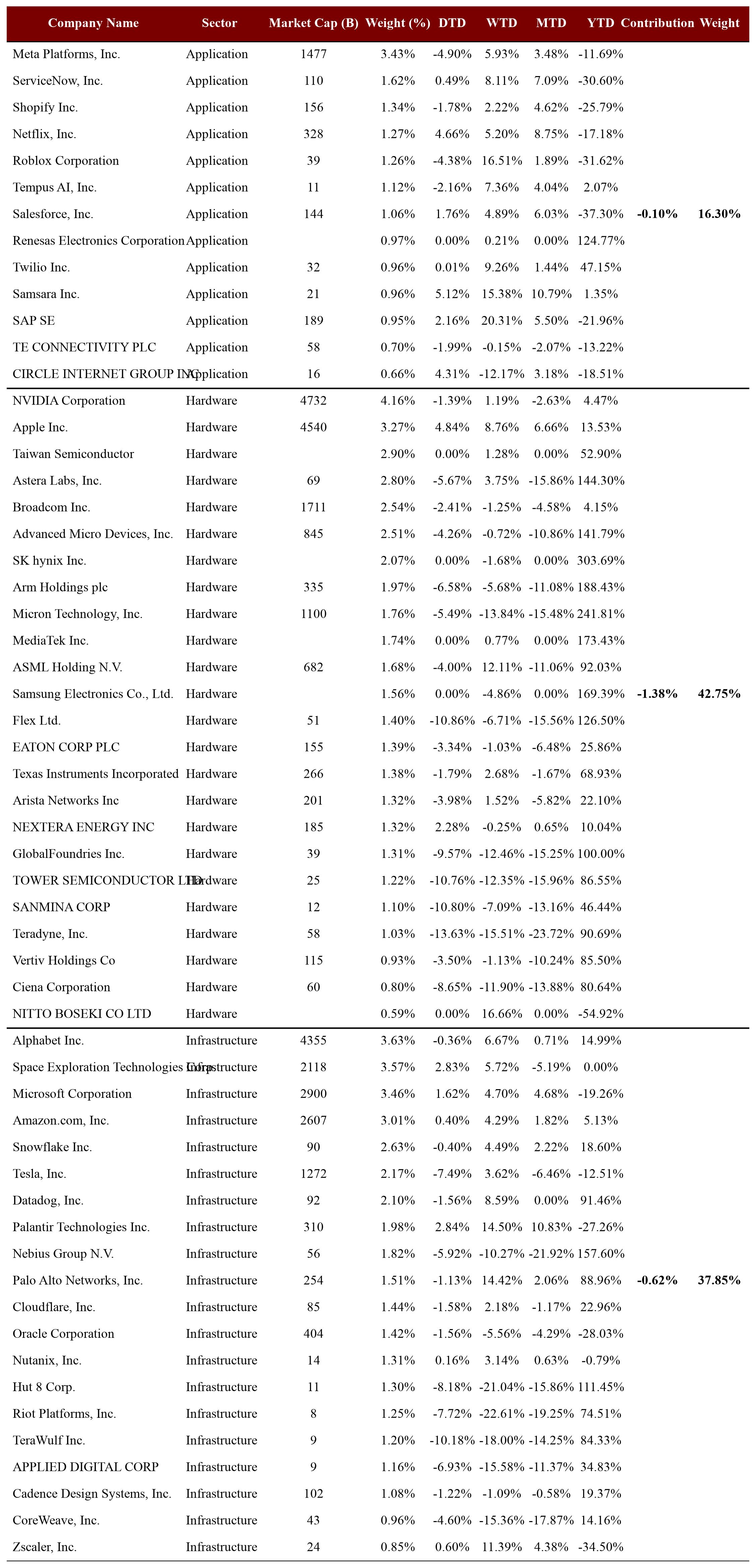
Contribution of the three sectors within AGIX holdings today
Application: -0.1%
Hardware: -1.38%
Infrastructure: -0.62%
Top-performing stocks in AGIX holdings today
Samsara Inc. (5.12%)
Apple Inc. (4.84%)
Netflix, Inc. (4.66%)
CIRCLE INTERNET GROUP INC (4.31%)
Palantir Technologies Inc. (2.84%)
Space Exploration Technologies Corp. (2.83%)
NEXTERA ENERGY INC (2.28%)
SAP SE (2.16%)
Worst-performing stocks in AGIX holdings today
Tempus AI, Inc. (-2.16%)
Broadcom Inc. (-2.41%)
EATON CORP PLC (-3.34%)
Vertiv Holdings Co (-3.5%)
Arista Networks Inc (-3.98%)
ASML Holding N.V. (-4.0%)
Advanced Micro Devices, Inc. (-4.26%)
Roblox Corporation (-4.38%)
CoreWeave, Inc. (-4.6%)
Meta Platforms, Inc. (-4.9%)
Micron Technology, Inc. (-5.49%)
Astera Labs, Inc. (-5.67%)
Nebius Group N.V. (-5.92%)
Arm Holdings plc (-6.58%)
APPLIED DIGITAL CORP (-6.93%)
Tesla, Inc. (-7.49%)
Riot Platforms, Inc. (-7.72%)
Hut 8 Corp. (-8.18%)
Ciena Corporation (-8.65%)
GlobalFoundries Inc. (-9.57%)
TeraWulf Inc. (-10.18%)
TOWER SEMICONDUCTOR LTD (-10.76%)
SANMINA CORP (-10.8%)
Flex Ltd. (-10.86%)
Teradyne, Inc. (-13.63%)
Top five listed stocks contributing the most within AGIX holdings today
Meta Platforms, Inc. (-4.9%)
Tesla, Inc. (-7.49%)
Astera Labs, Inc. (-5.67%)
Flex Ltd. (-10.86%)
Teradyne, Inc. (-13.63%)
Observation
The strongest movers across peer ETF holdings today are listed below:
| DTD | Stock Ticker | Name | Held by ETFs | analysis |
|---|---|---|---|---|
| 55.21 | ENXTPA:DSY | Dassault Systèmes SE | ['LSE:RBOT', 'XTRA:XAIX'] | The move on 2026-07-02 was not driven by any clearly identifiable company-specific catalyst in the provided results; the stock appears to have been influenced mainly by a sharp technical rebound after recent weakness and broader market/risk sentiment, rather than fresh Dassault Systèmes news. The available data show DSY trading around €18.19–€18.39 on the day, with the name still well below its recent resistance zone and navigating a choppy technical range. |
| 10.7 | NasdaqGS:AVAV | AeroVironment, Inc. | ['ASX:RBTZ', 'DB:XB0T', 'ARCA:IGPT', 'ARCA:LOUP', 'NasdaqGM:BOTZ', 'NasdaqGM:ROBT'] | AeroVironment’s 10.7% gain on July 2, 2026 was primarily driven by the announcement of a new $500 million firm-fixed-price U.S. Army counter‑UAS contract running through 2029, which materially strengthens its long-term defense backlog and growth visibility.[1][3] The move was reinforced by investor follow-through on the company’s record fiscal Q4 and full-year results and upbeat FY27 guidance reported earlier in the week, including a roughly $1.2 billion funded backlog and revenue guidance of $2.125–$2.225 billion.[1][3] |
| 7.9 | NasdaqGS:MSTR | Strategy Inc | ['LSE:RBOT', 'ARCA:IGPT', 'BATS:IGV', 'NasdaqGM:QQQ', 'XTRA:XAIX'] | Strategy Inc (MSTR)’s 7.9% move on July 2, 2026 was primarily driven by investor reaction to the company’s newly unveiled capital framework, which includes a formal USD reserve, authorization for significant share and debt repurchases, and a Bitcoin monetization program that reduces perceived balance-sheet and liquidity risk.[1][2][8] A secondary driver was the rebound in crypto markets, with Bitcoin moving higher on the day, which typically provides a tailwind to MSTR given its large BTC exposure.[2][8] Trading volumes were elevated versus recent averages, suggesting incremental participation from momentum and event-driven investors responding to the capital plan and sector move.[2][7] |
| 6.1 | EFX | EQUIFAX INC | ['NasdaqGM:AIQ'] | EFX’s 6.1% gain on 2026-07-02 appears driven mainly by a favorable analyst action: UBS raised its price target on Equifax to $220 from $215 and reiterated a Buy rating, reinforcing bullish sentiment around the name.[2] The move was likely also helped by a broader rebound after late-June weakness, as investors continued to focus on Equifax’s Q1 beat and raised 2026 outlook.[1][3] A secondary support factor was ongoing optimism around the company’s product and AI/identity-growth initiatives, but there was no clear company-specific same-day news catalyst beyond the UBS note.[1][2] |
| 6.03 | NasdaqGS:VRTX | Vertex Pharmaceuticals Incorporated | ['NasdaqGM:QQQ'] | Vertex’s ~6% gain on July 2, 2026 appears primarily driven by a rebound toward bullish analyst targets and buy-rated consensus after prior earnings-related weakness. Same-day data show the stock moving up more than 4% intraday and closing near the low-$520s, in the context of a broadly positive analyst stance with a Buy consensus and price targets clustered around $548–551, reinforcing the recovery narrative.[3][5][6] |
| 5.89 | NYSE:PSN | Parsons Corporation | ['LSE:RBOT'] | Parsons’ 5.89% rise on 2026-07-02 appears to have been driven mainly by company-specific positive sentiment around its July 1 announcement that Q2 2026 results will be released on July 29, which likely kept investors focused on an upcoming catalyst rather than any new negative news. The move also fits broader momentum/valuation support in the stock, with market quotes showing PSN trading up through the day and near its session high. No other major same-day company or regulatory headline appears in the provided results to explain the move more directly. |
| 5.87 | NasdaqGS:ISRG | Intuitive Surgical, Inc. | ['LSE:RBOT', 'ASX:RBTZ', 'DB:XB0T', 'ARCA:IGPT', 'ARCA:LOUP', 'NasdaqGM:BOTZ', 'NasdaqGM:QQQ', 'NasdaqGM:ROBT'] | Intuitive Surgical’s 5.9% gain on July 2, 2026 appears primarily driven by investors positioning ahead of its mid-July Q2 2026 earnings, building on strong Q1 results and confidence in continued procedure growth and da Vinci 5 adoption.[1][2] The move is also occurring against a backdrop of supportive analyst sentiment, with a majority Buy rating and materially higher 12‑month targets versus the current share price, which can reinforce buy-the-dip behavior after a weak year-to-date performance.[3][4][5] There were no clearly identified company-specific news releases or regulatory actions on the day, suggesting the move is largely anticipatory and sentiment-driven rather than event-specific. |
| 5.77 | NasdaqGS:TTAN | ServiceTitan, Inc. | ['LSE:RBOT', 'BATS:IGV'] | ServiceTitan’s 5.8% gain on July 2, 2026 appears primarily driven by renewed buy-side focus on its favorable analyst setup, with 16 covering analysts reiterating a consensus Buy rating and price targets that imply substantial upside from current levels.[5] The move also reflects a partial rebound from depressed levels near the bottom of its recent trading range after a weak year-to-date performance, as investors rotate back into select software names with strong AI and growth narratives.[4][6] |
| 5.68 | ETSY | ETSY ORD | ['ARCA:THNQ'] | Etsy’s 5.7% gain on July 2, 2026 appears primarily driven by continued momentum and investor optimism following recent positive analyst sentiment and a Buy consensus as of June 30, 2026. Secondary support likely came from technical factors, with the stock trading near the top of its recent range and benefitting from strong short-term price performance over the prior month. |
| 5.59 | NYSE:NOC | Northrop Grumman Corporation | ['NasdaqGM:ROBT'] | Northrop Grumman’s 5.59% move on 2026-07-02 was most likely driven by a favorable same-day defense contract catalyst: the company received a roughly $312.34 million Navy contract modification for continued production of SEWIP Block Three systems, which investors viewed as a long-duration revenue win.[1] The stock also appeared to be extending positive momentum from the morning session, with the move amplified by its rebound from a recent 52-week low and a relatively low-volatility profile that can make contract headlines more price-sensitive.[1][6] An additional supporting factor was a reported analyst upgrade to “Outperform” by RBC Capital earlier that day, which likely reinforced sentiment.[8] |
| 5.45 | NYSE:TYL | Tyler Technologies, Inc. | ['BATS:IGV'] | Tyler Technologies’ 5.45% move on July 2, 2026 appears primarily driven by company-specific news: the successful statewide rollout of its AI assistant in South Carolina, which was highlighted in same-day coverage and framed as a meaningful validation of Tyler’s AI strategy and public-sector growth opportunity.[6] This catalyst likely reinforced the positive sentiment around Tyler’s long-term SaaS and AI roadmap from its recent Investor Day materials, encouraging investors to re-rate the stock toward its above-market analyst price targets and “Moderate Buy” consensus.[4][2] Broader tech-sector strength on the day provided a supportive backdrop but was secondary to the AI rollout news.[5] |
| 5.34 | NYSE:GWRE | Guidewire Software, Inc. | ['BATS:IGV'] | Guidewire Software’s 5.3% gain on July 2, 2026 was primarily driven by a rebound from recent post-earnings weakness as investors re-focused on the company’s upgraded fiscal 2026 outlook and strong subscription/ARR growth trajectory.[8] The move was supported by a constructive broader setup: analysts’ consensus upside of more than 50–60% and predominantly Buy ratings, plus technical indicators flagging GWRE as oversold and a strong buy, encouraging incremental accumulation after a deep correction.[4][7][3] |
| 5.32 | NYSE:FICO | Fair Isaac Corporation | ['LSE:AIAG', 'ARCA:THNQ', 'BATS:IGV'] | Fair Isaac’s 5.3% gain on July 2 was primarily driven by bullish analyst actions, with Raymond James raising its price target to $1,940 (maintaining Outperform) and UBS lifting its target to $1,270, reinforcing a positive outlook on FICO’s growth and competitive positioning.[1][7] A secondary driver was ongoing optimism around the broader rollout and data availability of the FICO Score 10T mortgage datasets via Fannie Mae and Freddie Mac, which supports expectations for increased adoption of FICO’s newer scoring models and future revenue upside.[1] |
| 5.12 | NYSE:IOT | Samsara Inc. | ['NasdaqGM:AGIX', 'LSE:AIAG', 'ARCA:IGPT', 'ARCA:LRNZ', 'ARCA:THNQ', 'BATS:IGV'] | Samsara’s 5.1% gain on July 2, 2026 appears primarily driven by follow-through buying after a strong fiscal Q1 print and growing confidence in its AI-enabled growth story. Recent earnings showed 31% year-over-year revenue growth and a 54% jump in adjusted EPS, reinforcing a consistent execution narrative that has attracted bullish analyst commentary and upside price targets.[2][3][6] A secondary driver is positive sentiment from analysts and investors around Samsara’s AI strategy, with multiple recent “Buy” ratings and consensus targets well above the mid‑$30s trading level, framing the stock as undervalued relative to its growth profile.[3][5][8] Technical factors, including the stock trading above short-term moving averages and rebounding from post-earnings weakness, likely amplified the move as momentum and growth investors added exposure.[1][10] |
| 5.06 | TSX:TRI | Thomson Reuters Corporation | ['NasdaqGM:AIQ'] | Thomson Reuters’ 5.06% move on 2026-07-02 appears to have been driven primarily by a broad re-rating in the name rather than a company-specific same-day announcement, with the stock trading strongly on the day and closing well above the prior week’s levels.[10][5] The most credible public catalyst in the available results is supportive market/analyst sentiment, including a “Buy/Strong Buy” consensus and upside price targets, which likely reinforced buying interest.[2][1][6] A secondary contributor was likely sector and style momentum, as Reuters’ market coverage shows the TSX was moving on the session amid geopolitical pressure, while TRI’s technical signals were also positive.[5][2] |
| 5.04 | NYSE:MDT | Medtronic plc | ['NasdaqGM:ROBT'] | Medtronic’s 5.04% move on 2026-07-02 appears to have been driven primarily by a strong price breakout rather than a clearly identifiable company-specific catalyst in the available same-day results; the stock closed at $83.19, up $3.99 from the prior close. The move also came in above the options market’s 14-day expected move of about ±3.36%, suggesting the rally was larger than implied volatility had priced in. No major Medtronic-specific earnings, guidance, or regulatory announcement is evident in the provided results, so the second-order drivers likely were broader healthcare/defensive rotation and momentum buying. |
News
Funding & M&A
CarbonSix raises $40 million to deliver intelligent learning machines to the factory floor.
CarbonSix Inc. recently announced the completion of a $40 million Series A funding round, co-led by DSC Investment and LB Investment, with participation from IMM Investment, Korea Development Bank, SV Investment, and others. The funds will be used for talent recruitment, infrastructure expansion, and global growth. The company focuses on developing plug-and-play robotic AI solutions, using a unique 'data flywheel' mechanism that continuously optimizes models with on-site task data to enable rapid deployment on manufacturing lines. The SigmaKit tool suite includes AI software, robotic arms, and sensor modules, allowing users to quickly train robot skills via teleoperation without programming, and complete model deployment and iteration within a day. The core team comes from SuaLab (acquired by Cognex), MIT, and Yale University, aiming to drive the application of embodied AI in factory settings, helping manufacturers achieve intelligent transformation and cost reduction.
IQM, Europe’s first public quantum company, admits the future of the tech is uncertain.
Finnish quantum computing full-stack company IQM went public on the U.S. Nasdaq on Thursday via a SPAC merger, with a valuation of approximately $1.5 billion. The stock price did not surge on the day and traded below the offering price. In its prospectus, the company cautioned that large-scale commercialization may never occur, but its customer base has grown from 8 in 2024 to 22 in 2025, including private-sector clients. IQM sells physical quantum computers and cloud services, with customers including Finland's VTT and the Leibniz Supercomputing Centre in Germany. It has established a quantum technology center in Maryland, USA, and is deploying equipment at the U.S. Department of Energy's Oak Ridge National Laboratory. Multiple EU countries have policies supporting quantum computing, and a Trump executive order is accelerating progress. IQM will also list on Google Helsinki tomorrow to access nearly $2.6 billion in liquidity.
Mark Zuckerberg tells staff that AI agents haven’t progressed as quickly as he’d hoped.
According to Swiss reports, Meta CEO Mark Zuckerberg stated at an all-hands meeting that the company's AI agent development progress has not accelerated as planned. To rapidly transition to AI-focused operations, Meta laid off approximately 8,000 employees this year and reassigned about 7,000 others to AI teams. Zuckerberg acknowledged that the restructuring process has not been perfect and that the benefits of the AI organizational changes have not yet fully materialized. Nevertheless, the company still plans to invest up to $145 billion in AI infrastructure this year. Multiple reports indicate that the work intensity within Meta's AI division is relatively high. Analysts believe that Meta's personnel adjustments during its AI transformation reflect the strategic challenges large tech companies face amid technological iteration.
Tripo AI secures an additional $150 million in funding to enhance its 3D and world models.
3D AI founder Tripo AI announced the completion of a $150 million Series A3 funding round, co-invested by Geely Capital, 4399 Network, Tanwan, and Giant Network. The company's official name is Holymolly Ltd., and it primarily develops 3D foundation models and world models that can automatically generate high-quality interactive 3D assets from natural language prompts, significantly reducing labor costs in gaming, manufacturing, and film. The latest models, Tripo H3.1 and Tripo P1.0, achieve breakthroughs in 8K resolution texture generation and object segmentation algorithms, while the Project Eden world model supports robot training. This round of funding will be used for algorithm optimization, data infrastructure construction, and recruitment of top AI talent to help build a global business ecosystem.
Global venture funding hits a record $510 billion in the first half as the AI boom accelerates.
According to the latest Crunchbase report, global startup funding in the first half of 2026 reached $510 billion, surpassing last year's total and setting a new historical record. AI has become the dominant force in capital flow, with OpenAI and Anthropic alone absorbing 43% of global venture capital during this period, an unprecedented concentration of investment. Funding slowed to $205 billion in the second quarter, but AI companies still accounted for 70%. Anthropic raised $65 billion in a single round, becoming the highest-valued private company. SpaceX's initial public offering and the large acquisition of Anysphere drove a recovery in the exit market, with total IPO and M&A volume exceeding $200 billion this quarter. Several foundation model companies and infrastructure firms received tens of billions in funding, showing that AI investment has spilled over into multiple sub-sectors. With the liquidity market reopening and broad-based growth in funding across stages, 2026 is poised to mark the beginning of an interactive cycle between AI capital and the exit market.
Indian tech tycoon bets $30 million of his own money to build an AI alternative to Microsoft Office.
Indian serial entrepreneur Bhavin Turakhia has personally invested $50 million to create enterprise AI platform Neo, which redesigns workplace software from scratch, integrating project management, documents, file storage, and AI capabilities into one. Neo supports multiple models, allowing enterprises to freely switch between AI models rather than being tied to a single vendor. The platform is currently running internally at companies like Zeta, and plans to roll out to mid-sized knowledge workers. The company currently has about 45 employees and expects to expand to 100 by the end of the year. Turakhia believes the enterprise AI market is not winner-takes-all, and even capturing 2% to 5% market share can constitute a huge business. This move has attracted attention from investors like Chamath Palihapitiya and puts Neo in competition with leading companies such as Microsoft, Google, and Salesforce.
Homebuilding AI startup Higharc secures $90 million in Series C funding.
AI startup Higharc today announced the completion of its Series C funding round, raising $95 million. The round was led by Insight Partners, with participation from Wellington Management, Fifth Wall, Spark Capital, Lux Capital, and SE Ventures, the investment arm of Schneider Electric. Higharc provides home building solutions based on spatial AI models, automating complex processes such as design, estimation, sales, and construction documentation, and embedding local building codes into the model to automatically convert 2D floor plans into 3D spatial models. This funding will be used to expand AI products, develop more specialized models, and promote material supply chain partnerships. The company has partnered with US LBM, the largest privately held building materials distributor in the U.S., to launch the AutoTranslate AI tool for accurate material takeoff estimation. Higharc claims its technology can significantly shorten project preparation cycles, reduce costs, and minimize overruns.
StirlingX raises $20M for sovereign data intelligence platform
UK-based data intelligence startup StirlingX Ltd. has completed a $20 million Series A funding round to accelerate product development and expand into new markets. The company specializes in a data intelligence platform for drones and autonomous systems, providing data collection, secure fusion analysis, and action capabilities for national critical infrastructure and defense sectors. Its products are manufactured in Cambridge and Oxford, UK, and its clients include the UK National Grid and Five Eyes alliance agencies. The company is chaired by former GCHQ chief Jeremy Fleming and was spun off from its parent company GALLOS Technologies. The round was led by Ventura Capital, with Rokos Capital Management participating, bringing total funding to $31 million. The funds will be used to expand the security software engineering team and advance products for military and high-risk civilian environments.
Palantir CEO Alex Karp doesn't hold back in an interview as he rails against the AI industry.
Palantir Technologies CEO Alex Karp questioned the U.S. government's reliance on OpenAI and Anthropic for military AI development in a CNBC interview, calling it a "loss of sanity." He criticized the standard billing model of AI as imposing a "wealth tax" on enterprise customers, arguing that models are oversold and fail to create real value for users. Karp pointed out that the business community is very dissatisfied with the practice of large companies like Google and Apple taking data and charging high fees, warning that such behavior will ultimately be passed on to taxpayers. He questioned the U.S. military's dependence on private companies for AI as a "loss of sanity" and called for keeping key technologies under domestic control. The interview was described by multiple media outlets as "TV nervous breakdown," sparking heated discussions about the sustainability of AI business models.
Venice raises $65 million at a $1 billion valuation for private, uncensored AI.
Privacy-first AI company Venice.ai today announced the completion of a new $65 million funding round, bringing the company's valuation to $1 billion. The startup was founded in 2024 by cryptocurrency entrepreneurs Erik Voorhees and Jesse Proudman, and its main product is a privacy-focused chatbot that does not record user prompts and stores conversations locally on the device. Its service currently handles 3.5 trillion tokens in ratings and processes 1.3 trillion tokens per month, and has already achieved profitability in the first quarter. This funding round was led by Dragonfly, with participation from Coinbase Ventures and several other crypto and tech investment firms. The funds will be used to build its own data centers, acquire GPU infrastructure, and expand global users and API business. Venice will provide computing resources to developers through the cryptocurrency VVV funding pool model.
Verkada receives investment from Nvidia to expand its physical AI platform.
Physical security company Verkada recently received an investment from Nvidia and signed a technology cooperation agreement to accelerate the deployment of its AI technology across 2.4 million devices. The collaboration centers on the Nvidia Cosmos world foundation model and the Physical AI Data Factory toolkit, which will be used for video search, spatial-temporal query, and other scenarios. After the partnership, Verkada improved its average precision metric by 87% on relevant benchmarks. Verkada previously completed a funding round at a $5.8 billion valuation in 2024 and has surpassed $1 billion in annual orders. Nvidia is expanding its ecosystem into robotics, smart factories, and other fields through the Cosmos model series and developer toolchains. Verkada's technology is deployed in 3,000 organizations across 17 countries, including 100 Fortune 500 companies.
Report: SpaceX showed investors an AI device before its IPO; Musk denies it.
According to the Wall Street Journal, SpaceX showcased a handheld AI device prototype based on xAI technology to investors before its initial public offering. The device is thinner than an iPhone and features a Qualcomm Snapdragon chip. CEO Elon Musk immediately denied the report on X platform, calling it "completely false." The report said the project is still in early stages, the design may change, and it has not been determined whether it will be brought to market. SpaceX actually acquired xAI through a stock transaction earlier this year and fully integrated it into its operations. If the device becomes a reality, it would be SpaceX's biggest expansion from rockets and satellite internet into consumer hardware, aligning with Musk's long-term goal of building a "super app." The company completed the largest IPO in history on the Nasdaq in June, raising approximately $75 billion, with a valuation of $1.77 trillion.
Raja Koduri's Oxmiq Labs raised $35 million to reduce the design cost of custom AI chips.
AI chip startup Oxmiq Labs has just completed a $35 million Series A funding round, bringing total funding to $60 million. The round was led by Fundomo and the Samsung Accelerator Fund, with participation from Meicheng Electric, MediaTek, Hecheng Investment, CDIB-TEN, and others. Founded by former Intel chief architect Raja Koduri, the company is developing the OxCore GPU architecture and OxQuilt compute fabric, integrating GPU, CPU, and Tensor Engine into a single IP block to reduce AI chip development costs. Its software stack supports unmodified CUDA and PyTorch code. Oxmiq aims to become the "next Arm" and compete with companies like Broadcom and Marvell in the custom chip market. The funds will be used to finalize initial IP and expand the engineering team.
Product Launches
Meta quietly launches a vibe-coded gaming app called Pocket.
U.S. tech giant Meta is entering the gaming space with its new AI creation app, Pocket. The app allows users to generate small interactive applications and games using AI prompts, and offers a scrollable discovery feed to share others' creations. Pocket is the result of Meta's acquisition of the AI game platform Gizmo team earlier this year, and its features heavily overlap with Gizmo's original app. Data shows Pocket launched on the App Store and Google Play on June 29, 2026, and is currently in an initial experimental phase. This move is a key step in Meta's push to popularize AI creation tools, following the release of Meta AI-generated images, Vibes video generation, and the Edits editor. Analysts point out that this action will further strengthen Meta's competitive position in the AI ecosystem.
Pinecone releases Nexus into public preview to bring business knowledge to AI agents.
AI infrastructure company Pinecone Systems Inc. today pushed Pinecone Nexus into public preview. The platform uses connectors and Manifests templates to finely curate multi-source enterprise data into knowledge art for AI agents to call upon, addressing their lack of internal organizational recognition. Users can create independent Contexts within Workspaces, with support for data sources such as Box and Microsoft OneLake, and future plans to integrate Google Drive, Slack, and others. Testing shows a 95% accuracy rate for complex support issues at Q2 Holdings, and another security vendor outperformed standard RAG solutions by 25 percentage points across 598 documents. Nexus reduces concurrent query costs and token expenses through structured curation, providing a professional knowledge layer for agentic AI.
Apple is reportedly planning to release new iPad Pro and MacBook Pro models early next year.
Bloomberg cited sources saying that Apple plans to launch multiple new iPad Pro models and an entry-level MacBook Pro (internal codename K104) in the first half of next year. The new iPad Pro will feature a faster chip, while the MacBook Pro is expected to be equipped with the M7 processor, Apple's first M7 chip. Following the release of the iPad Pro last October and the high-end MacBook Pro and MacBook Neo with the A18 chip this March, Apple is accelerating its product iteration. Amid current supply chain tensions leading to price increases, the new products are positioned to balance high-end features and cost-effectiveness, helping Apple cope with competition and prepare for the post-Tim Cook era. The market is anticipating whether these new products can alleviate the recent price pressure from MacBook Pro storage upgrades.
Policy & Regulation
A warning sign about AI's real cost, courtesy of Google and Amazon.
Recently, Google and Amazon simultaneously released sustainability reports, showing that the carbon emissions of the two tech giants increased by 25% and 16% respectively compared to the previous year. The reports indicate that the rapid expansion of AI businesses is the main cause of the emission increases. Both companies saw significant rises in Scope 3 indirect emissions, with data center construction, GPU procurement, and related supply chains being the core drivers. To maintain AI computing power, companies have begun purchasing natural gas power generation facilities on a large scale while continuing to increase renewable energy procurement. Analysts believe that low-carbon technologies for steel, cement, and semiconductor manufacturing have yet to meet data center construction needs, making net-zero emission targets more challenging. To fulfill their commitments, both companies need to increase purchases of carbon credits, invest in low-carbon building materials, and accelerate technological innovation.
Sam Altman calls for a US-led international forum to set global AI standards
OpenAI CEO Sam Altman wrote in the Financial Times, calling for the establishment of a U.S.-led international forum to set global AI safety standards. This body would bring together government representatives, independent technical experts, and others, modeled after the International Atomic Energy Agency, to govern frontier model labs and prevent a dangerous race driven by commercial competition. Altman emphasized that the goal is to ensure fair benefits for all people worldwide, not just a few companies. During the G7 summit, OpenAI, Anthropic, and Google DeepMind discussed related topics with leaders from multiple countries. The biggest challenge currently is how to effectively supervise and verify model training within data centers. Washington has recently tightened controls on the industry, requiring OpenAI's GPT-5.6 model to be first made available to government-approved partners, while Anthropic's Fable 5 and Mythos 5 were briefly taken down due to a Commerce Department ban. The Brookings Institution noted that the G7 should accept industry help in setting standards but must ensure agreements are enforceable, not just voluntary.
Jersey Mike's IPO illustrates how bad the AI hype has become
Longyinshan City Zisha Sofa Store Jersey Mike's mentioned "artificial intelligence" and "AI" 22 times in its IPO filing, drawing market attention. The company, which primarily sells sofas, still listed AI as an investment risk factor, stating it is beginning to apply AI technology in its business. This mention is related to early AI inventory management tool failures at other food companies like Starbucks. Analysts point out that although the company relies on software and data, the actual application of AI is still in its early stages, and the risk disclosure is more of a template language. The article discusses the transition from technological excitement to speculative失控, and links this phenomenon to investors' eager pursuit of AI. This is reflected in the fact that AI mentions have become routine in IPO filings, even for non-tech companies.
Industry Partnerships
What to expect during the Machina AI summit: Join theCUBE July 7
Physical AI is shifting from software automation to industrial robots that need to perceive, decide, and act in physical environments. Nvidia is driving the construction of computing and robotics infrastructure. Analyst Krista Case points out that enterprises must shift focus from model performance to operational performance to avoid new technological fragmentation. Structured environments such as manufacturing and logistics provide the clearest near-term deployment path for physical AI. Simulation, synthetic data, digital twins, and edge computing will become key enablers. At the Machina AI Summit, companies like Path Robotics and Boston Dynamics will demonstrate how to integrate physical AI into enterprise operations to achieve scaled deployment and measurable business outcomes.
15 examples of real-world challenges: Insights from the AWS Summit Washington, D.C. event
AWS recently announced an additional $1 billion investment in its frontier deployment engineering division, aimed at accelerating the adoption of generative and agentic AI applications by enterprises and government agencies. AWS is collaborating deeply with partners such as Palantir, Granicus, SAP, Accenture, Sharecare, and Booz Allen Hamilton across areas including the public sector, healthcare, and defense research. Through embedded engineering teams, 45-day rapid deployment sprints, and customer enablement programs, AWS helps users quickly migrate AI from pilot to production environments while ensuring security and compliance. Cases such as NASA's Artemis mission, the Fleming antimicrobial resistance research, and the FluidCloud cloud migration platform show that cloud-based high-performance computing and AI are significantly shortening simulation cycles and drug discovery times. Overall, this move marks a new phase in AI moving from proof of concept to scaled value delivery.
Microsoft launches an AI-focused professional services business with a $2.5 billion investment
Microsoft recently established a new business unit called "Microsoft Frontier Company," with an initial investment of $2.5 billion, bringing together 6,000 industry and engineering experts, led by former Microsoft Asia President Rodrigo Kede Lima. The unit will deploy forward-deployed engineers on-site at enterprise clients to help build customized AI applications and use FinOps methods to assess return on investment. It will also leverage the Azure Foundry platform, integrating over 11,000 AI models, including its own MAI-Thinking-1 reasoning model. The partner lineup includes professional service firms such as Accenture, Capgemini, and EY, providing global clients with industry knowledge, change management, and enterprise-grade AI engineering capabilities. Facing competitors like Amazon, Google, Anthropic, and OpenAI, which are also ramping up forward-deployed engineering services, Microsoft's move aims to accelerate enterprise AI adoption and maintain its lead in cloud services.
Yep, we’re using OpenClaw to date now.
This article reveals how entrepreneur Ben Guez used OpenClaw, Claude code, and Instagram trial automation scripts to quickly generate emotional support videos with country names after the World Cup. The strategy garnered over a million views and 200 direct messages, but required downloading his AI language learning app Canary to get in touch. Separately, Jeff Weisbein used OpenClaw to research dating spots, while Cailey used Claude to auto-generate breakup messages. Security expert Lazer Cohen warns that users need human approval to avoid privacy risks. The article shows that AI has deeply integrated into tech professionals' dating and emotional management workflows, but also raises discussions about boundaries and ethics. This phenomenon is still in the exploratory stage, and more regulation and transparency will be needed in the future.
Thiel Capital’s Jack Selby nabs stakes in hot startups like Etched through Arizona connections.
Four-year-old hardware startup Etched recently announced that its first chip was successfully manufactured at TSMC in the first half of the year, with systems set to ship this summer. The company is currently valued at $5 billion but faces challenges related to TSMC's capacity constraints. Early investor Copper Sky Capital hopes to resolve manufacturing issues using TSMC's Arizona plant. The firm led Etched's $120 million Series A round two years ago, and its founder Jack Selby, a former PayPal executive with deep ties to Peter Thiel's family office, is a member of the Arizona Commerce Authority. Selby is promoting the relocation of semiconductor companies to the state. Copper Sky is currently raising a $50 billion second fund to continue supporting defense hardware companies establishing operations in Arizona.
Dell/Microsoft partnership: Three insights you may have missed from theCUBE’s coverage of Dell Technologies World.
U.S. computer giant Dell Technologies Inc. and Microsoft Corp. emphasized their deep collaboration on enterprise AI deployment at the Dell Technologies World conference. The two companies jointly launched solutions such as Azure Local and Foundry Local, supporting the operation of large AI models in offline devices and local private cloud environments, achieving both data sovereignty and security. These solutions leverage tools like Microsoft Intune and Azure Arc to meet compliance requirements in regulated industries such as healthcare and government. They are also promoting the integration of SQL Server Engine with the Dell Automation Platform to reduce data fragmentation and help healthcare institutions provide real-time AI recommendations at the patient level. This partnership provides enterprises with private cloud AI infrastructure, reduces deployment risks, and accelerates the adoption of AI at scale.
Meta shares jumped 9% following a reported plan to offer AI infrastructure services.
According to reports, Meta Platforms is planning to lease excess capacity from its AI infrastructure to other enterprises. The company expects capital expenditures of up to $145 billion this fiscal year, including the Hyperion data center campus under construction in Louisiana, which will consume 5 gigawatts of power. Following the news, Meta's stock rose 8.8%, while CoreWeave and Nebius shares fell 13.9% and 17%, respectively. Meta is nearing the launch of the MTIA 300 inference accelerator within the year, and its core large model Muse Spark has already demonstrated enterprise-grade application potential. This move could have complex implications for collaborations with Nvidia, AMD, and Google, while xAI is also advancing similar infrastructure leasing plans. These actions will foster competition and cooperation in the AI infrastructure market.
Anthropic is discussing a new custom chip with Samsung.
According to reports, Anthropic is exploring a collaboration with Samsung to develop custom AI chips, aiming to address chip shortages and reduce reliance on Nvidia. The company has not yet determined the specific use cases, server integration methods, or performance targets for the chips. This move may be a response to OpenAI's partnership with Broadcom to launch the "Jalapeño" inference chip. Anthropic reiterated its commitment to a diversified chip strategy relying on Google, Amazon, and Nvidia. Samsung already manufactures AI chips for Nvidia and is jointly building an AI chip factory in South Korea, while also exploring collaboration with Google. Multiple AI companies are developing in-house chips to improve performance and reduce external dependencies.
融资收购
Microsoft launches its own AI deployment company with a $2.5 billion commitment.
Microsoft announced on Thursday the formation of a new business unit called 'Microsoft Frontier Company,' which will leverage existing AI tools to help enterprises achieve successful deployment. The project is backed by $1 billion in investment and brings together 6,000 specialized engineers and industry experts. Judson Althoff, CEO of Microsoft's commercial business, said the organization will go beyond the traditional pre-deployment engineer model to become the world's largest and most powerful results-oriented engineering team. This move is similar to recent actions by Amazon Web Services, OpenAI, and Anthropic in advancing AI implementation. Microsoft will leverage its massive customer base to move quickly and has already begun collaborations with companies such as London Stock Exchange Group, PwC, Land O'Lakes, and Ericsson.
SoftBank unveils plans to enter the U.S. neocloud business with SB Neo
Japanese technology group SoftBank Group Corp. and its telecom subsidiary SoftBank Corp. are planning to launch a new "New Cloud" business in the U.S., leasing AI chip resources to hyperscale data centers and enterprises through a new entity, SB Neo Inc. The business will begin operations in March of the 2027 fiscal year, with SoftBank Corp. holding a 51% stake. The company will leverage Japan's Infrinia AI Cloud OS technology stack and advantages in gas and fire power generation, aiming to provide 10 gigawatts of AI computing power by 2030. This move is a key step for SoftBank Group to boost annual operating revenue by 3 to 4 times, reaching $18.5 to $25 billion. The plan will face competition from strong rivals such as CoreWeave, AWS, and Microsoft, and may rely on a $65 billion investment in OpenAI to build customer relationships. Additionally, SoftBank will build multiple gigawatt-scale data centers in Japan and is negotiating with banks for a $1 billion loan secured by OpenAI shares.
OpenAI could reportedly give a 5% stake to the US government
According to the Financial Times, OpenAI executives have held preliminary talks with Trump administration officials about transferring a 5% stake to the U.S. government, a plan OpenAI has proposed for over a year. Based on its $852 billion valuation, a 5% stake is worth $42.6 billion, and if the valuation reaches $1 trillion after an IPO, the stake's value would rise further. The White House is discussing this with multiple AI developers, and companies like Anthropic, Google, and Meta may also be asked to transfer corresponding stakes. This move may require congressional approval and would place the stake in a sovereign wealth fund. Similar measures have been taken with quantum computing companies in the U.S., and this policy would strengthen regulatory oversight of AI research, development, and commercialization.
AI stock trading startup EquiLibre raises funding at a valuation of over $500 million.
Prague-based AI developer EquiLibre Technologies Inc. has completed its Series A funding round, with a valuation exceeding $500 million. The round was led by Stockholm venture capital firm Creandum, with the investment amount being the largest in the firm's history. The company primarily develops AI trading agents based on deep reinforcement learning, which have achieved monthly trading volumes of hundreds of billions of dollars in markets such as cryptocurrencies and U.S. stocks, without ever incurring losses. Its technology originates from the poker AI model DeepStack developed by the founders in their early days, which uses self-play training methods. This funding will mainly be used to expand computing clusters and recruit researchers to enhance the profitability of the AI trading system. The company's technical approach is similar to Google DeepMind's application of self-play in solving mathematical problems.
OpenAI proposed donating 5% of its equity to a U.S. sovereign wealth fund.
OpenAI CEO Sam Altman recently proposed donating 5% of the company's equity to a U.S. sovereign wealth fund to ease political pressure and build a good relationship with the government. According to the Financial Times, other AI companies may need to take similar steps. The proposal stems from Altman's earlier public discussions about a public AI fund, and OpenAI further elaborated in a policy document released in April on the idea of directly investing in AI labs through a public wealth fund and distributing returns to citizens. President Trump has also confirmed related discussions, but any formal action requires congressional approval. A more aggressive bill proposed by Senator Bernie Sanders suggests a one-time 50% equity tax on systemically important AI companies, with funds going to a public fund, but the bill has not yet entered committee review. This move reflects the regulatory and distribution challenges facing the AI industry amid rapid development.
Popular TV-tracking app TV Time is shutting down as the company focuses on AI.
TV tracking app TV Time will permanently shut down on July 15, 2026. After its parent company Whip Media was acquired by Blue Torch Capital, the company prioritized developing the AI product Helix, leading to the closure of the consumer app. The app had 26 million installs, but its free model was unsustainable. Data will no longer be used for commercial services, and users can export their personal data. This case illustrates the impact of the AI transition on traditional media data businesses.
RSS Subscription
FBI Seizes NetNut Proxy Platform, Popa Botnet
The U.S. Federal Bureau of Investigation (FBI) announced today that, in cooperation with industry partners, it has seized hundreds of domain names associated with NetNut, a residential proxy service operated by Israeli listed company Alarum Technologies. This action follows the publication of research by multiple security companies on KrebsOnSecurity, linking NetNut to the Popa botnet, which includes at least 2 million devices infected with malware.
This Page Left Intentionally Blank
An author explores the concept of "intentionally blank" pages, aiming to provide internet users with a simple and peaceful space. Especially in the current era of generative artificial intelligence, blank space becomes a form of creative expression. This project attempts to reintroduce the idea of blank space to the internet as a response to information overload.
Stealth Startup Spy #353
A former applied AI researcher is developing a foundational model for predicting drug responses to enable evaluation before clinical trials; meanwhile, a former Amazon engineer is building a single API that spans over 15 voice AI providers. Additionally, a former director of AI and data transformation at Alaska Airlines is creating an AI platform to support enterprise revenue decisions.
The case of the thread executing from an unloaded third-party DLL
The Explorer team investigated a frequent crash and found that it originated from a thread in an unloaded third-party DLL (LibUtils_CloudNs_3.dll). The unloading of this DLL caused the unloading of several dependent DLLs, ultimately affecting system stability. Although the crash could not be reproduced, the team confirmed that CcNamespace.dll was the key component causing the issue, and Contoso no longer supports this namespace extension.
Digital Autonomy 2.0: now for real
At the Surf Privacy & Security Conference on June 25, speakers emphasized the importance of digital autonomy, pointing out that Europe's digital dependence on the United States has reached an absolute level, with almost all public services relying on Microsoft. Although action is necessary to enhance digital autonomy, the current political and management leadership lacks the motivation to change, making this issue difficult to resolve. Speakers called for starting small and promoting practical progress in organizational digital autonomy.
This blog is written in en-GB
Recently, someone left a comment on my blog asking me to use more inclusive language because they didn't understand some of the cultural references I used. In response, I believe everyone should embrace different cultures and accents, and it is possible to understand and adapt to unfamiliar concepts. Even if you encounter unfamiliar words or expressions, there is no need to worry, because the brain has the ability to adapt to new information.
Jack Tramiel and Atari
On July 2, 1984, Atari was acquired by former Compaq founder Jack Tramiel for $240 million, after its parent company Warner Communications was eager to divest due to a $535 million loss in 1983. Tramiel quickly launched the Atari ST computer based on the 68000 processor, successfully beating its competitor Amiga to market. Although Atari achieved a profit of $25 million in 1986, it never returned to its 1982 glory.
Pluralistic: The difference between "today's task" and "accretive work" (02 Jul 2026)
When discussing the difference between "today's tasks" and "value-added work," the author points out that programmers' experiences fall into two categories: one is the "centaur" type, who can autonomously decide how to use automation tools, and the other is the "anti-centaur" type, who is forced to serve the automation system. Although code that "gets the job done" has short-term value, truly value-added code is that which can be continuously improved and used in the future. The author emphasizes that the essential difference between personal software and production code is that the former is a tool customized for an individual, while the latter must be used and maintained by others.
Text AI watermarks will always be trivial to remove
The EU AI Act will take effect in August 2026, requiring that all AI outputs must be identifiable as artificially generated. To meet this requirement, AI providers need to apply watermarks to their outputs, although text watermarking is relatively complex to implement. Google's SynthID is currently the only tool that publicly claims to use text watermarking, detecting watermarks by assigning scores to each generated word.
April Report From Ookla: ‘A Return to mmWave 5G’
The latest data shows that U.S. millimeter-wave (mmWave) 5G networks are continuing to grow, with Verizon's deployment significantly ahead. In the second half of 2025, Verizon offered mmWave connectivity in 91 markets, while AT&T had deployments in only 7 markets, and T-Mobile appeared in just 1 market during that period. Although mmWave coverage is limited, download speeds in some markets exceed 1 Gbps, demonstrating its outstanding performance.
Introducing the Safari MCP Server for Web Developers
Safari Technology Preview 247 introduces the Safari MCP server, a model context protocol server designed for web developers to accelerate and enhance development and debugging workflows. By connecting agents to the Safari browser window, developers can debug code more efficiently, obtaining information such as the DOM, network requests, screenshots, and console output, thereby reducing time spent on window switching and manual inspection. This server supports various use cases, including improving Safari compatibility, analyzing performance, and checking accessibility, helping developers better optimize website experiences.
EveryMac Turns 30
Since its launch on July 2, 1996, EveryMac.com has provided users with detailed Apple product information, covering everything from the original 128k Macintosh to the current product line, now for 30 years. The site encourages users to support sponsors and has introduced an "EveryMac.com Supporter" page, offering support options for individuals and small businesses to continue providing services. Additionally, the site has launched a captcha-free query and the EveryMac API to help users save time and costs.
I Repeat Myself (5G vs. LTE Edition)
A comparative test shows that 5G networks consume significantly more battery on multiple Apple devices than 4G. The new iPhone SE lasts nearly an hour longer on 4G than on 5G, while the iPhone 13 Pro has a battery life of 12 hours and 50 minutes on 5G, but about 2.5 hours more on LTE. Although 5G speeds are impressive, users may find that LTE does not feel "too slow" in daily use, so turning off 5G to save battery life is a worthwhile option to consider.
★ A Tale of Two Modems
According to AppleInsider, Apple plans to use Qualcomm's modem hardware in the iPhone 18 Pro sold in the United States to support 5G mmWave, while iPhones 18 in other regions will use Apple's own C2 modem. Although Qualcomm's modem has an advantage in speed, Apple's C-series modem performs better in battery efficiency, meaning the battery life of the US version of the iPhone 18 Pro may be shorter than that of versions in other regions.
Claude Fable and Kayfabe
Claude Fable 5 and Mythos 5 resumed global access on July 1, 2026, after access to these two models was suspended on June 12 due to export controls imposed by the US government. Fable 5 became available to all users on July 1, with usage limits of up to 50% for certain plans until July 7, while Mythos 5 resumed access to some US organizations after receiving government approval on June 26.
Truth Social Is Still Just Trump’s Blog
The dispute between Trump and Musk, though detrimental to the MAGA camp, has caused a surge in user engagement on social media platform X (formerly Twitter) over the past 24 hours. On June 5, its ranking in the U.S. App Store jumped to 23rd place, a significant rise from the average 68th place over the past 30 days. Meanwhile, active users on Trump's social network Truth Social also increased by more than 400%. However, X still has 100 times more users than Truth Social, highlighting the vast difference in social networking capabilities between the two.
llm-coding-agent 0.1a0
On July 2, 2026, I developed a simple coding agent based on an evolved LLM library, created using a Python library template, and implemented a Claude code-style coding agent with tools for reading, editing files, and executing commands. The agent has been published to PyPI and supports command-line operation. Preliminary test results are satisfactory, offering various tool functions such as file editing, command execution, and file search.
MG Siegler Got Banned From WhatsApp for No Reason
Meta users have had their WhatsApp accounts disabled three times in the past three years for unknown reasons, suspected to be related to new username applications. Although users can apply for review, they report a lack of transparency and effective communication, feeling that Meta has mismanaged its core social service, especially when users rely on WhatsApp for daily life. Users express concern about Meta's future development and its focus on products.
‘A Perfect Reflection of Trump’s Washington’
President Trump promised to quickly and cheaply beautify the reflecting pool at the Lincoln Memorial, but the result was a no-bid project costing over $14 million, with the paint turning green due to algae growth shortly after application, reflecting the corruption and chaos in Washington. Although Trump claimed to have beautified the city, the reality turned it into a construction zone and militarized camp.
Using DSPy to evaluate and improve Datasette Agent's SQL system prompts
Research shows that using DSPy can evaluate and improve the SQL system prompt of the Datasette Agent. Through testing, it was found that including column names in the schema list or adjusting related suggestions can reduce errors and retry loops, thereby improving system performance.
'Why Is Meta Destroying Its Engineering Organization?'
Meta recently made large-scale adjustments to its engineering organization, causing its once efficient engineering culture to rapidly collapse. Over the past 20 years, Meta's engineering culture has evolved from "move fast and break things" to "move fast with stable infrastructure," but in recent weeks, leadership seems to be deliberately undermining this successful engineering culture, shifting software engineering from a profit center to a disregarded cost center.
Understand to participate
At the AIE conference, Geoffrey Litt emphasized the importance of understanding code in order to collaborate more effectively with coding agents. He pointed out that deep code understanding can avoid cognitive debt and enhance engagement in the creative process. Over 300 talks from the conference will be released gradually, and Geoffrey's talk is worth watching on YouTube.
Hackers Stole Instagram Accounts Simply by Asking Meta AI to Give Them Access
Hackers exploited Meta's AI customer service chatbot by requesting email changes for target Instagram accounts, successfully compromising several high-profile accounts, including the Obama White House account and the Sephora account. Users reported being unable to escalate issues to human customer support after their accounts were stolen. In March, Meta announced it would roll out the AI customer service to all Facebook and Instagram accounts, with key features like password reset, but this approach significantly increased security risks.
Understanding is the new bottleneck
At the AI Engineer Conference in July 2026, speakers emphasized the importance of understanding AI-generated code and proposed various effective comprehension techniques, such as code explanation documentation, comprehension quizzes, and interactive microworlds. Although AI is becoming increasingly proficient at self-verification, human involvement remains necessary to drive the creative process and avoid the accumulation of cognitive debt. The speakers also shared specific methods to enhance understanding through structured explanations and interactive quizzes.
Bring Back Crappy Forums
Online forums were gradually replaced by more advanced options in the 1990s, but their historical roots can be traced back to the Usenet system in the 1970s, which was a major communication platform for early internet users. Although web forums were technically imperfect, they rapidly evolved with the introduction of multimedia content, becoming important tools for commerce and social interaction. In 1995, Lundeen & Associates launched the WebCrossing forum tool, which was used by several well-known media outlets and is still under continuous development, demonstrating its significance in internet history.