AGIX Daily Report 2026-07-06
AI Summary
Market Overview
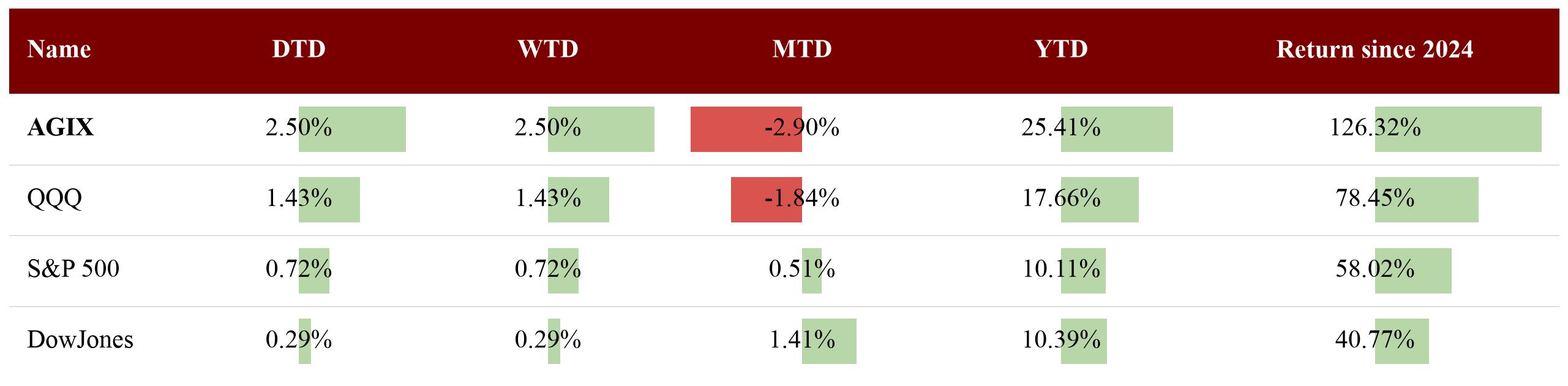
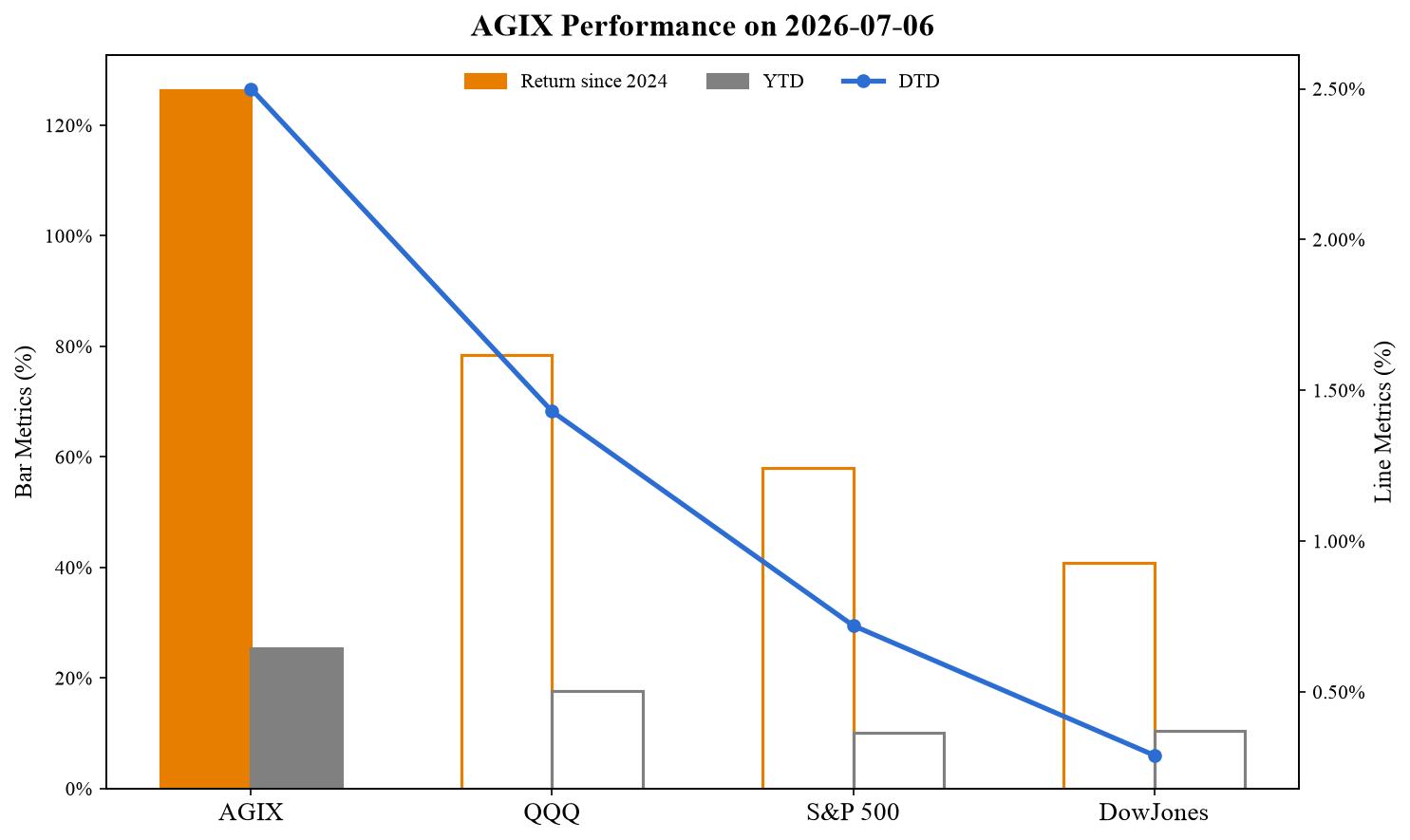
• AGIX outperformed all major benchmarks on the day, up 2.5% DTD, versus QQQ (+1.43%), S&P 500 (+0.72%), and Dow Jones (+0.29%). The ETF’s year-to-date return of 25.41% also leads the QQQ (17.66%) and the S&P 500 (10.11%).
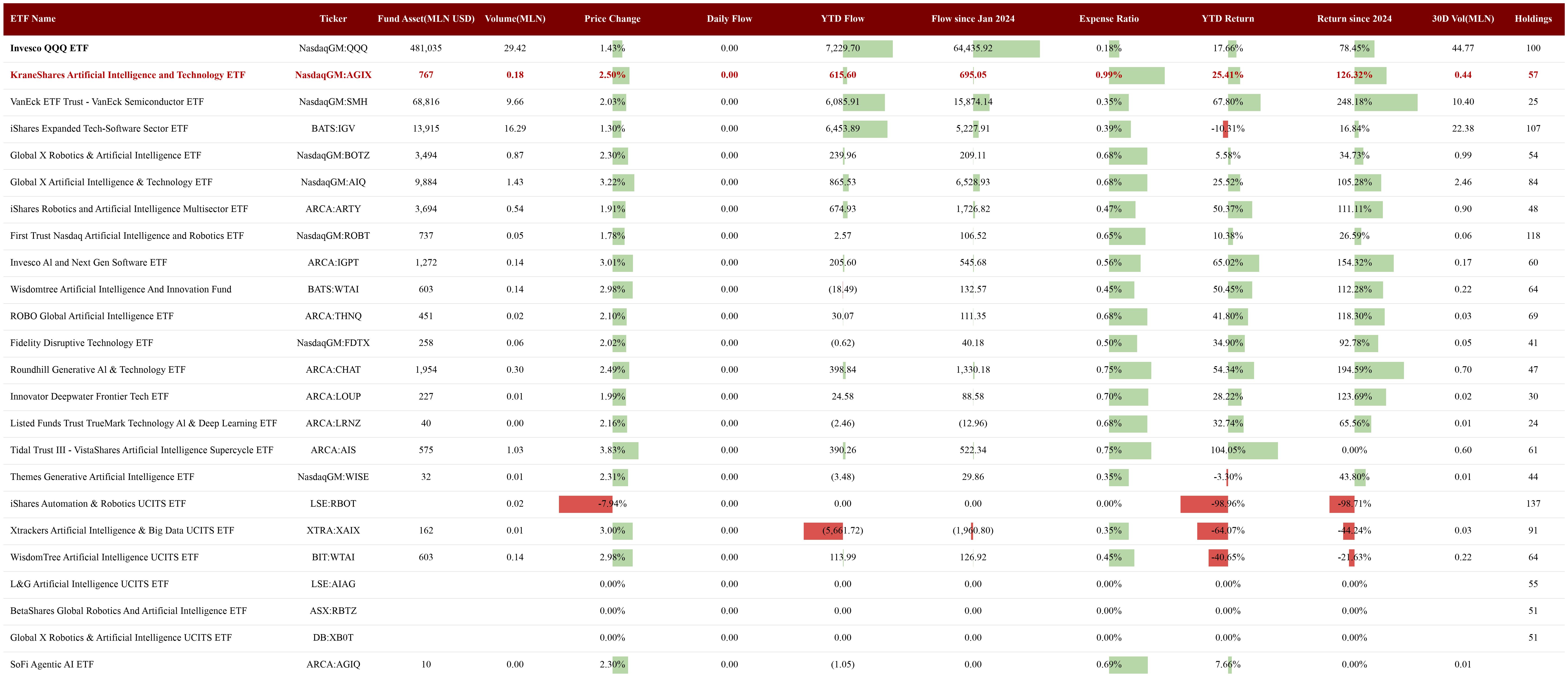
• Among peer AI-themed ETFs, AIQ (+3.22%), IGPT (+3.01%), and WTAI (+2.98%) posted the largest daily gains, while AIS (+3.83%) led on a YTD basis (+104.05%). The broad AI/semiconductor rally was evident across the peer set.
• Top AGIX holdings driving performance included AMD (+6.61%, hardware), Tesla (+6.69%, infrastructure), and Astera Labs (+6.48%, hardware). AMD benefited from a Goldman Sachs price target hike to $640, while Tesla was lifted by Q2 delivery optimism and robotaxi expansion news. Astera Labs continued to attract inflows following its Nasdaq-100 inclusion and strong Q1 results.
• Key stocks to watch: AMD (AI chip demand, analyst upgrades), TSLA (robotaxi expansion, deliveries beat), and Astera Labs (Nasdaq-100 inclusion flows, AI connectivity play) are likely to remain in focus given their strong moves and positive catalysts.
News Highlights
1. Microsoft’s layoff of ~4,800 employees, including 1,600 in Xbox, highlights a broader tech restructuring toward AI. While not directly replacing jobs with AI, the move signals cost reallocation to AI infrastructure, which may pressure near-term sentiment for Microsoft but supports the long-term AI build-out narrative for AGIX holdings like Microsoft and Azure partners.
2. Palantir CEO Alex Karp criticized OpenAI/Anthropic’s business model as a 'wealth tax' and announced a sovereign AI partnership with Nvidia. Palantir’s stock rose 9% on the news, reinforcing demand for data sovereignty solutions. This is positive for Palantir (an AGIX holding) and Nvidia, as enterprises seek controlled AI deployments.
3. SK Hynix plans a $12.8B US IPO amid surging AI memory demand (HBM, DRAM). The company’s Q1 revenue nearly tripled YoY. This underscores the AI-driven memory cycle and is a tailwind for AGIX hardware holdings like Micron (+0.94% DTD) and Samsung, as supply tightness persists.
4. The first fully autonomous AI ransomware attack (JadePuffer) exploited Langflow, raising cybersecurity concerns. This event highlights the growing threat landscape and likely benefits AGIX cybersecurity holdings such as Palo Alto Networks (+2.72% DTD), Zscaler (+2.1%), and Cloudflare (+2.12%), as enterprises increase security spending.
RSS Highlights
1. GLM 5.2 is described as the first truly competitive open-weight model against Opus and GPT, though slower in interactive tasks and lacking vision support. The piece argues that lower switching costs for enterprises could pressure frontier labs' margins, a key development for AI model economics.
2. A detailed analysis of SoftBank’s net asset value ($615B) versus total debt ($76.4B), with large stakes in ARM and two Vision Funds. The early OpenAI investment could yield up to $100B in returns, but a gap persists between private and public market valuations.
3. Josh W. Comeau reports that sales of his new animation course are only one-third of typical launches, attributing the decline to AI anxiety among developers and AI’s personalized tutoring reducing demand for paid courses. Course creator incomes have dropped over 50%.
4. The open-source AI gap map indexes 421 products (266 tools/libraries, 85 models, 50 datasets, 20 hardware projects) across 228 organizations, with $400M in funding. The data is published on GitHub under MIT license.
Performance & Benchmark
Attribution
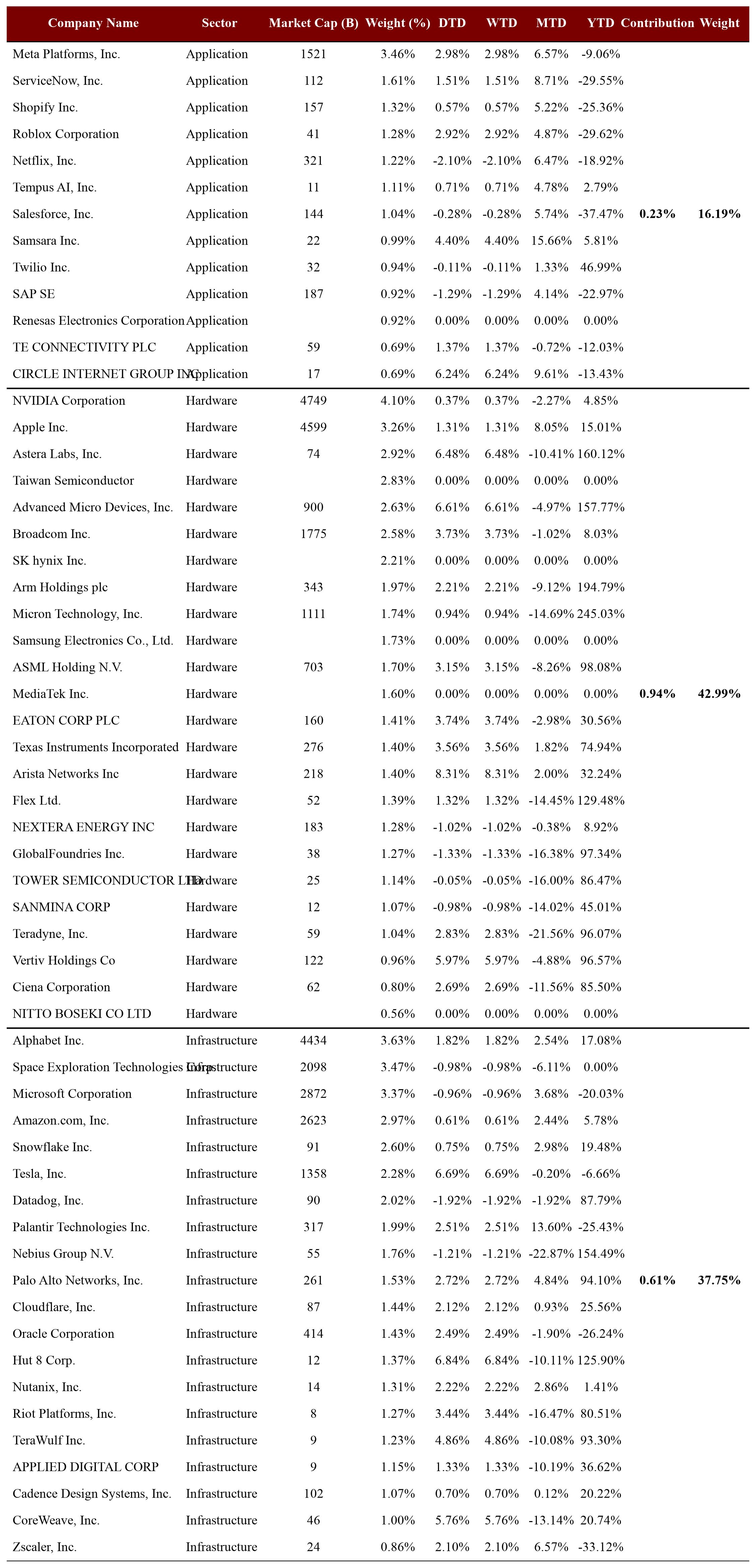
Contribution of the three sectors within AGIX holdings today
Application: 0.23%
Hardware: 0.94%
Infrastructure: 0.61%
Top-performing stocks in AGIX holdings today
Arista Networks Inc (8.31%)
Hut 8 Corp. (6.84%)
Tesla, Inc. (6.69%)
Advanced Micro Devices, Inc. (6.61%)
Astera Labs, Inc. (6.48%)
CIRCLE INTERNET GROUP INC (6.24%)
Vertiv Holdings Co (5.97%)
CoreWeave, Inc. (5.76%)
TeraWulf Inc. (4.86%)
Samsara Inc. (4.4%)
EATON CORP PLC (3.74%)
Broadcom Inc. (3.73%)
Texas Instruments Incorporated (3.56%)
Riot Platforms, Inc. (3.44%)
ASML Holding N.V. (3.15%)
Meta Platforms, Inc. (2.98%)
Roblox Corporation (2.92%)
Teradyne, Inc. (2.83%)
Palo Alto Networks, Inc. (2.72%)
Ciena Corporation (2.69%)
Palantir Technologies Inc. (2.51%)
Oracle Corporation (2.49%)
Nutanix, Inc. (2.22%)
Arm Holdings plc (2.21%)
Cloudflare, Inc. (2.12%)
Zscaler, Inc. (2.1%)
Worst-performing stocks in AGIX holdings today
Netflix, Inc. (-2.1%)
Top five listed stocks contributing the most within AGIX holdings today
Astera Labs, Inc. (6.48%)
Advanced Micro Devices, Inc. (6.61%)
Tesla, Inc. (6.69%)
Arista Networks Inc (8.31%)
Meta Platforms, Inc. (2.98%)
Observation
The strongest movers across peer ETF holdings today are listed below:
| DTD | Stock Ticker | Name | Held by ETFs | analysis |
|---|---|---|---|---|
| 13.02 | NasdaqGM:RPD | Rapid7, Inc. | ['LSE:AIAG', 'ARCA:THNQ', 'XTRA:XAIX'] | Rapid7’s 13% gain on July 6, 2026 appears primarily driven by continued bullish follow‑through after its Q1 2026 earnings beat and upbeat demand commentary for AI‑driven cybersecurity solutions. The company reported better‑than‑expected EPS ($0.36 vs. $0.30) and a revenue beat, reinforcing confidence in profitability and growth despite prior drawdowns[2]. A secondary driver is improving sentiment around security vendors positioned to benefit from rising enterprise investment in AI‑powered threat detection, which has recently supported Rapid7’s share price recovery[1]. |
| 10.44 | NasdaqGS:CEVA | CEVA, Inc. | ['LSE:RBOT'] | CEVA’s 10.44% gain on July 6, 2026 appears primarily driven by investor follow-through on its better‑than‑expected Q1 2026 earnings and improving sentiment toward the name. The company reported Q1 EPS of $0.04 that beat forecasts and 11% YoY revenue growth to $27M, alongside a strong buy consensus and upside to analyst targets, which likely supported renewed buying interest after prior post‑earnings weakness. |
| 10.15 | NasdaqGS:PENG | Penguin Solutions, Inc. | ['ARCA:AIS'] | Penguin Solutions’ 10.15% gain on July 6, 2026 was primarily driven by an AI-catalyst news event: the company was named an Nvidia AI Factory Specialized Partner, an invitation-only designation that effectively endorses its full-stack AI infrastructure capabilities and ties its growth narrative more tightly to Nvidia’s ecosystem[2]. A secondary driver was broader AI/semiconductor sector strength and momentum, with investors and traders rotating back into high-beta chip names after recent volatility, which amplified the stock’s move given PENG’s elevated beta and strong year-to-date performance[1][4][6]. |
| 10.04 | LMND | LEMONADE INC | ['ARCA:THNQ'] | Lemonade’s ~10% gain on July 6, 2026 appears primarily driven by follow-through buying after recent positive company-specific catalysts, rather than by any new, stock-specific headline that day. The key near-term driver is improved reinsurance terms and related optimism on profitability and capital efficiency, which previously pushed the stock up about 6% and continues to reset expectations higher for margins and growth quality.[5] A secondary factor is momentum and volatility in a name that has frequently posted >5% daily moves, with investors extrapolating recent positive news in a relatively thinly traded, high-beta stock.[1][6] |
| 9.77 | NasdaqGS:CRDO | Credo Technology Group Holding Ltd | ['LSE:RBOT', 'ARCA:AIS', 'ARCA:ARTY', 'ARCA:CHAT', 'ARCA:IGPT', 'ARCA:LOUP', 'BATS:WTAI', 'BIT:WTAI'] | Credo’s ~9.8% gain appears primarily driven by a cluster of bullish sell-side actions positioning the company as a key AI connectivity beneficiary. Evercore ISI launched coverage with an Outperform and a $325 target, while Stifel raised its target to $350 and reiterated Buy, and BofA lifted its target to $340, collectively reinforcing a high-growth AI data‑center narrative and drawing strong incremental demand for the shares. Broader positive momentum in semiconductor and AI‑exposed names provided an additional tailwind, amplifying the move. |
| 8.92 | BE | Bloom Energy Corp- A | ['ARCA:ARTY', 'BATS:WTAI', 'BIT:WTAI'] | Bloom Energy’s 8.9% gain on July 6, 2026 appears driven primarily by continued enthusiasm around its role as a key power supplier for AI data centers, reinforcing the bullish narrative that it is a critical beneficiary of AI-driven grid constraints and onsite power demand.[3] A same-day “stock spotlight” feature highlighted BE’s strong move and likely amplified investor attention and momentum trading in the name.[2] The advance also came amid elevated trading volume versus recent lows and a broader context of recent positive media and analyst commentary on Bloom’s growth and positioning in alternative energy and AI infrastructure.[1][5] |
| 8.43 | NasdaqGS:CIFR | Cipher Mining Inc. | ['BATS:IGV'] | Cipher Mining’s 8.43% gain on 2026-07-06 was most likely driven by a same-day re-rating around its AI/data-center transition and imminent AWS lease revenue start, with investors reacting to the prospect of first meaningful recurring rent from its hyperscaler partnership. A supportive second driver was positive analyst sentiment and price-target hikes that reinforced the “infrastructure landlord” thesis. The broader market and firmer Bitcoin prices also provided a modest tailwind, but the company-specific AI/lease catalyst appears to have been the main move driver.[1][2][6] |
| 8.31 | NYSE:ANET | Arista Networks Inc | ['NasdaqGM:AGIX', 'LSE:AIAG', 'ARCA:AIS', 'ARCA:ARTY', 'ARCA:CHAT', 'ARCA:THNQ', 'NasdaqGM:FDTX', 'NasdaqGM:ROBT', 'NasdaqGM:WISE', 'XTRA:XAIX'] | Arista Networks’ 8.3% move on July 6 was driven primarily by renewed AI enthusiasm and a cluster of bullish sell-side actions highlighting its role in high-speed networking for AI data centers.[2][5] Key drivers were: (1) multiple price target raises from major banks including BofA, KeyBanc, and Morgan Stanley toward the $190–$200 range and Morgan Stanley’s designation of ANET as a preferred AI networking play, which reinforced the Street’s constructive stance and strong Buy consensus.[2][3][4] (2) Positive focus on Arista’s new 1.6Tbps switches and deep hyperscaler partnerships (Meta, Microsoft, Oracle, AMD, Broadcom), emphasizing its leverage to AI switch demand and “faster plumbing” for AI data centers, which attracted momentum and thematic AI investors.[2][1] |
| 8.29 | BMNR | BITMINE IMMERSION TECHNOLOGIES INC | ['BATS:IGV'] | Bitmine Immersion Technologies’ 8.3% gain on July 6, 2026 appears primarily driven by its leveraged exposure to Ethereum, as the stock outperformed broader “strategy” and crypto-related baskets while headlines highlighted that its ETH-centric treasury positioning was lifting the shares despite sector pressure.[1][6][8] A secondary support came from the still-bullish fundamental backdrop, with consensus rating the stock a Strong Buy and implying substantial upside to target prices, which likely helped amplify buying interest on a volatile crypto-linked name.[2][9] |
| 7.16 | BFLY | BUTTERFLY NETWORK INC | ['ARCA:THNQ'] | Butterfly Network’s 7.16% move on 2026-07-06 was most likely driven by fresh product- and licensing-related catalysts, especially reports that a Midjourney Medical scanner will use 40 Butterfly Ultrasound-on-Chip modules under a licensing deal that could generate up to $74 million over five years. The move was also supported by broader positive sentiment around Butterfly’s AI-powered ultrasound platform and commercial expansion, including Brazil rollout headlines. Market data shows the stock was actively trending higher intraday, which is consistent with catalyst-driven trading rather than a company-specific negative event. |
| 7.14 | NasdaqGS:WDC | Western Digital Corporation | ['ARCA:AIS', 'ARCA:ARTY', 'ARCA:IGPT', 'NasdaqGM:FDTX', 'NasdaqGM:QQQ', 'XTRA:XAIX'] | Western Digital’s 7.1% gain on July 6 was primarily driven by ongoing AI-related enthusiasm and follow‑through buying after a major bullish analyst repricing of the stock earlier in the week, which raised price targets and reinforced the upside narrative around high-capacity drives and AI data storage demand.[1][5] The move was further supported by strong recent fundamentals and a favorable sell-side setup, with Western Digital having recently reported substantial year-over-year revenue and margin improvement and maintaining a strong buy consensus and high target prices relative to the prior close, encouraging momentum and institutional participation.[2][3][8] |
| 7.05 | NasdaqCM:CLSK | CleanSpark, Inc. | ['BATS:IGV'] | CleanSpark’s 7.1% gain on July 6, 2026 appears primarily driven by a rebound in bitcoin-linked miners following prior sharp weakness, with no new company‑specific disclosure or rating action that day. The move likely reflects short-covering and technical buying after CLSK’s recent drawdown toward the $12 support area highlighted by trading commentary earlier in the week, amid continuing speculative interest in its bitcoin mining and AI-infrastructure positioning. |
| 6.97 | NasdaqGS:TENB | Tenable Holdings, Inc. | ['BATS:IGV'] | Tenable’s 6.97% move on July 6, 2026 appears primarily driven by follow-through buying on a positive fundamental catalyst: Gartner’s July 1 recognition of Tenable as a Leader in the 2026 Magic Quadrant for Vulnerability Management, which strengthened confidence in its competitive positioning and exposure management strategy.[8] The stock’s advance also fits within a broader 2026 uptrend supported by improving sentiment around Hexa AI and platform adoption, with investors increasingly viewing TENB as a core cyber exposure compounder rather than a challenged SaaS name.[2][4] |
| 6.93 | NasdaqCM:INDI | indie Semiconductor, Inc. | ['LSE:RBOT'] | indie Semiconductor’s 6.9% move on July 6, 2026 appears primarily driven by follow‑through buying after recent positive fundamental and sentiment catalysts, rather than any new company‑specific news that day. The stock is trading with a Strong Buy technical signal and attractive upside versus consensus targets, with 6 buy recommendations and an average 12‑month price target of $5.84, which reinforces dip‑buying and momentum flows after the late‑June rally tied to upbeat earnings and strong automotive chip demand.[5][2] A secondary driver is improving perception of the company’s growth/valuation profile, with external analyses highlighting >20% expected revenue growth, undervaluation versus peers, and raised price targets, which likely supports incremental demand in a constructive tech/auto‑semis tape.[3][5] |
| 6.85 | NasdaqGS:QLYS | Qualys, Inc. | ['BATS:IGV', 'XTRA:XAIX'] | Qualys’ 6.85% move on July 6, 2026 was driven primarily by a sharp improvement in analyst sentiment, with multiple upgrades and large target price hikes pushing the stock to a new 52‑week (and 1‑year) high. Scotiabank upgraded Qualys to Outperform and raised its target to $190 from $100, while JPMorgan lifted its rating to Neutral, citing stronger growth prospects in vulnerability management and increased security spending, which collectively catalyzed the rerating and momentum bid into the name.[1][2][4] |
| 6.84 | NasdaqGS:HUT | Hut 8 Corp. | ['NasdaqGM:AGIX', 'BATS:IGV', 'NasdaqGM:AIQ'] | Hut 8’s 6.84% rise on 2026-07-06 was most likely driven by a bullish analyst action from BTIG on the day, with Google Finance showing BTIG reiterating Buy and lifting its price target to $156.00.[10] The move was also supported by ongoing investor enthusiasm around Hut 8’s AI data-center pivot and large hyperscale lease portfolio, which Yahoo reported as a major catalyst for the stock.[1][8] |
| 6.69 | NasdaqGS:TSLA | Tesla, Inc. | ['NasdaqGM:AGIX', 'LSE:AIAG', 'ARCA:THNQ', 'BATS:WTAI', 'BIT:WTAI', 'NasdaqGM:AIQ', 'NasdaqGM:BOTZ', 'NasdaqGM:QQQ', 'NasdaqGM:ROBT'] | Tesla’s 6.69% jump on July 6 was most likely driven by a combination of strong Q2 delivery-related optimism and renewed enthusiasm around its autonomous-driving/robotaxi narrative. Public market data show the stock moved sharply higher on very heavy volume, and contemporaneous market commentary linked the move to reports that Tesla expanded commercial Robotaxi service and that deliveries beat expectations. A secondary contributor was likely technical/momentum buying after the sharp swing in the prior sessions. |
| 6.63 | NasdaqCM:RR | Richtech Robotics Inc. | ['ASX:RBTZ', 'DB:XB0T', 'NasdaqGM:BOTZ'] | Richtech Robotics’ 6.6% gain on July 6, 2026 appears mainly driven by technical and sentiment factors rather than any new fundamental catalyst, as there were no company-specific news releases or earnings updates that day and the most recent disclosed items were the late-filing Nasdaq notice (May 28) and prior legal and listing overhangs.[5][7][8][10] The move likely reflects short-term positioning and bargain-hunting after a steep year-to-date drawdown and earlier pressure from Nasdaq non-compliance and class action headlines, with some support from ongoing investor focus on its upcoming robotics showcases and embodied AI initiatives announced in June 2026.[1][3][4] |
| 6.61 | NasdaqGS:AMD | Advanced Micro Devices, Inc. | ['NasdaqGM:AGIX', 'LSE:RBOT', 'LSE:AIAG', 'ARCA:AIS', 'ARCA:ARTY', 'ARCA:CHAT', 'ARCA:IGPT', 'ARCA:LRNZ', 'ARCA:THNQ', 'BATS:WTAI', 'BIT:WTAI', 'NasdaqGM:AIQ', 'NasdaqGM:QQQ', 'NasdaqGM:ROBT', 'NasdaqGM:SMH', 'NasdaqGM:WISE'] | AMD’s 6.6% gain on July 6, 2026 was primarily driven by a major price target hike from Goldman Sachs, which raised its 12-month target to $640 from $450 and reiterated its positive rating, prompting significant outperformance versus the broader tech sector.[2][4][5] A supportive backdrop of a broader AI-chip rally, with semiconductor and AI-exposed names leading the market, further reinforced investor momentum into AMD on the day.[3][7] |
| 6.56 | NasdaqGS:VRNS | Varonis Systems, Inc. | ['LSE:AIAG', 'ARCA:THNQ', 'BATS:IGV'] | Varonis Systems’ 6.56% rise on 2026-07-06 was most likely driven by takeover-speculation momentum tied to Bloomberg-reported interest in a potential sale, which had already been pushing the stock higher in prior sessions.[6][8] Secondary support likely came from continued positive sentiment around the company’s customer recognition and security-product credibility, including its 2026 Gartner Peer Insights Customers’ Choice status.[2] The move also looks consistent with a momentum/trading extension after an already strong short-term run in the shares.[2][6] |
| 6.48 | NasdaqGS:ALAB | Astera Labs, Inc. | ['NasdaqGM:AGIX', 'ARCA:AIS', 'ARCA:ARTY', 'ARCA:CHAT', 'ARCA:IGPT', 'ARCA:LRNZ', 'BATS:WTAI', 'BIT:WTAI', 'NasdaqGM:QQQ', 'NasdaqGM:SMH'] | Astera Labs’ 6.5% gain on July 6, 2026 appears primarily driven by continued momentum following its recent inclusion in the Nasdaq-100 index, which is attracting passive and benchmark-driven inflows and elevating the stock’s profile among institutional investors.[4] A secondary driver is ongoing enthusiasm around the company’s strong Q1 2026 results and AI infrastructure exposure, with multiple outlets still highlighting its 93% year-over-year revenue growth and role as a key connectivity play for AI build-outs, supporting continued multiple expansion.[1][4][9] Elevated options-implied volatility and a high-valuation, high-beta profile likely amplified the upside move as traders position around expected large swings.[3][10] |
| 6.39 | NasdaqGS:CORZ | Core Scientific, Inc. | ['BATS:IGV'] | Core Scientific’s 6.4% gain on July 6, 2026 appears primarily driven by bullish sentiment around its evolving business model and favorable analyst/price-target narratives rather than a discrete company-specific news release that day. The stock has recently been highlighted for its data center pivot and hosting/colocation strategy, with commentary suggesting meaningful upside from current levels, which likely supported incremental buying interest and momentum in a strong year-to-date tape for Bitcoin-mining peers.[2][4][9] Secondary support comes from a generally positive fundamental backdrop, including recently reported Q1 FY26 results that showcased the company’s scale in mining and hosting operations, reinforcing the thesis that it can benefit from both crypto and infrastructure demand.[1][8] |
| 6.26 | NasdaqGM:SOUN | SoundHound AI, Inc. | ['ASX:RBTZ', 'DB:XB0T', 'BATS:IGV', 'NasdaqGM:AIQ', 'NasdaqGM:ROBT', 'NasdaqGM:WISE', 'XTRA:XAIX'] | SoundHound AI’s 6.26% rise on 2026-07-06 appears to have been driven mainly by a broad AI-growth/risk-on bid rather than a company-specific catalyst, as I found no same-day major corporate announcement in the provided results. The stock was already trading near the low-to-mid $6s with analyst coverage remaining bullish and price targets well above the market, which likely supported a rebound from recent weakness. A secondary factor may have been short-term momentum/trading around a volatile, highly valued AI name, amplified by ongoing investor interest in voice-AI adoption and SoundHound’s recent acquisition narrative. |
| 6.24 | NYSE:CRCL | Circle Internet Group, Inc. | ['NasdaqGM:AGIX', 'BATS:IGV'] | Circle Internet Group’s 6.24% gain on July 6, 2026 appears primarily driven by continued positive sentiment following recent U.S. legislative progress on the stablecoin-focused CLARITY Act compromise, which has been highlighted as a major upside catalyst for CRCL given its core role in dollar stablecoins and blockchain infrastructure.[6][1] This regulatory momentum improves the perceived long‑term operating environment for Circle’s stablecoin and on-chain payments platform, supporting multiple expansion in the absence of new company-specific disclosures.[1][8] A secondary driver is elevated trading activity and volatility around CRCL, with recent option-implied moves and high volumes amplifying the upside as investors position for further regulatory and adoption tailwinds.[7][3] |
| 6.24 | NYSE:CRCL | CIRCLE INTERNET GROUP INC | ['NasdaqGM:AGIX', 'BATS:IGV'] | Circle Internet Group’s 6.2% move on July 6 appears primarily driven by continued bullish sentiment around regulatory progress for stablecoins and the perceived beneficiaries, with Circle frequently cited as a key winner from the bipartisan CLARITY Act compromise earlier in 2026.[5] That theme has been reinforced by ongoing media and research commentary positioning CRCL as a high-growth, high-upside play on regulated dollar stablecoins and blockchain infrastructure, encouraging momentum and retail participation.[5][7] A secondary driver is elevated options-implied volatility and recent sharp moves in the stock, which have attracted short-term trading and technical buying after prior corrections.[5][9] |
| 6.16 | NASDAQGM:INOD | Innodata Inc. | ['NasdaqGM:ROBT', 'NasdaqGM:WISE'] | Innodata’s 6.2% gain on July 6, 2026 appears primarily driven by ongoing momentum and retail/AI-theme interest following its massive Q1 2026 earnings beat and subsequent multi-week rally, rather than by any fresh company-specific news that day.[4][9] The stock remains a high-beta AI/data-services play that recently hit an all-time closing high in early June 2026,[8] so the move is likely an extension of prior positive sentiment and trading volatility in a still-elevated level rather than a reaction to new fundamental disclosures. |
| 6.08 | NasdaqGS:NTAP | NetApp, Inc. | ['ARCA:IGPT', 'XTRA:XAIX'] | NetApp’s +6.1% move on July 6, 2026 appears primarily driven by continued investor optimism around its expanded Google Cloud enterprise agreement and broader hyperscaler partnerships, which are reinforcing the AI and sovereign cloud growth narrative for its storage platform.[1][4] A secondary driver is momentum from recent partnership announcements (e.g., Nutanix integration) and strong FY26/FY27 guidance tied to AI and all-flash demand, which are supporting a rotation into infrastructure names leveraged to data and AI workloads.[1][4] |
| 6.04 | NasdaqGS:SIMO | Silicon Motion Technology Corporation | ['ARCA:AIS', 'NasdaqGM:FDTX'] | Silicon Motion Technology’s 6.0% gain on July 6, 2026 appears primarily driven by continued positive sentiment following its record Q1 2026 results and strong guidance for Q2, which reinforced the company’s high growth trajectory in SSD and embedded controller markets.[1][2][4] A secondary driver was bullish institutional activity and analyst positioning, with MarketBeat highlighting strong Buy-rated coverage and elevated price targets, alongside news that Y Intercept Hong Kong Ltd had materially increased its SIMO stake, supporting demand for the shares.[3] |
| 5.97 | NYSE:VRT | Vertiv Holdings Co | ['NasdaqGM:AGIX', 'ARCA:AIS', 'ARCA:CHAT', 'ARCA:LOUP', 'BATS:WTAI', 'BIT:WTAI'] | Vertiv’s 5.97% gain appears primarily driven by continued enthusiasm around its AI data-center exposure and strong recent fundamental momentum, rather than a specific new company disclosure on the day. The stock is trading near the top of its 52-week range with a “Strong Buy” consensus and meaningful implied upside, which is supporting dip-buying after recent volatility and profit-taking in AI infrastructure names.[3][5][7] A secondary driver is style and technical factors: VRT remains a high-beta, high-momentum name, and its rebound fits with a broader bid into AI-related infrastructure stocks following a short period of underperformance.[1][7] |
| 5.88 | NXXT | NextNRG Inc | ['NasdaqGM:WISE'] | NextNRG’s 5.9% gain on July 6, 2026 appears primarily driven by renewed investor optimism around its strong growth profile and supportive analyst sentiment. The stock is benefiting from recent disclosures of robust revenue acceleration (29% YoY in Q1 2026 and triple gross profit)[1][7] and earlier triple-digit growth in 2025[3], alongside a current Strong Buy consensus rating and a $5 price target as of July 5, 2026[5]. A secondary, smaller driver is likely technical and trading dynamics in a low-priced, high-volatility stock with prior heavy selling pressure, where incremental positive sentiment can trigger outsized percentage moves[3][4]. |
| 5.86 | NasdaqGS:STX | Seagate Technology Holdings plc | ['ARCA:AIS', 'ARCA:ARTY', 'ARCA:IGPT', 'NasdaqGM:AIQ', 'NasdaqGM:FDTX', 'NasdaqGM:QQQ'] | Seagate’s 5.9% gain on July 6 appears primarily driven by ongoing AI-related bullishness and recent analyst target hikes that are still being priced in, rather than by any new company-specific disclosure that day.[2][4][7] The move is supported by a strong upward price trend and momentum in the stock, with investors continuing to position Seagate as a key “picks and shovels” beneficiary of AI infrastructure and hard-disk drive shortages.[2][6][7] |
| 5.8 | NasdaqGS:QCOM | QUALCOMM Incorporated | ['LSE:AIAG', 'ARCA:IGPT', 'BATS:WTAI', 'BIT:WTAI', 'NasdaqGM:AIQ', 'NasdaqGM:QQQ', 'NasdaqGM:ROBT', 'NasdaqGM:SMH'] | Qualcomm’s 5.8% gain on July 6 was primarily driven by renewed bullish sentiment on its AI and data center roadmap following a positive analyst note from Benchmark, which reiterated a Buy rating with a street-high $300 price target and highlighted firm backing for Qualcomm’s fiscal 2027 data center targets.[1] A secondary driver was speculative enthusiasm around reports that Qualcomm is in advanced negotiations to acquire AI infrastructure company Modular Inc., reinforcing the narrative that the company is building a broader AI stack beyond smartphones.[1] These company-specific catalysts helped the stock significantly outperform a modestly positive broader tech tape.[1][3][8] |
| 5.76 | NasdaqGS:CRWV | CoreWeave, Inc. | ['NasdaqGM:AGIX', 'ARCA:ARTY', 'ARCA:CHAT', 'ARCA:IGPT', 'NasdaqGM:AIQ', 'NasdaqGM:QQQ', 'NasdaqGM:WISE'] | CoreWeave’s 5.76% gain on July 6, 2026 appears primarily driven by continued bullish sentiment around its AI-focused cloud infrastructure growth story, with traders leaning into the name ahead of near-term high-volatility options expiries that imply large expected moves.[2][3] The move also fits within an ongoing rebound phase following prior catalysts such as Nasdaq-100 inclusion and long-term hyperscale data center contracts, which have reinforced the narrative of strong secular AI demand despite recent share price volatility.[1][2] |
| 5.65 | NasdaqCM:NN | NextNav Inc. | ['BATS:IGV'] | NextNav’s 5.65% gain on 2026-07-06 appears to have been driven mainly by stock-specific momentum after a volatile prior session, with the shares already trading near the top of a recent range and well above their recent lows. I did not find any clearly identified same-day company announcement or major news catalyst in the provided results, so the move looks more consistent with trading/positioning and broader risk appetite than a fresh fundamental development. |
| 5.59 | ENXTPA:DSY | Dassault Systèmes SE | ['LSE:RBOT', 'XTRA:XAIX'] | Dassault Systèmes rose 5.59% on 2026-07-06, and the move looks most consistent with a technical rebound after recent weakness rather than a clear company-specific catalyst. The stock had been trading in a choppy range and near support, with market commentary highlighting a bounce after prior declines and resistance around the 20-day moving average.[1][3] A secondary driver may have been a modestly supportive market tone in the stock itself on the day, with intraday quotes showing a move from the prior close into the high-18s.[2] The only same-day company announcement in the results was a routine update on the number of shares and voting rights, which is unlikely to explain a move of this size.[6][7] |
| 5.53 | ONDS | Ondas Inc | ['ARCA:IGPT'] | Ondas Inc’s 5.5% gain on July 6, 2026 appears primarily driven by renewed trading focus on the name amid reports of surging defense-related orders and ongoing positioning of ONDS as an emerging AI-enabled defense and autonomous security platform, which attracted active retail and momentum traders during the session.[9][1] A secondary driver was continued sentiment spillover from its earlier January 2026 $1 billion stock-and-warrant capital raise, which left the company well-funded for M&A and growth, reinforcing the bullish “Strong Buy” consensus and high 2026 price targets among analysts.[6][7][5] |
| 5.48 | NYSE:YOU | Clear Secure, Inc. | ['BATS:IGV'] | Clear Secure’s 5.5% gain on July 6, 2026 appears primarily driven by broader positive risk sentiment and a strong day for equities rather than company-specific news. Major U.S. indices, particularly the Dow and S&P 500, advanced on growing confidence in the economic outlook and expectations for solid Q2 earnings, supporting travel- and consumer-exposed names like Clear Secure.[1][2] No material, stock-specific news, disclosures, or regulatory developments for Clear Secure on that date were identified, suggesting the move was largely beta-driven with potential incremental support from investors positioning ahead of the upcoming earnings season.[2] |
| 5.44 | NYSE:TDC | Teradata Corporation | ['LSE:RBOT', 'ARCA:IGPT', 'BATS:IGV', 'NasdaqGM:AIQ'] | Teradata’s 5.44% gain on July 6, 2026 appears primarily driven by positive fundamental sentiment, highlighted by a same‑day Zacks note positioning TDC as a “strong growth stock,” which likely attracted incremental buying interest from growth and momentum investors.[9] This built on a supportive backdrop of recently better‑than‑expected quarterly results (EPS and revenue beats with reaffirmed 2026 guidance) and a solid institutional ownership base around 90%, reinforcing confidence in the name.[2] No material negative company‑specific or sector news emerged that day, so the move looks like an extension of a favorable re‑rating on fundamentals rather than a reaction to new adverse information.[1][8][10] |
| 5.41 | NYSE:ZETA | Zeta Global Holdings Corp. | ['BATS:IGV', 'NasdaqGM:WISE'] | Zeta Global’s 5.41% gain on July 6, 2026 appears primarily driven by positive sell-side and broker sentiment, with multiple Buy ratings, upside targets around $28–29, and commentary characterizing the name as an “undervalued disrupter” with strong upside from agency ramp and ARPU growth.[1][3][5][7] This constructive analyst backdrop likely reinforced ongoing investor optimism about Zeta’s AI-powered marketing platform and growth trajectory, supporting incremental buying interest in the stock.[1][3][6][7] |
| 5.36 | NasdaqGS:PCAR | PACCAR Inc | ['NasdaqGM:QQQ'] | PACCAR’s 5.36% move on July 6 appears primarily driven by positive company-specific fundamentals rather than a single headline. PACCAR’s investor relations page shows the stock closed at $125.91 after trading as high as $125.91, and recent company results highlighted improved first-quarter 2026 net income and revenue resilience versus a year ago.[9][8] A secondary driver was bullish sentiment around margin improvement from lower tariff costs under Section 232 and continued demand in PACCAR’s Parts business, which Zacks tied to the stock’s strength.[1] |
| 5.33 | NasdaqGM:NVTS | Navitas Semiconductor Corporation | ['ARCA:AIS'] | Navitas Semiconductor’s 5.33% move on July 6, 2026 appears primarily driven by ongoing momentum around its “high‑power” AI infrastructure narrative and strong Q1 2026 results rather than any new fundamental disclosure that day.[1][3][4] Earlier catalysts include the May 5 earnings release showing 18% sequential revenue growth, improving margins, and rapidly expanding exposure to AI data centers and grid/industrial electrification, which have supported a broader multi‑week rerating.[1][4] A May 18 SEC settlement that cleaned up legacy SPAC earnout terms, combined with elevated short interest, has further fueled a momentum and short‑covering dynamic that can amplify single‑day moves in the absence of fresh news.[3][6] |
| 5.17 | NasdaqCM:PGY | Pagaya Technologies Ltd. | ['NasdaqGM:WISE'] | Pagaya’s 5.17% gain on July 6, 2026 appears primarily driven by continued investor enthusiasm around its recently expanded partnership with Upgrade, which integrates Pagaya’s AI credit assessment into BNPL Flex Pay for travel purchases and has kept the stock “in the spotlight.” This narrative is reinforced by bullish commentary highlighting a large perceived valuation gap to estimated fair value and a “Goldilocks” setup as falling interest rates are expected to boost volumes and profitability, sustaining positive momentum in the absence of new company-specific disclosures that day. |
| 5.15 | NasdaqGS:AVPT | AvePoint, Inc. | ['BATS:IGV'] | AvePoint’s +5.2% move on July 6, 2026 appears primarily driven by continued positive sentiment following its strong Q1 2026 earnings and raised full-year ARR and revenue guidance, which highlighted 26% ARR growth, 35% SaaS revenue growth, expanding operating margins, and a $150M share repurchase authorization.[1][2] A supportive sell-side backdrop, including DA Davidson’s reiterated Buy rating and $18 price target on growth and valuation upside, further reinforced the bullish narrative and likely attracted incremental buyers at an undemanding multiple.[2] Broader interest in AI data governance and AvePoint’s positioning as an AI-related SaaS beneficiary also provided an underlying thematic tailwind to the stock.[3][4] |
| 5.14 | NasdaqGS:OMCL | Omnicell, Inc. | ['ASX:RBTZ', 'DB:XB0T', 'NasdaqGM:BOTZ', 'NasdaqGM:ROBT'] | Omnicell’s 5.1% move appears primarily driven by ongoing technical and sentiment momentum rather than a discrete fundamental catalyst on the day. The stock has recently triggered a bullish “golden cross,” is ranked Zacks 1 Strong Buy, and has seen upward earnings estimate revisions, which together are attracting momentum and technical buyers.[1] In the absence of company-specific news or macro events on July 6, the move is best attributed to follow-through buying in a name viewed as having improving fundamentals and favorable technical setup.[1][6] |
| 5.13 | NasdaqGS:EXTR | Extreme Networks, Inc. | ['XTRA:XAIX'] | Extreme Networks’ 5.1% gain on July 6, 2026 appears primarily driven by ongoing post-earnings momentum and valuation re-rating following its recent earnings beat and strong multi-week price performance.[1][5][8] Recent commentary highlights robust 30-day and 90-day returns and argues the market had become overly pessimistic, encouraging dip-buying and follow-through interest from fundamental investors.[1][4][5] A secondary driver is technical and momentum-based buying, as EXTR has been trading near the top of its recent range, attracting trend and momentum strategies that amplify upside moves on relatively high volumes.[1][3][6] |
| 5.08 | NasdaqGS:OKTA | Okta, Inc. | ['NasdaqGM:AIQ', 'XTRA:XAIX'] | Okta’s 5.1% gain appears primarily driven by a sector-wide cybersecurity rally catalyzed by a bullish Scotiabank upgrade, which reframed Okta as a key beneficiary of rising AI-driven identity management demand and raised the price target to $165 from $121. The stock also benefited from positive read-across from gains in other cybersecurity leaders such as CrowdStrike and Palo Alto Networks on the same cluster of upgrades, reinforcing momentum in the broader identity and security complex. |
| 5.01 | SHA0.DE | Schaeffler AG | ['ARCA:LOUP'] | Schaeffler AG’s 5.0% gain on July 6, 2026 appears primarily driven by continued positive follow-through after its inclusion in the MDAX, which has increased index-related demand and trading activity since March 2026. Key driver 1: Ongoing impact of MDAX inclusion effective March 9, 2026, which Schaeffler itself highlights as boosting trading volume and attractiveness to institutional investors. Key driver 2: Supportive sentiment from earlier 2026 fundamentals, with management communicating a “good start in 2026” on Q1 results, reinforcing the recovery narrative and underpinning recent upward share price momentum. |
News
Funding & M&A
Amazon’s Mechanical Turk service now on life support as it stops accepting new users
Amazon Web Services has announced that its long-standing Mechanical Turk crowdsourcing platform will stop accepting new customers as of July 30, 2026. Launched in 2005, a year before AWS's public cloud business, the platform was primarily used for tasks like manual data labeling and completing CAPTCHAs that cannot be automated. In recent years, Mechanical Turk gradually evolved into a source of AI training data for AWS SageMaker, but with the maturation of alternative services like SageMaker Ground Truth, its commercial value has significantly declined. Amazon says existing users are not affected, but the platform has entered maintenance mode and may be fully shut down in the future. This move is seen as an important signal of AWS optimizing its product portfolio and focusing on core cloud services, and has also sparked community discussions on crowdsourcing labor ethics and platform evolution.
US investors will soon get access to SK Hynix, another memory maker riding the AI boom
SK Hynix plans to sell nearly 17.8 million ADRs through a US IPO, expected to raise $12.8 billion. The company, a competitor to Samsung and Micron, is benefiting from rapid AI growth. First-quarter revenue increased nearly 200% year-over-year, and its stock price has risen 260% this year. Due to massive demand from AI data centers for HBM, DRAM, and NAND, memory chips are in short supply. Micron's stock has risen nearly 700% over the past year, with a market cap exceeding $1 trillion. South Korean tech companies have pledged to invest over $550 billion to expand production capacity. Although there is a risk of oversupply, capital markets are currently looking for investment opportunities similar to NVIDIA.
The token economy: The state of AI mid-2026
Near Abilene, Texas, USA, Crusoe Inc. is building the world's largest AI computing cluster. The project covers 980 acres, with the first phase already serving Oracle and OpenAI's Stargate project, and will expand to 1.2 gigawatts. Additionally, the company is building another 900-megawatt campus for Microsoft. Once fully completed, the total computing power will reach 2.1 gigawatts, equivalent to the output of two nuclear power plants, capable of supporting 400,000 high-end GPUs. Crusoe recently raised $1.375 billion at a valuation of over $10 billion and secured 4.5 gigawatts of natural gas resources through a joint venture. The company's approach of placing computing resources in areas with cheap energy has become the core logic for global AI infrastructure construction. This move marks the AI industry's shift from demonstrations to the real economy, processing tens of trillions of tokens daily.
Every major tech layoff in 2026 that has name-checked AI
Global tech companies are driving AI-related streamlining and restructuring, leading to a wave of mass layoffs in the tech industry in 2026. Microsoft will lay off 4,800 positions at the start of the year, accounting for 2.1% of its global workforce; Oracle has laid off 21,000 people over the past 12 months, a reduction of 13%; GitLab laid off 350 people, or 14% of its staff, to invest in AI infrastructure. Google is continuing to streamline management in its cloud business and other departments; Intuit, Meta, and Cisco have laid off 3,000, 8,000, and 4,000 positions respectively. Additionally, companies such as Cloudflare, Coinbase, PayPal, Snap, IBM, Atlassian, Dell, Block, Salesforce, and Amazon have announced workforce reductions ranging from 10% to 20%, redirecting the saved costs into AI data centers, intelligent agents, and automated workflows. These actions show that while recording revenue, companies are still exiting some non-core roles to adapt to AI-driven organizational changes.
Smart glasses startup Even Realities raises $150 million.
Shenzhen smart glasses startup Even Realities Ltd. raised $150 million at a $1 billion valuation, led by Meituan, with Tencent following. Its flagship product, the Even G2, is priced at $599 and features dual-layer micro-display lenses and seven MicroLED projectors, expanding the field of view through waveguide plates and gradient ray nets. The glasses have no camera but are equipped with an AI assistant named Conversate that can explain terms and provide relevant information. Users can also optionally pair the Even R1 smart ring for touch control and health monitoring such as heart rate and sleep. This funding round makes Even Realities the latest unicorn in the smart glasses space in 2024. During the same period, Xreal and IXI also completed $10 billion and $35 million funding rounds respectively. Market leader Meta just launched the $299 Meta Glasses, supporting the Muse Spark large model. Competition in the smart glasses track continues to intensify.
Microsoft lays off nearly 5,000 employees across Xbox, commercial sales
U.S. tech giant Microsoft announced on Monday that it will lay off approximately 4,000 employees globally, representing 2.1% of its workforce. The Xbox division was hit the hardest, with 1,600 employees let go immediately, and a total of 1,600 planned by the end of fiscal year 2027. The company described this as 'the most significant structural adjustment in Xbox history,' citing slower-than-expected growth in Game Pass and other services, hardware supply chain issues, and high capital expenditures. Microsoft is also restructuring or spinning off four game studios, including Compulsion Games, and compressing management layers from 14 to a maximum of 5. This round of adjustments is linked to Microsoft's newly formed 'Frontier Company' business unit and a $2.5 billion AI deployment investment. The company stated that AI is changing the way work is done and some tasks can now be automated, but the layoffs are not directly caused by AI replacement. Meanwhile, tech giants like Meta and Amazon have already laid off nearly 154,000 employees in the first half of 2026, reflecting a tough job market in the industry.
Smart glasses maker Even Realities hits $1B valuation with $150M funding led by Meituan, Tencent
Shenzhen-based startup Even Realities has completed a $150 million Pre-B funding round, led by Meituan with participation from Tencent, at a valuation of $1 billion. Founded by former Apple engineers, the company focuses on camera-free waveguide display smart glasses, emphasizing privacy protection and real-time information projection. Its latest product, the Even G2, paired with the companion ring Even R1, uses proprietary Holistic Adaptive Optics technology and has achieved sales breakthroughs in the US, Japan, South Korea, and Europe. The Even G1 previously set a record of over 10,000 units sold for a single product, targeting male executives aged 30-50, with a unit price of around $1,000. The company emphasizes optical stack and European privacy compliance, and is not entering the Chinese market for now. Its employee count has expanded from 30-40 to 300-400, making it a profitable player in this track.
This humanoid robotics company is going public, but its CEO isn’t promising a robot in your home anytime soon
The humanoid robot track is seeing a surge in financing. Startups such as AI2 Robotics, Apptronik, and Figure AI have recently raised hundreds of millions of dollars each, reaching valuations in the billions. Agility Robotics, on the other hand, has chosen to go public via a SPAC merger with Churchill Capital Corp XI, at a valuation of $2.5 billion, and plans to raise over $2 billion, becoming the first pure-play humanoid robot company to trade on public markets. The company will use the funds to expand production capacity, taking orders from clients including Amazon, GXO Logistics, and Toyota, and has secured over $30 billion in multi-year orders through a robot-as-a-service model. CEO Peggy Johnson stated that the company will maintain a low-key execution strategy, steadily advancing with real customer deployments and safety certification advantages.
Technical Breakthroughs
You can now customize Siri’s pace and expressivity in the latest iOS 27 beta
Apple has opened up voice control features for Siri in the iOS 27 developer beta 3, allowing users to adjust the assistant's speech rate and emotional expressiveness via Pace and Expressivity sliders, making Siri more natural and personalized. The feature was first announced at WWDC in June 2026 and can now switch between multiple accents with real-time preview. This move is a key part of Apple's generative AI strategy to rebuild Siri, aiming to give users a greater sense of warmth in voice interactions. In comparison, OpenAI's ChatGPT introduced more diverse options for warmth, enthusiasm, and style adjustments in December 2025, offering greater flexibility in both voice and text. The update also includes minor features like an optimized Reminders app icon, and some users have reported issues such as Siri losing permissions or re-indexing data.
The ‘first’ AI-run ransomware attack still needed a human
Cloud security company Sysdig recently discovered the first "agent-based ransomware" attack, named JadePuffer. This AI agent independently completed the entire attack process: exploiting a known vulnerability in the open-source tool Langflow to breach the server, extracting credentials to enter the production MySQL database, using another vulnerability to gain administrator privileges, encrypting over 1,300 configuration records, and automatically generating ransom notes and Bitcoin addresses. The attack agent fixed login failures within 31 seconds and recorded its reasoning process in natural language comments. Although humans are still responsible for setting up infrastructure, selecting targets, and providing initial credentials, the technical execution is fully automated. Sysdig could not confirm the specific model, but warned that this technology will significantly lower the cost of ransomware, potentially leading to large-scale concurrent attacks in the future. This case shows that AI has already moved beyond simple human operations, bringing new cybersecurity challenges.
AI agent exploits Langflow in first fully autonomous ransomware attack
Cloud security company Sysdig recently released a research report stating that it has discovered the first ransomware attack carried out by an independent AI agent. The attack, named JadePuffer, uses a large language model to exploit the CVE-2025-3248 vulnerability in the Langflow framework. The agent first extracted database credentials, obtained API keys for AI services such as OpenAI and Anthropic as well as cloud platforms like AWS and Azure, and then used Nacos default configurations to bypass authentication certificates and escalate privileges. Ultimately, it encrypted the target MySQL database, deleted table structures, and left ransom notes. Researchers confirmed it was autonomous based on the agent's built-in English reasoning notes and its ability to automatically fix errors within 31 seconds. This incident shows that AI agents can now automatically link information gathering, lateral movement, and ransomware processes, enabling low-cost attack scaling. Experts advise companies to promptly patch vulnerabilities and privatize AI tool endpoints.
When the sovereign AI diagnosis goes prime time
Palantir Technologies CEO Alex Karp recently criticized OpenAI and Anthropic on CNBC, calling their business models a 'wealth tax' on American enterprises and emphasizing that customers should control their own computing power, models, and data sovereignty. Meanwhile, Palantir has partnered with Nvidia to launch a sovereign AI operating system reference architecture that supports deploying Nvidia's Nemotron open-weight models in isolated environments. Customers can fully control computing, models, data, and core competencies without transferring control to third parties. Following the announcement, Palantir's stock rose 9%, reflecting a clear market preference for 'own tech stacks' and highlighting strong demand for data security and autonomous control.
Policy & Regulation
If you use Google, you’re training its AI. Here’s how to opt out.
Recently, Google introduced updates to its search service privacy settings, which now default to saving user-uploaded media such as images, files, audio, and video to train AI models. This adjustment is implemented through two new settings, Search Services History and Personalized Recommendations, covering multiple services including Google Maps, Shopping, and Translate. Users can control this by deselecting the "Save Media" option in the settings page or by setting a data auto-deletion period. This move reflects the industry trend of tech companies collecting large amounts of user data to improve AI performance, with Meta also collecting user media through devices like AI glasses. Although users can opt out, the default-on setting still sparks discussions about privacy and data usage boundaries.
Reddit is using LLMs to solve a problem LLMs largely created
With the widespread adoption of large model technology, the efficiency of generating spam content has greatly increased. Social platforms like Reddit are using their own LLM tools to enhance spam detection capabilities. According to platform data, they block 23 million spam views and 25,000 new spam posts daily. The new system has reduced user exposure to spam by 20%. YouTube, Meta, and Instagram require AI-generated content to be labeled, while TikTok allows users to customize the proportion of AI content displayed. Experts point out that AI content moderation must be combined with human review to improve effectiveness. This trend reflects the dual exploration of technology and regulation by platforms.
Industry Partnerships
Station F ramps up as a launchpad for Europe’s hottest AI startups
Station F, the Parisian startup hub founded by French billionaire Xavier Niel, is preparing to launch the second cohort of its F/ai accelerator in April. The program aims to help AI startups transition from early-stage products to real revenue within weeks. The first cohort of 20 companies received $540,000 in pre-seed funding, with 80% founded by experienced repeat entrepreneurs. The program has partnered with tech giants including AMD, Anthropic, AWS, Meta, Microsoft, OpenAI, and Mistral AI. The second cohort will add new members such as Eleven Labs, HubSpot, and GitHub. Station F also takes equity in selected companies through mechanisms like the Future 40 selection and provides access to government officials and AI figures like Yann LeCun. Its goal is to enable European AI startups to commercialize quickly on home soil.
Vercel CEO Guillermo Rauch on the fight to split off models from agents
Vercel, as a key infrastructure platform for AI software development, processes over 1 trillion tokens daily through its cloud services and AI gateway. The company recently launched the Eve framework and Vercel Sandbox tool to address data security, access control, and auditing challenges for enterprise-level AI agents in production environments. CEO Guillermo Rauch noted that coding agents and internal enterprise agents are two killer application scenarios, with the latter significantly improving data-driven decision-making efficiency in functions like sales. Vercel emphasizes its complementary positioning with major AI labs, supports multi-model integration to optimize cost-performance, and promotes open protocols to avoid data silos. Facing competition from labs like OpenAI expanding their toolchains, Vercel is positioning itself as the AWS of next-generation AI infrastructure, helping enterprises deploy intelligent agents securely.
融资收购
AI post-training startup Bespoke Labs raises $40 million in funding.
AI startup Bespoke Labs Inc. recently announced the completion of a $40 million capital financing round, of which $31.375 million in Series A was led by Wing VC, with participation from employees of Mayfield, The House Fund, and Anthropic. The company also previously received $8.25 million in funding from a consortium including Google DeepMind Chief Scientist Jeff Dean. Bespoke Labs primarily provides a reinforcement learning environment building platform that can quickly and automatically generate virtual sandboxes to support the post-training phase of AI models. Its open-source project GEPA has automated prompt engineering, while the OpenThoughts dataset offers high-quality samples for supervised fine-tuning. The new funds will be used for platform upgrades and AI data research.
RSS Subscription
Cursed circuits #5: capacitance multiplier
A capacitance multiplier is a circuit that uses an operational amplifier and resistors to effectively increase capacitance, thereby reducing the cost of capacitors. The circuit works by having the operational amplifier follow the input signal voltage and using resistors to control the charging speed of the capacitor, making it charge n times slower than a traditional circuit, which is equivalent to charging a much larger capacitor.
Making a Shuffle Button
I updated my note blog and improved the "random" feature. Now, when a user clicks the "random" button, it navigates to a new page that embeds JavaScript logic for all notes, and displays a "Randomizing..." prompt on load, adding fun to the user experience. This way, caching issues are confined to a single file, improving build and deployment efficiency.
Travel notes: PLDI Boulder
At the PLDI conference this June, I met many new friends and participated in interesting research discussions, especially at the EGRAPHS workshop. I had dinner with Aaron and Jacob, discussing various topics including Knuth-Bendix and Datalog. During the conference, I also took part in a "DIY e-graph" tutorial and collaborated with Yannis on implementing a linear scan, though I felt a bit lost during the process.
Reading List 07/04/26
This week's news summary includes: about one in seven homeowners in the U.S. have no homeowners insurance; Taiwan intensifies crackdown on AI chip smuggling, with raids on related company offices; South Korea plans to invest 1 trillion dollars in memory chip factories and humanoid robots, with Samsung and SK Hynix investing 585 billion dollars in new chip manufacturing plants; China is building a personalized cancer vaccine production factory, using AI technology to complete relevant procedures within a day.
Combined 1D and 2D Barcodes
As QR codes gradually replace the barcodes (UPC) used since the 1970s, I tried making a QR code with an embedded barcode. Although this design may not be practical because the embedded barcode weakens the QR code's error correction capability, it demonstrates the high fault tolerance of QR codes and the possibility of embedding graphics.
Does additional data always reduce posterior variance?
Today's lunch discussion mentioned that additional data does not always reduce the size of the confidence interval. From a Bayesian perspective, although new information generally reduces uncertainty about an estimate, in some cases—especially when the new data conflicts with the current prior—the posterior uncertainty may increase. Taking the binomial-beta model as an example, if the prior for the success probability parameter θ is a beta distribution, after observing successes, the posterior variance may under certain conditions be larger than the prior variance.
Stealth Startup Spy #354
Former Apple AI privacy head is building a GTM agent platform across voice, chat, and email, while TU Delft engineers have developed an 'interceptor-as-a-service' defense platform aimed at protecting energy grids and military assets. Additionally, a former Bank of America quantitative analyst is building predictive modeling infrastructure for AI risk assessment for insurance companies.
Premium: The Hater's Guide To SoftBank
SoftBank attracted widespread attention at its 46th annual general meeting, especially due to founder Masayoshi Son's speech and the slides he presented. SoftBank's net asset value is 48.2 trillion yen (approximately $615 billion), but its total debt amounts to $76.431 billion. SoftBank's investments are mainly concentrated in chip company ARM and two Vision Funds—one performing well, the other suffering significant losses. Although SoftBank's early investment in OpenAI could yield returns of up to $100 billion, there is a notable gap between the valuation of its private equity and public market values.
Reproducing a geometry theorem diagram
This geometric theorem involves a unit circle and diameter AB, along with a line CD perpendicular to the diameter. The theorem states that the diameter of the blue circle equals the sum of the radii of the green and orange circles. By setting up equations, the radii of the green and orange circles can be solved, and the corresponding figure can be drawn.
I opened a file with FILE_FLAG_DELETE_ON_CLOSE, but now I changed my mind
You cannot change your mind, but you can take a different approach.
e approximation
Recently I discovered an approximation e ≈ 2721/1001, which is highly accurate relative to the size of its denominator. Unlike the approximation e ≈ 2718/1000 obtained by truncating the decimal expansion, which only achieves four significant digits, 2721/1001 reaches seven digits of accuracy, almost eight.
I'm just so bored of AI
The author is tired of the AI topic, believing that the hype around AI is as tedious as a smoker's obsession with cigarettes. He hopes people will stop the excessive promotion and criticism of AI, and looks forward to returning to more interesting conversations.
Why IBM bought Lotus
On July 6, 1995, IBM acquired Lotus Development for $3.5 billion. Lotus was once the second-largest software publisher in the world, with a market value of $5.5 billion at its initial public offering. Although Lotus faced challenges in 1995, IBM believed its product portfolio, especially the email and backend server Domino and its client Notes, could help IBM gain an edge over Microsoft. In 2018, IBM sold the remaining assets of Lotus to the Indian software company HCL for $1.8 billion.
My blog has moved
Please note that I no longer use this address. The new blog address is: https://codon.org.uk/~mjg59/blog, and the new RSS feed link is: https://www.codon.org.uk/~mjg59/blog/index.xml. If you are still reading here, please update your subscription.
Amazon Basics, but for intellectual property.
Amazon has been repeatedly accused of exploiting merchants on its platform, but has always denied any wrongdoing. When merchants sell products on Amazon, they are essentially exposing their operational data to Amazon, which could allow competitors to use this information. For example, at Anthropic, its chief product officer launched Claude Design while serving on the board of Figma, revealing a potential conflict of interest. This shows that companies need to be cautious when using AI, so as not to expose internal data to third parties that may become competitors.
C2PA only works if everything is signed
C2PA (Content Credentials) aims to provide unforgeable author metadata for AI-generated images, but current adoption is extremely low, especially for human-generated images, which are hardly ever used. Although the concept of C2PA is sound and may face more regulation in the future, widespread application still requires solving issues such as image preservation and support for C2PA data on social media platforms.
GLM 5.2 and the coming AI margin collapse (part 1)
GLM 5.2 is considered the first truly competitive open-weight model against Opus and GPT, though it is slower in interactive tasks and lacks visual support. As users increasingly migrate to the convenience of open-weight models, the switching costs for enterprises have significantly decreased, which may pose a threat to frontier labs. Meanwhile, the lack of effective web search capability is seen as a major current weakness.
Stephan's Quintet
This celestial image shows five closely adjacent galaxies, where the blue spiral galaxy on the left is ten times closer to the others, with a redshift value of z=0.0026, while the other galaxies have a redshift of z=0.022. This galaxy group is known as Hickson Compact Group 92 or Arp 319, containing a dual-core galaxy NGC 7318 formed by a galaxy collision, and interacting with the true barred spiral galaxy NGC 7320C. The total exposure time is 4.2 hours.
The Life and Times of Maxis, Part 1: SimEverything
Game enthusiasts show great passion and dedication in preserving gaming history, although their efforts sometimes lead to distorted understandings of history. Many widely celebrated classic games, such as Myst, while unpopular among hardcore gamers, became bestsellers in the 1990s, reflecting the diversity and mainstream appeal of the game market. Meanwhile, games like SimCity successfully attracted non-traditional players, serving as early examples of the integration of gaming and reality.
How did we conclude that CcNamespace.dll was the ringleader of a group of DLLs that unloaded prematurely?
In investigating crashes caused by threads executing unloaded third-party DLLs, it was found that CcNamespace.dll may be the core of the related DLLs. By analyzing the list of recently unloaded DLLs, it can be inferred that CcNamespace.dll plays a key role among these DLLs, as its name differs slightly from others, possibly indicating it is the key to the entire DLL family. Installing Contoso Cloud and verifying the namespace extension DLL further supports this theory.
Midnight Train to Stockholm
I was recently summoned to a meeting in Stockholm, and although I have lived in Copenhagen for many years, I had never visited that city. To make it to the 9 a.m. meeting, I chose to take an overnight train from Malmö to Stockholm. Although the experience on this train was not as charming as I had imagined, I ultimately opted for a private sleeper compartment, which turned out to be the wisest decision of my adult life. The train's environment and the state of the other passengers made me uneasy, but I still experienced a unique train culture during this journey.
The Fall and Rise of Screwworm
Since the 1980s, the United States has experienced its first outbreak of screwworm, first discovered in a three-week-old calf in Texas. Screwworm is a parasite that feeds on living tissue and once caused severe livestock losses in the southwestern U.S., with over 1.2 million infections and 180,000 livestock deaths in Texas in 1935. Although the pest was successfully eradicated over the past decades by releasing sterile male screwworms, the defense line in Panama failed in 2023, allowing screwworm to spread northward again, and re-eradication efforts are currently underway.
Compute!’s Gazette magazine, 1983-1995
In July 1983, Commodore computer magazine Compute!'s Gazette was launched and quickly became successful, closely following the development of Commodore 8-bit computers. The Gazette's predecessor was the PET Gazette, founded in 1978, which later expanded into a comprehensive magazine covering multiple computers. By 1985, Commodore held a 38% share of the home and personal computer market, selling approximately 8 million computers. As interest in 8-bit computers waned, Compute! was acquired by General Media in 1990 and reorganized into a general-interest magazine.
Pluralistic: CARDiac, syntax coloring, view source and vibe code (03 Jul 2026)
In the mid-1970s, the author's father brought home a CARDiac, a cardboard computer designed to help students understand computer principles. Through the CARDiac, the author experienced the joy of programming and developed a deep understanding of computer operations. Later, the author encountered an Apple ][+, and while entering programs, improved typing and problem-solving skills.
Swimming Pools, Pee, and Trying to Delete Your Data From the Internet
Trying to remove personal information from the internet is as difficult as trying to remove urine from a swimming pool. Once data spreads online, it cannot be completely eliminated, which is especially important in the context of data breaches. Although many services claim to delete personal information, their effectiveness is limited because only legitimate services willing to comply with deletion requests can handle these requests effectively.
★ Apple Should Eliminate the App Icon ‘Squircle Jail’
Apple's ban on app icon shapes is seen as a step backward for usability and creativity, making icons harder to distinguish. Critics note that Apple should allow icons to have diverse shapes instead of forcing all icons to use the same rounded square design, which makes it more difficult for users to identify apps. In the past, the shape and color of icons were their hallmark features, and the current design change is criticized for reducing icon recognizability and aesthetics.
Backblaze Versus Dropbox
After a recent update, Backblaze no longer supports backing up Dropbox and will automatically delete existing Dropbox backups. This change occurs in version 9.2.2.878, and users may be affected without being clearly informed. Additionally, Backblaze cannot back up files from iCloud Drive and OneDrive because these cloud storage services manage files in a way that limits third-party backup access.
Markdown Now Has a UTI in Apple’s Version 27 OSes
Apple has released the third developer beta of its 27 operating systems, which includes a new built-in Markdown data uniform type identifier (UTI): net.daringfireball.markdown, conforming to the public.utf8-plain-text standard. The author has updated previous recommendations to change the text encoding standard to UTF-8 to reflect current widespread support.
Allen Pike, Back in November: ‘Why Is ChatGPT for Mac So Good?’
Although companies like Anthropic and Google are challenging OpenAI's model performance, ChatGPT remains firmly in the lead as an end-user product. ChatGPT's Mac application is praised for its stability and user experience, with OpenAI continuously introducing new features over the past year and a half, while other competitors' Mac apps perform poorly and even have multiple user interface issues. As AI technology develops, application quality becomes increasingly important, especially in desktop environments, despite mobile apps dominating.
Maestral, the Open Source Splendidly Simple Mac Dropbox Client, Has Been Retired
Maestral is a powerful command-line interface tool that supports viewing and restoring file history versions, creating and revoking shared links, and monitoring sync activity in real time. It allows users to configure an unlimited number of Dropbox accounts and exclude specific files from syncing via a .mignore file, and is not subject to Dropbox's three-device limit for basic accounts.
ATP Member Special: Mac-Assed Mac Apps
The Accidental Tech Podcast released a members-only special episode discussing the features of Mac apps and their importance to users and developers. ATP membership costs $8 per month or $88 per year, and the members-only episodes are well worth the price.
Jason Snell Ends His Column, and 28-Year Run, at Macworld
In 1997, Apple was on the verge of bankruptcy. Steve Jobs returned and began to revive the company. After the launch of the iMac in 1998, Apple gradually recovered. Entering the Tim Cook era, Apple achieved unprecedented growth driven by the iPhone, with Cook focusing on supply chain and manufacturing innovation. Now, as John Ternus takes over as CEO, Apple faces new transformation opportunities to adapt to the rapidly changing tech industry.
sqlite-utils 4.0rc3
sqlite-utils 4.0rc3 has been released, adding support for composite foreign keys and making important adjustments to table.foreign_keys. Additionally, this version follows SQLite's case-insensitive column name convention.
Life with hazard ratios
In health and longevity research, the hazard ratio (HR) is often used to measure the impact of a certain behavior on mortality risk. For example, increasing fiber intake has an HR of 0.90, which may correspond to a lifespan increase of about 3.7 years, while occasional smoking has an HR of 1.25, which may lead to a lifespan reduction of about 2.9 years. However, the effect of hazard ratios varies across different age groups, and the assumption that the hazard ratio is constant may lead to inaccurate estimates of lifespan changes.
sqlite-utils 4.0rc2, mostly written by Claude Fable (for about $149.25)
sqlite-utils 4.0rc2 was released on July 5, 2026, primarily written by Claude Fable, fixing several critical issues including a severe bug that caused data loss. This update introduces a new transaction processing model, ensuring that all write operations are executed in their own transactions and automatically committed, simplifying the user workflow. Additionally, the update resolves compatibility issues related to the auto-commit setting in Python 3.12.
sqlite-utils 4.0rc2
sqlite-utils 4.0rc2 released, primarily written by Claude Fable, with development costs around $149.25.
Building a World Map with only 500 bytes
Iwo Kadziela successfully generated a credible ASCII world map using 445 bytes of data, with the key being the use of deflate compression combined with JavaScript code.
Better Models: Worse Tools
On July 4, 2026, Armin reported an issue on Link Blog: the new version of the Claude model often generates non-compliant extra fields when calling Pi's editing tools, causing tool calls to be rejected. This is especially worse with new models like Opus 4.8 and Sonnet 5, while older models do not have this problem. Armin speculates that this may be because the new models are trained with reinforcement learning, making them more prone to errors when using editing tools.
From the DF Archive: ‘Electron and the Decline of Native Apps’
Microsoft's shift to Chromium as the built-in rendering engine for Windows reflects its concerns about ElectronJS, believing that EdgeHTML cannot achieve functional parity with Chromium in Electron apps, leading to performance degradation. Although I have a different view on the future of native applications, the prevalence of Electron has indeed negatively impacted macOS and Windows, especially as user demand for high-quality native apps is declining, posing a threat to the future of the Mac platform.
Fantastical 4.1.15 Adds Calendar Mirroring
The calendar mirroring feature automatically syncs personal and work calendars, avoiding awkward situations caused by time conflicts. Users can choose to display full event information or mark events as 'busy' to ensure privacy. This feature is already available on Mac and iOS, with a Windows version coming soon, and the setup process takes less than 2 minutes.
Day One Journal
Day One launched Daily Chat, a conversational journaling experience that helps users record and reflect on their daily lives through simple conversations. The feature is now available on iPhone, iPad, Android, Windows, and the web, and users can find it under the 'Today' tab. Daily Chat guides users into deeper reflection, generating journal entries that reflect their personal language and emotions while ensuring user privacy and data security.
This Week in Package Management: 4 July 2026
The updates in the seventh week include the release and feature enhancements of multiple packages. Hex 2.5.0 introduces organization-defined dependency policies, Conan 2.30.0 supports SPDX expressions, uv 0.11.25 enhances tar handling, and Rust 1.96.1 fixes Cargo's HTTP client issues. npm 12.0.0-pre.2 promotes the link installation strategy from experimental to stable, and Security Composer 2.10.2 fixes multiple security vulnerabilities. Guix fixes four vulnerabilities related to alternatives, and fixes for API bypasses are in progress.
Better Models: Worse Tools
Recent research has found that new Claude models often generate nested arrays containing fictional fields when calling Pi's editing tools, causing tool calls to fail. In particular, the two latest models, Opus 4.8 and Sonnet 5, perform worse than older models in this regard, with error rates as high as 20%. This phenomenon may be related to the models' training methods, as modern models learn different tool-calling specifications during later training, leading to more errors in specific situations.
★ Claude’s Criminally Bad Electron Mac App Is an Inside Job
Anthropic released the Claude macOS desktop app in October 2024, but the app uses the Electron framework and failed to impress users. Although Claude Code and Claude Cowork can control the Mac to perform tasks, many developers still question why native development tools more suitable for Mac are not used, especially since the last 10% of work often takes longer during development. Some engineers' backgrounds are related to Electron, leading to the choice of this framework, but it also limits the app's native functionality.
Open Source AI Gap Map
On July 3, 2026, Link Blog released the open-source AI gap map, aiming to index the current state of open-source AI. The map details 421 products, including 266 software tools and libraries, 85 models, 50 datasets, and 20 hardware projects, involving 228 organizations, divided into 14 categories and 3 tiers. The project has received $400 million in funding, and the related data is published on GitHub under the MIT license, containing 1,184 YAML files and other auxiliary scripts.
Quoting Josh W. Comeau
Josh W. Comeau released his third course, "Fantastic Animation," and its sales are currently only one-third of a typical course launch. He pointed out that the main reason for the significant decline in course sales may be the impact of AI, as many people feel uneasy about the future of developer jobs, making them reluctant to spend time and money learning new skills. At the same time, the personalized tutoring provided by AI reduces the motivation to purchase paid courses. Overall, course creators' income has generally dropped by more than 50%.
Fable's judgment
In a Fireside Chat with the Claude Code team, Cat Wu and Thariq Shihipar suggested letting Fable and Opus decide their own working methods, especially in testing. To improve efficiency, they recommended using low-power models for smaller tasks and running them in sub-agents to save Fable tokens. Simon pointed out that major programming tasks should be handled by appropriate low-power models, while judgment-based work such as design and auditing should be left to the main model.
June 2026 newsletter
The June patron-exclusive monthly newsletter has been released, covering Claude Fable 5, GPT-5.6 and US export restrictions, GLM-5.2 becoming the best open-source model, along with other model releases and related projects. Patrons can access the content early by paying $10 per month.
megawatts by microwave
In 1914, the U.S. Department of the Interior began exploring the potential of the Columbia River through the Bureau of Reclamation to address irrigation and electricity needs for arid lands. In 1934, President Roosevelt pushed for the establishment of a regional planning committee, which planned a series of dams, including the Hoover Dam and the Bonneville Dam. The latter's power generation capacity could reach 1.2 GW, greatly boosting the power supply in the Pacific Northwest. After the Bonneville Power Administration (BPA) was established, it was responsible for distributing electricity at fair prices, promoting the region's industrial revolution, especially the development of the aluminum industry.