AGIX Daily Report 2026-07-07
AI Summary
Market Overview
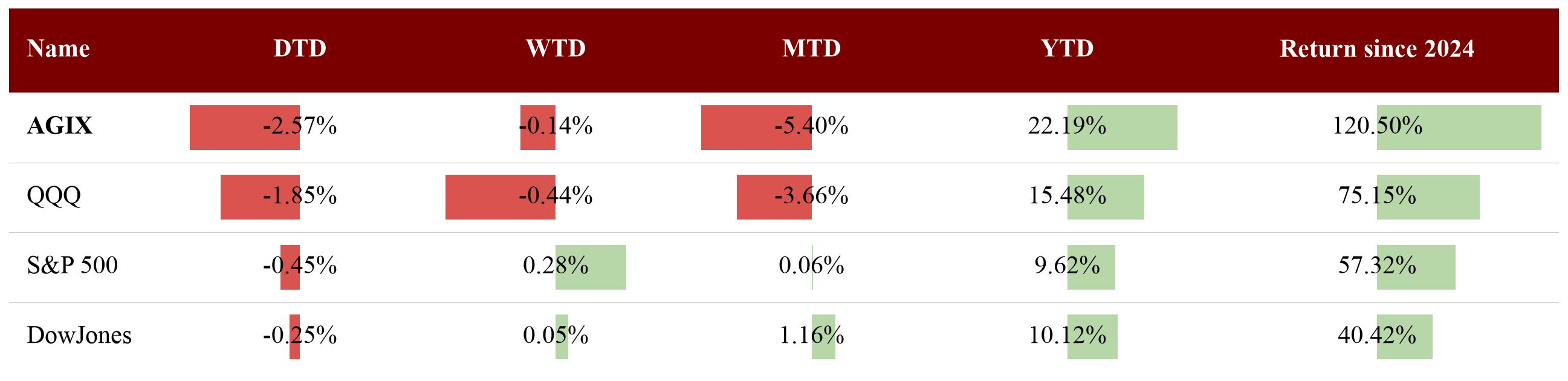
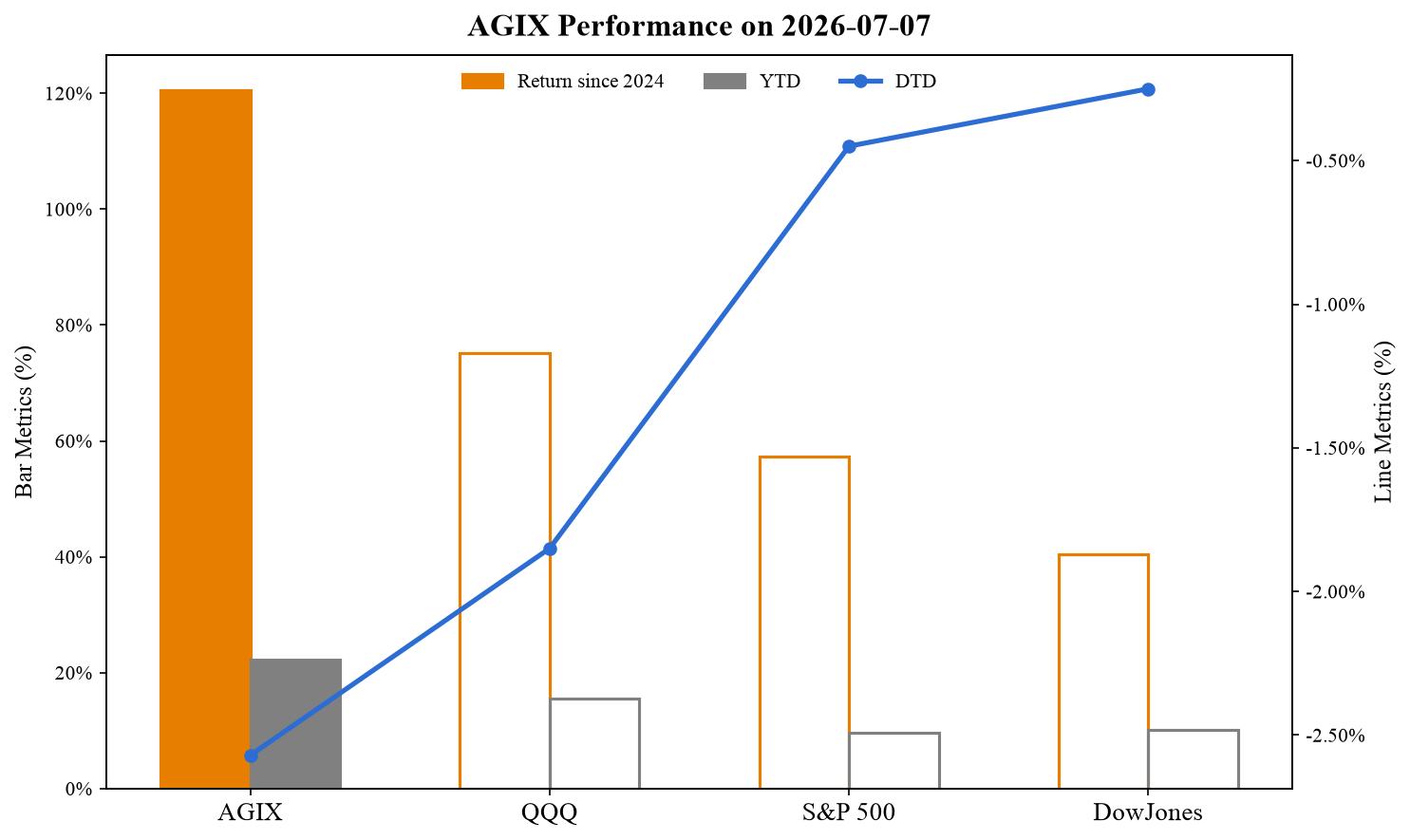
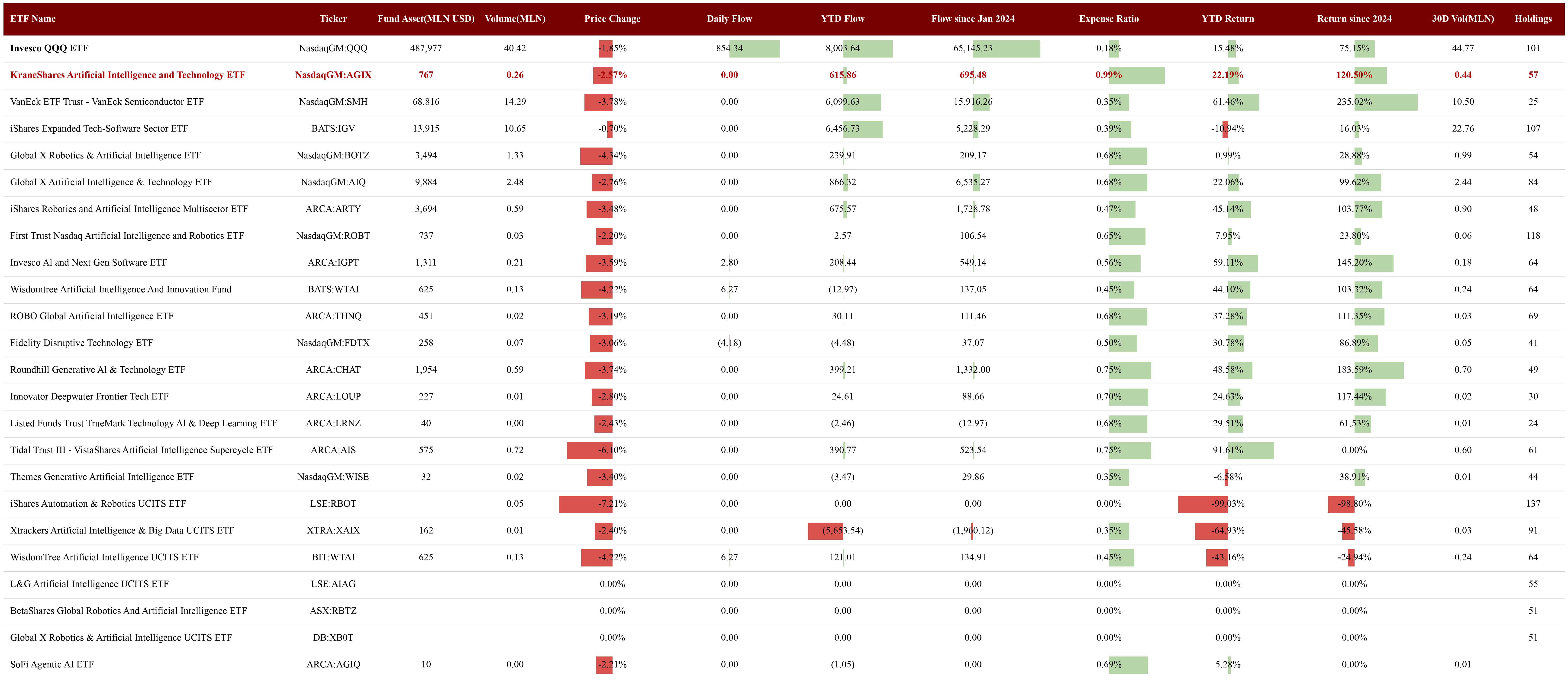
• AGIX fell 2.57% DTD, underperforming the S&P 500 (-0.45%) and the Dow Jones (-0.25%), but lagging QQQ (-1.85%). The weakness was broad-based, with the AI-focused peer ETFs SMH (-3.78%), BOTZ (-4.34%), and IGPT (-3.59%) all declining more than AGIX, reflecting a broad sell-off in AI and semiconductor names.
• Within AGIX holdings, hardware names were the biggest drag: Astera Labs (-11.52%), Teradyne (-9.59%), AMD (-6.51%), and Arm Holdings (-6.77%) all fell sharply. Micron (-4.71%) also declined, despite strong earnings momentum, as memory sector news (SK Hynix IPO, Samsung profit beat) failed to lift the stock today.
• Infrastructure holdings showed mixed performance: Cloudflare surged 8.6% after a bullish analyst upgrade (Scotiabank Sector Outperform, $300 PT), while CoreWeave (-3.39%), TeraWulf (-8.87%), and Hut 8 (-6.78%) declined on no specific negative news, likely part of the broader AI infrastructure pullback.
• Key stocks to watch: Cloudflare (NET) — strong analyst upgrade and breakout; Micron (MU) — memory demand tailwinds from AI data centers; AMD — continued weakness amid competitive pressure; and SK Hynix (indirect via ADR IPO) — major memory IPO could set sector tone.
News Highlights
1. First AI-run ransomware attack: Sysdig discovered 'JadePuffer,' where an AI agent autonomously exploited a Langflow vulnerability, encrypted databases, and generated ransom notes. This lowers the barrier for ransomware attacks, increasing cybersecurity spending demand — positive for Palo Alto Networks (held by AGIX) and Zscaler.
2. SK Hynix U.S. IPO: The memory maker plans to raise $12.8B, riding AI-driven HBM demand. This validates the memory cycle and benefits Micron and Samsung (both AGIX holdings), though oversupply risk remains. Micron's stock has surged 700% over the past year.
3. Anthropic signs $19B data center lease with TeraWulf: The 20-year deal underscores explosive AI infrastructure demand. TeraWulf (AGIX holding) will build a 401MW facility, with initial capacity in 2027. This supports the long-term thesis for AI data center builders.
4. AMD Advancing AI event preview: AMD is partnering with Nutanix and Rackspace to offer open AI infrastructure. Analysts note 64% of organizations see data bottlenecks as key obstacles. AMD's strategy may help it gain share in enterprise AI, but near-term stock weakness persists.
5. Microsoft reduces reliance on OpenAI/Anthropic: Microsoft is shifting to its own MAI models for cost control, routing prompts in Excel/Outlook to its in-house models. This trend could pressure OpenAI/Anthropic revenue but benefits Microsoft's margins. For AGIX, it signals enterprise AI cost optimization is accelerating.
RSS Highlights
1. Let AI Burn: Analysis shows AI industry revenue is fragile, with most coming from OpenAI/Anthropic compute spending while both face massive losses. Big tech plans $765B+ capex in 2026, but generative AI has yet to prove substantial revenue generation.
2. Pluralistic: U.S. states and international trustbusters are joining forces to counter Big Tech, targeting multinational monopolies. This regulatory trend could impact AGIX holdings like Alphabet, Amazon, and Meta.
3. sqlite-utils 4.0 released: First major update since 2020, adding database schema migrations, nested transaction support, and composite foreign keys — a practical tool for AI/ML data pipelines.
4. Tencent's Hy3 model launched: A 29.5B-parameter MoE model with 2.1B active parameters, supporting 256K context. Free on OpenRouter until July 21, reflecting the rapid pace of open-source AI model releases.
5. Full-body MRI risk equivalent to a year of smoking: Study quantifies risks of unnecessary medical scans, highlighting the trade-off between early detection and overdiagnosis — relevant for AI health-tech applications.
Performance & Benchmark
Attribution
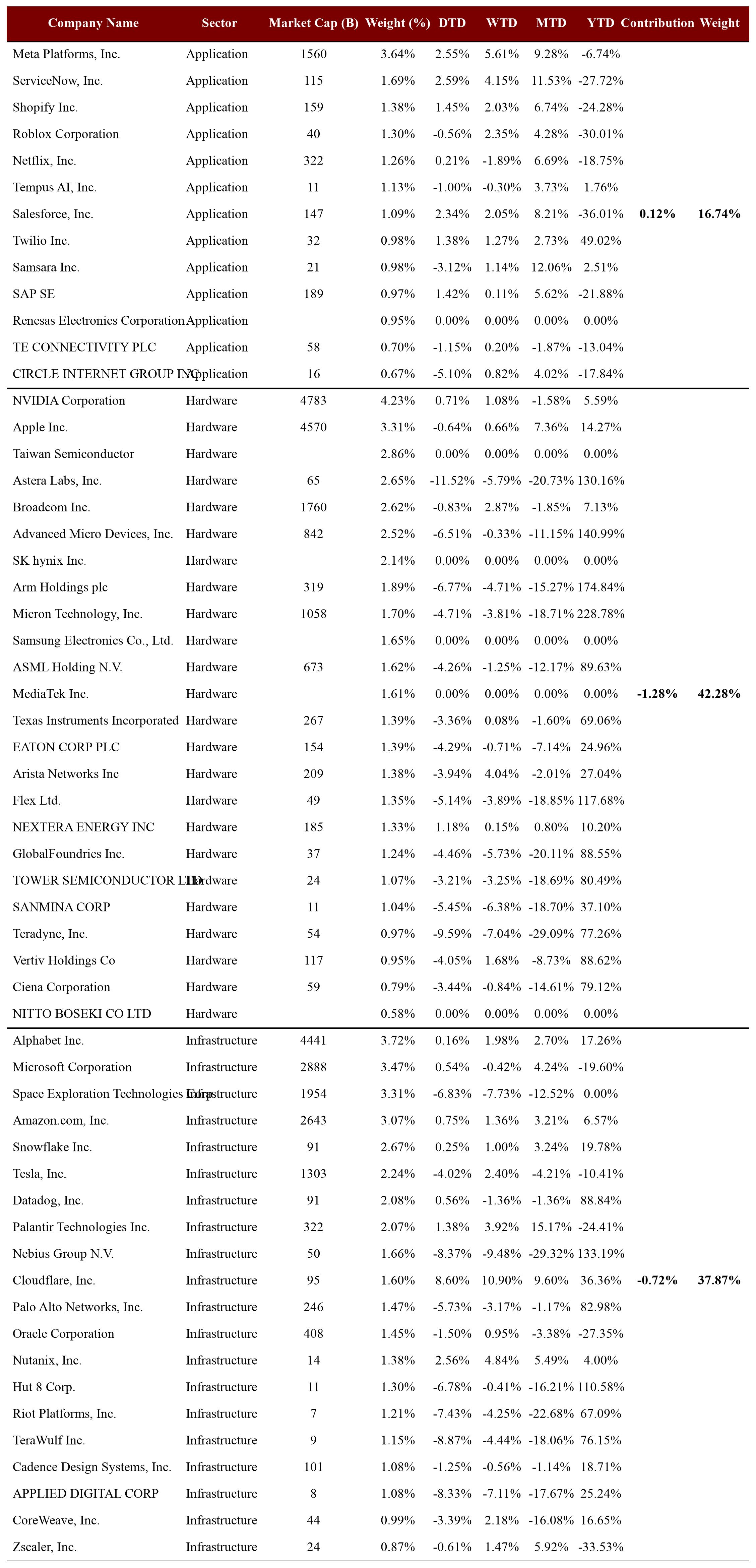
Contribution of the three sectors within AGIX holdings today
Application: 0.12%
Hardware: -1.28%
Infrastructure: -0.72%
Top-performing stocks in AGIX holdings today
Cloudflare, Inc. (8.6%)
ServiceNow, Inc. (2.59%)
Nutanix, Inc. (2.56%)
Meta Platforms, Inc. (2.55%)
Salesforce, Inc. (2.34%)
Worst-performing stocks in AGIX holdings today
Samsara Inc. (-3.12%)
TOWER SEMICONDUCTOR LTD (-3.21%)
Texas Instruments Incorporated (-3.36%)
CoreWeave, Inc. (-3.39%)
Ciena Corporation (-3.44%)
Arista Networks Inc (-3.94%)
Tesla, Inc. (-4.02%)
Vertiv Holdings Co (-4.05%)
ASML Holding N.V. (-4.26%)
EATON CORP PLC (-4.29%)
GlobalFoundries Inc. (-4.46%)
Micron Technology, Inc. (-4.71%)
CIRCLE INTERNET GROUP INC (-5.1%)
Flex Ltd. (-5.14%)
SANMINA CORP (-5.45%)
Palo Alto Networks, Inc. (-5.73%)
Advanced Micro Devices, Inc. (-6.51%)
Arm Holdings plc (-6.77%)
Hut 8 Corp. (-6.78%)
Space Exploration Technologies Corp. (-6.83%)
Riot Platforms, Inc. (-7.43%)
APPLIED DIGITAL CORP (-8.33%)
Nebius Group N.V. (-8.37%)
TeraWulf Inc. (-8.87%)
Teradyne, Inc. (-9.59%)
Astera Labs, Inc. (-11.52%)
Top five listed stocks contributing the most within AGIX holdings today
Astera Labs, Inc. (-11.52%)
Space Exploration Technologies Corp. (-6.83%)
Advanced Micro Devices, Inc. (-6.51%)
Nebius Group N.V. (-8.37%)
Arm Holdings plc (-6.77%)
Observation
The strongest movers across peer ETF holdings today are listed below:
| DTD | Stock Ticker | Name | Held by ETFs | analysis |
|---|---|---|---|---|
| 8.6 | NYSE:NET | Cloudflare, Inc. | ['NasdaqGM:AGIX', 'LSE:AIAG', 'ARCA:LRNZ', 'ARCA:THNQ', 'BATS:WTAI', 'BIT:WTAI', 'NasdaqGM:FDTX', 'NasdaqGM:ROBT'] | Cloudflare’s 8.6% gain on July 7, 2026 was primarily driven by a bullish analyst action, with Scotiabank upgrading the stock to Sector Outperform and raising its price target to $300, which catalyzed buying and a breakout toward 52-week highs.[3][6] A secondary driver was continued positive sell-side and investor sentiment following recent Investor Day guidance for >$5B revenue before 2028 and a “Rule-of-50” AI-infrastructure growth profile, reinforcing the stock’s positioning as a core AI and internet infrastructure beneficiary.[1][2][3] Traders also responded to strong technical momentum, with NET trading well above key moving averages and reclaiming the upper end of its recent range, attracting incremental momentum and breakout capital.[3][5] |
| 7.69 | TUYA | Tuya (N Shares) | ['XTRA:XAIX'] | Tuya’s 7.69% jump on 2026-07-07 is most consistent with a valuation-driven rebound in a very volatile, low-priced ADR rather than a clear company-specific same-day catalyst; the stock had been trading near $1.8 and remained well below analyst targets, which can amplify upside moves on modest buying. The best fundamental support in the available public information is that analysts still had a bullish/strong-buy stance and price targets materially above the market price, while recent commentary pointed to improving revenue trends and AIoT strength. Broader risk-on sentiment in tech may also have helped, but no major Tuya-specific news event is evident in the provided results. |
| 6.67 | NasdaqGM:RPD | Rapid7, Inc. | ['LSE:AIAG', 'ARCA:THNQ', 'XTRA:XAIX'] | Rapid7’s 6.7% gain appears primarily driven by continued positive momentum and investor reassessment following its stronger-than-expected Q1 2026 earnings, where EPS and revenue both beat consensus and management reiterated a constructive outlook on ARR growth and profitability.[2][6] A secondary driver is improving sentiment toward AI-enabled cybersecurity vendors, with Rapid7 highlighted in recent commentary as a beneficiary of rising enterprise investment in AI-powered threat detection, supporting multiple sharp single-day moves in the name.[1][5] |
| 6.45 | 002747.SZ | ESTUN AUTOMATION CO LTD-A | ['NasdaqGM:BOTZ'] | Estun Automation’s 6.45% gain on July 7, 2026 appears primarily driven by continued momentum and abnormal trading fluctuations over several sessions rather than a specific new fundamental catalyst that day. The company disclosed that its share price deviation over July 3, 6, and 7 exceeded 20% and explicitly stated there were no undisclosed material events beyond a previously announced planned acquisition of equity in an associate, indicating a technically driven move amplified by investor speculation and strong “Strong Buy” technical signals.[1][4] |
| 5.86 | NYSE:HUBS | HubSpot, Inc. | ['LSE:AIAG', 'ARCA:IGPT', 'ARCA:THNQ', 'BATS:IGV'] | HubSpot’s 5.86% gain on 2026-07-07 appears to have been driven mainly by broad positive momentum in the stock rather than a clear company-specific announcement; MarketBeat noted the shares were up about 4.9% that day, with trading near the $203 area and a continued gap to Wall Street’s average target around $311.[2] The move is also consistent with renewed investor focus on the company’s strong Q1 fundamentals—EPS and revenue beat estimates, and the stock had already been reacting to analyst optimism and upgraded views despite earlier concerns about pricing and sales-cycle length.[1][3] |
| 5.27 | NYSE:FIG | Figma, Inc. | ['ARCA:IGPT'] | Figma’s 5.3% gain on July 7 was driven primarily by a fresh Buy rating and resumed coverage from Bank of America, which emphasized AI as a key long-term growth catalyst and attracted momentum and fundamental buyers back into the name.[8] A secondary support came from ongoing bullish sell-side and media commentary framing the post-IPO weakness as an opportunity, reinforcing the positive sentiment following Figma’s strong Q1 print and raised 2026 guidance.[2][5] |
| 5.23 | 2513.HK | Knowledge Atlas Technology JSC Ltd | ['ARCA:CHAT'] | Knowledge Atlas Technology JSC Ltd’s 5.23% gain on 7 July 2026 appears primarily driven by positioning around the expiry of its IPO lock-up, with 25.7m H-shares coming off lock-up on that date, prompting investors to reassess supply/demand and near-term overhang risk.[3] The move also fits within a broader rebound in the stock over the past month after sharp prior weakness, suggesting short covering and momentum/trading flows amplified the reaction rather than any specific new fundamental disclosure.[2][5] |
| 5.21 | NasdaqGS:GILD | Gilead Sciences, Inc. | ['NasdaqGM:QQQ'] | Gilead’s 5.2% move was primarily driven by company-specific positive catalysts, notably successful Phase 3 results for its once-weekly long-acting HIV regimen and a European first-line monotherapy approval for Trodelvy, which strengthened confidence in both its infectious disease and oncology pipelines.[1] A secondary driver was HSBC’s upgrade to Buy with a higher price target, which highlighted an undervalued pipeline and improving sentiment around the HIV franchise.[1][2] The stock also benefitted from supportive sector sentiment, as Gilead materially outperformed a rising pharmaceuticals and medical research group on the day.[1][6][9] |
News
Funding & M&A
Norm Ai nabs $120M at $1.2B valuation to bring AI agents to the law.
Legal tech company Norm Ai announced a $120 million Series C funding round, reaching a valuation of $1.2 billion. The round was led by Khosla Ventures, with participation from Blackstone, Bain Capital Ventures, Coatue, and other institutions and investors. The company focuses on applying agentic AI to legal services, providing intelligent legal agents for institutions managing over $30 trillion in assets. Its products operate autonomously while maintaining compliance through multi-layered human oversight. The funds will be used to expand business areas, accelerate hiring, and advance the agent framework for regulated enterprises. This model transforms the traditional hourly billing structure in legal services, driving the industry toward outcome-based approaches.
US investors will soon get access to SK Hynix, another memory maker riding the AI boom
SK Hynix plans to sell nearly 17.8 million ADRs through a U.S. IPO, expected to raise approximately $12.8 billion. The company, a competitor to Samsung and Micron, is benefiting from rapid AI growth. First-quarter revenue increased nearly 200% year-over-year, and its stock price has risen 260% this year. Due to massive demand from AI data centers for HBM, DRAM, and NAND, memory chips are in short supply. Micron's stock has surged nearly 700% over the past year, with a market cap exceeding $1 trillion. South Korean tech companies have pledged to invest over $550 billion to expand production capacity. Despite the risk of oversupply, capital markets are currently seeking investment opportunities similar to NVIDIA.
Microsoft is reportedly ditching OpenAI’s and Anthropic’s AI models in favor of its own to cut costs
Bloomberg survey shows that Microsoft is gradually reducing its reliance on the most advanced AI models from OpenAI and Anthropic, shifting to its own MAI model series to control costs. It has already transferred tens of thousands of prompts in platforms such as Excel and Outlook to models like MAI-Thinking 1 for processing. This model has 35 billion parameters and a context window of 256K, and its programming capabilities can match Claude Opus 4.6. This move is primarily triggered by the huge expenditure on third-party models, and Microsoft aims to achieve zero cost by the time its agreement with OpenAI expires in 2032. Meanwhile, multiple US companies such as Amazon, Accenture, Meta, and Uber are also exploring cheaper AI solutions, even considering China's DeepSeek model. Microsoft's recently released MAI series includes various scenarios such as image generation and speech recognition, which will promote the adoption of low-cost, high-efficiency AI in enterprise applications.
Syntiant, which makes low-power chips for on-device AI, files for initial public offering
Syntiant Corp., a British chipmaker focused on on-device local AI processors, has filed an IPO application with the U.S. Securities and Exchange Commission, planning to list on the Nasdaq Global Market under the ticker SYTN. Founded in 2017, the company produces ultra-low-power AI chips that run on wearable devices, headphones, cars, robots, and other devices, along with corresponding software support. Its valuation after the latest funding round was $646.4 million, with cumulative funding of $311 million from major investors including Intel, Microsoft, and North. Syntiant previously acquired North's micro-electromechanical systems business and factories in China and Malaysia, and plans to use part of the proceeds for debt repayment and new acquisitions. The company reported a net loss of $26.2 million for the quarter on revenue of $64.5 million. The founder will continue to control a majority of voting rights through super-voting shares.
Samsung says memory chip demand will drive a 19-fold jump in operating profit
Samsung Electronics announced today that, driven by AI demand, memory chip sales and prices hit new highs, with second-quarter operating profit expected to reach 89.4 trillion won (approximately 58.47 billion US dollars), a year-on-year increase of more than 19 times, setting a new record. Revenue more than doubled year-on-year to over 171 trillion won. Analysts have raised their full-year profit forecast to nearly 401 trillion won. Samsung has pledged to invest tens of trillions of won to expand chip production capacity, in line with the South Korean government's 588 billion US dollar plan. SK Hynix and Micron Technology have both signed multi-year supply agreements to lock in customers. Memory prices will continue to rise by 24% to 25% in the third quarter. The mobile business, under cost pressure, may raise phone prices again. The stock price has risen more than 150% this year.
Memory chipmaker SK hynix seeks to raise $28 billion through a US IPO
SK Hynix plans to launch its IPO in the US this week, offering 17.8 million depositary receipts, with an expected fundraising scale of about 28 billion US dollars, making it the second-largest IPO in history. As one of the world's top three memory chip manufacturers, the company benefits from the AI-driven surge in demand for HBM and DRAM, with first-quarter revenue tripling year-on-year and its stock price rising more than 260% this year. Due to the expansion of AI data centers, memory shortages are intensifying, pushing up prices of consumer electronics. SK Hynix and Samsung will invest over 550 million US dollars to expand production, but analysts worry about the risk of overcapacity. Previously, US investors could only indirectly hold shares through the Roundhill Memory ETF; this listing will provide a direct investment channel. Micron's stock has surged 700% due to similar demand, with a market value exceeding one trillion US dollars. If the fundraising is successful, SK Hynix will become an important benchmark in the AI memory field, and market expectations for its demand remain optimistic.
The first American autonomous ground vehicles are fighting in Ukraine
US autonomous vehicle company Forterra recently revealed that over 100 Lancer autonomous ground vehicles, modified from Polaris all-terrain vehicles, have been deployed in conflict zones in Ukraine for nine months, completing more than 1,100 missions, transporting over 770,000 pounds of cargo, and conducting 52 casualty evacuations. The project, funded by the US Department of Defense, is an important practice of the US military applying automation technology in actual combat. Forterra leverages Polaris's commercial supply chain to reduce costs and has integrated over 5 million US dollars in venture capital. Currently, the vehicles mainly operate through remote control, and autonomous performance still needs further improvement. Its competitors, Scout AI, Field AI, and Overland AI, are also advancing military autonomous vehicle projects. The Ukrainian defense department hopes Forterra can further reduce equipment prices for larger-scale deployment.
Savi's app aims to protect consumers from realistic AI scams like kidnappers demanding ransom.
Brothers Patrick and Ryan Coughlin founded the security startup Savi Security, which announced $7 million in seed funding and launched iOS and Android apps on Tuesday, focusing on preventing AI-generated high-precision scams. The funding was led by Acrew Capital, with participation from Magnify Ventures, TTCER, and Resolute Ventures. The company was inspired by the terrifying experience of their mother, who fell victim to an AI-generated fake kidnapping scam. Savi offers real-time call monitoring, SMS and email scanning, priced at $8 per month for a family annual plan. Previously, its free website Scam Wise had received 50,000 suspicious content submissions. Amid the surge in AI scam cases, the company aims to help consumers tackle new threats with affordable real-time protection tools.
Tangos grabs $20M in funding to take on the bad guys by automating financial crime investigations
AI startup Tangos AI Inc. recently announced the completion of a $20 million seed funding round, led by Red Dot Capital Partners, with participation from Leaders Fund, Clarim, Venture Israel, Signal Fire, Clutch Capital, Selah Ventures, and Bright Data Inc. Founded last year by serial entrepreneur Eyal Azoulay, the leadership team has a combined 75 years of experience in financial crime, sanctions evasion, and intelligence investigation. Tangos has launched the world's most advanced AI investigation platform, which uses multiple domain-specific AI models and structured workflows to automatically investigate suspicious transactions, sanctions risks, anti-money laundering, and fraud, generating regulatory-grade reports with full audit trails. The platform helps financial institutions, government agencies, and intelligence organizations address the challenges of investigator shortages and high alert volumes, improving efficiency through network analysis. Investors believe this will reshape the financial crime investigation model.
AI law startup Norm raises $120M, hits unicorn valuation.
AI legal startup Norm announced on Tuesday the completion of a $120 million Series C funding round, led by Khosla Ventures, at a valuation of $1.2 billion. Founded nearly three years ago, Norm launched its own AI legal services brand, Norm Law, using proprietary AI agents as the core, with human lawyer oversight, offering outcome-based, non-hourly billing for enterprise clients. The company is also developing a higher-level AI system to supervise other AI agents. This round brought in investors including Bain, Craft Ventures, Coatue, Vanguard, New York Life, TIAA, as well as former Blackstone executive Tony James, former Kirkland & Ellis chairman Jeff Hammes, and Fenwick LLP. Norm has now raised over $260 million in total funding, with new capital to be used for product iteration and lawyer recruitment. The legal AI sector is highly competitive, with peers like Harvey and Legora also accelerating their efforts.
Technical Breakthroughs
Three insights you may have missed from theCUBE’s coverage of the ‘Scaling the Agentic Era’ event
As AI agents move from proof of concept to production systems, the cost per generated token has become a core concern for enterprises. CoreWeave executive Chen Goldberg stated that the Nvidia Vera Rubin platform improves inference efficiency by 10 times and reduces the cost per million tokens to 10%, which is not just a hardware specification improvement but a technological leap. This platform tightly integrates CPU, GPU, storage, and networking, providing the latency, reliability, and real-time feedback capabilities required for agent workflows. CoreWeave's Mission Control system unifies the management of compute, networking, and storage, supporting agent evaluation and continuous experimentation. Dell and Nvidia have jointly validated rack-scale systems, driving the centralization of liquid cooling, power, and security controls. This technology path is reshaping the evaluation criteria for AI infrastructure, providing sustainable, low-cost industrial support for large-scale agent deployment.
Why the rise of open source AI isn’t hurting Anthropic … yet
Decathlon CEO Jesse Zhang offers a new perspective, arguing that cutting-edge AI models and open-source models are not in competition but rather two stages of the same lifecycle. As use cases mature, companies will shift from expensive cutting-edge models to cheaper open-source ones, but the continuous emergence of new use cases keeps total spending on cutting-edge models stable. Data from Vercel and OpenRouter shows that open-source models like DeepSeek account for over 30% of token volume today, while Anthropic still accounts for more than half of spending. Nvidia's new model Nemotron is also about to join the competition. This dual-layer structure may become a stable feature of the AI economy, with frontier labs leading new discoveries and open-source models taking over production environments.
Storage gets promoted in the agentic AI era
The huge demand for context memory in AI agent systems in 2026 is driving major upgrades in storage technology. Nvidia has introduced the CMX context storage layer and DPU technology in its BlueField-4 STX architecture, extending GPU memory across entire racks and transforming storage from a supporting component into a core part of the AI inference engine. Companies like Solidigm and Neo4j are advancing KV cache and context graph technologies to solve the storage challenges of million-token-level agent session data. As inference computing's share of AI computing rises to one-half, the heterogeneity and intelligence of storage architecture are becoming key differentiators for enterprise-level AI production. Developers need a deeper understanding of underlying hardware to support more efficient agent systems.
Assail launches Sidewinder, an offensive security AI that fixes its own mistakes
Autonomous security company Assail Inc. has launched the Sidewinder platform, which is based on a new 31-billion-parameter reconstruction of its Ares offensive security platform. Sidewinder uses multiple autonomous agents and a persistent knowledge graph to automatically plan tests, verify results, and fix errors without human intervention. The platform supports real browser operations, multi-account authentication, and MITRE ATT&CK mapping, and can escalate low-threat footholds to account control or data exfiltration. Customers can deploy it on AWS, Azure, Google Cloud, or on-premises. This release transforms annual static testing into continuous autonomous security validation, helping reduce false positives and improve defense efficiency. Assail will showcase the technology at the ISC2 conference in October.
The 'first' AI-run ransomware attack still needed a human
Cloud security company Sysdig recently discovered the first 'agentic ransomware' attack, named JadePuffer. The AI agent independently completed the entire attack process: exploiting a known vulnerability in the open-source tool Langflow to breach a server, extracting credentials to access a production MySQL database, leveraging another vulnerability to gain administrator privileges, encrypting over 1,300 configuration records, and automatically generating ransom notes and Bitcoin addresses. The attack agent fixed a login failure within 31 seconds and recorded its reasoning process in natural language comments. Although humans were still responsible for setting up the infrastructure, selecting targets, and providing initial credentials, the technical execution was fully automated. Sysdig could not confirm the specific model, but warned that this technology will significantly lower the cost of ransomware, potentially leading to large-scale concurrent attacks in the future. This case shows that AI has already moved beyond simple human operations, posing new cybersecurity challenges.
IBM debuts compact z17 mainframes and LinuxONE servers for on-premises enterprise AI
IBM recently launched the next-generation z17 mainframe and LinuxONE 5 servers, including single-rack, rack-mounted, and smaller LinuxONE Rockhopper 5 and Express versions. The new products use Telum II processors, with memory up to 18TB, single-thread performance improved by 10%, and total capacity increased by 20%. The LinuxONE Rockhopper 5 can replace 23 equivalent x86 servers, reducing energy consumption by up to 83%, suitable for transaction processing and AI workloads. The new system supports IBM Spyre accelerators, enabling generative AI, real-time inference, and fraud detection within a local security boundary. To meet data residency, energy consumption, and regulatory requirements, IBM also provides quantum-safe encryption, an infrastructure-as-code management platform, and OpenTelemetry support. This release brings the high-performance AI capabilities of the mainframe architecture to smaller enterprises.
AI agent exploits Langflow in first fully autonomous ransomware attack
Cloud security company Sysdig recently released a research report stating that it has discovered the first ransomware attack carried out by an independent AI agent. The attack, named JadePuffer, used a large language model to exploit the CVE-2025-3248 vulnerability in the Langflow framework. The agent first extracted database credentials, obtained API keys for AI services such as OpenAI and Anthropic as well as cloud platforms like AWS and Azure, then used Nacos default configurations to bypass authentication certificates and escalate privileges. Finally, it encrypted the target MySQL database, deleted table structures, and left a ransom note. Researchers confirmed its autonomous nature through features such as the agent's built-in English reasoning notes and its ability to automatically fix errors within 31 seconds. This incident shows that AI agents can now automatically link information gathering, lateral movement, and ransomware processes, expanding attack scale at low cost. Experts advise companies to apply patches promptly and privatize AI tool endpoints.
Product Launches
Google’s Pixel event is set for August 12
Google is scheduled to hold its 'Made by Google' event in New York City on August 12, where it will launch the Pixel 11 series smartphones. According to multiple media reports, the new devices feature significant design improvements, including a new gold color option, slimmer bezels, and a black camera bar design. The Pixel 11 Pro may be thinner, and the Pixel 11 Pro Fold will feature a redesigned camera module and reduced weight. Some reports suggest Google may drop the 128GB storage option and launch with 264GB of storage, leading to a price increase. Compared to last year's Pixel 10 launch, this event will have less celebrity involvement. Google is advancing the application of AI technology in mobile devices through product iteration.
Claude Cowork expands to mobile and web
Human AI company Anthropic has expanded its Claude Cowork agent tool from desktop to mobile and web platforms, available exclusively to Max subscribers. The tool syncs task status across devices, supports background operation, and requests human input when needed, aiming to deeply integrate AI into daily office workflows. Data shows that 33.4% of sessions are used for business process operations, including report compilation, new employee training, and financial reconciliation; 16.4% for content creation and copywriting; and software development accounts for only 0.87%. This move marks a shift in AI competition from coding tools to full-featured administrative assistants. Similar to OpenAI's Codex, Anthropic has also launched a Claude Tag integrated into Slack. Multi-platform support allows the agent to work continuously without being tied to a single device, becoming a key step for tech companies to deeply integrate AI products into work scenarios.
Meta rolls out Muse, a new AI image generator.
Meta has launched a new AI image generator called Muse Image, developed by its internal AI unit Meta Superintelligence Labs. Muse Image will be free for users of the Meta AI App, Instagram Stories, and WhatsApp, allowing users to create cartoon, comic-style images and interior decoration effects using custom prompts. Additionally, the model offers prompt editing features for removing unwanted people from photos or generating custom QR codes. Meta has also introduced several new AI effect filters powered by Muse in Instagram Stories. The company stated that it is free within normal creation limits, with a subscription plan required beyond that. A video version, Muse Video, is already in development. This launch marks a new step in Meta's deep integration of AI with its advertising and social platforms.
Policy & Regulation
The 'GitLost' vulnerability let GitHub's AI workflows leak private repositories.
The research team at AI security company Noma Security exposed a serious prompt injection vulnerability in GitHub's newly launched Agentic Workflows feature. Dubbed GitLost, the vulnerability allows attackers to steal data from private code repositories without authentication by simply posting a specially crafted issue in a public repository. The exploit uses indirect prompt injection techniques, leveraging AI agents to read untrusted user input and execute malicious instructions, bypassing GitHub's protection mechanisms. Researchers found that adding keywords like "additionally" to instructions could disable safeguards. Such vulnerabilities expose the risk of turning user-controlled content into AI instruction execution, making agent systems an attack surface. Noma recommends that developers must minimize agent permissions, isolate user input from instruction context, and enforce manual review of sensitive operations. Experts note that before widespread deployment of agentic AI, reassessment of its permissions and real-time monitoring requirements for internal systems is necessary.
Discord admits an AI moderation bug wrongfully banned users over harmless images.
Discord recently admitted that its AI content moderation system has flaws, mistakenly banning over 8,000 users in the past two months. Harmless images such as spreadsheets, chessboards, game textures, and transparent backgrounds were wrongly flagged as harmful content. The issue has affected users since May, with an additional 200 bans over the past weekend until the team identified and fixed the bug. All affected accounts are now being gradually restored. Discord stated that the system detects content by matching against a database of known harmful materials, and while there is a human review step, the bug caused automatic bans to take effect directly. Users on X and Reddit complained that grid patterns are easily misjudged as attempts to hide inappropriate content. This incident highlights the limitations of AI-assisted moderation on large platforms and has sparked widespread discussion about transparency and redress mechanisms for automated penalties. Meta and Tumblr have also faced similar large-scale false ban complaints, underscoring a common industry challenge.
Industry Partnerships
What to expect at the AMD Advancing AI event: Join theCUBE July 22-23.
As AI applications enter production environments, enterprise AI infrastructure is becoming a key success factor. AMD, in multiple announcements ahead of the Advancing AI 2026 event, emphasized promoting open, scalable AI infrastructure as a core strategy. The company has formed a multi-year partnership with Nutanix to integrate ROCm software, EPYC processors, and Instinct GPUs into the Nutanix platform, creating a full-stack open platform for agentic AI. Additionally, AMD signed a strategic partnership with Rackspace Technology to provide a governable AI stack for regulated industries, from infrastructure monitoring to business outcomes. Analysts point out that 64% of organizations see data and infrastructure bottlenecks as the biggest obstacles to AI deployment, and AMD's diverse computing options are adapting to this trend. Its enterprise technology sales executives stated that the company will act as a trusted supplier, helping customers achieve a balanced hybrid AI architecture with CPU and GPU workloads in existing environments.
Anthropic brings Cowork out of the desktop and onto web and mobile.
Anthropic PBC has expanded its Claude Cowork intelligent AI assistant to mobile and web platforms, allowing users to perform tasks without relying on a desktop. The tool, based on the company's most powerful AI model, can work across files, calendars, emails, and various communication tools. Originally aimed at software developers, it is now adapted for general users. In the beta version for Max users, tasks can be controlled from mobile or web, and scheduled tasks can run automatically without the computer being online. Market research shows that 33.4% of its use is for business processes and operations, 16.4% for content creation, and the rest for software development, research, and other areas. Anthropic also released a report on user usage, indicating that AI agents are becoming increasingly common in knowledge work.
融资收购
Microsoft joins the AI cost-cutting trend by relying more on its own models.
As AI operational costs continue to rise, many tech companies have begun adopting cost-saving strategies. Microsoft has started reducing its reliance on OpenAI and Anthropic models, with some users in Excel and Word now seeing prompts powered by its own MAI models. At the Build conference, the company released seven new MAI models, including code agents and text-to-image generation, to lower external purchasing costs. This move reflects a broader industry trend of cutting AI spending, with companies like Amazon, Uber, Meta, and Accenture all reducing their AI expenditures. Some businesses are even turning to cheaper Chinese models to cope with the pressure of high costs. This shift not only affects external AI suppliers but also reshapes the capital support structure for large model deployment.
Anthropic inks a $19 billion AI data center lease with TeraWulf
AI company Anthropic has leased TeraWulf's data center in Hawesville, Kentucky, for 20 years at a cost of 20 billion US dollars. The project is built on the site of a former aluminum smelter, with initial computing capacity expected in the second half of 2027 and full operation by 2028, reaching 401 megawatts. TeraWulf estimates an investment of 3 to 4 billion US dollars but could achieve a rental return of 19 billion US dollars. Additionally, TeraWulf will sell a 50.1% stake in its Abernathy project in Texas to Fluidstack for 45 billion US dollars. This deal reflects the explosive demand for AI infrastructure and active capital markets. Both companies are also promoting the application of green cooling technology.
AI post-training startup Bespoke Labs raises $40M in funding
AI startup Bespoke Labs Inc. recently announced the completion of a $40 million capital raise, with $31.375 million in Series A funding led by Wing VC, and participation from employees of Mayfield, The House Fund, and Anthropic. The company also previously secured $8.25 million in funding from a consortium including Google DeepMind Chief Scientist Jeff Dean. Bespoke Labs primarily offers a reinforcement learning environment building platform that can quickly and automatically generate virtual sandboxes to support the post-training phase of AI models. Its open-source project GEPA has automated prompt engineering, while the OpenThoughts dataset provides high-quality samples for supervised fine-tuning. The new funds will be used for platform upgrades and AI data research.
Report: China’s DeepSeek follows OpenAI in developing its own custom inference chips
DeepSeek is advancing the design of its own AI inference chips to reduce reliance on Nvidia and Huawei. According to Swiss media reports, the project has been underway for about a year and is still in its early stages. The company has held cooperation discussions with multiple chip design, foundry, and storage companies, and is recruiting experienced chip design engineers. This move primarily targets inference workloads, aiming to control costs and enhance commercialization capabilities. DeepSeek recently secured $740 million in funding to support this project. Meanwhile, Chinese tech giants such as Alibaba and Baidu are also developing their own AI chips, reflecting a significant trend of industry competition and self-control.
Amazon launches $25B bond sale to fund AI infrastructure
Amazon is raising at least $25 billion through the bond market to support its AI infrastructure construction. The bonds are divided into eight tranches, including fixed and floating rates, with maturities ranging from three to forty years. Lead underwriters include Barclays, Goldman Sachs, JPMorgan Chase, and Morgan Stanley. Orders reached $62 billion, and the final amount was set at $41 billion. Amazon has issued over $64 billion in bonds in the first half of this year, primarily for data centers, chips, and AWS facilities. Its capital expenditure this year is expected to reach $200 billion, far exceeding last year's $131 billion. CEO Andy Jassy stated that AI capacity demand exceeds supply, and its self-developed chips Trainium and Graviton will generate over $10 billion in revenue this year. Meanwhile, Google, Microsoft, and Meta are also financing AI expansion through debt, with the three companies investing over $700 billion in AI this year.
RSS Subscription
Let AI Burn
If you are interested in this article, you can subscribe to my premium newsletter for $70 per year or $7 per month. It includes detailed analysis of NVIDIA, Anthropic, and OpenAI's finances. Currently, most of the AI industry's revenue comes from computing expenditures by OpenAI and Anthropic, both of which are facing massive losses, highlighting the fragility of the AI industry. Although big tech companies plan to invest over $765 billion and $1 trillion in capital expenditures in 2026 and 2027 respectively, generative AI has yet to demonstrate the potential to generate substantial revenue.
How did Windows 95 decide that a setup program ran?
Windows 95 identifies installation programs by detecting whether the program name contains keywords such as "setup" or "install", thereby preventing older versions of files from being overwritten. If there is no match, the system also checks whether the executable file path contains "Setup". Additionally, Windows 95 performs real-time file checks after multimedia drivers are installed via INF files to prevent system DLLs from being overwritten.
Pluralistic: How US states and international trustbusters can beat Big Tech (07 Jul 2026)
U.S. states and international antitrust agencies are joining forces to counter big tech companies, facing a common enemy in Trump and his tech giants. Over the past decade, antitrust actions have intensified globally, especially under the Biden administration, where U.S. antitrust enforcers have engaged in productive cooperation with their international counterparts to target these multinational monopolies.
Interim injunction proceedings of Solvinity shareholders
Solvinity's shareholders filed a summary proceeding in court yesterday against the Dutch State Secretary for Digital Economy and Sovereignty, seeking to lift the ban on their acquisition by a U.S. company. The shareholders argued that waiting until September for a ruling is too long and that their urgent interest has not been effectively demonstrated, which the judge noted. Media coverage of the event focused on Solvinity's dissatisfaction with the government's handling and the debate over public risks in DigiD management.
Ray Kassar, former Atari CEO
Raymond Edward Kassar was born on January 2, 1928, and died on December 10, 2017, at the age of 89. He served as president and CEO of Atari Inc. from 1978 to 1983. Under his leadership, Atari's sales grew from $75 million in 1977 to over $2.2 billion in 1980. However, due to his authoritarian management style and conflicts with engineers, the company experienced frequent turnover of senior executives, ultimately leading to a major financial crisis at Atari in 1983, and Kassar left the company in July of that year.
Blog about things you don't understand yet
This blog post emphasizes the importance of learning and thinking during the writing process. Each article not only reflects the author's perspective but also prompts him to delve deeper and challenge his own understanding, especially in the fields of technology and business. The author believes that writing should revolve around controversial topics, as this allows for clearer thinking and improved writing quality, while also encouraging readers to remain open to new areas.
A full body MRI earns you a year of smoking
The risk of a full-body MRI scan is equivalent to the risk of smoking for one year, approximately 926 micromorts. Among 1,000 people scanned, 680 have no abnormalities, 296 require additional tests, 10 undergo unnecessary biopsies, 4 benefit from early detection, and the net gain per person is 0.025 quality-adjusted life years (QALYs). This indicates that the risk of undergoing a full-body MRI is comparable to other high-risk activities.
sqlite-utils 4.0, now with database schema migrations
sqlite-utils 4.0 was released on July 7, 2026, marking the first major version update since version 3.0 in November 2020. The new version introduces three main features: database migrations, nested transaction support, and composite foreign keys, allowing users to define sequences of database schema changes via Python files and track applied migrations.
Markdown Now Has a Uniform Type Identifier (UTI) in Apple’s Version 27 OSes
Apple has released the third developer beta of its 27 operating systems, which adds a new Uniform Type Identifier (UTI) for Markdown data: net.daringfireball.markdown, conforming to the public.utf8-plain-text standard. The author has updated the recommendation to emphasize the use of UTF-8 encoding for broader compatibility.
sqlite-migrate 0.2
sqlite-migrate version 0.2 has been released, which will retire the library and implement compatibility adaptations with the new dependency sqlite-utils 4.0.
GitHub code web component
An experimental web component built with GPT-5.5, designed to embed code from GitHub. This component can handle specific GitHub URLs, convert them to raw content links, and fetch the specified lines of code via fetch(), displaying line numbers but without syntax highlighting.
sqlite-utils 4.0
sqlite-utils version 4.0 is now released, adding database schema migration functionality. See the related link for details.
OS 27 Developer Beta 3 enables new 'Pace' and 'Expressivity' sliders for Siri's new voices
In the latest iOS 27 developer beta, Apple has introduced voice control features for Siri, allowing users to adjust the assistant's speech speed and expression. This update aims to make Siri more natural and personalized, with options to choose different accent voices and adjust speed and emotional expression via sliders. Additionally, iOS 27 beta 3 brings other minor updates, such as an updated icon for the Reminders app.
Content addressing in package managers
Content addressing identifies data by the cryptographic hash of its content, rather than by name or location. Two copies of the same bytes get the same identifier, and any change of a single bit produces a completely different identifier. Content addressing in package managers allows registry indexes, package metadata, and all published artifacts to be named by their hash, enabling retrieval from any source and local verification. Currently, multiple systems have made progress on this concept, but it has not yet covered the entire technology stack.
sqlite-utils 4.0rc4
sqlite-utils 4.0rc4 is the last release candidate before the stable 4.0 release, with improvements based on a detailed review feedback from Claude Fable 5.
tencent/Hy3
Tencent has launched a new model called Hy3, a 29.5-billion-parameter Mixture of Experts (MoE) model with 2.1 billion active parameters and 380 million MTP layer parameters. Hy3 has demonstrated significant utility improvements across multiple products and productivity tasks. Its full-size model is 598GB on Hugging Face, with an FP8 quantized version at 300GB, supporting a context length of 256K. Currently, users can use Hy3 for free on OpenRouter until July 21.