AGIX Daily Report 2026-07-08
AI Summary
Market Overview
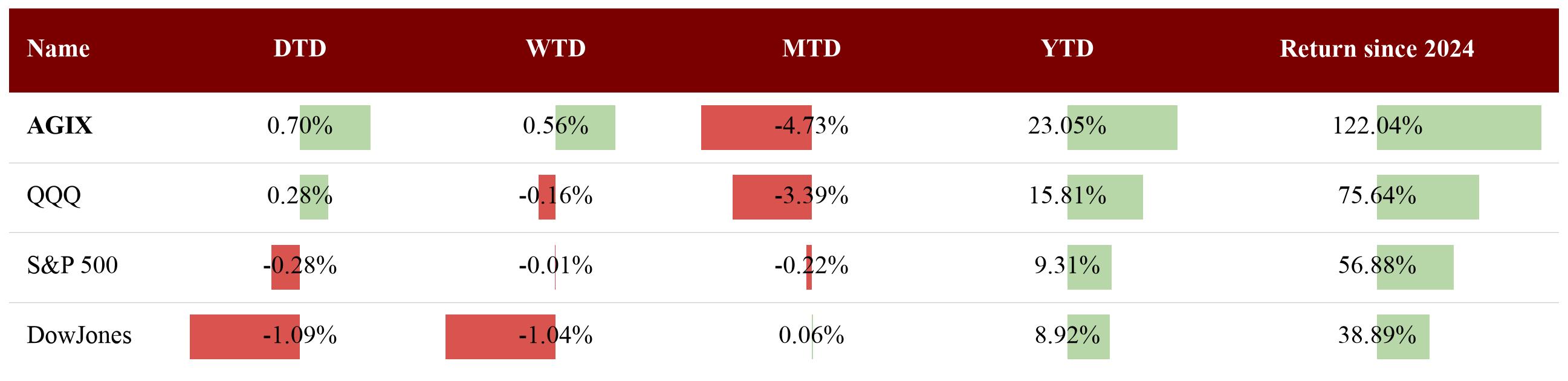
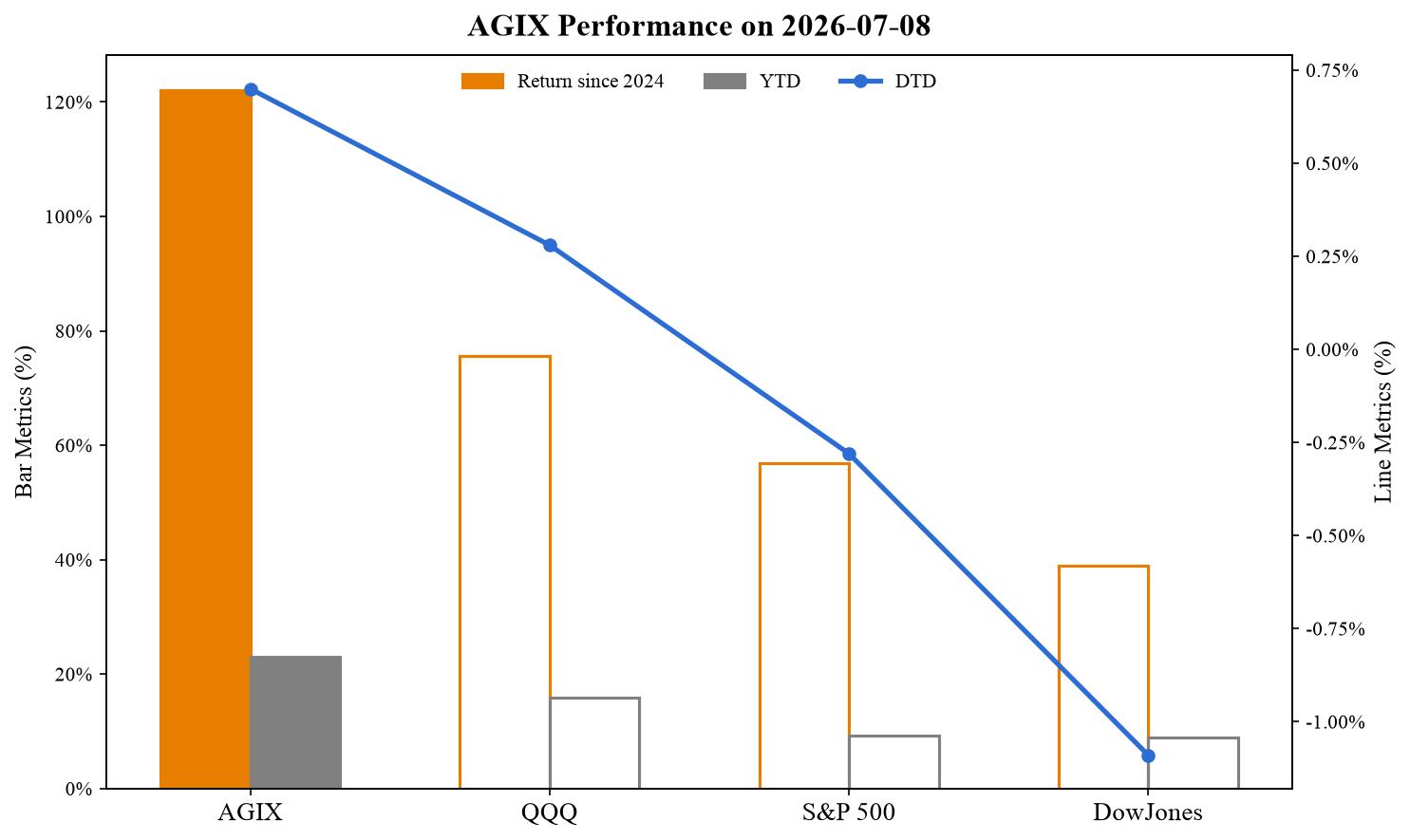
• AGIX outperformed benchmarks with a DTD return of 0.70%, driven by strong gains in AI infrastructure and hardware holdings such as Nebius Group (NBIS, +10.91%), CoreWeave (CRWV, +7.75%), and Arista Networks (ANET, +8.76%).
• AI chip and infrastructure stocks broadly rallied: NVIDIA (NVDA, +3.65%), Broadcom (AVGO, +4.83%), and Vertiv (VRT, +4.00%) contributed positively, reflecting sustained demand for AI computing and networking.
• Key detractors included Tempus AI (TEM, -4.69%), Palo Alto Networks (PANW, -4.88%), and Meta Platforms (META, -2.02%), with Meta's decline linked to privacy concerns over its new Muse Image generator.
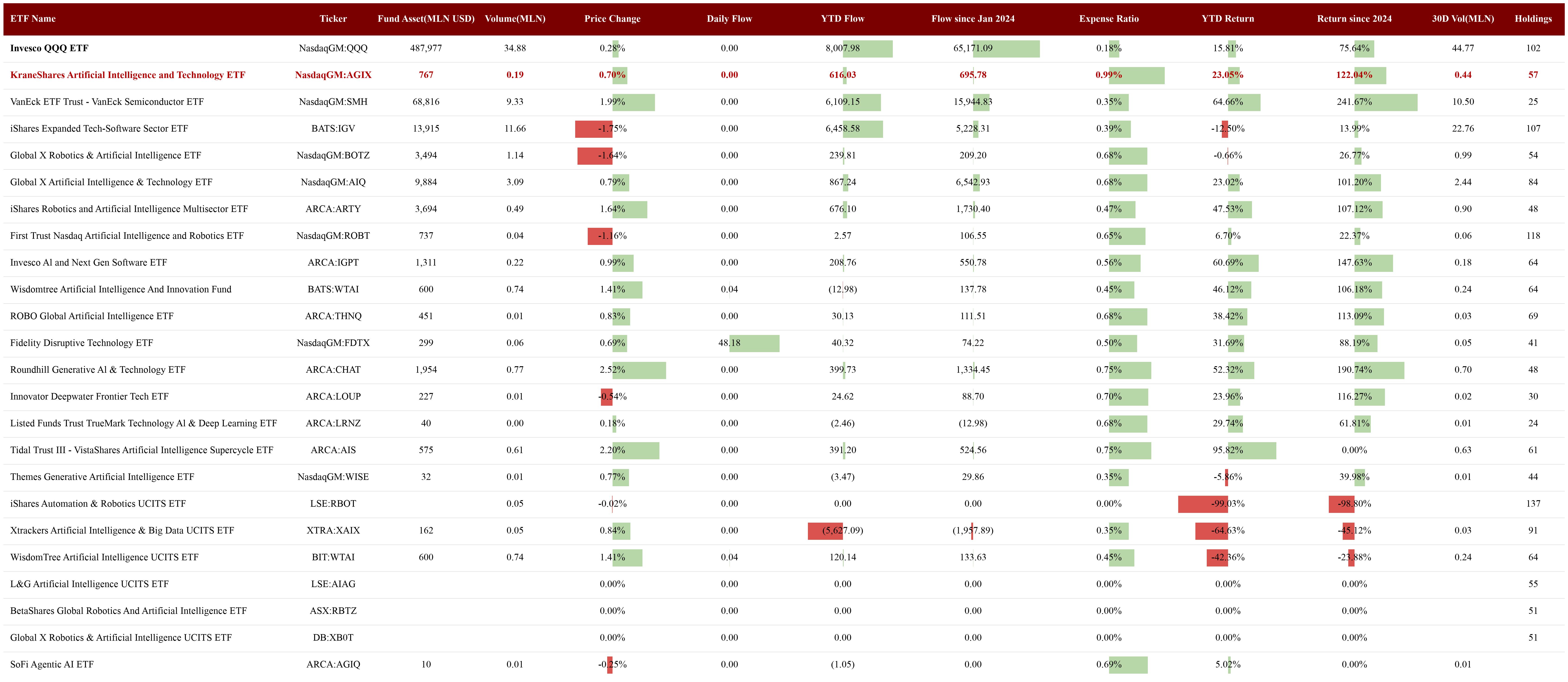
• Peer ETF performance was mixed: SMH (+1.99%) and CHAT (+2.52%) led gains, while IGV (-1.75%) and BOTZ (-1.64%) lagged, highlighting rotation toward semiconductors and AI-native names.
News Highlights
1. Microsoft is reportedly shifting tens of thousands of prompts from OpenAI and Anthropic models to its own MAI series to cut costs, signaling a broader industry trend toward in-house AI solutions that could pressure third-party model providers but benefit AGIX holdings like Microsoft (MSFT, -1.41% DTD).
2. Meta launched Muse Image, a new AI image generator with coding and search capabilities, integrated into Instagram Stories and WhatsApp; however, privacy backlash over use of public Instagram photos weighed on META shares (-2.02% DTD).
3. Amazon launched a $25B bond sale (upsized to $41B) to fund AI infrastructure, with 2025 capex guided to $200B; this reinforces the AI buildout theme and supports AGIX holdings such as Amazon (AMZN, -0.96% DTD) and CoreWeave (CRWV, +7.75% DTD).
4. AI chip startup SambaNova raised $1B at an $11B valuation and launched the SN50 inference chip, claiming 3x performance over Nvidia B200; this highlights competitive pressure in inference silicon but does not directly impact AGIX holdings.
5. DeepSeek is developing custom inference chips to reduce reliance on Huawei, reflecting a broader trend of AI companies vertically integrating hardware; no direct AGIX holdings exposure.
RSS Highlights
1. Apple and Broadcom signed a multi-year, $3B+ deal to produce over 15 billion U.S.-made wireless chips, supporting Apple's $600B U.S. investment plan and benefiting Broadcom (AVGO, +4.83% DTD) as an AGIX holding.
2. OpenAI released full-duplex voice models GPT-Live-1 and mini, enabling natural interruptions and real-time translation, replacing ChatGPT's Advanced Voice Mode; underscores AI voice interface competition.
3. Google Photos added a new AI 'Video Remix' tool powered by Gemini Omni, allowing cinematic editing and style transfers; part of Google's push to embed generative AI into consumer apps.
4. Salesforce enhanced Slackbot with connectors to its entire ecosystem (CRM, Tableau, Agentforce), enabling natural-language data queries and multi-agent orchestration; supports Salesforce (CRM, -1.73% DTD) as an AGIX holding.
5. SpaceXAI released Grok 4.5, claiming Opus-class performance at lower cost; intensifies competition in large language models.
Performance & Benchmark
Attribution
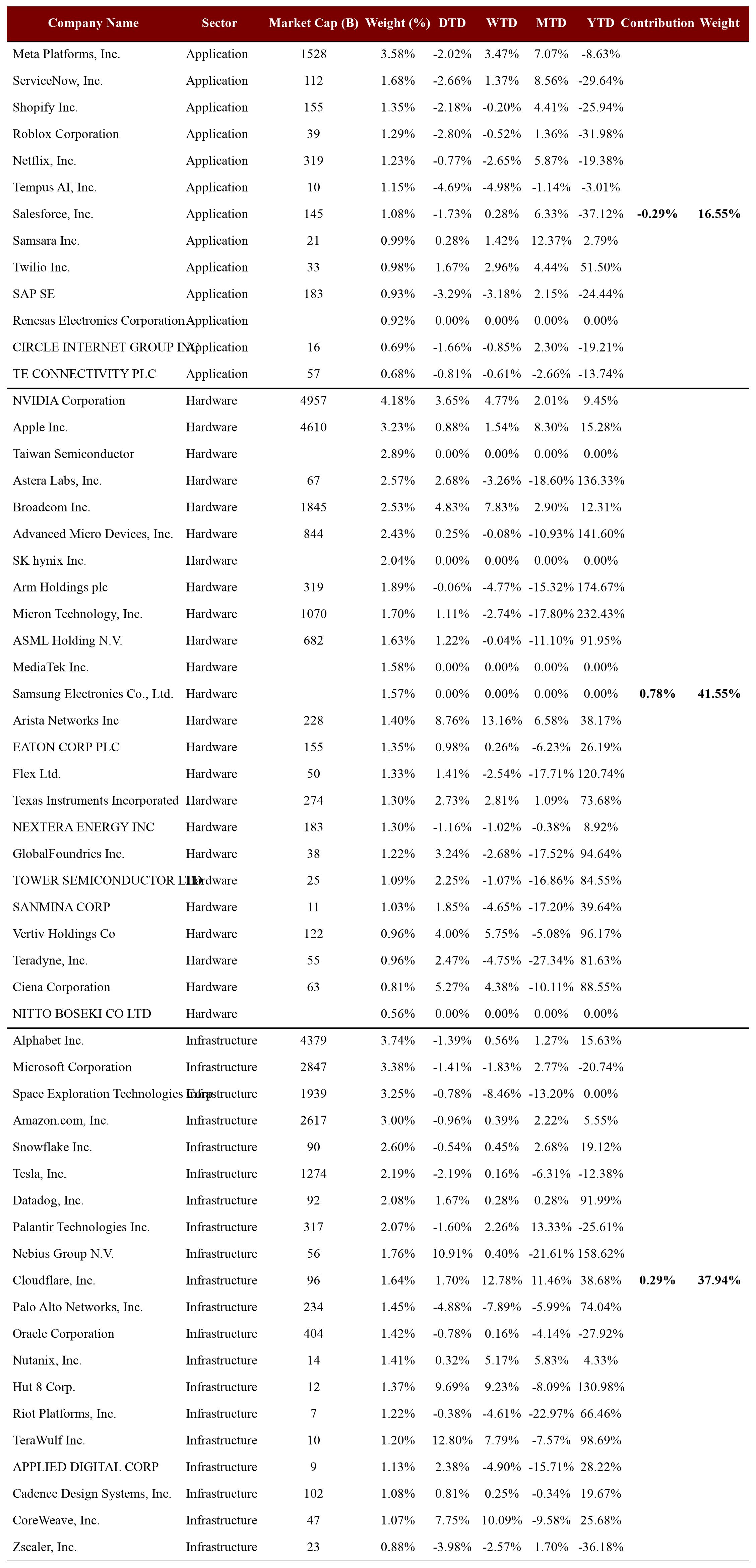
Contribution of the three sectors within AGIX holdings today
Application: -0.29%
Hardware: 0.78%
Infrastructure: 0.29%
Top-performing stocks in AGIX holdings today
TeraWulf Inc. (12.8%)
Nebius Group N.V. (10.91%)
Hut 8 Corp. (9.69%)
Arista Networks Inc (8.76%)
CoreWeave, Inc. (7.75%)
Ciena Corporation (5.27%)
Broadcom Inc. (4.83%)
Vertiv Holdings Co (4.0%)
NVIDIA Corporation (3.65%)
GlobalFoundries Inc. (3.24%)
Texas Instruments Incorporated (2.73%)
Astera Labs, Inc. (2.68%)
Teradyne, Inc. (2.47%)
APPLIED DIGITAL CORP (2.38%)
TOWER SEMICONDUCTOR LTD (2.25%)
Worst-performing stocks in AGIX holdings today
Meta Platforms, Inc. (-2.02%)
Shopify Inc. (-2.18%)
Tesla, Inc. (-2.19%)
ServiceNow, Inc. (-2.66%)
Roblox Corporation (-2.8%)
SAP SE (-3.29%)
Zscaler, Inc. (-3.98%)
Tempus AI, Inc. (-4.69%)
Palo Alto Networks, Inc. (-4.88%)
Top five listed stocks contributing the most within AGIX holdings today
Nebius Group N.V. (10.91%)
TeraWulf Inc. (12.8%)
NVIDIA Corporation (3.65%)
Hut 8 Corp. (9.69%)
Arista Networks Inc (8.76%)
Observation
The strongest movers across peer ETF holdings today are listed below:
| DTD | Stock Ticker | Name | Held by ETFs | analysis |
|---|---|---|---|---|
| 25.13 | NasdaqGS:PENG | Penguin Solutions, Inc. | ['ARCA:AIS'] | Penguin Solutions’ 25.13% jump on 2026-07-08 was driven primarily by a fresh AI-infrastructure catalyst: the company was named an Nvidia AI Factory Specialized Partner, which investors read as a major credibility boost in the hot AI buildout theme. The move was amplified by the stock’s already strong momentum and heavy trading interest, including elevated options activity and volume. A secondary driver was broader bullish follow-through from the company’s recent beat-and-raise quarter and higher FY2026 guidance, which likely reinforced the re-rating. |
| 14.98 | 0268.HK | KINGDEE INTERNATIONAL SFTWR | ['ARCA:THNQ'] | Kingdee International Software’s 14.98% move was primarily driven by its same-day profit warning that, despite the term, guided to double-digit H1 2026 revenue growth and a return to profitability, which the market interpreted positively. The company projected 13–14% year-on-year revenue growth and profit attributable to equity holders of RMB 400–600 million, turning profitable due to scale in its subscription business and AI-driven efficiency gains, highlighting strong execution of its “AI-first, subscription-first, globalization” strategy.[1] |
| 14.52 | 3896.HK | Kingsoft Cloud Holdings Ltd | ['NasdaqGM:WISE'] | Kingsoft Cloud’s 14.5% gain on July 8 appears primarily driven by continued rerating momentum following recent bullish analyst coverage and a strong consensus “Strong Buy” recommendation with large implied upside, which has supported investor appetite for the Hong Kong line alongside the ADR move.[3][4][8] The move also reflects buying interest in a stock trading near its 52‑week low in Hong Kong, with investors positioning for mean reversion given the wide gap between current price and average 12‑month targets.[2][3][6] |
| 13.35 | 2513.HK | Knowledge Atlas Technology JSC Ltd | ['ARCA:CHAT'] | Knowledge Atlas Technology’s 13.35% move on 8 July 2026 is best explained by technical and positioning dynamics following the expiry of a major IPO lock-up on 7 July, which increased tradable float and appears to have catalyzed heightened speculative trading rather than fundamental news. The lock-up release of 25.68m H-shares on 7 July 2026, combined with the stock’s already high volatility profile and strong recent AI-related narrative around its GLM-5.2 open-source model, likely amplified short-term momentum and trading-driven price action rather than reflecting new company-specific disclosures. |
| 12.8 | NasdaqCM:WULF | TeraWulf Inc. | ['NasdaqGM:AGIX', 'BATS:IGV'] | TeraWulf’s 12.8% move on July 8, 2026 appears primarily driven by continued positive repricing of the company’s July 6 announcement of a 20-year, approximately $19 billion AI data center lease with Anthropic and the monetization of its Abernathy JV stake, which materially enhances long-term contracted revenue and liquidity.[2][3][7] A secondary driver was follow-through institutional commentary and media coverage on July 8 (including CEO interviews and research discussions) that framed the Anthropic lease and Abernathy sale as a strategic pivot from Bitcoin mining to high-margin AI infrastructure, reinforcing bullish sentiment and attracting incremental investors.[3][8] |
| 11.98 | 0100.HK | Minimax Group Inc | ['ARCA:CHAT', 'ARCA:LOUP'] | Minimax Group’s 11.98% gain on July 8, 2026 appears primarily driven by positioning and short-covering ahead of a major lock-up expiry scheduled for July 9, when approximately 63% of its Hong Kong-listed share capital becomes freely tradable, including a large block held by financial investors.[2][3] A same-day report noted a rapid intraday surge with gains approaching 20% and a peak near HK$389.8, suggesting aggressive trading activity around the event rather than new fundamental news.[5] A secondary driver is the stock’s prior sharp drawdown of over 50% in the month, which likely amplified the rebound as traders anticipated near-term technical inflection around the lock-up overhang.[2] |
| 11.44 | NasdaqGS:KC | Kingsoft Cloud Holdings Limited | ['XTRA:XAIX'] | Kingsoft Cloud’s 11.44% move on July 8, 2026 appears primarily driven by momentum and technical factors rather than a discrete company-specific news event, as no new filings, earnings releases, or major announcements were reported that day. The stock was highlighted for “surprising price action” in prior-day trading, which likely attracted short-term traders and incremental buying interest into a relatively low-float, volatile name, amplifying the move on normal fundamental backdrop. |
| 11.05 | NYSE:BABA | Alibaba Group Holding Limited | ['LSE:AIAG', 'ARCA:THNQ', 'NasdaqGM:AIQ', 'NasdaqGM:ROBT', 'XTRA:XAIX'] | Alibaba’s 11.05% move on July 8, 2026 was primarily driven by a broad rotation into Chinese internet names and growing optimism about an earnings rebound, with BABA posting its biggest single-session gain since late 2025 and rallying alongside peers like JD.com and Baidu.[2][3][7] A secondary driver was company-specific sentiment improvement, including reports of narrowing quarterly losses with stable profitability and continued strong analyst support, with the vast majority of covering analysts maintaining Buy ratings and targets implying substantial upside.[2] |
| 10.91 | NasdaqGS:NBIS | Nebius Group N.V. | ['NasdaqGM:AGIX', 'ARCA:CHAT', 'ARCA:IGPT', 'ARCA:THNQ', 'BATS:WTAI', 'BIT:WTAI', 'NasdaqGM:QQQ'] | Nebius Group’s 10.91% gain on 2026-07-08 was most likely driven by a rebound from the prior day’s sharp selloff in neocloud names, which had been tied to reports that Meta may sell excess AI compute and had pressured the group broadly. The stock also benefited from continued investor enthusiasm around Nebius’s AI cloud growth story and recent structural support from its inclusion in the Nasdaq-100, which should attract passive fund demand over time. [1][7][9] |
| 10.67 | NasdaqGS:AKAM | Akamai Technologies, Inc. | ['NasdaqGM:ROBT', 'XTRA:XAIX'] | AKAM’s 10.67% jump on July 8 was primarily driven by bullish sell-side sentiment and fresh AI-security catalysts. Oppenheimer reaffirmed an Outperform rating with a $180 target, calling Akamai’s cloud and AI inferencing growth underappreciated, while the company also highlighted its new agentic framework for Bot & Agent Control and completed the LayerX acquisition, both reinforcing the AI security narrative.[1][2] A secondary driver was market validation of Akamai’s product momentum: the company’s API Security earned Microsoft’s “Solutions Partner with certified software” badge, which likely supported the view that Akamai is gaining traction in Azure-linked security workloads.[1][2] |
| 10.03 | AIP | ARTERIS INC | ['BATS:IGV'] | Arteris’ ~10% gain on July 8, 2026 appears primarily driven by continued momentum around its semiconductor IP and AI/auto design narrative, with traders re‑rating the stock after recent wins such as SiEngine’s licensing of FlexNoC for next‑gen automotive SoCs.[1][2] A secondary driver is ongoing positive sentiment from the earlier Q1 2026 “beat and raise,” which reinforced growth and AI exposure, supporting momentum buying despite recent volatility.[2][6] The CEO’s recently disclosed share sale on July 6 may have already been digested, with the remaining large ownership stake limiting negative read‑through and allowing the growth/AI story to dominate trading flows.[1][8] |
| 9.69 | NasdaqGS:HUT | Hut 8 Corp. | ['NasdaqGM:AGIX', 'BATS:IGV', 'NasdaqGM:AIQ'] | Hut 8’s 9.7% move on July 8, 2026 was primarily driven by positive sell-side rating momentum, with Craig-Hallum initiating or reiterating a Buy rating on the name that day, reinforcing recent bullish analyst commentary and price targets following its large AI data center leasing wins.[8][6] A secondary driver was continued enthusiasm around Hut 8’s long-dated, multi-billion-dollar triple-net lease revenues at its Beacon Point and other hyperscale AI campuses, which support a high-growth AI/HPC narrative despite current large net losses and rich valuation multiples.[7][6] |
| 9.52 | 1810.HK | XIAOMI CORP-CLASS B | ['NasdaqGM:BOTZ'] | Xiaomi’s 9.5% move appears primarily driven by a rebound from recent weakness and renewed buying interest ahead of its next earnings report, with the stock still well below the average Street target and supported by a dominant Buy consensus among analysts.[2][5][8] The rally also reflects investors re-engaging with the longer-term EV and ecosystem growth story after a period of pressure from EV- and AI-related losses that had weighed on Q1 2026 profits.[5] Elevated trading volume versus normal levels points to active institutional and momentum participation in the move rather than company-specific news on the day.[2][6] |
| 9.1 | NasdaqGS:CORZ | Core Scientific, Inc. | ['BATS:IGV'] | Core Scientific’s 9.1% move on July 8, 2026 appears primarily driven by a rebound after the prior day’s weakness, with no new company-specific news or disclosures on the tape. The stock traded between $20.88 and $23.90 and closed at $23.71, up sharply intraday and 13.6% above the day’s low, indicating a technical recovery and momentum-driven buying rather than a fundamental catalyst. Secondary drivers likely include continued investor focus on Core Scientific’s AI infrastructure pivot and recent bullish sell-side commentary and target hikes in late June, which support a constructive sentiment backdrop for any rebound move. |
| 8.76 | NYSE:ANET | Arista Networks Inc | ['NasdaqGM:AGIX', 'LSE:AIAG', 'ARCA:AIS', 'ARCA:ARTY', 'ARCA:CHAT', 'ARCA:THNQ', 'NasdaqGM:FDTX', 'NasdaqGM:ROBT', 'NasdaqGM:WISE', 'XTRA:XAIX'] | Arista Networks’ 8.76% jump on July 8 was mainly driven by renewed enthusiasm around AI networking demand, with investors reacting to reports of strong hyperscaler data-center spending and Arista’s new 1.6Tbps switching platforms. A second driver was the wave of bullish analyst commentary and higher price targets from firms including KeyBanc, Morgan Stanley, and BofA, which reinforced the upside case. Intraday strength was also supported by broad market interest in AI infrastructure names, with ANET trading near its 52-week high. |
| 7.75 | NasdaqGS:CRWV | CoreWeave, Inc. | ['NasdaqGM:AGIX', 'ARCA:ARTY', 'ARCA:CHAT', 'ARCA:IGPT', 'NasdaqGM:AIQ', 'NasdaqGM:QQQ', 'NasdaqGM:WISE'] | CoreWeave’s 7.75% gain appears primarily driven by investor rotation back into high‑beta AI infrastructure names after a recent period of volatility and underperformance. The move came on elevated volume and without a company-specific press release or earnings event, suggesting a sentiment rebound and short-covering following prior declines tied to concerns over litigation, leverage, and competitive threats.[5][6] |
| 7.31 | NasdaqGS:SMCI | Super Micro Computer, Inc. | ['ARCA:AIS', 'ARCA:ARTY', 'ARCA:CHAT', 'ARCA:IGPT', 'NasdaqGM:AIQ'] | SMCI’s 7.3% gain on July 8, 2026 appears primarily driven by bargain hunting and reassessment of long-term AI infrastructure upside after a ~37% selloff over the prior month tied to the $7 billion equity/convert financing and Taiwan raid headlines.[1][4] Investors likely leaned on supportive commentary from research coverage framing SMCI as strategically positioned for AI server demand but undervalued over the long term, prompting short-covering and value-oriented buying in a thin news window.[1][5] Technical factors also played a role, with the move roughly in line with the options market’s implied 1‑day range (~6–7%), suggesting a volatility rebound rather than a discrete fundamental catalyst.[2][4] |
| 6.77 | NasdaqGS:SNDK | Sandisk Corporation | ['ARCA:AIS', 'ARCA:IGPT', 'ARCA:LRNZ', 'BATS:WTAI', 'BIT:WTAI', 'NasdaqGM:QQQ'] | Sandisk’s 6.77% move on July 8, 2026 was most likely driven by a sector-wide rebound in memory-chip names after the prior day’s sharp selloff, which had been tied to Samsung’s earnings disappointment and hit peers like Micron and Sandisk alike. The stock also remained highly volatile after a massive multi-month run, so traders were likely covering shorts and buying into an already oversold pullback rather than reacting to any company-specific disclosure. Technical factors appear secondary but supportive, with the stock having shown very large intraday swings and recent momentum exhaustion. |
| 6.74 | NasdaqGS:CIFR | Cipher Mining Inc. | ['BATS:IGV'] | Cipher Mining’s 6.7% gain on July 8, 2026 appears primarily driven by continued momentum and positioning following its Q1 2026 earnings and strategic pivot toward high-performance computing (HPC) and AI infrastructure, which have recently strengthened the long-term growth narrative and analyst enthusiasm around the name.[3][8][9] This move was supported by a robust fundamental backdrop, including a Strong Buy consensus from more than 10–14 analysts and substantial upside implied by 12-month price targets versus the prevailing price.[2][4][8] A secondary contributor is technical and trading dynamics, with the stock trading well above key longer-term support levels and intraday buying pushing shares to close near the top of the session’s range on above-average liquidity.[2][3][5] |
| 6.24 | NasdaqGS:SIMO | Silicon Motion Technology Corporation | ['ARCA:AIS', 'NasdaqGM:FDTX'] | Silicon Motion’s 6.2% gain on July 8, 2026 was primarily driven by a company-specific catalyst: its same-day announcement of the date for Q2 2026 results and earnings call, which likely refocused investors on upcoming numbers following a record Q1 and strong AI-driven NAND controller demand.[1][5][7] A secondary driver was broader strength in semiconductor and AI-related names, with SIMO benefiting from its positioning in AI-focused storage and recent positive sell-side commentary highlighting robust 2026–2028 growth potential.[1][3] |
| 6.07 | NasdaqCM:INDI | indie Semiconductor, Inc. | ['LSE:RBOT'] | INDI’s 6.07% move on 2026-07-08 appears driven mainly by follow-through from its late-June technical breakout and positive momentum setup, with the stock still above its 200-day average and showing strong buy signals in market summaries. A second support factor was continued investor focus on the company’s Q1 2026 results and upbeat Q2 outlook, which highlighted revenue growth and design-win momentum. I did not find a clear same-day company-specific announcement on July 8, so the move likely reflected technical trading plus ongoing sentiment around the earnings backdrop. |
| 5.88 | NasdaqGS:IPGP | IPG Photonics Corporation | ['LSE:RBOT', 'ARCA:IGPT'] | IPG Photonics’ +5.9% move on July 8, 2026 appears primarily driven by a sharp rebound from the prior day’s selloff, with the stock recovering from a -7.7% decline on July 7 and moving from a $94.48 intraday low to close near $102.28.[3][4] The bounce occurred without identifiable company-specific news or filings that day, suggesting short-term technical factors and dip-buying in a name that has materially outperformed over the past year (IPGP ~35–38% 1Y vs ~9% for the S&P 500) were the key drivers.[4][7] |
| 5.75 | 0939.HK | China Construction Bank Corp-H | ['XTRA:XAIX'] | China Construction Bank’s 5.75% rise on 2026-07-08 was most likely driven by a broad rally in Chinese bank stocks after Reuters reported a possible change to bank shareholding rules, which lifted the sector in Hong Kong. Reuters specifically noted that Chinese bank stocks climbed on the news, making this the clearest same-day catalyst for 0939.HK.[9] A secondary support was the stock’s own positive momentum and technical rebound after trading near recent ranges, but there is no evidence in the provided results of a company-specific announcement that explains the move.[3][10] |
| 5.71 | NasdaqGS:BKR | Baker Hughes Company | ['NasdaqGM:QQQ'] | Baker Hughes rose 5.71% on July 8, 2026, mainly after announcing a multiyear gas turbine order agreement with Kodiak Gas Services to support U.S. data center growth, which directly reinforced the company’s power/industrial technology growth narrative.[8][10] Yahoo Finance also linked the rally to this same-day contract win, noting the stock outperformed the broader market on the news.[10] A secondary driver was supportive analyst sentiment, with Susquehanna keeping a positive rating even while trimming its price target to $70, which still implied upside from the prior close.[1] |
| 5.59 | PDYN | Palladyne AI Corp | ['NasdaqGM:WISE'] | Palladyne AI’s ~5.6% gain on July 8 was primarily driven by follow-through buying on its July 7 after-market 8‑K and press release announcing preliminary Q2 2026 revenue of about $5.8M (up ~480% YoY and ~66% QoQ) and backlog growth to ~$24M, which materially strengthened the company’s near-term growth narrative.[3][9] A secondary driver is momentum interest in high‑beta AI names, with PDYN already trading as a volatile, sentiment-driven AI play where strong top-line updates can trigger outsized short-term moves. |
| 5.27 | NYSE:CIEN | Ciena Corporation | ['NasdaqGM:AGIX', 'BATS:WTAI', 'BIT:WTAI', 'XTRA:XAIX'] | Ciena’s 5.27% rise on July 8, 2026 appears driven mainly by continued investor confidence in its AI/networking growth story and strong analyst sentiment, with multiple sources citing a “Moderate Buy”/Buy consensus and higher price targets around the low-to-mid $500s.[1][5] The move was also consistent with the stock’s strong momentum after a record fiscal Q2 2026 and a large backlog that improved visibility into 2027.[2] Option pricing implied a fairly large expected daily swing of about 7.2% into July 10, which suggests the move was within normal high-volatility trading for CIEN rather than requiring a company-specific same-day catalyst.[3] |
| 5.12 | 6600.HK | ONEROBOTICS SHENZHEN CO -H | ['NasdaqGM:BOTZ'] | The 5.12% move in OneRobotics (Shenzhen) Co., Ltd. on July 8, 2026 appears to be driven primarily by company-specific buying interest in the absence of any identified stock-specific news or disclosures that day. Public data show the price move and market cap change but no accompanying announcements, suggesting the move is more likely linked to investor positioning, momentum in robotics/AI-related names, or follow-through from prior catalysts rather than a new fundamental event. |
| 5.1 | NasdaqGM:CAMT | Camtek Ltd. | ['ARCA:ARTY'] | Camtek’s ~5% gain appears primarily driven by continued strength and optimism around advanced inspection/metrology demand for AI and leading-edge semiconductors, with the stock rebounding within its recent trading range on solid volume and no negative company-specific news flow.[3][6] A secondary driver is supportive sentiment from prior quarters’ strong revenue growth guidance and higher analyst price targets, which reinforce the bullish structural narrative and likely attracted incremental momentum and growth investors on the day.[1][5] |
News
Funding & M&A
With $25 million in funding, Alta AI aims to accelerate go-to-market automation.
Israel-based agentic go-to-market automation startup Alta AI Inc. recently announced the completion of a $20.25 million Series A funding round, led by IN Venture with participation from Mindset Ventures, Skywell Capital, Leumi77, and Entrée Capital. The funding will be used to accelerate the scaling of its intelligent go-to-market platform. Alta provides a centralized intelligence layer called the "Company Brain," which connects to over 50 data sources and more than 60 go-to-market tools, including Salesforce, HubSpot, Attio, and Clay, replacing fragmented systems with a collaborative AI agent network. The company has secured customers such as Snowflake, Atlassian, and Deel, with annual recurring revenue exceeding $15 million, and plans to double that by year-end. Alta will use the new funds to enhance CRM and ad platform integrations, and develop long-term account management and cross-sell agents. Investors believe Alta is defining a new category of AI agent-driven go-to-market.
Microsoft is reportedly ditching OpenAI’s and Anthropic’s AI models in favor of its own to cut costs
Bloomberg research shows that Microsoft is gradually reducing its reliance on the most advanced AI models from OpenAI and Anthropic, shifting to its own MAI model series to control costs. It has already transferred tens of thousands of prompts in platforms such as Excel and Outlook to models like MAI-Thinking 1 for processing. This model has 35 billion parameters and a context window of 256K, matching Claude Opus 4.6 in programming capability. This move is primarily triggered by the huge expenditure on third-party models, and Microsoft aims to achieve zero cost by the time its agreement with OpenAI expires in 2032. Meanwhile, multiple US companies such as Amazon, Accenture, Meta, and Uber are also exploring cheaper AI solutions, even considering China's DeepSeek model. Microsoft's recently released MAI series covers various scenarios including image generation and speech recognition, promoting the adoption of low-cost, efficient AI in enterprise applications.
Argentum targets the capital stack as the missing layer in AI infrastructure buildout
With the explosive growth of AI computing demand, the core bottleneck for data center deployment has shifted from electricity and GPUs to capital structure. Andrew Sobko, founder and CEO of Argentum AI Inc., pointed out that many independent developers hold power capacity but have paused projects due to difficulties in capital combination. The company has introduced a "demand-first" capital stacking model, which shortens the project financing cycle from 12 to 18 months to just a few months by signing customers in advance and providing cash support. It has already signed $10.5 billion in revenue, with a pipeline of $180 billion, expected to reach $300 billion by the end of the year. This model does not rely on specific GPU suppliers, maintains neutrality, and accelerates the global deployment of AI infrastructure.
Lovable is reportedly in talks to double its valuation to $13.2 billion.
Swedish 'vibe-coding' startup Lovable is in talks for a $300 million funding round at a $13.2 billion valuation, double its $660 million valuation from last December. Menlo Ventures is expected to lead the round. The company, less than three years old, has reached a $500 million annualized revenue run rate as of June, with customers including Workday, Asana, and Nvidia. Its product allows users to quickly build websites and e-commerce platforms by describing them in natural language. Among peers, Replit is valued at $9 billion, Factory raised $150 million at a $150 million valuation, and Cursor was acquired by SpaceX for $60 billion. This round reflects sustained capital enthusiasm for AI coding tools.
Inference chip startup SambaNova valued at $11B in $1B funding round
Flower chip startup SambaNova Inc. recently announced a $1 billion funding round, reaching a valuation of $11 billion. This Series F round was led by General Atlantic, with participation from Intel Capital, Vista Equity Partners, JPMorgan Chase & Co., and others. The company had previously completed a $35 billion funding round in February. SambaNova also launched its next-generation inference chip SN50, claiming its performance is more than three times that of Nvidia's B200. The chip uses a modular layout and close-proximity memory design, integrating HBM, DRAM, and SRAM into a single chip, significantly reducing data movement latency. SambaNova also introduced the SambaRack server composed of 16 SN50 chips, with a power consumption of only 40W. Investor JPMorgan will integrate the SN50 and SN40 into its local inference architecture. This funding will be used to continuously optimize chips, racks, and software products, and accelerate market promotion.
AI chip maker SambaNova raises $1 billion at an $11 billion valuation, 5 months after its last mega round.
AI chip innovation company SambaNova Systems announced the completion of a $1 billion Series F funding round, valuing it at $11 billion, led by General Atlantic. This round comes just five months after its $35 million Series E round in February. SambaNova will use the new funds to expand its supply chain and drive the SN50 chip to begin shipping in the second half of 2026. Reports indicate that the company had previously held acquisition talks with Intel for $1.6 billion, and the two have now established a multi-year partnership. Additionally, JPMorganChase has selected SambaNova as its inference infrastructure partner, with its SN40L and SN50 systems supporting the bank's private deployment of secure AI inference tasks. The funding round also brought in multiple institutional investors including BlackRock and T. Rowe Price. SambaNova's target customers include sovereign clouds, emerging cloud service providers, and enterprise-owned data centers.
This startup believes robotics is about to have its ChatGPT moment.
Tech startup General Intuition recently raised $2.5 billion in funding, valuing it at $2.3 billion. The company advocates that embodied AI should take a foundation model approach, training on millions of hours of gaming video data to build a general model with spatial-temporal reasoning capabilities. Its model has achieved zero-shot control of a specialized quadruped robot using only 8 minutes of real robot data, demonstrating excellent stability in dynamic environments. Lead investor Vinod Khosla supports its core thesis on action data, believing this approach will significantly reduce the robotics industry's reliance on massive real-world data. General Intuition positions itself as a provider of physical AI foundation models, rather than directly producing robots or autonomous vehicles. Its models will lower the barrier to entry for subsequent robotics companies.
Prime Intellect raises $130 million in Series A funding to help enterprises build their own AI agents.
Founded in 2024, Prime Intellect provides a full-stack platform for AI agent development, including computing resources, reinforcement learning frameworks, and evaluation tools. The company just closed a $130 million Series A funding round at a $1 billion valuation, led by Radical Ventures, with participation from Nvidia Ventures, Intel Capital, Dell Technologies Capital, Iconiq, and several prominent founders. Its platform uses a modular marketplace model, allowing customers to freely choose tools without being locked into a closed model. Companies like Ramp and Zapier are already users, with annualized revenue moving from $3 million toward $100 million. This funding round reflects strong demand from enterprises for autonomous data control and avoiding dependence on frontier labs.
Why this CEO thinks video games provide better training data than the internet.
New York-based startup General Intuition, backed by former Amazon founder Bezos, has just completed a $320 million funding round, valuing it at $2.3 billion. The company was spun off from the gaming platform Medal TV and aims to use gaming data to train world models, supplementing the shortcomings of large models in spatial-temporal understanding and advancing AGI. Investors in this round include Coatue, Eric Schmidt, MIT researchers, and Google DeepMind. CEO Pim de Witte said on the TechCrunch Equity program that the technology could bring major breakthroughs in physical AI, but must also carefully address ethical boundaries such as defense applications.
Kaon AI raises $60M to build the next generation of AI-driven interactive entertainment
Generative AI platform Kaon AI (formerly FlowGPT) has raised a total of $50 million across multiple funding rounds. Backed by investors including B Capital, Redpoint Ace, Goodwater Capital, and DCM, the company previously completed a $10 million pre-Series A round in 2024. CEO Jay Dang stated that the funds will be used to break traditional media recommendation models and drive personalized media content generation. Its core product, Emochi, offers multimedia character interaction stories where users can generate stories, visuals, and videos in real time through conversation. To support this system, Kaon has built a custom technical architecture with over 1,000 GPUs, partnering with Nebius Group and DigitalOcean to process trillions of tokens at 10 times lower cost than traditional cloud services. Emochi currently has over 2 million daily active users with an average session duration of 150 minutes. The newly established Kaon Labs will leverage massive user data to rapidly launch AI models for entertainment.
These AI startups are growing revenue at faster and faster rates.
Recently, many AI startups have seen significantly faster revenue growth, with the time from reaching the first million dollars to exceeding ten billion dollars continuously shortening. Mercor surpassed $2 billion in annualized revenue in June, taking only 4 months to go from $1 billion; Anthropic's revenue run rate exceeded $470 billion, going from $300 billion in just 2 months. Sierra achieved its second $100 million ARR increment in 2 quarters; Glean went from $200 billion ARR to $300 billion in just 6 months. Gusto's revenue velocity accelerated for 5 consecutive quarters, surpassing $1 billion in trailing 12-month revenue. Clio, after embedding AI in 2023, grew ARR from $200 million to $500 million. These companies show that AI technology is rapidly reshaping enterprise growth trajectories.
Solo GP Ashley Smith announces a second $25 million fund to back startups in AI, security, and more.
U.S. venture capital firm Vermilion Cliffs Ventures announced on Wednesday the close of its second fund, sized at $25 million. Founded in 2023 by former operations expert Ashley Smith, the firm is one of the few venture capital firms managed solely by a female general partner. The new fund will continue to back technical founders in AI infrastructure, security, and developer tools, with average individual investments between $500,000 and $1 million, planning to invest in up to 25 companies over the next 30 months. The firm previously closed its first $13 million fund and invested in 35 companies, including cybersecurity firm Keycard and AI infrastructure company CopilotKit. Smith, who previously led go-to-market efforts at Twilio, Facebook, GitHub, and GitLab, will leverage her experience to help founders craft sales strategies and avoid common pitfalls in selling to developers and security teams.
Apple will produce Made in America wireless chips with Broadcom.
Apple and Broadcom have reached a multi-year agreement worth over $3 billion to design and produce more than 15 billion custom wireless connectivity chips made in the U.S. for Apple's various products. Apple will invest $150 million in capital expenditures to support the expansion of Broadcom's facility in Fort Collins, Colorado. This deal continues the partnership between Apple and Broadcom in wireless components. The move is part of Apple's plan to invest $600 billion in the U.S. over the next four years, in response to tariff pressures from the Trump administration. The deal is expected to create hundreds of jobs in the U.S.
Model Releases
OpenAI releases new voice models for more natural live conversations
OpenAI has released the full-duplex voice model GPT-Live-1 and its mini version, which supports simultaneous speaking and listening, natural interruptions, and real-time translation, addressing previous pain points where voice modes easily interrupted users and lacked intelligence. The new model will replace ChatGPT Advanced Voice Mode by default, with paid users able to access the larger GPT-Live-1, which relies on GPT-5.5 for search, reasoning, and agent capabilities. The model also supports long periods of silent context absorption and visual information display, suitable for complex conversations lasting 30-40 minutes. OpenAI stated that voice will become the main interface for future computing, but emphasized that it will not create AI companions and has set safety protections for teenagers. Meanwhile, companies such as Apple, Amazon, and Sesame are also pushing for more natural voice assistants.
Meta launches image generation model with coding and search capabilities.
American tech giant Meta Platforms today launched its latest image generation model, Muse Image, developed by its AI research team Meta Superintelligence Labs. This is the second major achievement after the first large language model Muse Spark in April. Muse Image supports generating high-quality images from multiple prompt sentences, editing existing photos, and refining outputs through tools such as web search and code generation. The model can also call Muse Spark to convert images into websites and games. Compared to the traditional best-of-N method, Muse Image adopts a "deliberate reasoning" mechanism and self-refinement capability, formed automatically through reinforcement learning. The model has been deployed in Meta AI chatbots and Instagram Stories effects, and will gradually expand to platforms like Facebook and Messenger. Meta plans to launch Muse Video, a video generator, and introduce commercial services for advertisers through the Advantage+ marketing tool.
Refiant goes where rivals only promised with a 10 million-token AI model.
AI optimization startup Refiant Inc. has launched the Protea long-context AI model suite, with the largest version supporting a 10 million token context window, leading among publicly available models. This technology can process entire enterprise codebases, years of regulatory archives, or clinical trial data in one go, effectively solving the 'lost in the middle' problem of traditional models. Founded in 2025 by Viroshan Naicker and others, Refiant previously compressed OpenAI GPT-OSS-120B to run on a MacBook Pro and has established research collaborations with Imperial College London and the University of London. The company secured $5 million in seed funding in its early stages, and the model is now available on refiant.ai with no waitlist required.
Meta launches an image generation model with coding and search capabilities.
Meta Platforms Inc. today released the image generation model Muse Image, the second algorithm from its artificial intelligence research division Meta Superintelligence Labs following the launch of the Muse Spark large language model in April. This model supports generating images based on multi-sentence detailed prompts and editing existing photos, and also has tool-use capabilities, such as supplementing information through web searches and writing Python code to generate visual charts. When coding needs are complex, Muse Image can call Muse Spark to transform images into websites or video games. Unlike the traditional Best-of-N method, Muse Image employs a "deliberate thinking" mechanism, reasoning before generation, and supports test-time computation to improve quality. The model can also self-review and optimize outputs, a feature that emerged autonomously during the reinforcement learning phase. Currently, Muse Image is available in limited release through the Meta AI chatbot and integrated into Instagram Stories effects, with future expansion to platforms like Facebook and Messenger. Meta plans to connect the model to Advantage+ marketing tools within weeks, while also advancing the Muse Video clip generator, whose current version ranks third on the Arena AI video generation leaderboard. The company may also open the service to developers via an API.
SpaceXAI releases Grok 4.5, which Elon describes as an ‘Opus-class model’
Space exploration AI company today launched its latest large model, Grok 4.5, positioned as a 'tool-type' product capable of handling multiple routine knowledge tasks such as programming, office work, research, and writing. The company claims the model is twice as computationally efficient as mainstream models on token calculation, with an input cost of $2 per million tokens and an output cost of $6 per million tokens, outperforming Anthropic's Opus 4.7 and some versions of OpenAI. Founder Elon Musk stated on social platform X that Grok 4.5 performs close to Opus level but is faster and cheaper. This release comes as OpenAI prepares to launch GPT 5.6, intensifying competition in the AI model space. The industry is watching whether low cost and high efficiency can truly change users' purchasing choices for large models.
Technical Breakthroughs
Microsoft is reportedly dropping OpenAI's and Anthropic's AI models in favor of its own to reduce costs.
Microsoft is gradually reducing its reliance on the most advanced AI models from OpenAI and Anthropic, instead prioritizing its own MAI model series. According to Bloomberg, Microsoft has redirected tens of thousands of prompts in Excel and Outlook to MAI models to reduce costs. A month ago, Microsoft released seven new models, including MAI-Thinking 1, which has 35 billion parameters and a 256k context window, and is comparable to Claude Opus 4.6 in programming ability. Microsoft AI CEO Mustafa Suleyman stated that the company's goal is to gradually eliminate dependence on Anthropic. Currently, many companies in the industry, such as Amazon and Meta, are exploring ways to reduce the cost of AI usage.
Tensordyne targets the AI inference market with logarithmic math and a rack architecture derived from Juniper.
Tensordyne Inc. recently emerged from stealth mode, with its first chip now in production at TSMC. The company has redesigned the internal arithmetic logic of AI inference chips using an innovative logarithmic math architecture, converting traditional floating-point multiplication into addition, significantly reducing transistor area and power consumption. Compared to Nvidia's equivalent systems, its 72-chip inference pod occupies just 13 rack units and consumes 30 kilowatts, with a single rack delivering over 1000 tokens/s per user throughput and latency as low as 1 microsecond. Using all-copper single-hop interconnects, it supports high-performance inference for cutting-edge large models without additional high-speed networking. The company has filed core patents for the Pareto logarithmic number system, claiming it is indistinguishable from conventional floating-point math from the user and SDK perspective, while achieving a hardware-level energy efficiency leap. This move directly challenges Nvidia's dominance in AI inference infrastructure, marking a paradigm shift from stacking HBM to fundamental arithmetic reconstruction in AI chips.
Ex-GitHub chief’s Entire opens distributed Git network for the AI agent era
Developer platform startup Entire Inc., founded by former GitHub CEO Thomas Dohmke, today launched a preview of a distributed Git network designed specifically for AI coding agents, enabling code cloning and pushing without rate limits from centralized hosting platforms. The preview is now available on a waitlist in the United States, the European Union, and Australia, supporting one-click mirroring of GitHub repositories to Entire nodes, from which agents can read code. Tests show the network achieves 570,000 clones per hour and 586 pushes per second, surpassing centralized servers. The company plans to open-source the Git backend and benchmarking suite, and to launch native repository hosting in the coming months. Entire raised $60 million in seed funding in February at a $300 million valuation, and currently has over 40 employees across nine countries. The network also offers AI programming tools such as Entire Blame, Entire Review, and semantic search, and has integrated with multiple mainstream agents including Claude Code and Cursor.
Google's deepfake detection system was used to debunk a hoax image involving McConnell.
Google's SynthID watermark system recently helped confirm a fake AI-generated image of U.S. Senator Mitch McConnell. The image spread widely on Reddit and X before being debunked by Snopes. By detecting the SynthID watermark in the image, the system effectively identified the AI-generated content. SynthID was announced at Google I/O 2025 and embeds invisible watermarks inside images that remain detectable even after cross-platform screenshots. Gemini models have supported the technology from launch, OpenAI joined in May 2026, while Anthropic has not yet participated. Users can verify image authenticity via Gemini models or OpenAI's verification tool. This case demonstrates SynthID's real-world effectiveness in combating deepfake videos.
Product Launches
Solidigm targets the intelligence layer as agentic inference pushes storage to center stage.
As AI inference shifts from training to agentic reasoning, data storage is evolving from a peripheral role to a core intelligence layer. Solidigm executive Greg Matson noted in an interview at RAISE Summit 2026 that enterprise and sovereign AI deployments are driving a surge in storage demand. As agentic inference workloads become more complex, the gap between GPU memory and data supply has become a bottleneck. To keep the most expensive GPUs fully utilized, hyperscalers are replacing older equipment with high-capacity SSDs. Solidigm has launched a 122TB enterprise SSD and pioneered cold-plate cooling products for fully liquid-cooled Nvidia GPU servers. Storage is now seen as a core component of the intelligence layer, critical to supporting the token-based AI economy.
Meta rolls out Muse, a new AI image generator
Meta recently launched a new generation AI image generator called Muse Image, developed by its internal AI unit Meta Superintelligence Labs. Muse Image will be freely available to users of Meta AI App, Instagram Stories, and WhatsApp, allowing users to create cartoon, comic-style images and interior decoration effects using custom prompts. Additionally, the model offers prompt editing features that can be used to remove unwanted people from photos or generate custom QR codes. Meta has also introduced several new AI effect filters powered by Muse in Instagram Stories. The company stated that it is free within ordinary creation limits, and a subscription plan is required beyond that. A video version, Muse Video, is currently in development. This launch marks Meta's new progress in deeply integrating AI with advertising and social platforms.
DeepFabric ships more than 50 AI agents for supply chain operations.
Supply chain AI startup DeepFabric has officially launched an AI agent platform designed specifically for supply chain execution, already deployed in production environments at multiple enterprise customers. The platform offers over 50 specialized agents covering areas such as operations, financial control, assurance, and growth, with core products including Freight Auditor, Proposal Manager, and Inventory Manager. User results are significant: 10x ROI on freight auditing, 45% reduction in audit costs, and up to 30% faster quote response times. The platform requires no internal technical resources or data cleaning, and new agents can go live within a day. The customer base spans industries including logistics, third-party logistics, food packaging, medical supplies, fleet management, and grill manufacturing, with clients such as NFI Industries, Kenco Group, HelloFresh, TwinMed, Merchants Fleet, and Weber. Founder Kalyan Kommineni emphasizes that AI must be tied to actual business KPIs, focusing on measurable revenue, profit, and service metrics. Former GEODIS Americas CEO Mike Honious praised its implementation results.
Superhuman launches Docs, merging writing, AI and data for document collaboration.
Superhuman Inc. (formerly Grammarly) officially launched its Docs product today, leveraging the acquired Coda technology to reinvent the document collaboration experience. The platform integrates the Docs AI assistant, enabling users to generate complete drafts, structured tables, and interactive data views through natural language prompts, achieving no-code AI-driven collaboration. Docs also introduces the AI views feature, which automatically builds custom workflows and interfaces based on descriptions, and provides MCP connectors for real-time integration with AI services like ChatGPT and Claude. Enterprise customers Figma, DoorDash, and The New York Times have already adopted this AI workspace. Compared to Notion, Microsoft Loop, and Google Workspace, Superhuman Docs embeds interactivity natively into documents, turning content into dynamic applications that update in real time, marking a deep implementation of AI in enterprise collaboration.
Hot French startup ZML releases a free product to speed up inference across many AI chips.
French AI startup ZML recently launched a new LLM inference server called ZML/LLMD, aiming to break the lock-in of chip vendors. The software supports running open-source large models on various chips including Nvidia, AMD, Google TPU, Apple Metal, and Intel Arc, significantly improving inference performance and reducing energy costs. Founder Steeve Morin said this move helps enterprises flexibly choose more cost-effective hardware combinations, accelerating AI adoption across industries. Although ZML is not open-source, it is currently free to collect user feedback and may switch to a paid model in the future. ZML is also collaborating with several emerging European AI chip companies, including Axelera and Fractile, to explore silicon-level co-design. With a lean team of 20 people and $20 million in funding, ZML is rapidly iterating its product, competing with Baseten, vLLM, and SGLang. While Nvidia still dominates, ZML's emergence injects more choice and vitality into the market, highlighting the rising potential of Europe's native AI ecosystem.
Meta just launched a new AI generator, Muse Image, and users are already pushing back over the use of their photos.
Meta on Tuesday launched Muse Image, an AI image generator developed by Meta Superintelligence Labs, internally codenamed Mango, now available for free through the Meta AI app, Instagram Stories, and WhatsApp. The model supports preset prompts, prompt editing, and custom ad generation, and can integrate with Facebook Marketplace to help users preview home renovation effects. However, its feature allowing users to modify others' images by tagging public Instagram accounts has raised privacy concerns, with the default setting being opt-out. Meanwhile, Meta has also introduced new Muse-driven AI effects on Instagram Stories. This release reflects Meta's continued investment in AI, but its privacy strategy remains under scrutiny. The Muse Video model is already in development.
Meta just launched a new AI generator, Muse Image, and users are already pushing back over use of their photos
US tech giant Meta launched a new generation AI image generator Muse Image developed by its super intelligence lab on Tuesday. The model, internally codenamed Mango, is now freely available through Meta AI app, Instagram Stories, and WhatsApp. Users can generate comic-style images using preset prompts, or use public Instagram user images as input for AI reconstruction. This feature has raised privacy concerns due to the unauthorized use of others' content. Meta stated that users can opt out of this feature in settings, and Muse can also be used for custom ads, interior decoration previews, and Facebook Marketplace product displays. Additionally, Meta will launch the Muse Video generator and continue to increase investment in AI infrastructure.
Google Photos adds a new AI ‘Video Remix’ tool
Google announced Wednesday that it will roll out a new Video Remix feature for Google Photos, powered by its newly released Gemini Omni model. Users can achieve cinematic relighting, background replacement, and artistic style conversions such as watercolor, sketch, and oil painting with just a few taps in the Create tab within the app. This move is Google's latest effort to deeply integrate generative AI tools into consumer applications, aiming to compete with companies like Apple, OpenAI, and Adobe. The feature is gradually rolling out to Google AI Plus, Pro, and Ultra subscribers in the United States, India, Japan, South Korea, and other countries. Previously, Google Photos also introduced AI features such as photo editing and virtual clothing try-on, further enhancing ecosystem stickiness.
10 insights from the Machina AI Summit: Physical AI moves from demos to deployment
As physical AI and robotics move from impressive demonstrations to actual deployment, production-grade systems with measurable ROI are emerging in manufacturing and logistics. Path Robotics uses Obsidian neural networks to help U.S. manufacturing address the skilled labor shortage, reducing manual spot welding time by 91%; Boston Dynamics is commercializing the Atlas humanoid robot, with AI shortening new feature development time to just a few hours. Skild AI has launched the universal Skild Brain model, while Apptronik and Agility Robotics are deploying Apollo and Digit in logistics warehouses, respectively. VicOne, Niantic Spatial, Rhoda AI, and Neura Robotics provide solutions in security, spatial perception, video action models, and cognitive robotics. SemiAnalysis predicts 2027 will be the breakout year for commercial deployment. This field is driving sustained and sustainable growth through real-time data flywheels and functional safety.
Policy & Regulation
Meta wants its AI glasses to seem less creepy. Its AI strategy suggests otherwise.
Meta has introduced a new feature for its AI glasses that automatically turns off the camera when the recording indicator is tampered with, addressing user concerns about privacy. This feature aims to prevent users from secretly recording with the device. However, Meta is still promoting several AI features involving data collection, such as using public Instagram photos to train AI models and allowing user content to be used for AI training. This move tends to require customers to give up more privacy, triggering investigations and lawsuits in multiple countries. The company has previously been questioned over the Cambridge Analytica incident and other privacy scandals, and now faces incidents where outsourced employees have been exposed to sensitive videos. Analysts believe that Meta's continued reliance on large-scale personal data collection in advancing AI development conflicts with users' expectations of privacy protection. This reflects the need for regulators to strengthen oversight of data usage in the integration of social media and AI.
Industry Partnerships
Salesforce enhances Slackbot with connectors to the entire platform ecosystem.
U.S. CRM software giant Salesforce recently made a major upgrade to Slackbot, giving it full access to all data and tools in the Salesforce ecosystem, including CRM, Tableau, Data 360, and Agentforce. Slack CMO Ryan Gavin said in an interview that users can perform data queries, generate reports, and orchestrate multi-agent tasks directly through natural language in the Slack chat interface without switching between multiple apps. This upgrade is an extension of Salesforce's 'Headless 360' strategy, applying the MCP protocol to enable seamless connections between AI models and platform data. Slackbot now supports multi-person collaboration in channels with external agents such as Anthropic Claude, Shopify, and Box, and can package reusable workflows as shareable skills. This update helps address the fragmentation of enterprise AI tools and boosts team productivity.
Former OpenAI executive Kevin Weil is now on the board of Stoke Space.
Seattle-based startup Stoke Space is advancing the development of its rapidly reusable rocket Nova to challenge SpaceX. The company has raised a total of $1.34 billion, including a $510 million Series D round in 2025. Former OpenAI Chief Product Officer Kevin Weil has joined the board, leveraging his experience in digital platforms, scientific research, and Planet Labs to help the company scale operations and explore military partnerships. Stoke will combine emerging fields such as space data centers, solar energy, and military applications to reduce launch costs through rapid reuse technology. With SpaceX's IPO and progress on Starship, market demand for reusable rockets has significantly increased, and Stoke is expected to capture a significant share of the launch market.
融资收购
Amazon launches a $25 billion bond sale to fund AI infrastructure.
Amazon is raising funds for AI projects by issuing at least $25 billion in multi-tranche senior unsecured notes. The bond issuance is divided into eight parts with maturities ranging from 3 to 40 years, and has seen strong investor demand, with peak orders reaching $62 billion. Amazon will use the proceeds for general corporate purposes, including future capital expenditures and repaying existing debt. The company has guided 2025 capital spending to $200 billion, primarily for data centers, chips, and AWS facilities. To meet AI capacity demands, Amazon is joining tech giants like Alphabet, Microsoft, and Meta in increasing debt financing. Global tech AI investment is expected to exceed $700 billion in 2025.
Report: China's DeepSeek follows OpenAI in developing its own custom inference chips.
DeepSeek is advancing its own AI accelerator for inference workloads, still in early stages, having discussed cooperation with multiple chip design, foundry, and memory companies, and begun recruiting experienced chip design engineers. The company currently relies mainly on Nvidia H800 and Huawei Ascend chips, but U.S. export controls have accelerated its self-developed chips to reduce external dependence. DeepSeek recently secured $740 million in funding, providing ample financial support for the chip project. This move aligns with strategies of U.S. companies like OpenAI and Anthropic, aiming to control the tech stack and reduce reliance on Nvidia. Chinese peers Alibaba and Baidu are also developing their own AI chips. This will reshape China's AI hardware supply landscape and enhance domestic companies' technological autonomy.
Amazon launches $25B bond sale to fund AI infrastructure
Amazon is raising at least $25 billion through the bond market to support its AI infrastructure construction. The bonds are divided into eight tranches, including fixed and floating rates, with maturities ranging from three to forty years. Lead underwriters include Barclays, Goldman Sachs, JPMorgan Chase, and Morgan Stanley. Orders reached $62 billion, and the final amount was set at $41 billion. Amazon has issued over $64 billion in bonds in the first half of this year, mainly for data centers, chips, and AWS facilities. Its capital expenditure this year is expected to reach $200 billion, far exceeding last year's $131 billion. CEO Andy Jassy said AI capacity demand exceeds supply, and its self-developed chips Trainium and Graviton will generate over $10 billion in revenue this year. Meanwhile, Google, Microsoft, and Meta are also financing AI expansion through debt, with the three companies investing over $700 billion in AI this year.
Report: China’s DeepSeek follows OpenAI in developing its own custom inference chips
DeepSeek is advancing the design of its own AI inference chips to reduce reliance on Huawei. According to Swiss media reports, the project has been underway for about a year and is still in its early stages. The company has held discussions with multiple chip design, foundry, and memory companies and is recruiting experienced chip design engineers. This move primarily targets inference workloads, aiming to control costs and enhance commercialization capabilities. DeepSeek recently secured $740 million in funding to support this project. Meanwhile, Chinese tech giants such as Alibaba and Baidu are also developing their own AI chips, reflecting a significant trend of industry competition and self-control.