AGIX Daily Report 2026-07-09
AI Summary
Market Overview
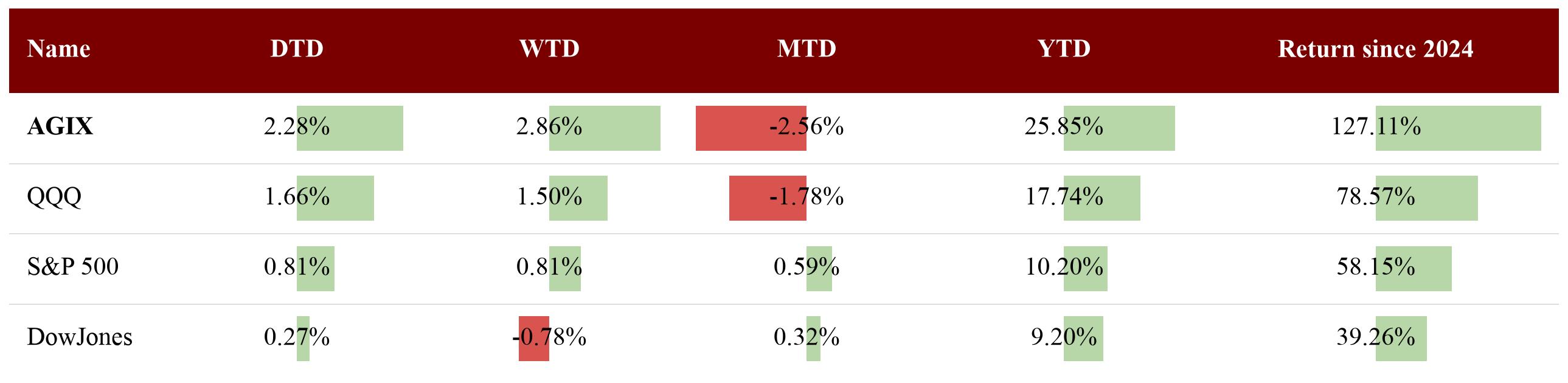
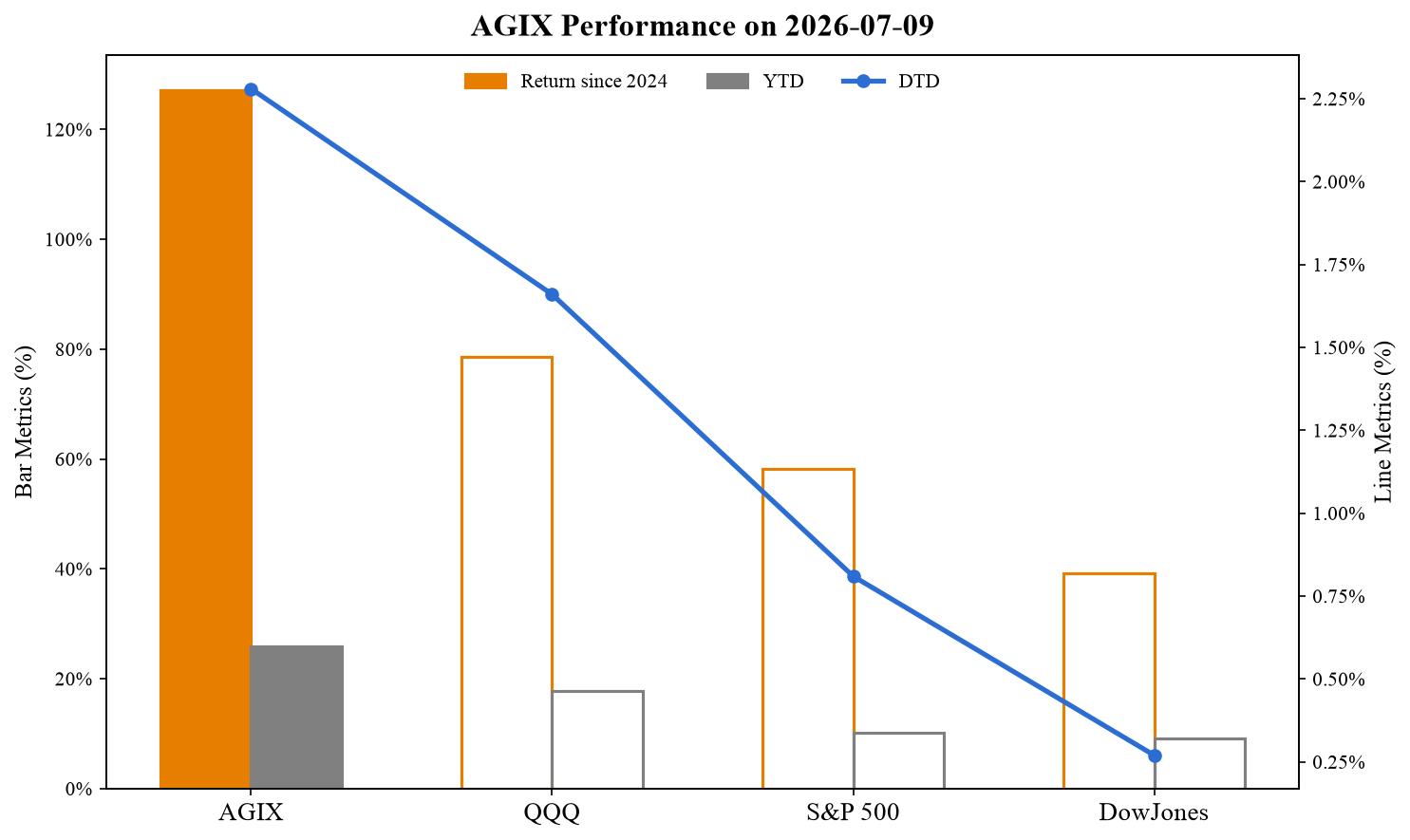
• AGIX outperformed all major benchmarks on a DTD basis with a gain of 2.28%, beating the QQQ (1.66%), S&P 500 (0.81%), and Dow Jones (0.27%). The fund's YTD return of 25.85% also leads the QQQ (17.74%) and S&P 500 (10.2%).
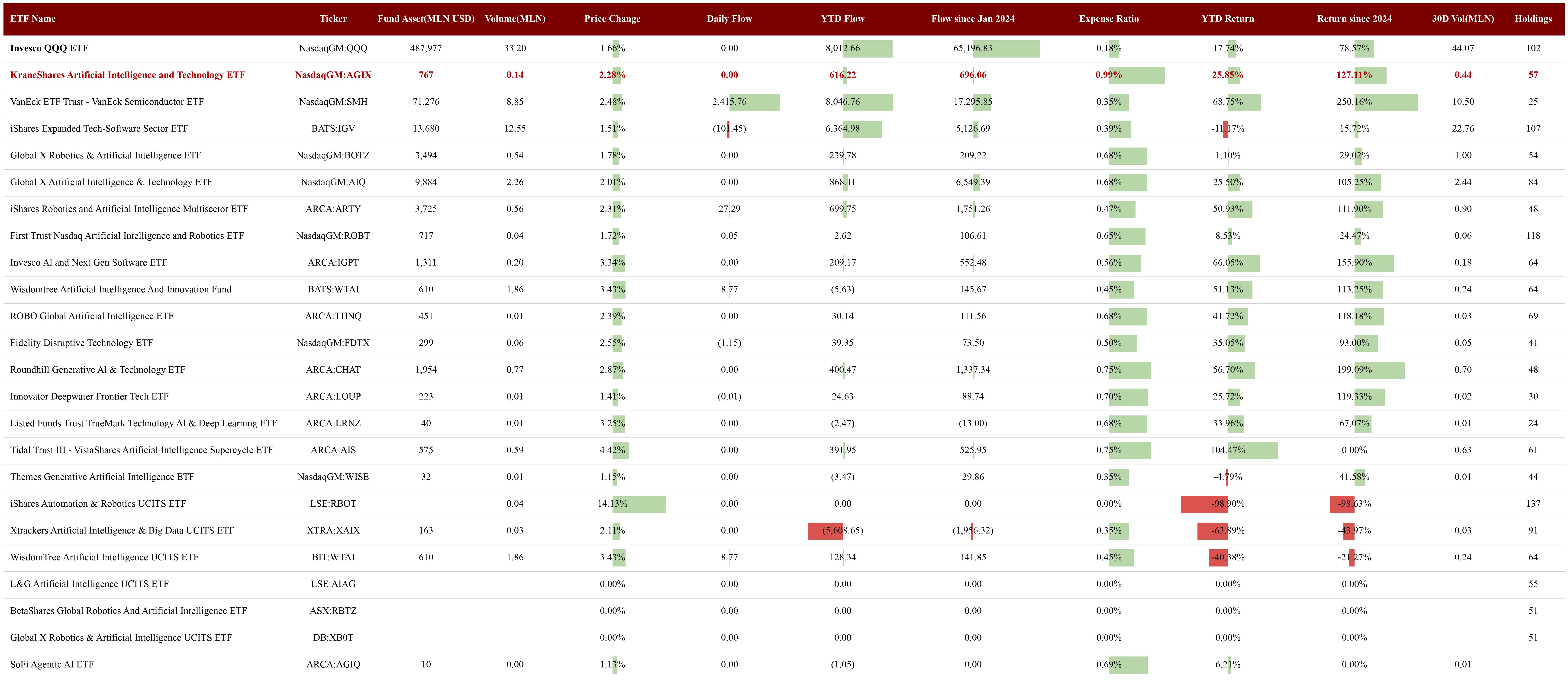
• Among peer ETFs, IGPT (+3.34%), WTAI (+3.43%), and AIS (+4.42%) posted the strongest DTD gains, while SMH (-7.34% MTD) and BOTZ (-3.45% MTD) remain under pressure. The broad AI infrastructure theme continues to drive outperformance.
• Top AGIX holdings driving positive performance include Arm Holdings (+9.2% DTD), Astera Labs (+6.18% DTD), and Advanced Micro Devices (+5.66% DTD), all benefiting from strong AI semiconductor demand and analyst upgrades. These names contributed significantly to the fund's daily return.
• Key stocks to watch: Arm Holdings (analyst price target lift), Astera Labs (AI infrastructure momentum ahead of Q2 earnings), and AMD (bullish sector commentary and CPU demand for agentic AI) are likely to remain catalysts for AGIX.
News Highlights
1. OpenAI launched GPT-5.6 (Sol, Terra, Luna) and GPT-Live voice models, intensifying competition in AI models. This may pressure AGIX holdings like Meta and Alphabet, but also benefits infrastructure providers such as Microsoft and Oracle through increased cloud demand.
2. Meta released Muse Spark 1.1 and Muse Image generation, while also beginning production of MTIA custom AI chips in September. These moves reduce reliance on Nvidia and AMD, potentially impacting AGIX's hardware holdings but strengthening Meta's own position.
3. SpaceXAI's Grok 4.5 undercuts competitors on price, signaling a shift toward cost competition in AI models. This could pressure margins for model providers but benefits inference infrastructure companies like Cerebras Systems (held by AGIX via peer ETFs).
4. Anthropic signed a $40 billion computing capacity deal with SpaceX's xAI, while also launching 'Reflect' features. This highlights growing demand for AI compute and may benefit AGIX holdings in infrastructure (CoreWeave, Nebius) and data center providers.
5. AMD's CTO emphasized system-level AI optimization, shifting from chip designer to rack-level optimizer. This positions AMD as a key beneficiary of heterogeneous inference, directly supporting AGIX's large position in AMD.
6. PitchBook reported US venture funding hit $412.7B in H1 2026, with AI accounting for 86% of deals. This signals sustained capital inflows into AI startups, benefiting AGIX's exposure to high-growth AI names.
7. The New York Times accused OpenAI of hiding evidence in copyright trial, raising transparency concerns. This could create regulatory headwinds for AI model providers but may not directly impact AGIX's hardware-heavy portfolio.
8. Meta's Instagram default setting allowing AI reuse of public photos sparked privacy backlash. This could lead to regulatory scrutiny but may not materially affect AGIX holdings.
RSS Highlights
1. OpenAI launched GPT-5.6 family (Luna, Terra, Sol) with a 1M token context window and pricing from $1 to $5 per million tokens. Sol scored 53.6 in long professional workflow evaluations, surpassing Claude Fable 5.
2. Meta released Muse Spark 1.1 with improved tool calling and computer use capabilities, now available via API. The model supports self-chat features and is accessible through the new llm-meta-ai plugin.
3. OpenAI also introduced GPT-Live voice mode, using GPT-5.5 in the background for real-time interaction. The previous voice mode was based on GPT-4o with limited functionality.
4. Bun was rewritten from Zig to Rust by Jarred Sumner, citing memory management challenges. The new version is deployed in Claude Code with a 10% improvement in Linux startup speed.
5. The ELIZA Archaeology Project is recreating the first chatbot from the 1960s and plans to publish a book titled 'Inventing ELIZA: How the First Chatbot Shaped the Future of AI.'
6. A cybersecurity startup IRIS C2, run by far-right conspiracy theorists and individuals with criminal records, is purchasing zero-day vulnerabilities for up to $7 million, raising concerns in the cybersecurity field.
7. Snapchat CEO Evan Spiegel donated $5.5 million to Undue Medical Debt, helping cancel about $550 million in medical debt for nearly 60,000 people.
Performance & Benchmark
Attribution
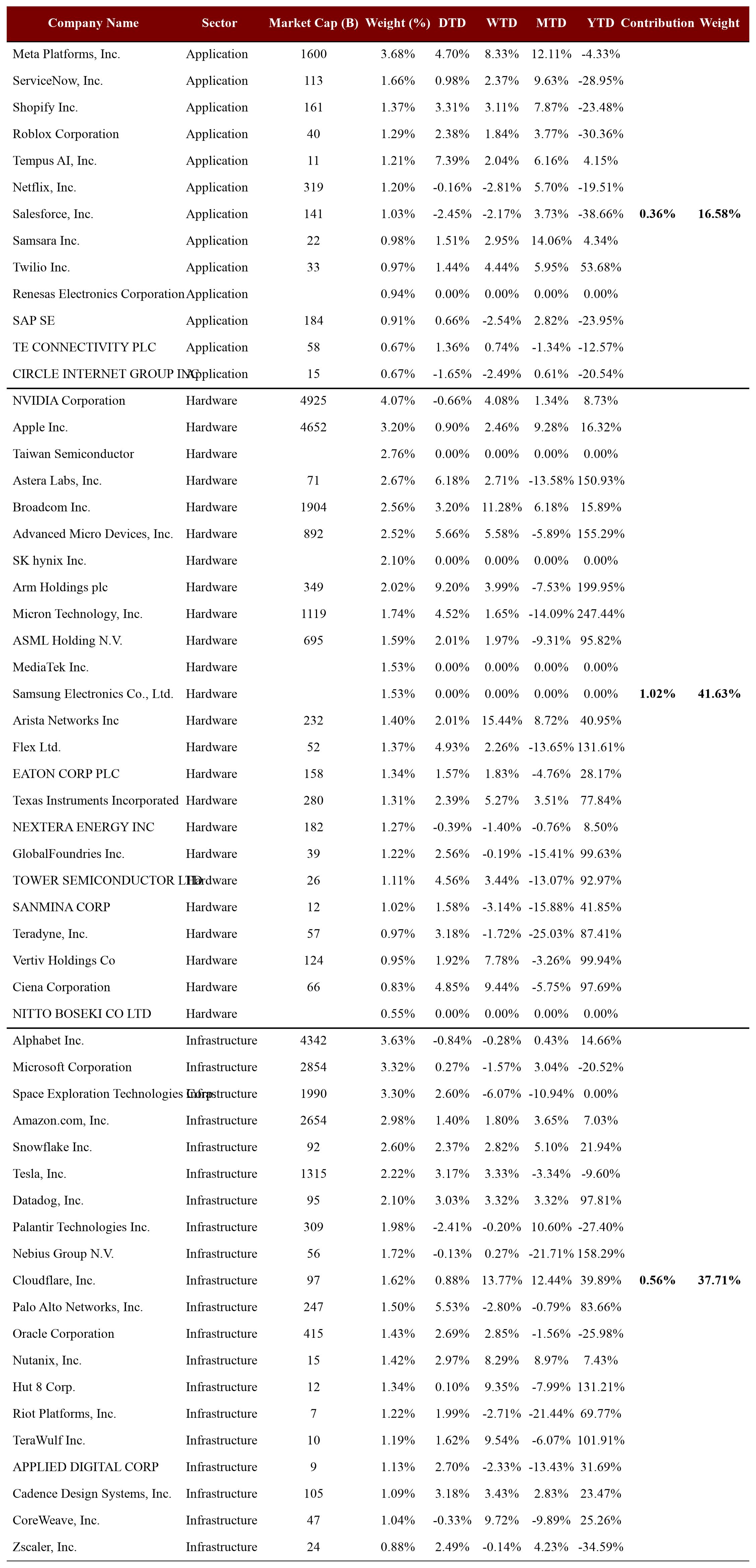
Contribution of the three sectors within AGIX holdings today
Application: 0.36%
Hardware: 1.02%
Infrastructure: 0.56%
Top-performing stocks in AGIX holdings today
Arm Holdings plc (9.2%)
Tempus AI, Inc. (7.39%)
Astera Labs, Inc. (6.18%)
Advanced Micro Devices, Inc. (5.66%)
Palo Alto Networks, Inc. (5.53%)
Flex Ltd. (4.93%)
Ciena Corporation (4.85%)
Meta Platforms, Inc. (4.7%)
TOWER SEMICONDUCTOR LTD (4.56%)
Micron Technology, Inc. (4.52%)
Shopify Inc. (3.31%)
Broadcom Inc. (3.2%)
Cadence Design Systems, Inc. (3.18%)
Teradyne, Inc. (3.18%)
Tesla, Inc. (3.17%)
Datadog, Inc. (3.03%)
Nutanix, Inc. (2.97%)
APPLIED DIGITAL CORP (2.7%)
Oracle Corporation (2.69%)
Space Exploration Technologies Corp. (2.6%)
GlobalFoundries Inc. (2.56%)
Zscaler, Inc. (2.49%)
Texas Instruments Incorporated (2.39%)
Roblox Corporation (2.38%)
Snowflake Inc. (2.37%)
Arista Networks Inc (2.01%)
ASML Holding N.V. (2.01%)
Worst-performing stocks in AGIX holdings today
Palantir Technologies Inc. (-2.41%)
Salesforce, Inc. (-2.45%)
Top five listed stocks contributing the most within AGIX holdings today
Arm Holdings plc (9.2%)
Meta Platforms, Inc. (4.7%)
Astera Labs, Inc. (6.18%)
Advanced Micro Devices, Inc. (5.66%)
Tempus AI, Inc. (7.39%)
Observation
The strongest movers across peer ETF holdings today are listed below:
| DTD | Stock Ticker | Name | Held by ETFs | analysis |
|---|---|---|---|---|
| 19.42 | 6809.HK | MONTAGE TECHNOLOGY H | ['NasdaqGM:FDTX'] | Montage Technology’s 19.4% gain on 9 July 2026 appears driven primarily by continued momentum and rerating in a strongly favored name rather than a discrete new catalyst, with the stock extending a sharp year-to-date rally amid robust growth expectations and a “Strong Buy” analyst consensus. The move came on elevated turnover (HK$2.23bn, ~8% turnover ratio), suggesting active institutional participation and follow-through buying as the shares traded near the high end of their recent range and close to the average 12‑month target price, in the context of forecasts for mid‑20% annual earnings and revenue growth. |
| 11.34 | 2513.HK | Knowledge Atlas Technology JSC Ltd | ['ARCA:CHAT'] | Knowledge Atlas Technology’s 11.34% gain on July 9 was primarily a rebound following the expiration of a major H-share lock-up on July 7, which had introduced near-term supply overhang and volatility earlier in the week.[3][6] The move was further supported by ongoing positive sentiment around the company’s open-source GLM-5.2 AI model and its growing API usage, which investors view as a structural driver of future revenue growth despite cautious target prices.[3] |
| 11.33 | NasdaqGS:MXL | MaxLinear, Inc. | ['LSE:RBOT', 'ARCA:IGPT'] | MaxLinear’s 11.33% jump on 2026-07-09 is most likely driven by continued momentum in the stock rather than a clearly identifiable same-day company announcement, as the available public results do not show a specific July 9 press release or earnings catalyst. The strongest supportable factor is a technical/flow move in a high-volatility name, with the stock trading around its recent highs and showing a large intraday range, while option-implied move data also points to elevated volatility.[1][2] A secondary contributor may be broader optimism tied to earlier AI data-center strength and prior earnings/guidance beat that had already been boosting sentiment in the name.[8] |
| 11.13 | LITE | Lumentum Holdings Inc | ['ARCA:CHAT', 'BATS:WTAI', 'BIT:WTAI', 'NasdaqGM:QQQ'] | Lumentum’s 11.1% gain was primarily driven by a broad rebound in U.S. chip stocks after positive news from Meta about doubling AI capacity, which benefited AI-exposed optical and photonics names and lifted LITE sharply. The move was supported by Lumentum’s strong AI infrastructure positioning and recent fundamental momentum, including rapid revenue growth and solid margins that have kept sentiment and analyst ratings firmly positive, allowing the stock to outperform on sector-strength days. |
| 9.98 | NasdaqCM:MARA | MARA Holdings, Inc. | ['BATS:IGV'] | MARA Holdings’ ~10% gain appears primarily driven by a bullish initiation from Citizens with an Outperform rating and a $24 price target, which highlighted the company’s strategy to repurpose bitcoin-mining power assets into high‑performance compute for hyperscale customers, prompting strong speculative interest.[1] A secondary driver was broader positive sentiment toward bitcoin miners and digital asset infrastructure names tied to policy chatter around a potential U.S. “Strategic Bitcoin Reserve,” which supported the group and amplified the move in high‑beta names like MARA.[1][3] |
| 9.94 | NYSE:HPE | Hewlett Packard Enterprise Company | ['ARCA:AIS', 'ARCA:CHAT', 'ARCA:IGPT', 'NasdaqGM:AIQ', 'XTRA:XAIX'] | HPE’s 9.94% jump on 2026-07-09 was most likely driven by the market’s reaction to stronger growth guidance for fiscal 2026/2027, which pointed to materially better revenue growth and free cash flow expectations. The move was reinforced by upbeat momentum/trading interest, with volume running well above average and the stock showing a strong same-day rally. [2][6][1] |
| 9.69 | 300757.SZ | ROBOTECHNIK INTELLIGENT TE-A | ['NasdaqGM:BOTZ'] | RoboTechnik Intelligent Technology’s 9.69% gain on July 9, 2026 appears primarily driven by strong technical momentum after a sharp selloff, with the stock rebounding toward recent highs and triggering follow-through buying interest.[1][5][10] The move occurred without identifiable company-specific news or regulatory catalysts that day, suggesting buying was dominated by traders responding to oversold conditions, positive technical ratings, and high historical volatility in a stock that has delivered substantial gains over the past year.[5][10] |
| 9.49 | NasdaqGS:OUST | Ouster, Inc. | ['LSE:RBOT', 'NasdaqGM:BOTZ'] | Ouster’s 9.5% gain on July 9 appears primarily driven by continued momentum and optimism around its Rev8 digital lidar platform and broader AI/autonomy positioning, building on recent multi-sector product and partnership news. Investors have been reacting positively to initiatives such as the Rev8 native color lidar qualification for NVIDIA DRIVE Hyperion and expanded manufacturing and robotics collaborations, which reinforce the company’s role in autonomous vehicles and AI perception stacks.[2][4][5] A secondary driver is bullish sell-side and investor sentiment, with recent initiations and higher price targets (e.g., Roth/MKM’s $75 target) supporting a re-rating of the stock despite elevated valuation metrics, as investors focus on long-term lidar demand and physical AI autonomy adoption.[2][5] |
| 9.26 | BFLY | BUTTERFLY NETWORK INC | ['ARCA:THNQ'] | Butterfly Network’s 9.3% gain on July 9, 2026 appears primarily driven by follow-through buying on recent positive fundamental news rather than a discrete new company-specific catalyst that day. In late June, the stock rallied sharply on optimism around international expansion and licensing deals (including a Brazil launch) and subsequent analysis highlighting significant upside potential, which has kept momentum and retail interest elevated into early July.[6][9][10] Secondary drivers likely include the broader bid for small-cap medical device and digital health names and technical trading, as BFLY has been rebounding from depressed levels with high volatility and volume.[2][7] |
| 9.25 | CBRS | Cerebras Systems Inc | ['ARCA:CHAT'] | CBRS rose 9.25% on 2026-07-09 mainly on continued post-IPO volatility and AI-semiconductor momentum, with the stock still trading well below its debut peak after the May listing.[4][6] A second likely driver was investor positioning ahead of or around the company’s recent earnings cycle, which had highlighted strong revenue growth but margin concerns and left the shares highly reactive to news flow.[5] The move also fits the stock’s elevated implied volatility, with option markets pricing an 8.69% expected move into the Jul. 10 expiry.[2] |
| 9.2 | NasdaqGS:ARM | Arm Holdings plc | ['NasdaqGM:AGIX', 'ARCA:AIS', 'ARCA:CHAT', 'ARCA:IGPT', 'ARCA:LRNZ', 'NasdaqGM:QQQ', 'NasdaqGM:SMH'] | Arm Holdings’ 9.2% move on 2026-07-09 was most likely driven by a sharp re-rating after Bank of America lifted its price target on Arm to $335 from $245 while keeping a Neutral rating, which likely reinforced optimism around the company’s AI/data-center opportunity.[2] The move also appears consistent with broader analyst enthusiasm and positive momentum in the name, as ARM had been trading strongly into the session and was already near levels where options implied an outsized move.[2][1] No company-specific same-day disclosure in the supplied results clearly explains the entire jump, so analyst repricing looks like the primary catalyst.[2] |
| 8.77 | NYSE:ONTO | Onto Innovation Inc. | ['LSE:RBOT', 'ARCA:ARTY'] | Onto Innovation’s 8.8% gain on July 9, 2026 appears primarily to be a rebound after the sharp selloff on July 2 and subsequent volatility, as investors re-established positions in a high-momentum AI semiconductor equipment name. The move is supported by strong recent fundamentals and guidance from its Q1 2026 report, including record revenue of $292M and Q2 revenue guidance of $320–330M, which underpin the AI advanced packaging growth narrative that has driven the stock’s multi-month rerating.[4][1] |
| 8.32 | 3711.TW | ASE TECHNOLOGY HOLDING LTD | ['ARCA:ARTY'] | ASE Technology’s 8.32% gain on July 9, 2026 appears primarily driven by continued strength in the semiconductor packaging cycle and investor momentum behind advanced packaging beneficiaries. The move coincides with the stock approaching prior 52-week highs, reinforcing a technical/momentum bid in a high-valuation “high flyer” name that has delivered strong double‑digit revenue growth and commands a premium multiple versus history but still sits near or below broader peer valuations.[1][2][3][10] |
| 8.18 | 042700.KS | Hanmi Semiconductor Co Ltd | ['ARCA:CHAT'] | Hanmi Semiconductor’s 8.18% gain on July 9, 2026 appears primarily driven by strong price momentum and investor optimism rather than a discrete new fundamental catalyst on the day. The stock broke higher within an already sharp one‑month rally of over 60%, supported by a 12‑month analyst target implying ~22% upside and a Neutral/tilt-to-Buy recommendation mix, which likely reinforced buying interest among momentum and growth investors.[2][3] |
| 7.95 | NOK | NOKIA CP ADS | ['NasdaqGM:AIQ', 'XTRA:XAIX'] | NOK’s ~8% move on July 9, 2026 was primarily driven by a high‑conviction analyst re‑rating, with JPMorgan more than doubling its price target to $21 while reiterating Overweight and highlighting Nokia’s accelerating optical networking and AI/cloud demand. [1] Second, broader AI‑linked semiconductor and networking enthusiasm supported the tape, as chip and AI infrastructure names rallied on expectations of sustained hyperscaler investment. [1][9] |
| 7.85 | NasdaqGS:AMKR | Amkor Technology, Inc. | ['ARCA:ARTY'] | Amkor Technology’s 7.85% gain on July 9, 2026 appears primarily driven by renewed buying interest in high‑beta semiconductor names after a weak prior week, with AMKR rebounding sharply from recent declines and outperforming broader tech benchmarks in the session.[5][6] A second driver is ongoing optimism around Amkor’s strategic positioning in advanced packaging and AI/HPC—especially its Arizona capacity build‑out and long-term collaboration with leading foundries, which continue to underpin a medium‑term growth and “under-valued” narrative in recent analyses.[1][2][4][6] No material company-specific news or guidance updates were published that day, suggesting the move was more sentiment- and positioning-driven than event-driven. |
| 7.78 | NasdaqCM:INDI | indie Semiconductor, Inc. | ['LSE:RBOT'] | indie Semiconductor’s 7.78% move on 2026-07-09 appears to have been driven mainly by technical momentum rather than a clear same-day company-specific catalyst. The strongest available evidence is that the stock had recently turned bullish on multiple indicators, including a positive MACD on July 1, a 50-day moving average crossing above the 200-day on June 11, and a momentum breakout in late June, which likely supported follow-through buying. There is no clearly identifiable same-day earnings release, guidance update, or other major public news in the provided results to explain the move, so broader trading/technical factors look like the primary driver. |
| 7.59 | NasdaqGS:SNDK | Sandisk Corporation | ['ARCA:AIS', 'ARCA:IGPT', 'ARCA:LRNZ', 'BATS:WTAI', 'BIT:WTAI', 'NasdaqGM:QQQ'] | Sandisk’s 7.59% gain on 2026-07-09 appears most consistent with continued momentum in the stock rather than a single company-specific announcement, as recent coverage highlighted strong post-earnings buying and elevated volatility in SNDK. A secondary support was broader enthusiasm around AI-linked storage demand and semiconductor momentum, which has been cited as a key bullish driver for the name. There is also evidence the stock has been trading near the top of its range, so a technical breakout/short-covering effect likely amplified the move. |
| 7.39 | NasdaqGS:TEM | Tempus AI, Inc. | ['NasdaqGM:AGIX', 'LSE:AIAG', 'ARCA:ARTY', 'NasdaqGM:ROBT'] | Tempus AI’s 7.4% move on July 9, 2026 appears driven primarily by growing investor optimism ahead of its upcoming earnings report and reinforced by supportive analyst sentiment. The company announced it will report financial results later in July, focusing attention on its 25%+ growth trajectory and recent FDA-driven ASP lift highlighted at its May 2026 investor day, which underpin the precision medicine growth story.[6][7] A secondary driver is the solid Buy consensus and relatively high average price targets from 13 covering analysts, which provide valuation support and encourage dip buying after prior weakness.[4][9] |
| 7.28 | NYSE:DNA | Ginkgo Bioworks Holdings, Inc. | ['LSE:AIAG'] | Ginkgo Bioworks’ 7.3% move on July 9, 2026 appears primarily driven by continued momentum following its recent post-divestiture positioning and investor reassessment of the autonomous lab and core cell engineering story, rather than a discrete new catalyst on the day.[3][9] The stock had been trading near recent lows and modest positive sentiment around the company’s cash runway, cost actions, and potential for improved visibility after the biosecurity sale likely supported a rebound in a high-beta, loss-making synthetic biology name.[1][9] |
| 7.03 | STRL | Sterling Infrastructure Inc | ['ARCA:LOUP'] | Sterling Infrastructure’s 7.0% gain on July 9, 2026 was primarily driven by a pre-market gap‑up following positive analyst sentiment and reaffirmed “Buy” consensus, with MarketBeat highlighting favorable ratings and a ~$721 consensus target that supported renewed demand for the stock.[4] A secondary driver was ongoing fundamental optimism around its high‑margin E‑Infrastructure segment and sizable backlog, with Simply Wall St reiterating a positive growth and valuation view that encouraged investors to add on recent weakness.[5] |
| 6.72 | NasdaqGS:SMTC | Semtech Corporation | ['ARCA:AIS'] | Semtech’s 6.7% gain on July 9, 2026 appears primarily driven by continued positive sentiment and momentum following its recent earnings beat and upbeat guidance, with the stock still trading at a meaningful discount to bullish analyst targets. Same-day data show the shares advancing within a $123.9–$131.6 intraday range and closing higher, building on prior strength tied to record fiscal Q1 revenue and a consensus Buy rating with an average target around $200–205, implying substantial further upside. A secondary driver is ongoing support from multiple upward EPS revisions and favorable sell-side commentary, which reinforce the turnaround narrative despite some valuation concerns. |
| 6.68 | NasdaqGS:GTLB | GitLab Inc. | ['BATS:IGV', 'BATS:WTAI', 'BIT:WTAI'] | GitLab’s +6.7% move was primarily driven by a bullish investor update highlighting accelerating consumption-based revenue and strong AI product traction, which improved sentiment on the durability of growth. Management disclosed that paid Consumption Run Rate exceeded $20 million as of June 30, 2026 and pointed to >100% year-over-year growth in first-order activity for its new Flex consumption program, reinforcing the view that newer monetization initiatives are scaling successfully.[1] The stock’s reaction also reflects positioning after a significant drawdown from prior highs, with investors increasingly focused on GitLab’s AI-driven DevSecOps opportunity and improving growth narrative.[1][2] |
| 6.45 | NasdaqGS:CIFR | Cipher Mining Inc. | ['BATS:IGV'] | Cipher Mining’s +6.45% move on July 9, 2026 was primarily driven by a bullish research catalyst reframing the company as a long-term AI/HPC infrastructure landlord with $11.4 billion in contracted lease revenue, which supported a re-rating higher at the open.[2] Additional momentum came from recent analyst target hikes and Buy ratings (including Morgan Stanley’s Overweight and Rosenblatt’s positive stance), alongside a constructive broader tape with the Nasdaq up about 1%, which amplified the stock’s intraday recovery from its lows.[1][2][5] |
| 6.18 | NasdaqGS:ALAB | Astera Labs, Inc. | ['NasdaqGM:AGIX', 'ARCA:AIS', 'ARCA:ARTY', 'ARCA:CHAT', 'ARCA:IGPT', 'ARCA:LRNZ', 'BATS:WTAI', 'BIT:WTAI', 'NasdaqGM:QQQ', 'NasdaqGM:SMH'] | Astera Labs’ 6.18% gain on July 9 appears primarily driven by a rebound in AI/semiconductor sentiment following the sector-wide selloff that dragged ALAB down nearly 12% on July 7, with investors re‑risking into high‑beta AI infrastructure names ahead of its Q2 print and ongoing Nasdaq‑100 inclusion flows.[3][1] The move was amplified by strong underlying fundamentals (Q1 revenue up 93% year over year and Q2 guidance implying continued rapid growth) that support dip‑buying and momentum positioning in the name.[4][1] |
| 6.14 | NasdaqGM:NVTS | Navitas Semiconductor Corporation | ['ARCA:AIS'] | Navitas Semiconductor’s +6.1% move appears primarily driven by a rebound in high‑beta AI/power‑semiconductor sentiment and technical follow-through after recent volatility, rather than any new company-specific fundamental catalyst on the day. The stock had experienced a sharp selloff and high intraday volatility around July 6 following routine news of its upcoming Q2 earnings date and ongoing debate over rich valuation and momentum trading dynamics, setting up scope for a reflex bounce as buyers stepped back in. Broader enthusiasm for AI data center and high-power GaN/SiC plays, where Navitas is strongly positioned, likely amplified the upside move as traders re-engaged with the name. |
| 6.13 | NasdaqGS:TEAM | Atlassian Corporation | ['ARCA:LOUP', 'ARCA:THNQ', 'BATS:IGV', 'XTRA:XAIX'] | Atlassian’s 6.1% gain on July 9, 2026 appears primarily driven by a technical rebound from deeply oversold levels following a prolonged sell-off, with the stock up from its July 8 close of $85.47 to around $90.7 as it bounced off multi‑year lows and recent support levels.[5][7] This move was likely reinforced by investors reassessing the valuation after a roughly 55% 12‑month drawdown and a much lower multiple versus historical levels, prompting short-covering and dip‑buying rather than any specific new company‑level news catalyst that day.[5][7][10] |
| 6.04 | DVLT | Datavault AI Inc | ['NasdaqGM:WISE'] | Datavault AI’s 6.0% gain on July 9, 2026 appears primarily driven by ongoing investor positioning around its recently communicated growth and funding story rather than any new company-specific news that day.[3][6] The stock traded in a tight $0.36–$0.38 range with modest appreciation, consistent with follow-through interest after its Q1 2026 business update highlighting 443% YoY revenue growth, more than $800 million in tokenization contracts, a reiterated $200 million 2026 revenue target, and significant equity and non-dilutive funding secured in May–June.[3][5][6] In the absence of fresh catalysts on July 9, style and speculative AI-theme flows in a low-priced, high-growth narrative name likely served as a secondary driver of the move.[3][4] |
| 6.01 | NasdaqGS:LRCX | Lam Research Corporation | ['LSE:AIAG', 'ARCA:LOUP', 'ARCA:THNQ', 'NasdaqGM:QQQ', 'NasdaqGM:SMH'] | Lam Research’s 6.0% gain on July 9, 2026 was primarily driven by an analyst upgrade and associated price target increase, which triggered a positive re-rating and investor buying interest in the stock. MarketBeat reported that LRCX was trading about 6% higher intraday on the back of this analyst action, aligning closely with the observed daily return. |
| 5.9 | NYSE:S | SentinelOne, Inc. | ['BATS:IGV', 'BATS:WTAI', 'BIT:WTAI', 'NasdaqGM:ROBT', 'XTRA:XAIX'] | SentinelOne’s 5.9% gain on July 9, 2026 was primarily driven by growing investor optimism around its AI-native cybersecurity positioning and supportive sell-side sentiment, against a backdrop of solid recent fundamentals. Analysts maintain a Buy consensus with a 2026 price target around $20, reflecting confidence in continued market-share gains from AI-driven offerings such as Purple AI and broader platform traction.[5][1] A secondary contributor is the company’s demonstrated operating leverage and improved profitability in its latest reported quarter, which reinforces the long-term margin and cash-flow story following its achievement of sustainable quarterly non-GAAP profitability and positive free cash flow.[4][1] |
| 5.89 | AIXA.DE | AIXTRON SE | ['ARCA:AIS'] | AIXTRON SE’s +5.9% move on July 9, 2026 appears primarily driven by continued positive sentiment following its April upgrade to FY 2026 revenue and margin guidance, which reaffirmed strong demand trends in optoelectronics equipment and robust order intake.[1][2] The stock is trading with substantial upside versus consensus target prices, supported by a predominantly Buy-oriented analyst stance, which likely reinforced investor momentum and follow-through buying on the day.[5][10] Technical context also shows the shares well above their 52‑week lows and still below recent highs, providing room for performance-chasing and trend-following flows.[4][5] |
| 5.67 | NasdaqGM:VCYT | Veracyte, Inc. | ['LSE:AIAG', 'ARCA:THNQ'] | Veracyte’s 5.7% move appears primarily driven by a Zacks Research rating upgrade from Hold to Strong Buy, which reinforced a broadly positive analyst backdrop and highlighted the stock’s favorable growth and valuation setup.[1][2] This call came against the context of strong recently reported Q1 2026 fundamentals, including 21% total revenue growth, 26% testing revenue growth, and 30.8% adjusted EBITDA margin, which underpin the bullish thesis and likely amplified the impact of the upgrade.[4] |
| 5.66 | NasdaqGS:AMD | Advanced Micro Devices, Inc. | ['NasdaqGM:AGIX', 'LSE:RBOT', 'LSE:AIAG', 'ARCA:AIS', 'ARCA:ARTY', 'ARCA:CHAT', 'ARCA:IGPT', 'ARCA:LRNZ', 'ARCA:THNQ', 'BATS:WTAI', 'BIT:WTAI', 'NasdaqGM:AIQ', 'NasdaqGM:QQQ', 'NasdaqGM:ROBT', 'NasdaqGM:SMH', 'NasdaqGM:WISE'] | AMD’s 5.66% gain on July 9, 2026 was primarily driven by renewed AI-related enthusiasm for CPUs and semiconductors, reinforced by bullish analyst commentary and sector-wide technical buying. First, multiple bullish calls on chip stocks, including Fundstrat’s Tom Lee framing the recent semiconductor selloff as a buying opportunity and highlighting a rare “Momentum Index” signal, spurred a broad rebound in names like AMD and its peers.[2] Second, investors focused on AI infrastructure and agentic AI CPU demand, with fresh positive analyst coverage and higher price targets for AMD supporting the view that its data-center and server CPU businesses are poised to benefit disproportionately from this trend.[1][8] |
| 5.62 | NasdaqGS:EXTR | Extreme Networks, Inc. | ['XTRA:XAIX'] | Extreme Networks’ 5.6% gain on July 9, 2026 was primarily driven by continued momentum following its recent earnings beat and upward revenue guidance revision, which have kept the stock trading near its 52-week high and above key technical levels.[1][3][5][8] A same-day company announcement scheduling its fourth quarter and fiscal 2026 results conference call likely reinforced investor focus on the strong fundamental trajectory and upcoming catalysts.[6][10] Positive analyst sentiment and multiple recent price target increases, citing AI networking momentum and solid execution, also supported the move as investors continued to re-rate the name upward.[1][2] |
| 5.62 | NasdaqGS:IPGP | IPG Photonics Corporation | ['LSE:RBOT', 'ARCA:IGPT'] | IPG Photonics’ 5.62% gain on 2026-07-09 appears driven primarily by broad price momentum rather than a clearly identifiable company-specific catalyst, as the available same-day public results do not show a major earnings release, guidance update, or other material announcement for IPGP. The stock was already trading sharply higher intraday, with quotes showing a move around 4% to 6% above the prior close and a session range near $96.15–$102.49, indicating strong buying pressure through the day.[2][5][6] A secondary support factor may have been continued positive sentiment around IPG’s improving margins and growth outlook, but the most concrete evidence points to trading flow and momentum rather than new news.[4] |
| 5.53 | NasdaqGS:PANW | Palo Alto Networks, Inc. | ['NasdaqGM:AGIX', 'LSE:AIAG', 'ARCA:AIS', 'ARCA:LRNZ', 'ARCA:THNQ', 'BATS:IGV', 'BATS:WTAI', 'BIT:WTAI', 'NasdaqGM:FDTX', 'NasdaqGM:QQQ', 'NasdaqGM:ROBT', 'XTRA:XAIX'] | Palo Alto Networks’ 5.5% gain on July 9, 2026 appears driven primarily by continued bullish sentiment around its AI-focused cybersecurity offerings and recent analyst upgrades, extending a strong multi-month rerating rather than reacting to a discrete new headline.[1][2][9] First, multiple price-target increases and reiterations of Outperform/Buy ratings in recent weeks, highlighting strength in subscriptions, AI-driven security demand, and remaining performance obligations, have kept investor momentum elevated into early July.[1][2][9] Second, options activity was robust, with implied volatility and volume significantly above average, suggesting active positioning and possible short-dated bullish flows supporting the move.[5] |
| 5.42 | NasdaqGS:VICR | Vicor Corporation | ['ARCA:AIS', 'ARCA:LRNZ'] | Vicor’s 5.42% gain on 2026-07-09 appears to have been driven primarily by continued momentum in the name rather than a clearly identifiable company-specific announcement that day. The stock traded up to an intraday high of $287.75 and was also being covered as “trading up” on the session, while broader bullish sentiment was already supported by strong recent fundamentals and upbeat analyst targets. The available public sources do not show a major same-day earnings, guidance, or regulatory catalyst to explain the move more directly.[1][2][10] |
| 5.32 | NasdaqGS:LSCC | Lattice Semiconductor Corporation | ['LSE:RBOT', 'ARCA:IGPT', 'BATS:WTAI', 'BIT:WTAI', 'XTRA:XAIX'] | Lattice Semiconductor rose 5.32% on July 9, likely driven primarily by the company’s announcement that it was named to TIME’s America’s Best Companies 2026 list that day, which provided a positive same-day news catalyst. A secondary support was ongoing investor attention around the previously announced AMI acquisition financing, after Lattice disclosed a new $200 million revolver and $950 million delayed-draw term loan to help fund the deal. There was no stronger company-specific negative news in the provided results to offset those positives. |
| 5.32 | ENTG | ENTEGRIS INC | ['ARCA:ARTY'] | ENTG’s 5.3% gain on July 9, 2026 appears primarily driven by continued momentum from recent AI/EUV-related catalysts and bullish analyst sentiment rather than any new company-specific news that day. In the weeks prior, the stock re-rated sharply after the EUV cross-licensing deal with JSR/Inpria and a Mizuho price target increase, which positioned Entegris as a key beneficiary of AI-driven advanced-node semiconductor capacity expansion.[1][9] On July 9 specifically, the move occurred against a backdrop of ENTG trading near the top of its 52-week range with strong buy signals and elevated options-implied volatility, suggesting technical and momentum factors amplified the ongoing rerating rather than a fresh fundamental development.[2][4][7] |
| 5.32 | NasdaqGS:AEIS | Advanced Energy Industries, Inc. | ['ARCA:AIS'] | AEIS’s 5.3% gain on July 9 was driven primarily by a sharp gap-up open and continued momentum buying tied to its strong year-to-date performance and upgraded earnings and price target expectations. Shares opened more than 7% above the prior close ($315 vs. $293.64) and held most of those gains intraday, reflecting follow-through interest after a multi-month rally and improving semiconductor capital equipment fundamentals. A secondary driver was increasingly bullish sell-side and quant sentiment, with AEIS carrying a Strong/Moderate Buy profile and rising 2026 earnings estimates and consensus targets (around $400–$427), which reinforced the recovery narrative in its core markets and supported further multiple expansion. |
| 5.17 | NasdaqGS:GLBE | Global-E Online Ltd. | ['ARCA:LOUP', 'NasdaqGM:FDTX'] | Global-E Online’s 5.17% rise on 2026-07-09 appears to have been driven mainly by continued positive investor sentiment around its growth outlook rather than any clearly identified same-day company-specific news. The strongest fundamental support in the available results is analyst optimism and upgraded price targets tied to stronger quarterly performance, improved revenue and margin expectations, and support for the Passport acquisition, which likely helped the stock trade higher. No major same-day disclosure or headline-specific catalyst is evident in the provided public sources. |
| 5.15 | NYSE:RBRK | Rubrik, Inc. | ['ARCA:LOUP', 'BATS:IGV'] | Rubrik’s 5.2% gain appears driven primarily by continued post-earnings momentum and positive sentiment around its growth and AI‑driven data security positioning, rather than any discrete new catalyst on the day. Recent upside surprises in revenue and EPS, raised FY 2027 revenue guidance, and strong net new subscription ARR have reinforced the bull case on durable high-growth metrics, supporting ongoing re‑rating in the weeks around the move. |
| 5.07 | NasdaqGS:CEVA | CEVA, Inc. | ['LSE:RBOT'] | CEVA’s 5.1% gain on July 9, 2026 appears driven primarily by continued momentum and bullish sentiment following its Q1 2026 earnings beat and strong year-to-date performance, with the stock up over 100% since January on better‑than‑expected licensing revenue and EPS.[2][4][5] A secondary supportive factor is the prevailing positive analyst stance, with a consensus Buy/Strong Buy rating and price targets clustered around or above the current level, reinforcing demand on a low‑news day.[2][3][5] |
| 5.06 | GH | Guardant Health Inc | ['ARCA:LRNZ'] | Guardant Health’s ~5% gain on July 9 appears primarily driven by positive analyst actions, led by Morgan Stanley raising its price target to $175 and maintaining its rating, reinforcing the bullish outlook on the stock.[6][8] The move was further supported by a strong existing consensus of “Moderate Buy” and upward revisions from other brokers, which highlight meaningful implied upside relative to prior trading levels.[1][4] Trading followed through on recent strength in the name, with shares continuing to trade near new highs after prior gains linked to optimism around its colon cancer blood test and broader precision oncology positioning.[8][3] |
| 5.04 | NasdaqGS:WDC | Western Digital Corporation | ['ARCA:AIS', 'ARCA:ARTY', 'ARCA:IGPT', 'NasdaqGM:FDTX', 'NasdaqGM:QQQ', 'XTRA:XAIX'] | Western Digital’s 5.0% gain on July 9, 2026 appears primarily driven by ongoing momentum in the AI‑storage trade and bullish sentiment around its role as a key high‑capacity HDD supplier to cloud and AI data center customers.[1][3][9] The move extends a sharp recent rally following multiple target hikes and “Overweight/Outperform” ratings from major brokers, which have reinforced the earnings-upside narrative from tighter HDD supply, better pricing, and margin expansion.[1][3][4] A supportive broader backdrop for high‑growth AI and semiconductor names, with WDC trading near the top of its 52‑week range and maintaining a strong “Buy” skew in analyst recommendations, likely added incremental demand for the shares.[4][7][8] |
News
Funding & M&A
Lovable is reportedly in talks to double its valuation to $13.2 billion.
Swedish "vibe-coding" startup Lovable is in talks for a $300 million funding round at a $13.2 billion valuation, double its $660 million valuation from last December. Menlo Ventures is expected to lead the round. The company, less than three years old, has an annualized revenue run rate of $500 million as of June, with clients including Workday, Asana, Nvidia, and others. Its product allows users to quickly build websites and e-commerce platforms by describing them in natural language. Among similar companies, Replit is valued at $9 billion, Factory raised $150 million at a $150 million valuation, and Cursor was acquired by SpaceX for $60 billion. This funding round shows continued capital enthusiasm for the AI coding tools track.
Can AI answer the $3 trillion question?
A new calculation by Sequoia partner David Cahn shows that global AI infrastructure spending will reach $1.5 trillion in 2026, requiring the industry to generate $3 trillion in revenue to balance the investment. This figure has escalated over the past three years, with rising memory costs and heterogeneous chip usage raising revenue requirements. Meanwhile, Anthropic's annual recurring revenue has reached $600 billion, and OpenAI's 2025 revenue is $200 billion, still far from covering massive infrastructure investments. Apollo economist Torsten Slok warns that Google, Meta, Microsoft, and Amazon all expect significant cash flow increases by 2028. However, if users shift to cheaper open-source models, causing token prices to drop, cash flow targets may be missed, potentially triggering an economic downturn and stock market correction. This analysis highlights the tension between AI capital expenditure and commercial returns.
Fidji Simo steps down from OpenAI’s number two role
OpenAI's Chief Application Officer Fidji Simo will transition from a full-time to a part-time advisory role due to health reasons. Simo joined OpenAI in May 2025, overseeing application business and reporting directly to Sam Altman, and had consolidated business and product operations under her leadership. Previously, she served as CEO of Instacart, leading the company to its IPO in 2023, and spent over a decade at Meta managing the Facebook app. Her departure from full-time duties comes as the company prepares for an IPO and accelerates enterprise initiatives, requiring Altman to quickly find a successor. This also reflects the pressure OpenAI faces from slowing consumer growth and lagging behind Anthropic in code tools.
Paris-based AI voice startup Gradium raises $100M seed, backed by Nvidia
Paris-based voice AI startup Gradium reopened its seed funding round and brought in new investors such as Nvidia, bringing the total round to $100 million. The funds will be used to open an office in the US Bay Area and recruit AI talent to strengthen its competitive position in the world's largest AI ecosystem. Gradium was co-founded by Neil Zeghidour, a former researcher at Google Brain, DeepMind, and Facebook, and is a spin-off from the French AI lab Kyutai. The company specializes in ultra-low-latency voice AI models and has already secured major clients like French automaker Renault. The field is highly competitive, with ElevenLabs valued at $11 billion and tech giants like Google and Meta advancing similar products. Gradium's move highlights the trend of European AI companies expanding to catch up with US tech hubs.
An AI agent startup just let its agent run its $100M fundraise.
Lyzr, an AI startup founded three years ago in the West Village, used its own AI agent system SivaClaw to complete its own funding round. The system provided Q&A services for over 130 investors, drafted investment memos, and tracked page dwell time on presentations, ultimately helping the company secure a $100 million Series B round at a $1 billion valuation. The round generated $400 million in interest from Silicon Valley, the Middle East, and the financial sector. This case demonstrates that amid the AI boom, startups can significantly reduce fundraising costs through automation tools. During the fundraising process, the founder did not need to travel to Sand Hill Road for traditional roadshows. This case also reflects the current market's extremely high capital appetite for AI technology projects.
Nvidia is a victim of the compute marketplace it created
Over the past two months, Nvidia's stock price has fallen 15% from its May high, with its market valuation now below the S&P 500 average. Although the GPU shortage has eased, surging demand for high-bandwidth memory in data centers has made memory suppliers a new investment hotspot. Micron's stock price has tripled over the same period, and DRAM spot prices have increased tenfold in a year. Nvidia's CUDA platform and GPU technology still lead the industry, but increased competition from custom chips has driven down computing market prices. In contrast, tight memory supply has allowed related companies to earn excess profits. Analysts point out that the upward trend in memory prices will continue until a breakthrough in HBM technology. This phenomenon reflects a market shift in the redistribution of value between computing and storage in AI infrastructure construction.
Meta’s new AI chips will begin production in September
US social media giant Meta is accelerating the development of its own custom AI chips to address cost pressures from GPU component shortages. According to internal sources, the company will begin production of the latest version of the MTIA AI chip in September, with a testing cycle as short as six weeks. The project is co-designed by Broadcom, manufactured by TSMC, and sources RAM, storage, and fiber optic equipment from Samsung, Sandisk, and Sumitomo Electric respectively. Meta will use this chip for ranking recommendation algorithms, AI training, and inference tasks to reduce reliance on Nvidia and AMD. Additionally, Meta has signed multiple large contracts with ARM, AMD, and Amazon, and plans to deploy 7 GW of computing power within the year. This strategy is a key part of massive AI investment, with capital expenditures expected to reach $12.5 million to $14.5 million this year.
Prime Intellect raises $130M at $1B valuation for its AI training platform
AI training startup Prime Intellect Inc. recently completed a $130 million funding round, co-invested by Nvidia NVentures, Intel Capital, Dell Technologies Capital, and Cloudflare CEO Matthew Prince, among others, with a valuation of $1 billion. The platform focuses on custom training based on open-source models, offering two open-source tools, Verifiers and Prime-RL, supporting rapid sandbox environment setup, thousand-card parallel training, and efficient LoRA fine-tuning. The platform has been used to train the Intellect-3 model with over 10 billion parameters and is used by clients such as Ramp Inc. for supercomputing tasks. With an annualized revenue of $1 million, Prime Intellect currently has about 6,000 customers and offers inference capacity auction services across more than 50 data centers worldwide.
Exclusive: Corvic AI launches V5 to turn one-off prompts into repeatable workflows
Enterprise AI startup Corvic AI today officially launched the Corvic V5 platform. The core feature of this version is support for reusable prompts and workflow automation, which can transform validated interactions into continuously running intelligent processes and automatically pull the latest information when data changes. V5 offers more powerful data connectivity, reusable process automation, security controls, and unified orchestration of structured and unstructured data. The platform also expands support for external APIs and enterprise data sources, helping users connect business systems, databases, documents, and cloud storage resources into AI workflows. CEO Farshid Sabet said that what enterprises need is not another chatbot, but AI that can reliably execute real business processes. This upgrade also provides more security credential management and a library of pre-built templates covering scenarios such as research, finance, and operations. Corvic was founded in 2023, serves customers in industries including manufacturing and life sciences, and completed a $12 million seed round in April 2025.
Popular open-source AI developer tool Ollama raises $65 million and grows to nearly 9 million users.
Open-source AI tool Ollama has completed a $65 million Series B funding round, led by Theory Ventures. Previously, Benchmark led a $15 million Series A round, bringing total funding to $88 million. Launched in 2023, Ollama helps developers quickly run open-weight models on local PCs, currently with 8.9 million monthly active developers and coverage of 85% of Fortune 500 companies. The founder previously started Kitematic, which was acquired by Docker, and Ollama is seen as the Docker Desktop of the AI field. After the funding, the company will expand cloud inference services to meet large model deployment needs. The industry is shifting from closed models to open-weight models to reduce inference costs, and Ollama is benefiting from this trend. Although some users worry about commercialization impacting the open-source ethos, management emphasizes that the free desktop core product remains unchanged, positioning it as a natural extension of the open-source ecosystem.
TheCUBE Research finds Oracle’s AI database move could unlock bigger multicloud returns
A recent economic report released by the U.S. analysis firm theCUBE Research shows that enterprises migrating from fragmented on-premises data environments to Oracle's Autonomous AI Database on Multicloud platform can achieve significant modernization value within five years. The report uses a $100 billion manufacturing business unit within a group with $400 billion in annual revenue as a model to evaluate two scenarios. In a pure infrastructure migration scenario, the five-year net present value is $223 million, with an internal rate of return of 108% and a payback period of 26 months. If 17 AI projects are added, the net present value reaches $2.6 billion, with a return rate of 295% and a payback period of 14 months. The study notes that Oracle's platform can run on AWS, Azure, and Google Cloud multicloud environments, supports multimodal data management, and automates database operations. The analysis emphasizes that enterprises should treat database migration as an AI platform decision, not just a technology upgrade. By deploying AI projects early, companies can quickly build data governance capabilities and create a "flywheel effect" that accelerates subsequent project deployment. The report concludes that modernization and AI execution should proceed in tandem to gain strategic advantages in competition.
Open-source AI developer tool Ollama raises $65 million to grow its platform
Ollama Inc. announced the completion of a $65 million Series B funding round, led by Theory Ventures, with participation from Benchmark, 8VC, Y Combinator, and others, bringing the company's total funding to $88 million. As an open-source AI platform, Ollama provides developers with tools to run models locally and in the cloud, with over 8.9 million monthly active developers and coverage of 85% of Fortune 500 companies. The funds will be used to accelerate the expansion of cloud inference services and the integration of new models. Ollama supports model switching with a single command and is compatible with the OpenAI API, significantly reducing the switching cost for developers between local and cloud environments. Its cloud service pricing differentiates itself from competitors like Together, Fireworks, and Groq, while maintaining ecosystem synergy with local tools such as LM Studio and AnythingLLM. The funding reflects continued capital confidence in open-source model infrastructure, and Ollama is becoming a key bridge connecting local and cloud AI development.
PitchBook: US venture funding hit $412.7 billion in the first half as AI deals dominate.
U.S. venture capital deal volume in the first half of 2026 reached $412.7 billion, up nearly 30% from the full year last year. AI companies absorbed $355.9 billion, accounting for 86% of the total. Megadeals of $1 billion or more made up 87.5% of the volume, indicating high market concentration. Human intelligence startup Anmengjia secured $6.5 billion in funding at a $965 billion valuation, surpassing OpenAI. SpaceX completed a $1.7 trillion IPO in Q2, the largest public listing in history, and acquired xAI for $1.7 trillion. Investment institutions raised $72.4 billion, with concentration continuing to rise. Analysts warn that over-reliance on AI could lead to market risks.
Anthropic, OpenAI, and SpaceX are bigger than the last 25 years of tech exits
As AI giants like SpaceX, OpenAI, and Anthropic gradually move toward IPOs, the private market is creating an unprecedented scale of value. According to the NCVA-PitchBook Venture Monitor report, the value generated by the exits of these three companies will exceed the total value of all US VC-backed company exits since 2000. SpaceX is going public at $1.77 trillion, while OpenAI and Anthropic are also valued near the trillion-dollar level, with the three combined potentially exceeding $4 trillion. Compared to the total US IPO proceeds of $7 billion in 2024, this wave of AI exits will reshape the capital markets. Over the past 25 years, companies like Google, Tesla, and Meta have built today's tech empires through IPOs, while companies like Uber appear small in comparison when acquired or taken public. The high capital demands of AI training have prompted companies to delay their IPO timing to achieve higher valuations. This IPO wave has pushed financial infrastructure to its limits and will profoundly impact the global tech investment landscape.
Argentum is targeting the capital stack as the missing layer in AI infrastructure buildout.
As AI computing demand explodes, the core bottleneck for data center deployment has shifted from electricity and GPUs to capital structure. Argentum AI Inc. founder and CEO Andrew Sobko points out that many independent developers hold power capacity but have stalled projects due to difficulty in combining funding. The company has introduced a "demand-first" capital stacking model, which shortens project financing cycles from 12-18 months to just a few months by signing customer contracts in advance and providing cash support. It has already signed $10.5 billion in revenue, with a pipeline of $180 billion, expected to reach $300 billion by year-end. This model does not rely on specific GPU vendors, maintaining neutrality and accelerating global AI infrastructure deployment.
Model Releases
OpenAI launches its new family of models with GPT-5.6
OpenAI launched the GPT-5.6 model series on Thursday, including Sol, Terra, and Luna variants, targeting enterprise, coding, and research scenarios. CEO Sam Altman stated that Sol achieves higher efficiency on coding tasks with 54% fewer tokens, and claimed it is the strongest cybersecurity model to date, supporting threat modeling, code review, and patch defense. OpenAI also introduced ChatGPT Work tools, supporting enterprise office tasks on desktop, web, and mobile. On the Artificial Analysis Coding Agent Index, Sol scored 80 points, surpassing Anthropic's Fable 5 by about 2.8 points, with lower cost and fewer tokens. This release primarily competes with Anthropic and will also be compared to new models from Meta and SpaceXAI.
OpenAI launches GPT-Live voice model series ahead of broad GPT-5.6 release
OpenAI Group PBC has launched the GPT-Live series of voice AI models, designed for real-time voice interaction, which will power ChatGPT's voice mode and be opened to developers via API. The series includes two versions: GPT-Live-1 and GPT-Live-1-mini, serving paid and free users respectively, supporting multiple languages and iOS, Android, and web platforms. The new models adopt a full-duplex architecture, enabling interruption, real-time translation, and parallel task processing, significantly improving response speed. GPT-Live-1 scored 75.5 in pleasantness evaluation, outperforming its predecessor. Complex tasks will call on the GPT-5.5 model, which recently set records in coding benchmarks. OpenAI also announced that the GPT-5.6 series will be fully released after approval this Thursday, having already received US government approval. Meanwhile, OpenAI Deployment Company announced the acquisition of professional services firm Northslope Inc., which saw revenue grow sevenfold last year, primarily building AI applications on the Palantir platform.
SpaceXAI’s newest AI model Grok 4.5 dramatically undercuts Anthropic and OpenAI on price
Space exploration technology company SpaceXAI has officially released the Grok 4.5 model, positioned as a high-efficiency, low-cost general-purpose work model. The company claims it offers a token efficiency advantage of twice the previous generation, with input pricing at only $2 per million tokens and output at $6, significantly lower than mainstream models like Anthropic Opus 4.7 and OpenAI GPT-5.6 Sol. Benchmark results show its performance is close to Opus 4.7, but with faster generation speed. Meanwhile, OpenAI has also launched GPT-5.6 Sol and the GPT-Live series, with the former restricted to select clients due to policy review. This release indicates that the AI model market is shifting toward a dual competition in performance and cost.
Technical Breakthroughs
Tensordyne is targeting the AI inference market with logarithmic math and a rack architecture derived from Juniper.
Tensordyne Inc. recently emerged from stealth mode, with its first chip now in production at TSMC. The company redesigned the internal arithmetic logic of AI inference chips using an innovative logarithmic mathematical architecture, converting traditional floating-point multiplication into addition, significantly reducing transistor area and power consumption. Compared to Nvidia's equivalent systems, its 72-chip inference pod occupies only 13 rack units and consumes 30 kilowatts of power, with a single rack providing over 1000 tokens per second throughput per user and latency as low as 1 microsecond. Using all-copper single-hop interconnects, it supports high-performance inference for cutting-edge large models without requiring additional high-speed networking. The company has filed core patents for the Pareto logarithmic number system, claiming it is indistinguishable from conventional floating-point math from the user and SDK perspective, while achieving a hardware-level energy efficiency leap. This move directly challenges Nvidia's dominance in AI inference infrastructure, marking a paradigm shift from stacking HBM to fundamental arithmetic restructuring in AI chips.
OpenAI debuts ChatGPT Work, an agentic tool for automating business workflows.
OpenAI Group PBC today launched a new "agent" tool called ChatGPT Work, and simultaneously released the cutting-edge model GPT-5.6 globally. ChatGPT Work integrates Codex, enabling it to autonomously execute complex workflows across multiple platforms such as Slack, Microsoft Teams, Gmail, and Salesforce, generating spreadsheets, presentations, and web applications. GPT-5.6 offers three variants: Sol, Terra, and Luna, achieving a 54% improvement in token efficiency over GPT-5.5 on agent decoding tasks, significantly reducing enterprise AI costs. Enterprise users can pre-authorize sensitive operations and set usage limits through ChatGPT Enterprise. The concurrently released Sites feature has entered public beta, supporting one-click conversion of work materials into interactive websites and dashboards. OpenAI CEO Sam Altman stated that this move aims to counter competitive pressure from Anthropic, Google, and others, and has completed a joint security review with the U.S. Treasury, Department of Commerce, and the National Cyber Director.
Fast token generation emerges as the key differentiator as heterogeneous inference takes hold
With the increase in agentic AI applications and the growing demand for real-time interaction, inference services are shifting from GPU-only architectures to heterogeneous computing solutions. d-Matrix announced a partnership with NVIDIA's Parasail, deploying Corsair accelerators alongside Hopper and Blackwell GPUs in production environments to achieve heterogeneous disaggregated inference with fast token generation. This solution leverages memory bandwidth advantages by using 3D-stacked DRAM and logic to boost memory bandwidth beyond HBM levels while reducing energy consumption. Fast tokens have become a new revenue tier, as seen with Anthropic's Fast Mode enabling high-priced interactions. d-Matrix is developing a next-generation 3D architecture integrating four DRAM stacks to deliver more fast tokens in a smaller footprint. This marks the transition of production-grade heterogeneous inference from concept to commercial deployment.
Permiso brings FICO-style risk scores to human, machine and AI identities
Permiso Security Inc., a unified identity security platform provider, has launched the Risk Score Engine model, which continuously assigns multi-dimensional risk scores to all human, machine, and AI identities within an organization. The tool outputs three types of results: identity risk scores, session scores, and organizational risk scores, similar to a "FICO credit score" for identity risk. Each identity score is composed of three independent indicators: behavioral deviation, likelihood of attack, and impact, combining static posture and runtime signals. This system supports scoring for machine identities such as service accounts, API keys, and OAuth tokens, as well as the rapidly growing number of AI agents, based on Permiso's Universal Identity Graph for cross-environment identity correlation. IDC Research Vice President Chris Kissel believes this continuous scoring model is a significant advancement over traditional ITDR and ISPM tools. Permiso CEO Paul Nguyen noted that static labels can no longer address the complex risks of the global workforce, non-human identities, and AI agents. The engine is now officially available with the Permiso platform.
Cerebras Systems positions inference speed as the key advantage in AI infrastructure.
As competition among AI models intensifies, inference speed is becoming a core competitive advantage in the semiconductor industry. Cerebras Systems focused on inference performance years ago, and its wafer-scale chip architecture can store model weights in on-chip SRAM, achieving inference speeds 10 to 30 times faster than GPUs. CEO Andrew Feldman stated that this technological advantage is driving new demands such as agentic AI workflows and long-context inference. Its customers include OpenAI, Cognition AI, Block, and Goliath, and it plans to expand production capacity by 8 to 10 times. This technological breakthrough not only improves user experience but also enables better answers through multi-step inference, promoting global data center deployment.
Token per watt becomes the defining metric as storage moves to AI’s critical path.
As the demand for context memory in agentic AI surges, storage efficiency is becoming a core metric for AI data centers. Solidigm Vice President Avi Shetty pointed out that "token per watt" has become the new standard for data center performance, with storage shifting from a peripheral role to a key factor determining whether GPUs are fully utilized. The company's AI Central Lab small-scale simulation data center has verified linear scaling performance from single nodes to multiple nodes on hardware such as NVIDIA H100 and B200. Its 122TB D5-P5336 SSD can provide 4PB capacity in a 1U rack, reducing power consumption by 80% to 90% compared to traditional hard drives. To address extreme performance cooling issues, Solidigm has also partnered with NVIDIA to launch the world's first liquid-cooled SSD. This technological approach not only reshapes the efficiency evaluation standards for AI infrastructure but also provides new density and energy consumption solutions for large-scale data center expansion.
Meta enters the crowded AI coding battle with Muse Spark 1.1
US tech giant Meta on Thursday officially launched the multimodal AI model Muse Spark 1.1, featuring agentic programming capabilities that enable multi-step reasoning, complex workflow management, and enterprise system deployment. This version was first released in April and is now available to enterprise users at a low price per million input and output tokens, though slightly more expensive than Anthropic Claude Haiku 4.5 and OpenAI GPT-5.6 Luna, it remains price-competitive. The model excels in large-scale agent workloads, bug fixing, and code migration, with CEO Mark Zuckerberg voicing support for the first time in three years. The same week, Meta also released the Muse Image image generation model, while SpaceXAI's new Grok version and OpenAI GPT-5.6 were also launched on the same day, intensifying competition in the AI field.
Product Launches
Character.AI enters the microdrama arena with its own productions, but there is a twist.
Character.AI is launching a new AI micro-drama product, combining its core AI character chat functionality with entertainment content. The company has initially released three works: "Last Summer," "The Nighttime Game," and "Eden Fall," allowing users to directly chat with characters and role-play within the shows. This model leverages AI production tools and will be opened to users for creating their own series in the future. This move is the latest step in Character.AI's shift toward entertainment features, while it is also testing c.ai FM audio dramas and the c.ai Reads creation tool. According to Sensor Tower data, users spend over 950 minutes per month on the platform, indicating strong interest in the micro-drama market.
OpenAI is shutting down Atlas, but its AI browser ambitions are still growing
OpenAI's AI browser Atlas, planned for an October launch, has been withdrawn, and its tested agentic browsing features will be integrated into the ChatGPT desktop app. This move is OpenAI's latest after streamlining projects, responding to industry challenges to Chrome's dominance. OpenAI also released a Chrome extension, allowing users to invoke ChatGPT directly in the browser for web Q&A, content summarization, and task execution. Additionally, the desktop app's browser functionality has been enhanced, supporting login, file downloads, and web interactions, with a cloud browser running to enable AI agent tasks. These updates transform ChatGPT into a continuous workspace across Chrome, desktop, and agents.
Anthropic’s new Claude feature is quietly selling you on AI
Anthropic has launched a new Claude feature called "Reflect," which provides users with data visualization analysis. This feature turns Claude into a daily productivity tool by displaying topics, usage patterns, and task distribution, while guiding users to think about AI dependency. It also offers features like quiet hours and break reminders to help users avoid over-reliance. The feature also recommends tools like Projects to improve efficiency. For sensitive conversations, Reflect only shows high-level summaries, and health data is completely hidden. Currently, this feature is available for testing by Free, Pro, and Max users who have enabled the memory function, and usage time statistics will be added in the future. This move aims to strengthen user stickiness and promote the orderly and sustainable integration of AI into daily work.
Policy & Regulation
Instagram users: Here’s how to stop Meta’s AI from using your photos
On Tuesday, Meta launched a new AI image generation feature called "Muse Image" within its apps, allowing users to directly create original images, edit existing photos, and generate custom ads. The feature can use photos from public Instagram accounts for AI generation, as long as the user's account is public and can be tagged by others; private accounts and users under 18 are automatically excluded. This move has raised widespread concerns about consent, privacy, and misuse of images, as users cannot know if their content is being reused for AI creation. Meta was previously fined $5 billion by the FTC for privacy violations, and the Cambridge Analytica incident has further heightened public skepticism about AI integration. A Pew survey shows that 35% of respondents have increased concerns about AI. Experts are calling for greater transparency and privacy protections from the platform to address user worries about the integration of AI tools.
Darktrace discovers that an AI gateway using Amazon Bedrock was hijacked for cryptocurrency mining.
British cybersecurity company Darktrace recently reported a cloud intrusion incident where a LiteLLM proxy server connected to Amazon Bedrock was hijacked by hackers to mine cryptocurrency. The EC2 instance had its SSH port exposed, was brute-forced, then downloaded XMRig mining software and connected to a Monero mining pool. Darktrace's monitoring system detected abnormal traffic and notified the customer to shut down the server. The incident highlights the risk of AI gateways centralizing cloud permissions and model access rights. Experts point out that this type of attack is a common pattern in cloud security, but the specificity of AI infrastructure makes its impact broader. After the incident, Darktrace also detected another IAM account attempting to enumerate Bedrock models, but it did not confirm a link between the two incidents. This case reminds enterprises that AI infrastructure must be integrated into unified cloud security management.
How did the government decide OpenAI’s frontier model was safe to release?
The U.S. government's approval process for the release of OpenAI's latest large model Sol and Anthropic's Fable model remains notably opaque. Both models received broad release permissions after private discussions with government officials, but the specific evaluation criteria, testers, and algorithms have not been disclosed. Former Trump policy advisor and current OpenAI executive Dean W. Ball noted that the current licensing standards are unclear. Experts point out that the Commerce Department's AI Standards and Innovation Center leads the evaluation work, but six other departments will finalize their mechanisms by August. Analysts believe the process relies too heavily on personal connections rather than institutionalized review, which could lead to conflicts of interest and undermine public trust. Industry voices are calling for the establishment of third-party audit institutions and open research communities to balance safety and innovation.
Google will now disclose which ads are made with AI
Google has begun rolling out a new feature globally that helps users determine whether an ad was created using AI technology through the "My Ad Center" panel. The feature applies to platforms such as Google Search, YouTube, and Google Discover. Users can click the three-dot menu on an ad to see the "How this ad was made" label. Previously, this rule applied only to election ads, but it has now been extended to all advertising categories to reduce consumer confusion about synthetic images. Advertisers using Google's generative AI tools will automatically have the label displayed; those creating ads manually must self-declare. This move complies with legal requirements in multiple regions, and Google will not independently verify whether AI was used. The policy is expected to enhance advertising transparency and promote the standardized development of the digital advertising ecosystem.
New York Times says OpenAI hid evidence in ChatGPT copyright trial
The New York Times and Daily News have accused OpenAI of concealing key evidence in a copyright lawsuit. The company previously claimed it could not retrieve training databases and chat logs, but has internally completed multiple retrievals. Engineers revealed in court testimony that OpenAI had built a de-identified chat log database of 78 million records before the lawsuit and deployed a Bloom filter named "Project Giraffe" to track output duplicates. The plaintiffs allege that OpenAI deleted data and provided a heavily redacted sample of 20 million logs, rendering the evidence invalid. The two media outlets are asking the court to restrict OpenAI's use of the sample, confirm the duplication behavior, and order payment of legal fees. OpenAI, in turn, accuses the Times of using the lawsuit to infringe on user privacy and reiterates the fair use doctrine. This case will test the boundaries of AI training transparency and copyright.
Meta reportedly testing prototype AI specs that record everything the user sees and hears
This week, US tech giant Meta released a privacy update for its AI smart glasses, blocking the recording indicator light to prevent the camera from recording without the user's knowledge. However, according to the Financial Times, Meta is internally testing a "super-sensing" glasses prototype that continuously takes photos every few seconds, aiming to achieve an "always-on assistant" feature that can summarize a user's daily activities, find lost items, and more. Most concerning is that Meta executives may not enable the LED indicator for this feature, making recording behavior harder to detect. Meta reportedly plans to save only metadata rather than raw footage to reduce privacy risks, but metadata still contains sensitive information like location. Previous reports have indicated that Meta sent sensitive content recorded by existing glasses to Kenya for manual labeling used in AI training. Overall, battery life remains the biggest technical challenge for the prototype. Meta claims it will fundamentally protect privacy, but the project has sparked widespread industry discussion about privacy norms for AI devices.
Industry Partnerships
AMD is targeting system-level AI infrastructure optimization as agentic workloads reshape enterprise computing.
As agentic AI workloads grow in complexity and scale, enterprises increasingly need system-level AI infrastructure optimization. AMD CTO Mark Papermaster notes that end-to-end complex processes require heterogeneous computing engines to run collaboratively, with load scheduling across data center clusters, edge, and AI PCs. To this end, AMD has shifted from single-chip design to rack-level system optimization through acquisitions of Xilinx, Pensando, and ZT Systems. Its unified ROCm software stack runs across devices, allowing enterprises to allocate workloads to the lowest-cost computing tier while maintaining existing x86 architectures. This strategy helps drive AI infrastructure toward modularization and heterogeneity.
Data sovereignty emerges as the defining moat in the agentic AI era
As agentic AI accelerates enterprise transformation, data sovereignty has shifted from a compliance standard to a strategic core. Neo4j CTO Philip Rathle and Agentcy Labs CEO Amit Eyal Govrin noted in an interview with theCUBE at the RAISE Summit that sovereignty is not just about where data is stored, but about who can capture the business value generated by AI. They believe that knowledge graphs can achieve deterministic decision-making through multi-hop reasoning, complementing the creativity and interpretability shortcomings of LLMs. Govrin divided sovereignty into five layers: territorial, operational, technology stack, legal, and unit economics, emphasizing that enterprises must maintain control over the stack. Currently, most enterprises are still in the early stages of the adoption curve, with open weights, data residency, and encryption becoming basic requirements. The combination of knowledge graphs and LLMs will be a key technical path to ensuring sovereignty.
DDN targets GPU efficiency with AI data infrastructure as the make-or-break layer
At the RAISE Summit 2026, DataDirect Networks CEO Alex Bouzari revealed that AI data infrastructure is becoming key to determining the efficiency of AI factories. DDN has supported xAI's deployment of hundreds of thousands of GPUs and helped Salesforce achieve a 70% increase in GPU productivity. Bouzari pointed out a global divergence: some companies and countries can maximize GPU utilization efficiency, while others suffer capital waste due to improper infrastructure deployment. To maintain data sovereignty, DDN is supporting twelve sovereign AI projects. He also mentioned that future AI factories will consist of a hierarchical structure of 25-100MW large training nodes and globally distributed edge data centers, a architecture for which the Infinidat platform has been developed over eight years. NVIDIA has used DDN supercomputers internally for over eight years, validating their complementarity with NVIDIA's computing power.
Elon Musk praises Mythos/Fable, promises not to ‘cut off’ Anthropic.
U.S. AI lab Anthropic has reached a large-scale partnership with Elon Musk's SpaceX. Anthropic will rent the entire computing capacity of xAI's 300MW Colossus 1 data center near Mississippi at a price of $125 million per month, with the contract lasting until May 2029, totaling $40 billion. Google also signed a contract until June 2029, with a monthly fee of $125 million. Musk publicly praised Anthropic's Mythos series models as currently leading on platform X and promised not to cut off services due to competitive tensions. This partnership makes Anthropic one of SpaceX's largest customers, while also giving SpaceX engineers access to top-tier AI technology. Both parties have included contract terms to prevent technology leakage risks, but the deal still signals a new trend in AI supply chain and infrastructure alliances.
融资收购
Nandan Nilekani leaves GP role at Fundamentum as it launches $200M third fund
Nandan Nilekani, co-founder of Indian IT services giant Infosys, will step down from his role as general partner at Fundamentum Partnership, the venture capital firm he co-founded, but will remain an anchor investor in the third fund, continuing to provide advisory and mentorship services. Fundamentum's third fund aims to raise approximately $200 million and will select eight to ten Indian startups in consumer tech, fintech, and AI applications for investment, with initial individual investments of around $10.5 million. Nilekani will make the largest venture investment in his history. Former general partner Ashish Kumar has left the firm and founded an independent AI venture capital firm, Fundamentum Frontier Advisors. As domestic capital in India continues to grow, Fundamentum will strive to raise half of the funds from domestic investors. The fund has previously invested in companies such as Spinny and PharmEasy.
Market data platform startup Databento closes $97M round after drawing $300M in investor demand.
Market data platform startup Databento Inc. recently announced the completion of a new $97 million funding round. The round was led by New Enterprise Associates Inc., with participation from DRW Venture Capital, Redpoint Ventures, and Tribe Capital. Founded in 2019, the company provides real-time and historical data services for futures, options, and stocks, directly connecting to exchanges through its own data centers. This funding will be used to expand asset class coverage, enhance international presence, and increase storage capacity by over 100PB. Founder Christina Qi previously served as head of high-frequency trading firm Domeyard LP. The company's recent revenue grew 6.65 times year-over-year, with an enterprise customer retention rate of 97%, and it is profitable with 25 employees. This round brings the company's total funding to $127 million.
Mindbeam deploys generative AI models to work on drug design, searching for better pain medications.
Enterprise AI infrastructure company Mindbeam AI Inc. recently published research demonstrating the application of generative AI in discovering safer analgesic drugs. Starting from the common painkiller acetaminophen, the company used generative AI, computational models, and virtual screening technologies to evaluate 24 new drug candidate compounds, screening against the TRPV1 pain signaling pathway. Three lead compounds were ultimately identified, one of which showed particularly promising development prospects. The study also emphasized concerns about the hepatotoxicity risk of acetaminophen. Meanwhile, AI drug discovery companies such as Chai Discovery, Converge Bio, and Terray Therapeutics have recently completed large funding rounds. This field is advancing through capital and technological progress toward safer pain treatment options.
RSS Subscription
Family Feud: Mac-assed Mac App Edition
According to a survey, 100 people believe that the companies most capable of developing excellent Mac applications are, in order, Apple, Anthropic, Adobe, and Google. Although these companies have ample funding, that does not necessarily mean they can produce high-quality Mac apps; there seems to be some correlation between company size and application quality.
Writing an LLM from scratch, part 34b -- from bigrams to GPT-2, one component at a time (in JAX)
The final part of this series explains how to build and train a large language model (LLM) from scratch using JAX instead of PyTorch. During training, the author created a simple A-to-A model and eventually transformed it into a GPT-2 model, training it on an RTX 3090 for 37 hours and 15 minutes, achieving a loss of 3.418784, which is better than the original GPT-2 small model's 3.499677. Although OpenAI's weights still performed better in the instruction fine-tuning challenge, the author's model showed good progress during training.
The Decline of Deviance 2
Since the 1990s, the decline in risky and rule-breaking behaviors reflects increased social prosperity. While this has led to lower crime rates, it may also stifle innovation. Many teenagers no longer smoke, drink, or use drugs; these changes have not come about through deliberate effort but as a byproduct of economic growth. Although people's reactions to this phenomenon vary, we should focus on how to leverage these positive trends to further improve society.
The other kind of control flow guard check: The combined validate and call
This article discusses how to extract function pointers from control flow integrity checks, introducing a version that combines verification with invocation. This version directly calls the function pointer after verifying it, requiring register adjustments to comply with calling conventions. The implementation logic for x86-64 and AArch64 is similar, using different registers for parameters and temporary data to ensure all arguments remain intact during the call.
Weekly Update 511: Live from my Riad in Marrakech
This week I discussed the futility of trying to delete data from the internet, while also mentioning the pleasant time I had in Mallorca last week compared to the stunning experience in Marrakech this week.
Felons, fraudsters flog offensive cybersecurity startup
A cybersecurity startup called IRIS C2, operated by two far-right conspiracy theorists and individuals with criminal records, is purchasing zero-day vulnerabilities in popular software for prices ranging from $10,000 to $7 million. The company claims to focus on offensive cybersecurity capabilities and is actively recruiting high-IQ junior engineers. Despite its questionable background, IRIS C2 is attracting attention in the cybersecurity field, particularly regarding services tied to government contracts.
A bug which only affected left-handed users
A blogger discovered a bug while optimizing their WordPress site that caused users who scroll with their left hand to accidentally trigger the comment box. Although this issue was reported seven years ago, it was only recently fixed. The fix simply removed a few lines of code, aiming to reduce inconvenience for users.
How Donkey Kong toppled Atari
In July 1981, Nintendo released its third arcade game, Donkey Kong, which quickly became the most popular arcade game worldwide and had a profound impact on the home console market. The game not only helped Nintendo defeat Atari but also laid the foundation for its later Mario series. Donkey Kong sold over 14 million copies across arcade and home console platforms, marking Nintendo's rise in the gaming industry.
The special value Pi 4 was extremely short-lived
The 'Special Value' edition of the Raspberry Pi 4 is extremely rare, certified to run only at 1.25 GHz, while the retail version runs at 1.8 GHz. The 4GB version costs $89, with a final price of $160, compared to Micro Center's 4GB Raspberry Pi 4 priced at just $94.99. Although this 'Value' edition looks identical to the retail version in appearance and main chip markings, its power consumption at idle is 3W, significantly higher than most Raspberry Pi 4s, which are under 2W.
And then the billionaire paid off $550 million of our debts
Snapchat CEO Evan Spiegel and his wife donated $5.5 million to the California nonprofit Undue Medical Debt, helping to relieve about $550 million in medical debt. The organization acquires medical debt at a very low cost, with every $10 donated canceling approximately $1,000 in debt, ultimately benefiting nearly 60,000 people. Although the donation amount is relatively small, this generous act still has a positive impact on many lives.
Arp 90
Arp 90 is a pair of interacting galaxies. On the western side of the image, there is a strange distorted galaxy whose redshift is similar to that of the pair; it may be tidal debris or a gravitationally bound irregular galaxy. The total exposure time was 2.6 hours, captured using a C9.25 telescope and an IMX533 camera. The processing included calibration, stacking, and a stretch that preserves color.
Stealth Startup Spy #355
A former FBI deputy director and Airbnb's chief trust officer have gone dark, a former Heal CEO is building a fully automated robotic pharmacy that can fill prescriptions in 60 seconds, and an Anduril defense executive and a Vultron founder have also gone dark. Additionally, a former senior marketing data scientist at Google is developing a training platform that simplifies athlete performance tracking.
I’ve decoded a #pragma detect_mismatch error and fixed the mismatch, but I still get the error
When dealing with #pragma detect_mismatch errors, note that after modifying a public header file, all object files that depend on that header must be recompiled. A colleague encountered this error due to a synchronization change, and found that object files in a library conflicted with those in the project. However, the library was not part of the project, so rebuilding the project did not resolve the issue. The solution is to recompile the library, or more safely, perform a clean rebuild of the entire codebase to avoid residual content from old headers.
Monorail: Pioneering $999 PCs from 1996
Monorail was a short-lived personal computer manufacturer founded in 1995. It launched its first Pentium-class PC with a monitor for $999, featuring an LCD display. Despite strong initial sales, the company ultimately went bankrupt in 2005 due to thin profit margins and production issues, failing to maintain a competitive edge.
Cursed circuits #6: reverse avalanche oscillator
This article introduces a reverse avalanche oscillator that, despite its obvious design flaws, actually works. The circuit uses an inverted NPN transistor connected to a 14-20V power supply. The LED flashes, and the capacitor quickly discharges from about 10V to 9.1V after charging. Although the oscillator is inefficient and unstable, it demonstrates the complexity of semiconductors, especially the phenomenon of avalanche breakdown at high voltages.
Pluralistic: Post-political (09 Jul 2026)
In current political discussions, there are significant life-or-death differences between the left and the right, and simply dismissing them as 'tribalism' is wrong. The left focuses on human rights, the environment, and social justice, while the right tends to maintain existing power structures. The key point is that the real political debate is about whether there is a ruling class, not the identity of the ruling class.
Poppy the Training Box, Part 1: The Beginnings
I plan to assemble a standalone machine for training local large language models (LLMs). Previously, I used my desktop computer Perry, equipped with an RTX 3090 graphics card, which could handle some training tasks but interfered with daily use. To improve training efficiency, I decided to reboot a small PC named Poppy, with an AMD Ryzen 5 3600 CPU and a GTX 1660 Super graphics card, and plan to upgrade it to support multi-GPU training. Recently, I successfully reassembled Poppy and ran LLM training on it, which unexpectedly lasted 11 days.
★ John Ternus Should Reverse Apple’s Slide Down the Advertising Slippery Slope
In 2014, Apple CEO Tim Cook published an open letter emphasizing that Apple's business model is to sell high-quality products, not to profit from user data. However, by 2026, the number of ads displayed in the App Store has increased significantly, and users have begun to question its privacy promises. Although Apple still claims that its advertising policies respect user privacy, many users may feel that their location information is being tracked and sold, creating a contradiction with Apple's long-standing privacy philosophy.
Today’s the Day OpenAI Fucked Up the ChatGPT Mac App
OpenAI held its second livestream this week, launching a new version of ChatGPT and the GPT-5.6 model, including three new models: Sol, Terra, and Luna, each tailored to different usage needs. The new version of the ChatGPT app integrates Codex functionality and introduces ChatGPT Work and a hosted website service, aiming to improve user productivity and experience. GPT-5.6 sets new standards in intelligence and efficiency, supports more complex task handling, and offers different pricing plans through the API.
Apple’s Classic Mac Era Forays Into ‘Apps as Tiled Buttons’ Simplified Computing: At Ease and Launcher
Tobias Steinke raised a discussion on Mastodon about the shape of app icons on iOS and macOS, pointing out that iOS's 'rounded square' icon design is not suitable for macOS. The article emphasizes that macOS app icons should have distinctive shapes to better reflect their rich functionality and history, rather than being simple buttons. The author argues that Apple's design guidelines once clearly stated that unique icon shapes help users recognize apps, and calls on Apple to refocus on platform-specific user interface design principles.
The new GPT-5.6 family: Luna, Terra, Sol
OpenAI released its latest GPT-5.6 series models on July 9, 2026, including Luna, Terra, and Sol, priced at $1, $2.5, and $5 per million input/output tokens respectively. All models have a knowledge cutoff date of February 16, 2026, with a context window of 1 million tokens and a maximum of 128,000 output tokens. Sol surpassed Claude Fable 5 with a score of 53.6 in long professional workflow evaluations, demonstrating higher efficiency and performance.
Boxed In
Self-imposed creative limitations can harm creativity. Paul Fusco has focused solely on the character ALF since the 1990s, which has limited his career development. Although ALF achieved great success in the 1980s, high production standards and constraints led to declining ratings in the fourth season and eventual cancellation, leaving fans with unresolved cliffhangers. Fusco's dedication reflects his love for the character, but it also caused him to miss other opportunities, illustrating how creators' pursuit of perfection can hinder their own growth.
'Parry Encounters the Doctor' — Chatbot on Chatbot Action Circa 1973
RFC 439 records a conversation that took place on September 18, 1972, between participants PARRY and DOCTOR. In the dialogue, PARRY expresses annoyance with crowds and discusses experiences related to gambling, including horse racing and the mafia. The document was published in January 1973 and aims to showcase an early example of human-computer interaction.
My Conversation With Eliza
ELIZA is a reimplementation based on the DOCTOR script developed by Joseph Weizenbaum in 1966. Users can engage in conversation by inputting emotions and thoughts. The system offers various commands to enhance the user experience, including changing display colors, adjusting font size, and saving conversation logs. User conversations are limited to the local machine and are not transmitted elsewhere.
The Eliza Archaeology Project
The ELIZA Archaeology Project brings together scholars, artists, and programmers to explore the history and philosophy of ELIZA, the first chatbot designed at MIT in the 1960s. The project not only recreates ELIZA's functionality but also analyzes its impact on human-computer interaction and its representation in literature and film. It plans to publish a collective work titled "Inventing ELIZA: How the First Chatbot Shaped the Future of AI."
Meta sets Instagram accounts to allow content reuse by AI by default.
Meta recently launched an AI image generator called Muse Image, which allows users to create AI images based on photos from public Instagram accounts, with all adult users opted in by default. Although this feature can be turned off, the move reflects Meta's attitude toward leveraging user data.
Introducing Muse Spark 1.1
On July 9, 2026, Meta launched Muse Spark 1.1, the first Spark model to offer an API, significantly improving tool calling and computer use capabilities. This version also includes an interesting self-chat feature, showcasing interaction between models. Users can access the model through the new plugin llm-meta-ai.
llm-meta-ai 0.1
Version 0.1 of llm-meta-ai is now released, supporting prompt execution on the newly launched muse-spark-1.1 model.
llm 0.31.1
Version 0.31.1 of llm fixes a bug in the OpenAI Chat Completion interface that could cause a JSON error when tool calls have empty parameters in certain providers. This issue was discovered while testing llm-meta-ai.
Unboxed: Zig
Zig's package manager has been built into the zig binary since version 0.11 in August 2023, requiring no separate tools or central registry. Projects manage dependencies through build.zig and build.zig.zon files, where the former is executable Zig code and the latter is static data, ensuring security and reproducibility. Each dependency is precisely located by content hash, supports multiple download protocols, and does not require an additional lock file.
★ What’s Good for the iOS Goose Is Often Not Good for the macOS Gander
Tobias Steinke asked on Mastodon why it is acceptable for iOS and iPadOS app icons to use a squircle design, but not for macOS. The author believes that design is not just about appearance; macOS app icons should have a richer visual language because they are not just simple buttons but objects that can be dragged and interacted with. Although Apple still released platform-specific Human Interface Guidelines in 2018, they have now unified them into a single set of guidelines, reflecting that Apple has neglected its own past principles in user interface design.
Rewriting Bun in Rust
On July 8, 2026, Jarred Sumner published a blog post about rewriting Bun from Zig to Rust, detailing this complex engineering process. The main reason for the rewrite was the challenges of memory management, and Rust's safety features effectively resolved many bugs. The new Bun implementation has been deployed in Claude Code, with a 10% improvement in startup speed on Linux.
Introducing GPT‑Live
On July 8, 2026, OpenAI launched an upgraded version of ChatGPT's voice mode, GPT-Live, which uses GPT-5.5 in the background and can handle more complex problems while maintaining smooth conversations. The previous voice mode was based on the GPT-4o model with a knowledge cutoff in 2024, offering relatively limited functionality. Users noticed some minor issues during the preview, but OpenAI has made adjustments to improve the experience.
‘PARRY Encounters the DOCTOR’ — Chatbot on Chatbot Action Circa 1973
RFC 439 records a conversation between PARRY and DOCTOR on September 18, 1972, covering topics such as gambling, mental state, and interpersonal relationships. In the conversation, PARRY expresses anxiety about crowds and negative experiences with gambling, ending with 'Goodbye' at a cost of $399.29.
My Conversation With ELIZA
ELIZA is a reimplementation of the DOCTOR script written by Joseph Weizenbaum in 1966. Users can converse with it by inputting their feelings and thoughts. The program offers various commands to enhance the user experience, including changing display colors, adjusting font size, and saving conversation logs. All user conversations are limited to the local machine and are not transmitted elsewhere.
‘Searching for SmarterChild’ Kickstarter
A reader shared the Kickstarter page for the documentary project "Finding SmarterChild," which aims to make a film about the AOL Instant Messenger chatbot SmarterChild, which once had 30 million users. The Kickstarter campaign has only one week left and has not yet reached its main goal.
Mac Apps Can Escape From Squircle Jail If They’re Not in the Mac App Store
This weekend, Iris released a new version that adds three optional app icons, which users can select through "Special Preference Settings," breaking the square icon restriction enforced by macOS Tahoe. In addition, Iris has added a "Show Face in Dock" feature, allowing users to add photos of family or friends to the Dock for added enjoyment. Iris is available through the official website or the Mac App Store, with the direct version including more fun extras.
App Icon Conventions From the Original Macintosh
Recent discussions about Mac app icons and the "square prison" have brought back memories of early Mac icon design. In the 1980s, Mac app icons were 32×32 pixel black-and-white images, with classic icons like MacWrite and MacPaint using slanted rectangular designs that reflected the app's function. As users became more familiar with the Mac, icon design gradually relaxed these restrictions, and Apple began to abandon traditional designs in some utilities.
Quoting Kenton Varda
Kenton Varda announced that he is pausing the use of AI-written change descriptions (such as PRs and commit messages), because these descriptions are not only useless when reviewing PRs but also omit the high-level framework needed to understand the overall functionality of the code.
The ELIZA Archaeology Project
The ELIZA Archaeology Project brings together scholars, artists, and programmers to study the ELIZA chatbot developed at MIT in the 1960s and its impact on human-computer interaction. The project will explore ELIZA's history, programming culture, and its influence on later works, and plans to co-author a book titled "Inventing ELIZA: How the First Chatbot Shaped the Future of AI."
[Sponsor] WorkOS Pipes: More Context Makes for Smarter Products
The Pipes platform enables agents to easily access user data from other applications, supports integration with multiple SaaS applications, and manages credentials via OAuth or API keys. Once authorized by the user, Pipes automatically handles token expiration and refresh, ensuring security and compliance while simplifying the integration process.