AGIX Daily Report 2026-07-10
AI Summary
Market Overview
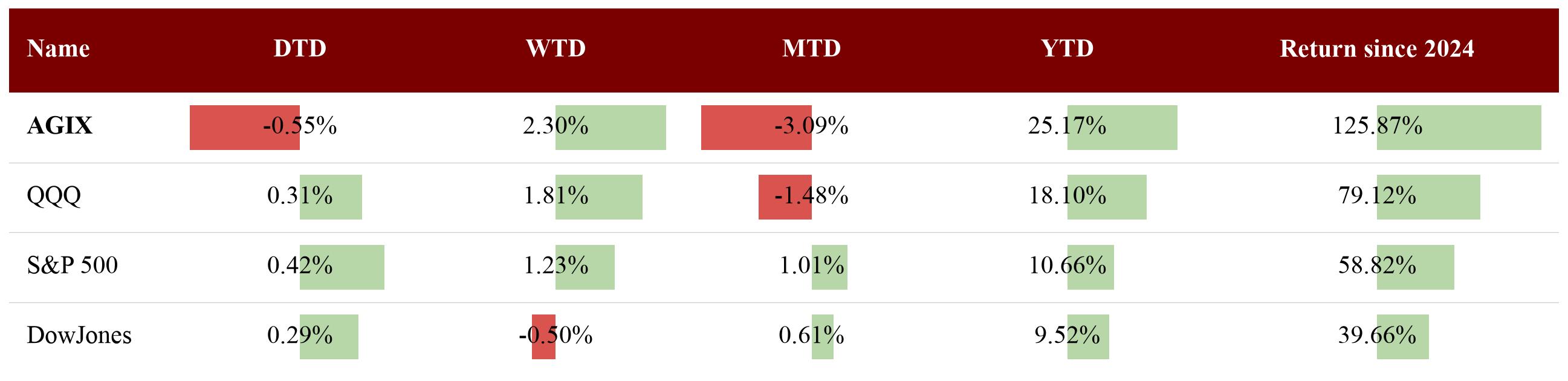
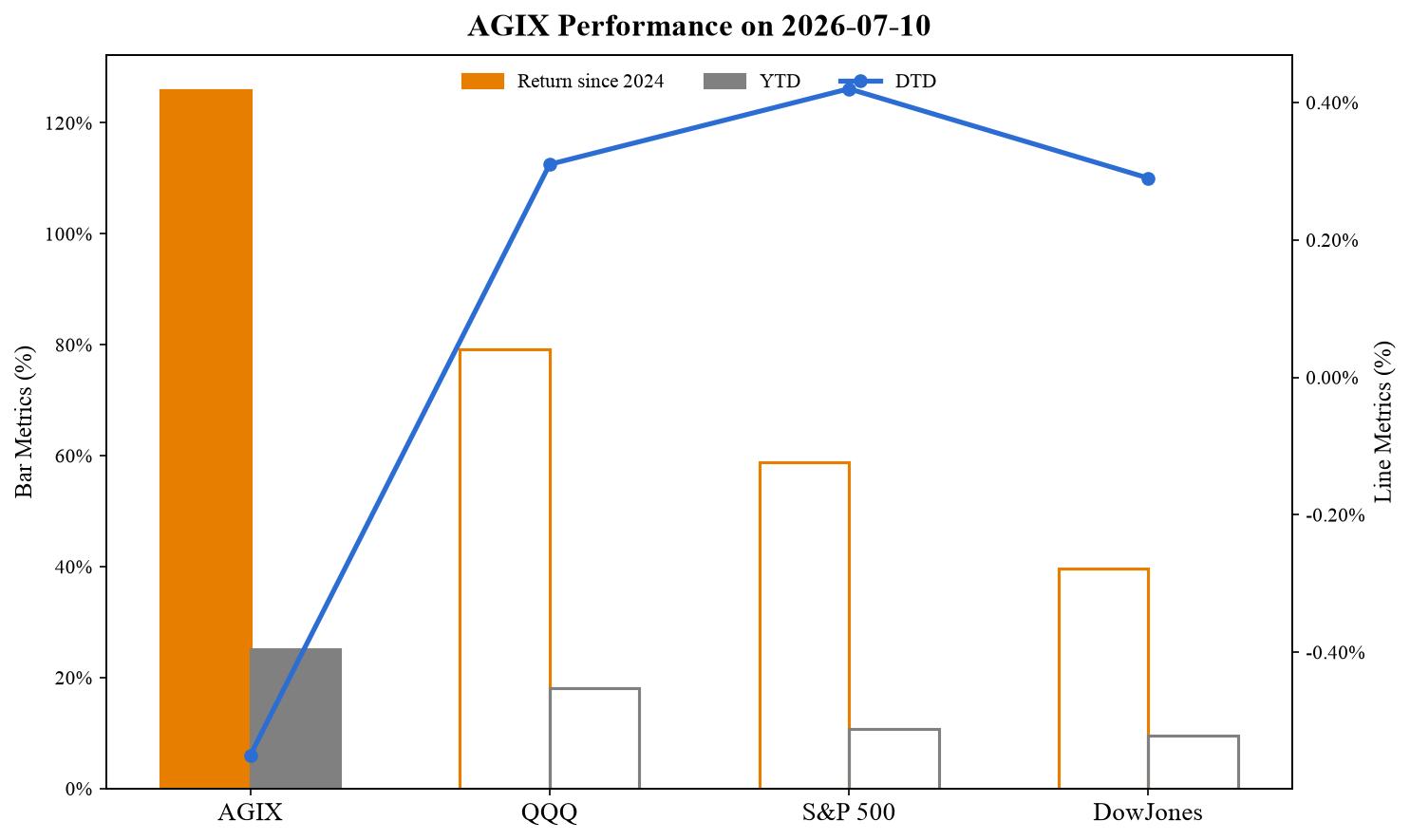
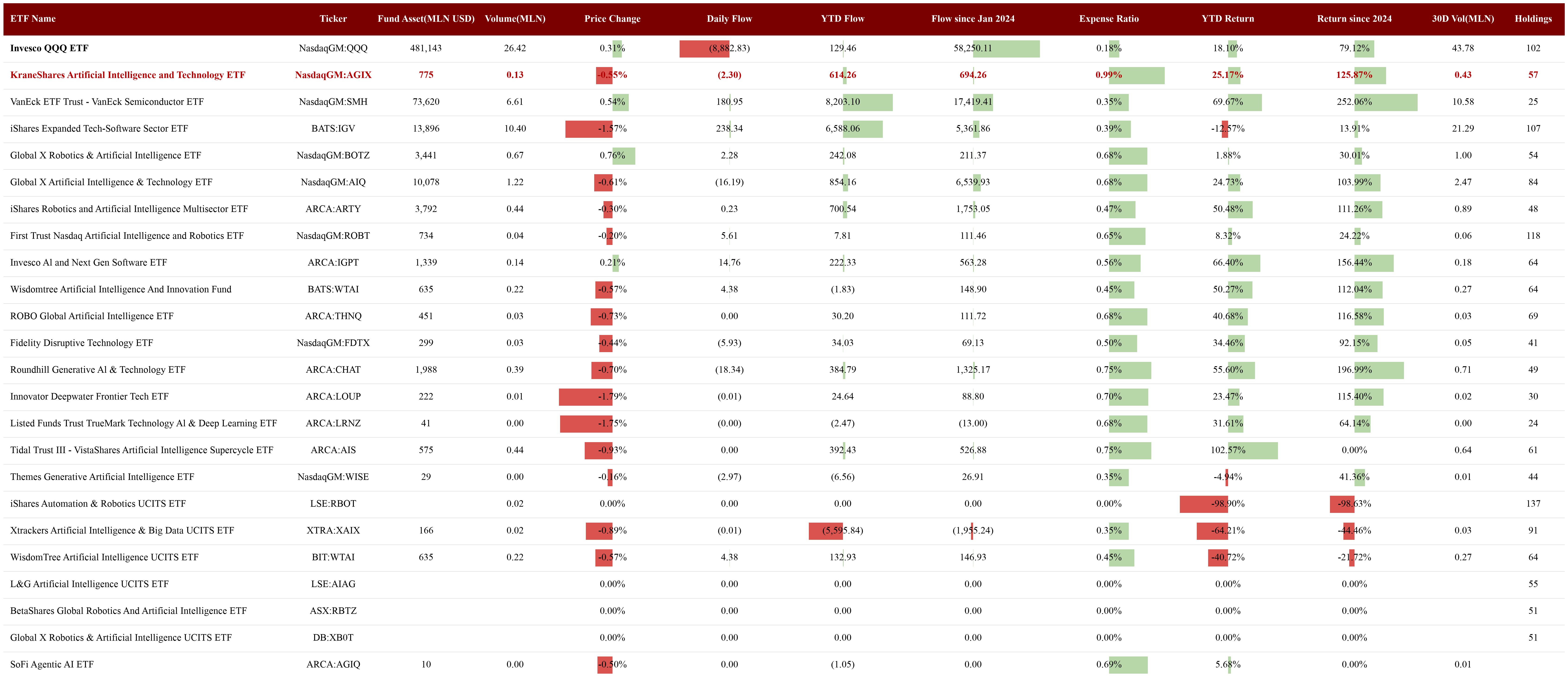
• AGIX slipped 0.55% DTD, underperforming the S&P 500 (+0.42%) and QQQ (+0.31%), but still leads YTD with a 25.17% gain vs. QQQ's 18.10%.
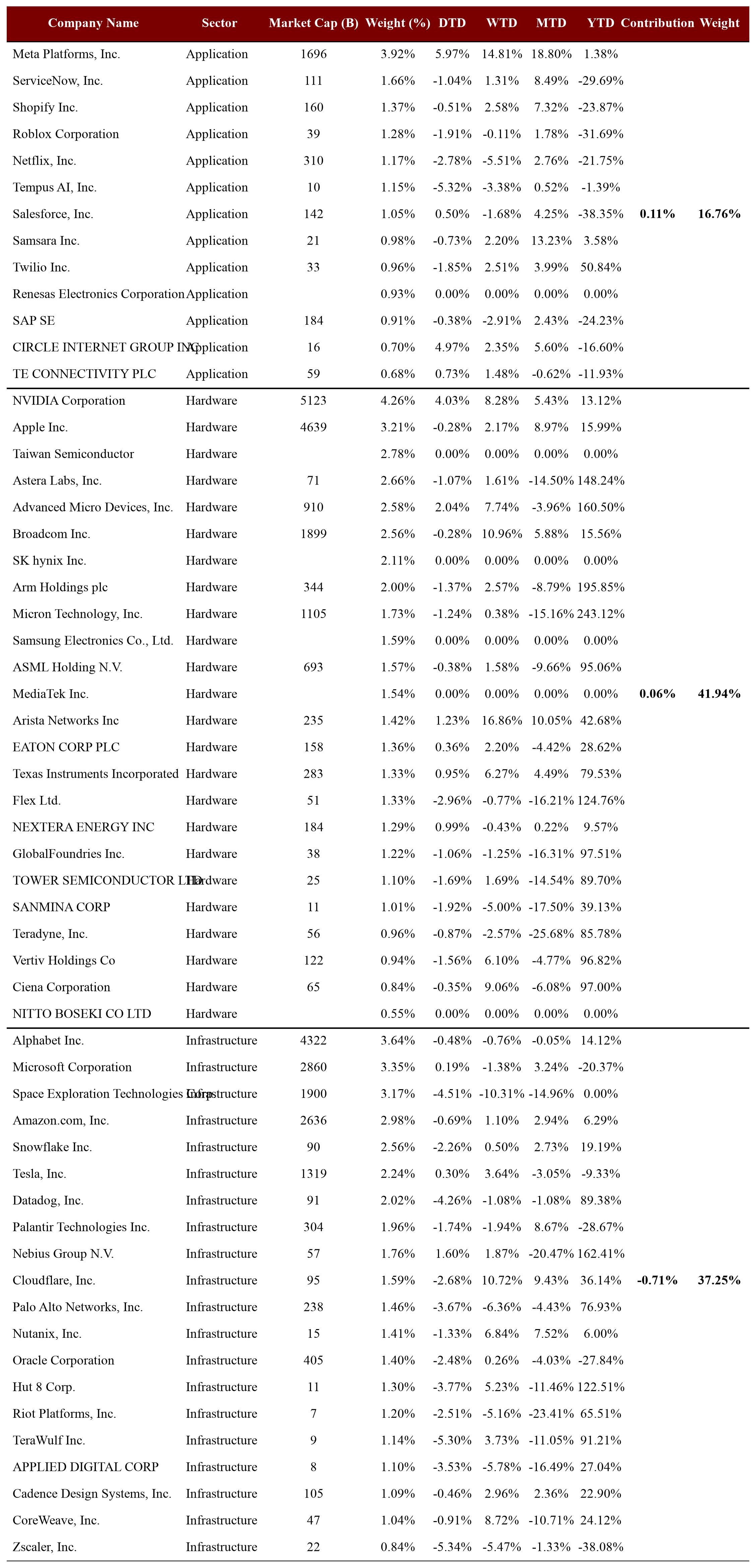
• The top contributor to AGIX's performance was Meta Platforms (+5.97%), driven by bullish AI strategy sentiment after the launch of Muse Spark 1.1 and progress on in-house AI chips.
• Among hardware holdings, NVIDIA (+4.03%) and AMD (+2.04%) were strong, while Astera Labs (-1.07%) and Micron (-1.24%) lagged.
• Key stocks to watch: Meta (AI model momentum), SK hynix (record US IPO), and VAST Data (exabyte-scale AI storage).
News Highlights
1. OpenAI's GPT-5.6 launch (Sol/Terra/Luna) and ChatGPT Work agent tool directly challenge Anthropic; the Sol variant scored 80 on coding benchmarks, likely boosting sentiment for AGIX holdings like Microsoft and Nvidia that benefit from enterprise AI adoption.
2. SK hynix raised $26.5B in the second-largest US IPO ever, with ADRs surging ~14% on debut; as Nvidia's HBM supplier, this underscores strong AI memory demand and benefits AGIX's hardware exposure (Nvidia, Micron).
3. Apple sues OpenAI for alleged trade secret theft involving former hardware executives; while this may raise legal overhang, the direct impact on AGIX holdings appears limited as Apple is not a top holding.
4. Meta launched Muse Spark 1.1 with a 1M-token context window and multi-agent capabilities, reinforcing its AI leadership and supporting AGIX's largest holding (Meta, 3.92% of portfolio).
5. VAST Data raised its valuation to $30B and built a single exabyte-scale AI storage cluster for 300k GPUs, highlighting infrastructure scaling that benefits AGIX holdings like Nvidia and CoreWeave.
RSS Highlights
1. OpenAI's new 'super' ChatGPT desktop app and ChatGPT Work feature are rolling out, with Benedict Evans calling it 'chaotic' and reflecting internal disorganization.
2. Sam Altman and Elon Musk argued publicly on social media over who is running the 'bigger scam,' drawing attention to AI industry tensions.
3. A deep dive into Gary Kildall's death investigation reveals the computer pioneer's passing was less mysterious than commonly believed.
4. The Gilbreath conjecture may see progress: Terence Tao and collaborators published a random model to simulate prime-number calculations, offering a heuristic but not yet a rigorous proof.
5. Apple's lawsuit against OpenAI over trade secret theft was widely covered, with 9to5Mac noting the involvement of former hardware VP Tang Tan.
Performance & Benchmark
Attribution
Contribution of the three sectors within AGIX holdings today
Application: 0.11%
Hardware: 0.06%
Infrastructure: -0.71%
Top-performing stocks in AGIX holdings today
Meta Platforms, Inc. (5.97%)
CIRCLE INTERNET GROUP INC (4.97%)
NVIDIA Corporation (4.03%)
Advanced Micro Devices, Inc. (2.04%)
Worst-performing stocks in AGIX holdings today
Snowflake Inc. (-2.26%)
Oracle Corporation (-2.48%)
Riot Platforms, Inc. (-2.51%)
Cloudflare, Inc. (-2.68%)
Netflix, Inc. (-2.78%)
Flex Ltd. (-2.96%)
APPLIED DIGITAL CORP (-3.53%)
Palo Alto Networks, Inc. (-3.67%)
Hut 8 Corp. (-3.77%)
Datadog, Inc. (-4.26%)
Space Exploration Technologies Corp. (-4.51%)
TeraWulf Inc. (-5.3%)
Tempus AI, Inc. (-5.32%)
Zscaler, Inc. (-5.34%)
Top five listed stocks contributing the most within AGIX holdings today
Space Exploration Technologies Corp. (-4.51%)
Datadog, Inc. (-4.26%)
Tempus AI, Inc. (-5.32%)
TeraWulf Inc. (-5.3%)
Snowflake Inc. (-2.26%)
Observation
The strongest movers across peer ETF holdings today are listed below:
| DTD | Stock Ticker | Name | Held by ETFs | analysis |
|---|---|---|---|---|
| 8.34 | CBRS | Cerebras Systems Inc | ['ARCA:CHAT'] | CBRS rose 8.34% on July 10, 2026, most likely because investors reacted to reports that Cerebras expanded its Flex AI production deal, which was framed as a roughly 7x boost to CS-3 output through 2026. That same-day move also appears consistent with broader bullish AI-chip sentiment and continued optimism around Cerebras’ scaling plans, including European AI infrastructure and OpenAI-related demand. [1][2][7] |
| 6.18 | 402340.KS | SK Square Co Ltd | ['BATS:WTAI', 'BIT:WTAI'] | SK Square’s 6.18% gain on July 10, 2026 was primarily driven by a sharp re-rating of the value of its semiconductor holdings following SK Hynix’s record-setting U.S. ADR debut and strong first-day performance. As SK Square is a holding company with major exposure to SK Hynix and other semiconductor/ICT assets, the nearly 21% indicated post-listing jump in SK Hynix’s ADRs and the $26.5 billion raised in the offering substantially expanded the implied value of SK Square’s stakes, prompting investors to bid up the shares. A secondary driver is momentum and rerating in SK Square itself, which has already posted very large gains over the past year as markets increasingly price it as a leveraged play on SK Hynix and the AI memory cycle. |
| 6.1 | 009150.KS | Samsung Electro-Mechanics Co Ltd | ['ARCA:AIS'] | Samsung Electro-Mechanics’ 6.1% gain on July 10, 2026 appears primarily driven by continued momentum as a leading beneficiary of surging AI server MLCC demand, reinforcing its status as a structural growth story in Korea’s hardware sector.[2][3] The move occurred on very high trading volume (875k shares vs typical levels), suggesting strong institutional participation following earlier research commentary that highlighted long-term contracts and tight MLCC supply for AI applications.[2][5] A broadly positive analyst backdrop, with a heavy skew toward Buy ratings and substantial upside to consensus target prices, likely amplified incremental buying interest on the day.[3] |
| 5.97 | NasdaqGS:META | Meta Platforms, Inc. | ['NasdaqGM:AGIX', 'LSE:AIAG', 'ARCA:CHAT', 'ARCA:IGPT', 'NasdaqGM:AIQ', 'NasdaqGM:FDTX', 'NasdaqGM:QQQ', 'NasdaqGM:ROBT', 'XTRA:XAIX'] | Meta’s 5.97% gain on July 10, 2026 was driven primarily by growing investor optimism around its AI strategy and infrastructure roadmap. CNBC highlighted that Meta had its best week in over two years, up about 15% for the week, as the market reacted positively to new AI model launches (Muse Image and Muse Spark 1.1) and reports of progress on its in-house “Iris” AI chips and data center expansion plans.[2] A supportive broader AI-driven tech backdrop and rate-cut expectations further reinforced bullish sentiment toward large-cap technology, amplifying the move.[1] |
| 5.77 | NasdaqGM:PRCT | PROCEPT BioRobotics Corporation | ['ASX:RBTZ', 'DB:XB0T', 'NasdaqGM:BOTZ'] | PROCEPT BioRobotics’ 5.77% gain on July 10, 2026 appears primarily driven by investors reassessing the stock’s risk/reward after a sharp year-to-date decline, supported by solid underlying fundamentals and favorable long-term analyst views. Same-day commentary highlighted that shares rose intraday to $20.91 on light volume, with the move occurring against a backdrop of 20% year-over-year Q1 revenue growth, expanding gross margins, and management’s reaffirmed 2026 revenue and procedure growth outlook.[1][5] A secondary driver was supportive sell-side and aggregator sentiment: despite recent downgrades, the name still carries a consensus Hold-to-Buy posture and a mid‑$30s to ~$37 price target range, which frames the stock as oversold and may have encouraged bargain hunting after prior weakness.[1][3] |
News
Funding & M&A
Fidji Simo steps down from OpenAI’s number two role.
OpenAI's Chief Application Officer Fidji Simo will transition from a full-time to a part-time advisory role due to health reasons. Simo joined OpenAI in May 2025, responsible for the applications business and reporting directly to Sam Altman, and had single-handedly centralized business and product operations. Previously, she served as CEO of Instacart and led the company's IPO in 2023; she also oversaw the Facebook app at Meta for over 10 years. Her departure from full-time work comes as the company prepares for an IPO and accelerates its enterprise expansion, forcing Altman to quickly find a replacement. This also reflects the real pressure OpenAI faces from slowing consumer growth and falling behind Anthropic in code tools.
Shares of memory chip giant SK hynix rise after it secures $26.5 billion in a blockbuster US listing.
South Korean memory chip manufacturer SK hynix officially listed its ADR on the U.S. stock exchange on Friday, with an opening price of $149. The stock rose nearly 14% to $170 after the open, closing at $168.01, raising a total of $26.5 billion. This transaction became the second-largest share sale in history, second only to SpaceX. As the world's leading supplier of high-bandwidth memory (HBM), SK hynix leveraged U.S. investor enthusiasm for AI-related stocks to enhance its visibility in the American market. The proceeds will be used to build new chip factories and purchase advanced equipment, as well as help narrow the valuation gap with its U.S. rival Micron Technology. Together with Samsung Electronics and Micron Technology, the company underpins the global memory market, and its HBM products have become a core component of Nvidia's AI accelerators. Analysts noted that this listing reflects sustained U.S. investor interest in the AI supply chain.
Apple sues OpenAI and former employees over alleged intellectual property theft.
Apple Inc. recently filed a lawsuit in the U.S. District Court for the Northern District of California, accusing OpenAI of systematically stealing its consumer electronics-related intellectual property after acquiring io Products, a company founded by a former Apple executive. The lawsuit alleges that OpenAI recruited former Apple employees and required them to bring device blueprints, prototypes, and engineering methods, naming hardware head Tang Tan and former engineer Chang Liu as co-defendants. Apple also claims that OpenAI used internal documents retained by former employees and unreturned work laptops to download confidential files. Apple is seeking damages and a court order to prohibit OpenAI from using its trade secrets. This case comes against the backdrop of an existing Siri and ChatGPT integration partnership between the two companies, indicating that hardware competition will impact technological collaboration. OpenAI responded that it has no intention of using others' trade secrets and will continue to focus on technological innovation.
What is sovereign AI — and why it will decide the winners and losers of the AI race
The definition of sovereign AI is being redefined. Open-source architecture has shifted from an option to a strategic core, because data localization alone cannot solve vendor lock-in or geopolitical risks. The U.S. Stargate project plans to invest $500 billion to control the global AI supply chain; DeepSeek has demonstrated that frontier models can be successfully trained on restricted chips. Europe, through the European Digital Sovereignty Declaration, is raising €120 billion and supporting Mistral in deploying 13,800 Nvidia GB300 GPUs in France. Saudi Arabia's HUMAIN is building a full-stack AI initiative, collaborating with AMD to develop 500 MW of computing capacity. Surveys show that 61% of CIOs in Western Europe are shifting to local clouds due to geopolitical factors, and there are over 130 sovereign AI projects globally. Open source is no longer a preference but the only architectural choice to prevent dependency crises.
Apple sues OpenAI over alleged trade secret theft
Apple filed a lawsuit on Friday in the U.S. District Court for the Northern District of California against OpenAI and its executives, including hardware chief Tang Tan, alleging systematic theft of its trade secrets. The lawsuit claims that Tang Tan used Apple project code names during recruitment, required candidates to bring hardware components to interviews, and instructed departing employees to smuggle security programs. Tang Tan, who previously worked at Apple for 24 years, recently served as Vice President of iPhone and Watch Product Design. Apple also accuses former senior systems electrical engineer Chang Liu of failing to return company laptops after leaving and downloading a large number of confidential documents. Apple believes OpenAI is using this information to develop its first hardware product, which may directly compete with the iPhone. Apple is asking the court to prohibit OpenAI from using or disclosing its trade secrets and to return the relevant materials.
Mercor buys Deeptune to build training environments for AI agents.
AI training data company Mercor.io Corp. has announced the acquisition of Deeptune Inc., which specializes in building simulated software environments for training AI agents. The deal comes about four months after Mercor CEO Brendan Foody made a personal angel investment in Deeptune. Deeptune's "training gym" replicates hundreds of enterprise applications and provides reinforcement learning environments for frontier labs. Foody stated that the bottleneck in model training has shifted to environment construction itself. Mercor is pushing for a funding round with a target valuation of $20 billion, with annualized revenue exceeding $2 billion. Mercor previously suffered an attack via malware in the LiteLLM open-source library, but it did not affect its partnerships with frontier clients. The Deeptune team will join Mercor's New York office.
AI model mania and the new chip gold rush
The global AI model race accelerated again this week. OpenAI, Meta, Anthropic, SpaceXAI, and other organizations launched new models or services, with Meta even claiming it will significantly lower prices to capture the enterprise market. Microsoft is considering replacing OpenAI and Anthropic products with its own models on some platforms to save costs. Palantir CEO Alex Karp criticized frontier labs for attempting to control enterprise data, sparking debate over who can capture value. Investor concerns about an AI bubble have intensified, with Nvidia's market cap falling by over $1 trillion in a year. Meanwhile, SK hynix, Samsung, Broadcom, and other memory and chip companies have secured massive funding or orders due to surging AI demand. Several AI startups are raising funds through financing rounds or IPOs. Experts warn that whoever controls the data, models, and enterprise processes will determine the future distribution of AI value.
Web data scraping infrastructure startup Oxylabs reels in $130M in its first funding round
Lithuanian data extraction startup Oxylabs UAB recently completed a $130 million funding round led by Warburg Pincus LLC, achieving a valuation of $3.6 billion and becoming a unicorn. The company provides large-scale web data collection infrastructure for AI model developers, with a proxy pool of over 175 million ethical consumer IPs capable of processing billions of requests daily. The funding will be used to expand its global network and develop next-generation extraction tools. The company currently has $3.6 billion in annual recurring revenue and over 350,000 customers. Although Oxylabs claims to comply with the strictest EU data regulations and is a founding member of the Ethical Web Data Collection Initiative, it remains in a legal gray area due to a copyright lawsuit from Reddit. This investment also gives Warburg Pincus stakes in two of Lithuania's largest tech companies.
SK Hynix raises $26.5 billion in the biggest foreign IPO in US history, and is urged to build new US fabs.
South Korean memory chip giant SK Hynix set a record in its U.S. initial public offering, raising $26.5 billion by issuing 177.9 million ADRs at $149 each, surpassing Alibaba's IPO scale. The stock will officially trade on the Nasdaq under the ticker SKHY on July 13, opening over 14% higher. The proceeds will be used to build new factories and packaging plants in South Korea and purchase EUV lithography machines to alleviate the HBM memory shortage driven by AI. The U.S. Secretary of Commerce is pushing Samsung and SK Hynix to build new plants in the U.S., while Micron has pledged $25 billion in investment. Leveraging its position as an Nvidia HBM supplier, SK Hynix has successfully overcome the Korean stock discount.
Faith Tech: Pat Gelsinger steers Gloo's platform to lead faith-based organizations into the age of AI.
Former Intel and VMware CEO Pat Gelsinger has taken on the role of Executive Chairman and Head of Technology at Gloo, a tech company, after retiring. Gloo primarily provides AI platforms, data management, and donation collection tools for churches and non-profit organizations. The company's revenue in the previous quarter grew 238% year-over-year, and it raised its 2026 revenue guidance to $2.095 billion. Under Gelsinger's leadership, Gloo has completed multiple acquisitions, including Masterworks and Igniter, and improved the accuracy of precise Bible verse citations to 100%. To support the digital transformation of faith-based organizations, Gloo will launch a public offering of 7 million shares of Class A common stock. Market analysis shows that the U.S. faith ecosystem generates over $400 billion in annual donations. Gloo is optimizing its technology stack through AI guardrails and acquisition strategies, aiming to approach breakeven in the third quarter and achieve profitability in the fourth quarter.
Memory chip giant SK hynix bags $26.5 billion in a blockbuster US listing.
South Korean memory chip maker SK hynix Inc. priced its American depositary shares at $149 each, raising approximately $26.5 billion, and will list on the Nasdaq exchange on Friday. The company is the world's leading supplier of high-bandwidth memory (HBM) chips, which are critical for generative AI servers. This listing becomes the second-largest stock offering in history, trailing only SpaceX. The proceeds will be used to build new chip factories and purchase equipment, as well as to help narrow the valuation gap with rival Micron. The three major HBM producers—SK hynix, Micron, and Samsung Electronics—together support the global memory market, and Nvidia CEO Jensen Huang recently reaffirmed that SK hynix is its largest partner. This listing reflects the market's enthusiasm and capital support for AI-related technologies.
An AI agent startup just let its agent run its $100 million fundraise.
Lyzr, an AI startup in West Philadelphia founded three years ago, completed its own funding round using its proprietary AI agent system, SivaClaw. The system provided Q&A services for over 130 investors, drafted investment memos, and tracked time spent on pitch pages, ultimately helping the company secure a $100 million Series B round at a $100 million valuation. The round generated $400 million in interest from Stone River Valley, the Middle East, and the financial sector. This case demonstrates how, amid the AI boom, startups can significantly reduce fundraising costs through automation tools. During the fundraising process, the founder did not need to travel to Sand Hill Road for traditional roadshows. The case also reflects the current market's intense capital chase for AI technology projects.
Autonomous ship startup Kraken raises $175 million at a $1 billion valuation.
British defense technology startup Kraken Technology Group Ltd. recently completed a $175 million Series B funding round, reaching a valuation of $1 billion. The round was led by private equity firm DTCP, with participation from the British Business Bank, the NATO Innovation Fund, and others. Kraken primarily manufactures unmanned autonomous vessels, with core products including the 36-foot K5 Kraken, the 18-foot K4 Manta, and the air-deployable K3 Scout. The funding will be used to accelerate global deployment and strengthen business cooperation with NATO and its partners in the maritime domain. Kraken has previously partnered with Anduril Industries to produce the K5 and a new K7 vessel in the U.S. Founder and CEO Mal Crease stated that this round will drive rapid capacity expansion, providing defense customers with more reliable autonomous systems.
Model Releases
OpenAI launches its new family of models with GPT-5.6.
OpenAI launched a new GPT-5.6 model series on Thursday, including three versions: Sol, Terra, and Luna, targeting enterprise, coding, and research scenarios. CEO Sam Altman stated that Sol achieves higher efficiency on coding tasks with 54% fewer tokens and claims it is the strongest cybersecurity model to date, supporting threat modeling, code review, and patching for defense. At the same time, it rolled out the ChatGPT Work tool, supporting enterprise office tasks on desktop, web, and mobile. On the Artificial Analysis Coding Agent Index, Sol scored 80 points, surpassing Anthropic's Fable 5 by about 2.8 points, and holds an advantage with lower cost and fewer tokens. This release primarily competes with Anthropic and will also be compared with new models from Meta and SpaceXAI.
Fidji Simo steps down from OpenAI’s No. 2 role
OpenAI's Chief Application Officer Fidji Simo is transitioning from full-time to part-time advisory role due to health reasons. She joined the company in May 2025 and was responsible for consumer business. Simo's departure comes as the company prepares for an IPO and as growth in ChatGPT, which she oversaw, has slowed. On the same day, OpenAI released the new GPT-5.6 model family and ChatGPT Work agents, directly targeting competitor Anthropic. To alleviate talent retention pressure, OpenAI has shortened employee equity vesting to no waiting period and increased its 2025 equity compensation budget to $600 million. This personnel change forces Altman to urgently find a replacement.
Technical Breakthroughs
OpenAI debuts ChatGPT Work, an agentic tool for automating business workflows.
OpenAI Group PBC today launched a new 'agent' tool called ChatGPT Work, and simultaneously released the cutting-edge model GPT-5.6 globally. ChatGPT Work integrates Codex and can autonomously execute complex workflows across multiple platforms such as Slack, Microsoft Teams, Gmail, and Salesforce, generating spreadsheets, presentations, and web applications. GPT-5.6 offers three variants: Sol, Terra, and Luna, achieving a 54% token efficiency improvement over GPT-5.5 on agent decoding tasks, significantly reducing enterprise AI costs. Enterprise users can pre-authorize sensitive operations and set usage limits through ChatGPT Enterprise. The concurrently released Sites feature has entered public beta, supporting one-click conversion of work materials into interactive websites and dashboards. OpenAI CEO Sam Altman stated that this move aims to address competitive pressure from Anthropic, Google, and others, and has completed joint security reviews with the U.S. Treasury, Department of Commerce, and the National Cyber Director.
Meta launches flagship Muse Spark 1.1 model with multi-agent upgrades.
U.S. tech giant Meta Platforms Inc. has launched a new flagship large language model, Muse Spark 1.1, designed specifically for multi-agent automation workflows. The model is now available for public beta testing through Meta's AI chatbot service and the Meta Model API, allowing developers to embed it into custom software. Muse Spark 1.1 features a context window of one million tokens and employs context compression mechanisms to retain key information in multi-agent tasks. Internal tests show it can automatically generate chat applications, detect issues, and fix code in programming tasks, scoring 62.2 on the Vibe Code Bench v1.1 evaluation, far surpassing the previous generation model. Additionally, Meta plans to increase its data center capacity to 14 GW and push forward with mass production of its MTIA400 self-developed AI chip in September. The chip features a 51% increase in memory capacity and a 400% performance boost, laying the foundation for Meta's future enterprise-grade inference services.
Token per watt becomes the defining metric as storage moves to AI’s critical path.
As agentic AI drives massive demand for context memory, storage efficiency is becoming a core metric for AI data centers. Solidigm Vice President Avi Shetty pointed out that 'token per watt' has become the new standard for data center performance, and storage has shifted from a peripheral role to a key factor determining whether GPUs are fully utilized. The company's AI Central Lab small-scale simulation data center has verified linear scaling performance from single-node to multi-node configurations on hardware such as NVIDIA H100 and B200. Its 122TB D5-P5336 SSD can provide 4PB capacity in a 1U rack, reducing power consumption by 80% to 90% compared to traditional hard drives. To address extreme performance cooling issues, Solidigm also partnered with NVIDIA to launch the world's first liquid-cooled SSD. This technical approach not only reshapes the efficiency evaluation standards for AI infrastructure but also provides new density and energy consumption solutions for large-scale data center expansion.
Product Launches
OpenAI is shutting down Atlas, but its AI browser ambitions are still growing.
OpenAI's AI browser Atlas, scheduled for an October launch, has been withdrawn from the market, and its tested agentic browsing features will be integrated into the ChatGPT desktop application. This move is OpenAI's latest action after streamlining projects, in response to challenges to Chrome's dominance from both inside and outside the industry. OpenAI also released a Chrome extension, allowing users to directly invoke ChatGPT in the browser for web Q&A, content summarization, and task execution. Additionally, the browser functionality within the desktop app has been enhanced, supporting login, file downloads, and web interactions, and running a cloud browser to enable AI agents to perform tasks. These updates turn ChatGPT into a continuous workspace across Chrome, desktop, and agents.
This slushie machine was a lifesaver during New York City's heat wave.
U.S. home brand Ninja has launched the new Slushi Twist dual-jar slushie machine, responding to the U.S. summer heat market's demand for multi-flavor frozen drinks. The machine features two 48-ounce independent mixing jars, allowing users to make two different frozen drinks simultaneously, supporting modes such as slushies, smoothies, frozen coffee, and granitas. Its exclusive Dual SlushAssist intelligent freeze adjustment technology automatically adjusts the freezing temperature based on the characteristics of the ingredients, ensuring the right texture for different frozen drinks. It also supports a dual-flavor swirl dispensing function, making it easy for users to create layered beverages. Priced at $399.99, the product is suitable for large families and those who enjoy entertaining guests, but its large size and higher price may require consideration for users who only occasionally make frozen drinks.
Dumb Co dared me to trade my iPhone for a hacked flip phone.
Dumb Co, a company that repurposes low-end TCL flip phones into smart devices, supports common apps like WhatsApp, Spotify, and Uber while maintaining a low-screen-time design. The company grew out of a monthly offline community event, and its founding CMO Lydia Peabody transitioned from being a psychotherapist to this field. The product supports voice forwarding, audio recording, and third-party iMessage access, allowing users to leave their smartphones at home and reduce screen dependency. Reviews show the device effectively reduces anxiety and promotes real-world interaction, though it has drawbacks like slow input and limited functionality. Currently funded mainly by friends and family, the company targets young people with a simplified lifestyle solution that weans them off smartphones.
OpenAI bets on families as ChatGPT goes deeper into households
As the age structure of ChatGPT users continues to shift, OpenAI is expanding from personal tools to family scenarios. The company is hiring dedicated product managers in the Ways area to build tailored experiences for families, caregivers, and the elderly. Sensor Tower data shows that the proportion of users aged 35 and above globally has risen to 31%, and the usage rate among U.S. parents has increased from 16% to 24%. Analysts believe this move marks the transition of AI products toward multi-generational shared devices, similar to the paths taken by Google, Apple, and Meta in their early days. However, AI assistants carry higher trust risks, requiring stronger content controls, age-appropriate experiences, and parental supervision. A survey by the Family Online Safety Institute shows that parents underestimate the frequency of their children's use of generative AI, with actual usage reaching 38%. OpenAI has introduced parental controls, a rational model for sensitive conversations, and an optional 'trusted contact' feature, and faces multiple lawsuits from parents. In the future, features such as family plans, child accounts, and shared memories may emerge, driving the symbiosis of AI safety and design.
Cisco brings enterprise AI infrastructure to the edge: CUBEd Award winner
Cisco Systems Inc. recently launched the Unified Edge platform, designed to address the infrastructure needs of generative AI and agentic AI workloads at the edge. The platform integrates computing, networking, and storage, supporting CPUs, GPUs, and up to 120TB of storage, with redundant power, cooling, and 25G networking, making it suitable for real-time AI inference. Using the Intersight SaaS management platform, enterprises can centrally monitor and manage thousands of edge sites, simplifying the operation and maintenance of distributed AI infrastructure. At the same time, Cisco launched the Cisco Compatible AI Solutions program, inviting third-party vendors to test, verify, and adapt their solutions on the platform, building a broader partner ecosystem. Industry observers note that this solution truly extends enterprise-grade computing power to where data is generated, potentially accelerating the large-scale deployment of AI in industrial and retail scenarios, while improving overall deployment efficiency and security.
Policy & Regulation
Meta removes controversial AI feature on Instagram after backlash
Meta canceled a controversial AI image generation feature less than a week after its launch. The feature allowed users to generate images by mentioning public Instagram accounts with @, but did not include a mechanism to notify the referenced users, leading to strong opposition from users and agencies such as CAA. Meta stated in a blog post that the feature did not meet expectations as a creative tool and has been removed from Muse Image. This incident comes amid the misuse of AI to generate nude images of celebrities on social platforms, once again sparking discussions on privacy protection and technological boundaries. Meta has not yet provided further comments on the matter.
Industry Partnerships
OpenAI says GPT 5.6 is the ‘preferred model’ for Microsoft Copilot 365 amid breakup chatter.
Bloomberg reported that Microsoft is replacing some OpenAI software with its own MAI models to reduce costs in applications like Word and Excel, raising questions about whether the partnership between the two companies is showing cracks. OpenAI announced on Thursday with the release of GPT 5.6 that it will become the 'preferred model' for Microsoft 365 Copilot, supporting productivity tools such as Word, Excel, and PowerPoint. In a blog post, OpenAI stated that the two companies will continue to advance AI technology for individuals and organizations. The announcement did not deny reports that Microsoft is increasing its use of proprietary models to cut costs, but reaffirmed the close collaboration between the two companies in the AI field.
China is catching up to Elon Musk’s reusable rockets
China Aerospace Science and Industry Corporation achieved a maritime recovery landing via the Long March launch vehicle, becoming the second country to master this technology. The rocket will eventually be reusable, potentially reducing launch costs. Compared to SpaceX's Falcon 9 in the U.S., China uses a grid capture method instead of landing legs. This move will help China's satellite communication network and hypothetical orbital data center compete with Starlink. The U.S. military is monitoring China-Russia cooperation against Starlink. Additionally, companies like Blue Origin, Rocket Lab, and Stoke Space are also advancing reusable rocket projects, intensifying global competition in reusable rocket technology.
After Apple, India’s smartphone manufacturing boom enters new phase with Vivo JV
The Indian government has recently approved a joint venture between Chinese brand Vivo and local electronics manufacturer Dixon Technologies, which will push smartphone production in India into a new phase. The joint venture, with Dixon holding a 51% stake and Vivo holding 49%, will acquire some of Vivo's production assets in India and manufacture electronics for Vivo and other brands. This move comes amid stricter scrutiny of Chinese investments in India. Apple has turned India into a global smartphone production hub, with its suppliers Foxconn and Tata handling manufacturing. Chinese brands like Oppo and Xiaomi are also seeking similar partnerships to address policy and tax issues. Analysts believe this model could serve as an industry template and help boost India's electronics manufacturing capabilities.
Canva targets enterprise creativity with trusted AI creative workflows
At the RAISE Summit, Canva's EMEA Managing Director Duncan Clark spoke with theCUBE about how generative AI is being integrated into trusted creative workflows. Canva addresses enterprise concerns about security, compliance, and liability related to generative AI through proprietary editing, collaboration, and IP indemnification mechanisms. Its Affinity design suite integrates Claude models to automate repetitive tasks like layer naming, freeing designers from tedious work to focus on strategy, taste, and craftsmanship. Canva emphasizes that truly valuable AI should be embedded in familiar, editable environments rather than simply pursuing speed. This development reflects a dual transformation in product deployment and enterprise trust.
Hugging Face’s CEO on why companies are done renting their AI
Open-source AI is rapidly emerging. Hugging Face CEO Clem Delangue noted on the TechCrunch Equity podcast that the platform has become the 'GitHub' of the AI field, facilitating the sharing and downloading of open-source models and datasets, and is adopted by nearly half of Fortune 500 companies. Delangue observed that companies initially rely on cutting-edge APIs, but as they scale, cost pressures drive them toward open-source models. This discussion ties into Anthropic's suspension of the Fable release, highlighting the importance of competition between open-source and closed-source for the industry ecosystem. Delangue worries that a few large tech companies could control AI technology, emphasizing the critical role of the open-source ecosystem. This series of programs also promotes collaboration and knowledge dissemination in the open-source AI field.
融资收购
Pulling out the AI stops at RAISE Summit Paris
The RAISE Summit held in Paris this week has driven AI investment enthusiasm to a peak. Data centers and 'new cloud' companies are rapidly investing billions of euros to build AI-specific infrastructure, with GPU constraints, data storage, and management tools becoming major bottlenecks. Multiple vendors such as Clockwork Systems, SambaNova, Hammerspace, Comet ML, Backblaze, and Rafay Systems have fully pivoted to AI. SambaNova just completed $1.1 billion in funding, and Backblaze signed a multi-million-dollar order with CoreWeave. Meanwhile, companies are balancing innovation and risk driven by FOMO. Analysts warn that the current enthusiasm closely resembles the dot-com bubble era, and an AI bubble is only a matter of time. Before the bubble bursts, data center construction and technology transformation will remain investment themes.
Open-source AI model developer MiniMax raises $2B in funding
Shanghai-based AI developer MiniMax Group Inc. is raising $2 billion in funding, with more than half coming from new share sales and the remainder through the issuance of convertible bonds. The company plans to subsequently issue $6.5 billion in zero-coupon convertible bonds maturing in 2027, convertible into 19.4 million shares. Following the announcement, the stock price fell 9.8% on the day. MiniMax listed in Hong Kong earlier this year, raising approximately $619 million in its initial public offering. Its latest model, MiniMax-M3, has 427 billion parameters, supports 1 million token prompts, and leverages MiniMax Sparse Attention technology to significantly improve inference speed. Additionally, MiniMax has launched the VTL series of visual tokenizers and generates revenue through its cloud platform and multimedia generation applications. CEO Yan Junjie announced that he will forgo his salary until AGI is achieved and has donated 5% of his shares for employee incentives and open-source projects.
Market data platform startup Databento closes a $97 million round after drawing $300 million in investor demand.
Market data platform startup Databento Inc. recently announced the completion of a new $97 million funding round. The round was led by New Enterprise Associates Inc., with participation from DRW Venture Capital, Redpoint Ventures, and Tribe Capital. Founded in 2019, the company provides real-time and historical data services for futures, options, and equities, and connects directly to exchanges through its own data centers. The funding will be used to expand asset class coverage, enhance international presence, and increase storage capacity by over 100PB. Founder Christina Qi previously led high-frequency trading firm Domeyard LP. The company's recent revenue grew 6.65 times year-over-year, with an enterprise customer retention rate of 97%, and it is profitable with 25 employees. This round brings the company's total funding to $127 million.
VAST Data targets KV cache storage and Neo Clouds as AI infrastructure enters the exabyte era.
Investment in AI infrastructure continues to expand, driving cache storage to become a key data layer for AI factory operations. VAST Data completed its Series F funding round at a valuation of $30 billion, more than tripling in value over three years, with NVIDIA participating as an investor. This funding round reflects VAST's architectural advantages and revenue growth in unified AI data platforms. Its platform is being optimized for KV cache storage and disaggregated inference workloads, and it has signed a $117 million commercial agreement with CoreWeave. VAST recently built a single-system exabyte-scale AI storage cluster supporting 300,000 GPUs, surpassing the scale of public cloud providers. Meanwhile, the company is promoting the "Neo Clouds" model, offering data services such as vector databases and event middleware for AI service providers, helping customers achieve high gross margins. This funding round will accelerate VAST's leadership in the AI infrastructure market.
VAST Data targets KV cache storage and neoclouds as AI infrastructure enters the exabyte era
To address the continuous expansion of global AI infrastructure investment and the increase in inference workloads, cache storage is becoming a key data layer for AI factory operations. VAST Data raised its valuation to $30 billion through Series F funding, more than tripling its 2023 valuation, with Nvidia as one of its investors. This funding round reflects market recognition of VAST's leadership in unified AI data platform architecture. Its largest customer, CoreWeave, signed a $1.17 billion commercial agreement with it and built a single 1EB storage cluster for 300,000 GPUs, a scale surpassing public cloud providers. VAST is promoting KV cache storage and new cloud service models to provide a high-concurrency, high-performance data platform for disaggregated inference.
RSS Subscription
The Tadpole galaxy:
This image shows a galaxy with a prominent tidal tail, with a total exposure time of 3 hours, where 165 images of 30 seconds each were stacked. Despite some cloud interference, the image quality is acceptable.
Panel meter calculator with floating point
This article introduces a floating-point calculator based on the 8-bit AVR128DA28 microcontroller, using six panel voltmeters and a vintage voltmeter as display components, with a case made of thin maple wood and a 4×4 grid keyboard layout. The calculator implements fixed-point arithmetic to avoid floating-point precision issues, and has functions for handling fractions, negative numbers, and error conditions.
Posterior variance
Recently I wrote an article exploring whether additional data always reduces posterior variance, and the answer is no. For different Bayesian models, the posterior mean is a weighted average of the prior mean and the new data mean, with weights determined by precision. Taking the Poisson-Gamma model as an example, after observing k events, the posterior variance is (α0 + k) / (β0 + t)², indicating that the posterior variance increases each time an event is observed, and decreases quadratically between observations.
Posterior mean
Common sense suggests that after seeing new data, beliefs should strike a compromise between prior beliefs and the new data. Bayesian data models provide a quantitative and objective framework for updating beliefs, where the posterior mean is a weighted average of the prior mean and the new data mean, with weights determined by precision. Through examples of the normal-normal model, beta-binomial model, and gamma-Poisson model, it can be seen that precision has different meanings in different models, but they all belong to the conjugate models of the 'exponential family' distribution.
Another Ridiculous Interrail Holiday - 6,379 Km and 13 Countries over 7 weeks
Last year, my wife and I took a month-long, 5,025 km Interrail trip visiting 10 countries. This year, we chose a 15-day travel package over two months and purchased first-class tickets. The entire journey included two ferry crossings, totaling about 40 hours on trains, traveling through cities from London to Brussels, Hamburg, Copenhagen, Oslo, Stockholm, Helsinki, and more. Although we encountered a few hiccups, the overall experience was enjoyable.
Making cooled clothing:
As summer temperatures rise, the demand for cooling clothing is increasing. Research shows that a mixture containing sodium sulfate hydrate can absorb heat at around 18°C, making it suitable for personal cooling and easy to carry. This material can be prepared through a simple heating and mixing process and does not require electricity to cool in the shade, offering a safe and economical cooling solution.
Progress on Gilbreath’s conjecture
The Gilbreath conjecture is a simple but peculiar mathematical conjecture. Paul Erdős once speculated that it might be true but could take 200 years to prove. Recently, Terence Tao and two collaborators published a paper introducing a random model designed to simulate Gilbreath's calculations on prime numbers. Although this model is more complex than Gilbreath's original method, it is easier to analyze with existing techniques. Tao's article provides a heuristic explanation for the plausibility of the Gilbreath conjecture but notes that current technology cannot yet make these heuristics rigorous.
Reading List 07/11/26
This week's reading list covers several topics, including that nearly 49% of U.S. adults under 30 live with their parents, and that Samsung's chip division's profits in 2026 will exceed the total of the past 40 years. Additionally, New York City added 38,682 apartments in 2022, the highest number since 1965, but still insufficient.
Good news about digital autonomy
Recent discussions on digital sovereignty have drawn widespread attention. Multiple Dutch regulatory agencies jointly released a report emphasizing the need to reduce dependence on a few IT service providers to ensure the continuity of digital services. The report makes specific recommendations, including not relying on suppliers from outside the EU or EER and imposing restrictions on the use of public clouds. Furthermore, the Dutch tax authority has decided to stop outsourcing email and VAT software to the United States, instead strengthening its own development and infrastructure capabilities, marking a positive shift toward digital sovereignty.
Pluralistic: Workplace "flexibility" isn't (11 Jul 2026)
"Flexibility" does not exist in the workplace; so-called "flexibility" actually shifts risks onto workers. Take Uber as an example: although the company claims to offer flexible work options, it effectively transfers almost all operational risks to drivers by controlling passenger demand and pricing. According to research by former U.S. Department of Labor official David Weil, the business models of Uber and Lyft expose workers to greater uncertainty while the companies profit from this arrangement.
In defense of not understanding your codebase
In software engineering, the depth of understanding a codebase varies with team size and personnel turnover. Teams with small codebases often believe they must fully understand the code, while teams with large codebases consider partial understanding sufficient. In practice, partial understanding is the norm in large systems, and reconstructing a complete theory is often impractical; engineers need to work effectively based on imperfect understanding.
Prefer STRICT tables in SQLite
In SQLite, STRICT tables improve data accuracy by enforcing data types, preventing errors such as inserting text into numeric columns. Creating a strict table only requires adding STRICT at the end of the definition, and invalid data types are not allowed. Although strict tables aid data validation, existing tables cannot be directly converted to strict tables; data migration is required. SQLite has supported strict tables since version 3.37.0.
Building intuition about LLM parameter counts
When building the GPT-2 model, the authors found that even a simplified version had 77 million parameters, while the final LLM had only 163 million parameters, with input and output components accounting for nearly half. OpenAI released GPT 5.6 today, and the authors used its "Sol" variant to create a visualization tool showing the distribution of parameters across embeddings, attention, feed-forward networks, and output heads in different GPT-2 models.
Premium: The Hater's Guide To The Memory Crisis
I will be on vacation next week, marking only the second absence since I started this newsletter in June 2025. Due to surging AI demand, consumer electronics prices have generally risen, and companies like NVIDIA have significantly increased spending on high-bandwidth memory (HBM) and low-power memory (LPDDR5X), driving up overall costs. Data center memory costs are expected to reach approximately $1.894 billion. Additionally, Samsung, SK Hynix, and Micron control over 90% of the global memory market and face lawsuits over price manipulation.
Adam Brown – A deep but accessible introduction to general relativity
Adam Brown returns to discuss Einstein's general theory of relativity, emphasizing its core idea: the mass that resists acceleration is exactly the same as the mass that responds to gravity. He also explains the properties of black holes and their limitations on energy extraction, and discusses the potential of artificial intelligence in rediscovering general relativity.
The case of the mysterious changes to integers when there shouldn’t have been any code generation effect
A colleague modified the code. It was originally expected not to affect the generated binary, but four functions were found to have changed, three of which were in the same source file, and the fourth was in an unmodified file. Analysis revealed that the changes were merely line number adjustments caused by deleting an unnecessary header file, and did not affect functionality. The change in the fourth function was due to link-time code generation inlining a call, causing line number changes to affect the unmodified file.
Game Review: Lovers In A Dangerous Spacetime ★★★☆☆
My New Year's resolution is to play more cooperative video games with my wife, especially "Lovers In A Dangerous Spacetime." This game is fun and moderately short, requiring players to jointly control a spaceship for shooting and rescue missions. Although the game has limited variety and is best for four players, the overall experience is still enjoyable, and it costs about five dollars.
Gary Kildall’s death investigation
Regarding the investigation into Gary Kildall's cause of death, although early reports were vague and full of rumors, the event of his death on July 11, 1994, was not as mysterious as the public imagined. Kildall was a distinguished computer pioneer whose company developed the operating system needed for early personal computers, yet there was almost no media attention at the time of his death. The investigation showed that he was injured at a bar on July 6, 1994, and died after several days of hospital treatment, although initial reports differed on the details of the accident and the cause of death.
Pluralistic: "Rights for robots" and the AI slavery fantasy (10 Jul 2026)
The current AI boom is not just a material phenomenon but also embodies an ideology: a longing for a world without people. In this fantasy, AI replaces workers who require moral consideration, creating a world with only 'slaves,' reflecting a disregard for human labor and ethical considerations. Although AI is promoted as a solution, its economic benefits and actual performance are often disappointing.
QuadRF can spot drones and see WiFi through my wall
QuadRF is a phased array radio device based on the Raspberry Pi 5 and an FPGA board, capable of detecting WiFi signals through walls and tracking drones. The device supports directional gain up to 1.15 MW and is suitable for local software-defined radio (SDR) applications in the 4.9-6 GHz frequency range. Although the user interface still needs improvement, its functional performance is impressive, especially in real-time analysis and visualization of the RF environment.
How UIs Degrade Over Time
User interfaces degrade over time. The Windows 95 interface had good contrast and clear shapes, making it easy to read; while the Windows 11 interface, though its shapes are still self-explanatory, lacks contrast, making it difficult for users to understand; the Windows 11 Insiders version is even more confusing, with unclear interface elements and ambiguous functions, and the overall design fails to effectively serve users.
Fable gets another bump
On July 12, 2026, Anthropic announced extending access to Claude Fable 5 until July 19 and increasing the weekly usage limit for Claude Code by 50% across all paid plans. Meanwhile, OpenAI's GPT-5.6 Sol model has shown strong user growth, reaching 6 million active users, and has removed the 5-hour usage limit for Plus, Business, and Pro plans.
Paulo Andrade: 'A WWDC 27 Update on Building a Mac-Assed App With SwiftUI'
In the WWDC 27 update, SwiftUI introduced a new \.backgroundProminence environment value, allowing developers to better manage view background prominence. Additionally, the newly added \.onDragSessionUpdated API addresses visibility issues in drag-and-drop operations, enabling developers to update the UI when a drag starts and clean up when the session ends. Regarding keyboard shortcuts, while \.onMoveCommand is unavailable on iOS, it is available on tvOS, raising concerns about cross-platform consistency.
sqlite-utils 4.1.1
In the sqlite-utils 4.1.1 update, when a transaction is open and foreign keys are enabled, if a table is referenced and a destructive delete operation (such as CASCADE, SET NULL, or SET DEFAULT) occurs, calling table.transform() will raise a TransactionError. Additionally, the command-line interface (CLI) and Python API documentation now link to each other, making it easier for users to find corresponding features.
'Every Frame Perfect'
Wayland's goal is 'perfect every frame,' which applies not only to the technical level but also to user interface (UI) design. A good UI builds user trust and reflects the developer's careful polishing of code and interface, avoiding issues like white screen flickering, partially loaded content, and inconsistent animations. Every frame matters; design should focus on animation smoothness and consistency to ensure an accurate user experience.
Sam Altman and Elon Musk argue over who is running the bigger scam.
Elon Musk and Sam Altman engaged in a heated debate on social media, with Musk accusing Altman of 'fraud' and mentioning his investment in short-term space data centers. Altman countered by saying Musk was pitching these projects to public market investors. The dispute between the two CEOs has drawn widespread attention.
TwoMillionKit: Use Private Cloud Compute in MacOS 27 Foundation Models Without an Entitlement
Apple allows third-party apps to use private cloud computing language models in macOS 27 and related versions, but only for developers in the small business program whose apps have fewer than 2 million downloads. Because one developer's iOS app exceeded that download limit, they were unable to use the feature, putting them at a competitive disadvantage. Although Apple claimed the app had over 2 million downloads, the developer could not find a corresponding report in App Store Connect. The developer used the fm command-line tool in macOS 27 to create a Swift package, allowing non-sandboxed Mac apps to use the private cloud computing model without special authorization.
Lunacy — Jeff Halter’s Lunatic Fringe Player
Lunacy is a modern player for the classic game Lunatic Fringe, created by Ben Haller, originally released as part of a Macintosh software package in the 1990s. The app is built with native Swift and includes a built-in emulation engine, allowing the original game to run seamlessly on modern Apple platforms, with CRT simulation effects that recreate the classic gaming visual experience.
Stacks — HyperCard Player for Modern MacOS
A native Mac app called Stacks lets users run HyperCard stacks directly on modern Macs without an emulator, and supports one-click browsing of the Internet Archive's HyperCard collection. The app faithfully reproduces the classic 1987 style, with accurate typography, sound, and cross-stack navigation.
I love LLMs, I hate hype.
The author is excited about the progress of artificial intelligence (AI) and large language models (LLMs), believes programming is changing, and emphasizes that the value of AI mainly stems from Moore's Law and computational advances rather than the efforts of specific companies. He criticizes negative publicity about AI, arguing that such rhetoric aims to create panic, and points out that improvements in programming tools have led to significant productivity gains.
sqlite-utils 4.1
On July 11, 2026, sqlite-utils released its first minor version update since version 4.0, adding several features including support for directly inserting Python code via the --code option to generate new rows, allowing overriding of automatically selected column types, and a new drop_index method and command. Additionally, the upsert function in sqlite-utils can now infer the primary key of existing tables, and the transform command also supports changing the strict mode of tables.
Can someone explain to me how to get 'ChatGPT Classic'?
OpenAI has launched a new 'super' ChatGPT desktop app, allowing users to download and use the new version through in-app prompts, but in some cases, the old version may still be retained. Although the new app may coexist with the old version, users may encounter confusion when updating, especially if they are not aware of the new version's release. Currently, ChatGPT has over a billion users, though not all of them use the Mac app.
OpenAI Help Center describes what is wrong with the new ChatGPT
The ChatGPT Work feature is gradually rolling out to eligible accounts, and users can use it on the web and mobile apps. ChatGPT includes three modes: Chat, Work, and Codex. Work is used for long-term research and creating finished materials, while Codex focuses on software development. Users can access Codex in the desktop app and access supported Codex tasks via a remote tab in the mobile app.
Benedict Evans on the new 'Super App' ChatGPT
Benedict Evans gave a concise review of the new ChatGPT app, pointing out that it is chaotic and reflects the disorganization within OpenAI. Compared to the previous focused version, the new app looks flashy in its user interface but actually lacks structure and clarity, showing the company's anxiety about competitors at the top level.
Exactly like Om Malik
Om Malik has a profound influence in the tech field, inspiring many with his gentle tone and deep insights. His career began with multiple rejections, but he eventually succeeded in entering tech journalism through persistence and creativity. His friends recall his generous time, honest feedback, and encouragement to younger generations, portraying him as an outstanding journalist and mentor.
Gurman on Tang Tan and Paul Meade
Apple is alarmed by OpenAI's recruitment activities, especially since OpenAI poached multiple senior hardware and design leaders, including smart glasses head Paul Meade. Meade worked at Apple for seven years, leading hardware engineering for the Vision Pro headset, and planned to develop display-less smart glasses to enter the AI wearable device market. Meanwhile, Tang Tan has drawn attention for his adventurous spirit at Apple, and it is his work at Apple that has led to the current lawsuit.
This Week in Package Management: 11 July 2026
The eighth week's update includes the release of several software packages. npm 12.0.0 has been launched, which by default no longer allows git dependencies and remote tarball URLs, removes the npm shrinkwrap feature, and introduces error handling for unknown .npmrc keys and CLI flags. pnpm 11.10 adds the _auth setting to simplify CI authentication, and introduces the pnpm access command to manage registry visibility. Go 1.26.5 and Rust 1.97.0 have released security updates, fixing multiple vulnerabilities. Other updates include Homebrew 6.0.9, RubyGems 4.0.16, and more.
John Ternus Calls Sam Altman
A man asks on the phone about the delivery status of a package, saying the delivery person did not contact him. The other party responds that they can stop mentioning the money.
'No Interest'
OpenAI's Director of Communications, Drew Pusateri, stated on social media that the company has no interest in other companies' trade secrets and is focused on developing innovative technology to empower users globally.
Ice Cold
Apple has filed a lawsuit against OpenAI, accusing it of stealing trade secrets related to consumer hardware. Previously, during WWDC, Apple executives reacted coldly to the OpenAI partnership and ChatGPT, which may be related to this matter.
Ryanair Literally Sucks
Shortly after takeoff from Thessaloniki, Greece, a flight bound for Germany experienced an incident where a passenger was partially sucked out of a window, forcing the plane to make an emergency return. The 61-year-old passenger was injured, suffering neck and shoulder injuries, oxygen masks dropped in the cabin, and passengers heard a loud noise and felt decompression. The U.S. National Transportation Safety Board has launched an investigation, with preliminary reports suggesting possible issues with the right engine and cabin decompression.
Newly Renamed Trump Airport in Palm Beach Has an AI Slop Logo
Donald Trump has become the first president to have an airport named after himself while in office. Palm Beach International Airport in South Florida has been renamed "Donald J. Trump International Airport." The new logo, generated by AI, features multiple design inconsistencies, sparking online discussion. Although the airport has not denied that the logo was AI-made, this phenomenon reflects the Trump administration's extensive use of AI, especially in promotion and personal projects.
Mac OS 9’s Finder Had a ‘View as Buttons’ Mode
The Finder in Macintosh OS 9 has a "Button View" feature that allows users to display folder contents as clickable buttons, making it easy to quickly access frequently used programs and documents. Although many users do not need this view, it offers unique convenience for those with specific needs.
Squircle Jail Isn’t (Or at Least Shouldn’t Be) About Upcoming Touchscreen Macs
Tobias Steinke asked on Mastodon why it is acceptable for iOS and iPadOS app icons to use "squircle" shapes but not for macOS. The author argues that design is more than just appearance; macOS icons should have a richer visual language because its functionality goes far beyond simple buttons like iOS. Apple's 2018 Human Interface Guidelines emphasized the importance of distinctive shapes, but recent changes have neglected this principle, leading to a decline in design consistency across platforms.
Dot product: Component vs. Geometric definition
This article explores why the two definitions of the dot product of vectors in Euclidean space (component definition and geometric definition) are equivalent. Through geometric proofs and projection proofs, it demonstrates the relationship between these two definitions and introduces related properties of inner product spaces, such as symmetry, linearity, and positive definiteness. The norm of a vector is defined as the square of its length, reflecting the magnitude of the vector.
AI 2040 and the Cult of Intelligence
This article explores the future development and limitations of artificial intelligence (AI), emphasizing that although technological progress may lead to machines becoming successors to humans, there is no 'hard takeoff' phenomenon in reality. The author points out that AI cannot solve all problems and faces many challenges in practical applications, such as supply chain issues and technical constraints. At the same time, it highlights individual control over AI and the pursuit of freedom, arguing that large tech companies should be prevented from dominating personal choices.
Apple Sues OpenAI, io, and Former Employees, Alleging Theft of Trade Secrets
Apple Inc. today filed a lawsuit against OpenAI, accusing it of stealing trade secrets, involving former employees using Apple's confidential information for OpenAI's benefit. The lawsuit mentions that former Apple Vice President of Product Design Tang Tan and former Senior Systems Electrical Engineer Liu Chang, among others, allegedly illegally obtained and used Apple's proprietary technology and information after leaving the company. Apple is seeking injunctions and damages to protect its intellectual property and the innovative achievements of its teams.
Quoting Nilay Patel
On July 10, 2026, the realization of augmented reality glasses requires placing a continuously recording camera next to the eye and processing data in real time to overlay information. Current options include sending data to the cloud or manufacturing a device similar in size to the Vision Pro with an external battery. This means that developing such products may infringe on personal privacy, and the societal trade-offs may make it inadvisable to continue developing this type of product.
My Conversation With Eliza
ELIZA is a reimplementation of the DOCTOR script written by Joseph Weizenbaum in 1966. Users can converse with it by inputting their feelings and thoughts, and the system provides the same responses as the original. This implementation adds some new commands, which users can access by entering commands starting with an asterisk, such as changing display colors, adjusting font size, and saving conversation logs.
Package Management as Org Chart
Conway's Law states that organizations produce systems that reflect their communication structures, and dependency management tools are part of this. Different dependency management strategies, such as Monorepo and Git submodules, illustrate various approaches organizations take to resolve dependency conflicts, often relying on internal communication and coordination. Many dependency strategies aim to avoid interpersonal negotiation, but tools themselves cannot eliminate disagreements; they simply default to choosing the losing side.
Shocking No One, Fidji Simo, Would-Be Usurper, Is Out at OpenAI
OpenAI executive Fidji Simo is stepping down from her full-time role to become a part-time advisor due to worsening health conditions. She made this decision after a medical leave and said her recovery will take longer than expected. Meanwhile, as OpenAI competes with Anthropic, it is rapidly shifting toward developing enterprise-focused AI coding tools and has launched a new "super app."
A dock that finally wakes up reliably
For a long time, my biggest hardware headache was being unable to wake a docked laptop. Although Thunderbolt 4, announced in 2020, claimed to solve this issue, my CalDigit TS4 purchased in 2022 still occasionally failed to wake the system. It wasn't until I replaced my monitor with an ASUS ROG Swift in 2025 that the wake function became reliable, waking the laptop perfectly in under a second. To this day I don't know the exact reason—it might have been a firmware issue with the old monitor.
Don't you mean extinct?
In 1993, the release of Jurassic Park completely changed the use of CGI in movies. Although director Spielberg was initially skeptical of computer-generated dinosaurs, he was ultimately convinced by the lifelike T. rex shown by Industrial Light & Magic's digital artists. As technology advances, programmers face anxiety about being replaced, but adapting and learning new tools is the best way to avoid "extinction." Today, mastering new tools like large language models (LLMs) can significantly boost work efficiency, though code quality remains crucial.