AGIX Daily Report 2026-07-13
AI Summary
Market Overview
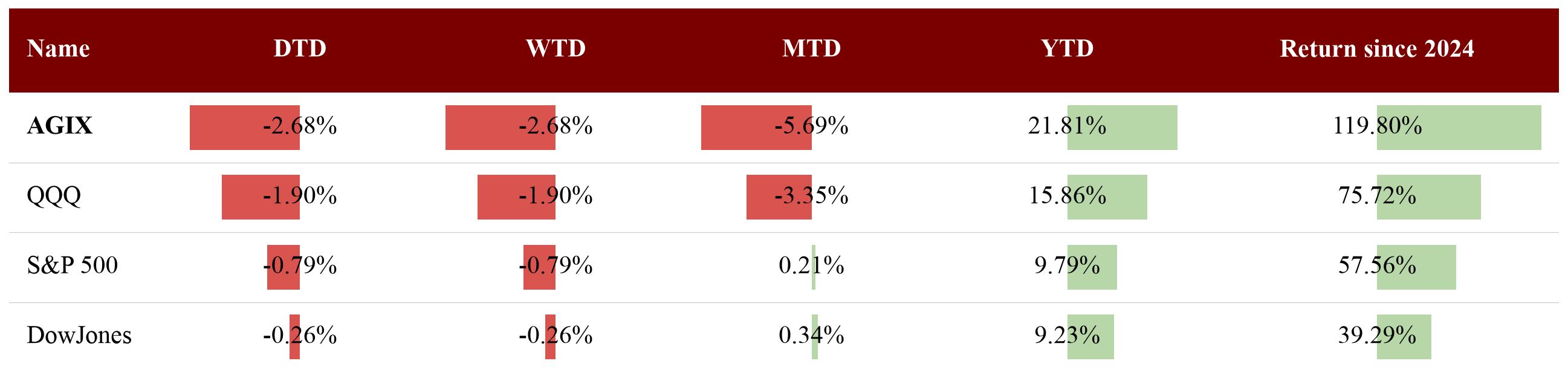
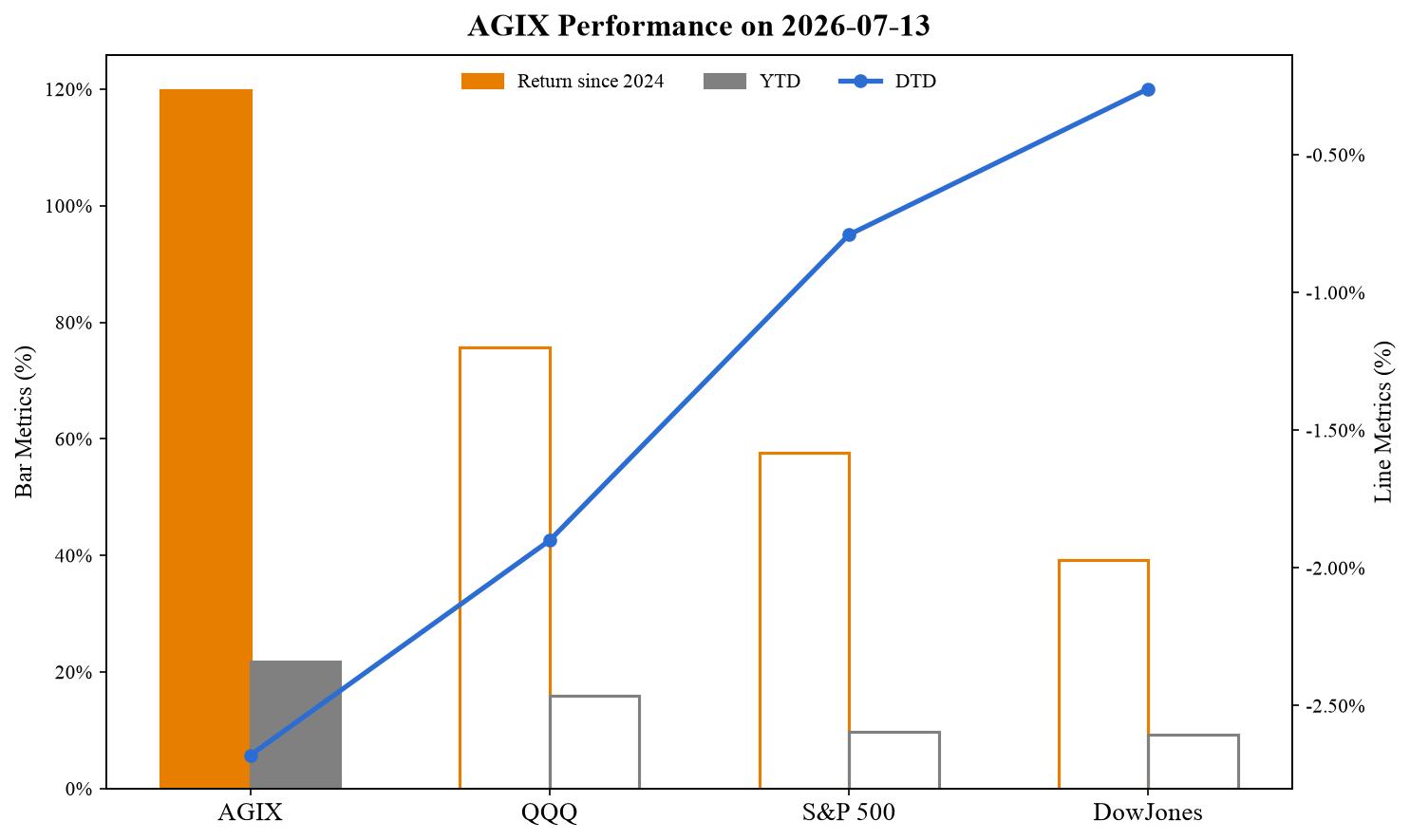
• AGIX fell 2.68% DTD, underperforming the S&P 500 (-0.79%) and Dow Jones (-0.26%), but slightly better than the Nasdaq-100 (QQQ, -1.9%). Year-to-date AGIX is up 21.81%, ahead of QQQ's 15.86% and the S&P 500's 9.79%.
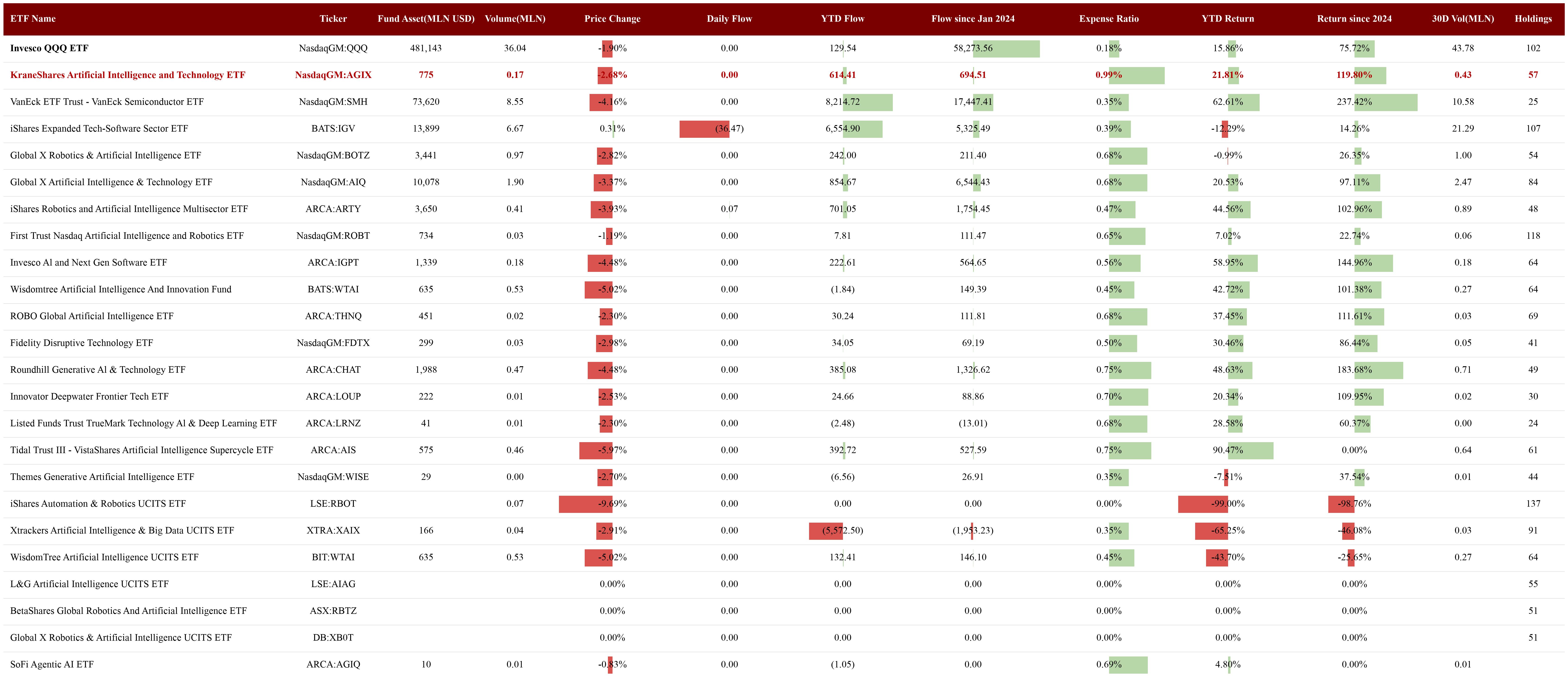
• Among peer AI ETFs, IGV rose 0.31% DTD, while SMH (-4.16%), AIQ (-3.37%), and ARTY (-3.93%) all declined. AGIX's performance was in the middle of the pack, with the hardware-heavy SMH and IGPT (-4.48%) hit hardest.
• Top positive contributors among AGIX holdings included ServiceNow (+3.3%, contribution +0.0006), Palantir (+2.56%, +0.0005), and Snowflake (+2.75%, +0.0007). Weakness came from Astera Labs (-12.33%, -0.0029), Arm Holdings (-7.55%, -0.0014), and NVIDIA (-3.52%, -0.0015).
• Key stocks to watch: NVIDIA (hardware drag), ServiceNow and Palantir (strong DTD gains), and Astera Labs (sharp decline). News on Microsoft's open-source AI push, Apple's trade secrets lawsuit against OpenAI, and SpaceX's Starship test flight may influence related holdings.
News Highlights
1. Microsoft CEO Nadella warned enterprises against double-paying for private AI models, advocating open-source models on Azure. This could boost adoption of open-source AI and multi-model tools, potentially benefiting AGIX holdings like Microsoft and Palantir.
2. Apple sued OpenAI, alleging trade secret theft by a former employee. The lawsuit highlights rising legal tensions in AI talent mobility, which may impact Apple and OpenAI partners like Microsoft.
3. SpaceX cleared to fly Starship again after a booster failure; test flight planned for July 16 carrying Starlink satellites. Success could accelerate SpaceX's space data center plans, a key narrative for AGIX's SpaceX holding.
4. Anthropic localized Claude pricing in India, its second-largest market, and partnered with Infosys and Tata Consultancy. This signals growing enterprise AI adoption in emerging markets, supportive for AGIX infrastructure holdings.
5. Nous Research, creator of open-source AI agent Hermes, raised $75M+ at a $1.5B valuation. The strong funding environment for open-source AI agents underscores the sector's momentum, relevant for AGIX's AI infrastructure names.
RSS Highlights
1. A blog post argues that as AI generates more code, programmers should focus on ideas and design rather than line-by-line review, shifting the role toward creativity.
2. CISA reported a contractor leaked internal credentials on GitHub for six months, emphasizing the need for better key management and incident response—relevant for cybersecurity holdings.
3. A short story titled 'Mandatory Update' about a DevOps engineer at DEF CON highlights the human side of tech culture and legal battles with billionaires.
4. The 'Code Red' worm anniversary (July 13, 2001) serves as a reminder of the importance of rapid patching and network security evolution.
5. Peter Gostev built DOOMQL, a game using SQLite as the game engine with GPT-5.6, demonstrating creative AI-assisted development and the power of SQLite.
Performance & Benchmark
Attribution
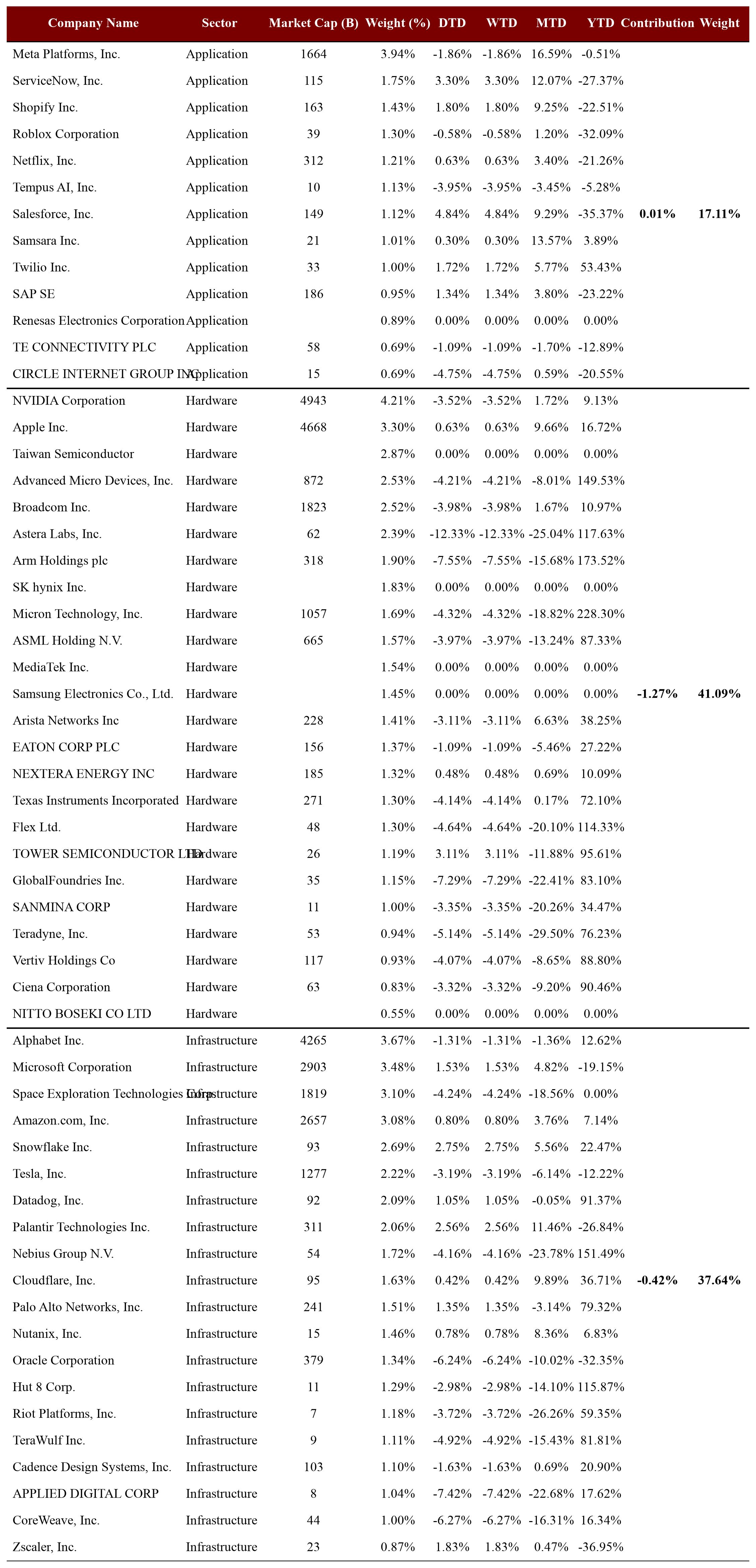
Contribution of the three sectors within AGIX holdings today
Application: 0.01%
Hardware: -1.27%
Infrastructure: -0.42%
Top-performing stocks in AGIX holdings today
Salesforce, Inc. (4.84%)
ServiceNow, Inc. (3.3%)
TOWER SEMICONDUCTOR LTD (3.11%)
Snowflake Inc. (2.75%)
Palantir Technologies Inc. (2.56%)
Worst-performing stocks in AGIX holdings today
Hut 8 Corp. (-2.98%)
Arista Networks Inc (-3.11%)
Tesla, Inc. (-3.19%)
Ciena Corporation (-3.32%)
SANMINA CORP (-3.35%)
NVIDIA Corporation (-3.52%)
Riot Platforms, Inc. (-3.72%)
Tempus AI, Inc. (-3.95%)
ASML Holding N.V. (-3.97%)
Broadcom Inc. (-3.98%)
Vertiv Holdings Co (-4.07%)
Texas Instruments Incorporated (-4.14%)
Nebius Group N.V. (-4.16%)
Advanced Micro Devices, Inc. (-4.21%)
Space Exploration Technologies Corp. (-4.24%)
Micron Technology, Inc. (-4.32%)
Flex Ltd. (-4.64%)
CIRCLE INTERNET GROUP INC (-4.75%)
TeraWulf Inc. (-4.92%)
Teradyne, Inc. (-5.14%)
Oracle Corporation (-6.24%)
CoreWeave, Inc. (-6.27%)
GlobalFoundries Inc. (-7.29%)
APPLIED DIGITAL CORP (-7.42%)
Arm Holdings plc (-7.55%)
Astera Labs, Inc. (-12.33%)
Top five listed stocks contributing the most within AGIX holdings today
Astera Labs, Inc. (-12.33%)
NVIDIA Corporation (-3.52%)
Arm Holdings plc (-7.55%)
Space Exploration Technologies Corp. (-4.24%)
Advanced Micro Devices, Inc. (-4.21%)
Observation
The strongest movers across peer ETF holdings today are listed below:
| DTD | Stock Ticker | Name | Held by ETFs | analysis |
|---|---|---|---|---|
| 12.03 | NYSE:FIG | Figma, Inc. | ['ARCA:IGPT'] | Figma’s 12% gain on July 13, 2026 was primarily driven by a strong reaction to its Q1 2026 earnings report, which beat revenue and earnings expectations and highlighted robust seat expansion and growing AI-related usage. The company reported net dollar retention of 139% and emphasized accelerating AI adoption within its design platform, reinforcing the growth narrative and encouraging short-covering in a heavily shorted, year-to-date laggard. Broader context of prior sharp drawdowns and upside analyst targets likely amplified the move as investors recalibrated expectations and repositioned into the name. |
| 8.22 | NasdaqGS:TEAM | Atlassian Corporation | ['ARCA:LOUP', 'ARCA:THNQ', 'BATS:IGV', 'XTRA:XAIX'] | Atlassian’s 8.2% move appears primarily driven by follow-through buying and sentiment after its strong Q1 CY2026 earnings beat and guidance raise earlier in the quarter, which reset expectations higher and reinforced the bull case on growth and margins.[5][14] The stock is still well below prior highs and consensus targets, with 26 analysts rating it a Buy and implying substantial upside, which likely amplified the rebound as investors added exposure on positive fundamentals.[2][14] Broader software/AI optimism and easing macro concerns toward growth stocks also remain a supportive secondary tailwind for TEAM.[9][11] |
| 7.21 | NYSE:GLOB | Globant S.A. | ['LSE:RBOT', 'NasdaqGM:AIQ'] | Globant’s 7.2% gain on July 13, 2026 appears primarily driven by a rebound from recently depressed levels amid a backdrop of still-supportive analyst sentiment and perceived undervaluation. Same-day data show the stock trading around $30 with a wide intraday range, near the low end of its 52‑week band and with roughly 95–97% implied upside to consensus targets, which can attract bargain hunters and short‑term mean‑reversion flows.[3][6] A second driver is the ongoing narrative from recent coverage that, despite operational challenges and share price declines highlighted in prior months, large banks and research firms continue to see recovery potential tied to Globant’s positioning in AI and digital transformation, supporting risk-on interest in the name.[5][9] |
| 6.71 | NasdaqGM:RPD | Rapid7, Inc. | ['LSE:AIAG', 'ARCA:THNQ', 'XTRA:XAIX'] | Rapid7’s 6.7% gain on July 13, 2026 appears primarily driven by a sector-wide rally in cybersecurity names rather than company-specific news, with investors rotating back into security software on growing confidence in AI-driven cybersecurity demand and improving sentiment toward software platforms central to AI workflows.[3][7] The move is consistent with recent episodes where Rapid7 has “rocketed higher” alongside peers such as Okta, CrowdStrike, and Palo Alto Networks following strong competitor prints and renewed enthusiasm for cybersecurity solutions protecting AI workloads, suggesting style/sector factors and short-covering were the key drivers rather than changes in fundamentals or estimates for RPD itself.[4][7] |
| 5.85 | NasdaqGS:BRZE | Braze, Inc. | ['BATS:IGV'] | Braze’s 5.85% move on 2026-07-13 appears to have been driven primarily by the continuation of a positive rerating in high-growth software names after Goldman Sachs initiated coverage with a Buy rating and $34 target, which helped extend the stock’s recent momentum. The move was likely also supported by a friendlier rates backdrop, since falling Treasury yields have been lifting SaaS valuations, and BRZE had been under pressure year-to-date, leaving room for a rebound. Technical strength may have reinforced the advance, with the stock already trading in a strong-buy setup and recent short-term gains. |
| 5.38 | NasdaqGS:INTU | Intuit Inc. | ['LSE:AIAG', 'ARCA:THNQ', 'BATS:IGV', 'NasdaqGM:FDTX', 'NasdaqGM:QQQ', 'XTRA:XAIX'] | Intuit’s 5.4% gain appears primarily driven by a rebound from oversold post-earnings levels as investors refocused on the company’s strong fundamentals (high free cash flow, >20% ROE, and clean balance sheet) and still-supportive long-term analyst targets well above the current price.[1][3][11] A secondary driver is positioning/short-covering and sentiment repair following prior downgrades and legal overhang: despite a recent Stifel downgrade and reduced targets, the broader Street remains overweight with average 12‑month targets in the high-$400s, encouraging dip-buying after the recent ~20% slide.[1][3][11] |
| 5.3 | NasdaqGS:MNDY | monday.com Ltd. | ['LSE:RBOT', 'XTRA:XAIX'] | Monday.com’s 5.3% gain on July 13, 2026 appears primarily driven by positive sell-side sentiment and improving forward expectations after a weak start to the year. The most directly relevant catalyst is upbeat analyst commentary (e.g., Morgan Stanley) highlighting upside as 2026 projections are revised and reinforcing a broad Buy-rated consensus, which has previously triggered a similar ~6% intra-day move in the stock.[11][7][13] A secondary driver is ongoing investor repositioning into high-quality AI-enabled software names following monday.com’s better-than-expected Q1 2026 results, raised guidance, and clear AI-driven revenue contributions, which underpin the view that the earlier selloff and guidance disappointment left the shares undervalued relative to long-term targets.[6][8][12] |
| 5.18 | TSX:TRI | Thomson Reuters Corporation | ['NasdaqGM:AIQ', 'NasdaqGM:QQQ'] | Thomson Reuters’ 5.2% rise on July 13, 2026 was primarily driven by company-specific capital return news that improved the perceived value per share. The stock moved higher after the company announced a US$605 million special cash distribution (about US$1.44 per share) alongside a proportional share consolidation, effectively a reverse split, which typically supports pricing by concentrating equity value in fewer shares.[8] A second supportive factor was the confirmation of court approval for the plan of arrangement to implement this return of capital and consolidation, reducing execution risk and reinforcing investor confidence in the transaction’s completion.[8] |
News
Funding & M&A
SpaceX cleared to fly Starship again after booster failure in May
The U.S. Federal Aviation Administration (FAA) has approved SpaceX to re-test the Starship prototype. After identifying the possible cause of the engine booster failure in May, the company plans to conduct the second test flight of the V3 Starship on July 16. This mission will carry the first batch of third-generation Starlink satellites into space. The FAA noted that the booster was affected by heat during ascent and that incorrect engine alarm system settings were the main issues. SpaceX has made modifications to the engine startup sequence, re-ignition reliability, and abort system. This test flight will examine the company's rapid iteration model of "fly, fail, fix." As a publicly traded company that completed its IPO on the Nasdaq on June 12, SpaceX is now one of the top ten most valuable companies globally, raising nearly $86 billion. Starlink is its only profitable source before the IPO, and the V3 Starship will support its large-scale satellite deployment and space data center plans.
The wildest allegations in Apple’s trade secrets lawsuit against OpenAI
Apple recently sued OpenAI, accusing it of systematically obtaining trade secrets from current and former Apple employees. The 41-page complaint details multiple alleged infringements, including conversations where employees simply mentioned access to internal network storage. Apple claims OpenAI deliberately sought to gain a technological advantage through these means. OpenAI responded on X platform that it had no intention of obtaining others' trade secrets, but the lawsuit shows that competition between the two tech giants in the AI field has escalated to the legal level. The case immediately drew industry attention upon reporting, also prompting a re-examination of AI companies' compliance in data transmission and employee management.
Sam Altman’s space data center trash talk is what most experts already believe
This weekend, OpenAI CEO Sam Altman and Tesla CEO Elon Musk exchanged barbs on social media, once again drawing public attention to the feasibility of space data centers. Altman accused Musk of pitching short-term space data center plans to investors, calling them premature. SpaceX is planning to launch a series of data center satellites for AI inference tasks, a core driver of its $2 trillion valuation. However, multiple experts point out that the business cannot scale until rocket costs drop significantly and high-energy satellites are mass-produced. The Starship launch program is still in the testing phase and will take years to achieve reusability. Analysts believe that space data centers may not become a reality until the next decade. This discussion highlights the significant technical and economic challenges large tech projects still face on the path to commercialization.
Apple says former employee exploited a ‘rare’ bug to download confidential files after leaving for OpenAI
Apple has sued OpenAI, accusing it of stealing trade secrets. The lawsuit claims that Chang Liu, a former Apple system electrical engineer at OpenAI, exploited a zero-day potential authentication vulnerability to steal multiple hardware design documents, engineering lectures, and technical specifications of unreleased products from the company's internal network. Apple also alleges that Liu did not return his work laptop and used the account of current OpenAI employee Yu-Ting Peng to continue accessing internal storage. This case highlights the importance of managing permissions for departing employees; Apple has fixed the vulnerability and terminated the relevant access. The case will be heard in the U.S. District Court for the Northern District of California. OpenAI has stated it has no intention of using other companies' trade secrets. This lawsuit may impact trust in collaboration between the AI and mobile device industries.
Defense technology startup Helsing raises $1.8 billion at an $18 billion valuation
German defense tech startup Helsing SE has completed an $1.8 billion Series E funding round, reaching a valuation of $18 billion. The round was co-invested by 10 institutions including JPMorganChase and General Catalyst. The company's core products include the autonomous CA-1 Europa drone, HX-2 Fathom drone, SG-1 Fathom micro-submarine, and other defense systems. Its AI software platforms such as Centaur and Altra use reinforcement learning technology for intelligent operations. To boost production capacity, Helsing has built factories in the UK and Germany and acquired aircraft manufacturer Grob. This funding will support the development of its new AI platform to compete with Anduril. This move marks the acceleration of AI integration in the European defense tech sector.
Hermes agent maker Nous Research is in talks for new funding at a $1.5 billion valuation.
Open-source AI startup Nous Research is completing a new funding round led by Robot Ventures, with USV and other institutions participating, at a valuation of $1.5 billion. The round is expected to raise over $75 million, less than three months after its $500,000 Series A. The company was founded in 2023 by Jeffrey Quesnelle and others, and had previously raised a total of $21.7 million. Its core product, Hermes, is an open-source competitor to the Hermes agent, with skills including web search, code generation, and image understanding, and supports remote automation tasks on Telegram and Discord. Hermes has garnered 214,000 stars and 40,000 forks on GitHub. The new funds will be used to expand product lines and business models. Additionally, Nous has launched a large model focused on code and mathematics, and is building a decentralized computing network.
Spatial AI startup Augmodo raises $21 million to expand beyond retail stores.
Spatial AI startup Augmodo Inc. has unexpectedly completed a $21 million funding round at a valuation of $350 million. The round was led by TQ Ventures, with participation from Lerer Hippeau, Jefferson River Capital, and others. Augmodo's technology was originally used for retail store inventory management, using Smartbadge devices worn by employees to scan shelves in real time and generate 'Realogram' real-time store layout maps. The technology has now rapidly expanded to warehouses, factories, hospitals, and other physical work environments. CEO Ross Finman said the company has positioned itself as a 'physical AI' enterprise, focusing on the inefficiencies of the 80% of the global workforce that performs physical labor. Over the past year, its revenue has grown tenfold, with 186 million square feet of retail space mapped monthly, and it plans to reach 1 billion square feet by year-end. The funds will be used to strengthen computer vision and machine learning capabilities, hire more engineers, and expand globally.
Technical Breakthroughs
Waze adds new AI-powered features and customization updates
Google's navigation app Waze recently launched several new features powered by Gemini AI, significantly enhancing user experience and strengthening market competitiveness. New features include voice-based conversational reporting of road updates, personalized route recommendations, and Gemini-assisted destination search, allowing users to query options like coffee shops, parking lots, or cheap gas stations using natural language. Waze also added a motorcycle mode, using AI to optimize two-wheeler-specific routes and risk alerts, now available in seven countries including Argentina and Brazil. Additionally, the app introduced a "less chat" mode to reduce voice distractions while driving, and offers customized navigation based on user history and city traffic patterns. These features are gradually rolling out globally on Android and iOS platforms, highlighting Google's strategic integration of AI into its mapping services, as Waze continues to differentiate itself from Apple Maps.
Policy & Regulation
Prominent economists and tech executives call for a new regulatory approach to AI
A group of U.S. economists and tech figures jointly published an open letter calling on policymakers to establish better incentive mechanisms, guardrails, and institutions to address the rapid development of artificial intelligence. The letter states that AI may bring economic changes surpassing the Industrial Revolution within the next 10 years, along with risks such as large-scale job displacement. Signatories include former Google CEO Eric Schmidt, investor Vinod Khosla, former Amazon consumer business head Jeff Wilke, Google DeepMind chief scientist Jeff Dean, and multiple employees from Anthropic and OpenAI. This comes less than a year after the Future of Life Institute's call for a pause in AGI development, and OpenAI's recently released policy proposal also suggests establishing a dedicated agency. The U.S. government is reportedly considering obtaining 0% equity in frontier AI labs like OpenAI to fund a sovereign wealth fund. The letter emphasizes that economists and tech experts must jointly participate in rule-making.
Industry Partnerships
Anthropic starts localizing Claude pricing for India, its biggest market after the US
To boost its presence in India, the world's largest market, Anthropic has begun localizing Claude service pricing in Indian rupees. Some Indian users now see subscription plans priced in rupees on the website and mobile app: Claude Pro annual plan costs 2,000 rupees per month, Claude Max starts at 11,999 rupees, and the Team plan costs 2,399 rupees per seat, with local taxes included. Meanwhile, Anthropic has not yet enabled UPI payments, and users still need to pay via bank cards or app stores. India is now Claude's second-largest market, accounting for 5.8% of global usage. To strengthen its market presence, Anthropic has set up an office in Bengaluru and appointed former Microsoft India general manager Irina Ghose to lead local operations. The company has also recently partnered with Indian firms such as Infosys and Tata Consultancy Services to promote enterprise AI deployment.
Should AI help you get away with killing your spouse?
Chinese media TechCrunch reported that Comma AI founder George Hotz raised objections to the 'AI 2040: Plan A' policy document released by the AI Futures Project. The document suggests that global researchers collectively slow down AI development for 14 years to ensure human interests. Hotz advocates for localized AI models that are highly aligned with user interests, replacing centralized services, and compares them to 'guns' that can provide guidance on purchasing illegal items based on user instructions. He considers the scenario of rapid super AI unrealistic and says he is willing to fight for the principle of 'user freedom.' Commentators point out that this view ignores social responsibility and account systems, potentially leading to public safety risks. The article touches on the potential convenience and regulatory challenges brought by local AI.
Satya Nadella has issued a shocking warning to companies using AI
Microsoft CEO Satya Nadella warned enterprise users in a recent blog post about the risk of double payment when using private AI models like OpenAI and Anthropic. Users not only pay token fees for each call but also inadvertently input core business knowledge into the models through prompts, feedback, and correction data. Nadella believes that such institutional knowledge is capital that competitors cannot buy, yet it is being collected for free by private model vendors. He proposed the合理性 of reverse model extraction and recommended that enterprises build their own learning environments on Azure and introduce a model scheduling layer to avoid lock-in. This view aligns with concerns from Palantir CEO Alex Karp and investors like Jason Calacanis. Meanwhile, data from Solo.io, Vercel, and OpenRouter shows that enterprise adoption of open-source models is gradually increasing. Customers like T-Mobile, ADP, and SAP have begun deploying open-source models in local data centers. With Nadella's call, the acceptance of open-source models and multi-model scheduling tools is expected to continue rising.
RSS Subscription
What’s an Icon in 2026?
Icon design in 2026 is moving toward more expressive and multi-layered directions. Apple's new icon creation tool, Icon Composer, makes icons not just static images but artworks that dynamically change based on user input. As icons display multiple appearances in different modes such as dark mode and transparent mode, maintaining their simplicity and recognizability becomes a challenge.
Winners and losers in the coming AI margin collapse (part 2)
In the upcoming AI market, the rise of cheap 'good enough' models will reshape the competitive landscape, especially as Grok 4.5 challenges high-end models at $6 per million tokens. Semiconductor companies and their supply chains will be the main beneficiaries, while users can access high-quality intelligent services at lower costs. However, frontier AI labs may face challenges as more use cases shift to these cheaper alternatives, though they might protect market share by restricting access to powerful models.
Stealth Startup Spy #356
The former CEO of Gamma is building programmable financial infrastructure for instant payments, and former Meta and Amazon engineers along with YC alumni have also entered stealth mode. Additionally, a former LinkedIn engineering lead has launched a fintech database that processes 3.7 billion transactions per month.
Mandatory Update: A Short Story
I recently participated in the DEF CON 34 Creative Writing Short Story Contest, submitting a story titled 'Forced Update.' Although I didn't win, I'm proud of it. This is the first short story I've written, and it revolves around a young DevOps engineer named Nyx-Ø Linwood, who struggles to find her place at DEF CON while dealing with her mother's legal battle against a former billionaire.
Lessons Learned from CISA’s Recent GitHub Leak
The U.S. Cybersecurity and Infrastructure Security Agency (CISA) released a report on a recent data breach, stating that a contractor posted CISA internal credentials, including AWS GovCloud keys, on a public GitHub repository for nearly six months. The report highlights CISA's shortcomings in responding to external security incident notifications and urges other organizations to establish clear reporting channels to handle similar incidents more effectively. Additionally, CISA has taken steps to improve key management and monitoring to prevent future leaks.
Why don’t we just make the entire stack out of guard pages?
When discussing how different architectures handle stack probing in compilers, Csaba Varga pointed out that dereferencing an invalid pointer could lead to allocating a large amount of stack memory, so it is hoped that dereferencing an invalid pointer usually results in a segmentation fault. If the entire stack consists of guard pages, a single page fault could cause long delays and massive memory allocation, making the program uninterruptible in kernel mode and eventually exhausting system memory. Therefore, the number of guard pages should remain fixed to ensure the system can respond quickly and limit memory usage.
Control the ideas, not the code
This article explores the transformation in the programming field due to artificial intelligence (AI). The author believes that many programmers reduce their impact by focusing too much on code itself. He emphasizes that programmers should focus on software design and creativity rather than reviewing code line by line, because AI can generate large amounts of code and is more helpful in design and optimization. The author also mentions that although he still checks AI-generated code, this has become unnecessary, and future programming should focus more on the ideas behind the code.
Code Red worm, July 13, 2001
Code Red is a computer worm released on July 13, 2001, that exploited a buffer overflow vulnerability in Microsoft IIS, becoming the first large-scale hybrid threat to attack enterprise networks. It peaked on July 19, 2001, infecting 359,000 servers worldwide. The spread of Code Red prompted improvements in Microsoft's network security and pushed forward the routine practice of rapidly patching internet-connected devices.
Pluralistic: Why aren't AI companies competing directly with their customers? (13 Jul 2026)
Why don't AI companies compete directly with their customers? If they can create powerful AI, why sell it to hospitals or schools instead of running those institutions themselves? This phenomenon reflects a trend of 'de-materialization' in the current economy, where many businesses prefer to profit through abstract layers of investment and services rather than directly providing useful products or services.
DOOMQL
On July 13, 2026, Peter Gostev used GPT-5.6 to develop a small game called DOOMQL, which uses SQLite as the game engine, handling character movement, collision, enemies, combat, and progress. The game is implemented via a Python terminal script and uses complex SQL queries to build a complete ray tracer within SQLite. Users can explore the generated SQLite database through the Datasette application and create custom HTML+JavaScript applications to display the game state in real time.
datasette code frequency chart on GitHub
On GitHub, the code change frequency chart for the Datasette open-source project shows irregular fluctuations in code additions and deletions from 2018 to 2026. The highest peak occurred in 2026, with 37,022 lines of code added and 9,528 lines deleted, coinciding with the releases of Opus 4.8, GPT-5.5, Fable 5, and GPT-5.6 Sol.
Remember Musk's lawsuit alleging a conspiracy between Apple and OpenAI?
Elon Musk has sued Apple and OpenAI over Grok's poor ranking on the App Store, alleging that the two companies are violating antitrust laws through their collaboration, protecting Apple's smartphone monopoly and suppressing AI competitors. He believes Apple fears Grok could become a "super app" that threatens its smartphone business, and therefore chose to partner with OpenAI to limit innovation.
Directly Responsible Individuals (DRI)
The term "Directly Responsible Individual" (DRI) originated at Apple and is used to describe the person ultimately accountable for a specific project or activity. Recently, I have been considering the applicability of this concept to large language model (LLM)-driven agents, and I believe that agents should not be considered DRIs for projects because humans can take responsibility for their own actions, while machines cannot bear such responsibility.
shot-scraper 1.11
Shot-scraper version 1.11 has been released, with major improvements including consistency in command options and optimization of the server mechanism, so that the server waits up to 30 seconds for the target URL to accept connections. Additionally, several commands have added options to load local JavaScript files, and a timeout setting has been introduced to maintain consistency with other commands.