AGIX Daily Report 2026-07-15
AI Summary
Market Overview
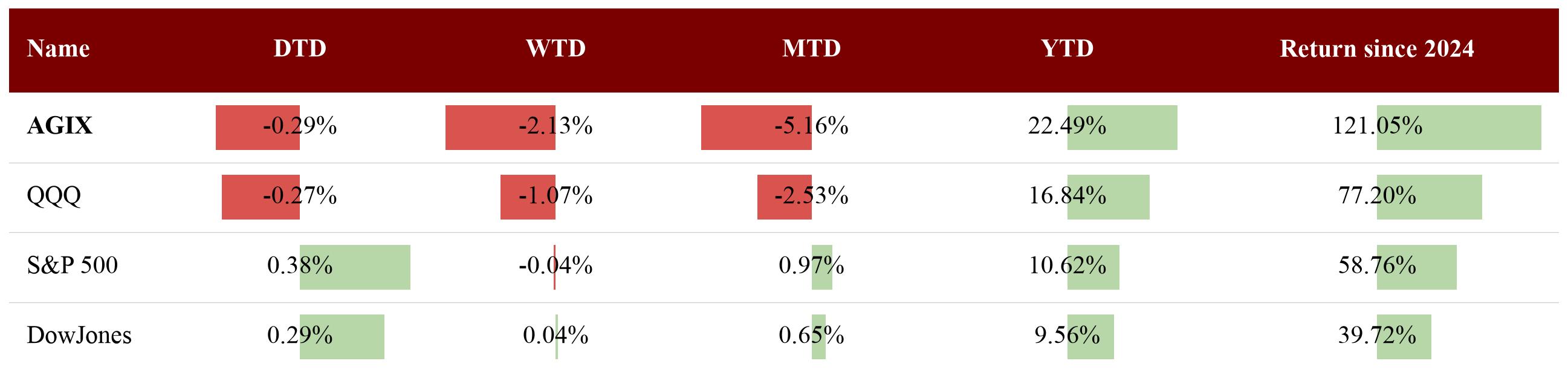
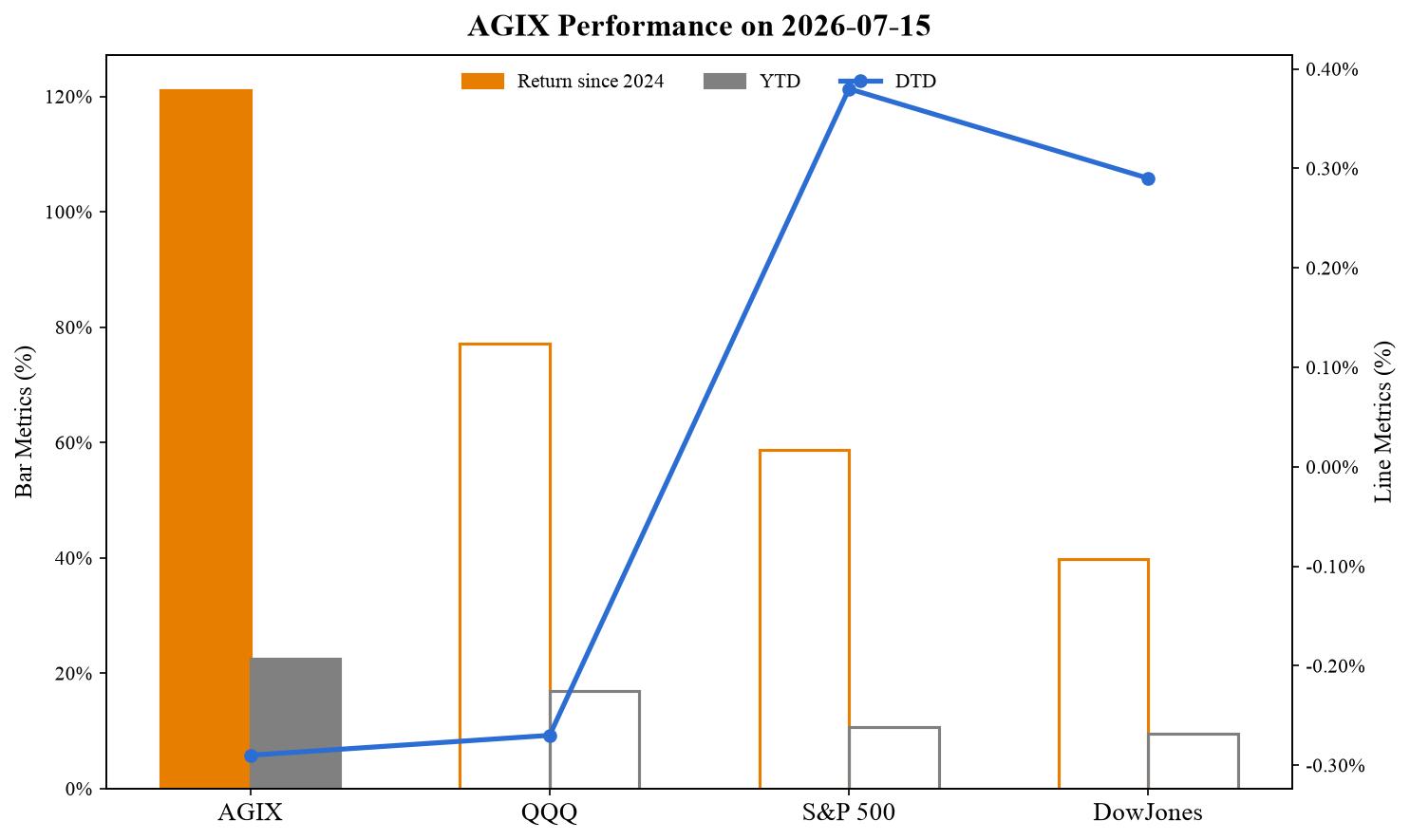
• AGIX fell 0.29% DTD, slightly underperforming QQQ (-0.27%) and the S&P 500 (+0.38%), but YTD it leads with a 22.49% gain versus QQQ's 16.84% and the S&P 500's 10.62%.
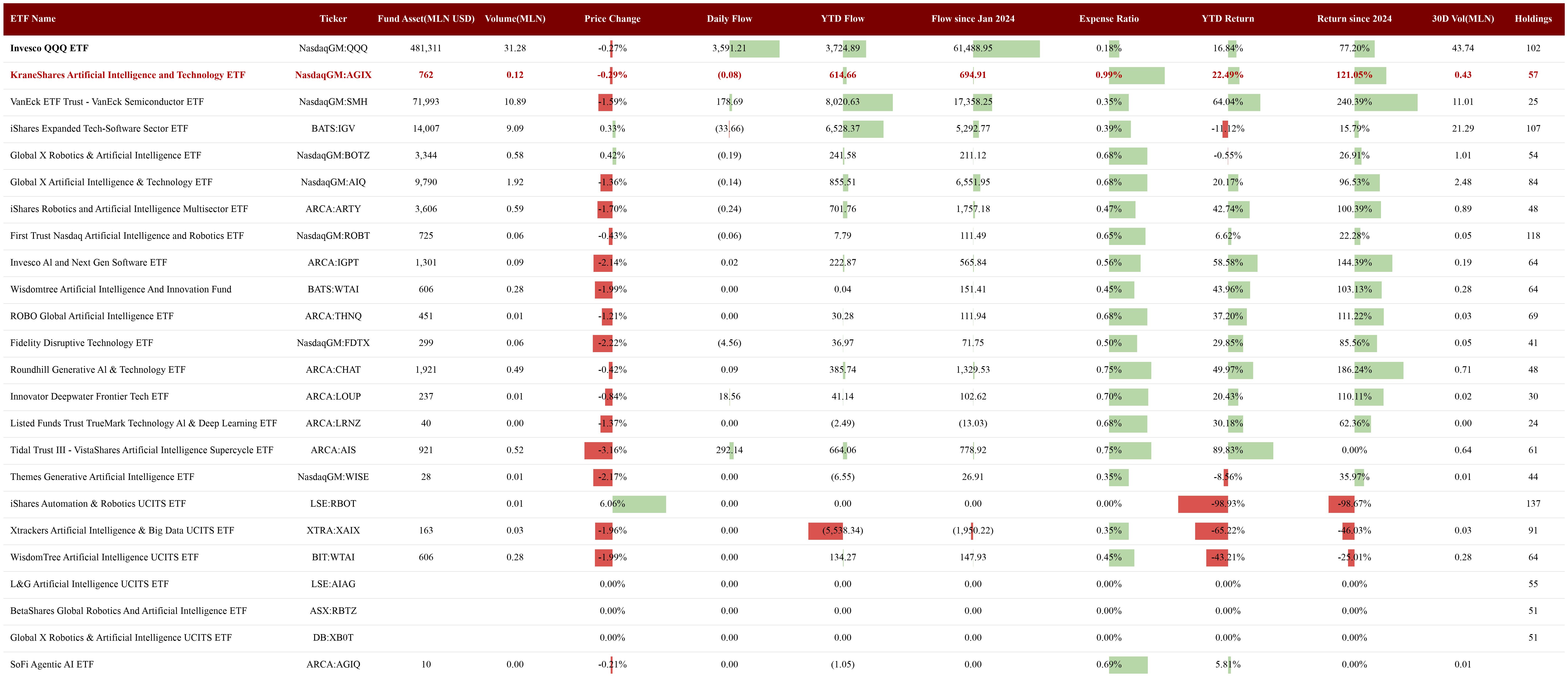
• Peer AI ETFs were mixed: SMH (-1.59%), AIQ (-1.36%), and IGPT (-2.14%) declined, while IGV (+0.33%) and BOTZ (+0.42%) edged up. The broad weakness in semiconductor ETFs weighed on AGIX's hardware holdings.
• Top positive contributors among AGIX holdings: Apple (+4.01%, DTD) contributed 0.14% to portfolio return, Meta (+3.07%) added 0.12%, and Roblox (+4.77%) added 0.06%. Key detractors: Micron (-8.02%) subtracted 0.13%, Arista Networks (-5.83%) subtracted 0.08%, and Astera Labs (-3.08%) subtracted 0.07%.
• Notable moves in peer-held stocks: Hanmi Semiconductor surged ~30% on record earnings, PayPal jumped 17.2% on takeover speculation, and SK Square rose 16.1% on Korean tech strength. These signal strong sector interest in AI hardware and fintech.
News Highlights
1. Apple Intelligence approved for launch in China using Alibaba's Qwen AI — positive for Apple (AGIX holding, +4.01% DTD) and Alibaba, expanding AI reach in a key market.
2. OpenAI pushes back on Apple trade secret lawsuit; OpenAI also developing a screenless smart speaker — highlights intensifying AI hardware competition, potentially affecting Apple's positioning.
3. Anthropic and Blackstone launch Ode with $1.5B for enterprise AI implementation — underscores trend of AI labs moving into services, which may pressure AGIX holdings like Salesforce and ServiceNow if competition for enterprise AI spend increases.
4. Cadence launches AuraStack AI agent for PCB and packaging design — positive for Cadence (AGIX holding, -1.41% DTD) as it expands AI beyond chips, supporting its 'super engineer' narrative.
5. SpaceX slips below $135 IPO price ahead of Starship launch — SpaceX is a top 3 AGIX holding (3.01% of portfolio); the stock's weakness and high-risk launch could impact AGIX performance.
RSS Highlights
1. Gurman reports OpenAI's first hardware device will be a movable, screenless speaker acting as an AI companion — aligns with news of OpenAI entering consumer hardware, a key trend for AGIX's hardware holdings.
2. Apple updates advertising services policy with new rules for Maps ads, taking a stricter approach than Google — could affect digital ad dynamics for Alphabet and Meta (key AGIX holdings).
3. Apple Intelligence approved in China with Baidu and Alibaba AI models — confirms the partnership and opens a major market for Apple's AI services, benefiting Apple's growth outlook.
4. Security vulnerability found in Claude's web_fetch tool allowing data exfiltration — highlights ongoing AI safety challenges that could affect trust in AI agents and regulatory scrutiny.
5. Fourier transform notes provide a deep technical dive into signal processing — relevant for understanding AI hardware and algorithm fundamentals, though not directly market-moving.
Performance & Benchmark
Attribution
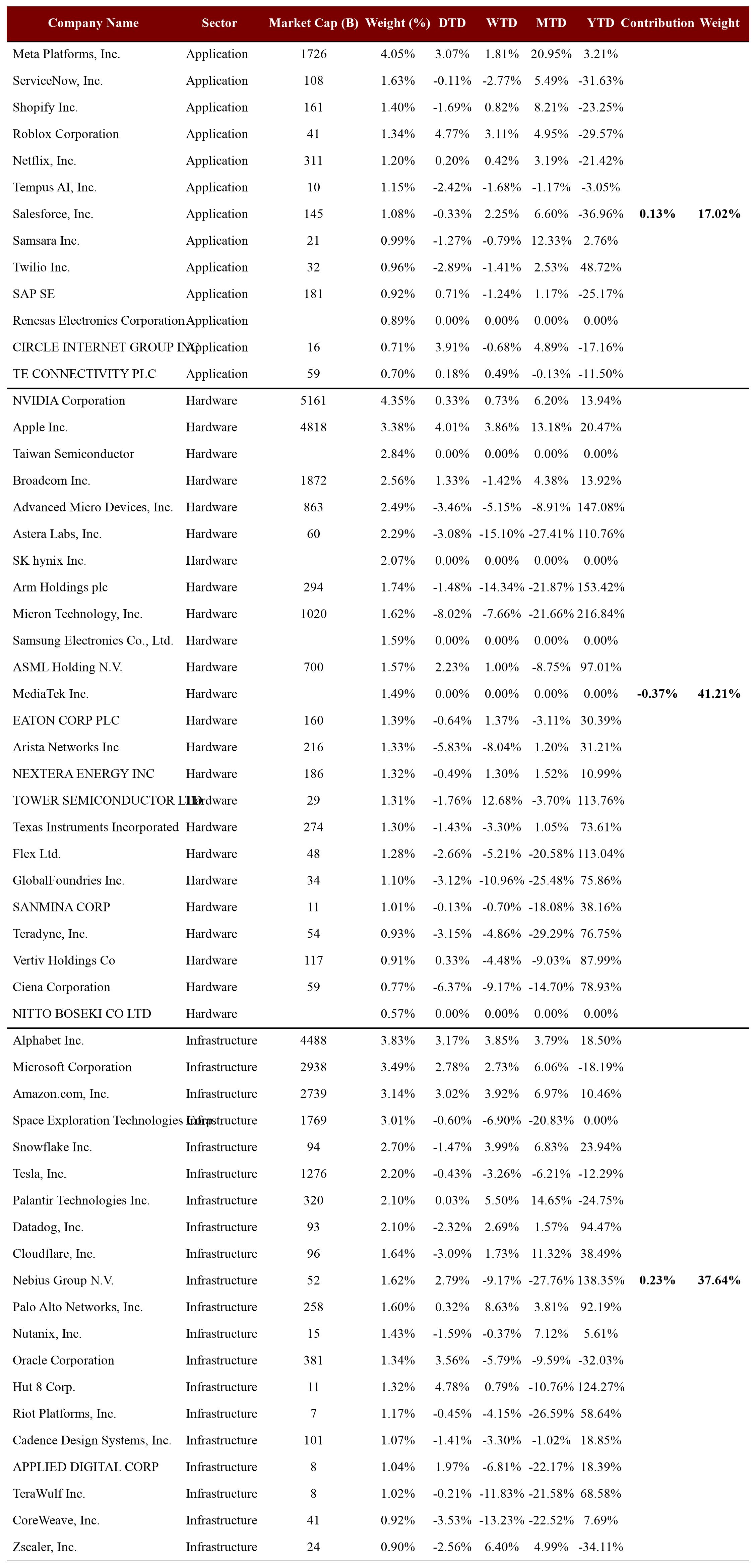
Contribution of the three sectors within AGIX holdings today
Application: 0.13%
Hardware: -0.37%
Infrastructure: 0.23%
Top-performing stocks in AGIX holdings today
Hut 8 Corp. (4.78%)
Roblox Corporation (4.77%)
Apple Inc. (4.01%)
CIRCLE INTERNET GROUP INC (3.91%)
Oracle Corporation (3.56%)
Alphabet Inc. (3.17%)
Meta Platforms, Inc. (3.07%)
Amazon.com, Inc. (3.02%)
Nebius Group N.V. (2.79%)
Microsoft Corporation (2.78%)
ASML Holding N.V. (2.23%)
Worst-performing stocks in AGIX holdings today
Datadog, Inc. (-2.32%)
Tempus AI, Inc. (-2.42%)
Zscaler, Inc. (-2.56%)
Flex Ltd. (-2.66%)
Twilio Inc. (-2.89%)
Astera Labs, Inc. (-3.08%)
Cloudflare, Inc. (-3.09%)
GlobalFoundries Inc. (-3.12%)
Teradyne, Inc. (-3.15%)
Advanced Micro Devices, Inc. (-3.46%)
CoreWeave, Inc. (-3.53%)
Arista Networks Inc (-5.83%)
Ciena Corporation (-6.37%)
Micron Technology, Inc. (-8.02%)
Top five listed stocks contributing the most within AGIX holdings today
Micron Technology, Inc. (-8.02%)
Advanced Micro Devices, Inc. (-3.46%)
Arista Networks Inc (-5.83%)
Astera Labs, Inc. (-3.08%)
Cloudflare, Inc. (-3.09%)
Observation
The strongest movers across peer ETF holdings today are listed below:
| DTD | Stock Ticker | Name | Held by ETFs | analysis |
|---|---|---|---|---|
| 29.88 | 042700.KS | Hanmi Semiconductor Co Ltd | ['ARCA:CHAT'] | Hanmi Semiconductor’s ~30% gain on July 15 was primarily driven by its release of record second-quarter earnings that materially beat market expectations, with sales up 39.5% year-on-year and operating profit up 51%, fueled by surging demand for HBM-related TC bonders and MSVP equipment for AI semiconductors.[1][5] A secondary but important driver was the broad strength in AI and semiconductor names after softer-than-expected U.S. CPI improved global risk appetite for tech, with Korean peers like SK Hynix also rallying sharply.[1][11] |
| 17.2 | NasdaqGS:PYPL | PayPal Holdings, Inc. | ['NasdaqGM:QQQ'] | PayPal’s 17.2% single-day move was driven primarily by media reports that Stripe and Advent International submitted a joint takeover offer of about $53 billion, or $60.50 per share, implying roughly a 28% premium to the prior close and triggering a sharp rerating of the stock. The bid speculation, backed by reports of substantial committed financing, led investors to price in a potential takeout and fueled heavy trading volume and one of PayPal’s strongest sessions on record. |
| 16.13 | 402340.KS | SK Square Co Ltd | ['BATS:WTAI', 'BIT:WTAI'] | SK Square’s 16.13% jump on July 15 was most likely driven by sector-wide strength in South Korean technology stocks, with the KOSPI up 8.23% that day and semiconductor names leading the advance on a global tech rally and softer U.S. inflation data. SK Square’s move also likely reflected its high sensitivity to SK Hynix sentiment, since the stock is closely tied to that holding and chip-related optimism was strong across the market. There is no company-specific disclosure in the provided results, so the move appears primarily macro- and industry-driven rather than event-specific. |
| 13.3 | 0100.HK | Minimax Group Inc | ['ARCA:CHAT', 'ARCA:LOUP'] | Minimax Group’s 13.3% gain on July 15, 2026 appears primarily driven by renewed investor focus on its substantial upside to consensus target prices and strong Buy-rated analyst support, with an average 12‑month target of HKD 808.64 implying more than 250% upside and 14 Buys vs 1 Sell.[1][2][7] This move likely also reflects technical rebound dynamics after recent sharp declines and high volatility, as the shares have traded near their 52-week low (HKD 209.2 vs a high of HKD 1,330), making the name attractive to momentum and value-oriented traders.[1][2][4][5] |
| 12.14 | 009150.KS | Samsung Electro-Mechanics Co Ltd | ['ARCA:AIS'] | Samsung Electro-Mechanics’ 12% gain appears primarily driven by continued momentum as a leading Korean AI-component beneficiary, with investors buying into its exposure to MLCCs and FC-BGA substrates for AI data centers after a steep pullback in recent weeks.[8][10][13] First, the stock has already surged multifold year-to-date and remains heavily highlighted in local media and brokerage research as a “representative AI component stock,” supporting ongoing re-rating and dip-buying.[8][10] Second, strong analyst support with a high average 12‑month target and overwhelmingly positive recommendations reinforces the growth narrative despite recent volatility, encouraging further inflows on the day.[2][5] |
| 7.88 | NYSE:BILL | BILL Holdings, Inc. | ['BATS:IGV'] | BILL Holdings’ 7.9% gain on July 15, 2026 appears primarily driven by ongoing positive reassessment following its recent earnings beat and above-consensus fiscal 2026 guidance, which highlighted stronger profitability and growth than previously expected.[6][14] A secondary driver is supportive sell-side sentiment and higher price targets from major brokers in response to those results, reinforcing the “buy” narrative and upside potential for the stock.[2][10] |
| 7.61 | 3665.TW | BIZLINK HOLDING INC | ['NasdaqGM:FDTX'] | Bizlink Holding’s 7.6% gain on July 15, 2026 appears primarily driven by continued re‑rating around its strategic $850M acquisition of Interplex Datacom, which materially increases exposure to high‑growth AI infrastructure and data center interconnect markets and has been framed positively by management in recent media commentary.[5][10] A second driver is strong medium‑term investor sentiment, with consensus 12‑month target prices implying substantial upside and a dominant buy recommendation profile that supports momentum buying in the stock.[1][8] |
| 7.56 | 4062.T | Ibiden Co Ltd | ['ARCA:CHAT'] | Ibiden’s 7.6% gain on July 15, 2026 appears primarily driven by continued positive sentiment around its large-scale IC package substrate investment for AI and high‑performance server demand, which positions the company as a key beneficiary of the AI hardware cycle over FY2026–2028.[4] A secondary driver is strong analyst support and upside expectations, with 13 buy ratings, only 1 sell, and double‑digit implied upside to the average 12‑month target price, which likely reinforced dip‑buying interest after recent volatility.[2][7] |
| 7.09 | 3037.TW | Unimicron Technology Corp | ['ARCA:AIS', 'ARCA:CHAT'] | Unimicron Technology Corp’s 7.09% gain on July 15, 2026 appears primarily driven by continued positive sentiment following sharp price appreciation and strong consensus “Strong Buy” ratings and elevated 12‑month targets from multiple analysts, reinforcing a momentum and rerating narrative rather than a discrete new fundamental event.[3][4][9][11] The move also fits within an ongoing period of unusually high volatility and a rapid repricing of the shares, with the stock trading near the upper end of its 52‑week range and supported by technical “strong buy” signals that likely attracted additional short‑term and momentum-oriented inflows.[4][9][12] |
| 6.83 | NasdaqGS:CMCO | Columbus McKinnon Corporation | ['LSE:RBOT'] | Columbus McKinnon’s 6.8% gain on July 15, 2026 appears primarily driven by investors reacting to prior negative sentiment and EPS miss as the stock approached key support levels, prompting a rebound in a name widely framed as undervalued. Recent coverage highlights CMCO’s weak recent performance, EPS miss, and proximity to its 52-week low, alongside analyses characterizing the shares as undervalued with significant upside potential, which likely encouraged value-oriented buying as the stock stabilized near support. Secondary support comes from generally constructive longer-term analyst views and upside to consensus price targets, which may have reinforced dip-buying interest despite near-term fundamental concerns. |
| 6.69 | 2513.HK | Knowledge Atlas Technology JSC Ltd | ['ARCA:CHAT'] | Knowledge Atlas Technology’s +6.69% move appears primarily driven by continued AI-theme momentum and bullish sell-side positioning rather than a discrete new company-specific disclosure on the day. The stock remains heavily owned as a leading domestic large-model AI name, with BofA Securities recently initiating coverage at Buy and highlighting aggressive multi-year revenue growth expectations and key upcoming catalysts including model upgrades and a potential A-share listing, helping to support positive sentiment despite the stock already trading above consensus target prices.[7][8][9] Elevated volatility, strong recent performance over the past month, and active trading in high-beta Chinese AI names likely amplified the move as investors continued to chase upside in the sector.[3][9] |
| 6.55 | 3711.TW | ASE TECHNOLOGY HOLDING LTD | ['ARCA:ARTY'] | ASE Technology’s 6.6% gain on July 15 was primarily driven by ongoing bullish sentiment around its advanced packaging exposure to AI, with investors continuing to price in robust growth in the LEAP segment and recently raised revenue guidance. The move was reinforced by a strong consensus “Strong Buy” stance and upward EPS revisions from analysts, which have kept the stock near the top of its 52-week range and supported follow-through buying after earlier gains.[1][6][8][11] |
| 6.51 | 002747.SZ | ESTUN AUTOMATION CO LTD-A | ['NasdaqGM:BOTZ'] | The primary driver of ESTUN AUTOMATION’s 6.51% gain on July 15, 2026 was its same-day release of a very strong interim results forecast, signaling a sharp turnaround in profitability. The company guided 2026H1 net profit to RMB 150–180 million, up 2,144%–2,594% year-on-year, with adjusted net profit up 441%–526%, supported by higher-margin product mix, cost-efficiency measures, and increased non-recurring gains from equity investments.[1] A secondary driver is momentum from recent abnormal positive price moves in its A-share stock earlier in June, which may have amplified investor reaction to the earnings guidance despite the company stating there was no undisclosed material information.[3] |
| 6.09 | 2329.TW | ORIENT SEMICONDUCTOR ELECTRONICS L | ['ARCA:ARTY'] | The 6.1% gain in Orient Semiconductor Electronics (2329.TW) on 15 July 2026 lacks any identifiable stock‑specific news or regulatory filings, so the move appears primarily technical and flow‑driven. In the weeks leading up to the date, the stock had already experienced unusually large price jumps from the NT$31.55 reference level to the mid‑50s, suggesting elevated speculative interest and momentum trading rather than new fundamental information. Absent clear company or sector catalysts on the day, the move is most likely driven by short‑term trading dynamics, positioning shifts, and follow‑through buying in a volatile name. |
| 5.52 | NasdaqGS:BLKB | Blackbaud, Inc. | ['BATS:IGV'] | Blackbaud’s 5.5% gain appears primarily driven by a technical rebound and value buying interest after the stock recently hit a new 52‑week low and has fallen more than 50% over the past year, leaving it screened as significantly undervalued versus fair value and analyst targets.[4][5] Secondary support likely comes from investors re‑positioning ahead of upcoming catalysts, as the company’s recent earnings showed revenue outperformance and attracted at least one rating upgrade, while consensus price targets still imply substantial upside from current levels.[5][3][2] |
| 5.32 | 2449.TW | King Yuan Electronics Co Ltd | ['ARCA:AIS'] | King Yuan Electronics’ 5.3% gain appears primarily driven by continued bullish sentiment around its earnings outlook and target price upgrades, reinforcing the stock’s strong buy status among analysts and technical indicators.[1][2][3] Recent research raised the 12‑month price target and confirmed broad buy recommendations, while same‑day technical signals on TradingView flagged the name as a strong buy across daily and weekly horizons, likely attracting momentum and retail flows.[1][2][3] In the absence of specific company news or disclosures on the day, the move is best explained by positive sell‑side revisions and pro‑cyclical trading interest in Taiwan semiconductor back‑end names. |
| 5.27 | NYSE:GXO | GXO Logistics, Inc. | ['NasdaqGM:ROBT'] | GXO’s 5.27% gain on 2026-07-15 most likely reflected a positive reaction to its investor-day announcement, which was followed by a reported 4.52% share-price gain and signals management visibility into long-term strategy. A secondary driver was constructive technical/trading momentum, as the stock was also moving higher intraday and had recently flashed a bullish moving-average setup. I did not find a stronger same-day company-specific negative catalyst that would explain the move. |
| 5.1 | NasdaqGM:VCYT | Veracyte, Inc. | ['LSE:AIAG', 'ARCA:THNQ'] | Veracyte’s 5.1% gain on July 15, 2026 appears primarily driven by ongoing positive sentiment following its strong Q1 2026 earnings and raised full-year revenue guidance, which highlighted 21% total revenue growth, substantial profitability, and upgraded 2026 revenue targets to $582–592 million.[4][11] A secondary driver is supportive analyst positioning and forecasts, with a consensus “buy/moderate buy” rating and active research coverage that reinforce the bullish narrative around the stock.[2][3][7] In the absence of discrete stock-specific news on the day, technical momentum within an established uptrend and proximity to recent 52-week highs likely amplified the move.[6][9] |
| 5.06 | NasdaqCM:CLSK | CleanSpark, Inc. | ['BATS:IGV'] | CleanSpark’s 5.1% gain on July 15, 2026 appears primarily driven by continued momentum and investor optimism following recent positive catalysts, rather than a specific new company announcement that day. The stock was already in an uptrend with strong buy ratings and substantial upside embedded in consensus price targets (average ~$21–22 vs. mid-teens spot), which likely supported dip-buying after recent volatility and underperformance versus the broader market.[2][10][11] Second, trading on July 15 occurred against a backdrop of elevated interest in CLSK’s AI/data center pivot and the long-term Sandersville lease, which had previously triggered sharp upside moves and remains a central bullish narrative for the name.[7][15] Third, technical factors – the stock trading above key support levels with a short-term “buy” signal on popular charting platforms – likely reinforced the move as momentum and retail traders added exposure.[4][16] |
News
Funding & M&A
OpenAI pushes back on Apple trade secret lawsuit
The United States District Court for the Northern District of California received a trade secret lawsuit filed by Apple. Apple accuses OpenAI of systematically obtaining its confidential information and intellectual property by recruiting former Apple employees to support its own hardware product development. OpenAI officially responded that there is currently no evidence to support the lawsuit and reiterated its focus on innovative technology. The case involves Tang Chao, a 24-year Apple veteran who is now OpenAI's Chief Hardware Officer. This lawsuit represents the latest development in the competition between the two companies in the AI hardware field, following OpenAI's recent acquisition of Jony Ive's company, io. The latest reports indicate that OpenAI is developing a screenless smart speaker that will serve as a home AI companion.
SpaceX slips below its $135 IPO price ahead of the Starship launch.
Space exploration company SpaceX's stock price has continued to decline after its initial public offering, recently falling below $135, which was also its IPO price. The stock quickly soared above $200 after listing but has since pulled back significantly, with only 4% of shares currently trading on the Nasdaq, leading to high volatility. The market is cooling on CEO Elon Musk's large-scale vision, and a broader tech stock correction has also affected its bond prices. This stock performance will directly impact the success of IPOs by peers such as Anthropic and OpenAI. The first test launch of the Starship rocket is scheduled for Thursday, and the project remains high-risk, with success or failure directly affecting investor confidence.
Indian AI coding startup Emergent becomes a unicorn with $130M Series C.
Indian AI coding startup Emergent has just completed a $130 million Series C funding round, achieving a post-money valuation of $1.5 billion, a fivefold increase in seven months. The round was led by private equity firm Creaegis, with participation from new investors including MNI Ventures-Claypond and Sentinel Global, as well as existing shareholders such as Khosla Ventures, SoftBank Vision Fund 2, Lightspeed, and Y Combinator. The company has raised a total of $230 million to date. Emergent focuses on providing production-grade AI application building tools for non-technical entrepreneurs and small-to-medium enterprises, with an annualized revenue of $120 million and over 200,000 paying users. The funds will be used to accelerate product development, improve core AI agent workflow efficiency, and expand into European markets.
Google’s biggest clean power project is 40 miles north of xAI’s unpermitted gas power plant.
Google has announced the completion of its largest-ever solar and storage project purchase. The first two phases of the Steel River Energy Center in Arkansas will provide 1 gigawatt of solar power and 1.9 gigawatt-hours of battery storage capacity to the grid, enough to meet 6% of the state's peak demand. Google co-invested with developer Cypress Creek Energy and will purchase all electricity output for its data center consumption. The full three phases will make this the largest solar farm in the United States, expected to connect to the grid by 2029, with a total capacity of 1.8 gigawatts of solar and 2.9 gigawatt-hours of storage. The project is backed by $350 million in financing. This move aligns with Google's goal of matching its electricity consumption with clean power on an hourly basis and contrasts with xAI's use of natural gas power in a neighboring state.
Rime raises $24 million in Series A funding to help enterprises handle customer calls.
Rime was founded in 2022 by former Stanford Ph.D. Lily Clifford, former Amazon Alexa engineer Brooke Larson, and Stanford engineer Ares Geovanos, focusing on speech AI models trained on conversational data. To reduce the customization burden for enterprise customers, the company built a recording studio in San Francisco and uses a phoneme architecture to adapt to various brand names and industry terminology. Rime recently completed a $24 million Series A funding round led by M13 Ventures, with participation from Twilio Ventures, Corazon Capital, Unusual Ventures, and others. The funds will be used to expand the 35-person team and bring in former Meta and Nvidia audio research officials as chief scientists. Rime currently has enterprise customers including Mayo Clinic, Dialpad, Upstart, and Asurion, and is shifting toward speech-to-speech models to reduce latency and improve turn-taking. The CEO stated that enterprises still prefer traditional IVR systems because the current speech AI experience has not yet met expectations.
Whatnot acquires Shaped to power real-time live shopping recommendations.
Live shopping app Whatnot announced on Wednesday that it has acquired Shaped, a machine learning company focused on real-time recommendations and search. The acquisition will strengthen Whatnot's capabilities in discovery and personalized recommendations to address the challenges of real-time changes in inventory, auctions, and user demand in the live commerce market. Shaped's technology can push recommendation latency closer to real-time, and its founder Tullie Murrell and team will join Whatnot's newly established Applied AI Research group. Whatnot recently completed a $225 million Series F funding round, valuing it at over $11 billion, and has surpassed 20 million buyers. After the acquisition, Whatnot will leverage Shaped's large models and machine learning technology to rapidly roll out more accurate recommendations across thousands of new categories, solidifying and enhancing its competitive edge in the secondhand retail industry.
Emergent emerges as the latest AI unicorn after raising $130 million in funding.
Capital startup company Emergent Labs Inc. announced the completion of its Series C funding one year after its founding, led by Creaegis and Claypond, with participation from Khosla Ventures, SoftBank, Lightspeed, Sentinel Global, and Y Combinator. The funding round raised $130 million, bringing the company's valuation to $1.5 billion. Emergent focuses on the "vibe coding" wave, offering a platform based on multiple AI agents that enables non-programming business owners to generate production-grade enterprise software using natural language. The platform integrates code generation, testing, debugging, deployment, and monitoring, supporting continuous iteration and version management. Since its launch last year, 2.6 million users have built 12 million applications, with 70% of users having no programming background, saving an average of $800,000 in development costs. The company also launched Wingman, a personal AI assistant that supports scheduling, reporting, note-taking, and other daily tasks. This funding will be used to expand agent capabilities and lower the threshold for small businesses to create software.
Backed by $60 million in funding, Oak emerges from stealth mode to address the identity chaos that AI agents are exacerbating.
Israeli startup Oak has emerged from stealth, launching a unified identity control platform for cloud and AI environments to address the difficulty traditional IAM tools face in adapting to AI agent authentication. The company was co-founded by Shai Morag and Tal Marom and has secured $60 million in seed funding, co-led by Accel, CRV, and Greylock Partners. The product is already generally available and deployed by multiple enterprise customers, enabling real-time mapping of application access permissions and automatic cleanup of invalid permissions. Morag previously sold Secdo and Ermetic to Palo Alto Networks and Tenable respectively, and his professional background has earned investor trust for Oak. The company aims to rapidly expand and become a major player in the field, with the US as its primary team base.
AGI raises $70 million to acquire and transform insurance companies into AI-native operations.
US startup American Growth Insurance (AGI Holdings LLC) has announced the completion of nearly $70 million in equity financing, co-led by venture studio Atomic and private equity firm Rockbridge Growth. The company will adopt an AI-driven acquisition strategy to technologically reshape the operating model of independent insurance agencies in the US. AGI plans to use proprietary AI agents to automate back-office tasks while maintaining human customer touchpoints, addressing the talent shortage in the US insurance industry. The company has completed its first acquisition and is testing its AI operating system with 10 partner agencies, achieving an average profit increase of 10 years. CEO Brian Morgan stated that AGI aims to reach $10 million in annual revenue by year-end through multiple acquisitions. This model rebuilds the insurance distribution business from an architectural level to achieve sustainable growth amid talent shortages.
Construction automation startup TerraFirma has raised $115 million.
Construction tech startup TerraFirma Inc. has completed a $115 million funding round, including a $100 million Series A led by Kleiner Perkins, with participation from Bain Capital, Definition, and others. The company was founded by former SpaceX engineers and provides a software platform for remotely operating heavy machinery, allowing construction teams to use control sticks to remotely drive excavators, loaders, and other equipment. The platform supports autonomous workflow creation and collision avoidance algorithms, enabling simultaneous control of multiple machines on the same construction site to improve safety and productivity. TerraFirma can also quickly generate construction project quotes and provide simulation tools to optimize workflows. The company will use the new funds to hire 300 employees within four months and build new facilities. This funding round shows strong capital market interest in construction automation technology.
SpaceX falls to a $135 IPO price ahead of the Starship launch.
Space exploration technology company SpaceX, after its initial public offering, saw its stock price decline from a high of over $200, closing at $135.27 on Wednesday, near the IPO price. Only 4% of shares are floating, leading to high volatility. The stock price decline reflects investors' cooling expectations for Musk's massive Starship program. Meanwhile, the company's bond prices are also under pressure. A Starship test launch is scheduled for Thursday, and its success or failure will directly impact the stock price. This IPO serves as a reference for tech giants like Anthropic and OpenAI going public, and its stock performance will be a bellwether for the success of large-scale tech IPOs.
OpenAI researcher Miles Wang is in talks to launch an AI drug discovery startup valued at $2 billion.
Open-source AI researcher Miles Wang is planning to leave OpenAI to start a new company focused on AI models for drug discovery. According to sources familiar with the matter, the company is in talks to raise $400 million at a $2 billion valuation, with Lightspeed expected to lead the round. This move reflects investors' high interest in AI-powered life sciences. Two years ago, Chai Discovery also raised $400 million at a $3.8 billion valuation using similar technology, and its co-founder previously worked at OpenAI. Google DeepMind spin-off Isomorphic Labs just completed a $2.1 billion Series B round in April. Analysts point out that the new company may reposition existing FDA-approved drugs for new indications to achieve rapid commercialization. Wang dropped out of Harvard in his early 20s to join OpenAI, and his papers explore AI accelerating scientific discovery. This funding activity shows that biomedical AI is becoming a new investment hotspot.
InstaLILY, a developer of AI teammates that can automate complex, business-specific work, raises $60M
Enterprise automation startup InstaLILY Inc. today announced the completion of a $60 million Series B funding round, bringing its total funding to nearly $100 million. The round was led by Energize Capital, with participation from Insight Partners, Home Depot Ventures, and United Rentals. At the same time, the company launched a new AI tool called Lily, positioned as an 'AI pre-deployment engineer,' trained on enterprise-specific processes to rapidly develop, deploy, and continuously iterate business application software. Lily deeply integrates with the InstaBrain intelligent layer and can support scenarios such as pricing and quoting, logistics planning, sales opportunity identification, and remote equipment diagnostics. Over the past year, the company's revenue has grown more than fivefold, serving companies such as SunSource, SRS Distribution, and Henry Schein in the construction, logistics, and healthcare sectors, with a single customer case generating over $200 million in new revenue. Founder Amit Shah stated that Lily can transform enterprise proprietary knowledge into software, shortening deployment cycles from quarters to days. The company will expand Lily's capabilities, enter new industries, and refine its private data center deployment solutions.
OpenAI’s first hardware device is reportedly a screenless speaker that can move
According to reports, OpenAI is developing its first hardware device: a screenless smart speaker that can sync with ChatGPT to provide personalized home AI services. The device is described as an AI companion with a 'personality' that can autonomously learn about users' digital lives and includes mechanical elements that can move automatically. The project is supported by former Apple engineers and is related to the trade secret lawsuit filed by Apple. Meanwhile, AI hardware startup Hark has just completed a $700 million Series A funding round, valuing it at $6 billion. This trend shows that market interest and capital concentration in consumer-grade AI hardware are gradually heating up.
Construction robot startup Monumental reels in $32 million.
Dutch brick-laying robot startup Monumental BV has just completed a Series B funding round led by Khosla Ventures, raising $35 million, with existing investors Plural and Hummingbird following on. The company has developed three specialized robots—Petra, Panama, and Pisa—responsible for brick laying, mortar transport, and brick arrangement, respectively. Through the Atrium platform, it enables automatic blueprint generation, optical measurement error correction, and multi-robot collaborative scheduling. The system has supported over 300 construction projects and adopts a results-oriented pricing model to reduce the burden of equipment purchase for builders. This funding will be used to expand the engineering team, promote international market expansion, and extend the scope of robot automation tasks, helping to improve efficiency in the global construction industry.
A SpaceX veteran raised $65 million to bring wire harnesses out of the Cold War era.
Startup Senra today announced the completion of a $65 million Series B funding round, co-led by Lowercarbon and Interlagos, with participation from General Catalyst, Sequoia Capital, Andreessen Horowitz, and Founders Fund. Senra was founded in 2023 by former SpaceX engineers Jordan Black and Benjamin Shanahan, providing automated wiring harness solutions for vehicle manufacturers in aerospace, defense, and automotive sectors. Its proprietary software platform Amp enables digital twin management, material traceability, and standardized inputs to reduce human errors and improve production efficiency. The company currently produces 1,000 wiring harnesses per month across two factories, with plans to reach 10,000 by 2027. This funding will help upgrade wiring harness manufacturing standards for the U.S. defense industrial base, preventing fire hazards similar to those in Boeing Starliner.
AI DevOps startup MyDecisive launches with $12M and open-source SmartHub.
AI DevOps startup MyDecisive has officially launched and secured $12 million in new funding to drive the market adoption of its open-source observability data management foundational platform and commercial suite. The company was founded in 2023 in a new market by veteran enterprise infrastructure expert Ari Zilka, who previously founded Terracotta (later acquired by Software AG), served as an architect at Walmart.com, and was Chief Technology Officer at Hortonworks (later merged with Cloudera). Core products include the open-source project SmartHub, based on Kubernetes and OpenTelemetry, and the commercial suite Octant, which intercepts telecom data at the edge, enabling anomaly detection and automated operations, reportedly reducing production system operational costs by nearly 90%. The round was led by Copper Sky Capital, targeting production workload scenarios in finance, retail, telecom, and healthcare, helping enterprises maintain stability amid continuous changes in AI workloads.
Technical Breakthroughs
Cadence is extending its AI agents beyond chips with AuraStack for circuit boards and packaging.
U.S. EDA leader Cadence Design Systems has released a new generation AI agent, AuraStack, integrated into the Allegro AI studio, focusing on packaging and system-level design. While chip design is already highly automated, PCB, packaging, and system integration still face issues like tool fragmentation and cumbersome workflows. AuraStack integrates multi-domain analysis such as thermal management, signal integrity, and mechanical inspection, reducing tasks that previously took multiple teams four days to just minutes. Following ChipStack, this product marks Cadence's expansion of agentic AI from chips to the entire hardware design chain. Analysts say this move can significantly boost average engineer efficiency to near 'super engineer' levels, laying the groundwork for fully automated packaging design in the future. Meanwhile, startups like ChipAgents and Flux are also driving agentic PCB design, and the industry is entering a phase of multi-point breakthroughs.
Sophos launches Fusion, an AI-native 'defense system' designed to unify security tools.
Cybersecurity company Sophos has launched the Sophos Fusion platform, integrating endpoint, network, identity, email, and cloud protection into one. The platform is built on an AI-native architecture that re-engineers Sophos Central and incorporates the Taegis analytics engine from last year's acquisition of Secureworks, enabling synchronized security and agentic AI automated response. The platform supports over 500 third-party integrations and will roll out new-generation SIEM, expanded MDR, rebuilt XDR, Sophos AI Defense, and CISO Advantage services in batches from August to October. Sophos claims its self-operated largest agentic SOC allows AI to independently resolve 52% of cases, with an average response time of 89 seconds. This move addresses the current trend of AI-driven attacks increasing in speed, scale, and complexity. The seventh annual ransomware report released the same day shows that 79% of ransomware attacks are triggered by identity compromise, while multi-factor authentication has application vulnerabilities. Futurum predicts the security operations market will double to $37 billion by 2029. Gartner analysts emphasize the need for an intelligent connection layer to respond at machine speed.
Creatio expands beyond its no-code roots with conversational development tool and AI studio.
Creatio, a technology company, today officially launched the major upgrade Creatio 10x, deeply integrating the CRM platform with AI agent building capabilities through two core tools: AI Twin and AI Studio. This version allows business users to create personal assistants, deterministic workflow agents, and autonomous systems using natural language, without requiring programming skills, while ensuring secure deployment under enterprise policies and permission controls. AI Studio provides full lifecycle management, policy enforcement, approval monitoring, and cost optimization, addressing challenges of multi-agent overlap and governance. The new version extends intelligent agents across sales, marketing, and service processes, and introduces pre-built agents for industries such as banking and manufacturing. Creatio has introduced an 'Unlimited Enterprise' strategy, promising unlimited user counts and workflow volumes, aiming to help mid-to-large enterprises consolidate multiple standalone AI tools and reduce technology stack complexity.
Perplexity launches secure sandbox to make its AI agents secure and powerful.
Meishuying AI Company recently launched a new feature called SPACE, providing stronger security and execution capabilities for its agentic AI service Computer. SPACE is a sandbox platform based on Firecracker micro-VMs, enabling session pause, resume, fork, and credential isolation, supporting continuous tasks spanning multiple time periods, days, or even months. The system integrates 19 cutting-edge models including Claude, Gemini, and Grok, and can orchestrate tools such as web search, email, Notion, and Slack, with support for automatic scheduling and planned execution. Compared to Anthropic's Claude Cowork and OpenAI's ChatGPT Work, SPACE offers better security. Internal tests at Meishuying show that using the Nvidia Vera architecture, workflow speed increased by 1.5 times, and concurrent sandbox startup is 1.9 times faster. Over the past week, the platform supported over 1.25 million sandbox creations and 11.9 million reconnections. Meishuying stated that SPACE will serve as a foundational infrastructure and continue to iterate to adapt to the evolution of AI agents.
Thinking Machines amps up its bet against one-size-fits-all AI with its first open model, Inkling.
Thinking Machines Lab, an AI startup founded by former OpenAI CTO Mira Murati, officially released its first self-developed model, Inkling, on Wednesday morning. The model uses a mixture-of-experts architecture with a total of 975 billion parameters, activating only 41 billion parameters per inference, and was trained on 450,000 billion tokens of text, image, audio, and video data, supporting native multimodal understanding. Unlike mainstream closed-source models, Inkling offers open weights, allowing enterprises to download and customize it directly. The company also launched the Tinker platform, which supports users in fine-tuning the model. Tests show that on programming tasks, Inkling achieves the same effect as Nvidia Nemotron 3 Ultra with one-third of the token consumption. This release marks the company's first public demonstration from scratch, with the core logic being to enable organizations to adapt AI to their own business knowledge rather than relying on general-purpose models from big tech companies. Previously, the company collaborated with Bridgewater Associates to fine-tune an open-source model, surpassing multiple proprietary models in financial understanding tests. The company has not yet disclosed its funding plans but has partnered with Nvidia to deploy large-scale computing resources.
Microsoft patches a record number of security vulnerabilities, citing its use of AI.
On Tuesday, U.S. tech giant Microsoft released a record 570 security patches covering product lines such as Windows and Office. The batch includes at least two zero-day vulnerabilities, one of which affects Windows Server and allows attackers to elevate privileges from a standard user to system administrator; another affecting SharePoint has been flagged by CISA as being actively exploited. Microsoft stated that the significant increase in patch volume is largely due to AI technology helping security researchers uncover more potential code vulnerabilities. As AI models mature in the cybersecurity field, long-standing vulnerabilities in software code will gradually be uncovered. Microsoft's Windows head Pavan Davuluri said AI will enable defenders to find more issues, leading to a continued increase in monthly security updates.
OpenAI details GPT-Red, an AI that attacks its own models to find flaws.
OpenAI Group PBC recently disclosed its internal AI system, GPT-Red, which uses self-play reinforcement learning to automatically launch large-scale prompt injection attacks against its own models. GPT-Red achieves an 84% success rate across scenarios, far exceeding the human red team's 13%, and has reduced the failure rate of direct prompt injection to one-sixth of the best production model from four months ago. Against the "fake chain-of-thought" attack that was 95% successful on GPT-5.1, the success rate on GPT-5.6 has dropped below 10%. The tool has successfully hijacked the Vendy vending machine agent and command-line coding agent, exposing real risks in autonomous AI systems. OpenAI stated that GPT-Red will not be released externally and is only used for internal training iterations, having been in use since GPT-5.3. The system still has shortcomings in multi-turn conversations and image injection, requiring human supplementation. The disclosure comes as OpenAI releases GPT-5.6, with prompt injection remaining a core challenge in AI security.
Product Launches
Atlassian evolves Jira into an orchestration hub for developers and AI agents.
Atlassian Corp. recently announced an expansion of the Jira platform, introducing multiple updates for AI agents to address collaboration bottlenecks from planning to delivery. New features include Jira Planner, which turns vague project ideas into technical specifications; and Jira Coding Agent, which supports executing limited tasks directly in the cloud and automates workflows through the Agentic Engineering Template. Users can seamlessly assign tasks to third-party agents such as Claude, Codex, Cursor, or GitHub Copilot, while retaining Jira as a unified knowledge and governance hub. Atlassian emphasizes that with the widespread adoption of AI coding tools, planning and coordination have become bottlenecks, and simply increasing code output no longer delivers sustained value. This upgrade aims to enable efficient collaboration between human and AI teams, reduce rework and context gaps, and improve overall return on investment. Industry research shows that the acceptance rate of AI-generated code is still lower than that of humans, with quality issues being prominent, and Jira's control plane positioning is expected to become the organizational core of enterprise AI software development.
Reelful’s AI turns your camera roll into short-form videos for social media.
Reelful, an AI video editing app created by former Snapchat machine learning engineer Kate Deyneka, has officially launched. The app automatically transforms photos and video clips from your album into short-form content suitable for platforms like TikTok and Instagram Reels based on user prompts. Users simply input a story description, record a 30-second voice sample, and select materials; Reelful then automatically writes a script, generates AI voiceovers, adds subtitles and music, and completes the edit. The app also supports animating static images into video clips. Currently, Reelful has joined the a16z Speedrun program, primarily targeting founders and business owners, offering video credits through subscriptions and one-time purchases. As a new member of AI creation tools like Opus Clip and Captions, Reelful demonstrates how AI is reshaping the short video creation process, allowing users to further refine results through chat.
Chipmaker Axelera releases Voyager Wingman to speed edge AI development.
Edge AI chip company Axelera AI has officially launched the Voyager Wingman intelligent assistant tool, helping developers build and debug edge chip applications through natural language prompts. The tool connects to the Voyager SDK and full documentation, supporting automatic assembly of computer vision pipelines, compiler parameter optimization, and error diagnosis. It was previously showcased at CES and has undergone customer and internal testing. Developers can access the SDK, documentation, and code libraries directly in the chat window, along with examples of supported operators, APIs, and configuration syntax. The tool offers a free tier and a bring-your-own-API-key mode, with AI programming framework plugins planned for the future. Axelera has raised over $450 million in total funding, including a $250 million+ round in February led by Innovation Industries, with participation from BlackRock and Samsung-style accelerator funds. The company was spun out from IMEC in 2021, focusing on the Metis and Europa edge inference chips, and serves over 500 telecom, aerospace, and enterprise customers. Voyager Wingman marks Axelera's strategic expansion from hardware into developer tool ecosystems.
Amid a hardware legal battle, OpenAI releases a $230 keyboard for Codex.
OpenAI has officially entered the hardware space, launching the Codex Micro smart keyboard designed to pair with its AI coding assistant Codex. Developed in collaboration with Work Louder, the device features illuminated "Agent Keys," customizable command keys, a joystick, and a dial for adjusting understanding levels, aiming to provide users with a new command center for managing AI agent swarms. This is a limited collaboration product, more of a statement device. Meanwhile, OpenAI is developing a screenless, portable ChatGPT smart speaker with an automated inspection structure, designed by a former Apple engineer, though it is still in the development stage. Previously, Apple filed a lawsuit against OpenAI over alleged theft of trade secrets, which OpenAI has denied. This product series represents a key step in OpenAI's hardware strategy.
Policy & Regulation
New York becomes the first US state to impose a moratorium on data centers.
New York State has become the first U.S. state to implement a statewide moratorium and environmental permitting for data centers. Governor Kathy Hochul signed Executive Order No. 62, directing the state Department of Environmental Conservation to suspend approvals for hyperscale data center projects of 50 megawatts or more for one year. The decision is a response to the enormous computing demands brought by artificial intelligence, aiming to avoid impacts on electricity, water resources, and residential electricity rates. During the moratorium, the state Department of Public Service will develop unified environmental impact assessment standards covering energy, water, and air quality. Additionally, the state Economic Development Authority will issue a community investment framework within 60 days, requiring developers to support infrastructure, childcare, and other projects. Hochul will also advance a grid acceleration fund and eliminate sales tax incentives for large facilities. This move sets a reference for the strictest data center standards nationwide.
Google DeepMind CEO Demis Hassabis calls for the creation of an AI standards body.
Google DeepMind CEO Demis Hassabis recently called for the establishment of a standards body focused on regulating frontier models. In a Substack article, he proposed that the United States should take the lead on this matter and has already begun discussions with the White House, European officials, and rival AI labs, hoping to launch the organization by the end of the year. The body would develop AI risk assessment benchmarks covering areas such as cybersecurity, biological research, and deceptive model detection. Hassabis suggested referencing the FINRA model, with the private sector providing hardware and technical support, and a board composed of independent experts and open-source representatives. Initially, it would implement a voluntary risk assessment program requiring model review 30 days before submission, gradually transitioning to mandatory protocols. This move echoes a similar regulatory framework proposal made by Anthropic CEO Dario Amodei a month ago, aiming to ensure safe AI deployment and address rapidly evolving technological risks.
Hack suggests AI music generator Suno scraped YouTube for training data.
According to a report from 404 Media, AI music generator Suno suffered a supply chain attack in November. Hackers obtained employee credentials and accessed source code, discovering that it had been scraping decades of audio from YouTube Music, Deezer, Genius, stock music libraries, and podcast RSS feeds for training. Major record labels are suing Suno for violating the DMCA and actively circumventing YouTube's scraping protections. Competitor Udio has also been accused of scraping YouTube data. The hackers also obtained customer emails, phone numbers, and some credit card information from Stripe; Suno did not notify users of the incident. Following the exposure, the industry has once again raised concerns about the compliance of AI training data sources and privacy protection. Google, as YouTube's parent company, also faces related copyright allegations.
Industry Partnerships
Microsoft is reportedly training salespeople to talk down OpenAI and Anthropic.
Microsoft is intensifying its sales strategy to cope with fierce competition in the AI field. In an internal meeting on Tuesday, company executives instructed the sales team to focus on comparing OpenAI, Google, and Anthropic when promoting Microsoft's own AI products, emphasizing the advantages of Microsoft's models in efficiency, cost, and Office application integration. Executive Vice President Jay Parikh pointed out that Microsoft provides end-to-end complete solutions rather than single components; Jacob Andreou directly compared Copilot's performance with Anthropic's Claude, claiming the latter falls short in speed, accuracy, and security. This move marks an acceleration of Microsoft's transition from relying on OpenAI models to developing its own models. Recently, Microsoft has gradually replaced OpenAI and Anthropic models in core applications like Word and Excel to reduce costs. As the exclusive partnership with OpenAI ends, Microsoft is boosting market confidence through sales strategies to address investor concerns over massive AI expenditures.
Vint Cerf is developing a plan to unleash AI agents on the open internet.
Internet protocol architect Vint Cerf, after leaving Google 20 years ago, has begun serving as an advisor to Innovation Labs. The company, a subsidiary of Identity Digital, is promoting the DNS-based AI agent identification standard DNSid to address the identity authentication and accountability challenges of autonomous AI agents interacting across the internet. Cerf believes that widespread adoption of the agent economy will rely on user demand driving standard interoperability, similar to the history of TCP/IP. Innovation Labs emphasizes that it will not control registration data to reduce resistance from large tech companies to the standard. Several unnamed hyperscale cloud service providers and identity companies have begun trials. The initiative is still in its early stages, and its success will affect the trust and accountability mechanisms between future agents.
Inside Ode with Anthropic, the startup betting AI services are the future of enterprise.
Ode and Anthropic have jointly established a joint venture aimed at embedding frontline engineers into large enterprises to solve the difficulty of implementing AI pilots. The company acquired Fractional AI as its core team, led by Chris Taylor and Eddie Siegel. Ode is backed by institutions such as Blackstone, Hellman & Friedman, and Goldman Sachs, focusing on an AI-native service model that attempts to replace traditional consulting teams with a small number of engineers. Industry observers believe this move may create a new track for AI services, pushing enterprise AI from proof of concept to large-scale production.
Anthropic and Blackstone are betting that the next trillion-dollar AI business lies in implementation, not just models.
To help enterprise customers effectively deploy AI models, Anthropic, together with institutions such as Blackstone, Hellman & Friedman, and Goldman Sachs, established an AI implementation company called Ode. Based on $1.5 billion in capital, the company has completed the acquisition of Fractional AI, making it the core team. Ode currently has 100 high-end engineers, primarily providing customized solutions at the CEO level, and adheres to the "Claude-first" principle. Its goal is to transform the best models into quantifiable business benefits, and it plans to build itself into a trillion-dollar-level AI service platform in the future. This move shows that frontier AI labs are turning technological advantages into real enterprise value through deep cooperation with private equity firms and consulting companies. At the same time, OpenAI has also launched a similar "The Deployment Company," a trend indicating that AI model providers are investing more resources into application implementation.
Apple Intelligence has been approved for launch in China, using Alibaba's Qwen AI.
Apple's generative AI service, Apple Intelligence, has received approval from the Cyberspace Administration of China and will launch in China. The service will integrate Alibaba's Qwen large model and be available on its iOS, iPadOS, macOS, and visionOS systems. This partnership marks a significant step in Apple's AI progress in the key Chinese market. Apple's second-quarter sales in Greater China grew 28% year-over-year to $20.5 billion, and it returned to second place in China's smartphone market after the recent shopping festival. Apple had previously considered partnerships with Baidu, ByteDance, and DeepSeek, but delays occurred due to model adaptation issues. Alibaba confirmed that Qwen will provide text and image understanding and generation capabilities, and its US-listed shares rose over 6% after the news. This collaboration will boost Apple's AI push in China.
Lorde says AI glasses are 'not sexy'.
At the Mad Cool music festival in Madrid, singer Lorde publicly criticized Meta's AI smart glasses developed in partnership with Ray-Ban, calling them 'damn' and urging the audience not to buy them. She noted that the world today makes it hard to distinguish truth from falsehood, and people wearing glasses might be secretly recording videos. Singer Jennie is also a brand ambassador for Ray-Ban Meta, following a previous performance. Although Meta claims to have added privacy protections such as a visible recording light, the product still faces investigations and lawsuits in multiple countries over privacy concerns. Market data shows that EssilorLuxottica sold over 7 million pairs of Meta AI glasses in 2025, more than triple the total sales from 2023 to 2024, with sales remaining strong. Lorde described the scene as 'sexy,' reflecting the public's ongoing concerns about tech privacy.
Lorde says AI glasses are “not sexy”
Singer Lorde publicly criticized the AI smart glasses launched by Meta in collaboration with Ray-Ban at the Mad Cool music festival in Madrid, calling them 'widely questioned privacy noise.' She urged the audience not to buy the product, pointing out that the line between reality and fiction in the real world is becoming increasingly blurred. Ray-Ban, as a sponsor of the music festival, jointly launched the smart glasses with Meta, and BLACKPINK member Jennie is also a brand ambassador for the series. Although Meta emphasizes that it has added protective measures such as visible recording lights to the device, it still faces investigations and lawsuits in multiple countries. Data from British capital firm EssilorLuxottica shows that sales of Meta AI glasses in 2025 exceeded 7 million units, more than three times the total sales from 2023 to 2024. The continued growth in product sales contrasts with privacy concerns, reflecting the complex balance between consumer market demand and ethical boundaries for AI devices.
AWS adds AI-assisted product listing service to its Marketplace portfolio
Amazon Web Services recently launched an AI-based product listing assistant feature on AWS Marketplace for independent software vendors and consulting partners, aimed at supporting the rapid growth of enterprise-level intelligent agents. This feature can automatically generate comprehensive product information using existing digital assets, reducing manual data entry and optimizing SEO performance. The AI agent tools category in AWS Marketplace has grown from 50 to over 3,500 partners in the past year, making it the fastest-growing category in history. AWS Vice President Matt Yanchyshyn noted that agents are not only conducting research but also beginning to execute purchasing actions, driving deep integration of data security and AI services. He recently published a new book summarizing how large enterprises, including Bank of America and Mercedes-Benz, are scaling intelligent agents. This move will help enterprises better leverage the AWS ecosystem to commercialize AI products.
融资收购
India is betting billions on breaking China's hold on smartphone manufacturing.
The Indian government on Wednesday launched a new round of smartphone manufacturing and semiconductor support plans, totaling approximately $20 billion. The mobile manufacturing scheme amounts to 625 billion rupees, offering incentives of 2.25% to 5% based on sales, with an additional 1.5% bonus for local component usage. The semiconductor sector receives an additional 1.28 trillion rupees, covering equipment, materials, design, and R&D. The policy continues to support production by Apple, Samsung, Xiaomi, OPPO, and others in India, and has cleared the joint venture between Vivo and Dixon. The government also plans to promote local brand R&D and improve supply chain depth, aiming to increase mobile phone production to 40 trillion rupees by 2031. India currently accounts for 18% of global mobile phone production, while China still holds 63%; the policy focus is on shifting from assembly to R&D and local component production.
Singularity lands $80M at $400M valuation to build cheap drone interceptors
Air defense startup Singularity Defense Corp. officially announced its launch and the completion of an $80 million Series A round, valuing the company at $400 million. The company is developing low-cost air defense interceptors to defend against inexpensive drone and missile threats. Its production team comes from Tesla and Toyota automotive manufacturing backgrounds and plans to establish an automotive-style linear production line to significantly increase capacity. Founder Jack Oswald stated that the company will keep technical details confidential to quickly deploy to two active conflict zones. The funding was led by Khosla Ventures and Felicis, with participation from multiple investment institutions. The company has hired former senior U.S. military officials and a former Ukrainian Deputy Defense Minister as military advisors. Its founding background stems from the large-scale casualties caused by low-cost munitions on the Ukrainian battlefield.
RSS Subscription
The OpenAI Bubble
This week's 'Where’s Your Ed At' newsletter will be paused to celebrate the first anniversary of the premium edition, now offering a one-year subscription at just $60 for lifetime access. OpenAI has become one of the biggest burdens in economic history, with future expenditures projected to exceed $852 billion, including $748 billion in obligations involving giants like Microsoft and Amazon. The success or failure of OpenAI will profoundly impact the entire AI industry and its investment boom.
The case of the invalid function pointer when shutting down the display control panel
In a crash of the display control panel, an invalid function pointer was found, causing a crash when verifying the window procedure address. Analysis shows that the pointer may have been invalidated due to truncation to 32 bits, and only the lower 32 bits were restored during recovery, ultimately leading to the error. The crash involves multiple function calls, illustrating the complexity of the system's handling of property sheets.
Are you in IT or not?
In a large organization, a toilet malfunction caused thousands of liters of water to be wasted. Despite numerous phone calls and involvement from the legal department, responsibility remained unclear. Eventually, a colleague suggested it could be fixed in 10 minutes, but due to a lack of formal maintenance support and concerns about potential risks, the issue remained unresolved. Meanwhile, government IT systems face similar difficulties, heavily relying on a few U.S. suppliers, and urgently need to regain control over IT systems to resolve technical issues more effectively.
Reasons for Escom’s bankruptcy
On July 15, 1996, German PC manufacturer Escom declared bankruptcy, less than two years after acquiring the Commodore and Amiga brands. Escom was the second-largest PC manufacturer in Germany, but due to rapid expansion, weak market demand, and losses from the acquired Rumbelows stores, it faced massive losses in early 1996 and ultimately failed to secure a $69 million rescue package, leading to bankruptcy.
Weekly Update 512: IoT Lockout Fail
After a 33-hour journey, the author found that the smart home IoT door lock battery had died, leaving them locked out. After this experience, the author summarized several lessons: battery-powered locks have issues, simple backup mechanisms are unreliable, and a traditional manual backup key should always be kept. Next, the author plans to delve into Ubiquiti's Access ecosystem and has already scheduled a meeting with them.
Gurman on OpenAI’s upcoming hardware product: 'A movable, screenless speaker built as an AI companion.'
OpenAI plans to launch a device with human-like personality and interactive capabilities, designed to serve as a companion for users and to better understand them through personal information such as emails. The device comes with a rechargeable battery, making it easy to move between rooms, and users can carry it while doing chores or use it in the kitchen and living room. Although the current design is not yet finalized, the company hopes it will become a physical embodiment of ChatGPT.
Apple updates its advertising services policy with new rules for ads in Maps.
Apple recently released the rules for its new Maps advertising, adopting a stricter ad review approach than Google. Although the specific launch date has not been announced, it is expected to roll out in the summer in the United States and Canada. Apple's advertising policy prohibits home service businesses (such as plumbing, electrical, locksmiths, etc.) from placing ads and evaluates healthcare ads on a case-by-case basis, showing that its ads will focus more on user experience and authenticity. Additionally, Apple displays only one ad in Maps search results and ensures that user interaction data is not collected or shared.
Eric Seufert: 'Did Apple just signal a third-party expansion of Apple Ads?'
Apple may be planning to expand its advertising platform, Apple Ads, to third-party platforms. Recently, Apple updated its advertising service terms to allow ads on non-Apple-owned apps, websites, and platforms, marking a significant change in its advertising business. If this happens, it would contrast sharply with Apple's current model of limiting ads to its own controlled inventory and could affect the use of its ad attribution framework.
Apple Intelligence approved to launch in China, using AI models from Baidu and Alibaba.
China's internet regulator has approved Apple's use of artificial intelligence tools on iPhones, allowing it to partner with Alibaba and Baidu. After a two-year delay, Apple Intelligence has been licensed for features such as email summarization, report writing, and image editing. This license currently applies only to iPhone devices, and it is unclear whether other Apple products will also be able to use it.
How I tricked Claude into leaking your deepest, darkest secrets.
On July 15, 2026, Ayush Paul discovered a security vulnerability in Claude's web_fetch tool that allowed attackers to extract users' private data, including names, cities of residence, and employer information, through embedded links. Although Anthropic claimed to have internally identified and fixed the vulnerability, it did not pay any bug bounty.
Notes on the Fourier Transform
Fourier series are an effective tool for analyzing periodic functions, but for non-periodic functions, we can compute the Fourier series over a finite interval without considering behavior outside that interval. By visualizing the Fourier series of a non-repeating function, we find that as the frequency increases, more coefficients are needed to achieve a better approximation, and ultimately an infinite number of coefficients may be required, forming a continuous Fourier transform. The Fourier transform converts a function in the time domain into a representation in the frequency domain, making it suitable for studying signals and systems.
Quoting GitHub Changelog
Dependabot now waits at least three days after a new version is published in its registry before opening a pull request for a version update. This cooling-off period has become the default setting and requires no additional configuration.