AGIX Daily Report 2026-07-16
AI Summary
Market Overview
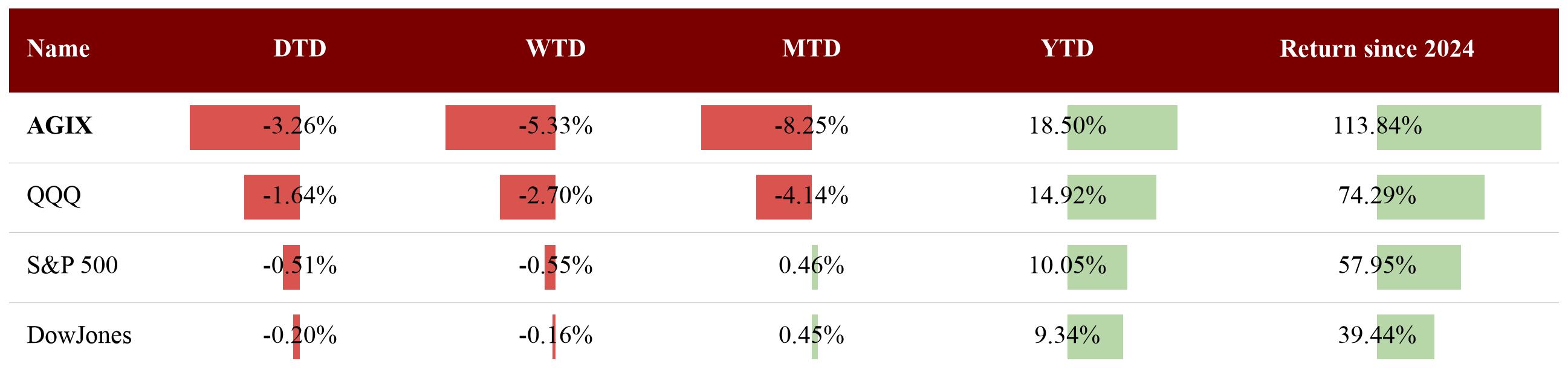
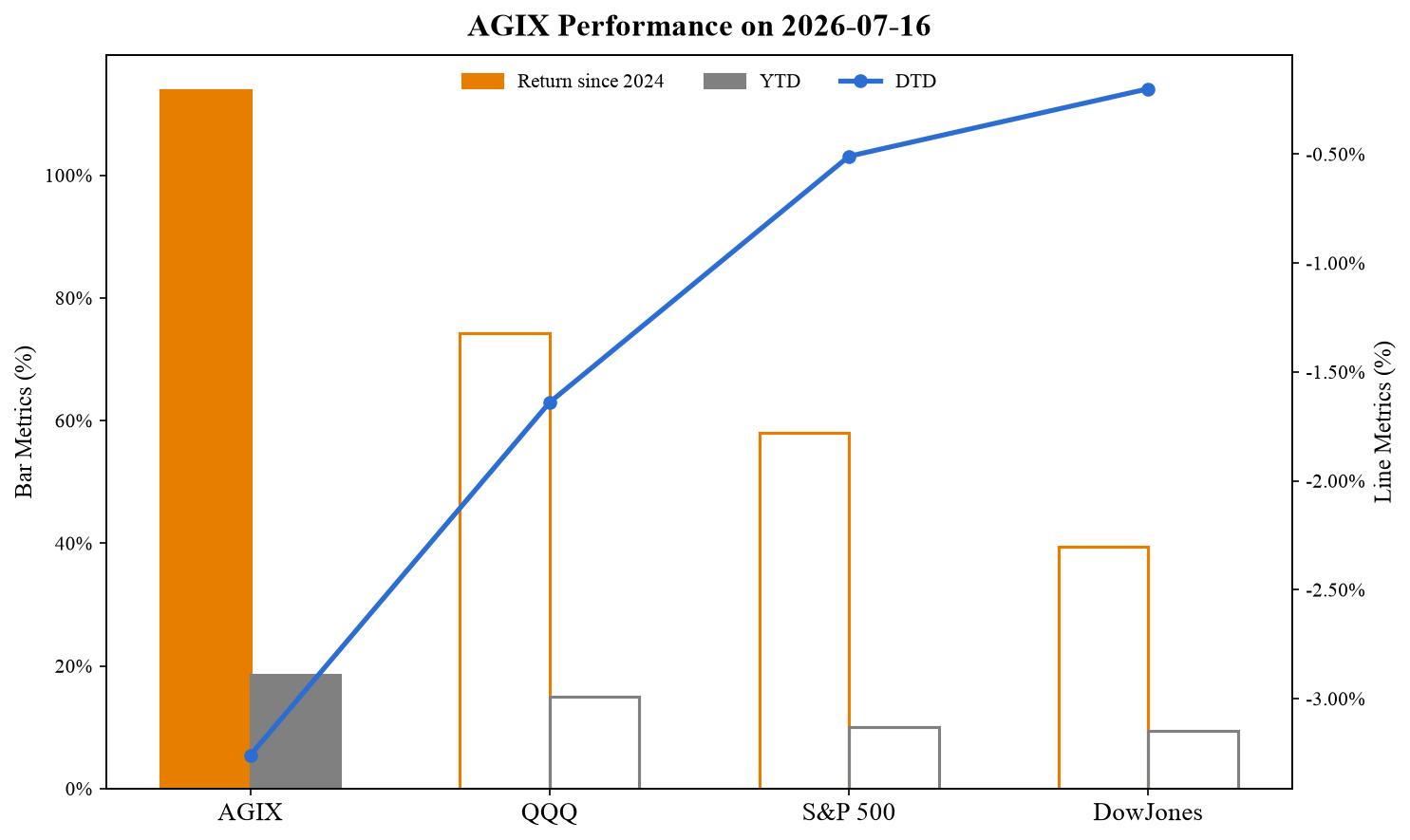
• AGIX fell 3.26% DTD, underperforming the QQQ (-1.64%) and S&P 500 (-0.51%), primarily dragged by hardware holdings like Broadcom (-5.03%), AMD (-5.33%), and Astera Labs (-8.81%), as well as infrastructure names like Alphabet (-4.44%) and Nebius Group (-13.9%).
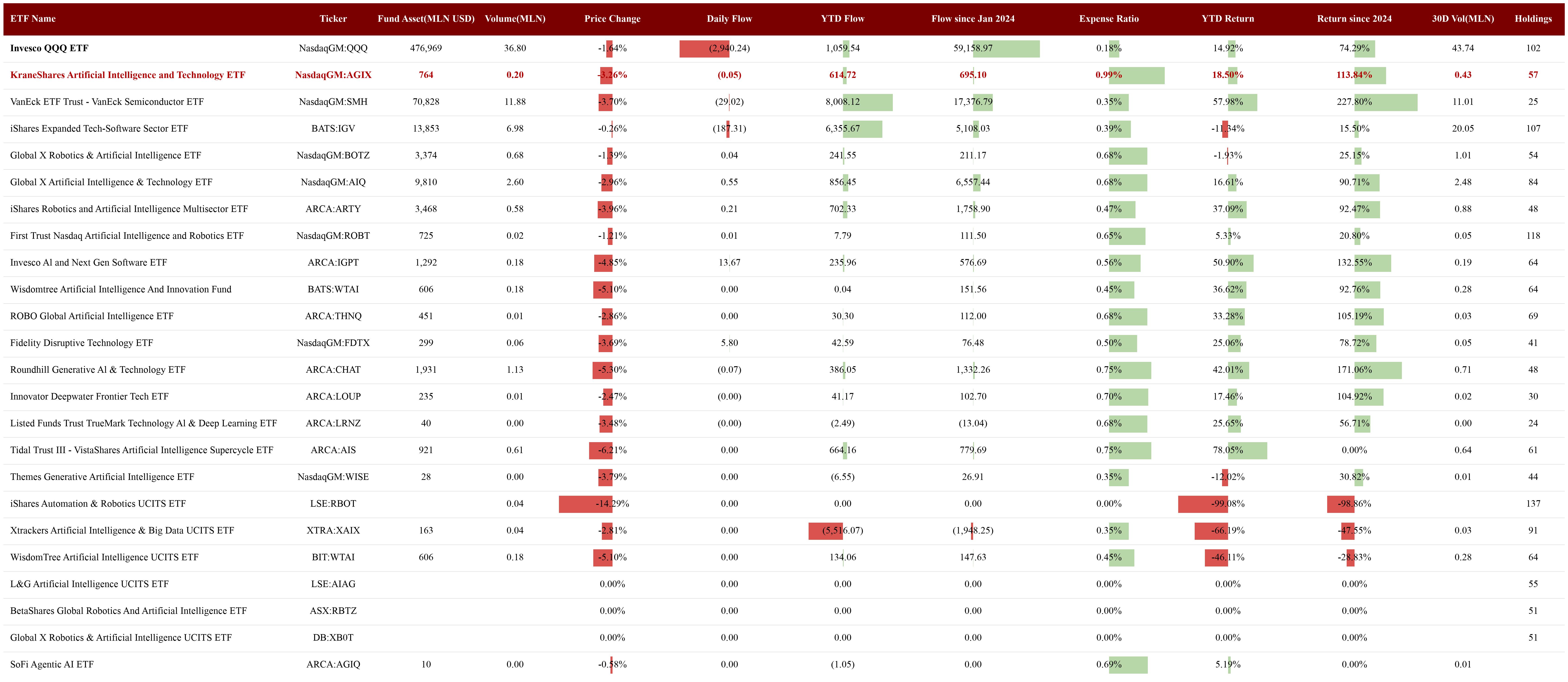
• Peer AI-focused ETFs also saw broad weakness, with IGPT (-4.85%), WTAI (-5.1%), and CHAT (-5.3%) all declining more than AGIX, while the broader market held up better, indicating sector-specific selling in AI and tech.
• Among AGIX holdings, notable gainers included SAP (+3.68%), Salesforce (+3.4%), and Samsara (+2.83%), reflecting strength in enterprise software and application stocks, partly offsetting the weakness in semiconductor and infrastructure names.
• Key stocks to watch today: Broadcom and AMD (hardware pressure), Alphabet and Nebius (infrastructure weakness), and SAP and Salesforce (positive momentum) — all are major AGIX holdings with significant DTD moves likely driven by sector rotation and specific news.
News Highlights
1. OpenAI's GPT-Red system demonstrates a major leap in automated red-teaming, reducing prompt injection failure rates to one-sixth of prior models; this may pressure AI security stocks but underscores the importance of robust AI for enterprise adoption, benefiting AGIX infrastructure holdings like Microsoft and Alphabet.
2. Microsoft is training its sales team to talk down rivals OpenAI and Anthropic, accelerating its own AI model development and reducing reliance on OpenAI; this could positively impact Microsoft (3.64% of AGIX) as it strengthens its competitive position and margins.
3. Moonshot AI's Kimi K3, a 2.8 trillion-parameter open-weights model, surpasses GPT-5.6 Sol and Claude Fable 5 in some benchmarks; this intensifies the open-source vs. proprietary AI debate and may pressure closed-model vendors, but also validates the AI infrastructure buildout, benefiting AGIX hardware names like Nvidia and TSMC.
4. TSMC boosted its Arizona fab investment by $100 billion and raised 2026 capital expenditure to $60-64 billion, signaling strong demand for advanced nodes and packaging; this is a positive catalyst for AGIX holdings like ASML, AMD, and Nvidia, which rely on TSMC's manufacturing.
5. Nvidia launched the Cosmos 3 Edge world model and expanded its physical AI push in Japan with the Cosmos Coalition, involving over 20 Japanese companies; this reinforces Nvidia's leadership in AI hardware and edge computing, supporting its 4.37% weighting in AGIX.
6. Apple Intelligence was approved for launch in China with Alibaba and Baidu, potentially boosting Apple's Greater China revenue; Apple (3.54% of AGIX) could see a positive impact from this regulatory milestone.
7. Thinking Machines Lab (Mira Murati) released Inkling, a 975B-parameter open-weights model, offering Western enterprises a low-cost alternative to Chinese open-source models; this may increase competition in the model layer but also drives demand for AI infrastructure, benefiting AGIX holdings like Nvidia and CoreWeave.
RSS Highlights
1. Moonshot AI's Kimi K3, a 2.8 trillion-parameter open-weights model, outperforms Claude Opus 4.8 and GPT-5.5 in benchmarks but is the most expensive model from a Chinese AI lab, with input tokens at $3/M and output at $15/M.
2. OpenAI responded to Apple's trade secret theft lawsuit, stating it found no evidence supporting the complaint, while an NBC News investigation revealed a communication breakdown due to Apple lawyers confusing two OpenAI employees.
3. xAI's Grok Build tool faced backlash for uploading user directories to Google Cloud, leading xAI to disable the feature, delete data, and open-source the codebase under Apache 2.0.
4. Linus Torvalds stated that the Linux project is not anti-AI, calling AI a useful tool, and argued that anyone doubting its value hasn't actually used it.
5. Intel was founded on July 18, 1968, by Gordon Moore, Robert Noyce, and Arthur Rock, initially focusing on memory chips before launching the first commercial microprocessor in 1971 and becoming an x86 standard-setter.
6. A review of the Thermal Master DV2 thermal imaging camera for birdwatching highlights its 512x384 resolution, 8x digital zoom, and 900m human heat signature detection, but notes the lack of a dedicated shutter button.
Performance & Benchmark
Attribution
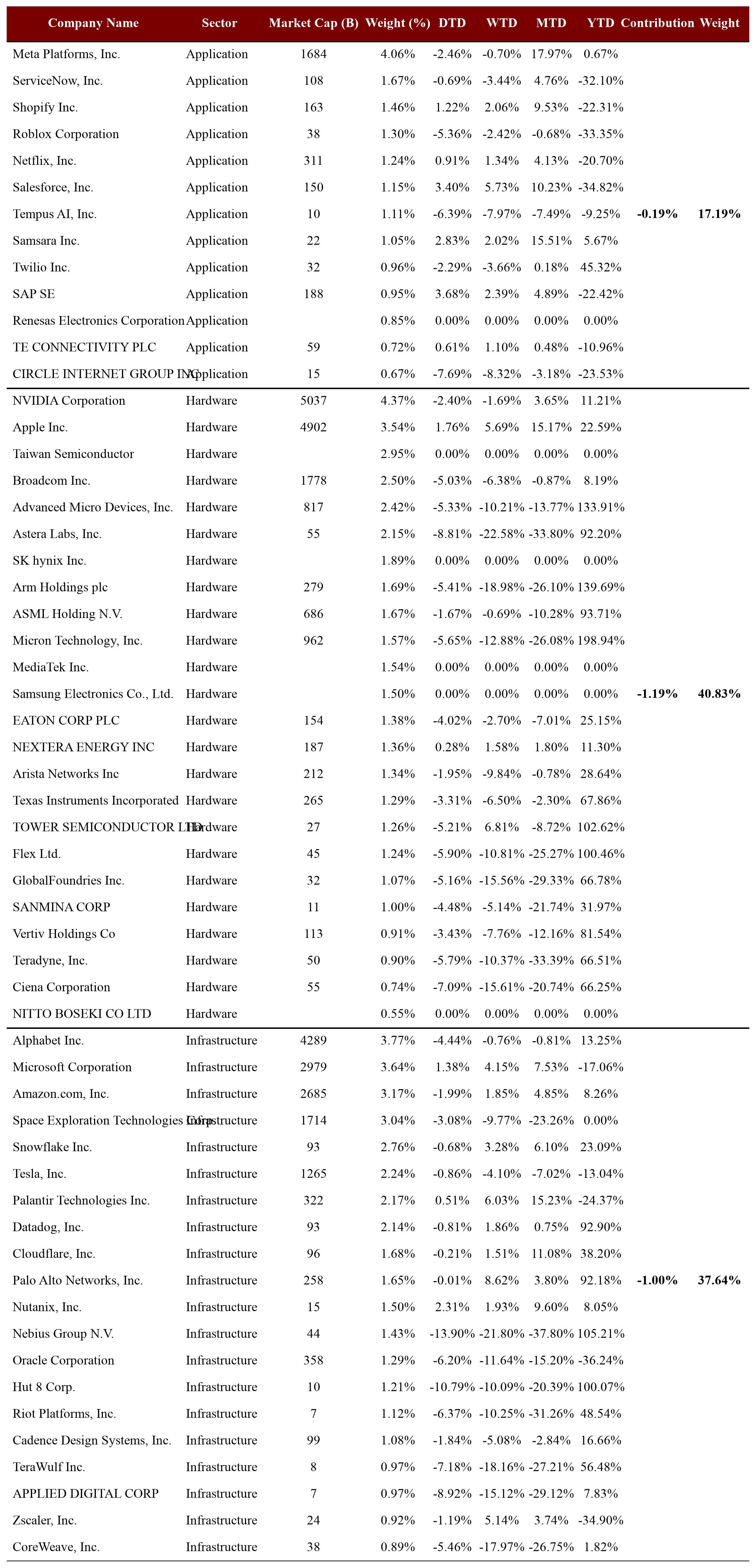
Contribution of the three sectors within AGIX holdings today
Application: -0.19%
Hardware: -1.19%
Infrastructure: -1.0%
Top-performing stocks in AGIX holdings today
SAP SE (3.68%)
Salesforce, Inc. (3.4%)
Samsara Inc. (2.83%)
Nutanix, Inc. (2.31%)
Worst-performing stocks in AGIX holdings today
Twilio Inc. (-2.29%)
NVIDIA Corporation (-2.4%)
Meta Platforms, Inc. (-2.46%)
Space Exploration Technologies Corp. (-3.08%)
Texas Instruments Incorporated (-3.31%)
Vertiv Holdings Co (-3.43%)
EATON CORP PLC (-4.02%)
Alphabet Inc. (-4.44%)
SANMINA CORP (-4.48%)
Broadcom Inc. (-5.03%)
GlobalFoundries Inc. (-5.16%)
TOWER SEMICONDUCTOR LTD (-5.21%)
Advanced Micro Devices, Inc. (-5.33%)
Roblox Corporation (-5.36%)
Arm Holdings plc (-5.41%)
CoreWeave, Inc. (-5.46%)
Micron Technology, Inc. (-5.65%)
Teradyne, Inc. (-5.79%)
Flex Ltd. (-5.9%)
Oracle Corporation (-6.2%)
Riot Platforms, Inc. (-6.37%)
Tempus AI, Inc. (-6.39%)
Ciena Corporation (-7.09%)
TeraWulf Inc. (-7.18%)
CIRCLE INTERNET GROUP INC (-7.69%)
Astera Labs, Inc. (-8.81%)
APPLIED DIGITAL CORP (-8.92%)
Hut 8 Corp. (-10.79%)
Nebius Group N.V. (-13.9%)
Top five listed stocks contributing the most within AGIX holdings today
Nebius Group N.V. (-13.9%)
Astera Labs, Inc. (-8.81%)
Alphabet Inc. (-4.44%)
Hut 8 Corp. (-10.79%)
Advanced Micro Devices, Inc. (-5.33%)
Observation
The strongest movers across peer ETF holdings today are listed below:
| DTD | Stock Ticker | Name | Held by ETFs | analysis |
|---|---|---|---|---|
| 7.22 | NasdaqGS:CTAS | Cintas Corporation | ['NasdaqGM:QQQ'] | Cintas’ 7.22% move on July 16, 2026 was primarily driven by a stronger-than-expected fiscal Q4 earnings print and upbeat forward guidance that reinforced the company’s high-margin growth narrative. The company delivered an adjusted EPS beat ($1.29 vs. ~$1.23 consensus) and revenue ahead of expectations ($2.91B vs. $2.87B), with record sales, record margins, and roughly high single-digit organic growth, which supported multiple expansion and a sharp rerating. A secondary driver was a wave of positive analyst reactions, including price-target increases and reaffirmed Buy/Outperform ratings (e.g., Goldman Sachs lifting its target and others following suit), which reinforced investor confidence and added incremental buying demand. Investor focus on continued progress toward the UniFirst acquisition, framed as a strategic growth lever, likely provided an additional supportive backdrop but was less important than the earnings and guidance surprise. |
| 7.22 | NasdaqGS:DXCM | DexCom, Inc. | ['NasdaqGM:QQQ'] | DexCom’s 7.22% gain on July 16, 2026 appears primarily driven by continued investor enthusiasm around its stronger 2026 fundamental outlook and long‑term growth and margin targets, supported by broadly bullish analyst sentiment. Q1 2026 results beat on both EPS and revenue, with raised full‑year margin and revenue guidance and a $1B buyback framing a higher‑quality growth story that investors are still repricing into the stock.[10][12][13] A strong “Buy/Strong Buy” consensus from over 24–30 analysts with upside to target prices reinforced the move as the stock traded up toward those targets.[2][5] |
| 6.6 | NasdaqGS:CSGP | CoStar Group, Inc. | ['LSE:AIAG', 'ARCA:ARTY', 'ARCA:THNQ'] | CoStar Group’s 6.6% gain on July 16, 2026 was primarily driven by a positive reaction to its fundamental setup at a seven-year-low valuation, with investors leaning into the name on improving earnings power and supportive analyst targets. Recent commentary highlighting doubled year-over-year adjusted EBITDA, raised full-year EBITDA guidance, and an average Street price target implying roughly 60% upside from current levels likely reinforced buy-the-dip sentiment and helped catalyze the move.[10][5] A secondary driver was the stock’s elevated volatility and prior sharp drawdown, which can amplify single-day rebounds when sentiment or positioning shifts.[10][7] |
| 6.34 | 1810.HK | XIAOMI CORP-CLASS B | ['NasdaqGM:BOTZ'] | Xiaomi’s 6.34% rise on 16 July 2026 appears primarily driven by stock‑specific technical and sentiment factors rather than a discrete fundamental news catalyst. The share broke sharply higher from the prior close of HK$25.86 to around HK$27.5, with technical indicators on Investing.com shifting to a “Strong Buy” signal, which likely attracted momentum and algorithmic buying.[6] In the absence of notable same‑day company or regulatory announcements, the move is best attributed to positive technical setup and short‑term trading flows in a stock that had been trading near the lower end of its 52‑week range.[6] |
| 6.04 | NYSE:KAI | Kadant Inc. | ['LSE:RBOT'] | Kadant’s 6.0% move was primarily driven by its first‑quarter 2026 earnings release, which significantly beat expectations and reset the growth and guidance narrative higher. The company reported strong Q1 results with adjusted EPS of $2.84 on $281.5 million of revenue, record bookings of $320.8 million (up 25.2% year over year), and raised full‑year 2026 revenue guidance, prompting investors to re‑rate the stock.[5] |
| 5.96 | NYSE:GWRE | Guidewire Software, Inc. | ['BATS:IGV'] | Guidewire Software’s 5.96% gain on July 16, 2026 appears driven primarily by momentum and bullish sentiment rather than a specific company news event, as there were no new fundamental disclosures or material headlines that day. The stock is trading with a broad analyst “Buy” consensus and substantial implied upside to target prices, reinforcing investor appetite for the name amid strong recent performance and favorable technical signals.[3][7][6] |
| 5.77 | 3896.HK | Kingsoft Cloud Holdings Ltd | ['NasdaqGM:WISE'] | Kingsoft Cloud’s 5.77% gain on July 16, 2026 appears primarily driven by positive sentiment around its AI-related positioning and ongoing bullish analyst views, rather than by any new company‑specific disclosure that day. Haitong International recently highlighted Kingsoft Cloud as a unique and agile cloud provider leveraged to the surge in token usage from AI agents, framing the name as a beneficiary of current AI demand, which helped underpin the move alongside broader AI/cloud strength.[9] A secondary driver is the strong existing analyst backdrop, with a “Strong Buy” consensus and substantial implied upside to target prices that continues to support incremental buying on strength.[1][6] |
| 5.71 | NasdaqGS:AVAV | AeroVironment, Inc. | ['ASX:RBTZ', 'DB:XB0T', 'ARCA:IGPT', 'ARCA:LOUP', 'NasdaqGM:BOTZ', 'NasdaqGM:ROBT'] | AeroVironment’s 5.7% gain on July 16 was primarily driven by renewed optimism around its drone and counter‑drone franchise, centered on the Titan platform and associated U.S. Army and domestic security contracts that are shaping multi‑year growth expectations.[1][6] The move was reinforced by bullish sell‑side commentary and upward‑sloping price targets (e.g., Raymond James’ Outperform and $210 target, Jefferies and others highlighting $500M‑plus Titan and potential laser awards), which supported a “buy the dip” narrative after prior weakness.[1][2][6] Elevated trading volume versus average also points to momentum and institutional positioning rather than idiosyncratic, stock‑specific news on the day.[2][7] |
| 5.63 | NYSE:QTWO | Q2 Holdings, Inc. | ['BATS:IGV'] | QTWO’s 5.6% gain on July 16, 2026 appears to be driven primarily by continued investor enthusiasm around the company’s digital banking and fintech positioning, supported by a broadly positive analyst backdrop and upside to consensus target prices. Public data show a solid Buy consensus and meaningful estimated upside to 12‑month targets, which can reinforce momentum and attract incremental demand in a rising stock. In the absence of company-specific news or disclosures on the day, the move is best attributed to style/momentum factors and ongoing rerating toward bullish analyst expectations. |
| 5.56 | 0268.HK | KINGDEE INTERNATIONAL SFTWR | ['ARCA:THNQ'] | Kingdee International Software’s 5.6% gain on July 16 was primarily driven by investor reaction to its same-day profit warning, which, despite the label, guided to double‑digit revenue growth and a return to profitability for 1H26, reinforcing confidence in its “AI-first, subscription-first, globalization” strategy.[7] The move was further supported by positive sector sentiment toward AI‑enabled software and SaaS names, with local brokers highlighting Kingdee as a leading Chinese enterprise management cloud provider positioned to benefit from AI adoption.[4][7] |
| 5.54 | NYSE:ACN | Accenture plc | ['ARCA:ARTY', 'ARCA:THNQ', 'NasdaqGM:AIQ'] | Accenture’s 5.5% move appears driven primarily by a rebound in an oversold, undervalued name, with investors rotating back into high-quality IT services after a sharp year-to-date drawdown. Same-day pricing data show ACN trading up from roughly $137 to the mid-$144s, with multiple sources highlighting a depressed P/E, strong free cash flow, and analyst consensus “Buy” ratings and sizable upside to target prices, which likely supported bargain-hunting and short-covering.[1][2][6][9][10][11] A secondary driver is growing anticipation of a cyclical recovery in consulting and AI-related transformation spending, supported by commentary that bookings and large deal activity remain healthy and that recent weakness is viewed as transitory rather than structural, encouraging investors to add exposure on improving sentiment.[8][9][13][15] |
| 5.4 | NasdaqGS:INTU | Intuit Inc. | ['LSE:AIAG', 'ARCA:THNQ', 'BATS:IGV', 'NasdaqGM:FDTX', 'NasdaqGM:QQQ', 'XTRA:XAIX'] | Intuit’s 5.4% gain on July 16, 2026 was primarily a continuation of the sharp rebound following strong FY26 results and upgraded guidance that re‑anchored the earnings and AI-growth narrative after prior tax-season weakness. Recent coverage highlighted double‑digit revenue growth in fiscal Q3 2026, strength in QuickBooks Online and the broader online ecosystem, and raised full‑year revenue and EPS guidance, which have supported renewed investor confidence and buying interest in the name.[6][10] |
| 5.32 | NYSE:ESAB | ESAB Corporation | ['LSE:RBOT'] | ESAB’s 5.32% move on 2026-07-16 appears most consistent with a continuation of positive sentiment from recent company-specific catalysts rather than a clear new same-day headline. The strongest fundamental support in the available news is ESAB’s completed Eddyfi Technologies acquisition, its reaffirmed 2026 guidance, and the earlier increase in its quarterly dividend, which together likely helped keep buyers engaged.[5][11] A secondary driver is broader market/sector risk appetite, as recent coverage linked ESAB’s strength to easing geopolitical concerns and industrial risk sentiment. Technical/momentum factors may also have amplified the move, since the stock had been under pressure before the rebound and was trading near the lower end of its recent range.[6][11][1] |
| 5.29 | NasdaqGS:ODFL | Old Dominion Freight Line, Inc. | ['NasdaqGM:QQQ'] | Old Dominion Freight Line’s 5.3% gain appears primarily driven by follow-through buying after its better‑than‑expected Q1 CY2026 results and resilient margin performance, which reinforced the bull case around its premium LTL positioning despite modest volume and revenue pressure.[7] The move was likely amplified by technical and sentiment factors, with the stock trading near 52‑week highs and benefiting from a broader freight‑recovery narrative and generally positive analyst stance, including upward price target revisions earlier in the year.[5][5][9] |
| 5.24 | NasdaqGS:PEGA | Pegasystems Inc. | ['ASX:RBTZ', 'DB:XB0T', 'ARCA:IGPT', 'BATS:IGV', 'NasdaqGM:AIQ', 'NasdaqGM:ROBT'] | Pegasystems’ 5.24% gain on July 16, 2026 appears driven primarily by renewed focus on its upside relative to consensus valuation and ratings, rather than by discrete company news. The stock traded around $31.28 on the day with a “Strong Buy” consensus, 0 sells, and an implied ~86% upside to the average target price of $58.18, which likely supported incremental buying interest as investors rotated into under-valued software names[12]. A secondary driver is supportive analyst commentary around the time of its user conference, with Citizens reiterating a Market Outperform and $58 target and highlighting attractive valuation metrics, reinforcing the bullish setup[11]. |
| 5.03 | NasdaqGS:MLAB | Mesa Laboratories, Inc. | ['LSE:RBOT'] | Mesa Laboratories’ 5.0% gain on July 16, 2026 appears primarily driven by a rebound and accumulation following the sharp post-earnings sell-off earlier in the week, as investors digested Q4/FY26 results that showed modest revenue growth but substantially higher FY net income and AOI margins. Recent commentary from Jefferies highlighting undervaluation and raising the price target to $130 while maintaining a Buy rating likely supported sentiment and helped attract dip-buyers and fundamental investors. No new company-specific news prints or major sector catalysts were identified on the day, suggesting the move was largely a technical and sentiment-driven recovery within the context of recent earnings-related volatility. |
News
Funding & M&A
How a former DeepMind researcher raised money at a $300 million pre-seed valuation before launching a product
Visual AI company Elorian, founded by former Google DeepMind researcher Andrew Dai, raised $55 million in seed funding at a $300 million valuation, becoming one of the largest seed rounds in the AI field. The company focuses on visual understanding and reasoning capabilities, aiming to advance visual AGI. Collaborating with strategic investors like Nvidia and Menlo Ventures rather than purely pursuing a high valuation demonstrates the founders' emphasis on technical understanding and resources. This round provides rapid growth capital for former deep learning researchers and highlights the importance of speed and technical storytelling in the AI field. Elorian is recruiting top researchers to accelerate model evolution.
SpaceX suddenly aborts second Starship V3 launch after ignition
North American tech company SpaceX launched an upgraded Starship rocket again on Thursday, but it automatically aborted after booster ignition due to some Raptor engines failing to start. According to CEO Elon Musk on X, the company will try again in a few days. This test flight was originally scheduled to launch third-generation Starlink satellites, but the rocket has not yet proven it can reach Earth orbit for timed burn. This is the company's first launch attempt since its initial public offering on June 12, which raised over $95 billion in the largest IPO in history. Since the IPO, the stock price has fallen from the $135 IPO price, and it dropped another 4% in after-hours trading on the day of the launch. In the previous V3 rocket launch in May, although simulated satellites were successfully deployed, the booster landing failed, leading to an FAA investigation. The industry is watching whether SpaceX can verify the feasibility of the "orbital data center" concept through this series of tests.
AI-powered travel agency Fora hits unicorn status, raises $60M
Travel service platform Fora has just completed a $60 million Series D funding round, led by Forerunner and Tactile Ventures, with a valuation of $1 billion. Founded in 2021, the company offers two core services: first, helping ordinary people quickly become travel agents by providing infrastructure for client communication and itinerary planning; second, making it easy for users to find professional travel advisors to design itineraries for occasions like honeymoons or family trips. This funding round also brought in Insight Partners, Thrive Capital, and other institutions. To date, Fora has raised a total of $138.5 million. The new capital will be used to expand the AI assistant Via, which helps travel agents handle research, itinerary creation, and other tedious tasks, enhancing human efficiency rather than replacing humans. Since its launch, agents on the platform have achieved over $3 billion in orders, with most agents being newcomers. Future funds will also be used to expand into travel categories such as cruises and air travel.
Microagi secures $55 million to teach factory robots how to work
Munich-based AI robotics startup Microagi GmbH today announced a $55 million seed funding round, led by Hummingbird, with participation from Northzone, LocalGlobe, Village Global, and Redalpine. The company was founded ten months ago by former aerodynamic engineers from the Red Bull Racing and Mercedes-AMG F1 teams, with CEO Bercan Kilic having previously worked at Red Bull Racing. Its core product, Atlas, is an industrial robot data and deployment platform that extracts large amounts of factory data to fine-tune cutting-edge robot models. The company does not develop its own robots or models but provides a data layer service, learning in real-time through on-site engineers and continuously optimizing performance with reinforcement learning loops. This round is primarily used to address the contradiction in industrial robot training data. To obtain more home cleaning and cooking video data, Microagi is offering free cleaning services in New York and developing a private chef program in new cities, helping clients achieve rapid robot deployment.
Sheryl Sandberg leads a $10 million investment in an AI-powered vehicle inspection service
The family office of former executive Sheryl Sandberg, Sandberg Bernthal Venture Partners, led a $10 million investment in San Diego-based vehicle inspection startup Self Inspection. Founded in 2021, the company uses smartphone cameras to complete vehicle body damage assessments, having performed over 1 million inspections for rental fleets, auto finance companies, auction industries, and marketplace platforms. Stellantis' financial services division has adopted the platform for corporate vehicle and lease-end inspections. Investors also include tire distributor U.S. AutoForce, auto lender Westlake Financial, and Costanoa Ventures. Self Inspection uses AI to compare against a large damage database, outputting detailed repair reports and cost estimates, helping clients save $80 million in costs and over 300,000 hours. New funds will be used for product development, enterprise customer expansion, and European market deployment.
Ultrahuman’s former hardware VP raises $5.5M for devices that control AI agents, not just record you.
Bengaluru and Washington-based startup Aina has announced $5.5 million in funding, led by Redstart Labs and 360 ONE, with participation from MIXI, Antler, and Blume Founders Fund. The round also attracted prominent investors including WhatsApp's new chief Kunal Shah and Razorpay's founders. Aina, formerly known as Project Mirage, was founded by Apoorv Shankar, former VP of Hardware at Ultrahuman. Its first product, Dune, is a three-button smart shortcut keyboard that can control devices and trigger AI agents. The company is integrating this device with other design features and plans to develop next-generation action-oriented AI control devices. This funding round reflects strong investor confidence in the AI interface hardware market.
AI infrastructure startup Fireworks closes $1.5B round at $17.5B valuation
Spark AI Company Fireworks AI Inc. has just completed a $1.5 billion Series D funding round, co-led by Atreides Management, Index Ventures, and TCV, with participation from Nvidia and several other institutions. The company is now valued at $17.5 billion after this round. Spark AI primarily provides open-source model fine-tuning and inference services, processing over 40 trillion tokens daily and generating an annualized revenue of over $1 billion. Its clients include well-known tech companies such as Samsung Electronics and GitLab. The platform supports four parallel technologies and offers both serverless and dedicated deployment inference methods, as well as quantization compression and auto-scaling. This funding will be used to expand infrastructure and increase the engineering team.
Spectro Cloud wants to ease AI infrastructure management after raising $100M in funding.
AI software startup Spectro Cloud has just completed a $100 million Series D funding round, led by Goldman Sachs' investment division, with participation from AMD Ventures, Ericsson, LG Technology Ventures, and Maximus. This round brings the company's total funding to over $260 million. The company focuses on its Palette platform and the newly launched PaletteAI service, aiming to address the complexity of managing AI infrastructure deployment across multiple scenarios. Global AI spending is expected to reach $2.59 trillion, with most flowing to hardware and a very small portion to software. Spectro Cloud's solution provides a unified control plane on top of Kubernetes, supporting GPU management, distributed inference, and multi-cloud environments. The company will prioritize expanding PaletteAI capabilities, entering the sovereign cloud market, and deepening partnerships with chip and server manufacturers. AMD Ventures' participation highlights market interest in non-Nvidia GPU inference.
Applied Computing wants to give oil and gas operators an AI model for the entire plant.
London-based foundational AI startup Applied Computing has announced a $20 million Series A funding round, led by engineering giant KBR, with Databricks Ventures participating. Founded in 2023, the company focuses on Orbital, a foundational model for the oil, gas, and petrochemical industries, which combines time-series, physical chemistry models, and language models to enable real-time facility status predictions. It has transitioned from stealth to hundreds of thousands of dollars in ARR, with clients including several publicly listed oil companies. Partnerships have been established with KBR and Wipro, and Orbital has been integrated into the INSITE 3.0 platform. The funding will be used for international expansion, R&D hiring, and business deployment. The company is also opening an office in Houston to be closer to North American clients. Against competitors like AspenTech, its core competitiveness lies in AI model development and proprietary industrial data.
QumulusAI’s direct listing: Accelerating the neocloud for enterprise AI
QumulusAI announced it will list on Nasdaq via a direct listing on Thursday under the ticker QMLS. The company allows existing shareholders to sell shares without underwriters, making it suitable for cash-rich and highly liquid enterprises. Unlike traditional IPOs, direct listings do not create new shares, with the main goal being to enhance capital flexibility, increase customer trust, and seize the AI infrastructure window. QumulusAI focuses on GPU-driven AI-first cloud infrastructure, using modular 50MW data center deployments to quickly bring Nvidia Hopper and Blackwell GPUs online, prioritizing power availability and delivery speed over hyperscale cloud providers. The company is transitioning from crypto infrastructure to an enterprise-grade AI computing provider, building its capital structure through asset-backed convertible bonds, equipment leasing, and customer prepayments. The listing will provide more financing options, improve governance transparency, and lock in multi-year GPU contracts. As the market shifts from H100 scarcity to scale, utilization, and power bottlenecks, QumulusAI's listing comes amid surging demand for AI infrastructure, helping it accelerate expansion in the competitive "new cloud" track.
Model Releases
Mira Murati’s Thinking Machines releases Inkling, an open-weights model anyone can access
Thinking Machines Lab Inc. today officially launched its first self-trained foundation model, Inkling, and will fully open its weights to developers. The model uses a Mixture-of-Experts architecture with a total of 975 billion parameters, activating an average of only 37 billion parameters per prompt, significantly reducing operating costs while maintaining efficiency. The model was trained on 450 trillion tokens of text, image, audio, and video data, supporting native reasoning across four modalities, outputting text, code, and structured data. The company partnered with Citigroup to complete training on GB300 NVL72 systems in less than nine months. To compete with Chinese open-source models, Inkling offers Western enterprises a low-cost, fully customizable option. Developers can quickly fine-tune via the Tinker API and adjust the trade-off between speed and accuracy using the "thinking" parameter. Analysts note that this is the first Western open-weight solution capable of competing with Chinese models, reshaping the economics of enterprise AI deployment.
Moonshot’s upcoming Kimi 3 is expected to close the gap with Anthropic’s Opus 4.8
A new version of the Kimi model from Chinese AI lab Moonshot AI is about to launch, expected to reach or exceed the level of Anthropic Opus 4.8. According to the Financial Times, Kimi K3 will become China's largest open-weight AI model, with 20-30 billion parameters, set to go online soon. Previously, Kimi K2 received high praise in the open-source community, with capabilities close to the latest frontier models. Moonshot is conducting a new funding round at a $31.5 billion valuation, having raised $3 billion at a $20 billion valuation in May. This news comes amid industry discussions about whether to pay for closed-source models like OpenAI and Anthropic. Industry leaders recommend using open-source models like Moonshot and DeepSeek as alternatives, training them according to specific needs.
China’s Moonshot throws down the gauntlet with Kimi K3, the world’s largest open-weights model
Yueshe Intelligence today announced that it will soon release its latest large model, Kimi K3. The model has 2.8 trillion parameters and will become the world's largest open-weight model, with its weights scheduled to be publicly released on July 27. Benchmark tests show that Kimi K3 has surpassed OpenAI GPT-5.6 Sol and Anthropic Claude Fable 5 on some tasks such as front-end development. Third-party evaluations like Arena.ai indicate that its intelligence index closely follows top proprietary models. The model is primarily designed for long-cycle autonomous software development tasks and supports visual feedback loops. Yueshe Intelligence is backed by Alibaba, and its input and output prices are significantly lower than those of comparable US models. Analysts point out that this release may mark China's open-source models surpassing those of the US, triggering a new round of discussions on model theft, export controls, and security reviews.
Technical Breakthroughs
Special Breaking Analysis: Nvidia’s AI networking moat is real – but the lock-in debate continues
In a panel discussion hosted by Dave Vellante and Bob Laliberte, Nvidia's head of networking, Gilad Shainer, explained that in the era of agentic inference, networking has transformed from a pure data connectivity device into a core component of computing systems. The discussion emphasized that to build a true AI factory, networks must be deeply integrated with modules such as GPUs, CPUs, DPUs, NVLink, Spectrum-X, ConnectX, and BlueField, rather than simply setting up server clusters. The article points out that Nvidia leads its peers at the system level, with its advantage stemming from extreme co-design rather than a single protocol layer. However, this deep integration also brings the risk of customer dependency, so Nvidia has compromised by claiming support for standard Ethernet, RoCE, and multiple NOS. A CUBE Research survey shows that 94.6% of respondents believe the impact of networking on business goals has significantly increased.
Three insights you may have missed from theCUBE’s coverage of RAISE Summit
With the rapid development of agentic reasoning and inference, the focus of AI infrastructure has shifted from training to inference, and storage is becoming a key performance element. Solidigm executive Greg Matson pointed out that agentic reasoning adds new layers to the storage hierarchy, requiring high-capacity, high-performance solid-state storage close to GPUs to ensure continuous computation. AMD is achieving collaborative optimization of CPU, GPU, and adaptive computing through the ROCm software stack. Tensordyne has launched the Napier inference chip, which uses a logarithmic number system to significantly reduce power consumption. d-Matrix combines the Corsair accelerator with Nvidia Hopper/Blackwell GPUs to support heterogeneous inference. Argentum AI is innovating capital models to accelerate deployment. Neo4j's knowledge graph combined with large models enables data sovereignty and rule control. This transformation is reshaping data center architecture and energy management.
Roblox launches an AI-powered game-creation feature in its mobile app
Roblox recently launched a new feature called "Build," allowing users to input text prompts on mobile devices to automatically generate basic games using AI. This feature integrates multiple open-source and proprietary models, handling game mechanics, environments, characters, sound effects, and more, enabling low-barrier creators to quickly realize their ideas. This move has raised concerns among developers about an influx of AI-generated content, with a survey showing that over 50% of industry insiders believe generative AI has a negative impact on the industry. In response, Roblox will sort content based on player retention rates to control low-quality content. Additionally, the company is developing multiple AI tools, including an AI assistant, scene generation models, and 3D asset generators, and will begin public testing in New Zealand on July 28.
OpenAI details GPT-Red, an AI that attacks its own models to find flaws
OpenAI Group PBC recently disclosed its internal AI system, GPT-Red, which uses self-play reinforcement learning to automatically launch large-scale prompt injection attacks against its own models. GPT-Red achieves a success rate of 84% in scenarios, far exceeding the 13% of human red teams, and reduces the direct prompt injection failure rate to one-sixth of the best production model from four months ago. For the "fake chain-of-thought" attack that was 95% successful against GPT-5.1, the success rate on GPT-5.6 has dropped below 10%. The tool has successfully hijacked the Vendy vending machine agent and command-line coding agent, exposing real risks in autonomous AI systems. OpenAI stated that GPT-Red will not be released externally and is only used for internal training iterations, having been in use since GPT-5.3. The system still has shortcomings in multi-turn conversations and image injection, requiring human supplementation. The disclosure comes as OpenAI releases GPT-5.6, with prompt injection remaining a core challenge in AI security.
Intel starts using ASML’s High NA EUV technology to produce chips
ASML Holding NV announced that Intel has started up the TwinScan EXE series high numerical aperture extreme ultraviolet lithography machine at its Oregon factory for production of some critical layers of the Intel 18A process. The EXE:5200B has a 51% higher NA value than its predecessor, enabling 8nm resolution pattern etching, significantly better than the previous 13nm level. Intel is using the equipment to mass-produce some Intel Core Ultra Series 3 notebook processors, integrating 12 CPU cores, 12 GPU cores, and an AI accelerator. ASML simultaneously released its second-quarter financial results, with revenue of 9.3 billion euros exceeding expectations, net profit of 2.9 billion euros, and raised its full-year revenue guidance to 43-45 billion euros, planning to increase capacity by 30% on some production lines over the next two years. This marks the transition of high-NA EUV technology from verification to commercial mass production, helping Intel narrow the gap with TSMC in advanced process competition.
Product Launches
Google Vids now lets you star in your own AI videos
U.S. tech giant Google announced on Thursday that its AI video tool Google Vids will receive a major update. Users can upload selfie photos and voice recordings to generate personalized digital avatars, and combine text prompts with reference images to create videos. The new Gemini Omni model enables background replacement, lighting adjustments, and step-by-step editing, making video production more flexible and efficient. The tool is now integrated into Google Workspace, expanding from a business presentation tool to a full-featured video creation platform, directly challenging AI video startups like HeyGen and Synthesia. Personal avatars will be tied to accounts and have SynthID watermarks implicitly added, with usage restricted to users aged 18 and above in specific regions. This move marks Google's strengthened presence in the generative AI field and is expected to enhance enterprise content creation efficiency.
Newsletter platform Beehiiv now lets subscribers chat with each other, adds AI
The Beehiiv platform has launched several new features, transforming itself from a newsletter service provider into an all-in-one creator platform. The most important is the Community tool, which allows subscribers to create discussion forums directly within the platform, supporting paid membership tiers and chat room management, thereby bringing communities that were previously scattered across Discord, Slack, or Facebook groups back to the platform. At the same time, Beehiiv introduced the AI Copilot assistant, which provides growth suggestions based on content, subscriber behavior, and performance data, and supports draft scheduling and opportunity identification. The platform also opened programmatic advertising features, allowing creators to automatically select the highest-return ads based on customer data. Previously, the platform's ad network had already enabled publishers to earn over $1 million in monthly revenue. Additionally, Beehiiv upgraded the editor to a dual-view mode for instant preview effects. The company has now launched podcasts, webinars, and customizable paywalls, with 50% of podcast users migrating from external sources. As competitors like Riverside and Substack also roll out similar features, Beehiiv is building a core competitive advantage in the creator ecosystem through product iteration and AI capabilities.
Google’s AI Mode now lets you link and interact with select apps
U.S. tech giant Google announced on Thursday that its conversational search experience AI Mode now supports users in directly connecting to and operating third-party applications. The first integrated apps include Instacart, Canva, and YouTube. Users can sync restaurant shopping lists directly to their Instacart cart within AI Mode, have Canva generate design templates, or save generated playlists to YouTube Music. This move expands AI Mode from simple Q&A to actual task execution, aiming to increase user engagement and strengthen competitiveness against ChatGPT and Claude. The feature is gradually rolling out in the U.S. and will continue to integrate more partners. Previously, Google had launched third-party integrations within the Gemini app at the I/O conference, and recently added features like inventory lookup, parallel web browsing, and personal intelligence.
Ledger launches Agent Stack to keep AI agents away from crypto keys.
Ledger SAS today launched the Ledger Agent Stack, an open-source toolkit that allows developers to build AI agents capable of reading account balances and drafting cryptocurrency transactions, but transactions require human confirmation via signing on a Ledger hardware wallet before execution. The toolkit includes components such as the Device Management Kit Skills, Ledger Wallet CLI, and Ledger Enterprise CLI, and also provides OpenPGP and Security Key features to protect keys and service logins. Ledger cites data indicating that human error causes approximately 60% of security incidents and emphasizes that hardware signing can effectively prevent asset loss if an agent is compromised. MoonPay and Shisa have already begun integrating the toolkit. This release is the first result of Ledger's 2026 AI roadmap, and since its founding in 2014, the company has sold over 8 million hardware wallets globally.
Policy & Regulation
Meta now alerts parents if their teen discussed suicide or self-harm with its AI chatbot.
Meta announced Thursday that it will send notifications to parents of teenage users when they discuss suicide or self-harm content with the Meta AI chatbot. Additionally, Meta is developing an emergency services contact feature that can directly alert authorities if a conversation indicates a risk of self-harm. This move aims to address concerns from regulators and parents about AI chatbots handling crisis conversations. The notification feature is now available within Instagram's parental supervision tools in the US, UK, Australia, and Canada, and will expand globally by the end of the year. Meta has built a dedicated AI system to identify conversations that explicitly mention self-harm, and all flagged content will be reviewed by human moderators before alerts are sent to reduce false positives. Meta has also extended its 'limited content' settings to Meta AI, further restricting sensitive topics discussed with teenagers. Additionally, Meta stated that regardless of user age, if a conversation suggests suicide risk, emergency services will be contacted. Meta has previously implemented similar measures on Facebook and Instagram, and this expansion extends them to AI chat scenarios.
Industry Partnerships
Apple Intelligence approved for launch in China with Alibaba and Baidu
Apple is bringing its generative AI service, Apple Intelligence, to the Chinese market. According to Ruirui, China's internet content regulator has approved the service, with the core being a partnership with Alibaba to integrate the Qwen model into iOS, iPadOS, macOS, and visionOS systems. Baidu has also confirmed cooperation with Apple to jointly develop features tailored for Chinese users. Alibaba stated that the Qwen model will support text and image understanding and generation. Apple is exploring potential integrations with DeepSeek and ByteDance. The launch of Apple Intelligence in China had been delayed pending regulatory approval. In the second quarter, Apple's Greater China revenue reached $20.5 billion, up 28% year-over-year, and it returned to the second position in China's smartphone market.
Why AMI Labs’ Alexandre LeBrun won’t call his AI ‘AGI’ or ‘superintelligence’
AMI Labs CEO Alexandre LeBrun gave an exclusive interview to TechCrunch during the ICML conference in Seoul, explicitly refusing to use labels like AGI or superintelligence, arguing that these concepts lack clear definitions. The company is in talks with Korean robotics, semiconductor, and manufacturing companies, planning to train world models using real physical environments to address current AI shortcomings in the physical world. LeBrun noted that world models can predict changes in object states and will complement large language models in the future, enhancing robot safety and environmental perception. South Korea, with its strong hardware industry base and rapid technology adoption, has become AMI's preferred location for early deployment. The Korean government has announced an investment of $880 billion to boost chips, AI data centers, and physical AI development. SBVA CEO JP Lee also emphasized that physical AI and language models need to advance in parallel. Although AMI completed a $1.03 billion funding round in March, reaching a valuation of $3.5 billion, it is still in the pre-product stage and has not announced a specific timeline.
Why is OpenAI selling a ChatGPT basketball?
OpenAI this week launched its first hardware product—a small keyboard priced at $230—alongside a ChatGPT basketball sold for $70 and a series of merchandise. The basketball is made of rubber, suitable for outdoor use, and is part of the "Pause. Play. Prompt." campaign reminding users about mental health. Additionally, OpenAI introduced merchandise featuring motivational phrases like "Good research takes time," including a quarter-zip pullover for $175. These products primarily target tech professionals and AI enthusiasts, reflecting the company's attempt to blend creativity with daily life. While the product designs may face market adaptability challenges, they also indicate that AI companies are gradually expanding their product ecosystems.
Yes, you can now order DoorDash from the command line
DoorDash has launched a limited beta of a command-line tool named dd-cli, allowing developers to order food delivery, find deals, and complete checkout directly from the terminal via an AI agent. The tool is available to macOS developers in the US and Canada through a waitlist. This move connects the DoorDash ordering platform to AI agents, enabling developers to build their own tools for ordering meals, groceries, and local deals. In addition to the CLI, DoorDash has already implemented similar features in iMessage and its own smart chatbot "Ask DoorDash," and is integrating its services with large models like ChatGPT and Claude. This initiative marks an exploration of the "agent commerce" model, packaging platform capabilities into composable building blocks.
Microsoft is reportedly training salespeople to talk down OpenAI and Anthropic
Microsoft is accelerating its sales strategy to cope with fierce competition in the AI field. During an internal meeting on Tuesday, company executives asked the sales team to focus on comparing competitors such as OpenAI, Google, and Anthropic when promoting their own AI products, emphasizing the advantages of Microsoft's models in efficiency, cost, and Office application integration. Executive Vice President Jay Parikh pointed out that Microsoft provides end-to-end complete solutions rather than single components; Jacob Andreou directly compared Copilot's performance with Anthropic's Claude, stating that the latter falls short in speed, accuracy, and security. This move marks an acceleration of Microsoft's transition from relying on OpenAI models to developing its own models. Recently, Microsoft has gradually replaced OpenAI and Anthropic models in core applications such as Word and Excel to reduce costs. As the exclusive partnership with OpenAI ends, Microsoft is boosting market confidence through sales strategies to address investor concerns about massive AI expenditures.
Founders Fund hires former OpenAI exec Ryan Beiermeister (and not because of her ‘Mafia’ skills)
Former OpenAI Vice President of Product Policy Ryan Beiermeister announced she has joined Founders Fund as a partner. She was responsible for ChatGPT-related policy development at OpenAI and left due to opposition to the "adult mode" feature. Previously, she worked at Meta and Palantir, and has close ties with Founders Fund partner Trae Stephens and Palantir founder Peter Thiel. Her outstanding performance in Founders Fund's "Mafia" game show attracted attention, but officials said the game was not part of the interview process. Beiermeister stated she will focus on high-risk, high-tech startups in areas such as AI infrastructure, defense, energy, climate change, and biotechnology, and is open to accepting founders who do not fit traditional models. This move will strengthen Founders Fund's capabilities in cutting-edge technology and defense technology.
Nvidia launches Cosmos 3 Edge model and expands its physical AI push in Japan
Nvidia has launched the Cosmos 3 Edge world model designed specifically for edge devices, supporting 4 billion parameters for visual reasoning and robot policy generation, and can be adapted to specific robots, vehicles, and sensors within a day. The model is based on the Nemotron family, runs on the Jetson platform and RTX, DGX systems, and is accompanied by the Metropolis library, which can speed up the construction of Cosmos video intelligent systems by more than six times. Nvidia announced the formation of the Cosmos Coalition in Japan, with more than 20 companies including FANUC, Yaskawa Electric, Kawasaki Heavy Industries, Fujitsu, Hitachi, NEC, SoftBank, Sony, Honda Research, and Preferred Networks joining. SoftBank is building a physical AI development platform based on Cosmos, Omniverse, and Isaac Sim, while Groove X and Enactic are applying Jetson and Isaac GR00T to companion robots and care robots, respectively. Nvidia and the Japanese government jointly launched the world's first national-level AI infrastructure, FRONTia, built by Noetra, deploying 27,500 Rubin GPUs and 13,750 Vera CPUs with a total power of 140MW, supported by Japan's Ministry of Economy, Trade and Industry and $2.4 billion in government funding. Japan aims to capture more than 30% of the global AI robot market by 2040, with a market size expected to reach $133 billion. Jensen Huang said this move will help Japan revive its manufacturing leadership and usher in a new era of physical AI.
融资收购
Ramp targets AI’s fastest-growing cost with expanded token spend tracking
Ramp Business Corporation, which focuses on enterprise payments, has expanded its AI Token Spend Management product, providing finance teams with a unified dashboard to monitor token usage and billing across multiple AI providers including OpenAI, Anthropic, and Google Gemini. The system integrates weekly spending trend briefs, invoice-to-actual usage reconciliation, and overrun alerts. Ramp notes that AI token spending has become a third category of corporate expenditure, with usage based on API keys rather than cardholders, and its cost structure differs significantly from personnel and supplier spending. Thousands of businesses are already using the platform, which helps users identify cost-saving methods such as shifting workloads to cheaper models. Ramp CFO Will Petrie stated that managing AI spending is not just about controlling costs but also identifying the most valuable investment directions. The company, founded in 2019, recently completed a $750 million Series F round at a $44 billion valuation in June, with cumulative funding exceeding $3 billion.
TSMC boosts Arizona fab investment by $100B after strong second quarter
TSMC today released its second-quarter financial report, with net profit reaching NT$706.56 billion, up 97% year-over-year, exceeding analyst expectations. Revenue reached $39.45 billion, with high-performance computing contributing nearly half. The company also announced it will invest an additional $100 billion in the Arizona Fab park, building at least four new factories, bringing total investment to $265 billion. Two of these factories will produce 2nm and more advanced nodes, while the other two will produce advanced packaging components. TSMC raised its 2026 capital expenditure to $60-64 billion and increased its full-year revenue growth forecast to over 40%. The new node N2 has launched a data center version N2X and an automotive version N2A, offering customers higher performance and customization options.
RSS Subscription
Pluralistic: Deranged billionaires and their syndromes (16 Jul 2026)
Market theory holds that although people may be selfish, this selfishness can be transformed into overall social benefit through market mechanisms. Both the left and the right agree on using incentives to promote production and reduce costs, ensuring that market participants create value for the public while pursuing their own interests. Successful market participants often do not truly believe in the market; instead, they hope to protect their own interests through monopolies, which forces policymakers to create a competitive environment to ensure product and service quality and fair prices.
Stealth Startup Spy #357
A former HubSpot engineering director launched an AI customer relationship management system designed to act proactively rather than just track; meanwhile, former Boston Dynamics robotics experts are developing a YC-backed AI robotics company. Additionally, the co-founder of Kyoto Fusion Engineering is building the world's first isotope refinery.
Speculating on how the buggy control panel extension truncated a value that it had right in front of it
Last time we found that the crash of the control panel extension was caused by pointer truncation: the code incorrectly discarded the high 32 bits when handling 64-bit pointers. When the developers recompiled 32-bit code to 64-bit, they failed to update type conversions in time, resulting in passing 32-bit values instead of 64-bit values. Although they successfully performed window subclassing, they missed fixing the pointer issue after updating symbol names. Next time we will explore why this bug has not been fixed to this day.
How Predictable Are Laws?
The U.S. National Environmental Policy Act (NEPA) requires projects to undergo years of environmental impact studies before construction, making it a key tool for environmental groups to delay or block projects. Although NEPA's influence extends beyond federal projects, with many states and countries adopting similar laws, its original intent did not foresee such far-reaching consequences. An analysis of 239 federal laws over the past 50 years found that about 11% of laws had effects significantly deviating from expectations, revealing the unpredictability of legal implementation outcomes.
Gadget Review: Thermal Master DV2 - Infrared Birdwatching Scope ★★★★⯪
Thermal Master's DV2 thermal imaging camera is designed for bird watching and animal detection, featuring a bright touchscreen with a resolution of 512x384, 8x digital zoom, and video recording at 30fps. It can detect human heat signatures up to 900 meters away, provides RTSP video streaming over WiFi, and includes a built-in laser pointer and tripod mount. The battery is removable and supports USB charging. Compared to the Topdon TS004, the DV2 offers a more user-friendly interface and features but lacks a dedicated shutter button for taking photos.
Intel was founded on July 18, 1968.
Intel was founded on July 18, 1968, by semiconductor pioneers Gordon Moore, Robert Noyce, and investor Arthur Rock, initially focusing on SRAM and DRAM memory chips until 1981. In 1971, Intel launched the world's first commercial microprocessor, the Intel 4004, and transformed into a CPU company in the early 1990s with the rise of personal computers, gradually becoming the standard-setter for the x86 architecture. Despite the rise of competitors like AMD, Intel maintained its market position through strong brand marketing.
Deleting Systems You Don't Understand
The author recalls childhood experiences using a home computer, emphasizing the scarcity and importance of storage space at the time. Although he deleted seemingly unimportant .ini configuration files to free up space, it ultimately caused the computer to fail to boot, reflecting how people often underestimate the importance of certain seemingly trivial files or data. This mindset is common across various fields and can lead to serious consequences.
Kimi K3, and what we can still learn from the pelican benchmark
Moonshot AI released its latest model, Kimi K3, on July 16, 2026, with 2.8 trillion parameters, becoming the first 'open 3T-level model.' The model outperforms Claude Opus 4.8 and GPT-5.5 in self-reported benchmarks, but falls slightly short against Claude Fable 5 and GPT-5.6 Sol. K3's task cost is $3 per million input tokens and $15 per million output tokens, making it the most expensive model released by a Chinese AI lab.
OpenAI Takes a Second Crack at a Response to Apple’s Trade Secret Theft Lawsuit
OpenAI told Bloomberg this week that they take the allegations seriously but have found no evidence supporting the complaint's validity, and emphasized their support for fair competition and employees' freedom to choose their workplace.
Lawyer for Apple Mixed Up Two OpenAI Employees’ Names, Sent One Email to the Wrong Guy, Back in February
Apple accused OpenAI in a lawsuit last week of not responding to its concerns about trade secret theft, but an email investigation by NBC News showed that OpenAI did respond in February. Due to Apple lawyers confusing two employees with similar surnames when communicating with OpenAI staff, the communication broke down, and OpenAI's legal counsel expressed dissatisfaction with this.
Louie Mantia: 'The Shape of Apps'
macOS Tahoe introduces a new app icon style, banning icons of arbitrary shapes. All icons that do not meet the new standard will be called "Squircle Jail." Since macOS Big Sur, Apple has encouraged developers to use rounded square icons, but with the release of the new version, many old icons have been forced to adapt, limiting some designers' creativity. Nevertheless, some developers are still striving to maintain the uniqueness of their icons by customizing colors.
OpenAI Releases Codex Micro, a Stupid $230 Hardware Keypad
In its effort to focus on core products, OpenAI has launched a $230 hardware keyboard designed to work with Codex, which is no longer a standalone app but a tab within its super app. This move has raised questions from users, who argue that using a regular laptop keyboard and trackpad is more practical.
Inkling: Our open-weights model
On July 16, 2026, Thinking Machines Lab released its first open-weight model, Inkling, a mixture-of-experts transformer with 975 billion parameters, 41 billion of which are active. It was trained on 45 trillion tokens of text, images, audio, and video. The model is designed as a powerful foundation model that can be easily fine-tuned on its Tinker training platform. Although not the most performant model currently, it is competitive in multimodal capabilities and customization.
Quoting Linus Torvalds
Linux top maintainer Linus Torvalds stated that although some people oppose artificial intelligence (AI), the Linux project is not anti-AI, and AI is seen as a useful tool. He emphasized that the usefulness of AI is no longer up for debate, and anyone who doubts its value clearly hasn't actually used it.
Mermaid to Unicode box art (grok-mermaid)
While exploring the codebase of the newly open-sourced Grok CLI coding agent, a "self-contained terminal renderer" written in Rust for Mermaid diagrams was discovered. By trying the tool in a browser via WebAssembly, a visual Mermaid diagram editor was eventually implemented, supporting both source code editing and rendering of diagrams.
xai-org/grok-build, now open source
On July 15, 2026, xAI's Grok Build tool faced strong community backlash for uploading user directories to Google Cloud, with users reporting that their personal data was uploaded. xAI has disabled the feature and promised to delete all previously uploaded data, while also open-sourcing the Grok Build codebase under the Apache 2.0 license, containing 844,530 lines of Rust code, aiming to enhance user privacy protection.
Bring Back The Kiosk
As Sony cracks down on the physical game market and Grand Theft Auto 6 completely abandons discs, many people are beginning to miss the self-service kiosks that used to exist in the UK for burning games on demand. Although the GameStop website allows you to purchase almost every game released in the US since the mid-1980s, finding a specific game in physical stores is quite difficult. The old EDOS system once allowed stores to copy games on-site, and although the company ceased operations in 1994 due to losses, its concept remains appealing in today's digital gaming environment.