AGIX Daily Report 2026-07-17
AI Summary
Market Overview
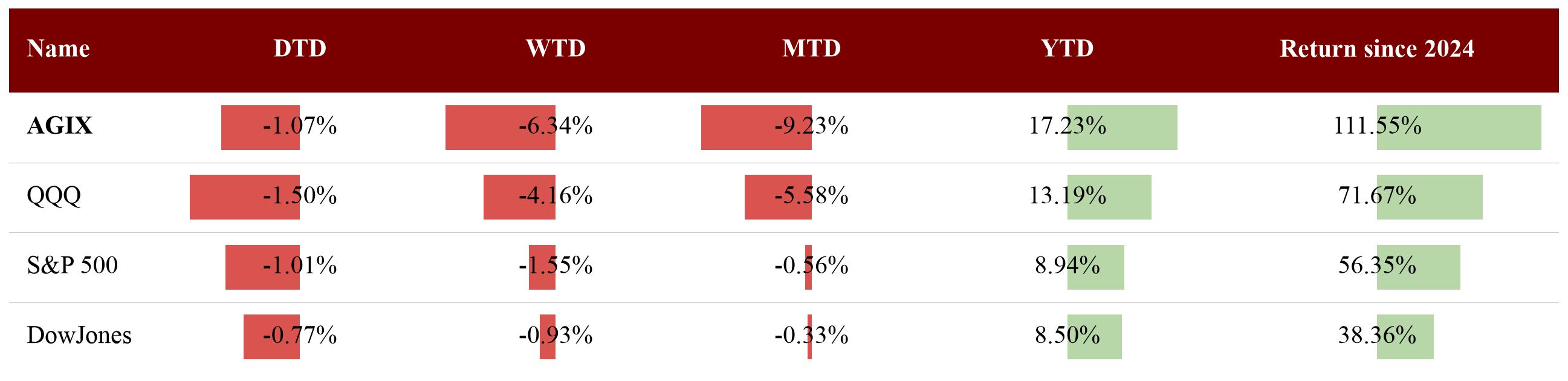
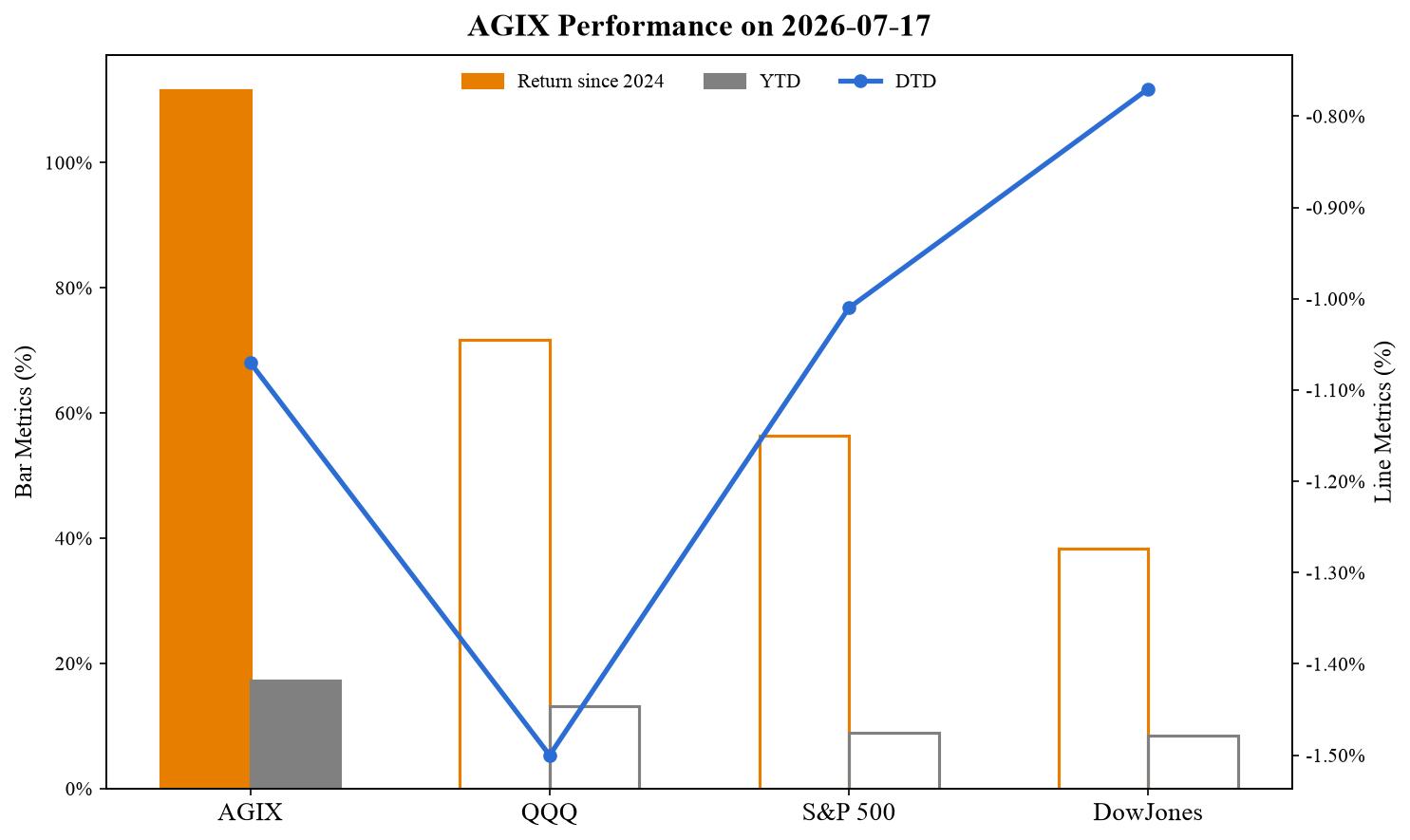
• AGIX fell 1.07% DTD, outperforming QQQ (-1.5%) but lagging the S&P 500 (-1.01%) and Dow Jones (-0.77%). Since 2024, AGIX has returned 111.55%, outpacing all benchmarks.
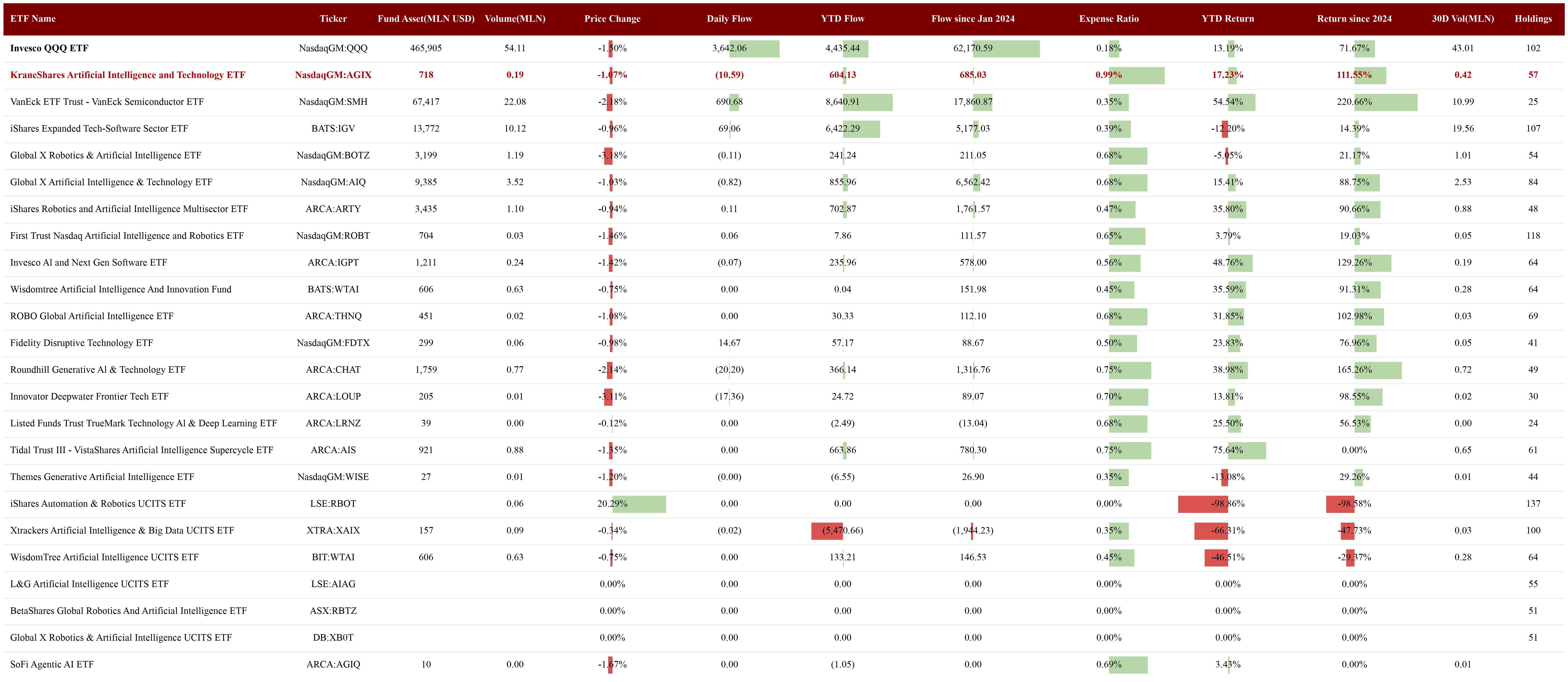
• Peer ETF performance was mixed: SMH (semiconductors) dropped 2.18% DTD, while IGV (software) slipped 0.96%. Robotics ETFs BOTZ (-3.18%) and AIQ (-1.03%) also declined, reflecting broad tech weakness.
• Among AGIX holdings, top DTD contributors included Nebius Group (+3.46%, infrastructure), Cloudflare (+1.91%, infrastructure), and Arm Holdings (+1.98%, hardware), driven by positive AI infrastructure and data center demand news.
• Key drags on AGIX came from Cadence Design Systems (-9.47%, infrastructure), Netflix (-7.26%, application), and Astera Labs (-5.04%, hardware), reflecting semiconductor sell-offs and company-specific headwinds.
News Highlights
1. TSMC’s strong Q2 earnings (profit up 97% YoY) and $100B additional Arizona investment signal robust AI chip demand, benefiting AGIX hardware holdings like NVIDIA, AMD, and TSMC.
2. Nvidia’s Cosmos 3 Edge launch and Japan robotics coalition (including SoftBank, Sony, Honda) bolster physical AI and edge computing, supporting AGIX infrastructure names (Nvidia, Cloudflare) and robotics exposure.
3. China’s Moonshot AI released the 2.8T-parameter Kimi K3 open-source model, sparking competitive fears and a Nasdaq sell-off; AGIX’s AI infrastructure holdings may face volatility from geopolitical tensions.
4. Apple’s trade secret lawsuit against OpenAI over employee poaching could disrupt OpenAI’s IPO and hardware plans, indirectly affecting AGIX’s SpaceX and CoreWeave positions through AI ecosystem uncertainty.
5. Databricks’ $188B valuation and new $3B funding round highlight sustained AI investment, reinforcing the growth narrative for AGIX’s data and AI infrastructure holdings like Snowflake and Datadog.
RSS Highlights
1. Linus Torvalds endorsed AI as a useful tool, countering anti-AI sentiment and supporting the long-term adoption thesis for AGIX’s AI-focused holdings.
2. OpenAI’s restructuring (Greg Brockman leading product) and ChatGPT improvements aim to streamline offerings ahead of a potential IPO, impacting AGIX’s SpaceX investment via OpenAI’s compute needs.
3. Claude Code now uses a Rust-based Bun runtime, improving startup speed by 10%—a technical advancement that could enhance developer productivity and AI agent adoption.
4. Google lost its final appeal against a €4.1B EU antitrust fine, a regulatory headwind that may pressure Alphabet, a top AGIX infrastructure holding.
5. A new tool (LLM cliché highlighter) and Firefox compiled into WebAssembly demonstrate ongoing AI and browser innovation, relevant to AGIX’s software and infrastructure ecosystem.
Performance & Benchmark
Attribution
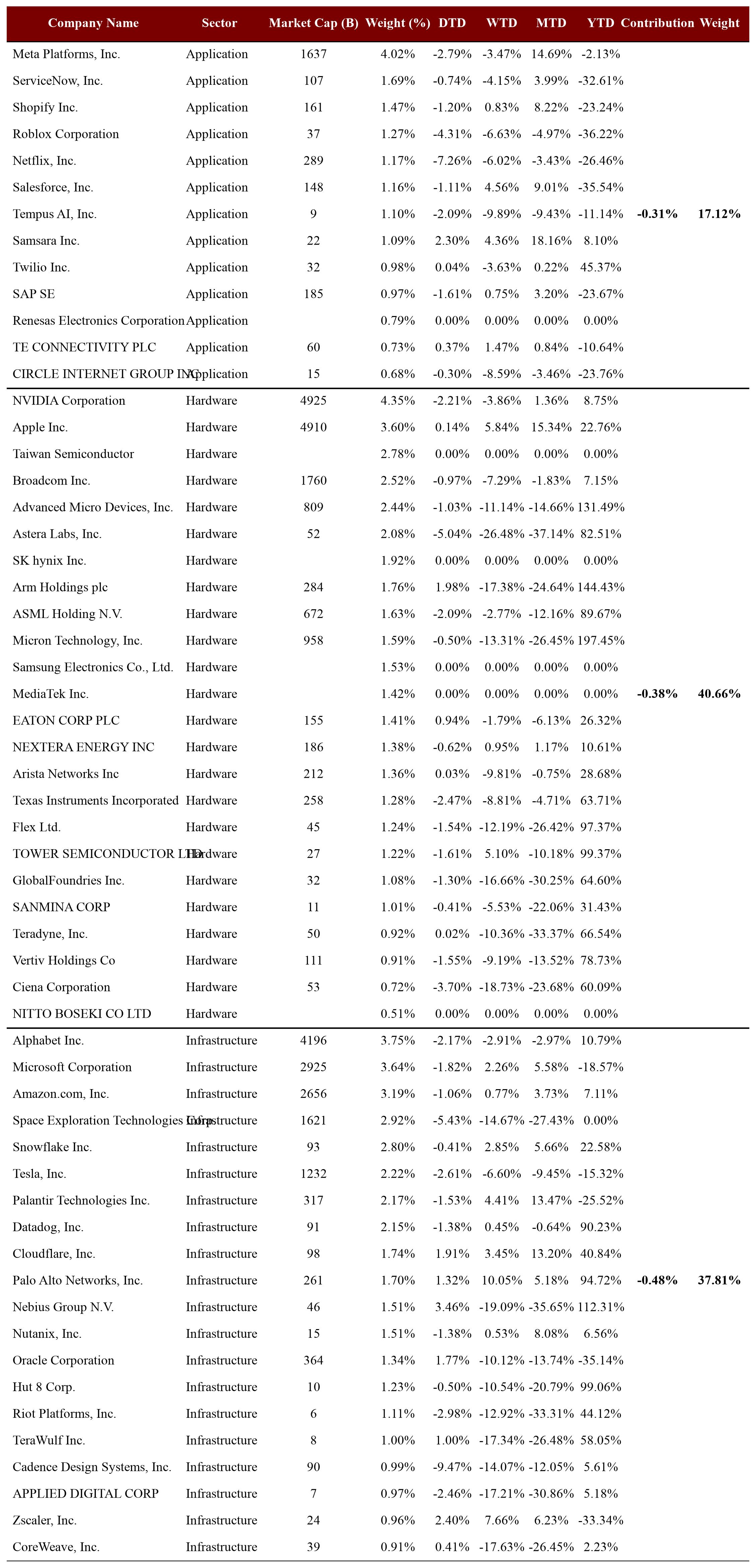
Contribution of the three sectors within AGIX holdings today
Application: -0.31%
Hardware: -0.38%
Infrastructure: -0.48%
Top-performing stocks in AGIX holdings today
Nebius Group N.V. (3.46%)
Zscaler, Inc. (2.4%)
Samsara Inc. (2.3%)
Worst-performing stocks in AGIX holdings today
Tempus AI, Inc. (-2.09%)
ASML Holding N.V. (-2.09%)
Alphabet Inc. (-2.17%)
NVIDIA Corporation (-2.21%)
APPLIED DIGITAL CORP (-2.46%)
Texas Instruments Incorporated (-2.47%)
Tesla, Inc. (-2.61%)
Meta Platforms, Inc. (-2.79%)
Riot Platforms, Inc. (-2.98%)
Ciena Corporation (-3.7%)
Roblox Corporation (-4.31%)
Astera Labs, Inc. (-5.04%)
Space Exploration Technologies Corp. (-5.43%)
Netflix, Inc. (-7.26%)
Cadence Design Systems, Inc. (-9.47%)
Top five listed stocks contributing the most within AGIX holdings today
Space Exploration Technologies Corp. (-5.43%)
Meta Platforms, Inc. (-2.79%)
Astera Labs, Inc. (-5.04%)
NVIDIA Corporation (-2.21%)
Cadence Design Systems, Inc. (-9.47%)
Observation
The strongest movers across peer ETF holdings today are listed below:
| DTD | Stock Ticker | Name | Held by ETFs | analysis |
|---|---|---|---|---|
| 14.6 | NXXT | NextNRG Inc | ['NasdaqGM:WISE'] | NextNRG’s 14.6% move on July 17 appears primarily driven by a company-specific catalyst: the announcement that it has begun pre-construction on two California healthcare microgrids, which directly highlights near-term project execution and potential revenue visibility in its core distributed energy business.[4] The stock’s reaction was likely amplified by its very low absolute price and high implied upside versus consensus target (around $5 per share vs. $0.28 spot), attracting speculative trading and momentum-oriented buyers on the back of the positive project update.[2][6][12] |
| 5.66 | NasdaqGS:STX | Seagate Technology Holdings plc | ['ARCA:AIS', 'ARCA:ARTY', 'ARCA:IGPT', 'NasdaqGM:AIQ', 'NasdaqGM:FDTX', 'NasdaqGM:QQQ'] | Seagate’s 5.66% gain on July 17, 2026 was primarily driven by increasingly bullish sell-side positioning around AI-driven storage demand and rising price targets, which reinforced the narrative that STX is one of the best-levered plays on global AI infrastructure spending.[1][2][3][6][8] First, multiple analysts and market commentators highlighted Seagate’s exposure to AI data storage and improving revenue/margin trends, with consensus Buy ratings and target prices materially above the current share price, supporting renewed investor optimism.[2][3][6] Second, the move occurred against a backdrop of a strong multi-month uptrend in STX tied to prior management guidance and expectations for the upcoming July 28 fiscal Q4/FY26 earnings, with traders positioning for upside as AI-related demand headlines remained constructive.[1][8] |
| 5.41 | NasdaqGS:OUST | Ouster, Inc. | ['LSE:RBOT', 'NasdaqGM:BOTZ'] | Ouster’s 5.4% gain on July 17, 2026 appears primarily driven by ongoing bullish sentiment around its digital lidar positioning and strong relative fundamental narrative rather than a discrete company-specific news event that day. The move occurred within an options-expected range (±8.9% for July 17 expiry), suggesting the stock’s advance reflects normal volatility around a generally constructive outlook on its high-performance lidar and “Physical AI” platform and rapid revenue growth trajectory highlighted in recent analyst and industry commentary. |
| 5.32 | NasdaqGM:GPCR | Structure Therapeutics Inc. | ['ARCA:LRNZ'] | Structure Therapeutics’ 5.32% gain on July 17, 2026 appears primarily driven by follow-through momentum and retail interest after the stock’s sharp appreciation on earlier obesity trial news rather than any new company-specific catalyst that day.[1][3][10] The move was supported by a still-bullish fundamental backdrop, including strong Phase 2 data for oral GLP‑1 candidate aleniglipron and a consensus “Moderate Buy” rating with a materially higher target price, which likely sustained positive sentiment.[2][10] |
News
Funding & M&A
SpaceX suddenly aborts second Starship V3 launch after ignition
North American tech company SpaceX aborted the launch of its upgraded Starship rocket on Thursday after some Raptor engines failed to ignite during booster ignition. According to CEO Elon Musk on X, the company will try again in a few days. The test flight was originally planned to launch third-generation Starlink satellites, but was timed to burn before the rocket had proven it could reach Earth orbit. This is the company's first launch attempt since its IPO on June 12, which raised over $95 billion in the largest IPO in history. The stock price has fallen from the IPO price of $135, and dropped another 4% in after-hours trading on the same day. Although the first V3 rocket launch in May successfully deployed dummy satellites, the booster landing failed, leading to an FAA investigation. The industry is watching whether SpaceX can validate the feasibility of the "orbital data center" concept through this series of tests.
Netflix paid $587M for Ben Affleck’s AI filmmaking startup
Streaming giant Netflix revealed in its latest regulatory filing that it has completed the acquisition of InterPositive, an AI startup co-founded by actor and director Ben Affleck, for approximately $587 million in cash. The deal, announced in March, aims to enhance post-production capabilities, addressing practical filming challenges such as missing shots, background replacement, and lighting adjustments. Affleck will join Netflix as a senior advisor, and the entire team will be absorbed. Previously, external estimates valued the transaction at over $500 million. Netflix reported in its earnings that 300 productions are now using generative AI technology. This acquisition accelerates the deep integration of AI technology in content creation within the streaming industry.
Can an Apple lawsuit derail OpenAI’s hardware plans?
Apple recently filed a trade secret lawsuit against OpenAI, accusing it of systematically inducing former Apple employees to disclose confidential information. The lawsuit specifically names Tang Tan, OpenAI's head of hardware, and mentions that over 400 former Apple employees have joined OpenAI. This incident could delay OpenAI's upcoming smart hardware product launch and disrupt its IPO plans. The TechCrunch Equity program analysis suggests that Apple's move may lead to delays, scrutiny, or a settlement, while OpenAI is likely to continue responding based on its previous legal victory. The lawsuit also highlights the competitive dynamics between the two companies in the AI hardware sector.
Inference cloud operator General Compute raises $400M in debt financing.
AI infrastructure startup General Compute Inc. recently secured $1 billion in debt financing, with investment firm Upper90 underwriting the first $100 million tranche. The company does not rely on Nvidia graphics cards but instead builds its cloud platform using AMD's MI300X and SambaNova accelerators. In this architecture, SambaNova chips optimize the decoding stage through near-memory storage and processor structure, while AMD chips handle the prefilling stage that extracts prompt meaning. The setup supports standard air-cooled server racks, enabling rapid scaling without liquid cooling equipment. The funding will be used to expand cloud computing capacity and provide developers with managed calls to open-source models and dedicated computing environment services. General Compute has already secured 15 megawatts of air-cooled rack capacity to support growth in the fourth quarter.
Databricks hits $188B valuation, extending its run as AI’s favorite second act
Data analytics platform Databricks announced a new round of funding on Thursday, valuing the company at $188 billion. The round is led by Coatue, with a scale of approximately $3 billion, and is expected to close this summer. This is Databricks' third large-scale funding round in nearly 20 months, having previously raised $5 billion and $1 billion at valuations of $134 billion and $100 billion, respectively. The company has transformed from the big data era into an AI service provider, launching AI products such as Lakebase and Unity, and recommending China's open-source model GLM 5.2 to reduce AI operating costs. Internal evaluations show that the open-source model has reached the highest difficulty level in programming tasks, with total costs lower than those of Anthropic and OpenAI products. This funding round reflects the capital market's continued optimism for AI companies.
How Apple’s big lawsuit could disrupt OpenAI’s IPO plans
Apple filed a trade secret lawsuit against OpenAI on Friday, alleging that over 400 former Apple employees have joined OpenAI, including OpenAI's head of hardware. The lawsuit comes at a sensitive time as OpenAI prepares for an IPO, potentially significantly impacting its hardware plans and listing process. The talent competition and data trust issues in this case reflect deep-seated tensions in the AI industry over secrecy protection and employee mobility. How open-source AI companies balance commercial interests with data security has become a focus for investors and the industry. This case also highlights the compliance risks and market challenges tech companies face before going public.
Model Releases
China’s Moonshot throws down the gauntlet with Kimi K3, the world’s largest open-weights model
Yueshe Intelligence today announced the upcoming launch of its latest large model, Kimi K3. The model has 2.8 trillion parameters and will become the world's largest open-weight model, with weights set to be publicly released on July 27. Benchmark tests show that Kimi K3 has surpassed OpenAI GPT-5.6 Sol and Anthropic Claude Fable 5 in some tasks such as front-end development. Third-party evaluations like Arena.ai indicate its intelligence index is close to top-tier proprietary models. The model is primarily designed for long-cycle autonomous software development tasks and supports visual feedback loops. Yueshe Intelligence is backed by Alibaba, and its input and output prices are significantly lower than comparable US models. Analysts point out that this release may mark a milestone where Chinese open-source models have surpassed those in the US, sparking a new round of discussions on model theft, export controls, and security reviews.
Kimi: Threat or menace?
This week, Chinese company Moonshot AI released the Kimi K3 open-source model, drawing significant global attention in the AI industry. The model has demonstrated cutting-edge performance across multiple benchmarks, with some independent analyses suggesting it approaches the level of top closed-source models like Claude Fable 5 and GPT 5.6 Sol. The news coincided with Chinese President Xi Jinping's speech at the World Artificial Intelligence Conference in Shanghai, triggering panic on Wall Street, with the Nasdaq falling about 1% and chip stocks like Nvidia being sold off. Former Trump administration AI czar David Sacks criticized U.S. overregulation, saying it would cause the U.S. to fall behind in the AI race. Former Uber CEO Travis Kalanick accused Chinese models of distilling knowledge from U.S. models. OpenAI's head of strategic futures, Dean Ball, warned that if open-weight models dominate the market, it could lead to an "AI communist" public infrastructure model, and called on regulators to create compliance risks to limit the spread of Chinese open-source models. Industry opinions on this concern are divided, with some arguing that the Chinese government will also face similar security considerations.
Alibaba previews Qwen3.8, claims it’s second only to Claude Fable 5
Alibaba Group previewed its latest Qwen series model, Qwen3.8, at the World Artificial Intelligence Conference in Shanghai, claiming it has 2.4 trillion parameters and supports multimodal input, second only to Anthropic's Claude Fable 5. This release comes just three days after Beijing Yueshe AI Technology Company launched the 2.8-trillion-parameter Kimi K3, marking the official entry of Chinese companies into the multi-trillion-parameter level. However, Alibaba did not provide any benchmark data or model cards, and the previous Qwen3.7-Max performed only moderately on third-party leaderboards. The model is currently accessible via a Token Plan subscription at a trial price, with a promise to open-source the weights. This move is a key part of Alibaba's push to establish itself as China's default AI provider.
Technical Breakthroughs
EY re-envisions RAG around multimodal knowledge graphs to improve accuracy
EY has proposed a multimodal RAG framework to address the issue of non-textual information such as charts, engineering drawings, and data tables being overlooked in enterprise-level large language model applications. The framework uses a knowledge graph to associate text with image content and stores them in separate vector indexes and graph databases. Relationships are established through keyword matching, semantic similarity calculation, and machine learning reasoning, enabling multi-hop retrieval. This approach keeps the underlying LLM unchanged while providing more complete and verifiable answers for industries like manufacturing and life sciences through configurable access, re-ranking, and retrieval strategies. Researcher Dipanjan Sengupta notes that multimodal capabilities can significantly improve accuracy and response quality, and provide more reliable domain knowledge for AI agents. The framework has not yet been benchmarked publicly, but customer practices show its effectiveness.
Product Launches
Compute Exchange opens secondary market for used Nvidia H100 and A100 GPUs
A computing exchange recently launched a dedicated marketplace for used and refurbished GPUs, expanding its original platform for reserving graphics processor capacity into the physical AI hardware space. The service primarily targets older-generation products like the NVIDIA H100 and A100, helping AI startups, cloud service providers, and large enterprises obtain production-grade hardware capacity at lower costs. The platform provides inquiry, logistics, and transaction execution support, and maintains a neutral stance to increase market transparency. This move reflects a trend of differentiated demand for the latest Blackwell systems, while H100 and A100 still meet most production workloads. The initiative helps improve resource utilization in AI infrastructure.
Vertu wants executives to pay $6,880 for an AI agent — here’s how it actually performs
British luxury phone maker Vertu has launched the Alphafold foldable smartphone, priced starting at $7,000, targeting high-end executives with AI smart services. The device is based on the ZTE Nubia hardware platform, features genuine leather and aluminum alloy materials, and includes the Hermes Agent AI agent capable of executing multi-step workflows. Tests show that Hermes outperforms Samsung Galaxy Z Fold 7's Gemini in local document analysis and cross-app automation, but encounters date errors and incomplete execution in scenarios like trip planning and reminder setting. Vertu also offers legal and investment expert agents as well as a human butler service. Despite advantages in premium materials, security chips, and encrypted communications, the device's core hardware is not significantly different from Samsung's foldable phones, making its price-performance ratio difficult to compete. The device is still in the iterative stage of AI agents and primarily targets ultra-high-end users.
I replaced my space heater and ceiling fan with one Dyson appliance
Dyson has launched the Hot+Cool HF1 smart heating and cooling fan, priced at $99, offering winter heating and summer air circulation. The device features a bladeless design and supports remote control via the MyDyson app, scheduling, oscillation angle adjustment, and sleep mode. It operates as quietly as 26 decibels and includes a smart thermostat for automatic output adjustment. The cooling mode functions as a high-power fan rather than true air conditioning. The bladeless design makes cleaning easier and enhances safety, making it suitable for homes with children and pets. Weighing about 2.7 kg and standing 26 inches tall, it is easy to move. Reviews indicate it can replace traditional fans and space heaters, making it suitable for year-round use, though expensive, it offers high integration of features.
reMarkable’s new Paper Pure is good. That’s why I wrote this review on it.
Global notebook e-paper company reMarkable has launched the new Paper Pure, returning to a monochrome display basic design at a price of $25,399. The device features a 10.3-inch screen with a resolution adjusted for landscape layout, improving text capacity and handwriting sharpness during reading and writing. The new model supports calendar sync and enhanced handwriting recognition search, making it easy to import cloud documents from Drive, Dropbox, etc., and convert notes to text for sharing. The device is clearly positioned as a distraction-free note-taking tool, suitable for meeting notes, article annotations, and draft creation, though PDF handling still has limitations. Compared to the previous Paper Pro color version, the Paper Pure is better suited for authors and designers who want to resist phones and laptops. The company is not yet publicly listed, and its product line remains primarily hardware sales.
Parents want safer phones for kids. These companies are answering the call.
As parents become increasingly concerned about children's safety when using smartphones, many tech companies have launched mobile phones designed specifically for children. These devices are similar to regular smartphones in hardware but have enhanced restrictions at the software level, removing browsers, social media, and app stores, and only allowing approved contacts. Parents can use a companion app to set screen time, monitor location, manage contacts, and receive alerts about online risks. The Bark phone is based on Samsung hardware and supports progressive unlocking; Gabb adopts a no-internet-risk mode and offers curated apps and streaming music; Pinwheel and Terracube provide schedule modes and app approval features. Additionally, home landline products like Ooma MyPhone and Tin Can offer calling services that only allow approved contacts. This product market is gradually becoming an important choice for parents managing their children's digital lives.
Policy & Regulation
The AI backlash intensifies, China gains on the US leaders, and IBM tanks
This week, multiple AI leaders who once opposed government intervention are now calling for stronger regulation to address concerns such as employment impacts. Google DeepMind CEO Demis Hassabis proposed establishing an AI standards body. New York Governor Kathy Hochul signed an executive order imposing the first moratorium on AI data centers. Meta increased its investment in the Hyperion data center in Bay County to $50 billion. China's Moonshot AI released the Kimi model, approaching international leaders in capability. Nvidia emphasized the critical role of networking technology in scaling AI factories, while IBM's stock plunged 26% due to weaker-than-expected mainframe orders. The sovereign AI trend is driving divergence in global AI stacks.
The Zoom hack that says, ‘Don’t record me’
With the rapid proliferation of AI transcription applications, American social interaction expert Lonnie Levins and others have begun to reflect on the social consequences of always recording. Many people actively record conversations during Zoom meetings and venture capital exchanges, and some founders even record dates and input them into Claude to analyze their own performance. This indiscriminate recording is causing conversations to lose their naturalness and hiding legal risks, while the massive amount of generated text may become an 'audio dump' that no one reads. Currently, many parts of the United States have no clear rules requiring prior notification and consent in business settings. Industry observers point out that if a balance between privacy and efficiency cannot be found, AI transcription applications may face stricter compliance constraints.
‘Odyssey’ director Christopher Nolan calls AI an obvious ‘Trojan horse’.
Oscar-winning director Christopher Nolan expressed deep skepticism about AI in an interview, calling it a "Trojan horse" technology and noting that young people's rapid rejection of AI-generated content is a "healthy skepticism." Nolan emphasized that technology should be rationally examined rather than blindly trusted. Against this backdrop, Hollywood's unions and the Screen Actors Guild discussed AI-generated content during the 2023 strike, and the Directors Guild has secured related protections. Nolan, as president of the Directors Guild, has long been skeptical of digital technology, and his new film "The Odyssey" is also the first to be shot entirely on IMAX film. His views reflect widespread concern in the film industry about the ethical and creative risks AI may bring to content creation.
Patreon stops asking AI bots not to scrape — and starts blocking them
Patreon is partnering with Cloudflare to enhance its AI scraping protection strategy. To prevent AI training bots from unauthorized extraction of creator content, the platform will shift from relying on the robots.txt protocol to directly blocking AI training crawlers. This move comes after the platform launched new Home Feed and Quips features, making content easier to scrape. Cloudflare's AI Crawl Control technology can charge per use or directly reject training crawlers, while indexing crawlers remain accessible. Patreon's tests showed that after blocking, weekly visits from AI training crawlers dropped from thousands to zero. The platform states that 'consent should not rely on scrapers' self-discipline' and emphasizes that creators should have real say in how AI uses their work. This reflects a global reassessment by content creators and publishers of the ethics and compliance boundaries of AI extraction.
Industry Partnerships
Nvidia launches Cosmos 3 Edge model and expands its physical AI push in Japan
Nvidia has launched the Cosmos 3 Edge world model designed for edge devices, supporting 4 billion parameters for visual reasoning and robot policy generation, and can be adapted to specific robots, vehicles, and sensors within a day. The model is based on the Nemotron family, runs on the Jetson platform as well as RTX and DGX systems, and is accompanied by the Metropolis library, which can speed up the construction of Cosmos video intelligence systems by more than six times. Nvidia announced the formation of the Cosmos Coalition in Japan, with more than twenty companies including FANUC, Yaskawa Electric, Kawasaki Heavy Industries, Fujitsu, Hitachi, NEC, SoftBank, Sony, Honda Research, and Preferred Networks joining. SoftBank is building a physical AI development platform based on Cosmos, Omniverse, and Isaac Sim, while Groove X and Enactic are applying Jetson and Isaac GR00T to companion robots and care robots, respectively. Nvidia and the Japanese government jointly launched the world's first national-level AI infrastructure, FRONTia, built by Noetra, deploying 27,500 Rubin GPUs and 13,750 Vera CPUs with a total power of 140 MW, supported by Japan's Ministry of Economy, Trade and Industry and $2.4 billion in government funding. Japan aims to capture more than 30% of the global AI robot market by 2040, with a market size estimated at $133 billion. Jensen Huang said this move will help Japan revive its manufacturing leadership and usher in a new era of physical AI.
Nonprofit Current AI is racing to build the World Wide Web of AI, free for all
The nonprofit organization Current AI, in collaboration with the Indian government's Bhashini initiative, has launched the Suno Sutra offline AI device, which supports 22 Indian languages and addresses language barriers for rural users in areas without internet access. The organization was established in February 2025, with seed funding of $100 million from the French government and a total of $10 billion in support from institutions such as Ford, MacArthur, DeepMind, and Salesforce. Recently, it allocated $3.2 million in donations to support multilingual AI datasets, cultural digitization, and offline tool projects in Kenya, Lebanon, and the Brazilian Amazon. At the Geneva AI for Good Summit, it released the open-source chatbot Alpha Chat and collaborated with Japan's Sakana AI to develop a sovereign AI stack supporting languages of the Global South. Current AI emphasizes that data ownership should belong to communities rather than private companies, promoting the construction of open public AI infrastructure to protect diverse languages and cultures.
What to watch for after Jensen Huang’s Japan visit
Nvidia CEO Jensen Huang visited Tokyo from July 15 to 16, signing multiple major collaborations with various Japanese industrial and chip suppliers. The two sides will jointly advance Japan's sovereign AI factory, robotics alliance, and vehicle physical AI projects. The Japanese government plans to invest 1 trillion yen, bringing together 44 companies including SoftBank, Sony, NEC, and Honda to build the Noetra platform, deploying Vera Rubin AI data centers by 2028. Meanwhile, robotics giants such as Fanuc, Yaskawa, and Kawasaki Heavy Industries will develop factory-side applications based on Nvidia's Cosmos model. Toyota will also deeply integrate the Nvidia Drive platform into its next-generation vehicles. This collaboration aims to help Japan capture 30% of the global AI robotics market share by 2040 and promote the application of physical AI in manufacturing.
Anthropic, Meta reportedly discussing $10B data center leasing deal
Anthropic is in talks with Meta about a potential $10 billion data center lease agreement, with a term of two years, aimed at securing Meta's computing resources to support its AI model training and inference. The negotiations are currently in early stages, and Anthropic wants the contract to include an early termination clause. Meta is spending over $50 billion to build a large data center campus in Louisiana and plans to recoup some of its investment by leasing out AI chip infrastructure. This move comes after Anthropic recently signed a $1.25 billion per month supercomputing lease agreement with SpaceX. If the deal is reached, Anthropic is expected to further increase the rate limits of its Claude API. Notably, the two companies are direct competitors in the large language model market, with Meta recently launching a low-cost programming-specific model, Muse Spark 1.1, priced at just one-quarter of Claude's price. Despite the competitive and cooperative relationship, Meta may still enhance its competitiveness in the AI infrastructure market through its partnership with Anthropic.
Agility Robotics plants its flag in Tesla’s backyard
Humanoid robot developer Agility Robotics is building a 60,000-square-foot training facility in Fremont, California, to accelerate the deployment of its Digit robot in manufacturing and warehousing scenarios. The facility is located near Tesla's Optimus production plant and will provide robots with a training environment similar to real-world conditions. Agility has generated revenue from clients including Amazon, GXO, Schaeffler, and Toyota, and has secured $3 million in orders. CEO Peggy Johnson is pursuing a reverse merger plan to make Agility the first publicly traded pure-play humanoid robot company. The company uses a safety-independent architecture combined with generative AI to achieve large-scale application. The facility will support deployment negotiations with over 30 clients, driving the commercialization of robots in logistics and manufacturing.
Google AI Mode gets more useful with Canva, Instacart and YouTube app integrations
Google announced that its AI Mode conversational search tool now supports integration with external applications. It has already integrated services like Canva, Instacart, and YouTube, allowing users to complete tasks such as generating shopping lists, adding items to carts, and creating playlists through natural language requests. This update will first launch in the United States, with plans to expand to more third-party applications in the coming weeks to months. This move is mainly to strengthen the practicality of AI Mode in scenarios like shopping and creative work, and to enhance competitiveness with OpenAI and Anthropic in the smart chat field. Google also emphasized that Gemini remains the core of its AI strategy, while AI Mode, as an embedded search interface, is enhancing personalization and real-time data integration capabilities through multiple iterations. As more applications are connected, AI Mode will better meet users' daily needs.
AMD’s next reinvention: A new playbook for the AI era.
AMD is shifting from a survival battle against Intel in the x86 market to building a new chapter as an AI infrastructure platform. In the AI accelerator space dominated by Nvidia, AMD is leveraging EPYC CPUs, Instinct accelerators, ROCm software, rack-level systems, and an open ecosystem to create a second platform. Led by Lisa Su, AMD is attempting to compress an ecosystem that would normally take two decades to build into just a few years through strategic acquisitions, capital allocation, and consistent execution. This move not only reshapes the company's positioning but also injects new variables into the global AI computing landscape. Industry observers believe that if AMD succeeds, it will transform from a model of x86 revival into a key player defining next-generation AI infrastructure.
Social Impact
Neil Rimer thinks the AI money is coming back out.
Index Venture Partners co-founder Neil Rimmer said in an interview in Athens that the massive wealth accumulated in the AI field will inevitably be redistributed, and he hopes tech leaders will proactively guide this process. He mentioned the decline of modern philanthropy and the trend toward policy-mandated redistribution, citing data such as the continued decline in U.S. charitable donations and a significant drop in the Giving Pledge sign-up rate. Meanwhile, California will hold a referendum on a one-fifth property tax, and the equity wealth of OpenAI and Anthropic employees has also raised concerns about capital concentration in society. Rimmer emphasized that tech companies must rediscover their moral center to avoid the forced tax policies that resulted from extreme income disparities in the golden age of the past. His perspective provides a key viewpoint for discussions on the social responsibility of the tech industry in the AI era.
融资收购
Why the first GPU financiers are turning to inference chips in a $400 million deal
AI reasoning cloud startup General Compute has secured a $400 million loan from tech investment firm Upper90, potentially the first financing case using AI inference-specific chips as collateral. The company completed a $15 million seed round in May and is building an inference cloud platform based on SambaNova SN50 chips. Compared to traditional GPUs, these chips offer higher energy efficiency and faster deployment without complex liquid cooling systems. This financing reflects growing market demand for affordable inference of open-source models and will help stabilize capital support for alternative chip suppliers outside Nvidia. Upper90 previously provided GPU-backed loans to Crusoe and is now shifting focus to the inference sector. Analysts believe this deal signals rising investor interest in open-source models and affordable AI infrastructure.
TSMC boosts Arizona fab investment by $100B after strong second quarter
TSMC today released its second-quarter financial report, with net profit reaching NT$706.56 billion, up 97% year-over-year, exceeding analyst expectations. Revenue reached $39.45 billion, with high-performance computing contributing nearly half. The company also announced an additional $100 billion investment in its Arizona Fab park, building at least four new factories, bringing total investment to $265 billion. Two of these factories will produce 2nm and more advanced nodes, while the other two will produce advanced packaging components. TSMC raised its 2026 capital expenditure to $60-64 billion and increased its full-year revenue growth forecast to over 40%. The new node N2 has launched a data center version N2X and an automotive version N2A, offering customers higher performance and customization options.
RSS Subscription
Podcast Notes: Iain McGilchrist on “The Great Simplification”
In episode 217 of the podcast, Dr. Iain McGilchrist explores the limitations of science and reason, emphasizing that while they can answer many questions, they are not the arbiters of everything. He points out that many major discoveries in science and mathematics were not reached through linear logic or algorithms, but through sudden insights into the whole. McGilchrist also mentions that analysis can only provide information, and information only functions within a holistic context, highlighting the importance of humility and an understanding of 'non-doing' in knowledge and creative work.
NGC 7497, etc.
NGC 7497 is a relatively ordinary spiral galaxy, but the reflection nebula in its background is actually closer than the galaxy. This nebula is far from the Milky Way and has no central star; its light source is the combined light of the Milky Way, resulting in an exceptionally low surface brightness, with the brightest areas at magnitude 26 per square arcsecond. The total exposure time was 28 minutes, using equipment including a C9.25 telescope and an IMX533 camera.
Fitting a regular expression to a list of words
When using grep, you can provide a file of regular expressions with the -f flag and use the -F flag to indicate that these expressions are actually just words. Compared to grep, ripgrep performs better when processing smaller HCPCS codes, as it can compress all codes into a single regular expression, achieving search speeds three orders of magnitude faster than grep, reducing execution time from 73.426 seconds to 0.078 seconds. Using Python's trieregex library can generate more efficient regular expressions, especially when dealing with words that share common prefixes.
Sum of low squares
For an odd prime p, half of the numbers from 1 to p-1 are squares (called quadratic residues) and the other half are not. For primes p satisfying p ≡ 3 (mod 4), the sum of the quadratic residues is called the signature of p, and each signature is unique. The corresponding prime p can be found using the formula 16s + 1.
Impro is a handbook for running a cult
"Impro" is a book by Keith Johnstone that explores the liberation of creativity and expression, arguing that Western culture and education suppress children's natural creativity. The book emphasizes that status games in social interactions are particularly important for software engineers, and the ability to flexibly adjust one's social status is a core skill for effective communication. Additionally, Johnstone advocates for an improvisational way of life, encouraging people to break free from the constraints of over-analysis and pursue a more spontaneous attitude toward life.
Make It Work vs. Make It Good
In the process of design and development, "making it work" and "making it good" are two important stages. The former focuses on functional implementation and is easy to gain approval, while the latter emphasizes design quality and user experience, often being more challenging and harder to reach consensus on. Work on implementing functions takes up most of the time, but improving quality is equally important and involves multiple considerations.
Reading List 07/18/26
California's "Project Eternity" faces setbacks: a $500 million 155mm artillery shell factory has not produced any shells since it started operations two years ago, because General Dynamics tried to retrofit existing equipment instead of building a new production line. Additionally, electric vehicle maker Lucid Motors' stock price has plunged more than 50%, although the company denies considering privatization or bankruptcy and says it has enough liquidity to support operations.
What's the deal with all the random weekly quota resets for agents lately?
Subscription-based coding agents like Claude Code and Codex set usage quotas of 5 hours and weekly limits to avoid server overload and prevent users from consuming too much quota at once. Recently, OpenAI has frequently reset Codex's weekly quota over the past two weeks, especially after the release of Fable 5 and GPT-5.6, with resets occurring six times. Although these resets provide users with additional usage opportunities, they also cause frustration over quota management, especially when users need to frequently adjust their usage plans.
Book Review: A City on Mars - by Dr. Kelly Weinersmith and Zach Weinersmith ★★★★⯪
This book seems aimed at dampening the morale of a generation full of dreamers, as the author points out that space exploration is much harder than its promoters admit. Although space exploration technology may be faster, safer, and cheaper, applying these technologies to Earth offers greater benefits. The book explores multiple aspects including biology, law, and moral philosophy. Despite its rigorous logic, the author still finds space exploration appealing and calls for people to start building the future.
Overtraining as the path to human-like AI
Anonymous blogger Gwern recently published a 13,000-word article exploring why large language models (LLMs) lack flexible human intelligence and proposing a theory of improving this through overtraining. He argues that modern LLMs fail to "understand" their training data in core areas, resulting in weaker generalization ability compared to humans, and that overtraining can push models to truly understand the data, thereby enhancing their intelligence. Gwern suggests that investing billions of dollars in such training could potentially give rise to LLMs with genuine human-level intelligence.
Visualizing Medical Code Hierarchy
A treemap created using Python's squarify library shows the number of codes starting with each letter in HCPCS and ICD-10 coding. Among HCPCS codes, the letter G has 2,010 codes, and the letter J has 1,232 codes, while among ICD-10 codes, the letter S has 31,052 codes, and the letter T has 10,090 codes. The size of each rectangle in the treemap is proportional to the number of codes starting with that letter.
The Life and Times of Maxis, Part 2: SimWorld
Maxis released SimHealth: The National Health Care Simulation in 1994, a game that simulated the complex U.S. healthcare system and explored issues such as health insurance and cost control. Although it was originally intended as a training tool for businesses and government, it ultimately did not achieve the expected success and instead became a symbol of political debate, especially after the failure of the Clinton administration's healthcare reform.
Regular expressions for HCPCS codes
HCPCS (Healthcare Common Procedure Coding System) codes consist of one letter and four digits, formatted as [A-CEGHJ-MP-V][0-9]\d{4}, and there are currently 384 official modifiers available. Although some combinations of codes and modifiers may be uncommon in practice, searching for HCPCS codes and their modifiers using regular expressions takes 20 milliseconds, while searching the full code list takes 46 seconds.
Why has the display control panel pointer truncation bug gone unfixed for so long?
Some users' computer video drivers are too old, causing system crashes, even though the relevant vendors fixed the issue long ago. This is because computer manufacturers are responsible for certifying driver updates, typically certifying them within one to two years after product release, after which support may stop, leaving users with outdated drivers. The generic drivers provided by Microsoft and graphics card manufacturers have lower priority, so users' systems still rely on these outdated manufacturer-certified drivers.
Regular expression speed and error rates
Seven years ago, I wrote an article about using regular expressions to match diagnostic codes, and now I revisit its speed and error rate. Using regular expressions to match ICD-10 codes is significantly faster; test results show that regex search takes 18 milliseconds, while searching against a reference code list takes 386 seconds. Although regular expressions perform well in terms of error rate, the false positive rate can be high in certain contexts, especially in randomly generated text.
Digital Research's 1991 merger with Novell
On July 17, 1991, Novell acquired Digital Research for $80 million, aiming to compete with Microsoft by integrating its desktop operating system and network technology. Digital Research was once famous for the CP/M operating system, and although it failed to provide an operating system for the IBM PC in 1981, its later DR DOS had grown to 273 employees and $36 million in annual revenue by 1991. After the acquisition, Novell continued to release DR DOS 6.0 and tried to compete with Microsoft's MS-DOS through enhanced features, but ultimately failed, leading to the gradual decline of Novell and NetWare.
Art Doesn't Scale
At a coffee shop in Copenhagen, I overheard two acquaintances arguing about whether AI art counts as art. A wealthy tech worker believed that AI-generated works are essentially no different from handmade creations by artists, while an artist felt confused, arguing that art should convey emotion. Meanwhile, I also pondered the similarity between AI art and forgeries, thinking that both might undermine the standards of art criticism and challenge our understanding of artistic value.
Tech note: making your own V-I plots at home
While writing the book "The Secret Life of Circuits," the author collected about 290 original illustrations to provide authentic electrical characteristic data, including voltage-current (V-I) curves of semiconductor devices. To overcome the limitations of conventional oscilloscopes in recording tiny currents, the author used a benchtop multimeter and a pulse power supply, and by cooling the devices by immersing them in a non-conductive liquid, successfully captured currents ranging from microamps to nearly 2 amps. Finally, the author presented the actual V-I curve of a 1N4148 diode, revealing the complexity of the voltage-current relationship at different currents.
Regressive JPEGs:
An interesting feature of the JPEG file format is that it can prioritize saving low-frequency components, allowing images to be displayed at low resolution during partial downloads. By dividing the compressed data into multiple "scans," a JPEG file can progressively fill in image details, ultimately achieving full quality. This property can be used to merge multiple images into a single JPEG file, although this method relies entirely on network latency for playback and has no practical application.
Paper
Paper is a brand-new design tool that provides a design canvas connecting teams, agents, code, and data, supporting seamless transition from design to code. By connecting with any IDE or CLI agent, users can design and code in a shared layer, update content in real time, and handle repetitive tasks, allowing them to focus on creative decisions. Paper also plans to launch new features such as design tokens, a pen tool, and vector editing in June 2026, and is currently hiring product designers and design engineers.
9to5Mac Uncovers Dozens of Disguised Gambling Apps on the App Store in Brazil
A survey by 9to5Mac found that over 60 apps disguised as simple games and utility tools are actually hidden gambling platforms, particularly prominent in the Brazilian App Store. These apps are often published by developer accounts, use similar privacy policies, and take measures during App Store review to avoid being flagged as suspicious. Brazilian authorities have recently pressured unauthorized gambling apps, demanding that Apple and Google explain how they detect and prevent the existence of such apps.
★ Mornings in Cupertino Have the Aroma of Napalm Once Again
Apple recently filed a lawsuit against OpenAI, and former Apple executive Tony Fadell said this is a typical tactic Apple uses to intimidate employees, especially regarding talent attrition. Apple's founder Steve Jobs took a tough stance on employee poaching, historically communicating with other company executives via email to demand a halt to poaching. Although Apple paid a $415 million settlement in 2015 over an anti-poaching lawsuit, this has not changed its hardline stance on talent retention.
AI Mania Is Eviscerating Global Decision-Making
On July 19, 2026, Nik Suresh explored the impact of the AI boom on global decision-making in his blog, sharing several anecdotes from anonymous sources. One executive, while formulating an AI-centric technology strategy, admitted to never having used ChatGPT or any AI tool. Additionally, exaggerated claims by client executives about achieving 100x productivity made vendor executives afraid to question them, lest it affect the client's credibility or even lead to cancellation of corporate contracts.
Claude Code uses Bun written in Rust now
On July 19, 2026, Jarred Sumner claimed that Claude Code v2.1.181 (released on June 17) and subsequent versions use a Rust port of Bun, resulting in a 10% faster startup on Linux. Inspection of the Claude Code installation reveals support for the unreleased Bun v1.4.0, and the Rust version of Bun running in production is already used on millions of devices.
Google Runs Out of Appeals, Must Pay Record $4.7 Billion EU Antitrust Fine
Europe's top court on Thursday upheld a fine of about €4.1 billion ($4.67 billion) against Google for anti-competitive practices related to its Android system. In 2018, the European Commission first imposed a record fine on Google, accusing it of abusing its market dominance through pre-installation agreements with smartphone manufacturers. Google has no further right to appeal, and shares of its parent company Alphabet fell about 1% in pre-market trading.
Apple Sends Letters to Dozens of Former Employees Now at OpenAI
Apple sent legal letters to about 40 current OpenAI employees, asking them to preserve documents and communications and meet with Apple's lawyers. This move reflects Apple's aggressive strategy after filing a lawsuit against OpenAI and two of its employees last week, accusing them of stealing confidential hardware plans.
SQLite Query Explainer
Julia Evans mentioned in her blog that while she wishes she could learn to read SQLite query plans, she hasn't mastered them yet. To help with this, Fable developed an interactive tool that runs SQLite in the browser and provides explanations for the results of EXPLAIN and EXPLAIN QUERY PLAN. The tool is built using Python and Web Assembly, and although the author's understanding of SQLite query plans is limited, they believe the tool's functionality is reliable.
Paulo Andrade: ‘A WWDC 26 Update on Building a Mac-Assed App With SwiftUI’
In the WWDC 26 update, discussions about building Mac apps with SwiftUI attracted widespread attention and prompted feedback from Apple engineers. The newly introduced \.backgroundProminence environment value and \.onDragSessionUpdated API address some major issues in drag-and-drop operations, bringing SwiftUI closer to AppKit's flexibility in custom rows and drag-and-drop functionality. Additionally, the author proposed improvements for the missing \.onMoveCommand on iOS to enhance cross-platform UI framework consistency.
This Week in Package Management: 18 July 2026
In the ninth week's update, pnpm version 11.13 added a native changeset-compatible release planning tool, supporting version bumps and dependency propagation; Deno 2.9.3 introduced new command options; Homebrew 6.0.11 merged CVE scanning functionality to enhance security. Additionally, Docker Engine 29.6.2 fixed three CVE vulnerabilities, ensuring higher security.
Claude make Fable 5 permanent
On July 18, 2026, Claude announced that Fable 5 will become a permanent feature. Starting July 20, all Max and Team Premium plans will include Fable 5 with a 50% limit, while Pro and Team Standard users can still access Fable using credits and receive a one-time $100 credit. Due to competitive pressure, Anthropic decided not to remove Fable 5 from subscription accounts, though users on the $20/month plan still cannot access Fable 5.
nascheme/quixote
The last commit to the Quixote web framework was six hours ago, while the earliest commit to the project was 21 years ago, when Quixote 2.4 was imported from Subversion to Git.
Apple Books and Amazon are flooded with AI-generated books that rip off legitimate authors.
During the Aspen Ideas Festival, I discovered that the Apple Books platform is flooded with AI-generated knockoffs of my books and other works, priced between $9.99 and $20.99. Meanwhile, Apple and Microsoft have recently raised the prices of Macs and iPads significantly, with increases of up to $200, and refurbished device prices have also gone up. Consumers face a trust crisis when buying bestsellers, especially on Apple Books, where the counterfeit problem remains severe.
MG Siegler: 'OpenAI Makes ChatGPT ChatGPT Again'
OpenAI quickly fixed the update issue with ChatGPT, restoring the original chat functionality and renaming it back to "ChatGPT" instead of the previous "ChatGPT Work." Although the new version still has some performance issues, the user interface is now clearer, the chat feature has returned to the main screen, and the user experience has improved.
Roblox is set to introduce an AI game-building feature, including on iOS.
Roblox has launched a new mobile-first AI creation tool called "Build," which allows users to create basic games directly in the mobile app using text prompts. The tool will enter public testing in New Zealand on July 28 and will roll out to more regions in the coming months, aiming to accelerate game development for creators at all levels. Build works alongside Roblox Studio to provide powerful AI support, helping creators quickly iterate and refine their game designs.
Apple raises prices for Apple Music and Apple One subscriptions.
Apple today raised the subscription prices for Apple Music in the United States and other countries, with the individual plan increasing from $10.99 to $11.99 per month, the family plan from $16.99 to $19.99, and the student plan from $5.99 to $6.99. Prices for some Apple One bundles have also gone up. The price increase is due to rising licensing costs, marking the first price hike for Apple Music since October 2022. Despite the increase, Apple Music remains cheaper than Spotify.
OpenAI’s Product Shake-Up Put the Complexifiers in Charge
OpenAI announced that it will restructure the company to unify its product lines. Greg Brockman will be responsible for the company's product strategy and will merge ChatGPT and Codex into a unified experience. The company also appointed Thibault Sottiaux to lead the core product team, Nick Turley to move to enterprise products, and Ashley Alexander to oversee consumer products. This adjustment aims to streamline products, enhance competitiveness, and prepare for a future IPO.
The Terminus
The longest numbered highway in the United States is U.S. Route 20, which is 3,254 miles long and connects Boston to Newport, Oregon. The ancient Roman word 'terminus' means 'boundary marker' and is derived from the Roman god who protected boundaries, emphasizing the importance and sanctity of borders. In modern society, the understanding of boundaries has shifted from sacred to social norms, yet boundaries still play an important role in territorial and spatial organization.
OpenAI Starts Cleaning Up the Utter Mess It Made of ChatGPT
OpenAI's engineering lead Thibault Sottiaux said on Twitter that, in response to user feedback, the team has made several improvements to the newly launched ChatGPT desktop application, including displaying conversation history and projects in the sidebar and enabling cross-platform synchronization. Although these updates have brought improvements, the new app still has issues, being bulky and offering a poor user experience.
Linus Torvalds: ‘AI Is a Tool, Just Like Other Tools We Use. And It’s Clearly a Useful One.’
Linus Torvalds said that although some people oppose artificial intelligence, the Linux project is not anti-AI, and he considers AI a useful tool. He pointed out that the practicality of AI has become obvious over the past year, and anyone who doubts its value clearly has not actually used it.
BBEdit 16
BBEdit 16 adds over a hundred new features, improvements, and optimizations, with some features achieving order-of-magnitude performance gains. The new version supports text conversion via App Intents and allows multi-file text search within images. For users who purchased a BBEdit 15 license, BBEdit 16 is a free upgrade, while for users of earlier versions, the upgrade costs $29.99 or $39.99.
ArtfulType: Markdown Writing App for the 68K Macintosh
ArtfulType is a distraction-free Markdown writing app designed for classic 68k Macintosh computers (System 6/7), supporting operation on compact Macs like the Mac Plus via BlueSCSI devices. The app offers real-time Markdown to rich text conversion, raw Markdown syntax editing, link insertion, cut/copy/paste, and multi-level undo/redo. Saved files are in plain text .md format, compatible with any text editor.
Google and Epic Give Up Fighting — Third-Party Android App Stores Are Coming Next Week
Epic Games and Google have jointly withdrawn their request for retroactive settlement of the lawsuit that would change how Android app stores operate in the US, meaning Google will be forced to support rival app stores within its own app store. Google plans to start offering third-party app stores in the US on July 22, 2024, and will charge these stores an annual fee of $5,000 for security and policy reviews. This marks a major change in Android app distribution and fee models, potentially lowering fees and allowing external payments.
Quoting Kimi K3
After refusing to leak its system prompt, Kimi K3 asked if it could provide practical help.
LLM cliché highlighter
A tool called "LLM cliché highlighter" has been developed to help identify and highlight ten common clichés in LLM-generated writing, aiming to improve article quality by avoiding expressions like "no substance, no filler, no jargon."
Plumbing Homebrew into the vulnerability ecosystem
The brew-vulns tool, released in January to add CVE scanning to Homebrew, has now been replaced by a built-in command in Homebrew 6.0.11. The tool checked approximately 8,400 packages, found 1 vulnerability, and analyzed 1,191 patches across 809 formulas to ensure patch-to-CVE correlation, improving security.
Spot birds not golf
A suggestion for addressing data center water usage is to acquire some golf courses, convert them into public parks, and encourage former members to participate in sustainable activities like bird watching. Google used 10.9 billion gallons of water in 2025, about 30 million gallons per day, while the Coachella Valley has 120 golf courses, each using about 800 acre-feet of water per year, roughly 750,000 gallons per day. Therefore, acquiring 40 courses (about one-third) would help alleviate water pressure.
European Commission Adds Exemptions for Watches and Earbuds to Portable Battery Removal Rules
On July 14, 2023, the European Commission adopted a new regulation exempting six additional product categories from the removable and replaceable battery requirements for portable batteries, including smartwatches, electric toys, and explosion-proof equipment. The batteries in these products only need to be replaced by professionals, aiming to balance consumer, safety, and recycling interests. The regulation will take effect 20 days after publication in the Official Journal, unless the European Parliament or the Council of the European Union raises objections.
Quiche Browser Now Defaults to No-AI Web Search Results
Quiche Browser has disabled AI overviews in search results by default starting today, aiming to reduce interference from useless information and ensure users can more easily access human-created websites. When the browser selects Google, DuckDuckGo, Bing, and Brave as default search engines, it directly provides AI-free search results. Users can also re-enable AI features in settings.
Firefox in WebAssembly
On July 16, 2026, Puter successfully compiled Firefox into WebAssembly, allowing the entire browser to run inside another browser. The project cost an estimated $25,000 in Claude Opus and Fable tokens. The demo routes all traffic through WebSocket protocol to Puter's servers, supporting end-to-end encryption, ensuring HTTPS traffic is encrypted while HTTP requests remain in plaintext.
Dithering: ‘Apple Sues OpenAI’
The latest episode of Dithering is available for free listening due to its appeal to DF listeners, specifically discussing Apple's lawsuit against OpenAI. The show updates twice a week with 15-minute episodes, and the subscription costs $7 per month or $70 per year.
Mermaid to ASCII art (mermaid-ascii)
A developer created a Mermaid-to-ASCII tool based on Rust code built by Grok, and discovered a more feature-rich Go library (AlexanderGrooff/mermaid-ascii) that supports color. Claude Fable 5 compiled it into WebAssembly for comparison.
email encryption
Email, as one of the most common technologies in computer networks, originated in the 1960s and underwent multiple evolutions, eventually forming a modern email system centered on SMTP. Although email has many limitations in security and processing capacity, its design flexibility keeps it in use today. With the development of the internet, the security issues of email have become increasingly prominent, especially given the prevalence of third-party email services, where the confidentiality and integrity of emails urgently need improvement.