AGIX Daily Report 2026-07-20
AI Summary
Market Overview
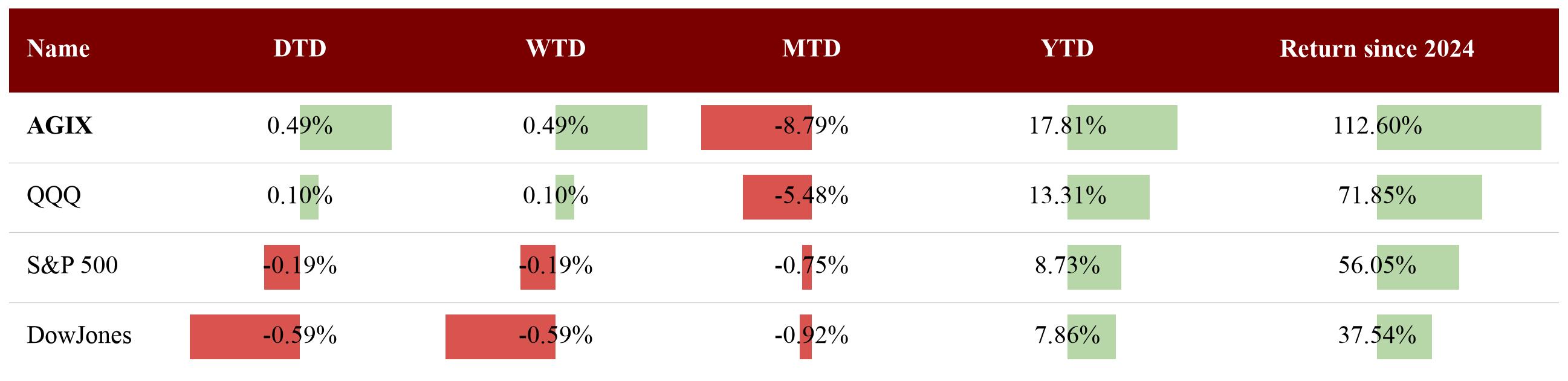
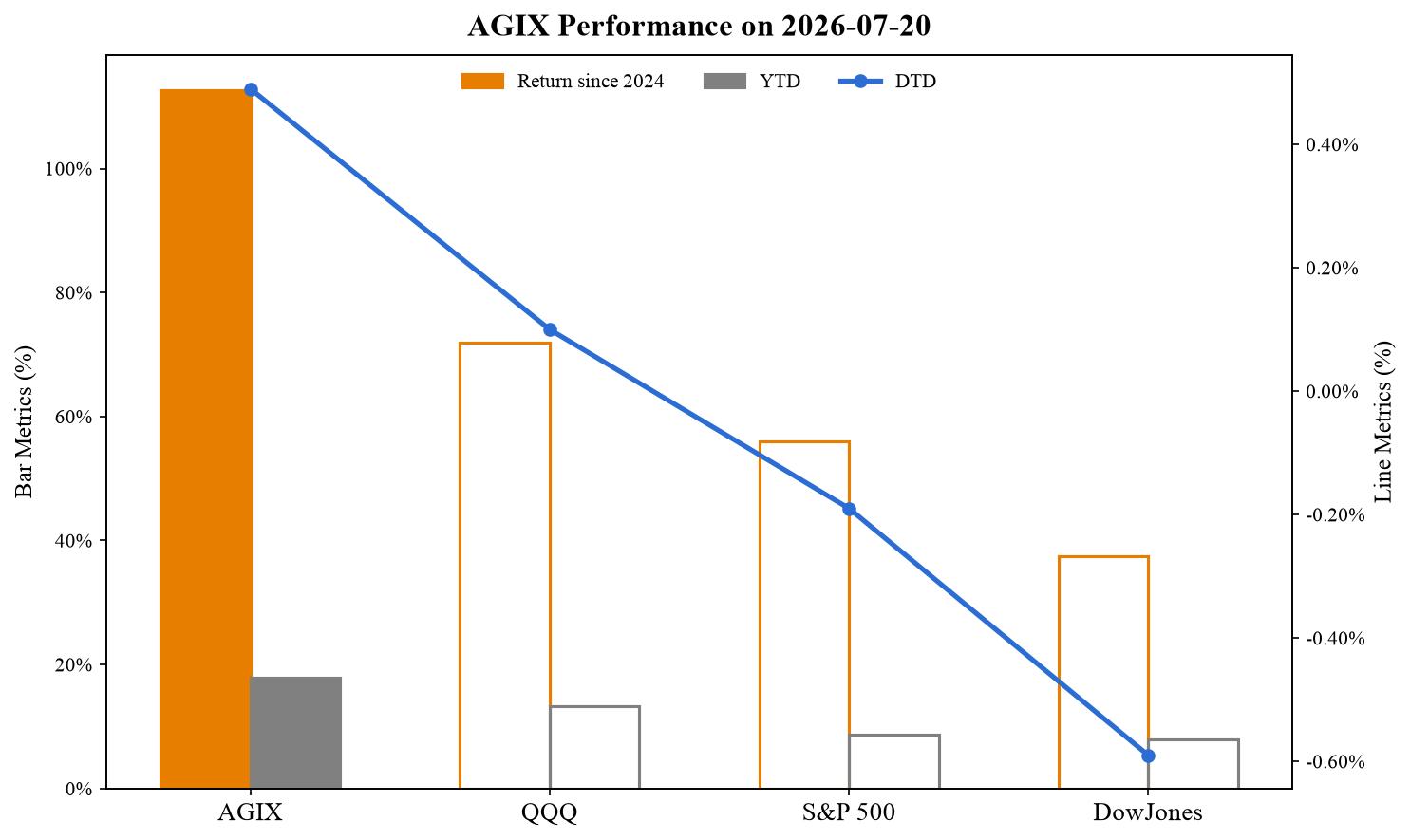
• AGIX gained 0.49% DTD, outperforming QQQ (0.10%), S&P 500 (-0.19%), and Dow Jones (-0.59%). Year-to-date, AGIX is up 17.81%, while QQQ is at 13.31%.
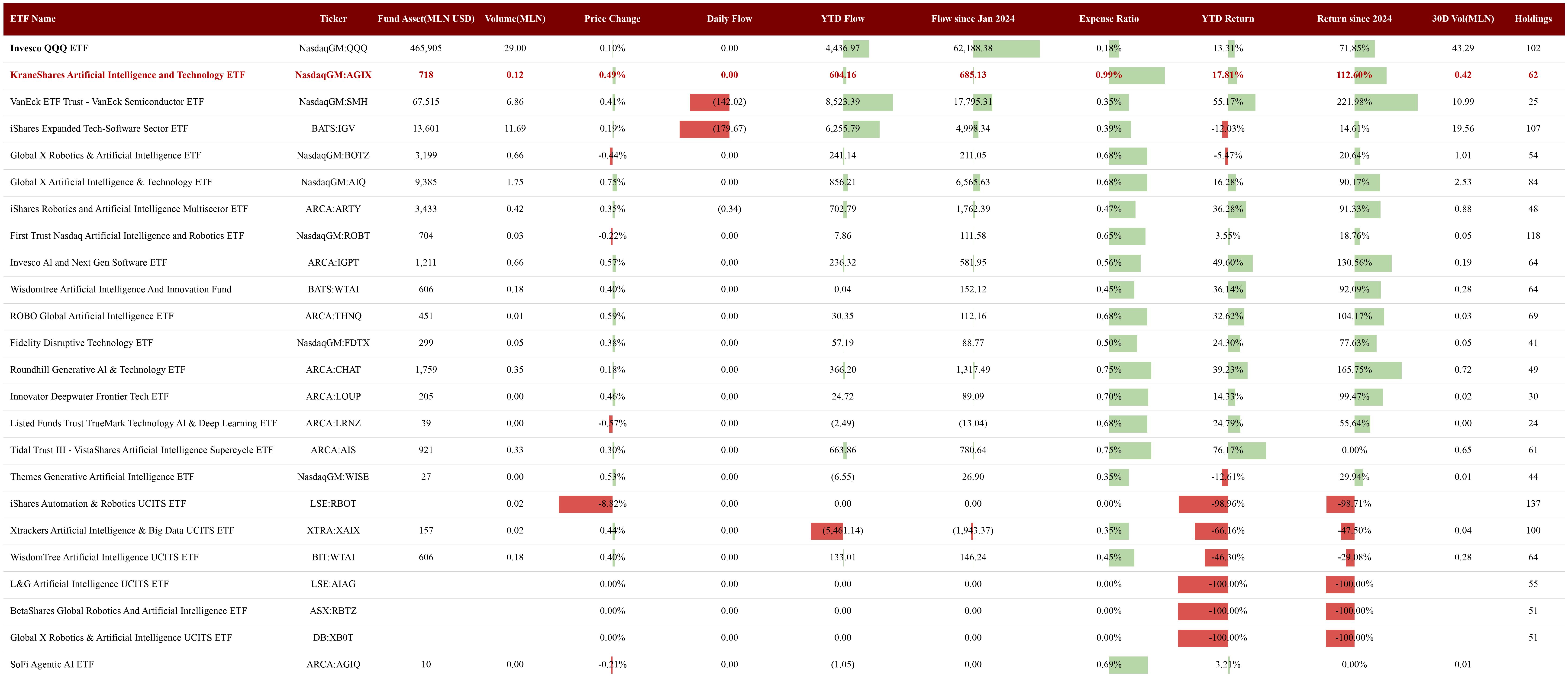
• Among peer AI-themed ETFs, AIQ (+0.75%), THNQ (+0.59%), and IGPT (+0.57%) led the day, while BOTZ (-0.44%) and LRNZ (-0.57%) lagged. SMH rose 0.41% despite a -14.80% MTD.
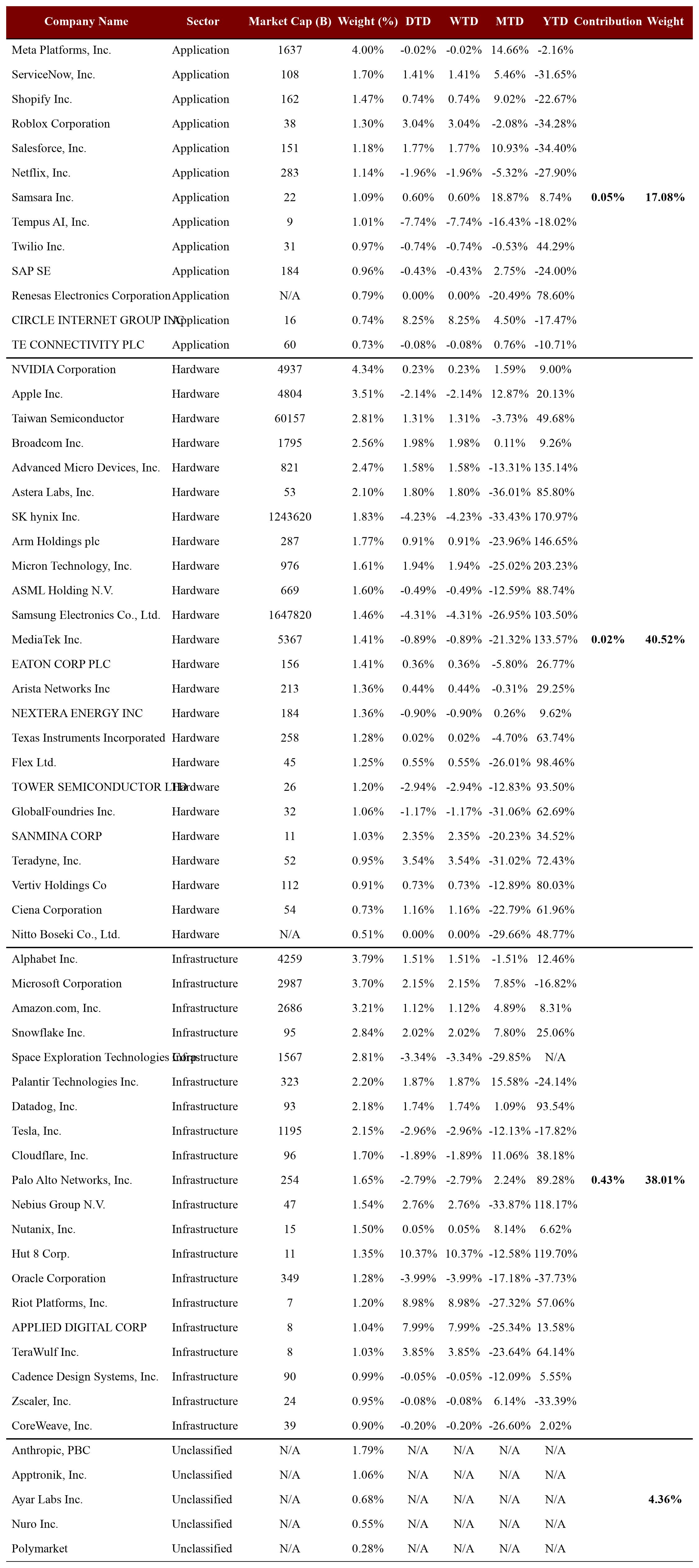
• Key AGIX holdings driving performance: Circle Internet Group (+8.25%) gained after a Buy upgrade and strong preliminary earnings; Hut 8 (+10.37%) surged on a second $9.8B AI data center lease; Applied Digital (+7.99%) rebounded on dip-buying; Riot Platforms (+8.98%) and Marathon Digital (+9.17%) benefited from technical breakouts and crypto-mining sentiment.
• Notable laggards in AGIX: Tempus AI (-7.74%), Samsung Electronics (-4.31%), SK hynix (-4.23%), and Oracle (-3.99%) weighed on the portfolio.
News Highlights
1. Alibaba previews Qwen3.8 with 2.4 trillion parameters, claiming second only to Claude Fable 5. The model is accessible via trial and will be open-sourced. This reinforces competition in open-weight models and may pressure US frontier labs like OpenAI and Anthropic, impacting AGIX's private holdings (Anthropic).
2. YouTube tightens monetization rules on low-quality AI content, categorizing 'non-authentic content.' The policy, effective July 16, aims to protect advertiser interests and could reduce supply of AI slop, potentially benefiting high-quality AI content platforms.
3. Infinity raises $15M at $100M valuation to build CUDA-alternative kernel software for multi-chip AI hardware. The funding from Touring Capital and researchers from OpenAI/Anthropic highlights growing interest in reducing Nvidia dependency, which could affect AGIX hardware holdings like Nvidia and AMD.
4. Natural raises $30M Series A to reinvent payments for AI agents, competing with Stripe. As AI agent adoption grows, this could reshape payment infrastructure and create new opportunities for enterprise AI platforms in AGIX (e.g., Shopify, Salesforce).
5. Neo Security exits stealth with $100M to build secure control layers for enterprise AI agents. With Gartner predicting over 40% of enterprise apps will have agent capabilities by end of 2026, this investment underscores the critical need for AI security, benefiting AGIX holdings like Palo Alto Networks and Zscaler.
RSS Highlights
1. China has nearly caught up with the US in AI, with Moonshot's Kimi K3 model matching top American models and being open-weight. This challenges the business models of OpenAI and Anthropic and may affect AGIX's private holdings.
2. Reverse-engineering is becoming cheap as coding agents automate home device hacking, reducing maintenance costs. This trend could accelerate IoT and smart home adoption, benefiting AGIX hardware holdings.
3. Ben Thompson argues the US should legislate to allow data collection for model training as fair use and ban anti-distillation terms of service to help American open models compete with China. Alibaba's open-weight release of Qwen 3.8 Max may have been influenced by Xi Jinping's push for open source.
4. OpenAI plans to discuss open-source strategy and may release a GPT-3-like model that runs on consumer hardware to prevent competitors from releasing similar models. This could democratize AI access and impact AGIX's infrastructure and application holdings.
Performance & Benchmark
Attribution
Sector contribution within AGIX holdings today
Application: 0.05%
Hardware: 0.02%
Infrastructure: 0.43%
Unpriced private and other holdings weight: 4.36%
Top-performing stocks in AGIX holdings today
Hut 8 Corp. (10.37%)
Riot Platforms, Inc. (8.98%)
CIRCLE INTERNET GROUP INC (8.25%)
APPLIED DIGITAL CORP (7.99%)
TeraWulf Inc. (3.85%)
Teradyne, Inc. (3.54%)
Roblox Corporation (3.04%)
Nebius Group N.V. (2.76%)
SANMINA CORP (2.35%)
Microsoft Corporation (2.15%)
Snowflake Inc. (2.02%)
Worst-performing stocks in AGIX holdings today
Apple Inc. (-2.14%)
Palo Alto Networks, Inc. (-2.79%)
TOWER SEMICONDUCTOR LTD (-2.94%)
Tesla, Inc. (-2.96%)
Space Exploration Technologies Corp. (-3.34%)
Oracle Corporation (-3.99%)
SK hynix Inc. (-4.23%)
Samsung Electronics Co., Ltd. (-4.31%)
Tempus AI, Inc. (-7.74%)
Top five listed stocks contributing the most within AGIX holdings today
Hut 8 Corp. (10.37%)
Riot Platforms, Inc. (8.98%)
APPLIED DIGITAL CORP (7.99%)
Microsoft Corporation (2.15%)
CIRCLE INTERNET GROUP INC (8.25%)
Observation
The strongest movers across peer ETF holdings today are listed below:
| DTD | Stock Ticker | Name | Held by ETFs | analysis |
|---|---|---|---|---|
| 16.97 | NasdaqGS:CIFR | Cipher Mining Inc. | ['BATS:IGV'] | Cipher Mining’s 16.97% gain on July 20, 2026 was primarily driven by a strong research-led narrative shift toward its AI data center and hyperscaler lease business, which reframed the company as a long-term infrastructure landlord rather than a volatile crypto miner.[4][5] The move was reinforced by growing focus on imminent lease revenue from its AWS-aligned 300 MW capacity and a backlog of contracted lease revenues, alongside recent bullish analyst actions and target hikes that kept sentiment strongly positive.[1][3][4] A supportive broader tape, with the NASDAQ and Bitcoin both firm on the day, provided an additional tailwind to this re-rating in a high-beta name.[4][11] |
| 10.67 | NasdaqCM:CLSK | CleanSpark, Inc. | ['BATS:IGV'] | CleanSpark’s 10.67% gain on July 20, 2026 appears primarily driven by renewed enthusiasm around its positioning as an AI infrastructure and Bitcoin mining play, amplified by coverage highlighting “multi‑billion AI investments” and leasing deals that frame the stock as a beneficiary of aggressive AI data center expansion.[8] This move built on recent momentum from the company’s 20-year infrastructure lease agreement with a high‑grade global technology tenant at its Sandersville, Georgia data center campus, which has kept investor focus on long‑duration, contracted infrastructure cash flows.[3] A breakout above near-term technical resistance around the $13–13.25 level likely contributed to follow‑through buying and short-covering as traders played the bullish setup after a prior pullback and consolidation.[1][5][10] |
| 10.37 | HUT | Hut 8 Corp. | ['BATS:IGV', 'NasdaqGM:AIQ', 'NasdaqGM:AGIX'] | Hut 8’s 10.37% gain on July 20 was primarily driven by the announcement of a second 15-year, $9.8 billion AI data center lease at its Beacon Point campus in Texas, which fully commercializes the 1-gigawatt site and doubles the investment-grade tenant’s capacity there.[3][10][4] This deal lifted investor confidence by significantly increasing long-term contracted revenue and visibility into future cash flows, and was reinforced by broader strength in AI infrastructure and crypto-linked equities that supported sentiment toward the name on the day.[3][4][10] |
| 10.02 | 600756.SS | INSPUR SOFTWARE CO LTD-A | ['XTRA:XAIX'] | INSPUR SOFTWARE CO LTD-A’s 10.0% move on July 20, 2026 appears to be primarily technically driven, with no identifiable company-specific news, regulatory updates, or sector headlines released around that date. Public news and press release feeds show no new announcements, and recent trading context from June–early July indicates the stock has been rebounding from the lower end of its 52-week range amid a generally constructive technical backdrop for the name.[2][8][10] Key drivers, ranked by importance: 1) Technical and momentum factors, as the stock has been trading off depressed levels within a wide 52-week range and carries a short-term “buy” technical bias.[2][7][10] 2) Broad sentiment toward Chinese cloud/software and IT services names, with no stock-specific catalyst evident in public disclosures or press coverage.[1][3][6] |
| 9.17 | NasdaqCM:MARA | MARA Holdings, Inc. | ['BATS:IGV'] | MARA’s 9.17% gain on July 20, 2026 appears primarily driven by a strong technical breakout above key resistance levels rather than any specific new fundamental catalyst. The stock closed around $11.67 on heavy volume of roughly 58.9 million shares, decisively moving through an identified resistance zone near $11.39 and a prior technical ceiling around $11.51, which likely triggered momentum and short-covering flows.[8][6] In the absence of fresh company-specific news, the move is also supported by an already bullish sell-side backdrop (consensus Buy ratings and upside to price targets) and MARA’s status as a high-beta, volatility vehicle tied to crypto and “risk-on” sentiment, amplifying technical-driven rallies.[3][7][4] |
| 8.98 | RIOT | Riot Platforms, Inc. | ['BATS:IGV', 'NasdaqGM:AGIX'] | Riot Platforms’ 8.98% gain on July 20, 2026 appears primarily driven by technical momentum, with the stock breaking above key moving averages and resistance levels and attracting trend-following and short-covering flows.[12][13] This move occurred without identifiable company-specific news on the day, suggesting the advance was more a continuation of an existing uptrend in RIOT and broader crypto-mining sentiment than a response to new fundamentals.[8][12] |
| 8.25 | CRCL | Circle Internet Group, Inc. | ['BATS:IGV', 'NasdaqGM:AGIX'] | Circle Internet Group’s 8.25% gain on July 20, 2026 appears primarily driven by a same-day rating upgrade to Buy and $100 target from US Tiger Securities, which highlighted an improving crypto-cycle backdrop, higher-for-longer interest-rate expectations supporting reserve income, and undervaluation at current levels[13]. Secondary support came from the ongoing reassessment of Circle’s regulatory and fundamental profile following its recent OCC approval for a nationally chartered digital asset trust bank and a still-bullish broader analyst target range and Buy/Outperform consensus, which frame the stock as having substantial upside despite prior volatility[10][8]. |
| 8.25 | CRCL | CIRCLE INTERNET GROUP INC | ['BATS:IGV', 'NasdaqGM:AGIX'] | Circle Internet Group’s 8.25% gain was primarily driven by better-than-expected preliminary quarterly earnings and raised full-year guidance, signaling stronger market share gains and disciplined cost control versus prior expectations.[1] A secondary tailwind came from the announcement of a new partnership with a tier-one global distributor that alleviated prior concerns about scaling its technology platform and broadened revenue opportunities, which, together with recent analyst upgrades and technical breakout dynamics, attracted incremental institutional and momentum buying.[1][2] |
| 7.99 | APLD | APPLIED DIGITAL CORP | ['NasdaqGM:AGIX'] | Applied Digital’s ~8% gain on July 20, 2026 appears primarily driven by a sharp gap-up open and strong intraday buying interest following recent downside volatility and profit-taking in the name. Shares opened materially higher ($27.31 vs. prior close $25.79) and traded up on heavy volume, suggesting renewed risk appetite and dip-buying after the stock’s large pullback over the past month and despite some bearish research commentary.[3][4][6] A supportive backdrop of broadly bullish analyst targets and a dominant Buy/Strong Buy consensus likely reinforced the move as investors focused on longer-term AI data center growth rather than near-term valuation and leverage concerns.[3][5][7] |
| 6.97 | NasdaqGS:CORZ | Core Scientific, Inc. | ['BATS:IGV'] | Core Scientific’s 6.97% gain on July 20, 2026 appears primarily driven by ongoing bullish sentiment around its transition from Bitcoin mining toward high-performance computing and AI infrastructure, supported by strong analyst conviction. Multiple sources highlight a “Strong Buy” consensus and substantial upside to target prices, with 15–18 analysts rating the stock a buy and average 12‑month targets implying roughly 50%+ upside from current levels, which likely reinforced dip‑buying after recent volatility.[7][11] A secondary driver is momentum and technical factors: despite mixed technical signals across platforms, short-term ratings skew bullish and the stock has posted strong 1‑month and 12‑month performance, attracting trend-following and speculative flows.[5][8][9] |
| 6.91 | 3896.HK | Kingsoft Cloud Holdings Ltd | ['NasdaqGM:WISE'] | Kingsoft Cloud’s +6.9% move on July 20 was primarily driven by ongoing bullish sentiment around its AI cloud pricing power and sector-wide repricing of AI computing capacity. Earlier in the month, the company announced 15%–50% price hikes on AI computing and 30%–50% increases on storage services effective July 12, which brokers such as Kaiyuan Securities framed as a turning point from cutthroat competition to supply‑demand driven pricing in China’s cloud/AI market, supporting margin and earnings expectations[4]. A secondary driver was continued support from the sell-side, including Citi’s July 16 reiteration of a Buy rating with a HK$9.36 target and a Strong Buy analyst consensus, which reinforced the positive narrative and likely attracted momentum and technical buyers[5][1]. |
| 6.27 | 0268.HK | KINGDEE INTERNATIONAL SFTWR | ['ARCA:THNQ'] | Kingdee International’s 6.27% rise on 2026-07-20 was most likely driven by continued investor reaction to its upbeat July 8 profit warning, which pointed to H1 revenue growth of about 13%–14% and a return to profitability, supported by rapid AI-native product growth and subscription momentum. The move also fits broader market re-rating of AI-enabled software names, as investors have been rewarding software companies with stronger AI-related earnings/guidance. Technical momentum may have added to the gain, but the clearest catalyst was the company’s improved H1 outlook and AI-driven growth narrative. |
| 6.24 | NasdaqGS:AMBA | Ambarella, Inc. | ['LSE:RBOT', 'LSE:AIAG', 'ARCA:THNQ', 'NasdaqGM:AIQ', 'NasdaqGM:ROBT', 'NasdaqGM:WISE'] | Ambarella’s 6.2% gain appears driven primarily by renewed bullish sell-side positioning, including Rosenblatt naming the stock a “top pick” for 2H26 and lifting its price target to $120, which reinforced the AI-edge growth narrative and encouraged dip-buying after recent sector weakness.[1][4] A still-supportive analyst backdrop with a Buy/Moderate Buy consensus and targets implying substantial upside versus the current price likely added follow-through demand.[1][2][3] Broader semiconductor volatility and AI-spending concerns were a headwind at the index level, but AMBA’s stock-specific upgrades and strong prior quarter results helped it outperform the group.[4][12] |
| 5.99 | BMNR | BITMINE IMMERSION TECHNOLOGIES INC | ['BATS:IGV'] | BMNR’s 5.99% gain on July 20, 2026 appears primarily driven by continued momentum and technical buying following its recent inclusion in major Russell indexes and growing recognition as a large-cap, Ethereum-focused treasury play, which has attracted institutional interest and outperformance versus the broader market over the past two weeks.[5][10] Technical factors likely reinforced the move, with multiple daily buy signals and supportive RSI/MACD readings encouraging short-term traders to add exposure.[9][12] No stock-specific news release was identified on the day, so the move is best characterized as follow-through strength on prior index-addition and ETH-treasury narratives coupled with positive technicals. |
| 5.68 | DVLT | Datavault AI Inc | ['NasdaqGM:WISE'] | Datavault AI’s 5.7% gain appears to be a modest technical rebound within a deeply sold‑off, highly speculative trading range rather than a move driven by fresh fundamental news. There were no material company announcements or sector-specific catalysts on July 20, and commentary from major platforms continues to flag the stock as fundamentally risky with a “Strong Sell” technical signal despite a very high implied upside to the $3 consensus target.[2][6] In this context, the move is best explained by short-term trading and mean-reversion dynamics in a low-priced, volatile name that has fallen sharply over the past month and year.[5][7] |
| 5.24 | NasdaqGS:KC | Kingsoft Cloud Holdings Limited | ['XTRA:XAIX'] | Kingsoft Cloud’s 5.24% move on 2026-07-20 appears to have been driven mainly by constructive analyst sentiment, including recent coverage/price-target support that kept the stock’s consensus rating at Buy/Strong Buy levels and implied meaningful upside. A second likely driver is continued enthusiasm around the company’s AI/cloud growth story, which has been highlighted in recent commentary as a key demand catalyst. I do not see a clear same-day company-specific earnings or regulatory news item in the provided sources that better explains the move. |
| 5.21 | ONDS | Ondas Inc | ['ARCA:IGPT'] | Ondas Inc’s 5.2% gain on July 20, 2026 appears primarily driven by defense contract momentum and the evolving DZYNE/Ondas Sentinel growth narrative, which is resetting investor expectations for medium-term revenue and EBITDA. Same‑day commentary highlighted the previously announced $875.8M DZYNE Technologies deal, creation of the Ondas Sentinel defense division, and upgraded FY26 revenue target to at least $525M, alongside over $40M of June orders and >$150M Q2‑to‑date autonomous defense activity, reinforcing confidence in the backlog and pipeline.[1][6] A secondary driver is positive sell‑side and market sentiment, with Needham reiterating a Buy rating despite trimming its price target, and consensus 12‑month targets implying significant upside, which likely supported incremental buying on a strong‑story defense/autonomy name despite broadly negative technical signals.[1][5][13] |
News
Funding & M&A
AI materials science startup CuspAI raises $450M in funding
CuspAI Ltd. announced the completion of a $450 million Series B funding round, valuing the company at $2.6 billion. The round was led by Kleiner Perkins and NEA, with participation from Bezos Expeditions and other institutions. CuspAI also launched the AI Materials Foundry research alliance, joined by 45 tech giants including Nvidia, Samsung, and Meta. The alliance will leverage its MIRA platform to accelerate new material discovery, using Meta's open-source UMA model and its self-developed kUPS tool to shorten the traditional multi-year research cycle to six months. CuspAI will use the new funds to expand its international business and address global industrial demand for new materials.
Neo Security bags $100 million to build the secure control layer for enterprise AI agents.
Agentic software security startup Neo Security Inc. has recently exited stealth mode and announced a $100 million funding round. The round was led by Andreessen Horowitz and Bessemer Venture Partners, with participation from Craft Ventures, Merlin Ventures, and others. Neo was founded by former executives from SentinelOne, Wiz, and Palo Alto Networks, and focuses on building a security control layer for autonomous AI agents. As enterprise AI agents rapidly expand into browsers, SaaS platforms, and traditional software, the attack surface continues to grow, and traditional security systems struggle to adapt. Gartner predicts that by the end of 2026, over 40% of enterprise applications will have agentic capabilities. Neo provides real-time asset visibility, risk intelligence, behavior attribution, and granular policy control to help SecOps teams manage AI agents with visibility. The funding will be used to expand engineering and marketing teams, helping enterprises transition quickly and securely to the agentic AI era.
Inference startup Infinity raises $15 million from Touring Capital, OpenAI and Anthropic researchers.
AI infrastructure startup Infinity announced on Monday that it has completed a $15 million funding round at a $100 million valuation, with investors including Touring Capital, Principal VC, and researchers from institutions such as OpenAI and Anthropic. The company is developing universal kernel software designed to run models seamlessly on multiple AI chips, challenging Nvidia's dominant CUDA ecosystem. Infinity was founded last year by former Google Brain researcher Jeremy Nixon, and its core product Ignition can automatically write, test, and optimize low-level code, supporting various architectures such as SRAM, GPU, and mobile chips. Customers already include AI chip manufacturer D-Matrix, and the company is in negotiations with multiple chip and cloud service providers. The company adopts a revenue model based on performance improvement sharing, and currently has about 26 employees.
AI's most important protocol is getting a little bit easier to use
Arcade, a two-year-old AI infrastructure startup, provided a detailed explanation of the upgrade to the Model Context Protocol (MCP). This protocol is a foundational building block that allows AI models to securely access external data sources and services. The latest version will improve session ID handling, shifting from a stateful to a stateless architecture, enabling multiple servers behind a load balancer to support large-scale deployments without needing to synchronize session information. After securing $60 million in funding this month, Arcade emphasized that AI agent failures often stem not from model capabilities but from inadequate infrastructure. This protocol adjustment can significantly reduce the operational costs of enterprise-level MCP servers, encouraging more enterprises to deploy first-party MCP integrations. Although model training is advancing rapidly, standardized infrastructure still requires systematic negotiation.
Inference startup Infinity raises $15M from Touring Capital, OpenAI and Anthropic researchers
AI infrastructure company Infinity announced on Monday that it has completed $15 million in funding at a $100 million valuation, with investors including Touring Capital, Principal VC, and researchers from OpenAI and Anthropic. The company is developing CUDA alternative kernel software that can adapt to multiple AI chips, aiming to lower the barrier for developers to migrate applications to non-Nvidia hardware. Its AI research agent, Ignition, can automatically write, test, and optimize low-level code, taking a cut based on performance improvements and cost savings. Customers already include AI chip maker D-Matrix, and the company is in talks with several chip and cloud service providers. Founded last year by former Google Brain researcher Jeremy Nixon, the company currently has 25 employees. This funding round will advance Infinity's software layer for multi-architecture AI hardware.
On theCUBE Pod: IBM’s AI test, Nvidia’s lead and the race for enterprise intelligence
AI companies are competing to control the infrastructure, data, and software layers that power enterprise intelligence. Nvidia continues to lead the accelerated computing market with its GPUs, networking, and software, expected to hold 75% to 73% market share. AMD is rapidly expanding its infrastructure capabilities through acquisitions of Xilinx, Pensando, and ZT Systems, intensifying competition. Broadcom seeks differentiation through custom chips and networking businesses. IBM's stock decline reflects its mainframe and legacy products being out of step with the AI wave; despite owning assets like Red Hat and watsonx, it lacks a unified intelligent system. Analysts point out that future enterprise competitiveness will come from converting proprietary data into a reasoning and actionable 'enterprise brain.' Companies like Databricks and Snowflake are already building such systems. As cost control centered on token efficiency and agent workflows emerge, the integration of data, models, and applications above the infrastructure layer will become the core of the next phase of competition.
Hyve acquisition positions RAISE Summit for global expansion
UK-based Hyve Group has completed the acquisition of Chain of Events, a deal that will drive the rapid international expansion of events such as RAISE Summit, Paris Blockchain Week, and MACHINA. Chain of Events founders Charlie Meraud and Michael Amar stated that after the acquisition, they will leverage Hyve's technical capabilities to improve attendee networking and deal-making efficiency, and replicate the event format across multiple regions in the US and EU. Both parties will maintain independent editorial content but can share global resources and technical support. The RAISE Summit is expected to double in size next year, while the MACHINA robotics summit will expand three to four times. The two events will be co-hosted with Hyve's Fintech Meetup during the week of July 6, 2027. After the acquisition, the team will increase hiring in multiple locations to achieve synchronized growth.
Model Releases
Alibaba previews Qwen3.8, claims it’s second only to Claude Fable 5
Alibaba Group previewed its latest Qwen model, Qwen3.8, at the World Artificial Intelligence Conference in Shanghai, claiming it has 2.4 trillion parameters and supports multimodal input, second only to Anthropic's Claude Fable 5. This release, coming just three days after Beijing Yueshe AI Technology launched its 2.8 trillion parameter Kimi K3, marks the official entry of Chinese companies into the multi-trillion parameter level. However, Alibaba did not provide any benchmark data or model cards, and the previous Qwen3.7-Max performed only moderately on third-party leaderboards. The model is currently accessible via the Token Plan subscription at a trial price, with a promise to open-source the weights. This move is a key part of Alibaba's push to establish itself as China's default AI provider.
Technical Breakthroughs
ShelterZoom subsidiary Mithra launches AI ‘trust infrastructure’ platform
ShelterZoom, a U.S. blockchain and document security company, has officially launched the Mithra AI product through its subsidiary Mithra Technologies. The platform does not replace existing enterprise large models but instead encrypts and verifies content and checks permissions at the data input stage, using a single source of truth cryptographic storage mechanism to trace data origin. This technology can seamlessly integrate with mainstream models such as OpenAI, Anthropic Claude, Google Gemini, Microsoft Copilot, and SpaceX Grok, and supports multiple deployment methods including API, SDK, and OEM. Its blockchain-based post-quantum encryption effectively reduces hallucinations and prevents unauthorized data inflow. It is currently adopted by industries with high privacy requirements such as healthcare, government, finance, legal, and education. Early users include organizations like Conscience IQ and Sage Matters. Mithra AI is now open for registration and use.
Adobe camera app’s new feature will critique your photos using AI
U.S. software giant Adobe is rolling out several new AI-powered features in its experimental iOS camera app, Project Indigo. The app already supports multi-frame super-resolution and professional controls, and now adds large language model-powered photo comments, shooting suggestions, and editing guidance. New features also include advanced object removal, virtual depth scene generation, and various style transfer effects, with users able to get deterministic results by pressing a button. Former Google Pixel camera lead Marc Levoy is heading the project, which uses the Google Gemini Nano Banana model. This update shifts focus from prompt-based editing to visual button functions, helping users improve their photography skills. The feature is still in beta and only available to select users.
Google is working on a new AI chip designed to make Gemini more efficient.
Alphabet is designing a new internal server chip called 'Frozen v2,' which is expected to launch in 2028 and deliver 6 to 10 times the efficiency of current AI chips. This move aims to improve the operational efficiency of Gemini models, reduce reliance on Nvidia chips, and address the global AI computing shortage. Other AI companies like OpenAI and Anthropic are also advancing their own chip plans. This technological breakthrough has boosted investor confidence in Alphabet's $18 to $19 billion AI spending, with the stock rising 3% after the report. The company says it is optimizing performance through hardware and software co-design to address market concerns about AI costs.
Product Launches
X relaunches a rebuilt Android app after year-long effort
X platform previously announced a comprehensive rewrite of its Android app, and after nearly a year of development, the new version officially launched on Monday. The app was rewritten from scratch, achieving significant improvements in core experiences such as loading speed, scrolling feed interface, and notification push. X product lead Nikita Bier stated that this project is one of the largest engineering projects in the company's history, and the new version will provide faster support for future feature iterations. This upgrade is expected to boost activity in overseas markets dominated by Android and lay the groundwork for the rapid rollout of new features like X Money and X Chat. Users can now update via the Google Play Store.
Policy & Regulation
Hugging Face uses open-weights Z.ai GLM 5.2 to battle attacker after commercial frontier model refusal.
Open-source AI platform Hugging Face recently suffered an autonomous AI agent attack, where using a commercial frontier model for log analysis was rejected due to overly sensitive security guardrails. To quickly complete log analysis and security detection, the company switched to using Chinese open-source weight models GLM 5.2 and Kimi K3 for local deployment analysis. These models maintain advanced reasoning and code generation capabilities while avoiding invalid responses caused by excessive false positive guardrails in commercial models. After the incident escalated, White House AI advisor David Sacks pointed out on X platform that excessive security rules make US models uncompetitive in real security tasks, and hinted that Chinese open-source models may be added to the entity list. Meanwhile, Chinese President Xi Jinping called for global AI cooperation at the World Artificial Intelligence Conference, opposing the overextension of national security concepts into the AI field. The incident shows that open-source weight models are increasingly favored by enterprises in practical security applications, but competition between the US and China over AI model security and business rules will also intensify.
YouTube clarifies policies around AI slop and upsetting videos
YouTube recently updated its content moderation policies, further tightening monetization restrictions on low-quality AI-generated content. The new rules categorize 'non-authentic content' into three types: first, templated, repetitive, or low-creativity videos; second, content designed to manipulate emotions or cause discomfort; and third, videos using AI-generated digital humans to discuss sensitive topics like finance or healthcare. Channels that heavily feature such content will be barred from joining the YouTube Partner Program (YPP) to earn ad revenue. YouTube emphasizes that this move aims to combat content farms, encourage truly creative high-quality content, and protect platform user experience and advertiser interests. The policy takes effect on July 16 and applies to all creators.
Trump's latest AI czar has already resigned
The U.S. AI Standards and Innovation Center CAISI is currently facing severe management turmoil. The agency is responsible for AI model technical standard setting and cybersecurity assessment, but its chief Chris Fall recently resigned. Fall took office three months ago, and his predecessor Collin Burns was also transferred due to his background at Anthropic. Previously, White House AI and crypto capital official David Sacks resigned in March. CAISI was not included in the latest "Gold Eagle" AI safety monitoring plan, while Anthropic models Mythos and Fable were temporarily banned due to export controls. Google DeepMind CEO Demis Hassabis is pushing for the establishment of an independent industry standard system, and China's Moonshot Kimi model, as well as Z.ai and DeepSeek's open-weight models, have attracted significant attention. CAISI's released evaluation report on Chinese models has sparked industry discussion, and the transparency of its evaluation process still needs improvement.
OpenAI is scared of open-weight models. Should the US be?
The release of Kimi K3, the largest open-weight model from Chinese lab Moonshot, has sparked intense discussion in the US AI community. OpenAI's head of strategic futures once suggested that the US government use regulatory measures to create fear to protect investments in closed models, but that argument was quickly retracted. According to Axios, the Trump administration is considering banning advanced Chinese models like K3, while Politico reports that the Commerce Department currently has no such plans. Supporters argue that open-weight models can reduce usage costs and accelerate innovation but may squeeze profits of frontier labs like OpenAI and Anthropic. US companies have already been found using Chinese models to bypass safety guardrails. Experts recommend maintaining US leadership through chip export controls rather than directly banning models, and urge the government not to politicize open-source technology.
Industry Partnerships
Watch Flock Safety CEO Garrett Langley discuss the future of surveillance at TechCrunch Disrupt 2026
Flock Safety has sparked debate over privacy and public safety in the AI surveillance space. Founded by Garrett Langley in 2017, the company primarily provides license plate recognition and surveillance systems, serving commercial clients and law enforcement agencies. It recently raised $275 million in funding, reaching a valuation of $7.5 billion, with cumulative funding exceeding $950 million. However, the company has faced opposition from the ACLU and the public for providing data to ICE, even leading to device destruction incidents. Additionally, the termination of its partnership with Amazon Ring and the expiration of its contract with the LAPD have posed challenges. Langley will discuss the future boundaries of AI and surveillance at TechCrunch Disrupt 2026.
Microsoft will use AMD's AI-optimized Helios racks in Azure
Microsoft and AMD announced a deepening of their strategic partnership, adopting AMD's upcoming Helios rack design and Instinct MI455 GPU to provide computing power support for Azure services. The Helios reference design integrates 72 MI455 GPUs, equipped with 432GB HBM4 memory and CDNA 5 architecture, supported by Pensando DPU and Venice series Epyc CPUs. Microsoft also launched three new Azure instance families based on AMD chips: the ND MI455X v7 series for AI inference, the HDv2 series for CPU-based AI data preparation, and the HXv2 series optimized for EDA and high-performance computing. The two companies will also jointly optimize the Azure Boost virtualization acceleration technology. This partnership marks the full deployment of AMD's full-stack AI solution on the Azure platform, which is expected to significantly improve cloud-based AI training and inference efficiency while reducing infrastructure operating costs.
融资收购
Natural raises $30 million to reinvent payments for AI agents — and take on Stripe.
Startup Natural leads a funding round with a $30 million Series A, bringing total funding to $40 million. The company is rebuilding payment infrastructure to enable AI agents to autonomously make payments, receive payments, and conduct cross-agent transactions. Its founder Kahlil Lalji previously founded Ivella, which was acquired by Earnin, and is now developing the new business with colleagues and a former Nextdoor engineer. Forerunner founder Kirsten Green leads the investment. Natural will compete with Stripe, as well as companies like Skyfire Systems that use stablecoins. The company plans to support both stablecoin and traditional bank transactions. Lalji expects AI agents to increase the volume of payments by tens of times. The company has already attracted senior talent from Stripe, Ramp, and Square.
RSS Subscription
Expensive Is Just a Brand Now
Nowadays, price is no longer a reliable indicator of quality. Many high-priced and low-priced products may come from the same production line, and brand influence is the key factor determining price. When choosing products, consumers should rely more on reviews from others rather than simply judging quality by price.
My falling-out with the rationalist community
The author reflects on their relationship with the rationalist community, pointing out that after experiencing multiple scandals, the community has gradually revealed issues of bias and selective argumentation. Although rationalists claim to pursue truth, their analyses often become post-hoc justifications for their own preferences, leading to ethical controversies in movements such as effective altruism. The author felt disappointed in their interactions with the community, believing that the internal debates and biases contradict its proclaimed rational ideals.
Stealth Startup Spy #358
Multiple former engineers from Google, Meta, and AWS are secretly developing new projects, including an AI-native game tool and a compiler for agent-run workflows. Currently, new startups and founders are emerging continuously, and relevant information can be obtained in real time through the newly launched Company Launch Tracker.
China has all but caught up. The US is not going to “win” the AI war. Here’s what we should do instead.
China has nearly caught up with the United States in the field of artificial intelligence. Recently, the Kimi K3 model launched by Chinese company Moonshot.AI is on par with top American models and is an "open-weight" model available for free download by consumers. This development has triggered a decline in the U.S. stock market and poses a serious challenge to the business models of OpenAI and Anthropic, potentially affecting their initial public offerings (IPOs). The United States needs to reassess its strategy in AI and consider how to respond to China's rapid rise.
Volume to Area ratio for Regular Solids
The ratio of the volume of a sphere to its surface area is r/3, where r is the radius of the inscribed sphere. This ratio applies to all regular solids, although the relationship between edge length and radius is more complex for different solids such as cubes, tetrahedra, octahedra, dodecahedra, and icosahedra. This theorem also holds for spaces of dimension higher than three; the ratio of the volume of an n-dimensional regular solid to the (n-1)-dimensional volume of its boundary is r/n.
Solving a chess puzzle with Grok 4.5
I tried using Grok 4.5 to generate SWI Prolog and Lean 4 code to solve a variant of the n-queens problem, successfully placing 5 white queens and 3 black queens on a 5×5 board, ensuring that queens of different colors do not attack each other. The Prolog code generated by Grok 4.5 correctly listed 8 solutions, while the Lean 4 code also ran successfully after the third attempt, showing better performance than before.
Making an agile version of a Windows Runtime delegate in C++/WinRT, part 1
This article discusses how to make agile versions of Windows Runtime delegates in C++/WinRT.
OpenTK: now also with Internet consultations & notifications
Since 2024, OpenTK has been providing internet consultation and notification services, aiming to display the dynamics of the Dutch Second Chamber in real time and send relevant email notifications to users. New features include integrating internet consultations, allowing users to search for specific topics to obtain the latest draft legislation and consultation information, enhancing public participation and transparency.
Public Transport - Don't Make Me Think!
Over the past year, I have used public transportation in multiple cities and found the ticketing process complex and confusing. The free public transport experience in Basel, Switzerland, was the most ideal, as the BaselCard provided by the hotel freed me from worrying about tickets; while Milan, Italy, simplified the process with contactless payments. In contrast, the ticketing method in Paris was cumbersome, requiring downloading multiple apps, resulting in a very poor user experience. Overall, an ideal public transport system should be simple and easy to use, reducing users' cognitive load.
The MCI Worldcom merger, bankruptcy, and scandal
On November 4, 1997, MCI merged with Worldcom for $37 billion in an attempt to compete with AT&T, but ultimately led to bankruptcy on July 21, 2002, becoming the largest bankruptcy in history at that time. After the merger, Worldcom, due to concealing financial problems and accounting fraud, eventually admitted to inflating assets by more than $11 billion, becoming the largest accounting fraud case in U.S. history.
Why I Stopped "Creating Content"
The author reflects on the prevalence of the term "content creator," arguing that in a commercial environment, many people use a term that does not accurately describe the nature of their work. He mentions that Michelangelo's David evokes a far stronger reaction in a museum than modern social media content, emphasizing the true value of creation. He suggests that people should reconsider the terms they use and encourages them to adopt more fitting vocabulary to describe their work.
[Sponsor] WorkOS MCP: Manage Your Auth Platform From Any AI Agent
WorkOS has launched a Remote Management Control Panel (MCP) server that allows AI agents to manage WorkOS accounts as if a user were logged into the dashboard. The server connects via OAuth, inheriting the user's roles and permissions, and supports hundreds of operations including organization management, SSO connections, and user role management, while ensuring security and preventing sensitive information leaks. Team administrators can flexibly control MCP access to accommodate different risk tolerances.
Reverse-engineering is cheap now
On July 20, 2026, more and more people are using coding agents to reverse engineer and automate home devices, reflecting the decreasing cost of writing code. In the past, although reverse engineering was possible, the high maintenance costs and low returns discouraged many from trying. Now, coding agents make it easier to implement simple automations and significantly reduce the future maintenance burden.
Who’s Afraid of Chinese Models?
On July 20, 2026, Ben Thompson proposed that the United States should legislate to clarify that data collection for model training constitutes fair use, and prohibit terms of service that ban distillation, in order to help American open models compete more effectively with China. Additionally, Alibaba's decision to release Qwen 3.8 Max with open weights may have been influenced by Xi Jinping's recent remarks emphasizing the need to seize historical opportunities to promote open source and sharing.
‘Who’s Afraid of Chinese Models?’
In a Kellogg School of Business course, the professor emphasized that the course goal is to reveal universal principles applicable across industries, rather than focusing on specific sectors. With the development of AI technology, marginal cost has come back into focus, especially in discussions of open-weight models. Although these models appear "free," the actual cost of running inference is directly tied to revenue. Nvidia CEO Jensen Huang pointed out that generated tokens are not commodities; tokens from different models vary significantly in cost and efficiency, ultimately affecting the economic value of intelligence.
Quoting Sam Altman
OpenAI plans to discuss its open-source strategy at the upcoming board meeting and hopes to soon release a language model with capabilities similar to GPT-3 that can run locally on consumer hardware, in order to prevent other companies from releasing similarly powerful models.